




E Dr. David Watts (Hon. Vice President),
D
27 Raydean Road, Barnet, ENS 1 AN.
IT Andy McConnell,
0 21 The Landgate, Rye, East Sussex, TN3 I
7PA
R Henry Fox,
S
20 Ockford Road, Goda [ming, Surrey, GU7 I QY.
No. 104
r)
SEPT.
0 0 5
Web site, www.glasseirele.org
E-mail, dew@daroben.demon.co.uk
GLASS CIRCLE NEWS
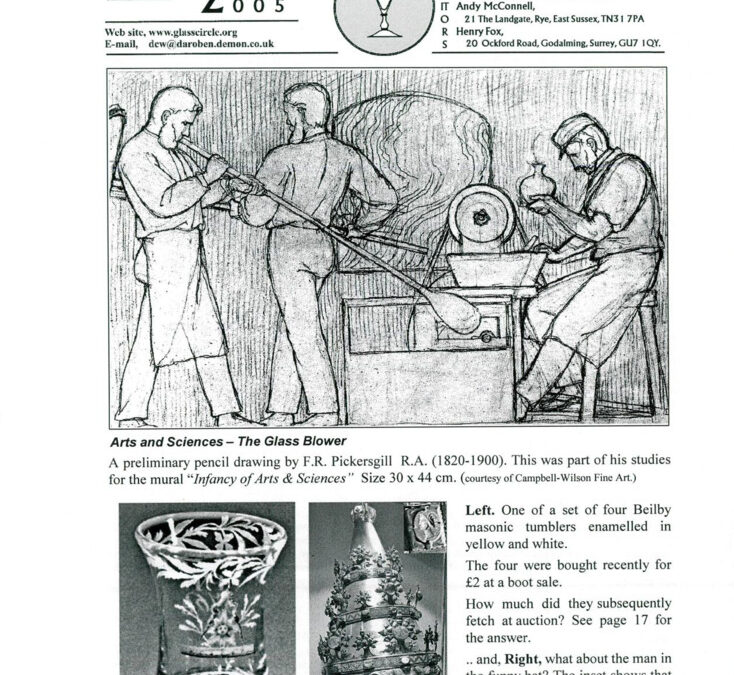
Arts and Sciences — The Glass Blower
A preliminary pencil drawing by F.R. Pickersgill R.A. (1820-1900). This was part of his studies
for the mural
“Infancy of Arts & Sciences”
Size 30 x 44 cm.
(courtesy of Campbell-Wilson Fine Art.)
Left.
One of a set of four Beilby
masonic tumblers enamelled in
yellow and white.
The four were bought recently for
£2 at a boot sale.
How much did they subsequently
fetch at auction? See page 17 for
the answer.
.. and,
Right,
what about the man in
the funny hat? The inset shows that
one stone in the lowest band of the
“crown” has been recycled from a
signet ring or a seal. Find out more
about this piece and the problem it
poses on page 14.
Left.
A goblet made
from London garden
clay by the Editor.
Ht. c. 9.5 cm.
Below.
Melting charac-
teristics of lead and
soda glass compared.
Note that the viscosity
is a log scale so that
each division repre-
sents a tenfold increase
from the one below.
The grey area repre-
sents a viscosity range
of 10,000 times. While
soda glass is hardly dif-
ferent from lead glass
at 1000
°
C. it is about 20
times more viscous at
625
°
C as indicated by
the vertical dotted line.
EAD
GLASS
F
USES
SODA
GLASS
SILICA
WM
500
600
700
800
900
1000
1100
1200
130
Temperature, degrees C
reasonably accurate pyrometer was reputedly invented by
John Northwood in the late-19
th
century. So, glass
technologists prefer to talk about the
Softening Point,
a
temperature just above that at which a glass is annealed,
usually in the range 450-600°C. The
Softening Point
there-
fore corresponds roughly to the very bottom of the
Working
Range,
typically around 700°C for soda and 635°C for lead
crystal.
A further variable is the rate at which soda and lead glasses
cool. Lead glass, due to its higher density, loses heat more
slowly than soda glass. So, the
Working Range
of lead glass
is clearly longer, giving the glassmaker more time to
perform his manipulations.
A small practical point; if you are watching a glassblower
at work and he happens to snip off an attractive oddment of
glass, as sometimes happens, take care if you are tempted to
15
14
13
12
11
•
10
0
9
A4
–
t9
O
8
C.>
>
C17
O
6
5
4
GLASS CIRCLE NEWS No. 104, 2005
Editorial
Mastering Materials
A small area of my garden, rich in London clay, has a
consistency that varies between concrete and a quagmire
depending upon the weather. So, in a fit of manic
enthusiasm I decided to dig out the surface and replace it
with a more amenable loam.
Whilst digging away, my thoughts turned to the age-old
problem as to whether glassmaking had its origin in pottery
or metallurgy. At that moment, my shovel was piled high
with a raw clayish goo shouting to be investigated. Having
stirred a rich sample in a bucket of water I allowed the
sludge to settle for several days and the clay to form a layer
on the surface. Once the clay had been skimmed off, it took
several more days in the hot June sun to reach a workable
consistency.
My first discovery was that, like glass, clay has a limited
working range. For clay, it relates to its water content. An
initial attempt at moulding my clay resulted in it
resolutely refusing to separate from my fingers, and when
left exposed to dry in the sun the clay cracked and would
not hold its shape. My ultimate achievement is shown
above. Perhaps London clay is not the best in this respect!
Regarding glass, the
Working Range
is defined technically
by the temperature difference between the moment when
the glass becomes workable (the
Working Point)
and when
it ceases to be workable. Workability is measured in terms
of
Viscosity,
the
Working Point
being log 4 units of
viscosity. Workability ceases at log 8 units. This represents
a 10,000-fold increase in viscosity’ as shown by the grey
area on the graph. While soda glass ceases to be workable
at about 790°C, lead glass can be worked down to around
625°C.
From a glassmaking perspective, the
time
spent making a
particular piece does not take into account the
rate
at which
the glass cools. The graph demonstrates that the
Working
Point
for soda glass is just over 1000°C while that for lead
crystal is about 50°C lower. In other words, the higher the
Working Point
the more rapid the cooling, and for this
reason soda glass is called “short” while lead glass is
“long”. However, the glassmaker, considering all aspects of
his metal from a purely practical viewpoint, is more likely
to call it sweet-natured or short-natured according to how
well it handles.
Technical glass books, of which I have several, are not very
illuminating in understanding such matters. Whilst
soda/potash glasses have been subject to intensive study,
strangely, our much-favoured lead crystal hardly gets a
look-in. Further, the
Working Point
barely merits a
mention, probably because most of the glasses studied by
technological institutes appear to have been studied on a
small, technical scale rather than on a commercial one.
A further problem is that the hot end of a melting curve is
much more difficult to measure accurately. The first
. . . . The views expressed in GC News are those of its contributors ….
2
GLASS CIRCLE NEWS No. 104, 2005
pick it up; it can remain considerably hotter than boiling
point for several minutes.
The reason it is difficult to understand how glass behaves is
that, unlike most other substances, it does not have a clearly
defined melting or boiling point. We all know that pure
water melts at exactly 0°C and boils at 100°C. The melting
point of sugar (sucrose) is 185°C and for solid oxygen it is
minus 218.4°C. During the transition from one state to
another, solid to liquid or liquid to vapour, the temperature
remains constant so it is very easy to measure. However,
glass being an amorphous mixture has smooth curve with
no discontinuity as the graph shows.
Nevertheless, glass does have a so-called
Transformation
Temperature,
a region at which it
tends
to crystallise and
change from liquid to solid. This can cause a problem when
the transformation temperature coincides with the working
point and crystals begin to form while the molten glass is
still in the pot, especially when it is held for relatively long
periods of time as has happened in the past during industrial
conflicts. The result is that the glass objects made from it
will be prone to crizzling and devitrification.
In the past, glassmakers were unaware of the nature of this
problem and had to overcome it by luck or trial and error.
During the early 20
th
century, the soda glass used to make
window glass by the vertical drawing process, developed
by the Belgian E. Fourcault, was found to be optimal for
drawing into sheets at its Transformation Temperature,
causing considerable problems of devitrification? This is
probably why so much attention was devoted to the subject
in the text books of the period.
The problem was finally overcome in the early 1950s by Sir
Alistair Pilkington’s Float Process. This fuel-efficient
method, managed to combine cheap materials with good
working properties to achieve a satisfactory end-product, a
remarkable achievement.
Historically, the styles produced by glassmakers in differ-
ent geographical regions were largely dictated by the prop-
erties of glass metal they used. For instance, the quick-
setting properties of soda glass, as favoured in Venice, were
particularly suited to the lightweight, thin-walled vessels.
Conversely, lead-glass took far longer to cool and stabilise.
As a result, early English glassware tended to be more
laborious to make and heavier, both stylistically and physi-
cally. In Central Europe, where the quicker setting chalk-
potash was favoured, one reads about how many more
glasses a glassmaker could make in a “move” compared
with his English counterpart using full lead crystal.
The slow cooling rate of lead-glass also creates problems
when it is press-moulded. Some years ago I watched heavy
lead glass ashtrays being pressed at the Val St-Lambert
factory in Belgium. After pressing, each piece had to be left
for 10 or 15 minutes before it could be ejected from the
mould without risk of being deformed. This is the reason
why glassworks had to employ several moulds for each
particular pressed piece, and possibly explains why only
some examples may bear its maker’s mark or logo.
During my visit to Val St-Lambert, the workers were press-
ing sets of four souvenir dishes each with a different central
floral design. Each mould was used in sequence, the
previous pressing in that mould only being turned out
immediately before the mould went back into the press.
Considerable research was devoted to discovering more
suitable forms of glass for pressing during the 19
th
century.
A barium-based glass, introduced around the turn of the
20
th
century because of its quick-setting properties, is
described by H.S. Powell of Whitefriars in the 1902, 10th
edition of the Encyclopaedia Brittanica.
Some years ago, the International Glass Centre at Brierley
Hill, near Stourbridge, experimented with the use of barium
glass rather than lead crystal in order to avoid the cost of
installing lead extraction filters to meet new Health and
Safety regulations. However, its quicker setting properties
made it unsuitable for teaching hand-working so lead glass
had to be retained.
Ceramic makers do not have these problems to contend
with. However, the need to dry pottery slowly does
compare with the similar necessity to anneal glass, both
operations being required to prevent cracking. The origin of
annealing is unknown, but it may be that the glassmaker
learned a trick here from his pottery counterpart.
My clay goblet dried successfully but I fear it would
probably explode in the oven if I tried to fire it, otherwise I
would fill it with wine to toast the achievements of the old
glassmakers. However, if any members care to send me a
photo of a goblet they have made using only materials dug
out of their garden I will be delighted to include it in a
future Glass Circle News.
Fusing Silica
The graph opposite also includes part of the curve for pure
silica and it can be seen that it has hardly even begun to
soften at the temperature when glass is molten. In fact, a
temperature of around 2000°C is required. So how is this
achieved? The story of how it was done is given on p. 12.
Notes
1.
The unit of viscosity, originally called a
Poise
is
now
0.1 of
a
Pascal sec
in SI units. Thick oil has a viscosity of about 1
Poise and water at room temperature about 0.01 Poise.
Molten glass is about 100 Poise and at Log 4 (the Working
Point) about 10,000 Poise. Log 8 is 100,000,000 Poise.
(KG. Pfaender,
The Schott Guide to Glass).
2.
Incidentally, the Fourcault process was patented exactly
100 years ago as I write (2004), although not put into com-
mercial practice until 1913. Subsequently, the American
firms of Libby Owens and the Pittsburgh Plate Glass Com-
pany developed their own improved versions of the process
said to overcome the devitrification problem. These develop-
ments made cheap window glass available for mass hous-
ing and horticulture, in particular. It took the manufacture of
window glass away from hand blowing into the machine age
and became a major industry. *
3
GLASS CIRCLE NEWS No. 104, 2005
Glass Circle Matters
Remembering Hugh Tait
Our Hon. Vice Presidents send their appreciation and memories
From
Paul Perrot
Sarasota, Florida
I have received the news of Hugh Tait’s death with deep sorrow. It has been over thirty years since I saw him last but
the memory of that and of numerous earlier encounters, his unfailing gentleness and courtesy, and his
generosity
in
sharing his broad knowledge, left a deep and lasting impression.
He was among that galaxy of British glass scholars who, through their warm accessibility, deep understanding of glass
and of the cultures that produced it, helped form a generation of disciples whose heirs today have brought an
understanding of glass which has illuminated other aspects of history and the arts.
I think especially of Honey, Thorpe, Harden, and Charleston to whom all of us, who were passionate for the subject,
owe an unrepayable debt. They provided not only foundations of knowledge but, perhaps more important even, an
attitude toward their younger colleagues that dispelled awe, encouraged enquiry and resulted in deep friendships. They
were the exemplars.
Hugh was a worthy disciple of these elder statesmen of the glass world, and his devotion to the welfare of the Glass
Circle, commitment to its excellence, and his contributions to the literature of glass are but further evidences of our loss.
I mourn his passing and grieve for his family.
Paul N. Perrot
Added by email:
Since writing to you I checked back through some old records and this confirmed that I had met him in 1956, during my
first visit to the BM. He knew nothing of me but was ever so welcoming, showing me the Venetian glass in storage. At
that time I had never seen so many pieces, crammed together in dusty cabinets, but displaying a wide range of forms
and techniques. It was a test to determine their ages since there were no labels and the centuries were very mixed up. He
was indulgent of my relative lack of experience and treated me as if I was an “authority,” which was characteristic of his
generosity, a virtue which was shared in equal fashion by his colleagues in other departments of the BM, Bernard
Ashmole, Tony Werner and Mavis Bimson, and, though not part of the staff, that pillar of ancient glass history: Donald
Harden. Rich memories from an extraordinary productive period.
I only met Audrey a few times but I recall those encounter with pleasure. They both seemed to be “on the same
wavelength,” reflecting harmony and affection.
Paul.
That “Hon.” again!
I recently received an email from no less than a
Committee member claiming that my editorial,
Fashioning the Future,
in GC News 103 was in error
in stating the Robert Charleston was the last President
of The Circle when it was placed right next to my
obituary for Hugh Tait. Hugh, however, was elected
Hon. President as stated both on the cover and in
paragraph four of my appreciation. In spite of my
efforts in GC News 101 it seems necessary to restate
that, in the context of The Glass Circle, the prefix
“Hon.” indicates that any person so honoured has no
official role or executive responsibility in running the
society unless at the behest of the Committee. For
this reason our officers are not designated as Hon. in
our constitution. *
Editor elected a Fellow or The Corning
Museum of Glass
We are delighted to announce that our editor of Glass
Circle News, Dr. David Watts, has been honoured by
election to Fellowship, the most prestigious award
that can be given by The Corning Museum of Glass in
respect to services in the study, promotion and interest
of glass.
New Members
Mr. G. McFarlan
The Bard Graduate Center for Studies in the
Decorative Arts, Design & Culture, USA.
Mr. N. Uddin
Mrs. C. Wetherell
4
GLASS CIRCLE NEWS No. 104, 2005
From
Dwight Lanmon
Santa Fe, New Mexico
I met Hugh at the beginning of my museum career. When we first met, I was an assistant curator at the Henry Francis
du Pont Winterthur Museum in Delaware, where I had been in charge of the glass and ceramics collection for just one
year. I was in London to attend the Wedgwood International Seminar and had arrived a few days before the conference
began, visiting museums and auction houses and meeting dealers. I recall being in Howard Phillips’s shop. Two men
were there when I entered. One was Howard Phillips; I didn’t know the other, but Howard eventually introduced us. It
was Hugh Tait, and we had a pleasant chat. It was an experience that characterized Hugh’s personality and outlook:
generosity of spirit and interest in others — even in neophytes. I recall Howard’s comment when Hugh left: “Now
there’s a gentleman who knows that there is always something new to learn.” He also added (with a bit of a snarl, as I
recall), “…unlike most keepers in museums.” I recall wincing.
I soon learned that Howard’s appraisal of Hugh was right-on. Hugh was a man of encyclopedic knowledge and
interests, a person who never automatically accepted anyone else’s conclusions unless they were grounded in
indisputable facts, and a supportive and generous colleague who was always willing to hear and consider new theories.
When he agreed, he would gently ask telling questions that resulted in the sharpening of an argument. Likewise, when
he disagreed with an idea, he was equally gentle in pointing out alternative paths of research that might be productive. I
recall more than once having him lower his head and look over his glasses intently at me as we studied glass collections
throughout Europe and discussed and pondered unusual objects that one or the other of us questioned.
I also recall a humorous incident (in retrospect). A year after our first meeting in London, Hugh and I (along with our
wives) attended the 1970 Congress of the International Association for the History of Glass in Prague, Czechoslovakia.
We stayed in a massive Russian-style hotel and felt fortunate to be on the top floor. Electric trams circled below us and,
because it was so hot, we opened every window that we could in our rooms. We were probably ten floors above the
noisy street, but Hugh and Audrey were near the top of the elevator shaft. There was an iron door on the elevator
machinery housing, and as the elevators rose, the door swung open; on their descent, the door clanged shut. After what
probably seemed like hours of clanging, Hugh and Audrey had had enough and, thinking that calling the desk would
undoubtedly result in nothing happening, Hugh took matters into his own hands. That meant climbing out on a narrow
parapet (with no railing!) and inching along the wall toward the door. Eventually, he reached it and closed and latched
it. As he inched slowly back to the open windows of his room, the realization of what he was doing suddenly came
upon him: he was in a Communist country, and there were armed soldiers patrolling in the street below. How would he
explain his night-time ledge-walking (if he had the chance)? What if his window closed unexpectedly before he reached
it? Fortunately, he got back safely, and regaled many of us the next day with his Spiderman exploits. We shall always
remember Hugh acting out the activity, slowly inching along the wall, arms outstretched! I think that Lorri and I have
never laughed harder.
Hugh, Audrey, Lorri, and I shared many enjoyable moments looking at glasses — often empty and inside display cases,
but sometimes delightfully full. It was a privilege to have known Hugh and to call him a dear friend and devoted
colleague. He enjoyed a full and extremely productive life, and all of us who knew him feel both joy at how much
refined scholarship he has left us, and sadness that we shall not again hear pearls of wisdom emerging from his lips.
While we reflect on his friendship with gratitude and give thanks for his life, we also convey our heartfelt condolences
and warmest wishes to Audrey, who has lost even more than we have.
Dwight P. Lanmon FSA.
VISIT TO THE EXHIBITION OF GLASS AND OBJECTS OF JACOBITE INTEREST FROM THE DRAMBUIE COLLECTION
A private visit on Monday 19th September at 2.00 pm at the Fleming Collection
13, Berkeley Street, London W.1. (nearest tube station GREEN PARK)
CHARGE;- £10 to include a guided talk and tea and biscuits.
Due to the short notice please inform Mrs Jo Marshall, the organiser, as soon as possible if you wish to
come either by writing (including a cheque made out to her for £10) to:-
9, Cloister House, Griffiths Road, Wimbledon, SW19 1SS. or by telephone – 0208 542 8663.
5
GLASS CIRCLE NEWS No. 104, 2005
ceimplef
ceeffec
ileic
f
ty 9t
,
e,tev,
cedw,
For some time past one has been pondering a Reflection
upon Fashion and Style amongst modern collectors of
C.18t
h
Glass, but three recent publications* suggest that
this is to put the cart before the horse. One should perhaps
first reflect on the original inspiration for the fashion and
style of drinking and dessert Glasses, before thinking
about the quite different fashions and predilections that
inspire collectors and determine prices two to three hun-
dred years after these Glasses were created.
Perhaps the first thing to establish is that drinking Glasses
themselves were generally regarded in the C.18
th
as utilitar-
ian rather than fashionable items, and that the way that
they were used follows on from this; indeed, when a
modern Art Historian writes of ‘Glasses’ in an C.18
th
context he is more likely to mean decorative mirrors than
drinking vessels. That this is not just a C.21′ usage is
neatly demonstrated by the newly issued Walpole Society
Volume, which gives us a complete transcript of the 1725
inventory for Cannons, near Edgware, the prodigiously
extravagant palace built between 1714 and 1723 for James
Brydges, the 1St Duke of Chandos. The cost was so great
that it constrained the Duke’s life style thereafter, and on
his death in 1744 the house proved to be unsaleable, and so
was demolished. The Cannons inventory reveals not only
an extravagant building but also sumptuous furnishings. At
the same time, an inventory of the Duke’s Town-House in
St. James’s Square was taken, and is included in this
published record. Regrettably from our viewpoint, neither
inventory includes either Glass or ceramic tableware, nor
surprisingly in the light of comparable contemporary in-
ventories, does it list linen, whose value generally much
surpassed that of the ceramics and Glass. This makes the
note of two wooden spoons in the domestic offices, valued
at 2d., all the more incongruous. But there is a very
considerable quantity of lighting Glass and mirrors,
amounting to over £1,500 at the two houses, together with
‘Ten windows painted on Glass’, valued at £500 in the
chapel at Cannons. The description of the windows at
Cannons shews an interesting gradation; the best public
rooms are noted as having ‘Sash Windows Plate Glass’,
his Grace’s private rooms have ‘Sash Windows Crown
Glass’ whilst the other public areas have just ‘sash win-
dows’, presumably glazed with cheaper cylinder Glass.
The gardens had 253 feet of ‘lights’ together with a hot-
house and a greenhouse. The range of prices for window
Glass in the 1750s encountered in Scottish records ranges
from from 6d. per foot charged to the Earl of Traquair ‘for
the Hot Beds’, to 1 sh.4d. per foot (plus carriage) for best
London Crown Glass used by the 3″
1
Duke of Argyll at
Inverary Castle; it was not until the 1850s that the 8t
h
Duke
of Argyll installed plate Glass in the windows at Inverary,
indulged in by the Duke of Chandos 130 years previously.
Indoors, Cannons had fifteen small
‘glasses’,
mostly in the
female servants’ rooms; at an average price of 13sh. each,
this represents many weeks wages. There were a further
twenty-three large chimney and pier Glasses that ranged in
price from £4 to £110, but these prices include some very
elaborate frames. The St. James’s Square house had only
six small Glasses (the servants fared much worse there) but
there were twenty-five chimney and pier Glasses, the most
expensive being valued at £80. Spread between the two
houses there were twenty-nine cabinets and bookcases with
glazed doors, all but five of them located at Cannons; one
of these had doors glazed with mirror Glass, and there was
also
a ‘Looking Glass Fireskreen’
priced at £5. Lighting
Glass consisted of pairs of arms (mostly less than £1 each),
looking Glass Sconces at above £10 each, chandeliers with
balances (at only £3 each) and two
‘Large Glass Branches’
at £60 the pair. St. James’s Square had several
‘Blazes of 3
branches, silklines, balance and a glass bell on the topp’
whilst the most elaborate ‘Blaze’ had 8 branches and was
valued at £35. There were seven
‘Glass Lanthorns’
inside
Cannons, ranging in price from 2sh. 6d. in the servants’
passage to £20 in the staircase hall. Outside, there were 30
external lamps with ironwork; 14 of these were in the service
court, with only four in the Great Court, the formal entrance.
Whilst a ‘Large Spy Glass’ was valued at £10, ‘A Magnify-
ing Glass’ was priced at £30, presumably reflecting the
difficulty of accurately grinding large diameter lenses.
Silver abounded, nearly twenty-two thousand ounces of it,
valued at £9,560; only 2,006 ounces of this was at St.
James’s Square, with all the dining plate being at Cannons.
There was a plethora of dishes, plates and covers; two
silver epergnes (one being
‘the new Silver Machine con-
taining . . .’
[27 pieces in all] ), bowls and punch-bowls,
candlesticks, cisterns, and flatware in profusion. Presum-
ably when the Duke travelled to St. James Square a plate
trunk of dining silver was part of the baggage. Fashion
would soon dictate that some of the silver would be super-
seded by Glass, – two sets of
‘3 Large Salvers for Dezarts,
with a foot to them’
and four
‘lesser salvers for dezarts’,
and a sillibob cup with cover. There were five Frames or
Stands for flasks, and
a ‘stand for a bottle with ice ‘
together
with
a ‘stand for a flask with ice’,
fairly substantial items at
99 and 97 ounces respectively.
Silver provided the design inspiration for some Glassware;
baluster Glasses have silver antecedents and the footed
salver follows silver specimens even more closely. But
much of the innovation in Table Glass must have originated
from the Glass craftsmen, even if they were sometimes
looking over their shoulder at earlier Venetian styles; twist
and facet stems are obvious examples of craftsman inspired
design. Silesian stems have some parallels in silverware,
and the traditional view that they derived from a Germanic
prototype seems questionable. The numerous excellent
catalogues of Continental Glass collections published in
recent years all indicate the dates of Silesian stems on the
Continent as following, rather than anticipating, the Eng-
lish form. Bowl forms and the capacity of British glasses
remained largely unchanged throughout the C.18
th
, but the
rapid development around 1800 of the rummer form both
for tavern and high quality Glasses is intriguing; does it
6
GLASS CIRCLE NEWS No. 104, 2005
perhaps have some connection with the drastic change in
formal table manners, whereby glasses were placed on the
table throughout the meal? The question as to whether
glasses were ever placed on the table during the course of
C.18
th
meals remains an enigma. There can be no doubt that
during formal dining in aristocratic and gentry circles the
a
la Francaise
usage pertained, and that glasses were not
allowed on the table; drinking wine during the meal to
complement the food was not the mode. But what happened
on less formal occasions is far from clear, when only the
family was present, or during informal supper entertain-
ments; nor is it clear how far down the wealthier middle
classes the
a la Frangaise
mode prevailed. The fact that
grander houses often had both a large dining room and a
less formal parlour or eating room suggests a divergence in
practise between formal and informal occasions. Both
Cornforth’s and Lehman’s books make it abundantly clear
that how rooms were used, the way food was prepared and
how it was served were subject to considerable change as
the century progressed.
Perhaps it is in dessert presentation and its glassware that
one can perceive most clearly that:
“the world must submit
to the laws of the goddess
Taste”.
Writing in 1750, Mon-
sieur Menon with his rhetorical questions pins down a
momentous change in fashionable French Taste:
“What has
become of those pyramids erected with more labour and
effort than taste and elegance which used to be seen on our
tables? What has become of that confused piling up of fruit
which was more a display of profusion than of intelligence
and refinement?”
No decline in the use of pyramids for
dessert can be seen before the 1760s in Britain. The pur-
chase of footed glass salvers by private individuals peaked
in the mid C.18t
h
, and my records of bills of sale to aristo-
crats and gentry shew 16 salvers being purchased between
1733 and 1763, but after this date sales abruptly cease;
furthermore, all purchases of expensive Middle, High and
Top Glasses also fall into this period. Nonetheless, newspa-
per advertisements for glass salvers continued for another
thirty years, until the 1790s. I raised this apparent contra-
diction with Tim Udall, who kindly and patiently pointed
out that in the second half of the C.18
th
it became common-
place for confectioners in urban areas to supply complete
dessert courses together with the appropriate glassware.
Thus, the decline of private sales of salvers does not
necessarily reflect a decline in the use of pyramids of
salvers, rather that professional confectioners became the
main customers for salvers, in the place of private individu-
als. However, the purchase in 1761 by the Countess of
Egremont of 26
“scollop’d Basons”
for dessert that ranged
in price from 12sh. to 15sh. each, along with two dozen
“Scollop ‘d Jelly Glasses hollow diamonds”
that were eight
times more costly than plain Jellies, does reflect the change
in fashion noted by Menon in the above quotation, and
heralds the use of very expensive and fashionable cut Glass
dessert services that became notable around 1800.
Whilst these reflections merely scratch the surface of
fashion changes in C.18’
h
table glass and its use, it is surely
an aspect of collecting that deserves more careful study
than it has had in the past.
* John Cornforth
‘Early Georgian Interiors’
(2004)
Susan Jenkins
An Inventory of his Grace the Duke of
Chandos’s Seat att Cannons taken June 10 1725′
In The
Walpole Society Volume LXVII (2005)
Gilly Lehmann
‘The British Housewife’
(2003)
The Art Fund
supports Glass acquisitions by Museums.
The
‘2004 Review’
of
The Art Fund
(NACF)
lists support
for Glass purchases by three museums. The British
Museum purchased
a facon de Venise
Goblet of quite
unusual proportions; the cup shaped funnel bowl, which
surmounts a small blown ribbed knop, is decorated on its
lower half with ribs alternating with vertical
latticino
inclusions, with an upper encircling cable of two looped
latticino
threads. The height of the Glass is 16.5 cm, whilst
the bowl, described by Aileen Dawson in her essay for the
report as ‘extraordinarily large’, is a little wider than this at
its mouth; a calculation reveals that it has a capacity of
approaching two litres! No other complete example of this
type is known, although fragments of similar shape were
found during the excavations of the Cour Napoleon of the
Louvre, and it is suggested that the Glass is itself French, of
c1600. The purchase price was £18,750, of which
The Art
Fund
provided half.
Temple Newsam Museum at Leeds acquired a large and
ornate hexagonal gilt brass lantern, just over three feet
high, suspended with a balance by gilt chains. The clear
Glass panes are leaded with ruby red borders, and the lamp
resembles a documented lantern of 1832 by William
Collins (who was discussed in our last issue) that hangs at
Burton Constable, also in Yorkshire. Unusually for a hall
lantern it has a flat, circular leaded Glass base, mounted
within the hexagonal brass frame so that the angles of the
hexagon provide ventilation spaces. It is now hung in the
centre of a gate-leg staircase at Temple Newsam, allowing
close examination by those who are interested. Its
importance is reflected in the price of £24,000, towards
which
The Art Fund
contributed £2,000.
Belfast Museum received support from
The Fund
for a
total of eleven purchases; four were for contemporary
Glass. The artists were Tessa Clegg, Caroline Madden,
Killian Schurman and Louise Rice. The aggregate cost of
these four pieces was £9,636 with
The Art Fund
contributing 90% of their cost.
F.P. Lole
7
GLASS CIRCLE NEWS No. 104, 2005
Annual Report of The Corning Museum of Glass
The world-wide reputation of the Corning museum continues to grow and
the past year reflects further successes with numerous donations both to the
museum (over 70 donors) and the Rakow Library (around 350 donors).
Museum donations ranged from 314 glass animals made by Corning and
ten modern copies of ancient vessels presented by Christopher Sheppard, to
a 1912 Owens bottle machine given by Birmingham Museum and Art
Gallery for Coming’s future Machine Gallery; in America, as in the UK,
efforts are being made to attract the young. Corning now allows children
free entry resulting in a significant increase in the number of visitors and
the time spent there.
The only major donation of English glass was a Chinese style cameo vase,
ruby over opalescent white; attributed to Thomas Webb & Sons,
c.
1890;
the design of the bird suggests to me the work of Joshua Hodgetts (Fig. 3).
Of the purchases, the most important pieces were also European and
include a late 3′ to 4
th
century blown German drinking horn with white and
yellow trailed decoration (Fig. 4), a portrait medallion of King Louis XIV
attributed to Bernard Perrot, c.1680, (they have one already!), a neo-gothic
house altar with engraving by Paul Zach (Fig.1 . see p. 13) and a hollow
Venetian millefiori mosaic glass ball of
c.
1500 (It always worried Hugh
Tate that the metal mounts were rarely contemporary with the glass as in
this example.) Acquisitions of American glass included a cast lacy glass
windowpane by the Boston and Sandwich Glass Co. 1845-1860 (Fig. 2) ,
two peacocks, one in
cire perdu
by Carder, the other designed by Carder
and made by Corning, both between the wars, and a mould-blown, cut,
gilded and engraved kerosene (paraffin) parlour lamp,1857-65 (such lamps
command enormous prices in America). Also several modern pieces.
Among the 6300 items of paper and other visual material received by the
Rakow Library were two important donations, an archive of Lalique de-
signs for the perfume industry, and notebooks and journals from the
collection of Arthur J. Nash, Thomas Webb glassmaker who went to
America and created the famous glass (and many of the designs) for Louis
C. Tiffany, and also, a 1912 gouache on board study signed by Tiffany for a
pictorial window. Few of the past plethora of books on Tiffany give much,
if any, credit to Nash but the reality of the situation, and some extraordinary
developments arising therefrom, are gradually coming to light, a subject I
hope to address in a future GC News. Cataloguing is an important part of
the libraries activities and members should take at a look at their on-line
catalogue at
www. cmog. org/library.
Among their collections are 26 of the
31 known editions of Neri’s
L’Arte Vetraria
including “a copy of
the 1662
English edition, which was presented to King Charles II of England.”
Unlike our English museum libraries the Rakow library lends much of its
material without charge and where this is made it is usually very modest.
Highlight of the year was the acclaimed exhibition of facon de Venise glass
occupying several rooms each dedication to a particular region of manufac-
ture. The accompanying book is re-reviewed on page 9.
Figures
1. Top.
House altar, c.1845, the centre panel reverse painted perhaps by Heinrich Maria von Hess,
the ruby side panels and top blue panels engraved and signed by Frans Paul Zach. The other cut
panels overlaid in red, green, blue orange and brown glass. Ht. 77.7 cm.
2. Middle.
Press-moulded lacy glass panel in the so-called ‘star, fan and leaf ‘ pattern.
Probably Boston and Sandwich Glass Co. 1845-1860, Ht. 24.4 cm.
3. Bottom.
Chinese style cameo vase cased ruby over translucent white, the background
etched with a floral design. Probably Thomas Webb & Sons.
c.
1890, Ht. 26.4 cm.
4. Bottom left.
German drinking horn blown in a greenish glass and decorated with
yellow and white trailing. Late 3rd to early 4th century. Overall length 37 cm.
8
GLASS CIRCLE NEWS No. 104, 2005
Book Reviews by David Watts
Beyond Venice:
Glass in Venetian Style 1500-1750*
Jutta-Annette Page et al. (Ed. Richard W. Price)
The Corning Museum of
Glass,
2004, ISBN 0-87290-157-2
Size 23 x 30 cm., 339 pages, with numerous b/w and colour
illustrations. Price $89 US
(c.
£55) hardback.
To mount an exhibition of facon de Venise glass is a big
enough problem; to write about it is an even greater chal-
lenge. The problem lies in distinguishing the foreign look-
alikes from the originals. Consequently, many of the pieces
illustrated are qualified with
“probably”
or if less likely,
“possibly”.
Nevertheless, it is an appropriate time to assess
the situation and Jutta-Anette Page and her co-authors
have made a valuable contribution to our understanding, not
least because many of the numerous citations in the
extensive biblio-graphy are from non-English sources.
The layout of the book, following an introduction by David
Whitehouse, consists first of a self-indulgent rampage by
Page through the glass-related text of the period that
reflects the Venetian background. She touches on many
interesting and entertaining aspects from the histories of
glassmaking families to the ability of Venetian glass to
detect poison – a test that our authors could hardly use to
advantage. Facon de Venise glass is then considered by
country,
Austria
(Page again),
Spain
(Ignasi Domenich),
France
(Marie Laurede Rochebrune),
Netherlands
(Reino
Liefkes) and
England
(Hugh Willmott). For light relief a
delightful article by Alexandra Gaba-Van Dongen on
Long-
ing for Luxury in the Netherlands
separates Rochebrune
and Liefkes. Each section is followed by additional docu-
mented illustrations contributed by Page and these include
some truly stunning pieces. Picture quality and presentation
is excellent.
The date span begins perhaps a little late at 1500 when
Venetian glass came into prominence but no clear explana-
tion is given of the chosen terminal date of 1750. Liefkes
states that the popularity of fawn de Venise declined after
about 1720 but does not say why. Most of the articles, other
than that on Spain, barely wander outside the 16
t
h and 17′
h
centuries. It made me wonder why an examination of the
bishopric of Liege had been omitted out since Chambon at
least describes some of the relevant later events.’ He tells us
(p.118 et seq., my translation) In 1693 at Chaudfontaine, in
the principality of Liege, (a furnace) was established for
facon de Venise glass that was active for some months
only; the same year at Ghent, or in 1690 two Venetians had
tried to introduce the manufacture of all sorts of glasses and
crystalline glass in colours. By 1713/14 Louis Marius, who
ran a facon
de
Venise glassworks in Liege, decided to
produce plain glass imitating lead crystal (this would be
Bohemian chalk glass). This was because Nizet (a well-
known Liege glassmaker), who had been to England to
learn the secret of English crystal, was also achieving
success in its production. Likewise, competition forced the
* This volume was first reviewed in GC News 100 by Simon Cottle
but is here assessed from a different aspect.
Bonhommes in 1713 to convert one of their crystal facto-
ries into making bottles, and shortly after, to reduce their
manufacture of white glass to a half-furnace. From this
moment, Chambon tells us,
“direct influences of Venetian
manufacture on those of the glasshouses in our regions
(Belgium) became nearly hopeless”.
Chambon also tells us (p.130) that among the 1705 papers
of the Nizet glassworks, in the Liege State Archives is
given a recipe for
“crystal of Venice”
where is already
recommended the use of a small quantity (about 2,5%) of
“minium of lead”.
The addition of lead is thought to have
been to spare the amount of alkali required, which was in
short supply in the bishopric. And in 1762, (p.131)
“S.
Zoude succeeded in the creation of an opaque white enamel
in imitation of the china of Saxony, and had composed the
different colour enamels, that that one finds only in Ven-
ice”.
However, scientific matters
in Beyond Venice
are
barely touched upon which is just as well when one reads
(p. 4)
“Most of the silica was extracted from quarzite
pebbles… “,
the pebbles in question, from the river Ticino,
being solid silica throughout with no extraction involved.
Such matters apart, the main articles provide in-depth sum-
maries of the glasshouses of known or possible relevance
and their successive owners. Page concentrates on those
from Lairbach, Vienna, Hall in Tyrol, about which we in
Britain hear so much and know so little, and the Court
Glasshouse in Innsbruck.
Domenich, on the other hand, deals with Spanish glass area
by area — Catalan, Castile, Andalusia, Valencia and Ma-
jorca. The problem here is that because of the country’s
close proximity to Murano, many of the Muranese glass-
makers went there to work, perhaps in their home towns,
during the months when their furnaces were officially
closed down by the Council of Ten to prevent overproduc-
tion.’ Consequently, shape becomes less important for dis-
tinction between pieces than colour and subsequent decora-
tion. It may explain why apparently typical Spanish styles,
the porron and cantir, occur with Muranese attributions.
These Muranese glassmakers seem to have moved about
more freely than we are often led to believe although
usually subject to some form of central control.
Fawn de Venise glass in France was a more speculative
affair, associated particularly with high society, court life
and attempts at patronage, being the first to persuade an
Italian glassmaker, Ferro, to enter the service of Rene
d’Anjou in France in 1443. France also gives us the first
reference to the term “facon de Venise”. Some Altarist
glassmakers also emigrated and delightfully enamelled
pieces as well as new shapes emerged in the 16
t
h and 17
t
h
centuries. Rochebrune attributes the final demise of facon
de Venise at the beginning of the 18
t
h century to “the
developing fashion in modern homes for `pivette’ drinking
glasses, blown of very light
verre de fougere.”
(glass made
with fern ash). The wealthier public are said to have pre-
ferred the better quality English and Bohemian glasses.
As Liefkes explains, glassmaking in the Netherlands
reflects a complex political mix of the war with Spain,
formation of the Dutch Republic of United Provinces and
the emergence of Antwerp and Amsterdam as major trading
9
Drinking tazza with a cigar stem in
blown greyish glass. Suggested
by Hugh Willmott to be possibly of
English manufacture, 1st half of
the 17th century. Ht. 14.5 cm
GLASS CIRCLE NEWS No. 104, 2005
The problem of drinking whilst wearing a ruff.
Left.
Detail of lady with a tall flute from ‘Taste’, Cornelis van Kittensteyn, c. 1600 – after 1638.
Right.
Detail of a lady with a fluted drinking tazza from ‘The extravagant couple’, Gilles van Breen, 1560 – 1602.
Both from black and white prints in the Museum Boijmans Van Beuningen, Rotterdam. (“Beyond Venice”, pp. 199 and 219.)
centres. Some fine glasses are attributed to the region.
Rather less is known about the glasshouses although details
are given of a typical layout and the workers’ pay and
conditions. Notable, of course, is the emergence of decora-
tive diamond point engraving prior to use of the wheel.
Gaba-Van Dongen plunders the rich inheritance of Dutch
documentary and pictorial history to explore social aspects
linked to the rich merchant class. In spite of their Calvinist
religion their enjoyment of luxury goods and fine wine is
reflected both on and in the ownership of glass. Moralising
runs from how to hold a wine glass and “Do not worry
about cool wine”, indicating that the rewards of wealth are
to be worked for, to “Good health and a full flute” for those
who have already arrived. Paintings and prints are a delight.
Drinking scenes, the aphrodysiac nature of oysters, opulent
still life and “easy come easy go” comparing gambling with
the transient nature of ownership in an unpredictable future.
The fashion for ruffs, illustrated above, suggest that the
flute and tazza may have helped ladies to protect their
finery from wine stains although, as two
prints show, not necessarily from amorous
advances! Superstition related to the break-
ing of glasses, someone’s death or celebrat-
ing a wedding, is contrasted with the recur-
ring theme of vanity of ownership — “Oft
we have lived in luxury, but death is much
closer than we know.”
Willmott considers the earliest fawn de
Venise glass in England to be imports, most
of them probably Venetian, passing by the
contributions of the De Houx glassmakers
in Buckholt and Woodchester where the
southern round type of furnace employed
and the archaeological remains suggest, at
least to me, a Venetian influence.’ The
Verzelini goblets, now thought to number
12 come under scrutiny and only three
have a reasonable English provenance. The
important Barbara Potter glass (1602), probably made in
the Blackfriars glasshouse, is somehow overlooked. In his
own field of stem analysis, particularly related to the Grace-
church Street, London, hoard, Willmot is authoritative.
Lion mask mouldings appear to have no national diagnostic
features and, on the basis of numbers found, he favours the
hollow cigar stem as a particular but not exclusive English
manufacture (picture below). This reviewer’s research
indicates that such as were imported probably came directly
from Venice. Mansell, from 1615, strove to exclude conti-
nental imports of all glass as well as suppress indigenous
wood-fired glasshouses. Suppression, incidentally, was
never achieved within a year as stated.’ Venetian
imports were mostly excluded from this rule. Willmott also
introduces the idea of a
scrolled serpent stem
(see p. 14)
that is not to be confused with the well-known winged
serpent stems that Alexandra Gaba-Van Dongen tells us
may be to remind the imbiber of the poisonous nature of
alcohol. The complete example illustrated, in the
Rijksmuseum, ‘s designated ‘probably’ fawn de Venise.
Despite my minor criticisms, added to
those of Simon Cottle, this book is a major
achievement and contributes substantially
to our understanding of fawn de Venise
glass, its relationship with Venice and the
important European glasshouses of the
period. As a fashion accessory, the book
itself undoubtedly falls into the “vanity of
ownership” class and should be promi-
nently displayed where it can be viewed to
advantage. But do read it first!
References
1.
R. Chambon, L’histoire de la verrerie en
Belgique, Brussels, 1955.
2.
D. Jacoby, J. Glass Studies, vol. 35, CMOG,
1993, p. 65.
3.
J.S. Daniels, The Woodchester Glasshouse,
John Bellows, Gloucester, 1950.
4.
D.C. Watts, The Glass Circle Journal, in press.
10
I say. Bri, what is the best
way to annoy a chicken?
I really have no idea.
What is the best way to
annoy a chicken?
Use a cock – tail shaker!
Ha! Ha! very funny.
Where did you get that
from?
Oh! Stuart’s, Stourbridge;
between the Wars, I think.
Well! there will be a war
on here if you produce any
more jokes like that one!
And, by the way, that is a
Stuart decanter
not
a
cocktail shaker!
GLASS CIRCLE NEWS No. 104, 2005
Objects of Fantasy: Glass Inclusions of
the 19
th
Century
Dena K. Tarshis
Paperweight Press, 2001,
Size 21 x 26 cm, 175 pages with numerous colour illustration and
some b/w. ISBN 0-933756-39-9, Hardback, price not known.
Although published a few years ago this book, which has
just come to my attention, fully deserves a review in GC
News. The author, Dena Tarshis, also a Circle member, is a
recognised American authority in the field of glass paper-
weights. Taking my cue from the previous review this
volume might well be called “Beyond Paperweights” as it
deals with a high-end luxury group of articles that take the
millefiori or paperweight concept as its basis and extends it
in a diversity of complex vases, bowls, ta7zas and other
objects such as newel post finials, scent bottles, seals,
decanters, inkwells and writing sets, many made in the
famous French glasshouses. In so doing Dena looks for
links with the past as the inspiration for their creation.
The book is divided into seven sections:- Mosaic to Mille-
fiori, Egyprian trail decoration to Rubans Torsade, Reti-
cello to Filligrana, Roman Cameo to
Verre Double,
“At the
Lamp” to
Chalumeau,
Greek Gold Glass to Cameo and
Gold-foil Incrustation, and finally, an essay including the
Inclusions of Mrs Applewhaite-Abbott. A separate bibliog-
raphy is given at the end of each section.
Overall it is a remarkable assemblage of objects bringing
together varied combinations of every conceivable tech-
nique used at the furnace or the lamp, often embellished
with gold or painting or an elaborate metal mount.
The text covers not just the background history of each
piece, the glasshouses and makers and influence of one
country on another but also the manufacturing technology
with pleasing accuracy. The book is unique of its kind and
beautifully produced. Only 1500 were printed so if you
fancy a copy you will probably have to hunt on Ebay or
among the specialist booksellers on the web. *
About Parrot-nose Shears
In my article on gadgets in the last GC News I referred to
parrot-nose shears used for cutting off a gob of glass to
form the foot of a wineglass, but I did not have a suitable
picture of them available. The attached picture shows a
group of four shears I recorded in a studio glasshouse in
America earlier this year. The outside images shows ordi-
nary shears in two sizes. The parrot-nose shears are third
from the left and obviously get their name from the shape of
the blade. The remaining shears with the narrow blades I
have not seen before and can only assume that they are used
for cutting or shaping in a restricted part of the piece such
as vertical snips round the bowl of a sweetmeat that are then
folded back to make a saw-tooth rim..
Parrot-nose shears are not included in early pictures of
glass-making tools and may be inferred to have been in-
vented after World War II as the illustrations I have come
across of this period indicate the use of ordinary shears up
to that time. More precise information on their origin would
be welcome.
In operation the glassmaker uses the parrot-nose shears first
to grab the pontil to direct the gob of hot glass exactly onto
the upturned stem of the glass. The shape of the blades
would obviously give a firmer grip on the pontil than
ordinary shears. However, doing this all day long would
blunt the sharp edges of the blades and this has led to a
second modification shown in the picture, the small semi-
circular cut-outs nearer the tips of the blades. These enable
the glassmaker to grab the pontil without damaging the
cutting edges of the shears themselves. Having steered the
molten glass gob onto the upturned foot he can then snip it
off with one swift movement. I handled a pair in Peter
Layton’s workshop and was surprised at their weight. I
would certainly not like to have to use them for any length
of time — yet another reason for admiring the skills and
endurance of the glassmaker.
D.C.W.
11
GLASS CIRCLE NEWS No. 104, 2005
From the Archives
by D.C.W.
Melting pure
silica on a commercial scale –
an English first.
This information emerged because a friend of my wife, learning of
my interest in glass, told me of his ancestor’s work at the turn of the
20th century in discovering how to melt pure silica (melting point
1713°C boiling point 2230°C). He still has a small bowl first made in
this material.
The remarkable property of pure silica, apart from its resistance to
thermal shock, is its transparency to ultraviolet light. (Ordinary glass
is opaque below about 360 nm which is only just below the human
range of sensitivity.) This has made possible not only UV and quartz
iodine lamps but also a huge range of medical and scientific
technical equipment that would not otherwise be possible. The
firm,Thermal Syndicate Ltd., mentioned below, still exists today as a
subsidiary of St. Gobain Glass UK.
The following is a slightly contracted version of pages 40-42 from
“Reflections of a Technologist”
by Prof. R. A. Hutton, (Pitman,
1954) that explains in his own words the events leading up to the
discovery. The persons he mentions were all leading glass tech-
nologists of the day. My explanatory comments are in parenthyses.
In my own publications I had described the production of
vitreous silica by toasting under an arc and by using a
carbon resistor embedded in quartz sand, and had shown
that the film of silicon carbide formed on the carbon
protected the silica from further attack. As consultant to the
Thermal Syndicate in its early days, I had planned an
experiment for the large-scale use of this resistor method,
which I carried out with J. F. Bottomley, who was in charge
of the work at Wallsend. During its progress we observed a
spectacular breakdown of the smooth running, and the
rising up of the charge. Bottomley claimed that the
experiment was a failure and wanted to return to arc heat-
ing, but I interpreted the effect as due to the formation of a
mass of hot plastic silica at the core, and the blowing out of
this by gas pressure resulting from the interaction of the
silica with the carbon core. At once I realized that this gave
us the basis for blowing and shaping articles
in situ
by the
control of the gas thus formed, or by introducing blowing
from an outside supply.
I reported this work to Arthur Paget in some detail with
suggestions for the extension of the experimental work and
Arthur Paget wrote on the 19th January 1904:
“I am very pleased that the result of your
visit has been to strike out on somewhat new
lines of research and I hope that it may lead
to the success which you anticipate for it. ”
The first patents of the Thermal Syndicate
in May 1904 were based on these results,
and Bottomley, who was in charge at New-
castle, subsequently did splendid work in
developing the commercial production of vitreous silica
and his death in 1922, at the early age of 46, was a great
loss to the Company.
The Commemorative Jubilee Volume of the Thermal
Syndicate in 1956 was published without my co-operation,
and fails in some respects to give the correct story of these
early days, of which I still have all the detailed records.
Following this work on silica I took great interest in re-
fractories, and realizing that their limitations were largely
due to shrinkage at high temperature and to fusion, condi-
tioned by their impurities, I melted some quantities of pure
magnesia and alumina. We tried to interest a well-known
company in magnesia, and supplied them with what, for
our laboratory, was rather a large quantity (I think one half
or one ton), and designed a submerged arc furnace for them
to continue the work, but as far as I know it is only in quite
recent times that they have developed this side of their
business (I think this technology underlies the manufacture
of the smaller glassmaking pots today).
The work of Ryschkewitch on small articles made of highly
shrunk pure oxides of magnesia, thoria, zircona, etc., has
shown the value of purity, and really high temperature
pre-treatment, on their service quality and I have tried to
impress on manufacturers and users the similar advantages
which can be expected from bricks and larger furnace
structures made of the more abundant of these pure oxides.
In 1937 I gave the American Institute of Metals Lecture in
New York on this subject.” *
“While still in Paris I flirted with the idea of
trying to fuse and work silica under the
electric arc, but Moissan dissuaded me by
suggesting that it was not likely to be suc-
cessful owing to the formation of
silicon-carbide (caused by reaction between
the silicon and the carbon electrodes of the
lamp). Before that time fused quartz fibres Basin made of
pure silica in
1964.
and small vessels had been made with the help of the
oxy-hydrogen blow-pipe by Shenstone, Boys, and
Threlfall; and Heraus, who by the turn of the century was
making such vessels commercially in Germany, had stated
that the cost was unlikely to be reduced below one shilling
per gramme.
One of the first investigations I started in Manchester was
on this subject and I soon got quite encouraging results,
which were communicated in papers in 1901 and 1902 to
the Manchester Literary and Philosophical Society and to
the American Electro-Chemical Society. Shortly afterwards
I was approached by Arthur Paget and Robin Strutt (later
the fourth Lord Rayleigh) who said they had been told of
this work by Vernon Harcourt and wished, with my
co-operation, to look into the possibilities of making it into
a commercial process.
Arthur Paget visited my laboratory and on March 2nd 1903
wrote:
“I have today received specimens of the fused quartz sand
which you prepared when I was present on Thursday last. I
hope that these samples may be interesting in the future as
the first beginnings of a new industry. ”
This was the start of Thermal Syndicate of Wallsend on Tyne,
the manufacturers of “Vitreosil,” which has turned out to be a
most flourishing concern, for which I can only claim the start
and the invention of the basic processes.
The use of electric furnaces in place of oxy-hydrogen blow-
pipes has greatly reduced the cost of producing fused silica and
has also enabled vastly larger products to be manufactured.
12
SI
urn
p ri
Ls II 111
trj
GLASS CIRCLE NEWS No. 104, 2005
Lessons from the trip to Cologne.
by David Watts
The low budget airlines certainly
provide
quick
and cheap
travel to the continent. I flew German Wings from Stan-
stead airport without any problems. Cologne itself was
having its annual Festival which meant that all the shops
and nearly all the museums, and even for most of the time,
the cathedral, were shut. So it is not a time to go to see that
city itself.
Our first trip, to Heerlem, brought us the first piece of
glass of interest, a pillar moulded Roman bowl,
c.
1 AD.
There appears to be three theories as to how these were
made as indicated in Fig.l. the most probable being that
of William Goodenrath as described in Tait’s
5000
Years.
That these bowls were highly prized was brought
home to us when we found one embedded in the complex
gilded and bejewelled pulpit at Aarchen cathedral. It was
partnered by a bowl of rock crystal and carved ivory
panels on either side..
Much could be said about the magnificent exhibition of
engraved glass in Dusseldorf, a a major reason for our trip
but as the exhibits are all described in the book by Paul
Fig. 2. (left), Goblet by Percival and Co., Manchester, cut and yellow silver
stained, the lid, with air-twist acorn finial, stained in manganese purple.
Engraved by Augustus Bohm while in Manchester. Ht. without lid 26.5 cm.
Fig. 3. (right), Goblet attributed to Bohemia, c.1834, but of similar date,
style and cutting to Fig. 2. The foot and stem stained silver yellow, the
bowl in pale gold ruby glass. Ht. 24.8 cm.
Picture courtesy of Sotheby’s.
Fig. 4. Group of cut and copper-ruby stained Bohemian goblets of
c. 1840-1870 in Rheinbach museum. Consider the typically un-English
variation in the shapes of the stem, bowl and finial. The goblet third from
the left is engraved by Augustus Bohm, c. 1740-1750.
Fig.1. Roman pillar-moulded bowl viewed from the inside. Of the three
theories of manufacture, blowing into a mould, moulding by hand on a
turning wheel’ and casting into a mould followed by slumping, the last
seems the most probable method. The use of the bowl as a decorative
item in the centre left panel of the pulpit of Aachen cathedral illustrates just
how highly prized such pieces were.
von Lichtenberg I will mention only a couple of them.
Perhaps the biggest surprise was the goblet engraved by
Augustus Bohm (Fig. 2). Originally thought to be Bohemian
it was identified by a member of the Percival family to have
been made and engraved in Manchester, England, by the
firm of Percival and Co. The staining of the lid, manganese
purple and the air-twist acorn finial should perhaps have
indicated caution in accepting the original attribution.
The suprise came when back in England I found a similar
goblet, but without lid, in a Sotheby catalogue, also described as
Bohemian (Fig. 3). Without the cutting the shape is clearly that
of a typical English baluster glass although with a heavy foot,
quite unlike the more generally knopped Bohemian stems (Fig.
4). Further, the bowl was of gold ruby (cranberry glass),
whereas Bohemian glass typically has copper ruby staining. The
catalogue picture of the glass is poor but the engraved back-
ground of simple asterisks confirms it as Bohm’s work. So
whoever bought this piece, thinking it to be Bohemian with an
unknown engraver actually ended up with a goblet probably by
Percival, Yates & Vickers, about 30 years later than suggested
in the catalogue but with a known famous engraver as compen-
sation. Only our Cologne trip could have brought this to light!
The recent acquisition by The Corning Museum of a table
altar with engraving by Zach (see p. 10) reminded me of a
unique piece in this exhibition by Zach to demonstrate his
skills both in cameo and in copper wheel engraving (Fig. 5).
In recent months I have been translating early Italian glass-
making recipes published by Ceasar Moretti (of which more
anon). Hence, in the Dusseldorf museum, which has a fine
glass collection, my attention focussed on their display of
early Venetian glass. It showed how difficult it is to pin a
piece down as Venetian rather than facon de Venise. I also
13
GLASS CIRCLE NEWS No. 104, 2005
Fig.5.
Masterpiece demonstration goblet by Frans Paul Zach, the bowl
cased blue over white showing cameo engraving on one side of the bowl
and copper wheel engraving on the other. Ht. c. 25 cm.
Picture K. Coleman.
suspect that the date attributions could even be a century
adrift as the Venetians were clearly making glass before the
6th century (fig.7). The problem I suspect is that dating is
often based on depictions in paintings and prints of the the
6th and 7th centuries that focus on the more elaborate pieces.
In a
1980 review of Tait’s
The Golden Age of Venetian
Glass
Ruth Hurst Vose wrote:
“Following the virtual disappearance of luxury glassmak-
ing in western Europe during the Dark Ages, glassmaking
in some form was certainly being pursued in Venice by the
end of the tenth century AD, and there is evidence for the
making of mosaic and vessel glass on the island of Torcello
in the Venetian lagoon as early as the seventh century AD.
During the thirteenth and fourteenth centuries the
Venetians laid the foundation of their great glass industry
with other glasshouses being established in Ancano,
Bolognia, Ferrara, Mantua, Padua, Ravenna, Traviso, and
Vincenza by 1295. Other centres of Italian glassmaking
were established at Naples, Florence and notably Altare
near Genoa, the latter doing much to establish Italian
glassmaking north of the Alps.”
Two early pieces of blown glass that have come to my
attention are an elaborately enamelled and gilded tn77a in
the Robert Lehman collection, dated 1499 -1514 on the
basis of the enamelled armorial, and the enamelled and
gilded opaque turquoise blue goblet of similar date in the
British Museum. Clearly, elegant complex pieces were al-
ready being made at this early date. It suggests the possibil-
ity for the discovery (or perhaps re-attribution) of Venetian
and fagon de Venise glass from earlier times. Twelfth
century enamelled glass, originalled designated by C.J.
Lamm as Syro-Frankish (types like the Aldrevandin
beaker) is now being redesignated as Venetian. To confuse
matters even further, Marian Wenzel suggests that Venetian
glassmakers were producing to order styles uncharacteristic
of Venice some 200 years before John Greene sent his well-
known diagrams, which also include two romers uncharac-
teristic of Venetian styles, to Allesio Morelli. The famous
Four Seasons Cup, dated 1632, in the British Museum, with
the curious form of a romer mounted on a splayed foot, has
also been suggested to be of Venetian rather than English
origin although Charleston argued in favour of the latter.
Among the later fagon de Venise glass in the Dusseldorf
museum I was struck by the remarkably fine helical decora-
tion in blue glass to the flute in Fig.6. This is the form that
Willmott calls
a “scrolled serpent stem”
glass (p. 10). The
Fig.6.
left,
two late C.17th fagon de
Venise goblets with trailed blue deco-
ration. That on the right is called by
Willmott (p.10)
a scrolled serpent
stem The scroll is about 2 cm long.
Fig. 7. Above right,
two goblets in a light brownish glass, probably
fagon de Venise. That on the left probably late 16th century, the one on
the right later and with a cigar stem.
scroll itself is an extraordinary delicate piece of glasswork.
Another perfect example is in the Rijksmuseum
An attractive feature of the Dusseldorf museum is its very
generous layout of 10 century and early 20
th
century conti-
nental coloured glass by such artists as Sneider and Copier
as well as the better known works of Loetz and Tiffany.
They don’t reproduce well in black and white and I hope to
post these
images in colour on our web site shortly.
Fig. 8. Left.
Gold and carved ivory book
cover of approx. A4 size with jewel and enamel decoration. 1170 AD.
Right, detail,
showing (2nd from left) a probably manganese purple cast
glass jewel with a seated male figure (inset) probably from a signet ring.
On a quite different tack was the Cathedral Museum in
Aachen. There was no glass there as such but the medieval
objects relating to Charlemagne were heavily encrusted
with gems amassed by the bucketful from years of pillag-
ing. I concluded that the irregular polished stones were
natural while the well-shaped pieces, particularly those
bearing images, were probably cast glass. These appeared
in a twelfth century book cover (above) and Charlemagne’s
curious conical hat with its crown filial (cover picture).
I was intrigued by the shape of the hat. The unexpected
sequel came while I was researching books on stained glass
for the last GC News, for, I
found the self-same hat, but
without the crown finial,
depicted in a window of All
Saints Church in Langport,
Somerset (Fig. 9). Clearly,
then, this hat has a religious
connotation but why in
England? Hats depicted in
stained glass windows ap-
pear to be a totally neglected
area of research and any
explanation or further unusual examples of this tonsorial
art would be greatly appreciated. *
14
GLASS CIRCLE NEWS No. 104, 2005
qCq’tV Q eteAftet19d
The Shaftesbury Bowl
I only discovered this small glass bowl (about H.3.5 ins D.
4.5ins) dating to the late 10
t
h century AD in August this
year. It was found many years ago (1862 or 1904?) buried
in front of the high altar in Shaftesbury Abbey. It is said
that it may have contained the heart of King Canute who
died at Shaftesbury in 1035 AD, but was buried in Win-
chester. This bowl is “the only complete piece of late
Saxon glass in England”. Where is it? Next time you visit
Winchester Cathedral climb the stairs to see the library and
then go one floor higher (Triforium Gallery) and you will
find it displayed with a number of other objects in the first
case to the right.
Tale of Two Boxes
It is not just the richly enamelled wares produced in the
workshops of the Russian house of Faberge that are col-
lected and admired by the rich and famous, particularly in
Europe, America and now Russia again. Currently there is
an almost insatiable demand, particularly in Hong Kong
and China again, for the best enamelled wares made for
the Imperial Chinese Court from C.17th onwards. I men-
tion this because enamel is glass related and I thought that
members might like to “dream on”! Sotheby’s Hong Kong
Sale (2n
d
May) featured an Imperial marked “golden pheas-
ant” enamelled box and cover of superior quality, Kangxi
1662-1722, (picture below, left) which was fiercely con-
tested to HK$17.5m (£1.25m).
Another later smaller
covered box (Qainlong pe-
riod), this time Christie’s
Hong Kong sale (30
t
h May),
designed and enamelled to
resemble a couple of books (picture above) made
HK$2.2m (£157,150). These two boxes probably best
illustrate the importance of “time and place” when
considering where to sell at auction. The Sotheby’s box
was previously auctioned on June 2003 in Cologne for
E135,000 (£101,550), whilst Christie’s box, which was
auctioned locally to me in Godalming in January this year,
sold to a clearly knowledgeable London dealer for just
£7,000!
Early Glass Cupboard
My attention was recently drawn to a William & Mary
period wall hanging glass cupboard (picture top right) with
its painted motto, “Maids I advise you have a Care, Glasses
& Lasses are Brittle ware 1693” and its combination of the
English rose, Scottish thistle, Hibernian harp, and French
Fleur-de-Lys to the fretwork panels. This was at a time
before the formal Act of Union. The uniqueness of this
piece helped it to be bid in London last year to £30,000!
By Design
Rachel Moss, specialist dealer in Victorian and later stained
glass designs and glass panels, will be hold selling exhibi-
tion at the Millinery Works, 87 Southgate Road, Islington,
London N1 3JS from 6
t
h October to 30t
h
October, but closed
on Mondays. A fine richly coloured Whitefriars panel
“Chariot of Fire” (also “Translation of Elijah”), signed with
a Whitefriars pictogram, and attributed to E. Liddall
Armitage, c.1940, will be a highlight to see.
I
recall that
some years ago Rachel had a stained glass advertising panel
used by the Wm. Morris Showrooms.
Trail of Glass
This was the title of contemporary glass exhibition organ-
ised by the Richmond School of Art and was spread over
several locations in the Richmond (Surrey) area. It featured
studio glass by students and tutors. Ken Cannell, a fellow
GC Committee member, and I spent a happy day dodging
the rain to visit sites in Kew, Richmond and Twickenham. I
was impressed by the work on display, some of which was
for sale. Glass with metal or wire inclusions seemed to be
popular. Included on the trail were two serious professional
displays. One “Gardens of Glass” which was work by
Chihuly on show (until 15
t
h January 2006) in the grounds of
Kew Gardens, and the other was work by the London
Glassblowing Studio shown in a gallery on Richmond Hill.
We did not have time to see Chihuly’s spectacular sequence
of glass sculptures, (but Jo Marshall and I went a few weeks
later and spent a few hours wandering round. Some of the
ideas did not do much for me, particularly a clump of
bushes with large bluish-grey glass “boulders” nor was I
over excited by the flotilla of coloured glass objects floating
on the pond before the palm house, but the floating boat
weighted down by variously coloured objects looked attrac-
tive from a distance.) Ken and I both admired much of the
glass displayed on Richmond Hill by Peter Layton and his
team of associates.
Pilkington Glass protection for the Mary Rose
Early visitors to see Henry VIII’s ill-fated flagship, rescued
from its watery grave, will recall having to don heavy
waterproofs because it was being continuously sprayed
with water to extract the salt from timbers impregnated by
long immersion in the sea-water. After more than a decade
that process has now been completed. The next and final
stage of preservation, now under way, is to impregnate the
timbers with wax which also involves spraying.
Pilkington’s have provided special glass protection for a
brand new public viewing gallery so that this remarkable
ship can be enjoyed to even greater advantage.
More of the ship’s timbers have also been reinstalled. *
15
GLASS CIRCLE NEWS No. 104, 2005
Around the Auctions* with Henry Fox
*Woolley & Wallis, Salisbury —
24th May –
English & European Ceramics and Glass — this
sale had 92 glass lots and included French paper-
weights as well as glass table lustres. Among the
drinking glasses were multiple lots, sometimes
including both C.18th and C.19th examples. There
were also engraved “Jacobite style” wines some
with portraits of Bonnie Prince Charlie. A lot of
two such glasses made £90. A gin glass with
baluster type stem on folded foot made £240,
whilst a set of four bell bowl wines with opaque
twist stems, but three with foot chips made £420.
A Firing glass with engraved bowl on opaque
twist stem, set on heavy circular foot was bid to
£420. A pedestal stem wine (picture right) with
hexagonal plain shouldered stem with long tear set
on folded foot was contested to £720.
*Sotheby’s New Bond St —
2nd June – British & European Ceramics and
Glass—
There were a number of fine enamelled glass specimens on offer, ranging
from work by Brocard of Paris to examples by Lobmeyr of Vienna,
showing distinct Persian or Islamic style influence, which were popular in
latter half C.19th. I illustrate (right with detail below) part of a very
impressive enamelled leaded-glass window by J.D. Imberton, Paris, dated
1887 (H. 216.5cm x W. 67.5cm), which was contested to £19,000. Among
the British glass were a good heavy baluster goblet c.1700 sold at £5,800
(picture below, left); a Beilby enamelled goblet, the bucket bowl decorated
with fruiting fine, set on white opaque twist stem, sold for £6.500; a Webb
two coloured cameo vase, opaque white and red overlay, with beautifully
executed spider’s web, prunus and peonies contested to £14,000 (picture
below, right and detail).
*Christie’s King St —
27th June –
British & Continental Ceramics — A
stained glass roundel dated to the
C.1 6th depicting what looks like a
floating Venus attended by winged
putti was finally secured with a bid of
£22,000. (See picture page 17, top)
*All prices are hammer prices.
Pictures are courtesy of the auction houses.
16
GLASS CIRCLE NEWS No. 104, 2005
*Christie’s S. Kensington —
7th July — Important C.19th
Ceramics — this had a variety of early bottles, one of which
was onion shape and went for £700. Highlights among the
wines were a short baluster goblet for £900; mid C.18th
cyder flute £1,500; and a set of four Beilby enamelled
masonic waisted tumblers dated 1768, the masonic symbols
in yellow, other decoration in white, was finally acquired
for £18,000. It shows that there are still bargains to be
found as this set was purchased by its vendor at a car boot
sale in Brighton area for £2 within previous 12 months.
(picture top right and details). Far exceeding its top
estimate of £200 was a 12 ins circular dark green dish with
cut petalled rim over a cut radiating zig-zag pattern, star cut
base, and some minute chipping. It saw the hammer come
down at £4,200.
This sale was on morning of the day of first London suicide
bomber attacks and this no doubt accounts for the high
proportion of passed lots and in some cases the auctioneer
not getting higher prices.
*Woolley & Wallis, Salisbury –
27th July — Silver, Plated
and Collectables — this sale included a small private collec-
tion of glass scent bottles and glass vinaigrettes. An attrac-
tive turquoise opaque vinaigrette (H. 3cm) the overlay
mount pierced with thistles and shamrock was bid to £350
whilst another (est. £80 – £90) “flashed with blue with an
embossed hinged cover and mullet pierced grill” (H.
4.5cm) made £300. In both cases the mounts were not
marked, but I would mention that the latter one was unusual
in that the body was not flashed but closely covered in blue
trailing which had been subsequently carefully cut to make
typical broad Victorian criss-cross pattern; a difficult exer-
cise in cutting if one does not want to break off bits of the
trailing in the process!
*Sotheby’s Olympia London —
6th
July — European Ceramics, Glass,
Silver etc. — a good cross section of
mainly C.19th Continental glass-
ware including French paper-
weights; a Clichy moss-ground
weight with assorted coloured canes
was in demand, finally going for
£8,200. There was a varied assort-
ment of C.18th English drinking
glasses and also later glassware. A
small baluster glass c.1710 made
£800; a heavy baluster period drop
knop glass went for £2,000. (picture
below, left); a tall double series stem cordial glass with
basal fluting to the small bowl made £850; two rare firing
glasses , each short stem with slightly wavy central blue
column within white opaque spiral thread, set on terraced
foot, made £1,800 and £2,600 respectively. I do not know
why the second one brought such a higher bid. Another
firing glass slightly taller with similar style and colour twist
stem, but with a plain heavy foot, made more at £2,800. A
colour twist stem glass with bell bowl and stem with
central white corkscrew edged with green and red within
pair of spiral white threads competed to £3,500.
*Chiswick & West Middx Auctions —
26th July — An-
tiques and Fine Art — this was a very varied general sale but
it included a pair of Pre-Raphaelite stained glass panels H.
16.5ins x W. 8ins which took me to South Acton to view.
To convince myself about them I was allowed to remove
the backing, and they certainly were stained glass and quite
attractive at their size (picture below). I subsequently dis-
covered out of curiosity that they were contested to £1,100,
far exceeding top estimate.
Dreweatt Neate Godalming (formerly Hamptons) —
July
2005 – Fine Art & Antiques Sale — In this varied sale were
a few items of interest to members: a carved glass parasol
handle, studded with small foil backed amethysts, £500; a
Russian silver and cloisonne Imperial presentation cigarette
box by Ovchinnikov finally went for £3,700; and a gilt and
red guilloche enamel buckle with half pearl decoration
made by Michael Perchin, a leading workmaster for Fab-
erge, was fought over, finally going at £5,100. *
17
GLASS CIRCLE NEWS No. 104, 2005
An unusual glass sale at Bonham’s
Three glasses are coming up for sale on 20 September,
Books, Maps & Manuscripts, that include the Faber
Collection of T.S. Eliot’s private letters and presentation
copies of his work.
Lot 647. A glass rummer supported on a ‘lemon squeezer’
base engraved by Laurence Whistler, incorporating verses
specially composed by T.S. Eliot, presented to Sir Geoffrey
Faber on the occasion of his knighthood in 1954, by the
Directors of Faber and Faber, namely Richard de la Mare,
Morley Kennerley, T.S. Eliot, W.J. Crawley, Peter du
Sautoy, Alan Pringle, and Charles Monteith, each director
represented as a figure in a hot-air balloon, viewing the
new star, with Eliot as Pegasus, above views of Westmin-
ster Abbey and St Paul’s
Cathedral: “Amaz’d astronomers
did late descry/ A new great luminary in the sky./ Straight
to the Queen the prompt petition came:/ Would She be
pleased to give this star a name? ‘Sir Geoffrey let it be.’ Her
word benign./ The Heav’ns approved, & all the Muses
Nine/ T.S.E.”.
This unique Eliot publication is listed in a
secondary form by Gallup as reprinted and reproduced in
Engraved Glass 1952-59 Laurence Whistler (1959), Gallup
B81. Included in the lot is a typed letter, signed with
initials, by Eliot to Faber, acknowledging his
thanks: “If my
verses satisfied, as they seemed to do, the desire of those
whose affection and content, as well as my own, they were
designed to express, and if they gave pleasure to the recipi-
ent, as I hoped they might do, then with your letter I am
more than repaid. I think that the only proper subscription,
however is that of ANON., to indicate the collective rather
than individual inspiration; and the artist has gone beyond
my intention if he incised my initials beneath those on the
beaker”
(5 June 1954).
Lot 648. A similar rummer engraved by Laurence
Whistler, incorporating verses specially composed by T.S.
Eliot, presented to Enid Faber on her thirty-fifth wedding
anniversary, 30 December 1955, by her children Thomas,
Ann and Richard, with a couplet for each and accompany-
ing symbols (scientific, literary and diplomatic), signed
“versus composuit T.S.E.”
and
“vitro insculpsit L.
W. “.
Included in the lot is a file of letters by T.S. Eliot (4 letters,
2 autograph, plus notes on his verses) and Laurence
Whistler, discussing the commission in considerable detail:
“The set of three couplets for the children should present no
insuperable dculty… It is the ‘serious’ epigram or
epigrams, the two quatrains for Enid, that give me pause. It
is very very difficult to write Occasional verse except in a
style of pastiche and a regular rhymed metre: wit, neatness
and elegance of phrasing, rather than inspiration, are what
succeed.. I am no Coventry Patmore; and the subject-
matter you suggest is somewhat outside my range of
experience”
(T.S. Eliot, 27 June 1955).
Whistler’s original purchase receipt for the glass prior to
engraving is also included. This goblet was designed to
match the rummer given to Faber by the Directors of
Faber’s on his nighthood the year before (see previous lot).
Lot 649. Goblet, 230 mm heigh, engraved by Laurence
Whistler, presented by Sir Geoffrey Faber to his wife Enid
on their thirty-fifth wedding anniversary, showing fire-
works above a crowd of spectators, flanked by two statues,
the foot engraved with verses by Whistler (two quatrains
beginning
“Golden and Silver Rains and Falls and
Fountains…’),
signed “LW 1955”. *
Sale of Davenport ‘Patent’ Glass
21st September at Bonhams, at 101 New Bond Street, Sale
of the Joyce Mountain collection of Davenport ceramics and
glass. This sale will include ten lots of that extremely rare
collectable glass, Davenport ‘Patent’ glass.
The Davenport pottery in Longport, Stoke on Trent was
extended to include a glassworks in about 1801. On 1st
August 1806, Davenport took out a patent for a new method
of decorating glass. The patent describes a curious mixture
including ground glass, refined loaf sugar, water and ink, to
be applied to the glass surface as a fine paste. The artist
would then ‘draw’ through this with a sharp tool of metal or
bone in order to produce his design or image. The glass was
heated to a point where the background solidified, appearing
as a rough surface similar to ground glass, with the design
visible against it. Although similar designs are recorded,
because of the process, every glass is necessarily unique.
Ron Brown, in his important article on Davenport Glass in
the Glass Association Journal, (Vol. 1, 1985), knew of only
18 pieces of ‘Patent’ marked glass, mostly in museum col-
lections. The sale represents therefore a marvellous oppor-
tunity to see a good range of this curious early 19th century
method of decorating glass. The viewing is on 15th-20
September (excepting Saturday 17th).
A Davenport Patent glass
rummer (Bonham’s sale,
Lot No: 150)
The bowl is decorated with a large panel showing a huntsman with a
shotgun holding a bird delivered to him by his dog. On the reverse a
similar panel showing a landscape with a ruined church on the skyline. A
broad frieze of swags around the rim, and a smaller guilloche frieze
above the panels. c. 1806-10. Ht. 15.9 cm. Marked ‘Patent’ on the base.
Material Culture.
This sale also includes a creamware
‘Success To the Volunteers’ commemorative mug,
c.
1803,
and a mid C. 19th, ‘William of Orange’ jug as well as a
couple of ceramic disaster commemoratives. *
Pictures courtesy of Bonhams.
18