




E Dr. David Watts (Hon. Vice President),
D
27 Raydean Road, Barnet, ENS
IAN.
Andy McConnell, 21 The Landgate
Rye, East Sussex, TN3 1 7PA
R
Henry Fox,
S
20
Ockford Road, Godalming, Surrey, GU7
I
QY.
No. 106
March.
L.• 0 0 6
Web site, www. glasscircle.org
E-mail,
dcw@daroben.co.uk
GLASS CIRCLE NEWS
-7-7,-
•
•
•
-arT:
“=””:
”
)
1
01
1
1
,
n
I )1I
WWII II
‘I flit II it Hi I
Bewick and Beilby
Writing about Thomas Bewick in GC News might seem strange since
his only known link with glass is that, in 1767, at the age of 14 he was
taken into apprenticeship by Ralph Beilby. Ralph, brother of glass
enamellers William and Mary, was a professional engraver, his work
ranging widely from banknotes to bottle moulds and copper plates for
Newcastle’s thriving book industry. A thorough understanding of the
copper plate rolling press became fundamental to Bewick’s later success
in exploiting the full detail of his fine hard-wood engraving although
initially the firm only carried out crude work on soft wood. The London-
based technique of fine cutting on small blocks of boxwood, previously
unknown in the north, was introduced to them by a Dr Charles Hutton
who wished it to be used for his own
Treatise on Mensuration.
continued on page 2.
Polychrome enamelled goblet with the Beilby arms auctioned by Bonhams on the
T
h
December, 2005 (lot 10) . See pages 2 and 16.
GLASS CIRCLE NEWS No. 106, 2006
Bewick and Beilby
Thomas Bewick was a child prodigy, born 1753. He made
the technique of fine carving on boxwood his own and was
soon complaining that he would never learn if he was not
allowed to cut the tricky bits. He was also taught the art of
painting in water colours, perhaps by William Beilby. This
he used to great effect to enhance his preliminary drawings,
notably for his book on British Birds. His apprenticeship
completed in 1774, he was taken into partnership in 1777 to
form the firm of Beilby and Bewick which continued until
1798. A wood engraving won him a premium from the
Society of Arts in 1775 – beating the Londoners at their
own game.
One may presume that Beilby’s skills in wood engraving
also contributed to Bewick’s volume’ of 165
Select Fables,
the inspiration for this article. He became very jealous of
his own talent and would not include the Beilby name in his
book titles if he could help it.
Each fable has a title design and a tailpiece totalling 330
woodcuts in addition to those in the prelims, although this
is only about a quarter of the total eventually acquired by
the publishers of this volume.
None of the cuts is signed (hence the
210 Otbero
in the
title shown below) although the Thomas Bewick ones are
most probably those showing the finest detail and are used
for the text tailpieces. If the Beilbys did not contribute to
the cuts they probably helped with the designs.
The most impressive feature of the cuts is their fine detail for
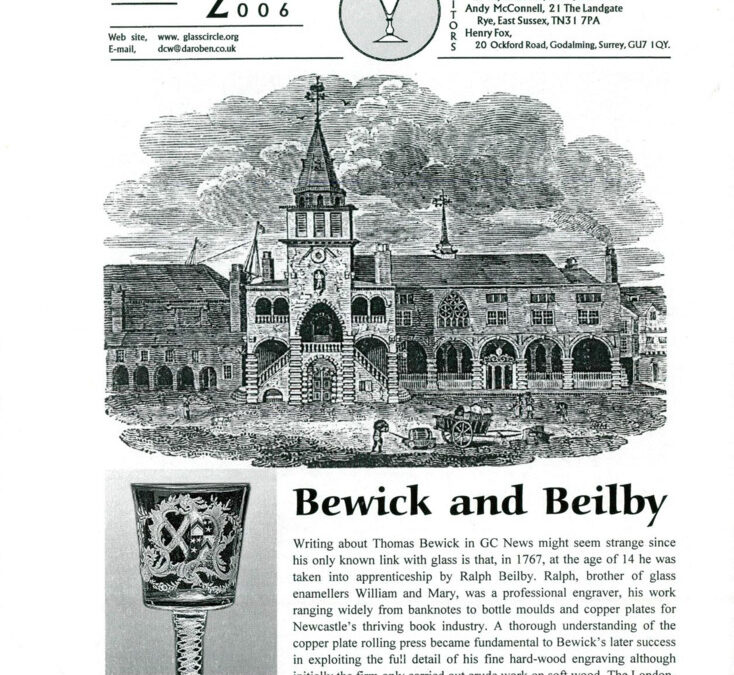
works of such small size executed on wood. Our cover im-
age, from the title page, of the
Old Exchange
in Newcastle
(engraved by Bewick in 1819) is the largest at only 8 cm
wide and is shown here to advantage at twice the original
size.’ The standard width seems to have been 5 or 6 cm.
#ettrt fabtto;
WITH CUTS, DESIGNED AND ENGRAVED BY
THOMAS AND JOHN BEWICK,
,2110 i:Dtbergi,
PREVIOUS TO THE YEAR 1784:
TOGETHER WITH A
Memoir ; anti a Deficriptfin Catalogue
OF THE
WORKS OF MESSRS. BEWICK.
312eiv ca stie
PRINTED BY S. HODGSON, FOIL EMERSON CHARNLEY,
AND BALDWIN, CRADOCK, AND JOY, LONDON.
M. DCCC. XX.
What was an engraver’s workshop like? The following
extract’ by William Heath Robinson (1872-1944), remem-
bering his father’s (Thomas Robinson) workshop, gives a
vivid impression of what the engraving workshop would
have been like:-
“in the old days . . . [the workshop] was occupied by a staff of
three or four engravers. They were all bent low over their
work. Glass globes filled with water increased the light that
came from green shaded lamps. Each engraver wore a pro-
tracting eyeglass like a watchmakers glass fixed to one eye.”
I have thought to use a few of the cuts in forthcoming issues
of GC News. The fox on page 8 is 15 mm wide in the
original.
D.C.W.
Notes
1.
Found by the
Editor in a market in Bridport, Dorset. The
pressing of boxwood engraving is a specialist trade because
of the difficulty of bringing out the detail. Most of the later
prints are reproductions taken from original pressings..
Details of Bewick’s life are taken from
Thomas Bewick, A
memoir written by himself.
OUP reprint, 1975.
2.
Bewick’s largest engraving (in 1789), of a bull, was 9.5 x
7.5 ins of which only 250 copies were printed (i.e. in 18201).
Of 6 prints on velum one, belonging to Mr Beilby, came into
possession of the (un-named) editor of the book. Another
was said to be worth 20 guineas at that time.
3.
From James Hamilton,
Wood Engraving and the Woodcut
in Britain c. 1890 -1920,
Barrie & Jenkins, 1994.
THE BEILBY GOBLET
and other recent
discoveries
by Simon Cottle
The recent sale in London by Bonhams of a Beilby armorial
goblet, first presented on the
Antiques Roadshow
in 1997,
was of particular interest to me, a devotee of 18′
h
century
British enamelled glass. I believe that this example exem-
plifies the significance of the work of William Beilby and
his siblings, and is representative of their best work.
It is further noteworthy because certain specific elements in
its decoration are also found on other Beilby armorial
goblets, particularly those dating between 1764 and 1765.
Richly decorating its bowl in polychrome enamels is the
coat-of-arms of that of the Beilby Thompson family of
Micklethwaite Grange, Collingham, a mile south of
Wetherby, Yorkshire. The house still stands today and the
arms remain carved above the lintel of the front door. A
branch of the family closely related to William Beilby,
married into that of the Thompson. This is doubly interest-
ing since a wine glass in private hands [James Rush,
A
Beilby Odyssey,
p.94] bears the crest of another branch of
the Thompson family of Yorkshire, cousins of the Beilby
Thompsons.
. . . . The views expressed in Glass Circle News are those of its contributors . . . .
2
GLASS CIRCLE NEWS No. 106, 2006
Fascinatingly, the Beilby Goblet (cover picture) bears a
cartouche virtually identical to those applied to the Partis
Goblet [Laing Art Gallery, Newcastle-upon-Tyne], and the
Lowndes Goblet [Cecil Higgins Museum, Bedford]. Henry
Partis was Mayor of Newcastle-upon-Tyne in 1760, and
Richard Lowndes (?1707-1775) of Winslow served as an
MP for Buckinghamshire from 1741 to 1774. Lowndes
inherited considerable estates in Buckinghamshire and was
a notable Tory supporter.
The elements common to these three goblets include scroll-
work, diaper panels and pendant floral swags. Within its
elaborate scroll cartouche, the Beilby Goblet also shares
several elements with the Couper Goblet, in the Cinzano
Collection, Turin. These are taken from a watercolour
drawing of an almost identical design for a rococo cartou-
che, signed
TB,
that I have previously attributed to Thomas
Beilby
[Glass Circle Journal 9,
p.40 and
Apollo,
June
1989, ‘The Beilbys Recollected’].
The red and white ribbon ‘wreath’ below the Beilby fami-
ly’s leopard’s head crest, on the reverse of the Beilby
Goblet (see illustration page 17), its leafy sprigs and diaper
panel, are also identical features found on several examples
dating from 1764-65, including those named above.
These include an armorial punchbowl in the V&A whose so
far unidentified coat-of-arms and crest are similarly treated
to those on the Beilby Goblet. The bowl bears the
Beilby
signature and the date
1765.
Robert Charleston drew attention to the Beilby’s use of a
distinctive overlapping three-flower device in the pendant
swags on several of the armorial pieces and sought to link it
to a group of otherwise unattributed opaque-white glass
scent bottles decorated with initials, dates (generally from
the 1770s and ’80s) and colourful cartouches in enamels.
This three-flower motif is not only present on the Beilby
Goblet but also on several other examples, including the
Partis, Couper, and Lowndes goblets. It is found on the
Royal Goblet in the Fitzwilliam Museum and the V&A’s
Blackett Decanter [for Walter Calverly Blackett (1707-
1777) of Wallington Hall, MP for Newcastle-upon-Tyne
1734-1777] enamelled with the arms of Newcastle-upon-
Tyne. This decanter can be securely dated to 1764 when
Blackett was elected Mayor. Furthermore, such a distinc-
tive decorative element is included in the enamelled fea-
tures of a pair of highly important, but as-yet unrecorded
goblets, painted with the arms of Montagu and Robinson
and signed by William Beilby [private collection]. These
goblets feature elements of the cartouche and the crest on
the Beilby Goblet. Bearing the signature
Beilby invt. &
pinxt NCastle,
these goblets add to the 13 signed extant
Beilby examples already known
(op.cit.
Apollo, June
1989).
Sadly, the Beilby Goblet is less than perfect. Its foot was
broken at some unknown point in its history, and the dam-
aged half joined to the remainder with an unsightly resin.
This obviously discouraged the interest of some potential
buyers. Although I do not ordinarily approve of invasive
restoration, it is arguable that this rather awkward repair is
preferable to the alternative: the replacement of its entire
foot with another from a contemporary example.
Another potentially negative feature of The Beilby Goblet
is a depression in the edge of its bowl, directly above its
enamelled arms. Nonetheless, this feature provides a clear
indication of how, nearly 250 years ago, the finished piece
was inserted rim first into a furnace to fix the enamels
following the slow firing of the enamels in a muffle kiln.
This may also account for the blistering in some of the
enamels.
From a commercial perspective, these imperfections make
the Beilby Goblet slightly less appealing than, for example,
the Buckmaster Goblet. Further Beilby armorial pieces will
gradually emerge from the woodwork. For example, a
Royal Goblet at Arniston House in Scotland, sadly cracked,
was published in
Country Life
on 19
th
June 2003. It came to
light in 1989 shortly after I had published what I had
thought was a comprehensive list of the Beilby ‘Royals’.
Unfortunately, it is unsigned. We can now record nine
goblets and one decanter. A pair of previously unknown
bucket-shaped goblets painted in polychrome enamels each
with a shepherdess seated beneath a leafy tree before a
landscape [private collection] has also emerged in recent
years. They appear to be the partners to two of the recorded
group bearing a shepherd standing beside a tree [Toledo
and Corning Museums]. This is a particularly exciting find
as the goblets are still in the hands of the family whose
home in the north of England appears in a watercolour
study by William Beilby. Nonetheless, when compared to
this and other recent discoveries, the Beilby Goblet has to
be one of the most interesting and relevant.
In passing, I was amused by the reference in the auction-
eer’s catalogue to ‘Major’ Rush. The late James Rush was a
Squadron-Leader in the RAF and was very proud of his
rank and his wartime flying experiences. For various rea-
sons Robert Charleston always referred to him rather depre-
catingly as ‘Commodore’ Rush or ‘the Commander’. Thus,
as a Major he would appear to have been a member of all
three services, no mean feat! *
A Previously Unrecorded Wedgwood
Portland Vase
Bonhams March 8th sale (no
glass) includes this rare experi-
mental Wedgwood copy of the
Portland vase. Over-fired it has
collapsed at the shoulder (the
dent is visible in the picture)
and the body is blistered. The
vase which comes from the
same mould as the intact one in
the BM, is very rare indeed and
will most probably end up in a
museum. It was originally the property
of Lord Dacre.
Bonhams glass sales are May 17th, June
7th and Nov. 15th.
For Sotheby glass sales, see back page.
3
Notification of the sale of a sealed Ravenscroft posset pot
(page 18) arrived too late for me to get a picture of the glass
itself. However, the one below has a highly distinguished
history. It originated, with two others, also sealed, from
Wentworth Woodhouse and was probably made in
about 1677 for William Wentworth, 2nd Earl of Stafford
(1626-1695).
Woodcut from Bewick’s
Selected Fables,
This one, entitled
The Splenetic Traveller,
includes a punch bowl and glasses.
Glassware is infrequently depicted in Bewick’s woodcuts.
Original size of cut, 5.6 cm.
Just arrived
GLASS CIRCLE NEWS No. 106, 2006
Editorial
The first Earl, Thomas (1593, beheaded 1641), was a close
adviser to King Charles, and was appointed Lord Deputy of
Ireland in 1633. His aim, to create prosperity in Ireland, led
him to manipulate the Irish parliament in order to appropri-
ated lands in the name of the Crown and vast tracts for
himself. His methods apparently left much to be desired and
caused considerable local resentment.
William, who followed, built up the family estates in Cool-
lattin, Co. Wicklow in Ireland. These grew steadily as its
oak timber was sent over to England for the reroofing of
Westminster Hall and Westminster Abbey in London, for
King’s College Chapel, Cambridge and, further afield, the
State House in Amsterdam.
It was, no doubt, at the height of his prosperity that William
was able to purchase a number of the finest possets on the
market to relax and enchant visitors with this welcoming
beverage after a long or difficult drive.
The above illustration, sent to Hugh Tait by Howard
Phillips, is described by Howard as:-
“Posset Pot, 3
5
/is ins. high, having the cylindrical body,
decorated with twelve slightly wrythen ribs, to which is
attached a pair of C-shaped handles with their extremities
curled back upon the handles. The fore-part with swan-
necked spout to which has been applied the seal of an
heraldic raven’s head being that of George Ravenscroft of
the Henley-on-Thames and Savoy Glasshouses. Be-
neath there is a high kick. The pale blue lead metal lightly
crizzled.
English, c.1677.”
New Technical Handbooks received from
A & C Black
Glass and Print
By Kevin Petrie
Explains the details of combining glass and print-making in
a diversity of media and a range of imagery. If you ever
wondered ‘How did they do that’ you will probably find the
answer here. It will give you a new respect for the technol-
ogy even if you don’t like the result! Highly recommended.
128 pages mostly colour, paperback, Price £14.99
Printmaking for Beginners 2n
d
Edn.
By Jane Stobart
A follow-up to Bewick and complementary to the above
text this DIY book is a guide to the processes of monotype,
relief, intaglio, collagraph, screenprinting and lithography
with methods, materials, tools and all the rest.
128 pages mostly colour, paperback, Price £14.99
Not about glass but you might be interested in:
–
The Ceramic process
Written by the Chief Technician of the European Ceramic
Work Centre based in the Netherlands. Likely to become
the bible for everyone from students to technically comp-
etant collectors. Hardback, Price £45.00
Ceramic Faults and their remedies 2″
d
Edn.
Harry Fraser
The odd piece of pottery is often used to enhance a glass
collection. If you make your own then this paperback vol-
ume will prove indispensable for a mere £17.99.
Order via
www.acblack.com or Tel. MDL on 01256 302688
4
GLASS CIRCLE NEWS No. 106, 2006
Glass Circle Matters
Chairman’s Letter
First an apology, a gremlin crept into my proof read-
ing. The committee originally thought that September
would be a good month to visit Scotland, but for
various reasons the date was changed to OCTOBER
4
th
to 8
th
. In early September the AIHV are holding
their biannual (or is it biennial? I am without a dictio-
niary here) meeting in Antwerp and several members
who wish to go the Scotland will also be going to
Belgium. While on the subject of Scotland if there any
members who are not too far from Glasgow or Edin-
burgh who would be prepared to allow us to see their
collection during this visit it would add to the trip
enormously.
Soon after you receive this Newsletter, Journal 10 of
the Glass Circle should be landing on your doormat,
having been printed in Hong Kong at considerable
saving to the Circle. The Journal contains 6 lengthly
papers of record and supplements the necessarily
briefer articles in the Newsletter. Any member who is
doing research, which they would like to see pub-
lished, is invited to submit a
resume.
I am currently in the Swiss Alps and the photograph,
top right, is of some ice sculpture which looks just
like glass.
John Smith
Great Corning Museum Bequest
We have just learned that The Corning Museum of Glass
has just been given its biggest ever donation of $5 million
of contemporary studio glass. We wonder where in the
museum they will find the space to display it!
Ice Sulpture. The
rings
are about 40 cm
in diameter.
See Chairman’s letter.
New Members
Mr. J.B. Coulter
Mr. W.J.N. Davis
Dr. R. Donaldson
Ms. J. Harding
The next issue of GC News is June; the deadline for
copy is May 7th.
Glass of the Roman Empire and Elsewhere
A celebration of the contribution of Jennifer Price
to the study of archaeological glass
Tuesday and Wednesday 14th and 15th March 2006
at The Wallace Collection Manchester Square, London Wl.
Further information and registration from
Martine Newby at martine.newby@virgin.net
UV Lamp update
Small portable UV lamps are
an endless source of enquiry
by glass collectors. My earlier recommendations have
hardly changed except to say that a firm called ‘Light-
house’ now markets what is essentially the same range as
Prinz. My Prinz short-wave lamp had expired and when I
went to buy a new one I found that the appropriate model,
an L85, was now made by Lighthouse but not by Prinz. It
was important because I also had the more expensive short-
wave UV filter attachment which now costs a further
£44.75. This small piece of dark purple glass has always
been very expensive and is the main cost in many short-
wave UV lamps. The reason for having it is that both the
long and short wave tubes used in these lamps also emit a
significant amount of white light. For most purposes this
does not matter but for the serious investigator anxious to
detect low levels of fluorescence it is a vital accessory to
obtain pure short-wave UV radiation. Most of the long-
wave lamps use the same tube so a cheap lamp will serve
just as well as a more expensive one.
As a reminder, long-wave detects predominantly non-lead
glass with a yellow-greenish fluorescence attributed to the
presence of manganese. It also shows up the presence of
uranium as a brilliant yellow, often in those pale green
between the wars glasses where you would not expect to
find it. The short-wave is required to establish the presence
of lead in both early glasses and in
19t
h
century (and later)
glasses where the long-wave lamp may fail to detect it.
Some glass, particularly window glass and old bottles, fails
to fluoresce and this is thought to be due to the absence of a
decolouriser because the glass quality was not thought to be
important by the manufacturer. A pale pink colour may
indicate a borosilicate glass of late manufacture.
For the potential purchaser in the UK I suggest a visit to
Vera Trinder’s (just off The Strand, in London) web site
www.vtrinder.co.uk where the options and prices are
clearly displayed. These lamps are particularly used by
stamp collectors and if you have a local retailer they may
well have them in stock.
Finally, a reminder that short-wave UV can cause head-
aches and, with prolonged use, temporary blindness. Expo-
sure directly to the eyes or use of this lamp for other than
relatively short periods should be avoided.
5
LASS CIRCLE NEWS No. 106, 2006
CY)
c?
e,
f
ic
alcio
r
t
v
5t
,
e,te
0E
04
The occasion of the
Circle’s
AGM and specimens
meeting provided a reason to visit London last
October, and when in London one tends to visit the
Heanage bookshop in Duke Street, St. James’s, for not
only does Heanage have a good selection of new and
second hand glass books, but they also offer
Glass
Circle
members a useful 10% discount on all pur-
chases. Whilst there, I was shewn a novelty hitherto
never encountered, – a glass-bound book! This was a
small, French, Lady’s Almanac of 1812, some 4ins
high by 3ins wide, with
Verre Eglomise
glass covers
secured by dentil edged gilt metal mounts. The glass
was very crisply painted, or printed, with a title and a
vignette of a classical group, on a white background.
The work was a curiosity rather than something that
one yearned to posses, but it certainly extends the
fields in which glass makes a significant contribution.
What I did acquire from the bookshop was David
Whitehouse’s new catalogue of the 72 specimens of
Sasanian glass in the Corning Collection.*
The Sasanian empire covered Iraq and
Iran, parts of the Caucasus and the
Arabian peninsular and briefly ex-
tended to the Mediterranean and parts
of Egypt, from AD.200 until it was
engulfed by the rise of the Muslim
empires in about AD.700. It contin-
ued to produce glass in the Roman tradition, with the
main production centres being in Iraq; its later products
are, understandably, very similar to early Islamic glass,
although it does not seem to have produced enamel
painted pieces. Perhaps its most attractive works were
facet cut, in the Roman fashion; some vessels were of
blue glass, whilst rarely colourless vessels were en-
hanced with blue beads. As with other early glass,
drinking vessels were very much a minority, amount-
ing to only 15% to 20% of the total, depending on how
one classifies the vessels. The biggest uncertainty com-
prises the drinking (?) cones, of which most of the
Sasanian ones are cut. Those of us brought up by the
older writers, such as Thorpe, tend to think of cone
glasses as northern European, found often in Saxon
graves and undoubtedly for drinking, in the manner of
the ancient ox horns of which the Vikings were so fond.
An example of these ox horns survives as Rory Mhor’s
horn, in the old castle of Dunvegan on the Isle of Skye;
it holds 3 pints of Claret, which each MacLeod Laird
on his succession is expected to down in one draught.
But modern scholarship suggests that such cone
glasses were more likely lamps, hung singly or in
groups in a polycandelon, – a name archaeologists love
to bemuse us with; there is an illustration in Newman’s
`Dictionary of Glass’.
The most numerous artefacts in
the Corning collection of Sasanian glass are what
Whitehouse calls ‘appliqués’, glass discs with an im-
pressed motif, in the manner of bottle seals; often they
have clearly been attached to a larger glass vessel, but
some seem always to have been free standing. In Met-
ropolitan Roman glass these seals are paralleled by the
discs with incised gold leaf decoration affixed to the
underside of bowls, but later, in Islamic glass they
assume a life of their own, being used as coins or
standard weights.
The American Numismatic Society
in
1976 published a work by Paul Balog, a catalogue of
his own collection of 922 such impressed Glass discs,
mostly acquired in Cairo and dating from AD.700 to
AD.900. The Sasanian group were all impressed with
animals, or with human faces, and only a few had any
inscriptions. The later group were overwhelmingly non
representational, and completely covered with Arabic
script; the few that had clearly been
attached to bottles all apparently bore
drug names or descriptions, and were
the pharmaceutical equivalent of the
sealed wine bottles of the 17th and
18th centuries.
This low proportion of glass drinking
vessels is reflected in Roman Glass, and also in Is-
lamic Glass, where, for instance, the archaeological
discoveries of Fustat period (AD.700 — 1200) Islamic
glass in Cairo# yielded only 29 drinking glasses
(11%) out of 260 recognisable vessels recovered. It is
not until the late medieval period that we find drink-
ing glasses (along with bottles) taking on the prepon-
derant position they have held amongst glass vessels
since the time of King Henry VIII. This Monarch
leads one on to reflect on the recently published
book+ about the material culture found at Nonsuch
Palace, which contains a mass of valuable information
on 17th century glass.
Nonsuch Palace was built by Henry VIII between
1538 and 1546, modelled on Hampton Court as a two-
courtyard palace, and intended as a residence for his
son Edward. Because of Henry’s death in 1547 it was
not used by Edward, and soon went out of Royal
possession, until it reverted to Queen Elizabeth in
1592; she and her successors were fond of the palace,
and between 1592 and 1649 there were twenty-seven
protracted Royal visits. After the Restoration, George,
Sas(s)anian. Of or pertaining
to the family of Sasan,
whose grandson, Ardashir I
founded the dynasty which
ruled the Persian Empire
A.D. 211-651.
O.E.D.
6
GLASS CIRCLE NEWS No. 106, 2006
Cut Bowl Sasanian, Iran, 6th-7th century.
Transparent light purplish brown. Probably cast,
possibly blown, and cut. Cup: hemispherical. Rim
plain, with rounded and very slightly everted lip;
wall curves down and in; foot is solid cylinder.
Decorated on wall with two continuous horizontal
rows of six cylindrical bosses with concave upper
surfaces, made by cutting, grinding and polish-
ing.
Overall Ht: 7.2 cm, Diam: 8.1 cm.
Similar objects were among the Sasanian glass-
ware exported to the Far East. At least one
example is known from China, and fragments of
another were found in a sixth- to seventh-century
context on the Japanese island of Okinoshima.
1st Earl of Berkeley was appointed Keeper and the
building was put into repair and thoroughly cleaned;
several departments of the Exchequer were housed
there in 1665/6 when the great plague drove them out
of Whitehall. At the end of this decade further consid-
erable sums were spent on repairs and re-roofing, and
the whole palace was again cleansed and garnished.
Then, in 1671 Charles II granted Nonsuch to his soon
to be discarded mistress, Barbara Villiers, Countess of
Castlemaine; she never resided there, and secured the
right to demolish it, selling the materials to the
Keeper, the Earl of Berkeley, who demolished the
inner court in 1683, but retained his quarters in one
wing of the outer court until 1687, when demolition
was largely completed. The Palace was extensively
excavated in 1959, and all the artefacts now reported
upon, 46 years later, were found during this excava-
tion campaign. Almost all the finds, which include a
great deal of glass, were from just 11 of the 31
garderobe shafts, all of these shafts containing rub-
bish being in the part of the building occupied by the
Keeper and his noble relatives. There were also
significant quantities of glass shards, particularly of
bottles, found in the Great Cellar in the central
cross range, which Lord Berkeley used for wine
and general storage. Both the documentary and the
archaeological evidence confirm that the deposits date
from the late 1660s to 1686, although many of the
more important artefacts were already more than a
century old when they were discarded.
Before his death Robert Charleston wrote a 37 page
essay on the ‘Fine Glass’ finds, which is a valuable
commentary on C.16th & C.17th table glass in gen-
eral, in addition to considering the Nonsuch finds.
None of the ‘Fine Glass’ finds was intact, but several
are substantially complete; there were however five
intact Black Bottles. 196 separate ‘Fine Glass’ vessels
were identified, together with a further 79 black bot-
tles, eleven of which were sealed. Drawings and a few
photographs are given of all these finds, although not
of course for the mass of unidentifiable small shards.
Charleston divides the fine vessel glass into two cat-
egories; high status cristallo, which includes Venetian
and facon de Venise, together with five lead glasses,
one of which has a Raven’s Head seal and another an
indecipherable seal. The oldest is an early C.16th
Venetian enamel and gilt painted goblet that is nicely
represented in the book by a coloured drawing by
Jenny Stringer, Robert Charleston’s daughter. In all,
the group comprises seventy-nine glass vessels, two
thirds of which are drinking glasses. The second and
larger group is Green Glass, or Forest Glass, in which
utilitarian objects, – apothecaries’ vials, flasks and
urinals, – predominate. Almost half the ‘Fine Glass’
dates from 1600-1650, and so was 20 — 80 years old
by the time it was discarded. Little more than 15% of
the glass was post Restoration in date, and one third of
all the glass was 16th century, which emphasises just
how long-lived much of the glass was before it was
irreparably damaged and finally thrown away.
The section on Black Bottles (called Green Bottles by
the editor) is by Martin Biddle and Jane Webster and
is perhaps of even greater importance than that on the
fine glass. Professor Biddle considers the whole cor-
pus of known Black Bottles from 1650 to 1700 and
sets out to establish a detailed time scale for subtle
differences in shaft and globe, and in onion bottles,
decade by decade during the second half of the
C.17th. He also gives a schedule of 148 dated bottle
seals down to 1700, which is more comprehensive
than anything listed by earlier authors, and brings us
in full circle back to the Roman, Sasanian and Islamic
seals reflected upon above. In conclusion, I think that
one has to say that for anyone interested in C.17th
English glass the 115 pages of this work that are
devoted to the subject are essential reading.
* David Whitehouse:
“Sasanian and post-Sasanian Glass
in the Corning Museum of Glass” (2005).
# G.T.Scanlon & R.Pinder-Wilson:
“Fustat Glass of the
early Islamic period”
(2001).
+ Martin Biddle:
“Nonsuch Palace; the Material Culture of
a Noble Restoration Household”
(2005).
© The
Co
rning
Mu
seu
m
o
f
G
lass
7
GLASS CIRCLE NEWS No. 106, 2006
HENirzys GLiPPINIGS
A contemporary commission,
Through a Glass Brightly,
created by Kalim Afzal and Farhad Ahrarnia and funded by
the Arts Council is on show alongside the exhibition.
(There is an entrance charge to this special exhibition, but
other areas of the Gallery are free).
36 Craven Street
This address, a stone’s throw from Trafalgar Square in
London, is probably known to few members, but it is here
that Benjamin Franklin came in 1757 and stayed for five
years, before returning to Philadelphia. He returned to take
up residence again in 1765 and remained until 1775. Whilst
there he invented the glass “armonica” (a musical instru-
ment) and something which many of us use today — bifo-
cals. Today this simple traditional flat-fronted Georgian
House , which incidentally has 14 fireplaces, is Grade 1
listed, and has just been refurbished and brought back to the
period of Franklin’s time there.
Palace and Mosque
Members visiting Sheffield may like to see the exhibition
under the above title at the Sheffield Millenium Gallery.
The V&A are loaning 120 items from its world famous
collection of Islamic and Middle Eastern Treasures. Glass is
included, notably The Luck of Edenhall beaker. The “Luck”
has been on walkabouts since last year when it took a trip
first to Texas and then to Tokyo. The exhibition ends on
April 16
th
and members in the Midlands should not miss the
unique opportunity of seeing one of the most important
glasses in our national collections.
Revamp at the V&A
Regular visitors to the V&A glass collection will be all too
familiar with the tedious trek down the long gallery filled
with ceramics to reach their goal. Now all that has been
swept away in a magical transformation that may prevent
you reaching it at all. A joint venture with the Royal
Institute of British Architects has produced a captivating
new display of architecture full of models, plans, videos
and the latest up-to-date gadgetry about our national build-
ings and some, like Southwark’s “Shard of Glass”, yet to
be built. A side gallery of photos highlights the ongoing
problem of conserving some of our decaying architectural
treasures.
But press on and in the foyer to the Glass Gallery itself you
reach another new display of modern studio glass. The
V&A has gone to town to capture sublime examples of the
art – Erwin Eisch, Lino Tagliapietra, William Morris, the
chaps from Czecho and many more. The Glass Gallery
itself remains unchanged except that the defunct computer
on the mezzanine floor has at last been replaced, but only
with the V&A/Corning CD about the history of glass.
There is still no provision for accessing the catalogue
details of the hundreds of numbered-only glasses in the
Glass at the Fitzwilliam.
On the 15
th
November last the
Association for the History
of Glass
held its AGM at The Fitzwilliam Museum, in
Cambridge, where most of us present were able to see for
the first time how the Museum has re-displayed its wonder-
ful glass collection, following the recent massive new
development. There was an audience of about twenty, with
The Glass Circle
contributing over one third of those
attending, and the
AHG
used the occasion to mount a short
study day of the University Collections of Glass, with Julia
Poole and her colleague James Lin discoursing upon the
glass at the Fitzwilliam, together with Sandra Davidson
telling us of the conservation of the remarkable glass in the
Westminster Retable. After the AGM, following which we
dispersed to find lunch, we reassembled to see the reserve
collections, the majority remaining at the Fitzwilliam, with
a few going off to see the ancient glass in the Museum of
Archaeology and Anthropology.
Notoriously, much of the magnificent collection of C.18
th
glass at the Fitzwilliam is no longer on public display, but
there is one nice large cabinet placed on the slightly out of
the way mezzanine floor of the new Courtyard develop-
ment, and this contained, amongst a substantial group of
treasures, a polychrome enamelled goblet by William Col-
lins, with rather more restrained decoration than on some of
his work. Elsewhere there was also a temporary public
display of large English C.18
th
Goblets. The conditions in
the reserve collection are very much better than formerly,
and despite some drawbacks would be the envy of many
museum curators. One recognised a number of old favour-
ites, and what one had not noted before was a group of two
jugs and two goblets with standard ‘Davenport Patent’
decoration on them. I had never before met jugs decorated
in this way, and thanks to the group of twenty-two pieces of
Davenport Patent Glass from the Joyce Mountain Collec-
tion, dispersed by Bonhams last September, more than
twice the quantity of this Glass is now recognised than was
the case twenty years ago, when the late Ron Brown pub-
lished his pioneering paper in
The Journal of the Glass
Association.
We were also privileged to see a substantial
group of Spanish Glass, newly bequeathed to the Museum
and only placed in the cabinet two days previously and still
awaiting assessment. It was indeed a most enjoyable meet-
ing, but sadly it confirmed how little of the glass at the
Fitzwilliam is now on open display.
F.P.L
8
Above.
Roundel
detail from the top
left corner of the
window.
All pictures © D.C.W.
2006.
GLASS CIRCLE NEWS No. 106, 2006
display cabinets. Even a few of the old fashioned paper
catalogues on a string would be a great help.
The V&A shop is also on the move to the central isle as you
penetrate the museum. This should give it more much-
needed space but I suspect that the real reason is probably
because the current location provides the main route
through to see the huge Raphael cartoons adorning the
walls of what is currently a large open space.
Omission!
The hammer price for the slightly rubbed Thomas Webb
swan neck scent bottle sold by Sothebys to which I made
mention in the last issue of GC News was £2,300.
New Stained Glass
gallery at the V&A
Leave the Glass gallery by the side exit.
Passing over the bridge you see below a
degree of bedlam among the statuary prob-
ably associated with a new acquisition
called
The Three Graces
(I originally
thought this was a misprint for
The Three
Glasses
but apparently not). Keep going
across the metalwork gallery until you can go no further.
Then turn left and at the end of this dim corridor, on the
right, you find the new long gallery devoted to a combined
display of silver and stained glass.
At the entrance to the gallery is an intriguing bowl-shaped
clear crystal font by Colin Read, the curved underside cast
with fish and the polished top with central domed depres-
sion to receive the holy water. Colin is one of the leading
British glassmakers able to work on such a large scale.
Passing into the gallery the left-hand side has windows
facing the museum central courtyard, providing an ideal
background against which to display the bulk of the stained
glass. Other glass is illuminated on the opposite blank wall
and on partitions dividing up the gallery as shown in the top
picture. The stained glass combines well with the silver
display to enhance the religious theme and create a suitably
receptive atmosphere for the visitor.
The windows are displayed in roughly date order down the
gallery. Although the V&A is said to have one of the best
museum collections in the world, including some of the
earliest known stained glass shown here, there are notable
omissions, for example, from Tiffany, the Arts and Crafts
movement or from the post-war era. This is not to deni-
grate the V&A’s collection but only to emphasize the huge
diversity of stained glass through the ages. Other collec-
tions, such as at Ely, Birmingham and the Burrell collection
in Glasgow all contribute to what in total is a stunning
collection of stained glass in the UK.
The only problem I found was that for the serious student
the upper panels, ten or twelve feet above the ground were
difficult to see. A stepladder on wheels would be a helpful
addition although not suitable for weekends when the gal-
lery is much busier than my picture may suggest.
D.C.W.
Top. One corner of the
stained glass gallery. The
tryptiche of The Last Supper
is loaned by the Queen.
Left.
Colourful border to a
window from Saint Denise,
France, 1140.
Right.
Head said to be King
Semei (?) set in a surround
of glass fragments. From
Canterbury cathedral, 1180.
Below .
Detail from a panel
depicting Saint Stephen be-
fore the High Priest. From
Normandy, 1230-1240.
Bottom.
Madonna and child. Drawing against a background
of red, green and blue glass. German, 1470-1480
9
GLASS CIRCLE NEWS No. 106, 2006
Book Reviews by D.C.Watts
MoLAS Monographs, No. 28.
John Baker’s late 17
th
-century glass-
house at Vauxhall. 2005.
Published by the Museum of London Archaeological Serv-
ice, Museum of London.
Size A4, 85 pages in colour and b/w, soft covers, £12.95.
It has been my intention for some time to draw attention to
the excellent series of archaeological monographs pub-
lished by MoLAS. This newly-published definitive account
by our member Hugh Willmott and Kieron Tyler demanded
delay no longer.
This well-illustrated book is written as a very readable
historical record of events relating to Baker’s glasshouse
(founded 1663-81, demolished 1706) at Vauxhall without
compromising the archaeological details of the excavation
dating back to 1989. It is part of a determined effort by
MoLAS, in conjunction with English Heritage, to bring up
to date publication of the most important of the numerous
`digs’ that have become an integral part of London’s rede-
velopment. Modern archaeology involves a range of ex-
perts and it is not surprising that classification and interpre-
tation of the ‘finds’ is a lengthy and expensive process.
Baker’s glasshouse, close by the River Thames at Vauxhall
Stairs, should not be confused with its more famous con-
temporary neighbour founded at the Restoration (1660) by
the George Villiers, 2nd Duke of Buckingham and subse-
quently managed by John Bellingham. Finding the glass-
house was, I suspect, a bonus as the original target was a
mid-17
th
century barge-house constructed for the Cloth-
workers’, Fishmongers’ and Mercers’ Companies.
Production seems mainly to have been bottles, of which a
number, some with seals, dating from 1650, were found,
and some interesting clear glass tableware. However, the
main discovery was the coal-fired furnace with a large
adjoining structure interpreted as a fritting furnace. The
furnace itself is a long tunnel with sieges for three pots on
either side, a central raised region for the coal fire, and
brick-lined wind tunnels at either end, one with a device for
controlling wind strength. Numerous pot fragments were
found containing clear, green and pinkish glass, their size
indicating considerable production. Unlike the earlier
winged furnaces found in the Weald and at Kimmeridge the
only adjoining structure was the above-mentioned fitting
furnace, essential for a preliminary roasting of a
soda/potash batch. However, its proximity to the furnace
and the absence of any indication of a lear on the site
suggests to me that this must have been at least part of its
function. The authors appear to think that a lear must
necessarily involve a device for moving the glassware from
a hotter to a cooler region of the chamber. This was a later
development; simple chamber lears are still used by tradi-
tional glassmakers in the Middle East today.
The analytical data of the samples is somewhat difficult to
understand for the uninitiated. The values of the component
elements are expressed as weight percent (wt%) but if
added together come to only around 35 wt%. This is
because silicon is not included in the calculation and is
obtained by the difference from 100 wt% (the initial weight
of the dry sample). The silicon in the bottle samples repre-
sents about 65 wt% which is a quite low for this type of
glass. The normal value for bottle glass is closer to 73 wt%.
A lower silicon content makes the glass easier to melt
suggesting that this furnace was not all that efficient. Three
samples (nos. 95, 97 and 98) contain almost no stabilising
elements, a cause for worry over the accuracy of some of
the analyses. This is not helped by the statement that lead
and antimony are expressed as wt % when, in Table 1, they
are clearly expressed as parts per million.
Two globe
and shaft wine bottles found at
the site. Picture © MoLAS 2005.
As mentioned in
my review of The Journal of Glass Stud-
ies, it has become the practice with such physical analyses,
to include a long list of the trace element values found.
These usually contributes nothing to the understanding of
the samples and are a complete waste of space and effort
unless they justify commentary in the text. Here, mention
could have been made that the low calcium samples cited
above are also manifestly deficient in zinc and strontium
which does suggest that a component may have been omit-
ted from the batch. But for most purposes of presentation a
short list of Mean and Standard Deviation of the values
would suffice. The full list, kept by the museum, being
available upon request.
It is part of the pleasure of archaeology that anyone may
speculate about the interpretation of the finds and there are
numerous areas here to discuss. For example, the bases of
two very small pots (base diameters of 55 and 60 mm) were
found. These were reasonably interpreted as test pots for
small quantities of glass. However, I was reminded of the
story of the docker, seen every day to take a wheelbarrow
full of straw past the dock gate security. Repeated close
inspection of the straw failed to reveal anything incriminat-
ing. The docker was, in fact, stealing wheelbarrows! It is a
reminder not to neglect all aspects of the problem. Perhaps
the small pots were actually being used to test the pot
material itself. Analysis of the residual glass revealed that
the glass stabiliser, calcium was almost absent from both
pot samples. This would produce a more fluid molten glass
and perhaps provide a more stringent test for the pot mate-
10
GLASS CIRCLE NEWS No. 106, 2006
rial. Full sized pots were made with the addition of crushed
quartz. These small pots incorporated sand instead that
could give a considerable cost saving if proved acceptable.
Another interesting observation concerns the finding of
pink glass although its manganese content is not signifi-
cantly raised above that in the green glass. Whether or not
manganese turns molten glass pink depends crucially on the
oxidation state of the melt. In a coal-fired furnace for bottle
glass the inclusion in the melt of an oxidising agent, such as
saltpetre, is unlikely. More likely, in this situation, there
was a long delay between founding and working the pot
when molten glass spontaneously dissolves oxygen from
the atmosphere. So perhaps this glass indicates an unusual
event such as running down the furnace to replace a broken
pot leaving a full pot standing for some time on the siege.
The authors suggest that the source of the soda-rich ash for
the batch was probably kelp, but do not explain where it
might have come from? Most British kelp was harvested in
Scotland and Northern Ireland or French kelp was imported
from the coast of Brittany. We do know that ash was
brought long distances; wood ash, for example, was
imported from Scandinavia while the soda-rich ash from
littoral plants might have come from Spain or the south of
France. Perhaps the kelp came as packing for window glass
brought from Newcastle which would be a good commer-
cial use for this material. Sand was another problem,
although perhaps not in the 18
th
century. Woolwich had a
plentiful supply of the sort used for window glass and
bottles and I recall that the excavation of the Pellatt site, not
far from Vauxhall, revealed a fine bank of clean pale
yellow sand some ten feet under the surface. The neigh-
bouring Bellingham furnace appears not to have had any
problems in these respects suggesting that the industry was
well organised.
Finally, two unfortunate errors must be mentioned relating
to an ambitious table listing the locations, occupants and
products of all the London glasshouses of the period. The
well-known Hensey family, that made broad glass at Wool-
wich, is listed as making Crown glass, while, for some
unaccountable reason, the Bear Garden glasshouse has be-
come entangled with the glasshouses about a third of a mile
further east situated by Southwark cathedral. Within this
muddle Crown glass is said to have been made there from
1679. But by 1680, Bowles, in response to an anticipated
take-over, had already moved his Crown glass making to
Ratcliffe down the river and Crown glass manufacture
ceased at the Bear Garden. I have to report that my name is
listed among the reference citations but decline any respon-
sibility for these relatively minor historical transgressions.
Overall, this inexpensive and well-produced book provides
a thoughtful and stimulating insight into a productive
period of glass making in London. It is highly recom-
mended reading for all those interested in both the glass
history of London and the importance of modern archaeol-
ogy for its appreciation and understanding. A full list of
MoLAS publication can be found on the web at
www.molas.org.uk where they can be ordered directly from
the Museum of London. *
Mt. Washington & Pairpoint Glass (Vol. 1)
Kenneth M. Wilson *
Antique Collectors’ Club, 2005, ISBN 1-85149-491-X
Size 29.7 x 25 cm, 349 pages, numerous illustrations in full
colour. Hardback, Price £45 ($95 USA).
This fascinating and heavily researched volume centres
around the activities of one man, Frederick S. Shirley
(1841-1908), mainly in relation to the lamp and shaded
ruby glass trade in North America in the last quarter of the
19
t
h century. The story, however, takes us back to 1812 and
South Boston where a name familiar to all collectors of
press-moulded glass, Deming Jarves, took possession of a
factory sandwiched between a turpentine works and an oil
refinery to manufacture glass oil lamps and lighting fix-
tures.
After numerous ups and downs, the glassworks was taken
over in 1863 by William S. Libbey and renamed the Mt.
Washington Glass Works. An inventory of the factory at
this time tells us that it operated seven presses with a large
number of moulds and that production had diversified to
include drinking glasses and a wide range of tableware.
Extensive price lists and a series of old photographs
((1861-1864) include, for example, 43 different styles of
tumbler, 53 styles of lamp font (oil container) as well as
fish globes, pie covers, battery jars (presumably for
Leclanche cells before dry batteries) and other items pro-
viding valuable information for collectors.
Following Jarves’ death in 1869 the firm moved to well-
appointed larger premises (possibly the first glass factory
in the world to possess elevators) in the coastal whaling
town of New Bedford. For lighting, whale oil and candles
were mostly used until Dr Albert Gessner in Canada in-
vented kerosene (patented 1854) and, in 1859, Edwin L.
Drake drilled the first successful oil well (in America) in
Titusville, Pennsylvania. Wide availability of the new
cheaper lighting fluid sparked demand for a flood of glass
lighting fixtures – fonts, bases, chimneys and shades — used
in various combinations for lamps of every purpose from
parlour to privy. It is also said to have saved the whale from
extinction by over-fishing.
In 1874, into this highly competitive industry steps Freder-
ick S. Shirley as the new Agent for the Mt. Washington
Glass Works. He replaced Libbey who had become Agent
for the New England Glass Company founded by Jarves.
Shirley’s father was a gas engineer who had established the
Engineering & Gas Fitting Depot in the East End of Lon-
don. Before emigrating to America with his family Freder-
ick had worked for the London firm of M. Shirley & Son,
“Manufacturers of Crystal, Bronzed and Ormolu Chande-
liers”. His job now was to manage all aspects of the firm’s
business from formulating glass batches to making con-
tracts and promoting sales. Overall, his talent was not so
much in original invention but in developing modifications
that evaded patents already established. One profitable
*
I met Ken Wilson twice and was privileged to read one
chapter of this book before publication.
11
GLASS CIRCLE NEWS No. 106, 2006
Mt. Washington Lava Glass
patent was the adoption of an earlier patent (which he later
acquired) for a decorated cone-shaped lamp chimney that
combined the function of an ordinary chimney and shade.
Others included the development of iridescent glass with
chemical fumes, already patented by Thomas Webb in
England for their Bronze Glass; and lava glass, called
Sicilian, made with genuine Mount Etna lava incorporated
in the batch! He also invented product names, designed
trademarks and, inevitably, gas fittings for chandeliers. To
produce their cut and other fancy glass in silver-plated
mounts he promoted, in 1880, the formation of the Pair-
point Manufacturing Company, built on land adjacent to the
Mt. Washington works, such was his all-embracing role for
the firm.
Infringements of patents necessitated litigation which he
pursued vigorously and involved him in endless gentle-
manly exchanges, particularly with Libbey. The most noto-
rious cases relate to the inventions of the ruby shaded glass,
called
Amberina
and
Peach Blow. Amberina
was invented
in 1883 by Joseph Locke a talented glassmaker from Stour-
bridge, England, in Libbey’s firm. Shirley responded with a
copy called
Rose Amber,
and the lawyers sharpened their
quills for a lengthy litigation that Libbey eventually won.
Shirley then patented his
Burmese
(1885) with shading on
an opaque rather than clear ground and litigation roles were
reversed. Exact details are provided of Shirley’s triumph in
presenting sets of this glass to American President Cleve-
land and to Queen Victoria. Coupled with the excitement of
the sale of the Chinese (pottery) Morgan vase with a similar
colouring, for an astounding $18,000, these ruby-shaded
glasses became a national must-have. A contemporary glass
replica of the Morgan vase and stand was made by Hobbs,
Brockunier & Co. In England, Thomas Webb took up the
patent to produce the equally successful
Queen’s Burmese.
The Samuel Clarke Fairy Light Co. almost immediately
ordered 23,000 of Webb’s lights for a special display in
Surrey.
In 1886 both Shirley and Libbey were awarded patents for
Peach Blow
and
Peach Skin,
the uranium yellow used in
Burmese
being replaced by pale copper blue. The delicate
shading of this glass, likened to a peach skin, was another
success. Litigation this time was a draw and brought con-
flict to an end. Another competitor in the field was the
Phoenix Glass Company, founded in 1880 with Joseph
Webb from Stourbridge as Superintendent. They advertised
themselves as the “Sole Manufacturers in the United States
of the Celebrated Webb Glass” and, as with Webb’s
Queen’s Burmese, their glass colour seems to have had a
slightly more delicate touch. Glass with feathered designs
appears in advertisements, a technique apparently not used
by the American firms. In England, Peach Blow was made
by Thomas Webb under the Libbey patent.
Enamelled decoration and gilding on Mt. Washington
shaded glass was of a high standard; in the book, designs as
well as shapes are closely examined with numerous illustra-
tions to distinguish the products of different firms. Coralene
ware, decorated with tiny applied beads, was a particular
success.
Other types of glassware made by Mt Washington and
Phoenix that are examined in the book include satin ware
with a pattern of air pockets, and cameo — relatively cheap
and not unattractive acid-etched designs through plated
(cased) glass. This followed John Northwood’s earlier copy
of the Portland vase. The book concludes with an examina-
tion of the wide range of sundry items produced in shaded
glass and presented in metal stands by the Pairpoint Com-
pany. Frederick S. Shirley left the firm in 1895 and moved
to Canada where he re-established his British nationality
and became an authority in mining mica.
Kenneth Wilson died before final publication of his book
but he would have been gratified to know his outstanding
achievement could hardly be bettered as an epitaph for a life
of dedicated study that brings together and details some of
the most emotive decorative glass ever made on both sides
of the Atlantic.
Kenneth wrote the first two chapters of volume 2 about
other forms of decorative glass made by Mt Washington;
this is to be completed by Jane Shadel Spillman. *
Funny hats – final statement
Straying by accident into Sotheby’s I
became enveloped by statues. My
attention was taken by the small
statuette opposite. It was thought
to be of Pope St. Gregory, 16th
century. Hence the crown is clearly
an indication of a pope and Christian
saint I thought.
I then received from Peter Lole this 16th century portrait of
the Ottoman sultan, Stiliman the magnificent. The crown,
made in Venice of gold studded with huge
gems, has an extra tier as a piece of one
upmanship to indicate that he is
greater than his adversaries, Pope
Clement VII and Emperor Charles
V. It was worn or displayed during
his walkabouts and travels in
Europe to indicate that he was the
true Caesar!
So, if you have enough power and
money, have any hat you like!
12
Designed by Eva Englund for the
Swedish Pukeberg glassworks.
Swedish. c. 1965
Shakers, transfer printed with a
band of red over a band of yellow
with black scrolling. Plastic tops.
French.
c.
1960.
English salt with flat cutting c. 1770.
English or Irish. Curved
cutting and Vandyke
cut rim. 1795-1805.
Irish salt 1785-1795.
English or Irish/American
4-part mould-blown salt
with a cut rim.
1810-1820
English cut or press-moulded
and after-cut salt mounted on a
lemon squeezer foot.
c.
1800.
13
GLASS CIRCLE NEWS No. 106, 2006
The Glass Salt Cellar,
1750-1980
According to the OED the term
condiment –
anything of pronounced
flavour used to season or give relish to food – is slightly older (1st
reference 1420) than that for
salt cellar
itself (1434). The value of salt in
those early days is well known and in 1729 Swift wrote “Fold up the
Table-cloth with the salt in it, then shake the Salt out into the Salt-cellar to
serve next Day”.
The 1434 reference is to “A fier salt saler of peautre with feyre knoppe.”
but they have been made in every possible material and of endless shape or
form. Glass salts are relatively conservative in shape but Andy McConnell
has accumulated no less than 300 glass specimens of which some 250 will
soon be exhibited at his new Glass etc. shop in Rye, East Sussex.
Bewick woodcut depicting a royal at
dinner with condiments on the table.
c. 1780. Original size 4.7 cm wide.
The gradual evolution of the shapes and decorative styles of
glass salt cellars reflects the history of glass through one of
its prettiest and most compact vessels. The exhibition is
weighted towards the Regency period of classic English
glass-cutting, loosely dating between 1790-1825, and fea-
turing about 150 examples dating from those 35 years. A
further 40-or-so are earlier, dating
c.
1760-95, whilst the
remaining 60-80 are either Victorian or 20
th
century.
Mid-to-late 18
th
century examples were cut against wheels
driven erratically by horse, mule or apprentice-power. The
advent of steam-powered cutting, between 1795-1805, had
a profound effect on British cut-glass. The regularity and
power of steam allowed craftsmen to cut deeper and create
the more spectacular, jewel-like clusters of diamonds, fans
and v-grooves that we associate with the Regency.
Later examples contrast Bohemian coloured and gilded
pieces with versions pressed by Sowerby and Davidson in
the north-east for the working—classes. Andy says that he
has “little or no preference for fine, rare Georgian antiques
over later cheaper pieces.” Indeed one of his favourites was
designed by Eva Englund for the Swedish Pukeberg glass-
works around 1965 (shown below).
Some examples from the exhibition are illustrated below.
The exhibition, admission free, will be held at
GLASS etc, 18-22 Rope Walk, Rye, East Sussex,
from April 10th to May 28th. Open: 10-5 weekdays
& Saturday; 12-5 Sundays.
GLASS CIRCLE NEWS No. 106, 2006
Shipwrecked glass
DVD: Le Verre Antique: la matiere et les gestes
Price €25.00, P+P E4 (+£8 for a UK bankers order).
Order from: Agent Comptable de l’UTM, 5 alles Antolio Mach-
ado — 31058, Toulouse Cedex
9. France.
This DVD is an interesting enterprise combining the efforts
of Daniele Foy*, the University of Toulouse le Mirail,
Underwater archaeology and the French National Research
Centre. It relates to a 2″
d
century AD shipwreck at Embiez,
a small island in the Mediterranean just off the south coast
of France. The boat was loaded with broken glass lumps
(ingots) and some glass vessels (beakers and goblets) being
shipped probably from Alexandria to coastal destinations
where it could be remelted and worked into items for sale.
Murano bought glass in this way up to at least the 12t
h
century, if not later. This idea of primary and secondary
glass-working sites has become a prominent feature of
modern archaeological thinking.**
The DVD film begins with an underwater exploration,
recovery and treatment of the glass finds. The DVD is by
no means full and I would like to have seen more on this
initial archaeological excavation which is rather briefly
treated. We then move to a grassy field where D. Foy gives
a lengthy lecture relating to one large glass lump with cuts
back to the original pictures. Then onto a glasshouse where
some of the cleaned lumps are melted and worked into a
beaker with other items made being shown to demonstrate
how well the ancient glass has survived. After a fairly
lengthy (and for me unintelligible) interview with the glass-
maker he demonstrates the making of a beaker, a footed
goblet that includes a nice demonstration of how a blown
foot is made, a mould-blown Roman bottle and a tall
wrythen jug. The demonstrations are excellent if a little
repetitive in their early stages. From an English point of
view the accompanying French commentaries, interview
and lecture are spoken far too fast to follow unless you are
competent with the language which I am not.
Separate sections of the DVD list all the participating bodies
and do a run-a-round of the glassmaker’s equipment with
their names. Finally, a separate pdf computer file provides a
24-page run-down of the basics of glass composition, forma-
tion and an illustrated summary in fairly readable French of
the first three items made in the film demonstration (for
student benefit). Picture quality overall is excellent.
The DVD film runs OK on a DVD player linked to the TV
but I had trouble getting it to run on my PC. Software. This is
supplied under the heading UTILITAIRES accessed via
Internet Explorer; the, computer only, pdf file is accessed
in the same way. Instructions in the 15-page accompanying
pamphlet are far from clear if you are not computer wise.
The pamphlet also provides a summary of the pdf file but,
remarkably, the main text nowhere mentions Embiez or the
date of the shipwreck. However, “Embiez” does appear in a
reference list. I looked up Embiez via Google and found a
site that summarises the archaeological exploration but it
does not mention the DVD.
*D. Foy is also working on the long term storage of radio-
active waste in glass of which this study is said to be part.
How about
this for a job? Just one box of fragments being
sorted in an attempt to reconstruct complete vessels. For
an example of the highly gratifying result, see below.
**An
interesting translatable French site on this topic is
vvww2.cnrs.fr/presse/journa1/1318.htm from which the
following extract of an example of the ancient glass
industry being run on a commercial scale was obtained:
The furnace of the primary manufacturing workshop
The discovery of glass-makers furnaces in Israel ‘ in 1992
made it possible to know better the organization of the
primary workshops and the structure of the furnaces of
antiquity. One thus could reconstitute the manufacturing
process of glass. The raw materials – sand and the natron –
were placed in the fusion chamber. After its closing, fire
was lit and maintained during ten to fifteen days. The glass
thus produced formed a large slab of from 8 to 9 tons
which was quickly cooled with water. The arch of the
furnace was then dismantled and the flagstones of glass
broken to obtain transportable blocks.
1.
Excavations carried out by the institute Israel Antiquities
Authority.
Group of Islamic glass, some reconstructed from shards,
recovered from the 11th century Serge Limani shipwreck.
See also: www.sportesport.it/wrecksFR010.htm which
gives the date of the Embiez wreck as 4’
h
century! This site
also provides information on a long list of
c.
230 ancient
shipwrecks. Under Turkey, the Byzantine vessel, Set
–
9e
Limani, XI Century A.D. had a cargo of exceptionally fine
decorated glass as pictured above. In this connection an-
other interesting web site is:
ww.diveturkey.com/inaturkey/serce/glass.htm
D.C.W.
14
More Book Reviews
25 Years of New Glass Review
Tina Oldknow
The Corning Museum of Glass, 2005.
Size 23 x 23 cm, 247 pages in full colour,
ISBN 0-87290-‘160-2, hardback, $29.95.
Thomas Buechner, founding Director of CMOG,
in
1950, conceived the idea of establishing
New Glass
Review
both to collect and disseminate information
about Studio Glass and also to determine what to collect
for the museum. The outcome has been an important
aspect of CMOG policy ever since.
Now, 25 years on, Tina Oldknow, CMOG’s current curator
of Modern Glass and an established authority, has
confronted the task of selecting some 200 of the best of
2800 successful entries, themselves selected from some
75,000 slides, submitted over that period.
Back in 1999 Dana Zamecnicova wrote
“Today, there are
practically no limits, rules or laws that exist in the work
with glass.”
Oldknow acknowledges that her selection for
this anniversary issue is “subjective” but that it does reflect
what she believes has made an important contribution in
terms of
“idea, meaning and metaphor”
as reflected in the
pages of
New Glass Review.
Each year four jurors selected the creations for that issue.
The jurors were predominantly American but Australia,
France, Germany, Italy and Czechoslovakia were also rep-
resented over the years. In spite of the lack of British
representation it is gratifying that in this issue Britain is
second, after America, in terms of items chosen before
Australia, Czechoslovakia* and then Japan. Several artists,
such as Danny Lane and Stephen Proctor, are represented
in more than one country. In all, 29 countries are repre-
sented. While it is encouraging that our own craft is in
GLASS CIRCLE NEWS No. 106, 2006
good health it also reflects
favourably on the jurors
faced with the daunting chal-
lenge of putting creativity
before country.
The book is divided into five
sections; vessels, sculpture,
flat/painted glass, install-
ations/architectural glass
and, finally, design. Each
section is preceded by a short explanatory essay by Old-
know on the group that follows and she acknowledges a
bias towards later entries. This is perhaps because nearly all
exhibit consummate technical skill that may have been
lacking in the earlier years when artistry and idea were the
prevailing factors. The quality of the reproductions in the
book is exemplary.
I have deliberately avoided mention of my favourite pieces.
But looking through the illustrations one is struck by those
who are not included, William Morris, in America, or
Jonathan Harris, in Britain, for example, both of whom
produce top class innovative work. But that is the man-of-
the-match nature of such reviews or, of course, they may
have not submitted work in the first place. It would have
been interesting to have known the total number of submis-
sions from each country.
Beuchner can be proud of his brainchild and the artists
grateful for CMOG support. All those who appreciate,
collect or aspire to succeed in this challenging art will
benefit from a study of this modestly-priced book.
*Czechoslovakia should have been second but threw away a com-
fortable silver medal by additionally dividing itself into Slovakia and
the Czech Republic.
D.C.W.
Journal of Glass Studies no. 47.
The Corning Museum of Glass, 2005
Size 27.3 x 20.3 cm, 248 pages in b/w and colour. Price $40
This long-established annual ultimate in glass journals is
written mainly by professionals for professionals with
every ‘it’ dotted and almost every ‘t’ crossed. In this issue
164 pages are devoted to 9 articles of which nearly half (80
pages) are not in English. Most interesting for GC members
are an article, in English by R. and D. Truitt on
Harrach
Glassworks: 300 Years of Quality and Innovation,
and two
on glasshouse furnaces. One, by Dedo von Kerrsenbrock-
Krosigh, on
The cadmiologia ofJohann Gottlob Lehman: A
Sourcebook for the History of Preindustrial Glass Fur-
naces in Central Europe,
concerns 17t
h
and 18
t
h century
furnaces (picture opposite). The other by Lawrence Jessen
and Arlene Palmer is on
Fresh Insights into Early Ameri-
can Glass Manufacturing: The Jacob Cist papers.
This
relates to an American furnace of the first decade of the 19t
h
century with a 24-page finely-detailed addendum on the
manufacture of window glass in all its aspects from the cost
of the land on which the factory was to be built to the
length of a blowpipe.
concluded
overpage
Section of a glass furnace from the article by Dedo von
Kerrsenbrock-Krosigh. Separate tunnels for stoking and for
ashes are shown as well the siege, pots and working holes.
15
•
,..-110.41111
3
..
nn
•11•01•••
n
•
—•
nn
••
n
•
!
52441C461:1
.
ilithAr
Mq
AWtlrilhalthr
…….
mem%
eae.a.ma e
omega tomer,.
,….a2
re•GT3.1.
..r.7
n
∎
n
∎
,
C= b., .r.aai. RA A
ret:fM”Mi
=.
7″P ”
.witLt
n
A aazattt 154P000.1/2•Vi aS
•
…”.
..”…:,
v.,
–
,
v7-tic..§7%,
.:vcAt-gektv..
r vvr
it
ivcv
Oz..1:0.1.
5.
W.
0.7:111.6=
,&:fl.:4.7.01=’;: 6troize-MgaZ st
=V= IM.7
1
A \
!.m Igo gin
F.2
5
1=1 raWz
ic
”CzA
U
t
tY4E rarglE*M2
GLASS CIRCLE NEWS No. 106, 2006
Auction Sales*
with
Henry Fox
*Dukes, Dorchester —
15 & 16 Nov. 05 — a Thomas
Webb scent bottle 1884 modelled as a swans head
made £4000 (compare to the one illustrated in GC
News 105).
*Drewett Neate, Godalming —
17 Nov. 05 — this sale
included a Lalique Art Nouveau brooch designed as a
fairy with plique a jour enamel wings estimated at
£300-700 finally went for £10,500. (Picture above).
*Pictures courtesy of the Auction Houses
*Christie’s South Kensington — 22Nov 05 —
tucked away in
this largely furniture sale was a large heavy Victorian stained
glass window representing the seasons and smaller roundels
with symbols of the zodiac, which was finally bid to £3,600
(picture below left)
*Woolley & Wallis, Salibury —
29 & 30 Nov. 05 — included
in the glass was a truly fine lot, the magnificent pair of
“Newcastle” Royal Armorial Marriage goblets illustrated on
the cover Ward Lloyd’s
Investing in Georgian Glass,
published
in the 1960’s. To my mind
these were a bargain at
£5,000. The arms are those
of William IV Prince of Or-
ange and Anne daughter of
King George
II.
Another lot
was pair of glasses engraved
with the arms of William IV,
Prince of Orange and the
seven coasts of arms of the
provinces of Holland, the
bowl on a knopped stem.
This lot was bid to £2,600,
whilst a commemorative
glass engraved with a por-
trait of William III, a
crowned lyre and the mot-
to
‘The Immortal Memory
said to be
c.
1740 sold for
£2,000.
*Christie’s Paris
-7 Dec 2005 . here, a 10.5cm high amber
framed hour glass
c.
1700 shot well over top estimate to finally
go to a European collector for E62,000 (£42,200). (Picture
p.17, top left).
*Bonhams, New Bond St —
7 Dec. 05 – this sale included
some interesting glassware in the 13 lots available. This in-
cluded the Beilby dicussed on page 3 that sold for £13,000.
I
show here the reverse of the goblet (Picture p.17, top centre). A
Book Review, Journal
of Glass Studies 47, concluded.
If you can read Italian there is an interesting article on aven-
turine glass and another on the history of beads, both by Paolo
Zecchin. Approximately one-third page summaries in Eng-
lish are provided of all the articles but these are not nearly
long enough to give a real feel for the nature of the subject.
One page should be minimal for those not written in English.
In spite of my scientific background I am becoming
increasingly irritated by the inclusion (as mentioned in my
MoLAS review) of analytical data containing long lists of
trace elements simply because a machine spews them out.
This is particularly so when, as here, they are not even
referred to in the text. Valerie Thirion-Merle’s article on
Les
Verres de Beyrouth . .
devotes six pages to such data
without even telling you in the table heading what the num-
bers mean. This is eventually found in a footnote on the 5
th
page where we are advised that the principle constituents are
given as the percent of oxide (by weight is assumed and the
valency of the oxide concerned, necessary for any calcula-
tion, is not given) and the minor constituents, which might
be major in another sample, as parts per million. We are left
to determine for ourselves which is which. In sample VER
662, for example, lead is given the number 40. Is that major
or minor? It is hardly worth the bother of finding out when
the description of this object is simply, ‘Carthage,
linear-
cut,
ambre’. It really is now time that in all publications,
accumulated but irrelevant data that has not been discussed
in the text, is committed to an appendix stored by the pub-
lisher, here, conveniently, the Rakow Library of CMOG.
Those who wish to know can then ask for it.
The remainder of the volume is devoted to three short notes;
one, by Dan Barag, is a price list of glass and glasses, sold by
weight, by Diocletian AD 301. We are told that Alexandrian
glass cost nearly twice the price of Judaean green glass while
2`K
I
quality window glass was only half that of the green glass
and must have been poor stuff. Also, Aileen Dawson seeks
help on the identification of a mystery French/Venetian
goblet held by the BM. Acquisitions by the Corning Mu-
seum and the Rakow Library, and awards to, and obituaries
of, luminaries in the glass world complete the volume.
This nicely designed and well-produced publication is well
worth its price but the editor needs to rethink its handling of
foreign manuscripts and scientific data if it is to develop the
more universal appeal it certainly deserves.
D.C.W.
16
GLASS CIRCLE NEWS No. 106, 2006
pair of magnum decanters in remarkable condition cata-
logued as
c.
1820 — I thought they might be later; their
brightness, clarity, and almost undetectable wear put me in
this mind – realised £2,800. (picture below left). On the
other hand I liked the fine Staffordshire enamelled opaque
white glass flask decorated with Chinese figures that found
a buyer at £2,600. (picture below right)
*Watsons, Heathfield, E. Sussex —
8 Dec 2005 — a modest
size stained glass panel said to be by Morris & Co with
central portrait of a lady, possibly Morris’s wife realised a
bid of £1,600 after the sale. (picture above)
*Dreweatt Neate Godalming –
25 Jan. 2006 — this general
sale had several interesting glass lots. First, an Austrian
amber glass hall lantern
of hexagonal form
painted with alternate
panels of children play-
ing musical instruments
which made £440.
(picture right). An early
C.18th dark green glass
bottle with seal marked
`Robt Dick’
made
£2,000. An engraved
wine glass with Jacobite
symbols of rose and bud
made £420. An airtwist
wine glass with pan top
bowl and central spiral
cable stem made £340,
whilst another airtwist with bucket bowl and double
knopped multispiral stem made £320. Personally, I liked a
large wine with basal dimple moulded round funnel bowl
on shoulder and central knopped multispiral airtwist stem
which was bid to £460. The prize in this section was a
wine glass with a round funnel bowl set on a shoulder
knopped stem containing blue, black and white spiral
threads (undated and estimated at £100-150). There was
brisk bidding, including telephones, and it finally made
£2,300. A country dealer said to me afterwards that it could
have been Norwegian; I was curious that no illustrations of
these and some other glasses were in the catalogue.
*Lyon & Turnbull, Edinburgh —
26.1.06 — the second
day of the Drambuie Collection Sale included a glass
section (but nothing of Jacobite association, that has all
been retained as a separate collection, highlights of which
were on display in London last year). There were six dram
type firing glasses: four had opaque twist stems and these
varied from £320 to £600 (picture bottom right). This last
amount was given for an exceptionally scarce moulded
overstrung foot. A glass of this kind is shown in Barrington
17
D.C.W
GLASS CIRCLE NEWS No. 106, 2006
Haynes (Penguin Book out of print), and it is the first
time that I have seen this glass! The other two with
plain stems with basal fluting to the bowls on an
oversewn foot (blanket stitch) and terrace ridged foot
respectively, made £280 and £260. A large wine glass,
enamelled in the Beilby manner (i.e. not necessarily by
a member of the Beilby family), with a white opaque
roccoco scroll cartouche enclosing ‘Success to the
Town and Trade of LEITH’, sold for £11,000 (picture
page 17 bottom left.) A `Newcastle’style glass, Dutch
stiple engraved with three putti went for £7,500. I
attach a picture of the glass (right) although the
stippling was too faint to depict. A good size engraved
Scotttish sentiment ceremonial goblet or punch bowl
with incurved cup bowl dated 1824 made £5,500
(pictures far right). The engraving depicts men seated
and drinking at a table, above a frame inscribed:
0 WILLIE BREW’D A PECK 0′
MAUT
On the reverse, below date and initials, the text reads:
ACE 0′ HEARTS
TO SAY AUGHT LESS WAS THE CART ES
AND FLATT’RY
I DETEST
*Locke & England, Leamington Spa
2.2.06. — Yet another (my third) cased
Thomas Webb swan’s head scent bottle. This one was bid to £2,700.
Around tin Fairs
Early in January I found myself at the Kensington Town
Hall for one of the first quality fairs of the year. I was
surprised to find the fair was smaller than usual, but the
change round in the entrance arrangements were an im-
provement as immediate access was given to the ground
floor stands. The fair was supported by two of our dealer
members, namely Jeanette Hayhurst (who had returned to
this old esstablished fair on this occasion) and Brian
Watson. Both stands had a good variety of glassware. The
quality and variety was well maintained on all the other
stands, but few had any glassware, except for those biased
towards Art Nouveau period. The fair was, however, quiet,
and it must have remained so over the weekend as I have to
report that this particular event has been cancelled and will
not be repeated by the organisers. Next I went up to Bir-
mingham to visit for the first time the fair there, which for
some years was associated with LAPADA and supported by
its members. The quality was of a high standard, particu-
larly some of the furniture, whilst pictures of one kind or
another were well in evidence, but I do not recall seeing any
Cl8th drinking glasses; the few pieces of glass I did notice
were late C 19th — early C2Oth and principally Continental.
Some of the pieces were very attractive.
Now for a complete contrast: this was my visit to the pre-
view of
‘Col lect’
(the space between the two Ts’ is part of
the title and publicity) selling exhibition of the best in cur-
rent craft work from around the world at the V&A and
organised by the Crafts Council was an enthralling experi-
ence. You felt surrounded by dynamic creativity which had
been carried out by true professionals, those to whom the
future will look back on as representative of the works of the
first decade of this century. Quality abounded. For me the
joy was to see that glass was no longer on the back burner
judging by the number of skilled glass artists showing their
current output — lovingly made for the discerning collector
or interior decorator.
Some members may have seen the review of the ‘Col lect’
fair which was given out after the 7.0pm TV News on
Channel 4 on 8t
h
February. The Crafts Council may have
some problems at the moment but the top end of the craft
movement is thriving, and is providing future generations
exciting new areas for the collector. It is good to learn that
skilled workmanship from individuals is still appreciated in
this current throw-away society. Make a note and try to visit
the V&A for its 2007 ‘Col lect’ selling exhibition. Members
may also be interested that this year a number of glass
galleries have put on special displays in their showrooms to
coincide with this V&A event.
–
– – – – – –
– – – – —–
– – – – –
— —
Forthcoming Sales at Sotheby’s
Ravenscroft sealed posset pot.
Very few Ravenscroft sealed glasses remain in private
hands. This posset pot, positively dated to the late 1670s,
was last seen in public when it was sold by Sotheby’s in
1952. It will be on offer again (est. £100,000 -150,000) at
their London, New Bond Street, glass sale on May 24th,
2006, along with other 17th and 18th century drinking
glasses. (see, also, page
4)
Other dates of Sotheby glass sales are:-
13th
April, Olympia.
5th July, Olympia.
28th September, Olympia.
21st November, New Bond Street.
Enquiries Tel. +44 (0) 207 293 6433
18