




No. 107
E Dr. David Watts (Hon. Vice President),
D
27
Raydean Road, Barnet, ENS 1 AN.
I Andy McConnell, 21 The Landgate
Rye, East Sussex, TN31 7PA
0
R Henry Fox,
S
20 Ockford Road, Godalming, Surrey, GU7 1 QY.
r)
June.
0 0 6
Web site, www. glasscircle.org
E-mail,
dcw@daroben.co.uk
GLASS CIRCLE NEWS
The Great Aldrevandinus Beaker
Mystery . . .
The beaker has been a much favoured form
of glass drinking vessel since the discovery
of blowing in Roman times. Under the
Saxons there was possibly a shift in favour
of the drinking horn, but by the medieval
period the beaker was firmly back in favour.
Although for decoration the Romans used
applied spots of colour and the Saxons
white trailing, it was only with the return of
the Crusaders from the Holy Lands in the
late 13
6
century that we encounter beakers
with polychrome enamelled decoration.
This reflects an established artistic tradition in the Near East. The Luck of Eden Hall, in the V&A, is our best
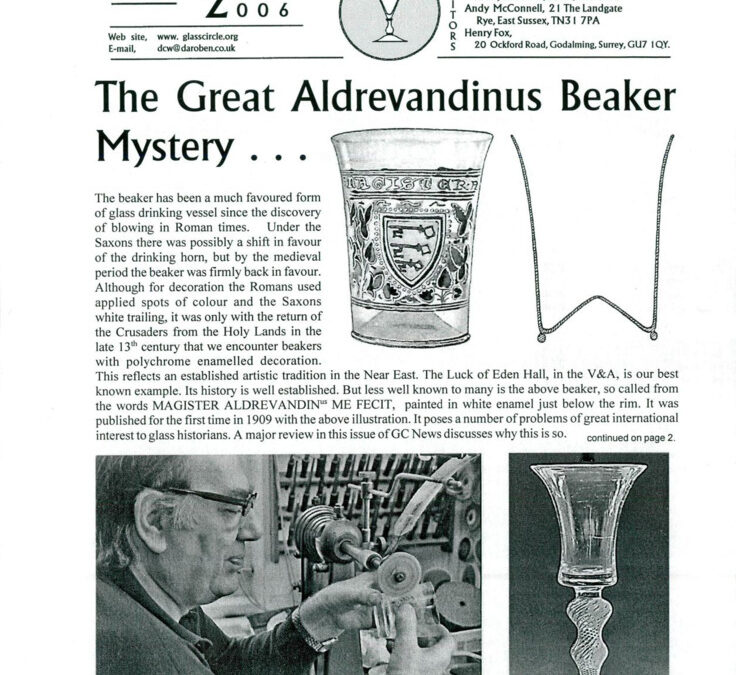
known example. Its history is well established. But less well known to many is the above beaker, so called from
the words MAGISTER ALDREVANDIN” ME FECIT, painted in white enamel just below the rim. It was
published for the first time in 1909 with the above illustration. It poses a number of problems of great international
interest to glass historians. A major review in this issue of GC News discusses why this is so.
continued on page 2.
Death of Peter Dreiser
–
an appreciation by Katherine Coleman on page 10.
,
…and how this goblet inspired a course in glass making, page 12.
GLASS CIRCLE NEWS No. 107, 2006
Editorial
Hugh Tait and Aldrevandin
A quick thumb through this issue will reveal the above
average length article on the Aldrevandinus beaker. It is the
result of your editor being presented with Hugh Tait’s glass
library by Mrs Tait. As she told me, this is no ordinary
library but a reflection of his professional interests in glass
and its history. Curators are expected to study the history
and develop the interest of objects in their charge. For those
in major museums like the BM the challenge is formidable,
well beyond the imagination of the average collector. Much
of the information is in foreign and often inaccessible
journals and books. Such is the case for the Aldrevandinus
beaker that must have led to many enquiries by and
discussions with his colleagues. It even led Corning
glassmaker, William Gudenrath to make an exact copy to
assess the problems involved in its manufacture.
Many will not have even heard of the Aldrevandinus
beaker, yet it epitomises one of the most significant areas of
decorative glassmaking in early medieval glass history. Are
there technological and artistic relationships between
glassmaking in the Middle East and that in Venice and the
rest of Europe and, if so, what are they and how did they
develop? The Aldrevandinus group of enamelled beakers
sits at the centre of this problem. In the following review,
with the translation package on my computer working
overtime, I have attempted to extract the information
central to this issue as currently understood by experts
around the world. Their views change as more information
comes to light and I have not shirked adding my own
critical assessment of their beliefs, including those of Hugh,
himself. Minimal references have been added for the
benefit of the initiated although few will have these
volumes on their shelves. And I would like to express my
thanks to The Society of Antiquaries, of which Hugh was a
proud Fellow, for the free use of its fine library.
One disadvantage for me was the inability to examine first
hand the vessels and shards illustrated. In particular, the
quality of the glass itself is often poorly described. Hugh,
Mrs Tait told me, was ruthless in this respect, using his BM
`clout’ to have objects out of their cases for close scrutiny,
often at short notice. How, I asked myself, was “bright and
clear” understood in the 13
th
century compared with today?
Such problems I have had to take for granted.
I hope this review will entertain, educate, stimulate and
perhaps even annoy its readers, but if in so doing it helps
promote the understanding of one of Hugh’s life-long
obsessions it will have served its purpose and express my
gratitude for the privilege of being able to do so.
Finally, a note on the meaning of the numbers in Table 1.
The Mean is the average numerical value of the samples,
obtained by adding them all together and dividing by the
number of samples. The Standard Deviation (S.D.)
indicates the spread or range of the samples around the
Mean for each group. If the Mean±S.D. of the groups of
samples for each component show a marked overlap, as
they do in Table 1, then the groups are considered to be
numerically identical. Such statistical presentation provides
an easy way of assessing the significance of the data.
The Great Aldrevandinus Beaker
Mystery
David
Watts
Islamic glass is thought of as the precursor of Venetian
glass and the glass collection bequeathed by Sir Felix Slade
(following his death on the 29th of March 1868) to the
British Museum was rich in Venetian glass. It was possibly
this connection that prompted Sir Augustus Wollaston
Franks (appointed curator of British Collections in 1851
and head of the new Department of British and Medieval
Antiquities and Ethnography in 1866) to acquire on behalf
of the British Museum an unusual enamelled beaker just
after its exhibition in Munich in 1876 (Fig. 1)). The clarity
and quality of the glass was thought to indicate that it was
made in either the Near East or Venice. But the beaker was
painted in enamels on both the inside as well as the outside
of the beaker — not a Venetian feature. Conversely, other
than its early date
(c.
1300) and that it carried a band of text
that said, in Latin “Master Aldrevandinus made me”, the
standard of artwork was generally considered to be poor by
comparison with known Islamic examples. Franks died in
1897 and was buried in Kensal Green cemetery; he was
never to know that after the Portland vase and Lycurgus
cup his purchase was to become one of the most
challenging acquisitions in the British Museum glass
collection.
The piece lapsed into obscurity and might well have stayed
there had not Miss Alice de Rothschild donated an early
enamelled “Saracenic” beaker to the BM (Fig. 5). The
Islamic connection prompted the then keeper, (Sir) C.
Hercules Read to present, in 1902, a paper on the subject to
The Society of Antiquaries of which he was Secretary
(Archaeologia,
2
217-226).
In 1899, Gustav Schmoranz
(Old Oriental Gilt and Enamelled Glass Vessels)
had noted
an unusual foot construction of some Islamic glass. Read
confirmed this in detail for the new Rothschild gift (Fig. 5)
and distinguished this specifically Saracenic feature from
the simple foot-rim of the so-called Aldrevandini beaker
(cover picture). On this basis, and the identification by Max
Rosenheim, a fellow Antiquarian, of the arms on the shield
as being European from Swabia, now part of the Kingdom
of Wutemburg, the Grand Duchy of Hesse and western
Bavaria (Figs. 1, 2)), Read concluded that the Aldrevandini
beaker must have been made in Europe, probably Venice.
These pearls of wisdom were, however, to fall on deaf ears.
In 1907, author/historian, Edward Dillon
(Glass),
having,
without doubt, discussed the piece extensively with Read,
concluded that “both the glass and the enamel . . . are the
work of Syrian craftsmen at Venice but more probably at
the court of one of the Frankish princes who held fiefs in
Syria during the 13
th
century.” His conclusion was biased
by consideration of a similar beaker, also in the BM, but
better decorated in the Islamic fashion. This piece, called
The Hope Cup after its donor, was recently declared a fake
by Hugh Tait after many years of suspicion (unfortunately
it is not on show in the BM). Further comparisons made by
world authorities, Robert Schmidt
(Das Glas)
and Islamic
specialist, C.J. Lamm led them to adopt Dillon’s suggestion
of “Franco-Syrian” to indicate the origin of both pieces
were, in their view, “Syro-Frankish”. In 1946, W.B. Honey
. . . . The views expressed in Glass Circle News are those of its contributors . . . .
2
GLASS CIRCLE NEWS No. 107, 2006
The Aldrevandinus beaker in the British Museum and an internal view to show the crude enamel in-filling of the
detail outlined in white enamel on the outside. 13th /14th century. Note the numerous gas bubbles. Height 13 cm.
“1
1111
•
11
5
Two views of the Aldrevandinus beaker copy by William Goodenrath to
show other features of the enamel decoration. (courtesy of Mrs. A. Tait)
The Restormel Castle beaker,
Cornwall. Ht 10.5 cm.
(British Museum.)
Display of Aldrevandinus-type shards from the London, Foster Lane excavations. Two bear the name
“BARTOLOMEUS”. One has only a decorative ribbon round the top. (Museum of London.)
All picture © D.0 Watts 2006
3
GLASS CIRCLE NEWS No. 107, 2006
Saracenic goblet donated to the British Museum by Miss
Alice de Rothschild from an investigation of which C.H. Read
accurately determined the unusual foot formation.
(Archaeologia,
1902, 217-226).
Dish painted with a band of scrolling foliage with
3-lobe terminals. Islam or Venice, 8th/9th century.
(A. Gasparetto,
(Mille Anni di Arte del Vetro a Venezia, p.16)
Mosque lamp, 14th century, and
detail to show the 3-lobe flower
and crinkle leaf infill decoration.
(G.
Morantz.
Old Oriental Gilt and
Enamelled Glass Vessels)
Detail from the shard of a plate incised with 3-lobe flowers and crinkle
Fig. 9
leaves decoration. 9th century, Tepe Madrasch, Iran.
(J. Kreiger, Nishapur Glass of the Early Islamic Period, p. 118.)
Fig. 11
Beaker enamel-decorated with a camel, typical flowers
and banding. Note the broad flared shape. Found in the
Middle Rhine area, 13th/14th century. Ht. 8 cm.
(E. Baumgartner& I. Kreuger,
Phoenix aus Sand und Asche p.142).
Fig. 1. Section of Sarneenic
goblet of enamelled glass.
(I,
linear.)
Beaker enamelled with
the name “.ETRUS”.
Note the similarities in
design with the shards
from Foster Lane. Found
in Mainz. Ht. 10.6 cm.
(E. Baumgartner & I. Kreuger,
Phoenix aus Sand and
Asche.p.129).
Fig.
Blue Saxon drinking horn with white
enamel trailed decoration.
c.
7th century.
(British Museum)
Yellow trailing has been found on
Saxon beads and on early
Fig. 12
4
__
t
oo_ medieval mid-
European glass.
Beaker of typical curved Islamic
shape bearing clear traces of
Aldrevandinus-type decoration.
Found in the North Caucusus.
Ht. 10. cm.
(F.A. Dreier, Venezianische
Glazer, p.31)
4
4a
GLASS CIRCLE NEWS No. 107, 2006
(Glass)
repeated verbatim Dillon’s preferred conclusion but
combined it with Dillon’s first thought by now indicating
an Italian working in Syria! Such academic confusion
might have quietly faded into obscurity but further events
were to bring the Aldrevandinus beaker back centre stage.
Unexpectedly, considerable evidence for many such
decorated beakers began to surface all over northern Europe
— Finland, Sweden, Denmark, Germany and even in South
Russia, Egypt and Israel. Recently, Ingeborg Kreuger,
world authority on this topic, reported in
The Journal of
Glass Studies
that shards had been found at 18 additional
sites in Germany, mostly in the upper Rhine area. A few
have been found in Venice itself but none (so far as I am
aware) in Syria or, more surprisingly, France. She also
identified a second signed Aldrevandinus beaker in Estonia.
The Syro-Frankish theory was under threat. Was the long-
standing assumption that the greatest number of finds
cluster around the source of manufacture to turn the
prevailing view on its head? Modern writers tend to hedge
their bets, favouring Venice but now not excluding northern
Europe. By chance, the Aldrevandinus beaker, as the first
recorded example, had become the archetype.
The beaker is included in one of the BMs most important
glass catalogues,
Masterpieces of Glass
(1968). Here Tait
reveals a cautious swing (back) to Venice as the source.
And, perhaps unwisely, he follows Read’s “Italianisation”
of Aldrevandinus into Aldrevandini and this is repeated in
The Golden Age of Venetian Glass.
But where did the
Aldrevandinus beaker really come from? — Syria, notably
Allepo or Damascus, or, less likely, from Persia (Iran/Iraq),
or was it from Venice, or further afield, such as
Constantinople, Corinth or even from northern Europe? Tait
concurred that the quality of the decoration was inadequate
for Syrian craftsmen; it is, in fact, very different as a trip to
the BM (Gallery 34, case 20) will readily confirm.
Islamic Flower Decoration
Islamic glass artists are particularly fond of both
floral and animal decoration. My attempt to find
parallels with the (largely ignored) stylised plants
with 3-lobed flowers identified a Syro-Egyptian
7
th
/8
th
century bowl and an 8
th
century fragment, both
with staining (S. Carboni,
Glass from Islamic
Lands); a
C. 13
th
painted bowl (Mentasti
et al., Mille
Anni di Arte del Vetro a Venezia),
and the C. 14
th
foot
of an enamelled bowl (Carboni again).
Three-lobed flowers and crinkle-edge leaves occur
together on a 9
th
century incised plate found in Iran
(Fig. 9) and, a rare occurrence, on a mosque lamp
(Fig. 8). These leaves are a relatively common form
of decorative infill. There is no known comparable
Venetian glass from this period and the painted dish
(Fig. 7) is of uncertain but probably Middle Eastern
origin. It is difficult to escape the obvious inference
that this plant is a long-established Islamic
decorative element. Kreuger favours the lily but my
preference is for the tulip that grew wild in Central
Asia. As early as 1000 AD. The tulip was cultivated
by the Turks and became highly prized in the West.
Flowers resembling tulips form decorative elements
on Islamic ceramics of the period.
In 1979, Hugh, in
The Golden Age…
described the beaker’s
main characteristics These are narrow bands of yellow
enamel outlined by bands of red enamel, two just below the
rim that contains the text, and one near the foot below the
main decoration (Fig. 1). In Islamic decoration, lines in
gold are outlined in red and Tait suggested the gilding had
been replaced by yellow enamel, either for cheapness or
because the artist simply did not know how to do it.
However, a few shards with traces of gilding have now
been recorded from various sites in Europe. The enamelling
was applied to both the outside and inside of the glass (Fig.
1). Common decorative features are outlining in white
enamel and typical stylised plants, the leaves and flowers
often painted in two colours, particularly red and blue
(Figs. 1,4). Also, for some beakers, a propeller-like element
is included in the spandrel of adjacent arches (Figs. 3, 4).
Adding to British interest, we are privileged to possess not
just the archetypal vessel in the BM but also a group of the
finest shards ever found. Probably representing eight
vessels, these came from an excavation in Foster Lane near
the Goldsmiths’ Hall in London; examples are prominently
displayed in the Museum of London (Fig. 4). They are so
stunning that I had make a second visit to convince myself
just how fine they are, They really do look as though they
have just come from the kiln, brilliantly enamelled on truly
colourless glass about 1 mm thick and with hardly a bubble
in sight. In fact, the quality of the glass appears better than
that of the Aldrevandinus beaker itself. They provided the
samples analysed by Ian Freestone mentioned overpage.
Other shards have also been found in England at Restormel
castle in Cornwall (Fig. 3. also on display in the BM),
Boston and, most recently, by Rachel Tyson rummaging in
a museum in York. A shard has even been found in Ireland.
Over what period were these beakers, and, it should be
mentioned, a few other vessels with similar decoration,
made? They seem to occur between the fall of Acre in 1291
when the last Crusaders crept home, and the mid-14′
century. The latter date is defined by a possible association
with the arms on the Aldrevandinus beaker with families in
a document known as the “Zuricher Wappenrolle”?, itself
dated to 1320-1330. Another document in the Venetian
archives extends the span to around 1350. (This,
incidentally, covers the time (1291) when the Venetian
Grand Council banished glass furnaces from Venice itself.)
Production was almost certainly brought to an abrupt end in
1348, however, when bubonic plague was carried from
Kaffa, in the Crimea, to the
sea
ports of Messina, Genoa
and Venice. It spread throughout Italy in a few months and
rapidly into France and the rest of Europe, killing an
estimated third of the population and bringing trade to a
standstill. It visited England in 1348 and Ireland in 1349
with similar devastating consequences. Not until 1446 is
there further Venetian documentary reference to a glass
painter and we begin to encounter fine Muranese enamelled
glass. This is the time when Angelo Barovier was re-
inventing what we now call
cristallo
and the old
glassmaking statutes of 1271 were replaced by a new set in
1441. Crystal glassmaking in Murano was not wiped out by
the plague but it definitely suffered a severe setback.
Of the fifty, or probably many more, beaker shards
discovered so far, ten or twelve are essentially complete.
Five, of slender shape, have the continuously flared outline,
5
LASS CIRCLE NEWS No. 107, 2006
although not the complex foot structure, associated with
Islamic beakers (Fig. 6) while the others are either simply
tapered, as found among Iranian cut beakers of the 10t
h
/11
t
h
centuries, or flared near the rim like the Aldrevandinus
beaker. Such local flaring can be associated with reshaping
if it had been partially melted during refiring as described
by Corning glassmaker, William Goodenrath. The
reshaping cannot continue too far down the inside of the
beaker or it would risk damaging the internal enamel
decoration (Fig. 1). Narrow straight-sided beakers flared at
the rim are a common Islamic shape. Hence, shape,
per se,
definitely has a Middle Eastern bias. In the 13′ and 14
t
h
centuries Islam continued to produce continuously flared
beakers (Fig. 6) that were exported in quantities to Asian
countries such as Russia. These were more sparsely
decorated with enamel quite unlike
the Aldrevandinus forms. The
diversity of shape of the
Aldrevandinus beakers makes one
wonder if a few plain Islamic glasses
ended up with Aldrevandinus
decoration applied elsewhere.
The decline of the Syro-Frankish
theory was accelerated with the
discovery by Italian historian, Luigi
Zecchin of the names of several
glass painters in the C.13`
11
/14t
h
Venetian archives. However, when in 1997 Rachel Ward
organised an important symposium at the BM,
Gilded and
Enamelled Glass from the Middle East,
evidence was
reviewed indicating Islam, at least, as the inspiration for
enamelling in Venice. The flared beaker is an Islamic shape
but hardly the wide-bodied form frequently found in the
Aldrevandinus group. The latter shape was not particularly
Venetian either at that time. Was it specially developed to
provide the maximum decorative surface and ease of access
for enamelling the interior? Also, as Tait pointed out, no
beakers have yet come to light that have both the
Aldrevandinus decoration and the relatively common
Syrian foot (Fig. 5).
Stefano
Carboni tells a fiction-based-on-fact story of one
Gregorio from Nauplia in the Peloponnese (South Greece).
A painter-decorator, possibly a refugee, he arrived in
Venice in
c.
1280, about the time the Crusaders were forced
out of Syria. Gregario failed to fulfil several commissions
to paint beakers, calculated by Zecchin as totalling some
4400 items. If Gregorio could paint 20 beakers every day,
with no two beakers exactly alike, this would represent a
minimum of 7 – 8 months work. Preparing the enamel
paints would involve considerable time in grinding the
lumps of enamel provided by the glassmaker. More
probably it took him several years and it is hardly
surprising that he took to the taverns for solace and ended
up recorded in the Venetian state archives. There is no
evidence that he actually painted Aldrevandinus-style
beakers. The original documentary context relates to a
contract with a ‘fiolario’? — normally translated as a vial
maker (Dillon says “bottle”) – who would not be expected
to make glass of the quality of the Aldrevandinus beakers
even if described as clear and bright (mozoli schieti;
`mozoli’ is old Italian for ‘drinking glass’ rather that
specifically for `beaker’); this would be the work of the
cristalleri (cristal glass makers). Vials and small bottles
might, however, be labelled more simply in relation to their
contents, such as oil or wine, as mentioned by Astone
Gasparetto in
Mille Anni Di Arte Del Vetro A Venezia
(1982). A small bottle, 7.8 cm tall, in the Glass Museum in
Liege, has inscribed between the usual red/yellow/red
bands the inscription [0]LMV[M] PROINFIRMIS,
probably an oil or potion for sickness or infirmity. On the
shoulder is an alchemical symbol like a letter M, possibly
indicating a distillate, a common way of making active
plant extracts in the Middle East back to Roman times.
Carboni weaves an enchanting story but its significance
could equally well lie in this humble little bottle.
Marco Verita analysed the glass itself from the
Aldrevandinus group, from C.14th Islam and from Venice
(c.1450 or later, so-called
vitrum
blanchum,
an early version of
cristallo).
He found them to be
virtually identical in composition and
he concluded that the alkali used was
allume catina
(best Syrian ash)
specified for use in Venetian
glassmaking from 1275 (Table 1).
However, David Whitehouse, in
Glass of the Sultans,
tells us that
between 1255 and, at least, 1277
quantities of glass lumps were
imported into Venice from Antioch.
So how reliable is the analytical data for proving a uniquely
Venetian origin for the Aldrevandinus glasses?
Unfortunately, the early Muranese recipes never mention
imported glass or even the use of cullet in their batches.
Verita
Freestone
Aidrevandin
Venice C.15th
Islamic
Islamic
SiO
2
69.111.33
67.8611.10
68.912.26
68.7211.17
A1
2
0,
0.9710.64
1.1310.45
1.1010.18 1.2210.18
Na
2
O
11.3910.89
12.7211.18
11.711.08
13.1411.25
K
2
O
2.4010.70
2.5010.60
2.5510.60
2.3810.64
CaO
9.7810.82
10.2811.27
7.9011.49
8.1311.09
MgO
3.2010.34
3.4010.82
3.4310.52
3.2210.68
Fe
2
0,
0.3510.10
0.3610.09
0.3710.10
0.4410.16
MnO
1.1010.28
0.5010.32
1.1710.38
1.1510.43
Table
1. Data showing the remarkably uniform composition of
glasses from the sources under consideration and the excellent
agreement between the analyses of Verita and of Freestone &
Stapleton on separate groups of glass samples. The Aldrevandinus
and Islamic glasses are from the late 13th and early 14th centuries.
No comparable Venetian glasses of this period were available for
analysis. Values are Mean%±S.D. (see Editorial)
Data from R. Ward,
Gilded and Enamelled Glasses from the Middle East.
Enamels, as well as the glass, were made by the
glassmaker. Goodenrath, based on his own experiments,
suggests that after painting the beakers had to be refired
fixed to a pontil by the glassmaker who made them. This is
because the red and blue more thinly painted enamels had
similar melting points to the glass itself. It is, however, a
wasteful use of a glass furnace, the wood for which has to
be imported, compared with a dedicated muffle furnace
operated by an experienced enameller. Also, several of the
beakers do not appear to have been reshaped (Figs 6, 11).
Gianfranco Toso
(Murano, A History of Glass)
tells us that
in Venice enamels were principally supplied to the
Guide to Types of Medieval Glass
Based on the amount of alkali – Sodium (Na),
Potassium (K), and Magnesium (Mg) – found
by analysis of the glass.
ROMAN:
High Na, negligible K and Mg,
derived from Egyptian salt lakes
ISLAMIC and VENETIAN:
High Na and Mg,
Low K, plant ash derived mainly from Syrian
and other littoral shores in the area.
NORTH EUROPEAN:
High K and Mg, Low
Na, derived mainly from forest trees and ferns.
6
GLASS CIRCLE NEWS No. 107, 2006
goldsmiths. Would these goldsmiths have done their own
firing or were there specialist enamellers for that purpose in
this highly regulated society? It is a tenuous argument to
suggest that the enamels had to be fired by the glassmaker
that made the beakers. The only 14
th
century Venetian
document to mention enamel relates to Murano glassmaker,
Giovanni Deolay who was allowed to work his furnace for
this purpose during the annual vacation. But, as discussed
below, much restoration work involving enamel mosaics
was going on in the city at that time, notably S. Marco, the
Baptistery and the Chapel of S’Isidoro; there is no
indication this enamel was being used to paint beakers.
Scientific analysis of shards from the Foster Lane site by
Ian Freestone confirmed that the red and blue enamels and
the beaker were made from the same glass recipe. But this
is not surprising in the light of Muranese recipes as early as
1450, or earlier, examined by Cesare Moretti and Tullio
Toninato
(Ricette vetraria del Rinascinamento, 2001).
For
that is exactly how they were made by adding colouring
agents to a basic glass. Exceptions were white and yellow
enamel where high concentrations of lead and tin were
added to the base glass in different proportions. One would
expect these additives to lower the melting point just as
lead glass has a lower melting point than soda glass. The
compositions differ somewhat from those in Islamic glass
but such recipes are not written in tablets of stone.
As well as Gregorio, other painters have been identified in
the Venetian archives, Donino and Paolo, brothers of
Bartolomeo da Zara from Dalmatia, are mentioned in
1290: Donino is listed as a painter of drinking glasses as
late as 1345. Bartolomeus, listed in the archives, occurs as a
signature on two of the Foster Lane shards (Fig. 4); but the
name is a common one and there is no certainty that they
are one and the same individual. Another name in the
archives that has been identified on a beaker is Petrus, the
name itself going back to 1083 in a reference to “Petrus
Fiolarius Flabanicus”. A beaker bearing the name
.ERTRUS (the dot indicates a missing letter) was found in
Mainz and is probably his work (Fig. 10). Another painter
listed is Zannus Totulus although nothing seems to be
known of his work. I was unable to determine how many of
these decorators were established natives of Venice.
Variations in the style of decorating and spelling on the
beakers support the view that many painters were involved.
A common sentiment is “AVE MARIA GRACIA PLENA”
with `gracia’ spelt GRCIA, GRATIA, GRC.IA or GRACI.
On two beakers we find AMOR VINCIT OMNIA while a
shard from Metz has the curious sequence .ACNETAM.
which could be a Latin abbreviation for ‘grace and love’?
Overall, including the beakers without text, several painted
with animals (Fig. 11), the subject matter seems aimed at a
diverse section of the population with themes that are
clearly not Islamic. Islamic text is not found on any beaker
of the Aldrevandinus group.
The evidence so far, then, turning away from the Syro-
Frankish theory, has tended perhaps to over-emphasize that
in favour of Murano. Nevertheless, the Middle East may
still claim to be the inspiration for, and possibly a
contributor to, the manufacture of Aldrevandinus beakers.
This brings us to the once vast but steadily declining
Byzantine empire, particularly Constantinople and Corinth
where several Aldrevandinus-type shards have been found.
Gregorio was Greek and in the 13t
h
century Corinth was a
relatively unstable city, being sequentially conquered by the
Normans, Franks, Byzantines, Turks, Venetians and then
again by the Turks. Emigrating to Venice might well have
been a safe option for him.
David Whitehouse’s presentation at Rachel Ward’s
symposium concerned gilding but mentions the
contribution of 12
th
century author of
De Diversis Artibus,
Theophilus who describes how coloured “enamels” were
made. Axel von Saldern, in the same volume, states “Fine
clear and colourless glass must certainly have been made in
Constantinople, which was the centre of production of
polychrome enamels…”. The best known example is a bowl
in the St Marks’ Treasury brought to Venice by the
crusaders after 1204. An 11
t
h/12
t
h century commercial link
between Venice and Corinth is suggested by Attilia
Dorigato in
Murano Island of Glass.
This relates to the
widespread use of
moili de girlanda et imperlati —
glasses
opulently decorated with threading and small prunts. No
less important, Byzantine artists were employed to repair
the mosaics of S. Marco; but, surprisingly, the mosaics they
used were reported by Freestone in
Science and the Past
to
have been made with North European wood or fern ash
rather than with Syrian ash as might have been anticipated!
How can these contradictory findings be explained?
Mosaic tesserae, possibly made in Corinth, were also
suggested to have been used to colour glass found at the
Hamwic (1998) excavations near Southampton. But these
relate to the Saxon period and analyses indicate that the
glass found there, like that from the venerable Bede’s abbey
in Monkswearmouth, was made with Egyptian salt lake
soda. This underlines the fact that trade between East and
West had been practiced for nearly half a millennium. As
Freestone suggests, European raw materials for the S.
Marco mosaics were perhaps exported to Byzantium to
meet an exceptional demand at that time. It would explain
why Giovanni Deolay was allowed to work his furnace
during the holiday period.
The Byzantine evidence, then, cannot be left out of the story.
Costantinople and Corinth must have been deeply involved
in Middle Eastern glassmaking practice. Possible evidence
that at least some Aldrevandinus beakers may have been
made there, perhaps those of Saracenic shape, comes from a
comment by Donald Harden in Medieval Archaeology,
(1978). “Glass fragments found in Southampton depict part
of a roundel frequently found on Byzantine bottles but seem
to be unknown on any other Syro-Frankish glass.
Significantly, these are enamelled red on the inside and
yellow, green and possibly white on the outside.”
Finally, the possibility of a North European origin must be
considered. As cited above, the proposal was originally
linked by Tait to the absence of gilding and the poor
technical and artistic quality of the decoration. Might this
decline in quality reflect a commercial response to popular
demand? Herein lies a number of problems the main one
being the composition of the artefacts themselves.
First, is it true to say that such glass could only be made in
Murano? After contemplating the Museum of London
shards I wandered round the museum and came across the
7
GLASS CIRCLE NEWS No. 107, 2006
displayed coffin of a 4
th
century rich Roman lady. Within it
were two quite thick but almost colourless glass perfume
containers, perhaps, it said, made in the Rhine area. Some
of the world’s finest glassmaking sand, low in iron, comes
from the continent, so if a crystal quality glass was possible
in the 4
th
century why not the 13
th
? By contrast, Henkes and
Henderson found that a particular type of C. 17
th
“spun-
stem” roemer, attributed to the Netherlands, was
nevertheless made with glass that had a high sodium, low
potassium content indicating imported Near Eastern alkali .
Such facts clearly undermine any conclusions from an
otherwise convincing report by Marco Verita
(J. Glass
Studies)
that nine Aldrevandinus shards from German sites
were all made of the same Venetian-type glass (see Table
1) with what is possibly Venetian-type enamelling.
Reports of several beaker fragments reveal that
not all of the glass used to make them was of the
same high quality. Some have a more bubbly
metal; one is a pinkish brown (picture right) and
other examples are deliberately coloured red and
blue, as well as the ordinary bottle already
mentioned. By the 14th century, fine enamelled
metal-ware and stained glass, mainly for
three samples and not statistically significant. On the other
hand, Julian Henderson finds a convincing correlation
between the cobalt in Islamic blue glass (7 samples) and
French translucent blue glass (24 samples) of the same
period. He suggests Anorak, near Tabriz in Iran as the
source and suggests that “lumps of blue frit” were traded
between the two areas. Bernard Gratuze
et al.
in
BM
Occasional Paper 109,
also find the same cobalt type in a
diverse group of medieval French glass but, by contrast,
they attribute the source to the Erzgebirge mountains of
North Bohemia and the Syrian-style alkali to the south of
France! Further, the enamel used for precious metal
artefacts attributed to the Meuse region (about which
Theophilus writes) also had the same high sodium, low
potassium content. It seems that this composition is not a
certain indication of origin. Clearly, the Saracen final
conquest of Syria was not
necessarily
a barrier
to continuing trade with the west and that one
way or another the requisite exchange of raw
materials
could
have continued with Northern
Europe. Equally, they might have come from
Venetian sources but yielding an essentially
similar scientific fingerprint.
religious buildings, was already well developed
Such decoration by North European glass
in northern Europe. Theophilus is believed to
painters, if it occurred, is unlikely to have been
have been German which helps explain his
initially a speculative enterprise. Rather, as for
Aldrevandinus-type .
understanding of coloured glass. Fired-on
nainted windows, it would have been a
beaker with griffin
enamel, made with finely powdered glass is only
decoration.
commission and the equivalent of a glass-
a small step removed from fired stained glass in The Hedwig beaker of painter’s `videmus’, a drawn outline design,
which only the pigments, and perhaps a flux, are slightly earlier date, in provided as guidance. Concerning design, it is
used. The manufacture of glass enamels could the BM, gallery 34, is interesting that a 3-lobed ‘leaf ‘, not unlike that
have been quickly solved if there was a demand carved with a griffin.
found on the beakers, also forms part of the
to produce beakers that carried the religious
repeat border pattern in the great west window,
c.
1339, of
message of the eclesiastical windows into the private home.
York Minster.
Saxon glass, probably of German origin, has been found
with trailed on white enamel (Fig. 12). Further, we are told
by Richard Marks in
English Medieval Industries
that
treating both sides of cathedral glass to reinforce images
was well established by the 13
th
century. Gilding, on the
other hand was not part of the glass painter’s repertoire. But
there were architectural gilders and manuscript decorators
that might later have become involved for a few specimens.
The Hanseatic merchants thought initially to have provided
the European market with enamelled beakers imported
from Murano might equally have imported them
undecorated. These merchants, because of the dominance
of their trade support for Murano , were allowed to export a
proportion of their Venetian purchases free from export
duty. More glasses could be exported if undecorated, just as
England found later that it was cheaper to import un-
ground “coaching glasses”. If the trouble experienced by
the Venetian glassmakers with Gregorio is any guide this
might well have been a preferred business deal.
But what about the enamel being formed from the same
glass as the beaker? In practice, glass exporters always had
to allow for breakage in transport thereby ensuring a supply
of shards that could be ground with pigment to make
enamel. Not much enamel is required to decorate one
beaker. However, the white and yellow enamel used could
have been a problem as these were not colours used by the
glass painters and might have had to be specially imported.
Freestone finds a difference between Islamic and
Aldrevandinus-type white enamel but it is only based on
Underlying these uncertainties is the fact that that although
the Aldrevandinus beaker has become the archetypal form
we know almost nothing about Aldrevandinus himself.
From the dating he seems unlikely to have been a
contemporary of Bartolomeus or the much maligned
Gregorio. The statement on the beaker could indicate that it
was to celebrate emergence from apprenticeship or that it
was made, like a videmus, as an example for apprentices to
copy, or even to advertise his studio, wherever that might
have been. The authority on this subject, Ingeborg Krueger,
states
(J. Glass Studies)
that she believes that the wording
has no significance at all!
Even his nationality is in question. Following Read,
Honey and Tait, Aldrevandin(i) is tacitly assumed to be
Italian. He is not listed in the Venetian archives although
a possible link turns up in a document in Florence of
April 4, 1331. This is to “Aldovrandino fiolaro” (note
spelling). Could our painter also have been a vial maker
or, perhaps, a relative? Documentary reference is not an
indication of nationality any more than Verzelini was
English! If we rewrite his name as Aldre-van-Din the
`van’, in Dutch meaning ‘from’ or ‘of’ indicates a Low
Countries or perhaps Germanic origin, areas important
for both glassmaking and, particularly, glass painting as
suppliers of window glass, including to England. An
unscientific trawl on the web revealed the name, Andre-
van-Duin, a live Dutch celebrity, and I was gratified to
discover that although Ludwig van Beethoven was born
in Bonn his family came from Belgium. The word or
8
GLASS CIRCLE NEWS No. 107, 2006
syllable ‘van’ is definitely not part of Italian vocabulary.
All this means is that it is unwise to infer that
Aldrevandin(i) provides evidence that these beakers were
made in Venice although he, or some of his relatives,
may have gone to Tuscany.
This review, if anything, reveals what a complex and
confusing literature currently surrounds our attempts to
understand the history of the Aldrevandinus group of
enamelled beakers. The authors seem often to raise more
problems than they solve. From a commercial angle there
must have been something to stimulate the demand in the
first place. There are enough shards discovered of beakers
with the concave Saracenic shape and elements of
Saracenic decoration to support a Middle- or Near-Eastern
inspired origin and a connection, perhaps via Costantinople
or Corinth, relating to trophies brought by the returning
crusaders. This quickly fell away and the Hanseatic
merchants saw a trading opportunity to fill a new demand
with replicas from Venice. Perhaps these, initially painted
by Byzantine emigrants, set the Saracenic-based style of
the characteristic art-work but with the script in Latin.
Local European industry then took up the challenge either
by enamelling imported plain beakers or even making their
own. Exporters/importers cashed in on a lucrative trade in
raw materials. The beakers developed a unique broader
shape more amenable to decoration, and established glass
painting solutions of using both the inside and outside of
the beaker were adopted, perhaps for speed (the inside can
be painted while the outside is still wet) and to prevent the
enamels from running into each other during firing. The
subjects of the decoration itself were widened to satisfy
both religious and secular demand. This whole industry
flourished for some seventy years creating relatively cheap
and cheerful must-have keep-sakes — with a few exceptions
bearing toasts they were not intended for regular drinking –
in an otherwise rather drab market. It was terminated,
within months, if not weeks, by bubonic plague in 1348. A
century was to elapse before the luxury glass industry
recovered with the emergence of
cristallo
and enamelled
goblets in Murano.
Even if this speculative picture is roughly correct we have
no information about the time change at each stage of the
sequence, how long each lasted and to what extent they
overlapped. In particular, there is still no hard evidence that
manufacture ever took place in Northern Europe. Was
Read right all along? Further archaeological finds,
documentation and more extensive analyses will hopefully
help clarify the picture in the future.
For the glass historian it remains an important transitional
time of glassmaking that will continue to challenge our
understanding of a difficult and unstable period. From a
Venetian perspective it helps demonstrate how imported
raw materials, and the inclusion of pure quartz and crushed
pebbles in the batch reflect a technical understanding of
how to make top quality crystal in the early 14th century
long before Barovier perfected his famous
cristallo.
HENUZY’S CuPPINIGS
Admiral Lord Nelson cameo
The above image was taken from the sales catalogue of
Historical Medals and Works of Art, May issue, by
specialist dealer, Timothy Mallett, Ltd. London.
The uniformed bust portrait of Nelson is in white glass,
signed on the truncation WARNER F., mounted on a blue
glass background and contained within a paper mache
frame with integral gilt-brass ring suspension. Size 75 x 94
mm.
Warner is recorded as being a gem engraver at the end of
the 18th century. A Tassie portrait of Adam Smith in 1787
was reproduced in cameo by Warner.
CORRECTION re the Leith Goblet
NOT “Not necessarily by a member of the
Beilby family”.
My description in GCN 106 of the Leith Goblet sold at
auction by Lyon & Turnbull elicited the following
response from our member George Neilson.
“As a former curator of the Drambuie collection with
special responsibility for the glass section I co-operated
closely with Campbell Armour the Ceramics and Glass
expert of Lyon and Turnbull on the various descriptions of
the glasses in the catalogue and we agreed that the glass was
most probably decorated by William and Mary Beilby”
The catalogue states “decorated by the Beilby family”; I
now concur, with full apologies for any offence caused by
my error, that this description is accurate. *
It is gratifying for The Glass Circle to know that our late
Hon. President, Hugh Tait was both a custodian of the
Aldrevandinus beaker and a significant contributor towards
understanding its wider significance. *
NB Check out
this fine new site, www.discoverislamicart.orq
Peter Rath, owner of J & L Lobmeyer
will be
speaking on
No History for the Crystal Chandelier
at
the Ruskin Glass Centre, Stourbridge, at 3.00 pm on
Sat. 29th August, 2006, as part of this year’s
International Festival of Glass.
9
For more details consult ifg.org.uk
GLASS CIRCLE NEWS No. 107, 2006
Peter Dreiser M.B.E. (1936 – 2006)
an appreciation by Katherine Coleman
Members of The Glass Circle will be sad to hear of the death of Peter Dreiser on 4th April 2006
after a long battle with cancer. Peter was Britain’s greatest 20th century wheel engraver on glass,
one of the last to be trained in the full Bohemian tradition, one of a chain of masters reaching right
back beyond the 18th century. He was also a great teacher of glass engraving techniques; more
practising glass engravers in Britain have been taught by him than by any other.
Born in Cologne in 1936, his father worked as a railway Tina were married on 20
t
h July 1957. They always
engineer while his grandfather was a prosperous maintained that each had the characteristics of the other’s
nurseryman and expert on the weaving of fine velvet. country, Tina the organiser, Peter the easy-going, gentle
When Peter was a child they all survived, in their
free spirit.
nightclothes, the firebombing of Cologne and several years
as unwelcome refugees in Bavaria. Peter’s wartime Tina helped Peter find a better job with a glass firm in 1958,
misfortune and lack of education turned out to his and our supervising enamelling by silk screen onto glass. In his
advantage in that he encountered the new State School for spare time, Peter constructed an engraving lathe of his own
Art Glass at Rheinbach in Germany, founded in 1948 with and began to engrave once more from the broom cupboard
the cream of the refugee Czech Bohemian engravers. There in their tiny flat. To start with, he had no success selling his
he fell in love with glass engraving instantly, completely, work — Harrods’ and Liberty’s buyers were not interested.
and for ever, at the sight of Otto Pietsch in his little studio However, one day he approached Leathers & Snook, a glass
gently and exquisitely engraving the cheeks of a fox. He shop in Piccadilly, where Mr. Leather spotted his talent and
trained in glass engraving and design at the Rheinbach Mrs. Snook introduced him to Thomas Goode where he
Glasfachschule under Otto Pietsch and Fritz GlOssner soon secured employment as their resident glass engraver.
(from Steinschonau, now Kamenicky enov) from 1951 to He worked there until 1970 when he decided to become
1954.
freelance.
His training proved to be of little immediate use in post-war While working for Thomas Goode, Peter customarily spent
Germany and it was in 1955 that he came to England, his lunch break and spare time at the Victorian and Albert
recruited by Century Glass Works Ltd in Edmonton, a glass Museum studying its great glass collection and so came to
factory run by a Bohemian Jewish family, producing glass know Robert Charleston. They learned a great deal from
items for Woolworths (see GC News 103, p.16). During each other. It was through his association with Robert that
this time he met his future wife Jovita Antonia Martinez he joined The Glass Circle where he became respected by
Cue, daughter of the famous Spanish musicologist, the members for his quiet, considered opinions and
Eduardo Martinez Tomer who had studied at Madrid and knowledge. At weekends, Peter would prowl the Portobello
Paris, friend of De Falla, Debussy, Faure, Saint-Seans,
Road street markets for beautiful late 18
t
h and early 19
th
Dukas and Maurice Ravel. Returning to Spain in 1914 century cut glass, then out of fashion and unappreciated.
Martinez Touter had toured the country, collecting folk
songs & music, published the Cancionero Asturiano and Bizarre ideas of dating engraving by means of analysing
Cancionero Gallego until the Civil War in Spain brought magnified images for grit marks or fanciful theories about
his work to a standstill. As head of
la Seccion de Folklore
the engraving of
diatreta
he treated with the contempt they
del Centro de Estudios Historicos
in Madrid, Martinez deserved. The former because any self respecting copper
Torner lectured at La Residencia de Estudiantes with Lorca wheel engraver can imitate old grits by the simple
and Dali who drew a lovely caricature him, also Bunuel expedient of mixing modern ones, the latter because — as
who before his film studies was a soldier in the artillery and Josef Welzel has since proved — they were definitely cut by
an amateur boxer. Martinez Touter arrived as a refugee in wheel rather than drilled like ivory. Peter always advised
England on 3r
d
September 1939 and worked for the BBC, students to study carefully and critically the modelling and
lecturing on Spanish folk music and literature in Oxford, style of the engraving to establish where possible the true
Cambridge and King’s College London. In 1955, he died of author of unsigned and dated work, bearing in mind all the
cancer. When the Spanish Cultural Attache came to offer, characteristics of the glass itself, where the age of the glass
from the then Spanish government, every post he had was not certain. He also advised engravers to avoid
before leaving the country he replied “I rather sweep the engraving on antique glass, not only because older glass is
streets of London than return to fascist Spain”. Peter and brittle and unpleasant to engrave but also because having
1
0
GLASS CIRCLE NEWS No. 107, 2006
survived to this day, antique glass commands respect.
Peter Dreiser once told me that he regretted having to spend
so much of his life doing ‘bread and butter engraving’ when
he was already acknowledged as a great artist on glass.
However his work is testament to the latter, with its strong
theme of concern for the natural world. This will live on in
public and private collections — the V&A, The Science
Museum, Broadfield House Glass Museum, The Corning
Museum of Glass in the USA, Nottingham Museum, the
Ulster Museum, the Fitzwilliam to name just a few. For
many years he worked on major pieces of crystal for royalty
and for Her Majesty The Queen. Peter was very proud to
receive an honorary MBE last year and the position of
Honorary Liveryman of the Worshipful Company of Glass
Sellers — the MBE particularly pleased and amused him as a
German national, having started his life with a singularly
different opinion about the British and their Empire and the
second honour was very cheerfully and proudly received
with full ceremony at his bedside.
In 1975, along with Laurence Whistler and David Peace,
Peter Dreiser became a founding member of the Guild of
Glass Engravers, one of the first of the Guild Fellows and
an active Vice-President. Peter taught glass engraving at
Morley College in Lambeth for 25 years and at Branch
workdays of the Guild of Glass Engravers. As a teacher and
mentor Peter was generosity itself to all serious students.
His name is renowned both here, in Rheinbach and
Kamenicky enov where they refer to his wonderful book
that he wrote with Jonathan Matcham as the Bible of glass
engraving. He taught by example, with great patience and
humour. Many of his students went on to enjoy successful
careers as glass engravers themselves. They include such
names as Jacqueline Allwood, Jo Birrell, Virginia Bliss, Jill
and Peter Chaplin, Elly Eliades, Elaine Freed, Josephine
Harris, Clare Henshaw, Isabelle Liddle, Stanley Serota,
Thomas Standage, Katharine Coleman and Hilary Virgo.
There is a detailed account of Peter Dreiser’s career on tape
recorded by the British Library’s National Life Story series.
David Mocatta captured Peter engraving on glass for future
generations in a beautiful film. Even last October Peter was
propped up in bed sorting through boxfuls of negatives and
slides for the heavily revised and updated second edition of
his book,
‘Techniques of Glass Engraving’,
to be published
by A&C Black in October. For many years Peter was also
Vice-President of the Royal Society of Miniaturists,
Sculptors and Gravers, now known as the Royal Miniature
Society. Collectors, connoisseurs and curators all turned to
him for information on both British and Bohemian
engraved glass.
A modest and retiring man, despite his 6ft 8ins stature, like
many really great artists Peter seemed oblivious of his
extraordinary skills and charisma. He seldom entered
competitions. But glass enthusiasts, other engravers and
miniaturists recognised him for what he was: a veritable
giant in his field, an absolute master of copper wheel
engraving and
the
authority on engraved glass past and
present. Those members of The Glass Circle who came on
the visit to the Czech Republic in 2002 will remember his
expertise on knowledge of Bohemian engraving and glass
decoration; already ill, the sight of so much beautiful glass
greatly cheered him. At every museum the cry went up
“Peter, Peter, come here and tell us
1
”
Peter’s family may not have always enjoyed his obsession
with glass — but they, like us, profited from his insatiable
curiosity and creativity — his gardening green fingers
inherited from his grandfather (a polymath like Peter), his
engineering skills from his father and brother, his cooking
and love of sweet biscuits. Who else would take their first
car apart, literally into pieces, before they drove it, just in
case it broke down? Peter’s children Rodrigo and Theresa
have clearly inherited his talents with photography, Marina
his patience and design skills. He loved nature and music,
both of which he successfully realised in glass. He was also
a more than competent linguist.
He is survived by his wife Tina and children Rodrigo,
Marina and Theresa and two grandchildren. Born in
Cologne, Germany on the 11t
h
June 1936, he died of cancer
in London on 4 April 2006. *
Glass Circle Matters
New Members
Mr. P. Daniels
Mrs. A.M. Horne
Dr. J. Kemp
Mr. A.M. Pullan.
E-mail Addresses of Members
Glass Circle Members who have given their e-mail
addresses to the Hon. Membership Secretary will
have recently received an e-mail from the Hon.
Secretary. If you have an e-mail address and have
NOT received this communication please send your
e-mail address as soon as possible to
marianne@dial.pipex.com. The Committee intention
is to send communications by this medium wherever
possible.
GC News 108 Publication Date
The next issue of GC News is scheduled for
September. Copy please by mid – August if possible.
11
Compare that to today in the college hot shop where most
students are girls (unthinkable in the 60s) and several were
of ‘a certain age’. Pictures were shown to illustrate how in
Left.
Interior view of
the IGC with
a
student from Sweden
working in the chair.
Right.
Blown bowl
decorated with blue
and white cane
inclusions made by
our speaker.
All
‘pictures
are
copyright of the author
GLASS CIRCLE NEWS No. 107, 2006
FROM BUBBLE TO BOWL
by Jane Dorner
A lecture given to the Glass Circle at The Art Workers’ Guild on
Tuesday 21st. March 2006.
The hosts for this meeting were Mr L.A. Trickey, Mr K. Cannell,
Mr
R.E.
Chatfield and Dr B. Clarke.
The hall was well-filled for Jane Dorner’s talk on her year as a
student at the International Glass Centre (IGC). She started by
showing a slide of some of her own collection of 18t
h
century
drinking glasses (cover picture) and said her interest was in
twists and latticino. Her year experiencing glass-making at
first hand had made her a more discerning collector, and she
would return to this at the end of the talk.
The author ladles
hot glass in a casting session.
The courses in glass making techniques and technologies at
the IGC are amongst Britain’s best-kept secrets. It is one of
the few design-based teaching establishments where
students from all over the world learn a full range of glass-
making techniques. There are not many places in the world
where you can do all these things, and the full-time courses
are free to EU students of all ages. There is even a learner
support fund to help people relocate.
To illustrate the mouth-watering tasters from a whole series
of hors d’oeuvres, Jane divided her talk into 7 sections in
which she gave a whistle-stop tour of the course. These
covered the following with many slides illustrating her own
progress as well as finished work made by fellow students:
1.
Hot glass –
blowing, casting, lampworking, bead-
making.
2.
Kiln forming –
painting with stains, enamels and
lustres, fusing and laminating, casting, pate de verre,
experimenting with inclusions, making moulds, slumping
into them, using coloured fits and shards, programming
different types of kiln.
3.
Cold working –
sandblasting, wheel cutting, engraving,
polishing, sawing, cameo, Graal.
4.
Stained glass –
copper foil, leading, stencilling and
electroplating.
5.
Technology –
composition of glass, batch calculations,
how furnaces are built, using a polariscope.
6.
Design –
sketchbooks, PhotoShop, internet research.
7.
Assessment –
record-keeping, setting up exhibitions.
The IGC is based in Brierley Hill and is part of Dudley
College. It has a truly remarkable set of workshops kitted
out with all the appropriate equipment.
The one-year full-time course, gives students an Open
College Networks Access Module certificate at Level 3 and
students are expected to get 16 out of the 24 credits
available as
a quid pro quo
of enjoying a free course
—
to
keep it going for future years. The range activities involved
was so great that one could not get through everything the
course demands without a willingness to give it your fullest
focus. Our speaker spent every available minute in the
workshops and all her time out of them designing. There are
part-time courses as well.
The workshops were first set up to provide practical skills
in order to train apprentices on day release from the many
glass-houses in the surrounding area. This was in the 1960s
when almost every family in Stourbridge and Brierley Hill
would have had several members in the glass industry.
Nevertheless, they were locked into the apprenticeship
system — one, Jane felt, held back its young trainees who
would start at 15 as a taker-in (the lad who breaks the pieces
off the punty iron and puts them in the lehr where they cool
overnight), then progressed to being a gatherer (bringing
glass to the master in the chair) finally rising to a master
blower (or gaffer) only after a minium of 5 years.
12
GLASS CIRCLE NEWS No. 107, 2006
Three of
the goblets made by Jane at
the
Istanbul Summer School, her technical skill not
quite matching her design ambitions!
24 teaching weeks — and only 5 hours a week taking it in
turns to be in the chair — Jane had progressed from making
a shapeless blob on the end of a punty iron to a small salad
bowl decorated with twisted cane that she had pulled
herself, together with the aid of the technician. Wobbly, she
agreed, but it
is
possible to learn a great deal in a short time
and a great pleasure for someone who is a collector of
twisted cane glass.
Though at first the experience had proved too hot (up to
1500°C), too difficult, too dangerous, and impossible to
control stuff that is white hot and fluid at one moment, and
stiff and unmalleable minutes later, Jane got hooked on
glass blowing and is now looking to see where her next
`fix’ is coming from. Not many of the complete beginners
did
achieve ‘control’, but they all got remarkably far
towards doing so.
Our speaker’s
forte
turned out to be drill engraving — a
technique she knew almost nothing about and
didn’t even
like.
As a collector, her taste in wine glasses was for
undecorated purity of shape. This view has since changed
because the optical illusions that can be achieved with
engraving feed a personal interest in ambiguity of
perception. Ambiguity was demonstrated again in another
slide of a giant comma made of fused optical lenses that had
been exhibited at the Red House Cone in July 2005 with a
story-teller accompanying the piece. On the table, along
Drill-engraved plate that won the John Davies Memorial
Award for the best progress in glass decoration.
Goblet,
the stem cased pale blue inside, by second-year
student, Caroline Scully that was short-listed for the Bombay
Sapphire award. The design is inspired by a ball gown.
with
other examples of blown work for our inspection, was
an engraved plate (below left) for which she was given an
award.
To end end her talk Jane showed again the shapeless blob
that had been her first attempt at blowing, and then a set of
12 assorted goblets (above left) blown at the Glass Furnace
near Istanbul just weeks after the IGC course had ended. We
were told how thrilled she was to have achieved these
jaunty wineglasses and then returned to a picture of the
most expensive glass she had ever bought: Lot 181,
Sotheby’s November 1999 – a quadruple-knopped airtwist
of
c.
1750. Experience had left its mark! “Now that I have
tried to do an airtwist myself, I can appreciate the skill
involved. It is far from easy. Nevertheless, mine probably
took 10 minutes to make, and though the four knops make it
relatively unusual, there’s something unsatisfying about the
way they are drawn out. At the talk, I asked what Sotheby’s
was doing charging such high prices. Audience laughter
suggested echoing thoughts, but it was pointed out to me
afterwards that it isn’t Sotheby’s so much as market forces.
Still, I will be a different sort of collector from now on.”
Originally
Brierley Hill Technical Institute, it
then
became the local Public Library and displayed part of
the glass collection now at Broadfield House, the
International Glass Centre as it is today.
Applications for the year beginning September 2007 to
john.tavloredudleycol.ac.uk or visit the website at
www.dudleycol.ac.uk/glass/. For the Istanbul two-week
summerschools, email arts_educationaalassfurnace.orq, or visit
www.glassfurnace.orq.
13
GLASS CIRCLE NEWS No. 107, 2006
06
1
4lira ceeffeatlia
9
t
‘ete1
,
cede
The Portico Library in Manchester is one of a handful that
survive of the many private subscription libraries founded at
the turn of the C.18th by the professional and commercial
middle classes. The London Library is the best known and
most successful, but Manchester’s still thrives, and this year
celebrates its bicentenary. The Portico occupies a purpose
built building by Thomas Harrison of Chester that opened its
doors on 20th January 1806, and its Great Room still has
working the wind indicator that allowed the Proprietors (for so
members were, and are still, called) to see when the wind was
favourable for the cotton clippers to dock in Liverpool, thus
suggesting that it was time to adjourn to the Cotton Exchange.
The library publishes occasional booklets on pertinent
subjects, and one entitled “Portico 1806; the Founding
Fathers” has just been issued, revealing an unexpected snippet
of information concerning acid etching of glass before 1800.
Dr. Edward Holme (born in 1770) was a man of wide interests
beyond his profession of medicine, for which he received his
doctorate at Leyden in 1793, and he read a number of learned
papers to the Manchester Literary and Philosophical Society, a
few of which were published in their Journal. One that is
recorded as being delivered in 1796 was “Observations on the
art of etching on glass”, although unfortunately this was not
one of those printed. If this title means what it seems to, it is a
far earlier reference to acid etching on glass than is given in
Charles Hajdamach’s book, where 1820 is the earliest
reference recorded. One obviously is slightly uncertain as to
whether the unqualified reference to ‘Etching’ meant acid
etching, but amongst the Portico’s books is an almost
contemporary 1818 edition of Johnson’s dictionary, which in a
very prolix definition confirms that etching was a process in
which the object was covered in resist, a design scribed
through this and then ‘bitten’ with acid. This would seem to
indicate that etching had then the specific meaning that it still
has today.
Another interesting glass snippet, this time concerning the
widespread use of glass dessert vessels in the last quarter of the
seventeenth century, occurs in Roy Strong’s latest book, on
the British Coronation Ceremonies. He illustrates a 1687
engraving of the table layout of the coronation banquet of
King James II in 1685, together with a part of the key to what
the dishes were. The engraving is titled: “The manner of
Placing the Mess on their Majesties Table being 145 several
dishes”. The illustration shews four, footed salvers, one at
each corner of the table, together with three elaborate central
displays of dessert glassware, the central large round platter
being surrounded by six large alternating with six small footed
salvers, and midway between the centre and the ends of the
table were square salvers, or platters, each surrounded by four
large and four small round salvers. Unfortunately the portion
of the key that is printed covers only two of the corner salvers,
one carrying ‘Pistachio Cream in Glasses’ and the other
`Three Dozen Glasses of Lemon Jelly’. The three central
arrangements were very much larger, and must have carried an
interesting selection of goodies. We have elsewhere another,
earlier reference to James and dessert glassware, in 1680 when
he was still just Duke of York, and banished to Edinburgh at
the time of the Exclusion Crisis. Edinburgh Corporation gave
him a dinner, and it is recorded that the breakages included 36
glass trenchers, 16 stalked plates and 12 jelly glasses; two
silver mounted knives were also ‘lost’, presumably pocketed
by a guest as a memento of the occasion. (One is reminded of
Sir Walter Scott at the banquet given to George IV in
Edinburgh in 1822; Sir Walter placed two of the drinking
glasses from the table into the pockets of his tailcoat as
mementos, but later heedlessly sat down with disastrous
results for the glasses.) It is worth reflecting that dessert glass
as a ratio to drinking glass shewed dessert glass to be much
more important (for private purchasers at least) in the seventy-
five years prior to 1750 than in the ensuing seventy-five years.
From the bills known to me, in the earlier period there were
sold 757 pieces of dessert glass representing about 40% of the
number of drinking vessels, whilst in the later period there
were only 250 dessert glasses, representing just 8% of the
drinking glasses recorded as sold, with both types usually
appearing on the same bills.
Tumblers make an interesting contrast to dessert glassware,
for they increased in popularity as the C.18th progressed,
rather than declining as did dessert glass. Some collectors find
tumblers uninteresting, coarse and plebeian even, and
certainly they cannot display the variety and elegance that
wine glasses do. Nearly twenty years ago John Brooks
published a booklet on tumblers, which used decorative
treatments of tumblers as the major determinant of date, and
largely concentrated on the nineteenth century. Tumblers
provide a good surface for commemorative decoration and are
not infrequently dated, aiding Brooks’ approach of
considering the vessel and estimating its date, the exact
reverse of using data from bills of sale that are firmly dated,
but leave the form uncertain. Brooks also pondered the
difference, if any, between tumblers and beakers, concluding
that for post restoration glass in Britain the terms are
synonymous. Glasses sold as ‘beakers’ are rare in C.18th
Britain, but there is a bill of 1757 from Thomas Betts that lists
both a ‘pair of Gilt Beakers’ @ 42d. each and also 12
`Tumblers Hol
d
‘ @ 14d. each, so Betts must have
differentiated between the two forms; there are two other bills
(both, curiously, to Scottish noblemen) in 1763 & 1764,
covering another 16 much less expensive beakers, but these
are all that one has encountered.
One is chary of introducing a tabulation into Limpid
Reflections, but perhaps a footnote summary of tumbler sales
from 1675 to 1820 may be excused, for it paints an interesting
picture which, despite the fact that one could go on for hours
about the detail and the underlying trends, I shall allow to
speak for itself.
Recorded sales of Tumblers, and their proportion of
total drinking Glass sales.
Period
Tumblers No.
and %
Average Price.
1675-99
62
8%
6.3d
1700-24
0
0%
1725-49
22
3%
6.3d
1750-74
39
4%
9d
1775-99
206
22%
7.5d
1800-20
142
11%
23d
14
Lichecourt
.ViomEnil
Contrexeville
Monthure
0
a
Passavant
La Rochere
GLASS CIRCLE NEWS No. 107, 2006
TYZACKS OF LORRAINE
by Don Tyzack
A lecture given to the Glass Circle at The Art
Workers’ Guild on Tuesday 21st. March 2006.
The hosts for this meeting were Mrs E. Newgas,
Peter Lole, Tim Udall and Mr A.E. Bright.
It is a rare event for the Circle to be addressed by a
descendant of such a historically important glassmaking
family as the Tyzacks. Don, whose family built the first
glasshouse in Stourbridge, began by describing how he
returned to Darney, a small town with a glass museum near
Hennezel in the Voge mountains, the area occupied by his
ancestors. Here he was welcomed by the lady mayor with a
champagne reception. Such a welcome was, he said, “just
like returning home! … After all the Tyzacks had only left
in 1570 ! ! !”
From around 1400 the Hennezels, Thietries, Thysacs and
Bisvals had come there, probably from Bohemia, to make
broad window glass. The acorns of their coats of arms were
part of those of Darney (top right). A second group of
workers, Finance, du Houx, Massey, Bonay and Bigot made
bottles, goblets and other small items known as “menu
glass”. The glassmakers made their glass in remote wooded
areas and consequently had a secondary role as guards for
the Dukes of Lorraine. The large number of glassworks in
the region was remarkable – 44 for a population of around
only 600,000. Most of them remain unexplored so with the
mayor and museum director, and armed with a spade Don
was quickly able to uncover some crucible, pieces of kiln
and glass cullet in the corner of an orchard. These finds were
from the remains of La Batai I le glassworks.
In 1448 Duke Jean granted a new Charter for the
glassmakers by which they could build glass ovens, have
fishponds and hunt the deer and black bear in the
surrounding forest. They enjoyed the rights and privileges
of knights and other nobles in the Duchy of Lorraine. Most
of the Thysacs worked within an area of 10 miles around
Darney.
Don then described the process of pot making at the still
extant glassworks of La Rochere (13 Km from Darney)
built by Simon Thissac in 1496 (those who went on the
Glass Association trip to the Vosge will have been there
and seen the original huge old barn used for the furnace and
to store wood). An extract from the works rules says
“Avoid beating the tiseurs (who supervised the fires), but if
one is reduced to an undeniable extreme it will be necessary
to thrash them or put them on a diet of bread and water.. .”
An oven could work for 12 – 15 months known as “the
awakening”. When it was stopped for inspection this was
called “the death of the oven.” The use of sand and ash for
the batch was then described and the process of blowing,
splitting, flattening and annealing a muff to make broad
window glass.
The manufacture of broad glass was known only to the
above-mentioned families; their children who took it up
had to swear an oath of secrecy. However, Jean Thisac’s
sons, Robert and Francois subsequently left to discover the
art of making cristallo in Murano. Here Robert was
befriended by George Ballarin (related to the Barovier
family) where the brothers developed the production of
ruby widow glass. In so doing they betrayed their vows and
when Francois returned alone to the V8sge he was
ostracised for the betrayal by his family. However, he was
befriended by Duke Rene II and given a grant of land in
1505 to make cristallo. From this time cristallo was made in
Lorraine at La Frizon. Jean Thisac, the father, was also
given a site at Lichecourt by the Duke where he built a
furnace. His third son, Nicholas built the present
magnificent chateau there (picture below) in 1538. Relative
Christophe, during a feast day squabble, murdered his
cousin, Balthazar de Hennezel with his epée (which
everyone of note carried at that time). As a result he had to
flee to England. He was pardoned by Duke Charles II but
never returned. Christophe had a family in England and
died there in 1595. The names of these children and what
happened to them is not known.
Charles, another of the Thysac family built a glasshouse
called Belrupt, near Darney. He had to run away for killing
the local taxman! He was also pardoned and our speaker
was able to visit the derelict remains of his home. (No less
than eight other Thysacs had to seek remission for murder
and all received a pardon). Charles was buried in Catholic
Belrupt church. His son, Charles II left Lorraine in 1570,
probably due to the combined religious influence of Luther
and Calvin and to the pillaging of the Army of Philip II of
Spain. In England, under Mansell, the new broad glass
window industry brought over by the Tyzacks and Henzeys
flourished. The rest, as they say, is history.
Don’s family later abandoned glassmaking for toolmaking.
Don has published the family history in
Glass, Tools and
Tyzacks.
The 4th edition
of Don’s book is
now available in
full, free on his
website. *
Lichecourt
Chateau, 1538
15
GLASS CIRCLE NEWS No. 107, 2006
AROUND THE FAIRS
with HENRY FOX
Earlier this year I made my first visit to the Cambridge
Glass Fair. I was motivated to make this journey because I
wanted to see the special loan exhibition of Stuart 1930s
enamelled glassware ( for example see picture right). I was
singularly fortunate that a west country member friend was
visiting a former neighbour who lived now close to
Cambridge and so I was kindly given a lift to the Fair site,
which I must confess is not convenient unless you have
your own transport. Once there, I thoroughly enjoyed both
the exhibition element and the colourful stands weighed
down with a very wide choice of glassware, ranging from
C.18th through to contemporary studio pieces. There was a
good number of stands showing C.18th English drinking
glasses. I was particularly taken with a modern piece — a
full size trumpet. Needless to say dealers were taking
advantage of the interest shown in the special Stuart display
to have on offer pieces for sale on their stands. All in all – a
good day out.
My next visit was to the Woking Glass Fair in Surrey. This
did not have the buzz of Cambridge, but I saw several of
the same dealers, and again I can report a good selection of
mid to late C.18th drinking glasses.
It is always a pleasure to stroll down
Chelsea’s Kings Road, heading for the
BADA annual Fair. The general
development in this area is a great
improvement. Once in the grand marquee, I
soon found our dealer member Jeanette
Hayhurst showing selection of interesting
C.18th wine glasses, jellies etc. (see
picture right of an early mead glass) as well
as some later glassware. Just around a
corner I found another dealer member
Mark West. He, too, had C.18th glassware
and later colourful C.19th and C.20th
examples. Among Mark’s more unusual
items were several substantial pieces of Val
St. Lambert. Also, an interesting mirror
engraved with a quotation from the Koran
in Arabic, and a set of four glasses made
for Thos. Goode London 1935 which had
Picture
p
J. Ha hurst
globe-shaped hollow
stems containing lamp
work features depicting
fox hunting elements.
The bowls were
engraved within a horse
shoe with the words:
The
Hunting Season in The
Silver Jubilee Year of
1935.
Quality reigns at
this fair; I did not see
quite the variety of
candelabras, mirrors etc.
but I did find a few
reverse paintings on
glass.
This year has seen the re-launch of the LAPADA fair in a
London venue — Burlington Gardens at the rear of the
Royal Academy of Arts in Piccadilly. It was a warm
evening when I arrived early for the preview. Every effort
had been made to make this an important event. I was
pleased to see glass well-represented by exhibitors on either
side of the grand staircase. Our member, Christine Bridge
was on one side with some fine engraved glass and a
variety of Victorian decanters as well as examples of
C.18th English drinking glasses. She was complemented on
the other side by a dealer who specialises in Art Nouveau to
Art Deco glassware and art-work bronzes
covering the same period. There was an
impressive range of pieces by Galle, Daum.
Lalique, Argy-Rousseau and Walter to
mention but a few of the top glassmakers
from that period. Upstairs I found a silver
specialist who was showing a collection of
silver-mounted claret jugs. It was a busy
evening and getting overcrowded. When I
came to leave at around 8pm the queue
stretched along Burlington Gardens and the
side roads were grid locked with cars and
taxis. Personally, I enjoyed my visit but the
layout did not allow the huge numbers who
had turned up to move easily and coolly
around.
My next outing was closer to home: a large
marquee in the grounds of Losley House
Estate, Guildford. This property has been in
the same family for over four hundred
years. Here I found
another of our dealer
members, Brian Watson.
He had a selection of
mid-C.18th drinking
glasses as well as a
variety of early C.19th
rummers,
variously
engraved. This fair was
showing a mixture of
antiques and interior
decorator’s pieces, and
this arrangement proved
to work well, There was
a lot of interest and
money was changing
hands. This time out
16
Tennants
Christies
Sotheby’s, Amsterdam
Chri
sties
GLASS CIRCLE NEWS No. 107, 2006
everything was on the level and the passageways were
wide and general circulation around the stands was easy.
Several stands showed Victorian and Art Deco glass.
I did not get to the NEC, B’ham on this occasion, but
members may find of interest the picture (bottom of p. 16)
which another dealer member had in the catalogue.
Courtesy of Christopher Sheppard, this is an ensuite set
consisting of a decanter and eight double-knopped air-twist
glasses engraved with roses, two buds and moths for
Jacobite sympathy, of
circa
1750/1760.
. and AUCTIONS
*Sotheby’s Amsterdam- 21 & 22 February —
included in
this two day sale was a collection of birdcages which
included a rare and unusal glass birdcage, possibly Italian,
c.1850 (picture top right). Ht. 55cm. It is believed to have
been made for the Great exhibition of 1851. Estimated at
Euro 3,000-5000 it actually made Euro 900 as it was sold
without reserve.
*Tennants, Leyburn, N. Yorks — 12 April —
This Russian
cut glass and cloisonné enamel decorated inkwell made
£800 (picture right with apologies for the poor quality.)
*Christie’s South Kensington — 11 May — British And
Continental Glass and C.19th Ceramics –
this sale
included three Beilby enamelled glasses, all decorated with
fruiting vine: they made £2,000 wine; £1,000 wine
chipped foot; £4,500 firing glass. A pair of cut and
enamelled decanters and stoppers, perhaps by William
Collins
c.
1815 £1,400 (picture far right). They were
enamelled around the shoulders with Venus, cupids and
dolphins, the enamel rubbed in places. An attractive
Lobmeyr two handled Persian-style vase made £2,000
(picture right).
*Sotheby’s New Bond Street — 23 May — Ceramics and
Glass —
the highlight had to be the Ravenscroft posset but it
failed under the hammer, to be sold immediately
afterwards for £102,000. I did not attend this sale but got in
early on the previous Friday to view and it has it in my
hands for a few minutes. It was lighter than I anticipated
and for its age in superb condition. (picture bottom right)
The highest price of the
day was given for an
amazing pair of enamelled
and gilt Lobmeyr vases
decorated in the Persian
style. These went for a
world record price of
£144,000. That is at least
4 times the previous
highest price paid for a
piece of Lobmeyr glass
(picture of one, right).
I close with a mention of
some other very early
English lead crystal glass
that might have tempted
the more ordinary
collector with a deep
pocket. First there was a
For a very similar sealed ‘mystery posset pot in non-lead
glass, in the BM, donated by Albert Hartshorne, see the
article by Hugh Tait in GC News 71,1997, p. 4.
17
GLASS CIRCLE NEWS No. 107, 2006
Auctions concluded.
deep tazza, gadrooned round the base of the bowl on a hollow stem with folded foot. Dated to 1675-1680 it could have
been by Ravenscroft. It fetched £8,400. Next came an interesting jug on a hollow quatrefoil stem and domed folded foot.
This did not meet the reserve however. Finally there was a gadrooned mead glass with a coin in the hollow stem that sold
for £18,800.
However, my particular favourite was a pair of knopped air-twist baluster candlesticks of
c.
1725 that were
vigorously bid to a final price of £14,400. The beauty of early English glass still makes the heart miss a
beat. The pictures below say it all!
Double Glazing and Global Warming
The double glazing industry continues to do its bit to reduce global warming. Members will be familiar with the colour-
coded system used for rating the thermal efficiency of refrigerators. This has now been introduced for double glazing. Of
the three most efficient bands, coded green, band C is now the accepted target for new buyers. These windows use a glass
with low thermal transmittance combined with argon gas filling. Not all firms are yet able to supply them, however.
Band A efficiency, with essentially no heat loss, has hitherto related only to triple glazing but two firms in England now
offer double glazing with this rating. It involves glass with a special internal coating as well as gas filling. It may also
require special frames.
You may also be fascinated to know that British Arm Wrestling champion, and World number four, is a double glazing
salesman. (Glass & Glazing, March 2006).
co/oh/Will 21,0 rs
New Designers,
the foremost graduate showcase of Britain’s most talented
designers, celebrates 21 years of design excellence with two weeks of unrivalled
creativity — from 29 June to 2 July and 6 July to 9 July.
The unprecedented success of the exhibition is due to the continued high quality of
the young designers whose careers the show has launched. More than 4,000
graduate designers from 20 creative disciplines will display their skills to an
anticipated audience of over 14,000 design hungry consumers, collectors,
historians and traders.
The exhibition,
divided into two parts according to craft, is held at the
Business
Design Centre, 52 Upper Street, Islington, London N1.
Ticket Box Office:
Tel. 08701 295031
Part 1: June 29 to July 2
Ceramics and Glass Jewellery and Precious Metalwork, Fashion, Textiles and
Accessories.
Part 2: July 6 to July 9
Product Design, Furniture Design, Illustration and Animation, Graphic and
Interactive Media, Photography and Spacial Design (Architectural Design, Interior
Design, Model Making and Theatre Design).
Event website
www. newdesigners.com
Designers’ directory
www.newdesignersonline.co.uk
18