




GLASS CIRCLE NEWS
E Dr. David Watts (Hon. Vice President),
D
27 Raydean Road, Barnet, ENS 1 AN.
1
Andy McConnell, Glass Etc., 18-22 Rope Walk,
Rye, TN3 1 7NA.
0
R
Henry Fox,
s
20 Ockford Road, Godalming, Surrey, GU7 1 QY.
No. 108 0 SEPT.
LI 0 0 6
Web site, www.
g
lasscircle.org
E-mail,
dcw@daroben.co.uk
The Forgotten
Great Fire
of London
The City of London, rebuilt in brick after the Great Fire of 1666, became immune from serious fire
risk. Southwark was to suffer a similar catastrophe ten years later, but the worst fire since 1666 did
not occur until 1794 in Ratcliffe, an area widely known as part of London’s East End. This fire
effectively marked the closure of the century-old manufacture of Crown glass transferred there by
John Bowles from the Bear Garden glasshouse, Bankside, in 1680. We tell the tragic story on page 2.
VIP 1
In
,,vpm
– ‘ V
WI -7 v
41#
,
“ON
. ,
441
s
v
;„,
•
—
botre.),
1
‘
*
•
“145
1
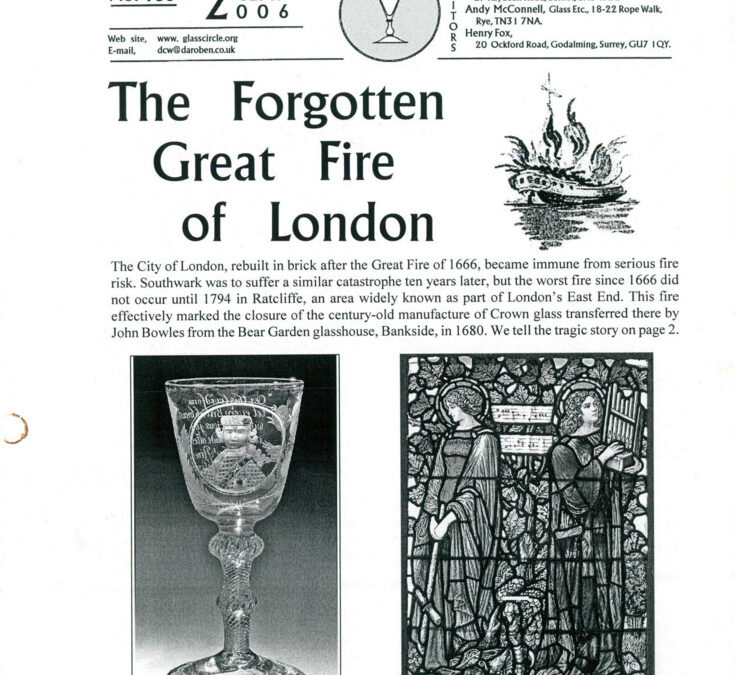
Above.
This fabulous Jacobite commemorative is part of an important selling exhibition by Delomosne & Son, at
their premises, starting Sept. 23rd. Details are on the back page.
Right.
Stained glass window depicting St. Margaret and St. Cecelia, identified by Martin Harrison as the work of
Florence Camm (1874-1960) whose father founded a firm of stained glass designers and makers in 1882. See p. 16.
GLASS CIRCLE NEWS No. 108,
2006
Editorial
Chucked Out at 5 o’clock.
Reflecting my current interest in Islamic glass I was in-
trigued to find that Barry Wood of the V&A was giving an
evening gallery talk on this topic at 6.30 pm on June 21st
when the Museum had one of its late opening days. It was, I
thought, an ideal occasion for a long quiet browse in the
Glass Gallery and to study the Islamic glass ready for the
lecture. Getting there just before five, in plenty of time, as I
thought, I had hardly stepped into the Gallery when I was
told to leave because it was closing time. What about the late
night opening and the gallery lecture, I protested? “Sorry
Sir,” said the attendant politely, “this Gallery is
shut.”
The
cafe was also
shut
but in the entrance hall, beneath the
Chihuly chandelier, a substantial crowd was noisily consum-
ing wine and nick-nacks to the accompaniment of a barely
audible string ensemble. It was all very jolly except that I
wished to study the glass and now had an hour and a half to
kill.
The ground floor was still open and largely unattended but I
made my way, for no particular reason, in the direction of
Trajan’s column and the other gallery of plaster casts. In the
corridor between the two I encountered a couple of cases
with 13/14th century enamels on metal. The quality was
exquisite and confirmed the view that northern European
artists had skills in all the colours at that date. The reliquary
(shown below) delightfully depicting Thomas a Becket hav-
ing his head hacked off suited my mood of the moment.
Fortunately, the Museum Director was not in evidence.
Barry Wood gave an excellent talk with reference to the
V&A’s fine collection of Islamic glass and particularly of
glass shards which, he said, were often in much better condi-
tion than the whole objects. Of Aldrevandinus significance
was one enamelled shard clearly depicting a Christian knight
or monk in an Islamic context. The suggestion that Islamic art
shunned the human figure clearly had no basis, Barry said, as
the Museum had a number of such examples. In explaining
the enamelling process he said that the enamels were deliber-
ately compounded so that the different colours melted at
different temperatures. This is contrary to the published sci-
entific evidence for the period. But I was made to wonder
when considering a large mosque lamp; there was clearly no
way this could have been reshaped during heating as sug-
gested for the Aldrevandinus beakers. Nearby, was a small
selection of tooth flasks, so called from the shape of their cut
feet. They are said to have lead in the glass so perhaps there is
a group of Islamic enamels that could have been made with a
lead glass softer than the glass of the vessel itself. I could see
no shards with Aldrevandinus characteristics and it was an
area with which our lecturer was clearly unfamiliar.
Overall, I felt that it was both a beneficial and instructive
visit although the galleries relating to special lectures should
clearly be kept open for participants’ preliminary study.
The Forgotten Great Fire of London.
David C. Watts
Take the A1203 going east from the northern end approach
road to Tower Bridge and in about a mile on the left you
will find the side turning called Brodlove Lane almost
immediately followed by a narrow alley, Glass House
Fig. 1. Entrance to Glass House Fields today from the south.
Picture © D.C. Watts, 2006
Fields (Fig. 1) and then by Schoolhouse Lane. Between
Brodlove Lane and Schoolhouse Lane lies the site of the
Bowles’ factory, labelled in Fig. 2 as
Glafs Houfe Yard
Glass House Fields, the dead-end alley shown above, was
the original entrance to the site (Fig. 3).
From Brodlove Lane, to the Rotherhithe Tunnel, some 500
yards, defines what was once the tiny hamlet of Ratcliff(e).
It is hard to believe that the 4-lane boulevard along which
you have come is the most southerly of three ancient roads
charted by William Morgan in 1682 (Fig 2). That in the
north, the A13 Commercial Road, was originally called
White Horse Lane and runs into White Horse Road that still
retains its ancient name. The middle road, Cable Street
(originally Brook Street and once the site of rope walks)
runs parallel to the railway where you can alight at Shad-
well Station and pursue your investigation of the area on
foot. Cable Street defines the northern boundary of Bowles
glasshouse. Broad Street (Fig. 4), as its name suggests, was
probably always wide to allow the horse-drawn traffic to
turn round without reversing. It was not wide enough,
however, to prevent the inferno that reduced most of the
area to ashes. Brodlove Lane is called Cut Throat Lane on
Morgan’s map which indicates the general ambience of the
area at that time. It was later changed to Love Lane (Figs 3,
4) and then to Brodlove Lane as we know it today.
The web site,
eastlondonhistory.corn
tells us that “Ratcliffe
was born as the first landfall for ships hitting the capital.
The first wharf was built in 1348, and is the earliest re-
corded instance of the river being used for business east of
the City. The hamlet grew quickly, spreading north along
the still extant Butcher Row (extreme right in Fig. 4), the
main route to Stepney and Hackney. By the 17
th
century,
NB
The Jameel Gallery of Islamic Art at the
V&A opened on July 20th with 400 items on
display including glass.
…..
. . The views expressed in Glass Circle
News are those of its contributors . . . .
2
Fa7ghes..
sibupolirldire poir
rats,
las M/
azy, deimd.Ziaanlyr
Etlas37e
.7’e
deux mil:
d /Vial
d 1E14.4
de
WV; raPPeriellt
aar
arkre.Zes trgars “rriks
rs
/.17
alle,aux pets
,
nlyr la 1
–
ranrilf/i
,
de.k
at/e _1*r-4V/is
erveata Cona’aire
7.1A1
e pour ks21/2
,
ma..
your lea
FanyAr.
less
_f
r
fC,I.T.
pgr
p
r
N
A
N
B
Stables and
Coach-house
Cable Street, originally Brook Street
(33074)
r
4%
W/
hse.
45/56
Middle
Glasshouse
18/31
24/31
Brewhouse
Brick Warehouse
li7/ 1_116/
I17/30.61
21.6/45 11
22/3
4
?30/2.a
ujj
16i house
house
(64660)
(84376
The Highway (A1203)
originally Cock Hill running into Broad Street
The entrance to Bowles Glasshouse is now known as Glass House Fields
Bowles
Glasshouse
Ratcliffe (1787)
45/50
Warehouse
68/31
(33075)
Bowles
house
O
8
C/2
(18916)
D.C.W. 2006
71/61
Glasshouse
(33075)
Pot
Chamber
West Glasshouse
(33073)
15/54 116/31 25/35 19/24
40/50
KILN
27/36
KILN
Coal
Place
22/45
(33077)
16/26
100/40
Ware
house
GLASS CIRCLE NEWS No. 108, 2006
Fig. 2. Left.
Detail of Ratcliffe
(between Shadwell and Lime-
house) on the north bank of the
River Thames, taken from William
Morgan’s map, published in 1682.
Glass House Yard, clearly shown
on the left, relates to a glasshouse
already present on the site before
the arrival of John Bowles in
c.
1680, and explains his choice of
site for the manufacture of Crown
window glass. As explained in the
text, White Horse Lane at the top
of the map is now the A13 Com-
mercial Road. Below it Brook
street is now the B128 Cable
Street, and the bottom road, Cock
Hill leading into Broad Street is
now the A1203 The Highway.
Source: Tower
Hamlets Local History
Library, Map. 1167.
Fig. 3. Below.
Plan,
c.
1787 of
Bowles’ Ratcliffe glasshouse
based on the details in the insur-
ance policies (shown in brackets)
held by the Guildhall Library, Lon-
don, taken out with the Hand in
Hand Fire & Life Insurance Co.
The fractions indicate in feet the
dimensions of the buildings
N>S/E>W drawn approximately to
scale.
3
‘
.
.
n
,
‘
7
–
—
–
‘,
–
–
–
r
”
–
–
‘
–
”
3
11’
o
rt
3.
4
V
Lane
t
–
; •
1
*.
1..,
,
,,
”
.
.—
.
.
..
–
– –
-_
-_
rziono
l
i,
4
1
.
.
.
.
.
.
T
T
.
!
t
!
1
i
”-
i
1
3 e
t
t
11
2A
vy
‘
1
.
7
.
–
I
–
1
LLI…
j…
..
J
.i..
..
i..
..
1
–
$
Off
Eure
,
mt
.
.
;
n
.
.
.
.
.
C
i
C
31
•
..
E
i
r.
ri
•
.
–
.
‘t
ra
d
a
‘
A
1.
•
•
–
–
.-
1
…
!
,
,
0
,.
…
,•
..
1
.
,,
,
i
1
2.
..
„
….
..
..
„
.
.
.
.
,
..„
..
.
..
.
.
.
.
:
,
.
.
.
……
.
..
.
C
..
.
.
.
..
. .
.
.
. .
..
.
:
,
7„,
%
[
.
Ch.
0
0
11
,
.
n
r
Q.
_
_.
–
,
.
NZ,
.
.
.
:tfa
mw/
cre
eory
.
–
‘
1
.>
.
.
,..
.•.
T.,
.
i.
.
.
„
.
.
.
.
..
..
„
I.
,.
..
k
i
.
..
,
–
q
•
I
1.
…
.
.
.
. i
m
•
,
••:,.
.
,
–
.
r
i.
4
_
–
.
..
..
..
4
C
4.
r
e
li
l
” .
1
n
B
.
,
q
:
7
:
.
1.
.
—
_
r
i
-_
1
,
WO
•
•
‘
.
.
..
/.
.
.
.
…
.
..
..
.
.
.
..
.
‘..
.
–
•
•
”
‘
ec
ro
co.
Ho
le
T.
A.
1
4
13
.
.
..
‘.
‘.
.
‘ 1
r
n
•
T
–
1
–
c
iv
il
111121
=
1E1
1:
1
.
.
t)
_
Al
f
l
a
:
I
”
a
I•4
3
4
I
,
..
111
:
4
:
1Y
‘,„
””
‘ ,
•
Ft .
.
?
‘
.
..
–
‘,
.
.
.
.
4
‘
..
,
:..
.
:
.-.
.
:
*
1
21
.
.
…
•….
.
r
.
1
ti
c
e
, ,
; .
.,
•
•
.,
CS
..
i
•
M
g
*
•
1
7
n
n
•
•„
.
•
•:
,
ot
-.
-:,
•.
,
1
,
•
•r.
M
lit
le
c
9
.
7.,
‘
r
..
:4
1
*
..
.
C.
–
_
,
‘$•
“.
,
:,
–
,,
.,,
l
”F*
C
OA
C
.
un
4
,1
,.
p,
0
0.
..
;
:,
“1
n
i
.
”
–
a
.
154
11D
13.
11
COT.
3
IL
•r
4
III
–
.’*’•
.
.
7
-,
–
.
‘
..
.
1.
,
,
,,
,
,,
,
,,,
r
‘ -3..
0
‘
..
.•
…
,_
–
:
–
–
N
–
–
–
0
S
‘
•
.
!i
” c.
4
‘.
.
a
.
‘
S
CI
U
M
I
E”.
…
…..
..
..
.
….
..
,„
:.
,
X
,..
*
3
<:.
.
•
"
,..;,
,,
,
__
L.
.
1
J
kt
1
e
ll
-
-
'
'
'.,
,
Si
t
Z
i
I
4
..
,
o.
'
•
,
:
.
,
.
...
-
ay
los:
o
Cou
r
t ..
13
,.
.,.
i
;
..
,
,
-2,
.
.
...
2
:
,
4
..
..
..
..
.
1...
..
.
,
..
4.
;..
.
,...
..
...
;
'
-
-
-t
.
.
•
.
.
.
.
n
•
,
._
„,,
i
-
X
-
CE0
0
13.
-,_
MOspr
A
VIVO'
, AW
C
ita&
.
4.
1x
y
..
.
..
.
.
'
''
'
'
.
.:
L-
' ,
.,
V
ili
.
•
1
trf
a
al
N
.
.
a
a
..
.
..
.
.
„
F
-
R
T
'
'
•
131
,
1
$ .
,,,
4.
.
.. t
.
1
' Hf
ti
l,
1
-
:
-
i
2
2
.
,
•
=f
-
'.
::
2
•
`•
,
:
.
r
'..
-,-
--
..
.
..
.
.
—
t
.
.
..
..-
-
-
iii
,,
,,
bp
,
c
.
,
.
.:
.•.!
,
..
.
..,
1-i
.-
.--
i-i
'-
.-.-.
ni
.
,
:.
,
.;
,
'
-
t
-
•
i
'l
i
r
-
et
.
:
3
i
3
,;
3
:
-
'
y..
*
i
.
1
i
?
;
r 0
..
,st
e
..
.....
..
...
-.
•
:
.
:
:
.
.
..
m
.
ci
ci
p
ip
,c
,
, ,
..
--
...
a
r
.
i
vc
..
p
...
,
.
c
•
'4.-
1
----
-
,
..
i.
:
.
i
.
„
..
,
1.
.
1.
!
..
..
J.
L.
1
.
.
:.
-
.,
f
i
-
-
,.
.
.i.
A
.
,
.
.
p
g
f,
..
.
~
..,
*„
..,
.,
„
.
....
..
..
...
f
2
1
E
S
0
%-
;,,
.
)
::
;;
:-
,
,
:
...
0
1
.
_
.
..
...
..
...
....
.
....
;,.
.
.
ru
.
...
7.
..
.
14
...
.
.
.
1
.
,
...
.
....
f
p
±
,
,
L
i,
.
N
.
.
.
:.
.
.V.
` ,,..
,
..
,„,
3
•,
'
i,
,
.
,
..,
.
;
' N
.
i
-
•
'
..
E
1
-
---
--
i
I
3
•
;
:
•
n
.
.
44
2
•
-
:
6 e
l .
.
-
7
,
..
',
'
:
1
.
•
-
....
..
-
':
41
",
-
'
-'.
:
'
-
--
-
-
..
•
l
i
,H
=7
.
1 .
.
..
..
._.
...
.
-
:
,
1:1151E
,
9
•
,..
"
-
'
,
tt
.
'
.
-.
.
e
,
.
..
4
-.
..
-.
t
l
„,_
,.....,..
;
VINZ
PA.
*
0.
1.
01
1
*
1
H
r
.
-
i
.
;
;
st
.
.t!,
1
./
P.
.
-
.
.....
.
.
.
....
.rr.
6
t.
,
,,,
f,
r,
t•
.i..
.
i
..
,
,
,,
.
,
r.
,
„,
,.
„
,
.
,
.
;
1.
.4
..
.
..
,
.
-)
.
....
,
w
.
,
.
_
...„
..
.
.
.
....
.
.
...
•....
.•
..
.
..
,
.
:
.
-,
-
I
-
•
,
:
"..,
,
'
-
.
,
'S
)
EE
RIE
.
....
..
.„
4
-.
.
1:
i
n
....
.
...
:
.
,
. .
.
•
•
.
-
-
-....
—.....
_
1-11
....
..
...
..
..
-
.
.
•
•.
T2
4;
t
:2
•.
.
-.
.
,
--
,..
•
.
,...
b
i
.
Op
i44
'•
'22
'
*:
?
-
'11
'241
.....
1
÷
.
1
-:
l
ii,
"
T
;;;F
--
(
7)
•.
f
2
72
•2
11
-•2
7
-•
•
•
--
la
.
...,
.
*
.
,
.P
.
;•
-:
*
::
:
-.
.,,
05,
1?
• 09
li
r
.. 1
1
,P
—
—
0
CTi
-
AD
‘.
,
_
.
_
..
.
4
.
'5
'"
:
'
1
.
.
•
.
V
:
1
r
-
1
21
f
....
.
1
2
....
.
2..
.
1".
•-
•
rp
hoe
t
r
Y
e.
.
I
•
:
c
•
:
V
I
...,
.
.
,...
.
:
P
t
'
7.
,
.
:
6
;
' -
Ji
-
-
"----.-
-
-
.
,
.
n
-
•
-
'1
"
.
'
-
3i
•
:
..
:
-
:
•
.
',.,
..
4
4
.
..
.
.
6
.
,
r
/
0
..
.
El
•
LI
?..„
.
i
.
.
g
as
.
..,:.
...
.
.
.,
,:
.
m0;
cmcmcc,
.
..
:
':
a
no
Ina
-
--
-I
-4
.
..
,
.
1
61
1E51
q
1313
131
W
1
1
1
i
.
11
11
...
.
.
..
,
-,,
'
•
..
.
—SI
-
-
a
11
12
Cl
u.
,
-
0
. 1
91
..
,
•
.
s.
vm
s
's
r
am.
..
.
,
•
'
1•
4
'"
.
•':
•
-
13
....
%
Z
I
I
"
'
... 1
'
7.
:
::,
;
'
A
i
-
io.
o
l
:
,.
.
>
1
1
li
1
4,
1
_
•
81
.
1
,
4
7
11
1
E
‘
:
e
9
“,
°
f
l
‘i
r41
A
i
4
‘
.
..
.,
–
‘”F.
ci
d
1
]
.
II
–
-.
Bu
T
c
A..
Ro
w
ra
romm
twr
l,
on
.r
n
v
*Otl
0
..
..
.
.
“1
•
n
+,
..
..,
••••••
n
,
..,,
..
.
….
.r
n
r
*—
BROAD STREET RATCLIFF
GLASS
CIRCL
E
NEW
S
No.
1
08,
20
06
Fig.. 4.
A CORRECT GROUND PLAN of the Dreadful Fire at Ratcliff, which began at Mr Cloves, Barge Builders, Cock Hill, on Wednesday July 23rd 1794, 3 o’clock P.M.
A,
Mr Cloves Yard with Bowles’ warehouse above;
B
East India Warehouse;
C
Sugar Warehouse. The site of Ratcliff Cross op is speculative. The fire consumed all the buildings to the right
of the wavy line, from the Thames to beyond Brook Street. The map was published Aug. 30 1794 by Wm. Frazer, Shadwell Water-works. (Tower Hamlets Library, ref. no. 101a)
GLASS CIRCLE NEWS
No. 108, 2006
Note by Rufus Ide appended to
some other historical notes relating
to the Glass House Fields site that
first drew my attention to the prob-
lem of the location of Sir Robert
Mansell’s Broad Street Glasshouse.
From the Ide Archives, property of
Rankin (Glass).
I- 3-72.
—
”
/
i
.
ak
,
fi
4,4i/
itoZd
&rt./
14cat
No4….4vt )
/9604
Nowt
v
174.
a 410-4
a;:°.
4
/
10,4 16-1,c,17
e1
1,61
–
t
fIPV,
/
rerCt/L.,-
oto-t..474-€
tvi
74p,
41,1-4
there were more people – 3,500 – living in Ratcliffe than in
any of the other Stepney parish hamlets” — notably
Whitechappel, Wapping and Shadwell to the west and, to
the east, Limehouse (named from the lime kilns in the area,
not the Chinese association popularised in song by
George Formby). “Ratcliffe’s bustling streets were lined
with sailors’ houses, shipwrights’ offices and taverns” –
homes to the hard-working, hard-drinking population.
Charles Bowles, owner in the late 18th century, took out
extensive fire cover from the Hand in Hand Fire & Life
Insurance Co. totalling £3850 p.a. Fig. 3 is my layout of the
factory derived from these policies, now stored in the
Guildhall Library, London. The policies give the dimen-
sions of the buildings in feet and their approximate location
on the site. My plan is in reasonable accord with that of Fig.
4, made to show the extent of the fire, but does not include
all the small houses or the Quaker meeting house (top right
corner) not covered by the policies. The description of one
building as a “Brick Warehouse” indicates that the other
buildings were not substantially constructed at that time and
this one would have been insured at a concessionary rate.
The Rate Books reveal that by 1680 John Bowles had
moved the manufacture of Crown glass from the Bear
Garden glasshouse in Bankside, Southwark to Glass House
Yard shown on Morgan’s map (Fig. 2).
From Eleanor Godfrey
(The Development of English Glass-
making 1560-1640)
we also learn that glassmaking at Rat-
cliffe, most probably on this site, dates back to 1580.
Frenchman, Godfray Delahay and Venetian, Sebastian Or-
landini had legally been been making beads and bugles and,
illegally, drinking glasses at Beckley (near Rye in East
Sussex). John Smith, a London glazier, bought out their
glasshouse and proposed to move it to larger premises at
Ratcliffe. This expansion brought protests from Verzelini,
who held the monopoly for making drinking glasses, and
caused Smith’s proposal to be put on hold while the matter
was resolved. By 1616, Sir Robert Mansell had acquired the
site and a furnace was built there for drinking glasses and
sublet to a group of four London merchants headed by
Thomas Robinson. The glasshouse (Fig. 3) was further
sublet by Mansell in 1620 after the conflict with Sir Wil-
liam Clavell who had brought drinking glasses to London
from Purbeck. The identity of the tenant is not known.
At this stage in the history of Glasshouse Fields confusion
arises because Mansell also established his Venetian glass-
house, stated to be at Broad Street and assumed by histori-
ans to be in central London (near Liverpool Street Station).
I make this error on page 9 of our Journal 10. However,
Glass House Fields is at the western end of Broad Street,
Ratcliffe (Fig. 4) and it now seems most probable that this
is the true location of his Venetian glasshouse. The unsuit-
ability of central London for the site of a glasshouse has
always been apparent because of the fire risk, the problem
of coal firing being prohibited in the City and lack of access
to raw materials. There was also the problem of accommo-
dating foreign workers who were not allowed to reside
within its walls. Further, Mansell had a house opposite the
factory, which, in Ratcliffe, would now be on the bank of
the River Thames, much more appropriate accommodation
for a naval man. It offered easy access to the naval shipyard
and to Hensey’s broad window glasshouse, both located at
Woolwich, a mile down river on the south bank. Whether
there was any continuity in the making of Venetian-style
drinking glasses dating back to the earlier possible occupa-
tion of Sebastian Orlandini we do not know.
A further twist to the story is that Rufus Ide (about whom
more in part 2 of this article) suggests that George Villiers,
2nd Duke of Buckingham, purchased the glasshouse, per-
haps upon Mansell’s death and was the first to start spun
window glass production there. Ide attributes to the Duke
the invention of the name “Crown Glass”, indicated by a
ducal crown stamped on the pontil of the disc. We do know
that there was considerable conflict between Mansell and
the Duke and it may have been connected with this matter.
Certainly, Bowles purchased the second Duke’s glasshouse
at Vauxhall and continued to use the Duke’s name for it.
But Neve’s Directory of 1703 specifically states that spun
Crown glass was first made at the Bear Garden Glasshouse
in Southwark, owned by Bowles and Lillington. By 1679
the Bear Garden was under threat of takeover and Bowles
departed to Ratcliffe with his invention. Was there a con-
nection between Bowles and the Duke over naming the
new spun glass? We shall probably never know. Either
way, it is clear that the quality and size of Crown glass that
led to its overwhelming popularity among the rich, has its
origin in the excellence of the glass made at the Vauxhall
works. The technique itself of blowing spun glass was well
known in France back to at least the 15th century.
Returning to the great fire. Across the road from Bowles’
own house, complete with garden and orchard, at the SE
corner of the site (Fig. 3), an alley leads to Bowles’
5
LASS
CIRCLE NEWS No. 108, 2006
Thames-side wharf and his warehouse (Fig. 4,A), no doubt
stacked with Crown glass waiting for export. Adjacent, on
the Thames river front is the shipwright’s workshop called
Clove’s Yard. It is here that the fire started.
The story is best told verbatim by a reporter for The Times
who was there:-
“Yest. Afternoon, on July 23r
d
, about 3 o’clock a dreadful
fire broke out at Mr Clove’s, a barge dealer adj. The East
India Co’s. Warehouse at Stone Stairs Ratcliffe Highway.
The fire was occasioned by a pot of pitch boiling over,
which immediately set fire to the premises, and communi-
cated v. rapidly to the adjoining buildings. The fire after
consuming the E.I.Co’s Warehouse that was contiguous
(see Fig. 3,B), next communicated to Brook Street and
burnt down all the houses on both sides, as far as Ratcliffe
Cross, as well as several alleys. Several large crafts, an East
India boy, the ship Hannah, trading to Barbados and several
small boats down that part of the river, have been consumed
for the rapidity of the flames was beyond example. The
explosion of the saltpetre warehouses was like the dis-
charge of a cannon. A very large sugar house near Rat.
Cross (Fig. 3,C), a glass manufactory and the principal
lighter builders are among the houses burnt down; and
when the person who brought this acct. to the Paper, left the
place, about 9 o’clock, near 200 houses were computed to
be consumed, and there was no appearance of the confla-
gration abating. The ruins were so widely spread, that the
firemen found great difficulty getting near the body of the
fire.
PS. The fire contd. burning at 12 o’clock last night, when
the paper went to press.”
A second report stated that the fire consumed more houses
than any conflagration had done since the dreadful fire of
London. It spread to an adjoining barge laden with saltpetre
the blowing up of which caused large flakes of fire to fall
on the warehouses of the E.I.Co. and spread the conflagra-
tion widely in a short time. The wind was from the south
and both sides of the High St. caught fire which prevented
the engines from essential service. Only 570 of 1200 houses
were preserved and a 100 mostly poor people took to the
fields overnight.
As with all such reports the exact tally of houses destroyed
is in conflict. Harold P. Clunn
(The Face of London,
Spring
Books. p. 297) states that 455 homes were destroyed along
with 36 warehouses. He further explains that “the flames
from the pitch spread to a barge loaded with saltpetre and
other stores spreading to several vessels lying nearby. The
tide was low so these vessels could not be moved to save
them. When the saltpetre blew up the flames were carried to
the East India saltpetre warehouses nearby, the explosion of
which could be heard six miles away, raining fire on adja-
cent buildings. . . Many hundred families were left home-
less and the Government sent 150 tents from the Tower of
London and these were pitched on a piece of ground next to
Stepney Churchyard. A collection was taken up at Lloyds
Coffee House for the relief of those left homeless.”
The title to the map (Fig. 4) states 453 dwelling houses and
Fig. 5.
All that remains in Ratcliffe to remind us of the great
fire is this entrance originally built, or rebuilt, in 1796, imme-
diately after the fire. It is unclear whether it was the entrance
to the East India Co’s warehouse or to Bowles’ Dock, or
perhaps both. Only the headstone is definitely original. The
central arch is said to have been replaced and the two side
arches may not be original but date from at least the early
19th century.
Below.
Detail of the headstone of the arch engraved with
FREE TRADE WHARF and ERRECTED IN MDCCXCVI.
The oval shield with lion supporters has a St George’s cross
with what appears to be a crown summounted by a rose in
the first quarter. Above, a lion lies between the two flags that
also carry St George’s crosses. These are not the arms of
the East India Co. as was suggested by Maddocks.
(Pictures © DCW 2006)
upwards of 20 Public Buildings. The wind is also stated to
have blown from S.W. to N.E. which took the fire largely
away from the glass factory as indicated by the diagonal
wavy line across the map. However, it does appear to have
severely damaged the main glassmaking buildings as well
as engulfing the Bowles’ house. No mention is made of the
work-force although, with their homes destroyed, many
must subsequently have left the area.
It seems that the factory closed and all production ceased.
Surprisingly, no-one was reported killed by the disaster
although five died later when a wall they were demolishing
collapsed upon them. The rebuilt arch (shown above) and a
wharf at the river’s edge constructed of timber (Fig. 6)
appear to be the only structures now remaining that can,
with qualifications, be attributed to that period.
6
GLASS CIRCLE NEWS No. 108, 2006
Fig.6.
Ratcliffe wharf today, an abandoned anachronism
among the endless rank of modern blocks of luxury flats
lining the Thames river edge.
(Picture © DCW 2006)
Exactly what happened next to the Bowles’ glasshouse is
still uncertain. The last known owner by descent had been
Humphrey Bowles. An East London historian, Sydney
Maddocks, wrote in an article for
The Copartnership Her-
ald
for Chrismas 1935/January 1936 “In 1794 a minor
came into the inheritance, but the difficulties and personal
financial risk of a trustee of a commercial undertaking in
those times led to the final closing of the works.” Certainly
there was the problem of rebuilding the factory and the
glass tax was still crippling the owners but who this “mi-
nor” might have been is unknown. Rufus Ide states that
over the next 60 years the Glass House Fields site was
“nibbled away piece-meal” although “a small area was still
used for glass”. Maddocks tells us that a fair sized site was
taken over by The British Gas Company in 1824. It came
into the possession of the Commercial Gas Co. in 1852 who
dismantled the works and, in 1860, the site was sold to an
established local firm of ships chandlers, T & W Ide. From
this site Ide’s came to supply not only glass of all sorts but
also exploit its decoration and design, particularly bending,
gilding, embossing and engraving. It is the story of
their extraordinary achievements that we pursue in Part 2 of
this account.
Fig. 7.
This is not the end of the story although it is the end
of part 1.
Sandblasted and engraved image illustrated in T. & W. Ide
post-war advertising brochure. TVVIDE Leaflet No. D6
.
Tower Hamlets Reference Library.
I am deeply indebted to Rankin (Glass) UK and to
Mrs
Stephanie Bennett of the firm for the generous loan
of
archival material relating to the history of the Ide family
and the works at Glass House Fields. Much of this
material will feature in Part 2 of this article.
Glass Circle Matters
Chairman’s Letter
By now you will have received The Glass Circle Journal X
with its six papers of previously unpublished work. This
has been printed in Hong Kong with the saving of thou-
sands of pounds to the Circle, but the distance, time and
language barriers slowed up the publishing process to a
greater extent than the committee anticipated. We apolo-
gise for this delay as we expected to be sending out the
Journals in the spring; however the quality of the printing is
superb.
You may have noticed that our web-site is currently not on
line. This is because we are having it professionally rede-
signed. This will occur in two stages. The first stage should
soon be up and running. Our Hon. Secretary, Marianne
Scheer, (new e-mail address, marianne66@tiscali.co.uk)
would appreciate any suggestions or comments.
Our trip to Scotland, 4th/8th October still has a few places
available for late bookers. Please contact me on
johnpsmi@globalnet.co.uk
Many members travel the world with glass in mind. Simon
Cottle went to Australia earlier this year. In May I went to
The Corning Glass Museum for the opening of amazing
new exhibition of glass furniture. The exhibition is accom-
panied by a new book,
‘European Glass Furnishings for
Eastern Palaces’
by Jane Shadel Spillman. It is full of
grand illustrations and contains much unpublished infor-
mation on ‘Hancock, Rixon and Dunt’ and also ‘Jonas,
Defies and Sons’. This is based on Jane’s researches both
at the Rakow research library in Corning and also The
National Archive, U.K. at Kew. Copies can be obtained via
The Corning Museum of Glass web site.
Our Hon. Vice President, David Watts is going to a
Fellows meeting and conference at Corning in October
where he will also see the Glass Furniture Exhibition. I
look forward to reading all about his trip.
John Smith
(Chairman)
New Members
Mr.
A. Whittle
Carmarthen County Museum
Death of Ann Lole
The Circle sends its deep sympathies to Peter
Lole for the recent loss of his wife, Ann from
cancer. Ann’s wisdom and support for Peter in his
research and writings for GC News and for our
Journal will be greatly missed.
GC News 109, copy deadline
The deadline for copy for GC News 109 is the
beginning of November for publication in De-
cember.
7
•
GLASS CIRCLE NEWS No. 108, 2006
Curious Glass from Australia
Our new member “Down Under”, Bill Davis, has sent us the following
intriguing pictures of glass. That on the right, found on a market stall, is 5Y2
inches tall and looks like an early 19th century wine glass except for the
curious attached spout. It is an unusual pale copper blue colour which I have
never seen before in a glass of this type. However, it does seem to be all-of-
a-piece and specially made for its purpose. It might be a form of Posset pot
except that the spout is attached to the top rather than the bottom of the
bowl. The best guess at present is that it was made for an invalid determined
to pursue a long-standing habit of a glass of wine in a vessel to which he/she
was accustomed to hold.
The large tankard (ht.230mm, dia. 170mm) shown in two views (right) is
a more serious piece altogether. It was bought from E. Barrington Haynes
in 1946 by Rex Ebbott, glass advisor to the National Gallery in Melbourne.
Bill bought it from Rex’s collection following his death in 1991. It is of lead
glass, of waisted cylindrical shape with a strap handle applied from the top,
and engraved with “God Bless The King”. In addition to the fern-like motifs,
swags and other decorative elements, the circular panel contains a biblical
scene of the Ark resting on Mount Ararat, the sun in full splendour and a dove
about to land without the olive leaf. It was clearly made as a commemorative
but for what? Is this of Irish origin in support of King William? The roundel
could cleverly indicate both his superiority in battle (landing on the mountain
top) and the triumph of the English Church over Catholicism. The cross-
hatched swags are an Irish motif and clearly reflect a Bohemian hand. With
the handle first attached near the rim it could be 18th or early 19th century.
It has also been described described as a Harvest Mug but Bill finds it
difficult to accept that such a fragile item would be used as a communal
drinking vessel in harvest celebrations or similar. Do such vessels exist, he
asks? He certainly would not like to pick it up by the handle alone if it were
full of liquid, weighing about 5 kg. Again, perhaps it was made for the
purpose of celebrating George III’s recovery! Whichever, at over nine inches
tall it is an impressive piece and one can be sure that Barrington Haynes
spun a very convincing yarn to Rex Ebbott.
Australia, like everywhere else, is for ever celebrating centenaries. For
example, 2004 marked 100 years since the Australian Patent Office was
formed; 2001 saw the century of Founding the Commonwealth; Victorian &
Melbourne celebrated one in 1934/5, and so on. For many years I have had
the clear glass press-moulded plate (picture right) exhorting Melbourne,
Sydney, Adelaide and Brisbane to “ADVANCE”, but to what purpose? I
now believe that it commemorates the centenary of England’s colonisation
of Australia in 1788. My plate is unmarked but evidence comes from a plate
with a similar border surround and the lettering AUSTRALIA’S CENTE-
NARY 1788-1888, made by Henry Greener & Co. and registered 26t
h
November 1887. This excellent design was pressed into service again for the
George VI/ Elizabeth coronation plate. And similarly for a “Visit to
Canada” plate although the latter has been attributed to Bagley by Susan
Biss
(Pressed Glass Commemoratives: A Collectors Companion.
Vivien c
Walker and Susan Biss, 2002.). The Powerhouse Museum, Sydney,
website tells us that Greener & Co. produced at least three types of 1888
Centenary glass using this design in an amber colour. The museum also
has a matching smaller plate, and a bowl. All bear the same registration
number, 88120. The coat of arms, with ostrich and kangaroo supporters,
featured on the plate, appeared throughout the Australian colonies in the
19
th
century. ‘Advance Australia’ was a common, though not exclusive,
slogan on coats of arms decorating objects relating to New South Wales.
The official state arms registered in 1906 features a lion and kangaroo. * D.C.W
8
GLASS CIRCLE NEWS No. 108, 2006
0/e
lm/a
ci’eA
cticia
g’st
,
etet
0Eafe,
The Lowth glass Ht
1% ins. compared
with a wine glass,
Ht. 6% ins.
Picture taken from
Percy Bate, English
Table Glass, facing
page 111.
Fortuitously, these Reflections have something of an
ecclesiastical theme. In early July I was privileged to be
amongst the congregation in St. Giles Cathedral in
Edinburgh for the installation of two new Knights of the
Thistle. One sat, unusually, facing along the whole
length of the Kirk towards the 1985 great west window,
by Leifur Breidfjord and commemorative of Robert
Burns. The distance was too great to pick out the detail,
which was not overloaded, thus allowing the clear and
radiant colours to speak of immensity; the upper register
was dominated by a central pattern of brilliant red,
inspired by Burns’
“My love is like a red, red rose”
whilst the lower register was predominately emerald
green. It was a day of fitful sunshine, and interestingly
the colours were at their best when the sun was
obscured, for when it shone the rays striking the interior
face through the clerestory windows diminished the
radiance of the window. One was indeed doubly
privileged, for the procession of Knights and dignitaries
passed only eight feet in front of us, between the rows
of pews; and lo, when Her Majesty the Queen processed
between this observer and the window, her earrings were
composed of enormous single emerald drops that exactly
matched the colour of the Glass in the lower register of
the West Window. The whole effect of these glowing
and harmonious colours called to mind the renown of the
Lorraine Glass men, whose C.13
th
colours were described
as ‘Rainbow like an Emerald’,*
the colour for which
they were then especially renowned, as they were four
centuries later for
‘the lost red’,
which the ravages of the
thirty years war in Lorraine extinguished for over half a
century. This colour was reputed to be the most brilliant
red available and thus redolent of the St. Giles’ window;
it was a copper red flashed onto clear Glass, whilst most
alternatives were red through and through, greatly
reducing their ability to transmit light.
In recent months a piece of serendipity seems to
elucidate the meaning of a commemorative Glass whose
earlier attribution had long troubled me. Percy Bate, in
his book
‘English Table Glass’
(1913), illustrates what
he describes as
“a fragment of glass of a type somewhat
resembling [a baluster glass] bears an inscription
referring to a Parliamentary election, which seems to
have been a political cataclysm, not mentioned in our
histories. It reads ‘THE REVOLUTION OF
LOWTH,
Novembr the F’, 1755′ and is said to commemorate the
triumph of a loyal and independent club in returning Mr.
Thomas Tipping to Parliament; a change, doubtless, but
one — however complete — which was only a ‘revolution’,
so far as Louth itself was concerned ”
This has always
been an enigma to me, since history really has passed it
by, for Louth in Lincolnshire was not a Parliamentary
constituency, nor does Thomas Tipping feature in either
the British or Irish Parliamentary records of the C.18
111
;
however, recently I encountered a casual but relevant
reference to Robert Lowth (1710-1787) that steered me
to his entry in the new
‘Oxford Dictionary of National
Biography’.
Robert Lowth was a polemical poet and critic, who took
holy orders at the age of thirty-one. Initially he struggled
for preferment, and his love of controversy never
deserted him; but gradually he improved his situation
and then in 1755, under the tutelage of the Marquis of
Hartington, then Lord Lieutenant of Ireland and soon to
succeed as Duke of Devonshire, Lowth traded the offer
of an Irish Bishophric for a prebendal stall in Durham,
taking up his post in October 1755. Finally in 1771 he
became Bishop of London, where he remained for
sixteen years until his death in 1787. Thus, it seems
highly probable that
‘THE REVOLUTION OF
LOWTH,
Novembr the Is’, 1755′
relates to his installation as a
Prebendary at Durham. There is, however, another
pointer to be gleaned from Percy Bate’s illustration.
Whilst Bate refers to the Glass as “a fragment”, the
picture does not suggest a broken stem, and the bowl is
disproportionately small for even a cordial on such a
stem; but the Glass does bear a striking resemblance to
the small Glasses quite common in Scottish Kirks today,
where a communal Communion cup is eschewed in
favour of very large sets of individual small footless
Glasses of this form. One wonders whether more
research might reveal that Robert Lowth introduced such
individual Communion cups into Durham Cathedral in
1755, – that would indeed have been a revolution. Or is
it a Glass that is much later than the mid C.18
th
— and
where is it now? *
* ‘RAINBOW LIKE AN EMERALD; Stained Glass in
Lorraine in the Thirteenth and Early Fourteenth
Centuries’
Meredith Parsons Lillich (1991)
9
Orrea
ei
siKsta
V:jXjiti•
*
*
P
I
k
b
erg
INybrol
+Mal no
olipegaard
Petershe
Russt
GLASS CIRCLE NEWS No. 108, 2006
Seeking Out 20th
Century Scandinavian
Glass
Andy McConnell
`Would you like to write a book on 20
t
h
century glass?’ It was Anna Sanderson on
the phone, but the timing of Miller’s com-
missioning editor was less than perfect: my
tome, placing
The Decanter
in the context of
wider glass history, was still hot off the
De
press. Researching and writing its 150,000
words and collating its 2,500 images had
been the result of seven years hard labour, it
had been an expensive exercise and caused
untold domestic upheaval.
Still, it was an appealing proposition. Several books have
previously covered the subject, ranging from Ada Polak’s
period piece,
Modern Glass
[1962], through several studies
of specific factories to Judith Miller’s
20″ Century Glass.
Probably the best, Leslie Jackson’s
20
th
Century Factory
Glass
[2000], covered the factual and stylistic history of the
Western world’s leading glassworks, from Baccarat to
Steuben, over 256 pages. Though reliable, it didn’t sell and
was soon remaindered. The problem was that it was inad-
equately illustrated, with a maximum of just two or three
images per factory. With Georges Chevalier and Per
Ltitken, for example, each having dedicated their 50+ year
design careers to Baccarat, France, and Holmegaard, Den-
mark, respectively, a single image representing their life’s
work could never do them justice.
So, after due consideration, the direction of my project
began to emerge. It needed to be image-heavy, factually
reliable and examine the output of unfashionable designers
and glassworks. There seemed no point in chronicling the
work of Rene Lalique or the output of the Whitefriars works
in any detail as the excellent books already devoted to their
designs leave few stones unturned. However, such well-
known names produced just a miniscule fraction of the
veritable tidal wave of pieces generated by hundreds of
glassworks across the western world during the 20th century.
I should know, having gradually amassed a colossal collec-
tion, now probably numbering around 20,000 pieces, the
vast majority of which bears no maker-identifying marks.
Large antique fairs, junk shops and boot fairs are knee-deep
in glassware, the attribution of which is generally limited to
grunts, vaguely suggesting, ‘it’s probably Scandinavian’, or
`it looks like Murano’.
Certain works, mostly British and Scandi-
navian, routinely applied their logos,
names and/or codes to their output. As a
result, most glass collectors have at least
heard of Holmegaard and Orrefors. The cut
The sculptural
Aristrocrat
decanter, de-
signed by Per LOtken for Holmegaard,
Denmark, in 1955. The week we spent at
the Holmegaard guesthouse was probably
the most relaxing and enjoyable part of our
trip.
37cm inc. stopper.
Sweden
Nu
Turk
•• ctockholm
Don’t leave home without it. A cast glass camera,
bought in a Stockholm charity shop. Engraved scripted
signature:
Lindshammar Sweden. Chr SjOgren 02790.
Designed: Christer Sjogren for Lindshammar Glabruk,
Sweden, c. 1970. 16cm max.
and enamelled output of Stuart Crystal is recognisable,
largely because it is generally applied with the company’s
distinctive acid-badge. But what about the stories behind
the headlines? And what of lesser-known works such as
Nuutajarvi and Riihimaki?
Yet even as the focus narrowed and a list of potential
subjects emerged, problems remained. Initially, I had
wanted to examine Czech pressed-glass and had travelled
to the Republic twice in 2003. However, it was clear that
the secure attribution of most pre-war Czech glass to its
makers remains problematic, largely due to the loss of
documentation during and after WWII. In an attempt to
narrow the field, I dispatched images of around 100 pieces
likely to be Czech or German to the king of the subject,
Siegmar Geiselberger, whose site, pressglas-
korrespondenz.de, reproduces hundreds of contemporary
catalogues. However, his best efforts elicited little joy: just
a half-dozen specific attributions.
The defining characteristics of the book were to be good
images and reliable texts. Of course, even the best books
contain occasional mistakes, but it was essential that these
were kept to a minimum. So, unfortunately, pre-war Czech
pressed was out. A lack of available examples also meant
excluding post-war Czech too. North American decorative
10
GLASS CIRCLE NEWS No. 108,
2006
My favourite purchase of the trip: a
bellows-shaped decanter, designed
by Simon Gate for the Orrefors sub-
sidiary Sandvik in 1923. It was
bought in a Stockholm antique shop
for about £60.
26cm.
glass was also impossible be-
cause, first, glassworks such as
Blenko refused to answer my
emails or return my calls, and sec-
ond, because of the expense of
researching in the US.
The obvious destination for a serious voyage of exploration
was Scandinavia. I had better luck with my initial ap-
proaches. The exemption was Hadeland, Norway, whose
directors failed to respond, even to repeated phone calls. On
the bright side, Orrefors, Kosta and the Swedish Glass
Museum were positive, and Lis Larsen, archivist at Hol-
megaard, Denmark, positively welcoming. The big ques-
tion was Finland, home to numerous underrated but impor-
tant works, including Iittala, Riihimaki and Nuutajarvi. The
problem was that it may well be a long, long way to
Tipperary, but it’s even further from Orrefors, in southern
Sweden, to Riihimaki in central-southern Finland.
Pressed glass shade by Pukeberg
Glasbruk, once Sweden’s largest
producer of lighting glass. Among
collectors it is best-known for the
cast designs of Uno Westerberg,
Goran Warff and Eva Englund, that
were widely retailed in Britain.
28cm max.
nearby Vaxj5 kindly gave us the
tour of its gigantic reserve collec-
tion, but how many pieces can the
brain absorb in an hour?
Heading north again, we rested in Stockholm before cross-
ing the extraordinary 24,000 island Baltic archipelago under
a midnight sun. A morning at Helsinki’s Sunday antique
market left the car groaning even more loudly after loading
it with boxes rammed with pieces designed by Kaj Franck
for Nuutajarvi, Sarpaneva and Wirkkala for Iittala and vari-
ous lumps of vivid Riihimaki. Two days of voracious photo-
copying and study at the Finnish Glass Museum were fol-
lowed by more of the same at Iittala.
A particular highlight was a fortuitous meeting over lunch
with Helena Tynell, aged 86, who with Nanny Still and
Tamara Aladin, had completed Riihimaki’s triumvirate of
post-war female designers.
Calling Kaisa Koivisto, curator of the Finnish Glass Mu-
seum, I expressed my misgivings concerning the cost of
hundreds of road miles plus another £250 for the car ferry
between Stockholm and Turkku, Finland’s most easterly
seaport. ‘Andy,’ she declared charmingly:
`If you go to the effort of coming here we
will look after you’.
Less than two weeks later our battered old
Ford Escort, stuffed with computer, camera
gear, scanner and several cases of Bordeaux
wine, lurched onto the DFDS ferry at Har-
wich, return fare to Esbjerg, Denmark,
£460. Over the following month my wife
Helen and I clocked up 2,500 miles, and a
bill of around £3,500, on the most wonder-
ful voyage, exploring some of the world’s
finest and most historic, and northerly, 20
th
century glassworks.
Just crossing Denmark proved expensive,
with two toll bridges depleting our bank
account by £25, each bridge, each way, and
May drizzle heralded our arrival in Copen-
hagen. However, things soon looked up:
finding a flea market within three minutes
of parking! Depressed after a lousy day,
stallholders were delighted loading us with
numerous lumps of local Holmegaard glass,
even at half their marked prices.
The story
was repeated at regular pit-stops along the road to
Riihimaki, with our wine stock gradually diminishing, the
space it had occupied replaced by Nordic glass swag. We
spent two days scanning documents at Orrefors, a day
photographing and scanning at Kosta, then a visit to the
unfortunately named Pukeberg, self-proclaimed as ‘the
world’s longest glassworks’, but now largely abandoned.
Gunnel Holmer, curator of the Swedish Glass Museum at
Our last afternoon was spent at the Kaj Franck museum at
Nuutajarvi, surrounded by evidence of Dale Chihuly’s re-
cent visit, when he had formed elements of his future instal-
lations at Garfield Park, Chicago, and Kew Gardens.
Relaxation came during warm evenings
drinking local beer and eating smoked rein-
deer and wild berries. However, we needed
the leisurely return ferry crossing and drive
through central Sweden to clear our heads
in preparation for the last week: an all-out
assault on the Holmegaard archive.
Finally returning home, the story was re-
peated over the following 18 months, with
visits to funny little Nazeing and the Isle of
Wight. Of course, research trips form just
the tip of the iceberg. A couple of days of
scanning and photographing at one location
were followed by weeks of further research
and slaving over images in Photoshop to
eliminate sunspots and maximise the impact
of each object. Checking the email stats of
the two years devoted to
20`
h
Century Glass,
I note 3885 items in the In-Box and 5850
Sent Items, whilst the camera tells me that it
captured 12,600 images, some 2,500 of
which appear in the book.
Yes, it was a long, exhausting and expensive road. The last
few grinding months, from Christmas to Easter were the
toughest as I valiantly, and successfully, strove to meet the
publisher’s deadline. By the skin of my teeth. 12-to-14 hour
days and seven-day-weeks became the order of the day, and
the financial returns will never justify the expense and the
effort. So, it’s little wonder that books of this nature are few
and far between. However, with the result now in my hands,
and the knowledge gained mostly retained in my memory,
I’m already thinking about the next one.
4:.
lsoaiti
[Grandmother] decanter
and matching glass, designed by
Helena Tynell for Riihimaki, Fin-
land, in 1969. A chance meeting
with Tynell, now aged 86, fol-
lowed by lunch together, was the
highlight of our visit to the Finnish
Glass Museum, based at the old
Riihimaki glassworks.
Decanter: 19.6; tumbler: 6.5cm.
11
GLASS CIRCLE NEWS No. 108, 2006
A Sideways Look at Contemporary British Glass Engraving
by Katharine Coleman
Report of a Meeting of The Glass Circle at The Art Workers’
Guild on June 17 2006. The hosts were Gordon & Sheila
Baker, Barry & Marianne Scheer.
Ever since the dramatic resurgence of interest in glass
engraving in the early 1970s, centred on the work of
Laurence and Simon Whistler, there has been an
astonishing rise in the number of practising engravers on
glass. This was despite the feeling among most observers at
that time that glass engraving had had its day, sometime
around the turn of the 19th and 20th centuries. The art
colleges were still training students with superb copper
wheel engraving skills but failing to encourage
contemporary design skills. Factories wanted old skills and
old designs. Furthermore, engraving was anathema to the
bright new studio glass makers of the ’70s.
In 1975 Laurence and Simon Whistler, doyens of romantic
point engraving, were at the height of their powers, feted
throughout the UK and beyond. Inspired by the
calligraphers of the 17th Century Netherlands, David
Peace, using an old dental drill with diamond burs, strove
to establish his name as a letterer on glass. Peter Dreiser, a
wheel engraver recently become freelance, was stretching
his wings as both artist and master craftsman. Jane
Webster, another copper wheel engraver, was already well
regarded for her figure work. Alison Kinnaird was
experimenting with more challenging and contemporary
themes. None of these artists, however, could really be
considered part of the exciting new glass world of the
1970s.
Only four engravers showed any connection with the glass
movements of the time: John Hutton, famed for his giant,
painterly engravings on the great west windows of
Coventry Cathedral, Stephen Proctor at Farnham and
Alasdair Gordon. Gordon left for Scandinavia before
settling in Australia, a more stimulating environment and
appreciative market. The fourth was Ronald Pennell, a
hardstone engraver who later excelled as a glass engraver.
So it was that for the next twenty years, a curious glass
engraving world developed in Britain, led by the dominant
traditionalists, Whistler, Dreiser — who encouraged modern
design but whose words fell on stony ground – and Peace.
Their work was of the highest quality and they fostered the
development of a Guild of Glass Engravers in 1975, which
grew rapidly from a membership of 45 in 1976 to 870 in
1984. Thereafter numbers dwindled to today’s figure,
around 300. The highly figurative nature of the work
produced by most Guild members appealed to many,
especially those collectors and engravers who had no
sympathy with contemporary studio glass.
Within the Guild were the
afficionados
of particular
techniques, such as the point engraving school — those that
essentially followed the Whistlers: James Denison-Pender,
Peter David, Andrew Lawson-Johnston and Jacques
Ruijterman. Of these only Ruijterman has produced point
engraving in a contemporary manner which breaks away
Simon
Whistler, bowl ca. 18cm diameter, “Templa quam
delicta”, all the Stowe temples, point engraved, 1990.
from the mould
of the neo-le century print into a thmore
imaginative world.
Intimidated by wheel engraving while a student at the
Royal College of Art, Annabel Rathbone also developed
her own form of point engraving. Inspired by 16t
h
and 17t
h
Century Dutch and Elizabethan graffiti artists and
engravers, Annabel pulls a diamond chip through the
surface of the glass to produce fine, unsplintered lines in a
technique she has made her own.
Of the classic intaglio copper wheel engravers who flour-
ished after 1975, Peter Dreiser’s and Alison Kinnaird’s
names stand out ahead of Mary Stevens, Jane Webster and
Michael Fairbairn. Alison Kinnaird has continued to de-
velop work acclaimed by engravers and contemporary glass
artists alike. She was recognised from the early 80s as a
contemporary glass artist, a position which she enjoyed
almost alone for many years, occasionally with Peter
Dreiser, regularly with Ronald Pennell. Pennell, who never
joined any group of glass artists, has ploughed his own
field, a professional in every respect and who has deserv-
edly enjoyed a place in the contemporary glass world
throughout his career — much to the chagrin of the Guild
traditionalists.
Of the window engravers, John Hutton died early of lung
cancer, largely from the dust he inhaled over the years
working on large scale glass panels. His son Warwick
continued his work and taught Jennifer Conway, already a
well regarded classic stipple engraver, to engrave in Hutton
fashion.
David Peace encouraged a whole host of imitative letterers
on goblets, panels and bowls, notably Stuart and Shirley
Palmer, Tony Gilliam and David Pilkington. Like graphic
designers and glass engravers Audrey Leckie and
12
GLASS CIRCLE NEWS No. 108, 2006
Madeleine Dinkel, Lida Cardozo Kindersley and Charmian
Mocatta came to glass as trained calligraphers and letter
cutters. Their use of lettering is more inventive though
throughout the period 1975 to 2000 letters remain unremit-
tingly italic.
Claudia Phipps, detail from “Anonymity, window at Eton
College, sandblasted, wheel cut and acid etched, 2005
Peter Dreiser’s second great achievement in this period
was to teach so many current British glass engravers,
largely by teaching intaglio drill engraving. He taught Jose-
phine Harris (who taught Tracey Sheppard, now the doy-
enne of botanical, lettering and architectural engraving) and
a whole style of drill engraving developed — Hilary Virgo,
Shirley Palmer, Nicholas Rutherford, Gill Mannings Cox,
Stephen Rickard, myself and Jacqueline Allwood. The av-
erage age of his students, their tastes and ideas were cer-
tainly of their period but not of any relevance to the con-
temporary glass around them.
To this day, only a handful of glass engravers design their
own glass. Most current glass engravers are deplorably
ignorant about their material and lazy about sourcing it,
preferring commercial glass. They wail “Why do they
never show our work at the Crafts Council?” When it is
explained that the Crafts Council promotes the work of
individual contemporary artists and that the work of most
Guild members is too traditionalist in style and presenta-
tion, it is received with a sneer rather than genuine concern
and reflection.
To obtain their faultless glasses, straight sided and with
flamboyant stems for display, the Whistlers had their gob-
lets blown by Whitefriars and Leerdam. A few engravers
work with glass blowers — for example Peter Dreiser and
myself with Neil Wilkin and Andrew Potter, Alison Kin-
naird with Lindean Mill, Peter Furlonger with Roger Tye.
Gill Mannings Cox was unique, learning to blown her own
glass, making
graal
techniques her own.
As the majority of glass engravers becomes greyer and
grumpier, it becomes harder still to attract a new genera-
tion. The young stay away, or come to one meeting, see all
the grey heads, who criticise their lack of concern with fine
technique and they flee. In the 1990s the failure of the
Guild of Glass Engravers’ work to fit into the contemporary
glass world began to trouble me personally, forcing me to
look at my own work more critically. I sought advice from
those outside the Guild — Jiri Harcuba and Ronald Pennell –
who both told me to answer the question as to why I was
working on glass. A simple but obvious remedy.
Being a finalist for the 2003 Jerwood Applied Arts Prize
brought my work as an engraver back into the contempo-
rary glass world. Edinburgh College of Art asked me to
speak to the students about glass engraving last year and
this yielded two dedicated converts now seeking instruc-
tion abroad, there being no more wheel engraving courses
in the UK. Glass engraving has not been taught at univer-
sity glass courses for decades; Farnham and Edinburgh
studios are fully equipped but have no tutors and do not
encourage engraving of any sort. As Visiting (now Honor-
ary) Professor of Glass Engraving at Wolverhampton, Ron-
ald Pennell has been down this road and in 2002 had given
but two lectures, both ill attended, over some four years.
Alison Kinnaird has moved on from engraving clear glass
blocks to sheet glass, combining her copper wheel tech-
nique with drill and sandblast and resin casting. Using
photographic printing on shadow banners behind her work,
Alison also designs the lighting of her new installations
using dichroic glass, fibre optics and LCD filaments. She is
leading the older generation alongside the new faces of the
21″ Century glass engravers.
Other new faces in the contemporary glass engraving field
include Peter Furlonger, a graphic artist who has, over the
last 15 years, developed his own strong and exciting forms
of lettering which interact with colour overlaid
contemporary glass more sensitively than those of the
1980s. He uses predominantly sandblast techniques. His
work was selected by Dan Klein for his seminal show of
21st Century British Glass in Bond Street last year. Ruth
Dresman, a Farnham student of the 1980s, learned to blow
glass and sandblast her own well-observed designs through
colour overlays and is comfortably established in
contemporary glass. Chris Ainslie, once a monk at
Buckfast Abbey, has developed his own quirky, humorous
engravings in both sandblast and drill on blown overlaid
vessels of his own design. He too was in the Dan Klein
show.
Peter Furlonger, “Psalm”, blue overlaid dish 28cm diameter,
sandblasted, 2002.
13
GLASS CIRCLE NEWS No. 108, 2006
Fewer contemporary engravers can now be identified
with a particular technique. Most use combinations of
techniques as the work dictates. Few are concerned with
technique
per se.
Some, like Alison Kinnaird continue to
demonstrate great technical virtuosity with inspiring and
original designs; others, like Dominic Fonde, are less
concerned with the niceties of letter form, more
concerned with the content. Dominic is a story teller and
his work reflects this — stories on glass in a lettering
hand that make the older generation shudder, but which
appeal to a new generation for all their coherence,
humour and immediacy.
The appointment of Jai Harcuba as a Visiting Professor
to the University of Sunderland also inspired a small raft
of glass engravers. Those motivated to try engraving
were encouraged to attend the Dominic Biemann School
and the triennial International Glass Engraving
Symposium workshops at Kamenicky Senov in the
Czech Republic. Claudia Phipps, an architectural glass
artist, took to engraving as a result and uses it to great
effect in her architectural glass work.
Charmian Mocatta, “EP”, 9cm crystal cube, sandblasted and
drill engraved, 1996.
German interest in modern glass engraving has always been
greater than in the UK and contemporary German art glass
engraving was never beset by so great a traditionalist camp.
Participating in the Coburg Glass Prize 2006, a European
competition held for the first time in 20 years, was for me a
great personal encouragement, having been told to my face
by several British glass engravers that my work is no longer
relevant to UK glass engraving. It is significant that most
glass engravers, Alison Kinnaird excepted, do not know
about or participate in any of the current glass prizes.
As the 21″ Century progresses, from the point of view of
the glass collector or curator, the gulf between the two
camps of traditionalist and contemporary glass engravers
can be seen to be ever widening in Britain. It is exciting
to see at long last voices in glass engraving that relate to
what is happening in the rest of the contemporary glass
world. *
REPAIR AND RESTORATION
OF GLASS OBJECTS
Sandra Davidson FIIC ACR
The majority of privately owned glass objects requiring
repair and/or restoration are historic or contemporary:
some may only have a sentimental value. Having recently
read Simon Cottle’s article,
THE BEILBY GOBLET and
other recent discoveries
(Glass Circle News No. 106,
2006) with interest, I thought it timely to write an article
concerning glass repair and restoration processes, particu-
larly the difficulties and limitations of restoration. Details
can be found in: Davison, S. (2003).
Conservation and
Restoration of Glass
(Butterworth-Heinemann, Oxford).
The obvious disadvantages of repairing and restoring trans-
parent glasses are first that the work cannot normally be
disguised and second that there is a limited number of
materials available with which to do the work. These fac-
tors limit the appearance of the final result which is often
difficult to convey to owners and buyers who may not have
encountered restoration before.
There are several comercially available “glass adhesives”
but they do not all bond well to glass particularly as a good
bond relies on the smooth glass surfaces being free of dust
and grease from handling. Readily available adhesives of-
ten encourage people to try their hand at repair. Fragments
are not often supported sufficiently well whilst the adhe-
sive cures. Having to remove failed amateur repairs in-
creases the cost of professional work.
Glass repair and restoration is carried out both by profes-
sional conservators and by commercial companies. The
Institute of Conservation (Icon) operates an accreditation
system for evaluating conservators and restorers in the
United Kingdom who must operate to a strict code of
professional ethics. Details of practices in England, Wales
and Northern Ireland can be found on The Conservation
Register: Telephone 020 7785 3804
Email: info@conservationregister.com
Website: www.conservationregister.com
Details of practices in Scotland: Telephone 0131 668 8668
hs.conservation.bureau@scotland.gsi.gov.uk
In the majority of cases materials are drawn from the
commercial sector but have a proven track record in the
field of conservation. Optically clear epoxy resins can be
used for the repair of transparent glass objects and also to
restore them (i.e. to replace missing areas) by being cast
into wax or silicone rubber moulds. However this is techni-
cally a misuse of the adhesive resins and creates a number
of problems with working, curing time, the formation of air
bubbles or a matt finish.
With the usual caveats concerning delicate or decorative
surfaces, break edges of thin-medium glass are cleaned
with acetone to remove dust and grease from handling
before being held together with narrow strips of Scotch
Magic Tape 810®. In this way it can be ensured that all the
fragments are accurately placed before introducing the
resin. Adhesive is applied along the breaks and enters the
14
GLASS CIRCLE NEWS No. 108, 2006
spaces between the fragments by capillary action displacing
the air and rendering the joins less visible. The joins appear
as hairlines in both glass surfaces, unless there are tiny chips
along the break edges. Because of the large number of
reflective surfaces on cut glass objects repairs may not be
visible. Tiny chips that do not penetrate through the glass
and so leave gaps could be filled with drops of resin at a later
stage. However this is extremely time-consuming and thus
costly bearing in mind that the chipped areas will be no less
visible. Once the resin has cured, excess is carefully re-
moved taking care not to scratch the glass. Resin can also be
introduced by capillary action into traveling cracks although
it may not penetrate right to the closed end of the crack. In
the case of thick glass, it may be preferable to paint resin
along one edge, following which two pieces of glass are
squeezed tightly together and secured with strips of tape.
The technique requires some practice because excess resin
squeezed out onto the glass surface makes the surface slip-
pery and difficult to tape. Broken wineglass stems are very
difficult to repair because they rarely break with a straight
edge, fragments are often missing and in any case there is a
small point of contact. However it may be possible to repair
stems on wineglasses intended for display rather than use.
Restoration may be undertaken to impart stability or to
improve the appearance of an object, particularly in a com-
mercial context. Glass restoration is time-consuming and
requires a great deal of practice. However, as Simon Cottle
pointed out, this is preferable to cutting off the remains of
the original foot and replacing it with a foot from a similar
broken glass (or indeed with a newly made foot). Profes-
sional conservators would never remove part of an original
object. Restoration is normally only worth undertaking if the
piece is of significant historic or financial value. Feasibility
is usually determined by the percentage of the object re-
maining, the shape, thickness and the condition of the glass
and any applied decoration present, and the materials avail-
able for restoration procedures. Normally there has to be at
least half of a bowl or foot remaining from which to take a
mould. If as in the case of the Beilby wineglass foot there is
little of the original remaining, the missing part will have to
be modelled before a mould can be made, Following this a
temporary cast in plaster of Paris would be made, finished to
perfection and a second mould made in to which to cast clear
resin. If the shape curves in two or more directions it may be
necessary to make the cast in two pourings on the same day
or to wait until the resin has begun to cure before casting it –
and unfortunately tiny bubbles then form within the resin.
Repaired and restored glass objects should not be immersed
in water.
An alternative approach to rendering glass safe for storage
or display is to mount the fragments with adhesive onto
stands or formers made of acrylic or blown glass.
The repair and restoration of glass parts from chandeliers
and other light fittings presents different challenges because
they are suspended above peoples’ heads. Parts from small
glass chandelier can be repaired if they are not load-bearing.
If it is decided not to re-use broken pieces, they can be
repaired and kept by the owner as archive material. New
glass parts, including lustres and brass pins can be bought
from a number of companies. These can be found on the
web.
Small chips in the rims of bowls and feet can often be
ground out. Companies undertaking this work can be found
under China & Glass Repairs in Yellow Pages. Despite calling
themselves Restorers, this work is not restoration and should
only be carried out on modern household items, never on
historic glass. Over time, the interior of vessels used to contain
liquids may become cloudy. It is not easy to tell without
testing whether a white cloudiness is the result of insoluble salt
deposition and/or a deterioration of the glass surface. Food &
drink residues can be removed by leaving a solution of bio-
logical enzyme (e.g. Biotex®) in the vessel overnight before
rinsing out with clean water. Hard water sediment may be
removed with vinegar. If these treatments fail the interior of
decanters may be professionally ‘polished’. This involves ei-
ther by the use of abrasive wheels on long spindles or by re-
polishing the glass surface with highly dangerous hydrofluoric
acid; this work must be carried out by a specialist. There is
always a risk of damage to the glass. Some of the companies
cited below that undertake restoration also have collections of
antique stoppers.
F.VV.Aldridge Ltd.
Unit 3,
St. John’s Industrial Estate, Dunmow
Road, Takeley, Essex CM22 6SP. Tel. 01279 874000/874001.
Fax. 01279 874002. Email: angela@fwaldridge.abel.co.uk
Website: www.fwaldridgeglass.com
Glass repairs of all kinds. Large stock of blue glass liners.
Blue Crystal,
Units 6-8, 21, Wren Street, London WCIX OHF.
Tel. 020 7278 0142. Email: bluecrystal@aol.com
Website
www.bluecrystalglass.co.uk Blue Glass linings, Antique & gen-
eral repairs, antique glass, chandeliers, antique glass reproduc-
tions, cruet bottles, decanter stoppers, copper wheel engraving
Delomosne & Son Ltd.
Fine Antiques, Court Close, North
Wraxall, Chippenham, Wiltshire SN14 7AD Tel 01225 891505
Fax 01225 891 907. Martin Mortimer is the acknowledged ex-
pert on the history of English chandeliers. The firm will advise
on restoration work.
Nostalgic Glass.
Unit 1C, Vanguard Court, 36-38, Peckham
Road, Camberwell, London SE5 8QT. Tel/Fax 020 7277 2770).
Cutting, Engraving, Restoring. Bespoke Glassmaking any size,
shape, colour & design. Specializing in antique & modern parts
or whole chandeliers, wall lights, candelabras, liners, claret
jugs, cruet & scent bottles, decanters, glasses, mirrors, cornu-
copias, shades etc.
R. Wilkinson & Son.
Head Office & Workshops: 5, Catford Hill,
London SE6 4NU.
Tel. 0208 314 1080 Fax 0208 690 1524. Mayfair Showroom: 1,
Grafton Street, London W1X 3LB. Tel. 0207 495 2477. Fax.
0207 491 1737. Email; enquiries@wilkinson-plc.com
Website www.wilkinson-plc.com
The UK’s largest chandelier manufacturers & glass restorer.
Produces a good catalogue of chandelier styles and replace-
ment parts.
Glass Designs,
Unit 4, Manor Farm Courtyard, Manor Farm,
Rowsham, Aylesbury, Bucks. HP22 4QP.
Email:
sales@glassdesigns.co.uk.
Website:
glassdesigns.co.uk
Engraving, sandblasting, glass restoration.
Basil Loveridge Glass Restoration,
Monday
–
Friday, 9
–
5.
Unit 1, Avonbury Court, County Road,
Buckingham Road Industrial Estate, Brackley, Northants
NN13 7AX. Tel 01280 706 490
Redhouse Glass Crafts,
C/o /Ruskin Glass Centre [the former
Webb Corbett works], Wollaston Road, Amblecote,
Stourbridge, West Midlands, DY8
4HF.
Tel. 01384 399 460
15
GLASS CIRCLE NEWS No. 108, 2006
Fairs and Auction Sales with 1-1e,
7
(Toy
AROUND THE FAIRS
The Summer Fair at Olympia was a new experience. The
entrance was now officially at the side and the layout was
new. Indeed the central area was spacious and some of the
stands were spectacularly up market. It was easy to get
round and easy to see the varied displays. Glassware was to
be found, but the piece which attracted my attention was
actually found on a ceramic stand. It was a brownish/amber
Lalique heavy gothic arch rear-moulded dish with same
figure within, said to be late 1920s. I saw no Chinese glass.
One Continental specialist dealer informed me that early
Chinese glass was difficult to find and currently com-
manded a high price. On the other hand Continental glass of
the Art Nouveau and Art Deco periods was much in evi-
dence. Mirrors as well as C.18th drinking glasses were seen
on the balcony level.
The Grosvenor House Fair is always a joy. Here two of our
members were showing exclusively fine glass: Delomosne
not only had a good range of Cl8th English drinking
glasses, but were also showing the largest selection of
tapersticks I had seen for many a year. Mark West — who
has now withdrawn from his Wimbledon premises to con-
centrate on fairs — had a number of C.18th drinking glasses
plus later glass. I was particularly taken with a handled
bowl decorated with enamel painted fish, also with a col-
ourful pad cameo vase, which I was told was by Webb. I
found on Mallett’s stand a baluster shape six panel object
decorated with coloured glass beads forming flowers, foli-
age, birds and insects. It was said to be early English —
C.17th or before. Close by I found the C. Finch stand with
ethnic or tribal bead work. Here were examples from the
New Hebrides as well as bead work by North American
Indian tribes, probably c.1870’s or earlier. Peter Nahum at
Leicester Galleries had illustrated in the GH Catalogue an
exceptional stained glass window 116.8cm x 80cm c.1925,
showing St. Margret of Antioch and St. Cecilia (See cover
picture). It was designed by Florence Camm (1874 — 1960)
and excuted by her and her brother Walter. This window
formed the centre light of a three section landing window at
a house in Halesowen, Birmingham.
My next port of call was the
International Ceramics Fair
which was celebrating its 25
th
Birthday. How this fair has
shrunk. I remember going to
the first fair at the Dorchester
Hotel in Park Lane. This time
at the Park Lane Hotel there
were only around 15 stands.
Our member Christopher
Sheppard had glassware which
ranged from the Roman period
through to the 18th century. I
noted his very unusual half
blue glass half clear glass
taperstick (picture left).
(Picture CC) Jeanette Hayhurst 2006).
Sassoon was showing a number of contemporary glass
artists, including the work of Katharine Coleman. Jonathan
Horne was showing a number of early English wine bottles.
Lastly, I found myself at the
Antiques for Everyone
at the
NEC Birmingham. I went specifically to see our dealer-
member Nigel Benson’s exhibition of English designer cut
glass of the 1920s through to 1950s early 1960s. This was
well presented and informative. The fair itself was not
overcrowded and it was cool to get around. A number of
stalls had examples of C.18th glassware; more than usual I
thought. However I saw only one piece of pressed glass. I
begin to think it is time for collectors to re-visit the better
examples of the output of the Northern glass manufacturers.
The designs of Walter Crane beloved by Sowerby and its
mould makers are well worth seeking out. Sowerby
Queen’s Ivory Ware dispels the common view that pressed
glass is “slag” glass.
AUCTION NEWS
with hammer prices
*Dukes, Dorchester — May –
Ceramics & Glass —
In this
sale was the glass pictured
right. This bucket bowled wine
glass is engraved with “Success
to the Eagle Frigate privateer”.
It was either a bargain or, more
probably, recognised as a late
copy, possibly very late, be-
cause it went for £300!! I say
this because years ago privateer
glasses were said to be being
copied, and those considered to
be examples of the period com-
manded premium auction bids.
*Sotheby’s New York -14
th
June — The Triestman Col-
lection –
This important single owner sale of fine glass
acquired to show the best of
English Victorian Cameo
work and glass from the Art
Nouveau and Art Deco periods
was built up over some twenty
years. Tiffany was strongly
represented, and a highlight
was an unusual
c.
1913 aqua-
marine favrile vase internally
decorated with goldfish swim-
ming beneath a pair of finely
engraved dragonflies (picture
left). This was contested to
$180,000 (£102.800). The top
price was another Tiffany
Studio piece, this was a good
size oblong favrile panel de-
picting parrots, which finally
sold for $380,000 (£217,100)
16
GLASS CIRCLE NEWS No. 108, 2006
*Dreweatt Neate — July — Ceramics & Glass — a lot consist-
ing of five various wine bottles, mostly early to mid C.18th,
was bid to triple estimate at £4,500 (picture above); an
engraved mercury twist drawn
stem cordial glass made £480
(see picture above, left); an
opaque twist stemmed wine
with bucket bowl found a
buyer at £260 (picture above
right); a cut glass and cover,
probably a royal commission
was bid to £1,800; an unusual
pedestal stemmed sweetmeat
glass with honeycomb
moulded bowl and matching
moulded fold foot (picture left)
went for £320.
Woolley & Wallis — Salis-
bury — 15
th
July — Ceramics
&Glass —
This sale included
an octagonal Chinese reverse glass painting bid to £2800
(picture below).
… and now for a few CLIPPINGS
The Pursuit of Style
So far this year their have been a number of auctions of
Dealers Stock and/or their private eclectic possessions. It
was under this heading that Sotheby’s disposed of the
stock etc of “John Jesse at Kensington High Street”. This
dealer specialised in the period spanning the early designs
of Christopher Dresser through into the best of design in
the 20t
h
century, although some of the items on offer might
appear wayout to some people. I have chosen a few of the
glass related items which may interest members; on the
catologue cover was featured an important English surreal-
ist table with circular glass top supported on white and
green painted gesso hand shaped base, signed underside ‘A.
Costa 1934′. (picture below) . This fetched £21,000.
Among the continental items in the sale a Rene Lalique
Tommier du Japon’, a glass tiara lamp designed in 1929, H.
42cm was keenly contested to finally go for £32,000.
In contrast an aesthetic movement stained glass panel
circa
1880, 95.5cm x 59cm went for £2,900 (picture below).
17
DELOMOSNE fr
Son
Ltd
COURT CLOSE. NORTH WRAXALL,
CHIPPENHAM, WILTSHIRE SN117AD
I
I
I
I
I
I
I
I
GLASS CIRCLE NEWS No. 108, 2006
I
I
I
I
I
A typical triple stem Harry Powell for Whitefriars
goblet with pulled green threads to bowl was bid to
£1,300 (see picture and design sheet below).
Glass at Fairfax House
An exhibition under the title ‘The Glory of Glass
‘
, the
collection of English glass given to the York Civic
Trust by the noted Yorkshire collector, John Butler,
will be on show at Fairfax House, York until 31
December 2006. Members who would like to catch a
curator’s tour of this very fine collection of English
glass covering the period 1700-1820 should telephone
01094 655543 for further details.
Pub Glasses
A member has kindly sent me cuttings about the plan
to ban glasses and bottles from use in pubs and clubs
throughout Glasgow. Pub owners have mounted a
legal challenge. Could this ban be taken up by other
local councils? Some years ago
I
seem to remember
the EU was considering banning lead from drinking
glasses — I think health and safety was the driving
force in this case. In the case of the Glasgow Pub
glasses and beer bottles a subsequent cutting drew
attention to the farcical situation that foreign beer
bottles would be exempt!
Forthcoming Sale
Sotheby’s New Bond Street, 21st November.
The second part of the famous collection
belonging to the late Fritz and Mrs. Mary
Biemann. Totalling over 80 pieces of 16
th
and
17
th
century Venetian and German enamelled
glass, it represents one of the last great
German collections to be offered at interna-
tional auction. There are some major early
pieces of Venetian and Hall-in-Tyrol enamelled
glass and wonderful German humpen from the
late 16
th
and early 17
th
centuries.
The End of a Chapter
This was the catchy title given to the Gordon Watson
single owner Catalogue. This collection was totally
different from that of John Jesse, but hidden away in it
was the interesting green glass cut-decorated, bell-
shaped hookah base made for the export market and
dated to early C.19th. (picture below). It was bid to
way over the estimate at £2,300.
II
IIIIIII
IIIIIIIIIIIIIZIIIII
I
IIIIIIIIIIIIIIIIIIITIIIIIIIIIIIII
II
I
I
I
I
I
I
I
I
TEL: BATH (01225) 891505 WWW.DELOMOSNE.CO.UK
I
I
I
I
I
T
•
In September 2006 we will be offering for sale a
T
•
remarkable private collection of early English
I
drinking glasses. The collection consists of over
•
one hundred and thirty glasses and a few other
related items. Nearly all categories are well repre-
•
sented covering the whole of the eighteenth cen-
I tury and with a few glasses from the late seven-
z
teenth century. The collection is particularly
T
•
strong in glasses commemorating the Jacobite
÷
cause with many fine and rare examples (see cover
÷ picture).
T
•
The exhibition will be held at our premises here,
+
from Saturday
23
rd
to Saturday 30
th
September,
+
2006, and will be accompanied by a fully
•
trated catalogue. Catalogues will be available
•
f
•
rom September 5th and will cost UK £15 inc.
•
P+P, Continent + £3.50, or elsewhere + £5.50.
3
•
Please make cheques payable to
The Seton Veitch
3
•
Collection.
I
It
is planned that the exhibition will be on line
•
from the 24
th
. Please check our website for further
details or contact us direct.
TITITITITIIIIIIIIITITIIIIITITITITIT1TITITITIIIIIIIIIIITITITITIIITT
I
I
I
I
I
I
EXHIBITION
THE SETON VEITCH COLLECTION
I
I
I
I
I
I
I
I
I
I
I
I
I
I
I
I
I
I
I
I
I
I
I
I
I
I
I
I
I
I
I
I
I
I
I
I
I
I
I
18