




No. 109
E Dr. David Watts (Hon. Vice President),
D
27 Raydean Road, Barnet, ENS 1 AN.
I Andy McConnell, Glass Etc., 18-22 Rope Walk,
Rye, TN31 7NA.
0
R Henry Fox,
s
20 Ockford Road, Godalming, Surrey, GU7 1QY.
DEC.
L, 0 0 6
Web site, www. glasscircle.org
E-mail,
dcw@daroben.co.uk
GLASS CIRCLE
NIAMS
A thought for
K4riatnt0
We have never known why a
pseudo Gothic style of text is
always considered the
conventional way to depict
Christmas. However, Glass
Circle News is nothing if not
conventional.
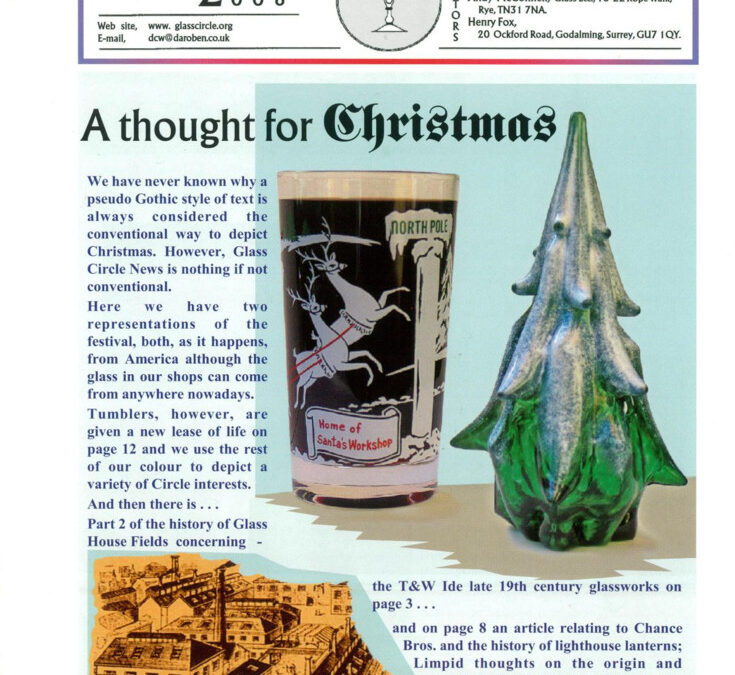
Here we have two
representations of the
festival, both, as it happens,
from America although the
glass in our shops can come
from anywhere nowadays.
Tumblers, however, are
given a new lease of life on
page 12 and we use the rest
of our colour to depict a
variety of Circle interests.
And then there is …
Part 2 of the history of Glass
House Fields concerning –
Ai IN al I
–
1 =e
t
r2t _
Fl
a
e
e
l
teoftwt
/
–
.
I– •
ILL
the T&W Ide late 19th century glassworks on
page 3 …
and on page 8 an article relating to Chance
Bros. and the history of lighthouse lanterns;
Limpid thoughts on the origin and
. manufacture of Silesian stem glasses
may be found on page 10;
as well as all our usual news and
reviews to bring you a bright and
shiny Christmas and a successful
glassy New Year.
GLASS CIRCLE NEWS No. 109, 2006
Above. The Glass Circle outing to Scotland in October. Members
pour over archival documents at Traquaire House. See page 4.
Left. The Glass Circle seminar at Glass Etc. The top three 20th
century decanters from Graham Cooley’s list of the top 20. See page 3.
New Glass Review 27. See page 16
Right. Cast bowl by Mark Pieser, USA. 46.4 cm in
diameter.
Below. Cemetary letters from Strathmore.
Katherine Coleman.
Right, Jo Marshall and
Martin Mortimer discuss
the merits of the Seton
Veitch collection at
Delomosne’s; meanwhile,
Ken Cannell, far right,
pays homage to the Ker
Amen glass. See page 8.
Left, Cameo vase sold
at Sotheby’s. see p. 18.
Late arrivals. Two fine
books for Christmas by
members of the Circle.
Left, bowl by Peter
Layton,
c.
1974.
Right, Andy McConnell
blockbuster, see p. 16.
. . . . The views expressed in Glass Circle News are those of its contributors . . . .
2
GLASS CIRCLE NEWS No. 109, 2006
Editorial
Finding space in the right place is always a problem with
GC News. But this is the last formal contribution from
Henry Fox after many years recording Sales, Fairs and his
inevitable Clippings, as well as his editorial help. Our
profound thanks for all his work but hope that old habits die
hard and we may hear from him again in the future.
May all our members have a restful Christmas to build up
your energies for 2007 and another year of glass interest.
GC News
110, copy deadline
The deadline for copy for GC News 110 is the
beginning
of
February 2007 for publication in March.
Glass Circle Committee 2006-2007 and
Officers
Hon. President,
Simon Cottle
Hon. Vice Presidents,
Dwight Lanmon, Paul N. Perrot,
Dr. David Watts.
Committee
John Smith (Hon. Chairman)
Marianne Scheer (Hon. Secretary)
Derek Woolston (Hon. Treasurer & Membership Secretary)
Ken Cannell
Anne Towse
Simon Cottle
Jo Marshall
Henry Fox
Graham Vivian
Martine Newby
One position unoccupied
Auditor, Tim Udall
Glass Circle Matters
Chairman’s Letter
I am delighted that at the AGM the members voted for the
appointment of a new Honorary President following on
from the late Hugh Tait. Simon Cottle, who was my
predecessor as Chairman, has been involved with glass
virtually all his working life. He worked for a long time in
two of the UK’s major museums, he is now a director of
one of our leading auction houses and he has written on a
wide range of glass subjects.
The new web-site is up and running, although still under
development, for those of you who are computer familiar.
We have a new web designer and new software and fresh
items are being added weekly. Members are most welcome
to contribute to the site, in the first instance via myself,
both to point out our teething troubles and also I am very
anxious to review glass books published in the last two
years, signed, unsolicited reviews will be most welcome.
Tomorrow I am off to Istanbul. This is for the 150
th
anniversary of the building of the Dolmahce Palace which
contains many fine examples of English chandeliers and
torcheres, many of them documented. Jane Spillman, of
The Corning Museum of Glass, and myself are giving
papers on this subject to an international conference to
mark the anniversary.
John Smith
Max Kimber recalls – 20
th
Century Decanter Day at
Glass Etc,
Rye,
2nd September, 2006
How many of us have dusty decanters pushed to the backs
of the kitchen cupboards or forlornly forgotten on study
shelves? Once fashionable, and intended for the
aristocracy and proletariat alike, the decanter as an art form
and functional object appears to have disappeared under a
generational manhole. My personal feelings about both
decanters and decanting was ambivalent – merely
acknowledging their existence without having devoted too
much thought to the subject: they had slipped under my
radar.
Given that my knowledge of decanters is scant at best and
hideously lacking at worst, I jumped at the chance when
invited to a `20
th
Century Decanter Day’, hosted by Andy
McConnell, Graham Cooley and Circaglas. Timed to
coincide the publication of Andy’s
20
th
Century Glass
and
the launch a dedicated exhibition at ‘Glass Etc’ in Rye, this
had the makings of a good day out!
With 25 attendees arriving on the day of the talk,
Glass Etc
was humming as the guests supped tea and made their
initial appraisals of the exhibition. The effect of nearly 400
decanters on display provoked reactions from hushed awe
to excited whispering as people viewed the vast array of
glass on display and drooled over the cabinets.
Decamping to the nearby Fish Café for the talks, the group
of attendees were poised and ready for information upload!
I had some doubts whether decanters could hold my interest
for the duration, but I was soon to be surprised.
Andy McConnell launched into an exuberant talk, guiding
us through the ages and explaining the history of the
decanter, from its birth as a utilitarian object, to its ascent
into a materialistic icon adorned with engraving, coloured
enamels and gold. Who would have considered the
economic circumstances behind such a ‘forgotten’ item?
There was more to a decanter than met the eye. I realised
that I was hooked when, at the end of the talk, I found
myself shouting
`More!’
After lunch, Graham Cooley embarked on a voyage of an
almost scientific explanation of the various elements of a
decanter. The funnel in, the funnel out, the shape of the
base, the shape and fit of stoppers…I had never considered
the aeration achieved with a Holmegaard ‘Cluck Cluck’
decanter! That shape had a
purpose?
This was new ground
for me! Graham finished with his ‘Top Twenty’ decanters
from the exhibition – an eclectic selection of recognisable
shapes, each one chosen for reasons that expanded our
knowledge yet further.
After a day of full-on decanters, I now view those not-so-
humble vessels in an entirely new light. As Andy said
during his talk, perhaps we should consider why today we
concluded overpage
3
GLASS CIRCLE NEWS No. 109, 2006
The Glass Circle Visit to Scotland.
From the 5′
h
to the T
h
October a small group of
Glass Circle
members visited Glass Collections and Glass Studios in the
Glasgow and Edinburgh areas. Numbers fluctuated from
fourteen down to a group of nine, peaking on our first day,
when we were in Edinburgh itself. Starting with the
Granton stores of the National Museums of Scotland, we
then went to the main Chambers Street Museum, finishing
at the Huntly House museum in the Canongate, whose glass
collection all has some sort of Scottish connection, with
C.19
th
engraved and cut Edinburgh Glass being strongly
represented. In the Granton store your scribe found an
interesting diamond engraved drawn trumpet glass,
unfortunately with a substantial chunk of its bowl missing,
and carrying the inscription
“Rebel no more and may thou
flourish”
together with a crowned thistle (the Scottish
Royal Badge). This seems to be an adaptation of mottoes
that appeared on medals commemorating the Duke of
Cumberland’s success in 1746 (Wolf 52,
55);
it is
presumably an amateur epigram from some benevolently
minded Scots Whig. In addition to the magnificent glass on
permanent display in the NMS in Chambers Street, which
includes four
AMEN
glasses, there was a temporary
exhibition of
‘Islamic Art from the State Hermitage
Museum’
that had a stunningly sumptuous Syrian C.14′
h
enamelled drinking horn, fitted with most impressive
German Princely silver-gilt mounts of 1551.
After lunch we travelled to the core of the New Town,
visiting the Scottish National Portrait Gallery. Promptly
descending into the stores we saw the largest group of
Tassie pastes in Britain. There our Chairman explained to
us not only the subtleties of the casting technique, but also
the two quite different types of `Tassie’; on one hand the
cameos and on the other the portrait medallions. (See
GC
News
No: 97) We concluded our first day at the Huntly
House museum.
The next day was spent in Glasgow. After a short visit to
the Hunterian museum we moved to the newly refurbished
Kelvingrove museum, which displays a considerable
amount of excellent glass, scattered around in ‘contextual’
displays, which worked much better than many of us had
anticipated. Moving from there to the Burrel Collection for
lunch, and then, after inspecting the public displays,
descending into the cellars, which proved to be a veritable
Aladdin’s cave of
glassy delights.
Our Chairman was
intrigued to discover a sweetmeat tree, with two tiers of
four arms mounted on an unusually tall facet stem stand,
with the eight original (?) baskets, and all us present found a
number of treasures that pandered to our particular
interests. For most of us this was the high-point of our trip.
On Saturday we returned to Mid and East Lothian, visiting
the studios of Alison Kinnaird, where we saw some
impressive very deeply wheel engraved tableaux, cleverly
mounted to allow LED lights to fill the engraving with
areas of different colour. We concluded our study of the
flourishing Scottish Art-Glass scene at the studio of James
Denison-Pender, the stipple engraver, who had a
considerable amount of his work on display. Both artists
lived in delightful surroundings and were most hospitable,
with coffee and tea being produced for us. In between these
two visits we travelled southwards to Traquair House, with
its fine group of Jacobite and other glass, including the only
AMEN
Glass still to be displayed in its original home (pace
Dunvegan Castle!). The archivist had laid out for us some
of the original bills and inventories considered in our
Journal
No: 10, and it was a great privilege to be able to
see 250 year old manuscript documents that relate so
intimately to our interest. We were given an excellent lunch
at Traquair, despite some confusion over what our
Chairman, who was the organiser of this excellent trip, had
intended.
All in all this was a very worthwhile and enjoyable
expedition, and the thanks to John Smith of that select
group who attended were heartfelt.
FPL.
YYYYYYYY I YYYYYYYYYYY YYi YYiiTii77YYTTTYTTYT YYTYTYYYYYi YTTTYYTiT TTTTTTTT
llllll ITTITI TTYYTTTTYTTiiiITTTYYYTYTYTT lllllllllll 111111111111
Max Kimber – Rye outing, concluded.
view vases,
which we never use for flowers, as more ‘valid’ 8:
LH118
two-hole decanter, Vicke Lindstrand, Kosta,
[or ‘collectable] objects than decanters? The decanter is
1955.
more than just a ‘bottle with a lid’, it is a piece of complete 9:
People
decanter. Erik Hoglund for Boda, 1955.
sculpture reflecting the times and conditions of its era with 10:
Night Sky
Giraffe carafe. Shape: Robert Goodden,
a presence that deserves to be appreciated.
pattern Margaret Casson, Chance Brothers, 1958.
11:
Optic ribbed cylinder decanter, Jacob Bang, Kastrup,
1950s.
12:
Dimple
decanter, Ronald Stennett-Wilson, Wuidart,
1954.
13:
Cockerel
decanter, Kaj Franck, Nuutajarvi, 1957.
14:
Pinch-sided decanter, Per Liitken, Holmegaard. 1957.
15:
Smoke-tinted baluster. Imported by Jones & Co:
attributed to Ernest Gordon, Afors, 1961.
16:
Gaston,
Frank Thrower, Dartington/Wedgwood, 1982.
17:
Mot-yen,
Domnhall O’Broin, Caithness, 1965.
18:
Twisted stopper baluster, Bengt Orrup, Johansfors,
c1958.
19:
Brass ball stopper pyramid decanter, Tapio Wirkkala,
Iittala, 1968.
20:
SV,
Nanny Still for Riihimalci, 1950.
Thanks go to Andy McConnell, Graham Cooley and Circaglass
for such a wonderful experience. Thanks also to Paul Bishop and
Christina Glover for instigating the idea and to Nick Toldi, Geoff
Lawson, Stephen Pollock-Hill and Nick Allen for providing
examples for the exhibition. What’s next?
Graham Cooley’s Top 20 20th Century Decanters
1:
Rhapsody,
Sven Palmqvist, Orrefors, 1959.
2:
Aristocrat,
Per Liitken Holmegaard, 1956.
3:
Saturn,
Ronnie Stennett-Wilson, Kings Lynn, 1967.
4:
Tulpan,
Ernest Gordon, Afors, 1955-56.
5:
Traet [Tired]
Cluck-Cluck, Holmegaard, c1937.
6:
Glacier
cylindrical whiskey decanter. Geoffrey Baxter,
Whitefriars, 1976.
7:
FT44.
Frank Thrower, Dartington, 1967.
4
Fig. 1. Above. Thomas Ide, founder of
the firm in 1860.
Left. Unpacking a large sheet of plate
glass required a team of about twelve
workers. Note the strap carriers used
to move the sheet around.
The sheet itself was probably brought
by boat from the Tyne Plate Glass
Works or St Gobain in France to
Ratcliffe wharf on the River Thames.
From there it was a short distance by
horse and cart to the factory.
horse and cart the short distance to the
factory. In the drawing on the cover
two carts appear to be carrying such
large flat loads.
There was probably a close link with
the Tyne factory as its founder, Robert
Walter Swinburne was founding
member of the National Plate Glass
syndicate and appointed its manager.
Thomas Ide was a dominant figure in
the so-called London Section of the
syndicate that extended from Norfolk
NN.
GLASS CIRCLE NEWS No. 109, 2006
The Ide Family Glassworks at Glass House Fields.*
by David C. Watts
When T&W Ide ‘s was finally sold in 2002 following the death of Rufus, the last
male member of the family, the art section of the firm was purchased by another
large London firm, Rankin (Glass). This purchase included 24 whole plate
negatives and some documentation. This lecture was a presentation of these
pictures (recovered by the author on computer) through Rankin’s generosity in
making them available for study. Study is the operative word for there is no
explanation of the images and a certain amount of speculative guesswork was
required in understanding the activities involved. However, I am grateful to Dr
Joanna Thomas (daughter of Rufus Ide) for help with the identification.
Around 1830 the Ide family opened a ships’ chandlers cum builders’ shop in
Cable Street, Ratcliffe. Glass for portholes and lamps were among the numerous
items they sold. It was a prosperous area and adjacent Shadwell was planning a
new opulent Town Hall. At that time Glass House Fields was occupied by a gas
works. By 1859 the gas works had been
taken over and the site offered for sale.
Young Thomas Ide had been working in
France for the St Gobain glass factory in
France before coming back to England
to carry out a few experiments on his
own. Now he saw here an opportunity to
put into practice a novel idea he had
been considering for some time — the
manufacture and marketing of curved
sheet glass. Purchase of the site was
made and in 1860 building the new
factory was under way. Large sheets of
plate glass were obtained either from the
Tyne Plate Glass Works or St. Gobain
(Fig. 1.). They were probably shipped to
Ratcliffe wharf and then carried by
qr
,
* Lecture given to the Glass Circle at The
Art Workers’ Guild on Nov. 14th 2006.
:Apo
The hosts were Mr. John Scott, Mrs. Ruth
Fig. 2. The work force displays a large sheet of curved and partly matted plate
Willcock, Mrs. Katharine Coleman and
glass. On the left it may be James Ide holding the template for the bent shape.
Mr. Henry Fox.
5
2096
Fig. 3. Polishing the edges of large sheets of plate glass, roughing in the back
ground with hanging sand hoppers. Final polishing in the foreground in which
one workeris guiding the plate glass against the wheel while the worker on the
extreme right is applying and spreading the abrasive polish.
Fig. 4. The Art and Design department. This muddle depicts a variety of
activities from drafting and painting, with religious cartoons shown on the wall
(at left), to gilding (at right) with mirror advertisements leaning against the wall.
GLASS CIRCLE NEWS No. 109, 2006
to the Channel Islands! His diagrams of
curved glass are included in the rule
book. The rules were very strict
including the mandatory making of 10%
profit on any sale on pain of severe
punishment. Incidentally, it is not
generally recognised that the Tyne
company shared with Chance Bros. the
enormous order for rolled plate glass for
the 1851 Great Exhibition.
In 1861, Thomas registered his designs
for curved glass of all sorts at the
Stationers Hall. Two large furnaces,
called Jumbo and Alice by the workers,
were built for bending plate glass of
unprecedented size – 14 x 8 feet or a little
larger (Fig. 2.), and small furnaces for
lesser pieces. In addition the new factory
became an extension of the chandlers’
shop selling a variety of hardware items
from tin baths to wallpaper, and a
selection of lamp glasses and table and
domestic glassware.
The manufacture of a range of cut, gilded and silvered
decorative glass was also developed for shop fronts, the
booming business in the elaborate decoration of new inns
and public houses and advertisements of all sorts.
Designing for stained glass panels and windows was also
undertaken including sub-contract work for London’s
stained glass firms.
In 1875 a new process of making mirrors with silver rather
than with poisonous mercury was developed and, for a
time, the firm became National Silverers to the Trade.
Members may have encountered curved distorting mirrors
that were a popular line with fairgrounds.
Thomas died in 1896 and the factory was taken over by two
of his six sons, James and William. The two eldest brothers,
Thomas Ide Jnr, and Henry managed their main premises
in Rathbone Place and Wells Street, just off Oxford Street.
The other sons, John and Frederick, managed subsidiary
outlets in the Brompton Road, in Portland Street and in
Harlesdon. It was probably soon after this that a
photographer was employed to take pictures of all the main
activities on the Glass House Fields site. Quite remarkably,
24 whole plate (8%2 ins x 6Y2 ins) glass negatives have
survived to provide a unique record of how much of the
work was carried out.
Work in the glasshouse was both rigorous and demanding.
The larger glass was mostly stored in open sheds. Indoor
work mainly depended on daylight with gas lighting when
it was most required with mantles in the important areas
and unprotected bats-wing flames elsewhere. These seem
to have been the only form of heating and it must have been
cold working in the winter. Not until after
WWII, in 1954, is there mention of
installing a boiler for central heating.
Most of the work was on a commercial
scale. Ordinary glass cutting, carried out
on a large table was much as it is today. A
template was used for outlining the
curved tops of domestic sash windows
and these must have been cut by the
thousand for the expanding residential
fringe areas of greater London.
Large sheets of plate glass, once cut, might
have the edges polished by being laid on a
special truck that was trundled, by hand
past the grinding and polishing wheels
(Fig. 3.). Smaller work was carried out by
hand. This was particularly important for
free hanging and framed advertising
notices, both for shops and public houses
that were popular at the time.
6
GLASS CIRCLE NEWS No. 109, 2006
Fig. 5. (Left) Cutting plate glass (detail). The sheet is suspended by a rope and counterbalance joined to a mobile trolly on
the rafters. This allowed the cutter unimpeded movement of the glass over the cutting wheel.
Fig. 6. (Right) The relative tranquility of the silvering workshop with three mirrors on the table in the foreground and
circular mirrors in the side racks. The glass is thoroughly cleaned on the slatted table (centre), silvered (back left) and
washed (back right) before being dried and transferred to the finishing shop. Note the ‘spider’ batswing gas lighting (top left).
The Art and Design department (Fig. 4.) was the heart of
the decorative side of the firm’s activities. The young Ides
who took over from Thomas must have had a thorough
apprenticeship for they seem familiar with all aspects of the
work involved. One of them (James ?) features in most of
the negatives turning his hand to the activity involved.
Decorative cutting is by traditional methods although with
steam driven lathes. Nevertheless it was very demanding
work both physically and in terms of concentration for what
in those times must have been a long working day. A
special suspension device was used for cutting large sheets
both to carry the weight of the glass and to allow the worker
freedom to move it easily in any required direction (Fig. 5.).
Smaller sheets were cut in the traditional manner although
these were still too large for the workers to work sitting as
in the tableware trade in Stourbridge.
A particular technique was selectively matting the glass
surface. This was either done horizontally for flat glass
using a hand-operated pressure pad suspended from the
Fig. 7. Hand grozing thick discs of plate glass. A selection of
grozing tools hang on the wall at the back. At left, one of the
Ide family is perhaps checking the finished disc for size.
workshop roof, or, for curved glass, by using a large mop on
a lathe. Exactly how the very large curved sheets (see Fig. 2)
were treated I cannot say unless they were matted before
being bent to shape.
At least two workshops were required for silvering (Fig. 6.).
By this time the old lead/mercury process had been
superseded except for special conservation work. The glass
has first to be thoroughly cleaned to remove every speck of
grease or dirt. It is then laid flat and the silvering solution
poured on. A gutter round the table collects any surplus
solution for reuse as the silver nitrate used is expensive.
Silvering (from my personal experience) takes about 30
minutes compared with days for the old mercury process,
after which the residual silvering solution is poured off and
the plate transferred to a washing tray. The silvered plate is
dried and taken to the finishing shop where a protective coat
of paint is applied to the silver and the face given a thorough
clean ready for the customer or perhaps for painting or
gilding. If a frame was required this is made in wood or
metal by the framing workshops.
Fig. 8. General store-room indicating the wide range of
stock available for sale from ships’ lights, domes and lamp
chimneys to cut glass and other tableware.
7
LASS
CIRCLE NEWS No. 109, 2006
Fig. 9. Detail showing decanters and a covered dish in the
store room..
An unusual activity was grozing (shaping with pliers) both
round and square sheets of thick plate glass and must have
been the ultimate boring job (Fig. 7.). These seem to have
been made in large numbers but for what they were used?
Unless it was ship’s lights and portholes, this is a mystery.
Fig. 10. The stained glass workshop with typical examples
of the work done in the foreground..
Leading stained glass has, of course, a long tradition.
Details of the process have changed little over the centuries
with the glass being cut, grozed and assembled on a full
size cartoon of the picture (Fig. 10.). The most significant
change from today is the use of a gas-heated soldering iron.
When it gave way to the electric iron I do not know. Much
of the work seems to have been directed towards domestic
glass windows for front doors and top lights but religious
work subcontracted from London firms, such as Goddard
and Gibbs, and advertising work was also an essential part
of their trade.
Other negatives detail the store rooms (Figs. 8,9.) and the
boiler house with three steam engines to run the factory
workshops. One of these appears to have just been
converted to drive a dynamo of pre WW1 vintage.
Between the wars the firm of T&W Ide flourished. But in
WW2 the firm suffered badly in the blitz on the East End
docks. How it survived extensive bombing, recovered and
and prospered after the war must be saved for Part 3 in GC
News 110.
1-15KI2Y’S CLIPPINIGS
New Catalogues
Any
member who has not availed themselves of a copy of
the recently published catalogue of The Durrington
Collection of Rare C.17th and C1.8th British Drinking
Glasses do not know what they are missing. This private
collection contains many great rarities. including a Beilby
polychrome enamelled Royal Armorial Goblet. Available
from Broadfield House Glass Museum.
Also available from Broadfield is an excellent catalogue
published in association with the exhibition “A Glass
Menagerie”, which ends zl’
h
February 2007. It features
exclusively the creative designs of Amalric Walter (1870 –
1959) who specialised in pate de verre.
Delomosne & Son Ltd have produced a timely monograph
entitled “English Wineglasses with Faceted Stems” which
I
am sure members will find informative now that facet
stems are being increasingly pursued to add to collections.
The Seton Veitch Collection
This selling exhibition by Delomosne caused quite a stir in
North Wraxall. On the opening day people were quequing
outside by 5.30am. Tim and
his helpers were kept busy
brewing tea and making
coffee. It was on a more relaxed
visit that I and two fellow
committee members (Mrs. Jo
Marshall and Ken Cannell, pics
on page 2) arrived several days
later. Certainly many of the
I
,
pieces were a joy to see.
di
I
,
Jacobite glasses in particular
were well represented with the
Ker Amen Glass taking pride
–
of place. To me, in particular,
it was quite exciting two see
Two fine balusters, both
two acorn knop airtwist
glasses in the collection both
with differing engraving;
neither of these engravings
were similarly to those on two that
were once in my own collection.
Facets stems were also well
represented, particularly engraved. *
A fine matching pair of cut stems
with vine engraving.
c.
1745-1760.
with domed feet. One has a
triple knop; The other a
rare drop knop.
c.
1710 – 1720.
Baluster goblet, the
hollow prunted knop
contains a silver four-
pence piece dated
1689.
Ht. 24.2 cm
8
GLASS CIRCLE NEWS No. 109, 2006
The Art Fund Contributes to New
Museum Glass.
The
‘2005 Review’
of
The Art Fund
reveals that last year
The Art Fund
contributed £36K to four museums to allow
them to purchase glass at a total cost of £106K. Most
Circle
members will consider the acquisition of the Darnell Glass
Service by Sunderland Museum at a total cost of £45K to
be the most interesting and the most important of these
acquisitions. It is now fully displayed for the first time since
1830 as the centrepiece of their extensive glass collection
from Roman times onwards. The service today still has 413
pieces, of 24 different shapes and sizes, covering wine
glasses and tumblers, finger bowls and rinsers, jugs,
decanters and carafes, a large punchbowl and various
dessert glassware. It is thought to have been commissioned
from the Wear Flint Glassworks in Sunderland, to mark the
marriage in 1812 of Robert Darnell and Jane de Mowbray;
thus the service is earlier than either the Lambton or the
Londonderry services from the same stable, although later
than that made for the Prince Regent by Perrin and Geddes
in Warrington. Deeply cut with prismatic bands and pillar
flutes, with the larger pieces carrying the engraved arms of
the Darnell and de Mowbray families, it emphasizes yet
again how by the early years of the C.19t
h
production of the
most expensive and prestigious glass had begun to slip
away from the London makers, even though the London
Glass Sellers probably still had a finger in the pie. An
article by Simon Cottle in the Winter 2005
‘Glass Cone’
considers the service in some detail.
Left, the 1812 Darnell service saved by the NACF for the
Sunderland Museum. Right, grisaille window, 1200-1250,
for Ely. Only the roundel inner quadrants are coloured.
Two of the other acquisitions were of stained glass; three
panels of Rosetti/Morris Glass went to Bradford Museum,
whilst the Ely Museum acquired for £30K a very early
geometric panel of grisaille coloured but unpainted glass,
still in its early C.13
th
leads. To add interest to this last
piece, it came from the dispersal of the Whitefriars
Glassworks in 1980, and is thought to be part of the
`Historismus’ collection made by Harry Powell. Brighton
museum was helped to buy a piece of studio glass by
Thomas Heatherwick, and finally, once more Sir Nicholas
and Lady Goodison presented through The Art Fund some
studio glass, together with modern ceramics, to the
Fitzwilliam museum.
F.P.L.
Re Australian Glass
Our member, Margaret
Hopkins tells us that
Frank Dux Antiques
recently sold another of
these curious spouted
glasses. This one is in
clear glass as shown in
her picture (right). By
chance, it also went to
Australia, although not to
Bill Davis. There is
general agreement that
the spout must have been
.
“‘”•
n
•AL
–
‘
4
“‘
part of the original
construction and not added afterwards.
The very large opening into the bowl of the glass suggests
that it would work well for an invalid, both for medicine
and an evening tipple.
Robin Hunt from Melbourne confirms that the large tankard
illustrated here is indeed in the Ebbot catalogue for August-
September, 1991. It is item 293 and dealer Pat Daniels had
it down as “Dutch
c.
1775”. My suggestion of Irish makes
one think of Tieze but the
pictures I have of his work
suggests that this is not his
style, either the border work
or the fern flourish.
Going back to the Dutch
attribution it is true that
Holland was subject to
regular flooding and could
explain images of the ark and
dove. According to the web
Wikipedia the last one, up to
the 19th century, was the
Christmas flood of 1717, so could this be a centenary
commemorative goblet somewhat later than the suggested
date? If so, the king being blessed would be Willem I (1772
– 1843). King Willem
III
was also born in 1817 but he was
not crowned until 1849. There is a British connection in that
Willem I was the grandson of William IV of Orange-
Nassau and Anne of Great Britain and Hanover.
It makes a good story whether or not it is true!
Bonhams sale
Wed. 13th December.
Fine English and Welsh
Ceramics and Glass.
This sale included 96 18th
century drinking glasses with
13 of Jacobite significance, 4
Newcastle glasses, 2 Cyder
glasses (one shown right) and
a Lynn glass as well as
flowered and composite
glasses. More details to follow
on this diverse and interesting
collection of 18th century
glass.
9
GLASS CIRCLE NEWS No. 109, 2006
Chance Brothers 1950/1
by
Robert Wilkes*.
The author (centre, highlighted), age 15, among a group selected to work for Chance Bros. Ltd. in 1950. Sir
Hugh Chance is thought to be sitting in the centre of the front row. Robert was apprenticed to the Experimental
Lighthouse Department although better wages soon tempted him elsewhere and a very diverse and active life.
I have a confession to make; I hate glass. It is one of the
nastiest, most dangerous materials on earth. If it was
invented today it would be banned on health and safety
reasons; it is as bad as that.
In a disaster situation, like bombs and earthquakes, glass
rains down as lethal daggers, stabbing and slicing into the
flesh of innocent people. In a thousand street brawls every
Saturday night, glass is the favourite weapon. Only in
Britain has glass become a verb; To Glass – thrust a jagged
broken beer glass in the face. Half of what we eat and drink
once came packed in glass and yet the tiniest sliver of glass
ingested can cause terminal haemorrhage. Glass containers
get filled at the rate of a thousand a minute; not much time
to check for damage.
If you are unfortunate enough to need to work with the
damned stuff, you face other kinds of hazards every day. In
the hot-end of the trade, at the very least you risk infra-red
burns to the skin or at the worst third degree burns to the
flesh. In the cold-end you suffer the screeching complaints
of the material resisting your best efforts to shape it in an
unnatural way. It will fly without warning, drawing blood
or taking out an eye.
I have spent much of my working life in and around the
glass trade. Born in Stourbridge, surrounded by glassworks
and glassworkers, I chose to go further afield, looking for
the big time in the great glassworks of Messrs. Chance
Brothers, Smethwick. Here at the age of fifteen I was taken
on as a technical apprentice, a privileged position for bright
boys who could be expected to rise to positions of
leadership, as distinct from humble craft apprentices who
actually made things and made things work.
* Robert, a keen supporter of the Circle, died earlier this
year and I am deeply indebted to Mrs Yvonne Wilkes for
providing this article written shortly before his death.
Our deep sympathies go to Mrs Wilkes and her family. Ed.
In 1950, the place where I started to work, the quaintly
named Lighthouse Experimental Workshops, was right in
the middle of this huge labyrinthine enterprise covering a
quarter of a square mile and employing with rapidly
diminishing effectiveness more than three thousand people.
The whole place was as Dickensian as when Charles
Dickens himself actually visited Chance Brothers and wrote
about it.
(Household Words
No.105 Vol.5 Saturday March
27
th
. 1852)
These workshops lay right on the interface of the hot end
and the cold end of the works, that natural dichotomy of the
glass trade. People who work glass hot are an entirely
different breed from those who work it cold and have little
to do with each other.
As is normal in the processes of a large works, Chance
Brothers used to make, and break, an awful lot of glass and
right beside my place of work were the cullet piles. Here
every couple of minutes or so, a great clamshell would
come trundling out on a thirty-foot-high gantry dropping
another ton of broken glass. I believe a human being has a
natural reflex to abhor breaking glass and the sound of it
brings on an involuntary flinch. This is not a good thing to
happen when one is expected to carry out tasks requiring
delicate handling. There was a man who worked beside me
who, a few years before, had been a rear gunner on a
Lancaster bomber. The poor chap already had the jim-jams
and every time the cutlet came crashing down he tended to
drop things or if working on the draughting table his ink-
line would suddenly describe a seismic wave.
Technical apprentices were not expected to do much actual
work and had the indulgence of the kind and benevolent Sir
Hugh Chance to wander around all the departments of the
works. On the pretext of running errands I would poke my
nose into the dozens of departments making hundreds of
different products, the variety of which was to be the
downfall of the firm only a few years later.
10
GLASS CIRCLE NEWS No. 109, 2006
While justly famous throughout the world for large sections
of optical glass in general and in particular the huge
lighthouse optics, Chance Brothers also supplied
Woolworths with fruit bowls, huge glass envelopes for
electronic transmission valves and rectifiers, the lighting
globes for the tops of petrol pumps, Hysil laboratory ware
was filled from end to end with a hundred mechanically
animated machines actuated by cams and levers and driven
by slapping leather belts in their complex and madly
repetitive movements. The wobbling iron elbows and
pivoting arms moved unerringly over the slowly rotating
surfaces of the lenses and prisms, the act performed in
shallow tanks so as to contain
the sloshing of the liquid
polishing compounds. The
whole operation went on night
and day interrupted only
occasionally by an old man
who sluiced down each
machine and changed to a
progressively finer grit.
These antiquated machines, all
designed by long dead Chance
technicians for the sole purpose
of perfecting the complex
optical elements of the
lighthouse lanterns, were
responsible for the one thing
for which Chance Brothers will
be remembered throughout the
world. No Woolworths’ fruit
bowls these.
The first lighthouse Freznel dioptic lenses
were produced by two French firms, M.
Lepaute and Mm. Sautter & Cie. of
Paris. The above light, said to throw 17
miles, was ordered from one of these firms in 1906 for Sambro Island, at the entrance
The
great
lanterns, some
as
to Halifax harbour, Nova Scotia, the oldest lighthouse in Canada. This light is now in high as a three-storey building
Halifax local museum.
and weighing several tons,
Chance Bros. had been employing French workers clandestinely for some years, were a glittering array of glass
notably for blowing glass for the 1851 Crystal Palace. Sir James Timmins Chance and marine bronze which took
(1814-1902) who was both a physicist and mathematician, had been experimenting months to assemble in the
with glass optics. He was able to study the French light and, as can be seen, the cathedral-like fitting shop.
Chance product (picture right) is superficially almost identical. Their light, however, When complete, one of these
had superior optical qualities, won first prize at a Paris exhibition and led to elegant, massive
devices,
Chance’s domination in this field in Britain and throughout the world.
which floated on a bath of
mercury, could be rotated with
and the very latest thing – square-faced television tubes. the touch of a single finger. It was
an honour to be allowed
There was nothing in glass they did not make.
to climb the scaffolding around and test this amazing
feature. Apart from reducing friction almost to zero, the
Chances also supplied the very oldest type of glass – richly mercury bearing kept the lantern perfectly level, an
coloured broad glass for church windows. This was blown essential condition when you are projecting a light thirty
in great cylinders five feet long by an old chap who stood miles across the ocean.
on a bench alternately swinging and blowing to ever-
increasing length. The man’s face, which when at rest
drooped like the jowls of a bloodhound, became
grotesquely distended with two varicose balloons on his
cheeks. When the blow would go no larger the ends were
cut off and the cylinder split lengthwise and opened out flat
on a hot marver. It seemed a pity this magnificent sheet of
glass was destined to be cut up into little bits and stuck
round with strips of lead. The same could be said of the
exquisitely thin sheets of glass which were cut into small
strips for microscope slides. Dickens mentioned seeing both
of these products being made.
I would not want leave the impression of this great works
entirely as a relic of the 19th century. The equipment and
processes in some departments were then at the forefront of
technology. It was for this reason that the other great
glassmaking family firm, Pilkingtons, was so keen to
acquire a controlling interest in Chance’s, the pressure from
which the good Sir Hugh finally succumbed and which
quickly resulted in the wholesale dismantling of the firm.
This was a slow process which was begun in 1936 and was
not finally completed until 1955. Finally, it should be said
that the take-over was planned from the very beginning
with the full agreement of Chance shareholders. 4-14
In fact, many of the operations he described were still
exactly the same as when
I
got there. The only new
buildings were those which had been hastily built to replace
the ones destroyed by German bombs. The optical grinding
and polishing department, both in structure and equipment,
was an amazing collection of decrepit Victorian ingenuity.
A long, low brick shed, entirely devoid of human presence,
The Chance archive,
dating from 1616, was deposited by
Sir Jeremy Chance at the Sandwell Community History and
Archive Service, Smethwick. A £443,000 lottery-backed
scheme
Documenting the Workshop of the World
has made
the Chance archive available for public inspection.
11
GLASS CIRCLE NEWS No. 109, 2006
c’eLaftil
g:’9±
,
ite
,
L
cede
In late September Delomosne held a selling exhibition of
the Seton Veitch Collection of Britsh 18th Century Glass,
with its delightful group of almost forty Jacobites. But it is
not these about which I wish to reflect, but the collection as
whole, and that, so to speak, in a negative way. Do not
misinterpret that last remark, for it truly was a remarkably
good group of glass, but in one aspect it illustrates a point
that Sherlock Holmes once made concerning: ‘the dog that
did not bark in the night’. In a group of one hundred and
thirty-three glasses there were only two Silesian stems, and
both were on vessels that one could equally well classify as
either for drinking or for dessert use as sweetmeat glasses.
Traditionally, there have been two groups of undeniably
C.18th English drinking glasses about which collectors
tended to turn up their noses, – Silesian stems and facet
stems. The prejudice against facets seems now to have
lessened, although still they seldom command the price that
other contemporary glasses do. This is despite the fact that
the earliest of the Glass Sellers’ prices for ‘cut shank’ stems
that one has encountered, in the late 1750s, were four times
more expensive than their twist stem counterparts, making
them very upmarket indeed. Cutting before the days of
mechanical power was a very laborious, time consuming
and expensive business, far more so than for engraving
which seldom more than doubled the price of a plain glass;
even with power driven wheels, cutting remained
expensive.
But it is really about the Silesian, or pedestal, stems that I
wish to reflect, for they pose a number of fascinating
questions. Perhaps the most important concerns their
origin; no one nowadays believes it to have been Silesia,
although the term ‘Silesian Stem’ remains a very
convenient and widely understood shorthand description.
(Some have advocated the term ‘Moulded Pedestal Stem’,
but not only is this ungainly, it is also misleading and
tautological, for any stem of whatever type conforms to the
dictionary definition of a pedestal.) Secondly, and
intimately bound up with the question of origin, is their
date, and its relationship with their Continental cousins.
Lastly is the question of why they are not popular with
collectors, for they clearly overlap and resemble the
Baluster stems, which are amongst the most desirable and
expensive of C.18
th
glasses; is it perhaps because the stems
are mould blown, or is it simply an aesthetic judgement?
To broad generalisations there are always qualifications,
and in this instance there are two notable exceptions.
Firstly, we have a distinguished
Glass Circle
member who
has made a speciality of collecting from this group of glass,
and secondly, within that collection is a fine representation
of those glasses that celebrate the Hanoverian monarchy,
with the slogan ‘GOD BLESS KING GEORGE’ or related
slogans and symbols, moulded onto the shoulder of their
stems. This small Hanoverian group has for long opened
the purses of collectors who would regard a simple
unadorned Silesian stem as unworthy of their interest. This
sub-group, too, throws light onto the dating of Silesian
stems, for most authorities take them to celebrate the
coronation in 1715 of King George the 1’s. For a time I did
ponder as to whether they might indeed relate to the 1727
coronation of his successor, George 2n
d
, or even later be
associated with those wheel engraved glasses bearing the
white horse of Hanover and in a banderol the inscription
‘Liberty’
or in a very few cases
‘George and Liberty’.
(There was a specimen of each of these types in the Seton
Veitch collection at Delomosne.) But in the end I
concluded that those who attribute to the advent of George
1″ these Silesian stemmed glasses embossed with
Hanoverian symbols, are correct. There are several plain
Silesian stemmed glasses with scratch dates earlier than
1720, and the monster eight-faced Dudmaston Glass is
represented in a painting that is also no later than 1720 (see
G.C.
News
No.101.)
Two in particular of these diamond point engraved glasses
demand our attention, each of them with good pictures in
sale catalogues. Both are quite large goblets, (71/4″ and 81/4″
respectively) and elaborately illustrate in diamond point the
fall of man from the garden of Eden, with Adam and Eve,
the serpent entwined around the apple tree and a scattering
of animals; the two engravings appear not to be by the same
hand. The earlier, a hexagonal Silesian stemmed glass,
lacks any inscription on the stem and is possibly a marriage
glass, with the initials t, and carrying the date 1714.
(Sotheby, 13
t
h June 1977; lot 69) The later one (Sotheby,
15
t
h September 1996; lot 36) with an octagonal stem, has no
initials, but carries the date 1716 and is moulded with
‘GOD SAVE KING GEORGE’ on the upper shoulder of
the stem. (Rather than at the top of the vertical flat face,
which is where the inscriptions usually appear on four
faced stems.) Not only do these two glasses reinforce the
dating to the very beginning of George 1S”s reign, (or
possibly even before, since he did not accede to the British
throne until mid 1714) but they also apparently confound
the theory that those glasses with more than four faces
came later on the scene than the four-faced glasses.
Those glasses with lettering on the upper part of four faced
12
GLASS CIRCLE NEWS No. 109,
2006
stems occasionally reveal that the mould
into which the stem was blown allowed
`slugs’ bearing individual words to be
inserted into the mould wall, so enabling
a ready change of the slogan, as
required. The specimen in the
Durrington collection moulded with
`GOD SAVE KING GEORGE’ together
with crowns on the top of the shoulders,
clearly shews as a mark on the stem of
the glass the outline of the ‘slug’ that
carried individual words (see picture
where the square edges of the slug round
the word
George
can clearly be made
out). One also meets the slogan `GOD
BLESS THE KING’ with the top of the
shoulders carrying both crowns together
with crossed sceptres alternating with
stars. An especially interesting
fragmentary relic has a complete stem
and foot, but only the lower, solid, part
of the bowl; the stem carries `GOD
BLESS THE KING’ together with
alternating crowns and half length
effigies of crowned figures on the
shoulders. This specimen is said to have
been dredged from an Amsterdam canal,
– make what you can of that piece of social history! There is
even a dip-moulded salt, apparently utilising the top half of
a stem mould, that carries the motto `GOD BLESS THE
KING’, – a nicely ambiguous slogan that satisfies both
Whig and Jacobite.
It is a commonplace that the design for these stems must
have originated on the continent, although no one has
convincingly demonstrated from where on the continent.
Dutch engraving is quite often carried out on glasses
having Silesian stems; the Rijksmuseum and the Historisch
Museum in Amsterdam hold between them thirty-eight
Silesian stemmed glasses, all but two of these being
engraved. Just two from amongst the whole group are
suggested as possibly being earlier than 1725, with all the
rest being attributed to the second quarter of the C.18t
h
.
Unfortunately, despite the Dutch predilection for dating
engraved glasses, only a single one is so dated, in 1726. For
definitely Germanic forms of this stem the catalogues of
the Ernesto Wolf and the von Strasser collections illustrate
eleven glasses between them. Only two of these glasses
(one from each collection) are regarded as possibly being
earlier than 1725, with one of these (von Strasser No.229)
being tentatively assigned to perhaps as early as 1710, on
the basis of its engraving.
It really does seem that for continental Silesian stems, the
overwhelming bulk post-dates the reign of George
1St
who
died in 1727. This makes it very questionable whether the
English Glassmakers of c.1714 got their design inspiration
from Germanic glass, under the tutelage of the Court of
King George I, as is so often suggested. Should one
perhaps look to the English Huguenot silversmiths for the
design source of this moulded stem form? And did it then
spread from England to the continent, in quite the opposite
direction to the usual assumption? 0
Editorial Note
The adjacent glass was discovered
after receiving Peter’s article. It is
possibly from the same workshop.
The Times, Tuesday February 7 1978.
In London yesterday Sotheby’s sale of
English and Continental glass made a
total of £31,684, with 4 per cent unsold.
The rarity of the sale was a George I
commemorative goblet, which fetched
£2,200 (estimate £2,000 – £2,500). While
loyalty to the Stuart cause was constantly
recorded in glass, pro-Hanoverian glass
is a rarity; this glass has a thistle bowl set
on a moulded pedestal stem inscribed in
relief under the four shoulders “God Save
G R”; between the G and the R is inserted
a bust of George I. The piece had been
bought for a song in a West Country
antique fair by its previous owner.
(Geraldine Norman).
The remains of a variant
Silesian stem glass has
since come to light. This
has a hollow-blown
square knop, if it can be
called such. It has been
inserted with mereses
between a conventionally
drawn stem and blown
bowl. This knop acts in
place of the ball knop in
the top picture. The
words “GOD BLESS
KING GEORG” appear to have been cut into the mould
such a way that an overflow of glass can be seen around the
edges of the words as shown below. Whether this indicates
the use of slugs or of a roughness round the edge of the
cutting is not clear as the overflow outline is not square.
The advantage of having a separate knop for the motto is
that a complete new mould does not have to be cut for the
stem which can be a reusable standard type. The more
simple square mould can then be added with any particular
wording according to the interest of the day. D.C.W.
My thanks to Jo Marshall for the loan of the specimen
for photography. Pictures 0 DCW.
jr)
V)
0
0
In further support of Peter’s thesis on the origin of these Silesian stem goblets
the earliest continental glass I have been able to find is dated 1717.
13
GLASS CIRCLE NEWS No. 109, 2006
The Young Glass Collector – Tumblers
Whether young in age or young at heart it is never too late
to start collecting glass. Its relative ambiguity of origin,
style and method of manufacture never ceases to present a
challenge to the enquiring mind. If you already collect then
a cheaper second string interest can provide compensation
for the occasions when the main interest fails to deliver.
One of the most readily found and diverse in form, in spite
of its simple shape, is the tumbler. The early glasses were
called beakers and the word tumbler is said to have arisen
from the footless variety. Today, the terms are used inter-
changeably although ‘beaker’ now seems to have a more
plastic connotation.
In terms of price they range from pence in a fleamarket to
more than most of us could afford at a a top auction house.
Here are a few suggestions for starters, none extending in
price beyond double figures.
Old in style although not in age; these two mould-blown
copies of Roman 1st century AD beakers were among the
most expensive in this collection although bought half price
in a British Museum sale. They help set the shape and
historical significance of the most commonly used drinking
vessel. They were made by Mark Taylor and David Hill.
That on the left was probably a religious souvenir and that
on the right reflecting a visit to the circus.
size and shape has on the bottom CRYSTOLAC REGD
BRITISH TOUGHENED. The
glass.co.nz
web site tells us
that these were made for Clayton Meyers & Co. Ltd. by one
or more UK glassworks. Beneath the text a number of dots
gives the date of manufacture starting with one dot for
1941. Mine has six dots. There is clearly much more to
learn about these tumblers, who originally designed them
and exactly who made them. The tumbler on the right I
know nothing about except that it appears to be commonly
associated with the overnight storage of false teeth!
But who invented toughened glass after that contentious
account by Pliny of the king who killed the glassmaker that
first made unbreakable glass because it might undervalue his
gold? There appears to be another link here between Britain
and the continent. Rufus Ide (see p. 3) mentions toughening
gauge glasses with boiling mutton fat during WW1. The
method may have been cribbed from a French
encyclopaedia. The moulded tumbler shown here claims
some of the credit for Val Saint Lambert.
SAIN-T LA
/”
11
.
:
Would the tumbler have stayed so
—
11111111111=0(
popular without the invention of
press moulding in the first quarter of the 19th century? It is
an obvious shape for experiments with the mould maker.
This early 19th century pair in a greyish lead glass (Ht. 11.5
cm) are probable examples. They are massively thick and
heavy, tipping the scales at 552 grams (left) and 754 grams
(right). That on the left also has a large capital letter D
moulded into the hollow domed base.
Two more copies; that on the left 4th century in dark green
German forest glass. Why were they always that colour?
The simple shape has complicated decorative applied ele-
ments. I watched it being made at an early studio glass
workshop in Bristol. On the right a mould-blown footed
beaker reconstructed from 16th century shards found at the
Woodchester glasshouse in the Weald. Whitefriars made
them in several colours. This one is manganese purple.
From the sublime to the rediculous for the next pair of
tumblers. They were press moulded by the million and sold
for pence in Woolworth’s. Most homes will have one. But
what can you say about them? That on the left has d
un
on
the base which appears to be a 1940s forerunner of the
French Duralex. However, a superficially identical glass in
Once the technique had been mastered chunky elaboration
soon followed with simple geometric 3-dimensional
designs but still in lead glass. I have a version of the one on
14
A
MERRY
S
The whiskey’s only supermarket but
I
have a
good selection of tumblers to drink it from!
GLASS CIRCLE NEWS No. 109, 2006
the left with a handle applied top down indicating its early
date. Ht. 11.4 cm it weights 526 grams with handle. Also in
lead, are glasses of lighter weight but still with ambitious 3-
dimensional designs in simulated cutting as shown below.
From the middle of the century we move away from the
heavy glasses into thinner light-lead and non-lead versions.
They offer the opportunity for sandblast, etch and cut
decoration,
often
for
exhibition souvenirs. Left is a
crudely sandblasting tumbler
4
but it becomes more collectible with the Sowerby mark
underneath the base. More sophisticated sandblasting was
used for the 1893 Bristol Art exhibition shown above while
below is comparison between sand blasting (right) and the
more finely outlined acid etching using templates and
machine-made decoration. Incidentally, the sandblasted
flowers, although purely decorative, have their Bristol
connection marked underneath the glass.
Engraving should, in theory, be much more expensive but
dealers are not always aware of the value of what they have
to offer. The above elaborately engraved tumbler was
bought for just under £10. The cut Greek Key pattern,
below, is part of a suite of late 19th century glasses while
the tumbler to its right takes us
well into the 20th century with a
sophisticated cut and etched
printie pattern indicating up-
market drinking.
A companion of the tumbler is the
carafe. The acid-etched example
here commemorates the 1887
Newcastle exhibition but that is to
take us beyond this article.
These examples hardly touch the
a huge diversity of tumblers
available. There are many more
waiting to be found from etched
whisky glasses to polychrome enamelled tumblers for
everyday soft drinks. And, of course, there is an endless
sequence of royal and other commemoratives. The
Christmas glass on our cover was bought recently for $4 in
a Corning antique shop. See what you can find.
e
DCW
i5
GLASS CIRCLE NEWS
No.
109, 2006
Glass Books for
rWtsitat
New Glass Review
27.
The Coming Museum of Glass, 2006. Size 21×26.6 cm, 126 pages full
colour, soft covers, web price $10.
Each year the CMOG invites glass artists to submit two
slides of their work from the past twelve months. From this
submission, 2492 slides from 39 counties in 2006, one
hundred are chosen for inclusion in the Review. The
rotating panel of judges this year was Dan Klein and two
Americans headed by Tina Oldknow, Corning’s Curator of
Modern Glass. Exactly how the final selection is achieved
is something of a mystery as each picture carries the initials
of the approving judges. Only five had the support of all
four but some as few as one with TO clearly influential. In
the country stakes the UK came fourth (10 artists) after
America (42), Japan (18) and Australia (11). Apart from
Italy (6) the rest of the successful countries had fewer than
four. Twenty countries failed to be represented at all. Many
of the world’s leading glassmakers clearly do not enter
unless they happen to have done something particularly
splendid. So this is about the future.
What is surprising is the poor showing from the continent
(the publication has German associations) where studio
glassmaking is thought to be flourishing. But, then we are
In collecting terms there is no question that the old is
giving way to the new. Nineteenth century glass is
chasing 18th century prices and much twentieth
century glass is no longer cheap. The choice,
however, is vast and the three new books here under
consideration will all help you to tailor to your desires
and the depth of your pocket.
not given a breakdown of the actual number of submissions
from each country so a percentage success rate cannot be
calculated. However, this competition is not notionally
about nationality but about artistic achievement. In this the
judges clearly have varied opinions
I was delighted to see Katherine Coleman’s successful
entry reflecting both artistry and high technical standard
(picture p.2). Mark Pieser’s piece of glass knitting (also p.
2) I saw while I was in America and had a chance to talk to
Mark. It is a stunningly complex piece of work
Surprisingly, the largest entry was from the UK, Brian
Clarke’s decorative screen of laminated float glass, 3.66 by
30 metres in size — wow! Many were bizarre such as dozens
of highly impracticable suspended Japanese glass springs.
Several reflected presentation rather than the quality of the
glassmaking. But the reader should judge for himself.
The book also contains essays by the judges, pictures of
their own preferences, and illustrations of work by the
Rakow Prize winners. The application for next year’s entry
is now closed but I hope the Contemporary Glass Society
will be encouraging its members to give serious thought to
2008. We must beat the Aussies at something!
Peter Layton & Friends celebrating london
glassblowing.
Compiled by Peter Layton.
Pub. Halsgrove, 2006, 22.5×26.6 cm. 96 pages full colour. Hard back with
dust cover. Price £19.99.
This is an unapologetic nostalgic gallop down the memory
lane of Peter’s glassmaking over the last 30 years. I first
encountered him when I went to his studio in Rotherhithe.
He was standing outside adding pounds of sugar to a bucket
of water. I was later to learn that this was his first
experiment in frosting the glass surface. Since that time he
has encouraged and worked with many collaborators with
an impressive success rate. The host of contributions to this
book are by George Layton (brother), Dan Klein, Jane
Dormer, Sam Herman, Michael Robinson, Catherine
Coleman, Candice-Elina Evans, Alexia Goethe and of
course, the author. It is a glorious read, refreshingly free
from arty claptrap. Pictures from (inevitably) Peter at 18
months to the present day, include not just the work that
many might have seen in his studios but commercial
aspects and exotic sculptural creations exploiting the
combination of stainless steel and glass. Many of these,
scattered round the country, will become a permanent
memorial to his achievements.
Peter’s own work is followed by further contribution from
nine of his past and present collaborators and their CVs.
Receiving the book stimulated me to get out the first piece
we ever bought from Peter back in 1974 (picture page 2). It
has a delightfully fresh yet rustic feel about it. How things
have changed today with masterful intricate polychrome
ornamentation; technical art for a technical world. When
this has run its course a return to the simpler pleasures of
glassblowing may yet again delight us.
20
th
Century Glass, Andy McConnell
(picture p.2.)
Miller’s, 2006, 256 pages 22. X28.7 cm. full colour art paper, hard
back, dust cover, Price £30.
Just arrived as we were going to press, this book is a
stunning achievement to be raved about. The specially
designed end papers tell you at once that it is devoted to
uncompromising detail with not a millimetre of space to be
wasted. Every one of the stated 2000 items, including those
on the dust cover, is described. The information extracted
from an army of authorities is awesome. This book tells you
what sort of glass people in the western world lived with in
the 20
th
century. It is approached from many angles;
country, category, factory, designer, distributor, and the text
supported by factory and outlet advertising material, trade
marks, paper labels and time-lines of production. And, of
course the huge number of colour images beautifully
recorded by the author himself which means that he has
been able to study them first hand. Andy has travelled
widely in search of the information and examples; much
new information is included, particularly from the
Scandinavian factories.
Although Lesley Jackson wrote a fine book on 20
th
century
glass this volume really charts a new era for collectors,
incidentally suggesting areas for popular collecting of
consummate interest without disabling the average family
income; beer glasses, Art Deco – you name it? Sadly, as is
pointed out, this is perhaps the last century where most the
glass is identifiably home made as the Far East takes over
leading to the collapse of our traditional industries. This
book will undoubtedly spawn more detailed monographs
on individual factories. It points the way for others to
follow. Whatever your interest in glass this book will open
your eyes to the glass world around you. It must be the
ideal present for any occasion. It is ironic that the price is so
modest because it was printed in China.
D.C.W.
16
GLASS CIRCLE NEWS
No. 109, 2006
FAIRS AND AUCTIONS
WITH
HENRY FOX.
FAIRS.
The Woking Glass Fair
re-appeared in October, but sadly
I have recently been informed that this Sunday Fair will not
be coming back. I must say that at quite a number of fairs
the number of dealers taking stands has dropped. I suspect
that this might well be due to the effect of more and more
people — both dealers and collectors — using the Internet.
This time round this fair had several dealers all specialising
in Carnival Glass. The numbers of stands showing pressed
glass seemed to be fewer, but dealers certainly had some
interesting pieces. One had quite a number of good
examples of Sowerby nursery rhymne pieces after designs
by Walter Crane; notably a white example of
Pippin Hill
Anther stand had a very rare Molyneaux Webb small
elephant with howdah. It had some restoration but even so
it was priced at £500. Had it been in perfect condition it
could have been twice this figure. (I recall that recently the
North Yorkshire auctioneer Jim Railton sold a Sowerby
comb handled bowl Queens Ivorywhich was moulded both
externally and internally with flower blossom motifs for
over £600.) Victorian glassware and modern glass were
both well in evidence. I arrived very early but a London
dealer had already snapped up a mid 1930’s Stuart cocktail
shaker and six matching glasses in the engraved spider web
and enamelled spider pattern.
My next outing was to the
Original National Glass Fair,
now at the Motor Car Heritage Museum. Again, I got here
to join the opening queue. However I was only able to catch
a glimpse of the star item on a stall just near the door to the
main section. The black pressed glass Sphinx by Molineaux
Webb (illustrated by Ray Slack on p.121 of his English
Pressed Glass) had just been sold to an eager collector. I
was consoled by quickly coming to a good display of
C.18th drinking glasses on Ged Selby’s stand. Several
other dealers nearby had C.18th drinking glasses too. I
noticed this visit that there were several glasses available
from the classic early baluster period. Quality Victorian
glassware was well represented by John Stallebrass. Nigel
Benson was showing glass from the ’20s and ’30s and on
the stand next to him I found another of our dealer members
Joscelyn Vereker who was showing a number of cherut
holders which along with scent bottles I noticed on another
stand can make an interesting area of collecting. As one
might expect glass by Whitefriars, Monad, and Vasart as
well as Lalique, Moser, Loetz etc. was receiving a lot of
attention. Modern studio glassworkers were also much in
evidence One exhibitor in this group had stunning
examples of cameo work; not only had she created 21st
century examples to rival the Victorian craftsmen, she had
also made her own cased glass blanks!
I now find myself outside
Olympia London
again waiting
for doors to open. Here I found Delomosne showing an
attractive range of “Newcastle” Dutch-engraved C.18th
drinking glasses along with a good selection of typical
English glasses of this period. I always admire their stock
of late C.18th/early
C.19th cut tableware. I
turn a corner and I find
Mark West (who now
only trades from fairs and
the internet). He has
several colourful and
heavy cutpieces from the
Val St. Lambert factory,
as well as a number of
examples of Bimini. A
selection of C.18th
English drinking glasses
were also on show. The small chunky cream jug of
c.
1820
(picture above) was a delightful piece, perhaps because of
its diminutive stature, a mere 95 mm tall. I was pleased to
note that this stand also had English pressed glass on
display, including nursery rhyme pieces.
Next I encountered Christine Bridge with a display of
C.18th drinking glasses including several Beilby enamelled
glasses and a dram/ firing glass with white opaque twist and
blue translucent twist
in its short stem. Two
tall opaque twist
cordials were a
collector’s delight.
One had a hammered
bowl and the other a
plain bowl solid at the
base (pictures right).
Carol Ketley was at
the rear of the hall.
She specialises in
good
Victorian
domestic glassware,
and in recent years,
good period mirrors. On the balcony level I discovered the
specially mounted exhibition to celebrate the 25t
h
birthday
of the
British Paperweight Society.
There must have been
over a hundred weights, representing most factories,
including those produced in studios, notably American.
Members of the Society were on hand to answer questions.
Further along I came to Jeanette Hayhurst’s stand with its
usual good showing of C.18th English drinking glasses, and
early C.19th glassware. As well as some attractive later
engraved pieces there was a rare enamelled tumbler
designed by Richard Redgrave (Well Spring pattern) for
Summerly Art Manufacturers, 1847.
17
GLASS CIRCLE NEWS No. 109, 2006
AUCTIONS
*BBR, Elsecar, Nr Barnsley July 2′ — this
specialist sale
included a sealed and dated (1725) black glass bladder
shape bottle with small star crack to body.
It
fetched
£4,200. (picture below right)
*Shapes, Edinburgh 2nd
September — A Clutha glass vase
£1080 (picture below left)
*David Duggleby
4`
h
November – Pair if Georgian
Sunderland Bridge Rummers
c.
1820 were bid to £900.
*Sotheby’s Bond Street October 31.
“Great Exhibitions
Sale” This included the Apsley Pellatt & Co. English glass
imitation of the Koh-I-Noor Diamond and case (which was
inscribed “Model of the Koh-I-Noor as exhibited by the
Queeen, 1851”). Excluding VAT the buyer paid £7,440.
This lot also included with it a bronze 1851 exhibition
medal, inscribed Apsley, Pellatt & Co Class XXIV.
A large and important English “Chinoiserie-style” cameo
vase, designed by Lionel Pearce c.1880 which was seen in
our Circle’s
Palace to Parlour
exhibition No.221 held at
the Wallace Collection London in 2003 was competed to
£60,000 (see picture on page 2.)
*Sotheby’s Bond Street
November 21st- Fine British and
Continental Ceramics & Glass. In this sale a fine and rare
Beilby enamelled crested wine glass, known as the
Thompson Wine Glass was bid to £14,500 (picture col. 2,
right); the next lot also a Beilby but with the know ruined
arches pattern finally went at £9,000 (see picture co1.2,
left); an engraved Jacobite portrait glass on airtwist stem
made £5,000; a French engraved and silver mounted facon
de Venise Goblet
c.
1650 with portrait of the Cardinal-Duc
de Richelieu (1585 — 1642) sold for £5,000; In contrast an
opulant Russian ormolu
mounted deep cranberry
coloured centre piece,
c.
1810-1830 (picture
right) was sold for
£46,000.
The latter part of the sale
was taken up by the
Biemann Collection,
Zurich, Part 2 which
consisted of Venetian
and German Enamelled
Glass 1550-1750.
*
Sotheby’s
Bond
Street –
November
4th. In this Decorative
Arts sale I could not
resist showing our
members these two
pieces. An impressive
centrepiece made for
Liberty & Co London,
early C.20th Ht.62cm,
D.58cm. (picture right)
The fish were not
included in the sale!!
However, it still fetched
£9500.
Sadly this next little lot
did not sell – a
delightful vase by Argy
Roussseau decorated
with a frieze of white
rabbits seated on a
broad brown band
(picture right). Ht. 9cm.
The estimate guide
(£4,000 — £6,000) was
clearly too high.
(But we all hope the
Fox will still be chasing
rabbits well into the
future. Ed.)
18