




GLASS CIRCLE NEWS
No. 112
0
0 7
Sept.
www.glasscircle.org
dcwadaroben.co.uk
andy@decanterman.com
EDITORS
Dr. David Watts (Hon. Vice President),
27 Raydean Road, Barnet, EN5 IAN.
Andy McConnell,
Glass Etc. 18-22 Rope Walk,
Rye, East Sussex, TN31 ‘7NA.
The Worshipful Company of Glass Sellers was founded in
London in
1664 to regulate the selling of glass and pottery.
Today, it is today a charitable organisation. A new prize for
engraving has been added to its annual awards for
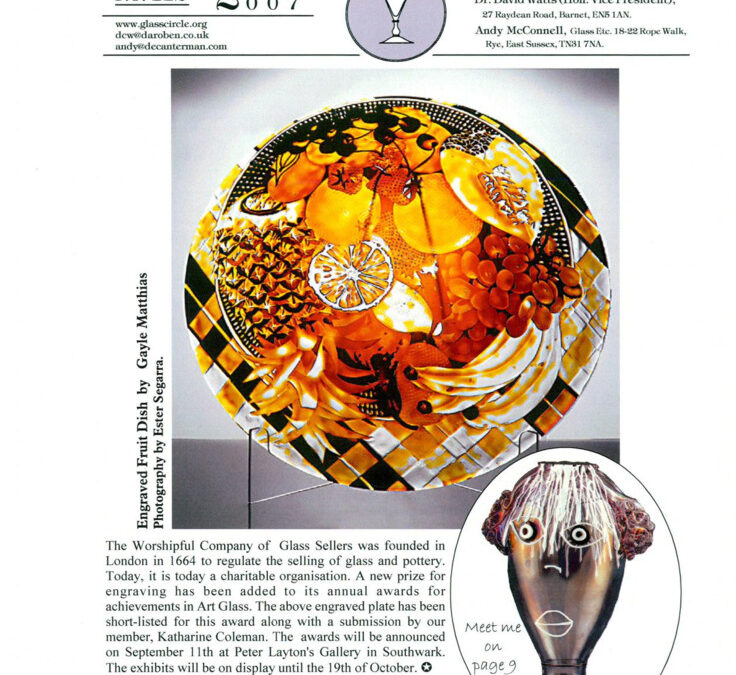
achievements in Art Glass. The above engraved plate has been
short-listed for this award along with a submission by our
plus,
member, Katharine
this
is
e
Col
s
e
u
m
e
ai The
awards will be announced
on September 1 1 th at Peter Layton’s Gallery in Southwark.
The exhibits will be on display until the 19th of October.
0
. . .
Sweetmeats, page
5.
•
Verre
eglomise, page 6.
•
• Collecting glass human figures, page 8.
•
• • A trip to Toledo, page 10, and all our regular features.
… but what is 0 all about? see page 2.
GLASS CIRCLE NEWS No. 112, 2007
Editorial
Glass Circle News
–
extra info on the web
The aim of this new experimental venture is to provide
extra colour pictures, articles, and other content for
GC
News
on the Internet.
The plan is to provide colour enlargements of some of the
pictures reproduced in GC News in monochrome; also,
important pictures and extra information or late news for
which there wasn’t room in your printed
GC News.
To find
out which images in your printed version are on the
website, keep an eye out for the 0 symbol.
The new site will be at:
www. gcnews.co.uk You will
need to type in the issue number and a short password.
From now on, this information will appear on the back
page of the newsletter. Each newsletter will have its own
password, so keep your old copies of
GC News
if you
think that you may wish to refer back to earlier web site
material.
On the site you will find a list of postage stamp sized
“thumbnail” images of pictures. Clicking on a thumbnail
(or its title) will bring up the full-sized picture. There may
also be additional text if this is felt necessary or helpful.
I am indebted to my son, Ben, for producing the site and
to an anonymous donor who has provided the space for the
site to appear on the web at no cost to The Circle.
Ben says that the site should work with versions of
Internet Explorer with
Windows 98 Second Edition
onwards (Internet Explorer version 5.01 or later), or any
modern browser including Firefox, SeaMonkey, Opera,
Safari or Netscape version 6.01 or later. If your web
browser is older than this, you are strongly advised to
upgrade your software. Upgrading any of the above
products is free, and will significantly improve the
appearance of the web. Many sites, including the Microsoft
web site, do not work well with software from before 1998.
As stated above, this enterprise is purely experimental
and your feedback and opinions will be greatly appreciated.
National American Glass Club 75
th
Anniversary.
Congratulations to the NAGC for reaching this important
milestone in its long history. The NAGC is one of the few
American organisations that can genuinely claim to be the
oldest in the world. The Glass Circle, I think, comes
second, being founded five years later, although I doubt
that our founder was aware of his rival across the Atlantic.
The NAGC was originally called The National Early
American Glass Club and its attention was primarily
focused on the first glass brought to and made in America.
In that respect the two clubs have much in common. Had
The Circle of Glass Collectors thought to have called itself
Early
it would have probably discarded it for the same
reason, that interests have moved on to later and modern
glass.
The NAGC has a brief newsletter, appropriately called
The
Shards,
and a Journal, more like an up-market version of
GC News, that usually includes four, or so, main articles
but with no newsy or peripheral material. The Anniversary
issue has four articles. The first is on the technology of
mould-blown decanters, made in the earlier Irish manner
with ribbing round the base, This ribbing is made by
blowing the paraison into what is called an optic mould.
This is a dip mould with a zig-zag pattern cut round its
inner side. I always wondered why it was called optic? The
author, Wallace Venable’s explanation is as follows:-
When
glass is blown into an optic mould, the mould creates a
pattern of temperature differences in the glass. When the
glass is further expanded, the glass becomes thinner where
it is hotter and thicker where it is colder, This results in
many lens-like areas, hence the name optic.
Well! I never knew that! If you have a suitable decanter
take a look at it and see what you think. If anyone knows of
an alternative English definition or can confirm that of Mr.
Venable I should be very pleased to pass it on to Jane
Shadel Spillman who edits the NAGC Bulletin.
The second Bulletin article typically concerns American
interest. Rather like our obsession with Jacobite variants it
is about identifying the minor differences in one of their
most popular pressed designs called Bellflower. In true
horticultural tradition various factories were found to have
introduced their own variety of this much loved species.
More to our interest is the article on what Sheldon M.
Finkelstein calls.
Unneighborly Litigation
between Louis
Tiffany and President Theodore Roosevelt. Why, Sheldon
asks, did Roosevelt remove a floor to ceiling screen by
Tiffany, installed in 1882 in the entrance to The White
House by President Chester A. Arthur, when he became
President on 1904? Apart, I suspect, that it was not very
good, being pre Nash, the answer is suggested to lie in the
way Tiffany trampled over the council and residents of
Oyster Bay when he built his magnificent 580 acre house,
Laurelton Hall there in 1902. In so doing he occupied a
significant section of public beach which he extended with
a huge breakwater. Tiffany’s initial success in a long
stream of acrimonious litigation was watched by Roosevelt
who lived next door. Eventually, the Council did win back
the land and planned a recreational and picnic area for the
newly exposed beach. However, Tiffany, instead of
gracefully accepting defeat, torpedoed the breakwater,
flooding the area and depriving the Council and its public
of any benefit. Tiffany’s attitude and behaviour so offended
Roosevelt, Sheldon believes, that he removed all trace of
his work from The White House.
An interesting aside to this matter is Sheldon’s remark that
Tiffany did not design his famous lamps; these are now
thought to be the work of Clara Driscoll. Added to our
growing knowledge that his jewellery was designed by
team of employees and Nash’s claim to have invented
all
his stained glass (except for a few early works of mediocre
quality) one is beginning to wonder if Tiffany really was
anything more than a rich entrepreneur whose real talent
was the exploitation of a skilled work-force under his own
name. The achievement cannot be gainsaid but perhaps
future will judge that the deification of the individual has,
in this instance, been somewhat overdone. Laurelton Hall,
incidentally, burnt down in 1956 and the offending screen
is thought to have perished in a fire in 1923.
The final Bulletin article, by Jane Shadell Spillman, is an
account of the Toledo seminar but from a different
perspective from that on page 10. *
. . . The views expressed in Glass Circle News are
those of
CHAIRMAN’S NEWSLETTER
Various matters arise from the last Newsletter. First I
am delighted to announce that we now have a
prospective new Treasurer, Mr. Laurence Maxfield,
and at the AGM it will be proposed that he be elected
to the committee so that he can take up his new role.
Ann Lutyens-Humfrey, of the Chelmsford Museum,
and Vernon Cowdy, a regular attendee at all our
meetings, have been co-opted to the committee during
the last year and we hope that they will be formally
elected onto the committee at the same AGM.
We are learning more and more about running the
website. In particular items prepared for the
Newsletter using DTP will not transfer to the web-site
properly using a PDF; enough of acronyms, those who
are computer literate will understand the problem and
I couldn’t start to explain to the rest.
The trip to Dorset is already full but there is space on
the others. Three people have queried why we are
charging for these trips when the venues are making
no charge. I am happy to acknowledge the generosity
of all the hosts who are giving their time and
hospitality free of charge but it is not true to say that
there is no cost to the society. We have calculated that
the cost to the society of printing, postage, expenses
and donations will be around £350 and it seems unfair
that these costs should be born by members, some
distant or overseas, who cannot come on these trips.
We have enough people wishing to go on the Czech
trips to justify going both in the spring and the
autumn. The hotel has generously offered us a free
room on each trip, we intend to offer this room each
time to a young museum curator interested in glass
who would not otherwise be able to get a grant to
come on this educational trip.
We offer our congratulations to our secretary,
Marianne Scheer, who has just been elected an
Honorary Fellow of the British Computer Society.
john Smith
GLASS CIRCLE NEWS No. 112, 2007
GLASS CIRCLE
MATTERS
RICHARD EMANUEL, FRCP. (1923-2007)
Those of us who had the privilege of knowing Richard
Emanuel knew him as a discerning and knowledgeable
collector of eighteenth century drinking glasses. But he was
one of the most distinguished cardiologists of his genera-
tion, lecturer at the Middlesex and National Heart Hospitals
in London, and civil consultant to the R.A.F. He was
chairman of the cardiac care committees of the British
Heart Foundation and the Royal College of Physicians. He
and his wife, Lavinia, have been members and stalwart
supporters of
The Glass Circle
since its earliest days. But in
whichever sphere of his life Richard was a man of the
greatest kindness, generosity and charm, and is remem-
bered by his many friends with love and respect. Our
deepest sympathy goes to his wife and three sons in their
great loss.
Jo Marshall.
Richard as a Glass Collector.
Richard Emanuel started his glass collecting back in the
palmy days soon after the end of the war, but even then he
found his favoured baluster glasses to be expensive.
Discussing this with Barrington Haynes, it was suggested
that Silesian stems were of much the same period as
balusters, but being less favoured were much more
affordable; a ‘poor man’s baluster’. Thus was his
remarkably distinguished and comprehensive group of
Silesian stems inaugurated, although other particularly
interesting glass that caught his eye was not spurned. He
disliked viewing his collection behind glass doors, so
created around his sitting room a range of cunningly
bottom lit open shelves, which admirably displayed the
collection, although demanding more care in keeping it
clean in London’s atmosphere. He had a true collector’s
dislike of disposing of his favourites, but like all of us, at
times had second thoughts about what he had acquired;
those glasses that he came to regard as perhaps being in
some way unworthy were placed in ‘limbo’, a closed
cupboard beneath his display, and resurveyed from time to
time until either their worth became once more apparent, or
they were consigned to the sale room. But for glasses that
he loved, disposal was abhorred, and the disposal of one
treasure in particular was unfailingly mentioned with
regret.
When showing his collection, Richard’s innate courtesy
and modesty were always apparent, facilitating discussion
and permitting questions and observations that were never
dismissed as irrelevant or even impertinent; a response not
always unknown elsewhere. He was a true collector with an
impeccable eye and a keen interest in all that related to his
well documented collection and discussion of a glass was
often enlivened by a little story about its acquisition.
Having been a
Glass Circle
member since the days when
meetings were still invariably held in member’s homes, his
departure truly does signal the end of an
era.
Peter Lole.
3
GLASS CIRCLE NEWS No. 112, 2007
Late News
Hon. President, Simon Cottle moves from Sotheby’s to Bonham’s
Simon Cottle, a leading light of the
Glass Circle for many years and its
current Hon. President, has switched
jobs: moving 500 yards up New
Bond Street from Sotheby’s to
Bonhams. In a major shift in the
auctioning of glass in London, he
has been appointed Bonhams’
Director of Continental Ceramics
and Glass.
The move is directly attributable to
Sotheby’s recent decision to hike its
minimum lot value from around
£750 to £3000, which effectively
severed its interest in most glass. As
Simon put it: “Naturally, I am delighted to have moved to
a firm which takes ceramics and glass seriously and where
new collectors can be encouraged.”
Simon has been joined by two of his colleagues at
Sotheby’s: continental ceramics specialists Nette Megens
and Sebastian Kuhn, who will join him in January 2008.
As part of the reorganisation, Fergus Gambon, a member
of Bonhams’ ceramics department for the past 13 years,
has been appointed Department Director of British
Ceramics.
John Sandon, who takes on the role of International
Director of European Ceramics and Glass at Bonhams,
says: “I have always enjoyed a friendly rivalry with our
Sotheby’s ceramics colleagues and I am delighted to have
such expertise join my team. Their individual strengths
and knowledge will, without doubt, see Bonhams become
market leaders in continental ceramics and glass as well as
British porcelain.”
Bonhams’ chairman, Robert Brooks adds: “Unlike its
competitors, Bonhams continues to invest in established
talent in long-term markets. In July, we appointed two ex-
Sotheby’s Asian Art specialists. Now, we are appointing
key talent from their Ceramics department. Naturally, to
have a high calibre of people working for Bonhams is a
true asset as we close the gap on our competitors.”
Simon added: “I regard this as an important move in
European glass sales. Generally, our minimum lot value
will be between £400-500, but I will enjoy a new
flexibility here. I’ll be pleased to offer glass in the £200-
300 range if pieces come in as parts of collections or if
they are of sufficient academic interest. Fashions change
and evolve so I’m keen to attract items that highlight
categories of glass so far neglected by the market.”
“From my perspective there are currently two principal
categories of glass dating between c. 1600-1900,” Simon
continued. “Firstly, the European section that incorporates
Renaissance Venice; late-16th, 17th and 18th century
German and 19th century Bohemian. The quality of many
examples in this field is astonishing and often remarkably
cheap in comparison with 18th century English or 20th
century art glass. Secondly, there is the
British group, which again can be sub-
divided into 18th century drinking-glasses
and Victorian decorative work by the likes
of the Woodalls and Fritsche. It is my
objective not only to promote all those
categories but to broaden the appeal of
glass generally, both to established and to
new collectors, and my appointment at
Bonhams will give me a perfect
opportunity to do so.”
For the record, Simon is graduate in
history with honours from University
College Cardiff and Washington State
University, and a postgraduate of the
University of Manchester in Museum and Art Gallery
Studies. He worked for 10 years as a Senior Decorative
Arts curator. Specialising in ceramics, glass and silver at
the Laing Art Gallery, Newcastle-upon-Tyne, Glasgow
Museum and Art Gallery and at the Burrell Collection, he
organised several international exhibitions. He joined
Sotheby’s in 1990 and took his first auction in 1995.
During his long career he has made many significant
discoveries, several of which have produced world-record
prices at auction. Simon is the published author of a
number of books on Ceramics and Glass. He often
contributes articles to other publications, regularly gives
lectures and has made appearances on television and
radio. He is a founder member of the Glass Association
and was Chairman of The Glass Circle from 1996 until
2003. Simon is a Fellow of the Guild of Glass Engravers
and a trustee of the Glass Engraver’s Trust, which is
responsible for commissioning glass for No. 10 Downing
Street. He was appointed Hon. President of the Glass
Circle in 2006.
Simon explained: “I will be holding two sales each year
dedicated to British and European glass from 1450 to
1900 and also working with my colleagues here to hold
sales of Fine British and Continental Pottery and
Porcelain. Bonhams has a significant team of ceramics
and glass specialists headed by John Sandon. In recent
years John and his colleagues have held highly successful
sales in London, especially of British ceramics and glass,
establishing a formidable international reputation. With
Sebastian Kuhn and Nette Megens, two of my former
colleagues at Sotheby’s, I have now established a section
of John’s department particularly devoted to Continental
Ceramics and to British and Continental Glass. With all
our newly combined talents we aim to become the
international market leaders for British and European
ceramics and glass, offering greater scholarship based on
our acknowledged individual experiences.”
He is contactable, both in his role as Hon. President of The
Glass Circle and as Bonham’s specialist, at: Bonhams
European Ceramics & Glass Department, 101 New Bond
Street, London W1S 1SR, UK. Tel: 0207 7468 8383.
email: simon.cottle@bonhams.com.
A. McC.
… See
Out with a Bang! page 15.
4
GLASS CIRCLE NEWS No. 112, 2007
17
th
and 18t
h
Century Sweetmeats
and
the Glasses in which they were Served
with
Special Reference to Glasses for Wet Sweetmeats.
0
Tim Udall
Report of a Glass Circle lecture at the Artworkers’ guild, Tuesday 10th, April, 2007.
The Hosts were
Mr. R.. Whatmoor, Mr. J. Scott, Mrs. E. Newgas and Dr.
B.
Scheer.
Seventeenth and 18t
h
century glasses are now divorced from
their original settings and are treated rather clinically.
However, discovering what sweetmeat glasses contained
adds another dimension to collecting them.
In the le and 17
th
centuries the dessert was a very grand
affair often served in special rooms, pavilions or in the
garden while the tables in the banqueting hall were cleared
ready for the evening’s activities, but from the 18
th
century
the dessert was increasingly supplied by caterers and
confectioners while coffee houses and confectioners’ shops
blossomed.
On the table the centrepiece was often the glass pyramid
with two or three tiers of salvers holding jelly or syllabub
glasses filled with coloured confections and with a
stemmed sweetmeat glass at the top, usually containing an
orange. These stood at the centre of the table and examples
were shown. References to them in 18t
h
century literature
were quoted.
Official grand banquets would be staged by caterers such as
Birch, Birch and Co. of Cornhill whose shop front is in the
Museum of London. These pastry shops sold invalid jellies
to Charles II for Nell Gwynne and James II was a popular
customer. Under the name of Ring and Brymer this firm
still undertakes prestige catering but sadly their archives
were destroyed in the Blitz of WW2.
Coffee houses and confectioners flourished from the
middle of the 18
th
century and slides were shown of some of
these shops with pyramids of sweetmeats on display. Also,
slides were shown of sweetmeats being eaten at home as
with the Gilray print “A voluptuary under the horrors of
digestion”. Slides of glasses such as were used on these
occasions were shown.
Classification of sweetmeat glasses can, very arbitrarily, be
divided into glasses for dry sweetmeats such as nuts,
sweets, chocolates, small cakes etc. and glasses for wet
sweetmeats such as posset, syllabub, jellies and creams.
Only brief mention was made of glasses for dry sweetmeats
— the most important being epergnes and stemmed
sweetmeat glasses — the “top glasses” at the top of a
pyramid. Examples were shown and it was pointed out that
if an early epergne should come up for sale probably most
or all of the baskets would have been made recently.
Then the lecture was confined to wet sweetmeats and their
glasses. A number of recipes were described taken from the
household and cookery books of the time. Particular
mention was made of Mrs Elizabeth Raffald and her classic
“The Experienced English House Keeper”. She was the
Mrs Beeton of the 18
th
century. Recipes were given for
Posset pot, last quarter of the 17th century.
Philadelphia Museum of Art. Given by Mrs. Hampton L. Carson
in the name of Anna Robeson Barr.
posset, syllabubs, jellies, creams and slides were shown of
them being served at home or in cafes and clubs.
The first wet sweetmeat glasses to be described were the
17
th
century large lidded posset pots, 8 or 9 inches high
which are some of the finest examples of old English glass
with their florid Venetian style of decoration. Presumably
the contents were served with a ladle. It was even suggested
that they could have been used for punch. Soon a spout was
added and the handles became functional rather than
decorative so that these pots could be passed round for
communal use. Examples of these different types of pot
were shown.
Attention was then given to the small double-handled
spouted posset glasses only about 3 or 4 inches high, such
as the sealed Ravenscroft example sold at Sotheby’s last
year for over £100,000. The earliest of these glasses had
cylindrical bowls without a foot, sometimes with ribbed
decoration or gadrooning, but soon a foot was added and
different bowl shapes are to be found. Theses glasses do not
seem to have been made after the middle of the 18t
h
century.
Examples shown included stemmed types and also those
with a double-B handle.
Posset was sometimes taken as a night-cap or medicinal
drink so these glasses were used as a feeding cup. However,
Sir Kennelm Digby in his 1669 cookery book wrote “My
Lady Middlesex makes syllabub for the little glasses with
spouts.” Having made the syllabub it is left to stand in the
glasses overnight and then “the curd will be thick and firm
and the drink clear underneath.” So the curd would be eaten
with a spoon and the liquid drunk through the spout. It has
also been suggested that this was also practised in the case
of the large posset pots but no evidence was quoted. There
5
LASS CIRCLE NEWS No. 112, 2007
REVERSE PAINTING
AND
GILDING ON GLASS
FRANCES B1NN1NGTON
0
Report of a Glass Circle lecture at the Artworkers’ guild, Tuesday 13th, February, 2007.
The Hosts were
Mr. Peter Lole, Mrs. Audrey Tait, Mr. Michael Nathan and Mrs. Anne M. Home.
RENAISSANCE
What is these days known as
verre eglomise * can
be said to
have dated from the very early Renaissance. The Italian
painter,Cennino Cennini
(c.
1370 – c.1440) describes
techniques that are still used today, with few modifications,
by practitioners of the art. Very simply, gold leaf is
attached with the weakest animal glue to the reverse of a
sheet of glass, scratched through and backed overall with
oil paint. Looking from the front again the image is seen by
reflected, not transmitted light. The necessary bonding of
the image to the glass gives particular qualities to the work
seen from varying angles and under different lighting
conditions. If we remind ourselves that lighting was very
different centuries ago, we can begin to understand the
mystery and beauty of such work.
From northern Italy, the art spread over the Alps to central
and Eastern Europe, where it flourished. Used widely
within churches, its life was however limited; not only was
it fragile, but ostentatious. It tended therefore to be used for
small items, for portable altars or as personal religious
pieces. The secular world, too had a great taste for the art.
Status was flaunted with the use of painted and gilded
glass: family crests on glass, built into the facades of
houses; consumer goods such as rock crystal pendants and
scent bottles (made in two halves for later assembly to
allow for decoration); cabinets of curiosities; jewellery
caskets with glass panels; ceremonial tankards encased in
elaborate constructions of silver gilt and decorated glass.
THE SIXTEENTH CENTURY
With advent of the printing press, endless source material
became available Placing a sheet of clear glass over an
engraving, painting could almost be done by numbers. This
lent itself to the decoration of not only flat glass, but also of
large dishes and panels to be set into furniture and fittings.
The glass was never fired, so it as only ever for display.
Often an individual object combined painting on glass,
verre eglomise
and collage. As a measure of the popularity
of this art, at one time the city of Zurich alone supported
around 30 gilders and painters of glass.
THE El GHTEENTH CENTURY
As the art spread, so did it grow. In the Far East, travelling
Jesuits had taught the Chinese oil painting. Their enormous
skills at imitation led them soon to export to the West some
of the most beautiful painted glass ever made. They often
made very fine reproductions of western paintings, but they
also painted mirrors. European mirrors were sent to
Canton, areas of silvering were partially removed and the
spaces painted in. The completed work was then returned to
the west, reframed and sold. For export, common subject
matter took the form of attractive girls sitting in a garden,
but the more interesting, dubious subjects were kept for
domestic, Chinese consumption. Their considerable skills
led to some very red faces amongst collectors; western
painters on glass could often be identified and these
Chinese imports were often just too good. Only
occasionally a frame or slightly oriental eyes would give
the game away.
Meanwhile, back in Europe, work of a very different nature
was going on. Following the example of Versailles, newly
built chateaux and stately homes needed large looking
glasses to catch the light and enhance their opulent
interiors. Now the technology was in place to produce
bigger sheets of glass while their phenomenal cost merited
further decoration and enhancement. The main mirror
plates were surrounded with clear or coloured panels of
either brilliant cutting or engraving (Italy and Spain) or,
with panels of
verre eglomise
(England and Sweden). The
latter carried a continuous design of strap work, with
Sweetmeats concluded.
is evidence that some of these little posset glasses may have
had covers but no examples are known.
Then a large number of slides were shown of jelly and
syllabub glasses. Nomenclature varies a lot between these
two types so no distinction was made between them.
Examples were shown with different bowl forms — bell,
round funnel, pan-topped and hexagonal. Also different
types of mould —blown decoration and many handled
glasses — single, double, double-B and rarest of all, single-
B.
In conclusion, not many descriptions and even fewer
illustration are to be found of the Grand Dessert but the
glassmakers of the day with their eye for form and
craftsmanship have bequeathed to us some delightful
glasses which were once part of the extravagant lifestyle of
the upper classes of society.
And we still have with us a number of the business-like
glasses which were the stock in trade of the 18
th
century
coffee houses, confectioners and cafes.
So when you handle one of these specimens I hope you can
imagine some of the settings in which it may have been
used.
For further information on the subject see articles by
Robert Charleston, Helen Mc Kearin and Tim Udall in
Glass Circle Journal No. 5. *
6
GLASS CIRCLE NEWS No. 112, 2007
acanthus leaf, on occasion including classical figures,
backed with black (for mourning), green (peaceful, for
bedchambers) blue or red. The whole construction was set
into carved giltwood frames.
THE NINETEENTH CENTURY
The industrial revolution meant mass production. Popular
versions of the great gilded pier glasses were now available
to the wider public in the form of the Regency frame, or
Pillar. A gilded and painted panel of glass sat atop a
rectangular mirror plate, housed in an architectural style
giltwood frame. Made in the U.S. as well as in the U.K.
they were produced in enormous quantities and the painted
panels often had great charm. Though their production was
very fast, comparatively, it soon became more cost
effective to replace the glass with cheaper gilded plaster
casts, so that was the end of that. At the same time, in
Austria, southern Germany and many eastern European
centres, glasshouses were making huge quantities of glass.
This gave the surrounding communities, often isolated in
the winter months, a ready supply of glass to paint in their
traditional folk art manner. Framed panels were packed up
and transported by foot across the Alps to the coast, from
where they were despatched all over the world. With
financial pressure, standards slipped. Imitation gold (Dutch
metal) replaced the real thing; all sorts of corners were cut
and the work degenerated into charming, sloppy, folk art.
On a walking tour of the village of Murnau, the painter
Gabriele Miinter with her lover Kandinsky came across the
last of a long line of glass painters. They were charmed by
the techniques and both produced a good deal of glass
painting. The art revived in the Art Deco period, only to
disappear again until the second half of the 20
t
h century.
Verre Eglomise table top. Probably 19th or 20th century
Maker unknown.
* Named after Jean-Baptiste Glomy (d. 1786), a French
picture framer who used the process in glass mounts.
Further reading.
Cennino d’Andrea Cennini The Craftsman’s Handbook ‘EL
Libro del Arte”, around 1457 Translated by Daniel V.
Thompson Jr. 1960
Reverse Paintings on Glass: The Ryser Collection. Based on
the Book
Verzauberte Bilder
by Frieder Ryser.
Translated by Rudy Eswarin, The Corning Museum of
Glass, Corning, NY 1992
Author’s Website.
www.gilding.net
The Art Fund
support for Glass acquisitions in 2006.
During last year The Art Fund contributed £9,102 to glass acquisitions by five
different museums whose cost in total amounted to £23K. In addition, gifts
were made through The Fund to another four museums. These are reported
and illustrated in the ‘2006 Review’ of The Art Fund, published in May.
A 3r
d
century Roman millefiori ‘stud’, found in Oxfordshire many years ago,
was acquired by the Woodstock museum. Two museums, Bolton and Belfast,
were assisted with modern studio glass by Gillies Jones and Paul Devlin
respectively, the work by the latter being a striking group of three ‘Placid
Vases’. The Bristol Museum increased its already important collection of
Chinese glass with an early C.20th (mid-Qing dynasty) cameo vase carved
with a very satisfying representation of an orange day-lily on a milk white
ground, from the Plesch collection; reminiscent of Stourbridge cameo work of
the same era, it has a more refined appearance. The piece that will perhaps
have most resonance with Glass Circle members interested in classical British
glass is a green rummer decorated in black enamel and gilding by Absolon
with Admiral Lord Nelson’s arms, which is one of pair presented by Absolon
to Nelson when he landed at Yarmouth in 1800 (picture right); this cost
£16,055 towards which The Art Fund contributed £5,000.
Sir Nicholas and Lady Goodison donated two pieces of
studio glass to the Fitzwilliam, another of their many gifts
of studio glass over the years to this institution; Broadfield
House received a collection of C.19
th
Glass pigs, whilst the
Nature in Art museum at Gloucester was given a collection
of silver and glass flowers together with three C.18
th
drinking glasses. Perhaps the most unusual of the gifts was
a section of 22 panels of a glass wall, 2.8 metres high,
decorated in black enamel by Bruce McLean (1994). They
were previously located in the staff restaurant of Credit
Suisse First Boston. The panels have been re-erected in a
corridor of the curatorial offices of the Kelvingrove
Museum in Glasgow, where they may be seen by
appointment.
F.P. Lole
7
GLASS CIRCLE NEWS No. 112, 2007
The Young Glass Collector –
Know your Betters!
Admiring the human form is a
universal attribute. Collecting
it in glass is a more tricky
matter. I was well used to the
fancy ladies who used to adorn
the popular
Between the Wars
flower centres but where else
might they be found? In fact,
funereal figures, known as
shabtis are one of our earliest
forms of glass. Most, relatively
common, were made in
faience, a sort of partially
fused glass with a glazed
outside. Rarely, they are glass
right through like this one in
the Toledo Glass Museum. It is
coloured copper blue and dates
from around 1300 BC.
The so-called Jason head flasks
take us into the early centuries after
the invention of mould-blown
glass. Genuine ones are mostly
quite small, about 5-8 cm tall.
Middle-Eastern entrepreneurs were
quick to recognise a good souvenir
when they saw one and copies in a
wide range of sizes and colours
may turn up unexpectedly.
The one here, in an amber
glass, is genuine and about
9cm tall.
Curiously, from these
early beginnings, although
the human form is common
on engraved and painted
glass in later centuries, its
expression in 3-dimensions
is rare. Only the delightful
figures attributed to Nevers, in
France, come readily to mind.
They were made from the late
16th to the early 19th century
and commonly assembled in
groups to form miniature
tableaus. The exquisite
example (left), courtesy of
Adrian Sassoon, is in white
and coloured glass, 9cm tall
and dates to around 1750. But
it is only for those with a very
deep pocket.
The true beginner’s
period might be said to
commence with the later
19th century. I bought
this press moulded
match holder longer ago
than I can remember. It
is plain glass with an
acid matt finish. I have
no idea who made it
although the decoration
on the plinth suggests it
might be English.
How about this charming pair of salts displayed in the
Fostoria museum (see page 10). Columbus, on the left, was
only allowed to sail the ocean blue after protracted negotia-
tions with his Queen, Isabella of Castile, about how to share
the spoils of any discovery. Isabella, who led a complex
life, also tried to prevent abuse of the native Americans.
This lamp-work pair of glassblowers, 10-12 cm tall, was
made at the Webb Corbett factory in Stourbridge in the
early 1970s. In colourless glass, acid-matted with red bulbs
on the end of the blowing irons, they are contrived in the
form of place holders for the dinner table. The blower’s
heads were said to have been miniature portraits of some of
the factory workers! Broadfield House has a complete
model of the firm’s glasshouse made in this way.
8
attractive, the quality of
the craftsmanship tells us
that it originated in
Murano. However, Andy
also reminds us that there
are now numerous copies,
probably originating in the
Far East. The difference
between them may lies in
the quality of the detail so
here is one area in need of
further research.
Also from Murano comes
this pair of dancing
figures, dressed in powder
blue costumes. The poise
GLASS CIRCLE NEWS No. 112, 2007
The mould-blown figured glass
bottle has, for me, a particular
association with Francois
Theodore Legras (1866-1930),
of the “Verreries et Cristalleries
de St Denis” in Paris. Although
he is best known for his Art
Nouveau glass he was brought
up in Clairie in the Vosges
Mountains, near Nancy. The
Clarie museum has an
interesting collection of his
figured bottles. They appear,
somewhat
incongruously,
alongside a commemorative
exhibition of the French
Resistance movement. Today,
many are probably made in the
Far East, Spain or South
America. This one, in amber
glass, unmarked and of unknown
origin, is at least forty years old .
The following group were all
provided by my co-editor and
reflect his diverse interests in
later glass. First, a hand-blown
decanter that perhaps had its
origin in the above simple
bottle. It is by Hovmantorp, a
Swedish maker of mostly
utilitarian glass, and dated to
1927. Its undoubted rustic
charm lies in the skilful
painting in coloured enamels.
Another prolific Swedish
producer of so-called
Peoples
Decanters
was Eric Hoglund.
The mother-daughter pair
below is just about as simple
an adaptation of a conical flask
as is possible – the attachment
of arms and a stopper pressed
with the face. The attraction
lies in the used of bubbly glass and rich colours, red for the
mother and green for the daughter.
If the Swedish bottle
might be described as
cool or restrained the
Spanish version is all
about passion embodied
in the striking head of a
typical Flamenco dancer.
(top of next column).
Cold painted, with jet
black hair interlaced with
coloured poppies and
overdone red lips she
declares herself as not
being for the faint-
hearted, albeit only 20cm
tall. As a commercial
product it sends a strong
message to the customer
about the strength and sexy
attraction of good Spanish
brandy for which it was made.
Keep an eye out for her next
time you go there on holiday.
One of the most recognisable
figures to be found is the
colourful clown, 32 cm tall,
shown below. Although,
personally, I do not find it
and grace of the movement
is exaggerated by the
elongated form. The
quality of the detail makes
it an exceptional example
of that island’s finest work.
Finally, this vase by
Fulvio Bianconi for the
Venini factory surely
reflects the amazement that
the human form can be
represented in so many
cunning ways in glass. *
9
GLASS CIRCLE
NEWS No. 112, 2007
No! Not the blood-thirsty
bull-fighting town in Spain
but a quiet, almost
backwater, in north-east
America (actually north-
west Ohio). Its claim to have
been the greatest glass-
making city in the world is
not without justification. For
a while it enjoyed a bonanza
period in the 19
th
century
when two gas fields attracted
around 100 glasshouses to
Toledo and the surrounding
towns, such as Tiffin and
Fostoria, both of which,
incidentally, have small but well stocked glass museums
reflecting their local industries. But these
were the days before any thought of
control and in four short years, when the
whole place was lit like day every night,
the gas ran out and so did all the glass
makers except for one. That
one
was
William L. Libby (1827-83) who had
transferred there from Boston the New
England Glass Co., originally founded by
Deming Jarves of press-moulding fame.
Libby designed his furnaces to run on any
fuel and exploited the benefits of the site,
its provision of seven railways and the
river for shipping.
Ravenscroft jelly
All entrepreneurs require a slice of luck
rigaree decoration
and Libby was blessed with an
exceptional young engineer
called Michael Owens (1859 –
1923). Owens first invention
was a foot-operated device for
closing and opening a mould.
This was needed because of the
shortage of youth who would
normally do this operation for
the blower. But Owens is really
remembered for the automatic
bottle blowing machine and,
thanks to a strike preventing
Corning from being able to fulfil
Two-headed flask blown
a contract with Edison to make
in opaque white
g
l
ass.
glass envelopes for his newly
Roman
c.
lAD. Ht. 7cm.
invented lamp, the bulb blowing
machine. These inventions were not sold but licensed all
over the world and brought Libby both wealth and control.
Hence the claim recorded above? Well! not quite; under his
son, Edward D. the firm became, in what is known as the
Brilliant Period
(1876-1910), the largest cut glass factory
in the world. At the 1893 Chicago World’s Fair they had
130 craftsmen making and cutting glass. For the Illinois
Fair in 1904
The Illustrated London News
was sufficiently
impressed to devote a full page to Libby’s manufacture of
the world’s largest (25 ins diam.) cut glass bowl, the blank
weighing over a hundredweight. The firm, incidentally, did
not use lead glass except briefly in the 1940s. There were
later British indirect contributions through the inventions of
Joseph Locke of Amberina, Maize etc., while Arthur D.
Nash, Tiffany’s glass guru, introduced Libby-Nash
glassware in 1933.
But one does not go to a quiet town with
no proper centre just for history. Edward
D. Libby left his millions to build and
furnish a magnificent Art Gallery and
Museum, opened in 1901. But the real
attraction is its new Glass Pavilion with
walls made almost entirely of glass,
opened in August 2006, shown above.
The total area of 76,000 sq.ft. on two
floors houses a collection of about 7000
objects. It is particularly strong in
antique and Roman glass but includes
early English and some fine European as
glass with unusual
well as good American glass and, of
to the handles.
course, glass made by Libby including a
The famous Libby cut bowl and a group of admirers.
Filled with Burbon the
welcome is even warmer.
10
Gokb5
romm.ca amo•••
n
..2 A
C4r loNSAIttO
PIRR CLAY,
TMC
COSTIErvIS rAri.r
AV A TenARTT….0415.
1
1
00
.
155430
.
cA05.
1
SY ATenr41/1.-
rwatoc
OF GAS
=
Arm
,
AIR OCrLC.CLIED
A
FPrOnr
.
r
.
Al SOMA.
C CO
,
AnwAg…G.
AY
OALL
E
.401.16
Or r411.14,M pars A A
DITACMC.0 POT
MOOS%
to
,
vemoi-J
is
.i•Rvoucc.o0,4—
MI5
tirs,
t•O, SALIPILtre.
/.5.P.sAr.
twursowenc
spWW7i4AAVCTV7.:rstao
twos
EMU NI.]
Rai
tmor46.07
LM
111.0 on .”0
4
.
CA.114 rrAQ At.C.71110 IN A 4LoAAAts-
Rortt.P4e
PoSILILJO it To r.is ‘GLASS
ISto•ogfe WAG •novnik TA& MARS itar.wAr..v
grarvirAIE OtracArrAtl.C•
Artalt
ASTMAT..4 In A %.4.44•ATITTG.
AND rAOAR. erh14111ry
WOPIkOrtArr NOW fr.rrALS IT MORO. orinarri…
ISAArc… It is TAiltr• AsittriATIM A
T.AG TIM& 7V
A
MA
airekarrrOgs
rAg 7CAOSIR
cnAsa In
reti..Altr OR
liaAncicoespoG over.* •
nn
•
n
,-1O,111 .7 if
Trios! OKAPVP,A,N
,
Coo,OP . 17 IS
now
IRCASY
‘
,
cot snot.
TARCE STArre.•
Or
TAO
C.V
.
D1,44 OPCOIATIAIr
It(p.rprAiltS WITH SANE. ANT”
A ‘,it..
Gn1r+10.nd 04,511.
–
Scco,iso., r,ri,
r
rl
sr
c
St
,
A Vranlel i
,
l’rpracr werwrt.. A-••.‘”
1…5111•T1, tr
.
arrafr8.12 40 A vo••C•ew
Pot..110,00nJO ArACCL .
, POLISi-1114.4
lb ‘NCH GLASS
FCIR elte111700.1
A
$7 LO.,15 CxC. St
–
1 to
foop:
CAJC:iiirrcrr
A
,
:o-Ar’SS`PLATOIL
A Trle0
n
.A.K”.
ea-OATI
–
rd
–
Crl
–
.Ail
C.
ittswin
n
Rovancy)
D.
.Ol
TOOT
OP ”
VASC 15,‘IN4 Cif:toast, 01
A
ACW12aINTA6. CiriiraOsrao,
—
SANS AMC
,
WATCIt tiOING A.-trOWtO
TV
DRIP oti;rtt TAC WNtei. Pot*. A
Cant
IbrIAPG13 Di.KII
Around the Auctions,
concluded.
not kept pace with inflation.
An opaque twist wine glass
with basal wrythen and
moulded trellis design to the
round funnel bowl went for
£1200, despite chips to the
foot (picture right).
A green air-twist stem
goblet with central knop
finally went for £1700.
A colour twist stem wine
with shoulder and central
knops, the central white
gauze encircled by red blue
and green translucent spiral
canes was bid to £2300.
(picture left).
An attractive taperstick with
17
GLASS CIRCLE NEWS No. 112, 2007
View of the main area of the Ceramics Fair from the
friendly hospitality of the Adrian Sassoon stand with a
substantial sculptural piece of crystal by Colin Reid
prominently displayed in the foreground.
George III, and some later continental glass. Opposite him
was the opening stand of a newcomer, our Chairman, John
P. Smith, reflecting his first new venture since retiring from
Mallett’s. Here, as well as typical works of cut float sheet
glass by Danny Lane, was a new 3-dimensional creation
(29ins. wide) in bright orange glass called “Goldfish”. It
dominated the front of the stand. Hidden in a back room
was a display of diamond point engraving by James
Denison Pender, each piece in its own illuminated case, and
a very dark oil painting of a glasshouse interior, probably
from the continent. On a different plane Jonathan Keane
had half a dozen varied early British wine bottles on show.
A major attraction of this fair were the lectures by ceramic
specialists. Our Editor, who took the accompanying
pictures, tells me that he was invited to one on Bow
porcelain by Patricia Begg who had come from Australia
specially for the event (no wonder they charge £17 for the
Ceramics Fair. The Stand of John P. Smith with exhibits of
work by Danny Lane and an unusual kiln-formed piece
called Goldfish dominating the front. In the background are
four stained glass panels by Patrick Rentiens.
pleasure!). He tells me that the room was hot, stuffy and
packed but that it was a revelation to learn about the
technical problems, many unsolved, that beset this ceramic
group. By comparison, glass-making seemed quite easy!
A short stroll around the corner brought me to
Grosvenor
House
in Park Lane. . Here, I went round the Gallery to see
the Delomosne stand which was busy with visitors
examining their usual display of good C. 18′ drinking
glasses and general glassware up to the Regency — William
IV period. They had started the show with no less than six
Beilby enamelled drinking glasses. Continuing round I
came to Mark West (again) with, not surprisingly, similar
glass to that shown at Olympia. I was pleased to learn that
he had sold the Stuart spider web set. He had used these for
his advertisement in the Fair’s catalogue. I think this must
be a first. I would not have expected 20th century Stuart
enamelled glassware to be sold at Grosvenor House. *
Looking into Glass
29th — 30t
h
September 2007.
A Conference at the Eden Project, Cornwall,
Sponsored by Creative Glass Guild.
The conference will have sustainability as its theme,
with discussions focusing on the environment,
technology and recycling in glass making as key
points. Speakers include Therman Statom, American
glass artist, David Reekie, British sculptor working in
Glass, Emma Woffenden/Tord Boontje, fine
artist/designer, Rebecca Newman, sculptor, and
Richard Golding, glass blower.
A detailed programme of all events has been available from
May 2007 – for further information or high quality images
please phone – Pam Reekie at CGS +44 (0) 1603 507737
and finally …
Hung Up on Glass
Seen in a local charity shop window in July a full size clear
glass coat stand. I stared hard at this amazing object and
then entered the shop. It (the stand) was composed of three
slightly curved splayed supports, narrowing at the top and
each support joined into a circle by two triangular glass
discs; each support had applied coat pegs in the shape of
small rhino horns. The effect was elegant and arresting and
would make a good talking point in a minimalist
household,
I was informed that it was a one-off and the charity was
seeking four hundred pounds or best offer. I hurried home
wondering who would buy it? A week later, when I
returned, it was still there! The charity now propose to put
it on Ebay.
HF
Member’s Extra, Web Site
Log on to:
Issue No:
Password:
www.gcnews.co.uk
112
pontil5
CAMBRIDGE GLASS FAIR. Sun. Sept. 30, 10.30 am – 4.00 pm. Chilford Hall Vinyard , Linton, CB21 4LE. Tel. 07887 762872
1
8