




No. 113
2
O
D e
0
c
7
www.glasscircle.org
dcw@daroben.co.uk
andy@decanterman com
EDITORS
Dr. David Watts (Hon. Vice President),
27 Raydean Road, Barnet,
ENS
IAN.
Andy McConnell,
Glass Etc. 18-22 Rope Walk,
Rye, East Sussex, TN31 7NA.
ebr
i5tin
ag
14$
reeting5
from
GLASS CIRCLE NEWS
Congratulations
on
OU
Years of a Royal Marriage
around 1940 might bring as much as $16,750. The one here, chosen for its pretty
picture, cost your editor $12.
US officials presented two other Steuben royal wedding presents. In England,
a
superb gift was a goblet, diamond point engraving by Laurence Whistler with a verse
composed by Thomas Campion for the marriage of Princess Elizabeth, daughter of
James I, in 1613, given by Mr. Mark Bonham-Carter. Pictures of this glass and 95 other wedding presents can be
seen on www.royalcollection.org.uk/microsites/royalwedding1947/objectasp?grouping=&exhibs
Copyright restrictions prevent us from showing any of them in Glass Circle News.
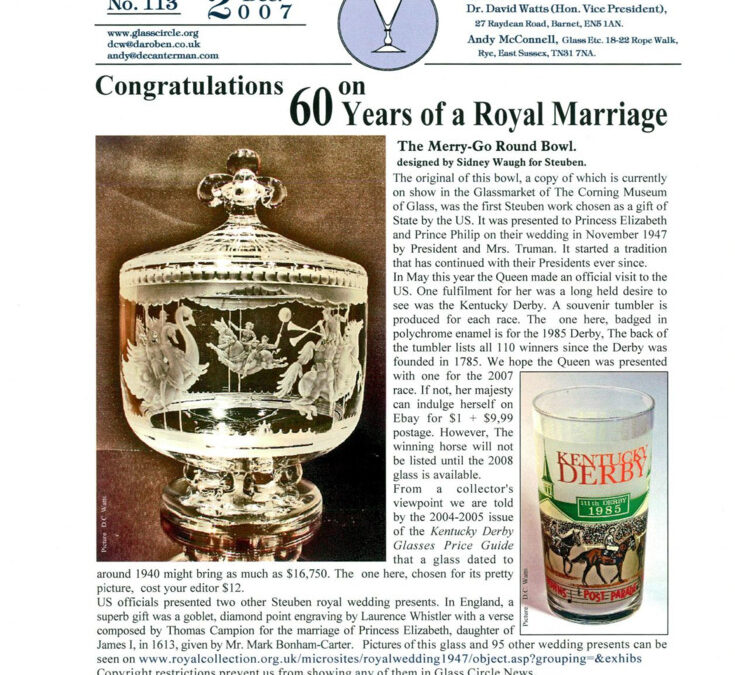
The Merry-Go Round Bowl.
designed by Sidney Waugh for Steuben.
The original of this bowl, a copy of which is currently
on show in the Glassmarket of The Corning Museum
of Glass, was the first Steuben work chosen as a gift of
State by the US. It was presented to Princess Elizabeth
and Prince Philip on their wedding in November 1947
by President and Mrs. Truman. It started a tradition
that has continued with their Presidents ever since.
In May this year the Queen made an official visit to the
US. One fulfilment for her was a long held desire to
see was the Kentucky Derby. A souvenir tumbler is
produced for each race. The one here, badged in
polychrome enamel is for the 1985 Derby, The back of
the tumbler lists all 110 winners since the Derby was
founded in 1785. We hope the Queen was presented
with one for the 2007
race. If not, her majesty
can indulge herself on
Ebay for $1 + $9,99
postage. However, The
winning horse will not
be listed until the 2008
glass is available.
From a collector’s
viewpoint we are told
by the 2004-2005 issue
of the
Kentucky Derby
Glasses Price Guide
that a glass dated to
also in this issue …
Sebastien Zoude catalogue unsafe, page 3.
Report on our AGM, page 7.
Press-moulded Art Deco, page 8.
Notes on the Importance of Gullet (New Series),
Glass Sellers Prize results, page 13
and all our usual articles, reviews and notices.
and …
on
our GC News web site.
The Contemporary Glass Society
10th Anniversary Exhibition.
Pictures from the Glass Sellers
page 10.
prize.
Art of Light, exhibition pictures.
Colour images from our articles.
GLASS CIRCLE NEWS No. 113, 2007
Editorial
When is a Fake not a Fake?
This question arises from the article opposite. The answer
lies in the definition of fake. Was the item under
consideration deliberately intended to deceive or was it
originally made for some quite different and innocent
purpose? If the intention to deceive was deliberate then our
language is endowed with ample unambiguous terms of
which
counterfeit
and
forgery
are perhaps the best. Our
dictionaries allow
fake
to convey the idea of intent so it is a
word to be used with caution.
Back in 1954 Royal Brierley Crystal introduced a suite of
glasses they called
Edinburgh: a Revival of Historic
Drinking Glasses.
They would not deceive me today but, as
a beginner, I fell for one, that I thought at the time was an
18th century bargain. I keep it today as a reminder about the
dangers of dabbling in an area of collecting outside one’s
specific knowledge.
The Sebastien Zoude catalogue discussed opposite proved
particularly difficult to interpret. Looking at photocopies of
the pages aroused suspicion but nothing concrete. But once
the original was to hand for study its shortcomings were
soon apparent. It was clearly not a catalogue, there was no
text on which a date could be based while other features
indicated that it could certainly not have been intended as a
submission for a royal grant in 1762/3.
On the other hand, the ink-drawn catalogue was clearly not
the work of an expert forger as its poor quality became
apparent after even a brief examination. As a test of the
little grey cells it was hardly a starter. The real challenge
that faced Hugh Tait and myself was to understand the
enigma of how it came into being in the first place and its
purpose for doing so.
The Zoude catalogue (initially it was not clear to me that
there were two versions) is first known in the collection of
Belgian author and historian, Raymond Chambon. Where it
came from is unknown. If its shortcomings were so obvious
why did he promote it as genuine? Why were reputable
authorities allowed to accept his dating of 1762 and the
drawings to indicate glassware as actually originating from
the Zoude furnaces? Why did he present it as genuine in his
otherwise well-researched book on Belgian glass?
The only solution I have been able to find that answers all
these problems is that Chambon relied upon his provider as
an unimpeachable authority and that a small number of
pictures in the catalogue were backed up by actual items in
the donor’s collection. If that interpretation is accepted then
the original owner of the catalogue can only have been a
noted Belgian collector, Armand Baar. Upon reflection,
and it worries me still, I find it difficult to forgive Chambon
for allowing his misrepresentation of the date to persist and
deceive both the collector and the curator/historian.
Who made the catalogues in the first place? I do not accept
the idea of a deliberate forgery. It could have been Baar but
it does not relate directly to what we know about his
collection. It could have been a member of the later Zoude
family, as I favour, or an unknown intermediary buyer.
Corning’s Rakow Library may, on occasions, be criticised
for its blotting paper approach to building up its holding.
But by holding in one place the entire Chambon collection,
including other Zoude family documents, the investigation
was made much easier for me. Further, its generous support
both in sending copy material overseas at no or minimum
charge and readily making originals available for study in
the library itself is a practice to be commended to libraries
and holders of other collections everywhere.
Art of Light — German Renaissance Stained Glass
At the National Gallery, London. Until February 17th, ’08
This modest exhibition explores whether the best stained
glass from the late Renaissance period fully reflected – and
even rivalled – the latest developments in painting, while
exploiting to the full the vibrant properties of light.
Examples of le century German stained glass from the
Victoria and Albert Museum are juxtaposed alongside
carefully selected paintings in the National Gallery of the
same period, and from the same regions of Germany.
Sketches and drawings help support the analyses of the
chosen pieces. Accompanying texts are particularly
informative. A full colour booklet is available for £4.50.
German stained glass of this period made use of the same
imagery as painting and showed similar visual innovations.
See more pictures in colour on
Increasingly, the designers of stained glass windows were
also painters of panel pictures. There is a special focus on
three important early sixteenth century artists who designed
for stained glass as well as creating paintings: Albrecht
Diirer, Hans Baldung Grien and Iorg Breu. The concluding
highlight is a full-scale recreation of one of the
extraordinary multi-scened glass panels from the Abbey of
Mariawald. This work is considered to be one of the
greatest achievements of the glass painters of the early
sixteenth century. The panels reveal the full range of the art
of this period, including well-executed landscapes.
A 4-minute video outlines how stained glass is made while
a small section of the exhibition depicts materials relating to
both painting and stained glass in this period. Similar
pigments were often used while the different techniques are
compared. Stained glass is said to
approach the painter’s
art, becoming ever more painterly and sophisticated.
By
highlighting the beauty and importance of both glass and
painting this exhibition will (should) help
open eyes to the
lost worlds of medieval and Renaissance Germany.
Admission is free; don’t miss it.
our web site www.gcnews.co.uk
. . . . The views expressed in Glass Circle News are those of its contributors . . . .
2
Ink-drawn copy of the Zoude catalogue showing the stuck in crest and bill poster of which
the most age-distressed areas have been trimmed off. Untrimmed copies of this poster
and the crest are in the Rakow collection.
GLASS CIRCLE NEWS No. 113, 2007
Found Wanting, the Putative Sebastien Zoude Glass
Catalogue of 1762.
by David C. Watts*
The Namur Belgian, Sebastien Zoude is
recognised, probably correctly, as the first
glassmaker on the continent to perfect the
manufacture of English lead crystal. A
putative catalogue of his glassware
patterns contains numerous examples of
English style air-twist, opaque-twist and
Newcastle glasses. Its significance for
collectors of English glass is, therefore,
immeasurable. This catalogue, of which
there are two forms, came, in a manner
unknown, into the hands of Belgian
historian, Raymond Chambon. Following
his death the entire Chambon library was
purchased by The Corning Museum of
Glass for its library. As described in GC
News 93 and 94, an earlier catalogue in
the collection, called the Catalogue
Colinet was found by Hugh Tait to be a
forgery. Correspondence from our Hon. Vice President,
Dwight Lanmon relating to the Catalogue Colinet and to
the Chambon collection in general, incidentally raised
doubts about the authenticity of the Zoude Catalogue. With
Hugh’s help and the generous co-operation of the Rakow
Library I undertook a study of the Zoude catalogue. Our
findings have just been published in the latest issue of the
Journal of Glass Studies
(vol. 49, 2007, pp. 153-178).
Of the two forms of the catalogue, one is drawn in ink in a
large leather-bound ledger and the other is drawn in red
chalk ( a common graphic material of the 18
th
century) on
small irregular sheets of paper subsequently stuck onto
(approx. A3) thin card. Each consists of 460 almost
identical drawings of 197 drinking glasses as well as
bottles, general tableware and pharmaceutical items. The
scale and quality of the drawings varies in different sections
of the catalogue, notably the pharma-
ceutical items where a large number are
crammed onto each page. The drawing of
opaque and air twist glasses would only
be recognised as such by one who was
familiar with these designs. Further, the
bowls and stem shapes of the Newcastles
show little concordance with those in the
known collections I was able to study. In
general, most of the bowl shapes were
bell or round funnel There were a couple
of ogee but no double ogee bowls and no
drawn (Silesian) stems.
*All pictures are copyright of D.C. Watts and The
Corning Museum of Glass.
The ink drawings are of generally poor
Version of the Zoude catalogue with drawings in red chalk stuck onto large sheets of thin
quality, such as by a person unfamiliar
card contained in a relatively modern folder with ties.
with what he is trying to depict. Smudged
Below, detail of another page showing tableware with printed black lines running through
areas revealed that the ink was a mixture
the paper. The jug is a 19th century design not found in the 18th century.
of black and vermillon-coloured inks
rather than the typical brownish iron-gaul based ink that
might be expected for a C.18th date. Some of the items
have late 18
th
or 10 century associations rather than 1762.
Indeed, Chambon initially dated the catalogues as
c.
1780
but adopted the earlier date when he found that Zoude had
submitted an application for a renewal of his contract
(octroi) in 1763 to which he (Chambon) thought the
catalogue appeared to relate more closely. There is no
written text or dedication in either catalogue as might be
expected for the time; nor is there a copy in the Belgian
3
Which stem type? These, drawn in ink, I
think are meant to be opaque twists. Note
the consistent depiction of a central double
thread surrounded by a double spiral. Do
you have one of these in a rather greyish
metal?
types shown in the catalogue.
GLASS CIRCLE NEWS No. 113, 2007
Namur official archives to indicate that the catalogue had been submitted as part of
Zoude’s octroi application. The evidence was suspicious but far from conclusive.
Following Hugh’s untimely death and my election as a Corning Fellow I was able
to study the catalogues first hand in the Rakow Library. Their shortcomings
became immediately apparent. They were undated and all the graphic elements
(title on the cover of the leger etc.) relating to Zoude had been stuck on.
Surprisingly, the Rakow collection even included spare printed labels as though
more such catalogues might be contemplated. But conclusive evidence was the
finding that the title page of both catalogues was an age-distressed bill-poster of
about 1757 rebutting a complaint by the local shopkeepers over the poor quality of
Zoude’s glasses supplied to them. Clearly both catalogues had been assembled at a
much later date and probably in the 19
t
h century. Some of the chalk drawings had
printed black lines on them such as might be found in a pocket notebook. These
could be original and some might date back to Zoude himself as drawings of
glasses that he had seen and might contemplate making in his own glasshouse. He
was trained as a master goldsmith and had no earlier connection with glassmaking.
Zoude clearly did make a variety of glassware in the English metal, including a
carillon of glass bells but probably not in sufficient quantity unduly to disturb the
English market. More important for the historian, these catalogue images can not
be used as evidence that he made the glass
depicted or to attributing a date to their
own specimens. Several appear in
existing catalogues including one by
Robert Charleston relating to the
Waddesdon collection.
Perhaps Chambon had his own
suspicions. There is yet another
catalogue relating to the French firm of
Montherme, not far away in the Vosge
mountains and founded in 1668. Most
of the drinking glasses in this catalogue
were found by Chambon to be
essentially identical to those in the
Zoude catalogue. The Rakow Library
has a photocopy bearing the name of
Chambon’s contemporary, French
historian James Barrelet. Again it is
undated and has no text. I was unable to
establish the exact location or get
permission to view the original and so
cannot comment on it in detail.
Large drawing
of a chandelier in red chalk.
The shaded-in blocks are wood supports for
the glass branches. Beneath the heavy
If Baar, as the premier glass collector in
shading, original glass globes for supporting
Belgium, was the mystery source of all
the branches are
just discernable
indicating
the Zoude family material that came
that this was probably an English design
into Chambon’s possession, this would
copied and modified for typical continental
certainly explain the prominence of
production. This drawing, reproduced by
Chambon in his book, is not included in the
Museum Curtius in Liege in 1952 and,
I catalogue although
speculate, what better way of getting his
benefaction recorded for posterity than to donate the
documentary evidence for it to Chambon. The latter, unlike
his treatment of the Catalogue Colinet (which was not
known to be a fake at that time and is represented by several
pages of illustrations) does not include any examples taken
from the Zoude catalogue except for a chalk drawings of a
chandelier and fitments which are not part of the catalogues
proper. Instead, the catalogues’ contents are summarised in
some detail and photographs are included of no less that 40
glasses (of a total of 52) itemised as being in the Baar
collection. These include six pieces, such as a tazza with
jelly glasses, exactly reproduced in the Zoude catalogue, For Chambon, although Armand Baar was dead, there could
even to depicting exactly the same jelly glass from several have been other considerations making the problem>>
We move from fact to speculation when
we ask the question
How did this all come
about?
Was Chambon a criminal who was
perpetrating a fraud for personal gain?
This, I think, can be discounted although
he was notably secretive over allowing
the catalogues to be studied by others. At
the time he was writing his book
L’
Histoire de la Verrerie en Belgique du re
siecle a nos Jours,
(1955). Chambon’s
problem was that there was no (or very
little) C.18th glass that he could
specifically identify as being of Belgian
origin. The Zoude catalogue, with its 460
illustrations, provided a gratifying
solution to this problem.
Chambon conspicuously dedicates his
book to Armand Baar a prominent
collector in Belgium who had been
building his collection from around 1930.
Baar presented his collection to the
Chambon’s dedication. Further, if along
he states that it is.
with a variety of other important family
documents (also in the Rakow library),
Baar had acquired the six fine pieces mentioned above
directly from the Zoude estate we have the final piece of the
puzzle. In our JGS paper we are ambiguous about the source
of the ink catalogue but it is a substantial piece of work and I
wonder if it was actually commissioned by Baar but
ultimately rejected by him because of its poor quality. On
the other hand the sticking onto sheets of thin card of chalk-
drawn drawings cut out from old reference notebooks is
quite likely to have been by a young member of the Zoude
family, perhaps as a pasttime for a wet Sunday afternoon.
4
GLASS CIRCLE NEWS No. 113, 2007
dElostiplif Re./kcitioco-ws, 6y g. sPutiv dead,
The ability of
Glass Circle News
to bring together
apparently separate subjects into a common strand is
illustrated in our last issue. There David Watts reported on
his visit to the Toledo Glass Museum, whilst I reflected on
the Exeter Flute, and its place in the pantheon of Jacobite
glass. Shortly after that issue appeared I acquired a copy of
a book with the unoriginal title of
The Art of Glass’
(2006), edited by Jutta Annette Page, curator of Glass at
Toledo; it is the fourth book of this title to join my shelves.
Of a type that is becoming increasingly popular, the book
considers one hundred items, or in some cases groups of
items, drawn from the collection of the Toledo Museum,
each is given at least a double page spread and a colour
illustration. It covers the whole span of glass, from the
ancient to contemporary Art Glass. Item 40, entitled
‘A
Diplomatic Gifi?’ is
a Dutch flute glass almost sixteen
inches high, diamond engraved with a portrait of King
Charles II, with an inscription round the rim:
“God Bless
King Charlis (sic) the Second”.
Attributing the glass to
1660-1685, the contributor reflects upon whether this glass
was a gift to King Charles from the City of Amsterdam at
the time of his coronation in London on 23′ April 1661.
Amsterdam was represented at the ceremony by their
Burgomeister, Johan Huydecoper who died later that year;
there is in the Rijksmuseum a beaker dated to the previous
year, 1660, and engraved with the four Continents, on
which Huydecoper standing in front of his mansion,
Goudestein, represents Europe (Rijksmuseum catalogue,
VoLII, item 183).
The suggestion that this was a coronation gift seems very
speculative and to stretch the sources cited; indeed, to
attribute the glass just to the period from Charles’
Restoration in 1660 seems unjustified, for Royalists, and
this includes the Dutch Court, regarded his accession as
being in 1649, and he had already been crowned at Scone in
Scotland on New Year’s Day of 1651. But, this glass has
considerable similarity to the Exeter flute, although it is by
no means identical. The Exeter flute is an inch taller, and
the portrait of Charles is handled differently; the
inscriptions are the same, although the Exeter flute avoids
the misspelling of Charles’ name and also carries the
blasted and burgeoning oak, which the Toledo glass lacks.
From a rather indifferent illustration of the Exeter glass the
script of the two blessings seems similar. On consulting the
curator at Exeter, who is familiar with the Toledo glass, he
confirms that the engraver of both glasses might be the
same, but that this is far from certain. The Exeter glass
came from the Arden family, and the family tradition is that
it was used at a banquet given to King Charles in Dorset;
unfortunately there is no record of Charles ever having
been at such a banquet. However, the Arden family in
Staffordshire were possibly involved in harbouring Charles
at Boscobel during his flight after the battle of Worcester in
1651, although in a very indirect capacity. One always
suspects that there is a nugget of distorted truth in these
seemingly impossible family legends, but what that grain of
truth might be in this instance we shall probably never
know, and it seems nigh on impossible that the glass
>> difficult for him. It was further
complicated by his discovery of the
concordance with the drinking glasses in the
Montherme catalogue (the original was
probably never owned by either Chambon or
Barrelet).
Following Sebastien Zoude’s death in 1678
the family continued making ordinary glass
but no more facon d’Anglaise lead crystal.
Drawings of the crystal glass designs could,
therefore have been sold off to Montherme at
that date. This would further explain the
inclusion in the Zoude catalogue of possibly
new chalk drawings of bottles and
pharmaceutical ware apparently by a
different hand and on different scales.
Whether Montherme subsequently made
facon d’Anglaise lead crystal I do not know.
Implications
Apart from the fact that the catalogue
cannot be used to date the items illustrated
or even that they were actually made by
Zoude it resurrects the problems about the
when and where lead glass was made on
the continent. While we may reasonably
infer that some of the poorer quality lead glasses, including
the Newcastles, actually have a Low Counties origin (see
GC News 92 and 93), at best these cannot be dated until
after 1656/7. For example, should the Greenwood point
engraved glass in the BM, dated 1650, be described as
“Probably Dutch”?
There is, so far, no evidence that lead
glass was made on the continent before 1656/7 after a
possible brief flurry of activity in the late 17th. century.
Zoude’s predecessor in Namur, F-H-J Colnet made
Bohemian
cristal
but not English lead crystal. X
information emerges that the
neighbouring Bishopric of Liege at one
stage threatened to withhold supplying
ashes essential for the batch formulation.
It is certain, nevertheless, that the choice
of Chambon as recipient of the Zoude
material, wherever it came from, was the
best way at that time of enhancing the
collector status of Armand Baar and
Belgium’s role as an important player in
18`
h
century crystal glassmaking.
An ink-drawn page of goblets with
air twists. The glasses are not
Although Sebastien Zoude never received the
numbered although ‘1•1°’ is written
hoped for financial support in the renewal of
alongside each glass.
his
octroi
in 1763 the order for a carillon of bells,
presumably involving lead glass to improve the ring, must
have kept his firm viable. Further he was commissioned to
make several drinking glasses in Bohemian crystal,
suggesting that competition from fawn d’Anglaise lead
crystal was not welcomed by the controlling Habsburg
family. Nevertheless, Zoude did make a modest amount of
lead glass and quite possibly in a coal-fired furnace.
Alongside other problems relating to squabbles over the
duties on glass charged at the various state borders,
5
Exhibition:
21st January – 29th February 2008,
Monday – Friday
11:00 am – 5:30 pm
See large pictures in
colour on our web site
gcnews.co.uk
LASS CIRCLE NEWS No. 113, 2007
existed at the time of King Charles’ flight, when he did pass
through Dorset.
Inventories are always simultaneously fascinating and
tantalising for what they tell us about how our forebears
used glass; often one just encounters a single inventory,
which may be difficult to put into context. However, in
1998 the
Worcestershire Historical Society
under the
editorship of Malcolm Wanklyn published a group of one
hundred and nineteen
Inventories of Worcestershire
Landed Gentry 1537-1786.
This collection is especially
valuable, as it allows us to reflect upon the increased use of
all types of glassware during the evolutionary period of
classical English glass. The
Landed Gentry
excludes on the
one hand Peers of the Realm, and on the other hand,
labourers, farmers, merchants and
the middling sort
in
towns. Thus they are the group, together with the much
smaller but considerably more wealthy aristocracy, whose
acquisition and use of glass fired its development
throughout the C.17
th
and C.18t
h
; it was not until the C.19
th
that the use of glassware spread widely beyond this group.
The inventories in question were almost entirely prepared
for probate (although not all are priced), for a statute of
1529 required executors to provide specific details of the
estate of the recently deceased. Inheritance and probate fell
under Church jurisdiction, so mostly inventories are to be
found in the records of ecclesiastical courts, at least until
the mid C.18
th
. The information yielded by these
inventories is hedged about with qualifications; whilst a
record of glassware can be accepted as positive, its absence
is less conclusive, for some records include statements such
as
“all other furniture in the lodgeing chambers”, “and
other things”
and so on. Nonetheless, one can accept that
the pattern, of frequency and particularly the amount of
Glass recorded, is indicative of the situation at that time.
The C.16
th
reveals that there was very little glass indeed; of
twenty-nine inventories between 1537 and 1599, only two
(7%) contain any drinking glass, in 1566 and 1581, and but
a single
fayre looking glass’
appears, in 1581, valued at 3
shillings and 4 pence. Verzelini did not have a large market
amongst the Worcestershire gentry! As one might expect,
things moved on apace in the C.17
th
, although slowly in the
first half, when only 14% of the inventories listed drinking
glass, compared with 34% after the Restoration in 1660,
and 42% in the period 1700 to 1786. However, even in the
mid C.18
th
and allowing for slap-dash recording of
glassware, approaching half the gentry did not possess
drinking glasses. Very many more glass bottles were listed
than table glass; two of the inventories of the second half of
the C.17
th
list some 160 dozen bottles each, whilst the
maximum number of drinking plus dessert glasses on one
inventory was 24, although only a few of the records
specify numbers.
An even more dramatic growth is demonstrated by looking
glasses after the Restoration; before 1660 only three
‘Glasses’
are recorded, whilst in the last forty years of the
C.17
th
, half the inventories record looking glasses,
encompassing 55 mirrors in all. Early in the C.18
th
looking
glasses, pier glasses and chimney glasses abound, and in
most cases exceed the drinking glasses enumerated
(although much of the table Glass is still simply described
as
“a parcel of Glasses”
or similarly unquantified).
`Weather Glasses’,
or mercury barometers, first appear in
1698, amounting in total to six examples by 1759, and
some garden glass,
‘Melon Glasses’, ‘Bell Glasses’, ‘Hand
Lights’
etc appear after 1730.
Thus, it is an interesting reflection that even amongst the
gentry, by 1740 by no means all their inventories list
drinking glasses, despite almost all of them owning
significant amounts of silver plate. (There are only three
inventories later than 1740, the last of them being for
1786.) In only a few cases were the inventories sufficiently
detailed to establish individual values, but judging by these
few the probate value seems to have been about half the
retail cost. The advance of ceramic tableware seems to have
been even slower than that of glassware, and almost all the
estates owned substantial quantities of pewter, as well as
silver. Worcestershire is a long way from London and
despite a few of the inventories mentioning London
property, the adoption of London table fashions amongst
the gentry seems to have been a slow process. +
Exhibition/Symposium
Peter Layton and Friends –
Celebrating 30 years of London Glassblowing
Symposium / Discussion forum:
Saturday 26th January 2008, 3-6pm
“Contemporary Glass – Sex Appeal
versus Content”
An enquiry into the challenges facing the
survival and sustainability of this versatile
medium in the 21st Century?
Tickets £12 or £8 for concessions, book your
place now.
Tel: 0207 403 2800 / Fax: 0207 403 7778
Email: info@londonglassblowing.co.uk
Join us at:-
London
Glassblowing Workshop, 7 The Leather Market, Weston Street, London, SE1 3ER.
6
GLASS CIRCLE MATTERS
GLASS CIRCLE NEWS No. 113, 2007
The AGM in November saw Derek Woolston, our retiring
Hon. Treasurer and Membership Secretary, present his last
annual financial report. The Circle, although slightly
overspent on the year, was still comfortably placed with
£12,000 in the bank. Members subscribed generously
towards a substantial cheque being presented to him in our
picture (right) by Hon. President, Simon Cottle. A substantial
The Chairman
reports
bouquet of flowers was presented to Mrs. Faith Woolston in
full recognition that behind every successful man . . . etc.
Another Committee retirement this year was Henry Fox whose service in devising
and producing Circle exhibitions had been indispensable. The contributions of
other Committee members and of the GC News team were fully acknowledged.
The Chairman’s report further reminded us of the full and interesting series of
lectures and outings in the past year.
The Specimens Meeting that followed produced an interesting range of glassware from possibly late 17th century to modern.
The former was a small flask with gadrooning round the base and applied prunts (picture on web site). These flasks are
difficult to date as they are not all early. Among the 18th century glass was a tall wine with bell bowl over an attenuated
Silesian stem, a small pan-topped wine with cut stem and, towards the end of the century, a heavily cut jelly glass.
The picture left shows some of the later glass, a blue glass fire
extinguisher, a modern Stourbridge cameo-style engraved vase – white on
blue with pierced frets, a badged Russian caviar strainer that baffled most
of those present, a Webb-engraved rock crystal goblet, a red lithyalin
scent bottle and, just showing the spout, a Regency cut sauce boat. *
From Derek Woolston
Having retired from the positions of Hon. Treasurer and Membership
Secretary after a period of nearly fifteen years I thank all who
contributed to the generous gift made to me at the AGM, and for the
presentation of flowers to my wife, Faith. I will use the money to
purchase a glass to remind me of the many good friends I have made.
Chairman’s Newsletter
With long winter nights looming in, I seem to be
spending more money on books than glass. However the
reduction in the cost of printing over the last decade
means that far more high quality books are being
produced now, usually with original research rather than a
rehash of previous works, as tended to happen in the
1970s and ’80s.
Dr. Petr Novy kindly sent me a copy of a hardback
book recently produced by his museum in Jablonec n N
with text in Czech, German and English entitled
The
Jablonec Button
which I have reviewed for GC News and
our website. Jablonec has been the world capital of button
making for the last 200 years and will be our headquarters
for our forthcoming trip to the Czech Republic. I have
also just received a further new publication from the
museum
Everyday Art
with two articles, one on the
designer Vaclav Hanus, born 1924, and the other on
crystalware from the Jizera mountains.
The co-editor of our newsletter, Andy McConnell, in
2006 produced Miller’s
20th-Century Glass,
256 pages
packed with facts and illustrations including lots of
contemporary patterns and advertisements. Andy’s
formative years were spent as a popular journalist and it
shows in the readability of the text, and, apparently, in the
sales figures. It would have needed at least twenty
monographs of equal length to cover the entire field in
detail, (and nobody would have bought them), so a
specialist will occasionally find one of his favourites
missing in his particular field.
Celle la vie.
In 2005 Helmut Ricke, whom some of us met on our
trip to Germany, edited a magisterial catalogue,
Czech
Glass 1945-1980. Design in the face of Adversity
to
accompany an exhibition that travelled from Corning to Prague via Vaduz. The distinguished contributors, and the
photographers, between them, have produced an overview
of an astonishing creative movement during a period of
oppression.
I have also been reading Jutta-Anette Page’s
The Art
of Glass’,
published in 2006, just before the opening of the
new glass museum in Toledo, Ohio, which David
discussed in the last Newsletter. Although Todelo’s
collection of European glass is not in the same league as
their ancient glass, they do have some very good British
glass including a sealed Ravenscroft decanter; a royal
armorial Beilby [one of only 7 or 8 known]; a pair of
silver-gilt mounted covered cups with the blue glass
ascribed to the workshop of Thomas Betts, and a large pair
of cameo vases by Thomas Woodall with typical maidens
on one side and the arms of the Cure family on the other.
Finally I have been reading the 2007
Journal of Glass
Studies
published by the Corning Museum of Glass, which
includes a paper by our Editor, David Watts [who here
admits to holding three doctorates in Evolution, Medicine
and Genetics]:
Assessing the Authenticity of the Putative
Sebastien Zoude Catalog of 1762,
describing work he
carried out with our late Hon. President, Hugh Tate, on this
contentious document, part of the Raymond Chambon
archive held in Corning, which turns out to be a fake of
dubious origin.
Ask for a glass book for Christmas, you know it
makes sense.
John
P.
Smith, ,.Afivember, 2007
7
GLASS CIRCLE NEWS No. 113, 2007
The Older Glass Collector –
Press-moulded Art Deco
Going through the agony
of gen-ing up on style.
That’s what glass collectors
are doing all the while.
And as I look around me
I really have to smile
at what is called Art Deco
in twenty’s, thirty’s style.
See the pictures in colour on the
gcnews.co.uk web site.
The term, Art Deco was devised by Bevis Hillier in 1968 to
embrace a complex of styles that emerged in Europe
between the two World Wars. It is typified by a rather
curious combination of angles and generally minimalised
curves. On the whole it does not lend itself readily to blown
glass designs although there are many so defined as
representing a break from the sweeping reflexed curves of
Art Nouveau and traditional English geometric cutting
around the turn of the 20th century. Much of blown Art
Deco is recognised by its after cutting and engraving rather
than by the shape of the vessel itself.
Most pressed Art Deco is non-lead glass frequently
coloured either pale pink by selenium or pale green by a
mixture of iron and chromium frequently enlivened with a
touch of uranium. It perhaps became popular to make
because these colours do not require the oxidising
conditions associated with lead crystal. However, some
notable pieces have been produced in England.
Our first example (above) is in some ways a transition piece
simulating a clear blown
glass. The squarish flared
shape (Ht. 12cm.) is
reinforced by the oblique
pseudo-cut decoration within
well-defined boxes. Wheel-
cut blazes were used in the
18th and 19th century but
never in this way.
Next (left) is a pink vase with
a simulated basket weave top
running into a circuit of nine
panels and terminating in a
solid diamonded foot with
overtones of traditional
cutting. It sits on a separate
black stand. This impressive
piece is 26cm. tall and was
0 bought in Scotland some
years ago. Maker is unknown.
The next two vases are by Walther & Sohne of Germany,
prodigious producers of finely crafted Art Deco forms, the
The upper one is in dull green with a satin finish (Ht.
17cm). the one below, called
Greta
pattern, is in a new
colour, copper blue, with a satin finish applied to the leaf-
shaped central panel, to side panels not visible in the
picture and to the integral stepped plinth. Both were made
to a high standard in 4-part moulds with the mould seam
marks cunningly concealed within the design.
On the other hand
Art Deco lends
itself readily to the
planes and angles
so easily achieved
by press moulding.
More important in
the context of this
article it is mostly
cheap to buy and
not all that difficult
to find. Prices,
however, are on
the way up.
Curves were not
completely a thing of
the past but the broad
sweeping
panels
decorating this green
vase and the flat lobed
handles, as well as the
colour, define it as Art
Deco. It is of a
technically clever
design to exploit a
simple
two-part
mould which divides
down the edge of the
handles.
Ht.
c.
17 cm.
8
GLASS CIRCLE NEWS No. 113, 2007
Probably the most prolific of
English makers of
Between
the Wars
decorative glass,
was Bagley of Knottingley.
Much of their tableware
output in particular was
unremittingly Art Deco like
this
Grantham
pattern vase. It
was designed by Alexander
Hardie Williamson, and made
in green, pale blue amber and
pink, both opaque and clear.
It was sold with an insert
(often missing, as here) to
position the flower stems. Selenium pink and uranium
green were two of Bagley’s favourite colours. As well as
the characteristic terraced foot of these pieces the firm also
made separate black stands; the vase, bottom left on page 8,
could be one of their products for that reason.
This vase in selenium
pink (Ht. 19.5 cm) is
either another Bagley or
a Walther & Sohne
product. The prominent
tapering leaf-like feature,
seen on the two vases on
the previous page, seems
to be a design feature of
Walther products. In this
example a ring of three
are interspersed with
bands of chevrons with
alternative
chevrons
matted. Made in a 3-part
mould it is quite a
complex piece, although, with an old-fashioned star-cut
foot, perhaps not one of the firm’s most elegant.
Both Bagley and Walther & Sohne are also associated with
decorative marine motifs. The bowl below, in golden
amber (19.5 cm diam.), is unmarked but may be by
Walther. The raised pattern here includes a snail, starfish
and seaweed as well two prominent fish. Although of the
same period I am unsure as to whether it should be
classified as Art Deco. A Walther dish with a somewhat
similar marine design is shown on our web site.
Another English firm particularly associated with Art Deco
designs is Davidson of Gateshead. Davidson’s were more
distinctive than Bagley both in design and originality in the
use of of colour. Cloud glass, a simulated tortoise-
shell, was first
introduced in 1923 as
part of an expansion
of their product range.
This piece, (Ht. 14cm),
has a satin copper-blue
body with manganese
purple streaks. The
colour is essentially a
copy of Wheildon’s*
Tortoiseshell
produced
on ceramics in the mid-
18th century and made
with the same colouring
materials. It was also made in other colours. The shape is
not particularly Art Deco.
On the other hand there is no doubt about this
uncompromisingly angular bowl, very appropriate for
press-moulding. It is approx. 36 cm wide. Also, it is made
in Davidson’s more realistic tortoise-shell in shades of
brown with a satinised finish.
The
use of genuine tortoise-
shell has a very long history but seems to have become
particularly popular between the Wars.
Davidson’s also developed a range of angular vases in other
colours, clear, opaque and with the swirled cloud effect.
These seem to have been particularly popular in their day as
they are found in a range of sizes. Those below, pressed in
3-part moulds, are (left to right) opalescent cloud orange-
red (Ht. 13cm.), cloud opaque green (Ht. 19cm.) and
transparent dark amber (Ht. 24cm.). None of these and the
above pieces are marked although Davidson had a well-
known Lion in Crown trade-mark. According to a web site
some cloud glass was made in the 1950s for the post-war
market but I have no further information on it. Reissues
from old Davidson moulds certainly took place. *
* Thomas Whieldon, a contemporary of Josiah Wedgwood.
9
GLASS CIRCLE NEWS No. 113, 2007
Notes on the Importance of Cullet (Part 1)
by
Robert Wilkes*
Like the chicken and the egg,
glassmaking depends on a
multiplier process: To make glass,
you need glass.
This is one of two factors which
form an inescapable equation, the
limitations of which inhibited the
rapid growth of glassmaking for
centuries. The other is the need for
a high temperature refractory
product to contain the melting
process. It is important to
remember the difference between
simply remelting already existing
glass and the long, exhausting
process of founding glass from
raw materials.
Recycled glass is called cullet.
The word is a corruption of collet,
the French for collar or neck, and
originally referred to the ring of
glass left on the blow-pipe after
each piece of work was cracked
off. It came to mean any off-cut or
failed work and, later, any
secondary items of glass purchased
A man and
woman select cullet from a barrel, followed by
washing the glass, breaking it into small pieces and fi-
nally transporting it to the glasshouse.
From Diderot
for recycling.
Indeed, many early glassmakers
may have done nothing except
remelt cullet, judging by the poor
quality of their refractory
materials. This would account for
the very small amount of glass in
the old world compared to other
industrial artifacts such as pottery,
bronze and iron, Waste pottery has
almost no residual value. While
there was intrinsic value in all
metal objects, because of the
abiding value of their usefulness it
was not much more costly to smelt
the metals from ores?
So whence came the chicken? In
the very beginning, perhaps as
long as four thousand years ago,
glass evolved as a by product of
ancient ceramic kilns where it
occurred in the form of a glaze.
For a very long time it then existed
independently only as a semi-
vitreous matrix, worked in the
form of a paste, and only the outer
surface being a true glass.
Cullet was used in the initial stages of the fitting process, to
glaze the inside of new pots and so limit the corrosive
affects of the active chemical ingredients of the batch, and
also in the final stages of the fusion of the frit.
Glass becomes just visibly fluid at temperatures as low as
500°C but at the fusion temperature of the frit, the
pulverized cullet melts rapidly and flows easily into the
gaseous interstices in the semi-fused frit. It performs its
essential task by greatly increasing the rate of heat transfer
between the particles and accelerates fusion. To make glass
in early furnaces, it took about 48 hours of firing time at a
temperature of up to 1,500°C even with 40% by weight of
cullet added. Once the whole mass is amorphous, i.e. the
crystal structure of the raw silica is destroyed, it can be
remelted in a very short time at a much lower temperature.
While it is technically possible to make glass from raw
materials without the use of cullet, it is doubtful if medieval
glassmakers could achieve it. Any attempt, even to make
small amounts, would require enormous amounts of extra
fuel for the greatly prolonged firing time, at least another 24
hours, at the necessarily higher temperature. In practise, you
simply cannot make glass without cullet unless you have a
very high temperature refractory product and early
glassmakers had no such thing.’ Even with adequate
supplies of cullet, early wood-fired furnaces consumed
twenty times the weight of fuel to the weight of glass
produced.
*Written by the late Robert Wilkes in 1999 and published
here for the first time by kind permission of Mrs. Yvonne
Wilkes.
At some point, at least two thousand years ago, small
quantities of a truly amorphous glass were produced – a
glass which could be blown and drawn into delicate shapes.
Someone discovered the almost magical process of fluxing
whereby existing glass is pulverized and introduced into the
mix. This dramatically reduced the time taken and the
temperature at which the mix fused into a homogeneous
mass. Once this was discovered, the hunger for cullet began
and would continue almost to the present day. It is only in
the past quarter century that it became normal for a large
proportion of available cullet to be wasted. The amount of
energy lost in dumped glass containers is enormous.
It could be argued that much of the glass in the world is
related, being descended through a slow process of
regeneration and multiplication in each remelt. Glass has
travelled the world since before Roman times and cullet was
a valuable commodity which was traded between nations
five hundred years ago.
The semi-vitreous matrix of ancient times became known as
the product of fitting. The original two-stage process of
glassmaking involved two separate furnaces. First, the
Calcar, a flat hearth process wherein the raw silica source,
usually well-washed sand, was heated in a mix with
chemical fluxes until surface adhesion of the particles
created a matrix. If quartz pebbles were used, this required a
preliminary calcining period followed by quenching the
pebbles in cold water to shatter them.
Second, the melting furnace, usually with six pots standing
in two rows with the fire between. These were preheated
before filling with a mix of finely crushed frit and cullet and
10
GLASS CIRCLE NEWS No. 113, 2007
were refilled while in the fire as long as they survived the
heat, usually no more than three weeks.
Evidence has recently emerged of the importance of cullet
as a result of the work done by Staffordshire County
Archaeologist, Christopher Welch and his team at
Wolseley. The excellent paper he published on the subject
in PMA (Post-medieval Archaeology) Journal (vol. 31,
1997) reveals the two-tier nature of the site; i.e. It has two
distinct periods and two sets of artifacts. Of widely separate
medieval and post-medieval dates, these provide proof of
the progress made in refractory design and performance.
The first period pots c.1300 were of such low temperature
performance that in order to survive they would have
required a very high percentage of cullet in the mix. There
are indications that this furnace operated at a temperature of
about 900°C and there was evidence of very frequent pot
failure even at this low heat. The furnace of the later period
c.1550 appears to have operated successfully at a
temperature of about 1200°C with far less pot failures.
The Wolseley site, and also the previously excavated
Bagot’s Park site nearby, both pose enigmas. Why was a
large quantity of perfectly usable cullet left abandoned near
the furnace? It seems likely the cullet, which was well
sorted, was buried in a cache but the owner failed to return
to reclaim it. This tends to indicate operations on the site
were intermittent over long periods.
When a furnace was abandoned, good cullet was far too
valuable to leave behind and usually the items found have
been rejected by their owners as worthless; either too small
and scattered, too contaminated or of incompatible
composition.
The most valuable cullet was primary cullet – that which
was produced as hot glass off-cuts in their own glassmaking
operations. Most of this went straight back into the pot or
into the next batch. Primary off-cut cullet is rarely found in
any quantity on early sites.
All early glassmakers were desperately short of cullet
simply because they did not generate enough in their own
operations to sustain the process. Of a single pot of a
successful melt, a maximum of about 65% of finished work
could be produced. The remainder might be primary cullet
but about 5% of this would be lost as too small to recover. A
further 5% would be lost when skimmed off with the slag
and too contaminated, leaving only 25% to be recycled
including that which was left in the bottom of the pot.
With a minimum of 40% cullet required in each mix, there
was always a deficiency of not less than 15% which needed
to be bought in, when available, or else a larger proportion
of a perfectly good batch was sacrificed as cullet instead of
being made into goods. Even the white scum or sandiver,
skimmed off the top of a new potful, was recycled leaving
only a small amount of infusible material in the form of
slag. The furnaces also consumed their own waste. The
wood ashes provided a bonus in the form of alkali (potash)
and also traces of lime.’
Much early glass contains fine bubbles. This was probably
due to a shortage of cullet making it difficult to raise the
temperature of the mix after the final stage of fusion, when
the bubbles are formed, and expel them at the necessarily
lower viscosity. The condition is known as seeding and the
process of removing seeds as plaining. If this process did
not take place rapidly then the seeds became difficult to
expel and remained permanently in the glass, even if
remelted as cullet.
The smallest size unrecoverable cullet on any early
glassmaking site would include a significant number of very
fine threads of glass. These threads were produced as glass
was repeatedly drawn out of the pot after plaining, when the
glass is at its highest temperature and very fluid, and is
being gradually reduced in temperature until it reaches its
optimum working viscosity. They were the final test
samples before working. These threads provide the best
indication of the quality and composition of the glass made
on that site because they are most unlikely to have been
brought in as secondary cullet.
The shortage of cullet, combined with a lack of suitable
refractory clay, were probably the main reasons for the
failure of the Jamestown, Virginia, venture in 1608.
5
The
very idea of attempting to make glass in an isolated new
world without a sustainable source of cullet proves how
little the venturers understood about the glassmaking
process. The famous
Tryal of Glasse may,
in fact, have been
a fraud; they may simply have remelted some of the cullet
brought from England and sent the sample back just to keep
the investors happy. Judging by the small size of the three
ships that carried the original settlers and their precious
supplies, the amount of cullet taken to start up the
glassmaking operation must have been hopelessly
inadequate, and so was the amount of refractory clay or
melting pots. Even so, excavations have revealed a variety
of useable cullet left when the furnace was abandoned.’
There must be a very good reason why any appreciable
amount of cullet is found on a glassmaking site. If the cullet
is primary – the result of work on that site – there is no more
reason to discard it than there is for a shopkeeper to throw
away his small change. But glassmakers were sometimes
forced to leave a site hastily because of hostile attack or a
natural human tragedy such as plague may have struck
them. They may never have returned to the site. There could
also be a long-term accumulation of bought-in secondary
cullet which was sorted out and rejected as incompatible
with their particular process. [to be continued]
Editorial notes.
I.
In fact, the medieval furnace is thought to have barely attained
1400
°
C.
2.
Apsley Pellatt’s best quality glass is said to have been made
exclusively from fresh batch materials but this must have been a
very unusual practice.
3.
Smelting bronze requires a similar temperature to that for
founding glass.
4.
Wood ash may contain up to around 50% lime, sufficient to
stabilise glass if not removed by purification processes.
5.
In addition to disease, starvation and attacks by the natives.
6.
The excavated material found more probably relates to the
second wave of glassmakers some ten years later.
GLASS CIRCLE NEWS No. 113, 2007
The extraordinary diversity of glassware is surely amongst
its greatest attractions: every time I leave the house I
stumble upon things I’ve never previously seen. This an
amazing fact considering that over the past 30 years I’ve
amassed a collection now numbering between 25-30,000
pieces.
One of my most recent acquisitions falls into the ‘strange’
category. It is a lightweight soda-based liqueur decanter
decorated in acid-paste with probably the most bizarre
scene I’ve ever seen applied to glass: a group of soldiers in
pith helmets and Turkish-style fezzes firing muskets and
canon at a group of ‘natives’ taking cover beneath a palm
tree. Politically correct? Perhaps not, but very interesting
nonetheless. It was bought from a ‘runner’ who scours the
brocante
of northern France from her home near Montreuil,
and is almost certainly French or Belgian. But what does
the scene applied to it represent?
According to a historian friend, Michael Baldwin, it
provokes a couple of possibilities: ‘In 1881 the French
approached Tunis, their object being to restrain warlike
tribes and protect the Algerian frontier. A treaty was signed
with France which gave France the right to occupy
positions which they deemed to be necessary to secure the
frontier and the coast. In May of that year there was conflict
between the French and the Arabs. The French entered
Mater. On 18th May the Sultan of Turkey protested at the
treaty. By early June a French resident minister, virtually
the ruler, was appointed. By early September 2000 French
reinforcements arrived because of a deteriorating situation,
followed by 28,000 more. The Tunisian army, under the
Bey, the nominal ruler, was surrounded by early October,
which resulted in the amalgamation of the French and the
Bey’s army. All insurrection was suppressed by mid-
November and an occupying army of 20,000 was
announced on 29th November. However, there was still
some Arab incursion about a year later.
You have there the palm trees, insurrectionists, possible
Turkish hats, etc, which sort of makes sense. It is likely that
the decanter thus commemorates the French wars to
dominate Tunisia. A possible alternative scenario is the
1885 attack by Dahome on the French settlement at Zebo.
In 1892 the French parliament voted 3 million francs for an
expedition to the area to protect Porto Novo and Kotonou.
However, I don’t know if they have palm trees there!’
What a series of events to commemorate on a decanter! *
On Dec. 8th Andy is having a lecture cum tasting meeting
at Glass etc. in Rye on whether decanting improves the
flavour of wine. If interested give him a call or let us know
the results of your own experiments to pass on to members.
Clig41
C4410011140
Opening of Nazeing Museum of 20th Century British Domestic Glass
What defines the type of glass worthy of museum status?
Perhaps ancient excavated fragments that hint at vanished
civilisations? Maybe unique studio work, or pieces
demonstrating technical virtuosity are best-suited to
display cases?
Of course, glass that falls into those categories are already
well catered for: the V&A has an huge collection and
Broadfield House has an impressive selection drawn from
its environs. But what of ‘ordinary’ domestic British
glass? For example, the glassware of our childhood: the
transfer-printed beaker where Granny kept her teeth at
night, or the jug for our cereal milk? Or Ravenhead’s
textured
Sienna
goblets, given away in their millions at
petrol stations?
Stephen Pollock-Hill, owner of Nazeng Glass, has given
consideration to these questions, as I discovered in
September at the opening of the Nazeing Museum of 20th
Century British Domestic Glass. Housed in Nazeing’s
offices, a vast array of British domestic glass is displayed,
including a broad selection of the company’s own output.
The two-year project has culminated in about a thousand
pieces by most of Britain’s leading companies including
Whitefriars, Bagley, Stevens & Williams, Pyrex,
Dartington, etc, virtually all of them now defunct.
The museum is the first to concentrate in its subject, and is
full of items that will strike a familiar chord in most of us.
It’s too easy to overlook the Pyrex jug that you cracked
your eggs into, or the Chance tumbler with the funky
pattern that you bought in 1978. Yet these are part of our
cultural heritage and their history is now being preserved at
Nazeing.
As Andy McConnell observed, when formally opening the
museum, this really is an example of how museum
preservation can be deployed:
not
when items are scarce,
but whilst there is still time to preserve the history for the
next generation. As an example of this, Stephen Pollock-
Hill anticipates hosting parties of school children from the
surrounding areas, who would be treated to a factory tour,
culminating in an excursion around the Glass
Museum. Seeing familiar items on display, coupled with
cries of ‘My Mum’s got one of those!’ will hopefully help
them appreciate British domestic glass a little better and
think about its history a little more.
Max Kimber
12
GLASS CIRCLE NEWS No. 113, 2007
The Glass Sellers Prize for 2007
The exhibition at Peter Layton’s Glass Art Gallery, for the
Glass Sellers Prize was a great success with many visitors;
old and new clients have enjoyed the exciting array of
works on show and for has sale. The exhibition, which
included past winners and ended on October 19, was a
partner venue of the annual London Design Festival.
The Glass Sellers Prize 2007 was
awarded to Richard Jackson for
Triune IV
(picture right),
described as a courageous and
dynamic sculpture in cast glass. It
certainly had immediate impact
both for its design and the quality
of its execution.
The Glass Sellers Student award
was given to Ramon Beaskoetxea
Sans for
Bullfighting,
a large
installation and a powerful
indictment of his country’s cruel
sport. I rather felt that this piece,
which consisted of what I crudely
interpreted as a number of dead
black bulls testicles hanging from
the ceiling on strings, was not
dealt full justice by its location.
Hang-Sheun Yeung was
awarded the runners-up prize in
the student category for her
charming, delicate
Fish’s Tale.
Katharine Coleman, who else,
swept the board for the
engraving prize with her
masterpiece,
City Blocks Vase.
It was one of those pieces with
so much delicate detail cut with
the copper wheel with the
absolute precision at which
Katharine excels and would
drive the average engraver bonkers. The dish shown on the
cover of our last GC News was a worthy runner up. It
underlined the difficulties facing the judging panel in
assessing such disparate pieces reflecting such different and
difficult skills.
My thanks to Benedict Watts who was busy with the
camera while I concentrated on the gastronomic and social
aspects of a delightful evening.
Check out Ben’s pictures
of the winning entries in colour on our gcnews web site.
Gardeners Corner . . .
and beyond
Digging around I discovered that although it is generally
believed that the tulip was first found in Turkey the first
wild tulips were actually found by Turkish nomads in
Kazakhstan. Some time later they appeared in Turkey,
where these flowers became a symbol of fertility. From
Turkey these descendants of the lily family (Liliaceae)
arrived in Europe via the Belgian city of Antwerp.
For those unfamiliar with Kazakhstan it is roughly half way
between Bichkek, the capital of Kyrgyzstan (you always
knew that!) and Chelyabinsk, famous as the centre for
building the Trans-Siberian Railway and the manufacture
of the T34 tank.
The glass interest of Chelyabinsk is that it is here that the
Russians store their highly radioactive waste in a sodium-
aluminum-phosphate glass (i.e. silicon is replaced by the
phosphorus-aluminium combination). What they do with it
after that is unclear but the city has a poor reputation for
radiation control! A long stay there is not recommended.
The technology was apparently originally French and was
the basis of the facility at Winscale, begun in 1990.
More to our interest is the Star’Glass company. For more
than 200 years it has been a recognized industry leader in
Russia and its dependencies. Its speciality is coloured sheet
glass. Perfect quality of coloured sheet glass has always
been the motto of the plant throughout its history.
Nowadays the Star’Glass company offers coloured sheet
glass to the world in 39 shades with various surface
treatments: drawn, textured and figured. It can also provide
a unique colourless glass flashed with opal. This coloured
glass is produced by a vertical drawing process which may
seem old fashioned (and probably is) but is appropriate to
the product. The usual colouring agents are used:- oxides of
selenium, cadmium, cobalt, manganese and copper.
Coloured sheet Star’Glass (unlike the once proud English
industry) claims to be used for a variety of architectural and
decorative purposes on the home market and for export.
Chelyabinsk’s Art Picture Gallery contains a collection (or
maybe a visual presentation) of rare Dyatkovo cut glass.
Other than it dates from the mid-nineteenth century and
was made in Bryansk I have no further information on it. If
anyone has information on this glass or its history please let
us know. If not I will recommend it to my co-editor for his
next foraging trip abroad. *
Preliminary Notice
Conference – Buying and Selling Glass
March 18th, 2008
Association for the History of Glass Limited
at The Wallace Collection
Hertford House, Manchester Square, London, W1U 3BN
Speakers include Colin Brain, Julia Poole, Peter Lole, Alex Werner, Anna Moran, Dr Jill Turnbull
and Roger Dodsworth.
Cost: £25, £20 (AHG members), £10 (students) for further
details and to book places please contact Martine Newby,
preferably by e-mail to
martine.newby@ntlworld.com
or by post to 1, Barlby Road, London. W10 6AN
13
GLASS
s rumus
GLASS CIRCLE NEWS No. 113,
2007
Books with D.C.W.
Journal of Glass Studies Vol. 49, 2007
27.3 x 203 cm. 292 pages, soft covers, much colour
Price $40.00.
As a Fellow of The Corning
Museum of Glass one of my
commitments is to promote the
Rakow Library and the
Corning Museum of Glass
publications. I am inexcusably
biased towards the 2007 JGS as
it contains my own article,
summarised from page 3 of
this newsletter. There are,
however, 15 main articles and
10 short notes. The subjects
inevitably veer towards the
more academic and often abstruse aspects of glass. This
time only four of the articles are not in English. I have been
pushing for them all to be in English as a language more
known by the less academic and particularly the American
public. There are English summaries but these are too short
to be really helpful.
The articles are chronologically arranged by subject. After
an article on ancient cameo glass fragments (in German)
there is an interesting description of the mould materials
used by glassblowers in Roman times. Limestone (marble)
was a popular material but also ceramic and sandstone was
used, with single instances of plaster and bronze. A mould
for a grape flask, thought originally to have been Roman,
was found to date to 1890-1930 underlining the importance
of such studies for exposing forgeries of this period.
Reports from archaeological excavations, often ongoing,
delve further into the early history of glass making. The
importance of Turkish glassmaking is poorly known. An
article on finds in Sagalasso suggest glass working there in
3-4 AD. A survey of finds elsewhere in Turkey seem to
support an AD rather than a BC industry but I found the
dating unclear. On the other hand there is no doubt about
the impressive array of finds of eastern Macedonian
glassware, window glass and lead came from in Philippi.
The city was founded 360 BC but largely destroyed by
earthquakes from the late 6t
h
century and never rebuilt.
Paul, the apostle, founded the first Christian church there in
AD 49-50. The discoveries includes lamps, flasks and
mosaics as well as 6.5 kilo of window glass. Much of it is
now displayed in their Museum of Byzantine Culture.
scrutiny of a Corning Museum team. The occurrence of a
double pontil relating to the method of enamelling is
recorded. The quality of the glass is poor with many
bubbles and blisters, some broken. It is hypothesized that
the breakage is caused by the production of oxygen from
manganous oxide (an intermediate produced from
colouring the glass) during reheating. Manganese
chemistry is notoriously complex and the authors have
managed to get their equation, Mnp,
–
2MnO +
0
2
wrong. It should read 2Mn
2
O
3
4 4MnO +
0
2
yielding half
the oxygen per molecule of manganous oxide originally
indicated. Simple gas expansion within the bubble on its
thin walls during reheating seems equally probable.
Another Corning article about Bernard Perrot’s (1619?-
1709) portrait plaques of
King Louis XIV is
particularly interesting.
These plaques are impressive
cast pieces some 36 cm tall.
Of nine known examples six
come from the same mould,
two of which are in Corning
and one in Toledo. It would
be interesting to compare
their chemical compositions.
One of them, auctioned by
Simon Cottle when at
Sotheby’s, is conjectured by
Simon to have been presented to the King of Siam.
A 20-page unillustrated article (in German) on Johann
Glauber, a well-documented alchemist who used glass as
an analytical tool, particularly for gold, would probably be
both interesting and informative if only I could read it. By
contrast, this is followed by two beautifully illustrated
articles. The first is on Zwischengold glass and the methods
of their manufacture; the second (in Italian) is on
polychrome Venetian enamels where the sources of the
decorations are traced to old prints.
A short article on murrhine ware and its relationship to
Derbyshire blue John is followed by yours truly on Zoude
and then one (in German) to do with beakers and another
(in Italian) on Salviati glass.
Then comes an article relating to American glass and the
Smithsonian Institution (founded in 1846 by Englishman,
James Smithson). Again, fully illustrated, it illustrates some
of their many glass treasures. Finally, we are given an
account of Frederick Carder’s visit to Germany, Bohemia
and Austria in 1902. It is based on Carder’s own notebook,
now in the Rakow Library. In places it is cryptic;
elsewhere, particularly on technological aspects, quite
detailed, such as on finishing the top of a wine glass and
making Tiffany glass by mixing coloured glasses on a table
and rolling them together. It is full of information on
glassmaking specifics such as gilding, smoke-free furnaces
and the absence of gaffer’s chairs.
Of the notes I pick out only an analysis of a Hedwig beaker
fragment from Brno (Czech Republic), relating its origin
primarily to Levant and Islamic countries in the 13
th
century. Six such beakers have now been analysed. Their
European distribution is attributed to returning Crusaders.
In spite of the frustrating foreign language problem this
volume offers a diversity of glass interest that will widen
the knowledge of any glass enthusiast.
Order it on the CMOG web site. *
The
famous
Byzantine bowl
with
enamel
decoration and
metal mounts in
the treasury of St.
Mark’s in Venice
comes under the
14
•
1.0•11.••
n
•.•
n
II•11.04•*•101….“•..11
.•••).
wuk
,
ix,.
.5
area laws……unet
One Joe
p.n.{ 1
.
/
Z•r1a=
••
n
••
nn
1.0,…..1.• *Y. •
.M4
pify,
nn
•
Sy*
•
n
••••
•
••
nn
• *In
,
.
n
••
n
•••.”1…..
n
••
n
•••••
a
OC,PfrO•10.
n
••11,00.7.1
nn
•••*••
n
•
IA•••ii•II•O•10.0•79.010.)101•Y“..••
••
n
••…..41.16.1.6.4.0.•
n
••••••
GLASS CIRCLE NEWS No. 113, 2007
The Art of Faberge
by
John Booth
Quantum Publishing,2005.1SBN 1-84573-069-0
Size 33.5 x 24.5 cm, 192 pages, full colour, hardback with dust
jacket Price £30.00
The recent record sale of a Faberge egg has aroused a more
general interest in this master craftsman, or perhaps one
should say, entrepreneur. As with Tiffany much, if not all,
of his output was carried out by other workers. His
addiction to the most expensive materials meant that glass
seems mostly to have been beneath his consideration. As
well as eggs he was particularly noted for his flowers, more
decorative that realistic, standing in small containers of
water.
In fact, I learn that these containers are actually solid
blocks of cut rock crystal. The only possible glass I could
identify in this book is the modest tumbler opposite
although described as smoky quartz. It
is mounted on a solid gold foot.
Paintings of two other tumblers
embellished with garnitures of gold
and jewels are depicted. There was
nothing common coming from his
workshops. The main use of glass was
in the form of enamels. These were
used extensively in various ways,
cloisonné, champeleve and plique
jour, drawing on a palate of 144
different basic colours and worked to the highest standard
There was no shortage of customers. At its height the firm
employed some 500 workers and exported worldwide. This
is a coffee table book, replete with endless opulent
illustrations, over which to indulge your dreams. My
volume, incidentally, cost £9.99 in a remainder bookshop.
Glass Books for Children
A book is probably little more than a child’s stocking filler
nowadays but here are three on glass worthy of consideration.
First is
Story of Glass Colouring Book
by Peter F. Copeland
and John H. Martin (1982). Peter did the outline drawings and
John, recently deceased, who was deputy Director of The
Corning Museum of Glass, provided the text. Examples are
taken world wide and the book has some colour illustrations as
guidance. It is one of a long series of soft-cover volumes of
approx. A4 size that you might find in any Art shop. It is
available from Amazon for £4.65 but their web site says
delivery is 4-6 weeks.
Next we have
A Day in the Life of a Colonial Glassblower
by
L.J. Branse (2002) Powerkids Press, New York. It only has 24
..i
3
stand. As the illustration indicates, it consists of 12
the various activities that take place in an 18/19th
century glasshouse. The illustrations are mostly
from old prints that have been coloured.
A
German father and son partake in the various
activities. It does not spare the technical terms
which are explained in a glossary. It is said to be
for 8-12 years old but a parent might find it
illuminating on some aspects. Unexpectedly, it
includes a picture of a Ravenscroft decanter. It
would make a good book at bedtime if you wish
to indoctrinate your offspring into your own
41%
STORY OF GLASS
Coloring Book
4
Thew ‘ow. ant rarLng m
o
plau
particular hobby. Amazon sells
it for a massive
£20.13 but you can get a copy from The Corning
Museum’s Glassmarket for $12.95. Express postage
for this and the following book is $12.50.
In my view Corning’s
Innovations in Glass
(1999) is
by far the most interesting of these three books With
64 pages, 20.5×24.5 cm, soft covers, 23 topics on
windows, optics and vessels are presented as a series
of double spreads with concise explanations,
diagrams, pictures of the inventors and colour
examples. It is a mine of technical information simply
explained and beautifully presented. It might be said
to have an American bias but most of the important
European inventors are included. At $4.95 it is a
bargain that children of all ages will appreciate. As with
the above
pages (20×18.5 cm) but the covers are thick enough to use as a teapot
double spreads. They describe with a reasonable degree of accuracy
The
Glasshouse
On o fol morning in 1740, Karl Berger and
his 12,,reorold son Fritz left their home lo yo
to he glasshouse, a glass factory, where they
both waked. The glasshouse was neor the
ciy of Philadelphia in the cciony of
Pennsylvania. Karl was a gkisslolower, a
acitsmon who mode bodes, window glass,
jars, pitchers, and other objects by blowing or
Into lot gloss through a tube. His son Fritz
was an apprentice. Korl, his we Renato, and
Fritz had cane horn Germany to Pennsylvania
three years earlier.
volume it can be ordered via the CMOG web site. *
15
‘ MIRIAM
PARENTP_R.
11411
-W
_
11;11+.
:
sI
n
,.
SIOUR88iDGE.
•
r
–
-°ENGLANd
;I
•
(,)
.140tirAciuuR
;.„
•,
1 fizoorsmsoFionsCIATSZ
CANDE141144,VASES.
‘ SPECIMEN TUBES,
As‘i ir
CO;
til4lpf011itElib0:11 ii.C165
. or
iyvo pi
.
rattpNow.
„41
.
.
n
ady .0./.
n
•••1
GLASS CIRCLE NEWS No. 113, 2007
fieLDINgs
auct ioN e ens
Ltn
Report by Yvonne Wilkes*
Fine Art & Antiques. Stourbridge. Saturday 8th
September, 2007.
More of the late H. Jack Haden’s archival material was for
sale at this auction. Broadfield House Glass Museum
managed to acquire three of the more important items. Lot
459 contained a quantity of publicity photographs and
original catalogue illustrations. Together with printing
blocks illustrating glassware, all from various Stourbridge
glass houses, it went for £780 against a top estimate of
£800.
Lot 460 was an accumulation of Jack’s extensive research
including printed matter and documents about the design
and manufacture of glassware in the Stourbridge area. This
made £1400, (estimate £1000-£1500). The Museum also
acquired Lot 461 for £15,000 (the bottom of the estimate).
This very important collection was accumulated by Jack
over many years. The highlights (picture right) were the
register of the Stourbridge Government School of Art
1864-1874, a glass recipe book of Joseph Fleming, glass
manufacturer at the Platts, and a recipe book used at the
Dial Glass Works by Solomon Davis.
Lot 457,
Philip Pargeter trade catalogue, with cut and etched
tableglass, flower centres, candelabras etc.
The Museum made three other purchases earlier in the
sale. They paid £500 (£60 to £80) for a mid 19th century
sale catalogue for the Heath Glassworks and estate
including a large folding plan of the works. A group of
manuscripts relating to Messrs. Davis, Greathead & Green,
including a draft Partnership, Leases given by George
Robinson etc. This lot fetched £290 (£150 to £200). They
paid £580 (£150 to £180 ) for a small group of manuscript
and printed documents relating to the Coalbourne Hill
Glassworks. Items ranging from 1768 to 1920 included a
draft indenture with details of the premises and concerning
Joseph Webb, as well as a sale catalogues with plans of the
works.
A large part of the funds for the purchase came from The
V&A Purchase Grant Fund. A local benefactor, having
seen in the press that the archives might go abroad if the
money was not available, kindly donated two thousand
“Ail pictures courtesy of the auctioneers. Prices quoted are
hammerprices.
pounds. The short fall was made up by The Friends of
Broadfield House, The Friends of Dudley archives and
various other local history groups.
Several other items went elsewhere. Including Lot 456, a
19th century pen, pencil and ink working drawing by John
Northwood, illustrating a design for a baluster form vase
and cover with applied owl handles (picture below). The
design is illustrated in
John Northwood
by John Northwood
Jnr. along with four others with equally unusual handles
published by Mark and Moody in 1958. I wonder where the
other drawings are now?
Decades of Design, Stourbridge, 22nd Sepember 2007.
The Dale Collection of Stuart Enamelled Glass, which
had previously been exhibited at Broadfield House Glass
Museum as
Cocktails of Colours
from the middle of
February to the beginning
of July this year, was sold
(well a fair proportion of
it was) in the Art Deco
section of this sale. Amy
& Tom Dale had been
collecting the vintage
glassware for the last
twenty of their thirty
years together. When
Tom died in 2004, Amy
decided the collection
would be sold as a tribute
to him, with some of the
money raised going to the
British Heart Foundation
and the Birmingham’s
Children’s Heart Nurse
L
ot
456
Appeal.
Of the 61 lots only 18 sold, all within estimate or slightly
above. The lots that did well were either cut as well as
16
all•miwwwww:g4ir
,0
–
GLASS CIRCLE NEWS No. 113, 2007
enamelled, or had the more dramatic Art Deco Designs,
introduced by Geoffrey Stuart from 1933. I liked the pair of
footed highball tumblers enamelled with galleons in full
sail. The pair made £70, slightly above estimate. A tumbler-
form cocktail shaker in the Diablo pattern with the devil in
red holding up a glass, together with four conical bowl
glasses each with a running devil in either red, blue, black
or green, made £470 (£300-£500). For more details of this
part of the sale see Henry Fox’s report below.
Two other glass items in this section of the sale that failed
to sell may be of interest to our members. A Clyne
Farqhuarson – John Walsh Walsh large clear cut crystal
barrel form vase in the Albany pattern with elliptical
lozenge cuts; these are interwoven with engraved wave
lines. With an engraved signature, height 24.5 cms. it failed
to reach £400.
Not to my taste was an Edvin Ohrstrom – Orrefors of tear
drop form. This heavily-cased piece had a clear crystal wall
over an internal patterned ground. A portrait panel was on
one side and a rectangular panel with dove on the other, and
a tonal graduated green to blue ground. It stood 19 cms high
with a fully engraved signature and numbered 147-f. It
failed to make the estimate of £2,000 to £3,000. *
More on Auctions and Sales by Henry Fox
*Fieldings, Stourbridge — 22” September
Decades of Design. As mentioned above by
Yvonne, this sale included the Dale collection of
1930s Stuart enamelled glass. The multiple lots of
floral-decorated glassware, which I find particularly
attractive, did not fare well and buyers were very
selective. An Art Deco design decanter and two
matching glasses (right) went for £380; a pair of
highball footed tumblers enamelled with galleons
(far right) made £70; a posy vase of flared trumpet
form enamelled with
a stylised floral
garland
within
patterned borders took
£100. The cocktail shaker
(left) and two matching
small glasses with the much
sought after design of an
engraved web and
enamelled spiders (With
only six legs they look
more like bed bugs, ed.)
made £250.
*Byrnes; Salney,
Salney, Chester — 29th September.
A pier glass mirror (picture opposite) resembling one
illustrated in
The Gentleman and Cabinet Makers Directory
(1754, reprinted 2005) and showing imaginative use of
French rococo and English orientalism, attracted the
telephone bidders as well as several present at the sale.
Despite the need for extensive restoration, this carved and
*All pictures courtesy of the auctioneers. Prices quoted are
hammerprices.
gilded Chippendale-framed mirror went to a London
dealer for the exceptional sum of £80,000.
*Doyle, New York — 10
th
October.
In total contrast to the previous entry was the severely
plain but nevertheless elegant and functional mirrored
wood break-front display cabinet by Syrie Maughan.
Syrie was a leading British interior decorator of the
The top lot, at £470 was a
tumbler-form cocktail
shaker decorated in the
Diablo pattern with an
enamelled devil in red
with fork and holding
aloft a symbolic drinking
glass, together with four
conical bowl, capstan
stem glasses, each
enamelled with a running
devil in red, blue, black
and green, respectively.
17
and finally …
Capturing Glass
It is probably only in the last
two decades that photographs
have been taken seriously as
works of Art, particularly by
collectors in the UK. Judging
by the prices obtained at a
Sothebys
sale,
12t
h
November, a glass collector
might be well advised to
consider augmenting his
collection with examples
taken from this sale. The
picture, below entitled
Jenaer
Glas,
by Albert Renger-
Patzach,
c.
1936, was not sold
and bought in against an
estimate of £25,000. The lot
pictured
above,
Distortion of a Glass
by Andre Kertesz,
1943 and described as
printed later
went for
£3500. This image,
quite clever at the
time, would be child’s
play with a computer
today.
These sales apparently
did not include the
negatives the where-
abouts of which, if
they still exist, is not
known. Further copies
could possibly be printed at a later date.
Web Site check-in:-
www.gcnews.co.uk
Issue No. 113, Password:- mould6
GLASS CIRCLE NEWS No. 113, 2007
1920s and 1930s, and also wife of
Somerset Maughan, the author. This lot
(picture left) was also subject to strong
bidding and finally made US$ 30,000
(£15,500). This was double the top
estimate although very good value if the
bidder had been British taking
advantage of our favourable exchange
rate.
*Dreweatt Neate & Neales, Nottingham
— 25t
h
October.
A colour twist ale glass (picture right),
the plain straight stem with a multi-
spiral opaque white corkscrew entwined
by a pair of red spirals. The bowl is
engraved with a traditional pattern of
hops and barley. It sold for £3200. *
Around the Fairs –
Olympia
At this top quality Fair, the last in 2007, it is the specialist
glass dealers who command our particular attention. Here
are a few personal impressions from a fine display of glass.
Delomosne, as one has come to expect, had a good
showing of C. 18t
h
drinking glasses, including three
attractive Beilby enamelled examples. An early turnover
rim bowl on a bobbin section above a moulded conical
stem was another of their pieces.
Mark West, as well as C.18t
h
drinking glasses and C.20
th
glass including Art Deco styles, featured two wine bottles.
One was a typical sealed college bottle, the other a most
unusual triangular shape with a Masonic motif seal.
Andrew Lineham, after a period of absence, had returned
to exhibit a colourful array ranging from Webb and Stuart
cameo scent bottles and amberina to a glass made by Webb
and engraved and signed by William Fritche.
Carol Ketley was specialising in Victorian glassware
alongside large period mirrors in gilt frames, supplied, I
was told, by her daughter. Mirrors from the C.19th and
earlier are now commanding high prices reflecting their
true value at the time they were made.
Jeanette Hayhurst also had a fine showing of C.18th
glasses to excite the collector. Of her later glass I
particularly liked a Regency ship’s decanter with cut neck
and body; also a fascinating Webb table centre piece, with
its 16 parts forming posy holders and candle holders.
Brian Watson also had fine display with yet more C.18th
drinking glasses. This fair really does bring out some of the
finest glass of this period to tempt collectors.
My most exciting discovery, though, was the stand of Jan
Afford, a specialist in Lalique glassware. I cannot recall
such a colourful display of imposing Lalique glass –
ranging from red, blue, green, and yellow-cased to the
familiar clear and frosted examples. Several car mascots
were displayed as well as coloured
pin trays
(formerly, I
suspect, used as ash trays?) with their central animal
figures. I was particularly excited to see and handle a
Lalique Langoustine paperweight, and a larger and heavier
crab paperweight. (See pictures on www.afforddecarts.com)
Overall, it was an instructive and worthwhile experience
with the gallery much more comfortable than the crowded
ground floor. What will 2008 bring for us glass collectors?
18