




v
GLASS CIRCLE NEWS
2 0
0 8
No. 114
EDITORS
Dr. David Watts (Hon. Vice President),
27 Raydean Road, Barnet, BNB IAN.
Andy McConnell,
Glass Etc. 18-22 Rope Walk,
Rye, East Sussex, TN31 ‘7NA.
www.glasscircle.org
dcw@daroben.co.uk
andy@decanterman.com
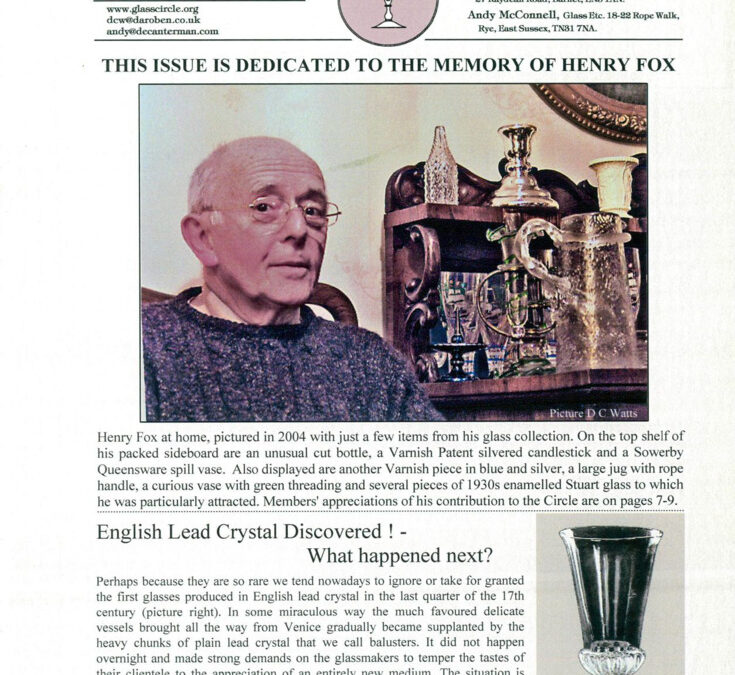
THIS ISSUE IS DEDICATED TO THE MEMORY OF HENRY FOX
Henry Fox at home, pictured in 2004 with just a few items from his glass collection. On the top shelf of
his packed sideboard are an unusual cut bottle, a Varnish Patent silvered candlestick and a Sowerby
Queensware spill vase. Also displayed are another Varnish piece in blue and silver, a large jug with rope
handle, a curious vase with green threading and several pieces of 1930s enamelled Stuart glass to which
he was particularly attracted. Members’ appreciations of his contribution to the Circle are on pages 7-9.
English Lead Crystal Discovered ! –
What happened next?
Perhaps because they are so rare we tend nowadays to ignore or take for granted
the first glasses produced in English lead crystal in the last quarter of the 17th
century (picture right). In some miraculous way the much favoured delicate
vessels brought all the way from Venice gradually became supplanted by the
heavy chunks of plain lead crystal that we call balusters. It did not happen
overnight and made strong demands on the glassmakers to temper the tastes of
their clientele to the appreciation of an entirely new medium. The situation is
analysed for your consideration on page 3.
plus . . . An appreciation of Audrey Tait on page 6.
. . . The interface between silver and glass page 10.
. . . Limpid Reflections on page 14.
. . . Fielding’s auction – Three Centuries of Glass on page 16.
… and don’t forget our web site.
A mid-17th century building preserved in Godalming High Street.
GLASS CIRCLE NEWS No. 115, 2008
Editorial
Arising from a discussion with Henry Fox on the discovery
of English lead crystal glass we got round to thinking about
how rapidly it was adopted as the new glass of preference,
particularly for the manufacture of drinking glasses.
From a manufacturer’s point of view the extra cost of the
raw materials was offset by the lower temperature required
to found the glass. But it was still expensive and the earlier
examples, naturally following the Venetian styles, have a
clumsy look about them. Further, what features of the new
lead glasses might be described as English innovations?
Could a trend be identified that culminated in the baluster
that emerged triumphant at the end of the century?
Surviving baluster glasses display a considerable diversity
of form that would appeal to a range of tastes, but with a
uniformity that would appeal to the well-to-do of the day.
At the time we could ask the questions but had no answers.
Sadly, Henry did not survive to consider, and probably
criticise, the outcome of my investigation of this problem
set out in the following article.
Before, or after, Ravenscroft?
Walking down Godalming’s delightful old High Street after
the reception for Henry’s funeral I came across this
splendid building with its elaborate brickwork frontage. It
carries the date 1663 (insert) and the upper elaborately
leaded windows, clearly of the correct period, are superbly
preserved.
Earlier, on another project, I had been struggling with the
difference between the dating system BC/AD and the new
BCE/CE system now sometimes found in its place. It
occurred to me that if there is now to be a free-for-all over
such fundamental matters as date it might be a good idea
for glass collectors to introduce their own. I suggest BR/AR
for before and after Ravenscroft’s patent of 1674. This
building would then become a satisfying 11 BR. Why not?
The emergence and adoption of
style in English lead crystal glass
in the late 17
th
century.
David Watts: dedicated to Henry Fox.
Most writers on the subject of the ‘invention’ of English
lead crystal glass (generally called flint) tend to assume that
the quality of the glass itself was sufficient for its instant
popularity and adoption by those who could afford such
luxuries. But was this the truth of the matter? There was no
rapid expansion of these glasshouses in London. Neither
Bowes’ Blackfriars glasshouse nor Mansell’s Venetian
glasshouse in Broad Street are thought to have survived to
this date. Pike Green in Southwark and probably the Duke
of York’s flint glasshouse in Red Maid Lane closed down.
The Bear Garden concentrated on window glass and
looking glass plates although it probably did make some
crystal ware (but possibly not lead glass) as evidenced by a
shard bearing what is thought to be a bear’s head. “Finest
drinking glasses” are only advertised by Jackson and Straw
from 1693, almost 20 years after Ravenscroft had given up
his patent. The White glasshouses in Stony Street began
about 1701 and did not produce lead crystal. Whitefriars
did not begin until 1702 at the earliest. The Saltpetre Bank
and Goodman’s Yard glasshouses, east of the Tower of
London, concentrated on green glass and bottles. The
Vauxhall glasshouses made mirror plates. English (flint)
lead crystal glass appeared not to be at a premium.
On the positive side there was, of course, Ravenscroft’s new
glasshouse at Henley on Thames; the Salisbury Court flint
glasshouse that had been closed for a while came back into
operation from 1684 and possibly the Charterhouse Square
glasshouse, associated initially with the Duke of
Buckingham. Even so, lead crystal for tableware seems not
to have immediately attracted much attention by the
London glasshouses.
From a technical point of view the
glassmakers had to learn the best
way of exploiting a new material
with quite different handling
properties from those to which they
were used. On the other side of the
English Channel Kunckel (1679), a
practicing glassmaker, considered
lead glass unsuitable for making
drinking glasses. It was not helped in
that the optimum amount of lead to
use in the batch had still to be
determined and as much as around
40% has been found in some 17t
h
century shards (Watts, unpublished
and see Dillon’s
Glass,
p.319). Lead
glass melts at a lower temperature
than non-lead glass but it also stays
softer for longer as the glass cools.
Consequently, it needs to be blown
thicker to avoid deformation. Except
for very large pieces where thick
glass is acceptable it was not easy to
. . . . The views expressed in Glass Circle News
are those of
its contributors . . . .
2
Above, two Venetian glasses of
the simpler type, and below, a
more complex version with wry-
then knopped stem and applied
blue handles with clear glass pin-
cered frills. Later 16th century.
Sealed Ravenscroft roemer
showing strong Venetian
influence with moulded
ribbing, a rigaree trail just
below the bowl, hollow stem
and an upturned folded foot.
GLASS CIRCLE NEWS No. 115, 2008
adapt to prevailing Venetian styles. Consequently,
glassmaking in England, and London in particular, moved
into the period described by W.A. Thorpe as
The Age of
Design.
Here, it takes us up to the turn of that century. What
exactly should be made with the new English lead crystal
glass?
In this regard we now have to consider the influence of style
and taste. Taste reflects individual preference and style
reflects both the design of the piece and the general
adoption of a particular taste, commonly associated with
what is termed hegemony or, more crudely, cultural
coercion. As described by Michael Snodin in V&A’s
unwieldy tome,
Design and the Decorative Arts
(p. 65
et
seq.),
at least up to the Reign of Charles II style was led top-
down. It was set by the manifestation of what pleased the
King. When Charles returned from France he brought with
him his experiences there of the tastes and styles of the
period. In glass these were the elaborate confections from
Venice, frequently as moderated by their adoption in
France, Germany and the Low Countries in particular. In so
far as they could they integrated with prevailing preferences
for furniture, wall coverings and dress with their emphasis
on elaboration and detail, their value reflecting the hours of
workmanship that went into their creation.
For the nobility, simple glasses were not yet the order of the
day. To attract royal attention the new English lead crystal
had to contain ‘value-added’ design and workmanship as
well as display the beauty of its metal. Further, there was
the
The Grand Tour
introducing a new experience in
Europe and Italy that
was beginning to
influence the cultural
philosophy of anyone
of note.
W.A. Thorpe
(History,
p. 159 et seg.)
discusses
the nature of style with
a rather circular
argument; first that
the
English
(glassmakers)
were not clever, and
they steadfastly refused
to assimilate Venetian
manners
(i.e. their
practical skills were
inadequate for the
manipulation of any
type of glass). Then the
influence of the type of
glass was acknow-
ledged together with
that of the aesthetic
hangover from the
Puritan rule (unspec-
ified but presumably
towards much plainer
designs). In support of
these proposals Thorpe
sets out to analyse the
anatomy of English glass of the period and to identify those
foreign elements that were manifest, beginning with the
Venetian. The indefinable influence of taste was acknow-
ledged but not where it came from!
In an attempt further to unravel this problem I began with a
trawl through my books on Venetian glass to determine the
elements of their style from the mid 17
th
century up to its
end by which time English glass had manifestly developed
a style of its own.
My conclusion was that the basic features of Venetian glass
were that they were thinly blown in clear glass. Apart from
a group of small undecorated glasses, they were generally
shaped with mould-blown ribbing or similar effects, a
hollow stem and a spreading foot with upturned rim.
Applied decorative elements were trailing in a conventional
manner, usually as a rigaree collar or round the foot of a
beaker and enhanced by a milled or cut edge Frequently
blue glass was trailed over clear glass (or vice versa),
particularly for generally unusable handles. Prunts were
used infrequently and with discretion, Gadrooning was not
used at all or was an extreme rarely. Overall, design was
repetitively classical; decorative elements occurred exactly
where you would expect to find them, established and
inherited through generations of family-led tradition.
Surrounded by the fabulous collections of early English
glass donated to the V&A
Thorpe attempts (p. 163
et
seg.)
to extract from them
the design characteristics
he identifies as foreign.
Unfortunately, he lacked
for comparison the
necessarily
broad
corresponding foreign
collections, particularly of
Venetian glass, which is
perhaps why he mis-
attributes what, in my
view are the considerable
English innovations of
design made in the early
English lead crystal
drinking glasses.
Most significant is the
introduction of gadroon-
ing found on many
English vessels of the
period. I infer that the
popular adoption of this
particular feature is because while the thin Venetian metal
is rather ineffective in this respect the thickly worked lead
glass makes a bold statement. Thorpe describes three types
of gadrooning –
rounded, wrythen
and
spiked
(points pulled
out from the ribs as found with one jug decanter and the
flammiform glasses towards the end of the century). All of
these appear to be almost unique to English glass at this
time. On the other hand the bowl shape appears mostly to
be the conservative round funnel or a more squarish cup
shape with little attempt to emulate the more complex
Venetian shapes such as the large flared bucket with a
milled rim to the base of the bowl. Thorpe comments on the
possible influence of the Greene’s instructive drawings to
.
,
riwor.2,_/
Exuberant goblet
goblet with chain
trailing, gadrooning with nipt-
diamond-waies, and a hollow
ball stem with a circuit of
prunts containing a coin dated
1684.
A similar goblet in the V&A
has a stem with two prunted
hollow balls, the lower one
containing a coin dated 1686.
Another glass from a Sotheby
sale (Dec. 6, 1971, lot 139) with
plain bowl but a prunted ball
stem containing a coin dated
1704 suggests that this style
persisted for a considerable
time.
GLASS CIRCLE NEWS No. 115, 2008
Morelli in Venice that
include bucket styles but
there is little indication that
these influenced English
glassmakers if, indeed, they
were aware of their
existence. The much later
thistle bowl is a more
generally European style
but the thick or solid base
to the thistle, as with the
round funnel, only emerges
with the later creation of
the English baluster.
Of the early lead glasses the
English roemer, as judged
by surviving examples,
appears to have been a
particular success, the bowl
plain or with ribs or
gadrooning. (Its European
(German?) origin and
development, dating back
to 1350′, must surely
qualify as the most
successful goblet design of
all time.)
The gadroon cannot be
claimed as an English
invention. The earliest
example
I
have come
across is on a 15th century
French lidded vase below.’
However, it does seem to be an extremely rare decorative
treatment before the Ravenscroft period. Bellanger
illustrates two gadrooned French jugs dated
fin XVII or
later.’
It is often suggested that styles in glass followed
those in silver. The earliest silver
I
have found with
gadrooning dates to the end of the 17th century. Perhaps
members can provide more enlightenment on that question.
The hollow spun roemer foot (decorated with threading)
was also replaced by a more conventional splayed tubular
foot like that on thr French vase below. Such splayed
tubular feet are characteristic of many Venetian vessels
dating back to at least the early le century. Although
Greene, as determined from his drawings, clearly believed
that a white glass Venetian-made roemer was more
marketable than a poorer quality continental one this is not
considered a natural Venetian shape.
Apart from the roemer, prunts were not widely used on
early lead glasses although the occasional extravaganza can
be found, particularly on larger pieces such as the famous
Safron Walden posset pot (Thorpe pl. XIX). As with the
glass (left) trailed decoration seems to appear randomly, in
the form of cercuits of chains. This, again, is found on some
Venetian styles.
Except for one mid C.17 French jug (Bellanger, p. 327) I
have not found trailed-on
nipt diamond waies
on other than
English glasses . Rare Venetian versions were achieved by
blowing in a mould to decorate the entire bowl.’
The stem was a particular source of experiment and
Venetian influence is certainly apparent in the earlier lead
glasses. The blown ball or pear-drop, with or without optic
moulding, can be found as occurs with the S-sealed glasses
but more commonly with larger pieces of more extravagant
design (Thorpe pl. XXXI). Most of these are
conventionally dated to
c.
1685, begging the question as to
whether they actually came from the Henley glasshouse. Of
similar date are tall lead goblets with elaborate serpent
stems. One wonders for whom these were made? Is the
crown finial found on their covers an indication that they
were to commemorate the coronation of James II or
perhaps for the retirement of eminent citizens such as Sir
Christopher Wren? On the other hand they might simply be
window dressing — cultural coercion to draw attention to
the outstanding merits of the new glass.
Among the more ordinary glasses the blown hollow stem
did not survive long although its solid replacement often
included a simple tear of quite large size. The Venetian
blown optic-moulded stem became the drawn solid
Is this the earliest known example of gadrooning?
A 15th century vase, with applied hollow handles and blue
decoration. Although described as French the treatment
shows strong Venetian influence.
Comparing two 17th century stem shards in lead glass.
Left, hollow stem blown into an optic mould. The bladed
knops provide further evidence of Venetian influence.
Right, solid stem with moulded ribbing and tooled into a top
knop and inverted baluster but no merese. Only the ribbing
reflects Venetian influence.
4
GLASS CIRCLE NEWS No. 115, 2008
The transition from roemer to rummer. The English roemer gains gadrooning to the base of the bowl but the Venetian
rigaree trail is still applied just below the bowl. The prunted stem gives way to a plain hollow stem with experimental
knopping in some examples and finally the bowl becomes smaller and the stem becomes a solid rod to be manipulated into
knops at the glassmaker’s fancy. The foot rim is now turned underneath.
Pictures from Thorpe’s
History.
wrythen-moulded stem as we begin to move into the
particularly English period. The bowl of the roemer-style
goblet becomes flatter and broader to form the first English
rummer. With a turned-out rim to the bowl Thorpe (pl.
XXII, XXIII) identifies these as the first English sweetmeat
glasses dating from around 1680.
Attention now focuses on the stem. A blob of hot glass
dropped by the glassmaker onto the upturned bowl of a
goblet, still on the blowing iron, naturally draws out into an
attractive inverted baluster. With additional tooling it can
readily be formed into a series of knops of somewhat
uncertain shape in these early glasses. For the shorter stems
it can be tooled into lobes as in the Ravenscroft sealed stem
on the cover of GC News 114. The foot bears hardly a
mention except to say that instead of its thin rim being
turned upwards it rapidly proved more practical and
aesthetically pleasing to turn it down and under.
Elaboration by 1690 has become an entirely English
process. Winged blobs added to the stem and gadrooned
)11
A page of Greene’s 1668 drawings to Morelli in Venice
showing goblets with bucket bowls with a milled ring to the
base. The roemer, bottom left, with plain foot, has applied
prunts that are not moulded but simple dabs of hot glass.
The vases top left with decorated handles are described as
calcedonio.
flammi-form bases to the bowls are further removed from
Venetian influence than might be thought. The problem for
the glass-maker was to create designs that appealed to a
growing wealthy public no longer entirely dependent on the
taste of their monarch. James II was on the run and William
III — a gin swilling foreigner – was intent on the chase.
Meanwhile, in Bohemia, in 1683, Michael Muller,
production manager at the Janouskova glassworks near
Vimperk, discovered chalk glass. This greatly improved
Bohemian crystal was soon adopted by most Bohemian
glass factories. While
retaining most of the
manipulative
char-
acteristics of the earlier
non-lead glass it had the
disadvantage that it lacked
the brilliance of lead
crystal and was difficult to
fine, frequently leaving the
glass with a mist of fine
gas bubbles. Even so, by
the end of the century
elaborate goblets of
heavier weight were being
produced with it although
still with a distinct
Venetian
character.
Mostly, these had
compound stems with a
small, usually blown,
inverted
baluster
accompanied by hollow
balls and numerous bladed
knops quite unlike their
English counterparts.
More importantly, they
were heavily decorated
Bohemian goblet,
c.
1710.
with, in many cases, all- Heavily decorated by Franz
over
cutting
and
Gonderlach from a famous
engraving made possible
Hessian family of engravers.
concluded overpage
LASS CIRCLE NEWS No. 115, 2008
Audrey Tait – an appreciation
Although Audrey Tait was not directly involved in Glass
Circle affairs there is no doubt that her influence was
considerable. Audrey graduated from Cambridge with an
Honours degree in History (a subject she always said
was
of no use to anybody!)
and it was through Hugh’s
early association with the Fitzwilliam Museum that they
first met. Initially, life was hard. She learned shorthand
and typing, which she taught, and also French, holding
down an administrative post with Unilever.
After moving to London they had the good fortune to
acquire a large flat in Cannon Hill, Hampstead, within
easy commuting distance from the British Museum.
Here she honed her hostess and domestic skills to
provide Hugh with a daily 3-course lunch, often
stretched to embrace unexpected guests relating to
Hugh’s wide academic interests, frequently involving a
varied and lively conversation. Her typing skills (and to
some extent her great command of English grammar)
were invaluable in the production of Hugh’s numerous
publications.
While Audrey tolerated a computer in the house she
never felt it was worth the bother of really getting to
grips with it. (Anything technological, she felt, was
beyond her capabilities.) Nevertheless, being located in
an area where car parking was almost impossible, she
did condescend to use her computer to order groceries
from the local supermarket.
Audrey frequently accompanied Hugh on his various
trips to museums abroad. It was through this that while
Hugh was busily using his British Museum clout to have
an exhibition cabinet dismantled so that he could handle
its contents (essential, he said, for the precise assessment
of any piece) she developed an interest in photography,
so she said to pass the time away. Her interest was
photographing flowers rather than glass, and she became
a Friend of Kew Gardens.
Their immaculately kept flat was littered, as well as
with flowers, with mostly new glass. Much of it had
been produced by American glassmaker, William (Bill)
Gudenrath in connection with his researches into the
manufacture of Venetian glass. Bill’s contribution to
5000 Years of Glass
was all thrashed out with him in the
flat while Audrey prepared refreshment and typed the
emergent text in the kitchen.
After Hugh’s death Audrey became deeply involved
with the local Catholic church and was rapidly promoted
to chief producer of sandwiches for the coffee events
involving the 150-strong congregation. Her own passing
from ovarian cancer, after a short severe illness, was a
sad blow to all who knew her. Audrey will be
remembered with great fondness and appreciation. She
leaves a daughter, Nikki who is a law court reporter for
the Financial Times.
David Watts
The emergence and adoption of style in English
by the introduction of water-powered cutting wheels.’ This
might have been to mask the poorer quality of the glass,
and certainly had that effect, but was more probably to
provide the cherished ‘added value’ that their rich patrons
would demand.
In England, the first generation of lead glassmakers was
drawing to a close. It was a period said by Gordon’ to be
associated with the Italian Baroque movement — escape
from the Classical by means of elaboration and innovation.
From a comparison with the styles of continental products
mentioned above that continued to be produced well into
the first half of the 18th century, this may be a simplistic
explanation. At least for English lead crystal that trend had
now run its course. Around the turn of the century a new
generation of glassmakers found their future lay in
manipulating their glass without the aid of moulds and
tweezers and letting the metal speak for itself, an approach,
in the late 19th and 20
Th
centuries, identified with
modernism and
truth to materials.
If the roemer is the most enduring design of all time for a
goblet then the baluster, produced in relative profusion,
represents the apogee of English lead crystal design. It is
not only attractive to the eye but also robust, clean and
practical in its adaptability to all forms of drink. The
classical English glass collector likes them as they emerged
from the leer. Mutilation with the diamond and the copper
lead crystal glass … concluded
wheel was for foreigners. Its emasculation in the name of
Rococo was yet to come.
Finally it should be said that the development of style in the
new lead glass was hardly a logical progression as might be
suggested here, and there is no evidence of royal influence.
With features such as gadrooning and nipt-diamond-waies
it would be foolhardy to be dogmatic about when and
where they were first introduced into glassmaking. But
what is certain is that the English glassmaker, after an
uncertain start, from early on handled his new material in a
progressively more innovative and assured way than that
for which he has perhaps been credited.
Notes
1.
H.E. Henkes and J. Henderson, in
J. Glass Studies,
vol. 40,
1998, 89-103.
2.
H. Demont,
Histoire des Arts Dcoratifs,
1970, Libraire
Hachette, p.288
3.
J. Bellanger, Verre de Usage et de Prestige, 1988,
p.228/9.
4.
For examples see
Mille Anni di Arte del Vetrio Aveneza,
1982, p. 136; H. Tait,
The Golden Age of Venetian Glass,
1979, p.182.
5.There are numerous examples in Michael Kovacek’s Glass
of 5000 years, 1990 and 1993 edns. and other volumes. The
picture here was taken from F-A Drier, Glaskunst in Hessen
Kassel, 1969, no 34.
6. H. Gordon,
Antiques in their Periods,
1964, p. 47
et seq.
6
GLASS CIRCLE NEWS No. 115, 2008
Glass Circle Matters
Chairman’s letter Summer 2008
In January I gave an all-day course on Glass to some
members of ‘The Friends of the Victoria and Albert
Museum’ entitled ‘4 millennia of glass in five hours’,
illustrated entirely with objects from the museum’s
collection. Preparing this made me realise that if you have a
good understanding of Roman glass everything else follows
on: there is virtually nothing new after that. Islamic glass,
Venetian glass, French glass paperweights; engraved glass
all relate to Roman glass. About all they missed out on was
pate de verre
and fibre optics! If you visit the V & A be
aware that some of their most exciting glass is not in the
glass gallery but exhibited, in context, in the period
galleries. For instance, some of their best Ravenscroft glass
is in the English 17
th
century section next to Delftware and
oak furniture.
Last Autumn I attended a ‘European Glass Weekend’
organised by our sister organisation, ‘The Glass
Association’, with speakers from Sweden, Holland, the
Czech Republic and Italy. The Glass Association has a new
chairman, Brian Clarke, who has taken over from Charles
Hajdamach, former head of the Broadfield House Glass
Museum. It is occasionally suggested that our two societies
should merge but Brian and I agree that it is better to have
two societies, one London based with midweek meetings,
the other more outside London with weekend meetings, if
we merge we are afraid that one or other of the two parts
might atrophy. Many of us belong to both anyway. We do
agree though, that there should be greater co-operation
between the four societies, The Glass Circle, The Glass
Association, The Guild of Glass Engravers and The
Contemporary Glass Society. The Glass Circle is also
starting to have joint meetings with other special interest
societies, the first one was in April with The Wine Label
Society. In this spirit The Glass Association has asked us to
join in their The Glass Association weekend at King’s Lynn
12
t
h and 13
th
July, 2008:-
Hi
Sklo Lo Sklo – From Masterpiece to Mass Produced
which will be very relevant to those of us interested in
Czech glass. Details are included with this mailing.
We are about to start the production of the next Journal and
I need some help. No in depth knowledge of glass is
required, the authors have this, but I need someone with
some time and a good knowledge of desk-top publishing,
Quark, In Design, or similar, so that we can send ‘print
ready’ copy to the printer and save ourselves thousands of
pounds. If anyone is prepared to help please contact me on
johnpsmi@globalnet.co.uk.
Unfortunately, David’s lecture on the discovery of lead
glass over-ran leaving only a short time for discussion and
questions. The committee hopes that in 2009 it will be
possible to have a meeting, with a guest speaker giving a
short critique of David’s paper, followed by an extended
question and answer session on the development of lead
glass.
Henry Fox died on February 27
th
this year. During his life
he was a leading member of The Circle as committee
member, long time contributor to Glass Circle News and
inspirer and organiser of our exhibitions. Even in death his
influence lives on as he bequeathed £2,000 to The Glass
Circle, which the committee intends to use for a specific
project bearing his name.
John. Smith
New Members
Thanks to Derek Woolston and Peter Lole for help with
L.Tembleque (British Museum) Dr. Joanna Thomas
proof reading this issue.
John Burgess
Athelny Townshend
Mrs. Valerie Humphreys
Paul Weddell
Copy for GCN 116 by mid-August please.
A Colloquy with, or Vignette of, Henry Fox. by John Scott
Imagine the following conversation:-
John: “Henry!” . . . (rather loud as we’re both somewhat
hard-of-heaFing deaf!)
Henry:
“Yes John”
John:
“I just wanted to know how your brain transplant operation went . . .* (much laughter from both of us)
Henry: “Well! John, it was a
great success, Thank you for your kind enquiry.
I
can now tell the difference between a
cotton and an air twist.” (more laughter)
This was absolutely typical of my life with Henry; a constant barrage of jokes and ribald commentary back and forth — the
more personal and rude the better. Henry had much of the character of those children’s toys; wooden rockers they were. No
matter how hard you hit them they always gyrated and came up straight; smiling of course.
And Henry had a constant seemingly insatiable appetite for organising and getting things done. He was always busy on
reports and articles for Glass Circle News. “If you wanted a job done give it to a busy man.” That was Henry all over.
But it was his broggadio of repartee that was so appealing “When your friends stop being rude to you, you will know
you’ve lost them.” It was this endearing feature of dear Henry that made him such a beloved friend and companion.
I shall miss him greatly, as will very many.
*The comments here relate to the fact that John himself had been undergoing a considerable number of joint replacements.
7
11.11M10111.11•01′
GLASS CIRCLE NEWS No. 115, 2008
Further tributes to the late Henry Fox*
Ken Cannell :
I first met Henry on an outing to Winchester. I had heard
that he was friendly, chatty and knowledgeable; he proved
to be all three, at times almost overwhelmingly so. It wasn’t
until later that I discovered that he had a significant
collection of 18th.century drinking glasses and even then,
in spite of my less than subtle hints to see them when
visiting him, I was always put off by “Oh, they’re all
wrapped up in boxes in the other room” or somesuch. In
fact, although I had some eye-catching glimpses through an
interior window, I never got into this “other room”! Maybe
it was something to do with the burglary he had
experienced, or maybe, not being a collector myself, he just
didn’t think me worthy. What I did get to see, presented
with great enthusiasm almost as soon as one got through his
front door, was his latest acquisition, usually late 19th.-
early 20th.century decorative glass. However, his
continuing respect for his earlier glass was marked,
perhaps, by his wearing of a dark suit at his
auctions, instead of the smart country clothes
he usually wore.
In spite of any inhibitions he may have had
about showing his older glass, he appeared to
have none regarding his “collector’s stories”,
which often illustrated his ability to laugh at
himself. A favourite related to a somewhat
diffident visit to his bank manager to borrow
the money for a drinking glass that he’d been
unable to get at auction. To Henry’s
amazement his branch manager was quite
understanding, and the glass quickly became
part of Henry’s collection. Another related to
his purchase of a set of glasses with stems in
the form of nude females; a moment of
embarrassment led him to re-enter them into
the next auction when, to his delight (and
assuming an absence of embroidery) he
made a small profit.
. One
At one of his Bonham’s sales I heard it
this
suggested that Henry was not a ‘classic’
collector. In the sense that he collected only
what he liked that may be true, but there’s no
denying he had a fascinating collection, of which most
members would be highly envious, myself included. After
the sales I had the impression that he suddenly found
himself free from the constraints of the ‘classical’ glass
collecting period and allowed himself to buy just what he
fancied, both glass and non-glass. At one dealer who
specialised in Whitefriars and whom we visited several
times, Henry was always tempted. On these occasions I
acted as the laurel crown bearer in a Roman triumph
whispering in his ear “Remember you have given up
collecting glass!”. But it did no good; he always came
away with something delightful.
As to his collections not included in the auctions these
needed a visit to his home in Godalming to appreciate.
‘Stuff was everywhere; from huge glass ornaments on the
stairs and a large Dresser copper scuttle in the hallway to a
* Thanks to Ken Cannell for organising this assembly.
duly enthroned glass Punch and Judy
in the bathroom. There were prints
and other pictures on every wall.
There was his collection of items with
a ‘fox’ theme. And there were his
books, many on the decorative arts,
large format and piled on the floor –
but nothing that I saw on glass.
Perhaps he had become tired of his
glass books as he seems to have done of his drinking
glasses; I remember him muttering “Oh, books, books, too
many books”, even so, towards the end of his life, I
remember him diving into an antiquarian bookshop in
Henley, as if on the off-chance, to pick up an early
illustrated children’s book he had ordered. Was this another
collection?
Although on occasion he could be unexpectedly tetchy, he
was essentially a kind and friendly man. I
remember ringing him on one of his
hospital stays only to have the ‘phone
answered by the Sister: “He’s here
somewhere. I’ve seen him running about
cheering everyone up.” That was Henry.
We’ll miss him.
Marianne Scheer:
Henry was always very kind and
supportive to me particularly when I took
on the role of Hon. Secretary. I knew I
could always telephone him and he would
point me in the right direction; nothing was
ever too much trouble even when on one
occasion I had to send him a fax. This
involved ‘phoning him first, then ‘phoning
the shop near his home and then ‘phoning
him again to say that it had gone
successfully (I hoped). He then ‘phoned
me to confirm!
On one visit to Gaydon I was ‘manning the
stall’ when I saw on the next stall the most
beautiful piece of modern glass which had
particular significance for my second
granddaughter. I toyed with buying it for her, but she was
only three at the time and I was very indecisive and went
home empty-handed. Two years later we gave Henry a lift
to the Cambridge Fair but, for some reason, I had not had a
chance to look around. In the car on the way home Henry
told us about this beautiful bowl he had bought. His
description was of the same piece which he unwrapped
when we arrived at the Towse household. Although I will
never own it, it gives me great satisfaction that we both
admired such a beautiful object. Somewhere in the depths
of my computer filing systems I have a wonderful picture,
instigated by Henry, of Ann Towse, Henry and myself at
the same Cambridge Fair playing at being the three “wise
Monkeys”. We laughed all the way there and we laughed
all the way home.
Jo Marshall:
I had known Henry for over 25 years and had spoken with
of Henry’s favourites was
Stuart between the wars’
goblet with a fox (enlarged
above) in the hollow stem.
8
GLASS CIRCLE NEWS No. 115, 2008
him only a few days before he died. I know I will miss him
tremendously. He was a most amiable and amusing
companion, very knowledgeable on a wide range of
subjects and a perfect gentleman.
I particularly remember a situation some years ago, when
we were all assembled in a coach ready to leave for a visit
to Bath. At the very last moment a lady member arrived –
but she had not booked a seat – and there was not one
available. Henry immediately jumped up and gave her his
seat and made the journey by train. Henry also travelled
extensively in search of sales information for our Glass
Circle News.
In addition, he was the inspiration for a number of our
Glass Circle exhibitions – the most recent was the
memorable “From Palace to Parlour”. He made a great
contribution to the Circle and will be sorely missed.
Another of Henry’s favourites was the Hale Thompson and
Varnish patent internally silvered glass. These pieces in
deep blue and cut to show the crystal and internal silvering
beneath.
Andrew Lineham:
I
have known Henry only for about ten years but like all
who met him found him charming, amusing and witty. He
liked a bit of gossip and was interested in all types of glass.
I first met him when I was first an exhibitor at Olympia; he
bought some glass cheroot holders from me, grumbling at
the price in a way, I later discovered, to be his stock in trade
‘ I’m paying far too much, but I like you ‘ manner.
At that time his collecting field and my stock rarely crossed
over. However, once he had sold his 18th. century
collection he cast his eye around and decided that modern,
i.e. 19th century glass had merit.I believe that I sold him his
last purchase, although the tale is unusual.
I had bought a lot at auction which I had not examined but
went on a condition report from the auctioneer. Some
weeks later I received a letter forwarded by the same
auctioneer:
“To the buyer of lot ***
Dear Sir,
This letter has been kindly forwarded to you on my
behalf through ******* auctions. I was unable to
attend the auction last week, but I am wondering if
you might be a ‘trade’ buyer, and, if so, would you let
me know the best offer you would accept, assuming
that it was bought for stock, or not already sold on.
Over the years I have collected various examples
of ********* Glassware and lot ****
would have made an attractive addition.
If like myself you are a collector, I congratulate
you on your purchase.
Yours truly,
H.J. Fox”
A charming letter and very difficult not to reply to. I
delivered the lot to Henry’s neighbour in Godalming in
January as he was not well enough to accept it himself.
The Glass World will be a poorer place with his passing.
Marie Polley:
I was so sad to read of the death of Henry Fox. I only met
him a few times but he was such a lovely man to talk to.
His Auction and Fair reports were so interesting. I am very
lucky to have a lasting memory of him as I have his rare
scale facetted stem glass from his sale. It had been my
ambition for some years to own one! He will be so sadly
missed.
Barry Scheer:
He was known to all members of the Glass Circle. He
treated all people he met with the same gentle courtesy.
New members and “experts” were treated alike. My own
memory of Henry was when we attended the Harvey sale
several years ago, he guided my faltering footsteps and
advised me not to bid for a lot that I realized afterwards
went for a price that was well above my budget.
Marianne and I enjoyed many visits to the Birmingham and
Cambridge Glass Fairs with him and we will miss his
friendly teasing.
Christine Bridge:
[Yes I am very sad to hear this news.] Henry was full of
life last time I saw him and we had a good laugh together,
the way I will remember him.
Virginia Halewood:
I
remember Henry well from my days of working for the
late Alan Tillman in the early 70s when he was a regular
visitor to the Halkin Arcade (us and Ward Lloyd). He was
always extremely welcome and entertaining!
Nigel Benson:
I
know I will miss him, especially on those days when I was
having a difficult fair and he turned up and put me in a good
humour with his wonderful mischievous sense of humour.
It was always a great pleasure to see him, regardless of
whether or not he decided to make the odd purchase. He
was a force for good in the glass world and someone who
will be difficult to replace.
Lynne Zilkha:
I
am really saddened to hear about the death of Henry Fox.
We had met in 2004 on the sale of his collection and he was
interesting, informative and patient with newcomers.
Hence I joined the Glass Circle after reading the articles he
wrote in the newsletters, and heard his stories, and his
evident passion for new discoveries of rare glass.
Peter Layton:
I
am deeply saddened and shocked.
Suzanne Higgott:
I was really saddened by this news. Henry was such a
delightful, kind and charming man – not to mention,
incredibly knowledgeable – he will be greatly missed.
***************
9
JOHN GRINSELL 85 SONS,
MANUFACTURINfl ZWYBESAIriells%
AN&X.Aera Aol NOWA= of
LOCK-UP LIQUOR FRAMES,
BISCUIT BOXES,
Butter Olshes, Caps, Cruet Frames,
Flagons, Salad Bowls,
Waiters, do,
sa
OA. Art0A 10c04..Plated ataestrAAA lama o
warns
oar WOXIL
GLASS CIRCLE NEWS No. 115, 2008
THE INTERFACE BETWEEN SILVER AND GLASS
Professor John Salter
Lecture given at a joint meeting of The Glass Circle and the
Wine Label Circle on April 8th, 2008 at the Art Workers’ Gad.
The hosts were Graham Vivian, John Smith, Marianne Scheer,
and David Watts.
1.
INTRODUCTION
Glass and silver are both found in a natural state, glass in
the form of obsidian, “a blackish-grey somewhat
translucent substance which breaks conchoidally”‘ and
silver in galena or lead sulphide whilst gold occurs
naturally, often in alluvial deposits and was readily
malleable. Man-made glass however requires silica, alkali,
lime or lead, and heat. Man-made silver requires extracting
from ores, refining and workmanship involving heat. Both
can be the subject of high quality engraving. Both have a
transcendental, uplifting quality. Glass has the
characteristic of near transparency and responds to light.
Silver over time acquires a patina with its characteristic
softness and responds to light. Both can be regarded as
essential components to gracious living, in particular by
candlelight.
Techniques for making both were known to the ancients.
Opaque coloured glass and a lyre with silver revetments
were made in the land between the Tigris and the Euphrates
in about 3000 BC.
2
The technique of glass-blowing was
developed in Syria in the first century BC and quickly
spread to the rest of the Roman Empire and eventually to
Britain. In 680AD Benedict Biscop “sent messengers into
Gaul to fetch makers of glass thence, that by a craft until
then unknown in Britain, they might glaze the windows”‘ of
St Peter’s Monkwearmouth and St Paul’s Jarrow. “They
not only did the work required but also taught English folk
their mystery, which was suited to … the making of useful
vessels.”‘ The Jarrow fragments show a wide range of
colour. Romano-British silver was quite sophisticated. One
only has to examine the Mildenhall Treasure. The seventh
century ship burial at Sutton Hoo provides an insight into
Anglo-Saxon England and the Ardagh chalice an insight
into Ireland in the Dark Ages.
2.
COLLECTING HABITS
Collectors as a rule like objects made entirely of glass or of
silver and do not collect mixtures. So, for example, many
collectors of ceramic coffee cans and many collectors of
silver do not collect porcelain coffee cans housed in
handled silver containers. By so doing they miss an
interesting time capsule with astonishing variations in
design ranging from Victorian Gothic through the Vienna
asArrtrimikaromrs sr. amortoxrrs. a1
N0
8m:8w Rooms,.
XI, Ahortarholomi arm.. Holborn Cam.% LONDON
,
And
70. weal Xl. Sow., CL* OW.
Fig. 1. Advertisement for a tantalus by John Grinsell .
Secession, Art Nouveau, the Edwardian classical revival
and Arabesque to the various phases of Art Deco until the
outbreak of the Second World War. The interface between
silver and porcelain is most interesting. Likewise most
collectors of wine, sauce, medicinal and perfumery labels
tend to display their acquisitions in cabinets rather than on
the objects they were made to adorn, with the important
exception of the silver wine label on the glass decanter.
3.
THE DECANTER FRAME
Decanters were normally stood individually in silver
coasters which could be pushed around the table or often in
threes in silver frames which could be carried. Some
coasters had wood bases. Some were plated. Some decanter
frames were made of wood, especially the tantalus or lock-
up liquor frame with silver or plated mounts as advertised
for sale by John Grinsell and Sons in 1882 (fig 1). They
were manufacturing silversmiths and electroplaters, and
mounters of glass, earthenware and oak goods in
Birmingham. Many decanter frames were plated. Enamel
wine labels often seem to have been placed in the
nineteenth century on decanters housed in electroplated
frames.
4.
THE CRUET AND SOY FRAMES
The oil and vinegar silver frame dates from about 1704 and
Fig. 2. Oil and vinegar frame by William Darker, London,
1720. The labels for OIL and VINEGAR
c.
1750 probably by
Richard Binley but not original as the chains are too long.
The bottles with pull-off caps are unmarked and the elabo-
rate diamond cutting is compatible with the later date.
seems to have been the invention of Benjamin Pyne. He
was perhaps inspired by the success of imported Japanese
porcelain cruet stands made in Arita in the 1680s with the
familiar Imari pattern in underglaze blue. The cruets were
spouted and lidded and bore the titles in gilt of 0 (OIL), S
(SOY) and A (AZJIN). They had under the Japanese Act of
1639 to be brought in by the Dutch East India Company,
10
GLASS CIRCLE NEWS No. 115, 2008
Fig. 3. Soy frame by Jabez Daniel, London, 1750, with four
original bottles mounted with engraved matching crests by
Stephen Walsh of Cork and Dublin. This piece is of
particular importance for dating the style of cutting.
Obtained after a fire at Powerscourt, Dublin when surviving
items were sold off.
which is why A was used instead of V for VINEGAR. The
Chinese immediately spotted a business opportunity and
from about 1700 they made cruet bottles for export to
Britain and other European countries. The oil and vinegar
frame became very popular. The glass bottles with
unmarked pull off silver double-spouted caps in William
Darker’s frame of 1720 (fig 2) are of great quality. The
provenance is from a Regimental Officers’ Mess but there
is no guarantee that the bottles go with the frame. There is
no crest on the bottle mounts.
Anthony Nelme has been generally credited with the
invention of the Warwick cruet in 1715, so called because
Fig. 4. Circular soy frame by Thomas Daniel with open
crescent labels by Thomas Hyde. The five glass bottles
have similar cut pattens of diamonds over a circuit of pan-
els. They also have a similar crest to that engraved on the
stand – a mythical winged bird with talons over a Baron’s
mantling.
at one time
it belonged to the Earl of Warwick. Nelme
combined the two silver mounted oil and vinegar bottles
with the long standing set of three individual silver castors
for sugar (the larger) and black pepper and dry mustard (the
smaller). Dry mustard was about to be replaced by cayenne
pepper. It was not long before the silver castors were
replaced by silver mounted bottles as in Jabez Daniel’s
1750 Powerscourt frame (fig 3) or Thomas Daniel’s truly
magnificent circular frame of 1774 (fig. 4).
Cruet frames got bigger and bigger as the choice of
flavourings got wider and wider. The cruet was sometimes
combined with a centrepiece or epergne. Splendid
examples are in the Hermitage Museum in St. Petersburg.
Nearer home Sotheby’s sold such a piece by Robert
Breading of Dublin made in 1796 with 16 matched
mounted soy bottles bearing 8 silver unmarked crescent
shaped sauce labels and 5 silver baskets for desserts such as
fruit salads. However the soy bottles were assembled
because four mounts were marked by Fenton, Creswick and
Watson of Sheffield dated 1788, two were marked by
Thomas Lewis of Sheffield without any date mark and the
remaining mounts were unmarked! Some cruet frames were
Fig.
5. Copper and leather soy frame attributed to Thomas
Bowen II, London 1797, with four bottles cut with broad
above narrow flutes, cut stoppers, and engraved for
KETCHUP, FISH-S, KYAM (with marked silver-gilt
cayenne spoon) and SOY.
plated, some made of copper and leather (fig. 5), some of
lignum vitae, some of papier mache – varieties of materials
were used at the lower end of the market instead of silver.
5. THE USE OF SILVER FOR DATING GLASS
Silver coasters are of little help in dating glass decanters,
unless the decanter has a silver mount which is relatively
unusual. The marks or armorials on the mount would have
to match those on the coaster. The coaster itself would be
fully marked and thus give the date of the silver year. In
certain circumstances such as the date of registration of the
maker’s mark or the date of death of the silversmith it is
possible to be more precise as to the actual date. Decanters
had essential mobility and were probably not kept with
particular coasters.
Silver frames are a little more promising because they were
made to fit the glassware supplied. So the stopper holders
11
mr*
,c4
‘
,
.
.
“If
–
I
1
,
GLASS CIRCLE NEWS No. 115, 2008
may have been individually designed and likewise the
decanter ring holders, but hard evidence is lacking.
Although wine labels were made to fit the shape of
decanters both in their choice and method of hanging, the
curvature and balance and their size, no help is afforded
because some makers were specialists and supplied the
frame maker who was also a specialist. Fully marked silver
bottle mounts would be of great assistance. Unfortunately
the 1738 Act by section 6 exempted from liability to be
assayed (so far as is relevant to this subject) chains, cranes
for bottles,’ mounts, screws or stoppers to glass bottles and
generally things which, by reason of their smallness or
thinness, are not capable of receiving the marks, and not
weighing 10dwts. of gold or silver each. This was repealed
by the Act of 1790 which by its section 3 exempted chains,
by section 4 exempted mounts not weighing 10 dwts of
silver each, except necks and collars for casters, cruets, or
glasses appertaining to any sort of stand or frames and by
section 5 exempted any wares of silver not weighing 5 dwts
of silver each, except necks, collars and tops for casters,
cruets or glasses appertaining to any sort of stands or
frames, bottle tickets, salt spoons (but not cayenne spoons,
fig. 5) and pieces to garnish cabinets (such as a tantalus or
tea chest or knife case) or stands or frames.
A further problem arises from hallmarking practice.
Sometimes a sterling silver mark only was put on;
frequently the date letter was omitted on small items. Due
to heavy use and cleaning the marks were often worn. The
usefulness of silver for dating glass is best reviewed by a
series of case studies (see below).
6.
THE
USE OF SILVER FOR IDENTIFYING GLASS
MAKERS
If a piece of glass can be linked to a particular silversmith it
may be possible to establish the likely glass manufacturer
by consulting records such as those kept by the Assay
Office in question, correspondence between glassmaker
and silversmith and documentary evidence establishing a
relationship or a course of conduct. In 1874 Elkingtons
employed their own enamellers.
7.
EXAMPLES OF SOME CASE STUDIES
1.
Mounted glass vinegar decanter taken from oil and
vinegar frame by William Darker, London, 1720 (fig 2).
Silver mount with double lip unmarked. Pontil ground out –
doubtful for this early date. Heavy glass with scaly
faceting. Glass sits well on frame but silver no help in
dating.
2.
Powerscourt bottles with armorials engraved on the pull
off caps (fig. 3). No silver Mounting to bottle. Cap bears
maker’s mark of Samuel Walsh, an Irish maker of the
1750s. Presumably the five soy bottles were bought in and
given caps by the local silversmith. This is the earliest
known silver soy frame (fig 6). Pontil ground out. Very fine
diamond and oval faceting. Enclosed crescent sauce label
engraved for CARRACHI added.
4. Rare set of six soy bottles with silver-gilt mounts and
pull out glass stoppers from a silver-gilt frame made by
Robert Piercy, London, 1775 (fig.6). The label of unusual
design is engraved for KYAN but is unmarked. The silver-
gilt bottle mounts were replaced in 1804. The circular feet
to the bottles have six petals and the bases a six pointed
star. The stoppers have diamond facets and one is attached
Fig. 6.
to
an unmarked silver-gilt kyan spoon.
5.
A fine five glass bottle cruet with silver tops all
unmarked, the base being by Thomas Daniel, London,
1774 (fig. 4). The glass bottles all have similar patterns.
The stand has a cartouche with an engraved crest, a
mythical winged bird with talons over a Baron’s mantling.
A similar crest is engraved on the bottle mounts.
Furthermore the bottle mounts and the stand are all
decorated with similar swags. The glass is clearly datable
to 1774. Research could indicate who supplied glass to the
Daniels.
6.
An oil or vinegar cruet in a four bottle frame made by
Robert Hennell in London in 1789 (fig. 7). The glass has
long narrow flutes and is much less sophisticated than the
earlier glass. Hennell’s silver mounts are fully marked
apart from the date letter. The labels are for VINEGAR and
Fig. 7.
12
\< 7 7:REELL:CTING GLASS CIRCLE NEWS No. 115, 2008 OIL. 9. A small soy bottle, one of a group of four, is engraved FISH S for fish sauce (fig. 5). It fits perfectly into the four bottle soy frame in which it was acquired. The stand is made of leather with copper trim and copper feet and copper carrying handle. It has been attributed to Thomas Bowen II however of London, 1797, because the KYAN bottle's stopper has affixed to it a silver-gilt cayenne spoon fully marked although not required under the Act of 1790 if weighing less than 5 dwts. NOTES (1) June Osborne, "Stained Glass in England". (2) Michael Vickers, "Early Silver". (3) The Venerable Bede. (4) A crane is a wine siphon. One made by Thomas Hyde is illustrated in Wine Label Circle Journal 7, p.275. Fig. 8. This set of three small soy bottles in indivdual coasters labelled in gold with KETCHUP, GARLICK and SOY were identified by Glass Circle members at the meet- ing from the gilding and a small decoration on the stoppers as being by James Giles . New Books In recent years museums have sought new ways of presenting glass, particularly new or studio glass to generate interest among the viewing public. Here are two publications relating to current exhibitions, both in America. The first, Contrasts, by Vicki Halper, comes from The Museum of Glass, Tacoma, published by the Univeristy of Washington Press, 64 pages, 21.8cm sq. in colour for $18.95 (£10.99 from Amazon). It depicts some fifty objects in contrasting relationships. Some concentrate on the appearance and forming of glass such as Natural/Fabricated, Hot/Warm/Cold, Transparent/ Translucent/Opaque and Factory/Studio. Others illustrate general aesthetic, historic, or iconographic categories like Form/Surface, Vessel/Sculpture, Useful/Fanciful and Art/Craft. The actual objects range from a 1 AD Roman cinerary urn, windows by Louis Comfort Tiffany and Frank Lloyd Wright to a Coca Cola bottle. It is an interesting approach to focus attention on the design and interest, as well as the technology of individual objects. The actual exhibition runs until November 2009. to guide the reader through the various techniques of cameo glass, gold glass, cage cups and mosaic glass that were developed in antiquity along with examples of their inspiration for modern reproductions. Our guide is David Whitehouse, aided by Dunja Zobel-Klein and Michael J. Klein on Roman glass in general and by Bill Gudenrath, Mark Taylor and David Hill on the technological aspects. The comparison is revealing. Modern glassmakers, in spite of their greater understanding, in general, of glass technology can be as good as but arguably not superior to their forebears in antiquity other than in the quality of their metal. One interesting example is a German attempt to reproduce the Lycurgus cup following a glass recipe based on an analysis by the British museum. The ruby colour obtained is rather too plummy and there is no change to green in reflected light. So chemistry cannot reveal all the secrets of this masterpiece. The engraving, too, appears from the photo to be competent but less exquisitely detailed. Copies of the Portland vase are also examined although the original has not left the BM. Other overlay pieces where no comparison is possible, such as the 5- layered Great Tazza by the Woodall team, are, however, in a class of their own. Another technique showing notable advance is enamelling in the hands of Brocard, Lobmeyer and Galle. Even so, by comparison, the famous bowl in St. Marks Treasury in Venice, still commands respect. The exhibition at Corning ended in May and has now, along with the Lycurgus cup, passed to the exhibition's co- creator, the J. Paul Getty Museum. The pictures in this volume are exquisite and, there is an extensive bibliography. At the current exchange rate for the £ this book, direct from CMOG on the web, is a real bargain. PS. Beware Amazon where I saw a copy advertised for £93.13! Both CMOG and the BM sell replica examples of antique glass. D.C.W. The second, Reflecting Antiquity: Modern Glass Inspired by Ancient Rome, has a much more substantial text and also gives you a lot more book for your money. There are 234 full colour pages, 21 x 26.8 cm, published by The Corning Museum of Glass at $29.95, soft covers. This is a serious attempt 13 GLASS CIRCLE NEWS No. 115, 2008 o ek iv a ei T. SPeivi, 0.ED/4p In March, Delomosne mounted a delightful loan exhibition of Rare English Tumblers; 1750 — 1830. A useful, fully illustrated booklet accompanied the exhibition.* Of the eighty-nine tumblers (including two pairs) shewn the overwhelming majority were decorated, by engraving, cutting, gilding or enamelling; only four specimens were undecorated — they can hardly be described as plain -, one a colourless specimen with Lynn rings, and three in varying shades of blue glass. Soon after 1750 engraving became a widely used decorative technique, and tumblers have been much favoured vessels for commemorative decoration, both of personal and public events; quite often such commemorations are dated, which adds to their value for study. Even in Roman times beakers were a form that frequently carried decoration and inscriptions, although moulded rather than engraved; the catalogue of Roman Glass in the Corning Museum records some particularly appropriate inscriptions on beakers, amongst which are half a dozen bearing in Greek the inscriptions 'Rejoice and be Merry' or 'Delight in that at which you are present'. Inevitably, consideration of the display at Delomosne sent one back to the little book on the subject of Glass Tumblers that was published by John Brooks twenty-one years ago. Both Brooks and Tim Osborne devote much of their respective introductions to considering why in Britain these vessels are usually called tumblers, whilst on the Continent and for ancient glass, beaker is the preferred term. Both authors quote the Oxford English Dictionary in recording 1664 as the first use of the term in Britain, and John Brooks points out that John Greene, in his famous instructions to his Venetian supplier, Morrelli, uses the term tumbler in both 1669 and again in the following year. Amongst the Glass Bills of which one has a record, 286 tumblers are noted as being sold between 1675 and 1800; the average price for an undecorated tumbler was 8d. (compared with an average price of 6d. for a plain Wine Glass.) In the same period there are only four mentions of beakers: in 1757 Thomas Betts sold 'a pair of Gilt Beakers' for 42d. each (and on the same bill were twelve tumblers); in 1759 Rachel Laggatt sold 4 White enamel beakers @ 18d. each; in 1763 William Ritchie, of Edinburgh, sold 4 gilt beakers at only 6d. each, and finally in 1764 Airey Cookson of Newcastle sold six 'A pint beakers, painted and gilt, @ 24d. each. It is interesting to observe that the cataloguer of the Thomas Collection, to be sold in June, has listed each of the five tumblers in that collection as `beakers'; probably the two Giles gilt decorated coloured tumblers were indeed sold as 'beakers', since the Christies 1774 sale of Giles stock refers exclusively to beakers, but the three colourless engraved glass tumblers in this forthcoming sale were almost certainly originally sold as tumblers. It is only during the third quarter of the C.18' h that one has encountered any contemporary British mention of beakers; * Copies of the catalogue (a not for sale loan exhibition) with 87 coloured illus., 9 to an A4 page, are available from Delomosne for £7 + p+p of £1.50. Tumbler engraved with decorative lettering SUCCESS TO THE WARRINGTON HUNT. they would seem then to refer to tumblers decorated much more expensively than engraved tumblers, perhaps an aggrandised description to justify prices very much higher than encountered hitherto. Tumblers, too, were usually sold in dozens, but beakers in smaller numbers per transaction. By the early C.19 th when enormously expensive deep-cut glass came suddenly into fashion, only tumblers are encountered on bills; thus, in 1812 Hancock, Shepherd and Rixon sold half a dozen tumblers at the unprecedently high price of 18 shillings each. John Brooks also equates the term 'Water Glass' with tumblers, but this seems to me to be mistaken. Even in the C.17 th , water glasses and tumblers appear together on the same bill, and by the mid C.18 th water glasses often are accompanied by saucers or stands. Water Glasses, or cups, later to become `wash-hand-cups', are what we now call finger bowls. It is well recorded that in the C.18 th such vessels were frequently used to rinse out the mouth after eating, which scandalised foreign diarists. The use of blue or green glass for 'wash-hand-cups' in the second-half of the C.18 th and into the C.19 th , was to conceal 'the filthy scourings of their gums'. As noted in one's opening remarks, Delomosne's exhibition was predominately of decorated tumblers, with almost two thirds of the exhibits being of the eighteenth century. Whilst discussing things with Tim Osborne, he commented both on the virtual non-existence of British tumblers earlier than 1750, and the equally notable absence 14 GLASS CIRCLE NEWS No. 115, 2008 of undecorated tumblers of any date before the mid C.19 th . This pattern is quite contrary to that observed from the bills of sale. In the one hundred years 1675-1775, tumblers comprised a fairly consistent 5% of all drinking vessels sold, and not until the last quarter of this period did any decorated tumblers appear. In the final quarter of the C.18 th the proportion of tumblers increased dramatically to 20% of all drinking vessels, but surprisingly (and certainly not typically) none of these was decorated. Then, after 1800 comes the predominance of decorated tumblers, with engraving being the most frequent mode, closely followed by cutting, and in some cases combining both techniques. This is just another instance for the glass collector of the survival pattern for glass types being quite different from that of the original supply. It is in fact readily explicable in terms of today's habits; most of us are quite happy to utilise a mixture of plain tumbler types for every-day use, continuing with older glasses until breakage overtakes them. With our 'best' tumblers we take rather more care to keep the set intact, until finally the few survivors may be relegated to every-day use, although as often as not even these few remnants are still cherished. One of the minor pleasures of the tumbler exhibition was that it encompassed a group of five tumblers, ranging over the forty years from 1780 to 1820, which are wheel engraved with 'decorative' lettering. This is lettering of varying complexity, sometimes with uprights having feathered outlines, and generally having the mid point of upright strokes embellished with an oval, frequently but not invariably polished, sometimes together with or replaced by a superimposed star. This decorative lettering was a typological conceit that persisted well into Victorian times, when for printers' type it occasionally developed into letters composed of attenuated, outstretched and 'twee', human figures. Of the tumblers with decorative lettering in the exhibition, one with finely executed lettering having a series of small chevrons between parallel vertical lines for the initial uprights, together with a polished oval at the centre point, probably celebrates the recovery from madness of King George III, in 1790. The earliest, conveniently dated 1780, commemorates 'THOMAS NIXON, NORTHOP', whilst another assigned to 1790-1800 is to 'JAMES TAYLOR, PEOVER'. Both these villages are in the Flintshire - Cheshire borders area, and reinforce a slight impression that this form of lettering is a North West speciality, even though not confined to the North West. There remain extant more than 30 small rummers of The Tarporley Hunt Club, in Cheshire, with decorative lettering in three minor variants representing successive purchases, one of which is minuted as being in 1834. Churchill's 'History in Glass' of 1937 illustrates a very similar small rummer with simple decorative lettering reading: 'MAY HONOUR AND FRIENDSHIP UNITE AND FLOURISH ON BOTH SIDES OF THE DEE'; the River Dee forms the boundary between Flintshire and Cheshire. The Warrington Museum has a large rummer dedicated: 'SUCCESS TO THE WARRINGTON QUAY PACKET' in the same decorative lettering as the Tarporley Hunt Club Glasses, and embellished by a canal boat being drawn by two horses. Also, the museum has a capacious tumbler, 4Y2" high, commemorating 'SUCCESS TO THE WARRINGTON HUNT' in decorative lettering (See photo.) Lastly, Wigan Borough Council has a tumbler presented to them in 1800 by John Unsworth, the Warrington engraver and Glass cutter, inscribed on the obverse in decorative lettering: PROSPERATION / TO THE / CORPORATION', with a rather longer inscription in conventional capitals on the reverse. All this is very circumstantial as evidence for a regional source, but it does alert one to watch out for related inscriptions. * ado- agediww. Chandelier Parts Martin Mortimer has written to say that Margaret Hopkins identification was close. The two stands shown in GC News 114 are the bases of candelabra or girandoles, vulnerable structures whose upper parts have often disintegrated over the 200 or more years of their life. Of course I rushed to the chandelier book to check on the example illustrated on page 68 but there are no candelabra components in the stem of that example. However, the wonderful catalogue of the aborted sale of Dumfries House illustrates a "pair" of candelabra of approximately the type of one of Andy's at Lot 56. One base of the Dumfries House pair is clearly a replacement. On the basis of a bill from Maydwell & Windle dated 1766, Christies have presumed this to be the pair invoiced and plumped for that date. Australian bottle? Bill Davis writes:- A friend of mine found an interesting sealed wine bottle here in Melbourne of a shape which does not seem to conform to the cylindrical shapes of the 1770's. It is of globular form, 23cm high and 17cm diameter. The seal shows `A. Warren 1779'. The string rim is similar to that of cylindrical bottles of the period. The kick has the usual pontil mark. In Roger Dumbrell's book, he talks of an 'extraordinary bottle for its age' on page 144/145 which is of similar shape, which he assumes was a special order. He commented that the string rim is far from typical. (However as noted above, the string rim on this Melbourne bottle is typical of the period.) I would be interested to know if anyone has had a similar find. 15 A late 17th century wine glass, circa 1690, the waisted bucket bowl with basal gadrooning raised on hollow five bobbin knop stem on a folded foot was 16cm high. It reached £3,100 just inside the estimate. A circa 1700 pedestal bowl made £450 well above estimate. The cup shaped bowl with threaded collar above "nipt-diamond- waies"and gadrooned based raised on a rudimentary foot was 11cm high. A circa 1700 flask also with a central band of nipt-diamond-waies reached its estimate of £500. It was a very pretty thing with raspberry prunts round it and pinched strapwork along its 15.5 cm length. Another piece to reach its estimate at £200 was the 19th Century Lobmeyr, Schwarzlot decorated 19.5 cm high goblet. I guess nowadays some people might have objected to the decoration. I rather liked the enamel hunting scene on the bell shaped bowl, of dogs bringing down a stag. The inverted baluster stem and slightly domed foot were painted to match and outlined in gilt. Broadfield House Glass Museum bought some good lots in the 19th Century British section. It acquired a Stevens & Williams Tapestry pattern bowl decorated with a looped air trap over a peach and caramel- coloured streaked ground with a frilled rim. Pattern number 12359 designed about 1887, 10cm high. The Museum paid £1550 (Top estimate £1200). GLASS CIRCLE NEWS No. 115, 2008 Three Centuries of Glass. Fieldings Auctioneers Ltd. Stourbridge. Saturday 12th April, 2008. Sale reviewed by Yvonne Wilkes Once again Fieldings had collected together some interesting lots for the annual specialist glass sale. There were 114 lots in the first section of 18th century & Georgian glass. Most reaching the estimate, proving once again that Fieldings know their market. The first lot was a Perrin Geddes & Co. wine glass. The engraved design on the cup shaped bowl of a liver bird above a rope collar was commissioned to celebrate the visit of the Prince of Wales to Liverpool In 1806. The wrythen step cut base on diamond knop and octagonal pillar stem and star cut petal edged foot raised the wine glass to 10.5 cm. It made £390 just short of its estimate. The 18th Century facet cut taper stick just 14.5 cm high, the reel sconce above shield facet cut knobbed stem with slight damage to its conforming domed petal edged foot made £320, well above the £150- £180 estimate. It was 'rescued' several years ago from a cabinet of pressed glass in an antique shop. I think Henry Fox would have enjoyed that story. A large Georgian goblet also with some damage reached £230 above estimate of £100-£150. The drawn cup shaped bowl engraved "Unanimity" above the Prince of Wales feathers, number 361 within a collar of Masonic devices, was raised on a plain stem & foot. *All pictures courtesy of the auctioneers. Prices quoted are hammer prices. SEE LARGER PICTURES IN COLOUR OF SOME OF THESE ITEMS ON OUR WEB SITE 16 repeat pattern borders. GLASS CIRCLE NEWS No. 115, 2008 Broadfield House also bought three archival items. The most important and desirable was, a large 19th century leather bound folio sketch book belonging to glass designer and engraver, Frederick Englebert Kny. The book had 65 pages of pencil and ink illustrations and working drawings for vases, jugs and assorted table ware. There were also a number of loose leaf designs with hand water coloured tints. The lot fetched £5,100, just inside the estimate. The museum also purchased for £410 a legal conveyance for a transaction relating to the Heath Glassworks of Stourbridge, dated 29th September 1887. It included a large annotated plan drawing of the site. Their other purchase was a Phillip Pargeter's cash ledger for the years 1897 to 1901, leather bound with brass fittings and lock. It contained a great number of transactions relating to the glass Industry and John Northwood in particular, covering the period in which the copy of the Portland vase was made. They paid £820 for the lot which included associated cheque stubs. A telephone bid, mid- estimate at £740, secured a late 19th century Stourbridge Rock Crystal vase, possibly made at Thomas Webb & Sons. The flared bucket body with three oval cartouche panels decorated with oriental inspired landscape scenes of pagodas, cranes and fishermen. The rest of the body with a grid form ground of bamboo canes with foliate sprigs. Height 15.5cm. A late 19th century Thomas Webb & Sons crystal cameo claret jug sold above estimate at £420. The footed ovoid form decorated with a Persian style foliate scrolled motif between It was mounted with a silver (indistinctly marked) collar, thumb lift lid and integral collar. A very elegant 28cm high crystal decanter late 19th century Thomas Webb & Sons, unsigned but possibly by William Fritsche sold well above estimate at £1,030. The folded and fluted swept foot rising to a spherical fluted body with shallow collar was polished intaglio cut with exotic birds among stylised flowers and foliage. The matching hollow blown spherical stopper also included a small bee. Andy McConnell has a similar example in his book "The Decanter an illustrated History of Glass from 1650" on page 381. A 24cm high vase in the manner of Dr. Christopher Dresser (right) also sold above estimate at £420. Three applied discs were on the tall drawn neck rising from a spherical base. It was in green glass simply decorated with a feint bronze effect finish. Late 19th century with a very modern look. I was surprised that this late 19th century cameo glass shallow dish-formed bowl, sold for £160, did not reach its estimate of £180. It was very pretty with a quatre-lobed rim cased in lilac over opal and cut with floral sprigged decoration, the whole 12 cm wide. In the Continental section a large (31cm high) late 19th century Moser goblet reached its top estimate of £400. Deep green tinted with gilded highlights on the body and knobbed stem. The whole covered in a hand-enameled floral pattern with stylised leaves and wild strawberries. A large 19th century enamel glass vase in the manner of Moser sold mid estimate for £185. The compressed spherical body with flattened everted rim and applied sprue feet and arched handles, stood 15cm high. On each side it was enameled and gilded with a large fish swimming amongst reeds. Two modern White- friars Butterfly paperweights seemed 17 GLASS CIRCLE NEWS No. 115, 2008 to be the most desirable of 28 lots of paperweights, both selling way above estimate. The first (see previous page) had a central butterfly in pink, yellow and blue millefiori canes inside a white garland, on a pale green ground. It was top cut with six panel sides and sold for £490. The second weight on a cobalt ground with 1979 date and factory cane and also 7.5cm high made £470. The butterfly in green and blue millifion canes with a pink Clichy style rose in a pink garland was top cut with six panel sides. A 1930's Paul Ysart paperweight, with an early six pointed star cane arrangement sold for £160, and another the central cane surrounded by two concentric rings, the third outer ring spaced by radial latticino canes on a pale green opaque ground, 9.5cm diameter, Sold for £220 (pictures on web site). An ever popular piece was a late 19th Century "Old English" ink bottle weight. Possibly by Richardsons, the skirted base was set with a high crystal dome with flared collar and detailed with an internal concentric millefiori canopy with assorted canes in pink, lavender, white and green. The stopper had a further canopy within a crystal dome with alternate canes, height 16.5cm. It sold for £230. (picture also on the web site). A collection of 42 pieces of Keith Murray designed glass for Stevens & Williams Royal Brierley sold mostly within estimates. A "Silver Shower" 25cm high vase sold to a telephone bid of £320 well above the £100- £120 estimate. The unsigned piece had a circular clear crystal foot rising to an ovoid body with internal silver foil fleck over a deep lilac ground. Unusual in Britain, among the foreign glass an early 21st Century American Pilgrim cameo glass vase (picture left).Of ovoid section with elaborately cut frill rim and small solid foot it is cased in tonal green and sand cut with spiralled stylised oak leaves. The full engraved signature to the base, dated for 2001, height 22cm. It sold for £250. The sale also included 49 lots of Isle of Wight Mdina glass. Many lots, some of several pieces, went for under £50 but a large "Onion" vase of spherical form designed by Michael Harris fetched £660, a large early Mdina glass "Fish" vase fetched £520, and a large early Mdina glass sculptural "knot", both designed by Michael Harris, went for £420.* Americans please note. According to a note in the showcase in the British Museum the Lycurgus cup, generally recognised as the finest single piece of glass ever produced, has been loaned to CMOG and then the Paul Getty Museum until January 14, 2009. If you are able, do go and see this world masterpiece. We understand that it is brilliantly displayed. See New Books on page 13. August Bohm used for Ping-Pong balls! Objects of unknown value can easily end up as trivial containers. This happened to an 1845 Bohemian goblet engraved by August Bohm used to store ping-pong balls. Quite how the merits of the piece came to be recognised we are not told but the lucky owner saw it sold at auction for £64,000. The fact that the piece clearly has a familiar relationship with the owner suggests that it was not a new treasured acquisition. So what was a Bohemian piece engraved by a Bohemiam master doing in Gloucestershire where it was sold? In GC News 104, p.13, we explained how Bohn came to England and worked for one of the Manchester firms associated with Percival & Co. Percival produced the blank goblets designed in the Bohemian fashion. This was discovered for the first time when a Bohm engraved goblet turned up in a Sotheby sale and was recognised by a member of the Purcival family. There are certain minor differences in construction and decoration that might help resolve this problem of attribution if the new owner is a aware of it. Thanks to Michael Vaughan for submitting this piece, found in the Daily Record of 3.4.08. p. 25. Buffet decanter bottle vinegar frame with pouring lips for topping up cruet vinegar bottles. See page 10. Member's Extra, Web Site Log on to: www.gcnews.co.uk Issue No: 115 Password: shards 18