


,„
•
„ „••
,
GLASS CIRCLE NEWS
No. 116
2
PI
e
t8
EDITORS
Dr. David Watts (Hon. Vice President),
27 Raydean Road,
Barnet, ENE IAN.
Andy McConnell,
Glass Etc. 18-22 Rope Walk,
Rye,
East Sussex, TN31 ‘7NA_
www.glasecircle.org
dcw@daroben.co.uk
andy@decanterman.com
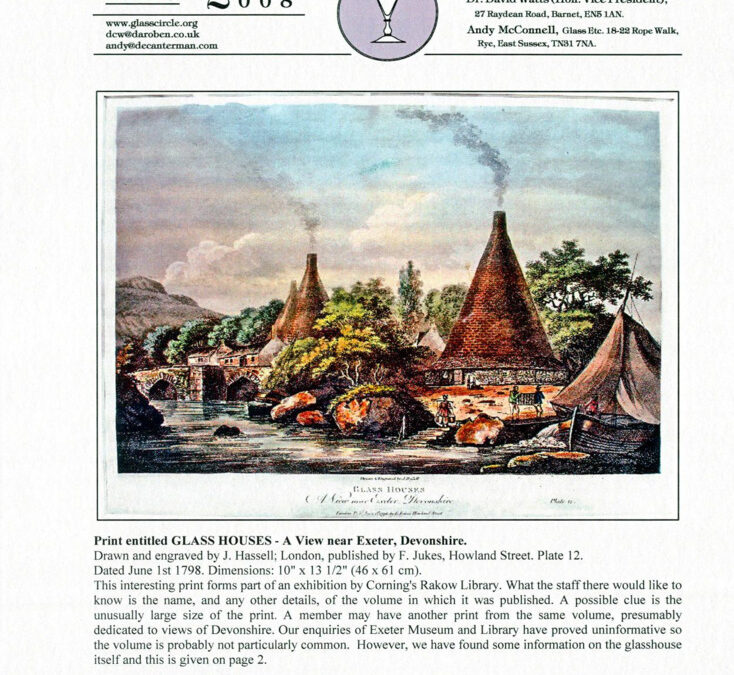
Print entitled GLASS HOUSES – A View near Exeter, Devonshire.
Drawn and engraved by J. Hassell; London, published by F. Jukes, Howland Street. Plate 12.
Dated June 1st 1798. Dimensions: 10″ x 13 1/2″ (46 x 61 cm).
This interesting print forms part of an exhibition by Corning’s Rakow Library. What the staff there would like to
know is the name, and any other details, of the volume in which it was published. A possible clue is the
unusually large size of the print. A member may have another print from the same volume, presumably
dedicated to views of Devonshire. Our enquiries of Exeter Museum and Library have proved uninformative so
the volume is probably not particularly common. However, we have found some information on the glasshouse
itself and this is given on page 2.
The Claw Beaker mystery, page 3.
Czech Glass, page 6.
More on Ravenscroft’s discovery, page 8.
The Amsterdam furnace, page 10.
Notes on cullett (part 3), page 11.
Bonham’s sale of the Ron and Mary Thomas collection, page 16.
. .. and all our regular features.
GLASS CIRCLE NEWS No. 116, 2008
a
Editorial
The Exeter Glasshouse
The surprising discovery of three glass cones in Exeter
raises the interesting question of how many such cones
were built in Britain altogether? The fact that most of them
were probably used for making bottles, with the notable
exception of those in Stourbridge, has resulted in many of
them being allowed to escape our interest.
More information about the Exeter glasshouse can be found
in www.exetermemories.co.uk, built by the River Exe at
Topsham, about five miles east of Exeter city, is known to
have existed from 1681. Its purpose was to make bottles, up
to that time imported from Bristol. Topsham had a deep-
water harbour suitable for exporting the factory’s products.
Factory access was from the main Exeter-Topsham road
via Glasshouse Lane that ran down to the river and then
turned west along it as far as Bridge Road (A379). There
were probably numerous small tributaries running into the
Exe and the bridge shown in the print is probably not a
forerunner of the present bridge over the Exe unless
depicted as part of an artistic background. The site itself, as
shown on Google Earth, is still only rough riverside
pasture.
The glass cone measured 94 ft high by 60 ft in diameter –
rather larger than the Red House cone still standing in
Stourbridge. There was also a “pound house”, although the
OED describes this term as
a round bottle house . . . with
all conveniences,
a barn, stable, two small dwellings and
some outhouses. There is no mention of three cones as
shown in the print. From shards found, early bottles made
there were
squat and baggy,
but by the 1750’s they had
acquired the shape described as
closer to that of a modern
sherry bottle.
The ‘exetermemories’ site continues: “In 1746, Joseph Crew
a collector of customs, was requested by the Sick and Hurt
Board of the Admiralty to prepare the buildings of the
Glasshouse at Countess Wear to accommodate French
prisoners of war. He was paid £15 per annum for as many
as 1,100 prisoners, who were held in various places around
Exeter, as well as Glasshouse. It was intended to hold them
all on the premises, but preparations were not complete.”
(These prisoners would have resulted from the lengthy War
of the Austrian Succession (1740-1748) during which, at
the Battle of Dettingen in 1743, King George II became the
last British monarch to lead troops into battle. The war
finally concluded with the Treaty of Aix-la-Chapelle of
1748.)
“There is evidence that a Captain Reynolds sublet the
Glasshouse to Crew – a fragment of bottle bearing the
date 1741 and the name Richard Rendall, and one from
1793 with the name Richard Rundle have been found,
suggesting that the Glasshouse returned to bottle making
after the prisoners left in 1748.”
The date of the glasshouse’s closure appears unknown. But
from the date of the print it might be assumed that it
survived at least until the early 19
th
century when furnaces
within glass cones gradually became obsolescent.
Opaque white glass from the Ron Thomas Sale.
Some highlights of the sale begin on pages 16. Detai 1 s of
the opaque white glass shown below are on page 18.
Top, lots 139-141 with, below, detail from Lot 140.
Delomosne web site revamped
Tim and Vicky Osborne have given the Delomosne web site
an overhaul and update to make it even easier to use. The
site shows some delightful glass as illustrated by the three
coloured sugar bowls
(c.
1800-1820) shown above.
. . . . The views expressed in Glass Circle News are those of its contributors . . . .
2
GLASS CIRCLE NEWS No. 116, 2008
The Mystery of the Claw Beaker — an English Speciality?
by David Watts
Many, if not most, members will possess a copy of W.A.
Thorpe’s book,
English Glass
(1935) of which several
reprints abound. The surprising thing about this book is that
the first 93 of 266 pages of text are not about English glass
at all! Approximately 35% of the book is devoted to glass
predominantly made, so Thorpe tells us, in the Upper Rhine
region and around Namur in Belgium. So how did this
curious juxtaposition with English glass come about?
At the time Thorpe was working in the Ceramics (and
Glass) Department of the V&A. There were already a
number of excellent illustrated books on the subject of
English glass such as Percy Bate’s
English Table Glass
(1913) and J. Sydney Lewis’
Old Glass and How to Collect
It
(1928), not to mention Hartshorne. A new angle was
required for the young Deputy Curator and exciting
discoveries of new forms of glass in pagan Anglo-Saxon
graves offered a solution. This glass dates to the pre-
Renaissance period of what used to be called the Dark Ages
(5
th
– 9
th
century). In spite of their presumed foreign origin
claw beakers were being found, in some quantity, at various
sites in southern England but notably in the county of Kent.
This glass is post Roman, which is not considered in the
book, but it is hardly an appropriate introduction to our
traditional pioneers, Carre, Tyzack, Henzey and Verzelini
of more than half a millennium later. Indeed, I wonder just
how many of our members have actually sat down and read
this section of Thorpe’s book or considered why it was
written in the first place?
To justify such a misleading title you might think that the
book should have at least been called something like
Glass
in England.
So may we imagine that there was some
purpose in Thorpe’s apparently eccentric title beyond just
appealing to the English historian; there is little of this glass
available to the collector? One possible explanation is that
although the remits of the British Museum and
V&A are supposed to complement each other,
in practice there is a considerable degree of
competition between them. Was this a piece of
V&A one-upmanship to counter the fact that
most of the new finds would inevitably end up
in the BM?
There is no question that Thorpe’s research on
the subject was thorough. We recognise
Donald Harden of the BM as the British
authority on early glass. And in his 1972
lecture (part III) to The Royal Archaeological
Institute he acknowledges that Thorpe’s
typology is generally sound
apart from
minor
amendments.’
The typology to which Harden
referred was claw beakers.
Glass of this Anglo-Saxon period constitutes
bowls, cone beakers, bag beakers with a
rounded rather than a pointed bottom and,
most spectacular of them all, the claw beaker.
The famous “Mucking” claw beaker, in pale green glass, has
several unusual features, notably the broad foot and zig-zag
trailing just below the rim. The loops at the top of the upper
claws is suggested to indicate an origin inspired by the
porpoise. The presence or absence of nipt trails down the
claws or between them are features used to separate the
claw beakers into different classes.
Mucking is a tiny village (it has a church) on the north bank
of the Thames near its mouth. It is thought to be named
after a Saxon chieftain. The beaker was discovered in an
archaeological dig prior to gravel extraction of the site.
Speculation this may be, but there is something compelling
about the claw beaker that is Thorpe’s main focus of
attention. Most have been found in burial sites
(intumations) but a number have been
identified from cremations due to the thermal
resistance of the characteristic claws to the
funeral pyre. Thirteen of Thorpe’s 22 plates
are devoted to illustrating claw beakers as well
as to this related early glassware. They are all
attributed to a German or continental origin.
There are actually 12 images of claw beakers.
The surprising fact is that more claw beakers
are found in England, and particularly in Kent
and the South-East, than in any other country.
This was first observed by Vera Evison F.S.A.
in 1982
2
following her relentless pursuit of
every known specimen in the country and
abroad, and confirmed by her in a year 2000
update? Traditional thinking has it that items
Claw beaker from Ashford, Kent. In olive green
glass, it is of slender form with three bands of
four alternating unadorned claws, Note the
typical “button foot” and two bands of trailing.
GLASS CIRCLE NEWS No. 116, 2008
.
..,
—
C t
Cret.1.4
‘,A-ter
I
,
b,
„,,,,c„,”,…,,„„
I :TE0V.0
a
EAKEPS
aI
c
r.,
1)
,,„,,,
r,,A
be
r AO
fad
,
Gt..%
CAstk !
40.
%Awn
d a In
:AS
Sas
U
CLAW
–
BIAPF PS
Tap… 4,…‘t
el
tr.1Ceat
PO
.
,i
ail
o
*
•teti. Brits
III
Favtrdat4Ktrie
I
b I
F ,art,tham,
il
CONE • REAMERS
tltl
ih,!’
.’s
1
d
9
Kb*
CI
r
”””
i
41
14..dut.y.
,
..i
RP ,.. t Pint
c i
d i
1.4.10.,
,
7
,
,
•
,…,
44r.
Not
0444
‘
‘
Pi.< 4 ...._ I I' EiVf — ii/a b , AtIsioni , Kart 0 ii 1 farettAton,t4nt at I _ 0 , Patmhot Ked! 111 GAG - OP AKE RS t y ,,,, , .,,,,,,„. ' I i RaMth.iffl ,1 {Etx 1l DRINKING HORNS {1.....letts , 1 , 44 V DELL - BEAKERS v I a of 1 Tr n ao " ~16 b, 11 1 IFAIP 1 .---... 111151.1„. r II D . .4 di II))) - --, c se..., .r... a i t I Sare Pint Chait.411, Kern Ye,* VII POUCH bt barkitsb.bc4 s BOTTLES ' ' 1 Lpthoo,d, V., Baer A t, ii -7 4 i ,- , 1 Kent MI SQUAT JARS 6.444ft.I.1 r..4. P.m ...44 1 , 4 , 4 ti.)i ,„ d x • 7 I Ptt tr lo...t. NoV00 o ,,„...„, I of ‘ 1 1, ;i f a t I a it b I CaN444.10.0 St /Arlon ... 00 r,,k6 r....,......K...t Sat *At 1444... I PALM CUPS . ..,..7 . Ittb Dee . Ss XI liolVt S ..... Kent IC ReOrn. E were generally made in the country where most of them are found. Could that be the situation here, even when there was (and still is) no strong archaeological evidence of glassmaking associated with the regions of discovery? Traditional thinking is not always correct as was found with the Aldrevandinus beakers. The claw beaker is a sophisticated piece of glassware, not an amateur product from a back-yard crib. In the region of 6 to 8 inches tall it can be decorated with up to twelve claws and usually has additional trailed decoration. Both technical expertise and an efficient furnace for founding and/or reheating the glass are required for its manufacture. The hollow claws are usually but perhaps not always blown as one might think. A blob of hot glass, slightly flattened at the end, applied to the vessel wall softens at the region of contact. It may then immediately be pulled out and turned downwards to attach lower down the vessel wall. I have seen in Damascus the spout of a porron made by this method by a traditional glassmaker sitting at a small furnace. The whole operation is unbelievably quick. Most claw beakers are also decorated with trailing before the claw is applied. To apply trailing, Diagram used by Donald Harden in several of his papers to illustrate the different types while sitting at this middle- of Anglo-Saxon glass found in Britain in the 5th - 7th centuries. eastern type of furnace, one hand controls the vessel on a horizontally held pontil supported at the hot end by a V- shaped block by the furnace door; while with the other hand a small blob of hot glass is applied from just above and the vessel rotated rapidly to make the trail. It looks easy to do but requires exact co-ordination between very steady hands and a sure eye. Compared with the modern practice of walking to and fro between chair and furnace, the traditional method of glassmaking, without help and sitting at the furnace, has all the advantages. The claw beaker appears to have developed from, or have been contemporary with, cone beakers and the so-called bag beakers with a rounded bottom. In terms of design, Thorpe, searching for the inspiration for their creation, places them alongside the bird jugs of Colchester and Canterbury monsters and infers an organic form inspiring their creators. Evison favours either a pretty cup with applied dolphins open to the interior or to a thicker, more severely panelled style, which acquired plainer, more claw- like appliques. 4 In use, most of these vessels have to be placed in a stand or, more probably, immediately replaced by a servant or stood upside down after the contents had been drunk at a draft — a pagan ritual that seems to have continued up to the mid-18 th century! The claw beaker is usually embellished with a button foot that, in many examples, is hardly sufficient for it to stand on. They are not convenient to hold and perhaps the button foot is to allow the empty beaker to be carried hung upside down between the fingers or stored in some sort of rack. The earliest known English claw beaker is c. 400 AD from the Saxon village of Mucking in Essex. Continental counterparts have a similar date and they became relatively prolific in the 6 th and 7 th centuries. They are found in the graves of both men and women, usually with wealthy associations. The Ashford beaker (picture previous page) was found alongside weapons and the skeleton of their owner. Donald Harden, from a study of other glass from the period, suggested, in 1956, that Faversham (Kent) might be 4 GLASS CIRCLE NEWS No. 116, 2008 a possible glassmaking centre. But nevertheless he, like Thorpe, considered claw beakers to be imported. Understanding took an about turn in 1982 when Vera I. Evison, FSA, published a long article illustrating and discussing all the claw beakers she had so vigorously sought.' Those in England numbered 55 in total (now updated to over 70). 3 She classified them into five types, plus a few other examples and odd claws that emerged during her research. Although the bulk were found in Kent, others have been found as far away as Dinas Powys (South Glamorgan), Castle Eden (Durham), Lovenden (Lincs.), Newport Pagnell (Bucks.) and several in Norfolk. Most important, she found that while some types had continental counterparts a significant number were unique to England. There were 26 examples of the sixth century type known as 3c which includes the Mucking beaker mentioned above and other complex forms with ten claws. A few were found on the continent that had no English counterparts. The conclusion was inescapable that while some were made on the continent, England must have had its own manufacturing base for claw beakers. In 1972 a series of Anglo-Saxon glass including three claw beakers and three earlier cone beakers were analysed at the British Museum. The results clearly showed that all were of the same type of glass with about 20% sodium oxide and less that 1% potassium oxide. In other words the glass was similar to that used at Monkswearmouth, as described by Bede, and not the typical, later potash-rich English glass made with wood and/or fern ash.' It seems that the glass was imported as cullet, possibly made using soda-rich kelp ash from France's so-called golden mile, or even littoral plant ash from as far away as the Mediterranean. By using cullet, reworking would have been much easier as a lower temperature furnace could be used. This may explain why, as with Monkswearmouth, none has been found. The glass of the vessels is generally full of bubbles and covers a range of colours from green to pale amber, one piece even being copper blue. Thorpe's description of their colour is a swimming amber, a greenish yellow or a deeper and darker green than we find elsewhere in glasses of the Invasions. He includes one analysis from a contemporary dark blue bowl and this is also a soda-rich glass. Equally interesting is their practical use. Thorpe, referring to the habitual drunken habits of our Anglo Saxon forefathers, reminds us of the uninhibited consumption mentioned on almost every page of the roughly contemporary old English epic poem, Beowulf. Of particularly interest is a quote relating to a banquet with Danish King Hrothgar. Now and then Hrothgar's daughter bare the ale cups to the nobles from end to end . . . she presented the studded vessels to the heroes. If these studded vessels were claw beakers perhaps they were specially awarded for gallantry at war or, bearing in mind that women owned then too, for achievement in athletics and games adopted during the Roman occupation. Could ten claws equal a modern gold medal? Is that carrying speculation a little too far? I can only vouch for their most laudable drinking habits. At a campsite dining room in old Czechoslovakia my stein of beer was instantly replaced as soon as it was empty — and no questions asked! So we may conclude that Thorpe was right in his book title after all, albeit unwittingly and clearly for the wrong reason. English Glass is about - English glass. Claw beakers were made in England, although not exclusively, together with the even more prolific cone beakers, cups and the rare bag beakers. As shown in Harden's diagram, these bag beakers may have the same nipt trailing as found in the claw beakers.' One might imagine that these simpler vessels were for the lower orders in one of Hrothgar's drunken orgies. This curious combination of glassmaking and social history about a much neglected vessel helps shed some light on the more civilised behaviour of our warring ancestors. The pioneering studies of Thorpe, Harden, and now Vera Evison, both reveal and confirm an important period of English glassmaking in the "Dark Ages" that should be lauded as an important era in our history. It seems improbable that glassmaking died out in the late 7th and 8th centuries as might seem to be the case. This invaluable era for archaeological investigation came to an end because of a change from paganism to Christianity in England.' As a result personal possessions were no longer buried with their owners. Consequently, there is still much to be learned in the two hundred years or so before we encounter the relative enlightenment of Medieval England. Notes 1. D.B. Harden, 1972, Ancient Glass, III: Post Roman, The Archaeological Journal, CXXVIII, p. 90, note 50. 2. V.I. Evison, 1982, Archaeology, vol. 107, 47-104. Ruth Hurst Vose only two years earlier had stated in Glass, Collins Archaeology, p. 100, that claw beakers found in England "were probably produced in the Seine-Rhine area". 3. V.I. Evison, 2000, in Glass in Britain and Ireland AD 35 — 1100, British Museum Occasional Paper no. 127, ed. Jennifer Price, pp. 189-200. 4. Another vessel with animal attributes is the 1" century Middle-Eastern rhyton, a curved horn with the tip formed into a head with snail-like horns. Unlike an ordinary drinking horn it usually has a base for it to stand up. Only seven of these extremely rare vessels are known; one is in the BM and one in Newark Museum, NJ, USA. Anita Engle associates their use with royalty and religious libation in The Puzzle of the Glass Rhytons, Readings in Glass History No. 19. 1985, Pheonix Publications Jerusalem P.O.B. 8190. The term has subsequently also been used to include a variety of different vessels with animal associations made in various materials. 5. R. Cramp, 1970, Glass finds from the Anglo-Saxon monastry of Monkswearmouth and Jarrow. Studies in Glass History and Design. Soc. Glass Technology, Sheffield, pp.16-19. 6. According to Harden in ref. 1, p. 89, of seven bag beakers with this type of trailing two have been found, one in Sweden and one in Holland, four in Faversham, Kent and one in. Gilton, Kent. Consequently he favoured Faversham as the probable place of origin. 7. J.M. Wallace-Hadrill, 1983, The Frankish Church. Oxford University Press. p. 27. 5 1: Mould-blown & furnace- worked vase designed c1960 by Josef Hospodka for Chribski, visited by GC members on its first visit to the Czech Republic, when similar designs by Hospodka were still being made. Ht. 20cm. LASS CIRCLE NEWS No. 116, 2008 Czech Glass by Andy McConnell After years in the wilderness, Czech glass is finally coming in from the cold. Though pre-war examples still suffer from widespread anonymity, post-war pieces are beginning to emerge from behind an Iron Curtain of obscurity. The subject has been the focus of three recent exhibitions: Czech Glass, 1945-1980: Design in an Age of Adversity, staged at Dusseldorf and the Corning Museum of Glass in 2005, and the more obtusely titled Hi Sklo Lo Sklo, held at Kings Lynn over three weeks this summer. Extending the flow of information on the subject, the illustrated catalogues to the exhibitions may be joined in the autumn by Marcus Newhall's long-promised book on Czech post-war pressed glass, Sklo Union: Art before Industry. Sklo is the Czech word for 'glass'. Though the prospect of Communist-era Czech glass may appear at first to be unprepossessing, Czechoslovakia probably employed more glassmakers per capita than any other country, with the possible exception of Sweden. Further, the products of their labour were aggressively exported, most notably those at the bottom-end of the price scale which remain generally available, often at low cost. Though Czechoslovakia has existed only since 1918, its predecessor, the northern kingdom of Bohemia (now part of the Czech Republic founded on Jan. 1, 1993) remains renowned for its glassware, produced there for approaching a thousand years. Evolving technically and stylistically over the centuries, it benefited greatly from its geographic position in central Europe and proximity to Vienna, the wealthy capital of the Habsburg Empire. Bohemia's principal specialities, enamelling and engraving, were directly descended from its pre-Medieval ecclesiastical window staining and the fondness of its king, Rudolf II [1575-1612] for rock crystal carving which inspired engraved glass equivalents from around 1600. Employing thousands and one of Bohemia's principal industries, its early 20th century production spanned the ranges of price and quality: from the cheapest utility wares to the most luxurious status symbols. From pressed plates and paste jewels to Wiener Werkstatte masterpieces and Lobmeyr chandeliers, and very much in-between. The Second World War had profound ramifications for Czechoslovakia. The Nazi seizure of its Sudetenland in 1938 followed by the Moscow-backed takeover from 1946 effectively left Czechoslovakia occupied for the half- century between 1938-89. With dissent banned, Prague's most enlightened art college tutors directed their most promising students towards the politically neutral substance of glass. Three glass schools encouraged and developed design skills: Kamenicky Senov [founded in 1856], Nov' Bor [1879] and Zeleznji Brod [1920], whilst technical glassmaking was taught at new colleges founded at Chribska in 1946; Novy Bor, 1947 and 2elezn5 , Brod, 1950. Virtually all the leading names in Czech post-war glass had direct associations with these schools: Josef Hospodka, whose designs sustained the Chribska glassworks [founded in 1414] into the 21st century [figure 1], was a tutor at Novy Bor, and their graduates included virtually every designer featured in the recent exhibitions, including Vladimir Jelinek, Rudolf Jurnikl, Jiri Harcuba, Adolf Matura and Frantisek Vizner. The Prague regime soon recognised the Czech glass industry's potential for generating both revenue through exports and positive propaganda. With the industry entirely nationalised and grouped into a series of collectives, its products were aggressively promoted throughout the world. Its principal organ in the English-speaking world, the richly illustrated monthly magazine Czech Glass Review, was issued free to glass & china retailers. After an initial hesitance, Czech glass was first exhibited abroad at the Milan Triennale in 1957, where positive reviews encouraged a repeat in the following year at the Brussels Expo. The award of a gold medal to Rene Roubicek was followed by invitations to several other Czech designers to participate at The Corning Museum of Glass's influential exhibition Glass 1958, where their work was acclaimed as revelatory. Many observers have attributed the first stirrings of the American studio glass movement to their contribution. Strong sales and international success encouraged the Czech regime towards both significant investment in glassmaking facilities and a greater tolerance of its glass designers. Moser, the only works to retain its individuality under communism, was almost entirely rebuilt, for instance, and designers were provided with personal 2: Hand-pressed Osaka pattern jardiniere, designed by RudolfJumikl, 1969. Size 14 x 18cm. studios within glassworks and use of the best craftsmen for experimental purposes. The result of the combined impetus of greater investment, international respect and artistic freedom was an outpouring of glassware of many types and categories. The 6 GLASS CIRCLE NEWS No. 116, 2008 Glass Circle Matters Chairman's Letter In July I visited Memphis, Tennessee as a guest of The American Cut Glass Association (circa 1600 members) to attend their 30t h annual convention and to give two lectures on English and World cut glass. The convention took place in a large, gleaming Hilton Hotel about 15 miles from down-town Memphis and was attended by around 275 delegates including spouses. There were two days of lectures, a large dealers show, and an opportunity for delegates to show, and possibly sell, from their own collection. A fantastic display of 'Brilliant Cut' glass had been put on for our benefit at a nearby 'Stately Home', The Dixon, a fine 1940's building. All that work and no catalogue, we are fortunate that The Glass Circle produces catalogues for its exhibitions. American 'Brilliant Cut' glass is regarded in Europe, erroneously, as an equivalent to our Regency Revival cut glass. To quote from the above exhibition's hand-sheet:- It was not until the country was about to celebrate its hundredth birthday that the American style fully emerged. The prejudice of European glass' superiority began to disappear when eight American companies exhibited their ware at the 1876 Centennial Exposition in Philadelphia. Visitors, bursting with national pride and flush with new wealth, were captivated by the elegant tableware, lamps, perfume bottles and other items on display. Cut glass became a symbol of elegance and leisure, and demand for exquisite glass product spurred intense competition and creativity within the industry. Stunning new patterns with intriguing names were developed and patented. Cut glass was marketed in the finest jewelry and department stores. A social commentator of the day noted that the dozens of pieces used for dining made the Victorian table "weigh a ton, cost a fortune and sparkle like diamonds." In the early 20t h century, escalating labor costs, intense competition and a saturation of the market began to take its toll on the American glass industry. By 1908 there were only one hundred cutting houses; down from a peak of nearly one thousand. The outbreak of World War 1 dealt a final blow to the industry. The size and quality of some of the work I saw was breathtaking, quite unlike anything produced in Europe at the time. Little was exported and we in Britain should be aware that the best American cut glass of this period is not a poor imitation of Regency cut but an exuberant example of American self-confidence. John Smith Welcome to New Members Mrs. Shelly Hitch and Dr. Vera Varga and a Sad Loss We have just learned of the death of Paddy Baker from cancer on August 26th. An appreciation will follow. Age of Adversity exhibition concentrated on top-end unique and limited series pieces that remain both extremely rare and avidly sought-after whereas the recent Hi Sklo Lo Sklo focussed further down market. Curated by Graham Cooley and drawn exclusively from his own collection, Hi Sklo Lo Sklo was subtitled Post-war Czech glass Design from Masterpiece to Mass-Produced. Whilst it included a few high-end 'masterpieces', including eight by Vladimir Jelinek for Moser, it concentrated on mass-produced pieces currently valued under £100. Its principal categories were decorative domestic vases and bowls made by mould-blowing, furnace-working and pressing, and decorated with colour, cutting, engraving and some by printing. All of these are included amongst the 200 colour illustrations in Mark Hill's catalogue. Its most striking feature was, without doubt, the depth and diversity of the subject matter. This precisely echoes the past when Bohemian makers and decorators not only created and developed new themes but also copied virtually anything made elsewhere that they considered to be commercially viable. When attempting to attribute virtually any anonymous glass- ware, dealers and collectors have long employed the axiom 'if in doubt, it's probably Bohemian/Czech'. Possibly the most surprising aspect of the exhibits was their intensity of colour, mindful of the greyness generally associated with communist Eastern Europe. The exuberant vibrancy of the designs produced by Josef Hospodka, principally between 1954-64, and often mistaken for Murano, for instance, stand in contrast to the 3: Hand-pressed monolithic architectural slab vase in dark amber, designed by Adolf Matura for Rudolfova, 1972. Ht. 15cm. Concluded on page 15 7 GLASS CIRCLE NEWS No. 116, 2008 Ravenscroft's discovery of English lead crystal We are pleased to report and discuss this critique* from our Chairman, John P. Smith 1. Glass Circle News states that the articles within are the responsibility of the authors rather than the collective beliefs of The Circle, and this was never more true than in the lengthy and detailed article in the 2008 Spring issue (no. 114) of David Watt's latest paper on lead glass given to The Circle in February. Below are my thoughts on the paper given in the same spirit. Unfortunately, I was unable to be present when the paper was given, and I am aware that the printed article can only be a summary of the whole talk. 2. We all accept that George Ravenscroft, unlike the 2th l Duke of Buckingham, was not a chemist and we believe that the formulation work for Ravenscroft was done by da Costa, thus agree that Ravenscroft was not the inventor of lead glass, although this supposition clouded glass scholarship for at least the first 80 years of the 20 th century. 3. We know, vide Peter Francis in Apollo magazine, The Development of Lead Glass', February 2000, that in the 1660s three glassmakers were working in Nijmegen. By 1669 they had left Nijmegen, one to Dublin, one to Scandinavia, and, by 1673, da Costa to London. Peter Francis asserts that all three were making glass vessels using a formula including lead in non-trivial amounts. David disagrees with this assertion. There is no suggestion that they were making glass paste, i.e. a very high lead content glass used in the manufacture of imitation precious stone jewellery. Da Costa is said to have used a 'new type of furnace' in Nijmegen and made 'Venetian style' glass, which was the fashion of the time. This 'new' type of furnace may or may not have been the 'key' to the alleged use of lead by Da Costa; it may be a red herring. 4. I know of no evidence that either Da Costa or Ravenscroft had any commercial interest in artificial jewellery, but the use of lead (over 30% by weight) in paste had been known for many years. 5. The word `patent' had a very different meaning in the 17 th century from its current use. Today a 'patent' is used to protect intellectual property. In the 17 th century a 'patent' was more a license from the Crown to produce, and have that production protected, sometimes as a monopoly. Ravenscroft's patent makes no mention of the use of lead or any other novel ingredient. No 'secret' ingredient or novel production method was needed for the granting of a patent, only that granting a license to produce would be good for the State, often by reducing imports or producing a taxable product. It seems that the fact that Ravenscroft was granted a patent is irrelevant to how or by whom lead glass was discovered. Chris Dent of the Melbourne Law School, in his Legal Studies Research Paper No 237, published in July 2007 'Patent Policy in Early Modern England: Jobs, Trades and Regulation' discusses in detail this problem in the 16 th and 17 t h centuries. https://ssrn.com/abstract=100161 for the full paper. *Held over because of lack of space in GCN 115. The paragraphs have been numbered for convenience of reference in the response. 6. We know that the early glass produced by Ravenscroft had a low lead content and was unstable, increasing lead content eventually cured this problem. 7. David's proposition that because calcedonio contains lead, therefore this is how lead glass for vessel making was discovered, is difficult to accept without any further evidence although the production in Venice of calcedonio was known in England. Calcedonio manufacture for vessel glass has really nothing to do with the manufacture of paste jewellery. I know of no English calcedonio glass of this period and if demonstrating the production of calcedonio glass had produced a eureka moment one might have expected this to be recorded. I would like to see much more evidence of this proposed route to discovery. 8. David finds very significant the fact that neither Hooke nor Plot mentioned the use of lead but if Ravenscroft thought he had a secret key ingredient he might have kept this fact from curious visitors. David's comments on the production of mirror glass, and the production of glass globes for lighting London, are interesting for discussion another day. 9. Since writing the above I found the following :- L M Angus Butterworth, wrote in 1956 in 'British Table and Ornamental Glass' page 24:- In the spring of 1674 Ravenscroft obtained a patent for seven years, with special protection against imitators of 'a particular sort of Christaline Glasse resembling Rock Christall not formerly exercised or used in this our Kingdome'. His part in introducing this new product does not in the least indicate that he was a clever chemist or inventor. His function was the often misunderstood and little-appreciated one of the business man or enterpriser. In his trading contacts with Italy he had become acquainted with the areas where glass was made, and with the men actually engaged in the 'mystery'** of glass-making. His 'Christaline Glass' was no fresh invention, but the speciality of a foreign master craftsman named Da Costa whom he brought to England. ** 'Mystery' at this time meant `Trade' or 'Handicraft', not the present day meaning of 'something not easily understood'. 30th April 2008 Comments by David Watts An hypothesis is nothing if it is not capable of withstanding reasoned criticism. John makes a series of important points and I am pleased to be able to respond to them. The purpose of my lecture was not just to explain how English lead crystal was discovered but also to place it in the context of the day. Para 2. This statement is somewhat ingenuous as it clearly 8 GLASS CIRCLE NEWS No. 116, 2008 misses the point. As I showed in a table most writers up to the present time have stated that Ravenscroft undertook research or experiments that led to the invention of English lead crystal (ELC). Most recently, Britannica on Line web site states:- Ravenscroft's experimentation was supported by the Worshipful Company of Glass Sellers. The Glass Sellers site states that:- In 1674 it employed George Ravenscroft to carry out research to find a process for the production of English glass and in 1676 "Lead Crystal" was born. Both statements are either inaccurate or misleading. In 1674, Ravenscroft had already been awarded his patent. Incidentally, I gave as a major reason why Ravenscroft was not tempted to undertake experiments as the fact that there were probably five glasshouses in London either making or capable of making white glass. In fact, there were six as I forgot to mention the Bear Garden that was stated to have a white glasshouse. Other reasons were the limited market (first mentioned by Macleod) and the risk of causing royal offence by possibly competing with the Duke's Red Maid Lane glasshouse when the King had twice come to his assistance in Venice. Finally, my suggestion is that da Costa's formulation work for making Venetian-style calcedonio was aided by Ravenscroft's knowledge of the English glassmaking practice of using saltpetre and other English materials. Para 3. An important aspect of any detective work is getting the time sequence right. De Reinier and Costa were said to be making Venetian crystal, fine and large wine and beer glasses soon after 1669 but there is no mention of the supposed new invention of lead crystal. In fact, Regnier is not recorded as making some form of lead crystal until 1678. Where Formica went initially we do not know but he, again, did not apply for a permit to make ELC in Ireland until 1675, probably after having learned from da Costa that the crizzling problem had been overcome. So far as I am aware, da Costa's actual manufacturing skill comes from Hooke's description of what he was making at the Savoy. The term "paste" is to my mind a too limiting description of his ability and I prefer the modern term "bijouterie" - small items of decoration and ornament, of which calcedonio is an example. One might note, too, that da Costa did not immediately leave Nijmegen along with his colleagues which suggests that he was not involved in what might be called normal glassmaking activities that required a large furnace. The so called "new style furnace" is associated with Amsterdam. There is no evidence that one existed in Nijmegen, nor does Francis suggest how this led to the discovery of ELC. The nature of the furnace I will discuss after this response to John. (see page 10) Para 4. The recipe for Venetian lead glass, as used notably for jewels and enamels, goes back at least to the mid 16th century. It was founded from a simple mixture of powdered flints and lead oxide , in essence a form of lead silicate, that bore no resemblance to ELC. It is a misunderstanding of the chemistry to suggest otherwise. The idea that Ravenscroft became interested in bijouterie is my speculation because that was what da Costa was found to be making at the furnace stated to have been built at the Savoy by Ravenscroft. It also avoids any problem or suggestion that Ravenscroft was experimenting with the manufacture of a new form of cristalline glass. Para 5. Chris Dent's review is in accord with my understanding of the legal situation at the time. One needs to ask why da Costa, said incorrectly by Peter Francis to be making ELC independantly at the Savoy, did not apply for a patent for his new invention. As inventor, under the Act of November, 23rd of James I, only he was entitled under English law to hold the patent and it was to last for seven years. As I pointed out this was the problem that the Duke of Buckingham had illegally to circumvent in order to get the patent for making mirror plates. Because da Costa was working for Ravenscroft the latter was entitled to apply for the patent. There is no evidence to suggest that da Costa handed it to him having discovered ELC earlier himself. Para 6. In fact, we do not know if Ravenscroft's first new form of cristalline glass contained lead. glass. This is a point I made in the lecture but omitted from the GC News report. In the lecture I included the possibility that the non- lead version was probably made first in the manufacture of calcedonio but included the addition of saltpetre as was English practice. Then, in discussion with Ravenscroft, da Costa might have said that he could make an even better version but that it would cost more both in materials and in pots broken by the formation of metallic lead. Ravenscroft said "give it a go anyway" and thus the first ELC was created and lead found not to break the pots. Its purity was identified because uniquely in making calcedonio the colouring agent is not added to the molten glass until after it has been founded. Because the Venetian cristallo, a non- lead glass, was notoriously unstable from a lack of calcium, we are left to assume that if any was made, arising from the discovery of how calcedonio was made, then it has long since disintegrated. What I do find surprising is that the early lead glasses, with perhaps as much as 15% lead, particularly associated with Ravenscroft were so unstable. My measurement suggested 9% to 14%, as used in making calcedonio, but we have to remember that these measurement were made on glasses that have survived to the present. Colin Brain in Glass of the Alchemists tells us that for crizzling to occur about 9% lead was the maximum required to be added which seems to fit in with my measurement. Para 7. According to the recipes calcedonio could have been made without lead (vide Neri) but that lead was added for the best result. This was justified for calcedonio by the high price that it commanded. Calcedonio was imported into England by John Greene from 1668 but there is no evidence it was made here at that time. There is no known way of distinguishing Venetian from possible English calcedonio. However, the fact that Wren and Hooke went to see it being made surely indicates that it was a unique experience and had never before been made in England. Para 8. This needs no comment - no disagreement here. Para 9. One can only say that this contribution by Butterworth, a practising glassmaker, is a typical speculative statement of the time, largely based on Robert Plot's ambiguous statement that da Costa brought unspecified glasses to England. It was as far as Butterworth could go with the knowledge at the time. He is wrong to say that it was not a fresh invention. This is because of the need to add saltpetre and substitute ingredients; his belief that ELC was already a specialisation of a 'foreign master craftsmen' is demonstrably incorrect. * 9 The Amsterdam furnace from the 1669 Latin translation of Neri's L'Arte Vetraria after Merrett. One square aperture is ringed. GLASS CIRCLE NEWS No. 116, 2008 The Amsterdam Furnace The Latin (1669) and French (1752) translations of Neri/Merrett illustrate separate views considered to be of the same Amsterdam glass furnace. Charleston' considers this furnace to be a version of the southern beehive furnace modified to accommodate the leer containing moveable iron pans (frasches) to carry the new glass progressively into a separate room (sarosel). The leer has been considered to be the novel feature of this structure' which is probably why it is included in the publications. Colin Brain has presented an additional theory suggesting improved temperature control within the furnace by means of two channels running up the surface of the furnace dome in conjunction with a moveable cap or plate on the top. These channels are clearly shown as square openings in the 1669 translation of Neri (below). It is this modified furnace that is suggested by Peter Francis to be essential in the invention of English lead crystal in preference to that of any chemical formulation. The picture in the French edition (right) shows the furnace and leer from the side, perhaps to emphasize the latter. The square openings are shown but the cap is missing. The significant feature of this depiction is that the openings appear not to run into channels as it can be seen through them to the curved face of the furnace dome (see detail). There is no positive evidence that the square openings do represent channels that run into the furnace and it is possible that they were tried in 1669 but abandoned by 1752. It is significant that various features of the 1752 furnace are labelled but not the square openings. This suggests that they have no practical significance. The brickwork also appears in both pictures to be too narrow to accommodate a channel. Nor is there any indication of stoppers to regulate the air flow. The moveable cap on top of the furnace was almost certainly to provide control of the temperature of the leer by restricting or otherwise the heat entering into it. Brain claims to have computed how the temperature within the furnace is controlled but I have not seen the calculations (and probably could not understand them if I had). However, I am reminded of an eminent university lecturer who said "give me one variable and I can prove some things; give me two variables and I can prove many things; give me three variable and I can prove anything!" This may be grd% 4 1. Above. illustration of the Amsterdam furnace from the 1752 French translation of Neri's L'Arte Vetraria after Merrett. Below. Detail of the square apertures suggested to be tunnels leading into the furnace. unjust to Colin and one should remember that Apsley Pellatt observed that the continental glassmakers of his day did have a way of controlling the furnace temperature such that glass could be founded and worked at the same time. However, Pellatt did not think it was a very successful way of founding glass. In his chapter in Glass of the Alchemists (reviewed page 14) Colin repeats the idea of the possible role of his proposed tunnels in promoting the function of the furnace but does not mention any involvement with the leer. He avoids any direct connection between this modified furnace and the invention of English lead crystal glass (ELC) as claimed by Peter Francis although he does suggest that it might have been built in da Costa's Nijmegen glasshouse. Since the founding of lead glasses generally require less heat than that for non-lead glasses it is difficult to understand to how these modifications, even if true, can in any way contribute to the invention of ELC. For Francis, such a furnace had to be involved in his claim that da Costa built the furnace in the Savoy and began making ELC there. On the contrary, documentary evidence proves that Ravenscroft made the furnace and that da Costa was not making ELC but calcedonio. References 1. Charleston R.J. 1978. J. Glass furnaces through the ages. Glass Studies 20, pp. 9 — 33. 2. Toninato T. 1982. in Mille Anni di Arte del vetro Avenezis. Albrizzi Editore, p.13. D.C.W . 10 GLASS CIRCLE NEWS No. 116, 2008 Notes on the Importance of Cullet (Part 3) by Robert Wilkes By 1980, Ruth Hurst Vose, quoting Denis Ashurst, wrote: "The major dculty encountered especially in a post- medieval glasshouse excavation is the cullet. The origin of cullet on a site must always be in doubt and must necessarily throw suspicion on all glass fragments found there." The enlightenment of this last statement was a long time coming. I would add that the amount of cullet found scattered, as opposed to stored, on an early glasshouse site is in inverse proportion to the likelihood of it being made there. Only one 16th century bottle has ever been found intact on an English glassmaking site. It is of hexagonal form, about 5" high and is in Gloucester Museum. The Woodchester site, whence this superb example came, is still something of an enigma having yielded an outstanding variety of drinking vessel fragments. What is important about this bottle is that it is intact and so was not brought in as cullet. It could, however, have been brought in for other purposes. There are various other reasons to suppose Woodchester was, indeed, principally a vessel making site. The published works by J.S.Daniels should be studied to understand this supposition. It is significant that this site was operated by Huguenot rather than post-medieval Norman glassmakers. Huguenots made window glass only by the cylinder (broad glass) method while Normans only used the crown glass method. There are no known exceptions to this distinction. And because of the premium value of their glass, it is very unlikely that Norman crown glassmakers would get involved with vessel-making. So there is more likelihood of vessels being made on a Huguenot site. Thus Woodchester may be the exception to the rule. It is unique in other ways including its [beehive] furnace. For some still unexplained reason, this may be one of the rare examples in English forest glassmaking where vessel glass was predominant. There are no known examples of bottle moulds being found on any early glassmaking sites. This is a great pity because no other artifact can indicate with such certainty what was made on a site. These moulds of either wood or clay were part of a glassmaker's precious implements which travelled with him. By 1696, Houghton had listed forty-two bottle houses in England producing about three million bottles annually. A century later the output was tens of millions a year from what came to be a specialized industry. This rapid and continuous expansion did not level off until the output reached fifteen millions a day in the middle of the 20th century. Bottle houses came to be regarded as the lowest status in the industry because the quality of both the glass itself and the products were so poor. This was caused by the rapid expansion of the industry and a desperate shortage of cullet. Bottle houses in the North-East even used refined blast- furnace slag from the iron industry to supplement the cullet. This was clear but dark green acid slag which was, in fact, a crude form of glass. It was much more compatible than the later opaque marble-like slags which gave their name, quite incorrectly, to the decorative 'Slag Glass' of the North- East. This was deliberately contrived using opacifiers and colorants. Ironically, the collar which gave cullet its name was the most contaminated form of cullet and in the fine lead crystal houses of the nineteenth century was quite useless. They were known as 'blacks' in the trade because of the iron scale picked up from the blowpipe and were only reclaimed in 'green' houses where the discoloration caused by the iron oxide was of no consequence. It was not until 1886 that John Northwood, grieved by the considerable waste of valuable lead crystal cullet lost in the collars, invented and patented a method of dissolving and separating the iron scale from the glass collars and pontil scars so that they could be reused. The present day price of cullet from local authority bottle- banks is running at about £18 a ton at the glasshouse and can be much less at times of glut. Contrast this with the mention in the inventory of the will of "Thomas Rogers, of Amblecoat, White glassmaker" dated 1719: "Half a ton of Cullen" is valued at £14! This is the modern equivalent of about £5,600 a ton which seems improbable but does give an indication of the enthusiasm of the valuer for the scarcity of this commodity at this time But perhaps the valuation of this cullet was not all that outrageous. It is now fairly certain that the term 'white glass' was used for 'flint' glass made using lead oxide. There were at least four generations of this family of glassmakers named Thomas and this one, described as `whiteglassmakee, is known to have made lead glass tablewares at Holloway End. As cullet, lead 'crystal' glass was worth at least twice as much as the best 'green' glass. In F.W.Hunter's work on Stiegel glass in America he observed of the need for cullet: "Its use explains the constant advertisements we find in early American papers offering a penny a pound for broken green glass and two pence a pound for broken flint." English currency still prevailed in America at this time and so in c. 1760 American glassmakers were paying £9.7s. a ton for green cullet and £18.14s. a ton for flint cullet, the modern equivalents of about a thousand pounds a ton and two thousand pounds a ton. In England, the waste product from iron making, acid slag, was recognized as a cheap source of crude cullet before 1788 when Chambers and Rees published their Universal Dictionary of Arts & Sciences. In this is given: "Glass, common bottle or green, is formed of sand of any kind, fluxed by the ashes of burned wood or any parts of vegetables; to which may be added the scoriae or clinkers of forges .... the composition with the clinkers consists of a 11 GLASS CIRCLE NEWS No. 116, 2008 qirAdliVitf et T. sPeivp 0E04 In July, I visited for the first time the National Trust for Scotland house of Newhailes, just to the east of Edinburgh. The seven bay central block of the house is late C.17t h and in an expansion scheme, brought to fruition in 1721 by Sir David Dalrymple, the second baronet of a dynasty of Scots lawyers, the house was turned into a symmetrical fifteen bay house with a large new eating, or dining, room being added. This room extended through the original external end wall, whose line is now delineated by four columns, in two pairs, which screen the service area of the room. As in so many Scottish houses of this era, the original fireplace and flue was in the immensely thick internal cross wall which supported the weight of the upper rooms; the result was that the formal approach to the room, through this wall, did not allow a view of the impressive marble chimney- piece by Henry Cheere, offending Georgian sensibilities that regarded the fireplace as the focus of a room. To remedy this, Sir David placed on the opposite wall, to be seen between the paired pillars of the screen, a "mirrored window" composed of nine plates of bevelled mirror glass, in a 3 x 3 configuration, secured in a brass frame, and making a 'window' of over eight feet in height and about four feet wide, in conscious emulation of the salle-des- glaces at Versailles. The senior branch of the Dalrymple family produced the first Earl of Stair, ennobled in 1703, but notorious before this, when as Lord Advocate of Scotland he signed in 1692 the order for the extirpation of the MacDonalds of Glencoe. Stair allegedly made out the writ on a playing card, the nine of diamonds, now sometimes known as "the curse of Scotland". It was his fifth son who acquired Newhailes and who started the expansion of the house; thus Sir David Dalrymple was a grandson of Stair. At the opposite end to the new dining room was built a large library, to house his celebrated collection of books which was much augmented by his successors. Unfortunately, the shelves are now devoid of books, for the remaining 7,000 volumes were in 1971 transferred to the Treasury in lieu of Death Duties, and are now housed in the National Library of Scotland. There have been agitations to return the books to their rightful home, but neither the Treasury nor the NLS has yet proved receptive to the idea! The library is lit by a pair of very handsome six arm glass chandeliers with globe decorated central shafts, which are thought to have been brought in later from another Dalrymple property. One cannot help wondering as to whether the original stimulus for the acquisition of these chandeliers was the purchase from Maydwell & Windle in 1752 by the Duke of Atholl of Importance of Cullet continued hundred and seventy pounds of wood ashes, a hundred pounds of sand and fifty pounds of clinkers." The excess of ashes for fluxing in this mixture indicates both the expectancy of low quality of the ashes and the sand and, no doubt, the very variable vitreous quality of the acid slag available. Some acid slag is, in fact, a remarkably good form of pale green glass with good transparency. Samples we have gathered from the bed of the Dick Brook close to Andrew Yarranton's iron furnace c. 1653 at Astley, Worcs., show good quality and stability having survived in remarkable condition over three centuries exposure. As Mansell found at Newcastle, an excess of chemical fluxes is no substitute for adequate cullet and in any case his supply of ashes was of poor quality. Mansell's operation would have involved a greater length of fitting time in the calcar stage at the lower temperature of about 800°C and would certainly have resulted in excessive amounts of sandiver and infusible scum. Godfrey states: "Initially, the high cost of buying ashes (from wood or ferns), which more than offset the savings of using coal, brought about the failure of Mansell's furnaces in some locations." The high value of new glass determined the value of the cullet, as did the cost of transportation. Window glass from the Weald between 1570 - 1600 cost £10 to £15 a ton which is £3,000 a ton in modern terms. To this must be added the cost of transport from the Weald to London of 20 shillings a ton or £200 in modern terms. Thus it can be seen that a cost of cullet of £5 a ton or £1,000 in modern terms is not unreasonable. In Dan Klein's The History of Glass the contributor, Perran Wood states: "In a treaty concluded in 1277 between the Doge, Jocopo Contarini, and Bohemund VII, Prince of Antioch, the regulation of cullet ... imported from the Middle East to Venice was mentioned " This is probably the earliest specific mention of trade in cullet. This author made the point that all the ingredients used by Venetian glassmakers [at that time] were imported. Antioch, then part of Syria, was close to the ancient centres of glassmaking where Venetians first learned the art. In the same volume, Hugo Morley-Fletcher states that, in 1671, Ravenscroft, while experimenting with lead oxide in glass made from flints, discovered it made the glass less fragile and enhanced its brilliance but; "It is not at all certain this was what Ravenscroft was looking for, although he was undoubtedly trying to find a replacement for Venetian cullet on which the manufacture of (crystal) glass in England was to some extent dependent." Further, Ruth Hurst Vose commented: "In early medieval times, sources of enamel or specialized glasses were scarce and enamellers probably used tesserae from Roman mosaics for their raw materials. " It is often overlooked that these tesserae were made of glass and, being widely dispersed throughout the ancient world, would have provided a rich source of specialized cullet. Other authors have mentioned trade in old beads as a source of applied colour in glassmaking. On the other hand, coloured glass cullet has always presented a particular problem for glassmakers who had no use for it. In crown glass houses and flint glass houses it was feared like the plague, where even small amounts of contamination could seriously reduce the quality of their work. To be Concluded 12 GLASS CIRCLE NEWS No. 116, 2008 "A Cut Lustre containing six Cut Branches le Starpans and brass Sockets £10.10.0" for the re-embellishment of Blair Castle after its battering in the Jacobite Rising of 1745. The Newhailes chandeliers certainly conform to Maydwell and Windle's description of the Blair lustre, and Atholl and Dalrymple moved in the same Whig circles. Another 'Legal House' is Arnistion, to the south, of Edinburgh and about ten miles from Newhailes, built over a long period by two generations of the Adam family for the Dundas dynasty. On a visit there a couple of years ago, as a solitary visitor I was lucky enough to be shewn round by the chatelaine. Between the south facing saloon and the hall there is a great fixed screen, glazed with large sheets of beautifully striated and curved glass, that yields slightly to the touch; I was told that there is a family saying: "Arniston for Glass and Newhailes for Books". This brought to mind the visit by The Glass Association in 1995 to Nancy. There we were honoured by a civic reception in the fine Town Hall; at the head of the main stairs the broad landing is separated from the reception saloon overlooking the square by a long glazed screen with big panes of glass in it. Word soon got around that it was glazed with original C.18 d1 broad-glass sheets of local production, so thin that slight pressure would cause it to flex noticeably; thereafter there was a surreptitious but steady trickle of members to test this phenomenon, and the chairman later confessed that he was on tenterhooks that some member would disgrace the Association and press too hard! The 1678 Salle-des-Glaces at Versailles as well as inspiring the "mirrored window" at Newhailes, spawned a host of copies throughout Europe, especially amongst the German Principalities. Prussia boasted three Palaces where porcelain or silver was displayed in mirrored rooms. The renowned Glass Cabinet at Rosenborg Palace, created by the Danish King Frederick IV in 1714, housed 464 pieces of Venetian Glass acquired by him on an incognito visit to Venice in 1709, which was augmented by 497 pieces of German glass presented to him by German rulers anxious to match the generosity of the Venetians. This cabinet is not wholly mirror glazed, as are some, but it does have some mirroring. In Britain, the large single plates of mirror for pier glasses, as large or bigger than the Newhailes "Window" composed of nine panes, were deemed an essential for the fashionable aristocratic house; these large plates were for over half a century a monopoly of the St. Gobain factory in France. We are told by Barker in his book on the Pilkington Glassworks, that in 1773 it was estimated that £60K to £100K worth of plate glass was imported from France annually; nearly all was smuggled by "a kind of trading company formed for the purpose. " 'The British Cast Plate Glass Manufacturers' was formed at St. Helens in 1773, but despite the implicit endorsement given by the Osterly Park inventory of 1782, listing the largest pier glass in the house as: ". . . the plate ninety six by sixty inches. l' plate made in England", the concern struggled until the 1790s to become financially viable, when mutual blockades to suppress Anglo-French trading set it properly on its feet. Reverting to the subject of tumblers reflected upon in our last issue, one that I acquired recently set me pondering. A glass with Jacobite engraving, probably of the 1750s, it is capacious and comfortably holds 1 pint; but with a rim diameter of just over 4 inches it is very difficult to hold securely and one doubts whether it was actually designed for use, despite there being noticeable wear under the foot rim. After 1750, more often than not Glass Sellers' bills specified the capacity of tumblers listed; between 1750 and 1818 there are bills for 466 tumbler sales in my records. 213 of these are of no specified capacity, but of the 253 whose capacity was stated on the bill, only 5 were of 1 pint, whilst two-thirds of those specified were of 'A pint capacity, with the remainder being '/ 3 or 'A pint. Since the Glass Sellers were at the same time selling a plethora of Ale and Beer glasses and a few mugs, one suspects that the largest tumblers were intended to be used for commemorative engraving and to stand for most of the time in a cupboard or a display cabinet, destined only to be used for occasional special toasts. * Support by The Art Fund for Glass Acquisitions by Museums during 2007. The Art Fund Review 2007/2008 gives details and illustrations of three museum glass acquisitions during 2007 that the Fund supported. The Ashmolean Museum in Oxford received £85k towards the total cost of £250k to acquire the Wilshere Collection of Roman gold-glass roundels, many of which portrayed Christian or Jewish themes. With 37 of these roundels in the collection, it ranks only behind the collections of the Vatican and the British Museum in both size and importance; one has become so used to the Corning Museum of Glass holding larger groups of ancient Glass than other institutions that one has to note that its catalogue contains 'only' 18 examples of gold-glass roundels. The Wilshere Glass collection had been on loan to the Ashmolean since 1957, and also contains Roman marble reliefs and inscriptions. The Ely Stained Glass Museum received £2,950 towards a 1920's window by Edward Woore of Christ in the Carpenter's Shop. Finally, Sir Nicholas and Lady Goodison made yet another donation of modern glass and ceramics to the Fitzwilliam Museum. Their gift included a pair of blown coloured glass vases by Phil Attril, a pate-de- verre bowl by Margaret Alston together with an opaque black glass lost-wax cast leaf form by Angela Jarman. As Julia Poole observed in her report in The Review, "After eleven years of their generosity the collection as a whole has become an inspirational resource . . ." However, by far the largest contribution that The Art Fund has ever made was the £21/4 million towards the acquisition by The Great Steward of Scotland's Trust of the contents of Dumfries House. Whilst the furniture is overwhelmingly the most important of these contents, the house contains good architectural and lighting glass that is now on display. The Christies' two-volume catalogue, prepared for the aborted sale of the contents of Dumfries House last year, also noted some good table glass, that is not yet displayed; furthermore, the catalogue illustrated two Glass Bills of the 1760s from Maydwell and Windell for table glass supplied to the House, little of which seems to survive. F.P. Lole 13 GLASS CIRCLE NEWS No. 116, 2008 New Books GLASS of the ALCHEMISTS. Lead Crystal — Gold Ruby 1650-1750 Curated by Dedo von Kerssenbrock-Krosigk with contributions by Colin Brain, Olga Drahotova, Paul Engle, Werner Loibl, Martin Madl, William R. Newman and Pamela H. Smith. Published by The Coming Museum of Glass. 357 pages, Hardback, 320mm by 265mm, illustrated in full colour. ISBN 978-0-87290-169-8. Price $59.95 from The Coming Museum of Glass. The book accompanies an exhibition of the same name at The Corning Museum of Glass, June 27 th 2008 — January 4 th 2009 This book is really two books and could well have been published in two volumes, which, as it weighs 2,72 Kg, (six pounds) might have been a good idea. One part of the book is a series of essays concerning how the 'Alchemists', the chemists of the day, helped in the formulation and hence manufacture of glass. This at the time when the study of material sciences was rapidly changing from something akin to witchcraft to what we would now call 'the scientific method'. The other part of the book is a catalogue of the exhibition, which comprises of the finest examples of glass of the period that Corning either owns or could borrow. There is no cross-referencing between the two parts. The catalogue is a scholarly joy of 117 exhibits and will be discussed later. The discussion of 'Alchemists' is quite a dense, academic read. This reviewer has a first degree in Chemistry and still had to concentrate hard at times, those with a science-free background may struggle. Explanation is clear and concise but no attempt has been made to popularise or over simplify. The Introduction, by the author, sets the scene. To quote:- The term "alchemist" is about as precise a professional characterization as "healer" would be for an otorhinolaryngologist. Alchemy was a form of worldview that involved amateurs as well as professionals. He refers to Neri and Kunckel, both well known in the glass world, and Glauber, famous in the world of chemistry. overlapped with art as the production of pigments involved philosophical understanding of matter, particularly the use of gold in the production of ruby glass. William Newman, Professor at Indiana University, Bloomington, writes on the changes of understanding which lead from alchemy to chemistry as we know it today via such luminaries as Starkey and Boyle. From the four humours, via corpuscular theory, the emphasis was on experimentation leading to our eventual understanding of the periodic table. Paul Engle, translator of Neri's L'Arte vetraria, diverts us to a newly rediscovered manuscript in The Ferguson Collection in the library of Glasgow University. This is an unpublished document in the hand of Neri and another, dated 1599, illustrated in ink and watercolour on 'the whole of alchemy'. The drawings are charming and almost too good to be true. Werner Loibl, a former German museum director, traces the influence of Johann Rudolf Glauber who believed that colours could be extracted from glass, he was a discoverer of gold ruby glass and worked on other colours. He influenced Crafft, Becker, Del Bono, Kunckel, Scapitta, Diem, Stumpf and others. The indefatigable Olga Drahotova, doyenne of Czech glass, discusses Bohemian glass-making of this period illustrated with glass from the Buquoy glassworks and other glass `huts' where chalk based glass was developed. Martin Madl, curator, The National Museum, Prague, discusses the work of Becker and his downfall caused by N. ein ruinierter Collonel. (N. The drunken Colonel.). The 101111111 1 r There follows an essay on alchemy by Pamela H. Smith, Professor at Columbia University, New York City, whose present research covers the relationship between science and art in early modern Europe. She states that alchemy was more than fraudulent or credulous attempt to turn base metals into gold but overlapped with medicine through their common use of distillation, sublimation, and other processes of investigation. It also Catalogue no. 35, English lead glass goblet and cover with acorn filial, height 43.2 cm. It is one of a group produced around the turn of the C.18th with strong Venetian influence in the construction of the stem. The diamond point engraving depicts a coat of arms, Faith and Hope with a temple in the background and the date July 22 1708. The cover decoration includes the arms of the City of London. Comparable examples are in the BM and V&A. 14 4: Blue globular Nemo vase, optic decorated with lenses. Designed by Max Kanngiesser for Borske Sklo between 1959-63. Shapes and sizes vary widely, but this one is 23cm tall. GLASS CIRCLE NEWS No. 116, 2008 National Museum has been a major lender to this exhibition. Colin Brain discusses the development of lead glass by the merchant George Ravenscoft using the knowledge of Da Costa following work by Glauber, Newton, Boyle and Hooke, all men with 'alchemist' leanings. His views on this development diverge considerably from the views of David Watts recently published in Glass Circle 114 and further discussed in this issue on pages 8-9. Finally, Dedo von Kerssenbrock-Krosigk, formerly curator at Corning, now at Dtisseldorf, discusses gold ruby glass, the subject of his doctoral dissertation. He starts with Kunckel's work at Brandenburg for the Elector of Cologne and then moves to Schlackenwerth, Bohemia, Potsdam and the Dresden of Augustus the Strong, where Bottger, the alchemist and chemist to the Meissen porcelain factory, was working. Most of the above was written by people whose first language is not English and Richard W. Price is to be congratulated on editing the text so that it reads as if written by one person. The illustrations have been chosen with considerable care. There is a brief section at the back where several scientists write about what is now going on at the cutting edge of glass science today. The catalogue section starts with vessels of alchemy but quickly moves to decorative glass starting with a gilt mounted German beaker dated 1613 which was formerly in the British Rail Pension Fund. We then move through northern Europe until we come to the "Butler Buggin Bowl, English, 1676-1690, and two sealed Ravenscroft items. After 18 pieces of British glass, including No. 35, illustrated opposite, the exhibition returns to Bohemia and Silesia with clear engraved glass and such curiosities as a large cast medallion of Louis XIV by Bernard Perrot of Orleans 1685-1700 and a blue glass medallion of a philosopher, surely slumped and a precursor of the work of James Tassie. 34 items, (24 loaned and only 10 from Corning's own collection,) of red glass are the raison d'etre of the exhibition. Many are mounted in silver gilt, a few are plain but the majority are cut or engraved. The photography is superb but even the best photographers cannot always make very clear the engraving. In this reviewer's opinion, fine engraving should be reserved for clear glass, where, as in rock crystal, the light can shine through unimpeded. It is unlikely that a collection of gold ruby glass of this quality will ever be put together in one place again. John P. Smith Czech Glass, concluded from page 7. prevailing political and social circumstances. Conversely, the gallery at Kings Lynn dedicated to pressed-glass designs did evoke visions of bland totalitarianism. Less well-lit than objects in the principal gallery, the lines of vases formed in a palette restricted to dull amethyst, green, amber, blue and colourless, resembled an estate of concrete tower- blocks and entirely resonant of Soviet brutalist architecture. Ironically, whilst the colourful pieces hold the widest popular appeal, it is the relatively dull pressed ones pieces, clearly descended from Bauhaus, that have proved of greatest interest to academics [figures 2 & 3, page 7]. The light-backed wall of large, occasionally huge, optic- decorated featherweight vases was particularly striking. Originally sold in the '50s and '60s for a few shillings, they were often supplied with a porcelain Siamese cat whose paw gripped the rim. Generically named Nemo, some with stained lenses, they were designed by Max Kanngiesser for Borske Sklo between 1959-63, and may well be dismissed by traditionalists as kitsch trash [figure 4]. However, they have become increasingly sought-after by young collectors who use them as bold furnishing pieces. Further ranges of this general type with gilded bands and meandering patterns have yet to cross the fine line that divides groovy from ghastly. Hi Sklo Lo Sklo was Graham Cooley's fourth major exhibi- tion all have followed post-war themes: Ronnie Stennett- Willson's Wedgwood glass, German and Italian Fat Lava ceramics and Frank Thrower designs for Dartington. For those who were unable to attend, Mark Hill has produced well-illustrated catalogues for Fat Lava, Dartington and helped with the research and writing with Hi Sklo Lo Sklo. The exhibits, totalling just over 1,000, were generally well displayed and clearly labelled. Most of all, they provided an education to the interested academic, dealer and collector who will have seen countless similar examples, virtually all unsigned, over the years. In the past, we have either admitted ignorance or resorted to vague Czech or Murano attributions. Owing in good part to Cooley's extraordinary capacity to acquire pertinent examples, diligence in researching their background and ability to present a cogent history, we can now be more accurate. Czech post-war glass is truly coming in from the cold. What's next, Graham? A smaller - scale exhibition of post-war Czech Glass, featuring pieces from Graham Cooley, Mark Hill and Andy McConnell's collection will be held at Andy's shop, Glass Etc. next Spring. * The 148 page catalogue is advertised on eBay for £20 + P. 15 GLASS CIRCLE NEWS No. 116, 2008 Bonhams 4th June, 2008 English Glass: The Thomas Collection * Wing Commander Ron Thomas, a long- established member of the Circle, began collecting English glass in 1962 and became a dealer ten years later. This sale concerns his (and his late wife, Mary's) own private collection. It is a sale that Henry Fox would have relished having been to see it in situ. Superlatives are redundant as the collection speaks for itself, spanning glass from the early post-Ravenscroft period to the mid 18th century. The problem for your reporter was to select examples from the 267 lots, most of which now have new owners. The matter is greatly helped by Bonham's skillful photography and I start with a group of late C.17th/very early C.18th gadrooned goblets, two with winged knops and one a pair. These fetched £4,200, £1,080 (the pair) and £1920 respectively. An early mammoth glass, 26.7cm tall, the stem with a simple baluster over a ball base knop baluster fetched £9,000. Inevitably, of some 28 glasses from this period I must include the favourite mushroom and acorn knops and the massive exceptionally rare double drop knop (pictures below) that fetched £8,160, £9,840 and £9,000 respectively. I just cannot imagine the amazement and joy that must have accompanied the discovery of this last glass. 16 Rt. 27 Ht. 19.2 cm. Note domed foot A similar pleasure must have accompanied this drawn stem, one of a rare group of glasses moulded in relief with God Save Ye King and a crowned bust portrait flanked by the initials G R. It has an extensive prov- enance. Other examples are in the Museum of London and the Ashmolean collections. It fetched £11,400. *All pictures courtesy Bonhams auctioneers. Numbers in the pictures are lot numbers. Prices quoted include the premium of 20% of the hammer price but not VAT etc. Top left on page 17 is a mixed bag of glasses including a light baluster wine, a pan-top cordial on a plain stem, a firing glass engraved FRIENDLY HUNT, a thistle-shaped posset with two handles and a dwarf glass engraved with chickens etc. These made unsold, £600, £2880, £1440 and £1320 respectively. It is an interesting reflection of values that most of these glasses fetched more that the fine C.17th glasses mentioned earlier, particularly the firing glass. Now we come to Lot 56, the highlight of the sale, the English light baluster engraved and signed by Jacob Sang. His engraving on the RF bowl (shown full-page in the catalogue) depicts a three- masted sailing ship berthed alongside a harbour bustling with activity. We may take this to be Amsterdam as the reverse depicts the old Custom House there. The foot is inscribed Jacob Sang, inv-et Fec.: Amsterdam, 1759. How much? It fetched £24,000 against the upper estimate of £18,000. And now, as they say, for something completely different. The picture opposite shows four from a group of seven sticks - two taper, one air twist candlestick and one a rare opaque twist candlestick. Only the facet-cut taperstick, at a modest £336, and the opaque twist, at £1,320, came within 16 The first (16 cm high) was engraved with an orange branch obliquely encircling the bowl together with the inscription The Glorious Memory of King William. It sold, reasonably enough, for £600. The other (slightly taller at 17.5 cm) had - yes - the same inscription above what appears to be typical fruiting vine. Clearly this buyer had not heard of Peter Francis' strictures on the subject as this lot climbed to the extraordinary price of £2,280. Lots 80-93 were devoted to the Jacobite glasses and here we may conclude that there has been no long-term financial effect resulting from articles suggesting the dubious provenance of their engraving. All sold and all fetched four figure sums (remember that all these prices include the 20% premium), the lowest being £1,020. This was for a small drawn trumpet wine with double series mercury air twist engraved with rosebud and "stylised bee". The picture below shows three of the more interesting specimens, all c. 1740-1750. They all have identifiable engravers according to Seddon's The Jacobites and their Drinking Glasses, 1995. First we have a drawn trumpet MSAT engraved with a rose with two buds, oak leaf and star that sold for £1560. In the middle the glass, itself of no great distinction, has a rose with two buds, oak leaf and Fiat but enhanced by the Prince of Wales feathers on the foot which pushed the GLASS CIRCLE NEWS No. 116, 2008 37 39 Lots 37-41. Heights 14.5, 15.5, 9, 11.5 and 12 cm respectively. Lots 57-60. Heights in cm and (dates) are 15.4 (c. 1730), 19 (c. 1745), 16.2 (c. 1780) and 20 (1765) respectively. their estimates; the others were well above at £2,400 and £2,040 respectively by factors of 3 to 4. It should be mentioned that the other three candlesticks were also well above their estimates (who would be an auctioneer?). Perhaps this is a response to the rising price of oil and we should all stock up with candles! For the interest of our senior member and ex-treasurer, Tim Udall, I have also chosen to include a couple of nice jellies' (picture top right). That on the left with the single B handle (height 9.6 cm) is relatively rare and dated to c. 1750. The glass itself is of a common form which may be why it only fetched £240. The glass on the right, some ten years its senior, is correctly identified as a syllabub glass with its pan-top bowl. The tall elegant shape (height 13.5 cm), diamond moulding and high domed foot gives it a much more commanding air. It brought £336 which I thought was one of the sale's bargains. Then followed a nice but typical mid-18th century tankard with trailing, gadrooning with a coin in the base, and a hollow spreading (flared) foot. Such pieces are not without their attractions, particularly when filled with beer of mulled wine. It asks to be used to justify its price of £660. We are then taken into the serious field of Williamite and Jacobite glasses. There were two of the former - typical drawn trumpet glasses with plain stems and feet, both dated c. 1740. 17 Pilkington in Australia - * GLASS CIRCLE NEWS No. 116, 2008 bidding up to £2160. Finally we have the rather nice light baluster on a domed and folded foot, the bell-shaped bowl with barely room for the heraldic rose and just one bud. This brought £2,280; without the engraving it probably would have made about half that price. However, the most expensive glass in the Jacobite group was a small, 3-piece MSAT on a domed and folded foot, the RF bowl engraved with a "bust portrait to sinister (i.e. facing to the left) of Prince Charles Edward Stuart within a laurel wreath, the reverse with an heraldic rose and star". Someone thought that this was worth £4,560, nearly four times the upper estimate. Lot 124 (above is described as "A rare engraved Masonic firing glass, c. 1755, the drawn ogee bowl decorated with the arms of the United Lodge of England flanked by masonic emblems including a pair of dividers." Ht. 10 cm. It fetching £540, just above the lower hammer price estimate of £500-700. Finally we come to the opaque white glass illustrated on page 2. They are all attributed to South Staffordshire with estimated dates of 1760. The two flanking pairs both have wooden covers and are painted on the reverse with a leaf sprig below a puce feathered border. One may presume that they are actually a set. The height of the tallest is 16 cm and the smallest 14 cm. Appropriately, both pairs fetched £540. The central vase, skillfully painted in famille rose colours and with three birds in flight on the reverse, height 13cm, fetched £1,200. There are many more excellent lots to be covered and we hope to include some of these in the next issue of GC News. There was another Bonham's sale of British and European glass and paperweights on June 4th plus the James Hall collection of English glass, scheduled for December 17th, that will merit our future attention. * Australia appeared briefly in Glass and Glazing with these images of the Royal Arcade in Melbourne. Opened in 1870, this historical shopping mall and Turkish baths has just been given a technological upgrade with a new roof of Pilkington Activ self-cleaning glass. The construction also includes a solar control inner layer. The outer translucent panes that can be seen in this new roof are to obscure adjacent building constructions and help to enclose the elaborate Victorian atmosphere. Decoration of the mall includes models of the so-called giants, Gog and Magog flanking the clock to strike the time. In London, similar models are carried in the annual procession of the Lord Mayor's Show through the City. According to tradition, the giants, Gog and Magog are guardians of the City of London, and images of them have been carried in the Lord Mayor's Show since the days of King Henry V (1413-1422). The pictures can be seen in colour are on our web site. REQUEST We are hoping to include Sonia Solicari's report on the trip to the Czech Republic in the next GC News. Any interesting pictures of the glass or of people at the events would be greatly appreciated. Email images to dcw@daroben.co.uk or post to the usual cover address. Thanks to Derek Woolston, Peter Lole and Andy McConnell for proof reading this issue. Member's Extra, Web Site Log on to: www.gcnews.co.uk Issue No: 116 Password: merese 18