




%4r1.6tuta#
–
16 Ijere again!
GLASS CIRCLE NEWS
0 Dec.
0 0 8
www.glasscircle.org
dcwerMaroben.co.uk
andy0deronterman.com
EDITORS
Dr. David Watts (Hon. Vice President),
27 Raydean Road, Barnet, EN5 IAN.
Andy McConnell,
Glass Etc. 18-22 Rope Walk,
Rye, East Sussex,
Tx31
7NA.
No. 117
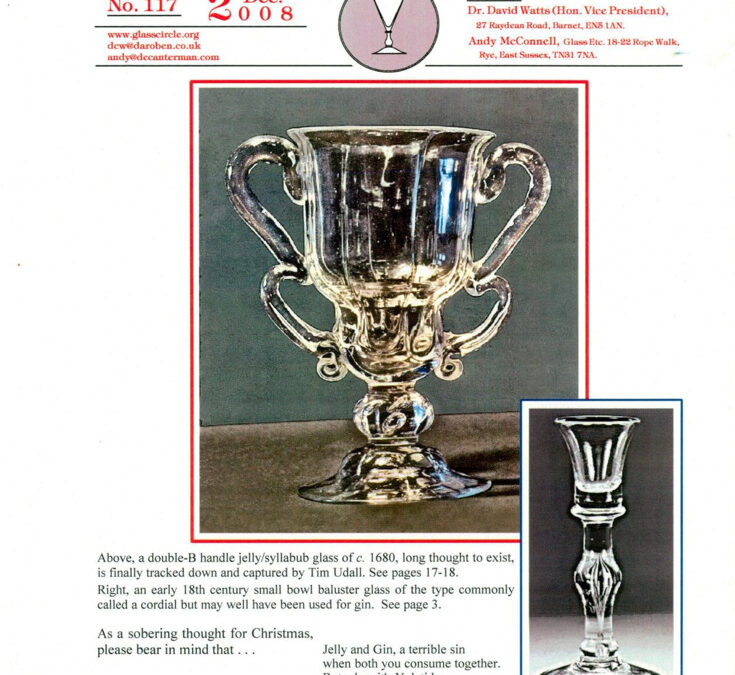
Above, a double-B handle jelly/syllabub glass of
c.
1680, long thought to exist,
is finally tracked down and captured by Tim Udall. See pages 17-18.
Right, an early 18th century small bowl baluster glass of the type commonly
called a cordial but may well have been used for gin. See page 3.
As a sobering thought for Christmas,
please bear in mind that . . .
Jelly and Gin, a terrible sin
when both you consume together.
But when it’s Yuletide
your embarrassment hide.
Just say that it’s due to the weather.
also in this issue …
Czech trip, pages 2 and 9
A large Pineapple Glass, page 10
Report on “Shift” exhibition, page 12
Silver decorated glass, page 13
Fatamid rock crystal ewer, page 16
Bonham’s Knowle sale, page 17
… and all our usual features
a
That bowl again! Do you think we could
get it past security if we filled it with
porage?
Conversation stoppers – a korunna (crown) for their thoughts – the
viewers, that is!
Bowl with
three ants performing
ant-ics round the rim.
Demonstration of wheel engraving.
Watch carefully – your turn next.
… and if you could chose one disc for your stay on
a desert island which would it be?
GLASS CIRCLE NEWS No. 117, 2008
Images from the Glass Circle’s Czech
Republic trip in September 2008
Here we have a new use for the Daily Mail (Czech edn.).
Pictures (and some of the captions)
courtesy of Derek Woolston.
. . . . The views expressed in Glass Circle News are those of its contributors . . . .
2
GLASS CIRCLE NEWS No. 117, 2008
Editorial
The Importance of Ritual
God moves in mysterious ways . . . A few days after I had
been reading the newly arrived
Glass of the Alchemists
I
found myself in a waiting room of my local hospital. Lying
on the next seat was a magazine called
Prediction,
proudly
bearing the added label “Property of the NHS”. Suppressing
the obvious political jibe, curiosity prevailed and I thumbed
through it to find a mixture of semi-serious articles and
occult meanderings.
One article, on the importance of ritual, seemed particularly
relevant to glass making. It pointed out the role of ritual in
focussing the mind and the production of introspective
thought, and, through these, the generation of confidence
backed by the envisaged support of an unknown external or
supernatural force. It has other aspects, of course, control of
the mind and the instillation of obedience to a particular set
of directives.
We can all think of examples but it is necessary to
appreciate that ritual, although important to the individual,
is not a feature of the related process that is subsequently
performed. It is distinct from, say,
preparing for take-off
or
washing up
for an operation. Although these may be
ritualistic in their own right they are part of the job in hand
and one would not be applied to the other. Ritual is
necessarily personal and independent of what follows. It is
essentially a prayer for protection before an adventure into
the unknown.
Nowhere is this more apparent than in the glassmaking of
the ancients as described in the cuneiform texts. Lighting
the fire of a newly installed furnace upon which one’s
livelihood depends always has been, and perhaps even with
today’s technology, always will be a crucial moment. The
relevant cuneiform translations were independently
published in 1925 almost simultaneously by Campbell-
Thompson in Cambridge (of which I have a copy) and
Zimmern in Germany. Before the fire was lit some form of
religious act was performed. Thompson, struggling more
than usual with this text, concluded that human foetuses,
from abortions or miscarriages, appeared to be sacrificed.
What Zimmern concluded I have never seen reported in
English, but in a 1970 translation by Axel von Saldern
human foetuses were dismissed in favour of a sheep.
However, I have since read that in those far-off days a place
was often set aside where unwanted human births could be
left to die and no questions asked. So a source of human
foetuses was not out of the question and perhaps Thompson
was not so far off the mark. As an authority his translations
extended into chemistry and medicine, well beyond glass-
making. Whether the
Kubu deities
so favoured, and who
were perhaps connected with the ritual of fire itself, ever
justified this attention we shall never know.
Von Saldern’s translation did not greatly improve our
chemical understanding of the glassmaking process at that
time, particularly with regard to the use of calcium as a
glass stabiliser, but, based on the extensive earlier work of
Zimmern, did rationalise our understanding of the
numerous fragments of which the tablets are composed.
Now we approach our own Christian festival. If you take
care with the decorations the only victim of an errant fire is
likely to be the Christmas dinner. But however you chose to
celebrate, by ritual or otherwise, may it be both fruitful and
bring success in 2009.
( Editorial Overflow on page 11.)
Here’s to a Tot of Gin!
by David Watts
Visits to American bookshops have convinced me that,
when it comes to choice of European history Britain wins
hands down. One volume with a glass interest that caught
my eye was
GIN, the much lamented death of Madam
Geneva: The eighteenth century gin craze.
by Patrick
Dillon.’ The word “gin” is an English corruption of the
word geneva (originally sometimes spelt “gineva”) and
refers to the berry used by the Dutch for flavouring, not to
the city in Switzerland of “Geneva Convention” fame.
Drinking gin in England dates back to the 1680s if not
earlier. Most of it was probably imported from Holland
where the practice was well established, although some was
distilled in England under licence. It was not at that time
popular with the masses. The “craze” began when William
of Orange, himself a heavy drinker, became William III,
King of England. One of his first acts was to remove the
prohibition on distilling, probably, it is thought, to
encourage trade with Holland. It also coincided with a new
Duty on beer. With the expulsion of James Stuart all things
French and Catholic were banned and that included brandy.
Hence, the earliest reference to gin in the OED is 1706.
Most affected was London; the few officially licensed
distillers rapidly found themselves in a losing market as
literally thousands of back-street stills sprung into action.
Two early baluster gin glasses of
c.
1720, that on the left
with a tiny bowl clearly for use in a back street gin parlour,
Ht 12 cm; That on the right, Ht. 12.1 cm, courtesy of
Christine Bridge Antiques, targeting the moneyed class
rather than the working
class.
The price fell to as little as an halfpenny a tot, although
“drunk for a penny, dead drunk for tuppence” became the
universal slogan, and a drink previously the perquisite of
the rich ultimately became the solace of millions.
Like drug addicts today the poor and outcast found it a
cheap form of escape from their misery and, like the addicts
of today, escape often became permanent. The reason was
3
n
•—•
n
.-4
1?
r
Three small bowl ‘cordial glasses’ spanning the first two thirds of the
18th century that might well have been used to serve gin.
GLASS CIRCLE NEWS No. 117, 2008
partly due to excess personal consumption and partly
to the poisonous nature of the spirit used, often made
with raw turpentine (distilled from the sap of pine
trees) and flavoured with anything cheap the amateur
distiller had to hand.
Such a popular drink, dispensed in small volumes to
a highly appreciative clientele required a special
container, and so the baluster gin glass was born
dating from as early as the 1720s. It soon degraded
into the more common light baluster version that
endured to around the middle of that century, if not
much later. This gin glass was surely the first ever
mass-produced glass for the working-class market in
England. They must have been made, and broken, by
the million. Above stairs the container was the glass
we affectionately like to call a “cordial”. The
desirability, and value, of a small wine glass is often
enhanced by this choice of terminology. The
capacities of the three gin glasses in my collection, in
spite of their varied shape, are exactly one
tablespoonful (20 ml) to just below the rim. When,
long ago, I proudly bought them as part of a (very
Ht. of the middle glass (from the Walter Smith collection) 17cm.
cheap) lot at a Sotheby sale a famous London dealer
crushingly remarked to me that they were “very pretty but
of no great consequence”!
The term “Madame Geneva” is taken from a 1736 text
entitled
An Elegy, On the much lamented Death, of the
“Young men should practice, sans intermission,
until they can drink four bottles without being
flustered, then they will be sober people, for it won’t
be easy to make them tipsy, a drunken man I
abominate!!!”
Undated early cartoon reprinted in a
Wine Mine
catalogue.
Most Excellent, The Most Truly-Beloved, and Universally-
Admired Lady, Madam Geneva,
the author being
represented by a skull and crossbones! It reflected the fact
that the government was beginning to take seriously the
economic problem posed by the craze. The moneyed class
found that they were either losing their working class
servants or that their competence to perform was being
severely impaired. But worse, from a government point of
view, was that this massive new home-based industry was
providing no income for a country cash-strapped by endless
wars. How different from today’s government concern
about the detrimental effect of the “Happy Hour”!
The end of Madam Geneva was premature in 1736 but it
did foretell the wind of change. It was partly the result of
abstinence campaigner, Dr. Stephen Hales; when he began
his drive in 1734 an estimated five million gallons of raw
spirit was being distilled in London every year for a
population of less than 700,000.
Although London was the focus of attention it was
probably little better further afield, particularly the nation’s
ports. At Poole, Dorset, for example, in 1736 the Widow
Simmonds was accused of keeping
a disorderly house,
being the general rendezvous for alle Travellers and
Vaggabonds;
in 1738 a
widow
was prosecuted
for selling
Geneva and other spirituous liquors in her house without a
license.
There are many more examples; it does seem to
have become a popular source of income for widows.’
In all, some six government Acts were required to bring the
problem under control and, even then it was not the
government that delivered the final blow. The first Act had
been passed in 1729, partly in response to criticisms of
London’s morality by the newly crowned King George II
and his demand for a substantial increase in payment to
support his Civil List. First minister, Sir Robert Walpole,
his post under threat, responded with the imposition of a
swingeing annual licence of £20 on all retail gin sellers plus
a 5-shillings tax on every gallon of gin-like material
distilled, to be payable by the compounders. Walpole’s Act
4
Number of Old Bailey trials mentioning gin in the transcript
•
.
•
.
• •
.
.
•
.
.
.•
.
.
1660
1680
1700
1720
1740
1760
1780
1800
1820
1840
Date 1670-1830
N
u
m
ber
o
f ca
ses
600
500
400
300
200
100
0
Graph showing how the number of gin-related crimes increased after William of
Orange came to the throne although perhaps Queen Anne, William’s sister-in-
law (1702-1714), should bear some of the blame! All of the cases relate to larceny,
murder and similar criminal activities in which gin is involved but unconnected
with direct breaches of the Excise Acts. The data are compiled by the author
from transcripts of Old Bailey trials published on the web.
GLASS CIRCLE NEWS No. 117, 2008
should have stopped the problem in its
tracks but it was ill-judged. The charges
imposed were as much as most could
expect to earn in a year. Consequently,
the Act was virtually dead when it
reached the statute book. An army of
Excise Officers could not track down
more than a fraction of the stills;
specially implemented courts could not
cope with the work load and the
criminals, if found guilty, could rarely
pay the fine. Distilling and drinking,
perhaps a little more discrete at first,
continued as before, much to the disgust
and irritation of Dr. Stephen Hales.
There was a further problem in that the
large distilleries created a commercial
outlet for poor quality corn, largely
unsuitable for any other purpose. Hence
both farmers, who had been suffering
from bouts of bad weather, and the
official distilleries soon became
disenchanted with the Act. The 5-
shillings tax was abandoned in 1732.
The 1736 session of parliament opened with the daunting
news that there were now 7,022 gin sellers in Middlesex
alone without including “street hawkers and old ladies in
atticks”. Act no. 2 was the brainchild of Master of the Rolls,
Sir Joseph Jeckel and amounted to an attempt at prohibition
by taxation.
3
Its key feature was to impose a duty of 20s. per
gallon on gin sold in small quantities plus a £50 retail
licence. Penalties were £100 for an unlicensed premises and
£10 for a hawker, the penalty being imposed under widely
drawn conditions. It was a case of close-up, pay-up or two
months hard labour. Many MPs were fearful of the
outcome, anticipating riots. Jacobites exploded a small
bomb in parliament, further to exploit unrest already at
fever pitch by a shortage of work caused by cheap
immigrant Irish labour being used to replace British
workers (does that sound familiar?). Sir Robert was worried
about the potential loss of revenue to the treasury from the
previous act that was now bringing in a modest income. A
mutiny for free gin for the working classes hung in the air.
The army was mobilised just in case!
The day for implementing the 1736 Act arrived and . . .
nothing happened. A heavy military presence sat idle.
Jacobites did not rebel. The inventive Londoners were too
busy exploiting loopholes in the law. Collectives purchased
gin in quantity and the precious liquid retailed under a host
of new names. The Excise was left to play catch-up.
Jeckel died in 1738. By 1741/2 only two £50 licences had
been taken out while spirit production now exceeded eight
million gallons a year for a population of under a million.
Walpole was ousted in 1742 by John Cateret while more
wars in support of Maria Theresa in Austria had required
more revenue fast, in particular to pay Hanoverian troops in
Flanders. Act no. 3 of 1743 recognised the seemingly
inevitable. The duty on low wines made from corn was
doubled to 2d. while that for spirits was set at 6d. The retail
licence was reduced to £1 but more strictly regulated in
anticipation that the victuallers would now pay it. The hope
was that this act would really work, albeit to the dismay of
the reformers. An annual income of £120,000 was
anticipated. Lord Bathurst described it as “An experiment
in pragmatism.” It was “a pact with the devil.” The need for
a glass for gin remained as strong as ever.
In 1746 Henry Pelham replaced Cataret and Act no. 4
increased the duties to 3d. and 7
1
/2d for corn wine and
spirits respectively. Gratifyingly, spirit production had
fallen by 19%. A year later a new licence of £5 was offered
to spirit distillers in London that enabled them to establish
their own retail outlets. The offer was avidly taken up; the
number of licenses issued rose from 600 to 5297 in five
years. It helped fill the government coffers but did not solve
the problem of the gin craze.
A 1740s/50s crime wave in London caused by soldiers
returning from the wars was attributed to a taste for gin
acquired on active service, but this does not show up in the
Table above. So was an earthquake in 1750 after a long hot
summer. Horace Walpole complained “the earthquake
which has done no hurt, in a country where no earthquake
ever did any, is sent, according to the Bishop, to punish
bawdy books, gaming, drinking etc.” Nevertheless, 10,000
printed copies of a sermon, by the Bishop of London, were
sold in two days. Doomsday was fixed for April 8; terrified
Londoners took to the surrounding fields; but the call never
came and “the lewdness and debauchery that prevailed
among the lowest people” went unpunished. Madam
Geneva had prevailed and if the Bishop had taken a
calculated gamble with his sermon influencing the morality
of the masses it had not succeeded.
When we hear of reports of today’s drunkenness among
more affluent groups of those whom we assume ought to
know better the question arises whether this 18th century
account of the gin craze is an over exaggeration? Might not
London look much the same when viewed 200 years from
now?
5
4
11
411111163
.01111r:…—
,
awl
1
.
11’111111
:
1!
\
111
4.6
:1
,
Z
I!,,tt
Cartoon of a gin parlour depicting in this detail five light baluster-style gin
glasses, one wine glass and a beer tankard; square gin bottle on the shelf.
Plate I from
The Drunkard’s Children,
by George Cruikshank (1848).
LASS CIRCLE NEWS No. 117, 2008
In October 1748, Henry Fielding (prolific
critic and author of Tom Jones, 1749) took
his oaths to become a magistrate and in
May 1749 was elected Chair of the
Westminster Quarter Sessions. From his
daily vantage point of facing criminals he
produced a tract of which a whole section
was dedicated to drunkenness. “The
drunkenness I here intend,” he wrote, “is
that acquired by the strongest intoxication
liquors, and particularly by that poison
called gin. . . Wretches are often brought
before me, charged with theft and robbery,
whom I am forced to confine before they
are in a condition to be examined; and
when they have afterwards become sober, I
have plainly perceived . . . that gin alone
was the cause of the transgression. Should
the drinking of this poison be continued in
its present height during the next 20 years there will be by
that time few of the common people left to drink it.”
It was estimated that since 1724 some 85,000 children had
died as the result of gin drinking although the significance
of this statistic is difficult to assess in the context of the
high child mortality rate of the time — nearly a quarter of all
children died in the first year of birth. The drink problem,
much as today, became a major topic of discussion among
their betters and, like today, their betters had no solution to
the problem that progressed beyond those that had gone
before. Nevertheless, change was in the air. Fielding had
influential friends. One of them, Thomas Wilson, an
advocate of prohibition, observed that “the government will
never, `tis feared prohibit it (gin) in earnest while it brings
in so prodigious a revenue, upwards of £200,000 a year.”
His solution was to link gin with crime and so make the
government aware of the downside of its policies.
Square gin bottle
in
opaque white glass cased in orange
brown with a clear glass pincered claw handle. For use in
the home. Probably not English manufacture.
Polished out pontil. 19th century. Ht. 17.5 cm
Another close friend was William Hogarth and his pair of
prints produced within months of Fielding’s publication,
Beer Street
with the relative merits of drinking brewed ale
and
Gin Lane
depicting the degradation and destruction of
all humanity. The latter, in particular, provided a visual
message that has reverberated through society up to the
present day. About the same time the Bishop of Worcester
proved more effective than his London counterpart with
sermons that “described in graphic detail the damage gin-
drinking was doing to the nation’s moral balance sheet.”
In 1751, the year that the Julian calendar was scrapped,
parliament, flooded with reports and complaints, opened
with a strong focus on the prevention of crime and the
causative role of gin drinking. A committee of MPs
favoured a return to prohibition but the question of
government income still prevailed. Terrifying statistics
became the order of the day. “City of London officials
testified that one house in fifteen in the City was a gin-
shop.” The Constable of Holborn claimed that “7066 gin-
shops in his division amounted to almost one house in five”
while in the ward of St. Giles the number could be
increased to one in four.
A desire for the introduction of punitive tariffs might have
prevailed had not the Frederick, Prince of Wales, died
suddenly from a burst abscess caused by being struck by a
tennis ball. When the news broke Prime Minister, Henry
Pelham was speaking against a motion that he would
probably have lost; now he was able to gain a month’s
adjournment in respect of the funeral. When the
government reconvened, as a result of political lobbying
during the recession, the initial proposal to raise the duty to
two shillings a gallon was reduced to one shilling – an
increase of only fourpence halfpenny.
But stronger action was to follow; the retail license was
doubled to £2 and issued only to inns, alehouses and
taverns; grocers and chandlers were specifically prohibited
and fines increased for all unlicensed premises. Unlike the
earlier Acts this attack on the supply chain was beginning
to restrict the availability of gin at its source. In 1752, gin
production in London dropped to below 4.5 million gallons
for the first time in 20 years although the volume of gin per
person was still prodigious.’ Change was, at last, under
way.
6
Ratafia,
mid 18th century,
containing the same volume
of liquid as in the glasses
opposite. Ht. 19cm
GLASS CIRCLE NEWS No. 117, 2008
Prohibitionists continued their propaganda but more
dramatic events were to finally resolve the problem — and it
was nothing to do with the government! In 1757, Mother
Nature, whose abundance of warm summers had
underpinned the gin industry for so long, suddenly withdrew
her support — the harvest failed. Exports of grain and malt
The capacities of a gin glass and a deceptive glass
compared. Both glasses contain exactly the same volume of
liquid.
Ht. of both glasses 12 cm. That on the right, 19th century.
were banned as was the making of wine and spirits from all
sorts of grain. The distillers lobbied against it but the
possibility of a starving mob in revolt weighed more heavily
with the government, particularly when the harvest failed
again the following year and again in 1759. A small amount
of gin was made from imported molasses but the supply
chain underpinning the addiction was broken. But alcohol in
some form remained a prerequisite. The working classes,
with no other option, now turned to porter as the drink of
choice.
In March, 1760, following an improvement in the harvest, a
bill was introduced to restore distilled corn drinks with
increased duties, but it was voted down by the City by the
margin of one vote. John Cataret’s “Pact with the Devil” of
1743 had at last been overturned; Porter at threepence
halfpenny a pint was cheaper than gin and became the drink
of the nation. It proved a good alternative as the
consumption of unboiled water less than a century later led
to the typhoid epidemic that took some fifty years to
understand and eradicate.
4
That might be thought to have been the end of the matter but
in the early 19th century Madam Geneva sprang Phoenix-
like from her grave and reached such proportions, as
indicated by my table, that cartoonist, George Cruikshank
(b. Sept. 1792), whose father had died of drink, took up his
pen following an earlier successful series,
The Bottle
to
produce a sequel,
The Drunkard’s Children.
It charts the
disastrous effect of alcohol with a series of eight cartoons.
The detail shown here is from plate 1 (1848) depicting a
scene in a tavern or gin shop in which five typical bell bowl
gin glasses can be seen. Not all the customers are drinking
gin but this illustration is the calm before the storm and
much worse follows in later plates.
Cruikshank’s depiction of the
glasses as being like light
balusters appears accurate
supporting the view that they
had a long life. Perhaps it was
about this time that a new
style of gin glass appeared,
designed for much heavier
use. This style – a deceptive as
shown below – has affinities
with what are called toasting
glasses but, in my view, there
are far too many of them
around for that. However, as
the cartoon (page 4) suggests,
the ability to hold one’s drink
was a source of personal pride
in one’s manhood. Such a
vessel in a well-to-do
domestic environment would
only be used by a wimp or,
perhaps, the ladies.
How this matter of excessive
gin drinking was finally
resolved, if ever it was, takes
us far beyond the limit of this
article. But if you own just one of these little gin glasses
you might like to ponder on whether they really are “very
pretty but of no great consequence”!
Notes.
1.
Published in America by Justin Charles &Co., Boston,
2002, 334 pages, at $14.99 (available from Amazon for
£6.96), is the main source of the material for this article.
2.
Beamish D, Dockerill J, and Hillier J. 1974.
The Pride of
Poole 1688-1851.
Published by the Borough and
County of the Town of Poole, p. 23.
3.
This prohibition probably soon passed. There is
reference to a “two-penny glass of brandy” in the
transcript of the Old Baily trial of David Morgan and
William Dupuy accused of theft with violence: highway
robbery, 6th May, 1761. The Proceedings of the Old
Bailey Ref: t17610506-15. It is probable that the same
glasses were used as were used for gin.
4.
Brewed drinks, such as ale and porter, being boiled,
protected the populace from typhoid that reached
epidemic proportions in the mid-19
th
century when
water, unknowingly contaminated by raw sewage, was
drunk in new beverages such as lemonade.
5.
The population of London: 1700, 550K; 1750, 700K;
1801, 959,300(1st census); 1831, 1,655,000. (Data from
Wikepedia.org).
6.
The transcripts of the Old Bailey trials, 1720-1830,
frequently refer to a
dram
or a
quartern
of gin being
ordered. Properly measured, these are one eighth and
one quarter of a fluid ounce (a fluid ounce is approx. 30
ml) respectively. A glass would be desirable for the
customer to assess the accuracy of such small measures.
Commonly, gin was ordered with beer and was probably
drunk in the tradition of a
whisky and chaser,
popular to
this day with those determined to get drunk.
*
7
GLASS CIRCLE NEWS No. 117, 2008
GLASS CIRCLE MATTERS
Chairman’s Letter
Since my last letter and my visit to Memphis I continue to
travel.
I have been to Florence where, in the Bargello museum,
really a sculpture museum, they have one wonderful
showcase of glass, rather eccentrically labelled, which
includes a rare late 17th or early 18th century glass,
probably English, with a serpentine stem and moulded
bowl. Ths glass is labelled facon anglaise’, made in
Murano (see picture on page 11).
I have been to Dubai where the museum has absolutely no
glass whatsoever, however in nearby Doha, Qatar, a new
`Museum of Islamic Art’, designed by I, M. Pel, has just
opened. This museum has been acquiring the very best of
Islamic glass over the past two decades, but the glass may
not yet be on show.
I have been to Paris to see ‘CENT VERRES FRANCAIS
1550-1750 Treasures from private collections’, an
exhibition, which ran from 13th to 26th October, of one
hundred exceptional French glasses from the mid-16th
century to the beginning of the 18th century. A catalogue
raisonne in French presenting the pieces shown was
published for the exhibition. The exhibition was curated by
Sylvie Lhermite-King. The catalogue may be obtained from
sylvielhermite.expert@wanadoo.fr
I have been to the Czech Republic with another group; we
learnt from the first trip and this was even more enjoyable.
See more pictures in colour on our Glass Circle web site.
Next year, in October, I am planning a trip to Paris for
around 25 people where we have already been promised
special access to various museums and collections.
At our meeting in November we discussed how little
contemporary material there is on British glass over the
time-scale 1675-1750. There are very, very, few paintings
showing glass, unlike Dutch still-lives, no pattern books
and a few rather stylized trade cards. Should anyone come
across bills of the period with glass interest in old archives
on in County Records Offices, or any passing references to
glass in the literature and memoirs of the period, please let
our editor know and we will publish whatever is found.
Anything related to what we now call ‘baluster’ glasses
would be particularly appreciated.
Our December meeting will be about such information
as.Julia Poole, of the Fitzwilliam Museum, Cambridge will
be speaking on ‘Glass Purchased for the Household of the
4th Duke of Bedford 1732-71’ This will be based on her
exhaustive study of the Woburn Archives.
Finally, The Corning Museum of Glass have just
purchased, at Sotheby’s in London,(Lot 178, 8th October,
Islamic World sale) a spittoon, described as ‘Indian’,
crizzled and with a ravenshead seal! The Corning
collection is not long on Glass spittoons, nor is their library
full of references to these objects in glass. If anyone has
any information on glass spittoons please lets me know at
johnpsmi@globalnet.co.uk and I will pass it on.
John Smith
Deaths
Dr. Patricia Lesley Baker
In the last GC News we reported on
the death from cancer of Dr. Patrica
(Paddy) Baker promising more
information in the next, this, issue. To
our embarrassment, in spite of being
well known and much liked, little of
her background has emerged. A
member of the Circle from 1982, and
later The Glass Association, her main interest was the
History of Art in which she held a Doctorate. Her focus,
although broad, showed a special bias towards glass,
notably contemporary studio glass and early glass. The
latter was possibly connected with her acting as courier for
travel holidays to the Middle East during the summer
months. In 2001 at a conference held by the AHG at the
V&A entitled
SURPASSING THE PAST:• Historicism in
19th century Glass examining the retrospective,
inspirational sources of glass design,
she contributed a
lecture on
Orientalism.
Paddy also published one book,
Islam and the Religious Arts
(2003, 288 pages).
Way back, Paddy wrote one article for GC News relating to
contemporary glass; for six years, until 2005, she acted as
Editor for the Glass Association’s
Cone.
D.C.W.
Ruth Hurst Vose
We have also just learned of the death of Ruth Hurst Vose.
Ruth became known as director of the excavation of the
important early 17
th
century Haughton Green glasshouse at
Denton, near Manchester. At the time she was Assistant
curator of the Pilkington Glass Museum at St Helens.
Excavations began there in 1969 after being alerted by a
local historian, and continued in 1970. The furnace finds
were interpreted as showing the change from wood to coal
firing, a large flue being introduced to carry extra air to the
furnace. Blue glass coloured with cobalt and black glass
coloured with sulphur were also unusual features of the
glasshouse products. It was probably this work that inspired
Ruth to write her very successful
Glass
(Connoisseur
Guides, 1975). It ran into several reprints. In another
publication
Glass in Antiquity,
1980 she felt able to claim
that
the Jews played an active part in the development of
the Syrian glass industry are no more conjunctive. We
know it from literature, from historical documents and
above all, from finds of glass in Palestine.
The Jewish
involvement, much lauded by Anita Engle, had been
largely overlooked at that time, as it perhaps still is today.
Sadly, Ruth suffered severely throughout her life from
agoraphobia – panic attacks caused by an unnatural fear of
some feature of her surroundings. Robert Charleston tried
to persuade her to come and lecture to the Circle on several
occasions but without success. Her illness led her to write
two books on the subject, a hardback
Torture Chamber
(352 pages) and a paperback,
Agoraphobia,
both published
in 1986. This was followed by another paperback of local
interest
Ormskirk Town and Country Trails,
1987.
Her writings survive as an epitaph linking important events
in archaeology with her debilitating illness but for which
she surely would have progressed so much further.
D.C.W
8
GLASS CIRCLE NEWS No. 117, 2008
Glass Circle Trip: Czech Republic
14th-19th May, 2008.
BURSARY REPORT: Sonia Solicari,
Curator, Ceramics & Glass, V&A Museum.
Personal background
I have been the curator of nineteenth-century Ceramics and
Glass at the Victoria & Albert Museum since September
2006. Having transferred from the paintings collection at
the V&A my new role has presented fresh challenges in the
development of subject knowledge. I therefore welcomed
the opportunity to attend a Glass Circle trip alongside so
many renowned experts and enthusiasts and relished the
chance to concentrate on glass objects and history away
from the distractions of museum life!
Scope of trip
Not only did the trip bring into focus the stylistic output of
a prolific glass-making region but, over the four days of
visits, a plethora of techniques and working practices were
covered, from the pressed glass of Desna and local cottage
industry bead workshops to the cut glass at Kamenisky
Senov museum and the wonderful painted glassware at
Novy Bor. The range of sites visited has provided me with
an excellent overview of Czech glass and has revealed
many a research avenue that I hope to pursue.
People
The benefits of visiting museum collections and factories
with individuals who approach glass in myriad ways
(collecting, dealing, creating, and curating) cannot be
underestimated. An explanation of puzzling techniques or
styles was never far away and I was fortunate enough to
have many rewarding discussions on shared points of
interest as well as hearing about areas of glass of which I
had very little previous knowledge or experience. It was
especially advantageous to meet members of both the Glass
Circle and the Glass Association and so gain more of an
insight into the activities of each group.
Many of the people that we met on our journey were
particularly helpful and keen to share their expertise. Dr.
Stefania Zelasko, curator at the Muzeum Karkonoskie at
Jelenia Gora, Poland conducted an inspiring tour of the
collections there and enthused many of us with her account
of the extensive work she has undertaken on the Josephine
glassworks.
At Harrach, in addition to a lively tour from the son of the
current owner of the glassworks, we had the good fortune
to meet independent glass researcher Deborah Truitt, a
specialist in Bohemian glass, who is currently undertaking
research into the Harrach archives and examining export
activities. Deborah’s research will be particularly valuable
when completed as it will cover previously neglected
documents and will incorporate a project to photograph
every page of disintegrating archival material for the future
benefit of us all.
Last but not least, the knowledge of our local tour guide
Christa Petraskova concerning the region’s glassmaking
heritage greatly enriched the visits and placed the glass
within a broader historical framework.
Highlights
For me, the most enlightening part of the trip was the
historic collection at the Harrach glassworks where many
of the exhibits were, on first examination at least,
disconcertingly indistinguishable from pieces produced in
England or France. I hadn’t before appreciated the diversity
of the Harrach output which encompassed all the major
glass trends of the nineteenth century, from satin glass to
`art-glass’ pieces in the style of Jean Auguste. The cutting
workshop at Harrach was particularly interesting –
unchanged since the nineteenth century and powered by
water turbines.
I also very much enjoyed the stunning collection of beads
and costume jewellery at the Jablonec Glass Museum. It
was unquestionably the best display of this kind of material
that I have seen and has motivated me to delve deeper, from
a glass perspective, into the comparatively modest costume
jewellery collection at the V&A.
My favourite glass object of the trip was at the Muzeum
Karkonoskie at Jelenia Gora, Poland: a cup and saucer by
Joseph Reidel, c.1850 crystal glass, cut, with gold and
platinum foil encased and painted in black enamel
(Zelasko, Stefania, European Glass at the Muzeum
Karkonoskie in Jelenia Gora (Jelenia Gora: Muzeum
Karkonoskie, 2006), p.36.
Thank you
I would like to take this opportunity to thank the Glass
Circle for a most informative and enjoyable trip. I have met
so many inspiring people, many of whom I hope to remain
in contact with for the exchange of glass information.
I
would particularly like to thank John Smith for his tireless
organisation of an exciting and packed itinerary and for his
words of encouragement and imparting of wisdom. 4:
Two important glass sales
at Bonhams, London.
Both on December 17th, 2008
10.30 am. The James Hall Collection of English
Glass.
With 208 lots of exceptional quality including
30 lots of 17th century goblets and 55 lots of baluster
glasses.
2.30 pm. Fine British and European Glass and
Paperweights.
With 311 lots from important
collections and 62 mainly French paperweights.
Viewing
Sun. Dec. 14th. 1 lam-3pm; Mon. 15th. 9am-
7.30pm; Tues. 16th. 9.30am-4.30pm.
9
GLASS CIRCLE NEWS No. 117, 2008
cC
olitiploi,
Rio
itiocetioo-ites. t
t
0T.
esi:Peivi lE
ct6
The Royal Collection has a well known, but unattributed, oil painting, of
c.1675, entitled
“Charles II receiving a pine apple”;
this shews the King
being offered, in the gardens of Hampton Court Palace, a pineapple held by a
kneeling gardener. It used to be said that this represented the first pineapple
to be grown in Britain, but the pundits now say that it was too early for this
to have been grown in this country, and that it must have been imported from
the West Indies. Indeed, a few years previously, in 1668 John Evelyn’s diary
records that whilst he waited upon the King at a banquet held for the French
Ambassador, his Majesty offered him a taste of a pineapple from his own
plate. Evelyn was not especially impressed with its taste!
About ninety years after these events an account book in the Traquair House
archives records a purchase, in 1763, by the Countess of Traquair of:
“A
Large crystal glass to hold a pineapple”.
Unfortunately the actual Glass
Seller’s Bill has not survived in the archive, but in the same year a Bill that
has survived, from Thos. Trotter & Son of Edinburgh to the Earl of Traquair,
details amongst other groceries:
“a Preserv
d
Pine Apple – 4 shillings”.
The
`Large crystal Glass’ no longer exists, and until lately one knew of no C.18′
h
dessert glass that particularly suited a pineapple, although a number of silver
or porcelain vessels with pineapple decoration and which can conveniently
hold a whole pineapple do survive. But recently I was telephoned by a fellow
collector to say that a monster
‘Middle or Top Glass’,
7’A inches high,
weighing 1Lb. 13oz. and with a rim diameter of approaching 5 inches, held a
pineapple very comfortably (picture right). It has a faceted inverted baluster
stem placed on a beaded knop, with the bowl decorated with shallow slice
cutting and an out-turned rim that has been scalloped, whilst the foot rim has
been cut into an octagonal shape; it is claimed to date from the second
quarter of the C.18`
h
. The subsequent arrival of a photograph illustrated how
admirably this glass holds a pineapple. Perhaps the emergence of this glass
will provoke information about other surviving glasses that may have started
life as
‘A large crystal glass to hold a pineapple’.
My records of Glass Sellers’ bills make it quite clear
that in the mid C.18
th
dessert glassware commanded
double the price per pound weight that drinking
glasses realised, and that this Pineapple Glass would
not have cost less than 2 shillings per lb, and probably
rather more. Furthermore, the cutting is fairly
elaborate, and glassware designated as
‘cut’
or
fine
cut’
frequently doubled or trebled the price of a plain
glass. Thus, this Pineapple Glass must have cost at
least four shillings, and could well have attained as
much as the
“Middle Glass fine Cutt @ 12 shillings”
bought by the Duke of Argyll in 1754, or even the
“Scollop’d Middle glass @ 15 shillings”
bought by
the Earl of Egremont in 1761 from Maydwell &
Windle, with an identically described glass bought
from the same supplier two years later by the Earl of
Dumfries, at the same price. These prices compare
with the 6d. paid for ‘standard’ wine glasses at that
time, and represent up to three weeks wages for a day-
labourer; this Pineapple Glass was a luxurious article
of conspicuous expenditure, very probably bought by
a member of the aristocracy. One does feel some
uncertainty about the claimed date, and suggests that
from the evidence of the Glass Sellers Bills a date in
the third quarter of the C.18
th
is just as probable as in
the second quarter; but this is a subjective matter, and
there is little hard evidence one way or the other.
Dessert glass supplied to the top end of the market
provides examples of both the cheapest and the most
expensive table glass in the mid C.18
±
. Plain jellies
that one has recorded between 1725 and 1775 amount
to almost 350, with an average cost of only 4’Ad. each.
Often these were used for preserving fruit or for
savoury jellies; many of the recipes for preserving, or
for custards and jellies, in Elizabeth Raffald’s
‘The
Experienced English Housekeeper’
of 1769, conclude
with the instruction:
“then put it into your glasses, tie
them down with brandy papers and keep them for
use.”
This is why so many simple jelly glasses have
an everted rim. However, cut or scolloped jelly
glasses were much more expensive, at up to 3
shillings and sixpence each; these would not have
been used for storage, but for immediate serving. *
10
GLASS CIRCLE NEWS No. 117, 2008
Editorial Overflow
Glasses for the People
It was while I was putting the finishing touches to my
article on gin that the book on Disaster Glasses (page 15)
arrived unannounced on my door mat.
Dealers naturally focus on those glasses which are most
elegant and most profitable. They like to be able to present
a story behind each piece and engraving can provide such
an opportunity. Disaster glasses and similar
commemoratives depend on the engraving as the glass
itself is usually of the cheapest kind. Rarely is a gin glass
engraved unless one included those defined as cordials. Yet
these simple glasses frequently tell us more about the lives
of the ordinary people than their much more expensive
counterparts do about those who can afford them.
As such they should be revered not for their commercial
value but for their importance in the history of our people.
It is a great pity that the tradition of recording these events
on glass is no longer part of our heritage.
Holiday Insurance.
I feel sure that many members,have taken out insurance as a
form of holiday protection. I have done this regularly for
several years although it gets considerably more expensive
as you progress beyond the 65 year old barrier. Hitherto,
nothing had happened to justify a claim but this year,
en
route
for Corning, the Airline mislaid my hold baggage
between Boston and Elmira, the local airport for Corning.
The Airline quickly provided a claim form after, upon
arrival, I had got over the initial distress of the carousel
going round without my bag on it. But to fill it in I had to
provide not just a list of the contents but also the date when
each was bought and where, and backed up by a bill of sale.
This, of course, could be done after I had gone home but
there was nothing for which I could remember having
saved the bill or even where most of the items had been
bought. And that included my quite expensive trolly bag.
No better was the statement that no electrical items were
covered. Altogether the loss amounted to well over £500. I
could not see my way to claiming for any of it! But worse, I
had stupidly packed my daily medication in the bag and
quickly discovered that, unlike the UK, in the USA it is not
possible to scrounge a few emergency tablets from a
pharmacy. Fortunately, Jane Spillman came potentially to
my rescue by arranging for me to see the Museum’s resident
doctor to get a prescription.
I was almost on my way to the surgery when the missing
luggage suddenly turned up. It carried a sticker saying
“Cleared by Home Security”.
Whether this was the cause of
the delay I shall never know but there are some obvious
lessons. If you care, pack into your hold luggage only items
for which you can specifically account and carry all
essential medicines and electrical goods etc. in your cabin
bag. It didn’t ruin an otherwise excellent trip but it could
have come mighty close. *
Right. The mid 18th century 6-branch chandelier (now
converted for electricity) from The National Trust
property, Newhailes, a house near Edinburgh with origins
dating to the late 17th century, discussed by Peter Lole in
Limpids in GC News 116.
Martin Mortimer comments on this chandelier that whilst
the main stem shows its genuine origins, the arms are
modern and the plate from which the arms spring has been
badly modified. F.P.L.
Photo courtesy of the National Trust for Scotland.
Above. Glass in the Bargello museum, Florence (see
Chairman’s Letter p. 8), labelled
`bcon anglaise; made in
Murano
but with all the appearance of being lead glass and
more probably made in England in the early years after the
problem with crizzling had been solved. Other lead glasses
of this form are known. Such styles faded out towards the
end of the 17th century as the glassmakers established
English styles more appropriate to the heavy metal.
It is annoying that many continental curators seem unable
to check the substance of their glasses with a UV lamp. (ed).
11
Poppy form by Stephen Beardsell
Fertile landscape by Max Jacquard
20th century form by Richard
William Wheater.
GLASS CIRCLE NEWS No. 117, 2008
SHIFT –
Stretching the Medium:
a Celebration of Kiln-Formed Glass
Just Glass
hosted this exhibition of contemporary glass at London
Glassblowing from 20 September to 10 October 2008. This is a group
of South London artists which set itself up as a group of established and
emerging glass artists in 2003. The opening was timed to coincide with
Peter Layton’s annual seminar in the Leathermarket which took the
same title. The seminar speakers exhibited alongside 27 other artists
expanding the kiln-forming range.
As is customary at these annual seminars, Peter opened the day by
challenging the audience with the question: ‘Is it possible for a piece of
glass to be truly sublime?’
Look now by Angela Thwaites
Angela Thwaites took a general approach by describing the changes in glass-making
she has witnessed. In a week where Damien Hirst had sold art for £111 million while
banks and insurance companies were going bust, it wasn’t surprising that sands were
shifting under our feet. Perhaps our very survival is challenged and we will need to
exploit wind-turbines, microwave kilns, cold-bonding and other energy-saving
solutions. A possible corollary of this is a shift away from the grandeur of technique.
This was visible in entries to the Biennale which had used glass with found objects,
sealing-wax, textiles, video and ceramics.
Stephen Beardsell described how he had shifted from being a painter to being
painterly with glass, and was disarmingly open about details of his technique for
making his sandcast poppyfield series. He showed his process in some detail and
gave temperature and annealing details to a wrapt audience.
Matthew Durran took up the theme of
sustainability, showing work created out of
recycled glass. After showing us a short film
about the glass crystal factory in Russia
celebrating 250 years of mass production, he
moved on to his installation made from 100 small
pieces of Whitefriars window glass removed from St Martin’s in the Fields as part of a
renewal project in the church ‘breathing new life into old crystal panes’.
Richard Wheater, who works in neon, touched on Peter’s question by quoting from
Shaw: ‘You use a mirror to see your face, and a work of art to see your soul.’ He spoke
about using glass in a performance context and expanding its range by looking for new
responses from different audiences.
Max Jacquard continued the philosophical mood by showing slides of glass from the 60s
onwards and illustrating how difficult it could
sometimes be to guess what era a piece came
from and trying to formulate what made them
works of art. Our generation’s way of stretching
the medium, he felt, was in architectural glass.
Finally, he came up with an answer to Peter
Layton’s question: ‘Work with who you are and what you can do — combining
craftsmanship, narrative and design with integrity can achieve the sublime.’
The seminar then moved to the Glass Art Gallery for the opening of the exhibition
in which the medium was stretched in further directions. Some personal favourites
(and of course this has to be subjective) were 2008 Biennale winning Tracy
Nicholls’ ambiguous Orphica pieces, Diana Dias-Leao’s astonishing glass corset
dresses, Jane Webb’s art derived from science, Su Herbert’s disturbing cages,
Wendy Neuhofer’s alchemical fusions, and Tania Porter’s enigmatic vision of what
a pear is. The exhibition was not of a universally original standard, but there was
plenty for the collector to admire and sales — as the economy spiralled down — were
good. As the pundits have been saying, now is the time to buy art.
(See the pictures in colour on our web
site.)
Jane Dorner
12
Silver decorated bottle and glass
by Biagiotti and Quercioli of
Ciesto Fiorentino.
GLASS CIRCLE NEWS No. 117, 2008
Silver-Decorated Glass – How did they do that?
Cold glass, as we all know, is a good insulator and does not conduct electricity. Yet
there is a large group of decorative glassware that has clearly been plated with silver
or some other shiny metal, such as palladium or chrome, to provide an unusual and
pleasant form of ornamentation.
Most of this glass seems to date back to between the wars, or just after, and its rather
lightweight quality seems to suggest a predominantly Italian source. This origin, in a
group of factories near Florence, is supported by a small promotional booklet
–
Italian Glass
(1955) published by the Italian Institute for Foreign Trade. Examples
of the items illustrated are reproduced here.
How this plating process was achieved is, or was, a matter of speculation but
presumably involved some way of making the surface of the glass conductive. The
technology had a distinctively 20th century ring about it. It came as a surprise,
therefore, to discover that the process actually dates back to the mid -19th century
and that a Staffordshire pottery could put forward a claim as at least one inventor of
the process. It is described in
The Art Journal
for 1853, page 234, as follows:-
IMPROVED PROCESS OF ORNAMENTING GLASS, CHINA, AND
CERAMIC MANUFACTURES GENERALLY
Mr. Ridgway, of Cauldon Place, Staffordshire, china manufacturer, has patented a
process for ornamenting the surfaces of ceramic manufactures by means of the
electro-deposition of metals. As these articles are formed of a non–conducting
material, they are first coated with some porous glaze, or rubbed with a mixture of
equal parts of sulphate of copper and plumbago. A coating of copper is next
deposited by galvanic agency, and the article, after corrosion by hydrofluoric acid, is
cleaned, and finally coated with the metal required to effect the proposed
ornamentation. If silver be the metal employed for that purpose, the surface of the
article previously coated with copper, is immersed in a solution of nitrate of mercury
before being placed in the silvering bath, whereby the after coating of silver is
rendered more firmly adherent. Gold, platinum, and other metals may in like manner
be deposited on the copper coating. The process of
deposition is effected by means of a galvanic battery in the
manner usually practised.”
To date we have not come across any defmitely English
examples of this type of glass. Pictures of examples from
members would be greatly appreciated.
Left. Dressing table set by Vetrerie Artistiche Toscane of Empoli.
Right. Galvanoplastic decorated set (that’s what the book says!) by Giorgio Cecci of Siesto Fiorente
Mulled Wine and Mince Pies
Yes! its that time again, traditional refreshments free
with Peter Layton at his Christmas workshop bonanza.
Find extraordinary Christmas decorations, candle holders,
vases, ornaments and objects d’art. Plus glass jewellery by
Elles van Os from the Netherlands. Ongoing glassblowing.
Friday 28th Nov. to Sun. 7th December, llam-5pm daily.
London Glassblowing, 7 The Leathermarket, Weston Street, SE1 3ER.
Free parking at weekends. Tel: 0207 403 2800
And a well organised Christmas Dinner
“With the Turtle soup there will be punch, with the
white baite, champagne, with the Grouse, claret. The
two former have been ordered to be particularly well
iced. I shall permit no other Wines, unless perchance a
bottle or two of Port.” Match that!
Thomas Walker, Metropolitan Magistrate, 1835
13
Chmt
xp
rtu
:©
11,1
P
,,I
vy
Demeilic
Chonce Itolher,
fo.pfraN (0.viv4
11
,
1/1HIN.
6,4
fooll
‘tart
ttlok
t
ifil# 4/4 ,i5r#4. itt.
77,5•MI112212.211R.R.R-1:7″ ,’J:’1.1.1?12f2ret2f22rlrthaZ::.
1.,,
(\.
A •-• ””r•-•
-,,m.
•
4
.,,
-44 fl
,
i
Part of the ‘Hellenic’ (1961) Fiestaware
set – a square and oval tray, a three-part
dish and a bowl. There are also a goblet
and decanter in the same pattern.
Decorated with Greek scenes as black
silhouette figures on a pale green
ground, with a vine leaf and Greek key
motifs, gilt rim. Created by Chance Bros.
Sales Manager, Robert Barrington,
adapted from drawings of Greek pottery
by Swedish artist
Ebbe Suneson. Widths
(cm) from top: 28.4, 33.5, 35.5
and 15.0.
The square tray is described as ‘scarce’.
GLASS CIRCLE NEWS No. 117, 2008
Book Reviews
by David Watts
Chance Expressions
David P. Encil
Cortex Designs, 2007, Size A4, 136 pages, over 750 ills. in full colour, soft covers.
ISBN 978-0-9549196-1-0. Price £17.99 + P+P £2.99. Best purchased on the web from
www.cortex-design.co.uk/sales.html
In GC News 109 we published a review by Richard Wilkes of his experience
with Chance Bros. but in the lighthouse department. This literally shone a
new light on the firm and its activities but did not include its production of
domestic glassware. This new volume in full colour by David Encil claims to
incorporate a complete glassware reference guide. The objects divide
broadly into two groups, pressed moulded glass and slumped Fiesta ware
although the latter also includes decanters and moulded goblets as part of
sets. Most will be aware of the brightly coloured glass plates and dishes and
the occasional handkerchief dish displayed in those shops devoted to
coming-of-age, weddings and similar commemorative events. For many,
too, although recognised as being made by Chance Bros., it will have been
dismissed as kitsch – worthless pretentiousness and a tad vulgar. Now, I feel,
all that is about to change after this stunningly detailed research by David
En cill.
The volume opens with a short history of the Chance brothers after which
chapter 2 deals with nine named patterns of pressed glass beginning with
Orlak cookware (1929) and ending with Cato – a set of bowls (1952). The
chapter ends with sections on the metal fittings used and other pressed
glassware such as refrigerator boxes, tumblers and ashtrays.
En route we
are
told about the designers and methods of production. Many will be familiar
with the items illustrated even if they were previously unaware who had
made them.
The next three chapters deal with Fiestaware and related topics. Not only are
there profuse illustrations of the seemingly endless list of named patterns
produced but we are also told about their designers, how they were made and
the three different methods developed for decorating the glass, applying the
gilt rim and subsequent slumping into an open cast iron mould to achieve the
required shape. Shallow vessels were just heat slumped at a temperature of
700°C while deeper pieces required, in addition, a form of light pressing.
Included in this section are matching tumblers, goblets and decanters
although these are obviously not made by the slumping method.
The number and diversity of pieces are, as the author admits, a logistic
nightmare to classify. But not only has he achieved this with great success
but there is information about the designers of the pieces and detailed
statistical analysis relating to size, shape, colour, rarity and value. A few
items were only decorated by Chance; sugar bowls, for example, being
probably made by the Nazeing glassworks. Commemoratives, souveniers
and promotional trays were produced in profusion. Somewhere I have one
from the Pilkington Glass Museum. It was Pilkington who progressively
took over the firm and caused its eventual closure in 1982 although glass
production had stopped in 1974. The last two slumped trays produced were
of Prince Charles and Diana in 1981 and the visit of Pope John Paul II in
1982. Among other items produce were paperweights, wall plates, clocks
and even jars to store spaghetti. It has to be said that although I earlier
intimated that Fiestaware was kitsche, great care and good taste is reflected
in everything the firm ever made. >>>
14
GLASS CIRCLE NEWS No. 117, 2008
AN ALARMING ACCIDENT
or Every Glass Tells a Story
John Brooks and William Cowan
Tyne Bridge Publishing, 2008.
96 pages with b/w ills., Size 16.5 x 20 cm, soft covers.
ISBN 978 1857951240, Price £7.99
It is 21 years since The Glass Circle mounted
Strange
and Rare,
one of the most comprehensive exhibitions
ranging from antiquity through all (or nearly all) of the
variety of English collectable glass. It included four
Disaster Glasses — the first time that such humble
pieces had been displayed in a major exhibition — as
well as 12 others connected with trade and transport.
Whether this exhibition inspired or merely paralleled
John Brooks’ interest in this area of collecting I do not
know. At the time of the disasters, and other events
covered in this book, most of these glasses must have
been produced in relatively small quantities to suit the
populations involved. Many may have been thrown
away by now or are perhaps still buried among the
possessions of the descendants. Seeking them out has,
I am sure, not been easy and the assistance of William
Cowan, located in the North East with which most are
connected, in tracking them down and researching
such information as is available about them, must
have made for a fruitful collaboration.
The result is this fascinating 96-page booklet. It
covers not just disaster glasses, connected mainly with
collieries, but also other events of a similar and a
contrasting nature. Each glass and its inscription is
tabulated into Mining Accidents (39); Other Mining
Related inscriptions (15); Non Mining Accidents (10);
Other Local Events and Death (46) and National
Events (29). The last group includes such treasures as
the sinking of the
Titanic
and
Lusitania, Be Canny
with the Sugar
and, last of all,
Get Your Hair Cut.
One of the most grisly stories, in a section called
Strange But True,
concerned William Jobling of
Jarrow in 1900. For his part in murdering the local
Disaster press-moulded tankard engraved with the words:-
West Stanley / Disaster / 168 lives lost / Feby 16 1909.
magistrate he was tarred and jibbeted. The jibbet was
located in the sea below high water mark so that his
body was covered each tide. His wife could watch this
happen during the sentence of three weeks from her
house nearby. However, the body was stolen one night
and never recovered. Another story recorded on glass
with overtones of events today concerned
The Man
Who Broke the Bank At Blyth.
Many of the glasses have been photographed by the
author and the rather variable quality is supplemented
by a section on details of the engraving which enabled
the same engraver to be recognised on several of the
pieces. There are also additional illustrations to
supplement some of the events.
All in all, this is a fascinating book, light enough for
the Christmas tree and sober reading after a heavy
Christmas dinner. It is to be hoped that it will
stimulate the appearance of many more glasses of this
genre and lead to a much enlarged second edition in
the future. *
Chance Expressions concluded.
After a chapter on topics related to Fiestaware, including
styles of packaging and the labels used at different times,
we then move on to handkerchief vases and the related
smaller posy bowls. As in previous sections we are given
their background and told how they were made followed
by another profusion of statistics relating to size, pattern,
colour and price.
Finally we come to the closing days of the firm and its
past successes at various national events, including
Britain Can Make It,
in 1946. Some may remember the
Chance Lighthouse lantern fitting on the top of the Shot
Tower. We are told that it was operated by remote
control from the Chance showrooms in St. James. So
much for modern technology!
There are sections of the book on pieces by other firms,
dating the Chance Bros. products and where to see them
as well as a useful index. This book is a significant
achievement, beautifully produced, that cannot fail to
surprise, inform and amuse anyone interested in glass
and domestic decoration in the mid- 10 century.
It will prove endlessly valuable to collectors and
historians and provide a new source of inspiration for
those whose pleasure involves hunting in charity shops,
fairs and boot-sales. Now is the time for action before
the dealers catch up and prices go through the roof.
Incidentally, the Hellenic set opposite was found for
£5.00 in a charity shop shortly after receiving a copy of
the book! *
15
GLASS CIRCLE NEWS No. 117, 2008
The Embarrassing case of the
Fatimid Rock Crystal Ewer
For all their faults our London auctioneers would never
have made the mistake of estimating the value of a piece
probably worth £3,000,000 at £100-200 as an example of
French-made Victoriana. Had not the world become
obsessed with the troubles of the stock market this
relatively minor upheaval in the antique market would
probably have attracted wider attention.
It is true that even for the knowledgeable country auction
house of T.R.G. Lawrence & Son of Crewkerne, Somerset,
such a piece would be a rare, if not unique experience. For
this was an 11′ century cut rock crystal ewer of which only
seven others (and some shards) are known. One is in the
V&A, the others in various religious houses and museums
in Europe. Further, its initial provenance was nothing
remarkable in that it had been in an unspecified family trust
from1854 “and thence remaining within the same family to
the present vendor”. However, a description of the ewer
must have got around as there were experts present at the
auction that suspected the antiquity of the cut decoration
and were prepared to fight for ownership.
The vendor was present at the sale and when the bidding
rapidly topped the original estimate he apparently realized
the magnitude of his error and tried to get the sale stopped.
Quite what happened next in the ensuing confusion is not
clear but the outcome, according to Antiques Trade Gazette
(ATG), was that the auctioneer allowed the bidding to
continue and the lot was finally knocked down at £220,000!
(plus 17.5% buyer’s premium). Subsequently, some form of
compromise was agreed between Lawrence, the buyer and
the vendor, the latter finally regaining possession of his
treasure.
According to an ATG lawer the situation, a legal minefield
in such circumstances, is that the auctioneer has the
authority as to whether he accepts or rejects a bid as, of
course, often happens when the bidding does not reach a
pre-agreed estimate. However, once the gavel has fallen the
agreement becomes legally binding. In this instance the
legal agreement must have been overturned although
details of the arrangement have not been released.
So far as the jug itself is concerned Lawrence’s was at least
half right in that the fitted case carried the name of the Paris
jewellers, Morel a Sevres, which is indeed the name of the
maker, Jean-Valentin Morel (1794-1860), of the beautifully
enamelled mounts. This has now been confirmed by the
discovery of a letter dated 18 October 1854 in which the jug
is mentioned. The mounts turned out to be of enamelled
gold rather than silver-gilt as first thought and this may
explain the very high price of 4,500 franks initially charged
for the work.
The jug itself is thought to have been hollowed out from a
solid block of rock crystal to give a wall thickness of only a
few millimetres. The cut decoration is truly delightful and
depicts cheetahs attached to scrolling foliaged by leads of
chain links. Animal motifs feature in all the known jugs;
that in the V&A is decorated with a hawk attacking a deer.
Eleventh century Fatimid rock crystal ewer with gold and
polychrome enamel mounts in a fitted box by Morel of
Sevres. Although not obvious in the picture the jug is
damaged and cracked. Ht. 30 cm.
See the picture in colour on our web site.
Of two, in the treasury of the Basilica of San Marco,
Venice, one is decorated with a ram and the other with a
lion. A fourth, from the royal Abbey of St. Denis and now
in the Louvre, is decorated with a small falcon. One, also
with falcons was stolen from the museum in Limoges in
1980 and has not been recovered while another decorated
with partridges was apparently broken beyond repair in the
Pitti Palace in Florence.
Detail of engraving on the
rock crystal jug.
Picture courtesy Christies.
All this excitement took place back in June. The ewer was
re-auctioned on October 7 at Christies
Art of the Islamic
and Indian Worlds
sale. With an expectant auctioneer and
telephone receivers at the ready what happened next was
something of an anticlimax. The bidding was opened at
£2.4 million. There was no counter bid and just when it
looked as though the piece would remain unsold a single
bid of £2.8 million (£3.2 million with premium) came from
the back of the room. ATG tells us that it was made by a Mr
Richard de Unger on behalf of The Keir Collection — a
private trust. The auctioneer, William Robinson, said that
this is the third highest price ever paid for an Islamic work
of Art.
Thanks to John Scott for this information. Sourced from
the web and the Antiques Trade Gazette.
Dating these jugs was initially
controversial. The V&A jug
was dated, when it was bought
in 1862, as being from the
Byzantine period — a loose
definition dating from the 6
th
to the mid-15′ centuries but
with the emphasis on the late
centuries so far as this jug was
concerned. It was only the
publication of the San Marco
jugs that tightened the date to
the time of the Fatimid
dynasty (909-1171).
16
GLASS CIRCLE NEWS No. 117, 2008
•
Bonhams’ Sale at Knowle, 14
th
October, 2008*
(and how one glass took my breath away)
by Tim Udall
This sale had 256 lots mainly from the Ron and Mary
Thomas collection (188 lots) and the Henry Fox
collection (38 lots). I had attended the sale in London
of the best glasses in these collections and saw many
very fine glasses. The report of the Thomas collection
in Glass Circle News 116 says “The problem was to
select examples from the very fine glasses on view”
wrythen moulding and spiked gadrooning on a short
stem with moulded cushion knop above a folded
conical foot, £400 (£300). In the Thomas sale in
London lots 4 and 6 (illustrated in GC News 116)
were fairly similar but more sophisticated and fetched
£3000 and £1600.
The most expensive wine glass was lot 118, the flared
130
In this sale, especially with my rather limited
knowledge of stemmed glasses, the problem was to
select the best pieces from the 100s on display. Many
lots contained more than one piece. There were some
“good” or “nice” glasses but, with one exception,
nothing very special and I think that this is reflected in
the prices. The most expensive single glass was lot
130 (centre above), a sweetmeat with crenellated ogee
bowl with cut decoration on a knopped multi-spiral
airtwist stem on a plain domed foot, c. 1740; it
reached £700 (£300). Other glasses in the photo, lot
99 at £240 (£300); lots 64 and 128 with mercury twist
stems, £170 (300) and £240 (£300) respectively; lot
139, an unusual facet-stemmed flute with
honeycomb-moulded bowl, £380 (£400).
Overpage are illustrated some more of the best early
glasses. Lot 86, a Jacobite dram with thistle, rose and
bud
c.
1740, £380 (£300); lot 103 with double series
opaque twist stem, £140 (£180); lot 85 at ;£190
(£200); lot 82, a cordial ,
c.
1730, £220 (£300); lot 66,
a facet-stemmed firing glass, £260 (£150).
The only heavy baluster glass that I spotted was lot 46
with plain trumpet bowl on a cylinder knopped stem
and restuck folded conical foot,
c.
1720, £450 (150).
Lot 79 was probably the earliest drinking glass in the
sale, an ale glass,
c.
1680, the conical bowl with
bucket bowl engraved with a continuous hunting
scene with huntsman, dog and hare on a ball knop and
wide circular foot,
c.
1820, at £520 (£350).
Among later glass, Nailsea sold well. Thirty glasses in
lots 150-185, which included some coloured glass
£2000 (£350), lot 190, a large speckled jug £520
(000).
Amongst “Other Properties” lot 270, a pretty South
Staffordshire opaque white ribbed pear-shaped
miniature bottle (or bud vase?) enamelled in a
“Famille Rose” palette £360 (£300).
The best of the early glasses were held in two cabinets
and on a table behind. On the left were four large
tables packed with hundreds of glasses which I found
rather daunting. There were wine glasses, ales goblets
beakers etc., and a lot of rather ordinary jellies. Often
there were several glasses in a Lot. For example lot
115 had 25 beakers including a Lynn which sold for
£950 (£ 300) while lots 107 and 109, with 16 early C.
19
th
small goblets for £1600 (£300). So there must
have been some desirable glasses if you had had the
time and experience to examine them all. I bought lot
58 with a pretty radially-moulded hexagonal jelly in
“crizzled soda glass”. It doesn’t look crizzled to me! I
paid £180 (£150).
*Pictures courtesy of Bonhams. Prices given are hammer prices before adding the 20% premium.
17
GLASS CIRCLE NEWS No. 117, 2008
On the other side of the room were tables with 19t
h
century or later glass, mostly from the Fox collection.
Fourtynine of his beloved cheroot holders fetched
£560 (£400). A lot of Sowerby press-moulded glass in
seven lots sold well. Lot 240, a pair of c. 1875
Thomas Webb rock crystal goblets, 18cm, the
moulded panels with engraved flower borders and
scalloped feet with the engraved crest of a greyhound
under a tree went for £550 (£200). The same amount
was paid for lot 231, a pair of Stourbridge “rock
crystal” goblets of similar date and size, the facetted
bowls engraved with cherubs in a rock landscape with
two birds on a tree. The star-cut feet may have been
recut. A large quantity of 1930s Stuart enamelled
glass sold around their estimates.
And my personal unforgettable experience.
Apart from all this interest, having seen Henry’s and
Ron’s collections in the London salerooms, I
wondered if there has ever been such collections of
English glass of such quality with such a range in date
and diversity. Few people could have had so much
pleasure and fun in building up a collection. So at
Knowle I did not expect anything sensational in this
provincial auction house. But there was one big
surprise in store for me.
In 1972 my wife and I visited Midsomer Norton
where Ron and Mary Thomas operated their shop and
I saw him each year at the Chelsea show. He was not
very forthcoming about his private collection but
many years ago I had heard rumours of a very fine wet
sweetmeat glass, albeit damaged. At Knowle I think
that at last I have tracked it down. On the morning of
the sale I had some time for another look at the
hundreds of glass on the tables. In the very last lot on
the last table I saw a glass that took my breath away. I
could not believe my eyes for there was the earliest
and finest double-B handled syllabub glass that I have
ever seen in 45 years of collecting (cover picture). It
was catalogued as a “wine glass”
c.
1660 (in spite of
being lead glass and, more probably
c.
1680!) with
ribbed flared bowl over a handsome air-beaded knop
and moulded blown foot. A heavy glass in good metal,
5 ins high.” It was accompanied by 3 decanters, a
pretty 18
th
century pepper pot, an engraved flask and a
nice glass scent bottle with original stopper and silver
cap. I paid only £180 (£150) for the lot, perhaps
because it was late in the sale!
Yes the syllabub is damaged with a chip and a crack to
the base of the bowl but this does not worry me
unduly as it is absolutely right. If undamaged it would
probably have been sold in London, fetching a small
fortune.* So, Ron, I can assure you that it has found a
good new home with pride of place in my collection.
*I once watched Howard Phillips bid highly for a very
damaged glass barrel with a putti astride on top. When
I asked him about it he said that if the piece was
sufficiently rare, as this apparently was, damage
became of minor significance. I guess Tim’s syllabub
is one such example overlooked in London. (Ed.)
and finally, Paperweight Collectors Beware.
The Scottish Daily Express of August 9, 2008, carried
a story that Matthew Williams from Elgin, Moray,
who collected paperweights as a hobby, displayed his
latest specimens on his bedroom window. While he
was asleep there the weights concentrated the sun’s
rays onto a plastic bag setting it alight. Matthew said
that had he not woken up the ensuing blaze could have
trapped him in the room without means of escape.
After trying to extinguish the blaze himself he called
the fire brigade. Even after the weights had been
hosed down they still registered 50 degrees, he said.
The fire was logged as being caused by “radiant heat”.
A Grampian Fire and Rescue spokesman said: “I
don’t want to scare anyone but you should be careful
where you place glass items”.
If it can happen in “sunny” Scotland it can happen
anywhere. You have been warned!
Thanks to Michael Vaughan for this news item.
Issue No. 117. Code word
Syllabub
18