




GLASS CIRCLE NEWS
No. 119
j e
0
0
9
n
o 9
EDITORS
Dr
. David Watts (Hon. Vice President),
Andy McConnell,
Glass
Etc. 18-22
Rope Walk,
Rye, East Sussex, TN31 7NA.
www.glasscircle.org
dcw@daroben.co.uk
andy@decanterman.com
A look at some Continental glass
/
11
14
#
*
it
4
•
•
•
•
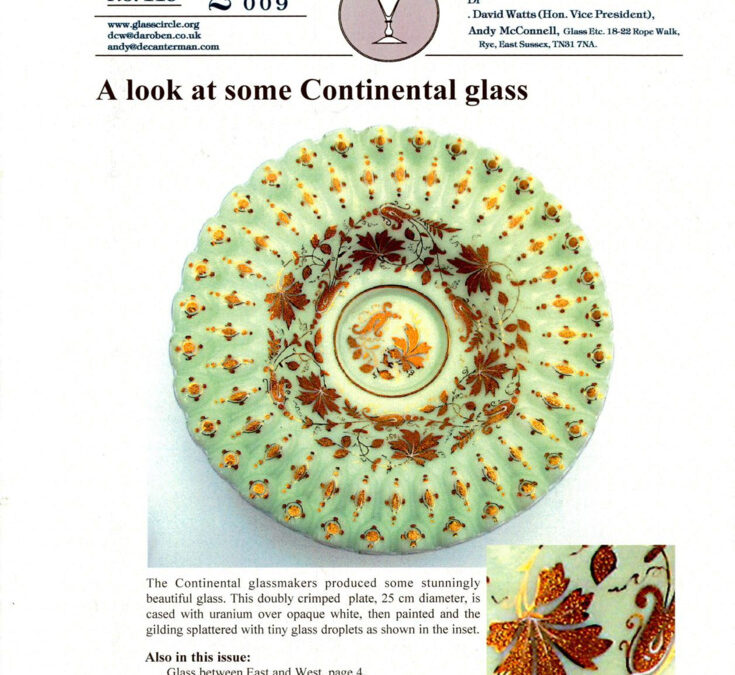
The Continental glassmakers produced some stunningly
beautiful glass. This doubly crimped plate, 25 cm diameter, is
cased with uranium over opaque white, then painted and the
gilding splattered with tiny glass droplets as shown in the inset.
Also in this issue:
Glass between East and West, page 4.
Gold Sandwich Glass, page 6.
Report on the Circle’s trip to the Czech Republic, page 8.
Who was Robert Kellaway? page 9.
The Art Studio of the Jablonec Museum of Glass and Fashion Jewellery. page 10.
The Causes and Battle against the 1695 Duty on Glass, page 12.
Limpid Reflections and Jacobite glass, page 16.
Fieldings’ auction, Three Centuries of Glass, page 17.
. . . . and all our usual articles and snippets of interest.
GLASS CIRCLE NEWS No. 119, 2009
Picture Page for
Glass Between East and West
by Vera Varga, page 4.
1 e)
AN% “,•••
n
”
I
Fig. 1. Two mugs of the type known as, “Bokaly”?.
Transylvania, Porumbak (?), 17/18
th
century.
Fig.
2.
Mug with tooled decoration. Transylvania, 18th century.
Fig. 3. Cellar-chest bottles in the original cellar-chest.
Eastern-Hungary, 1775.
Fig. 4. Decorative bottle of triangular form engraved with an
alegorical scene to indicate the month of May.
Northern Hungary, 1760-1770.
Fig. 5. “Giant glass” Engraved with the coats of arms of the
Bethlens of Bethlen and “C B”? monogram (Bethlen Katalin),
and “1795”. Transylvania, Porumbak.
Fig. 6. Bottle with gilded silver mount & stopper. Engraved
inscription of the gilded silver stopper: “Mikes Mihal 1693”
“Bethlen Drusian 1693”, “MW” (Michael or Matthias Werner
goldsmith masters based in Kolozsvar), Transylvania.
Fig. 7. Candlestick. Transylvania, Porumbak, Beginning of 18′
s
century.
. . . . The views expressed in Glass Circle News are those of its contributors . . . .
2
GLASS CIRCLE NEWS No. 119, 2009
GLASS CIRCLE MATTERS
From your Chairman
Since my last letter I have visited a jam
factory. Or rather, The Jam Factory in
Adelaide, South Australia, where Tom
Moore had a wonderful and eccentric
exhibition in Australia’s main
contemporary glass studio and exhibition
space, with facilities for both hot and
cold work. Australia was a major market
for English art glass from 1880 to 1914
and the major museums there have
mouthwatering displays of Stourbridge
cameo glass.
Glasses of the “Hawley Bishop’ style and
period have always intrigued and worried
me. We have so little documentary or
illustrative material on English glass
made around 1690.
Illustrated are two glasses probably of
this period. That on the left is perfect and in a museum in Florence. It is labelled ‘Venetian’ although
the broad folded foot and the rather clumsy construction suggests that it is made of lead glass and
more probably of English origin. The one on the right has a modern wooden foot, is lead glass and has
a somewhat crizzled bowl. I bought it in a large flea market in Utrecht last year. Can anyone tell me
the date and country of origin please.
yam [P. Smith
New Members
Audrey Bruce.
Francis Grew.
Mrs Shelly Hitch.
Dominic Keast.
Mr. A.W.K. Thomas.
Christopher Young.
Muse e des Arts Decoratifs, Paris.
Peter Layton moving Sale
We are not sure if this newsletter will reach you
in time but, prior to moving the Glass Art Gallery
to a new site on the floor below, it is having a sale
on Friday 19th, Saturday 20th and Sunday 21st
June 2009, 11 am — 5pm daily. The Glassblowing
Workshop is not moving at the present time.
Thanks to Derek Woolston and Peter Lole for help
with proof reading this issue.
Broadfield House.
A couple of weeks ago we were told that Dudley
MBC had still to appoint a review committee to assess
the problem of the museum’s future. However, as of
June 8th we now learn that L & R Consulting of
Liverpool have been appointed to carry out a
feasibility study.
According to their website L & R Consulting have an
impressive list of past and present clients in the fields
of Tourism, Heritage and Leisure. These include the
Arts Council, English Heritage, the Heritage Lottery
Fund, the National Trust, The Waterways Trust,
Wedgwood Museum Trust, the National Museums of
Scotland and Wales and many others.
Information from diverse sources suggests that the
problem of integrating Broadfield and the Red House
Cone on the Cone site is much more complex than
might be envisaged. Some three months having
already passed, at least a year seems a more realistic
prospect before anything positive emerges. Whether
we shall like the outcome is another matter.
Dr Aurelia McCann.
Godfrey Laventall.
Mr Michael Noble.
The Chrysler Museum.
New Orleans Museum of Art.
Philadelphia Museum of Art.
GLASS CIRCLE NEWS No. 119, 2009
GLASS BETWEEN EAST AND WEST:
HUNGARIAN GLASS WITH INTERNATIONAL CONNECTIONS
FROM THE 12
TH
CENTURY TO 1900-1910).
A
lecture given to
The Glass Circle on February
by Vera Varga
Tuesday 10, 2009 at the Art Workers Guild.
Part 1.
The first glass furnaces within our interest are likely to have
operated in the Pannonia province/region of the Roman
Empire (part of the territory of present day Hungary) in the
first century AD. From the 12
t
h century there were
prospering, dynamic trading and cultural connections with
Byzantium, and from the end of the 13
t
h century with Italy,
especially with Venice-Murano, which resulted in not only
the import of glass objects of outstanding quality, but also
in the influence on Hungarian glassmaking.
Findings from ongoing research may suggest that the
beginnings of independent glass manufacturing in Hungary
can be dated back to the early 12
t
h century; according to the
results of certain excavations, glass was manufactured in
the workshops of Benedictine Monasteries, and possibly in
forest glasshouses as well. From the 14
t
h century, the
existence of glasshouses, especially those working for
mining towns, mainly in the Upper Part of Hungary, is
amply documented by written records.
From the first third of the 17t
h
century, several glasshouses
were established by Hungarian noble families
for the sake
of pleasing the eye rather than profits,
manufacturing
enamelled, cut and engraved glassware of a very high
standard. One of the outstanding factories was Gabor
Bethlen’s glasshouse in Transylvania, where there were
Venetian glassmakers invited and working:
making crystal
from
c.
1619 up to 1629.
Up to the beginning of the 19
t
h century Hungarian
glassmaking followed the German, Bohemian and
Venetian-Muranese rules and traditions, adapting the
determining forms and motifs of the international period-
styles, and at the same time creating a peculiar repertoire of
forms and ornaments.
One early development was the creation of blown glass in
strong colours; perhaps the most characteristic are cobalt-
blue and white, in most of the cases with the
Hungarian
flowery Renaissance
enamelled ornamentation in the range
of colours used by German glassmakers and Hutterite
ceramists. The genres were the basic household glassware
types: jugs, mugs, and salt pitchers, including two special
types called bokaly (Fig. 1)’ and kancsopohar (pitcher-
glass). Other popular types were vessels for holy water and
trick glasses.
The material of the bokaly is bone glass varying in shade
from bubble-like reddish-bluish opaline effects to the
opacity of milk glass. The ornamentation of the bokaly
form’ of Italian origin is quite special; it is a furnace-work,
the embedded so-called sealing-wax red
calligraphic
scribal
has a combed pattern (Fig. 2). The technical
solution of this decoration partially explains its names;
glass + threads were spun hot on the blown body; these
glass threads were pulled and shaped with a bent, comb-
like iron tool, with various tweezers and pincers before
being embedded in the body as it was blown into its final
the relationship
thi
s
Transylvania,
(dog form), in blue glass.
between
tills
Transylvania, 17th century
technique
and
related motifs on contemporary Hutterite whiteware with a
shared origin: a Hutterite influence was spread by Hutterite
glassmakers who worked in the most important glass
houses located in Upper Hungary and Transylvania.’
The
marbling
of the opaque white body of mugs with more
or less embedded coloured glass threads reflects the
influence of Turkish ceramic vessels, while the opaque
white material and the coloured enamel painting of
bonbonierres, cups, glasses and flower holders made in the
18
t
h century show the strong influence of porcelain; in most
cases these were the products of the Viennese Porcelain
Factory. Their coloured, sometimes
en grisaille
painted
enamel decorations, are mostly chinoiserie- and Watteau-
scenes and allegorical representations of the Four
Continents.
To sum up, the value of these glass types is given by their
precious stone like colours. Their functional forms
(sometimes quite professional and peculiar) and decorative
ornamentation, which in some cases have allegorical
meaning, provide the decorative interest in these objects
that is beyond their household function.
The other area of development was
crystal:
clear glass, that
was manufactured in Hungary in the 17-18
t
h centuries, and
in most cases has a pinkish tint (because of an overdose of
manganese). Both the forms and the representations of
these objects made of Bohemian crystal show German and
Bohemian influence, which is a direct consequence of
glassware and also glassmaking immegrants coming from
Moravian and Silesian territories in the 17t
h
and 18t
h
centuries to Northern Hungary, as well as of the settling
down of certain Hungarian families in Moravia and Upper
Silesia.
Perhaps the most numerous and widespread functional type
made of clear glass during that period in Hungary is the
bottle. Among the basic European bottle types and their
several variations, a more or less unique Hungarian
representative is the cellar-chest bottle, which is also
known in German and Austrian territories, that evolved in
the 16
th
century
(cover picture).
As part of a set and also as
shape . This scribal
decoration has a
close relationship
with the marbled or
poured
dribble-
glazed
ornamentation of
Turkish influenced
17-18″‘
century
Hungarian pottery.
There are expert
sources explaining
4
GLASS CIRCLE NEWS No. 119, 2009
an independent object they remained popular and much-
used until the end of the 19
t
h century. The cellar-chest bottle
is one with a prism-shaped body, named after the portable
wooden container holding the bottles in its three-to-six plus
one bins, which were lined with red felt padding.
Sometimes bound in leather, mounted in metal fittings,
decorated with wooden inlays and bearing its owner’s
initials, the cellar-chest was used as a travelling bottle-
container. At the turn of the 18t
h
and 19t
h
centuries, the
three-to-six-bin chests, popular in earlier times, were
gradually replaced by multi-bin ones; specimens of twenty-
seven plus one bins were used, whose practical usefulness
was enhanced by the fact that they carried a tobacco set and
provided a secret hiding place for valuables, too. From the
le century onwards no cellar-chest was made for some of
these bottles as many of them advanced to the status of
ornamental bottle (Fig. 3), while the less elaborately
decorated ones were used as everyday liquid containers.
Although gradually losing its original function, this type of
bottle and its variant with lobed corners, became
increasingly common in the 18th and 19th centuries.
Specimens of the type used as
palinka
(fruit brandy) flasks
were enamel painted in a particular German style. Most of
the bottles bear German-language inscriptions and feature a
male or female figure raising their glass to toast someone, a
couple of pigeons holding a heart, a hussar, or a lady with
flowers. Almost identical pieces were manufactured in
Transylvania — Porumbak and Felsoarpas — and in Northern
and Western Hungary. It is explained by the common
origin; the influence of German glassmakers working in the
Hungarian glasshouses. Besides serving as brandy flasks
the bottles have additional functions: storing scented water,
medicines and even
love potions.
Written sources and numerous objects have survived,
bearing witness to a very wide variety of drinking vessels
and glasses. A more or less unique variant of the goblet
type is the
giant-goblet,
the average dimensions of which
are:- ht. 20-24 cm, ht. of the
giant
cup: 13-15 cm, the
diameter of the foot and of the mouth tend to be equal
c.
13-
15 cm. Analogous pieces are in the collections of the
Museum of Applied Arts, Budapest, and in the Muzeul de
Istorie, Sighisoara (Historical Museum of Segesvar). Pieces
with similar decoration are in The Corning Museum of
Glass? Their material is transparent Bohemian crystal with
a pinkish tint; the form is a conical bowl, inverted baluster
stem and a large blown conical foot. The engraved
representations on the bowl are trophies of arms
(representations of battle insignia), such as a drum, a flag
and a gun barrel; and a three-headed, crowned eagle and a
flower basket. These objects are dated 1690-1700.
Another interesting glass, a variation of the subject is a
giant beaker
(Fig. 4). It was made in Porumbak
(Transylvania), in the Bethlen glasshouse. The engraved
decoration is the coat of arms of the Bethlens, of Bethlen
set between two leafy branches; in the strip between the
arms and the rim of the cup are the initials “C
B”,
and
above the stem, beneath the date “1795”. Both the form and
the decoration of these giant objects show German
influence, which is not surprising knowing the fact that
Gabor Bethlen Prince of Transylvania (1612?-1768) invited
an engraver and a mirror maker, and later other
glassmakers, from Vienna.
An outstanding object of Transylvanian glassmaking is a
bottle made in Porumbak, Transylvania, around 1693 (Fig.
5). It was possibly made to the order of Mihaly Mikes and
Drusian Bethlen; that is what the dual coats-of-arms and the
inscriptions
Mikes Mihaly 1693
and
Bethlen Drusian 1693
on the gilded silver cup suggest. The hallmark “MW” on
the rim of the cup refers either to Michael or Mathias
Werner, goldsmith masters based in Kolozsvar. On the
front side of the bottle there is a rustic representation of a
Crucifix in a Baroque cartouche of a round medallion,
surrounded with a string-course, trellis- and leaf-work. The
other side bears a representation of
Agnus Dei
and the
narrow side-panels feature naturalistic wines. Though the
representation of the wines is quite naturalistic — closely
connected with that of Transylvanian wood carvings — they
are Christ-symbols, in obvious connection with the two
central subjects. The engraved representations are gilded,
which is a common characteristic of Transylvanian
engraved glass.
The other influence on Hungarian crystal glass was that of
Venice-Murano; one of the most characteristic Hungarian
a
la facon de Venise
glass types is a certain sort of
candlestick which survived from the late 17t
h
century to as
late as the end of the 19t
h
century (Fig. 6). The object is
emphatically segmented. The slightly conic, broad, round
foot is followed by a short, hollow baluster stem which
supports a stout, pressed-in, heart shaped section decorated
with a partly embedded red glass thread. Above the latter
section, which displays the influence of Venetian winged
goblets in a rural manner, is a hollow, cobalt blue sphere
with a drop-tray on it and then the ring-rimmed, cylindrical
candle-holder proper. Examining its provenance, one will
find that objects known to have come from Porumbak and
Parad were practically made with the same design and
technology.
A typical characteristic feature of Transylvanian jugs,
mugs, salt and pepper pitchers, and also of some holy-water
holders made of clear glass, in a particular rural Venetian-
Muranese manner, is their rim made of a cobalt-blue glass
thread.
Notes
1.
Objects belonging to the bokaly type represent a wide variety of
form; the basic shape of the body is a sometimes perfectly regular
sphere or egg which may be flattened or lengthened at the top. The
foot ring is usually lobed, but there are smooth, straight-footed
specimens too, and a footless type is also known. The neck, too,
can take a variety of shapes with some being straight, others steep
or splaying out into a mouth of a large diameter. The commonest,
in fact typical, form comprises a short, steep, multi-lobed foot, a
spherical, vertically elongated body, a long splaying neck, a
flattened “tape”-handle starting from below the mouth and joining
the body at the point it narrows down to the neck with a wavy
design.
2.
See Borsos, Bela: A Magyar Uvegmuvesseg. (Hungarian
Glassmaking) 1974, Budapest, 105.
3.
inv. n. 369, published in: Bunta, Magda — Katona, Imre: Az
Erdelyi Uvegmuvesseg a szazadforduloig. (Transylvanian
Glassmaking up till the Turn of the Century) 1983, Bukarest, no.
16, 130.
For the Corning pieces see
Glass of the Alchemists.
2008, Corning
(New York), nos. 65, 67, 228-9, 231.
To be concluded
5
LASS
CIRCLE NEWS No. 119, 2009
Gold Sandwich Glass in Antiquity
by
Daniel Howells*
A lecture given to The Glass Circle at the
Art Workers Guild on March 10th, 2009.
The hosts were Katharine Coleman, Mr and
Mrs D. Smith, Richard Whatmoor and Mr
and Mrs Timberlake.
Gold glass of the fourth century AD, images in gold leaf
sandwiched between two fused layers of glass, well-known
objects to scholars dealing with the period of Late
Antiquity. Gold glass and specifically that of the British
Museum collection, has been exhibited upon numerous
occasions around the world, and is on permanent display in
the Early Medieval Gallery.
The vast majority of available literature concerning gold
glass dates back either more than 100 years (e.g. Garrucci
1859; Vopel 1899), or has been based almost entirely upon
such nineteenth century and, in many cases, far earlier
publications. Funded by both the AHRC and the British
Museum, my work seeks to address this lack of scholarship
through a three year PhD program based at the British
Museum itself, in collaboration with the University of
Sussex.
The British Museum collection of gold glass, numbering
almost sixty pieces, is the second largest collection of such
objects in the world. The largest collection of nearly two
hundred examples resides within the Vatican Museo Sacro,
unsurprising since the vast majority of gold glasses have
been recovered from the catacombs of Rome, and indeed
are thought to have been produced
predominantly in the city.
Nevertheless, it can be argued that the
British Museum holds the most useful
corpus of gold glass for general study.
Recovered not only from Rome, but
also from the second suggested area
of production, Cologne, the British
Museum collection is the only single
sizable corpus to include all Late
Antique gold glass variants, some of
them (e.g. the St Severin Bowl)
unparalleled in almost complete form.
Glasses in the collection also bear
examples of a sizable range of iconographic depictions
known to occur in the media, along
with the only glasses suggested by past
scholars to depict contemporary living
personages (Cameron 1996).
Additionally, the British Museum also
includes as sizable number of
nineteenth century and earlier fakes,
forgeries and nineteenth-century
Venetian marketed reproductions (e.g.
Rudoe 2002; 2003).
Based upon the published literature
currently available, it may indeed
come as a surprise to learn that quite a
number of different, yet broadly
contemporary gold glass variants are
in existence. These have in the past
been either largely unrecognised, or/and been published as
a single object category (e.g. Morey 1959) by those
exclusively interested in the values of gold glass
iconography to the art historian concerned with Early
Christianity.
Dating to the early
fourth century and
being approximately 6
cm in diameter are the
glasses
generally
termed
‘brushed
technique’ glasses.
Only
fourteen
examples of this type
have been recorded of
this extremely rare
type: the British
Museum has one
example (Fig. 1).
Produced from the start
as medallions, these
glasses depict solely the highly lifelike portraits of either
individuals, or of a single adult with one or more children.
Upon a backing of blue glass, the type takes its name from
the skill employed to create the image through a series of
small incisions looking on inspection like brush strokes.
The image is then sealed with a colourless class disc to
complete the portrait medallion.
The most common gold glass type,
however, numbering over five
hundred recorded examples, has
become known as the ‘cut and incised
gold leaf technique’, the name
alluding to the method of
manufacture. Cut and incised gold
glasses can be further subdivided into
three distinct morphological
categories. As I intend to demonstrate
in my final thesis, all were probably
produced within the same workshop
perhaps even run by a single family
over a period approximating a
generati
on c 360-400 AD.
Of these three distinct categories, the
most common type is the two glass
layer vessel base disc/foot ring type
(Figs. 2-3). The base disc and foot
ring are produced as a single piece,
the flattened end and adjacent bottom
sides ‘cracked off from a glass
parison approximately 6-10cm in
diameter. After the gilding of the
surface and subsequent design
incision, a second parison forming
the vessel is fused on top of it. A
second variation of gold glass vessel
bases is that comprising of three glass
layers, the gold leaf decoration
applied between the lower and middle
layer. These vessel bases do not include foot rings. Both
vessel base types depict a significant number of
iconographical themes, not only Christian portraiture and
scenic representation and secular but nonetheless Christian
affiliated portraiture, but also distinctly pagan/mythic as
6
Fig. 4
)
111,
r
i
m, 111
1
4
1
,
va
1
1
,
1
1:17 ;
/4
AND
,
ITS,DEVELOPMENT
ON
//11,Nallf;e7
,
0O1U11/.N/f
f
THE
`
THAMES
T
/•
/7
D AVID) GAVATT S
ii
ftr
if
GLASS CIRCLE NEWS No. 119,
2009
well as Jewish symbols, secular sports and other
recreational subjects (boxing, hunting chariot racing,
theatre), and also secular scenic representations associated
with domestic and professional activities. Non-Christian
iconography, although evident in fewer numbers than its
Christian counterpart, is rarely acknowledged in both past
and present literature. The vessel walls of all known
examples have been broken away both in antiquity and in
recent centuries by those interested purely in the depictions.
The second most well-known gold glass variant is that
which has become known as diminutive medallions. These
`blobs’, usually with blue or green glass backings,
preserved cut and incised gold leaf images upon the side of
a bowl-like vessel designed to be viewed from the inside.
Such vessels, the St Severin example in the British
Museum being the only near complete example
(Fig. 4),
resembled in all but the gold leaf design the contemporary
`blobbed’ vessels found right across the empire. The gold
leaf iconography constituted a wonderful new innovation
applied to an already popular form. The diminutive
medallion imagery is overwhelmingly of Christian scenic
representations both of the Old and New Testaments, each
medallion bearing a single element and arranged to form
complete sequences of Biblical scenic representation. What
is less publicised is that such pieces also depict secular
individuals and mythic scenes; one of the most popular was
the twelve labours of Heracles.
Far less well-known are the few cut and incised gold leaf
plaques not produced as vessel bases and without the
protective covering layer of glass. As a result, far fewer of
such pieces survive. The British Museum has two such
pieces, of the four known (the other two are in the Vatican
Museo Sacro). Occurring always upon a flat and rather thin
colourless glass base, the iconography of these four
survivals appears wholly secular in nature. The British
Museum examples, despite being highly abraded illustrate
respectively the
togam virilem sumere,
the coming of age
`ceremony’ for the Roman male
(Fig. 5), and
a visually-
unaccompanied secular inscription. The Vatican examples
are equally secular in the nature of their iconography,
showing the activities associated with ship building and an
unaffiliated family group.
These then are the major gold glass ‘types’. However, a
number of other gold glass variants are also present in the
British Museum collection, if only in single examples.
These include contemporary allegedly Cologne-produced
examples, earlier gilded rod vessel bases and unusual blue
backed cut and incised vessel bases, dating perhaps to the
later third centuries and with less than five genuine
recorded examples. Nevertheless, the British Museum
collection is the only single corpus to include examples of
every gold glass variant.
In the past, gold glass scholarship and discussion of
function has been focused upon those with purely Christian
and Christian affiliated iconography. It is clearly apparent,
however, that a far
wider range of
subjects
are
depicted
and
morphological
types in extent. This
certainly
has
considerable
repercussions for a
modern study of
this material. *
* Daniel Thomas Howells BA (Hons.), MA, is an
archaeologist and art historian primarily concerned with
Roman provincial, Late Antique and Early Byzantine material
culture and imagery. An Associate Tutor and Arts &
Humanities Research Council collaborative D.Phil. student at
the University of Sussex in association with the British
Museum, Daniel’s current work focuses on fourth century
glass vessels, medallions and plaques bearing an array of
depictions, many of which are of Early Christian subjects,
executed in gold leaf. Other previous work and publication
has included the social distribution of Roman pottery and
artefact related approaches to diet.
Just arrived from the printers.
1
:
11
A HI S TPAVATi
tV
P1
‘
C
W
–
:
_-LA
r
SSMAKING
More in our next issue of GC News.
For immediate information see:-
htpp://www.glassyeye.com/watts_publishing/
7
GLASS CIRCLE NEWS No. 119, 2009
GLASS CIRCLE TRIP TO THE CZECH REPUBLIC:
SEPTEMBER 2008
by Graham Vivian.
John Smith organized two trips to the Czech Republic in
2008. Our trip was the second of these and we trod a similar
path through Bohemia to that of the earlier visit although
ours was a revised itinerary following discussions with the
first group. A report by from Sonia Solicari on the earlier
visit appeared in the December 2008 GC News.
Seventeen of us gathered for the September trip and our
group included a number of veterans of the Novy Bor visit
in 2001.
Compared with the Novy Bor trip which comprised some
ninety members of the Glass Circle and Glass Association,
this was a much smaller group and accordingly there were
no long welcoming speeches by the Towns’ mayors and no
concerts or orations as on our previous excursion.
We were based at Jablonec Nad Nisou in what might be
described as a Tourist Hotel memorable for the fact that the
lift to our floor appeared to be designed for transporting
stretcher cases (possibly patients with alcoholic problems)
rather than the upstanding members of the Glass Circle!
Nevertheless at Jablonec we were well placed for our daily
excursions to the surrounding towns and countryside.
The highlights of our tour depended to some extent on
gender. For the ladies Jablonec and nearby is a centre for
beads and costume jewellery. This caused a feeding frenzy
amongst our women folk resulting in the acquisition of such
a large quantity of beads that if anyone had had the time to
string them we could probably have got to the moon and
back. The range of beads was amazing and within our group
we had knowledgeable members who were able to give a
very informed commentary on the discoveries and
purchases which were made at that time.
In pursuit of beads and necklaces we visited a small family
run home/workshop where we saw glass beads being
pressed by hand on somewhat antiquated machinery. This
type of production would clearly be too slow to compete in
the commercial market place except in very special
circumstances.
It appeared that beads were not the only commodity
produced at this property. After lunch we were invited by
the owner to a wooden chalet in the garden to taste his
liqueur. Those of us who ventured to try the tipple were
soon intoxicated by its strength. Our guide Christa broke
into song and everyone started giggling. We left in such a
very merry state that at that point in time our chances of
being admitted to any glass museum would have been
questionable.
The following day we visited Zelezny Brod Glass School .
The school is housed in a fine stone building, appropriate to
the importance that glass has been to the Czech economy.
Unfortunately changing world markets have had a serious
effect on the Czech glass industry and demand has reduced
to a point where the school is under threat of closure on
account of the difficulties experienced in placing the
students. This was a considerable shock to us, particularly to
those who had been on the Novy Bor trip seven years
previously. At the school we saw the students involved in
the various stages of glassmaking from blowing to
engraving and polishing. On graduating, in the current
climate, their future would be far from assured.
Later that day we visited the home/workshop of one of the
tutors of the Glass School, Mr Bretislav Novak. He
specialized in cutting and polishing clear and coloured glass
into geometric shapes of the highest accuracy to take full
advantage of the prismatic effect created. He exhibited
nationally and internationally which is not surprising
bearing in mind the quality of his work.
Zelezny Brod is a very attractive town with a glass museum
which we visited. Part of the town is within a conservation
area in which a number of early wooden farmhouses are
preserved including an ethnological museum which gives a
valuable insight into life in the 19th century.
On the next day our destination was the Harrachov glass
factory and museum. This is a major tourist attraction where
we saw glass being made and blown. There is a raised
walkway around the glass blowing area which has been
specially designed to give visitors an excellent view of the
teams of glass blowers and their assistants. At the time of
our inspection wine glasses were being blown into moulds.
One cannot but admire the speed, skill and teamwork which
turns a paraison of hot glass on the end of a blowing iron
into an elegant wine glass in minutes before it is hooked on
to a conveyor belt on its way to the lehr. Each team is paid
on piecework so speed and quality are essential. Fascinating
as it was for us to watch the process, the repetitive nature of
the work must have been taxing on the workforce.
That afternoon we crossed the border into Poland. No
formalities were needed at the border post as we found it
deserted, one of the benefits of the European Union. Here
we visited the Jelinia Gora Glass Museum curated by Dr
Stefania Zelasko who met us and gave us a wonderful tour
over her gem of a museum which featured carefully chosen
exhibits of European Glass mainly of the 18th to 20th
Centuries. Dr Zelasko has an infectious enthusiasm for her
subject which was much appreciated by our group. She
wanted us to spread the word in order to get her museum
more widely known and visited which we are only too
happy to do.
The Museum is close to the former Josephine Glass Works
which was one of the most important in Poland. It copied
glass from other European countries. Dr Zelasko has
recently written a book on the Glassworks.*
On our last day we visited two of our favourite museums
from the earlier Novy Bor trip. These were the Novy Bor
Glass Museum and the Glass Museum at Kemenisky Senov
nearby. Both are housed in very attractive period buildings
in fine locations and feature European Glass mainly from
the 18th to 20th Century. At Kamenisky Senov there had
recently been an engravers’ symposium where our member
Catherine Coleman MBE had been present. These two
8
GLASS
CIRCLE NEWS No. 119,
2009
Who was Robert Kellaway?
A good question – never heard of him, I hear you reply. But
you have so let us refresh your memory. You will have read
enough glass history to know that the coal-fired glass furnace
was invented by Thomas Purcivall, Gent. The syndicate that
persuaded King James I and pushed it through parliament in
1614 was further composed of Bevis Thelwall, Sir Edward
Zouche, Kt., and Thos. Mefflyn, glazier to Elizabeth I.
By the time Sir Robert Mansell had taken over Mefflyn had
died and he was replaced by a Robert Kellaway. The glass
monopoly was already established, so was another glazier
really required as replacement or might an entrepreneur to
help finance the expense of its establishment be more
appropriate? A person with a bit of both attributes would be
even better and that brings us to Robert Kellaway.
The Kellaway/Calloway (K/C) family still thrives today and
has branches as far afield as America, Australia and New
Zealand. They have an extensive website devoted to their
ancestry that, quite amazingly, takes them back beyond the
12th century. They were landed gentry with extensive
property in the West Country, particularly around Sherborne.
Another branch or branches existed in the
Gloucester/Norfolk area. There is a probable 1066 link with
the French Osberne de Cailly and his coat of Arms.’
This pedigree is certainly sufficient to establish a presence at
the King’s court but what about the glass connection? Here
we encounter some remarkably good fortune as the K/C coat
of Arms appears in a window, dating to the 16th century in
Sherborne Abbey about the time of its rebuilding.’ It consists
of crossed grozing irons interspersed by four pears, a play
on the family name referring to the above Osberne and a
French pear variety
(Caillou Rosat) –
a novelty at the time.
No less remarkable, this family coat of Arms has a close
similarity to that of the Worshipful Company of Glaziers
and Painters of Glass; this also carries crossed grozing irons
but has the pears replaced by four nails as used to fix the
cames that hold the glass sections together. According to the
Company’s history the earliest description of its coat
Above. C. 16th glass in Sherborne Abbey. The same
pictorial representation occurs in two other West country
churches, Dolton in Devon and Godney in Somerset.
Above right. The Kellaway coat of Arms.
Right below, Coat of Arms of the Worshipful company of
Glaziers of the City of London.
occurred in 1588 when the
Herald, Robert Cooke,
Clarencieux King of
Arms, made his first visit
to the Company. There is
thus the possibility that the
K/C coat preceded that of
the Glaziers Company and
that some historical event
links the two together.
To date, no direct link
between Robert Kellaway and the extant Kellaway family
has been established although it seems beyond speculation.
Nor do we know whether he was an active glazier although
again this seems probable. His selection for the syndicate
can be seen as an action on Zouche’s part to ensure the
success of his venture.
1.
In the Library of St John’s College Cambridge, MS
A.4(IV), Giovanni d’Andrea’s Glossa ordinaria in Librum
Sextum (English, c. 1335-50). Caillewey is a form of the
name by the 14th century.
2.
See the web site www.kellawayhouse.co.uk/pears.htm
Thanks to Warwick Kellaway, Bruce Calloway and Bill Piper for
research assistance.
David C. Watts.
Czech Trip concluded
museums are not to be missed and have excellent displays
of Czech glass engraving.
We enjoyed a very pleasant lunch at the Park Hotel at Novy
Bor and to round off the early afternoon we visited the Karel
Wunsch Gallery which is next to the Museum. This Gallery
specializes in quality modern Czech glass and those of us
bent on acquiring a fine piece of art glass were not
disappointed.
On our way back to the hotel we visited the Sevroceske
Museum at Liberec. By the standard of those Museums
visited so far this was an important provincial Museum
housed in a fine classical style building. The glass was only
part of the exhibits on display which included a fascinating
film of the first day of the Prague Spring when the Russians
occupied the City.
REFLECTIONS
John Smith once again organized an excellent trip ably
assisted by our charming guide and interpreter Christa
Petraskova. Compared with our last visit 7 years ago, the
real shock was to see how the glass industry had declined.
Previously it had appeared that almost every house outside
the towns had had a glass furnace in the garden. This time
we were struck by the number of glass factories which had
closed or had partially closed in the intervening years. The
possibility of the closure of the glass school at Zelezny Brod
brought the decline home to us vividly.
There will always be a demand for fine hand worked Czech
glass but it seems the market overall is shrinking. While the
Czechs will continue to be among the top glass artists,
cutters and engravers in the World, it would appear that the
Czech dominance of all things glass is passing, brought
about by increasing competition and high fuel costs.
Nevertheless the skills of the Czech glassmakers and
engravers are there for all to see in the wonderful museums
we visited.
*Stefania Zelasko, Graflich Schaffgotsch’sche
JOSPHINENHUTTE,
Kunstglasfabrik in Screiberhau and Franz Pohl 1843-1900.
9
Copies of mid-19th century bottles
GLASS CIRCLE NEWS No. 119, 2009
The Art Studio of the Jablonec Museum of Glass
and Fashion Jewellery
In 2008 two groups of Glass Circle members went a trips to the Czech
Republic based on Jablonec nad Nisou. The museum there specialises in glass
buttons and jewellery with some glass goblets etc. When your editor was last
there the Museum had a studio for the production of hand-decorated copies of
old Bohemian glass. Although this enterprise has now ceased in their new
building it may be of interest to members to be aware of their copies that might
find their way into the antique market. This illustrated article was written by
LibuAe Hovorkova for the Czechoslovakian Glass Review back in 1991.
Very few museums in Czechoslovakia can boast of their own manufacturing
operations. The Museum of Glass and Fashion Jewellery in Jablonec nad Nisou
has manufacture and trade in its Statutes and has been performing both for the
past almost 25 year. Its Art Studio originated in 1966 at the instigation of the
first director of this specialized institution, PhD. Stanislav Urban (the 15th
anniversary of whose premature death we are remembering this year, i.e. in
1991).
The principal purpose of the Studio is the manufacture of
in a series or of free
compositions
inspired by the
museum
collections. The
Studio has its own
sales room on the
museum premises
and thus enables
the visitors to
obtain tasteful and
artistically
valuable
souvenirs. Their
assortment
is
continuously
extended with
examples from the
17
t
h-19
th
centuries’ painted glass and the products of black
fashion jewellery. At present the Museum is extending its
many years’ commercial
cooperation with selected
institutions in Bohemia and
Moravia as well as export to
other countries through
Glassexport.
Copies of folk glass, hand-
painted with rich enamels,
are based on models from
the 18th and the first half of
the 19th century. Bottles,
tankards and glasses were
intended for the population
of villages and the poorer
strata of urban population.
Their function was mostly
connected with family or Copy of a glass with a
seasonal customs. For
butcher’s emblem. 1st half
instance,
the
special
19
th
century.
rectangular or octagonal bottles made of pure or greenish
glass were used as presents on various occasions – as tokens
of love, nuptial or birthday presents, souvenirs, etc. The
figure on the bottles with the symbols of love – a dove, a
heart, a glass – are bordered with a rich floral or vegetable
ornament often supplemented with adages referring to the
decorative motif or addressing the recipient.
The tankards of pure or greenish glass were used for beer.
Every regular guest had his own tankard in the pub. Those
with the most frequent motifs included guild signs, figured
motifs supplemented with initials, house numbers and
various rhyming adages. The remaining surface was
usually covered with ornamental decorations.
Pictures painted on glass, usually on its lower face, became
highly popular among simple country people in the second
half of the 18th century. This, today, almost forgotten art,
was very much sought after in fairs and markets in the 19th
century. The patron saints illustrated were to protect the
family and the household, supervise the prosperity of the
craft and ensure health and success. The milk glass of the
second half of the 18th century with motifs of gallant
scenes and allegories of the seasons or continents, or the
pharmaceutical bottles and flasks of glass and ceramics of
the 18th and the 19th centuries have become sources of
inspiration for our Studio. The painted escutcheons of
pharmaceutical jars identified with a certain pharmacy and
the individual inscriptions indicated the contents of the jar.
Apart from accurate replicas of historical glass the Studio
also freely composed objects of art reflecting sensitively
the motifs of various periods in the history of art.
All new products of the Studio are subject to approval by
the Art Commission of the Museum, consisting of
professional and art historians, who assess the artistic as
well as the technical standard of the products. Every
product of the Studio is identifiable by the sign of the
Museum on its underneath and, in the case of an exact
copy, by the abbreviation “cop”.
art objects of souvenir character
10
GLASS CIRCLE NEWS No. 119, 2009
The manufacture of black fashion jewellery
represents another extensive field of activities
of the Studio. It has a tradition of more than a
century’s standing in the Jablonec region.
This type of fashion jewellery was applied for
decorative purposes first time in the sixties of
the 19th century. Since that time it has
recurred on the market in several fashion
waves, for the last time after the Second
World War. It influenced world fashion most
markedly in 1901, after the death of Queen
Victoria when it became a sign of mourning
in England.
Copies of 3 tumblers in opal glass, the originals
c.
1700.
fashion jewellery. Steel rivets were initially used, melted
(glued?) into the glass. These were replaced by hollow
brass tubes and the individual glass beads were inserted
into gypsum moulds with the shape of the finished jewel
and then tin-soldered with wire, forming a fine structure on
the underside of the jewel. The metal part of the jewel thus
became lighter and the resulting impression was that of
black lace. The Museum of Glass and Fashion Jewellery in
Jablonec nad Nisou has revived this forgotten and
technologically exacting manufacture of black fashion
jewellery, thus extending its artistic and commercial
operations beyond the field of painted glass.
Libule Hovorkova
See larger images in colour on our web site.
The
has
manufacture of black fashion jewellery
specific technological features. At the
beginning it was made by
cementing, since 1877 by
rivetting to massive bases.
Brothers Felix of Jiretin,
from where the Museum
obtained the black glass,
had the riveting technology
patented in 1877 under the
trade mark of RIVETED
JET 1887. The soldering
technique was introduced
in 1886-1888 in the field of
fashion jewellery and soon
afterwards also in the
manufacture of black
Copy of a humpen of 1683
Dating baluster Stem Glasses
Precise dating English glasses of any period in the 18th century has been
the subject of much speculation as we have recorded before in these
pages. The dates when the various types of baluster stems were first made
has, in particular, been the subject of much guesswork. This picture and
accompanying letter in
Country Life,
April 23, 1964, will, at least provide
a more accurate date for one such example.
SIR,—in
his erudite article
Vogue of the Baluster Glass
(June
13, 1963) the late Mr. E. M. Elville stated that the cylinder-
knopped baluster glass first appeared in the year 1715.
With the greatest respect for so learned an authority, I send you
a photograph of such a glass that has been in my family since
August, 1710, and therefore must have been made long before
1715. This glass was purchased in August, 1710, as part of a set of
wineglasses for a wedding gift, by Lt. Richard Lougher, of
HMS St.
Albans,
a fourth-rate of 54 guns. She was then in London, for the
first time since her launching at Rotherhithe on December 10,
1706. Lougher saw an advertisement for new wineglasses in
The
Tatler
for August 5, 1710, and presented them to his brother, a
Welsh squire, who was married in the following month.
WILLIAM H. GILL,
South Kensington, London.
11
GLASS CIRCLE NEWS No. 119, 2009
The Causes and Battle against the Duty on Glass, 1695-1699*
By David Watts, Part 1.
If international politics seem confusing today they are
hardly worse than those of the last quarter or so of the 17t
h
century. The need for the English government to raise large
sums of money fast, ascribed to the “Wars with France”,
led to the duty on glass of 1695. These wars resulted from
the ambitions of Louis XIV of France (1643-1715), to take
over surrounding territories that would make France the
largest by far of all the countries in Europe and maintain the
dominance of Catholicism. The wars involved Spain, the
Protestant-orientated Netherlands and the Hapsburgs’
Prussian empire. The threat of invasion if England had lost
was considered inevitable.
The cost to England of the war 1688-1697 is estimated at
£32,643,764.’ By 1695 all the countries involved were
beginning to feel a similar constraint.
The war was now
resolving itself into a fiscal contest,
wrote Davenant,
Whenever this war ceases it will not be for want of mutual
hatred in the opposite parties, nor for want of men to fight
the quarrel, but that side must give out where money is first
failing. If we in England can put our affairs into such a
posture as to be able to hold out in our expense longer than
France, we shall be in a position to give the peace; but if
otherwise, we must be content to receive it.
2
Continuous English support for this conflict against
Catholicism led to the invitation to Prince William of
Orange, a major player supporting the Protestant side, to
come and terminate once and for all the pro-Catholic
ambitions of King James II. William came at a price and
that price was full financial support, in perpetuity, for his
military campaigns. Government was desperate to raise the
money to pay William; the down payment for his army had
come from the City. Consequently, the Duty on Glass was
only one of a raft of measures introduced on every
commodity from marriage to leather and from coal to clay
pipes including wine, vinegar, tobacco,
East-India
goods
and other merchandise. The first tax on beer coincided with
the arrival of William in 1688. William’s further interest in
alcoholic beverages is reflected by the following
recommendation to the House
That, towards the Supply
(of
money)
to be granted to his Majesty, for carrying on the
War against France, the Duties granted by an Act, entitled,
An Act for the encouraging the Distilling of Brandy and
Spirits from Corn
(i.e. gin);
and for laying several Duties
on low Wines, or Spirits, of the first Extraction; be
continued to be collected, levied, and paid, for the Term of
* Most of the information in this article is taken from the
Journal of The House of Commons from 1695 on, mostly
quoted verbatim. At that time the Julian calendar was still
in use. However, the Journal was not published until 1830
and uses the Gregorian calendar introduced into Britain on
March 25′, 1753. Fortunately the month names and number
of days in the month remained unchanged. The practice of
proroguing Parliament throughout the summer and early
autumn may have had a practical basis such as the
recurring danger of the plague. Reconvening parliament in
November/December appears to be the origin of the
practice that continues up to the present with the Queen’s
speech. The other influential hangover is that after 1753, to
the present day the British tax year is still based on the
Julian calendar which is why it begins on April 5th.
Three Months after the Expiration of the said Act.
This
‘Supply’ was not just for the King’s personal purse but
towards the entire cost of the war effort. Everyone was
made to economise and it was the cumulative financial
squeeze, rather than the glass tax itself, that brought the
glass industry to its knees. Glassmakers were by no means
the only ones to plead for relief MPs must have spent long
hours in the House, their initial starting time of 10am soon
changed to 9am and then 8am, as timetabled events were
rescheduled week after week. Non-attenders were fined.
The prolixity of events were driven more by fear of failure
than any perverse whim of the House.
The proposed bill, touching not just glass but also pottery
and coal, was put by Sir
Thomas Littleton
(Ways and
Means Committee) on March 12, 1695, before what was
called a Committee of the whole House (as opposed to its
sub-committees). The first 16 of its 25 points (here quoted
verbatim)
were:-
1.
Resolved,
That it is the Opinion of this Committee
(repeated before each point), That towards the Supply to
be granted to his Majesty, for carrying on the War
against
France
with Vigour, a Duty be laid upon Glass.
2.
That a Duty of Twelve-pence a Dozen be laid upon all
Glass Quart Bottles.
3.
That a Duty of Six-pence a Dozen be laid upon all
Glass Pint Bottles.
4.
That the like Duty, in proportion, to what is laid upon
[Quart] and Pint Bottles, be laid upon all other green
Glass Bottles, of a greater or lesser Size.
5.
That the like Duty, in proportion, be laid upon all Flask
Glass Bottles (presumably to include decanters).
6.
That a Duty of 201.
per Cent. ad valorem,
be laid upon
all Flint Glass.
7.
That a Duty of 151.
per Cent. ad valorem,
be laid upon
all other Glass, not otherwise charged, except Window-
glass.
8.
That a Duty of 201.
per Cent. ad valorem,
be laid upon
all Plate-glass, or Glass-plates (for coach windows and
mirrors).
9.
That a Duty of 101.
per Cent. ad valorem,
be laid upon
all Window-glass.
10.
That the like respective Duties be laid upon all Glass
imported, over and above all Duties payable for the
same, as Glass made in
England
is charged with.
11.
That the like Duties be laid upon all Stone and Earthen
Bottles imported and made in
England,
as upon Glass
Bottles.
12.
That a Duty be laid upon all Coal water-borne, in Ships,
or other Vessels, in order to be shipped.
13.
That a Duty be laid upon all Culm (coal dust) water-
borne, in Ships, or other Vessels, in order to be shipped.
14.
That the said Duty upon Coals be
5s. per
Chaldron,
reckoning Six-and-thirty Bushels to the Chaldron,
Winchester
Measure.
15.
That the Duty upon Culm be ls.
per
Chaldron,
according to the same Measure.
16.
That a Duty of
5s. per
Ton be laid upon all Coal
imported from
Scotland,
over and above the Duties now
payable upon the same.
12
GLASS CIRCLE NEWS No. 119, 2009
Of the remaining nine points of the report two related to
duty on exports to Ireland, another
That the Duties upon
Burials, Births, Marriages, Coals, and Glass, be granted to
his Majesty for the Term of Five Years
and the remainder
(as I understand them) to recompense those private citizens
who had contributed large sums of money to promote
William’s involvement in the war in anticipation that it
would be repaid with interest.
The three readings (with minor amendments) to the House
of the:-
Bill for granting to his Majesty certain Duties upon
Glass Wares, Stone and Earthen Bottles, Coals, and Culm,
for carrying on the War against France;
went through
rapidly in spite of some time-tabling delays. It was sent to
the Lords for approval on May 1″. By the end of the
parliamentary session the Act had become law.
Thus the problem this Act posed for the glassmakers was
not just the duties on glassware but, more significantly, that
on the coal (already taxed at a lower level) required for
their furnaces in an environment where the population was
being stripped of its cash by this endless list of tax additions
and increases. The hardship it brought was very real. A
minor concession was a proposal that a
Duty clawback
should be allowed at the port for glass on export. It
probably helped the glass plate and bottle industries but not
to a sufficient degree as indicated by the effect on the Great
Bottle House in Southwark which had closed by 1701.
The House was prorogued until the early winter. With the
opening of the new parliament English democracy came
into play on Christmas Eve, Dec 24, 1695 when:
It was
ORDERED, That the Committee to whom it is referred to
consider of the Act, made the last Parliament, for granting
to his Majesty certain Duties upon Glass . . . and of the
Doubts and Complaints relating thereunto; have Power to
send for Persons, and
Papers: And that Mr.
Bromley,
Sir
Jo. Manwaring,
Mr.
Mason,
Mr.
Bickerstaffe,
Mr.
Archer,
Sir
Geo. Markham,
Mr.
Osbourn,
Mr.
Cocks,
Mr.
Newport,
Mr.
How,
Sir
Ra. Dutton,
Sir
Jam. Rushout,
Mr.
Staines,
Mr.
Dolben,
Mr.
Sandys;
and
all the Members that serve for
the County of Cornwall; be added to the said Committee:
And all that come are to have Voices.
In the New Year, Jan. 11, 1696, the first glassmakers to
petition the new Committee for Complaints etc., and not
about the tax on glass itself, were:-
“Peregrine Henzell,
John Henzell, Jacob Henzell,
and
Peregrine Tizack,
on
behalf of themselves, and the rest of the Glass-makers upon
the North Side of the River
Tine . . .
setting forth, That the
Petitioners’ Ancestors, being the first Makers of broad
Glass
in England,
did settle upon the River
Tyne,
where the
Petitioners now carry on the said Art; but now, besides a
Duty laid upon
Glass, there being a Duty of
5s. per
Chaldron laid upon all Coals water-borne, by an Act of the
last Parliament, which they are necessitated to use; and
several other Glass-works using no water-borne Coals,
they will undersell the Petitioners; so that they must give
over their Employment: And praying, That the said Duty of
5s. per
Chaldron upon Coals, used for making Glass upon
the said River, may be taken off.”
Not only glass was affected. For example, two days later
another heart-felt petition from
Charles Halford
Esquire
was presented to the House setting forth that loss of trade
from the Duty on sea-borne coal that would negate the
investment of above 5,000
I.
of his Father-in-law,
Daniel
Wigmore,
“being encouraged by an Act of Parliament, did,
about 20 Years ago make the River
Welland,
from
Deeping
to
Stamford,
in the County of
Lincoln,
navigable . . . now . .
. other Coals (would be delivered to Stamford) by Land-
carriage, at a much cheaper Rate; whereby the said Duty
will be avoided; the Petitioner will lose his said Estate; the
said River become unnavigable; and many Families, whose
Livelihoods depend upon the said River, will be ruined:
And praying the Consideration of the House in the
Premises, and Relief therein.”
Complaints, generally, about the duties on sea coal
continued to flood in from all over the country and on Jan.
24, 1696, a long report from the specially constituted
Complaints Committee was presented to the whole House,
part of which said . . . “That this Duty destroys the Supply
and Commerce of all Parts upon, and Towns and Places
adjacent to, the said Rivers; which will very much affect
the Woollen Manufactures, both in the Cloathing, Capping,
and Stockings: whereby the great Number of Poor they
employ, must either be reduced to Want, or quit those
Employments; which will endanger the Loss of those
Manufactures; and may create a Disaffection in the Minds
of those suffering People to the Government; they having
already risen in many Bodies, in those Counties, destroying
and pulling up divers Hedge-rows and Pales, and other
Fences, lopping of Trees, and destroying the Woods
themselves, in the Presence of the Owners, or their Agents;
being induced to such riotous Practices, only from the
severe Hardships they suffer under the Scarcity of Fuel:
That this Duty is not only so grievous to the Subject, but
falls so far short, in those Counties, of answering the End
designed, that it proves rather a Charge than an Income to
the Crown; the Revenue not having as yet, nor ever
probably will answer the Expense of the Collection:
That this Duty is not only pernicious to the Subject, in
the before-mentioned Discouragements, to the Navigation,
the Coal-Trade, and the Woollen Manufactures, but lessens
and abates the King’s Duties upon the Glass Wares; for that
the Owners of the Glass-houses
at Gloucester
have been
obliged to extinguish their Fires; because, since this Duty
commenced, they can have no Coals; which has forced
them to lay aside their Employment: and brought many
other Difficulties upon the Trades of that City. . .”
A Motion was then proposed with, it seems, some
confidence of success, “That Leave be given to bring in a
Clause, to take away the Duties laid upon Coals water-
borne, except in order to be shipped.”
It was
rejected
by 183 votes
to 103.
Complaints against the coal duty continued. Jan 25
th
, from
the City of London and then the Port of Hastings which had
to lay up its coal lighters to Newcastle for lack of trade.
And then on the 27
th
another on glass was presented to the
House: “A Petition of the Makers of Broad Glass, Glass
Bottles, and other Glass Wares, in and near
Stourbridge,
in
the County of
Worcester,
setting forth, That, heretofore, the
Petitioners used to employ many Thousands of People in
getting Woodashes, Clay, and other Materials used in
making Glass Wares, which they always sold, until, by an
Act of the last Parliament, a Duty was laid upon Glass
13
GLASS CIRCLE NEWS No. 119, 2009
Wares, and Coals; since which, they have not sold half the
Quantity as they sold before; which much lessens the broad
Glass Trade: That the Glass-Bottle Trade is quite stopped;
the Makers, who used to sell, 20d. the Dozen, Quart
Bottles, cannot now sell for above 2s. the Dozen,
notwithstanding the said Duties: so that their said Trade
will be ruined, and many Thousands of Families, whose
sole Livelihold depends thereon, will be impoverished:
And praying the Consideration of the House, and speedy
Relief in the Premises.”
On the 31′ came another on coal from Norwich.
Feb 6’96 saw a hefty duty of £30/ton being laid on French
brandy which must have stimulated the growing indigenous
gin trade. On Feb. 14
th
it was announced that the duties on
coal and glass were in the red to the tune of £560,038. In
this connection, money loaned to the government at 7%
interest was not being paid. And there were problems with
the value of the duties received due to debased coinage
caused by clipping the edges. On Feb. 19
th
Mr Bromley for
the Committee read a report on the duty on glass etc. but its
details were not recorded. Among the numerous other
matters it was proposed, Feb. 24/25 “That his present
Majesty, King
William,
is rightful and lawful King of these
Realms.” indicating the ongoing worry about “Papists, and
other wicked and traitorous Persons.” It was followed by
“An Act for impowering his Majesty to apprehend, and
detain, such Persons as he shall find Cause to suspect are
conspiring against his Royal Person.” (i.e. suspending
Habeas Corpus). Meanwhile, the furore about the duties on
glass had seemed to go quiet, possibly because elections
were on at the time. But a request on Mar. 24 to bring
forward a bill to explain a clause in the Act (possibly that
on the clawback on full bottles, see later) was defeated.
However, on Mar. 30, a new ” Petition of the Glass-makers
in and about
London,
on the behalf of themselves, and the
Glass-makers in
England,”
seemed at last to have some
effect. It set forth, “That the Petitioners, by great Pains and
Expense, have attained such a Perfection in making Glass,
as to outdo all the World therein; and hoped they should
have reaped a Benefit thereby; but a Duty having been laid
thereon by Parliament, by Misinformation that Glass would
bear a great Tax, the Consumption thereof has, since, been
so little, that the Petitioners have not had above some Eight,
some Four, and some not above Two, Weeks Work, to the
almost Starving of the Petitioners; and if the Duties be
continued, the Petitioners must be forced into foreign
Countries to get their Bread; and thereby the Glass
Manufacture will be ruined, as well as the Petitioners; the
said Duty being a very small Advantage to the Crown: And
praying the Consideration of the House in the Premises;
and that the said Duty upon Glass Wares may be taken off.”
Instead of being passed on to the Complaints Committee, as
was usual in such matters, it was ordered that the petition
should be considered by the whole House.
On April 9 the Ways and Means committee (W&M Ctee.)
proposed the confirmation of the duties on salt, tobacco
pipes, stone and earthen ware to be awarded to the King as
before,
but
no mention is made of glass or coal. On April
24
th
this Act was passed with the addition of establishing a
National Land Bank (connected with the loans mentioned
above); and for taking off the Duties upon Tonage of Ships,
and upon Coals. It now remained to be approved by the
Lords which happened without amendments on April 27
th
although, again, glass is not mentioned. “His Majesty was
pleased to give the Royal Assent to several Bills; and to
make a gracious Speech to both Houses; and to prorogue
the Parliament unto
Tuesday
the 16th Day of
June
next.”
However, on the 16t
h
June the King further prorogued the
House until the 28
th
July and again until Sept. 1St and then
the 20th October when the new session would begin.
Round one gave victory to the protesting public but the
Duty on Coals was to be replaced by new duties on salt,
tobacco-pipes and other unspecified earthen wares! The
first minister had to maintain the national income and he
followed the principle of countering relief from the Duty on
one commodity by applying it to another. In the meantime
the nation’s glassmakers, although helped by the relief on
coal, were preparing to mount a formidable challenge
against the Duties on Glass, the execution of which
particularly interrupted the practical operation of their
factories, a factor not stated in any of the petitions.
While all this had been going on the House had been
struggling with the problem of replacing by new milled
coins the hand stamped solid silver coinage, that had been
clipped to steal some of its value. In an assessment of the
loss caused thereby it was revealed that the anticipated duty
of £2,564,000 from Salt, Glass, and Tobacco-pipes not
having been raised, the Commissioners of his Majesty’s
Treasury were ordered to explain the loss of this revenue
due to the King.
The House was no less taken up with a crucial shortage of
ready money affecting the country caused by the monetary
change-over. To this was interposed the excitement of an
attainder of High Treason against the 3′ Baronet Sir John
Fenwick, an MP and Jacobite conspirator accused of
plotting against William. “A horse,
White Sorrel,
owned by
Fenwick was among items of his estate confiscated by the
Crown on his attainder and a fall from that horse was
responsible for William’s death. The horse purportedly
stumbled when it stepped on a mole hill. In recognition of
this, the Jacobites’ secret toast was to ‘The little Gentleman
in Black Velvet’.” (It is revealing that this explanation was
current in the House at the time of the event).
The new parliamentary session began on Nov. 25, 1696
when, as ordered, the Chancellor of the Exchequer
presented an obfuscation of the cause of the loss of
revenue; this he appears to blame on errors in the tabling of
the Act due to a rush to get it ready for the King to sign
when he was about to depart for Flanders. If I understand
the accounts correctly the anticipated receipt on Nov. 27
was £1,999,300 against which the Chancellor had borrowed
£366,465 Os. 10’Ad . Only £1200 had been paid in duty
leaving a deficit of £353,965 Os. 10Y2d. At any rate it was
clear that in spite of the hardship caused to the population
the tax was not working and the income was negligible.
Most of the other duties were below estimate and the total
deficiency to the nation was now close on £10 million.
On Dec. 2, a Petition of
Thomas Cardo
and
Edward
Baughton,
on behalf of themselves, and other Glass-
makers, in and about
Stourbridge,
in the County of
14
GLASS CIRCLE NEWS No. 119, 2009
Worcester,
was presented to the House, and another by
John Judges, Richard Jeffryes,
and other Glass-makers,
with many Hundreds of Families, in and about the City of
London.
These were in much the same terms as those
already given and were passed to the Complaints
Committee with orders to report back. The following day
two more petitions, one from “the Glass-makers in and
about the Town of
Newcastle upon Tyne”,
and the other
from
“William Gutteridge,
and others, on behalf of
themselves, and most of the Glass-makers in and about the
City of
London”,
were presented to the House with the
same result.
Another two came on Dec, 5′
h
. The first from “divers poor
Tobacco-pipe-makers, within the Cities of
London
and
Westminster,
and the other from
William Clifton,
of
Houghton
and
Abigail Pilmy,
of
Silkstone in Yorkshire.
On
Dec. 7 the previously silent pot makers added their voice.
Matters, it seemed were coming to a head. Two days later
another Petition of several Persons, on behalf of
themselves, and many others, who advanced and lent
Money on the Credit and Security of the Duties upon Glass-
wares, Coals, and Culm, was presented to the House. This
enterprise was supposed to have been underpinned by the
Land Bank mentioned above from which they were to be
paid, with 7% interest paid from the estimated income of
£2,564,000 that had not materialised. The petitioners now
wanted a more reliable form of security. These complaints
were passed to the Complaints Committee with yet another
from
“John Bague (Brettell Glasshouse),
and
John Jeston
(Heath Glasshouse),
on behalf of themselves, and other
Glass-makers in and about
Stourbridge,
in the County of
Worcester.”
These petitions must have been organised in some way as
on Dec. 12 came “A Petition of the Masters and Servants
belonging to the Glass-works in
Lynn Regis
(owned by
London glassmaker, Francis Jackson), in the County of
Norfolk . . .
setting forth that the Petitioners formerly
supported themselves, and Families, by making and
vending Glass-bottles; but since a Duty has been laid upon
Glass-wares the Consumption of Glass-bottles is so
lessened, that the Petitioners have not been employed since,
nor are likely to be so, if the said Duty be not taken off: And
praying a Discontinuance thereof.” And on the 16
th
came
another in similar terms from
John Ely,
and
John Morris,
and divers Glass-makers, on behalf of themselves, and
many Families in and near the City of
Gloucester,
and
Town of
Newnham,
in the County of
Gloucester.
The strain on the Complaints Committee was beginning to
tell and on the 14
th
it was ordered,
That Sir
William Bowes,
Mr. Liddell,
Mr.
Dowdeswell,
Sir
Robert Davers,
Mr.
Mountague,
Mr.
How,
Mr.
Hammond,
Mr.
Morris,
Mr.
Lambton,
Sir
Cha. Carterett,
Mr.
Bickerstaff,
Mr.
Berne,
Mr.
Morgan,
be added to it. Although we are not told it is
probable that this 13 were replacements for almost all the
existing Committee members who by now had duties
elsewhere (or simply wanted to go home for Christmas!).
Their inexperience is revealed in that they had to be
reminded (on Dec. 21) that they possessed “Powers to send
for Persons, Papers and Records.”
The year,1696, closed on Dec. 31 with two more petitions,
the first from “several Glass-makers, in and near the City of
Bristoll . .
setting forth That by reason of a Duty laid on all
Glass-wares, the Manufacture thereof is much lessened; so
that the Fires in most Glass-houses thereabouts have been
put out for want of Employ; whereby many of the
Petitioners are reduced to great Poverty: And praying the
Consideration of the House, and Relief in the Premises.”
The other was from
Peter Thompson,
Glass-maker, of the
Town, and County of the Town, of
Nottingham,
on behalf
of himself, and his Servants, setting forth “That the
Petitioner being unable to carry on his Glass-works, by
reason of the Duty laid upon all Glass-wares, the Petitioner,
and his Servants, are thereby reduced to a very low
Condition etc.”
Financially, 1696 had not been a good year for the
Government. Many more sessions were to follow before
the problem of the Duty on Glass was resolved. The
Christmas present for Sir John Fenwick, MP for
Northumberland, now languishing in Newgate prison, was
confirmation by the House of Lords of his attainder of High
Treason. He was beheaded on Jan. 28th, 1697 on Tower
Hill.
1.
Dowell S. 1884. A History of Taxation and Taxes
in England. vol. II, p. 402.
2.
Davenant C. 1695. An Essay on the Ways and
Means of Supplying the War, London, i, p.15.
The Torment of Coloured Cullet
Dear Sir,
Plus ca change…..!
I was amused to read in Vol 118 in the article “The
Importance of Cullet Part 4 (Conclusion)”, the phrase :- ”
coloured glass… in flint glass houses was feared like the
plague….where even small amounts of contamination
could seriously reduce the quality of their work”.
This reminded me of a ‘phone call in the early 1980’s from
a fellow GMF* Council member Eric Stott, MD of Dema
Glass who owned Thomas Webb at the time. He was
asking whether we would consider taking over production
of Bristol Blue glass for The City and Art Gallery of Bristol
Shop.
It appears that the presence of cobalt oxide and lumps of
cullet were somehow finding their way into the lead crystal
furnaces and causing the Thomas Webb lead glass to turn
blue!
Cobalt blue is perhaps the most concentrated of colours.
Think how one small drop of blue ink can colour a whole
beaker of clear water!
” I have promised to try to banish Bristol blue from our
factory and yet do not want to let the curator, John Adams
down as he is selling Bristol blue very successfully!” Eric
told me.
I was glad to report a year or so later to Eric that we had
made up a range for the Museum Shop which was selling
most satisfactorily.
Stephen Pollock-Hill
Nazeing Glass Works
*Glass Manufacturers Federation
15
GLASS CIRCLE NEWS No. 119, 2009
O
Rojeoakia
st:#4e4, dEcho
In late January I flitted, to use a good Scots word for
removal, from Manchester to Perth. Whilst this has the
drawback, in Glacial terms, of making visits to London and
thus to
Glass Circle
meetings, even more costly and time
consuming, it has the advantage of putting me into a major
area for active Jacobitism in both 1715 and 1745.
The 1745 Rising was at the time widely regarded, and not
just in England, as a Highland driven event; the
contemporary description of the Jacobite forces as
‘The
Highland Army’,
or even more emphatically,
The Wild
Petticoat Men’
underlines this perception, which
undoubtedly persists to this day. But in fact a majority of the
force came from the non-Highland and predominately
Episcopalian areas north-east of Edinburgh and Glasgow, as
is well demonstrated in Murray Pittock’s book,
The Myth of
the Jacobite Clans. ‘
Perthshire, although having a significant
but sparsely populated Highland zone in its north-western
marches, is largely a Lowland county and produced a notable
proportion of the Jacobite high-command, including six of
the eight officers holding the rank of General.
This manifestation of Jacobite support in Perthshire is also
reflected in the distribution of that peculiarly Scottish group
of Jacobite Glass, the
AMEN
Glasses. Eight of the thirty-
seven known Glasses have a reasonably good Perthshire
provenance, or as Robert Charleston felicitously expressed it,
pedigree. These comprehend, Breadalbane 1 & 2; Burn
Murdoch; Drummond Castle; Erskine of Cardross 1 & 2;
Gask and Murray Threipland. If one includes the contiguous
counties of Angus, Clackmanan, Fife and Stirling one brings
another four Glasses into the group, thus making up very
nearly one third of the total. Indeed, of the remaining
AMENS,
at least another dozen have an unknown early
geographical provenance, so the Perthshire clutch might well
be even larger than is yet apparent.
Even more surprising, given that one believes that the vast
majority of the wheel-engraved ‘mainstream’ Jacobite Glass
is of English and specifically London origin, is the fact that
two of the five recorded contemporary references to
`mainstream’ Jacobite Glass between 1750 and 1765 are
from Perthshire. The first of these is the letter of 1750 from
the Jacobite 5th Duke of Perth to his cousin, Thomas
Drummond of Logiealmond, covering the gift of a Jacobite
Portrait Glass:
“1 have sent by the beairer a Materia Glass .
. . adorned with the Princes figure with a suitable moto &
with the rose and thistle . . .”
Enigmatically, the letter also
says ”
[the Glass] is the more valuable that it came from
manchester . . .”;
since Manchester at that time supported
neither a Glass House nor a Glass engraver, one interprets
this as a reference to the town’s notorious reputation as a
post 1745 hotbed of Jacobite activity. The other reference
from Perthshire is the 1752 bill from Maydwell & Windle to
the Duke of Atholl for
“24 Wine Glasses engraved wth Rose
& Star £1.4.0”
This bill, too, presents us with an enigma,
for the Duke of Atholl was an active Hanoverian courtier,
and for a whole variety of reasons most unlikely to indulge
in any openly Jacobite public activity; but that is another
story!
One’s move northwards has gone reasonably smoothly, and
much of my main library is now logically and accessibly
shelved. However many of my research files, booklets,
catalogues and ephemera still have to be properly housed
and indexed; finding the source records for the two
quotations above proved to be particularly frustrating and
time consuming. Such are the perils of `down-sizing’!
Peter Lole has moved to Scotland and may now be
contacted at 8, Marshall Place, Perth PH2 8AH.
E-mail:- peterlole@btinternet.com
A previously unknown trove of Jacobite Glasses?
An American member recently sent us this picture of a set
of eleven matching wine glasses with engraved rose, buds, oak leaf and star. Dr. Seddon agrees that they are by “engraver
B”. Two glasses in the Drambuie collection are identical in detail and may be from the same set (illustrated on page 79 in
Dr. Seddon’s book). Another glass from the set is in the Philadelphia Museum of Art, the 1938 gift of George Horace
Lorimer, publisher of the Saturday Evening Post. These eleven glasses were also in Lorimer’s collection; they went to a
museum in North Carolina, which recently de-accessioned them.
Neither Dr. Seddon nor the new
owner have ever seen a set of
Jacobite glasses this large or
knew of this set’s existence.
That’s surprising, because
presumably it turned up in one
of the glass shops in London in
the 1920s or 1930s before going
to Philadelphia. I would have
thought that they would have
been sufficiently noteworthy for
the dealer to publish a photo.
That’s why I would appreciate
Glass Circle members knowing
about them to see if anyone has
seen a photograph or has any
other info about the set and can
help track down its history.
16