




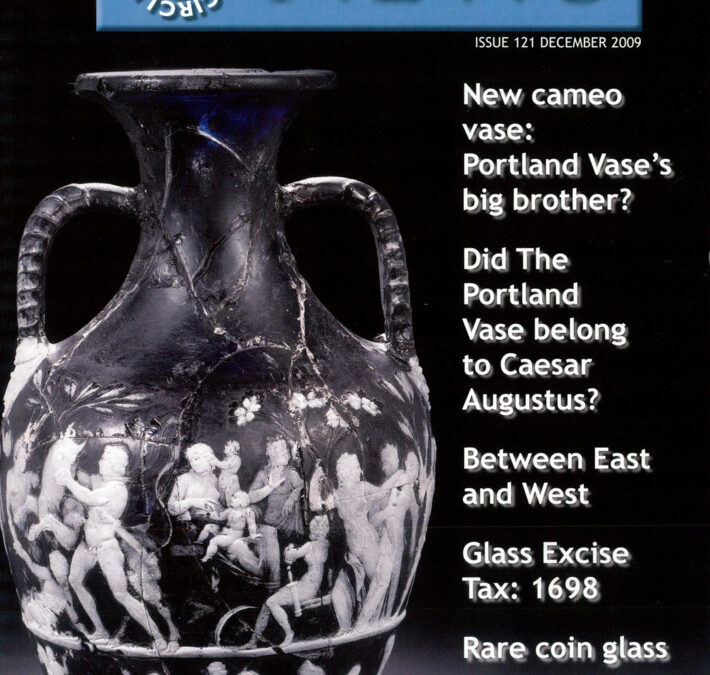
Did The
Portland
Vase belong
to Caesar
Augustus?
Between East
and West
Glass Excise
Tax: 1698
Rare coin glass
New book
reviews
ISSUE 121 DECEMBER 2009
New cameo
vase:
Portland Vase’s
big brother?
Editorial
News
Chairman’s Letter
New Roman cameo glass
Limpid Reflections
Glass Tax 1698
The Portland Vase
Between east and west
Book reviews
Forthcoming events
3
5
6
8
10
13
16
18
20
The Glass Circle News
Issue Number 121
December 2009
Editor
David Watts
dcw@daroben.co.uk
This issue joint editors
John P Smith
johnpsmi@globalnet.co.uk
Andy McConnell
andy@decanterman.com
Athelny Townshend
athelny@aol.com
Design and layout
Athelny Townshend
Printed by
Micropress Printrs td
www.micropress.co.uk
©The Glass Circle
www.theglasseircle.org
Sunderland Br
idge rummer
PHO
TO:
ANDY
MC
CONNEL
L
/
GLASS
ETC
NEWS
.
I n early autumn David Watts suggested
I that ‘the committee’ might like to pro-
duce a bumper Christmas edition of Glass
Circle News, both to give him a respite
from the hard work of editing, laying out,
printing, collating, packing and posting,
all of which he does
himself with some
help from his son, Ben; and to see if the
committee was competent to do so.
Athelny Townshend, who is profiled
elsewhere in this issue and who has just
finished designing Journal XI which you
will be receiving in early January, agreed,
with Andy McConnell’s help, to redesign
and largely edit this issue. He eagerly
awaits readers’ feedback to this new look.
We have moved a long way
from 1937 when members
were only interested in 18th
century English drinking
glasses and this issue may
seem a little top heavy with
unaffordable roman glass
but the two most impor-
tant glass objects to appear
on the market in the last
100 years are the Lycurgus
cup, acquired by the British
Museum in 1958 and the,
as yet unnamed, cameo vase
starred in this issue.
Peter Lole, in his Limpid
Reflections however informs
us that Dwight Lamnon, former director
an The Corning Museum of Glass, and
then director of Wintertur, Delaware, is
now preparing a catalogue of an impor-
tant private American collection of Eng-
lish glass, and using this as an opportunity
to reassess our knowledge of late 17th and
early 18th century English glass. Not be-
fore time in my opinion. Since Hartshorne
published his great book in 1897 there
have only been 3 or 4 books with good
new research on the subject, plus some
archaeological monographs and articles
in learned journal such as The Corning
Journal and our Journal, the other hun-
dred books have all been largely rehashes
of
each other.
One of the attractions of collecting glass
is its connection with political and social
history, and social customs. Many glasses
are engraved to record events current at
the time, some by skilled engravers, some
by amateurs. Although some collectors
prefer ‘form’ glasses
many of the great
glass collections of the world comprise al-
most entirely of engraved glasses.
Unfortunately some old glasses have
been engraved later and such engraving
can be difficult for the untrained eye to
differentiate from original period engrav-
ing. It is rumoured that this pernicious
practise is currently being applied by one
or two living engravers. The engravers
themselves are doing noth-
ing illegal. However this is
not true of those who com-
mission such glasses for
resale who are guilty of the
criminal offence of fraud.
The engraving of Sun-
derland bridge rummers,
Jacobite and cider glasses is
believed to be current and
anyone buying such a glass
should ensure that the ven-
dor provides them with an
invoice stating that, to the
best of their knowledge, the
seller guarantees that the
engraving is contemporary
with the glass.
Care should be taken to discover any
known provenance when buying glasses on
the internet or from non-specialist auction
houses. If a previously unrecorded rarity is
offered take extra care if it is not from an
old collection or does not have a credible
history such as a previous appearance in
an auction.
It is important not to throw the baby out
with the bath water. Thousands of glasses
were engraved in the 18th and 19th centu-
ries; they are the lifeblood of us collectors.
Good fakes are thankfully rare. If I were to
discover an engraved glass associated with
my hometown of Burton on Trent I would
excercise due diligence and then buy it.
by Pet
er Lote
The Nelson Absolon glass
NEWS
C
oin glassware is very unusual, with
most examples tending to be wine-
glasses with a coin captured within a hol-
low stem knop. This
by Andy
jug, containing an
English gold guinea dated 1789, surely
falls into a category that is beyond rare.
‘I saw it when I was viewing my local auc-
tion at Aylsham, Norfolk, says its new
owner, Mike Jordan. ‘I liked it immedi-
ately, thinking it highly unusual to see a
golden guinea contained within a hol-
low cavity in the centre of its base. The
streaking crack around the lower han-
dle termination was a bit worrying, but
thought that if handled carefully it would
probably survive. Some people in the
room were saying that they were going to
smash it to release the coin, which would
have been a terrible shame: criminal:
Estimated at £100-150, it generated a cer-
tain interest in the room, but the hammer
Art Fund support for museum glass acquisitions
Rare coin jug discovery
eventually fell at £160 plus commission.
As Mike saw it, ‘I thought that was cheap.
The vendor came up to me afterwards and
asked if I was going
to break it. He was
delighted to hear that I wasn’t and told
me that it had been handled down the
generations of his family, and that it had
been cracked for as long as he’d known it.
Pressures would certainly exist on certain
owners to realise the jug’s inner asset. Such
‘spade guineas, so-called as the shield on
the reverse is formed like a garden spade,
fetch good money. An internet search
for similar examples reveals
them available at between
£550-700 in mint condition.
‘I’m delighted with it, says
Mike. ‘I’ve contacted a restorer
and am going to have the crack
stabilised and trust that it sur-
vives for another 200 years.
cConnel
PHO
TOS:
ANDY
MC
CONNELL
/
GLASS
ETC
The Art Fund in its 2008/9 Review
I records that it supported three Muse-
ums in acquiring glass during 2008, con-
tributing almost £5K
to acquisitions that
cost in total slightly over £17K . The most
interesting, and the best bargain at £5,376,
was a group of eleven glasses by William
Absolon; they comprise 1 rummer, 5 large
(5
1
/2″ high) and 7 small (4″ high) wine
glasses, of turquoise coloured glass and all decorated en suite in gilt with black enam-
el highlights, acquired by Norwich Castle
Museum. The glasses apparently celebrate
the reward of a Marquessate to Lord
Cornwallis, who as
Governor-general of
India secured a critically important de-
feat of Tippoo Sultan at Seringapatam
in 1792. The glasses that celebrate these
events, bear a gilt and black enamel coro-
net together with a gilt inscription: ‘JOY
AND HEALTH TO CORNWALLIS
WHERE EVER HE GOES: This dating
makes them the earliest known examples
of Absolon’s gilded decoration, as opposed
to engraved work, and they are also the
largest known set of his glasses to survive.
The price of £7,500 emphasises the bar-
gain the eleven Absolon Glasses represent.
Francesca Vanke,Curator of Decora-
tive Art, Norwich Cas-
tle Museum said, “I’m
glad the Glass Circle
News thinks the Corn-
wallis pieces were the
most interesting glass
acquisitions supported
by the Art Fund for that
year. I was delighted
to get them I must say.
The auction house only
called me to tell me
about them about three
days before the sale. It
nearly killed me trying
to scrape the money together in time but I
was so pleased I managed it. Both the Nel-
son and Cornwallis glasses are now on dis-
play in our new galleries and look great:’
Perth Museum was helped to acquire
a Vasart vase, an unusual, slightly garish,
Vincent Ysart work of c.1950, made as a
birthday gift for Ysart’s wife.
Finally, Reading Museum acquired a
cast and textured Glass Sculpture by Co-
lin Read in 2007, with a gilt medal disc
mounted on its inner surface.
Victorian
engraved coin
tankard
L
I ife is full of coincidences, so I suppose
I—that having just written of the rarity of
glassware containing coins it was almost
inevitable that I would find another exam-
ple within 24 hours. Not that the second
example rivals Michael Jordan’s ‘Golden
jug’ as the one I found in a Worcester junk
shop contains not a precious guinea, but a
silver threepence.
However, mine is similar to his as it
also has a crack emanating from the lower
handle terminal, as well as a large piece
that was once broken off and has since
been rejoined with Araldite or similar.
Wheel engraved with ferns and Bohemian
floral stereotypes, it also bears the initials
and date
JJB 1879.
The coin is contained
within the ball knop and dates three years
earlier: 1876. Plonked in a junk box on
the shop floor and priced at £2, I simply
couldn’t resist.
New took
GCNews
R
eaders of the Glass Circle News may
be wondering who is behind the
new look Journal and News. The finger
can be unequivocally pointed at Athelny
Townshend, who answered a plea for help
from John Smith with regard to producing
the Journal. Athelny, who recently retired
from teaching, said, “I was delighted to
get the opportunity to be involved in
a practical way with the organisation;
an opportunity that would allow me to
combine my long standing love for glass
(I bought my first antique glass in a job
lot of junk glass at auction in Ipswich in
the mid 1960s) and a resurrection of a
previous career in graphic design.” Also to
the delight of John Smith not only was he
relieved of the burden of hands-on design
and layout of the Journal but also, quite by
coincidence, they conveniently live within
a handful of miles of each other on the
east Suffolk coast.
Athelny can be contacted by e-mail:
athelny@aol.com or phone: 01986
872272
v.
Silver research dates Georgian
The correlations between antique
I silverware and glass objects has
been documented, with the hallmarks
ell
applied to pieces formed in silver enabling
similarly fashioned glassware to be dated
with a degree of accuracy that was not
previously possible. So, when our
Chairman, John Smith, saw this
image, he responded by stating,
`By coincidence I have just
been researching old glass two
handled loving cups, which are
much more common in silver
and pottery than glass, and I’d
date it to around 1775:
The piece in question recently walked
into our Rye gallery, Glass Etc, with its
owner revealing that it had been in his
family for as long as he can remember,
and enquiring as to whether it was
worth restoring. The finial on the lid was
chipped, but worse, its left side handle had
once been broken off and reassembled
with glue, now oxidised. The answer was
affirmative: the removal of the chip will
not upset the aesthetic balance of the
oving cup
overall piece and the worst of the glue can
be removed.
Of greater interest is the question as
to whether its lid is original or a later
marriage of two parts. Addressing this
issue, first, there is no doubt as to
the fit: the inner rim of the lid sits
snugly within the cup without
any play. But in terms of style,
the issue is less conclusive.
Slice-cut lids of this type
were most commonly fitted to
square-footed, diamond-cut
mantelpiece urns, also known
as
bonbonieres,
dating between
1775-90. So, the date also fits.
It is also important to note that the
lid has been notched for a ladle at some
point.
Bonboniere
lids are never found with
this feature, but perhaps the twin-handled
base enjoyed a period serving as a family-
sized punch bowl and the lid adapted to
that purpose. In the grand scheme of
things, we will never know. However,
most will agree with John’s view that, ‘The
cutting of the cover does not match the
cutting on the bowl as perfectly as one
might expect, but is not too bad:
NEWS
Glassworkers lives: nasty, brutal and short?
W
e glass collectors often speak in
awe of the skills shown in the
manufacture of the glassware that forms
by AtbeinY TPWrishenall
the object of our desires We wonder
at the artistry and sensitivity of the
gaffer and admire the skilled teamwork
necessary to produce the finished article.
It is likely that many members of the
Glass Circle have visited glassworks and
studios and perhaps have even ‘had a
go’ ourselves. Warm work, most of us
would agree. But how often do we really
consider what it would have been like to
be an employee in a glassworks before the
advent of health and safety regulations?
What were working conditions like for
workers who toiled night and day in
such workplaces? Was the remuneration
adequate to maintain a decent standard
of living? What was the life expectancy
of glass workers? Just occasionally we get
a glimpse from the past of what life was
really like for them. The photograph shows
child labour in an Indiana bottle factory in
1908. The photographer, Lewis W Hine
[1874-1940] was a sociologist who used
photography as a tool for social reform.
From 1904-1907 he took photographs of
child labour for the National Child Labor
Committee as part of a campaign to end
the practice.
Another glimpse of the past that
allows us an idea of the squalid lives of
glassworkers is provided by the recent
performance of the play,
Rutherford & Son,
which first opened in 1912. It proved a
sensation at the time: a devastating attack
on the unacceptable face of capitalism
that gripped audiences in the West End,
and later on Broadway and across the
world. When the press discovered that the
writer was — astonishingly for the time — a
woman, Githa Sowerby became an instant
celebrity and feminist hero.
Almost 100 years on Sowerby has
now vanished, and little is known about
Githa and her play, which had never been
performed in Tyneside until recently
when it was staged by Northern Stage,
Newcastle, performed by actors drawn
from the locality. The play was inspired
by her personal experience: as daughter of
the glassmaking industrialist, John George
Sowerby, proprietor of the Sowerby-
Ellison glassworks in Gateshead, one
of the world’s biggest manufacturers of
pressed glass. Although she grew up in
Geordie high society she would also have
had first-hand experience of the poverty
and hardship endured by the factory’s
workforce.
A biography,
Looking for
Githa, by
Patricia Riley has been published by
New Writing North, which celebrates
C
ince writing my last letter I have been
Jtwice to Spain. First I went to Per-
alada, described as a feudal village in Gi-
rona Province in northern Spain, with a
collection of glass put together by a now
deceased Spanish Industrialist. The collec-
tion has no published catalogue, and hence
is little known, and is full of hundreds of
items of glass from northern Spain, Egyp-
tian, Roman and Islamic glass. There is
also glass from northern Europe including
Venetian filigree, a glass stipple engraved
by Woolf from the Netherlands, and an
English glass engraved with a beehive.
Later I went to the La Granja Museum
her life, is available from Northern Stage
and online from New Writing North
www.newwritingnorth.com /shop /shop.
php?section=1 and via Amazon. Copies
can also be ordered from Samuel French
& Co (London).
in the town of San Ildefonso near Sego-
via, where it is situated in the old royal
glass factory. This had glass from south-
ern Spain, and a fine collection of bot-
tles, many English. The factory was lav-
ishly built around 1728 by King Philip
V. For many years in the 20th century it
was closed but is now a state sponsored
concern, like a super Broadfield House
plus Redhouse Cone, with commercial
glass making, glass-making and engraving
schools, two extant cones, and tons, liter-
ally, of glass making equipment.
I expect you all know by now that
Broadfield House has been ‘saved. The
council has agreed not to close it but to
consider a five year plan to possibly move it
to the Redhouse Cone site, provided that a
larger and better museum than Broadfield
House can be built on the site. The Glass
Circle made vigorious representations to
both the Dudley Metropolitan Borough
Council and to the consultants the coun-
cil employed and this conclusion is in line
with our suggestions.
PHO
TO
BY
LEW
IS
HINE
FOR
THE
NATIO
NAL
CHILD
LABOR
COMMITTEE
Midnight at the glassworks: child labourers in Indiana in 1908.
ack in February while cataloguing
la glass for the Islamic Department at
Bonham’s I was called across the room
by Chantelle Rountree of the Antiquities
Department to have a look at some
photographs of a Roman glass they had
just been emailed. As I was walking over
I was told it was
Mart
i
so I wasn’t holding my breath. I was
then shown a series of photographs of a
broken and badly restored two-handled
cameo glass vase. The more I looked at
the photographs the more I realized I
was actually looking at one of the most
amazing pieces of Roman glass to have
survived from antiquity and not a fake.
More than that, it was one previously
unrecorded and one which could answer
so many questions as to the manufacture
of ancient cameo glass vessels.
The Vase arrived in London in late
March but nothing quite prepared me for
seeing it in the flesh. I knew it was 35 cm
high with a maximum body diameter of
20.7 cm, but until I had it in my hands I
didn’t fully appreciate how large it really
was. This was further emphasized when
it was studied alongside the Portland Vase
and the Auldjo Jug in the British Museum,
where it stood head and shoulders above
them. The Vase also weighs a staggering
2.85 kilos. Then there was the decoration!
The engraving is incredibly detailed with
the lightness of touch
of a true master at the
height of their skill.
Yet it was executed
by a different hand to
that of the engraver
of the Portland Vase,
which came as a bit of
surprise when I saw
them side by side. I
am currently trying to
unwrap the two friezes
in a scaled drawing and
even with the use of
magnifying glasses and
enlarged images on a computer screen it
is proving very difficult to include all the
subtle details such as, for example, in the
musculature of the bodies, the folds of the
garments, and the elaborate hairstyles.
The Vase has been consigned to
Bonham’s for study and conservation by
the daughter of a European collector.
According to her, the Vase entered her
father’s collection in the late 1940s. This
provenance is currently being researched by
Bonham’s while I am working on the Vase
itself. It is hoped that it will be exhibited
together with an accompanying catalogue
at Bonham’s later in 2010. Before then the
glass, the glues and
ri
the weathering will
be analyzed at Cardiff University, where it
will also be dismantled and reassembled.
To be able to study it in its fragmentary
form will be wonderful as it will hopefully
answer the question as
to how such large cameo
vessels were made. Of
course, in all likelihood
it will throw up more
questions than answers.
Yet, while I first saw
photographs of the
Vase in February I was
unable to talk about it,
an almost impossible
and frustrating secret
to keep. Thankfully,
Bonham’s and the owner
allowed me to give its
first presentation at
the 18th Congress
of the International
Association for the
History of Glass (AIHV) at Thessaloniki,
Greece, towards the end of September.
It was a wonderful
release and news of this
new discovery caused
and is still causing a
huge stir among the
world’s leading glass
and Roman experts.
This conference was
ahead of the official
press announcement
made by Bonham’s
in October and the
corresponding reports
members might have
read, most notably
in the
Antiques Trade Gazette, Financial
Times,
and
The Telegraph,
all of which can
be viewed online.
The photograph of the Vase on the
front cover, which is reproduced at around
1/4 of its actual size, shows that there are
very unusually two decorative friezes. The
only other cameo vessel with two friezes is
the Blue Vase in the Museo Archeologico
Nazionale, Naples, although the Portland
Vase originally had a second, lower frieze
before it was broken in antiquity and
repaired with the cameo base disc.’ The
Vase has a dark blue body, appearing
black, just like the Portland Vase, with an
opaque white glass overlay that reaches
from the lower neck to the bottom of the
body. The opaque white glass does not
appear to have extended to the underside
of the base although the bottom still
bears of polishing marks and cut grooves
as found on contemporary cast vessels.
Indeed, the bottom of this Vase is almost
identical to that of the aforementioned
Auldjo Jug, making this Vase a cross
between the Portland Vase and the Auldjo
Jug, and a clue as to how the Portland Vase
might have originally
looked. The two blue
handles were applied
onto the shoulders over
the opaque white and
drawn upwards before
being attached to the
side of the neck. This
pulling up has caused the
corresponding parts of
the shoulders to become
misshapen. When cold,
the glass was passed
from the glasshouse to
the studio/workshop of
the engraver, who almost
certainly was also a gem-
engraver.
The
twenty-five
figures in the upper frieze appear to form
two related scenes filled with movement
on each side. There are also five trees in
the upper frieze that fill the space behind
the figures and make a canopy above the
scenes in a horror
vacui
manner. There
are two smaller trees, more like shrubs, in
the lower battle frieze that has seventeen
figures, including six on horseback and
five dead bodies. I am grateful to my fiance
Didier’ for identifying recently the fifth
dead body among the rocks, increasing
the total body count now to forty-two. At
this stage it is unclear how these scenes
relate to each other or to the battle frieze
below. It is also uncertain as to which
side was intended to be viewed first, but
as the figures and scenes are identified
with further study all these relationships
hopefully will become clearer. For the
last 400 years scholars have disputed the
iconography of the Portland Vase, which
only has seven figures, so that for me to
identify (if possible) the scenes on this
vase will take a lot more study and there
The new cameo vase
Big brother to the Portland Vase?
a `Portland Vase,
I realized
I was actually
looking at one
of the most
amazing pieces
of Roman
glass to have
survived
y y
NEWS
will probably never be a consensus among
academics. Although the opaque white is
cut in low relief there is great depth to the
scenes created, which was partly achieved
by some decoration being cut in relief into
the background blue.
Some figures and scenes, however,
are identifiable. Scene 1 most probably
shows the punishment of Dirce where the
unfortunate queen is about to be tied to
the bull by Amphion and his twin brother
Zethus and then dragged to her death.
They are overlooked by their mother,
Antiope, with the two brothers shown
as young children in her lap. In Scene 2
a Maenad or an effeminate Dionysus is
holding back a distressed woman who is
being left by a bearded warrior. Both these
scenes can be seen on the front cover. The
next figure is of a very handsome muscular
god, either Apollo or Orpheus, playing his
harp while looking at a woman pleading
on her knees to a second but unbearded
warrior. They are overlooked by a seated
figure, probably that of Dionysus. This
scene could represent the abandonment
of Ariadne by Theseus, while the last
scene could show Ariadne after being
initiated into the Dionysiac mysteries.
Certainly the last six figures are taking
part in some form of Dionysiac festival or
procession where a man wearing animal
skins is holding a large krater over his
left shoulder. The next two women have
fruiting ivy wreaths in their hair, while the
latter, perhaps Ariadne, is also holding a
thyrsus, preceded by a Bacchant playing a
double flute, a putto holding a
liknon,
and
a maenad holding a lighted torch and a
thyrsus leading the way. That the scenes
are probably wholly or partly Dionysiac
should not come as a surprise as at least
seven of the other fifteen surviving cameo
vessels or panels also have Dionysiac
scenes?
The design must have been copied from
a model or drawing. Unlike the Portland
Vase every surface is covered with
decoration, which might indicate that it is
slightly later in date but it is still not clear
if these vessels are Augustan or Tiberio-
Claudian. This dating depends much
on our understanding of how the blanks
were made and the decoration created.
A feature of this Vase not encountered
before are some very large thin elongated
vertical bubbles in the dark blue glass up
to 13 cm in length. The opaque white
overlay, however, has considerably smaller
yet still slightly elongated vertical bubbles.
This suggests that the main body of the
vase was manipulated before the opaque
white was applied. Yet, rather than
indicating that the Vase was free-blown it
might have been formed a second way, a
theory currently being developed by Mark
Taylor and David Hill. A third technique
proposed by Rosemarie Lierke where
the decoration is placed as powdered
opaque white glass in a mould before the
background blue was then pushed into it
with the use of a plunger is generally not
accepted, especially by glass technologists,
and in the case of this Vase the decoration
is far too complicated for it to have been
formed this way.’
And if any member has any further
ideas or comments please send me an
email: martine.newby@ntlworld.com
Endnotes
1.
There are many other people I should thank
in my research to date including Sir John
Boardman, Sally Cottam, Ian Freestone,
Kenneth Painter, Maddy Perridge, Lisa Pilosi,
Jenny Price, Paul Roberts, Chantelle Rountree,
Mark Taylor and David Hill of the Roman
Glassmakers, as well as many of the delegates
to AIHV 18 who were very generous with
their knowledge and the photographers and
designers at Bonhams who produced the poster
for the Congress.
2.
These vessels include the skyphos in the J. Paul
Getty Museum, the Morgan Cup in The Corning
Museum of Glass, the bottle from Torrita di
Siena in the Museo Archeologico, Florence,
the Besancon Jug (the only vessel in purple
glass), the two panels from Pompeii in the
Museo Archeologico, Naples, and the Cameo
Carpegna in the Louvre. The Portland Vase
could be an eighth example, depending upon
whether the viewer accepts the identification
of the scenes as showing the story of Dionysus
and Ariadne.
3.
I am currently writing an article for the AIHV
18 proceedings where I shall be concentrating
more fully on how this Vase could have
been made while refuting Lierke’s plunging
hypothesis in more detail.
1
t was only two issues ago (GC News
119) that I reflected upon the high
incidence of Amen glasses in Perthshire
and its adjacent counties, but I make no
apology for returning to the subject.
The Amen glasses are amongst the
most highly valued of British 18th
century drinking glasses, although with an
accepted count of thirty-seven specimens
they are by no means the rarest sub-group.
Their fascination lies in the fact that each
glass is unique, with similar but differing
inscriptions, that they can be recognised
as the work of a single engraver, and
that all explicitly commemorate the Old
Pretender, King James VIII of Scotland, his
eldest son Bonnie Prince Charlie and also
in about a third of the glasses his younger
son Prince Henry, Cardinal Duke of York;
some carry additional specific dedications
to Scottish individuals or families whose
importance in the Jacobite pantheon of
1745 can be recognised. Nearly all, too,
carry such explicit recognition of the exiled
Stuart De Jure Royal line that they would
have been recognised in a contemporary
Court of Law as being treasonable; this is
not true for virtually all the ‘mainstream
wheel engraved glasses, all of which
carried well recognised Jacobite allusions,
but which could readily be represented
as being innocuous. We have five or
six contemporary references to wheel
engraved Jacobite glass, two of them in
Newspapers, that excited no reaction from
the authorities; but the Amens were a well
kept secret, jealously guarded by their
owners, and the first, somewhat garbled,
published reference to an Amen glass is to
the Murray Threipland Glass, in Richard
Clark’s
Account of the National Anthem
of 1822,
well after the penal laws relating
to the Stuarts had been rescinded. Three
of the glasses had well and expensively
crafted mahogany carrying cases made for
them in the 19th century, emulating the
practise of Dutch 18th century clubs, and
emphasizing the importance attached to
them.
The inspiration for this reflection comes
Pontil inscription of the Ogilvy Amen glass.
from a recent fascinating discovery by one
of our American Vice Presidents, Dwight
Lanmon. He is preparing a catalogue
of Mr John Bryan’s collection of almost
one hundred and fifty pieces of classic
English glass, amongst which is the
Ogilvy
of Inshewan
Amen glass that was sold
by Christies in May 1999 for £35,600.
He is using this work as the basis for a
critical re-assessment of classic glassware
in England, and hopes to publish it a
year or so hence. On close examination
of the
Ogilvy
Amen he has discovered
an inscription on the punty beneath the
foot, which reads: “Glenquich Glass”.
Initially this baffled him, but study of
the present day geography of the County
of Angus in Scotland seems to reveal
the logic, although the precise meaning
of this remains a little speculative.
Current Ordnance Survey maps reveal
two mentions of Inshewan, one: Weir
of Inshewan some 20 miles north of
Dundee (Map Reference NO 4456) and
the other a further two miles NNW, Mill
of Inshewan (N04261) which is today a
large farmstead well distant from other
buildings. Glenquich does not feature
in the modern Ordnance Gazeteer of
Great Britain, but Glenquiech (N04261)
does, less than a mile away from Mill of
Inshewan as the crow flies but very much
more by road, for this is broken and hilly
countryside on the southern fringes of the
Braes of Angus. Even with the map open
beside me, finding Glenquiech proved
difficult; for roads petered out, or were
blocked by gates marked “Strictly Private”.
Eventually I spied it in a clump of trees
from a few hundred yards away; it is an
excellent hidey-hole for a fugitive Jacobite.
A direct consequence of the 1745 Rising
was the survey of the whole of Scotland
by William Roy, later to be a General of
Artillery. Particular attention was given to
military needs and also to the estates of
rebels. He worked with his team on this
project from 1747 to 1755 and the fruits
of his work may be inspected on-line at
The National Library of Scotland / Maps.
Roy’s Military Survey of Scotland
shows in
this area a scattered settlement of West
Inshuan, quite close to Cortachy Castle,
seat of the Earl of Airlie but a couple or
more miles away from the modern Mill
of Inshewan. It also marks, more or less
where modern Glenqueich is, a house
surrounded by a formal wooded enclosure,
Queich.
Eureka!
The eastern side of Scotland between
the Firth of Forth and the Moray Firth
provided strong support for Prince
Charles Edward Stuart in the 1745
Rising. The Forfarshire Regiment under
the command of David, Lord Ogilvy,
eldest son of the Earl of Airlie of Cortachy
Castle mentioned above, probably
achieved a muster of about 800, making it
one of the larger of the Jacobite regiments.
(Forfarshire is an earlier name for Angus.)
What is even more helpful for Jacobite
historians is that the record of its roll was
better kept and recorded than for many
others. Amongst its officers was Captain
John Ogilvy of Inshewan, who also acted
as paymaster and must therefore have
contributed to the good record keeping,
although the surviving record was actually
made by the adjutant, Captain James
Stuart of Inchbreck. John Ogilvy escaped
to Norway after the debacle at Culloden,
but his subsequent history is unknown
apart from a record of his death in 1781;
however, it was his namesake and a
successor who sold the glass at Sotheby
in June 1924. The Colonel, Lord Ogilvy,
also escaped to Norway. He then made his
O
way to France where, in 1747, he raised a
regiment of expatriate Scots in the service
of France, He ultimately achieved the
rank of Lieutenant General in the French
army. Despite this he received a pardon
from George III in 1778, and was allowed
to inherit the family estate, although not
the title, which was restored in the 19th
century.
So, what can be made of this
inscription, ‘Glenquich Glass’, on the
punty of the Ogilvy Amen? I take it to
be a celebration of the owner of the glass.
The Amen engraver not infrequently used
the territorial patronymic of a family
in his dedications, –
Lochiel, Traquair,
Marischal
in place of
Cameron, Stewart
and
Keith.
It would seem likely from the
way the property was depicted on Roy’s
contemporary map that Queich was then
the main house on the Inshewan estate,
which would equate the inscription as
‘Ogilvy Glass’. Whilst I take this as a form
of dedication, it has been suggested that it
could have been a workshop identification
of whichever client the glass was destined
for. The quality of the engraving on
the bowl of the Ogilvy Amen is poor,
although that on the foot is noticeably
better; it has been credibly suggested that
this manifest difficulty in engraving on a
three dimensional curve makes this glass
an early example, perhaps even the first, of
the surviving 37 Amen glasses. In that case,
perhaps the unusual form of dedication is
also a tentative first that developed into
the more explicit and obvious format of
later glasses. It also suggests that this glass
was executed before the ’45, when Ogilvy
was safely on his estate. This then brings
us to the question of how and where did
the Amen engraver work? That he was a
Jacobite supporter seems certain, for he
really did run a risk in his work, and the
subtle variations in his inscriptions suggest
someone who thoroughly understood and
believed in the inscriptions on which he
or she worked. My own belief is that he
was an amateur and probably based in the
Scottish capital, Edinburgh, which was
a centre for Jacobite sentiment. Robert
Charleston suggested the engraver was
an itinerant, a view with which I concur,
although the evidence is skimpy and some
are firmly of the opinion that the work
was mostly done in Edinburgh itself. Of
those glasses where the provenance seems
to suggest a particular locality all except
the
Dunvegan
and the
Lochiel
are within
a fifty mile radius of Edinburgh, and
several of the presumed owners resided
in Edinburgh or had town houses there.
It was the practise of many of the Scots
gentry who did not have a permanent
Edinburgh residence to take lodgings
there for weeks at a time, and almost all
the aristocracy and gentry had a lawyer in
Edinburgh who acted as their Doer’ and
looked after their interests, sometimes
also acting as a purchasing agent. This
concentration of gentry focus lends some
support to the thesis that Edinburgh was
the sole source of the Amens. However,
the spread of glass types on which the
engraving is done is very wide; the engraver
clearly preferred a drawn trumpet glass,
for almost 80% of the glasses are of this
form. But they comprise both plain stem
and air twists, some with folded feet, some
with tears of widely differing shapes and
sizes and a few plain stems without a tear;
the heights vary widely, from 5″ to 11
1
/”.
If one categorises the whole population
of 37 glasses there is only one group of
four teared plain stem glasses, together
with another of five air twists, where glass
form, tear shape and size and their height
are sufficiently uniform for them possibly
to have come from a single delivery.. that
is less than a quarter of the whole corpus.
My personal belief is that the engraver
was largely an itinerant worker, who used
a client’s own favoured glass on which to
engrave; how else can we explain the use
of a Silesian stem in the 1740s
Haddington
glass? Another objection to the view
that mostly the engraving was done in
Edinburgh is the fact that Bishop Robert
Forbes in Edinburgh who assiduously
chronicled all things Jacobite from 1746
until his death in 1775, gives no inkling
of knowledge of Amen glasses; this is
especially pertinent in the case of Donald
Macleod, Prince Charlie’s boatman whilst
in the Hebrides and Skye, – “The Faithful
Palinurus”. Forbes describes carefully the
history and the inscription dated 1746 on
a silver snuff box presented to Macleod in
London on his release from imprisonment
and of which Donald was immensely
proud and displayed in Edinburgh
during his two months there in late 1747
before returning to his native Skye. This
inscription is repeated exactly on the foot
of the
Dunvegan
Amen glass, except that
his age and the date are advanced by one
year to 1747, giving a strong presumption
that this is the year when it was engraved.
If Forbes had learned of this glass, or
indeed of any of the Amens, he could
hardly have refrained from recording it in
his nine notebooks of Jacobite records and
anecdotes, jealously guarded from prying
eyes during his lifetime, and by his widow
until into the 19th century; they were
finally printed in full, in three volumes
published by the Scottish History Society
in 1897 under Forbes’ own title
The
Lyon in Mourning.
If the whole corpus of
Amens was engraved in Edinburgh, and
there must have been many more glasses
than those we know of today, then Forbes
surely would have sniffed out the secret.
It has to admitted that we really know
very little about the Amen engraver, but
this discovery of an inscribed punty has
certainly provoked more thought about
him or her. It also should act as a clarion
call to any of you who have access to an
Amen glass, or glasses, to look carefully to
Ogilvy of Inshewan Amen glass.
see whether there is a discreet inscription
on the underside of the foot that has
hitherto evaded detection, just as it has on
the
Ogilvy
Amen for so long. The Editor
would love to hear from you should you
find anything!
0
8
F.
F.
0
1
.72;075,2.ed
T
he year 1697 ended, and the early
days of 1698 began, with the
petitions of the leather workers just as
the year before it had ended with those
on glass. On Jan. 18th petitions from the
leather workers continued to pour in.
The
several Owners of Glass-works in or near
Stourbridge in Worcestershire,
realised that
they were losing out and sent in a reminder
petition
That the great Duties on Glass-
wares do so lessen
the
Consumption
thereof, as to endanger the Loss of the said
Manufacture, and Ruin of the Petitioners:
And praying Consideration of the Premises,
and Redress therein.
Clearly, this was
part of a well-organised attack as it was
followed on the 22nd by one in similar
vein from
John Cole, and others, Makers
of Glass, and Glass-bottles, on behalf of
themselves, and several other poor Families
in the City of Bristoll.
and yet another on
the 25th from
poor Working Glass-makers,
in and about Stourbridge, in Worcestershire.
joined on the 27th by one from the pipe
makers and on the 29th by another from
William Clark, and others Owners of Glass-
works in or near Bristoll.
The form of petitions was now well-
established and Feb. 5th saw the arrival
of
A Petition of several Owners of Glass-
works, in or near the Cities of London and
Westminster
claiming that
they formerly
maintained themselves and Families very
comfortably; but the great Duty set upon
Glasswares has so lessened, the Consumption
of that Manufacture, and the Petitioners
Employments therein, that if the Duty be
continued the same will utterly ruin the
Petitioners: And praying Relief therein.
These were not pleas in detail but rather to
remind the Complaints Committee that
their problems had not gone away.
February 7th brought another petition
from the pipe makers and so it went on.
The House, meanwhile, was struggling
with matters as diverse as Counterfeiting
Coin while the
W&M Ctee was
concerned with paying off the Army and
Navy. On February 9th the Pipemakers of
the ancient Borough and Corporation of
Pontefract, in the County of York, added
their voice along with a Petition of
John
Ellis and John Morris,
and divers other
Glass-makers, on behalf of themselves,
and others in and near the City of
Gloucester, and the town of Newnham
etc., another from the poor Glass-makers,
in or near the City of London, both of
these on the 10th, followed by another
on the 12th from the
Glass-makers, in and
near the Town of Newcastle upon Tyne.
It could not be said, though, that the
House was simply negligent. With over
20 diverse items in a day to consider —
Ayre and Calder navigation, Newcastle
waterworks, laws concerning robberies and
profanity, African trade, Tiverton work-
houses and much more, it was struggling
to keep up with the relentless pressure.
The House now began its business at 8 am
rather than
;9 am as previously.
Meanwhile, the leather workers
petitioned relentlessly and on February
24th the pipe makers tried a new
approach with a petition supported by
the
Vintners, Innholders, Victuallers, and
Coffeemen of the Borough of Southwark,
extolling the detriment of this pernicious
duty. It was passed to the Complaints
Committee enlarged by the addition of
Mr. Tredenham, Mr. Brotherton, Mr. Cox,
Mr. Osborne and Mr. Gardner. Where
would it all end?
The pot makers joined in with a petition
on March 3rd. But apart from another
from the London tobacco-pipe makers
on the 29th the rest of the month passed
without event.
On April 1st the W&M Ctee was back
on the problem of raising the Supply
granted to his Majesty. As a consequence
a long string of new duties emerged on the
14th, mainly affecting professionals such
as clergy, lawyers, estate and coach owners,
but glass was not considered. The month
ended with another petition from those
who had invested £564,700 in the Glass
Act enterprise. The government refused
even to allow it to be read in the House. It
was clear that no one was going to receive
relief until the debts due to King William
had been fully resolved.
The duty on leather was beginning
to have effect in that persons failing
to pay were being heavily fined by the
courts. Accordingly, on May 5th it was
ordered that the
Penalties . . . be levied,
and mitigated, by the Justices of Peace.
The
duty itself was not altered. The W&M
Ctee, under Sir
Thomas Littleton,
was still
struggling to meet its target for the Supply
granted to his Majesty and on the 7th the
duty on salt, already heavily taxed, was
raised to ls. 8d. per bushel.
The parliamentary session was drawing
to a close when, on Thursday May 12th,
it was
“Ordered,
That the Report from
the Committee, to whom the Petitions
complaining of the high Duties upon
Glass, and Earthen-wares, and Tobacco-
, pipes, were referred, be made upon
The causes and
battle against duty
on glass 1695-1699
Part 3 — The events of 1698
by Davi d Watts
NEWS
Wednesday
Morning next:’ On the 18th
it was duly postponed until Saturday. On
Friday 20th sugar was the target – Five
Shillings per Hundred weight, upon all
brown Sugar and Fifteen Shillings per
Hundred weight, upon all white Sugar,
the said Duties be granted for the Term of
Two Years, and no longer.
Saturday came and, at last, the
Complaints Committee was able to read
its report, the outcome of which was
that it should be presented to the whole
House, with recommendations at a date to
be fixed.
The report, delivered in at the Clerk’s
Table by Mr Manley, proved to be a
lengthy document (here quoted verbatim).
The Petitioners being numerous, the
Committee thought only to hear Two or
Three Witnesses to each Petition; and
took their Examinations, as followeth; viz.
Upon the Petition of the Glass-makers
and Workmen, in and about
Stourbridge,
in the County of
Worcester.
John Jesson
said, That the Duty laid
upon the Glass Manufacture is ruinous to
the Trade, and but of little Advantage to
the Crown:
That he has not made One Bottle since
the Commencement of the Duty; having
had 100 Dozen ever since by him, which
he cannot sell, unless to Loss.
Edward Houghton,
a Workman, said,
That there are Three more Work-houses
for the Bottle-Trade at
Stourbridge,
which
have not worked since the Duty; and that
he has not had One Day’s Work since:
That One Bottle-house employs 100
People when in Work; and about 50 to a
White-house: That there are 6 or 7 of the
White Glass-houses at
Stourbridge,
and
five Broad Glass-houses, which employ
about the like Number to an House:
That the said White and Broad Glass-
houses, since the said Duty, have worked
but very little; viz, 7 or 8 Weeks in the time
they before used to work Forty; whereby
many of the Petitioners are reduced to
that Poverty, as to become a Charge to
the Parish where they live; and that many
more must, if the Duty be continued.
Upon the Petition of the Glass-makers
in and about
Bristoll:
Henry Dixon,
a Workman, said, That,
before the said Duty, there were Six
Bottle-houses at
Bristoll,
always working;
and now but Three that are employed, and
they but little; and what they do make, are
for Exportation; whereby no Advantage
arises to the Crown, because of the
Drawback thereupon:
That there used to be Four White-
houses at work there, whereof but Two
work, and they very little.
James Jones,
Workman, said, That this
Tax bath ruined both him and his Family;
for, before the Duty, he could earn constant
Wages of 30s. a Week; and now if he can
get a Day’s Work, he can earn but 6d.; and,
for want of that Employment, he begged
his Way up to Town, leaving his Wife and
Four small Children behind him, to seek
Redress; and that there are 6 or 700 People
in the Country, that belonged to the said
Workhouses, without Employment.
Upon the Petition of the Glass-makers
of the City of
Gloucester,
and Town of
Newnham:
Mr.
Balawyn,
Owner of a Glass-house,
said, That he is concerned in Three Glass-
houses at or near
Gloucester;
and that he
has not worked Ten Days since the Duty
upon Bottles; whereas before, there were
[above] 100 Families that depended upon,
and had their Support and Employment
from, the said Houses, who now, for the
most Part of them, want Bread: That the
Duty raises the Price of the Bottles so
high, that his Customers, among whom
he chiefly dealt for Cyder, do now put
the same into Cask, instead of Bottles;
otherwise his Houses would have had full
Employment to this Day.
Upon the Petition of the Glass-makers
of
Newcastle upon Tine:
Joshua Middleton,
Owner of a Glass-
house, said, That he has endeavoured to
strive with the Burden of the said Duty;
and, to that End, kept his Fire in, and
worked, for Twenty Weeks, and employed
his poor Servants; but was forced to lay
down, not being able to sell the Bottles he
made, by reason of the Addition the Duty
puts upon the Price thereof; which puts so
great a Restraint upon their Consumption;
besides the Loss they sustain in Flying and
Breakage, after the Duty is paid to the
King.
John Colt,
Workman, said, He has left
his Wife and Children behind him, at
Newcastle,
whilst he came to seek for Work
at
London;
and has not had One Day’s
Work these 19 Months, the Fires being all
out in the Country; but used to get 40
s.
a
Week, when he was fully employed.
Upon the Petition of the Glass-makers
in and about the City of
London:
Mr.
Hall,
an Owner, said, That the Duty
upon Glass has loaded that Manufacture
to that Degree, that in what little Work
they do employ their Servants in, they are
forced to consine them, before they work,
to accept their Wages in Glass Ware; and
so, when they leave off Work, they are
forced to hawk about the Country, to turn
their Glass Wages into Money.
Daniel Griffin,
Workman, said, That he
has been out of Work these 18 Months
past, till, about Three Weeks ago, he got
into a Work-house in
London,
where there
is about Two Months Stock to work up;
and then never expects a Day’s Work
more, if the Duty continues.
Thomas Gyles,
Workman, said, That he
has had Work but 8 Weeks, for 18 Months
past, when his constant Wages was 40
s.
a
Week; and now wants Bread, for want of
Employment to earn it.
Mr.
Pearson
said, That there is now
12,000 Dozen of Bottles in Stock, at the
Glass-house in
Ratcliff.
Mr. Jackson
said, That at
Lyn
there were
Two Workhouses before the Duty; but
that they, neither of them, worked since
the Duty commenced; but that he has sent
down 5 or 6,000 Dozen of Bottles thither,
for a Market, and had as many in Stock
there, when he left off working.
Mr.
Dallow,
a Bottle-maker in
London
Confirmed on next page.
on I
Fti
110
)ri:T.
(Saltpetre Bank), said, That he has sold at
as good Rates, since the Duty, as before;
and that the Consumption is lessened by
the War, and not by the Duty: That, within
20 Years, several Contracts had been
between the Bottle-makers about
London,
who did agree not to sell, sometimes
under 3
s.
a Dozen, never under 2s. 6d.;
but the Country Manufacturers were not
concerned therein.
(Additional reports of a similar kind
relating to petitions by the Pipe-makers
and Pot-makers then followed.)
However, upon the said several
Complaints of the many Petitioners,
the Committee was willing to inform
themselves, what the Duties upon the said
several Commodities of Glass, Earthen,
Stone-ware, and Tobacco-pipes, amounted
to, from the 17th Day of May 1696, to
the 17th Day of
February
last past; and,
accordingly, made such an Order to the
Commissioners for those Duties, who
laid such Account before the Committee;
whereby it appeared, That the net Duties,
upon the said Commodities, for the Time
aforesaid, excepting the Duty upon Pipes
and Earthen-ware, from the 17th of
November,
to the said 17th of
February,
not being charged to that Account, paid
into the Exchequer, and in Debt standing
out upon Bond, amounted to 34,0551. 11
s. 7Y4d.
But the Petitioners alleging, There were
many Debentures for Drawbacks, that
were not come to the Commissioners
Hands, or that they had not brought to
Account; and that many of the Debts,
charged in that
Item,
were lost to the
Crown, the Persons owing the same being
broke, and undone, by the Continuance
of the said Duty; and that many of the
Wares, included in that Account, were still
on the Makers Hands;
And therefore, to come at a clear State
of the Income of the said Duty, from the
Commencement of the same, to the said
17th Day of
February
last, the Committee
sent their Order, for that Purpose, to the
Auditor of the Exchequer; who, the 16th
of
March
last, certified to the Committee
as followeth; viz.
That there has been paid into the
Exchequer, of the Duties arising by Glass,
Stone, and Earthen-wares, from the
Commencement of the Act, to the 17th
Day of
February
1697, inclusive, the Sum
of £19,258
15s. Y2d.
And, as to the Residue of the before-
mentioned Sum of £34,055 1 ls.
7
3
/4d.
the Commissioners insisted, and offered
to prove, That the same did remain in
the Manufacturers Hands, upon good
Security, and was in no Danger of being
lost to his Majesty; but had been forborn,
only in Favour to the Manufacturers.
And the Petitioners, in general,
complaining of what greater Hardships
they were yet likely to undergo, by the
Duties then voted, by this House, to be
laid upon Coals; alleging, That the Duties
upon the Coals they burn in the making
of 1001. worth of Manufacture, amount
to £5: that every Bottle-house about the
Town, before the Duty upon Glass Wares,
used to burn Twenty Chaldron of Coals
a Week, and in the Country about Thirty
Ton a Week; and that a Bushel of Coals
goes to the burning every Four Gross of
Tobacco-pipes:
The Commissioners for the Duties,
by Order, laid before the Committee
the following Proposals, in Writing, for
regulating the said Duties with greater
Equality, and Ease to the Manufacturers;
viz.
1.
That £10
per Cent.
on the Duty of
Flint and Green Glass, and £15 per Cent.
on Plate Glass, and £5
per Cent,
on the
Pipes and Earthen-ware, be allowed to the
Maker for Breakage.
2.
That the Duty on Glass, now laid
ad
valorem,
be altered, and laid on the several
Species of Glass to be enumerated.
3.
That a higher Duty be laid on the
Importation of all foreign Glass, and
Earthen-wares, and a Prohibition on all
foreign Tobacco-pipes.
4.
That Care be taken, in the
Enumeration, to take off Part of the
Duty upon each particular Sorts of Glass,
where it lies unequally; and to lay it on
other Sorts, where it may be easier to the
Manufacturers.
5.
That no Glass, or Earthen-wares,
be exported from
Ireland
to any of his
Majesty’s Colonies and Plantations.
The Commissioners did also lay before
the Committee some Heads, which they
conceived proper for Improvement of the
Duty; and for which, if needful Clauses
were provided for its due Collection, they
said, they are ready to procure sufficient
Persons to farm the same at £40,000
per
Annum,
clear of all Charges.
A Copy of the said Proposals being, by
Order, delivered to the Petitioners, and a
Day given them to be heard thereupon, the
Petitioners dissented from the Proposals;
and offered several Objections, in Writing,
against the same; insisting, That the said
Proposals, if complied with, would be very
little or no Ease to the Petitioners; in their Manufacture of the said Wares.
That, upon the whole Matter, the
Committee came to the Resolutions
following;
viz.
Resolved,
That it is the Opinion of this
Committee, That the Petitioners have
made good the Allegations of their several
Petitions.
Resolved,
That it is the Opinion of
this Committee, That the Produce of the
several Duties laid upon Glass, Stone,
Earthen-wares, and Tobacco-pipes, are of
little Advantage to the Crown, grievous
in the Collection, and, if continued,
will prove destructive to the said several
Manufactures.
Ordered,
That the Consideration of the
said Report be referred to the Committee
of the whole House, who are to consider
of Ways and Means for raising the Supply
granted to his Majesty.
On June 22nd a new twist emerged from
a rather audacious
Petition of the Masters
and Owners of several Glasshouses in and
about London setting forth, “That they are
informed the Duty upon Glass is likely to be
taken off, which will be prejudicial to them,
they having already paid, or secured, the
Duty payable, for their Stock in Hand: And
praying, if the said Duty be taken of they
may be repaid, or allowed, for what Glass
they have by them unsold.
Inevitably, the Petition was rejected;
debate by the whole House was scheduled
for the following day although, as usual it
was postponed until Saturday 25th.
The outcome resolved was
That it is
the Opinion of this Committee, That an
Equivalent be granted to his Majesty, for
Half the Duties now upon Glass-wares
. . . the Whole Duties upon Stone and
Earthen-wares . . . (and) upon Tobacco
pipes.
The losses were to be made up by
new duties on imported Whale-bone
(which is said to have virtually destroyed
the Icelandic industry) and upon
Scotch
Linen and Ticking imported, or brought
into
England.
Matters then moved fast
and the first reading of the new Bill was
approved on the following Monday with
minor amendments (unspecified) on June
30th. The 3rd reading was passed on July
1st and approved by the Lords on the 4th
to become law in December. The following
day Parliament was prorogued in stages
until December 6th 1698.
Probably because of the success of
the duties on leather and the proposed
new duties the House had weakened
to the extent of cutting the glass duties
to half although their implementation
was over five months away. The duty
on coal remained a vexed question. The
glassmakers’ initial respond to this latest
offering was not encouraging. Would
1699 provide the final answer?
NEWS
The Portland Vase:
Made for Augustus Caesar?
T
he Portland Vase, discovered in the
grave of Roman Emperor Alexander
Severus, (200-224 AD), in 1582, on the
Monte del Grano, a
few miles south of
Rome, is probably the most famous and
valuable piece of glass in the world. But
four major mysteries remain. Who made
it? How was it made? Who was it made
for? And, who are the seven figures por-
trayed? It has a well documented history,
from its discovery up to the present day,
and is as important as any other Roman
artefact.
Dating the vase
The vase was originally thought to have
been made in the first century AD. This
dating was based on the discovery of sim-
ilar Roman cameo glass in the ruins of
Pompeii, buried in the Vesuvius eruption
of the morning of the 25th August 79
AD. Since then the vase has been dated
to around 5 BC to 25 AD by The British
Museum, its keeper.
Who was the
vase
made for?
Even more startling is the possibility that
it may have been made for the aspiring
Octavius, later named Caesar Augustus,
perhaps to his own design, (or at least
he could have had an input), prior to his
election to help him secure the supreme
position. This could not be before 40 BC
and not later than 27 BC when he reached
the pinnacle of his power and became em-
peror; a period of less than thirteen years.
This ties in nicely with the facts known
about the
possible
engraver.
A case can be made to narrow this dat-
ing further. It is unlikely that the
sug-
gested
engraver, Dioskourides, lived as
long as Augustus, who died in his seventy
sixth year, a great age for the time. If he
had also engraved Julius Caesar, during
his lifetime, (and there seems little point
in engraving him after his death, when
another ruler was in power), there is a
good chance he was older than Octavian.
This points to the last part of the last cen-
tury BC.
Who are the figures?
The question of who the figures represent
has puzzled dozens of experts for nearly
four centuries. There are over fifty differ-
ent theories as to who the figures are. The
only unequivocally identified one is Cu-
pid. Most of the rep-
resented figures are
either from antique legend, gods and god-
desses, like Apollo, Paris, Theseus or real
people like Alexander the Great. A read-
ing of the extensive list of possibilities,
a list which there is little purpose in re-
producing, raises the questions of, “Why
him or why her?” Surely there must be
a logical reason for the choice of figures.
Most previous analysis has been made by
Greek or Roman historians, or archae-
ologists. However, taking the alternative
perspective of a glassmaker and designer
with the experience of helping hundreds
of customers design, choose and select
suitable gifts and commis-
sions to commemorate
a significant event or
date reveals a differ-
ent understanding of
the choice of figures.
To understand
the choice of fig-
ures on the vase
it is necessary to
consider some Ro-
man History. Cae-
sar Augustus, as
he became known
later, was the first
and greatest of all
the Roman emper-
ors and held power
from about 40 BC,
until his death in 14
AD. He was origi-
nally born Octavius,
the son of a Roman
senator and provin-
cial governor, Gaius
Octavius. Gaius Oc-
tavius came to promi-
nence by putting down
the rebellion of a tribe
called the Thurii in 60 BC
and died when Octavius
was only four. It was he who
added the name Thurinus to
his young son’s birth names. His
wife Atia, Octavius’ mother, how-
ever, had dynastic blood; her mother
was Julius Caesar’s sister, Julia. This made
Octavius a great nephew of Julius Caesar
and therefore part of the “royal Julian fam-
ily:’ It meant that he was closely related to
the (then) greatest emperor; the emperor
who gave the name Caesar to Rome. Oc-
tavius served alongside his uncle on cam-
paigns and was adopted by Julius Caesar
in his will. Hence his full name was Gaius
Julius Thurinus Octavius, today com-
monly called Octavian, or later, Caesar
Augustus. He is mentioned in the Bible at
by Stephen
Pollock-Hill
NEWS
the time of Christ.
Seeing as the vase is likely to be contem-
porary to Octavian’s life it is reasonable to
assume that it may depict some facts from
his life. The first three figures (cover, left
image) portray a courting couple, arms
outstretched towards each other in a lov-
ing gesture, with Cupid hovering above.
The figures on the reverse side
On the reverse side of the vase there is the
key figure of a strong, seated naked male
figure looking rather secure and serene.
He is observing two women, both seated
and both looking back at him. A compari-
son of this face and those in figs 6,7,8 &
9 raises the question whether or not this
Octavian. The central lower seated female
figure looks the elder of the two and is car-
rying a down-turned flambeau above bro-
ken books or stone slabs; not a fortuitous
omen. The other younger one seems to be
catching the attention of the seated male
figure. We need to consider Octavian’s life.
He married three times, once when very
young, but the marriage was not consum-
mated, and then he married Scribonia.
Maybe a pun is intended as under the
figure there is a book, or a binder of writ-
ings and “scribere” means to write in Latin
below here,? This apparently intellectual,
austere lady lasted less than two years as
his wife, from 34-32 BC, (he is reported
to have described her as having a shrew-
ish disposition and having been already
wed to two ex consuls before he married
her), when he met Livia, a beautiful young
mother, (picture right). She was a most
remarkable character, perhaps one of the
most famous and notable women in Ro-
man history. They fell instantly in love and
she divorced her husband and married
Octavian within weeks. Her son, Tiberius,
by her previous husband became Octavi-
an’s eventual heir and future
emperor,. This gap
between second and
third wife happened
in exactly 31BC.
That fits neatly into
the time window above of 40BC- 23BC.
This means it may be possible to get closer
to the real date.
Summary
Thus the seven figures on the vase are: Oc-
tavian’s father, Gaius Octavius; his mother,
Atia Julius Balbona; Cupid; Aeneas, the
founder of Rome; Octavian himself as
Caesar Augustus; Scribona, his second
wife, or more likely Octavia his recently
widowed sister; and finally, Livia his third
wife, whose son Tiberius succeeded Au-
gustus as Emperor. This is a new interpre-
tation and is presented here for evaluation
and to stimulate discussion. Agreed that
it is just another theory, but it is a theory
that answers many more of the questions
raised by this fantastic glass wonder than
any previous interpretations. It is based
on the latest common knowledge, more
so than all of the previous ones. With this
new theory much more of the jigsaw puz-
zle of facts appear to fit and less questions
remain unanswered. Whatever else, the
one certainty is that this magnificent piece
of Roman craftsmanship will continue to
intrigue and puzzle the experts and lay-
men for many years to come, and I am sure
others will attempt to reveal the Portland
Vase’s hidden secrets in years to come.
About the author
*Stephen Pollock-Hill has been a glass
manufacturer for over forty years. He
is Chairman of The British Glass Edu-
cation Trust (since 1982), a Council
Member of The British Glass Manufac-
turer’s Confederation (British Glass),
the industry trade association, a liv-
eryman since 1973 of The Glass Sellers
Company.
In 2007 he opened the Nazeing Glass
Museum of 20thCentury British Do-
mestic Glass to display his private col-
lection of over 3,000 glass artefacts, and
has set about completing short histories
of all the known British Domestic glass
factories of the 20th century- some 87
at the last count!
Editor’s note
This is a highly edited version of a talk
that Stephen gave to the glass circle in
May 2009. Originally it was intended
to publish the whole talk here but the
exciting discovery of the new “Bonham
vessel made us decide only to print a
summary to leave space for this new
discovery. The full text of Stephen’s talk
may be seen on the Glass Circle website.
BELOW:
Ornamental glass after the form
of a Bosnian pitcher type decorated with
the so-called Oriental-Persian historicist
ornament. The Workshop of Henrik Giergl,
before 1896.
RIGHT:
Ornamental
glass decorated with
the so-called Oriental-Renaissance historicist
decoration. Glassworks off. Schreiber
& Nephews, Zay-Ugrocz (Schreiber &
Neffen), before 1896.
n
urin
g
his long artistic activity Istvan
Sovanka (1858-1944) created
the synthesis of Hungarian national
ornaments, derived from Historicism and
the forms and ornaments of international
Art Nouveau. He was working for the
Schreiber & Nephew firm’s factory in
Zay-Ugrocz
as
the leader of the
etching workshop from 1881 to 1904.
In his first artistic period — from around
1894-1895 — he was experimenting with
two layered glass; the upper, thin layer is
made of copper-ruby glass, the etched-in
ornamentation is much more graphical
than sculptural in his earlier works.
The best known work of this period, a
real artistic-technical tour de force, is a
baptismal font made for the Hungarian
Millenary Exhibition of 1896. In 1902
he was awarded the Diplome de Merite
of the Turin (Torino) World Exhibition,
and he won gold medals at the 1904 St.
Louis and 1906 Milan World Fairs. Two
outstanding pieces made between 1902
and 1904 clearly demonstrates the stylistic
direction of Sovanka; to synthesise the
Hungarian national
historical motifs with
that of international Art Nouveau.
Working in the field of the ‘forgotten
arts’ in Hungary; Miksa Roth (1865-
1944), the Court Stained Glass and
Mosaic Maker of Francis Joseph was the
pioneer of Art Nouveau stained glass and
mosaic art. During his long lasting artistic
activity, he worked in Historicist, Art
Nouveau and Art Deco styles creating a
peculiar, characteristic Miksa Roth style-
synthesis of stained glass and mosaic
Ornamental pitcher after the form of a
pitcher type of Hungarian folk art, the
`nippled pitcher’; decorated with the so-
called National-Hungarian ornament. The
Workshop of Henrik Giergl, before 1896.
works. The most important products of
his workshop in Budapest include stained
glass compositions for the Academy of
Music (1904-1907), the monumental
representative building of the Gresham
Insurance Company (1907), the Ernst
Museum (in co-operation with Jozsef
Rippl-Ronai, 1911), the Chapel of the
Psychiatric Hospital in Lipotmezo (in co-
operation with Sandor Nagy, 1913), the
glass ceiling (cupola) and stage curtain of
the Teatro National, Mexico City (in co-
operation with Geza Maroti, 1910s) and
the Palace of Culture at Marosvasarhely
(today: Tirgu Mures, Rumania, in co-
operation with Sandor Nagy and Ede
Toroczkai Wigand, in 1907).
Pax and another distinguished mosaic
composition of Roth, the Sunrise won
Silver Medal at the 1900 Paris World
Exhibition. The style of Pax is quite
characteristic of Roth’s; a kind of ‘art
nouveau classicism also quite adequate to
the subject, Pallas Athene with the olive
tree bough of Peace.
Roth was the first in the Austro-
Hungarian Monarchy who used
opalescent glass in his stained glass and
mosaic compositions from 1897. The
ideological conception behind the use of
opalescent glass was to avoid painting on
glass; painting with glass, instead.
Actually it was the same idea as that
of using ‘Antique’ and cathedral glass –
which Roth generally combined with
opalescent glass — influenced by the
Glass between East
and West
Part 3 — Hungarian glass with international connections from
the 12th century to 1900-1910)
Z. NEWS
writings and practice of Charles Winston,
William Morris and Edward Burne-
Jones, to create stained glass works in
the spirit of the Middle Ages (also using
scwarzlot and silber). As Roth himself
wrote, in consequence of the use of
opalescent glass there came: “a break with
soul-killing, factory production took
place in the field of glass art, and artists
returned to the only correct path; to the
artistic work imbued with the soul of the
artist as an individual”.
12
Roth considered
opalescent glass suitable mainly for secular
representations, especially in places where
artificial lighting was only possible. Besides
the several surface variations of opalescent
glass: smooth, fluted, grainy or undulating,
he also used a further possibility of the
mixing of colours by placing (and fixing
by leading) two differently coloured pieces
on top of one another, as a result of which
the colour effects of the two were mixed.
As a final result the light filtering through
the pieces of glass is very variable, and in
addition has a particular mystic
effect.
To sum up shortly the significance of
ABOVE:
Vase
decorated with “ocellus (eye
of a peacock’s feather) flower.” Design:
Istvan Sovanka, Glassworks ofJ. Schreiber
& Nephews, Zay-Ugrocz (Schreiber
& Neffen), before 1902. The vase was
exhibited at the Turin (Torino) World
Exhibition in 1902, and for this and other
considerable works Sovanka was awarded
the Diplome de Merite.
BELOW:
Vase with
Autumn
Leaves Design:
Istvan Sovanka. Glassworks ofJ. Schreiber
& Nephews, Zay-Ugrocz (Schreiber &
Neffen), between 1902-1904.
Sunrise mosaic Miksa Roth, 1900. The art
nouveau composition was executed in an
inventive way with the use of American
opalescent glass, Puhl & Wagner gold foil
and Muranese mosaic. With this mosaic
composition together with that of the one
entitled Pax Miksa Roth won Silver Medal
at the 1900 Paris World Exhibition.
Cage Cup Design and partial execution:
Leo Valentin Pantocsek. Glassworks ofJ.
Gyorgy Zahn, before 1866. This cage cup
preserved
in
the collection of the Museum of
Applied Arts
in
Budapest is possibly the first
modern “adaptation” of the ancient cage cup
“theme’: It is definitely not an imitation of
any known cage cups. It is a representative
exhibition object which is — as possibly were
some of the ancient Roman cage cups — at
the same time a worthy imperial present
as well. The first pieces of Pantocsek’s cage
cups were exhibited in 1866; and later
on 8June 1867, on the occasion of the
coronation ceremonies in Pest, two samples
were dedicated to Franz Joseph and Queen
Elizabeth.
glass from the middle of the 19th centu-
ry, we have to emphasize that this fragile
material came into the limelight, para-
doxically symbolising everlasting histori-
cal values as a material itself, and also in
its form and ornamentation. In order to
determine these everlasting historical val-
ues in applied arts and especially in glass
art, serious research was getting started,
which was closely connected with the
origin-researches of the Hungarian na-
tion. To put it concretely, that meant the
research of the Hungarian historical form
and ornament ‘treasury’ and the historical
techniques as well, partially on the base
of a positivist research method. The aim
of these research works was to create the
Hungarian national style with the use of
the collected historical forms, ornamenta-
tion and techniques.
On this ideological base were created the
stylistic features of Hungarian historicist
glass. Considering the formal, ornamental
and technical characteristics of Hungarian
historicist glass we can distinguish the
following tendencies:
•
Iridescent glasses following antique,
sometimes oriental prototypes (Leo
Valentin Pantocsek), Neo-gothic,
Neo-renaissance and Neo-baroque
Ornamental glass after the Roman
stamnium
form
Design: Leo Valentin
Pantocsek. Glassworks of J. Gyorgy Zahn,
before 1862.
Ornamental glass Design: Leo Valentin Pantocsek. Glassworks of J. Gyorgy Zahn, before
1862. This and the following glass were part of the first collection of the iridescent glassware
made by Leo Valentin Pantocsek and was exhibited in the second London World Exhibition
in 1862.
4
cut, engraved, and enamel-painted
and gilded glasses, showing partly the
influence of the Venetian winged glasses
and partly that of the pieces from the
Rhine region, especially that of Romer
glass, Neo-rococo glassware featuring
high enamel-painting and gilding, a few
are multi-layered glass.
•
The different tendencies of the `Hungar-
ian national’ style: `Oriental-Hungarian’:
‘Persian’, oriental rug ornamentation
contoured with gold, and.`Turkish, with
tulip, corn flower, pomegranate and
miribota motifs, ‘National-Hungarian’:
`Flowery Renaissance’ and ornamental
motifs from folk art, of shepherd’s cloak
(wide sheepskin coat, reaching down to
the heels) and of shepherd’s long em-
broidered felt cloak, especially ‘ocellus
(eye of a peacock’s feather)-flower’, and
Neo-renaissance-national: The tech-
niques of these ornaments were relief-
enamel-painting, gilding, acid-etching,
rarely cutting and engraving.
As we already have seen these ornaments
have a determining role in creating the
‘Hungarian-National’ style on a strict
ideological base. That was the reason
why this style or at least its ornaments
were built into the Art Nouveau arsenal
of motifs and used during the Art Deco
period as well.
Hungarian Art Nouveau, especially
ornamental glassware shows the influence
of the French Art Nouveau, mainly that
of Emile Galle’s conception of nature and
oriental effects (the multi-layered, etched
art glasses of Istvan Sovanka), at the same
time keeping its Hungarian-National
motifs (Schreiber & Nephews Glass
Factories, Zay-Ugrocz, The Workshop of
Henrik Giergl).
During its history Hungarian
glass art was influenced by the forms,
ornamentation and techniques of both of
the two dominating glass ‘styles’ of Venice-
Murano and Bohemia — in earlier times by
the glassware of Byzantium —, but at the
same time created some peculiar forms,
decorations and special glass types such as
the cellar-chest flask, the `bokaly’ mug and
the pitcher-glass. From the 19th century
Hungarian glassmaking was one of the
internationally outstanding ones, winning
significant prizes at the international
word exhibitions. The second half of 19th
century was the period of creating the
Hungarian national style, the forms and
ornamentation of which survived in the
Art Nouveau and Art Deco applied arts
as well.
Notes
12 Roth, Miksa: Egy uvegfestomuvesz az
uvegfesteszetrol. (A Glass Artist on Glass Art)
Budapest, 1942, 22.
GREAT BRITISH
WINE ACCESSORIES
……11111111111M1114.
Great British Wine Accessories:
1550-1900
Robin Butler
Brown and Brown Books England 2009
ISBN 978-0-9563498-0-4
Soft backed, boxed.
32cm high 24.5cm wide, 288 pages, full
colour throughout.
I n 1986, in the heyday of his appearances
I in antiques related programmes on
television, Robin Butler wrote
The Book
of Wine Antiques.
That book became the
standard book on the subject. Twenty-
three years of continuing research and
additions to his picture library has enabled
Robin to do what every writer dreams of:
to produce a book even bigger, better and
more comprehensive than the original.
The British have always been enthusias-
tic consumers of wine, and the ritualistic
way it is drunk in the company of friends
has ensured that all the requisites involved
form according to changes in technology
rather than aesthetics.
The first two chapters are devoted to
bottles and bin labels, more familiar to the
butler of a large house than to its owner.
Early free-blown bottles are now highly
collectable with one selling in 2008 for
about £24,000. There are dozens of clubs
throughout the world devoted to the bottle
and a quote from the bottle section of this
book encapsulates the author’s thoughts:
The mind-set behind collectors of wine
glasses, labels, or bottles are all different
from one another and certainly from the
rest of mankind, but they exist and they
determine the prices to a greater or lesser
extent. They each have criteria, which in
their own chosen world, is important to
them, and this is expressed in the prices
they are prepared to pay:
In the world before the screw top the
drinker had to struggle with a corkscrew
to extract the cork, and hundreds of inven-
tors patented new devices which in their
eyes made this extraction easier and new
devices continue to come on the market up
to the present day. This reviewer now pre-
fers to use the simple ‘waiter friend’ having
tried many different types over the years,
but Robin illustrates 89 (!) examples from
the simple to screws decorated with gold
and agate. Again there is a plethora of
societies devoted to the corkscrew, some
with rather quaint names such as the
ICCA (The international Correspondence
of Corkscrew Addicts).
Wine tasters make for a short chapter
as they were mainly for professional
wine merchants rather than customers
and the book then moves on to Wine
Coolers, Cellarets and Cisterns. These
are all rather grand objects, unlikely to be
found in a modest villa. Wine coolers are
made occasionally
in gold, often in
silver, sometimes in base metal and less
commonly in ceramics or glass. Coopered
brass bound-mahogany table wine coolers
and floor standing cellarets for cooling
multiple bottles satisfied the aristocratic
owners of castles, country houses and
grand London properties.
Decanters and jugs placed directly on
a polished mahogany table can scratch it,
and wine drips can stain it, so decanter
stands, or coasters, were used to protect
the table. Trolleys, coasters on wheels,
were used to pass the port. Many believe
that these were first used by the Duke of
Wellington to avoid the embarrassment
of asking the Prince Regent to slide a
coaster, as the trolley could be rolled
in front of him. Coasters were made in
all materials, metal, precious and base,
wood, lacquer, ceramics and glass and can
be the most elaborate of all wine-related
accoutrements
Wine funnels have their collectors,
they are usually in silver but also exist
in enamelware, glass and porcelain. The
same is true of wine labels. The author
illustrates a collection of over 300 labels
together detailed descriptions of a further
87 labels, one even made from tigers’ claws.
Also described are wine siphons, silver-
mounted corks and pouring aids.
Unlike the author, this reviewer has
left decanters and glasses to the end. As
mentioned above brown wine bottles
were forbidden on the table so decanters
or carafes, (stopperless vessels), were
used. They also have the advantage of
aerating the wine, often improving the
taste. These started in the same form as
a bottle but in clear glass, but the form
have to be fashionable and up-to-date.
Only the bottle itself, forbidden on the
table of polite society until towards the
end of the nineteenth
by John P
century, changed its
Smith
British
Glass
Charles R. Hajdamach
progressed independent of the bottle and
Robin illustrates around 70 examples. The
grander cousin of the decanter is the ‘wine’
or ‘claret’ jug. These always had handles
and could be made in silver, pottery,
particularly the early ones, and glass, these
could truly be objects
de luxe
to grace the
sumptuous tables of the rich. Towards the
end of the 19th century some jugs became
quite zoomorphic, with parrots and ducks
being the favourite forms.
As collecting wine glasses has been
covered so well in specialist books on this
subject, Robin illustrates only around 70
examples, together will a discussion as to
why their shapes and sizes changed with
different drinking customs. It is hard for
us today to comprehend the importance of
toasting in social drinking.
Robin has only considered the civilised
side of drinking. There is neither gin
nor drunkenness to be found here. This
book is recommended for the Christmas
stocking of every wine lover in the country.
The book is available direct from
the publishers. The easiest thing is to
go to the book’s website, www.gbwa.
co.uk, where images can be seen and an
order placed with guaranteed next-day
delivery. The price is £65 incl. delivery.
20th Century British Glass
by Charles Hajdamach
published by ACC Publishing Group
RRP £49.50
A
c
o
omplete and fully illustrated survey
f British 20th Century glass rang-
ing from Art Nouveau masterpieces from
1900 to contemporary studio glass sculp-
ture in 2000
Written by the major authority on the
subject, this book is set to become the
standard work of reference
This is the most comprehensive book
yet published on twentieth century
British glass with hitherto unpublished
catalogues, contemporary photographs
and hundred of objects grouped to
assist collectors with identification. The
majority of the items, from private and
public collections, are illustrated for the
first time.
The book covers everything from Art
Nouveau and Art Deco masterpieces to
the now much ignored Pyrex ovenware
and everything in between from engrav-
ing, cameo glass and paperweights. Chap-
ters focus on the effects of the two world
wars, special features look at individual
designers including Keith Murray, while
major exhibitions including the Festival
of Britain in 1951 are fully discussed.
Biographical sections look at post-war de-
signers including Geoffrey Baxter, Ronald
Stennett-Willson and Frank Thrower.
Charles Hajdamach was elected a
Fellow of the Society of Glass Technology
in March 2000 for services to glass and
glassmaking. In 1980 he established
Broadfield House Glass Museum which
quickly became a major glass museum on
the international scene.
He expanded the collections from
1,500 to over 15,000 by 2003, actively
purchasing twentieth century British
glass including much contemporary
work. In 1993 he and two others founded
The Glass Association, a society of glass
collectors, makers and curators now
numbering about five hundred members
nationally and internationally.
NB: For readers that notice the foreign
glass on the front cover, the author points
to the relevant section in the chapter
on Studio Glass, and Michael Harris
innovative work abroad.
For readers of Glass Circle News there
is a 20% discount on the RRP £49.50.
Special offer £39.50 (plus free P&P
worth £4). To order call 01394 389977
or email sue.slee@antiques-acc.com
and quotereference ‘Glass Circle News
offer’.
19
E
ST
OF
GARETH
TA
Bonham’s
glass sale
16th December 2009
Bonham’s auction of Fine British and Eu-
ropean Glass and Paperweights to be held
in their New Bond Street rooms is notable
because of the consistently high level of
quality glasses available. The British glass
is especially significant and comprises a
fine selection of 18th century pieces from
the collection of Chris Crabtree.
Amongst the highlights of this collec-
tion are several significant South Staf-
fordshire and London-made opaque-
white glass vases, a cruet stand and pair
of candlesticks in the manner of porcelain
ABOVE:
Detail of VOC goblet engraved light bal-
uster attributed to Jacob Sang
BELOW:
The Beilby Thompson goblet
together with one of the finest groupings
of Beilby enamelled glass to appear on the
market for some years. This includes two
polychrome heraldic glasses – the Beilby
Thompson Goblet and a crested wineglass
from the Samuel Horsley service – along-
side several delicately painted wineglasses
in white enamel with figurative and archi-
tectural scenes. A Beilby goblet inscribed
‘Success to Sedbergh’ is thought to be
linked to the famous parliamentary elec-
tion of 1761.
Colour-twist wine glasses, the blue col-
our-twist Stout candlestick and other rari-
ties such as a green-tinted opaque-twist
wine glass and an amethyst-tinted taper-
stick add further lustre to the auction.
From other vendors the impressive
Tyger Privateer goblet, originally in the
Hamilton-Clements collection but re-
moved from the market for the past 80
years, stands out as does the recently dis-
covered tall late 17th century goblet with
rare cherub’s head prunts, a unique feature
in English glass. A group of five inscribed
facet-stemmed wine glasses made for the
Cycle Club were reported on in a previous
edition of GCN. Their history and signifi-
cance as society glasses is well illustrated.
A fine armorial decanter from the
Lambton Service, vases by Barbe and
Fritsche and an iconic Laurence Whistler
goblet are just a few, of the later pieces to be
found in the sale. Of the European pieces
in the sale a well engraved VOC goblet
and other Dutch engraved light balusters
are especially prominent.
411111111
11
Cambridge
Glass Fair
28th February 2010
The Cambridge Glass Fair is one of the
leading specialist fairs in the U.K. with
around 100 exhibitors selling fine antique
and collectable glass from all periods. Ex-
hibitors also include contemporary artists
showing their own work.
The foyer exhibition will feature a dis-
play of pieces from the 1950’s and early
60’s by the British designer Ernest Gor-
don for the Swedish manufacturer, Afors.
Vase by Ernest Gordon for Afors
The next Cambridge Glass Fair will be
held on Sunday 28th February at Chil-
ford Hall Vineyard, Linton, Cambs CB21
4LE. Open from 10.30am – 4pm, admis-
sion is £5 with free entry for accompanied
children under 16.
For more information visit www.cam-
bridgeglassfair.com or telephone 07887
762 872.
The Glass and
Ceramics Fair
28th March 2010
A new event from Specialist Glass Fairs,
will be launched on at Dulwich College
in South London. With a mix of collect-
able contemporary and antique glass and
ceramics from all periods it is planned for
this fair to become a major annual event.
With displays from top exhibitors from
across the country the fair is intended to
appeal to a wide range of visitors: collec-
tors, interior designer and lovers of fine
antiques.
SE21 will be held at Dulwich College,
Dulwich Common, London SE21 7LD.
Open from 10.30am – 4pm, admission is
£5 with free entry for accompanied chil-
dren under 16.
For more information visit www
gcSE2l.com or telephone 07887 762 872.