




Vot.33 No.1 March 201
ISSN 2043-6572
•
The development of the lemon-squeezer foot
•
18th century drinking habits
•
Cutlet: its value today
•
Excise Tax: 1699
•
Salerooms
•
Reviews
•
News
EDITORIAL
Hail and farewell
Editorial
2
Chairman’s Letter
Saleroom news
4
The Lemon-squeezer foot
6
The value of cutlet
9
Limpid Reflections
10
Glass Tax, Part 4 1698/9
12
News
15
,
Meetings
17
Obituary
18
Book news and reviews
20
News and diary dates
23
Glass Circle News
ISSN 2043-6572
Vol. 33 No. 1 March 2010
published by The Glass Circle
© Contributors and The Glass Circle
www.glasscircle.org
Editor
Jane Dorner
glass@editor.net
9 Collingwood Avenue,
London
N
0
3.#1,
Design and layout
Athelny Townshend
athelny@aol.com
Printed by
Micropress
Printrs
Ltd
www.micropress.co.uk
Neither the Glass Circle nor any of its officers or
committee members bear any responsibility for
the views expressed in this publication, which are
those of the contributor in each case. Every effort
has been made to trace and acknowledge copyright
in the photographs illustrating articles. The Editor
asks contributors to clear permissions and neither
the Editor nor the Glass Circle is responsible for
inadvertent infringements.
Next copy date:
15 May
2010
for the June edition.
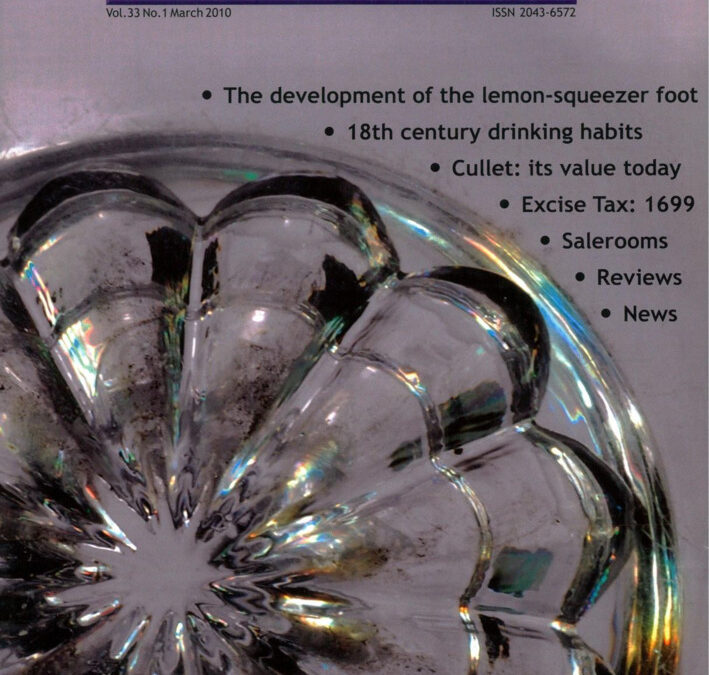
COVER ILLUSTRATION:
Lemon-
squeezer foot.
©Athelny
Townshend
CONTENTS
A
fter running this newsletter for 32
years, almost single-handed, David
Watts is stepping down as Editor.
Fortunately, we will not lose him as a
contributor. I certainly will want to draw
on his knowledge
by Jane
and his experience
because I am a relative newcomer to glass.
That is why the first thing I thought of
when asked to take over was that we
must find out what you, the readers,
want and what you can contribute. So I
urge you to fill in
the questionnaire
enclosed in this
edition — or if
you don’t like
form-filling, just
drop me a note
(preferably
by
email) and tell me
what you’d like in
future newsletters.
Also, I hope
to encourage Letters to the Editor
and an interactive exchange from the
membership. You’ll note that we now
have an ISSN and are renumbering
in line with academic practice so what
would have been Issue 122 is now Vol.
33 No. 1.
The first bit of advice I am taking from
my predecessor is to print pictures of
the editorial team — so that those who
see us at meetings will be able to put a
face to a name. I have spent most of my
working life in publishing and edited
three specialist journals before this one
as well as countless books.
I am also a small-scale collector and
I can’t resist a bargain wineglass. I must
Reception detail
have one for every possible drinking
mood, including some 18th century
opaque twists, which I put out for the
dessert wine at special dinner parties.
I’ve had 12 on the table with other
glassware, including a 1750s quadruple-
knopped airtwist — my most expensive
— and guests are always appreciative and
careful. The rest are a hotch-potch of ale
glasses, rummers, wrythens, tumblers
Dorner
and goblets.
Among them is a
modern one I watched being made by
the master craftsman Elio Quarisa in
Corning, and there are also a dozen
or so ‘woblets’ that I made myself in
the last four years as a rather inept
(but passionate)
mature student
of glass-blowing.
Readers
may
remember ‘From
Bubble to Bowl’
(Glass Circle News
Issue 107, pp.
12-13) in which
I described my
initiation
into
glass-making at
the sadly-demised International Glass
Centre. I went on to do an MA in Glass
at the University for the Creative Arts
at Farnham and my first major glass
installation behind the main reception
desk at the Royal National Orthopaedic
Hospital in Bolsover Street, will be
opened by Prince Andrew a few days
after this magazine drops on your mat.
So I am personally interested in both
the old and the new As a maker now,
working on exhibitions and commissions,
I may have more of a bias towards art and
design, and collectors’ items of the future
than this newsletter has hitherto had,
but I will be guided by you, the readers.
Fill in my questionnaire, add to it all the
things I didn’t know about and help me
make this a lively quarterly reflecting
your interests and your concerns.
Athelny Townshend, who has
volunteered to design
Glass Circle News,
collects Georgian glass and tells me that
this interest has to be self-financing.
His main interest, at the moment, is
balustroid gin glasses which he describes
as the vitreous equivalent of Alsace
wines: elegant and undervalued.
Jane Dorner is exhibiting as one of seven
glass artists from England at the Aven-
turijn Kunstbemiddeling, Epe, Nether-
lands until 24 April and at SOFA New
York
16-19 April.
Jane Dorner
Athelny Townshend
2
Glass Circle News Vol. 33 No. 1
1.01: dirk maly
VIM a 40d0.
OW,•trom nuelenersta, ton*
Roo* stac kg a .1.61vs rs• se
,
Wet, (1.410.
ornmerrararnmrsinrraHr.
1741.0460H-
l’i
n
ejc=
si
m
i
y
n
;.v
i
e
n
btle
,d
d
o
e
,
rted
to
the History of Glass
A HISTORY OF
GLASSMAKING IN LONDON
:VIA,’,704117,ZgArg””‘”‘”g first developed
CLICK HERE
WITH
14
,
,,
T. Fitlwilliarn
English Glass
History Trail
LONDON GLASS
BOOKSHELF
uniquely produced one-gallon whisky
bottles to export that delectable beverage
to America. Also the Fitzwilliam Glass
History Trail dedicated to our late Hon.
President, Hugh Tait. Please look the
site up and give it your support.
WATTS NEWS
B
ack in 1977, when at Robert
Charleston’s behest I started
Glass
Circle News,
I little thought that I would
still be editing it more than thirty years
later. One reason for this was that the
committee had no urge to get involved
and I was left to go my own way.
More recently I have gradually grown
concerned about continuity and the
present committee’s urge to go for a more
popularist presentation to match those
of our companion societies has given me
the opportunity to step down.
I have to say that it has been both great
fun and a great learning experience as
well as creating the opportunity to meet
and work with some of Britain’s best
brains in the world of glass. All this has
only been possible with regular help and
along with my assistant editors I would
particularly like to thank Peter Lole for
his continued flow of inspirational ideas,
particularly about Scottish glass and
the Jacobites in particular. I was always
grateful to the late Henry Fox who never
failed to travel up and down the country
checking dealer’s wares and covering glass
auctions for member’s benefit. Now the
Circle has a new team with a new editor,
Jane Dorner and a new designer, Athelny
Townshend. I wish them both success in
carrying
Glass Circle News
to new heights
of achievement in full colour.
Producing the newsletter has been
a time-consuming occupation and it
has been suggested that I might be at a
loss for what to do with all that newly
gained time. However, following up
on my book,
A History of Glassmaking
in London,
plus a visit to Museum of
London Archaeology for a talk on
Roman glass, it became apparent that
there was much more about glass-
making and glass-working in London,
both earlier and later, than the coverage
in my book. Accordingly, I have set up a
new research website with the address
www.glassmaking-in-london.co.uk.
Its purpose is partly to record what
I have found out so far, but more
importantly to gather new information
about all aspects of the glass industry
in our capital city, progressively up to
the present day. For this I shall need
contributions from members and
other supporters, all of whom will be
acknowledged. There are many gems
already — one favourite being a firm that
Letter from David Watts
Chairman’s letter
Da
v
i
d
Peace
Es
ta
te
n
avid Watts has been editor or joint
Li editor for all of the first 120 editions
of this newsletter from when he was a
lecturing scientist at Guys Hospital to, in
latter years, being a gentleman of leisure.
Fortunately, we are
not losing him. He
has used the work which went into his
new book (see the review in
Glass Circle
News
No. 120 page 5) as a basis for an
all-embracing website on British glass,
enabling him to bring his thoughts and
discoveries to a wide audience, and at
greater length than was ever possible in a
newsletter. He gives you the web address
in his piece above, and I too urge you to
look at it and add to it.
I am delighted that David will also
continue to write for us. His writing is
always learned, sometimes controversial
(shorthand for the fact that I do not
always agree with it) and covers a wide
field. His first report of a meeting in
the inaugural issue (March 1977), was
of a talk by David Peace on ‘The glass
engraver as calligrapher’ tracing the
personalisation of glass from 700 BC to
his own day. Many topics, both abstruse
and entertaining followed. His latest
article discusses the
P
Smith
effect of taxes on
17th century glassmaking in London
(see pages 12-14).
David always had very firm ideas as
to how the newsletter should look, and
what it should contain. It is already clear
David Peace design for a monogram
to me that our new editor is from the
same mould. I look forward to seeing
how her professionalism will advance
the presentation and content of our
newsletter. I know she is asking you all
for your comments and suggestions.
She is continuing with the new
format, no doubt with some further
improvements, and I am sure that will be
welcomed, judging by the many emails I
received, virtually all highly supportive of
the new look.
Journal 11,
which you will have
received in January, was sent out in
appalling weather conditions. At least
one member received theirs damaged.
If anyone else received a damaged copy
please let us know and we will replace it.
Work has already started on preparing
articles
for Journal
12.
Should you be in Edinburgh in
October, I commend to you the
conference in that city
(see
Diary dates
on page 24). Our President, and other
luminaries, will be giving papers related
to Scottish glass over the last 400 years.
We will be bringing you further details
as they are announced.
by John
Glass Circle News Vol. 33 No. 1
3
1
CD
A facon de Venise goblet
which realised £13,000
SALEROOM NEWS
Crabtree collection sold
B
onhams 269-lot sale held on 16
December was a mix of English and
Continental drinking glasses with an
80-lot afternoon session of 19th and
20th century paperweights. Although a
various-owners mix, two core properties
made up over a third
of the content: the
by Anne Crane
60-lot Morton collection of paperweights
and 50-odd lots comprising the first
part of the collection of drinking glasses
formed by Christopher Crabtree.
To this were added another 87 lots of
mixed-owner English drinking glasses
and around 50 lots of Continental glass:
16th and 17th century facon de Venise;
18th century Dutch engraved works;
Biedermeier and a sprinkling of 19th
century decorative glass.
Overall, with the immediate after-
sales included, the auction chalked up
just under £570,000 with selling rates
of 75% by volume and 88% by value. It
was a pretty good result in what is a solid
rather than volcanic market, especially
given that some of the key material on
offer was making a fairly swift return to
the rostrum.
This could be most easily observed in
the Crabtree collection. Well known in
the trade, Mr Crabtree has been a serious
glass collector for four decades and a
high-profile auction participant for the
last decade or so, buying prominently in
collectable sectors of the market, notably
enamelled glasses by the Beilby group of
decorators, often at top dollar prices.
A change of collecting direction has
prompted him to sell his collection
through Bonhams in two instalments.
Beilby, Jacobite glass, colour twists,
opaque white glass candlesticks and
some facon de Venise and Dutch-
engraved Continental pieces made up
the first offering. Part two, with other
glasswares, will be dispersed on 19 May.
Splitting a collection is one way of
ensuring that the market isn’t flooded and
it also gives both vendor and auctioneer
an opportunity to test the waters and, if
necessary, adjust expectations next time.
Bonhams estimates were not
automatically set to record a profit on
Crabtree’s recent purchases. But nor did
they leave much in the way of a profit
margin for the trade. Fortunately there
was a degree of flexibility in operation
so, while the audience sometimes proved
resistant at the auction, after-sales
ensured that virtually everything had
found a buyer a day or so later. There
were some strong individual prices, but
with other lots Mr Crabtree will have
at best broken even or made a loss. A
selection of pieces
are pictured and
discussed here.
With 16 examples to sell, Beilby glass
was the largest and most significant
element of the first instalment of the
Chris Crabtree collection. The 7
1
/2″
(19cm) high armorial enamelled opaque
twist goblet (pictured in
Glass Circle News
121 p20) was the highlight. When it last
appeared at auction in the same rooms
four years ago, estimated at £7000-
10,000, it made £13,000 hammer. Since
then the damaged and partly replaced
foot has been restored and it was offered
here with an estimate that was more
than double the 2005 price. Restoration
aside, the attraction of a glass like this
lies higher up, in the bucket-shaped
bowl, which bears an impressive armorial
for the Beilby Thompson family of
Micklethwaite Grange, Yorkshire, set
in a rococo cartouche. It surpassed
expectations, selling for £32,000.
Not every Crabtree Beilby-type
glass made the kind of dramatic price
increase of the Thompson Beilby goblet.
A 6″ (16cm) high opaque twist wine
glass of c.1765, with a delicate pastoral
landscape enamelled to its funnel bowl,
cost £13,500 plus premium when it
came up for sale at Bonhams five years
ago as part of the Henry Fox collection.
Entered here with a £10,000-15,000
estimate, it got away at £9,500.
The 7″ (18cm) high opaque twist
goblet of c.1760-65 inscribed `Success to
Sedbergh’ cost £15,000 hammer when it
came up for sale at Christie’s two years
ago. Entered here with a lower guide
of £8,000-12,000, it fetched £15,500.
Sedbergh is a Yorkshire woollen town
but the inscription is thought to be
a reference to a 1761 Parliamentary
election between two landowners in the
adjacent county of Westmorland.
A facon de Venise glass from the
Crabtree collection, (pictured left), is a
10″ (25cm) high goblet of c.1680 with
elaborate colour-twisted coiled stem and
flared bowl, engraved in Dutch diamond
point ‘Francis Withens 10 Maie 1590′
4
Glass Circle News Vol 33 No 1
5
Glass Circle News Vol. 33 No. 1
ABOVE:
Four
colour twist glasses from the Crabtree Collection.
RIGHT:
An
early baluster
goblet c.1690
SALEROOM NEWS
perhaps indicates an anniversary. When
it last appeared at auction as part of the
sale of the Hida Takayama Museum at
Sotheby’s in 2002, the glass cost £8,000.
This time around it realised £13,000
against an estimate of £7,000-9,000.
The Crabtree collection also included
a group of half-a-dozen lots of opaque
white glassware. This type of production,
which is ascribed to London or South
Staffordshire, carries very attractive, high
quality decoration but it can fall between
collecting stools. Its opaqueness makes
it more akin to porcelain for some glass
enthusiasts but it doesn’t necessarily
chime with factory-driven ceramic buffs.
Four of the lots had featured in a mixed
media sale titled`50 years of Collecting at
Christie’s’ in May 2003. There they were
purchased for substantial sums, none of
which were replicated this time around
although all got away eventually. A pair
of 5
3
/4″ (14.5cm) high vases of c.1755-
60, decorated in
famille rose
palette with
peony and rockwork, cost a mighty
£19,000 in 2003. Offered here with a
£10,000-15,000 estimate, they got away
at £8,000.
The Crabtree collection contained six
colour-twist glasses and one colour-twist
candlestick. Demand for these is not
as bullish as it was a few years ago but
all got away (the very rare candlestick
as an aftersale at £15,000). Pictured
(below left) from left to right are: a 61/2″
(16.5cm) high bell-bowled glass with
green- and brown-threaded opaque twist
— £1,800; a 7″ (17.5cm) high bucket-
bowled glass with amethyst thread
opaque twist — £2,600; a 6″ (15cm)
high glass with moulded bowl and blue-
threaded mixed twist — £3,200 and a 6″
(15cm) high glass with engraved bowl
and pink- and cobalt-threaded opaque
twist — £3,000.
Hasty resale was a particularly telling
factor in a group of pieces outside
the Crabtree collection where it was
combined with very bullish expectations.
Five 1770s facet-stemmed engraved wine
glasses offered here formed part of a set
of 13 used by the Cycle Club, a Welsh
Jacobite supporters association. They
were passed down by direct descent
from one Robert Vaughan of North
Wales until they sold at Tamlyn’s on 9
December 2008 for a total of £21,600.
Then the highest individual price was
£2,600. Just one year on, they carried
individual guides of £3,500-4,500
apiece. Lack of freshness told, just one,
engraved with the name of club member
Philip Egerton, found a buyer, at £3,000.
Conversely, Bonhams sale also showed
how much of a premium is attached
to fresh rarities that please current
collecting taste-buds. Early on the sale
featured an 111/2″ (29cm) high baluster
goblet of c.1690 (below right) which had
been acquired by the vendor at a country
house sale in Ireland. Good balusters
are currently much in demand and this
was an early example of impressive size
with the bonus of a gadrooned bowl
`nipt diamond waies’ over a hollow ball
knop applied with four putto heads.
These last were an unusual and attractive
touch, the raspberry prunts associated
with continental glass being a more
common motif. It was enough to send
the bidding to £30,000, over double the
£10,000-15,000 estimate, before it fell to
a telephone bidder.
The Continental section majored
on areas that are currently strong:
Venetian and facon de Venise and Dutch
engraved glass, eschewing the German
and middle European material that has
been struggling of late. Dutch glass is
on something of a roll, with interest
from the UK and Holland focussing
on a c.1770, 9″ (23cm) high Dutch
engraved goblet. There were multiple
attractions to this piece: the fine three-
masted sailing ship named Holland and
an elaborate monogram to the other side
in the form of the VOC insignia of the
Dutch East India Company. Although
unsigned, the engraving was stylistically
attributed to the well-regarded Dutch
artist Jacob Sang. It provided the highest
Continental price in this event and
realised £22,000.
The stickiest section was the group
of Biedermeier enamelled glassware, a
collecting field where demand has fallen
from its peak a decade or so ago.
The afternoon paperweights session
proved less solid, although the Morton
material performed markedly better than
the mixed-owner pieces that followed.
This article first appeared in
Antiques Trade
Gazette
Issue 1923.
wwwantiquestradegazette.com
PHOTO A: Cruet
with petalled foot
PHOTO B:
Salt with diamond foot
C
)
C&
P
Max
we
ll-
Ste
wa
r
t
2010
©
C&
P
Max
we
l
l-
Ste
war
t
20
10
LEMON-SQUEEZER FEET
The lemon-squeezer foot
Summary
The basic technologies for moulding
glass were established by the 1st century
AD
by the Syrian and Alexandrian
glassmakers of the Roman Empire.
Although intermittent exploitation of
these techniques was made for the next
1,700 years, the first
mass production of
moulded glass was in making feet with
convex ribbed domes impressed into
them at the turn of the 18th and 19th
centuries. These feet were marketed in
the glass trade of that time as ‘rose feet.
By the early 20th century glass collectors
commonly referred to them as ‘lemon-
squeezer’ feet because of an affinity of
profile with the common kitchen utensil.
(See cover picture).
The crudeness of many of these press-
moulded feet when contrasted to the
quality of the wrought glass components
to which they were welded, prompts
enquiry as to why the development
occurred.
In this article, I explore reasons why
this innovation was made and examines
the technical difficulties of welding these
feet to wrought glass bodies. I conclude
that the development was spurred
because it facilitated simulation of deep
cutting at relatively low cost.
Historical background
Outstanding examples of 1st century
AD
moulded glass in the collections
of the Corning Museum of Glass, the
British Museum and the Romisch-
Germanisches Museum were assembled
for the
Glass of the Caesars
Exhibition
in 1987. These included several sag-
moulded bowls and a press-moulded
plaque of Medusa. The crowning example
of the skills of the mould makers of this
era are the multi-part moulds which
were used by Ennion to make intricately
decorated mould-blown jugs.
Although press moulding was used
over the succeeding 1,500 years to make
paste jewellery the first industrial use
was in crimping tongs by which blanks
for chandelier drops and the finials
of decanter stoppers were pressed to
reduce, if not to obviate, subsequent
cutting. Those tongs could, however, be
considered to be a development of the
traditional glassmaker’s tools.
I remark that, by contrast, the ‘lemon-
squeezer’ foot marked a shift from the
skills of the gaffer to the mastery of the
machine. Although the basic technology
for this development was established
back in Roman times, the consensus of
informed opinion is that it did not occur
until the 4th quarter of the 18th century.
Certainly by 1800 a
wide variety of glass
vessels with lemon-squeezer feet were
being made in England and Ireland. The
following list shows the popularity of this
foot between 1780 and 1820. Salt boats
with boat, bucket and rimmed bowls;
drinking glasses notably ales, goblets and
rummers, candlesticks and oils lamps,
ornamental vases and lidded urns, fruit
bowls of various configurations including
those with cut turnover rims, montieths,
bonnet glasses, celery vases, jugs,
decanters, cruets, jellies and candelabras.
As examples in my collection I show in
photo A a cruet with a petalled foot and
tapered round stem and in B a salt with
a diamond foot and a tapered hexagonal
stem.
Machine press
–
moulding
The process of moulding glass by pouring
a measured gather of molten glass into a
metal form and then impressing it with
a plunger was developed in the late 18th
century. Examples of these devices are
preserved in the Museum of London and
Centro Nacional del Vidrio, Madrid.
I note in passing that the existence
of these devices proves that a hand-
operated plunger cut from graphite as
postulated by late Kenneth M. Wilson
from studies he made in the USA, was at
best, a marginal practice in that country
before press moulding was developed
with vigour and great ingenuity on that
side of the Atlantic
The items I review in this article
required that the press-moulded item be
welded to a wrought glass component.
To achieve this there would have to be
a compatibility of the melting points of
the two components. The melting point
of glass is determined primarily by the
type and quantity of the flux employed.
For British and Irish table glass of this
period the flux was lead. Whilst control
could be exercised in the amount of
lead which was added to a pot for
making press-moulded items to accord
with that for a separate pot for making
by Christopher
Maxwell-Stewart
6
Glass Circle News Vol. 33 No. 1
I
LEMON-SQUEEZER FEET
© At
he
lny
Towns
hen
d
wrought items, a difficulty would be
experienced in controlling the amount
of lead inherent in the cullet which was
a necessary component of both mixes.
This consideration points to a practice of
making the press-moulded components
and the wrought counterparts within a
single glassworks.
The grainy surface of some lemon-
squeezer feet is a clue as to how some
of these early feet were formed as now
explored.
The classical method of casting iron is
to make a wooden facsimile (template)
of the profile which is required; this is
then firmly pressed into sand to which a
cohesion agent has been added and the
template is then carefully withdrawn
leaving a sand mould into which molten
iron can be poured. Subsequently the
sand mould is broken away from the
casting which is left with a grainy surface
on the contact faces. If this grainy surface
is left as cast’, any glass subsequently cast
or pressed within it will reflect it on
those contact faces.
A more skilled method of making
moulds for press-moulding was available
from the trade which had long produced
moulds for forging (striking) coins and
medals. These tradesmen chased their
dies from bronze/ brass and (later) steel;
they styled themselves as die sinkers’ to
contrast themselves from `mould makers’.
So I deduce a reason some press-
moulded items have grainy surfaces and
others have smooth surfaces is that the
former were struck from unpolished cast
iron moulds and the latter from chased
bronze, brass or steel moulds.
The reasons for adoption of lemon-
squeezer feet
I have established that the technology for
press-moulding lemon-squeezer feet was
available long before late 18th century. I
also deduce the high probability that the
press-moulded components and their
wrought counter parts were made within
the same glassworks.
I next note that this innovation created
a foot with an enlivened appearance akin
to deep cutting. The markedly inferior
finish of the lemon-squeezer impression
when compared to that of late 18th
century cutting, is largely disguised by
the overlying glass.
I now focus on the depth of the tight
impressions made for lemon-squeezer
feet and then consider the difficulties of
achieving these by the cutting techniques
extant in the late 18th century and early
19th century. A prerequisite for such deep
cutting would be a set of small grinding
wheels. Such tools were available to
the glass engraver as witness some of
the wonderful intaglio achievements
of particularly German and Bohemian
craftsmen of the 18th century. However,
that was prohibitively expensive.
In contrast to engraving, cutting is
achieved by pressing the glass item onto
the rotating wheel. This requires that
the wheel and its drive shaft be robust.
Moreover to cut and polish the deep
impressions of the lemon-squeezer
wheels of small diameter rotating at
high speeds and substantial torque
were required. Consequently the heat
generated at the cutting face would have
required the use of coolants to avoid
damage to the glass. The technology
to counter these side effects was not
developed until the mid-19th century.
Press moulding circumvented these
problems.
I now turn to the bugbear of 18th
century and early 19th century glass
makers: the Excise Acts. In this regard
the press-moulded item had a fiscal
advantage over the wrought and cut
equivalent in that the tax on the
glass which is cut away by
the latter sequence was
avoided.
So I arrive at the
conclusion that
the lemon-
squeezer
foot was
4
introduced because it produced an
enlivened product akin to a deeply cut
rose, at a very moderate cost.
Pontil rod or gadget
Whilst I have deduced logical reasons for
making lemon-squeezer feet, I have yet
to identify the technique by which they
were held when welded to the wrought
components.
As a preliminary to this enquiry I
considered the distortion of the underside
of a lemon-squeezer foot which results
from press moulding namely the warping
of this free surface. This arises because as
the plunger is pressed into the molten
glass it pushes the plastic matrix towards
the sides of the mould. On meeting these
sides, the plastic glass wells up to high
points corresponding to the vertices of
the mould. The resulting cooled profile
of the sole is thus slightly concave. I note
that some lemon-squeezer feet were
welded to the other components and left
in the mould-struck condition and thus
rock when placed on a flat surface.
In order to weld the press-moulded
Glass Circle News Vol. 33 No. 1
LEMON-SQUEEZER FEET
FIG.
1:
Diamond foot with 16 v-shaped
lobes
FIG. a:
Square foot with 14 v-shaped lobes
FIG.
3:
Hexagonal foot with 12 rounded
lobes
FIG. 4:
Oval foot with 16 rounded lobes
FIG. 5:
Petalled with 12 rounded lobes
FIG. 6:
Octagonal foot with 32 v-shaped
lobes
foot to the other component, the foot
has to be firmly held so that when joined,
their respective centre lines are coaxial.
Classically this was done by welding the
foot to a pontil rod with a dob of glass
and subsequently shearing it off to leave
a pontil mark. This procedure would,
however, have marred the lemon-squeez-
er impression and that would have ne-
gated a major advantage of the technique.
That would explain why pontil marks on
lemon-squeezer feet, are rare.
This leads to the conclusion that
a gadget was used to clamp to the
foot as it was welded to the wrought
component. Prima
facie
the lemon-
squeezer impression would facilitate
interlocking of a gadget with the foot.
However, the fact that every lemon-
squeezer impression is eccentric (some
markedly so) to the vertical axis of its
foot, precludes this method of locking.
So the gadget would have had to clamp
on the outer margins of the sole.
Figures 1 to 6 record the variety
known to me of plan profiles of lemon-
squeezer feet welded to wrought glass
vessels. Each of these configurations
would have required its own gadget to
hold the foot firmly whilst it was welded
to counterpart components. Contriving
a gadget to clamp on a diamond foot
with its tapered hexagonal stem as photo
B poses challenges. My figures 7a and
7b show a conjectural solution. As a
reflection of the common warping of
these feet, I postulate clamping by studs
in the lower plate. This solution accords
with feint round impressions on the sole
of a diamond foot in my collection.
So I evince strong evidence the gadget
was developed some 70 years before the
date postulated in
Glass Circle News
No.
103. The challenges of making and using
such a device may have been the reason
FIG. 7A: Plan
of a conjectural gadget for
clamping a diamond foot
why the production of vessels with
press-moulded feet was a relatively late
development.
Postscript
I have written this article at the suggestion
of our Chairman as a preliminary to a
more extensive paper on lemon-squeezer
feet based on questions which arose from
an acquisition I made in 1968 when I
commenced collecting glass. I hope that I
have stimulated interest and controversy
by my above findings and invite readers
to share their thoughts with me when
I deliver my observations on ‘the PH
mystery’ to a meeting of the Glass Circle.
xi menage
I
Ai
….
kif
AL
– 4
FIG. 7B:
Elevation of a conjectural gadget
for clamping a diamond foot
8
Glass Circle News Vol. 33 No. 1
Kelleibank Recycling Centre, Alloa
CULLET
The value of cutlet to modern bottle-makers
s
a new member of the Glass Circle
was a little taken aback by the
article on the importance of cullet
and in particular the assertion that
The modern lightweight glass bottle
is a masterpiece of science and its
production will not tolerate cullet from
other glass processes…. Technology has
now reduced the essential importance of
cullet and, other than in economic terms
which are now marginal, it will never
again play a major role in the history of
glassmaking (Robert Wilkes in
Glass
Circle News
No.118, page 12).
Having worked in the glass industry
all my professional life, latterly running
the glass container factories at Harlow in
Essex and Alloa in Scotland (pictured),
I have been closely involved with glass
recycling in the form of bottle-bank
cullet right from its inception in the early
eighties. Although I commend the article
for highlighting the importance of cullet
in the glassmaking process, particularly
in its historical context, I believe some of
the points need redressing with regard to
large modern commercial operations.
I was recently asked to give my opinion
on the cullet requirements for a proposed
new overseas glass manufacturing
operation because of the prohibitive
price of recycled glass in that particular
country. I responded by pointing out
that, in essence, glass melting and
refining were a function of both time and
temperature, and that without the effect
of cullet the throughput of the glass from
the furnace, i.e. the time element, would
be severely restricted. If temperature was
used to compensate, apart from the cost
of the energy involved, the likelihood
of damage to the furnace was highly
probably. These days, glass container
furnaces, which give many years of
uninterrupted production, cost millions
of pounds to build.
Although recycling in all its forms
is being imposed more and more on
society, I can honestly say that the glass
industry, above all others, has taken this
on board to a greater extent than any
other industry. Having been directly in
charge of the glass furnaces at Harlow,
I was given the task of running the new
recycling centre when it opened in 1982.
Bottle-makers, it has to be said, have
a tendency to blame the glass for any
forming problems they cannot sort out
themselves, and the fact that we were
now putting significant quantities of
by Michael Noble
`rubbish’ into the batch potentially gave
them unlimited excuses.
One of the basic rules we applied at
the outset was to accept cullet into the
recycling plant only of a certain quality.
The processing plant could take out
the material it was designed to remove,
such as aluminium, paper, corks, iron,
etc., and obvious contaminants that
could be seen from a picking belt. Other
materials, such as pebbles, broken plates
and other ceramic articles, together with
large amounts of glass of a different
colour, were very difficult to separate and
would give all sorts of problems in bottle
production. The adage ‘Rubbish In,
Rubbish Out’ was never more apt. Other
contaminants included used hypodermic
needles, magazines and video tapes of
a somewhat dubious nature, handbags
devoid of contents, and on one occasion
a handbag full of credit cards and money,
when a lady had inadvertently put this in
the bottle bank and returned the bottles
to her car. Needless to say we managed
to return this, much to her relief.
I was always very nervous of the melt
if the cullet level had to be dropped
below about 10%, normally due to a lack
of supply. Once, when I was a young
man looking after a Scottish furnace at
Kinghorn, the amount of off-ware was
virtually non-existent. Every rejected
bottle underwent a postmortem, leaving
cullet in very short supply. This was in
1974 long before any recycling schemes
had been established, and my solution
at the time was to arrange the local
Boy Scouts to collect household glass
waste. The material collected, of course,
contained all sorts of bottle caps and
other waste products forcing me to reject
the entire load. I was quite rightly told
off for my draconian actions by the then
MD who made sure the scouts were paid
for their efforts.
The advent of light weighting bottles
and high productivity machines does not
adversely affect the amount of cullet that
can be included in the mix. Green glass
typically contains more than 80%, being
restricted by the need to keep control
of the glass composition and in some
cases limited by the mechanical handling
systems. Flint glass usually starts to lose
its colour above about 30% and becomes
unacceptable to certain customers, and
amber glass always seems to be at a
premium.
The price of cullet given in
Glass
Circle News
No. 116 (Robert Wilkes
Notes on the Importance of Gullet
part 3 page 11) was also interesting and
from my experience seems to be rather
on the low side. The general strategy
of the industry was to pay roughly the
equivalent amount of money for the
processed cullet as it did for glass made
from a batch of raw materials. Out of
this came the processing costs, either
in-house or from an external supplier,
and the remainder was given to the local
authority or cullet merchant. There were,
and probably still are, alternative uses
for cullet. For example, road builders
who do not need the quality required
for bottle production, can undercut
prices, sometimes leaving the glass
manufacturers running low.
This has been exacerbated in recent
years by the introduction of a Packaging
Waste Recovery Note system, devised by
government and accountants, in order
to force the use of recycled materials
by applying economic pressure. This in
turn would achieve their targets. The
problem of this complex system is that
the notes end up having a real value of
their own, remote from recycling, and
can be traded like bonds. Echoes of the
modern banking world perhaps.
In summary, therefore, it is worthwhile
pointing out that modern commercial
glass manufacturers need cullet as part
of their process and could not technically
operate without it. It does not generally
have an adverse effect on productivity,
helps the environment and, within the
limits described above, plays a huge
part in reducing the energy required
to produce a given amount of glass. In
many ways it is more valuable today than
it was in the 16th century.
Glass Circle News Vol. 33 No. 1
9
LIMPID REFLECTIONS
Drinking habits in the 18th century
I
n our last issue was a review by our
Chairman of Robin Butler’s long
heralded and useful book
Great British
Wine Accessories.
This new publication
does not entirely supersede Butler’s
earlier version of 1986,
The Book of Wine
Antiques,
which covered some broader
aspects of viticulture, vinification and
similar matters now deemed peripheral
to the scope of the new work. However,
for anyone interested in the usage of 18th
century glass this new work is valuable,
and afforded much pleasure as Christmas
reading. My only cavil is that at £65 one
does expect a hard bound, rather than a
paperback book of a size that makes its
floppy format uncomfortable.
There are nonetheless two assertions
concerning 18th century glass usage that
should cause raised eyebrows, one by the
author and the other by the reviewer. In
both cases the knowledge is delivered
ex cathedra,
without any supporting
evidence or justification. The author, in
his introduction, wrote concerning wine
glass sizes, that: ‘After dinner . . . larger
glasses that we today call goblets were
used. John Smith wrote in his review:
‘Only the bottle itself, forbidden on the
table of polite society until towards the
end of the 19th century, . . : and then
reiterates that `brown wine bottles were
forbidden on the table so decanters or
carafes were used’. In the case of 18th
century practice both statements seem to
call for much closer examination.
Let us consider wine glass sizes first;
there is widespread agreement that
enjoying wine together with food during
formal dinner, as we do today, was not
normal practice. During dinner a glass
of wine had to be specifically called for
to indulge in a toast, which could not
be savoured, but had to be scoffed off
promptly and the glass returned to the
servant; serious drinking started after
the main courses were cleared when
usually much greater quantities of wine
were consumed than during the meal.
It seems uncertain at what stage this
less constrained drinking started; was it
either with or did it follow the dessert
course? Practice probably varied, and
it more frequently followed after the
dessert, although the evidence is unclear.
There are many 18th century British
paintings and caricatures of this form
of drinking without food (a majority
showing bottles on the table), but very few
representing the main part of dinner and
those few are chiefly of royal or princely
occasions, and mostly of continental
banquets. The British portrayals of social
by
F Peter Lole
drinking generally illustrate glasses of
normal 18th century size, holding 60-70
ml of wine, yielding ‘twelve glasses in the
bottle’. There are a few pictures of club
drinking that show glasses mainly of
standard size, with a single larger glass
clearly serving a ceremonial purpose. The
recent Royal Collection exhibition of
`The Conversation Piece’ showed a prime
example of 1732 where at a club meeting
of
La Table Ronde
‘poor Fred’ is depicted
Detail: Poor Fred
being offered a large goblet with also a
standard-sized glass, uniform with those
of all the other members, on the table
in front of him. There are incidentally
five black bottles and no decanters on
the table. A number of club archives
preserve records of the ceremonial use of
larger glasses, particularly for initiation
ceremonies, and details of several of
these are given in my paper on’Clubs and
their Glasses in the Eighteenth Century’
in
Glass Circle Journal
No. 9.
Another way of trying to resolve the
problem is to look at both the pattern of
surviving glass sizes and the records of
glass sellers sales. Since the drinking that
followed dinner is believed to cover the
major part of wine consumption, it should
require more glasses than used at dinner
table, and result in a higher breakage
rate, and a specific pattern of glass types
should thus be especially noticeable in
the content of surviving glass bills. It is
quite clear that in collectors’ terms, after
the end of the heavy baluster period the
great majority of surviving glasses are
of the ‘standard’ small bowl capacity;
indeed, anything that could be called a
goblet is scarce. Whilst it is notorious
that the spread pattern of surviving
glass types is noticeably different from
the original supply pattern (the least
used or more precious glasses tend to
survive better than those in every-day
use), the overwhelming preponderance
of ‘standard’ sized bowls really seems
to represent their original universal
popularity. Furthermore, this pattern is
repeated amongst the glass bills.
A problem that anyone who has
worked with glass bills encounters is the
sketchy and imprecise descriptions giv-
en. However, for glasses with no added
decoration (engraving, cutting, painting
or gilding) price is a very good indication
of size. It is an amazing fact that an anal-
ysis of 105 glass bills of the 18th century,
encompassing three and a half thousand
drinking glasses, the average price of an
undecorated wine glass is 6d. apiece in
each of the four quarters of the century
(glasses with stem twists are treated as
undecorated.) This means that any wine
glass whose price exceeds, say 8d., is no-
ticeably larger than a ‘standard’ glass.
By a happy coincidence Julia Poole’s
valuable paper ‘Glass Purchases of the
Russell family, Dukes of Bedford’ has
just appeared in
Glass Circle Journal
No.
11, affording comparison with the series
of bills whose details I have collected.
The format of that paper does not give
details of all the bills discovered in the
archive, but the published results do fully
detail a series of purchases between 1754
and 1772 showing that 604 wine glasses
were purchased, of which 78 (13%) were
`wine and water’ glasses with a price
range of 9-12d. each.
There was also one large glass’ at 18d.
that must have been a monster of par-
ticularly large capacity. The incidence
of ‘wine and water’ glasses is four times
greater than in the series of bills that I
have recorded, where in the third quar-
ter of the 18th century they accounted
for only 3% of all wine glasses (although
continuing to rise in later periods, to
10
Glass Circle News Vol. 33 No. 1
Frederick, Prince of Wales, with members of La
Table Ronde
by Charles Philips, 1732.
Ratio of drinking glasses to decanters during the eighteenth century
Quarter 1
Quarter 2
Quarter 3
Quartet’ 4
Source:
FPL
FPL
FPL
J Poole**
All drinking*
111
788
1,561
1,159
985
Decanters etc.
nil
8
116
243
104
Ratio:
glasses to decanters
98:1
13:1
5:1
9:1
‘All drinking’ includes ales, beers, tumblers, etc. as well as wines.
**The J Poole item relates only en records for which full particulars are given in her paper.
LIMPID REFLECTIONS
achieve 7% in first quarter of the 19th
century).
One could continue to derive other
statistics from the bills to demonstrate
the massive preponderance of ‘standard’
small bowled wine glasses throughout
the 18th century, but this would just be
to bore you rigid. I suggest however that
the contention that the ‘serious’ drinking
that followed on after dinner made use of
larger glasses than those which comprise
the bulk of our collections is at best very
questionable.
The question of whether black bottles
were accepted on ‘the tables of polite so-
ciety’ may also be looked at in two ways;
the pictorial evidence of contemporary
paintings and prints (already touched
upon above) and the incidence of sales
recorded by glass bills. Andy McCon-
nell’s
magnum opus
on decanters has
virtually swept the board in reproduc-
ing 18th century pictures of decanters
in use. He found only five pictures with
decanters and no bottles on the table, but
gave another four with both bottles and
decanters and nine with bottles alone.
There are also many more pictures of
bottles alone than he published, but I am
not aware of any with decanters that he
has missed. Thus more than three-quar-
ters of 18th century portrayals depict
bottles on the table; it is also worth com-
menting that four of the five that only
illustrate decanters are post 1755.
The sale of decanters and carafes
shows a dramatic growth as the century
progressed. The Bedford bills cover only
the third quarter, but the record of items
purchased quarter by quarter, from my
own records (FPL) together with the
Bedford purchases, are shown in the
table below.
Again, the Bedford bills demonstrate
decanter acquisitions on a truly ducal
scale, and probably justify John Smith’s
remarks in that very likely only decanters
were admitted to the ducal table.
However, the more general gentry and
aristocratic market represented by the
bills that I have recorded never achieved
the close ratio between glasses and
decanters that Bedford did. Paradoxically
the ratio of glasses to decanters fell back
in the first quarter of the 19th century
to 18:1.
Taking together both the pictorial and
the purchasing evidence, one can form
some sort of judgement. I suggest that
one can assert that bottles on the table
were the norm in the first half of the
18th century, but that decanters became
increasingly
de
rigueur in the second half,
until in the 19th century John Smith’s
strictures become wholly justified. An
interesting digression concerning the
Duke of Bedford’s embassy to Paris in
1762-3, to conclude the hostilities at the
end of the Seven Years War, is that he
purchased and hired an immense amount
of glass, which included a considerable
number of water carafes, but there is no
mention of wine decanters. So, what was
the French practice at that time?
Let us conclude this article with a
quotation from James Boswell’s diary
for 27 December 1787, recording a cold
and miserable Christmas day at Lowther
Castle with his avaricious and overbear-
ing patron, James Lowther, 1st Earl of
Lonsdale. There were only three at din-
ner, including the host: ‘Dinner was be-
tween six and seven … Only two bottles
of wine, I forget which. But the grievous
thing was that no man could ask for a
glass when he wished for it but had it giv-
en to him just when the fancy struck L.
The glasses were large, eight in a bottle:
So here we are in the last quarter of
the 18th century, at the country house
of one of the richest peers in Britain,
with bottles on the table(?), ‘large’
glasses (about 90 ml. — tiny by modern
standards), dining unseasonably late and
taking wine with food. Yet again ‘Bozzy’
tells of life as it is, not as a stereo-typed
pattern and of a variety quite contrary to
so many of our preconceptions.
Glass Circle News Vol. 33 No. 1
11
GLASS TAX
Lead crystal goblet c. 1695. Unusually for
a lead glass there is much seed, perhaps
reflecting the difficult conditions and price
of coal at the time.
The causes and battle against
the duty on glass 1695-1699
Part 4 – The events of the 1698/9 Parliament
© Dav
i
d Wa
tts
The
success
I of
the
new duties on
sharks’ fins and
Scotch linen had
paved the way
by David
for a 50% relief on
the glass duties. But
it was the effect of
the glass duty on coal
that finally resolved the
problem. Meanwhile, the
government had other
concerns. At the opening
of the 1698/9 session Sir
Thomas Littleton, who had
chaired the Ways & Means
committee was elected Speaker
(The first Prime Minister was
Walpole in 1721). The Kings
speech on 12 December included
the plea:
I think it would be happy, if some effectual
Expedient could be found for employing the
Poor: which might tend to the great Increase
of our Manufactures, as well as remove a heavy
Burden from the People.
The speech, written by the King in
conjunction with his Privy-Council,
rather than by the government, was then
debated by the House. It resolved that
a committee be appointed to consider:
‘Ways for the better providing for the
Poor, and setting them on work:
Consequently, a Bill was presented
`to prohibit the Exportation of
Corn, Meal, and Bread,
for One Year’. Both
reflected
the
Kings influence
although
because the
latter might
increase
the home
distillation of
gin a new Bill
was proposed ‘to
prohibit the Distilling
of Spirits, and low Wines
from Corn; and to prevent Frauds
in Distillers’. From the gin craze that
followed it is doubtful if this bill had
much effect. And so the year ended.
In fact, the harvest had been poor that
year due to bad weather and the farmers
complained, from 10 January on, that
they had no outlet
Watts
for their poor corn
now that distilling had been prohibited.
On the other hand a petition of the
bailiffs, burgesses, and commonalty, of
the borough of Tewksbury on 23 January
1699 took a contrary view:
That, of late Years, Corn and Grain, of all Sorts,
is grown to an excessive Price, by reason of the
vast Quantities used for Distilling, at
Bristoll,
and other Places; insomuch that the old Stores
are exhausted, and the Poor ready to starve;
and, if a Stop be not put to Distilling, there will
not be Corn enough in the Country to make
Bread, till next Harvest: And praying the speedy
Passing of the Bill, depending in the House, to
prohibit the Distilling of Spirits, and low Wines,
from Corn; and to prevent Frauds in Distillers.
Petitions for both sides of the argument
over distilling corn continued to flow
in as did those on leather. Meanwhile,
the related bill against the export of
corn was also in trouble. This involved
a joint conference with the Lords (who
presumably lost financially) although it
was to take effect within a few days, from
10 February. It eventually prevailed while
that for preventing distilling passed its
third reading.
Inevitably the glassmakers, having
gained relief of half the duty on glass,
now wanted removal of the remainder as
in the case of the pot and tobacco pipe
makers. The first sign of this arrived on
23 February:
A PETITION of several Persons, for and
on behalf of themselves, and the rest of the
many poor labouring Artificers in the Glass
Manufacture, in and about the City of
London,
was presented to the House, and read; setting
forth, That the House was pleased, the last
Parliament, to take off Half the Duty which
was laid upon Glass, and the whole Duty laid
upon Earthen-wares and Tobacco-pipes, it
being apparently proved, that the said Duties
were an Oppression to the Petitioners, That the
remaining Half Duty upon Glass will not yield
12
Glass Circle News Vol. 33 No. 1
GLASS TAX
1,000
I. per
Annum to the Crown, as they are
credibly informed; but yet is a great Grievance
to the Petitioners, who have had but very little
Work since the Half Duty has been taken off,
their Masters selling their Goods to little or no
Profit: And praying, That the said remaining
Half Duty may be taken off; whereby they may
be enabled to get Bread for their Families.
As a result it was:
Ordered,
That the Consideration of the said
Petition be referred to a Committee (essentially
the members of the Complaints committee):
And that they do examine the Matter thereof;
and report the same, with their Opinion therein,
to the House:
And it is referred to Mr. Cox, Sir
Theop.
Oglethorpe,
Sir
Sam. Barnardiston,
Sir Wm.
Cook,
Mr.
Hamond,
Mr.
Barnardiston,
Mr.
Hayes,
Mr.
England,
Mr. Osborn, Mr.
Cook,
Mr.
Yates,
Mr.
Lowther,
Sir
Jacob Ashley,
Mr.
Blofeild,
Mr.
Thornhagh, Mr. Mountague,
Sir
Richard
Cocks,
Mr.
Dyott,
Sir
Robert Eden,
Mr.
Jervoise,
Sir
Edward Hussey,
Mr.
Clayton,
Mr. Guy: And
they are to meet at Five a Clock this Afternoon,
in the Speaker’s Chambers: And have Power to
send for Persons, Papers, and Records.
The swift response indicates that the
petition was being taken seriously.
However, it must have occasioned some
dispute and on 2 March Sir Robert
Marsham, Mr Freeman, Major Halsey,
Sir John Gerrard and Colonel Drake
were all added to the committee.
On 25 February Mr Dalby Thomas,
who had been involved in a contrary
view in the debate on the Glass Act, was
arrested by the Sergeant-at-Arms for
conspiring with a:
Mr
John Freeman
(also arrested), in attempting
to defraud the Company of Distillers of the
Sum of Six hundred Pounds; and pretending
therewith to gain an Interest with the Members
of this House, to get the Bill thrown out, which
was for prohibiting the Distilling of Spirits from
Corn; is guilty of a very great Crime, and, as far
as in him lay, of bringing a scandalous Reflection
upon this House.
On 3 March, a new petition arrived from
the London glassmakers:
That the Glass Manufacture, by reason of
the Half Duty continued thereon, and the
Interruption it receives by Collectors, is so
discouraged, that the Petitioners cannot longer
carry it on; which, were it encouraged, by taking
the Duty wholly off, would be so improved
here, as to out-do all the World; but the late
Duty on Coals (Five Shillings per Chaldron
[256 gallons] shipped and landed in
England)
makes the Half Duty continue as burdensome
as before the other Half was taken off; so that
the said Manufacture is in Danger of being lost
for a very inconsiderable Revenue to the Crown:
And praying, That the said Duty may be taken
off; whereby the Petitioners may be encouraged
to bring the said Manufacture to a perfect
Establishment in
England.
The following day a similar petition
arrived from several persons, on
behalf of themselves, and other poor
working glassmakers in Gloucester and
Newnharn. Both were referred to this
new committee as was another from the
Stourbridge glassmakers on 6 March
and a rather feeble effort from the glass
manufacturers of Lynn Regis on 10
March.
A new slant on the problem was
provided on 9 March in a petition from
Newcastle upon Tyne:
That the House, taking off Half the Duty upon
Glass, encouraged the Petitioners to carry on
their Employments; and yet they have scarce
been able to get Bread thereby, for their Families,
by reason of the remaining Duty, and the great
Encouragement the said Manufacture has in
Scotland,
and other foreign Countries; by being
supplied with Wood, Ashes, and Clay, from
England,
they will be enabled not only to furnish
foreign Markets, and undersell the Petitioners,
but also to import Glass into this Kingdom, to
the Ruin of the Petitioners, and Extirpation of
the said Manufacture …etc.
18 March saw the arrival of a counter-
petition from John Bellingham
(Vauxhall Plate Glass House), Richard
Wilcox, and William Pate, masters and
owners of several glasshouses in and
about London, and was presented to the
House. This stated:
That several Petitions have been presented to
this House, complaining of the high Duties upon
Glass-wares, wherein are several Contradictions
and Falsities alleged; and have been procured by
one Mr.
Francis Jackson,
or his Agents, in order
to ingross the whole Manufacture of Glass into
his own Hands: That the present Duty on Glass,
which the Petitioners have been always ready to
comply with, is the only Hindrance of the Glass-
makers engrossing the Trade, and lowering the
Prices of Glass: And praying they may be heard
before any Bill pass, in favour of the said Glass-
makers Petition.
Jackson who, owned the Kings Lynn
glasshouse and, with John Straw, the
London Gravel Lane glasshouses and
had recently taken over the Great Bottle
House by St Mary Overy’s church in
Southwark, had been accused of a similar
behaviour in the previous report on the
industry. Why he should fall foul of
Bellingham, who was in a different line of
manufacture, is difficult to comprehend
since making expensive looking-glass
plates for the wealthy was hardly affected
by the duties. Perhaps Jackson had been
threatening a takeover. The committee,
however, had its own explanation which
it produced in its report on 1 April 1699.
This was presented by Mr Freeman to
whom the several petitions relating to
the duties still remaining upon glass-
wares were initially referred.
Following the usual preamble about
the ‘report to the House; which he read
in his Place; and afterwards delivered in
at the Clerk’s Table..: this was as follows:
That the Committee had considered the several
Petitions to them referred, complaining of their
Sufferings under the Duty which is laid upon
the Glass Manufactures; and did examine a
few Witnesses attending, to make good the
Allegations therein; viz.
Om.
Jones,
Master-worker, said, That, before
the Duty was laid, he used to work 40 or 45
Weeks in a Year; but, since, has not worked a
Year in the Whole; and not above Nine Weeks
since
the Half-Duty was taken off.
John Colt
said, That he has worked but
very little since the Whole Duty; and not Two
Months since the Half Duty was off; has been
forced, for want of Work, to pawn all his Goods,
except his Bed, which his Landlord threatens to
seize for Rent.
Jacob Vihitelly
said, That he hath not worked
One Year since the Duty has been laid; and but
Nine Weeks since the Half-Duty was off; and
verily believes, That, if the Duty be continued,
he shall have no Employment.
Mr.
Pilling
said, That he hath had but very
little Employment since the Duty was laid.
Fra. Jackson
said, That he was forced to lay down
his Glass-Works at Lynn-Regis, so soon as the
Duty was at first laid; and since the Half-Duty
was off, has set his Flint-house to work, only
for working up his present Stock; but must be
forced to leave it off again, if the remaining Duty
be not taken off:
That the Collection of the Duty is very
grievous to those Manufacturers that pay the
Duty upon Coals; and is much more uneasy to
them than the Duty upon Coals:
That the Duty upon Glass prevents the
Consumption upon Coals, to that Degree, That
there is much more lost by the former, than is
gained by the latter, to the Crown; and, if the
Glass-Duty be continued, that Manufacture
must be lost; and then the Duty upon Coals
will be very much lessened; whereas, if the
Glass-Duty be taken off, the Consumption of
Coals will be so greatly increased, as to bring
in a much greater Duty by the extraordinary
Consumption of Coals, than the present Duty
Both now produce:
And further said, That all the Glass that
is broken after the Duty is paid, is lost to the
Manufacturers; for the Duty is paid, or secured,
as soon as made; and Breakage of Glass is very
great in all Works:
That the Difficulties of Drawbacks on
Glass Circle News Vol. 33 No. 1
13
GLASS TAX
Exportation (particularly important for the bottle trade) is a great
Inconveniency; and many will rather lose it, than be at the Trouble and
Charge of drawing back, especially for small Quantities:
That their best Workmen
Packington,
and Mr.
Hamond,
do prepare, and bring in, the Bill.
So victory at last for the hard-pressed glass industry but, in a sense
made possible only by the government’s recent increase in the tax
on coal. One reason that the
on
o
f Pe
ter
A
dam
son.
Pho
to
© At
he
lny
Towns
hen
d
are solicited to go into foreign
Parts, where there is great En-
couragement given: Many are al-
ready gone; and more will soon go,
if the Duty be not taken off.
Then the committee took
into their consideration several
accounts, which were sent for, by
them, from the commissioners of
the customs, and the commissioners
for managing the glass duty, in order
to find a true state of what these
duties have amounted to:
From
Michaelmas
1695, to the First of
August
1698, the net Produce of the entire Duties
upon Glass wares, Stone and Earthen Bottles,
paid into the Exchequer, amount to 13,500 /.:
By contrast, the Produce of the Duty upon
Whale-Fins, for Six Months past, amounted to
3,679
I. 12s. 91/2d.:
while the Duty upon
Scotch
Linen, for the same time, amounted to 4,288
1.
10s.
ld.; which makes, in the Whole, 7,968
I. 2s. 101/2d.
In other word the duties on whale fins and
Scotch linen had produced in six months more
than half that produced by glass in over three
years.
Upon the whole matter, the committee came
to the several resolutions following:
Resolved,
That it is the Opinion of this Committee,
That the remaining Duties on Glass-wares are very
prejudicial to the said Manufacturers, are vexatious and
chargeable in the Collection, and of small Advantage to
the Crown.
Resolved,
That it is the Opinion of this Committee,
That the remaining Duties upon Glass-wares, if continued,
will lessen the Duty on Coals, to the Prejudice of the Crown,
much more than the Duties on Glass-wares will amount to;
will hinder the employing great Numbers of Poor; and, in
great measure, lose the Glass Manufactures of this Kingdom.
And, that as to the Petition of
John Bellingham,
and others,
for the Continuance of the present Duty.
It appeared to the committee that the
petition was procured by the
commissioners of the glass
duty, and made use of
for delay only, in the
proceedings upon the
other petitions. For
which, and divers other
reasons, the committee came
to the resolution following:
Resolved,
That it is the Opinion of this
Committee, That the said Petition is groundless.
The said Resolutions, being severally read a
Second time, were, upon the Question severally
put thereupon, agreed unto by the House.
Ordered,
That Leave be given to bring in a
Bill for taking off the remaining Duties upon
Glass-wares: And that Mr.
Freeman,
Sir
John
tax on glass was so vexatious
was the way its application
interfered with the running
of the glasshouse. That on
coal, charged at source on the
wholesaler, was not so.
The Bill was read for the first
time on 6 April. But the business
was not yet complete. A new
petition emerged from the wealthy
individuals who had invested
money in the Act and still wished for
security it respect of it. This was to be
considered when the new Bill was read
for a second time. An interim report,
fn
15 April, suggested that this would be
achieved through the duties on shark fins
(that almost brought Iceland to its knees)
and Scots linen.
The estimated accounts presented 17
April appear to indicate a rough parity
between the old and the new tariffs. These
were amended slightly by Sir John Packington
from those of the committee before approval by
the House the following day. The third reading
was passed on 18 April and taken by Sir John to
the Lords where it was agreed on 25 April 1699
without amendments. Gratifyingly, the King’s
plea had also received a positive response in the
process.
Thus the actual period of the duty ran for
approximately four years rather than five as is
sometimes stated. Nevertheless, it was a period of
extreme duress for the glass industry and the trades
with which it had been associated for taxation pur-
poses. As today, a wholly commercial finance-based
industry cannot work if the money is removed by
the government from those who both make and
buy the products of manufacture. If manufacturing
fails the artisans are thrown out of work without a
source of income and become a burden on the
nation. In the 17th century the solution
was the workhouse and although
not addressed here a survey of
a number of workhouses
were carried out by parlia-
ment during this period.
Tax income for the govern-
ment falls and as Davenant
wisely said in 1695 regarding
the war with France: `If we in England
can put our affairs into such a posture
as to be able to hold out in our expense
longer than France, we shall be in a posi-
tion to give the peace; but if otherwise,
we must be content to receive it.
England did ‘give the peace’ and it was
another 47 years before glass taxation
again raised its ugly head.
Simple heavy baluster goblet of circa 1700.
It is amazing how quickly this new style
emerged within months of the repeal of
the glass duty. Glass was bought by weight
at that time and I wonder if the produc-
tion of a heavy goblet minimized both the
time and the wastage
in
production and so
helped the glasshouse owner catch
up
on
his profits. Ht. 18 cm.
14
Glass Circle News Vol. 33 No. 1
NEWS
A hunting goblet
T
erry Clarke had never bought glass
before as he’d spent his adult life
collecting maritime artefacts. However,
finding fresh nautical pieces increasingly
difficult to buy at affordable prices, he
decided to turn his
eye to a new field.:
by Andy
commemorative rummers.
Having been a beater on a shoot for
many years, and being something of a
countryman, his eye was struck by the
goblet (pictured) which was for sale at a
local antique centre. It bears the wheel-
engraved toasts: THROUGH THE
BROOM and INTO THE ROUGH
on one face, matched by a running fox on
the other. Beneath these are two parallel
bands above a series of rolling scrolls.
The dealer admitted that he wasn’t a
glass specialist, but suggested a date of
c1880. A price of £300 agreed, Terry
marked his first venture into a new field.
Most collectors of antique glass would
dispute this date, so the question is when
was Terry’s glass made and decorated?
The choices would appear to be either
circa 1780 or 1925. The engraving,
clearly by a Bohemian or Czech hand
looks right, but the shape of the glass it
is applied to looks suspicious, appearing
to be more early-20th than late-18th
century. The foot, which is very flat,
shows a great deal
of wear, possibly
too much, even for 230 years of use. Its
colour is also suspicious, being faintly
yellow rather than the grey that one
would expect from an antique. When
tapped, the bowl rings slightly, but not
with the clear, harmonious tone usually
heard in English 18th century crystal.
Glasses of this type were widely repro-
duced during the 1920s in Stourbridge,
Edinburgh and Czechoslovakia, and my
diagnosis is that, sadly, Terry’s goblet falls
into this category. However, Terry wasn’t
disappointed, and buying an example of
an early 20th century reproduction is a
great deal better than being duped into
parting with money for one of the fake
FIAT and other Jacobite commemora-
tive motifs reputedly being applied to
period glasses today by certain British
engravers.
Hunting
scene goblet
McConnell
GC visit to the Nazeing Glass Works
n 24 September last year, ten of us
%../ from the Glass Circle went on a
group visit to the Nazeing Glass Works
and the Museum of 20th Century British
Domestic Glass at Broxbourne.
by Marianne Scheer
After an illustrated talk on the history
of the firm by Stephen Pollock Hill,
the Director, we were taken round the
factory where we saw railway warning-
lamp lenses being made as well as
learning about explosion-proof windows
for prisons. There are some 600 types of
lenses made not just for the railway signal
industry, but also pavements, wall blocks
and decklights. Diversification into glass
components for industry may be a prime
reason why Nazeing has survived (as has
Plowden and Thompson) where other
glassworks have gone under.
There is still a domestic side — mainly
in blowing and press-moulding. The
group watched some of the finishing
Londonontap carafe
processes for the contract to make the
London on Tap carafes which Nazeing
won last year. This was an initiative set
up by the Mayor of London in 2008 as
an open competition to design an iconic
carafe, to serve tap water in restaurants,
bars and hotels throughout the capital.
It was won by Neil Barron, a London-
based industrial designer and part-time
senior tutor at the Royal College of Art.
The carafes (pictured) are currently
being made in green, blue, clear and
frosted and are retailing at £10 each.
The Nazeing Glass Museum of 20th
Century British Domestic Glass grew
from Stephen Pollock Hill’s personal
collection of English post-war glass.
There are over 1000 pieces spread
over four rooms, including the library,
study room, and a walled garden. It
tells the history of almost 80 British
glass factories that operated between
1900 and 2000. It is open Mondays to
Fridays from 10.30 a.m. until 3.30 p.m.,
admission £2.50. Further information
on +44 (0)1992 708250 or museum@
nazeing-glass.co.uk.
I thought the carafes well worth having
(they may become collectors’ items of
the future); ordering information is at
http:/ /www.londonontap.org.
Glass Circle News Vol. 33 No. 1
15
NEWS
Outside the comfort zone
s a simple collector of antique Eng-
ish drinking glasses, my forays into
some of the other worlds of glass some-
times leave me cold. Just recently, I was
quite stunned. The new Litvak Gallery
in Tel Aviv, with its
by Stephen
8,000 square feet of
exhibiting magnificence, was outside my
comfort zone, but I found it awe-inspir-
ing. As you enter the gallery, enormous
glass sliding doors open to reveal a vast
area with 20-foot high ceiling.
The gallery is Muly Litvaks hobby;
and what a hobby. He is already well-
known for his support for contemporary
glass artists, and he has attracted much
admiration for his displays at the annual
SOFA exhibitions (Sculpture Objects
and Functional Art) in Chicago and
Santa Fe.
The opening exhibition, `Trends in
Contemporary Glass Sculpture, featured
23 of the world’s leading exponents of the
studio glass movement including Vidal/
Cigler, Dale Chihuly, Julius Weiland and
Lucio Bubacco. Some may find the vari-
ety of great works on display too much;
future exhibitions will centre more on
individual artists rather than the studio
glass movement in general. But this exhi-
bition was meant as a `splash’ on the stu-
dio glass stage, to attract as many as pos-
sible and to spread the word. To this end,
Litvak has succeeded to a high degree.
If you like colour, there was colour.
Classic Dale Chihuly, Lino Tagliapietra
and the fabulous glass instruments of
Davide Salvadore. Set apart in a black
room was a stunning display from
Murano by Lucio Bubacco, entitled
`Eternal Temptation’ featuring the battle
between Good and Evil.
Those who prefer the simplicity of
early 18th century balusters to the multi-
coloured twists of the mid-18th century
might like the monochrome creations
of the Czech and
Slovakians. Their ‘fa-
ther’, Vaclav Cigler, is an important figure
in the studio glass movement — as read-
ers who saw his first British one-man
show in Sunderland’s National Glass
Centre will know. His pieces are made
of the highest quality optical glass. One
creation, entitled ‘Optic Round Pano-
rama’ is only 23.5cm H x 36cm D, a col-
ourless hemisphere of solid warmth and
Saturno
by Lino Tagliapietra
profound reflection, in which, when one
peers deeply, it seems that all of life can
be seen. It weighs around 30 kilos.
The curator, Ronen Mechanik, enjoyed
telling me just what is involved when
transporting Cigler pieces around the
world. Not only must they be packed to
avoid a chip or a scratch, but they try to
avoid leaving fingerprints on the pieces as
well: lifting, moving, stabilising, packing,
transporting, and then performing the
reverse procedures. As we know, this is
part of what makes glass valuable: its
survival.
Sometimes breakage is not a major
worry: Ann Wolff’s creations are made
from such heavy, solid pieces, that an
earthquake would probably send them
through the floor — without a scratch.
Would I now buy some contemporary
glass?
To do this, I would have to exit my
comfort zone. What this expo reminds
me, is that there is an enormous art world
out there and not just for glass. I have the
honour to know some people who are
`very involved’ in art nouveau, and have
often been tempted to delve. Buying one
piece to look at and enjoy is one thing.
But building a collection is another, for
that involves deeper knowledge on the
subject, research, study and discussion.
When we have visitors, my wife warns
them not to ask me about the glass in
our collection, for she knows I won’t
stop — especially as the guest is always
fascinated that, within the tiny subject
of primarily early to mid 18th century
English drinking glasses, there is already
an incredible variety.
I shall stick to what I know, although
the temptation to purchase a quality
modern piece was great. There is no
question that most of the pieces for sale
had more impact than the plain drinking
glasses in my cabinet at home. So they
should, at the prices they commanded.
That said, I am grateful to the Glass
Circle for inspiring me to introduce
myself to Muly Litvak and his team and
to be exposed to the very special world of
studio glass.
See https://litvak.com for more details.
Pohlmann
©
An
dre
a
Kro
t
h
Lost
Blues
by Ann Wolff
Optic Round Panorama
by Vaclav Cigler
16
Glass Circle News Vol. 33 No. 1
English or a continental example of ruby overlay 1840s
Mid-Victorian rinser with decoration in engraved gold leaf
MEETINGS
Refraichissoirs or
wine glass coolers
Report of the Glass Circle meeting on 9 February
given by Peter Kaellgren, PhD
r Kaellgren’s copiously-illustrated talk selected the best from 144
L./wine glass rinsers in the Royal Ontario Museum where he was
until his recent retirement keeper of Western Art and Culture. Most
of these had been acquired from the collection of Donald James, a
former member of the Glass Circle who bought mostly in New York
and London. The full collection gathered together over 350 exam-
ples, which shows what members of the Glass Circle can achieve by
pursuing their chosen interests. Often James would acquire a set of
six just to make sure he owned all of the important ones.
Wine glass rinsers seem to be somewhat neglected in the literature
on historic glass. Peter Kaellgren began by reviewing the origins of
wine glass rinsers, looking at silver, porcelain and ceramics too —
hallmarking being helpful in dating certain styles. He then traced the
evolution of having chilled and rinsed wine glasses at the table. Some
of the most celebrated examples were created by the Isaacs family of
Bristol around 1800, including the blue one pictured here and an
unusual opaque white, edge-gilded with a similar Greek motif — the
favourite of Ken Greenstein, who inherited the collection and who
came to England to be present at the lecture.
The wide range of examples from the James Collection allowed
Kaellgren to trace developments through the Regency and Victorian
periods and on into the early 1900s, when polite society in Britain
and North America revived the use of finger bowls and wine glass
rinsers. From about the 1890s to the turn of the century, there had
been virtually no examples made. The revival around 1900 came
about when Empire, Regency and Biedermeier tastes signalled a
return to genteel living.
The form of vessel used to rinse and chill wine glasses varied over
the years. The talk focussed on the bucket or bowl form which had
one or two spouts on the rim to support the stem of the wine glass
while the bowl rested in the cool water. Early examples were relatively
plain, but later ones had wheel-engraved, frosted, electroplating
and gilded decoration — the latter including the Victorian craft of
potichomanie
or decoupage on the inside of the glass.
Individual wineglass coolers were introduced to the English
dining-table during the 1750s and generally matched the other
tableware as part of a set. Occasionally this would include an
heraldic coat-of-arms or other wheel-engraved family device. One
of the most luxurious of the mid-Victorian rinsers in the James
Collection was the one (middle picture) with exceptional decoration
in engraved gold leaf. The arms are those of a nobleman who was
a member of the Order of the Garter, most likely the Marquess of
Hertford. Some rinsers had matching plates or stands, though the
speaker thought this was probably not a general practice and it may
occasionally have been coincidental that a rinser would fit onto a
matching plate from the same set.
Those who attended the lecture saw some 77 examples of these
small utilitarian objects starting with a type that could date any time
between 1760 and the 1830s, and ending with an engraved Steuben
made in Corning between 1930 and 1960 (and purchased on eBay
in 2002). It almost seems a shame that fridges and liquid ice bottle-
cozies have led to the demise of this attractive piece of tableware.
Ed.
Bristol blue c.1800 decorated by Isaac Jacobs
Glass Circle News Vol. 33 No. 1
OBITUARY
Ronald Stennett-Willson: an appreciation
Ronnie Stennett-Willson was born on 23
November 1915 and died on 27 November
2009 aged 94.
D
onnie Stennett-Willson was prob-
ably the most dynamic figure in
post-war British glass. He founded
Wedgwood Glass, ran retail and whole-
sale companies, wrote books on contem-
porary glass, was Reader in Glass at the
Royal College of Art and designed hun-
dreds of items of artistic and production
glassware.
More influentially, though untrained
in business or design, his greatest
achievement was as an early propagandist
who persuaded the British public to
abandon its fondness for the security
of Regency Revivalism in favour of the
dangers of modern design. Derivatives of
the Swedish glass he championed during
the 50s and 60s remain available today in
department stores across the world.
Stennett-Willson rose to international
prominence after 30 years in glass as the
founder, managing director and designer
of Lynn Glass, founded at King’s Lynn
in 1967, and taken over by Wedgwood
two years later. He managed Wedgwood
Glass and designed every element of its
ranges until his retirement in 1979.
Stennett-Willson was an unusual
hybrid who combined the roles of
importer, distributor, designer, academic
and entrepreneur. Acting as a travelling
salesman, then managing director and
talent scout for his various enterprises
placed him face to face not only with
designers and manufacturers but also
with professional buyers and individual
customers. Witnessing at close quarters
what sold, who bought it and how much
they were prepared to pay for it, gave him
a clear understanding of the market.
by Andy McConnell
By persuading department store
buyers and the managers of Britain’s
china and glass shops towards the
virtues of modern design, Stennett-
Willson probably did more than any
other to break the stranglehold over
the high street previously enjoyed
by Stourbridge’s big four cut-crystal
makers: Webb Corbett, Thomas Webb,
Stuart and Royal Brierley.
Stennett-Willson was fluent in the
language of contemporary glass. He
wrote the text and laid out the pages for
his two influential books:
The Beauty
of Modern Glass
Studio Publications,
1958 and
Modern Glass
Studio Vista,
1975, both largely based on photographs
drawn from recent
Studio Yearbooks of
Decorative Art.
He visited most of Scandinavia’s
leading glassworks, both as a buyer and
as a commissioning designer, and for
many years enjoyed exclusive British
distribution rights to the output of the
Swedish glassworks Orrefors, Kosta
and Pukeberg. Orrefors is widely
acknowledged as the 20th century’s most
influential glassmaker.
Ronald Stennett-Willson was born
in Padgate, Cheshire, in 1915. Educated
at local state schools, he moved to
London as a boy with his mother and
stepfather. After leaving school he
worked until 1939 as a junior at Rydbeck
& Norstrom, a London-based importer
of Swedish glass. At the outbreak of the
Second World War, he joined the Royal
Tank Regiment and became a gunnery
instructor at Hunstanton. Rising to the
rank of captain, he later served under
Montgomery in North Africa and led
a special tank force during the D-Day
landings.
After the war, he rejoined Rydbeck
& Norstrom until 1951 when he was
appointed sales manager of J Wuidart
& Co, importers of Orrefors and Kosta
glass and Rorstrand ceramics. During
this period he became managing director
of Wuidart and designed several ranges of
glassware. Invitations to tender for their
production were declined by traditional
British glassworks and they had to
be subcontracted to various Swedish
glassworks,
including
Bjorkshults,
Ekenas, Stromberg and Johnansfors. In
1953, Stennett-Willson hired a young
travelling salesman, Frank Thrower,
whose later career mirrored that of his
former boss as the founder and principal
designer of Dartington Glass from 1967.
In 1959, Stennett-Willson was
commissioned to design several ranges
for Lemington Glass, a GEC subsidiary
based in Newcastle upon Tyne. In the
following year, his suite of
Canberra
vases for Lemington, intended for use
of the P&O liner, won the Duke of
Edinburgh’s Design Centre Award.
Stennett-Willson left Wuidart in
1961 to spend six years as the Reader
in Industrial Glass at the Royal College
of Art during what is widely regarded
as its golden age. He joined at the per-
sonal invitation of its principal, Sir
Robin Darwin, whose declared mission
was to transform the college from the
stagnant club for posh arty types that it
had become into a powerhouse of indus-
trial design and a magnet for talent. To
achieve this objective, the college was to
provide, as he put it, courses of a thor-
oughly practical nature in all primary
industrial fields’ under the tutelage of
country’s leading exponents. Stennett-
Willson’s contemporaries at the RCA
included many of the pivotal figures in
British post-war design, such as Rob-
ert Gooden, in silversmithing, David
Queensberry in ceramics, David Pye in
furniture and Kenneth Grange in prod-
uct design. Embracing Darwin’s vision,
Stennett-Willson typically installed the
RCAs first glass furnace and several of
his students later emerged as pioneers of
the British Studio Glass movement.
In his spare time between 1963-66, he
and his future wife, Elizabeth Martens
whom he married in 1968, owned and
managed Choses, an
avant-garde
lifestyle
shop in Hampstead. Its ranges were
revolutionary for the period, spanning
fabrics, teak and pine furniture, ceramics,
stainless steel, lamps and, of course, glass.
His early attempt to buy butchers’
aprons for Choses was refused by the
wholesaler on the ground that it did
not sell meat. Inspired by his skills at
retail display, the ceramicist Bernard
Leach said that Stennett-Willson was
18
Glass Circle News Vol. 33 No. 1
© Gra
ha
m
Coo
ley
Co
llec
t
ion
/
An
dy
Mc
Conne
ll/
G
la
ss
Etc
Duncan
Ro
bin
son
/
An
dy
Mc
Conne
ll/
G
lass
Etc
1
g
0
Coo
ky
Co
llec
t
ion
OBITUARY
the only person who could arrange three
pots together on a shelf and make them
talk to one another. Terence Conran, a
frequent visitor to Choses, borrowed
from the Stennett-Willson template
with Habitat, which he opened in 1964.
Between 1964 and 1996, running
concurrently with his jobs at the RCA
and Choses, Stennett-Wilson also
founded and managed Wilmart, a
London glass importer and wholesaler.
In 1963 he was elected a Liveryman of
the Worshipful Company of Glaziers
and became a Freeman of the City of
London.
A chance conversation in Choses with
a customer, Sir William Gorell-Barnes,
led to the foundation of what was to
become Wedgwood Glass. Goren-
Barnes, a civil servant, had been one of
the `flying knights’ who had commuted
between London and Brussels during
1961-63 while negotiating Britain’s entry
into the Common Market. He observed
that Stennett-Willson had spent his
entire working life importing, designing,
and selling increasingly fashionable
glassware and suggested that he should
run his own glassworks. Further, he
offered to arrange the finance necessary
to do so.
Two years later in 1967, and with
the aid of regional development grants,
Lynn Glass fired the first of its four
furnaces. The initial workforce totalled
35, including 15 skilled Swedish
glassmakers. In two years the payroll had
increased to 50 and eventually to more
than 100.
Lynn was one of three Anglo-Swedish
glassworks successfully established
in Britain during the 1960s, which
borrowed shapes and colours from
the Swedish repertoire and employed
Swedish glassmakers to form them.
The first, Caithness Glass, had been
founded in Wick, Scotland, in 1961
under Domhnall O’Broin, who had
studied at the Orrefors Glass School.
Ironically, within months of Lynn
opening, Stennett-Willson’s protégé,
Frank Thrower, who had followed a
similar professional route, founded his
own and ultimately more successful
glassworks, Dartington, at Great
Torrington in North Devon. Dartington,
which recruited 20 Swedes including its
managing director Eskil Wilhelmson,
eventually employed more than 300.
Lynn’s initial product range included
several of Stennett-Willson’s best
designs, notably including the disc-
Two fruit bowls and a footed serving
bowl designed by Stennett-Wilson at
King’s Lynn.
Stonehenge,
1967
Sheringham candlesticks, 1967
stemmed Sheringham candlestick. Kings
Lynn’s proximity to the Sandringham
estate encouraged several royal purchases
and commissions, and the company won
the Queen’s Award for Industry in its
first year.
Arthur Bryan, appointed in 1967 as
chairman of Wedgwood, the historic
Stoke-based pottery, was eager to expand
his company and saw the potential for
many gains in the acquisition of Lynn:
for one thing its salesforce could to sell
glassware alongside its traditional ranges.
A price of £150,000 was agreed and
Lynn Glass became Wedgwood Glass in
1969, with Stennett-Willson retaining
his combined roles of managing director
and designer.
His familiarity with Scandinavian
glass, dating from 1935, left an indelible
impression on Stennett-Willson the
designer. He drew influences from the
Finns Kaj Franck, Tapio Wirkkala
and Timo Sarpaneva; the Swedes
Edvin Ohrstrom, Sven Palmqvist, Nils
Landberg, and the Danes Jacob Bang
and Per Liitken. Of them all, he declared
Lutken as his favourite: ‘Glass possesses
two lines: the inner and the outer. Liitken
appreciated that and exploited it in his
designs better than any other’. While
many of Stennett-Willson’s designs were
derivative, his best works, notably the
unique studio pieces, stand comparison
with many illustrious names.
Increasingly stifled by Wedgwood’s
corporate structure and what he
considered to be Arthur Bryan’s
interference, Stennett-Willson retired in
1979. Wedgwood filled the creative void
left at Lynn by his departure through
acquiring control of Dartington and
appointing Frank Thrower as chief
designer of both glassworks.
Stennett-Willson remained in glass,
creating a new venture with Paul Miller,
formerly his head gaffer, at Lynn. A
studio glassworks, Langham, was
established in the Norfolk village of the
same name although the association was
terminated in 1987, leaving Miller to run
Langham to the present day.
Enjoying a renaissance in the
popularity of his glass designs amongst
collectors, Stennett-Willson attended
and reminisced at length to an audience
at a retrospective exhibition of his life’s
work at King’s Lynn Arts Centre in 2004.
This obituary appeared in
The Times
on 2 January 2010.
Glass Circle News Vol. 33 No. 1
19
BOOK NEWS & REVIEWS
British Glass
Charles Hajdamach
20th Century British Glass
Antique Collectors’ Club, 2009
£49.50
480 pages and 974 illustrations.
ISBN 978-1851495870
I n the last issue of
Glass Circle News
I
I observed that just a handful of truly
worthwhile, large books have been
written on British glass in the last 100
years. Charles Hajdamach is the first to
have written two. This one was compiled
over two decades and is stuffed with so
much material that its editors have often
been unable to keep text and illustrations
on the same page, which causes a lot of
toing-and-froing.
By definition such books are not an
easy read, particularly when describing
a century that witnessed great social,
aesthetic and technological changes. An
author could do it:
•
by decade;
•
following an individual maker or
factory throughout the period;
•
by type of glass.
Alternatively, British glassmaking could
be divided into 4 periods:
•
to 1914, the Edwardian period really
being a continuation of Victorian
progressive philosophy;
•
1918-39, as illustrated in the
Broadfield House catalogue
Between
the Wars;
•
post-war Britain to 1985;
•
1985 to now covering the virtual
extinction of all UK hand-made
glass manufacture and the rise of the
studio glass movement.
Hajdamach has chosen to do both,
which he probably had to do, but it does
not make for consistency. For instance
the chapter on cameo glass covers both
pre-1914 and its late-20th century
revival.
Hajdamach’s first book was the
story of ever-increasing technical and
commercial success, with buyers in the
UK and throughout the Empire eagerly
embracing new ideas. The 20th century
is a different story. The Empire declined
and a combination of unadventurous
glasshouse management, and (perhaps
even more important) unimaginative
traditional
British
middle-class
consumers, stifled almost all attempts
at originality. Broadly speaking, the
British have no feel for objects. Unless
the item suits a ‘china cabinet, they have
no use for it. The concept of buying an
object d’art,
positioning it and lighting it
appropriately is anathema to the average
Briton. Even pieces made by studio glass
artists today find themselves in cabinets.
Anne Dickinson, one of Britain’s best
glass artists, is represented by a gallery
abroad. When the Studio Glass Gallery
near Marble Arch, London, exhibited
the best of Czech glass, virtually all
its customers were foreigners. Factory
production died in the UK, beaten by
cheap labour and better design from
continental Europe.
This book is effectively a requiem to
the UK glass industry, with Dartington,
Nazeing and Tudor Crystal (now
owned by Plowden & Thompson) being
virtually the only survivors. And one has
to worry about Tudor Crystal whose
latest range is called
Titanic.
All owe
their survival to being quick on their feet.
Nazeing for instance, specialises in short
production runs and making quirky
objects such as the coloured glasses for
traffic lights and railways.
The book starts with a description
of the fine, if paternalistic, companies
extant in 1900. Continuing to
Edwardian England, it shows an
by
Har
die
Wi
lliams°
cJ
a
Hand-painted work in the 1930s [Plate 229]
Geoffrey Baxter [Plate 669]
Pyrex, [Plate 473]
Alexander Hardie Williamson’s designs for Ravenhead [Plate 783]
20
Glass Circle News Vol. 33 No. 1
BOOK NEWS
&
REVIEWS
industry still buoyant and able to
respond to the ideas of art nouveau
coming from continental Europe. The
interwar years are represented, amongst
others, by the infamous Mrs Elizabeth
Graydon Stannus, her art glass and her
fakes, examples of both of which are still
displayed in our national museums. The
V&A has a fake 1720s jug and her art
glass features the 1920s section.
The longest chapter in the book (54
pages) is entitled ‘Sophistication and
Style in British Art Deco Glass’. Some
of this glass is good, but so commercially
unsuccessful at the time that its rarity
commands relatively high prices. The
designers Clyne Farquharson and the
better-known Keith Murray, who also
designed ceramics for Wedgwood, are
given justified prominence. The artistic
movement, such as it was, led to the
commercially unsuccessful exhibition of
1934, held at Harrods, London, titled
‘Modern Art for the Table’, where major
artists of the day displayed their ‘designer
tableware’.
Enamelled glass, either hand painted
or machine printed, appears in three
different chapters. Although less
imaginative than equivalent Czech pieces,
which some members will recall from
recent trips there, this technique remains
under-appreciated in the UK. I am sure
that Hajdamach’s lengthy analysis of this
genre will provoke a reassessment. Hand-
painted work was carried out in the
1930s. [Plate 229] The post-war years
saw a wide variety of machine-printed
kitchenware. Starting with Pyrex, [Plate
473] which the author collects, then
Alexander Hardie Williamson’s designs
for Ravenhead [Plate 783] in the 60s,
and then in the 70s, 80s and 90s, when
we see wonderful machine-printed
glasses commemorating elections,
Coronation Street,
and even a commission
by Damien Hurst [Plate 870]. Trust me,
these will be future collectors’ items.
After 1945, the production of luxury
items was forbidden for several years,
and later attracted such punitive luxury
tax rates that it was not until the 1960s
that much distinctively ‘modern glass
was produced in Britain. Barring a
few exceptions, Stourbridge continued
much as before, producing largely staid
cut glass almost indistinguishable
from its Edwardian or Regency roots.
But Whitefriars in London, under
the design leadership of Geoffrey
Baxter [Plate 669], King’s Lynn under
Ronald Stennett-Willson
(see
page 17),
Dartington under Frank Thrower and
Caithness under Domhnall O’Broin,
embraced colour and the Scandinavian
design aesthetic.
British and Scottish paperweights
are awarded a chapter to themselves,
deservedly so as Scottish paperweights
were one of the commercial success
stories of the post-war era, all based on
the groundwork of Paul Ysart.
The last section is devoted to the
studio glass revolution. With the advent
of affordable electric furnaces, and small
gas glory-holes, British glassmaking has
largely returned to individual workshops.
The long apprenticeship system has
been replaced by art school training.
There are some well-known British
glass artists today, but their influence
on world glass is less than Hajdamach
implies. By coincidence, I have just been
reading
Soviet Glass
by Nikita Vorono
Aurora Art Publishers, Leningrad
1981, naming over 100 glass artists
with biographies mentioned. We still do
not appreciate the quantity or quality
of glass art’ produced behind the Iron
Curtain before the Velvet Revolution
in 1989. The worldwide studio glass
movement is the artistic surprise of the
late 20th century. Tina Oldknow, curator
of contemporary glass at the Corning
Museum of Glass can, off the top of
her head, name a mere half-a-dozen
British artists of international stature
only one of which Hajdamach mentions
and considers British art glass third to
Germany and the Czech Republic in
Europe. Globally speaking, America
leads followed by Japan and Australia.
Commission by Damien Hurst [Plate 870]
Hajdamach has spent all his working life
in and around Stourbridge and perhaps
over-emphasises the importance of the
UK to the international movement,
important though it is nationally.
All those interested in 20th century
British glass should try to read this
book: their efforts will be rewarded.
There is unlikely to be a better book on
the subject for the next twenty years. By
then the passage of time will enable its
author to adopt a long-view perspective.
John P Smith
*Special reader’s offer £39.50 (incl.
P&P) from sue.slee@antiques-acc.com
or 01394 389977. Please quote
‘Glass
Circle News
offer’.
Scottish glassmaking
Shiona Airlie and Brian Blench
400 Years of Glassmaking,
Cortex Design 2010
£14.99
77 pages with over 200 photographs
and illustrations
ISBN 978-0954919658
c
overin
g
the period 1610 to 2010, this
is the first general history of Scottish
Glass aimed at the general reader. Topics
include: glasses used by Prince Charles
Edward in 1745; bottles from the 18th
and 19th centuries; Clutha glass; Scottish
engravers; collectors’ items from Monart,
Ysart, Vasart, Strathearn to Alison
Kinnaird, Perthshire paperweights and
much more.
Available from:
wvvvv.cortex-design.co.uk/ or
+44 (0)121693 6669
Objects of desire
Simon Bruntnell
Objects of Desire
Self-published 2010
£15 p&p free to the UK
72 pages, full colour
C imon Bruntnell is a photographer,
who has gained a reputation for
photographing contemporary glass art.
This book features 43 different artists
with students and well-known names
in contemporary glass presented in the
Glass,Cirde News Vol. 33 No. 1
21
V OHN
KOTHGASSER
BOOK NEWS & REVIEWS
© Simo
n
Brun
tn
e
ll
publication side-by-side. Also shown are
some of the faces behind the glass, with
previously unpublished portraits. Are
these collectors’ pieces of the future?
Available from:
www.northlightphotography.co.uk/
objects-of-desire-book-sale.htm
or +44 (0)1384 399 465
Roman London
John Shepherd and Angela Wardle
The Glass
Workers
of Roman London
Museum of London Archaeology,
2009
£6.95.
64 pages full colour.
ISBN 978-1901992847
This is an easy-read account mainly of
one archaeological site, 35 Basinghall
Street, where, exceptionally, over
70kg of broken glass and production
waste relating to glass working, was
discovered in 2005. Glass making from
batch materials has not been confirmed
in London; on the other hand, cullet
from various sources was remelted on
a regular basis and used to create new
Reconstructed Roman furnace
vessels. This book outlines the finds and,
in conjunction with Mark Taylor and
David Hill, reports tests on experimental
furnaces (see picture) used for this
process. They also describe in detail how
such vessels were thought to have been
made.
In spite of its small size the book
is supported by numerous large clear
illustrations relating to all aspects of
the work involved and explains how an
analysis of the thousands of fragments
and wasters found can be used to
establish the types of vessels that were
made in the second century AD.
A separate section indicates the
approximate locations of 26 sites in
London where glass working debris
suggests a similar activity, occasionally in
conjunction with pottery making. Most
fall within the London Wall although a
few have been found outside.
As a non-technical introduction to
some of what went on under the well-
worn streets of London this little book is
highly recommended.
Further details about the 26 sites
compiled with the help of John Shepherd
is listed on David Watts’s website www.
glassmaking-in-london.co.uk.
David Watts
AftC Black offer
I n addition to the reduced prices
I indicated on these pages, A&C Black
(the Editor’s own publisher) has kindly
agreed to give readers a 20% discount on
the three recently-published glass books
listed here, until May 2010. Prices are
shown at the discounted rate and include
postage. Phone the distributor, MDL, on
+44 (0)1256 302699 and quote GLR
3RP when ordering.
The Coffey and Hulse books are useful
additions to the library of the amateur
maker and are both well-illustrated with
step-by-step instructions and invaluable
advice on many aspects of the craft they
are describing.
The Cummings will appeal to
collectors and artists alike. Following
on from his
Techniques of Kiln formed
Glass
(2001) this is a book about the
contemporary scene, showcasing the
work of 51 international glass makers.
Inevitably there are omissions, but major
collectible artists feature in it. Most
talk about the technical aspects of their
work with photographs to illustrate
stages in the making, with some hard-
won secrets shared (though couched
in suitably vague terms). The strength
of the book is in new research on past
and present pate de verre artists, which
Cummings acknowledges is the work of
Max Stewart.
Yvonne Coffey
Glass Jewellery,
2010. £12.79 128 pages. ISBN
9780713679403
Keith Cummings
Contemporary Kiln-
formed Glass: A World Survey,
2009. £24
208 pages. ISBN 9781408100752
Gillian Hulse
Inspirations in Kiln-
formed Glass,
2009. £13.59 128 pages.
ISBN 9781408114377
If you would like to
review
a book
published in 2010, please contact
the Editor with details and we will
try and obtain it for you
Biedermeier enamels
Paul von Lichtenberg
Mohn & Kothgasser: Transparent
Bemaltes Biedermeierglas –
Transparent-Enamelled Biedermeier
Glass
Hirmer Verlag GmbH 2009
€150,
528 pages full colour
ISBN 978-3777439952
The author spoke to the Circle in
December and this book is available
to members at the special price of £100. It
retails for £149.85 from Amazon. Simon
Cottle has a stock of them at Bonhams
and members can order copies from him
(p&p free in the UK or collect from the
office). Cheques should be made payable
to The Glass Circle.
simon.cottle@bonhams.com
or +44 (0)207 447 7447
22
Glass Circle News Vol. 33 No. 1
NEWS & DIARY DATES
Letters to
the Editor
Dear Editor,
Best wishes for 2010.
Congratulations on the new
edition of the
Glass Circle
Journal.
It is a valuable addition
to my glass library. Success with
the new activities this year.
Rene Andringa
The Netherlands
Dear Editor,
Congratulations — its a great
issue. I like both the design and
the information.
Jane Shadel Spillman
Curator of American Glass
The Corning Museum of Glass
Dear Editor,
Glass Circle News
121 featured
two coin glasses (pages 3 &
4). The photograph shows
another one, an early cream jug.
The waisted bowl has trailed
decoration at the top and nipt
diamond waies at the base; over
a hollow knop containing a
silver Queen Anne penny dated
1713. The slightly domed foot
has trailed decoration overall.
My wife found it for £20 in a
junk shop, but it was without
its handle. West Dean College
made a new handle and made
an excellent job of it. Some
time ago I took it to one of our
‘specimen meetings and the
unsuspecting experts did not
spot the repair.
ET Udall
Bury St Edmunds
Announcements
In the next issue
Simon Cottle on enamelled
glass produced in 18th century
style in the 1950s
Libby Horner on Frank
Brangwyn’s designs for glass
tableware — if any members
have glasses in their collections
designed by Brangwyn for
Whitefriars, and can supply
photographs, please contact the
Editor.
ISSN
Readers will note that this issue
is not numbered 122 continuing
from the previous one. We have
changed to this numbering
system because it is useful to
academic writers among the
membership for claiming points
under the Research Assessment
Exercise. So this is Volume 33
(because it is the 33rd year since
it began) and Number 1 Spring
2010 (because it is the first one).
Readership survey
Inside this newsletter is a
readership survey asking
what you want to read about.
You can either post it back to
the address given, or fill out
the online version at https://
www.surveymonkey.com/s/
CZB7X7S, or email glass@
editor.net with your responses.
Visits abroad
GC trip to Liege,
September 2010
The Glass Circle is planning
an overseas trip based in Liege.
The trip is planned for 17th
to 21st September this year.
Among the attractions are: the
Grand Curtius Museum in
Liege; the Groesbeeck de Croix
Museum and archeological
museum in nearby Namur;
the glass museum in Charleroi
(once the centre for European
window glass); the Limoges
enamels at Huy; the Museum
for Angewandte Kunst and
the Romishe-Germanisches in
Cologne, 100 km away — also its
very fine cathedral. Liege can be
reached by Eurostar, changing at
Lille, or we may arrange a coach
from Brussels airport if there’s
enough demand. Full details
are in the enclosed leaflet and at
www.glasscircle.org.
GA trip to Coburg,
May 2011
The Glass Association is inviting
Glass Circle members to join a
visit to the glass collections at
Veste Coburg Castle (over 3500
pieces) including the important
Venetian glass collection put
together by Queen Victoria’s
second son, Duke Albert; also
the modern glass collection
(over 1100 pieces) in the park
of Schloss Rosenau. The GA
would welcome expressions
of interest to gabymarcon@
btinternet.com or +44 (0)7711
262 649.
Diary dates
All dates are 2010 unless
otherwise indicated.
Glass Circle meetings
13 April
Brian Blench on Scotland
& Europe: 400 years of
glassmaking
11 May
Charles Hajdamach, The Robert
Charleston Memorial Lecture:
Sophistication and style in
British 20th century glass
8 June
Andrew Rudebeck on The rise
of British cut glass excluding
wineglasses from 1700 to 1775
Pocket scent bottle, 1691-1714
Other events
London Glassblowing
Peter Layton’s workshop,
62-66 Bermondsey Street, SE1
3UD almost opposite Zandra
Rhodes’s Fashion and Textiles
Museum.
The new exhibition space and
viewing area where visitors can
watch glassmakers at work is
proving popular as passers-by
are attracted and a new clientele
is buying glass.
Exhibitions include:
ReCollect, 12-19 May; summer
open week and sale, 19-25 July.
All 11 a.m.-5 p.m. Monday
to Saturday. Some Sunday
openings.
www.londonglassblowing.co.uk
I
23
Glass Circle News Vol. 33 No. 1
DIARY DATES
I
a
Scottish glass: a celebration
March — 31 October
A 400th anniversary exhibition
of glassmaking in Scotland
Aberdeen Art Gallery &
Museum, AB10 1FQ
wwvv.aagm.co.uk or +44
(0)1224 523 700
SE21
The glass and ceramics fair
28 March 10.30 — 4 p.m.
Christison Hall, Dulwich
College, SE21 7LD
A new event featuring up to
eighty exhibitors selling a
selection of glass and ceramics
with an emphasis on quality and
design.
www.gcSE21.com or +44
(0)7887 762 872
Fieldings auction
17 April
Three
centuries of glass go
under the hammer at the fifth
annual glass sale at Fieldings.
There are 800 lots to include
18th century drinking glasses,
19th century Bohemian and
Stourbridge glass, and 20th
century Dartington.
www.fieldingsauctioneers.co.uk
or +44 (0)1384 444140
Exploring the 18th century
Fairfax House, York
A programme of events in
various venues appealing to
18th century afficionados,
including a talk on wines for a
Georgian cellar (15 April), an
ice cream feast (19 September)
and a Georgian antiques
&
wine
dinner (22 October).
www.fairfaxhouse.co.uk or
01904 655543
National Glass Collectors Fair
9 May 10.30 — 4 p.m.
The National Motorcycle
Museum, Solihull B92 OEJ
The fair will include all types
of antique and collectable glass
from 18th century drinking
glasses to contemporary studio
glass.
www.glassfairs.co.uk
Sale of paperweights
19 May
`Fine Paperweights from the
collection of the late Baroness
de Bellet; Bonhams. The sale
features three generations of a
family of collectors and contains
many beautiful floral and
millefiori designs. Highlights up
for auction include the Baccarat
Chouffieur carpet-ground
example (£5,000-7,000), the
unrecorded Baccarat flower
(£7,000-9,000), the Clichy
stylised flower (pictured)
(£3,500-4,500) and the Clichy
bouquet (£6,000-8,000).
Medieval glass for popes,
princes and peasants
Corning Museum of Glass
15 May — 2 January 2011
An exhibition following the
evolution of glass production
Club-Shaped Beaker, southern
Netherlands or northern France,
c. 1500
Cone Beaker, Western Europe,
mid-5th to 6th century
over 1,000 years, from its
height in the Roman Empire,
through the radical social and
political change of the Middle
Ages when all but the simplest
glassmaking techniques were
forgotten, until the golden age
of Venetian glassmaking during
the Renaissance. There will be a
programme of events associated
with the exhibition in Corning
and elsewhere.
vvww.cmog.org
Byzantine glass
27-29 May
A 3-day conference at the
British Museum.
Topics include glass and
mosaics, gold glass, the Lycurgus
Cup, techniques of manufacture,
new discoveries in Byzantine
glass. Confirmed speakers
include: Tassos Antonaras
(Thessaloniki), Claudia
Bolgia (Edinburgh), Cristina
Boschetti (Nottingham), Jas
Elsner (Oxford and Chicago),
Ian Freestone (Cardiff), Yael
Gorin Rosen ( Jerusalem),
Daniel Howells (Sussex), Judith
Mckenzie (Oxford), Martine
Newby, Nadine Schibille
(Oxford), Marianne Stern
(Netherlands), Ann Terry
(USA), Marco Verita (Venice),
Hanna Witte (Germany), David
Whitehouse (Corning), Gary
Vikan (Walters Art Gallery).
www.sussex.ac.uk/arthistory/
Byzantineglass
Paperweight Collecting Circle
5 June
Exhibition and paperweight
making demonstration;
paperweight dealers
Broadfield House Glass
Museum, Kingswinford.
Guild of Glass Engravers
15 June — 15 August
Octagon Room, Fitzwilliam
Museum, Cambridge
The Glass Circle hopes to
arrange a group visit to the
museum and details will be
circulated.
Remarkable Glass
18 June — 17 July
Contemporary Applied Arts,
London
An exhibition of the
Contemporary Glass Society
showcasing work that
demonstrates innovation,
originality and creative
expression within glass making
techniques. The event is
supported by Arts Council
England.
www.caa.org.uk
Art in Action
15-18 July
Waterperry Gardens, nr
Wheatley, OX33 1JZ
www.artinaction.org.uk or +44
(0)20 7381 3192
International Festival of Glass
27-30 August
Various attractions in the Glass
Quarter of Stourbridge.
wwwifg.org.uk
British Glass Biennale
27 August-11 September
Ruskin Glass Centre,
Stourbridge
Judges for the awards, totalling
£7,500, are Annabelle Campbell,
Exhibitions & Collections
Manager, Crafts Council;
Reino Liefkes, Senior Curator
Ceramics & Glass Collection,
V&A Museum; Sylva
Petrova, Director, Institute for
International Research in Glass,
University of Sunderland; Alan
J Poole, Dan Klein Associates;
Corm Reid, glass artist.
International glass
conference
in Scotland
1-4 October
Edinburgh College of Art,
EH3 9DF
There will be three
parallel streams: historical,
contemporary, and paperweights
as well as hot and cold-working
demos.
Confirmed speakers include:
Brian Blench; Jill Turnbull;
Stephen Pollock-Hill; Graham
Cooley; Andy Nowson;
Geoffrey Seddon; Siobhan
Healy; Patty Niemann; Nigel
Benson; Simon Cottle; Susan
Bradbury; Jessamy Kelly; John
Clark; Alison Kinnaird; Eric
Hilton; Andy Nowson; Alastair
Macintosh; Dave Moir; Mike
Hunter; Peter Holmes, Helen
MacDonald; Shona Spinal;
David Hurry; Linda Campbell;
William Manson.
www.scodandsglass400.co.uk
C0t PIGS
&kg
o
1610
of Glassmaking
2010
4
24
Glass Circle News Vol. 33 No. 1