




GLASS CIRCLE
W
ing glasses
A new view of lead glass
Postcards‘
4*4111
04?
The Bowles glasshouse
eports
4
.
1
„
EDITORIAL,
CONTENTS
Editorial
Letters
My favourite glass
On collecting
Using firing glasses
A new view of lead glass
Collecting postcards
The Bowles glasshouse
Reports
Reviews
Curiosity corner
Collectors’ corner
Diary/News
Glass Circle News
ISSN 2043-6572
Vol. 35 No. 2 Issue 129 July 2012
published by The Glass Circle
© Contributors and The Glass Circle
www.glasscircle.org
Editor
Jane Dorner
glass@editor.net
9 Collingwood Avenue, NI 0 3EH
Design and layout
Athelny Townshend
athelny@aol.com
Neither the Glass Circle nor any of its officers or committee members bear
any responsibility for the views expressed in this publication, which are
those of the contributor in each case. Every effort has been made to trace and
acknowledge copyright in the photographs illustrating articles. The Editor
asks contributors to clear permissions and neither the Editor nor the Glass
Circle is responsible for inadvertent infringements. All photographs are
copyright the author(s) unless otherwise credited.
Printed by
Micropress Printers Ltd
www.micropress.co.uk
Next copy date:
15 September 2012 for the November ,
edition.
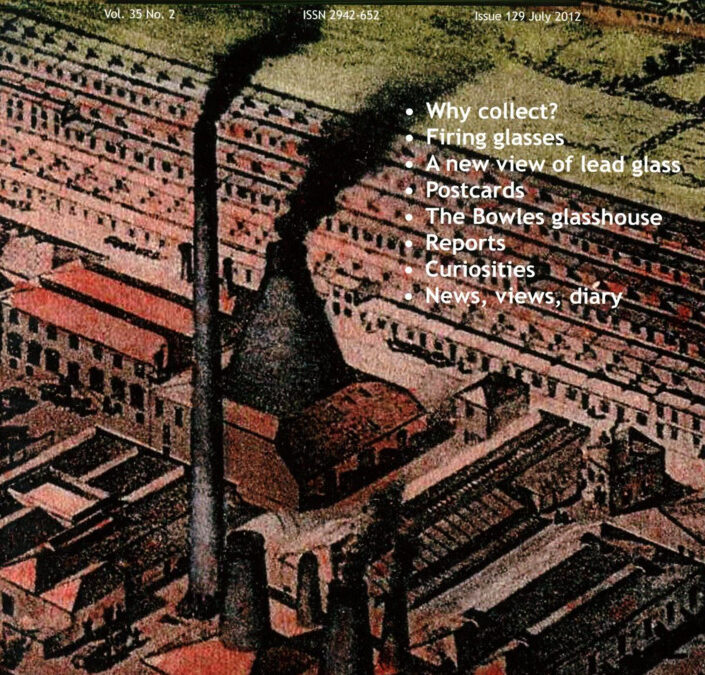
COVER
ILLUSTRATION:
A
birds eye view of The Late Messrs. Hartley&
Co’s, Glass Works in Sunderland as it was in
1850
from
a postcard in the Richard Taylor Collection.
Editor’s letter
Tp
e’re going a little
Dutch in this issue.
It wasn’t intentional,
but it so happens that
three items have a Netherlands connec-
tion: the article on the use of fir-
ing glasses; a report on the lecture
on bulb vases; and two books on
lowlands glass. The Circle’s high-
ly successful trip to trip to the
Netherlands will be described in
the next issue. My thanks to my son-in-
law, Joachim Fleury, for helping with the
Dutch translation of Rene Andringa’s
firing glass piece — there were expressions
neither of us could quite fathom, such as
what a’visor position is and whether the
wording of the toasts is exactly accurate.
Internet research suggests some varia-
tions, and though I asked around I could
not find a Freemason who would check
it. Funny, that! Letters to put us right
welcomed.
The article on collecting particularly
appeals to me as I have often wondered
what makes some of us collectors and
why we gather up the things we do. The
questionnaire survey we held a couple of
years ago revealed that most of you, like
the author, have several discrete collec-
tions — not
all of it
glass. In his
analysis of
the motive
force
be-
hind collect-
ing, Francis
Golding is
clear that the
ensemble is
as important
as the urge
to ‘have one
of those’ and
that is why
we felt it important to illustrate the piece
with a sense of collection rather than in-
dividual pieces. The current Master of
the Art Workers’ Guild — where the Cir-
cle has its meetings — is a multiple collec-
tor too. He collects things in series: rul-
ers and tape measures; books that have
numbers
only
in their titles; things that
look like trees; architectural chocolates,
and a museum of holes. I daresay some
‘11
n
11
n
1410Millrn
of you have bizarre miscellanies along-
side your seriously valuable items stored
in vitrines — with rules about how you
are allowed to acquire things and per-
sonal conditions that must be met. We’d
like to hear about them, so I’ve
started a ‘Collectors corner’.
And then there’s that old
chestnut about what it was that
Ravenscroft invented, and the
expressions ‘flint glass’ and lead
glass’. I predict that some of you will have
something to say about Mike Noble’s ar-
ticle; no need for me to canvass on this
one. Strangely, though, looking back over
Peter Lole’s useful index of 100 issues of
Glass Circle News,
I could find remark-
ably little coverage of the subject in these
pages. And yet I have a sense that it is
always being talked about.
Our new Hon Secretary is helping me
with reports of meetings. It hasn’t proved
easy to find members willing to write up
the monthly meetings and I know that
both town and country members re-
ally appreciate an account of the lectures
they might have liked to attend, but for
one reason or another could not get to.
Between us we are going to try to ensure
that lectures become magazine articles
(where au-
thors are
willing) or
are written
up to give
you a flavour
of what you
missed.
My
il-
lustration
(carrying on
the theme
showing my
own work)
is a detail of
© Alan Greaves of Asg Photography
Sheffield’s
Forge Valley Community School gate
made in steel and glass by Matthew Lane
Sanderson and myself and installed in
April. We won the commission in a pub-
lic art competition. You can stop this edi-
torial exhibitionism, you know, by send-
ing me pictures of your own. No one can
say I don’t keep asking. If not, it’ll be our
installation for the National Memorial
Arboretum in the next issue.
by
Jane
Dorner
2
Glass Circle News Issue 129 Vol. 35 No. 2
LETTERS
Chairman’s letter
The Glass Circle’s
trip to the Nether-
lands also took in
a visit to the tulip
fields
by
John P
Smith
tyl
s our Editor says,
spring belongs to
Holland in this
issue. Those of
us who went on the trip to the
Netherlands learnt that after the
accession of William and Mary
to the British throne there was
so much interaction between
craftsmen in both countries that
it is not always possible to tell
whether a glass was made in
England or Holland. The same is
true of walnut marquetry furniture
of the period when often only the
quality of the dove-tailing of the
drawers gives a clue as to origin.
There is at yet, no such clue to
enable us to differentiate between
some Dutch and English glass,
although analysis of lead content
may help, particularly as it can
now be done non-destructively.
I am in correspondence with a
Dutch museum curator about a
set of 39 air twist ale (or possibly
champagne) glasses with two
knops in the stem. They look
entirely English, but have Dutch
provenance, and finding a whole
set of around 40 mid-eighteenth
century wine or ale glasses
anywhere in the British Isles
would be unprecedented.
As a full report of our trip to
The Netherlands will be in the
next issue I thought that I would
share (as the Americans say) a
few thoughts. The Dutch taste
is different from ours. Cut glass
and gilding is considered vulgar,
as we saw both when we visited
the Leerdam Museum and in
the private collections we were
privileged to
see.
None contained
items decorated in this way. Several
years ago I bought a wonderful
highly cut Baccarat cream jug in
Holland, very cheaply. The dealer
knew perfectly well what he had
but told me ‘I can’t sell this cut
stuff in Holland’. However, had it
been an item of wheel-engraved,
or stippled, glass he would have
had people queuing to buy. The
quality of the engraved glass that
we saw was staggering, both from
the 18th and 19th centuries. In
the 19th century most of the best
engravers were Bohemian, some
working in the home country
but many working in Germany,
the British Isles and America.
Holland lost its supremacy. The
Dutch have no Glass Cirde of
their own, which is why we have
several Dutch members.
Our next trip aboard will either
be in Autumn 2013 or Spring
2014, and I wonder if members
have any suggestions as to where
to go. Nancy is one suggestion;
Munich/Augsberg/Nuremberg
another; Vienna/Budapest a
third. Any feedback would be
much appreciated.
One of the joys of collecting
glass is that no matter how old
you are there are always new areas
to be discovered. I have recently
discovered such a field, and I rarely
need to pay more than £10 for an
example. In a year’s time, with the
Editor’s permission, I will let you
all into the secret of what this
collection is.
Letters to the Editor
PAR RIGHT:
Mr Wilson’s ship
glass… is this the
real thing?
RIGHT &
RIGHT BELOW:
A word of caution
from the editor:
the drawn trumpet
goblet shown has
been cut down by
Photoshop. Unusual
shaped glasses can
have an explanation
other than rarity.
Only close inspection
can determine which
one Mr Wilson’s
glass is.
Tasti ngs
Vour Editorial in Issue no. 128
I reminds me of tastings I
used to do at work for United
Glass. In the early seventies the
airlines wanted to lighten their
load and United Glass had to
come up with a plastic miniature
bottle to replace the glass bottles.
Every Friday afternoon we had a
tasting of vodka, gin and whisky
from several types of plastic to
compare against glass. This lasted
for about six months. At the ouset
the plastic gave a peculiar taste to
the spirit, but over the months this
improved until finally you would
have had to be a master of wine to
tell the difference. It was always a
good start to the weekend.
Mike Noble
Dunmow, Essex
Ship’s glass
ollowing the previous articles
I on ships’ glasses by Andrew
Gilmore and Bill Davis (‘Favourite
glass’ in Issue 127 and ‘Letters’ in
128), I thought readers might be
Glass Circle News Issue 129 Vol. 35 No. 2
LETTERS
interested in a glass I bought not
long ago. The glass has a drawn
trumpet bowl on a plain stem with
an included tear. It is a very solid
glass of some weight and dates to
around 1750. It stands 14.5 cm
(5
3
in) tall but the foot is a very
wide 9.2 cm (3% in). The dealer
I bought it from considered it to
be a ship’s glass. Perhaps the Bill
Davis glass is not. I would call it
a firing glass. The thick foot being
for rapping on the table during
toasts — though there is nothing
to say it could not be used for this
purpose at sea.
Robin Wilson
West Sussex
I
was interested in Bill Davis’s
illustration of a faceted stem
glass (‘Letters’ no. 128), which he
considers to be a ‘ship’s wine glass’.
I have a near identical late 18th
century glass, 113 mm (4
1
/2 in)
high, and in my view and, I suspect,
that of most glass collectors, this is
a dram glass with a firing foot’. I
know of no reason for associating
such glasses with ships.
Anthony J Lester, FRSA
Isle of Wight
Museum quality collection
U
I am unable to
%.,,J come to Circle meetings, due
to my age — 93 yrs. I am unable to
travel long distances.
However, I would like to bring
to readers’ attention my glass
collection — about 350 glasses
— which was exhibited at the
Kunsthistorische Museum in
Vienna some years ago. This
museum is now rebuilding its
Kunstkammer
which will open
early 1913. About 70 of my glasses
will be exhibited there; the rest
will be at Schloss Ambras.
Schloss Ambras is one of the
oldest castles in Austria, located
near Innsbruck, and part of the
Kunsthistorische Museum. It
houses some lovely antiquities
ABOVE:
Schloss
Ambras
BELOW:
Claret jugs
collected by Archduke Ferdinand
in the 16th century. I think my
former collection will find a lovely
new home there, and it might be of
interest to some of your members
to visit this really unique museum.
Prof Rudy
Strasser
Vienna
Claret jugs
I
heard about your publication
through Linkedln and thought your
readers might be interested in my col-
lection of claret jugs.
KS
Austria
Editor’s note: see also page
31
4
Glass Circle News Issue 129 Vol. 35 No. 2
FAVOURITE GLASS
My favourite drinking glass
C
ompared with some
members of the
Glass Circle, I am
a relatively new
collector. I bought my first glass
in 5995. Indeed, collecting
early glass is the most
recent of my interests
after motorcycling, botany,
antique furniture and rugs.
I started working in an
office on the corner of Kensington
High Street in 1958. On the op-
posite corner was Delomosne. My
regret is that my interest in glass
came too late for me to meet them
before their move to Wiltshire.
Shortly after I started collecting,
Jo Marshall of Phillips (now Bon-
hams) arranged for me to meet the
collector, John Towse. I was com-
pletely bowled over by his erudi-
tion and wonderful collection. He
explained to me the importance of
the heavy baluster in the context
of 58th century English glass.
Over the years I have set about
building a collection of my own. I
have found my collecting empha-
sis changes as my knowledge and
the number of glasses I acquire
increases. I have not concentrated
on heavy balusters but I certainly
appreciate their qualities.
What may have been my fa-
vourite glass io years ago would
not be so now
There are many factors that
might contribute to the title ‘My
favourite glass’ such as sentiment,
colour and shape, the glassmaker’s
skill, and rarity.
When I started to write this
article I found it very difficult to
select a glass from my collection
which would fit the title as there
were several contenders although
none of the balusters I own would
have qualified.
In 18th century English Glass
we do not normally have the
perfection or simplicity of form
achieved by the Venetians in their
early pencil-stemmed tazzas. I re-
alised that no glass of mine would
match this rigorous standard.
..Pka,en
xwor…^………arninoRatn
This led me to the conclusion
that my favourite glass would be
one that I shall never be able to
buy. It is to be found in the V&A
(museum no C55&A-1969) in
the glass gallery at the far
end of the room. It has a
cabinet all to itself. It is a
superb heavy baluster gob-
let, or possibly a chalice,
with a cover and was made
around 1700. It strongly argues
against the assertion of some col-
lectors that large glasses of this
kind are too chunky and have little
to recommend them but their size.
If filled, it would probably hold
about four bottles of wine, making
it extremely heavy to pass round
the table so that a toast could be
drunk by each guest, as was the
custom.
In the Delomosne 1985 cata-
logue ‘The Baluster Family’, Martin
Mortimer states that the criteria
on which baluster glasses should
be judged, are proportion, success
in execution, colour, brilliance of
metal and condition. This baluster
goblet achieves the highest marks
in this regard. With its cover it
stands 37.4 cm (14.1/2 in) high. It is
beautifully but simply made. The
striations on the round funnel
bowl and cover glisten in the dif-
fused light. The inverted baluster
knop is perfectly formed and the
folding of the saucer-shaped foot
generously applied. The way the
cover has been made to match and
round off the form of the bowl is
a lesson in design and proportion-
ality. The cushion knop below the
ring handle is suggestive of Raven-
scroft.
At the pinnacle of early Eng-
lish lead glass manufacture this
is a very serious contender to the
Venetian skill and artistry seen
500
years before. On the bowl,
poorly engraved in diamond point,
and so easy to miss if you did not
know it to be there, are the words:
`St (or Sr) Simon Boosington’.
What an evocative surname for a
drinking glass!
The Boosington goblet, is, in my
opinion, one of the finest pieces of
early English lead glass on public
view in Britain and my favourite
English glass. I shall never own it.
But does that really matter when it
is there for all to enjoy?
Graham
Vivian is a chartered sur-
veyor and arbitrator, and a Commit-
tee member of the Glass Circle
The Boosington goblet
by
Graham
Vivian
Glass Circle News Issue 129 Vol. 35 No. 2
5
Glass Circle News Issue 129 Vol. 35 No. 2
COLLECTING
The collecting compulsion
he Editor’s sug-
gestion
that
I might write
something
about collecting and what it means
in my life was both daunting and
tempting; gratifying to the van-
ity as an invitation to write about
oneself, but raising the possibil-
ity of uncovering and confronting
motivations one might prefer to
keep in darkness.
For collecting is a pattern of
activity that goes pretty deep. A
list of things I collect may give you
the idea: Chinese pots and jades,
English silver, Indian paintings
and drawings, small ivory objects,
silk handkerchiefs, glass. And
there are things I used to collect
that still lurk about the house:
Chinese and Indian textiles,
images and models of the Taj
Mahal, rugs. There just seem to
be so many beautiful objects in the
world needing to be given a home
and to be loved and appreciated.
Asked why I spend my time and
money burdening myself with all
this stuff I always respond on the
basis of aesthetics and sensuous
feelings. The practicalities of
manufacture interest me hardly at
all. I remember in my university
interview that, having mentioned
furniture as an interest, I was
asked how much I knew about
cabinet making and surprised
my interviewer, a biochemist, by
saying not the slightest bit. He
accepted, perhaps too readily, that
this was an appropriate attitude for
someone wanting to read English.
We shared some merry laughter at
our stereotypical attitudes and I
was duly offered a place.
What I’d say now, if pressed a
bit further, would stress qualities
that can be appreciated by touch
as well as sight, including the
nature of the material itself. I
think it’s significant that nearly
everything on my list is something
that needs handling to be
appreciated, jade being perhaps
the primary example, but all the
by
Francis
Golding
ABOVE:
FIG. 1
The author’s mantel-
shelf in the l000s
BELOW:
Fig.
2
The same mantel-
shelf today
others too — certainly the glass.
The Indian things, that might
seem the exception, are unusual
amongst visual art in the extent to
which they are intended to be held
in the hand rather than hung on a
wall, though they obviously don’t
call out to be touched and handled
in the way of the pots, jades, silver
and glass.
This side of collecting is
brought home to me when I
consider the things I don’t collect.
A prime example is books. I have
lots of them, many relating to the
objects I do own, but they live in a
different emotional category from
the things I consider part of my
collection, on account, I would say,
of the inherent dullness of paper
COLLECTING
as a material and the intellectual,
as opposed to sensuous, effort
involved in appreciating their
contents, the lack of the immediacy
which my chosen objects provide.
Speaking of immediacy, though,
should not imply something that
is short-lived. On the contrary
these materials used well can take
you to a state of contemplation
that can last and last, giving a
profound satisfaction far removed
from the every day. Harmony
of form and content, colour and
texture become at once both
abstract and specific and when
objects are arranged so as to
produce contrasts and harmonies
between them they can provide
endless visual fascination, even in
something as simple as a well-set
dinner table.
Tempting though it is to stop at
this elevated spiritual level, there
is more that must be said, both
positive and negative. Looming
over any collector is what I call the
postage-stamp challenge, the idea
that what is important is putting
together a group of objects whose
completeness is its purpose, rather
than its aesthetic or historical
value. Closely associated with
this is the showing-off syndrome.
Td like to have one of those to
complete my collection of..: ‘Not
many people have one of those:
‘They are really expensive and
hard to come by:
I’m afraid there is no avoiding
some of this, however aesthetic
one tries to be. Where glass is
concerned (finally I get round to
glass) I can say with all honesty
that my favourite glasses are some
late 19th century rummers with
honey-comb cut stems, because I
just love drinking out of them: the
heft of their weight in one’s hand;
the slightly oily texture of the
material as one holds it; the way
they sit on the table on their big
flat bases. They are not rare and
certainly not valuable. I can also
say that when I started buying
decent glasses I was so frightened
of the stamp-collecting syndrome
that I only bought 18th century
glasses with plain stems to avoid
collecting spiral patterns. But I
also have to confess that variations
in bowl shapes became of interest,
that I saved up for a baluster glass
and felt quite smug when I got one
and that if I was rich I’d have lots
and lots of chunky balusters, just
to show everyone. It also gives me
real satisfaction that when I look at
the ‘rudimentary stem’ illustrations
in Barrington Haynes I find that
my street-market bargains include
examples of so many glasses that
feature there.
Something of this is inherent in
the very notion of the collection I
suppose, by definition a group of
objects that is defined both by the
similarity of one object to another
and also by their differences.
A collection that consisted of
identical objects would surely
provide a stimulus to identify
minute differences. I was about
to write that only a really neurotic
person would make such a
collection in any case, (how unlike
you and me, fellow collectors)
when I remembered that I own
a CD containing each of Maria
Callas’s performances of the Mad
Scene from
Lucia di Lammermoor
on consecutive evenings in Mexico
City in 1952, plus the one she sang
again as an encore when they
wouldn’t stop applauding.
Listening to these performances
and appreciating the subtle
differences is an exercise in
connoisseurship, of course,
and that brings me to another
aspect of collecting: the training
and exercising of taste and
discrimination, the ability to
identify and describe quality and
make selections based on that
discrimination, to know a good
one from a dud or, even worse,
a fake. This is where someone
like me falls down by relying on
instinct and experience rather
than proper hard knowledge when
assessing potential possessions.
ABOVE:
Fig. 3
Blue and white,
mostly 19th century
Chinese inherited
from a godfather
BELOW:
Fig. 4
Glass and silver
in
a tablesetting
Glass Circle News Issue 129 Vol. 35 No. 2
COLLECTING
Where glass is concerned a glance
at the Stourbridge catalogues from
the early aoth century is enough to
frighten me no end, and Chinese
things are notoriously widely
faked. If I’d heeded the advice
implicit in the words of William
Willets, who first aroused my
serious interest in Chinese things
—
can’t tell jade from soapstone’
—
I’d have saved myself a lot of
unwise purchases, but would have
missed some things that give me
immense pleasure. I like to think
that responding to the feel and
look of things often guides one
well, but I’d never make the excuse
that it doesn’t matter whether
something is right or not as long
as one likes it. When belief is
destroyed things go right to the
back of the cupboard and I try to
forget they exist.
Mention of Willets brings
me finally to consider what it is
that makes one choose to collect
one thing rather than another.
I believe there must be reasons
that are buried quite deep. Insight
for me came when I was sitting
next to a psychoanalyst at dinner
a few years ago. With a few deft
questions he presented me with
the realisation that because I first
began to learn about Chinese pots
in Singapore, when I’d got away
me the other life I never took
up, like someone out of Conrad
or Maugham looking at the oily
water slurping against the dock
wall in my crumpled suit and
going in to hit the whisky in the
deserted bar.
I can find the same level of
motivation for most of the
things I collect, but where glass
is concerned I am at a loss to
get beyond a superficial level of
attraction to the material and
liking for what the glasses contain.
There was an incident that set off
the fascination, however. We were
in the Isle of Wight in the early
197os, driving home to tea:There’s
a junk shop over there’ said my
hostess, ‘but we’ve no time to look:
‘Stop!’ I shouted, having caught a
glimpse of two green glasses in the
window and reluctantly she did
pull over. Knowing nothing at all
about glass I just had an instinct
that they were interesting. I’m
relieved to say that I didn’t manage
to beat the man down from the
£3 he wanted, though I really did
have no idea what they were. On
Sunday we drank out of them
on the beach. Back in London I
identified them in Group VIII,
Section a of the Barrington
Haynes categories, with their cup-
topped funnel bowls, hollow stems
and raised feet (possibly pedestal
but my memory is vague after all
this time). On Monday my flat-
mate took them in to the V&A to
show Robert Charleston. He gave
them the thumbs up and I regret
to say that I took them straight
off to Christie’s, where they sold
as separate lots and fetched £346.
They paid for a trip to India, but it
was years before I bought another
serious glass, or found such a
bargain of any kind. I did keep
looking, though, and I still do.
Francis Golding was the Secretary of the
Royal Fine Art Commission and now advises
on architecture and town planning.
ABOVE:
Fig. 5
A heavy baluster
goblet bought in
2010
BELOW:
FIG.
6
18th and 19th
century glasses
in
everyday use
from home and my mother and
was learning to sweat in the heat,
travel and make love, these objects
represent for me freedom and
independence. Indeed, because
one of the Indonesian dealers who
brought such pots to Singapore to
sell once suggested I accompany
him on a buying trip in Sumatra
(I feebly declined), they show
8
Glass Circle News Issue 129 Vol. 35 No. 2
y
ne
inga
Re
Andr
ABOVE:
Fig.
4 Firing glass
England,1820-180,
engraved with motto
and cypher of the
Duke of Sussex,
and with masonic
symbols
BELOW FROM LEFT
TO RIGHT:
Fig
2
Jubilee edition firing
glass issued for the
250th anniversary
of the Dutch Order
of Freemasons
in
204,6. Bearing the
inscription: ‘discover
the mystery of
Freemasonry’
and
all-seeing eye symbol
Fig.
3
Modern
style firing glass,
showing masonic
symbols including
the columns Joachim
and
Boaz which
will appear in a
Freemason Temple
Fig.4 A ‘canon’ from
the 18th century,
showing the motto
used by the Dutch
Grand Loge since
its establishment
in 1756 (‘Silentio et
Fide’)
by drumming the glass on the
table. To protect their glassware
from such abuse, innkeepers
ordered more robust glasses, with
a thickened base which wouldn’t
break when banged on the table.
The first models consisted of a
cylindrical cup, joined directly
to a solid base. This is possibly
the first indication of the origin
of the early firing glasses. The
French name, in the r8th century,
for this model was ‘cannon’.
These newly-formed societies in
various intellectual fields would,
in time, lead to the creation of a
Masonic Lodge. This generally
took place at an inn which had
an upper room where the group
could isolate itself. The new
establishments often incorporated
military
personnel
from
ambulatory garrisons, temporarily
stationed in a particular town. They
exerted considerable influence over
the use of glass in Freemasonry –
in particular with the development
of even stronger glasses.
When a new Lodge was formed, it
FIRING GLASSES
The function of the firing glass
his article is about a
type of glass that is
often seen in museum
and private collections,
at auction houses, antique
dealers, and the Lodges of
Freemasonry: the firing
glass. But its function
is rarely described. I
will concentrate on
Freemasonry, where the
firing glass is still used during
meals, and describe the rituals
associated with it.
Although I will talk about the
way in which it is used in the
Netherlands, I am well aware that
there are variations elsewhere.
Though the same principles hold
in many parts of the world, the
wording used at banquets, where
firing glasses are used, varies.
A brief description of the origins
of Freemasonry will help to clarify
how this glass got its name and how
it is connected to Masonic ritual.
Freemasonry is made up of
individual Lodges which have
been established worldwide as
independent organisations. The
associations set up in a country,
are represented collectively by a
Grand Lodge or Grand Orient
that oversees compliance with
the statutes and regulations
for the proper functioning of a
Lodge in the specific country.
From the age of 18 men can
become members, but the statutes
do not allow women to join the
regular Freemasonry. They are,
however, allowed to become
members of the Co-Freemasonry
Lodge, which is for men and
women and is directly supervised
by the Grand Orient in Paris.
A candidate for membership
undergoes a review by a committee
to investigate whether the person
is suitable as a member
of the Freemasons.
They meet regularly in
their own building or in
rented accommodation.
Every Freemason anywhere
in the world may acquire a
recommendation letter from their
own Lodge allowing them access
to a meeting of a Lodge in any
other country. Generally speaking
the ceremonies performed are
almost identical.
Lodges have been established in
many countries from the early r8th
century to the present day. The
use of the firing glass in the Lodge
dates back to the r8th century.
This century is also known as
The Age of Reason or the Age of
Enlightenment and it led to the
creation of numerous societies in
various fields such as: trade, music,
literature, friendships, and so
on. Many of these newly-formed
societies first met in taverns, as
these were easily available public
spaces: later funds would allow
them to construct purpose-built
venues.
It was not unusual, in those
days, to end a fiery or impassioned
speech, by slamming a glass in
your hand sharply down on the
table to emphasise a point. It was
a way of confirming the speech.
Similarly, the audience would
approve arguments or encourage
the speaker to continue talking
Glass Circle News Issue 129 Vol. 35 No. 2
9
©
Ac
he
lny
Town
s
hen
d
FIRING GLASSES
was not unusual for the innkeeper
to be inaugurated at a meeting
and to go through the various
stages of membership — from
apprentice, to journeyman, and
finally master. This formed a bond
with the Lodge which enabled the
innkeeper to unite business with
pleasure. Because he also provided
the food and drink, he may also
have made firing glasses a feature
of established Lodges based on
first-hand knowledge of the uses
to which they were put.
As dedicated Lodge buildings
developed for the weekly
meetings, they were commonly
divided into two separate rooms.
The room where the Freemasons
congregate is called the Forecourt,
and the room where they gather
to perform the prescribed rituals
is named the Temple. Rituals
performed in the Temple are
described as an Open Lodge.
In the Temple itself, during
the Open Lodge, no glass is used
except the Rose Croix Degree in
the so-called Higher Degrees.
Only the presiding Master uses
this in the Temple and it tends
to be an engraved or enamelled
glass goblet
(see
Issue no 127).
After the Open Lodge, for
example at the initiation of a new
student, the Brethren repair to the
Forecourt for the Table Lodge.
Here the function of the firing
glass is more general and will be
described below. The Table Lodge
is a board of fare prepared by
several Brethren and ranges from
a modest dinner to a fully-catered
banquet ordered by the current
court and Cellar Master of the
Lodge.
The tables are arranged in
a U-shape in the Forecourt.
During the Table Lodge (a formal
Masonic meal), the presiding
Master and the Secretary of the
hosting Lodge, will sit centrally
at the head of the U-shape with
visitors such as Masters of other
Lodges or members of the Central
Administration alongside. The
other Brethren are seated along
both sides of the U-legs. At each
end sits the first and the second
Supervisor, because they fulfill
an important role in the function
of the firing glass and need to be
able to observe the full curve of the
table.
First, a ribbon in the colours
of the Lodge is strung along the
centre of the tables. Then the
firing glasses and bottles of wine
are placed on this ribbon. This
alignment of the glassware on top
of the ribbon, derives from the
influence of soldiers at the time of
the establishment of the Lodges
with their militaristic tenets of
precision and conformism.
Metaphors abound, for
example: a glass is a cannon;
glasses are artillery; a bottle of red
wine is a ton of red gunpowder;
firing is drinking from a glass; and
a glass of water is weak powder.
At the beginning of the Table
Lodge, three compulsory
conditions are ‘released’ by the
presiding Master who is also
addressed to as the Worshipful
Master. Releasing, or setting,
a condition is the Masonic
terminology for ‘proposing a
toast’. The releasing of a proper
condition is done as follows: all
the brothers stand, after which the
presiding Master speaks:
Brethren, I set a condition on the
highest authority of the
Order
of the
Grand Master. To arms!
The firing glass is placed in the
right hand, but remains on the
table.
On
guard!
The glass is raised to eye level,
and aimed at those who set the
condition.
Take aim!
The glass is brought to the lips.
Fire!
One sip is drunk.
Return to aim!
The glass is placed back into
visor position.
Present arms!
The glass now moves through
three horizontal movements: to
the left shoulder, then to the right
shoulder and jerked back into
visor position.
At
ease! One, two, three!
The glass is now placed on the
table in three movements, ending
with all the glasses aligned along
the ribbon.
If a brother at the Table Lodge
wishes to speak, he performs the
next ritual: he slides the firing
glass on the ribbon in front of
him, about 25 cm (to in) towards
Fig. 6 A pair
of English lead
crystal firing glasses
engraved with
Masonic symbols
and with thick
firing
feet. Circa 1760
10
Glass Circle News Issue 129 Vol. 35 No. 2
FIRING GLASSES
himself across the table. This
indicates that he wishes to hold
the floor.
The first or second Supervisor
at each end of the table, on
observing this, will then give a
short tap on the table with a gavel.
The assembled company then falls
silent while he says:
Worshipful Master, the cannon
of brother So-and-so is no longer
aligned, and he wishes to speak.
The Master of the Lodge
then gives his permission to the
brother concerned to speak.
The brother, first puts his glass
back on the ribbon, to align
properly with the other glassware
and then stands up to talk to the
brothers present. It is usually an
expression of gratitude, or he
brings greetings from another
Lodge.
At the end of the Table Lodge,
when repast is over, all the brothers
stand up and rotate a quarter turn
so that they face the open end of
the U-shape. They take the firing
glass in the right hand and lift it up.
The Master of Ceremonies of the
Lodge comes forward and stands
in front of the brethren, saying:
To all Brethren anywhere in the
world; in wealth, sorrow, or distress.
Ad Fundum
(to the bottom)
brothers.
Everyone drinks the last
remaining wine from the firing
glass and then puts the empty
glass, with a sharp blow (firing),
back on the ribbon. This is referred
to as ‘the overall final cannonade
for the termination of the Table
Lodge’.
Rene Andringa is a member
of member of a Lodge in the
Netherlands and collector of 18th
and i9th century glass, and is in the
process of setting up a glass library.
Editor’s Note:
A paper on ‘Masonic
glass in England’ was given to the
Circle in 1990 and published in
The Glass Circle Journal in 1996,
No. 8 pages 38-53.
Notes
Vrijmetselarij in de lage landen,
by Prof Dr Anton van de Sande.
Walburg Pers Zutphen, 2001.
`Glazen en drinkgewoonten bij de
vrijmetselarij; thesis by Monique
Engelberts, Leiden, 1986.
De Dr ieslag,
No. 9 March.
Groningen, 2003.
AMT (Algemeen Maconiek
Tijdschrift)
the
Masonic
Journal of the Grand East of the
Netherlands, year 49, No.2.1995.
250
Jaar Orde van Vrijmetselaren
(anniversary edition). Stichting de
vrije metselaar, 2006.
Fig. 7 Irish dip
moulded Prussian
decanter engraved
with Masonic
emblems and the
date 12 May 1823
–
,
..mateass
nnnnnn
•1
Glass Circle News Issue 129 Vol. 35 No. 2
11
S
O
FLINT GLASS
Flint glass: an alternative view
W
ntil recently I had
thought, if indeed
I had considered it
at all, that George
Ravenscroft had invented lead
glass sometime towards the end of
the 17th century, and had obtained
a patent for its manufacture.
This to my mind is the generally
perceived view.
Having had time to look into
the matter, however, a number
of questions keep cropping up.
Did George Ravenscroft actually
‘invent’ lead glass? What was the
reason behind applying for the
patent and was it really given for
manufacturing this type of glass?
And why was it called flint glass
shortly after its introduction?
The reason that prompted
this paper was the discovery, in a
Chancery lawsuit of 1608 between
Sir Jerome Bowes and Edward
Salter, of the materials used in
the manufacture of glass at the
Winchester House glasshouse in
Southwark.’ They manufactured
there:
…all manner of drinking glasses and
other glasses and glassworks whatsoever
of the fashions stuff matter or metals
now used made or wrought in the said
town or city of Murano near Venice
[which was] not prohibited, restrained,
or forbidden in or by the said several
letters patent…made unto the said Sir
Jerome Bowes.
From the depositions made by
two Italian glassmakers working
there at the time, the silica was in
the form of sand and not flints.
The latter has been regarded as
the material used in the early
manufacture of good quality glass,
and even Dossie in his
Handmaid
of the Arts
published in 1758 writes
that:
‘It had this name [‘flint’ or ‘chrystall’
glass] from being originally made with
calcined flints, before the use of white
sand was understood”.
This statement does not,
however, appear to be factually
correct given the evidence
from Winchester House, and
it can be argued that sand was
commonplace for good quality
glass and not flints.
This then leads to the question
of why was the newly patented
glass known as ‘flint glass’ and
not `lead glass; after all the
terminology used at the time
tended to be extremely literal. In
order to try and answer this and
the other questions, it makes sense
to put them into the context of the
glass industry at the time.
The idea of patents had been
introduced in the 16th century,
and one of these was granted to
by
Michael
Noble
BELOW LEFT:
Fig. 1
“Christalld Goblet by
Verzelini dated 1586
BELOW RIGHT:
Fig.
2
The Duke of Buck-
ingham: a dominant
force in the production
of glass
Glass Circle News Issue 129 Vol. 35 No. 2
12
© Na
t
iona
l Ga
l
lery
o
f Vic
tor
ia
FLINT GLASS
James Verselyne [sic], a Venetian
glassmaker, giving him certain
rights and privileges in order to
entice him to help establish an
English glass industry, which was
virtually non-existent at the time.
The reason given for granting the
patent was to redress a situation
in which to purchase foreign glass
meant that great sums of money
have issued and gone forth out
of this realm in the parts beyond
the sea”’. The next glass patent
was granted to Sir Jerome Bowes
as a reward for his services to the
Realm as Ambassador to Russia in
the time of Tsar Ivan the Terrible.
Bowes himself was not, of course,
a glassmaker, but was interested
in the revenue it would give him
as a pension, allowing others to
manufacture the glass and run the
business.
In the reign ofJames I the system
of patents was beginning to fall
into disrepute, with accusations of
bribery and corruption being rife
and the Crown taking money as
part of the conditions for granting
the patents. This was to become
such an issue that Parliament
debated the situation on many
occasions, finally forcing some of
the patents to be withdrawn and
curtailing the King’s activities. It
was at this time that Sir Robert
Mansell was the holder of a patent
for manufacturing glass with coal,
which had initially been granted
to Sir Edward Zouch and others
in 1611. Although Mansell was
an Admiral in the King’s Navy,
he was to become extremely
involved in the manufacture of
glass, so much so that the King
is reported to have said that ‘he
wonder’d Robin Mansel, being a
seaman, whereby he hath so much
honour, should fall from water to
tamper with fire, which are two
contrary elements He, together
with his wife Elizabeth, proceeded
to defend his patent rights with
considerable vigour, and actually
held on to them until the outbreak
of the Civil War.
From the above it is clear that
the early patents had been granted
for a variety of reasons. On the
restitution of Charles II, however,
the system had started to change,
with patents of privilege giving
way to patents of invention. It
was the Duke of Buckingham
who was to become the dominant
force in the production of glass
during the early years of the
restoration. He, or rather his
associates, obtained a patent for
the `makinge of Christall’ which
was then modified to include ‘the
sole makinge of Lookinge Glasse
Plates, Glasses for Coaches,
and other glasse. In 1663 after
examining the application for the
patent, the report stated that `if it
be a new invencon, as the peticon
affirmes, and I can find nothing to
the contrary, then a new patent
could be granted on the surrender
of the old one, for a period of 14
years.°
Bearing in mind that
Ravenscroft’s patent was granted
in 1674, some three years before
Buckingham’s patent had expired,
there must have been some new
`invention that would enable this
patent to be granted. Several years
earlier, in 1663, a patent application
had been made by Brian Leigh
for ‘a new invention of extracting
looking glasses and crystal glasses
from flint” although this had been
rejected, probably at the behest of
the Duke. By 1674 Buckingham
Fig. 3 Example of
crizzelled bowl
Glass Circle News Issue 129 Vol. 35 No. 2
13
FLINT GLASS
had fallen out of favour with the
King and was not so influential,
and may indeed have lost interest
in glass production. Ravenscroft
may also have had some sort of
working relationship with him. It
was, after all, only a couple of years
or so later that Ravenscroft was
running Buckingham’s glasshouse
at Vauxhall.’
Ravenscroft himself was
neither a glass maker nor an
inventor. He was a merchant
with specific trading interests in
Venice, living there for a time,
and importing goods such as lace,
currants and glass. He would
have had dealings with the glass
makers of Murano, and it would
seem reasonable to assume that
through these contacts the idea of
manufacturing glass in England,
based on the Murano model,
would have had some commercial
attractions. Unfortunately the
patent itself gives little indication
as to its makeup. It simply states
that George Ravenscroft had
attained ‘the art and manufacture
of a particular sort of christaline
glass resembling rock christall..:
9
without going into any further
technical details.
Venetian glass was based on
the use of pebbles as a source
of silica, and it would not have
been too dissimilar to consider
the use of flints as an alternative.
Flints had been identified as a
glassmaking material long before
this, and was even cited by the
Italian Antonio Neri in the
Art of
Glass
and published in England by
Christopher Merrett in 1662.'”
It would seem reasonable,
therefore, to speculate that the
‘new invention’ of Ravenscroft
was based on the use of flints as
a departure from the common-
place. Why else would the newly
produced glass be called
flint glass
as soon as it had become available,
and why also would Dr Plot in
his
Natural History of Oxfordshire
state that ‘the materials they
formerly used were the blackest of
flints calcined’.” Although some of
the other ingredients quoted by
Plot were probably incorrect, his
testimony seems to give credence
to the idea of glass made of flint.
As does Hooke who, following
a visit to the Savoy, tells us that
he saw ‘calcined flints as white as
flower’.”
The problem with the newly
developed glass was that it was
prone to a defect called crizzelling.
Fig. 4 Goblet with
Raven Head seal
14
Glass Circle News Issue 129 Vol. 35 No. 2
Fi
g
5
A piece in Glass
Circle News no. 48
ABOVE:
Fig. 6 A
raven’s head seal detail
from a Ravenscroft
basin in the
Corning Museum of
Glass
BELOW:
Fig.
7
A piece in Glass Circle
News no. 48
Yn
.,4
,
0
6
,;
/
;
44
–
6
.-N4`i
s
.2/ 2r Set!’ Z.’?
`4′
74
‘
4
’47
4
7 f