




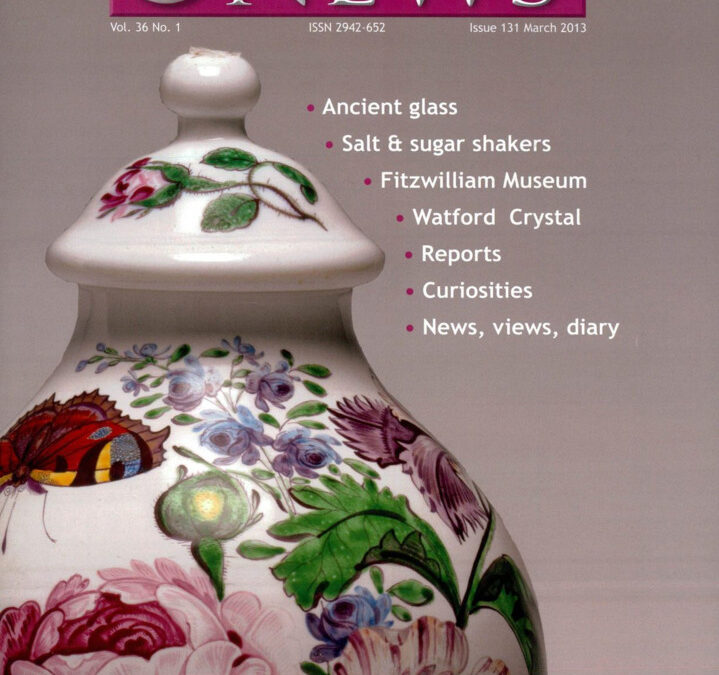
GLASS CIRCLE.
Vol. 36 No. 1
ISSN 2942-652
Issue 131 March 2013
Ancient glass
Salt Et sugar shakers
Fitzwilliam Museum
Watford Crystal
Reports
Curiosities
News, views, diary
CONTENTS
Editorial
Letters
My favourite glass
Ancient glass
Salt Et sugar shakers
Fitzwilliam Museum
Watford Crystal
Reports
Reviews
Curiosities
Last words on flint
News and diary
Glass Circle News
ISSN 2043-6572
Vol. 36 No. 1 Issue 131 March 2013
published by The Glass Circle
© Contributors and The Glass Circle
www.glasscircle.org
Editor
Jane Dorner
glass@editor.net
9 Collingwood Avenue, NIO 3EH
Design and layout
Athelny Townshend
athelny@aol.com
Neither the Glass Circle nor any edits officers
Or Cl7111111ilt,
members bear
any responsibility for the views expressed in
dill
puLVivanov which are
those of the contributor in
each case.
Every effort ha, been made to trace and
acknowledge copyright in the photographs illustrating articles. The Editor
asks contributors to clear permissions and neidler the Editor nor the Glass
Circle is responsible her inadvertent infringements. All photographs are
copyright the author(s) unless otherwise credited.
Printed by
Micropress Printers Ltd
www.rnicropress.co.uk
Next copy date:
15 May 2013 for the July edition.
EDITORIAL
Editor’s letter
t
g
-1
lave enjoyed putting
this issue together: it
falls nicely within the
broad church interests of
the Circle and the Association
combined. Our two magazines
have coincidentally been moving
closer to each other in subject
matter in the last year or so
— neither of the two editors
knowing about the current proposals.
Our earliest piece pictured dates right
back to
c.
14th century BC (page 8) and
the latest to 1976 (page 29); not counting
the artist’s impression of the hotshop of
the future at Corning.
The article on ancient Egyptian and
Roman glass will be welcomed by many as
several respondents to our questionnaire
three years ago asked for more on this
subject. It
has
had a reasonable airing
over the years, but when I looked back
at the survey responses, I was surprised
to see a request for more on ‘modern
studio glass and ancient Greek, Middle
Eastern and Roman glass’. It’s refreshing
to see more than one collector making
connections between items so many
centuries apart.
There’s plenty to interest the collector
who buys ‘whatever turns up by chance
that I can afford or arouses curiosity’: if
it’s affordability you are after, look at the
little gems in the article on condiment
sets of the Victorian era.
There’s plenty to interest the hard-
core 18th century afficionado as well
in the stunning photographs of the
new displays at the Fitzwilliam
Museum, taken by Michael Jones
at the museum especially for this
article. I chose one of these for the
cover as it is such a fine example
of painting and disguise skill.
This article was flagged up last time, and
looks like a prime target for one of those
joint visits the Chairman outlines on the
next page.
Also promised, and delivered, is the
piece on the rise and fall of the Watford
Glass Company, with its intriguing
insights on how a concern of this sort
is manned, and why it can’t survive in
today’s climate. This was when you
worked your way up from the bottom to
the top.
Finally, apart from our regular pieces,
my arm has been twisted to set the
matter straight
again
on flint glass. But
as the present Editor to the ex-Editor –
that’s the last word on the subject now.
My latest installation accompanies
this editorial (no one is crying a halt to
this shamelessness). This is a screen in
a newly-built house is Gloucestershire
and is made in collaboration with
my husband, the lutemaker Stephen
Gottlieb.
by
Jane
Dorner
COVER ILLUSTRATION:
Detail of an enamelled glass vase (full picture on
page zo) © The Firtzwilliam Museum, Cambridge
2
Glass Circle News Issue 131 Vol. 36 No.4
LETTERS
Chairman’s
etter
Monteith made
by Joseph Ward,
hallmarked 17o9-
1710. Museum
number: M./4:1,
2-1973
gum he Edward V
Phillips
sale,
at Halls of
Shrewsbury
(see
back page) was a great success.
The room was packed to standing
room only, collectors of 18th
century drinking glasses are not a
dying breed, nor are members of
our society.
I would like to thank those
who sent me their opinions
and constructive suggestions
concerning a possible merger
of the Glass Circle and the
Glass Association. The overall
impression I received was that
of slight sadness tempered by a
realisation that it was inevitable
if there was to be a long term
future for a society for those
interested in glass. Also several
members stressed that , from their
experience of similar situations, it
was important that we progressed
slowly and carefully.
I held an informal meeting of
committee members recently to
discuss all these issues. We could
see that great savings would be
made by merging news magazines,
journals and web-sites, and that
with a bigger pool of contributors,
maintaining quality would not
be a problem. Foreign visits most
years would continue as before.
These are great fun for those who
attend, and bring back knowledge
of the interaction of glass makers
in different countries, both in the
past and today. Meetings would
continue, much as before, but
hopefully with greater attendance
by a greater membership, there
could be meetings outside
London, largely at the weekend,
and meetings in London, usually
on a Tuesday evening. The legal
and logistical matters seemed
to us quite resolvable. With
increased costs, hire of meeting
venues, printing costs and the
staggering rise in postal rates,
subscriptions will have to up, but
they will have to go up anyway. If
we merge we expect to offer our
members a better service for their
subscription.
Our lecture series is now
virtually fully planned for the
next
12
months, suddenly it has all
come together for Anne Lutyens-
Humfrey, our meetings organiser
whose hard work makes it happen.
These meetings, in the historic
ArtWorkers’ Guild building, with
coffee, sandwiches and gossip
beforehand, are the back-bone of
the society.
Two suggestions came up at
our meeting, whether we merge
or not. The first, that we should
have a series of informal meeting
in museums, largely provincial,
in museums which have glass,
organised by a member local to
the museum. The format would
be to meet around 10.30 on a
Saturday morning for coffee
followed by an examination of
Editor’s note:
All letters referring
to a previous edition of the
magazine refer to Vol. 35 No. 3
Issue no. 13o unless otherwise
stated.
Monteith
I recently came across this snippet
of information in the online
catalogue of the National Register
of Archives for Scotland, in a list
of miscellaneous papers relating
to the Countes of Roxburgh.
There is no date given, but all the
papers are from 1684 — 1743.
Headed: ‘Directions by the
Countess of Roxburghe to
James Wathell, probably her
butler’, it consists of a long list of
instructions about food and drink
allowed to the various servants, for
example: ‘the washers are given 3
mutchkins ale between them at
each meal..: which are interesting
in their own right, and continues:
‘the footman whom Wathell is
the museum’s collection, with or
without a curator if the museum
has one. Followed by lunch and
a
post mortem.
Looking at a
collection with a group of friends
with different levels of knowledge
is always more fun than looking
by oneself. The other suggestion
was that occasionally our London
meetings should take place on
a Saturday afternoon, probably
in a lecture room in Kensington
Library, which has some, minimal,
catering facilities, enough for tea
and biscuits, with two lectures.
This format, which is used by the
English Ceramics Circle, might be
better for members who live out
of London, or who do not like to
go out in the evening, especially in
winter. Feedback from members
on both these suggestions would
be most welcome. You can contact
me at johnpsmi@globalnet.co.uk.
allowed to have as assistant is to
cover the table and draw the drink,
and stand at the cupboard and fill
all the drink at the table and when
the servants give him the glasses
let him throwe what is left in
them in the cisteren, and put the
by
John P.
Smith
Letters to the Editor
Glass Circle News Issue 131 Vol. 36 No. 1
r
LETTERS
glass in the muntieth amongest
the watter which is to stand upon
the glass cupboard full with fish
wafter every day;…
It goes on to say that Wathell
and the footman have to clean the
silver, etc.
I just thought it might be a
useful insight into the use of
the monteith in the late i7th-
earlyi8th century. The reference
is NRASHoo/Bundle 803 should
anyone care to follow this up.
Jill Turnbull
Edinburgh
Editor’s note:
a longer article on
monteiths and their uses is in
preparation as a result of this letter.
If any readers have information
they would like to contribute, we
would be pleased to hear it.
Posh paperweight
A
n item
in
The Daily Express
frA(17
October 2012) on the
25 richest people ever caught my
eye. ‘The hereditary Nizam of
Hyderabad ruled the principality
from 1911 to 1948 when it was
absorbed into India. Hyderabad
was the world’s sole supplier of
diamonds in the 19th century and
Nizam used the Jacob diamond –
the seventh biggest in the world –
as a paperweight: How’s that for a
paperweight!
Michael Vaughan
Lanarkshire
Research notes 1
L
ooking through some old
research notes I came across the
following: State Papers Venetian,
p.22, 1621, 16 April. Girolamo
Lando, Venetian Ambassador in
England, to Doge and Senate in
Venice:
Many are thinking of removing the
monopoly on flint glass, as when
brought from Venice it would cost
little more than what is made here
and it is considerably finer, while it
would not consume the wood in the
furnaces, there being a great scarcity
of it in the kingdom. I have tactfully
encouraged this idea.
So it would appear that the term
‘flint glass’ had its origin in Venice
many years before Ravenscroft
and was simply adopted as a
matter of convenience for the
English version.
I don’t
think it
means that glassmakers generally
in England made glass from
crushed flints at that time.
David Watts
London
Research
notes 2
I
was at the British Library last
week trying to find the reference
David Watts quoted regarding
Robert Hooke’s sight of ‘calcined
flints as white as flower’. Although
I have so far missed this, what I
did find was the entry of Saturday
February 28th 1673/4 which
states:
Lazenby [a chirurgeon]
affirmed that he saw the man at
the Savoy for making his crystal
put into the pot first a layer of
borax, then a layer of sand then
nitre [saltpetre]. Of sand borax
the
2/3
of pot was filled that being
put into the fire it boiled and
made a great noise. Afterwards
it settled and the …with an iron
ladle took off the scum. His flints
he heat and quenched often then
beat them to powder in wooden
mentors.
Mike Noble
Dunmow
Wrong chandelier
T
he Chairman has spotted that
the chandelier on page 11 in
my article is not the one described
in the caption. That one is, in fact,
manufactured in 1804 and is one
of four produced that year in the
Waterford factory. The chandelier
hanging the council chamber in
Waterford City Hall and dated
1786 is this one (pictured). It
was commissioned by the Lord
Lieutenant, Rutland.
Martin Hearne
Waterford
Impartial
review?
Vour review of
Bibliography
I of Glass: From the Earliest
Times to the Present
by Willy Van
den Bossche (page 26) is more
favourable than is justified.
Putting it to the test, I first
ran through the names of the
Swedish glass designers currently
uppermost in mind: Vicke
Lindstrand, Erik
Hoglund,
Bertil
Vallien, Goran Warff, Signe
Persson Melin and Lars Hellsten.
This formidable group of
contemporaries produced a huge
swathe of work, totalling many
thousands of designs, for some
of the leading glassworks of their
era, including Orrefors, Kosta and
Boda. Their work was expressed
in both production pieces that
sold in millions and, setting the
trend over recent decades, unique
art objects.
An index check of this book
reveals that none of them is
mentioned at all. Not even one of
them, once. Perhaps the author
considered them too obscure?
Yet Lindstrand ranks amongst
the greatest glass designers of the
past century. So, if Lindstrand is
considered unworthy of inclusion,
how about the glassworks
themselves, Orrefors, Kosta and
Boda? No mention of Orrefors,
4
Glass Circle News Issue 131 Vol. 36 No. 1
LETTERS
though Kosta Boda does
appear under the
Kosta
Boda Book of Glass,
published in 1986 to
celebrate Kosta’s 25oth
anniversary.
So, what of the
Finns, Tapio Wirkkala
and Timo Sarpeneva,
whose work for Ettala
won Grand Prix at
the 1951 and ’54 Milan
Triennales.
Neither
appears, though space
is found for ‘Sasparilla
Bottles’, which rate two
listings.
It can be deduced
that this book is not
for those interested in
Scandinavian
postwar
glass. But what about the
foremost British glassworks
of the same era: Thomas
Webb, Webb Corbett, Stuart,
Brierley, Whitefriars and
Dartington? None are indexed,
though Waterford does appear,
once.
Travelling back through history,
I adore the work of James Giles
[1718-80], Britain’s greatest 18th
century glass gilder/enameller,
whose work was explored in two in-
depth articles for Apollo in zoo5.
With increasing predictability,
this book does not mention him.
Also absent is the Bielby family
of Newcastle whose enamelling
became synonymous with English
Rococo and examples of which can
fetch tens of thousands of pounds.
Facon
–
de
–
Venise
glassware, which
dominated European taste for
almost a century from
c.
1700,
appears just twice.
So what
does
this book contain?
The city of Liege, near where
the author lives, merits 18 index
listings. This compares to nine for
Finland.
Underlining this paucity, I
visited the Corning Museum of
Glass’ Rakow Library Catalog
on-line for comparison. It lists
five works on James Giles, 21 on
Vicke Lindstrand,
49
for Tapio
Wirkkala and
739
for Orrefors. It
even supplies
zo8
entries for Liege.
So much for reviewing impar-
tiality!
Andy McConnell, Rye
Looking forward
Thank
you so much for
I including some of the earlier
periods of glass manufacture
in your magazine. Reading and
studying glass of the Ancient,
Merovingian and Medieval times
is fascinating and we appreciate
your focusing on them.
Carole Allaire
New Jersey
Glass safety
I
happen to live in Israel, where we
I have the worries of bombs from
any direction, and earthquakes.
There is a fault cutting through
Israel, north to south, but
`happily’, the line is about 60 km
east of where I live in Tel Aviv.
Residents of Jerusalem should be
more concerned.
II February zoo4 was the date
of our last local’ quake, measuring
5.2, and centred in the Dead Sea
region, perhaps
8o
km from here.
I claim to have broken the World
52-meter sprint record, from office
to glass collection, in time to
see
several of them rocking slightly. It
is a horrible experience.
But it does not need a conflict or
a natural disaster to knock glasses
over. Parties, grandchildren, new
cleaning ladies and tripping over
the rug will do it nicely.
I strongly recommend preven-
tive action. The product recom-
mended to me initially by John
Smith, and which I now use, is
called Museum Gel. It is a clear
wax-like material which, like
putty, you knead into very small
beads and place under each foot
– in perhaps
3
places. You then
place the glass onto the shelf in a
simple action of slightly twisting
and mashing.
That’s it. The glass is then sta-
ble, and will withstand the kind
of shaking that most events will
cause. It is clear, but it can be seen
– but not more visible than a one of
those small round identity stick-
ers. With gentle rocking action,
the glass can be quite easily and
cleanly released from its position.
So this is not a permanent fix.
Stephen Pohlmann
Tel Aviv
ABOVE:
Vickie
Lindstrand’s
internally decorated
Autumn vase,
designed for Kosta,
Sweden,
1953.
Lindstrand, one of
the most significant
glass designers of
the zoth century,
is amongst
many
who do not
merit
a mention in the
Bibliography of
Glass
RIGHT:
Stephen
Pohlmann’s
collection
prophylactically
secured with
Museum Gel
©
Geo
f
f Law
son
/
An
dy
Mc
Conne
ll/
Glass
Etc
Glass Circle News Issue 131 Vol. 36 No. 1
5
FAVOURITE GLASS
My favourite glass
by
Anne
Towse
c…
/g
–
y father’s pas-
sion, mainly for
18th century
English
drinking glasses, but for beautiful
glass objects generally, was the
inspiration for my own interest
in — and love of — glass. I cannot
remember a time in my life when
he was not enthusing about one or
another piece, going to museums,
reading books and learning all
he could; so of course when our
Editor asked me to write about
my favourite glass, I immediately
thought of my
father’s
favourite,
which is illustrated here.
In his last years, when he was
becoming very frail, my father
would ask me to give him ‘the glass
— you know which one’. He would
hold it and look at it for a while,
then he would heft it in one hand
and the other. Finally, he would
beam at me and say’That is a
lovely
glass!’ I agree with him; it is also an
interesting piece, which merited
his research into it after he had
bought it.
Seven and a half inches tall (19
cm), with a deceptive bell bowl,
and very heavy — nearly 1 lb (500
grams) — it is very comfortable
to hold and must have been a
splendid toastmaster’s glass. It
holds less than one fluid ounce
(3o ml). Every part of it is faceted,
except the inside of the bowl
and the underside of the foot.
The bowl has long diamond and
triangular facets; the stem has
long hexagonal and pentagonal
facets. The domed foot is terrace-
cut, then has flat pentagonal slices
to the edge, which is also cut in
long diamond shapes. I have seen
it described elsewhere as a cordial,
but I think the proportion of the
bowl to the stem (as opposed to
the bowl’s capacity) is too big for
that.
When my father bought the
glass, the auction catalogue dated
it at around 1780 and stated that
an identical glass was sold … from
the Hamilton Clements collection,
on 6th November 1930′ and that
it was illustrated in
Old English
Glass
by Francis Buckley. Buckley
lists it under ‘early cutting’
The Hamilton Clements glass
was also illustrated in W.H.
Thorpe’s
A History of English and
Irish Glass.
Thorpe dates it to
about 1740, describing it as’a heavy
glass probably dating from before
the Excise Act of 1745-46 and
showing the elaboration possible
even so early, given a good bulk
of metal’. Both books ascribe the
glass to the Hamilton Clements
collection. My father always
preferred Thorpe to Buckley as an
authority and was delighted with
the earlier dating.
One evening I was visiting my
parents; generally a quiet, peaceful
time. Suddenly my mother and I
heard my father cry out; we rushed
to his study, where he was clutching
Buckley and looking amazed
and triumphant: he had found
in the Catalogue of the Plates a
detailed description of a flaw low
down in the stem’ — exactly what
he was looking at in the glass on
his desk… He had proof that his
glass is not merely ‘identical to’ the
Hamilton Clements one — it is
that very glass.
I have tried to find out more
about Hamilton Clements but
could only find reference to a
193o publication:
Catalogue of
the Well-known Collection of Old
English Glass, the Property of the
Late Hamilton Clements.
Had he
lived another few years, surely
Mr Clements would have been
a founder member of the Glass
Circle in 1937.
My father’s enthusiasm was
infectious
and
considering
his favourite glass, reading his
handwritten catalogue entry,
following his research and reading
up on aspects I was ignorant about,
not only brings him to life in the
happiest way, but lights up my own
continuing interest in glass.
John Towse joined the Glass Circle
around 1970 and remained an
enthusiastic member the rest of his
life. In retirement he wrote a regular
column
for Glass Circle News
and
was for some years Joint Editor with
David Watts. He also gave a talk on
‘Collectors and collecting’ in which
he discussed the ‘collecting gene’.
6
Glass Circle News Issue 131 Vol. 36 No. 1
ROMAN & PRE-ROMAN GLASS
Collecting ancient glass
tyi
s glass collectors go,
those specialising
in ancient glass
are much thinner
on the ground than, for example,
collectors of Georgian or Victorian
glass. What one collects is often
influenced by meeting an existing
collector. For a long time there
have been a lot of Georgian
and Victorian glass
collectors in the UK
and so they are a
more
numerous
group, whereas one
rarely meets an ancient
glass collector and those
that there are seem to
have little interaction
with other collectors.
Until I was well into
early middle age I had no
idea that ancient glass or
any antiquities could be
purchased or collected
by private individuals.
It was by chance that
through my business
I developed a client in
Israel and I had occasion
to visit that country on
business on more than 90
separate trips. My client had
nothing whatsoever to do with
antiquities, but my many visits did
give me the opportunity to explore
the country in great depth in my
free time. This led to the visiting of
many historical and biblical sites
and museums, arousing a great
interest in ancient art and history.
I was pleasantly surprised on visits
to Old Jaffa and Jerusalem to
discover dealers authorised by the
Israel Antiquities Authority to sell
antiquities. So in the mid 198os we
made our first foray into ancient
art with the purchase of a Roman
oil lamp. The first piece of ancient
glass I bought was for my wife,
as I thought that would appeal
to her more than other material,
but in time glass became an equal
passion for both of us.
This first piece was a small
Roman glass pitcher in a honey
that subsequently we would look
back on as mediocre or inferior
examples of the genre. Our
most important considerations
in buying any piece is to be
confident about the authenticity,
genuineness and provenance of
the item. I am able to say that
from the very beginning we
applied ourselves diligently
to studying books on
the subject and
visiting many glass
museums to see
examples excavated
from archaeological
sites. We built a
substantial library of
our own but actually
found it quite difficult
to find a number of titles
on ancient glass, part-
icularly those long out
of print. Consequently
when we came across
duplicates of these
rarer titles we bought
them to enable us to
assist other collectors
in building their own
libraries. When I retired
from my career in the city
I developed my current
occupation of supplying
books on glass, which is more
of a hobby than a business. A
suggested basic library is given at
the end of this article.
I am often saddened to hear
tales of people buying fake
antiquities on the internet and
this happens quite a lot. What is
most revealing is to find that, more
often than not, such people rely
on the description on the website
rather than consulting a reference
library or using knowledge and
judgement acquired through
studies of collections in museums.
Therefore the best advice I can
give to new collectors of ancient
glass is to build up a good library,
visit a lot of museums and do a lot
of homework before buying any
piece of glass. By studying and
handling hundreds of pieces of
yellow colour with a lovely
rainbow patina. This came to be
followed by many purchases of
ancient glass absorbing a big share
of our disposable income. We had
got the collecting bug. It was and
still is surprising how inexpensive
the simpler items of ancient glass
were, but of course when you find
by
David
Giles
really rare and fine examples then
the price can be in seven figures
though these are few and far
between. There are thousands of
common Roman tear drop glasses
and similar available in the market
at modest cost.
Like most collectors new to the
game, we were often in too much
of a hurry to build our collection
and we bought quite a few items
Fig. 1. Roman
free-blown glass
cinerarium 1st-
2nd century AD.
Probably from Gaul.
26 cm H.
Glass Circle News Issue 131 Vol. 36 No. 1
7
Glass Circle News Issue 131 Vol. 36 No. 1
ROMAN & PRE-ROMAN GLASS
ancient glass, over a long period
of time, one acquires an almost
sub-conscious data base of typical
size, shape, form, colour, weight
and surface condition for the
main categories of glass. Almost
instinctively one knows if a
glass is genuinely ancient or not.
Unfortunately there is no absolute
scientific test for dating ancient
glass, but factors such as chemical
analysis of the ingredients can go
some way to establishing this. This
is done by a gadget known as an
XRF scanner.
At the time we started buying
ancient glass it was with the
understanding that we could
buy such items as legitimate
trade. We still hold with this
understanding and correctly so
but nevertheless recently there
has a grown a body of academics
who resent such trade and who
have done their utmost to try to
curtail it. The obvious destruction
and looting of archaeological sites
and Museums in places like Iraq
and Afghanistan is something we
would all condemn. This however
is a long way removed from the
traditional and legitimate trade
that has existed since the time of
The Grand Tour. If we consider
the great museum collections of
ancient glass in the Metropolitan
Museum, New York; the British
Museum, London; the V&A,
London; the Louvre, Paris; the
Israel Museum, Jerusalem; the
Romisch Germanischen Museum,
Koln; Corning, Getty, Toledo,
Newark, Pittsburgh and Yale
Museums, USA — none of these
glass collections would be there
had it not been for the great
private collectors who donated
their collections. These include:
Greau, Charvet, Sangiorgi, Slade,
Moore, J.P. Morgan, Cesnola,
Dobkin,
Winfield-Smith,
Schaefer, Bergman, Drummond,
Curtis and Oppenlander, who
donated or sold their collections
to the museums. In effect these
private collectors were custodians
Fig. 2. Fragments
of core glass vessels
from Egyptian
New Kingdom 18th
Dynasty c. 14th
century BC.
Fig. 3. Core
glass alabastra
from Eastern
Mediterranean c.
4th century BC.
Largest of this
group of three.
12.3
cm H.
Fig.
4.
Hellenistic
cast and cut glass
kantharos c. 2nd
century BC.
15
cm
x
8cm.
8
Fig. 9. Hellenistic
cast and cut glass
bowl with 12 bosses
c. znd century BC.
17.9 cm D.
Fig. 6. Saxon or
Frankish free-blown
glass palm cup 6th-
7th century AD. 9
cm
D.
Fig.
7.
Hellenistic
cast and cut glass
pyxis c. znd century
BC. 8.9 cm D.
ROMAN & PRE-ROMAN GLASS
of the glass in their lifetimes
and passed on their collections
to the nation at the end of their
lives. This spirit continues and
the private collectors of ancient
glass today are as passionate and
dedicated as ever.
There is an argument that
items that emerge out of context
lose valuable archaeological
information. This is true if it
is a major unique piece, but
overwhelmingly the objects
found in private collections are
examples of types where many
archaeological parallels are
already contained in museum and
academic collections throughout
the world. In other words they
are quite common types of which
many examples have been found
in archaeological context and so
the areas of manufacture and the
dating of them is well-established.
A couple of years ago there
appeared in the commercial
market a huge Roman glass cameo
amphora which was such a rare and
important piece that it obviously
should have been reported to
antiquities authorities at the
time of find so that information
of the context and place of find
could be properly recorded.
Because of its importance and
lack of any recorded provenance
or paperwork it became a refugee
in the glass world with nobody
really able to handle it. It has now
disappeared from view. So there
definitely needs to be a sensible
and balanced approach to the
subject. There are thousands of
common glasses which can be
traded, but something unique is
in a class of its own, and relies on
good paperwork and provenance,
ideally with information of place
and date of find.
One of the major influences on
the anti-collecting lobby has been
the rise of nationalism in some
of the Mediterranean countries.
These countries have belatedly
realised how politically valuable it
is to be associated with an ancient
Glass Circle News Issue 131 Vol. 36 No. 1
9
Fig. 8.
Roman
ribbed bowl
century AD.
Made by pinching
radial ribs on a flat
pancake of glass
and
then slumping over a
former.
Fig. 9. Roman
free-blown glass
balsamarium 4th
century AD. 16.5
cm H.
Fig. so. Roman free-
blown glass askos
1st-2nd century AD.
15.5 cm
L.
ROMAN & PRE-ROMAN GLASS
heritage and civilisation and
how it can add to their prestige.
However the descendants of these
ancient civilisations do not just
live in modern Greece, Egypt or
Italy but are now dispersed all
over the world. If on the other
hand one argues that articles
from ancient times attach to their
physical region of manufacture
then you have a real problem
with Roman glass because it was
made in an area stretching from
Syria to England and much of it
is of similar form. If one further
argues that it attaches to its place
of find, then we have an additional
problem as a huge amount of this
material was uncovered a long time
ago and in some cases hundreds of
years ago and became souvenirs
of the Grand Tour. In such times
there was hardly any paperwork
and so we don’t know where they
were found. What are we to do
with these many thousands of
orphans? The answer really is
that antiquity is something that
belongs to the world community
and as such any group of people
that is doing its best to preserve
this heritage is doing mankind a
service, regardless of where they
are located.
Of course, it is correct that in
modern times better care is taken
to protect archaeological sites and
our world heritage but we cannot
undo the practices of bygone ages
when such care was not taken. We
have to be thankful that during
those uncontrolled times, patrons
of the Metropolitan Museum, the
British Museum and many other
major museums, secured and saved
some of this material for posterity.
Much of the material from those
times is still in circulation in the
antiquities trade.
When we purchase glass we
always look for provenance and
a good paper history. One of the
problems with this is that up until
about 25 years ago nobody cared
very much about this and so a lot
of material was traded without
10
Glass Circle News Issue 131 Vol. 36 No. 1
ROMAN & PRE-ROMAN GLASS
proper records. We always try
to buy glass that has an export
licence from the country of origin;
is recorded on the art loss register
and if possible a full history of
its previous ownership if coming
from an old collection. Using a
reliable and established dealer is
also advisable.
When we look at the skills and
techniques that the glass workers
possessed it is nothing short of
miraculous and humbling for us
in these modern times. Even with
all our technology we are hard
pushed to equal the beauty of
form, colour and technical ability
exhibited by these ancient glass
makers, the cameo glass, mosaic
glass and the works of the ancient
master glass maker Ennion, to
name but a few. The fragility and
grace of some of the pieces is
breathtaking and when you add
to that some of nature’s rainbow
patination we are witnessing some
of the most beautiful glass work in
man’s history.
The passion for this subject
has not dimmed over the
25
years
we have been collecting. Our
knowledge continues to grow and
the stimulus is always there. I can’t
think of anything more wondrous
than to hold in my hand an intact
piece of glass that is
2,000
years
old and sometimes 3,500 years old
and to wonder about what person
originally held it in their hand and
about all the events it has survived
since then.
ABOVE LEFT:
Fig. 11. Roman free-
blown
and
splashed
glass aryballos 1st
century
AD.
10.2
OH
H.
ABOVE RIGHT:
Fig.
12.
Roman
mould-blown twin
grotesque glass head
flask. 3rd-4th
century
AD. 15 cm
H.
David Giles used to work in the City
where he was a partner in a large
international shipbroking company.
His complete stock of books is listed
at www.gilesancientart.com.
All illustrations are from the author’s
collection and are his own copyright.
Ancient glass: a basic reference library
Auth,
S.
Ancient Glass at the Newark Museum,
N.M. 1976
Bianchi, R.
Reflections on Ancient Glass
from
the Borowski Collection,
PvZ, 2002
Christie’s Catalogue
Ancient
Glass Formely in collection of Kofler-Truniger,
Christie’s, 1985
Goldstein, S.
Pre-Roman and Early
Roman Glass in
The Corning Museum of Glass,
C.M.G., 1979
Grose, D.
Early
Ancient Glass at The Toledo Museum,
Hudson Hills, 1989
Harden, D.
Glass of
The Caesars,
Olivetti Milan, 1987
Harden, D.
Ancient
Glass,
Royal Archaeological Institute, 1972
Kunina,
N.
Ancient Glass in The Hermitage Collection,
A.R.S. St Petersburg, 1997
Lightfoot, C.
Ancient Glass in National Museums Scotland,
N.M.S. Edinburgh, 2007
Matheson, S.
Ancient Glass in the Yale University Art
Gallery,
Y.U.A.G New Haven, 1980
Miho Museum,
Ancient Glass,
Miho Museum Japan, 2001
Neuburg,
F. Glass in Antiquity,
Theodore Brun, 1949
Newby, M.
Fascination of Ancient Glass,
Antiek Lochem, 1999
Saldern, A. Von
Glaser
Der
Antike — Sammlung Oppenlander,
PvZ, 1974
Sotheby’s
Important Ancient Glass from the Collection of the British Rail Pension Fund,
1997
Sotheby’s Catalogue
The Constable Maxwell Collection of Ancient Glass,
London, 1979
Sotheby’s Catalogue
The Benzian Collection of Ancient and Islamic Glass,
London, 1994
Stern, M.
Roman
Mold Blown Glass The First through Sixth Centuries,
Bretschneider, 1995
Tait, H.
Five Thousand
Years of Glass,
B.M.P. London, 1991
Whitehouse, D.
Three Volumes of Roman Glass in The Corning Museum,
C.M.G.1997/2001/2003
Glass Circle News Issue 131 Vol. 36 No. 1
11
SMALL OBJECTS OF DESIRE
Salt and sugar shakers
by
Scott
Beale
uring
uring the Victorian
era, especially between
the years 1880 and
1910, the people of
the day had something created for
just about everything. This
was especially true when it
comes to items made for
the table. There were four-
piece table sets that would
include a butter dish,
sugar bowl, creamer, and spooner.
Ornate containers to hold pickles,
mustard, syrup, vinegar or maybe
oil, and toothpicks were commonly
produced. Small containers with
perforated tops for salt, pepper,
and larger containers for sugar
were very popular and came in
an endless number of designs and
types of glass produced during
that period.
The glass industry was very
competitive and makers were
always trying to outdo the
competition. New designs and
types of glass were being developed
and patents defended readily.
Factories like Consolidated Glass,
Challinor Glass, Taylor Glass
Hobbs Brockunier Glass and the
Mt Washington, New England,
and Northwood glass companies,
to name just a few, were major
producers from this period. It is
this diversity that makes them
objects of desire.
As a collector I love all the items
produced from that special period.
However, I found that shaker
collecting was my true passion. I
find them desirable because they
are small and you can build a large
collection and display them is a
relatively small area. Interestingly,
it is not unusual to find old notes
telling about the piece or where
it came from tucked inside the
shaker from its past owners.
Sugar shakers were made
to contain and dispense sugar,
usually a powdered type and were
not really included as part of a set
(fig. I). Salt and pepper shakers
were sold as a set and the addition
of a mustard jar and maybe even
a small oil bottle or cruet were
found in more elaborate sets. I
find that the two and three piece
sets are much easier to find than
the four piece sets.
Salt shakers and all
related bottles can come
in almost all types of glass.
Most were mould blown
and included cased glass
and decorated opal-ware
as well as many other forms of
enamelled glass. Others include
Amberina, Burmese, Peachblow,
Findlay Onyx, Opalescent,
Chocolate Glass and many others
(fig. 2).
Many Victorian era shakers
have either a two-piece or a one-
piece top. Two-piece tops contain
a collar that is cemented to the
shaker using plaster (fig. 3). This
collar contains the threads that the
top screws on to. The glass itself
does not contain any threads. The
second is a one-piece top in which
the glass itself contains molded
threads and the top screws on
like modern-day tops. On most
shakers that have a one-piece top
you will notice a very thin rough
top edge.
This rough chipped edge is a
tell-tale sign the shaker is an old
one, but not in all cases. Many
pieces do have a ground top and
to tell the old ones from the new,
experience in handling different
pieces is important. Of course,
this top edge is hidden once the
top is screwed on. There are some
reproductions in the marketplace;
most will have a ground or smooth
top edge and may be a heavier
glass. As mentioned above, not
all
old
shakers have rough chipped
edges and experience will give you
the skills to spot them.
When buying a Victorian era
shaker, do not be discouraged if
the top is missing. Unless it’s a
shaker with a very specific top
that is part of its identity, you can
always find a top you can use. Most
shaker collectors have a box of old
tops for just this reason. Some
Al
l p
hotog
rap
hs
© Scott
Bea
le
12
Glass Circle News Issue 131 Vol. 36 No. 1
SMALL OBJECTS OF DESIRE
OPPOSITE TOP:
Fig. i. An example
of mother-of-pearl
glass decorated
sugar shaker,
late igth century.
Probably made
by either Mt
Washington or
Phoenix glass.
OPPOSITE BOTTOM:
Fig.
2.
Opalescent
ring neck stripe
condiment set in
silverplate holder.
Produced by Hobbs
Brockunier & Co.
5888-5891. Four-
piece sets are harder
to find especially
with the silverplate
holder.
TOP LEFT:
Fig. 3. Example
of a typical two-
piece top that was
used during the
Victorian era.
LEFT:
Fig.4
A Mt Washington
Glass Company
Chick Head shaker
with figural top.
This is held on
with prongs that
provided pressure
against the glass
body to hold it tight.
BOTTOM LEFT:
Fig.
5.
This is an
unusual
mustard
jar made by New
England Glass
Company in their
green opaque glass.
Notice the delicate
decoration around
the top. This
mustard jar
is very
Hard to
find in this
type of glass.
TOP RIGHT:
Fig.
6. A
pair
of Mt
Washington Glass
Company Eggs in
original silverplate
holder. A typical
set found in the late
1.800s.
RIGHT:
Fig.
7.
Not
much is known
about most old
carnival glass
shakers. This is
an example of a
pattern called shell
& seaweed, maker
unknown. The
colour is marigold
finish on moonstone
glass.
Glass Circle News Issue 131 Vol. 36 No. 1
13
SMALL OBJECTS OF DESIRE
of these speciality tops, usually
figurative in design, that were used
mainly by Mt Washington, were
fastened to the glass body with a
prongs that held it by pressure (fig.
4
page 13).
The most common item that
goes along with a salt and pepper
shaker set is a mustard jar. This
held powdered mustard which
was dispensed with a small spoon.
They came in all the same patterns
and glass types as the shakers.
Actually, mustard jars are harder
to find because, generally speaking,
there was only one mustard jar
(fig. 5 page 13) for every two
shakers made.
Every shaker and mustard had a
top of some sort. These tops were
made of many types of materials.
Typically brass, nickel, pewter, and
silver were used. The tops can come
BELOW LEFT:
Fig. 8. Hard-to-find
examples of New
England Glass
Company peachblow
shaker and
mustard
jar. These types of
pieces are getting
harder
and
harder
to locate.
RIGHT:
Fig.
9.
Very rare Indiana
Tumbler & Goblet Company
Golden
Agate also known as
Holly Amber Glass.
This type of glass
was made for a very
limited time and is
very rare.
plain or embossed with designs
and flowers. These speciality tops
were reserved for certain shakers
made by Mt Washington and
C. F. Monroe’s Wavecrest line to
name a couple. Mt Washington
made some shakers in the forms
of tomatoes, eggs, chicks, and figs
(fig. 6 page 13) . These shakers had
speciality tops that were made just
for the shaker they are on. They
are part of the form of the object
they represent. Victorian shakers
can range from very plain shapes
to objects found in nature such
as animals, acorns, flowers, and
stylised representations of natural
objects.
Some of my favourite pieces
are odd colour or non-production
colours, slag glass shakers as
well as old carnival glass shakers
which are very rare to find (fig. 7
page 13) . Some of the more rare
colours would be any of the true
peachblow pieces either produced
by New England Glass (fig. 8) or
Mt Washington Glass Company.
The Indiana Tumbler & Goblet
Company produced some shakers
in Chocolate Glass as well as
Golden Agate (fig. 9). The Findlay
Glass Company produced Findlay
Onyx and any of its variations.
When it comes to odd colours
and non-production colours, the
variety is really unknown due
to the fact that any kind of odd
colour may turn up that was not
a normally produced colour or a
mistake due to a bad glass batch.
Enamelled shakers can be
miniature works of art (fig. so)
representing flowers, designs,
Mary Gregory-type figures, and
even flying insects like butterflies.
Also figural shakers can be most
interesting and many hard to
come by. They can represent owls,
chickens, eggs, and tomatoes to
name a few as mentioned above.
Mt Washington made a number
of shakers that represented these
kinds of objects. Atterbury & Co.
and Challinor produced some of
the owl pieces (fig. II).
Shakers come in all price ranges
so they are affordable for new
collectors. There are many very
nice pretty shakers that can be
bought for under £50 (or the same
in dollars). At the other end of the
spectrum, high end collectors can
spend several thousand pounds
for some very rare unique pieces.
Most of the better pieces fall
Glass Circle News Issue 131 Vol. 36 No. 1
14
SMALL OBJECTS OF DESIRE
between
£75
and £300 each.
Collecting shakers can be a dis-
ease like any other type of collect-
ing and even though they are small
they do have a habit of multiply-
ing quickly and filling every space.
They can be a bit of a challenge to
display well and I find that narrow
wall cabinets work best.
Shaker collecting has a large
following and it is hard to find
bargains any longer — certainly
not in antique shops. The major
marketplace for them is on e-Bay
and glass-collector shows. It can get
very competitive for the better items.
The most interesting thing
about e-Bay is that it gives the
collector the ability to view and bid
on pieces that one would normally
never have the opportunity to
have access to. Sellers from all over
can sell nice shakers that could
have been found in a sale or attic
that day and it gives the ability
for buyers from almost anywhere
to buy them. Sellers don’t need
to be knowledgeable in glass;
they will sell themselves if they
are good pieces. One can build a
collection in a short period of time
that would really not have been
possible for most, years ago.
Victorian art glass shakers
and condiment sets are just one
category of the many table items
that were used to set a table in
the Victorian era. Its amazing to
think that glass workers of that
era would never believe that their
handiwork making these little
works of art would be alive and
well in the zest century.
New collectors will find the
following books on the subject
useful, though they are out of
print so I would suggest finding
them on the secondary market.
Peterson, Arthur G.
Glass Salt
Shakers,
Wallace Homestead
Book Company, 1970 and Lechner,
Mildred & Ralph
The World of Salt
Shakers,
Volumes 1,2,3, Collector
Books, 1992. The Antique Glass
Salt and Sugar Shaker Club at
www.antiquesaltshakers.com is
another useful starting point.
Scott Beale is a manager in the
electronic security industry living
in New Jersey USA and has been
collecting shakers and condiment sets
since
1995.
BELOW LEFT:
Fig.
10. This miniature
work of art is on
a shaker called
Flared Panel,
maker
unknown. This
Mary-Gregory-type
decoration was
produced around
1890.
BELOW:
Fig. it.
This piece was
produced by the
Atterbury Glass
Company, probably
in the 188os. This
tall shaker stands
taller
than
most at
14 cm. Produced in
both Milk Glass and
crystal, it’s a most
unusual piece.
15
Glass Circle News Issue 131 Vol. 36 No. 1
FITZWILLIAM GLASS
The new display of British glass at the
Fitzwilliam Museum
he Applied Arts
gm
,
Department at
The Fitzwilliam
Museum,
Cambridge houses over
20,000
objects, amongst which are nearly
1,o5o pieces of British glass, as
well as small quantities of Islamic,
Chinese and Continental glass.’
The first pieces of British glass to
be acquired were two dark green
Nailsea-type jugs that were given
by the Friends of the Fitzwilliam in
191o’; the most recent acquisition
in this field was a group of two
male heads (one blue, the other
greenish-white) by David Reekie,
entitled
Something of a Relationship
III,
given by Nicholas and Judith
Goodison through The Art Fund
in 2009.3
As Julia Poole highlighted in
her interesting
1999
article, the
Fitzvvilliam’s collection of British
glass is ‘in effect an agglomeration
of private collections and single
items donated or bequeathed’:
Mrs W.D. (Frances) Dickson
gave groups of glasses in 193o,
A’
l
c
6′
1
q
,
rz
A’
,e;
n
‘
g
by
Victoria
Avery
RIGHT:
Fig. 1
Goblet, Jacopo
Verzelini’s glass-
house, dated
1578. Ht. 21.6 cm.
C.4-1967
BELOW LEFT:
Fig.
2
Roemer, c. 1680. Ht.
24.7 cm C.295-1961
BELOW RIGHT:
Fig.
3
Punch bowl,
C. 169o, ladle later.
Ht. 21.6. d. 29.3 cm.
C.266.1961
1932 and
1945;
the J.C. Varty-
Smith collection was given by his
sisters in 1931; the Reverend Alfred
Valentine
Valentine-Richards
(1866-1933) bequest was received
in
1933;
the Donald Howard Beves
(1896-1961) bequest in 1961; and
the Ivan Napier collection was
given by Miss E.H. Bolitho in
1975.
Of these, the most important by
far was the Beves collection, which
was described in 196o as ‘probably
the finest private collection of
English glass in existence Since
1975,
the Fitzwilliam’s glass
collection has grown more slowly,
with acquisitions focussing
on pieces from the nineteenth
century onwards, in an effort to
extend the range. That said, the
Museum continues to be gifted
outstanding examples of earlier
dates: in 1998, for example, Sir
Ivor and Lady Batchelor gave an
extremely rare six-spouted open-
flame lamp on a tubular stem with
spreading foot of c. 1700-1720.°
As a result of gifts and purchases,
the Department’s holdings of
16
Glass Circle News Issue 131 Vol. 36 No. 1
.
2:
1112
.00
10
,
‘‘.
FITZWILLIAM G
LASS
I
British glass now cover some 43o
years, starting with its spectacular
Verzelini goblet initialled AT and
dated 1578 (fig. 1) and ending with
the Reekie heads of 2009. The
collection’s particular strength lies,
however, in glass made in England
between 1670 and 1830.
Following the Courtyard
Development project (2002-
4), during which Applied Arts
lost its dedicated glass gallery, a
chronological display of about
ninety pieces of late 17th to early
zoth century glass was installed
in a conservation-grade case on
the Mezzanine Level outside the
Department’s reserve, with the
intention of treating this as a small
exhibition to be changed when time
permitted. The Verzelini goblet
was displayed in the Rothschild
Gallery of Medieval and
Renaissance Art (Gallery 32) and
loth-century glass was displayed
in the Adeane Gallery (Gallery
12). The rest of the collection,
including our Ravenscroft and
other late 17th century glass with
crizzling or a propensity for
crizzling, was carefully stored in
the reserve, where it could be seen
by appointment—which, indeed,
remains the case today.’
Given that space in the
Mezzanine case was limited, and
relatively few visitors found their
way to this area, it was decided
last summer to find an alternative
location, where a larger proportion
of our late 17th- and 18th-century
glass could be displayed. The site
chosen consisted of three large
wall-cases in Gallery 26 (Lower
Marlay) on the ground floor of
the Museum. Admittedly, it is
not ideal for the display of glass
(particularly engraved glass): the
large windows make it very light,
and the backs of all the cases
are covered with cream fabric
(originally chosen to show off
the bright colours of blue-and-
white and enamelled porcelains
or as a non-reflective background
for silver). However, the gallery
is much easier for the public to
locate (being sited between both
entrances), the space available is
much larger (meaning more of
the collection can be displayed),
and relevant context is provided
by other objects displayed here
(namely, 17th- and 18th-century
English, Continental and Japanese
porcelain). On balance, we felt
that the advantages outweighed
the disadvantages, and thus went
ahead with the move.
The glass on display in Gallery
26
is all English and ranges in
date from about 1680 to 1790.
It is designed to illustrate the
development of drinking and
dessert glasses, with associated
objects such as punchbowls,
ladles, decanters, and dessert
stands. Over
200
items are now on
display, with nearly three-quarters
from the Beves bequest.’ The
displays are basically chronological
and focus on certain types of glass.
The earliest glass on display is
late 17th-century stable lead glass
as represented by a large covered
goblet, possibly from the glass-
house of George Ravenscroft or
his successor, Hawley Bishopp
(fig.
2 —
illustrated here without
its cover), and the punch bowl
decorated with trailing and ribbed
moulding on a plain pedestal foot
(fig.
3 —
shown here with a later
ladle).
In terms of twist stem glasses,
the Fitzwilliam boasts an
impressive collection datable to the
third quarter of the 18th century—
including incised twist, air twist,
mercury twist, opaque white twist,
and coloured twist (fig. 4) —with
a large variety of bowl shapes and
sizes. Given how popular these
are with the public, the aim was
to show as many different types
and forms as possible. A small
group of later 88th-century cut
stems—currently, a class under-
represented in the Museum’s
collection—is displayed nearby.
The collection also includes an
extraordinary range of different
early 18th-century lead-glass
baluster stems, including a giant
BELOW:
Fig.
4
Five
wine glasses with
colour twist stems, c.
1760. 1
–
Its. 13.5 cm,
14.4 cm,
17.8 cm, 19.5 cm,
and 14.5
cm. C.553
–
1961,
C.645.1961,
C.585-1961, C.642-
1961, and C.530-1961
.41
Glass Circle News Issue 131 Vol. 36 No. 1
17
RIGHT:
Fig. 6
‘Lynn glass’ wine
glass and mallet-
shaped decanter, c.
1760-75. Ht. is cm
and 25.2 cm. C.40-
1975
and C.
48
,1
975
RIGHT:
Fig. 5
Giant goblet, c.
1700-10. Ht. 39.5 cm.
C/Gao-1933
FITZWILLIAM GLASS
goblet (fig. 5). Measuring 39.5
cm high, it is one of the largest
glass goblets known. These are
contrasted with a number of
later light balusters, and wine
glasses and sweetmeat glasses with
moulded pedestal stems, including
one wine glass moulded with the
inscription ‘GOD BLESS KING
GEORG [sic]’ probably for
George I.
Another important aspect of
the collection is its Lynn glass,
presumed to date from the mid-
to later-18th-century.'” It includes
a wine glass with round funnel
bowl, horizontal grooves, and
plain heavy stem and foot” and an
unusual mallet-shaped decanter
again with the horizontal ‘Lynn’
rings of c. 1775 (fig. 6). As is the
case with these examples, most of
our Lynn glass was given by Miss
Bolitho in
1
975•’
The new glass display also has
small groups of tumblers and
firing glasses, as well as mugs and
two-handled cups. A particularly
fine example of a late-18th-century
two-handled cup is shown in
fig. 7, which is decorated with
a wheel-engraved ship in an
oval medallion, inscribed ‘The
Crawford’. The reverse is engraved
with the following verse:
May prosperous breeses (sic]
Ever speed
The Crawford on her way
And may the family all
Be blest
In heaven at the last day.
The George III silver coin dated
1787 trapped inside the hollow
knop provides a firm
terminus ante
quem
for the date of production.”
Glass
two-handled
covered
cups echoed silver equivalents,
which were highly popular as
commemorative gifts in the i8th
century.
In addition, the Fitzwilliam’s
collection includes a number of clear
lead glass wine glasses and goblets
with opaque-twist stems enamelled
by members of the Beilby family of
Newcastle in the mid- to later i8th
18
Glass Circle News Issue 131 Vol. 36 No. 1
viL
.
„ _
ote4
FITZWILLIAM GLASS
century. The best known of the
Fitzwilliam’s Beilby glasses is an
armorial goblet with bucket bowl
and gilt rim, enamelled in colours
with the Royal Arms of England
(front) and the Prince of Wales’
triple feather badge (back):4 It
is thought to have been made to
commemorate the birth in August
176z of the future King George IV
and is proudly signed by William
on the back.’ Not so well known
but of great interest is the large
bucket bowl armorial goblet with
opaque-twist stem (fig. 8), which
is enamelled in colours and gilded
with arms of the Watson family
(for the Marquis of Rockingham)
and Bright family. Datable to c.
1765, it was also probably painted
by William Beilby, but may have
been designed by his younger
brother Ralph who was an heraldic
specialist. ‘ Displayed nearby is a
rare decanter and stopper (fig. 9)
of the same date. It is enamelled
in white with hops, barley and a
butterfly and inscribed, ‘BEER’.
Also on display is a group of
opaque-white enamelled glass
made to imitate porcelain or, in
the case of the guglet enamelled
in blue with landscapes, English
delftware.’ The largest of these
faux porcelain items is a beautiful
opaque-white glass vase of
inverted baluster shape with a
domed cover with a knob, dated
c. 1760-65 (fig. Jo — or see cover).
The Dutch-style flowers, insect
and butterfly decorations done in
polychrome enamels may be the
work of the painter who signed
P.F. or P.P. on the 1764 water bowl
in the V&A.”
The new display also contains
a selection of lead glass dessert
glasses, including ones which have
been described as jelly glasses,
syllabub glasses, posset cups
(with spouts), and tall-stemmed
sweetmeat glasses with variously
decorated rims, and circular
footed stands:
9
Fig. ii shows a
sample of these glasses: on the
left is a 9.3 cm high posset pot
with panel-moulded body, and
plain handle and spout, believed
to date from the first quarter of
the 18th century; in the centre is a
20.1
cm high sweetmeat glass with
a moulded pillar stem on collars
and domed and folded foot of c.
8745; and on the right a 11.3 cm
high Jacobite jelly glass of
c.
1750,
engraved with a Jacobite rose, oak
leaf, star and ‘FIAT’ (Latin for ‘let
it come to pass’).”
We are pleased that feedback
from the public about the new
displays has been positive thus
far, and we intend to photograph
in colour the entire collection of
English glass (when funds become
available) so that high-quality
images can be added to the online
catalogue. We would warmly
welcome comments from readers
regarding the database’s contents:
the glass collection was one of
the first to be entered onto our
electronic database from the old
paper catalogues, and we are aware
that many entries are now in need
of revision. We also hope that
readers will be inspired to visit the
Fitzwilliam Museum, and
see
the
new displays for themselves.
ABOVE:
Fig. 7
Covered two-
handled cup, c.1787.
Ht. 28.4 cm (with
cover). C.254 &
A-1961
LEFT: Fig. 8
‘Rockingham
Goblet; probably
enamelled by
William Beilby,
c. 1765-70.
Ht.
22.6
cm. C.910-
1961
Glass Circle News Issue 131 Vol. 36 No. 1
19
FITZWILLIAM GLASS
Dr Victoria Avery FSA is Keeper,
Department of Applied Art at the
Fitzwilliam Museum.
Endnotes
1.
For glass at The Fitzwilliam, see
the exhibition
catalogue,
Glass at
The Fitzwilliam Museum
Cambridge
University Press, 1978; and Julia Poole,
‘The Fitzwilliam Museum: Bequests from
Two Cambridge Collectors, The Reverend
Alfred Valentine Valentine-Richards MA
(1866-1961 [sic]) and Donald H. Beves
MA (1896
–
1961)’ in
Glass Collectors and
their Collections in Museums in Great
Britain
The Glass Circle, London,
1999,
pp.
49-55.
Information about individual
pieces can be found via the Museum’s
online Collections Explorer database
(www.fitzmuseum.cam.ac.uk/explorer/)
which is being added to constantly.
2.
Accession numbers C.1-1910 and C.2-
Iwo
3.
C.15A-C-2oo9
4.
Poole
1999
(as at note s); quotation
from p.
49.
Dickson, Beves and Napier
were all members of The Circle of Glass
Collectors, with Beves Hon. Vice-
President.
5.
Robert Charleston,’Cambridge
Connoisseur;
Connoisseur,
CXLV June
1960, pp. 32-7.
6.
C.5-1998
7.
Glass in the Applied Arts reserve
may be viewed by prior appointment
on Tuesdays, Wednesdays and
Thursdays. To do so, please contact the
Collections Manager in writing, by email
(fitzmuseum-applied-arts@lists.cam.
ac.uk) or by telephone: 01223 332945.
8.
Beves Bequest: 146 items; Napier
collection:
24
items; Valentine-Richards
Bequest:
23
items; Dickson gifts:
8
items;
Varty-Smith collection:
6;
with
4 items
acquired by other means.
9.
C.486-1961
so. See Delomosne & Son Ltd.,
Lynn
glass? Glass of the 18th century traditionally
associated with King’s Lynn or Norwich,
1995.
u.
C.40-1975
12.
The Cambridge Journal & Weekly Flying
Post, No.167,
z8 November
1747,
induded
an advert for the sale, possibly of Lynn
glass, by weight to be held on 16 December
1747,
which included’A large Quantity of
fine flint Glass, both/figur’d and plain,
well sorted, being the whole Stock of the/
Glass House Company there; Consisting
of a great Variety of the most/Saleable lots
of Drinking Glasses, Decanters, Salvers,
and other Glass/Ware./To be view’d at
the said Glass-House in/the Common
Staith Yard in Lynn any time before the
sale: I am grateful to Julia Poole for this
information and reference.
13.
Initial attempts to identify’The
Crawford’ have proved unsuccessful, so if
any reader can help us identify the ship,
we would be most grateful.
14.
C.570-1961
s5. The inscription reads: ‘W. Beilby Jun.r
Ncastle inv.t &
s6.For further discussion of Beilby glass
and the roles played by the various siblings
in the family workshop,
see
Simon Cottle,
‘William Beilby and the Art of Glass;
Glass Circle Journal
9,
2005, pp. 28
–
40.
17.
C.118-1950
18.
For further examples, see R.J.
Charleston,
Gilding the Lily. Rare forms of
decoration on English Glass of the later 18th
century
(London, 1978), for example, fig. 21
on p. 16.
19.
See the articles by R.J. Charleston, Tim
Udall, and Helen McKearin in The
Glass
Circle
5, 1986.
20.
C.IO2-1975,
C.417-1961 and C.507-1961
respectively.
ABOVE: Fig. lo
Vase
and
c over,
enamelled opaque-
white glass, c. 1760-
65. Ht. 26.4 cm.
& A-1945
LEFT:
Fig. 9
Decanter and
stopper, enamelled
by a member of the
Beilby family,
c. 1765. Ht. 26.8 cm.
C.5o9 & A-1961
ABOVE RIGHT:
Fig.
11
Posset pot,
sweetmeat glass,
and jelly glass, 18th
century. Hts. 9.3
cm,
20.1
cm, and
11.3 cm. C.io2-1975,
C.417-1961, C.597-
1961
Glass Circle News Issue 131 Vol. 36 No. 1
20
WATFORD CRYSTAL
Watford Glass Company: 1932-1992
heWatford
gm
,
Glass Company
can trace its
roots back to
Gebruder Kiewe (Kiewe Brothers)
in Offenbach, Frankfurt am
Main, Germany. I have no records
of when Gebruder Kiewe was
founded, but the factory was large,
as can be seen from the illustration
on its notepaper (fig.1).
In the early 192os Gus, my
grandfather and one of
the Kiewe brothers, was
on holiday in Wiesbaden,
Germany and met Malke,
from England. A holiday
romance followed and they
married. She moved to Germany.
They travelled often to England
and, as Jews, were becoming aware
of the changes in Germany. They
decided in 1929 to move with their
EERNSPRECHER:
IIEUSFEISTANIM 976
NACI-1 GESCIMM55.1.1/55:
FIRANKFIAM AM MAIN
AMI• NORDEN NII.MM9
DR All TA N SC H RIFT,
KIEWE
HEUSENSTAMM
OFFENBACHMAIN
young daughter, Felicity (Fay),
to England, leaving his brother
Heinz in charge of the factory. Gus
returned once to Frankfurt before
the war, but had a bad encounter
with some officials and did not
go back. When Heinz became
a victim of the Nazis Gebruder
Kiewe was left in the hands of the
manager but he disappeared and
the factory was expropriated.
On
2
June 1932 Gus set up
Watford Glass Company
(Watford Crystal) in
Liverpool Road, Watford.
After the war Fay, who
had been a WREN, joined
her father in the company.
They worked together until
1957,
when Gus died suddenly of a heart
attack. Very shocked, deeply upset
and about to give birth to me, Fay
took over the running of Watford
Glass. By this time she was Fay
Peck, having married Lionel in
1952 (fig. 3).
The company carried on the
tradition of buying blank glass-
ware from Europe. I vividly re-
member, each year, going with
my parents on a buying trip
around Europe. We would start
in Belgium at Val St Lambert and
then go onto FX Nachtmann in
Germany and finally Glassexport
in Liberec in what was then
Czechoslovakia. Gus had bought
from all these companies for his
factory in Germany. The real
sadness for my mother was going
back to Prague under communist
rule, as she remembered it as
a mini Paris before the regime
changed. Several of the old factory
owners had killed themselves
when the Russians took over.
We also bought blanks from the
UK-based companies Nazeing
Glass and Whitefriars Glass and
the Italian company CALP. All
these pieces were then cut using
a diamond cutting wheel. Once
cut, the pattern looked opaque
until polished in acid (this is
documented in Issue No. 53o).
The council was not happy
having an industrial unit in a semi-
residential area and so the factory
moved in 1959 to Faraday Close,
Holywell Industrial Estate, now
by
Gaby
Franklin
GEDRUDER rfIEWIE
MITTELDEUTSCHES7K R I
S`T
A L LGLAS-S:,CHLEIFWERK
RANK KONt01
DIIMMION DER DIANONIO.
OESMIACNA.,
FRANKFURT A. M.
MAUI KONSTAINAR WACIM
MNIIMSOM
POSTS CHECK
•
MAMMA, 1MAIN
n
NM
liEUSENSTAMM, Offenbach (M) Land, den
31
.
3
•
193
2
Glass Circle News Issue 131 Vol. 36 No. 1
21
LEFT:
Fig.
Gebruder Kiewe
factory notepaper
LEFT: Fig.
2
Fay
and
Lionel
BELOW RIGHT:
Fig. 3 Gus and
Malke
WATFORD CRYSTAL
Watford Business Park (fig. 4). At
that time the company employed
nearly 4o people: cutters, packers,
acid polishers, salesmen, glass
cleaners, office, shop staff and a
cook.
Watford Crystal flourished
in the 196os and 7os. In 1970
Fay was awarded an MBE for
her services to export (fig.5).
She was completely surprised
to receive this medal and never
knew who had recommended
her for the honour. She became
quite a celebrity, especially being a
woman in business. A much rarer
TOP:
Fig.
4
Faraday
Close factory
ABOVE:
Fig s Fay
receiving her MBE
in 197o
BELOW:
Fig.
6
The Pristine series
occurrence then than now
Macy’s and Marshalls in the
USA were big export customers,
as was El Corte Ingles in Spain.
Other foreign markets were the
Caribbean, Bermuda, Hong
Kong, Gibraltar, New Zealand,
Kuwait, Denmark and the
Channel Islands. The company
had a very good agent, Vic Farmer,
in Scotland and during the 197os
this was a booming market. I
remember doing a large amount
of business with the Scottish Co-
op. UK retailer outlets included
Chinacraft, a chain of London
based shops, Harrods, Fortnum
and Mason and House of Fraser.
Watford Crystal produced
hand-cut crystal drinking glasses,
vases, bowls, decanters, dishes,
jugs and cased coloured crystal.
All these items were decorated
in different patterns: Cheney,
Sunburst,
Chelsea,
Boston,
Blandford, Bedford, Dogwood
Rose,
Worcester,
Pristine,
Buckingham, Abbey, April and
several more (figs. 6, 7, 8, 9, 10 &
ii). The most popular ranges were
Cheney and Sunburst.
The company also made special
commemorative pieces for the
Queen’s Silver Jubilee, the wedding
of Charles and Diana and a series
of glasses decorated with the Four
Musketeers for the Russian poet
Yevgeny Yevtushenko. Much of
the range was packed in silk-lined
presentation boxes, first in blue
and then in purple.
At the beginning of each year the
company exhibited at Harrogate
and Birmingham Spring Fairs.
Apart from taking orders there
was a real feeling of camaraderie
between the glass companies. It
was a relatively small industry
and everyone knew everyone else.
Sadly, I don’t think any exist today
in the form they did back then.
My working days at the factory
started during my school holidays.
My first job was in the blacking
off room. I spent the days cleaning
22
Glass Circle News Issue 131 Vol. 36 No. 1
WATFORD CRYSTAL
off the black marks that were put
on each piece of glass to guide
the cutters where to cut. I began
working full time with my mother
in the late 197os and worked
in the office, designing, buying
blanks and travelling round the
UK selling, The factory opened
its own on-site gift shop, which
quickly became the company’s
best customer. I remember that
when we started taking credit
cards our sales doubled overnight.
When Watford FC, the Town
Hall or local businesses needed
gifts Watford Crystal was often
their first port of call. It was a
breath of fresh air to have people
come to the factory not thinking
we were Waterford. This mistake
seems to have continued, as I
was interested to discover when
I recently received an email from
Maurice and Pauline Wimpory of
the Glass Association:
About xo years ago we bought a blue-
cased glass
vase
cut and engraved with
fish/waving weeds and bubbles. It was
sold to us as Webb Corbett.
An exhibition in London about
eight years ago curated by Jeanette
Hayhurst and Nigel Benson attributed
an identical clear vase as being made by
Waterford. We were surprised by this
because it was totally unlike any of their
other cut glass items.
Whilst researching something else
we stumbled across a Watford Glass
advert in The Pottery Gazette for a
green cased vase identical to our blue
one and called ‘Deep Water’. Hayhurst/
Benson and a
Miller’s Guide
all mistook
it for Waterford.
We were actually older than
the current Waterford, which was
founded in the 195os by a Czech
glassmaker, Charles Bacik, and a
consortium of Irish businessmen
(glass had been made in Waterford
from the 178os for about a century
but had then ceased until the
195os). In fact my grandfather
Gus knew Bacik, who had talked
to him about his new business
venture.
In the 198os, as well as the
traditional range, the company
undertook corporate business –
producing a few thousand medals
and trophies for corporate games.
It also worked with Colefax and
Fowler and Jane Churchill, making
a range of own-label glasses, vases,
jugs and candlesticks.
My mother and I worked
together until the mid-198os
when her high blood pressure
and heart condition made her
slow down. I took over the day-
to-day running but business was
becoming difficult with the advent
of cheap glass from China and
Eastern Europe. It was proving
uneconomical to cut the glass in
the UK and sadly like so many
British manufacturing businesses,
we could not survive and in 1992
the factory closed after 6o years.
Writing this piece made me
FROM TOP DOWN:
Figs.? &
8
The
Sunburst series
Fig
9
Buckingham
brandy glass
10 A Watford
State Goblet
BELOW:
Fig. 11 The
Buckingham series
wonder — if we had done things
differently, would Watford Crystal
still be around? The answer is yes
and no. The only way it would have
survived would have been to stop
any cutting in Watford and get
everything made in China, as even
Eastern Europe was becoming
too expensive. The name would
have survived, the product would
have been good but it would have
been just an import company. My
mother was passionate that we
should always create something in
Watford and that she had to carry
on what her father had started;
that was why it did not close until
after her death. Watford Glass
had the fate of nearly all the UK
crystal companies. Closure.
In the winter of 1991 my mother
and I visited Frankfurt. We saw
her childhood house and the site
of her father’s factory. Gebruder
Kiewe had been replaced by a
police station. I often asked her
why she had not tried to get the
factory back or any compensation
from the German government, but
she never really gave me a good
reason other than she just didn’t
want to. Fay died in the summer
of 1991 of a heart attack. She was
only 67.
Gaby Franklin is the last owner of
Watford Glass and now concentrates
on interior design and running a
commercial property company.
Glass Circle News Issue
131 Vol. 36 No. 1
23
-0
JD
REPORTS
A
••
Circle meetings and outings
Jan van der
Straet
An
alchemist’s
laboratory’
(
1
57
0
)
9
October 2012
Alchemy, Archaeology
and Glass by Dr Marcos
Martinon-Torres
In this extremely well-
presented talk, Dr
Martin:in-Torres took
us on down one of the
lesser-known avenues of
our subject, allowing us a
glimpse of the role of glass
in early natural science. He
was careful to stress that he
was not a glass specialist, but
an archaeologist specialising
in archaeological science of
the late mediaeval to 57th
century period.
He introduced his subject
by examining the different
meanings of’alchemy’ past
and present. Skirting briefly
over transformation of self
(as found in Paul Coelho’s
novel
The Alchemist),
and
Harry Potter’s magical
potions, it was clearly a
third dimension of early
modern alchemy that Dr
Martin6n-Torres had in
his sights: the alchemist
as a proto-scientist. While
this character had attained
a certain mythic notoriety
in Europe linked to an
obsessive search for the
‘philosopher’s stone’ capable
of transmuting base metal
into gold, historically
alchemists were real
individuals interested in a
wide range of experiments.
They had been depicted
by artists in Europe (often
with considerable artistic
licence) as unkempt and
impoverished individuals,
working in the midst of
retorts, stills, tubes, books,
noxious fumes and furnaces.
While alchemists work
might appear very different
from science today, in
parallel with modern
researchers their work had
its own logic (based then
on Aristotelian theories
of matter) and language
with its own symbols.
Their aim was to replicate
in the laboratory what
happened in nature over
time. It was suggested
that glass itself, with its
bright colours and variable
opacity/transparency was
an intrinsically alchemical
material which had made it
possible to imitate nature in
the form of semi-precious
stones and minerals. Indeed
the fact that it rivalled
and possibly outshone
minerals such as lapis or
rock crystal had exercised
Pliny and other luminaries.
The invention of glass in
the region of Mesopotamia
had been a landmark in the
development of material
culture with economic and
philosophical implications.
Prized by powerful rulers,
it became a valuable and
widely traded commodity,
coveted by all.
The evidence for
glass being used in early
alchemists workshops is
rare, but some phials and
distillation equipment have
been discovered in Egypt
in the late Roman period,
coinciding with the era of
the alchemist, Maria the
Jewess. An archaeological dig
in a church in Lower Austria
has revealed evidence of an
alchemist’s laboratory in a
church dating to the second
half of the 56th century.
This included locally made
‘forest glass’ bottles and thin
transparent glass vials and
distillation columns possibly
made in Venice. In c.1607
alchemists were among the
new colonists in Jamestown,
Virginia, sent there to
make a’tryall of glass using
local resources. (The crude
black glass excavated there
explains why the venture
was abandoned.)
Nearer to home,
Solomon’s House on the
old site of the Ashmolean
Museum in Oxford
was discussed. Inspired
by Francis Bacon as a
foundation whose aim
was to investigate ‘the
Knowledge of Causes
and the Secret Motion of
Things’, it incorporated a
library, a garden, a cabinet of
curiosities and a laboratory.
In
1999
a dig on the site
yielded glass and ceramic
alchemical apparatus,
confirming the presence of
a laboratory in the original
museum as cited in Elias
Ashmole’s bequest of 5683.
Indeed, Robert Plot, first
Keeper of the Museum,
was also described as
‘Director of Experiments
and Professor of Chymistry:
The residues within the
laboratory artefacts revealed
the presence of sulphur and
mercury, traces of zinc and
manganese sulphide and
antimony.
This wide-ranging lecture
closed with discussion of a
subject dear to the heart of
many Glass Circle members:
lead glass. A trail of glass
which had dripped down
the side of a shard from a
ceramic crucible, had been
analysed and found to have
a very high lead content.
Plot is known to have
visited George Ravenscroft
(since 5674 holder of the
royal patent for producing
lead glass) however the
experimentation with lead
glass at the old Ashmolean
lab reveals interest in a
property of Ravenscroft’s
glass other than its pleasing
quality for drinking vessels.
This find of lead glass, a
developed version of the
‘vitrum Saturni’ of earlier
alchemists, brought the
fascinating story full circle,
for while on a philosophical
level it perhaps bore witness
to their interest in imitating
natural rock crystal, it
also brought us back to
their fabled pursuit of the
‘philosopher’s stone’.
Susan Newell
We are grateful to Nickola
Smith, Gordon Baker, and Jay
and
Ann
Kaplan for hosting
this meeting.
24
Glass Circle News Issue 131 Vol. 36 No. 1
REPORTS
13 November 2012
Composite Glass Objects by
Juanita Navarro
Juanita Navarro defined
‘Composite Glass objects: or
‘marriages or assemblages’
to be discussed as items
with glass repairs, not with
added metal parts. Her area
of investigation covered the
19th century boom in antique
glass collecting from the
mid-century on, with repairs
that were probably intended
to deceive the collectors who
had bequeathed, given or
sold important glass pieces
to various leading museum
collections: the Wallace
Collection where she
currently works, the Victoria
& Albert Museum where
she previously worked, the
British Museum, Courtauld
Institute and others. Some
of these early Venetian or
facon-de-Venise
pieces may be
traced back to the dealer and
collector Frederic Spitzer
(1815-189o), and some of the
restorers he used, such as the
goldsmith, restorer and faker
Alfred Andre (1839-1919).
An early example of the
skill in deceptive repairs
was of an enamel on copper
plaque by Leonard Limousin
(c.15o5-1577) of
Catherine de’
Medici as Juno.
An irregular
area of loss had been cleverly
infilled with an exactly-
fitting piece of painted and
fired copper, back-filled with
putty and soldered to the
loss, and the edge concealed
with cold painting.
Tips for finding deceptive
repairs included:
•
The main evidence is
the presence of grinding
marks
•
Examine the piece in good
light, with a torch; turn
around to see from all
angles;
•
Compare with similar
pieces, but remember the
comparative pieces may
themselves have been
m
•
Look for evidence of
old organic adhesives,
which yellow; they may
have been removed and
replaced with newer
synthetic adhesives, which
may still be clear and thus
less visible;
•
Check for adhesives with
a low-output UV lamp,
though not all show up
under this. Organic
binders will show up
better than synthetic
ones, not all of which will
appear;
.
Repairs are themselves
fragile, so they may have
been replaced by newer
repairs which will be less
visible
.
Scientific analysis is not a
high priority but might be
considered.
Juanita then displayed
slides of objects where close
examination showed more
or less deceptive repairs and
their techniques:
A two-part goblet,
British Museum: knops are
misaligned, and a stem knop
does not match. Another
covered cup was one of a
group of three items with
repairs, acquired in the
188os all with the same
provenance;
A scallop-shaped bottle
with a pair of shoulder
handles that did not match:
availability of plenty of
broken pieces for repairs
suggests a thriving repair
industry;
A dark blue goblet with
the unusual number of six
knops on the stem, acquired
by the Wallace Collection in
the 188os: the top knop had
been painted green-blue on
the inside and would have
matched the blue five-knop
stem for some time. As
the join was unstable the
old putty was removed and
replaced with a new repair,
for stability;
A bowl/vase at the
Courtauld Institute was
compared with a similar one
at the Victoria and Albert
Museum: there was a repair
at the top to a merise, the
parts matching, but a repair
at the base showed that
the foot was a replacement
attached with a dowel and
putty;
A cruet (left) in the
Wallace Collection, acquired
in 1865: the spout differed
from comparators and
was shown to have a line
levelled by grinding, the
replacement join disguised
with another added piece
[a mask grunt]. The foot
was also a replacement,
with a hollow knop painted
inside with bronze-based
gold paint, now betrayed
by discolouration, the knop
filled with putty and held
together by the stem still
attached to the replacement
foot; at the V&A, a goblet
where a stem knop fits
inside another as join to
a replacement foot, and
another acquired in 1893
from the Spitzer collection
where the base of the goblet
had been ground out and
the bowl base of another
with stem and foot had been
inserted;
Lastly, an ewer acquired
ABOVE:
Ewer
BELOW: Cruet
Glass Circle News Issue 131 Vol. 36 No. 1
25
Dickens
losIto It.’
I
.
KENT’S VENTILATED ICE SAFES I
Prodi
PATENTED MAY, 1963.
viaim
cum
rater.
duvet
88 vet
Refit,
is the
Conn
narr
Pater
be bet
List
Vent
List
Ve
ORDINARY ICE
SAFES AND REFRIGERATORS AT
RENT’S MINIATURE REFRIGERATORS
Adapted for :lin
PATENTED
MAY, 1866
REPORTS
by the Wallace Collection in
1865 or the 187os had been
ground down below a knop
and an (unstable) organic
filler used.
Juanita finished with a
quote from Neil McGregor
of the British Museum:’We
can’t understand the objects
without the conservators’. :
Anne Lutyens-Humfrey
We are grateful to B
Abrahams, Marie Polley,
Donald Hepburn and Anne
Horne for hosting this meeting.
11 December 2012
Dickens and Glass by Alex
Werner
This talk touched on
the period covered by
Dickens’s life (1812-187o),
an era of great change, with
the industrial revolution
impacting in a major way
on glass production and
more generally on people’s
lives. The glass industry
expanded rapidly with
new glass-making centres
emerging alongside old
ones to meet the demand
of a growing population as
well as expanding overseas
markets. Steam-powered
cutting, coloured glass and
the introduction of pressed
glass are just a few of the
important developments
of the period. From his
earliest childhood memories
right through to the last
passages of text that he
wrote, Dickens showed that
glass was very much part of
everyday life – from mirrors
and windows to wine glasses
and bottles.
Dickens’s other novels
were produced in serial
form. Month-by-month,
a new part of the story
was published, made up
of three chapters and one
illustration, surrounded by
pages of advertisements.
It was Hugh Wakefield in
1961 who first wrote about
the Apsley Pellatt abridged
illustrated price list found in
the Nicholas Nickleby serial
26
of November 1838. This
gives insight into the design
and cost of wine glasses
and tumblers described
in Dickens’s work. It is
not known what type of
table glass Dickens himself
owned, but he was very fond
of punch and champagne.
The advertsisments in the
part works show many other
types of glass including
cruets, medicine bottles,
lamps and, most amusingly,
a pair of cut glass decanters
in a promotion for ‘ventilated
ice safes:
Perhaps the most
memorable and noteworthy
use of table glass in Dickens’s
work is for the serving of
punch. A good description
appears in Our
Mutual
Friend
where readers are
introduced to the Six Jolly
Fellowship Porters, a small,
ramshackle Limehouse
public house, and some
interesting drinks and
glasses. It is noteworthy how
hot alcoholic drinks appear
again and again throughout
Dickens’s novels and stories
(and not just those passages
describing Christmas
celebrations). This British
tradition of drinking hot
alcoholic drinks is less
common now.. When one
examines the thick-walled
wine glasses and tumblers
of the 19th century, it is
worth considering that many
would have been used for
consuming hot drinks. One
does not really think of glass
as a suitable material for this.
Furthermore, glasses often
had to withstand the heat of
a red hot poker thrust into
the liquid, as this added to
the flavour of the punch.
The Pickwick Papers
has more descriptions of
drink and food than any of
Dickens’s novels. Someone
has worked out that
there are 35 breakfasts, 3z
dinners, to luncheons and
249
references to drink in
the work. One of the most
amusing scenes involving
glass is when Mr Bob
Sawyer makes rum punch
in his chemist shop. As
there was only one tumbler
in the house’, Bob used’a
glass funnel with a cork
in the narrow end’ and’a
wide-lipped crystal vessel
inscribed with a variety
of cabalistic characters, in
which chemists are wont
to measure out their liquid
drugs in compounding
prescriptions’ to allow
him and his two friends
to consume the punch . In
Dickens’s stories wine glasses
and tumblers are often in
short supply and have to be
shared or borrowed. This
was associated particularly
with Victorian lodging
houses where many of
the glasses had had’their
feet snapped off: In one
case, a landlady’s glasses
were described as ‘little,
thin, blown-glass tumblers
whereas those that she
had borrowed from the
local tavern were ‘great,
dropsical, bloated articles,
each supported on a huge
gouty leg: In
The Mistaken
Milliner,
glass is seen as a
status symbol of genteel
living’ for a relatively poor
newly-wed couple where
on each of their sideboards
there were found`three
wine-glasses and a tumbler:
And the next time we are
considering wine glasses,
decanters and toasting
glasses we should remember
Dickens’s description of a
large dinner:
The moment the noise
ceases, up starts the toast-
master:—’Gentlemen,
charge your glasses, if you
please!’ Decanters having
been handed about, and
glasses filled, the toast-
master proceeds, in a
regular ascending scale:—.
‘Gentlemen—air—you—all
charged? Pray—silence-
gentlemen—for—the
cha-i-r!
Alex
Werner
We
are grateful to Graham
Vivian, Donald Hepburn,
Tim
Udall, Gordon & Mrs
Slater for hosting this meeting.
Glass Circle News Issue 131 Vol. 36 No. 1
3
November
Circle outing:
Visit to the Museum of
London stores
A group of Circle members
made their way through
the side streets north of
Moorfields Eye Hospital
to Eagle Wharf Road and
the discreet entrance of
Mortimer Wheeler House.
We were welcomed by Alex
Werner, Head of History
collections, and Beatrice
Behlen, Senior Curator for
Decorative Arts, with coffee
and biscuits, before entering
the Glass and Ceramics
store.
The principal collections
of interest were the Garton
collection, put together for
the London businessman
Sir Richard Garton between
1927 andIg34 (when
Garton died) by the leading
dealer Cecil Davis, and
presented to the Museum
in
1943
by Garton’s heirs.
Superb drinking glasses,
jelly glasses, sweetmeats,
candle- and taper-sticks and
other pieces from c1650 to
the 1830s, not all British,
were ranged deep on metal
shelves in glass-sided storage
cabinets, making viewing
rather tantalising.
The internal museum
of Whitefriars Glass, from
James Powell’s early
straw-
coloured Arts and Crafts
pieces to the vibrant colours
and textures of the 196os
and up to its closure in
1980, was the other notable
collection, with many items
of great beauty.
This is a general store
for finds from the Greater
London area, so other items
of interest could be seen
around. A small number
of objects from glasshouse
excavation sites, mainly
twist stem fragments,
were put out on a table for
handling, though as Alex
Werner pointed out the
glass industry has always
been green’ in recycling
cullet, so few finds remain
— and those might not
be originally from the
glasshouse on the site
where they were found.
Other finds were stored by
period or site. There were a
number of bottles of varied
periods, including a large
carboy, near some yards-of-
ale, glass walking sticks and
Victorian flashed pieces;
also, among the ceramics a
noticeable group from the
Chelsea-Derby factory.
Thanks to Alex Werner
and the Museum of London
staff for making us welcome
on a Saturday.
Anne Lutyens-Humfrey
Glass Circle News Issue 131 Vol. 36 No. 1
REPORTS
19 February 2013
Andy McConnell: Scratching
Around, the Glories of
Engraved and Etched Glass
Andy McConnell, author of
The Decanter: an Illustrated
History
1650-1950 and An-
tiques Roadshow specialist,
took us on an enjoyable
romp through
2000
years of
engraved glass history.
Starting in antiquity, we
were shown the delightful
wheel-abraded Populonia
Bottle (140AD) at Corn-
ing. We then sped across
the Med to Cairo as the first
transparent high art seen by
mediaeval Europeans were
Fatimid rock crystal artefacts
looted by crusaders some
9
centuries later. Rock crystal
cutting skills were re-invent-
ed in Renaissance central
Europe when’fossilised ice
objects were imbued with
quasi-supernatural qualities.
By the late 17± century these
skills were being applied to
glass, resulting in wheel-en-
gravingfacon
de Boheme,
and
relief-carving
hochschnitt.
Prior to this, glass-making
know-how had spread
throughout Europe thanks
to the Venetians. In the
17th century Low Countries,
diamond-point engraving is
seen onfacon
de Venise
glass,
latterly with
Berainesque
and
calligraphic ornament. Apart
from some rare exceptions,
diamond-point engraving
gave way to wheel- engraving
which continued to develop
in northern Europe in the
re century. In Britain it was
mainly in the mid-19th cen-
tury, when cut glass fell out
of fashion, that demand for
engraved glass grew. British
glassmakers then employed
many highly-skilled Bohemi-
an artist/craftsmen, and their
work was universally admired
at the London International
of 1862. At a lower level, itin-
erant engravers would walk
from town to town pushing
barrows with foot-operated
treadles, engraving glass to
order. In the 20th century en-
graving received a new boost
at Orrefors in Sweden where
German craftsmen executed
artists’ designs.
Andy invited glass
engraver Katharine Coleman
to bring the story up-to-
date. In a thought-provoking
finale, the stunning pieces
shown by Katharine brought
home her warning that, given
the dearth of specialised
courses now, wheel-engraving
on glass may well be a dying
art.
Susan Newell
We are grateful to John New-
gas & Mrs Eveline Newgas,
Maurice Mclain and
Tim
Udall for hosting this meeting.
ABOVE:
Whitefriars
glass
BELOW:
Simon
Gate
engraving
for Orrefors,
192os
27
Boudoir Labels
1752-1987
John Salter
The Wine Label Circle,
2012. £65 (special offer to
Circle members of £5o +
f
‘
5
P&P)
ISBN
978-0-9572523-o-1
208 pages
REVIEWS
Book reviews
JOHN SALTER
T
his is the last of the
author
‘
s trilogy of publi-
cations on labels, the others
being
Wine Labels
and
Sauce
Labels.
And fine scholarly
works they are too in their
albeit limited field. This one
lists some
558
silver, enam-
elled and printed labels with
extensive commentaries and
54
0
pictures comprehensively
cataloguing glass bottles,
boxes and other bibelots
that would have been part
of a lady
‘
s boudoir.
Perfume bottles and
toiletries of all kinds (and
variously labelled) one
might expect. Also bottles
and labels for soft drinks
(including the toxic ratafia
and a number of not-so-soft
cordials) and medicines
(including red Constantia,
chartreuse, orange curacao
and methylated spirits). But
the mistress of the house
didn
‘
t need disguise to mask
her collection of boudoir
tipples as she would be
well-versed in making her
own and had novelty bottles
for night caps and cocktail
pick-me-ups, including the
enchanting snake liqueur
decanter (right) made by
Saunders and Shepherd
in 1895. A whole chapter is
devoted to boudoir tipples
enumerating the choices
from absinthe to white port
and detailing their non-
dining-room use.
Decanter collectors will
be disappointed perhaps
that the elegant decanters
referred to in the text are de-
picted sparingly, but this is
a book about the labels that
show what is held inside
the bottles and the book is
well, and fully, illustrated
with much to interest any
glass bottle collector. Some
pictures are not of the best
resolution for book produc-
tion, but those are printed
inoffensively small and the
general impression is of a
well-made book, nicely laid
out. Certainly it is thor-
oughly researched, drawing
on primary sources such as
housekeeping books and
apothecaries lists and giving
descriptions, anecdotes and
the occasional recipe as well.
There is a full descriptive
catalogue of silversmiths
in the penultimate chapter.
This is a book for browsing
and referring to, rather than
for serial reading.
I found the paragraph
numbering somewhat
irksome —
9.541
for Ylang-
Erwin Eisch
Hirmer Verlag, Munich,
2012.
€49.90
ISBN 978-3-7774
–
5191
–
6
(UK), English & Ger-
man texts in parallel
242 pages
This
collection of essays
I by artists, curators and
friends provides a vital
insight into the life and
work of Erwin Eisch, one
of the key members of the
Studio Glass movement
(50th anniversary) also the
warm, charismatic focus
of the BildWerk Summer
Academy, Frauenau.
Kruse
‘
s
Introduction
covers Eisch
‘
s early life and
art
school years. Eisch’s
Ylang or 13.112 for Yapp &
Woodward being uneasy
on the eye — and confus-
ingly the figure numbers
don
‘
t relate to the paragraph
numbering thus making it
quite hard to find pictures
referred to in the index.
Nevertheless, I was pleased
to find out what quuetche,
oppoponax and cinq a Sept
were, though paxarette
eluded me and weicsel
appeared to be in a non-ex-
istent chapter. Still, I
‘
ve got
a bottle of red Constantia in
my cellar and am delighted
to find I should move it to
my medicine cupboard, if
not my boudoir.
An esoteric book, but a
must-have for collectors of
any kind of bottle and an
unusual window on social
history.
Jane Dorner
Editor’s note:
If anyone
would like my review copy
in return for an s.a.e. the
first person to email me
with a promise of a
600-
word article on their own
favourite glass can have it.
difficulties with formal art
teaching in the 19405 and
5os, his rejection of ideo-
logies and war, his love of
freethinking. Eisch has glass
in his blood – his father
owned a glass factory — so
it is not surprising he came
to see glass as a material
with artistic potential. This
book could be called
When
Harvey Met Erwin,
so great
was the influence each had
on the other when Harvey
Littleton met Eisch in 196z.
Sam Herman adds,
‘
He
(Eisch) taught us not only
the technique but also the
true understanding of how
glass could be used as a fine
art form:
Ricke
‘
s essay details
Eisch’s early group
of
28
Glass Circle News Issue 131 Vol. 36 No. 1
I
7
REVI EWS
READERS’ NOTES
Curiosity corner
LEFT:
Eight
Heads of
Harvey
Littleton,
1976
anti-establishment artists,
including Gretel, his wife.
Eisch’s ‘creative approach
was always focused on art
and not the material used
disliking the charms and
transparency of glass. There
is interesting material on
Eisch’s early glass works and
exhibitions, quoting him in
196z: ‘I would like to lead
glass out of the so-called
sphere of good form, to
liberate it once again and to
regard it as a material that
can hold an entire world
of poetic possibilities … I
feel an inclination towards
everything that a goody-
two-shoes ideology has
rejected as dirt or contami-
nation: Indeed, the most
interesting words in this
book are Erwin Eisch’s own,
quoted from exhibition
catalogues.
Many will be interested to
read about Eisch’s work as a
painter and printmaker, his
main interest since the mid-
1970s, his theme:’Heaven
starts on the ground. Ines
Kohl’s essay explores Eisch’s
use of drawing in all his
artwork and his refusal to
accept the term ‘glass artist;
seeing the artist as a creative
person who views all
materials in terms of their
creative potential.
English speakers will
find Kevin Petrie’s lucid
essay on Eisch’s inspiration
and printing techniques a
delight, penetrating through
the fog of philosophy
and interpretation. Petrie
examines the prints from
a technical perspective as
well as for their content,
through their development
over the years since 1981,
painting a vivid portrait of
Eisch, artist and man. Eisch
has produced more than
75
editions of prints and
further single experimental
prints and monoprints.
With Littleton in the USA
Eisch developed a new
technique, vitreography,
printing from engraved glass
plates.
Charles Hajdamach
focuses on the
Great Heads
which, after the
Telephone,
made Eisch famous,
including in 1976
`The Eight Heads of
Harvey Littleton’.
Many other series,
heavily enamelled, gilded
and engraved, include
`Sixteen Heads and the Space
in Between’,
a dialogue
between pairs of male
and female busts. Tina
Oldknow considers these
his most significant works
of all. Hadjamach addresses
Eisch’s ambivalence to
Picasso and stresses Gretel
Eisch’s involvement.
Nonetheless, everyone
should read this book to
understand why Eisch is
one of the most significant
artists of his generation.
Like all prophets, Eisch’s
careful words are often
taken out of context and
sorely misunderstood — and
like all prophets, he is an
exceptionally tolerant and
kindly man. Ironic that a
glass engraver should review
the life and work of this
great champion of all that
repudiates such work!
Katharine Coleman
Bitters
he’ What’s
this’ object
I illustrated on page
25 (issue 130) is a 19th
century bitters dispenser.
First compounded in 1824
by the German physician,
Dr Johann Siegert (1796-
1870), as a cure for sea sick-
ness and stomach maladies,
bitters was for a period used
by the Royal Navy.
The dispensers, like the
one illustrated, would have
been filled from the base
and then a cork inserted.
The funnel-shaped end,
with a hole about the size
of a pinhead, then allowed a
small quantity of bitters to
be easily poured.
While these glass objects
were always of the same
basic form, the cutting can
vary. Some have plain bod-
ies with simple cut faceting
only on the funnel end,
while others have quite so-
phisticated cutting all over.
This object was also illus-
trated in
Antique Collecting,
September issue and I sent
my reply then so perhaps
that clears up your ‘Even
curiouser’ comment.
Anthony Lester
Isle of Wight
What is this ship?
f any reader can identify
I this ship from The Craw-
ford glass in the Fitzwilliam
Museum, please let us know.
See the article on page 16.
Ship’s glass
Qill
Davis’s comments
LP (page 4 issue 130)
regarding his ‘ship’s glass
is certainly interesting and
a subject worthy of more
research. While such glasses
have always been referred
to as ‘firing glasses; it is not
beyond the realms of possi-
bility that such glasses were
indeed used on ships.
That said, his remarks
about the bowl shape is not,
in my view, significant. I
have an early 19th century
Masonic glass of similar
form but on a plain stem
and a io mm thick foot. It is
engraved with Masonic em-
blems and the words ‘Alfred
Lodge, Oxford, 649′. Clearly,
this was not destined for use
on ships.
Anthony Lester
Isle of Wight
Soldier, soldier
The picture (overleaf)
I shows a portrait of a sol-
dier in the summer undress
of a subaltern officer of the
Bengal Engineers that hangs
in our drawing room. The
clothes date it to between
1834 and 1848.
I have been researching
this fine painting, both to
find out who the sitter was
and where it was painted –
in India or while the young
man was on furlough at
home, surrounded by exotic
purchases from abroad.
Of these, the hookah
pipe stands out — clearly
cut glass. My first question
is, was cut glass produced
in India? If not, who in
this country would have
produced such an unusual
item? Was there an export
trade in such things? There
is an air of wealth about
the picture, particularly
associated with the silver
mounts of the pipe, which
could have been shipped
back from India to be fitted
to the vessel. Knowledge
of where the vessel was
BELOW:
Hand, 1968
Glass Circle News Issue 131 Vol. 36 No. 1
29
Had the pipe been taken
back to England I doubt
that the mat would have
gone with it. Had the
young man been posing
in England I do not think
that this would have been
the furniture to bring out
onto the porch. But these
are just guesses. We know
that hubble-bubbles were
shipped to India in the
18th century from London
glasshouses, so one should
not rule out that possibility.
Then again, the real clue
may lie in the identification
of the greenery that looks
like the crowding of nature
rather than the product of
English garden landscaping.
Ivor Noel Hume
Williamsburg
Indian trade
r
ut glass was made in
%..India, but there was
also a lively trade in glass
made in England for the
Indian market. This seems
to relate more closely to
English cut glass than (what
I remember) to be Indian-
made. There is a hookah of
similar form in the Corning
Museum collection, where
there are two hookah bases
that have the same shape as
the one in the painting, but
not with similar cutting.
Dwight Lanmon
Santa Fe
Editor’s note:
The Editor
consulted two readers
known to have an interest
in hookahs and received
the responses above. Other
thoughts are invited with a
view to a future article.
ABOVE
RIGHT:
Bases of
hookahs from
India 1700-
1
799
Coloured glass
i
t
A aybe a reader can iden-
tify these glasses. I have
around 90 different ones
and I have always thought
they were either Danish or
perhaps Swedish.
But now I think they are
from England. Have you
ever seen any of them?
Merete Moller
Denmark
Glass Circle News Issue 131 Vol. 36 No. 1
READERS’ NOTES
made would help me iden-
tify where the portrait was
painted, and that, in turn,
might lead to narrowing
down who might have done
the painting — something
that has eluded the National
Portrait Gallery and the
Courtauld Institute.
I should be enormously
grateful for any evidence
readers may be able to
produce about the hookah
water vessel. Incidentally, I
understand that a hookah is
the least unhealthy way of
smoking tobacco, because
the nicotine washes out in
the vessel, turning it yellow.
Richard Channon
Colchester
30
Home thoughts from
abroad
‘What
an interesting
picture. I have a few
thoughts that lead me
to think that the picture
was painted in India. The
crowding of the foliage
behind the stone wall look
very un-English. I can see
the chair and the table as
Anglo-Indian. The solid
wall, too, is not what one
would expect at an Eng-
lish country house, nor is
the roundness of its cap.
Perhaps a textile authority
might have something to say
about the mat that looks as
though it belongs with the
hookah.
FLINT ADDENDUM
Lime, Lead and Flints –
the Ravenscroft Revolution
bile acknowl-
edging our edi-
tor’s comments
following Mike
Noble’s contribution in the last
issue I do feel that a short adden-
dum is necessary.
Regarding the use of lime Mike
is quite correct that while it is
essential to stabilise a non-lead
glass the early glassmakers make
no comment on its use. I discussed
this problem back in 2004 in the
GCN Centenary Supplement
and
its content remains generally valid.’
However, understanding has
moved on a little. Analyses’ reveal
that Venetian ordinary glass has a
calcium oxide (CaO) content of
9.98 wt% while cristallo, in spite of
being made with essentially CaO-
free soda, still contains 4.88wt%,
about half the amount. Hence
lime, in some form or another was
also added. This might have been
as unpurified ash or possibly some
of the washed lime sludge from
the ash purification process.3 Da
Costa would have been aware of
this and so might have tried it to
solve the crizzling problem. The
alternative solution of adding
lead glass comes directly from
the recipe for making calcedonio
and might not have been the
most
immediately
obvious
solution because of its potential
for breaking the melting pot.
The addition of lead glass would
normally be part of calcedonio
making and so the problem of
crizzling would not arise.
We are unlikely ever to resolve
the question of when lead was
added to the glass but I have
found one possible example
of a highly crizzled pre-lead
Ravenscroft period jug (fig. 1).
It comes from an article by Paul
Hudson, Jamestown museum
curator, Virginia.
4
It is included
in an illustrated list of all the
Ravenscroft period glass he could
find. In design and decoration it is
almost identical to a lead glass jug
in the Fitzwilliam
Museum and
another in the Corning Museum
of Glass. However, neither of
these jugs is sealed and so all
three might reflect attempts by
continental glasshouses to copy
the Ravenscroft discovery unlikely
as that may seem. Nipt diamond
waies and collars are common on
sealed Ravenscroft glasses but
pincered vertical stripes have not
been encountered so far.
Mike is also right in describing
the confused nature of patent law
prior to the James I edict of 1624.
But it is important not to stray
outside the time frame after that
date or it simply fogs the issue.
The new patent law defined by
James I applied to the Duke
of
Buckingham and to Ravenscroft,
not what happened before he
made it. Concerning the
law as it applied to Jews
during the Ravenscroft
period, Da Costa, as
an alien, was neither
a denizen (a patent
awarded by the King)
nor naturalised from
birth (awarded by the
government).
3
Further,
although he had a number
of well-placed relatives
in London, these awards
were not hereditary. Verzellini’s
sons were imprisoned for illegal
ownership of land although Jacob
was himself a denizen. These
laws also applied to Catholics
and Ravenscroft was a Catholic.
Hence da Costa could not apply
for a patent of his own and
Ravenscroft probably had to do
so with caution. It might explain
why he moved so quickly, perhaps
anticipating a legal problem. But
in answer to Mike’s question I
think it was his desire to get into
the lucrative mirror glass market
as reflected by his deal in 1675
with the Duke of Buckingham
over the Vauxhall patent. His lead
glass was ideal for this purpose
because of its clarity and softness
that made it much easier to
grind flat than
ordinary non-lead
glass. Ravenscroft was already
suspected of illegally importing
unpolished glass plates. The
Venetian ambassador, Girolama
Alberti reported to his Senate in
December 1671: ‘Meanwhile to the
detriment of the Venetian mirror
makers and contrary to the wish
of the Senate unpolished sheets of
glass continue to arrive in London
from Venice.’ This is a remarkable
story.
There remains the question of
flints. I have never been in any
doubt about their use, which is clear
from the documentary evidence
concerning the manufacture
of cristallo. The inventories of
the Vauxhall and John Baker’s
Chelsea glasshouses indicate
that both had flint mills. I have
been unable to establish whether
powdered flints were imported.
A list of Jewish merchants in
the Port of London books 1620-
1680 reveals that ‘flintstones’ were
exported but there is no mention
of any flint imports.’ Plots states
that the Henley glasshouse used
Oxfordshire flints ‘the black
ones well polished. Incidentally,
analysis of flints indicates that they
are better than 98% silicon oxide
and so could not be the source of
calcium found in cristallo.
References
1.
GC News Centenary Supplement
Sept.
2004, pp. 8-9. Also available at www.
glassmaking_in_london.co.uk. Click on
the sidebar logo.
2.
Watts and Moretti,
2011,
Glass Recipes
of the
Renaissance,
p. 42.
3.
Watts and Moretti,
2011,
loc.cit. p.
49.
4.
Hudson J.P.
George Ravenscroft and
his contribution to English glassmaking.
Antiques, Dec.1967, pp. 822- 831.
5.
Ross J.M.’Naturalisarion of Jews in
England’
The Jewish Historical Society
of England, Transactions
Vol. XXIV,
Miscellanies Pt. IX, 1975. pp. 59
–
72.
6.
Callendar, State Papers Venetian,
1971/2, Dec. 23rd., p.372.
7.
Woolf M.’Foreign Trade of London
Jews in the 17th century’.
The Jewish
Historical Society of England, Transactions
Vol. XXIV, Miscellanies Pt. IX,
1975•
pp.
38-58.
8.
Plot R.1677.
The Natural History of
Oxfordshire,
Oxford, First Edn. p.72.
by
David C.
Watts
Fig. 1. Very heavily
crizzled non-lead
Ravenscroft period
jug decorated with
nipt diamond waies
and
applied pincer
work. Ht. 8% ins.
Originally in the
Isaac Delgado
Art
Museum now called
the New Orleans
Museum of Art.
Similar jugs in
lead glass are in
the Fitzwilliam
Museum.
©The Corning Museum
of Art and Broadfield
House Glass Museum.
Glass Circle News Issue 131 Vol. 36 No. 1
31
DIARY/NEWS
Diary dates
Circle meetings
All held at the Art Workers
Guild. 6 Queen Square, WCiN
3AT. 7.15. Sandwiches from 6.30
p.m. Guests are welcome (there
is a charge of £.7 per guest for
refreshments).
14 March (NB a Thursday)
Kate Newnham, Senior Collec-
tions Officer at Bristol Muse-
urns:’Chinese Glass in Bristol
Museums’
9 April
David Watts, Honorary Vice-
President:Skulduggery at the
Glasshouse – George Raven-
scroft and the manufacture of
looking glass plates’
16 May
(NB a Thursday) Simon Cottle:
(title to be announced).
June
Kitty Lameris:’Filigrana glass
and Professor Simon Wain-
News
Hobson: A single twist
—
a
geometrical analysis of opaque
twist stems’
17th century glass study day:
the evidence for British crystal
glass 1660-17oo
i6 March
The Association for the History
of Glass Project Workshops,
Quarley, Hampshire,
SPii 8PX.
www.historyofglass.org.uk
300 years of Harrachov glass
February-26 May
From Neuwelt to the whole
world. Museum of Glass and
Costume Jewellery U Muzea
398/4 466 oi Jablonec nad
Nisou, Czech Republic
www.msb-jablonec.cz
National Glass Fair
12 May and so November
National Motorcycle Museum,
Solihull B92 oEJ
vvww.glassfairs.co.uk
07887 762872
Cambridge Glass Fair
22
September
Linton Village College, Cambs
CB2i 4JB
vvww.cambridgeglassfair.com
07887
762872
Society of Glass Technology II-13 September
Living Glass Conference 2013
Including history and heritage
session
www.cambridge2oi3.sgthome.
co.uk
Antiques Roadshow 2013
Andy McConnell will be on
hand to identify glass items at
these locations.
16 May: Polesden Lacey, Great
Bookham, Surrey, RH5 6BD.
9-4.3opm.
23 May: Eastbourne Bandstand,
Grand Parade, Eastbourne, East
Sussex, BN2i 3AD. 9-4.3opm.
27 June: Towneley Hall
Museum, Towneley Park,
Burnley, Lancashire. BI3113RQ
9-4.3opm.
4 July: Gregynog, Tregynon, Nr
Newtown, Powys, SYi6 3PW.
9-4.3opm.
9 July: Scone Palace, Perth PH2
6BD, Scotland. 9-4.3opm.
is July: The Scottish National
Gallery of Modern Art, 75
Belford Road, Edinburgh, EH4
3DR. 9-4.30.
25 July: The Sainsbury Centre
for Visual Arts, University of
East Anglia, Norwich, NR4
7TJ, Norfolk. 9-4.3opm.
5 September: The Royal Ballet
School, Richmond Park,
Richmond, Surrey TWio 5HR.
9-4.3opm.
iz September: Exeter Cathedral,
i
The Cloisters, Exeter EXi
Devon. 9-4.3opm.
19 September: Wentworth
Woodhouse, Wentworth,
Rotherham, S62 7T(2, South
Yorkshire. 9-4.3opm.
The Edward Phillips collection
Halls Auction House, Shrews-.
bury, 6 November
2012
The sale included 172 lots of
glass with no multiple lots.
129 of these lots were drinking
glasses,
20
sweetmeats, 8 candle/
taper sticks, the remainder
miscellaneous objects. There
were 4 baluster glasses, but the
majority were twist glasses, none
C
Lennoxlove Amen Glass
coloured, selling in the
£200 to
£800 range. There were 25 glass-
es of allegedly Jacobite interest
with 6 selling for over £1,000,
two for more than £10,000.
The star of the sale was the
Lennoxlove Amen glass which
the late owner had bought
from this reviewer when he was
working for Asprey in 1986. This
fetched
£52,030
including buyers
premium of 21%. The bargain
of the sale was undoubtedly lot
246, the well known AUDEN-
TIOR IBO portrait decanter
which fetched £6,292
This is the type of sale where
the provincial auction scores.
Collectors were able to buy just
the glass that interested them,
rather, than as happens with the
major London auction houses,
having to buy glasses lotted
together to meet the houses
policy,of having no lots with
an estimate of, say, £500. The
saleroom was completely full
with standing room, and the
auctioneer can be justifiably
pleased with the result.
John P Smith
New at Corning
Hotshop
Work has started on renovating
the ventilator building of the
former Steuben Glass factory
adjacent to the Corning
Museum of Glass. It will house
Hot Glass Show glassblowing
demonstrations and other
special glassmaking activities in
a space that will accommodate
500 people and offer 36o-degree
views of the glassmaking show.
The venue will have retractable
banked seating, and a gallery-
level balcony running around
the perimeter of the hotshop.
The glassmaking facility
will be energy-efficient and
includes a 32-inch glory hole, a
L000
–
pound furnace for clear
glass, two furnaces for coloured
glass and four 83-cubic-foot
annealers. The glass melting and
reheating furnaces are designed
to use waste heat to reduce
energy consumption. Sounds
a dream for glassblowers in
the locality,’the best hotshop
in the world in a light-filled,
temperature-controlled
environment says the press
release.
European glass curator
The Corning Museum of Glass
has appointed Dr Audrey
Whitty as its new curator of
European glass. Dr Whitty
comes to Corning from the
National Museum of Ireland.
She is also an expert in Asian
art, and will additionally curate
the Museum’s Asian glass
collection.
Stop press
David Whitehouse, former
executive director of the
Corning Museum of Glass, died
on 17 February 57. An obituary
will appear in the next edition.
32
Glass Circle News Issue 131 Vol. 36 No. 1