




Vol. 36 No. 3
ISSN 2942-652
Issue 133 November 2013
ague twists part 2
lecting from BC to now
style Viennese glass
Vetro a retortoli
Critiquing ‘series’ twists
Reports
News
Diary
Glass Circle News
ISSN 2043-6572
Vol. 36 No. 3 Issue 133 November
2013 published by The Glass Circle
© Contributors and The Glass Circle
www.glasscircle.org
Editor
Jane
Dorner
editor@glasscircle.org
9 Collingwood Avenue,
N10 3EH
Design and layout
Athelny Townshend
designer@glasscircle.org
Neither the Glass Circle nor any of its officers or committee
members bear any responsibility for the views expressed in this
publica
which are those of she contributor in each case. Every
effort has
tion,
been made to trace and acknowledge copyright in the
photographs illustrating articles. The Editor asks contributors en clear
permissions and neither the Editor nor the Glass Circle is responsible
for inadvertent infringements. All photographs are copyright the
author(s) unless otherwise credited.
unfortunate and serious accident just
after Christmas this year. His recovery
was slow, but is now complete to an
almost miraculous extent. We and the
Association both have similar aims,
but discussions over such matters as
the venues and frequency of meetings,
a new subscription format, the merging
of newsletters and journals, the
maintenance of the charitable status
(which the Association enjoys) and other
matters, takes time and care.
Both committees hope to be able to
put forward a firm proposal to their
members in the early spring, to enable
it to be ratified at an EGM, if accepted
by the members, before the next AGM.
Your committee already has a’plan B’ in case
these discussions do not end in a merger,
but it would not be the best result.
The committee is grateful for all the
suggestions that it has received from
members.
John P. Smith
Chairman’s report
Letters
My favourite glass
BC to Modern
Viennese Greek style
EDITORIAL
Chairman’s report
ecently I have visited
two European glass
factories. One was Ajka,
reported in the account
of our trip to Hungary (page 26), which
employs 297 people and makes high
quality table-ware and vases by hand,
largely for others, such as Waterford, to
sell under their own name.
The other is Arc International,
which employs around ii,000 people
world-wide, including over
5,5oo
at its
headquarters in Arques, near St Omer,
about 4o minutes drive from Calais in
Northern France. This company, founded
in 1825, and now owned by the Durand
family, is entirely mechanised, including
cutting and printing and remains
successful, partially because it employs
260
people in research and development.
In Arques, they have a derelict factory,
which they are demolishing, and a highly
modern factory. Between the two sites
is the large glass sculpture (pictured).
This factory can be visited, but only by
appointment for a guided tour. They also
have a very large and well-stocked shop
on site.
Discussions concerning a possible
merger with The Glass Association
continue. Subscriptions will have to be
raised anyway as we are rapidly running
out of money, indeed a proposal to
this
effect
would have been suggested
at the AGM if these discussions were
not ongoing. The discussions were put
on hold, losing nearly nine months
discussion time, due to the Chairman
of the Glass Association, Brian Clarke’s
Editor’s letter
CONTENTS
Printed by
Micropress Printers Ltd
www.micropress.co.uk
Next copy date:
15 January 2013 for the May edition.
COVER ILLUSTRATION:
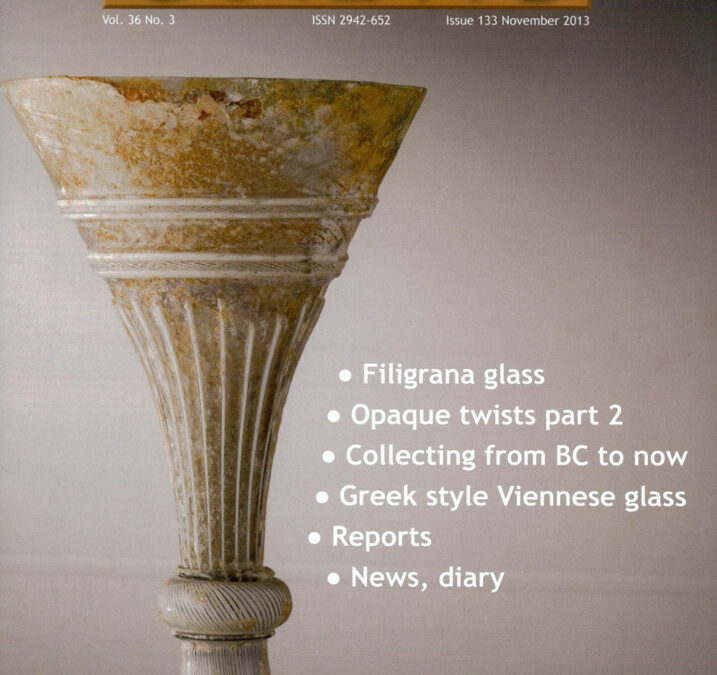
Goblet with filigrana at retortoli © Gemeente
Museum, The Hague
s my postbag/email
tyl
intray is now so full
of your letters, I think
it is time for me to
reduce my editorial to a minimum and
let the readers fill these pages.
In this issue we have three articles
written by members for whom English
is not their native language — hats off
to those three authors; how many of us
can write well in any foreign language? I
am not saying your Editor had no work
to do — it’s often prepositions and word
order that give the game away — but I am
seriously impressed, not just with what
each of them says, but how they say it. I
am sure readers will agree.
A co-author of the fourth article lives
in France – see how international we have
become! This analysis of the positioning
of canes to achieve twists is one to which
we shall return.
No curiosities this time – surely
someone has found an oddity while
bargain-hunting?
Jane Darner
Glass Circle News Issue 132 Vol. 36 No. 2
2
Letters to the Editor
Density measurements
I
n your last edition you have a
I nice obituary to Peter Plesch
written by Philippa Neilson. In
the obituary it mentions Peter as
an avid collector of oriental art,
English glass and Chinese glass, all
of which is correct, but additionally
Peter and his wife Traudi were
great collectors of ancient glass,
most of which was auctioned at
Christie’s London on 28 April
2009, including an amazing Gallo-
Roman cinerarium. I knew Peter
quite well and was intrigued by
his enthusiasm for recording the
density measurement of all his
glass and this included Roman
glass. When I have mentioned this
to curators and other collectors
of glass they are curious about
the approach but have not used it
themselves. What experience do
other members have of the use of
this technique as a possible assist
in authenticating glass?
David Giles
London
Collecting
I
would like to add to the debate
on collecting started in Issue no
129 and continued in 130. When
I was still at school I read a story
by Conan Doyle whose theme was
based on the idea that if one slept
with an artefact under one’s pillow
one could be transported into the
era to which the object belonged.
I spent several uncomfortable
nights in an effort to take me back
Editor’s note:
All letters
about a
previous
edition of
the magazine
refer to Vol.
36
No.
2
Issue no.
132
unless
otherwise
stated.
LEFT:
Peter Plesch’s
Gallo-Roman
cinerarium.
LEFT:
Sussex
Roman
Bottle. H
SN in
to the English Civil War before
concluding that my piece of brick
was not the right one. The point of
that early recollection is that ever
since it has coloured my collecting
life. The whys and whens are the
questions I ask myself no matter
whether I am looking at a Roman
bottle from Sussex (below), a
16th-century money-box, or a
19th-century stoneware gin flask
from Lewes. Of the Roman glass
bottle I ask whether grains of
chalk under the handle confirm
the dealer’s claim that it came
from a Roman cemetery on the
Downs. A tiny pin-hole in the side
of a Tudor money box must have
a reason, so we fire reproductions
with and without the hole. I find
that the Lewes gin bottle was
associated with the Guy Fawkes
night burning barrel rolling in
the 1840s. Did the owner of the
bottle stand on the bridge and
watch the festivities? Who laid
the Roman bottle in the grave and
beside whose body did it lie? My
bottom line is that every antique
object is a fragment of history and
opens research doors that I find
absolutely fascinating — not about
the object but about the world of
which it was part. Collecting cow
creamers in every known hue is
not my kind of collecting.
I recently wrote an article for
the Guild of Arts Scholars on
burnt window glass found in the
Inns of Court. It was a relic of
the Great Fire and with it were
a cupboard hinge and parts of a
ca. 165o delft cup. I could
see
the
flames through that glass, share the
owner’s dismay as the cupboard
caught fire and wondered whether
the cup rolled out as the door fell
open. I could almost smell the
smoke and hear the screams of
the people as they fled from their
home. I suppose I should be called
a serious romantic; but for me, like
Conan Doyle, these journeys are
what collecting is all about.
Ivor Noel-Hume
Virginia
Glass Circle News Issue 133 Vol. 36 No. 3
3
LETTERS
Chevron beads
I
was interested to read in
I the article on glass beads by
Adrienne Gennett, reference to
chevron beads (fig. 9 page 11)
which she noted were taken by
those travelling to distant lands
such as Africa and North America.
Adrienne might be interested to
learn that I acquired a chevron
bead (see right) in the
town of Balikpapan, East
Kalimantan (Borneo),
Indonesia when I was
working there in the
1980s. I assume that
the Dutch would have
been using such beads in
their trading activities in the
area back in the 17th and 18th
centuries.
Bill Davis
Melbourne
Glass in Egypt
I
read the article on bead-making
with interest and would query
the reference to glass beadmaking
in the 7th and 8th Dynasties in
Egypt. The beginnings of glass
working in Egypt are still not
entirely clear, but I think most
scholars now believe that Egyptian
glass production didn’t really go
very far until the incursions into
Syria by Thutmosis III in the 15th
century BC. The author correctly
states: ‘It is thought that glass
beads first appeared in Western
Asia in the latter half of the third
millennium BC: After that, glass
beads become more common at
archaeological sites in western
Asia and the Levant during the
first half of the second millennium
BC; this phenomenon is probably
due to increased production, but
may also be related to the poor
preservation conditions at most
Near Eastern sites, where 4,000
years seems to be near the outside
limit for glass survival. While the
few glass beads found in Egypt
dated to before 1500 BC seem to
be either imports or accidents of
faience manufacture, there is little
doubt that by the end of the 15th
century BC glass craftsmen were
making beads in both Egypt and
the Near East.
James Lankton
South Korea
Come and visit
I really enjoyed Shaun Kiddell’s
trip ‘Around the world in glass’.
And six months of it! Being an
avid reader and considering
my great interest in glass, it
took me a while to realise
that perhaps Shaun did get
to do other things during
those six months.
What ‘grabbed’ me was his
mention of visits to fellow Glass
Circle members in Australia and
their collections. When my wife
and I visited the late Peter Meyer,
his first question when he met
us at the station was ‘Why are
you here?’ He was still a little
suspicious. ‘I’m a fellow collector;
I answered. ‘I want to see your
collection: Peter smiled. ‘Oh,
that’s fine then; he responded, and
all was OK.
I’ve lived in Israel almost 30
years. No glass connoisseur has
ever seen my collection here. In
fact, during the previous years
since I started collecting in the
late 7os and lived in Kensington,
there were also no knowledgeable
visitors.
So this is a formal invitation to
all and any fellow GC members.
Just contact me first.
Stephen Pohlmann
Tel Aviv
Cut glass
A s
a new (alas not young)
fr‘collector of old cut glass
I was thrilled to read Shaun
Kiddell’s description of his travels
in search of cut glass. I am even
more grateful to our Editor for
putting me in touch with Shaun
who together with the two early
cut glass collectors he knows
has increased my circle of fellow
enthusiasts by 300%.
Shaun described an item from
my collection, probably a lidded
honey or preserve jar (pictured),
as having ‘the body cut with
swirling mitre cuts below a band
of medium diamonds set on a
stepped circular spreading foot cut
on the underside with radial facets.
The domed cover similarly cut
with swirling mitres terminating
with a diamond cut knop:
The silver mount has the makers
marks for Thomas Phipps and
Edward Robinson [first registered
in July 1783] and is dated 1789.
May I take this opportunity to
thank our Editor for
Glass Circle
News
which I believe to be one
of the best produced specialist
newsletters with its attractive and
always accessible combination
of original research, informed
opinion and news.
Philip White
Cheddon Fitzpaine,
Taunton
Editor’s note:
The writer refused to
allow me to cut the last paragraph.
4
Glass Circle News Issue 133 Vol. 36 No. 3
ltiee
ma
–
ANTIQUE
WINE BOTTLES
LETTERS
The Higgins
The
revamped Higgins Art
I Gallery & Museum, Bedford
has reopened with its new and
splendid glass display. There
is a large number of 17th and
18th century drinking glasses
on display, the majority being
English and mainly from the Cecil
Higgins collection. As yet there is
only some useful and interesting
generic labelling — more detailed
labelling will follow.
The selection of glass is curated
by Victoria Partridge, who
clearly has a good grasp of the
subject, and whilst one cannot
see
what is still in store, the
selection is both interesting and
appropriate. Highlights include
three pieces of Ravenscroft
conserved in a separate cabinet,
and also a small but worthwhile
selection of English facon de
Venise glasses. Colour twists at
The Higgins have been kept down
to a proper proportion.
Fellow glass collectors will
find a visit well worthwhile.The
lighting has been very carefully
arranged, the methods of display
do not interfere with the objects,
and in all departments the objects
chosen are very well worth seeing.
The building has been refurbished
to a high standard with regard
to windows, doors, flooring,
washrooms, etc. It is as pleasing
to the eye as the new sections
of the Ashmolean — Bedford is
lucky to have a museum of this
calibre. There is a nearby multi-
storey car park, and several small
restaurants, together with an
excellent café leading off the main
courtyard. The museum is within
walking distance of the main bus
and coach station.
Graham Slater
Cambridge
Editor’s Note: The curator has
promised us an article on the
collection and a Circle visit is
proposed on
21
April
2014.
Soldier, soldier
T
hanks to the good offices of
your Editor I have been given
a plethora of information about
hookah pipe reservoirs in glass.
The object of the exercise was to
establish whether the young man
in the portrait (Issue no. 131 page
30) could have bought a cut glass
vessel for his pipe in India, or
whether such an item was only
available in Great Britain: the
thinking behind this was that the
picture might have been painted
for proud mamma whilst he was
on furlough in this country.
Research notes forwarded to
me by our Editor suggest that
this is the case and the knowledge
that has been freely presented
to aid my quest has been truly
astonishing, and the amount of
material cited enormous. Glass
vessels were produced in India,
but tended to be decorated with
gilt or enamel, while at the time
the picture was painted some
sources think the cutting is in the
exuberant Irish style though there
is much dispute about this. For an
inherently fragile article standing
on the floor with a lot of ‘top
hamper’ it obviously makes sense
for it to be as solid and stable as
possible, hence the characteristic
bell shape.
I have been fascinated and
enlightened by what I have learned
and my researches have been given
renewed focus. I am indebted not
only to the Editor, but to Ivor
Noel-Hume, Dwight Lanmon,
Gail Bardhan of the Corning
Museum and Paul Weddell for the
kindness and generosity of their
response to my original query, and
thank them all most sincerely.
Richard Channon
Colchester
Editor’s note: Paul Weddell and
Shaun Kiddell are collaborating on
a ‘last word’ on glass hookah’s for the
next edition.
Glass books offer
A
fter 20 years offering books
specialising on glass and
having gone beyond the allotted
three score years and ten I have
decided to dispose of most of
the inventory. Particularly I am
disposing of books on English
glass and glass in the period from
Medieval to Modern times. Before
putting these books into auctions
or offering them to other dealers
I would like to give members of
the Glass Circle the first refusal on
any of them. They can be found on
my website www.gilesancientart.
com under special offers, many of
them for as little as £1 each. I will
consider any offer from a Glass
Circle member and would rather
the books found a home in that
direction. I am almost proud to
say that in trading books I have
not made a profit in any year of
the years that I have been trading.
I never set out to make a business
of it but to provide a service to my
fellow glass collectors and that has
given me great satisfaction in itself.
David Giles
East Sheen
5
Glass Circle News Issue 133 Vol. 36 No. 3
FAVOURITE GLASS
My favourite glass
ABOVE AND LEFT:
The author’s vase
showing how it
changes in different
lights.
by
Tony
Wigg
tg
–
n 1952 the V&A
purchased a de-
lightful two-han-
dled Murano am-
phora by Archimede Seguso
which can be seen in one of the
display cabinets at the V&A –
Glass Gallery Number 0235. It
had previously caught my atten-
tion before I acquired my own
bottle vase (seen here) which has
since become an enduring favour-
ite of mine because it has some-
thing of the Ancient and Modern
about it.
Both vases belong to a
delightfully light and airy range
that use gold to explore the
‘weathered’ surfaces of pottery and
glass from antiquity. I’m unable to
supply the reader with the name of
this series albeit the firm seems to
have created a distinctive Golden
range. When comparing my vase
to
the
V & A
amphora
particular
attention was
paid to the way
gold inclusions
were evenly
distributed
throughout
the whole
vase and by direct comparison an
attribution to Archimede Seguso
was made. The V&A Archimede
Seguso vase ca.1951 stands at
18.7cm 71/2 (in) while my bottle
vase stands at 17.5cm (7 in). Both
vases use the applicazioni di
foglia d’oro technique, ‘glass with
transfer gold inclusions’ or polveri
glass.
Although the V&A vase is
referred to as having been made by
Archimede Seguso, it is uncertain
whether this would refer to the
master glass artist himself or the
company that bore his name. Until
1946 Archimede Seguso was the
company’s chief glassmaker/gaffer
and throughout the 195os he
was still active at the chair. A
common error is to confuse
the firm Archimede Seguso
with another company Seguso
Vetri d’Arte which Archimedes
father, Archimede and two of his
brothers set up in 1933. Seguso
Vetri d’Arte are best known for
those alluring and now extremely
popular sommerso designs by
Flavio Poli which are often simply
described as ‘Seguso:
A remarkable feature concerning
the decoration of my vase is its
ability to completely change
appearance from strong gold
to grainy or cloudy gold depending
on the light suggesting the frosted
or patinated surface of an antique
vase. The company of Salviati were
prime innovators of distressed glass
producing scavo or sooted glass
which looked towards excavated
glass and corinto glass emulating
the oxidisation of long-buried
glass. Harry Powell’s ‘antique
finish’ for Whitefriars also comes
to mind. Antique glass and pottery
shapes and patination still provide
endless ideas for glassmakers
today and when precious metals
such as gold are used the glass
‘metal’ itself is consciously elevated
in the grand gesture of traditional
illumination.
While considering the quiet
simplicity and strength of this
vase born from the poetic flames
of Antiquity it’s interesting to note
the contrast to hot-worked mac-
chia ambra verde vessels which Ar-
chimede Seguso produced around
the same time, in which gold in-
clusions were also used to great ef-
fect within thick Modernist forms
beside green and amber glass.
There is little to compare these
thicker-walled macchia ambra
verde vessels to this thinly blown
golden vase yet they do provide
an insight into the way Seguso
was using gold for offset colour or
simply to impose a more solitary
allure.
Tony Wigg teaches painting and
drawing on silk and having once
collected his ancestor Powell’s glass he
now prefers to study glass within the
broader field of the decorative arts.
6
Glass Circle News Issue 133 Vol. 36 No. 3
was there that Lebeau created a
series of glasses that is undeniably
influenced by the authentic
Roman glass forms. One of his
creations is a mould-blown bottle
with a height of 28.6 cm (II in) and
a conical or piriform body, a long
cylindrical neck and a widened
rim. Two handles of heavy coil are
applied to the shoulder, drawn up
and attached to top of body. The
body is decorated with vertical
indentations and flattened ribs
(see fig. 1).
The specific Roman form by
which Lebeau must have been
influenced is the jug found in
Mainz. This is now part of the
collection of the Landesmuseum
Mainz (inv. no. 7.1V.1897, H
26.8 cm [lot in]), and is dated
toward the end of the ist century
AD. The form of the body, the
ribbed decorations and the
cylindrical neck are very similar
to Lebeau’s creation. The Roman
example is mould-blown too, has
a constriction at the base of the
neck and only one ribbed handle,
applied at the shoulder, drawn up
and attached to the top of the neck
(see fig. 2) .
Just like all the other modern
glass artists, Lebeau distanced his
COLLECTING
—
.1.1111111
n
•••••=111Meree”,-
From BC to modern times
was to graduate with a thesis on
Roman glass. Finally Prof. Dr.
Titus M. Elias, extraordinary
professor of Industrial Design
at Leiden University, reacted
enthusiastically when I asked
him to be my supervisor and he
approved my subject. So for my
BA (2007) I researched Roman
Glass found in the Netherlands
and for my Master’s (2008) my
thesis was entitled:
Roman Glass
Forms and their Survival, Creation,
Imitation and Falsification.
My
research question was to what
extent the modern glass artist is
influenced by Roman glass forms
when blowing a new creation. I
looked at the work of Louis C.
Tiffany, Frederick Carder, Chris
Lebeau, Archimede Seguso, Ariel
(Gila) Bar-Tal and Max L.H.M.
Verboeket.
I will share here just three
interesting results of my research:
one creation of the Dutch versatile
artist and glassblower Chris
Lebeau (1878-1945) and two of
the Italian
maestro
glassblower
Archimede Seguso (1909-1999).
Lebeau worked for Leerdam
Glass at Leerdam and between
1926-1929 for L. Moser & Sohne
in former Czechoslovakia. It
by Hans
van
Rossurn
LEFT:
Fig. 1
Chris
Lebeau, Unica,
L. Moser &
Czechoslovakia
1927. H 28.6
cm.
Modern Glas in
Nederland 1880-
1940 no.91,
p. 140.
RIGHT:
Fig. 2
Mould-blown Jug,
1st. century AD,
Mainz.
H 26.8 cm.
Landesmuseum
Mainz, Romische
Glaskunst and
Wandmalerei
no. 8, p.55.
tyl
fter 33 years of
hard work manu-
facturing and sell-
ing all kinds of
different window blinds, I decided
to leave the business of covering
glass for my growing passion for
collecting glass — uncovering a
whole new world of Roman glass.
Because of my intensive business,
collecting had been on a ‘back
burner’, but it dated back to 1976,
when on a holiday to Jerusalem
with my wife. On that trip, I
bought my first glass object — a
very small teardrop-flask. It was
not intact, because of a big hole
in the body which I discovered
when I came back home, but it
was cheap. This was the start of
my collection with the inevitable
consequence that subsequent
holidays to Israel would be much
more expensive than the first one.
After retiring from business,
I decided to study at Leiden
University. So in 2004 I ‘came’
to Leiden (the credo of the
University) and it was the start,
not only of the study of history of
art, but also of a completely new
life. At last I had the opportunity
of doing something more with my
interest in Roman glass, because I
now had the time for it. Every day,
every hour and even every minute
at Leiden University I enjoyed the
lectures, the discussions and the
conversations, but at the same
time I was a diligent student, so
at the end of the first year I got
my
propedeuse
(the Dutch name
for the first year of a university
degree).
At the end of the second year I
had to choose my specialisation.
It was a bit complicated because
Roman Glass is not a part of
the Applied Arts tripos as it has
more to do with Archaeology.
So the problem for me was to
find a professor as my supervisor.
All my lecturers advised me to
choose my subject for graduating
within the regular subjects of
Applied Arts. But my intention
Glass Circle News Issue 133 Vol. 36 No. 3
7
COLLECTING
creation from the Roman glass
form by adding new details or by
omitting specific characteristics
of the authentic form. So here he
changed the single and impressed
ribbed handle to two simple coil
handles. Lebeau also covered the
surface of his creations with a
structure described by the former
director of a Dutch museum,
Mr Van Gelder, as seeming: `…to
be covered with a sweet rain of
snowflakes’. The specific structure
Lebeau applied to the body
appears, however, to be intended
as a reference to the weathering
and encrustation that covered
Roman glasses when they were
found.
Archimede Seguso
(19 09-
1999)
was a member of the well-
known Seguso family of master
glassblowers, living in Murano
(IT) from
1397.
Between
1952
and
1998
Archimede created a series
of glasses inspired by authentic
Roman glass forms. His creation
(inv.
12006,
Private collection
1990,
H
32
cm
[12
1
/2 in]) entitled
`Vaso is clearly inspired by the
Roman Cinerary Urn (see fig.
3).
RIGHT:
Fig.3
Creation of
Archimede Seguso,
inv. 12006, Private
collection 1990.
H
32
cm.
Notarianni and
Seguso
fig. 8Z
p. 195
BELow:
Fig. 4
Cinerary Urn,
1st. century AD,
Cologne. H 21 cm.
Riimische Glaskunst
and Wandmalerei
no. 5,
p.52
The Roman glass cinerary urn was
used in the western part of the
Roman Empire only during the ist
and znd century (see fig.
4).
It lost
its significance when Christianity
became the state religion.
The first impression of
Archimede’s vase suggests it is
a Roman cinerary urn. But a
second look reveals the differences
between Archimede’s vase and an
authentic urn. The colour of the
glass, the form of the body, the
rim and the highly formed hollow
foot, all exist within the Roman
glass vocabulary, but undeniably
not as a cinerary urn. Archimede
created all these parts, based on
fantasy, but influenced by a specific
authentic Roman glass form and
it is surprising that the creation
looks at first sight authentically
Roman.
Another example of a creation
by Archimede Seguso, influenced
by an authentic Roman glass form
is the striking vase (see fig.
5),
also
entitled ‘Vaso’ (inv. Rincicotti,
Private collection
1966,
H
36
cm
[14
in]). It is an extremely tall vase
which at first glance resembles a
modern supermarket bubble-bath
bottle. But this is dated
1966
and
I think that is too early for these
modern plastic squeeze-bottles.
The vase is blown from opaque
white glass with a medium blue
central area and two handles of
the same colour. The top part,
the ‘cap’, is a medium blue and the
large blue area on the body has
white geometric designs. The two
handles are undeniably inspired
by the dolphin handles the Roman
glassblower in the northwest part
of the Roman Empire
would
Glass Circle
News Issue 133 Vol. 36 No. 3
COLLECTING
apply to his aryballos (see fig. 6).
This is the name of an oil bottle,
already in use among the ancient
Egyptians and the Greeks, but
extremely popular with visitors
to the Roman bathhouses, where
the oil was used for massage
and cleaning. This creation of
Archimede’s gives the overall
impression of a modern version
of a Roman bath oil bottle, yet the
geometric designs on the surface
have undergone a metamorphosis
and seem to represent water
drops. It is the enormous height
of the creation that makes it into
a personal statement based on
antiquity.
I finished my studies in
2008
and was awarded the degree of
Master of Arts in Art History with
Roman Glass as my specialisation.
In the meantime I had become
a fully fledged collector of Roman
glass and I had also developed the
attitude of a real collector, which
means: a thrill in the hunt for an
object, excitement in owning it,
and the enthusiasm in sharing
and exchanging ideas, experiences
and information with other glass
collectors. When I started my
collection I preferred translucent
glass, especially clear, but taste
is always changing and in my
case it also meant a new kind
of fascination with nature and
the rainbow colours created by
iridescence (see fig. 7). The word
iridescence
is derived in part from
the name of the Greek goddess
Iris,
the personification of the
rainbow. In the beginning I also
preferred only glasses which were
totally intact, but after some years
I realised that a crack or a chip
is no longer any problem for me,
especially when the form is rare or
difficult to find.
I have attempted to build up an
LEFT:
Fig. 5 Creation of Archimede Seguso, inv. 12006, Private
collection 1990. H 36 cm.
Notarianni and Seguso fig. 83, p. 192
ABOVE:
Fig. 6 Aryballos, 1st-2nd century AD, Marseille, Musee
d’Histoire inv. 99.2.19. H 4.5 cm. Tout feu tout sable no. 204.
Butow:
Fig. 7 Handle of free blown Jug, 4th century AD. Eastern
Mediterranean. H 9 cm. Collection
HvR.
Glass Circle News Issue 133 Vol. 36 No. 3
9
COLLECTING
All p
ho
tog
rap
hs
©
Tom
Haa
r
tsen
interesting collection with pieces
representing not only different
forms and techniques, but also
enclosing different centuries,
restricted to the Roman and
Early Byzantine periods, roughly
dating between the 1st century
BC and the 6th century AD.
The Benzian, Hessing, Maxwell,
Kollek and Breitbart collections
of Ancient Glass are well-known
to collectors and many pieces of
these famous collections are part
of my collection now (see figs 8,
9 & so). To describe and compare
the glasses as well as possible it is
essential to have a well selected
library of ancient glass books.
That is why I have a considerable
number of books and so I am in a
position to document the objects
in detail, find as many references
as possible and attempt to
establish both a chronological and
geographical classification.
Every piece has a personal
significance for me and the
collection as a whole gives me a
.A
n
MBOYMMIMMMBe
Glass Circle News Issue 133 Vol. 36 No. 3
nnnnnn
IMMIIMNNNa/MI
n
10
OPPOSITE TOP FAR
LEFT:
Fig. 8 Mould-
blown Jug 4th
century AD. Eastern
Mediterranean.
H 13 cm. Collection
Benzian, HvR.
OPPOSITE BOTTOM
FAR LEFT:
Fig. 9
Mould-blown
Guttrolf, 3rd century
AD. Eastern
Mediterranean.
H 16 cm. Collection
Teddy Kollek, HvR.
OPPOSITE LEFT:
Fig. 10. Mould-
blown Jug, 1st
century AD. Eastern
Mediter-ranean,
Sidon.
H 9.6 cm. Collection
Breitbart, HvR.
ABOVE LEFT:
Fig. 11. Aryballos
with bronze chain
and stopper, 1st
century AD. Eastern
Mediterranean,
probably Asia
Minor. H
Z3
cm.
Collection HvR.
LEFT:
Fig. 12.
Detail of an
aryballos.
COLLECTI NG
lasting pleasure. The price I paid
isn’t important; a simple glass
bottle can be more rewarding
than an expensive jug. Many
different and interesting forms of
aryballoi (the collective term for
bottles containing oil for use at the
thermes) are part of my collection.
One example still has its original
bronze basket handle, rings, chain
and stopper: a real masterpiece
(see figs ii
& 12).
Personal highlights for me were
the invitations to participate as a
collector in the exhibitions
Antiek
Glas, de Kunst van het
Vuur’ at
the Allard Pierson Museum, the
Archaeological Museum of the
University of Amsterdam in
2001
and at the Museum Simon van
Gijn in Dordrecht in
2004.
I was
greatly honoured to be invited to
be one of two guest-curators of
an exhibition of Roman Glass in
the Thermenmuseum of Heerlen
in
2011.
This was an exhibition of
Roman glass with more than
270
pieces from
II
private collections. I
also collaborated with Joop van der
Groen on the catalogue:
Roman
Glass from Private Collections,
a
real highlight for me as a collector
of ancient glass. During all those
exhibitions I had to live without
many of my most beautiful glasses
and I can tell you, that was not
easy.
Hans van Rossum ran a company,
with his wife, specialising in
Venetian and other blinds and after
retirement did his MA at Leiden
University. hrossum@gmail.com
Bibliography
Hans van Rossum
Romeinse Glasvormen
en bun Nachleben: Creatie, Imitatie en
Falsificatie,
Boxpress zoo8
Titus M. Elias
Modern Glas
in
Nederland
1880-1940, Waanders Zwolle (NL)zooz
Michael J. Klein
Romische Glaskunst and
Wandmalerei,
Philipp von Zabern Mainz
2001
Vetro
Vitri
Preziose iridescenze,
Milano
Museo Archeologico Electa Elemond
Editori Associati 1998
D. Foy and M.D. Nenna
Tout feu tou sable,
Musees de Marseille/ Editions Edisud
2001
Glass Circle News Issue 133 Vol. 36 No. 3
11
WM=VIMM
LgtadUi
2altaljt=
Au* a,r y.rm
amn.,
n
.
n
VIENNESE GLASS
Viennese glass in Greek Style
lass-manufacturer,
J. & L. Lobmeyr, was
fond of engaging
artists and architects
as designers for their glass (as
documented in Issue nos. 122 and
127). The artist Theophil Hansen
(1813-1891) was one such.
He was born in Denmark and
became one of the most important
architects in Vienna in the second
half of the igth century. He
had left Denmark in 1838 and
started an educational journey
via Germany and Italy to Greece
where he stayed for eight years. He
used this time for intensive study
of classical buildings, became part
of the European artists’ colony and
realised his first building projects.
In 1846 Hansen was invited to
Vienna and quickly established
himself as an architect to influential
families of the new industrial
and banking elites. From the
beginning he was involved in the
planning of the Vienna RingstraBe
that started in 1864. He designed
not only residential buildings for
influential bourgeois families, but
also some of the most important
prestige public buildings (such as
the Musikverein Concert Hall and
Praamatt
Xettet.
the Houses of Parliament).
He had adopted the so-called
`Greek Style’ in Copenhagen
where he had been in touch
with Thorvaldsen’s Nordic
neo-classicism as well as with
Winckelmann’s theories of
antiquities and the neo-classicism
of Karl Friedrich Schinkel. On his
way to Athens he had paused for a
while in Berlin to study the work
of Schinkel; then in Dresden to
see the Opera House by Semper
and in Munich, the neo-classicist
buildings by Klenze and Gartner.
Immersed in intensive study
of Greek antiquity, and the
style of Palladio and the Italian
Renaissance period, he developed
a style that became known as the
Viennese Revival. Structures such
as the Parliament Building can be
classified as Greek Renaissance.
Hansen designed the interiors
of his buildings too: furniture,
lighting, bannisters, carpets, wall
fabrics and other detailing. In
all his buildings Hansen seems
to anticipate the idea of the
`Gesamtkunstwerk’ which Vienna
became famous for around 1900.
Moreover he designed jewellery,
cutlery, ceramics and other objects
of applied arts. In all these objects
a preference for figurative decor
and rich ornamentation makes
itself felt and was known as Greek
Revivalism.
Through his arts and crafts
work he came into contact with
important companies that had
taken up the ideas of the Viennese
arts and crafts reform around
the RingstraBe projects. Among
them was the glass-manufacturer
Ludwig Lobmeyr.
The collaboration began in the
early 186os when Ludwig Lobmeyr
contacted the artist in the run-up to
the Paris International Exhibition
of 1867. Ludwig Lobmeyr himself
described this collaboration in his
autobiography:
[Hansen] received [me] with kindness
and enthusiasm and started straightaway
to draw bronze centrepieces with figures
and ornaments and also glass bowls on
top, then a set of glassware…. I would
have had to tell Hansen that his glass
shapes, pitchers, etc., were better suited
for bronze; but to get things done more
quickly, I modified his designs myself
and took them to him. Laughing, he
said, ‘I have no use for such rubbish’;
to which I remarked that this or that in
his designs was technically not feasible.
He accepted being told this and partly
revised the drawings, and if I still raised
objections, he went about improving
them a third time without ever getting
impatient, so that the objects eventually
turned out in a way that he was
delighted with’.
Beside the dessert-service, which
were centrepieces made mainly of
bronze’ (see fig. 1), two drinking
sets (see fig.
6 & 7)
of colourless
glass with ‘Greek engraving’s
by
Ulrike
Scbolda
RIGHT:
Fig. 1
Centrepiece in
Greek Style, dessert
service No.
25 I.,
1866. Gewerbehalle
Stuttgart 1868, p. 9.
BELOW:
Fig. 2
Ornaments for
crystal glass
engravings
in
Greek
style designed by Th.
Hansen.
Gewerbehalle,
Stuttgart 1866,
p. 148.
12
Glass Circle News Issue 133 Vol. 36 No. 3
TAMLAUFSAT, comet. von Of,..e.th INCOPRIL R. , HANSEN,
, ,
led
an…, Anha
VIENNESE GLASS
marked the beginning of the
collaboration: the Greek decor
consisted of circumferential
decorative ribbons with stylised
floral motifs and meanders as well
as swans and winged creatures.
Hansen had used this type of
ornamentation already in objects
he had designed in Copenhagen.
These two drinking sets became
part of the serial production of
Lobmeyr as No.95 and No.1o3,
but are not available any more as
tastes have changed.
As had been the norm since
the 18th century, the Hansen
drinking sets combined glasses
in different shapes and sizes:
goblets with stems for wine, a
champagne flute, (footed) beakers
for water, beer, and punch, and
several bottles, carafes and jugs.
At first sight the drinking set does
not look very Greek. The shapes
were more influenced by Italian
drinking vessels. The Greek
Style seemed to encompass the
Renaissance as a rebirth of the
antique. The decoration refers
partly to real Greek elements
such as the meander, palmettes
and band ornaments, but partly
to the Renaissance that refined
the antique pattern such as the
arabesques with birds and puttos.
The engraved flutings of the bottle
necks and the base of the cups
remind one of fluted column.
Similar ornamental friezes
(see fig.
2)
were used by Hansen
for the dessert service No.23
designed in 1866.
4
Three more
drinking sets, also ‘with Greek
engraving’ after Hansen’s design,
followed in 1872 and offered three
different decorations for the same
shapes (No. 143, 15o, 157) (see fig.
5). Again Greek ornamentation
was combined with Renaissance
LEFT:
Fig. 3
Centrepiece, dessert
service No. 25 II.,
1872. Blotter
fur
Kunstgewerbe,
Vol. 4, Vienna
1875, plate IV.
BELOW:
Fig. 4: Series of
vessels after Greek
models, brown
painted milk glass,
ca. 1872.
Glass Circle News Issue 133 Vol. 36 No.3
13
VIENNESE GLASS
detailing.
5
The wide definition of Greek
Style provided a large framework
of possibilities. A series of vessels
made in 1872 shows further
imitation of Greek styling (see
fig. 4). They were made after
Greek models in brown-painted
milk glass, which was supposed
to imitate antique earthenware.
The design was by Hansen: the
figurines were by the painter
August Eisenmenger or were
directly copied after antique
models. However, this series,
which was also shown at the 1873
Vienna World Fair, did not meet
with much approval, as Ludwig
Lobmeyr himself conceded:
Of its kind, hardly anything better
has ever been made: still, imitating
earthenware in glass was a mistaken
idea.’
Hansen’s personal commitment
is well documented in Ludwig
Lobmeyr’s autobiography. Hansen
visited the modellers and bronze
workers together with Lobmeyr.
He also directed and supervised the
chasing of the bronze items, which is
why the whole project turned out so
beautiful and fine … And yet, it was only
the drinking wares and, with rime, a few
centrepieces that found buyers’
Besides these series Hansen
also designed simple glass
vessels, carafes, and pitchers,
but also sumptous gifts such as
presentation goblets.
The influences for Hansen’s
Greek series came partly from
his studies in Greece, but also
as a result of the international
zeitgeist. England, in particular,
became a role model for
Bohemian glass production in the
185os and 186os. Both countries
were specialists in colourless
cut glass. But it was the British
who introduced new shapes and
new ornaments: engraving glass
with floral patterns, arabesques,
sometimes in Renaissance style or
with Greek borders and figures.
Examples by British firms such as
Apsley Pellatt & Co. or Dobson
& Pearce were known through
the International Exhibition in
London 1862.
Lobmeyr also became an
initiator in changing the Bohemian
glass industry:
Lobmeyr has well understood the
English reform; he has renounced the
false triumphs of coloured and painted
glass and placed all emphasis on the
artistic design and use of clear crystal
glass. […] He alone has saved the honour
of the Bohemian glass industry.’
Lobmeyr had exhibited thin white
crystal glass with fine engraving,
partly also in Rococo-style or
BELOW:
Fig. 5:
Drinking
Set No.
150 ‘with Greek
engraving’, 1872
Glass Circle News Issue 133 Vol. 36 No. 3
14
,a.
“4
1
IPA”
2,
–
VIENNESE GLASS
Sevres-like painted alabaster glass
at the International Exhibition in
London 1862,. In
1866
Lobmeyr’s
first objects with Greek design
were noted at a national
exhibition, followed by the stand
at the International Exhibition in
Paris in 1867 where he presented
glass in Greek style in Hansen’s
designs as well as in ‘altdeutsch’
and modern style.
In the Austrian department, no one, I
think, can fail to admire the white flint
glass exhibited by Mr Lobmeyr, in a
great variety of forms, all in good taste,
and admirably formed of a combination
of metal and glass, which is both in
point of design and execution one of the
most beautiful displays in Class 16.9
Hansen’s designs were part of
Lobmeyr’s success and contact
between the two men intensified.
The collaboration between
Hansen and Lobmeyr went far
beyond glass design and led to a
personal friendship between the
artist and the glass manufacturer
for whose apartment Hansen
designed the furniture in the
187os.
Ulrike Scholda is an art historian
and author in Vienna.
Notes
1.
Waltraud Neuwirth: Schoner als
Bergkristall. Ludwig Lobmeyr. Glas
Legende. Vienna 1999, p.224, 226.
(Autobiography of L.Lobmeyr)
2.
Dessert-Service No. 25Venterpieces
of fine gilded bronze with engraved
crystal-glass bowls, 1866′, variation in 1872
with even more bronze figuration (fig.
3). The material of glass was confined to
the plates and the vases with mountings.
For the gods and mythological figures of
Hansen made the sketches and engaged a
painter with the fully detailed drawings.
3.
So called in the working drawings of
the company, kept in the MAK, Museum
of Applied Arts, Vienna.
4.
It was also partly combined with
bronze (e.g. winged lions as feet for
bowls).
5.
Ludwig Lobmeyr himself designed the
dessert-service No. 24 and the drinking
set No. 1o8, already in 1866/67, also using
meander and stripes.
6.
Waltraud Neuwirth:
op cit.
p.345.
7.
op. cit.,
p.286.
8.
Falke Jacob, Die Kunstindustrie
der Gegenwart,
Studien auf der Pariser
Weltausstellung im Jahre 1867,
Leipzig
x868, p.158 f.
9.
Henry Chance: ‘Report on Crystal and
Fancy Glass: Class 16; in:
Reports on the
Paris Universal Exhibition,
1867. Vol. II,
London 1868, p. 374.
ABOVE & BELOW:
Figs. 6 & 7:
Drinking set
No. 103, design
drawing, signed Th.
Hansen, 1866
Glass Circle News Issue 133 Vol. 36 No. 3
15
Glass Circle News Issue 133 Vol. 36 No. 3
FILIGRANA
11
1111111111=
Vetro a retortoli:
thoughts about dating
Part 1
ast year we
were fortunate
enough to have
the Henk Germs
collection of over
40 filigrana glasses in
our shop. Filigrana glass
is made out of canes,
decorated with (in this
case) white glass threads.
There are three types of
filigrana
glass:
Filigrana a fill,
filigrana a retortoli, filigrana a
reticello. Filigrana a fill
is glass
made with canes of clear glass with
a single white thread in the middle
(figs. 8, 12).
Filigrana a retortoli
is
glass made with canes of clear
glass decorated with white twisted
threads (figs 1,10, ii).
Filigrana a fili
and
filigrana a retortoli
can be used
together in one glass (fig. 2, 6).
Filigrana a reticello
(fig. 14) is glass
with a diamond-shaped pattern
of white threads, with small air
bubbles in-between the crossed
threads. The pattern looks like a
net (the Italian word ‘rete’ means
`net’). Having so many of these
glasses was a real opportunity.
It offered us a unique chance for
some in-depth research, to look at
them and study them, and above
all, to compare them with each
other.
This article will deal with
various dating methods, using
filigree glasses from the important
collection held by the Haags
Gemeentemuseum (which some
readers visited on the Glass Circle
trip to the Netherlands in 2012).
They already had an interesting
group of filigrana glasses, which
they enriched with two glasses
from the Henk Germs collection
(figs. 6 and 1o). In the next article,
I will talk about the techniques of
making
vetro a retortoli
glasses.
Even though in most English
literature the term
vetro a retorti
is
used, I choose to use, as do Italian
writers, the original term used
by the Serena brothers, who first
mentioned the technique in 1527:
(vetro a)`retortoli”.
There are different methods of
dating glass. The easiest way is
to study a glass which has been
signed and dated by the engraver.
Another way is to study a glass
made for a particular
occasion, such as a
marriage or the signing of a
peace agreement. In those
cases, you simply research
the date of the occasion.
This provides a
terminus post quern,
since the glass can’t have been
engraved long before the special
event, and typically, the glass itself
will have been made shortly before
it was engraved.
Usually filigrana glass is
completely covered with canes,
resulting in a lacelike pattern on
which engravings are illegible.
Because of this filigrana glasses
usually aren’t engraved, which
makes this dating method
irrelevant. However, there’s a glass
in the collection of The Hague’s
Gemeentemuseum that is an
exception. It’s a large beautiful
glass ornamented with spaced
vertical retortoli canes (fig. 1).
In the gaps between the canes,
different names and dates have
been inscribed with a diamond in
various handwritings. Probably
the glass was used by an Austrian
so-called
Stubengesellschaft.
A
Stubengesellschaft,
or
Drinkstuben-
gesellschaft,
was a circle of upper
class gentlemen who met to discuss
politics. To become a member of
such a circle one was obliged to pay
a large sum of money or to donate
a valuable goblet that would be
filled with wine and passed round
the assembled company.
It may have been the custom in
this particular circle to inaugurate
newcomers by asking them to
write their names and date of
membership on the glass: probably
after they had been asked to empty
the glass in one draught. For the
most part the names are illegible,
but the dates are easy to read. The
earliest signatures date from 1564,
the last one from over a century
by
Kitty
Lameris
16
FAR LEFT:
Fig. 1 Goblet, with
filigrana a retortoli,
H 28 cm
LEFT:
Fig.
2
Wineglass with
filigrana a fili and
filigrana a retortoli,
H17.5 cm
Below:
Fig. 3
Pieter Pourbus
(1523-1584),
An
Allegory of True
Love, c.1547.
Details above.
Glass Circle News Issue 133 Vol. 36 No. 3
FILIGRANA
later: 1674. It is likely that the glass
already existed in 1564. Some of
the names from 1670 are easy to
decipher: ‘Ferdinandus Carolus
Fux a Lebenberg’ and ‘Jacoby de
Fridercis Parochy Marlinga’.
The additions ‘a Lebenberg’ and
‘Marlinga are very interesting,
as together with the dates they
reveal something about the glass.
Schloss Lebenberg, a castle built
by the Herren von Marling in the
13th century near the Marlinger
mountain in South Tyrol, is
situated just 8o km from Hall
in Tyrol which is well-known
for glasses made in the mid-16th
century having exactly the same
shape as this goblet, but without
filigrana. Between 154o and
1569 glass was made here under
the watchful eye of Sebastian
Hochstetter. It could well be that
the glass now in The Hague’s
Gemeentemuseum was made
in Hochstetter’s glasshouse. It
is interesting that a large goblet
of the same shape is still extant
(without filigrana) and was once
owned by the Stubengesellschaft
of Hall of which Hochstetter was
a members.
Another method of dating is
to study excavated pieces. These
will preferably have come from
a site with production waste,
but other finds, too, can reveal
a lot about the history of a glass.
The Gemeentemuseum holds
an excavated filigree glass of
intriguing origin (fig. 2). It was
found in Syria and is, together
with two similar excavated glasses
now in the national Museum
in Damascus, an indication
that filigree glasses were soon
appreciated well beyond Venice’.
Two glasses of the same type
are depicted in Pieter Pourbus’
painting An Allegory of True
Love’ (fig. 3). A wealthy company
bedecked with jewels and finery
is seated around a marble table
loaded with delicacies. The whole
atmosphere is one of abundance.
On the table are the two glasses,
filled with red wine. Pieter Pourbus
(Gouda 1523-Bruges 1584) worked
for most of his life in Bruges. His
canvas reveals several things about
the glasses. First, that filigree glass
was already known in Bruges
as early as 1547, the date given
to this painting. That’s only
20
years after its invention. Second,
the painting shows that such
glasses were considered extremely
sophisticated. Pourbus has used all
the means at his disposal to convey
just how rich and important the
people are: hence the placing of
these two glasses — real novelties
— on the table. It is still hard to
tell whether they were made in
Venice, or belong to the earliest
production of filigrana glass made
elsewhere, such as Antwerp. What
is remarkable is how soon this
Venetian type of glass turns up in
different places across the world.
Another depiction of a
comparable glass was published
in 1735, almost zoo years later
(fig. 4). It features in
Nederlandse
Displegtigheden,
a book by Van
Alkemade and Van der Schelling
describing the history of drinking
habits in the Netherlands up to
the early 18th century. The print of
the glass is contained in a chapter
on glasses to amuse drinkers
and test their skill (‘feest- en
schertsglazen’). It is a mounted
bowl of a glass of the same type
as those found in Syria and that
are depicted in Pourbus’ painting,
with filigree decoration of vertical
a
fili
canes and — in this case — a
single horizontal group of canes of
an
a retortoli
cane between two
a
fili
canes. According to the book,
the glass was designed after a
glass that belonged to the Mayor
of Gouda, Daniel de Lange, who
inherited it from Daniel van
Keulen. Daniel van Keulen turns
out to have been a professor of law
in Leiden, who lived from 16o8 to
1672. Thanks to the book’s subject,
namely old drinking habits, it
depicts a glass that was already
very old in
5735,
with the dates
,
1%01001.0:1:01:12111
17
LEFT:
Fig. 4
Frans
van Bleyswyck
(1671-1746),
Old drinking and
toasting glass, 1734.
BELOW:
Fig. 5
Anonymous, Still
life. c.1600.
n
•
n
of the original owner providing
a
terminus ante quem.
The glass
depicted must have been made
before
1672,
the date Van Keulen
died. It might be much older.
This shows how important
pictures can be in helping to date
objects, especially when these are
dated or signed by an artist whose
dates we know. In general one
can assume that objects depicted
are contemporaneous with the
pictures, even when it concerns a
historical subject. A nice example
of this is the Last Supper. Together
with the Annunciation, this is the
most frequently painted biblical
episode in Italy. As we all know,
Jesus that evening drank a glass
of wine together with his apostles.
On the paintings this is often
served in glasses, and instead of
painting Roman glasses of the ist
century, the wine is usually drunk
from glasses in use at the time the
painting was executed.
For the Netherlands still lifes
are of paramount importance.
These paintings were often used
to depict the most beautiful
and valuable objects imaginable,
including the highly desirable
S
r,
O
O
a
-o
S
S
0
0,
a
O
18
Glass Circle News Issue 133 Vol. 36 No. 3
BELOW:
Fig. 6 Tazza (`alza ta’) made of
filigrana a retortoli and filigrana a fili, H 10.3
cm, D bowl: 18.8 cm.
ABOVE:
Fig. 7 Tomas Yepez (1595-1674),
Still life. c.1642.
LEFT:
Fig. 8 Spanish plate with filigrana a
fill. D 47 cm.
FILIGRANA
Venetian glasses and, later, glasses
made in the Netherlands in the
Venetian way. The glasses feature
in these paintings not only because
of their value, but also because
of their extreme fragility which
makes them symbols of mortality.
Like flowers and watches, fragile
glasses are seen as a reference to
the finite nature of existence.
Filigree glasses are rarely
depicted in paintings, but a canvas
in Delft’s Prinsenhof Museum
shows two (fig. 5). One is a high
glass of a type usually attributed
to Antwerp or Germany, the other
a beautiful tazza. A strikingly
similar tazza is one of the glasses
the Gemeentemuseum recently
acquired (fig. 6). Both the canvas
and the glass were most probably
made around i600. To celebrate
the new acquisitions, early in 2013
the two were brought together for
an exhibition on filigrana at the
Museum in The Hague.
As early as the latter half of the
16th century, filigrana glass was
already being produced in Spain.
From the mid-16th to the mid-
17th century a very characteristic
type of
vetro
a fi/i was being made
in Catalonia. These glasses are
easy recognisable due to
a fill
cane
decoration in relief usually
covering only the underside of
the bowl, plate or flask. In a still
life by Tomas Yepes (1595-1674)
c.1642, two carafes of this group
of glasses are standing on a table
behind a pile of pancakes (fig. 7).
Parts of the white canes that go
roughly halfway up the bottle are
visible. The Gemeentemuseum
has a beautiful example of this rare
type of glass. It is an extremely
large plate of 47 cm D (181/2 in)
with a low cylindrical base and
a flat broad rim. The entire base
is covered with radiating white
canes in the middle, while three
concentric white canes decorate
the rim (fig. 8).
For glass specialists, the
Bichierografia
is of invaluable
importance. This is a four-part
4
Glass Circle News Issue 133 Vol. 36 No. 3
19
Fl LIGRANA
Hen
k Germs
co
llec
t
ion
volume comprising around 1600
drawings of glasses by Giovanni
Maggi. The work is dedicated
to Cardinal Francesco Maria
del Monte (1549-1609) who
had a large collection of glasses.
An inventory lists ‘five hundred
glasses of cristallo and different
types of glass’ (‘bicchieri di
cristallo e vetro di diverse sorte
numero cinquecento’)
4
. Part four
features several depictions of
striped vases (fig. 9). Their shape
closely resembles that of the other
glass bought by the museum (fig.
io). This little vase is made out of
a
retortoli
canes called
canna a rete;
canes made out of cristallo with
an external
decoration
of thin white
threads. These canes
have been fused.
Between two adjacent
canes so many white
“\–..”; threads on the
outside of the
canes
come
together that a white vertical stripe
appears and it seems as though the
a retortoli
canes alternate with a
fill
ones. The vase is covered with
little diagonal stripes between
long horizontal stripes. Maggi
reproduces this optical
effect
in his
drawings by using vertical lines.
As the four volumes were printed
in 1604, we know that the vase in
the Gemeentemuseum may have
been made around that period.
Mounts are also an important
source to help date a glass. Silver
mounts often have hallmarks to
indicate who the maker was, or
the year in which it was made.
Other mounts are engraved with
inscriptions. Sometimes glass and
mounts are made at the same time;
sometimes a glass is ornamented
later (e.g. a foot made for a broken
glass).
The Gemeentemuseum’s col-
lection has a mounted filigree
glass (fig.
Many bowls with
this shape in particular were (re)
used with mounts. The mount
of this particular glass, made of
gilded silver and copper, bears
no hallmarks; nor does it have an
inscription. However, others do.
One such inscription reveals that
(at least some of the) glasses of
this type were made in Antwerp.
This possibility is raised by a glass
mounted with a silver bell in the
Curtius Museum in Liege. The
bell bears the coat of arms of Sarah
Vinckx. Vinckx was married in
1584 to Ambrosio de Mongardo,
owner of the Antwerp glasshouse
Het Gelaesenhuys.
When Ambrosio died she
took over the company until she
remarried, taking as her husband
first glassblower Philippo Gridol-
phi, who managed the glasshouse
until he died in 1625. During this
period the Antwerp glass industry
LEFT:
Figs. 9a & 9b
Giovanni Maggi,
Bichierografia faro
quarto,
Firenze
1604
BELOW:
Fig. 11
Filigrana glass with
filigrana a fili and
two types of
filigrana
a retortoli, mounted
with a statue of a
personification of
Fortuna H 16.5 cm
LEFT:
Fig. 10
Vase with filigrana a
retortoli, type canna
a rete, H 18.5 cm.
RIGHT: Fig. 12
Beaker met filigrana
a fili,
H 21.3 cm
20
Glass Circle News Issue 133 Vol. 36 No. 3
FILIGRANA
RIGHT:
Fig. 13 Boetius
Adams Bolswert
(15804633),
The Horrors of the
Spanish War, 1610.
BELOW:
Detail
.3
a
<-0 and all masks made with that same stamp will bear the same characteristics. Therefore a glass decorated with lion masks that are the same as the mask found among the shards of De Twee Rozen was most probably made there. Because of this find, Michel Hulst attributes the Gemeentemuseum's beaker to De Twee Rozen on the Keizersgracht and so we know it must have been made in the second quarter of the 17th century. In Part 2, I will show how the techniques of making can also provide information on dating filigrana glass. was at its height°. The fact that Vinckx' coat of arms is engraved on a mount of one of these glasses, taken in combination with several archeological finds of this same type in the city of Antwerp, suggests that these glasses must have been made at her glasshouse in Antwerp. The museum's collection also holds a large beaker made of vetro a fili with vertical white canes (fig. 12 opposite). Halfway up the glass are three lion masks alternating with three clumsy little knops of a spiralled trail. A comparable beaker is depicted in an engraving by Boetius Adams Bolswert (1580- 1633) entitled The Horrors of the Spanish War (fig. 13) which dates to c.161o. A woman is trying to keep a Spanish soldier from using his knife against a kneeling man. In her other hand she holds a beaker filled with beer. The beaker is decorated with diagonal white threads. An oval plaque is clearly visible. According to Henkes 7 these beakers were made from the second half of the 16th century up to the second half of the 17th. Recently published research by Michel Hulse allows us to date this beaker more precisely. The lion masks decorating the beaker resemble a mask dug up during an excavation of production waste discovered near the 17th century glass house `De twee Rozen (the two roses) in Amsterdam. Prior to moving to the Rozengracht, this glasshouse operated on the city's Keizersgracht canal from 1621 to 1657 and was located approximately where numbers 263- 273 are now. It was here that the lion mask was found, amid production waste and cullet. It's not certain whether the mask was glass waste from the glass house or a shard intended for recycling. However there is sufficient evidence to indicate that this particular mask was indeed made at De Twee Rozen. Lion masks are made with a stamp, 4_. o Dr Kitty Lameris is one of the three owners of Frides Lameris Art and Antiques in Amsterdam. One of her specialties is Venetian and Facon de Venise glass. Last year she wrote a catalogue about filigrana glass: Kitty Lameris, A collection of filigrana glass, Frides Lameris Art and Antiques, Amsterdam 2012. She gave the Robert Charleston Memorial Lecture on this subject in June. Notes 1. Archivio di Stato di Venezia. Consiglio dei X, Parti Comuni, filza 6, n.84. Luigi Zecchin, 1989. Una fornace Muranese all'insegna della Sirena. In Vetro e vetrai di Murano, Studi sulla storia del vetro. Vol. z. Venice: Arsenale page 213. 2. The glass is published in Erich Egg, 1962. Die Glasbutten zu Hall and Innsbruck im 16. Jahrhundert, Innsbruck. Tafel VI, picture 12. 3. A. Al'Ush, A. Joundi, B. Zouhdi. 1976. Catalogue du Musee.I976, p.267, 4.153. 4. Paola Barocchi. 1977. facsimile: Giovanni Maggi. i6o4. Bichierografia, Firenze. p.V and note 2.5, p. XIII. 5. Ann Chevalier, The Golden Age of Venetian Glass, Tokyo 1999, picture 63, P.54 and 146. 6. Raedt, Ine de a.o,'Samenstelling van side- tot 17de-eeuwse glazen voorwerpen opgegraven in Antwerpen; in: Johan Veeckman, Berichten en Rapporten over het Antwerps Bodemonderzoek en Monumentenzorg 2, Antwerp 1998, p.89. 7. Harold E. Henkes. 1994.'Glass without gloss; in: Rotterdam papers, Rotterdam. 8. Michel Hulst. 2013;Glazen met maskerons en leeuwenkopstammen uit Amsterdamse bodem. Een aanzet tot de identificatie van zeventiende-eeuwse Amsterdamse facon de Venise; in: Vormen uit vuur 221, 2013/2, p. 21- 39. BELOW: Fig. 14 Plate made of filigrana a reticello. D 26.5 cm Glass Circle News Issue 133 Vol. 36 No. 3 21 Amolow n , OPAQUE TWISTS A critique of E. Barrington Haynes' `series' terms Part 2 he terms SSOT and DSOTs are familiar to all collectors of Georgian drinking glasses. They are but abbreviations of single series opaque twist and double series opaque twist, terms coined by Edward Barrington Haynes (EBH). Their raison d'être is, however, far from clear — were they simply ad hoc terms to help with stem classification or were they a reference to the way the stems were made? Here, we will explore what EBH wrote about his series, their insufficiencies as descriptors and the fudging that went on to force the terms SSOT and DSOT to fit the descriptions of actual opaque twist stems and vice versa. What is clear is that the terms have little in common with how the stems were manufactured. Single and double series twists EBH was an avid collector and client of Arthur Churchill Ltd., probably the leading glass dealer in London of the day. Following the death of Churchill in 1936 EBH acquired the company. The 5937 re-edition of the company catalogue refers to multiple or multi-spiral opaque twists and multiple air spiral twists while all the familiar terms we use today to describe twist glasses are there — spirals, gauzes, n-ply, tapes and threads; corkscrews are inside n-plies while tapes surround gauzes'. The precision in the descriptions is remarkable and few do better today. Be that as it may, the word series is not to be found. The prevailing single and double series (SS & DS) terms are widely known from EBH's book Glass Through the Ages, first published in 1948 2 . However, he had another vehicle to make known his opinions, and he had many and expressed them in no uncertain manner. Arthur Churchill Ltd. published a series of sixteen Glass Notes up to December 1956 that ceased with EBH's death in 1957• Numbers 7 (1947) and 8 (1948) contain detailed company checklists (stock) for air and opaque twists respectively in which the SS and DS classification system appeared;• 4 . Checklists for mixed and colour twists, balusters, plain and hollow stems and incised twists stems followed from 5950 to 1956. Again no definitions for single or double series were given, while MSAT and MSOT were the only abbreviations used. The post-war Glass Notes are fascinating for they reveal far more of EBH's character than transpires from reading Glass Through the Ages, no doubt because the Penguin Book editor used his red pencil. The most colourful is: 'We predict that the cult of twist collecting will become more fashionable once the formation and nomenclature of the twists are common property, as will shortly be the case', that appeared a year before (note 3, p. 27). He created the demand and was on hand to supply clients — ingenious! Commenting on his own book, at the modest price of two shillings, it may be expected to replace the cheaper text-books, now out-of- date, out-of-print, and unduly expensive (note 4, p. z5). This effectively sidelines most previous authors. However, from the almost non-existent description of how air or opaque twists were made, it is clear that their manufacture was of little interest to him. Turning to his magnum opus, 'MSAT' is in the vanguard and appears in Part 2 Group V 'Glasses with Compound Stems' — 'The abbreviation MSAT for Multiple Spiral Air Twist is used where appropriate' (note 2, 1 11 94). by Simon Wain- Hobson Athelny Townshend 22 Glass Circle News Issue 133 Vol. 36 No. 3 Fig, 1 The grey circles in the diagrams under each stem type illustrated indicates the corresponding theoretical layout plan for the canes in the manufacture of the carrots prior to twisting In the same chapter, but now in the subsection on composite stems with an opaque twist, we read, 'Both single and double series twists occur; again without the slightest explanation as to what a series is (note 2, p. 196). Finally he comes to it: The twist may consist of one formation by itself or of two reciprocal spiral formations; these are here termed''single series twists". More commonly, the twist is composed of two formations, the one inside the other, and these are called 'double series twists': Very rarely, there may be a triple series twist (note 2, p. 211). The 1959 revised edition of Glass Through the Ages uses essentially the same paragraphs. The crux of the double series definition is that a helical formation is contained within a larger helical one while a triple series denotes three nested helices, a little like Russian dolls. Single series stems are made up of one formation by itself or of two reciprocal spiral formations; but as we do not know what he had in mind for a formation, we are not much further on. And that's it, except to note that EBH writes about opaque white twists, rather than opaque twists. Despite what is a very perfunctory effort EHB sets himself off against some of the greatest: "There does, however, seem room for a more precise classification of the various types of drinking glass we made, based on the structure of the stem, with bowl and foot variations regarded as a subsidiary. There are in fact families, genera, and species of drinking glasses, the last possessing no inconsiderable number of varieties:' (note 2, p158). A more unambiguous reference to Carl Linnaeus, who laid the foundations of the modern classification of living organisms, is hard to find. The next wave of authors was clearly influenced by EBH's work, some adopting", some resisting his nomenclature'. However, the familiar abbreviations MSAT, SSAT, DSAT, MSOT, SSOT and DSOT arrive in force with Bickerton 9 ; he was the Great Abbreviator! Note the ambiguous S — for MSAT and MSOT it means Spiral while for SS and DS stems it means Series even though MSATs are a subgroup of SSATs. The same goes for MSOTs, which are a subgroup of SSOTs according to EBH. Thereafter the single series, double series terminology gathers ground, although not as readily as he would have us believe. For example, Rush refers to what is clearly a MSOT as a fine mesh OPAQUE TWISTS opaque twist spiral stem"), while the term double series opaque twist is used but once in his 1987 book". Yet back in 1959 EBH noted:'The terminology applied to the twists has been indeed various. The illustrations provided show nearly all the varieties of twist and are named in accordance with a terminology which has now had a longish life and has met all requirements' (note 5, p257). The longish life presumably refers to the Glass Notes of which he was the prime mover. The far more interesting questions are whether the SS & DS terminology is accurate and whether it helps us better understand how these lovely stems were made. Are these terms accurate? We shall begin with DSOTs and TSOTs for their definition is apparently simple, one inside the other'; furthermore they represent the majority (77%) of opaque twists 5 . For the stem illustrated in fig. la there is no doubt whatsoever — one formation is inside the other, ditto for the TSOT (fig. 1b). But what about the stems illustrated by figs lc & cl? The inner elements, or formations, overlap part of the outer tapes. The difference is best illustrated by the Cane plans; shown below the figures, which provide cross sectional views of the stems. As one formation is not inside the other, like Russian dolls, they cannot be made sequentially as some authors have said. This fallacy is no better formulated than by Bickerton: In English stems it was formed by the introduction of opaque-white glass rods in the stem mould, the delicate patterns being produced by drawing and twisting and repeating the process for a double- series twist'. Actually, he repeats himself so there is no room for confusion: Since it is possible to create an air twist and then, after adding metal which increases the diameter, to repeat the Glass Circle News Issue 133 Vol. 36 No. 3 23 Fig, 2 OPAQUE TWISTS process, the terms 'single series' (SSAT) and 'double series' (DSAT) are used to differentiate between them:' Of course, when it is realised that all elements in a stem were drawn and twisted simultaneously', it ceases to be a conundrum whether the inner formation is completely inside the outer one, (fig. la), or overlaps it (figs lc,d). The important point is that everything was assembled on the marver - opaque white canes or carrots were picked up, clear glass added, reheated, more canes or carrots were picked up, clear glass added, reheated and so on until the gaffer was happy with the ensemble. Then, and only then was it drawn and twisted. The relative position of a cane/tape/carrot to another is determined during assembly. Turning to single series opaque twists, they are of one formation by itself or of two reciprocal spiral formations'. It seems reasonable to assume that reciprocal means that the formations are on opposite sides of the stem axis, some of the most beautiful being a gauze and tape or a pair of helical gauzes (fig. 2a,b). The word formation is vague, yet knowing OT stems, it is probably a collective word for a number of similar elements, such as a group of 2-3 canes (fig. 2c). Of course the immediate challenge is shown in fig. 2d, an OT made of four helical gauzes. It could be argued that the cane plan represents two orthogonal pairs of reciprocal helices, however EBH didn't make that argument. Nonetheless, he classifies it as a SSOT just as he does a stem with three helical gauzes where reciprocity is impossible. Given the Russian doll logic inherent to double and triple series, there cannot be a single series — the innermost doll is solid! EBH tries to give some different ground rules to govern this group with discussion of formations and reciprocity. Single series is simply a euphemism that encompasses 24 everything that is not a double or triple series. Are they robust terms? By this we mean are they easy to use? We have seen that EBH's definitions are minimalist leaving room for others to add and comment. There is the troublesome start in that the 'S' in MSAT is not the same'S' in SSAT and DSAT, spiral and series respectively, even though MSATs are subsumed within SSATs. EBH classifies the well known lace twist outlined as a SSOT, yet the lace twist is, by definition, within the canes outlining it and so should be classified as a DSOT (note 4, p. 31). What about the corkscrew with two opaque canes described as a SSOT (fig. 2e)? Certainly the two canes are reciprocal i.e. on opposing sides of the stem axis, however, what do we do with the corkscrew which lies bang down the centre? Actually EBH calls it a DSOT! (note 4, p. 46). A 'spiral gauze with core is classified as an SSOT when it is a full-bloodied DSOT, the core being within the helical gauze, while several DSOTs are actually TSOTs. Such was EBH's standing that both errors were propagated by Lloyd (note 7, p. 155 and p. Ho) and Bickerton (note 13, figs 118o and 1215). EBH provides few illustrations with scant figure legends; by contrast, Bickerton illustrations are abundant and annotated. Conservatively, we have counted approximately 44/486 (9%) errors among his `series' annotations of air and opaque twist glasses, mainly in the latter, although these could have originated with EBH. Bickerton is not alone; auction rooms regularly make mistakes, as do some dealers. When the stem is a trifle complex, an incorrect description often ensues. Occasionally EBH fudged. For example: The spiral band is composed of two spirals rather far apart; in some cases a slight misplacement causes the spiral gauze to appear inside the spiral band, but the arrangement is not a true double series twist. This also applies to the preceding and the two following twists' (note 4, p. 34)• The nomenclature is correct; the gaffers misplaced some spirals! This is too much — the gaffers mommi Glass Circle News Issue 133 Vol. 36 No. 3 Fig. 3 OPAQUE TWISTS knew far better than EBH what they were doing. Interestingly contemporary descriptions of mixed or colour twists (MT & CT) are never accompanied by a series designation, despite single, double and triple series sections existing for them in EBH's nomenclature. It is all the more surprising therefore that the Great Abbreviator didn't forge SSMT, DSMT, SSCT or DSCT even though he used the complete terms 9 •". They simply never took for mixed and colour twists, dealers and auction rooms today content themselves with describing the stems. The singular feature of colour twists is the nature of the coloured cane. There are coloured clear glass canes and coloured opaque or enamelled canes. The former are sometimes referred to as translucent, which is incorrect being confused with transparent. Perhaps it would be simplest to discern a royal status on 'opaque twist — meaning opaque white twist — and be clear when commenting on the nature of the much rarer coloured canes — e.g. clear blue or opaque blue. Of the abbreviations, MSAT and MSOTs were never in doubt except that Georgian twists are helices and not spirals. Amusingly one of the very few auction houses that uses the word helix to describe opaque twist stems is Cheffins of Cambridge, UK: amusingly, because the structure of DNA, the Double Helix, was discovered in Cambridge in 1953' 5 • And so? The single and double series terms are not useful, although they have the advantage of being well known. However, there is a strong dose of the arbitrary in them, which is never a good thing. It would be more useful to make an effort to describe clearly the stems. Constructing cane plans are useful to understand a twist, and appreciating the subtle similarities and differences between stems. Some more examples are shown in fig. 3. We are in the process of conservatively reassessing the variety of distinct cane plans for opaque twists — EBH had a tendency to make arbitrary distinctions, which invariably inflated the niirnber of disrin twists. Pictures of unusual air, opaque, mixed or colour twists from members would be greatly appreciated. Above all let's not get too caught up in nomenclature and savour the beauty of these twist glasses. They are truly remarkable feats of workmanship and a delight to hold, never more so than when two-thirds full. Simon Wain-Hobson is Professor of Molecular Virology, Paris. simon. wain-hobson@pasteur.fr. Athelny Townshend is a dealer in 18th century drinking glasses and retired schoolteacher. athelny@aol.com The authors would be glad to hear from any reader who has any anecdotes or photographs of E. Barrington Haynes. Notes 1. Catalogue of Old English Glass. 1937. and edition. Arthur Churchill Ltd., London 2. E. B. Haynes. Glass Through the Ages. 1948. Penguin Books, London. 3. Glass Notes No. 7,1947. Arthur Churchill Ltd., London. 4. Glass Notes No. 8, 1948. op. cit. 5. E. B. Haynes. Glass Through the Ages. 1 959• Revised edition, Penguin Books, Middlesex. 6. E. M. Elville. English Tableglass. 195i. Country Life Ltd., London. 7. W Lloyd. Investing in Georgian Glass. 1969. Barrie & Rockliff, London. 8. G. B. Hughes. English Glass for the Collector, 166o-186o. 1958, Lutterworth Press, London. 9. L. M. Bickerton Eighteenth Century English Drinking Glasses, an illustrated guide. 197i. ist edition. Barrie & Jenkins, London. lo.J. Rush. The Ingenious Bielbys. 1973. Barrie & Jenkins, London, p. 64. u. J. Rush. A Bielby Odyssey. 1987. Nelson & Saunders, Bucks, p. 66. 12. S. Wain-Hobson & A. Townshend. Glass Circle News. 2013. vol. 36, p.16. 13. L. M. Bickerton Eighteenth Century English Drinking Glasses, an illustrated guide. 1986. and revised edition, Antique Collector's Club, Suffolk. 14. Glass Notes No.10, 1950. Arthur Churchill Ltd., London, p. 32. 15. J. D. Watson and F. H. Crick. 1 953• 'Molecular structure of nucleic acids; a structure for deoxyribose nucleic acid: ~ii rur; V01 I I p. Glass Circle News Issue 133 Vol. 36 No. 3 25 REPORTS G lass Circle outings 28 August to 3 September Vienna and Budapest Vienna A little over 20 of us assembled in the Art Hotel, Vienna, to start a trip to what had been the Austro-Hun- garian Empire. Our first visit was to the Kunsthistorisches Museum led by a guide, who was a history rather than an objects person, so we missed the fantastic paintings, silver, rock Crystal, et al, but saw all the fine glass on display (they have even more in store). The Roman glass was rather disappointing, if one can say that any collection with a good cage cup is disappointing, although one of the pieces could have inspired Tiffany (fig. 1). However the first post-medieval case we saw (fig. z), had four items of the best early Venetian glass, matching anything in the V&A or BM. We saw wonderful glass from Innsbruck and Hall, mainly bought new by the Habsburgs over 500 years ago. to the Hofburg palace the next day. Since the Second World War it has been the Arab market that has kept the company afloat. Leaving the shop we walked to the workshop and archives (fig. 4) where we saw chandeliers being assembled and learned more about the philosophy of the company. In 1971 they bought a rival company who had run out of heirs, 'We had known them for 15o years', by going to their bank,'While we waited the manager wrote a cheque for the amount we required: The company retain all their records, an invaluable resource for scholars, and also parts of very early chandeliers. After two and a half hours in the company of the ebullient Peter Rath we staggered off to dinner. The next day was slightly more relaxing. First a visit to the Leopold Museum, with an exhibition of Schiele and Klimt, and a whole room devoted to the Wiener Werksteitte movement including examples of fine 'Secessionist glass. Next, we visited the Gallery Sikabonyi, a contemporary glass gallery in the centre of town, run a by a geologist who had forsaken his career for his love of glass. It was noticeable how little of his stock was of blown glass. Then to the Hof Silberkammer which turned out to be a store of all the tableware of the Habsburg royal family. Room after room displays their cutlery, china and glass from ABOVE: Fig. 1 Roman bottle with iridescence BELOW: Fig. 2 Venetian glass After lunch we visited MAK, the Austrian Museum for the Applied Arts, where we were met by Dr Rainald Franz, knowledgeable, charming, and fluent in English, who showed us the museums collections of mainly 19th and zoth century glass (fig. 3), much, but not all, from German-speaking areas. We were then allowed into the museum's reserve collection, full of glass, some wonderful, some dull; cameras clicked and objects were queried. After two hours we dragged ourselves away to the Lobmeyr shop. Peter Rath, in theory retired, a member of the family which has owned it for nearly 200 years, walked us up the stairs to the firm's museum to give us a history lesson. Lobmeyr commissions designers, glass blowers, and engravers to produce items for their perceived markets (see page iz). As the Habsburg dynasty had a very high concept of their own importance their demand for tableware and chandeliers, in bulk, kept the firm prosperous up to around 1916, as we were to see in our visit ABOVE: Fig. 3 Bohemian enamelled vase 1920s BELOW: Fig. 4 Peter Rath in his archive room 26 Glass Circle News Issue 133 Vol. 36 No. 3 REPORTS throughout most of the 19th century. Suite after suite of glass was displayed, some of the finest quality, some for more every day use together with acres of silver gilt and ormolu candelabras and epergnes (fig. 5). Upstairs we visited the Sisi museum, Sisi being the Empress Elisabeth, wife of Franz Joseph who was assassinated by an Italian anarchist in September 1898. Hungary Our first stop was the gallery of a stained glass artist and restorer, who had also built himself a gallery to display the work of other artists. Laszlo Hefter has been kept busy for many years repairing the depredations of the Second World War and the 1956 Hungarian uprising. Then on to that rare thing nowadays, a true working glass factory. Ajka, founded in 1878, is the sort of factory that used to be in Stourbridge. Large: it still employs 297 people. Versatile: it uses up to 12 colours. International: if you buy Wedgwood glass, Edinburgh Crystal or Waterford Crystal it is probably made now by this company. Also glass for Ralph Lauren, Tiffany or Christian Dior. We were shown round their museum and gallery by their designer Zsuzsa Csala. They still use 24% lead crystal and have also tried to make ultra-modern designed 'art glass', but have given it up as being un-commercial. We then toured the factory, which was in be a day of rest. At 9 a.m. we set off into the Hungarian countryside again to Domsod, where we visited a new gallery devoted to the life and work of Julia Bathory (1901-2000), built and run by her son, Andras Szilagyi and his wife Julianna Kovacs. Fortunately her grandson, also Andras Szilagyi, a glass scholar with a doctorate in Art History, was there to tell us all about her remarkable life. Having studied art in Germany she became a glass designer working in Germany, Bohemia, and then in France, receiving a Diplome d'Honneur at the World Fair of 1937. Back in Budapest we visited the Hungarian Parliament Building, built in the late 19th century using white limestone, which unfortunately rots, so all the façade has recently been replaced. The House has two chambers, and we were shown one by a guide, together with the state crown, with its interesting history, and crooked finial. For some of us the highlight was some wonderfully camp stained glass in one of the corridors by Miksa Roth (1864-1944) (fig. 6). After this we visited the Roth Miksa Museum, named after the stained glass artist, which turned out to be a truly unexpected Arts and Crafts building (or Art Nouveau, or Secessionist, the source of some sterile argument). Miraculously his daughter, Amalia, had kept his belongings together during the communist era and Fig. 5 A place setting with Lobmeyr glasses operation as it was a Saturday afternoon, but their working methods seemed no different from other glass manufacturers. We felt that their glass was very elegant, which is why they have survived, together with their readiness to use ideas derived from other people's work. Later we arrived at our hotel, the Zara Continental, a modern and smart hotel close to the centre of Budapest (re-opened in 2050, erected in 1910). It was here that the skills of our leaders and organisers Attila Sik and his partner Zsuzsanna Molnar, both from Budapest, really started to show. The hotel was all that we could have wanted and it became apparent that they knew everyone in Budapest. Sunday was not to LEFT: Fig. 6 Window by Miksa Roth Glass Circle News Issue 133 Vol. 36 No. 3 27 the apartment survives intact, together with some of his work, and many of his working drawings. The contents of the house, and the interior decoration are pure William Morris or William Burgess, and a complete delight. Our fourth visit of the day was over the river to Buda to the Ponton Gallery. Arranged by a local collector, Lajos Barabas this gallery had been taken over for the day to show us the work of current Hungarian glass artists. They had all studied at the Budapest college of Applied Arts under Professor Zoltan Bohus, who was there with 13 of his former pupils. The college has no facility for blowing glass and hence producing vessel forms: all the work was ground, cast, sintered or assem- bled, usually with glue. We had a presentation by each of the artists, showing their work, and explaining their philoso- phy. We all enjoyed this special exhibition, and several Hungarian works are now gracing Brit- ish private collections (fig. 7). On Monday on the Continent all museums are usually closed, as is the case in Budapest. But not for us. Attila waved his magic wand and both the Museum of Applied Arts and The Hungarian National Museum were opened specially for us. First to the Applied Arts Museum, a rather eccentric museum built towards the end of the 19th century in the Moorish style. We were met by the deputy director of collections Zsombor Jekely, and LEFT: Fig. 9 Hungarian Roman cage cup LEFT: Fig. 8 Baptismal font. Etched and cut flashed ruby glass. Istvan Sovanka, Zay-Ugrocz, 1896, from the Millennial Exhibition of that year. ABOVE: Fig. 7 Sculpture by Lciszlo Lukdcsi REPORTS Gabriella Balla the curator of glass and ceramics, who gave us a brief history of the museum and then showed us around the not large, but carefully chosen collection, with many of the exhibits having impeccable provenance as they had been bought new by the museum. All the major names in glass from around 1800 were there, from France, Germany, Bohemia, the UK (Dresser and Webb) and Hungary (fig. 8). Our tour moved on to the Hungarian National Museum and then to the museum's conference room where we were greeted by the glass curator Anna Ridovics and given a brief history of the museum before being taken on a whirlwind tour of all the glass in the museum and its reserve collection. The curator of Roman glass had got out their cage cup (better than the one we saw in Vienna) especially so that we could see it close up (fig. 9). We then moved to European glass and saw the biggest conical vessel from Venice, H 43 cm (17 in), with a silver gilt foot commemorating King Matthias the Just who died 1490. The day was not yet over, in the Belvedere Szalon a small auction had been arranged for our benefit and a local collector showed us his collection. And then to the hotel for a farewell dinner and an opportunity to thank Attila and Zsuzsa for the immense amount of hard work that they had put in on our behalf. John P. Smith 28 Glass Circle News Issue 133 Vol. 36 No. 3 REPORTS 7 September Brighton T he venue of Brighton was appropriate for an outing concentrating on Regency glass, as the Prince Regent's Pavilion (later George IV) is the centre-piece of the town. The day began at St Nicholas Church (fig. 1) with refreshments, kindly provided by Shaun Kiddell, including home-cooked cake. Our chairman, John Smith, gave a most interesting illustrated lecture on glass table services. The custom in the i8th century was for small glasses to be used because they were filled and drunk in one draft. Men and women originally sat opposite one another, but the Prince encouraged the more intimate custom of sitting together. The illustrations showed wine and water carafes and decanters. This was followed by a lively discussion as to whether late 18th century and early 19th century cut glass originated in setting for dessert with glass of the period (fig. 4). Queen Victoria had disliked the Royal Pavilion because its position was too public, and removed most of the contents. Some of these have been retrieved from the Royal Collections and brought back for display here. After much research the chinoiserie decoration has been restored to its former glory. The weather was fine and many members had tea in the Royal Pavilion gardens with some including the adjacent Brighton's museum for its collection of studio glass. This was followed by a visit to Shaun Kiddell's extensive collection of cut glass. This included drinking glasses and table ware including honeypots, butter dishes, many various shaped bowls, salts and decanters, all illustrating deep and varied cutting techniques. The whole day was organised by Shaun and our thanks are due to him for a very interesting and enjoyable visit. Geoffrey Laventhall ABOVE: Fig. 2 Stained glass by Charles Earner Kemp in St. Nicholas Church, Brighton BELOW LEFT: Fig.1 The day begins at St Nicholas Church, Brighton BELOW: Fig. 3 Brighton Pavillion's dragon chandelier England or Ireland. The number of guests at banquets could be so large that we also considered whether extra glass tableware would be hired in for the occasion. We then toured the church dating from the mid 14th century with a Norman font, of Caen stone dating back to the 12th century. This was the original parish church of 'Brighthelmstone' and is now the oldest building in Brighton. It features a series of stained glass windows by the prolific Victorian designer and stained glass manufacturer Charles Eamer Kempe (fig. z). Lunch was taken at the historic Ship Hotel, where the Prince Regent's Ball took place in 1819. In the afternoon we visited the Royal Pavilion. In the Banqueting Room is an immense fiery dragon, carrying in its claws a stupendous chandelier by Parkin and Perry (fig- 3). Also of special note was an impressive table ABOVE: Fig. 5 One of Shaun Kiddell's collection of cut glass BELOW: Fig. 4 The Pavilion set for dessert Glass Circle News Issue 133 Vol. 36 No. 3 29 REPORTS Engraved Glass from North East England, 1800-1860: the Ian Robertson Collection G lass of this style, period and origin may not be to all members taste, but those who failed to visit Delomosne's selling exhibition have missed a unique opportunity to see this exceptional collection. I would urge those members at least to obtain the well- illustrated catalogue with Tim Osborne's useful essay. Only six out of 91 engraved glasses were signed. Tim Osborne identifies some three groups of the glasses from 1800 to late 183os, based around those probably engraved by Richardson, Williams and Watson and then a later group, post 184o, particularly associated with Hudson's engravings. Many depicted views of the Sunderland Bridge, Alnwick Castle, Bamburgh and other local views, steam engines, ships, railways and themes of the times. Grouping unsigned work by the similarity of patterns and cuts, repeated designs and hunches can be risky. However, when I finally visited Delomosne's, Tim's great knowledge, founded on thorough research, which he demonstrated to me, far outweighed my earlier scepticism about some of them. Certain cuts, flower forms, fruits, flourishes, diamond point embellishments and borders are like handwriting and can be peculiar to an engraver. I particularly liked no.z, a large rummer decorated with the Sunderland Bridge and the Exchange, possibly engraved by Richardson; also no. 5o, a delightful view of a steel works and the owner's house, with its carefully planted front garden. If I could, I would have run away with no.18, a view of Bamburgh Castle, superbly lettered and engraved by Watson in 1834 — the high tide of the North Eastern engravers' skills. As a copper wheel engraver, I do so admire those who letter competently with the wheel rather than reverting to a diamond point. However good the catalogue, however professional the photography, nothing can surpass the experience of seeing the real thing, the glass itself. The quality of engraving on these glasses might be largely inferior to that of contemporary Stourbridge and Bohemian masters, but the charm and spirit of the idiosyncratic engravings on those beautiful great Newcastle rummers — no wonder Ian Robertson, living in the North East, collected them so avidly. Now his collection is to be.broken up. Most are already sold. In this way the glasses will be prized by many rather than languish in the vaults of some overcrowded museum. The cata-logue remains a lasting tribute to Robertson's great achievement. It was good to see it in all its glory. Katharine Coleman Glass Engravers' Network I ast year I met up with a couple of German engravers whom I had met years ago at one of the triennial international symposia of glass engraving that used to be hosted at Kamenicky Senov in the Czech Republic. These stopped, mainly for financial reasons, in 2008. The three of us decided to invite 10 colleagues each to a meeting in Frauenau, Bavaria, in August 2013 and some 35 people came from all over Europe (Estonia, Poland, the Czech Republic, Germany, France, UK, Switzerland, Italy, Canada and Dubai). We invited those people who would be useful in helping determine a future programme for three things — international glass engraving symposia, exhibitions and setting up a free network for glass engravers. Further information will appear at www. glassengraversnetwork. com in due course. Katharine Coleman A rummer engraved with a view of Bamburgh Castle by John Watson, and under the foot with The Lord's Prayer and signed JMW 1834. H 15.9 cm. Small ruby waterlilly engraved by Katharine Coleman 30 Glass Circle News Issue 133 Vol. 36 No. 3 ABOVE: The Crystal canal walk in Stourbridge BELOW: The prestigeous Gingham paperweight bought for the Corning Glass Museum by the Howard Fund through Leo Caplan. NEWS News Crystal canal T he Royal Geographical Society has produced a series of geographically- themed walks around the UK. The walks are available in written or audio versions and are free, self-guided and illuminating. Of interest to this readership is a two-mile walk along the town arm of the Stourbridge Canal which looks at how Stourbridge became world-famous for iron and glass making. The guide doesn't say, but your Editor happens to know that there are one or two agreeable pubs opening onto the canal along the way. The walk was created by glass enthusiast and trustee of the British Glass Foundation, Gra- ham Fisher and it takes walkers past current and former glass manufac- turing sites including the Red House Glass Cone, New Dial and Ruskin Glass Centre. You can find it online at https://www.discover- ingbritain.org/walks/ region/west-midlands/ stourbridge-canal.html Venetian Renais- sance enamelled and gilded glass T he laboratory of the Centre de Re- cherche et de Restau- ration des Musees de France is collaborating with the Louvre and the Laboratorio di Analisi dei Materiali Antichi to establish criteria based on chemical analysis, as well as historic and stylistic study, to distin- guish between Venetian Renaissance enamelled and/or gilded vessel glass, facon de Venise and later production in Venetian Renaissance style. The project is look- ing for Venetian Renais- sance enamelled and/or gilded glass from reliably dated contexts to serve as control references for the chemical analysis iden- tification. If any reader knows of objects or frag- ments from such con- texts in British museum collections or archaeo- logical excavations, please contact Suzanne Higgott (suzanne.higgott@wal- lacecollection.org), who has already provided the project with some examples in Britain. OBITUARY Leo Kaplan (30 Leo 1917 to 21 August 2013) Corning Museum Fellow and donor Leo Kaplan died during the sum- mer. He was the world's leading authority on fine antique French and American paperweights. He and his wife Ruth began selling paper- weights in 1966. In 1969, they opened Leo Kaplan Ltd, a gallery in New York City that specialises in ceramics, glass and paperweights. In zoca, they opened Leo Kaplan Modern, representing modern works in glass. Kaplan became a Fellow of the Corning Museum in 1987. The Museum's Fellows are the world's leading experts, collectors and dealers in glass. Leo was a great friend to the Museum for many years. Many of the Museum's paperweights were purchased through his gallery, includ- ing the rare Gingham paperweight (left). The Kaplans also donated several important paper- weights to the Museum's collection. Karol Wight Glass Circle News Issue 133 Vol. 36 No. 3 31 Circle meetings All held at the Art Workers' Guild. 6 Queen Square, WC1N 3AT. 7.15. Sandwiches from 6.30 p.m. Guests are welcome (there is a charge of E77 per guest for refreshments). 14 November Double bill Robin Butler: Ships decanters, Sue Newell: The Roger Pilking- ton Glass Collection Tazza from the Pilkington Collection io December Sally Haden: They went to larn em: Four British glassmakers help to modernise Japanese glassmaking;t874-1883 2054 forthcoming dates 6 March and 8 April tbc. 21 April Circle visit to the newly re- opened Cecil Higgins Museum in Bedford. The Chairman will arrange a visit to the USA in 2015. A Study Day at the Victoria and Albert Museum is also planned. October 2013 to 2014 A Sea of Glass The Dutch National Glass Museum, Leerdam A large exhibition focussing on marine biologist Ernst Haeckel and glass artists who have been inspired by his drawings and "by the creatures living in the ocean. The exhibition will show VERRES DE LA RENAISSANCE v."11 DIARY/NEWS .4" Diary dates News Haeckel's work, the glass models of the Blaschkas, glass artists such as Andries Copier and new work of contemporary artists manufactured in their own Glass Lab. 8-30 November Verres de la Renaisssance, 1480-1620 14o pieces drawn from 8 private European collections, showing glass from the Renaissance pe- riod until the early 16th century Galerie Sylvie Lhermite-King 14, rue de Beaune, Paris VII www.alafacondevenise.fr 27 November -26 January 2014 Glasstress: White Light/ White Heat A selection of glass from the exhibition at this year's Venice Biennale Wallace Collection Manchester Square London W,U 3BN www.glasstress.org 3o November - i December Christmas festival Broadfield House Glass Museum Kingswinford, DY6 9NS www.dudley.gov.uk/see-and-do/ museums/glass-museum/ Life on a string: 35 centuries of the glass bead until 5 January 2014 The Corning Museum of Glass www.cmog.org ",, • 8 October Annual General Meeting k A mutes of the AGM will be Mcirculated separately. There was further discussion on the proposed merger with the Glass Association which is outlined in the Chairman's Letter. Following the AGM there was the opportunity to discuss members glasses. The panel comprised Simon Cottle (Honorary President), John Smith (Chairman) and Susan Newell (Honorary Secretary). Among others were discussed: a good baluster glass of about 1700-zo, a bowl with trailed and `nipt diamond waied of late uth century date, a zoth century American vase imitating late ,9th century peach blow glass, and some fun zoth century Simon Cottle Honorary President John P Smith Chairman & Publications chairman@glasscircle.org publications@glasscircle.org Laurence Maxfield Honorary Treasurer & Membership Secretary treasurer@glasscircle.org Susan Newell Honorary Secretary secretary@glasscircle.org tumblers with enamelled decoration, including one from a stylish American set commemorating the New York World Fair of 1939 (below left). The co-hosts for the AGM were Sharon Butler, Andy Mc- Connell and Marie Polley. Sue Newell Vernon Cowdy Web site manager web@glasscircle.org Shaun Kiddell Geoffrey Laventhall Anne Lutyens-Humfrey Meetings Organiser Marianne Scheer Athelny Townshend Publications Production and Graphic Design Anne Towse Graham Vivian The Glass Circle committee members 32 Glass Circle News Issue 133 Vol. 36 No. 3