




iciS1S
Geometry on the table
The Higgins
Stained glass
Reports
Reviews and news
Diary
Glass Circle News
ISSN 2043-6572
Vol. 37 No. 2 Issue 135 July 2014
published by The Glass Circle
© Contributors and The Glass Circle
(f
) ince last writing I have
been to Detroit to choose a
suitable hotel for our visit to
America next year, and just
as well that I did so as the first one I found,
on the internet, was dreadful. This will
be our base to visit first the Henry Ford
Greenfield Village, with its American
glass and a truly all-American museum.
Next we will visit nearby Toledo, with
probably the second or third best glass
museum in the US. Then we will fly to
Corning, difficult to get to usually, and
absolutely amazing; by then their new
extension should be finished. After that,
by coach to Brooklyn, which will be our
base for the Brooklyn museum and the
museums on Manhattan Island. The trip
will be in the middle of May next year,
so if you have other places or people you
wish to visit in American you can either
do this before we arrive in Detroit, or
after we finish in New York.
I have also been to Malta, the birthplace
of Mdina Glass in 1968, opened by
Michael Harris and Eric Dobson. By
1973 Dom Mintoff had made Harris’s
position impossible and he moved to
the Isle of Wight. The Mdina company
continued to be run by Harris’s first
apprentice, Joseph Siad. Harris had been
very influenced by Sam Herman while
at the Royal College of Art. There are
now three glass houses on the Maltese
islands, all producing rather similar
glass, apparently quite successfully, and
not much changed in style in 48 years.
The philosophy seems to be, `if it still
sells, why change it?’
This brings me to the problem of
dating old glass. We tend to forget that
good glass designs have a very long life.
Baccarat designed the Harcourt goblet in
the 182os and it is still production today.
I have a plain Prussian three-ringed
decanter, apparently caoo, bearing the
cipher of Queen Victoria. I have recently
been helping a Japanese Museum update
the identification of some of their
glass. After dating some of their glass,
I discovered that their records showed
that they had bought much of it new,
often
20 to
4o years after my estimation
of the original date of production.
In my last letter I quoted an article
by Peter Korf de Gidts concerning the
development of lead glass, which has
lead to an open discussion on page 4.
John P. Smith
to
A pair of very fine cut blue glass vases with their original ormolu mounts. English c.1770. Both the British Museum
and
the Corning Museum
of Glass bays relatsd blue glass circr
,
.
EDITORIAL
CONTENTS
Chairman’s letter
Letters
My favourite glass
On knopping
Editor
Jane Dorner
editor@glasscircle.org
9 Collingwood Avenue, N10 3EH
Design and layout
Athelny Townshend
designer@glasscircle.org
Neither the Class Circle nor Any of h
.
officers
Or
antmitxte
members beer any responsibility tor the views expressed in this
publication, which are chose of the contributor in each case. Every
effort has been made to trace and acknowledge copyright in the
photographs illustrating articles. the Editor asks contributors to
clear permissions and neither the Editor nor the Glass Circle is
responsible for inadvertent infringements. All photographs are
copyright the author(s) unless otherwise credited.
Printed by
IVEcropress Printers Ltd
www.micropress.co.uk
Next copy date:
15 September for the November edition
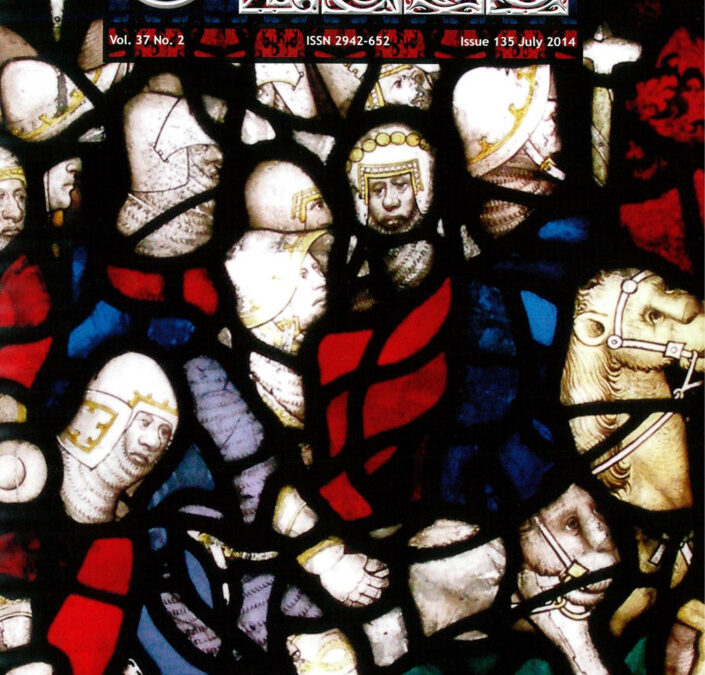
COVER ILLUSTRATION:
A
panel of the Great
East
Window of York Minster
Copyright the Chapter of York (see page 17)
Chairman’s letter
Glass Circle News Issue 135 Vol. 37 No. 2
ked
LETTERS
Letters to the Editor
Editor’s note
All letters
about a
previous
edition of
the magazine
refer to
Vol. 37 no.
2, Issue No.
133 unless
otherwise
stated.
What is this
ship?
The letter about the engraved ship in
Issue no. 131 page
29
was incorrectly
attributed to David C. Watts and
was in fact written by Stephen
Pollock-Hill. An apology to both
writers.
Editor
Breaking mirrors brings seven
years of bad luck
D
eaders may be interested in
an item I found in the
Daily
Express,
28 March 2014. It reads:
This superstition has its origin
in ancient Greece before mirrors
were invented. In a form of
divination called catoptromancy,
shallow bowls filled with water
were used to tell a person’s future
and any distortion meant bad
news. The first mirrors fashioned
from precious metals were
unbreakable but in 15th-century
Venice — where glass mirrors
backed by silver coating were first
produced — they were so expensive
that any servant who broke one
would have to offer seven years of
labour to pay back the debt.
Michael Vaughan
Lanarkshire
Books acquired
n the letter section of your last
I issue Stephen Pohlmann kindly
offered a reader, for free, a couple
of books published by Mallet &
Son on historic glass. I responded
and have just received these
beautifully illustrated catalogues
published nearly 25 years ago and
co-written by our chairman, John
P Smith. I also received a copy of
Harold Newman’s
Dictionary of
Glass
which, as a beginner, I find
most useful. I am very grateful
to Stephen for his generosity in
sending these books – especially
as he lives in Tel Aviv. He did ask
me, in return, if I could find him a
Verzelini in a flea market for £10 –
well, you never know what may be
round the corner!
Chris Smith
West Sussex
Erratum
I
n my piece on density measure-
ment in glass (page 4) I find that
the 4th paragraph states that ‘a
density of 2.75 notionally repre-
sents about 5% lead’ . It should say
‘15% lead’. My apologies for not
noticing earlier.
David Watts
Website reinstated
Dr Watts tells us that his website
www.glassmaking-in-London.
co.uk is now back running after
having been down for several
months as the result of vandalism.
Editor
Night, night
I
is
hard for us to imagine how
dark large houses were at night
in the 18th century. This hand-
held lantern from Duff House,
Aberdeenshire would light you to
bed (continental 18th century). As
seen in situ.
Jam P. Smith
Lead
glass: Point
I
guess that John Smith knew that
his report on Peter Korf de
,
Gidts’
article on the invention of lead
glass would be bound to attract
my response. Peter is not the
first to centre Dutch involvement
on Johann Glauber, a German
alchemist who died in Amsterdam
in 1668. Glauber was not the only
alchemist of his time whose main
interest was the transmutation of
a base metal, notably lead, into
gold. Ruby glass and lead glass
were hopeful steps along the way.
Unlike Johann Kunckel, who was
briefly thought to have made the
magic discovery, Glauber was not
a glassmaker.
Lead used in glass-making goes
back to antiquity and traditional
continental lead glass was well-
established by the 14th century. It
is a form of lead silicate made by
melting together silica (sand or
crushed quartz) with lead oxide.
It contains no alkaline flux or any
other ingredient. Its particular use
was in making certain coloured
glasses. It was never used for
making colourless Cristal’ as it is
deep amber in colour. Cristal was
made from a mixture of purified
soda containing some lime, mostly
from littoral or shore-loving
plants, and crushed quartz or
flints.
Johanne Baptiste da Costa,
an Altarist working in Holland,
certainly knew all this when he
came to England. He was possibly
working at the Bear Garden
glasshouse when commissioned
by George Ravenscroft to make
calcedonio at a small furnace he
organised in the Savoy Palace.
Calcedonio is an expensive glass
used for making small ornaments.
It is made by stirring a colouring
Glass Circle News Issue 135 Vol. 37 No. 2
3
LETTERS
Ravenscroft jug
1676-78 from the
Higgins (see page
12)
powder containing silver into best
cristal containing added lead glass
to produce the swirling coloured
effect of agate. Because of English
coal fired furnaces dating back
to the days of Mansell saltpetre
was added to the cristal batch to
protect against coal discolouration.
The remarkable discovery was
made that saltpetre discharged the
amber colour caused by lead. And
no less important, it stopped the
lead from attacking and destroying
the glass pots — another reason it
was not used on the continent.
This melt was the first English lead
crystal patented by Ravenscroft.
Saltpetre seems never to have
been used in glass batches outside
England — Venetian cristal was
better than anything produced in
England up to that time. But it
took another hundred years before
this `secret’ of English lead crystal
leaked out.
I agree with Peter Korf de Gidts
that it was da Costa’s expertise
that resulted in the discovery
of English lead crystal. But it is
unarguable that it could only have
happened in England at that time
as a result of the ban on wood
firing introduced by King James I
and VI back in 1615 and Mansell’s
adoption of saltpetre. As always,
it is the boss who took out and
exploited the patent that got the
credit!
A detailed and fully referenced
account will appear in the shortly
to be published and edn. of my
book,
A History of Glassmaking in
London from the earliest times to the
present day.
David
C.
Watts
London
Lead glass: Counterpoint
J ohann Rudolf Glauber (1604-
1670) was not a glass-maker.
He was a chemist, a pharmacist
and a technologist and it was his
own curiosity that lead him to
new forms of scientific research.
He certainly was not an old
school alchemist, who was only
interested in making gold out of
lead; he knew a lot about glass.
He took advantage of its multi-
purpose character and its known
properties in his experiments.
He was a freelance entrepeneur,
highly esteemed, with his own
laboratory where he worked at his
own research and as a commercial
producer for others.
In the middle of the 17th
century Glauber occasionally
hired room and furnace time in
the Glasshouse ‘De Twee Rozen’
(The Two Roses) which existed
in cosmopolitan Amsterdam from
1657-1679. Here he experimented
with the colouring of glass.
Like many others, he was of the
opinion that glass could take
on any colour according the
chemicals and processes used.
His experiments in making
coloured glass — as well as his
results — did not go unnoticed. As
in most glasshouses in northern
continental countries, the most
important jobs were executed by
highly qualified workers from
Venice and Altare. Apart from
experience
where production was
concerned they had an enormous
knowledge of raw materials and
chemicals, furnace temperatures,
and so on. Cross fertilisation
between chemists and glass
workers was a logical consequence.
Between both professional groups
there was exchange of the latest
developments in glass-making
which were strictly kept secret
and never put into writing. The
economy prospered and the
cristallo glass became extremely
popular with the wealthy. New
glasshouses were established
by adventurous and greedy
entrepreneurs who had no idea
how to make cristallo. They badly
needed the professionals who were
snatched from their employers
by the lure of high salaries. This
explains the itinerant life of the
glass-makers. And every time they
took their secrets and experience
with them. Italian glass-workers
like the Venetian glass master
Nicolao Stua, Giacomo Scapitta
and Bastiaen Maistre worked in
the glasshouse The Two Roses’
at the time that Johann Glauber
did his experiments with lead and
glass colouring. Bastiaen Maistre
worked later in the glasshouse of
the Altarist glass-makers Baptista
da Costa and Jor Odacio in the
chapel of the Jacobspital in the
Hezelstraat in Nijmegen (1658-
1674). Doubtless all of them
were totally aware of the latest
developments in their field and
shared their knowledge with their
confreres in Europe. And so also
did Baptista da Costa, Seigneur
de Baramont. It was a pleasant
surprise that David Watts wanted
to react to the resume of my
lecture and that he agrees with me
that Da Costa’s expertise resulted
in the discovery of lead glass in
England, facilitated by George
Ravenscroft. It is only obvious and
logical that Ravenscroft registered
his patent since Da Costa was not
equipped to apply.
Peter Korf de Gidts
The Netherlands
C
ass
Circle News Issue 135 Vol. 37 No. 2
4
Glass Circle News Issue 135 Vol. 37 No. 2
FAVOURITE
My favourite glass
eg
—
agonised over
which glass was my
favourite; in the
end the decision
came down to why I have a
wide interest in almost
every variant of glass from
the 16th to 21st centuries.
It is the nature of glass
itself as well as the wonder
of who may have owned,
enjoyed and used an item.
At first sight my choice could
appear plain, uninteresting and
easily passed over. To me, it says as
much through understatement as
a piece of cut, engraved or coloured
glass. It is a simple lead glass beer
or water beaker, possibly from the
first decade of the 18th century and
similar to those glasses illustrated
in John Greene’s letters to his
Venetian glass maker about 1670.
The height almost matches its
diameter and it is squarer in profile
than the tumbler of tapering form
that became popular later. The
colour, nature and qualities of the
metal are very similar to the bowls
of heavy balusters.
In plan, it is not quite round,
neither at the base nor at
the rim. It stands 4
3
4″ (11.8
cm) high and is 4″
cm) wide at the lip and
3
1
/s” (7.8 cm) at the base
and holds an imperial pint
(568 ml).
As a piece of historic glass it is
perfect in its imperfection and tells
us exactly how it was crafted by its
creator. Each action of the maker
is permanently recorded in the
fabric of the glass. The tool marks
and striae in the glass make an
otherwise plain glass come alive.
It is a ‘fossil’ in glass preserving a
moment of human endeavour, like
the footsteps of prehistoric man
forever preserved in rock.
In the hands of the gaffer in the
chair, the jacks danced all over
the surface of the bowl as it was
formed. This has left the material
permanently frozen in diagonal
swirls around the body of the glass,
giving a cross-over
effect
where
they rise on one side and fall on
the other. A pair of vertical striae
show us where the same tool slid
out of the bowl against the wall
of the glass. Another single mark
indicates were he hesitated just
momentarily when opening out
the bowl. On the rim, a finger can
just determine the very slightest
bump and below it, a distortion
in the glass tells us where the
smoothing tool used to finish the
lip came off the glass.
It is peppered with bubbles and
impurities and has a particularly
prominent cluster of seeds about
two-thirds of the way up the bowl,
distorting the surrounding glass,
as if they had been dropped onto
the surface when it was a semi
solid state. The rough pontil is
pushed up just enough to raise it
off the table and is haloed by wear
marks equivalent to many hours of
use and gallons imbibed.
It probably took an experienced
workman not more than three
minutes to make this glass as
he deftly and without conscious
thought picked up each tool in
turn. In a single glass, those three
minutes of a distant life still echo
30o years later, if you pause to look
hard enough.
RIGHT:
natural daylight
reveals tooling
marks
by
Paul
Weddell
KNOPS
On knopping:
Open letters between Patrick Hagglund, Simon Wain-Hobson
and Mark Taylor
0e
ar Simon,
I wish to record
my
appreciation,
gratitude
and
delight to yourself and Athelny
Townshend for the ground-
breaking articles in Issues 13z and
133. Something that had troubled
me for so long now seems to be
solved to my personal satisfaction,
namely, how 18th-century opaque
twist stems were created by the
gaffers of that period. The papers
are surely important advances
in the documenting of the
processes most likely used by the
glassmakers of 18th century in
creating the opaque twist stems
we all admire.
I recall, when we spoke in
London, that you raised the
further issue of stem knops and
how they may have been made. I
wish to offer a tentative opening
to the discussion of this topic.
I fully realise this is most likely
only the tip of the proverbial
iceberg in our understanding of
how these familiar stem knops
were made, but an opening gambit
nevertheless.
I have given much thought to
how these were made, and initially
assumed that the stem was twisted
to completion before the knop was
created by compressing the gather
in some way, thus creating a bulge
we refer to as a knop. It did not take
me long to realise that that just
would not work. Knops in opaque
twists reveal that the twisted canes
in the knop are thicker in the mid-
point (maximum diameter) of
the knop than that at where the
knop gives way to the stem on
each side of the knop. I checked
the illustrations in Bickerton’, and
they mostly appear to show this
characteristic (refer Bickerton figs
697, 698, and 1193). His illustration
fig. 1175 does not show this very
clearly, but a similar stem from my
own collection (see fig. t) certainly
does — what he refers to as a
MSOT
(multi-spiral opaque twists).
This observation persuaded
6
me that the knop must have
been decided upon during the
twisting process. The continuance
of the twist must have been carried
out on each side of the knop,
control being kept by use of two
sets of jacks or other appropriate
tools during the additional
twisting. This suggests that knop
creation may have required more
than just one pair of hands to
achieve the technique successfully.
Another observation is that the
twists either side of the knop are
often not quite the same, possibly
indicating that the twists either
side of the knop were separate
operations. The `single series’
opaque twist in my collection,
as mentioned above, shows this
quite clearly (fig. I).
The examples in Bickerton
of
DSOTS
(double-series opaque
twists) with knops show that
the twists within the knops are
decidedly strange and uneven in
appearance (see Bickerton figs
697 and 698). I do not have one
of these in my collection to be
able to compare at first hand.
This all seems to point to the
knops being created something
like the way I suggest without
going into the mechanics
of changing the pontil
rods at the different
stages of the process.
For similar reasons, I
concentrate on opaque
twists, though the basic
techniques probably apply to air
twists as well.
I notice that I am unable to find
any discussion of this topic in the
standard literature. Hartshorne,
Francis, Thorpe, Bickerton,
Haynes, et al° do not appear to
raise the question of how the
knops were made. In fact, Lanmon
(zoii) in The Golden Age of
English Glass 1650-1775, whilst
briefly discussing the making of
air and opaque (enamel’ in his
terminology) twists (pages 184-
187), avoids mention of knops
altogether. I have not found
any solid knop-making either
in the splendid demonstrations
recorded by William Gudenrath
of the Corning Museum of Glass
in New York on DVD nor online.
The latter does make hollow
knops, but they are a completely
different technique altogether.
I have deliberately kept this
suggested description as simple
as possible to launch the topic for
discussion. Please let me know
your thoughts.
Patrick
ear Patrick,
I agree with
you, the art of
knopping has
been given even shorter shrift
than the making of opaque
twists, which was slim in itself.
Your point about the canes
in the knop being thicker than
in the stem is well made and
proves that stems were drawn
away from the knop. Playing the
poorly-paid devil’s advocate –
even he is hard up these days — I
can see two possibilities. First,
a preformed carrot of parallel
opaque canes is heated up and
simultaneously drawn and
twisted at one end away
from the middle. When
the other end is so
treated this would
leave the delightful
MSOT
with centre knop
in your collection (fig. 1).
This is your scenario. The
alternative is to work from a
preformed carrot of already
twisted glass and simply draw
on one end followed by the
latter. So which is it
If a preformed twist was used
and drawn, the angles (alpha
glyph, gamma glyph) subtended
by the twist in the stem would
have to be greater than that
in the knop (13) because the
diameter of the stem is reduced
as a result of drawing; in short
y,
(fig. za). If twisting and
a.
4- drawing were simultaneous,
Glass Circle News Issue 135 Vol. 37 No. 2
BELow:fig. 1
Patrick Hagglund’s
knopped multiple
spiral opaque twist
stem
4ar
oitatiW
lae
RIGHT & OVERLEAF:
fig. 3 A set of photos
showing the
making
of a plain knopped
stem as
found in
balustroid glasses
(See next page)
BELOW:
Figure 2
A
KNOPS
everything depends on the ratio
of twisting to drawing — twisting
tends to diminish the angle of
the opaque white threads while
drawing tends to increase it. For
your
MSOT
stem the angles above
and below the knop are less than
that within the knop (fig. 2b). As
the diameters of the stems on
either side of the knop are the
same, this rules out the hypothesis
that there was a preformed twist
that was merely drawn on either
side of the knop. Inspection of an
ale glass of my own with a similar
stem, as well as Bickerton figs 61′-
616, all show that the angles above
and below the knop are smaller
than that of the canes in the knop.
From this we can conclude
that
OT
knops of this form were
made from a carrot of parallel
opaque canes, the knop proper
arising from what is left following
simultaneous drawing and
twisting of the stem either side.
Once drawn to a diameter of
approximately ‘ cm, bowl and feet
could be added.
There is a category of
OT
wine glass where it seems likely
that the preformed carrot was
added directly to the bowl and
subsequently drawn, twisted
and knopped (fig.
2C;
Bickerton
figs 608-610). I recently bought
a highly unusual glass belonging
to this family where there was no
twisting at all — the opaque canes
remaining dead straight (fig. ad).
It is less attractive compared to
its sister (fig. 2c) and emphasizes
the harmony just a little twisting
brings to a stem. The key point,
however, is that it has two small
knops proving that they could be
formed during drawing the carrot.
Like you I suspect that air-twist
knops were made in a similar
manner but need to think it
through a little more. These are
some immediate thoughts that come to mind and they square
up with your own. Let us invite
comments from other readers.
Simon
Glass Circle News Issue 135 Vol. 37 No. 2
7
KNOPS
ear Patrick and
Simon,
The Editor asked
me to add to this
discussion and I hope to elaborate
further in a later edition. To
make a central knop in a stem is
not difficult, and only needs one
glassblower to make it.
The starting point is a short,
plump cylinder of glass, either
attached to the bowl or to a bit
iron. A central knop is produced by
carefully squeezing and stretching
the glass with the jacks alternately
at either side of the knop a little
at a time, occasionally pushing
against the knop to reinforce its
shape and to cool it slightly. A
basal knop and a knop at the top
of the stem can also be produced
at the same time.
The photographs in fig.
3
show
some of the steps needed to make
the simple knopped stem. This
stem took about one minute to
make and required no reheating.
Knopped stems with air,
opaque and colour twists are
more difficult, and may have had a
twist introduced into the original
cylinder, which may be twisted
further during the stem-making,
with the twist at either side of the
knop individually tightened. This
would account for the sometimes
differing tightnesses of the twists
above and below the knop.
Air-twist knopped stems are
the most difficult stems to make
as the air can easily be squeezed to
one area or another of the stem by
overuse of the jacks.
There are one or two early films
which illustrate the knop-making
process, such as this one of a gaffer
at Whitefriars in the 193os:
www.youtube.com/
watch?v=nQGO3wDesLE
Mark Taylor,
Georgian Glassmakers
Notes
1.
Bickerton, L.M. (1986) Eighteenth
century English drinking glasses, an
illustrated guide. Woodbridge: Antique
Collector’s Club, znd revised edition.
2.
References given in Issues nos. 132
and 133.
8
Glass Circle News Issue 135 Vol. 37 No. 2
TABLEWARE
Geometry on the dining table
°Davenp
or
t
g
lass
BELOW RIGHT:
fig. 3a
Cut desert
plate (see detail
overleaf)
V
ery few of our
members collect
tableware, which
is a pity because
although drinking glasses are
attractive and interesting, the best,
and most expensive, items made
by glass manufacturers in
the early 19th century, are
larger items for the table.
Very few people were,
or are, as extravagant as
the Prince Regent, who,
after being entertained by the
Liverpool Corporation in i8o6 to a
lavish banquet including specially
commissioned glass from the local
glass-house of Perrin Geddes,
declared ‘I want the same (fig. t).
Four years later the service was
delivered, the most extravagant
ordered either before or since.
Most of the service is still in
Windsor Castle, but some
escaped and may be seen in the
best museums and collections
of the world. The story of their
escape is intriguing. Soon after her
coronation in 1837 Queen Victoria
gave a banquet for her relatives
and other senior nobility. This
service was used at dinner, and
after dinner the Queen, probably
not a fan of George IV or his
lifestyle, invited her guests
to take home items from
the table. Some did.
The Prince Regent also
bought a larger, and less
extravagant, service from
John Davenport, decorated using
his recently patented method of
stencilling a pattern of low melting
point ground glass to the glass,
and then firing it.
The Corning Museum of Glass
has a pineapple stand, accession
no. 2005.2.4, which is made in two
pieces and a tour
de force
of cutting
(fig. 2). The museum attributes
this stand to the London maker
Apsley Pellatt. This stand is 45.5
cm high.
The Regency cutters became
LEFT: fig.
1
Perrin Gedes
‘Prince of Wales’
decanter
BELOW:
fig.
2
Pineapple stand,
attributed to Apsley
Pellatt
by
John P
Smith
Glass Circle News Issue 135 Vol. 37 No. 2
9
TABLEWARE
extraordinarily proficient at
complex cutting. The plate
illustrated (fig. 3 a & b) is one of
a set of io dessert plates, which
at the time of manufacture,
would have been as expensive,
or probably more, than the most
highly decorated porcelain. When
decorating ceramics, if the brush
slips, the enamel can be removed
and reapplied, but there is no such
second chance when cutting glass;
once glass has been ground, that
is it. The plates were first marked
out by specialist markers, using
a special turntable with pegs,
and then the cutters, in England
working overhand (that is on the
top of the wheel) and looking
through the glass to see the depth
BELOW
LEFT: fig.
3b
Cut desert plate
detail (see fig. 3a
previous page)
ABOVE LEFT:
fig. 4 Butter dishes
with
‘Van
Dyke’
border
AeovE:fig.
5
Claret jugs, probably
of Irish manufacture
of the cut, would cut the glass.
They then brought the plates to
a fine polish using a cork wheel
and a putty-like powder. It was
only much later in the century
that hydrofluoric acid was used to
polish the original matt cutting.
This acid polishing also removed
the sharpness of the cutting. Some
early deep cutting almost feels
dangerous to handle.
Butter dishes would have been
used, butter to go with biscuits,
and the pair here (fig. 4) have
serrated boarders, rather fancifully
called ‘Van Dyke’ borders by
dealers, after the form of a typical
Van Dyke beard, although this
term was not used at the time
when they were made.
There is much dispute
concerning Irish glass, and the
contemporary records are not
very helpful, but it is generally
agreed that certain forms, such
as piggins, and canoe shaped
bowls, are nearly always s of Irish
manufacture. Particularly large
spouts are also thought to be Irish,
such as are on the pair of claret
jugs illustrated here (fig. 5). These
never had stoppers, the claret was
always finished at one sitting;
Glass Circle News Issue 135 Vol. 37 No. 2
1
0
TABLEWARE
RiGHT:fig. 8
Detail of ‘hobnail’
cutting
none was left over at the end of the
meal, particularly not in Ireland.
The jugs are extraordinarily heavy
as they are pillar-cut, so needing
very thick blanks. This form of
cutting was very expensive to do
as it cannot be done on a mitred
wheel; each pillar has to be
smoothed round, which is very
time-consuming.
The trio of coloured vessels
(fig. 6) was first illustrated in
our exhibition at the Wallace
Collection Palace to Parlour’ and
they are very beautiful. They all
date from around 1830. The amber
jug is pillar-cut and the two claret
jugs, red and aquamarine are
panel-cut.
Except for white wine, wine
should never be served in coloured
glass, since you cannot admire the
depth of colour in the wine. Only
spirits such as gin can be served
in coloured glass as no one holds
their gin glass up in the air and
says, ‘Oh! What a lovely colour’.
In many ways the lack of coloured
glass is regrettable. Coloured glass
looks particularly fine on a white
table cloth. The pair of green
decanters (fig. 7) would not have
been used for port, as the trolley
suggests, but for white wine,
almost certainly in the best circles
from Germany, the original home
of our Royal family, and at this
time it was usually -of great age,
at least zo years was considered
preferable.
Finally the last illustration (fig.
8) is a close up of a decanter of
around 1830 showing hob-nail
cutting, the title of this cutting
also being dealer’s invention,
rather than the name used at the
period of manufacture. The ‘hob-
nails’ are astonishingly even in this
example. No modern cut glass
can approach this quality, even if
the craftsmen still exist to do this
work, and they probably do, the
time required to cut and polish to
this quality would put the cost of
such a decanter towards f.i,000.
ABOVE:
fig.
6
Three coloured jugs
all dating to around
1830
ABOVE
FLIGHT:
fig.
7
Pair
of green
decanters, probably
used for white wine
Glass Circle News Issue 135 Vol. 37 No. 2
11
NEW GLASS GALLERIES
The Higgins
6
,
3
n 21 June 2013 The
Higgins
Bedford,
pened with a special
dawn till dusk’ event.
This marked the end of a major
£5.8 million redevelopment
project which united two separate
organisations: the Cecil Higgins
Art Gallery and Bedford Museum.
The transformation has been total,
three historic buildings have been
joined together and redeveloped,
creating new galleries and modern
visitor facilities, and the collections
have been reinterpreted and
redisplayed throughout (fig. 1).
The Redevelopment has been a
long process. The Cecil Higgins
Art Gallery closed in June
2007
to protect the collection from
the first lot of building work,
the redevelopment of Bedford
Gallery. This building had lain
empty for nearly
35
years, but with
funding from the Department
for Communities and Local
Government it was turned into
a new exhibition space with two
large galleries. Fundraising for
the second phase of building
work was affected by
the financial pressures
of the recession, but
work finally began in the
summer of
2011.
When I arrived as Keeper
of Fine and Decorative Arts in
2009
the majority of the objects
had been packed, so for a few
years I was the Keeper of Boxes,
unable to see the marvels that
lay within. The hundreds of
boxes that surrounded
me had been expertly
packed by specialist
art handlers and
staff. Each piece
from the collec-
tion was cleaned,
condition report-
ed, documented
and packed in
acid free tissue.
The boxes were
then moved to a
purpose built off
site store, where
they were to remain
until their cases were
ready and the process of
unpacking could begin.
Even though I only
packed a portion of the
ABOVE:
Fig. 1 Newly
opened Higgins
BELOW:
Fig. 2 Author
moving Sam
Herman
vase
1969
RIGHT:
Fig. 3a
Ravenscroft jug
1676.78
12
NEW GLASS GALLERIES
collection, I think it is true to say
that unpacking glass and ceramics
is a far more nerve wracking,
lengthy experience than packing
(fig. a). It is testament to our staff
and art handlers that every piece
survived the closure intact.
Some pieces in the collection
were more challenging to move
and store than others. The pieces
that gave us the most sleepless
nights were those by George
Ravenscroft. The Higgins has
three pieces of Ravenscroft, two of
which are marked with the Raven’s
head (fig.
3).
All three come from
Kirkby Mason’s collection of
Old English Glass which was
sold at Soetheby’s in
1929
after
his death. Cecil Higgins bought
several items from the Kirkby
Mason collection but none as rare
or as delicate as the Ravenscroft
pieces. Ravenscroft, an importer
of Venetian glass, had taken out a
patent in
1674
for a ‘particular sort
of Christaline Glasse resembling
Rock Cristalr. His first attempts
were plagued with problems, but
in
1676-77
he appeared to have
perfected his glass and marked it
with a Raven’s head as a mark of
its quality. Ravenscroft, however,
hadn’t quite fixed the problem
with his glass and the few pieces
that still exist marked with the
Raven’s head seal are prone to
crizzling. To stop the Ravenscroft
glass crizzling from developing
any further, the glass has be kept
at low humidity and a stable
temperature.
The redevelopment called for
the glass to be moved from its
humidity-controlled case to an
offsite store two miles away, where
it would stay until we reopened.
We sought advice from both the
Fitzwilliam and British Museum
as well as an independent
conservator as to the best way to
go about this. To minimise any
changes in temperature en route,
a specially-built packing crate
was made, lined with foil. The
temperature of the store that it
was going to had been monitored
for several weeks to make sure
that it remained at a stable level
and when the glasses arrived they
were unpacked, which not only
gave them room to breathe but
also allowed for regular checks
on their condition over the next
two years. Handling the glass was
very different from what I had
expected. After years of being told
how fragile it was, I expected it to
be light and delicate. In fact it was
quite solid and weighty and far
more agreeable to move than its
Venetian counterparts.
When it was time for the
glass to return, the process was
repeated. The glasses were the
last pieces to be installed in the
new Design gallery and have been
given pride of place in their own
specially designed case. The case
may look like all the others, but
hidden within the frame is a de-
humidifier working silently to
keep the glass safe. It is even set
to sound an alarm to tell us of any
problems. I am happy to say that a
year down the line the case is still
working well and the Ravenscroft
glass has come out of its adventure
unharmed.
The returning of the
by
Victoria
Partridge
BELOW:
Fig. 3b
Ravenscroft bowl
1676-78
n.b A further
Ravenscroft piece
from the Higgins
Collection is
illustrated on
page 4
RIGHT:
Fig. 4 Cecil Higgins
by Glyn Philpot
Ravenscroft glass marked the
end of the redevelopment and the
beginning of a new chapter for the
Cecil Higgins Collection. A letter
in this publication (Issue no.
133)
saying ‘fellow glass collectors will
find a visit worthwhile echoes
one written
64
years ago at the
time of the first opening of the
Cecil Higgins in
1949.
Housed
as its founder had asked ‘in the
unusually friendly setting of the
former Higgins family home, it
was the first public art gallery to
open in Bedford. The collection
that Cecil had amassed during
the last ten years of his life was
described as bearing the ‘stamp
of thoughtfulness’ and the glass
collection was ‘acclaimed as one of
Glass Circle News Issue 135 Vol. 37 No.
2
13
NEW GLASS GALLERIES
those which glass students must
not fail to visit’.
What makes Cecil’s collection
unique is that, unlike other
benefactors who have endowed
institutions with a lifetime of
collecting, Cecil Higgins (fig.
4)
collected with the specific
intention of opening a museum.
He devoted the last ten years of
his life to this aim.
Cecil’s early life showed no sign
that he was to become a museum
founder. He was the youngest
son of a family of brewers, his
grandfather Charles (1789-1862)
had been a tenant of the Swan
Inn, a large hotel which still stands
today on the banks of the river
Great Ouse. Charles realised that
he would be able to increase his
profits if he brewed the beer that
he sold, so in 1837 he leased the
land known as Castle Close (fig.
5)
(named so because the remains
Bedford Castle are in its grounds)
from the Duke of Bedfordshire,
with the intention of building a
brewery and a family home.
The Higgins & Sons brewery
(fig. 6) became a successful
business, which Charles handed
down to his son George who in
turn left it to his sons Lawrence
(1849-1930) and Cecil (1856-1941).
The family were pillars of their
community serving as Mayors,
Justices of the Peace, Magistrates
and Councillors. Cecil served as
a Bedford Magistrate, but chose
to live away from the family in
London. In the City he played
the part of ‘a rather bored man
about town; being driven in a
custom-made Rolls Royce which
allowed him to keep his top hat
on and taking a box at the opera
(which he attended in full white
tie and in which he once boasted
about falling asleep during a
performance of
The Ring).
He must have kept one eye on
the family business though, as
when it showed signs of struggling
in 1907, he persuaded his brother
Lawrence to retire and started
running the brewery from his
home in London. The family home
was sold in 1910 and Lawrence, the
last Higgins to live there, moved to
Somerset. The business remained
in Cecil’s hands until 1928 when,
as neither he nor his brother had
married or had children to pass it
on to, it was sold. Two years later
Lawrence died and, with the bulk
of his estate going to Cecil as well
as the profits from the sale of the
brewery business, Cecil became a
very wealthy man.
It was at this time that he
decided upon the idea of setting
up a museum. He was
73,
and
thought that he probably had
about ten years left to live (in
fact he had 12) and that he
would devote those years
to a career as a serious
collector. He enlisted the
services of a young glass
and ceramics expert at
Sotheby’s as his advisor
and for the next ten years
collected over 300 pieces of
glass and over moo pieces of
ceramics. We know from the
few receipts that relate to the
glass collection that most of
the glass was bought through
the London dealer Cecil Davis
on Kensington Road, as well
as from private house sales. On
return trips to Bedford he would
also frequent ‘Frederick Jones
Antiques’ on Tavistock Street.
The bulk of Cecil’s collection
is formed of ceramics, especially
early English and Continental
porcelain, and British glass from
around 1675-1810 (like many of
his generation his taste did not
reach the Victorian period). As he
was collecting with the intention
of opening a museum, Cecil also
collected ceramics and glass
that could tell the history
of the inventions and styles
that led to the glass and
ABOVE LEFT:
Fig. 5
Castle Close about
1955
ABOVE:
Fig. 6
Castle Brewery
about 1885
14
Glass Circle News Issue 135 Vol. 37
Tour to the USA
Spring 2015
The plans for our trip to the USA are advancing well.
We leave for the USA from Heathrow on Tuesday 12th May, and return on Thursday 20th May. There is a
possibility of staying on longer in the USA for those who so wish.
Our Schedule
Arrive Detroit Tuesday 12th May
Stay three nights Courtyard by
Marriott 5200 Mercury Drive,
Dearborn, MI 48126 a very pleas-
ant hotel which I have visited, quiet
and spacious.
Wednesday 13th May: visit Henry
Ford Museum. This museum is near
the hotel and will give us a leisurely
first day. Wonderful museum of the
American way of life, with a display
of American glass.
Thursday 14th: visit Toledo Mu-
seum of Art. 80 minutes away by
coach. Fine museum with a special
new section devoted solely to glass.
We will have lectures, a visit to a
nearby Tiffany windowed church,
and a wine tasting.
Fridayl5th: fly from Detroit to
Corning
Stay three nights Radisson Hotel
Corning 125 Denison Parkway East
Corning NY 14830 The only de-
cent hotel in Corning. The museum,
library and Corning town will keep
us fully occupied for the 2 1/2 days
we are there. The hot glass studio
will be running and an new exten-
sive contemporary glass wing will be
opened just before our arrival.
Saturday 16th & Sunday 17th:
Corning Museum of Glass
Monday 18th: Coach to Brooklyn
About 5 hours, but the only sensible
way to leave Corning.
Stay 3 nights at the Brooklyn Hotel
(to be confirmed)
Monday afternoon. Brooklyn
Museum. Very good glass and little
visited by foreigners (or even New
Yorkers).
Tuesday 19th: Metropolitan Mu-
seum NY Roman glass, through
European to Tiffany.
Wednesday 20th: Free day in New
York, so much to see, so little time.
Thursday 21st: Fly to UK
Covered Casket with Tray, 1830-1840 from the Henry Ford
American members:
We very much
hope that some of our American
members will join us for all, or part,
of this trip, and pay accordingly.
Cost:
The final cost will be fixed
nearer the time, in case of exchange
rate fluctuations, (the $ is very weak
at present) but is expected to be
£1,850, double occupancy, single
supplement £410.
What is included:
The price in-
cludes all flights and coaches, but
not subway in New York. Accom-
modation. All museum admissions,
four dinners and three lunches. Not
breakfasts and other meals (America
does not do B & B as we know it)
breakfasts can be taken in the hotels,
or do as Americans do, breakfast
out. Nearby restaurants to the
hotels can easily be found and there
are no language barriers (well not
much), and some of us like burgers,
others don’t.
Insurance:
No insurance is includ-
ed, travelers MUST make their own
arrangements, particularly medical
and repatriation. Also ensure that
they are aware of any visa require-
ments. Visas are not currently
required for British citizens but you
will have to provide your passport
details in advance.
Bursery:
A little of your payment
will go towards a bursary for a
young museum curator to enable
that person to accompany us.
Glass Circle conditions:
£50 deposit will reserve a place on
a first come first served basis. This
will be fully refundable up to two
months before departure.
Booking:
Please fill in the form
below and send a cheque for £50 per
person to:- John P Smith , Chairman,
42 Vespan Rd., London W12 9QQ
Payable to The Glass Circle’
Contact:
email johnpsmi@
globalnet.co.uk
Full name
Phone
Address
Mobile
Post code
No. of additional members
1. Full name
2. Full name
I enclose a cheque for £50 per person as a deposit for
Glass Circle trip to USA Spring 2015. I understand
that I may not ask for a refund after 12th March 2015.
Signed
FUND RAISING
Thurscay October 30th 6.30 to 8.30
As The Circle continues
to be in discussion with
The Glass Association
about a possible merger
it has been decided
by the committee
not to put up the
subscriptions this year
as no joint decision on
future subscriptions of
a merged society has yet
been agreed. Should
we not merge, higher
subscription
levels
in the future will be
required.
However this means
that there will be a
shortfall in required
income to the Circle for
the year 2014/15.
We have decided to
hold a fund-raising
event so that those who
are able can help to
maintain the financial
stability of the Circle.
This will be in the
form of a champagne
reception at the Vessel
Gallery in Notting Hill
Gate. Vessel Gallery
is a leading gallery
for the showcasing of
contemporary
glass
and ceramics and we
hope that some of their
artists will join us.
The evening will consist
of a reception, gallery
talk, and raffle and will
take place on Thursday
October 30′ at 6.30 to
8.30
The Vessel Gallery,
www.vesselgallery.com
is at
114 Kensington
Park Road W11 and
parking is free in the
vicinity after 6.30.
I would like to attend this event at The Vessel
Gallery and would like to purchase
tickets
at £45 each.
I cannot attend but enclose a cheque as a
contribution to the Circle.
I hope/will not be able to bring along an item
suitable for the raffle.
I enclose a cheque for £
payable
to The Glass Circle
Full name
Address
Please send to John P Smith, Chairman, 42 Vespan Road London W12 9QQ
An auction of GLASS & glass-related items given by members
TO BE SOLD
is to be held after the AGM to raise
funds for future meetings.
Members are invited to donate items for
the sale and are requested to contact
VERNON COWDY
0208 653 4327
or
v.cowdy@gmail.com
or alternatively bring their
donations PRIOR to the meeting
This meeting will befree
of
charge
BELOW LEFT:
fig. 7a
William Beilby
Goblet about 1765
BELOW:
Fig 7b
Wine glass about
1785
RIGHT:
fig.
7c
Jacobite wine glass
about 1755
FAR RIGHT:
fig. 7d
Privateer Wine
Glass about 1757
_
–
–
so pieces of glass that have been
collected over the last
5o
years go
some way to filling gaps in the
period of time between the end of
Cecil’s collecting and the present
day. The two most important
groups are from other collectors.
In the 197os, the gallery acquired
250 items of furniture, ceramics
and glass from the Handley-
Read collection. Charles and his
wife Lavinia were great collectors
of Victorian and Edwardian
decorative arts. The pair did the
bulk of their collecting in the
195os, when items by designers
such as William Morris and
William Burges were extremely
unfashionable. Derided at the
time, their collection is now seen
as nationally important.
Before their deaths in 1971,
Charles was planning for an
exhibition at the Royal Academy
which displayed his collection
stylistically; it was with that
in mind that we displayed his
collection at
The Higgins Bedford.
NEW GLASS GALLERIES
ceramics on which his collection
concentrated. In the glass
collection this is illustrated by the
items of Roman, Egyptian and
Medieval glass which allow us to
talk of the origins of glass, and the
small but excellent collection of
Renaissance and later European
glass,
including
Venetian,
German, Dutch, Spanish and
Bohemian. Then there is the bulk
of the collection, which includes
magnificent examples from the
golden age of glass’, including
enamelling by the Beilby family,
rare examples of Jacobite political
glass and Privateer glasses, (fig.
7abcd) as well as the three pieces
of Ravenscroft.
This unique foundation to the
museum meant that when it came
to redisplaying the glass collection
the bulk of the work
had been done by
Cecil himself. The
redisplay follows
the structure of
Cecil’s collection,
showing chrono-
logically the history
of lead glass from
continental influence
through Ravenscroft
to balusters and Bielby.
Once the structure
of the redisplays was
agreed upon, the
second priority was to
show as much of his
collection as possible.
As with all museums,
only a fraction of what is in
the collection is on display at any
one time, but with open storage
areas and large deep display cases
where the glass can be placed three
pieces deep the fraction has been
increased.
Cecil Higgins’ original col-
lection has never been added to.
It has always been felt that
the collection is so
representative in its
way, that adding to
it has never been a
priority. The imp or
cws Issue 135
Vol.
37
No. 2
15
NEW GLASS GALLERIES
lovely examples of Whitefriars but
their provenance is superb.
It is the stories of the collectors,
such as Cecil Higgins and Charles
and Lavinia Handley-Read,
which we have focussed on in
the new displays at The Higgins
Bedford. We are a collection of
collections, from Paleolithic flints
collected by Bedford’s Victorian
antiquarians, to watercolours of
John Sell Cotman collected by
the leading authority on his work.
We hope that through the stories
of these people, our founders and
benefactors, we are able to show
what at first may seem a disparate
group of objects as a cohesive story
of Bedford and the remarkable
gifts that these pioneering people
left to the town.
Victoria Partridge is Keeper of Fine
and Decorative Arts at The Higgins
Art
Gallery & Museum, Bedford.
The glass, which includes a
selection of fine Mid-Victorian
glass and Art-Nouveau glass
by GaIle, Tiffany and Zsolnay,
has been displayed in a series of
chronological cases exploring style
and technique (fig 8a & b).
The other major collection is
26 pieces of Whitefriars, which
came from the grand-daughter
of Harry Powell, the factory’s
chief designer. Powell kept the
pieces as a record of his work for
the company, so they are not only
LEFT:fig.
8a
Emile GaIle Vase
about 1901
RIGHT: fig
8b
Louis
Comfort
Tiffany Vase about
1900
BELOW LEFT: fig.
9
Unpacking
Willem Jacobsz.
Van
neemskerk
engraved flask
about 1686
BELOW: fig.
10
Stripped out
building
Glass Circle News Issue 135 Vol. 37 No. 2
16
by
Ian
Freestone
BELOW LEFT:
Fig. I
Detail from
thirteenth century
stained glass panel,
now in the Music
national du Moyen
Age, Paris
TOP RIGHT:
Fig. 2
Reconstruction of
excavated window
from Khirbet
el-Mabar, Jericho
(on display in the
Israel
Museum,
Jerusalem)
BOTTOM RIGHT:
Fig. 3
Coloured opaque
glass mosaic
tesserae, found in
the glass workshop
at San Vincenzo al
Volturno, Molise,
Italy
STAINED GLASS
New light on medieval stained glass
through scientific analysis
this early period, the glass used
in both the East and the West
was made by mixing sand with
soda deposited around the edges
of lakes in Egypt. The glass was
melted in tank furnaces to produce
slabs weighing eight tonnes or
more, along the coasts of Palestine
and Egypt, where suitable sand
was abundant. These slabs were
broken up and the glass chunks
distributed around the Late
Antique world, to be remelted and
blown into table wares, containers
and windows.
By the 8th century, East-West
trade in the Mediterranean was
diminishing, and fresh glass
became less easy to obtain. It
appears that around this time,
glass workers in Europe began
to exploit the large amounts of
Roman glass which was available
in the ancient buildings which
were still standing. This was in
the form of windows and the
opaque glass cubes or
tesserae
from the mosaics on the walls and
vaults (fig. 3). For example, it has
been estimated that the Baths of
Caracalla in Rome contained over
zoo tonnes of window and mosaic
glass, none of which remains and
presumably has been recycled since
Roman times. The window and
vessel glass found when excavating
the 8th century Abbey at San
Vincenzo al Volturno, Molise,
Italy seems to have been entirely
derived from Roman glass made
some Soo years previously, and
obtained through the gift to the
Abbey of a Roman building which
was used as a source of building
materials, including also columns
made of the famous Egyptian
cy
tained glass as seen in
our great cathedrals
and churches (fig.
1) emerged in 12th
century Europe, but its origins
lie much earlier, in the middle of
the first millennium AD. Shaped
pieces of blue, green and yellow
glass, along with glass streaked
with red, have been recovered
from archaeological excavations
across Europe, for example in
the monastery church at Sion,
Switzerland dated to the 5th
or 6th centuries, and in Jarrow,
Northumbria, dated to the 7th
century. Coloured window-glass
was also used in the Near East, for
example in the Islamic palace at
Khirbet el-M4ar, Jericho, where
it was held in place with plaster
(fig. 2), rather than the H-shaped
lead
cames
familiar in Europe. In
Glass Circle News Issue 135 Vol. 37 No. 2
17
STAINED GLASS
granite from Aswan, on the Nile.
The window-glass fragments
excavated at San Vincenzo are
frequently coloured blue but a
range of colours occur. As can be
seen from the fragments in fig. 4,
they are sometimes streaky, due
to the mixing of coloured opaque
mosaic tesserae with colourless
glass to make translucent glass.
Clearly the remaining Roman
glass could not indefinitely sustain
a substantial production, because
by the end of the first millennium
AD northwestern Europe had
begun to make its own glass from
local raw materials, and this is
very different in composition
from Roman glass. The new glass
was made by fluxing sand with
the ashes produced by burning
forest plants, such as beech trees
and bracken. Medieval authors
such as Theophilus and Eraclius
tell us that this was the case, and
chemical analysis confirms it.
Medieval glass is a type known
as potash-lime-silica glass and
is also rich in the oxides of
magnesium and phosphorus,
which are important components
of wood ash, along with calcium
and potassium oxides. A key
difference between the two glass
types is the content of silicon
dioxide, or
silica,
which is typically
15% higher in the Roman glass.
Silica, which is derived from the
sand, forms a strong cross-linked
network in the glass structure
— it is what makes molten glass
stiff and viscous and allows glass
to form. Unfortunately silica is
also an important contributor to
the durability of the glass — the
more silica, the better the glass
stands up to the damp climate
of the North. The low silica
contents of medieval glass mean
that it is easily damaged by rain
and condensation and this is
the reason why medieval glass is
frequently less well preserved than
Roman glass which is a thousand
years older. Large European
cathedrals such as Canterbury and
York have their own specialists
working on the conservation of
their stained glass windows, and
major programmes, such as that
currently underway on the Great
East Window of York Minster,
are undertaken to ensure they
are properly protected. Thanks
to a research grant generously
awarded by the Leverhulme
Trust, we have been able to work
with York Glaziers Trust and
other conservation studios to
sample glass in their care while it
was removed from the supporting
leads for conservation (fig. 5).
Medieval stained glass windows
are characterised by their vivid
colours but these colours are not
‘stains’ as we might assume from
the term. Most coloured glass was
not stained on the surface, but was
coloured throughout, by dissolved
metallic ions such as cobalt
(blue), iron (yellow or green) and
manganese (a purplish brown
known as’murray’). Glass coloured
throughout from the melting pot
is sometimes termed ‘pot metal’
glass. A technique known as ‘silver
stain’ was introduced in the i4th
century whereby silver salts were
painted on the surface of the flat
glass sheet and reacted with the
glass at high temperature in a kiln.
The silver diffused into the surface
and formed a thin yellow layer, or
stain. The development of colour
seems to have been one of the key
challenges facing the glassmakers.
For example, in the izth century
it appears that European sources
of cobalt, needed to produce the
beautiful deep blue glasses of
the windows, were unknown.
Chemical analysis shows that the
blue glass in the windows of this
time, such as those of St. Denis
in Paris and York Minster, was
produced by mixing old Roman
mosaic glass and contemporary
potash-lime-silica
glass,
a
continuation of the early medieval
practice seen at San Vincenzo. By
the 13th century, cobalt appears to
LEFT:
Fig. 4
Coloured glass sheets
from San Vincenzo.
RIGHT:
Fig. 5
Project researcher
Jerzy Kunicki-
Goldfinger and York
Glaziers Trust
Head
of Conservation
Nick Teed sampling
a panel of the Great
east Window,
York
.Minster, while
it is undergoing
conservation.
18
Glass Circle News Issue 135 Vol. 37 No. 2
•
•
•
STAINED GLASS
•
•
•
LEFT:
Fig. 6
Nanoparticles of
metallic copper in
a translucent red
glass. The scale
bar in the lower
right is divided
into 5 units, each
of 100 nanometres
(1 millimetre
= 1,000,000
nanometres).
ABOVE:
Fig. 7
Cross section of a
fragment of 13th
century window
glass, showing
the characteristic
striated structure
ABOVE RIGHT:
Fig. 8
Cross
section
of 15th century
window glass,
showing a single
layer of red.
have been discovered in Saxony,
and the blue glass produced using
mosaic tesserae disappears.
The colour red also posed
difficulties.
Medieval
glass
makers found that they could
develop a translucent red glass
(sometimes termed ‘ruby’) by a
technique known as ‘flashing;
whereby a gather of red glass on
a blowpipe was coated with white
(colourless), then inflated into a
cylinder comprising a thin layer of
red over white. This process was
essential, because the red colour
was imparted by tiny nanoparticles
of copper metal in the glass (fig.
6). If the red layer was too thick,
the glass would be opaque and
unsuitable for windows. We have
found that there was an abrupt
change in the technique used to
produce the copper nanoparticles
at around
1400
AD. Before this
time, red glass in England and
France was ‘striated’, consisting of
a large number of extremely thin
layers of red between thicker layers
of white (fig. 7), while after this
time there was a single red layer
(fig. 8). Our research has found
that the striated red layers were
not produced by repeated gathers
of glass, as is sometimes suggested
in the literature. Instead the
glassworkers produced a streaky
glass by mixing a blue copper-
bearing glass and a colourless glass
in a melting pot. The blowing of
a glass cylinder stretched these
layers until they were relatively
thin. Then a heat-treatment
caused diffusion of copper from
one glass into the other and the
precipitation of nanoparticles to
give a series of very thin red layers,
close to the boundaries between
the two initial glass types. From
around
1400
red glass was made
using the standard flashing
technique, a procedure which has
been in use ever since.
There is written evidence that
much of the coloured glass in
English windows was imported
from the continent. For example,
in
5
449,
John Utynam, a Flemish
glassmaker, was granted a
monopoly to make coloured glass
by Henry VI ‘because the said art
has never been used in England’.
Written sources on white or
colourless glass are limited but
the fact that continental glass was
sometimes specified suggests that
colourless glass was also produced
in English glass houses. We have
found that from around 137o, a
new type of coloured glass was
introduced into English windows,
with higher lime and lower potash
than earlier types. The new
coloured glass appears to be from
the continent but the colourless
glass continued to be made to the
old recipes. Is this English glass?
It very much looks that way, as
it is very close in composition
to glass made in English glass
houses in Staffordshire. We are
currently working to confirm
a Staffordshire origin using a
series of tests involving isotopes
and trace elements. The Weald
has traditionally been assumed
to be the major source of glass
in medieval England. It may
well emerge that the output of
Staffordshire was on a similar
scale.
Ian Freestone is Professor of
Archaeological Materials and
Technology at the Institute of
Archaeology, University College
London, where he teaches
and researches the science of
archaeological
and
historical
materials.
Further Reading
Freestone I, Kunicki-Goldfinger J,
Gilderdale-Scott H, Ayers T (2010)
Multi-disciplinary Investigation of the
Windows of John Thornton, focusing on
the Great East Window of York Minster.
In Shepherd M
B,
Pilosi L and Strobl S
(eds) The Art
of Collaboration: Stained
Glass Conservation in the Twenty-First
Century.
New York: Harvey Miller for the
CVMA.
Kunicici-Goldfinger, J. J., Freestone, I. C.,
McDonald, I., Hobot, J. A., Gilderdale-
Scott, H., & Ayers, T. (2014). Technology,
Production and Chronology of Red
Window Glass in the Medieval Period—
Rediscovery of a Lost Technology. ourna/
of Archaeological Science
41, 89-105.
Schibille N, Freestone IC (2013)
Composition, Production and
Procurement of Glass at San Vincenzo al
Volturno: An Early Medieval Monastic
Complex in Southern Italy.
PLoS ONE
8(10): e76479. doi:10.1371/journal.
pone
0076479
Glass Circle News Issue 135 Vol. 37 No. 2
19
REPORTS
Glass Circle meetings
6 March
Professor Ian Freestone’s
talk on Medieval Stained
Glass is given in full on
page 17.
12 April 2014
The Circle visit to the newly
re-opened Cecil Higgins
Museum
A
bout 3o Glass Circle
members met at The
Higgins to see the glass
collection. The Circle
had had an outing there
sometime during the
late 199os, when Halina
Graham was the curator
of what was then known
as The Cecil Higgins
Museum, but it was our
first visit since the major
re-vamp of Bedford’s
museums into a single
establishment.
The Higgins is much-
changed. The main en-
trance hall is a big, wel-
coming space with room
for temporary displays.
On the day we visited,
several ladies were lace-
making and were happy
to talk about what they
were doing.
After coffee and
biscuits, we were di-
vided into two into two
groups; one going with
the Museum Director,
the other with the Keep-
er of Fine and Decorative
Art (whose article about
the history of The Hig-
gins is on pages 12-16).
After a short talk on
the background of the
museum and its collec-
tions, as well as a swift
overview of the glass
which was on display,
the two groups joined
forces in a seminar room,
where we were shown a
number of glasses from
the reserve collection.
These had been carefully
selected, we were told,
because the Museum
was unsure about them
and wanted any informa-
tion we might be able to
give them. To my sorrow,
they had not included a
beautiful glass taper stick
which was a favourite
of mine from previ-
ous visits, and which is
sadly now in the reserve
collection. We saw a
wide variety of types
and quality of glass, as
well as an interesting old
ledger with hand-written
entries about the glasses
in the collection. There
was more Continental
glass than I had remem-
bered, in particular a
stunning’zwischengold’
goblet with a lid with
long pointed finial. I also
recall a rather strange,
dark purplely-greenish
goblet which was listed
as Ravenscroft, although
several of us found that
hard to believe. There
was also some discussion
on the goblet (pictured
left) catalogued with a
date of 1600. The visit
thought that it might
have been from the Low
Countries.
All in all, it was an
interesting day, the usual
pleasurable mixture of
meeting friends and
looking at glass.
Anne Towse
13 May
John P. Smith: Julia Bathory
(1901-2000)
This is the story of a
I remarkable Hungar-
ian lady, a glass de-
signer and engraver, who
worked for a decade in
Paris but, when she was
at the peak of her power,
was trapped in Hungary
by the communists after
the second world war,
and consequently is now
little known now outside
her native country.
Julia was born in 1901,
in Debrecen, the second
largest city of Hungary,
and was educated in
Debrecen and Budapest.
In 1924 she went to Mu-
nich, Germany, where
she graduated at the
Stadtschulefiir Angewendte
Kunst.
During her
studies in Munich Julia
became fascinated by
glass design, and in 1929
became an independent
glass-designer, first in
Dresden, where she was
influenced by the Dres-
den Modernist Glass
movement. She moved
to Dessau, there she was
much influenced by the
Bauhaus school, which at
that time was located in
that town.
In 193o, Imre Huszar,
a Hungarian sculptor,
and Julia mounted a
joint exhibition in Paris.
Although Julia briefly
returned to Budapest,
the success of this ex-
hibition inspired her to
move to Paris, where she
remained until January
194o. Here she set up her
own studio.
These so years were
the most productive of
Julia’s life. She was able
to travel throughout
France, and to visit Italy,
Germany, Switzerland,
and Belgium. She
was part of a group of
LEFT:
Goblet
catalogued
as being
Ravenscroft
c. 1600.
Can any
of
our readers
identify this
glass?
LEFT &
BELOW
LEFT:
The new
galleries at
The Higgins
20
Glass Circle News Issue 135 Vol. 37 No. 2
REPORTS
–
,-,1
n
011111111
n
11‘
Hungarian artists who
were living in Paris at
that time. Among these
artists were the ceramist
Margit Kovacs (19o2-
1977), a fellow student
from Munich who now
worked at Sevres, and
Andre Kertesz (1894-
1985), the eminent Hun-
garian photographer,
who worked in Paris for
a time but emigrated
to the United States in
1936 because of his fear
that his Jewish heritage
would lead to persecu-
tion. After surmounting
various difficulties, he
was acclaimed in Ameri-
ca, and his photographic
plates and prints of Julia
and her work survive.
Julia was a member
of the
Salon dAutomne.
Founded in 1903, the
Salon,
perceived as a
reaction against the
conservative policies of
the official Paris Salon,
organised annually a
massive exhibition which
almost immediately
became the showpiece
of artistic developments
and innovations in
20th-century Paris. This
exhibition took place in
Paris in the Autumn, and
still does to this day. Julia
regularly exhibited at the
Salon.
Her private
5933
exhi-
bition shows glass furni-
ture, in typical Art Deco
style. Also a mirror, a
wall panel, a coffee table
and a cocktail cabinet,
all decorated with large,
cutting wheel, engrav-
ing. Perhaps the most
amazing articles she
designed and produced
at the time were wall-
mounted radios, faced
with mirrored engrav-
ings,
Musique Pathetique
for the serious music
lover,
Musique Legere
for
the light music lover,
depicting ballet dancing
and Jazz Age dancing.
Much of her work must
remain in and around
Paris, where it is waiting
to be rediscovered.
In January 194o Julia
moved back to Budapest
before the Germans in-
vaded France on so May.
She worked in Budapest
continuously until the
end of
5944
when the
Soviet forces defeated
the defending German
forces with much loss of
life and damage to prop-
erty in an action known
as ‘The siege of Budapest:
Under the communist
regime Julia became a
non-person. She could
not work, and she could
travel. She was assigned
a menial job in a drawing
office and it was not until
the early 195os that she
was asked to assist in the
education of the young
in glass design.
In
5957
Julia was given
a project: huge panels for
the Hungarian Pavilion
to the Brussels World
Fair of 1958. One of
these still survives, un-
fortunately now broken,
in the Grand Curtius
museum, Lige, Belgium.
In 1967-8 she produced
two large figural murals
for the Ziildfa restaurant
and the Csillag pharma-
cy. Much of the balcony
of the Zoldfa Restau-
rant still survives in the
Bathory Museum.
In 197o, aged 69, Julia
retired from teaching
at the school, but spent
time at home, organising
the records of her life’s
work. In 1989 the po-
litical situation changed,
also the economic situ-
ation. Julia, then
88,
set
up a studio again with
the help of her stepson
Andras Szilagyi, also a
glass artist, and his artist
wife Julia Kovacs. Julia
decided to recreate the
works lost or destroyed
during the last decades,
and the studio repro-
duced these disappeared
works, and also created
new designs.
Her work lives on in
the family museum and
gallery in Doms8d, a
little way out of Buda-
pest. Here some of her
work and drawings are
displayed, together with
panels salvaged from the
restaurant in Budapest.
Her stepson and his wife
still work in this gallery
and their son, an art
historian, is joint author
of this paper.
A version of this paper
was first presented at a
conference to commemo-
rate the life and work of
David Whitehouse, held
at The Corning Museum
of Glass in March 2014.
The full text of the paper,
with many contempo-
rary illustrations, writen
by John P. Smith and
Andras Szilagyi (the
step-grandson of the art-
ist) with be published in
The Journal of The
Corn-
ing
Museum of Glass,
autumn
2015.
John P. Smith
RIGHT:
Two plaques
hanging in
the museum
in Domstid.
The bird
on the right
was also a
design for a
weather-
vane and
became
effectively
Julia’s logo.
BELow:
Vase
engraved
with fishes,
first designed
in
the
1930s, and
executed in
the 1990s.
Glass Circle News Issue 135 Vol. 37 No. 2
21
Cour
te
sy
o
f t
he
Na
t
ion
a
l Por
tra
it
Ga
llery,
Lon
don
REPORTS
10 June
Simon Cottle: Fragile
Diplomacy: the Significance
of the Beilby Royal Armorial
Goblets
k
A ajestic enamel-twist
Mgoblets with large
bucket-shaped bowls
each painted and gilt
with the Royal Arms
of King George III and
either the Prince of
Wales’s triple-feather
crest or a ship portrait,
are considered to be
the highlights of the 90
recorded examples of the
heraldic glass produced
by the Beilby family of
Newcastle-upon-Tyne in
the 176os. They consist
of ii items in total of
which nine are goblets
together with a decanter
and a beaker which was
originally the bowl of a
goblet. Each is a variant
and no two goblets are identical. One bears a
ship portrait,’The King
George; and is inscribed
Success to the African trade
of WHITE-HAVEN,
a
reference, of course, to
slavery.
My lecture was an
extension of a paper
I presented recently
at Corning Museum
in memory of the late
David Whitehouse, in
which I presented my
theories behind the
production of Beilby
heraldic glass in general.
The lecture I gave to the
Glass Circle examined in
close detail the differenc-
es between each of the
Royal Goblets, includ-
ing the treatment of the
enamelled decoration,
the differences in height
and their varying stem
arrangements. The sign-
ing of four of the goblets,
two with William
Beilby’s signature in
indicate a production
date for most between
August 1762, the birth
of Prince George (later
George IV), the Prince
of Wales, and March
1765, the death of Wil-
liam Beilby’s father.
Set against the
background of political
intrigue, surrounding the
accession to the English
throne of King George
RIGHT:
Portrait
of the 2nd
Marquess of
Rockingham
(1730.82),
after
Sir
Joshua
Reynolds
BELOW:
The
Whitehaven
Goblet,
obverse
BELOW:
The
Whitehaven
Goblet,
reverse
Glass Circle News Issue 135 Vol. 37 No. 2
22
-e
ttl
REPORTS
III in October 176o, the
emergence of two major
factions, the Whigs and
the Tories, may have
inspired the production
of these Royal-associat-
ed glasses. The leaders
of the Whig party, the
Duke of Newcastle-
upon-Tyne and Charles
Watson-Wentworth, and
Marquess of Rocking-
ham (173o-178z), saw the
lobbying of Members of
Parliament for support
against the King’s fa-
vourite, the Earl of Bute.
The lecture demonstrat-
ed how the inspirational
yet provincial family
of Beilby in Newcastle
came to be linked to the
Rockingham faction
and illustrated several
other enamelled glasses
which have Rockingham
associations. Many of
these glasses are as-
sociated with Yorkshire
and northern English
families whose heads
were often Members
of Parliament and thus
important political
recruits to Rockingham.
Rockingham was himself
resident of Wentworth
Woodhouse, his family
seat near Rotherham,
and was First Lord of the
Treasury and Lord of the
King’s Bedchamber.
Although the majority
of the Royal Goblets un-
fortunately have no prov-
enance, the important
discovery in the 198os of
an example at Arniston
House, near Edinburgh,
was of great significance
and may have provided
one of the pieces of the
jigsaw. Robert Dundas
was a Member of Parlia-
ment and distinguished
lawyer in Scotland
who commanded great
respect and was highly
influential in Scottish
politics. Brought up as a
Whig, he served as Lord
President of the Court of
Session and wielded con-
siderable power amongst
Scottish aristocratic
families. Between 1762
and 1765 Rockingham
manoeuvred for posi-
tion as Prime Minister
and is known to have
encouraged Dundas to
rally support in return
for greater influence
in Scotland. Perhaps
the Royal Goblet was a
diplomatic gift between
the two. It is believed
that Meissen porcelain
at Arniston was accepted
by the Dundas family in
similar fashion.
The Whitehaven
Goblet is a mystery
since the owner of the
ship the King George,
launched in 1763, and
the main landowner in
and around Whitehaven,
was the Earl of Lonsdale
who was married to the
daughter of the Earl of
Bute, Rockingham’s po-
litical rival. If the White-
haven goblet was a gift
to Lonsdale then what
better way of celebration
but to personalise it with
a toast to his success.
Lonsdale’s vote was cru-
cial to Rockingham.
Despite the lack of
documentary evidence,
there is a circumstantial
link between Rocking-
ABOVE:
The
Arnis
ton
Royal
Goblet,
obverse
BELOW
& BELOW
RIGHT:
The bowl
of a Royal
Goblet,
obverse and
reverse
Cour
tesy
o
f t
he
Vic
tor
ia
an
d
Alber
t
Mus
eum
ABOVE.
The
Arniston
Royal
Goblet,
reverse
BELOW:
Portrait
of Robert
Dundas
(1713-1787)
Cour
tesy
o
f t
he
Victor
ia
an
d
Alber
t
Museum
Glass Circle News Issue 135 Vol. 37 No. 2
23
REPORTS
n
••
n
••=1.,
Cour
tesy
o
f t
he
Na
t
iona
l Ga
llery
o
f Victor
ia,
Aus
tra
lia
ham and the
-E Beilbys.
The
husband
of
g William Beilby’s
1
elder sister, Eliz-
abeth was Ralph
17; William Watson,
a junior member
of the Treasury.
:
1
Living firstly at
0155 Sloane Street
u
and then in Rus-
1
sell Square, the aspirant
Watsons appear to have
been on the periphery
of London political life.
William Watson was
promoted in 1766 by the
then Secretary to the
Treasury, Charles
1
Lowndes (1699-
1783) of Chesh-
am, during Rock-
ingham’s first term
as Prime Minister.
The coats of arms of
both Rockingham and
Lowndes are
to be found on Beilby
goblets of similar form to
the Royals. The punch-
bowl in the Victoria and
Albert Museum, signed
Beilby and dated 1765,
bears the arms and crest
of Lieutenant Richard
Johnson Hill of Thorn-
ton Hall in Yorkshire,
under the trusteeship of
the Marquess of Rock-
ingham.
The existence of the
Royal decanter at Toledo
Museum of Art which
also bears the Prince of
Wales crest, an unusual
object of decoration, sug-
gests that the glasses as
a whole were intended
for use, albeit on special
occasions. The pristine
gilt rims and enamels
on the majority of the
glasses indicate that they
were well preserved.
A handful of Beilby
goblets, wine glasses
and decanters of large
size which bear politi-
cal inscriptions, slogans
and statements in white
–
enamel, further
emphasises
the celebratory
nature of much
of their work.
The son of
William and
Elizabeth Watson
went on to receive
a knighthood and
became secretary
to Kings George IV,
William IV and Queen
Victoria. It has always
been a mystery that after
William Beilby’s depar-
ture to Battersea from
Newcastle in 1778 he
was able to become a
respected mem-
ber of affluent
London soci-
ety. His and his
family’s reputa-
tion through earlier
close political connec-
tions may not have done
him any harm.
Simon Cottle
List of the Royal
goblets and decanters
. Fitzwilliam Museum,
Cambridge, signed
WBeilby
Junr Ncastle inet & pinxt,
21cm high
•
Diageo Collection, Santa
Vittoria, Italy, signed
WBeilby junr invt & pinxt,
21.2cm high
•
Philadelphia Museum of
Art, USA, signed
Beilby
Ncastle inet & pinxt,
23.5cm
high
•
Toledo Museum of Art,
Ohio, USA, 22.8cm high
•
Dawson Collection, current
whereabouts unknown,
22.3cm high
•
Durrington Collection,
21.5cm high
•
National Gallery of Victoria,
Melbourne, Australia,
23.6cm high
•
Arniston House, Midlothian,
Scotland, 21.5cm high
•
Victoria & Albert Museum,
London, bowl only, 12.1cm
high
•
The Beacon, Whitehaven
Museum & Art Gallery,
Cumbria, signed
Beilby junr
inet & Pinxt,
ship portrait,
25cm high
•
Toledo Museum of Art,
Ohio, USA, decanter,
23.5cm hi
g
h
ABOVE:
The
Rockingham
Goblet
bearing the
arms
of
Wentworth-
Watson and
Bright
LEFT:
The
Philadelphia
Royal Goblet
BELOW
LEFT:
The
Melbourne
Royal Goblet
038,983,
purchased
through The Art
Foundation of
Victoria with
the assistance
of Australian
Consolidated
Industries
Limited,
Governor, 1983
Glass Circle News Issue 135 Vol. 37 No. 2
24
REVIEWS
Book reviews
Timothy Mills
Rummers: A social
History told in Glass
180 pages, colour and
monochrome
ISBN 978-0-
9926096-0-3
Shore Books
and Designs
(Blackborough End,
Norfolk
PE3z SF),
2013, £25
T
he British rummer,
I as made from
around 1775 onwards,
is the perfect size and
form for engraving,
particularly engraving
of a commemorative
nature. The author has
been collecting such
rummers for some time
and used much of his
collection to illustrate
this book, together with
photographs from other
sources.
The first 5o pages
are devoted to the
manufacture and form
of different types of
rummers, country of
origin, shape, and type
of decoration. This
information is not much
different from that in
other good text-books on
British glass. Irish glass
can be differentiated
from English glass, but
not always accurately.
Rummers can be plain,
moulded, or cut and
examples are shown.
Coloured rummers
— very rare — are
illustrated, usually
gilded ones by William
Absolon of Yarmouth.
And the strange
decorative technique
of John Davenport is
explained and illustrated.
However the main
reason for acquiring this
book lies in the second
half. How rummers
were
decorated:
wheel
Rummers
A Social History Told in Glass
r
14
‘
44
4
–
•
engraving, stipple
engraving and line
or scratch engraving;
by whom they were
engraved; and the subject
matter. Engraved glasses
were largely unsigned,
and only a few engravers;
who largely lived and
worked in the north
east, are known today.
These engravers formed
the basis of the Ian
Robertson Collection,
recently sold by
Delomosne and Son and
reviewed by Katharine
Coleman in Issue No. 133
(page 3o). Many of these
glasses are illustrated in
this book. As engravers’
hands tend to be
distinctive, unsigned
glasses can sometimes
be ascribed to known
engravers on stylistic
grounds, in the same way
as Dr Geoffrey Seddon
has attempted to do with
Jacobite glasses.
There then follow
two chapters on
standard decorative
motifs,’Greek Key’
et
al,
and personalised
glasses such as Harvey
Boulton’s Ale Glass
28th September 1783.
The book then moves
into social and political
history — the main
reason, in this reviewer’s
opinion, for owning
this book. This starts
with ‘Births, Marriages
and Deaths’, including
a glass commemorating
the death, in
1779,
of
Thomas Scarisbrick, who
was killed by a bolt of
lighting whilst building
a turf (peat) stack. Even
William Wordsworh
commemorated this
event in verse.
Craftsmens’ guilds
often had their own
glasses, such as the
blacksmith’s (illustrated
here), and straw-works,
rope-makers, and
farmers, particularly
ploughers, also had their
own glasses.
Following on from
the toasting tradition of
the 18th century, many
glasses had toasts or
mottoes engraved on
them.’Let love abide
Till death devides’, on
a sugar bowl! More
cheerfully:’Here goes a
Nobler’, a nobler being
a draught of beer or ale;
Jove decreed the grape
should bleed for me;
`Peace and Plenty’; ‘Peace
to all Mankind’; ‘Plenty
to the Poor’; ‘Love your
Mother’; ‘Love and Live
Happy’; and`When at
Sea Think On Me:
The Napoleonic
wars produced much
loyal sentiment,
particularly the death
of Lord Nelson, whose
body, after his death at
Trafalgar, was pickled
in brandy and brought
BELOW:
Union
rummer
c. 1800
engraved
with a
crowned
Irish harp
supported
by roses,
thistles and
shamrocks
Signed
George
Murray.
Glass Circle News Issue 135 Vol. 37 No.
2
25
New Light on Old Gloss.
Recent Research on Byzantine
Mosaics and Glass
Edited by Chris Entwistle
and Liz James
Roses.
PlobticabOn
which are associated
with the three-year
Leverhulme Trust
funded Network
The
Composition of Byzantine
Glass Mosaic Tesserae,
to
REVIEWS
BELOW:
Marriage
rummer
1794
engraved
by James
Podmore for
his daughter
Sarah on the
occasion of
her marriage
to
Thomas
Farr.
Chris Entwhistle and
Liz James (Eds)
New
Light on Old Glass:
Recent Research on
Byzantine Mosaics and
Glass
British Museum
Press Research
Publication
179, £45
Quote the code
NEWLIGHTzo14
for a io% discount
to Circle readers in
August, redeemable
through the online
shop at www.
britishmuseum.org/
shop.
T
his substantial
volume is a collection
of thirty papers
presented at a conference
at the British Museum
in May 2010, most of
back to London for
a ceremonial burial.
Nelson’s funeral car is
often depicted on glasses.
Royalty and politics were
other popular subjects,
and often intertwined.
Other chapters are
headed` Navigation and
TravelrBuildings;`Free-
Masonary;’Friendly
Societies and Convivial
E
Clubs and’Sports and
Pastimes’ which at this
period meant ‘field sports
rather than ball games.
When the Glass Circle
was considering an
exhibition to go with the
London Olympic Games
of 2012 it wondered
about an exhibition of
‘sport on glass’; this did
not go forward as the
only sports to regularly
appear on old glasses
are hunting, fishing and shooting, which were not
considered Olympian.
This is an attractive
and well-illustrated
book, and the only
criticism, and it is a
serious one, is that
virtually none of the
illustrations mention
the owner, provenance,
or who owns the
copyright of the image.
Not what is expected
from an author with an
academic background. A
professional editor would
have picked this up.
John P Smith
which have been added
more papers on the
subject of Late Antique
and other glass. Most of
the articles are written
by experts in their fields,
scientists, archaeologists
and researchers, and a
full list of the papers
can be found at the
project website: www.
sussex.ac.uk/byzantine/
research/mosaictesserae.
Naturally, a collection
such as this is intended
mainly for the serious
ancient glass specialist,
and discusses the use of
glass in mosaic tesserae,
but it is a credit to the
many contributors,
and the editors, that
throughout the style
remains readable and
interesting. The scientific
detail of analysis,
categorisation and
typologies may not be
for the general reader
(there are numerous
tables and diagrams
with chemical analyses
of glass compositions),
but overall, this book is a
significant contribution
to the study of mosaics
and their tesserae, and
seen together, helps
define the state of
current research into the
subject.
There is one caveat:
unfortunately, the
editors accepted for
the conference, and for
publication here, one
article typical of the
variety of’unconventional
opinion that plagues
research into ancient
glassmaking techniques
today, and which
continues to be accepted
unquestioningly by some
authors. This is a serious
oversight, and is an
unwelcome intrusion in a
volume dedicated to the
memory of one of the
most promising young
researchers in ancient
glass, Daniel Howells.
Dan was fiercely opposed
to the some of the
extreme alternative ideas
written about ancient
glassworking techniques.
Dan’s article’Making
Late Antique Gold Glass
concerns his successful
attempts to re-create
some of the designs
believed to have formed
the bases of glass bowls
dating to the late 4th
century AD, decorated
with scenes from
Christian, Jewish, Pagan
and secular sources.
Dan worked extremely
hard at perfecting the
painstaking incising
and removal of gold
leaf to produce some
of the most beautiful
reproductions of these
gold glass sandwich
objects that have ever
been made. The results
of one of these can
be seen in the article,
alongside the Late
Roman original he
was copying, but the
photographs hardly do
his work justice, sadly.
The scope of Dan’s
work will stand as the
benchmark for many
years to come.
Other outstanding
articles include:Tate
Antique Glass Pendants
in the BM’ by one of the
editors, Chris Entwhistle
with Paul Corby Finney,
which has a catalogue
of the entire collection,
and’Glass Tesserae from
the Petra Church; by
Fatma Marii, which is,
like many of the articles,
illustrated by a wealth
of scientific data and
fascinating conclusions.
Overall, this is a useful
addition to the wealth
of literature on mosaic
art — perhaps not for the
general glass enthusiast,
but still fascinating.
David Hill
Glass Circle News Issue 135 Vol. 37 No. 2
2
6
NEWS
News
T
he Glass Sellers Salt
has been finally
handed over by the do-
nors, Michael and Jenny
Nathan at a dinner
at the Vintners’ Hall,
celebrating the Com-
pany’s 35oth anniversary.
It is 29 cm high and 13
cm diameter and weighs
nearly 2 kg. Michael
and Jenny
had
puimmommr
commissioned me to
design and make a port-
able’treasure for this
anniversary, Michael
being a Pastmaster of
the Worshipful Com-
pany of Glass Sellers,
as was his father before
him. He has also been
Chairman and President
of the Guild of Glass
Engravers and a
generous
cham-
pion
of
Brit-
ish glass
engraving.
I suggested to them
the idea of a salt, a grand
container to sit on the
Master’s table at formal
dinners, like those which
medieval companies had
for their High Tables
(hence ‘sitting above or
below the salt’). The
Glass Sellers have no
hall and so need to carry
their treasures from hall
to hall when they dine.
After a redesign to
make the piece lighter,
the first weighing in at 6
kg, Potter Morgan Glass
of Altarnun in Cornwall,
blew this piece for me to
my design in two parts
in lead crystal, both with
yellow overlay.
The form represents
a traditional glass cone,
the flames of the furnace
below and the sun, from
the arms of the Com-
pany, shining down from
above. The top and base
were engraved separately.
The overlay on the base
was cut away from the
middle section of the
cone and it was ground
and polished back before
the arms were engraved
in copper wheel intaglio
on one side, lit from the
other side (to make the
engraving more visible)
by a small window high
up on the back wall. The
name of the Company
and dates were cut
in relief through the
flames in yellow over-
lay around the base.
The bowl of the salt
was cut to represent
the sun and its rays.
Not being used
to cold lamination
techniques, I sought
help from a colleague
outside London with
fixing the small bowl to
the supporting cone. Un-
fortunately, the shrink-
age of the glue (UV
Bohle) caused the whole
4
cm thick and wide
upper part of the cone
to crack right through
Simon Cottle
Honorary President
John P Smith
Chairman & Publications
Laurence Maxfield
Honorary Treasurer &
Membership Secretary
Susan Newell
Honorary Secretor
Vernon Cowdy
Web site manager
and crack into the base
of the sun above. Peter
Layton and his team at
London Glassblowing
very kindly helped me
to quickly cut below the
crack to forestall further
problems and later, when
the repaired top and cut-
down base had been very
carefully ground together
as with a decanter and
stopper, with a level on
the top of the bowl and
the bench, Anthony
Scala used an epoxy resin
to successfully bond it. A
leather carrying case was
supplied with the arms
of the company em-
bossed and gilded, also
a horn spoon engraved
with the Company’s
name.
Katharine Coleman
Shaun Kiddell
Geoffrey Laventhall
Anne Lutyens-Hobbs
Meetings Organiser
Marianne Scheer
Athelny Townshend
Publications Production and
Graphic Design
Anne Towse
Graham Vivian
The Glass Circle
committee members
Glass Circle News Issue 135 Vol. 37 No. 2
27
Circle meetings
Held at the Art Workers
Guild.
6
Queen Square,
WC1N 3AT. 7.15.
Sandwiches from 6.3o
p.m. Guests are welcome
(there is a charge of
&to for membersi,12 for
members of related soci-
eties and £15 for guests).
14 October
Peter Layton:
Catch it while you can:
The Glass Circle
7L’KAX I
r
rr
C
r
t
Au tiune roSimon Cottle
11 NOVEMBER
An auction of GLASS &
glass-related items
given by members
TO BE SOLD
WITHOUT RESERVE
is to be held after the AGM to
raise funds for future meetings.
Members are invited to donate
items for the sale and are
requested to contact
VERNON COWDY
on
0208 653 4327
or v.cowdy@gmail.com
or bring their donations
PRIOR
to the meeting
This meeting will be free of charge
DIARY
Diary
30 October
British Studio Glass
Fund raising event for
the Circle at the. Vessel
Gallery, 114 Kensington
Park Rd London Wit.
Vessel specialises in the
best of contemporary
glass and ceramics.
Champagne, gallery talk,
and raffle to raise funds
so subscriptions do not
need to be put up this
year. £45
per head.
11 November
AGM followed by a
Charity Glass Auction
(see below left)
9
December
Terry Bloxham:
The Development of
Stained Glass as seen
through the V&As col-
lection
Until so August
Pilkington Collection
Broadfield House
Museum
(see page 3o)
Kingswinford, DY6 9NS
vvww.dudley.gov.uk/
see-and-do/museums/
glass-museum/
The exhibition has been
extended to JO August
because the International
Festival of Glass has
been post-
poned until
2055.
Radiance
and Reflec-
tion:
Glass Collec-
tions in East
Anglia
A series of af-
ternoon talks at
2 p.m. at the Fit-
zwilliam Museum,
Cambridge
Tickets:
£6
per
talk (E5 conc.) or
£20 for whole series
To book
tel: 05223
332904
or email: education@
fitzmuseum.cam.ac.uk
•
18 September
Masterpieces in colour
and design:
Medieval to
contemporary stained
glass at the Stained
Glass Museum
Dr Jasmine Allen, Cura-
tor, The Stained Glass
Museum, Ely
•
25 September
From Renaissance
Venice to
Post-Modern London:
Highlights from the
glass collection at the
Fitzwilliam
Dr Vicky Avery, Keeper
of Applied Arts,
Fitzwilliam Museum,
Cambridge
•
2
October
Symbolism, natural-
ism, and decadence: Art
Nouveau glass at the
Sainsbury Centre for
Visual Arts
Prof. Paul Greenhalgh,
Director,
Sainsbury Centre for
Visual Arts, Norwich
•
9
October
A Museum in mind:
Glass in the Cecil Hig-
gins Collection
Tom Perrett, Head of
The Higgins Bedford
24
September
Stained
glass
museum
First World
War memo-
rial stained
glass and the
fragile art of
remembrance
Autumn Lec-
ture by
Dr Neil Moat
Ely Cathedral, 7.30
p.m.
Booking at
https://www.
stainedglassmu-
seum.com/
lectures.
html
9
–
23
October
International contempo-
rary engraved
glass
Selected exhibition of
work by members of the
Guild of Glass Engrav-
ers, showing in London
for the first time in ten
years, including Alison
Kinnaird, Chris Ainslie,
Nancy Sutcliffe, Chris-
tian Schmidt, Katharine
Coleman and invited
guest April Surgent.
Morley Gallery
61 Westminster Bridge
Road, London SEI 7HT
www.gge.org.uk
12 May 2015
Circle trip to the USA.
Visiting Henry Ford
Museum, Detroit,
Toledo, Ohio, Corn-
ing Museum of Glass,
Brooklyn Museum,
Metropolitan Museum
New York. Returning
either Wednesday 20 or
Thursday 21 May.
Full details of both
events in flyers (with a
tear off section for those
wishing to join the trip).
BELOW LEFT:
Giacomo
Verzelini and
Anthony de
Lysle. Goblet,
dated 1578.
C.4-1967
© The
Fitzwilliam
Museum,
Cambrid
g
e
BELOW:
Predella panel
from the 1919
parish war
memorial for
the church
of St. Mary
Magdalene,
Hart
(near
Hartlepool),
Co. Durham,
designed by
the local artist
Philip Basil
Bennison
(1890-1924)
and executed
by Messrs.
Lowndes &
Drury
Glass Circle News Issue 135 Vol. 37 No. 2
28