




•••
*010.000••••41*
.
1
1″
/44
41
1
•
GE”,4
1.
id
0
4
lo a
sgerfielpire
GLASS CIRCLE
Vol. 38 No. 1
ISSN 2942-652
Issue 137 March 2015
•
Whimsies or friggers • Stained glass • Maurice Marinot
•
Mystery engraver • Reports, reviews, Et news
Dutch engraved goblet
Reports
Reviews
Diary and news
Glass Circle News
ISSN 2043-6572
Vol. 38 No. 1 Issue 137 March 2015
published by The Glass Circle
© Contributors and The Glass Circle
www.glasscircle.org
Editor
Jane Dorner
editor@glasscircle.org
9 Collingwood Avenue, N10 3EH
Design and layout
Athelny Townshend
designer@glasscircle.org
Neither the Glass Circle nor any elks officers or committee
members bear any responsibility for the views expressed in this
publication, which are those of the contributor in each case. Every
effort has been made to trace and acknowledge copyright in the
photographs illustrating articles. The Editor asks contributors to
clear permissions and neither the Editor nor the Glass Circle is
responsible for inadvertent infringements. All photographs are
copyright the author( s) unless otherwise credited.
Printed by
Micropress Printers Ltd
www.micropress.co.uk
Next copy date:
15 May for the July edition
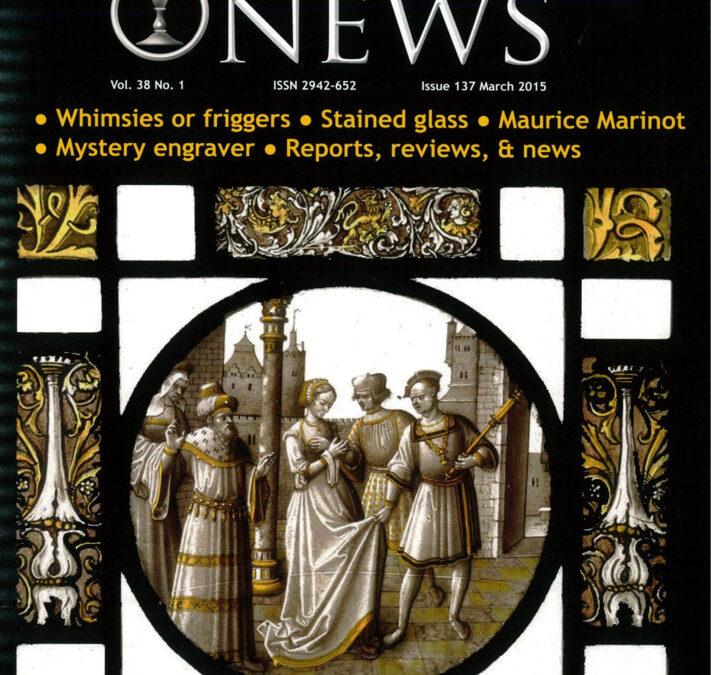
COVER ILLUSTRATION:
Susaurrab accused by the Elders and led to judgment,
Netherlandish, c. 1530, Accession
number:
5637-1859
<0 Victoria & Albert Museum American whimsies Stained glass at the V&A Maurice Marinot EDITORIAL .e.4111.0 1 1010000 Chairman's letter Letters My favourite glass Chairman's letter CONTENTS tyi s members know, in the autumn of 2012 discussions started between the Glass Circle and the Glass Association (GA) over a possible merger of our two organisations. Despite the best efforts of Brian Clarke, Chairman of the Glass Association, and myself, our two committees have been unable to agree terms for a merger. In many people's eyes such a merger made perfect sense, as over recent years our two societies' aims and interests have become closer. A merger would have reduced overhead costs: for instance, the biggest expense for both societies is the cost of producing and mailing out the Circle's Glass Circle News and the GAs The Cone, which have both matured from 'newsletters' to the stature of magazines. The merged society would have continued to benefit from the GA being a registered charity and thus able to claim Gift Aid on subscriptions received from members who are UK taxpayers. This would have meant receiving an additional 25% (at current basic rate) from HMRC in respect of those paying income tax and willing to sign a Gift Aid declaration. We in the Circle were worried that the financial benefit would be outweighed by the restrictions imposed on the running of a charitable organisation, at least as interpreted by the GA, who insisted that one of our aims must be for every meeting to be self-financing; indeed they held that this was an absolute requirement for a charity. The Circle prefers to aim, of course, to balance the books at the end of each year and if possible to show a profit in order to maintain our activities and not have to increase subscriptions too often; we hope to achieve our goals, when necessary, by more fund-raising activities such as the event at Vessel at the end of October, and the auction we held after our AGM in November (see page 22), both of which have raised extremely useful funds for the Circle, as mentioned below. We also felt that the GAs attitude meant that charitable status would fetter the new (merged) society's freedom to be run as its members and its committee and officers might wish, both on a day- to-day basis and as to general policies. The GA committee appeared to regard the combination of the two societies as a take-over of the Circle rather than a merger, with the Circle being treated as the London regional group of the GA. Bearing in mind that we have in recent years offered about nine meetings or outings per annum, in contrast to the Glass Association's four or five, the Circle's Committee felt this was inappropriate and could not accept the GAs approach. Sadly therefore, after two years of negotiations, partly extended because of Brian's unfortunate accident at the beginning of 2003, it has become apparent to the Circle's Committee that the two organisations were not going to reach agreement. This is not to close the door on further discussions in a few years' time, when both societies may wish to revisit our discussions. Fortunately, as mentioned in previous announcements, your committee has also been working on a 'Plan B' in case the merger discussions came to nothing. First, our subscriptions have not been raised since 2006. We would have raised them two years ago had we not been in discussions with the GA. We will be introducing a new simpler subscription package next year and below is our Treasurer's explanation of this. Although for the last two years we have made a loss, this year, through the generosity of our members, who have raised over £2,000 at a fund-raiser and an auction, we expect at the very worst, to break even. We also plan to reduce the cost of our meetings by having some of them upstairs at the Artworkers' Guild, in a room that has recently been refurbished, rather than downstairs in the main hall, which is much more expensive and which we rarely fill. Second, we will continue to have a full range of seven meetings each year. These, together with Glass Circle News, are the life-blood of the Circle, given by a wide range of speakers, some of them distinguished members of the museum profession, some long established dealers, by John P Smith Glass Circle News Issue 137 Vol. 38 No.1 -:;;;1 I E (Y)NL th.4.41A some 'independent scholars' as they are known in professional conference terms, and some enthusiastic and knowledgeable Circle members. Many of these meetings lead to interesting and scholarly articles in our magazine. We will continue with our occasional overseas visits. This year we are visiting the USA, one of our most ambitious trips yet. Through the generosity of those on this trip we are able to offer a very substantial bursary to enable a young museum curator, involved in glass, an opportunity, early in his or her career, to travel with us to meet other curators and handle glass in all its aspects. Third, we feel that the Circle has rather neglected appreciation of the wonderful collection that is now in Broadfield House, in EDITORIAL, the centre of the Midlands glass- making area. In April we expect the speakers to be Kari Moodie, who is in charge of Broadfield House, and Graham Fisher MBE, of the British Glass Foundation, talking about the collection and its (hopefully) impending move to a purpose-built museum on the old White Cone site in Stourbridge. Our domestic visit this year will be to the Midlands, to visit the Birmingham museum store, in the outskirts of Birmingham, and Broadfield House in Kingswinford. To sum up, we will continue to be a very active society, with a large overseas membership. Over the last three years we have offered our members nine or ten events each year. Glass Circle News, which is now a highly professional magazine, bound and in full colour, is judged to be one of the best of any learned society, thanks to the professionalism of our editor and our designer, and is considered a periodical of record. ABOVE: Covers of the 'new look' Glass Circle News LEFT: A caviar dish bought by our chairman at the auction. Note drainage hole in the centre. As the ice melts it does not leave the caviar in a puddle. The financial future of the Glass Circle ur subscription rates have not been increased since 2006/7; since then our costs have risen, particularly in relation to all aspects of Glass Circle News. We have decided to simplify our subscription structure. We propose to abolish the distinction between London membership rates and those for the rest of the UK, to reflect the fact that London members no longer enjoy Tree' meetings and that everyone who comes to meetings pays a meeting fee. Additionally, we believe it would also be beneficial to introduce a student rate to encourage the educational aspects of our society. We also propose to extend all subscriptions (except student memberships) to cover a single person or a couple, so that members do not have to pay extra to enroll their partners. The changes to the membership classifications will mean an amendment to the Constitution which, with the new subscription rates, will be proposed at an Extraordinary General Meeting to be convened later in the year, to take effect from 1 October 2015. We are also bringing our subscription rates into line with those of other decorative arts societies. The new rates we propose are: Membership type UK ..... 1.p.a. £40 Student £20 Institutional £55 Overseas £55 * *To reflect the higher postage cos s) Laurie Maxfield, Hon. Treasurer Glass Circle News Issue 137 Vol. 38 No. 1 3 LETTERS Letters to the editor Agate or glass? Thomas Joyce makes an I interesting case regarding the work of Thomas Betts of Cockspur Street, London. Possibly Betts achieved interesting results in making glass imitate precious stones and he would not be the first (nor the last) to have made such experiments. As far as the agate-lidded box in our collection is concerned (accession number 93.7.4) I have analysed this box using X-ray fluorescence, and can confirm that it definitely is not glass. It has a really high iron peak and not nearly enough silica. The official description stands: Carved agate, engraved and gilt brass; agate, gilt brass. The red agate box of octagonal shape is closed with a fitted and hinged brass lid. The lid is framed by a stylised garland of laurel, its center engraved with an oval emblem inscribed around the rim 'LONDON GLASS MANUFACTORY: The initials 'TB' are decorating the center. Astrid van Gen Associate Conservator Corning Museum of Glass See also note on page 25 Glass as a medium for imitation A s a glassman whose collecting fr‘interests are focused on early English porcelain, I was particularly interested in Jessamy Kelly's article. Glass and porcelain form an easy alliance, and in fact one of the first patents granted for the manufacture of English porcelain contained glass as a principle ingredient in its manufacture. This was obtained in 1744 by Edward Heylin and Thomas Frye in which the recipe consisted of a kaolin clay from Carolina called 'Unaker' and a soda/lime glass which, when mixed in various proportions, was potted and fired to form porcelain. Contemporary with this was the Chelsea manufactory of Charles Gouyn and Nicholas Sprimont, and one of the first products coming out of the factory was a goat-and-bee' jug, as illustrated here. Some of these specimens, an example of which can be seen in the Fitzwilliam Museum, have the date 1745 inscribed on them. In this instance lead glass was included in the porcelain body, analysed at about 10% lead oxide, and when Gouyn moved to his St James factory in around c.1748, his 'toys', of which a scent bottle is also illustrated, contained even more lead glass, analysed with around 15% lead oxide. Although European porcelain was developed in the 18th century, with Augustus the Strong actually incarcerating the arcanist Johann Bottger until he produced porcelain for him which started the Meissen factory, it was the 17th century that saw 'China-Mania' become a craze. As the Dutch and English East India Companies developed their business, carrying goods from China and the Far East, so the fashion for this wonderful new material grew. One can well imagine the European ceramic and glass manufacturers wanting to get involved with this lucrative market but, without any knowledge of how to manufacture porcelain or even what raw materials went into its production, this was a virtual impossibility. Glass was an obvious place to start, and a glasshouse that was in existence in Chelsea during the 167os under the ownership of John Baker actually manufactured ares called china work' This was recorded in an inventory made during a dispute with his landlord, Charles Cheyne, and would of course have been opaque glass which was being produced in imitation of china-wares, much earlier than the relatively common white opaque glass found in the eighteenth century. An even earlier mention of china-work comes in John Rovenzon's 1613 book with the lengthy title A treatise of Metallica but not that which was published by Mr Simon Sturtevant upon his patent, which is now by order cancelled and made voyd, by reason of his standing out-lawed at the time of the grant... whereupon priviledge is granted... to John Rovenzon, Esquire, for the making of iron and other Mettals and Materials with Sea-cole, Pit-cole, etc. In it he describes his development of a 'wind furnace which was used to produce, amongst many other things, 'bugles, china-work, and glass-work therein'. This must surely be the first reference to such a product being manufactured in England and, although presumably an opaque glass, shows that attempts were made to imitate Chinese Porcelain even at this very early date. What is certain is that glass and china go hand in hand together, and further investigation into these early connections should prove most illuminating. Mike Noble Dunmow, Essex Editor's note All letters about a previous edition of the magazine refer to Vol. 37 No. 3 Issue No. 136 unless otherwise stated. Glass Circle News Issue 137 Vol. 38 No. 1 FAVOURITE My favourite glass -• n WO*, o single out t g lia° just one of any category of objects in ones collection is seldom an easy matter. My choice in this instance presents itself for two very different reasons. The first is that it is indeed my favourite glass to hold, to use, to enjoy, and, in its simplicity of design, to admire as a functional object that seems perfectly suited to its use, whilst offering a delight to the eye that always seems to compliment the deep red liquid that I used to charge it with. The second reason for choosing this glass is that it represents a cautionary tale. I can no longer use it on my former almost daily basis, as it suffered a catastrophic accident resulting in the shattering of its folded foot into many splinters. My favourite glass is an English single-teared drawn trumpet glass with folded foot of c.174o being 16.7 cm (6 1 /2 in) high with a bowl rim of maximum diameter of 8.2 cm (3 1 /4 in), and of heavy character. It feels delightful in the hand, balanced, substantial and open to repeated presentation to the lips to savour its liquid contents. Like all glasses of the period, it carries the features of an object hand made. It is of a common form of the time, and, in fact, probably represents the most notable 18th-century form that persists in glassmaking to the present day. Heavy balusters are glorious examples of glassmaking, so are many balustroids, air twists, gin glasses, opaque twists, moulded pedestals — all are a delight to collectors of i8th- century English glasses; but my favourite drawn trumpet (I have a half dozen of this form in a variety of sizes and weights), has that mystical `just so' quality that makes it to stand out from the crowd. But my glass now rests quietly in my display cabinet. One fateful day in November 2011, after a catastrophic placing of a saucepan onto my glass on a kitchen work surface, I looked down on the shattered remains of the foot of my glass, and wondered what I should do. Was it worth attempting to have it glued together again? Should I have a new foot made? How much would this cost? What would the glass be worth after such work? Then I realised that I was approaching this from the wrong standpoint altogether. This was my favourite glass after all. It was part of me. How could I contemplate not attempting to have it repaired. It did not take me long to start the search for a suitable restorer to undertake the necessary work. Five months later and £324 poorer, I took delivery of my beloved glass from Sarah Peek, the expert restorer of ceramics and glass located in Brighton. Ms Peek did a wonderful job on my glass, using Fynebond, state of the art adhesive used in V&A and British Museum restorations et al, to both bind the fragments of the folded foot, as well as to fill in the small losses of glass that inevitably result from a break like the one that my glass suffered. What a joy it was to be reunited with my glass, but I was much saddened to realise that the glass was no longer for daily use on the advice of the restorer. I fully realise that the cost of repair to the foot of my favourite glass is probably more than the glass was worth on the open market before its damage. The break remains obvious. But money is only money! I have my glass back where it belongs — in my collection to savour whenever I wish to take it from its resting place in my cabinet. Folk who do not collect objects of beauty probably regard me as mentally certifiable, but I am confident that the readers of this tale will understand me, and why I think the repair cost was worth every penny. The moral of the story though hardly needs mention. Patrick Hagglund retired from a near lifetime in finance, has two degrees in biology, a science-teaching PGCE, and now concentrates on collecting i8th century English porcelain and drinking glasses. by Patrick Hagglund Glass Circle News Issue 137 Vol. 38 No. 1 5 AMERICAN WHIMSIES Rediscovering American glassworkers' whimsies Tp himsies — known as friggers in Brit- ish glass litera- ture' — are usually defined as amusing, non-production items that glassworkers made at the end of the day or between shifts to take home, to give to friends, or to sell. Glassblowers probably also made whimsies to demonstrate their skill and to impress factory visitors. Some were the result of quick thinking when the glassblower would clo over' an object that he had bungled or modify a factory form for a different purpose. While many whimsies are truly one of a kind, others, such as witch balls and walking-sticks, are common forms. For over a hundred years, bottle and flint glass factories stood along the bank of the Delaware River in the bustling industrial community of Kensington, just north of Philadelphia, Pennsylvania. 2 Although there are no landmarks or architectural ruins to mark this history, some evidence is still present. AECOM (Architecture, Engineering, Consulting, Op- erations and Maintenance) 3 is conducting excavations in the area on behalf of the Pennsylvania Department of Transportation and the Federal Highway Administration in advance of a project to improve Interstate-95 (I-95), a major highway that runs parallel to the river. Excavations to date have recovered close to one million individual artifacts spanning nearly 6,000 years of local history. Some of the artifacts attest to the presence of Native Americans as early as 3500 BC, based on carbon dating. The majority of the excavated material, however, dates to the 19th century and includes an exceptionally large amount of early American glass: whimsies, free-blown and mould-blown hollow-ware, lacy pressed and pressed-pattern glass, cut tableware, lighting, bottles and window glass. To date, the 1-95 Project has directly impacted only a small section of two glasshouses, the most significant being the Dyottville Glass Works bottle factory (fig. 1). Most of the artifacts are being found in privies just west of the glass factories, in neighbourhoods where glass- workers, shad fishermen, and shipwrights resided. Households were often crowded, having multi- generational families or more than one family, plus numerous children and transient renters. Glassworkers often moved from one glasshouse to another and sought temporary work during the summer when the factories were closed. Given all this, we should not be surprised that many of by Mary C. Mills Rebecca White Fig. 1 An 1898 view of Dyottville Glass Works located at the juncture of the Aramingo Canal and the Delaware River, which is seen in the background. Inset: excavation of annealing ovens. Glass Circle News Issue 137 Vol. 38 No. 1 6 sIc LION , BLOCK FEATURE as S A PODGKSS VIEW AMERICAN WHIMSIES nearby (fig. 2). AECOM historians are using city directories, census records, newspapers, household inventories, photographs, and other period sources to construct the historical context for the artifacts, but the objects themselves reveal how strongly glassmaking shaped the identity of the neighbourhood. Based upon the number found thus far, glass canes, hats, flip-flops, witch balls, and other whimsies were part of everyday life. As the 1-95 Project excavations continue, it will be interesting to see how quickly the number of whimsies recovered decreases with increasing distance from the factories. Among the many recovered whimsies are fragments of fragile toy noisemakers called 'flip-flops' (fig. 3). AECOM has found examples in very pale aquamarine and medium green, as well as one extremely rare blue example. Making a flip-flop required great skill. The glassblower had to blow an extremely thin bubble and flatten the bottom to create a closed funnel shape. When one blew carefully into the mouthpiece, the delicate flat glass membrane would move in and out, making a loud popping or cracking sound — thus the name flip-flop. Because they were easily broken and quite dangerous, and required great skill to produce, these are rarely seen today. Period sources also call this toy a 'singing glass' and describe a different way of using it. In her Reminiscences of Salem, Harriet Van Meter Cone recounts events of her teenage years (c. 1835), when evening sleighing parties travelled from Philadelphia across the Delaware River to taverns in southern New Jersey for supper. Some times [sic] there would be four or five sleigh loads. Starting out about five o'clock, p.m. the destination was at the glass houses (so we called them) in Glassboro, about twenty or thirty miles distant. ... After the supper the party was taken to the Glass House, where the fires were kept going all night. Here many fancy glass ornaments were manufactured, singing glasses, balls, horns, canes, etc. Singing glasses resemble a decanter, upset to where held by the neck, the lips pressing the bottom, a musical sound would accompany the voice. These singing glasses were very thin glass and it was a rare treat to get one home safely. The balls and horns were easily carried, and the ladies had the duty of the glass articles, if saved, to get them home safely.' Harriet also remarks that the men blew the horns and created quite a ruckus as they arrived home in the early hours of the morning. Thin, short, L-shaped threads of the residential lots had multiple privies. Constructed of wooden barrels, wood-lined boxes, or brick-lined shafts, these odorous outhouses preserved material culture for future archaeologists. When a wooden privy deteriorated and needed to be replaced, it was filled with household debris and sealed, and a new privy was dug ABOVE: Fig. 2 Wood-lined box privy shaft. BELOW & BOTTOM: Fig. 3 a & b. Excavated fragments of flip-flops, also called singing glasses, and two views of an intact flip-flop, 9.5 cm (3 3 A in) diameter, early 20th century, private collection. Glass Circle News Issue 137 Vol. 38 No. 1 7 aisiNNIII• WEI amp min alleamt eimagawaffew 111111.11111.110. imimaramm. 4111;2111111.1fflow er awfwv AMERICAN WHIMSIES glass of various colours (including pale green, pale amethyst, blue, dark amber, peacock green, and straw yellow) were found at Dyottville Glass Works and several other sites (fig. 4). Until some larger spiral sections were recovered, these threads were quite a mystery. These curiosities are fragments of Jacob's ladders, a name referencing the biblical stairway to heaven. Jacob's Ladders are made by quickly wrapping a strand of glass around open jacks (or pucellas), then squeezing the jacks and slipping the spiral off the small pointed end of the tool. Because the glass is pulled very thin, it does not have to be annealled. Jacob's ladders are very entertaining because they display an unexpected flexibility in glass. When pressure is applied to the top they contract, then spring back into place when released. Because they cooled so quickly, they were ideal for quick demonstrations and factory visit souvenirs. Amazingly, intact sections measuring as much as Jo cm (4 in) in length have been recovered in the excavations. Archaeologists have also excavated broken sections of glass canes in assorted colours and featuring various decorative techniques (fig. 5). The cane fragments reflect the colours commonly used in the production of bottles with many examples in shades of green and blue. The remnants suggest that some of the canes were simple, formed of a single colour, and others had opaque white and coloured threads encased in the centre or applied to the exterior of the gather. Some of the solid cane sections have the typical crook at one end and were simply drawn, while others display tight or lose twisting. A few examples were blown and drawn out hollow and have a bulbous end, indicating a baton form. There are many documented accounts of glassworkers carrying their canes in labour parades and of the presentation of canes to visiting dignitaries and politicians. Unique examples were shown at fairs, or proudly displayed in private collections and on occasion glass canes were called into service as aids in walking. Period newspapers provide additional accounts that are rarely discussed in the literature. In an essay competition published 31 January 1903 in the Minneapolis Journal, a school boy described a glass cane made by his great-grandfather as the item he would rescue in the event of a fire. An article dated z9 May 1890 and printed in the Washington Gazette in North Carolina made a brief mention of a 'glass cane filled with whiskey' owned by Tony Lewis described as 'the champion drink Slinger: Glass hats recovered at the dig include an almost full-size pale green blown bowler, one crafted from a seven-sided pressed tumbler, a miniature example blown in a ribbed optic mould, specimens made from blue and amethyst octagonal panelled colognes, and many more. One of the local glassblowers expertly shaped a hat using a porter bottle mould (fig. 6). It reads J. M. KIRSCHENMANN / 485 / GERN ROAD / PHILADA on one side, with a hollow block'K' on the other. City directories indicate that these bottles were originally being made in the very late 185os for John M. Kirschenmann, who owned a 'Beer House' at 485 Germantown Road in Kensington. Only seven different types of bottles bearing Kirschenmann's name are currently known to exist. s Although this one has no LEFT: Fig. 4 Fragments of Jacob's ladders. BELOW: Fig. 5. Two segments of an almost intact blue cane, and assorted cane fragments, longest 29 cm (11% in). 8 Glass Circle News Issue 137 Vol. 38 No. 1 Above: Fig. 6 a & b Two views of hat 5 cm (2 in) high fashioned from a Kirschenmann porter bottle mould, probably Dyottville Glass Works, probably 1857- 1858. LEFT & BELOW: Fig. 7 a, b, & c Inkwell 4.8 cm (1% in) high, witch ball, and hat blown in GII-15 inkwell mould. AMERICAN WHIMSIES maker's name, five of the seven Kirschenmann bottle forms are marked 'Dyottville Glassworks. This example was found just a stone's throw from the Dyottville factory. In addition to being made from bottle moulds, whimsies are sometimes shaped after being blown in multi-part, full-size moulds normally used for making 'blown three mould' hollow-ware.' The mould used to create the olive-green witch ball and hat was actually designed to produce ink wells like the one shown (fig. 7). In the 194os, American glass scholar Helen McKearin meticulously catalogued and published all of the mould patterns known at that time. Based upon her research, these two whimsies, (blown in the GII-15 pattern) are extremely rare, if not unique. In addition to the small selection of whimsies discussed here, archaeologists also recovered a wide variety of witch balls, bellows, pens, plain and decorated eggs, a pipe, and even sculpted male anatomy. While some were simple achievements, others demonstrate considerable skill and individuality. The quantity and wide distribution of whimsies found in this community prove that these brightly coloured amusements were ubiquitous household items. We are fortunate and should be delighted that they met their end in the depths of privies and can now shed light on this neighbourhood's rich glassmaking heritage. Mary Mills is the Historic Glass Specialist and Rebecca White is the Laboratory Manager at AECOM's office in Burlington, New Jersey. Notes 1. For a good discussion of British friggers, see Charles R. Hajdamach, British Glass 1800.1914, Woodbridge, England: Antique Collectors Club, 1991, pp. 379 - 390• a separate community, Kensington became part of Philadelphia 3. URS Corporation, named in previous articles about this project, is now part of AECOM. 4. Harriet Van Meter Cone, 'Reminiscences of Salem, unpublished booklet, pp.114-115. Salem County Historical Society, Salem, New Jersey. Harriet was born in New Jersey in ,8,8 to Robert H. Van Meter and Sarah Leake Whitaker. 5. John M. Kirschenmann is listed in the 1857 city directory as 'Beer House' at '485 G T Road; the same address on the bottle. Philadelphia street names and numbers changed in 1858, so in 1858'485 Germantown became '1729 Germantown: That being said, the address on this specific bottle form can only date from 1857-1858. McElroy's Philadelphia City Directory, Edward C. and John Biddle 1857: 362; 1858: 366; 1859: 384; ,86o: 528. Tom Kutys, researcher. 6. 'Blown three mould' is the term used to describe glass blown into metal hinged moulds that usually have a base section and three vertical parts. With additional handwork, the glass could be manipulated into various forms. This type of glass was very popular in America between 1815 and 1835. See Ian Simmonds article in Glass Club Bulletin no. 212 Fall/Winter 2008, p.12,21, for an explanation of Helen McKearin's classification system as published in George S. and Helen McKearin, American Glass, New York: Crown Publishers, 1941, and subsequent printings. Glass Circle News Issue 137 Vol. 38 No. 1 9 STAINED GLASS The development of stained glass, as 'seen through' the V&A collections . 0" . ecorated windows, known traditionally as `stained glass', have played an important role in the art of the Christian Church for well over a thousand years. The Victoria & Albert Museum has a large and comprehensive collection of decorated glass windows and is particularly strong in glass from the medieval and renaissance period. The Museum began acquiring glass through purchase, gift and bequest from its inception in the middle of the 19th century. In this study I am exploring the development of the decorated window from its heyday in the izth until the early decades of the i6th century, illustrated with the Museum's collection but also making some references to window glass developments outside the scope of its collection. To many the height of the decorated glass window was in the Izth and 13th centuries as still seen, in part, in great Gothic structures such as Chartres Cathedral in France and in Canterbury Cathedral here in England. These structures have windows of glorious colour designed to illustrate the teachings of the Christian Church. But it took several centuries to get here. Let us go back and trace the development of such an expansive display of decorated window glass. Excavations in recent decades and reanalysis of previously excavated finds have added a great deal to our understanding of the use of window glass in England. Many Anglo-Saxon sites throughout England have now been identified as having had window glass. From the stratified contexts archaeologists uncovered fragments of clear and coloured glass datable between the 7th and loth centuries. This ties in with the Venerable Bede's account of Abbot Benedict Biscop bringing in glaziers from Gaul to make and fit glass windows at Monkwearmouth in the last decades of the 7th century. At this time, window openings were small and the glass displayed was most likely to have been unpainted and arranged only in a decorative, non-narrative manner. The most important impact on the development of the large, colourful narrative window was the advancements made in architecture, especially in the tzth century. Engineering advances in vaulting and buttressing enabled the medieval architects to make vast stonework structures with large apertures. These apertures could then be filled with large expanses of colourful, and as we shall see, narrative glass. From this time onwards we are truly in the realm of the splendid decorated glass window. But there is more to this story. The art that once filled the medieval church wasn't simply art — it had a function: to instruct people in the faith, to reaffirm their devotion to the Trinity and to convey very complicated theological messages. Church law required that religious foundations had images of the divinity and of the saints to whom the church and its altars were dedicated. These images could take the form of statues in niches, embroidered altar frontals, painted screens and walls and, of course, narrative windows. Figs. x & z show, respectively, a scene from the Life of Christ and a scene from the life of St. Vincent. The Flagellation panel originally formed the top of a lancet window illustrating the Passion of Jesus Christ. The St Vincent panel is from a window in the church of St-Germain-des-Pres, originally dedicated to Vincent, which illustrated scenes from his martyrdom 4th century Zaragoza. in early Let's have a closer look at the technique of medieval decorative glass making. Figs. 3 & 4 show a panel depicting Moses from a Tree of Jesse which once formed part of a window illustrating the ancestry of Jesus Christ. The various `bits of clear and coloured glass are each encased in lead. The glass was mouth by Terry Bloxham Below: Fig. 1 A scene from The Life of Christ Glass Circle News Issue 137 Vol. 38 No. 1 ABOVE: Fig. 2 A scene from the life of St. Vincent LEFT & RIGHT: Figs. 3 & 4 A panel depicting Moses from a Tree ofJesse 11 STAINED GLASS blown into a cylinder, or 'muff, form, then flattened out and cut into sheets. The sheets were then cut into irregularly shaped pieces, following the cut lines on a cartoon — a full-size pattern of the whole image. The details of the face, hair, folds of drapery, etc. were painted on with an iron-based pigment, which was the only pigment in use on glass at this time. The coloured glass was made by adding metallic oxides to the clear molten mix thus producing a glass coloured, wholly or in part, all the way through — this is known as 'pot metal' glass. The painted pieces were then put in a kiln to fix the pigment to the surface of the glass. These glass pieces were laid out on the cartoon to form the desired image and each piece was encased in lead, then each leaded piece was soldered together to create the finished panel. But that is not all there was to making a decorative glass window in the Middle Ages. You may have noticed that in spite of the title of this article 'The Development of Stained Glass; I have been describing Glass Circle News Issue 137 Vol. 38 No. 1 STAINED GLASS these windows as decorated' and not as 'stained: Certainly by the i9th century, all historic window glass was described as 'stained' and we continue to use this term today. Strictly speaking, stained glass is a specific type of decorated glass which does not make an appearance until the early 14th century. And when it does appear, there is a revolution in the decorated, stained, glass window industry. Fig. 5 shows a panel which was made between 132o and 1324 for the abbey church of Saint-Denis in Paris. Instead of using pieces of coloured glass to create a design, it is made entirely from pieces of clear glass with decoration painted on in black pigment and in yellow, then encased in lead and joined together. The yellow colour is derived from a silver nitrate compound suspended in liquid painted onto the glass and then fired in a kiln at around 6o o degrees Celsius. The silver penetrates the upper layers of the glass, hence the term 'stained'. You can see that the yellow colour is ON the clear glass and not a separate piece of yellow pot metal glass, coloured with iron or antimony oxides. It may seem a simple distinction — yellow decoration by pot metal glass or by silvered paint — but the change in the industry was profound. Economically, silver- painted clear glass was less expensive to produce than pot metal glass. Aesthetically, coloured designs in the window could be achieved more fluently than could be done with clumsy and expensive lead work. The image on the cover of this issue, a roundel in a surround depicting a scene from the Old Testament story of Susannah and the Elders, illustrates the fine use of silver stain with its varying shades from pale lemon yellow to a more orange colour. We know from much later works that the imagery on stained glass often derived from printed engraved sources. It is not so clear where image sources derived in the medieval period but we do have an example of a panel with an image source in the V&A. The roundel in Fig. 6 is English, unknown origin but would have been part of the tracery lights of a window dedicated to the life of Christ and the Virgin Mary. It was made about 134o — note that all of the yellow decoration is silver stain and not pot metal yellow glass. It depicts the story of the annunciation to Joachim that his wife, Anna, will conceive the Virgin Mary, the mother of Christ. Fig. 7 is a manuscript, now in The Hague, dating to about 133o. You can see at once the same elements in the composition in the two images — the standing figure of Joachim greeted by an angel emerging from LEFT: Fig. 5 A panel made for the abbey church of Saint-Denis in Paris between 1320 and 1324 BELOW LEFT: Fig. 6 Roundel, English c.1340, depicting the story of the Annunciation BELOW: Fig. 7 Manuscript c. 1330 Glass Circle News Issue 137 Vol. 38 No. 1 l2 STAINED GLASS the clouds, a seated shepherd playing a bagpipe, several sheep and a dog. The two images are undoubtedly related but how is still to be determined — did the creator of the stained glass panel have access to this manuscript, or was there an intermediary source? This is a good example of how imagery was transmitted amongst various types of workshops in the Middle Ages, through manuscripts. By the end of the Middle Ages, there were many stained glass workshops operating in England. Major workshops included Norwich, York, Coventry and Oxford. Commissions were plentiful in the buoyant post-Black Death economy and stained glass makers travelled extensively in the country to complete projects. But this English industry was not competition-free. Stained glass production was also, obviously, being carried out on the Continent and one area in particular posed problems for the English producers — the Low Countries. Glass painting centres were numerous in the Low Countries — modern day Belgium and the Netherlands. Their output was enormous, of high quality and cheaply produced. They were exporting their products in great quantities into England and the English stained glass workshops often petitioned the Crown, mostly unsuccessfully, to stop these imports. Traditionally, as taught in schools, the end of the Middle Ages coincides with the outbreak of the Protestant Reformation. The Reformation not only challenged the supposed abuses of church practice but also attacked some of its fundamental tenets of theology. We all know of the destruction of church art at this time but I would like to point out how church art itself was used as a weapon — by both sides! The roundels in Figs. 8 & 9 were created in Netherlandish, Low Countries, workshops. Both are single panels of clear glass painted with black pigment and silver (yellow) stain. The one on the left depicts a pig in a monastic habit being forced out of an urban setting. The anti-monastic message is clear — a perfect example of reform imagery. However, the roundel on the right is a perfect example of anti-reform imagery. Here we see the scene of St. Gregory celebrating Mass. Gregory received a vision from God in which the wafer and wine were transformed into the actual body and blood of Christ. This represents the doctrine of Transubstantiation — one of the targets of the protestant reformers. The succeeding years of the i6th century brought dramatic changes to the structure of society in Europe and many changes to the stained glass industry, as well as to all other artistic workshops that had formerly produced works for the Church. Both in Britain and on the Continent the stained glass industry adapted to the new political and religious situation. The industry incorporated advances in chemical technology with the use of enamel paints as well as the advancements being made in the manufacture of the glass itself. The Victoria & Albert Museum has many fine works in its collection from the i6th through to the early zist centuries illustrating these advancements. Terry Bloxham is an Assistant Curator in the Ceramics & Glass Section of the V&A and is responsible for their medieval ceramics and stained glass ABOVE LEFT: Fig. 8 Netherlandish roundel depicting a pig in monastic habit ABOVE: Fig. 9 Representation of the doctrine of Transubstantiation Glass Circle News Issue 137 Vol. 38 No. 1 13 MARI N OT Maurice Marinot: A Passion for Glass glass, Marinoes creative ef- forts were limited to design- ing vessels that others blew under his direction, and then decorating the pieces with enamel (fig. z). These were in the light-hearted Parisian styles of the time, display- ing either elegant geometric designs or small scenes of everyday life. This form of work gained immedi- ate recognition, and from as early as 1911 his enamel work was exhibited at the Salon d'Automne and Salon des Independants. At the outbreak of war in 1914 Marinot joined the French army and his glass work aurice Marinot ( 1 8 8 2 - 1 9 6 0 ) pioneered the use of glass as an artistic medium and was one of the most influential glassmakers of the 20th century (fig. 1). The exhibition Maurice Marinot: A Passion for Glass displays forty-four glass works from different stages of his career, brought together for the first time since Florence Marinoes generous bequest of her father's work to Amgueddfa Cymru (National Museum Cardi ), the Victoria and Albert Museum, and Leicester Arts and Museums Service (amongst others) in the 1960s and 70s. Displayed alongside the glass works are oil paintings, water- colours and designs by Marinot, telling the story of his artistic development and his personal life. This is a rare insight into his canon of work, the remainder of which is split between public and private collections. The quantity of his work is limited due to the explosion of a munitions from the tutor. In 1905 he exhibited paintings at the Salon d'Automne in Paris alongside contemporaries such as Andre Derain and Henri Matisse. Critics attacked the exhibition for its riotous colour and application of colour, ABOVE: Flg. 1 Maurice Marinot, Self-portrait, 1947. by Penelope Hines truck outside his studio in 1 944, destroying a lifetime of work and making his glass pieces rare. Marinoes career did not follow a straightforward course through media and styles; he recurrently left and returned to painting and glassmaking throughout his life, and the phases of work in both overlap. His career began when he entered the Ecole des Beaux-Arts, Paris, in 1901 to study painting under the tutelage of the historical painter Fernand Corman. However he was soon expelled for, in his own words, being a 'dangerous non-conformist; presumably for refusing to produce works in the delicate and romantic realist styles of the time. However this rejection did not deter him from studying art. With the help of other students he would sneak into life-drawing classes and hide describing the artists as `fauves: literally `wild beasts'. This exhibition, originally established to showcase progressive art, is now notorious for sensationally launching the Fauvist movement. Marinot left Paris for his home town of Troyes soon after the exhibition, though he remained known as a Fauvist painter until 1913. In 1911, out of curiosity, he visited the glassworks of his friends Eugene and Gabriel Viard in Bar- sur-Seine, just south of Troyes. He instantly developed a passion for the material. Fascinated with the luminosity of the enamel and colours, he became determined to learn the glassmaker's trade. He learned the basics of glassblowing from a gaffer, and the Viards allowed Marinot to use materials and tools while their regular employees were on breaks. While still learning to blow © Le ic es ter Ar ts an d Museum s Serv ice Glass Circle News Issue 137 Vol. 38 No. 1 14 O LEFT: Fig. 2 Maurice Marinot, Vase, 1913. ceased. During this period he produced drawings and watercol- ours. Originally with the French ambulance service, he was sta- tioned in Morocco from 1917, and his drawings from this date portray the daily lives of those around him. In 1919, however, he re- turned to designing glass shapes and enamelled deco- ration. Marinot's glass deco- ration was technically com- plex, with layers of enamel overlaid on one another and subjected to repeated firings. By 1922-3 he was accomplished enough himself to give up sur- face decoration of the glass and to turn to the actual mak- ing of the vessels, whereupon he began to explore the forms of the glass itself. Marinot's glass works from this period onwards fall into three broad categories: massively thick glass vessels that are deeply acid-etched; similarly massive glasses in simple forms suffused with bubbles; and small ball-stoppered bottles. This first 'type' was produced by submerging the vessel in baths of hydrofluoric acid (fig. 3). Although brutal, this method resulted in delicate textural surfaces which sparkle under light. The second type of piece demonstrates the control Marinot had over the natural flaws in glass, turning them into a decorative feature (fig. 4). RIGHT: Fig. 3 Maurice Marinot, Vase 1930 BELOW RIGHT: Fig. 4 Maurice Marinot, Bowl, 1930. Glass Circle News Issue 137 Vol. 38 No. 1 15 MARINOT The small ball-stoppered bottles have coloured inner casings which are mottled, swirled and cracked to suggest tree bark, melting ice, river beds and other natural phenomena (figs 5, 6, 7 8 & 9). These were created by sandwiching coloured glass between thick layers of clear glass. Colours were created by mixing metal oxides, like the creation of paint's colour through mixing pigments. Marinot devised the chemical formulae for all the colours himself. Marinot's glass received broad recognition at the Paris Exhibition of 1925, but poor health combined with the closure of the Viards' Glass Works forced him to cease glasswork in 1937. He continued, quietly, with his painting. To understand Marinot's vision it is important to consider the context that he was producing his work in. Glass was accepted as a medium of decorative art, but in that respect it was primarily in the decoration of the material that artistic merit was perceived. Marinot's initial work on glass with pre-made vessels and enamels could be more closely related to the German and Austrian development of 'glass art' of the early 2oth century than to French tastes. The 'Wiener Werkstatte' move- ment strove to establish a modern language of forms and adornment by enamelling and engraving on glass in geometric styles. Though these objects were produced only in small quantities and classified as objets darts they were nonetheless produced in factories by a team of workers. In Marinot's time, fine glass art works made in France were delicate cameos or carved glass of the Art Nouveau style, with its characteristic theme of sinuous asymmetrical lines based on plant forms. As part of the production process for these pieces, acid was used to frost, etch or enhance the shine of the surfaces. These treatments were minimally invasive and applied for the purpose of enhancement. These too were produced by teams of craftsmen in factories. Marinot, in sharp contrast, used acid to rip into the surface of the glass to create form and shape. For him, each piece was unique and made entirely by his own hand. He described making every piece as a contest: between the blowing action on the interior and BELOW LEFT: Fig. S Maurice Marinot, Bottle and stopper, 1930. BELOW: Fig. 6 Maurice Marinot, Bottle and stopper, 1929 OPPOSITE TOP: Fig. 7 Maurice Marinot, Vase, 1930 OPPOSITE MIDDLE: Fig. 8 Maurice Marinot, Bottle and stopper, 1929 OPPOSITE BOTTOM: Fig. 9 Six bottles with stoppers, 1929-1931 Glass Circle News Issue 137 Vol. 38 No. 1 16 MARI NOT the tools working on the exterior. The material was manipulated in the battle between these two alternating forces. This account reveals the very intense personal involvement Marinot had with the material during the creation of each work. All of Marinot's glass works have visual effect; the early enamelled works have a grace, simplicity and balance to them rare in the decoration of ready- made glass objects and the later pieces are striking and as purposefully shaped as sculpture. Though contrasting in appearance and shape, all his glass works retain a basic functionality. However the bodies of the glass vessels made by Marinot push the glass way beyond the traditional expectations of the medium to be either purely practical or merely decorative. It has been said that Marinot masculinised the production of glass, as his pieces were meant to convey strength. Yet the vessels do not have unnecessary bulkiness and rarely any feeling of excess in form. There is a balance and symmetry within his work. Perhaps the fact that he undertook the entire process of creating them himself helped to achieve this. The appeal of Marinot's glass is intensified when light catches the texture and colours within the glass. Though the pieces are visually complex, it is possible to appreciate the finer details of the textures within and on the materials such as bubbles and bumps. He added large amounts of colour to the glass: rather than a wash through the material, the deep colours are reminiscent of jewels. The inherent appeal of Marinot's glass may be that, despite all the thought about material, form, and the battle of creation, there is a prevailing simplicity of nature in his work. He does not employ all his skills in every piece, rather choicely presents a few at a time. Although he is best known for his glass works, the field within which his work was unique, this exhibition displays his versatility. There is charm in his bright blocky paintings and his delicately drawn images are touchingly intimate. Marinot not only learnt the skills of the glassmaker from the most basic processes to the most sophisticated techniques, he also learned how to produce his artistic creations in glass single- handed. No painter or artist of standing before Marinot had abandoned his easel in order to work directly with hot glass. This break with tradition was perhaps the most revolutionary change he introduced. For this reason Marinot's glass has unique historical importance as well as artistic value as the most forceful creative statement made in glass in the first half of the zoth century. 11111111111111Mammil By Penelope Hines, with thanks to Dr Rachel Conroy for original research. Both are Curators of Applied Art for Amgueddfa Cymru-National Museum Wales. Sources: Tait, Hugh (ed.), Five Thousand Years of Glass (British Museum Press, 1991) Hughes, P. The Gift of Works by Maurice Marinot in Amgueddfa: Bulletin of the National Museum of Wales 16 Spring 1974. Marcilhac, Felix Maurice Marinot (1882- 1960) Artisan Verrier Catalogue Raisonne de Eceuvre de Verre (Les Editions de 1'Amateur, 2013). Glass Circle News Issue 137 Vol. 38 No. 1 17 by Athelny Townshend LEFT: Fig 1 The Nottinham Goblet, the round funnel bowl contemporarily wheel engraved with a ship and on the reverse the portrait of a bearded gentleman with additional engraved scrollwork to the bowl and foot, above a light baluster stem comprised of a multi-teared dumb bell knop over an inverted baluster knop with a single tear extending through a plain section into to a basal knop supported on a plain conical foot with broken pontil mark. Circa 1760 INVESTIGATIONS IN GLASS Conjectures on a Dutch engraved goblet tyl sk a collector of 18th century drinking glasses why they chose to collect in this niche corner of antique collecting and you will, more than likely, find someone with a romantic outlook. Collectors often muse about who drank out of these glasses: wondering whose lips have felt the opulent oleaginous feel of the glass rim as a sip of ratafia is taken. Others may imagine the racket made as a toast is made by firing glasses being banged and clattered on the table. These, sometimes very personal, objects can give us a direct link to a bygone era: an era that still inspires us with its aesthetics, sense of sophistication and cultivation. A sense of history and romance is inspired by glasses that provide these links to the past. Engraved glasses provide the most straightforward means of doing this. Much sought after Jacobite glasses inspire a strong emotional link to a hugely romantic era of history and their engraving leads directly to the historical event. However, other engraved glasses are less forthcoming in giving up their stories. This article looks at a glass that has raised many questions: questions whose answers have lead to further intriguing questions and eventually to a conclusion that some may think of as wild speculation. The conclusion drawn may well be criticised for being impossible to prove, especially considering the lack of provenance and the distance in time since the glass was made. The tenuous chain of deduction makes it even more difficult to come to a safe conclusion. However, it is not uncommon in writing and talking about 18th century glass for descriptions and assignations to be little more than assertions to be accepted or rejected according to how highly regarded or experienced the writer or speaker is perceived to be. It is hoped that what follows will be seen to have an element of logic to it in its attempt to offer some explanation of the conundrums of this rather unusual drinking glass. Whatever else may be said or thought about the glass, the process of trying to understand this glass has been stimulating, a great source of entertainment and well worth the effort. The glass (fig. I) was bought at auction in Nottingham in August zon. In danger of being left on the shelf a last second bid as it was about to be 'passed' enabled it to be bought for a modest sum. The 'Nottingham' goblet, as it shall be referred to, is a splendid light-baluster goblet, nicely proportioned and well made out of fine lead metal. It is a good size at 20.9 cm (8 1 in) tall and in excellent condition. The wheel engraved bowl is decorated with a ship on the recto and a portrait on the verso. The bowl is also engraved with scrollwork, as is the upper surface of the foot. The crude quality of the engraving, at best naive and at worst incompetent, goes to explain why none of the other glass dealers at the auction took any interest in it. Most people who have been shown it have just glanced at it, instantly dismissed it and commented'Nice glass... pity about the engraving: The glass seemed to be destined for a corner of a dark cupboard to be abandoned and forgotten about for the foreseeable future. (Every dealer has a cupboard like this... just ask!) However, it wasn't long before some nagging questions about the glass emerged. . If the glass was so disfigured by its engraving why had it been kept so carefully for over 25o years? • If the glass was well made, in good condition and nicely pro- portioned why was it allowed to be disfigured by such unsuitable engraving? + Who was the engraver? • Who could have had the oppor- tunity to carry out the engrav- Glass Circle News Issue 137 Vol. 38 No. 1 INVESTIGATIONS IN GLASS ing seeing that specialist tools are needed to complete even the most basic engraving? In trying to unravel the mystery of the glass the above questions needed answering. Artistic merit alone cannot explain the glass's survival for over 250 years. That is more likely to be because it had some personal significance for someone and the following generations. Our starting point in working out who the engraver was has to be the engraving itself. One characteristic feature of the engraving is its naive style. Those familiar with children's art will recognise the stylistic characteristics. These indicate conceptual stages of development, as for example, the symmetrical house with the chimney set at right angles to the slope of the roof rather than being perpendicular. Children's depictions of sailing ships and yachts often have these developmental traits. They too tend to be symmetrical (fig. 2). They often have two similarly sized sails either side of a central mast topped with a pennant flying against the wind. The symmetrical hull of the boat looks to be floating on the top of a sea represented by zigzag waves. The graphic style we ABOVE: Fig. 2 A child's schematic rendition of a sailing vessel. ABOVE RIGHT: Fig. 3 Detail of ship engraving on Nottingham glass BELOW: Fig 4 After Wigerus Vitringa (Dutch, 1657-1721) Seascape with sailing ships, 1695 detail. Note the spritsail and how it is lashed to the mast. see on this glass (fig. 3) seems have a strong stylistic resemblance to a child's formulaic draftsmanship. If so, it could indicate that the engraving was done by a child. There is another detail that should not be overlooked. Although the child-like qualities are the most obvious aspect to the depiction there are some interesting details of the ship that show the engraver was familiar with Dutch 18th-century shipping. The way the sails are laced to the mast with a zigzag pattern of the rope; a sprit supporting a four-cornered spritsail and the distinctive shapes of the stern and bow. All of these features are found in Dutch inland and coastal sailing vessels. (fig. 4). In the engraving the expected leeboards are absent. Instead there are vertical lines, perhaps to show an inside view of the ribs; a view that would be seen from above on the quayside. This Glass Circle News Issue 137 Vol. 38 No. 1 19 1757 1758 1759 1760 1761 1762 1763 1764 1765 1766 1767 1768 Year glasses signed by Jacob Sang INVESTIGATIONS IN GLASS could be an example of children ' s ability to combine two views in one. If we accept the engraver could have been a child the next step would be to consider whose child could it have been? Bearing in mind that the child glass engraver would need access to the tools of the trade it doesn ' t seem unreasonable to conclude that he/she was the child of a glass engraver. This would also explain the puzzle of how the engraver gained access to the specialist equipment needed for engraving and goes towards an explanation for the permission given for allowing vandalising of the glass. A fairly large seed in the bowl (fig. 5), not immediately noticeable, would explain why the glass was available for amateurish, unskilled engraving. An attempt has been made to hide the seed by disguising it to look like a part E C to a) V) no a.° 0 L (1) E 8 7 6 5 4 2 0 1754 1755 1756 of the scrollwork engraving... a not unusual practice of even the best glass engravers. But it is the positioning of the fault that is significant. The fault occurs where it is customary to place the engraved letters of the legend. This positioning explains why an expensive drinking glass might be discarded and be allowed to be treated this way. It also confirms the view of the glass ' s connection with a skilled engraver: an engraver who valued his work would be more likely to discard unsuitable ' blanks ' and put them to one side. So, are there any clues as to who the father of the child may have been The memory of another glass with similarly constructed blanks to the Nottingham glass inspired the next line of research. A similarly configured engraved goblet (fig. 6 opposite) belonging to glass dealer Ron Thomas and signed by Jacob Sang was sold at Bonhams London, New Bond Street on 8th June, zoo8 lot 56. F GAM Smit' categorised the Sang signed glasses by their stem type: Using the data from the book it is possible to make a chart that shows how the stem styles tend to cluster around a fairly short period of time (fig. 7). This clustering would suggest that he bought batches of blanks at a time and kept a stock of them so that customers would able to choose which style of glass they wanted their commission to be executed on. Both the Nottingham and the Thomas glasses conform to the M type glass as described by Smit. It may be argued that other engravers used the same stem type. However, these two glasses are far closer in every way to each other than M type glasses used by other engravers (fig. 8). The Thomas glass is described as being 28.3 cm (8 3 /4 in) in the Bonhams catalogue but Smit records the height as being za cm (81/4 in), the latter being almost identical to the Nottingham glass at zo.9 cm. They share the same proportions and show the same idiosyncrasies as can be seen by comparing them in the illustrations. These similarities would suggest that both glasses are likely to have been made by the same gaffer. Smit ' s LEFT: Fig. 8 Earlier rough working visuals to compare Sang connected glass M types with other engravers using the form. Inside the red box are the Nottingham and Thomas glasses showing the similarity between them ABOVE: Fig. 5 The Nottingham glass (detail). The offending seed. Below: Fig. 7 Chart ofJacob Sang engraved dated and signed goblets as categorised by Smit showing clustering of glasses by type. 20 Glass Circle News Issue 137 Vol. 38 No. 1 INVESTIGATIONS IN GLASS table shows that stem styles tend to cluster around a fairly short period of time. This would suggest that Sang bought batches of blanks at a time and kept a stock of them so that customers would be able to choose which style of glass they wanted their commission to be executed on. Two further glasses go some way towards finishing the jigsaw puzzle. The first came to light at the National Gallery of Victoria (Smit No. 1759.8) 21.2 cm (fig. 1o). The second glass, recently bought, is unsigned but attributed to Jacob Sang 21.1 cm (fig. ii). Both these glasses show the same striking similarities with the Nottingham glass. The latter glass has typically placed Sang style lettering just below the bowl rim. The positioning of the seed on the Nottingham glass would have precluded its use as a blank for any glass needing an engraved legend. Apparently Jacob Sang had a son who was born in 1750, although this has not been confirmed. If it is so then he could be a candidate for the engraver. He would have been about 9 years old during the ABOVE LEFT TO RIGHT: Fig. 6 The Ron Thomas goblet signed by Jacob Sang. (Smit cat. no. 1759.2) Fig. 9 Nottingham glass for comparison Fig. 10 Signed goblet. NGV (Smit cat. no. 1759.8) Fig. 11 Goblet with engraving attributed to Jacob Sang. BELOW: Fig.12 Is this the face ofJacob Sane period when Sang was at his most prolific and using M style glass blanks for his work. Obviously this is all an unprovable hypothesis and will probably remain so. However, when considering all the points above there is a possibility that Jacob Sang's son was the engraver of the goblet. He would have: had the opportunity to use en- graving tools and the blank glass to practice on; + been in the right place to regular- ly observe the kind of vessel de- picted and been able to see down inside them from an Amsterdam canal-side; . been the right age to draught this engraving in this childlike way; + been influenced in subject matter for the engraving by watching his father at work If this line of deduction is credible we are left with one final question: Could the portrait of the gentleman on the verso of the glass be the only known portrait of Jacob Sang (fig. I2)? If any readers feel they can offer a more convincing way to explain the enigmatic features of the Nottingham or 'Son of Sang' goblet I would be happy to hear from you. Athelny Townshend spent his early career working in the print industry but later took up teaching at primary level. He is now an antique dealer, mainly in i8th-century English glass. Note 1. Smit, FGAM, 1992, A Concise Catalogue of Eighteenth-Century Wine- Glasses Wheel-Engraved and Signed by Jacob Sang. Private publication. Glass Circle News Issue 137 Vol. 38 No. 1 21 REPORTS Glass Circle Meetings 11 November Fund raising and the AGM T he AGM broke with tradition insofar as the formal business was followed by a fund- raising auction instead of the normal consideration by a panel of experts of glass objects brought in by members for identifi- cation or assessment. The genesis of this idea arose at meetings of the Glass Circle Com- mittee which, during the course of the year, had discussed ways of raising money to strengthen our balance sheet. In order to achieve this there were to be two principal events: BELOW: Near pair of large English wry then ale glasses 1800-1820. BOTTOM LEFT: Sweetmeat with incised twist stem. c. 1760 BELOW RIGHT: English ale flute circa 1765 with DSOT stem a reception organised by our Chairman at the Vessel Gallery in Notting Hill which is a leading London Gallery specialising in contemporary glass and ceramics; and an auction of glass donated by our members. Simon Cottle agreed to conduct the auction and Vernon Cowdy was asked to deal with the administration. My ini- tial involvement started when I received an email from a member who wanted help with the disposal of part of her late father's collection of books and catalogues of auction sales. After hav- ing been in touch with an American member who has a fine collection of 17th and i8th cen- tury glass and ceramics I learned that he had very few early auction catalogues. He made a donation to the Circle for all the catalogues which were airfreighted to the USA in two boxes each weighing 3o kg. A good number of the books were snapped up at the AGM for Li and f,2, each according to size. (our novel way of pricing). Prior to the AGM I had been approaching dealer members and collectors for donations of glass objects for the auction and I realised that there would be a tremendous amount of work on the AGM eve- ning to 'catalogue the lots given the limited time we would have for Simon to conduct the sale'in the room so I joined forces with Vernon who had already done sterling preparatory work and with the other helpers we collected the lots and started to prepare the catalogue: From the minute we arrived at the venue activity was frenetic with members bringing in their pieces and plac- ing them on the crowded table of glass to be sold. The range of glass we had for sale in the 39 lots to be offered was amazing dating from the zoth century to ABOVE: English rummer c1830.40 ABOVE: latticino plate LEFT: English opaque twist wine glass circa 1765 the ogee bowl with remnants of gilded floral work possibly by James Giles RIGHT: Millenium GC Goblet (1 of 2) mid-i8th-century glass. Included were pretty de- canters in coloured glass, finely engraved rummers, sweetmeats, vases, bowls twist wine glasses, ale glasses, continental and commemorative glass and ai9th-century latticino dish. Our auctioneer ed a crowded m and bidding nued apace. Prices the glass items varied between a low of £3 for a Glass Circle com- Glass Circle News Issue 137 Vol. 38 No. 1 9 December Terry Bloxham's talk on stained glass at the V&A is given in full on page so. Co-hosts for the meeting were: Steven Damment, Ian Freestone and Tony Oakley. ABOVE: Possibly Scan- dinavian or English table item early 20c Right: Har- lequin series by Peter Layton. Erratum The names of the co-hosts for the October meeting (speaker Peter Layton) were unfortunately omitted from the report in Issue no. 136, page 22. They were: Michael and Jenny Nathan, Tim Udall and Robin Wilson. 23 .111111 n MIIMS. REPORTS memorative glass and £85 for an opaque twist wine glass. The highest price achieved on the day was £110 for a set of Churchill's Glass Notes. The whole evening was tremendous fun and we hope to repeat it, probably in two years time. There is little doubt that the purchasers were very pleased with their bargains and the culmination of the sale resulted in a payment into Glass Circle funds of Eazo5 as follows: Sale of books and catalogues £260 Sale of glass £1255 Vessel £690 Total £2205 The Committee is most grateful for the generosity of members and dealer members and the hard work of all those involved without which the event would not have been possible. Graham Vivian Co-hosts for the meeting were: Janet Benson, Sharon Butler, Patrick Hagglund, Marie Polley. RIGHT: Engli t s u h rn la b r i ge r c1780-90 BOTTOM: English wine glass with engraved and honeycomb moulded bowl above a DSOT stem. c.1760 RIGHT: pressed glass Victorian candle holder Glass Circle News Issue 137 Vol. 38 No. 1 N El G H BOURS AND SUCCESSORS OF ROM 1 Tradmons of glass peduction and u, and tit, Middlr Ea-u in the In,,, 1st millcnnion, I , 1 , 1 PANS .AND CAR, rt IN! REVIEWS Book reviews Neighbours and Succes- sors of Rome Traditions of Glass Production and use in Europe and the Middle East in the Later ist Millennium AD Edited by Caroline Jackson, Daniel Kel- ler & Jennifer Price Oxbow Books, £48 20% discount to Glass Circle readers ISBN 9781782973973, 35 2 pp T his book is a I collection of zo case-studies and an investigation of the development of the production of glass by neighbours and successors of Rome, referring to the same conference which was organised by the Association for the History of Glass (May zoii). It is classified according to a geographical range of findspots or origins of the glass presented in the contributions of this volume. The book starts in the north-west of Europe with a study about the last Roman glass found in Britain, the remains of ancient glass assemblages at West Heslerton, Whitby Abbey and Kirkdale Minster in North Yorkshire, and then explores a small assemblage of opaque yellow glass production during the 9th century in Tarbat Ness, Scotland. The next case study looks at the glass workshops in northern Gaul and the Rhineland during the 1st millennium AD and is followed by an investigation into the glass production in the north-west of the Iberian Peninsula with the specific shaped bowls from Gallaecia. The book next explores Via Veneto in northern Italy with the well- known and famous Venetian glassmaking, which began when the Venetian cristallo was developed as a luxury glass product, and then travels to the Balkans with case-studies about late Roman glass from South Pannonia (today in northern Croatia) and late Roman and early Byzantine glass in northern Bulgaria. Further to the south- east the book includes glass finds from the major Byzantine cities of Thessaloniki and Constantinople as well as from Asia Minor, the Levant, Egypt and the Sasanian Glass of Mesopotamia and Persia. Three papers describe glass objects of the Late Roman and Byzantine period, gold-glass, glass mosaics and HIMT (High Iron-Manganese- Titanium) glass exported from Egypt. The book is primarily intended for a reader who is generally interested in the history of glass production during the ist millennium AD. The case studies describe the scientific processes used to establish places and methods of production by the successors of Rome. Some studies are particularly important for scientific institutions and for those who study ancient glass with an interest in glass research or archaeology rather than of interest to glass collectors generally. These chapters include tables, graphs and information based on chemical analysis. On the other hand contributions like the 'Wilshere Collection of late Roman gold-glass at the Ashmolean Museum; 'Successors of Rome? Byzantine glass mosaics' and'A study about an early Christian glass workshop at 45, Vasileos Irakleiou Street in the centre of Thessaloniki' are undoubtedly attractive for the Glass Circle reader who is interested in the history of ancient glass, methods of production, excavations and survey techniques, varied and locally manufactured glass forms and ancient glass workshops. For the specific ancient glass collector the book is interesting because it shows the value of research links between archaeology and archaeological science for interpreting variations in the supply of glass in different regions of the former Roman Empire at different periods. The book is illustrated with many black and white drawings and 81 colour illustrations which are of moderate quality. Hans van Rossum A History of Glassmak- ing in London, Second Edition, from the earliest times to the present day David C Watts Watts Publishing 2014, £25 ISBN 9780 9562116 T he enlargement of the second edition of David Watts researches is suggested by the change of subtitle: the second edition, from the earliest times to the present day, is a third longer again. The second edition does indeed go back to the beginnings of glassmaking with mention of Roman glass working sites; the book is expanded throughout, with many more illustrations and maps and eight more chapters. The four end chapters bring the story up to date to the start of the zist century. As in the first edition Dr Watts' very thorough research includes the social, political and technical history of glassmaking. Political history is to the fore in the early chapters as the dissolution of the monasteries made sites available for furnaces just outside the City of London, and the Reformation guided the industry into new areas, with a flow of experienced Protestant glassmakers into the country. Most of the technical developments are covered as David Watts lays out the history of Glass Circle News Issue 137 Vol. 38 No. 1 24 A HISTORY OF GLASSMAKING IN LONDON SECOND EDITION FROM THE EARLIEST TIMES TO THE PRESENT DAY DAVID C . WATTS the glasshouses where various sorts of glass were made, district by district from the Southwark heart of London's glassmaking, those close to the City and along the Thames to the outlying parts of Greater London in the zoth century. The REVIEWS 17th-century conflict between Wealden wood- burning glassmakers and proponents of coal-burning furnaces, Edward, Lord Zouche and then Sir Robert Mansell, is expanded from Watts talk to the Circle in 2013, `Skulduggery at the Glasshouse'. This now precedes explanation of the technical processes that lead to Ravenscroft's and later developments. As a chemist Dr Watts is able to explain the sources and changes in the different batch materials used, the designs and developments of different types of furnaces explained, sources of pot clay and the importance of saltpetre for Ravenscroft's flint glass. Types of glass made grew as markets expand- ed: windows and mirrors and then coach-window glass and more recently car window laminates; bottles and phials, drink- ing glasses and optical glass. An appendix to chapter I5;Pike Green, Jackson's Falcon and Upper Ground Glass- houses' expands the first edition's chapter 14 into a brief history of forms of lighting, both public and domestic, pointing out the use of Ravenscroft's clear lead glass for devel- opment of oil-burning lamps, gradually super- seded from 1807 by gas from coal (coke), which itself powered much of the electricity that took over in the zoth century in incandescent sealed glass bulbs. Greater attention is also given to glass decoration, from cutting and engraving wheels, and James Giles gilding workshop to acid etch- ing, and sandblasting on panels in Cunard and White Star liners. As the book moves into and through the zoth century a wide range of glass products appear in the last few chapters, from plate glass and curving large sheets, to the automation of bottle production. The last chapter, `From Beads to Studio Glass', ends with a concise survey of studio glass in London; Watts was involved as the first Secretary of the Con- temporary Glass Society. In a work of such detailed research and wide scope it is perhaps niggling to mention that the book could have done with better copy- editing for inconsistent spellings, and cross- references that have not kept up with changes in layout. It cannot detract from the usefulness of the book. Anne Lutyens-Stobbs Editor's apology I n support of Astrid I van Giffen's letter on page 4, Peter Kaellgren, curator at the Royal Ontario Museum, tells your Editor that printing a close-up of apparent glass' on the cover of Is- sue No. 136 simply adds `insult to injury'. If the material in the snuff box were glass, there should be evidence of small bub- bles, striations or other characteristics of glass. He writes:'The colours and veining in the box illustrated in Thomas Joyce's paper Agate of glass? correspond to agate. Agate, bloodstone and other hardstones were commonly carved into snuff boxes in the mid-1700s. English examples are known, but the major production centre for the best was Berlin. `My practice as a cura- tor has been to go to the geologists and mineralo- gists in our Geology and Mineralogy Department to verify whether a mate- rial is glass or a mineral. This has prevented me from making errors on a number of occasions and has occasionally pro- vided pleasant surprises when red stones turned out to be verifiably rubies from Ceylon. I showed the illustrations of the snuff box in question to Katherine Dunnell who is a geologist in our Department of Mineral- ogy & Geology. She and one of her experienced colleagues who looked at the illustrations fully concur with me that the material is a form of ag- ate, perhaps even a type found in Scotland. The vein of crystals down the left side is exactly what one finds in naturally occurring agate: As Editor, I like debate, but I apologise to readers for not check- ing sufficiently before blazoning agate as glass on the cover of the maga- zine. I did subsequently ask Corning to test the box, but by then the damage was done. Jane D E o a r i n to e r e Glass Circle News Issue 137 Vol. 38 No. 1 25 NEWS News Dublin's new Keeper n r Audrey Whitty has I./left her position as Curator of European and Asian Glass at the Corning Museum of Glass to take up the position of Keeper, Art and Industrial Division, National Museum of Ireland, Dublin. This means she is overall Head of Decorative Arts, Design and Historical collections, and will also be leading a team of five curators. She will be based at Collins Barracks, located on the north quays in Dublin city, which is generally regarded as the HQ of the National Museum of Ireland (which com- prises four sites and four million artefacts and specimens). In addition the role of Keeper, Art and Industrial Division will involve playing a central part in the decade of commemorations to mark Ireland's centenary of independence. The most iconic object associated with Collins Barracks is the Fonthill Vase (below). It is Chi- nese celadon porcelain and was made about I3oo AD. When the vase was brought to Europe shortly afterwards, it was treated as semi-precious stone and hence given silver-gilt mounts. As Europeans were unable to make porcelain until over four centuries later, such objects were treated with great respect. The vase, which is one of the best-documented pieces of Chinese porcelain known, is recorded through the centuries in the collections of Lou- is the Great of Hungary, Charles III of Durazzo, the Dauphin of France and William Beckford of Fonthill Abbey. Un- recognised because the mounts were removed in the 19th century, the vase was acquired by the Museum in 1882 at the Hamilton Palace sale for £28 7s od. What that sum would have been in real terms is very difficult to assess — one point of comparison found in Bury Gazette was that a Suffolk beer seller was fined £20 155 6d because he allowed'drunkedness and violent quarrelsome conduct on his licensed premises' in February of that year. Audrey Whitty, new Keeper, Art and Industrial Division, National Museum of Ireland, Dublin The Fonthill Vase, National Museum of Ireland, Dublin New Space at the Corning Museum of Glass O n 20 March Corning's new 26,000-square-foot gallery space opens with its curvilinear, cloud-like' walls, and an intricate system of nearly 1,000 skylights. The design, by architect Thomas Phifer and Partners, is a square, minimalist white glass building, filled with soar- ing white galleries that allow the visitor to focus on the works, many of which have never before been on display. As artists have begun to work the material more effectively and push the boundaries of what they are doing, the scale of objects has increased; said Tina Oldknow, senior curator of modern and contemporary glass. This meant the museum needed to expand in or- der to accommodate the scale of the new works. The gallery space is di- vided into five individual galleries, each focusing on a specific theme. The Nature gallery will show- case statement pieces such as Katherine Gray's Forest Glass (zoo9), an installation of thousands of reclaimed green, colorless, and brown drinking glasses arranged on shelves to resemble three trees. The Body gallery will feature work by Karen LaMonte, Lino Tagliapietra, Stanislav Libensky and Jaroslava Brychtova. Other gallery themes include His- tory and Material and Contemporary Design. The final gallery will be for special temporary projects, including large- 26 Glass Circle News Issue 137 Vol. 38 No. 1 NGRAVED GLASS NEWS BELOW: A book found on the bookshelves of most collectors of Georgian glass: Investing in Georgian Glass by Ward Lloyd: BELOW: Siegmund and Sieglinde engraved by Jane Webster INVES1 LNG IN GEORGIAN GLASS scale, room-size installa- dons, the first of which will be Kiki Smith's Constellation. Also included in the North Wing expan- sion is the renovated and reimagined space that was once home to Steuben Glass. Con- tinuing the tradition of master craftsmanship, the space will become one of the world's largest facilities for glassblowing demonstrations and live glass design sessions. Congratulations G lass Circle member Katharine Cole- man has been elected an Honorary Liveryman of the Worshipful Com- pany of Glass Sellers. There are currently 200 Liverymen, who meet regularly at the quar- terly Court Dinners and other social events, also serving on charitable committees. The fees and fines are high, so it is a particular honour for Katharine to be spared these as an Hon. Livery- man. The Company will present the Biennial Art & Craft Award at the upcoming British Glass Biennale at Stourbridge in May 2015. Bristol Blue Glassware laristol Blue Glass of LJ Bedminster has gone into liquidation and has auctioned off its equip- ment. Valete T he glass commu- nity has lost three well-known personalities since the last issue. Jane Webster, the glass engraver, will be well known to many members as, until recently, she was a regular attendee at our London meetings. Jane was born in Tanganyika in the 193os and studied sculpture and then glass design, specialising in copper-wheel engraving. She was rather shy, living quietly in Kensington, and with plenty of commissions she had no need of, or appetite for, publicity. Nigel Benson wrote in The Glass Cone, issueioz, Spring 2013, an article, illustrated with some of her exquisite drawings, preparatory sketches for commissions, about her life and work which will serve as her memorial. The illustration (below) is of'Siegmund and Sieglinde; typical of her work, on specially made thick curved glass, on a bronze stand. Ward Lloyd will be known to many collec- tors as a glass dealer with premises in Belgravia in the 1970s, 8os and early 9os. Ward, an extrovert Irishman, came to glass dealing after a career in advertising. He wrote the excellent book Investing in Georgian Glass, and wrote other books as well. In the late 199os he went to live in The Nether- lands, but continued to deal. He was very much a dealer's dealer, with a very large number of'runner' contacts continually bringing him stock from the provinces. He died in Holland only hours after the death of his much-loved wife, Jo. Christopher Sheppard, who died in early January, was one of the most intelligent men I have ever met, with a prodigious memory. After Cambridge, and a brief career as a rock star, he became a full time glass dealer, particularly in ancient glass. Although at times Christopher's desire for fine stock out-stripped his purse Christopher supplied most of the major collectors and museums of the world with glass. His knowledge and intellectual integrity, combined with his library, ensured that his customers had access to great objects, together with information on their parallels in the museums of the world. Life with Christopher was never dull, he had a very wide range of friendships and he was never happier than when he was out in the countryside, with a gun in his hand, or a rod by his side. John P. Smith BELOW: Engraved Glass: Mas- terpieces from Hol- land, one of several Christopher Sheppard's collaborative catagloques for Mallett & Son Whitefriars T he Research Library of the Corn- ing Museum of Glass re- cently received important library grants to help conserve and digitise the Whitefriars Collection of stained glass cartoons. This will make accessible a collection of approxi- mately 5,000 to 7,000 large-scale, paper-based designs of historical significance. They will be available on the website when the task has been completed. Glass Circle News Issue 137 Vol. 38 No. 1 27 Circle meetings Held at the ArtWork- ers Guild. 6 Queen Square, WCIN 3AT. 7.15. Sand- wiches from 6.3o p.m. Guests are welcome (there is a charge of Elo for members, El 2 for members of related societies and £15 for guests). 4th April Graham Fisher: A New Home for the Stour- bridge Glass Collection Kari Moodie: Crystal Gazing: The Future of Broadfield House Glass io March David Burton: Antique Sealed Bottles 1640-1900 and the fami- lies who owned them DIARY Diary Museum (Keeper of Glass & Fine Art, Dud- ley Museums Service.) 6 May David Watts: Getting to know American glass 9 June Anna Lameris: Three diamond line engravers in 18th century Utrecht: Thomas van Borckeloo, Abraham Frederik van Schiirman and Adrianus Hoevenaar Emu net egg by Amy Whitting- ham www.glasscircle.org Other meetings and events Now untilJune A Passion for Glass National Museum Cardiff Exhibition on Maurice Marinot (5882-596o) and how he developed his original practice of oil painting through the medium of glass. See the article on page 14. 14 March-5 May Ripples: Glass inspired by nature The Contemporary Glass Associaition is showing the work of 26 artists inspired by nature, selected from a submis- sion of over So glass-makers from all over the world. The Pyramid Gallery 43 Stonegate, York www.pyramidgallery. corn April-28 June Hungarian glass artists An exhibition of 17 contemporary Hungar- ian artists is touring in the UK. The tour starts in Edinburgh (The Scottish Gallery, j-z8 April), continues to the Broadfield House Glass n ••• n • n •10. - Museum in Stourbridge (8-31 May) as part of the International FestiN;al of Glass, then moves to London, Olympia (58-28 June) Organised by the Prisma Gallery (www.prisma- gallery.com) 15June 2015, io a.m.-5 p.m. Glass for Eating, Drinking and Making Merry A joint study day on the use of table' glass of all periods run by the Asso- ciation for the History of Glass (AHG), Glass As- sociation (GA) and the Glass Circle (GC). Why did people choose to use glass instead of ceramics or pewter? Was the table glass used in homes, inns and taverns the same, or ,,,different? What differ- , 5 ence was there between city & country; upstairs and downstairs? Such questions are often asked, but less frequently answered so it is hoped to use this opportunity to study how, why, where and when table glass was used in different eras. The cost of the day will be £12 (€15) for students, £24 (€30) for members of the AHG, GA, GC or Friends of the Wallace Collection and £34 (€45) for non-members. The Wallace Collection, London WIU 3BN If you would like to contribute a paper please write to the Secretary or email ahgstudydays@ gmail.com. 25- 31 May International Festival of Glass and British Glass Biennale Ruskin Glass Centre Amblecote, DY8 4HF www.ifg.org.uk BBC Antiques Roadshow The dates and locations for Series 35 are: 28 May RAF Coningsby, Woodhall Spa, Lin- colnshire. 4June Plas Newydd, Anglesey. ir June Royal William Yard, Plymouth, Devon. 21_June Broughton Castle, Simon Cottle Honorary President John P Smith Chairman & Publications Laurence Maxfield Honorary Treasurer & Membership Secretary Susan Newell Honorary Secretary Vernon Cowdy Web site manager Banbury, Oxfordshire. 25 June Bowood House, nr Calne, Wiltshire. 9July Bolsover Castle, Chesterfield, Derbyshire. 19July Walmer Castle, Walmer, nr Deal, Kent. 30 July Balmoral Castle, Ballater, Aberdeenshire. 3 September Trentham Gardens, Stoke, Staf- fordshire. io September Lyme Park, Stockport, Cheshire. 20 September Han- bury Hall, Droitwich, Worcestershire. 28 October Royal Hall, Harrogate, North Yorkshire. The Roadshow makes an interesting day out, so if one is to be staged near you, do go along. Everything brought along by everybody will be seen by a specialist. Shaun Kiddell Geoffrey Laventhall Anne Lutyens-Hobbs Meetings Organiser Marianne Scheer Athelny Townshend Publications Production and Graphic Design Anne Towse Graham Vivian The Glass Circle Committee members Glass Circle News Issue 137 Vol. 38 No. 1 28