




4
Vol.38 No. 2 ISSN 2842-652 Issue 138 July 2015
•
Antique bottles
•
Roman moulded glass
•
West Midlands museum
•
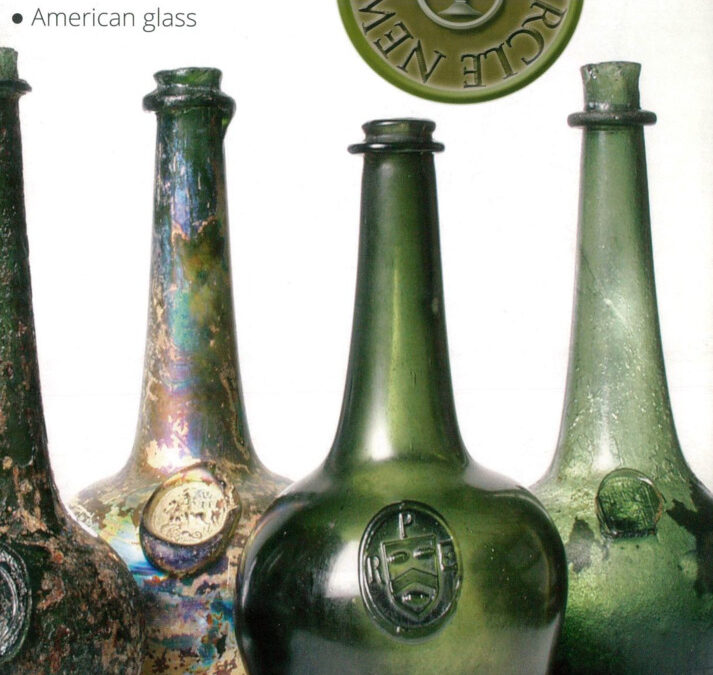
American glass
Chairman’s letter
Letters
My favourite glass
Antique sealed bottles
Moulded Roman glass
American glass
A new home
Reports
Reviews
The Adoration of the
Chairman. ohn
Smith, venerated by Andy McConnell, reclining in
as
glass hammock
made
by
Pinaree Sanpitak
in 2014.
It uses 632 beads and weighs 400 kg.
CONTENTS
Diary and news
Glass Circle News
ISSN 2043-6572
Vol. 38 No. 2 Issue 138 July 2015
published by The Glass Circle
© Contributors and The Glass Circle
www.glasscircle.org
Editor
Jane Dorner
editor@glasscircle.org
9 Collingwood Avenue, N10 3EH
Design and layout
Athelny Townshend
designer@glasscircle.org
Neither the Glass ( ‘axle nor any or im officers rw committee
members bear any Imponsibility for the views expressed in this
publication, which are those of the contributor in each case. Every
effort has been made to trace and acknowledge copyright in the
photographs illustrating articles. The Editor asks contributors to
clear permissions and neither the Editor nor the Glass Circle is
responsible for inadvertent infringements. All photographs are
copyright the author(s) unless otherwise credited.
Printed by
Micropress Printers Ltd
www.micropress.co.uk
Next copy date:
15 September for the November edition
Cover illustration:
A group of London and Oxford tavern sealed bottles dating
from she late 1650s to 1670. © David Burton
EDITORIAL
irtually all the readers of
cp
this letter will be collectors
of glass, some modest,
some with deeper purses.
We all rely on the scholarship of others
when making purchases, so that we can
tell our friends accurately what we own.
Nothing is more embarrassing
that to be told when we say ‘it’s a
mid-18th-century mead glass’, ‘oh
no, that theory was dispproved in
the 1980s; it’s a champagne glass’.
The year 2016 is likely to be a
bumper year for British glass scholarship.
Dr Jill Turnbull’s new book on Scottish
Glass made between 175o and z000
should be in the bookshops and two of
our members are submitting papers to
The Journal of Glass Studies,
published
by The Corning Museum of Glass.
These papers concern the production
of glass in England in the 17th century.
Apart from archaeological work little
new thinking has been published on
this topic since Hartshorne published
in 1897 (although the latter statement
might be disputed by David Watts who
has indeed worked in this area). Both
the authors have gone back to source
material, a very time-consuming process.
Our knowledge of the period leading up
to Ravenscroft’s manufacture of glass
has been full of supposition, and the
period just after Ravenscroft started
even worse. At last we are starting to
have a better knowledge of how, when
and where lead was introduced into
vessel glass and the
effect
that this had
on glass design. None of these three
authors are academics working
in universities, but amateurs
with time and the mindset of
true scholars.
In May some zz members
visited glass museums in the USA
and Rebecca Wallis, curator at the V&A,
has written about our trip (see page 23).
One of the places we visited was Toledo,
Ohio, where we were shown the vase
illustrated opposite. Once upon a time
this glass was attributed to Ravenscroft;
the consensus today is that it is probably
French, but still late 17th century. Now
that we have non-destructive analysis
by X-ray fluorescence, I am going to ask
the museum to test the composition of
the glass, particularly looking for lead,
and the metal colourant used. The
original attribution to Ravenscroft was
by ‘connoisseurship’; we now look for
evidence. The visit was not all work.
The illustration shows me relaxing on a
glass (what else?) hammock outside the
Toledo museum.
Chairman’s letter
by
John P
Smith
1
Glass Circle News Issue 138 Vol. 38 No. 2
2
Mary Lowndes and Britten & Gilson,
detail of east window (1896),
Holy Innocents’ Church, Lamarsh, Essex.
Arts & Crafts Stained Glass
by
Peter Cormack
Beautifully illustrated and based on more than three
decades of research,
Arts ea Crafts Stained Glass
is the
first study of how the late-19th-century Arts and
Crafts Movement transformed the aesthetics and
production of stained glass in Britain and America.
A progressive school of artists, committed to direct
involvement in making and designing windows,
emerged in the 1880s and 1890s, reinventing stained
glass as a modern, expressive art form. Using
innovative materials and techniques, they rejected
formulaic Gothic Revivalism while seeking authentic,
creative inspiration in medieval traditions. This new
approach was pioneered by Christopher Whall
(1849-1924), whose charismatic teaching educated a
generation of talented pupils — both men and
women — who produced intensely colourful and
inventive stained glass, using dramatic, lyrical and
often powerfully moving design and symbolism.
Peter Cormack demonstrates how women made
critical contributions to the renewal of stained glass
as artists and entrepreneurs, gaining meaningful
equality with their male colleagues, more fully than
in any other applied art.
HB ISBN 978-0-300-20970-9
r.r.p. £50.00
SPECIAL PRICE £40.00
PETER CORMACK is a noted scholar of 19th- and
20th-century British and American stained glass,
William Morris and the Arts and Crafts Movement.
Published by Yale University Press
for the Paul Mellon Centre for Studies in British Art
Louis Davis and James Powell & Sons, detail of
Benedicite
windows (1910), St Colmon Parish Church, Colmonell, Ayrshire.
ORDER FORM
To receive this title at the special discount price, send this form to: Yale University Press, Direct Mail Department,
47 Bedford Square, London WC1B 3DP Tel: 020 7079 4900 email: sales@yaleup.co.uk
Send to (please print): Name
Address
OR ORDER ON-LINE
www.yalebooks.co.uk
Online promo code Y1457 expires 28/02/2016
Please send me
copies of:
Arts & Crafts Stained Glass
HB ISBN 978-0-300-20970-9 at Er
s440 £40.00
Subtotal
Delivery: FREE in the UK
Delivery (outside UK*)
Total order amount
Your order will be processed by John Wiley.
YaleBooks
www.yalebooks.co.uk
Payment method:
EICheque
enclosed (payable to Yale University Press)
q
Visa
q
American Express
q
Mastercard
Please supply billing address of your credit card if different from the address above:
Credit card no.
Expiry date
Start date
Security code
Signature
*Delivery: Add the following to your order to cover delivery if outside
UK: EUROPEAN customers (EU & non-EU) add £5.35 surface mail;
£12.75 airmail. ALL OTHER COUNTRIES add £7.75 surface mail;
£14.95 airmail
q
Tick here if you wish to receive notifications from Yale about related books
EDITORIAL & LETTERS
At the EGM in June you
approved some minor changes
to the constitution, and revised
and simplified subscription levels.
The subscription levels should
have been raised two years ago,
but this changed was postponed
while we were in discussions
with The Glass Association. Your
committee decided that it was
important to keep up standards,
with seven first-class lectures
each year, international visits,
and a magazine of high quality.
The quality of the magazine is
self evident, the Director of The
Corning Museum of Glass is
happy to appear in it! (see page ii).
Our future will continue very
much as in the past. Our lectures
will continue to be held at The Art
Workers’ Guild in central London,
sometimes using the smaller Gra-
didge Room upstairs, which has
been recently refurbished and is
considerably cheaper. For a variety
of reasons some meetings will be
on Wednesdays and Thursdays as
well as on our traditional Tues-
days. There has been some regret
that the merger did not take place,
as there was much sense in it, but
general relief that the Cirde will con-
tinue without having to make unhap-
py compromises.
The problem of our library
continues
to
exercise
the
committee, as it will have to move
from Sir Mortimer Wheeler
House soon. In April we heard
two talks on the future of the
Broadfield House collection and
its impending move to the White
House site (see page 2o). It is
possible that our library might
move there, if indeed they intend
to have a library and study room
there, which is in doubt.
Letters to the editor
LEFT:
Stephen
Pohlmann’s drawn
trumpet wine glass
All letters
about a
previous
edition
of the
magazine
refer to
Vol. 38 No.
1
Issue no.
137 unless
otherwise
stated.
Back copies
M
y father, Philip Jackson,
died last year and he has left
copies of the
Glass Circle News
nos
7 to 125 (I think every copy in
between). Sadly, neither my sister
nor I share his detailed interest
in glass and so it is unlikely that
we will need to refer to them.
I
see
that the Editor appealed for
certain missing copies in March
2011 and I’d be happy to let you
have all of them or just selected
ones for your records.
Paul Jackson
Bath
Editor’s note: In the fullness of time,
Philip Jackson’s copies arrived and
I now have a complete set for future
editors with the exception of issues no.
1
to
6.
Can anyone provide them for me
— photocopies would do.
Favourite glass
I have a (complete) glass just like
Patrick Hagglund’s ‘pieced-
together’ version. Mine is slightly
smaller, being only 12.5 cm high (5
in.), and no tear, which is perhaps
symbolic, and I do understand his
affection for his glass. My similar
trumpet may not be my no. 1
favourite, but if it broke, as did
Patrick Hagglund’s, it probably
would be.
My broken glass story concerns
an early posset cup. When we
moved to Israel in 1984, this was
the only piece damaged in the
shipment. A bad crack from one
side of the bowl to the other. But
still in one piece. The insurance
assessor came, and OK’d full
compensation. But then he
attempted to take the bowl with
him. Officially, it now belonged to
the insurance company. I stopped
him; almost threatened him. He
had officially declared it a total
loss, yet here he was, trying to
get his hands on it, for whatever
reason. He took the hint, and it is
still there, over 3o years later, still
in a place of very special affection.
Stephen Pohlmann
Tel Aviv
Marinot
s Penelope Hines explained
n her article on the works
of Maurice Marinot assembled
for the exhibition A Passion for
Glass currently being held at
the National Museum Cardiff,
examples of Marinot’s glass are
rare. Members who make trips
to Normandy may, therefore, be
pleased to note that there is a
small but impressive collection
of Marinot’s glass in the Dieppe
Museum.
Christopher Maxwell-Stewart
East Sussex
Glass Circle News Issue 138 Vol. 38 No.
2
3
LETTERS
Glass breaks
I
was interested to read the
obituary of Chris Sheppard
and was reminded what a great
raconteur he was.
I remember he told me how
he went to Zurich to collect an
antique piece of glass from the
free-port zone. He took the tram
which goes from the centre of
Zurich to the warehouse. On the
return journey after he’d collected
the glass he caught the tram and
placed the glass, in a bag, on the
empty seat next to him. At the
next stop a very big lady got on
board and before he realised what
was happening the lady had sat
down next to him and crushed the
glass.
Chris told this as if it was an
everyday occurrence and just
laughed about it. He found it
amusing rather than tragic and
that says a lot about his character.
David Giles
London
Sang: conjecture
A
thelny Townshend’s exposi-
tion of his thinking process
on his Sang glass was fascinating.
I assume that the scrollwork
below the boat is indicative of the
sea. Elsewhere it is just decoration.
Sang uses a distinctive type of
engraving when portraying water.
The type of scrollwork evident on
his glass, as far as I am aware, is
not found on Sang glasses and as
far as I am can gather it is also not
found on Dutch engraved glass.
While I accept that the
engraving is crude it resembles the
‘German Metic style, see Thorpe
Plates XCVI
If this were
a Sang family engraving how did it
get to the UK as it is most unlikely
that that a collector would buy the
glass because of the poor quality
of the engraving. So if the glass
were engraved in England by a
German Metic does this support
the eternal argument that these
Dutch style light balusters were
made in England and exported to
Holland and engraved there. The
argument is endless.
Graham Vivan
London
Sang: response
G
raham Vivian raises an
interesting point that the
engraving looks to be in the style
of German Metic engraving, a
style not seen in the work of any
Dutch engraver, including Sang.
A
much
closer match in style to
those
mentioned in Thorpe can
be seen in the panel moulded
flip glasses which are sometimes
claimed to be American and
sometimes German. In either
case it is generally accepted that
they are both carried out by
German engravers on their travels.
However, I think the issue of the
style of engraving being German
in origin actually supports my
argument. It is reasonable to
assume that when teaching a
novice the basics of engraving Sang
would probably have taught them
in a similar way to how he himself
was taught. The technology used,
a treadle-powered grinding wheel,
is the same for both the cruder
and cheaper German metic style
and the more refined, but more
expensive, Dutch styles . The main
difference is that the former used
the side of the wheel and the latter
used the edge.
Graham also wonders why the
glass turned up in England. This
is difficult to explain. However
the most extraordinary thing
about this glass is for it to have
survived at all. People, over several
generations, must have cared
about it enough to protect it for
over 25o years… how else can you
explain its continued existence?
And yes, it does add to the debate
about where these glasses were
made!
Athelny Townshend
Suffolk
Other Sangs
I
thoroughly enjoyed Athelny
Townshend’s ‘skip through the
unknown: It’s a perfect example
of why everyone should have a
passion such as our love for glass.
There are so many aspects to this
tale.
It starts with a beautiful light
baluster. The ‘bad/naive/amateur’
engraving will have spoilt the glass
for some, but for others, it opened
up a world of conjecture. And
that’s absolutely OK; part of glass-
collecting.
I have two signed Sangs, both
also dated 176o. One is the classic
image of a ship – plus engraving
around the foot.
The other is, for this subject,
more interesting, for it is an almost
identical glass to the ‘Nottingham;
except the bowl appears to be
slightly more rounded.
The subject is a farmhouse, with
the usual inscription. The stem is
composed; the height is
20.9 cm.
Just like the Nottingham.
Stephen Pohlmann
Tel Aviv
BELOW LEFT
AND BELOW:
The engraved
Nottingham goblet
compared to a
German/American
engraved flip glass.
BELOW RIGHT:
Stephen Pohlmann’s
M type stem goblet
engraved and signed
by Jacob Sang.
Glass Circle News Issue 138 Vol. 38 No. 2
4
Vy favourite glass
FAVOURITE
aving
bought and
disposed of
many pieces
of antique glass over the last
25 years or so, my present
interest is in old, hand-crafted,
domestic jugs and bowls. My
favourite glass though is none
of these things. It is a modern,
mass-produced,
moulded,
industrial acid flask. I have
been aware of it for several
decades but have only recently
acquired it. Standing at a
height of 7
1
/2″ (18.5 cm) it is
31/4″ (8.3 cm) in diameter. To
reinforce its original purpose
and to highlight the danger
from the liquid within, the
previous owner labelled the
flask CONC. SULPHURIC
ACID.
The beach glass within it
was collected a short walk
from where I live. One day,
on a swimming expedition
with my wife, I noticed small
pieces of glass amongst the
shingle. This gave me the idea
of collecting it and putting it
into a much smaller flask than
the one shown but from the
same source. After the pair
to the small one was drained
of peaty whisky that too was
filled with glass, as was a small
scent bottle.
The best-looking pieces
have been rounded and
frosted over the years by
the continual action of the
waves over the shingle. It is
impossible to tell now, for the
most part, from what kind
of vessel they came, although
most are probably from
bottles. The best finds have
been two green flask stoppers
and two circular bottle
stoppers. It is interesting to
think about where all this
glass was made, what kind
of vessels were involved, how
they came to be in the sea and
how long it had all been there.
by
Simon
Cook
The colours are just as
appealing as the shapes and
there is always the eager
anticipation of finding a
rare hue and the resultant
excitement when it is spotted
and retrieved. Mostly the glass
is clear, with very pale blue
and very pale green also in the
majority. Next comes emerald
green and then brown but
the rarest and most unusual
colours are navy blue, orange,
lemon yellow and lime green.
Red is the ultimate find, with
only one piece found out of
more than 3,000 collected.
The supply also seems to be
inexhaustible, for I can collect
hundreds of pieces one day
and return just a few tides
later and collect many more.
It is a case of the thrill of the
hunt but with guaranteed
results!
My flask and the other two
came from my late engineer
father’s garage. During
the weekend that I
gave the scent bottle
to a friend and the
small flasks, which I
had had for several
years, to my mother
and sister I retrieved
the larger one. It had
been languishing in
the garage because
the council would
not take it and the
stopper was jammed
tight. To free it I
applied some oil
to the top of the
stopper and a pair
of pliers got it out.
The small amount
of acid was disposed
of and the flask was
thoroughly cleaned
then filled.
The three flasks
in particular are
not only a tribute
and memorial to my
father but also to
my brother because
both visited me at
my seaside home. If
I had had to pay one
pound for each piece of
glass in my flask it would
have cost me £875. As it is,
the glass was free but the
joy and cumulative pleasure
of collecting it, sorting it,
looking at it and recalling
all those happy memories
of my father and brother is
priceless.
Simon Cook is a lecturer,
naturalist
and
polar
bear guard.
Glass Circle News Issue 138 Vol. 38 No. 2
5
BOTTLES
Antique sealed bottles
The shape and classification of the bottles
o
n
n
ito March I
gave a talk to
e Circle on
my three-volume
book titled
Antique Sealed
Bottles
1640-1900
and the families
who owned them.
This
book, published in
January zo15, brings
together a definitive
listing of British-
manufactured sealed
bottles with a social
and genealogical history
where many of the original
owners have been identified.
It examines the evolution of
the sealed bottle from the
164os to the late
1800s,
the
early glasshouses involved
in their manufacture, the
social and historical stimuli
that made changes in style
inevitable over relatively
short periods, the early inns,
taverns and coffee houses and
their use of sealed bottles,
the trade tokens that were a
major influence on the seal
engravings associated with
the tavern and inn keepers,
the bear-baiting and cock-
fighting across the River
Thames in Southwark, and
the records of the Oxford
colleges and Inns of Court
that provide information on
the drinking habits of the
well-to-do sons of the gentry
and noble families. With
many of the bottles sealed
with a crest or coat of arms,
the nuances and complexities
of heraldry are discussed in
detail to inform the collector
and encourage research in
this often misunderstood and
neglected field.
With the many recent
discoveries of bottles and
seal fragments excavated in
the former British colonies of
North America, it embraces
the use of merchant marks
in the colonies and the
harsh life of the early New
World colonial settlements,
the slave markets and the
absentee plantation owners
who accumulated vast wealth
through the hard graft of
the overseers and slaves
who worked the
plantations.
The
4,729
sealed
bottles and fragments
recorded in the book’s
main list are not
viewed in isolation
as simple pieces of glass
belonging to a certain historic
period. They contribute
a
more
broadly-based
introduction to the wider
subject of sealed bottles,
their design, evolution and
manufacture, balanced by the
changes in style as a result
of the need to lay down
wine to improve its quality
and longevity, and how this
relates to the social history of
the day, the individuals who
ordered and used the bottles
at home or in the private clubs
frequented by gentlemen,
much influenced by the
historic events of the i7th
through to the zoth centuries.
Genealogical research is
evident on every page and
some fascinating histories
have been uncovered where
wealth bought titles, but
where titles did not necessarily
create wealth.
RIGHT:
Fig.
2
This bottle dated 1674 was
purchased by Roger Dumbrell
from Richard Dennis in
Kensington Church Street
in 1976. Until this time,
the previous record price
paid for a sealed bottle was
£950 but this bottle sold for
£5,000, which featured in
the national press at the time
and changed the perception
of sealed bottles for ever.
THE ONION
c.1680-90
BELOW LEFT:
Fig.
3a
A short’stubby’ neck which
made it difficult to grasp and
pour, large bulbous body with
a deep basal’Idck-up’ and disc
pontil scar. Note the position of
the seal at the base of the neck,
almost covering the shoulder.
This was not the most efficient
of styles and yet the shape
lasted almost fifty years.
THE SHAFT & GLOBE
c.1640-1675
LEFT:
Fig. 1
The classic style of the 165os
with a long slender neck, some
slight tapering towards the
shoulder where it joins the
body, the string rim positioned
well down from the lip, small
bulbous body with a shallow
basal ‘kick-up and glass-
encrusted pontil scar.
Pre-1650-166o
BELOW:
Fig. 3b
Note the position of the
seal as it moves south.
C.1690-1700
by
David
Burton
6
Glass Circle News Issue 138 Vol. 38 No. 2
RIGHT:
Fig. 4
An elegant half size bottle with
a more rounded bulbous body.
Note the engraving of the
letter ‘w’, a combination
of the letters and ‘u’
which was common in
the late 17th and early
18th centuries.1710 -20
THE MALLET
C. 1715-50
RIGHT:
Fig. 6
With a long
elegant neck,
sloping shoulders
and short body,
this is an example _
from the 172os
with a most classy
outline in the style
of an Indian club.
THE BLADDER
c.
1715-40
ABOVE & LEFT:
Figs. 5a & 5b
The rarest of all the bottle
shapes and known affectionately
as ‘Bastard’ bottles, so-called
after the name of a family
from Kitley House,
Yealmpton, Devonshire
who ordered many
examples. Note the
frontal view and the
view from the side
(fig. 5b), so designed
to ensure easier
transportation with
less damage, and
encourage the
binning of wine.
THE EQUAL-SIDED
OCTAGONAL
CYLINDER
c.
1740-85
RIGHT:
Fig. 8
This is also known as the
`rounded’ octagonal shape with
a long elegant neck, sloping or
angular shoulders, moulded
body with a deep basal ‘kick-
up’ and sand pontil scar.
THE RECTANGULAR
OCTAGONAL CYLINDER
C.I730-90
LEFT:
Fig.
7
A long elegant neck, sloping
shoulders and moulded body
with no evidence of chamfered
sides in the four examples
in the author’s collection,
and a minimal basal lick-
up’ with no pontil scar.
The Cylinder
C.I740S
-1900+
Left:
Fig. 9
This is much closer to the
shape of today with a short
or long tapering neck, narrow
body with a more elegant style
or a wide body with a much
heavier and more ‘weighty’ style.
The lick-up’ is wide and deep
with (usually) a sand pontil
scar.
BOTTLES
Glass Circle News Issue 138 Vol. 38 No. 2
7
THE
‘
CARBOY’ CYLINDER
177os -8os
RIGHT:
Fig. lo
Bottles in this
style are often seen today
as display bottles in
pharmacy windows.
This was probably
not the
case
in the
short time, less than
20 years, this style was
being manufactured.
All the seal engravings
can be associated with
private individuals.
paper label to the base.
The base is embossed
W SHIELS
& C° /
LEITH
which was
assumed to
be the name of the
wine merchant. The
seal is engraved BORDER
MAID 1877 encircling the
seal, which was thought
Glass Circle News Issue 138 Vol. 38 No. 2
RIGHT:
Fig. 13
This is best described
as a fairly mundane
cylinder bottle
dated 1877. It was
not until a visit
to Berry Bros.
& Rudd that an
identical bottle
was discovered
in their collection,
but with the
addition of an ancient
8
to be the name of a whisky.
How wrong can one be: the
Border Maid was the name
of a ship, not a whisky! 1877
was the 4oth anniversary of
Queen Victoria’s accession to
the throne and on 1 January,
she was proclaimed Empress
of India: the sealed bottles,
filled with Scotch whisky,
would have been shipped in
celebration of the occasion.
BOTTLES
HENRY RICKETTS
‘
PATENT OF 1821
BELOW:
Fig. 12
The 19th century is marked by
the introduction of the three-
part moulded bottle in the early
182os, which revolutionised the
manufacturing process. The
mould was patented by Henry
Ricketts of Bristol and was
granted on 5 December 1821
and enrolled (i.e. approved) on
z6 January 182a. It simplified
the process of manufacture
and produced the body and
neck of the bottle in equal
size and weight, which proved
to be so successful that other
glasshouses producing bottle
glass had changed their method
of production within a few years.
‘The heart of the apparatus was
a hinged cast-iron mould that
was normally kept open by
gravity, so that the paraison (the
gather on the end of the blow-
pipe) could be introduced. Then,
the operator stood on a pedal to
THE SQUAT CYLINDER
1755
-1
83
0
BELOW:
Fig.
u
A group of three bottles dated
to the 178os from the southern
edge of Dartmoor. The bottle
in the centre is unique, being an
equal-sided octagonal cylinder
with the squat cylinder shape.
These are the bottles with
the largest capacity, averaging
some nootn1 compared with
the 75oml of today’s bottles
and were used by the yeomen
farmers and heavy-duty workers
of Cornwall, Somersetshire and,
to a lesser extent, Devonshire.
close the mould, removing his
foot from it when the bottle had
been blown. The arrangement
of pedals and levers permitted
the use of any mould required,
and it was easily adaptable
to produce bottles of large or
small capacities (Wills, p.23).
One rather sad result of Henry
Ricketts initiative was the
decline in the number of sealed
bottles, which accelerated after
ifizz. Mechanisation gradually
took over the manufacturing
process and from the mid-183os
it is evident from the number of
examples recorded that demand
for the sealed bottle was in
terminal decline. It has never
reappeared in any significant
quantity although some
businesses even today incorporate
an embossed seal bearing a
company logo or crest, used as a
marketing tool for their products.
BOTTLES
NAUSEA STYLE
1740-1820
The Nailsea Glassworks near
Bristol, established in 1788,
was an important source of
window glass and a wide range
of domestic glass, including
bottles, in the early 19th century.
The individual style of the
glass with the use of enamel
chips was known before
5788
but it has proved difficult to
associate any sealed bottle with
the Nailsea factory. The term
Nailsea style has been used
throughout the book to describe
this specific style of glassmaking.
LEFT:
Fig./4
The style of the lip and string
rim, shallow’kick-up’ and lack of
a pontil scar confirms the dating
of this Nailsea style Rectangular
Octagonal Cylinder to the 1740s.
ALLOA GLASS
Following the loss of the
American colonies in 1776,
trade between England and
America reduced to a trickle
and it was left to the Scottish
glass producers to re-establish
trade links and produce bottles
that appealed to the new
emerging independent nation.
The Alloa Glass Work had
been established by Frances,
Lady Erskine in about 1750
and towards the end of the
i8th century it developed free
blown glass in an individual
style that appealed to the
American market. The earliest
example produced at Alloa is
dated 1792 and all the examples
over a period of some 3o years
were sealed with initials only,
making them cheaper and
therefore more attractive than
the American-produced bottles.
BELOW:
Fig.
15
This revealing example lacks
any enamelling but introduces
eight rigaree glass trails, four
long, four short, running down
the side of the body. Revealing
also because of the detail of the
seal engraving dated 1821 which
carries a rake
and wine press,
almost certainly
the mark of a
wine merchant.
STIPPLE-ENGRAVED
ALLOA GLASS
With the continued decline
of an early steam train and
in demand for sealed
carriages stopped at a signal.
bottles, irrespective of the
The subject of the engraving
individuality of the style, the
suggests that the bottle was
Alloa glassworks
a presentation piece, possibly
introduced
to mark the retirement of
stipple-engraving
Robert Seath as he would
on
plain unsealed
have been aged about sixty
bottles in a final
in 1853. The auction hammer
effort to produce
price of US$1,800
a
product that
equivalent) is a record for an
was not too
Alloa glass stipple-engraved
expensive
bottle and this may reflect
but
the engraving of the early
would
steam train which would be
appeal
of much interest to collectors
to
of railway memorabilia.
those
who
wished
to mark
an occasion,
perhaps an engagement,
marriage, birth, retirement
or death, or simply being
Scottish. This flourished
from 5830-80.
ABOVE:
Fig.
16
This is a fine example
that probably marks the
retirement of Robert Seath
in 1853. The engraving is
THE SEAL ENGRAVINGS
BELOW LEFT:
Fig
17
Marking a bottle to denote
ownership or workmanship
was not new in the 17th century.
There is a good example in
the V&A of a bottle found
at Amiens in France which
is indistinctly marked on the
base FRONTIN 0. Frontinus,
who worked in the 3rd-4th
centuries AD and who probably
made the bottle at Boulogne
or Amiens, was originally from
Syria. A similar example with
an everted rim and strap handle
bears a moulded inscription
to the base, again slightly
unclear but identified
as
YOHAIAYO h.
A number of these
early moulded bottles
incorporate the name of
the manufacturer on the
base with most examples
having a simple, square
design for ease of transport
throughout the vast Roman
Empire, similar to the Dutch
case gin bottles shipped to the
East and West Indies in the late
i8th and early 19th centuries.
The seal engraving can be
viewed as the key that can
unlock the social history
associated with a simple
utilitarian object. The addition
of the seal introduces a third
dimension to the collecting
of these early artefacts. In
how many other fields of
collecting can one experience
that eureka moment when you
identify the original owner and
are in a position to uncover
perhaps 300 years of history?
BELOW:
Fig.
18
This is a simple engraving on
a tavern bottle dated to
the 166os sealed
WILLIAM
CLIFFTON
encircling
a golden
fleece,
the sheep
hanging
by a strap
around its
1
19.8
48:1
–
Glass Circle News Issue 138 Vol. 38 No. 2
middle being clearly visible in
the centre. He was tavern keeper
of the Golden Fleece tavern
on the site of what is now the
Drury Lane Theatre. The tavern
had a notorious reputation for
homicides, this part of London
being not of the highest public
standard, hence the reluctance
on the part of ladies to enter
a tavern, even with a male escort.
RIGHT:
Figs. i9a & b This is
the earliest complete example of
a dated sealed bottle with P /
R M (pyramidal format) / 1657
flanking a kings head, crowned,
and has been attributed to a
Kings Head tavern.
The head resembles
Charles I but is dated
during the period of the
Commonwealth when
Oliver Cromwell, Lord
Protector of England
(1653-1658) and king in
all but name, ruled
the country.
It has been
suggested
that the bottle
was made
a few years
later than 1657,
possibly early
in the reign of Charles II to
celebrate his accession, but the
early shape of the bottle would
rule this out.
A more logical explanation is
given by Woods, p.313).’In this
month (April 1660) all tokens
of monarchy restored. Armes
that had been plaistred
over in the broken
times, especially
those in the Public
Schooles, were all
plaistred (i.e. set up
again in plaster). The
signe of the Kings
Head that had been
dashed out or daubd over in
paint tempore Olivare (and in
its place was written’This was
the Kings Head’), was new
painted’.
BOTTLES
THE ENTRANCE TO THE CITY
(W
LONDON
ABOVE: Fig. zo The heads of
the felons on pikes served as
a warning to those entering
the city across London Bridge.
The figures closest to the
entrance are standing outside
the Bear Inn, one of the most
famous hostelries south of the
River Thames and one of the
favourites of Samuel Pepys.
There is a bottle associated
with the tavern dated c.1663
sealed C / T D surmounting
a bear, with THE WHIT
BEARE AT THE BRIDGE
FOOT encircling the seal
(fig.
21,
below). The initials
refer to Thomas & Deborah
Cooke who were married in
1663 at Canterbury and the
bottle(s) would have been
ordered to mark the occasion.
Thomas was the son of
Cornelius Cooke, inn keeper
at the Bear until 1666, when
he was succeeded not by his
son but by Abraham Browne.
The front cover image shows a
group of London and Oxford
tavern sealed bottles dating
from the late 165os to 567o. The
bottle with the degraded surface
(left) was recovered from the
River Thames at Wapping and
is from the Goose and Gridiron
tavern in St Paul’s Churchyard.
The irrisdescent bottle (second
left) was also recovered from a
river in the city and is associated
with a St George
&
the Dragon
tavern. The next one is the
Three Tuns tavern in Oxford,
one of very few examples of
this period in mint condition,
and the one to the right is
from a Bull’s Head tavern.
BACK COVER:
Fig.22a
The Colborne bottle. Note the
silver mount on the bottle from
the Sun tavern, behind the
Royal Exchange, a bottle famous
for its connection with Samuel
Pepys. The initials N C relate
to Nicholas Colborne, tavern
keeper from 1651 until 1664/65.
Compare this bottle with the
Wyche bottle (fig. 22b below
right) which is held in The
House of Sandeman collection.
Both have 17th century silver
mounts with silver bottle
stoppers and chains which are
identical in style, but slightly
different in pattern, to each
other. So what is the connection
between the two The bottle
in The House of Sandeman
collection bears the Arms of Sir
Cyril Wyche, elected President
of the Royal Society in 1683 and
succeeded, in 1684, by Samuel
Pepys. Sir Cyril also preceded
Samuel Pepys as First Lord of
the Admiralty. Did Sir Cyril also
frequent the Sun tavern behind
the Royal Exchange; it was, after
all, one of the most important of
the city taverns at the time? Sir
Cyril purchased Hockwold Hall,
near Thetford, Norfolk after
retiring from public life and the
Nicholas Colborne bottle was
also found in Norfolk, quite
close to Kings Lynn, which,
given the three-way connection,
makes it interesting to speculate
that Sir Cyril and Nicholas
Colborne ordered the elaborate
silver mounts at the same time,
slightly later than the date of
their bottles. It is also recorded,
z3 October 1663, that Samuel
Pepys had his own bottles
made and sealed.`Thence to
Mr Rawlinsons and saw some
of my New bottles, made with
my Crest upon them, filled
with wine, about five or six
dozen: It would be interesting
to speculate that Pepys bottles
also carried a matching silver
mount and stopper in the
style of the Colborne and
Wyche bottles but this would
be too much to expect.
David Burton is the author of
Antique Sealed Bottles 1640-
190o and the families who
owned them.
Copies of the
three-volumes can be
obtained direct from
him at david@
burtonl.com at
the special price of
£175 (RRP Lz5o).
Notes
Wills
(The Bottle-
Collector’s Guide,
1977, p.23)
Woods
(The Life
and Times of
Anthony Wood,
Antiquary, (1623-
1695),
p.313).
10
Glass Circle News Issue
138
ROMAN G LAS S
lVould-b own glass fro m ancient Rome
All images (0 Corning Museum of Glass unless otherwise stated. Museum numbers
are given in square brackets.
here is one
t
g
n
element of
mould-blown
glass that sets it
apart from all other Roman glass.
From mould-blown vessels, we
have preserved the names of a
small group of glass artisans
from the 1st century AD.
The artisan responsible
for the manufacture of
the earliest and finest
Roman mould-blown
glass was a man called
Ennion. His name is
known because it was
incorporated into designs
of the moulds used to
make his vessels. Set within a
rectangular panel, Ennion’s name
is written in Greek letters, and
it is combined with a verb form
meaning ‘made by’ — ‘ENNIWN
ETIOIE’ or `ENNIVVN EHOIESEN’
(Ennion made it). His name
is preserved on only three basic
shapes: cups, six-sided flasks, and
jugs.
Although we have his name, we
know very little about the man,
other than that he worked and
lived in the eastern Mediterranean,
where Greek, rather than Latin,
was commonly spoken. This
suggests that his workshop was
located near Jerusalem, possibly in
the city of Sidon (in modern-
day Lebanon), which is often
cited by ancient writers
as a city famous for
its glass production.
Ennion’s
vessels
were highly prized
by his customers,
and pieces that bear his
name have been found across
the breadth of the Roman
Empire.
Archaeologists working in
different parts of the Mediterra-
nean basin and beyond have found
fragmentary and nearly complete
works by Ennion. One is a mag-
nificent jug that was badly dam-
aged when the building it was in
burned
down in
AD
70.
Most of
the exca-
vated piec-
es of En-
nion’s glass
have
come
from
ancient
burials
located
around
the Med-
iterranean
basin
from Cadiz,
Spain, to Pan-
ticapaeum in the
Crimea. This ar-
chaeological evi-
dence suggests
that, in addi-
tion to being widely
traded, Ennion’s glassware was
highly valued because it was given
as gifts to the dead.
Ennion’s works stand apart from
the larger corpus of mould-blown
glass for their refined designs
and delicate decorative patterns.
His designs set a high standard,
which his competitors attempted
to emulate.
A common language
of design
When designing his glassware,
Ennion was inspired by decora-
tions and patterns from a number
of sources, including architecture.
The honeycomb pattern seen on
Ennion’s jugs and cups, for exam-
ple, may have been derived from a
type of Roman brickwork known
as
opus reticulatum,
a construction
technique that was introduced in
the 1st century BC. The refined
decorative patterns in Ennion’s
mould designs demonstrate a
high level of creativity, elegance,
and innovation. This same level of
refinement is not found on other
glass vessels, and scholars have
used the quality of the design to
determine whether an unsigned
work may have been made in En-
nion’s workshop.
The design vocabulary that
Ennion used was also employed
by artists working in other media,
including metalware and pottery.
The use of similar patterns in
different media illustrates the fact
that certain motifs, such as rosettes
and ivy tendrils or garlands, are
easily adapted to a variety of vessel
shapes. What works well on clay
or silver can also work well on
glass.
Only one of Ennion’s jugs still
retains its original foot,
which is preserved on
a jug in the collection
the Eretz Museum
in Tel Aviv, of which
Corning Museum of
Glass has a copy (fig.
i). A rectangular frame (called
a
tabula ansata)
is prominently
placed within a honeycomb-
patterned band. It bears the Greek
inscription ‘ENNIWN EITOIEr
(Ennion made it).
Ennion designed a variety of
drinking cups. While most have
by
Karol B
Wight
LEFT:
Fig.
Ennion jug
modelled after a
jug in
the Eretz
Museum, Tel Aviv
159.1.761
BELOW: Fig. 2
Drinking cup
166.1.361
Glass Circle News Issue 138 Vol. 38 No. 2
11
ABOVE:
Fig. 3
One-handled jug,
signed. Gift off.
Pierpont
Morgan,
1917
[17.194.226].
RIGHT:
Fig. 4
Hexagonal flask
(amphoriskos),
signed. Gift
of Henry G.
Marquand, 1881
(81.10.224)
BELOW:
Fig.
5
Unsigned jug
[65.1.2)
Fig
s
3 & 4
©
The
Me
tr
op
o
lita
n
Museu
m
o
f
Ar
t
ROMAN GLASS
one or two handles (as in
fig. a), one subset has no
handles. All are inscribed
with Ennion’s name, and
many bear a second inscription
on the back, `MNFIOH 0
ArOPAZWN’ (May the buyer
be remembered).
Ennion also designed
flat-bottomed jugs
(fig. 3). They serve
to exemplify how
Ennion modified
the shapes of his
wares, even when
using the sa
design. Like
footed jugs, the fla
bottomed jugs ar
decorated with th
tabula ansata
that bea
Ennion’s signature. This
one is blown into a four-
part mould.
Only two of Ennion’s flasks are
known. Fig. 4 was blown in a four-
part mould. The hexagonal shape
is similar to smaller perfume
bottles; and the panels offered the
mould maker a generous surface
on which to create his designs.
Each panel contains a different
motif associated with Bacchus, the
Roman god of wine. The flask is
inscribed ‘ENNIWN EIIWHCEN’
(Ennion made it).
Some unsigned jugs (fig.
5) have decoration similar to
Ennion’s signed pieces, but only
a few have been assigned to
Ennion’s workshop because their
decoration parallels other signed
works
Ennion’s competition
In addition to Ennion, we know
of four artisans who signed their
works by designing their moulds
in a similar way: Aristeas, Jason,
Meges, and Neikais.
Aristeas was a somewhat com-
mon Greek name in the eastern
Mediterranean, but little is known
about the individual who signed
his glass with this name. Of all the
l’-
—
Ii
glassworkers who signed
mould-blown vessels at
this time, however, Aris-
teas is the one whose prod-
ucts most closely resemble
, Ennion’s. In fact, the simi-
larities are so striking that
‘ 1 it is tempting to believe that
these two craftsmen worked
together. Only two intact
vessels signed by Aristeas
have survived
from antiq-
uity.
One
is the only
example of
Aristeas’s
work found
in Italy, from
a site near
Pavia. It is
inscribed with
the name of its
maker, followed by
a verb form meaning
`made by’:
`APICTEAC
EllOffif
(Aristeas made
it). Surrounding the
inscribed tabula
ansata
are three pairs of floral
sprays, one of which re-
sembles vine stems and
leaves On the second
known cup by Aristeas,
the artist identifies
himself as a
Cypriot, from
the island of
Cyprus.
All
the
beakers made
by
Jason,
Meges, and
Neikais share
the same sparse,
minimal, decora-
tion. The design
is domin-ated by
a pair of inscrip-
tions that appear
in broad bands
on the sides of the
cups. The inscrip-
tions are separated
by stylised vertical
palm fronds that also conceal the
seams of the glass moulds. Jason
and Meges are common Greek
male names, but Neikais is a rare
variant of Nikias or Nikaios, a
name that was given to girls as
well as to boys. All three of these
artisans, however, were probably
men who manufactured glass dur-
ing the same period. Their wares
have been found only in eastern
Mediterranean lo-
cations, which
suggests that
their wares were
not distributed
as broadly as
Ennion’s and
were made
for a local
market.
Inspiration
for design
Inflating glass in
moulds carved
with
decora-
tive and figural
designs was a
technique used
to create multiple
examples of a vari-
ety of vessel shapes
with high-relief pat-
terns. The moulds used
to shape this ancient glass were
complex in their design, and the
mould-blown glass vessels of an-
cient Rome tell a wealth of stories
about the ancient world, from
gladiators to perfume vessels, from
portraits of a Roman empress to
oil containers marked with the
image of Mercury, Roman god of
trade. When creating designs for
mould-blown glass, artisans had
a wealth of sources from which to
choose. For centuries, myths and
epic poems were used as image
sources in order to paint murals on
walls, to decorate ceramic vessels,
to form scenes on metalwork, and
to carve stone sculpture. Imitat-
ing the natural world was another
Glass Circle News Issue 138 Vol. 38 No. 2
12
ROMAN GLASS
LEFT
& BELOW:
Fig. 7a & b Vessel
for wine together
with a drawing of
the design running
round it
[59.1.152]
artistic practice,
so human heads,
animals, or fruits,
among other de-
signs, also served
to inspire. When
designing their
moulds,
glass
artists frequently
followed the prac-
tices of their fellow
artisans working in
clay and other ma-
terials, and scholars
can easily associate
vessels made with
the same imagery in
a variety of materi-
als. But glass artisans
also chose to forge
their own path. They
created new designs and
shapes that were unique to glass
because the properties of glass
enabled this material to do things
that other materials could not, due
to its malleability when hot. Lo-
tus-bud beakers, for example, are a
design found only in
glass (fig.
6).
Lotus bud bea-
kers come in many
sizes and were likely
used to drink both
wine and beer. Their
knobbed exte-
riors enabled
the
drinker
to keep a firm
grip on his
beverage con-
tainer.
On
vessels
used to drink
or serve wine
the imagery was
associated with
wine
drinking
or the mer-
rymaking of
the
follow-
ers of Bacchus,
the Roman god of
wine. The god is shown among his
followers (fig.
7).
Perfume bottles
and pyxides
Small flasks that
held perfumed oils
have survived in
abundance
from
ancient
times.
Their function and
decoration give us a
glimpse into ancient
life. Along with lidded
round boxes (pyxides)
used as containers for
jewellery or cosmetics,
these flasks would
have graced a dressing
table. There are many
different designs for the
perfume flasks, and their
decorative motifs often do
not have a clear association
with their function. These
motifs — symbols related to
Bacchus, images of birds, and
different vessel shapes — seem to
be purely decorative. But fruit-
shaped flasks in the form of dates
and grape clusters clearly advertise
their contents.
The decoration found
on pyxides is very elegant
and refined, with slender
palmettes and garland
swags. It relates these
vessels to Ennion’s
cups and jugs, and some
scholars believe that they
may have been made in
the same workshop.
Numerous
scent
bottles (as in fig.
8)
have
survived from antiquity,
perhaps because they were
often placed in burials as
gifts to the deceased. The
moulds used in the manu-
facture of these flasks were
frequently made in two parts, but
more complex moulds of three or
more parts were also used.
Identifying glass
workshops
Our understanding of how
mould-blown glass was designed
and manufactured is hampered by
the lack of archaeological evidence
from glass workshops that can be
dated to the 1st century AD. Very
few fragments of glass moulds
have survived, and those that do
often date to later periods. With
little evidence from glass moulds,
therefore, archaeologists and art
historians often look at the design
of the glass vessels themselves
to determine where they may
have been made. Small design
features such as the manner in
which a handle is shaped and
attached, how a rim
is fashioned or a
foot coiled on, all
are clues that help us
identify the products
that may have been
made within the same
workshop.
One glass
scholar identi-
fied vessels
from a work-
shop based
upon the man-
ner in which
their handles
were added.
Named the
‘Workshop of the
Floating Handles’, these pieces are
associated by the way the handle
is attached at the rim of a vessel,
then drawn down and flattened
at the bottom. Remarkably, the
base of the handle is intentionally
unattached and ‘floats’ above the
surface of the glass. In many in-
stances, the delicate handles have
broken off, so they are assigned to
this workshop by comparing pat-
terns to identical pieces in other
collections with handles intact.
LEFT:
Fig. 6 Lotus-
bud beaker (64.1.10
RIGHT:
Fig. 8 Scent
bottle (50.1.8.1
Glass Circle News Issue 138 Vol. 38 No. 2
13
SlitKvittMilaYlitw
zt L A fi
v*4 kill titkiugit
s
g/.4
6
4
-• •
Glass Circle News Issue 138 Vol. 38 No. 2
14
ROMAN GLASS
Each of the vessels made in this
workshop has a unique shape and
design; if the flattened handles
had not survived on some ex-
amples, this workshop might not
have been identified.
A group of cobalt blue vessels
(fig. 9) can be linked to the same
workshop by the design of their
distinctive wishbone handles with
pinched glass trails, and a foot
formed by a thick coil of glass. The
vessels were made during the 3oos
AD, and scholars believe that this
workshop was located somewhere
in the region of the eastern
Mediterranean.
Souvenirs
In antiquity, as today, vessels were
made as souvenirs to commemo-
rate a specific event or personal
journey.
Religious pilgrimages were
commemorated by the pilgrim
with the purchase of a mould-
blown vessel designed with
religious symbols, either Christian
or Jewish. Most of the vessels with
religious symbols were hexagonal
or octagonal, and a cross or
menorah often decorated one or
more of the vessels’ sides. These
vessels were often formed as
pitchers or large flasks. They could
have held holy water or oil, or they
could have been used to pour wine
in a ceremony.
Sports cups depict gladiators
in combat or chariots racing in
competition. Just as today’s sports
fans buy memorabilia related to
a team or individual, so did the
ancient Romans. The individual
gladiators are sometimes identified
by name, as are the teams of
horse-drawn chariots. The
majority of the mould-
blown vessels related to
sports competitions are
drinking cups.
Gladiators
were
the star athletes of the
ancient world. They
were befriended by
emperors and senators,
their achievements were
recorded in historical
texts, and their fans
scrawled their names as
graffiti on the walls of
cities. Gladiators were
immortalised by their
depictions in ancient art
— wall paintings, marble
reliefs, statues, and
vessels made in a variety of
materials.
Today’s Formula One
and NASCAR races
attract the same kind of
fan base as chariot racing did in
antiquity. Chariot drivers and
their horses were known, and
teams were named for animals or
mythical creatures that embodied
strength and prowess, just as
sports teams are today. Chariot
teams were also identified by
colours. Ancient writers have
written about the Greens and the
Blues, for example.
Fighting gladiators pair off
on the wine cup in fig. io, and
they are identified by name. The
armour worn by the gladiators
identifies their combat specialty.
The helmets, shields, and weapons
were each designed for a specific
type of combat.
Most of the cups were made
with three-part moulds, one
section for the base and two
sections for the sides. It was
common practice for the mould
makers to put a decorative palm
frond where the two side moulds
joined in order to conceal the seam
line that showed in the glass when
the vessel was inflated. A similar
tactic of using palm fronds to
conceal mould seams was followed
by Jason, Meges, and Neikais,
glass artisans who, like Ennion,
added their name to their mould
designs.
One type of drinking cup is
inscribed in Greek with the words
`KATAXAIPE KAI EYOPAINOY’
(Rejoice and be merry). Below
two horizontal lines, palm
fronds form a wreath above
the inscription, while a
chevron pattern below two
horizontal lines decorates
the bottom of the cup. The
words of the phrase are
divided between the two
halves of the glass mould, and
the mould maker concealed
the seams by adding vertical
palm fronds at the junction
of the two mould halves. This
use of vertical palm fronds to
ABOVE:
Fig.
9
Cobalt blue jug with
wishbone handle
T.59.1.194
RIGHT & BELOW:
Fig. ioa & b Wine
cup together with
a drawing of the
design running
round it 154.1.84.1
ROMAN G LAS S
RIGHT:
Fig.
ua
Square bottle
[66.1.168]
RIGHT:
Fig. sib
Underside
of the square
bottle. Situated
within a series
of letters that
fill the corner
is a standing
figure most likely
Mercury, Roman
god of commerce.
[66.1.168]
conceal mould seams can be seen
on other beakers with different
inscriptions and shapes, which
suggests that all of these beakers
may have been produced in the
same workshop.
Mould-blown glass for
the marketplace
When materials needed to
be shipped across the Roman
world, mould-blown glass ves-
sels became a natural solution
for merchants. Because mould-
blown vessels could be made
to the same size and had a con-
sistent interior volume, goods
such as olive oil and wine were
frequently shipped in them. For
the customer, glass bottles en-
forced governmental standards
of weight and volume. One could
see how much oil or wine the
bottle contained, and the seller
had no opportunity to cheat the
consumer. While the majority
of these bottles are four-sided,
others were designed to imitate
the wooden barrels and clay ves-
sels that were also used to trans-
port goods.
Those responsible for making
the moulds for bottles used to
ship materials usually chose to
keep the sides unadorned, and to
decorate the bases with identify-
ing symbols or groups of letters.
The figure of Mercury was often
chosen as a decorative emblem.
There is great variety among
the base designs, and consum-
ers undoubtedly looked at these
symbols to identify their pre-
ferred brands when making their
selections in the market. Similar
bottles used today have applied
labels identifying the contents,
but we have no evidence that
such labels were employed in an-
tiquity.
Many square bottles are
decorated on the underside with
an image of Mercury, Roman
god of commerce. Situated
within a series of letters that fill
the corner is a standing draped
figure, most likely the god
himself (fig. xib). This seems
quite appropriate because such
bottles were used to transport
goods throughout the empire.
Within a series of letters that
fill the corners is a draped figure
seated on an armchair.
Many of the finest of Ennion’s
surviving works from both
public and private collections are
on view at The Corning Museum
of Glass in the exhibition
Ennion
and His Legacy: The Mold-
Blown Glass of Ancient Rome
on show until January
2086
(see
Diary on page
32).
Two previous
exhibitions
Ennion: Master
of Glass
at The Metropolitan
Museum of Art, New York
City; and
Made by Ennion
at
The Israel Museum, Jerusalem
inspired this exhibition and
have focused much-deserved
attention on Ennion, one of the
most important glass artisans in
the ancient Roman world.
Blowing glass into moulds
continues to be a manufacturing
process to this day, and honours
a tradition that began with the
Romans about
2,000
years ago.
Karol B Wight, PhD is President
and Executive Director of The
Corning Museum of Glass.
Glass Circle News Issue 138 Vol. 38 No. 2
15
AMERICAN GLASS
Getting to know American glass
his ispersonal
journey
t
g
al.
ex-
plored
in
the Robert
Charleston Memorial Lec-
ture (6 May) accompanied
by 50 slides and a table-
top display of American
glass. I began by ex-
plaining that the earliest
known glassmakers were
three Germans, Cas-
par Wistar (1739-52),
Henry William Stiegel
(1764-74) and John Fred-
erick Amelung (1743-98),
who set up factories in what
is now called Wistarburgh, New
Jersey, South of New York. Wistar
and Stiegel made mainly window
glass and bottles in a greenish
poorly fined metal. They are only
positively known by single pieces,
Wistar, a bottle with the initials
of his son Robert, and Stiegel an
English style opaque twist goblet
for the marriage of his daughter
with engraving attributed to La-
zarus Isaacs from Bristol. Both
are now in the Corning Museum
of Glass. Amelung, who took over
the Stiegel glasshouse, is know
from a number of engraved pieces
in a better quality glass and the ex-
tensive investigation of his glass-
house.
What happened next is
greatly influenced by American
resentment of the heavy tax
burden imposed from London.
It led to the Declaration of
Independence in
1776
and the
banning of all English glass
imports. The demand for English
high quality window glass, bottles
and tableware was to some extent
met by smuggling, but it planted
the seeds of the new industry.
Spillman’ tells us that of
63
glass
factories in operation in the
United States between
1790
and
182o more than half failed in the
first few years.
But this begins the traditional
collectors’ period and most at-
tention has focussed on domestic
by
David
C
Watts
Honorary
Vice-President
The Glass Circle
Imag
e
cour
tesy
o
f
Green
Va
lley
Auc
t
ions
VA.
LEFT TOP TO
BOTTOM:
Fig. 1. Pocket
flask attributed to
Amelung based
on the ‘Checkered
Diamond’
decoration. 18th
century
Fig. 2.
Bottom hinge
mould, early 19th
century.
Fig. 3. Three tier,
36 light (now
electrified) cut
glass chandelier in
the Independent
Church, Gloucester,
Mass., made by
Thomas Cains
South Boston Flint
Glass Works, MA,
in 1824.
16
Glass Circle
News Issue 138 Vol. 38 No. 2
AMERICAN GLASS
ware. Initially this
was free-blown
kitchenware,
pans, jugs etc.,
in a greenish
bottle glass
and pocket
flasks
and
decorative
bottles. (fig.
I) Both were
made using a
bottom hinge
mould
carry-
ing an embossed
decoration
with
patriotic sentiments
or commercial advertis-
ing. The bottles have a finish
to the neck whereas the flasks
tend to be left rough. The devel-
opment of the side-hinge mould
(fig. z) with two or three sections
allowed larger and more three-di-
mensional pieces to be blown such
as decanters and jugs. But, like the
bottom hinge vessels, these tended
to be patterned all over to disguise
the poor quality of the glass.
The import ban hit the Bristol
glass industry hard with numerous
closures. This may explain
the arrival from the Phoenix
glassworks of Thomas Cains in
1812. He set up his own factory in
South Boston in 182o and is famed
as being the first to introduce
glass making with lead glass. His
tableware is characterised by the
use of applied chain ornament
and rigaree reminiscent of the
Ravenscroft period. As well as
tableware he also made chandeliers
(fig. 3). Cains also used the hand-
pressed lemon-squeezer foot, a
device probably brought from
England (fig. 4).
By 1830 the blowing skills of
American glassmakers matched
those on the Continent but a new
American invention, the machine
press, changed its direction in a
fundamental way. Its exact date
is uncertain, but probably about
1825 and its origin linked to John
P Bakewell of the
Pittsburgh
Flint Glass Manufactory
who took out a patent
for an ‘improvement
in making furniture
knobs’ (fig. 5). A
lead glass was
required for the
pressing and there
was no shortage of
experienced carvers
to make the moulds.
Eventually,
each
glasshouse had its own
mould-maker who also
contributed many of the
designs. A team of four
or five semi-skilled workers
could now make 6o-ioo items
an hour. Cheap tableware became
available to ordinary families for
the first time.
Other firms quickly adopted the
press. Plates, bowls, comports and
other items flooded the market.
They are characterised by overall
patterns, usually with a stippled
infilling of the plain areas to mask
flaws in the moulding. For collec-
tors, salts and cup plates (fig. 6)
have proved particularly attractive.
Over 700 different patterns of
cup plate have been identified and
there are many modern copies,
some obviously so, being smaller,
and much lighter with a smooth
rim and often in coloured glass. Attractive
lighting
was
transformed by the introduction
of pressed glass candlesticks,
notably with an ornamented
column stem or the much-
favoured dolphin (fig. 7). These
were made in two parts, the sconce
and the body, produced in opal,
blue, green or uranium yellow, that
could be joined together in any
combination by means of a dab
of hot glass known as a wafer. Oil
lamps were initially hand blown
and of similar designs to those
made in England. They developed
into hand-blown fonts mounted
on ornamental pressed bases and
eventually separately pressed
both fonts and bases in a range of
colours and designs that could be
LEFT:
Fig. 4.
New
Bedford Glass
Museum study
area.
BELOW LEFT:
Fig. 5.
Glass
expert, Art Reed
demonstrating the
pressing machine.
ABOVE & RIGHT,
TOP DOWN:
Fig. 6.
Rare cup
plate depicting
Queen Victoria
and Prince Albert.
Lead glass. Probably
Boston and
Sandwich, MA,
c. 1839.
Diam. 98 mm.
Fig. 7.
Replica dolphin
candlestick in
uranium glass. Note
the wafer joining
the sconce to the
body. Moulded with
S.G.M. on the base
for Sandwich Glass
Museum.
Ht. 163 mm.
Fig. 8.
Sandwich
style vase and
lamp, both made
from the same
pressed paraison
and mounted by
Art Reed on a
hand-pressed lemon
squeezer base.
Glass Circle News Issue 138 Vol. 38 No. 2
17
18
Glass Circle News Issue 138 Vol. 38 No. 2
AMERICAN GLASS
RIGHT:
Fig. 9.
Tumbler by Duncan
and
Miller, PA.
copper stained ‘But-
ton Arches’ pattern
shallowly engraved
for the Atlantic City
Exhibition of 1909.
joined by the same mix and match
process. The paraison produced
by a pressing could be developed
into several different articles by
the glassmaker (figs 8 or 9). Before
the end of the century elaborate
parlour and banquet lamps in cut
overlay glass, often on tall metal or
blown stems, represented the top
end of the range.
The second half of the i9th cen-
tury saw major developments. In
1864 Thomas Leighton, who had
already established his name mak-
ing triple overlay cut glass that
introduced gold ruby for the first
time, invented a new lime glass for
pressing. It replaced the old lead
glass, was cheaper to found and
quicker setting, cutting the cost of
pressed glass by four. It heralded
a boom period when pressed ta-
bleware was mass-produced in
every conceivable colour and de-
sign. Prominent
among the fac-
tories Hobbs
Brockunier,
where Leighton
became Works
Manager, became
the largest in
America. A print
of 1879 shows
eight
presses
and five chairs at
work round three
furnaces.
Apart from
the opaque twist
by Stiegel, men-
tioned earlier, the
known free-blown
drinking glasses are
an undistinguished lot, fre-
quently with round funnel bowls
on a heavy short stem with sim-
ple knopping plus the occasional
drawn trum-
pet. The rea-
son is that
tankards were
the predomi-
nant drinking
vessels, mostly
in
non-glass.
Blown tumblers,
also known as
flips from their
use for cock-
tails, became a
major drink-
ing vessel and
were made in
millions. A few
were engraved.
Press-moulded
drinking
glasses
were slow to appear, mainly be-
cause sharp edges to the rims were
not overcome until the 184os.
However, they soon became
LEFT:
Fig. 10.
Cut
lead glass
‘Punch Bowl’ made
by the Sweeny Flint
glass Works, PA in
1844 as
a
memo-
rial for the grave of
Michael Sweeney,
the
firm’s
owner. Ht.
c. isoo cm. Now
in
the Oglebay Glass
Museum, WV.
RIGHT:
Fig.
11.
Table setting with
press moulded green
gilded tableware
and elaborate centre-
piece, blown goblets
with pressed stems,
189os. Cambridge
Glass Museum, OH
RIGHT:
Fig.
12a & 12b.
Two
punch
bowls
and cups. Left, press
moulded and gilded
by Duncan Miller
Glass Co., PA., 1908.
Duncan and Miller
Museum. Right,
brilliant cutting of
green overlay glass
by Dorflinger, PA.
c. 1890. Cut Glass
Museum.
AMERICAN GLASS
dominant and were produced in
an endless range of designs, some-
times as part of a more extensive
suite of tableware. In the 189os the
firm of George Duncan in Pitts-
burgh designed a pressed tumbler
called Button Arches. The lower
part had the pressed design and
the upper clear part was copper-
stained red. It became popular
for lightly engraved souvenirs and
momentos (fig. 9).
Upmarket cut lead crystal was
made by several firms, particularly
the Ritchie Flint Glass Works
(1835-1837) which made elegant
cut drawn flutes, more than a
match for English styles, and the
Sweeny Flint glass Works (1845-
186o), both in Wheeling. The
latter produced table suites cut
in the heavy Germanic fashion.
Sweeny is most noted for a
stemmed cut punch bowl, 5 ft. tall,
made in 1844 as a memorial to its
owner, Michael Sweeny (fig. to).
The Cambridge Glass Museum
displays a table elegantly set for
a meal with its pressed tableware
and blown goblets with pressed
stems (fig.
II).
By about 1876 several firms
were making the new brilliant
cut glass. (figs. ma & tab) It is re-
markable for the depth and detail
of the all-embracing designs on
thickly-blown fine crystal blanks.
For consistency and quality it is
undoubtedly the finest cut glass
ever made. Of an estimated one
thousand producers the firm of
TG Hawkes of Corning, NY, be-
came prominent, winning prizes
at the 1889 Paris Exposition for
two patterns named Grecian and
Chrysanthemum. In 1903 Hawkes
teamed up with Frederick Carder
to found the world famous Stue-
ben Company that survives to this
day. At the 1893 World’s Colum-
bian Exposition in Chicago, The
Libbey Glass Company of Toledo,
also still extant, carried off the top
awards for cut glass with their Co-
lumbia and Isabella patterns. But
it was prohibitively expensive and
by 1910 pressed glass had got its
revenge. No more than a hundred
cutters had survived.
Another development, involv-
ing two Englishmen, was the in-
troduction of shaded ruby glass.
On 24 July 1883, Joseph Locke of
the New England Glass Co. pat-
ented a clear glass shaded yellow
to ruby which he called Amberina
(fig. 13). A month later, Frederick S
Shirley of the Mount Washington
Glass Co. patented a similar glass
which he called Peach Amberina.
Lengthy litigation over the name
resulted in it being renamed Rose
Amberina. All such glass is now
generally called Amberina. Then
in 1886, Frederick S Shirley pat-
ented an opaque uranium glass
shaded to red which he called Bur-
mese (after the robes of Burmese
monks). This glass was made un-
der licence by Thomas Webb and
renamed Queen’s Burmese after a
set presented to Queen Victoria. A
variant shaded glass with the ura-
nium replaced by pale copper blue
was called Peachblow. Perhaps
because of the name it became im-
mediately popular and versions of
it, blue and otherwise, all became
called Peachblow (fig. 14), a name
that endures in America to the
present day.
David Watts is the founder Editor
of
Glass Circle News
and edited
Issues Nos
1-126.
Endnotes
Spillman, Jane Shadel (1983)
Pressed Glass
1825-1925. Corning
Museum of Glass
BELOW LEFT:
Fig. 13. Hand
blown
Amberina
pitcher. Pilgrim
Glass Works, WV.
c. 196o.
Ht. 10.5 cm.
BELOW:
Fig. 14.
A selection of
Peachblow glass by
Hobbs Brockunier,
OH.
The two items
(bottom left) with
coloured linings
are extremely rare.
Late 189os. Oglebay
Glass Museum,
WV.
Glass Circle News Issue 138 Vol. 38 No. 2
by
Graham
Fisher
MBE
RIGHT:
Fig.
The proposed
site for the new
facility to house
the Stourbridge
Collection
and more.
This view from the
canal shows what
was,
until zoos,
the
site of the
Stuart
Crystal glass
works.
RIGHT: Fig. 2
Canalside view
of Plowden &
Thompson/Tudor
Crystal. The
truncated cone on
the right is thought
to be the only
remaining cone
that
is
still used for its
original purpose of
making
glass.
BELOW:
Fig.
3
An artist’s
impression of the
proposed new
facility.
NEW HOME
A new home for glass
gm
,
he Glass Circle
meeting on 14
April 2015 saw
an examination
of Stourbridge Glass delivered
by two people of divergent
backgrounds, and hence divergent
perspectives, yet which were
mutually complementary in their
narrative.
Kari Moodie opened the
evening. She is Keeper of Glass
and Fine Art for Dudley Museums
Service and custodian of the
renowned Stourbridge Glass
collection currently on display,
in part at least, at Broadfield
House Glass Museum (BH) in
Kingswinford.
Following on from her erudite
overview of the nature of the
collection and its significance, it
fell to me to illustrate the proposals
for its relocation. I introduced
myself as a writer and broadcaster
specialising in inland waterways
with a passion for glass; ostensibly
a curious combination but there is
an explanation.
I was pleased to declare my
appreciation to Kari in supporting
my appointment some years ago
as an Outreach Worker, which
enabled me to combine my parallel
lines of interest — the Stourbridge
Canal runs through the heart of the
eponymous glass industry, there’s
the explanation — before then
describing how I was appointed
as a Trustee of the British Glass
Foundation (BGF). For reasons
that will become evident I felt it
necessary to enlarge upon the BGF
itself prior to expanding on its
proposals.
The BGF is entirely independent
and purely philanthropic with
none of its Trustees receiving
a penny piece in remuneration.
Donate a tenner to us and that
same tenner goes in full to ‘The
Cause: BGF is also apolitical so
it is with a flat bat I relate the
reaction to that day in
2009
when
out of the blue, at least for most of
us, came reports announcing the
proposed closure of BH as part of
20
Glass Circle News Issue 138 Vol. 38 No. 2
NEW HOME
Q
o
a.
ci
I
a cost-cutting exercise.
At the time I was a broadcaster
with
102.5
The ‘Bridge radio and
in that capacity attended a rather
tetchy meeting at Wordsley
Community Hall in which the
Powers that Be
faced a critical,
perhaps even hostile, audience.
To me, two facts quickly became
apparent; the
Powers that Be
did
not appear to appreciate the value
of the collection and they certainly
underestimated people’s affection
for it. The meeting closed amidst
mutterings of dissatisfaction and,
whilst I am being a trifle simplistic
here for brevity, it was out of the
ensuing chaos that the BGF arose.
Who they?
I hear you ask.
We are a disparate bunch with
little in common save an interest
in glass and the English language,
and even then some of my
colleagues have the better accent
for it. However, working alongside
other groups and enthusiasts we
quickly established our credentials
in helping bring together under a
common cause the likes of Friends
of Broadfield House, the Glass
Association, the Contemporary
Glass Society and, of course, the
Glass Circle – with apologies and
salutations to the many more I
have not named.
I was appointed with a remit
for PR and Communications
and felt it essential that we
quickly established lines of
communication. Thus was born
GlassCuts,
our informal
ad hoc
email
bulletin — which has grown like
topsy and now spans the globe — in
addition to other publications that
I drew to the meetings attention
which have helped in promotion or
raising funds.
GlassCuts
is available
free of charge via our website.
Others involved are BGF
Chairman Graham Knowles,
CEO of the Hulbert Group,
Dudley. He is a benefactor to
Broadfield House Glass Museum,
with part of his glass collection on
ABOVE LEFT:
Fig.
4
Items made during
the
2012
Portland
Vase Project. The
replica vase, an
amphora version
and the replica
Auldjo Jug. Centre
front is the replica
base disc. All of
these will be housed
in the new facility,
having been granted
on permanent loan
by Ian Dury.
ABOVE:
Fig.
5
A Portland Vase
that didn’t quite
make the grade
due to a defective
handle; the handle
was ground away
and the blank
re-fashioned as The
Olympic Vase. This
will be housed in the
new facility, having
been granted on
permanent loan by
Ian
Dury.
LEFT:
Fig. 6
Cloak bottle by
Allister Malcolm,
part of author’s
collection. Allister
Malcolm’s vibrant
work contributes to
the surivival of the
Stourbridge glass
industry.
loan to them. He is also President
of Friends of Broadfield House
Glass Museum. Meriel Harris is a
career consultant with an interest
in fine art and cricket, amongst
other things, and maintains order
over our finances in her capacity as
Treasurer.
Allister Malcolm is resident
artist at BH and brings a practical
acumen to the table. He is also
a dab hand at raising funds by
way of ingenious projects such
as
The World’s Longest Glassmaking
Demonstration
and his
Celebrity
Doodles
Project. David Williams-
Thomas was the last Chairman
and Managing Director of Royal
Brierley Crystal (formerly Stevens
& Williams). His wealth of
experience meant that upon his
retirement as Trustee recently we
were delighted when he accepted
our invitation to be the first BGF
Patron. Secretary Lynn Boleyn is
not a Trustee but does a fine job in
all the seccy-things and, as a former
local Councillor, knows how to
navigate the intricate corridors of
power without getting us hung up
on the coat hooks of politics that
adorn their walls.
Glass Circle News Issue 138 Vol. 38 No. 2
21
NEW HOUSE
RIGHT:
Fig.
7
The Crystal Mile
is a walk along the
Town Arm of the
Stourbridge Canal,
which was the
spine of local iron
and glassmaking
sites.
BELOW:
Fig.
8
Delightful depiction
of a ‘chair’ of
glassworkers at
Stuart
Crystal.
And that’s us. Pretty thin on the
ground, you might think. Hence
the imperative for me to indicate
how such a small but determined
group punches well above its
own weight. As testament to this,
within the space of just a few
months we had developed from
a collective of enthusiasts whom
no-one had heard of (nor, in some
cases, wanted to speak to — one
key official declined to even meet
us) to being seated at the top table
as an integral part of proceedings
(where that same key official now
sat alongside us). Which is quite
amazing
per se;
as our Chairman is
oft inclined to say: ‘We don’t own
the bat and ball (the collection)
the pitch (the site of the proposed
new facility) or the players (staff).
We therefore have to rely upon
our integrity as being key to our
contribution.
BGF has striven to engage
actively across the board in order
to
underscore its credentials.
Witness its support of the
International Festival of Glass,
the Hagley Hall Gala Afternoon,
the 2012 Portland Vase Project,
the Webb Corbett Heritage
weekend and archeological dig,
Allister Malcolm’s projects,
The George Woodall and
John Northwood Plaques plus
numerous talks, shows, fairs and
much, much more. Then there
are our links with organisations
in the UK and beyond including
the British Museum, Corning
Museum of Glass in New
York State and the Frauenau
Glass Museum in Germany.
The reason for all this, and
why BGF must be promoted so
vigorously? Here’s the punchline:
whenever one applies for a grant
— as we have been doing — for
whatever reason and however
noble the cause, the first question
that is inevitably asked is: ‘What is
the degree of your public support?’
It may appear incongruous, but
the money in itself is of no great
use. Get the public support and
the money tends to follow. Get
the money first without public
support and, as has been seen in
so many instances
(cf.
‘The Public’
at West Bromwich), the project is
ultimately doomed.
I reckon we have amply
demonstrated our public support,
so when we get the money here’s
how we propose to channel both.
Down by the Stourbridge Canal
at Wordsley (you can see where
I come in now) there is a derelict
building opposite Red House
Glass Cone that was once home to
Stuart Crystal. Eminent high-end
producers, they supplied work for
White Star Line, owners of
RMS
Titanic.
Sadly, the firm closed in
zoo’ with the loss of zzo jobs.
This signalled the last of the
‘heavyweights’ that caused many
to erroneously conclude the
Stourbridge Glass industry was
finished. This is simply wrong.
As with Mark Twain, reports
of its death have been greatly
exaggerated, a point I am always
keen to clarify with reference
to the likes of the Studio Glass
Movement as represented by
Allister Malcolm, specialist
manufacturers, decorators, heri-
tage centres and any number of
aspects indicative of an industry
that, albeit now not what it was a
mere generation ago, still thrives as
it adjusts to the New Order of the
21st Century.
So, a former glass works of
huge provenance almost at the
epicentre of the Stourbridge Glass
industry and directly adjacent to
an instantly recognisable tourist
attraction with ready access via
canal and road. What a spot for a
new home to house a wonderful
assemblage of the old: and, indeed,
of the new Ian Dury, Coordinator
for the
2012
Portland Vase Project,
has already offered the resulting
artifacts, which he owns, to go on
show here.
And that, in a nutshell, is it.
More than five years after the
threats to Broadfield House, it
is still open, dare one suggest
largely as a result of BGF and the
Powers that Be
negotiating a stay of
execution until BGF could secure
a new home for the collection. We
have set our hand to the plough
of accomplishing our goal and we
will not stop until the end of the
furrow.
It is our intention to create a
world class facility that not only
shows the majesty of our local glass
but will be an inspiration to those
who seek to develop and continue
the proud traditions for which
Stourbridge is justifiably world
famous.
In thanking the Glass Circle
for its hospitality, support and
friendship I conclude by inviting
readers to share our vision at wwvv.
britishglassfoundation.org.uk
Graham Fisher, MBE, is a writer
and broadcaster and sits on the West
Midland Waterways Partnership,
part of the Canal & River Trust
that superseded the former British
Waterways.
22
Glass Circle News Issue
138 Vol. 38 No. 2
REPORTS
REPORTS
Glass Circle study tour
A
n enthusiastic group
/n.of 20 Glass Circle
members gathered in
Dearborn, Detroit, on 12
May to begin the USA
study trip organised by
our Chairman John P
Smith.
Our study of Ameri-
can culture started
promptly the next
morning with a trip,
by traditional yellow
school bus, to the nearby
Henry Ford Museum.
Named after its founder,
the noted automobile
industrialist Henry
Ford (1863-1947), the
museum and associated
Greenfield Village fulfills
Ford’s desire to preserve
items of national and
international significance
and in particular repre-
sents the industrial and
technological innova-
tions from the 17th cen-
tury onwards. The site is
now home to a vast array
of significant buildings,
machinery, exhibits, and
Americana. The collec-
tion contains many rare
items including John F
Kennedy’s presidential
limousine, the Wright
Brothers’ bicycle shop,
and the Rosa Parks bus.
Of specific interest to
GC members were glass
ribbon manufacturing
machines (for making
machine-blown glass
ornaments), collections
of American glass and
the Liberty Craftworks
Glass Studio. We were
privileged to be given a
tour of the studio by Josh
Wojick, who, with his
team, creates glass based
on historical American
designs.
That evening we had a
private view of Habatat
Gallery’s 43rd Interna-
tional Glass Invitational
Award Exhibition in
Detroit. Gallery owners
Ferdinand and Corey
Hampson were wonder-
ful hosts and it was a
fantastic opportunity
for us to see the larg-
est contemporary glass
exhibition in America
including work by artists
such as Dale Chihuly,
Peter Bremers and Judy
Chicago.
On the Thursday we
were welcomed by Jutta
Page, Curator of Glass
and Decorative Arts,
to the Glass Pavilion at
Toledo Museum of Art.
From the founding of the
museum in 1901, Toledo
was already known as
the Glass City due to
the concentration and
innovative glass industry
based in and around the
RicHT:Jutta
Page,
Curator
of Glass and
Decorative
Arts, to
the Glass
Pavilion
at Toledo
Museum
of Art.
Behind her
is Campiello
del Remer
Chandelier
# 2
by Dale
Chihuly.
original
configuration
1996, this
configuration
2006
BELOW:
Glass for
sale made
by Liberty
Craftworks
Glass Studio
at Greenfield
Village.
BELOW
LEFT:
Toledo
Museum of
Art’s Glass
Pavillion.
All exterior
walls consist
of large
panels of
curved
glass. It was
designed by
Tokyo-based
SANAA,
Ltd
BELOW:
Glass Circle
members at
the Habatat
Galleries.
Foreground
Peter
Bremers
Connected
BELOW
RIGHT:
Only the
Atoms are
Immortal
No
2
by
Clifford
Rainey
Glass Circle News Issue 138 Vol. 38 No. 2
23
RE PORTS
area. Jutta also explained
that contemporary glass
has a strong connec-
tion with Toledo as the
Studio Glass Movement
began in the grounds
of the museum. In
1962 Harvey Littleton
received the support of
director Otto Wittmann
to explore ways artists
might create works from
molten glass in their
own studios, rather than
in factories. Opened in
2oo6, the postmodern
Glass Pavilion was
designed by Tokyo
architects SANAA Ltd.
Exterior and interior
walls consist of large
panels of curved glass,
resulting in a transpar-
ent structure that blurs
the boundaries between
the spaces and allows for
wonderful opportuni-
ties to display glass from
the collection. The glass
collection comprises
more than
5,000
works
of art from ancient to
contemporary times and
the pavilion also houses
artist studios, demon-
stration areas and spaces
for temporary events.
The museum contin-
ues to acquire outstand-
ing glass for the displays,
both in the pavilion and
alongside fine arts in the
main museum building.
One recent acquisition
that Jutta showed the
group was a stunning
spiral form chandelier
made in 1810-ii for Brun-
swig Castle, the summer
palace of Napoleon’s
brother, Jerome Bona-
parte (1784-186o). The
makers Werner & Mieth,
Berlin, considered it to
LEFT:
Chandelier
made for
Jerome
Bonaparte by
Werner &
Mieth, Berlin
s8io
MIDDLE
LEFT:
The signature
of Louis
Comfort
Tiffany
BELOW:
Window
in
the
north wall
of the First
Congrega-
tional
Church,
Toledo, OH
created by
Louis Comfort
Tiffany
be the most beautiful
chandelier they created.
Its design may be at
tributed to the archae-
ologist and theoretician
Hans Christian Genelli
(1763-1823), as it relates
to a drawing in which
he ‘dissects the volute
shapes of a classical ionic
column.
Our visit to Toledo
included a chance to
see the Tiffany
&
Co.
stained glass windows
in the First Congrega-
tional Church. From an
earlier church the pews
and eight Tiffany & Co.
stained glass windows
of the 188os, in a high
Arts and Crafts style,
were incorporated into
the 1913 building. Further
Tiffany windows on
the north wall were
commissioned c.1927
Glass Circle News Issue 138 Vol. 38 No. 2
24
REPORTS
depicting Truth, Justice,
the Ascension, Hope,
and Inspiration. As John
explained to the group,
Tiffany’s windows are
known for their jewel-
like layered construction
and re-enforced copper
leading, allowing for
greater depths of colour
and scale. Louis Comfort
Tiffany was so proud of
these windows he was
said to bring prospective
clients all the way from
NYC. to view them in
situ.
On Friday
15
May
a short flight took us
to Corning, New York
State, our home for the
next three days — no
study tour would be
complete without taking
in this important centre
of glass making. Many of
us took the opportunity
to familiarise ourselves
with Corning town,
exploring the numerous
antiques shops along
the main street. Much
of the visit centred on
the world-renowned
Corning Museum of
Glass (CMOG) starting
with the private view of
Ennion and His Legacy:
Mold-Blown Glass
from Ancient Rome led
by Karol B Wight (see
page ii). The museum
cares for and displays
the world’s best collec-
don of art and historical
glass so our schedule
was extremely full and
definitely rewarding. On
Saturday morning Re-
becca Hopman and Beth
Hylan took us behind
the scenes at the Rakow
Research Library and
Archive to see treasures
such as glass designs,
documents and rare
books. It was wonderful
to see items rescued from
the Corning floods of
197z including a copy of
the Mappae Clavicula,
a izth-century Latin
manuscript that presents
more than zoo recipes
for making various
substances used in the
decorative arts. This was
followed by a tour of
the exquisite European
glass collections in the
museum with Curato-
rial Assistant Alexandra
Ruggiaro. Key recent
acquisitions include
Venetian glass, English
candelabra and French
furniture.
In March CMOG
opened its new Contem-
porary Art and Design
wing and Kris Wetter-
lund, Director of Educa-
tion and Interpretation,
took us around what is
now the world’s largest
space dedicated to the
display of contemporary
art and design in glass.
The new wing features
more than 7o works
from the Museum’s
permanent collection,
including recent acquisi-
tions and large-scale
works that have never
before been on view.
Thematically curated gal-
leries, located around a
central structure shaped
in the form of Alvar
Alto’s iconic I93os bowls,
highlight objects that
refer to nature, the body,
history and material.
Artists represented by
large-scale works include
Tony Cragg, Katherine
Gray, Stanislav Libens4
and Beth Lipman to
name but a few.
We were also treated
to a glass-making dem-
onstration by CMOG’s
expert glassblower,
scholar, lecturer, and
teacher
William
Gudenrath.
An authority
on historical hot
glassworking techniques
from ancient Egypt
through to the Renais-
sance, William has
presented lectures and
demonstrations through-
out the world and
contributed to numerous
academic publications.
Personally it was amaz-
ing for me to finally
see
William at work, having
previously heard him
explain how glass in
museum collections was
made.
On Sunday Jane Spill-
man, former Curator at
CMOG, kindly returned
to show us the important
American glass col-
lections including the
development of me-
chanical press-moulding,
Comings cut-crystal
and the Carder Collec-
tion of glass designed by
Frederick Carder (1863-
1963) — a gifted English
designer who started
his career at Stevens &
Williams before manag-
ing the Steuben Glass
Works from its founding
in 1903 until 1932. That
evening we sampled
delicious local wines and
traditional, seasonal food
from the Corning area at
the Benjamin Patterson
Inn built in 1796.
On Monday we took
a coach journey through
upstate New York to
our next port of call,
the Brooklyn Museum.
Situated in the heart of
one of the most diverse,
creative, and exciting ur-
ban centers in the world,
the borough of Brooklyn,
the museum houses an
extensive and com-
prehensive permanent
collection that includes
ancient Egyptian mas-
terpieces, African
art, Euro-
pean painting,
decorative arts,
period rooms,
and contemporary art.
The group was given spe-
cial access to the galleries
and collections (closed to
the public on Mondays)
with Edward Bleiberg,
Curator, Egyptian, Clas-
sical, and Ancient Near
Eastern Art and Barry
R Harwood, Curator,
Decorative Arts. We
were able to examine
glass in the stores much,
BELOW:
17th century
vetro
filigrano
ewer made
in Venice
ABOVE:
Venetian
style wine
glass by Bill
Gundenrath
BELOW:
Bill
Gudenrath
displays his
mesmerising
and skilful
technique
in his cho-
reographed
making of
a Venetian
style goblet.
Glass Circle News Issue 138 Vol. 38 No. 2
25
REPORTS
of which is in the process
of being catalogued
and made available for
research on their website.
On Tuesday we spent
the whole day at the
Metropolitan Museum
(Met). Curator Elizabeth
Cleland took us behind
the scenes to
see
up close
a selection of glass from
the 50,000 objects in
the museum’s compre-
hensive and historically
important collection
of European sculpture
and decorative art. Of
particular note was a
glass monteith of 1700.
This is the Met’s earliest
example of flint glass
and is engraved with the
arms commemorating
the marriage of Wil-
liam Gibbs of Horsley
Park, Essex, and the
heiress Mary Nelthorpe,
inscribed with the name
of the groom and mor-
alising inscriptions in
Italian, Hebrew, Slavonic,
Dutch, French, and
Greek (such as ‘Fear God
and honor the King in
the main panel). A tour
of the galleries followed
with time spent in the
Wrightsman Galleries
for French decorative
arts, the Lehman Collec-
tion and the American
Wing with stunning
daylit exhibits of 17th
through to zoth-century
American glass. The Met
also has an extensive
reserve collection part
of which can be seen in
their open stores within
the museum. On the last
day of the tour many of
us revisited the Met. I
also visited the Museum
of the City of New York
which has a fabulous col-
lection of Tiffany Glass.
I would like to thank
the Glass Circle and its
members for providing
a generous bursary to
allow my participation
in this study trip. It was
enormously rewarding
and has given me op-
portunities for introduc-
tions and discussions
with eminent scholars
and professionals, and
promises to increase my
specialist knowledge of
and engagement with the
glass collections under
my care.
Rebecca Wallis
Curator, Ceramics &
Glass,
V&A Museum
Circle meetings
io March
David Burton’s talk on
antique sealed bottles is
given
in
full on page
6.
Co-hosts for the meeting
were: Laurence Trickey
and Tim Udall
14 April
The talk on Broadfield
House Museum by Kari
Moodie and Graham
Fisher is
on
page zo.
The host for the meeting
was: Tim Udall
6
May
David Watts’s Robert
Charleston Memorial
Lecture on American glass
is on page
16.
Co-hosts for the meeting
were: Andy McConnell
and Brian Clarke
9
June
Four engravers from
Utrecht by Anna Lameris
n
iamond-point
V engraving was used
in the Netherlands in
the 17th century, and
became an intellec-
tual pastime among elite
circles, but faded from
use in the 18th century.
Engraved glasses have
survived as treasured
specimens in families,
churches and among
guilds and corporations.
Large ceremonial covered
goblets were used as
loving cups but also used
on the installation of a
new guild member who
had to drink the entire
contents, often equiva-
lent to a bottle-full. The
installations were also
times when new mem-
bers gave such glasses to
the guilds, either glasses
that were new at the time
or ones that were already
old. As the period
progressed diamond-
point engraving died
away, work was done by a
smaller number of more
professionalised wheel-
engravers, so it is wheel-
engraved pieces that have
survived in most Dutch
cities, with Utrecht an
exception.
The four Utrecht
engravers shared stylistic
similarities. They all
worked on lead glasses;
inscriptions were usually
in a cartouche or shield
with heavily worked
tendril or acanthus-leaf
type borders, and similar
borders around the
rims. They often used a
gothic black-letter script
when other hands were
becoming more popular,
and this again was quite
heavily worked. When
working coats of arms
or pictures they used a
pictorial technique of
working a matte area
which functions as black
or shadow, where wheel
engravers use a more
graphic or linear mode of
representation.
The engravers Thomas
van Borckeloo and
Abraham Frederik van
Schurman worked to
commission, though one
or two pieces have come
down through their
own descendants. Van
Schurman had intel-
lectual antecedents in a
great-aunt who was an
intellectual prodigy co-
eval with Rembrandt and
of similar fame in their
day. Of the two Adrianus
Hoevenaar the younger
had a partly military
career and his work in-
cludes depictions of the
rulers of the Netherlands
in the Napoleonic period
and after. A detailed ar-
ticle on this subject will
appear in a subsequent
edition.
Anne Lutyens-Stobbs
The hosts for the meet-
ing were: Jay and Anne
Kaplan
ABOVE:
The Carder
Collection
at Corning
Museum of
Glass
BELOW:
A behind the
scenes view
was given
to the Glass
Circle visi-
tors to the
Metropoli-
tan Museum
NY of an
early flint
Monteith
c. 1700
Diamond
line
engraved
goblet signed
by Abraham
Frederik
van
Schurman
(1730-1783)
in
1757
‘A.F.a
Schuman
Sculpsit Ao
1757:
26
Glass Circle News Issue 138 Vol. 38 No. 2
REVIEWS
Books
4
A Passion
for
Glass
The Dan Klein and
Alan J Poole Private
Collection of Mod-
ern Glass
Edited by Rose
Watban
NMS Enterprises
Ltd. National Mu-
seums Scotland.
Edinburgh 2015, £40
ISBN 978-1-905267-
83
–
5, 334 pp
n
an Klein and Alan
J Poole — both
individually and together
— have been two of the
most significant agents
of promotion, encour-
agement and develop-
ment in contemporary
glass in the UK over
the last 3o years. They
channelled their energy,
curiosity and creative
eye
into a collection of mod-
ern glass that is quite
remarkable, and that was
gifted to National Mu-
seums Scotland in 2009
and it is this collection
that is charted here.
Many makers will at-
test to Klein and Poole’s
approachability. They tell
tales of the encourage-
ment that they offered in
the development of their
career — encouragement
that was often reflected
in the purchase of a
piece. The pair bought
work by newcomer and
established maker alike,
and followed careers as
well as buying one-
offs that caught their
eye. So we see pieces
that trace the artistic
development of David
Reekie, Colin Reid,
Anna Dickinson, Tessa
Clegg, Steven Newell
and Angela Jarman over
a decade or more. But we
also see snapshots and
clusters of snapshots;
Keith Brocklehurst,
Galia Amsel, Jane Bruce,
A PASSION FOR GLASS
THE DAN KLEIN & ALAN J. POOLE
ORNATE COLLECTION Of MOOEILY GLASS
*
A.
Sabrina Cant, Heike
Brachlow, Dominic
Fon& and Transglass to
name a tiny number of
those represented. Plus a
heap of surprises; people
we’d forgotten, vaguely
remembered or missed
out on for one reason or
another.
The sheer number
of pieces presented
here — over 150 artists
— in good, clear images
packed into an easily
Arts and Crafts Stained
Glass
Peter Cormack
Yale Books, 354 pages
ISBN 978-0-300209-
709, £40 discount to
members (E5o RSP)
Published for the
Paul Mellon Centre
for Studies in British
Art
This
is a grand gar-
rulous book by the
foremost authority
on the subject. Peter
Cormack began his love
affair with the Arts and
Crafts movement while
Curator at the William
Morris Gallery. There,
during the 1970s and
80s he brought the work
of disregarded stained
glass artists — many of
them women — into the
handled but spacious
size make it a valuable
resource. The collection
consists mainly of work
made in the UK and Ire-
land, with a smattering
of international pieces,
which means that what
you have is the most
comprehensive view to
date of the sculptural
objects in glass made in
the UK since the 197os –
a unique perspective that
is not equalled by even
the V&A or Broadfield
House Glass Museum,
important though these
are. This collection gives
those who love contem-
porary glass today’s im-
mediate predecessors.
It is a perspective that
we don’t always see in
presentations of glass the
UK — a very personal
view, with the gaps and
preoccupations that
come with that. It is a
unique approach from
two people immersed in
spotlight that he felt they
deserved. His well-re-
searched commentary on
their work allowed oth-
ers to share his enthu-
siasm for their achieve-
ments. With support for
continuing research as
an independent scholar
since 2010, Cormack has
been able to examine the
the glass community that
comes from a sustained
period of looking, enjoy-
ing and buying contem-
porary glass objects. Seen
alongside the burgeoning
array of approaches that
include performance,
video and installation,
design and lighting in
glass that are a growing
part of the whole picture
of contemporary glass,
it’s a jigsaw piece that fits
neatly into place.
For a student this is
essential reading. For a
collector it’s an invalu-
able guide and personal
primer. For a maker in
the UK or Ireland, its a
family album that forms
an important part of the
collective story of who
we are and what we are
a part of. It should be on
all our bookshelves.
Victoria Scholes, an artist,
curator and writer based in
the north-west of England
,
1
n
1
n
•
nn
1
productive lives of artists
influenced as well as
trained by Christopher
Whall.
Initial chapters estab-
lish the place of Arts and
Crafts stained glass prac-
titioners of the 189os and
19oos as ‘building on the
acknowledged advances
in public taste achieved
by the Morris circle and
now able `to explore a
more personal integra-
tion of artistry and
craftsmanship’. Cormack
charts the personal trials
and eventual triumphs of
Whall’s gradual control
over the materials of his
craft. Early exhibitions
and commissions are
analysed here, Whall’s
search for the right
imagery and participa-
tion in exhibitions and
lectures from his ‘country
Glass Circle News Issue 138 Vol. 38 No. 2
REVIEWS
Page
228
183
Charles
J Connick,
detail of
war
memorial
window
(1921)
First
Presbyterian
Church,
Greensburg,
Pennsylvania
studio workshop, the
converted coach house
and cowshed at Stone-
bridge’.
Cormack reveals the
efforts made by Whall’s
colleagues to interest
buying and commis-
sioning members of the
public. The formation
of the Arts and Crafts
Exhibition Society,
Century Guild and Art
Workers Guild at this
time contributed towards
the gradual acceptance
of their new vision while
many Guild and Society
members played an im-
portant role in educat-
ing a new generation
through craft courses in
London (Central School
of Art and Royal College
of Art), Birmingham,
Manchester and Glas-
gow.
New names featured
by Cormack at this
stage included Mary J
Newill, Charles March
Gere, Henry Payne,
Sidney Meteyard, Helen
Coombs, Heywood
Sumner, Sylvester Spar-
row and Walter Crane.
On the subject of church
attitudes, Cormack refers
pertinently to the Revd
AGB Atkinson who
contrasts the decadent
modern ecclesiastical
upholsterer’ with the
medieval artist who is a
‘master workman, mov-
ing amongst his men and
inspiring them with his
own ideals’. (1899)
The development of
Whall’s own work in
stained glass and that
of his ablest assis-
tants Louis Davis and
Reginald Hallward, is
described by Cormack
in some depth and we
are introduced to Mary
Lowndes, co-founder
of Lowndes and Drury
where so many fine win-
dows were fabricated. By
5900, Whall continued to
play a vitally important
part in the education
of a new generation of
artists with inspirational
teaching and a publica-
tion — his 1905 practical
handbook
Stained Glass
Work.
Students at this
time included Theo-
dora Salusbury, Margaret
Chilton, Gordon M
Forsyth and George E
Kruger.
Cormack then turns
his reader’s attention
to developments in
Birmingham, focusing
on the work of Henry
Payne, Richard Stubing-
ton, Bertram Lamplugh
and Florence Camm
before turning to Ireland
and the foundation of
The Tower of Glass by
Sarah Purser with Alfred
Child (one of Whall’s
students) in charge.
This fabricating studio
enabled fine work to be
made by Beatrice Elvery,
Ethel Rhind, Catherine
O’Brien and Wilhelmina
Geddes. Evie Hone who
also worked here has
not been included in
this context. However,
Harry Clarke
is briefly
mentioned before Cor-
mack moves the story to
Scotland and the work of
Robert Anning Bell, Al-
exander Strachan, Oscar
Paterson and Douglas
Strachan of whom he
writes:’With Douglas
Strachan, who can be
considered the foremost
British stained glass
artist of the generation
after Christopher Whall,
the Arts and Crafts ap-
proach to the design and
making of windows takes
on a distinctly modern
intensity. The result is
one of the last dramatic
flowerings of the figura-
tive tradition:
Cormack then pauses
to consider ‘Glazing
Schemes; the difficul-
ties encountered and
triumphs achieved with a
sequence of windows in
an architectural setting.
Christopher Whall’s
struggles with his
magnificent Lady Chapel
windows in Gloucester
Cathedral are recorded
here as well as Louis
Davis beautiful scheme
for St Colmon, Como-
nell, Ayrshire and finally
Douglas Strachan’s ‘Peace
Palace’ windows at The
Hague.
We are then taken
to America where Arts
and Crafts ideals were
fostered by the eloquence
of two Boston architects,
Ralph Adams Cramm
and Charles Collens who
both wanted good qual-
ity and original stained
glass
for their new
churches.
‘Religion and art
join in the demand for
stained glass that shall be
good from the stand-
point of art and religion;
the day of forgeries,
shams, sentimental
substitutes and patented
tours de force has passed
away and the field is clear
for a great restoration
which shall be strong
with the heritage of
the past, vital with the
impulses of the present
day’. (C Collins)
Cram had visited Eng-
land. He enjoyed meet-
ing Whall and had been
immensely impressed by
the Gloucester Cathedral
windows, commission-
ing Whall in 1907 to
create new stained glass
for All Saints Episco-
pal Church, Ashmont,
Massachusetts. The
American artist Charles
Connick admired this
work, describing the
‘white glass areas as
crisp flowers glistening
with frosty light’. In 1910
Connick visited Whall at
his studio workshop in
Ravenscourt Park where
he responded warmly to
the genial, friendly and
unhurried atmosphere’
more like `a. school than
a commercial factory.
Shortly after returning
to America, he opened
his own studio produc-
ing many fine brilliantly
coloured windows. He
28
Glass Circle News Issue 138 Vol. 38 No. 2
THE JACOBITES
and their
DRINKING GLASSE
REVIEWS
is best known for the
‘Holy Grail’ window
(1919) in Procter Hall,
Princeton, New Jersey
and the stained glass
windows for the 1938
Heinz Memorial Chapel
in Pittsburgh.
Cormack continues
the story of Arts and
Crafts stained glass
with the work of the
younger generation
of artists (1900-1914),
many of whom made
their windows at
Lowndes and Drury’s
studio. Among then
were Whall’s daughter
Veronica, Edward
Woore, Rachel Tancock,
Arnold Robinson,
Joseph E Nuttgens,
Lilian Pocock, Joan
Fulleylove, Herbert
Hendrie, Margaret
Aldrich Rope, her cousin
Margaret Agnes Aldrich
Rope and Mabel Esplin.
Of the Birmingham
group, the TW Camm
Studio continued
working in their studio
at Smethwick, Henry
Payne ran his own
Guild in Amberley,
Gloucestershire and
Richard Stubington
continued teaching and
making windows. In
Ireland, Wilhelmina
Geddes created
astonishing, powerful
windows as did Douglas
Strachan in his splendid
studio in Scotland. The
story ends with John
Betjeman’s comments
taken from a
Spectator
article written in 1956
commending Geddes
window in Laleham
and noting ‘the truly
impressive east windows
designed by John Piper
and executed by Patrick
Reyntiens in Oundle
School Chapel … these
seem to me a landmark
in the use of colour, that
brilliant jewel-like colour
which only glass can
have, and which Strachan
and Christopher Whall
understood:
This is a wonderful
resource book, with
proper references
indicating the wide range
of Cormack’s research.
It is a scholar’s book.
Sadly there are no maps,
no lists of sites, no time
lines. These I had hoped
for. But guidebooks exist
elsewhere. No one other
than Peter Cormack
could have created these
fascinating, meandering
chapters.
The discount is avail-
able for three months
from 15 July and the pro-
mo code is Y1457. https://
yalepress.yale.edu/book.
asp?isbn=978o3oozo
9709 and enter the code
in the check-out process.
Caroline Swash, a stained
g
lass artist and writer and
former Leader of the Post
Graduate Courses, ‘Glass,
Fine Art and Architecture’
at Central Saint Martin’s
College of Art and Design
41111111111F
The Jacobites and their
Drinking Glasses, 3rd
edition
Geoffrey Seddon
Antique Collectors’
Club, 208 pp, f.28 to
members (RSP £35)
ISBN 978-1-85149-
795
–
9
I n 1995 I reviewed the
I first edition for
The Art
Newspaper.
This is the
third edition, in a larger
format redesigned with
the text in two columns,
better quality of the
colour plates, and easier
to read. It also has two
further chapters reflect-
ing further research since
1995.
The first thing to
say is that Dr Seddon
is a superb photogra-
pher, well served by his
printer, important, as
this book is all about im-
ages. His book is aimed
at two distinct markets,
the Jacobite enthusiast,
who needs the chapter
on 18th century drinking
glasses and their forms,
unlike the readers of this
magazine; and the glass
collector, who needs all
the help he can get on
Jacobite emblems and
symbols. This review will
concentrate on the latter
readership.
Many of the early
British glass collectors
and writers were keen
followers of the Jacobite
cause. This had two ef-
fects, one benign and the
other malevolent. The
benign effect was that
these glasses were much
discussed and illustrated.
However because of
this they became very
collectible and expensive,
extraordinarily so, and as
the engraving is relatively
crude they were easy
to fake: and faked they
were, and are.
The first two chapters
concern the history of
the Jacobite movement,
from the battle of Kil-
liecrankie in 1689, to the
battle of Culloden in
1746. The first rebellion,
in 1715, or uprising for
Catholic freedom as
the Scottish National-
ists might prefer, was
historically important
but probably did not
generate much glass of a
political or commemora-
tive nature; but see The Cycle Club mentioned
below founded in 1710.
The second rebellion,
in 1745, was a different
matter with the romance
of Charles Edward
Stuart, (Bonny Prince
Charlie). After Culloden,
when the army of Prince
Charles was obliterated
by the’Butcher’ Duke of
Cumberland and Charles
fled to France, helped
by Flora McDonald, he
remained, hovering in
the background, a pos-
sible rallying point for
supporters of the cause.
Chapter 3 concerning
the Jacobite clubs, is the
pivotal chapter in the
book. Following on the
work of our late mem-
ber Muriel Stevenson
during the last war, our
current member, Peter
Lole, has discovered
over 14o Jacobite clubs,
mainly in England, and
they all needed glasses.
The Cycle Club founded
by Sir Watkin Williams
Wynn, of Wynnstay
in north Wales, is the
most well-known of
these clubs, but Seddon
mentions the Society of
Sea-Sergeants as well as
societies in Rotterdam
and Boulogne.
Glass Circle News Issue 138 Vol. 38 No. 2
29
REVIEWS
Skipping the excel-
lent chapter on English
drinking glass forms we
come to the chapter on
emblems, mottoes and
their meaning. From
the oak leaf to the star,
the thistle, the feath-
ers, the compass etc.
all is explained, as are
the mottoes. For those
who wish to understand
fiat, reddite, redeat,
redi, revirescit, reddas
incolumem, radiat, turno
tempus erit, floreat, ab
obice major, cognos-
cunt me mei, premium virtuitis, pro patria, and
many more, those of us
who have not had the
advantage of a classical
education need go no
further. The portrait
glasses and the source
material for the images
are also discussed in this
chapter.
The next chapter is
the real reason why the
book has been written,
the fruits of many hours
of research, and in many
ways the most conten-
tious. Dr Seddon has
examined and photo-
graphed 487 glasses and
analysed the results. He
has identified
5
prolific
engravers on stylistic
grounds, A B C D E,
and four other F G H
and I. This is all based
on close examination of
calligraphy, the method
of depicting roses, and
other means. There is
undoubtedly a lot of
sense in this: engrav-
ing, like handwriting,
is recognisable, but it is
quite difficult. I know
of several dealers with
Jacobite glasses who have
struggled to assign their
glass to a particular en-
graver. Also this reviewer
wonders whether all the
engravers A-I are dead
yet, although Dr Seddon
might dispute this. He
ialso discusses several
London engravers who
Are known to be working
at this time.
The next chapter dis-
cusses the Jacobite Rose,
what it ought to look
like, and what it signifies.
Also the significance of
none, one or two rose
buds in the engraving.
Chapters
9
and io
discuss ‘Amen glasses.
This, as I said zo years
ago, and will say again,
is the most riveting
part of the book. There
are just over 3o Amen
glasses currently known,
some with impeccable
provenance going back to
the i8th century, and all
extremely costly.
If one came on the
market today it might go
for less than £500,000,
but not much! They
have been studied by
experts in calligraphy,
and are all by the same
hand. Here each one is
photographed and ana-
lysed, and its provenance
discussed.
Work on these glasses
has unearthed several
fake Amen glasses, all
made by the same
engraver on genuine
i8th century glasses/The
Snakes in the Grass as
Seddon describes them.
There are also genuine
reproduction Jacobite
Glasses, not made to
deceive, but these are not
a problem. The fakes,
known as Ferguson
glasses, after the person
who ‘discovered’ them in
the I930s are quite good
copies, but the faker
made one fatal error, he
copied a glass from Bles’s
famous book without
realising that in one
of the illustrations the
image on the foot had
been reversed. The faker
inscribed the wrong side
of the foot!
In
5994 Peter Francis
from Belfast published a
paper in the Burlington
Magazine unmasking
a faker of Williamite
glasses, who conveni-
ently signed his work in
a hidden way, and who
worked towards the end
of the 19th century, and
a little later. This opened
up a complete can of
worms and we now
think that there are very
few genuine Williamite
glasses. This paper
caused some people to
think that this might
also be true of Jacobite
glasses. This led, in
1996, to a symposium,
organised by the Glass
Circle, ‘Judging Jacobite
Glass’ at the V&A. At
that time very, very few
non-Amen Jacobite
glasses had provenance
dating back before 191o.
As Seddon points out,
this conference spurred
researchers, particularly
Peter Lole, to delve deep
into archives and the
results of 59 years of la-
bour are published here.
Genuine Jacobite glasses
do exist.
The final chap-
ter might have been
published in our next
Journal, which has been
delayed during discus-
sions with the Glass
Association. In 2050 a
conference was held in
Edinburgh to celebrate
400 years of glass mak-
ing in Scotland. Dr Sed-
don gave a paper there,
which he later refined in
detail, giving his theory
as to whom might have
been the calligrapher
of the Amen glasses
(see Issue 526.3-4). He
proposed Robert Strang,
a line engraver work-
ing in Edinburgh and
elsewhere. Although Dr
Seddon’s hypothesis is
not universally accepted
he deploys some very
convincing arguments.
It is these last two
chapters that make
this book essential for
all those interested in
Jacobite glass, even if
they have a previous
edition.
Dr Seddon has shown
us that there are many
fine and genuine Jacobite
glasses in existence but
caveat emptor. I think
that we might both agree
that there is a ratio of
roughly 8o/2o between
right and wrong. But
we might not agree on
which is the 20%.
The discount (includ-
ing postage) is available
direct from the author:
Garden House,
34
High
Street, Little Eversden,
CBz3 ‘HE.
John P Smith
30
Glass Circle News Isst4138 Vol. 38 No. 2
Record price for
a flask
An early Pittsburg-
district double eagle
historical flask fetched a
record price of
$57,330
at
the Norman C. Heckler
& Company auction on
18 March. The pint-sized
flask, made between
182o and 184o, is in fine
condition, rare and in
a bright yellow-green
with olive tones. It has
a sheared mouth, pontil
scar and light exterior
high point wear. The
Connecticut auction
house ran the auction
through its website and
attacted nearly woo bids
for the 94-lot sale.
Valete
Eveline Newgas, who
died on
31
January aged
91, was a member of the
Glass Circle for many
years. Known to most
of us as Eve, she always
came to meetings that
might have a bearing on
her particular interest,
which was Continental
glass.
Eve came to the UK
with her family from
Vienna, in the late 193os,
to escape Hider’s perse-
cution. With the family
came their collection
of glass from Renais-
sance to Bohemian 19th
century glass — and also
fine continental ceramics,
in which she also took a
great interest.
Eve was always happy
to talk about glass and
china and to pass on her
knowledge. Her elder
son, John, shared her
interest and is also a
member of the Circle. In
her old age she remained
as enthusiastic as ever
and nothing seemed to
slow her down, even the
serious injuries sustained
about ten years ago when
she was knocked down
on a pedestrian crossing
NEWS
as she took her dog to
the park.
The last meeting Eve
attended was in No-
vember 2014, when our
AGM was followed by
a successful auction to
raise much-needed funds
for the Circle. She will
be very much missed.
Anne Towse
Tina Oldknow
retires
Tina Oldknow, will
retire fromThe Corning
Museum of Glass in
September 2015. Since
2000,
Tina Oldknow has
been responsible for all
curatorial aspects of the
glass collections dating
from 1900 to the present.
She transformed the
displays and collections
of the museum, cu-
rated numerous popular
exhibitions and is widely
known as a leading ex-
pert in the field. The new
Contemporary Art
&
Design Galleries at the
museum is the exclama-
tion point to her career
here and a gift to all who
love contemporary art
in glass.
She has curated
numerous special exhibi-
tions at the Corning
Simon Cottle
Honorary President
John P Smith
Chairman &
Publications
Laurence Maxfield
Honorary Treasurer &
Membership Secretary
Susan Newell
Honorary Secretary
Vernon Cowdy
Website Manager
Museum, notably: `Czech
Glass: Design in an Age
of Adversity 1945-1980′
(2005),`Curiosities of
Glassmaking’ (2007),
‘Making Ideas: Ex-
periments in Design at
GlassLab’ (zolz), as well
as focus exhibitions on
influential studio glass
artists, including Harvey
Littleton, Erwin Eisch,
Richard Marquis, and
Toots Zynsky.
She is also a prolific
author.
Shaun Kiddell
Geoffrey Laventhall
Anne Lutyens-Stobbs
Meetings Organiser
Marianne Scheer
Athelny Townshend
Publications Production and
Graphic Design
Anne Towse
Graham Vivian
The Glass Circle
Committee members
www.glasscircle.org
Glass Circle News Issue 138 Vol. 38 No. 2
31
DIARY
Diary
Circle meetings
Held at the Art Workers’
Guild. 6 Queen Square,
WCIN
3AT. 7.115.
Sandwich-
es from 6.3o p.m. Guests
are welcome (there is a
charge of Li° for mem-
bers,
£12
for members of
related societies and £15
for guests).
13
October
Project Cristallo
Suzanne Higgott
Project Cristallo,
a
research programme
concerning Venetian
Renaissance
glass currently being co-
ordinated by the Louvre
to November
AGM and auction
Following on from last
year’s successful fund-
raising event, we are hold-
ing another. Please put
aside any glass or books
you wish to donate for
the auction — entries of all
kinds are welcome. Please
bring them on the day.
8 December
Homage to
Rene Lalique
Andy McConnell’s
talk will cover Lalique’s
early art nouveau work in
jewels and furniture,
before he dedicated the
remainder of his life from
c1905 to glass
joined with the Roman
mould-blown wares.
29 July, 6.15pm for 6.3opm
Annual Lecture of the
Stained Glass Museum
Keith Barley FMGP
ACR: Herkenrode
Conserved: the remark-
able survival of a 16th-
century masterpiece
The Art Workers Guild
www.stainedglassmu-
seum.com/lectures
ti October
Cambridge Glass Fair
Knebworth
22
November
National Glass Fair
National Motorcycle
Museum (nr. Birming-
ham)
www.nationalglassfair.
corn
BBC Antiques Road-
show
Series
35
dates and
locations:
19 July
Walmer Castle,
Walmer, nr Deal, Kent.
30 July
Balmoral Castle,
Ballater, Aberdeenshire.
3 September
Trentham
Gardens, Stoke, Staf-
fordshire.
to
September
Lyme Park,
Stockport, Cheshire.
20
September
Hanbury
Hall, Droitwich,
Worcestershire.
28 October
Royal Hall,
Harrogate, North
Yorkshire.
Other dates
May-19 October
`Ennion and His Legacy:
The Mold-Blown Glass
of Ancient Rome’
The Corning Museum of
Glass
See the article on page
xi. Other Roman mould-
blown glass from the
permanent collection are
on display too. Then from
October-4 January 2016,
additional mould-blown
glass from antiquity to the
present day from Corn-
ing’s collection will be
32