




Vol. 38 No. 3
ISSN 2942-652
Issue 139 November 2015
•
Pyrex centenary • American glass
•
Hieronymus Hackel • The Tilly glasses
•
eports • reviews • Diary
Letters
The Tilly Glasses
Hieronymus Hackel
100 years of Pyrex
American glass
My favourite glass
EDITORIAL
CONTENTS
Chairman’s letter
Chairman’s letter
Reports
Reviews
Diary and news
Glass Circle News
ISSN 2043-6572
Vol. 38 No. 3 Issue 139 November
2015 published by The Glass Circle
© Contributors and The Glass Circle
www.glasscircle.org
Editor
Jane Dorner
editor@glasscircle.org
9
Collingwood Avenue, N10 3EH
Design and layout
Athelny Townshend
designer@glasscircle.org
Neither the Glass Circle nor any of its officers
or C011Iali
tee members
bear any responsibility for the views expressed in this publication,
which are those of the contributor in each case. Every effort has been
made to trace and acknowledge copyright in the photographs illustrat-
ing articles. The Editor asks contributors to clear permissions and
neither the Editor nor the Glass Circle is responsible for inadvertent
infringements.. All photographs are copyright the author(s) unless
otherwise credited.
Printed by
Micropress Printers Ltd
www.micropress.co.uk
Next copy date:
15 January for the March edition
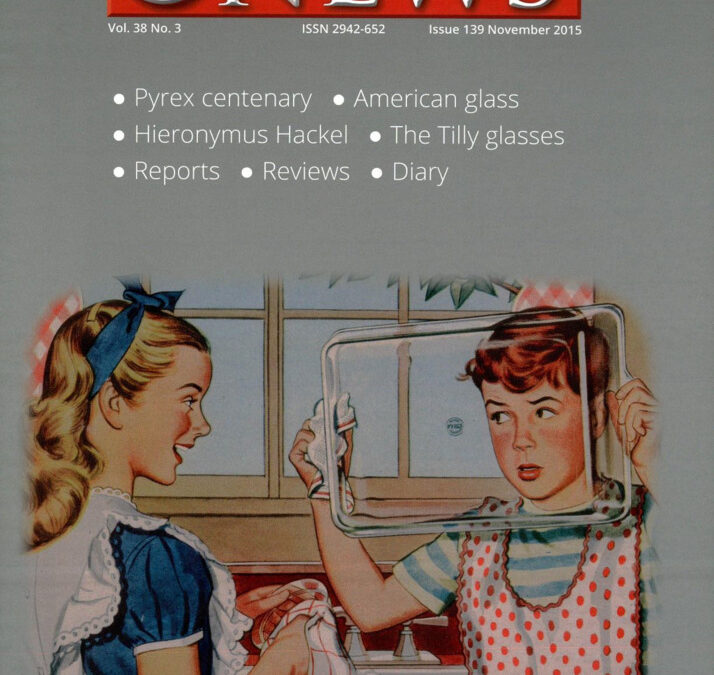
COVER ILLUSTRATION:
It is dean — you can see it’s clean — it’s Pyrex
Ware!; Advertisement published in
Satur-
day Evening Post,
1947. ©
Corning
Museum
of Glass
y
the time you read this
Broadfield House will
have closed down.
On the 13 August
Stuart Connelly, Head of Attractions
and Amenities at Dudley Council,
emailed me, and others, writing:
I would like to inform you that
Broadfield House Glass Museum
in Kingswinford, will close to the
public at the end of September this
year.
The decision to close the museum
has been made to allow the museum’s glass
collection to be displayed at the new ‘White
House Cone museum, currently being
developed across the road from the Red
House Cone in Wordsley, Stourbridge, West
Midlands. This new, exciting development
will enhance the borough’s ‘Glass Quarter’
adding an attraction for all to enjoy.
The Council has worked closely with a
number of partners on this project and
I’m pleased to say that the British Glass
Foundation will be managing the new
museum, with support from the Council. An
opening date for the new museum is yet to
be confirmed although I anticipate this will
be sometime next year.
b
Joh
Sm
y
n P
ith
I visited the site at the end of August
and my report is on page zo.
In August I attended the 16th annual
Assembly of ‘Light and Glass’ in the
historic city of Maastricht. About 4o
of us met to discuss chandeliers, their
design, restoration and the use of up
to date lighting technology.
The incandescent light bulb
which we have been using since
its invention around 188o, is
inefficient, producing more
heat than light and under
European directives will soon be illegal
to manufacture for most purposes.
Halogen lights also give off a lot of heat
and fluorescent tubes produce light with
parts of the spectrum missing, distorting
colours.
Until recently LEDs (light emitting
diodes) which are extraordinarily
efficient and long-lasting, with lots
of light and little heat, gave a light
of around 6,500 K (a measure of
colour temperature) which is very
blue. Technology progresses and now
bulbs, and candle-light bulbs, can be
produced with a colour temperature of
4,199,471,ASEE.1.4
Light and Glass members meeting in the showrooms o
Mestrom Chandeliers, Maastricht.
Glass Circle News Issue 139 Vol. 38 No. 3
2
All letters about a previous
edition of the magazine refer
to Vol. 38 No.
2
Issue no. 138
unless otherwise stated.
•
Antique bottles
•
Roman moulded glass
•
West Midlands museum
•
American glass
EDITORIAL.
around 2,5oo K, about the same
as a normal light-bulb or candle,
with a decent spread across the
spectrum. Currently a good
complete candle and bulb with
integral electronics costs around
£60. But this will come down
with time. Also these bulbs last
20-40,000 hours as opposed to
around 1,500 hours for current
bulbs, a great advantage in
positions where bulbs have
difficult access.
The meeting was truly interna-
tional with lecturers from France,
Belgium, Holland, Germany,
Austria, the Czech Republic and
the UK. English and Continen-
tal chandeliers are very different
in conception, particularly in the
18th century On the Continent
chandeliers are made from a con-
spicuous metal frame, decorated
with drops, either rock crystal or
glass, English chandeliers appear
to be made entirely of glass, with
any supporting metal-work en-
tirely hidden.
A
fine English
chandelier, circa
1755, now in The
Corning
Museum
of Glass.
Letters to the editor
Squashed bottles
Thank
you for arranging to send
I me copies of the
Glass Circle
News
which includes my article.
It looks and reads well so I hope
it will be of value to your readers.
My only comment concerns the
image of the bottles on the front
cover which, given the shape of
the page, has been `stretched’ to fill
the space giving the appearance of
a different shape. Not a serious
issue of course but the purists may
demur.
David Burton
Designer’s note:
My apologies for the error, David…
An unintentional slip of the mouse
while re-sizing I’m afraid. Here is
how they should have looked on the
cover of Issue No. 138.
Wrong title
I
was a bit concerned to note
I that the title and subject given
for my forthcoming lecture to
the Glass Circle, on 13 October,
is `Project Cristallo’ in the Diary
section. In fact, the title of my
lecture is ‘Renaissance enamelled,
gilded and millefiori vessel glass
excavated in Britain: Although I
will say something general about
Project Cristallo at the outset, the
subject of my lecture is specifically
as indicated in the title on the flyer.
I’d be very grateful if the correct
title could be communicated to
members so that they are clear
about the subject of the lecture.
Suzanne Higgott
London
Editor’s note:
The mistake turned
out to be a Microsoft glitch. If you
open the flyer in the Preview file
pane in Outlook (as I did), the
title of the lecture doesn’t appear.
It just starts with the picture and
then the words: As part of Project
CRISTALLO ..: So I didn’t
know what the title was and put
something together from the text.
Members will have received the
flyer though, and if they opened
it fully they will know the correct
title. An article on the talk will
appear in a future issue.
Mirror mirror on the wall
R
eading the
Daily Mail
edition
of
8
August 2015 (I was at
the hairdresser’s, M’Lud) I was
interested to find a double-
spread comparing changing-room
Glass Circle News Issue 139 Vol. 38 No. 3
3
LETTERS
mirrors in ten department stores,
and the images they reflected. It
was no news that the image could
be affected by the surrounding
space and shadows, lighting, and
the angle of tilting the mirror –
but interesting to learn that the
constitution of the glass itself
affects the flesh tones of the
beholder. Mirror glass contains
iron (so it said) which gives a
greenish tinge to the reflected
skin. The mirror containing the
least iron gave a healthy, natural
glow to the image (enhanced in
the case of this clever store by
yellow lighting).
The mirrors cost around Eioo;
for
£2,000
the stores could have
had mirrors with glass including
selenium dioxide, which would
give a rose tinting to the reflected
peerer.
I shall look into my looking-
glass in future with some mistrust.
Hazel Bell
Hatfield
3D glass printing
s this the next collectors’ item?
I Your readers might like to know
about a new manufacturing
platform designed to 3D print
optically transparent glass with
incredible accuracy.
Designed by a team at MIT
called Mediated Matter, the
creators of the printer believe it will
allow glass-makers to determine
the colour, light transparency
and form of their finished glass
designs with total precision — thus
opening up
a
world
of design
pot-ential
in
the
production
of everything
from
aero-
dynamic
glass
building facades, to
lighting devices to museum
quality glass pieces.
So how does it work? The
top of the printer is like a
small kiln, within which the glass
is placed. When the kiln is fired
(to approximately i9oo°F) the
glass melts. The lower part of the
printer has an alumina-zircon-
silica nozzle, which functions
similarly to a desktop FDM
printer. Molten glass flows from
the kiln, through the nozzle and
is extruded from there into layers
that cool and harden. To stop the
flow of glass, the temperature
of the nozzle is cooled via
compressed air.
Examples of the glass pieces
will be on display next year at
the Cooper Hewitt, Smithsonian
Design Museum.
Tony Wills
London
Uranium glass
ur member, John Westmore-
land, a retired nuclear
scientist, recently approached Dr
Peter Novy, Curator in Chief,
Museum of Glass and Jewellery in
Jablonec nad Nisou to ask about
the difference between Annagelb,
Eleonorgriin and Annagriin glass.
Peter replied that just before
184o Franz Riedel, who had two
daughters, Anna and Eleonore,
discovered that locally produced
uranium made a good and new
colourant for glass. He called the
resultant glasses Anna, for the
yellow variety, and Eleonore for
the green.
A little after Franz’s death in
1844 Josef Riedel, who inherited
the company, and was married
to
Anna,
changed the
name of the
green glass
to Annagriin,
and the yellow
to Annagelb,
Eleanore’s name
disappeared.
A little copper salt is
added to the mix to give the green
variety.
John P Smith
London
Threat to the freedom of
glass collectors
U
nfortunately, too often,
%.0
bureaucrats come up with
wonderful ideas for regulating
activities without fully thinking
it through or understanding the
consequences.
The German authorities are in
danger of doing just that. They
are planning to strictly regulate
the international sale of art
and artefacts deemed to be of
significant cultural value including
glass.
This law will apply retroactively
and requires the owner of a’cultural
good’ with value at least 2,500
Euros to provide proof as to the
item’s provenance for the past zo
years; in the case of archaeological
goods the value is as low as ioo
Euros. The legislation further
restricts art imports and exports.
Only objects accompanied by an
export licence from the source
country can be imported into
Germany and all exports from
Germany will require an export
licence even within the EU.
This could be the thin end of
the wedge and if applied it could
spread throughout the EU as
these kinds of regulations have a
habit of doing. Such requirements
are unrealistic since few objects in
circulation over the last century
have export permits from the
source countries. These provisions
will make illegal most objects
currently traded, in full accordance
with the law on domestic and
international markets, . It will be
like creating stateless people, only
in this case objects.
There is a petition asking for
amendments to modify these
proposals to make them more
practical and reasonable. This
petition with greater explanation
can be seen on this link:
https://www.openhpetition.de/
petition/ online/fuer- den- erhalt-
des-privaten-sammelns
David Giles
London
4
Glass Circle News Issue 139 Vol. 38 No. 3
by
Stephen
Pohlmann
LEFT:
Fig. 1
The
Durrington
Tilly
RIGHT:
Fig.
2
The
Van Dobben’s
Tilly
famous Beilbys of Newcastle. There must have
been more. Certainly there is a second (see fig.
2)
and this one had been sitting dangerously on
a shelf at the van Dobben home — possibly since
it was enamelled.
The owners were Joyce and Rudy van Dobben
who live in a lovely home in Halfweg (`Halfway’)
in the Netherlands. Rudy is a direct descendant
of the Tilly family, whose ancestor, Claes de Tilly
set up C. de Koning Tilly b.v. in 1696, currently
the 7th oldest Dutch company still functioning.
Their product is Haarlem oil, a disgustingly
smelly dark liquid cure-all which is meant to be
good for almost every part of the body, internally
and externally. In early days, Dutch sailors were
given vials of the stuff by their wives to take with
them in case of emergency (fig. 3).
According to Wikipedia, ‘The word
haarlem-
merolie
is now used in Dutch to indicate a fix
for all problems, i.e. “lowering taxes will be like
haarlemmerolie for the economy”. This is also
used sarcastically:
The Dutch have always enjoyed commemora-
tive events and objects, and in so many forms,
5
COMMEMORATIVE GLASS
The Tilly glasses
any
any viewers wonder how
antique glasses have survived
for so long. My usual answer
is to refer to the thousands
that were made in those days, and that mine
are among the few which have survived. (Every
time a piece breaks somewhere, surely a collector
elsewhere cries crocodile tears.) But in the case
of commemorative glasses, limited numbers were
originally produced, so the survivors can often be
very rare or unique.
We all know that there exist a finite number
of antique glasses, forever appearing and re-
appearing in this wonderful world of ours. But
occasionally, the words ‘unrecorded’ or ‘hitherto
unknown’ come up, and a glass appears that
‘bucks the trend’. The story I am about to tell is
such a case.
Until recently, it was assumed that only one
Tilly glass existed. That is how Simon Cottle saw
it in the catalogue of the wonderful Durrington
collection, exhibited in 1999 at the Broadfield
House Museum in the UK (see fig. i) when he
called it
the
Tilly and confirmed that it was by the
Glass Circle News Issue 139 Vol. 38 No. 3
COMMEMORATIVE GLASS
including glasses. The
Dutch loved to give and be
given commemorative glasses. Wheth-
er produced in the Netherlands or in England
(and that has been a separate and interesting
subject for many years), the Dutch were un-
questionably wonderful engravers, both with
the wheel and the diamond. Engraving was a
successful industry. Companies, families, roy-
alty, politicians, members of clubs and guilds, all
wanted to have glasses engraved. Special events
were celebrated: accession to political positions,
municipal and regional anniversaries, and so on.
People of means would look for any excuse to
have a glass engraved: love, wishing good luck, or
just friendship. All of us have seen depictions of
David and Jonathan or a couple of putti holding
a banner, hovering above the scene. Battles, or
even just family feuds, would be an excuse for a
glass to be produced with some representation
of ‘peace:
It is likely that the i8th century Tilly family
were of means’. They will have seen many
examples of family, friends and neighbours
commemorating their success and happy
events with the production of engraved glass.
The glass was enamelled around 176o-65; the
Tilly company was established in 1696. We can
only speculate for which event the glasses were
produced.
As is commonly known, the Beilbys specialised
in the use of enamelling, usually white, and in
some magnificent cases, in colour. Undoubtedly,
they sensed the existence of some potentially
very good business on the other side of the
Channel. Perhaps a Dutch agent visited them,
brought them orders, or even sent them orders
from Dutch clients. Perhaps a member or an
agent for the family business visited clients in the
Netherlands. Either way, we do know of some
magnificent examples of Beilby glasses engraved
for the Dutch market and the Tilly is one of
them.
In December 2oxo, Joyce and Rudy decided
to ‘clean out the attic’. They took the glass and
some other objects to the Stedelijk Museum
in Alkmaar, where `Tussen Kunst en Kitsch’,
Holland’s equivalent of the Antiques Road
Show, was having its day. The moment when
they showed the glass to the programme’s expert,
Kitty Lameris, was captured on Dutch television.
The van Dobbens knew the glass was old; they
knew it was of some value. So they
were not as typically surprised
as many guests on the show. But
`flabbergasted’ they still were.
The programme was broadcast
on
9
March 2o1i. Over a year
later, the van Dobbens decided to sell, and, after
having passed the accepted period after which
items brought to the programme can be sold
to dealers involved with the programme, they
brought the glass to the Lameris gallery in the
Spiegelstraat, Amsterdam. This was just days
before I happened to pop in to the shop for
my usual friendly chat with some of the nicest
people in the glass world. I was shown the van
Dobben Tilly.
Now came the difficult part for me: buy or
not buy (we like to use the word ‘acquire in this
business). Two factors were influential. The first
was the imminent visit of the Glass Circle to
the Netherlands, which happened to include a
talk on Jacob Sang to be given by Anna Lameris
(see Graham Vivian’s report in Issue no. 13o, pp
22-4). Don’t leave till tomorrow that which you
should do today’ kept going through my mind.
The second factor was that this glass had a great
story. And I love stories. So I ‘acquired’ the glass.
Since then, I have tried hard to contact the
owner of the Durrington Collection, in a bid to
bring the two glasses back together (as I did a
few years back with the `1768 PT’ Beilby Freema-
son beakers pictured on the cover of Issue no.127
and described in my article on pp 12-13). But to
no avail. In fact the Durrington Tilly pictured in
fig. I is a scan (with permission) from a Sotheby’s
catalogue of the
Frigger – English & Continental
Glass and Paperweights
sale on
24
November
1986, as we have been unable to track down the
original photograph: hence its poor quality.
There are some interesting details about
these Tillys. First of all, they are among the very
few Dutch Armorial glasses decorated by the
Beilbys —
12
at last count. These varying sizes
Fig.
3
A Tilly glass vial, in
which the Haarlem
oil would be
transported. These
have been found all
over the world. The
pencil is
around
soo years old;
part
of the company’s
marketing effort.
It was also used as
a secret key during
the
war.
MarAttrrogoWar
6
Glass Circle News Issue 139 Vol. 38 No. 3
COMMEMORATIVE GLASS
of light balusters
could perhaps have
been imported from
1
1
Holland, for it is ©
well-known
that
this type of glass
was very popular
with most Dutch
engravers, such as
Jacob Sang.
The two glasses
are almost identical:
can be said to be
a pair. They have
the same height,
6
3
/4″ (17
cm), same
round funnel bowl
on a stem consisting
of an annulated knop with three rings on an
inverted baluster, enclosing two rows of ten tears,
and at the base of the stem, a basal knop above a
conical foot.
However, the enamelling on these two Tillys is
not identical, which does create a slight mystery.
When very few glasses are made specially, it is
usual that they form part of a set. Perhaps they
were produced at different times, for different
occasions.
Both glasses show a bird on a small branch
with green leaves, encircled by a snake. This
happens to be the coat of arms of the Tilly family,
whose name is written in large capitals below.
Surrounding this are ornaments in manganese
and white, typical of Beilby.
This throws up a question mark: the
Durrington glass was first known to be on the
market back as far back as Lot 16 in the Sotheby’s
sale on 1 July
1949
and was sold to Delomosne.
It then appeared again as Lot 78 in Sotheby’s
wonderful sale of 24 November 1986, bought by
Asprey, who, in turn, appear to have sold it into
the Durrington collection in 1987.
The Sotheby’s sale included some very fine
Beilbys, including two armorials. Yet the Tilly
was
not
recognised as a Beilby in that sale. This
connection only came up in the catalogue of the
Durrington collection, put together by Charles
Truman and Lucy Burniston. The section on
the Beilbys was written by our own Simon
Cottle. He eliminated all doubts about the Tilly.
Another Beilby was ‘noted’
So when I
was told by the
Lamerises
when
considering the van
Dobben Tilly that
it could be a Beilby,
other experts were
contacted, including
Simon
Cottle.
Having already gone
through the process
of recognising the
Durrington Tilly
as a Beilby, it was
now easier to make
the same judgement
on the van Dobben
glass.
The Durrington has wheel-engraving on the
reverse, making it the
only
Beilby to combine the
two forms of decoration.
The images on the reverse are again not
identical. The Durrington shows an enamelled
dove perched on an engraved oval medallion with
seven arrows, representing the Seven Provinces
of the Netherlands and inscribed VREEDE EN
EENDRAGHT.
The van Dobben has the same white enamelled
dove, but this time sitting on a yellow enamelled
helmet, both again known to be part of the Tilly
coat of arms. Looking through the glass from
the side of the coat of arms, the snake appears to
wear the helmet.
In April this year, I happened to be on business
in the Netherlands. On 19 April, the Flehite
Museum in Amersfoort opened its doors to an
exhibition of 3o years of the TV programme
‘Tussen Kunst en Kitsch’. It celebrated the most
exciting and interesting items brought in by
the public over that period and this included
‘my’ Tilly. At the opening I toured part of the
magnificent displays together with Rudi and
Joyce van Dobben, and Kitty Lameris and we
are pictured in fig.
4
with the Tilly in its glass
case. I returned home, a very happy man. By the
time you read this story, the glass will be on its
way back to me as the exhibition ends as this
magazine goes to press.
Stephen Pohlmann is a collector of 18th century
glass and his business is in dental sales.
Fig.
4
Kitty
Lameris, Rudy and
Joyce van Dobben,
myself and the Tilly
1
Glass Circle News Issue 139 Vol. 38 No. 3
7
.Y
von
nberg
Paul
Lichte
METIC BOHEMIAN ENGRAVER
Hieronymus Hackel (1785-1844
tyi
r
surprising number
of Hackel’s works
has turned up in
the decade since
my lecture to the Glass Circle in
2005 and the bilingual Hackel
monograph (Lichtenberg
2005).
Hieronymus
Hackel (pronounced like
knuckle, but with an H
instead of an N) is one of
the many young North
Bohemian engraving artists at the
beginning of the 19th century who
had to leave his homeland to make
a living and one of the few who
became famous elsewhere. He was
forgotten, as most people are, soon
after he died. This is why he was
given the pseudonym ‘The Master
of the Rising Sun’ in an exhibition
catalogue in 1922, where six of
his engravings with a rising sun
were shown. Gustav Eduard
Pazaurek, the much travelled
walking art encyclopaedia of his
day, discovered Hackers name
on a signed engraving then on
permanent loan to the V&A
(Pazaurek 1930), but did not
mention any master of a rising
sun.
Why Hackel decided to
emigrate to South Styria of all
places is still unclear. Many states
with a good infrastructure in
German lands, but also within the
multinational Austrian Empire
had offered work and abode to
Bohemian glass experts. Styria
was poor and in particular South
Styria with a Slovene majority
was one of the poorest and most
backward regions of the
Empire. Archduke John,
a younger brother of
Emperor Francis, had
taken a particular liking
to the landscape and the
simple life of the people and
acquired great lands there. He
demonstrated by good example
how these poor inhabitants could
turn the woods high up in the hills
into pasture and arable land. The
timber was then used for building
and the wood waste fired the
fledgling glass industry. Archduke
John founded or initiated most of
the institutions in Styria including
the University in Graz and the
Joanneum Museum, where I
curated the international glass
exhibition in 2004 showing loo of
the most important Biedermeier
engravings in private collections
including 18 of Hackel’s works.
This led to a further exhibition
I curated in Celje, Slovenia
(previously called Cilli in South
Styria), in 2005 commemorating
the bicentenary of Hackel’s move
there in 1805.
My monograph mentions that,
among his earliest engravings
expressing his ideas (as well as his
peculiar handling of the copper-
wheel) in his new surroundings,
are two topographical beakers.
They are kept in the Joanneum,
with the coat of arms of the major
towns of Styria after an etching by
Kaiser around 1800 with the fire-
breathing Styrian panther in the
centre. The motif itself must have
been a good entrée for this poor
immigrant. Dating such beakers
is not difficult: the glass being
fairly thin and light, was blown
around or shortly after 180o, and a
crown on each head of the double-
headed eagle copies the etching.
Hackel updated the second beaker
by adding the third crown to the
coat of arms (fig. I), as Francis
II of the Holy Roman Empire
had in addition been crowned as
Francis I, Emperor of Austria, in
1804 to be on a par with Emperor
Napoleon.
Due to the bicentenary exhibi-
tion a number of engravings
of varying quality throughout
Hackel’s long career have been
identified in Slovenia and in other
countries. Luckily, these include
a second signed example, a most
charming rendering of Venus
descending from her shell chariot
drawn by swans with spread wings
(fig. z). This beaker surfaced in
Glass Circle News Issue 139 Vol. 38 No. 3
BOTTOM LEFT:
Fig.
1 The Styrian
fire-breathing
panther and the
double-headed eagle
with three crowns, c.
1806, 11.6 cm
high
MIDDLE LEFT:
Fig. 2 Venus
descending from
her shell
chariot,
c.
1830, 10.4 cm high
RIGHT:
Fig. 3 An eagle
guards the memory
of F Kammann, c.
1825-35, 9.6 cm
high
METIC BOHEMIAN ENGRAVER
November 2008 in a private home
near Celje and my friend Joe
Rataj, the curator for glass and so
much else in the Pokrajinski muzei
Celje (the Regional Museum),
called me up in Egypt, where my
wife and I were sailing on the
Red Sea, and sent me emails and
photos asking for my advice. My
emphatic recommendation was:
`Buy it for the museum at once;
as I would have liked to have the
glass myself. In fact the museum
had no cash immediately available
for acquisitions. Thereupon
joie, quite undeterred, took it
upon himself to go from house
to house in the centre of town in
his spare time asking each and
every businessman, shopkeeper
and hotel or restaurant owner to
contribute a few Euros towards the
Hackel beaker none of them had
ever even heard of in exchange for
being acknowledged as museum
donors. Quite touching, I still
think. A smug vocation is good,
I am sure, but the dedication and
determination demonstrated here
are better.
Hackel must have felt an
affinity with birds since so many
of his engravings include them
with spread wings. A recently
discovered slightly stocky beaker
with everted rim is typically
decorated with a large eagle
guarding the memory of ‘F
Kammann’ (fig.
3
opposite left).
As I suggested in the monograph,
many of Hackel’s clients were
not well-off. Some may well have
brought the glass they could find
with them – such as this one
with a rather provincial-looking
thick base – when ordering
an engraving. Then again, the
souvenir (Zum Andenken) on
a high quality cylindrical beaker
with extensive diamond cutting
shows Amor kneeling and offering
fruit and flowers from a large dish
(fig. 4).
This well proportioned
rendering is practically identical
to the beaker with other initials
in Lichtenberg 2004, no.155 and
Lichtenberg 2005, no.44•
One of the typical ways Hackel
filled surfaces like altars, columns,
pedestals and monuments was
a very special type of stippling
with the copper-wheel. This is
also the way he engraved fleece
on his famous pastoral scenes
and even sheepdogs’ hair. No
other engraver filled surfaces
with such meticulous stippling,
although Franz Riedel (another
North Bohemian engraver and
entrepreneur) did occasionally use
this technique haphazardly, full
of short cuts in the double sense
of the word. In a way, Hackel’s
coherently well-placed, careful
stippling reminds one of working
with a hoe when gardening;
hacking away — in fact the old
verb ‘to hack’ goes back to Anglo-
Saxon times. Food for thought for
the etymologist: the corresponding
German verb hacken being very
similar to the name Hackel
could perhaps have something
to do with why Hieronymus
Hackel developed this particular
engraving technique to perfection
and implemented it so often.
Five engravings by Hackel are
dated. The last one, dated 1842,
bears his handwriting, as we know
it from the two signed examples,
as well as from his typical
landscapes with hunters with
polished top hats, polished lapels,
cuffs and boots (fig. 5). These
hunters are ever recurring motifs
in his work and more often than
not the flap of their satchels shows
this special stippling as well. Just
as importantly, in each case the
whole concept is Hackel-like and
each detail is an inspired variation,
an embellishment or a precis of
what we already know. In some of
his hare hunts the enlarged hare
– humorously still invisible to
hunter and dog – cocks a snook at
them (fig.
6).
His hunting scenes always
show the animals in their natural
environment: no wounds, no
LEFT:
Fig. 4
A souvenir beaker
with the young
Amor, c. 1828, 9.6
cm high
RIGHT:
Fig. 5
A deer hunt at
daybreak, c. 1825,
10.1 cm high
BOTTOM RIGHT:
Fig. 6 A hare hunt
in the light of dawn,
c. 1825,
10.1 cm high
Glass Circle News Issue 139 Vol. 38 No. 3
9
METIC BOHEMIAN ENGRAVER
bloodshed, no deaths, no carcasses
anywhere. Never is a deer mauled
by the dogs, never does a duck fall
from the sky.
In many of Hackel’s mature
masterpieces, the main motif is
no longer placed in the traditional
cartouche, but is positioned
freely between carefully cut and
polished clusters of flowers, or
panicles, and meadow grass on
the even cylindrical beaker wall.
Such horticultural framework
is demonstrated on the signed
engraving of Venus (fig. a) and
again on his rendering of Justice
(fig.
7).
Here not blindfolded
Justice, but an eagle, yet again
with spread wings, is holding the
scales. What concerns us more
are the encompassing panicles, a
unique compositional element in
glass engraving. This raised the
question where Hackel learnt this
mastery with such unswerving
confidence. A close reading of the
panicles led to studying engravings
around
1800-5
of saints in a
cartouche (never on a medallion)
similarly, but perhaps still a little
helplessly surrounded by reed, tall
grass and other plants and flowers
with long stalks. None of these are
great works and probably no one
was inspired or even impressed by
them then or later. This is perhaps
the reason why many of them are
still considered to be anonymous
engravings. But they are all
engraved by the same person,
confirmed by identical marks of
the abrasive as used in the beakers
with the fire-breathing panther
(fig. i) and are clearly
stylistic precursors of the
panicles and meadow grass
settings. Probably each of
these many early glasses
with a saint was ordered as
a present for the name-day
(much more important than
a mere birthday in those
times) of the recipient.
One of the earliest of these
could well be the engraving
of ‘Saint’ Charlemagne
(who was never canonised),
surprisingly showing the St
Veit Cathedral in Prague in
the background (fig.
8).
This
would mean that Hackel
engraved this particular
beaker for the name-day of
one ‘Karl’ (Charles) before
he left Bohemia in June
1805
— unless, of course, he
felt homesick during his early
days in South Styria.
Hackel’s so delicately intimate
renderings of religious, mytho-
logical, pastoral and idyllic motifs
are forever introspective and seem
always to be looking backwards
in time a la recherche du temps
perdu.
In the most intimate Biedermeier
vernacular fig.
9
depicts a formally
attired maiden sitting upright
in a garden plaiting a garland
of flowers in virginal innocence
for her girlfriend’s wedding. She
is daydreaming about a similar
garland for her own head. Her
imagination seems to materialise
as an elegant but ethereal young
gentleman with polished top hat,
lapels and cuffs reaches out of the
symbolic rosebush behind her to
crown her. This maiden, by the
way, was the thrice removed great-
great-grandmother of the previous
owner. The story handed down
from generation to generation
is that following this ancestor’s
own marriage in Cilli in
182.6
the
intrinsic wish to be desired found
its quiet way into this delightfully
refreshing souvenir. Her husband
had ordered it from the best glass
engraver close at hand for their
tenth wedding anniversary in
1836.
The little beaker later turned
into a much cherished heirloom.
This glass is one of the very few
of Hieronymus Hackel’s master
LEFT:
Fig. 7 Justice
with sword
and
scales, c. 1820-25,
10.4 cm high
RIGHT:
Fig. 8
‘St’ Charlemagne in
Prague,
c.
1800-05,
11.2
cm high
BOTTOM LEFT:
Fig. 9 A virgin’s
daydream, 1836,
10.1 cm high
OPPOSITE TOP
LEFT:
Fig. 10
Amor
in
a cage, c. 1830,
10.2 cm high
OPPOSITE BOTTOM
LEFT:
Fig. 11 St Barbara,
c. 1830, 12.3
cm
high
OPPOSITE TOP
RIGHT:
Fig. 12
Faith, Love and
Hope, c. 1830, 11.8
cm high
Glass Circle News Issue 139 Vol. 38 No. 3
10
identical abrasives for the popular
triple symbolic, not personalised
motif Glaube, Liebe, Hoffnung
(Faith, Love and Hope) is in its
quiet assurance a masterpiece in
tranquility and one of Hackel’s
most inspired, most tenderly
intimate metaphorical engravings.
Next to the more versatile,
in psychological portraiture
unsurpassable
Dominik
Biemann (5800-5857), Hackel
is one of the great masters of the
understatement. He is the only
engraving artist of the Biedermeier
period whose occasionally
provocative work puts one in a
pensive mood and at the same time
cheers one up. Hackel’s engravings
can be recognised by the obvious
manifestations of his mannerisms
and his quiet contentment in
having arrived, so far from home.
References
Pazaurek 1930; Gustav Pazaurek,
Hieronymus Hackel,
1930
Lichtenberg 2004; Paul von Lichtenberg,
Glasgravuren des Biedermeier. Dominik
Biemann and Zeitgenossen,
Regensburg,
2004 (a few remaining copies are with the
author)
Lichtenberg 2005; Paul von Lichtenberg,
Hieronymus Hackel. The Master of the
Rising Sun, Celje,
2005
Paul von Lichtenberg, is a chartered
architect and also a collector, lecturer
and exhibitions organiser specialising
in the Biedermeier period.
METIC BOHEMIAN ENGRAVER
engravings with an unbroken
provenance and the motif makes
even him seem less aloof, less
restrained, more human.
Fig. to shows two revealingly-
clad enchanting young ladies and
the naked little Amor. The one,
having confiscated Amor’s arrows
and locked him in a cage, scolds
him with raised forefinger for
making her fall unhappily in love,
while the other, sitting on the cage
to prevent him from escaping,
looks sternly on. This beaker with
such conspicuous strap-wheel
cutting towards the base is the
missing link in Hackers output
between engravings on the even
wall of a beaker and on any kind of
protuberance such as a medallion.
Hackel started to use beakers with
medallions around the mid-183os,
as he had to move with the times.
By the late 182os over zo glass
producers, the larger factories with
several furnaces, had opened shop
in Styria having been encouraged
to do so by lenient, even permissive
legislation initiated by Archduke
John. With the influx of further
experts from Bohemia, lured by
the offer of free land and timber
for building a house, the quality of
Styrian glass rapidly improved. In
parallel an increasing number of
affluent local families demanding
a more intricate glass decoration
forced cutters and engravers like
Hackel to compete with or surpass
what was produced in Bohemia
and in vogue in the major centres
of the Empire. Fig. is shows yet
another variation of Hackel’s
art: a well balanced combination
of an intricately cut beaker with
a surprisingly sensuous young
lady — compare the drapery of
her robe with that of Justice (fig.
7) — presumably a sophisticated
rendering of St Barbara as a
name-day present. A similarly
cut beaker (fig. 52) obviously from
the same source (Lichtenberg
zoo4, no.115, then, with a link
or two still missing, considered
to be anonymous) and using
Glass Circle News Issue 139 Vol. 38 No. 3
11
NEWEST MIRACLE IN GLASS
ANNOUNCED BY CORNING GLASS WORKS—
How Cook in Clan
on open-ihnne.f
Only “Pvt.” Top-of-Stove
Ware brings you
all these adyantages1
Extra Heat-Resistant
Pyrex
–
Top-of-Stove
Ware
Now Ready…
nrn
Inle
‘
riY
‘ A
the owl
:met
—
J’
now a:
ttrot
and the Moo …team
,$
$
f
ur
T
;’Z,’;’,.`,”:
w
7 , ;
v , nvv.
v.v.
a
meek kw, yet is fur more e.t.a. to herd I
Every
pit.
le pnerard.d.
A small Pane ore.. in the 1.1tent of ea
A ‘
a e new ware Loo f
ro
it wk.
‘
‘
‘
V
t
;
‘
1
‘
; Z
t
”. ;
;et Illt .
â
re
,
To”: -So:: at;
These
na..
quart wee, su—kho trquart ote St 25. The
one. are ao
youll went …eel.
joy to cook with—gal yours marl
thmeew
Pyrew
in the.. with Pyrex
‘
07env
‘
arre.
‘Au
equippol with
own temeeL.
2
:11e
Potatoes, tomatoes and other …W….
egtordstewadwrents.fruita…hever.youtireamed
of conking them. tight on too of Yoe
,
. ole
—
t
5
clear. e., gless2 Evens… gown
,
roe…
ditke. And without transfern. to another
di. for wewite
Wel. now Ow, drenm Ims cet.
Corning Ghost Works. makers of Eke.
was. have sole.
thiy pichlcm that has baffled
NEW PYREX
10P-Of-SNVE WARE
PYREX
A century of Pyrex
his year marks the
centenary of a house-
hold name in glass
around the world. Pyrex,
developed by Corning Glass
Works, made its debut to the
American public in 1915. An ex-
hibition at The Corning Museum
of Glass tells the story of
this iconic glass and the
people who shaped its
path. America’s Favorite
Dish: Celebrating a Cen-
tury of Pyrex, on view un-
til 17 March 2016, show-
cases hundreds of Pyrex
objects, advertisements
and ephemera, drawn
primarily from the collec-
tions of the Museum.
The story of Pyrex begins with
a small glass company in rural
New York. Corning Glass Works
was an industrial glass com-
pany, the manufacturer of bat-
tery jars, light bulbs and other
utilitarian items. The company
had recently developed a heat-
resistant glass called Nonex or
CNX (Corning Non Expansion)
for use in railway lanterns. In
the past, lantern globes would
often shatter when the warm
glass encountered the
cold outside air and
broken signal lanterns
could lead to train ac-
cidents or near misses.
To solve this problem,
Corning scientists Eu-
gene Sullivan and Wil-
liam Taylor formulated a
borosilicate-based glass
resistant to sudden
changes in temperatures, based
on their knowledge of the Ger-
man glassmaker Otto Schott’s
work with borosilicate glasses in
the late 19th century.
CNX proved a success with the
ABOVE:
Fig. 1
Eight of the first
twelve pieces
of Pyrex-brand
ovenware:
2 covered
casseroles; loaf
pan; pie plate;
shirred egg dish;
au gratin dish;
baking dish,
and custard
cup. Gift °Berry
E Wright.
LEFT:
Fig. 2 ‘Now
cook in glass
on open-flame!’
Advertisement
published
in Good
Housekeeping,
April 1936.
CMGL 140093
railway companies and Corning
began to explore other markets
for this durable glass. Jesse T.
Littleton, a young physicist at
Corning, was discussing product
ideas for CNX with his wife
Bessie one day, when the idea
of using Nonex for bakeware
emerged. The next day Jesse
came home with the sawed-off
bottoms of two Nonex battery
jars which Bessie used to
bake a sponge cake. The cake,
remarkably, was evenly cooked,
easy to remove from the glass
container, and baked faster
than cakes cooked in metal or
ceramic. Jesse returned to work
to share the experimental cake
with his colleagues. Soon after
by
Regan
Brumagen
Emily
Davis &
Aprille
Nace
12
Glass Circle News Issue 139 Vol. 38 No. 3
RIGHT:
Fig. 3 Child’s cup,
, Blue Trains,
1957.
home economist. Women like
Sarah Tyson Rorer, founder
of the Philadelphia Cooking
School, and editor of the
influential Ladies’ Home Journal,
began testing Pyrex. Rorer’s
endorsements, highlighted in
ads, cookbooks, magazines and
newspapers, helped convince
Americans to try this new
ovenware. By 1919, Corning
had sold over 4 million pieces
of Pyrex across America and
expanded its product line to
include over 100 dish shapes
and sizes.
Ads
assured
Americans
that ‘no home can have too
much’ Pyrex. New products
like teapots, and measuring
cups were added, as well as a
set of junior Pyrex dishes, The
Pyrexette’, for children. In 1920,
Pyrex ovenware was a major
product line for Corning Glass
Works, pulling in about a quarter
of the company’s total profits.
Production
costs
for
borosilicate glass were high,
though, keeping Pyrex just
out of reach of working class
Americans. It was 1938 before
Corning’s first fully-automated
Pyrex factory opened in Corning,
New York, and casserole
dishes began to march off the
production line. Pie plate prices
went from 40 cents down to 20
cents, and the oval casserole
pan once selling for $1 was now
only 50 cents. Pyrex had become
affordable for the masses.
Corning was looking for other
ways to boost sales as well, and
in 1929, Lucy Maltby, a professor
of home economics, was hired
by Corning Glass Works. Her role
was to evaluate the functionality
of the Pyrex product line,
respond to consumer requests
and develop recipes and tips
that could be used in marketing.
Maltby started by hiring a
staff of home economists and
establishing Corning’s innovative
test kitchen – two moves that
proved integral to the success
of Pyrex over the next decades
(figs 4 & 5 next page). The
test kitchen was a laboratory
where the staff carefully tested
products, recorded their results,
and suggested design changes
to improve functionality. By
paying attention to consumer
feedback, Maltby and her staff
were able to suggest design
changes that mattered to the
women who used the products.
When Maltbys staff examined
Corning Glass Works began
the work of refining CNX for
the consumer market. Bessie
Littleton continued to test
prototypes like lamp chimney
tops for baking custards, and
carefully recorded her results.
Sullivan and Taylor adapted the
CNX formulation and in 1915,
Pyrex was born, as twelve Pyrex
ovenware products reached the
market (fig. 1).
Glass was not a material
American
cooks
were
accustomed to baking with and
Corning had to convince them
that Pyrex was safe to use in the
oven. To do this, the company
turned to a new authority in
American households – the
Glass Circle News Issue 139 Vol. 38 No. 3
l3
Circle Ncw, Issue 139 Vol.. 38 No.
3
the cake pan, for example, they
observed that the pan needed
handles in order to prevent
one’s thumb from slipping into
the batter and that the size of
the pan needed to shrink in
order to fit two cake pans side
by side in modern ovens. Once
these designs were adopted,
sales of the cake pan increased
by 1,000%. The test kitchen also
provided material for Comings
marketing department, develop-
ing recipe books, and cleaning
and cooking tips for consumers.
In addition, the staff of home
economists trained Corning’s
all-male sales force in how to
cook with Pyrex, so that they
could speak knowledgeably to
customers in the field.
At the same time Maltby’s test
MOVE:
Fig. 4 Helen Martin, Lilla Cortright, Mary Alice Dailey
tf, prepare foods to be photographed in Pyrex Dishes.
n
,?
n
; BELOW: Fig.
5
RF Barlow, GJ Mackey, and EE Shankin training in
the Test Kitchen.
kitchen was beginning to have
an impact, Corning scientists
were perfecting top-of-the-
stove cookware to use in the
oven and on the stovetop.
Flameware, a durable, flame-
resistant alumino-silicate glass
for frying pans, saucepans
(see fig. 6), and later teapots,
emerged from the Corning
labs. Flameware prototypes
were thoroughly vetted in
Maltbys test kitchen, and were
on the shelves by 1936.
The same year Flameware
hit the market, the company
completed a merger with the
Macbeth Evans Glass Company
in Charleroi, Pennsylvania,
opening the doors to the next
chapter of the Pyrex story –
the development of opalware.
Corning Glass Works used the
manufacturing equipment in
Charleroi and the Macbeth
Evans opal glass formula to
develop a tempered soda-lime
opal glass.
The first opalware was plain
white and produced for the
American military to use as
mess-ware during World War
II. Corning Glass Works, in fact,
made many products to support
the war effort – items like
glass irons (fig. 7), searchlight
lenses, and radio parts as well
as experimental products like
glass thimbles, glass coins,
and glass bullets. Wartime
advertisements for Pyrex urged
women to do their part not only
by using more Pyrex, which
conserved fuel with quicker
cooking times, but by growing
victory gardens and conserving
rationing coupons. You won’t
waste a single hard-won carrot,’
one ad explained, ‘because
leftovers can be stored,
RIGHT:
Fig. 6 Pyrex
flameware saucepan
with detachable
metal handle and
original label, c.
1936-1948. Gift of
Thomas P Dimitroff.
BOTTOM RIGHT:
Fig.
7 Silver Streak
Iron Insert (blue)
and Silver Streak
Electric Iron (red),
Corning Glass
Works; Saunders
Machine and Tool
Corporation, made
in 1946; designed in
1943.
Gift of Otto Hilbert.
Fig.
8 Set of 4
mixing bowls, set
of 4 casseroles with
lids, and
quart
casserole with lid,
in the Horizon Blue
pattern, 1969-1972.
Fig. 9 One-quart
covered casserole,
Friendship, 1974.
Fig. 10
Detail from
Cinderella mixing
bowl, Butterprint,
195 7-1967.
reheated, and served again in
the same Pyrex dish’. Another
offered a recipe for ‘dumplings
over your victory garden,’ stating
that ‘Uncle Sam wants stronger
nephews and nieces and leaner
garbage cans’.
After World War II the first set
of coloured Pyrex opalware was
introduced in the form of the
primary colour mixing bowl set.
Later, patterned decorations
were added in an astounding
number of designs and colours.
Between 1956 and 1987, Corning
Glass Works would release over
150 different designs on Pyrex
opalware, including standard
patterns such as Gooseberry,
Friendship, and Butterprint, as
well as limited release patterns
only available for a year or two
at most, and so collectors’ items
today (figs 8, 9, 10). In 1987,
production of opalware ended,
as newer products such as
Corelle proved more popular
with consumers.
In 1999, Corning Glass Works
sold its Consumer Products
Division along with a licence
for its most renowned brand,
Pyrex to World Kitchen. World
Kitchen continues to produce
Pyrex for the consumer market
today, some of it in Charleroi,
Pennsylvania where Macbeth
Evans and, later, Corning Glass
Works first manufactured opal
glass.
Pyrex has proved its staying
power for consumers beyond
the retail market, as collectors
avidly search flea markets,
yard sales, and vintage shops
for Cinderella bowls, engraved
teapots,
and
patterned
opalware. As over 6,000 visitors
to America’s Favorite Dish (see
page 24) can attest, Pyrex holds
a nostalgic appeal not equalled
by any other kitchenware brand
in America.
Regan Brumagen, Public Services
Librarian; Emily Davis, Cataloging
Specialist, Continuing Resources
and Digital Collections; and
Aprille Noce, Associate Librarian,
Public Services, are all members
of the Rakow Library team.
Glass Circle News Issue 139 Vol. 38 No. 3
15
AMERICAN GLASS
Getting to know American glass
BELOW
TOP TO
BOTTOM:
Fig. 3
Bowl and
candlesticks
in the
Etruscan
pattern by
Northwood,
1917.
Fig.
4
Pressed glass
trough in
the world
famous
American
pattern by
Fostoria.
Length 16.7
cm.
Fig. s Opal
Depression
glass by
Macbeth-
Evans in
the popular
American
Sweetheart
pattern.
.0
8
cyl
‘t the
close
of the
9 t h
century several new
glass factories were
established. In 1888,
Harry Northwood,
son of the Stourbridge
engraver, arrived in
America. For a few
years he worked for
Hobbs Brockunier,
Wheeling, in West
Virginia, which had
become a dominant
force in American
glassmaking since its
inception in 1843. Af-
ter a couple of jobs
elsewhere he took over
the Indiana Glass Co.,
Pennsylvania, in 1896.
It became noted for
its Custard glass (fig.
I).
Meanwhile, in 1893
the owners of Hobbs
Brockunier, decided
to go their
separate ways.
For the next
ten years the
furnaces
fell
silent in spite
of Council efforts to
the contrary. Then, in
5902, Harry North-
wood, appeared
on the scene
and restored
the factory.
Three
years later
Frank
Fenton
and his
brother
started
the Fenton
Glass Co., ini-
tially to decorate
glass. Frank had
worked for North-
wood, where he in-
vented the iridescence
associated with carni-
val glass. Both firms
started its manufacture
about 5907-8 (fig. 2). It
became immediately
popular and Harry
embossed his products
(at least initially) with
‘H’ in a circle, possibly
to distinguish them
from those of Fen-
ton. Carnival was only
one of a wide range of
Northwood glassware,
including Goofus glass
(pressed intaglio with
strongly moulded de-
tail followed by
cold overpaint-
ing) that was
made until the
factory closed
in 1925. An
opalescent glass called
Luna was developed
for lighting. This glass
was also used for ala-
baster-like tableware
such as Etruscan (fig.
3).
The Fostoria Glass
Co.
Moundsville,
West Virginia, (1887-
1983) began by making
kerosene lamps and
then tableware. In 1915
it produced the most
successful
pressed
design ever made,
called American (fig.
4).
It was applied
to a wide range of
glassware and became
a worldwide success
including exporting to
the UK. Production
continued until the
firm closed when its
moulds were taken
over by the Imperial
Glass Co.
Borosilicate glass
was discovered by
German
scientist,
Otto Schott and
marketed as Duran
for scientific glassware
from 1893. Hardly had
World War I broken
out when (1915)
Corning Glass Works
marketed clear glass
Pyrex ovenware using
an essentially identical
formula. (This product
is thought to have
continued until 1993
when it was sold to
Anchor Hocking Co.,
Ohio, a kitchenware
specialist, and the
formulation changed
to a soda glass.)
However, ‘Between
the Wars’ another
firm, Macbeth-Evans
Glass Co., Charleroi,
Pennsylvania,
(
1
899-
1936) developed a fine
range of opal glass,
particularly in the
American Sweetheart
pattern (fig. 5). Corning
fancied producing opal
Pyrex and bought out
Macbeth-Evans in
1936. Opal Pyrex was
marketed for the first
time in 1945 made
by Macbeth-Evans
but in the meantime
produced opal ware
carrying its own logo,
called Little Joe, but
BELOW:
Fig. i Ice-
cream dish
in ivory
(Custard
glass) with
nutmeg
decoration.
Peacock
and
urn
pattern by
Northwood,
2015.
BELOW:
Fig.
2
Carnival
glass. Left,
Northwood
Grapes and
Cable in
clear glass.
Right, grapes
and peacock
in blue glass
by Fenton,
192os.
by
David C
Watts
16
Glass Circle News Issue 139 Vol. 38 No. 3
ABOVE:
Fig. 6a Opal cup and
saucer by Macbeth-Evans.
LEFT:
Fig. 6b Embossed mark on
the base showing Little Joe, the
Corning marks,
a registration
mark
and below the words MADE
IN U.S.A.
AMERICAN GLASS
ABOVE:
Fig.
7
Little
Joe emblem
painted on
the Corning
Glass Works
tower used
for drawing
glass tubing.
LEFT:
Fig.
8
Small wine
or cordial in
black glass
(Ht 11.5 cm)
by the Tiffin
Glass Co.,
Ohio (i889-
1981).
with the Corning name
(fig. 6). Little Joe was
never used on Pyrex
but Corning thought
fit to paint him on its
factory tower from
where he can be seen
all over the city (fig. 7).
The American De-
pression period runs
from 5920 to 195o and
covers much of the
mass of glass made at
that time. It is particu-
larly associated with
poor quality pressed
wares given away as
promotional presents.
It does not feature
much in museums and
I feel unable to com-
ment on it except to say
that it was often pro-
duced in pale colours
with a slightly mould-
ed pattern of which
American Sweetheart
is an upmarket exam-
ple. Somewhat con-
fusingly, it parallels
the Art Deco period,
stimulated by the 1925
Paris Exhibition. It
produced
drinking
glasses: mainly cor-
dials, cocktails and
champagnes (fig. 8).
Some had blown
bowls on moulded
stems featuring what
might be called flat-
tened open geometric
!mops, or human or
animal three-dimen-
sional figures.
The year 5903 saw
the formation of the
Steuben Glass Works
by Frederick Carder
in partnership with
Thomas
Hawkes,
a glass engraver
mentioned in the
previous part of
this review. Under
the umbrella of the
Corning Glass Works
it has flourished to
this day. It is too well
known to require
further
discussion
here and much the
same might be said of
Louis Comfort Tiffany
(1848-1933), famous
for his stained glass,
mosaics and to a lesser
degree art glass. This
glass was invented
and
developed
by
Englishman,
Arthur Nash. He
hid his recipes from
Tiffany but could
not hide them from
his assistant colour
mixers. Two escaped
with his recipes. The
first, John Lafarge
(5835-595o) developed
stained glass windows
in a Tiffany style
(fig. 9), although this
story seems doubtful
as
LaFarge appears
to have been making
stained widows before
Tiffany
employed
Nash. He is best
known in England
for his window in the
Harvard Chapel in
Southwark Cathedral.
Less well known, and
more important for
collectors, are a colour
mixer and blower who
left Tiffany and joined
the family glasshouse
in New York, called
Quezal.
Naturally,
they exploited their
knowledge of the Nash
formulae. That was
only the beginning.
Further relationships
resulted in their
recipes being passed
first to Imperial and
then to another at the
Vineland Flint Glass
Works, NJ under
the name of Durand
(fig. 1o). Resolving
BELOW:
Fig. 9 John
Lafarge
window in
The Mother
Church,
The
First Church
of Christ,
Scientist,
Boston.
The shaded
colours and
similarity to
those used
by
Arthur
Nash for
Tiffany is
clear.
BOTTOM:
Fig. 10
Tiffany
look-alikes
originally
derived from
the Arthur
Nash colour
formula-
tions. Left
to Right
in
development
sequence
Tiffany,
Quezal,
Imperial,
Durand.
Glass Circle
Circle News Issue 139 Vol. 38 No. 3
AMERICAN GLASS
ABOVE &
LEFT:
Figs.
ita & • b
Candlewick
tableware by
the Imperial
Glass Co.
Bellaire,
Ohio.
the origins of the
art glass from these
different glasshouses
has provided a
major headache for
collectors.
About this time
(1936)
Imperial
produced its most
successful line of
tableware, known as
Candlewick (fig.
II).
Also,
lampshades
under the name
Newart and pressed
cut glass under the
name Newcut. All
these items found their
way to England. By the
late 196os the firm was
struggling to survive
and reintroduced ‘slag’
pressed glass in green
and caramel colours
(fig.
12).
You might find
a few here advertised as
`rare Victorian colours’.
The firm finally closed
in 1984.
One firm with a
significant American
following was begun
by the McKee brothers
(1854-1951). In its
chequered career it
produced a wide
variety of pressed
glass from tableware
to insulators (for
telegraph poles, etc.),
and shot balls, much
loved by the gun
fraternity, as well as
making window glass.
Some of their moulds
were purchased by
Fenton (to join those
bought from Imperial
and Fostoria among
others — some Io,000
in total). Fenton,
started by the Fenton
brothers mentioned
earlier, remained a
family business until
its closure in zoii. Its
output of art glass and
tableware was both
diverse and prolific and
although its museum
was recently sold off
LEFT:
Fig.
12
Imperial
duck (Ht
7cm) and
goblet (Ht 16
cm) pressed
in
slag glass,
196os.
BOTTOM
LEFT:
Fig.
13 Fenton
bird pressed
in opaline
glass. Ht to
tail
9 cm.
Anove:
Fig. 14
Modern
cameo vase
illustrating
glassmaking
techniques
and
decoration.
Ht c 3o cm.
to raise funds it still
has a large flourishing
shop today (fig. 13 &
14). Perhaps it was
just too successful and
too prolific. I found
the antique shops in
the area full of Fenton
glass. It seems that as
here in the UK the
future of Art glass in
America lies in the
hands of the studio
glassworkers (fig. 14).
David Watts is the
founder Editor of
Glass Circle News
and an Honorary Vice
President,
18
Glass Circle News Issue 139 Vol. 38 No. 3
A
ll p
ic
tures
@
At
he
lny
Tow
ns
he
n
d
ABOVE & BELOW
Plain stem drawn
trumpet wine glass
engraved Miss Bell
Chessyre. Height 16
cm (61/2″)
Graham Slater
was invited to
join Christie’s
where for
15
years he looked
after insurance
and risk man-
agement.
family house still survives and is
used as a public house/restaurant
called The Trident
Arrabella died in Chester
in 1806 and was described in
her obituary as Lady Arrabella
Rawdon, heiress of the late Sir
John Chesshyre, aunt to the Earl
of Moira, and cousin to Countess
Fauconberg
Confident of my attribution
perhaps I might say that this
glass was the favourite of Lady
Arrabella, Derek Manning and,
latterly, Graham Slater.
FAVOURITE
Vy favourite glass
t….
/,
—
y
favourite
glass was one
which
for
many years
was, I now learn, also a favourite of
our fellow member and my close
friend, the late Derek Manning.
I acquired it last year
after the dispersal of his
collection. I was attracted
Graham
to it by the quality and
depth of the engraving
Slater
and also the strong
possibility of ascertaining the
identity of its original owner. I
confess to not having drunk from
it feeling somehow that it might be
disrespectful to the original owner.
The earliest dating of these
two-part plain stem trumpet bowl
glasses is customarily give as 1740,
so I was looking for a Miss Bell
in the middle of the 18th century.
The engraving of the name is
contemporary with the other
decoration on the bowl – vine
leaves etc., these being suitably
arranged to allow space for the
name.
The surname Chesshyre – later
Cheshire (and other variants,
according to the whims of
parish clerks) notably attaches
in particular, but not exclusively,
to one late 17th – early 18th
family at Runcorn in Cheshire.
My first approach was to search
the surname in any location or
spelling but with the addition of a
forename name often abbreviated
to Bell. The most likely choice was
by
Isabella of which I found several
but most were too late for the glass.
Then I altered my search with the
less common name of Arabella.
Eventually my search showed up
an Arrabella Chesshyre who was
born in 1723.
For the purposes of this
article her antecedents start
with Sir John Chesshyre,
a notable lawyer born in
1662 at Hallwood, Halton,
near Runcorn in Cheshire.
He was knighted in 1714 as The
King’s Prime Sergeant at Law, and
died a very wealthy man in 1738.
Importantly he had a brother,
Robert, who became Vicar of
Runcorn, dying a year later in 1739.
Robert in turn had a son
William who was named as co-
inheritor of Sir John’s Estate, and
who had married a girl named
Sara(h) (surname not recorded).
They were the parents in 1723
of Arrabella – to use her original
spelling.
Arrabella married in
1743
so any glass referring to her
maiden name must have been
given to her in her late teens,
possibly as a 17th or 18th birthday
present?
Arrabella’s husband was
Arthur Rawdon, Sheriff of
Meath in Ireland, and after the
death of her father William she
clearly inherited the Hallwood
estate as she sold the house in
1774 to
a Thomas Chesshyre
of Warrington. As a matter of
interest only one wing of her
Glass Circle News Issue 139 Vol. 38 No. 3
I 9
REPORTS
The White House
The Red
House, with
its listed
cone
O
n
27 August I
drove to Stour-
bridge to meet with Gra-
ham Knowles, chairman
of the British Glass
Foundation. Graham is
also CEO of the long
established local family
business, The Hulbert
Group, which has
two divisions, com-
mercial property
and estates, and
press tools for
the automotive
industries.
Dudley
Council,
the own-
ers
of
Broad-
field
House, and owners
or custodians of the
contents, have long
considered Broadfield
House an unsuitable
home to the museum.
It is difficult to find and
hence under-visited, and
a building on three floors
never designed to be a
museum. It was origi-
nally used by Dudley
Council as a home
for fallen women,
and the two local
collections of
Stourbridge and
Brierley Hill
were packed
into it when
it opened in
1980. It
is also a drain on
Council’s resources in a
time of cutbacks.
About three years
ago the Council an-
nounced its impending
closure. This caused
local outrage in some
quarters, and complete
indifference in others
— those who have no
interest in museums and
heritage. The Friends
of Broadfield House
mounted a campaign to
save the museum, but
this was rather parochial
and antagonised the
local Council. It was felt
that a more nationwide
approach was needed
and The British Glass
Foundation was formed
as a charity to look to the
future of the collection
and archive rather than
the building.
Consultants were
employed and the first
plan was to move the
collection into the
Red House site,
which is owned by the
Council and included
a listed glass cone. This
space is very cramped
and would have been a
second best solution.
Then the White
House site became
available. This is across
the road from the Red
House site, is extensive
and the former home
of Stuart Crystal. This
contained the old glass
factory, which is a listed
building. A developer ac-
quired the site, and this
is where the skill and
experience of Graham
Knowles becomes really
important. A complex
scheme was developed
by CDP (Complex
Development Projects)
whereby a large part of
the site was given over
to housing development
but `planning gain meant
that the developer had
to leave some of the old
buildings standing, to be
given to the Trust to be
used as a museum and
ancillary services, with
work partially paid for
by the developer. Owing
to the patience and per-
sistence of Ian Harrabin
during the planning pro-
cess, the Council eventu-
ally showed enthusiasm
for this scheme as it gave
them a way out of being
fully responsible for
the glass collection with
very little capital cost to
themselves, and a saving
in running costs.
The site became
eligible for £2.1 m of
European money, which
has to be spent by the
end of 2015, and the
Council will hand over
the value of the building
of Broadfield House, but
not the total site, a sum
a little less than fa m.
The Council will make
over to the trust the
resultant buildings, and
Glass Circle News Issue 139 Vol. 38 No. 3
REPORTS
the glass and archives
of Broadfield House, in
trust, for over too years
and will make a small
annual cost towards run-
ning costs. The museum
site will also be able to
rent out surplus space to
give additional income.
This is phase one, and
the basic building work
will be largely finished
by the end of this year.
The plans have already
altered from the ones
illustrated in the last
edition of
Glass Circle
News
as much of the
exterior glazing has been
reduced, both for secu-
rity, and to make display
easier inside.
The next stage is to
determine how to use
the space. Reception,
museum space, special
exhibition space, offices,
library and archive dis-
play and storage, meeting
room, as well as toilets,
etc. Also one of the
buildings will be devoted
to both hot and cold
work, so that visitors
will be able to
see
glass
being made by resident
glass artists, engravers,
and possibly cutters. The
archives of films made
in the factories will also
be preserved for future
RIGHT:
Iris
Intaglio
Vase
Designed by
Frederick
Carder for
Stevens &
Williams,
intaglio
cut by John
Orchard,
1901
in the
collection to
be shown
BELOW:
The Pearl
Necklace
cameo
plaque with
gilt mount.
Carved
by George
Woodall,
caw
BELOW
RIGHT:
Work in
progress at
the White
House site.
generations. A consultant
will soon be employed to
advise on this, and how
to raise further monies
to this end. As this is a
purpose-built museum
showcases and lighting
can be designed with only
glass in mind.
Across the road is
the already existing
Red House Cone glass
museum, owned and run
by the Council, with its
listed cone, original lehr
and furnace, workshops,
hot glass areas, old glass-
making equipment and
some rather rudimentary
displays.
By now the Council
can see the sense in
partially or completely
combining the White and
Red sites. The Red site
already has a shop and
cafe. Although the sites
are on the opposite sides
of a very busy road there
is a plan to use a long
boat, crewed by volun-
teers, to take visitors
on the canal under the
bridge, from one site to
the other, adding to the
Black Country experi-
ence.
The total complex
could be a world-class as-
set to the West Midlands.
John P Smith
Glass Circle News Issue 139 Vol. 38 No. 3
21
REVIEWS
Book reviews
Glass-Making in England
Harry J Powell
Cambridge University
Press, 2054, £17.99
ISBN: 978-1-107689-
66-4, 200 pp
t is a pleasure to report
I
that this historic vol-
ume, published in 1923,
has now been reissued.
This text, the first by
an actual glassmaker,
indicated that glass
collecting and its history
could now be accepted
as a national art or craft.
It helped inspire my
own research into the
subject. It reflects not
just his own knowledge
of glass-making but also
his association with the
glass luminaries of the
day, Hartshorne, Buckley
— both Francis and
Wilfred, Chance, Wes-
tropp and many others
that help make his text
an authentic reflection of
the period.
It was a seminal time
for the industry. Harry
Powell feared correctly
that the new automatic
bottle-making machine
was rapidly becoming
a must-have for any
glasshouse to survive. It
was causing young men
to shy away from the hot
and laborious seven-year
apprenticeship needed to
create a master glass-
maker with no expec-
tation of an assured
future. Although not
quite so dramatic as he
feared, the invention of
other devices, such as the
cracking-off machine,
soon meant that glass-
makers were no longer
able to shear the rim of
a wine glass standing up
while holding the glass,
mounted on a pontil, in
the left hand. A negative
in the mind of the classic
collector.
However, the book is
by no means a technical
manual. There are
no sequences of glass
making operations in the
manner of Diderot. The
history of glass making
in England from Roman
times up to his day, as it
was then understood, is
traced with interludes,
as it were, on the
location of known
glasshouses in London
and elsewhere. The bulk
of the book relates to
the characteristics and
identification of English
glassware from the
simple goblet to a cut
chandelier. In a sense he
set the format for many
authors to follow.
The reissue of this
well-illustrated book in
its original format but on
American A4 size pages
gives wide margins (43
mm) for adding notes
and comments. The
reproduction quality is
as good, if not better,
than the original. It is
essential reading for the
beginner, and perhaps
not a bad idea for those
who think they know it
all already. It is sad that
Harry never lived to see
it published.
David
C
Watts
Collecting Contempo-
rary Glass
Tina Oldknow
Corning Museum of
Glass, 2054, $63.75
ISBN: 978-0-87290-
205-5 208 pp
This
is the latest in a
I series of magnificent
publications from the
Corning Museum of
Glass (cmoo), and is a
visual treat. Its subtle
endpapers; photographs
of’A Continuous Mile
of beaded rope by Liza
Lou, which took her and
a team of Zulu women
more than a year to make
using over 4.5 million
glossy black beads, sets
the tone. The selection
and quality of images,
the beautiful layout,
graphics and the erudite
texts make this the ulti-
mate coffee table book
for the aspiring collector
of modern glass.
Representing the
works of too artists the
book is a celebration,
not only of the new
Contemporary Art and
Design wing of cmoo,
but also of the wide
ranging creativity of the
glass world over the past
25 years. The museum
is, without a shadow of
doubt, the best of its
kind in the world. It has
the most comprehensive
collections comprising
the very best examples,
beautifully displayed by
period from antiquity
through to the present
day. In her foreword, its
current director, Karol B
Wight, a classical scholar
specialising in Ancient
Greece and Rome, notes
her surprise and delight
at discovering the diver-
sity of the continuous
artistic exploration and
achievement of contem-
porary artists working
with glass. She extols the
thought-provoking, the-
matic and creative jux-
tapositions of the works
both in the book and as
installations in the spa-
cious purpose built and
sky-lit new building, ena-
bling viewers to see and
appreciate the art works
via a journey of discovery
into how glass can be
transformed in the hands
of talented artists.
The new galleries and
the hotshop amphithea-
tre occupy the grounds
of the former Steuben
factory. Founded in 5903
by Frederick Carder, a
British designer from
Stourbridge, it operated
as the luxury division of
Corning Glass Works
for over a century. Tina
Oldknow (who was
until recently the senior
curator of Modern and
Contemporary Glass)
writes about how `what
was once a factory has
become a place to experi-
ence artists and designers
working with glass in
new ways, mirroring the
gradual movement from
luxury glass worldwide
from industry to studio
over the last 4o years:
Credit for the mu-
seum’s pre-eminence in
its field must in the first
instance go to its founder
director and curator,
Thomas S Buechner
Snr. A visionary, he was
an avid and encourag-
Glass-Making
in England
Harry J. Powell
COLLEC
TING
C
ONTEMPOR
AR
Y
GL
ASS
22
Glass Circle News Issue 139 Vol. 38 No. 3
Czechoslovakia, and
above all the realisation
that glass objects could
‘transcend utility’.
It fell to Harvey Lit-
tleton, ceramicist and
teacher, and the son of
the Corning Glassworks
Director of Research,
to explore the idea that
glass could be worked by
an individual in the same
way as an artist potter
could work clay.
Only twenty years
later in
1979,
a second
exhibition ‘New Glass:
A Worldwide Survey’
became the first interna-
tional travelling show of
studio glass and here the
percentage of its content
was entirely reversed,
with only io% produced
industrially and the rest
by artist-craftsmen. At
the Glass Art Society
conference that year,
Tom Buechner said:
`New Glass is about
discovery, about new
forms, new decoration
and a new way of making
things. The history of
glass has changed radi-
cally and profoundly’
Ms Oldknow’s concise
introduction, `Collecting
Contemporary Glass at
Corning; gives a com-
prehensive account of
the development of the
studio glass movement
and of cmoc’s essential
and active part in it. Its
notes provide important
additional documenta-
tion on the phenomenal
growth of glass art inter-
nationally. Her selection
of the artists and their
artworks, beautifully
photographed together
with authoritative texts
and captions is presented
impeccably. One could
quibble (too few Brits,
for my liking!) but that
would be churlish. This
spectacular book is an
important historical
document that illus-
trates Littleton’s dream
`the blossoming of glass
from its roots in craft
and decorative arts to
become entwined with
fine art’. I recommend it
as a wonderful addition
to anyone’s library, let
alone for somebody with
an interest in the diverse
and expressive qualities
of this magical medium.
Peter Layton
without reserve. Any
unsold items should be
collected by donors.
BIDDERS
. During the auction
successful bidders
names will be recorded
against lot numbers.
. Bidders may pay at the
end of the auction or
earlier for early leavers.
. Payment for lots must
be made before removal
and may be paid for
by cash, cheque or by
online bank transfer.
Sorry, no debit or
credit card payments
can be accepted.
The Glass Circle
Committee members
.1111MMmom…smanzossamt.am…maramamem•
Shaun Kiddell
Geoffrey Laventhall
Anne Lutyens-Stobbs
Meetings Organiser
Marianne Scheer
Athelny Townshend
Publications Production and
Graphic Design
Anne Towse
Graham Vivian
wvvw.glasscircie.org
Simon Cottle
Honorary President
John P Smith
Chairman & Publications
Laurence Maxfield
Honorary Treasurer &
Membership Secretary
Susan Newell
Honorary Secretary
Vernon Cowdy
Website Manager
REVIEWS
ing supporter of the
studio glass movement,
championing contem-
porary glass art through
important exhibitions
and his active participa-
tion in its forums both in
the USA and abroad. He
organised`Glass 1959 – A
Special Exhibition of
International Contem-
porary Glass; the first
major postwar exhibition
of glass design. The mu-
seum bought most of the
exhibits, 9o% of which
were factory produced,
though much of it with
a handmade label. The
revelation, as at Expo 67
in Montreal and later at
the ‘Hot Glass Symposi-
um at the Royal College
of Art, London in 1976
were the artworks from
Glass auction: guidelines
Some of
the items
donated
so far
(See AGM notice on page 24)
DONORS
. Donors may consign
any number or type of
glass or glass related
object. These items do
not need to be date-
lined but should be
saleable and in reason-
able condition
. Items for auction
should be brought to
the meeting venue as
early as possible before
the business of the
meeting starts.
. A brief, written
description of glass
item(s) would be much
appreciated.
. If you are unable to at-
tend but would still like
to donate objects to the
auction please contact
committee mem-
ber, Graham Vivian
(gj.vivian@btinternet.
com) or Vernon Cowdy
(v.cowdy@gmail.com)
to arrange to hand it
over.
. The auctioneer will
state who has donated
lots unless you advise
us otherwise.
. All glasses will be sold
Glass Circle News Issue 139 Vol. 38 No. 3
23
The Glass Circle
AuctioneeroSimon Cottle
12
111
NOVEMBER
An auction of GLASS & glass-related
items given by members
TO BE SOLD
WITHOUT RESERVE
is to be held after the AGM to raise funds for future
meetings. Members are invited to donate items for the
sale and are requested either to contact
VERNON COWDY on 020 8653 4327
v.cowdy@gmail.com
or GRAHAM VIVIAN on 020 7937 3376
g.j.vivian@btinternet.com
Alternatively bring donations PRIOR to the meeting
This meeting will be free of charge
DIARY & NEWS
Diary
Circle meetings
H
eld at the ArtWork-
ers’ Guild. 6 Queen
Square, wc IN
3AT.
7.15.
Sandwiches from 6.30
p.m. Guests are welcome
(there is a charge of
£10 for members, £12
for members of related
societies and £15 for
guests).
12
November
AGM and Auction
See box below
8
December
Rene Lalique
Andy McConnell’s talk
will cover Lalique’s early
art nouveau work in
jewels and furniture,
before he dedicated the
remainder of his life
from
c.
1905 to glass.
There are no meetings in
January and February
17 March
The Pursuit of Excep-
tional Typicality
Rebecca Bell will talk on
glass-making in Com-
munist Czechoslovakia,
1948-1968
Annual General
Other diary dates
zo November
A Second Miscellany
of Glass
The Association for
the History of Glass
is hosting another
study day to explore
the latest discoveries
in archaeological and
historical glass.
historyofglass.org.uk
1-19 December
Glass Delusions
Eleanor Morgan,
Artist in Residence
12 November
F
ollowing formal
business we propose
to repeat the auction
formula which was so
successful last year.
While the raise in sub-
scriptions and economies
that have been made will
strengthen our balance
sheet, the cash we are
likely to make from the
auction should provide a
little icing on the finan-
cial cake.
Excluding the Vessel
Gallery reception, we
raised about £1500 on
the day last year. Every
item of
glass offered sold.
at the Grant Museum
of Zoology, has been
investigating the
collection of glass
sponges and is showing
work inspired by the
museum’s collection.
Grant Museum
of Z000gy and
Comparative Anatomy
Rockefeller Building
London WOE 6DE
The wide range included
i8thand 19th century
English, Continental,
engraved and unengraved
glass as well as a wide se-
lection of modern glass.
Literature on glass
sold well and any spare
copies of the classic
works or important auc-
tion catalogues were in
demand.
We hope the points
on page 23 will help you
decide what, when and
where to donate. As last
time, many of the lots
donated can be brought
in almost at the last min-
ute
on the evening of the
Until 17 March 2016
America’s Favorite Dish:
Celebrating a Century
of Pyrex
Corning Museum of
Glass
See the article on page 12
is January 2016
Submission deadline for
papers for the SGT con-
ference (see last item)
4-8 September 2016
Glass — Back to the
Future!
Society of Glass Tech-
nology Centenary Con-
ference & European
Society of Glass
Science and Tech-
nology Conference
Sheffield
www.esgzor6.eu
AGM, though it would
be a great help if you
would let us have these
as early as possible. If
this is difficult, it would
save time if those mem-
bers who are attending
the AGM were able to
email me at g.j.vivian@
btinternet.com before
the iz November with a
brief description of what
they intend to bring.
So open your cabinets
and dust of your book
shelves and please give
generously.
Guidelines for the auction
are
on page 23,
Veeting and Auction
Glass Circle News Issue 139 Vol. 38 No. 3
24