




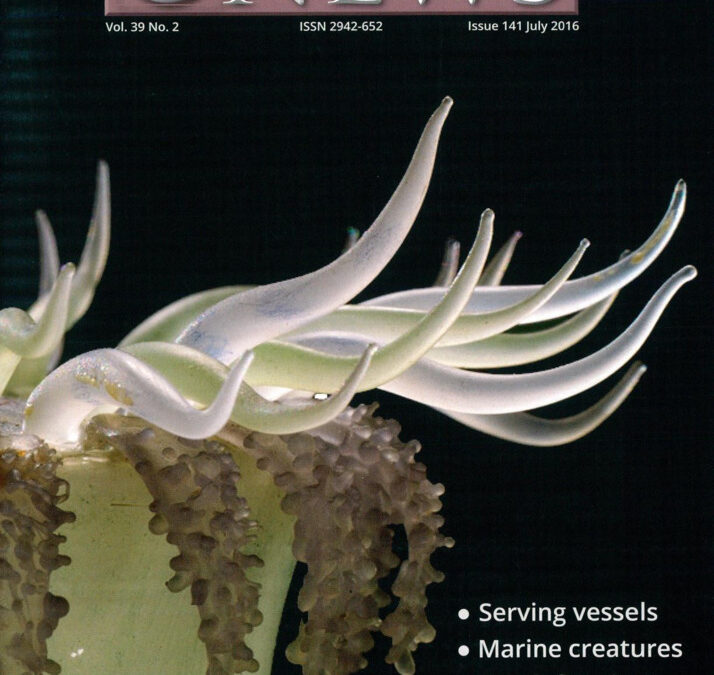
GLASS CIRCLE
Vol. 39 No. 2
ISSN 2942-652
Issue 141 July 2016
•
Serving vessels
•
Marine creatures
•
Czech figurines
•
Reviews
•
Diary
Chairman’s letter
Letters
My favourite glass
Serving vessels
Blaschka models
Czech glass figures
Reports
Reviews
News
Diary
Glass Circle News
ISSN 2043-6572
Vol. 39 No. 2 Issue 141 July 2016
published by The Glass Circle
© Contributors and The Glass Circle
www.glasscircle.org
Editor
Jane Dorner
editor@glasscircle.org
9 Collingwood Avenue, N10 3EH
issinnsissxxinsiniawisanisiisxxxwasssississ
ininsaw
nsw.09911999991
Design and layout
Athelny Townshend
designer@glasscircle.org
NEIVI
0
norasry
0
Its
or corn cteemembets
bear any responsibility for the views expressed in this publication,
which are those of the contributor in each case. Every effort has been
made to trace and acknowledge copyright in the photographs illustrat-
ing articles. The Editor asks contributors to clear permissions and
neither the Editor nor the Glass Circle is responsible for inadverten
infringements. All photographs are copyright the author(s) unless
otherwise s redired,
Printed by
Micropress Printers Ltd
www.rnicropress,co.uk
Next copy date:
15th September for the November edition
Cover illustration:
Specimen of Blaschka Marine Life: Ulactis
muscosa (‘Ni’. 116), 1885. ©
Cormng Museum
0/ass
it
gam his heading was the
first slide shown
by Colin Brain at a
recent meeting of the
Association for the History of Glass
held at The Wallace Collection in April
this year.
This myth was believed
and published by Hartshorne
in 1897, and by others before
him. It has been re-iterated in
virtually all glass books ever
since, and hence must be true.
Wrong! Much research has been carried
out in the interim as to who George
Ravenscroft was, his ‘patent; and where
his glasshouses were, but the belief that
Ravenscroft invented lead glass had not
been substantiated, nor even questioned
until Peter Francis published a paper on
the subject in the 199os.
Over at least the last ten years two
researchers, Colin Brain (with his wife
Sue ), and Mike Noble have been trawling
through (probably) dusty archives
looking for original source material from
the 17th century, often in difficult to read
handwriting. Most authors up to now
have used secondary material.
The results are startling. Colin and
Sue have written a 16-page paper entitled:
The development of lead-crystal glass
in London and Dublin 1672-1682: a
reappraisal
which is published in the
April 2056 Journal
Glass Technology
of
The Society of Glass Technology. With
this magazine is included a supplement
which reprints all Colin’s recent papers
first published by The Society of Glass
Technology. This paper follows on from
an earlier paper
Crystal glass-making in
London
1642-1672 which Colin and Sue
published in the same Journal in 2014.
I would not dare to summarise
the circulated paper but two main
facts emerge. There was no
eureka moment, but a steady
development of lead glass,
which had been known of since
the Romans, particularly in the
production of ‘paste jewellery.
Secondly, the reduction in price and
increase in availability of saltpetre was
crucial.
Mike Noble, who also writes regularly
on ceramic matters, was, before his
retirement, factory manager at the
Alloa Glassworks of United Glass. The
last ten or more years of work have
resulted in a book
Eighteenth Century
Glass and its Antecedents: A documentary
History of English Glassmaking from the
Late Medieval Period to the Industrial
Revolution,
hardback, over 400 pages and
300 illustrations. Based, as Mike writes,
on original contemporary documents
housed in archives throughout the
country, much of which has never been
published before, as well as drawing
together work from glass researchers,
archaeologists and local historians, this
book outlines the development of the
embryonic glass industry in England
from c.155o until caoo:
With this edition of
Glass Circle
News
is a flyer offering this book at a
Chairman’s letter
eavansci-c,i’z
;,-2v
ee.ai
lead
3/a55
by
John P
Smith
CONTENTS
LETTERS
2
Glass Circle News Issue 141 Vol. 39 No. 2
Ancient glass
sugar shakers
Fltmmilmm Museum
Watford Crystal
Repo,
Curiosities
views, diary
LETTERS
prepublication price. This book
will be reviewed in the next
edition, but I have had a preview
of some of the contents.
Many of us do not realise how
many glasshouses there have been
throughout the country and this
book will give you an opportunity
to read up on a glasshouse near
to where you live, provided that
you live in England. Jill Turnbull
has just finished her book on
Scottish glass. If you live in Wales
your ceramics are wonderful, glass
is rather lacking. Ireland is well
covered with books, some better
than others.
Preparing for my lecture later
on this year I have had occasion to
visit the V&A, not only the glass
gallery, which I am sure that we
are all familiar with, but also the
primary galleries, both British and
Continental. You may not realise
that some of the best glass in the
A four
–
branch candelabra, c.1700
museum is in these latter galleries.
The illustration is of a four-
branch candelabra, c.1700, on
show in the British Galleries,
which is in two parts. There is an
interesting story attached to this
candlestick. In the 196os, when
I first knew it, the damage to the
central candle nozzle had been
very badly repaired, covering the
whole area so that you could not
see that the top was separate and
just rests in the nozzle.
One day the late Hugh Tait, of
the British Museum and former
President of the Circle, when
vetting an Antiques Fair, spotted
a cream-ware version, in one piece,
on a dealers stand. He suggested
that it be tested by thermo-
luminescence for age. It turned
out to be less than to years old.
The faker had copied the V&A
version without realising how it
was constructed.
Letters to the editor
The Glass Circle Index –
an appreciation
H
azel Bell’s methodical and
thought-provoking approach
to providing the Circle with a
well-organised index for our past
mena=1111MMIna
publications is to be admired and
acknowledged. Words cannot
really express the gratitude we
owe to her for her Herculean task
which has taken several months
to achieve, though it is through
(;[
\A/
iru I
s
r
•
Vienna Secessionists
•
Hubble-bubbles
•
Jellies H possetts
•
Chamber post Er others
•
Lecture reports
•
News, views and diary
words that the recent history of
the Circle has now been recorded.
Commissioned by our Editor, Jane
Dorner, who is to be congratulated
for finding such an experienced
and professional practitioner,
Hazel’s work, set out over 51 pages
on the Circle’s website, provides
an extremely important method
of access to the contributions
to the editions of
Glass Circle
News,
Journals and special
commemorative issues since the
197os. Assimilating and updating
Peter Lole’s index to the earlier
editions of
Glass Circle News,
Hazel
has delivered a tool which will be
of great assistance for present and
future glass researchers, drawing
out the hitherto hidden former
work of lecturers, writer and
editors.
It comes as no surprise that one
All letters
about a
previous
edition
of the
magazine
refer to
Vol. 39 No.
I Issue no.
140 unless
otherwise
stated.
Glass Circle News Issue 141 Vol. 39 No. 2
I-
,19411002.11illaMillaisetigIA,
LETTERS
of the longest entries is that for
the contributions of the late Dr
David Watts who, of course, was
the primary mover in initiating
and editing Glass Circle News.
There is no doubt that had he
lived to see his work recorded
by Hazel in such an organised
manner, he would have been more
than enthusiastic in his praise.
Furthermore, the authors of the
various published works of the
Glass Circle will be appreciative
that their contributions are now
accessible to all. In reading Hazel’s
article in Issue No. 140 of
Glass
Circle News,
I was amused to
see the way in which she deftly
handled, sifted and cut through
the variety of similar terms used
by contributors to produce a
crystal-clear index of which the
Glass Circle should rightly be
proud.
Simon Cottle
Hon. President
Jacobean or Jacobite?
I
was delighted to find the news of
the successful collaboration with
Hazel Bell in producing the new
updated, extended and corrected
Index of our publications. Whilst
I knew that some work was going
on to achieve this, I had not
appreciated how much and how
comprehensive and accurate it has
proved to be. The news contained
in Issue no. 14o overcame my
dislike of web-sites, and sent me
to the Glass Circle one, (for the
first time!) where I followed John
Smith’s instructions and found
the Index, which most impresses
me. Very well done, especially to
Hazel Bell.
Whilst initially disappointed
that it that it is not in printed
format
(although
printable)
the explanation that it is to be
continuously updated makes the
decision inevitable.
May I take the opportunity
to correct the confusion between
Jacobean’
and
jacobite’?
Both
terms derive from the Latin form,
Jacobus’ for James, and refer to
various Stuart monarchs, but of
different periods. Jacobean relates
to King James VI & I (reigned
1603-1625) and usually categorises
architecture and artistic and
furniture styles, but occasionally
also the politics and history of the
time. It really has no relation to
glass, since the British drinking-
glass industry was then very small
and its output indistinguishable
from Continental
Facon de Venise
glass (Mansell’s great work in
the glass industry was mainly
and successfully directed at
window glass.) The new Index
has only one entry for Jacobean,
in Journal No:
11,
which recounts
how Edinburgh Cristal labelled
some of their Jacobite inspired
glasses as ‘Jacobean; either through
ignorance or perhaps to avoid
being accused of forgery; some
of the London and Stourbridge
makers did the same in the first half
of the zoth century. ‘Jacobite’ is a
term of much wider use and refers
RIGHT:
Jacobite
baluster wine glass
wheel engraved with
a rose, a single bud
and five leaves.
4
Glass Circle News Issue 141 Vol. 39 No. 2
LETTERS
to the supporters of the Stuart
cause following the rude expulsion
from the throne of James II & VII
(reigned 1685-1688) by his nephew
and son-in-law, William of
Orange. Jacobitism may be said to
extend from 1688 until 1788, when
James II grandson, Bonnie Prince
Charlie
(The Young Pretender)
died.
It was a cogent political force from
the time of William’s usurpation
until the mid-175os, and thereafter
of considerable symbolic and
commemorative
importance.
Jacobitism produced a very prolific
material culture throughout
its time: books, pamphlets and
broadsheets; portraits, miniatures
and prints; medals, snuffboxes,
ceramics and textiles; but above
all, engraved drinking glasses.
E Peter Lole
Perth
Stained glass query
am writing a booklet on the
I stained glass at Apothecaries
Hall in Blackfriars Lane in
London. My co-author is dealing
with all the heraldic aspects and I
am dealing with the history of all
the glass.
It is the custom for our Mas-
ters to have their Coat of Arms in
stained glass installed in a window
in the Great Hall after their year
of office. We now have quite an
interesting collection especially as
Carl Edwards had his studio at
the Hall from 1952 until 1972 and
designed and executed a number
of the panels, including other win-
dows in the Hall. One Master had
his Arms engraved by one Ralph
Lawrence in 1985 (illustrated). The
panel is signed and dated but there
is no further record of the artist or
his technique.
I cannot find any reference to
Lawrence anywhere and wonder
if any members of the Glass Circle
might be able to help. Is Lawrence
is still working in glass?
William Shand
Peterborough
Editor’s note:
Katharine Coleman is our expert
in these matters and her view is
that the technique is flexible drive
drill engraved with a diamond
bur, almost certainly done by an
amateur. She has looked him up at
the Guild of Glass Engravers and
finds: Dr Ralph A Lawrence is last
listed as a Craft Member (allowed
to show in a Guild exhibition)
and was then living in Derby. He
resigned from the Guild when
assessment for Craft Membership
was brought in. The Glass Circle
expertise has yet again come to the
aid of a researcher.
Enhancing taste
The
Editor’s letter in Issue No.
I 128 mused on the effect that
serving wine in different types of
glasses might have on the taste.
Recently my son and I were
to dine some miles from home,
and would have to set off at 6
p.m. However, an afternoon
engagement extended later than
foreseen; and my son said we
could return home first only to
collect what we were taking and
rush out again. Oh dear; I said,’no
time for my evening glass of wine’.
My son is a kindly lad, looks
after his mother. To prevent this
deprivation, he put a half-bottle
of Sauvignon Blanc in the car, and
when we were on the road, he at
the wheel, handed it to me. Not
wishing to reject his kind offering,
I unscrewed the cap and set the
bottle to my lips.
I can assure readers, wine
swigged from a bottle seems
entirely different from that sipped
from any type of glass, and is in no
way improved.
Hazel Bell
Hatfield
Editor’s note:
Do other readers have
similar experiences to recount?
Speaking for myself, I prefer to
drink out of one of these (below).
SIR RONALD DIDSON
COE. DM. DL.
1901
–
1382.
Glass Circle News Issue 141 Vol. 39 No. 2
FAVOURITE GLASS
Vy favourite glass
he glass I
admire most in
our collection
t.
is a stipple
engraved goblet by David Wolff
(1732-1798) portraying the
personification of Amsterdam. It
is my favourite not only because
of its great rarity and beauty, but
also because of the memorable
circumstances under which I
acquired it.
One day while in London
in
1997,
I was contacted by the
irrepressible late Christopher
Sheppard who called me to
ascertain if I were free the next day.
He said that if I were, I simply had
to accompany him to Amsterdam
where Frides Lameris would show
me ‘the single most remarkable
diamond stipple engraved glass’
that has hit the market ‘since that
very glass was sold at Christies
in 1978: (I, of course, discounted
Chris’ hyperbole — at least until I
saw the glass.)
The next morning Chris and
I flew to Amsterdam. Upon our
arrival, he advised me that before
visiting Frides, I need ‘train my eye’
for the occasion by studying the
masterpieces of diamond stipple
engraved glass in the collection of
the Rijksmuseum. To assist me in
this endeavour, he had arranged
for the museum’s curator of glass
to be my personal guide. The guide
and I spent hours at this task.
On our way from the museum
to the Lameris galley at Nieuwe
Spiegelstraat 55, Chris explained
that a major Dutch collector
had gone bankrupt, and the
bankruptcy court engaged Frides
to sell the entire collection. He
said that Frides was only now
unpacking the crates of glass of
this collection, so we would have
an early opportunity to view it.
We spent hours admiring each
glass as it emerged from its careful
wrapping. My eye immediately
gravitated to ‘The Personification
of Amsterdam: Frides explained
that although it is generally
recognised that the glass was
made by David Wolff, he had
his doubts since he questioned
whether Wolff had the skill to
produce such a subtly refined
glass. However, it was being sold
and priced as a David Wolff:
Although I examined many other
glasses in the collection with the
guidance of Frides, my eye kept
coming back to this special goblet.
I acquired it without hesitation
and have displayed it since with
pride.
Martine Newby describes
the glass in the catalogue of
our collection in great detail. I
summarise her description as
follows. The bowl is finely stipple-
engraved in diamond-point with
a seated lady, who represents the
personification of Amsterdam.
She sits on a stepped dais facing
three-quarters to her right. She is
in classical dress wearing sandals.
She has a crown on her head and
is holding, in her left hand, a staff
topped by a hat (to symbolise
Liberty). In her right hand she
holds a sword (to symbolise
Justice). She wears a shield with
the city arms of Amsterdam on
her breast. On her lap is an open
Bible inscribed BIBLU, resting
on unfolded sealed parchments.
Around her feet are a number of
trophies and symbols of trade.
To her right there is a black
slave,
representing
Africa.
Kneeling on his right knee he
offers Amsterdam the produce of
his continent in the form of large
ivory elephant tusks. To her left
is an Oriental man (representing
Asia). He wears a pointed cap with
an up feather and a long scarf. He
offers Amsterdam a cornucopia
containing strings of pearls.
Martine surmised that the
glass was probably English and
the engraving Dutch by David
Wolff, c.1780. She concluded:
‘This remarkable goblet is a
tour
de force
by David Wolff especially
in the treatment of the black slave.
It is the only known example
decorated with the personification
of Amsterdam.
by
Jay
Kaplan
The Personification
of Amsterdam,
Stipple engraved by
David Wolff c.1780.
Height (182
mm
(7.2 in)
Rim
diameter 80
mm
(3.1 in)
Base
diameter
77mm (3.4
in)
Published:
Smit 1993,154,
no. Eb61.
6
Glass Circle News Issue 141 Vol. 39 No. 2
SERVING VESSELS
SiebenbOrgische serving vessels
tyl
cherished item
in my glass
collection is a
serving
bottle
(figs 1 and 2) for which I was the
successful bidder at Christies’ sale
on 25 November 1986 when it
was catalogued as:
A Spanish serving vessel of green tint,
the tapering oviform body with a band
of looped decoration pendant from
engrailed bands applied to the shoulder,
the tapering neck with two further
bands and with reeded loop handle the
base with applied waved rim (chips to
upper rim). Andalusia 16th-17th century.
25.5
cm (to in) high.
Then as now, its handsome form
and the intricacies of its details
far outweighed the inference
that it had a damaged neck rim.
Moreover, my inspection prior
to bidding of the ‘chips to upper
rim noted their neatness (fig. 4)
and this resonated with examples
grozing of glass quarries of
Medieval window glass which I
had seen on a recent visit to the
restoration team at Canterbury
Cathedral.
This interpretation, however,
left unresolved the matter of
whether the grozing was done as
part of the manufacturing process
or whether it was a modification of
the neck to preserve it as a viable
by
Christopher
Maxwell-
Stewart
BELOW LEFT:
Fig.
1 ‘Spanish’ serving
bottle – side view ©
the author
BELOW:
Fig. 2
`Spanish’ serving
bottle – handle view
vessel subsequent to fracture of its
neck.
For
28
years I left this detail
unresolved until Andy McConnell
requested Glass Circle members
(Glass Circle News
Issue No. 136)
to suggest amendments to his
magnum opus
The Decanter
for
his second edition (in progress).
I thought that the addition of an
‘Hispano Moresque item might
interest him, but not unreasonably
the Chips to the rim’ were a
deterrent. This prompted me to
try to resolve when and why the
neck was grozed.
Referring to Alice Wilson-
Fotheringham’s Spanish Glass I
Glass Circle News Issue 141 Vol. 39 No. 2
7
SERVING VESSELS
Glass Circle News Issue 141 Vol. 39 No. 2
8
ABOVE:
Fig. 3
Three pieces of early
southern Spanish glass
LEFT:
Fig. 4
A grozed neck
RIGHT:
Fig. 5
Feathered overlay on a
grozed neck
SERVING VESSELS
noted the following:
Rather simple methods of shaping
and working glass are perceptible in
the objects blown at the centres of
Almaria and Granada.
The rims were
cut off and melted smooth with no further
embellishment except to trail a thick thread
round all bottle necks and so build up a
flange for the edge.
Bases are formed in
several ways, the least complicated being
the ‘kick’ or conical indentation pressed
into the bottom of the object itself. An
attached ring-foot supports many of the
Andalusian glasses; for this type of base
a small gather of glass was worked to
circular form and pinched into ripples
like the edge of pie crust.
My purchase loosely conforms
with that description of an
Andalusian serving bottle minus a
neck rim. Fig. 3 shows three early
southern Spanish glass vessels in
the Victoria and Albert Museum.
Note the thick rim of the spout
of the botijo (centre). Was the
chipped rim’ of my serving bottle
the result of trimming a neck
from which the thickened rim had
sheared?
Close inspection negates that
hypothesis thus: The surface of
the interior of the neck in my
specimen extends as a smooth
convex transition up to the grozing
(fig. 4). An inference of this detail
could be that it was the transition
from neck to flanged rim made
in the final stage of working the
body of the vessel. This prompts
the further question ‘was such a
rim fractured and then trimmed
by grozing?’ However, closer
inspection of the neck of my vessel
reveals that is was cased with a
gather of glass which is feathered
off to terminate below the lip (fig.
5).
So if there had been a neck
rim it would have been made
deliberately thin and thus fragile.
That is incompatible with all
information which we have about
neck rims of early Andalusian
vessels.
Thus was sowed the first seed
of doubt about the ‘early Spanish’
attribution. That hardened
when my literature research
recorded no Andalusian vessel
having a handle with a thumb
rest and the sophistication of ‘the
looped decoration pendant from
engrailed bands’ was not reflected
in any Andalusian glass which I
had so far noted.
To follow up these anomalies I
requested access to the collection
of Andalusian glass which Juan
Bonifacio sold to the V&A in
1873. Thus I came with my vessel
to a meeting with Senior Curator,
Reino Liefkes in the Ceramics
Department of the museum.
Reino’s advice was that whilst
the vessel very likely dated from
the i7th century, it was too
disciplined and refined to be
Andalusian. Of particular note
was the uniformity of the ‘petals’
formed by crimping its foot rim
compared to the random ‘pie crust’
of Andalusian foot rims. He was
of the opinion that its neck was
trimmed on manufacture so that
play between it and a pewter tube
was minimised thus facilitating
a tight fit. In later times this
trimming would be effected by
grinding — grozing thus supports
an earlier dating. We noted that
vessels with these pewter caps
were associated with Germanic
glassworkers. This interpretation
of the neck trimming and capping
has subsequently been endorsed
by Claudia Urduzia, Curator of
Glass at the Brukenthal Museum
in
Sibiu
(Hermannstadt)
Romania. See
The Decanter
plates
ABOVE:
Fig. 6.
Saxon settlements in
Transylvania
Glass Circle News Issue 141 Vol. 39 No. 2
9
SERVING VESSELS
© T
he
Bru
ken
t
ha
l Na
t
iona
l Museum,
Roman
ia
26 and 189 .
Reino then referred me to a
recent German translation of a
research record of Transylvanian
glass by the Romanian
archaeologist, Ligia Fulga,
Das
Siebenburgische GIas im
17
and
18
Jahrhundert.
Siebenburgen — Seven Towns
— is the collective name of one
many Germanic settlements
in central and eastern Europe
established between 13th and
19th centuries. Fig. 6 is an extract
from a 19th-century ethnographic
map of Austro-Hungary showing
the Saxon settlements in the
Carpathian Mountains. The term
Siebenburgen originally referred
to the areas where the common
language was German but in time
became the German
term
for
Transylvania.
The Germanic connection
extends to the 13th century.
The migration of South Saxons
occurred later and mirrored the
German migrations into other Slav
lands, notably Bohemia in what is
currently the Czech Republic. As
in Bohemia and Silesia (Poland),
the Saxon migrants brought
with them skills in mining, metal
refining and manufacturing and
glass making. In contra distinction
to the other settlements, those in
Transylvania were located within
the western hinterland of the Ot-
toman Empire until it was incor-
porated in the Hapsburg Empire
in 1687. Trading links to Byzan-
tium and Venice also dated back
to the 13th century and migrants
from these areas became partici-
pants in local industries including
glass making. The resultant mix
of styles of Hungarian glass were
aptly illustrated in the lecture
‘Glass between East and West’
given by Vera Varga to the Glass
Circle in February 2009 .
The glass vessels illustrated in
Lygia Fulga’s study were all made
in villages in the southern
extremities of the Saxon
areas in the foothills of the
Carpathian mountains. The
glass works in Porumbacu
de Sus established by
Gabor Bethlen, King of
Transylvania in the 17th
century was the most
prominent of these. A nearby
glassworks at Comana de Sus
has tentatively been identified
as another important source.
The characteristics of 17th-18th
century glass made in these glass
houses are: pear-shaped bodies,
nip’t overlays, reeded handles with
thumb rests, uniformly petalled
foot rims and good quality
trailing. The examples in figs 7,
8
and 9 from Lygia Fulga’s study
reinforce Reino’s attribution.
Fig. 7 is a pouring vessel (Kanne)
in the Brukenthal Museum, Sibiu,
of pear-shaped body in Waldglas
with two gathered and tucked
overlays and surmounted on an
applied foot rim which is crimped
to form uniform petals. The wide
neck is decorated with spiralled
trailing. The vessel was completed
with a reeded loop handle with a
thumb rest at its vertex. Height 21
cm
(8
1
/4
in); foot diameter 8.5 cm
(3% in). Attributed to the glass
works at Parambacu de Sus in the
first half of the 17th century.
Fig. 8 is a pear-shaped pouring
bottle currently in the Kunst-
gewerbemuseum, Budapest, free-
blown in a blue-tinted glass body
extending into a cylindrical domed
neck terminating with threaded
lip and pewter cap. The base is
an applied rim crimped to form
uniform petals. The cocked and
reeded pump handle has a thumb
rest at its vertex. The body is
enamelled with white and ochre
trailing flowers whilst the neck is
similarly enamelled with elongated
leaves and spiral binding. Height
21.5 cm (8
1
/2 in). base diameter 8
cm (3 in). Provenance: Collection
of Emil Sigerus, Hermannstadt.
Attributed to the glassworks at
Parambacu de Sus or at Comana
de Sus in the first half of the 17th
century.
Fig. 9 is a similar serving vessel
for storing spirit beverages, the
Waldglas body of which has been
flashed in opaque white glass and
then enamelled with cobalt blue
and rubinrot decoration and the
date 1630. The neck terminates
in a threaded pewter lip to take a
pewter cap. The shoulders of the
main body and neck of the vessel
have applied waved (crimped)
trailing in cobalt blue glass. The
plain foot and cocked reeded
handle with thumb rest are of
applied Waldglas with opaque
white decoration. Height 22.5 cm
(8
3
/4 in); foot diameter 6.2 cm (2
1
/2
in). Provenance: Collection of
Lazar Jenoe, Siebenburgen since
1888. Attributed to the glassworks
at Parambacu de Sus or at Comana
de Sus in the first half of the 17th
century.
BELOW:
Fig. 7
Kanne
pouring
vessel
10
Glass Circle News Issue 141 Vol. 39 No. 2
SERVING VESSELS
I bid for my serving bottle in 1986
because I perceived, that despite its
chipped rim, it had very attractive
features. That it was described as
early southern Spanish’ was an
allied consideration because I
already had some serving bottles
from the La Granja Glassworks in
central Spain. The origin of ‘chips
to rim’ was, however, a recurrent
source of debate with my friends
who shared interests in glass
and ceramics. Ultimately it was
researching this detail which led
me to question the ‘Spanish glass’
attribution. By happy chance
a recent German translation
of research by a Romanian
archaeologist led to the attribution
of the vessel to late 15th or early
17th century in the Transylvanian
province of former
Hungary. That
attribution would
not
have been
possible until recent years. Had its
true provenance been identified in
1986, I would have been unlikely
to have been the successful bidder
as surviving items from this Saxon
settlement are rare. It is greatly to
the credit of the Glass Circle and
like organisations that erroneous
attributions are corrected. There
are two lessons for us collectors:
`Beware lest the written word
becomes a tablet of stone; and
No matter how much one knows
about a subject there will always
be something new to learn.
Christopher Maxwell-Stewart has
collected glass for 5o years ranging
from pre-Roman to contemporary,
and is still learning.
References
1.
McConnell, Andy (2004)
The
Decanter – an illustrated History
of Glass from 1650.
Antiques
Collectors’ Club.
2.
Wilson-Frothingham, Alice (1963)
Spanish Glass,
Faber and Faber.
3.
Ibid.
4.
The Decanter,
op cit.
5.
Wittstock, Rohtraut and Machat,
Christoph (translated from
Rumanian into German) (2007)
Das
Siebenbiirgische Glas im 17. and 18.
Jahrhundert.
Verlag Janos Stekovics,
DOssel.
6.
The Times Atlas
(1895) Ethnographic
Map of Austria-Hungary. The Times
Atlas.
7.
Varga, Vera (2009) ‘Glass between East
and
West; Glass Circle News
No 119.
Acknowledgements
The author is very grateful for the advice of
Reino Liefkes, Senior Curator of Ceramics
at the V&A and Claudia Urduzia, Curator
of Glass at the Brukenthal Museum, Sibiu,
Romania.
ABOVE LEFT:
Fig. 8
Pouring vessel
ABOVE:
Fig. 9
Pouring vessel,
c 1630
Glass Circle News Issue
141 Vol. 39 No. 2
11
rom their first
Its.
la
commission for
glass marine in-
vertebrate models
in 1863, to their later pro-
duction of glass flowers for Har-
vard University
‘
s well-known
Ware
Collection of Blaschka Glass Models
of Plants,
Leopold Blaschka ( 1_g
22-
1895) and his son Rudolf (1857-
1
939) masterfully captured in glass
the brilliance and beauty of living
specimens.
Leopold and Rudolf Blaschka
were extraordinary glass artists
known for the delicacy of their sea
creatures and their glass flowers.
Widespread scientific, cultural,
and educational changes of the
mid-i800s had fuelled the public
‘
s
thirst for knowledge, including
knowledge of undersea creatures
whose features were best captured
in glass. Scientists travelled the
globe, studying and producing
books filled with illustrations of
recently discovered species. These
printed sources were not only
scientific works disseminating
but
artistic
of draftsmanship
knowledge,
masterpieces
and printing.
Newly-founded universities and
museums collected natural science
specimens, displayed according to
their scientific classifications. Tax-
idermied animals were frozen in
time and displayed alongside min-
eral specimens, gems, and insects.
The display of marine inverte-
brates, however, posed a problem.
The shapes and colours of these
soft-bodied creatures quickly lose
definition and detail, even when
stored in formaldehyde or alcohol.
Glass models enabled the
study and display of these
marine invertebrates far from
the sea, providing accuracy while
simultaneously capturing their
transparency, translucency, and
vivid colours. Today, both the
glass models and the soft-bodied
undersea creatures they represent
are fragile and merit conservation
efforts.
FRAGILE LEGACY
The Blaschkas and their undersea creatures
by Alexandra Ruggiero
12
Glass Circle News Issue 141 Vol. 39 No. 2
FRAGILE LEGACY
The Blaschkas:
father and son
The Blaschka family’s tradition in
glassmaking is believed to trace
back to the early 1600s, when a
worker of decorative glass (said to
have come from Venice) registered
in Prague with the name Blaschka.
Centuries later, Leopold began his
career working with his family to
produce costume jewellery and
other fancy goods out of metal and
lamp-worked glass. Later, Leopold
would add the production of glass
eyes and chemical labware to his
repertoire before his son, Rudolf,
officially joined the business in
1876.
By the late 185os, the glass plant
models Leopold had made only
for his own enjoyment attracted
attention, leading to his first
commission for glass invertebrate
models requested by Professor
Ludwig Reichenbach. In 1863,
Reichenbach, director of both
the Dresden botanical garden
and the natural history museum,
commissioned models of sea
anemones to be displayed in the
natural history museum. It didn’t
take long for Leopold to realise
the potential market these models
offered and he soon turned his
attention to their production and
sale.
The Blaschka glass models
gave a semblance of permanence
to these elusive life forms. Their
stability appealed to curators
and educators who otherwise
had frequently to acquire
replacement specimens. By
1888,
the father and son team
offered 700 models that,
according to Leopold,
were ‘universally
acknowledged as
being perfectly true to
nature’. Carefully crafted
in the Blaschkas’ Dresden
studio from 1863 to 189o,
thousands of models were
shipped to universities and
museums worldwide.
Emerging expertise
The Leopold & Rudolf Blaschka
Collection, held in the Corning
Museum of Glass Rakow
Research Library, contains decades
of drawings, business ledgers,
letters and more. Each drawing
is a careful study of marine
invertebrate form and colour, with
delicate and wispy tendrils, gentle
curves of tentacles conveying
movement, and subtle variations
of colour. The more than
400
Blaschka marine drawings were,
and still are, works of art in the
service of science.
At first, Leopold and Rudolf
created these drawings after a close
study of existing illustrations in
published zoological texts. As the
Blaschkas and their glass models
gained fame, scientists provided
them with publications, live
specimens, and
access
to marine
research stations. These additional
resource materials expanded their
knowledge and their ability to
create more accurate models.
The Blaschkas continued to
study existing publications, but
increasingly worked directly
from nature, either in their home
aquarium or in the field. They
strived to ensure that their models
represented the latest and best
scientific research available; even
details that could not be easily
seen were included. The inside of
Blaschka No. 369,
Aeolis papillosa,
for example (fig.
2),
contains a
glass structure representing the
internal organs of this sea slug.
OPPOSITE TOP:
Fig. I Specimen of
Blaschka Marine
Life:
Porpita
mediterranea (Nr.
216) 1885.
OPPOSITE BOTTOM
Fig. 2
Specimen of
Blaschka Marine
Life:
Octopus
Salutii (Nr.
573),
1885.
ABOVE:
Fig. 3
Design Drawing of
Calliactis decorata,
nr. 51; Sagartia
fuegiensis,
nr.
9o; and
Evactis
artemisia, nr. 61,
1863-189o.
&Low:
Fig. 4
Specimen of
Blaschka Marine
Life:
Aeolis
papillosa (Nr.
369),
1885.
Fabrication and assembly
Much of what we know about the
Blaschkas’ production methods
derives from close inspection
of archival material in tandem
with examination of the models
themselves. To standardise their
production process, Leopold
and Rudolph prefabricated
invertebrate body parts. Forty
matchboxes that house these
pre-made, uniform glass parts,
to be used for making a variety
of models, demonstrate the
Blaschkas’ meticulous approach
to crafting their work. Matchbox
cases (fig.
5
overleaf) often contain
written text and illustrations
disclosing their inner contents.
Vibrant flames of coloured glass
attached to wire supports,
curling tendrils and groups
of thin glass
hairs,
13
Glass Circle News Issue 141 Vol. 39 No. 2
FRAGILE LEGACY
kleine augen’
(little eyes), and
‘tubularia trauben’
(tubularia
grapes) were all safely housed in
these tiny containers for later use
by the father and son.
Only after receiving an order
would they create a model by
assembling the prefabricated parts
with metal wires and animal glue.
Assembled invertebrates were
then painted and embellished
to appear as realistic as possible.
A letter from Rudolf provides
insight into the division of labour
between his father and himself:
ABOVE:
Fig.
5
Match Box
Containing Glass
197 Parts of
Marine
Animals, 1863-
1890.
BELOW:
Fig. 6
Specimen of
Blaschka
Marine
Life: Tubularia
indivisa (Nr. 191a),
1885.
The colouring of the invertebrate
animals, the cephalopods, snails,
worms, jellyfishes, starfishes,
sea anemones, etc. came in my
share exclusively. Very much I
have learnt empirically in that time and
studied with passion to get soft shades
of unfading colour on […] glass. So it
got quite a customary matter, a matter
of course, that my father had let me
paint the models alone. He liked it
better to create with the lamp. [. ..] As
to the glass-work, the shaping of the
models, the shares equalise each other.
As much as one has more in this model,
the other man has more in the other.
Given shipping conditions in the
late 1800s — dirt or cobblestone
streets, horse-drawn carriages, and
ocean-faring ships — Leopold and
Rudolf exercised extreme caution
when packing and shipping their
glass models from their studio to
their customers around the world.
Securing the models to wooden,
plaster, or paperboard base limited
the glass’s movement; packing
materials, like paper or straw,
were gently placed around the
models to cushion the severe
shocks of transit.
From Dresden to the
world
The emergence of natural
history museums and
teaching institutions gave rise
to a new profession: suppliers
of fossils and zoological
specimens.
Leopold
quickly
realised that
these dealers and their
published catalogues
provided an
excellent strategy
for publicising his
models. Thus, the
Blaschkas worked
with agents to sell
and distribute
their models
throughout
Europe
and around
the world. In
North America,
their sole agent
was Henry Ward,
an adventurer
and professor of
natural science.
Ward developed
an extensive
teaching
collection
before creating
his own
Rochester,
NY business
supplying
schools and
universities
with natural
history specimens.
In 1878, Ward’s
Catalogue
featured
63o Blaschka models,
with prices ranging from
20
cents to $7. In its preface,
Leopold writes:
14
Glass Circle News Issue 141 Vol. 39 No. 2
LEFT:
Fig.
7
Specimen of
Blaschka Marine
Life:
Physophora
magnifica (Nr. 213),
1885.
BELOW:
Fig. 8
Specimen of
Blaschka Marine
Life: Ulactis
muscosa
(NT. 116),
1885.
The
glass
models, indicated in the
following list and which I have now
made for more than fifteen years, are
suited for Museums, as well as for the
completion of instruction in Natural
History at Universities, High Schools
and other Academies. . . . All the
animals mentioned in this catalogue, are
represented exactly according to their
natural form and colour. They are made
partly after my own observations and
examinations, and partly by the help
of the best modern Zoological Works.
. In the giving of orders I must beg
for as lengthened a time of delivery as
possible, as I make the models with
the help of my son, Rudol[f] Blaschka,
alone, it being impossible to employ any
other assistant in the manufacturing of
them.
The extensive list of purchasing
institutions included in the preface,
coupled with their methodically
kept business records, indicate
that the Blaschkas sold to over
ioo institutions across more
than
20
countries in 3o years.
Considering model production
was accomplished solely by father
and son, this output is truly
staggering.
The Corning Museum of
Glass and Cornell University
In 1885, Cornell University
in Ithaca, NY purchased 570
Blaschka glass models from
Ward’s
Catalogue.
Andrew Dixon
White, then Cornell’s president,
had launched the University on an
avid course of specimen collecting.
A visit to Ward’s Natural Science
establishment in Rochester, NY,
less than loo miles from Ithaca,
resulted in White’s enthusiasm
for the Blaschka models and led
to the university’s eventual order.
The university’s Entomology and
Invertebrate Zoology Department
utilised the models until the
advent of the aqualung and
underwater filming, when research
dives and video footage became
preferred methods of study. No
longer needed as teaching tools,
the collection fell into disuse until
1957,
when Professor Thomas
Eisner, a young Cornell faculty
member, discovered the 57o glass
marine invertebrates inside a
locked cabinet. To protect and
preserve these models, Cornell
University and the Corning
News
Issue 141 Vol.
39 No. 2
15
FRAGILE LEGACY
Museum of Glass soon established
a managed loan that continues to
the present day.
Recently, the work of Dr
Drew Harvell and David Owen
Brown, founders of the
Fragile
Legacy
project, developed a new
audience for Cornell’s Blaschka
collection. Dr Harvell, a marine
biologist and professor in
Cornell’s Department of Ecology
and Evolutionary Biology, is
curator of Cornell’s Blaschka
BELOW:
Fig. 9
Specimen of
Blaschka Marine
Life: Astroisies
calycularis (Nr.
119), 1885.
collection. Brown, a former
member of the Jacques Cousteau
documentary team, is a producer
and cameraman specialising
in marine and aquatic issues.
Together, Harvell and Brown
have undertaken a quest to film
living examples of the Blaschka
models in Cornell’s collection. `If
there ever was a time to compare
the plentiful past with an ocean in
jeopardy, that time would be now;
explains Harvell. The resulting
footage provides a high definition
chronicle of today’s marine
invertebrate life and an insightful
perspective on the habitats of
these amazing animals.
Marine conservation
While one can readily appreci-
ate that these models themselves
are brilliantly crafted, footage
captured by Harvell and Brown
reveals the Blaschkas’ extraordi-
nary talents at replicating these
16
Glass Circle News Issue 141 Vol. 39 No. 2
FRAGILE LEGACY
underwater creatures. Blaschka
Model No.
119,
Astroides calycu-
laris,
(fig.
9)
represents a currently
endangered cup coral. Although
the species lives exclusively in
the Mediterranean, corals world-
wide are endangered by climate
warming and ocean acidification;
unfortunately, accurate popula-
tion data on many invertebrate
species is lacking. Footage of the
coral captured in the Tarifa Na-
ture Reserve, a protected marine
area off the coast of Spain, shows
the coral’s translucent tentacles
emerging to feed. Close inspection
of the model demonstrates the
Blaschkas’ astounding ability to
capture the coral’s energetic ten-
tacles and vibrant colour in glass.
Glass conservation
Over time, handling, transporting,
and storing the models resulted in
damage and required conservation
efforts carried out at the Corning
Museum of Glass. While
marine conservationists focus on
safeguarding marine ecosystems
and on limiting and preventing
damage to them, our museum’s
conservators have worked to
repair, protect, and stabilise the
models so they are preserved
for years to come. Blaschka No.
260,
Ophiothrix Serrata (fig.
1o) had broken into
14
pieces
prior to conservation treatment.
Conservation began by gently
dusting off the surface with a soft,
dry brush and a low-powered
vacuum. Fibers and debris still
trapped between the tiny glass
hairs after this initial process
were removed with adhesive tape.
Conservators then meticulously
glued together all
14
parts under
a microscope, taking a total of 20
hours over
4
weeks to fully clean
and repair this stunning model.
A
contemporary source of
inspiration
Although absent from Cornell’s
1885 purchase, some of the most
spectacular Blaschka models
reveal the surprising microscopic
world of radiolarians. The slender
glass spikes and intricate inner
spheres of glass networks that
make these models so remarkable
are incredibly fragile, limiting their
ability to travel great distances
and eliminating the possibility
to acquire one on loan from
outside institutions, The striking
beauty of these specific models
inspired contemporary Italian
photographer Guido Mocafico,
whose stunning photographs
enable the Blaschkas’ models to be
enjoyed around the world without
potential for damage. While the
models themselves remain safely
on display at various European
museums, nine photographs
of glass radiolarians provide
a close look at the impressive
craftsmanship of the Blaschkas
and a reminder that the work of
Leopold and Rudolf continues to
inspire today.
Although crafted over 13o years
ago, these intricate models are a
constant source of inspiration for
contemporary artists, glassmakers,
marine conservationists, and
students. They enable us to
explore the intersection of art and
science. The Blaschkas exquisite
work continues to remind us of
the fragility of marine life, and
remains a valuable teaching tool as
our oceans are threatened.
Alexandra Ruggiero is a Curatorial
Assistant at Corning Museum of
Glass and co-curated the special
exhibition, ‘Fragile Legacy: The
Marine Invertebrate Glass Models
of Leopold and Rudolf Blaschka;
with Dr Marvin Bolt, curator
of science and technology. The
exhibition is on from now until S
January
2017.
BELOW:
Fig. 10
Specimen of
Blaschka Marine
Life:
Ophiothrix
serrata (Nr. 260),
1885.
– –
–
Glass Circle News Issue 141 Vol. 39 No. 2
17
Glass Circle News Issue 141 Vol. 39 No. 2
CZECH GLASS
1948-68
The pursuit of exceptional typicality:
glass-making in Communist Czechoslovakia
0
by
Rebecca
Bell
ABOVE:
Fig. 1
Jaroslav Brychta
Female Circus Rider,
1935
RIGHT:
Fig. 2
Jaroslav Brychta
Female Circus Rider,
1933
tech glass caught my
very soul around ten
years ago and has
held it ever since.
Historian Verena Wasmuth’s
phrase ‘attempts at structuring
transparent mass”
‘ captures some
of the magic found in these objects,
but for me they are attempts at
structuring much more than their
physical properties. My current
PhD research at the V&A and
Royal College of Art concerns
Czech glass, furniture, film,
animation, and interiors, made
between the late 1940s and 1960s.
It’s a far-reaching material breadth
that allows me to forge a narrative
path through the craft and design
of this complex political period. I
was delighted to share my research
with the Glass Circle on the 17
March 2016, focusing on glass
production under Communism
in former Czechoslovakia. Here
I will touch upon a few of the
examples and themes that the talk
addressed, focusing on three glass
makers.
Czech glass figurines are a
good place to start: these small
protagonists of the mantelpiece,
cabinet, and shelf bring together
stories much bigger than their
physical selves. Of particular
interest are those made in the
northern Czech town of 2elezny’r
Brod, a glass-making region since
the sixteenth century. National
enterprise Zeleznobrodske sklo
was established here in 1948, the
year the Communist Party of
Czechoslovakia came to power in
the aftermath of Nazi occupation.
Production drew upon the cottage
industry of creating glass rods or
tubes over kerosene or gas-fired
blast lamps local to the region.
The Communist government
built upon this history, not
only centralising regional craft
and production within a state
enterprise but also absorbing the
national form of lamp-worked
glass into the Communist
narrative, commandeering glass as
18
a component that could support
socialist history and promote
successful state production. Two
artists making glass figurines
that became part of this weighty
narrative were Jaroslav Brychta
and Miloslav Klinger.
Brychta, father of the well-
known Jaroslava Brychtova, had
been teaching in Zelezq Brod
since 1920 and his work shows
how preceding debates around
craft and design played out under
Communism. His figurines
were well-known and loved in
the Czech Republic during the
CZECH GLASS
1948-68
interwar and postwar periods,
connecting to the Symbolist
movement, debates around the
quality of craftsmanship in objects
for the home, and ideas of’typically
Czech’ glass. As decorative and
collectable objects they also
occupy an interesting position
in the Czech art and design
hierarchy: historian Susanne
K. Frantz stated that ‘…their
acclaim should not be mistaken
for aesthetic consideration within
the Czech Fine Art Academia’.
Any lack of acclaim is, I believe,
due to the fact that they were (and
are still) collected not only by
museums but also by individual
purchasers of small means.
Brychta’s designs and those of his
students became key players in the
success story of Czechoslovakian
glass exportation under the
Communist government, their
figurines featured regularly on the
covers and pages of
Czechoslovak
Glass Review.
The latter made
them important to the post-
war Czechoslovak socialist
production story, creating a
place of discomfort between
their having both a Communist
affiliation as exported Eastern
Bloc ‘kitsch’ and connections to
interwar Czechoslovak art and
design activity, of which Czech
scholarship is rightly so proud.
In some ways, the figurines
created an intellectual continuum
whereby debates around the roles
of applied art, craft and industry
were kept active even in their new
socialist context.
Amongst this debate was the
search for a type of objects that
could fulfil both the needs of
socialist design in Czechoslovakia
while continuing the interests
of the designers and theorists
within their restricted political
circumstances. Central to my
research is the use of the
phrase ‘exceptional typicality’,
sourced from a 1952 talk at the
Czechoslovak Writers’ Club
by Soviet professor Myasnikov
when trying to explain what the
new socialist hero should be:
idealised, realistic, or, as the idea
of exceptional typicality implies,
both?’ This idea recurs in many
forms throughout cultural debate
in the period under survey and
is about the quest for something
extraordinary that can be
contained within the socialist
design requirements. Glass raises
its head repeatedly as an example
of a medium that can achieve this.
Both the maker, the glass worker,
and the object become part of
a quest for a kind of socialist
hero. An early example of this
in Communist Czechoslovakia
was Brychta’s 1948 animation
Inspirace
(Inspiration), made
with film-maker Karel Zeman, a
stop-motion animation featuring
flame-worked glass figures. A feat
of inventiveness and detail, each
figure had to be heated and re-
shaped for every frame.
Inspirace
is a celebration of the maker, of
creativity and, most importantly,
of Czech glass. In the aftermath
of Nazi occupation, filled with
the optimism of a return to a
free Republic, this animation can
be seen as the heralding of the
restoration of the glass industry –
and indeed of a Czech identity. The
film begins with the dedication:
‘This film is dedicated to those
who transform hard material glass
into the magical poetic images of
ideas — Czech glassmakers’. The
hero in
Inspirace
is the romantic
glass artist, working alone in his
studio, looking out into nature.
Similar figures to those featuring
in the animation can be seen
in the Museum of Glass and
Jewellery, Jablonec nad Nisou (figs
and 2), the collection’s glass horses
and fish show clear precedent for
the
Inspirace
characters.
By 1958, we have another por-
trait which shows the transition of
the role of maker under Commu-
nism in Czechoslovakia, this time
an image of Brychta himself cast
as a socialist design hero (fig. 3c).
A 1958
Czechoslovak Glass Review
article entitled ‘Brussels Report-
ing contains illustrations showing
both Brychta and his colleague
Miroslav Klinger in white coats
LEFT TO RIGHT:
Figs. 3a, b &
c Miloslav
Klinger, Ladislav
Ouhrabka and
Jaroslav Brychta
`Brussels Reporting;
Czechoslovak Glass
Review, 1958
Glass Circle News Issue 141 Vol. 39 No. 2
19
CZECH GLASS
1948-68
working on their glass figurines
(figs. 3a, b & c) at the Brussels
Expo 58, the international Trade
Fair where Czechoslovak glass
made its name with great success4.
The white coat, seen in many de-
pictions of Soviet designers at this
time, implies the artist is working
in a scientific manner to find solu-
tions to the cultural needs of their
country. It is interesting, then, that
the work Brychta is making in the
photograph is
Universe
(fig.
4),
in
collaboration with Jan Cerny and
Ladislav Ouhrabka, containing
figures representing the mystical
signs of the zodiac. They contin-
ue the legacy of Brychta’s earlier
figurines in their humorous con-
tent; glass curator Karel Head
from the Museum of Decorative
Arts (UPM), Prague, described
the figures as ‘grotesque’, and in
so doing puts his finger on some
of their main attributes: they are
comic, exaggerated and whimsical
in their forms and expressiveness’.
Whilst these characteristics make
a marked contrast to many of the
other glass works at Brussels, they
are key to the Czech cannon and
show Brychta’s satirical heritage,
evoking the form and content of
Josef Lada’s illustrations for
The
Good Soldier Svejk
(192.3).
Scien-
tist and humour make an unlikely
marriage in this popular Czecho-
slovak form that becomes incor-
RIGHT:
Fig. 4
Jaroslav Brychta,
Sagittarius,
a figure
from
Universe,
made for Brussels
Expo 1958. UPM
Collection, Prague.
BELOW:
Fig.
5
Cameraman
and
Girls
in
Swimsuits,
after
1957
School of
2eleznjr Brod
Glass Circle News Issue 141 Vol. 39 No. 2
20
CZECH GLASS
1948-68
Glass Circle News Issue 141 Vol. 39 No. 2
21
porated in the official Communist
design narrative. (figs 5 & 6)
Another artist making figurines
and working on the glass ‘type
was the aforementioned Miloslav
Klinger, whose impact on the
socialist Czech glass story is
also significant though he is
less remembered in literature
in the field. Klinger succeeded
Stanislav Libensky as director
of the Zelezny Brod glass school
in 1963, increasing flame-worked
production
and
larger-scale
innovations. In the late 194os
and early 195os when the socialist
realist style was the dominant
ideological form demanded of
art and design in Czechoslovakia,
Klinger made figurines that fitted
into this type whilst developing
the Czech form that preceded
this doctrine. His figurines,
such as
Girl from
195o (figs 7, 8
& 9), explored movement and
expressiveness whilst depicting
idealised life, supporting the
notion of a march towards a
perfect Communist future, life as
it could be rather than as it was’.
He was the perfect candidate
to make commemorative glass
gymnast figurines to accompany
the mass-exercise Spartakiad
event in Prague in 1955 (fig. io).
LEFT:
Fig. 6 Jaroslav
Brychta from the
Aquarium collection,
1933
BELOW FAR LEFT:
Fig. 7
Girl, Miloslav
Klinger, around
1950
BELOW LEFT:
Fig. 8
Girl with goslings,
Miloslav Klinger,
1950
BELOW:
Fig. 9 Sledger,
Miloslav Klinger,
1946-1947
CZECH GLASS
1948-68
Named after Spartacus, gladiator
and leader of the slave uprising,
these synchronised gymnastics
had taken place in Moscow since
1928 and overlapped with an
older form of Czech patriotic
gymnastics, Sokol, founded in
1862.
The bourgeois associations of
Sokol, forged in the Capitalist
past, were explicitly rejected in
the 195os despite apparent visual
similarities, and Klinger’s glass
gymnasts mark this transition.
Czech writer Vladimir Macura
outlines a semiotic reading of
the gymnasts that were depicted
by Klinger, where ’emblems of
work became emblems of beauty,
gymnasts became images of
flowers, connecting aesthetics
to images of labour”. As such
their movements aimed to reach
perfection, not repressing actions
but ultimately, according to writer
Marie Majerovi!s 1955 description,
ABOVE:
Fig. 10
Spartacus,
Miloslav Klinger.
Glassgymnast
figurines created for
the First All-Stage
Spartakiad, Prague.
Images
from Tvar,
issue 5, 1955
BELOW:
Fig. 11
Hotel International,
Brno, Jaroslava
Brychtowl and
Stanislav Libensky’s
1962
decorative
glass screen
cleansing them of ‘unsightly
involuntary movements’
8
. Klinger’s
gymnasts represented an attempt
to stabilise power through
symbolic action
9
, becoming what
writer on gymnastics Petr Roubal
calls a’body language of obedience
to the Socialist mass: doing’…what
all its fascist predecessors did with
the same problem: it aestheticised
Klinger’s
glass
gymnast
figurines brought this ideology
to the mantelpiece but were also
a means of utilising the medium
of glass to convey movement, as
much a celebration of material
possibility as Brychta’s animation
Inspirace.
As well as meeting
approval with his socialist realist
work, Klinger’s figurines increased
in scale and won recognition at
the Brussels Expo, marking the
post-Stalinist ‘thaw’ transition
to an emphasis on the ‘socialist
modern style. Housing and hotel
interiors became a key site for this
to play out: Klinger’s glass bird
screen for the Hotel International
in Brno, built in 1962 (fig. ti),
demonstrates his continuing role
in locating a type suitable for
the socialist public realm whilst
finding spaces of exploration for
Czech glass. This time the modern
was recontextualised by State-
organised initiatives, aiming to
demonstrated Czechoslovakia’s
forward-looking design and
production ability in order to
create an ‘exceptional’ and ‘typical’
design hero, an iconic design
object.
As well as forms and methods,
individual makers were re-
purposed to demonstrate socialist
design success and create an
aspirational type such as glass
artist Emanuel Beranek and his
glassworks, Skrdlovice (fig. 12). In
1954 Beranek’s full-page image was
published in key publication
5,000
Years of Glass-Making,
by Jaroslav
R. Vavra, showing the glass maker
as working-class man, rough-shod
and apparently in a workshop,
but making something of great
beauty and intricacy. Beranek’s
story was one of triumph over
adversity, using waste glass and
limited materials during the 194os
to make innovative objects. Even
though his initial success came
before the State centralisation
of his firm within ULUV (the
Centre for Folk Art Production),
his glassworks were held up as an
example of the ways in which glass
artists could successfully work
with factories to create pioneering
objects within a centralised
system. Beranek’s 1954 portrait
shows the transition away from
22
Glass Circle News Issue 141 Vol. 39 No. 2
CZECH GLASS 1948-68
romantic artist to a socialist type.
Beranek is typical and accessible
in his everyman appearance,
but exceptional in his ability: a
proud Czech glassmaker used as
a means of promoting the success
of an organisation like ULUV
and resulting models of industry
which aimed to bring together
ethnographic research and craft
processes to create new forms for
the socialist modern interior.
The common thread in writing
around this area is that as a me-
dium, glass ‘roused less suspicion’:
craft and industry were ‘assumed
to be incapable of subversion'”. The
latter is also part of a continued
debate around the hierarchy of art
and design that can be tracked to
the assertions of Gottfried Semper
in the 19th century, the influence
of the British Arts & Crafts
Movement, and the Bauhaus:
related notions around the role
of craft, the decorative, function
and relationships between artists,
makers, design, and industry
were actively engaged with by
relevant writers and thinkers in
Czechoslovak regions. In terms
of glass industry practice post-
1948, this is a story of intelligent
or conscious assimilation, not just
a blind official rhetoric: under
Communism. I believe artists
and designers brought together
interwar and postwar techniques,
theories, and interests and in
so doing contributed another
strand to this proposed idea of
exceptional typicality’ — using a
combination of exploration and
accepted socialist types to take
forward ongoing design aims. The
‘transparent mass of Czech glass
reveals many more structures
by which their socio-political
context can be understood than
may appear at first sight, as well as
insights into wider design debates
under Communism during this
period.
At the end of my talk for the
Glass Circle, a small section
of which I have attempted to
communicate here, the audience
contributed personal experiences,
historical knowledge, and technical
understanding in connection to
glass and Czechoslovakia that were
deeply helpful to my research. The
kind invitations to factories and
studios have not been forgotten, I
look forward to taking them up in
the near future.
The author would like to thank
Petr Nov9 from the Museum of
Glass and Jewellery Jablonec nad
Nisou for his help with providing
images. The co-hosts for the
evening were John Newgas and
Lawrence Trickey.
Rebecca Bell is currently doing a
PhD on the V&A/Royal College of
Art History of Design programme
and lectures in Critical & Cultural
Studies at the University of
Hertfordshire
References
t.
Wasmuth, V. (zoos)’Czechoslovak
glass: a subtle weapon in the
superpowers ideological struggle,
the Czechoslovak Glass Exhibition,
Moscow, 5959 in: Helmut Ricke (ed.),
Czech glass 1945-1980: Design in an Age
of Adversity,
Dusseldorf: Museum
Kunst Palast, p. 86
2.
Frantz, S. K. (zoos) ‘Czech specialized
schools for glassmaking and schools
of applied arts:
5945-1990’
in: Helmut
Ricke (ed.),
Czech glass 1945-198o: Design
in an Age of Adversity,
Dusseldorf:
Museum Kunst Palast, p. 21
3.
Viney, D. E.(1952-1953) ‘Czech Culture
and the New Spirit, 1948-52:,
Slavonic
and East European Review,
3,
p. 466
4.
‘Brussels Reporting’,
Czechoslovak Glass
Review,
Issue 6,1958, p. 38
5.
Ibid, p.
6.
A concept widely discussed in Sheila
Fitzpatrick (5998)’Middleclass Values
and Soviet Life in the 1930s;
Soviet
Society and Culture: Essays in Honour of
Vera S. Dunham,
Terry L. Thompson
and Richard Sheldon (ed.$), Boulder,
CO: Springer, and Deema Kaneff
(2004)
Who Owns the Past? The Politics
of Time in a ‘Model’ Bulgarian Village,
New York, Oxford: Berghahn
7.
Macura, V. (5992) Spartalciad,
The
mystifications of a nation: ‘the potato
bug’ and other essays on Czech culture,
translated and edited by Hana Pichova
and Craig Cravens (University of
Wisconsin Press, zoio), p. 93.
Essay
originally
published in
Secistny
vele:
Symboly, ernblemy a myty 1948-1989
(Prague, 5992)
8.
Majerova , M. (1955)
.
Chvala
spartalciady’ in Mucha, Prvni
celostdtni
spartakidda 1955,
7-8, cited by Macura
1992, p.
500
9.
Roubal, P. (2003)Politics of
Gymnastics: Mass Gymnastic Displays
under Communism in Central and
Eastern Europe’, Body & Society, SAGE
Publications (London, Thousand Oaks
and New Delhi), Vol. 9(2), p. 8
p. zo
is. Frantz, S. K. (zoos)’Twentieth-
Century Bohemian Art in Glass: The
Artistic and Historical Background’
in: Helmut Ricke (ed)
Czech Glass
1945.1980 Design in an Age of Adversity,
Dusseldorf: Museum Kunst Palast,
32
ABOVE:
Fig. 12
Vladimir Jelinek
and Emanuel
Beranek, Plate
with Abstract
Decoration,
gkrdlovice
Glassworks,
1957.
Glass Circle News Issue 141 Vol. 39 No. 2
23
REPORTS
Glass Circle meetings
5 April 2016
Dora Thornton:
Glass in the Waddesdon
Bequest
A
redisplay of the
Waddesdon Bequest
at the British Museum
opened in spring 2015,
funded by Rothschild
successors of the original
donor, Baron Ferdinand
de Rothschild (1839-
1898). His bequest was
made in 1898 and the
collection which has
been displayed since
then covers maiolica,
Limoges enamels and
silver as well as glass,
a mixed collection of
largely medieval and
Renaissance treasures.
It provides a snapshot
of a new 19th century
collecting dynasty, and
is commemorated by a
book by our speaker, the
curator of this collection
responsible for the
redisplay.
The collection is
named after Baron
Ferdinand’s manor
near Aylesbury,
Buckinghamshire — his
retreat for Saturday
to
Monday entertaining; his
main residence
was
his
house on Piccadilly. The
room decors, called’a
creation by Henry James
and other distinguished
guests, are known from
the’Red Book’ compiled
by Baron Ferdinand
(they have been recreated
at Waddesdon itself,
now belonging to the
National Trust). Many
rooms are in French
Eighteenth century style,
which Baron Ferdinand
considered adaptable for
late nineteenth lifestyle.
Others such as the new
Smoking Room in the
Bachelors Quarters
are like a stage set of
the Renaissance, with
specially woven damasks
and displays of jewellery,
maiolica, Limoges
enamel and silver.
Particular treasures of
glass were discussed in
detail, starting with the
large Venetian ‘Deblin
Cup; an exceptionally
large lidded goblet later
than 1415, the date in an
engraved inscription. It is
dip-moulded with large
red and blue prunts in
a nipt-diamond-waies
lattice; the gilded lid
is now thought to be
from another vessel
of the period, as the
moulding does not
match. It is inscribed as
a Welcome cup for the
castle of Deblin, near
Brno, and compares with
the Petronell Beaker at
the V&A, a Welcome
glass dated 1613, or
the Pucheim Cup in
Vienna, though these
are half the size. It looks
good with Nuremburg
silver-gilt cups, and may
be based on the same
forms. It was acquired
by Baron Ferdinand’s
father Baron Anselm and
was catalogued in his
collection in 1865.
Another rarity is
a turquoise glass cup
enamelled with lovers
in roundels, late 15th or
very early 16th century.
The roundels show
on one side a man and
woman under a sun with
a deer in the foreground,
a motif often found
on maiolica wedding
pieces, and on the other
side a couple under a
streaky sky with the man
touching the woman’s
chest, a betrothal
gesture. Turquoise is a
rare colour in Venetian
glass, probably imitated
from a Middle Eastern
carved turquoise cup in
the San Marco treasury.
A comparable very large
glass bowl at the V&A
is of the same shape and
colour, and a turquoise
beaker enamelled with
Pyramus and Thisbe is
dichroic. This Rothschild
glass was acquired by
Baron Anselm so is
before 1866, but has
often been thought a fake
because it is so unusual.
However, old glues
crumbled while moving
it so its restoration gave
opportunity for a sample
to be analysed (published
in the
British Museum
Technical Journal 2014).
15th century glass
found at a convent
excavated at Padua and
to be published by Rosa
Barovier, and pieces from
excavations at the French
Quarter, Southampton,
(mentioned in Suzanne
Higgott’s talk on 13
October 2015) are the
only parallels recorded
BELOW:
The
Deblin
Cup,
Venice last
half 15th
century
24
Glass Circle
News
Issue 141 Vol. 39 No. 2
REPORTS
BELOW:
The
Palmer Cup,
Syrian 13th
century
5
so far.
A lidded beaker in
dichroic glass, opalescent
changing to red/pink,
was long thought to be
Venetian from its quality
and from the moulding
of sea gods distantly
derived from a Mantegna
print. The colours can
compare to the Lycurgus
cup — now in the
Anglo-Saxon galleries
and lit properly to show
the colour variance.
The beaker’s three-part
moulding is similar to
ones in the Muhlieb
collection. Comparable
glasses in Prague have
been attributed to
the very experimental
Buquoy glassworks in
Bohemia, operating only
between 1673 and 1685.
Another from the same
mould in the Felix Saye
collection (acquired in
5878) have been analysed
with X-ray spectrometry
and compared with the
Waddesdon Bequest
beaker. The composition
can be shown to be
different from that
used to make opal
glass in Venice and the
ingredients match lists
of raw materials such
as arsenic which were
used at the Buquoy glass
house. It would appear
that the Waddesdon
Bequest beaker was
made there (see the
current edition of
Glass
Studies).
A barrel-sided casket
is enamelled similarly to
one from Nuremburg at
the Vitromusee Romont,
Switzerland, and its
ebony frame turns out to
be not 19th century but
original 16th century. It
also has Baron Anselnis
collection label from
1866.
Compared with these
a late 14th century Egyp-
tian or Syrian Mamluk
mosque lamp is not very
special. It was probably
acquired as a decorative
piece in the 186os when
they were popular with
collectors. Much more
rare is the Palmer cup,
probably Syrian 13th
century, enamelled and
gilded, with a very early
foot replacement in rock
crystal. It is inscribed
in Arabic with a wine
poem: further research
is to be published by
Anna Contadini. The
cup is said to have
come from the Cru-
sades and later came
into the possession of
the Palmer-Morewood
family of Warwick-
shire. It compares with
the early 13th century
‘Coupe de Charlemagne’
recorded at Chartres
from the r7th century,
and with the Luck of
Edenhall, now at the
V&A. It was acquired
by Baron Ferdinand who
displayed it between
miniature wooden busts
c.i515 of Margaret of
Austria, Governor of the
Netherlands, and her
husband Duke Philibert
II of Savoy, which were
once in the collection of
Emperor Rudolf II.
The collection is now
displayed in the new
gallery on the ground
floor of the British
Museum. At the centre
of the gallery are three
huge cases by Stanton
Williams with special
non-reflective glass,
where three of the glasses
discussed can be seen.
The Palmer cup is shown
in a case projecting
from the wall with the
two Meit busts with
which Baron Ferdinand
originally displayed it at
Waddesdon Manor. The
gallery includes some
interesting 19th century
fakes and forgeries.
It is similar to other
Rothschild collections
internationally, in taste
and rarity.
Dora Thornton coped
gracefully with unusual
problems setting up the
computer/projector,
leading to a delay and
change of room to the
downstairs hall, though
this did not prevent her
answering questions.
Anne Lutyens-Stobbs
The co-hosts were: Jill and
Paul Dymock, Suzanne
Higgott, and Lawrence
Trickey.
The co-host for the May
talk by Graham Vivian
were Maurice and
Margaret McLain, David
Giles and Lawrence
Trickey. The talk will be
reported on
in
the next
issue of Glass Circle News
Glass Circle News Issue 141 Vol. 39 No. 2
25
(_A
r
•af;
4W
/
1
/771/
1
1
–
-?;
y
1,,it
11
.
Apet
tritT
/ii 1)
C
lir
hilt
)f
/3
1
.7
.
•;
1(
„;;,
I
,
6
1
h
lika /3
/
711,
CA71/11,ivi
C
1/16
/716.
REVI EWS
Boo < reviews ett&zr. iey Hand-drawn model hook ji.om Nostetangen Glassworks 1763 — an industrial-historic docu- ment in facsimile Jan Kock Glashistorisk Selskab Aalborg zos6, €60 + €40 p&p ISBN 978-87-993613- 6-6,432 pp. Text in Danish and English This is a facsimile of a I model book from the Nostetangen Glass- works and shows draw- ings of some 600 glass items shown here at full size (20 x 30 cm). They are hand drawn by Ip Olufsen Weyse, a letter and stamp engraver who lived in Copenhagen (c. 1721-89). Six similar copies are known, dated 1763, 1764 and 1774. Five copies are in Norway (in Bergen, Hadeland and Oslo), and there is one in the Royal Library in Co- penhagen which was never fin- ished: this one dated 1763 is the most complete. They are all slightly differ- ent, but what is unique about them is that pattern books of this type at that time are in- credibly rare and the sponsors who made this book possible have done a huge service to the glass world in making this volume available. The publication was support- ed by a number of funds. All museums with sig- nificant glass collections should acquire a copy. Nostetangen Glass- works was established on the initiative of the king in 1739, together with s e v - eral other industries, in an effort to make the twin monar- chies of Norway and Denmark more self-suffi- cient. Customs duties on imports effectively made them unaffordable thus forcing people to buy domestic products even though they were, , : ye . , c) at first, of a lesser quality. Green and white glass were made at the glasshouse right from the beginning; by 1763 clear forms were being produced. Initially, Norwegian glass was made by immigrant glassworkers who brought their own traditions with them and as a result the styles represented in this pat- tern book tend to reflect what was happening in Germany, Bohemia and England some 3o-6o years previously. One popular strand were goblets based on Newcastle balusters with many and varied stems with different kinds of knops, buttons, drops and spirals introduced by James Keith, and his assistant, from New- castle who had been recruited in 1755. The English influence did not reign supreme as covers for goblets with complex crowns in the Ger- manic tradition were also fashionable. Over time, the different styles metamorphosed into a unique Danish and Norwegian tradition. Production was large and varied Several of the glasses have been named after the person who origi- nally ordered them: e.g. 'Hoffets Dessert' (court dessert),'Hoffets Slebne Wand Caraffer' (court- cut water carafes),'Count Molke's no s' and'Gers- dorf's formed Caraffer: The introduction to the book is by Kock MA, Associate Profes- sor Emeritus, Aarhus University. It is concise (some so pages) and cites Ada Polaks Old Norwegian glass of 1953 (reprinted in 1983). The late Dr Ada Polak, who died in 2010 aged 96, will be remembered by many older members as a regular attendee at our meetings. She was a fine scholar and wrote the only book of any impor- tance on Norwegian 18th century glass available in English. The bulk of the book shows goblets, crowns, caraffes, bottles, flasks, beakers, bowls, jugs, tazzas, measuring vials, apothecary wares, glass plinths and one or two curiosities. If I were still blowing glass myself I would have this pattern book by me in the hotshop to try out some of the stemware knopping - assuming, that is, that I could carry the book around with me: it is as heavy as it is worthy. Jane Dorner 26 Glass Circle News Issue 141 Vol. 39 No. 2 t 6,000 people in groups and 60,000 museum visitors to make their own glass each year. Glass Circle Auction Whitefriars jrcle for over 50 years ohn Scott has been a member of The Glass and a regular attendee until recently. Since leav- ing Cambridge, where he was a Rugby Blue, and later an International player, he has collected continuously. Once, when he kindly hosted a visit by The Circle to his home in Notting Hill, he announced that a day without collecting some- thing was a day wasted. 4 NEWS ews Books Free books Specialist book dealer David Giles has of- fered free glass books to members who would like them for their personal use. There is a list of over 15o books available and the only payment would be the postage for delivery. Please contact David directly to get a copy of the list davidg- giles@gmail.com Museums White House Cone Museum of Glass T he name of the new museum in Wordsley/Stourbridge to house the Broadfield House collection has been chosen. The shell of the building is almost completed and propos- als are in hand to stage a series of pop-up exhibi- tions and glassmaking demonstrations ahead of the collection being transferred there by mid-2017. Corning Studio zoth Birthday I n May 1996, The Studio of The Corn- ing Museum of Glass (right) opened its doors to eager teachers and students from around the world. Ever since, it has captivated countless people with the magic of glassmaking, making the material accessible to beginners and advanced students alike, encour- aging them to explore, collaborate, and create. On z6 May, it celebrated its zoth birthday with a hot party. In its zo years, The Studio has hosted more than ioo resident artists and 20,000 students; awarded 800 scholar- ships; and now enables He bought both from nearby Portobello Road and from the grandest dealers in the West End. He has collected in all media, particularly of the period 1880-1920 and much of his collecting was done when this pe- riod was unfashionable. Over the years museums in the UK have benefit- ted from his generosity. In 2014 he decided that he should divest himself of some of his collec- tions, resulting in four catalogued exhibitions at The Fine Art Society's premises in Bond Street, London. John has recently given 38 glasses to The Circle, to be sold to raise funds it. Twenty are of late 19th and early zoth-century engraved glass and 18 are of Whitefriars glass of the same period, some of the latter quite impor- tant. These will be sold, with reserves where ap- propriate, at an auction at our AGM in October. They vary in value from Lb° to over £500 with a total estimated value of £2/3000. RIGHT: Two of 38 items of glass donated by John Scott to raise money for the Glass Circle Glass Circle News Issue 141 Vol. 39 No. 2 27 NOV 10.30am to 4.00pm NATIONAL MOTORCYCLE MUSEUM WEST MIDLANDS B92 OEJ 07887 762872 10.30 - 4.00 KNEBWORTH HOUSE SG1 2AX DIARY Diary THE GEORGIAN GROUP nationalglassfair. corn 13 November National Glass Fair National Motorcycle Museum, Birmingham www.glassfairs.com Renderin g of Kotler- Coville Glass Pavilion, Architects: lewis+ whitlock Tuesday 13 December Suzanne Higgott: Edward William Cooke (1811-188o), English Marine Artist, Diarist and Collector: The For- mation and Dispersion of his Venetian Glass Collection Circle outings, other meetings and events May- 8 January 2017 `Fragile Legacy: The Marine Invertebrate Glass Models of Leopold and Rudolf Blaschka (see page 12) 24 June Glass at the V&A Glass Association: Third Study Session To register interest send an email to pay@glassassociation. org.uk 4-8 September 2016 Glass — Back to the Future! Society of Glass Technology Centenary Conference & European Society of Glass Science and Technology Conference Sheffield www,esg2m6.eu 5 August-29 September Final showing of`Gravur on Tour' at Glasmuseum Frauenau, Bavaria https://glasmuseum- frauenau.de/en/ October Let's Twist Again: 7th workshop on how 18th century drinking glasses are made A Glass Association meeting To register interest send an email to pay@glassassociation. org.uk 2 October Glass Fair at Kneb- worth Knebworth House, Stevenage SGi 2AX. wwwcambridgeglassfair. corn the Kotler-Coville Glass Pavilion in autumn 2017. The region has a high concentration of studio glass collectors and the new complex will celebrate 5o years of the studio glass movement in the US and the revival of glass art in post-war Europe. Antiques Roadshow Bring a glass to show Andy McConnell who will be there to advise at the following locations. 28 July New Lanark World Heritage Site, South Lanarkshire. 7 September Pembroke Castle, South Wales. 15 September Trelissick, near Truro, Cornwall. 25 September Senate House, Univer- sity of London. Circle meetings Held at the Art Work- ers Guild. 6 Queen Square, WCIN 3AT 7.15. Sandwiches from 6.3o p.m. Guests are welcome (there is a charge of Eto for members, f.12 for members of related societies and £15 for guests). Tuesday 13 October AGM, My Favourite Glass (members' show and tell) & Auction of John Scott's donated col- lection (see page 31) Thursday to November In association with the Georgian Society John P Smith: Country House lighting in ath- century Britain: the ascendency of glass The Ringling's Kotler- Coville Glass Pavilion The John and Mable Ringling Museum of Art is Sarasota is opening The Glass Circle Committee members Simon Cottle Honorary President John P Smith Chairman & Publications Meetings Organiser Laurence Maxfield Honorary Treasurer & Marianne Scheer Membership Secretary Athelny Townshend Susan Newell Publications Production and Honorary Secretary Graphic Design Vernon Cowdy Anne Towse Website Manager Graham Vivian www.glasscircle.org Shaun Kiddell Geoffrey Laventhall Anne Lutyens-Stobbs 28 Glass Circle News Issue 141 Vol. 39 No. 2