




CLASS CIRCLE
Vol. 39 No. 3
ISSN 2942-652
Issue 142 December 2016
•
Cinzano collection
• Early table settings
•
Tales of glassmaking • Newcastle glasshouses
•
Ale or champagne? • Transporting valuable glass
.044 o
,
4
Dr Christopher (Kit) Maxwell appointed a
curator
of
European glass at the Corning Museum of Glass
Schloss Ambras, Innsbruck, Austria, home of the
Rudolf Strasse collection of
European
glass
CONTENTS
Chairman’s letter
Letters
Cinzano collection
Transporting glass
Ale or champagne?
Tales of glassmaking
Newcastle glass
Early table settings
Reviews
Diary
Glass Circle News
ISSN 2043-6572
Vol. 39 No. 3 Issue 142 December
2016 published by The Glass Circle
© Contributors and The Glass Circle
www.glasscircle.org
,E£.1.1..3.1•111
Editor
Jane Dorner
editor@glasscircle.org
9 Collingwood Avenue, N10 3EH
Design and layout
Athelny Townshend
designer@glasscircle.org
OMIM0/
Neither the Glass Circle one any of its officers or committee members
bear any responsibility for ehe views expressed in this publication,
which are those of the contributor in each case, Every effort has been
made to trace and acknowledge copyright in the photographs illustrat-
ing
articles,
The Editor asks contributors to dear permissions and
neither the Editor nor the Glass Circle it responsible for inadvertent
infringements. All photographs are copyright the aurhor(s) unless
otherwise credited.
Printed by
Micropress Printers Ltd
www.micropress.co.uk
Next copy date:
15th February for the April edition
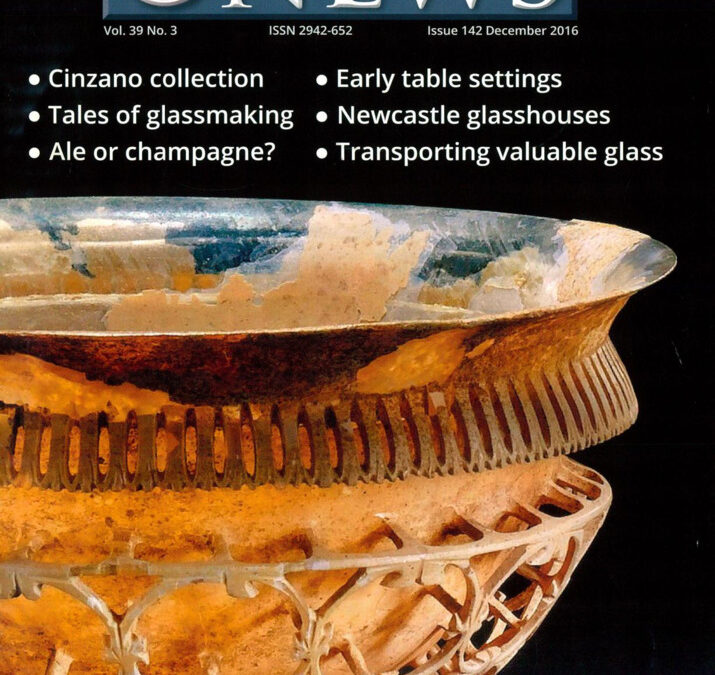
Cover illustration:
The Constable Maxwell cage cup. See page 8.
Bonhams
LETTERS
his edition is a little
gm
,
late this year, but
considering it relies on
the goodwill of unpaid
professionals, what’s in a few weeks’
delay! Our designer, Athelny, has just
finished a long planned and lengthy trip
around the USA. Our editor, Jane, has
had an unplanned and irksomely
long sojourn in hospital. Indeed
she has effectively put this
edition to bed from Tower 14
of University College Hospital.
Looking to the future, both are
looking to relinquishing these roles.
If any member has time and skills as
an editor or designer please contact me
as societies such as ours can only exist
through the efforts of its members. This
will be my last year as Chairman, and I
am determined to hand over the Circle
to my successor in a healthy state.
Thanks to the generosity of our
member of 5o years standing, John Scott,
the auction of the glass he kindly gave
to the Circle raised £2,000, with many
of our members taking home a souvenir
and memento from his great collection.
Following our various reorganisations,
raising subscriptions, auctions, paying
for meetings, the Circle is now running at
a surplus and looks sustainable for many
years to come, although, in common
with most special interest societies, is
suffering a slow decline in membership.
Please try and recruit a new member.
In particular we will continue to have
regular meetings, currently at least
7
a
year plus outings, partially to encourage
scholarship, and also to provide material
for our Glass Circle News. In July
The Corning Museum of Glass
announced the appointment
of a curator of European glass,
after a two-year interregnum.
He is Dr Christopher (Kit)
Maxwell, (below left) who obtained his
first degree at Cambridge in
2001,
then
his Masters at University of London,
and his Doctorate at Glasgow. He has
worked both for The Royal Collections
and in the glass and ceramics department
at the Victoria and Albert Museum. In
2013 he moved to America. He will now
be working with the best collection
of European glass in the world, with
access to the best research library.
In October I visited Innsbruck to visit
Schloss Ambras, a large and wonderful
castle with a fine
kunstkammer.
But
the reason for my visit was to see the
collection of Rudolf Strasser (1919-2014).
He was an Austrian who was financially
successful in the USA and collected
Chairman’s letter
by
John P
Smith
Glass Circle
News
Issuc 142 Vol. 39 No. 3
LETTERS
An early 18th
century
German
tumbler from the
collection of Rudolph
Strasser
an amazing amount of decorated
European glass. Virtually all his
glass is decorated with engraving or
enamelling; he collected very little
‘form’ glass. He left it to the Austrian
state and some of his collection
may be seen in Vienna, as some of
us did on The Glass Association
visit to Austria and Hungary two
years ago. However the majority
of his collection has been sent to
Innsbruck, which is appropriate
as Innsbruck, and nearby Hall,
were the glassmaking centres of
Austria in the 16th/i7th centuries.
The illustration is of a early
i8th century German tumbler, the
design is amazingly oriental and
would not look out of place on an
Art Nouveau object. The collection
is large, the display spacious, and
the captions, in both German and
English, as some of the best I have
seen in any glass museum.
Letters o the editor
Books
Editor’s note:
In the News section we mentioned
David Giles’s offer of free
books. Unfortunately, InDesign
automatically hyphenated his
email address so it read as
davidg-giles@gmail.com rather
than
davidggiles@gmail.com.
Please contact him on the second
email if you would like to see his
list of books.
He still has over 13o books on
glass available free. There are about
5o titles that have been added
that were not on the original list
taking the place of books already
disposed of.
Tasting
glasses
I
sympathise with Hazel Bell
relating the enjoyment of wine to
the vessel from which it is drunk.
I once visited a
patient in a
London private clinic who had
smuggled in a bottle of the finest
claret — Chateau Petrus, no less.
He offered some to me, chilled
and in a plastic tooth mug. I can
assure you it was terrible!
Dr
Philip Edmondson
Stroud
Migration
I
was impressed with the breadth
and depth of the articles in this
edition. We have come a long way
from the narrow base of the Glass
Circle which I joined many years
ago!
I particularly liked John Smith’s
debunking of the myth that glass
fluxed with lead was an English
invention. I look forward to
further scholarship correcting
the common assertion that many
Dutch engravers worked on
glasses made
in England. There is
substantial evidence that lead was
used in Continental Europe to flux
glass prior to it being adopted in
England. Indeed as with virtually
all glass-making techniques, this
method of fluxing was imported by
migrants from the Continent — or
Englishmen who fled to safety on
the Continent during the 17c Civil
War and returned post 166o with
the skills acquired whilst refugees.
We are all the beneficiaries of
migration though many of us are
reluctant to admit it!
I also appreciated your
encouragement to add a
conclusion to my own article
which fitted nicely with John
Smith’s Chairman’s letter and the
appended four papers by Colin
and Sue Brian.
Christopher Maxwell-Stewart
St Leonards-on-Sea
East Sussex
All letters
about a
previous
edition
of the
magazine
refer to Vol.
39
No.
2
Issue no.
141 unless
otherwise
stated.
Glass Circle News Issue 142 Vol. 39 No. 3
3
LETTERS
Crystal glass-making in
London 1642-1672
Eirst,
I want to express my
I
–
thanks and admiration for the
Brains’ research and preparation
of this paper. Having worked with
archival material from this period
to document London silversmiths,
I am aware of how much time
and effort it takes to find relevant
information. And then, when one
thinks one has found something,
there is sometimes the challenge
of having to read the hand-writing
and cope with phonetic period
spelling. I once had to consult
a badly faded document using
ultraviolet light. The ink was so
far faded that only under UV did
it fluoresce enough so that you
could read it. I also want to thank
the Circle and the Brains for
compiling these off-prints into a
special publication and making the
information available for a wider
audience. Actions like that greatly
advance research and knowledge.
My impetus for writing was
prompted by the interpretation of
the quote from Girolamo Alberti,
Venetian Secretary in London
(top of page XIII)
. . .
here [London] many furnaces
produce [drinking] glasses, but they
have no valid protector, only some
Italian masters working very well,
but unable to reduce the matter
to the clearness and fineness
of contesto cristallo.
I think there is a simple and logical
explanation of Alberti’s words
‘non
hanno
Protettori
de
qualita’
First, consider who is writing
these comments. Even today, part
of any official representative’s duty
in a foreign capital is to promote
trade. The international trade in
Venetian cristallo had proved a
big money-maker since the 15oos.
I can recall references to people
in England complaining that
silver drinking vessels were being
supplanted by imported Venetian
glass in the Tudor period. Alberti
needed
to document and report
on what was going on in London,
England, and to do some’industrial
espionage’. Thus, he is looking at
English glass production in terms
of how does it rate compared
to Venetian imports, which he
obviously wanted to continue and
increase.
One of the reasons that
Venetian glass enjoyed such a wide
market was its consistent quality.
Quality was often imposed by
Guilds. For example in the case
of silver made in London, all of
it was sent to be assessed and
hallmarked at the assay office. Any
item that was sub-standard or of
poor workmanship was destroyed.
That’s still the case today. This in
part is due to the fact that since the
late 13oos, the Crown ruled that
the alloy in English silver always
had to be that of the coin of the
realm, This allowed it to be melted
down in times of need or political
turmoil. Because of the important
role the Goldsmiths’ Company
played in maintaining the quality
of silver, even today they can
invite a member of the Royal
Family to one of their functions.
Maintaining legally established
standards was an important part
of any craft.
My interpretation of
‘non
banno
Protettori
de
qualita’
would
be that there is ‘no consistently
regulated quality control for the
product’. Guilds or associations
of manufacturers, even the fish
mongers in London, set standards
for what they were selling to the
public. This is a legal necessity if
one wants to encourage consumers
to consistently buy the product.
Has anyone investigated what
‘contesto cristallo’
means? Is this soda
lime glass produced to a level of
clarity and perfection as required
by a common agreement among
the glasshouses of Murano? Has
anyone discovered and published
the regulations that applied to
glass production and exports
from Venice? Quality control is a
very important factor. During the
i600s, English manufacturers and
consumers were often checking on
the differences between English –
usually London — made products
and what was available on the
Continent. For example, William
III sent his favourite, the Duke
of Portland, on a diplomatic
mission to Paris in the later 169os
(recorded in a furniture history
article I have read). One of the
instructions was to check on the
latest furnishing fabrics that were
available there. Rich furnishing
fabrics were important, especially
for palaces. Because of the great
influx of Huguenot weavers and
designers after the Revocation
of the Edict of Nantes in t685,
the Duke of Portland wrote back
to the King to say that there was
nothing for sale in Paris that you
could not find being made in
England by Huguenot
weavers,
ABOVE AND
OPPOSITE:
Two 17th-century
Venetian thin walled
glasses of the type
that Ravenscroft was
trying to emulate.
The more viscous
properties of lead
glass made this
difficult, and hence
his thicker glasses
introduced the
`English’ style.
4
Glass Circle News Issue 142 Vol. 39 No. 3
LETTERS
Glass Circle News Issue 142 Vol. 39 No. 3
often at a lower price. As a result
of the Huguenots, similar quality
improvements occurred in clocks
and scientific instruments as well
as in silver and furniture.
The standard rote that I was
always told was that the glass
industry in Venice was highly
regulated and that a craftsman
betrayed its secrets on pain of
death. Is this true? Has anyone
documented what the regulations
and punishments were Did
any workers succeed in leaving
and setting up elsewhere? If
those regulations and laws and
their consequences could be
documented, perhaps we could
stop automatically thinking that
the workers who made ‘Venetian’
glass were from Venice.
I am also wondering about the
workers from Altare. How was the
glass industry there regulated in
comparison to Venice? In certain
industries, notably the potteries
in Staffordshire, the workers
tended to be Protestant. Many
of the Staffordshire potters and
their employees were low church
or Methodist by the late 17oos.
Protestant tendencies are reflected
in the decoration of a wide variety
of English and Continental
pottery in the 1600s. Was Altare a
centre of Protestantism? Religious
affiliation was an important part of
how the decorative arts migrated
and developed right up to the
mid 20th century. Was it more
comfortable/safer for Italians
from Altare with non-conformist
Christian views to live in England?
In the 18th century, certain highly
talented cabinetmakers came to
London from Europe because
there were communities of the
countrymen there and protestant
churches of their own faith. Some
of them stayed and made a success.
Others learned the English
techniques and forms during
their
wanderjahr
as a journeyman
and returned to use them in their
workshops on the Continent. In
writing this, I am speaking from
my wider experience as a curator
who has done research in silver,
ceramics, furniture and glass and
studied guild and trade practices.
The one problem with protestant
congregations in England in the
1600s is that the non-conformist
ones where one is likely to find
the craftsmen and workers did
not keep as accurate records as the
Church of England.
It seems to me that London
is often under-rated by British
historical researchers as an
attractive destination and centre of
European innovation. It was one
of the largest and most important
European cities in terms of trade
and commerce when Gustav Jung
visited there in 1667-68. Little
wonder he decided to go there!
Although I have not been able to
find and verify specific statistics,
I believe that London was one
of the largest urban centres in
Europe throughout the 1600s.
Large urban centres are magnets
for new industries and innovation.
What I could find on line was an
essay compiled by scholars on ‘The
Emergence of Modern Europe,
1500-1648: Economy and Society’
from the History of Europe
section of the Encyclopedia
Britannica (last updated in 2015).
One short quote would seem to
support my assessment:
1..
with 400,000 residents by 165o,
London then ranked below only
Paris (440,000) as Europe’s largest
city. Urban concentrations of such
magnitude were unprecedented
in the Middle Ages, the largest
sise attained was roughly
220,000,
reached by a single city, Paris, about
1328.
Peter Kaellgren
Ontario
Blue or grey
I
have inherited a zo-volume
I edition of
The Windsor
Shakespeare,
edited by Henry H.
Hudson, LL.D.,
c.
1910, with
plentiful, somewhat quaint
editorial notes. In
Two Gentlemen
of Verona,
Act IV scene ii, Julia
examines a picture of Silvia, her
rival in love, and observes, ‘Her
eyes are grey as glass’. The editorial
note appended to this line runs:
What we call
blue
eyes were
always described as
grey
in the
Poet’s time. And
glass
was not
colourless then, as we have it, but
of a light-blue tint. So that eyes
grey as glass’ were of the soft azure
or cerulean, such as usually go
with the auburn and yellow hair of
Silvia and Julia.
I cannot vouch for the validity
of this information: but if it is
indeed right, then how well might
dwellers of the Tudor period see
through their light-blue tinted
windows?
Hazel Bell
Hatfield
5
COLLECTIONS
The Cinzano Glass Collection
LEFT:
Huge
English
goblet
1710-1720.
Height 24.7
cm. Lead
glass with
bell bowl,
placed
on double
merese.
LEFT:
Roman mould-
blown beaker.
1st century AD.
Relief of alternating
bunches of grapes
and vine leaves.
RIGHT:
Netherlands
17th century
crystal goblet.
175 cm
high.
by
David
Giles
n 1971 Count
Alberto Marone
Cinzano, of the
family that created
the famous Cinzano vermouth,
decided to start collecting
fine examples of ancient and
antique glass. The collection
was published first in 1974 and
again in 1978 under the title
The
Cinzano Glass Collection,
edited by
Peter Lazarus.
In recent times
the
collection
appeared
to
have gone from
public view and I
enquired of many
glass people what
had happened to
it. It was suggested
that it had been sold
and dispersed, and in
fact in one recent
London glass auction
catalogue it suggested
that a glass had come
from that collection. After
much searching I was
delighted to discover
that the collection was
still completely intact
and with additional glasses
added after the 1974-
78
publications. What
however had happened
was that the Marone
family sold the vermouth
business in 1992 to an
international drinks
company which
was absorbed
in 1997 into
the
large
British company
Diageo and the collection of
glass was included. Diageo is an
invented name and was created by
a marketing consultancy company,
The name is composed of the
Latin word ‘clia, meaning day,
and the Greek root ‘ged, meaning
world, and is meant to reference
the company giving pleasure every
day, everywhere.
So now the collection is known
as the Diageo Glass Collection.
Diageo actually sold the Cinzano
vermouth label to Campari in
1999
but kept the glass collection. It
was published again in 2005 and
edited by Rosa Barovier Mentasti
under the title ‘Glass Collection
Della Diageo a Santa Vittoria
d’Alba’. The catalogue is now out
of print but can still be obtained
on second-hand books sites.
When the collection was
published in 1974-78 there were
125 pieces in the collection but
after that the Marone family
added more pieces and in the
2005 publication there are 144
pieces featured. The oldest piece
in the collection is a wonderful
5th
century BC obsidian lobed bowl.
There are twenty ancient vessels
of Roman and Frankish origin
and two Islamic glasses. Twenty
Venetian glasses. Lots of glasses
from Holland and Germany and
also from England. Each one is
illustrated with colour plate and
full description in Italian and
English. Eight examples are shown
here.
The collection is now kept at
the Diageo meeting centre in Villa
Storica a Santa Vittoria d’Alba
Italy which is between Turin and
Genoa, It can be visited by prior
arrangement if you email deborah.
fuhrmann@diageo.com.
Readers might also like to look
at www.diageomeetingcenter-sv.
it/
Enter the site and click on Le
Cantine and you will see how
cleverly the glass is displayed in
cut-out old wine barrels. This
collection might be an idea for a
future visit of the Glass Circle.
David Giles collects ancient glass
and is disposing of his collection of
books on the subject. See
Letters
on
page
3.
Editor’s note:
If other readers
would like to tell us about little-
known collections, we might
alternate the ‘My favourite glass’
page with a ‘Collections’ slot.
LEFT:
German
‘Reichsadler-
humpen’ late 16th
century/early 17th
century. Height
32.5 cm. Enamel
decoration. Coats of
arms and
inscription: The
Holy Roman
Empire
with its
members.
Glass Circle News Issue 142 Vol. 39 No. 3
LEFT:
English goblet
with twisted stem
1760. Height 15
cm. Lattimo
threads
in
stem.
RIGHT:
Venetian
16th century crystal
glass. Height 18.5
cm. Twisted filigree.
BELOW LEFT:
Roman
1st century
mould-blown
victory beaker.
Height 7 cm.
Inscription reads
‘Seize The Victory:
Very
rare
type as
an inscription is
normally
outside
of the garlands.
However, this
example
has
an
inscription within.
Only three extant
examples known.
BELOW RIGHT:
Venetian Glass
Beaker. Venice
1798-1805. Height
11.4 cm. Enamel
decoration.
The inscription
relates to political
regime changes
1797-1798
Glass Circle News Issue 140 Vol. 39 No. 3
7
COLLECTIONS
BUBBLE-WRAP
—
NANDANAAA,NNIMA
Packing glass: four layers and a hearse
…O
acking is as old
as travelling and
commerce.
No
doubt the Romans
lost countless phials on donkeys’
backs. John Greene bemoaned
breakage of the Venetian glasses
he imported to England. Such
problems were a motive for
developing the glass industry in
England and seeking more robust
metal. To reduce loss of valuable
finished products destined for
Europe, Chinese merchants
transported unpainted porcelain
some 600 miles from Jingdezhen
to the port of Guangzhou
(Canton) where painting could
be applied to white porcelain.
Indeed, this porcelain became
known as
guangcai.
More recently
the Blaschkas didn’t blink over
exporting their extraordinarily
fragile glass flowers to the US or
by
Simon
Wain-
Hobson
RIGHT:
Fig. 3
Thistle bowled
baluster goblet with
mushroom knop
BELOW:
Fig. 1
One of the original
packing boxes for
flowers shipped by the
Blaschkas to Harvard
in 1894.
Photograph by Hillel Burger
for the Ware Collection of
Blaschke Glass Models of
Plants, Harvard Photograph
by Hillel Burger for the Ware
Collection of Blaschke Glass
Models of Plants, Harvard
University, Cambridge,
Massachusetts, USA
BOTTOM:
Fig. 2 The
hearse being loaded for
the journey to
Harvard
The Archives of Rudolf
and Leopold Blaschka and
the Ware Collection of
Blaschka Glass Models of
Plants, Harvard University,
Cambridge, Massachusetts,
USA
©Laur
ie
Le
ig
h Ant
iq
u
e
s
Japan by sea and then overland
to the customer. They tied down
each piece with wire in numerous
cardboard boxes, using tissue
paper to cushion the glass and
keep the parts that could not be
wired from moving (fig. 1). Straw
padding was used to isolate the
boxes, and then a layer of burlap
over the entire structure (by this
time the height of a person). But
even then they had to survive
bumpy roads. This provoked
creative juices, notably in the US
where a hearse (fig. 2) was used to
transport Blaschka glass flowers to
the 1976 Steuben Glass exhibition
in New York. It proved an even
smoother ride than a limousine!
BOTAIVICA4, MUSEUM
I DI RAD. In 41,NA FLOWN/AN
AND 9,111-1
,
N,
3C
.
8
Glass Circle News Issue 142 Vol. 39 No. 3
IND
300
4 Layers
250
200
150
50
0
0.00
0.05
0.10
0.15
0.20
0.25
0.30
0.35
0.40
Static load (psi)
BUBBLE-WRAP
© Sea
le
d
Air
C
BELOW:
Fig.
4
Diagram
of cushion
curves
Dynamic cushioning performance of two, three and four layers of bubble
wrap® PD-230 (1/2″ thickness). Weights were dropped from 30″. Data
are for an average of 2-5 drops
Parcels still get damaged today.
Even with cardboard boxes,
bubble-wrap, polystyrene peanuts
and the like, gorgeous glasses
occasionally return to dust.
According to a major international
freight company, every parcel
experiences the equivalent of one
3o-inch drop (76 cm). On average.
So how should we ship antique
glass, most of which is poorly
annealed? There is probably no
one solution. However, almost
everybody in the antiques
trade uses bubble-wrap, or
BubbleWrap° cushioning to give
its full name. This led to a recent
flurry of emails among some
Glass Circle members. Could
bubble-wrap explode under low
pressure in aircraft cargo bays at
33,000 feet? After all air pressure
outside the aircraft is 3.8 pounds
per square inch (psi), only 26%
of what it is at sea level. Might
peppering by popping plastic
bubbles less than half an inch
from a Georgian baluster damage
it? To increase the angst let’s fix
on a large baluster goblet with a
mushroom knop (fig. 3 opposite).
The air pressure inside
commercial airliners is the
equivalent to that at 6-8,000 feet,
or 77% of atmospheric pressure.
The cargo bays are also at this
pressure. Santa Fe in New Mexico
is at 7200 feet. Glass collector
Dwight Lanmon used to live
there for many years and never
experienced burst bubble-wrap.
The standard vacuum cleaner
can generate a maximum suction
of around 3 psi, the difference in
atmospheric pressure between
Santa Fe and sea level. Turning
a vacuum cleaner onto half-inch
bubble-wrap, the most commonly
used sort for wrapping glass, didn’t
rupture any bubbles. Try it.
More serious depressurisation
is clearly needed. How much?
Sealed Air, the makers of bubble-
wrap have explored the resistance
of bubble-wrap using vacuum
chambers. The bubbles rupture
at an outside pressure equal to
that at 29,000 feet, which is close
to cruising altitude. So our well-
packaged baluster in the cargo
bay can rest in peace; it will not
suffer from popping bubble-
wrap while cruising. In the event
of severe depressurisation at
high altitude the bubbles would
obviously explode. What then? To
use engineering jargon this would
result in catastrophic stress. The
aircraft would be lost.
When at cruising altitude we
are reminded that the outside
temperature is something like
-5oC. Is our baluster being stressed
by large temperature changes?
Like the cabin the cargo bay is
heated. Some parts can be at 4°C
to cater for the shipping of flowers
or perishable goods. Other parts
are like the cabin for animals are
transported in the cargo bay. But
this had to be so. Baggage does
not normally emerge onto the belt
frosty or freezing cold. That bottle
of Margaux meticulously wrapped
in dirty linen never exploded as a
result of freezing.
For those living in remoter
places and who rely on small
unpressurised aircraft like Cessnas,
what then? These generally don’t
fly higher than
12,000
feet so the
bubble-wrap won’t burst. OK, but
the air inside the bubble-wrap
will expand which could pressure
fragile glass, right? The answer is
to be had via Boyle’s law. At these
altitudes atmospheric pressure
is roughly 4o% down on that at
sea level so that the volume of a
bubble will increase by about 6o%.
As bubbles have space around
them this will be taken up and so
the expansion is unlikely to impact
the glass. By the by, this is the same
Robert Boyle of the Royal Society
who wrote about crizzling in 1669,
a detail noted by Colin and Sue
Brain in the third article that was
reproduced and distributed along
with the last Glass Circle News,
issue 141.
Back to bubble-wrap. How does
it protect? How much should be
used? Imagine a one pound weight
wrapped in two layers of the stuff.
We will assume that its lower
surface is approximately 6 square
inches. Its static load would then
be 0.15 psi — or the red spot on
the cushion curve’ for
2
layers of
bubble-wrap (fig. 4). Now drop
it on a flat surface from 3o inches.
Glass Circle News Issue 142 Vol. 39 No. 3
9
F
BUBBLE-WRAP
From the moment the bubble-
wrapped package first touches
the surface to being stopped the
weight undergoes deceleration
in a very short distance and time.
The bubble-wrap is cushioning
the impact. In fact the weight
undergoes deceleration of the
order of 200G — that’s about
200
times greater than the acceleration
due to gravity (G). Take the same
weight and add an additional
layer of bubble-wrap. Obviously
the package is a little thicker.
Maximum deceleration is now
roughly iooG (red square), or
half of that before. Add another
layer and repeat. Maximum
deceleration is approximately 8oG
(red triangle). By this reasoning a
fifth layer is better. However, the
cushion curve becomes shallower
with increasing layers of bubble-
wrap so the gain is less. Four layers
at least would seem to be a good
idea.
As drinking glasses are rarely
more than a pound in weight, and
when packaged have surface areas
easily in excess of to square inches,
this fortunately places them near
the bottom of the curves meaning
that they would undergo minimal
deceleration if dropped. For heavy
studio glass more layers make
sense.
As to the package itself the
advice from Mike Osber, Project
Packaging Engineer with FedEx
Services, is not surprisingly
the double box technique. The
bubble-wrapped glasses should
not be closer than
3
inches to the
cardboard box. That is a 3-inch
layer of polystyrene chips between
the cardboard and the bubble-
wrap. The chips should be piled in
tightly such that ‘you have to fight
to close the box’. If not vibrations
during shipping will cause the
wrapped glass to sift to the bottom
and touch the cardboard box,
which is not good.
Obviously there are several valid
techniques for packaging ranging
from well-heeled transporters to
piping. Cut it to the desired length
and stuff the bubble-wrapped
glass inside. You have a formidable
first package. Stand on the pipe –
it will not give.
From there it is best to pack
it in a cardboard box with poly-
styrene peanuts for the vagaries
in shipping should never be
underestimated. The forces on
a cubic parcel are comparatively
slight if it hits the deck on one
of its surfaces. If it drops on an
edge they are considerably greater,
while if it drops on an apex they
are maximal. Or imagine a forklift
truck missing the wooden pallet
stacked with boxes — the forks
could pierce the one at the bottom
that just happened to be yours.
Even if the trip home is only
45
minutes, someone in the London
Tube could still crash into your
exquisite, yet unfortunately lightly
bubble-wrapped Roman glass
amphora (fig. 5). Put it this way,
bubble-wrap is cheap compared
to the glass and two layers of the
stuff really isn’t enough. Don’t
economise.
Everyone agrees that the glass
should be wrapped first in tissue
paper, preferably acid free. No tape
of any form should be applied. It
is important that the bubble-wrap
does not contact directly the glass
for it may leave an imprint. This
is especially important if the glass
has enamelling or gilt work, since
the bubble-wrap could adhere to,
and remove it. The other issue is
how to secure the bubble-wrap.
Our Chairman remarks, ‘When I
was at Mallett Antiques it was a
sackable offence to use any form
of scotch or sellotape on bubble-
wrap. If tape was used, which was
rare, we used paper-based masking
tape because it is easy to tear off’
The trouble with sellotape is that
people sometimes end up fighting
the packaging, especially if the
bubble-wrap is taut. Becoming
distracted can cause distress to
the contents. So the science of
packaging is one thing, but human
ABOVE:
Fig. 5
A Roman glass
amphora, 1st
century AD
BELOW:
Fig. 6
Stephen Pohlmann’s
sweetmeat
commercial foam packing systems
available but they nearly all need
expensive machinery to operate
— which is beyond most of us.
Dwight Lanmon’s one liner “if
it is valuable take it in the cabin”
is fine especially as bubble-wrap
will not pop at cabin pressure.
Be especially careful when going
through the security check.
There are some simple yet rather
ingenious solutions. Athelny
Townshend’s is to use one eighth
inch (3 mm) thick plastic draining
10
Glass Circle News Issue 142 Vol. 39 No. 3
BUBBLE-WRAP
behaviour must be factored in too.
Stephen Pohlmann, the Glass
Circle correspondent who started
the thread, contacted his shipper
in the USA to find out how his
latest acquisition, an opaque twist
sweetmeat (fig.
6
opposite), was
to be sent. The formula was lots
of tissue paper, no tape; several
layers of lightly applied bubble
wrap, not heavily taped; double
cardboard box with styrofoam.
The shipper added, “From that
point getting the items delivered
undamaged is up to a higher
power than I”. Some people don’t
use bubble wrap at all, for example
Frides Lameris of Amsterdam.
Phoenix Antique Art of New
York use cotton wadding instead.
Colin Brain considered that a
bowl rim less than
1
mm thick and
loo mm in diameter (0.04 x 3.9″)
would be subject to uneven loads
and that the tension components
of the bending stresses are likely
to be surprisingly high even for
loads of a few pounds. He notes
that Glass Notes
8
by Arthur
Churchill (December 1948) page
24, advocated soft newspaper.
And that: ‘From a professional
perspective, both Sandra Davison
in her book Conservation and
Restoration of Glass, and Steve
Koob in his book Conservation
and Care of Glass Objects discuss
packing glass for transportation.
Their favoured materials are acid-
free tissue paper and specially cut
foam’.
The above suggestions hopefully
will interest collectors. The ground
rules change when transporting
museum or extraordinary pieces
like the £2-6m Roman cage-cup
on the cover of this edition. Simon
Cottle notes: ‘When I was in the
museum profession we would
always use acid-free tissue as
the first line of protection. Large
sheets folded into z-inch narrow
strips, flattened out, were wound
around the stems of glasses and
the rims of bowls and feet firstly
in a lateral and then horizontal
manner and secured by tucking
in the ends. Once a ball had been
created — the strips would be built
up to even out the surface area —
the whole was wrapped in two or
three further sheets of acid-free
tissue but not taped. Around this
ball we would then wrap a sheet
of bubble wrap forming at least a
double-layer with short pieces of
coloured tape fastening the ends
(but not wrapped around the
whole):
‘We experimented with those
expensive and fancy methods
of flowing foam into a box to
surround the object thus creating
a mould. The object would be
covered in a layer of thin plastic
— similar to a bin liner — and
then the foam squirted into the
box. The method required the
solidified foam to be split in half so
that the object could be removed
safely. Our concerns were that this
process might create a build-up of
heat and/or unnecessary pressure
on the object:
Clearly packaging is com-
mensurate with the value of
the glass. No matter how many
layers of tissue paper and bubble-
wrap, going into an aircraft hold
surrounded by a wooden crate
is going to be safer. The costs of
course are going to be beyond the
reach or practicability of most
collectors. Fortunately when it
comes to bubble-wrap we can be
pretty confident. With four layers
of bubble-wrap, the Blaschkas
wouldn’t have needed a hearse.
Simon Wain-Hobson is Professor of
Molecular Virology at the Institut
Pasteur, Paris. The author thanks
Colin Brain, Simon Cottle, Jane
Dorner, Dwight D. Lanmon,
Stephen Pohlmann, John P. Smith
and Athelny Townshend who made
invaluable comments to the email
conversation from which this article
grew. Bubble Wrap° is a trademark
of Sealed Air Corporation (US).
Editor’s note:
We would like to
hear from readers about their
experience of packaging and
accidents. This might help all of us
in preserving our collections.
BELOW:
Fig. 7
The Constable
Maxwell cage cup,
c. AD 300, sold at
Bonham, in 2004
for £2.6m.10
cm H x 18.2 cm.
See also the cover
picture
Glass Circle News Issue 142 Vol. 39 No. 3
11
ALE GLASSES
The collector’s c ilemma: a glass of ale, beer
or champagne?
Fig.1 Greene beer
glasses
c.1670
tg
-n my talk to the
Circle on 12 May,
I focussed mainly
on the type of
English glass that may have been
used to drink strong ale or beer or
champagne between the start of
the English lead glass revolution in
the last quarter of the 17th century
until the end of the 18th century.
During a period of 125 years, the
design of the drinking glasses used
for strong ale or beer changed from
being influenced by the Venetians
to the tall, slender, round funnel
bowl glasses with which readers
are no doubt familiar. I shall look
at the form of champagne glasses
and the controversies surrounding
them a little later in this article.
For the first part of the last
millennium ale was one of
the most popular drinks in
England. Around 1400 hops were
introduced from Europe to give
us the alternative of beer. There
was some resistance to hops at
first. Hops were not easy to grow
but eventually the crop became
established in Kent which had a
suitable climate and soil for this
vine to flourish.
Brewing
Ale is brewed with a high quality
barley known as malting barley
which goes through a roasting
process to produce the malt which
gives the drink its flavour. Much
of the production was brewed in
the home or on the estate with
commercial brewing steadily
increasing as the 18th century
progressed.
Non-commercial
making was often carried out by
women in the home. The brewing
of ale is a complicated process
requiring considerable skill, good
quality ingredients, the right type
of water, temperature control
and careful timing. Brewers yeast
is added to the brew to provide
fermentation and a limited
amount of hops might also be
added.
Brewing beer follows a similar
process but hops were always
added at the end of the cycle to
provide the distinctive taste. The
more hops applied, the darker the
beer. Pale ale however, could be
brewed using a best quality pale
malt.
The main difference between
the two drinks is that ale may
contain no hops but if it does,
it is generally likely to be lightly
hopped whereas beer will always
contain hops and may be darker in
colour than ale. This may explain
the reason for the engraving
of both hops and barley on ‘ale
glasses’.
Ale and beer can be brewed
to give a wide range of alcoholic
content. The strength of the drink
would seem to govern the size of
the glass to hold it.
Identification
To help with identification of
the glass type and drink to fill it,
some of the best evidence in the
latter part of the 17th century
comes from the correspondence
between a London glass seller and
his Venetian supplier. In 1668 the
glass seller, John Greene, wrote to
his supplier Morelli of Murano
and placed a large order for z86
dozen beer glasses. In 1671 some 3o
beer glasses,
20
claret and 6 glasses
for thick beer were ordered. What
thick beer may have been is not
clear but it probably was a beer of
high alcoholic content. Later two
dozen flutes were ordered.
Greene’s correspondence was
accompanied by detailed drawings
(fig. 1) which have been preserved
illustrating the shape of the glass
required. Interestingly in the
letters of John Greene
to his supplier that
I have seen quoted
there is no mention
of an order for ale
glasses, only beer
glasses.
Robert Charleston
scaled some of
Greene’s
drawings
and found the beer
glasses to be 16.5 to 17.3
cm (about 6.5-7 inches)
tall, the claret glasses
being about 2. cm (i in)
shorter.
By the time Ravenscroft
came on the scene beer was
an established drink on a
par with ale. Until recently,
Ravenscroft was considered
to be the founder of the
English lead glass tradition
which, as time went by
introduced a much clearer and
heavier glass than the cristallo
of Venice. Ravenscroft’s 1677
price list included beer glasses
ribbed and plain, weighing 7
oz and costing is 6d each. The
ribbed glasses would have had a
moulded bowl. Beer glasses with
nipped diamond waies weighing
by
Graham
Vivian
12
Glass Circle News Issue 142 Vol. 39 No. 3
ALE GLASSES
8 oz cost is 8d each. The nipping
of the diamond waies would have
required hand work to give the
reticulated
effect.
The weight of a
glass and handwork required was
likely to be reflected in the price.
A montage in Robert
Charleston’s
English Glass
shows
the form these plain and ribbed
beer glasses would have taken.
(fig. 2) As in the case of Greene, I
have not seen any reference to ale
glasses in Ravenscroft’s price lists.
The glasses are somewhat similar
to those ordered by Greene from
Morelli.
Beer and ale were very important
drinks across all societies and were
considered both nourishing and
health giving. From time to time
the drink would be given additives
in the home to increase its
nutrition or to combat a medical
condition i.e. scurvy grass.
Based on an estimated UK
population in 175o of between
6.75 and 7 million persons and a
consumption estimated at about
43 million barrels a year (one bar-
re1=-35 gallons), I calculate that the
average person, including children,
drank about 5 pints of varying
strengths of ale and beer per day.
Types of beer and ale
In the period under review there
were mainly four types of ale and
beer brewed. Strong ale or beer
would have an alcoholic content
of about ii% by volume although
it could be brewed even stronger
when it was known as hum cup
because it might cause a humming
of the head. At the end of the 17th
century strong ale and beer were
probably drunk initially from
short ale glasses and later from
balusters and then from elegant
round funnel bowled glasses. The
nearest equivalent to strong ale or
beer today is barley wine.
Table beer which encompassed
many types and strengths of less
alcoholic beer and ales would have
been drunk from larger vessels
such as tankards or mugs. Small
beer was drunk by the working
classes in considerable quantities
as it was the least expensive of
the various strengths generally
available. There is no reason to
suppose that the better off did not
enjoy this as a thirst-quenching
drink. The alcoholic content of
small beer was thought to be
around 2%.This also would have
been drunk from large tankards or
mugs some with a capacity of up
to
2
quarts .
Porter was not introduced
until 1722. It reflected the quality
of brown pale or old ale and was
very dark in colour and heavily
hopped. It had a relatively high
alcoholic content. It was popular
with manual workers and London
porters from which it derived its
name.
Glass vessels because of their
expense and particularly their
fragility, would not have been used
for drinking beer or ale by the
working classes.
Champagne
Champagne was introduced to
England in the last half of the
17th century from France. It was
the most costly wine available and
was favoured by the aristocracy
who could afford it. Champagne
was regarded as a sparkling wine
although it was not as effervescent
as the wine that we drink today.
It also had a fair amount of
sediment. It was mainly drunk
from flute-like glasses and poured
from bottles and decanters.
Champagne glasses are the
most difficult to identify because
of their similarity to i8th century
ale or beer glasses. Bearing in
mind the expense of this drink it
would seem reasonable to assume
that a limited number of fine 18th-
century long-stemmed and tall-
bowled engraved glasses would
have survived. In its simplest form
any engraving would probably be
of grapes and vine leaves. I have
not seen such a flute shaped glass
illustrated in any of the leading
books on English i8th century
glass.
As far as the i8th century is
concerned Charleston opts for a
stemmed unengraved ale type of
glass probably with around a 6fl oz
capacity. There is a controversial
view that champagne may have
been drunk from a mead or
sweetmeat type of glass.
Fig.
2
Ravenscroft
beer glasses
diagrammatic.
c.1677
Glass Circle News Issue 142 Vol. 39 No. 3
13
Other factors
In price lists and inventories of
the period under review, drinking
glasses, if described at all, would
generally not be measured by
height. Where a measurement
was given it would relate to the
capacity of the glass normally
from a gill, which is a quarter of a
pint, to
2
quarts which would have
been a massive tankard used to
drink weak ale or beer.
The familiar short stemmed
(fig.
3)
strong ale or beer glasses
range between
14
and 15 cm (5.7-6
inches). The tall stemmed glasses
for strong ale, beer or champagne
range from 17-23 cm
(6.75 -9.2
inches) with the champagne
glasses probably being the tallest.
(figs
4,
5 & 6).
Before the 19th century sediment
was a real problem in alcoholic
drinks particularly strong drinks.
Ale or beer would be allowed to
settle in the barrel before it was
served although it was also served
in decanters. Champagne was
probably purchased in bottles
and when it was safe to do so
served from the bottle, otherwise
decanted.
There were various ways of
dealing with sediment. It could
be visually obscured by moulding
on the lower part of the glass.
The glass could have a pointed
base which would contain the
sediment or the drink could be
filtered or decanted before it was
served. The presence of sediment
affected the shape of the drinking
glass. The taller the bowl the more
space for the sediment to settle at
the bottom of the bowl so it would
not make its presence known until
most of the content had been
consumed.
In the case of beer or ale in
the middle of the 18th century
additives were used to improve
the quality and clarify the brew.
Beer or ale which had no or very
little sediment was known as fine
ale or beer.
Decanting an alcoholic drink
was a convenient way of allowing
the sediment to settle before the
drink was served. Eighteenth
century decanters often had
the name of the drink they were
designed to contain engraved on
the bowl. Alternatively a silver
label was hung round the neck
of the decanter. In the context
of this article the most common
appellation is ‘beer’ with very few
decanters engraved with the word
ale’. This is in line with there being
far more glasses in inventories or
price lists described as beer rather
than ale. It would seem that the
majority of decanters with beer
or ale inscriptions were designed
for strong ale or beer as low
alcohol beer or ale was drunk in
much larger quantities and would
have been drawn straight from the
barrel.
Andy McConnell states in
his book on decanters that
champagne was stored
in glass bottles and
decanters with an
ice pocket in the
bowl was used to
cool the champagne
BELOW LEFT:
Fig 3 Beer or ale
c.1700 (6 fl oz)
Venetian influence.
BELOW RIGHT:
Fig 4 Champagne?
c.1700 (6.5 fi oz)
BELOW FAR RIGHT:
Fig 5 Ale or beer
c.1760 (4.5 fl oz)
14
Glass Circle News Issue 142 Vol. 39 No. 3
before serving. From time to time
the bottles exploded as some were
not made of sufficient strength to
contain the effervescence. Andy
quotes the story of the cellarman
walking around in a helmet with a
visor and chain mail body armour
to protect himself.
Cost of alcoholic drinks
Over the period covered by this
article the cost of ale or beer was
affected by duties imposed by the
government and often more so by
the quality and quantity of the
barley harvest which could vary
considerably. In 1675 small ale
purchased by the Russell family
for Woburn Abbey cost 13s 3d per
barrel (280 pints) and strong ale
cost 17s 3d per barrel.
In 168o records of Parliament
state that beer was being brewed
so strong that it cost 4d per
quart and that it burned
like sack. At that time
sack was a term which
applied to any strong
wine imported from
Southern Europe and especially
sherry from Spain.
In 1691 small beer was again
purchased by the Russell family
this time at 7s 3d per barrel which
would give a wholesale price of a
little more than a farthing a pint
while cider cost £3 6s 8d per bar-
rel which would be about
25
iod
a pint. This would put it on a par
with French wine. Around 1720
table and small beers cost between
id and zd per pint .
An interesting window on the
cost of alcoholic drinks enjoyed by
fashionable Society in 1762 comes
from a pricelist published by the
Vauxhall Pleasure Gardens in
London as follows:
Champagne
Burgundy
Claret
ReciPort
Sherry
Cyder
‘rage beer a great mug
Development of ale
glasses and champagne
flutes
In the i7th century the main dis-
tinction between the drinks served
in glasses was reflected in the ca-
pacity of the glass, the largest for
beer, the next size for French wine
and the smallest for Spanish wine.
The capacity rule largely applied
to the 18th century. Other consid-
erations were the alcohol content,
the amount of sediment and to a
lesser extent the colour of the liq-
uid. The higher the alcohol con-
tent the smaller the glass.
A wrythen or engraved or
moulded bowl would disguise
the sediment to some extent. A
tapering or pointed bowl helps
to contain the sediment. A clear
glass, where appropriate, shows
the content to its best advantage.
Coloured drinking glass are used
more for the colour of the glass
than for the visual enhancement
of the liquid they contain.
By the end of the 17th century
and start of the 17oos there had
emerged a tapering glass usually
on a short stem decorated by
mould-blown ribbing. This two-
piece glass was usually called a
short ale and when the bowl was
set directly on the foot, a dwarf
ale. The standard capacity of
theses glasses was generally
4
–
5
A oz which is a reflection of the
strength of the beer or ale for
which they were designed to hold.
The tall narrow bowl could be
mounted on a baluster or other
stem (fig.8) to make a three-piece
glass and later in the century these
might be engraved with ears of
barley and hops. (fig.5) It is not
clear why the tall narrow bowled
ale glass shape for strong ale, beer
and champagne or mead (fig.9
CENTRE:
Fig 8 Ale
or
beer
c.1720(6fioz)
FAR LEFT:
Fig 6
Champagne? c.1780
( 7.5 fl oz)
LEFT:
Fig 7 Tall Ale
beer or champagne
c.1760 (6.5 fi
oz)
8s
a bottle
Es
Ss
25
(d
2S
is
4d
overleaf) evolved as it did.
At one time it was believed
that glasses with hemispherical
bowls were used for champagne
but Robert Charleston finds no
factual support for this believing
I
Glass Circle News Issue 142 Vol. 39 No. 3
15
ALE GLASSES
Fig 9 Mead glass
c.1765-1775 (4.5
fi
oz)
BELOW:
Fig 10
Sweetmeat or
champagne glass?
c. 1740 (6 fi oz)
these glasses were for sweetmeats
not champagne. Indeed Bickerton
in his book i8th Century English
Glasses must disagree as all
his illustrations of champagne
glasses show the sweetmeat type
of glass as does Harold Newman
in his dictionary of glass (fig. io).
Similarly it is believed that a small
goblet with a hemispherical bowl
commonly called a mead glass
was not made for this seldom
drunk liquor but contrary opinion
suggests that these glasses may
have been used for champagne,
certainly not mead.
On the assumption that
there could be a fair amount of
sediment in champagne, a flute is
much better designed to contain
the sediment at the bottom of
the bowl than a glass with a
hemispherical bowl.
Documentary evidence
In trying to ascertain what types
of early glass were used for beer
the best evidence that I have
obtained was from the drawings
that Greene sent to Morelli and
to some extent those 18th-century
glasses in collections engraved
with barley and hops. Thereafter,
except from a limited number
of paintings and illustrations in
books on drinking glasses, I could
only find written accounts with
minimal descriptions of the types
of glass under consideration from
the price lists and other material
available to me.
Charleston whose opinion
I value highly, shows the i8th-
century champagne glass to
have the form of a tall stemmed
unengraved ale glass with a round
funnel bowl which bears no
resemblance to the tall stemless
flutes of the previous century
with their narrow tall pointed
bowls stretching down to a wide
base. Evidence that champagne
was drunk from flute-like glasses
is demonstrated by a
1773
bill
from Colebron and Hancock
who supplied the historian
Edmund Gibbon with one dozen
champagne flutes for
8
shillings.
Thomas Betts was described
as a glass scolloper and polisher.
Scolloping was the name given to
a glasscutter and polishing prob-
ably applied to the work necessary
to finish glass mirrors. During his
life Betts will have published many
price lists. He refers to green half-
moulded egg-form champagne
glasses which is the green mead
type goblet which supports the
belief that champagne was not
only drunk from flutes in the i8th
century.
Looking at the inventory of the
io,000 glasses that was made after
he died in 1765 it is interesting to
note that there are many varied
glasses described to contain beer
but none specifically for ale.
Whereas for champagne there
were plain flutes, half moulded
glasses presumably to obscure
the sediment and air twist gilded
glasses.
The household accounts of the
Duke of Bedford discussed by
Julia Poole in the Glass Journal no
II are a rich source of information
on i8th century ale and beer
glasses. The only champagne flutes
acquired were purchased in Paris.
The information in the Duke’s
Household Accounts does not
support the view that by the
mid 18th century the distinction
between ale and beer glasses had
ceased to exist, as both types are
listed, yet in practice, this may well
have been the case.
Conclusion
My talk dealt principally with the
drinking glasses for strong ale or
beer which would have an ix% or
greater alcoholic content. In the
18th century, in particular, the
distinction between ale and beer
had become blurred. Contrary
to what many believe ale could
contain hops in the brew whereas
beer always contained hops. From
the last half of the 17th century to
the end of the 18th century there
Glass Circle News Issue 142 Vol. 39 No. 3
ALE GLASSES
appears to be more emphasis on
the beer appellation than ale as far
as drinking glasses are concerned.
This is supported by the fact that
there are many more decanters
engraved ‘beer’ than ale extant
today.
Strong beer as well as ale was
almost certainly drunk from the
dwarf and short stem ‘ale’ glasses
at the end of the r7th century.
The long stemmed and long
bowled glasses that followed
were of a form that could equally
be used for champagne, mead
or cider glasses. The capacity of
strong ale or beer glasses would
vary between approximately
4
and
6
fl oz. It is probable that
glasses engraved solely with barley
stems and those engraved with
hops in addition were used for
both strong ale and beer. In many
cases glass sellers would appear
to distinguish their glasses and
decanters by engraving as far as ale
and beer are concerned.
The term champagne flute in the
mid i8th century did not signify
a tall narrow pointed funnel
bowled glass placed on a hollow
ball knop above a folded foot. The
shape of champagne flutes was
derived from the long stemmed
ale glasses of this period (fig. iz).
A typical champagne glass would
have a capacity of
6-7
fl oz. It has
changed very little today. Because
of the cost and limited availability
of champagne, relatively few
glasses specific to this drink would
have been produced. Champagne
glasses may also have been
engraved or decorated in manner
that would identify the drink the
glass would contain. i.e. vine leaves
and grapes.
There is a body of opinion
that champagne was not drunk
from sweetmeat-styled glasses
but may have been drunk from a
goblet with a part moulded bowl
referred to as a mead glass (fig. 11).
Whatever the designation of the
glass I still believe that in the long
stemmed, long bowled glasses of
the i8th century we have some of
the most attractive and affordable
glasses that a collector may place
in his cabinet.
This is an abridged version of a
lecture Graham Vivian gave to
the Glass Circle on 12 May 2016.
The co-hosts were Maurice and
Margaret McLain, David Giles and
Lawrence Trickey
Graham Vivian is a glass collector
and Committee member of the
Circle. The majority of illustrations
of glasses are from his collection.
BELOW LEFT:
Fig 11 Betts-type
champagne glasses
c1750
BELOW:
Fig 12 Modern
champagne left, Ale
beer or champagne?
glass right c 1750
(6.5 fl oz)
Glass Circle News Issue 142 Vol. 39 No. 3
17
Tales from the
glasshouse
tg
–
t was after taking
the Kiln Club
in Scotland on a
tour of the Alloa
Glassworks that Dr Jill Turnbull,
the author of two books on the
history of Scottish glass, remarked
that she was surprised, with all the
modern technology and the purest
of raw materials, that anything
could go wrong these days in the
manufacture of glass. This was
just prior to my retirement from
the United Glass Company, where
I had spent all my working life,
completing my career by running
this massive factory, one of the
largest glass container factories in
the World.
Admittedly today’s glass
manufacture can in no way be as
hit and miss as the early glass-
making enterprises, but it does
have its moments. On the
(thankfully) rare occasion we
ever had a complaint from a
customer over the quality of
our bottles and prior to a
review meeting concerning
the complaint, I always
took the customer on a
tour of the plant. From
what could have been a
difficult situation they
invariably came back
by
Mike
Noble
Glass Circle News Issue 142 Vol. 39 No. 3
Glass Circle News Issue H2 Vol.No. 3
GLASSHOUSES
full of awe at the complexity of the
operation and, might I say, at the
amount of control we did actually
maintain over the processes. On
more than one occasion I did
humbly suggest that making glass
bottles was perhaps more difficult
than making whiskey, gin, vodka
etc., a sentiment they invariably
did not dispute.
However problems, often
serious and costly, did sometimes
arise, four of which I will narrate
here.
The first that springs to mind
is when the glass turned slightly
green in our white flint furnaces in
Alloa. It was a Monday morning
when, arriving at work, I was
met by a delegation of people
informing me that ‘the glass has
gone off’ We were at the time
producing well over a million
white flint bottles per day in the
factory, predominantly for the
spirit companies whose demand
for a pure clear non-coloured glass
was an absolute requirement. They
wanted the colour of their liquor
to be show-cased by the bottle and
not offset by a slight tinge of green
in the glass, which we were then
unfortunately producing.
Assembling the appropriate
team we set about trying to
identify what had gone wrong, how
to put it right, and how to handle
the current situation? Was there
too much or poorly processed
recycled cullet, had there been
some cross-contamination of the
green and white batches, or was it
one of the raw materials that was
out of specification. In addition
we had the problem of what we
should do with the glass being
produced; carry on producing and
throw it away or pack it off for
later culleting, or stop production
and let the furnaces idle without
getting the contaminated glass out
of the system. All very difficult
choices.
The immediate actions involved
sending samples of all the raw
materials and glass to a couple of
laboratories for analysis, which
would take two or three days to
complete; take out all the recycled
cullet; post people on the batch
conveyors on a 24-hour basis
to make sure there was nothing
untoward happening there; get
in touch with all the raw material
suppliers to find out if they had
any problems and to send their
analysis, and lastly and most
importantly to keep our fingers
crossed.
The following day nothing had
changed. Taking the recycled glass
out had had no effect, there was
nothing adverse to report on the
batch conveying systems, and the
suppliers had confirmed all their
materials were in specification.
In other words they were saying
`not me guvr I could almost have
believed them if it were not for
the fact that we were throwing
hundreds of tons of glass away.This
certainly keeps the mind focussed.
The glass analysis did finally come
back shortly after lunch time. We
had too much iron. That then
eliminated anything to do with
cross contamination where green
glass contains chromium and not
iron as a colourant.
It was at this stage that I made
an executive decision, i.e. one
based purely on instinct and
not on fact. It was the sand. The
quarry was located about fifteen
miles away and so I went there
and actually watched the sand
being analysed by a small portable
x-ray fluorescence machine. The
foreman at the quarry thought I
had gone mad when everything
still showed to be in spec. but I just
could not believe it.
What then followed was a
stand-off with the quarry manager
who refused point blank to move
to a different part of the quarry
as I requested. I could fully
understand his position. The XRF
results were satisfactory and to
move all his heavy equipment, take
off the top soil, and start on a new
area of the quarry was something
not to be done lightly. However….
Sand from the new part of
the quarry started to arrive later
that evening substituting what I
considered to be ‘bad sand: The
following day there was some
improvement of the glass and
results from the two laboratories,
although differing between
themselves, showed the iron
content in the sand to be between
o To% and
0,15%,
the results from
19
OPPOSITE LEFT:
Alloa Cone works
view 2004
BELOW:
United
Glass (UG) Harlow
factory in 1996
GLASSHOUSES
the quarry showing only
0.04%,
which was what it should be, the
higher level being enough to give
the glass a green tinge.
I never did bottom out why
the portable XRF machine gave
such spurious results. Perhaps
some technowhizz out there
has a theory, but certainly at our
round up meeting all the glass
technologists did not have an
explanation. It took a week to get
back to normal, and I really would
not like to say how much the whole
episode cost, but it certainly ran
into tens of thousands of pounds.
My second story concerns the
United Glass factory in Harlow
which I ran just prior to Alloa. At
the time amber beer bottles were
the main focus of production,
and suddenly and for no apparent
reason we started getting seed or
small bubbles in the glass from
certain forehearths. A forehearth
is a channel ten or more yards
long, about a yard wide and
contains about four inches of
glass. Its purpose is to transport
the glass at a high level from the
furnace to above the bottle making
machine while at the same time
homogenising the temperature.
At its end there is a rotating
refractory cylinder called a sleeve
which controls the flow of glass
into the machine. Through the
centre of this a needle pumps up
and down and pushes the glass
through orifice holes in the form
of gobs. These are then cut into
pieces by shears, and the gobs
are directed into the machine
by troughs and deflectors.
Although difficult to describe
here, the system is most elegant
in operation, with the gob of
glass being controlled to within a
couple of degrees centigrade, and
each gob weighing not more than
a couple of grams from each other.
The bubbles, when they existed,
could be seen when looking
down into the sleeve, something
not easy to do bearing in mind
temperatures of around Imo
degrees centigrade. This totally
baffled me, as it did many experts,
some of whom came from various
parts of the world to help resolve
the problem, and all of whom
thought it was connected with the
glass or furnace in some way.
One of the characteristics
associated with the bubbles was
a very fierce heat coming up
from the sleeve, even though the
temperature readings from the
thermocouples were showing
normal. An American forehearth
expert who was visiting the factory
for something quite different took
a look at the operation for me and
asked ‘why is your race cooling set
so high?’
I had never heard of race
cooling before, but apparently
it was the cooling applied to the
ball bearings in the race that
allowed the sleeve to rotate, and
was cooled by compressed air. The
pressure should have been fixed at
iopsi but, in this case, a pressure of
ioopsi was being applied.
On questioning the engineers
responsible, they said that they
had been having problems with
the race occasionally sticking
and that they had increased the
pressure to keep it cooler to
stop this happening. Once the
correct settings had been applied
the problem not unexpectedly
suddenly stopped. They never,
it has to be said, increased the
pressure ever again!
My third tale again concerns
seed or bubbles in the glass,
but this time originating in the
furnace.
Because certain Scottish spirit
companies are so particular about
glass colour, particularly when
bottles for their premium brands
are being produced, no recycled
cullet, which does have a slightly
detrimental effect to the colour,
was used.
The problem was that when
the cullet was taken out, with
a corresponding increase in
furnace temperature, seed started
to appear, which took an awful
amount of jiggery-pokery to sort
out. This was usually done by
substituting bottle bank cullet
with much better cullet from our
own off-ware, which was usually
in pretty short supply.
As the campaigns for these high
quality premium products came
and went so the problem continued
to persist, and it was not until one
of our furnace-men, teasers in old
language, spotted a single black
particle in the batch that we finally
BELOW:
Amber beer
bottle production
2003. UG’s
investment
in
high
speed production
technology was
coupled with
investment
in
quality control and
engineering skills.
20
Glass Circle News Issue 142 Vol. 39 No. 3
GLASSHOUSES
ABOVE:
Clear spirit
bottle production
2001. All bottles
produced at UG
Alloa were visually
and automatically
inspected to identify
any defects quickly.
resolved the problem.
It transpires that certain
deposits of sand contain a very
small proportion of a carbon
particle called lignite, a substance
I had never come across before.
It appears in such small amounts,
parts per million, that it is
virtually impossible to detect, and
who, after all, would have thought
something so inconsequential
would have such a large impact.
We probably still had our fingers
crossed from the previous problem
because it was certainly luck, and
of course a very observant furnace-
man, that resolved that problem.
Once lignite had been identified,
we kept a pretty close watch on the
sand afterwards.
My final story concerns a very
young and naïve me, and how my
career in the glass industry was
almost terminated permanently.
My first job when I moved
to the Harlow factory from the
relatively calm atmosphere of the
central laboratory in St Albans
was as their batch and furnace
manager. The batch plant, where
all the raw materials are stored,
weighed, mixed and transported
to the furnaces, was very old at
the time and took an awful lot of
looking after.
One problem concerned the raw
material soda ash, which is prone
to pick up moisture and become
solid. We had large silos about
fifty feet high to store the material,
and occasionally some hard lumps
of soda which had formed on the
sides of the silo would fall off the
wall and restrict the exit at its base.
On one occasion I was fed up with
a particularly hard lump of soda
ash which was restricting the flow
so severely that it was virtually
impossible to operate.
I therefore decided to go inside
the silo from the top, being
lowered the fifty feet on a bosun’s
chair, and break the material up
using a sledge hammer. As I say I
was very young at the time.
Anyway I had the riggers
fit up the chair from a tripod
contraption at the top, and they
would then lower me down to the
silo floor. To co-ordinate the effort
a graduate trainee from head office
who happened to be on site as part
of his training was put in charge
of this side of the operation. I
was lowered down by the riggers,
broke up the lump of soda ash,
and shouted to the top to haul me
back up.
I was steadily raised until a
couple of yards from the top when a
plaintive voice criedl can’t hold you!’
‘Don’t panic’ I retorted ‘DONT
PANIC! just lower me down
slowly; keeping my voice as calm
as possible, and without the use
of any expletives I might add. It
appears that the riggers, sensing
it was near tea time and having
become rather bored, had decided
to go off for a break leaving the
graduate trainee, who was even
younger than me, to look after
things. When I shouted to be
lifted up he foolishly decided to
undertake the task himself rather
than interrupt the riggers. When
the tea break was finally over they
came back, raised me up, and all
was well. That was something
I never did again, the graduate
trainee received a number of choice
words as part of his training, and
yes, I did live to tell the tale.
Mike Noble has been a glassman
throughout his working life. Having
obtained an honours degree in phys-
ics, he joined the UK Company of
United Glass, at their research and
development establishment in St Al-
bans to set up an x-ray fluorescence
and diffraction analytical section.
His first factory position was as the
Batch and Furnace Superintendent
at United’s Harlow factory in Es-
sex, becoming the Factory Manager
there in the early 1990s. By the end of
the decade he was managing Alloa
Glassworks in Scotland. Since that
time he has been kept fully occupied
by researching his book
Eighteenth
Century English Glass and its An-
tecedents:
see review on page
26.
Glass Circle News Issue 142 Vol. 39 No. 3
21
The noppr,v1
4
GLASS HOUSES
Some \ewcastle glass houses in 1793
V11
.
1.11
4 Rwlic”,(1,
•
•
CL///k/17(
&
a./c
Via./
J110AD
GLAfSHOU&S
:iht__(ri/i
AIR
thGlaki
,
A
ll p
hotog
rap
hs
© CMOG
WALIACRE
QuAl
PPEN11,SZS
iP/C
Ve
‘A
re
t
w
•
Lou 6z,dc.ao
UI
Op
n 15 March 1983,
Dr. Catherine Ross
resented a paper to the
Glass Circle:
The Flint
Glasshouses on the Rivers Tyne and
Wear during the 18th Century,
based
on the work in her PhD thesis’. Her
paper, as she acknowledged, used
as its basis two papers published
by Francis Buckley in 1925
2
and
1926′. This was later published in
The Glass Circle Journal
No. 5. This
paper emphasised the importance
of bottle glass production and
sheet (broad) glass production in
Newcastle and also mentioned the
relatively small production of flint
(table) glass. She also questions
the then accepted view that most
‘Newcastle style glasses were made
in Newcastle, as proposed by Thorpe
in 1923. We now know that these
were produced in large quantities
22
Glass Circle News Issue 142 Vol. 39 No. 3
411 Ng Mill ‘With
7
774sTraZoTgrore..17/ZrairaVoi;;;;M=Vales
earearariarraniZZVW=”4
.
a
kaw
4M.1•111.141/PIIIIP.M….
by
John P
Smith
OPPOSITE TOP:
The Corning
Museum of
Glass’ pen and
watercolour
plan
showing Newcastle’s
glasshouses.
OPPOSITE
BOTTOM:
The Newcastle
Broad and
Crown
Glass Company.
Left glasshouse,
`The Middle Broad
House; right
glasshouse ‘The
Eastern Broad
House:
ABOVE RIGHT:
Mrs Catherine
Henzell and
Company’s
Bottlehouse
RIGHT:
Unidentified
glasshouse off the
plan
to the west,
probably ‘The
Western House’
GLASS HOUSES
in the Low Countries. However it
is interesting that in the review of
Nostetanger glass in
Glass Circle
News
140 pp26 mention is made
of a James Keith who came from
Newcastle and designed ‘Newcastle
style glasses for his new employers.
Late in 2o15 the Corning Museum
of Glass purchased a very large
(129 cm x 76 cm) watercolour and
ink drawing: A plan of the middle
& eastern broad glasshouses &
premises belonging to the N(ew)
castle and Cr(ow)n Glass Company’
with ‘A SW perspective view of the
low glasshouses: Signed Robert
Turnbull 1793.4
This has two sections, a plan of
the glassmaking area by the quay
in Newcastle, and a quayside view
from across the river. It is confusing
that the plan and the sketch do not
line up.
The plan shows the two
glasshouses of the company
commissioning the drawing, ‘a &
just to the left of centre of the plan,
and on the very far left of the plan
the’Western Broad Glasshouse’, and
above it the ‘Ms Catherine Henzell
& Company’s Bottlehouse:
The smaller illustration, although
water stained, shows very clearly ‘a’
& `I’ the ‘Middle Broad Glasshouse’
and the’Western Broad Glasshouse’,
None of the glasshouses shown are
built around a cone, as might be
expected, but have large rectangular
chimneys. At this time, before the
large scale introduction of canals,
all glasshouses were built near the
waterside, all the raw materials were
imported by sea, and the bottles and
window glass exported by the same
method.
References
i. The Development of the Glass Industry
on the Rivers Tyne and Wear 1700-
1900.
Unpublished PhD thesis,
University of Newcastle 1982.
2:Glasshouses on the Wear in the 18th
Century:
Transactions of the Society of
Glass Technology,
Vol. 9
1925
3:Glasshouses on the Tyne in the 18th
Century’.
Transactions of the Society of
Glass Technology,VoLio
1926
4.
CMGL
146905
Glass Circle News Issue 142 Vol.
39 No. 3
23
18TH CENTURY TABLE SETTINGS
Falmouth lunch party 1788
by
John P.
Smith
ABOVE:
Table set for
meat and
fish — with
side detail
LEFT
W
hen the Glass
Circle visited
The Netherlands a few
years ago, we visited the
Gemeentemuseum in
The Hague where Jet
Pijzel-Dommisse kindly
took us to the museum’s
basement where she
had assembled some of
the finest items of the
museum’s glass for us to
see and handle. In 2015
Jet curated a wonderful
exhibition concerning
dining in The Nether-
lands over the centuries,
with over 20 tables
displaying how the dif-
ferent classes ate over the
last 500 years. The tables
were laid with contem-
porary items. At least
two Dutch families had
to eat in a different room
for the duration of the
exhibition as the entire
contents of their dining
rooms had been trans-
ported to The Hague.
Jet edited a book to go
with this exhibition’, il-
lustrating a sketch in the
Rijksmuseum, Amster-
dam’ This drawing, from
a series of sketchbooks’,
was done by Jan Brandes
(1743-1808), who trav-
elled the world sketching
what he saw: flora, fauna,
topography and cus-
toms. In 1778 he visited
Falmouth and, as well as
sketching several views
of the town, he pro-
duced a plan of a lunch
he attended given by a
Consul Dowes, of whom
I have been unable to
find any information.
Many towns and villages
in England have been
depicted by artists in
the i8th century but this
sketch, is, in my experi-
ence, unique. We have
documentary evidence of
eating habits in the UK
in the i8th century, but
not in this detail.
At this period service
was a la
Francaise,
that
is, all the food was placed
on the table for guests
to help themselves, first
the soup, meats and fish,
and then the table was
cleared for the dessert.
No glasses were on the
table during the meat
course. It was not until
the early 19th century
that service
a
la Russe
was introduced into
polite society, and even
then its acceptance was
slow. In service
a
la Russe
dishes of food were not
placed on the table, but
on a sideboard and the
4
24
Glass Circle News Issue 142 Vol. 39 No. 3
18TH CENTURY TABLE SETTINGS
ABOVE:
Table set for
dessert
BELOW:
Opaaue
twist wine
flute c.1765
BELOW:
Silver wine
label
servants would have
offered food to each
guest by standing by
them with the dish while
they helped themselves,
or the plate would have
been given to the guests
already laden;’plated up’
as we would
say today. This
left plenty of
space on the table
for glasses and, as
toasting and drunk-
enness had by then
gone out of fashion,
different appropriate
wines could be served
with each course, in the
correct’ shaped glass,
and sipped throughout
the meal.
Jet has very kindly
provided translations for
the captions in the two I
sketches.
1
2,
The central caption 1
–
reads: ‘The layout of the
meal in Falmouth at the c
)
(home) of Consul Dow-
es’. To the right are two
drawings of items which
appealed to Brandes.
The upper says:These
slippers were placed at
the door (of the house)
of the Consul, with
beautiful needlepoint’.
And below:Tron
clogs which
the women
used to walk on; across
the foot there is a belt’.
To the left the cap-
tions read:’Little buffet
with bread in a basket,
oil and vinegar, jug for
beer, glasses and wine’…
`these we had to ask the
male servant
for; and beneath
clever servant, all
done quietly and
quickly’.
The names of
the guests are on the
napkins, with Brandes
centre bottom, Consul
Dowes two to his left,
and’old English misses,
mother of the Consul’
two places to his right.
Note that the table has a
joint of meat, fish, salad,
sauces and salt, a bread
roll to the left on the
(clean) table cloth and
spoon, fork and knife to
the right.
If any guest needed a
drink they would have
to ask the servant who
would hand them a
full glass, (quietly and
quickly) wait while they
emptied it, and return it
to the buffet.
The lower drawing, ti-
tled’The Dessert; shows
the table com-
pletely cleared,
possibly a new tablecloth
used, (often the table
cloth was just removed
to reveal the shining
mahogany wood beneath
during the dessert).
The table is laid with
butter, cream, preserved
cherries, (in sugar?), jelly
of berries, oranges and
sweet almond pastry.
Water glasses are on the
table and also a small
wine glass for each
,
c
person. Two decanters
are shown, one for wine, c
2
1
the other for rum, and
the artist notes that the ©
decanter is’a
wine bot-
tle with
a silver
label and
chain’.
The
servant
would often
have left
the room
by now,
enabling the
guests to
gossip indis-
creetly among
themselves while helping
themselves to dessert
(the artist has forgotten
to provide spoons). The
glasses are small because
the wine was not for
sipping but for toasting,
which required empty-
ing the glass in one go;
not to empty it was an
insult. Guests became
very adept at suggesting
toasts: `To your Wife’:
‘Success to your fishing
fleet’; ‘May your harvest
be good’;’May your
daughter have many chil-
dren — the options were
endless and many hosts
would be offended if
their guests left the table
sober. We know all this
from the literature of the
period, but seeing it in
pen-and-ink and
drawn in such
detail by a
foreigner
is a bo-
nus — only
a foreigner
would bother
to sketch out
something so
obvious to an
Englishman.
Notes
1.
Nederland
dineert. Vier eeuwen
tefelcultuur. 2015 Ed Jet
Pijzel-Dommisse.
2. Maalttijdt inrigting in
Falmouth by de Consul
Dowes. Jan Brandes
(1743-1808). Rijks-
musuem, Amsterdam
NG-1985-7-2-52
Glass Circle News Issue 142 Vol. 39 No. 3
25
REVIEWS
Book reviews
Eighteen Century
English Glass and its
antecedents:
A documentary History
of Glassmaking from
Post Medieval England
until the beginning
of the Industrial
Revolution.
Michael Noble
Published by the
author, 2016
Publishhed price £65.
Discounted price for
members £58 +
p&p. ISBN 978-1-
5262-0357-1 Hard
back, A4, 436 pp
R
A
ichael Noble used
I V I to make glass,
indeed he was factory
manager of the largest
glasshouse in the UK,
and he is a scientist by
training, so he does
understand the subject!
(See page zo.)
For many years
Michael’s historical
interest had been
porcelain but his focus
changed to include glass.
Since his retirement in
zoos Michael has been
touring England with
note book and camera
visiting where possible
all the glass making sites
extant and all sources of
local history. Fortunately
for him glassmakers were
often litigious or prone
to bankruptcy so many
legal records also survive.
The book is divided
into three parts:-
•
London Glasshouses,
before and after the
Restoration.
•
Provincial glasshouses.
•
Glass production.
His cut off date is
around, or a little later
than the start of the 19th
century. After this time
factory records are more
accessible and pattern
books survive so this
period has been well
covered by other authors
with the rise of Victorian
glasshouses.
A total of 570
glasshouses are
considered in some
detail, and others
mentioned in passing.
zzo pages are devoted
to provincial glasshouses,
divided into South,
Central and North of
England. In the South
there are 44 in the
Weald, s8 in Bristol
and iz other sites. The
Central area lists 57
glasshouses plus 17 in the
Stourbridge area. The
North has
22
plus 9 in
Newcastle.
Around Too pages are
devoted to the 35 London
glasshouses, with maps,
notes on what was
produced in them, the
raw materials used,
the different types of
furnace, and production
methods.
There is a curious
timelessness in reading
this book. To take
one example, Michael,
writing about Bristol
glasshouses, in particular
about the Temple Gate
glasshouse of Ricketts &
Co (of bottle fame) and
the Avon Street, Great
Gardens glasshouse of
Isaac Jacobs (of gilding
fame) quotes the local
guide of 1819:-
Those
of our readers
who are curiously
inclined, would be highly
gratified with a visit to
Messrs. Ricketts and Co’s
Temple Gate, and Mr.
Jacobs, Great Gardens,
where strangers are
permitted to view the
same. On entering the
glasshouse, the stranger
will be surprised with
the apparent confusion
and intermixture of the
men and the boys, all
crossing and re crossing
each other, but each
moving in his proper
sphere, with the glass,
which they call metal, at
the end of their irons, in
its fluid state: some are
collecting the metal to be
blown: others blowing it
into various shapes: after
which it is finished by
the best workmen. When
the piece of glass is
finished and has assumed
consistence enough
to maintain its form,
it is conveyed at a red
heat into the annealing
furnace or lear, which has
nearly the same heat as
itself, through which it
is drawn down by slow
degrees till it becomes
gradually exposed to
the temperature of the
atmosphere.
‘Health and safely’ no
longer permits such free
movement in the UK but
those of us who visited
the Czech Republic will
recognize this scene
exactly. This quotation is
typical of the quotations
that pepper this book.
A enormous amount
of contemporary
information is slipped
in to each glasshouse
section, depending on
the information available,
costings, stock levels,
excavated examples
of glass, archeological
drawing of excavations
of glasshouse site,
together with Michael’s
photographs, old prints,
plans and maps. The
effect of changes in
taxation, the War tax
and excise duty are also
covered.
The last section, Glass
Production, has been
written by someone who
has actually done it, and
covers glasshouse and
26
Glass Circle News Issue 142 Vol. 39 No. 3
DYNAS
RUI LDE
ibe Hidden
Samuel Car
Founder
and
REVIEWS
furnace design as well as
manufacture.
This book has
thousands of end notes,
a testament to the
amount of work that
has gone into it, but no
index, which at times is a
pity, but understandable
as there is so much
indexable material in
this book that an index
might have taken up
5o further pages in this
book, and thousands of
man hours.
This is not a book
which will help
collectors identify their
glasses, that is not its
aim, but it will help
them understand how
they were made, and also
where that might have
been.
It has been said that
you are never more than
zo feet away from a rat
in England, which may,
or may not, be true but
this book shows that in
England you are never
more that 5o miles away
from the site of a former
glasshouse, although
usually a bottle or
window glass site, both
being absolutely essential
to the life and comfort
of any English man from
the middle ages onwards.
Don
‘
t be put off by
the length of this book.
It may be the first book
to comprehensively
cover glass making of
this period in England
but it is written in such
a readable style that it
will appeal to a wide
audience, historians,
academics, professionals,
collectors and students,
as well as those with just
a passing curiosity to
learn more about how
and where early glass was
made and the triumphs
and tribulations of the
glassmakers.
John P Smith
The Dynasty Builder:
The Hidden Diaries of
Samual Cox Williams,
Founder of Stevens and
Williams
David Williams-
Thomas
Brown Dog Books
2016, Lao (Amazon)
ISBN 97
8-1-
7
8
545
–
I07-2
Paperback, 510 pp
I
have just been
reading
I
The Dynasty Builder,
just
published, written by Da-
vid Williams-Thomas, the
last managing director of
Royal Brierley Crystal Ltd
(the final name of Stevens
and Williams). The moti-
vation to write this book
was to publish for the first
time dairies written by the
founder of Stevens and
Williams between 1869
and 1883, and at the same
time give a history of the
company in the context
of the Stourbridge area.
The diaries are published
verbatim.
Samuel Cox Williams
was no Pepys or Alan
Bennett. There are few
personal thoughts and
much of the diary is made
up of lists of monies in and
out, meetings attended,
gifts received and given,
and trips out, both with
his family and company
jollies, what management
consultants would now call
‘
bonding exercises!
The diaries give a great
insight into co-operation
between the different
manufacturers, what we
would now call
‘
price fixing;
and the regular battles
between the unions and
employers. Glass mak-
ing was a highly paid and
highly skilled craft. It
took at least seven years
to become a glass-blower,
starting as an apprentice,
and many more years
to become a good one.
Cutting was learned more
quickly but was still highly
skilled. The unions kept
a very tight grip on the
industry, to advantage their
members, and were rich
enough to enable them to
finance prolonged strikes.
Black Country cussed-
ness on both sides did
not help either. Because
Stevens and Williams had
good industrial relations,
particularly with one very
large family of glassmak-
ers, strikes affected Stevens
and Williams less than
many. If an industry wide
strike was called this
family continued to work
as they were already being
treated better than what
the strikers were aiming
for.
The unions were deter-
mined to keep machinery
out of the factories, as this
would be to the detriment
of their members, and the
owners were not too keen
either, so pressed glass was
introduced in non glass-
making-union areas such
as Manchester, which had
no background in table
glass manufacture.
The diaries give costings
for the running of the
factory, and lists of what
was made, and how much,
their dealing with the
Northwood family and
notes of glass made for,
and bought from, other
factories. It is unwise to
assume that a product sold
by a manufacturer was
necessarily made by that
company, companies often
bought in what they could
not make for reasons of
capacity or skill. The word
‘
manufacturer
‘
has misled
many a decorative arts
scholar, it did not mean
‘
maker:
The understanding
of the 325 pages of diary
are greatly helped by the
175 pages of commentary
and gloss provided by the
author, who has worked
for the company all his life
until its closure and is fully
aware of his family history
and traditions.
John P Smith
Glass Circle News Issue 142 Vol. 39 No. 3
27
SUNDAY
26 FEB
CAMBRIDGEGLASSFAIR.COM
Diary
Circle meetings
Held at the Art Workers
Guild. 6 Queen
Square,
WCIN 3AT
7.15.
Sandwiches from 6.30
p.m. Guests are welcome
(there is a charge of
£10 for members, Eiz
for members of related
societies and £15 for
guests).
Tuesday 13 December
Suzanne Higgott:
Edward William
Cooke (1811-1880),
English Marine Artist,
Diarist and Collector:
The Formation
and Dispersion of
his Venetian Glass
Collection
Thursday 16 March
Jill Turnbull
From Goblets to
Gaslights, the rise and
decline of the Scottish
glass industry
Monday 13 April
Mike Noble
The invention of Flint
Glass and other Patents
Thursday 18 May
Anna Moran
Irish glass
dtvivic,t
/1
HN
SMITH
I
fevi
frJ
WITII COMPLIMENTS
2 WEST A 9 THORPENESS, LEISTON9 SUFFOLK 1P16 4NF TEL: 0172 452 398
42 VESPA 0AD9 LONDON W12 gal 4l TE +20 S735 0318
CELL PHONE: +7725 4:i9 727 E
–
MAIL: JOHN SMI@GLO ALNET:CO.UK