




EDITOR
David Watts
27 Raydean Road
BARNET, Herts. EN51AN.
GLASS CIRCLE
NEWS
..i•NOMMIMPOMMINOSVINIIIO.C.4.6.2
n
•11.1.6111M100.0.11•101
John Towse
25-27 Curtain Road
LONDON, EC2A 3PH.
No. 32 July 1985
ARCHAEOLOGY OF THE NAILSEA GLASSWORKS
By Trevor Bowen
Simple ornamental glass associated with the name of Nailsea, today a quiet residential
town in Somerset near Bristol, is known worldwide.
Before the draining of the
Somerset Levels this century, the old village was situated on a low hill and isolated
by water for much of the year.
Despite the unpromising location, the area was rich
in coal, and in 1791 the entrepreneur John Robert Lucas took advantage of this ample
and cheap source of fuel by moving his bottle works there from the outskirts of
Bristol.
He became a partner in a mine and over period of years invested heavily in
land, subsequently selling its mineral rights to his own coaling company.
Nailsea
architecture reflects the influence of coal and glass; apart from ruined or converted
mine buildings, many of the glassworks buldings survive, principally two ranks of
early cottages, managers residence, offices and buildings which once housed gas-fired
French kilns – where glass cylinders were opened to form sheet glass.
Converted to a
cottage is the glassworkers own pub, one of about 22 serving the 2000 population.
In 1793, William Chance and William
Coathupe, key figures in the history of
the firm, became partners.
Robert Lucas
Chance, eldest son of William and nephew
of Lucas, became manager in 1811.
He acquired the services of John Hartley, a
leading glass technologist, and although he
left in 1815, taking Hartley with him, the
firm was now flourishing,
Chance
subsequently founded the famous firm of
Chance Brothers, near Birmingham, while
Hartley’s two sons established the firm in
Sunderland that became famous for hand-made,
coloured window glass.
Hartley’s was to
take over the Nailsea works for a short time
–
c
141
before Chance Brothers finally took it over
in 1870.
Closure came in 1873 when the
quality of the local coal was judged
unsuitable for gas-fired furnaces, and the
lack of capital – the result of fierce
competition – had not allowed the
previous owners to maintain the buildings or
to introduce tank furnaces and early
automation.
The firm’ records from 1807 to 1828 were
lost in the last war, but a detailed works
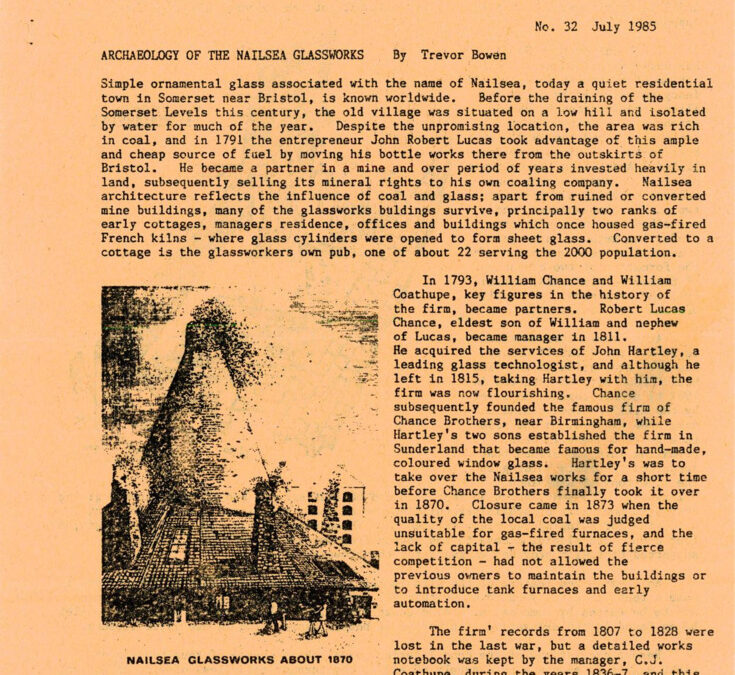
NAILSEA GLASSWORKS ABOUT 1870
notebook was kept by the maaager, C.J.
Coathupe, during the years 1836-7, and this
contains meticulous notes of wages, costings,
furnace dimensions, materials usage and recipes.
The firm described themselves as
Manufacturers of Crown Window Glass and Alkali, and it is clear that Couthupe
was
an
able chemist running the production of vitriol and sodium sulphate as well as of
glass.
In 1851 the firm was large enough to tender for the contract for the Great
Exhibition, although this went to Chance Brothers.
In this direction was the switch
to the cylinder method of glass production shortly before the repeal of the Excise
GLASSWORKS
RECONSTRUCTION
e
.
44: • • , —
•
•
.• •
•
•
*
01.
..e
•
Acts in 1845, and the New House’ cone, built about 1828, was enlarged by the addition
of ‘blowing holes’ where the large cylinders could be swung in deep pits.
Bottle
production had ceased by 1835, and with it the casual manufacture of the highly
collectable green and white tableware.
Sand for the high quality window glass was
brought from Wareham, the Isle of Wight and from BelgiuM.
Cut and etched window panels
were advertised in flashed blue and red, in amber and white, as well as colourless
glass, and it is presumably from these materials that the typical Nailsea ware were
made, originally, at least, by the workers in
–
their spare time.
For a few years French
and Belgian blowers were employed at Nailsea, but not for coloured glass as many
suppose.
The Local History Society
has built up a good slide coll-
ection of authentic domestic and
fancy wares owned by local fam-
ilies, supplemented by photo-
graphs of the ruined works
between 1900 and the 1930’s when
most of the buildings were demo-
lished. Apart from the Coathupe
notebook, primary source docu-
mentary material survives from
two of the glassworkers, who
described working conditions,
production methods, and spare
time activities – which included
the formation of two companies
of Engineer Volunteers, raised
from the workforce. Methodism
was also well supported.
After many representations
to Avon (i.e. Bristol) County
Council, excavation of the ‘New
House’ cone site was started in
1983 by archaeologists employed
by the M.S.C.
The foundations
have been exposed, on one side
to a depth of some 15 feet,
revealing inverted arches that
supported the piers holding up
the 1500 tons of nine-inch
brickwork.
The cone, about 90 feet high and 66 feet across, had 15 or 16 arches giving
access to the skirt of subsidiary buildings which contained, inter alia, the blowing
hole pits for swinging the glass cylinders.
These were not trenches but small rooms, 8
feet deep, with sloping access to the bottom from outside; planks laid across and
supported centrally provided walkways for the blowers.
An unexplained feature of the site is that the internal working area of the cone is
some 4 feet above the yard level so that all pots and materials brought into the cone
had to be raised by some means.
Also unexplained is the large amount of ‘Black’ cutlet
being found in the excavation, indicative of bottle glass being in use until closure.
Recent excavations of the cone interior reveal the presence of four tunnels at
right angles to ensure a good supply of air to the furnace regardless of wind direction.
It is hoped that other areas of the six acre site will eventually become available.
The future of the excavated area is uncertain, being officially designated for office
development; the Local History Society, actively supported by Nailsea Town Council, is
pressing for its preservation in part. Meanwhile, the site is available for viewing.
The lecture was presented at the Artworkers Guild on 18th April 1985.
The hosts
were Mr G. Hurran, Mr and Mrs Miller and Mr Slack.
A NEW EDITOR FOR GLASS CIRCLE NEWS – JOHN TOWSE INTRODUCES HIMSELF
During the 20 or so years that I have been reading some of the periodicals on the
ever-absorbing subject of antique glass, the absence of a few words about the
qualifications, let alone the expertise, of the writers on the subject did disturb, even
irritate, me!
Numerous self-appointed experts made unsubstantiated, “ex cathedra”
pronouncements on glass subjects by inventing, or simply repeating, unproven statements and
thereby doing harm to scientific or artistic accuracy.
Having been asked to contribute to
the Circle’s paper I consider, therefore, my first duty is to introduce myself so as to
avoid possible charges of pretensions or intellectual arrogance.
I was born and spent my youth in Hungary, qualifying in Law.
I came to England before
the war, in 1935, and had my most formative years influenced by the epheavals of the war and
the “duration” which considerably outlasted it.
The inspiration of old glass was
accidental to having lived in a 17th century cottage during my years in Suffolk. The
1950’s and 60’s saw me travelling the country as the representative of a City firm, greatly
facilitating visits to many museums, dealers, antique shops and local exhibitions.
During
this period I was strongly influenced by a very enthusiastic but not greatly knowledgeable
collector possessing an eclectic and admittedly biased taste for 18th century English
drinking glasses and candlesticks.
I was bitten by the bug good and proper and the life of
a minor collector began to flourish, limited only by financial constraints.
It must be
stated here and now that I have never undertaken any original research and the scant
knowledge I may possess is the result of talks, lectures attended, exhibitions and museums
visited and a moderately well-stocked bookshelf of my own. My interest is largely confined
to English colourless drinking glasses of the 17th and 18th centuries, including some
specimens of continental origin. My taste (for what it is worth) is almost entirely
conditioned by aesthetic as opposed to technical or scientific considerations. Most
emphatically I make no claim to specialized scientific or historical knowledge, beyond what
I could gather up from conventional sources.
I believe my task is to inform the average
collector, to comment on events of interest to them and to stimulate the furtherance of
their collecting passion.
I shall always welcome critical comments, constructive suggestions, information
about forthcoming events and an exchange of “cross-fertilizing” ideas.
I readily submit to
the guidance of my peers in the Circle, always providing that members and readers of this
paper make the necessary allowance for my limited expertise, linguistic deficiencies and
possible errors of artistic judgement.
Finally, I beg all readers not to consider me on
anywhere near the same level of competence and know-how which our late and highly respected
Gabriella Gros-Galliner had achieved for herself.
STIPPLE ENGRAVING BY JAMES DENISON-PENDER
An exhibition, of which some members may have received notice, was held by James
Denison-Pender, entirely based on his own stipple-engraved goblets. This was an unusual
event in more than one sense. Apart from Lawrence and Simon Whistler, Denison-Pender is by
far the most accomplished artist in this particularly demanding and beautiful field.
It is
now a matter of personal taste as to which of the three protagonists has achieved a higher
degree of perfection.
It appears an undisputed fact that nowadays only Denison-Pender
decorates the inside as well as the outside surface of goblets, as opposed to larger bowls.
He achieves a vaguely three-dimensional effect, especially apparent when the glass is
correctly lit.
Among the twenty or so glasses of the most outstanding beauty was a near-perfect
close-up of a lioness with her mate a short distance away in the bush. With strongly
reflected light from behind and from above the goblet a unique iridescence with all the
colours of the spectrum was achieved in a finely detailed head and the surrounding grass and
gorse.
His subjects are mostly African big game and natives, outdoor subjects from his
native Cumbria, portraits and trees in their natural settings.
But in quite different vein
was a deeply impressive symbolic representation of the Auschwitz death camp, based on actual
photographs.
It is understood that his next exhibition will be in Washington in the Autemn
J.T.
GUILD OF GLASS ENGRAVERS – ANNUAL EXHIBITION
This will be held at the Oxford County Museum, Fletcher’s House, Woodstock, and runs
from Oct.8th through Oct.3lst Opening hours: flues-Fri, 10-4, Sat 10-5, Sun 2-5.
Lawrence Whistler is currently working on a commemorative glass panel to the memory of
English composer, George Butterworth who was killed in the battle of the Somme.
It is to
be installed in the new Concert Hall at Radley College.
If you wish to subscribe then send
gifts please to Robert Gower, Radley College, Abingdon 0X14 2HR.
DELOMOSNE EXHIBITION: The Baluster Family of English Drinking Glasses.
There really is nothing quite like the flowing lines of an English baluster for
simple, graceful appeal, epitomizing the blend of lead crystal and the skills of the
glassmaker.
They are expensive to bUy but an excellent investment and a joy to
behold.
Thus it came as no surprise to learn that a small queue had formed outside
No.4 Campden Hill Road, W8 7DU, half an hour before the official opening of the
exhibition; half an hour after the doors had swung back 60% of the glasses had found
new owners!
But this was an exhibition so that all the pieces remained on show
until it closed.
In the meantime many members appear to have visited it more than
once, following Martin Mortimer’s advice that the whole is greater than the parts.
No.small contribution to the success was the tasteful display of this collection
of 60 or so pieces assembled with great discrimination by Toronto collector, Dr
Clarence Lewis.
All highlights and reflections were eliminated by the absence of
spotlights and the clever use of background lighting, allowing full appreciation of
the vessels themselves.
Mention must also be made of the warm atmosphere created by
Martin Mortimer, his highly individualistic comments, drawing attention to the
important features of each piece, and his infectious love of his subject.
With regard to the glasses, particularly evident was the perfect proportions of
most of the baluster stems shown, with special emphasis on acorn knops but also
including the rare cylinder and egg knops which, as Mr Mortimer says, are very much
an acquired taste!
Almost without exception, the metal of the glasses was among the
best of the period seen in recent years.
Special mention must be made of a wine
taster with gadrooned base, scroll handle and thumb piece, the rim with applied
stringing – a truly exceptional piece of the greatest rarity. Other glasses, candle-
and taper sticks helped add variety – all excellent examples of their
kind.
The 64-page exhibition guide contains full-page illustrations of all the exhibits and
is itself a work of reference.
An introductory essay by Martin Mortimer briefly but
skillfully traces the development of lead crystal although committing a slight slip
in delegating the King’s prerogative for granting Ravenscroft’s patent to the Glass
Sellers!
However, his discussion of the emergence and diversification of the
baluster style over the first half of the 18th century is a pleasure to read.
Priced at a modest E3.00 (plus postage, £3.40 home; £5.00 overseas), the guide is
still available as is their earlier booklet ‘Gilding the Lily’ with text by Robert
Charleston.
JT/DCW
ASSOCIATED UNIVERSITIES PRESS HELP THE CORNING MUSEUM
With the help of the AUP, who maintain a bookshop near the British Museum, CMOG are
reprinting Leo Oppenheim’s ‘Glass
and
Glassmaking in Ancient Mesopotamia’ – a volume
which was unfortunately destroyed upon publication in 1972 in a flood in Corning.
Donald Harden’s ‘Glass from Karanis’ is being reissued on the 50th anniversary of its
original publication by AUP, a translation of Galle
y
s ‘Ecrits pour l’art is being
readied,
and the
volume on the glass of John Frederick Amelung of the 18th century in
America is being issued as a monograph.
Other titles are in the pipeline.
Among their other activities the CMOG is currently assisting the Suntory Museum
of Tokyo with pieces from its collection for an exhibition of cut glass.
CMOG’s own 1986 exhibition will be on glass from the great exhibitions of the
19th century, starting, naturally, with the 1851 Crystal Palace Exhibition.
Our
member, Jane Shadel Spillman is in the driving seat for this one and the last issue
of GC News carried a request from her for notable exhibits.
LONDON SCENE: We just manage to squeeze in that the Craft Centre, Covent Garden,has
an exhibition of the best of British Studio Glass,
ending
on August 12th., while
Harrods has a summer promotion of
glass
supported with relevant historical material.
Padlock your purse before you go!
THE CRUNCH!!
The NEWCASTLE JOURNAL’S antiques column recently began: “Another
exquisite example of Beilby glass is going under the hammer in London soon”. ‘
JUNE BUSTIN’ OUT ALL OVER!
There was an unusual proliferation of events during June of great interest to glass
collectors.
It would be difficult, if not unfair, to pinpoint the most noteworthy
and so we present them in chronological order.
THE BRADFORD COLLECTION OF 18th CENTURY DUTCH ENGRAVED GLASS – Christies – June 4th.
This must be considered one of the most comprehensive collections of that period
in Holland. The 60 lots on offer encompassed the three major techniques of glass
decoration – diamond point engraving, stipple and wheel engraving – in which the
Dutch masters of the 18th century reigned supreme. They included a rare set of 12
glasses commissioned by members of the Council of Heusden, on the Maas, Water Board
and dated from 1762-1784; each new members donated a glass engraved with his arms and
motto.
Signed glasses included pieces by Schurman, Greenwood and Sang, as well as
an extensive series attributed to David Wolff and an anonymous handl The Foreword
to the Catalogue and a most detailed summary of the Polder-glasses in the collection
were written by our member, Mr Frans G.A.M. Smit, a, if not the, leading Dutch
scholar, with characteristically meticulous expertise in this field.
The 12 glasses were sold at the hammer price of £50 000 to a well known Dutch
dealer.
A fine stipple-engraved goblet by Frans Greenwood, c.1744, decorated with a
fishwife, which despite a 19th century replacement parcel-gilt metal foot, fetched
the highest price of £32 000 for a single glass. The collection was previously on
show at Weston Park (see GC News No. 27) and we hope members took the opportunity to
see it in its original, historic setting.
The second portion of the sale included a hitherto unrecorded, signed Beilby
Royal armorial goblet, c.1762, inscribed “Success to the African Trade of
Whitehaven”. Notwithstanding damage to the foot the hammer price was £52 000,
knocked down to one of our best known dealers. It is hoped that divine justice will
prevail and, just as the Polder glasses have found their way back home, so will this
superb example of British craftsmanship find its way irto a British museum or
collection.
A rare enamelled flask, dated 1757, numerous fine examples of 18th
century drinking glasses, and paperweights found a ready market with about 2%
remaining unsold. We were told that prices were generally well up to, or, for the
finest pieces, above expectations.
(Mr Smit would appreciate hearing, in absolute confidence, from anyone fortunate
enough to own Dutch glassware with purely calligraphic engraving.)
THE OLYMPIA FINE ART AND ANTIQUE FAIR – May 30th-June 8th.
Apart from a goodly number of highly regarded dealers and fine exhibits, this
Exhibition is a somewhat pedestrian affair, appealing more to collectors of
miscellania with an eclectic taste rather than to the experienced, specialist glass
collector. One well-known dealer, showing a rather ‘run of the mill’ range of
glasses did, in fact, remark that the best pieces were to be shown subsequently at
another venue.
The few specialist glass dealers presented their offerings to good advantage,
showing some beautiful pieces. John A. Brooks was displaying an 8 inch goblet
inscribed “View of the Union Flint Glass Works from Bow Be” (sic).
It is further
engraved with a church (Bow?) and a two storey factory with a vaguely cone-shaped
part but with an uncurved, sloping roof, and two separate buildings with three
chimneys – perhaps indicating the use of cutting machinery in the factory complex.
“Flint”, in the title, surely indicates the manufacture of domestic ware in lead
crystal.
This piece demands attention from glass historians.
Jeanette Hayhurst’s stand was outstanding for the tasteful display of some truly
attractive glasses.
An exceptional rare piece was an early glass xylophone, c.1800,
in a contemporaneous wooden box inscribed “Betts Royal Exchange”. Other rare items,
well worthy of note, were a deceptive cordial with a most unusual bowl and a late
17th century flask, diamond point engraved in the manner of Mooleyser.
GROSVENOR HOUSE ANTIQUES FAIR – June 12th-22nd.
This, as always, was a most impresive ‘tour de force’ of the antiques trade,
with the best representatives from all sections.
Asprey’s of Bond Street deserve special mention for having produced for the
occasion an extensively illustrated booklet of the highest standard; among the fine
glass portrayed is about 100 photographs of the recently acquired Alexander
Collection.
Some members will recalll the memorable Glass Circle outing to view
this collection in its original setting in Surrey.
The booklet is fully justified
in saying “Illustrated here is some of the finest, rarest and most elegant English
glass ever produced.” The outstanding clarity of the photographs make descriptions
almost superfluous, and it is true to say, as Asprey’s do, that those not fortunate
enough to purchase any of the glasses illustrated will find this publication of
lasting joy and interest.
For a copy write direct enclosing £5.00.
Incidentally,
something newly learned, bowl sizes changed, becoming smaller in,the mid-eighteenth
century, when custom dictated that glasses should be emptied at every toast – and
toasts were very numerous!
Bowls increased in size again in the 19th century when
dining became a more decorous affair.
Asprey’s booklet also includes nine
enlivening illustrations from Diderot’s great encyclopaedia of 1746, showing the
production of drinking glasses.
By far the most outstanding glass in this
exhibition was a Royal Armorial Goblet, enamelled by Beilby, to commemorate the birth
of the Prince of Wales, later George IV, in 1762.
Eight goblets from this series
are recorded to date, three of them signed and five unsigned.
On the reverse of the
bowl are the Prince of Wales’s feathers.
It must be true to say that these Beilby
armorial goblets are amongst the most important items of English glass ever produced,
equalled only by the sealed Ravenscroft glasseS of the 17th century and the Woodall
plaques of the late 19th century.
The rest of the glasses on show were all
outstanding specimens of the best produced in the 1700’s in these Islands.
Mrs Maureen Thompson, the only other specialiSt glass dealer present, exhibited
an excellent cross-section of typical as well as atypical coloured and colourless
drinking and ornamental glasses.
A striking feature, often commented upon, was the
immaculately lit, displayed and logically arranged pieces, all of which were clean
and free of the so often disconcerting finger marks.
One of her most attractive
items was a rare 18th century English sweetmeat with cover, c,1740, 28cm high.
Thomas Heneage was offering two books of special interest; “Catalogue of Glass,
Slade Gillection”, with Alexander Nesbitt’s notes on the History of Glass, published
in 1871, price £565, and Dr Robert Schmidt’s “Brandenburgische Glaser” published in
1914, price £1285.
Finally, Arthur Davidson Ltd. were showing a collection of over 1000 glass
Intaglios by Jsmes Tassie, used for making incrustations.
INTERNATIONAL
cERLi,acs
FAIR AND SEMINAR – Dorchester Hotel, June 14th-17th.
For devoted glass collectors this was probably the most interesting event.
Not
only were the specialist glass dealers in greater evidence, but several were also
showing the best in the medium and lower price brackets. To many of us it is
somewhat discouraging always to find an over-emphasis on superb museum pieces,
rarely, if ever, affordable to the average collector.
The aesthetic aspects of
form, shape, colour, proportions and rarity must remain of the first importance by
absolute standards, but the relative importance of what the average lover and
collector of old glasses can afford should not be neglected.
After all, on a lower
plane, we too could be compared with museums.
Someone said a short while ago that
museums could not flourish without collectors.
I hope this to be true.
There were a number of reasonably priced, yet fine, pieces holding their own
although displayed next to unique items of real importance and high monetary value.
Mention must be made of the sad omission from the Catalogue of any article on glass,
although there was space for four essays on porcelain, including one on Staffordshire
figures, taking up about 30 pages.
Prominant among the exhibitors was Delomosne and Son Ltd., who had included some
10 glasses, of exceptional standard, surviving from their recent exhibition, The
Baluster Family, mentioned above.
Also exhibited were a pair of slender Newcastle
glasses with beaded, shoulder-knopped and faceted stems, the bowls engraved with
festoons, trophies of arms, and shields bearing the Lion of Holland.
Neo-classical
engraving on this school of glasses is rare, curiously so in view of the fact that
they survived well into the 1770’s,
Cut glass included a fine oval tea box with
silver gilt mount of 1807, among many English and Irish pieces.
In sharp contrast
was an interesting group of French opaline ware from about 1830.
The most important
piece was an ormolu-mounted clock of some size in bleu lavande, but there were also
examples in hulle de savors, turquoise and gorge de pigeon.
Bernard Dragesco and Didier Cramoisam had a rare VOC goblet, finely engraved
with Triton and mermaid, with G or CI probably indicating the initial of an important
associate, or the first letter of one of their warehouse locations.
Also displayed
was a French, or, more appropriately, Gallo-Romano barrel-shaped 5 inch bottle by
Frontinius, mould-blown in greenish glass with a bent handle attached to the shoulder
and rim of the mouth, probably from Amiens, 3rd century. On the base was the barely
legible mark of “Frontin 0”. Peter Korf de Gidts of Amsterdam was showing a unique
and most delicate spiral spring-stemmed tazza on a domed foot; made in Venice by
Antonio Alamanni in the 1600’s, it was priced at £6 500.
Next to it was a most
attractive Venetian or ‘facon de Venise’ wine glass, its bowl decorated in white
enamel, on a hollow stem, with moulded lion masks and florettes, and folded foot.
He also had a signed and dated Sang ‘Friendship’ glass as well as another Newcastle
goblet with VOC monogram engraved on the sail of a ship.
Kunsthandel J. Pollak,
also of Amsterdam, displayed a magnificent Reichsadlerhumpen, dated 1592 and priced
at £16 000.
Other items included Roman flasks, tumblers and a carafe, and a
delightful English, very small dram glass with deceptive bowl on plain stem and
firing foot.
Sheppard & Cooper had glasses ranging from superb to mediocre. Among the most
interesting was a Venetian goblet, c,1520, of Gothic form with gilt and enamelled
band around the rim, from the Blunka(?) collection, New York.
This, allegedly,
should remind us of a painting by Altdorfer in the Alte Pinakothek in Munich, dated
1537, showing a woman drinking from a similar goblet! There was also a Roman
bottle, 1 BC-1 AD, of marbled blue, green, white and purple glass with cut and gold
leaf decoration, from the Koffler collection, Luzern.
One could not fail to see,
and be impressed by, a massive rock-crystal shell on a stem and foot, carved in
Tief-Schnitt by Paulus Eder of Nurnberg, more familiar as a glass engraver.
(The
British Museum has a similarly decorated beaker.)
A tragedy that it is badly
damaged although brilliantly restored.
This stand also carried a fair number of
good 18th century glasses in a wide price range, many worthy of a place in the
cabinet of any aspiring collector.
Moving on to the Seminar; Charles Hajdamach gave an inspired talk on the ‘Splendour
of Stourbridge Cameo Glass’ to a small but most appreciative and involved audience.
He outlined the history of cameo glass by evaluating the relevant artistic endeavours
over the last 2000 years.
The technical difficulties of casing one layer of glass
on another, combined with the delicate skill of high relief carving, put cameo glass
into the most expensive luxury market, restricted to the nobility and the most
prosperous collectors.
In the course of history the Portland Vase, now in the
British Museum, and the Blue Vase from Pompei became surrounded with myths and
legends, being the most complete cameo vases surviving from the Roman empire.
In the 9th and 10th centuries the technique reappeared in Persia and one notable
survivor from this period is also in the British Museum.
later, cameo glass again
reappeared in the unlikely context of Chinese glass of the 18th and 19th centuries.
Cased glass was developed in Bohemia in the early part of the 19th century and was
copied in England from the 1840s.
From then on the more difficult thick-layered
cameo was progressively developed.
Later, after variously successful attempts by
different craftsmen, F. Zach, the Bohemian engraver, produced his version of the
Portland vase, now in the Exeter Museum.
Finally, in 1873, Philip Pargeter and his
glassblowers at the Red House Glass Works developed the technique which allowed a
thick white casing, of even thickness and compatible properties of expansion, on a
blue glass body.
After three years John Northwood completed his copy of the
Portland vase in 1876 and the fashion for cameo glass was born.
George and Tom
Woodall, orielaally apprceticed to Notthvecd, moved to establish a cameo workshop for
Thomas Webb and Sons; Uarthvood himself became Artistic Director at Stevens and
Williams from 1E81 and was responsible for a wide variety of cameo glass, carved at
his workshop.
After the heyday of cameo glass in the 1880s the depression of the
1890s caused a drop in production.
Cost-cutting necessitated the introduction of
acid etching and the virtual elimination of any hand work.
A few artists,
especially George Woodall, retained their hand carving skills, but after Woodall’s
death, in 1925, little cameo glass of quality was produced.
Emile Galle, appreciating the cameo revival by Northwood, stamped his
personality on European glass by his brilliant technical and artistic achievements –
the epitomy of Art Nouveau glass sharply contrasting with the more formal classical
style of Stourbridge.
From the imitations developed the Graal technique at Orrefors
in Sweden, taking the idea a step further by reheating cameo glass after decoration
and trapping it under a casing of clear glass. In America, Frederick Carder was the
main exponent of cameo, rechristening it with the name ‘Intarsia’.
After a gap of 30 years or so the last decade has seen a world-wide revival,
especially in Sweden, America and the U.K.
The most novel twist to the story so far
is the interest shown by studio glassmakers rather than the established factories.
The enthusiasm and inventiveness of the studio glass movement seems to guarantee the
survival and continual success of cameo glees.
JT
BOOK RT,TIEW
FREDERICK CARDER: PORTRAIT OF A GLASSMAKER
The world has seen few complete glassmakers.
One of these was Frederick Carder,
honoured in this small volume by Paul V. Gardner, his one-time apprentice and right
hand man over many years.
The 36, or so, pages of text concisely portray this
kindly but irrascilae, technological and artistic genius whose dedication to his
craft makes a 34-hour week seem like a lunch-break!
Supported by an iron
constitution, that commonly goes with greatness, and a concomitantly long life, he
survived at the age of 70 the ultimate indignity imposed by the Corning take-over of
his Stuben Glass Works.
The, deliberate smashing of the contents of his stockroom,
possibly as many as 20 000 pieces, by the newly appointed manager, Arthur Houghton
Jr., great-grandson of the founder of Corning Glass Works, is now one of the epics
events in glees history.
One feels that, looking back, Paul Garner is trying to
soften the eaormity of this apparently wanton vandalism.
But other documents tell
us that Houghton had only one trick in his locker, the superb Corning clear crystal
that was, nevertheless, a winner in the.wind of changing fashion.
Carder’s
achievements were blown away because it was the only way a new manager with no
understanding of colour glass technology could survive.
But this book is about
Carder and the relevance of this event is that far from producing a broken man it
spurred him on to unsurpassed heights of achievement in his new pest as Art Director,
the point at which our author came into his life.
Paul Gardner skillfully portrays
his endless earlier creations, lifting the technological curtain just far enough for
the lay mind to be impressed but not baffled.
Later, banished to an office, Carder
pushed his desk to one end of the room and Gardner’s to the other, no doubt
accompareled by the stream of traditional Stourbridge oaths for which. he was renowned,
proceeded to build his own electric furnace and become the doyen of Studio Glass.
A
factory full of the world’s clearest crystal was, at best, of only limited use to a
man like Carder. The bulk of the 120 pages of the book are given over to a superb
full-colour pictorial record of his life-long achievements and those who already have
Gardner’s earlier biography of Carder will want this volume for the quality of the
pictures alone.
At $25 in panerback some may consider it expensive, particularly
when a hard cover would have added only 2 or 3 dollars to the cost of publication.
But this is not a ha’p’orth of tar to be quibbled over in what is a typically
excellent prodectien by the Corning Museum of Glass.
Order direct and add the
usual
$2
p&p for overseas customers.
DCW