




GLASS CIRCLE
NEWS
EDITORS
David Watts
27 Raydean Road
BARNET, Herts. EN51AN
John Toyse
25-27 Curtain ”Road
London, EC2A 3PH.
No. 35 July 1986
THE FORGOTTEN
Bor=tAKas
OF:STOURBRIDGE
By Brian Moody
The speaker. opened by observing that three days after his lecture would be the centenary
of the patenting of what he considered to have been the world’s first successful machine
for making
glase containers.
This was not the
Ashley patent (of 1887) but
one .by James’
Richard Windmill which had previously passed un-noticed.
The need for eechanisation was reflected in the
U.K. usage (not manufacture) of about
eight million bottles a day by IFS°, although the British makers were notoriously sloe
about respendine and a lorge pruporcion of the bottles used were of cheap continental
manufacture.
Several ineentiocs failed through neglect of the basic principle, used in
hand-made bottles, that the glass had to be shaped into a paraison on the :earlier before
the final blcwing.
Mechanically, this required two moulds as was developed by Ashley
in a two-stage Blow- &-Blow process.
Although a . notable advance his was a fiddly
machine • requiring two men and a boy to operate it.
The Windmill paten;: of a year
earlier used the al,ternetive Press-&-Blow
in
which the paraison was pressed rather than
blown.
This process, believed to be of American origin, as not used there
suecessfully until about 1893 When the Enterprise Glass
Company
produced vaaeline ;fare
in this way.
Unusual aspects. of the Windmill patent were that Windmill came from Dennie Park,
Brierley Hill, an area not generally associated with bottle-making.
The patentee
referred to as a commercial .treveller and had no obvious glass connections.
It
year earlier than the Ashley patent and, surprisingly, hed been passed over by
writers on the subieet.
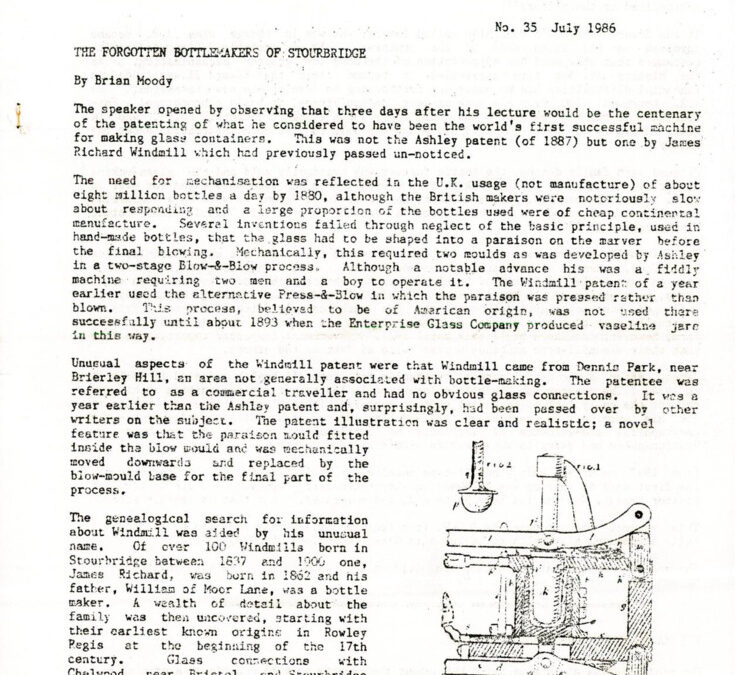
The patent illustration was clear and
realistic;
novel
featnre was thet the paraison mould fitted
inside the blow mould and wae meehanically
moved downward: and replaced by the
blow-mould Lase for the final part of the
process.
The genealogical search for information
about WindmS11 was .aide*.’ by his unusual
•/
.-.
/ _,
name.
Staurhrieige between 1’637 and re:
Se one,
Of over 100 Windmills born in
i.:::531
a
_it*itrak
James Richard, was burn in 1662 and his
e se
,
.eeed,
eVe
father, William of Moor Lane, was a bottle
.
.k
.ei l”’
,
; .;
•
Itt
ei
maker. A wealth ef detail
about
the
in,
t
.
1-
i
e. –
‘
family
was thee ueceecred, etarting with
fj
:”
^e..-4e
their earliest known origine in Rowley
:NeZ..,,,
-”’7;E;;”
f/
P1
,
1
V/4/1
%
Regis at the beginaing of the 17th
`nt;16.tpeee4–eese
77–
‘ ’77
,
77,7eee.ie
a
,
/ nee 7/…..en
century.
Glass
coenections
with
e
7
—121-7-
-54
Chelweod, near Bristol, end Srourbridge
emerge and by the second half of the 18th
J
t..
i
i
—-.7—“di–7,—–.,
/ si
‘ne
ee
i
century Windmills weee pre:ebly working in
in
.1 , .
the new
bottle house
in Moor Lane, just
.: i !
behind
the
flint ‘. house
of
Robert
i
1
,
1 .
j
)
/
Noneybourne which later beeemc Stevens and
I e-5 /
Williams. In 1772 ..John
Ivindmill,
1._.:1=
grew:-grandfather of J.R., was born and
:.
the
family’s history of Unttle-Llaking
J.R. Windeill’e drawing for his 186
aaeociaticne with Erierly Hill noved onto
Patent Press & Blew bottle mechine.
near
was
w,s
a
Other
a
2.
solid ground. John married Lydia Wood from the fatous glass-making family of that
name and became prosperous. The next two generations provided the works :managers and
at least a dozen other workers. Soon after 1800 the bottle house was bought by Edward
Westwood and by 1833
wain
making half a million bottles a year. In the middle of
the
century they
also
began
eking stoneware bottles and it was surely more than coincidence
that William Windmill and his family lived next door to Henry Carder, stoneware bottle
maker and uncle of the
famous ‘Fred’
who, it may be remembered, started his career
apprenticed to the pottery!!!
It was Edward Westwood’s son, also called Edward, who was in charge when J.R. became
involved on the
sales
side of the business.
It was probably J.R’s contact with
customers that sharpened his appreciation of the need fot greater mechanization.
As
the history cf the firm unravelled it became clear that Edward II
was
indeed in
financial difficultieo and no money was forthccming to develop the new invention.
So
J.R. borrowed £100 from
his
bank mareser, Joseph Finney, to build a prototype.
Fate
decreed
that
the bank manager’s son would marry J.R’s youngest daughter, Helen, who is
still alive – a hale 83 years old – and was able to give much information about the
family.
Plagued with family deaths, the bottle factory was eventually sold and the glass-making
side closed down. But bottle-making in the area Was on the wane and ceased for ever in
1S99.
Before then J.R., and a brother, had moved to St Helens to work as a commercial
traveller for Canning Shaw who became a founder member of united Glees Bottle
Manufacturers in 1913.
The Windmill patent was sold to Dan Rylands, whose father had set up in Barnsley with •
Hiram Todd, inventor of the marble-stoppered bottle. Dan, a thrusting man, apparently
keen to oust Ashley as father of bottle machines, submitted the idea, but now with eight
heads, as a patent of his own in 1888.
He also claimed, unsuccessfully that Ashley had
infrieged hi copyright! although the two machircs were quite different. Rylends
eventually went bust over en anprodective coal mine .end
connitted
suicide in 1910. • His
firm, however, continued profitably until 1927, a government inspector reporting in 1916
that their Windmill-type machines worked twice as fast as the others.
James, after a succesrfel career, eventually fell into ill health and died in Solihull
in• 1934.
The reasons why Windmill’s invention failed.to get due recognition in his day
reflect the early lack of financial support compared with Ashley’s blaze. of publicity
for his machine, the possessive, self-seeking outlook of Dan Rylands.and,
perhaps
the
geceraphical pre-eminence of Yorkshire
as bottlemakers so that anyone born in
Staffordshire and dying
in
Warwickshire didn’t eta :.d
a chAhce.
From 1897 onwards, many Windmill-type machine were build worldwide.
By “coincidence”
the first uaed in America was in wheeling where both
Harry Northwood and
J.R’a
youngest
brother Ernest, ‘.’ho married Rose Northwood, had emigrated.
But that is another story.
This account was prepared by D.C.W. from lecture notes kindly supplisd by Mr Moody. A
fully
documented history
is to be
found in
Glass Technology 26,1986,108-117.
fhe meecing was he
at
–
t!
–
!e Artworkers Guild on 26th June !786 by the kind invitation of
Mr and
Xrs
H=er, Mrs Kilbey aid Mr
Trickey.
VIIIMMIltaieNOCON=1.
—
…r.’=.91•111101111,11=,..
TFE
MAJOR FAIRS ARE HERE AGAIN…
The proliferation of antique fairs throughout the country must be considered a sign of
our •
times.
It appears that “antiques” cover
a
multiplicity of objects often hardly connected
with
age, even 1-2.ss with art, let alone be2uty.
Maybe the credulity and gullibility. of
some “collectors” offer the main incentive to
set up in business dealing in art
objact or
antiquf:s.
However, be tire;:
as
it may, the arrival of
he Season was marked by the.
opening of the
rine Art and Antiques Fair at Olympia in London. This beihg the
forerunner of the Grosvenor Mouse Antiques Fair and the ‘International Ceramics Fair et the
Dorchester Hotel, interest was aroused.
In between, Christies held a Glass Sale on the
3rd June and, concurrently with the Dorchester Fair, the Fourth London Ceramics fair took
place at the Camberland Hotel.
Mention must also be
mode
of the Cuild of
Glass
.
Engravers
‘Festival of Eagraeed Glass ’86 Exhibition’ held in St. Lawrence Jewry-next-Guildhall
eerly in Jtiy.
In chronological order the Olympia Fairewas
the first event and it claims to be the
largest commercial antiques show in the
U.K., supported by over 280 British antique
dealers.
It was obvious that the
ieeernatiener.y best known and .oldest
Kausee
were
absent,
aeparently
concentrating on the more prestigeous
Grosvenor House Fair.
Yet, collectors of
both knowledge and taste were noticable in
large numbers on the opening day. Trade
was brisk in all medium priced items and
satisfaction with the turnout was expressed
by ‘coat dealers consuleed.
Glass was the
foeal point of interest at John. Brooks,
Jeaneete Pa buret, Pryce & Brise Antiques,
Sun Feuse Anti quern,
aristine Bridge
Anticsees and Mark J. West.
Many more
stands exhibited old glasses of quality and
beauty but not of great rarity or
iaportance, with the exception of
Antikviteter of Copenhagen.
– – John Brooks had on offer an
exceptional Jacobite goblet of noble
proportions, the round funnel bowl, on an
inverted baluster stem and folded foot,
engraved “God bless King James”.
This
Jacobite sentiment links the period of the
glass (c.1715-1720) to James Edward Stewart
end the failure of the first Jacobite
uprising.
Another unusual glass in ‘Facon
de • Venice’, c.1660, with wide funnel. bowl
over a merese and hollow ball knop,
reminded us of the patterns of drinking
glasses sent by John Greene•to Morelli in
Venice.
–
– Jeanette Hayhurst had a large
selection of coloured glass on display
including a blue Lynn bowl with foot, a
rare, snail, green taper decanter with gilt
label “Essence of Lemon”, a selection of
amethyst glasses and bowls and a seldom
seen pair of blue overlayed and cut Varnish
& Co. Patent spill vases.
Other exhibits
on this stand included a rare ale glass,
the pan top bowl engraved with two pairs of
crossed ears of barley on a M.S.A.T. stem,
c.1745; a mercury twist stem sweetmeat and
a fine goblet with moulded pedestal stem
engraved with Bacchus seated on a barrel
surrounded by fruiting vines.
–
-Pryce & Brise Antiques had a wide
selection of coloured 19th century glasses
and some 18th century drinking glasses.
Conspicuous was was a Dutch-engraved
Newcastle “Alliance” • goblet engraved with
the erae of Anne, daughter of George II and
the arms of of the United Provinces of the
Netherlands within the motto “Concordia,
Res Parvae, Cres Cunt” (sic) within a
cartouche of entwined rope and anchors and
beneath the motto “Hoc, Signo Vinces,” on a
multiple-knopped stem and domed fbot,
c.1745.
We have seen a similar goblet at
the Burlington House Fair in 1982 by the
same hand and comparable, possibly
3.
deliberate orthographic mistake!
This
goblet probably commemorates the alliance
formed between England and the Netherlands
on the marriage of Anne and William 17,
Prince of Orange, on 25th March 1734.
–
interestine and taetefal, rather than
important pieces were to be seen on the
stand of Mark J. Weet, amongst them .three
fine English claret jugs with classical
decoration, dating from c.10.
–
– Antikviteter of• Copenhanen exhibited a
few very fine examplee of Art Nouveau and
Art .Deco, French overlay glass by G:’!1.1e,
Lalique and Daum hut, cost strikinnly,
wcrks `_rem Orrefors and Kosta by living
artists represented by Edvie OhretrBm,
Vicke Lindstrand, Gran Wail and Eerie Berg.
– – Sun House Antiques had a nice range of
coloured glasses from the 18th and 19th
centuries and e• number of 18th century
cordial and wine glasses.
THE GROSVENOR HOUSE ANTIQUES FAIR
This much more grandiose venue had only two
exhibitors with the emphesis on glass.
Aspreys
showed • their usual display of
balusters, enamel and colour twists, 19th
century commemorative
• glasses and Regency
cut glass.
Also, a fine collection
–
of
18th • century
green drinking glasses.
However, two
–
“Amen” glaeees dominated this
show;. – the
“Lennoxlove”
and
the
“Keith-Douglas”; the latter being
one
of
six described in Hartshorne.
Of exquiSite
quality were a pair of 19th century •glasses
engraved and signed by Fritache, a signed
Woodall rock crystal covered jar, an
intarsia and eameo piece signed Lu Kny
(acquired by the’ Toledo Museum), a Lionel
Pierce, Webb part-coloured rock etystal
bowl and an opaque glass gilded vase, aide
by Webb for Tlifarly for the 1899 Paris
Exhibition.
The other exhibitor was Maureen Thompspn
1410
as very successful in spite of fewer
overseas
visitors.
Her star item was a
Bielby “Privateer” wine glass enamelled in
colours, dated 1767, with a very rare
canary yellow, red blue, turquoise and
white twist stem.
Other outstanding
pieces included a blue cordial with
hammered bowl on a tall stems and eeveral
“Newcastles” ensraved with various coats of
arms.
-an interesting collection of
cordials included one with a deceptive bowl
with hameered decoration and a domed foot,
a Jacobite portrait glass, three enamelled
Beilby wines – one with hunting scene – and
several colour twists including one with
that attractive mixed=twist combination of
a turquoise and air twist stem.
An
eye-catching display of good quality cut
pieces,sets of champagne flutes, a wide
selection of decanters, three magnums, a
double magnum and a pair of magnums
engraved with newad racehorses attracted
connidereble attention.
TKE TWERNATIONLL
MAMICS FAIR AND
SEMINAR, AT THE. DORCUeSTER HOTEL
This may be euemed up as a most pleasantly
organised foir of sensible proportions with
pre-eataent dealers showing their bent
wares in a congenial environment – ideal
for seeing the best in antique ceramics and
glass.
– – Delomosne and Son Ltd., with
their treditional and unassuming modesty
showed what most collectors want to see and
ultesately poezess. Their principal
exhibit
was an
extravagant classical race
of ceseane fern in pink cased glass, nearly
13 ire high.
Arranged in three pieces,
the vase stood upon an elaborate pliath
with an outer rectangular sleeve cut to
represent drapery. The whole piece
,;as
crisply cut throughout in the manner
current in Bohemia in about 1835.
Other
items included a good “Hanover” glass with
eraacieg horse and polished-out heraldic
rose but lacking the familiar toast
“Liberty”.
Another rarity was a c.1765
sapphire blue standing ewer cut with a
eeriete of geometric patterns just such as
Thomas Betts might have stocked, judging by
detail:, of similar items in his recently
pueliahed inventory.
A number of cordials
and balusters gave pleasure to behold, let
alone own.
But worthy of special mention
was a goblet whose bell bowl sat on a
seven-ring annulated knop a small baluster
and folded foot!
We understand that
business was brisk in all good quality
items.
– Sheppard and Cooper, in diffefent
mood, showed a Bohemian mirror, c.1730,
with wheel-engraved panels in Rococco
style, a very fine amethyst rosewater ewer
in ‘Facon de Venise’ style from the Lord
Astor of Hever collection, a rare
Zwiochengold goblet and cover, c.1750, from
a famous New York collection, a set of four
pale green decanters, cut with flutes and
engraved with the Arms of Spencer, and
three German “Humpen” brightly enamelled
with armorials end inscriptions, c.
16th-18th centuries.
– – Peter Korf de Gidts, from Amsterdam,
justified his high standing with items such
as a serving bottle, c.1680, diamond point
engraved in the manner of Mooleyeer with
two birds on fiuwering breeches, sianed
goblets by Jacob Sang and F. Mame
(‘6S0),
16th and 17th century Venetian drinking
glasses and, rather surprising on this
stand, a few masonic goblets. Newcastle
goblets, exquisitely engraved by Dutch or
German masters were on offer at relatively
reasonable prices.
– r
Dragesco and Cramoisan, from Paris,
were showing a fine English colour twist
and a quite unusual Newcastle geblet, a
Nurnberg goblet engraved by or in the style
of Schmidt, a Roman bowl with monogram, an
enamelled and gilt Venetiaa plate of c.1500
and an important covered beaker with
moulded decoration, probably from Dresden.
Finally, one must mention a Pair highlight,
Martin Mortimer’s meticulously researched
talk on ‘The•Enelish Glees Chandelier’. He
traced its evolution in England fro%
experiments in the early 18th century
through to its ultimate technical mastery
of the grand yet tasteful manner in the
19th century, illustrating the emergence of
the various kyles by reference to
documented examples and illustrative
slides. We hope this work, reflecting
authority, experience and allto rare
original research will be published for the
wider enjoyment of all glass lovers.
There was little glass at the Fourth London
Ceramics Fair, on concurrently at the
Cum1eriand Hotel. The only glass
specialist,
Shirley Warren, showed an
impressive range of 18th and 19th
century
clear and
c’oared ela::
,
ses, balusters,
colour and white enamel twists, Jacobites,,
an Admiral Nelson 4oblet, a fine B-handled
.
jelly glass and’.a colour-enamelled wine
glass decorated with the crst and monogram
of the Horsey family, supposedly by Beilby
Reports by John Towse.
YORK MINSTER
Rose Window Exhibition
Open until October 31st, .086.
You can see the restored portions of the glass of
York Minster’s famous Rose Window
,
in the
incomparable setting of the Chapter Houser together
with an exhibition commemorating the union of the •’
Red and White Roses of Lancaster and York.
Admission: Adults €1.00 with free colour brochure;
Children (under 16) 20p including free sticker.
s.
FESTIVAL OF ENGRAVED GLASS
’86
by tit Onilb of Ofssg entrabtr$
It, is diffficult to
e
.envisage a more serene and
appropriate setting for displaying hand-engraved glass
than the Church of St ‘Lawrence Jewry-next-Guildhall,
isolated from the noise and bustle of city: life, but
easily accessible.
Eight years have passed since the
exhibition was last held here, during which. time the
standard of technical achievement displayed by Fellows
and Associate Fellows of the Guild. of Glass Engravere
has risen to unprecedented heights.
The Guild is now
eleven years old with some 700 members, about two
thirds of whom are engravers.
This growth of glass
engraving among independent designer/craftsmen i3
claimed to be . a purely British. pteeemenon of the
mid-20th century, having no equivalent abroad.
The
aim of the Guild is to promote the highest quality of
creative design and craftsmanship in execution; only
posterity can decide to what extent standards of real
art and originality are, achieved.
Working methods now embrace, in addition to traditional copper, wheel and point
engraving, drill and fleXible drive engraving – much favoured by the present exhibitors
– as well as sandblasting, etching. and cutting.
These techniques are briefly explained
in a most attractive illustrated booklet produced . to accompany the exhibition. The
seonsorship of Coward Chance;Linklater & Paines and Slaughter & May, three prominent
City law firms is. gratefully acknowledged.
The selection of items for, special :mention is a ,articularly unenviable task,
reflecting, as it must, the personal appreciation of your scribe.
Nevertheless,
several artists and their exhibits would he included on any list.
James
Denison-Pender, an outstanding stipple-engraver, had two goblets on show; one of an
African tribal wedding, scene and another showing the artist’s home with grazing sheep in
the foreground, both works of exquisite quality.
Alasdair Gorden was showing
“Antarctic Moon” on a sandeblasted
–
-laminated cube of unusual originality.
David Peace,
M.B.E., the best known and most accomplished practitioner
–
of lettering on glass, with
two impressive works. —Jane Webster, with superb taste, chose a blank of optical glass
for her copper-wheel engraved “Scandal” showing two women appropriately posed.
Laurence Whistler, C.B.E.e the doyen and supreme master of stipplel glass engraving,
exhibited three glasses designed and executed by himself.
these were “The paper Boat”
from a sequence of.hine illustrating the story of a paper boat,”Joy of Creation” and “St
Lawrence Jewry-next-Guildhall”, the last being a view Of the tower, lent by Oliver
.
Dawnay who had overlooked the chgrch for many. years from his office window.
Another
fihe view of the church engraved on both sides of an optical disc, by Ann Cotton, was
lent by the incumbent, The Rev. Basil Watson.
John Beard submitted an Orrefors
decanter (stipple-engraved) of Lord Nelson, after a’ portrait by Fuger, and another piece
showing a naval scene after a painting by Nicholas Pocock. • Philip Lawson Johnston had
a tabletop .equisitely engraved with a “Collage of Musical Instruments” – e.truly
original idea with great appeal, in addition to a Tudor crystal bowl engraved With
“Otter Scene” in the flexible-drive method.
Tracey Sheppard, again with’flexible,
drive, produced “Knebwoth Cricket Trophy”, a beautiful piece of work using the full
circumference of a punch bowl to obtain a three-dimensional effect of cricket in play
against the background of Knebworth House, set among trees.
A conspicuously fine
.
blue
goblet,
–
-engraved with doves in the
–
manner’ of Franz Zech by Eric Smith was a true
masterpiece.
These were highlights, based on a purely subjective assessment;
space does not permit
justice to be dene to many other impressive works.
Perhaps the most relevant
impression is the strikingly higher standard of workmanship achieved and of artistic
endeavour employed, in this latest exhibition of theGuild.
6.
THE VAUXHALL GLASSHOUSES – some new evidence
By Roy Edwards
Starting with search of manorial records for the area, and then of parish records,
Wills and other documents, fresh informatin about the history of three glasshouse
sites and further details about the personnel working at two of them has emerged.
Manorial surveys for Kennington in 1615 and 1785/6 and a manorial plan of 1681 for
Vauxhall have provided the basis for the reconstruction of the history of many
estates.
Two of the glasshouse sites (Figure I-) lay in the manor of Kennington, one (B) being
the Duke of Buckingham’s (ca. 1664-1788).
The third,.(C) John Bellingham’s, lay in
the gardens of the former Vauxhall manor house. – The earliest glasshouse (A) is
mentioned in the Norden 1615 Kennington manorial survey.
It has been assumed by
earlier authors that this lay within the later Duke’s site.
Careful study of the
manorial surveys and Court Books allows reconstruction of the particular site history
and shows that it was completely separate.
The 1615 survey lists no occupants, and
subsequent Court Book entries make no further mention of the glasshouse.
A3 the
Saracen’s Head public house lay within the estate concerned, this glasshouse has been
called by this name.
The 1662/3 Patents to the Dul.:e of Buckingham indicate a rough date for the beginning
of his establishment, but granting of a licence to demise in 1664 to the absent
landlord John Pollard is the first evidence for activity on the ground.
However, it
is not until his death in 1668 that first mention is made of a ‘brick built
glasshouse’.
The “Great Glasshouse” is followed by the erection of the “Little
Glasshouse” near the end of the century.
A Court Baron Jury in 1698 complained. about
the smoke and nuisance arising from this recently built structure.
The exact closure
date of the business is still uncertain, but the Hodskinson and Middleton manorial
survey of 1785/6 probably provides the most complete plan of the works near the end of
its life.
The Hand-in-Hand Insurance description (1713-90) and the 1755 Strype plan
of Lambeth for Stow’s Survey of London clearly distinguish between the two
glasshouses.
The first known manager of the works,
according to his own words in a suit
against the
Duke
in 1676, was John
Bellingham between 1671 and 1674.
He
left to found
his
own glasshouse
nearby.
According to W.H.Bowles,
citing the reminiscences of the
Reverend Dawson Warren, John Dawson I
was apprenticed to the Duke in about
1680.
However, the marriage of John
Dawson, Glassmaker of Lambeth to Judith
Hutchins of same, in 1677 at
Christchurch,
–
Newgete, appears to
indicate his recruitmnet on the change
of menz:gement when Bellinghnm left.
While the origins of
D-Awson
are yet
unknown,
subsequent
genealogical
Information over four generations has
been compiled, with varying degrees of
certainty, from Wills and the Lambeth
parish registers.
John Dnwson I died in 1712.
His Will
of 1711 conceals
the fart
that Richard
was the eldest son and that
he
took his
father’s share in the glasshouse.
ire
died in 1762 and
in
his Will (1752)
left this share to his nephew, John
Figure 1.
Vauxhall
I/Ls
–
IL
Glasshouses
,
11 47 1
i
N r
f-
7
;
:6;5
51-4
i
!
58
49= estate number
f 55
( )• first date
Copt/
Hall
56 :
,
r——-,–
1
–
J
1 Kennington
Manor
Vauxhall
91
‘
I
‘.
Gardens – ‘
7.
Dawson III.
This John, in his Will (1759), left it to his son, Edward III, when he
died in 1760.
This was wrongly claimed by-W.H.Bowles to be the first example of a
Will transfer of a glasshouse share.
The Hawker family does not appear to originate in Lambeth.
Apparent brothers John
and Francis are present at the beginning of the 18th century, but John is not
certainly a glassworker.
Both marry in the first decade.
Francis I married Mary,
first born child of John Dawson I.
There is abundant evidence for his preaence in
Lambeth until 1737, and Court Book entries describe him as “Glasumaker”.
He, had two
sons, John II and Francis II, and the former is also described as “giassmaker”:’,
For
Francis Hawkes I, there is a gap in the records until 1752-3 when the Court Baron
proclamations of his death state him to be “glassmaker of South Shields”.
The
Cookson MSS, (Durham) show him to have beet a minor partner in the newly founded John
Cookson plate and crown glasshouse in 1738. – Neither a burial entry nor a Will has
_yet been found for him.
However, with the help of Alan Leach, what appears r, be the
marriage by licence of Francis II at South Shields in the same year has been located,
and in the South Shields registers, consequent
.
children.
An Isaac Cookson Jr.,
Goldsmith, was one of the bondsmen for the marriage.
Two generations of the Cook faMily were involved, in Lambeth glasmaking in the first
half of the 13th century. Thomas Cock Snr. was admitted as tenant to a Kennington
riverside estate in 1710, and, because he was described,as a “glass Spreader”, it is
assumed that he worked at the Duke’s factory.
When he died (1721), his son, also
Themes, took the tenancy, but he was described just as “glassnaker”.
Later (1739)
data confuse the issue, as does a Glass Sellers apprenticeship of 1716, where Benjamin
Cook, son of Thomas Cook of Lambeth, Fellmonger, was bound to Richard Saunders.
John Bellingham came (back?)
.
to England about 1670 (Hudig) and, after leaving the
Duke’s employ, set up his own works in Demesne latd of Vauxhall manor.
This
glasshouse continued at least until his death in 1700.
In.this period, quite a lot
of general information about his activity is known.
Parish register data tell of his
children and servants between 1673 and 1681: and later (1699) of the birth of a
daughter to his son, also John., John II died on the same day and, early in 1700, his
father also died.
Bellingham Senior’s Will, made a few days before he died, is brief
and uninformative.
It gives no indication of his being a wealthy man.
A Vauxhall manor survey of 1681 (Thomas Hill) shows the exact location of his
glasshouse.
Correspondence in the same year concerning a complaint by a neighbour
about the risk of fire, and indicating that one glasshouse had already been burnt
down, was immediately followed by a survey of the site. This spoke of the “constant
workings and fires” and the factthatthe site was surrounded (in part) by a wall some
nine feet high.
This latter’is ‘confirmed. by Court Book entries
.
(1656-1743) and the
Hill map.
There is no proof that
–
the glasshouse continued after his death but, after
a few ephemeral primary manorial tenants, Edward Apthorp, Glass Seller, and his heirs
held the site until 1743.
The paper was read at a Meeting of the Glass Circle held on Tuesday 20th May 1986 at
Guy’s Hospital Moditai
s
School
e
U
s
M.D.S., London S. F.1.
The hosts were Dr and Mrs
Watts.
HAVE YOU SEEN THESE BOTTLES?… STOLEN FROM THE V & A.
2
1.
Dark amber-coloured glass mottled and streaked with
white (Bristol
or Nailsea). Six ribbed vertical bands
applied to the body
and on the shoulder.
Inscription
moulded in relief J.S.J.M. STIRLING 1827.
2.
Olive
-greet glass (English).
Seal pressed with the
inscription T Ridge 1720.
3.Dark greenish-brown glass (English). Seal pressed
with
the arms
of Cregorie of Pilston, Devon. About
1730.
4. Dark greenish-brown glass with metal neck and
stopper (English). Seal pressed with the arms of
Haselwood with the motto Vigilantia. About 1740-50.
UWnvo &Anna
a0M3
This exhibition, at the Shipley Art Gallery, Gateshead, from August 2nd to October
19th 1986, is Tyne and Wear Museum Service’s major contribution to INDUSTRY YEAR 1986.
It brings together for the first time almost one thousand colourful examples of
Sowerby glass from public and private’ collections worldwide.
The Exhibition
concentrates on the period 1870-1885 and features paintings and designs by
J.G.Sowerby, pottery by the Gateshead Art Pottery and original
stained
glass from the
Gateshead Stained Glass Co. as well as the pressed -sand hand-made glass and many
original Sowerby trade
.catalogues, with
photos, equipment and a video on making
pressed glass.
A full colour, 96-pace catalogue is available.
The Exhibition, sponsored by Stuart & Sons Ltd. of Stourbridge, can also be seen at
Birmingham Museum next Spring. For more details, phone 091 477 1495.
NEW BOOR
GLASS FROM WORLD’S FAIRS 1851 – 1904
By JANE SHADEL SPILLMAN
The Corning Museum of Glass, 8[*9-inches, pp.59, 27 plates, 20 in colour, paperback,
price?
Look through the front door keyhole of any of the major Palaces of Europe and what do
you see? The answer is, probably, not very much but you can be sure that what you do
see is the best there is around.
If you’re lucky, a bit of extra information here
and there will enable you to piece together a rough idea of what it’s like inside.
And so it is with the great Industrial Exhibitions of the World.
No less than 46
were held between 1851 and 1904, and this slender volume provides thumb-nail sketches
of 11 of the most important.
It covers the circumstances leading up to their
creation, each a fascinating history in itself, as one country vied with the next to
be bigger, better and more original.
Unfortunately, information about the glass
exhibited is rather patchy.
Considerable details are available about some exhibitors
and almost nothing about others.
Consequently, the beautifully reproduced colour
plates concentrate more on the exhibition buildings than the glass but that which is
shown reveals a standard of craftsmanship that is unlikely ever to be equalled, let
alone surpassed. The Morrison Tazza from the 1851 Exhibition, still untraced; a
Baccarat punch set, cased blue over crystal, elaborately cut and acid etched in cameo
style with a continuous frieze of Bacchus and attendants, from the 1867 Paris Fair,
are outstanding.Shoum by the latter firm, at the Paris 1878 Fair,was the truly
incredible, life-size Temple of Mercury, described in detail by Charles Colne, the
American commissioner. For the last, 1904, Fair in Ohio the fantastic brilliant-cut
punch bowl (now in the Toledo Museum) was only one out of 1300 pieces in the Libbey
Glass Co. display – estimated to be worth $25,000 at 1904 prices! Yet the lasting
contribution to civilization from the Ohio Fair has been said to be the invention of
the ice cream tone.
One is struck, looking at the illustration of the exhibit of James Green and Nephew of
London (at Philadelphia, 1876) by the trust shown, for the stand is filled to the very
‘edges with a precious display of every kind of glassware!
Jane Spillman is to be congratulated on a fine and evocative production in support of
the Corning Museum’s Exhibition of Glass from the World’s Fairs.
One only wishes. he
had time to record each one in depth, for the door of
time remains locked
for ever
and
we shall never know
the reality of what lies beyond the keyhole.
D.C.W.
ROMANS CONQUER CORNING!
The Roman
Galleries at the Corning Museum of Glass have been invaded by twelve
important Romans who intend to stay for the next few years.
Three of them – a jug
signed
by Ennion, a cup signed by Aristeias
and a
beaker decorated with ears of
barley, grapes and pomegranates – form the nucleus of
a
new display of early
mould-blown glass.
Two others, also mould-blown – the Argonaut flask, decorated with
scenes of Jason and the Argonauts, and a beaker decorated with gods and heroes are
featured in another display.
Colonel in Chief is the famous Constable-Maxwell cage
cup whom we salute at intervals in these pages.
Scholars have been concerned about
whether such senior officers were men of one. or many parts!
In the 18th century J.J.
Winckelmann,
a founder of classical archaeology, concluded that cage cups were made by
cutting and grinding.one thick blank of cast or blown glass; others though they was
sad from separate pieces of glass fused to the body. In 1964, from a single piece of
glass, Fritz Schafer created a perfect copy (Guild of Glass Engravers, please note!)
of a Roman cage cup found at Trier in Germany.
This proves it was possible, but not
all cage cups were made in this .way.
Corning has one that
was made by
bending
threads of molten glass, but the simpler mode of manufacture is compensated by its
splendid title – Pisch Kantharos.
If
NOW 0,6
0
0u±
s
far
Pnniversoo
–
/ exhtlai Hon
^ an. orilinal
D
I
ckn
R
,
La. n
ds
Pat
–
e.mt Glass
R
Sl
eeper! ”
JO.
“STRANGE AND RARE”
THE GLASS CIRCLE 50th ANNIVERSARY EXHIBITION OF MEMBER’S GLASS
Preliminary negotiations are currently
under way to hold an exhibition of Members’
glass at Broadfield House Glass Museum,
Kingswinford, in the Autumn of 1987, to
commemorate the 50th Anniversary of the
Glass Circle.
The proposed title “Strange and Rare” is
intended to give members the widest
opportunity of exhibiting the unusual glass
object they have chanced upon, as well as
the sought-after rarety that is part of the
mainstream of glass art and technology and
a cherished part of a collection because of
this. We hope to create an exciting
exhibition in which novelty and excellence
are mixed, an exhibition high-lighted by
the varied personalities and expertise of
our Circle’s many devoted collectors. We
believe that such an exhibition will bring
pleasure and new glass experiences to our
members and other collectors, and will also
capture the imagination of the viewing
public.
Through the generous collaboration of
Charles Hajdamach, quite extensive display
space in securely closed cabinets can be
made available in the museum and we would
hope to he able to exhibit at least one or
two pieces from all members who wish to
participate.
The probable display time would be about
two months, during which period the
exhibits, of which a detailed inventory
would be made, would be covered by the
Museum’s insurance.
The purpose of this notice is partly to
provide advance information for members so
that they can consider whether they might
wish to contribute to the exhibition.
But
also, such an exhibition entails a very
considerable amount of organisation,
including collecting and collating the data
about the exhibits, designing and preparing
a catalogue, printing, proof-reading,
advertising, fund raising (since the
exhibition must be self-financing), and so
on.
We shall therefore need much
voluntary assistance and we should greatly
appreciate provisional offers of help.
Particularly if you feel you may have
special skills to offer in connection with
the above or other aspects of mcunting the
exhibition, please let us know.
Assuming no unforsoen and insoluble
problems arise, formal committee approval
for the proposed arrangements should be
received in time for the next issue of
Glass Circle News, which will then include
an official notice about the exhibition,
together with instructions for potential
exhibitors.
Meanwhile, the Exhibition Sub-committee of
Philip Whatmore (phone 01 727 1681) and
David Watts (phone 01 449 7666) will be
pleased to receive any comments and deal
with any enquiries in this connection.
with acicnowledoerunts
to
O.
moody
for
infarentlan con
e.
Ryland
PTAs*