




No. 38
July 1987
1
DOCTOR SYNTAX IN THE GLASSHOUSE
,••
N,1
1
11
.
4K4
GLASS
CIRCLE MEETING:
fi
Cyril Weedon
/10
.
:(21n1;
4
”
.
.:
–
t
77
•
EDITORS.
David Watts
27 Raydean Road
BARNET, Herts. EN51AN
C
vr
–
GLASS CIRCLE
NEWS
John Towse
25-27 Curtain Road
London, EC2A ?TH.
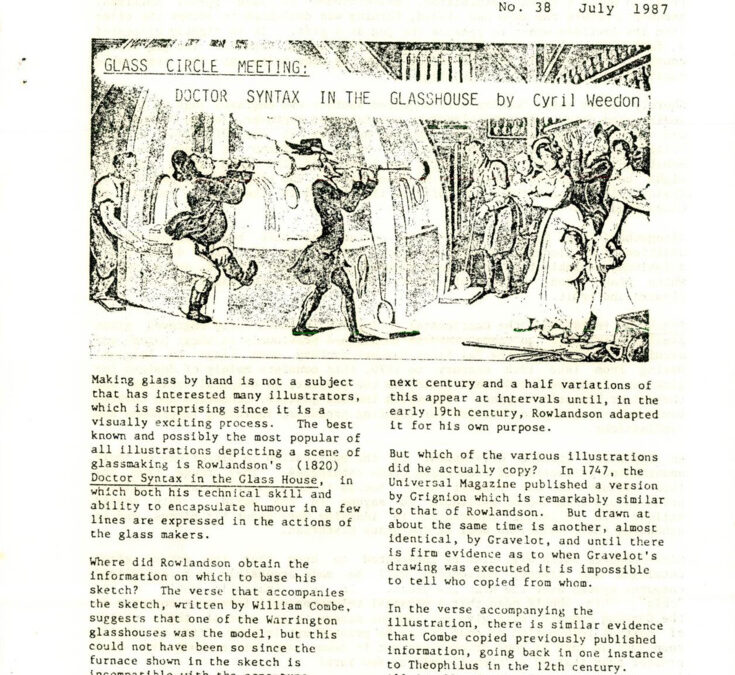
Making glass by hand is not a subject
that has interested many illustrators,
which is surprising since it
is
a
visually exciting process.
The best
known and possibly the most popular of
all illustrations depicting a scene of
glassmaking is Rowlandson’s (1820)
Doctor Syntax in the Glass House, in
which both his technical skill and
ability to encapsulate humour in a few
lines are expressed in the actions of
the glass makers.
Where did Rowlandson obtain the
information on which to base his
sketch?
The verse that accompanies
the sketch, written by William Combe,
suggests that one of the Warrington
glasshouses was the model, but this
could not have been so since the
furnace shown in the sketch is
incompatible with the cone-type
glasshouses in use in Warrington at the
time the sketch was executed.
A closer examination of the literature
on glassmaking shows that a drawing of
a
furnace, similar to
that illustrated
by Rowlandson, first appears in the
Frisius translation of Neri’s “L’Arte
Vetraria” in 1668, and that over the
next century and a half
variations of
this appear at intervals until, in the
early 19th century, Rowlandson adapted
it for his own purpose.
But which of the various illustrations
did he actually copy?
In 1747, the
Universal Magazine published a version
by Grignion which is remarkably similar
to that of Rowlandson.
But drawn at
about the same time is another, almost
identical, by Gravelot, and until there
is firm evidence as to when Gravelot’s
drawing was executed it is impossible
to tell who copied from whom.
In the verse accompanying the
illustration, there is similar evidence
that Combe copied previously published
information, going back in one instance
to Theophilus in the 12th century.
All in all, the drawing and its text
provide several splendid and
interesting examples of the art (or
should it be science?) of
plagiarism.
C.W.
The talk was given at
the
Westminster
Hospital on Thursday, 9th April 1987,
by courtesy of Dr Kersley, and
at
the
kind invitation of Dr and Mrs Launert,
Mr and Mrs Collington, and Dr Ward.
-2-
NEWSFROM CORNING:
The Ailsa Jug
Correspondence from The Corning Museum of Glass has become a regular feature
of this Newsletter; we are flattered and delighted at their continuing
interest.
In the last issue of GC News we raised the question of the Ailsa
Jug, exhibited by Dobson and Pearce at the 1862 London Exhibition.
Dwight
Lanmon has written to remind us that it was an important feature of the “Glass
from the World’s Fairs” exhibition, masterminded by Jane Shadel Spillman.
Moreover, before the show had closed, Corning was delighted to accept the offer
from its American owner to receive the jug as a gift.
It is rightly allocated
a full-page colour illustration in the 1986 Annual Report.
The jug is, of
course, clear crystal, but the colour rendering does bring out the remarkable
quality and detail of the engraving.
Shortly after this, Corning also acquired another two engraved jugs of similar
quality and date.
One was signed by the Bohemian engraver, Johann F. Hoffman,
and bore a fragmentary label suggesting that it was displayed at the
Philadelphia Centennial Exhibition of 1876.
Hoffman is known to have
exhibited glass there independently, but a detailed list from which the jug
might be identified remains to be discovered.
The other jug is possibly by
Apsley Pellatt; all three jugs will be illustrated in the next “Journal of
Glass Studies”.
Altogether, the Corning Anglo-Irish collections have been enriched by the
addition of 27 pieces, including an ormolu basket with 10 inset double-sided
sulphides, probably from the Falcon glassworks of Apsley Pellatt, and an opaque
white glass scent bottle of about 1760, colourfully enamelled with bird,
flowers and fruit.
Purchases in 1986 for the Continental collection included early engraved glass
panels attributed to Caspar Lehmann (mentioned previously in these pages) and
archival material from the Val Saint-Lambert factory near Liege in Belgium.
Dating from late 19th century to 1970, this consists mainly of designs for
glassware from the Art-Nouveau period to the present, as original drawings and
thermal or blueprint copies.
The wares include goblets, decanters and covered
bowls and two groups of designs for lighting products, including lampshades and
candlesticks.
An important Corning development is the publication in microfiche of their
unsurpassed collection of 2500 glass trade catalogues.
They range from the
16th century to the present day.
Access to this material, at a realistic
price should then become available to anyone in the world.
This should
delight the collector interested in learning more about his pieces, and so
enhancing their value, as well as the glass historian.
Microcomputer buffs will also be interested to know that the entire glass
catalogue and library collection will be made accessible on a centralized
computer system over the next few years.
In the remarkable world of the
“chip”, this should mean that a personal telephone call from your computer to
the Corning computer will give you instant access to any part of their wealth
of textual information so that it can be printed out in your office or sitting
room just as fast as your printer can get it down, and at a cost not much
greater than that of a “normal” call to New York!
WILLIAM FRITSCHE
Charles Hadjamach is working on an exhibition of the work of the famous
engraver, William Fritsche.
‘.Fritsche came to England from Bohemia
in
about
1869 and worked for Thomas Webb
.
& Sons for almost
5G
years.
His rock crystal
engraving was outstanding and for many he is the finest British engraver.
If
you have an example cf his work and would be prepared to lend it for an
exhibition in a year or so’s time, please contact Charles
at
BroadfieLd House.
-3–
THE GROSVENOR HOUSE AND DORCHESTER
ANTIQUES FAIRS – 1987
Major events in. the Fairs calendar demand
the display of superior artifacts, and thia
year we were not disappointed.
At the Grosvenor House Antiques Fair,
Aspreys lived up to their reputation with a
superb range of 18th and 19th century
glasses.
To mention but one: a white over
dark red cameo vase depicting luscious
blackberry sprays, the red ground with acid
etched decoration, signed Thomas Webb &
Sons, Cameo,
Several outstanding pieces
from Stevens and Williams and others from
the Midlands earned the greatest admitation
for British craftsmanship and innovative
artistry.
Balusters, commemorative wine
glasies and goblets represented some of the
best created in the 18th century.
Maureen Thompson, the only other specialist
dealer in glass, again earned our admiration
with her immaculate display of a rare
enamelled armorial wine glass by Beilby, in
addition to coloured wine glasses and
goblets, and decanters from the late
Georgian days, all cf excellent quality.
The International Ceramics Fair and Seminar
at the Dorchester fulfilled the highest
expectations.
Delomosne had a beautiful
display of 18th century English wine, ale
and cordial glasses.
Outstanding among
them was an early acorn-knopped goblet of
exceptional quality and a range of extremely
rare early-English labelled decanters.
By
way of added attraction, and a welcome
change, on their stand were a number of
charming drinking and decorative glasses in
the medium price range – something to be
appreciated at such spectacular events where
monetary
considerations
are
‘ usually
overwhelming.
One is tempted to pose the
question; is the dearest always the best?
Peter Korf De Gidts, from Amsterdam, showed,
amongst a number of very fine Dutch engraved
goblets, Venetian crystallo glasses, a VOC
goblet and cover, the bowl engraved with an
Indian fitted out with the winged helmet of
the god Mercury and further inscriptions.
A goblet once seen and never forgotten –
destined to end up at the V & A or Corning?
Sheppard and Cooper Ltd., were again
displaying some masterpieces.
Notable were
an extremely rare Venetian goblet, c.1500,
and a 17th century gold-mounted rock crystal
holy water Situla (an urn or bucket) with
the crest of Pope Leo XI (originally in the
Lord Astor of Hever collection).
In association with the Dorchester Fair, a
series of, seminar lectures
was
given.
Themost important for glass collectors was
by Circle member, Simon Cottle.
He used
the opportunity to dispel what he considered
to be major factual errors which a recent
publication on the enamelled glasses of
William and Mary Beilby seems to perpetuate.
He clearly showed the: unrecognised
involvement of Ralph and Thomas Beilby in
the production of enamelled glasses by
reference to the main near-contemporary
source on the subject, Thomas Bewick in
“Memoir”. Decorative cartouches and
signattires on water colours further
illustrated Thomas Beilby’s part in the
enamelling of glass, embellished by recently
discovered portraits of him and his family.
Since many Beilby glass ‘attributions are
inconclusive, Simon highlighted instances
where positive proof exists to support
provenance.
A closer look at the. pieces themselves
turned up some curious facts.
First, the
thirteen or so signatures are varied enough
to provide some interesting conclusions.
Secondly, the painted dates on attributable
Beilby glass, suggest that the majority of
the Beilbys’ work was carried out in the
1760s. Only one dated glass, of 1778a
exists – for the 1770s.
The evidence for a
shorter production period than once was
thought is underlined by the arrival of
Thomas Bewick in 1767 as an apprentice
engraver to Ralph Beilby, by the setting up
of a drawing school in Newcastle in the same
Year by William, and the departure in 1769
of Thomas Beilby to Sheffield to practice
his skill as a drawing master.
This
disintegration of the Beilby family is
mirrored by the evidence of the surviving
glasses.
In the final part of the his lecture Simon
drew attention to a number of previously
attributed but, in his view, unlikely
examples of Beilby glass; and to the
evidence for other contemporary enamellers
in Newcastle, London and Bristol and in
Scotland, and compared and contrasted
armorial glasses with a Scottish background.
Finally, these notes represent, of course,
just one viewpoint. We should he delighted
to receive members opinions and comments on
these or other Faits and glass events that
take place – and not just in the UK but
throughout the world.
J.T.
-4-
PROFILE – RACHEL WOODMAN
By way of a new idea, we bring you the first of an occasional series of articles
about outstanding young glass artists.
We start with the career of
Rachel
Woodman, born in 1957.
Examples of her work are in many major public collections
and exhibitions including, currently, “Clear Through to the Wood” at the Fitzwilliam
Museum, Cambridge*,
and she has received numerous awards, including the 1986
Bavarian State Gold Medal.
After a year of advanced training in glass making and glass design at the Orrefors
Glass School in Sweden, Rachel gained further experience at Kosta, Boda. Her forte,
colour overlay technique, was developed in Sweden and now dominates her work in
England.
In 1980 she went to Bornholm in Denmark and worked with Charlie Meaker and
D. Hinz, two American glass artists. Returning to England in 1982, she spent two
years at the R.C.A. where she found that her interest lay less in surface decoration
than the unique qualities offered by the material itself; those of brilliancy of
colour side by side with transparency, gloss, lustre and subtle depth.
She realized
that the strength of her pieces lay in the form, the quality of the surface and –
another revelation – the edge.
Always working around a bowl form, Rachel began to
form vessels built up from layers of colour sandwiched between layers of clear glass.
Soon the basis of the technique was established and with it the basis, for a new body
of work of enormous potential.
After leaving the R.C.A., she established a workshop, in partnership with Neil
Wilkin, a very fine glass maker.
The blowing of blanks for the colour overlay
technique, a complex process involving three people, was progressively refined to a
very advanced level by Neil Wilkin. A typical bowl will consist of three layers of
colours, grey, blue and black.
The grey will be blown as a small bubble which will
form the inside surface of the bowl.
A layer of clear glass will be gathered over
the top and cooled.
Meanwhile, the second colour, blue, is being blown into a
bubble.
This is joined end to end to the existing bubble and turned inside out over
it, rather like pulling on a sock.
Another layer of clear glass is gathered on top
and finally the black glass is overlaid as another “sock”.
In this way five layers
are formed, three colours interleaved with clear glass, which can now be blown into a
bowl weighing up to 18 lbs and incorporating 1 lb of colouring.
Rachel’s work begins after the piece has cooled.
By cutting into the body of the
piece and exposing the layers by bevelling, beautiful and subtle effects can be
created.
The beauty lies partly in the infinite colour combinations –
pink/white/grey; red/grey/black; turquoise/purple/black etc.
After these colours
have been put together, one can be cut away to expose another, the most interesting
and exciting part of the bowl being the edge, where all the layers come to the
surface; it can be polished or left partly matt.
The surface can be textured (the
only concession Rachel makes to surface decoration), left plain or sand-blasted.
The creation of one piece involves many hours of work, in both hot and cold states.?
The artistry in the designs resides in their apparent calm and their poise reinforced
by a simplicity that has evolved from a desire that form and colour should strengthen
one another.
Hence the colour follows the surface and the edges give a subtle hint
of the transparency within the mass of the completed piece.
Pure colour, strong
form and silky surfaces have a strong and wide appeal. Rachel Woodman’s aim is to
meet a challenge, to make the perfect piece – the most beautiful bowl.
J.T.
*Contemporary glass and furniture, selected by Henry W. Rothschild, until August 9th,
1987.
A 47 page A4 catalogue (price £2.50) gives the curriculum vitae, brief
expositions of the stylistic interests and a b/w photographic example of work by most
of the 30 glass artists and 5 furniture designers involved.
&yid A
WALSH
‘corvA
6>,
AtO
oiNDE by
Coe,„
•
Aj(
E
NGLAND
V
n
.:”:7 L 1,9
n
3/-
‘ j.”1,1
, . .
,
–
r
Q
1
r
/
i
,
,
,
i
/.;…
.,
r-4, A
14 BR: DG
r:
‘Ng
.
(7 /
.
.:
,
-5-
1,v
o
C
RYsi\–
BRITISH GLASS BETWEEN THE WARS
Then there are the bench-mark styles of
the period;
the art deco shapes, the
black decorative elements, the cut
patterns that combined the natural with
the geometric; and (to me, most
Striking) the colours, vividly seen in a
display of enamelling – the blue, green
and orange of the Gay Years.
Broadfield House Glass Museum,
Kingswinford, West Midlands
June 13th – August 31st 1987
This exhibition, sponsored by Asprey,
plc, is an enlightening experience.
Many of us still have warm memories of
the years between the wars, the years of
our youth, and of the artifacts of those
years, including glass, which were used
by or given as presents to people we
knew.
But it is something of a
revelation to us, as much as to those
for whom the 1920’s and ’30’s are only
history, to see the glass of the era
assessed and put into perspective.
There is a curious notion that the older
a thing is the better it must be
aesthetically – Victoriana is only
recently passing out of the darkest
shadow of this thought.
An exhibition
of this kind, demonstrating riches from
only half a century ago, helps us see
clearly that human creativity is
ageless.
It is an added delight that
both documentary and anecdotal
information are plentiful for this
recent glass. The well-illustrated
catalogue, compiled by Roger Dodsworth
of Broadfield House, records a great
deal of vital information on the
exhibits and also includes a series of
articles by experts on the firms active
at the time, the whole introduced by
Charles Hajdamach.
What of the exhibition itself?
Here is
quality, here is variety!
There is
well-made traditional glass (for the
British buyer was always conservative)
but there is also studio glass (from
Monart and Graystan), pioneering pieces
in a mood still echoed today; there are
the Lalique look-alikes in frosty
pastels from _Tabling; there is the
so-called reproduction glass from
Whitefriars, Stevens and Williams or
Walsh Walsh, which are not, to my eyes,
reproductions (whatever the makers
claimed) but a contemporary reaction
to
the inspiration of antique pieces.
Particular factories form the basis for
some of the groups, and the role of
artists drawn into industrial designing
at this time is highlighted.
There is
a
fascinating
collection
of
commemoratives, and pressed glass and
Pyrex, which have design strengths of
their own, are well represented.
No Glass Circle member who can get to
the West Midlands this summer should
miss the opportunity to see this
exhibition. There are endless other
things to see in the neighbourhood of
Kingswinford (which is on the edge of
the delightful countryside of the upper
Severn valley) including the ongoing
factories of Stuart Crystal, Thomas Webb
& Sons, Royal Brierly and Webb Corbett.
The glass exhibition itself is an
eye-opener and an education.
R.W.
CATALOGUE from Broadfield House
116 pages; 253 X 236 mm.
£8.95
153 of the 358 exhibits are illustrated,
54 in colour.
“GLASS OF THE CAESARS”
at the BRITISH MUSEUM
an Exhibition
from the Corning Glass Museum
opening November 19th 1987
Catalogues available:
I. 19.50
(314 pages with colour plates)
NEW BOOKS
-6-
GLASS: TWENTIETH CENTURY DESIGN By Frederick Cooke
Interest in glass produced from the mid nineteenth century has lately been
shifting from the glass itself to the question of its design, particularly in
relation to the requirements of the time.
The period saw a move away from
pieces designed by the craftsman at the furnace to those conceived by a trained
designer, aware of the problems facing the glassrnaker but not necessarily
possessing any practical skills.
By the 1950’s, all the important English
glass factories had their own designers.
Previous publications have certainly not neglected design (“Victorian Table
Glass and Ornaments”, by Barbara Morris is a good example) but this volume by
Frederick Cooke is the first to be totally dedicated to the design aspect of
glass making.
So much so that very little explanation is given of the various
types and styles of glass mentioned, other than through the pictures.
This
should send you back to your bookshelf to consult more familiar texts,
hopefully with a new and growing awareness of how it all fits into our
developing pattern of civilization.
The book is attractively produced and nicely illustrated with a good ,sprinkling
of colour plates as well as black and white.
The text, divided into only four
chapters does, however, cause problems.
The factual content is very high and
there is a desperate need to divide up accounts of the development of firms or
processes with sub-headings.
A pause every now and again to analyse what is
going on and to summarize its significance would have been welcome.
These
shortcomings are perhaps the consequence of producing a book cheap enough to be
accessible to the most .impecunious student, for the text shows distinct signs
of compression.
•
Rather more disturbingly, there are also factual errors, for example, Woodall
is consistently given as Woodhall.
On one firm that has been attracting
attention recently – James A. Jobling – there is a manifest lack of depth in
research; a 1950s photo of Pyrex Colourline associated with a 1939 attribution
in the caption is only one of several errors.
This may undermine professional
confidence and rule out the use of this volume as a source book, but it should
not deter the interested amateur for, with some effort, there is much of
benefit to be gained in terms of perspective.
In conclusion, we might ask what is design and how do we judge it?
Sam Herman
has almost the last word in this book (echoing the philosophy of Christopher
Dresser from a century earlier): “We must recognise the essential rules of the
material, respect them and work within them”.
It should be added that for
different craftsmen different rules apply.
Is that where John Ruskin – who
does get the last word – went wrong?
Published by Bell & Hy man, Denmark House, 37 Queen Elizabeth Street, London,
SE! 2Qb. Size 195×208 mm, 110 pages, Price £5.95.
D.C.W.
SECOND THOUGHTS ON BICKERTON
Due praise has already been heaped on the new edition of “18th Century English
Drinking Glasses” but reservations have been expressed about the poor quality of the
illustrations in the Baluster, Balustroid and Pedestal Stem sections, the relevant
details often being completely obscured.
And whilst, admittedly, diamond point
engraving is not easy to photograph, nevertheless, by 1980s standards much better
results can and should have been achieved, bearing in mind that this book carries a
price tag of £45.00.
Glass collectors, no less than anyone else expect value for
money.
J.T.
-7-
CYLINDRICAL ENGLISH WINE AND BEER BOTTLES 1735-1850 BY Olive R. Jones
One consequence of the improved heat output of the English coal-fired furnace was
the ability to produce a robust dark green bottle glass with a high iron content,
generally free from the flaws and iarge bubbles that marred the continental product.
The bottles travelled well and for over a century tens, if not hundreds, of
thousands carried beverages all over the globe.
Many have survived, some in the
families of distinguished citizens, others in cellars or to be dug up in
archeological excavations where their potential for helping to date other artifacts
has been under-utilized due to a lack of reliable information for this purpose.
The earliest bottles, with round bodies and tall necks, were frequently sealed, the
earliest dated seal being for John Jefferson, 1652, now in the Museum of London.
Olive Jones takes up the story in 1735, when the first cylindrical bottles were
produced and dated seals had become relatively scarce.
Her objective was to
achieve a classification supported by a reasonably reliable chronology for
practical application.
It must be said at once that as a result of her
penetrating , academic analysis_ bottle collecting can never be the same again!
Penetrating in more ways than one, for not only is every aspect and characteristic
of the bottle investigated in the minutest detail but, where necessary, bottles have
been sawn into sections to settle once and for all the past speculation (mostly
wrong, it would seem!) about particular methods of manufacture.
The opening two chapters deal with the development and uses of green bottles and
quotes extensively from the literature.
Indeed, the whole text is closely
documented with some 150 references.
Short sections on closures and the problems
Of
–
chronology then take us into the first major section on. Finishes (comprising the
lip, string rim and bore) and Necks.
Often only the neck of a bottle survives and
the detailed descriptions, fully supported by photos, form an important basis for
classification.
The body and heel of the bottle, although rather less informative,
are similarly analysed.
Base markings, particularly those of the Bristol-made
bottles are fully illustrated.
Extensive appendices present detailed tabular
information on over 330 bottles and their categorization in terms of volume,
including how to work it out from the few broken pieces you may have before you.
Manufacturing techniqueS are discussed along the way and the old bottle makers,
whose aim was to produce the maximum number of bottles within defined size limits in
the shortest possible time, would surely have been flattered by this scientization
of their pragmatic endeavours.
This affordable volume is essential reading for all who are remotely interested in
the subject and will guarantee to have you examining your own collection with new
eyes.
It will surely create a new awakening among bottle collectors.
Size 185×241 mm, 180 pages; available in English (cat. no R61-2/9-33E) or French
(cat. no R61-2/9-33F), price $11.40 outside Canada, from the Canadian Government
Publishing Centre, Supply and Services Canada, Hull, Quebec, Canada, KIA 0S9.
ENGLISH PRESSED GLASS By Raymond Slack
Interest in English press-moulded glass continues to grow as the values of some
pieces soar.
Colin Lattimore’s book on pressed glass, first on the scene and
still available for as little as £3.50 has been a bible on this subject.
‘The
Peacock and the Lions’ by Sheilagh Murray, although a useful addition had some
inaccuracies and failed somehow to make the same impact.
The present volume by
a third Glass Circle member, to be published on 15th October, promises much with
a genuinely complete list of all registered glass designs up to 1900 as well as
histories of firms, such as Rice Harris of Birmingham. that have so far received
insufficient attention, backed by 100 black and white and 24 colour plates.
At
£30 for 208 pages I nevertheless thought it sounded on the expensive side but was
softened-up by finding a piece that was a mystery to me depicted on the dust
cover.
We can look forward to a happy browse and a more informative review to
compensate for when the long winter evenings begin tc draw in.
-8-
A BEILBY ODYSSEY BY James Rush
The Ingenious Beilby’s, now out of print, captivated with its outstanding colour
photography of Beilby’s superb artistry. The new volume extends the interest
with more details of the family history and the watercolour activities of
William, described by another reviewer of this book as “amateur, probably more
accurate than charming”.
More important for glass collectors is the light they
shed, if any, on the glasses.
For it does seem that those who study the subject
can become heatedly dogmatic on the question of attribution.
Bearing in mind
the value of even a modest ‘Beilby’ and the effect an adverse attribution can
have on its value, this is not surprising.
At the present time the book has not
come to hand so a more complete assessment is not possible.
Published by Nelson & Saunders; copies from A.F.A. at H.P. Publishing, 226 Court
Oak Road, Harborne, Birmingham B32 2EG. 176 pages, profusely illustrated in
colour.
Price £18 (hardback), PA-P extra Te1.021 4279440.
THE CITY GLASS WORKS AND POTTERY, GLASGOW By Michael T. Vaughan
The author, known for his thesis on the Monart and Vasart glass factories informs
us that the results of his preliminary study on the factory that produced Clutha
glass, designed by Dr Christopher Dresser, is now available for £5 per copy
including postage.
Like the previous study, it is presumably unillustrated and
in typescript.
Write to 13 The Croft, LARKHALL, ML9 lAX, Lanarkshire, Scotland.
ENGLISH TUMBLERS GAIN RESPECT
Jeanette Hayhurst and John Brooks
organized an exhibition of tumblers at
Jeanette’s fine new Kensington Gallery in
April/May.
The much more elaborately
formed
and
exquisitely
decorated
continental beaker has been very
collectable for many years but the humbler
British tumbler, with few exceptions, has
been largely neglected: The exhibition
illustrated the subtle changes in design
and manufacture of this commonplace
article over the past 200 years.
Apart from the very early examples,
interest centred on commemorative and
other types of decoration; an attractive
group with acid-etched ornament was
eagerly snatched up.
Another interest
was in the early press-moulded tumblers in
robust designs and beautifully formed in
heavy, full-lead crystal, the earliest
marked piece carrying a registration mark
of 1849 relating to the Richardson factory
in Stourbridge.
Prices were high,
reflecting the years of searching that had
gone into putting the collection together.
Nevertheless, 60% of the glasses rapidly
acquired the red sticker indicating a new
owner.
A delightful booklet by John Brooks to
accompany the exhibition, tracing the
origin and history of tumblers and
illustrating
many
of the best pieces from
the exhibition is available from Jeanette
Hayhurst, Church Street, Kensington, for
E3.50 inclusive of P+P.
J.T.
GLASS CIRCLE GLASS CIRCLE GLASS CIRCLE GLASS CIRCLE GLASS CIRCLE
GLASS CIRCLE GLASS CIRCLE GLASS CIRCLE GLASS CIRCLE GLASS CIRCLE
50TH ANNIVERSARY EXHIBITION
Broadfield House Glass Museum, Kingswinford:
Sept. 13th to Dec. 13th 1987
Pilkington Glass Museum, St Helens:
from mid-January 1988
GLASS CIRCLE GLASS CIRCLE GLASS CIRCLE GLASS CIRCLE GLASS CIRCLE
GLASS CIRCLE GLASS CIRCLE GLASS CIRCLE GLASS CIRCLE GLASS CIRCLE