




No. 52
November 1991
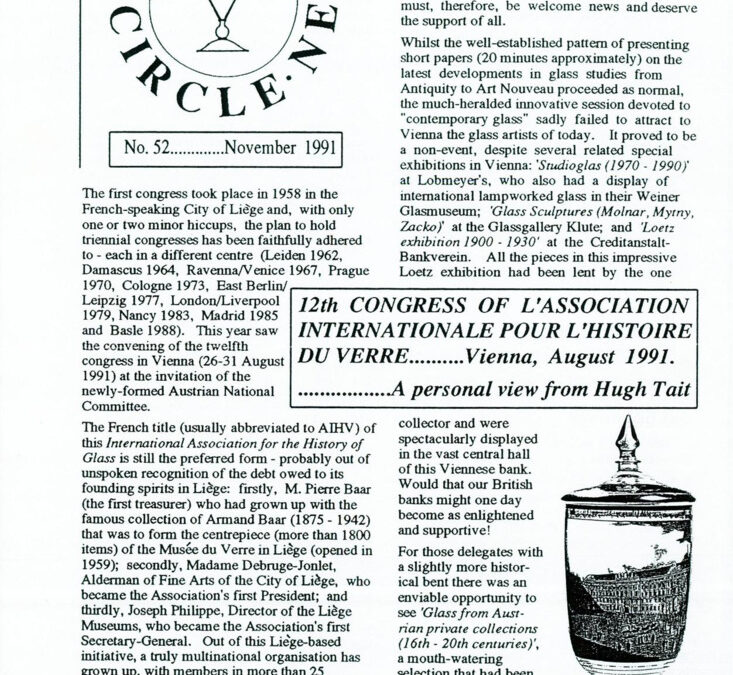
Goblet and cover by Anton
Kothg asset. Vienna. c. 1815.
Michael Kovaoek Glass Gallery.
I
The first congress took place in 1958 in the
French-speaking City of Liege and, with only
one or two minor hiccups, the plan to hold
triennial congresses has been faithfully adhered
to – each in a different centre (Leiden 1962,
Damascus 1964, Ravenna/Venice 1967, Prague
1970, Cologne 1973, East Berlin/
Leipzig 1977, London/Liverpool
1979, Nancy 1983, Madrid 1985
and Basle 1988). This year saw
the convening of the twelfth
congress in Vienna (26-31 August
1991) at the invitation of the
newly-formed Austrian National
Committee.
The French title (usually abbreviated to AI IV) of
this
international Association for the History of
Glass is
still the preferred form – probably out of
unspoken recognition of the debt owed to its
founding spirits in Liege: firstly, M. Pierre Baar
(the first treasurer) who had grown up with the
famous collection of Armand Baar (1875 – 1942)
that was to form the centrepiece (more than 1800
items) of the Musee du Verre in Liege (opened in
1959); secondly, Madame Debruge-Jonlet,
Alderman of Fine Arts of the City of Liege, who
became the Association’s first President; and
thirdly, Joseph Philippe, Director of the Liege
Museums, who became the Association’s first
Secretary-General. Out of this Liege-based
initiative, a truly multinational organisation has
grown up, with members in more than 25
countries, in Europe, Asia and America. Its
triennial meetings and regular publication of the
scholarly papers read at each congress (as well as
some twenty other associated volumes on glass)
have been a costly, but important, contribution
towards creating a forum for genuine debate (in
the three official languages: English, French and
German) and achieving a more balanced and
EDITORS
David Watts 27 Raydean Road,
Barnet, Herts. EN5 IAN.
John Towse
25-27 Curtain Road,
London, EC2A 3PH.
world-wide pursuit of the subject. The decision
taken at Vienna to continue these publications
must, therefore, be welcome news and deserve
the support of all.
Whilst the well-established pattern of presenting
short papers (20 minutes approximately) on the
latest developments in glass studies from
Antiquity to Art Nouveau proceeded as normal,
the much-heralded innovative session devoted to
“contemporary glass” sadly failed to attract to
Vienna the glass artists of today. It proved to be
a non-event, despite several related special
exhibitions in Vienna:
‘Studioglas (1970 – 1990)’
at Lobmeyer’s, who also had a display of
international lampworked glass in their Weiner
Glasmuseum;
‘Glass Sculptures (Molnar, Mytny,
Zacko)’
at the Glassgallery Klute; and
‘Loetz
exhibition 1900 – 1930’ at
the Creditanstalt-
Bankverein. All the pieces in this impressive
Loetz exhibition had been lent by the one
collector and were
spectacularly displayed
in the vast central hall
of this Viennese bank.
Would that our British
banks might one day
become as enlightened
and supportive!
For those delegates with
a slightly more histor-
ical bent there was an
enviable opportunity to
see
‘Glass from Aust-
rian private collections
(16th – 20th centuries)’,
a mouth-watering
selection that had been
sympathetically scattered
through the beautifully
arranged rooms of the
Historiches Museum in the
Karlsplatz. Another very
rewarding exhibition.
covering a similar period
of time could be seen at
Continued
12th CONGRESS OF L’ASSOCIATION
INTERNATIONALE POUR L’HISTOIRE
DU VERRE
Vienna, August 1991.
A personal view from Hugh Tait
GLASS CIRCLE NEWS Page 2
Vienna August 1991..
.
the Glass Gallery of Michael Kovacek, where
some of the pieces were already familiar from his
handsome Catalogue,
Glass of 5 Centuries
(Vienna 1990). Here, there was the additional
advantage of being able to handle – and discuss –
these treasures!
A remarkable insight into the important role of
glass in Vienna in the 19th and 20th centuries
could be gained during special visits to the
famous Technische Museum fur Industrie and
Gewerbe and the Lobmeyr-Archive collection
(1839 – 1990) and their associated display of
Crystal Chandeliers.
Rock-crystal, fantastically carved and engraved,
is one of the principal glories of the Hapsburg
collection at the Kunsthistorisches Museum but
even there, a special display of the sixteenth
century glasses from the Archduke’s factory at
Innsbruck and Hall (Tyrol) provided the
specialis t with a veritable feast, especially as it
included that unique survival: a diverse
collection of Renaissance glass jewellery.
Furthermore, the permanent exhibition of glasses
from the Ancient World, which included the
renowned FAVENTIBVS ‘cage-cup’ and the
beautiful lapis-blue glass portrait cameo signed
by Herophilos, had been expanded to show many
less familiar pieces.
In marked contrast, the once magnificently
arranged glass collection (14th – 20th centuries)
at the Museum fur Angewandte Kunst, where the
lecture sessions were held, remained locked away
in dismal storerooms, to which delegates were
periodically guided in small groups for brief
tours. The Austrian National Committee,
however, offset this disappointment by driving
delegates to Schloss Laxenburg and the hunting-
lodge, Brandhof, where the Biedermeir glass-
windows remain
in situ,
and to Graz, where the
Joanneum Museum houses a large collection of
glasses (16th – 20th centuries). There was an
equally relaxing visit to Baden and the glass
studio of Jack Ink but, as always in these
Congresses, it was the week-long opportunity to
talk with friends and colleagues from all over the
world and to meet new faces that mattered – and
on seven consecutive days of glorious weather.
NEW BOOKS. ON ITALIAN GLASS
from Shaunagh Heneage Distribution
No. 1 Stewarts Court, 220 Stewarts Road, London SW8 4UD.
ARCHIlvIEDE SEGUSO by Umbero Franzoi
22.5×28.5 cm with 169 colour and 1 B/W illus.
Price £30 approx.
This book, by the Director of the Doge’s Palace in
Venice, is about the artistic career of one of the
greatest and truest masters of Murano glass-
making. It began in the 1900s following, but
more often heralding, the developments and
contradictions of a century troubled by two World
Wars and characterised by the often complex and
sometimes painful evolution of taste, and by
formal and stylistic quest.
Through these
difficult decades the creativity of Archimede
Seguso, supported by the serene insight of all
great artists, has emerged. He combines old and
new experiences with an extraordinary technical
skill and attachment to the Murano tradition,
yet searching for new forms of expression.
The book presents a wide selection of Seguso’s
most important work from the famous laceworks
to the “massello” compositions, from “latticinio”
to transparent glass lightly soffused with shaded
colours.
ART AND GLASS
edited by Giovanni Sarpellon
22×28 cm, 76 pages with 55 colour and 31 B/W
illustrations. Price £14.00 approx.
This book illustrates works produced by the
fourth Premio Murano, an event which brings
together glass design artists and the masters of
glassmaking of Murano. About 30 designs
from the entry by glass artists were selected by a
special jury to be made by the Muranese glass-
makers. This book conveys the modern trend
for the design of art glass and its manufacture to
be separate activities, hopefully drawing the best
from both. The reader may judge for himself.
Giovanni Sarpellon, a Venice-born University
teacher, is Chairman of the Associarion for the
Study and Development of Murano Culture. He
collects 19th and 20th century glass, spending
much of his time searching for and restoring
glass objects produced over the last 100 years.
GLASS SOURCE BOOK: A Visual Record
of the World’s Great Glass Making Traditions.
by Jo Marshall.
Collins & Brown (1990)
A 192-page, coffee-table size, full colour picture
book with six introductory chapters describing
glass from Ancient Egypt to the Modem Day.
A browser’s delight for Christmas
£19.95
GLASS CIRCLE NEWS Page 3
Barry Richards 1910-1991,
an appreciation.
Our President, Robert Charleston, writes:-
“Barry Richards joined the Circle of Glass
Collectors in 1946 or 1947, part of a post-war
intake of which only half a dozen now remain. His
contemporaries as collectors included, among
Circle members, Donald Beves, Henry Brown,
Colonel Hale, G.F. Hotblack, Sir Harrison Hughes,
Monica Marshall, Ivan Napier, William Roscoe;
and few of their collections surpassed Barry’s in the
number of exceptional early pieces they contained.
There was no Verzelini, but there was a range of
late-17th century treasures which it would have
been difficult to match. Most were shown in the
1962 Circle Exhibition and the 1968 Exhibition of
English Glass, both at the Victoria and Albert
Museum. Among English glasses there was the
sealed Ravenscroft gadrooned bowl, one of three
known survivors; the unique S-sealed crizzled
Roemer, attributable either to the Savoy glasshouse
under Hawley Bishopp or possibly the Southwark
glasshouse of Bowles and Lillington; the crizzled
serving-bottle, wheel-engraved with the arms of
Catherine of Braganza, perhaps to be attributed to
George Ravenscroft.
Beyond these
incunabula
of English glass-making
was the splendid late-17th century goblet with nipt
diamond waies gadrooning and chain circuit, on a
hollow-knopped stem with raspberry prunts, and
the beautiful standing-bowl with similar features
but diamond-engraved with a later calligraphic
inscription dated 1727. Nor were Barry’s interests
limited to English glass. The 1962 Exhibition
included four fine wheel-engraved Nuremberg
goblets of late-17th century and early 18th century
date as well as an enamelled “Kurfiistenhumpen”
of 1625, a goblet stippled in the manner of David
Wolff and several late-17th century glasses which
hover between an English and a Netherlands
attribution.
Barry carried his collecting activities lightly, and
he had many other irons in the fire, as the memoir
below amply demonstrates. Members of the
Circle, however, will remember his generosity, his
infallible geniality and his ever-ready warm
chuckle. Those whose memories go back so far
will recollect vividly the 1974 Sutruner Outing to
Barry’s home and garden at Hartley Manor in Kent,
with the opportunity it gave to inspect at leisure
the treasures of glass which the house contained;
above all they will recall the warmth of Barry’s
hospitality.”
Barry also had a remarkable collection of frogs
ranging from antique Chinese Jade to vulgar plastic
sent by more ribald friends. He was also a keen
fly fisherman, a Judo expert, and a skilled
mycologist – chiefly because of the great variety of
fungi in his woods at Hartley Manor. He was a
great chef and delighted in cooking the edible ones;
rare examples he would take up to discuss with
Professor Ramsbottom at the Natural History
Museum.
He was born into a prosperous family of flour
millers and had hoped to study medicine but his
father forbade this. He spent some time at the
Sorbonne and in the 30’s lived the life of a well-to-
do young man about town. He served in the RAF
during the war, mostly in air-sea rescue.
After the war he worked with Group Captain
Leonard Cheshire. As a Trustee of the Cheshire
Foundation his talents for mixing happily with all
layers of society, together with his confidence,
energy and enthusiasm enabled him to start up
Homes for the disabled, often on a shoestring, both
in Britain and overseas. Thereafter he would enlist
the support of the wealthy and influential to ensure
their future.
His many social contacts alerted him to the tragic
consequences that befell some of his friends and
their families due to alcohol abuse. In 1964, he
gathered together a group of medical professionals
and friends and started the “Helping Hand” charity
to help alcoholics. Their first house, Giles House
in Camberwell, is still going strong.
Soon after, he plunged into the dangerous
and
largely uncharted waters of drug abuse. There
were few charities or facilities in that unglamorous
field, which did not have much public appeal and
consequently little financial support. The early
years were very precarious, and it was mainly
Barry’s determination and generosity that kept the
charity going. Now, ‘Turning Point” (as it is
now called) is the largest National charity helping
people with drink, drug and mental health
problems. Its latest project is a care unit for drug
users who have contracted Aids. This is a colossal
achievement and Barry must have been tremend-
ously gratified to see how his brainchild developed.
His efforts were crowned when, in 1987, HRH The
Princess of Wales became Patron, and she takes a
very active and keen interest in the work of the
charity.
Twelve years ago, as a result of a devastating
accident, Barry was left semi-paralysed and could
no longer take an active part in the management of
‘Turning Point” but his advice and judgement were
still sought.
Barry had a host of friends, he was known to the
Circle as a great collector; perhaps few members
realised what a great philanthropist he was. We
offer our sympathy to his only daughter, who lives
in America.
J.C-J.
E.T.U.
•
Judy Rudoe writes
The exhibition can be seen in rooms 90-91, the
Prints and Drawings Gallery. For the first time, the
museum has integrated prints and drawings with the
decorative arts, and much of the museum’s 20th
century glass is now on display.
During the period of the special exhibition, the
Modern Gallery (Room 48 on the upper floor), in
which the 20th century pieces are normally on show,
has been filled with 19th century decorative arts.
These include objects acquired in the 19th century,
such as the Clichy engraved glass ta77a from the
Slade bequest and a signed and dated Brocard
mosque lamp of 1867, as well as more recent
acquisitions, such as the engraved Baccarat ewer in
bizarre neo-renaissance taste (see picture below)
designed for the Paris Exhibition of 1878. Also on
show is glass by J. Powell & Sons, Louis Comfort
Tiffany, Karl Kopping and Kolomann Moser.
This Exhibition and the temporary display of 19th
century decorative arts together incorporate most of
the pieces discussed in my article in Glass Circle 7.
They also coincide with the publication of
Decorative Arts 1850-1950: a catalogue of the
British Museum collection”.
“See separate review.
GLASS CIRCLE NEWS Page 4
COLLECTING
THE 20th CENTURY
At the British Museum
4th Oct. – 16th Feb. 1992 Admission free.
This exhibition demonstrates that the British Museum is as
committed to the modern world as to the remote past, bringing
together an extraordinary variety of 20th century material
acquired through purchase, bequest, gift and fieldwork Since its
foundation in 1753, the Museum has aimed to represent a
comprehensive history of cultural development and collected not
only objects of antiquity but also contemporary artefacts. Over the
past twenty years it has ventured more systematically into the
modern field, extending long-established collections and
developing new areas of acquisition, such as political badges,
banknotes and work produced for the tourist market by non-
European societies. The exhibition includes European and
American prints, drawings, metalwork ceramics, glass, jewellery
and medals; oriental paintings, prints, carvings and ceramics; and
ethnographic items of great diversity, from Chinese paper funerary
objects from Malaysia and textiles from West Africa to ceremonial
featherwork from Brazil and a painted metal shield from Papua
New Guinea
The selection of objects shows how the Museum’s collecting policy
has adjusted to the cultural changes of the 20th century. This has
involved, for example. a reassessment of the merits of craft versus
industrial production and the relative importance of ‘high’ art
versus popular and often ephemeral art forms. The exhibition also
reveals the varying notions of modernity entertained by the
different cultures represented. Some societies, particularly in the
East, explicitly revere the imitation of past styles; in other cultures
little distinction is made between old and new: in Western eyes
modernism tends to be regarded as synonymous with a progressive
avant-garde, as exemplified by the Art Nouveau style and the
products of the Bauhaus school. On display are many acknowledged
landmarks of the ‘modern movement’; applied arts, drawings and
watercolours by Charles Rennie Mackintosh, German Expressionist
prints, and Russian Suprematist and Constructivist designs.
In collecting ethnographic material the Museum has sought to
document how the traditional skills of non-Western societies have
both survived and adapted to the demands and technological
developments of the 20th century. The notion that only the
products of cultures uncontaminated by modem influences are
worthy of acquisition in the ethnographic and oriental fields has
been challenged by the great imagination displayed in many regions
by the use of man-made materials, the re-use of the ‘disposable’ or
the incorporation of contemporary motifs within a traditional
iconography. The demands of tourism have in some cases preserved
local skills and prompted new forms of artistic expression, such as
the acrylic painting of the Aboriginal Australians and Inuit
printmaking from North-West America
The exhibition is accompanied by the book Collecting the
20th
Century, edited by Frances Carey, available at the Museum
bookshops price £4.95.
Four examples of Persian glass dating from the 17th to 19th century
GLASS CIRCLE NEWS Page 5
NEW BOOKS
from British Museum Press;
FIVE THOUSAND YEARS OF GLASS
Edited by Hugh Tait
(Oct. 1991) 256 pages, 256 colour , 28 pages b/w
ills. and 2 maps. 276×219 mm, cased, £25.00.
Thc powerful academic pedigree of the six contributors
ensures that this lovingly-compiled volume is the most up to
date and authoritative
work of its kind, analysing the
development of glassmaking from its first discovery to the
present century. In addition to the Editor’s introduction,
epilogue and a short section on fakes, we find, in chronological
order, Before the Invention of GiessbionYag
by Varonica
Tatton
–
Brown and Carol
Andrews, The Roman Empire and
Early Medieval Eumpe AD 400-1064
both by Varonica
Tatton
–
Brown,
The Lilatmi- Lands ana’ Chin.g by
Ralph Pinder-
Wilson,
Europe from the Afirldie Ages fa the todustaa/
RevoktriN
by Hugh Tait, and
Europe and America 1800-
194a
by Paul Hollister.
Their writing is complemented by a series of 214 superb
annotated photographs of Willam Gudenrath,
President of the
New York Experimental Glass Workshop, demonstrating the
probable methods by which pre-Roman, Roman and Venetian
masterpieces were created – the first such endeavour of its
kind – which will attract the practicing glassmaker as much as
the collector. (It was nice to see a little more than just Bill’s
extremities at the launch of this book at The Glasshouse,
Covent Garden, where, for over three hours, he captivated
those present with his skills.)
The book, beautifully printed in Italy, invites comparison with
the only slightly larger
Mc/As/my
of aass,
edited by Klein
and Ward, whereupon its bias towards the earlier periods
becomes apparent leaving Paul Hollister, like one American
footballer trying to win the Rugby World Cup on his own,
with an impossibly large temtory to cover. His is a master-
piece of concise writing but it does emphasize that with the
exponential growth of the subject over the centuries such
volumes both add their own contribution and complement
those of others.
DECORATIVE ARTS, 1850 – 1950
A Catalogue of the British Museum Collection
Judy Rudoe
(1991) 368 pages with 25 colour and 370 b/w ills.
276×219 mm, cased, £95.00.
The British Museum’s collection of decorative arts from Eu-
rope and America of the period 1850-1950 is here fully
catalogued for the first time. Hitherto relatively little known,
the modem collection has been carefully extended since 1979
and now numbers over 360 items of metalwork, ceramics and
glass. These range from William Burges’s gothic revival metal-
work to Russian Revolutionary porcelain. This catalogue
contains much new information from factory archives, and
publishes, for the first time in English, material from continen-
tal sources. Each object is considered in its historical setting
and in the light of the circumstances that gave rise to its creation.
Every item is illustrated and signatures. monograms and mak-
ers’ marks are reproduced.
Thc publishers arc rightly proud of the illustrations, drawn
from the best collections world-wide, with numerous original
contributions from the British Museum collections. Indeed,
many of the pieces shown arc the finest, frequently unique,
examples of their kind. They are afforded ample space and
it is a pleasure to just sit and turn the pages, absorbing this
miracle of modern technology.
It might be expected that Hugh and his team aspire to high
standards; they have undoubtedly delivered the goods!
Modestly priced, no student or collector will want to be, or,
indeed, should be, without it. American/Canadian readers
will find that their edition has a slightly different title.
D.C.W.
From
Decorative Arts
1850-1950.
Glass Vase Free-blown pale green glass.
Designed in 1921 by Vittorio Zecchin for the
newly-founded firm. Vetri Sotfati Muranese
Cappelin-Venini 8 Co. Zecchin’s purist
shapes broke away from traditional highly
decorated Venetian glass.
Goings – On at Jeanette’s….
(32A Kensington Church Street. TeL 071 938 1539)
We always seem to catch up with the last few days of
Janette
Hayhurst’s exhibitions. Tactile Treasures II, feat-
uring work by 14 outstanding modem artists, ends on
Nov. 23rd. However, a Christmas feature with lots of
fun, inexpensive modem paperweights, perfume bottles
and jewellery, starts on Nov. 30th. An exhibition of stain-
ed glass designs and stained glass by Rachael Moss, is also
at Janette’s from 8 – 18th January, 92. Janette also tells us
that The Sotheby Concise Encyclopaedia of Glass edited
by David Hattie and Simon Cottle is now out. Sorry, no
derails except that Martin Mortimer, Perran Wood and
guess who? are among the numerous eminent contributers.
“BEND BIRD
–
Pau de Verre, animal
hair and limestone.
Benu Bird war a sacred mythological
bird with the body of a Golden Hawk
and the head of a heron_ It represents
the incarnation of the sun at dawn as it
appeared alighting on the Benbeu stone
at the temple of Heliopolis.
Benu
Bird
appeared only every 507 years in the
pastures of the temple_
D.H.
GLASS CIRCLE NEWS Page 6
PATE DE VERRE:
A Personal Development
By Diana Hobson
Diana Hobson began her talk by explaining how her
career had started with a study of ceramics silver-
smithing and sculpture at art school. The idea of
working in glass had not occurred to her until she
worked on a table clock which incorporated glass and
enamelled silver. The body of the clock was
conceived as an irregular cone shape of enamelled
silver with a lens set into its top, through which the
clock face deep inside was magnified.
The base of
the clock was glass, which allowed light to pick out
the detail of the central interior focus.
The work with enamel led her to experiment with
complete forms made by fusing in a kiln finely
ground enamel and lead crystal layered into a mould.
Her objective was to make the vessel walls egg-shell
thin to exploit the interplay of light and the trans-
lucent nature of the material.
Nothing was known about the manufacture of this
form of Pate de Verre, and every aspect of the
technique had to be discovered by trial and error.
This included the choice of glass, the particle size to
use and how it should be applied to the wall of the
mould, as well as a carefully evolved firing process.
The nature of the mould material had to be deter-
mined so that the mould could be readily washed
away after firing to release the delicate glass structure
within. In her first attempts the glass particles failed
to fuse and, in order to improve heat penetration,
Diana adopted an open mould with no internal
support for the glass. The kiln temperature now
became critical in order to make the glass hot enough
to fuse but without collapsing in the mould. A con-
ventional thermostatted kiln was used in the early
firings but Diana now uses a computer-controlled kiln
built to her own specification by David Taylor, of the
Glasshouse in London’s Convent garden, and her
designer husband, John Stoddard.
The sequence of vessel construction is to apply the
coloured detail into the mould first and then to build
up layers of glass paste finely bound with gum arable.
Surprisingly, the coloring agents used are often pow-
dered earths and stones obtained all over the world,
some from as far away as New Mexico and India.
With the award of the richly-deserved Rakow prize
and the opportunity to create a work of art for the
Corning Museum of Glass, Diana siezed the oppor-
tunity to move away from open vessels and develop
three-demensional sculptural pieces. At the same
time she decided to extend the interplay between the
found
materials – such as stone and feathers – and
the
formed
materials such as bronze and glass.
This commune with nature took a new turn when,
while walking in the forests of Pilchuck near Seattle
in America, Diana came across a smooth egg-shaped
boulder which had been split almost symmetriclly in
half, an ancient symbol of creation. This boulder was
combined with glass representing the native American
creation myth of Copper Woman, the first woman
and mother of the Indian people of the islands in that
area, to produce the piece for the Rakow commission.
Since returning to England Diana has been busily
developing this theme at her studio in Hackney, and is
now working on more complex pieces using multi-
part moulds,
to exploit the
creative free-
dom liberated
by the move
away from the vessel shape. However, it takes five
days to fire and cool one piece in the kiln, so pro-
gress
is inevitably slow.
Her latest work, showing
a plethora of new ideas, enraptured the Circle
audience who enjoyed not only Diana’s first hand
account of her art form, but also the rare privilege of
learning from the artist herself of the emergence of a
more mature period of creativity, opening into a new
world of artistic expression still to be fulfilled.
J.S. & D.C.W.
NEW GLASS DISPLAY FOR V & A
The public and reserve collections of glass at the
Victoria and Albert museum have been stored away
during a total refit of the display area, the first for
longer than most can remember! As well as creat-
ing an entirely new public presentation the museum
is installing expensive (German) humidity-controlled
display cases – a conservational measure since an
unusually high proportion of the collection is subject
to crizzling; this even includes some pressed glass!
During the refit
no
glass will be available for study,
nor is there public access to the Department.
Ring
from the Enquiry desk if you need to make contact.
The
Grand Reopening
is planned for September 1993.
Meeting held at the Artworkers Guild
on 20th June 1991. The hosts were
Mrs
J.
Benson, Mr R. Whatmoor
and Mr and Mrs G. Miller.
GLASS CIRCLE NEWS Page 7
A Fly in (between) your Glass
THE GLASS CIRCLE SUMMER OUTING
2 Saturday 14th September 1991.
St Mary Virgin NORTHILL
A delayed coach start has quite a bonus.
–
The glorious warm day encouraged an unhurried survey
of St Paul’s Cathedral and its environs.
Some may
have pondered on the impending re-development of the
disliked Paternoster Square – did anyone reflect on the
1960s acclaimed TV series ‘The Power Game” starring
Richard Wymark. Then it was acclaimed as the
architecture of the age.
Those that came by ‘tube’ will have enjoyed the best (and
last?) displays of Harold Stabler’s lovely cream relief
tiles by Poole Potteries. Frank Pick was responsible for
the outstanding designs of the original ‘UNDERGROUND’
which established such a sense of London pride and
efficiency, sadly lacking now.
Our coach journey to Bedford was an enthralling panor-
amic vista of the history of Town and Country Planning
in Britain … .
as
well
as a lovely view of full summer’s
trees and fields. First the soul-less plate glass and steel
of the City offices – dead as dead at the weekend. The
rich mixture of Islington’s new and decadent quickly
gave way to the delightful neat villas and well-kept
gardens of Hendon and Finchley. Then; suddenly full
countryside and the huge flat expanses of Bedfordshire
greenery. Thank heaven for the Green Belt!
Arriving at the Cecil Higgins’ Art Gallery we were
warmly welcomed by the curator, our member, Halina
Graham, refreshed immediately with coffee and biscuits
and introduced to what is undoubtedly one of the finest
and most fascinating of provincial museums. There was
much to see. The huge Galls coupe of marqueterie de
verre on bronze foot was my favourite: the 1667 Roemer
painted with Dutch and English men-o-war (G.305): the
Warzenbecher with dark green raspberry prunts
engraved “Drink me up and throw me down, Pick me up
and fill me again” (G.354). And Halina very kindly
provided us with a 500-long descriptive list of all the
glasses displayed.
The room-settings are an unforgettable feature of the
Cecil Higgins’. In the magical re-creation of a room in
William Burges’ enchanted Tower House we should
reflect on two little-known matters. The first, the
anguish and passionate genius of Charles Handley-Reed
who recognised those self-same qualities in his hero,
Burges (and energetically amassed such a wonderful
collection – including the red wash-stand for £25, or so,
from a small shop in Kensington).
Secondly, to appreciate Halina’s
energetic enthusiasm that has resulted
in this magnificent display for all to
enjoy.
The Hart & Sons Gothic brass clock
enriched with coloured glass by Bruce
Talbert; the white Minton miniature
font of 1840 from St. Mary
Magdalene’s, Oxford; the 7th century Irish bog oak
Celtic broach; the watercolours – Varley, Constable,
Gainsborough, Sandby, Lear, Ruskin. Then: quickly
before an excellent sit-down buffet lunch, a privil-
edged visit to the reserve collection – the exquisite
18th century figurines in polychrome Nevers glass, a
fabulous De Morgan charger in the richest lustre
decorated with a fantastic ship and fish…. some
modest but interesting cast iron door knockers and a
salutary ‘Amen’ glass of 20th century provence among
enless other items.
It was a morning of visual intoxication. We shall
treasure the memories of our own favourite pieces.
The Circle, post-prandially, numbering 44, ascended
the bus and enjoyed an exhilarating tour of local
churches. The vicar of
St. Andrews, Kimbolton,
vividly described the
equally vivid Tiffany
window erected in
memory of the two
daughters of the Duke
and Duchess of Man-
chester.
The delicacy
of tone and bloom on
the children’s faces were
of such an intensity
(enhanced by the sun
shining through) as to be
unequalled for beauty in
this medium. Lurid
tales were
not
told of
the Duchess, a dashing
Cuban beauty, but the
Circle were enticingly
informed that there were
very
lurid tales! Wendy
Evans, who, with Halina,
had organised the tour,
thanked the vicar – a
charming personality
Continued
we
THE TIFFANY WINDOW (detail)
GLASS CIRCLE NEWS Page 8
Circle Outing contd…. with a substantial, rotund
figure. He had, she said, “torn himself away from a
fund-raising cycle race”. Bearing in mind the extent
of his rotundity a number of members privately
formed the view that by tearing him away from this
exertion the Circle may have saved his life!
Encased flies in glass window sundials were the next
wonders to behold. At St Mary Virgin. Northill.
Moggerhanger, the public can enjoy the rare mid-
seventeenth century (1664) windows by John Oliver.
Originally set above the altar, they are now displayed
on the north wall. They commemorate the refurb-
ishment of the church at that time by the Worshipful
Company of Grocers and have central motifs unusual
for a church, the Companies arms and those of its
patron Charles II.
Their pastel shades contrasted
sharply with the intense blues and greens of the Kemp
stained glass of 1874 nearby and our
earlier experience with Tiffany. But,
for the Glass Circle, there were
extras.
Two rar e sundial glasses
(John Oliver, 1664) were brought up
from secret caverns together with
some of the church’s ancient plate
– a 16th century flagon (see right)
converted to an ewer in 1880 etc.
The flies, incidentally, prominant
distractions on the face of the dials, were not perm-
anently and hermetically innured within the glass
(“time flies”) but painted on each side with
extraordinary delicacy and precision as thus to appear
entombed. One would like to hope that one sundial,
at least, could find its way to Cecil Higgins’ so as to
enjoy a wider audience.
Our final stop was to survey the Warden Abbey
medieval stained glass at the 12th century parish
church of St Leonard (featured in the Alec Guiness
epic – Kind Hearts and Coronets). Old Warden is the
prettiest of Bedfordshire’s lovely villages and we
came upon it complete with cricket match in the late
afternoon sun. The church is a veritable museum of
ancient wood carving.
Lord Ongley, in the 19th
century, “beautified” the church by incorporating
carvings from many periods and countries; Belgium,
France and Italy; these include panels from the
private chapel of Anne of Cleves.
The Shuttleworth family, having bought the Ongley
estate in 1872, subsequently enriched the church with
further gifts such that Sir Nicholas Pevsner said it
was “overcrowded with motifs of the past”!
Frank
Shuttleworth bought the pulpit in an Edinburgh
antique shop!
And: the extensive Minton poly-
chrome encaustic floor tiles are the same as those
previously laid in The Birch Church, Manchester, and
now in the writer’s collection! They are probably by
Pugin.
There is a lot more marvellous stuff and the
60p. guide book a mine of information.
Thanks to our hosts and organisers for a day replete
with delight . . and fun.
John Scott
THIS AND THAT
by J.T.
Much to my regret a number of printing errors in my
article in the last issue require correction.
In the report of the Ceramics Fair and Seminar held in
June at the Park Lane Hotel the following misprints
occurred: The facon de Venise goblet on Peter Korf
de Gidts’ stand was quoted as 25cm. high, instead of
29cm. The signed glass shown by Frides Lameris
was dated 1759, not 1753. The Baccarat vases on
Mallett & Son’s stand were offered at £68,000, not
£18,000.
In my comments on Sotheby’s subscription demand,
last year’s catalogue for antique glass was quoted at
£20. This should read “catalogue subscription” and
not “catalogue”.
And finally, the reference to the minimum value of
individual glasses to be offered for sale at Sotheby’s
ondon salerooms should have been £1,000, or
thereabouts, not £100. In fairness, it should be
mentioned that in their catalogue for a November
1991 sale a number of lots are estimated or valued as
low as £400. One can conclude therefore that the
£1,000 valuation is more in the nature of rough
guidance than a firm lower limit.
Chatting with some antique glass dealers and reading
general comments about business and the economy in
recession, one runs the risk of becoming seriously
confused. Some dealers say that they are doing
well, others complain about the scarcity of fine glass
and the absence of buyers. When reading press
comments the confusion becomes complete. The
economy is “bottoming out”, the economy is “on the
upturn”, or “we are in the worst slump since well
before the last war”. Spreading confusion seems
the order of the day. Under the influence of this
muddle, level-headed assessment of the true position
becomes impossible.
However, commonsense still can and does suggest a
course of action or, in this case, inaction. The good
old English adage of “wait and see” by Lord Asquith
in 1910 seems eminently applicable to the present
situation. If you are hungry, you have to sell. If
not, and you are in funds, then continue buying.
Life goes on, and collecting has become endemic in
what we would like to call (questionably???)
“civilised” society.
Every silver lining has a dark
cloud attached to it. I would propose to ignore the
latter. . .
$
STOP PRESS
We have just learned that Charles Hajdamach plans
to have his book British Glass: 1800 – 1914,
publication date November 26, 1991, on sale at the
Glass Collectors Fair (see Back Page). The book
has over 400 pages with some 400 b/w and 50
coloured Figs, large format and costs £45.00.
WIN
F:)
,43
A4
4
0,
PlOTORPAY
Ce
tt
re
cliot,
S
M42
Kt° ra5leAl
-• 6,180
M6
TWoLvErthitil Pio
r.1
4©
Mx
M
5
lvi
or
M4 0
4′
M
S
.
M4-1.,M40
Arele
r_rr._
rt
STho KM]
DGE
Enno-cickid Paksc
0 Red
llousc G.st
Dchn,c tical
c„
j
yt,,t
0 Silvcr E.,0(
(5) Sire of Tkcs
Wab
3,3
-..i