




EDITORS
David C. Watts
27 Raydean Road,
Barnet, Herts. ENS LAN
and
John Towse
25 – 27 Curtain Rd,
London, EC2A
3PH.
GLASS CIRCLE
PRESENTATION TO
JANET BENSON
Hon. Secretary for 20 Years
As a special item at the Annual General Meeting
last autumn our Charman, Barbara Morris, made a
presentation to Mrs Janet Benson in recognition of
her 20 years service as Honorary Secretary of the
Glass Circle.
Janet was only the second Hon. Sec. of the Circle
since its foundation in 1937. All who have had the
pleasure of working alongside her, always admired,
and were reassured, by her calmness and efficiency.
She kept the affairs of the Circle running on oiled
wheels.
In January, 1992, the Committee had reluctantly
and sadly accepted Janet’s resignation. It was
decided to give the membership the opportunity to
express their appreciation. When subscriptions
towards a gift were invited, contributions poured in.
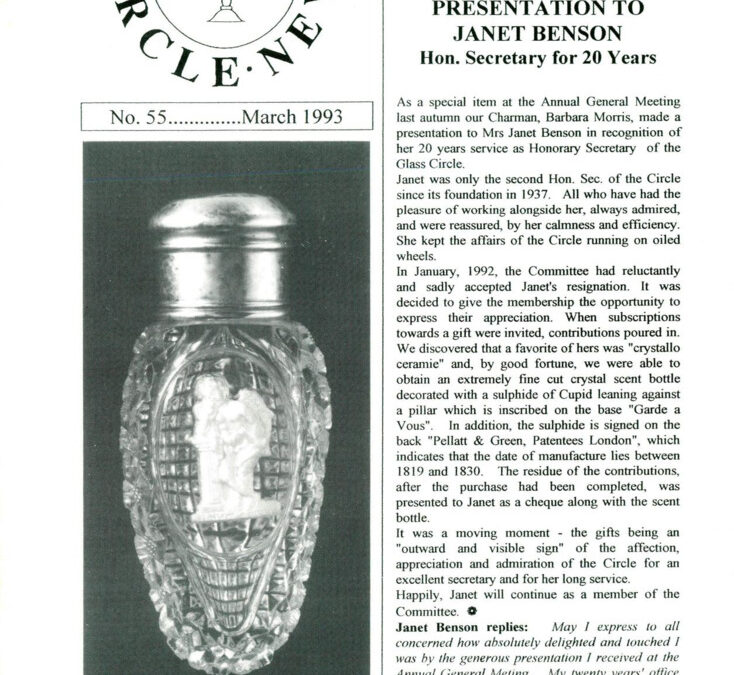
We discovered that a favorite of hers was “crystallo
ceramie” and, by good fortune, we were able to
obtain an extremely fine cut crystal scent bottle
decorated with a sulphide of Cupid leaning against
a pillar which is inscribed on the base “Garde a
Vous”. In addition, the sulphide is signed on the
back “Pellatt & Green, Patentees London”, which
indicates that the date of manufacture lies between
1819 and 1830. The residue of the contributions,
after the purchase had been completed, was
presented to Janet as a cheque along with the scent
bottle.
It was a moving moment – the gifts being an
“outward and visible sign” of the affection,
appreciation and admiration of the Circle for an
excellent secretary and for her long service.
Happily, Janet will continue as a member of the
Committee. 0
Janet Benson replies:
May I express to all
concerned how absolutely delighted and touched I
was by the generous presentation I received at the
Annual General Meting. My twenty years’ office
as Honorary Secretary afforded me much
enjoyment and many friends; I certainly intend to
continue to derive pleasure from its erudite and
sociable meetings for many years to come!
My warmest good wishes to you all for 1993. 0
No. 55
March 1993
The Apsleyllatt scent bottle presented to Janet Benson
Page 2
GLASS CIRCLE NEWS
LOUIS XIV’s GLASS TABLE;
A TRIUMPH OF IMAGINATION
AND TECHNOLOGY
By Paul Hollister
In the French royal inventory of 1681, listing the
furniture of the crown, number 276 is described as “a
table covered with divers pieces of glass cast and mingled
of several colours, with its legs also covered with glass”
.
In the 1729 inventory the table is carried on its feet by
‘five round columns
glass”. Today the legs are missing, but four may be in a
Smithsonian Institution warehouse in Washington, D.C.
The glass tabletop measures 116 by 81 cm. (45.5 by 32
inches), and consists of 1 I 1 glass panels of various
shapes showing cast glass images of mythological figures,
lamp work fauna, trees, and flowers in vases and baskets,
all set in a ground of coloured glass ribbons, filigree-twist
canes, and slices of millefiori cane. The panes are
separated by borders of repousse gilt-brass in an overall
strapwork design suggestive of knot gardens and
parterres, and of the bosquets, fountain pools and
mythological statuary of Versailles itself.
The table was probably designed and almost certainly
supervised during construction by Bernard Perrot (1619-
1709), the outstanding French glassmaker in the second
half of the seventeenth century. Perrot was born in the
Italian glassmaking centre of Altare, near Genoa, and
naturalised French in 1666.
Under the protection of
Louis XIV’s brother, the duc d’Orleans, Perrot received a
series of privileges and patents beginning in 1668 for the
pouring (casting) of glass as metal is cast: including the
casting of porcelaine de verre figures in two-part moulds;
pouring crystal into a shallow intaglio mould to produce
a cameo portrait; and introducing “rich enamels on tiles
and columns of copper, or other forms he wished to give
them . . which could be applied to making tables . . . and
other very unusual types of things”. These techniques
were applied in various combinations to the construction
of Louis XIV’s glass table.
The 111 glass scenes were probably slumped in two very
thin layers in shaped copper moulds, the edges or which
were turned up slightly to retain the hot glass.
The
lower or background layer consists of opaque coloured
and powdered glass strewn with lengths and shards of
coloured glass ribbons, filigree rod, and slices of
millefiori cane; the upper layer consisted of mythological
figures seen against a blue sky, scenes of the hunt in the
King’s forest, birds and butterflies, and formal flower
arrangements. The two layers must have been composed
and fused separately, the lower layer having to be
reheated to accommodate and fuse it with the imagery of
the upper layer. Yet the combined thickness of the two
layers is, astonishingly, no more than 1/8th of an inch.
The porcelaine de verre mythological figures
were
probably cast by Perrot in shallow intaglio moulds and
placed so that one sees only the flat upper surface of the
figure, while the very slight relief moulding of the under
surface served
to
anchor it in the background
layer.
Whereas the lampworked imagery appears to have been
produced flat.
Construction and assembly of the tabletop was probably
performed under the watchful eye of Bernard Perrot by
Frenchmen of Orleans and Nevers working with Italian-
born, naturalised French glassworkers from Altare and
Murano, who had lampworking skills and an ample
supply of Muranese filigree and millefiori cane. Perrot
must have made the glass-over-copper columns of ribbon
and filigree that formed the legs of the table. Many of
the smaller panels could have been produced in small
glassworks and studios of Orleans, perhaps by slumping
them in muffles. The concept of such a design for a
table combining so many glass techniques was ambitious,
but the result is a tour de force, and, so far, in the history
of glass nothing like it is recorded.
Tim Udall (Hon. Treasurer) – An
As members will know from January’s (1993) circular,
our Hon Treasurer, Mr T. (Tim) Udall, decided, for
personal reasons, to retire from office this year. Tim
has been a member of the Circle since the mid-sixties and
he became Acting Hon. Treasurer in early 1984 when the
late Philip Whatmoor, the Hon. Treasurer at that time,
departed for two year’s service overseas for BP in
Shanghai.
With the efficiency of a new broom Tim started an
energetic drive to collect overdue subscriptions and to
introduce new members to the Circle. In August, 1984,
his devoted attention to the accounts enabled him to
announce that there was £580 in the Current Account,
£100 in the Deposit Account and, very important, that
the loan of £600 for Glass Circle IV had been repaid.
appreciation
He also opened a Post Office Investment Account to
build up the capital to fund Glass Circle V – a very
necessary contingency in view of rising printing costs.
With the valuable assistance of John Scott to raise money
from advertisements in the Journal, Tim was able, in
October, 1985, to report that our resources had grown to
£3003 in the Savings Account, £724 in the Deposit
Account and £164 in the Current account.
Mr Whatmoor returned to London in March, 1986, with
the news that he had decided to resign his Office due to
pressure of work.
Tim was unanimously voted as
replacement.
Since then, Tim has been able to
consolidate the Circle’s funds while, at the same time,
ensuring that the bulk of members’ subscriptions directly
benefited the membership in the form of publications, and
GLASS CIRCLE NEWS
Page 3.
so on, while the meetings were largely paid for through
the generosity of the hosts and the arrangement of some
meeting places through privileged connections.
Tim also undertook the circularisation of the membership
which, in itself, is a mammoth task. He has agreed, very
generously, to continue this chore as well as remain a
member of the Committee, much to the pleasure and
relief of his colleagues.
But the contribution of our Hon. Treasurer has gone far
beyond the mundane necessity of collecting funds. He
possesses an encyclopaedic knowledge of the member-
ship of the Circle, and of the people generally connected
with glass.
The Circle has been fortunate indeed to
enjoy the results of his friendships and contacts.
Although he resides in East Anglia he has braved not only
the elements but (perhaps worse!) the rigours of British
Rail, to be a most devoted and assiduous supporter of
our meetings.
Most members will also know of Tim’s unbounded
interest in Jelly and Syllabub glasses of all periods, and he
has both entertained and educated us with excellent
accounts of their most detailed ramifications over the
years.
We hope that this interest will continue to
flourish to the benefit of us all.
We are sure you would all wish to join with the
Committee in expressing heartfelt gratitude to Tim for all
his hard work as Circle Treasurer for more than a decade
and we look forward to his companionship for a long
time to come.
Tim will be a hard act to follow, as they say, but we have
every confidence in Derek Woolston, our new Hon
.
Treasurer, as we look towards the future.
We know that members will welcome the opportunity to
mark Tim’s retirement with a lasting token of the esteem
in which he is held. If you wish to do so please send your
contribution to: Derek Woolston, Esq.,
31 Pitfield Drive,
Meopham, Kent. DA13 OAY.
Jo Marshall, (Hon. Secretary).
THIS AND THAT . . .
By
John Towse
It gives me great pleasure to congratulate our Committee
member Simon Cottle upon his appointment as Deputy
Director of the European Ceramics and Glass
Department of Sotheby’s. We well remember his talk to
the Circle on the Beilby family. Hardly referring to his
notes, an outstanding feat in itself, he quoted dates,
figures and locations accurately “ex memore” in a
performance of over an hour. At the time of writing, we
are looking forward to his talk on the 16th of March.
At the last Sotheby’s sale, on the 9th February, over one
hundred English, mostly 18th century, drinking glasses
were offered. Quite a few outstanding pieces fetched
prices well above the estimates.
Under present
conditions around 25% remaining unsold must be
considered as satisfactory. It appears that all the best
lots sold readily.
The cheaper and average items
attracted less interest and trade buyers were not strongly
represented.
Phillips’ sale, on the 2nd December, 1992, ranged from a
small collection of German “milchglas” to a collection of
paperweights. Also included was a collection of English
mid-19th century coloured glass bells – one pair, with
ruby opalescent colouring, realising £450.
An
interesting range of silvered glass, patented by J. Varnish
& Co. and W. Lund, included a pair of ruby glass double-
walled goblets which realised £1200. But the “star” lot
was a pair of magnum decanters, finely cut with hobnail
diamonds and flutes and each with a panel printed and
coloured with figures symbolic of, and titled “Asia” and
“Africa” and also marked “Patent Enamel”.
The
decanters were 35 cm high and realised £9500.
The Christie’s sale of November 1992 was a reminder of
bygone sales in the 1970s and 1980s.Fine typical early-
and mid-18th century English drinking glasses were on
offer, together with some unique Venetian, “facon de
Venise” and Spanish pieces, with about 60 fine French
paperweights. All in all, a fine mixture of some beautiful
glasses of exceptional quality together with relatively few
mediocre or cheap items. It seems worth mentioning
that only 5 out of 58 paperweights remained unsold as
opposed to 37 out of 206 other pieces. This seems to
indicate a more enduring popularity for paperweights
than for other glass in the current market.
After having assembled data for the past 25 years, our
member Frans Smit has finally published (in an edition of
200 copies only) “UNIQUELY DUTCH
EIGHTEENTH-CENTURY STIPPLE-ENGRAVINGS
ON GLASS”. For particulars about this book of 250
pages (which catalogues no fewer than 672 stippled
glasses) please send an S.A.E. to F.G.A.M. Smit, 4
Glamis Gardens, Longthorpe, Peterborough, PE3 9PQ.
It is not often that one is given an unexpected treat of
such dimension that it stays in the mind for many months.
Such a treat was vouchsafed for us when on holiday in
Austria last summer
.
Through the good offices of our member Dr. Edmund
Launert we were able to see the private museum of Drom
Perfumery Oils, near Munich. The drive, of over 100
miles each way through lovely countryside, was, in itself,
a bonus to remember, but our hours at Drom were a
unique experience.
The Storpe family have lovingly
assembled a museum of scent bottles, as mentioned in the
last GC News, for which it is hard to find adequate
superlatives.
The collection comprises scent bottles
from Egyptian, Greek and Roman times up to present-
day. The setting is – in one word – beautiful! Light
continued on page 4.>
Page 4
GLASS CIRCLE NEWS
Exhibition:
Drinking in Style
–
at the London Transport’s Headquarters, 55 Broadway.
The special viewing of this private collection of early
overstrung – were there to be studied. There was only a
English glass turned out, contrary to expectation, to be a
token display of facet and cut glasses from the later part
treble pleasure in that it provided an opportunity to take a
of the period but it is rare for any collector to span both
closer look at the architecture of the fine, and now
ends of the eighteenth century in depth.
Percy Bate
period, art deco building that is L.T.’s headquarters and
would, I think, have nodded his head in approval of a
also, on a bright and sunny, if breezy, morning, enjoy an
superb English collection, untroubled by “foreigners”.
unusual view of London from its tenth floor.
The glasses were displayed in three large cabinets, two of
The building is situated on top of St James’ Park
these with the narrow, chamfered, bronzed framework
Underground Station, making for easy access, and a
that betold of their association with the building,
good crowd had soon gathered to appraise a selection of
constructed in 1929 – and with no expense spared in
some of the best English glasses made between 1680 and
integrating its architecture with the interior cream
1830. The earliest piece, well known to experienced
marbled design and bronzed bowl fittings. One did not
collectors, was the Ravenscroft, or Hawley Bishopp,
need to go outside to know what it would look like,
giant goblet of which only the gadrooned bowl and
tapering skywards with a series of flat terraced roofs to a
intricate air twist stem now remains, mounted on a silver
central, blunt, trapezoid tower (once the tallest in town)
and turned wooden foot, but is, none the less, an
asking for, and getting, the inevitable stylized clock.
extremely delightful example of early workmanship in
From the tenth floor dining room, once the exclusive
lead crystal. It is not very often that one has the pleasure
perk of the L.T. directors but still with its original period
of being able to gaze on a…. what is the collective noun
sideboards, we were refreshed with coffee and biscuits
for baluster glasses?
…but anyway these subtly-tinted,
and could stroll over the landscaped roofs to blow away
graciously-flowing forms were a delight to behold even,
the cobwebs and boast our knowledge of the ever-
or perhaps, particularly, without delving into the relative
changing London skyline. Somewhere on the outside of
merits of acorn or other types of knop.
Tall drawn
the building are sculptures by Henry Moore, Jacob
shapes seem to develop an attractiveness of their own
Epstein,. Eric Gill and others, a remarkable tribute to the
and a light baluster with matching diamond-moulded,
days when everything worked and nobody moaned about
flared bowl and foot challenged the viewer to pass it over
the continuous lack of funds.
un-noticed. As we moved through the century from
By any standard this was a special treat and we are most
plain stem to air and opaque twists, most of the bowl
grateful to our member Henry Fox for arranging for the
shapes, mould blown or worked by hand, and a diversity
benefit of Glass Circle members this special viewing and
of foot styles – folded, firing, domed, terraced and
visit to one of the unsung gems of London.
This and
That (continued)
rooms contain many show-cases of unusual design, all
cunningly lit to best advantage and of such shape as to
enable one to view every pieces clearly.
There are, all together, more than 2000 items on show.
The manufacturing materials are, in the main, glass,
porcelain and earthenware. The largest room contains
examples from the last 300 years or so, both Occidental
and Oriental, ranging from ordinary to very rare and
strongly representing glass and Meissen. Another room
showed both ancient Egyptian and Greek and Roman
pieces, all in their appropriate settings.
We finished in yet another room which took us to the
present day. We saw original and production pieces of
scent bottles of most unusual designs, some still being
made today. Glass artists of great renown, e.g. Lalique,
designed perfume containers which were then mass-
produced_ One does not wonder that ladies will cherish
their perfume bottles long after the contents have been
used up.
We were most impresse by the obvious love and devotion
with which this collection has been assembled over years
and the thoughtfulness and care with which the display
has been designed. We were received with the utmost
kindness and hospitality by Dr and Mrs Storpe and
enjoyed our visit enormously. We hope that one day we
may return and see the museum again.
J.T.
BOOKS ON PAPERWEIGHTS
Carol Mannheim,
Bookseller, has let us know that she
has a small collection of second hand books on
paperweights available and one or two other books on
glass subjects.
If you are interested contact her at 31 Ennismore
Avenue, London, W4
I
SE. U.K.
or Telephone
081 9949740.
GLASS COLLECTORS FAIR May 16th
At the National Motorcycle Museum
Located at Junction 6 on the M 42.
This extremely
popular and well-supported fair virtually covers the
whole range of collectable glass. Early entry, from 9.30
am costs £2.50 while from 11.00 am the cost is £1.50.
For enquiries Telephone
Pat her
on
0260 271975
or
0384 253539.
Books on the Drom Scent Bottle Collection by Dr Lannert.
Will the member who wrote to me please make
contact as the items requested are now available but the correspondant’s address has been mislaid. D.C. Watts
GLASS CIRCLE NEWS
Page 5.
Publications:
THE HISTORY OF
SOUTH
YORKSHIRE GLASS
By Denis Ashurst M.A.
J.R. Collis Publishers, Dept of Archaeology and Prehistory,
University of Sheffield, Sheffield, SIO 2TN. (1992)
Size 5.9 x 8.9 ins, 150 pp, b/w ills. soft covers.
Price £8.95 inc. P+P. (Air mail: add £2 Europe, £4 International)
The author,
who is well-known for his excavation of the
Bolsterstone. glasshouse (1650 – 1758), now provides a
detailed survey of this glassmaking area whose importance
has been suspected from the pioneer writings of Francis
Buckley, in particular, but has received only minimal
interest.
The main reason, a lack of a suitable
comprehensive survey, has now been put right by this
authoritative and eminently readable account, althouth the
author says there is still much information to be unearthed.
The region covers from Sheffield in the south to Castleford
in the north and embraces 63 glasshouses of which perhaps
20 are reasonably well-documented to date. Many, such
as today’s Beatson-Clark, were mainly concerned with the
production of bottles or window glass although the entire
range of glassware from “Antigurgulars” to “Syllabubs”
was produced
.
After the Roman occupation the first glasshouses in the
area did not emerge until the 17th century, probably
because all the local woodland was earmarked as fuel for
the thriving iron industry. The first glass-houses were at
Wentworth, Silkstone, Bolsterstone, Gawber, and Glass
Houghton.
The earliest (1632) involving Sir Robert
Mansell and the Duke of Wentworth for the production of
window glass, is well-documented and inevitably embroils
the ubiquitous Bungar family and others well-known
glassmakers from the Weald.
Most of the book is documentary as relatively few glass
products can be positively associated with the area. After
examining the relatively stable level of production in the
18th century the author guides us through the great
expansion in the 19th century when as many as 25
factories, such as Rotheram, Bolsterstone, Gawber and
Beatson Clark, were in full production, to the 20th century
decline to about one fifth of that number, many of which
still survive.
The book also covers the social and welfare aspects of the
glassmakers and concludes with a helpful gazeteer which
includes a list of glass cutters and grinders in the area as
well as distribution centres form glass products and the
glasshouses themselves.
D.C.W.
ATELIERS DE VERRIERS
DE L’ANTIQUITE
A
LA PERIODE PRE-
INDUSTRIELLE
Edited by D. Foy and G. Sennequier
Libraire Archeologique, Monique Mergoil. b.p. 10, 34530
Montagnac, France. (1991)
Size 8.3 x
11.7
ins., 160 pp. numerous b/w ills. soft covers. Price
(inc P+P from the U.K.) FF 177.00.
This
book
contains 17 articles based on a conference held
in Rouen, in 1989, to appraise the archeological evidence
for glass factories in England and Europe from Roman
times, through the middle ages, to the 18th century.
The opening articles survey 12 Roman glasshouse sites
found in London and their associated glass. Five further
Roman sites at Colchester, Leicester, Mancetter, Worcester
and Wroxeter are also examined in terms of raw materials,
furnaces, crucibles, tools and glass waste. From the
Anglo-Saxon period only Glastonbury has produced
definite evidence of a glasshouse although glassworking
occurred elsewhere, such as at Monkswearmouth.
On the continent, comparable sites are considerably more
numerous.
In Germany, particularly around Cologne,
groups of furnaces have been found indicating an industry
of considerable size. Furnace sites also occur widespread
in France.
A classification for Gallo-Roman glass
workshops is proposed based on whether finished objects,
or only cullet from raw batch materials, was produced or
whether they were for the secondary process of working
remelted glass. Cullet for reworking was almost certainly
brought into Britain but there is
no
evidence for a British
cullet manufacturer at this time.
A survey of the middle ages begins with a reassessment by
David Whitehouse of the influence of Corinth on western
glassmaking. Workshops of the Middle Byzantine period
at Corinth assumed importance because, ostensibly, they
are the only ones to have been discovered and because
they are thought by many to have produced prototypes for
some common vessels, such as prunted
beakers, found in Italy and Western
Europe. Dr
Whitehouse – challeges this interpretation in the light of
modern evidence, concluding that the workshops may have
operated later and may have been occupied by Italian
rather than Egyptian glassmakers. Two furnace sites are
next examined, one near Stuttgart (15th century), which
yielded the remains of a fluted dip-mould, and one near
Florence (13-14th century).
Both furnaces were of the
long type and produced window or green glass.
Excavation is also under way of a range of glasshouses in
Northern Bohemia, the earliest, at Jilmova, being 13th
century.
With the Modern (post Medieval) epoch we move into the
time of the Gentilhommes-verrier and a concise survey of
some 45 French glasshouse sites (14-18th century). The
importance of Italian glassworkers emigrating from Altare
into France is examined, particularly to Nevers, which held
a regional glassmaking monopoly in the 17th century.
Finally, a superb 17-18th century farmhouse glassworks
excavation is described, revealing the partial remains of a
furnace superstructure, almost unknown in archaeological
work.
If you are interested in early glassmaking (and your French
is up to it) this excellent review is reccommended reading.
D . C . W
Page 6.
GLASS CIRCLE NEWS
t
. . . more Publications:
A Travers Le Verre
DU MOYEN AGE A LA RENAISSANCE
458 pp, 24 plates in colour, 200 photos b/w (1991)
Price (inc P+P) FF 196.00 (address below)
A fully-illustrated catalogue of the special exhibition
mounted to accompany the conference described on the
previous page.
It presents a very complete synthesis of
what is known of medieval glass in France, particularly the
discoveries of the preceeding five years.
In addition to
descriptions of 404 individual items it includes a preface
by David Whitehouse, introduction and table of regional
types and numerous references.
These and the preceeding book may be ordered from the
Beauvoisine – 76000 ROUEN, France.
VERRERIE D’EPOQUE ROMAINE
1. Pieces de provenance regionale.
By Genevieve Sennequier
Size 24 x 18 cm, pp. 224, 8 plates in colour, 24 photos b/w
and 66 plates of designs (1985). .
This is a well-illustrated, authoritative and fully
indexed catalogue of 315 pieces from the very fine
collection of Roman glass found in the Normandy
region of France and includes a number of prestigious
items.
Text by the author, museum curator, gives a
description of each piece, its method of manufacture, the
context in which it was found and other relevant
information.
Musies Departementaux de la Seine-Maritime 198, rue
Exhibition:
CONTEMPORARY BRITISH GLASS
There can be no doubt that creativity in glass has come a
long way since Harvey K. Littleton expressed, or should
one say re-expressed, his view that creativity in glass art
had to be spontaneous, generated “in the heat of the
moment at the furnace” But that was ten years ago and,
even then, the excitement of learning to manipulate and
exploit the molten metal – still a totally new experience for
many – had already existed for more than a decade. As
new artist glassmakers came along to enjoy this indulgence
for themselves it was inevitable that the more experienced
workers would move on to scale new heights and
endeavour to identify and conquer new horizons. Further,
economics and pragmatism decreed that such art must fall
within the bounds of what was financially affordable. The
emergence of glass forming, itself going back at least to the
early ’70s, in the hands of David Reekie, and since
popularised by Keith Cummings and the Stourbridge
College of Art, in particular, has proved a liberating
experience for those who would follow in the footsteps of
the masters like Keith Cummings and Diana Hobson.
It is a pity that this review must come after this quite
superb exhibition staged by the Craft Council has closed
for it was to be recommended for at least one visit and
preferably more.
The all-colour catalogue, 7.5 x 9.75
inches with 103 pages on quality art paper is still available
and a bargain for £8.99. It can, however, do little more
than convey the general flavour of the diversity of
originality and expression.
It was the American, Michael M. Glancy, who created the
word “enculturation” to express the totality of his personal
character and development as applied to his art, a sort of
personalised railway track of life along which one might
identify the stations of achievement through which the
artist progressed.
At this exhibition one could indeed
compare both the past and the present in time and the
greater sophistication of the older workers.
The best in
today’s contemporary glass can only rarely be wrought in
the heat of the moment.
Thus conceived, maybe, but
mostly a long struggle of search, trial, error and technical
triumph, gradually working the piece into its ultimate
shape.
This, one would expect of artistry on glass, the
work, for example, of Steven Newall, Ronald Pennell or
Peter Dreiser. However, in hot glass working it is a radical
progression away from the original concept . Perhaps, for
this reason, even a colour photo falls far short of
conveying the feeling of the best of this contemporary
glass, the colour handling of Pauline Solven or the surface
texture achieved by Liz Lowe and John Cook.
Such an exhibition tends to overwhelm, the close
proximity of so much creative diversity making too great
demands on the senses and, without any adverse reflection
on the Craft Council, not infrequently in a less than ideal
environment for any particular piece. On the other hand it
does permit the creation of a personal “pecking order” of
those works that you would like to have on your own short
list. Most of the recent glass was for sale and even some
pieces running into the middle range of four figures had
found buyers. Time will tell, however, whether, this
reflects only the expeditious investment by certain
museums.
Certainly, Broadfield House was well
represented among the loan items in the historical section.
This exhibition is part one of a two-part coverage of
contemporary glass. The second part, in about two years
time will move on to more architectural aspects.
You
have been warned. Don’t miss it!
D.C.W.
THE GLASS SOCIETY OF IRELAND
NEWSLETTER
The December ’92 issue of their Newsletter arrived
complete with a colour photo on the front page of an Irish
glass harp in a dark olive green. It is probably a frigger
from a bottle factory of late 19th/early 20th century date.
Other articles of interest are a description of the glass finds
from the glasshouse excavation at Salterdown going back
to the 1st quarter of the 17th century, also in a green, or
pale green, glass. The pieces shown include fragments of
a stemmed table glass, a cylindrical beaker with milled
foot rim and a mug with complex handle.
The centrefold of the magazine is devoted to a previously
unknown picture of the Ballycastle glasshouse cone, c.
1820-1840, and the Finnish designer Kaj Franck who was
invited to Ireland in 1961 to report on its industrial design.
The back page reproduces John Davenport’s patent (1806)
for ornamenting all kinds of glass with typical examples.
GLASS CIRCLE NEWS
Page 7
Glass and the Scottish
History Society Publications
(Part 2.)
By F. Peter Lole
The earliest window glass records are given in
‘Rentale Dunkeldense’ (SHS – 1915) which refers to
stained glass in Dunkeld Cathedral in 1396, and lists four
items of glazing in secular building associated with the
church, between 1505 and 1515. The building contracts
listed in Miscellany Volume XI’ (SHS* – 1990) begin in
1660 by specifying French glass for the windows at
Scone Palace, and again on 1677 for Gallery House in
Angus; but by 1688, in a new tenement building in
Edinburgh,
“Inglish Glass”
was used in the best room.
‘Cunningham’s Diary 1673 -1680’ (SHS – 1887) lists four
purchases of
“a glass
[bottle]
and ink.”
also
“for a bit
glasse to the wardrobe window.”
and in 1674 he also had
to pay 6
3
14d.
‘for a
[drinking]
glasse broken in quarters
at Stirling.”
Trade in window glass in Inverness
between 1720 and 1744 is mentioned in ‘John Steuart’s
Letters’ (SHS -1915), and in ‘A Scottish Firm in Virginia’
(SHS* – 1984) there is note of window glass exports
from Scotland to Verginia in 1767.
Straying momentarily from the Scottish History
Society to The Book of Old Edinburgh Club, Vol: XIII
(1932), which details the building of the Parliament
House in Edinburgh, tells us that in 1638 and 1639 a total
of 3,354 feet of glass at 6 Sh. 8 d. per foot (Scots money
presumably, and therefor 6
2
/3d. sterling) were installed
in the windows. Unfortunately, the source of the glass is
not given in this account, but since a major supplier is
named as Clement Touris, it could well be French. This
must surely have been the biggest contract for glazing to
that date.
The ‘Glorious Revolution ‘ of 1688 exacerbated
relations between England and Scotland; in 1695 the
Scots’ Parliament, sitting in that Parliament House glazed
67 years before, responded by passing an Act creating
“The Company of Scotland Trading to Africa and the
Indies.”
After much agonising as to how to best
implement the Act, a trading colony was established at
Darien, on the isthmus of Central America, as being a
centre for trading to either the East or West Indies.
Disease, English mercantile policy, and Spanish military
action against the this infringement of their monopoly,
scuppered the venture, almost bankrupting Scotland in
the process, so much of her National Wealth had been
committed to the enterprise. ‘Darien Shipping Papers’
(SHS – 1924) gives a note of Glass taken on board two
of the vessels which sailed in 1699 on the second
expedition of the ill fated colony. The vessel ‘Rising Sun’
had 48 drinking glasses and two hampers containing 493
Glass Garanados, from Leith. In 1689 Philip Dallows,
later sometime master of
The Green Glass Works
of
London, had been granted an English patent (which at
that time gave no protection in Scotland) for –
a method
of making ‘Grenado Shells’ and bottles of sealed pints or
quarts or any other exact size.
The ‘Speedy Return’ carried 12 wine glasses at 7
d. each, 12 brandy ditto at 3 d. each, together with 16
dozen glass bottles at 3 Sh. 4 d. the doze. William
Bryce was paid for
“Glasseing and dressing ye binnacle
glass.”
and for navigation there was supplied:
One watch glass
3 Sh. 4 d.
One half watch ditto
I Sh. 8 d.
2 half minute ditto
I Sh. 8d
2 half hour and I hour ditto
2 Sh. 6 d.
and for dressing 5 compasses with a
new glasse put in one of them
3 Sh. 10d
The ‘Lyon in Mourning’ (SHS – 1895) lists
household goods taken in 1746 by the abominable and
avaricious General Hawley (known as ‘Hangman Hawley’
from his treatment of his own troops.) from Mrs.
Gordon’s house in Aberdeen, after he had quartered
himself there on his march north to Culloden in support
of the equally abominable Duke of Cumberland.
In
addition to removing a large quantity of chinaware –
including
“a blue and white bowl holding 17 bottles”
and
some silver, he took
“2 dozen wine glasses with several
decanters.”
In the same work, the commissariat
accounts for Bonnie Prince Charlie’s campaign twice list
the acquisition of
“Vine glasses and water ditto.”
‘Cockburn’s letters to his gardener’ (SHS – 1904)
instruct his gardener in 1740 to
“See that the Bell
Glasses are carefully brought from Leith.”
Two
volumes recounts visits to glass bottle works, and of the
trade in bottles, – ‘Pocockes Tours’ (SHS – 1887) tells of
the Glasgow bottle works and their exports in 1760, and
‘Industrial History Miscellany’ (SHS* – 1978) Kalmetter
records visiting in Leith, in 1719:
“The glassworck
belonging to Mr. Weihtman and Befour, where they only
make bottels which are reckoned very good and strong,
and are there sold for 20 pence a dozin. They take
thereto 3/4 parts of woodashes, them they buy from
London
1
/4 of the refusals of the ashes of soap making,
and as much sand as the ashes may require. The
‘Seaware’ (a kind of wrack or big reed thrown up by the
sea) burnt, till it comes to a very hard body, and broken
glass of bottels, is likewise mixed with it. This is all
warmed in a furnace before they put it in the pots where
it is smelted about 10 or 12 hours before they begin to
draw the glass.”
Lastly, Sir John Hope of Hopeton’s
diaries in ‘Miscellany III’ (SHS – 1919) and ‘Miscellany
IX’ (SHS – 1958) describe a visit to glass furnaces in
Liege, in the Low Countries, and consider in some detail
the possibility of a new glassworks (Mentioned in part
one.) at Prestonpans just outside Edinburgh, in 1646 and
1647 respectively.
continued.
Page 8
GLASS CIRCLE NEWS
Glass and the Scottish History Society Publications (continued).
There may well be other references of value
toglass studies still to be uncovered in this series of
Scottish original documents. An abiding regret is that
I
have totally failed to find any contemporary record of
Jacobite Glass in these volumes; records of Jacobite
drinking and toasts are there, but nothing on the prized
Vessels from which the toasts were drunk.
I hope that these notes may have prompted
sufficient interest to stimulate some of you to study the
original SHS publications. Volumes marked * above are
still available, from Bridge of Allan Books, 2 Henderson
Street, Bridge of Allan, Stirlingshire, FK9 4HH. For
anyone interested in membership of the Scottish History
Society, the Hon. Treasurer, W.W. Scott Esq., Flat 3, 16
Parkside Terrace, Edinburgh EH16 5XW, would be
pleased to enrol you. Second-hand volumes are not all
that rare, and I have found both Hay-on-Wye and many
of the Scottish second-hand booksellers useful. Libraries
holding long runs or full sets become more common as
one moves northwards, but the B.L., the London Library
and Guildhall Library should have full sets. Sufficient
Public Libraries have been long term subscribers to
suppose that it may be possible to borrow through the
inter-library lending scheme. Anyone in the North West
is welcome to work on my set. Good Hunting.
FPL. August 1992.
EL WELL’S LUXURY GLASS
A Research Problem from Mr H. Jack Haden
Mr H. Jack Haden, the well-known and authoritative
Stourbridge historian writes to ask if anyone can provide
information about Elwell’s Luxury Glass, a glass
manufacturing and factoring business founded in 1923 at
Wyntersbrook, Essex by Herbert Elwell (born 10th
February 1882, died 2nd December 1963), the sixth of
eight sons of the Rev. Henry Elwell (1844-1908) who
had begun his working life as an apprentice in the family’s
iron forge near Wednesbury, Staffordshire? Finding the
work there uncongenial, he went up to Oxford, where he
met his wife to be, and read Law and Modern History
but, obtaining only a Fourth Class, he changed career
course, was ordained in 1868 and became Vicar of St
Mary Magdalen, Potter Street, near Harlow, Essex.
His son Herbert went to Felstead School and trained as a
brewer, eventually becoming head brewer of the Kemp
Town Brewery, Brighton. During World War I he
served with the Royal Sussex Regiment and, later, The
Royal Flying Corps. After the war, until his death he ran
Elwell’s Luxury Glass, specialising, according to his
nephew Charles J.L. Elwell in his family history “The
Iron Elwell’s” (1964), in making coloured glass. Major
Herbert Elwell’s daughter Lady Althea Pike informed Mr
Haden that Elwell imported glass from Czechoslovakia
but being unable to obtain sufficient quantities began
designing pieces that he had made by several glassmaking
firms. Lady Pike says one of his most successful lines
was ‘Roman Glass’ but what the name signifies is unsure.
A range of wine glasses in six colours, called Roman’
was produced at the Moser Glassworks to the design of
Karlovy Vary, pattern No. 15006, in the
1960s.
The business apparently flourished but Mr Haden has
been unable to discover whether Herbert Elwell ever had
his own glass melting furnace or merely a packing
warehouse. Directories give the office of H. Elwell and
Co. as 168 Regent Street, W. 1. Any further information
on this little-known enterprise would be greatly
welcomed.
THE DECORATIVE ARTS SOCIETY and JOURNAL No. 16
This issue, comprising 90 profusely-illustrated pages, entitled Historismus and International Exhibitions in Europe 1830 –
1880 has just been published. It is edited by Glass Circle member, Judy Rudoe, and two of the nine articles deal
specifically with glass. The first of these, by Judy Rudoe and Howard Coutts, discusses the table glass designs by Philip
Webb and T.G. Jackson for the London firm of James Powell & Sons. All surviving drawings by both Webb and
Jackson are illustrated, for the first time, alongside contemporary published illustrations and documentary groups of
glasses with a William Morris provenance. The second article discusses the little-known acquisitions made by the
Bayerisches Nationalmuseum in Munich at the Vienna Exhibition of 1873; these include a distinguished group of glass
vessels by Salviati, here published in full by Michael Koch. Other articles describe the purchases made by John and
Josephine Bowes at the International Exhibitions of 1867 and 1871, including glass from Italy and Romania, and a
spectacular piece of neo-renaissance French furniture with painted enamels by Claudius Popelin as well as “William
Burges’ furniture for Cardiff Castle” and “William de Morgan and the ‘Islamic tiles of Leighton House”.
The Decorative Arts Society as well as publishing a journal annually, organises regular visits to collections and houses
not normally open to the public.
Membership
for 1992/3 costs £10.00 (individual); £15 (household); £5
Students/Senior Citizens and all subscriptions include Journal No.16. The Journal price
alone
to non-members is
£15.00, inc. P+P. However, the 1993/4 year starts on April 1st so if you are interested in getting Journal No. 16 at
one of the privileged members’ rate
write at once
clearly stating your requirement, to The Hon. Membership Secretary,
P.O. Box 844, Lewes, East Sussex, BN7 3NG, U.K. (Tel. 0798 831734).
GLASS CIRCLE NEWS
Page 9
Crystal and Coloured from Sand
and Ashes
by David C. Watts
The stimulus for the author’s investigation of plant ash that led
to this lecture were the prevailing views, now suggested to be
incorrect, that glassmakers did not understand the use of lime
(i.e. calcium salts) in glassmaking until the end of the
seventeenth century and that window glass could be made,
and was made, in a wide spectrum of colours solely as a result
of the manganese present in the wood ash and the iron in the
sand used to compound the batch. A side benefit was the
discovery that analysis of old glass could be used to predict
the nature of the batch composition from which it was made.
An important feature in the spread of glassmaking from the
Middle East was the difference between glass made from
Syrian ash and that prepared from Egyptian soda with a low
content of magnesium and lime. Hence it was possible to
determine from the magnesium content that, in the seventh
century, the windows at Monkswearmouth and Jarrow,
excavated by Rosemary Cramp, had been made from Egyptian
soda.
The question then arises that if only the soda was
imported what sources of sand, which must necessarily
contain an appropriate level of lime, had been employed? The
addition of lime is generally explained as occurring as a
convenient contaminant of the sand, unknown, of course, to
the glassmaker.
The technical problems this question
creates predisposes one to the growing view that the glass was
imported as cullet and reworked on site. There is reasonable
documentary and archaeological evidence to support the
generality of this view as even the Venetian glassmakers
imported middle-Eastern cullet in the early 13th century.
The characteristic streaky red glass found at
Monkswearmouth probably resulted from poor mixing when
adding the colour to the clear glass cullet during remelting on
site; a modem Syrian example of a glass made from remelted
clear cullet and coloured a streaky blue was offered for
comparison. We may conclude that, at this time, at least
some colours in glass resulted from the deliberate addition of
appropriate pigments, aside from documentary evidence
indicating the use of old tesserae as a way of adding colour to
a clear glass batch.
Between the eighth and tenth centuries a potash-based glass
emerged in Europe derived from plant ash, probably in
connection with the massively expanding building industry to
fulfil the desire for glazed churches and cathedrals. Potash
glass would be favoured for the practical reason that it gives
better copper reds than soda glass as well as removing the
dependence on long-range, and, no doubt, expensive, imports.
Concerning the vegetable origin of the ash, emphasis has
inevitably been placed on the importance of beech wood,
because of the writings of Biringuccio Agricola and others,
Fern ash, by comparison, has received little consideration
other than for its association with “verre de fougere”, even
though there are numerous references to its use in this and at
a slightly later period.
Analyses of both beech and fern ash were carried out by Dr
Watts, using wet chemistry, to determine the average
composition and variability of English samples for comparison
with earlier measurements made mostly on the continent and
often on only one or two plants. Four main conclusions
emerged of which the first three were; first that beechwood
ash has a high calcium content and a generally low potash
content while bracken ash is the reverse; second, that with
beech, in particular, the composition shows considerable
ecological variability, and third, that the yield of ash was
small so that the glassmaker would be obliged to use pooled
ashes from more than one plant, particularly when coppiced or
pollarded wood – the preferred source – was used. Hence it
was appropriate to use averaged ash compositions to predict
the composition of the glass that would be obtained from
particular batch mixtures of ash and sand. The predicted
compositions can then be compared with the analyses of
glasses found by other investigators.
These comparisons
are still under investigation but samples of early post-
medieval glass, found at Kimmeridge by David Crossley, had
Summary of the joint meeting held with the Society of
Glass Technology on Tuesday 19th January 1993 at Borax
House by kind invitation of the SGT.
compositions closely compatible with a 2:1 beechwood
ash : sand mixture; so had glass, identified as late, from the
Weald. On the other hand, analyses of early Wealden glass
and early glass from the windows of York Minster and Ulm
cathedral, reported by Roy Newton and others, clearly indicate
the use of a beech ash/bracken ash mixture in simple
proportions. The addition of bracken ash would bring down
the melting point of a beechwood ash glass in a manner
appropriate to a more primitive, less efficient furnace.
Contemporary documentary justification was found for the use
of such ash mixtures.
These results indicate that the
glassmaker was aware of the variability between the ash from
different sources – it could hardly be otherwise – but not that
he understood the reason for the differences.
The situation is quite different, however, when one turns to
the discovery of Venetian crystallo and the all-important use
of purified potash. Dr Watts, by means of a demonstration,
showed how such a purification procedure also removes
essentially all the lime. Since flints, rather than sand, were
used as the source of silicon by the Venetian glassmaker,
there is no escaping the fact that lime would have to be added
separately as there was no other natural source. There can be
no question, then, that from about 1340 the Venetians both
understood the importance of lime and the proportion required
to provide a good workable glass. Thus, while the green-glass
makers might have used ash mixtures in an empirical manner
the crystallo makers would certainly have understood how to
use lime. The chemistry of the day was appropriate to this
level of understanding.
Finally, concerning the use of manganese to prepare pink and
red glasses – the fourth of his main conclusions – Dr Watts
found that the English trees he examined rarely contained
enough of the metal to make a good pink colour while the
manganese content of fern ash was even less. But even if
enough manganese had been present the glass was never
(hardly ever!) in a sufficiently oxidised state for the colour to
develop. A survey of glass analyses reveals that manganese
may often occur in a theoretically sufficient concentration to
give a pink colour in glasses that are not so coloured. In fact,
the evidence, supported by his own spectrophotometric
analysis of old glass fragments, suggests that most colouring
agents were deliberately added and did not occur by chance,
however attractive such a hypothesis might appear.
The
presence of a high manganese content reported to occur in the
ash of some beech trees on the continent should not be
generalised to conclude that this was a prevailing
phenomenon. Maintenance of the correct oxidation state of
the furnace was a much greater consideration.
The
production of a coloured glass by chance was the exception
rather than the rule.
n