




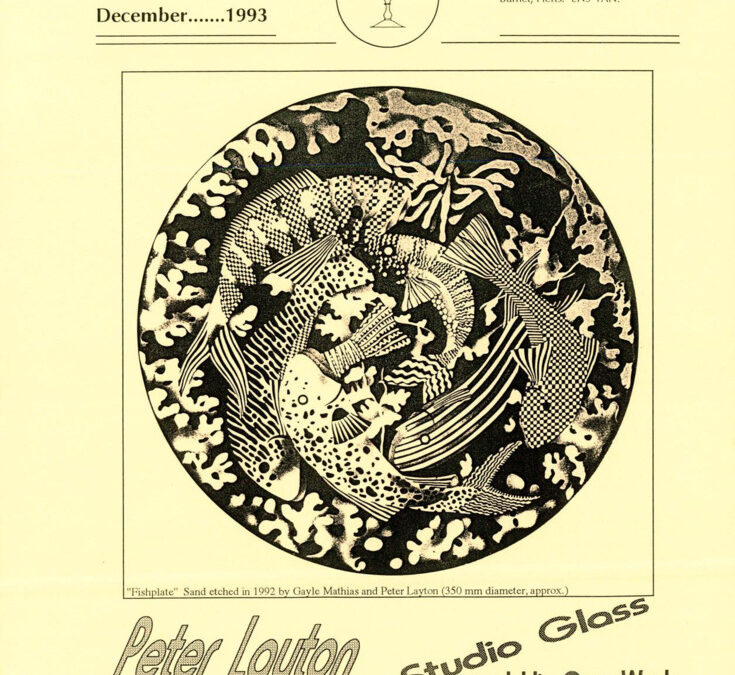
“Fishplate Sand etched in 1992 by Gayle Mathias and Peter Layton (350 mm diameter, approx.)
9tt
s5iP
and His Own Work
GLASS CIRCLE NEWS
No. 57
December
1993
EDITOR
David C. Watts
27 Raydean Road,
Barnet, Herts. EN5 1 AN.
s
ty,.
Peter began by observing that it was a pivotal time in
the evolution of Art Glass in Britain – it was one of mixed
104′
glass in this country, (contd.
than
fortunes – on the one hand we have at the new Crafts Council Gallery,
in Isington,
c4°544
to-
the first major exhibition of Studio Glass for more th a decade, on
the other, Opus 1, the only major outlet for contemporary
kb”
Page 2.
GLASS CIRCLE NEWS
Peter Layton Reviews British Studio Glass (continued)
(with the exception of Jeanette Hayhurst) has just closed
its doors – another negative statistic in the current
recession.
The modern Studio Glass movement is just entering its
3rd decade. It is only 30 short years since Harvey
Littleton introduced “hot glass” into the American craft
revival that began during the post World War II years.
His inspiration has developed into an international
resurgence in all forms of glassmaking to convey
personal imagery.
In 1960, Ada Polak observed, in an often quoted
passage from her excellent book, Modern Glass„ “That
some industrial designers who work with equal ease in
many materials, have produced excellent glass. At
times, however, one feels that their creations are the
product of the drawing board rather than of a deep and
exciting experience of glass and that the field of glass
design is becoming dangerously narrowed down . . . .
We look forward to the time when artists will again
apply the full force of their talents to the understanding
of glass and the exploration of its aesthetic potentiali-
ties, and give us fully orchestrated symphonies, not
merely chamber music”.
Neither Ada nor anyone else could have forseen the
extent to which her yearnings would be realized in the
years to follow. In this period, when science fiction and
reality threaten to merge, the Studio Glass movement
has represented one of the few optimistic signposts
“back to the future” in reversing the trend of
automation, factory closures and lost skills.
At the Toledo Musem, thirty years ago, Harvey
Littleton, a practising American potter and teacher, and
Dominic Labino, a brilliant glass technologist,
collaborated to demonstrate the potential of “hot glass”
as a medium for the individual craftsman. These two
men with widely differing viewpoints and experience,
Littleton providing the inspiration and Labino the
know-how, showed that glass could be produced with
simple equipment. The simple but essential technical
break-through was the invention of the one-man
day-tank furnace which, by contrast with the normally
huge industrial pot furnaces, created the opportunity to
melt, say, 50 or 100 pounds of glass as opposed to
Meeting of the Glass Circle held on February 18th,
1993, at the St Alban’s Centre, High Holborn. by
kind invitation of Dr J. Kersley, John Scott, Mr G.B.
Seddon and Mr L.A. Trickey.
several tons. From then on, virtually anyone could melt
and blow glass. This may seem straightforward today, in
an era of highly sophisticated small furnaces, but at the
time the results seemed miraculous and were reflected
in the enthusiasm and excitement that were generated.
In 1963, Littleton established the first hot glass
programme in the Art Department of the University of
Wisconsin. Amongst his students were many who have
become leading figures in contemporary glass, including
such luminaries as Marvin Lipofsky, Dale Chihuly, Fritz
Dreisbach and Sam Herman. Herman came to Britain in
1966 on a Fulbright Scholarship to be supervised by
Helen Turner at Edinburgh College of Art, where he
introduced the “small is beautiful” technology. In 1969,
he became involved in setting up the Glasshouse in
Covent Garden under the aegis of Graham Hughes, then
chairman of the British Crafts Centre. This enterprise
created, for the first time in Britain, a hot glass
workshop for RCA graduates and others (including the
speaker), as well as providing a specialist sales outlet
and a unique opportunity for the public to see
free-blown glass being produced.
There was much to learn and the view expressed in
“Crafts” (1976) that “in the early seventies there was
too much haphazard achievement in contemporary
glass” was probably true, but it took little account of the
anguish and pleasure derived from those early
endeavours, when we thought that the wobbly bubbles
and lumpy “globby” shapes we coerced from the metal
were great works of art. Before that time, no one had
seen much free-formed glass – thick sections, uneven
forms and wild use of colour became common. Pieces
were often “primitive”, perhaps crude, but they had a
vitality and strength that is frequently lacking in the
more refined, tasteful and professional work we produce
today. The early seventies were pioneer days; the
budding studio glass-maker had to design his furnace
and equipment, find out about the material, formulate
recipes, invent and develop techniques and educate his
Continued overpage C
Peter Layton at London’s Savoy Theatre
The loss of a famous building by fire is a great tragedy,
but careful restoration brings its own reward when the
dust, dingyness and decay of past generations are
returned to their original magnificence with the closest
possible authenticity right down to the colour and
pattern of the velvet for the seats and the 110,000
five-inch squares of aluminium leaf used to decorate the
walls. Instant success was achieved when the Savoy
first opened in 1881 to Gilbert and Sullivan’s “Patience”
and rave reviews are truly justified for this ten million
pound recreation that could so easily have ended up as a
car park! The journal “World of Interiors” (1993)
contains superb photographs and a “standing ovation”
by Leslie Geddes-Brown. Peter Layton and Associates
masterminded and produced
all
the lighting fixtures,
recreating the original designs as closely as possible –
overcoming formidable problems of design and
manufacture and making a very visible contribution to
this venture.
v
GLASS CIRCLE NEWS
Page 3
Peter Layton continued
customers, thereby creating a market for his work. Glass
also needed special display and lighting conditions and,
luckily, there were some enlightened galleries,
craftshops and other supporters who responded and
encouraged those early fumbling efforts, notably Wendy
Evans (at that time Information Officer at the Glass
Manufacturers Federation), Mark Ransom of Heals and
Pan Henry at the Casson Gallery. Later, Charles
Hajdamach (Broadfield House Glass Museum) and
Michael Robinson (Ulster Museum, Belfast) provided
welcome support.
The year 1976 was important for British studio glass.
The Crafts Council organised the tremendously
successful International Hot Glass Symposium, in
conjunction with the Royal College of Art, giving a
much-needed boost and a fresh outlook, not only here
but throughout Europe. For many it was the first real
contact with almost legendary figures such as Littleton
and Labino and also with Erwin Eisch from Germany,
Sybren Valkema from Holland, Finn Lyngaard from
Denmark, Bertil Vallien from Sweden and others, all
working and demonstrating, and discussing their skills,
experience and ideas. The presentation by Stanislav
Libensky from Czechoslovakia was particularly
memorable for the monumental quality of his work and
for the rare opportunity it offered to to see and hear
about his work and that of his contemporaries.
Also, in 1976, the London Glassblowing Workshop was
established while, under the guidance of John Cook,
British Artists in Glass (BAG) was founded as a
professional association of studio glass makers. BAG
started with thirteen full members, rising to 200, or so,
at its peak. Our speaker, who also became its president,
added that it would be difficult to imagine what the
current glass scene would have been like without BAG
which provided a forum and a focus for contact and
information exchange. Through its newsletter,
conferences and by virtue of the high quality of its
annual exhibition it became recognised as a major force
in European
glass.
But influenced by the dismal effects
of the recession Peter felt that perhaps BAG (currently
in the doldrums) had outlived its purpose – though its
stated aim “to educate the public by presenting the
highest standard of glass art” is as relevant and essential
as ever.
Peter then turned from the historic background to review
the achievements of some of the many glass artists who
survive (some even thrive!). There is a great diversity of
approach beyond glass-blowing, for example, fuse
casting and kiln forming (slumping glass over a former).
The possibilities are rich and diverse while costs are
generally far less than for hot glass. This section of the
talk was richly illustrated by slides and among the many
workers mentioned one might pick out David Reekie for
his work expressing an ironic, macabre humour that
illustrates human relationships in a satirical manner, and
also our member, Diana Hobson for her experimental
development of pate de verre which gained her the
prized Rakow award and teaching stints at Pilchuck
Glass School, the American award-winning campus set
in a 1500 acre tree farm.
Referring to his own work, Peter reminded us that, for
greater flexibility, only clear glass is produced in most
studio furnaces. Coloured glass may be obtained by
rolling the hot glass in powdered colour and fusion
achieved by reheating in the glory hole. His awareness
of the problems of the limitations of adequate lighting to
display all the features of transparent glass led him to
develop the surface lustre so characteristic of his early
work. Irridescence helps display the work to advantage
in any light as well as bringing out the subtle nuances of
the piece. His main artistic stimulus has been the marine
form, particularly as illustrated by different shell shapes
and the intricate patterning these involve. However,
Peter has worked on flower decorations on
vases
of a
wide diversity of shapes and the inspiration from
naturally coloured stones. His “Kimono” series of
relatively large vessels with intricate interconnecting
openings and decorated only in black on white (shown
in our 50th anniversary exhibition) reflected a
far-eastern influence and represented a new area of
thought. More recently he has turned to the creation of
free-form paperweights with strands of coloured glass
inserted between successive glass overlays in a manner
that captures, for example, both the freedom and
tranquility of a country scene.
But without doubt our speaker’s most memorable
achievements have arisen from the opportunity to build,
at the Novy Bor symposia in Czechoslovakia, artistic
works on an architectural scale, notably the prize-
winning “Pyramid”. His success stems from the skillful
exploitation of carefully designed modules that could be
created simply and assembled with reasonable speed.
From this approach has emerged the creation of garden
fountains and other statuary, such as the seven metre
high “Endless column”, made from repeat units in plate
glass and shown in the splendid International Exhibition
of Contemporary Glass “Le Verre” held in Rouen
(1992).
These ideas, bringing art into architecture, come a long
way from that first volcanic erruption of “hot glass”
and the driving artistic influence of the time of instant
creative expression untrammelled by practical
considerations. They raise again the question of the
distinction between artist and craftman. Our speaker
showed by his work that they are but two inseparable
facets of the same jewel of humanity. But it is working
in hot glass that captures the imagination of most
glasslovers and in drawing his lecture to a close Peter
Layton quoted the great Maurice Marinot (1927);
“To be a glassmaker is to blow transparent matter by the
side of a burning furnace . . . . to shape sensitive
material into simple lines by a rhythm suited to the very
nature of the glass . . . . I think that a good piece of
glassware preserves at its best, a form reflecting the
human breath which has shaped it and that its shape
must be a moment in the life of the glass fixed in that
instant of cooling”.
D.C.W.
Page 4.
GLASS CIRCLE NEWS
to Cass Circle
Summer Outing
;
yokii Scott
`Anticipation is better than fullfillmene, they say. But
the writer has always found the day more fun, replete
with the most convivial of company and invariably
more fascinating in content than he could ever have
hoped. The North Wraxall and Bath tour was no
exception and, to crown it all, the weather was as a fine
summer day throughout; it was most delightfully
unseasonable for late September.
What a lovely place to sell glass! Delamosne in the
heart of as pretty a Wiltshire village as you can fmd.
Court Close, instantly recognisable from the drawing on
the red cover of their catalogue, is a spacious, not to say
spectacular, rescue and conversion of an old barn once
half-filled with animal litter and its exposed beams in
the proud possession of a rooster. The village of
`Werochesalle’ is recorded in the Domesday book as
having 27 inhabitants (probably much the same today –
plus ca change . . . . ) and St James Church, not thirty
yards away, with sheep peacefully cropping the grass
between its tombstones, enjoys Norman arches and
unusual chevron moulding round the door. I could not
resist an inner smile at the solomn and simple beauty of
the smooth worn flagstones. In their ancient glory one
can understand the abuse poured out upon the (gaudy)
polychrome Minton encaustic tiles so beloved of Sir
Gilbert Scott (no relation!) in his Victorian restorations.
But even if an over-long perusal of the recently-
discovered medieval wall painting, Paul Methuen’s
marble tomb and dedicated windows has caused a loss
of coffee and biscuits we must return from the church
and give full attention to the glass at Court Close and
other attractions. Great credit is due to Martin Mortimer
and Tim Osboume for their warm hospitality and
wide-ranging display. Balusters and eighteenth century
drinking glasses abound with other varied wonders;
acquisitive eyes rested longingly upon the opaque white
glass South Staffordshire tea bottles and candlesticks
and the huge lyre-shaped clock of Baccarat in opaline
blue glass enriched with ormolu (now illegal to
manufacture). The high gallery (part of the restoration)
provided further interest to this enchanting ensemble
and the ‘Funnies’ show-case with its treen, Lancastrian
lustreware, needlework and pressed glass ensured that
there was something for everyone. A pre-prandial sherry
completed this part of the visit and prepared us for the
next.
We boarded the coach, which looked curiously out of
place in these historic surroundings, and our driver
skillfully navigated his massive masterpiece of modern
technology through the narrow, steep and twisting lanes
of this most picturesque countryside with its miles of
fine dry-stone walling and ancient beech and oak. At
the White Hart at Ford (The Old Inn by the Stream) we
were greeted by Robert and Joan Charleston who joined
us for lunch. A well-cooked and generously-served meal
was enjoyed by all, for which much credit is due; and
indeed for the whole tour, to Tim Udall. He had sent
menus to all of us to make selections in advance.
The next stop, after charming views of the Bath
countryside and Bath itself swathed in the bright sun
that so enriched its magnificent stone, was the Assembly
Rooms. These were considered the finest in the Country
and a great international social centre in the 18th and
19th centuries. The scagiola columns, vast salons, richly
decorated and adorned with classical stone sculptures
Continued overpage co°
GLASS CIRCLE PUBLICATIONS
DATABASE
This enterprise is proceeding slowly, partly due to the
challenge of achieving a good retrieval system to access
the diversity of publications received and also because
a glitch (virus?) recently wiped out the entire program!!
However, at this stage I would like to thank all those
members who took the trouble to send their publica-
tions list for inclusion, particularly, Paul Hollister,
Martin Mortimer, Mary Boydell, Mr G.B. Seddon and
Hans Smit. Eventually, all contributers will receive
copies so if you still have to send yours please do. (Ed.)
William Morris – correction.
Due to an
unknown cause the architect to whom Morris was
articled was incorrectly reported in Barbara Morris’
lecture (GC News, No. 56) This should have been
G.E. Street, a leading figure of the Gothic Revival.
THE PEOPLING OF LONDON
An Exhibition at the Museum of London
From 16th November 1993 – 15th May 1994
This exhibition traces the occupation of London from the ice ages. Of particular interest are the development
of links with the continent and the immegration of foreign artisans. The exhibition includes a little glass but its
main object is to enrich the visitor by explaining the origins of life in London.
GLASS CIRCLE NEWS
Page 5
NEW 800K$
REFLECTIONS ON GLASS
Four years older than the Glass Circle, the
National
Early American Glass Club
has celebrated 60 years
from its foundation with the publication of a compen-
dium of articles from the Glass Club Bulletin, first
published in 1938.
Thirtyeight articles and notes have been reproduced in
its 195 pages with only minor printing corrections and
reformatting to fit the modern page size of 8.5 x 11
inches. The selection, by Jane Shadel Spillman, Olive
Jones and Kirk Nelson, indicates a continuing high
standard of research and scholarship over the years of
which the Club can be proud. Jane and Olive are the
editors. As with the Club journal it is fully illustrated in
black and white but, unfortunately, no price was given.
The Table of Contents reveals a galaxy of of authors,
including a number who have addressed The Circle over
the years. The roots of American glassmaking stretch
across the Atlantic to Europe and there is much of
interest. The earliest article, dated 1938 is on
`Reproductions of Pressed Glass’ by Mabel Read
Surprise and draws attention to the ‘menace of fakes’
that accompanied the then growing interest in pressed
glass. Most of the articles, however, date from the early
1980s, presumably when illustration were introduced.
Some of the titles that caught my eye include ‘Making
the pot and changing the pot’ and ‘New evidence on
New England Glass Company Paperweight Canes’ both
by Paul Hollister; ‘Birmingham cut glass and the
American market: Examining an 1811 account and its
context’ and ‘The Bohemian urn vase: A forgotten form
in American decorative art’ both by Peter Kaellgren,
`Some notes on cutters and engravers of glass in early
America’, ‘The Jarves Goblet’ and ‘Joseph Baggott,
New York glass cutter’ all by Arlene Palmer Schwind,
`The Pittsburgh Glasshouse of Bakewell and Ensell: a
contemporary description’ by Christina H. Nelson,
`Collecting glass and knowledge:
glass
search and
research’ by Kenneth M. Wilson, ‘Silver glass’ and
`Some notes on early American glass lamps’ both by
Laura Woodside Watkins, ‘Insights into the develop-
ment of Burmese glass: The Jules Bathe pattern book’
by Janie Chester Young, ‘Eight rare bottle moulds
1850-1870’ by Miriam E. Mucha and ‘Working with
Frederick Carder’ by Paul V. Gardner.
There is, indeed, a feast of reading here for all glass
lovers and the NEAGC is to be congratulated both on
this publication and on their 60 years of maturity. D.C.W.
Glass Circle Summer Outing – concluded
and cast work and finally, and by no means least, the
colossal and brilliant chandeliers. Jonath Collet was the
manufacturer of the ‘mammoth’ in the octagonal card
room; and in 1771, probably because of the vibration
caused by the energetic dancing of the time, it started to
`shed arms’. This disaster resulted in a commission for
five chandeliers, to be complete in ten weeks for £500,
to be entrusted to William Parker. These magnificent
shining confections now adorn the recently redecorated
and reopened Ballroom and are one of the finest sets in
the world. (Have members perhaps seen the largest
chandelier in the world – presented to Sultan Abaul
Mecit by Queen Victoria – it now adorns the throne
room of the Dolmabahce Palace in Istanbul. It weighs
4.5 tons and has 750 candles). Those of a practical mind
might wonder at the mundane question of cleaning these
chandeliers and the inevitable damage resulting
therefrom? They are lowered once a year by a winch
hidden in the roof and new branches cost £1000 each!
Glass Circle outing ressemble a cultural voyage. In a
mere hour we had passed through (at 106′ 6″ x 43′ 6″)
the longest 18th century room in Bath, designed in 1771
by John Wood and constructed by public subscription at
a cost of £14,000. All this and more stimulating
information, was provided by our enthusiastic host,
Martin Mortimer. One felt drowned in wonder.
Finally, the Victoria Art Gallery, set in a magnificent
position overlooking the river and enabling Rugby fans
to glimpse Bath Rugby Club running in three tries in no
time at all. The glass collection was small but
interesting, comprising mostly the collection of Mr J.
Carr. A double-series enamel twist ratafia caught my eye
but No. 302, a mushroom knop baluster raised quite a
few critical eyebrows amongst the assembled company.
We were informed later by our gracious hostess, Susan
Sloman, that Sotheby’s were coming shortly to value the
collection. I wonder what they’ll make of No. 302?
Attention was somewhat diverted by a varied collection
of Bohemian glass which we were permitted to handle.
This included some interesting enamelled glass. It had
been been put out on display for our our benefit in a
newly-refurbished study room, with a useful collection
of glass books, and is open to anyone who wishes to
research any of the Gallery’s collection.
The main saloon of the gallery displayed an excellent
collection of paintings; the La Thange “Watersplash”
compellingly powerful, Therese Lessore’s “Walcot
Church Bath” we had only passed by minutes before
and, of course, our second Constable of the day. Many
pointed out John Nixon’s 1810 “Mrs Marshall at the
Pump Room” . The write felt the figure a very poor
comparison with our own charming and jolly Hon.
Secretary.
Returning to the coach, we were transported our various
ways, some to the railway station, the rest of us through
the “Bath traffic experience” to a welcome cup of tea at
a wayside roadhouse before picking up our cars at the
end of a full and satisfying day. •;•
Page 6.
GLASS CIRCLE NEWS
A SUPPLEMENT TO THE IDENTIFICATION OF
ENGLISH PRESSED GLASS 1842 -1908
By Jenny Thompson
This supplement of 32 pages (A4) on good quality paper houses which produced some of the earliest registered
with stiff covers provides additional drawings from the
glass. Five pages are devoted to the Richardsons and two
design registrations of the glasshouses listed in her
to Thomas Webb. We learn that Webb, Boulton and
original book. Members will welcome this further aid to Mills, and the Richarsons all registered various designs
the identification of products both by well-known
for reeded decorations for applied handles and their
manufacturers such as Sowerby, Davidson, Percival
identification should greatly help owners pinpoint the
Vickers, Greener, Molineaux Webb and James
likely origin of ther pieces.
Derbyshire but also several that are less well known
Jenny is offering her supplement for £4.50, post-free to
such as Matthew Turnbull, Stuart and Mills and Philip
her fellow Glass Circle members; write to Nunwick Hall,
Pargeter. Four pages on John Walsh Walsh provide
Great Salkeld, Penrith, CA1 1 9LN. Broadfield House
welcome information on their diverse range of products, Glass Museum and the Victoria & Albert Museum also
particularly a series of attractive naturalistic flower
have small stocks for callers.
holders. Although a number of the items shown reflect
The popular original volume, first published four years
the use of crimping and pressing irons they are
ago, has now been reprinted with additional plates and
manifestly hand made giving this work a wider interest new technology used to improve the quality of the
to all those attracted by Victorian glass.
reproductions. It can be had from Jenny for £13.50 (post
Of particular importance are the Stourbridge glass-
free to members).
D.C.W.
ARTISTS IN CAMEO GLASS Incorporating Thomas Woodall’s Memoirs
by H. Jack Haden
Published by The Black Country Society (1993).
Copies from “The Blackcountryman”, 32 Lawnswood
Avenue. Wordsley, Stourbridge, West Midlands. DY8
5LP.
Size 240 x 185 mm, soft covers in colour, 48 pages with
numerous black and white pictures. Price £4.95 plus 50p
P+P (U.K.)
This small volume provides a brief but detailed
documentary insight into the lives and activities of
prominant personalities in the Wordsley area connected
with the cameo glass trade in the 19th and early 20th
centuries. Particular attention is given to the history of
the Portland vase, the difficulties and controversies
arising over the attempted production of its copies and
also to the Woodall brothers and their cameo glass
engraving workshop. The involvement of the
surrounding glass factories, their origins, owners and
locations, as well as conflicts with the Trade Union,
provide a fascinating background.
The memoirs of Thomas Woodall are given verbatim.
These are divided into two parts, musical which create a
good idea of the social and religious life of the day, and
much briefer industrial reminiscences which describe his
early apprenticeship and the introduction of cameo
glass. The work is extensively supported by notes and
references. Jack Haden is a well-known glass historian
of the area with a renowned attention to detail. This
volume will amply repay the attention of all those
interested in Stourbridge glass in all its aspects. D.C.W.
Death of Don Barnfather
We report with greatest sympathy and sorrow the
death of Don Barnfather. Don was a foundation
member of the Ceramics and Glass Circle of
Australia inc. (founded 13th June 1984) . He
became Secretary of the Circle and worked tire-
lessly in its interests, particularly the glass aspects
on which he was an extremely knowledgeable and
entertaining lecturer. His untimely death will come
as a stunning blow to all members of the Australian
Circle as well as a great loss to his family. A fund to
contribute towards the purchase of projection equip-
ment for the Circle is to be set up in his memory.
GLASS CIRCLE NEWS
Page 7.
The Annual General Meeting
and Specimens Evening
The AGM proves as popular as ever and many members
rolled in carrying precious parcels of rare, ancient and
mysterious glassware to test our members and our
knowledgeable panel of experts. We were greated at the
door by our hosts, Barbara Morris and Ray Notley, both
in expansive hospitable mood and flanked by a choice
of red and white wines for our pleasure (one of the rare
occasions when with gleeful delight we deliberately
breach the Circle rules about no alcohol) and to wash
down large trays of delicious sandwiches.
By tradition, the AGM, now under the skillful
Chairmanship of Dr Jonathan Kersley, rarely delays
proceedings by more than a short while and his survey
of the activities of members of the Committee were
warmly appreciated as was the Hon. Treasurer’s report
that our finances were in a healthy state and that the
next issue of The Glass Circle, in the pipeline, was in
good financial state. Drawing these matters to a close
Dr Kersley called upon Dr David Watts to deliver a
short appreciation of our retiring Hon. Treasurer, Tim
Udall. Dr Watts recalled that rarely was an offical duty
more easy and greater pleasure as there was no shortage
of nice things to say about Tim, whom he recalled from
his very first meeting as standing head and shoulders
above the crowd and tending a recalcitrant projector,
typical of his responsible and caring attitude towards the
Circle. But not only was he concientious and honest but
he was totally reliable and his little memos, sent to the
speaker, did much to ensure that Glass Circle News was
ready for distribution on time as were so many other
things in his care. The Circle had been fortunate to
secure Tim’s services as Hon. treasurer, following the
sad death of Philip Whatmoor, and he has placed our
finances on a very sound footing. Not least in our
appreciation was his ongoing management of the
arduous task of addressing and distributing hundreds of
letters and packages to our membership as well as
masterminding this year’s very successful summer
outing. It was with the greatest pleasure that Dr Watts
called upon our Chairman to present Tim with a small
engraved silver salver, bearing the Circle emblem, and
an even smaller envelope. Tim, in reply, regretted that
the duties that had also brought him so much interest
and pleasure over the years must be drawn to a close
and he thanked the Circle for its kindness towards him.
As a postscript it may be added that it was only on the
train home that he opened the envelope and was truly
Held on 19th October, 1993 in the Sotheby’s (Works
of Arts course premises), at 30 Oxford St., London by
kind permission of Mrs Ceresole, Director, and the
kind invitation of Mrs B. Morris and Mr R. Notley.
overwhelmed to discover a cheque for over £500 as a
token of our members’ heart- felt appreciation of all
that he had done for us. His collecting days, he later
recalled, were not over after all!
We were then introduced to our panel of experts for the
serious business of addressing the specimens. These
were Hugh Tait (British Museum), Barbara Morris (V &
A, now retired), John Smith (Malletts) and Simon Cottle
(Sotheby’s) with Jo Marshall (Phillips) fullfilling a
life-long ambition by acting as porter, moving the
objects to and fro as well as occasionally contributing
her own expert opinion. The first item to come under
scrutiny was a fine clear glass bugle with a wrythen
body. These were made over a long period of time and
difficult to date; this one was probably a good early
example. The next piece was much more identifiable,
being a fine bowl cut with a typical Regency step and
strawberry design. But its particular feature was a
sulphide inclusion of George IV indicative of Apsley
Pellatt. This turned up at a boot fair and, in spite of
Officers and Committee 1993-1994
R.J.
Charleston (President)
Dr Donald B. Harden (Hon. Vice-President)
Paul Perot (Hon. Vice-President)
Hugh Tait (Hon. Vice-President)
Jo Marshall (Hon. Secretary)
Derek Woolston (Hon. Treasurer)
Dr Jonathan Kersley (Chairman and Membership)
Barbara Morris
Janet Benson
Wendy Evans (Library)
Anne Towse (Minutes)
Kate Crowe (The Glass Circle)
Simon Cottle (The Glass Circle)
Henry Fox
Dr David Watts (Glass Circle News)
(Tim Udall, Distribution)
4
,*
Page 8.
GLASS CIRCLE NEWS
The broken Glass
by Peter9 sole
There are many good records of the deliberate smashing
of drinking glasses, either to avoid later ignoble use of a
glass involved in a particularly important toast, or
perhaps more frequently, in the course of rowdy
bacchanalian enthusiasm.
today’s lager louts. Cockburn(3) tells us of the annual
“keeping”
of George III’s birthday in Edinburgh
Parliament House, at the end of the eighteenth century.
Fifteen hundred
“loyal”
citizens
“persevered to a late
hour, roaring, drinking, toasting and quarrelling. It was
not unusual,
he tells us,
at old Scotch feasts for guests
to toss the glasses over their heads, in order that they
might never be debased by any other sentiment. This
privilege was availed of so freely that the glass
crunched underfoot, and the court
(which met in the
Parliament House)
smelled for a week with the fumes of
that hot and scandalous night”.
At much the same
period a visitor(4) to Naples recalls that after Emma,
Lady Hamilton, had given a ball, it was
“followed by a
supper for the English alone, with toasts and the usual
hip-hurrah followed by a grand shattering of wine
glasses on the middle of the table, to the loyal
cry
of
“God save the King”.
Perhaps it was fortunate that by
then Emma had given up dancing naked on the table,
contenting herself with striking soulful “Attitudes”!
Jacobites, of course, are widely believed to have
smashed their glasses after toasting their King over the
Water. Robert Woodrow (5), a Scots divine and C’
The pre-Revolutionary Russian aristocracy are credited
with an especial love of glass smashing.
Russians,
quoth
Mary Visser (1),
“smash their glasses after particularly
fervent toasts, vows or oaths; the half Russian poet,
Appollinaire, loved using the image of the smashed
glass to express exultant joy.”
Indeed, the recently
published history of Baccarat(2) claims that throughout
the second half of the nineteenth century to beyond the
start of the first world war, two thousand of the
Baccarat workers worked exclusively for the Russian
market, since no Russian aristocrat would fail to throw
his glass over his shoulder after drinking from it.
Many of the records of glass smashing in Britain
suggest a joi-de-vivre which verges on the behaviour of
Glass Circle AGM continued
figurine on a ball stand, also in opaque white, received
an immediate positive identification as coming from
post-war Austria (1989) and made by Viminee
(spelling?), a living artist. A traditional goblet with
square bucket bowl decorated with a ring of green
prunts also receive an instant welcome as being by
Phillip Webb (19-early 20th century) as did a pale green
flat flask with a marvered-in loop decoration and pale
green cap; Powell, 1908, we were told. A shard of a
typical 1695 lead balluster wine, recently dug up at
Guy’s Hospital, proved to be the earliest piece present,
closely followed by an elegant two-handled jelly on a
teared, elongated balluster stem, 1730-1740, English. At
the other end of the spectrum and drawing the evening
to a close we might list, among several other interesting
items, a fine Richardson acid-etched green and white
alabaster vessel with an elaborately ornamented gilt lid
and handle, two ruby and latticinio tumblers from
Venice, three spa glasses and, of probably Far Eastern
origin, an undatable scent (?) bottle in amber with the
matching stopper attached by a chain all made in the
same material about which there was some doubt that it
was even glass!
As usual, our panel enjoyed a triumphantly successful
evening reminding us, if that were needed, of the
extraordinary diverse and mysterious material that really
is glass. Our thanks to all concerned.
D.C.W.
some damage, was a fine trophy. Next came a puzzle
piece, a finger bowl of unusual shape, more like a very
shallow posy vase, with fruiting vine border in a
1740-1750 style. The extra depth might have been for
use as a cooler. For the next piece thoughts turned to
South Yorkshire, an urn-shaped jug in clear glass with
applied blue rim and handle. But it was of very fine
quality and, for this reason, the panel were inclined to
prefer an American origin and 19th century date. A
large all-blue goblet with diamond cut stem was
received less favourably, such types being typically 19th
century or later, particularly from the Webb factory or
even the continent. This contrasted with one of a pair of
quite extraordinary goblets where the blue, flared
cup-shaped bowl sat in an elaborate tall gilt metal stand
with vaguely religious overtones! The panel thought it
was not quite Art Nouveau but favoured a French, early
20th century attribution. A tall, and very heavy dense
white candlestick also brought a frown to the brow.
Initial thoughts of a mid-18th century, English,
attribution became clouded by the realization that it was
slender in a modern way and apparently mouded rather
than blown. In spite of the metal it was probably late
19th or even 20th century, perhaps Italian. It was pieces
like this that underlined the need for care as well as
experience when addressing the unknown. The next,
however, a slender, extremely attractive hand-fashioned
GLASS CIRCLE NEWS
Page 9.
The Broken Glass, by Peter Lole. continued.
historian of the Scottish Kirk, records in a diary entry
for 10th June, 1712, birthday of the Old Chevalier,
“-ther has been great outrages at Edinburgh by his
freinds. …at night, ther has been great going throu the
street to keep the peace … the King’s health was drunk
out at several windows, and the glasses throwen over
the window when the magistrates passed by.”
But this
is the sole contemporary reference of which I know to
record glass smashing in a Jacobite context, and one
wonders whether the precious and carefully engraved
Jacobite Glass was often treated so summarily?
The polite version of smashing seems to have been the
snapping of the thin stem of special “Toasting Glasses”;
unbroken examples with both plain and air twist stems
are illustrated by Bickerton(6). According to Hughes(7),
“The London mode was for the drinker to snap the stem
between finger and thumb immediately after drinking the
toast, thus preventing the glass from being used for a
lesser toast”.
One knows from bitter experience with some of the
thin-stemmed Victorian glass how brittle and easily
broken this type of stem can be, whilst the foot and
bowl are much more damage resistant. The thick-
stemmed “standard” eighteenth century glass is,
however, a different kettle of fish and with these
accidental damage almost invariable shows on the foot
or bowl, rather than the stem. But there are two groups
of Jacobite Glass where the standard thick stem has been
broken, whilst the bowl, and sometimes the foot,
remains intact.
The first group is that of the Confederate hunt, or Lady
Wynn’s Glasses; an example was sold by Sotheby’s in
September 1992, and the catalogue has a good
illustration of it. A goblet with a bucket bowl and
enamel twist stem, it is engraved with the typical
Jacobite Rose and Thistle, and inscribed:
THE
CONFEDERATE HUNT, and Lady Wins (Wms?) Wynne,
Lady Parramount,
together with five
Lady Patronesses,
one for each of the years 1754-1758. This example has
the stem broken about an inch below the bowl, and is
mounted on a wooden replacement foot and stem capped
by a metal band. This is probably the example quoted
by Hartshorne(8) as having a
replacement foot and stem
turned out of sycamore;
both Sotheby and Hartshorne
give the height as 9.5 inches. There is another example
in the Museum of London with a break in the stem
mended by a clasping silver collar; I do not know the
origins of this glass. What may be a third example was
displayed at the National Museum of Wales in Cardiff,
in a 1934 exhibition “Wales and the Royal Stewarts”;
item 164, lent by Lord Harlech, was
“THE CONFEDERATEHUNT GOBLET; Tall bucket
bowl on repaired enamel twist stem and metal foot”.
The
engraved details were as on the other two Glasses but
the metal foot seems to differentiate it both from the
Museum of London and the Hartshorne examples.
The second group are two AUDENTIOR IBO Prince
Charles Portrait glasses from Fingask, home of the
Threiplands, two of whom were “out” in the forty-five.
One glass was sold by Christies at the Fingask dispersal
sale of April 1993, and is illustrate in the catalogue. The
air twist stem of this Glass is broken off an inch below
the upper knop, and is mounted on a simple turned
wooden foot, with no attempt to replace the missing stem
portion. This glass is mentioned and illustrated by
Hartshorne (9), who states that in 1869 there were two
similar Glasses, and that the stem of the other one had
been mended.
Thus we have two groups of Jacobite Glasses,
comprising four or five Glasses, both connected with
famous Jacobite partisans, and all of which have the
stems broken whilst the precious engraved bowls remain
quite intact. To break such substantial stems as these
without damage to the bowls would take some ingenuity
– coupled to which, the present owner (10) of the
recently sold Fingask Glass tells me that there is a
tradition in the Threipland family that the stem was
deliberately broken by Dr. Stuart Threipland, the
surviving brother of the two who joined the Prince in the
forty-five and was doctor to the Prince during the
campaign, so that
“no unworthy lips”
would ever drink
from the Glass from which the Prince had drunk. A nice
romantic story, no doubt, but the inferential evidence
that both groups of Glasses had their stems deliberately
broken lends some support to it.
References
1.
Margaret Visser; “The Rituals of Dinner” (1992) p. 258.
2.
Jean-Louis Curtis; “Baccarat” (French Edn. 1991) pp. 60, 62.
3.
Lord Cockburn; “Memorials of his time” (Scottish Classics
Edn. 1946) pp. 57-58.
4.
Flora Fraser; “Beloved Emma” (1986) p. 210.
5.
J.G. Fyfe; “Scottish Diaries and Memoirs. 1550-1746” (1928)
p. 382.
6.
L.M. Bickerton; “Eighteenth Century English Drinking
Glasses” (1986 Edn.) Plates 332, 333, 390.
7.
G. Bernard Hughes; “English, Scottish and Irish Table Glass”
(1956) p.209.
8.
A. Hartshorne; “Old English Glasses” (1967 Edn.) pp.
360-361, Fig. 355.
9.
A. Hartshorne;
op. cit.
pp 360-361, Fig. 355.
10.
The Baron of Earlshall.
(The Fingask Glass, together with
other important Jacobite relics will go on special display at
Earlshall Castle, Fife, in 1964)