




GL
A
SS CIRCLE, X
1
–
i
‘,WS
No. 58
March
1994
EDITORS
David C. Watts
27 Raydean Road,
Barnet, Herts. EN5 “IAN.
F. Peter Lole
5 Clayton Ave.,
Didsbury, Manchester M20 OBL.
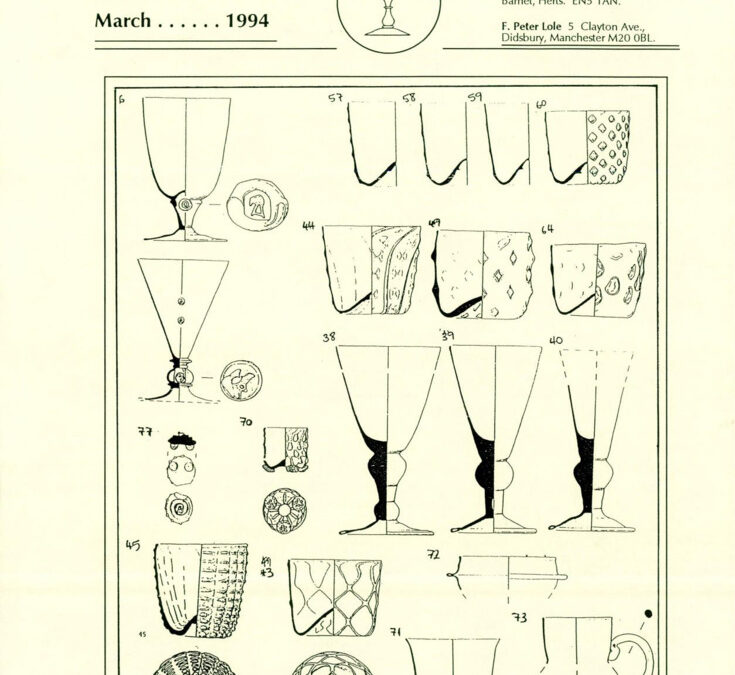
Rare finds of English glass in a cesspit at 16 Tunsgate, Guildford (see back page).
Line drawings by Andrea Selly, reproduced here with the kind permission of Guildford Excavation Unit.
Page 2.
GLASS CIRCLE NEWS
Editorial Changes for Glass Circle News
Since its inception, in , as a replacement for the
cyclostyled accounts of lectures which became
incorporated in to the new Glass Circle Journal, GC
News has had only one other previous editor, the
incredibly knowledgeable and much loved Gabriella
Gros Galliner. John Towse, already semi-retired from
business practice, nobly stepped into the breach left by
her untimely early death. John’s forte, as everyone must
know, is the traditional collecting ground of English
eighteenth century glass, although he has been known
to sully his shelves with the occasional discretely
displayed foreigner or contemporary piece. In these
connections his passion has been the ample hunting
grounds of the best of British collectors’ fairs. His
discriminating surveys of the field, which have brought
him into association with every dealer in the land worth
knowing, have been regular features of these pages.
Now
anno domini
has finally gained the upper hand and
John, respectably entrenched in his eighth decade, has
conceded the necessity for taking life a little easier. In
accepting his retirement from the post of Assistant
Editor I would like to thank him on behalf of the Circle
for all he has done to promote his own enthusiasm
among our membership. Writing, once you get the hang
of it, becomes a habit and we hope that with more time
on his hands he will not be able to resist occasionally
putting pen to paper to share his ideas with us all in the
future.
The job of being an editor is not unduly arduous but it
does call for a regular commitment of time in adition to
an enthusiasm for and a knowledge of glass. And it is
remarkable how publishing deadlines always seem to be
in conflict with a host of other demands.
In the last few years I have been more than grateful for
the diversity of interest created by F. Peter Lole in what
might be called the more applied aspects of British
eighteenth century glass, and in drawing attention to
important and, as yet, only poorly scrutinized docu-
mentary evidence on glass from a Scottish viewpoint.
“Further Ablutions” continues this saga in the present
issue. More importantly, with only a modest amount of
persuasion, he has agreed to become the new Assistant
Editor of GC News. Peter’s own introduction, which
follows, speaks for itself and will surely bring new
angles of interest to glass collectors everywhere. He
will welcome your support with any news or discoveries
you may make
In order to bring a fresh and more extensive coverage
of ongoing events of glass interest I have enrolled
Committee member, Henry Fox as Publicity Liaison
Member of GC News. He will endeavour to bring you,
each issue, all the news of “what’s on”. So, if word of
an impending exhibition, or whatever, of glass interest
comes your way please let Henry know
at once.
Finally, in order to expand the horizons of glass interest,
Mrs Jean Metcalfe, B.A. of the Sweetbrier Gallery in
Helsby, Cheshire, will be contributing an occasional
article on recent interesting activities in the paperweight
field. We hope to add to our panel of specialist
contributors with time and any offers of suggestions or,
better still, contributions, will be greatly welcomed. It
is, after all, your Society and by your hand it flourishes.
D.C.W.
Limpid Reflections and other Musings
by F. Peter Lole
The other day our Editor rang me up; “Have you had
my letter?” he said (for the second time). “No” said I
(also for the second time); we decided that the Post
Office must have sent it to Father Christmas. David then
settled down to business; “Now that
anno domini
has
caused John Towse to lay down his joint editorship,
would you consider joining me as deputy Editor, it
doesn’t involve very much. Just being there really.” I
hummed and hawed (I’ve met that sort of post before!)
and said in a more serious vein, that living in
Manchester, so far from the hub of the Glass Circle,
does pose some geographical problems. David went on
persistently, “It can all be done by post and telephone,
really.”
So weakly I said I would give it a whirl.”
Our Editor went on; You might perhaps consider
covering regularly some sort of News aspect for Glass
Circle News. Set up a sort of
Glacial Tittle Tattle
column; I’ve got the London Salerooms covered” he
said (The easy bit?); he went on “Your keen on the
Eighteenth Century, you could establish a correspond-
ents’ network to get news for us.” (With the shade of
Horace Walpole perhaps?). Once again I agreed. Then
we hung up.
Subsequently I started worrying; living so far north of
the Edgeware Road, what sort of Tittle Tattle ever
comes my way? I only hear about interesting
exhibitions when they are over, and the catalogue is
either sold out, or fiendishly expensive; and I finish up
on the waiting list of the outings I
really
want to get to.
And then there is the all important title;
Leaden Notes
doesn’t seem quite right, and From the Gaffer’s Chair
must pertain to our Secretary. What about
Limpid
Reflections, The Cutting Edge
or
Lapidary Musings?
Perhaps
The Gilded Column,
or even, looking at the
excellent membership list just circulated,
To
our
Friends Over the Water.
I had just got as far as
The
Glassy Stare
when I remembered that titles are
The
Editor’s job, not a lowly deputy’s.
Continued overpage
GLASS CIRCLE NEWS
Page 3.
Limpid Reflections . .. continued.
What sort of Title Tattle do
I
have for this issue? I’ve
just had one of Simon Cottle’s valuable circulars; while
Sotheby’s March 1st sale will be over when you read
this, there is another on the 14th June; he tells us that
Sotheby’s have reintroduced a Glass Catalogue
subscription at £40 for three Bond Street sales per
annum. (One is tempted to think that now-a-days the
Auction Rooms make more money from their
publications than from their Commissions.) The Bowes
Museum at Barnard Castle is to hold an exhibition from
28th May to 28th August on “European Table Layouts;
1550 – 1850”; it promises to be fascinating for those of
us interested in Table Glass Usage. Most of the Bowes
Glass will unfortunately remain in store, but may be
inspected by prior arrangement with Howard Coutts, the
Ceramics Officer – Tel. 0833 690606. And now some
snippets from our kindred Societies: The Scottish Glass
Society Annual Exhibition, principally of modern Studio
Glass, will be held in May at Caithness Glass in Perth.
They are also setting about the production of “A Glass
Map of Scotland.” The Glass Association Newsletter
reminds that our own Hon. President will be opening
Whittington Court, with its interesting Glass Collection,
on 2nd – 17th April and 13th – 19th August. daily from
2-5 p.m. The G.A. also reports the acquisition by the V
& A, under the “in lieu” provisions, of 41 pieces of
important English and Continental Glass, from the
collection of the late Barry Richards.
Lastly, a plea to all members of the Circle; if these notes
are not to finish up as
The Wrything Stem,
please,
please, please keep me advised of any interesting bit of
Glass News which come your way, especially the sort of
thing where you say to yourself “Why doesn’t the G.C.
News have that in it.?” .
NOTICE BOARD
On the Move:
W.G.T. Burne (Antique Glass) Ltd. have
given up their Elystan Street shop in Chelsea to return,
in the near future, to London’s West End. Burne’s are
one of the longest established dealers in fine glass and
chandeliers and may contacted on 0374 725834 (mobile
phone) or Fax 081 944 1977.
Howard Phillips,
another long-established dealer,
writes that he may be contacted c/o Midland Bank plc,
19 Marylebone High Street, London W1M 4BD.
The Ashmolean Museum,
Oxford, still has copies of
“The Finzi Bowl” by J.M. Popkin, pub. 1986, 56 pp.,
price £1.95. Contact the Publications Department, Tel.
0865 278 009.
FORTHCOMING EVENTS
V & A Glass Department Reopening.
The major glass event of the decade must be the
opening of the refurbished Glass Department at the
Victoria and Albert Museum on Wed. 20th April 1994.
An evening reception concurrent with The Glass
Association and The Friends of Broadfield House Glass
Museum has been arranged for May 4th, costing £10,
including wine and canapes. A separate order form is
being circulated.
V & A Glass Conference_
To celebrate the reopening Caroline Pearce-Higgins (in
conjunction with Elizabeth McKellar, Head of Higher
Education) has organized for the V & A, a conference
entitled
“Looking into Glass” for 12th/13th May 1994.
The programme on the 12th May focuses on new
approaches to the study and collection of glass and
includes lectures on:
Rehousing the V & A’s glass collections with its history
and wider implications.
The role of archaeological research, including a case
study of an Islamic glass workshop in Syria.
The Impact of industrialization on glass.
Current trends in glass collecting.
On the following day historical and contemporary
approaches to materials and techniques will be
examined including:
The discovery of ancient glass-making techniques.
Glass artists working with industry in the UK and USA.
Recent developments in the work of independent glass
artists.
The conference fee is £20/day
(L5
for lecturers
and
students) plus £5 for a private view of the glass gallery
on Wed. May 11th.
Contact the V & A on 071 938 8365 (Press Office ) or
071 938 8638 (Education Department).
CHRISTOPHER SHEPPARD lecturing on “The
lasting influence of Venice on the design of English
Glass from Charles
II to Queen Victoria”.
At the
International Ceramics Fair , Park Lane Hotel, late
afternoon on 13th June. Details and tickets from the Fair
organizers, 31 Old Burlington Street, London W1X 1LB.
(Tel. 071 734 5491).
SUNDERLAND’S GLORIOUS GLASS
An exhibition opening early summer, 1994, at
Sunderland Museum and Art Gallery. Exciting new
displays will highlight Sunderland’s historic glass
production: The Londonderry Service; 19th century Cut
and Engraved Glass; Pressed Glass; Jobling’s Art Glass;
and Friggers. For more information Tel. Sue Newell,
Assistant keeper, Applied and Fine Art, Sunderland
Museum and Art Gallery, Borough Road, Sunderland,
0 PLEASE MENTION GLASS CIRCLE NEWS WHEN CONTACTING ANY OF THE ABOVE C
0 For dates of Sales and Fairs see page 9 C
Page 4.
GLASS CIRCLE NEWS
From Rumour to Reality; Broadfield House Expansion Under Way
Dudley Metropolitan Borough Council plans to develop
a new National Glass Museum at Himley Hall, once the
home of the Earls of Dudley, which it now owns. It is a
large listed building a few miles to the north of
Kingswinford with a 200 acre park laid out by
Capability Brown, and is already part of their leisure
services. Here, the new museum could be sited within a
spacious, appropriate study and leisure complex.
Showing its strong commitment, the Council has spent
nearly two million pounds on the conservation and
development of Himley Hall, and the work there
continues, with the restoration and modernization of the
interior. The parallel expansion and reorganisation at
Broadfield House is also part of the Council’s strategy
to secure major support from the European Regional
Development Fund.
Major restructuring of the ground floor of Broadfield
House has already begun. When this is complete, visitors
will no longer enter through the front door but through a
new all-glass pavilion at what is presently the back of
the building (with no steps to bar the disabled!). Ahead
and to the right will be an enlarged bookshop and sales
area . To the left, a temporary exhibition gallery will
lead through to new toilets, plus a teashop opening onto
a closed garden – the Sculpture Court – while a
glass-covered way will lead into the old coach-house.
This will be refurbished as a hot glass studio with
viewing and display areas; it is planned to offer tenancy
for one year as a scholarship prize to promising new
glassmakers.
Passing straight ahead from the pavilion, through a new
hole in the back wall, so to speak, will bring the visitor
to an exciting new gallery, ‘The Magic of Glass’,
displaying the cream of the collection and setting the
mood for the visit. The old front rooms will be
reorganised to contain the ‘Cameo
Glass
Gallery’, on the
left as you now approach, and, on the right, a new
audiovisual theatre presenting ‘Personalities in Glass
History’. Hopefully, this development will also allow
some space for a much-needed technical display of
glassmaking materials and processes – crucial to
understanding glass. These alterations may release
some space upstairs although changes there will be
small.
Most remarkably, all this will be complete and running
by the end of August, 1994. when the museum will be
relaunched with an exhibition on American Brilliant
Cut Glass (see, also, page 9) In the meantime some
rooms may have to be temporarily closed, so ring
0384-273011 to check before you visit.
The mood is one of excitement and optimism. Charles
Hadjamach and Roger Dodsworth are to be compli-
mented on their vision and commitment that have
brought about the achievements so far and on their
imaginative plans for the future.
When the restoration and upgrading works at Himley
Hall are complete, and the funds become available, it is
hoped that the entire glass museum will be moved into
these expanded facilities to create the nucleus of a new
National Glass Museum. Here it will be backed up by
exhibition, conference and recreational facilities to fully
exploit the immense potential of this historical building.
One aspect not mentioned in the Dudley documentation,
which needs to be addressed if this enterprise is to
succeed, is the appalling lack of hotel accommodation
for visitors. It was a major stumbling block to
expansionist thoughts of the Crystal Festival and must
be overcome if Himley Hall is to become anything more
than just a fine parochial achievement. Fortunately,
there is plenty of room for a new hotel complex on or
near the estate without destroying the ambience of the
area. We await developments with interest.
GLASS CIRCLE NEWS
Page 5.
YTIKE3
ram
YORGERJE3
by ‘Jeanette layhurst
Introducing her subject, Jeanette Hayhurst said that
there were very few fakes, as such, most so-called fakes
arising from the wrong attribution of reproduced
traditional styles, particularly in the early 20th century
when glass was undergoing a Georgian revival
paralleling that for furniture. Catalogues of 1929 and
1930 showed reproductions of sweetmeats, rummers,
twist stems and cut glasses by such firms as Stevens and
Williams. These copies may be readily distinguished
from the originals as they are horribly white in colour,
lack striations and other tool marks and sometimes have
a ridged rim to the foot to simulate folding and may lack
the pontil mark, following the invention of the gadget.
The shape and proportions of the parts of the glass are
often incorrect. This is particularly noticeable with the
foot, which is manifestly flat rather than conical,
particularly on an opaque twist stem or a pan-top glass.
As a result the wear, which should be present, is several
millimetres in from the edge rather than round the rim.
Late rummers commonly occur with this feature.
English glass of the 18th century is nearly always made
of lead crystal and undue lightness can indicate a soda
glass, probably originating from the Continent.
Continental twists may have a left-handed spiral running
up the stem in contrast to the right-handed twist (like a
screw thread) of an English specimen. Continental twists
that look opaque may, upon close inspection, be found
to have the twist made up of a myriad of tiny bubbles,
apparently produced by the use of carborundum.
Slides of different groups of glasses, which Jeanette had
collected over the years, were shown to illustrate the
points made. Mixed twists, for example, must have a
positive combination of air and enamel. There are a few
late-cut glasses, sometimes with a star-cut foot which is
an easily recognised late feature. A firing glass with a
thick flat foot, which may show the clipping mark, a
short indented line near the centre of the underside of
the foot where the glass was sheared from a gather on
the pontil ready for pressing, should also be treated with
A meeting of the Glass Circle held at the Artworkers’ Guild
on 14th December, 1993, by the kind invitation of Mr and
Mrs T. Udall, Mr D. Manning and Mr L. Trickey.
caution. Another late piece often encountered is a glass
with a conical bowl with heavy wrything that continues
down onto a rather thin, short, lightly double-knopped
stem and a foot that looks respectably conical. These
may have been made by the Whitefriars factory.
Jeanette explained that decoration on glass presented its
own problems that could only be touched on in her
lecture. Fake enamelling sometimes occurs and may be
identified by the enamel having a chalky consistency
rather than glassy as it should be, while the subject is
usually a rare one, no doubt to enhance the value of the
fake. Jacobite-engraved copies were made at the
Edinburgh glassworks and also in Stourbridge, although
these should not deceive; as with fake Williamites, which
also turn up occasionally, the glass style and method of
manufacture is a clear indication of its date of origin.
Somewhat different are the genuine glasses engraved
with flowers which some collectors passionately believe
are masked allusions to Bonny Prince Charles. Jeanette
read a highly humorous series of written exchanges
between Barrington Haynes and one such enthusiast; he
simply could not accept that there was no justification for
his conclusion that the flowers engraved on his charming
set of five glasses were chosen so that the first letter of
the name of each flower made up the word “CHARLES”
indicating that they must have belonged to a private or
literary club of Jacobite supporters. As Barrington
Haynes politely and repeatedly pointed out, with
hillarious tact and patience, such sets were not a great
rarity and any speculation as to their significance could
only have substance
if supported by incontrovertible
evidence – a good general principle for all such theories.
In drawing her fascinating and most instructive lecture to
a close Jeanette displayed a clear pressed-glass candle-
stick which she had recently bought as an early Sowerby
piece. Subsequent enquiries revealed that a cache of such
candlesticks had been unleashed on the market. Genuine
fakers never stop trying; even an experienced glass
collector may be caught occasionally and should always
be on his guard. *
D.C.W.
THE GEOGRAPHIC MAGAZINE GOES
GLASS HUNTING
The special breed of glass buffs who also subscribe to
the National Geographic Magazine will have been
suprised and, no doubt, gratified to find master
glassmaker, Dominick Labino’s rhapsody in rosy hues
“Emergence Four Stage” on the cover of the December
`93 (Vol.184, No.6) issue. It advertised that inside was a
special 34-page colourful extravaganza on glass of all
sorts by photographer James L. Amos supported by
wide-ranging notes from assistant editor, William S.
Ellis.
The set pieces show a diversity of historical favorites,
mainly from the Coming Museum, while examples from
the big outdoors extend from obsidian and float glass
through space shuttles and lasers to life-like glass
flowers (by Paul Stankard) and the works of modem
artists, such as Sweden’s Jan-Erik Ritzman and,
predictably, Dale Chihuly. The article brims with
well-I-never information and you may be pleased to
learn that America is to follow France, Belgium and the
U.K. in jacketing its radioactive waste in glass that can
be “hidden away for ever” while Waterford Crystal
now applies a polymer coating to the inside of its
decanters to reduce the amount of readily-extractable
lead to an almost undetectable level. Thanks to glass
and modem technology we can face the 21st century
with confidence, drink ourselves to death without lead
poisoning or becoming radioactive and, alert to the last,
appreciate some very skillful photography. •
D.C.W.
Page 6.
GLASS CIRCLE NEWS
urtker Affutions
Gy
Peter Lie
Following my note concerning
‘The Royal Finger Bowls
and Coolers Mystery’
in GC News 56, two correspond-
ents have kindly produced another seven references to
usage, which are given below. None of these shed any
further light on Jacobite activities, but they do help
illuminate the story of Coolers and Rinsers. Mary
Boydell of Dublin produced two identical quotations,
from different works, of 1849 and 1852 respectively
(XXIII & XXIV). These two both include a small
engraving of a straight sided two spouted vessel
containing two drinking Glasses; despite its use as a
cooler, the text calls it a
‘Finger Glass’.
The earlier
coolers with a rounded base seem, by experiment,
incapable of holding two Glasses, but Mary Boydell
confirmed that she has in her collection a straight sided
cooler into which she can comfortably place two
Glasses, – although one wonders whether putting two
Glasses together into a cooler is not asking for chipped
rims. An unattributed quotation of c.1810 (XIII) is
ambiguous, but might also be taken to indicate two
Glasses in a cooler.
The other fresh references came from Godfray De Lisle,
of Ontario; three of them are from Canadian etiquette
books. Amongst Mr De Lisle’s Glass collection he has
some 230 Finger Bowls.
The series of quotations illustrate the names that users
gave the vessels, which may not always be the same as
the rapidly changing sequence of names in contempo-
rary newspaper advertisements (R.J. Charleston in
‘English Glass’
pp. 172-3). The earliest of the
references, two in 1766, refer to
‘Water Glasses’,
and
this name continued in use until 1793 (IV,V,VI, IX, X).
In 1784 and 1793
‘
Blue Water Glasses’
and in the
later instance used as a Wine Glass Cooler.
Four references between 1784 and 1821 simply refer to
‘Bowls’,
those of 1786 and 1810 being stipulated as
‘Blue’
and
‘Coloured Glass’
respectively (VII, VIII,
XXI, XXII). The only mention of a ‘Cooler’ occurs in
1810 (XIII).
‘Finger Glasses’
are not mentioned until
about 1840, with five references between then and 1852
(XI, XV, XVI, XXIII, XXIV). Reference XI is
misleading, for although it tells of events around 1795,
the memoir was not written until 1840, and Elizabeth
Grant may well have used anachronistically the current
term to describe the events of her youth. The term
‘Finger Bowl’
does not occur in these abstracts until
1896 (XVII, XXV, XXVI, XXVII).
The 1765 probate inventory of Thomas Betts, the Glass
Cutter and Engraver (Alex Werner,
Glass Association
Journal No:1,
1985) makes interesting reading in this
context. His stock of tableware comprised 10,600
widely assorted drinking vessels, 1,000
‘Water Glasses’
and 2,100 dessert Glasses; in each category about a
third of the vessels were already cut or engraved, and
two thirds were held
“To Cut”.
(Much of the stock held
“To Cut”
is recorded by weight rather than numerically
and I have made an approximate conversion). Well over
half the uncut
‘Water Glasses’
had saucers, whilst for
finished stock some 40% had saucers. Although Betts’
stock had some coloured Glass (with more Green than
Blue), none of the
‘Water Glasses’
are noted as being
coloured; the two earliest of the usage records (VI &
VIII) for
‘Blue Water Glasses’
are from twenty years
later on, in 1784 and 1786. Almost half, five of the
twelve references, dated between 1784 and 1840 specify
blue or coloured bowls.
Of the thirteen references prior to the death of King
George IV, eleven are from diaries or memoirs;
thereafter nearly all the references are from ‘Etiquette
Books’, which become increasingly admonitory and
genteel as we come to the twentieth century. Several of
the earlier comments on the nastier aspects of using
Water Glasses
are coupled with thundering about the
even more nasty use of Chamber Pots in the dining room
itself. In this last aspect the Curzons of Keddlestone
outshone (if this is the right term) all opposition; there
remains today, just outside the dining room door, a
closet furnished with pigeon holes for four chamber pots,
– to a poker player, only one short of a flush.
* * * * * * * *
XXI 1810 “Towards the end of dinner, and before the
ladies retire, bowls of coloured glass full of water
are placed before each person. All (women as well
as men) stoop over it, sucking up some of the
water, and returning it, often more than once, and
with a spitting and a washing sort of noise, quite
charming, – the operation frequently assisted by a
forger elegantly thrust into the mouth! This done,
and the hands dipped also, the napkins, and
sometimes the table-cloth are used to wipe the
hand and mouth.”
Louis Simond
“A Journal of a Tour in Great
Britain”
1810
XXII 1821 “In houses where a point is made of
following the latest fashions, servants, at the end
of desert, distribute bowls of cold water among
the guests, in each of which stands a goblet of hot
water. Whereupon, in full view of one another, the
guests plunge their fingers in the cold water, as
if to wash them, fill their mouths with the hot,
gargle noisily, and spit it out into the goblet or
bowl.”
Brillat-Savarin in
“Meditations sur la gastronomic
transcedante”
1821.
Continued overpage
GLASS CIRCLE NEWS
Page 7
Further Ablutions continued.
XXIII 1849 “The wine glasses, tumblers and fmger-
glasses, for dessert, are placed where most
convenient, but usually in the centre at the back,
with ice plates near to them, and the wine glasses
placed in the finger-glasses (see illustration
above); but when only one glass is used, that is
placed in the centre, mouth downwards. At very
large or fashionable dinners, the finger glasses
are sometimes placed on the dinner table, with
the plain and coloured wine-glasses in them, and
the same, refilled, are placed on again at
dessert.”
“The family friend”
1849 [* – see illustration
above]
XXIV 1852 An exact repeat of XXIII, including the
diagram.
“The home companion”
1852
upon a plate, on which a small doily lies. Unless
a second plate is served with the fruit, that on
which the bowl of water stands is intended to
receive it. Then the bowl and doily must be
removed a little to one side and the former placed
upon the latter. When the fruit is finished each
hand in turn must be dipped in the water, not
both together as though the bowl were a wash
basin. A little rubbing together of the finger tips,
without stirring up or splashing the water about,
cleanses them thoroughly and they must be dried
with the napkin on the knees. The flowers in the
bowl may be taken out and pinned in the front of
the gown or on the coat lapel.
XXV 1896 “The finger-bowls are to be two- thirds full
of slightly warmed water, and a rose geranium
leaf or a slice of lemon should float upon the
surface of each. The fingers of one hand at a
time are to be dipped in the water, rubbing the
leaf or lemon between them to remove any odor
of food, and then dried upon the napkin.
Sometimes, after partaking of meats, one may
dip a corner of the napkin in the finger-bowl, and
allowing it to drop back of the dry portion of the
napkin, wipe the lips with it. A gentleman is
permitted to moisten and wipe his mustache in
the same manner. Remember always to exercise
the greatest care not to have the operation a very
visible one, as it is not particularly attractive to
the onlooker.
A small glass of perfumed water is sometimes
placed in the centre of the finger-bowl for this
purpose. Lift it to the lips and sip slightly, being
careful not to have the appearance of taking it for
a beverage, and immediately dry the lips upon
the napkin.”
Maude C. Cooke
“Social Etiquette”
Canada –
1896
XXVI c1910 “A Finger bowl is the necessary adjunct to
a fruit course. The bowl, half filled with water in
which a fragrant leaf or blossom floats, is set
Emily Holt
“Encyclopaedia of Etiquette”
Canada
c1910
XXVII 1943 “The finger bowl, which follows a fruit
course or comes at the end of dinner, is half
filled with tepid water and set upon a separate
plate or doily. Sometimes a leaf or flower is
added to the water. The fingers are dipped lightly
into the bowl, one hand at a time, and then dried
on the napkin. Only the finger tips should
touch the water. It hardly seems necessary to
add that well-bred people do not splash the water
about, nor do they perform thorough ablutions at
table. The modern use of the finger bowl is to
clear the fingers of fruit juices that may stain the
napkin, or greases that may make an ugly mess.
Children should be shown how to use the finger
bowl and napkin as soon as they have graduated
from bib and tucker. The napkin should not be
knotted round the child’s neck; he should be
taught to keep it folded on his lap and use it like
a little gentleman. He should also be taught to
dip one hand into the finger bowl at a time, not
plunge both fists into it with a great splash – as
all
children will do if they are not taught
otherwise!”.
Lillian Eichler
“Today’s Etiquette”
Canada 1943
NEW PUBLICATIONS ON ROMAN GLASS
III
VERRE ET MERVEELLES
Just arrived from Musee Archoologique Departmental du
Val D’Oise, Place du Château, 95450 Guiry-en-Vexin,
France, a 132 page (A4 size, with many pictures and 8
full page colour plates) A book/catalogue of their recent
exhibition of Roman glass and beads, organized by
Monique Depraetere-Dargery and Genevieve Sennequier.
Written in French, it presents superb examples of Roman
glassmaking divided into period and use. Bill Gudenrath,
American expert glassmaker, explains the techniques
involved. The detailed analyses and full bibliography
make this book an indespensible reference work on
French finds. It is beautifully produced on art paper.
No price given. Phone the museum on (1) 34 67 45 07.
Death of Joan Charleston 1916 – 1994
We report with very great sadness the sudden death, on
the 28th February, of Joan Charleston. Joan was a
person of indefatigable determination and energy which
belied her slight build and the overwhelming
warm-heartedness and kindness which she extended to
all, but particularly to new members of the Glass
Circle, and typically to all those who came on the
Summer Outing to Whittington.
Associated with the Glass Circle for more years than
most of us can recall, she is best remembered for her
artistic appreciation of glass and her exquisitely skilful
cover design for the first issue of the Glass Circle
Journal that will long be remembered.
The extraordinary coincidence of her husband’s (our
Hon. President’s) retirement with her inheritance of
Whittington Court and the associated responsibilities of
its own estate with houses in the village, all in a
condition of considerable neglect, opened up for Joan a
new challenging and demanding life at a time when
most would have been content to put their feet up.
Joan’s success in engaging the support of English
Heritage to restore and upgrade the dilapidated
properties to modern standards, in addition to all the
restoration work on Whittington Court itself, was
warmly acknowledged by the local vicar at the
Committal Service, on the 7th March, in her own Saint
Bartholomew’s Church.
St Bartholomew’s Church, Whittington.
Woodcut by Myriam Macgregor, by courtesy of the artist.
In a moving sermon before a full local congregation, as
well as numerous visitors, he extolled the merits of
Faith, Hope and Charity with which Joan had not only
been blessed in full measure but had unceasingly
applied for the benefit of those less fortunate than
herself. All involved were grateful for what she had
accomplished and that she had lived to see and enjoy
the fruits of her work in Whittington, now so largely
completed. It goes without saying that such enterprise
achieves its greatest fulfilment as a family endeavour
and we extend our condolences to Robert and his family
in their time of sorrow.
Joan was interred in the tiny churchyard on the other
side of the lane from St. Bartholomew’s Church. The
Order of Service was printed on handmade paper by
Whittington Press and the collection was taken in aid of
the Leukaemia Research Fund.
Page 8.
GLASS CIRCLE NEWS
The Friends of Broadfield House Glass Museum
The inaugural meeting of a new body dedicated to the
support of Broadfield House Glass Museum took place
in Dudley Museum & Art Gallery on Thursday 10th
March. More than 70 people attended, including over
half of those who had responded positively to a
preliminary call for members sent out by an Interim
Committee. Their enthusiasm was matched by the
support from Dudley Metropolitan Borough, expressed
by Heritage spokesman, Paul Watson.
A constitution was agreed, so that the “Friends” can be a
registered charity. An AGM will be held in September.
Officers and committee were elected, including
Chairman: John Sanders and Secretary: Ann Hajdamach..
Members heard of the plans for immediate development
of Broadfield House and the more distant aim of a
National Glass Museum at Himley Hall (see page 4 ).
After a coffee-break, Mary Boydell spoke on the history
of the Irish glass industry and its productions. She
illustrated this with a series of slides of Irish glass, much
of it from private collections. Mary was on a study visit
to Broadfield House in preparation for an exhibition of
Irish glass that she is organising at the National Museum
of Ireland in Dublin, opening in October.
In pursuing their aims to promote, support, assist and
improve Broadfield House Glass Museum, the Friends
hope to have a good time. With this in view, the first
meeting, at Broadfield House on Friday, May 13th, will be
in conjunction with a wine tasting.
To join,
contact the Membership Secretary:
Derek Parsons, 42, The Knoll, KINGSWINFORD,
West Midlands DY6 8JT
(Tel: 0384 834833)
Annual membership fees
are: Individual £4; Family £6.
R.L.W.
Pre-industrial glass working in Britain and beyond
25th April 1994. Association for the History of Glass,
one day meeting, 10.00 am – 5.00 pm. 10 speakers.
Society of Antiquaries, Burlington House, London Wl.
Cost £9 per person. Write to;
Justine Bayley, Ancient Monuments Laboratory,
Fortress House, 23 Saville Row, London W1X lAB.
GLASS CIRCLE NEWS
Page 9.
EXCITING FINDS IN GUILDFORD (SEE COVER DRAWINGS)
What are claimed to be the finest excavated collection
of late 17th century pottery and glass is now on display
in the Guildford Museum in Quarry Street, close by
Guildford Castle. Included in finds taken from an old
cesspit discovered in 1991 when work was being carried
out at 16 Tunsgate, formerly part of the site of the
historic Tun Inn which stood in Guildford High Street
until early part of last century, were a Ravenscroft
sealed wine glass stem and fragments, another stem
with an unrecorded bear’s head seal, numerous beakers
in soda and lead glass, including rare “nipt diamond
waies” design. To see these fascinating and exciting
finds are a must for everyone who is interested in early
English glass. The finds were either in use in the Tun
Inn or were the property of a well-to-do household close
by. Among the pottery is probably the earliest English
teapot and this has been exhibited in London.
Incidentally, when visiting Guildford Museum do not
overlook the two virtually perfect Saxon period cone
beakers excavated from an old local burial ground many
years ago.
H.F.
25TH
–
31ST JULY. “THE ELEMENTS” AT PILKINGTON GLASS MUSEUM
The British Society of Master Glass Painters will be displaying their latest stained glass panels with the theme:
The Elements. We hope to provide more information on this exhibition later. St Helens also hopes to show the
important exhibition of American Brilliant Cut Glass from the MSC Forsyth Centre Galleries in Texas after it has
been on show at Broadfield House (see page 4.).
NEW PUBLICATIONS ON ROMAN GLASS (2)
Christopher Sheppard of Sheppard & Cooper has just
opened an exhibition of fine Roman Glass at the firm’s’
showrooms in 11 George Street, London, W1R 9DF.
(Tel. 071-629 6489). It is accompanied by a superb
catalogue with all 90 pieces exquisitely recorded in full
colour by photographer, Clive Bartlett. Text and
bibliography are by Christopher and another Glass
Circle member, Martine Newby. All the exhibits,
which include snake thread, pillar moulded and mould-
blown Janus head decorations, among many others, are
for sale. Prices begin at £220 for a “small bottle with
warts”, in light green glass, up to five figures for a rare
mould-blown Islamic bottle with elaborate funnel
mouth. Whether you go just to look or to buy the
welcome will be equally warm. Martine, an independent
glass consultant, who recently lectured to the Circle on
the theme of ancient fishy glass, is currently cataloging
the collection at the Ashmolean Museum in Oxford.
GLASS FAIRS AND SALES
Compiled by H. F.
7th-13th April.
Birmingham International Antiques fair
at the NEC. (William MacAdam of Edinburgh will be
exhibiting 18th century glass) .
30th April-1st May and 7th-8th May.
The last of Peter
Layton’s famous open weekends at the London Glass-
blowing Workshop in Rotherhithe. (11.00a.m.-5.00 p.m.
with wine etc. as he will be moving). Don’t miss it!
8th May.
London Glass Fair at Battersea Town Hall. (a
new venture; send us your reports).
7th-14th May.
Buxton Antiques Fair (high quality).
15th May.
Pat Hier’s fabulous Glass Fair At Birming-
ham Motor Cycle Museum . 9.30 a.m.- 4.30 p.m. £2.50;
after 11.00, £1.50. (John Brooks, Jeanette Hayhurst, and
William MacAdam will be among the 80+ exhibitors).
28th-30th May.
Antiques fair, Langley School, Loddon,
Norfolk. (William MacAdam will be exhibiting).
10th-13th June.
International Ceramics Fair, Park Lane
Hotel, Picadilly, London. (Delomosne, Mallett, Sheppard
& Cooper, and Leo Kaplan (New York) exhibiting).
17th-19th June.
Antiques Fair, Duncombe Park,
Helmsley, North Yorks. (William MacAdam exhibiting).
21st-24th July.
Snape Antiques Fair, Suffolk. (William
MacAdam exhibiting).
12th April and 24th May.
Sotheby Colonade Sales in
London. – Ceramics and Glass.
13th April and 4th May.
Sotheby Sales at Billinghurst,
Sussex. – Ceramics and Glass.
20th April and 4th May.
Phillips, Bond Street,
London.- Ceramics and Glass
8th June.
Phillips, Bond Street, London.- Fine Glass.
15th June.
Christies, King Street, London – Fine Glass
and Paperweights.