



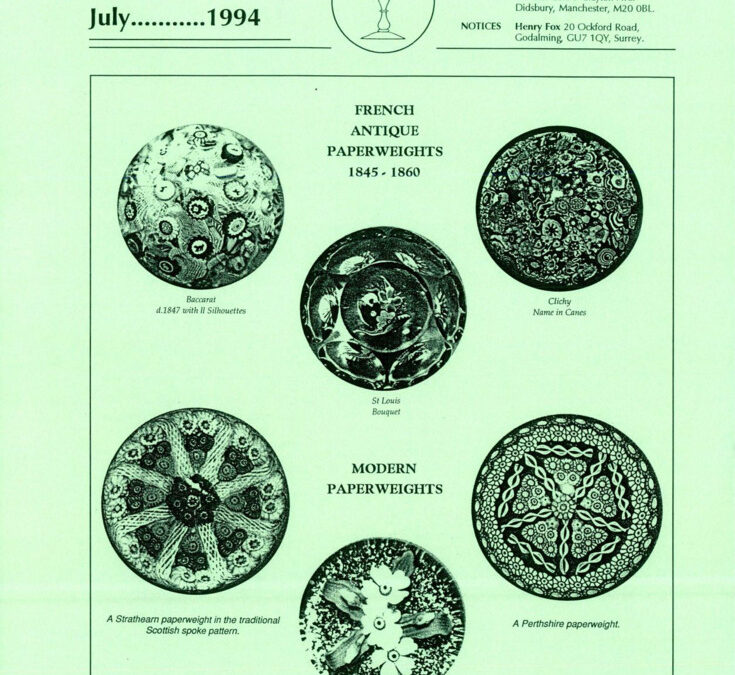
MODERN
PAPERWEIGHTS
St Louis
Bouquet
Baccarat
d.1847 with ll Silhouettes
Clichy
Name in Canes
FRENCH
ANTIQUE
PAPERWEIGHTS
1845. 1860
A Strathearn paperweight in the traditional
Scottish spoke pattern.
A Perthshire paperweight.
GLASS CIRCLE NEWS
EDITORS David C. Watts 27 Raydean Rd,
Barnet, Herts. ENS 1AN.
F. Peter Lole 5 Clayton Ave.
Didsbury, Manchester, M20 OBL.
NOTICES Henry Fox 20 Ockford Road,
Godalming, GU7 1QY, Surrey.
Selkirk
Primroses
See
PAPERWEIGHTS: AN OVERVIEW By Mrs Anne Metcalfe B.A.
Page 2.
GLASS CIRCLE NEWS
The most common remark I hear about paperweights is
“Aren’t they lovely – but I don’t really know anything
about them”. I hope in this article to go some way towards
making up that deficiency.
Glass paperweights first appeared in Europe. It is thought
that a Frenchman, Eugene Peligot, seeing Italian glass
paperweights made by Pietro Bigaglia, displayed at the
Exhibition of Austrian Industry in Vienna in 1845, took
the idea home to France and from then the French
glasshouses began producing glass millefiori and
lampwork paperweights until about 1860. Sulphides were
already in production in France and England. The
paperweights made during this period are those which are
considered highly desirable and fetch high prices at
auction.
After 1860 until 1953 paperweight production worldwide
was in the doldrums. In 1953, Coronation year, an
American, Paul Jokelson, suggested to the French firm of
Baccarat that they try to emulate their firm’s 19th century
achievements. From then on the modern paperweight
revival gained momentum, until nowadays collectors can
chose from fine paperweights produced in America,
England and France.
The antique weights came from three glasshouses in
France: Baccarat and St Louis from the Alsace-Lorraine
area and Clichy from the Paris area. Baccarat and St
Louis have of course continued, Clichy sadly was taken
over by Sevres in 1885.
The heyday of antique paperweight-making was in 1845 –
60. but not many antique weights are actually dated.
Baccarat are the chief factory who used dated canes but
their lampwork paperweights are never dated. About a
quarter of their millefiori are dated and the most common
date is 1848, perhaps because it was the date of one of
their revolutions and therefore had special significance;
the less common dates are 1846, 47 and 1849. Dates
between 1850 and 1860 are almost unknown.
In America however paperweight-making was taken up by
several glasshouses about ten years after the Classical
French Period. These factories were: The New England
Glass Company, Mount Washington, Sandwich, Gillender,
and Millville. They continued producing until about 1880.
These paperweights are seldom seen in England.
Bohemia was involved in paperweight-making in the
Classic French Period, but did not generally achieve the
quality of the French weights. Bohemia was still
producing weights in the early 20th century chiefly of the
coloured flower pot type – large and faceted.
The end of the nineteenth century saw the virtual end of
paperweight making, although the green bottle glass
doorstops or dumps continued into the next century and
indeed are still being made today. Those made today are
straight commercial factory production, but for many
years, right through to the 1930s and 1940s, at
Pilkington’s, bottle glass dumps and paperweights were
made by the workers as friggers. Of course the name most
commonly associated with these objects is Kilner and
from time to time they appear on the market with one of
the varieties of the Kilner factory name impressed on the
base.
Venice has been a centre of glass-making for centuries
and was indeed probably the source of the 1845 incentive
as detailed above. Nowadays paperweights from Murano
are common but of rather low quality, the canes often
being uniformly of the simple cog type, and sometimes
not as symmetrical as they were intended to be.
There was a serious paperweight revival in 1953 when
Baccarat made a coronation sulphide weight and in
England Whitefriars began a series of commemorative
weights. Both companies went on to achieve top quality
paperweights. Whitefriars finished in 1980 very sadly –
their catalogue for 1980 shows a multitude of very fine
millefiori canework paperweights – perhaps the reason for
continued on p.3
PAPERWEIGHTS: AN OVERVIEW
By Mrs Anne Metcalfe B.A.
4/7/17
,
7D
E…dEeeN71672s,
Pew
Zede
The south west of Britain provided me with much glacial
enjoyment this spring. Starting with a luncheon stop at
Exeter whilst making a January visit to Cornwall, the saga
opened with a disapointment, for a post prandial stroll
down to the Royal Albert Museum found the Glass
Gallery closed for refurbishment. The Gallery should now
be open again, but instead of communing with the Exeter
Flute and their other treasures, I had to console myself
with the excellent West Country silver. Whilst in
Cornwall, browsing through my brother-in-law’s library I
came across a reference of 1817 to Uranium Glass;
C.S.Gilbert’s ‘Cornwall’ observes on Pp. 269, whilst
discussing Cornish mining: “Uranium…. its oxides impart
bright colours to glass, which are according to the
proportions, brown, apple green or emerald green.” This
predates Riedel’s work of 1830, even though, as Wendy
Evans points out, it doesn’t actually tell us who is using it.
March, thanks to British Rail’s half price offer for oldies,
saw me in South Wales. The National Museum of Wales,
in Cardiff, has set up a nice new Glass display, and over
the past two years has added to the collection several
classic engraved eighteenth century Glasses with Welsh
connections, the most important being the Confederate
Hunt Goblet sold by Sotheby in September 1992; their
Watkin Williams Wynn exhibits are splendid, in both the
material and the intellectual sense. An hour’s journey
further west took me to the Glynn Vivien Gallery in
Swansea; here there is an underpublicised but absolutely
stunning collection of classic British Glass, including
almost two dozen Jacobite and Hanoverian Glasses. The
display is far from trendy (Praise Be!), but it is all on
display, and with a bit of neck craning, can be seen. This
trip made a long, but very satisfying day.
April yielded two trips. The first, to one of the open days
at Whittington Court, our Honorary President’s home, was
continued on p.4
f
GLASS CIRCLE NEWS
Page 3.
ANCIENT GLASS –
A
FISHY TALE
by Martine Newby
After briefly reviewing the origins of glassmaking and the
use of metallic oxides for colouring glass our member,
Miss Newby said that glassmaking in Mesopotamia and
Egypt was established in the 3rd millenium B.C. for the
manufacture of beads, pendants, cylinder seals and inlays.
Some time before 1500 B.C. the first core-formed vessels
appeared in Mesopotamia and, soon after, in Egypt, but
for the first glass fish we must turn to Tutmosis III in
18th-Dynasty Egypt (1504 – 1450 B.C.). His cartouche
occurs on an opaque light blue jug in the British Museum
and it is thought that he may have brought Asiatic
glassmakers back from waging war in Syria. The nascent
glass industry continued under Amenhotep II (1436 – 1412
B.C.) and reached maturity under Amenhotep III (1397 –
Sand-core glass vase in blue with dark blue, yellow and white trailed on
decoration. From El-Amarna, 18th Dynasty 13800-1350 B.C.
British Museum.
A lecture given to the Glass Circle on 17/2/94 at the
St. Alban’s Centre, High Holborn, London, W.C.1.
The hosts were Miss E.F. Haywood, Miss G.
Toynbee-Clarke, Mr P.H. Hawkins and Mr P. Layton.
1353 B.C.), during which glass-houses came under royal
patronage.
Some 500 18th-Dynasty glass vessels are known, six of
which take the fanciful form of fish as illustrated by the
famous example in the British Museum with orange and
white trailed scales and other fishy features on a blue
ground (illustrated). The B.M. has another example in
transparent blue glass with applied yellow fins, the Cairo
Museum has one from Saqqara with a polychrome looped decoration while the Brooklyn Museum has a rare
colourless example with opaque yellow spots simulating
scales and blue lines indicating gills applied directly to
the clay core, remnants of which still adhere to the inside
of the vessel. Glass fish may also take the form of a dish
and a unique example of unknown provenance in green
glass with incised lines, probably used for cosmetic
preparations, occurs in the Ashmolean Museum.
All surviving Egyptian glass fish represent one species,
Tipapia nilotica
(or the Bolti) which, for the Egyptians,
symbolized rebirth, an idea perhaps derived from the
mother’s practice of nurturing the eggs in her mouth until
they hatched and then spitting out the fully-formed young
fish.
Endless wars caused the glass industry to collapse in the
late Bronze Age (c. 1200 – 900 B.C.) and core-formed
vessels did not reappear until 800 B.C. although from 600
– 100 B.C. they were produced in quantity.
In Egypt the manufacture of inlayed glass figures and
floral tiles peaked in the Ptolemaic period (at the end of
the 1st millenium B.C.). Superficially similar are cast
continued on p.4
Peter Layton says Farewell to Rotherhithe
After 18, romantic and exciting years the London
Glassblowing Workshop is giving way to developers’
desires for the more remunerative returns of private
dwellings. The weekend of July 16/17 was devoted to a
wake and arriving just before the official opening time
of 11 a.m. I found the place a hive of activity in the
morning heat. Refreshed with free glass of ice-cold
punch I plunged into the throng of bargain hunters to
chose myself a souvenir where, for once, the fascination
of watching the artists at work was not the main point of
interest. I found myself a rather nice rib-moulded
lemonade glass with blue and white trailing made by
Patrick Stem whose better-known brother, Antony runs a
glass workshop at Battersea. Patrick’s very artistic,
usable and modestly priced tableware handsomely comp-
lements the Workshop’s more decorative activities.
The Workshop is moving to the old Leathermarket site in
Weston Street, near Guy’s Hospital, a short walk from
London Bridge Station. Here, on the top (second) floor
in more convenient and more spacious surroundings,
blowing irons should again be in full swing in a few
weeks time. Peter, himself, intends to concentrate
paricularly on architectural restoration work, all of which
arose from that famous Novy Bor Pyramid.
D . C. W.
Paperweight Overview contd.
their collapse. In 1968 Perthshire Paperweights in Crieff,
Scotland also entered the world of fine paperweights and
they carry on very successfully today. Caithness
Paperweights, also from Scotland, have been making
abstract and lampwork paperweights from 1969.
Both Caithness and Perthshire have very large factory-type
glasshouses with full tourist facilities and sell all over the
world. In contrast, in America, paperweight-making has
developed mainly through the studio artist; here we are
talking about men like Paul Stankard who makes
botanically correct flowers and Rick Ayotte similarly with
birds – both men producing the most artistic of objects,
both in the arrangement of the lampwork items and in the
colour combinations used.
Cheap paperweights have been coming out of China since
the 1930s. Many are easily recognised by their primary
colours and their rather primitive aspect; they come in
millefiori and lampwork flowers and most are miniatures.
I have not mentioned the paperweights made by Paul
Ysart, a Spaniard who spent his working life with his
father and brothers working in the glasshouses of
Scotland. He is thought by many to be the greatest maker
of the century, but that is another story.
I have necessarily skimmed the subject in trying to sketch
in a framework from which any interested reader can
make a start. There is so much more to say but I have
tried to discipline myself so that I did not stray into the
complexities of recognition.
Anne keeps a wide range of paperweights for inspection
and sale at her Sweetbriar Gallery in and often shows at
fairs. Tel. 0928 723851 for further information / free
informative newsletter and stocklist.
Page 4.
GLASS CIRCLE NEWS
Ancient Glass; a fishy tale. continued from p.4
mosaic plaques with intricately designed fish (pike,
dolphins – an “honorary fish” in this context! etc.) and
other sea creatures inlaid in their upper surfaces. An
example from the Coming Museum of Glass (CMOG) is
set in thick plaster suggesting its use for decorating
shrines and walls in houses. Similar panels of composite
construction (stone, glass and pottery) were used to
decorate fish ponds. A fine mosaic of this type depicting
two dolphins exists in the nympharium in the garden in
the House of Scientists at Pompeii. Related to the mosaic
plaques and panels are cast plates and bowls (1 B.C. to
1 A.D.) with mosaic-formed fish inlaid into the surface.
This was illustrated by a colourless rim fragment with a
small blue and white fish with red gills (from the Per Neb
collection). A number of impressed mosaic glass fish have
also been found Athens. The Corinth plate is one
well-recorded example and others, possibly representing
Parrot fish, may be seen in the Metropolitan Museum and
in the Kunsthistoriches Museum, Vienna.
From 31 B.C. – the early Roman period – a wider variety
of patterns and more brilliant colours were introduced for
mosaic glass vessels. Also, a new series of cast tableware
– cups, plates, dishes and bowls were made, mainly in
bright monochrome glass. More unusual pieces were a
model fishing boat (reputedly found at Pompeii, filled
with jewels) and a blue glass fish-shaped cover (CMOG)
cast in a mould and then wheel-cut and polished to
provide the anatomical details. Of similar date (2nd half
of the first century A.D.) is a tray, found in Spain,
moulded in base-relief with a fish in the centre of the base
and two handles, one at each end, in the form of
symmetrical ears. Mollusc shell motifs also feature in this
type of glass and in carved cameo work, probably used for
displaying sea food at elaborate banquets.
With the development of blown glass, around 50 B.C., a
wide range of fish-shaped flasks were produced. One
example, from Cologne, is a simple bottle which had been
modified by pincering to form the mouth and trailing
added to simulate gills and fms. Another ressembles a
swimming dolphin. Such creations, from the 3rd and 4th
century, probably made in Syria, were first blown into a
two-piece mould and then further inflated, which reduced
the crispness of the impression. Further details might then
be applied with trailed glass (see illustration). Eight
specimens from at least two different moulds are known,
reputedly from sites ranging from France to Turkey, but
the only datable piece comes from a 1st-century tomb at
Histria, in Roumania.
An amazing cache from the so-called “palace” at Begram,
in Afghanistan, possibly hidden between A.D. 241 and
250, contained 179 glasses including 27 extraordinary fish
forms decorated with distinctive heavy trailing and
Blown fish flask, 3rd century A.D. Colourless glass with greenish tinge,
pattern moulded and expanded with applied tooled decoration. Length
12..8 cm. (Corning Museum of Glass).
flange-like fms. Another 23 fragmentary vessels had
painted decoration, including a tall beaker with scenes of
hunting and fishing.
Another naturalistically-painted 1st-century glass bowl
with polychrome enamelling (applied as a powdered glass
paste and then refired) of fish and water plants or small
crustaceans (?) was found in a rubbish pit at Wintathur in
Switzerland.. Only about 40 such naturalistically
enamelled vessels survive. The dolphin motif also occur in
vessels or glass plaques of the 3rd and 4th century
decorated with applied gold leaf while cut decorations,
often combining facet and linear cutting, occur in the 4th
century. Of similar date there are bowls to which
several small individually blown fish have been applied to
the outer surface. One from Cologne had 18 such sea
creatures decorated with trails arranged in four rows. Of
particular interest is a fragment with part of a Christian
inscription, which reminds us that fish became an
important christian symbol.
Finally, mention was made of marine life carved into a 4th
century rock crystal lamp in the Treasury of St Mark’s in
Venice. Such detailed work in high relief, with deep
undercutting so that the figures appear almost in the
round, might be looked upon as the forerunner (or a
parallel) to the most laborious luxury glass ever produced,
the cage cups.
Miss Newby’s talk was supported by slides of most of the
pieces mentioned and generated a lively discussion by an
appreciative audience.
Amberina bowl, hobnail diamond (button daisy) pattern.
Corning Museum of Glass. See page 8.
Limpid Reflections contd.
delightful, with effectively four separate Glass collections,
all obviously loved and much of it in use, under the one
roof. Later in the month, a couple of days in Somerset
allowed me to visit the Holboume of Menstrie museum in
Bath, also newly refurbished. Whilst this has a pleasant
small collection of classic Glass, the surprise Glass
interest was in the exhibition ‘Boxes of Quality’, a private
collection of snuff and freedom boxes. A silver-gilt snuff
box of 1823, by John Linnit of London, had a very high
relief on the lid of a Glass Pedlar, holding a large
drawn-funnel Glass, and with a tray having two squares
and two decanters on it. Also of interest, particularly in
view of the current questioning of Williamite Glass dates,
was another silver-gilt box again by Linnit, but this time
of 1830, and having on it’s lid an equestrian portrait of
William, under the enribbonned legend ‘The Glorious
Memory’ and the date 1690, together with a presentation
inscription. I moved on to ‘The American Museum in
England’, at Claverdon Manor, to fmd, quite
unexpectedly, a significant Glass collection. Some was
British Glass, taken to the colonies, and now in period
rooms brought back from the USA. More interesting is
the large amount of American Glass, much of it loaned by
Corning, and ranging from two Stiegel type ‘flip’ beakers,
through pressed Glass to a dozen or so pieces of Tiffany.
The West Country trips concluded with another
frustration, for I had chosen the wrong day to try to see
the soi disant Nailsea Glass at Clevedon Manor, but I
found instead a small group of local Roman and Saxon
Glass at King John’s Hunting Lodge in Axbridge.
Since this saga ignores the two important Glass sellers of
the Bath area, the Taunton and the two magnificent
Bristol collections, it does illustrate how much
Glass
of
great interest one can see in south west Britain. Doubtless
I have missed collections worthy of comment, – please
write in and tell me of them.
16th. May 1994
GLASS CIRCLE NEWS
Page 5.
Two original Research Papers
read to a meeting of the Glass Circle
at the St Alban’s Centre, High Holborn, London WC1. on 17th May 1994.
The hosts were Miss A. Towse, Mr and Mrs J. Towse and Mr D. Woolston.
THE “SUCCESS TO THE SOCIETY”
JACOBITE GLASSES
By Dr David Stuart
My interest in these Jacobite glasses was stimulated by an
unsold glass from Sotheby’s which I subsequently bought
in order to compare the nature and variability of the
engraving and the type of glass, in terms of the opaque
twist, that was used. The immediately available evidence
from books and catalogues suggested the use of at least
three different twist types although the engraving pattern
appeared to be the same for all of the glasses.
For my detailed survey I searched Sotheby and Christie
catalogues, published books and journals and sent a
written enquiry to ten museums. Additional help came
from our members, Peter Lole and Dr Geoffrey Seddon.
Some attributions had been lost over the years resulting
in the mis-cataloguing of one glass and making another
difficult to track down. The fmal list contained eight
glasses which could be separately identified with
reasonable certainty although more may yet turn up.
The following conclusions were reached.
1.
Characteristics in common.
All are opaque white twists with straight stems, round
funnel bowls and plain feet, between 6 and 6.25 ins (15 –
15.5 cm) in height, and a bowl capacity of about 2 11. oz.
(50 ml).
All are engraved with an heraldic Jacobite rose with open
and closed buds on one side and an upright thistle on the
other.
All are inscribed round the rim ” SUCCESS TO THE
SOCIETY”.
2.
Differences.
There are two distinct though similar types of engraving,
Type A occurs on three different types of twist. Type B
(4 glasses) share the same twist and may belong to a set..
Twist Classification
Type A.
1.
My own glass, the only one positively identified with a
single series twist. The foot has five (old) rim chips.
2.
From the Hamilton Clements collection (sold
Sotheby’s, 1930) with “a cable spiral twist”. This suggests
a single series twist like glass 1., but probably a different
glass as there is no mention of chips (usually described in
the catalogues by A. J. B. Kiddell).
3.
From the Turnbull collection, now in Mompesson
House, with a double series twist (vertical gauze / pair of
spiral corkscrews).
4.
From Churchill’s Glass notes (1946) with a different
double series twist (verical gauze / pair of spiral tapes).
Type B (All have the same double series twist (lace twist /
pr. multiple spiral bands)
5.
From the Rees Price collection in the Victoria & Albert
Museum since 1925 (Illd. Thorpe, 1927, Fig. 46(b) ).
6.
From the Crawley collection (sold Sotheby’s, 1920 and
1975 and now in private hands).
7.
Bernard Hughes, Fig. 197c,1956, now in the Drambuie
collection.
8.
Illd. in “History in Glass”, Churchill, 1937, Pl. 8, No.
34. sold Christies, 1991, so cannot be any of the above.
Engraving
a. Heraldic Rose. These were similar in both types but the
outer of the two scoops, which lie just outside the central
polished area, tend to meet in type A and be discontin-
uous in type B.
b.
The Large Bud. Type A; the inner petals are more
curved and angled from the vertical, and the outer groups
of sprigs stand up. Type B; both the inner petals and outer
sprigs are relatively horizontal.
c.
The Small Bud. Type A; centre of bud engraved matt
and has no intruding sepals. Type B; bud centre always
has two intruding sepals with the outermost sepal
generally longer, although some variability.
d.
Lettering. Type A; Serifs tend to be thin straight strokes
usually lying at right angles to to letter strokes. Type B;
serifs more likely to be triangular in shape and at an angle
to the letter stroke, letter “0” invariably larger than the
rest of the lettering.
e.
The Thistle. Type A; unpolished or only lightly
polished. Type B; always polished in vertical bands in the
top section so as to appear tufted.
Discussion
To account for the difference we might infer that four (or
five?) sets of glasses were engraved between 1755 (1st
appearence of opaque twists) and 1770 ( trend towards
ogee bowl style and decline of support for the Jacobite
movement). Glasses dedicated to the King of Prussia
dateable to around 1757 have a similar appearance and
engraving style. Alternatively, the twist variation in Type
A might be explained by Society members providing their
own glasses for engraving although bowl capacity and
glass height are similar in all specimens. Type B, with a
greater number and polished engraving may be of later
date but could reflect a different engraver.
Were they engraved for one Society or were they, as
Bernard Hughes suggest, a stock pattern avialable to
different Societies? The accuracy with which the pattern
was copied argues for one workshop and, less certainly,
for one Society. If the “stock pattern” arguement is
accepted, London and Edinburgh would be the most likely
workshop sites as only in those cities would a sufficient
number of Societies have existed to make a stock pattern
worth while. A Scottish origin has been suggested on
account of the engraved thistle but Mr Lole tells me that
the thistle occurs no more frequently in Scottish hoards of
Jacobite glasses than in English hoards.
Whether the glasses were all engraved by one engraver,
with a lapse of time between the two groups is impossible
to decide with any certainty. Their very great general
similarity makes a single engraver seem possible although
the time-scale difference this imposes to allow for the
stylistic change between engraving Types A and B is a
problem, also lettering is an individual-consistant feature
and unlikely to change?. Alternatively, more than one
engraver worked in the same workshop or a glass might
have been given to a second engraver to copy.
It would be interesting to identify the Society or Societies
concerned but for this one would require details of the
glasses ordered or records of the Societies. Unfortunately,
such records, if they ever existed, seem not to have
survived. If the engraved glasses were for a single Society
it must have lasted some time to have used four sets – or
had a high breakage rate, which is not impossible!
Churchill’s Glass Notes (1946) suggestion that the
“Society” was Jesuits (the Society of Jesus) seems
unlikely as whatever popularity and influence they may
have enjoyed must have been in serious decline by the
time opaque twists were in vogue.
Assistance from the ten museums, Simon Cottle of
Sotheby’s with auction records, Dr Geoffrey Seddon (who
also loaned slides for the lecture) and Peter Lole for much
useful information about Jacobite Societies is gratefully
acknowledged.. *
Page 6.
GLASS CIRCLE NEWS
100 years of Glass at Tatton Park;
from Warrington to Baccarat.
F. Peter Lole
plates reveal other instances of this solecism well before
1859, and it seems that the family aggrandised their status
– a not uncommon sin – the heraldry books tell us! Also,
the two coolers, whilst superficially a pair, have differing
stem sizes and constructions, and show slight differences
in both their cutting and engraving. It was suggested that
the two were made separately, but both by Perrin and
Geddes, shortly after the succession of Wilbraham Egerton
in 1806.
Also discussed was an enormous set of Baccarat Table
Glass, documented by Baccarat as being supplied through
the Army and Navy Stores in 1911. The owner of Tatton
was then Alan de Tatton Egerton, who had succeeded his
elder brother in 1909, both being grandsons of Wilbraham.
The full service originally consisted of 976 pieces, and
there remain today 894 pieces. About one third of the
service has never been used, being still in the original
factory wrappings and having paper ‘Baccarat’ stickers on
the underside of the Glass. The cost of this service is
unfortunately not known.
The service comprises 4 sizes of stemmed Glass, ranging
from 7 inch high Goblets to Liqueurs of only 3 inches;
there are tumblers, fmger bowls and saucers to stand them
on, Decanters and small jugs. All the Glass is engraved
and then gilt, with encircling swags and a Baron’s coronet
surmounting the cypher ‘E of T’ (for ‘Egerton of Tatton’).
The metal has all the brilliancy usually associated with
Baccarat and, coupled with the bodies of the vessels being
delicately moulded with optic flutes, their reflective glitter
adds enormously to the opulent splendour of the Tatton
dining room. The Glass is contained in four very large
teak-wood trunks, with fitted trays having a compartment
for each piece of the service; the trunks bear a small
engraved plate reading, ‘Army & Navy CSL, Makers,
London, Bombay, Calcutta.’ Each trunk contains a service
for 36 people, providing 144 covers in all!
After considering the rather tenuous evidence as to how
the service was used, it was suggested that the Goblets
were used for Champagne, which seems to have been the
major table wine at Tatton in that era; that the Claret
Glasses were used for all other table wines, and the Port
and Liqueur Glasses lived up to their names. The
Tumblers, of which there are only a half set, would
probably have been used with the small jugs for spirits
and water (Large amounts of whisky and brandy feature in
the cellar) and the masculine bias of this tipple would
explain the half quantity of tumblers.
Tatton Park became home to one of the many branches of
the Cheshire Egertons at the beginning of the eighteenth
century. Following a half century of tottering fmances, the
1757 inheritance of the proverbial rich maternal uncle’s
fortune set them securely on their feet, so that when
Wilbraham Egerton succeeded in 1806 he was worth
£20,000 a year. He immediately set about completing and
furnishing the building started some twenty years earlier
by his father; the resulting ensemble remains largely
unchanged today. Tatton passed to the National Trust in
1958, for whom it is managed by Cheshire County
Council.
Part of Wilbraham’s refurbishment included a magnificent
and massive pair of cut and engraved three piece ‘Ice
Cellars’, some 17 inches high. They feature in the probate
inventory of 1856, when Wilbraham died as “Pair of fme
old Cut Glass Ice Pails, liners and covers (1 damaged)”; a
later annotation states “These are Warrington Glass Ice
pails. 19th century.” These ‘Ice Cellars’ consist of an urn
shaped body, with a bowl or saucer having a turn over
top, and which fits onto the top of the body; the ensemble
is surmounted by a conical cover, with an imposing
pineapple finial mounted above a frilled, sepal-like collar.
They are cut with diamonds and horizontal bands of step,
or prismatic, cutting, and the body of each urn has
swirling acanthus leaves and thistles, surrounding two
shields engraved with a rampant lion holding a vertical
arrow, the badge of the Egertons. The Tatton coolers can
be related to the Perrin and Geddes 1806/8 service for the
Prince Regent (C. & R. Gray; Glass Association Journal
Vol: 2) and also a ‘Wine Cooler’ in the V & A (illustrated
in Jo Marshall; Glass Source Book, p. 96). The cover and
saucer of the latter are virtually identical to those of the
Tatton vessels; although the body is quite different, it is
surely from the same stable. Comparable ‘Ice Cellars’ are
at Shugborough, with silver-gilt mounts of 1802, and
another pair was advertised by an American dealer in
1975, described as ‘unique fruit coolers’.
These coolers pose two problems; the engraved Egerton
badge stands on a cap of maintenance, – heraldically a
sign of Nobility. This raises a question over the date,
since the Egertons remained commoners until 1859, when
they became Barons. However, the Tatton Library book-
ONES THAT GET AWAY
A particular problem with a newsletter that only comes
out three or four times a year is that information can go
out of date before GC News is published. That is not to
say, however, that the information received from our
members is not appreciated, or even useful, as it can often
be passed on by word of mouth at our regular meetings.
Recently, I have been informed of a Whistler Exhibition
in Salisbury by Mr G. Cranch and of special exhibitions at
The Pilkington Glass Museum, all now past. Please keep
the news flowing and we will use it if we possibly can.
It must be admitted, however, that occasionally pieces are
left out either because they get lost, forgotten or sqeezed
out by the pressure on space. Into this category comes a
letter from Tim Udall particularly asking me to publish
his very great appreciation and thanks for the engraved
tray and handsome cheque presented to him by The Circle
after his retirement from being Hon. Treasurer.
Apparently he did not open the envelope containing the
cheque until he was on the train on the way home and
was overwhelmed by the generosity of your response. »
Tim has promised to let you all know when he finds a
piece worthy of adding to his fme collection of jelly
glasses.
The developments of modem computer technology have
helped us to cope with the ever increasing flow of infor-
mation on glass and the GC News of today, set mainly in
10 point, contains more than twice as much reading as the
old typed versions for the same number of pages. We
hope you continue to enjoy it and I would particularly
like to thank my colleagues, Peter Lole and Henry Fox for
their help and hard work.
D.C.W.
VERRE ET MERVEILLES
In GC News No. 58, we briefly mentioned this important
contribution to the study of Roman glass which contains,
inter alia,
an illustrated archaeological classification of
glass from the Merovingian period.
For those interested the price is 140 F + 32F P+P.
Cheques to Paierie Departmentale, CCP 9 015 08F PARIS
sent to Musee Archeologique Departmentale du Val
d’Oise, Place du Chateau, 95450 Guiry-en Vexin, France.
GLASS CIRCLE NEWS
Page 7.
Dr D. B. Harden 1902 – 1994: An Appreciation
by R. J. Charleston
Dr D.B. Harden died on the 13th April 1994 at the great
age of 92. He was unquestionably the greatest scholar in
the field of “Ancient Glass” which this country has
produced, and the Circle was among the many societies to
recognise his pre-eminence by electing him as an Hon.
Vice-President when that distinction first became
available in 1948. He read two papers to the Circle on
this subject.
Donald Harden first started on his glass studies in earnest
in 1926, when he was granted a Commonwealth Fund
Fellowship at the University of Michigan at Ann Arbor,
and there he busied himself with the Romano-Egyptian
glass from Karanis (Kom Aushim) then in course of
excavation by the University’s Archaeological Expedition
to Egypt. He himself spent two seasons on site, thus
gaining precious experience of archaeology in the field.
It was not until 1936 that he reaped the fruits of his
experience and of further study, in his book
Roman Glass
From Karanis,
the most thorough and comprehensive
book on glass from a single Roman site. In 1931 he had
produced
“Early Byzantine and Later Glass Lamps”
and
now other authoritative publications in the field began to
flow from his pen, not only on Greek and Roman glass,
but Sassanian, Anglo-Saxon, Mesopotamian, Persian. He
rapidly came to be regarded as the authority on “ancient
glass”.
It should be realized at the outset that this busy run of
publication was far from being his main professional
preoccupation. He was first Assistant Keeper, and then
Keeper, of a large and active Department of Antiquities at
the Ashmolean Museum, Oxford (1929-1956). In 1956 he
was appointed Director of the London Museum, and in
due course entered into the long course of negotiations
which led ultimately to the creation of the Museum of
London of which he became the Director Designate. Fate,
however, decreed that retirement should come between
him and his rightful goal.
Once he settled in London Donald Harden entered into all
the archaeological and antiquarian activities that the
capital offered. He had been Vice-president of the Society
of Antiquarians already in 1949-1953. He became
President in turn of the Council for British Archaeology
(1950 – 1954), the Royal Archaeological Institute
(1966-1969), the Museums Association (1960) and the
Society for Medieval Archaeology (1957-1963). On the
international place he was at least as well known. A
leading member of the International Committee on
Ancient Glass, he played a critical role in the formation
and evolution of the “Joumees Internationales du Vane”,
which in due course became “The International
Association for the History of Glass” and for a time
became President.
He will be remembered, by those old enough to have
known him, as a robust, cheerful and straightforward com-
panion, liberally endowed with common sense and
humour.
THE IMPORTANT WORKS OF DONALD HARDEN
A short list of Donald Harden’s more important and accessible works on glass has been compiled below by
Martine Newby for Glass Circle News.
For a, more or less, complete list see
Roman Glass: Two Centuries of Art and Invention,
Martine Newby and
Kenneth Painter (eds.), Vol. XIII of occasional papers from the Society of Antiquities of London (London
1991), pp. xi-xxix.
1931
With G.M. Crowfoot, “Early Byzantine and later glass
lamps”, in
Journal of Egyptian Archaeology, vol.
17,
196-208.
1935
“Romano-Syrian glasses with mould-blown inscriptions”
in
Journal of Roman Studies,
vol. 25, 163-186, pls. 22-28.
1936
“Roman Glass from Karanis Found by the University of
Michigan Archaeological Expedition in Egypt 1924-1929”,
University of Michigan Studies, Humanistic Series 41,
(Ann Arbor).
1956
“Glass Vessels in Britain and Ireland, AD 400-1000” in
D.B. Harden (ed.),
Dark Age Britain, Studies Presented to
E.T. Leeds
(London), 132-167.
1959
With J.M.C. Toynbee, “The Rothchild Lycergus Cup”, in
Archaeologia,
vol. 97, 179-212, pls. 59-75.
1960
“The Wint Hill hunting bowl and related glasses”, in
Journal of Glass Studies,
vol. 2, 44-81.
1961
“Domestic Window Glass: Roman, Saxon and Medieval”,
in E.M. Jope (ed.),
Studies in Building History, Essays in
Recognition of the Work of B.H. St. J. O’Neil.
(London),
39-63.
1968
Joint author, “Masterpieces of Glass”, (London),
Exhibition catalogue.
1968/1969/1971
“Ancient Glass, part I: Pre-Roman”
Archeological Journal,
vol. 125, 46-72.
“Ancient Glass, part II: Roman”
Archeological Journal,
vol. 126, 44-77.
“Ancient Glass, part III: Post-Roman”
Archeological
Journal,
vol. 185, 78-117.
1978
“Anglo-Saxon and later medieval glass in Britain, some
recent developments”, in
Medieval Archaeology,
vol. 22,
1-24.
1981
“Catalogue of Greek and Roman Glass in the British
Museum, Volume 1. Core- and Rod-Formed Vessels and
Pendants and Mycean Cast Objects” (London).
1987
Joint author, “Glass of the Caesars” (Milan), exhibition
catalogue.
Page 8.
GLASS CIRCLE NEWS
1a
&Pt
9eam
Oft
Vedea
eigetateeieeet* Pet
-et-ear-44V
This meeting, a departure from the normal style of Circle
lecture, revealed what an unbelievably exciting and
versatile material hot glass can really be. The attendance,
was smaller than usual, perhaps because those who stayed
away thought it would have little interest for them. And
indeed, as we gathered in the lecture theatre specially
equipped with a large scale video projector there was an
air of uncertainty as to our fare for the evening.
Peter Layton, by way of introduction explained that we
were to see two professionally produced videos of the
1985 and 1988 symposia each of which ran over 3 days at
the massive glass factory at Novy Bor in Czechoslovakia.
Only a selection of the world’s best studio artists were
invited and the workshops were given over to them to
create, in just one day, their hearts desire in hot glass,
engraving on specially produced blanks or working with
stained cold glass. Thus we were able to follow Dana
Zamechnicova as she built up a three-dimensional picture
by colouring and laminating successive glass sheets of a
considerable size.
But it was the hot glass working, where big wasn’t just
beautiful but almost essential, that overwhelmed as teams
of Novy Bor professionals – who must be some of the best
(and strongest) glass blowers in the world – blew gigantic
bubbles and stood atop stools and step ladders
precariously to swing and shape the red hot glass under
the artists direction. Some creations succeeded and some
didn’t; there was a most remarkable shot of one artst who
became so personally involved that he was seen stamping
on an enormous bubble regardless of the fact that his his
boot was engulfed in the flames. The heat from such
pieces must have been tremendous although the
A meeting the Glass Circle on 19/4/94 at Guy’s
Hospital Medical School (UMDS) London. SE1 9RT.
The hosts were Miss E.F. Haywood, Miss J. Darrah,
Mrs J. Marshall, Mr H. Fox and Mr J. Scott.
commitment was such that nobody seemed to care. One
creation, some ten or twelve feel long required three men
to carry it to the leer supported on wooden poles. On one
side we saw Peter painstakingly casting the dozens of
meticulously measured glass bars that were to form his
famous pyramid.
Swirling round all this activity were innumerable visitors,
many of them professionals in other aspects of the glass
industry, who had come to study the diversity of
techniques involved and simply enjoy the show.
Day 1, it should have been said, was given over to
preparation and working out ways and means. Day 3 saw
the moment of truth when the leers were opened and the
fmshed objects were brought out for examination,
installation in the display hall and a fmal assessment
given.
Perhaps most remarkable was the togetherness of the
whole operation as different nationalities waved and
gesticulated to convey their ideas and feelings, for even if
they could have been heard above the noise, which
seemed doubtful, in most cases they would not have been
understood, least of all by the Novy Bor workers who
seemed to get nothing but pleasure from demands that
must have tested their skills and strength to the limit.
A Novy Bor symposium should have occurred again this
year but from the new land of the free there has been no
move. Is it extraordinary that such extravaganzas were
possible only under communist rule and are incapable of
emulation by even the greatest of capitalist countries?
For those of us at the Glass Circle meeting it was
unanimously voted a revelation and our thanks go to Peter
for making this memorable evening possible.
WOT MORE FISH!
at the
CHRYSLER MUSEUM
An exhibition of
Studio Glass from the
Permanent Collection
is being held by
the Chrysler Museum, Norfolk, Virginia.
U.S.A. until October 16th. 1994.
Although relatively small in number,
with just 20 objects in the exhibition, the
quality is without question and includes
important pieces dating back to 1930,
before the Studio Glass Move- ment
took off in 1962.
Artists represented include Harvey
Littleton and the late Dominick Labino,
whose creative thinking and technical
knowhow in producing a glass that
would melt and work under amateur
furnace conditions, provided the
freedom from industry on which the Art
Glass movement depends, as well as
Jean Sala of France, George Dinkel of
Great Britain, Stanislav Libensky of
Czechoslovakia and Hiroshi Yamano of
Japan in addition to other well known
names – William Bernstein, Erwin Eisch,
Edris Eckhardt, Fritz Dreisbach,
Jaroslava Brychtova – Libensky and Paul
Stankard.
Sculptural Vessel Form (glass, silver leaf, copper bronze),
from the East to West Series by Hiroshi Yamano,
1991.
and PRESSING
PROBLEMS WITH
RAIBERIA/A?
It is well known that American pressed
glass was sent in quantity to Britain.
Perhaps less well known is that English
importers occasionally registered such
desirable pieces here to preserve copy-
right. This now appears to be the case
with the gold red-shaded from uranium
yellow pressed glass known as
Amberina. It was expensive to make
and fetches high prices today. Jenny
Thompson and Coming’s curator of
pressed glass, Jane Shadel Spillman, are
trying to obtain more information on
this little-researched topic.
An American collector has a piece with
RD. 63083 and Jenny fmds that Nos.
63082 and 63083 were registered for
pattern and shape on Dec. 8 1886 by
Scotney and Earnshaw, 22 Water Lane,
London. Barbara Morris’
Victorian
Table Glass and Ornaments
tells us that
in March 1884 the Pottery Gazette said
that Amberina was being sold by
Messrs Blumberg and Co. of Cannon
Street. Barbara thinks that Sowerbys
made Amberina, particularly a dolphin
bowl, in the 20th century. If you have
a regd. piece of this glass or any further
information
at all
please let us know.
GLASS CIRCLE NEWS
Page 9.
f • •
NOTICE BOARD
by Henry Fox
BRIGHT AND SHINY: THE NEW
GLASS GALLERY AT THE
VICTORIA AND ALBERT MUSEUM
Shirley Warren and Ray Slack
now offer a wide range
of books on glass subjects, as well as specialising in glass
of the Roman period. For a copy of their current book list
telephone 081 657 1751.
The Cecil Higgins Art Gallery,
Castle Close, Bedford,
will be showing Sam Herman glass in the museum foyer
from 2nd Aug. to 25th Sept. And don’t forget the
wonderful permanent display there of early English glass
including sealed Ravenscrofts.
In Lalique’s Bond Street Galleries Bonhams
will be
displaying, from 21st Sept. – 5th Oct., most of the items to
be auctioned on the evening of 13th Oct. at their
Knightsbridge Galleries. The event at Lalique will also
feature an amazing selection of perfume bottles from the
collection of Mr David Pickard-Cambridge and Glen and
Mary-Lou Utt.
What is there to do in the U.S.A.
now that the football
World Cup is over? How about a visit to see the stunning
McKean collection of Tiffany windows at the Morse
Gallery of Art in Winter Park, Florida. This is said to be
the most important and most complete Tiffany represent-
ation in existence. It includes besides windows, lamps,
jars, fountains, drinking glasses and desk sets. Winter
Park, which was the venue for this years Seminar of the
National Early American Glass Club, contains
(inter alia)
three other museums, a Science Centre, botanic gardens,
boat tours, five shopping centres and, of course, some-
where to stay. Shortish drives take you to several antique
centres and, if you’re not careful, Disneyland and
Universal (Back to the Future) Studios! For more
information contact Winter Park Chamber of Commerce,
150 N. New York Avenue, Winter Park, Florida, USA.
Not quite glass
but our Hon. Sec., Jo Marshall, recently
had the privilege of auctioning one of the finest quality
Delftware plates, dated 1664, ever to emerge from
Pickleherring Quay in Southwark. (English Delft, which
ultimately gave rise to the Lambeth potteries has close
links with the manufacture of glass and smalt in the early
17th century. Hugh Tait did much pioneer research on this
subject.) This particular piece fetched around a quarter of
a million pounds. When it was pointed out to Jo that she
had been committing the bidders money at the rate of
£10,000 per blink of an eyelash she mildly replied “Oh
really! was I?”. It is clearly a lot cheaper to stick to glass.
Glass Sales and Fairs – Diary Dates
Christies – 22nd Nov. 1994
Phillips – 7th Dec. 1994
Sotheby’s 15th Nov. 1994
Sotheby’s
will be offering fine early Venetian glass as
well as a collection of cameo glass, including a vase by
George Woodall and another by Locke which was
exhibited at the Paris Exhibition of 1878. It will be a
great surprise if these do not end up in Coming’s Rackow
collection so it may well be your last (only!) chance to
see them this side of the Atlantic.
Christies
and
Phillips
both anticipate bringing fine lots of English and
Continental glass under the hammer
Glass Collectors’ Fair
at the National Motorcycle
Museum (By junction 6 on the M42 near the NEC) is on
Sunday 20th November. Details as for previous fairs.
The Chelsea Antiques Fair
is from 13th – 24th
September (Somervale Antiques exhibiting) while the
Northern Fair, Harrogate, (William MacAdam exhibiting)
is from 28th Sept. to 4th Oct. 1994.
First impressions by Henry Fox
As one mounted the staircase to the new Glass Gallery at
the V & A a strategically placed showcase provided a
taste not only of what to expect but also a feeling that
colour and contemporary studio glass work would be
prominent in the display. This proved correct in that a
variety of quite dazzling colourful pieces made by today’s
leading glass-makers arrested the attention immediately
upon entering the gallery. What a change from the old
style of display – the initial impression is of entering a
gleaming Aladdin’s cave with a staircase and a balustrade
carved from ice. However, as this was a convivial visit it
was only to be expected that at times the gallery
resembled the Crush bar at Covent Garden! It was a
pleasure to meet and chat with members from both The
Glass Circle and The Glass Association (for this was a
unique joint first venture) as well as spotting familiar
favourites from the past such as the Ravenscroft sealed
pieces. Certainly, the new showcases give a feeling of
intimacy with the contents, and never more so than on the
new mezzanine, but only on the lower shelves as some of
the items seemed to be displayed at a height that could
only benefit those of six feet and over. On the mezzanine
one felt that in order to show more glass the old faults of
too much, which made easy viewing difficult in the past,
had managed to survive – not a good idea for a study area.
However, I would strongly recommend several further
visits at a quieter time. Without doubt a great deal of
thought and effort had gone into the design of the new
gallery with its computerized information stations. I am
sure it will prove popular with the multitude of visitors
who pass regularly through the museum.
Particular thanks must go to Henry who’s immaculate
organization of the visit for both societies, cheerfully
supplying tickets well after the catering deadline, was
greatly appreciated by everyone involved.
The Aladdin’s Cave syndrome, as it might be called was
particularly enhanced by first having to pass through the
now rather gloomy ceramics section. And if cleanliness is
next to godliness then this is certainly a holy of holies! A
1200 BC sand-cored vessel looked as though it had been
made yesterday while the closest inspection of the few
balusters at a reasonable eye level failed to reveal even
the slightest speck of dirt in the deepest crevices. The
whole display does, however, raise the question of the V
& A’s role and responsibilities in a modem world. For the
moment it is plaudits all the way to Oliver Watson and his
team for an impressive and outstanding achievement.
A David Lay (Penzance) sale
in June, was devoted to the
disposal of a private collection of pressed glass. Although
there was considerable interest many lots went for a few
pounds. But as always, the rare or unusual items exceeded
their estimates, notably three Sowerby Nursery Rhyme
pieces taken from Walter Crane designs. Two tall black
spill vases (sold separately) with “Mistress Mary Quite
Contrary” each went for £500 plus buyers commission,
while a small trough with “Ma Mammy Dance a Baby”
sold for £450, also plus buyers commission.
A Giles Haywood sale
in Stourbridge, in July, featured
nearly 600 lots of 18th to 20th century glass, much falling
into the collectable category. Among the highlights were
an 18th century glass condiment suite of two salts and a
jug, all on three lion-paw feet for £825; and a Paul Ysart
signed and dated millefiori ink bottle and stopper with
Monart label for £800, both plus buyers commission. *