




1’010
1110
T
GLASS CIRCLE NRWS
No. 60
September 1994
EDITORS David C. Watts 27 Raydean Rd,
Barnet, Herts. EN5 IAN.
F. Peter Lole 5 Clayton Ave.
Didsbury, Manchester, M20 OBL.
NOTICES Henry Fox 20 Ockford Road,
Godalming GU7 1QY, Surrey
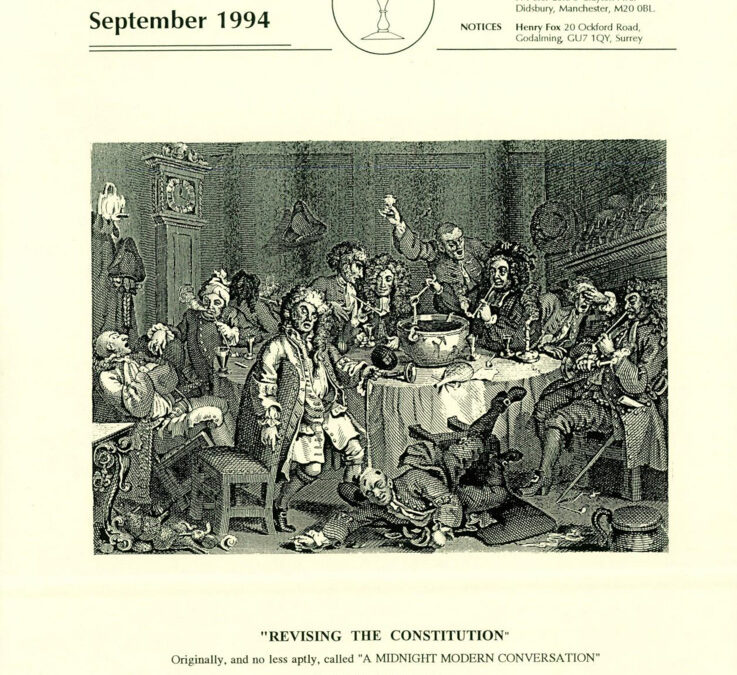
“REVISING THE CONSTITUTION”
Originally, and no less aptly, called “A MIDNIGHT MODERN CONVERSATION”
Engraved by T.E. Nicholson.
Published by John Major, 50, Fleet Street, Sept.l. 1831.
Page 2.
GLASS CIRCLE
NEWS
A REVISED
GLASS CIRCLE CONSTITUTION
Among the items along with this mailing of
Glass Circle News you will have encountered,
perhaps with some suprise and even misgivings,
a copy of a greatly revised version of the Glass
Circle constitution. You may rest assured,
however, that it is a generous and positive
document that not only reflects the spirit of The
Glass Circle as run today but should help carry it
into the 21st century.
It is an interesting fact that while the Circle has a
natural interest in the history of glass it has
shown very little in its own development. This is
partly due to the fact that since its inauguration
in 1937 it has enjoyed the continuity of only two
Presidents (the first being W.A.Thorpe) both of
great academic standing. Both, too, knew our
founder and his aspirations. The result has been
of outstanding benefit to the Circle as reflected
by the endless string of internationally
recognised authorities such as Hannah Ruggles
Brise, John Kiddell, Sir Hugh Chance, Ada
Polak and Raymond Chambon, who became
members, not to mention our Presidents
themselves. The typescript copies of their Circle
lectures are still frequently quoted today.
With changing times and the inevitable effects of
anno domini,
circumstances decree that we now
have a Committee mostly composed of
relatively new members, albeit of high
professional standing. Consequently, the need
has emerged for more precise guidelines than in
the past; the result is the revised constitution. It
endeavours both formally to encapsulate the
working.practices of the Circle, as we now
understand them to be, and incorporate the
hitherto neglected general requirements for the
constitution of any modern Society. To this end
the Committee has spent many hours of
discussion and research to produce a document
that would hopefully have received the
approbation of John Bacon and the first founders
of The Circle of Glass Collectors.
Some aspects of the new constitution might, at
first sight appear surprising, or even a cause for
concern. The Committee, however, does not
anticipate having to wind up the Circle and, so
far as anyone can recall, there has never been the
need for a special business meeting. Nor has it
worried unduly about rigorous guidelines for our
Hon. Treasurers, whose unstinting, prudent and
entirely trustworthy labours have brought the
Circle nothing but benefit. But today, all such
matters must be covered in the constitution of a
responsible society, as much for the protection of
its officers as for its members.
The revised constitution is presented with the
unanimous backing of the Committee. Read it
carefully and register your opinion at the AGM in
October.
DEATH OF MICHAEL PARTINGTON
Circle members may
have read earlier this year of the untimely death of Michael Partington. He came to
prominence, so far as Circle members are concerned, when Broadfield House Glass Museum suddenly
exposed to the world an unbelievable collection of the finest English glass of its kind to be seen
anywhere. It was, however, only a sample of the prolific and all embracing activities of Michael
Partington as a glass collector.
That collection is still on view at Broadfield House at the present time.
Michael was known to a number of members of the Circle, both personally and professionally, and we
hope to bring you an appreciation of his life and works in the next issue of Glass Circle News.
Meanwhile, we offer our sincere condolences to Mrs Parkington in her time of grief.
Chagall in the Weald
The Summer issue of GC News emphasizes getting out
and about and John Scott has written to tell us about
All Saints Church in in Tudely-cum-Capel, near
Tonbridge, Kent.
Although described by Hasted, in 1798, as “obscure and
unfrequented”, this little church has become one of the
most visited in the Weald. The reason is its outstanding
collection of stained glass by Marc Chagall (1887 – 1985).
The East window, commissioned by Sir Henry and Lady
d’Avigdor in memory of their daughter, Sarah Venetia,
who drowned in a sailing accident off Rye in 1963, was
dedicated in 1967. The glass was executed in the Simon
workshop in Rheims by Charles and Madame Marg.
Chagall insisted that his Christ, portrayed on the cross, is
a radiant and personable young man in whose company
young people delight. Christ and his attendant angel
represent the healing power of love and the assurance that
our earthly misfortunes do not pass unrecorded. The
lower half of the window is a restrained reflection of the
poignancy of death by drowning, with the girl cradled in
the deep and surrounded by mourning family and friends.
Four other windows, designed by Marc Chagall for the
chancel, were installed in 1985. The result is an
unparalleled collection of his work in England.
GLASS CIRCLE NEWS
Page 3.
.47/1P/2,
My Glacial wanderings over the past three months have
had a Northern, rather than a Southern slant to them. At
the recommendation of our Chief Editor I went across to
Sheffield to look at the Turner Collection housed in a
brand new University Museum. Whilst much smaller, it
almost matches the new V & A display in its pleasingly
catholic display ranging from the ancient world to modern
productions – the Studio Glass may not be quite so
spectacular, but the collection is much better for post-war
table and commercially decorative glass. It has a nice
group of classic English 18th century glass, including over
a dozen Jacobite and Hanoverian Glasses and possibly the
finest display of colour twist glasses in the country. Its
real strength, however, lies in the 20th century with many
unique pieces of precisely known provenance, many
presented to Turner himself in his various travels round
the world. What is more, it offers an 87 page A4
catalogue, in which everything of importance is illustrated,
at the amazingly low price of £5.00 – and good coffee at
30p per cup!
In June the Northern section of the Glass association went
to the Bowes Museum, principally to see the exhibition of
table displays: from the glass point of view these were
something of a disappointment, but they were a
tour de
force
of confectioner’s creation. One treasure well worth
mentioning is an exquisitely arabesque-engraved Glass
`Water Set’ or
Service de Verre d’eau
of 1871 by the
young Emilie Gall& with supporting correspondance from
Galle to Mrs Bowes. A few weeks later I found myself at
Glasgow Museum’s Pollok House, hoping to see some of
their fine British Glass; whilst disappointed in that respect,
I was recompensed by a display of 39 pieces of classic
Spanish Glass, claimed to be the largest collection in the
country. This is not a permanent display, and anyone
whose interest runs in that direction should try to get to
Glasgow before it is returned to store.
The cycle of fashion is a rum old creature; not so much in
that there is a cycle, for all of us react in some way to
earlier enthusiasms, but in the way that different segments
of it get out of step.
Perm- Zede
The fifteen years which followed the last was was a
prolific time in The Glass World for the study of Jacobite
and Political Glass. The writings of Barrington-Haynes,
`Churchill’, Horridge, Hughes, Muriel Steevenson and
others featured widely, much of it in the Circle of Glass
Collectors’ Papers, whilst the handsome group of Glass
Books published between 1945 and 1960 contained much
on Jacobite Glass. At the same time, however, the
professional Historians found the subject of Jacobites an
irrelevant bore; the introduction to one of the few books
of that era said: “. . . the publication of further works
about the ’45 . . . ought to be banned by statute under
heavy penalty.”
Over the last 15 years the two worlds have reversed their
approaches. My shelves contain some 30 historical works
on Jacobitism published since 1979, of which only four
proved to be pot boilers. Much serious historical work,
especially in North America, has been devoted to
exploring the period and making clear that the Risings of
1715 and 1745 were but significant incidents in a much
more important European saga. In the Glass world,
however, things are quite the opposite; the myriad Glass
books published since 1979 hardly touch on Jacobites, and
many serious Glass people, indeed even members of the
Circle, cluck their tongues disapprovingly and rapidly
change the subject if Jacobites are mentioned. It was most
noticeable during the paper delivered by Peter Francis at
the “Looking into Glass” symposium, to an audience
predominantly of Glass Professionals, that fun poked at
the credulous believers in Jacobite Glass evoked a more
enthusiastic audience response than almost anything else
in the day.
Possibly the reaction being provoked by Francis’ remarks
on Jacobite Glass (and its sensationalization in the press),
the impending appearance of Geoffrey Seddon’s book,
coupled with the coincidence of the quarter-millenium
anniversary of the ’45 next year, will lead once again to a
more serious approach and a wider appreciation that there
is more to Jacobite Glass than just “The Romance of the
White Rose”.
Publication offers for Glass Circle Members from ‘The Black Country Society’
Art, Feat & Mystery by
H. W. Woodward.
The History of Thomas Webb & Sons, Dennis
Glassworks, Amblecote. Hardback 7.5″x 9.25 “,
64 pp., 20 colour plates. Price £1.60 inc. P+P.
Artist in Cameo Glass
by
H.Jack Haden.
About George and Thomas Woodall. Flexiback,
coloured cover, unique photographs of the
Woodall’s work with prints from old glass plate
negatives. 7.5″x 9.25” Price £4.50 including
P+P.
Summer and Autumn issues (Vol. 27, 1994, Nos.
3 & 4, size A5) of
The Blackcountryman
(see
below) which includes, in two parts an article of
12 pages with 4 illustrations entitled
Inside an
Early Glasshouse
by
Dr Peter Chandler.
The
text is based on a number of probate inventories
of the 17th and 18th centuries from the
Prerogative Court of Canterbury which have
become available only in recent years.
Price for the two parts, £2.00 inc. P+P.
Bilston Enamels of the 18th Century
by
Tom
Cope.
Flexiback, colour cover and one colour
plate, no b/w. 148 pp. size A5. This is a detailed
history of the origin and development of art
enamelling in Bilston with accounts of all the
important artists involved. The text is important
reading for all those interested in painted opaque
white glass; see the various articles by Robert
Charleston on this subject. Price £1.50 inc. P+P.
Send cheques, payable to ‘The Blackcountryman’,
to Stan Hill, 32 Lawnswood Avenue, Wordsley,
Stourbridge. DY8 5LP.
The ‘Black Country Society’ is a non-profitmaking learned
Society devoted to understanding and promoting interest
in all aspects of history and life in the Black Country
(Dudley, Sandwell, Walsall and Wolverhampton). It
organizes various activities; Black Country Day, this year,
is on Sept. 17th and includes cut-price entry to the Black
Country Museum. Annual subscriptions include 4 illust-
rated issues of ‘Blackcountryman’ (typically 80 pages, size
A5) are; Individual
£7,
H/W £8, O.A.P. H/W £5.
Page 4.
GLASS CIRCLE NEWS
Glass Clippings
by Henry Fox
Notice Board
From 1st September 1994, Bonhams will increase their
buyer’s premium on the first £30,000 of hammer price to
15%.
The Guild of Glass Engravers’ 1994 National Exhibition
entitled “Art in Glass” will be at the Economist Building,
25 St James St. London, from 21st September to 21st
October.
If you have not already seen “Carry on Collecting” at the
Museum of London you have until 16th October to do so.
Fascinating collections of glass fish, scent bottles and milk
bottles are on display. And, while you’re there, do not
overlook the first-rank 18th century glass from the Garton
Collection.
This Autumn, Christies will auction the estate of the late
Miss Alice Tully, grand-daughter and heir of the founder
of the world famous Corning Glass Works. Extremely
wealthy, highly cultured and a great philanthropist, Miss
Tully was once described as “the closest thing we have to
Medici in these egalitarian times”. A series of sales begin
in October with a 2-day single-owner sale which will
include some 20 lots, mainly of Steuben pieces.
Surprisingly, there is neither antique glass nor examples of
Tiffany, Galle or Lalique!!
John P. Smith of Mallett’s has written to remind us that on
Wednesday 27th July the British Museum opened two new
galleries devoted to European Decorative Arts of 14th –
19th centuries. Much of their glass, from the Venetian
glass of the Slade collection to 19th century glass by
Powell, which previously had only been accessible by
appointment, is now “out”, shown in context with
metalwork and ceramics. Of particular interest to Glass
Circle members are the two Jacobite glasses, acquired in
the 1880’s before the publication of Hartshorne’s
inspirational book.
On 14th September 1994 a Phillips sale will include the
Fingask enamelled wine glass with a portrait of the Young
Pretender and a fine goblet and cover engraved with
Jacobite motifs; an Apsley Pellatt “Crystallo ceramie”
plaque of George IV and a Vienna Beaker painted by
Anton Kothgasser. Phillips December 7th sale will feature
a choice collection of paperweights.
Around the Houses: Annual Review
CHRISTIE’S On 8th December, 1993, Christie’s sold the
third and final part of the “Per-neb” Collection which
included the finest and most comprehensive range of
ancient Egyptian glass ever to come on the market. The
whole collection realized over £1.7 million. The December
sale included 18th Dynasty (circa 1450 – 1300 B.C.)
core-formed glass, Graeco-Roman mosaic glass including
canes with minutely detailed theatrical masks, animals and
floral motifs and Egyptian monochrome cast inlays of
glassy faience heiroglyphs (circa 4th-3rd century B.C.)
which would have been used to decorate wooden shrines
and furniture. One of the hi’ blights of the sale was a
multicoloured mosaic glass bowl. (1st century B.C.) which
realized £59,800. Christie’s sales of English and
Continental Glass and Paperweights in November 1993
and June 1994 saw a continuing and healthy demand for
drinking glasses of all types, the most noteworthy being
£67,500 for a magnificent ceremonial goblet and cover,
£23,000 for a rare Bakhmet’ev double-walled tumbler
decorated by Aleksandr Petrovich Vershinin using straw,
dried foliage and coloured paper, and E2
l
,840 for a large
Venetian enamelled deep bowl. (Rachel Russell)
SOTHEBY’S The last six months for Sotheby’s has seen
some notable highlights in its sales of glass. Of the two
main sales held in Bond Street – that of 1st March and
15th June – there was much on offer of both a Continental
and a British origin. From the first of the two sales, the
Continental section – particularly early Venetian and
Spanish glass – proved interesting. Late 17th and early
18th century Rubinglas and German-engraved examples
were most notably in demand. Amongst the British glass,
colour twists fared reasonably well, surprisingly against
the general trend, and early balusters fetched higher than
anticipated prices. Surprises in June were provided by the
paperweights, nearly all of which exceeded their
estimates. As in March, the strengths were to be found
amongst the German engraved glass with a superb
Silesian example, probably from the hand of C.G.
Schneider, circa 1760, almost tripling its low estimate of
£6,700 (before premium). None the less, prices of good
English and Continental 19th century glass seem on a
general basis almost to be eclipsing that of standard 18th
century glass and I see no sign of this development
abating. (Simon Cottle)
PHILLIPS The last year at Phillips has seen some
interesting pieces of glass although it has to be said that
the 18th century English drinking glasses were “thin on
the ground”. In May, 1993 we sold a Webb’s “Green
Bronze” Dish applied with a gilt metal Japanese design
and it is very heartening to see it now in the collection of
the Victoria and Albert Museum and on view in their
splendid new Gallery. In September 1993 a rare Venetian
red, white and blue Sprinkler Bottle was sold for £9000
in spite of its neck having been reduced. In the same sale
a very finely engraved Bohemian Table Service was sold
for £5000. Bohemian glass was again the star in
December 1993 when a large Annagrun vase and cover
realized £6500. In June 1994 it was the turn of
paperweights; a Clichy scattered millefiori weight
realized £1000 and a Clichy garland weight realized
£2600. (Jo Marshall)
Continued on page 5 >
LATE NEWS
BONHAMS GLASS SALE
Bonhams (Chelsea Rooms – Lots Road, London) will have
a sale on 7th December 1994 devoted to eighteenth to
20th century
glass
including a wide range of collectables
Regret no further details available.
GLASS FROM NONSUCH PALACE
More late news from Henry is that Glass and Ceramics
recovered from the site of Henry VDTs great palace at
Nonsuch may be seen at Jonathan Home’s Gallery,
66c, Kensington Church Street, London, W8 4BY from
5th October to 20th December 1944. Admission is free
and a Catalogue is available.
GLASS CIRCLE NEWS
Page 5.
The Reopening of Broadfield House
Exactly as planned the refurbished ground floor of
Broadfield House with its sparkling new pavillion was
ready – if only just – for the official opening on Friday
August 28th, the first evening of the Bank Holiday
weekend. For the distant traveller such events can have
their drawbacks, however, as the magnificent new loos
with their mindbending washbasin furniture were not open
for use until formally declared open at 8.30 p.m. by the
visiting dignitaries! Fortunately the ever-helpful staff
were well-prepared for emergencies.
The pavillion is, indeed, an exciting state-of-the-art
structure being made entirely of glass except one end
wall. The insulating roof, imported from Belgium,
consists of a sheet of glass with a silvered inner surface
separated by a 10mm gap from two laminated sheets with
a fme ceramic- treated surface to improve thermal
efficiency. This is supported on triply-laminated glass
beams and posts morticed together on to which the front
glass wall is fixed. Only the door furniture is not glass.
The fme sandstone-paved floor with underfloor heating
had still to be sealed and to avoid stains at the opening
only a fme white wine was served to accompany a
delicious fmger buffet. The pavillion houses the reception
desk and shop and a rest area. To the left, as you go in, a
broad passage takes you to the afore-mentioned toilets just
beyond the current loan exhibition of American
Brilliant-Cut Glass in space that will eventually become a
cafe area, also providing access to a sculpture garden.
Beyond these a further space displayed current
developments in the refurbishment of Himley Hall. This
and a rather nice brochure reinforced the Council’s
commitment to eventually establishing a National Glass
Museum there.
A side passage provided internal access to the old
coach house which will provide accomodation for two
suitably talented new student glassmakers for a limited
time. For the weekend, it was occupied by Keith Brettle
demonstrating stained glass window manufacture and
conservation, and the unbelievable lamp-working skills of
Neil Harris making, from pictures, lifelike models of your
pets from alligators to zebras or, at least, cocker spaniels
and corgis. Prices are around £20 – £30.
The pavillion also provides direct access into the main
display rooms and original entrance-hall and staircase via
a new darkened area to create, I felt, a sense of mystery
and, at the same time, depict the history and diversity of
glass displayed on internally-illuminated triangular
columns. It was a bold and interesting but not entirely
successful experiment as I found that endless reflections
made the metallized texts rather difficult to read. A
science-fiction panel was particularly effective but I felt
that to attract the young there was a strong need for
buttons and knobs to press and twiddle in the manner of
the Pepper’s Ghost and periscope at St Helens or the
manipulation of coloured lights at Bradford Colour
Museum. But such complexities take time and money
and I feel sure there will be changes here in the future.
Of the two main rooms one is given over to Cameo,
nicely done, while the other has some glass and a
multiscreen video involving, I am told, a complexity of
computers and fibre optics. It currently portrays, from
what I saw of it, the artistry of glass as seen through the
eyes of experts such as Malcolm Andrews, master
glassmaker at The International Glass Centre, Brierley
Hill, David Peace and Peter Dreiser, and is a credit to the
work of Roger Dodsworth and Charles Hajdamach.
The only structural change upstairs is the conversion of
the old ladies’ toilet into a room that is now occupied by
copper-wheel engraver, Kevin Andrews, nephew of
Malcolm, mentioned above. With 30 years experience, he
became Head Engraver of Thomas Webb before its
closure, and then formed Phoenix Crystal. Kevin is both
extremely skilled and artistically talented, and has
engraved commissions from royalty and film and TV
stars. See him at Broadfield House every Saturday.
Finally, an unguarded moment, I wandered into the
room next door, shocked to discover it occupied by a
clairvoyant complete with large crystal ball – part of the
weekend’s holliday entertainment. It took some moments
to explain my biochemical lack of faith in the futuristic
content of my palm lines and thankfully make my escape!
Broadfield House opening hours are Tue. to Fri. and
Sun. 2.00-5.00 pm, Sat. 10.00am – 5.00pm. Closed Mon.
D.C.W.
Glass Clippings continued.
NEWS FROM THE DEALERS
Delomosne. Martin Mortimer writes – It is common to
bewail the lack of items of interest today. Indeed, if one
looks through photographic files, tears of envy and
nostalgia start from the eyes. Nevertheless, there is yet fun
to be had. A simple tumbler engraved with fruitng vine
came to hand the other day. Without its inscription, its
style could have dated it to 1780 or so; but it carried the
toast LOWTHER and UPTON. The year in which Sir
James Lowther and John Upton contested the
Westmoreland Parliamentary division was 1761 and so
one adjusts one’s thoughts on dating such tumblers. At
least three other specimens of glass are known which
record this event, two decanters and a wineglass, all the
work of the same rather inexpert engraver. The decanters
are shouldered; the wineglass has an opaque-twist stem.
All (at present) agree a middle date for such a form of
decanter and such a form of stem, which would be 1760.
Things tend to arrive haphazardly, producing glut or
dearth. It happens at the present we have an extensive
range of good tumblers, including one enamelled by the
Beilbys and another with a coaching subject, after an
absence of interesting examples of many years extent.
(Tel. 0225 891505).
Somervale Antiques
of Somerton, Somerset. Wing-
Commander Thomas writes – Good early English
glassware continues to be difficult to fmd, particularly rare
and interesting examples. But during the past year a good
collection of balusters, including an egg knop, was
acquired from a private source. A few specimens remain
and these will be shown at the LAPADA Fair at the Royal
College of Art, London, this October. Also expected to be
shown are two fine large decanters circa 1800 and 1810
respectively. Tickets for the fair are available from
Somervale Antiques on request. (Tel. 0761 412686).
Jeanette Hayhurst Fine
Glass, Jeanette writes to say that
she has at last solved the mystery regarding the technique
of decoration on a Richardson’s opaque white jug
decorated with water lilies incorporating an infuriatingly
indecipherable diamond registration mark under the
handle, which she has owned for some time. The key came
from a recently purchased ‘true’ traveller’s sample box of
decorated window panes by John Hall & Sons of
Broadmead, Bristol, accompanied by a descriptive price
list dated 1845. Amongst them was a pane with a
reticulated design in the same technique and described as
“Enamelled with white ground 3Sh. a foot super”. Close
inspection of both revealed that the design was created by
drawing/scraping away the enamel applied to the glass
surface, prior to firing. The sample box may reveal more
secrets when Jeanette fmds time for further research. (Tel.
071-938 1539)
Page 6.
GLASS CIRCLE NEWS
EXHIBITIONS
DUBLIN ENGRAVED GLASS IN THE LATE NINETEENTH CENTURY
Our member and national expert on fish glass, Mary
Boydell is currently organising for the National Museum
of Ireland, Dublin, an exhibition comprising over 80
pieces of glass drawn from the collection of the National
Museum of Ireland but also including material from other
public institutions as well as from some private collectors.
The material, mainly manufactured at the Pugh Glass
Works and much of it engraved by Bohemian craftsmen,
reflects the range and quality of glassware which was
fashionable in Dublin at that time. A series of lectures
will take place in conjunction with the exhibition which
runs for six months from 24th October, 1994
AN AMERICAN SPLENDOUR
This is a unique opportunity to see a fine collection,
comprising some 55 pieces of American Brilliant-Cut
Glass on loan from the Lone Star Chapter of the
American Cut Glass Association. The lead crystal glass
is spectacular for its size and thickness permitting the
typical extra-deep cutting. The general principle of the
cutting was to outline areas of the glass by means of deep
cuts or in some other way, such as pillar fluting, and then
fill in the intervening spaces so created with various
delicate patterns, the most common being the Brunswick
star. It first emerged in the U.S.A. in about 1876 and
continued until the first World War. The glass is assoc-
iated with a number of firms, the Libbey Glass Company,
C. Dorflinger & Sons, T.G. Hawkes, J. Hoare & Co. and
several others perhaps less known to English collectors.
Most of the pieces are of large size; a spectacular Straus
handled basket, for example, being 18 inches tall while an
oil lamp (attrib. Dorflinger), 21.5 inches tall, has every
conceivable area of its glass, including the chimney, cut
all over – clearly a piece for appearance rather than
use.The largest item is a vase some 28 inches tall, about
the size of an umbrella stand, and one was left in wonder
that such massive pieces could be so delicately cut.
The exhibition is displayed in the new exhibition area at
Broadfield House Glass Museum and runs until Nov. 1st.
A nicely illustrated catalogue is available.
The Lone Star Chapter is associated with the Museum of
the The Memorial Student Centre Forsyth Centre Galleries,
Texas, whose generosity made this exhibition possible. The
Museum, which belongs to Texas A&M University – the
third largest University in the United States, houses the
Bill and Irma Art Collections, described as one of the
premier collections of English and American Glass in the
U.S.A. I am told that among the extensive collection of
Stourbridge glass, which includes the Runyan English
Cameo Glass Collection with particularly notable works by
George Woodall, there is a special display area for the
collection transferred from the Thomas Webb Factory
about which much was written in earlier issues of GC
News. All that is now in the past. D.C.W.
WAVING NOT DROWNING
Perhaps it is the long dark nights and too much introspect-
ion that has brought a lapse in Finnish artistic morale. At
any rate the result has been to rally around “An Eskimo
Woman’s Leather Breaches”, not quite what you might be
thinking as this was the original name given to a wavy-
edged glass bowl designed in 1936 by Alvar Aalto. In
1937, it was displayed in the Savoy Restaurant in Helsinki
where it was known as The Savoy Vase and subsequently
became a national cult object. It is now called the Aalto
Vase and hence
Waving Not Drowning
epitomizes the
current mental state and the ambitions of Finnish culture.
The exhibition is unique in that it takes a single glass
object as a point of departure to explore its relationship to
design and architecture as well as to social considerations.
Open until Dec.14th 1994, Mon. – Fri., 100.00 – 4.00.
Admission is free, at The Finnnish Institute 35/36 Eagle
Street. London. For accompanying glass-related lectures
on Sept. 15. and 30th and Oct. 13th. Tel. 071-404 3309.
DEATH OF PAUL GARDNER 1908 – 1994
It is with great sadness that we report the death, on April 1, of Paul Vickers Gardner, one of the most
notable and likeable members of The Glass Circle on the other side of the Atlantic. He was particularly
known to English collectors for becoming assistant to Frederick Carder at Coming and for his definitive
biography
The Glass of Frederick Carder
based on a wealth of personal knowledge. Indeed, Paul
probably knew more about Stourbridge than anyone else who did not actually live in the district. It was
my privilege in earlier years to attend a lecture he gave to the Circle on this subject at the old Glass
Manufacturers’ Federation and it is still remembered as a model of that friendliness and easy spontaneous
delivery at which he particularly excelled.
In America, however, he played a more important role as the first Curator of Ceramics and Glass at the
Smithsonian Institute where he promoted interest in and the collection of modem glass. He was on the
4-man committee which resulted in the creation, in 1964, of The National Museum of American History of
which he also became glass curator. His interest in glass form and colour, for which he had a wonderful
eye, took him into the realms of stained glass and other works of creative art and he was associated with
many learned Societies.
In recognition of his great contribution to glass on an international scale the Division of Ceramics and
Glass in the Smithsonian Museum of American History has established a fund to purchase a special glass
item to commemorate Paul in the Museum Collections. Contributions, payable to SI – Paul V. Gardner
Memorial Glass Fund should be sent to Sheila Machlis Alexander, Division of Ceramics and Glass
(MRC618), National Museum of American History, Smithsonian Institution, Washington, DC 20560.
1
GLASS CIRCLE NEWS
Page 7
.
THE ASHMOLEAN MUSEUM’S GLASS COLLECTION:
– A Glimpse of the Past from The Oxford Times
By extraordinary coincidence with our annual outing to
Oxford our member, Mr Richard Tinson, bought, second
hand, a book on glass in which he found a cutting from
The Oxford Times of Friday April 3, 1959. In it the
Newspaper’s correspondent, Margaret Parkinson, under the
general heading of “A Woman in the City” and the more
specific title of “EARLY ENGLISH GLASS”, gave a
potted biography of Mrs H. R. Marshall and the events
leading to the donation of her glass collection to the
Ashmolean Museum.
Mrs H.R. Marshall was a founder member of The Circle.
Although not one of the small group at its inaugural
meeting she was elected to its first Committee the same
evening. Items from Mrs Marshall’s collection were
included in the Circle’s 25th Anniversary Exhibition in
1962. In the Catalogue she is described as Mrs M.
Marshall, the initials H.R. being those of her husband.
The article, which is of considerable historical interest, is
reproduced below.
Few of the collectors whose paintings and objets
d’art enrich our museums are women. Unlike
America, with her Mrs Potter Palmers and her Mrs
John D. Rockefellers, England can boast of few
women who have collected Pisarros and Monets or
who are capable of founding a museum of modern
art.
Perhaps this is where emancipation falls down, for
serious collecting demands a width of leisure and
financial independence rarely achieved. Yet Oxford is
fortunate in her women collectors. In the past she has
had benefactresses like Mrs W.F.R. Weldon, whose
Watteau, Claude and other French paintings hang in
the Ashmolean Museum. In the present there is Mrs
H.R. Marshall, whose collection of early English
glass and of wine labels was presented to the
museum in 1956.
Mrs Marshall began her collecting at a time when a
large measure of financial independence was not
essential. Wine labels, if not two a penny, were
certainly not much more expensive in 1914. Living
against a background of period furniture – pieces like
the 18th century, Adam-inspired sofa which now
stands in her Kidlington home – Mrs Marshall soon
caught her parents’ enthusiasm for the beautiful and
the old. Her father, Sir William Somerville, was the
first Sibthorpian Professor of Rural Economy at
Oxford, and Lady Somerville was an inveterate
collector of antiques.
Wine labels were her “first love”, but when she
married Mr H. Rissek Marshall, at the end of the first
world war, she turned her attention, for a while, to
helping him to accumulate the early coloured
Worcester porcelain which has earned him
international renown.
Then she diverged and developed her interest in early
English glass. Drinking glasses could be found for
two or three shillings apiece, and she found a very
rare 17th century decanter for
Is. 6d. The value
and appreciation of early English glass have
increased since the 1920’s, and her most expensive
glass, a rare Jacobite specimen with a coloured
enamel bust portrait of the Prince wearing the Order
Rare 17th century decanter bought by Mrs Marshall for Is 6d.. an early
18th century baluster glass and an 18th century invalid’s feeding cup.
of the Garter, was bought at Sotheby’s and cost
several hundred pounds.
First encouragement to collect glass came from Mr
John Bacon, founder of the English Glass Circle.
Warned that glass was “difficult”, Mrs Marshall had
hesitated to collect, but Mr Bacon offered to teach
her, allowed her to browse through his collection, and
persuaded her that it was not such a complex pastime
after all.
Looking for glass took her all over England and
Scotland. The car in which she and her husband
travelled – like the horse that stopped at every
roadside tavern for a drink – stopped at every antique
shop it passed. Junk shops were turned inside out,
too, and auction rooms were visited. More than 600
specimens were amassed during 30 years of
collecting, from wine and sweetmeat glasses to a
vessel which is thought to have been used for feeding
calves.
Collecting brought her many friends. Even now,
when the glasses have been cleared from her home,
Hales Croft, Mill End, to the cabinets of the
Ashmolean, there are new acquaintances to meet.
American visitors and glass enthusiasts get in touch
with her when they are staying in Oxford, and Mrs
Marshall is most willing to show them her collection.
Go up the stairs to the Upper Fine Art Galleries and
there are the cases with their store of finely-shaped
vessels of glass, glinting where the light catches their
facets like huge jewels, or full-bowled like enlarged
raindrops. The collection, together with that of Mr
Marshall’s early coloured Worcester, was given to
the museum in memory of her son.
Educated at Winchester and Trinity, he was killed
while serving as lieutenant in the Scots Guards in
Holland in 1944. At the time, Mrs Marshall felt there
was no more zest in living but, recovering from her
sorrow, decided to give to the nation a collection
which would not only be an ever-present memorial to
her son but a source of joy to many who walked the
galleries of the museum.