




EDITORS David C. Watts 27 Raydean Rd,
Barnet, EN5 IAN. Herts.
F. Peter Lole 5 Clayton Ave.
Didsbury, Manchester, M20 OBL.
NOTICES Henry Fox 20 Ockford Road,
Godalming, GU7 1QY. Surrey.
No. 62
April
1995
and 0 vie
ndif
clifer
yo
etel .
1
.
.
s~a
p
l,rr s I
rozhe_f
j
DANIfl I
NAINIS-LITY-3 U
j
I I
7?p
g
Clge,.nrit L rne cr, .
GLASS CIRCLE NEWS
A Note from Tim Udall
In response to your generous cheque, presented to me at the AGM in
1993, I have yet to find a suitable wet sweetmeat glass for my
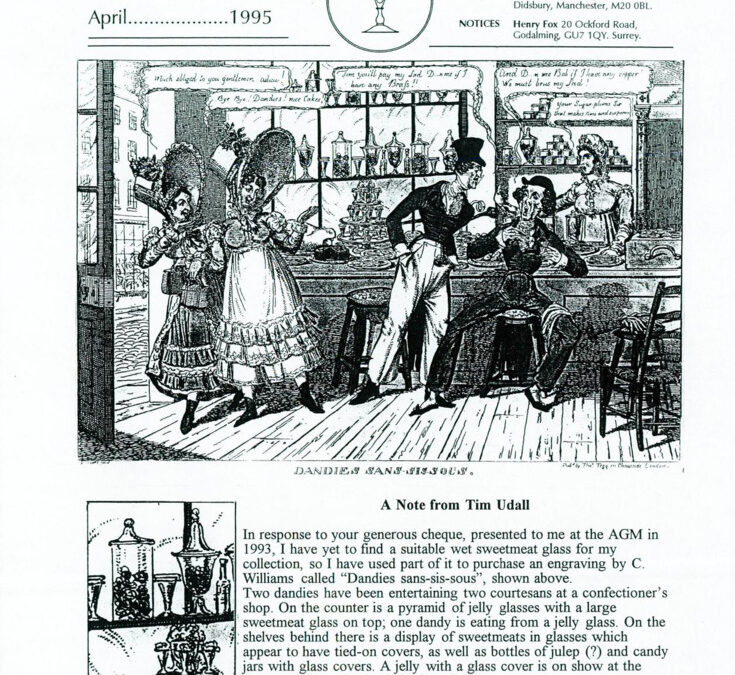
collection, so I have used part of it to purchase an engraving by C.
Williams called “Dandies sans-sis-sous”, shown above.
Two dandies have been entertaining two courtesans at a confectioner’s
shop. On the counter is a pyramid of jelly glasses with a large
sweetmeat glass on top; one dandy is eating from a jelly glass. On the
shelves behind there is a display of sweetmeats in glasses which
appear to have tied-on covers, as well as bottles of julep (?) and candy
jars with glass covers. A jelly with a glass cover is on show at the
Museum of London in their shop display.
This purchase only uses up part of the present and the hunt is still on
for a suitable glass; so if anyone spots an unusual jelly, syllabub or
posset glass for sale please let me know at Forge Corner, Troston,
Bury St Edmunds. 1P31 lEW. (Tel. 0359 269224).
:
!
1
P
–
,,•-
„,,,
,.
..
.”!
:
,:
k
#7
/00
,
1
g
Wal
l
,
•
Z
r
–
”
4
.’
‘
”
”
:
,’
.
USA. :
4
,
,
.
w
.
I
‘
1-“r-
i
iP7
•7%-
2″37–
”
•”•
‘
•
‘
”
.:
:
:
::
,;::
.:
‘
:
;
:•;’
,
Ii
i
“‘
7
.
g
•-
.
.^
.4
J.
.
r
t
.M
.
fa
……
a
uO
I
S
//
7
,
g
,
‘
,
il
l
“
.
4
‘
11
.
..
,,
,,,j/
,
/
,
/4
,,
Ad
0
/
,
.
N
I
O
NI
,b
,
/..
/wrgo.P
A –
,!
1
ii.n
im
iv.
9
n
–
,6
,
i
,
r
,)
,
A
Et
,
,
.,
,
ath
earoxixd
aMMY/
MOZ
ZI
GI
–
p
—
0
0
1
.
.
.
;
1’
…
,
..
A
v
eff
/
‘
”
1
„
‘:’
”
””
”’
-=
.
6.
”
,,”
,”‘
,
ff’
–
:
,.
O
A
MAW/
/0
Z7
,
. /
. 04
Q
r
i
f
.
7
..,,,,-
;;=x
:
1…
1
s
u
,
,,
f,
o
i
l
va
x2,
2
r
z
,
.„.
„
,„„/
.
:,,
,
,„„„,
„„,o,
„i,
,,
,fr
o
me
zer
sz
,
a
_
00
0
„
,,
,
,,..
.
0
,
,
r
aw
i
z
”
0
7
,
,
i.,
:,
,,
.
s:
‘
‘
i
!
1
.6
:
1
11
ErSZOld
a
Oal
i
ta
”
,
t
1
—
0
–
.
la
.
…
t
,
I
s
*.°
I.
P1
7
141
i
j
.
.
1
.,
u
°
I 91
V V
.
:.
.M
7
/
7
“°/
7.
0
M
Pr
i
f
/,
:
li
::
:
:::•
:::
.ffr
,’
; ”
:
:
, .
,
A
r
,
6
4
,,,
,,
/a
m
4
3
/
.
.
.
*
A
,ffer
krg
ss
..
M
A/
4
0′
4C
4′
aiti
Two other pits failed to provide further glass information
but took us back to the earliest occupation of the area
with worked flints, a ditch and a beautifully exposed
sinuous sandbank well worthy of a place in the Tate
Gallery when it occupies the Bankside Power Station
towering above us no more than a couple of hundred
yards away.
After three weeks it was sad to see the site covered with a
layer of protective gravel and then filled in. We said
farewell to Gary feeling that we knew just a little more
about archaeology and he a lot more about glasshouses.
We all hope a detailed dig will
be
financed and we shall
meet again in the future.
D.C.W.
1995
Page 2.
GLASS CIRCLE NEWS No. 62
Archaeological dig on the Apsley Pellatt Site
One morning recently an agitated Roy Bendry, one of our
new members, rang me to say that he had woken to the
sound of an excavator working no more than 100 yards
from his kitchen window. It was the noise of top soil,
actually rubble, being removed in a preliminary
assesssment of the archeological potential of the Falcon
glasshouse site, close to Blackfriars Bridge, by Gary
Brown of Preindustrial Archeology for the site’s new
owners. After being vacated by Pellatt in the 1874 the site
became Aps Cocoa Factory but has, for many years, been
a rough car park.
London archeologists are generally most interested in
Roman London and rapidly remove any Victorian
development, so the fear was that any Pellatt remains
would be lost. The fear grew when Roy found pieces of
pot with adhering glass on a spoil heap and it emerged
that Gary had little knowledge of glasshouSes. However,
he could not be faulted on his archeology. For the most
part the rubble was loose infill although one corner of the
dig revealed a transect through a dumped heap of glass.
With further clearing a complex of brick walls of a variety
of periods emerged and part of an early pavement. But the
central feature, some ten foot down, was clearly the base
of a furnace surrounded by burnt earth with a fuelling
tunnel approaching it from the north. Further south were
large brick structures that may have been the foundation of
a chimney, all very reminiscent of pictures of the Falcon
glasshouse except that the furnace base appeared too small
to be a main furnace. Although much is known about
Pellatt and his glass there is no known plan of the factory
and this was an important discovery. A more detailed
exploration could well reveal much of its complete layout.
The glass, a mixture of crushed cullet and factory blacks
and clippings, was of a high quality and all lead crystal,
some coloured or with enamel twists; samples had a
density around 3.2 the value quoted in
Curiosities of
Glassmaking
as typical.
A History of Glassmaking on the Thames South Bank, Pt. III
THE HENZEY AND BOWLES DYNASTIES
by David C. Watts
When Sir Robert Mansell took over the monopoly on
making glass with coal there were already members of the
Henzey family in Southwark, possibly involved in the
operation of the first coal-fired furnace to make window
glass. About the time he finally closed down the Wealden
furnaces Mansell set up a newcoal-fired factory for
window glass at Woolwich for Ananias Henzey who,
leaving his son Joshua in charge, went on to Stourbridge
to help set up more glassmaking there. Joshua had four
sons, all christened in Kingswinford, of whom three
initially helped run the Woolwich factory. The mainstay
was John while Joshua II became a merchant and Ananias
H went to seek his fortune (successfully) in Ireland. The
factory, overcoming setbacks described by Mansell in
1623, eventually flourished but with John’s death Joshua
II was obliged to take over. Later, he went to join Ananias
II in Ireland where he soon died. Ananias returned to
England and we find him working for John Bowles at the
Great Bottlehouse of St Mary Overy at the time of the
1695 duty on glass, discussed in the previous lecture.
The Woolwich factory closed in 1701 but some time
before this two London merchants, Robert Hookes and
Christopher Dodsworth, were granted a 14-year patent for
the manufacture of a superior window glass in Woolwich.
The site of a second glasshouse in Woolwich has not yet
been identified, hence this event may represent a financial
takeover of the Henzey factory. Significantly, they also
planned the takeover of glasshouses in Southwark.
Meeting of the
Glass Circle at the St
Alban’s
Centre,
High Holborn, London WC1. by the kind invitation of Dr
G.B. Seddon, Mr D. Stokoe, Mr J. Scott and Miss J.
Shadel Spillman.
In the meantime George Villiers, Duke of Buckingham,
had set up the famous Vauxhall glasshouse, upriver at the
other end of the South Bank glassmaking area, close to
where Lord Zouche had built the first window glass
furnace, in 1614/15, after the successful prototype at
Winchester Palace. With the Duke’s fall from grace, in
1667, John Bowles, then age 24 and endowed with a rich
inheritance from his father’s will, bought up the glass-
house although it continued to be known as the Duke of
Buckingham’s glasshouse and was so-called by John
Evelyn when, in 1674, he wrote the oft-quoted passage
about their making “huge vessels of metal as clear, thick
and ponderous as crystal”. (The nature of the glass, said
to contain borax, and its possible significance in the
development of lead crystal was then briefly discussed).
Following the prodigious success of the Vauxhall works.
Bowles joined with John Lillington (Lillingston), in 1671,
to set up a new factory at The Bear Gardens. The exact
position of the glasshouse has been identified, and is now
occupied by a derelict warehouse only yards from the site
of the recently discovered Rose theatre. The 1671
indenture tells us that the site had, in fact, already
contd. >
GLASS CIRCLE NEWS No. 62
Page
3.
1995
Death of Cyril Manley
Cyril Manley died on 19th December, 1994, only three
days before his 93rd birthday. Originally an engineer in
the early 1920s, making small metal fittings for Midland
glass firms, he became fascinated by the skill and artistry
of glass blowers. Like so many before and since, he
succumbed to the temptation glass has to offer and bought
a fine pair of vases by Bolton Bowater of the Plats Glass
Works, Amblecote. These and the results of more than 50
years of collecting are illustrated in “Decorative Victorian
Glass” along with pithy descriptions to help the collector
distinguish between local manufactures and continental
products. For the beginner there is no better book in this
area than his first-hand account.
Manley was also well known in America and, at a time
when Victorian glass had yet to achieve real popularity in
England, he wrote regularly for American antique
magazines such as The Spinning Wheel; some of his
articles were later published in bound form. Indeed, it was
a small comb-back colour book of his collection published
there (which rapidly went out of print) that paved the way
for his later opus. I enjoyed his company at a small lunch
party given some years ago by John Byrne, when he was
Managing Director of Webb Corbett (later taken over by
Royal Doulton), and can confirm an observation passed on
to me by Michael Vaughan that “He always had time to
waste with his friends”. What better epitaph.
D.C.W.
Thames South Bank History Continued
been a glasshouse and pothouse (pottery). Nothing is
known about this surprise discovery although this earlier
glass- house could have been occupied by the Caqueray
family of spun window glass makers, known to have been
resident in Southwark. This could explain the ‘invention’
of the famous Bear Garden spun Crown Window Glass
(perhaps using the Vauxhall glass formulation) which
superseded broad glass and unquestionably contributed to
the demise of Henzey’s Woolwich factory. More than one
glasshouse (for green
glass
and white glass) was set up on
this large site which unfortunately confused Francis
Buckley into thinking that the White Glass House at
Stoney Street (see later) was being referred to and was set
up at this time (some 70 years too early) – a confusion
propagated in every history since. The nature of the table
glass made was discussed with reference to the’Bowles
and Lillington’ sealed shard and that recently found at
Guildford with a bear’s head seal (see GC News 58).
The Bear Garden glasshouse was subject to the successful
takeover plot by Hookes and Dodsworth mentioned
earlier, the ramifications of which were discussed, but
Bowles, in about 1680, had transferred the entire window glass business to Ratcliffe (downstream on the north bank)
where it remained under control of the Bowles family
until its closure in 1795, after a truly massive fire had
destroyed part of the works and some 600 houses nearby.
A curious piece of wheeler-dealing involves one Henry
Richards who claimed that, in 1679, he went to Normandy
specifically to learn how to make Crown glass and on the
basis of which he applied for a patent. In effect, he was
trying to take over the Crown glass trade and put Bowles
out of business. But his claim was made not in 1679 or
1680 (when Bowles moved to Ratcliff) but 15 years later
in 1694! It emerges that Richards was connected with the
Bear Garden glasshouse and this was apparently an
attempt to capture the market by the new (Woolwich)
consortium, who had taken over the Bear Garden factory
only to discover that they could not make Crown as they
had anticipated. In this chicanery they were unsuccessful
and their main manufacture became looking glass plates.
The closing years of the glasshouse, which steadily
declined, and the Bowles involvement in it, if any, are still
only poorly understood; it is not shown on Rocque’s map
of 1746 and by 1750 the site had become a foundry.
We can now return to the Stoney Street glasshouses by St
Mary Overy’s church (see previous lecture). Following
the closure of the Great Old Bottlehouse in 1703, and its
conversion to a dwelling and warehouses, Francis
Jackson, who had been glassmaker in charge, moved into
the property next door which also formed part of Glass
House Yard and was linked by “a turning passage” with
Deadman’s Place. Here, with a John Eardley, he opened a
new glasshouse concerning which we have only one
reference, in 1710, but become inundated with
information in 1717 when William Bowles, John Bowles
grandson, is in charge and takes out the first of five
insurance policies, extending to 1745. (John died in 1709).
These detail the size of the glasshouse, confirm its
position and that it consisted of two houses known as The
Little Glasshouse (which made bottles) and the Flint
Glasshouse (which made a range of “pretty things”). This
venture prospered and Francis Jackson expanded into the
redeveloped bottlehouse dwellings, mentioned earlier,
possibly as showrooms since the glasshouse was featured
in the “Foreigners’ Guide to London” from 1729 to1763.
William died in 1748 but by 1744 the factory had already
been passed to his younger brother Benjamin. With
Benjamin comes the first evidence of making white
enamel for which this factory became famous although
the name “White Glass House” first appears only in 1747
(after the Bear Garden Glasshouse, with which it has
become confused, had closed down!). White (arsenic-
based) enamel glass was used to make a range of
snuff-boxes, jars, beakers, sauce-boats, salt-cellars etc.,
which could easily pass for porcelain by an “indifferent
judge”, as well as for dial plates for clocks.
The occupancy of the glasshouses by successive Jacksons
and Gerard Vanhorn can be traced from indentures and
newspaper records with reasonable accuracy until about
1766 when Benjamin Bowles died and brother Humphrey
(grandfather of W.H. Bowles who wrote the Bowles
histories) took possession. Both glasshouses had closed by
the end of the decade and, in 1772, it is reported that their
foundations were dug up to make way for the expanding
Borough Vegetable Market. The name “Glasshouse Yard”
persisted, however, until 1810; no evidence has yet
emerged for any other glasshouse in this area, essentially
the same site having been used for this purpose for close
on two centuries..
3123P31ED BY DE33GR
The
Firts and Crafts Collection of Manchester metropolitan University
MANCHESTER CITY ART GALLERIES Mosley Street until June 18th 1995.
A rare opportunity to see a little known Arts and Crafts teaching collection of exceptional quality. It includes important
works by such leading figures of the movement including William Morris, C.R. Ashbee, Walter Crane, and William De
Morgan. There are almost 200 exhibits including, besides glass, ceramics, metalwork, textiles, wall papers and printed
books; mostly acquired directly from the makers or through the contemporary Arts and Crafts Exhibition in London.
1995
Page 4.
GLASS CIRCLE NEWS No. 62
Anita Engle – Glass Historian Extraordinary
We learn with sorrow that Anita Engle died of cancer last
July. The following notes on her busy life were kindly
provided by her husband, Nelson Berkoff to whom we
extend deep sympathies.
Anita was a Canadian-born Israeli, brought up on her
father’s farm near Rumsey, in the foothills of the Rocky
Mountains. After working on the Calgary Daily Herald she
left for Palestine in 1936, from where she wrote articles
for the international press. During World War II she lived
in England, working in the Middle East section of the
BBC, in the Information Department of the Ministry of
Production and in the Youth Immigration Organisation.
She finally settled in Israel with her husband, a University
lecturer in linguistics, and two sons shortly after the State
was founded.
After a five-year interlude to write the very successful
“The Nili Spies”, subsequently dramatised on the BBC,
Anita was able to turn to her real passion in life, studying
the origins and development of the glass industry in
antiquity. Her interest was first aroused when she
discovered that Palestine had been a major glassmaking
centre, and that Jews were the glassmakers in Roman and
later periods as well, as she later discovered, as being
involved in the introduction of glassmaking into Europe
and the New World. Anita, herself, wrote
“It is impossible, however, to assess the role of Jews in
any field without considering the society in which they
live. . . . My studies, therefore have branched to cover the
whole of the ancient and medieval world, wherever the
glass has taken me.” In fact, she ranged far wider than this
making, among others, useful contributions to the study of
English glassmaking in the 17th and 18th centuries.
Her original research over the past 30 years, both in the
land itself and in ancient documents and records
worldwide, led her to produce in 1973 her own serial
publication, Readings in Glass History, published and
distributed by Phoenix Publications, Jerusalem. Her last
issue, No.23., was devoted to “An Intelligent Woman’s
Guide to Glass History”. Whatever the subject, they are
always a good read, thoughtful and provacative, with
every new idea or fact being analysed in depth to screw
out the last piece of information it contained right down to
the etymology of any terms involved. Family relationships
are exactingly resolved that others have glossed over. As
works of scholarship they rank on the highest plane and
stand as a lasting memorial to her ability. Today’s glass
historian ignores them at his peril.
Anita described her approach thus . . . “Most books on
ancient glass are written as if glass existed independently,
like a chandelier hanging from the ceiling, without contact
with people, country, politics, or economic conditions. But
glass was the product of all these factors, and this, I feel,
is the value (and the enormously extended interest) of my
particular work in this field
I have placed the most
important periods in glassmaking into their background;
have discovered their historical motivation, the human
element, and even laws and legends relating to
glassmaking in the Roman period. This not only makes the
story of glass much more fascinating, because it becomes
the story of mankind seen from a new angle; it also fills
gaps in the history of glass which until now have been a
matter of speculation only”.
Anita was a good friend of my first co-editor, Gabriella
Gros, and I was privileged to meet her just once, being
greatly impressed by her charm, modesty and, above all,
knowledge. She will be mourned by all who knew her and
her works.
8…e’,”971915′
by Henry Fox
Glass at the Royal Albert Museum, Exeter
Glass exhibited explores the craft of the glassmaker from
ancient Egypt to the present day, and examines the special
skills and techniques involved in the production of
glassware. Examples of different styles
–
from around the
world are on show, as well as displays giving details of
the most significant periods and places for the
manufacture and use of glass, such as the Roman Empire,
Venice, Germany, Bohemia, and 18th century England.
The House of Marbles, Bovey Tracey, Devon
Sited at the old pottery works, this house is now a glass
house open to visitors. There is also a small fascinating
museum, containing a range of antique glass.
Mompesson House, Salisbury
Situated in the Cathedral Close, this fine 18th century
house (property of the National Trust), has on permanent
display the important Turnbull Collection of early English
drinking glasses.
The Cecil Higgins Museum, Bedford
The fine collection of early glass, including Ravenscroft
pieces, will be well known to members, but a visit to this
museum is always a delight and a surprise. From 8th
August until end September there will be a display of
20th century glass in the foyer.
Pilkington Glass Museum
From 1st May 1995 an exhibition of Architectural Glass
by six North East artists is planned. The aim of the
exhibition is to extend public understanding of the history
and techniques of architectural or stained glass and inspire
new interest in contemporary work. This fine museum
dedicated to glass from all periods is always a joy to visit
and re-visit.
The Burrel Museum, Glasgow
Sited on the outskirts of Glasgow, this museum not only
presents a wonderful setting for the substantial collection
of antiques and fine art built up by one man but also has
on permanent display his interesting collection of good
early English drinking glasses.
The Liverpool Museum
The Curator of Metalwork & Glass writes that the
museum has some 1650 items of glass, and that the
collection is particularly strong in 18th century drinking
glasses. Currently the collection is being expanded by the
addition of modern glass. Members will be interested to
learn, too, that the museum has a large collection of
stained glass, which is being listed for the first time.
Ipswich Museum Suffolk
The curator advises that some 500 items of stored glass
from the 18th and 19th centuries may be viewed by
appointment.
Glass Clippings Continued >
GLASS CIRCLE NEWS No. 62
Page 5.
1995
Birmingham Museum & Art Gallery
The Keeper of the Applied Art Department has written
that a major acquisition during 1994 was a cut glass and
gilt brass electrolier by the local firm of F & C Osler. The
electrolier is now hanging in the Industrial Hall near to the
museum’s existing collection of smaller Osier pieces.
Some members may well remember the exciting display of
Osier glass furniture etc. shown at Mallets of Bond St. a
few years ago.
A Toast to the Stuarts
The Drambuie Liqueur Company owns one of the finest
collections of works of art associated with the Jacobite
period, notably an outstanding collection of engraved
Jacobite glass. As part of the 250th anniversary of the
1745 Rising, the Drambuie Collection will be exhibited at
several locations in 1995-6 to coincide with events of the .
time. First, from 2nd June at Kelvingrove Art Gallery,
Glasgow, an important exhibition entitled
Bonnie Prince
Charlie: Fact or Fiction
which will also include loans
from the HM The Queen, The Royal Armouries and The
Royal Museum of Scotland. Second, Jacobite Glass from
the Drambuie will be displayed from 5th-23rd July at
Traquair House, Peebles. Traquair House is still inhabited
by descendants of the loyal Jacobite, the Earl of Traquair.
Prince Charles visited Traquair in 1745 and the Earl
vowed that the gates of the house would never be
reopened until a Stuart sat on the British throne. They
have remained closed to this day.
Details of later venues will be published in forthcoming
issues of GC News. There are plans afoot to come “south
o’ the border”, including to Broadfield House.
At the Sales
Whilst the prices bid at auction for standard early drinking
glasses are in the doldrums, when it comes to rarity or
features of especial interest then the bids come thick and
fast. This was clearly demonstrated at Christie’s February
sale. An attractive air twist candlestick fetched £2600
(plus premium); a mammoth engraved rummer, circa 1840,
made £1600 (plus premium); a Beilby opaque twist wine
glass enamelled with a duck shooting scene went for
£6800 (plus premium); two canary yellow twist wine
glasses went for £11500 and £11000 (plus premium)
respectively. The former has a bowl with rare overall
honeycombed moulding.
Forthcoming Fairs
Jeanette Hayhurst will be at the Little Chelsea (27th-28th
March, Town Hall, Kings Road) along with Frank Dux
and Carol Ketley. She will also be exhibiting at Kings
Hall School, Taunton, 1st-2nd April. The next Olympia
Fair will be 8th-18th June where Mark West, Christine
Bridge and Jeanette Hayhurst will be showing their glass.
Open Weekend – London Glassblowing Workshop
On the 29th/30th April, 11 am – 5pm. Visit Peter Layton’s
fine new Showroom and Studio at 7, Leathermarket,
Weston Street, London Bridge, S.E.1. to see glassblowers
in action and receive a free raffle ticket with a chance to
win a glass- blowing class all to yourself (apparently
worth £75) and a chance to create your own masterpiece.
Plenty of bargains and lots of fun.
Some car parking. Nearest Underground station is
Borough on the Northern Line.
The Jacobites and their Drinking Glasses
Out at last, the much awaited opus on Jacobite glasses
by Geoffrey B. Seddon is now available from the
Antique Collectors’ Club (ISBN 1 88551492070).
Size 11.5 x 8.5 inches, it has 270 pages with 500 black
and white illustrations and 47 colour plates taken by
the author. Nearly 500 examples of Jacobite glass
have been recorded and analysed.
At £25.00 it sounds excellent value. We hope to
review it further in the next issue of GC News.
4MPT2, RE945e7961t5
;’eteft ,Zole
Autumn saw me making two unexpected visits to Bristol.
The first allowed only the most fleeting of visits to the
Bristol Museum; I was last there before the 1991 sales of
part of the Lazarus collection, which had formerly been
on loan. Even the briefest of visits made it clear that the
dispersal had still left a magnificent group of Lazarus
Glass in the Museum. A second visit a few weeks later,
unforeseen at the time of the first visit, permitted a
generous half day to be devoted to Glass.
I started with Harvey’s Wine Museum, where enjoyment
of the choice Glass is greatly enhanced by the ambience
of the medieval cellars in which it is displayed, and by the
association of so many related wine artefacts. There is,
too, always the temptation, to which I succumbed, of a
good lunch in the restaurant in the adjacent cellars; not
only are the food and claret excellent, but even with a
budget choice of menu and a single glass of fine claret,
the staff have that happy knack of making one feel an
important guest. With its own well equipped lecture
theatre, the Wine Museum would make a wonderful and
appropriate venue for a Glass Seminar, – given a generous
sponsor !
After lunch I had a serious session at the Bristol Museum;
there are not only the expected treasures, like the Isaac
Jacobs decorated blue Glass and the privateer Glasses, but
also an unexpectedly large crop of dated Glasses.
Eighteenth century Glass with a wheel engraved date is
relatively uncommon, surprisingly so in comparison to
ceramics. I have only assembled a note of fewer than
seventy Glasses so dated; of these, eleven are in the
Bristol Museum and one at Harveys, so almost a fifth of
my total is situated in Bristol, including the earliest, the
`Benjamen Hawkins 1742 ‘ wine Glass. ( I have, of
course, dismissed all the Williamite ‘1690 ‘ Glasses as not
bearing contemporary dates, irrespective of Peter Francis’
revelations.) By way of contrast, a single exhibition of
ceramics, the Northern Ceramic Society’s 1993
exhibition: ‘Made in Liverpool ‘, shewed eighteen dated
items from the period 1750 – 1800, exactly ten percent of
the eighteenth century pieces displayed. For both Glass
and Ceramics the peak period for dated items seems to be
1755 to 1775, although the frequency starts to increase
again in the second half of the nineties and on into the
nineteenth century.
The other unexpected strength at Bristol is engraved Glass
commemorative of political events and elections, quite a
number also being dated. Both museums have variants of
the ‘Sir Francis Knollys ‘ Glasses, dated 1761; an
Oxfordshire man, elected as MP for Reading in that year,
Knollys seems to have had no Bristol connections.
Perhaps, as Karin Walton of the Bristol Museum remarks,
this concentration merely reflects the guiding hand of
Peter Lazarus. Now that Geoffrey Seddon’s work on
Jacobite Glass is an accomplished fact, some one might
tackle the election and other political Glass, perhaps also
relating it to its ceramic cousins.