




No. 63
June
1995
EDITORS David C. Watts
27 Raydean Rd,
Barnet, EN5 IAN. Herts.
F. Peter Lole
S Clayton Ave.
Didsbury, Manchester, M20 6BL.
NOTICES Henry Fox
20 Ockford Road,
Godalming, GU7 1QY. Surrey.
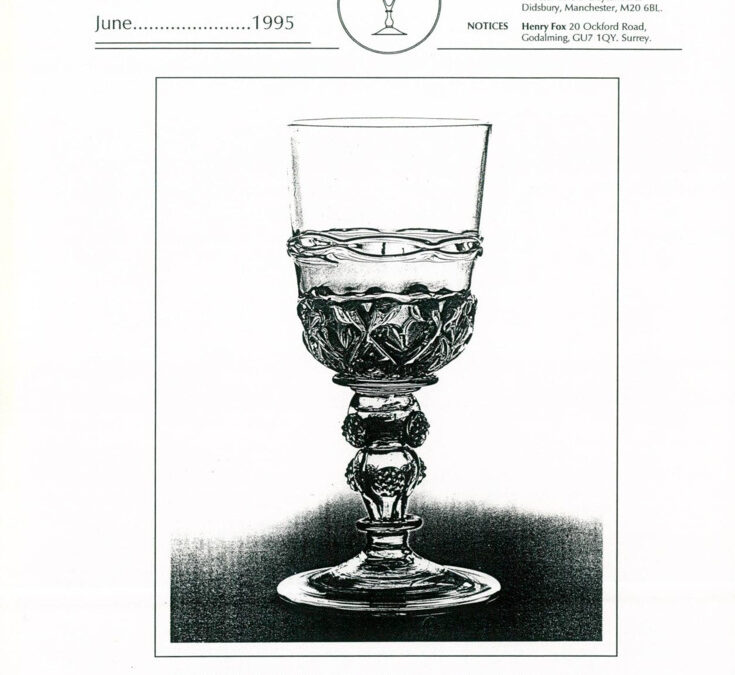
Early English coin goblet decorated with chain trailing, nipt diamond waies and raspberry
prunts. The coin is a silver groat (4 pence piece) dated 1687. Height 7% ins.
GLASS CIRCLE NEWS
The goblet is currently on display in the new
Europe 1400 AD – 1800 AD
Gallery (Room 46) at the
British Museum. Photograph (BM Copyright) supplied and reproduced by courtesy of the Trustees.
See Page 7 for details of a Southwark walk to
see
the glassmaking sites – on Saturday September 2nd.
1995
Page 2.
GLASS CIRCLE NEWS No. 63
The Prancing Horse Glasses
by F. Peter Lole
I recently acquired the two booklets produced by our
member Mr. F.G.A.M.Smit, on Frans Greenwood and
Jacob Sang. Two of the matters central to the author’s
subject I found especially interesting; the revelation about
the large numbers of signed and dated Dutch eighteenth
century engraved Glasses, and a quotation from a 1753
issue of The Amsterdam Courant, that: – ” Jacob Sang ….
engraves and cuts English goblets …. “. This last comment
has slightly abated my scepticism of the so called
Newcastle Glasses.
But an intriguing sidelight which emerged related to the
prancing horse Glasses. Srnit writes in his book on Frans
Greenwood: ” A galloping or springing horse is usually a
symbol of Freedom. Its portrayal in the eighteenth century
does not, as is often assumed, always relate to the White
Horse of Hanover.” He also illustrates quite conclusively
that the motto `AUREA LIBERTAS ‘ and its Dutch
equivalent ‘DE GULDE VRYHEYT ‘ are by no means
confined to political endorsement of the Hanoverians.
Shortly after the last war I spent most of my National
Service in Germany. For a year of this period I was
stationed near Brunswick and wore on my shoulder the
embroidered badge of the White Horse of Hanover, as the
divisional insignia. Ever since then I have almost
inevitably viewed the representation of a prancing horse as
being emblematic of Hanover and of the Guelphic
occupiers of our British Throne; I am indeed an
unregenerate victim of the very trap against which Smit
warns !
Smit’s booklets make it self evident that his warning, in
relation to Dutch Glass engraved for the Netherlandish
market, is wholly justified. But is it as valid for Britain ? It
seemed worth having a look at those Prancing Horse
Glasses in this country of which I could find a note. There
proved to be more than I had realised; a rather arbitrary
trawl through my notebooks, sales catalogues and my
library revealed thirty one references, which after allowing
for possible duplication, cover at least twenty Glasses.
These fall into two groups; the larger one has the motto
`LIBERTY ‘ or in a couple of cases ‘GEORGE and
LIBERTY ‘. The other group bears the Latin motto
`AUREA LIBERTAS ‘ and there is one Glass with the
Dutch version, ‘DE GULDE VRYHEYT
The group with the English motto is remarkably
homogenous; there are only two Glass types; a round
funnel bowl on a double knopped airtwist stem (The
construction is always a shoulder knop together with a mid
stem knop), or alternatively an ogee bowl on a tightly
twisted air stem. All the Glasses have plain feet and are 6
to 63/4 inches in height. The motto invariably surmounts
the prancing horse and is carried in a ribbon with flying
forked ‘pennant ends’ to it. The reverse of all these
Glasses (numbering between 13 and 24 depending on the
amount of double recording, which I cannot really resolve)
carries a six petalled rose, without a bud, but generally
with up to six leaves. The rose varies, from the normal
unpolished form with merely a ring of polished highlights
to represent stamens, through an example with rather more
polishing to emphasize the details, to the ‘outline’ rose
which is almost completely polished. The stem and foliage
is always completely unpolished. The polished rose is the
usual form on the straight stemmed glasses, and whilst it
does occur on at least one of the double knopped stems,
the unpolished rose is the norm on these. The photographs
available suggest that the form, layout and lettering are
sufficiently consistent to indicate a single engraver, but the
photographs are too few and too variable in quality to be
certain. Good illustrations may be seen in Bate, Bickerton
and Bles, and in some auction catalogues. The Fitzwilliam
has one of the only significant variants, with the motto
`GEORGE and LIBERTY ‘ in a wavy ribbon where the
central ‘and ‘ is raised up; the Glass is one of the straight
stemmed group, and is illustrated in Glass at the
Fitzwilliam Museum (item 266B), whilst Francis
Buckley’s English Glass (P1 XXIX) and G.B.Hughes
English, Scottish and Irish Tableglass (Fig 75) both
illustrate a very slightly different Glass, from the Hamilton
Clements collection. Not only is the motto of this whole
group in English, but the engraving has an ‘English look’
to it.
After the preceding paragraph had been written, Geoffrey
Seddon’s book on Jacobite.
Glass has appeared, with an
excellent series of photographs of two of these Glasses.
(Plates 134 & 135) One of the Glasses conforms to the
double knopped stem description above. The other,
however, is clearly by a different engraver; whilst the
general pattern remains the same, the rose has two buds
(one severed) and is in this respect unique.
Since all the above group have an enribboned motto, it is
worth commenting here on the use of such enribboned
inscriptions. During last year’s V & A symposium
Looking into Glass, Peter Francis asserted in relation to the
Williamite Glasses that the use of ribbon scrolls to enclose
inscriptions was not an eighteenth century feature, being
used mainly in the 1820 – 1830 period. However this view
is scotched by a quick analysis of the printed ceramics
illustrated in David Drakard’s invaluable Printed English
Pottery 1760 – 1820, which shews that of some 260
inscribed ceramics of the 1760 – 1800 period, 72 had
inscriptions within a ribbon scroll.
Those Glasses with a Latin motto are much more variable,
and I have only found seven of them (excluding Smit’s
1752.2, which is in Holland). Of the Glasses themselves,
the bowls are all round or straight funnels, either on
`Newcastle’ light baluster stems, usually with a domed
foot which is sometimes also folded, or on a seven or eight
faced pedestal stem with various foot forms. They are
taller, at 61/2 to 71/2 inches, than the English group. The
motto may be either above or below the horse; only in one
case is it enribboned. The horse is flanked by flowers or
shrubs, in one instance together with birds. For those
where there are adequate illustrations the engraving seems
more akin to Dutch than English work.
What may one deduce from all this? Firstly, the dates; the
English group would seem to fall into the 1740 -1760
period, when much effort was being devoted to countering
Jacobite artefacts of various sorts. The Latin group
apparently start earlier, and with the ‘Newcastle’ stems,
may finish later, possibly well into the reign of George III.
The English group I feel quite sure are Hanoverian in
intent, as the GEORGE and LIBERTY specimens
highlight. As to the Latin/Dutch group I am less sure.
Indeed the single example with the Dutch inscription DE
GULDE VRYHEYT brings one again to the more general
question; why, and when, did so many Glasses with Dutch
inscriptions come to this country ? Perhaps Smit’s
comment that the prancing horse is not necessarily
Hanoverian is valid in this country, too, in respect of this
last group? But, equally well, it could be that the Glasses
produced with the intent of portraying Freedom in an
abstract sense, were adopted by Whig partisans as a
convenient symbol for the Guelphs, just as rose
ornamented ceramic wares intended purely as pleasing
decoration were, and still are today, adopted by some
families as emblematic of their Jacobite leanings. *
Part of an early map of
Lambeth and Christ Church,
annotated to show the glass
cone, for Strype’s edition of
Stow’s survey, 1755.
Courtesy of Dr Watts
Meeting of the Glass
Circle held at the
Artworkers’ Guild by
Kind invitation of
Mr and Mrs Homer and
Dr David Stuart
GLASS CIRCLE NEWS No. 63
Page
3.
1995
The Falcon Brick Cone Glass House: t
alter revolution of 1688
by
Roy Hendry
The unique all-brick cone-shaped glasshouse
is universally accepted as first appearing in
the latter part of the 17th century, although
where this took place is a matter of
conjecture. That such a prominant piece of
landscape architecture of seminal importance
to the development and dominance of English •
glassmaking in the 18th and 19th centuries,
should emerge unrecorded is quite
extraordinary, and although the basic shape
and utility lasted for some 300 years it was
never patented.
In investigating how this came about our
speaker suggested that the very first
glasshouse cone was built in Upper Ground on
the south bank of the Thames (roughly
beneath the approach road to Blackfriars
Bridge) in the parish of Christchurch at the
western end of Southwark, almost opposite St
Paul’s Cathedral. Its instigator was Francis
Jackson, already owned glasshouse^ on a
nearby site by the Falcon Inn. The history of
the site and of the Jackson family was
outlined including the recording of opposition
to the new building by local washerwomen,
who feared its smoke. Views of the cone in
prints and pictures by several different artists
were shown and and a possible connection
with a building shown in a contemporary map
of Kings Lynn, where the Jacksons had
another glasshouse, was also discussed. The
novel sugestion was made that the inventor of
the cone, a significant architectural
achievement at that time as many subsequently
fell down, was Sir Christopher Wren who, at
about the time the cone was built, employed
the same device to support the dome of St
Pauls Cathedral – a marked sudden departure
from his proposed building plans some ten
years earlier. Wren undoubtedly knew
Jackson.
A further connection involving Jackson
emerges with the first glasshouse cone in
Dublin and may relate to the activities of a
man called Edmund Heming who was active
in developing street lighting sytems in both
London and Dublin. Mr Bendry’s lecture,
which was supported by numerous pictures,
some drawn by the speaker himself, attracted
considerable discussion and provided a most
entertaining and stimulating evening.
This talk will be presented in full in the next
issue of The Glass Circle Journal. 0
The Lasting Influence of Venice on t
esign of Englis Glass
by Christopher Sheppard
By way of introduction our speaker began by explaining
that in the 17th century, for those who could afford it, the
overwhelming desire was to own cut and engraved rock
crystal. As a result a severe shortage developed which, in
turn, stimulated the search for a glass alternative. Up to
that time Venetian glass had been the best in the world,
highly expensive and greatly coveted. Craftsmen from
Venice and Aleppo, seeking their fortune, brought
glassmaking to Antwerp, Nijmegen, Mastrich and
elsewhere but many settlers adopted the protestant religion
and, as a result, suffered Catholic persecution. By contrast,
England had a relatively permissive attitude which led to
the arrival of glassmakers in this country. The result was
that Italian styles were adapted and modified on both sides
of the Channel, the country of origin becoming difficult to
resolve.
With the Restoration of the Monarchy the Duke of
Buckingham adopted the improved glass formulation
invented in 1661 by Clifford and Paulden for his coal-fired
Vauxhall furnace. Further developments by Ravenscroft
resulted in lead crystal with its great clarity and refraction
and improved cutting properties closely simulating rock
crystal, the main goal of the inventor.
The glass collectors in the early decades of this century
had a strong natural desire for their pieces to be English
resulting in erronious attributions and dating which still
confuse many collectors (and dealers) today, a conclusion
reinforced by his own study of this difficult period over
many years. Robert Charleston, in particular, had warned
about the too confident dating of English glasses.
Mr Sheppard then launched into the main body of his
lecture, comparing by means of an extensive series of
slides, glasses from the Ravenscroft period onwards,
Meeting of the Glass Circle held at Guy’s Hospital Medical
School (UMDS) on the 18th May 1995, at the kind
invitation of Dr and Mrs Watts, vinous refreshment being
provided by the speaker.
beginning with the roemer, a Dutch shape, and the globe
and shaft decanter. Characteristics considered were nipt
diamond waies, gadrooning, threading and the application
of handles. All these features were used repeatedly well
into the 18th century, making an early attribution difficult.
English handles are always solid while a hollow handle
probably indicates a continental origin. They may be
applied on top of the nipt diamond waies or the threading.
A punch bowl with nipt diamond waies and incurved rim
might equally be attributed to the end of the 17th century
or well into the first quarter of the 18th century.
Gadrooning was used as a decorative device into the 19th
century and could mislead on the bowl of a ladle and
handled mugs in particular. Similar problems arise with
threading although the threads tend to get closer in later
pieces. One gadrooned mug, at first attributed to the early
19th century, from subsequent discussion of what appeared
to be close threading applied by machine, should more
probably be dated some 50 or 60 years later. Hence even a
late attribution might require further consideration. A
series of goblets containing coins of different dates,
spanning the 176/18th centuries, but with generally
similar decorative features provided another example of
the problem. A crown finial could suddenly reappear a
century later.
When one moves into the 18th century the problem of the
country of manufacture introduces a new dimension.
Newcastle light balusters possibly made in Holland,
Bohemian and Dutch engraving on presumed English >
1995
Page 4.
GLASS CIRCLE NEWS No. 63
NPN BOOKS
Five Thousand Years of Glass
(with new revelations on the fakers’ art)
Edited by Hugh Tait
I was surprised to discover that I first reviewed this
volume in GCN No.51 November 1991. How time flies!
The present paperback edition shows the same high quality
with all the 266+ plates in full colour as in the original
edition. It retails at the bargain price of £16.99 in the B.M.
shop or P+P £1.90 from British Musum Press, 46
Bloomsbury Street, London, WC1B 3QQ. Modern
computer technology has made it possible to make minor
corrections and update the information in connection with
the difficult problem of fakes. It appears that the fakers
were far more subtle than one might imagine if the reward
was big enough. Hugh has kindly provided notes on this
matter which I quote:
“Since the first edition was published in 1991, the
scientific analysis of dubious “masterpieces” of glass has
continued in the British Museum’s Research Laboratories
with two important results.
la) The famous Bonus Eventus plaque imitating lapis
lazuli (pl. 10).
First published in 1818, it had been acquired
in Rome for Charles Townley’s great collection of
classical antiquities (formed 1737-1805) and brought back
to England where much of it was subsequently acquired by
the B.M. Until recently, its Roman origin (“perhaps 1st
century A.D.”) had not been questioned but tests now
establish that it was
pate de verre
and that, in virtually
every aspect of its chemistry and technology, the piece is
anomalous in the context of Roman glass. It is, however,
fully acceptable as a product of a late 18th century
European glass workshop. It is composed of pieces of
glass and fit of several compositional types, all of which
have been pressed into a mould and heated until the softest
glass has melted and flowed between the others, causing
them to adhere.
The copying of gemstones in a glass paste was a particular
skill that a few late 18th century craftsmen, like Luigi
Pichler (in Rome) and James Tassie (in England)
developed so successfully. Significantly, Townley acquired
it as a rare lapis lazuli cameo plaque; it was not recognised
as glass (imitating lapis lazuli) until much later. As an
exceptionally large hard-stone cameo of Roman origin, it
would have commanded a diproportionately high price
among collectors of the late 18th century – hence it was
worth the fakers time and effort.
lb) The enamelled “Persian 16th century bowl (p1.10a).
Acquired in 1889 by the B.M., this bowl (illustrated in the
book in colour for the first time) has long been regarded as
the product of the glass industry of Persia, reputably
established when Timur (Tamberlane) forcibly removed
the glassmakers from Damascus and Syria during his
conquests of c.1400 A.D.
Scientific tests confirm that the bowl is a genuine, plain
Hellenistic bowl (probably 1st century B.C.) to which has
been added in recent years (before 1889) both gilding and
enamel colours. The style of the polychrome decoration is
close to Persian miniature painting of the 16th century; its
addition by modern craftsmen, without damaging the bowl,
required considerable skill and it would be valuable to
identify the workshop – perhaps in Paris.
2) Clear glass beaker with decorative prunts between two
trailed bands (p1.189a).
This beaker was found at Kerch
in the Crimea, Ukraine, with a mixture of Mongolian
coilns (ranging between approx. 1313 and 1373). Formerly
published as Islamic (Syria or Iran), recent research has
lead to its re-appraisal as being of possibly European
origin in the first half of the 14th century. Although it had
seemed likely that it was exported to the Crimea, where
European traders (especially Italian merchants) were active
at this time, new evidence, based on recent archeological
discoveries, is emerging to indicate the presence of a local
glass industry capable of producing work of this high
quality and fine proportions.
Antwerp “facon de Venise” in the mid-16th century.
3a)
The “Catalogue Colinet” (caption to p1.212).
This
illustrated MS pattern book, previously published as a
contemporary 16th century record (with many sketches of
glasses) of the products of the Colinet glassworks at
Beauwelz, has been brought from the Rakow Library to
London for study and now “can no longer be regarded as
authentic”.
3b)
The unique “sandwich” armorial tazza (pls. 207-208).
This Slade collection tazza, in the B.M., has two
polychrome coats-of-arms, both of which have been
identified by a continental expert on Netherlandish
heraldry (kindly communicated by Anna-Elizabeth
Theuerkauf-Liederwald). As a result, it is possible to
associate this elegant tazza with the marriage of Giles
Happaert of Antwerp in 1559, thereby confirming its
recent attribution to
a facon de Venise
workshop in the
Southern Netherland in the mid-16th century.”
Browsing again through the admirable technical section by
Bill Gudenrath I was reminded of Christopher Sheppard’s
lecture when I came across his demonstration of making
nipt diamond waies which is more subtle than appears
from the finished effect. Circle members will, no doubt,
treat the sudden appearance on the market, without
provenance, of any so decorated fine late 17th century
tableware with appropriate caution!
Members might like to know of the companion volume
Seven Thousand Years of Jewellery,
also Edited by Hugh
Tait, just published in paperback and selling for the same
price. This covers from the Middle East 5000-2000 B.C. to
1950 and absolutely everything in between, with 250
colour illustrations and 150 in black and white. As before,
top class experts from the British Museum are involved.
Both these volumes have separate editions for Canada and
the USA.
D.C.W.
Christopher Sheppard, Concluded
glasses, English opaque twists made in Norway by an
emigrant from Newcastle, and Irish cut glass all raise
questions of national origin. These are matters the early
collectors largely chose to ignore. Today we might ask can
we ever deduce where a piece was made without any
known provenance.
After some general discussion a vote of thanks was given
by Dr Watts who reminded members of Robert
Charleston”s maxim that all the features of a piece must
come into the final assessment including the colour which
was particularly white in early lead glass but rapidly
deteriorated when it came into general use at the end of
Ravenscroft’s patent. Christopher Sheppard had, however,
blown a large hole in the bulwark of early dated pieces and
provided much for serious thought in the future. His fine
collection of slides was particularly appreciated. The
lecture was received with warm applause.
e
GLASS CIRCLE NEWS No. 63
Page
1995
FROM MYTH TO REALITY
An Intelliqent Woman’s Guide to Glass History
by Anita Engle
It is a salutory fact that writing an academic book is, in
itself, unlikely to raise more than a ripple of interest in
those educated enough to understand its content, even if it
makes a significant contribution to factual knowledge,
unless it threatens in some way the well-being of the
reader. The subtitle of the present volume is a respnse to
just such disinterest, it being taken from Bernard Shaw
who, despairing that any male politician would listen to his
logic, turned to the more responsive attitude of the other
sex. Likewise, Anita Engle’s complaint is that not one of
this series has appeared in bibliographies of professional
literature on the subject. If true, it is something of a slur
on professional males as there is no shortage of females in
this field.
The real reason is probably that in this day and age new
information worth its salt is generally published first in a
peer-reviewed, recognised journal or, as in the case of E.
Godfrey’s book,
The Development of English
Glassmaking,
as a degree thesis. Further, the average
author need strive to place it under the very noses of
interested professionals by presentations at conferences
and the like. Even so, knowledgeable amateurs must
expect to be treated as second-rate citizens if they lack the
appropriate qualifications; professional status is jealously
guarded in any field. If, then, Anita’s contribution over the
years has any value – and in this amateur’s view it has
much – then it will eventually surface.
The main problem with
Readings is
her often barnstorming
approach which can make for tough reading, particularly
for those unfamiliar with ancient and Jewish history or any
sensitivity towards linguistics. For this reason one hesitates
to recommend them to the novice in glass while the depth
and breadth of her writing provides valuable infill for
those with more experience, challenging the reader to
accept or reject her theories according to their own grasp
of the subject. The present volume does just this, both
reappraising information from earlier volumes and
injecting new ideas.
If this volume has a female slant, and who am I to judge,
it is the links with agriculture and ancient emerging “home
economics”. The first chapter is concerned with Pliny’s
much relished but generally disbelieved story of the origin
of glassmaking by the river Belus, an area with which the
author had first-hand experience. Her reasoned conclusion
is that the fire was not for cooking but more probably in
conjunction with a religious ceremony for placating the
celestial controller of cereals. If this should sound
frivolous we are later introduced to an exemplary, if
mysterious, example where a large layer of ice-green glass,
several centimetres thick, appears to have been made by
burning a huge bonfire of chaff.
A complete list of titles, chapter headings and prices for
the entire series of READINGS IN GLASS HISTORY
can be obtained from D.C.W. by sending a stamped and
self addressed A5 envelope plus a stamp for 25p (for
cost of photocopying).
READINGS IN
GLASS HISTORY
VOLUME 27
Chapter 2 presents thoughts on Egyptian glasses and their
shapes (fish, palm, pomegranate), in relation to the
Isis-Osiris-Adonis myth cycle, centring on the Byblos and
Akko areas, the conclusion being that Egyptian glass was
never for mundane use but always had a deep mystic
significance. The Egyptians did not invent glass and for
that we go (chapter 3) to the Nuzi, or Hurrians, in the Old
Assyrian Kingdom. Early archeological finds are dicussed
and compared with other Phoenecian craft products.
Protective symbols of the gods on pottery bowls have
parallels in glass. Here too, first appears the mysterious
chain pattern with a line running through it, a decoration
characteristic of the Ravenscroft period (see Christopher
Sheppard’s lecture summarised in this issue!).
Chapter 4 deals with the mysterious layer of glass
mentioned above while chapter 5 looks at more
technological aspects of glass making, their religious
associations andthe related trade routes. The final chapter,
Glass under the Moslems,
comes back to the Belus area
and Mrs Engle compares the decorative patterns on glass
shards that she has collected there with known specimens
and considers their possible significance. Glass was clearly
made in the Belus area as well as its sand quarried.
Overall, this volume is an entertaining read that stimulates
the critical faculties rather than reiterating dogma. We are
moving into a time when it is becoming fashionable to
attack the tenets of the past. Anita Engle, on the other
hand, presents a more integrated and constructive look at
glassmaking in antiquity rather than a bald account of the
objects discovered.
The book has several maps, is profusely illustrated and has
a useful bibliography. Its 103 pages are in the same format
as previous volumes. Write to Phoenix Publications,
Jerusalem. P.O.B. 8190, Jerusalem, Israel. Price $16 +
Postage + Registration $2.50.
D.C.W.
“Not To Be Sneezed At”
Guildhall Library, London. until 31st August 1995.
Admission Free.
Thinking of Paul Hollister’s contribution to “5000
Years…” reminded me of the excellent lecture he gave
the Circle on the Crystal Palace a few years back. This
small but captivating exhibition of 28 old handkerchiefs,
up to 30 inches, or so, square, decorated with contem-
porary prints includes several with illustrations of the
Crystal Palace as well as The Coronation of Queen
Victoria and London Sights. There is also a
Cab Fare
`chief and an 1813
Century of Invention
‘chief illust-
rating what life will be like in 2000 A.D. If true, we
would still be driving in steam cars, flying in baloons
and lighting our houses with supergas! If you have
never been in the Guildhall Library with its highy
tempting bookshop it is well worth a visit.
1995
Page 6.
GLASS CIRCLE NEWS No. 63
“THE JACOBITES and their DRINKING GLASSES.
by Geoffrey 13. Seddon
“. ISBN 1 85149 207 0 The Antique Collector’s Club.
ce45. 268 pages, 210mm x 270mm, printed on Consort
Royal Art paper.
Somewhat surprisingly, this is only the third Glass book to
incorporate ‘Jacobite ‘ into its title. The first was Grant R.
Francis’ “Jacobite Drinking Glasses.” of 1925, which was
simply a reprint of his 36 page article in The British
Numismatic Journal for 1921; this seminal work drew
attention to some nine Jacobite medals (six of them struck
by the Roettier family in France) as probable sources for
images and mottoes on Jacobite Glass. Of the second
work, Arnold Fleming’s “Scottish and Jacobite Glass.” of
1938, the less said the better. The third, Geoff Seddon’s
beautifully produced book, is the only full length book to
cover the whole field of Jacobite Glass and its relationship
to the Jacobite Cause.
The first quarter of the book is given to a history of the
Jacobite Cause during the century from the ‘Glorious
Revolution ‘ of 1688 to the death of Bonnie Prince
Charlie exactly one hundred years later. The balance of
the work is devoted to the Glass. Inevitably, a major
contribution is expansion of the work already published in
The Glass Circle Nos: 3 & 5, supported by a mass of
lusciously illuminative photographs; those photographs
which appeared in the two issues of The Glass Circle were
very fine, but the reproduction here is significantly better.
GBS’ own photographs of Jacobite Glass are
supplemented by evocative colour photographs of Glass
from the Drambuie Collection; the Drambuie company
sponsored this book by the provision of these fine colour
photographs, but one has to say that the detail of the
engraving comes out much better in Seddon’s own black
and white prints. Particularly in the case of the Amen
Glasses, the photographs are far more ‘readable’ than the
Glasses themselves.
The characteristics of the work of the five major
engravers, responsible for 61% of the engraving studied
by GBS, are well explored, explained, illustrated and
tabulated, and must facilitate further consideration of other
facets of Jacobite Glass. Almost a quarter of the book is
devoted to the Amen Glasses, wholly justified by their
political importance and difference from the mainstream
wheel engraved Glass. The prospects of discovering more
of the earlier history of some of these Glasses, together
with the explicit relationship of some of the engraving to
Scottish Jacobite families and individuals calls out for even
more work in this field.
Not much space is wasted on speculations about those
flowers so often listed as ‘of Jacobite significance ‘. The
Rose, Thistle and Portrait Glasses, together with their
mottoes, are those considered in depth. GBS puts forward
his own interpretation of the significance of the Rose with
its one or two buds, without labouring it unduly; the
absence of contemporary evidence on this aspect does
leave one wondering whether there really was a uniform
and widely accepted meaning beyond representing the
Stuart family and its rightful sovereignty. The other
contentious area is that of dating; GBS reiterates his view
that the major period for Jacobite Glass preceded the
events of 1745, although he allows that some, if not all, of
the portrait Glasses extend well beyond Culloden. Despite
his well argued case I remain unconvinced; the parallel
case for the dates of both Jacobite medals and ceramics
supports the traditional post Culloden dating.
Geoff has done all those of us interested in Jacobite Glass
an immense service in illustrating, both visually and
textually, the characteristics of so many Glasses; from now
on much of our discussion can rest on firmer foundations.
For those whose informed interest has hitherto excluded
Jacobite Glass, the general background is well explained,
the detail is good without being overwhelming, and the
illustrations will both arouse the covetousness of all
collectors and assuage their need to know what to look for.
Any book evokes some regrets, and personally I wish that
the location of Glasses illustrated had been given (except
of course where security forbade it) and secondly that there
had been more consideration of the hoards of Jacobite
Glass in what seems prima-facie to be their original homes.
The real regret, however, is that the publishers, having
advertised the book at £25, at the very last moment
decided almost to double its price to £45. Those members
of The Antique Collectors’ Club who took up the
discounted offer based on the original, lower, price, got a
superb bargain; those of you who buy it at the issued price
will still get a rare prize. FPL. April 1995
F.P.L.
(Taken from an Old Pretender Glass, 17 5.)
God Bliss the subjects all
And save both great and small
In every station.
That will bring home the King
Who hath best right to reign.
It is the only thing
Can save the nation.
Anon.
JACOBITE GLASSES.
MADE AT NEWCASTLE-ON-TYNE, 181’11 CENTURY.
Problem? Does any member know where to find the glass
with the above inscription or any thing about it?
Reproduced from
The Company of Glass Sellers
by W. Ramsey, 1898, by courtesy of The Guildhall Library, London.
GLASS
CIRCLE NEWS No. 63
Page
7.
1995
A Walk to see the Glass House Sites of Southwark:
Saturday 2nd September, 1995.
A joint outing with the south-east region of the Glass Association . . . organised by Dr D.C. Watts.
The % mile or so strip of Southwark between Blackfriars
Bridge and London Bridge along the south bank of the
River Thames is historically one of the most concentrated
in all England in terms of its past occupancy of glass-
houses from the 17th through the 19th centuries. Six sites
were occupied by as many as 13 glasshouses and possibly
more (exclusive of another seven or so if the coverage is
extended from Vauxhall to Woolwich). The objective of
this walk is to visit these sites and refresh our memories
about their past history before they are swallowed up in
redevelopment.
Southwark has, of course, other important associations as a
recreational area and, in passing, we shall take in the sites
of the Swan, Rose and Globe theatres and see the new
Globe under construction next to where Ann Boleyn
stayed when she first arrived in London as wife of Henry
VIII, and Sir Christopher Wren is thought to have stayed
(probably apochrophally) when he rebuilt St Paul’s
Cathedral. Then there’s the Bishop of Winchester’s
brothels for the poor and Holland’s Leaguer for the rich,
and The Clink for any one the old Bish took a dislike to,
adjoining the remains of Winchester Palace. Fine views of
the river, as we perambulate, are a bonus.
We
shall start at 10.30 am
with coffee, courtesy of Roy
Bendry at his flat overlooking the river and see his
extraordinary collection of glass lumps rescued from the
adjacent Thames mud. Perambulation begins at 11.00 am,
reaching The George, 1676 galleried coaching inn, about
12.30 pm to partake of necessary refreshment (purchased
individually, cost £3-4 to taste). After lunch, a short walk
takes us to St Thomas’s Hospital “Old Operating Theatre
and Apothecaries Museum” (with a little medical glass) in
the roof space of tiny St Thomas’s parish church. From
here we shall visit Guy’s Hospital’s unique 18th century
chapel with 20th century rare
opus sectile
panels by
Whitefriars and John (grandfather of the Circle’s founder)
Bacon’s fine memorial to Guy. Then across the Guy’s
campus and through the backstreets, once ropewalks, to
the Old Leathermarket to conclude our walk at Peter
Layton’s workshop to see his new premises with glass
blowing in action and hopefully a cup of tea.
Numbers are limited to about 20 and
will be
accomodated on a first come, first served basis. The
charge for the walk is £3.00 per head to cover expenses,
museum entry and a small pack of background
documentation sent in advance. Write to D.C. Watts
(address on GCN cover).
Dublin Weekend
24 – 27 March 1995
In bright but blustery weather 18 Circle members made
their way to Dublin and we began our Glass Weekend on
the Friday afternoon with a conducted tour of the now
preserved old House of Lords which brought home what
life was like before the Union. Whilst waiting to go in we
were treated to an unexpected display of Irish singing and
dancing with musical accompaniment to celebrate Daffodil
Day. Then over the road to walk through the grounds of
Trinity College to see its fabulous old library, rated by one
much-travelled member as fine as any in Europe, and the
Book of Kells and other early medieval books.
Saturday began by meeting Mary Boydell and Catherine
McIvor at the National Museum who introduced us to
“Reflections” their exhibition of engraved 19th century
Irish glass and we walked round discussing the pieces, all
beautifully lit to show the engraving to advantage. A light
lunch followed, courtesy of the Museum Director, Dr
Wallace, who joined us for a chat, after which Catherine
took us for a conducted tour over a newly furbished
Georgian town house which showed 18/19th century glass
in a domestic setting. Walking back through St Stephen’s
Green we enjoyed the Spring flowers in the afternoon sun,
intending to take tea and see the Harry Clarke stained
glass at Bewley’s teashop. Being the day before
Mothering Sunday, much celebrated in Dublin, it was
alive with humanity and while some of us found haven in
the upstairs “museum” others gave up the struggle and
returned to their hotel. Early evening saw us on our way
The Rose and Emblems
on Jacobite Drinking Glasses
Lecture given by W. Horridge to the Glass Circle in 1944.
Photocopies of this 11-page typescript (Glass Circle paper
No. 56) which discusses the meanings of the Jacobite
emblems and analyses the numbers of different types of
Jacobite engraving that had been found at that time, as
well as theories of the meaning of the rose and bud etc.
can be obtained from D.C.W. for £2.50 inc. postage.
first to see the collection of Jennifer Guiness, beautifully
displayed in her house overlooking Dublin Bay. A
London rarity – a roaring log fire, a welcoming glass and
canapes added to the pleasures of our inspection of a wide
variety of 18/19th century table glass. I was particularly
take with a set of six 7-sided facet glasses with gilded
decoration on the bowls in immaculate order, genuine
18th C. and a great rarity. Time passed quickly and we
reluctantly said farewell to our host for a short walk down
the road to Mary’s house and an equally warm welcome,
anticipating supper but not on the lavish scale provided, to
see her Irish glass and meet Council members of The
Glass Society of Ireland. We presented Mary with an
inscribed glass platter (by Peter Layton) as a token of our
visit. Altogether it was a most memorable day and we
cannot thank our hosts enough for their kindness and
hospitality.
Sunday saw some depart while others tried their luck at
the local antiques fairs with modest success and enjoyed
the sights of Dublin. Dublin Castle with its dungeons and
its State Rooms with Waterford chandeliers were a
favoured attraction while more stained glass could equally
well be enjoyed in the Cathedral(s) – food for the soul –
and several of the local pubs, accompanied by a sandwich
and a glass of Guiness.
Monday arrived all to quickly and after more sight-seeing
and souvenir shopping it was back on the plane for
London after an eventful end memorable glass weekend in
Dublin. Several said we must go again. An opportunity
will arise when an entirely new glass display by the
National Museum of Ireland is mounted at their new
spacious Collins’ Barracks premises just along the river.
But that is a couple of years away.
®
Bibliography of Medieval
Glass Vessels
1000 –
1600 A.D.
24 pages of AS format listing some 150 works, mostly
excavation reports in which finds of medieval glass are
discussed. Send £1 cheque made out to The Assn. for
the History of Glass to John Clarke, Assn. for the
History of Glass, c/o Museum of London, 150 London
Wall,
London, EC2Y SHN.
1995
Page 8.
GLASS CIRCLE NEWS No. 63
oe.709…s:sw
OUT and ABOUT
Broadfields House Glass Museum, Kingswinford, Nr.
Dudley.
Do not miss the collection of Avon glass scent bottles
which are on display until 2nd July. This is followed by an
exhibition of Carnival glass until 20th August. From the
26th-29th August the museum will be hosting a Glass
Festival which will have something of interest for children
of all ages, including a glassmaker giving a demonstration
of lost techniques. From the 26th August until 29th
October the important Jacobite Glass Exhibition
commemorating the 250th anniversary of the Rising will
be on display. Refer to last issue of GC News.
Walker Art Gallery Liverpool
An exhibition entitled
“Handmade: Changing Taste in the
‘Look’ of the Crafts”,
demonstrating how fashion in the
crafts has changed with technology will be on view 15th
July – 10th September. It examines the contemporary crafts
against the backdrop of a 300 year history of decorative
art. Among items on display will be 17th century Spanish
glass tankards, some 18th century English drinking glasses,
and contemporary work in glass by Annette Meech.
Norwich Castle Museum
This museum has a good collection of 18th, 19th and 20th
century British and continental glass, including a number
of pieces decorated by Absolon of Gt. Yarmouth, as well
as a collection of over 20 examples of “Lynn” glassware.
Aberdeen Art Gallery, Schoolhill, Aberdeen
This interesting museum has a small collection of glass-
ware illustrating the development of style and technique.
This includes quality 18th century drinking glasses,
more >
41711P2, E4Ee71612.5
6et
Perm
These reflections return to those monster Glasses about
which I mused in newsletter No: 61. Those comments
evoked a letter from Derek Manning to Henry Fox,
suggesting that insufficient study has been given to these
outsize and relatively unpopular Glasses. He instanced a
pair in his own collection with very deep RF bowls which
hold over two pints apiece, (the same capacity that
Boswell recorded at Naworth.) unusually this pair has
disproportionately wide feet, of almost six inches diameter,
which certainly adds to their stability. In addition to
querying the usage of such Glasses, Derek pointed out that
some authorities tend to dismiss such monsters as
‘late’
or
`Continental’,
or both, whilst the price is usually quite low.
The apparently poor esteem in which these monsters are
held is probably because they take up more space than
most collectors wish to devote to them. One presumes that
the small bowl’d Glasses on very tall, often opaque twist,
stems, so often called
‘Captain’
Glasses, are related in
function, as formal Glasses. Less common than their large
capacity bretheren, they may be found not infrequently in
the purlieus of Bond Street, being correspondingly highly
priced; presumably, by being imposing without taking up
more cabinet space than a conventional Glass, they are
especially desirable. Whilst I have come across
contemporary references to the large capacity forms, I
know of none for this tall form with a small bowl. As we
move into the nineteenth century, some of the large
Glasses were intended as, or were certainly used
as,
`serving rummers’.
I recently saw at Peter and Traude
Plesch’s home a whole group of interesting monster
Glasses; one, a rummer, had the lower half of its bowl well
scored and scratched by the sugar crusher as the punch
was being prepared. This group certainly highlighted the
need for generous space to achieve so satisfying a display.
Later in the nineteenth century many of the monster
goblets became purely decorative.
The origins of these oversized Glasses must lie in the
medieval drinking horns used both as initiation or
welcoming vessels. The best known survivor of these is
Rory Mor’s
horn at Dunvegan, in the Isle of Skye; on the
coming of age of the MacLeod heir, he still has to swig off
from the horn,
“a half gallon of claret at a single draught.”
Saxon Glasses of curved horn shape, or more frequently
cone shape, are illustrated by both Thorpe and Charleston.
Even in the hard drinking eighteenth century these
obligations to excessive drinking became less popular. I
instanced the relaxation of prescribed drinking at
the
Tarporley Hunt Club
in my earlier reflections, and Muriel
Steevenson, in the Circle of Glass Collectors note No: 61,
gave a similar abstract from
The Board of Brothers
minute
of 1709, fifty years earlier; the minute reads:
“Ordered….
that the Great Glass No:1 be dispensed with and a lesser
in its roome.”
Shortly before there had been a similar
dispensation at the admittance of a Brother, but
“for this
time only.”
Obviously, those who framed the rules had
thirsts greater than most of The Brothers were prepared to
tolerate.
The
Beggars Benison,
at Anstruther in the Kingdom of
Fife, existed for almost one hundred years from 1739. A
somewhat scatological club, one its Glasses still survives,
an opaque twist 5 1/2 inches high and decorated, probably
in an Edinburgh workshop, with genitalia in polychrome
enamel. (On loan to the Glasgow Museums, it is
unfortunately seldom exhibited) This is surely a
ceremonial Glass; it was first illustrated in 1892, and
Simon Cottle reproduced it in colour in his `Apollo’
article of October 1986, where he describes it as the only
known pornographic Glass of British origin. However, the
Beggars Benison
had a schismatic Edinburgh offshoot,
The
Wig Club,
initially limited to twenty five aristocratic
members. Both its behaviour and its aroma were even
more Priapic than that of the
Beggars Benison,
and they
had ”
a Glass of offensive shape from which new
members had to drink a bumper of claret?’
Unless it is in
some secret trove, this Glass seems not to have survived.
During his 1822 jaunt to Edinburgh, that assiduous and
eclectic Glass collector, King George IV, is said to have
been presented with
‘several of the Beggars Benison
Glassses.’;
one wonders whether they yet remain in some
discreet cupboard of the Royal Collections.
Let us conclude with a riddle: ‘When is a Jacobite Glass
not a Jacobite Glass?’ The answer: ‘When it is a Beilby.’
James Rush, in `A
Beilby Odyssey’
quotes a nineteenth
century account of the large Beilby polychrome armorially
decorated Glass, known as the Hesleyside Standard, which
holds a whole bottle of claret;
“Sinking the Standard”,
said
`to originate in Jacobite times,’
required the contents to be
gulped down without drawing breath. Certainly, the
Charltons of Hesleyside were a Jacobite family; elsewhere
it is recorded that Bowie Charlton was taken into pre-
cautionary custody by the authorities in 1745, and when
the Roman Catholic Church in 1766 introduced
more >
GLASS CIRCLE NEWS No. 63
Page 9.
1995
Wow
9-444
elefrfria94
Venetian revival glass, stained glass from Aberdeen
buildings, glassware associated with the local area, and a
few examples of post 1950 glass.
National Museum of Scotland, Chambers Street,
Edinburgh
Glass items displayed are worldwide in scope, but because
of the restrictions on space the entire substantial collection
cannot be shown at any one time. If you have a particular
interest telephone the museum in advance of your visit on
0131 225 7534.
Huntley House, Cannongate, Edinburgh
Here you will fmd a glass collection numbering several
hundred pieces ranging from the 18th century to the
present day.
The Georgian House, 7 Charlotte Square, Edinburgh
Here, too, may be seen some early 18th century glass in a
Georgian furnished house setting. An interesting glass on
display is decorated with a Davenport Patent vitrified glass
portrait. John Davenport was an English potter who was
also a glassmaker. He patented his process of decorating
glassware to imitate engraving or etching in 1806.
AT THE SALES
*Glass often appears at local auctions. When glass is
included it tends to be very varied and not everything
necessarily sells – after sale bids can sometimes produce a
bargain! For members who are particularly interested in
19th and 20th century glassware Giles Haywood of
Stourbridge hold sales of a wide range of glass (usually
around 500 lots), including collectable items; 18th century
drinking glasses may also be among the glassware offered.
Tel: 01384 370891 for dates.
*At Sotheby’s
Bond Street February sale of fine glass the.
highlights were a diamond point engraved goblet dated
1940 by Laurence Whistler which made £5000 (plus
premium) against estimate £2/3000, and an Ochsenkopf
Humpen dated 1662 which fetched £13000 (plus premium)
against estimate
£5/7000.
*At Inman’s
(Brighton) February Sale was featured a
private collection of glass of mid 18th century/early 19th
century drinking glasses. Highlights were a composite
stem airtwist £350; a green/red/white opaque colour twist
stem wine £1800; a Newcastle wine for £630; an incised
twist wine, bowl engraved and basal moulded, £640; dated
coronation rummer for George IV and engraved with
knight on horseback (King’s Champion) £230. Also £100
was bid for a simple engraved, ‘mopped wine of soda
metal with standard red/white enamelled twist stem! All
prices are exclusive of buyers premium.
Limpid
Reflections,
Concluded
prayers for King George III, the two spinster Charlton
ladies ostentatiously rose and left the chapel,
“when the
usurper’s name was mentioned.”
The Standard of
Hesleyside features in a pre-Raphaelite mural painting at
nearby Wallington Hall, where it graces the representation
of
‘the spur in the dish.’
According to legend, when the
larder was almost empty, the chatelaine of Hesleyside
served up a covered dish; when the cover was removed,
there was no meat, only a spur. This signified that the
revelry must stop, and the menfolk should go forth to
replenish the larder. On the subject of large initiation
Glasses, my larder is now empty, the spur has been dished,
so sally forth with your pens and top it up with useful
information.
e
*At Christie’s
South Kensington General Glass Sale in
March decanters sold well whilst a tall damaged Bohemian
ruby flashed goblet and cover c. 1860 engraved by Bohm
with a boar hunt fetched £4000 (plus premium).
*In May Mallams
at their Cheltenham sale disposed of
early drinking glasses, including an opaque twist wine
glass which with other glasses fetched £510 (plus
premium).
*At Phillips
Chester Sale in May a wine glass with stem
containing a yellow, white and blue 17-ply spiral made
£6400 plus premium.
*Sotheby’s May Colonnade Sale saw one of the largest
collections of 18th century “Lynn” glassware seen at
auction for a very long time (15 lots), including a fine
`Lynn’mug with grooved strap handle and slightly
spreading foot which made £550, plus premium; and a rare
tall ‘Lynn’ ale glass with elongated double ogee bowl on a
double series opaque twist stem and folded foot which sold
on a fmal bid of £2800, plus premium. This latter ‘Lynn’
glass had a distinguished provenance and was well
documented, and these factors, no doubt, were reflected in
the keen bidding.
Special Offer I :
Virginia Creeper and Wisteria
No, this is not an item from the Chelsea Flower Show, but
in April the spotlight fell on Tiffany lamps at Sotheby’s
New York Sale when 75 good examples from a single
owner collection were sold with top hammer price setting a
new world auction record by a Japanese private buyer who
bid $1m (£625,000) for a Virginia Creeper lamp. Although
two lamps failed to fmd buyers this sale recorded ten new
highs with keen bidding from American, European and
Japanese private collectors and dealers, and raised $7.7m
(£4.79m) including premium.
Special Offer II :
Rhododendrons and Hibiscus
Again in April, but this time Paris, glass by Emile Galld
was attracting attention. A triple layered lampshade with
blown and moulded acid-etched blue-mauve
rhododendrons on an opalescent yellow ground, with
patinated wrought iron stand, went for £50,000, whilst a
multi-layered , pear shaped red and green Hibiscus vase
fetched £23,700.
More Light Relief
In May
it was the turn of an English country sale
(Dreweatt Neate, Newbury) to show that British glass can
also fetch record prices. Requiring restoration and lacking
a reported 100 lustres, a massive rare set of four Geo. IV
period cut glass seven light lustre candelabra, each with a
tapering diamond and vertically cut column supporting six
ormolu scroll-cast detachable branches, with cut sconces
and drip pans suspending cut and faceted drops, on a
square base with ormolu leaf cast bands, on four paw feet,
went to a glass dealer for £46,000 (plus premium). This
lot, which sold for nearly six times its upper estimate, had
apparently been stored in a cellar for the last fifty years,
which goes to prove that attics are not the only source of
“fmds”, even damaged ones!
Collector shows bottle and gets “one over the eight”
Against keen bidding a private collector showed his bottle
– to use a modem idiom – when he acquired for £7,800
(plus premium) an early 19th century imperial size glass
decanter. This fine rare large decanter of ovoid form,
which has a capacity to contain nine bottles instead of the
usual eight, is etched with bold bands of ribbon-tied
garlands, within vertically faceted bands, above typical
decanter basal fluting, and a flattened stopper etched with a
fleeing fox. This lot was also in the Dreweatt Neate Sale.
more >
1995
Page 10.
GLASS CIRCLE NEWS No. 63
Vet
WedIre
9
1
4
44
eliMeig9
4
Rummers go for cover as King Billy fights back
Although it was principally a furniture sale Brown &
Merry of Tring offered an unusual set of four square-based
rummers c.1800 each with a matching lid (8.5ins high
overall) which sold for £850 (plus premium). Whilst
mid-18th century and earlier drinking glasses with lids are
well documented it would be interesting if any member
can cite examples of much later glasses, particularly
rummers. Also included in this sale was a Williamite glass,
its bell bowl engraved with the legend “The Glorious
Memory of King William III” above the king mounted on
a horse and the date 1690, and set on a multi-spiral air
twist stem with frilled central collar and plain foot, which
failed to sell under the hammer, but was sold afterwards
for in the region of £1000 according to the auctioneers.
FORTHCOMING LONDON AUCTIONS
*Christie’s South Kensington –
28th June
–
British &
Continental Glass, including a Penfold Waterford decanter,
good Irish fruit bowls, a Dutch goblet engraved with ship
and motto and variety of 19th century glassware.
*Phillips Bond Street –
Good Glass Sale – 6th June at
3pm – 250 lots including two Kothgasser beakers and
quantity of finely engraved Bohemian glasses.
*Bonhams Knightsbridge
will hold their next Lalique
sale 12th October but 30 pieces of Lalique glassware are
included in a general mixed sale 13th July.
*Sotheby’s Bond Street –
13th June – Fine Ceramics and
Glass – this sale will be offering an important collection of
16th and 17th century Venetian glassware and
Facon de
Venise
pieces: also to be included is an important and
possibly unique German candlestick dated 1597. Some rare
18th century English drinking glasses and a rare pair of
green-tinted 19th century cameo glass vases possibly by
Frederick Carder are also in this sale. *Sotheby’s Bond
Street Colonnade Sales now also regularly include 18th
and 19th century drinking glasses and other collectable
glassware. (0171314 4405 for dates). Their Colonnade
Sale on 12th June has a large selection of 18th and 19th
century good commemorative glass. *Sotheby’s also
advise that on 20th June they will be holding a sale of 55
lots of Irish Glass in their Bond Street Rooms; whilst in
November they will be offering the Joseph R Ritman
Collection of important Dutch 17th century Glass, the
highlight of which will be a fine flute engraved with a
portrait of the young Prince William of Orange (later King
William III of England) dated 1657.
Auctions – Sunday Viewing
*Major auctioneers now have Sunday viewing on a regular
basis, but usually afternoon only. However, to avoid
disappointment it is advisable to telephone to confirm
viewing times.
NUMEROSITY OF ENGRAVED GLASSES
In his preface of “A concise catalogue of European
line-engraved glassware 1570-1900”, our member, Mr
F.G.A.M. Smit, provides figures relating to the incidence
of engravings in London glass auctions of Christie’s (King
St.) and Sotheby’s (New Bond St.) during the twenty years
of 1974-1993. Members interested in statistics will no
doubt be fascinated to learn that the total number of lots
(excluding large services and paperweights) in the 136
auctions amounted to 28406 comprising 50956 pieces of
glassware. The latter included 10168 (= 19.95%)
wheel-engravings, 288 (=0.57%) line-engravings and 103
(=0.2%) stipple-engravings of which 82(=0.16%) were
18th century stipples. In all, 10559 engraved pieces
(=20.72%) passed through the two main auction houses
during those years. A fair number of wheel-engravings in
British auctions concern glasses “of Jacobite significance”
and, not suprisingly, those with the ever-popular “hops and
barley” motif.
TALES OF THE UNEXPECTED
Members who attended the last AGM will recall that
among the items brought to the meeting was an attractive
facet-cut stemmed wine glass which its owner came down
one morning to find with part of its foot come away (refer
to AGM review in previous GC News). Strange to relate,
whilst tapping copy into my computer for last issue of GC
News, I heard a faint tinkle like sound in the next room:
part of the frill on a Davidson’s blue Pearline butter dish
which had been on display for several years had broken
off! Have any members similar experience, or is this the
beginning of a new phenomenon?!!
HOLIDAYING IN SCOTLAND?
If you are visiting Scotland or the Border Country this
Summer write to the Secretary of the Scottish Glass
Society, 32 Farington Street, Dundee DD2 1PF who will
be pleased to send you information on places of interest to
the glass enthusiast. (Please mention this GC News item).
FORTHCOMING FAIRS
*International Ceramics Fair and Seminar at the Park
Lane Hotel, Piccadilly, London, 16th-19th
June. Lectures of interest to members will be : Peter
Francis on “Re-invented History and a Fresh
Look at 18th century Engraved Glasses”; Antoinette Halle
on “Painted Decoration at Sevres and in
Paris on Porcelain, Glass, and Lava Slabs from end 18th
century to mid 19th century”. Glass exhibitors include
Aspreys, Delomosne, Malletts, Sheppard & Cooper, and
Leo Kaplan of New York; Jonathan Home will no doubt
be showing again a number of interesting early wine
bottles. For the second year modem glass will be
represented on the stand of Adrian Sassoon. This fair
offers items of superb quality and rarity, and should not be
missed by anyone with a serious interest in fme glass; it
provides the opportunity once a year to see, handle and
discuss pieces about which many of us can only dream.
*Olympia West London 8th – 18th June.
Members may
well spot glass items of interest on stands scattered
throughout this large fair, but in particular fme 18th and
19th to early 20th century glassware will be seen on the
stands of specialists Christine Bridge; Jeanette Hayhurst;
Gerald Sattin; and Mark West.
*Chelsea Antiques Fair (Town Hall, Kings Road) 12th –
23rd September.
Somervale Antiques will be showing a
wide range of good early English drinking glasses as well
as a number of later coloured pieces and Victorian glass
scent bottles.
*LAPADA Fair (Royal College of Art, Nr Albert Hall,
Kensington) 10th – 15th October.
Somervale Antiques
will also exhibiting here.
OTHER FAIRS
*William Macadam of Edinburgh
will be exhibiting fme
antique glass at Duncombe Park, Helmsley, N. Yorks
16th-18th June; also at Snape, E. Anglia 20th-23rd July;
the NEC Birmingham 3rd-6th August; Bury St. Edmunds
1st-3rd September; and the Northern Fair Harrogate 28th
September-4thOctober.
*Brian Watson of Norwich
will be showing 18th and
19th century glass at Snape 20th – 23rd July; Cobham Hall
Kent 28th – 30th July; Seaford College W. Sx 18th – 20th
August; Ilkley Yorks 25th -28th August; Hatfield House
1st – 3rd September; Park Lane London 8th – 10th
September; and Harlaxton Manor Nr. Grantham 29th Sept.
– 1st October.
more >
GLASS CIRCLE NEWS No. 63
Page 11.
1995
4
“fadstea ?gene
9-ea.24 et-we:494 –
war
*Glass Fair at the Birmingham Motorcycle Museum
(near NEC) – Sunday 19th November. Displays of 18th.
to 20th century glassware, as well as normally a wide
choice of books on glass topics. This specialist one day
fair is also held at the same venue in May each year. A
coach service from London is available to this fair;
telephone 0181 543 0722 for details.
*Glass Fairs are now held at the Battersea Town Hall
(Near Clapham Junction Station) on Sundays. For dates
phone 0181 663 3323 (answer phone gives details):
usually 19th century to mid 20th century glassware of a
general nature, but some earlier glass may be shown.
There are normally several stalls offering a wide range of
books on glass collectables.
Exhibition and Sale of “Lynn” Glasses (7th – 15th
October)
Delomosne have assembled an interesting exhibition
comprising a range of 18th century glassware with “Lynn”
ring decoration. The glass shown will be principally from
the Derek Wilmot collection, and includes a number of
fine rarities. Delomosne have prepared a small booklet on
“Lynn” glasses to accompany the exhibition, which will be
held in their showrooms at Court Close, North Wraxall,
Chippenham, Wilts – telephone 01225 891505 for further
details and directions.
ENGRAVERS GO NORTH
The Guild of Glass Engravers is holding an exhibition of
their members’ work at Castle Howard Yorks 15th August
– 17th September, viewing 11 am – 4.30pm daily.
Admission to what promises to be an interesting and very
satisfying display by some of the country’s leading glass
engravers is free, but the usual entrance fee to get into
Castle Howard is payable.
OTHER CLIPPINGS
“I’ll be your Sweetheart, if you’ll be mine”
St. Valentine’s Day may well be past but members
interested in Sowerby pressed glass may be surprised to
learn of the existence of a small low circular vase
impressed with a young lady being courted or proposed to
by a young man on bended knee with Cupid about to fire
his arrow behind him. The design on this marked Sowerby
black opaque glass piece has been identified by it proud
owners with V for Valentine in Walter Crane’s Baby’s
Alphabet. Congratulations on such a rare fmd.
Glass goes to Claridges
The end of April saw the first Antiques Fair held at the
renowned Claridges Hotel in London. The preview
reception was a glittering and packed occasion. Christine
Bridge (18th century English collectors’ glass and
Victorian coloured glass); Circa 1900 (Art Nouveau and
Art Deco glass); and Brian Watson (18th and 19th century
table glass) were each displaying a good representative
selection of their stock of fine period glass for the
discriminating collector. Some interesting Roman glass
was spotted among the antiquities on Vanessa Purcell’s
stand.
Glass Bequest
Doris Pleydell-Bouverie, one of West Suffolk’s leading
public figures, and one of whose chief enthusiasms was
glass, died earlier this year and bequeathed her collection
to the Manor House Museum, Bury St. Edmunds. Over 50
years she built up a considerable collection specialising in
18th century examples. The collection bequeathed to the
museum is a varied one, and the earliest English glass is
probably the massive baluster goblet, 15 inches high,
c.1700. Other items include gin, ale, and sweetmeat
glasses, salt dishes, jugs and fmger bowls; there are also
some Roman glass flasks in the bequest. The museum
hopes to be able to have an initial special display of this
new collection ready for visitors early next year. Further
details in future GC News.
“Glorious Glass” at the Sunderland Museum and Art
Gallery
Congratulations to Senior Curator, Neil Sinclair and to Sue
Newell and Nick Dolan of the Applied Art Department for
their success in scooping the handsome prize of £5000 for
their new permanent display “Sunderland’s Glorious Glass”
in the 1995 National Art-Collections Fund Awards. The
award was given for outstanding achievement in the
presentation and interpretation of visual arts in the “New
Projects” category. “Sunderland’s Glorious Glass” opened
last September displaying some of the museum’s massive
collection of Sunderland-made glassware.
The Gallery focusses on five areas: friggers; 19th century
engraved glass; the Londonderry dessert service (purchased
with the assistance of the NACF in 1987); Victorian
pressed glass and 1930s Jobling art glass. The design of
the cases reflects their contents and the accompanying text
(in large clear type) focuses on how the objects were made,
and who made and used them. Visitors can touch and feel
the difference between cut, engraved and pressed glass. An
audio commentary on each display is available at the touch
of a button.
The prize is to be put towards a leaflet to accompany
Sunderland’s Glorious Glass
and also the development of
an exhibition
Art Nouveau to Art Deco Glass
for the Year
of Visual Arts 1966. Photographers are welcome at the
gallery, but please contact our member and the glass
exhibition organiser, Sue Newell, about arrangements:
(Tel: 0191 565 0723).
Inspired by Design
This is the title given to an exhibition organised at the
Manchester City Art Gallery featuring the Art and Crafts
Collection of Manchester Metropolitan University. This is a
mixed exhibition of quality items, including glass,
representing the Arts and Crafts Movement.
Lalique Car Mascots
These have always been popular with collectors but it is
not often that one sees an example today on a car, but
Tete
de Coq
was spotted recently at a meeting of the Rolls
Royce Enthusiasts Club. It was nice to see it in functional
use but it did look a trifle odd on an early between-
the-wars Rolls Royce. I have often wondered why Rolls
Royce never commissioned Lalique to make a glass version
of their famous mascot “Spirit of Ecstasy”.
John
M. Bacon
Mr Bacon was a founder member of the Circle of Glass
Collectors (now called the Glass Circle) and was its first
Secretary. If anyone has any information or anecdote about
this noted collector, particularly personal background,
would they please let Henry Fox know for a project on
which he is currently working.
Irish Glass in London
Malletts of Bond Street will be holding a special selling
Irish Exhibition 30th May – 24th June and Irish glass will
feature along side the selection of fine antique Irish
furniture on offer. A variety of good early glassware from
Cork, Waterford, Dublin and Belfast awaits to tempt you.
– – ADVANCED WARNING –
–
Summer Outing To Bristol
The Circle’s annual outing this year will be to Bristol on
Saturday 9th September. Full details will be mailed to
you shortly. Put the date in your diary.
GLASS CIRCLE NEWS No. 63, (1995)
ADDENDUM AND CORRIGENDUM
Consequent upon technical problems with the computer my first draft of the summary of Mr Sheppard’s lecture, on pp.
3-4, was printed by mistake. The final, corrected version is printed below. Please cross out the draft. (D.C.W. Editor)
The Lasting Influence cf Venice on the Design of English Glass
By Christopher Sheppard
By way of introduction our speaker began by explaining
that in the 17th century, for those who could afford it, the
overwhelming desire was to own cut and engraved rock
crystal. As a result, and partly brought on by the 30 years
war (1618-1648), a severe shortage developed which, in
turn, stimulated the search for a glass alternative. Up to
that time Venetian glass had been the best in the world,
highly expensive and greatly coveted. Craftsmen from
Venice, seeking their fortune and encouraged by princes
who wanted the cachet of owning their own glasshouses,
brought glassmaking to Antwerp, Nijmegen, Mastrich and
elsewhere but many settlers adopted the protestant religion
and, as a result, suffered Catholic persecution (and vice
versa). By contrast, England had a relatively permissive
attitude which, after 1660, led to the arrival of
glassmakers in this country. The result was that Italian
styles were adapted and modified on both sides of the
Channel, the country of origin becoming difficult to
resolve.
With the Restoration of the Monarchy the Duke of
Buckingham adopted the improved glass formulation
invented in 1661 by Clifford and Paulden for his
coal-fired Vauxhall furnace. Further developments by
Ravenscroft resulted in lead crystal with its great clarity
and refraction and improved cutting properties closely
simulating rock crystal, the main goal of the inventor.
The glass collectors in the early decades of this century
had a strong natural desire for their pieces to be English
resulting in erroneous attributions and dating which still
confuse many collectors (and dealers) today, a conclusion
reinforced by his own study of this difficult period over
many years. Robert Charleston, to whom this lecture was
dedicated, had warned about the too confident dating of
English glasses in particular .
Mr Sheppard then launched into the main body of his
lecture, comparing by means of an extensive series of
slides, glasses from the Ravenscroft period onwards,
beginning with the roemer, a Dutch shape, and the globe
and shaft decanter. Characteristics considered were nipt
diamond waies, gadrooning, threading and the application
of handles. All these features were used repeatedly well
into the 18th century, making an early attribution difficult.
English handles tend to be solid while a hollow handle
probably indicates a continental origin. They may be
applied on top of the nipt diamond waies or the threading.
A punch bowl with nipt diamond waies and incurved rim
might equally be attributed to the end of the 17th century
or well into the 18th century. Gadrooning was used as a
decorative device throughout the 18th and early 19th
Meeting of the Glass Circle held at Guy’s Hospital Medical
School (UMDS) on the 18th May 1995, at the kind
invitation of Dr and Mrs Watts, vinous refreshment being
provided by the speaker.
century
and could mislead as to date on the bowl of a ladle
and on handled mugs in particular. Similar problems arise
with threading although the threads tend to get closer in
later pieces. One gadrooned mug, at first attributed to the
early 19th century, from subsequent discussion of what
appeared to be close threading applied by machine, should
more probably be dated some 50 or 60 years later. Hence
even a late attribution might require further consideration.
A series of goblets containing coins of different dates,
spanning the 17th/18th centuries, but with generally similar
decorative features provided another example of the
problem. A crown fmial could suddenly reappear a century
later which questions the early attribution of a number of
famous glasses in the Beves collection in the Fitzwilliam
museum and others A particular example is the famous
covered goblet in the British Museum, engraved and dated
1757, by Jacob Sang which might have been new when it
was engraved.
When one moves into the 18th century the problem of the
country of manufacture introduces a new dimension.
Newcastle light balusters possibly made in Holland,
Bohemian and Dutch engraving on presumed English
glasses, English opaque twists made in Norway by two
emigrants from Newcastle who set up a glassworks in
1755, and Irish cut glass all raise questions of national
origin. Mr Sheppard showed a group of slides of
NOstetangen glasses of the third quarter of the 18th
century, preserved in the Oslo Museum, which have
extraordinary English features. These are matters the early
collectors largely chose to ignore. Today we might ask can
we ever deduce where a piece was made without any
known provenance. Is it possible that Norwegian glass was
actually being imported into Newcastle rather than the
other way round?
After some general discussion a vote of thanks was given
by Dr Watts who reminded members of Robert
Charleston’s maxim that all the features of a piece must
come into the fmal assessment including the colour which
was particularly white in early lead glass but rapidly
deteriorated to grey when it came into general use at the
end of Ravenscroft’s patent. Christopher Sheppard had,
however, blown a large hole in the bulwark of early dated
pieces and provided much for serious thought in the future.
His fine collection of slides was particularly appreciated.
The lecture was received with warm applause. *
in
–
rn Ti ir 1 r
–
r rrnri gnu –
ir r-rnni
OF GLF1ci”
on
CO ROM
u
ric c
LEI I Llix I
DIURT
The storage of music etc. on compact disc, or CD as they
are called, instead of the old gramophone records, is now
commonplace. In the last few years the same system has
been used to store massive amounts of information in a
form usable by a domestic desk top computer obvious
examples are the Holy Bible, encyclopaedias and picture
shows selected from art galleries.
Now the same technique has been used by the
firm, Reed
Interactive,
in conjunction with the
Victoria and Albert
Museum, The Corning Museum of Glass
and the
Art of
Memory
to produce what has been described as “an
outstandingly beautiful and intreguing guide to the history
and tradition of glass.”
The technique opens up possibilites that go far beyond
tany conventional text and we hope to review their
achievements in the next issue of GC News. By the way,
it costs £49.99 and you
do
need a computer! *
more >
Death of T. H. Clarke Esq.
It is with great sadness that we record the death of our
member “Tim” Clarke, formerly of Messrs. Sotheby &
Co. Tim was educated at Stowe and Magdalene
College, Oxford, where he developed his love of
architecture and languages. He went into the family
firm of stock-jobbers but disliked it intensely and left.
During the war years he worked for M.I.6, which he
enjoyed immensely, and later on he regaled his friends
with wonderful stories of his experiences.
When he left the Services he joined Messrs. Sotheby &
Co. becoming an authority on ceramics – in particular
Continental porcelain and faience, and also on glass. He
contributed a great deal to the knowledge of glass and
especially paperweights, for which he devised a now
generally-accepted nomenclature. He was immensely
generous with his knowledge – and whenever one met
him and he started by saying “I have made a very great
discovery” one knew one was in for a very erudite and
exciting talk. He also became an excellent auctioneer –
always coolly elegant but totally in control.
He is survived by his wife and daughter.
He will be deeply missed by his many friends – he
enlightened the lives of those who knew him.
A Memorial Service will be held on Monday 19th June,
1995, at 10.30 a.m. at St George’s Church, Hanover
Square, London, W. L
Jo Marshall
GLASS CIRCLE
NEWS No. 63, 1995 Addendum and Corrigendum
S
tuhen
gaJi
-9n Zondon -stn
nnuival 60-Year Anniveriary
On March 20th, 1935 the Fine Art Society opened an
epoch-breaking exhibition at their premises at 148 New
Bond Street, in London. The catalogue explained why.
“Art exhibitions do not commonly have ambassadorial
significance. An Exhibition of American glass in London,
however, merits that rare epithet. For when the nation
which we have always admired for its enterprise and
material efficiency, but seldom things of spirit, reveals
itself as a pioneer in art, then something new is taking
shape in the cultural relations between the English-
speaking peoples.
A gulf is being bridged and a
rapprochement effected that is big with possibilities.
It is noteworthy that never until now has Bond Street had
an exhibition of American Art. American painters and
sculptors have displayed their work, but their art was more
distinctively American in character than it was French or
English or Italian. Stuben Glass is pure American in
character as in origin, the culmination of a century of
native workmanship and aesthetic tradition
The outstanding fact is that the Stuben glass-works in
NewYork State are melting the clearest crystal glass the
world has ever known. Laboratory tests have proved that,
with the exception of fused quartz, it is the most
transparent substance on earth. . . .
To do justice to this technical perfection, a group
of young
designers have joined forces with the single aim of
producing pieces that will express and display the natural
beauties of glass. The motive of their work is to lure the
immaculate crystal into forms that will reveal its essential
qualities.”
Three young men were involved in this enterprise, Arthur
A. Houghton whose great, great, great grandfather first
founded a glass works in Massachusetts and who took
over the Stuben Glass Works, long associated with the
artistry of Frederick Carder. Then their was a water
colour artist and architect, John Monteith Gates and
Sidney Biehler Waugh, artist sculptor and designer.
Together they set a new standard in world glassmaking
and artistry.
Their achievements deserved to be
remembered.
The Trident punch bowl and Narcissus vase by Sidney Waugh