




No. 64
August
1995
EDITORS David C. Watts
27 Raydean Rd,
Bamet, EN5 1 AN. Herts.
F. Peter Lole
5 Clayton Ave.
Didsbury, Manchester, M20 6BL.
NOTICES Henry Fox
20 Ockford Road,
Godalming, GU7 1QY. Surrey.
GLASS CIRCLE NEWS
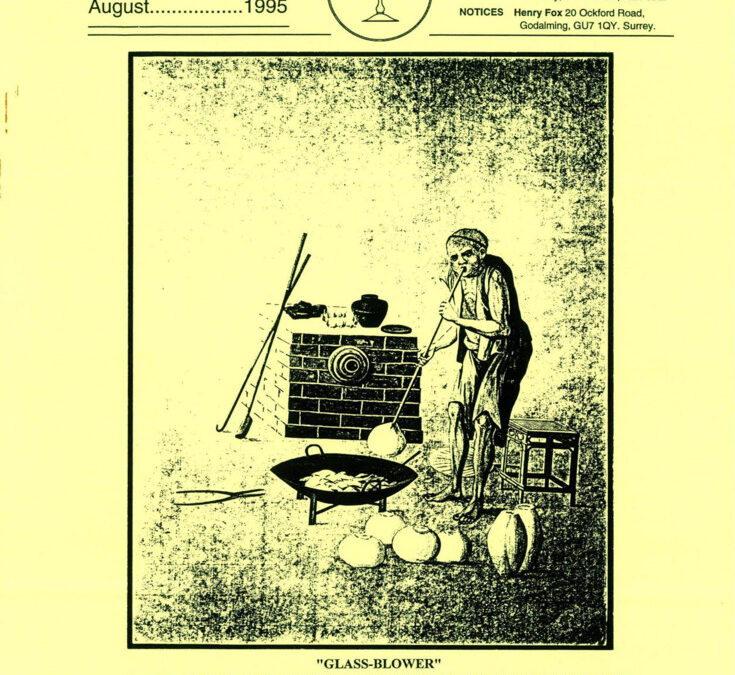
“GLASS-BLOWER”
Picture by courtesy of the Curator of Eastern Art and Culture of Bristol Museums and Art Gallery, and the NACF.
This charming gouache in pastel shades (30.2 x 37.2 cm) of a glass-blower was recently acquired by Bristol
Museums and Art Gallery, aided by the Friends of the Bristol Art Gallery, the Asian Art Society, the National Art
Collection Fund, and the Preservation of Industrial and Scientific Material Grant Fund.
Painted in Canton, about 1800, it was originally acquired as part of a series depicting all sorts of crafts collected by
Major-General William Kirkpatrick (1754-1812) of the Bengal Army. No other picture of traditional Chinese
glass-working appears to be known. However, the scene, depicting a glass-blower at work surrounded by his
accoutrements, poses a number of problems as it suggests a curious mixture of ancient and modern practice.
Continued on page 2
1995
Page 2.
No. 64
GLASS BLOWER continued
The glass-blower, superbly portrayed with his whole
body emotionally involved in his work, is appropri-
ately clad in skull cap, loosely fitting garments and a
purse or snuff bottle at his left hip, but he is amazingly
bare-footed. Peter Hardie, the Museum’s curator of
Eastern Art and Culture, tells us that H.E. Wulf in
The
Traditional Crafts of Persia
(1966, p.170, fig.254)
shows a Persian working in a light suit and sandals.
Possibly the discomfort from the tropical heat as well
as the kiln, and the fact that Chinese shoes would be
cloth anyway (i.e. inflammable) might explain this
aspect of the blower’s dress. The late 16th-century
Turkish glassmakers painted in the ‘Surname’ (0.
Aslanapa,
Turkish Art and Architecture,
1971, pl. xxix)
are barefoot and barelegged, and are seated on stools.
They work bellows with chains held in their toes!
The presence of the stool poses another problem, for
the blower is shown standing up holding his long blowing iron in the approved way (although the glass
globe at its end is attached in a most unrealistic
manner). On the other hand the small furnace and
stool suggest middle-eastern practice where the blower
would carry out all his operations sitting down before
the furnace using a much shorter blowing iron. The
pucellas, a vital part of any glass-maker’s toolkit, are
conspicuously absent. As well as for shaping the
glass, when sitting down he would rest them on his
right thigh to protect it from the hot end of the
blowing iron being rolled across his thighs. In Brill’s
film,
The Glassmaker of Heirat,
the glassmaker squats
on the floor and rolls his iron across the top of a
bucket of water. The cullet pan in the picture,
although rather low, might act in a similar way to to
carry out this essential activity.
The furnace itself, with flames emerging from a hole
in the top covered by a square tile, is quite like a
normal Chinese domestic oven and unlike ancient and
contemporary glass furnaces in North China depicted
in Kao Gu (No. 6, 1985, p.53 f) though the features of
a central furnace for melting glass and smaller ones to
the side for working it might be inferred. As
suggested by the prominently placed dish of cullet, this
may be a furnace only for the secondary working of
preformed glass rather than glass founding itself. Peter
Hardie recalls that Staunton’s note on Cantonese
glass-making in 1793 (and later sources) speak on the
predominance of cullet in the local industry, a parallel
to the earlier use of imported cullet on the Continent.
The furnace opening, shown as a series of concentric
mouldings on the side facing the viewer, has a red
centre in the picture and perhaps represents a symbolic
‘eye; since it is manifestly too small for working the
glass globes being depicted. It is more probably an
insulating cover to the furnace opening which is
removed by an assistant with the hooked iron when
required by the glassblower.
On top of the furnace, alongside the stoking irons, a
small heap of coal or charcoal is being preheated,
while in front of the adjacent pot is a flat black disc
possibly representing the marver, although this is
normally kept cool to prevent the glass from sticking
to it. The marver usually has a straight edge to form
the paraison so that the fmished object can be
detached from the blowpipe, but again, the glassmaker
of Heirat used the edge of his bucket and, again, the
cullet pan in the picture might serve a similar purpose.
Hence the black disc could simply be another cover or
damper for the furnace, leaving the question of the
marver, like that of a leer, unresolved.
None of these oddities and omissions of portrayal to
our eyes really matter if it is accepted that the artist
has arranged his view more with an-eye to artistic
balance emphasizing the emotional aspects of creative
glass-blowing (from which the title derives) than to
the technical accuracy of the glass-house. No real
glass-blower, for example, would leave his shears in
such an inconvenient spot; rather, the artist has here
used them to direct one’s focus towards the globe of
hot glass with the blower as the centre of interest at
what is technically the strong point in the painting.
The Bristol Museum is rightly proud of its purchase,
an appropriate addition to what is probably the largest
collection of Chinese Glass tableware outside China;
and it will surely bring pleasure to all those who see
it. Together with its magnificent collections of Roman
and early English glass, as well as some Continental
glass and paperweights, the Bristol museum now holds
one one of the finest representative collections of glass
in the country, a fitting venue for our Summer Outing
this year.
In the past decade the NACF has made twenty grants,
totalling almost £100,000, to support museum glass
collections. For example, the Sunderland Museum
and Art Gallery, supported by the NACF, has just
acquired from Delomosne a fine wine goblet made by
the Wear Flint Glass Company (c.1805 – 47). It is cut
and engraved with the Lambton arms, being part of a
suite made for John George Lambton (later 1st Earl of
Durham). Members might like to know that NACF
supporters receive publications and are invited to
privileged events that are alone well worth the modest
subscription; you can bask in the thought that whilst
enjoying yourself you are supporting a cause worthy
of any collector.
SUMMER OUTING REMINDER
Please let the Hon. Secretary know if you are coming on the Summer Outing on the 9th September
as soon as possible.
Those thinking of coming by car are reminded that parking is auite impossible in
this area of Bristol. (Tel. Mrs Marshall on 0171 499 8139 regarding Park and Ride information.)
GLASS CIRCLE NEWS No. 64
Page 3.
1995
PONDERING ‘TIM’ CLARKE
by Paul Hollister
From time to time – not often but always memorably – I
saw Tim Clarke. It might be in London for lunch or
dinner at his house or flat, or to examine glass at
Sotheby’s, or at a Corning Museum Seminar. Over a
couple of decades we corresponded about glass, especially
paperweights.
Following World War II, it was T.H. Clarke who put
paperweights – which had been selling for a few pounds a
piece – on the international map. One of the first great
sales was the 779-lot collection of English and Continental
Coloured Glass and Paperweights formed by the late Mrs.
Applewhaite-Abbott, which was sold over six days in
1952/3. Rare paperweights from that sale eventually
became prized lots in other important paperweight
collection sales.
In 1954, ex-King Farouk’s Palace Collections of Egypt
were to be sold in Cairo, including a catalogue of
paperweights and glass by Galle. For that catalogue Tim
went to Cairo. There in the Palace, while cataloguing the
paperweights, Tim Clarke was overtaken by a severe case
of ‘tourist’s complaint’, and was forced to identify and
catalogue the weights in the refuge of a basement W.C.!
Fortunately, the bottom of the door to this convenience
was raised sufficiently above the sill that Tim was able to
be passed two paperweights at a time under the door, and
to describe, evaluate and return them to a pair of unknown
but trusted hands.
Tim attended at least one paperweight symposium at the
Bergstrom Museum in Neenah, Wisconsin, which
Midwestern oasis was and is the Mecca for paperweights.
The almost unlimited variety of paperweights and their
component imagery is part of their fascination; but it also
presents an ongoing problem of secure identification. Tim
stood before the rapt audience and presented a glossary of
paperweight terms together with illustrations of each type
and variation. Published, it has become the
lingua franca
of paperweight terminology.
In 1970, Tim produced the paperweight catalogue and
handled the sale for Olga Drexel Dahlgren, in which one
weight, a lily-of-the-valley on translucent pink ground,
brought £8500, at that time a record for a single weight.
Olga Dahlgren lived two blocks from us in New York, and
she and I used to attend paperweight sales at Sotheby-
Parke Bernet, sitting together in the empty balcony to see
who was bidding how much on what. Then, literally on
her deathbed, Olga asked me to handle the sale of her
superb collection through Sotheby’s London, knowing that
Tim would be in charge. I steered things on this end and
corresponded with Tim about the catalogue, delighted to
be part of his act.
In 1978, Tim came to Corning for the Seminar devoted to
The Great Paperweight Show
held in the Corning Museum
of Glass, for which the then Director, Dwight Lanmon and
I had selected over 300 of the world’s finest and rarest
paperweights. Tim gave a brilliant talk at the Seminar,
but he also began to speculate about a fantastic glass
tabletop which had sold at Christie’s in 1975. With
Jonathan Bourne, Tim later wrote about this tabletop
(Apollo, November, 1988) at the time the glass
masterpiece was to be sold at Sotheby’s. Thirteen years of
mulling it over, tracking it down: whenever Tim began to
speculate, his thoughts flowed like wine and he became
drunk with thought.
What an incalculable loss is a mind like his; a mind that
travelled everywhere, conceived of every possibility (even
the non-existent ones), stalked through labyrinths, dared to
suppose, relate the unrelated, unwound mysteries, brought
order out of chaos, and did all these things as if it were
simply great fun and most curiously amusing. And for
apparent relaxation Tim could mine such esoteric
entertainments as ‘the Indian Rhinoceros’ and ‘dwarfs’
with the relished authority of a Ph.D. thesis.
Yet in my contacts with him Tim never displayed his
great, far-ranging knowledge in a proud, self-conscious
way, but as if each new discovery was part of a game of
hide-through-ignorance and seek-through-intuition.
And, of course, it had an uncanny effect: one felt as if one
were part of a delightful conspiracy and privy to secrets
Tim may only at that moment have been sorting out in his
mind. He could pick up a simple Vincennes cup and
saucer, read its palm, and give a mysterious dissertation
on its relatives and antecedents. He could even charm an
object into existence. Like the time in a Manhattan
duplex apartment when, washing his hands, he reached for
the soap and found it in a Venetian 16th-century
enamelled tazza, unsuspected by its owner. He divined
what lay behind everything, as behind the altar in a
church. Tim had the x-ray eye.
Paperweights sold by the New-York Historical Society
The Spring/Summer, 1995, issue of the Journal of our
Corresponding Circle Member, The National Early
American Glass Club, has a 4-page article devoted to the
controversial January sale by Sotheby, New York, of the
paperweight collection given by Jenny H. Sinclair to the
New York Historical Society in 1965. It is not just on this
side of the Atlantic that museums are finding themselves
perilously strapped for cash and the NYHS has been
forced to sell to survive.
The catalogue contains an important article by Paul
Hollister on the collection in which he writes “. . . it seems
unlikely that any paperweight collection of this size and
quality will ever again come onto the market.” The 500
paperweights, in 317 lots, amassed $1,503,999. It was
attended by a host of museum curators, all anxious to
improve their holdings. Prices were mostly above the
estimates and the final lot, a “Rare Clichy Large Bouquet
Weight, 19th Century”, sold for $46,000 against an
estimate of $15,000 – $20,000; the curators had to be
satisfied if they had fulfilled even one of their hopes.
The Corning Museum, with one of the most expensive
collections in the USA, acquired a St. Louis Macedoine
hand cooler (lot No. 168), an accessory customarily
carried by ladies attending a ball to cool the perspiration
on the palms of their hands after a dance. This extremely
rare object, one of the earliest made by the factory,
contains a signature cane with the initials “SL” and a date
cane for the year 1845.
Dr. Jutta-Annette Bruhn, Corning’s Assistant Curator
of European collections, was delighted with her buy. She
has prepared an exhibition of mosaic and millefiori glass
called
Designs in Miniature
(running until Oct. 23rd).
1995
Page
4.
GLASS CIRCLE NEWS No. 64
The Discovery of Islamic Enamelled Glass
in
the Nineteenth Century
Dr Stephen Vernoit.
The lecture traced
the
growth of interest in medieval
Islamic enamelled glass in the 19th century, with
reference to items in various collections in Europe and the
Middle East. Islamic enamelled glass of high quality was
produced in the Middle East in the 13th and 14th
centuries; the types of pieces made included mosque
lamps, goblets, bowls and bottles. As around 200 Islamic
enamelled glass pieces were known by the late 19th
century, the lecture was selective.
Some pieces of Islamic enamelled glass had entered
European collections before the 19th century. Prior to the
late 19th century, however, there was confusion among
scholars about the history of Islamic enamelled glass. One
collector who contributed to its understanding was the
French orientalist scholar, Charles Schefer who was
Professor of Persian at the Ecole des Langues Orientates
Vivantes from 1857.
Interest began to develop, in particular, from the mid-19th
century. Pieces were illustrated in such publications as
Eugene-Victor Collinot and Adalbert de Beaumont’s
Recueil de dessins pour l’art et l’industrie
(Paris 1859)
and A.C.T.E. Prisse d’Avennes’s
L’Art arabe
(Paris
1877). Various pieces were exhibited at the international
exhibitions in Europe.
Imitations of Islamic enamelling techniques on glass made
by Philippe-Joseph Brocard were first displayed at the
Exposition universelle, Paris, in 1867. Enamelled glass in
the Islamic style was also manufactured by the Viennese
firm of J.
&
L. Lobmeyr. Enthusiasm for Islamic
enamelled glass reached a height at the Exposition
universelle, Paris, in 1878, where items belonging to a
range of collectors were displayed in the Oriental Gallery
Meeting of the Glass Circle on the 20th April, 1995, at the
Bonnington Hotel, Holborn, London,
by the kind invitation of Mr and Mrs Whittle, Mrs E. Newgas
and Mr
L Trickey.
of the Trocadero. By the 1880s high prices were being
paid for Islamic enamelled glass in sale rooms.
Many enamelled glass mosque lamps were acquired in Cairo
by Europeans during the 19th century, and by the early
1880s very few enamelled lamps were still hanging in the
mosques. By 1899, for example, Captain W.J. Myers
owned fourteen mosque lamps. To prevent collectors from
acquiring all of them, a large number of lamps was taken
for safe keeping by the Commission for the Preservation
of the Monuments of Arab Art, created in 1881, and
gathered together in the Museum of Arab Art in Cairo.
By 1899 the Museum of Arab Art possessed sixty-nine
lamps and enough fragments for afurther ten lamps,
which comprised about half the number then known to
exist.
At the turn of the century, Islamic enamelled glass was
also entering European collections from unauthorised
excavations in the Middle East, while Islamic enamelled
glass found in China began to appear in Europe in the
early years of the 20th century. By this time, through the
pioneering work of Gustav Schmoranz and other scholars,
there was a clearer understanding of the Islamic
achievements in this medium. Today, there is a renewed
interest in Islamic enamelled glass as more information
about its origins and the chemical composition of the
coloured enamels used comes to light.
GLASS
arms
by Henry Tar
Museum of London
By a happy chance what could well be the original oil
painting for the print after M.J.Starling of the interior of
Apsley Pellatt’s Falcon Glassworks London from 1819
until its closure in 1951 used in Volume V of E.W.
Brayley’s “A Topographical History of Surrey, published
in 1850, has been acquired at auction by Malletts acting
for the Museum of London. Apparently the picture was
found in the basement of a “famous china retailing
establishment” who sent it to auction. This find made its
debut at the International Ceramics Fair in June where it
was shown on Malletts’ stand.
And
so say All of Us
In “Home Front” (BBC2, 7th June) on modem decorative
domestic window glass, it was good to hear the glass
designer declare what members know only too well:
“Glass is the most versatile product there is.”
More Tales of the Unexpected
A member
writes that “when, a few years ago, a burly
stentorian visitor burst out laughing, the central one of
fifteen panes of toughened glass (340×180 mm) of an
internal door, eight metres away, exploded with a loud
crack scattering countless fragments all over the floor”.
Glasshouse in the Park
This item is not about the newly opened Evolution House
at Kew Gardens which incidentally is one of the most
up-to-date glasshouses in the world, nor is it about the
Crystal Palace when it was erected in Hyde Park as the
showcase for the Great Exhibition of 1851. No, it is about
information gleaned by Vita Sackville West from the
muniments at Lambeth Palace (historic London residence
of the Archbishops of Canterbury) when researching for
her book on the family ancestral home “Knowle and the
Sackvilles” first published in 1922. She writes “…. there
is the interesting fact that glass-making was carried on in
the park, and I only wish that more detailed accounts
existed of this industry, which, thanks to the Huguenots,
had been pretty widely introduced into the South of
England.” I am sure that members will agree with her
when she continues: “I should like to know exactly where
their glass-foundry was, and whether they made use of the
sand on the portion known as the Furze-field, now a rabbit warren; and I should also very much like to know
whether – as seems probable – they supplied any of the
glass for the windows in the house.” Perhaps a member
has further information about this early glass house
(mid-15th century), which could be used as a follow-up in
a future issue of GC News. If so, please write and let me
know. Members will no doubt have noted the reference to
glass-foundry as opposed to glasshouse; can any members
cite other examples of the use of the term glass-foundry?
More Clippings on pages 6 and 11.
GLASS CIRCLE NEWS No. 64
Page 5.
1995
NewBook
Le Verre de L’Antiquite Tardive et
TYPOLOGIE – CHRONOLOGIE – DIFFUSION
Edited by Daniele Foy
Lovers of Roman glass and those interested in keeping
abreast of the growing accumulation of new archeological
discoveries of glass will drool with enthusiasm over this
publication by the Association Francaise pour
l’Archeologie du Verre of their conference on this topic in
1993. It is substantially confined to the period between the
third and ninth centuries and covers an area from Syria to
Ireland and from Italy to Russia. The 19 articles, three in
English, two in Italian, one in Spanish and the rest in
French are supported by literally hundreds of quite superb
line drawings of glasses, maps and tables that make the
text relatively easy to follow, even for the non linguist.
Unlike Verre et Merveilles (see GC News No. 58), which
particularly attacked the problem of distinguishing sites
used for founding and working glass, this volume is
devoted to the vessels themselves, to bring order out of
chaos from the almost endless but distinct range of fine
variation in construction, shape, colour and decoration of
tableware emerging from excavations.
A major problem in this work is accurate dating
and in the opening essay Hiliary Cool reviews the quite
numerous 4th century British sites where this is possible,
the problem becoming acute with the end of the Roman
occupation and the growing dearth of supportive coin and
pottery. Some of the shapes persist throughout the entire
period and it is a matter of opinion whether there is any
change in the aesthetic appeal of the designs. Pieces occur
with abraded or wheel-cut decoration but this topic is
specifically covered by Jennifer Price.
A radical rethink is suggested over the
significance of the 5th and 6th century sherds found in
some quantity in Ireland. Harden’s opinion, based on less
material, was that these were cullet for making beads
transported via Anglo-Saxon England. Ewan Campbell has
now established that many of these fragments form intact
vessels indicating a much more advanced culture than had
been previously supposed. Excavations at Whithom
suggest that some glass may have been made there
although furnace evidence is still lacking. Itself a centre for
pilgrimage, it lies near the short crossing to north-east
Ireland where most of the early material has been found.
Another concentration of finds in the south implicate a
longer sea route via The Channel. On the basis of an
unusual glass with a blue rim found at Whithom, some
imports may have come from as far as the South of France,
du Haut Moyen Age;
Goblet with annular foot in clear glass with opaque blue
“dolphin” decoration in the Romanisch-Germanisches Museum,
from
A Propos des Precurseurs Romains du Rtisselbecher
by
Anna-Barbara Follman-Schulz. (Another picture is on page 7.)
an area where the products of some two dozen sites are
extensively discussed by the general editor, Daniele Foy.
These examples of obvious British interest only
nibble at the wealth of information about other
discoveries. One beautifully illustrated paper (see above)
analyses the development of the Saxon claw beaker,
involving the need to distinguish three separate types of
claw in their construction, while another paper presents
chemical analyses of a series of glasses from Rome and
Carthage all showing a silica-soda-lime composition,
implicating the use of natron imported from Egypt.
At 120F + 25F P+P, the volume (soft covers),
39.5 x 21 cm, with 380 pages on good quality paper, must
be considered excellent value even at the present
unfavourable exchange rate of 7.5F = £1. Being 3 cm
thick, the sewn construction is not entirely satisfactory as
two pages fell out during my read through.
Cheques to Conseil General du Val d’Oise – Hotel du
Departement – Direction des Affaires Culturelles ; 2, le
Campus 95032 Cergy-Pontoise cedex. (Tel. 34.25.30.65
Mme. Fourrez).
D.C.W.
11TH MEETING OF THE ASSOCIATION
FRANCAISE POUR L’A’;’ CHEOLOGIE DU VERRE
On the occasion of the centenary of the opening of the
Glassworks at Albi the A.F.A.V. are devoting their next
conference to the theme ” De la verrerie forestiere a la
verrerie industrielle du milieu du XVIII siècle aux annees
1920″ at Albi on the 7, 8, and 9th November, 1996.
Emphasis is being placed upon the sites of glassmaking
production and all aspects of glassmaking technology, on
the glassmakers themselves and on the relationship
between the products and the clientele for which they
were made. This notice also constitutes a call for papers.
For further information contact Genevieve Sennequier,
(Tel. 35.98.55.10) A.F.A.V., Hotel de Societies Savantes,
198, Rue Beauvoisine – 76000 ROUEN, France.
Bohemian Glass
Now available exclusively from Sotheby’s
Bookshop at 34 New Bond St. London W1A
2AA, is “Bohemian Glass” by Petrova and
Olivie. It is priced at £49 and has 240 pages,
large format, with 130 colour and 95 black &
white illustrations.
This book not only has a sizeable section
devoted to the innovative work of contemporary
artisans but also detailed biographies covering
400 years of glassmaking.
1995
Page 6.
GLASS CIRCLE NEWS No. 64
s
.1’\
.\-
vt
–
‘
11\1
ON NEE
Report by J. & M. Hayhurst on the Lecture
by Peter Francis at the International
Ceramics Fair and Seminar, Park Lane.
Following up on his lecture at the Glass Seminar held at
the V & A last year, Mr. Francis gave a very slick
presentation which glided at high speed through his
research on Irish Volunteer glasses (with which few would
be in disagreement) on to a rapid denigration of all
Williamite glasses. His main argument is that as he could
find no records of celebrations of William or the Battle of
the Boyne in the 18th century, there could be no
commemorative glasses dating to this period. His lecture
totally ignored the 18th century documentation supplied by
Mary Boydell (see Burlington Magazine, September 1994
issue), which showed that there were celebrations in the
18th century. Mr. Francis also did not make reference to
the real reproductions of Williamite glass, such as the one
made by James Powell Whitefriars in 1923 and given by
them to the V & A in that year. One of our arguments
with Peter Francis has always been: why would there have
been reproductions if they (glassmakers of the time) could
make such good “fakes”?
Now well into his stride Mr. Francis started, in our
opinion, to skate on very thin ice by trying to convince his
audience that all Jacobite glasses were probably later
engraved. We can only comment that Teize must really
have been talented to be able to engrave in at least five
different hands. It would take a whole paper to reply to
this section of his lecture, but as an example of his
corroborative evidence he invited his audience to believe
that the Jacobite portrait glasses could not be old as they
are surrounded by a laurel cartouche, which according to
him was a late 19th century decorative innovation. Again
we can only comment that it is a shame no one told the
Romans or 16th century potters or Swartzlot enamellers
of the 17th century, let alone the designers of the 18th
century British interiors, all of whom had used this device
in their work.
Mr Francis finally “put his foot in it” by suggesting that
most 18th century glass may not be old. A slide was
shown and we were told that as the glass has a polished
pontil it could not be 18th century. The reasons given for
his assumptions in this section of the lecture are based on
a leaflet produced by Edinburgh & Leith Glass Works
1906 -10, which contained drawings of glass illustrated in
English Table Glass by Percy Bate, a book printed,
according to Mr. Francis, after the publication of the
Edinburgh & Leith leaflet. Yet again we can only point
out that Bate’s book was published by Newnes in 1905,
and further we found it difficult to comprehend that glass
artists such as Wolff, Sang and the Beilby family were
decorating glasses which were now being dated into the
19th century. It was suggested by -14.4r Francis that, as it
was too expensive to investigate carbon dating of glass,
the problem should be solved by digging glasshouse sites.
This seemed to us as slightly difficult because glass was
recycled in the 18th century.
In conclusion it was implied that it was up to those in the
audience to open up their own minds to accept the
findings of the lecturer. A very good short reply was given
from the floor by Christopher Sheppard , but unfortunately
time ran out for questions and further comment from the
the audience just as George Neilson, curator of the
Drambuie Collection, was starting his line of questioning.
We believe this lecture would have had quite a lively
finale!
More Clippings
Spotted not Foxed!
Recently spotted in a glass specialist bookseller’s list was a
good copy of Hartshome’s “Old English Glasses”, published
in 1897, with original owner’s bookplate, and which had
the rare distinction of being available with signed letter by
Hartshorne to this owner, indicating that this book is one
of the very few pre-publication copies the author had
squeezed out of the publisher. This copy also came with
the later extensive “Daily Chronicle” review dated 28th
October 1897. Needless to say this interesting lot had
already found a very satisfied buyer.
Spotted and Foxed!
Also recently seen was a published lecture of 1879 by
James Fowler “On the Process of Decay in Glass …. and
the History of its Manufacture”. As members know the
subject of glass disease and glass conservation is now
receiving priority consideration by all those charged with
the care of glass collections e.g. the New Glass Gallery at
the V &
Going Dutch
–
An Early Glass Test!
I
cannot do better than quote from Issue 24 of the
magazine “Antique International” : “Well before the
invention of the modern pregnancy test, 17th century
Dutch burghers had a sophisticated way of learning of an
approaching child. Such were the dangers of childbirth
that talk of it was restricted in polite society. However the
Burgheses were not going to miss out on their proud
moment, so a special glass was commissioned, a `Hansie
inde Kelder’. It was placed on the dining table, and friends
and relations invited round knew at once that a baby was
on the way.”
“Tell me wench, which way to the Irish ferry. I have a
battle to fight.”
“I just love the anti-catholic disguise your majesty; ’twill
be admired in posterity. But I wouldn’t start from here
if I were you – have a free shamrock’
GLASS CIRCLE NEWS No. 64
Page
7.
1995
Re_2gC`790/VS
I started my Glass collecting in the early 1950s, with a
brace of enamel twist stems which I acquired to drink
sherry from. Inevitably I was drawn to discover something
about these Glasses, and after seeking advice I bought a
copy of the 1949 edition of W.A.Thorpe’s “English
Glass.” This was the start of a collection of Glass Books
which now much exceeds in number my eighteenth
century Glass! I tell you this because any one starting his
career on a diet of Thorpe is likely to have some
prejudices; I still regard Glass later than the reign of King
William IV as slightly de trop, and coloured Glass as a
rather aberrant taste. In the Circle I am prepared to admit
to such outrageous prejudice, but there are Glass Societies
where such an admission might lead to a call for my
resignation. This reflection was prompted by a recent visit
to Chatsworth, where the Glass displayed is predominately
Nineteenth Century, and coloured, – and actually very
good to look at, even though I prefer not to drink my wine
from cranberry coloured Glasses. The items which really
caught my eye were the bedroom washing sets of Glass
(all the washing sets on display were of Glass, not a pot
one to be seen.). The surprise to me was the large size of
the basins and jugs, and the range of colours; apple green,
solid yellow and also uranium, or `vaseline’ yellow, pink,
claret and cobalt blue; some-one had really set about
buying sets in all the colours they could fmd. In two
bedrooms the washstand sets were complemented by the
most ghastly frilly Glass flower epergnes. The dining
table was dressed for dessert with a set of cranberry
coloured Glass, including fmger bowls and also some
quite large bowls, where the cutting showed the colour to
be flashed on, rather than solid. In addition to all this there
is a great variety of rather nice nineteenth century lighting
Glass. One thinks of Chatsworth as a William and Mary
house, and indeed there
is
a pair of large mirrors by John
Gumby, of 1703; but by and large the Glass on display
merits attention by those of you who are lovers of the
Glass of Queen Victoria’s time.
At the June Ceramics Fair, as well as a lot of nice Glass,
one of the starred attractions was the lecture by Peter
Francis, on “Re-invented History; a fresh look at
`Eighteenth-Century’ engraved Glass.” The audience was
almost equally composed of Circle members, and ‘media
persons.’ The presence of the latter group anticipated
mind blowing revelations about the authenticity of
Jacobite Glass. The press-men ought to have been
disappointed, for Peter did not say a great deal that I could
quarrel with, asking more questions than giving answers;
we should be grateful to him both for emphasising a
`multi-disciplined ‘ approach to dating commemorative
Glass, and for rekindling interest in the subject. I did feel
that his assertion, that Tartan representation of Bonnie
Prince Charlie was not a contemporary portrait form, was
wrong; if I am right, his main criticism of substance
relating to eighteenth century dating of the Glasses falls
Glass Circle News publication dates
In the past the publication of GC News has been tied ,
for convenience and economy, to the distribution of the
Notices of Meetings. The Committee has now decided
that there should be separate publication dates four
times a year. These, with deadlines, will be;
Mid-October for publication in early November,
The end of December for publication in mid-January,
The end of March for publication in mid-April,
Mid-July for publication in August.
away. This leads me on to ‘plug’ a Jacobite Symposium
at Wolfson College, Oxford, on Friday 22nd. September*:
the papers include offerings on the Engravings of the
Jacobites, their Medals, and Geoffrey Seddon on the
Glass, whilst I shall be discussing the Clubs; if it all
comes together in the way one hopes, it will throw light
on some of the questions which Peter Francis posed.
What he did show, quite clearly, was that some twentieth
century catalogue representations of ‘Jacobite
Reproductions’ seem very deceptive indeed; however,
looking at the Edinburgh & Leith Flint Glassworks 1920s
reproductions presently displayed in the Edinburgh Crystal
Museum at Penicuik, one questions whether the execution
of the Glasses themselves was quite so deceptive as the
catalogue suggested; the engraving certainly was, and if
done on actual eighteenth century Glass would be very
worrying. We all know that the Prince Charles Edward
Stuart portrait Glasses are beset with forgeries, some yet
warm from the engraver’s wheel; but whether they amount
to 8% or 80% of the group still remains opinion, not fact.
Nor does it have any bearing on whether the original
Portrait Glasses were coeval with Prince Charles ‘ life, or
later inventions. The day after this lecture, a report
appeared in the Daily Telegraph which made me wonder
whether I and the reporter had been at the same lecture.
Really, it is the treatment by the Press of Francis’ work
which is so worrying, rather than what he himself actually
says.
I have to conclude with an apology; the editorial process
for our last Newsletter got enmeshed in computer
problems, compounded by a rush to bring forward
publication to cover important dates in the glass world.
One result was that Traudi Plesch’s name was most
regrettably misspelt. However, the decision henceforth to
publish the Newsletter to a fixed quarterly timetable (see
below), should hopefully reduce the risk of such errors.
*The cost of the conference, which includes coffee, lunch
and tea, is £15. Cheques should be made payable and
sent to Dr. R.C.C. Fynes, The Garden Flat, Gimson Hall,
77-89 Princess Road East, De Montfort Square, Leicester
LE1 70Q., from whom more information can be obtained.
Side and base views of two claw beakers illustrated by
Jean
–
Yves Feyeux
in La Typologie de la Verrerie Merovingienne
du Nord de la France
(see Book Review, p. 5).
1995
Page 8.
GLASS CIRCLE NEWS No. 64
Fine Glass at the Park Lane Fair
Members will be pleased to learn that, clutching his Press
invitation, this reporter representing G.C. News was first
through the door for the Press Preview of this year’s
International Ceramics Fair at the Park Lane Hotel. It was
an interesting moment as one viewed stands still being
arranged with their precious objects as dealers awaited the
various vetting committees to pass verdict on the stock
displayed. Armed with notebook I went straight to the
stands of principal glass dealers, trying not to trip over the
glass vetting experts who had just started their round!
My first call was Shepperd & Cooper who, as usual, were
displaying a wide range of fine glass from Roman through
to 16th/17th century European on to 18th/19th English.
Among the English items were a magnificent rich emerald
green wine glass with rib-moulded bowl, set on a double
series air-twist, consisting of a central twisted multi-spiral
column within a pair of broad airt-twist tapes (c.1760); an
unusual tankard with fine trailing below the rim, central
applied blue glass chain decoration, heavy basal moulding,
set on a high domed and folded foot, and with an applied
strap handle (c.1760); and a rare rummer with deep bowl
on cut pedestal stem and square base, the bowl having an
applied green ring about an inch below the rim above an
engraved meander and initials, c. 1800.
Next, off to Malletts where John Smith was putting the
fmal touches to his display. Here was a surprise indeed, a
dramatic change from previous years. The stand was
dominated to good effect by 19th and early 20th century
glassware. There were good examples of Powell
(Whitefriars) glass and an impressive selection of Stevens
& Williams glass, particularly their designs c. 1920
influenced by Roman finds. There is a growing interest
among today’s collectors in the glass of the last hundred
years and Malletts obviously intend to carve out a name as
a major stockist. Earlier English glass was not entirely
ignored – there was an excellent Apsley Pellatt sulphide of
George IV set in a beautifully cut glass surround which is
illustrated in Apsley Pellatt’s book published in 1821.
Among the 18th century glass on offer was one of Peter
Lole’s tall glasses on white opaque twist stem (refer to
previous issues of GC News for Peter’s writings on the
subject of this type of tall drinking glass). Not to be
missed on Malletts stand was the newly purchased painting
of the interior of the famous Apsley Pellatt Falcon
Glassworks. (See Glass Clippings on Page 4, referring to
the Museum of London.)
Now across the aisle for a quick look at the stand of Leo
Kaplan of New York – beautiful and rare late 19th and
early 20th century glass – delicately cut, signed English
cameo pieces and magnificent French examples of the Art
Nouveau period.
And now round the corner to Delomosne’s stand with its
good display of Jacobite glasses, including a very rare
plain stem portrait glass with the motto “Audentior Ibo” (I
shall go more boldly). This stand also had an hitherto
unrecorded pair of small gilded bowls and saucers/stands
c.1765, the gilding attributed to the atelier of James Giles.
These were probably used for water, although a moulded
bowl and matching saucer/stand was auctioned last year by
Sotheby’s and described as tea bowl and saucer.
Last call was to Aspreys who were showing at this fair for
the first time. Asprey’s stock of antique glass was,
however, like some of Malletts, split between this specialist
fair and the prestigious Grosvenor House Antiques Fair
which was on at the same time round the corner. The only
item of interest appeared to be a pair of Norwegian opaque
twist candlesticks c.1760, although a tall composite style
stem glass with a domed foot and the bowl engraved with
floral emblems of possible Jacobite significance looked
familiar as an old friend sold from one’s own collection
some years ago! All in all there was something here at Park Lane for everyone with a love of fme glass from
whatever period. My thanks to the Fair’s Press Office for
the Press Preview invitation.
H. F
Two Great Glass Collections
The Drambuie Collection
A hardback 96 page book is now available about the Art
Collection of the Drambuie Liqueur Company, price £15
plus £2.50 P & P, and copies may be obtained from Robin
Nicholson, Drambuie Ltd., 12 York Place, Edinburgh EH1
3EU. There are 21 plates of glass illustrations, covering 35
Jacobite glasses, together with six others of the period
1760-1825, including two Beilby’s, one of which relates to
the port of Leith. Of the Jacobites, 18 of them are
illustrated in Geoffrey Seddon’s book, but the other 17 are
fresh. There are also 19 plates of other Jacobite items,
principally paintings, prints and medals, some of them
possibly source material for the glasses.
The remainder of this book covers the Drambuie Scottish
Art Collection. There are catalogue descriptions of every
item illustrated. The Jacobite Anniversary celebrating the
250th year of the Rising will conclude early next year, and
members who missed the various exhibitions
commemorating this historic event, should they be visiting
Scotland next year onwards will be able to view the
Drambuie Collection by telephoning the curator, George
Neilson, in Edinburgh (Tel: 0131 556 1357).
Cinzano Glass Collection
The present whereabouts of the famous Cinzano Glass
Collection, which was built up in the late 1960’s and on
into the 1970’s with the help of our late member Peter
Lazerus and subsequently with advice from our late
President, Robert Charleston, has been tracked down and
is now to be seen at the Cinzano Production Plant at Santa
Vittoria Alba, which is about 80 kilometres from Turin.
This collection used to tour Britain regularly but has not
now been seen in this country for many years. However,
members taking a holiday in Italy should not miss the
opportunity of seeing the collection with its fme specimens
ranging from the Roman and earlier periods to the 18th
and 19th centuries. Appointments to view may be made by
telephoning (0039) 172 477111 – you will not be
disappointed by the beauty and quality of this collection.
Reminder – Art on Glass Exhibition
This Exhibition at Castle Howard, Yorks, sponsored by
Sotheby’s continues until 17th September. Work is shown
is by the members of the Guild of Glass Engravers.
GLASS CIRCLE NEWS No. 64
Page 9.
1995
INTERESTING AUCTIONS
BY HENRY FOX
The London Scene
*Sotheby’s Bond Street report a successful Irish sale on
2nd June, which saw very high prices paid for standard
Irish antique glassware, including £8000 (plus premium)
that was bid for a rare Irish wine fountain. Sotheby’s next
sale of fine antique glassware is 14th November, and this
will be followed on the same day by the sale of the
Ritman Collection of 17th century Dutch glass in 80+ lots.
There are 15 glasses signed by Heemskerk, Mooleyser,
Peter Wolff, and the monogrammist “M” – eight coloured
bottles with calligraphic engraving and several important
large roemers, mostly diamond-point engraved. This glass
collection was put together over 15 years and contains
some of the most important Dutch glass to have been sold
either at auction or privately in that period.
The Ritman Collection is being exhibited in Amsterdam
prior to its sale in London.
*Phillips reports that their next glass sale will be on 13th
September when the collection of the late Mr Ben Fawkes
will go under the hammer in 102 lots. This collection
consists of good 18th century glasses, including rarely
seen balusters such as cylinder and mushroom knopped as
well as a Beilby enamelled glass and some finely engraved
Dutch glasses. On September 20th another sale will offer a
substantial single owner collection of pressed glass –
Sowerby – Davidson – Greener.
*Christie’s reports that their next sale of important early
English and Continental glass is scheduled for 18th
December.
*Bonhams in July sold to the Mansour Gallery, leading
London dealer in items from the Roman and early Islamic
periods, a superb pillar moulded mosaic cobalt blue and
white glass Roman bowl with intact foot for £220,000
(plus premium). The vendors had inherited the bowl from
their great grandfather who in the 19th century had been a
director at the mine site in Spain where it had been found
in a grave. No other pillar moulded bowl has until now
been discovered in perfect condition. Present experts
consider that it is likely that the bowl was made in Rome,
rather than Spain, between one BC and one AD.
*Commemorative Glass
Many traditional glass collectors make a brief foray into
commemorative glass to either enhance or complement
their collection. Recently, however, the two main areas of
18th century English commemorative glassware, namely
Jacobite and Williamite, have been subject to new research
and heated correspondence. However, there are still areas
of collection such as Sunderland Bridge rummers,
Nelsonia, and the “Success to …” glasses, as well as the so
called disaster glasses of the 19th century, and glassware
related to royal occasions stretching from the 17th century
to the present time. Sotheby’s July Colonnade sale
included a good collection of commemorative glassware,
including some rare, probably Absolom engraved, pieces
which sold well. A commercially produced simply
engraved souvenir glass of the sinking of the Titanic in
1912 fetched £340 plus premium, but a fine large rummer
attractively engraved with the Crystal Palace 1851 failed to
sell and the lot passed at £1550. The high price for the
Titanic glass may well have been influenced by publicity
over the past few years, including the current exhibition at
the Greenwich Maritime Museum.
Round the Counties
*An interesting lot in Key’s of Aylsham, Norfolk, July
auction was an elaborate vaseline tinted yellow glass
composite punch set, comprising lidded bowl, 14 glasses
with amber handles and feet together with similar large
tray. Each piece was decorated with panels of blue stylised
foliage on gilt reserves, and some of the glasses bore the
signature Moser, but the larger pieces were unmarked. The
set sold for £1050 (plus premium).
*Hamptons Fine Art Auctions in Godalming sold in June
for £1900 (plus premium) a large superbly engraved
green/yellow tinted rock crystal glass bowl attributed to
Stevens & Williams.In July Hamptons featured four 18th
century continental glasses, three made by the
Zwischengoldglas method by which gold leaf is
sandwiched between two layers of glass, and one small
beaker which was decorated with brightly coloured
enamelled hunting scenes. This interesting small group,
sold individually, totalled £6600 (plus premium).
*Phillips June Sale in Bury St. Edmunds contained a small
selection of good 18th century glassware. Of interest were
an acorn knopped stem wine with tear on domed foot
£440; facet-cut taperstick with petal rim and matching cut
domed foot £500; a pedestal stemmed candlestick with
domed edge cut foot £300; wine with flared bowl, teared
knopped stem and conical folded foot £200 (All prices
plus premium).
And Abroad
*Glassware Sale at Baden-Baden
Sotheby’s will be auctioning the contents of the Palace of
the Margrave of Baden-Baden in October. This highly
important sale includes a notable collection of continental
glassware spread over two catalogues. Amongst the
Venetian and German engraved and enamelled glasses of
the 16th, 17th and 18th centuries there is also, surprisingly,
a much later piece dated 1961 engraved by our member
Peter Dreiser!
*Fit for Aladdin
Old Lamps, particularly good examples from the Art
Nouveau and Art Deco periods, continue in popularity. In
May at a sale in Boston (USA) a Tiffany bronze and
Favrile glass peony lamp sold for $45,000 (£30,000).
(Note – the name “Favrile” was registered by Tiffany in
1894 and given to his Art Nouveau style glassware for
which he had developed an iridescent surface simulating
that found on ancient excavated Roman glass.) In the same
month on the American West Coast a Galle mould-blown
cameo glass yellow-ground blue rhododendron lamp with
domed shade over a spherical base sold to a private
collector for $110,000 (£72,000).
*Glass goes Down-under
In July a good selection of early English glassware came
under the hammer of Lawsons of Sydney in Woollahra
NSW Australia. Highlights were a baluster wine glass c.
1720, described as having two mushroom knops in the
stem, which fetched Aus.$1540; a Kit Kat wine glass
Aus.$1100; a Georgian comfits jar and cover Aus.$605; a
pair of Georgian decanters with triple ring neck and
faceted body Aus.$1980; a plain stem dram with oversewn
foot Aus.$302 (all plus buyers premium 10%).
(n.b. Aus.$ = £0.46)
1995
Page 10.
GLASS CIRCLE NEWS No. 64
More Clippings
Museums On The Move
*The Pilkington Glass Museum
is scheduled to be
re-housed in the new Science and Arts Centre at St. Helens
based on a former glasshouse. Further details in future GC
News.
*Broadfield House Glass Museum
may well be shifting
part of its renowned collections to Himley Hall, former
home of the Earls of Dudley, as and when Himley Hall
officially becomes the National Glass Museum. This
historic property is destined to become the collection’s
based glass museum for the whole country. In the
meantime glass displays and lectures are held at Himley
Hall; further details from Broadfield House Glass
Museum, Kingswinford, Nr. Dudley, W, Midlands (01384
273011).
Dudley Glass Festival 1995
Once again Broadfield House Glass Museum will be host
to a variety of “fun and glass related activities” over the
August Bank holiday period and the two following
weekends. Further details from the Museum.
Starting 26th August there will be three major exhibitions
at the Museum:
Toasts and Treason – The Jacobites and
their Glasses; Monart Glass
(selected from the extensive
collection of the late Michael Parkington) and
Paul Ysart –
The King of British Paperweight Makers.
These exhibitions end on the 29th October, 1995.
A series of lectures related to these exhibitions will take
place at Himley Hall on the weekend 2nd/3rd September.
Michael Parkington Memorial Lecture
Our member Dr. Geoffrey Seddon will deliver the first
lecture at Himley Hall, 2nd September at 7.30 pm,
admission charge £3 to include glass of wine. His subject
will be “Toast and Treason – the Jacobites and their glass”.
The Stained Glass Museum at Ely
Members visiting East Anglia should not miss the Stained
Glass Museum housed in the north triforium gallery of Ely
Cathedral. This is one of the most important collections of
stained glass in the country. Examples on display date
from the Middle Ages to the present day.
Tassie Exhibition London – Advance Notice
Malletts of New Bond Street will be holding in December
a special exhibition of the work of James and William
Tassie who are famous for their portrait medallions
(usually signed and named) of mainly contemporary
personages of note during the 18th century, which were
made from a mould using opaque white glass paste. The
moulds were made from original relief portraits in profile.
Our member, John Smith is preparing a publication to
accompany the exhibition. Members who would like to
attend the opening evening event should write to John
Smith at Malletts, 141 New Bond St., London W1Y OBS.
Local Libraries
It will be a sad day when local libraries close their doors
for good, but for the time being they are a wonderful
source of books of all descriptions, and many either carry,
or have access to, a wide stock on glass and related
subjects. Members may be surprised to learn that the
Bourne Hall Library, Ewell, Surrey has over 90 titles on
stained glass alone. Do members know of any other
libraries which have similar stocks on other glass topics?
Problems of Engraving and Glassmakers
Members are invited to attend a practical afternoon session
organised by the Guild of Glass Engravers for 28th
October at the Gustave Tuck Lecture Theatre, University
College London, Gower Street, London (Nearest tube
station Euston Square). Members interested should contact
Mrs Plant (0181 731 9352) for further details.
Glass at forthcoming Fairs
*Jeanette Hayhurst Fine Glass will be exhibiting at
the
Little Chelsea Fair at the Chelsea Town Hall 2nd – 3rd
October.
And, by the way, our congratulations to Jeanette on being
invited to join the British Antique Dealers Association.
Jeanette was displaying the BADA badge for the first time
on her stand at the June Olympia Fair. Jeanette, who is
well know for the wide range of her 18th/20th century
glassware, tells us that she enjoyed an excellent fair.
*William Macadam Antique Glass
will be at the
Northern Fair Harrogate 28th September – 4th October;
Langley School Loddon Norfolk 26th – 28th October;
Snape East Anglia 3rd – 5th November.
*Somervale Antiques
will be at the Chelsea Antiques Fair
12th – 23rd September, and at the LAPADA Show, Royal
College of Art, Kensington 10th – 5th October.
*Brian Watson Antique Glass
will be showing in
September at Hatfield House 1st – 3rd; Park Lane Hotel
London 8th – 10th; Harlaxton Manor, Grantham 29th – 1st
Oct; and in October at Woburn Abbey 6th – 8th;
Kennelworth 18th -22nd; and Loddon, Norfolk 26th –
28th. In November he hopes to be for the first time at
Kensington (Town Hall) Fair.
Holiday Reading
How many members have read the late Daphne du
Maurier’s “The Glass Blowers” which is a human saga of
a family of craftsmen in 18th century France?
It is still available in the Penguin series.
Southwark Walk
All the places for the joint Glass Circle / Glass
Association walk round the Southwark glasshouse sites
on September 2nd. are now taken.
An inevitable feature of the walk will be the
identification of the sites associated with the
playhouses of the the time and the now almost
complete Globe Theatre built in the Shakespearian
manner, but larger and not on the original site – said to
be the first thatched building to be erected in London
since the Great Fire of 1666. A fine set of five 25p
stamps depicting the Swan (close to the site of what is
believed to be the first glasshouse cone), the Rose and
Hope (adjoining the site of John Bowles “Crown”
glasshouse) and the Globe before and after being burnt
down and rebuilt, have just been published (August
8th) to commemorate the combined efforts of an
American (Sam Wannamaker) and a South African
(Theo Crosby) in making the new Globe Theatre a
reality. There’s nothing new about American enterprise
in London, of course. Both the London Underground
and Selfridges arose that way. And incidentally,
talking of Selfridges, one of the finest (largest?)
Tiffany domes in America was built as a special feature
for a Department Store – Marshall Field in New York.
“Fancy bidding $45,000 for an old Fanny table
lamp!”
“The name is Tiffany if you don’t mind! Fanny was
your mother and she never even made the reserve;
but after all, she was only a gas light!”
GLASS CIRCLE NEWS No. 64
Page 11.
1995
GLASS SURPRISES AT SHUG-BOR.OUGII
One of the great delights of browsing round Britain is that
you never know what unsuspected treasures lie in wait just
round the corner. So it was with my visit to Shugborough,
at the edge of Cannock Chase, chosen for convenience by
my wife as a meeting place for me to celebrate a forty-year
old national military service friendship.
Shugborough, a property of spacious but not
overwhelming proportions, is in many ways unique.
Unlike many large mansions it was built not by the
exploitation of a cheap labour force but by the naval
enterprise of Admiral Lord George Anson (1697-1762)
who amassed a vast fortune by first capturing a rich
Spanish treasure ship and then beating up the French navy
in crucial engagements relating to the seven years war – a
welcome change from the previous century when, in spite
of the efforts of Samuel Pepys, the English were repeatedly
trounced by the Dutch. Be all this as it may, George left a
substantial fortune with which his successors initially
created a far finer estate than that left to us today but then
squandered the capital so that a rescue operation involving
The National Trust and Stafford County Council was
necessary to preserve what is still an outstandingly fine
residence for our education and pleasure.
In most of such places the glass is incidental and receives
little mention. Hence its nature and quality comes without
warning. At Shugborough, the first surprise is encountered
in what is called the Ante Room, a pair of superbly framed
Chinese painted mirror pictures (the picture is first
painted on the back of the glass and then “foiled” over the
top) of a truly impressive size. These, one of the admiral’s
few remaining original trophies, were picked up in China
in about 1720 when he sold off the Spanish treasure ship
after having, of course, first removed its contents. They
are rightly described as “two of the finest of their kind”.
Perhaps they should lend one to the Bristol Museum?
From the Ante Room into the Dining Room where we are
greeted by the unbelievable sight of a table layout for
eight, each place setting including two sizes of Silesian
square-stemmed goblet with diamonded shoulders, folded
feet and very unusual gilded rims to the round funnel
bowls. This extremely rare set, c. 1740, is apparently
matched only by a similar one at Buckingham Palace, but
here is set off by some of the admiral’s original silver.
Next door, in the Red Drawing Room, considered the
finest work of Samuel Wyatt, a delicate English
chandelier, c. 1790, is the perfect foil to the beautiful
plaster-work ceiling and tasteful furnishings. More than
enough surprises for one visit, I thought, but climbing
Wyatt’s honeysuckle pattern metal staircase I was truly
astonished to be met on the landing by not one, but a pair
of Ravenscroft period Decanter Jugs of overwhelming
beauty (the NT book says “probably Ravenscroft”). These
were in a large wall case containing some 30, mostly
large, pieces of English and Irish cut glass, notably, pairs
of cut and covered stemmed honey jars and oval dishes in
a dark metal, possibly from Cork rather than Waterford as
the helpful warden suggested. In addition there were a
grand pair of finely cut ice pails with pineapple finials and
silver-gilt mounts, dated 1802, a pair of fluted water jugs
with silver-gilt mounts, dated 1798, and two Victorian
claret jugs, among a delightful selection of tableware.
There was other glass, for example, a pair of fancy
lanterns with cut drip trays on the family coach and a
range of domestic glass in Stafford County Museum, next
door, but it was the quite exceptional pieces of glass that
makes Shugborough so memorable for theglass lover and
to be recommended to anyone who finds themselves in the
area.
D.C.W.
Concluding Clippings
Hurry, Hurry, Hurry
Members who have a liking for, or an interest in,
stained glass should rush to Sherbourne Abbey in Dorset
to see the Pugin designed window before it is removed
forever and replaced by a new window which has been
designed by glass artist John Hayward. Approval for the
removal of the Pugin window was recently granted by
the Consistory Court. The fate of this window is not
known but it will probably either go into store, join a
museum’s collection, or go abroad. In anycase, it will be
a long time before it can be viewed again.
Heraldry and the Crafts
This is the theme of a series of lectures to be held at the
Royal Armouries Lecture Theatre, adjacent to the Tower
of London, on Saturday 14th October. Speakers will be
from the College of Heralds, Royal School of
Needlework, Guild of Glass Engravers, and the Royal
Armouries.
Get further details from the Educational Dept., Royal
Armouries, Tower of London, EC3N 4AB.
Mistaken Identity – Silly Season!
Received in June were two press releases addressed to
Glass Circle News from a well known truck manufacturer
which were headed “…Carrying More For Glass Fitters”
and “…Tippers for Glass Re-Cyclers”. Members with an
interest in, or secret yearning for, cutlet may like to add to
their file of glass statistics that the UK’s largest glass
re-cycler processes over 350,000 tonnes annually. It is
obvious that here is an exiting new area of collecting,
probably offering rich rewards to those who seek it out.
However, there is no truth in the rumour that “the Cullet
Society” has adopted as its anthem that well know song:
“Ten Green Bottles Hanging On The Wall”!!!
Fact or Fiction – Silly Season!
When I was a child there was a rumour in the nursery that
the moon was made of cheese, but in today’s world it
could well be made, in part, of glass if a recently
overheard technical conversation is to be believed. If any
members have any information on this point please let me
know.