




Na. 66
January
1996
EDITORS David C. Watts 27 Raydean Rd,
Barnet, EN5 1AN. Herts.
F. Peter Lole 5 Clayton Ave.
Didsbury, Manchester, M20 6BL.
NOTICES Henry Fox 20 Ockford Road,
Godalming, GU7 1QY. Surrey.
GLASS CIRCLE NEWS
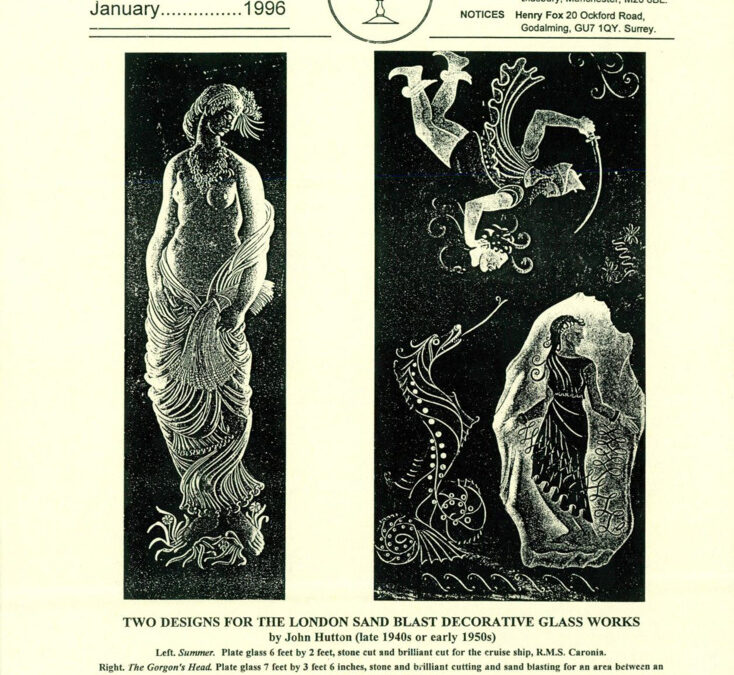
TWO DESIGNS FOR
THE
LONDON SAND BLAST DECORATIVE GLASS WORKS
by John Hutton (late 1940s or early 1950s)
Left.
Summer.
Plate glass 6 feet by 2 feet, stone cut and brilliant cut for the cruise ship, R.M.S, Caronia.
Right.
the Gorgon’s Head
Plate glass 7 feet by 3 feet 6 inches, stone and brilliant cutting and sand blasting for an area between an
aperitif bar and a restaurant.
The Magic of Decorative Glass Panels by David C. Watts
In the Tower Hamlets Local History Library, the speaker recently came across an advertising booklet czni..aL
,
mg the
pictures shown above. These designs, by John Hutton, are so different from his faqio,.!s
vizary Cathedral
windows that he couldn’t resist pursuing the matter further. An interim report on his discoveries begins on page 2.
See Appendix (pages 14/15) for information about the Manchester Glass Circle Weekend – May 10th-12th.
1996
Page 2.
GLASS CIRCLE NEWS No. 66
1
THE MAGIC OF DECORATIVE GLASS PANELS
by David
C.
Watts
In 19th century London, the art of decorating large
panes of glass began in Holborn (quite near where
we meet in Baldwin’s Gardens) as a result of two
new inventions and the advent of power cutting. The
first invention was acid etching which, although
discovered in the 18th century, only reached its full
potential in the 1850s, particularly for tableware at
Richardson’s in Wordsley where, according to Charles
Hadjamach’s
British Glass,
one James Smith con-
structed the first English etching machine, in 1855,
from an old lathe used for turning gun butts. It
came as a surprise, then, to discover an advertise-
ment in the London Post Office Directory for 1847,
8 years earlier, by the firm, Claudet and Houghton of
89 High Holborn, advertising “MATTED, EMBOSSED
AND MACHINE ETCHED GLASS”. The advert is
for decorative glass windows but must surely be one
of the first recorded uses of machine-etched glass (the
machine, incidently, only creates the pattern); the
same firm’s 1846 advert makes no mention of it.
Up to 1850 there was only one glass embosser listed
in the L.P.O.D. By 1890, the number listed had risen
to a peak of 34, after which it slowly declined.
Hydrofluoric acid (HF), used alone, eats away the
glass leaving a clear surface so that any decoration is
hardly noticable. The discovery of so-called white
acid (neutralised HF) revolutionised the technique as it
left a fine white matt fmish. French embossing, used
to decorate many pub windows, involved shading the
pattern produced with white acid by treating it with
two or more washes of HF. John Northwood is said
to be the inventor of white acid, for which he had a
patent, but it is possible that he discovered the secret
from the London embossing trade which, in turn,
probably learnt it from France as the name suggests.
Machine matting and French embossing became the
first method for producing large sheets of obscured
window glass, used to create the unique secluded
atmosphere of the Victorian pub as well as privacy
for the manager’s office
in
commercial firms and so
on. In the heyday of pub building, the 1880s and
1890s, it was reckoned to provide one pub for every
120, or so, people in the area and, for the best pubs
no expense was spared. The embossed glass could
be further decorated by silvering or gilding. Even
more expensive was to combine embossing with
brilliant cutting, a treatment which came into
prominence in the 1890s. The technical problem of
providing a way of offering up large sheets of glass
to the cutting wheel had been solved as early as
1850. The first to do this in Britain are thought to
be Mark Bowden & Co. of Bristol, using equipment
developed in the U.S.A.; in 1857 they advertised
“Brilliant Cut Ornamental Window Glass”.
A late entry into the field of decorating sheet glass
was sandblasting, invented by an American, Bernard
C. Tilghman some time before 1870. It came only
slowly into use for decorative purposes as it
compared unfavourably with embossing which required
no great financial outlay for special equipment and
gave a finer finish. Tilghman’s Patent Sand Blast
Company began life, in England, in 1875, among a
gathering of craft workshops at Sage Buildings, 80
Grays Inn Road. It described itself as engravers,
embossers, cutters, drillers, perforators, grinders and
polishers of glass. Much of this know-how seems to
have been embodied in the manager, John Richard
The
lectures by Dr D. Watts and Mr H. Fox,
summarised here, were presented at the meeeting
of the Glass Circle held on 19th Dec. 1995, at the
Artworkers Guild by the kind invitation of Mr and
Mrs R. Bendrey, Mr and Mrs Levy, Mr B. Moody
and Mrs J. Marshall.
Corsan. However Corsan left the firm the following
year and, by 1880 had set up his own sandblasting
workshop in the same building, offering much the
same range of services. He called it
The London
Sand Blast Works –
an uninspiring name for what
was to become a remarkable company. It was for
the Sand Blast Works that John Hutton carried out
the designs, on our cover. Tilghman’s disappear from
the L.P.O.D. in 1882, perhaps moving out of London,
but the Sand Blast works went from strength to
strength. John Corsan was followed by his son, Jack,
who retained ownership until the firm closed.
In 1898, the firm’s name was changed to the
distinctly upmarket
London Sand Blast Decorative
Glass Works.
Originally the firm seemed to have
concentrated on decorating small items but it was
soon to move into producing high class decorative
glass panels. How this began and the exact nature
of the panels produced up to the first world war is
still to be resolved, but the LSBDGW possibly
contributed to the interior decoration of three early
Cunard liners, the
Caronia
(launched 1905), the
Mauretania
(1907)* and the
Franconia,
(1911). The
reason for the uncertainty in dating is that the same
names were used for replacement ships and the
LSBDGW certainly produced panels for the post
World War 2
Caronia.
What seems certain is that
the firm helped furnish the White Star Line’s early
1930s(?) attempt to break Cunard’s dominance on the
high seas with the luxury superliner,
Britannic,
one of
the first liners to be sunk by a U-boat at the
beginning of World War 2.
In 1921, the LSBDGW, after a move in Grays Inn
Road, opened a new factory in Burdett Road, Ratcliff,
near the old Bowles glasshouse. The reason for this
probably related to lucrative contracts to supply
decorative panels for two new ocean-going luxury
liners, the
Arundel Castle
and
Athlone Castle
for the
Union Castle Line. Altogether, commissions for 33
liners, including the
Queen Mary
and
Queen Elizabeth
are listed in their advertising booklet (see cover). In
principle, the thinking behind the design of a luxury
liner was really no different from that of the
Victorian pub. It was to create a sumptuous internal
environment that sheltered and distracted the customer
from the mundane world outside. In his title Dr
Watts used the term magic and he said that at that
time these floating fairylands were probably as near
to magic as it was possible to get in the real world.
On land, there were commissions for Town Halls
(Norwich, Greenwich etc.), cinemas (Odeon, Leicester
Square etc.) top hotels (Claridges, Savoy, Ritz etc.)
and Guildford (and possibly Coventry) Cathedral.
Top designers of the day were employed, about
whom we have much to learn. One of the earliest we
know was Jon Juta, who lived in London from
1935-40. He created designs for the
Queens
liners
and for the balustrading for The Royal Institute of
British Architects – one of the LSBDGW’s most
continued overpage
GLASS CIRCLE NEWS No. 66
Page 3.
1996
Reminiscences of Personal
Favourites by
Henry Fox
This was Christmas entertainment and Henry Fox
began his “Reminiscences” by hoping that his talk on
18th century glassware from his own collection would
not disappoint anyone present who might have
misunderstood his reference to “Favorites”! His
excellent slides, showing mostly groups of glasses,
had been photographed by Jeanette Hayhurst using a
development of the method advocated by Percy Bate
in
English Table Glass.
Time limitation (self-imposed)
restricted his comments to only some of the glasses
shown but it was an additional pleasure to contem-
plate the others.
Henry said he had been collecting glass for 30 years
and that although he had concentrated initially on
air-twist examples, his horizon soon widened. And
what a variety there was, ranging from a small posset
pot to a large gadrooned tankard, and from heavy
balusters, with an interest biased towards multiple
knops, to a fine, possibly unique, purple taper-stick. A
cider glass with engraved bucket bowl on a mercury-
twist stern was one of his favourites. Each glass
brought particular memories – one of the pleasures of
collecting. In conclusion, Henry showed us a glass
(one of a number, including a rare moulded tea-bowl
and matching saucer, brought along to accompany his
talk) which was illustrated in one of Kneller’s
paintings of the Kit-Kat Club with this particular type
being held by the Duke of Newcastle. He concluded
his light-hearted presentation by wishing everyone an
“enjoyable seasonable break – have a Kit-Kat!”. Ugh!
Cheap U.V. Lamps
for Examining Glass
The response to my query about cheap U.V. lamps
for examining whether a glass was made of lead
or potash/soda brought only one reply. This was an
interesting letter from from John Brooks which
both opened up a new line of investigation and
presented a problem.
John has a battery-operated lamp made by a
German firm called PRINZ, rated at 4W. More
interestingly, it is rated at 256 nm (the wavelength
of light in nanometres) which means that unlike
most of the popular lamps on the market it
operates at short rather than long wavelengths and
will induce a blue to pink-violet fluorescence in
any uncoloured glass containing lead. The lamp
was sold to John some time ago by the firm of
A.J. Barmby, suppliers of ancillary equipment and
books to the antique trade. The lamp might be
used for examining postage stamps, porcelain,
pictures or for identifying hidden repairs to various
antiques. It originally cost £17, not cheap but
considerably less than around £200, the price asked
by most commercial suppliers of scientific
instruments for short wavelength lamps.
Unfortunately, Barmby’s address has been lost. So
if any member has a stack of old trade newspapers
or antique magazines please put them to good use
and see whether you can find this address or that
of a possible alternative supplier.
Decorative Glass Panels – continued.
prestigious architectural commissions. Undoubtedly
their most famous artist was John Hutton, who came
from New Zealand in 1935, and designed 6ft x 2ft
wheel-cut lighting panels for the post-war
Caronia.
His association with (Sir) Basil Spence over numerous
exhibitions led to his commission for Coventry
Cathedral glass screen. Spence recalls that he found
Hutton’s angels for the Air Force Memorial at
Runnymede were too tightly drawn for Coventry and
that as a result Hutton developed his famous engrav-
ing technique using a motorised hand-held wheel.
However, his commissions from the LSBDGC must
have been formative in this respect; whether the latter
was involved at Coventry, as it was at Guildford
Cathedral is not stated. The development of Hutton’s
style from clean-cut outlines to the expressive freedom
of the panels in the Shakespeare Centre at Stratford
upon Avon was briefly outlined. Another New
Zealand designer, John Buckland-Wright, is better
known as a wood-engraver and lecturer at the Slade
School of Art. After early education in Switzerland
and Bristol he married and spent his pre-war years in
Paris. He designed, from 1948, 13 panels for the
R.M.S. Caronia
and a set of six for the
President
Peron.
Other designers used by the firm were Juliet
O’Rorke, Suddaby & Fryer and Jacob Drew.
The London Sand Blast Decorative Glass Works came
to an abrupt end in 1967. Air travel sqeezed the
luxury liner trade and there were too many ships
pursuing too few passengers. More crucially, Jack
Corsan had either died or retired as his name
disappears from the L.P.O.D. But with the firm’s
closure some of their best workers were taken on by
the older established firm of T. & W. Ide who, back
in 1830, had bought John Bowles’ Ratcliff Glass
House. It was a five-minute walk from the Burdett
works. Today, Ide’s still run a complete glazing,
glass bending, silvering and decorating service using
eminent designers – their history is another story.
*Ken Cannel reported that there are three finely
engraved glass panes from the
Mauretania
(designer
unknown) in Liverpool Museum. Both Alyson Pollard,
Curator of Glass in the Decorative Art Department,
and myself, would like to learn more about these
panels and the London Sand Blast Decorative Glass
Works in general; any information would be greatly
appreciated. Ken has a copy of the LSBDGW booklet
written in Spanish, indicating that they undertook
commissions from abroad, while Simon Cottle told us
that many of the liners were broken up in Canada so
our members out there might be tempted to join in
the hunt.
D.C.W.
New information from
The Friends of Broadfield House
Glass Museum
is that thay have bought the Glass Museum
a Hutton panel, one of a series engraved in the 1960s,
which depicts a girl (Marigold) sitting with her back to the
artist in a typical beach setting. The Museum already has
a vase engraved by Hutton with a trumpeting angel.
Also, on the theme of passenger liners, the
Friends
have
presented the Museum with a Titanic “Disaster Goblet”
which bears the inscription “White Star Line Titanic
Sinking”.
(Re.
The Friends,
see, also, the item on page 8.)
•
1996
Page 4.
GLASS CIRCLE NEWS No. 66
Survival or Revival:
Historicism in English Glass
by Wendy Evans
and Roger Dodsworth
In this lecture our two speakers surveyed the field of
glassware designs, copied from or inspired by past
examples, that can mislead the uninitiated, or even
the expert, into believing that the piece was manu-
factured earlier than was the case. Miss Wendy
Evans, our first speaker, defined “Historicism” for us
as looking for a past glory or looking back to the
middle ages, particularly in Germany. Historicism in
England is particularly associated with the expansion
and colourful diversity of the 19th century. However,
among the plethora of written articles around 1916 a
wariness against copies and fakes was continuously
stressed; the talks focused more on this aspect than
Historicism
per se.
Both speakers gave the impression
that “fake” glass was no more than a fraction of any
factory’s output and the question of “survival”, by
exploiting Historicism, was not directly addressed.
“Fake” glasses might, however, represent a significant
proportion of known glasses of their type, as with
the Amen Glasses discussed recently in these pages,
and a knowledge of their existence is of considerable
importance to both curator and collector. Further,
over-zealous caution might result in the un-necessary
discarding of, or failure to acquire, an authentic
valuable piece while some late copies are now
collector’s items in their own right. The following
notes give the flavour of a meeting attended by a
large and attentive audience.
Wendy Evans began by illustrating a covered urn of
early inspiration made by Whitefriars and used as a
time capsule beneath the foundation stone of Tower
Bridge. The same firm also made a copy of the
Roman cut bowl found at Barnwell, Cambs. (Slade
colln., B.M.); other fastidious copies were made of
pieces such as the Zurich cup. The British archae-
ological revival inspired a claw beaker, also a cup
from the Woodchester excavation, first produced by
Whitefriars in sea green and revived in the 1930’s in
bright colours. Whitefriars glass inspired by Venetian
styles are well-known. Reproduction roemers appeared,
inspired by their inclusion in early paintings, while
bowls, based on Spanish originals decorated with
typical flat cutting, appeared in the 1930s. Pattern
books of 1906/8 reveal the manufacture of glassware,
such as a jugs, tumblers and wineglass coolers, cut
in 1820/30 styles; facet stem glasses with a tulip-
pattern border to the rim; the appearance of an
engraved 6-petal rose but polished (unlike a Jacobite);
drawn trumpet Williamite-style glasses and a ship’s
decanter after the firm of Buckley and Co. Also
produced were scallop-topped sweetmeats and candle-
sticks with panel cut stems clipped down the edges
in late 18th century fashion.
Roger Dodsworth began by linking the emergence of
reproduction Georgian and Regency styles with the
attitudes and architecture of the fashionable golden
age after the First World War – for example, Osbert
Lancaster’s
British Domestic Taste, Home Sweet
Home,
in 1939, and the construction of “Stockbroker
Tudor”. The growing interest in glass following
Hartshorne’s book, and the writings of Westrop,
Buckley, Thorpe, and others, helped stimulate the
manufacture of reproductions and fakes. On the
Meeting held on 14th Nov. 1995
at the Artworkers Guild by the
kind invitation of Mr D. Manning,
Mr and Mrs J. Hobbs,
Mr G. Taylor, and Mr Gallichan.
continent, C.H.F. Muller of Hamburg produced
Venetian-style elaborate-stemmed goblets that were not
slavish copies but transformations inspired by the
originals. Thomas Webb produced a cornucopia from
the 1860s copied from an 1890s rock crystal original.
The cameo glass revival was inspired by the Portland
Vase but these are not considered as fakes. Both
Stevens and Willams (1914/16) and Walsh Walsh
(1930) pattern books include glasses loosely based on
18th century styles. Examples are a flowered drawn
trumpet MSAT wine glass on a flat foot, and a
double knopped opaque-twist stem with cup-bowl, but
of the wrong shape and proportions for the 18th
century; similar differences occur with facetted stem
glasses. In a Soho Square, Birmingham, 1930s
catalogue was depicted a 6-inch drawn trumpet
MSAT
Fiat
glass with Tudor rose. Also illustrated
were firing-foot DSOT liqueurs, a drawn trumpet
MSAT with base knop, and numerous rummers.
These could deceive the collector. Pasted in a
Richardson’s pattern book were illustrations of old
George III cut glass. Wheel polishing continued
until 1910 and so genuine examples of this glass are
particularly difficult to distinguish. Walsh Walsh
produced reproduction Irish Georgian in about 1920 –
flared bowls, rummers etc. Similarly, coloured glass
was reproduced and illustrations included a lipped
finger bowl. In 1924, Alfred Arcus & Co., Birm-
ingham, advertised, in the Pottery Gazette, repro-
duction cut glass and cut and air-twist candlesticks,
turnover celery glasses and jugs, the last identifiable
as late since the handle is first attached near the
base rather than the rim. The firm of Hill Ouston,
glass importers and sellers, imported a Waterford
pattern fruit bowl. This was made in continental
demi-crystal (approx. 20% lead) rather than in
English full lead crystal. Many other firms, such as
Fenner of Chester, Graham of Stockton on Tees and
Nicholson of Twyford made or sold reproduction
glass. Clements of Bury St Edmunds listed a colour
twist with a “bird on foliage” engraving. This firm
contracted their orders to Stourbridge firms and the
shading in pencil of this glass in the design book
suggests a replacement to make up a set.
In concluding, Mr Dodsworth drew attention to the
fact that many designs were ordered during the First
World War; a panel-cut coaching glass (no foot), in
1914, the reintroduction of step cutting and late
Regency-style tumblers. While the flat foot is often
a give-away Whitefriars continued to blow feet in the
18th century manner until late.
In discussion it emerged that few 20th century
productions should deceive a knowledgeable collector
and that an understanding of the characteristic
features of early glassware and the types of glass
used was the best protection against costly mistakes.
Cut glass was the most difficult to assess because
the cutting obscured makers tool marks while
coloured glass is recognised as being difficult to
date. Hugh Tait voiced the need for a precise
terminology to describe the variously “faked” glasses
(This will be taken up in the future – ed.).
For further reading on this subject: – see overpage.
GLASS CIRCLE NEWS No. 66
Page 5.
1996
Righting a Wronged Chandelier
– or Vice Versa?
The Fall ’95 issue of The National Early American
Glass Club’s Bulletin, just received, reveals the
intangible problems that face a glass restorer, partic-
ularly of anything as complicated as a chandelier. The
NEAGC saga started when Bob Di- Bartolomeo, the
former Director of the Oglebay Institute Mansion
Museum, recognised that a massive 8-foot chandelier
was, in fact, a rare gasolier made by Hobbs,
Brockunier and Company of Wheeling, West Virginia,
one of the most important glass factories in 19th
century America. It was originally installed with
gas-burning jets in about 1880 but had, in the mean-
time, been converted to electricity in the course of
which its many arms, very curiously, had been
reinstalled upside down! As a further insult the
original shades for the gas-lights had been discarded
and the rings of cut drops, originally hanging from
the shades, now enclosed the later-installed light
bulbs. Once these anomalies had been identified,
restoration was inevitable and in due course, after
weeks of work, the chandelier was rehung, gloriously
resplendent with its arms correctly assembled and
replacement shades installed similar to the originals.
This laudable but not particularly remarkable endeav-
our would certainly have passed me by had it not
been for Mallett’s “Tassie” reception (see page 8)
where I was presented by John Smith with a copy of
The Art of Enlightenment,
a fine monograph written
by him to accompany an exhibition of chandeliers
held by the firm last year. This volume addresses the
question of 19/20th century gasoliers and electroliers,
a hitherto almost unexplored field. John reveals that
while conversion of, or redesigning, a chandelier for
gas simply involved replacing the candles by gas jets
protected by shades with, of course, appropriately
installed pipework, the greater brilliance of an electric
light bulb with its “exquisite pear-shaped lobe” posed
new aesthetic problems. These were described and a
solution offered in an 1895 issue of the
Art Journal,
the nub of which was that the bulbs should be
allowed to hang, an adaptation which necessitated
turning the arms upside down. Examples are illust-
rated to prove the point. Thus, the original conversion
is now explained. Hobbs exported their chandeliers to
Britain and we may debate whether this fashion was
American or British in origin. The nagging question,
however, remains – should the restoration of the
gasolier to its original form have involved converting
it back to gas as with electric lighting it represents
the stylistic anachronism the original conversion strove
so hard to avoid? What, perhaps, it does reveal is
just how fashion-concious America was at that time.
In contrast, as Peter Lole discovered at Muncaster
Castle in West Cumbria (see p.10), a conversion to
upright electric bulbs seems to have been accepted
without question. But maybe not every chandelier
was as adaptable as those made by Hobbs.
D.C.W.
Survival or Revival – further
reading.
Mainly Historicism:
Jackson,
Whitefriars Glass
(see
p.
7);
Evans, Ross &
Werner,
Whitefriars Glass;
Wakefield,
Nineteenth Century
British Glass;
Morris,
Victorian Table Glass and Ornaments.
Including fakes and reproductions:
Hajdamach,
British Glass
and in Bly’s,
Is it Genuine;
Elvillq
English Table Glass;
Wilkinson
The Hallmarks of
Antique Glass;
Jeanette Hayhurst and Christopher Sheppard,
Glass Circle News Nos 58
and
63 (Addendum)
respectively.
GLASS CLIPPINGS
by Henry fox
All Change in King Street
I am sure members
will be sorry to learn that our
member, Rachel Russell, who has been associated
with the sale of glass at Christie’s for the past 30
years, will be retiring early this year. During her
years at Christie’s Rachel has seen and handled many
fine rarities, including a Verzelini goblet and a
hitherto unrecorded signed Royal armorial goblet in
coloured enamel by William Beilby – the reverse
showing a ship under the legend “Success to the
African Trade of Whitehaven”. We wish her well in
her retirement. I am sure that members would like
me to record a big “Thank You” to Rachel for her
guidance and expert assistance provided so generously
to many of us during her years with Christie’s. Her
expertise will not be lost as she will be continuing to
act in a consultancy capacity. Rachel’s successor is
our new member, Paul Tippett, who has been
associated with glass sales at Christie’s South
Kensington for several years.
Held
by the Foot
Linking with my remarks (page 3) about a Kit Kat
glass being held by the foot in the well-known
painting by Kneller, some members might have seen
the picture in “The Field” by Jean Francois de Troy
called
Le Dejeuner D’Huitres.
Here, among the
gentlemen enjoying their oysters and champagne, no
less than five of those present are holding their
glasses by the foot. The original painting is in the
Musee Conde, Château de Chantilly (Oise), in France.
Old Blue Bottles, Carafes and Decanters.
“Kollectomania”, previously in the Isle of Wight and
now on the riverside in Arundel, is a specialist dealer
in mainly 19th and early 20th century glass bottles,
including a good selection of small blue medicine
bottles that look so well against a window. The firm
also stocks 18th century wine bottles.
Did you know that the chapter on “Serving bottles,
Decanters, Squares and Carafes” in Bernard Hughes
English, Scottish and Irish Table Glass
(published in
1956) illustrates no less than 43 different decanters
(c.1770 – 1835) from the then stock of Delomosne.
Stipple engraving
by David Wolff. From ‘Glass in the Rjiksmuseum’ by
Ritsima van Eck. Vol. II (1995) p.459, No. 582. See opposite. »
1996
Page 6.
GLASS CIRCLE NEWS No. 66
New Books
Glass in the Rijksmuseum Vol. 2.
by P.C. Ritsema van Eck.
Zwolle (Waanders Publishers), 1995. 495 pp., size
27.5 x 21 cm. Extensively illustrated inc. 32 col.pls.
Hard covers. Price 150 gld. (ca. £70).
Volume 1 of Glass in the Rijksmuseum (Amsterdam)
by P.C. Ritsema van Eck & H.M. Zijlstra-Zweens,
was published in 1993 (price 125 gld.) It catalogues
545 assorted pieces of glassware including 21
engraved ones. Volume 2, reviewed here, describes
and illustrates 613 engraved glass vessels dating from
the 16th-19th centuries comprising 185 line-engravings,
70 stipple-engravings and 358 wheel-engravings. The
engravers involved for each type of decoration and
the sources of their glasses are as follows:
Diamond Point. About 70% of all pre-1900 diamond-
point line-engravings are Netherlandish. Hence it is
not surprising that indigenous engravers are responsible
for nearly all catalogued vessels thus adorned. There
are 67 signed line-engravings and 36 attributions:
T. van Borckeloo attr. 3; B. Boers 1; J. Bot
1, attr. 1; D.H. de Castro 21, attr. 4; F. Crama 1;
M. v. g. 1; W.J. van Heemskerk 18, attr. 12; A.
Hoevenaar 1; H. van Lokhorst 2; M. 3; E.C.M. 1;
J.M. 1; A. Melort 2, attr. 1; S.J. Melort 3; Molenyser
1; W. Mooleyser 2, attr. 12; M. Petit 2; H. Scholting
1; A.C. Schonck 1; A.F. and A.M. van Schurman 1
each; M. Tesselschade attr. 2; A. Roemers Visscher 2,
attr. 1. Anonymous non-attributable engravings are
ascribed geographically to: Northern Netherlands 69,
Netherlands 10, Germany 2 and Austria 1.
The engraved objects themselves are assigned
geographically to: Netherlands facon de Venise 64,
same or Venice 1, Netherlands 12, Netherlands or
Germany 44, S. Netherlands facon de Venise 1,
S. Netherlands 4, S. Netherlands or France 4, Belgium
or France 16, Germany 2, Tyrol 1, Bohemia 1,
England 8, England or Netherlands 1, England or S.
Netherlands 14, England or Germany 1, and N.W.
Europe 1. Ten engraved glass panes (panels) are not
defined geographically.
Stipple-Engraving This remained a uniquely Dutch
phenomenon during the 18th and 19th centuries.
Twenty catalogued stipple-engravings are signed and a
further 46 attributed as follows:
G.L. Adams 1; L. Adams 1; Alius attr. 14;
“Master of the emerging lions” (=Alius) attr. 1; J.
van den Blijk 4, attr. 1; W. Fortuyn 1; F. Greenwood
3, attr. 2; N.L. Hoevenaar 1; G.H. Hoolaart 2; P.
Luyten 1; A. Melort 1; A. Schouman 2; D. Wolff 3,
attr. 27; and J. Wolff attr. 1. Four anonymous
non-attributable engravings are assigned geographically
to the Northern Netherlands.
The engraved goblets themselves are ascribed
geographically to; S. Netherlands 2; same or England
62, England 3; Germany 1; and Belgium or France 1.
One engraved pane remains undefined geographically.
Wheel-Engraving. This originated and developed in
Central Europe in the early years of the 17th century.
Executors of that technique working in the Low
Countries, many of them now anonymous, consequent-
ly had a mainly Germanic/Bohemian background. The
catalogued wheel-engravings are signed in 12 instances
and there are 14 attributions:
J.M. Kieseling attr. 1; C. Lehmann attr. 2;
W.O. Robart 1; J. Sang 9, attr. 9; S.J. Sang 1; H.W.
Schmidt attr. 1; C.G. Schneider attr.1 and C. Schroder
1, attr. 1. Anonymous non-attributable engravings are
assigned geographically to: N. Netherlands 224, same
or Central Europe 9, Germany 27, Germany or
Bohemia 9, and Bohemia 63.
The glasses are assigned geographically to:
Netherlands facon de Venise 13, Netherlands or
Germany facon de Venise 2, Netherlands 8,
Netherlands or Germany 7, Netherlands or England
107, S. Netherlands or England 4, England 36,
England or Germany 4, Germany 88, Germany or
Bohemia 11, Bohemia 74 and France 1. One pane
and two mirrors remain undefined geographically.
Conclusions. This analysis indicates that 56% of the
line-engravings in the Rijksmuseum collection are
either signed by, or have been attributed to, a
specific engraver while for stippled glasses a
remarkable 94% have been signed or attributed. By
contrast, the wheel-engravings fare extremely badly
with a mere 7%. It is surprising that none of the
listed engravings has been attributed to the Southern
Netherlands.
Excellent photographs, allowing descriptions to be
concise, constitute the most valuable feature of the
catalogue. The text of the general chapters is rather
slight but covers bare essentials and while some fresh
information has been provided for about 5% of the
glasses the majority of the glasses merited no notes
of any real interest. Apart from a sprinkling of
misprints there are some discrepancies and omissions
in this volume. Flutes are described as either
“Netherlands” or “Netherlands facon de Venise”; light
balusters are “Netherlands or English” for wheel-
engraved pieces but “S. Netherlands or “English” for
stippled ones; goblet 164 is said to originate from
“England” but the identical goblets, 165 and 166,
from “S. Netherlands”; No. 180 is a Stangenglas
rather than a “Humpen”, as described. The diameters
of bowl and foot are usually given in the descript-
ions of the glasses but here the author mentions only
one unspecified diameter. Pontil marks are not
mentioned nor the fluorescence observed when the
piece is viewed under U.V. light. More important,
there are no particulars on technical aspects of
individual engravings. The text is an English trans-
lation but standard English glass terminology has not
been followed and many inscriptions have been
translated with rather too great a poetic licence. A
popular and characteristic wine glass, which is at least
as Netherlandish as it is Germanic, is referred to as a
Romer instead of the equally deserving Dutch name
of roemer which is commonly used nowadays for
Dutch engraved examples. The literature references for
each glass are, on the whole, haphazard if not
incomplete. The same applies to the unsatisfactory
bibliography with notable omissions; some properly
printed publications are even described as photocopies.
Art historians tend to refer to their catalogues as
scientific publications. There is neither science
involved in the simple description and grouping of
objects nor in extracting relevant literature. The act of
cataloguing calls only for a sound general education,
specialised knowledge and a zest for some detective
work. According to the author “this is not a book
about Dutch engraved glass but a descriptive
catalogue of the Rijksmuseum’ s collection of engraved
glass.” Ideally, it should have been both! An eminent
glass connoisseur opined that the Rijksmuseum
catalogue leaves much to be desired. Nevertheless, the
pictorial disclosure – at long last – of an outstanding
national glass collection is extremely useful and
deserves our gratitude.
F.G.A.M. Smit
I say, don’t you think it’s curious that, with so much rare and
beautiful glass in our stately homes, the Queen’s internationally
famous art collection is only very poorly represented in fine antique
glasses.
No! not really; I suspect it’s because certain members of the Royal
Household have been throwing them at each other.
GLASS CIRCLE NEWS No. 66
Page 7.
1996
Whitefriars Glass: The Art of James Powell &
Sons.
Edited by Lesley Jackson.
A favourite biologist’s story tells of a scientist who
went to Africa to study lacewing flies and found
five new species without moving out of the
laboratory. This volume does much the same for
Whitefriars glass; I was able to identify three pieces
sitting around our house, bought because they were
attractive but with no knowledge of where they
were made. Although there is an emphasis on
“historicism” – surely the glass buzzword of 1996 –
there is much else here to attract the collector and
glass buff.
This volume, produced to accompany the Whitefriars
Glass exhibition in Manchester is not a catalogue in
that there is no numbered list of exhibits and those
loaned by The Museum of London are not
illustrated in order to avoid overlap with the book
on the same topic by Wendy Evans
et al*.
This is
essentially a practical manual, A4 size, of 160
pages, the first 94 of which contain six chapters
exploring the background to the exhibition material.
The first, by Peter Rose, gives an overview of the
early period 1830-1918, then Lisa Kent analyses the
development from 1850 of the Venetian style
leading into Art Nouveau. In Chapter 3 Judy Rudoe
looks at historic revival, tracing the sources of
inspiration for Harry and James Crofts Powell
derived from early glassware, pottery and pictures.
In the next chapter she relates Powell glass to the
continental Avant-Garde products up to 1914.
Finally, Lesley Jackson concludes with two chapters
tracing developments from the Arts and Crafts
*
To be reviewed in the next issue of G.C. News.
movement, through Industrial Art to the Scandinavian
influence and modem post-war designs. These highly
authoritative accounts are amply supported by 241
b/w figures and detailed references to sources that
surely will initiate much more research in the future.
The rest of the book, apart from glossary, biblio-
graphy and index, consists of 175 excellent colour
plates recording, in temporal sequence, the glass in
the exhibition except that from the Museum of
London mentioned above.
Designwise the book is open to criticism, clearly
being produced with an eye to economy. The text is
small and densely printed in two columns, running
so far into the spine that some force is required to
keep the book open. It does become more amenable
with use and the combination of high quality paper
and a stitched and glued binding withstands rough
treatment. Legends to the colour plates are mostly
full-page width and, with up to eight objects per
plate, the account of each is not quickly isolated.
However, the book, with soft covers, is readily
portable and will, I predict, herald the great
Whitefriars glass hunt as there must be millions of
unidentified bargains lurking everywhere throughout
Britain. Although its coverage is not comprehensive,
omitting most ordinary tableware, at £30 this book
is excellent value and a must for glass historians,
dealers, designers, curators and collectors everywhere.
It is published by Richard Dennis Publications.
Tel/Fax 01460 242009.
D.C.W.
Glass, tools and Tyzacks
by Don Tyzack
The first 116 pages of this 279 page volume traces
the origin and history of the Tyzack glassmakers
from their earliest known origins in Lorraine in the
15th century up to the 19th century. By this time
they had diversified into toolmaking and the rest of
the book relates to this business. The author, Don
Tyzack, is a descendant of the early
Gentilhomme
Verriers
who specialised in the manufacture of broad
glass. His account, naturally biased towards an
understanding of the role played by the Tyzacks,
makes a major contribution towards understanding
why they began making glass in the wild forest
region around Damey, near Nancy, in France. He
traces their relationship with the ruling, warring class
and the effect of the rejection of catholicism on
their diversification and emigration to England,
eventually establishing glassmaking in Stourbridge.
The story is a fascinating one and, although there
are gaps which may never be filled, it makes more
understandable the complex events when, at the
hands of Cane and others, England was trying to
establish its own glass industry.
The volume concludes with a 60-page table of the
Tyzack pedigree.
Published by Don Tyzack, 14 Meadowcroft, Gerrards
Cross, Buckinghamshire, SL9 9HD., the book, second
edition 1995, size 150 x 213 mm, hard covers, costs
£9.99 plus £1.50 p+p from the author.
What has Nazeing Glassworks Ltd. in
common with Harvey Littleton and the
Corning Museum of Glass?
The answers are that it began in the 1920s with a
single tank furnace, like that subsequently used by
studio glass makers, but in a disused goat shed! In
1947, the works was completely flooded when the
river Lea broke its banks and much of the stock
floated away. Today the firm flourishes – the only
crystal factory in S.E. England. We have been sent
their Sales dates with 15% off their handmade range
of plain and cut crystal tableware at their new shop.
These begin at 9.30 am on Sats. 9th Mar., 1st June
and 7th Sept. Well worth a visit in Nazeing New
Road, Broxboume, Herts. Tel. 01992 464485.
D.C.W.
1996
Page 8.
GLASS CIRCLE NEWS No. 66
.4106-4
401044iiiati
vititioalomii40005,10
1.041,
0
I
0
0
0
0
0
0
Tassie Miniatures Bewitch Members at Mallett’s
miniature works of art, whatever the substance of
their creation. John will be sharing his knowledge
with the Circle at our March meeting so no more
need be said here.
0
0
If Father Christmas had magically made every
conceivable kind of luxury glassware then one
feels that his store-room would have looked very
much like the premises of Mallett & Son, in
New Bond Street. Certainly, the members of The
Glass Circle and others that, on a mild, damp
evening in December, rolled gaily in for the
pleasure of this occasion, furnished with a glass
(or six) of champagne with food to match, soon
became engulfed, almost child-like, in the delights
laid out before us. The
raison d’être
for the
reception was to celebrate the capture by Mallett
& Son of the outstanding collection of Tassie
cameos collected by the Rakow family (after
whom the library at the Corning Museum of
Glass is now named). I suspect that few, in
advance, knew really what to expect.
James Tassie and his son William created
miniature portrait cameos and those for other
appropriate subjects both in intaglio and in
engraved form, rendered in both transparent and
opaque coloured glass “paste”. The transparent
3f pastes in a
variety of shades of red, yellow, green
if
and blue, decoratively mounted in backlit frames,
.-.-.-.-.-.-.-.-.-.-.-.-.-.-.-.-..-.-.
glowing like so many fancy wine-gums, attracted
immediate attention. The detail and quality of the Linking to the above, we learn that the Friends
cameos, many in opaque white “enamel”, were
of Broadfield House have presented the Museum
remarkable and an example of how they were
with a signed and provenanced Paul Ysart
achieved, by making moulds with molten sulphur, sulphide paperweight accompanied by the broach
rg
was laid out for inspection. The display was
from which the sulphide was made – a pairing of
clearly labelled and John Smith, our host for the which only one previous example is known. The
evening, has produced a descriptive history and
sulphide depicts a turbanned Arab head. The
account of the subject, clarifying many hitherto
weight is one of a limited edition of 150 weights
misunderstood aspects of the work. Produced to
made by William Manson who was taught by
the usual high standard associated with Mallett,
Ysart. Manson is considered one of the finest
on high quality paper with numerous colour
makers of paperweights working in this country.
photographs, this (67 page, A4) monograph*
This and the items mentioned on page 3, are
makes essential reading for anyone interested in
displayed on the first floor of the Museum.
46
1
1W
1
V*
1
1W
1
OW
1
0010WWWW1111*-
1
0ft Wft1104-
1
00‘
1
0*-
1
0ft
1
0W
1
00% 100q
1
004
11
0#4*- TIN* NAIR Vittel” NIKIV1115
1
,4*
Around the London Auction Houses
Glass Masterpieces at Broadfield House
20th January – 24th March 1996
*Christies King Street
report a successful pre-
On display, ten masterpieces of glass from around
Christmas sale; a rare early Venetian flask with
the world, ranging from a
7th century
Anglo-Saxon
enamelled portraits sold for £243,500 and a Bernard Claw beaker to a bowl engraved by Laurence
Perrot medallion of Louis XVI fetched £47,000. A Whistler recording the first moon landing. Other
St Louis gilt metal-mounted millefiori vase went for artists include Emile Guile and Rene Lalique.
£9775. These pieces (all including premium) well
exceeded their estimates. Jacobites, also, seem not
to have suffered from any adverse publicity about
authenticity and all met or exceeded their estimates.
*Christies, South Kensington,
held a successful sale
of Lalique (30th November). Among the highlights
a perfect Languedoc emerald green vase sold for
£13500; a good smoked coloured glass Baccants
vase for £10,000; and a rare set of 4 slightly dam-
aged Cariatide candlesticks, £11,000. Car mascots
were also in demand (These prices before premium).
Occasions of this sort are also memorable for
their social content and here one could rub
shoulders with some of the best glass artisans and
authorities in the country. Visitors from as far
away as Manchester, Bury St Edmonds and even
America chatted “glass” alongside glass of every
description from a Dutch flute, an English
baluster or Whitefriars goblet to a free-standing
Baccarat chandelier of monumental proportions. Of
everything it could be said that the quality was
outstanding. Mallett belongs to that group of elite
dealers whose academic interest in furthering the
understanding and promotion of glass far exceeds
commercial necessity; for providing yet another
memorable evening in the history of the Glass
Circle we are truly grateful.
* The volume costs £15 inc. P+P from Mallett,
141 New Bond St., London, W1Y OBS. Tel. 0171
499 7411,
Fax 0171 495 3179.
D.C.W.
Other Dates for your Diary
Feb. 22-25. Harrogate Fine Art and Antiques Fair.
April 11-14. NEC Birmingham Antiques Fair.
May 19.
B/ham M/cycle Museum Spring Glass
Fair.
June 14.
International Ceramics Fair and Seminar
at Park Lane Hotel.
*Sotheby’s Bond St.
sale of the Ritman Collection
of rare Continental antique glass produced sub-
stantial bids although several recently acquired lots
failed to realise the prices previously paid. A gen-
eral sale of fine glass on the same day did well.
*Phillips
December sale offered mixed glassware
which did quite well; two Sowerby lots, a large
decorated comb-handle bowl fetched £220 and three
nursery rhyme pieces (I lot), £240 (before premium).
Welcome to New Members:
Mr N. Benson, London.
Mrs M.J. Polley, Essex.
Dr V.A. Tatton-Browne, British Museum.
Mr P. Tippett, Christies, London.
f
9
9
9
9
9
Glass Circle News; publication deadlines.
No. 67
The end of March for publication in
mid-April.
No. 68 Mid-July for publication in August.
GLASS CIRCLE NEWS No. 66
Page 9.
1996
“Frilly Monstrosities” – Jack Haden replies.
Further to Peter Lole’s Limpid Reflections in GC
News no. 64, when I saw the ruby glass epergne on
a marble-topped stand at Chatsworth a decade ago I
immediately recognised it as a product of Hayden’s
glassworks in Brettel Lane, Amblecote. It looked
magnificent in the light from a large bedroom
window and obviously had been placed in a position
where it could be viewed to best effect. It was
certainly much admired by other visitors.
The works had a five-pot furnace and produced a
large range of fancy glass. The business specialised in
epergnes but not all produced were on the grand
scale of the Chatsworth specimen. Sometimes they
were retailed with a mirror as base – to impress the
Joneses or Devonshires!
When a small boy in the 1920s I saw them being
made by men in flannel shirts with sweat cloths
round their necks. The ruby colour was obtained from
gold. My father told me he used to buy the
sweepings from the benches of the jewellery engravers
in Birmingham. We certainly did not throw sovereigns
into the pot of metal as old glassmakers used to
inform visitors to a glassworks. The crimped edges of
epergnes were achieved in moulds but experienced
glassmakers could, with practice, make them by hand.
The spectacular epergne at Chatsworth has a crimped
edge to the base bowl from the centre of which a
short stump of glass was drawn up. On this a brass
fitting was fixed in place with an adhesive. From the
fitting’s central socket extended the largest trumpet-
shaped vase. Three smaller vases with curved stems
extended from the fitting and between these, from
other sockets, were clear twisted rods with an
elaborate hook-like ends from which could be hung
small baskets of ruby glass decorated with clear flint
trails. I can remember seeing the component parts in
the stockroom at Brettel Lane, the clear curved rods,
which were known as scrolls, being suspended from
wire strung across the room. Epergnes, flower stands
and vases were also made in opal and clear glass.
These creations were sold by Haden’s at the
beginning of the 20th century to retailers or factors
for around 7s. 6d (37
1
/2p.). They were especially
popular in South Wales and Lancashire where they
were usually proudly displayed on a table by the
front-room window; they made popular wedding
presents. They were very vulnerable, especially when
children were present.
Haden’s had a special reputation for its ruby glass,
but epergnes and other items of fancy glass were
produced at other works in Stourbridge and other
glassmaking centres. I recall that the late Sir Hugh
Chance had in his collection of fancy glass (which I
think he gave to the Worcestershire County Museum
at Hartlebury Castle) a similar epergne, a picture of
which accompanies the text of a paper on the
Bromsgrove glasshouses (known as cribs) read to
Worcestershire Archaeological Society and printed in
the Society’s Transactions for 1959.
The trade depression of the late 1920s resulted in the
bottom falling out of the market for such fancy glass.
English manufacturers could not compete with foreign
imports, and the General Strike, and especially the
coal strike, made it difficult to keep the furnaces
going. Also, fashion in glassware changed. Haden’s
turned to making lead crystal which they had cut
mainly by outworkers but eventually their glassworks
was one of several that had to close down. After the
second World War the ruby and other coloured fancy
glass was in great demand by the American
“antiques” trade and thousands of pieces were rounded
up by door-to-door “knockers” and crated for the
U.S.A. where there was an insatiable demand for
“cranberry” glass.
The 8tiegel rose and a Prickly Problem of Thistles
D.C. Watts
New developments have emerged from my suggested
link between the engraving of a rose on the Steigel
commemorative glass and some so-called “Jacobite
glasses”. Dwight Lanmon has written to say that the
Stiegel glass now resides in the Corning Museum
while our member, Mrs Bikker, has sent me the
picture opposite of a multipetalled-rose glass in her
collection. This interesting specimen, on a bucket
bowl with SSOT stem, has the characteristic central
cross-hatching and peripheral sprigs to the flower,
with the same arrangement of stem and bud and a
single (detached) thistle on the reverse. However, the
middle region of the rose is broken up by four
panels of cross-hatching as though to avoid the
monotony of engraving numerous rings of petals.
The picture suggests that the quality of the engraving
is adequate but not of a high standard. A similar
glass and engraving is shown in Geoffrey Seddon’s
The Jacobites and their Drinking glasses
p.89, p1.25).
Yet another of these glasses, also with bucket bowl
and SSOT stem, resides in the Fitzwilliam Museum in
Cambridge. It is similar to the above except that the
rose is petalled all over and the central area of
cross-hatching is smaller, like Fig. 3 illustrated in GC
News 65. Both, however, seem to belong stylistically
to this same small
group of glasses.
A clue to identifying
the engraver could
reside in the design of
the thistle. That on
Mrs Bikker’s glass is
of simple construction
with a cross-hatched
base to the flower and
florets of roughly-drawn
evenly-spaced lines. It
is quite unlike any of those in Seddon’s book, all of
which have a more complex construction. The thistle
by his engraver “G” (pl. 119) on the glass shown as
Fig. 2 in GC News 65, has the base drawn in short
lines, to indicate prickles, while the florets are
grouped into separate tufts. The thistle leaves are also
differently drawn. This feature is particularly clear on
a “Fiat” portrait glass, which bears a rose in the style
of engraver “G”, shown in the catalogue of
The
Drambuie Collection
as Plate 9. It may be concluded
that if this group of Jacobite glasses, characterised by
the Stiegel-type rose, is by Lazarus Isaacs then he is
not one of the nine engravers identified by Seddon.
1996
Page 10.
GLASS CIRCLE NEWS No. 66
-9A/17)97) 72E9,
–
Ee290A15
g
v
9.
Petez ,Cage
West Cumbria is the land beyond The Lakes, a long
strip, scarred but not spoiled by its former coal and
iron industries, hemmed by the sea and the hills of
the Lake district. You do not pass through it by
chance on your way to somewhere else, you go there
by intent. It is not a region one associates with fine
Glass, nor indeed with The Circle; those few of our
members listed in Cumbria live more than forty miles
from West Cumbria.
However, I spent ten happy years there, before
moving to Manchester, and returned recently for an
anniversary celebration. To make the most of a long
trip we visited two of its museums and its one and
only grand country house open to the public, finding
far more of Glass interest than I had recollected.
The Maryport museum has no Glass, but it does have
a very useful display board about a
short lived eighteenth century Glass- :`;;Z:f..-7
–
house there. Started in 1752, it was ,
as
,,;<;
•
offered for sale in 1773,
con-
sisting of: "A Cone or Round
House, two large pot chambers, Mill
and Clay Houses, bottle warehouse
and two Crown and Broad Glass
Warehouses, Karker and Ash House,
dwelling houses for twelve families
and a very good dwelling house for
the agent of the Works." Four years
later a report says that there is "a
Glassworks, although but little
used." and by 1813 the site was
being used as a shipyard, in breach
of the lease. The museum
reproduces a plan and a print of
the Maryport harbour area, both
shewing the Glass Cone. Twenty
miles to the south, Whitehaven too,
had a Glassworks, started in the
1730s as a bottle works; it con-
tinued for some considerable time,
but by 1813 it had been taken over
by The Glass House Pottery. There
are a number of paintings and prints of Whitehaven
during this period; one print (shown here) reveals
"The Bottle Works" as a rather small pagoda-like
establishment, certainly not a conventional Glass Cone.
Turning to Glass itself, the best known is, of course,
the signed Beilby Royal Armorial Goblet, additionally
decorated with a sailing vessel, 'The King George',
and the inscription: "Success to the African Trade of
Whitehaven." Acquired by the Whitehaven museum in
1986 for £66,462, it has since had a chequered
career. Stolen in 1994, it has been recovered undam-
aged and restored to the museum in circumstances
about which the authorities are rather coy. The
museum is presently moving to a new location on the
harbour front; it should reopen, with the Beilby Glass
on display, in the summer. The Workington museum
has a pleasing little group of Regency Glass
tableware. There is nothing of great distinction, but
since it was all acquired from local families, it very
nicely illustrates the sort of Glass used in the early
nineteenth century by the well to do professional men
and industrialists of this rather isolated area.
But, for Glass in West Cumbria, it is Muncaster
Castle which steals the show. Muncaster is not well
known for its Glass, (but then, neither is
Shugborough, about which David Watts wrote so
evocatively in G.C. News No. 64.) but rather for its
gardens, for it has one of the great West Coast
Gulf-Stream spring gardens. But its Glass is
interesting on a number of counts.
The dining table is dressed with nice nineteenth
century Glass; there are interesting rummers,
champagne saucers and wines which are pleasing but
of no great importance, a variety of Glass plates,
including some good crested ice plates, glass-rinsers,
and a large set of ormolu and Glass Ta77as The
Ta77as are interesting in that whilst the ormolu looks
to be
en suite,
the Glass trays shew a variety of
treatments. Unfortunately, the stunning Paul Storr
silver, which formerly complemented this table display,
had to be sold off at Sothebys last November to
support repairs to the Castle. On a side table there
are three monster rummers; a pair with conventional
ovoid shaped bowls on plain stems, some twelve
inches high, and an oddly shaped rummer, of dark
metal on an air-twist stem, slightly smaller at ten
inches high. The odd feature of
this last Glass is its completely
hemispherical bowl, which makes
it look like nothing so much as
an oversized grapefruit dish! They
were described as rummers for
mixing punch, but unfortunately
one could not get sufficiently close
to see if the bowls were character-
istically scratched, nor the full
details of their construction. One
cannot help wondering whether
they, too, were not originally
initiation Glasses, like those at
Levens and Naworth in the same
county. (G.C. News No. 61.)
Upstairs there are two large Glass
bedroom washing sets, of fine
clear metal and pleasing shapes.
(See G.C. News No. 64 for the
coloured versions at Chatsworth.)
The larger of the two wash basins
is about eighteen inches diameter.
They are complemented, if that is
the right term, by, of all things, a
clear Glass chamber pot; not a pretty sight to see in
the morning. There were more, too, of Jack Haden's
frilly cranberry devices, (see page 9) but, this time
used as upward facing candle shades for early electric
light fittings unlike that in America (see page 5).
But the last, and by far the greatest of Muncaster's
Glass treasures, is the 'Luck of Muncaster'. This is
a shallow Venetian Glass bowl with gadrooned base,
about seven inches in diameter, and encircled with
white and gold enamel dot decoration. It is reputed to
have been the drinking cup of King Henry VI, being
given by him to Sir John Pennington of Muncaster,
as thanks for succour given after the Lancastrian
defeat at the battle of Hexham in 1464. (For those of
you, like me, with imperfect recollection of the affairs
of Henry VI, 'Holy Harry', three trenchant chapters
of Winston Churchill's 'History of the English
Speaking Peoples' make a fascinating revision course.)
The gift of the Glass was accompanied by a blessing,
that for so long as the family shall hold the cup,
unbroken, so long shall they thrive. It still remains at
Muncaster, although unfortunately, but understandably,
in the strongroom rather than displayed. 'Lucks' of
this sort are rather a Cumbrian feature; there are at
least seven ancient houses who have, or had, them,
three being of Glass. The most ancient, and best >.>
.71.1
…..
•
.
51111e:hliC
H
7
7,..
:
::
:
:’.::
Ili
.31P.1:71,lifi
sr
Vicilatilt;
:
.
1.1t
p
arkrAlah
*,
,
4
6,4
4
4
GLASS CIRCLE NEWS No. 66
Page 11.
1996
Limpid Reflections Continued
known,
is the ‘Luck of Edenhall,’ a thirteenth century
Syrian Glass enamelled beaker, now in the V. & A.
This ‘Luck ‘ had an even more incredible origin, for
it was captured from the fairies who were dancing
round Saint Cuthbert’s well, in the policies of
Edenhall; when the wee-folk failed to recover it, they
chanted the now well known rhyming couplet:
If this cup should break or fall,
Farewell the Luck of Edenhall.
A much fuller account of the ‘Luck of Edenhall’ is
given in an article discovered and sent to us by
Jenny Thompson (this issue, pp. 12-13).
In 1992, Hugh Tait gave to the Circle a scholarly
review of these early enamelled ‘Luck’ Glasses,
comparing them with similar documented Glass
surviving elsewhere. ( G.C. News No. 54, with
illustrations.) In addition to the Muncaster and
Edenhall Glasses mentioned above, he considered a
`pretender’ from Muncaster, a Flemish enamelled
beaker, said to have left Muncaster in 1756 as part
of the dowry of Elizabeth Pennington.
The third Glass ‘Luc k’ is that of Skirsgill Hall;
being an 18th century Glass, it was not considered by
Hugh Tait. A large
armorial drawn trumpet
Goblet, rather over ten
inches high and with a
plain, teared, stem, it is
engraved in diamond
point with the arms of
Whelpdale of Skirsgill,
and inscribed:
“The Luck of Skirsgill,
September 1st. Anno
1732”, together with a
tulip and fruiting vine.
It was sold at Sotheby’s
on Jan. 22nd. 1968.
The remaining ‘Lucks’
are drinking vessels of
wood, metal, or in the
case of the Workington
Hall ‘Luck’, which was
presented by Mary
Queen of Scots, of
agate.
Thus, in this saga of West Cumbrian Glass, that at
Muncaster falls into four groups; a pleasing collection
of Tableware, a group of monster Glasses, unusual
bedroom-ware, and by way of dessert, membership of
that exclusive club of those who have ‘Lucks’, being
indeed, the sole survivor whose Glass ‘Luck’ remains
where it belongs. To all that add details of two
eighteenth century Glassworks, a pleasant little group
of domestic Glass at Workington, and the news of
the recovery of the Whitehaven Beilby Goblet. What
a feast to savour from a visit which did not
anticipate a Glassy reward.
* Thanks to Beacon Museum, Whitehavaven, and to
Sotheby’s for our illustrations.
Dare Find in Essex
A stained glass window
designed by Burne-Jones has
been identified in the local church at Barnston in the
depths of the Essex countryside.
This window, which originally had been installed in
St. Cyprian’s School in Eastbourne in 1912, was
removed when it closed in 1942. It is a scaled down
version of a window produced for Hillhead Parish
Church in Glasgow. Might this be another creation
by Whitefriars?
Jacobite Toast Pops Up
I am indebted to Dr Eveline Cruickshanks for
pointing out a reference, of 1747, to the Jacobite
“Independent Electors of Westminster” drinking a toast
to “The King” whilst holding their wine Glass over a
Glass of water. As discussed previously, in several
Ablution
notes (GC News Nos. 53, 55 and 58)
contemporary references to a Glass being held over a
bowl or Glass of water are all too rare. By courtesy
of Manchester City Libraries a much abridged
pastiche of the actual report is given below.
F.P.L.
THE
Gentleman’s Magazine,
AND
Hiftorical Chronicle.
VOLUME XVII.
Hiftorical Chronicle,
March t
747
THURSDAY
19.
The independent eldlors of the city
and liberty of
Weflatinfler
held their an-
niverfary feaft
at77ntser’s
hall, the Re-
wards being,
The E. of Litchfield, Sir Rd Bamfylde, Bart.
Earl of Orrery,
George Heathcote, Efq;
Ld Vifet Andover,
Tho. Carew, Efq;
And the following healths were drank.
From the
Lond. Evening Poft.
The king * :—The: prince :—The
duke :—Profperity to the independent
eleaors of
Wefintinfier :—Praperity
to
the city of
London,
and the trade there-
of :—Thanki to the worfhipful compa-
ny of vintners for the ufe of their hall:
•
Each man haring a skis of water on the
left ham!, and’ waving the glafs of wine over
the
water.–?hit Is
JAW in another
paper.
Death of Laura Seddon
With great regret we report the death of Winifred
Laura Seddon, at the age of 85, on December 15th,
1995, after a short illness. A very long-standing and
loyal member of the Circle, she contributed greatly to
glass knowledge by forming a very fine and varied
collection (c. 200 pieces) of coloured glass, now in
the Preston Museum. Laura also presented a unique
and valuable collection of 32,000 Victorian Christmas
and New Year cards, each one fully written up, to
Manchester Metropolitan University of which she was
elected Honorary Fellow (see GC News No.42).
Graduating from Girton College, Cambridge, in 1931,
as the first woman Senior Wrangler (a first Class
Honours in Maths) Laura combined a characteristic
independance of spirit with a cheerful and lovable
friendliness that made her a pleasure to know. She
will be sorely missed by both family and friends.
1996
Page 12.
GLASS CIRCLE NEWS No. 66
The
Story of The Luck of Eden Hall
The following extract from the Gardeners’ Chronicle dated July 19th, 1879, and the comments arising
from it, given overpage, were kindly provided by Jenny Thompson in response to the article in GC
News No. 54 on this topic by Hugh Tait, a subject taken up again in this issue by Peter Lole in his
Limpid Reflections.
EDEN HALL by William Hinds
The seat of Sir Richard Courtenay Musgrave, Bart. is
situated about 3.5 miles from Penrith, and one mile
from the village of Longwathby, which is reached by
the new Midland Railway, better known as the Settle
and Carlisle Railway, which was opened only a short
time ago.
The family of the Musgraves can be traced back to
the time of the Conqueror, and according to a
trustworthy history of Cumberland and Westmoreland
have been in possession of the family estates since
the reign of Henry VI (1459-1460). Since that time
up to a very recent period the Musgraves have taken
part in or occupied most of the distinguished posts
which usually fall to families of their rank and
prominence, not only in their native county but also
in the higher branches of Government service, as well
as in the Legislature. We read of Sir Philip Musgrave
being defeated near Great Salkeld, when commanding
a detachment of Royalists, by the Scotch General
Lesley in 1644; but four years later on (in 1648) the
fortunes of the day were reversed, and we find Sir
Philip, Governor of Carlisle. As High Sheriff and
Lord Lieutenant of the county we find the name
prominent during the reigns of Richard II, Henry VII,
Queen Elizabeth, James II; and in later years, in
1817, we find the name of Sir Philip Musgrave again
repeated, and in 1840 that of Sir George Musgrave,
the father of the present Baronet, who was so well
known in his native county as friend and benefactor.
The representation of the County of Cumberland in
Parliament has also been filled by one or other of the
Musgrave family since a very early period during the
reigns of Edward VI, Queen Elizabeth and George I.
Connected with Eden Hall and the Musgrave family is
the famous “Luck of Eden Hall”, which is described
in the History of Cumberland and Westmoreland as
being a tall tumbler of old-fashioned glass, green and
speeky, expanding in an easy curve from the bottom
upwards, terminating in a graceful lip, and enamelled
with a geometric design in crimson, blue and yellow.
The “Luck” has been in possession of the Musgrave
family for many generations. It has a threefold value
– in the mysterious tradition which associates it with
fairies. The “Luck” is kept in a leather case believed
to be the workmanship of the 15th century, and bears
the monogram I.H.S., which identifies it with the
Church, and according to history the “Luck may be
believed to have been used for sacramental purposes,
and made at Venice in the tenth century.
The fairy well, known as St. Cuthbert’s, is situated in
a corner of the pleasure-grounds (or, as it was once
familiarly called, the “low front”), near to the Hall. It
is a running fountain “all the year round”, cut out in
yellow stone, and partly arched over with stone
overlaid with grass. There is a niche cut in the stone
at the back of the well, where stands the cup with
which visitors are to draw water to drink from the
running fountain.
The story of the cup is, that one night, the butler
having gone out to bring water from the well, he
surprised a company of fairies who were dancing on
the lawn. They had, it is supposed, been drinking
from the well, for they had left their cup in a niche,
or, as some say, lying on the grass, and the butler
seized the vessel, and though called upon to restore
it, refused to do so, when the Queen of the Fairies
uttered the ominous couplet –
“If ever that cup should break or fall,
Farewell to the luck of Eden Hall.”
The main entrance is approached from Penrith by a
fine well-kept drive, which has lately been widened
and greatly improved. There is a grand row of Beech
and Oak trees on either side of the drive, which have
a fine effect when in leaf. They are of equal height,
and confine the view to the Hall in front, and a
splendid view of Crossfell, which at times under the
reflection of the sun, appears like vast distant terraces.
Some of these fells are clothed with snow up to the
end of June, and bear a marked contrast to the fertile
valley of the Eden immediately beneath them.
There are some fine specimens of Piceas standing
singly on the grass by the sides of the drive, and
upon approaching the Hall there is a new walk which
takes the visitor into part of the pleasure grounds
adjoining the “Fairy Well”, before reaching which are
several fme clumps of Rhododendrons planted with a
suitable variety of kinds for the climate.
On the left of this is the “grotto” which is being
rejuvenated, and I noticed several improvements in
new walks and new shrubberies being carried on here.
The writer can remember when this used to be a
favourite resort of the late Lady Musgrave, who was
always delighted with a bouquet of wild flowers from
the shrubberies around the “grotto”, and treasured
them quite as much as those of a more recherché
description that could be gathered from the choicest
exotics; but now, alas! hardy flowers have grown
common, and are a thing of the past till Fashion
grants them a fresh passport to return to their old
haunts and natural places of abode.
Bearing to the left the north front is reached, and
here a great improvement is effected in the clearing
away of old shrubberies, which, together with a high
stone wall, intercepted a fme view of the village of
Kirkoswald, the Nunnery Walks, Alston Moor, Borran
Wood, and other local places of note. The lawn is
dotted with choice Conifers, and altogether the success
of the alteration from a landscape point of view is
the most striking that I observed among the many
things that are being carried out. The Hall itself is an
elegant mansion in the Italian style of architecture
pleasantly situated and commanding a fine view of
the River Eden, of which a local poet has composed
the following lines:-
“Ye that love the rippling murmur
Of fair Eden in its gladness
Glassing Lady’s walk of Ednal
”
referring to a beautiful shaded walk along the Eden
side known as the Lady’s Walk
(The rest of the article is purely horticultural.)
Contemporary comments on the Luck in response to
this article are given overpage.
GLASS CIRCLE NEWS No. 66
Page 13.
1996
Comments on the Luck of Edenhall published in the Gardeners’ Chronicle, 1879.
This long discursive account by William Hinds, over
one thousand words in all, stimulated an even more
extensive correspondence, from four contributors.
‘DM’ wrote of a substantial poem by Longfellow,
titled “The Luck of Eden Hall” (a translation of the
German ballad by Uhland). This version has it that
in the course of time a ‘youthful lord’ succeeded to
Edenhall and its Luck, and “..being rather sceptical
of the properties of the Glass, had it produced at a
carousal, used it with the revellers as a wine goblet;
then, after it had served its purpose, deliberately
broke it.” Longfellow describes the consequence:
Slain by the sword lies the youthful lord,
But holds in his hand the crystal tail –
The shattered Luck of Eden Hall.
On the morrow the butler gropes alone,
The greybeard in the desert hall,
He seeks his lord’s burnt skeleton –
He seeks in the dismal ruin’s fall
The shards of the Luck of Eden Hall.
`DM’ goes on to ask whether “there have been two
Lucks of Edenhall, one of very early date, and now
extinct, the other of much more recent date, and
still in existence?”
`FB’ states that he has seen the cup, and that “it is
in a good state of preservation. The cup is
supposed to have been used as a chalice at the
time when the vicinity of the Scottish border made
the preservation of silver vessels in churches an
unsafe speculation. …. the replacing thereof by a
silver chalice might easily give rise to the legend
that the Musgraves hold their fortune by so frail a
tenure. In reality the fairies were priests and the
plundering butler a Scottish riever.”
Next, Thomas Williams takes the opportunity to
come up with a version of the story of the ‘Luck
of Muncaster’, asserting that it was the Stewart
Kings who gave it to the Penningtons. He goes on,
“Under the guise of friendship an enemy of the
family, during the absence of its lord, obtained
possession of the casket containing the precious relic
and dashed it to the ground, and the fallen hopes
of the house were mourned for nearly a century, no
one having the heart to open the casket and view
the the broken talisman. This, however, was at last
done, and the cup was found whole and sound, and
remains in Muncaster Castle to this day.”
Finally, G.S. Boulger commends to us “a small
duodecimo of eighty-six pages, entitled ‘The Luck
of Eden Hall’ by the the Rev. Beilby Porteus, Vicar
of Eden Hall. A modern lay of the olden days, ‘in
cantos three, as you may see, gentle reader, if
you’re willing, for a sixpence and a shilling.’
Published by A.Thurnam, Carlisle, 1856…. This
poem is illustrated by copious notes and a coloured
drawing of the Luck. The latter is a splendid
Venetian glass chalice of great antiquity enclosed in
a case of `cuir bouilli’ of fifteenth century
workmanship, stamped with the sacred monogram.
The glass is pale green, with bands of white edged
with yellow traversing its length in a geometrical
pattern, between which is scroll-work in blue
relieved with crimson. The glass has no stem, but
in shape corresponds to the mouth-end of a straight
and not reflexed trumpet.”
Browsing Around
Leafing through antique and fine art magazines is
always a pleasure – and never more so than when
one espies articles on, or pictures of, fine glassware.
Last October proved to be a particularly satisfying
month. In
Apollo,
Frides Lameris of Amsterdam
showed a fine lead glass goblet (Ht 18.2 cm) of
what used to be called a “Dutch-engraved Newcastle”
wheel-engraved in the style typical of Jacob Sang
with a ship – the D’Amazone. It was built in 1758
for the Admiralty of Amsterdam.
In the
Burlington Magazine
the Michael Kovacek
Gallery of Vienna showed an unusual Netherlands
facon de Venise beaker with a milled foot-rim and
kick-in base, c. 1700 (Ht. 18.6 cm). It was made of
colourless glass with chips of red, white and yellow
enamel embedded in the surface.
The cover of
The Antique Dealer and Collectors’
Guide
featured a glass display by our member, Brian
Watson while, inside, Martin Mortimer had an article
on The Glass Known as Lynn.
However, sobering thoughts were to be found in an
issue of the Antiques Trade Gazette: “Lack of new
blood creates a vacuum in the glass market” said the
headline. The article dealt initially with English
18th century glass unsold at auction, and in this
context I quote: “…those with established collections
all compete to acquire the most unusual pieces but
there are not enough buyers to take up the middle
range items. It is moreover simply an extreme
illustration of what can be seen in many collecting
fields today.” I pondered this, and decided that the
writer was correct in his assessment of a collector,
but surely, I argued to myself, it is usually the
more established, not to mention richer, members of
the collecting fraternity, and this includes museums,
who vie with each other for the rare items. Private
individuals usually, in my experience, start their
collections with humble, yet good, examples of their
chosen field with the aid and advice of a specialist
dealer, and only expand either by trading-in for
better or by having some improvement in their
financial affairs which increases their purchasing
capacity. For the beginner, and indeed any
collector, there are fine examples to be found and
treasured in the mid to lower price ranges; they
affords good hunting ground. Are too many people
today rather caught up with making that “fast buck”
than with the pleasure of admiring and seeking out
good simple honest examples to build up a
collection: have would-be collectors been
brainwashed somehow into believing that only
expensive and often over-hyped rarities make a
collection acceptable? In the case of glass,
particularly 18th century, I would have thought that
now was as good a time as any to start collecting.
But then again, perhaps we are not sufficiently
encouraging glass as a collectable.
H. F.
Temporary Reprieve for Pugin Window
The controversial West Window by A.W.N. Pugin in
Sherbourne Abbey which was to have been replaced
by new glass by John Hayward (see G.C. News 64,
p.11) has its supporters after all. It has now been
decided that it should be re-appraised on aesthetic
grounds before any further action is taken.
1996
SUPPLEMENT
GLASS CIRCLE NEWS No. 66
Manchester Weekend and Whitefriars Glass Conference
10th – 12th May, 1996
This Spring, Manchester City Art Gallery will have
on exhibition what is probably the finest assembly of
Whitefriars Glass likely to be seen anywhere in our
lifetime.
To give our members the opportunity to
enjoy both the exhibition and other riches the area
has to offer, Peter Lole has organised a “Manchester
Weekend” of glass visits which will also include the
Whitefriars Glass Study Day.
It is intended that the program will begin at Preston
Museum on the afternoon of Friday, May 10th where
we shall be received by the curator of glass and will
have the option of seeing glass in the store as well
as their very fine collections of 2700 scent bottles,
the Laura Seddon collection of coloured glass and
about 250 pieces of 18th and 19th century English
glass and good local commemoratives.
In the evening there will be an opportunity to visit
Peter at his home, inspect his glass collection and
books and enjoy a buffet meal with wine.
Saturday will be taken up with the Whitefriars
Conference to be followed in the evening by a
Chinese banquet in nearby Chinatown.
On Sunday, a visit has been arranged to look at the
glass of a private collector, followed by a tour to see
some of the best stained glass windows in the area.
Arrangements
In order to make the arrangements as flexible as
possible it is assumed that participants will make their
own way first to Preston and then to Manchester.
Guidance will be provided as necessary. For the local
travel, at least, it is hoped that those without their
own transport will be able to share with those that
have. Parking in Manchester is no less of a problem
than with any of our cities and for this reason two
Hotels have been chosen, one central and one
towards the fringe of the city that combines
reasonable parking with easy access to the centre.
Participants will be left to make their own hotel
bookings as some may wish to come a day earlier to
spend longer at the Whitefriars Exhibition and to
attend Charles Hajdamach’s lecture on the Thursday
afternoon (see overpage).
A booking form is at the foot of this page.
Programme
Fri. 10th May
2.00 p.m. (Allows travel by 10.40 am train
from Euston) Assemble at Preston Museum to see
collections, including reserve collection, with an
opportunity to handle some pieces.
7.00 p.m. Peter and Ann Lole at Home
Reception with supper.
Sat. 11th May
Whitefriars Glass Conference, in Manchester’s
(Victorian Gothic) Town Hall.
10.30 am.
Registration and coffee.
Alex Werner:
The Whitefriars workforce.
Wendy Evans:
Harry Powell: man of science.
Film:
Glassmaking at Whitefriars in the 1930s.
1.00 pm
Lunch
Dr.
Cathy Ross:
Throwing some light on
Whitefriars lighting.
Lesley Jackson:
Whitefriars and Whitefriars
look-alikes (plus identification of pieces).
3.30 pm
Tea
3.45 – 5.30 p.m.
Tour of Exhibition – close.
7.00 p.m.
Glass Circle Chinese Banquet
in Manchester’s Chinatown.
Sun. 12th May
a.m./p.m. Visits to view private
collection(s) and stained glass
ecclesiastical/secular.
(details to be arranged)
Cost
The inclusive cost for the Lole Reception, Conference
with coffee, lunch and tea, the Chinese banquet (but
not wine) plus an ‘A to Z’ street plan of Manchester
to facilitate finding venues etc. is £55.00 per head.
Accommodation
Special rates have been secured for Fri, Sat. and Sun.
at the following two hotels, inclusive of private bath
and breakfast. Make your reservations
directly at
the
hotel of your choice,
quoting
The Glass Circle.
City Centre. The Britannia Hotel
(4-star) Portland
Street, Manchester, M1 3LA. Tel. 0161 228 2288.
Close to the Town Hall, Art Gallery and Chinatown.
Single: £35 per night
Double: £50 per night (£25 per person)
Three miles South of Centre but easy bus access.
The Willow Bank Hotel.
340/2, Wilmslow Road,
Fallowfield, Manchester. M14 6AF.
Tel. 0161 224 0461.
Single: £28 per night
Double £38 per night (£19 per person)
For Parking at both hotels – see overpage.
MANCHESTER WEEKEND –
Booking Form.
Send to F.P. Lole, 5 Clayton Avenue, Didsbury, Manchester, M20 6BL. (Tel. 0161 445 2017)
Name:
Address:
Post Code:
Tel
Please reserve
places on the Glass Circle Manchester Weekend, 10th-12th May 1996.
I enclose my cheque (£55.00 per person, payable to F.P. Lole) for £
I shall / shall not be coming by car
;
I could accommodate. . . . persons as passengers.
Special dietary requirements for Conference lunch
I shall / shall not submit slides (non returnable) of pieces for identification
sent to Lesley Jackson, Whitefriars Glass Conference, City Art Gallery, Mosley
Signed
Date
at the Conference.
N.B. Labelled slides must be
Street, Manchester M2 3JL by 30th April 1996.
N.B. Members registering for the Lole weekend do NOT
need to register separately for the Study Day. Peter will
do this by block booking. BOOK EARLY, places limited.
GLASS CIRCLE NEWS No. 66
SUPPLEMENT
p. 2.
1996
Parking in Manchester
Like any major city in Britain, parking in
Manchester is relatively expensive. A map
of the City car parks can be obtained
from the large information centre at the
back of the Town Hall. Parking on street
meters and in unmanned car parks is a
security risk and no personal belongings
should be left in view or the car left
unlocked, even for short periods.
For The Britannia Hotel, Chorlton multi-
story car park is about 50 yards away. It
charges £3.50 overnight (6.30 pm to 9.00
am) and L11.00 per 24 hours if the car is
not removed during this period. Reception
will advise; unloading stops outside the
Hotel are permitted.
The Willow Bank Hotel
has its own
off-street private car park which is free to
residents. As mentioned, there is a
frequent bus service to and from the City
centre. The Willow Bank is also very
convenient for the visit to the Lole house-
hold which is on that side of the City.
Exhibition Catalogue
Whitefriars Glass
The Art of James Powell and
Sons.
Edited by Lesley Jackson
This volume will be on sale at the City Art
Gallery in Manchester and costs £30.00.
It is reviewed on page 7 of G.C. News.
Whitefriars in Manchester – Update
27th Jan. Exhibition opens. (Note that space will limit the
size of the subsequent Whitefriars exhibition at the
Museum of London to no more than 30%-40% of the
Manchester exhibition.)
Lunchtime Talks by Leslie Jackson, Keeper of Art.
(All at 12.30 noon on Wednesdays, City Art Gallery)
21st Feb.
Whitefriars Glass and the Arts and Crafts
Movement.
6th March
Whitefriars Glass: Art Nouveau and Art Deco
Designs.
24th April
Harry Powell’s “Glasses with Histories” Series.
24th April
Designs based on Historical Glasses and Paintings
in Museums.
1st May.
Whitefriars Glass during the 1920s and 30s.
12th June
Whitefriars Glass during the1950s and 60s.
Short Course – An Introduction to Glass
Four Sessions at the City Art Gallery and Manchester Metro-
politan University introducing the history and art of glass
making with hands-on activities using glass. Course leader,
Mike Brown, Senior Lecturer responsible for glass at MMU.
No experience necessary. Course fee £12.00 (£9.00 concs.)
Part 1.
Tour of Whitefriars Glass Exhibition
(Tue. 5 Mar. 4.45-5.45, City Art Gallery, Mosley Street.)
Part 2.
Demonstration of hot glass making and blowing.
(Tue. 12 Mar. 5.00-7.00 MMU Chatham Building, All Saints.)
Part 3
Working with glass: making a small stained glass
design (Tue. 19th Mar. 5.00-7.00 MMU Chatham venue.)
Part 4
Continuing Part 3 (Thur. Mar. 21 5.00-7.00)
Lecture by Charles Hajdamach
Thursday 9th May at 3.00 City Art Gallery.
(Entry Free but must book)
Gadgets Galore:
Materials and Techniques of 19th Century Glassmaking.
Lecture to be followed by a walk round the Exhibition with
the speaker and an opportunity to ask him questions.
11th May
Whitefriars Glass Conference (fee £25.00)
Selling Exhibition of Whitefriars Glass
Richard Dennis Publications, who published the Exhibition Catalogue, will be holding a selling exhibition of
Whitefriars
glass at their Gallery,
144 Kensington Church Street, London, W. 8. from the beginning of March.
He does not
say but he will surely stock the Whitefriars catalogue, which is being launched on Jan. 26th.
Clarification of Booking Arrangements
Members will already have received information and a booking form for the
Conference on Saturday 11th May direct from the City Art Gallery. If they
have already booked in for the Conference they may still book in for the
Peter Lole Weekend but should send him the reduced sum of £30.00, stating
that the conference has already been booked. Places for both “Weekend” and
“Conference” are limited so book early to avoid disappointment.
Participants are reminded that they may submit slides of putative Whitefriars
glass for identification and comment at the Conference. Slides, which must
be fully labelled with name/address etc., are non-returnable and must be sent
to Lesley Jackson, the Conference organiser, at the Art Gallery by April 30th.