




No. 67
April
1996
EDITORS David C. Watts 27 Raydean Rd,
Barnet, EN5 IAN. Herts.
F. Peter Lole 5 Clayton Ave.
Didsbury, Manchester, M20 6BL.
NOTICES Henry Fox 20 Ockford Road,
Godalming, GU7 1QY. Surrey.
Unique S
–
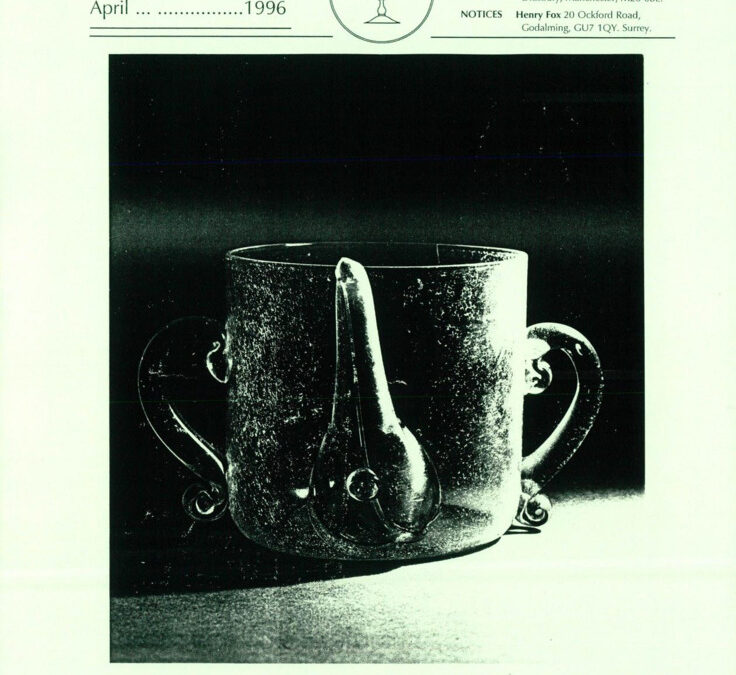
sealed posset glass (Ht. 8.5cm; C.650,1961) from the Beves Collection in the Fitzwilliam Museum, Cambridge.
The photo and drawing of the seal on page 3 are kindly provided by Miss J.E. Poole, Senior Assistant Keeper of Applied Art.
GLASS CIRCLE, NV,WS
This is one of only
three known glasses with the S-seal. The other two are a Roemer, originally in the Barry Richards
collection
1
, and the shard of a drinking glass in the Victoria and Albert Museum
2
. All three show crisseling. The original
picture of the posset glass, reproduced here with the permission of The Fitzwilliam Museum, carries on the back the original
continued on page 3,
Important Glass Circle notices – see page 2
1996
Page 2.
GLASS CIRCLE NEWS No. 67
Posset Glasses and Pots
by
Tim Udall
The little glass illustrated on the front cover is one
of a number of small (8 to 10 cm high) 17th
century spouted glasses which, miraculously, have
survived for more than 300 years. The earliest
glasses have this cylindrical bowl without a foot but
gradually the shape changed. A foot was added, the
bowl narrowed at the top, giving a bulbous or
bellied bowl; as the 18th century progressed one
normally fmds a bell or round funnel bowl. This
development is well-illustrated by specimens in the
Corning Museum, New York’ which surely must
have the finest collection of these glasses anywhere.
One example has a cylindrical bowl, gadrooned at
the base, and a Raven’s Head seal at the base of
the spout. Robert Charleston writes of this glass, and
a similar, but ribbed one in the Toledo Museum of
Art “The sullibub glasses in Ravenscroft’s list of
1677 correspond to the actual surviving glasses with
the Raven sear
2
. Nowadays, these spouted glasses
are almost invariably known as posset glasses or
pots whereas in the 17th century the term syllabub,
or sullibub, was also used. Corning, also, has two
glasses which are quite unique in my experience.
The first is a double-handled spouted glass with a
round funnel bowl gadrooned at the base above a
hollow inverted baluster stem on a folded conical
foot, circa 1700. A later spouted glass has a bell
bowl with double B handles over a triple ring
annulated knop and domed and folded foot
3
.
A number of 17th century glasses are sealed;
gadroon and ribbed decorations are to be found and
there is one glass in the V & A engraved with
diamond point3. I would be very interested to hear
if any other types of decoration exist?
Posset and Syllabub were popular sweetmeats and
there is no clear distinction between them or,
indeed, the glasses in which they were served.
Essentially both are made by adding spiced cream or
milk to some sort of (alcoholic) liquor, posset being
served warm and syllabub cold. Some are drinks,
others are thickened or whipped and eaten with a
spoon. Helen McKearin, in
Glass Circle
5, gives the
history of and recipes for these two sweetmeats in
great detail. Posset was often taken as a night-cap
or medicinal drink to cure fevers or the ague when
these glasses would have been used as a feeding
cup. The entry in John Evelyn’s Diary for the 7th
Feb. 1692, reads;
“Having had several violent fits of an ague,
recourse was had to bathing my legs in milk up to
the knees, made as hot as I could endure it .
and drinking carduus posset, then going to bed and
sweating”. A complete cure is recorded! Sir Kennelm
Digby, who died in 1665, wrote “My Lady
Middlesex makes syllabubs for little glasses with
spouts”. Having made the syllabub to his historic
recipe it is allowed to stand in the glasses all night.
“The next day the curd will be thick and firm
above and the drink clear underneath it’d. The liquid
in this concoction would have been drunk through
the spout and the curd eaten with a spoon.
I prefer to call these small glasses “posset glasses”
as distinct from the much larger, lidded “posset
pots” which stand 25 to 30 cm high. A few
spouted examples exist; there is one with gadrooned
decoration in the Philadelphia Museum of Art, and a
heavy plain one in the Cecil Higgins Museum and
Art Gallery, Bedford
5
. Besides glass, they are also
made of Delftware and other forms of pottery.
Presumably they were used for communal drinking.
Randle Holme, in his
Acadamie or Storehouse of
Armory,
compiled between 1663 and 1682, illustrates
a bellied, footed pot with a spout which is not
unlike the Cecil Higgins pot. He terms it “a posset
pott or a wassell cup or a sallibube pott’
6
. Wassail
is define (O.E.D.) as “to sit carousing or health
drinking”.
There also exists a number of late 17th century
double-handled pots of similar size but unspouted.
They are traditionally known as posset pots and are
decorated in the Baroque style with heavy
gadrooning, prunts, very elaborate finials. Their
handles, which are very much in the Venetian style,
seem to be more for decoration than for use. These
pots are some of the very finest old English glasses
as exemplified by specimens in the Saffron Walden
Museum, in Essex, and the Fitzwilliam, Cambridge.
They must have stood as magnificent centre pieces
on the table, the contents being ladled into smaller
vessels. They represent “the last fling of Venetian
style in England”
8
.
One cannot do justice to this subject in such a
short article. For more information Robert
Charleston’s classic, “English Glass” and the relevant
articles in Glass Circle 5 are essential reading.
1.
Glass
Circle 5, Fig. 6, p.67.
2.
Glass Circle 5, p.62 and Fig. 5, p.66.
3.
R.J. Charleston, 1984.
English Glass,
London.
Plate 26a.
4.
Glass Circle 5, Fig. 3, p.65.
5.
Glass Circle 5, Fig. 7, p.67.
6.
Glass Circle 5, Fig. 1, p.65.
7.
Charleston
ibid,
Plate 29a.
8.
Charleston
ibid,
p.131.
Glass Circle Diamond Jubilee
Exhibition of English Glass, next May
Plans are at an advanced stage to hold in May next
year a short term,, small exhibition of members’
early English glass, at a prestigious venue in
London. The aim is to display a selected cross
section of good, interesting, collectable 17/18th
century glassware; early bottles, drinking glasses,
candlesticks, sweetmeats, possets, jellies, tazzas etc.
Members who would be prepared to loan item(s) for
this exhibition are requested please to submit details
in confidence to Henry Fox as soon as possible.
Glass Circle One-Day Symposium
Judging Jacobite Glass
A one-day Symposium will be held at the V & A
on 2nd Nov. 1996 to discuss all aspects of the
current, status of Jacobite Glass. The speakers will
include Peter Francis and John Bailey from Ireland,
Dr Nicholson from Scotland, and Geoffrey Seddon,
Wendy Evans, Peter Lole and Reino Liefkes.
Note the date in your diary. This promises to be a
meeting not to be missed. Full details, and how to
book, will appear in the next issue of GC News.
Can You help the Ashmolean, Oxford?
Martine Newby, who arranged our 1994
Summer Outing,
to the Ashmolean Museum, requests any stories or inform-
ation on the three main donors of its glass collections, Sir
Bernard Eckstein, Mrs Monica Marshall and Dr Susman.
Contact Martine at
17 Steeles Road, London, NW3 4SH.
S-seal on the Fitzwilliam
Museum posset glass.
GLASS CIRCLE NEWS No. 67
Page 3.
1996
Cheap U.V. Lamps for Examining Glass
Many thanks to Valerie Howard of 2, Campden
Street (off Kensington Church Street) for supplying
the address of C. & A.J. Baumby, which is 140
Lavender Hill, Tonbridge, Kent. TN9 2AY. (Tel.
01732 771 590). This firm still stocks Prinz lamps,
of which more in a moment. Second, thanks also to
Brian Balman who confirms that the Prinz Short
Wave (SW) lamp behaves as stated by John Brooks.
Brian also drew my attention to a series of lamps
by Uvitec sold by the London stamp dealer,
Stanley
Gibbons.
Finding myself in The Strand I popped
in to investigate. UV lamps are used in philately
for detecting the phosphor strips on stamps. The
Uvitec series is specifically designed for this use
and while light and portable seemed to me too
small for glass. They did, however, have colour
filters which accounts for their relatively high prices;
SW £54.95; Long Wave (LW) £64.95; Combination
(LW + SW) £74.95. A report on these lamps for
studying glass would be useful. For the glass cum
stamp collector the “SAFE” Philalux Scanner
combines in a handy stand SW + LW lamps, an
inspection lamp, two magnifying glasses and a
perforation gauge, all for the heady price of £212,
again untested – it was not in stock!
Crossing the road I tried my luck at
Strand Stamps
who are not stockists but directed me to
Vera
Trinder
in 38 Bedford Street, WC2E 9EU (Tel.
0171 836 2365), about 100 yards away. Here, in
an underground cellar, I truly struck oil as they
specialise in stamp gadgetry and I was able to see
a Prinz lamp in action. Its design is very similar to
the Maplin lamp mentioned previously but without
the torch. The S.W. version (Model 2069) is an
aggressive beast with a clear mercury tube partially
screened by a detachable plastic mask which makes
it safer and more convenient in use. This I bought
for £23.50 and confirm that it leaves no doubt with
lead glass, even in good light. Its disadvantage for
detailed work is that it emits considerable white
light which makes the fine assessment of any
fluorescence by other glass – shades of yellow/green
etc. – difficult. This will not trouble most collectors,
particularly if you also have a LW model (No.
2068), price £14.50 (spare tubes available for both
models). However, in my view the Maplin model
with built in torch is, at £10.56, the best LW buy.
Several other lamps are available, the most inter-
esting of which are the “SAFE” SW and LW
models (both No.1030) with built-in filters at £55
and £29.30, respectively. Trinder’s “best value”
offers are a battery-operated LW “Money Detector”
which can be used with a 6V mains adaptor (not
supplied) at £8.50 and a sturdy (their description)
mains-operated LW money detector at £13. All these
I discovered in their catalogue on the way home so
another visit calls, sometime. For mail order include
£3.75 for P+P, any excess being refunded. Any item
can be ordered through your local stamp dealer.
Take known samples of lead and soda glass with
you when you go hunting; also four UM3 (AA-size)
batteries for an on the spot trial if you become
serious about purchase. Their cries of surprise will
help dispel the view that compared with our peers
in philately, glass collectors are slightly batty!
Let me know how you get on.
D.C.W.
OOOOOOOOOOOOOOO
OOOOOOOOOOOO
OOOOO oo
ro I r. ro
OOOOO
OOOOO
OOOOOOOOO
OOO
OOOOOOO
S-Sealed Posset Glass. Continued from page 1.
suggestion by Robert Charleston
3
that the “S” on the
seal stood for the Salisbury Court Glasshouse and
that its terminal date of manufacture was c. 1684.
In
Glass at the Fitzwilliam Museum
and in their
showcase it is said to have been made at the
Stoney Street Glasshouse However, this Southwark
glasshouse was not built until the first decade of the
18th century
5
. It is now generally accepted that the
“S” more probably stands for the Savoy glasshouse
which was under the control of Francis Ravenscroft
at a time when the Ravens Head sealed glasses
were being produced under patent in their glasshouse
at Henley for the Glass Sellers
2
. Roemers with these
two seals are closely similar in design while the
posset glass is similar to but of simpler construction
than its Ravenscroft counterpart (Ref. 1, pl. 4a; ref.
5 No.174), lacking the gadrooned base and has less
ornamented handles. For reasons discussed, the date
of manufacture of the S-sealed glasses must be c.
1676/81, slightly earlier than originally thought. Tim
Udall presents his thoughts on the use of posset
glasses and pots on page 2.
The Savoy Glasshouse used wood as fuel
6
. That at
Henley remains a mystery in spite of extensive
investigations, including an archaeological dig, by
our late member, Peter Elliman
2
. However, Daniel
Defoe in
A Tour Through the Whole Island of
Great Britain
(1724-26) writes in connection with
the industry of nearby Great Marlow, that “Here is
also brought down great quantities of beechwood,
which grows in the woods of Buckinghamshire more
plentifully than in any other part of England” the
“billet wood” being used “for the King’s palaces,
and for the plate and flint
glasshouses and other such
nice purposes”
8
. The statement
is ambiguous to the extent
that it relates generally to
Great Marlow, London and
palaces nearby such as
Hampton Court and Windsor,
but we have here, at least,
evidence that beech wood
from this source was readily available for use at
Ravenscroft’s Henley glasshouse and that the supply
continued well into the 18th century irrespective of
the law prohibiting its use.
D.C.W.
1.
Glass Circle 25th Commemorative Exhibition
1937-1962 Catalogue, No.115, plate 2.
2.
Watts D.C. in Glass Circle 2 (1975), 71-88 and
Fig. 6 therein.
3.
Charleston R.J. J. Glass Studies (1968). vol..X,
p.161.
4.
Glass at the Fitzwilliam Museum.
Catalogue of
the 1978 exhibition; text prepared before the time
of Miss Poole.
5.
Watts D.C. in Glass Circle News No. 62 (1995)
pp. 2-3.
6.
Rendel R. in Glass Circle 2 (1975) 65-70.
7.
A Typescript summarising his investigations, all
negative, is held by D.C.W.
8.
This Edn. ed. by Furbank P.N. and Owens W.R.
(1991) Yale University Press. p. 128. Beech was
used extensively in the furniture, kitchen-ware,
carriage, cart-wheel and shipping industries, thereby
releasing ample cord-wood as a by-product.
1996
Page 4.
GLASS CIRCLE NEWS No. 67
Enquiries into Glassworking
Decorative Processes.
hyWitham
gudenraM
Meeting held on 15th Feb. 1996 at
the Artworkers Guild by the kind
invitation of Mr William Forrester,
Miss Sylvia Coppen-Gardner, Mr A.
Rudebeck and Mr L.A. Trickey.
Glass blowing began probably around the middle of
the first century B.C. Some of the earliest pictures
of blown glass are in Roman wall paintings. Cameo
vessels, such as the Portland Vase, all came from a
small area in Italy and have recently been dated to
20 B.C., putting them among the earliest blown
glass vessels. There is no documentation about early
blown glass but the vessels themselves are highly
informative. Extensive extendability is an obvious
characteristic of glass and the act of blowing glass,
once appreciated, is not difficult. There are glass
tubes in the British Museum 1000 years older than
50 B.C. and one may ask whether blowing was
known to these earlier workers?
A sequence of slides showed that
while inflation is easy, separation of
the glass bulb from the blowpipe is
not. Simply blowing a bulb in a
gather of glass leaves a very strong
attachment between glass and blowpipe
(Fig. 1.) which for separation must be
of a suitable thickness and still
requires much filing and stress-cracking
of the joint with water. The modern
solution to this problem is to make on
the marver, or with pucellas, a
constriction or neck between the piece
and the blowpipe which creates a
region of weakness (Fig.2.). The stress
caused by a simple tap on the
blowpipe is then usually sufficient to
make the vessel break off. To get
this technique right is one of the most
difficult parts of learning to blow glass
and may take a student many months.
A survey of Roman blown glass at
the Corning Museum of Glass revealed that,
excluding open bowls and beakers, about 90 per
cent of them had a long neck. Comparisons with
pottery and metal vessels indicated that this was not
a stylistic feature but more probably was related to
the Roman glassblower’s approach to this problem
of separating the vessel from the blowpipe. It is
well known that stressed tubing breaks easily giving
a relatively clean transverse fracture. The suggested
operation used by the Roman glassmaker is that the
gather is marvered into a cylinder and then blown
to form a tube with a thick end (Fig. 3.). The
thinner wall of the tube rapidly cools enough to
support the bubble blown at its tip. After
separating the vessel by cracking off the tube it was
fixed to a pontil or held in some form of gadget
while the mouth was finished.
There is, in the Museum of London, a moil (the
wasted part of the construction between the vessel
and the blowpipe) indicating that bowls etc. were
made in the same way but after removal from the
blowpipe were cut to eliminate the neck (Fig. 4.).
The Portland Vase was blown as an amphora (Fig.
5.) and attached at its extremity by a pontil in
order to create the convex shoulders, attach the
handles and shape the mouth. At some time the
pointed base had been broken and restored to give
its present shape. This is revealed by a close
inspection
of the
carving at
the breakage point.
Similarly with the Auldjo Jug. The sequence of
steps necessary to make make such a piece,
including forming the overlay subsequently carved
away, was then demonstrated.
In a lengthy discussion Mr. Gudenrath explained
that the minimum tools required for blowing glass
were a pipe, pontil and a stick for shaping the
mouth. Shears were a help but not essential as
surplus glass could be removed by a technique
known as casting-off. Glass pipes, made by
drawing (like thermometer tube), might originally
have been used as blowpipes for small articles;
extant drawn pipes with blown ends
support this view. The problem of
thermal compatibility between the blue
and white glass used for the Portland
vase overlay was minimised because both
cobalt in the blue glass and lead in the
white glass softened the metal which
gave it long working characteristics and
slow cooling.
In considering the evolution of blowing
from moulded glass it emerged that not
all glass could be blown. Some window
glass hardens so rapidly on cooling that
the skin formed by marvering prevents
blowing. This is unlikely to have been
a problem with the ancient glasses. A
large furnace would have been required
for reheating the original shape in
making the Portland vase. A recently
created wood-fired experimental furnace
achieved a temperature of 1260 degrees
Centigrade, hot enough to make glass,
but only after the attachment of a
chimney to improve the drought. For
cameo carving, glass is relatively soft compared
with common hardstone jewellery. It is unlikely that
steel chisels, as used by Northwood, would have
been used in ancient times. Carved obsidian went
back as far as 10,000 B.C.; flakes of obsidian
(widely exported in the Mediterranean area) or
granite might well have been used.
Miss Wendy Evans, on behalf of the Glass Circle,
thanked Bill Gudenrath for providing a most
interesting and stimulating evening, heartily endorsed
by all those present.
D.C.W.
Glass and Glass Making in Pictures
A series of photographic pictures taken of the Royal
Brierley Crystal factory in Brierley Hill, to illustrate
how industrial tradition still thrives in the Black
Country, is on show at the Birmingham Museum &
Art Gallery until 28th April. These award winning
pictures by Wolverhampton University student,
Andrew Curry, are displayed alongside the work of
George Rodger, one of the pioneers of international
photo-journalism. Also at the Birmingham Museum
can be seen the interesting collection of glass
furniture made locally by Oster. Royal Brierley
Crystal also have a small glass museum showing a
variety of fine 18th century English drinking glasses
as well as later glassware, and is well worth a visit.
GLASS CIRCLE NEWS No. 67
Page 5.
1996
Book Review by
Barbara Morris
Whitefriars Glass: James Powell & Sons London.
Wendy Evans,
Catherine Ross and Alex Werner. Museum of London, 1995.
Hardback, 310 x 260 mm, 416 pp., 500
b/w illustrations and 100 in colour. Price £50.
The London based Whitefriars Glassworks, operated
by James Powell and Sons from 1834 until 1980,
was undoubtedly one of Britain’s most prestigious
and innovative glass firms with the highest standards
of both craftsmanship and design. When the glass-
works ceased operation in 1980 an extensive archive
of designs, catalogues, photographs and other docu-
ments, together with glassmaking equipment and
actual glass specimens, was acquired by the Museum
of London. It is this archive and collection of glass
that form the basis for this long-awaited volume.
The book is divided into four sections. The first,
entitled
A Jobbing London Glassworks 1834-1870
includes a brief account of the pre-Powell period as
the glassworks is known to have been in existence
by 1720 if not earlier. Little is known of the glass
made before the take-over by James Powell in 1834
but, until 1870, with some exceptions, their table
glass was little different from that made by other
high class firms such as Apsley Pellatt, Webb,
Richardson or John Ford. However, by 1860, with
the designs of Philip Webb we can see the
beginnings of the ‘aesthetic’ glass that was to
associate James Powell & Sons so closely with the
Arts and Crafts movement. As well as table glass
and lighting fixtures, Whitefriars produced both
optical and window glass; their quarries, according to
Harry Powell, “provided as good an imitation of the
effect of ancient glass as could be obtained by any
mechanical process”. The first stained glass windows
designed by Burne-Jones, including the famous St.
Frideswide window at Oxford, were made by
Powells and they employed other distinguished
designers including Henry Holiday.
Chapter two, entitled
Science, Art & Craft 1870-1920
deals with perhaps the most important period in the
firm’s history, a period dominated by the influence
of Harry Powell who joined the firm in 1873.
Trained as a chemist, he brought his scientific
knowledge to the glasshouse, introducing the famous
`blue opal’ and ‘straw opal’ glass. He was also a
talented designer with a strong antiquarian interest,
drawing inspiration from Roman, Anglo-Saxon,
Medieval and Venetian glass, and from glass
depicted in old master paintings, an interest shared
by his cousin James Crofts Powell. The glass of this
period, from the 1870s to 1920, appealed to artistic
tastes both at home and abroad and was sold by
firms such as Liberty’s in London, Bing in Paris
and Tiffany in New York and collections were
acquired by the Musee d’Arts Decoratifs in Paris in
1878 and other European museums.
Chapter three,
Whitefriars at Wealdstone 1920-1980
deals with the post 1914-1918 war period and the
move to Wealdstone, when, after a hesitant start the
1930s saw the production of distinguished table and
ornamental glass designed by Barnaby Powell, James
Hogan and William Wilson. The outbreak of the
second World War meant that production was
concentrated on utilitarian glass and it was not until
about 1950 that difficulties were overcome with new
departures particularly in the designs of Geoffrey
Baxter, the glass displaying a distinctly Scandinavian
influence.
The Glass Circle would like to express its gratitude
to Mr Max Hebditch C.B.E., Director of the Museum
of London, for generously invitating our members to
the official launch of this book, on Thursday 23rd of
November, 1995, at the Museum.
Part II The People
includes a hitherto unpublished
memoir by Nathaniel Powell, and is devoted to the
Powell family, the workforce and the working
practices, well-illustrated by superb photographs.
Part III The Glass
is the section with the most
obvious appeal to the collector and dealer. Apart
from a brief chapter on the identification of
Whitefriars glass, the concentration is on a wide
selection of design records and catalogues. The
earliest surviving design book, containing 495 pages
of hand-drawn items, dates from the 1830s onwards
and is annotated, often several times, with
customer’s names and prices, showing that many
early styles were still current in the 1850s. Printed
catalogues from the 1860s reflect the fashion for
more thinly blown glass, often with engraved
decoration, and the influence of Venetian glass.
Loose designs and sketches are also included,
together with catalogues from the 1930s to 1975.
The 1940 catalogue shows little innovation with the
re-issuing or remaking of earlier styles, while the
catalogues and brochures of the 1960s and 1970s
promote the ‘Studio’ ranges. This section also
includes an important gazetteer of Whitefriars stained
glass, both in the UK and abroad, and also lists the
stained glass records held by the V & A.
Part IV The Whitefriars Archive
lists the financial
and property records, personal records, advertisements
and other miscellaneous material.
The large and lavish “coffee table” format (weighing
some 13 lbs) with much wasted space, seems
somewhat inappropriate for what is essentially a
work of reference, and were it not for extensive
subsidies the price would have exceeded £50. The
same cannot be said for the complementary volume
Whitefriars Glass:
The Art of James Powell & Sons
edited by Lesley Jackson (reviewed by David Watts
in GC News No.66) which has been economically
produced in paperback to accompany the exhibition
of Whitefriars Glass at the Manchester City Art
Gallery, and illustrates in colour some 800 pieces of
Powell glass (deliberately excluding those illustrated
in the Museum of London volume). Although the
glass is densely packed on 150 colour plates the
illustrations pro”ide an excellent guide to
identification. The catalogue is preceded by scholarly
essays by Peter Rose, Judy Rudoe, Lesley Jackson
and Lisa Kent, which are illustrated in black and
white, mainly from contemporary sources such as the
Studio
and the
Art Journal.
Both volumes are fully indexed with extensive
bibliographies and together they make an important
contribution to glass scholarship. Each has its
strength and weaknesses and if you are seriously
interested in Whitefriars glass you will need to buy
both books. S
1996
Page 6.
GLASS CIRCLE NEWS No. 67
New CD-Rom reviewed by David Watts
The Story of Glass.
Produced jointly by The Corning Museum of Glass and The Victoria and Albert Museum in association with
the Art of Memory. Edited by David Whitehouse and Oliver Watson. Produced by Graham Howard.
Distributed by Reed Book Services, Rushden, Northants, NN10 9XY.
Price £49.99 + VAT.
This CD-Rom is primarily designed to provide an overview of the Corning and V & A glass
collections thereby enhancing visitor comprehension by highlighting outstanding objects in the
context of their origins in time and place and their methods of manufacture, all laced with a
little contemporary social comment, from the first glass to the present day. It would be too much
to expect that such an ambitious project, even combining the joint expertise of two of the
world’s major glass institutions, would be without fault. In the museum, a casual visitor might
dip in a bit here or a bit there with no likelihood of appreciating the whole work. At home, on
the other hand, it will be subjected to sustained study – the approach of this review.
Once installed, the program takes about 90 seconds
to load during which, to avoid boredom, a selection
of glass objects are sequentially displayed, taken
randomly from the picture database. Finally, the
Main Menu appears; clicking the mouse pointer on
any one of eleven options, takes you into that
section. Here, there is a secondary menu for further
choice while in a corner of the screen is a tiny
representation (icon) of the primary index screen,
clicking on which takes you back to the Main
Menu. As you proceed, further icons or direction
arrows appear to help you move around the
program. The icons and their meaning are explained
in the first option –
Introduction
but, at the end of
this section, you are not told how to return to the
Main Menu. This is uniquely achieved by clicking
anywhere on the Main Menu screen which continues
to underlie the smaller
Introduction
panel. Apart
from such minor glitches the system works well.
The next menu option is
Short Stories
with eight
sub-sections including the glass histories of Britain,
America, the glasshouse, drinking, fakes and glass
disease, intended as simple accounts but well
illustrating both the benefits and pitfalls of CD-Rom
assembly. The glasshouse section is CD at its best
with two pictures of glasshouses, one being taken
from Sir John Mandeville’s travels. Each activity in
the pictures is lettered, clicking on which enlarges
that section and explains what is taking place there,
thus progressively unfolding the whole glassmaking
process. At its worst, in the story of
British glass,
we find the famous picture of the Woodall cameo
team in a section headed Mass Production!!! Under
Glass Trade
a 19th century trade card is accom-
panied by text relating to the 18th century and in
the
Glass Disease
section we are told alongside a
picture of a crisseled Ravenscroft goblet that its
main cause is a lack of calcium. Particularly
irritating is that, unlike elsewhere, one cannot back-
track to take another look at the previous frame,
highly desirable in the
Fakes
section where the
original and its look-alike are successively illustrated.
This underlines the importance of pre-publication
evaluation for eliminating unintentional errors.
Climbing the up-side we come next to
The Making
of Glass,
fully exploiting the video potential of
CD-Rom. The first,
Ingredients,
section is a clip
from Brill’s
The Glassmaker of Herat
which while
interesting in itself is quite out of temporal context
with what follows – indeed, a clear description of
the modern glassmaking process is unfortunately
lacking. Then follows six sections, all by William
Gudenrath, describing 21 glassmaking techniques
ending up with a filigree beaker, a reticello vase
and a Venetian enamelled bowl. Accompanied by his
relaxed, smooth voice-over account of each stage of
What is a CD-Rom ?
(Compact Disc – Read Only Memory)
In England, the 1995 computer buzzword, already established
in America, was Multimedia. An ordinary CD disc*, in ROM
form, will interface with a desk-top computer to provide not
only speech and music but also text, pictures and (to a limited
extent) video, in full colour on the screen. One CD-Rom will
hold as much information as about 425 conventional 1.4
megabyte floppy discs, equal to the entire text of a major
encyclopaedia, Shakespeare’s works or the Holy Bible, all of
which are now available. Even more, it is now possible to go
beyond the book and blend all these modes of communication
so that the operator can respond to the screen display by
selecting alternative routes to further explore the subject under
consideration – so-called Interactive Multimedia (IM).
There are still technical difficulties to be overcome. Even by
CD-Rom standards, high quality colour pictures use much
memory and a video presenting these at 30 frames/sec. just
gobbles it up. This is overcome by making the frames small
(approx. 3 x 4 ins.) and keeping the sequences short. It is a
current limitation of the system not a criticism of the product.
Writing a book is hard enough; to produce a good IM is a
formidable challenge. Basically, one proceeds by creating a
series of separate databases for text, pictures, sound etc., and
then developing pathways by which selected combinations of
an item from each database can be brought together in a
meaningful way. The /selection must, of course, be capable of
being displayed simultaneously on the monitor screen and
intuitively operatable mouse or touch-screen buttons provided to
proceed forwards to the next aspect of interest, or backwards
to recap on past information. Thus the same picture may be
used in a range of contexts, information about an artist be
looked up any time his name appears, or the explanation of a
technical term given. With IM, unlike a book, there is no
single or even obvious route through the subject but a path is
chosen by the viewer according to the interest of the moment.
The important aspects of a CD-Rom are the size, quality and
accuracy of the databases, the way these are used to provide
exploratory routes for the user and the ease with which this
can be done.
Apart from glass knowledge, your reviewer’s technical
experience consists of producing two short scientific teaching
videos and a part-interactive computer teaching program –
enough
4
to understand the problems.
*A Multimedia home computer will play an ordinary CD.
manufacture, this really gets over what glass-making
is all about – the apogee of multimedia presentation.
(Members hoping to experience this at the V & A
will find the audio missing; hopefully the museum
will correct this when it gets round to presenting
more attractively the currently boring black box,
wholly ignored by the numerous visitors while
I
was
there.) This section concludes with four more
voice-over video clips of engraving techniques, lamp-
working for paperweights and a “still” account of >
GLASS CIRCLE NEWS No. 67
Page 7.
1996
The Story of Glass – continued.
cutting. All this information comes with a different
emphasis via a
Techniques Through Time
option.
Next, we find three impressive sections separately
presenting the enormous picture database by age,
country and utility of the masterpieces in both
museums (Members who know The Corning
Museum’s
A Short History of Glass
by Chloe
Zerwick will find many of them familiar). Most of
those from the V & A appear to be new. The full
colour pictures are excellent by computer monitor
standards, although perhaps falling short of the
definition of a good colour plate, each one taking
several seconds to load as a mountain of data is
transferred from the CD-Rom. Generally, pictures
are selected from a block of up to 8 stamp-sized
mini-pics, of which there may be several frames;
when enlarged, each one is accompanied by a short
attribution and where it is to be found in the
appropriate museum. Some pictures include an
enlargement of detail or an alternative view. Clicking
on an information icon brings further text against a
solid black block overlaying the picture. I would
have preferred here to have read the text against a
semi-transparent background to partially show the
picture as used in some of the section headings.
Clicking on high-lighted technical words in the text
brings up a clear explanation and these, in turn, are
linked to the sections on manufacture. Another icon
produces a short spoken contemporary observation
with its source being shown in a box. Unfortunately,
if this was more than one line long subsequent rows
of text were lost – sloppy programming. Otherwise,
these sections, with browse forward or backwards
buttons, all worked well. The
Masterpieces Through
Time
option was accessed via an ingenious time
scale placing the pieces in the context of the period.
This has 8 sections from ancient to modern and
illustrates, by my count, 226 objects.
The option headed
Maps
is an opportunity lost. The
maps, from the British Museum, are too small to
show their beauty and unless you do not know
where in the World to find Egypt, Spain, etc., are
uninformative. The map
Europe to 1800
names only
London and Bristol in the UK. and the accompany-
ing text and pictures relate only loosely to the stated
time-scale. Time scales are not given for the
Ancient
and
Roman
worlds, unfortunate, as in the text 200
B.C. is stated where 2000 B.C. is meant. The USA
map carries no place names at all! A map showing
American glass-making centres occurs under
Short
Stories – America
but there is none for the UK.
When one considers the superb technology available
for zooming-in progressively to show map areas and
details of specific interest this section is a great
disappointment.
The CD-Rom concludes with an excellent separately
accessible technical
Glossary
and an alphabetical list
of mini-biographies of a (stated) hundred important
Glass Makers.
There is nothing under “J” (no
Deeming Jarves or Jobling) and, less forgivable, “Y”
(no Ysart family). The only English pressed glass
makers mentioned are, understandably, Sowerby,
which is given the dubious accolade of being the
first UK. dedicated glass factory, and, because their
swans are illustrated, Burtles, Tate & Co. with no
mention of the important earlier Manchester industry,
let alone Greener and Davidson – the V & A does
possess their glass.
So much more could be said about this product; in
spite of its inconsistencies and irritations it remains
an exciting and interesting new approach offering
many hours of instruction and pleasure.
Few members,
I
suspect, will buy it at an over-
priced £50 + VAT but you should persuade your
local Public Library to get a copy. This pioneer
venture opens a new world for documenting glass.
Technical Requirements
This CD-Rom works with both Apple Macintosh and IBM
systems.
For IBM, the stated requirements are a 486sx 25 MhZ
microprocessor, or greater; 4 MB RAM (8MB recommended);
80 MB Hard Disc; Double Speed CD-Rom drive, a Sound-
blaster
(industry standard)
compatible sound card
(without
which the system will not run),
VGA Graphics adapter with a
minimum of 256 colours, Windows 3.1 (or greater), MS DOS
5.0 (or greater) and a Microsoft compatible mouse.
For this review the systems used were, a 486sx 66 MhZ with
8MB RAM and a much faster Pentium 90 MhZ, with 16 MB
RAM. Both had graphics accelerators, which further speeds up
the screen refresh rate. In use, there was little noticable
difference between the overall speed of the two systems, the
significant limitation being the information transfer rate from
the CD-Rom drive. Introducing a quadruple speed drive
reduced the time to load a colour picture* from about six
seconds (distinctly slow) to three (acceptable) compared with
the dedicated Apple Mac system at the V & A which took a
second or so.
Members considering a first time computer investment might
look, for example, at the Pentium 75 Multimedia system by
“Tiny Computers” – a reputable nationwide firm, competitively
priced at £749 +VAT (see ads. in
Computer Shopper),
but
wherever you go choose a reliable firm with a good service
record, readily accessible from where you live.
* The information to create a colour picture (and other screen
presentations) on the screen is called up from the CD-Rom as
required in order not to overload the hard disc.
For the Apple Mac the stated requirements are a Macintosh
colour display (256 colours), System 7.01 or later, 4 MB RAM
and a CD-Rom drive. I tried to test this on a friend’s Model
711 with 8 MB RAM. In fact, the CD-Rom would not run
with 4 MB RAM free and was no better with 6 MB free so I
was unable to test it. This does not mean that the information
on the CD-Rom is incorrect but that if you use your Apple
Mac with a wide range of software you could have problems
freeing up enough memory to make this CD-Rom work.
Ceramics Fair Lecture
Glass and Glass a la facon
Venise
Our member, Reino Liefkes, Deputy Curator of
Ceramics and Glass at the V & A, will talk on the
above subject at the International Ceramics Fair Park
Lane London, on Monday 17th June at 3.30 pm.
Tickets £17*.
The Production of glass in Venice expanded significantly from
the 12th century onwards. By the 15th century, the Venetians
had established an international monopoly of luxury glass
production and trade. From the second half of that century there
was a rapid development in techniques, shapes and methods of
production. Venetian style glass was produced in countries
outside Italy until the end of 17th century. Copies of old
Venetian glasses made in the late 19th and early 20th century
have fooled collectors and museums for decades. Reino’s talk
has to be a must for anyone interested in Venetian glass and
who is wishing to learn more about how to differentiate the
later productions.
*Includes entry to the Fair.
Venetian
de
DIM and
BRI
The Jacobites were so disorganised.
What I
can’t understand is that since you find five, six,
seven or even eight petals in their symbolic rose
why anyone should expect the presence of one or
two buds, open or closed, full or empty, to have
a single explanation?
An illuminating observation. Has someone been
changing your light bulb again?
1996
Page 8.
GLASS CIRCLE NEWS No. 67
Books by F.G.A.M. Smit
Special offers for Glass Circle Members
Our member Frans Smit, is kindly offering the
following new books to members at considerably
reduced prices, which
include
post and packing.
1.
The Art of Glass on
Stamps.
Size A5, 67
pp.,
107
stamps illustrated enlarged in b/w, from all over the world
depicting glass, glassmaking and glass-related persons up
to about 1987; informative legends. £3.00.
2.
Frans Greenwood, Glass Engraver.
Size A5, 194 pp.,
packs a prodigious amount of information on the life and
works of this Dutch genius from a Yorkshire family
background; includes detailed descriptions of his glasses
with 129 b/w ills. and drawings and an analysis of the
types of glasses on which they were produced. £6.00.
3.
A stippled Goblet in Kulturen Lund.
Size A5, 16pp.
10 engraved b/w ills. A detailed historical account of a
ceremonial goblet superbly engraved for the Town Council
by David Wolff, now part of a varied and fascinating
collection of European glass in the Culture Museum in
Lund, S. Sweden. £2.00.
4.
A Concise Catalogue of Signed Jacob Sang Goblets.
Size A5, 28 pp. Lists and describes all the known glasses
engraved by Sang and Simon Jacob Sang with 15
drawings of the stem types of the glasses engraved, brief
biographical notes and bibliography. £3.00.
5.
Uniquely Dutch 18th Century Stipple-Engravings on
Glass.
Size A4, 250 pp. A voluminous work of reference
and systematic catalogue with detailed descriptions and
keys for the identification of stipple-engraved glasses. No
illustrations but references where to find them. £16.00.
Send cheque with order to Mr F.G.A.M. Smit, at:
4, Glamis Gardens, Longthorpe, Peterborough PE3 9PQ.
Glass Circle News; publication deadlines.
No. 68 Mid-July for publication in
August.
No. 69 Mid-October for publication in November.
No. 70 Mid-December for publication in January.
Thanks to Rosemary Watts for proof-reading this
and the previous issue.
3 “Glass” Articles in
Collectors Guide
The February issue of Collectors Guide, somewhat
unusually, contains three articles on glass by Circle
members. First, Brian Brooks presents a detailed and
nicely illustrated historical review of glass whisky
measures about which little has been written since
J.T. Graham and Stephen Parry’s
Miniature decanters
and Whisky Measures
in 1981
(No. 44 of the Shire
Album series).
As collector’s items reflecting social
behavior of the time they make, for those of modest
means, an attractive subject that is both decorative
and of practical houshold use.
The second article, by Lesley Jackson, reviews the
life of the Whitefriars Factory, 1834 – 1980,
illustrated in both b/w and colour. A unique feature
of the history is that it shows how the factory’s
output changed with successive designers – a useful
preparation for a visit to the Manchester exhibition.
Finally, Mark West’s two-page spread both intro-
duces the beauty of English glass to the newcomer
and directs the collector to current areas of interest
where beautiful glass is still to be had at sensible
prices. Mark is a member of the vetting committee
for the Olympia Fairs and chairman of the glass
committee for the BADA Fair. This year he will be
showing at Grosvenor House. Members are always
welcome to drop in for a chat and inspect his
extensive stock, which includes some four hundred
18th century English glasses and several hundred
decanters, at his large shop in Wimbledon Village
High Street.
Upstairs, Downstairs or just take the Lift
Why is it that one must first negotiate stairs before
you can find in London the best of 18th century
English glass for sale? How many members have
registered this odd fact when visiting Asprey, Mallett
or Sheppard & Cooper? Certainly, with these noted
dealers, the effort justifies the pleasure in store for
the connoisseur.
Sotheby’s Educational Centre in Oxford Street has
also had a move up in the world by becoming
Sotheby’s Institute, an affiliated out-post of
Manchester University. Led by our member, Ray
Notley the Institute is offering evening studies on a
range of collectable glass. Needless to say, it is
advisable here to use the lift! (For more information
on Sotheby courses Tel. 0171 323 5775).
Welcome to New Members: Prof. F.J. Chiarenza. Connecticut U.S.A.
Mr D. Hodson. Tyne and Wear.
Mr. A.C.A. Peile. Sussex.
Mr M.T. Snell. London.
Me D.E. Tyzack. Buckinghamshire.
Miss L. Jackson. Manchester City Art Gallery
Deaths
It is with great regret that we report the death
of Dave Bowman, husband of Barbara Morris
and a regular attender at Glass Circle meetings;
also of John Hobbs whom older members
may remember in connection with meetings at
the Glass Manfacturers Association.
We extend our greatest sympathies to both
families in their bereavement.
GLASS CIRCLE NEWS No. 67
Page 9.
1996
Making Epergnes –
Further Reflections
by
Jack Haden
In writing about epergnes I must admit that I have
not examined them closely and I am relying upon
my memory of what I saw at our works 60 years
ago. The holders for the trumpets may have been
of metal or, perhaps, pressed glass and, if the latter,
I have no idea who made these holders. A limited
amount of pressed glass was produced at one or
two of the major glass works in the Stourbridge
area but they may not have made these fittings.
Specialist factors bought the components for epergnes
from the makers and assembled them themselves. It
was probably they who cemented on the fittings.
The completed items would then be sold on to the
retailers. On the other hand some makers might
have cemented on the holders themselves, which
would not have been a problem. There was no
hard and fast system.
I was told as a boy that the reason why Hadens
were able to carry on making fancy glass longer
than any other small business was because the
pieces were expertly packed in crates for transport.
My grandmother, Elizabeth Haden, who as a widow
inherited the business from her husband after he
died from heart trouble, spent much of her time
packing and most of the profits were the result of
very few breakages. There was a marriage
connection with a family of cratemakers whose
premises were quite near our works. A few yards
from the glasshouse was a stable for two horses –
Blossom and Gilbert, and we had a wagon for
carrying the crates and a cart for transporting coal.
The late Cyril Manley, of
“Decorated Victorian
Glass”
fame, completed a mechanical engineering
apprenticeship in Birmingham about 1921 and
obtained a job with a newly formed business, the
Britannic Manufacturing Co., which was started
about this time in Platts Road, Amblecote, by Arthur
Guest and John Frederick Bolton Bowater, who were
both glass factors. Fred Bowater was one of the
factors who bought Haden’s fancy glass. The
Britannic Manufacturing Co. was set up to make
small metal parts especially for the glass
manufacturers. I have a note that they made metal
handles, pressing out various shapes, but they also
dealt in metal tubing and it was from this tubing
that Manley made, with a team of girls, the brass
fittings for the epergnes and flower stands.
The fancy glass trade was flourishing at this time,
after World War 1, and Bowater decided to set up
his own glass-house and make goods himself instead
of buying from Hadens. The Hadens had been on
very friendly terms with the Bowaters, as well as
their supplier of glass, but Bowater seduced Haden’s
best glassmaker for his own little works which led
to a breach in relationships and the two businesses
became keen competitors. Due to the depression,
Bowater had to close his glassworks in about 1927,
when Manley left the Britannic Manufacturing Co.
and took an engineering job in Birmingham.
Bowater continued as a glass factor at The Platts
and, in a 1940 directory, appears as Bowater Glass
Works Ltd., glass manufacturer, The Platts. But after
the war he was reduced to a small warehouse in
Stourbridge town.
Life – and Lalique
– in London, Ontario
by
Lawrence Trickey
London, Ontario, is unknown to most people (and
that includes Canadians too) as it certainly was to
me prior to 1981. Those that know it regard the
city of 300,000 (boasting two cathedrals and one
university) as a sort of ‘boring old has-been’!
Founded in 1792 by John Simcoe, it was originally
proposed as the Capital of Upper Canada but was
nudged into obscurity when Ottawa got the nod
from Queen Victoria while Toronto became the
Provincial Capital. At a shade over 200 years old, it
boasts nothing of the antiquity of the ‘Old World’
but can be judged ‘mature’ in this neck of the
woods. At our local auction house, The Gardner
Galleries, we see a fair amount of Art Nouveau
glass which, to me, indicates the wealth that
accumulated in this city during the 19th century.
Again, I have seen precious little 18th century glass.
In the years that I’ve attended the local auctions I
have only ever seen three genuine pieces of 18th
century English glass (all in the same auction and
from the same source), two of which I was lucky
enough to acquire. The cataloguing tends to stretch
a point here and there by claiming pieces as 18th
that, by my estimation, are solidly 19th century! Oh!
to be in England . . .
The Gardner Galleries, boasts a weekly sale of
sundry goods, with more important 2/3 – day sales
occurring 5 to 6 times annually. General in nature,
they proffer an eclectic assortment of estate
furnishings, art, books, jewellery, objets d’art, china,
rugs, glass etc. Some of it is antique and some,
reproduction.
A sale held on December 11/12th, 1995, featured a
surprisingly large quantity of glass. The bulk of it
comprised a collection of American and Canadian
pressed glass which was sold for what seemed
depressed prices to an equally depressed collection of
buyers. Without doubt, the /highlight for ‘modern
glass’ collectors surfaced on the second day.
The following pieces were ‘discovered’ during a
routine appraisal of furniture, the owner being
unaware that Lalique was anything special.
Lot 436
was a truly enormous
Anvers
blue bowl,
21.5 ins (54.6 cm) across, the only flaw being a
minute chip under the rim. It realised $4,200 Cdn.*
Lot 437
Another bowl
Chiens 1,
9.5 ins (24 cm)
diameter, $1,250 Cdn.
Lot 438
Another bowl, 8
1
/2 ins. unidentified, of
Anvers
form but decorated with flowers, $600 Cdn.
Lot 439
Unusually deep, square bowl, 10 ins (24.5
cm), again unidentified but decorated with high relief
rose bushes. Unfortunately the specimen had a badly
chipped corner and fetched a mere $350 Cdn.
At this point it would have been reasonable to
assume that interest in Lalique had definitely waned,
but one more lot
(Lot 447)
was to come. This was
a magnificent 54-piece set of Lalique tableware
which consisted of goblets, large wines, sherries,
brandies, champagnes and liqueurs. It was most
unusual to see such a large collection together. The
bidding finally reached $3,700 Cdn. proving that just
once in a while something exciting can happen in
London – Ontario, that is!
If anyone can shed further light on the unidentified
pieces, please let me know. G
*Prices exclude 10% premium and 15% tax. $1 Cdn
50p.
1996
Page 10.
GLASS CIRCLE NEWS No. 67
a
Rs9eEenoits
Although as Collectors it is Glass Vessels which are
the mainstay of our interest, for centuries the sheet
glass trade has been dominant in commercial terms.
It was window glass which gave Mansell so many
problems, and, ultimately, rewards. Whilst neither of
the two Glass Livery Companies ranks amongst the
Twelve Great Companies of the City of London, the
Glaziers and Painters Company already existed by
1328 but the Glass Sellers Company was not
incorporated until 1664.
These reflections were prompted as I browsed
through the V & A
Catalogue of Adam Period
Furniture
of 1972, by Maurice Tomlin. Almost half
of this catalogue was devoted to the furniture at
Osterley Park, in 1972 an outstation of the V & A,
despite being a property of the National Trust, to
which the management has since reverted. This large
group of Adam furniture, made between 1761 and
1780 for Robert Child, the banker, features in an
inventory of 1782, necessitated by Child’s death.
Within this list are thirteen great Pier Glasses and
Chimney Pieces, for which, unusually, the dimensions
of the mirror plates are quoted. The largest plate
was a colossal “Ninety Nine by Fifty Five inches”,
and six of the plates are more than ninety inches in
length. ‘So what?’, you say; ah-ha! the really
valuable comment is that for one of the latest pieces
in the collection, made in the late 1770s, the
inventory reads: “…the plate Ninety Six by sixty
inches. 1st. plate made in England.”
This must surely be one of the first fruits of the
great undertaking at Saint Helens. A contemporary
commentator, Aiken’s:
Manchester and 40 miles
around
of 1795, tells us that at Saint Helens, in
1773, was founded ‘The British Plate-Glass
Manufactory.’ Aiken says that they employed three
to four hundred men and had casting tables of
fifteen feet by nine feet which could produce plates
from 133in. x 72in., to 144in. x 54in.; in 1789 a
steam engine was added for grinding and polishing,
“a very curious piece of mechanism …. which does
the work with more exactness and expedition. [It] is
said to perform as much work as would employ 160
men.” He goes on: “The glass is chiefly sent to
London …. . It is as brilliant in colour and perfect
in every respect as the French, though the want of
wood fewel was for some time a disadvantage,
which has been overcome by great industry and care
in the selection and use of the coals employed.”
The
Glass-makers
(1977) by T.C.Barker, expands the
story considerably; incorporated in 1773 by an Act
of Parliament valid for 21 years, the company built
a great casting hall at Ravenhead 340 feet by 150
feet. Commercial production commenced in 1776, but
very high wastage rates aggravated by excise tax
levied on the Glass melt, rather than output, and by
the petty restrictions of the excisemen, brought
production by casting to a twelve months halt in
1784, with accumulated debts of £100,000. Things
slowly improved, but by 1790 production was only
80 tons per annum, compared with over 1,000 tons
p.a. at Saint Gobain, the royal French works which
had hitherto had this market to itself. By 1800 the
corner had been turned, doubtless with help from
Napoleon’s Continental blockade curbing French
competition, and for many years substantial profits
were made. By the end of the nineteenth century
times were again very difficult, and in 1901 the
Ravenhead Casting Works was absorbed into
Pilkingtons.
by F. Peter Lole
At this point our Editor-in-Chief pulled me up;
“Hey,” he said, “you’ve overlooked the large Broad
Glass Plates made from the end of the 17th century
onwards. The
POSTMAN
for 1700 advertised
Vauxhall Plates ‘the like never made in England
before’ of up to 6 feet in length.” (Indeed, two
years later in an advertisement in the same
newspaper, the Bear-Garden Glass-House in
Southwark claimed plates “upwards to 90 inches.”)
This sent me back to consult various works; Ralph
Edwards
Shorter Dictionary of English Furniture”
(1974 Edn.), and Geoffrey Wills
English Looking
Glasses
(1965), were both helpful, whilst Roche’s
and also Dickens works on Mirrors proved less so.
The first two works yield a series of over forty
illustrations of large mirrors and pier glasses, dating
from 1670 to 1750, where the dimensions given
allow one to scale the size of the mirror plates. Of
these, the largest plate was 11.6 sq. ft., and only
five fell in the 10 – 12 sq. ft. range, whilst eighteen
were in the 5 – 10 sq. ft. range, with the remainder
being even smaller. This contrasts with the four
largest of the French Plates at Osterley averaging 35
sq. ft., with the “first plate made in England” being
40 sq. ft. I suspect that the solution to this apparent
conflict lies in Wills’ words: “Exaggeration is seen
to be an occupational disease of Glass making ….”
The North British Plate Co., was also contaminated
with the disease, for their claimed maximum size
was 66 sq. ft., two thirds as big again as the plate
installed at Osterley, whilst their enormous breakage
rate almost brought the company to its knees.
Tomlin, in the V & A catalogue, highlights the
problem of transporting these immense, brittle plates
of Glass. Barker, in
The Glass-makers,
emphasises
that one of the criteria for establishing The British
Plate Glass Manufactory at Saint Helens was that
canal transport to London had just become available.
One assumes that the great plates from Saint
Gobain, which monopolised the British luxury market
in the second and, third quarters of the eighteenth
century, likewise made use of the long and tortuous
river routes to the the French west coast ports.
It seems clear that during the last quarter of the
eighteenth century large but very expensive plates of
British produced Glass became increasingly available,
and that after 1800 they were widely used. Their
expense is illustrated by Wills, in a quotation from
The Plate-Glass-Book
of 1757, where the factory
cost of a polished but unsilvered plate of 18 sq ft.,
was given as £71 – a small fortune.
In a wider context, Aiken in 1795 mentions the
manufacture of both plate and window glass at Saint
Helens, and says that at Warrington: “the making of
glass
is a flourishing branch of manufacture.”
Howemer, Manchester, Salford, Stockport and
Liverpool receive no mention whatsoever of glass
making when he comes to consider their
manufactures.
Whitefriars Glass
–
Tipped to “Go Mad”
Whitefriars glass made a predictably loony start at a
Sotheby recent sale. A lot of seven modern faceted
paperweights, estimated at £250 – £350, brought
gasps as the price soared to £1340. The next lot,
eight modern millefiori Whitefriars paperweights, with
the same estimate, made £943 (refer to articles in
The Independent
of 24.2.96 and 2.3.96).
GLASS CIRCLE NEWS No. 67
Page 11.
1996
Glass Auctions
Pressed Glass
Shapes Up Well
Jenny Thompson writes with news
that bids were buoyant for 73 lots
of pressed glass auctioned by
Phillips North East, the hammer
rarely falling below the estimate
and often well above.
Among Davidson’s more ethereal
endeavours, a table lamp modelled
as a planet, in cloud amber glass
on a black square base, orbited at
£400* (estimate £100-150); a pair
of vases in light blue malachite
–
Lot 17,
blossomed to £150 (£40-60), while a pair
of blue Pearline boot spillholders –
Lot 18,
marched
up to £120 (£50-80). A rare Greener Eiffel Tower
candlestick –
Lot 20,
issued to commemorate its
opening in 1889, commanded a lofty £150 (£60-80)
while a Sowerby candlestick in blue malachite –
Lot
21,
snuffed out at £180 (£60-80). Even the blue
Greener wheelbarrow –
Lot 19,
not an uncommon
piece, trundled up to £95 (£40-60). Other plum
pieces bringing around twice their estimates included
a Davidson “Primrose Pearline” cake-stand (RD.
320124) at £150 among a number of other Pearline
products from the same firm.
In the swim were Heppel purple marble fish jugs at
two for £170 (£40-60) and, touching their upper
estimate, a pair of red Sowerby bowls with dolphin
feet (£200). By contrast, an extensive Sowerby
turquoise “Vitro-Porcelain” dessert service with
wickerwork decoration took a caning. Comprising
two tall comports on stands, three low comports,
another dish and 22 plates, together with four other
plates and another five dishes, it netted only £260
(£400-600).
Finally, collectors should remember that guesses as
to the maker of an unmarked piece, in the absence
of firm supporting evidence, are rather more likely
to be wrong than right. The top hat
(part of Lot
70)
is marked Davidson; the trumpet
(part of Lot
75)
is only attributed. *All prices plus premium.
Other Highlights
*Mealy’s of Castlecomer (Ireland) sold
last
November a collection of early glassware, including
a mould blown decanter with target stopper, Cork
c.1810 £575; late 18th c. Irish cut glass piggin
£260; pair of Irish cut glass Toddy Lifters, possibly
Waterford c.1810 £130; an 18th c. wine glass with
incised twist stem and folded foot made only £50
(plus premium).
*Christie’s King Street sold last
December an
exceptionally fine and rare five knopped multi-spiral
airtwist stem wine glass for £4000 (plus premium).
Good airtwist glasses with three or more knops or
an acorn knop are hard to find.
*Mallams of Oxford
sold last December an
attractive micro-mosaic brooch depicting St. Peter’s
Square, Rome for £700 (plus premium).
*Bonhams Knightsbridge
sold last February in their
contemporary furniture sale a typical glass chair by
Danny Lane £2645 (premium inc.). Members will
recall this glass artist’s work from the fine glass
balustrade for mezzanine/staircase, which is a feature
of the new Glass Gallery at the V & A.; or some
may have seen the exhibition of his work (tables,
chairs, etc.) shown some years ago at the Economist
Building, St. James’s Street, London.
*Farther afield in Sotheby’s St. Moritz
fine
Jewellery sale last February was a gold, pate de
verre and enamel Winter Landscape pendant/necklace
by Lalique c.1900, which sold for SFr 105,000
(£59000).
*Phillips, Oxford sold in March a small selection
of 18th century drinking glasses, including plain
stem wine with white enamelled swags on ogee
bowl £450; plain stem ale engraved hops and barley
motif £140; and baluster stem wine with waisted
squared-off bowl solid at base with tear £650 (all
prices plus premium).
Forthcoming London Auctions
*Phillips Bond Street – Fine Glass: English & Continental
– 5th June. This sale is scheduled to include good
engraved glass and some interesting paperweights.
*Phillips Bond Street – Art Nouveau – 11th June: routine
sale of Lalique and other glassware of this period. A
quality sale of Gall& Lalique etc. scheduled for 9th July.
*Christies King St. St. James’s will be selling selected
fine English and Continental glass in early June (date to
be confirmed; contact Paul Tippett, at Christie’s).
*Christie’s South Kensington English & Continental
Ceramics and Glass – 18th July: will include examples of
early English glass; Specialist Lalique Sale 10th May;
British 20th Century Decorative Arts Sale 24th May will
include Glass; 20th Century Continental Decorative Arts
Sale 21st June will include Glass (Gall, Daum etc).
*Bonhams Knightsbridge Sale of Antiquities 30th April: to
include ancient glass; Sale of 20th Century Furniture &
Decorative Arts to include Italian and Scandinavian glass.
*Bonhams Chelsea have English Ceramic & Glass Sales
30th April, 14th May, 29th May, 11th June & 25th June.
*Sotheby’s Bond Street Colonnade Sale 7th May will
feature a collection of Stourbridge Cameo Glass. Fine
Irish and cut glass will be a feature of the “Irish” Sale to
be held in theiri Bond Street Rooms on 16th May. There
will be the regular fine Ceramics & Glass Sale on 4th
June when a good range of early English heavy balusters
will be on offer.
STOP PRESS
The Glass Association has published an A4, 24-page list
of glass Regn. Nos. – 1908-1945, free to GA members.
The Association for the History of Glass
has just sent
out the first issue of a new 8-page newsletter on glass
history/archeology. First issue free, next three covering
1996/97, for £3.00. Send a cheque made out to The A.H
of G Ltd., to John Clark, ‘Glass News’, do Museum of
London, 150 London
Wall, London EC2Y
1996
Page 12.
GLASS CIRCLE NEWS No. 67
Henry’s March Around the Fairs
Sunday March 3rd saw the opening of a new
Ceramics and Glass Fair
at the Commonwealth
Institute, Holland Park, Kensington. Our members
Ray Slack and Shirley Warren had their display just
inside the door. As usual they were offering a wide
variety of books dealing exclusively with glass
subjects and among these I spotted a good copy of
Hartshorne (1887) and also Grant Francis (1926).
Upstairs in the main display area I met our member
Brian Watson who was showing a selection of 18th
century glasses. Shortly afterwards I bumped into
two other trade members, Jeanette Hayhurst and
Christine Bridge, who were visiting the fair. 19th
century decorative glassware was much in evidence
as well as later glass such as post-war Whitefriars
(now all proudly labelled as part of the current
hype). “Circa 1900” were displaying part of their
usual range of quality Lalique, Daum, and Galle
specimens. Frank Dux Antique Glass from Bath
were showing some 18th century glassware. On
other stands a quantity of flint pressed glass was on
sale but I only saw one Sowerby nursery rhyme
piece, the more common-place “Elizabeth, Elspeth,
Betsy and Bess” posy trough which was in purple
malachite glass. The combination of ceramics and
glass displayed in a well lit room (largely natural
light), made this a pleasant little fair with glass to
interest everyone although much of it was mundane
or merely utilitarian, but I have since met one
discerning member who winkled out one or two
little treasures. The fair does not have a dateline but
is vetted for quality. Next fair scheduled for 12/13th
October.
Being in the area I strolled down the road and
into the much larger and more prestigious
Spring
Olympia Antiques and Fine Art Fair.
Here was
indeed an Aladdin’s cave. Although smaller than the
main Summer fair, it still took several hours to get
round. The main thrust of the fair seemed to me to
be geared towards decorative items and in particular
those big brooding or exotic pieces which are so
beloved by interior decorators to the wealthy.
Beautiful pieces of mainly 19th century glassware
were to be found on quite a number of stands.
Even those exhibitors who offered 18th century
English and early continental glass, such as our
members Christine Bridge and Christopher Shepherd,
were displaying a wide variety of fine later decor-
ative glassware. It was the same story on Mark
West’s stand. However, a good selection of 18th
century glasses were on show by another member,
Gerald Satin, including several Jacobite examples and
a couple of attractive colour twists. A wonderful
collection of “turn of the century” glass, mainly
Moser and other continental contemporaries, was
shown by Lineham Fine Glass; this stand also had a
superb Stevens & Willaims carved vase going from
clear to pale pink simulating fish leaping from the
waves. Also on offer was an extensive suite of
elegant armorial engraved glasses in various sizes
labelled “possibly Whitefriars”. Spotted on a
furniture dealers was a good pair of facet stem
candle sticks on domed feet with scallop cut rims.
On another stand were an unusual pair of heavy
triangular shaped decanters, each side panel
commemorating a major royal event in the 1930’s.
Also seen were several attractive stained glass
panels, one being Dutch 17th century. A Spanish
exhibitor specialising in antiquities had some
interesting pieces of Roman glass. All in all, an
interesting fair where to see and handle the glass is
a joy while the reality of owning will remain for
most of us a pleasant fantasy. As this was the last
day I wondered, as I journeyed home, what
treasures had been already been spirited away by
eager collectors.
It is now two weeks later and I am in the Kings
Road, Chelsea. First port of call was the
Chelsea
Antiques Fair.
Here, our member Ron Thomas of
Somervale Antiques was displaying a truly fine
selection of 18th century glasses along side his
collection of early 19th century coloured glassware
and later glass scent bottles. I particularly admired a
heavy baluster rare mushroom knopped wine with
thistle bowl, several elegant “Newcastles”, and,
among the sweetmeats, a beautifully facet cut
example with an attractively cut rim and foot. Quite
a few decanters were on offer, some Irish.
Otherwise there was little glass to be seen other
than a few minor pieces of Roman glass.
Now on to the
BADA Fair
at the Duke of Yorks
Barracks, also in the Kings Road, where under an
enormous tent are set out the finest antiques. Glass
was in evidence on several stands; in particular
Mallets had supplied items for the BADA
Dining
Room Display.
I particularly liked their splendid
multi-airtwist cable stem candlestick which was
tucked away on a table at the back of this stand.
Highgate Antiques were showing a good selection of
drinking glasses c. 1750-80 period, including a Lynn
ringed wine glass with a terraced foot! Another
attractive glass on this stand had a white opaque
twist stem beneath an ogee bowl which was
engraved with flowers beneath the rim above facet
cutting. Several furniture stands had selections of
early 19th century green glasses and a few
decanters. I found a pleasing pair of facet-cut two-
branch table candelabra surmounted with central
prism-cut obelisks supporting a cut crescent and
with festoons of unusual cut pyramid drops.
Interestingly enough, details of restoration were
given on the swing ticket! Gerald Satin was show-
ing his usual range of fine period glass, and Mark
West, the only exclusively-glass dealer present, was
showing far more good 18th century English glass
than at Olympia (see above and p.8), including
balusters. Jonathan Horne was showing several old
wine bottles, including one with seal dated 1769.
This is an elegant and somewhat laid-back antique
fair but the various dealers I spoke with were most
helpful, informative, and pleased to discuss any
items be they glass, silver, ceramics or furniture.
Stained Glass at Strawberry Hill
An article in “Country Life” recently featured the
extensive attractive antique continental stained glass
incorporated into the windows of this famous gothic
style house converted from former coachman’s
cottages for Horace Walpole in the 18th century. It
is described in Chambers biographical Dictionary as
a ” …. stuccoed and battlemented pseudo-castle ….
which, mildly ridiculous as it may seem, helped in
its way to reverse the fashion for classical and
Italianate design.” Members within easy car journey
of Twickenham would find a Sunday afternoon visit
very rewarding. A guided tour 2.00pm – 3.30pm
Sundays only, May to October, otherwise by special
arrangement Tel: 0181 744 1932.
GLASS CIRCLE NEWS No. 67
Page 13.
1996
Around St. James’s . . . and other GLASS CLIPPINGS
by Henry Fox
The interest of members in this area is
probably centred on the principal sale rooms of
Christie’s in King Street, particularly when an
important glass sale is scheduled. However, I
recently realised that there is much to see of interest
in the way of glass in this old established part of
London close by historic St. James’s Palace.
Opposite Christie’s is the headquarters of the
Inchcape Group where the main entrance is
enhanced by three decorative glass panels signed
Rainey. Nearby on the corner of Bury Street is our
member Gerald Satin, whose shop offers many
beautiful antique “trifles” to delight the discerning,
including some excellent 18th century drinking
glasses and later period glassware to tempt the
collector. Opposite in Bury Street Chinese glass is to
be found at specialist dealer, Claire Lawrence. Here
there were rare snuff bottles, as well as three fine
bowls in the Imperial yellow glass dating from 19th
century. A very rare and exquisite transparent blue
glass bowl dating from the 18th century was also
on display. Further along (past Christie’s) on the
corner of Duke Street is Spinks who, I recall, in
the 1960s had specialist departments for 18th century
English glassware and fine 19th century French
paperweights. Although to-day Spinks no longer
deals in these items, fine glass objects are still to
be found and admired. I found a truly magnificent
tall floor standing glass candelabra (one of a pair)
made on commission by Oster of Birmingham for
an Indian Maharajah – no doubt ordered through
their Calcutta showrooms. Venturing farther into
Spinks I espied a 19th century glass hooker base
made of thick (almost frosted-like) glass decorated
with broad flat cutting and part gilded; I was told
that this base was probably Iranian. Close by I
spotted a small kohl pot (18th century) from India
made of blue glass, decorated with gold leaf. Going
up Duke Street there are two good bookshops,
namely, Sims Reed and Thomas Heneage who from
time to time stock many important books on glass,
including those of Hartshorne, Grant Francis, Bles
and other noted early authors. Sadly, I noticed
opposite that the St. George’s Gallery, a noted
bookshop of many years standing, was now gone.
Proceeding up hill towards Piccadilly, I turned left
into Jermyn Street and saw in a shop window an
interesting set of four (horizontally combined) sand
glasses. These dated from late 18th century. Also on
display in the shop were a number of large glass
drug jars of a later date. Before leaving the area I
decided to cross over Piccadilly and stroll down the
Burlington Arcade – Oh to be a lottery winner! To
my surprise I did find again some minor Sowerby
pieces of pressed glass (see previous Glass Circle
News No. 61).
Dudley Brochure of Summer Events
As members of
The Friends of Broadfield House
will know, Dudley Council has just issued a new,
delightfully illustrated colour brochure with details
of Glass Events in the Borough. This year’s annual
Glass Festival is from 25th Aug. – 2nd Sept. and
will involve both Broadfield House and nearby
Himley Hall. For a copy of the brochure and further
information about the Friends Tel. 01384 273 011.
Incidentally, a tempting benefit of membership is a
10% discount on items for sale in the Museum
shop, including their extensive range of glass books.
“Aspiring” Glass
A glass spire was lowered into place on the Church
of St. Barnabas in Dulwich, South London, on
February 8th (BBC news item). A mock up of the
design was shown at last year’s Summer Exhibition
at the Royal Academy London. Speaking to
“Clippings”, the Rev Richard Cattley said that the
glass spire had been chosen for a number of
reasons.
Inter alia,
it would be functional as it
would let light into the church and be a central
focus on the Communion Table; seen from below, it
would be inspirational as one’s eyes were directed
upwards as though to a star set on high; it would
be a thing of enduring beauty; and it would be a
reminder of the famous Crystal Palace of 1851 (with
its great glass fountain centrepiece supplied by
Osler), which was eventually removed from Hyde
Park to Sydenham in South London, an area not far
from that of the church. (The Crystal Palace was
destroyed by fire in 1936.) The Architect for this
project was Marius Reynalds of the London Office
of the American firm H.O.K. Inc.
Out for a duck!
The current activity surrounding the manufactures of
the late Whitefriars Glass Company has prompted a
West Country member to ask where have all the
modern glass ducks, which were made in various
colours, gone? This member has been seeking them
out in various parts of the country, including the
Birmingham Glass Fairs, for a number of years but,
to date, has only seen and acquired five. An
example is shown in Wendy Evan’s book (Museum
of London) but not in Leslie Jackson’s book
(Manchester Art Gallery). Can so few have been
made, or is this attractive post-war design continuing
to grace many a dressing table, or, perhaps, still
sitting happily in many a glass cabinet with an
oblique view of the telly? If anyone has the
answer would they please let Henry know.
…and one Claret Jug takes a ducking
An attractive late Victorian silver-mounted glass
claret jug with engraved realistic silver head, neck
mount, tail and feet was sold at auction in
Carmarthen last December for £3900 (plus premium).
The Broadfield House Ysart Paperweight
An Experimental Sulphide
Our member, Mrs Anne Metcalfe, who was involved
in this transaction, writes to expand our brief report
of this purchase in the last GC News.
Two paperweights were acquired by Broadfield
House. The important weight by Paul Ysart depicts
a full-faced turbanned head ‘cameo’ on a jasper
ground with salmon garland surround. With it is the
quite small original broach from which the mould of
the head was made. The second weight (Edn. No.
1/150), was made by Paul’s apprentice, William
Manson, and depicts a seal and a fish, together with
a ‘WM81’ cane in the base.
The Ysart weight comes from a collection, made in
the 1930s during experiments on sulphides, and, by
repute, bought originally from Paul himself. Three of
these weights, including the above, had accompany-
ing brooches (reputedly bought at Woolworths!), the
other two being a cameo female head and overlapp-
ing profiles of King George VI & Queen Elizabeth.