




No. 68
August
1996
EDITORS David C. Watts 27 Raydean Rd,
Barnet, EN5 IAN. Herts.
F. Peter Lole 5 Clayton Ave.
Didsbury, Manchester, M20 6BL.
NOTICES Henry Fox 20 Ockford Road,
Godalming, GU7 1QY. Surrey.
GLASS CIRCLE NEWS
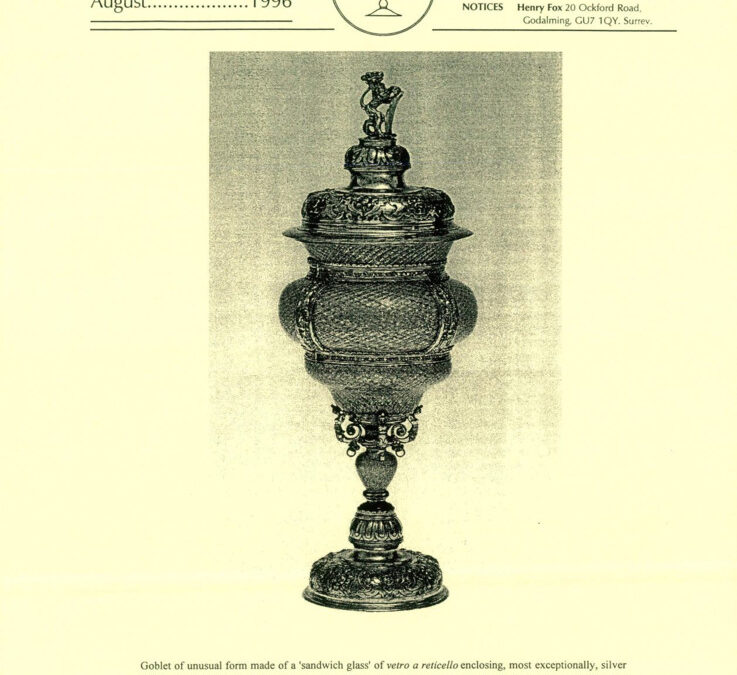
Goblet of unusual form made of a ‘sandwich glass’ of
vetro a reticello
enclosing, most exceptionally, silver
foil (instead of gold-leaf) between the two layers. The silver-gilt mounts (unmarked but executed in the
German Renaissance style) are, curiously, designed without any rim-mount and so, exceptionally, the
silver cover rests directly on the glass. Max. Ht. 34.7 cm. One of the glasses in
The Robert Lehman
Collection,
The Metropolitan Museum of Art, published in the
Catalogue
by Dwight Lanmon and
discussed by Hugh Tait on pages 2 and 3.
Important Glass Circle notices – see page 2
Venetian Renaissance
millefiori
glass ball (diam. 5cm); now
mounted in “gilt-brass or
bronze” (8-sided foot and a
Minerva(?) finial). Max. Ht. 17.5
cm. Veste Coburg
(cat. No.2).
1996
Page 2.
GLASS CIRCLE NEWS No. 68
The Perilous Path of Collecting
(and Cataloguing) Venetian Glass
By Hugh Tait
The Glass Circle is fortunate to have members
studying glass in many parts of the globe, who,
from time to time, enrich the programme of lectures
with contributions generously presented while they
are visiting London. Two such speakers – Dwight
Lanmon (an Hon. Vice-President of the Circle) from
the USA and Anna-Elisabeth Theuerkauff-Liederwald
from Germany – have, after many years of
independent research and preparation, brought out
their respective
Catalogues’
within a year of each
other and, as both collections are rich in Venetian
and
felon de Venise
glass (with a significant
proportion of
pastiches
and fakes), the two
publications have a special relevance for collectors
and historians of European glass made between the
15th and 19th centuries. Both authors are to be
congratulated because each has produced a reference
work that attempts, with the help of a wealth of
comparative illustrations, to resolve the uncertainties
surrounding the manufacture of these glasses.
The eighty-one Venetian and
facon de Venise
glasses
in the Robert Lehman Collection, discussed by
Dwight Lanmon, were acquired in a single purchase
from the Viennese dealer, Leopold Blumka, who had
transferred the family business to New York in the
mid-1940s. Furthermore, the previous owner of all
but one (a Medici armorial jug, cat. No.5) is stated
to have been “Otto Hopfinger, New York”, about
whom no information is given, even though two
glasses (a gilt and enamelled standing cup and a
chalcedony-glass standing bowl, cats. Nos. 2 and 32)
auctioned as recently as 1944 (Parke-Bernet, New
York) and 1953 (Sotheby’s, London), respectively,
subsequently entered his collection. Few of his
glasses have been traced securely to an earlier
owner and, of the four that have a history before
1900, two were first recorded in 1891 in the
collection of the infamous Frederic Spitzer of Parisi.
Perhaps it is not surprising, therefore, that the
authenticity of about a quarter of this collection has
had to be questioned by the author and, although
some readers (like myself) might wish to debate the
age of several more pieces, the end result is an
impressive proportion of the remainder emerging as
important and rare survivals from the Renaissance.
At the Veste Coburg, the scale of the problem was
far greater: the task that Dr Theuerkauff-Liederwald
first began in 1983 has resulted in a
Catalogue
of
747 entries. Apart from 42 pieces, all the glasses
belonged to the collection of Prince Alfred (1844 –
1900), the second son of Queen Victoria, who
conferred on him the title of Duke of Edinburgh.
After serving in the Royal Navy, he married the
Tsar of Russia’s only daughter, Marie, in 1874, and
Clarence House remained their London residence
until 1893, when (following the death of his uncle,
Ernst) he inherited the Principality of Saxe-Coburg
and Gotha; his glass collection remained at Coburg,
where Alfred was to die seven years later. Few of
the glasses have been traced to earlier owners and
the question of a 19th century origin for nearly
one-fifth of Prince Alfred’s vast collection has been
raised and discussed in this massive publication.
Although there are outstanding rarities, many of the
glasses are unspectacular, functional items and, to
catalogue them, the author has grouped them (under
38 main categories) according to their form; within
each category, the
glasses have been
arranged chrono-logically
and, to some extent,
according to the likely
place of origin when
they are
facon de Venise
However, there is no
index.
Both the New York and
the Coburg Collections
have examples of the
so-called
Verre de
Nevers
figures; indeed,
because Robert Lehman
purchased the entire
collection formed by a
previous Circle member,
Mrs Viva King (of
Thurloe Square)
3
, and
auctioned in London by
Sotheby’s (17th Oct.
1958), the Metropolitan
Museum of Art can
rightly describe it as >>
GLASS CIRCLE SYMPOSIUM
2nd November 1996
Judging Jacobite Glass
at the Victoria & Albert Museum
All members should have received a leaflet giving
full details with this newsletter – Book early.
Glass Circle Special Event
Thursday 21st November 1996
London Glassblowing Workshop
– 20th Anniversary
–
Our member, Peter Layton, has kindly arranged for
the Glass Circle a special evening reception, from
6.30pm – 8.30pm., to celebrate twenty successful
years of the London Glassblowing Workshop. Peter,
a founding father of the British glass-blowing move-
ment and British Artists in Glass (currently being
revived by Peter under a new name), after many
years at Rotherhithe, is now firmly established in
spacious accommodation at 7, The Leather Market,
Weston Street, SE1 3ER. – a short walk from
London Bridge or Borough Underground Stations.
Parking is free after 6.30pm.
On show will be part of a successful exhibition
of modern British glass shown in Prague and
Bratislava, the display of which is being shared
with the Studio Glass Gallery in Connaught Street.
Supported by the British Council, it includes fine
pieces by Tessa Clegg, Pauline Solven, Colin Reid,
Brian Blanthorn, Danny Lane, Gayle Matthias, and
Peter Layton. There will also be a display of glass
making and glass items made at the workshop.
Signed copies of Peter’s new book,
Glass Art,
to be published this October, will also be available.
A phone call (Tel. 0171 403 2800) or note to
Peter to say you are coming would be appreciated.
Venetian
Renaissance
millefiori
glass ball (diam. 7.8 cm); now
mounted in gilt-bronze (openwork
foot and negro finial). Max. lit.
18.7 cm.
Veste Coburg
(cat. No.1).
GLASS CIRCLE NEWS No. 68
Page 3.
1996
•
“one of the richest in this category
in American museums . . .”.
Similarly, both Collections boast
examples of that extremely rare
category: a Venetian glass “set in
Renaissance mounts”. Such court
“curiosities” rarely survive and,
therefore, are always subjected to
intense scrutiny but in neither
Catalogue
have photographs or
line-drawings been included to show
how the mounts are assembled and,
indeed, how they look when they are
taken apart. The Coburg pieces (Cat.
Nos. 1 and 2) are strange creations,
without parallel, and even without
dismantling the silver-gilt mounts on
the goblet of
vetro a reticello
(New
York cat. No. 63) it is clear that
they do not serve the protective
function required of all such mounts
when fitted in the Renaissance.
Apart from other inconsistencies of
detail that cast doubt on the age of
the New York mounts, the glass
itself has unusual features that seem
to be 19th century inventions.
Regrettably, these two lavishly-
funded opportunities have failed to
provide the reader with a complete
visual record of these exceptional mounted pieces,
whereas in other respects, the reader has been
handsomely rewarded by the many cautious moves
towards a more accurate assessment of the
complicated “Venetian Glass” story.
Notes
1. Dwight P. Lanmon,
Glass,
Vol. XI of The
Catalogue
of The Robert Lehman Collection
(Metropolitan Museum
of Art, New York, 1993), with David B. Whitehouse (cat.
Nos. 117-136: “Roman and Islamic glass”); 342 pp.;
extensively illustrated (inc. 94 coloured plates) and with
240 comparative photographs. Hard covers; format 28 x
20 cm. Price £100; ISBN 0-87099-678-9.
Anna-Elisabeth Theuerkauff-Liederwald,
Venezianisches
Glas der Veste Coburg
(Kunstsammlungen der Veste
Coburg, 1994), with Stanislav Ulitzka (pp. 40-53; report
on scientific analyses); 600 pp; extensively illustrated (inc.
68 coloured plates) and with 106 comparative photographs.
Hard covers; format 28 x 24 cm. Price 89 DM.
ISBN 3-923641-40-0.
Van Heemskerk for the Burrell
The newly published
1995 Review
of
The National
Art Collection Fund
illustrates an 8 inch tall Nether-
landish R.F. goblet acquired from the Sotheby sale
of 14th Nov. 1995, for the Burrell Collection.
Signed and dated 1668 by William Van Heemskerk,
it is engraved in diamond point with a religious
inscription. The purchase price of £62,000 was
made possible by a grant of £15,000 from the
NACF. An accompanying article by our member,
Reino Liefkis, briefly considers the work of Van
Heemskerk (see also the special book offers by
Frans Smit in the last issue of GC News).
This glass complements the very choice group of
Dutch engraved glass acquired by the Burrell in
1990 and 1991, again with contributions from the
NACF, and reviewed at length by another Circle
member, Brian Blench, in the NACF Review 1992.
2.
The dealer/collector Frederic Spitzer of
Vienna (1815-1890) had moved his
headquarters to Paris in 1852 and shortly
afterwards established his firm, Spitzer
Kunst- and Antiquitaten-Handlung, in
Aachen where the prolific faker, Reinhold
Vasters (1827-1909) lived from 1853
until his death. For a detailed
examination of their working relationship,
see H. Tait “Reinhold Vasters” in
Why
Fakes Matter: Essays on Problems of
Authenticity
(ed. M. Jones), British
Museum 1992, pp. 116-133, figs 1-27.
Spitzer’s own large and varied collection
was published in 6 volumes in Paris, in
1890-92. It contained many fakes but
all were described as genuine in the
auction sale catalogue;
Catalogue des
objets d’art et de haute curiosite
…collection Spitzer,
17th April – 16th
June, 1893 (P. Chevallier, Paris), 2 vols.
and portfolio of plates.
3.
Mrs Viva King, whose husband,
William, died in 1958 four years after
his retirement from the British Museum,
was the daughter of Henry Campbell
Booth. In the early records of The
Glass Circle they are described as “of
Thurloe Square” and although not strictly
“founder members”, they were enrolled by the Committee
in February, 1938, with an apologetic note added to the
brief minutes regretting the “unavoidable delay” in
completing this formality. At that time the Circle’s
Committee not only severely limited the number but
required members to own a collection; Mr and Mrs King
were clearly considered most welcome additions. Viva’s
name appears in the 1970 membership list as an Honorary
Member – a tribute to her significant contribution over
some thirty years.
An Exhibition of
Morris & Co. Stained Glass
until 31st August 1996
At the William Morris Gallery, Lloyd Park, Forest
Road, London, E17 4PP. (Tel. 0181 527 3782).
Open Tues-Sat 10-1.00 and 2-5.00.
Entrance Free.
Death of Howard Phillips
We regret to report the death of Howard Phillips on
July 24th, 1996, age 85. He was not only one of
the very top dealers of our time but his knowledge
of glass, particularly rare examples of English glass,
was quite exceptional. Many collectors and
museums must be grateful for the skill with which
he discovered outstanding pieces for their collections.
Although he was not a member of The Glass Circle,
dealers not being admitted at the time he was most
active, and rather intolerant of those he felt were
simply picking his brains, he was both kind and
generous to many collectors, whether or not they
were customers. His fine advertisement in the latest
Glass Circle Journal was typical of his support and
love for the subject. We extend our sympathies to
his wife, Enid, and their family.
1996
Page 4.
GLASS CIRCLE NEWS No. 68
James Tassie (1735-1799)
by John P. Smith
A talk given to The Glass Circle on Tuesday 19th March 1996
at the Artworkers Guild by kind invitation of Dr P. Kaellgren,
Dr and Mrs R. Emanuel, Mrs E. Newgas and Dr G. Seddon.
James Tassie was born in Pollokshaws on the
15th July 1735. He first worked as a stonemason
and then attended the Foulis Academy in Glasgow
where he learnt modelling and sculpture. Having
completed his art training in 1763, Tassie went to
Dublin where he met Dr. Henry Quin, King’s
Professor of Physic in the School of Physic, Dublin.
Dr. Quin was a man of many talents. As well as
being a physician he was also a musician and used
to give private concerts in his own theatre on St.
Stephen’s Green. He was a friend of John Murray
the publisher who also taught himself how to make
glass casts of antique intaglios. This latter skill he
passed on to James Tassie.
Tassie was an accomplished sculptor and was not
content with merely copying the works of the
ancients. He wished to produce portraits of his
contemporaries to compliment the production of
miniatures that had been popular in England since
the time of Queen Elizabeth. Tassie’s portraits were
usually executed in opaque white glass and did not
exceed 3 1/2 inches in height as this was the
largest size that the technology of the period would
allow. The works of James Tassie were exhaustively
studied by John M. Gray, Curator at the Scottish
National Portrait Gallery and in 1894 he published a
biography entitled
JAMES AND WILLIAM TASSIE a
biographical and critical sketch with a catalogue of
their portrait medallions of modern personages.
This
book also listed virtually all the portraits produced
by James Tassie. This exhaustive work was long
thought to be the last word on Tassie; unfortunately,
as Gray was an historian rather than a technologist,
some of his technological details are incorrect.
When he was making a portrait medallion, James
Tassie first sculpted the subject in wax. From this
he would make a plaster cast. Correspondence still
exists in the Strathclyde Regional Archive of letters
between James Tassie and Alexander Wilson, a
retailer in Glasgow where,
inter alia,
Tassie
describes the best way to obtain good casts. From
this plaster cast Tassie would make a master using
sulphur. Sulphur is an ideal material for making
moulds as it is readily obtainable, cheap, melts just
above the boiling point of water so that it is easy
to handle and when it goes from liquid to solid
form it has no granularity, unlike plaster or clay. It
is also much harder than plaster. Sulphur was much
used in the eighteenth century both as a casting
material and, if coloured with a pigment such as
Vermillion, as a final ornamental cast.
Dr. Quin taught Tassie the casting method that had
been first developed by Homberg and published in
1712 in France, the method was first published in
English in Chambers Cyclopaedia (1783). In this
method damp tripoli powder (Diatomaceous Earth)
was placed in an iron ring and the sulphur master
was pressed into this damp powder leaving a good
impression. The powder was then dried. Next a
sheet of glass was placed over the powder and the
whole placed in a furnace with proper temperature
control. The glass slumped into the mould taking a
good impression.
Portrait
medallions of James Gregory (d.1821), Professor of Medicine at
Edinburgh
University (left) and James Anderson (d.1809) botanist and
physician-general of the East India Company at Madras. Both these
gentlemen are
known only from their Tassie portraits. Further information
Is given in John
Smith’s
monograph on
Tassie available from Mallett.
Tassie used a special very high lead content glass
(approximately 30%) which he referred to as
paste;
this was the same material as was used in the
making of
paste,
i.e. artificial jewellery. Also, when
Tassie was using white glass he would refer to this
as
white enamel.
The use of these two terms has
caused much confusion to later commentators who
have assumed that Tassie made
a paste
of ground
glass and water and used
a Pate de Verre
tech-
nique. As well as having a high refractive index
paste
has a very low melting point, important when
using a small furnace.
On leaving Dublin, Tassie briefly returned to
Edinburgh but quickly moved to London which was
the artistic centre of the British Isles. Tassie was
first and foremost a sculptor and was regularly used
by Josiah Wedgwood to provide likenesses of
contemporary people. However, Tassie considered
that his glass medallions were superior to the rather
granular portraits produced by Wedgwood’s ceramic
technique and when Tassie opened a showroom next
door to Wedgwood’s, Josiah then looked upon him
as a competitor and stopped employing him. As
well as portraiture Tassie was also making enamel
plaques of subjects from the classics. These were all
the rage amongst fashionable people who had been
on the Grand Tour. He also copied the intaglio
jewels and seals of antiquity using coloured glass to
replicate earlier hardstone. These being small were
technically easy to make and quickly found
themselves into collectors’ cabinets. Catherine the
Great ordered a complete set from James Tassie of
12,000 individual items that were sold to her both
in glass and sulphur. Special cabinets were made for
this collection and the whole was catalogued by
Rudolf Eric Raspe, a rather disreputable German
Professor who was also the author of the celebrated
Baron Munchausen. Catherine’s order was placed in
1783 and the catalogue was produced in 1786.
Tassie was that rare combination, a good artist, a
competent businessman and a pleasant and highly
respected gentleman. These three qualities ensured
that his business continued successfully and
profitably until the year of his death, in 1799, when
he was succeeded by his nephew William, who had
been his assistant and partner for many years.
Death of Professor Keith Kelsall
We are saddened to report the death of our member,
Keith Kelsall whose books on
The Footed Salver
and
Open Flame Lamps
made significant contributions to
little-known aspects of glass collecting.
GLASS CIRCLE NEWS No. 68
Page
5
.
1996
Whitefriars Glass
– The Harry Powell Years
by Lesley Jackson
Harry Powell (1853 – 1922), one of the grandsons
of the James Powell who founded James Powell and
Sons in 1834, joined the family firm at Whitefriars
in 1873 at the age of 20. Within the space of two
years he had become manager of the whole
glassworks, a position he retained for 44 years until
his retirement in 1919. Partly because of his
longevity, but primarily because of his wide-ranging
talents – he was a true Renaissance man of the
Victorian Age – Harry Powell dominated Whitefriars’
output, particularly in the field of table glass and
ornamental glass, throughout the last quarter of the
19th century and the first two decades of the 20th
century. The purpose of this lecture was to give a
brief survey of his achievements in this field during
this period – the golden years of the Arts and
Crafts Movement.
When Harry Powell joined Whitefriars in 1873 the
firm was already established as the leading
glassmakers in the newly established field of
Aesthetic Movement tableware, as a result of
relationships established during the 1860s and the
1870s with the architect-designers, Phillip Webb and
T.G. Jackson. Within the space of ten years Harry
Powell would develop into a brilliant glass designer
in his own right, probably the most naturally gifted
glass designer this country has ever seen. By the
turn of the century his work was being displayed,
sold and celebrated throughout Britain, Europe and
the USA.
Yet throughout his career Harry Powell saw himself
less as an artist, but first and foremost as a
scientist. Having studied chemistry at Oxford during
the early 1870s, on joining the family firm he spent
a considerable amount of time carrying out
experiments to improve the quality of the glass
being made there, and expanding the range of
colours and decorative effects employed. He had a
great curiosity about the nature of glass, and a
burning desire to make objects which exploited glass
as a material to its full potential. He was, in fact, a
pioneer in a science which at that time had no
name, but which by the end of his career was
identified as glass technology. Like many scientists
Harry Powell was a very modest man, and not one
to blow his own trumpet. His achievements in the
field of design, however, were equal to those in the
fields of science and technology. His designs are
endlessly inventive, and he had a natural sense of
colour, proportion, form and pattern such as few are
blessed with. He was also extremely dedicated and
hard-working. Although the documentation for this
period is fragmentary, all the surviving evidence
suggests that Harry Powell was responsible for most,
if not all, of the new designs introduced at
Whitefriars between the late 1870s and the First
World War. This documentation includes not only
his notebooks and the pattern books in the factory
archive, but also contemporary sources such as
magazines like The Studio and The Art Journal, as
well as the catalogues of contemporary exhibitions,
such as those of the Arts and Crafts Exhibition
Society, in which Whitefriars participated on each
occasion between 1888 and 1916.
Although Harry Powell’s designs were wide-ranging
A meeting of the Glass Circle held at the
Artworkers Guild on Thursday 16th May 1996.
The hosts were Mr M. Greville Watts, Mrs C.
Weeden, Mr John Towse and Miss A Towse.
and reflected his developing interests at different
times, there is a consistency about them which
means that they can be broadly grouped into four
categories: Venetian Revival, Arts and Crafts, Art
Nouveau and “Glasses with Histories”, the latter
group spanning the entire length of his career. The
Venetian Revival designs cover the period roughly
from the late 1870s to the early 1890s, although
they continued in production well into the next
century. In these designs Harry Powell co-opted
Venetian-inspired design ideas – such as finely-blown
attenuated and complex forms, manipulation of hot
glass for delicate applied decoration, and opalescent
colouring – but the resulting glass was arguably of
a better quality, both technically and aesthetically,
than that by which it was inspired. He only copied
in order to learn, not through lack of ideas of his
own. This also applied to the “Glasses with
Histories” series, which grew out of the earlier
Venetian Revival designs.
The other three categories into which Whitefriars
glass of this period can be classified are less clear
cut. Many of the “Glasses with Histories” designs,
for example, have a strong Arts and Crafts aesthetic,
and there is considerable cross-over as well between
Arts and Crafts and Art Nouveau; the latter grew
out of the former. The “Glasses with Histories”
series was a group of designs produced
spontaneously and sporadically at intervals through
Harry Powell’s long career, all of which were in
some way inspired by historical artefacts (not always
glass, sometimes pottery, metalwork or even
alabaster) or by glasses in paintings. At the end of
his career, when he was nearing retirement, Harry
Powell analysed all the recurrent threads that had
cropped up in his work over the years, and
gathered them together in his “Glasses with
Histories” notebook – a fascinating document which
survives in the factory archive in the Museum of
London. In the notebook he grouped his designs
according to their nine main historical sources:
Egyptian, Cretan or Minoan, Roman, Spanish,
German, Flemish Or Dutch, Venetian, French,
English or Irish, and Pictures. For each design there
is normally a small sketch, a note of the pattern
number used by Whitefriars, and a note on the
specific source of the design. Extensive and detailed
information on the “Glasses with Histories” series is
provided by Judy Rudoe’s excellent essay on this
subject in the catalogue which accompanies the
current exhibition Whitefriars Glass – The Art of
James Powell & Sons. Research into the subject is
complicated by the fact that many of the attributions
and locations for the artefacts and paintings which
Harry Powell studied have since changed. This
makes it much less straightforward than it would
originally seem, therefore, to match up Whitefriars’
designs with their original source objects.
It was largely through the continued production of
designs from the “Glasses with Histories” series that
the spirit of Harry Powell lived on during the
inter-war years, long after his death in 1922. A
number of shapes based on what were then thought
to be Roman pottery vessels – some now known to
date from the Bronze Age – did not actually go
into production until after the factory moved to
Csntinural__Qu_paw-13-
1996
Page 6.
GLASS CIRCLE NEWS No. 68
91
7
,
4
Aca
Po
tea
An exhibition shown at Christiansborg Slot (Castle), Copenhagen, 7th June – 3rd Sept, 1995,
and at the Kunstindustrimuseum in Oslo 23rd Feb. – 5th May, 1966.§
Catalogue. A quarto volume, 195 pp. with numerous b/w ills. (colour ills. of Galle glasses); 13 authoritative articles by
Danish and Norwegian scholars plus a list of 411 exhibits with parallel text and captions in Danish and English. Price
290 Danish Kroner (approx. £30).
Available from Det kongelige Solvkammer, Christiansborg Slot, Prins Jrargens Ord, 1218 Copenhagen K. Denmark.
The object of this truly magnificent
exhibition was
to display the quality glass accumulated by the royal
house of Denmark and Norway* from the
Renaissance to today. It took four years to prepare,
with contributions coming from museum curators and
historians; the glass was loaned by many countries.
During the period covered, Denmark was not itself
producing glass, but cutters, engravers and traders in
glass were active in Denmark, most importantly
during the 18th century. From 1741 onwards the
court in Copenhagen had the services of a first
class Silesian engraver, H.G. Kohler, who was at
hand to celebrate royal occasions – marriages,
birthdays, coronations – in fine allegorical idiom
perfectly executed. Furthermore, from 1743 onwards,
glass was being produced at Nostetangen in
forest-rich Norway. The factory, active from 1743 to
1777, was vigorously supported and patronised by
King and Court, and this gave to the products a
grandeur and originality never again attained in
Norwegian glassmaking. Nostetangen glass engraved
by H.G. Kohler, one of the high points of this
history, more than anything else made the exhibition
a truly combined Danish-Norwegian enterprise.
Famous in Danish glass history is the group of
more than 400 pieces of elaborate Venetian glass,
acquired by King Frederik IV on his journey to
Venice in 1708/9. The collection is displayed in the
famous “Glass Kammer”, dating from 1719, at
Rosenborg Castle**; selected pieces were chosen for
the exhibition at Christiansborg. Most interesting
was a complete table cover with plate, knife and
fork, drinking glasses and decanters all in reticello
glass. For the first time it revealed a ‘practical’
aspect for such glass, though the set was surely
never used as such. Like the rest of the collection
its purpose was purely decorative.
Fine glass came to the Danish court from many
sources, some as presentations and gifts from other
royal houses from the closely-linked royal families
of Northern Europe, others as orders for decorated
glass for special occasions, also for import ware
which for reasons unknown finished up in the royal
residences of Denmark. The finest of all came from
Kassel, whose noble house was connected by
marriage to Danish royalty, and so it came about
that some of Christian Labhardt’s finest pieces are
to be found in Copenhagen, with Danish royal
cyphers, as well as fine examples of the skill and
artistry of his pupil Franz Gondelach. A very fine
Potsdam goblet was made for King Christian VI,
with the portraits of him and his consort in
medal-like style engraved upon it (c. 1735).
Unfortunately, it suffers badly from glass disease.
From big glass-producing centres in Bohemia, Silesia
and Saxony came any number of glasses – curious,
handsome, exquisite – the whole spectrum of quality
and local character. Most are engraved with the
royal cypher of the moment.
A couple of warlike glasses are of special interest.
For five prominent officers five identical goblets
were made with pictures and high-flown texts
celebrating the death of King Charles XII of
Sweden at Frederiksten castle in Norway. He had
brought endless trouble and suffering to Northern
Europe, and the stray bullet which killed him on an
otherwise peaceful evening in 1718 was celebrated
as a most heroic event, in the style of the time.
The other side of the story is represented by a
handsome covered beaker, made in Sweden and
showing a string of Charles XII’s victories – before
the joint forces of Russia and Poland stopped his
progress at Poltava in 1709. One single piece of
English origin is part of the collections, a fine
posset pot with a crown on the cover, made in fat
and juicy lead crystal. In the earliest Danish sources,
from 1715, it is described as a “Welcome”, and was
obviously being used to greet honoured guests in
the continental manner.
A real surprise for the organisers was the re-
discovery of a group of 18 Galle glasses, presented
to Frederick VIII and Louise, his Queen, on the
state visit to France in 1907, complete with vitrine
from Galles workshops. Two are dated 1904, the
year of Galles death; the others are variants of
types originating from ca. 1890-1904. The
collection is unrecorded in French sources, and
scholars in both countries are busily at work trying
to get it in proper focus.
Much attention was paid to glass made for the royal
table. The very earliest example is a set first made
at Nestetangen consisting of a stemmed wineglass,
conical decanter and water glass, all engraved with
the royal cypher. Amazingly, this little personal
table setting was repeated, initially by Norwegian
factories, later by continental glasshouses, and finally
by Holmegaard, the earliest Danish factory (founded
1825) until well into the second half of the 19th
century. For the grand banquets of the 19th and
20th centuries come a string of services with as
much as seven different drinking vessels per person.
On some occasions as many as 800 pieces were in
use. They were provided by Bohemia, by Val-
Saint-Lambert and, eventually, by Kosta and Orrefors
in Sweden and by Holmegaard. The story of the
drinking vessels is rounded off with descriptions of
the purchase and use of wine, beer and spirits
culled from Danish archives. Of particular interest
is a finely detailed account of a wine-buying
expedition to the Rhine between 1604 and 1606.
§ Also to be shown at The Corning Museum of Glass.
* The two countries were joined from 1380-1814 under the
Danish Crown with King and Court residing in Copenhagen.
** See Hugh Tait’s
Golden Age of Venetian Glass
p. 92, Fig 8.
Dr Ada Polak is one of the Circle’s oldest members and was
previously deputy curator in Britain of The Arts and Crafts
Museums of Norway.
GLASS CIRCLE NEWS No. 68
Page 7.
1996
Under the Hammer
– Recent Highlights
The London Scene
*Christie’s
King Street –
Fine Ceramics Glass – Stipple
engraved “friendship” glass by “Alias” (see reference to
this engraver under review of Park Lane Fair) £6500.
Magnum club shaped decanter (late 18th century) engraved
“Ale” within a cartouche £2000. Early facon de Venise
ta77a (some lead content) with latticino decoration £2400.
Mildner Zwischengoldglas armorial tumbler signed and
dated 1792 £6000. Cogwheel base beaker in style of
Anton Kothgasser with a little girl leading two sheep on
a ribbon (chipped rim) £500. Vinaigrette gorge de pigeon
French opaline c. 1830 £1000. (All prices plus premium).
King Street
(May) – Fine Continental Furniture.
An Italian ormolu-mounted micro-mosaic table top and
giltwood gueridon sold for £41,000. This impressive table
top c. 1810 (the base later) contrasts sharply for size with
the more common Italian micro-mosaic jewellery popular
in the 19th century: hence the price. Some members may
recall the interesting lecture given at a Circle meeting
some years ago by July Rudoe of the British Museum on
the subject of mirror mosaic work.
*Sotheby’s
Bond Street
(Irish Sale) – rare piggin enamelled
with shamrock and coronet early 19th century £550. Pair
of cut glass jars and covers £1300. Cut glass cameo
shaped bowl with Van Dyke rim £1800. (All prices plus
premium).
Colonnade
(May) – Collection of Stourbridge
glass with good examples of cameo work, including
Webb, in which a cranbury and blue opaline vase applied
with glass jewels and gilding made £4200. A large peach
blow vase by Webb made £1500. (All prices plus
premium).
Bond Street
(June) – Fine Ceramics & Glass –
Early Venetian calcedonio Tazza late 15th century, but
damaged and largely rebuilt, sold for $11000! Large
English baluster “goblet with mushroom knop stem c.
1710, ex Horridge and Walter Smith Collections, £3200.
Another tall baluster goblet wasted bowl set on triple
annulated knop and centre and basal knops in stem
c.1720, again ex Smith Collection, £2800. Among the later glass were “examples of Lobmeyr Persian style
pieces (late 19th century) e.g. a vase made £10,000. (All
prices plus premium)
Althrop Park (June) –
Rolls Royce & Bentley
Cars and Related Material – A Lalique “Tete de Bellier”
(Ram’s Head) car Moscow £2300; a stained glass window
by W. Hudson showing the front part of a period
open-top Rolls Royce in a country hillside setting with
words “Rolls” above and “Royce” below for £1495. (Both
prices include premium).
*Phillips, Bond Street (June) –
Ceramics & Glass – A
superbly engraved oval-shaped jug-decanter signed by
Frederick Kny (right and detail p. 9) depicting
the
warrior Queen Boadicea of the Iceni in a
lively engagement with the Romans – a true
tour de force
–
sold for £19,000. (and later
seen on the Asprey stand at the Grosvenor
House Fair – q.v.). A pair of tall Webb peach
blow glasses made £2000. A pseudo cameo
piece, probably by Johnson, carved with
spirited dragons and clouds made £500. A
pair of late 18th century English table
candelabras made £1100, and from the
selection of early wine glasses on “offer an
early English baluster glass with cushion knop
stem made £600.
Around the Countryside
*Woolly & Wallace, Salisbury –
May Sale – large
collection of glass scent bottles (100 lots) sold in all for
£16,000. Two mermaid figures by Lalique made £1100
and £1300 respectively. A number of English 18th century
wine glasses were in this sale and they all sold. (See also
under forthcoming auctions.) (All prices plus premium).
*Lock & England (Black Horse Agency) –
May
sale – a collection of English drinking glasses
including an ale glass, the bowl engraved with hops
and barley and a man in 17th century costume
holding aloft a toasting glass contained within an
arcadian portico, on a double series opaque twist
stem which made £850; another ale glass with basal
fluting and engraved around the rim made £420. By
contrast, a lot consisting of three jelly glasses late
George
III
period, made £24 (All prices plus
premium)
*Bearnaise Torquay –
June Sale – had several good
English 18th century drinking glasses. Heavy baluster wine
glass with cylinder knop stem, domed and folded foot
£1400. Slightly later, tall baluster cordial glass with
truncated trumpet bowl solid at base set on collar and
shoulder knop and inverted baluster stem, domed and
folded foot £780. An early heavy baluster wine glass with
trumpet bowl solid at base set on and basal knopped
stem, domed and folded foot £1150. Another later glass
with double ogee bowl on shoulder knop, inverted baluster
and basal knop stem, conical folded foot £500. A rare
colour twist toasting glass (red, blue and white), but with
chipped rim, £1800. Another good colour twist wine glass
(blue, red. green and white) £2700. (All prices plus
premium).
*G. Sworder & Son, Bishop’s Stortford –
April and
May Sales featured stained glass. A stylish Aesthetc
movement window panel depicting swan in bulrush pond
setting £2200: and four good stained glass Victorian
windows of good size each of which had two circular
panels of named prominent authors or scientists on a
ground of fruit, flowers and animal panels, all within a
stylised border, and they sold for £5300. (All prices plus
premium).
*Lawrence, Taunton –
June Sale
–
Heavy looking
English late baluster style wine glass with “Mating Fowl”
engraved on bowl sold for £370. Another, but lighter
baluster style, engraved with clasped hands (friendship)
made £310. An airtwist stem glass, the bowl “engraved
with Noah’s Ark, dove and leafy twig, made £250. (All
prices plus premium).
*Cheffins, Grain & Comins, Cambridge –
June –
Several lots of run-of-the-mill mid to late 18th century
glasses, mostly making around the £100 mark, but a
drawn plain-stem trumpet bowl goblet made £160 and a
mid 18th century tazza made £210. A pair of Regency
period cut glass vases and covers made £840. (All prices
plus premium).
*Dreweatt Neate, Donnington Priory,
Newbury –
May Sale – Good selection of glass
on offer including MacKenzie Collection
(reviewed separately). An early 19th century
commemorative rummer inscribed “Queen Caroline
1820” £230. A heavily cut Geo.III glass piggin
with minor chips to rim £240. An extensive
suite of Victorian cut table glass including claret
and water jugs as well as sherry and spirit
decanters, finger bowls, dishes and tumblers and
wine glasses sold for £2400.
Overseas sales follow on page 9
DIM and
BRI
Modern judgement is about as reliable as a
chandelier in a supermarket.
I read that the
Commemorative Stamp Committee of
H.M.
Post
Office has rejected a proposal to dedicate a
commemorative stamp to William Morris on the
grounds that “he was not of sufficient stature”.
Very true, but they will be featuring Muffin the Mule
and Sooty; how can he compare with them? There
is, of course, a quite nice William Morris exhibition
at the Victoria & Albert Museum*, but then, it always
did have questionable taste!
*William Morris 1834 – 1896,
until 1st Sept. 1996.
1996
Page 8.
GLASS CIRCLE NEWS No. 68
dri1
4-
1
1
L
.0
t-
Henry Fox has been
4V
i
i
A
Making the Most of the Manchester Weekend
The recent Manchester Weekend organised for Glass
Circle members provided an opportunity to venture
north of Watford.
I
can only say “Why did it take
me so long”? Manchester Museum & Art Gallery
has one of the largest early heavy balusters I can
recall seeing, attractively engraved with a bacchus
cheerfully astride a barrel; a truly impressive piece.
Equally, I noticed in a side cabinet, good examples
of Adam-period glass finger bowls engraved with
typical swag and bucranium decoration. Then I was
off to join the other participants at the Harris
Museum & Art Gallery, in Preston. which was
displaying a good range of 18th century English
drinking glasses, including several sought-after
rarities, as well as coloured 18th/19th century glass
from the collection of our late member, Laura
Seddon.
However, the great discovery for me was the
wonderful collection of scent bottles brought home
by a privileged browse among the reserve collection.
Built up by Mrs C.A.L. French, the variety of over
2700 bottles from various countries, dating from the
18th to early 20th century in ceramics, glass and
other materials, was amazing and the visual effect
of the display stunning. My favourites in glass have
to be the silver topped white/blue Webb cameo
swan’s head bottle and another overlay example
where both the body of the bottle and stopper had
been cut through the outer blue layer to reveal
white which in turn had been removed to show the
clear glass underneath which contained finely
controlled criss-cross latticino work. ( To get the
feel of this collection see Shire Album, No. 210,
Scent Bottles
by Alexandra Walker). To add to the
fun, and equally to give the visitor some idea why
scent was so important an accessory to “a person of
quality” in the past, a series of “sniffing boxes”
GC News Publication Deadlines
No. 69
Mid-October for publication in November.
No. 70
Mid-December for publication in January.
were dotted around the displays – Uh! Mrs French
also collected ladies’ visiting card holders, another
popular bygone accessory which disappeared with the
coming of the 20th century, and which she also left
to the Harris Museum. Although made of various
materials, none were of glass. However, several were
decorated with reverse direct paintings on glass (not
to be confused with the more familiar antique glass
pictures where a print is stuck to the reverse of the
glass and then the paper skilfully scraped away
leaving the outline of the print which is then hand
coloured). We concluded a full afternoon with a
round table discussion of some of the mystery
pieces from the reserve collection. We are most
grateful to Paul Slimtoff, the Curator, for his help
and hospitality. Returning to Manchester we were
treated to a sumptuous evening reception by the
Lole household and to the pleasures of studying
their glass-related possessions.
Saturday was devoted to the Whitefriars Symposium,
the full turn-out including past members of the
factory as well as many familiar faces. It proved a
thoroughly enjoyable and informative event in spite
of the mortifying chill of Manchester Town Hall, a
magnificent edifice but hardly designed for comfort!
Lesley Jackson can be well-satisfied with the interest
her symposium and magnificent exhibition has
stimulated in Whitefriars glass. Chinatown is five
minutes walk away and we concluded a successful
day with a lengthy and intricate Chinese banquet.
Sunday provided an opportunity both to tour the
surrounding district and visit, all too briefly, three
glass collections spanning a wide range of English
glass from balusters to 19th century and pressed
glass. At each stop our hosts were generous to a
fault with refreshments as well as letting us handle
their precious specimens, showing the remarkable
trust we glass collectors have in total strangers of
like persuasion. We cannot thank them enough.
Following lunch in a nearby old-world pub we
somehow managed to squeeze in a visit to
Middleton, St Leonard, church. Of particular interest
is an unusual window, dated 1505, which is unique
in portraying kneeling named archers with their
weapons. It is traditionally associated with the battle
of Flodden Field but more probably represents the
private troop of Sir Edward Stanley who donated
the window. This was in sharp contrast to two Arts
and Crafts windows by Christopher Whall, both
displaying the clever use of streaky glass.
Finally, our thanks to Peter Lole for a magnificently
organised weekend, and to his wife, Anne, and son,
Richard, for looking after us so well on Friday
evening.
Since then we have been subjected to the despicable
Manchester bombing. Fortunately, the Art Gallery,
which is not far from the site of the explosion, is a
substantial building. Although the glasses must have
danced on their shelves, nothing was damaged, the
worst consequence being a couple of broken
skylights and a considerable amount of dust which
was shaken from the air-conditioning system.
Elsewhere, it must be said, Pilkingtons will be
working overtime to provide replacements for broken
windows.
GLASS CIRCLE NEWS No. 68
Page 9.
1996
Under the Hammer
–
continued from page 7
Overseas Sales
–
Tiffany comes to the Big Apple
*Sotheby’s New York (June) choice selection of Tiffany
glass: a Favrile glass and bat lamp sold for $170,000
(£113,350); a Tiffany glass triple panel window together
forming a mountainous scene with trees and rhododendrons
in the foreground made record $240,000 (£160,000).
Tiffany sales at major auction houses in recent years
indicate a very strong market for quality items; the
possibility of breaking the million dollar barrier for an
exceptional piece is mooted over the next few years, if
not sooner.
The Mackenzie Collection of Glass
This collection was formed by the late David Mackenzie
(1911 – 1988), who studied dentistry and medicine at
Edinburgh University, and later went on to found the
Department of Oral Surgery and Orthodontics at the Royal
Berkshire Hospital, Reading. It was sold at auction on
22nd May, 1996, by Dreweatt Neate of Newbury; 97 lots
were on offer and included “specimens from the noted
collections of Joseph Bles, Bernie, Virgette and Walter
Smith. The main thrust of the collection, which was
largely built up prior to 1968, was drinking glasses
before 1760. Airtwist and opaque twist examples were
few with baluster styles, plain stems and a solitary
English pedestal stem and some early bottles and
miscellaneous pieces such as jugs and cruciform decanters
making up the rest. The collection also avoided engraving
of any kind (except for one glass described as
Bohemian): not for this “collector the ubiquitous “hops
and barley” or “Jacobite” rose! Sadly, 22 lots failed to
reach the reserve but at least some were destined to later
tempt visitors at the Park Lane International Ceramics Fair
(reviewed elsewhere). Here are a few highlights from the
auction. An early dwarf ale with flammiform decoration
and propeller knop (ex Bernie Collection) £1300; an early
heavy baluster wine glass with acorn knop £1550; a
similar glass with acorn knop £1850; another early glass
with drop knop and basal knop stem (ex Virgettte
Collection) £1400; and another with a cushioned knop and
basal knop stem £820; an unusual composite glass with
bell bowl set on an annulated knop above a shoulder
knopped airtwist stem and domed foot £880; a ratafia
with basally moulded bowl set on an opaque twist stem
£600; a drawn plain stem cordial glass on domed and
folded foot £460; a similar glass but for wine £1190; a
late 17th century small green tinted “shaft and globe”
wine bottle £1700, whilst a larger example with chipped
rim made £800. Most of the
remaining glasses sold
between £200 and £400. There was also a small
collection of glass books. A rebound copy of
Hartshorne made £110. (All prices plus premium).
Detail from the Kny jug-decanter – courtesy Phillips.
The Summer Fairs
There are four fairs held in June in London; two
specialist Ceramic Fairs held at the Park Lane Hotel
(Piccadilly) and the Cumberland Hotel (Marble Arch) both
of which show glass. The other two are general fairs held
at the Grosvenor Hotel (Park Lane) and at Olympia
Exhibition Halls (West London). Between them these fairs
offer all that’s best in quality antiques. Olympia offers
something for everyone and covers a wide range, whilst
the Cumberland offers only a range of ceramics and some
glass. However, the Grosvenor House and the Park Lane
fairs offer only the very best – often rare and expensive,
but reasonably priced quality finds can be found to
complement any member’s collection.
Olympia
–
The Big One
From a glass point of view there was an amount of it to
be seen at Olympia, but little in the collectibles category;
18th century glass was mostly thin on the ground. Very
little pressed glass was about, certainly nothing to set the
pulse racing, and some Whitefriars (Powell). However, the
principal glass dealers seemed happy with their sales. The
best glass was no doubt being held back for either
Grosvenor House or Park Lane. Clippings particularly liked
a large shallow Lalique bowl with wide lip engraved
around the sides of the bowl with a continuous troop of
elephants; on the same stand, Gallerie Modeme, were a
number of interesting Lalique car mascots. Another stand,
Andrew Lineham, offered Webb cameo pieces – some very
finely worked – and engraved Stevens & Williams; also
colourful decorated glassware by Moser among others. I
spotted a few glass cigarette/cheroot holders(!) but no
Roman glass. But then, Olympia is so big one really
needs two or more visits to do it fair justice. On this
occasion the summer heat did not encourage one to linger
for long. Jeanette Hayhurst was showing her usual range
of 18th century drinking glasses, later Victorian engraved
glassware, some pressed glass, and several examples of
Whitefriars. Carol Ketley was showing mainly Victorian
glassware as was Arenski, who seem to go in for
decorators’ pieces such as a tall whisky dispenser in the
shape of an Irish tower, or a pressed flint glass train set
c.1895 comprising a French engine followed by three
English coal wagons (Greener). Both Mark West and
Christine Bridge were showing 18th century drinking
glasses but later glass was more in evidence. Roger
Barclay had a few pieces of pressed glass. Reverse
paintings on glass, mainly continental 19th century, were
seen on several stands and varied considerably in quality
and price. Only a few pieces of early stained glass were
seen. Lalique jewellery which incorporated glass was on
viw on one expensive Jeweller’s stand. Sadly, this falls
into the same price category as collecting creations by the
workmasters of Faberge!
Grosvenor House
–
Queen of the Antiques Fairs
This famous fair has been going since before the War
and throughout that time has “maintained the highest
standards for quality and authenticity for the objects
shown. This year it can be truly said that there has never
been seen such a wonderful display of 19th century
engraved glass. Asprey’s were showing the jug decanter
engraved by Frederick Kny (bought at Phillips; see above),
which had already found a prospective buyer, also a good
tall pair of early 20th century candelabra by Ossler.
On an adjacent stand Malletts had another fine and rare
jug decanter, c. 1880, finely engraved by Paul Opptiz who
worked in a studio in Clapham, London. Mark West of
Wimbledon was showing his stock of English and
Continental glass, which included an attractive engraved
piece, for the first time at this fair. It was good to see,
this year, glass better represented at this important fair.
continued overpage
1996
Page 10.
GLASS CIRCLE NEWS No. 68
Taking each stand separately as one enters the fair, one
comes first to Adrian Sassoon who was showing modern
designer work by Danny Lane (a Solononic column),
Toots Zinsky (a bowl made of shaded mauve fused glass
strands), Colin Reid (an attractive cast and polished piece),
Keiko Mukaide (another bowl of fused glass strands). The
next stand was Christopher Sheppard who was showing a
selection of Roman pieces including a fine blue glass
pillar moulded bowl. Also on his stand was a beautiful
Nevers group of the Four Seasons; there were also
examples of English and continental drinking glasses and
modem glass such as champagne-style glasses by Biminni
and wine glasses by Venini. The main dealers in English
period glass were on the floor below. Here one found
Asprey with a much better display than last year: there
was a good heavy baluster period dram glass, as well as
two wines with mushroom and acorn knops respectively.
An attractive stipple engraved glass was also on offer, but
Clippings particularly liked the wine glass “engraved with
a portrait bust beneath the legend “The Duke of
Cumberland”. Asprey’s cut and Irish selection included a
pair of Cork decanters and a single decanter by Edwards
of Belfast. A few paces away was Delomosne who were
also showing an acorn knopped heavy baluster wine glass
as well as a rare plain stem portrait Jacobite wine glass
and with motto
Audentior Ibo.
The most interesting glass
on this stand was a tall plain stem glass superbly
engraved in diamond point; not only was there a vine
circling up from the base of the stem, but the bowl was
engraved with latin mottoes one each side together with
“The Charming Miss Betty Phillips – A. Jameson” – a
true loving cup!!! The quality of the engraving was such
that one wonders why more glasses engraved by this hand
have not come to light. Delomosne is also noted for their
quality cut and Irish glass as well as gilded glass. Of
additional interest was a pair of three-ringed neck ships
decanters with overall cut sides and matching stoppers; and
a small rare purple glass toilet bottle and stopper c. 1765
with overall shallow facet cutting. Around the corner. at
Malletts glass was much in evidence – Webb, Stevens &
Williams, and Stuart, including a rare vase engraved and
signed by Jules Barbe c. 1890. As usual this stand had a
number of tall ale and other glasses, including a captain’s
glass, but of interest to collectors of early English glass
was a decanter jug and its hollow stopper of possibly the
Hawley Bishopp period (fl.1676 – 1685). (Both Asprey’s
and Malett’s had stands at Grosvenor House and
consequently their glass stock was distributed between the
two fairs). Across from Mallett’s was the New York dealer
Leo Kaplan. Here, indeed, was a feast of colour and
technical virtuosity for the eyes. Apart from a superb
range of paperweights, was an array of Art Nouveau glass –
of which my favourite had to be a small Daum bowl
decorated with mushrooms. Fine examples of Webb cameo
glass, such as the “Aphrodite” vase – the work of George
Woodall, were much admired and covetted by Clippings.
There was also an unusual Webb blue glass apple with
three heart shaped windows in its sides. Mr. Kaplan
kindly explained that this piece, and an equally rare but
larger pear which was still in their New York showrooms,
were illustrated in Corning’s book on cameo glass. Not to
be missed was a very rare ruby gold glass medallion
engraved by F. Biegel showing “Hebe and Eagle of Zeus”.
Sadly Clippings had to tear himself away from this
beautiful stand and stroll across to Jonathan Horne’s stand
where he was showing two early English wine bottles of
onion shape with applied seals one identified as the Kings
Head in Oxford and the other marked “W.T.” circa 1690
and 1680 respectively. Retracing my steps I came to the
stand of leading French exhibitor, Dragesco-Cramoisan,
who was showing a selection of early Venetian glasses as
well as a fine stipple engraved “Newcastle” glass by Alias
(the name given to the unidentified engraver of a group
of stipple glasses by the same hand by our member Mr.
Smit in his booklet on stipple engraved glasses offered to
members cut-price in the last issue of GC News). Also
being shown was another stipple glass, this time in the
style of David Wolff. However, the most impressive piece
was a very large portrait medallion of the Sun King,
Louis XIV, by Bernard Perrot, an Italian who worked at
Nevers and latter at Orleans in the latter half of the 17th
century. Perrot invented plate glass for which he was
granted a patent in 1688 by the French king. Lastly, one
came to some glass which complimented the period
porcelain of the main display. Here Lindsay Grigsby had a
traditional Kit-Kat” style glass of long drawn trumpet bowl
set into a short inverted baluster stem; a George II period
pedestal stem tavza; and a small collection of jelly glasses.
I left with that warm and satisfied feeling that yet again
this fair had provided a feast in glass which even the
most fastidious collector would have enjoyed.
Forthcoming Auctions & Fairs
*Bonhams Knightsbridge, 3rd September – A selling
exhibition
British Decorative Arts Today – 96
includes glass.
Also a sale at their Chelsea (Lots Road) branch of English
and Continental glass and ceramics.
*Bury St Edmunds, 6th-8th September – Fair, William
Macadam will be exhibiting.
*Kensington Antiques Fair , 15th-18th August – On this
occasion Jeanette Hayhurst will not be present as she is
staging a special exhibition at her shop in Kensington Church
Street over the same period.
*Sotheby’s Bond Street, 19th November – Sale includes an
extremely rare English green tinted glass with opaque twist
stem (the only glass of this kind, which has been seen twice
by Clippings, one in the Walter Smith Collection sold in
1968). Also in this sale will be a pair of Swedish goblets in
Venetian style with lead content c.1690 Kingsholm Glasshouse.
At 20inches tall, these are two of the largest known examples
of Swedish glass.
*Woolly & Wallace Salisbury, 30th August – some forty 18th
century drinking glasses, including an engraved “Newcastle”
plain stem. Also two very fine ewers, possibly by Richardson,
in pristine condition.
Don’t Forget. . . .
Book early for the Symposium on
Judging Jacobite Glass
It
is an event you will not wish to miss. We are
indebted to The Daily Telegraph for the prominence
given to this event.
Incidentally, admission fees, including the special
price for members are standard rates fixed by the
Victoria and Albert Museum.
The Summer Fairs – continued
Park Lane – Quality Glass – Ancient Roman to
Today’s Studio
Clippings once again must thank the organisers for his
invitation to the Press Preview which takes place the day
before the official opening. It was “all go” with dealers
telling themselves it would be “alright on the night”.
Certainly, it is an ideal time to view; dealers can spare a
few minutes to point out their prize pieces and one can
appreciate them and the other glass on show without the
genteel crush that normally accompanies this type of fair,
where dealers are busy cultivating real customers with
deep pockets. As usual the glass on display was a
collectors joy – items ranged from Roman specimens on
Christopher Sheppard’s stand through to late 17th century
bottles shown by Jonathan Horne, then to 18th century on
the stands of Asprey, Delomosne, and Mallett and onto
Art Nouveau, rare cameo cut pieces, and paperweights
brought over from New York by Leo Kaplan, and lastly
onto modern studio glass shown by Adrian Sassoon.
GLASS CIRCLE NEWS No. 68
Page 11.
1996
4121(P 7D RE945e7T672,S.
by F. Peter Lole
4
It is remarkable how often an exhibition with one
theme provides valuable insight into a quite different
aspect. Of the legion of Jacobite exhibitions
prompted by the the quarter millennium of the
Rising of 1745/6, only one was devoted explicitly to
Jacobite Glass, the small ‘Toasts and Treason’
exhibition at Broadfield House. But others had minor
Glass dimensions, some quite unexpected.
The major exhibition ‘Bonnie Prince Charlie; Fact
and Fiction’ started in Glasgow, paused at Derby,
and then, unlike Prince Charles himself, moved on
to London, where it was at the National Army
Museum in Chelsea. Amongst a small group of
Glass was the Erskine of Cardross II Amen Glass,
which helped to highlight the importance of the
Erskine family in the pantheon of Jacobite Glass.
Only one other family possessed two Amens, the
Earls and Marquesses of Breadalbane. The Erskines
were also involved with the largest group of that
select little band of coloured enamel Portrait Glasses;
Thomas Erskine, later 9th. Earl of Kellie, is
recorded as providing six of these for use at the
dinners to celebrate Prince Charles’ birthday, held
annually at the home of Mr. Steuart in Edinburgh,
until Charles’ death in 1788 brought them to an
end. One of these Glasses was presented by our late
member, Miss Silvia Steuart, a descendant of the
dinner host, to the Royal Scottish Museums, in
Edinburgh. Erskines, too, were members of the
reputedly Jacobite Beggars Benison, in Fife, and
must have been familiar with their scatological
enamelled drinking Glasses. (Both these and the
enamelled Portrait Glasses were discussed, and
illustrated, in Simon Cottle’s article on ‘The Other
Beilbys’ in Apollo for October 1986.) Regrettably,
this travelling exhibition had no catalogue; indeed,
the only real catalogue to result from the plethora
of exhibitions is that for ‘The Swords and the
Sorrows’ exhibition, an outstanding display of
weapons by The National Trust for Scotland at their
Culloden visitor centre.
However, another exhibition with a small Glass
dimension which yields a totally unexpected and
important Glass sidelight, is that at the Inverness
museum, which runs until August. This opened with
three conventional wheel engraved Jacobite Glasses
(one rather questionable !). The publicity attendant
on the exhibition prompted the local gift of a
fourth, a nice Glass with an ogee bowl on an
opaque twist stem, bearing a cabbage rose with one
bud, dimidiated with a thistle, thus adding to David
Watts’ corpus of Stiegel type’ Glasses (GC News
65 & 66). But the real Glass treasure at Inverness
is not a Jacobite Glass at all, but an archive record
for the ablution saga. Duncan Grant was an
Inverness merchant of strong Hanoverian leanings,
who has left a journal of his affairs, unfortunately
unpublished; the Inverness Exhibition quotes
extensively from this journal. His Whig outlook was
widely known, prompting him to flee his home
when the Jacobites occupied Inverness early in 1746,
thereby resulting in the use of his house as billets.
He returned home after Culloden, and complained to
the authorities of extensive losses, amounting he said
to 400, which resulted from this occupation; amongst
the items detailed as lost was the following Glass:
4 dozen of the most fashionable wine glasses
2 large thick waterglasses
2 glass decanters
1 dozen glasses for washing hands at table
1 glass lamp to hang in a stair
This explicit reference to finger bowls for washing
hands precedes by twenty years the earliest reference
(Smollet’s) which I had managed to fmd for my
earlier list of finger bowl usage (GC News: 56 &
58). And this in the Highlands of Scotland, so
notoriously stigmatised by Butcher Cumberland as a
land of uncouth savages.
The ‘Vases and Volcanoes’ exhibition at the British
Museum, by way of contrast, has a catalogue which
needs a fork lift to handle, and a mortgage to
fmance. The exhibition has two lovely pieces of
Glass, the Portland Vase, which Sir William
Hamilton owned for three years, and a most
imposing Roman funerary jug, thirteen inches high,
which admirably illustrates the Roman facility for
producing large, pleasing, unpretentious Glass vessels.
There are also a number of other exhibits which
titillate the palate of Glass cognoscenti. Inevitably,
once in the B.M., one follows on up the stairs to
look again at the restyled ‘Bond Street’ galleries,
with their substantial and varied displays of Glass.
Amongst a number of Glass and Ceramic mementoes
of eighteenth century political life are two quite
atypical wheel engraved Jacobite Portrait Glasses,
purchased in 1886 and 1888 respectively. I am
indebted to John P. Smith for mentioning these two
Portrait Glasses, and am impelled to echo his
musing, as to what prompted both the timing and
selection of these two pieces to represent the
Jacobites in Glass, for they precede both Hartshorne
and the 1889 ‘Royal Stuart’ exhibition.
Two events relevant to The Circle are still to come
in this fervour of Jacobite commemoration. Our own
`Judging Jacobite Glass’ symposium at the V & A
on 2nd. November, and also an exhibition of
Jacobite prints, whimsically entitled: ‘Look, Love and
Follow’, mounted by the Scottish National Portrait
Gallery. This starts in their north of Scotland
outstation at Duff House in July, and moves to the
main Edinburgh SNPG gallery during October and
November. One hopes that this display, and the
accompanying book from Richard Sharp, may
illuminate and inform the discussion on the origins
of the images used by both the medallists and the
engravers of Jacobite Portrait Glasses.
The
Art of Glass:
Art Nouveau to Art Deco
Sunderland Museum & Art Gallery promise an exciting
exhibition of glass from this progressive and flamboyant
period, which will be on display 17th July – 27th October
1996. Pieces, by well-known artists of the day, never
before seen in the North East, will be on loan from
prestigious museums and private collectors. Included are
items from the famous Lalique glass service which was
given by the City of Paris to George VI and Queen
Elizabeth, and now in the private collection of the Queen
Mother. A large model of a horse’s head by Lalique,
which is usually “stabled” in the Royal
Box at Ascot,
has been lent by Her Majesty The Queen.
Admission free. Open Mon – Fri 10am to 5pm; Sat.
10am to 4.30pm; Sun. 2pm – 4.30pm. ” A book is
planned. Our member at the Museum, Sue Newell,
has been working closely with Victor Arwas, the
renowned author and glass expert on this period.
There will be many “new photographs of the
exhibits and a number of essays by Mr. Arwas.
The usual collection of OLD IRISH GLASS (for which this gallery has been
famous for ten years) will always
be
on view to delight the connoisseur and
collector so long as the supply lasts.
OLD IRISH GLASS
Aset of twelve Finger Bowls,
originally belonging to the
Master of the Tipperary
Hunt In 1805,
Old Dublin
Class of magnificent colour.
Unique specimens.
VISIT THE IRISH GALLERIES:
GRAYDON-STANNUS COLLECTION
:: 23, Earl’s Court Square, S.W. 5 ::
SPECIMENS FROM TWO TO TWELVE – HUNDRED GUINEAS
1996
Page 12.
GLASS CIRCLE NEWS No. 68
MORE
OR
LESS
TRUE BLUE
HUNTS.
by
F. Peter Lole
The note on True Blue Hunt Glasses in GC News No.
65 has brought forth some additional information: one
more, shadowy, True Blue Hunt; the confirmation of
THE NOBLE TIPPS
as a straightforward Irish Hunt
Glass, together with two further Irish Hunts.
I have been given a somewhat cryptic reference to
THE
FRIENDS AROUND THE WREKIN
Glass, which seems
to be a good candidate as a True Blue Hunt Glass. The
gentry of Shropshire, as also its neighbours Cheshire,
Staffordshire and the Welsh marches, were very Jacobite
in the eighteenth century, and Whigs there tended to
complain of their isolation, rather than form convivial
clubs. One is reminded of the story in Boswell’s
Life of
Johnson;
when Bozzy expressed surprise at finding a
Whig in Staffordshire, Johnson retorted: “Sir, there are
rascals in all counties.”
Mary Boydell expands on
THE NOBLE TIPPS,
which is
in fact the Tipperary Hunt;
Baily’s Hunting Directory
tells us that it was formed in 1820, and is still going
strong. The Graydon-Stannus advertisement of 1924
(above) avers that the set of twelve finger bowls offered
date from 1805, apparently fifteen years before the Hunt
was founded! Mary Boydell has a somewhat different
form in her possession, probably one of those sold by
Christies in 1975 (my list No: 12); unlike the Graydon-
Stannus finger bowls, it does not have wreathing sprays
around the trophies, which are themselves differently
arranged, whilst the rim is engraved with swags and
dependant stars. The engraving Mary attributes to
*Franz Tieze, thus putting this variant of the finger
bowls into the last third of the nineteenth century, or
even early twentieth century. She has, too, a finger bowl
engraved for the
DOWN HUNT,
which Baily’s records
as having mid-eighteenth century origins and also still
flourishes. Finally, David Stuart tells me of a late 18th
century drawn trumpet Firing Glass, 4V2ins. tall and
inscribed
ATHBOY HUNT,
which appears to have been
subsumed into what is today the West Meath hunt.
* It should be made it clear that the attribution to Franz Tieze
of the engraving for these finger bowls is totally devoid of any
Jacobite overtones. Two points need emphasising; first, I do
not regard the majority of the nineteenth and twentieth
century Hunt Glasses as having any Jacobite significance.
Those considered above seem to pertain purely to the sodality
of the hunt members. Second, the value of the Franz Tieze
attribution lies in the artistry of his recognisable style, and its
potential as a helpful indicator for dating the work. To me,
there seems no possible ‘hidden agenda’ for this particular
engraving.
Special Offer to Glass Circle Members Only
New Glass Books from Thomas Heneage
Glass Circle News is pleased to announce that it has negociated a 10% discount on new glass books bought from
Thomas Heneage. Thomas Heneage’s Spring and Summer 1996 issues of the Art Book Survey include the following in
addition to those already considered in GC News: Roman Mold-Blown Glass of 1st – 6th Centuries by Marianne Stern.
[55563]
£85.00
Das Bohmische Glas 1700 – 1950. 7 Vols. by Helena Brozkova.
[55360]
£565.00
Glass Art
by Peter Layton (publication in October 1996).
[56050]
£39.99
Glass Beads from Europe by Sibylle Jargstorf.
[55224]
£22.50
William Morris; Artifacts and Glass by Gary Blonston.
[55833]
£30.00
Popular ’50s and ’60s Glass; Color along the [Ohio] River by Leslie Pina.
[55225]
£29.95
Thuringa Glas aus Lauscha and Umgebang by Rudolph Hoffmann.
[55586]
£20.00
I Vetri di Archimede Seguso 1950 – 1959 by Rosa Barovier Mentasi.
[55210]
£29.00
Verre de Venise. 2 Vols. by Erwin Baumgartner.
[54479]
£73.00
Murano 1910-1970. From Decorative Art to Design by Marc Heiremans
[57243]
£60.00
For these and other glass books enquire (quoting Glass Circle News) direct to: Thomas Heneage Art Books, 42, Duke Street,
St Jame’s, London SW I Y 6DJ. Tel. 0171 930 9223 Fax. 0171 839 9223 Email: 100130.1050@compuscrve.com
Isn’t this carrying our search
for
rare glasses a bit too far?
(With acknowledgements to Geoff
Thompson and
The
Visitor.)
GLASS CIRCLE NEWS No. 68
Page 13.
1996
4
Courses and Information
for the Glassmaking Hobbyist
Some Like It Cold!
Making stained glass and leaded windows is a
popular past-time today. One of the oldest estab-
lished firms in the business of supplying all the
necessary equipment and glass required is James
Hetley & Co. The firm was founded in 1823 but is
now part of the T. & W. Ide Group, established
seven years later on the site of the old Ratcliff
Glasshouse in East London as briefly mentioned by
David Watts in GC News 66, page 3. Their
show-room is well worth a visit just to see the
bewildering range of over 500 different glasses,
hand- and machine-made from ten different manu-
facturers, plus a colourful range of bevels, globs, cut
jewels and bullions, not to mention lamp bases,
books and all the necessary tools. For the less
adventurous transparent glass paints are available to
simulate leaded stained glass. A 33-page A4
coloured catalogue cum instruction manual will tell
you how to get started and costs £2.50. Open
Mon.-Fri. 8.30am – 4.30pm, Sat. 9.00am – 2.00pm.
Tel. 0171 7902682, Fax 0171 790268 and please
mention The Glass Circle.
Some Like It Hot!
For those tempted to try their hands at hot working
Peter Layton runs teaching sessions at his workshop
in The Leathermarket. These are intensely super-
vised with only two students being taught in any
one session. Assuming very little innate ability it
shouldn’t take you long to produce “works of art”!
rivalling the early pieces by Harvey Littleton as well
as enjoying an unforgettable experience. Ring Peter
Layton on 0171 403 2800 for full details.
Please let GC News know of any other courses on
aspects of glassmaking worth a mention to members.
Welcome to New Members:
Mr and Mrs B.H. Budd. Woodford, Essex.
Mr A.T. Burne.
London.
Dr H.W. Odemer. Munich, Germany.
Mr P.L. Pratt.
West Wittering, W. Sussex.
Mr and Mrs M. Pulver. London.
Mr A.F. Gibney. Co. Wicklow, Ireland.
Mr R. Houghton and
Ms M. Huppert. both of London.
Ms C. Lawrence. London.
Dr S. Mossman.
Science Museum, London.
Mr A.J.O. Wigg. London.
that the story of the Luck
The
Musgrave Ritual
in The
The family is described as
a “cadel one which
had separated from
the Northern
Musgraves some time
in the sixteenth
century”. Their object
turned out to be an
ancient crown which
was found by the
butler!
This was published in
1893 and was most
likely inspired by the
1879 article which
was reprinted in Glass
Circle News
No.66.
Whitefriars Tear wine service
introduced at the Arts & Crafts Exhibition of 1889.
Whitefriars Glass:
The Art of James Powell & Sons of London
The long-awaited London version of this Exhibition
was launched on the 29th July 1996 and runs
through to 26th Jan. 1997.
Much has been written about this exhibition already
but in its new venue the Whitefriars glass takes on
a new dimension that makes it well worth a visit.
Inevitably, comparisons with the spacious Manch-
ester layout are invited but Leslie Jackson has done
a marvellous job in packing some two thirds of its
glass into the tiny exhibition space of the Museum
of London. Consequently, the labels for individual
pieces are more difficult to find and at least one
appeared to be the wrong way round. On the
other hand it was easier to follow the development
of design ideas and how they related to each other
in a particular period. The later glass, in particular,
benefited from the massing of its striking colours.
A much better impression is gained of how a
collection might look in a domestic environment.
There is no question that if the collectability of
Whitefriars glass had been in any doubt before, this
exhibition will settle the matter in a positive
fashion. The early glass has been expensive for
years but prices of the later glass can be expected
to rise even further until the extent of the market
becomes known. This is an area where snap
bargains may prove a profitable investment.
The usual Museum entry charges apply but there is
no charge to enter the exhibition. Museum entry is
free after 4.30 p.m.
Whitefriars Glass
concluded from page 5.
Wealdstone in 1923, when they were used for the
newly introduced streaky and cloudy ranges, and
later for the threaded range.
For some inexplicable reason, however, in spite of
the considerable international reputation he enjoyed
during his lifetime, particularly around the turn of
the century, Harry Powell’s remarkable achievements
were soon forgotten after his death. Whereas the
names of Tiffany and Galle have lived on and
continue to be celebrated, the names of Harry
Powell and Whitefriars have unaccountably faded
into obscurity during the post-war period. The main
purpose of the current exhibition, both in
Manchester, and later in The Museum of London
(see above) is to draw attention to the superb
quality of Whitefriars glass, particularly during the
remarkable Harry Powell years, and to ensure that
the status of both is guaranteed for posterity.
The Musgrave Ritual
John A. Franks writes to say
of Eden Hall reminds him of
Memoirs of Shirlock Holmes.
1
,