




GLASS CIRCLE NEWS
No. 69
October
1996
EDITORS David C. Watts
27 Raydean Rd,
Barnet, EN5
–
IAN. Herts.
F. Peter Lole
5 Clayton Ave.
Didsbury, Manchester, M20 6BL.
NOTICES Henry Fox
20 Ockford Road,
Godalming, GU7 1QY. Surrey.
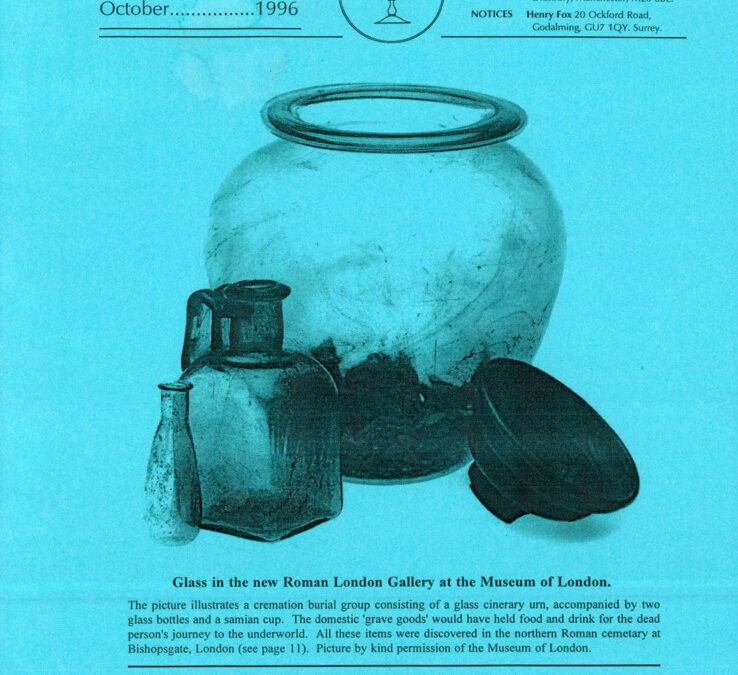
Glass in the new Roman London Gallery at the Museum of London.
The picture illustrates a cremation burial group consisting of a glass cinerary urn, accompanied by two
glass bottles and a samian cup. The domestic ‘grave goods’ would have held food and drink for the dead
person’s journey to the underworld. All these items were discovered in the northern Roman cemetary at
Bishopsgate, London (see page 11). Picture by kind permission of the Museum of London.
URGENT … HAVE YOU;
1.
Registered for the
Judging Jacobite Glass
symposium at
The Victoria & Albert Museum?
Return the registration form or contact the Honorary Secretary on
0171 586 1503.
2.
Registered for the
Evening Reception
on
November 21st
at
The London Glassblowing Workshop.
Ring Peter Layton on
0171 403 2800.
SOTHEBY & CP
Z
.-
114
1K.!
” • Z.`::`
NYDL DANK 7LAD.
••
ocwur
c
JO N
AN1N1710.
LONDON YOL
MACAO. MOLDS. N• VAINDDINCADOL•
let July, 1905.
Dear Plesch,
Thank you so much for the reprint of the Journal of
Class Studies.
It was very kind of you to remember me and
it is a eight for tired eyes to see such an interesting and
varied collection illustrated and with the association of so
many famous collectors.
Whenever I see figure
1
it reminds me of Cecil Davis.
A well-known auction room threw out a whole lot of glasses
and three or four others which were sold at Bruce’s?
There
was a tap on my door and Mr. Bernard Perret put his head round
the corner and said “Mr. Kiddell,
I
am just off to buy three
or four sealed Ravenscrofta.”
I laughed at him, he said “it
is quite true”.
An hour or so afterwards Cecil Davis rang
me and asked me if I wanted to see some really rare gl
so I said “would they be the sealed Ravenscrofts that-turned
up at so-and-so’s”.
There was a deadly hush and he said to
me “how the devil did you know?”
“Oh”, I said, “Perr2t told
me on his way to the sale.”
“He should never have done that
Mr. Kiddell, you might have gone to the sale yourself.”
Of course, they all went into the knock-out and bought
them for
a few pounds but the discovery of these QQQ
QQQbjects in
the sale belonged to Barrington Haynet4Churohill.
I think
as to where they had come from was supp ied by of Mr. Kiddell!
With kind remembranoes and many thanks,
Yours sincerelyik.
!(
Dr. P. Plesch,
Kiddell.
University
of keels, Staffs.
1996
Page 2.
GLASS CIRCLE NEWS No. 69
Posset Glasses and Seals
– Further revelations
Our article on posset pots has produced some
unexpected revelations dating back almost fifty years.
It began with an intriguing letter from Mr Kiddell of
Sotheby’s in response to being sent a reprint from
The
Journal of Glass Studies
on Ravenscroft glass by our
member, Peter Plesch who at one time owned a sealed
Ravenscroft posset pot. The letter, reproduced here,
relates to his exchange with Mr. Bernard Perret, one
time head of Delomosne’s, over the unusual nature of
their discovery.
Martin Mortimer was able further to illuminate the
mystery by pointing to an account of the event in
Churchill’s
Glass Notes,
No. 9. Under the heading
Annus Mirabilis
the salient events, which fortuitously
also reveal the origin of the S-sealed posset are given
as follows;
“Nineteen hundred and forty-eight may fairly be
regard as a happy year in the history of English glass
collecting. It was ushered in by the appearance in the
final days of 1947 by the “Baird of Lennoxlove”
Amen glass, not quite unknown but forgotten since
1912 when it was exhibited at Glasgow. The summer
brought a hitherto unknown Verzelini glass in
undamaged condition and this was illustrated in our
last number by courtesy of the finders, Messrs.
Delomosne and Son, Ltd. A few
weeks later we discovered a fine
Ravenscroft decanter-bottle with its
original stopper, and the magnificent
Ravenscroft goblet and cover with
the arms of William of Orange as
King of England. Later in the year,
a crizzled lead posset pot with the
`S’ seal was sold at Sotheby’s, an
appearance rather than a discovery,
from Ham House. These glasses
alone would serve to distinguish any
year, but more was to follow”.
“In the late autumn a parcel of
glasses appeared in a London
Sale-room, unheralded and without
provenance. So intriguing were they
that they might easily have been
dispersed without recognition but for
the fact that they included no less
than three uncrizzled posset pots
with the “raven’s head” seal. The
Company was able to acquire the
whole of the parcel…”.
Further investigations revealed an
unstated aristocratic provenance,
later claimed by Bickerton to be
William Wentworth the Earl of
Stafford. Delomosne acquired one of
the sealed possets, which is now in
the Toledo museum. Another is in
the Pilkington Glass Museum. The
uncrizzled nature of the possets was
remarkable because of the ten
sealed Ravenscroft’s previously
known only one, described as the
“ex-Ratcliffe goblet”, was without
crizzling.
Also in the parcel were three plain
possets in soda glass and a series of fruit tazzas and
wine glasses of similar date. Each of the tazzas was
of a different size suggesting that they were all
originally part of a large set. Further, the shape is to
be found in Greene’s drawings and one other actual
specimen (illustrated by Haynes in
Glass Through the
Ages,
pl. 32b) was known. The inference is that these
glasses, and the tazzas, might be pre-Ravenscroft
imports from Venice or, taking into account the
greyish nature of the metal, the products of The Duke
of Buckingham’s glasshouse in Greenwich. Unlike the
Ravenscroft possets the handles of the soda possets
are hollow, which Christopher Sheppard considers to
be a Continental feature (see GC News No. 63,
Addendum) although in this instance the makers were
probably Italian, wherever they were working.
One final feature, of interest at the time, was the
question of who made the initial discovery, the choice
apparently being between Barrington Haynes and
Howard Phillips (see page 5), the latter being inserted
in handwriting by Jim Kiddell in his letter although it
does not show up in our reproduction. Either way, the
credit for one of the most exciting single discoveries
in the history of English glass collecting must go to
Arthur Churchill and Company.
GLASS CIRCLE NEWS No. 69
Page 3.
1996
e
Looking at Uranium Glass
by D.C. Watts
A meeting held at the Artworkers Guild on the 16th June,
1996, by the kind invitation of Mr and Mrs Derek Woolston
and Mrs Jo Marshall.
The main purpose of this meeting was to investigate
a collection of putative uranium glass brought by
members, by using a Geiger counter and a
double-wavelength commercial UV lamp. However,
before examining the range of glass brought
—
Dr
Watts outlined the history of this interesting pigment
which although frequently mentioned is often
misunderstood.
As is well known, M.H. Klaproth, Professor at
Berlin University, first announced its isolation from
pitchblende in 1786 and gave it the name Uranium.
His product was not the pure element he at first
thought but the dioxide. The recent discovery by
Peter Lole of an 1817 reference to the use of
oxides of uranium to colour glass (GC News No.
59, July, 1994) indicates that his error became
apparent much sooner than suggested by the long
time lapse to 1841 when E.M. Peligot (who was the
first to publish an analysis of glass composition)
isolated the pure metal.
Also of interest, the 1817 reference states that
uranium produced brown, apple green and emerald
green, but, significantly, not yellow, colours in glass.
Hence it may be inferred that the pigment used was
heavily contaminated with such impurities as iron,
nickel, cobalt and copper present in the ore.
Whether or not the glass mentioned in this reference
was made by Riedel at his Dolny Polubny works is
not known. But the introduction of his distinctive
Annagrun (green) and Annagelb (yellow) glasses
around 1830 conveys his achievement in improving
the quality of the pigment long before the isolation,
in 1850, of pure sodium diuranate (uranium yellow)
that is said to have become the glassmakers’
standard additive. With this in mind the exceptional
nature of the uranium yellow girandoles presented to
Queen Adelaide in 1837 becomes more apparent.
Part of the early uranium glass folklore is the
derivation of Annagrun and Annagelb. The speaker’s
first CG News co-editor, the late Gabriella Gros
(from a Bohemian glassmaking family), writes in her
book that these names are a tribute by Josef Riedel
to his wife, Anna. On the other hand Jay Glickman
in
Yellow-Green Vaseline
(see page 3) writes that
the first uranium glass was produced by Frantisek
Riedel and he named the two glasses Anna Yellow
and Lenora Green after his two daughters. Anna
married Frantisek’s pupil and nephew, Josef Riedel
who subsequently expanded manufacture of uranium
glass. The problem with this alternative version is
that there appears to be no Riedel equivalent in
German to Lenora Green. Further, Lenora was a
significant glassmaking town in Czechoslovakia
which could have given rise to a misunderstanding.
On the whole, Dr Watts stuck by his late co-editor
but invites further clarification.
Incidentally, the term ‘Vaseline’, apparently still very
popular in the United States although never so-used
by any glassmaker, had a vogue among British
dealers after the war but has tended to decline in
favour of the more general ‘Uranium Glass’. This is
partly because there is less such glass about but
also because ‘Vaseline’, quite like the glass in
appearance, is the Registered Name for a petroleum
jelly jealously guarded by the Cheseborough Pond
Company. Jay’s book title would invite litigation in
this country.
Two other confusions in otherwise excellent texts
should also be clarified. In his
“British Glass”
Charles Hajdamach lists uranium along with gold
and arsenic as producing a change in colour in the
glass when reheated. This, so called, “striking” of
the colour does not occur with uranium and is a
misunderstanding of the nature of shaded glass
where the even background colour, which can
equally be blue, green or white, is simply masked
by the ruby or white shading produced on reheating.
Examples, brought by members, of modern Fenton’s
Burmese and Whitefriars original Straw Opal were
examined in this context. Uranium glass goes brown
(see above) in strongly reducing conditions but this
was not meant here. In Dan Klein and Ward
Lloyd’s
“History”
it is stated in a section on
uranium glass that “By 1838 Georges Bontemps at
Choisy-le Roi was producing uranium glass and
during the 1840s factories such as St-Louis were
using Egermann’s yellow and ruby stains”. However,
Egermann’s yellow stain was produced with silver
salts, just as the ruby stain was produced with
copper salts. Uranium glass occurs as an overlay but
is not know to have been used as a stain – a quite
different technique.
The amount of uranium required in different glasses
varies considerably. Angus-Butterworth in
The
Manufacture of Glass
(1948) suggests a range of
from 2% – 12% and quotes a formula unusually
rich in the pigment (including 32 parts uranium
dioxide (UO
2
) to 100 parts sand) that gives “a
beautiful red colour”. This, however is exceptional,
the range normally found being from about 0.2% to
3% by weight. Among the common glasses
Chrysoprase – first introduced by the Newely
Schreiberhan factory, in 1831, (2 parts UO
2
to 120
parts sand) and Sowerby’s Patent Queens Ware, with
a similar content, were among the most uranium-rich
glasses found and made the Geiger counter clatter
merrily. By comparison, Burmese, patented by
Frederick S. Shirley of the Mount Washington Glass
Co., in 1885, normally contains 1.1% UO
2
although
from radioactivity measurements some examples of
Thomas Webb’s version contain significantly less.
Stan Eveson has given recipes for 36 named
coloured glasses produced by Thomas Webb and no
less than 18 of these contain UO
2
. The problem for
the collector, however, is to relate the formula to
the actual glass and a reference collection is sorely
needed for this purpose.
Among the glass found not to contain uranium were
a Davidson opaque green vase, a Sowerby Aesthetic
Green plate, various amber pieces and a modern —
Bohemian handled basket of a colour that closely
mimicked uranium yellow. It became clear that
while the presence of uranium in some glass is
readily discernable it is not easy to be sure in
others without a specific test.
Other aspects of the subject touched upon in
discussion were the use of the fisssion tracks
produced in the glass by the uranium gamma
radiation, to date a piece from the time when it
was made, and the post-war use of so-called
depleted uranium, presumably with the fissile isotope
U235, representing about 0.7% of the total, having
Concluded overpagc
1996
Page 4.
GLASS CIRCLE NEWS No. 69
NEW BOOKS
URANIUM GLASS
by
K. Tomabechi
reviewed by
Professor Peter Plesch.
1996. Squarish format c.25 x 25 cm, hard covers, pp. 98; English,
74 Japanese, 64 Colour ills. No ISBN.
Order from the lwanami Book Service Centre, 2-3 Jinbocho
Kanda, Chiyoda-ku, Tokyo 101, Japan. No price available.
This book contains two text, one in Japanese, one
in English, both apparently by the same author
because no translator is mentioned. The author is a
physicist specialising in nuclear power generators
who, in the 1960s, worked for several years at the
Atomic Energy Authority in Vienna. During this
period he became fascinated by uranium glass and
started to assemble his personal collection. Unable to
fmd any book on the subject, he set about writing
this one.
This review is of the English version, the language
of which is adequate though not idiomatic, but there
are some obscure phrases and also technical
inadequacies (e.g. “silica contains quartz” rather than
“silica includes quartz” or “quartz is a form of
silica”); the most pervasive and irritating terminol-
ogical misuse is “handicraft” for “artefact”.
The book is useful because it is, as far as I know,
still the only one on the subject that covers such a
wide range of topics – discovery of uranium, its
various uses, the history, nomenclature, the colours,
fluorescence, radioactivity and other physical features
of uranium glass, places of manufacture, and much
else. There are many digressions, e.g. Pliny anent
his account of the alleged discovery of glass; about
the Counts Harrach anent their glass-houses where
uranium glass was made. Most of these are
evidently aimed at the Japanese readership who
cannot be expected to be familiar with such
essentially European matters.
The valuable technical information, e.g. on radiation
doses from uranium glass, the nature of fluorescent
radiation, the physical chemistry of glass, the origin
of colours in glass, and much else, is dispersed
amongst artistic and historical comments. Severe
editing would have produced a more easily usable
work. Nonetheless, the author has done a useful
service, and he is to be congratulated, especially
upon the 64 really first-rate colour plates showing
examples of uranium glass.
(N.B. The price of this text is not known. I wrote
for information to the Iwanami Book Service on
Aug. 5th but, to date, have received no reply which
does not augur well for orders sent on trust. Ed.)
Looking at Uranium Glass, concluded,
been removed (Dr Watts would appreciate more
detailed information on this material). We were told
that in the pottery trade old uranium stocks were
collected by government order at the end of World
War II; presumably the same happened in the glass
industry. For health and safety in manufacturing very
little uranium glass has been produced in the U.K.
post war although Stan Eveson told Dr Watts it was
used by Thomas Webb’s while significant amounts of
both press-moulded and blown tableware, many of
them reproductions, have beeen made in the United
States to meet
collectors’ demands!
Mid-18th century English yellow opaque twist
glasses, like the yellow parts of Roman and ancient
glasses were coloured with lead antimonate.
THE ART OF GLASS
–
Art Nouveau to Art Deco
by
Victor Arwas
1996. 24 x 30cm, soft covers, 111 pp. with 141 mostly colour plates
of glass and a further 20 illustrations of makers’ signatures and
trademarks. ISBN 1 90t092 00 3. Price £10.95 during the exhibition,
then £12.95 + £2 p+p from The Principal Commercial Officer, Tyne &
Wear Museums, Discovery Museum, Newcastle Upon Tyne. NE1 4JA.
This book is really the
Catalogue
of a superb
exhibition with the same name, at The Sunderland
Museum. The exhibition, which is the Museum’s
contribution to
The Year of the Visual Arts 1996,
is
due to end on October 27th but the
book
illustrates
most, if not all, the objects; many of them, some
from private collections abroad, have not been
exhibited before. Victor Arwas, the author and
well-known authority on this period, has loaned
objects’ from his private collection. Altogether, the
works of 85 artists and glass makers are shown. We
highlight a few.
An unusual feature of the book is that the convent-
ional index is replaced by an alphabetical list giving
brief biographical details of each artist or maker
followed by the page numbers where they are
mentioned. This section, illustrated by 20 signatures/
trade marks, is the work of Susan Newell, Assistant
Keeper of Fine and Applied Art for Tyne & Wear
Museums. Susan, who was mainly responsible for
organising the exhibition, also contributes a helpful
glossary of the technical and trade terms used.
The main text follows the general layout of the
exhibition, beginning with the
Precursors
of Art
Glass – Brocard, Rousseau, Leveille, and, from
Britain, Powell and Couper together with several of
the Stourbridge firms, in connection with which
Broadfield House has lent a number of pieces.
This brings us to
Art Nouveau
and the School of
Nancy, beautifully illustrated with table lamps by
Daum and Muller Freres and a choice selection of
Gad. A mould-blown Daum vase designed by Henri
Berge with raised autumnal chestnut leaves coloured
with vitrified powders and wheel-carved (c. 1908) is
quite magnificent.
Iridescence
comes next with major
sections devoted to Tiffany, Loetz and Moser,
followed by
Pate de Verre –
Cros, Despret,
Decorchement, Dammouse and Argy-Rousseau.
Roughly the last third of the book is devoted to
Art
Deco
where we find some fabulous treasures. We
are used to seeing small Marinot vases but here, a
31.5 cm tall, deeply-etched goblet in clear bubbly
glass is breathtaking. Also, Lalique boxes decorated
with opalescent glass panels, and part of a dinner
service uniquely designed for The Queen Mother,
together with a horses head in clear glass borrowed
from the Queen’s box at Ascot, are real highlights.
Work by Sabino, the Scandinavian firms, Moncrieff,
Walsh Walsh and humble- pressed glass. from Bagley
and the firms of the north-east bring the book to a
close but for one final treat. This is a remarkable
collection of life-like glass sea anemones made by
Leopold Blaschka (1822-1895), one of the treasures
from the Hancock Museum, Newcastle on Tyne.
You may not get to see the exhibition but this
Catalogue is
a worthy second best.
D.C.W.
The Art of Rene Lalique – at Broadfield House
An exhibition of Rare Scent Bottles from the Pickard-
Cambridge Family collection, until November 24, 1996.
An Anglo-Venetian goblet, part of the
parcel discovered by Arthur Churchill and
Co. and possibly made at the Duke of
Buckingham’s glasshouse in Greenwich
(see page 2). Sold by Sotheby’s as part
of the famous Walter F. Smith collection,
in 1968, it was bought by Howard
Phillips for £1400, one of the highest
prices of the sale.
GLASS CIRCLE NEWS No. 69
Page
5.
1996
HOWARD PHILLIPS 1910 – 1996
Martin Mortimer Reflects
The world in which Howard Phillips spent his life is
full of individualists. Few enjoy the security of a
niche within a multinational, pension-awarding
business and the life-long necessity of being a one-
man band produces interesting characters. Howard’s
death has taken from us just such a character.
William Howard Phillips was born in Stockwell. His
father was a promoter of International Exhibitions
including the first Motor Shows. An influential God-
father encouraged his education at Shebbear College
at Bideford. Poor health kept him out of the services
in the last war, but Howard was active throughout
with Charing Cross Hospital. From the age of 16 he
had been collecting glass, and he was in his element
when asked to assist with the securing of archeolog-
ical fragments, including glass, disclosed in bomb
craters. In this he assisted staff from the British
Museum, among them Adrian Oswald
and William King of the Victoria
and Albert museum. These two,
together with Cecil Davis, gave him
active encouragement so that he was
well placed after the war ended to
enter, in 1945, the celebrated firm of
Arthur Churchill and manage it for
E. Barrington Haynes who had
acquired it on the death of Arthur
Churchill. I first met him on Chur-
chill’s stand at the Antique Dealers’
Fair in 1948. He was an amiable
figure, approachable and disposed to
be agreeable to a nervous new
recruit; it was my first Fair with
Delomosne and, as it happened,
Arthur Churchill’s last. Not too long
afterwards, despatched by my boss,
Bernard Perret, to attend one of
Cyril Ray’s Exhibitions entitled “the
Complete Imbiber” and held at Kay
Kleinfeld’s King Street gallery,
Canterbury, I found his the only
known face. We passed a bibulous
and lachrymose evening behind a
pillar as he unloaded detail of his
failing marriage. I felt some sense of
honour at being the recipient of such distress. Soon,
however, all this was behind him and by 1953,
Howard was securely married to Enid, his support
and partner ever since.
Howard’s early training with Arthur Churchill, or,
more correctly, with Barrington Haynes, instilled in
him a respect for the classics of early English glass
which never left him, despite steadily diminished
opportunities for handling such things. When, in
December 1948, he left Churchills and set up shop
in Marylebone Lane with very little stock above his
own collection, he determined to continue so far as
humanly possible to deal only in the best and the
rarest (and thus, in his view, earliest) things. When
he first needed a shop sitter, he turned to me,
among others, with the result that a friend, suffering
a temporary loss of direction, went to work for him
for a year. This was Bridget Riley, the artist, who
when she moved on, started her steady climb to the
pinnacle she now occupies in the world of Modern
Art. Her place was taken by Sarah Proctor who later
became my wife – to Howard’s horror! He feared
she would escape with his _files and pass them on
to Delomosne.
It is probably true to say that, in setting up his
own business, Howard was almost pathologically
discreet. His determination to succeed on his own
led him to unnecessary degrees of secrecy which
brought about a certain distancing from his comp-
etitors. Thus, although a member of the British
Antique Dealers’ Association since 1955, he never
sat on the Council. He did not seek election and
his reticence was respected. Likewise, when the
Glass Circle relaxed its no-trade rule and accepted
dealers, he was not among those who sought
membership, despite having been a member when
the Circle was first started. It is clear that, in
pursuit of the best, he was not prepared to discuss
the possibility of opinions as to attributions other
than his own. This lonely path
isolated him to a considerable degree
from the give-and-take of specialist
discussion, the constant minor,
(indeed, sometimes major,) adjustments
of assessment, particularly in the
narrow period he made his own; and
when discussions with him did take
place, it was less eye-to-eye than
eyeball-to-eyeball. How many prime
pieces of the Ravenscroft period in
major public collections have moved
from England to Holland under the
spotlight of research in recent years.
Some, even, have moved half-way
back – to mid-channel, a term some-
times used today, not entirely
facetiously.
Nevertheless HP’s natural secrecy
gave his salesmanship a uniquely
personal touch. A visitor would call
to browse. At a calculated moment
after the visible stock had been
exhausted, a cupboard might be
opened and a feeling of privilege
engendered. The theatre would pro-
gress and a package brought from an
office shelf. With a tempting rustle of tissue paper
a glass would emerge. Howard made great use of
potent silence and he would hand over a glass with
no more comment than eyes bulging with emotion,
the recipient taking it with trembling hands and no
more clue as to what it was, or was supposed to
be, than that it was transparent. This left the coast
clear for Howard’s inimitable verbal shorthand:
“Only two others known” or “Been after this for
years” or even just “House in Scotland”. As was
his intention, one always felt at a -loss and
floundered wildly. “Is it? – was it? you don’t
mean….?”. The answer – a portentous nod.
After a few years in Marylebone Lane, an opport-
unity occurred to take the lease of a shop in a new
building in Henrietta Place. Professional advisers
assured Howard the pitch would be good and he
moved in, furnishing the relatively confined space
beautifully with pine cabinets of architectural design.
He saw the building out, retreating to his own
home when it was demolished. Howard and Enid
bought Bank Farm at Meadle in 1962. It suited the >
1996
Page 6.
GLASS CIRCLE NEWS No. 69
Exhibitions – Two for one at Manchester City Art Gallery
Finnish Post-War Glass, 1945 – 1996
Organised by the University of Sunderland, this exhibition, which runs until 31st
March, 1997, draws on some of the finest collections in Finland to illustrate why
Finnish glassmakers are renowned for their skill and creativity. Finland’s reputation
stems from the late 1940s when three young designers – Tapio Wirkkala, Timo
Sarpaneva and Kaj Franck – came to prominence. During the early post-war years,
Wirkkala designed his famous Kantarelli vases, inspired by the Chantarelle mushroom.
Sarpavena is best known for his Finlandia range from the 1960s – textured vases
blown into charred wood moulds (were these the inspiration for Geoffry Baxter’s own
textured Whitefriars range?) while Franck, a master of functionalism, designed
practical, elegant tableware in Scandanavian styles.
Also on display is Oiva Toikka’s playful pop art glass sculpture (illustrated opposite).
The younger generation of Finnish glassmakers is represented by Marrku Salo. His
quirky sculptures, Chariots (1994), with glass blown into a wire mesh, provide a
finale to the exhibition.
A New Look at Decorative Art
This is a lively display of ceramics, glass and metalwork from the city’s rich
permanent collections well-suited to both first-time visitors and the decorative arts
connoisseur, with appeal for all ages. It brings together styles in different media,
arranged in easily understandable thematic groups, such as colour, texture and pattern
and animal, vegetable and mineral. The exhibition will highlight many of the striking
new 20th century acquisitions made by the Manchester Galleries over the last decade.
No closing date.
Opening times; Mon. 11 – 5.30; Tue.-Sat. 10 – 5.30; Sun. 2 – 5.30. Entrance free.
Lake Palace, a 1970s pop
art sculpture by the Finnish
glassmaker, Oiva Toikka.
Howard Phillips, continued
period he loved best, the last quarter of the 17th
century. They slowly filled it with fine things,
furniture, textiles and much more. A medieval Hall
was demolished, conveyed a mile and attached to
the farmhouse. Here, from time to time, they
arranged musical evenings and it became a happy
family home for them and Enid’s daughters,
surrounded as it is by shady gardens paraded by
cranes.
At the end of his life, Howard was elected a
Liveryman of the Worshipful Company of Glass
Sellers with the dignity of the Freedom of the City
of London. His first marriage, in 1936, gave him a
daughter and a son, Christopher, now a Fine Art
photographer. Of course, he did all Howard’s
photographic work.
His chosen relative isolation from the Trade made
Howard difficult to know, and those who saw only
the sometimes brusque and pompous exterior will
have missed the warmth within, the straight face
but the twinkling eye, the generosity and the jokes.
Those jokes! Howard’s crisp memory retained them
word-perfect and there was one for every encounter.
However grand his demeanour on occasion, one
could always pull his leg; but the punishment was
a joke.
1948 was the last year that Arthur Churchill Ltd.
exhibited at Grosvenor House. I looked up the
relevant issue, No.8, of Barrington Haynes’
Glass
Notes
to see what was happening that year. The
frontispiece is of a very rare covered Royal goblet
engraved with the arms of William of Orange as
King of England, but clearly made before 1688.
Probably the last rare piece of glass sold by
Howard Phillips, a month before he died, active till
the end, was just such a goblet. It was an
exceptional find, last in a long run of similar
achievements, and a fitting crown for a man who
reached world-wide recognition in his chosen field.
New Book
GLASS ART
by Peter Layton
Price £39.
This fine and superbly illustrated hard-back volume
has just arrived for review. A detailed assessment
must await our next issue. However, after a brief
inspection it can be said to offer new insights into
what has now become a large, detailed and complex
area of studio glass art, particularly sculptural forms
and their makers. The text includes a helpful guide
to the intricacies of glass forming techniques.
Signed copies will be available for inspection and
special purchase at Peter’s invitation evening. This is
an event not to be missed as well as providing an
opportunity to see some of the best of British
Studio Glass just back from its very successful tour
of Europe.
Welcome to New Members:
Mr C. Bowman. London
Mr B.A. Gusterson U.K.
Dr Barrington Jones.
Peterborough.
Mrs B.A. Joyce.
Surrey.
Mr N. Mastrangelo
Gloucestershire.
Mrs J. Knock.
Gloucestershire.
Mr and Mrs D. Presgrave.
Death of Dr McDougal
We regret to report the death of a much-loved old
member, Dr lain McDougall. A staunch supporter of
The Circle, Dr McDougal was particularly_ noted for
his fine, and rare, collection of glass boots. Our
deepest sympathies go to his widow and family.
Glass Circle News No. 68 – Corrections
1.
We should have pointed out that the book prices
listed on page 12 were the standard prices
before
the
10% special reduction offered by Thomas Heneage.
2.
We apologise for mis-spelling the following names:
On page 7 the Torquay auctioneers should have read
Bearnes. On page 8 the Curator of Fine Art at The
Harris Museum should have read Paul Flintoff.
3.
With reference to the Venetian Glass collection in
Rosenborg Castle it has been pointed out that this is
described in several texts including Ada Polak’s own
book,
Glass, Its Makers and its Public.
GLASS CIRCLE NEWS No. 69
Page 7.
Delights and Surprises at the Dudley Glass Festival
by David Watts
I have often wondered why so few Glass Circle
members sample the pleasures of The Dudley Glass
Festival, particularly this year when the old-world
Talbot Hotel in Stourbridge town was offering cut-
price accommodation and free parking during the
Festival week, or the 17th century ambience of
Stourton Castle, complete with morning tea in a
four-poster bed, could be enjoyed for a mere £25?
The Festival itself had more than enough variety to
please any glass enthusiast. Each day at Broadfield
House top glassmakers showed their skills. We saw
Siddy Langley revealing some of the secrets behind
her intricate colour decorations, Andrew Potter’s
wizardry at making copies of old Venetian glass,
battling to produce paper-thin extravagances with the
studio’s 24% lead crystal, and Neil Wilkin, believed
by many to be the top glassblower in the country,
producing intricate pieces with easy perfection. All
the glass made was later auctioned with refreshing
humour by local auctioneer, Giles Hayward to top
up the Museum’s coffers.
Broadfield House, itself, was featuring a special
exhibition called
Slim Jims and Tubbies.
It resulted
from a remarkable salvage operation, initiated by a
chance phone call, on a recent piece of history that
could easily have been lost for ever. In a matter of
days Rodger and Charles had to rescue the almost
complete studio of Alexander Hardie Williamson.
Who was this man? you cry! Well! between 1944
and 1974 Williamson produced no fewer than 1711
original glass designs for the St Helens firms of
Sherdley and Ravenhead. Initially, it was pressed
tableware and then, with the introduction of transfer
colour printing, an extensive, colourful range of
squat and tall tumblers (see above picture) of which
the museum now owns his personal collection. They
were designed to be cheap for the popular market
and now represent a major period in English
post-war glass design and manufacture. Indeed, there
can be hardly a house in the country that does not
possess a Williamson design, or an individual who
has not drunk from a Williamson-designed glass. As
if that were not enough, having been head of
Textile Design for The Royal College of Art during
the war, he also designed china, wallpaper and
fabrics – simple and instantly-recognisable creations
that covered the mass-produced, popular books of
the period by publishers such as Newnes. These fine
discoveries will unquestionably create a new and
popular area for glass collectors.
Each day, during the Festival, various glass factories
featured special events, partly in connection with the
Midlands Festival of Industry and Enterprise.
Royal
Doulton had their design shop open where we learnt
that designs were being made for outside firms,
such as Marks and Spencers, which were then
produced in the cheaper industrial areas of Europe.
Old pattern books were on display and their private
museum showed Webb-Corbett pieces. At Stuart
Crystal the pot-making, gilding and grit-blasting
workshops were added to the usual tour. Stuarts
went over to the continuous tank production of lead
crystal in 1988 but still employs its old pot-maker
to supply outside orders. The famous cone has been
refurbished with a simulated central furnace and
static display of a “chair” in action. However, the
mysterious underground tunnels are now out of
bounds, no doubt for safety reasons. Alas, a
break-in of their small but delightful museum has
necessitated its closure, but a few special objects
were laid out for our pleasure including the original
glass patterns for the ill-fated Titanic, the Queen
Mary and other liners of the day. The senior tour
guide, of many years experience, said she had never
seen them before! Recalling the new link with
Waterford Crystal I asked whether, like that firm,
Stuarts put a plastic coating to protect against lead
leaching out inside its crystal? Apparently not, this
`storm in a teacup’ being long since ancient history.
The spectacle of the week was pot-changing at
Royal Brierley where we had a prime but hot!!!
view from an elevated gallery close by. A fork lift
truck was used to extract the white-hot pot from the
flames but it was still an exciting and memorable
business, particularly rebuilding the furnace wall by
hand, being totally dependant on brute force and
sheer bravery against the seering heat.
Wordsley, on the main Stourbridge Road sports a
large new glass showroom –
The Crystal Centre
–
which presents cutting and engraving displays, has a
large 1st floor cafe and a glassmaking video area. It
is run by Edinburgh Crystal to promote its own and
local products, a few from abroad and, much to our
surprise,
new
Webb Crystal! This, ironically, turned
out to have be made at the nearby Dennis Hall
Crystal co-operative, by the very men made
redundant by the firm’s closure. So far, only four of
the oldest Webb patterns are in production. Dennis
Hall was easily favourite for watching glass being
made at close quarters and, under close supervision,
a few visitors were allowed a “blow”. Old Webb
moulds and pattern books from the taken-over Tudor
Crystal (providing links with the American market)
were on display. It was a pleasure to see Dennis
Hall now well established.
Himley Hall, beautifully redecorated, was the venue
for several events; first the display of prize-winning
student glass, reflecting modern University trends in
teaching all aspects of glass making and decorating.
Also, the Connoisseur’s evening when, in addition to
a delightful dinner where the wine flowed freely,
John Brooks entertained us with two talks on
Wining and Dining in 18th Century England.
A
column of footed salvers was displayed decorated as
it was intended to be and, alongside other tableware,
participants were invite to drink Silver Birch wine,
made to an old recipe, from 18th century glasses
provided by Broadfield House.
A day of lectures, the Crystal Fair, the Antiques
Roadshow and the above-mentioned Auction brought
the Festival to a close. By sheer chance we popped
into the Roadshow just as a member of the public
turned up with a vase bearing a label that it had —
been exhibited at the Glass Circle 25th Anniversary
Exhibition. John Brooks, to whose Jot it fell to
comment, was adamant that it could be no earlier
than this century although a speedily produced
catalogue both illustrated the piece (No. 360) and
dated it circa 1810. Never! John roared, and after
an animated exchange, involving some five experts
drawn in on the debate, the compromise was fmally
reached that the probable creator, as suggested by
the white trailing, could well have been Mrs
Graydon Stannus. Our understanding of later glass
has unquestionably developed since Charleston’s day
but this vase did illustrate the considerable skill and
depth of knowledge required to date, with any
confidence, a difficult piece of glass.
DIM and
BR!
Ah! the past memories of
summer. I wonder what
the Romans called the
swimsuit in this
presumably >`’
genuine
mosaic from a villa
near Piazza Armerina, in
Sicily?
Well! I can’t speak for the
Romans but the origin of
“Bikini” seems to be a
strange one. According to
a Mr S.F. Nagel*, in Nupe, Nigeria, a guild of
glassmakers (apparently called masaga) were said to
make the real “Nupe glass”, which was called
“Bikini”, as against that which is obtained by melting
down bottles. One may infer that the common feature
is the element of transparency but if you know of a
better explanation I shall be pleased to hear it.
*Nature, 1940, vol.146, p.34.
1996
Page 8.
GLASS CIRCLE NEWS No. 69
Of Metal Mounts and Millefiori
Paul Hollister writes . . .
Until I read Hugh Tait’s piece in
GC News
No.68,
my mind had been on matters far from millefiori.
But the familiar sight of those two millefiori balls
at Veste Coburg brought me back to the day in
1977 when I examined them. The mounted example
with Minerva(?), HA745, is, like most balls a solid
sphere, slightly flattened by the blocking and the
grinding about the lower mandrel hole. The
inclusion of twists of coloured ribbon in the ball
may indicate a slightly later date among these
spheres, a stepping up from the all-millefiori cane
examples. I know nothing of metal mounts but
Minerva looked pretty good to me.
The other ball, as pointed out by Dr. Theuerkauff-
Liederwald, HA746, is blown and hollow. At 7.8cm
diameter, it is the largest of the known balls, and
the only blown example known. But she did not
mention that it was blown in a 12-ribbed, diamond-
patterned mould. (Hollister,
Annales,
8th. Congress,
A.I.H.V., Fig. 5). A similar mould may have been
used to blow the diamond-patterned sprinkler at Yale
(Hollister, same, Fig. 4). The form of this sprinkler,
identical to the lattimo-striped one in the British
Museum (Tait,
The Golden Age of Venetian Glass,
Fig. 84), suggests that these two examples, along
with other Venetian 16th-century millefiori vessels
illustrated by Tait„ may have been produced for
export to the Middle East.
While at Veste Coburg I was fortunate to be locked
in a room with this superb blown sphere, and took
nervous advantage of the chance of a lifetime to
disassemble its mount. As photographed, the ball
shows black in the small gaps between the canes.
This is because the entire interior of the ball was
coated with soot a condition I discovered with the
Glass
Circle News
–
Deadlines
No.70 Mid-December for publication in January.
No.71 Mid-March for publication in April.
aid of a moistened cotton swab, and the reason for
which I implore intrigued members of The Glass
Circle to supply.* But the thin glass is actually
nearly colorless, with only a very slightly greenish-
yellowish tinge. As to the mount, the Moor looked
good to me, but the base reminded me of a cast
iron spike for bills. Robert Charleston told me he
considered these objects to be “produced primarily
as objects of curiosity, for inclusion in the ‘Wunder-
kammer’ of the nobility or rich merchant-class.”
One of the most remarkable balls is that in the
Museum fur Kunsthandwerk, in Frankfurt, which Dr.
Margit Bauer was kind enough to let me examine
removed from its elaborate, spire-like, 19th-century
gothic mount. The surprising thing about this ball
(ill. Schmidt’s,
Das Glas
p. 92) is not the mount
but that at some point, after the usual melange of
millefiori was rolled into the ball and the ball
annealed, the sphere was enamel painted with a
variety of religious scenes and symbols, including
The Flight Into Egypt, Veronica with the Veil, a
Crucifix, Catherine and the Wheel, Barbara and her
tower. And then, as if this were not enough, at
some point the whole ball was further encased in a
layer of colourless glass about a quarter-inch thick,
which then or later caused cracks to appear. appar-
ently in the outer casing.
I
know next to nothing
about the nationality of enameled faces, and Robert
Charleston told me he thought they looked Italian.
To me they look German. If so, perhaps
it
was a
German who did the enameling and/or encased the
piece in a glass of the wrong ingredients or
coefficient of expansion. Whatever the truth of the
matter, it appears risky to try to gild a lily!
* Used as an ornament, particularly on a candle-lit table,
the central metal rod would show through the ball as an
unpleasant distraction. Soot, readily available,
would
render
it
opaque and, possibly, also match a similar, but
opaque, ornament placed on the other side of a centre-
piece on the table. Any other suggestions? Ed.
Hugh Tait further comments:
Paul Hollister’s important contribution establishes
beyond doubt the ease with which the Veste Coburg
mounted
millefiori
balls could be unscrewed and
dismantled. While in their disassembled state, a
comprehensive record (including photographs and line
drawings) of the component parts and of any
alteration to the glass balls themselves could have
been made for inclusion in
The Catalogue.
With
that new evidence, the reader would have been
better equipped to judge the age of the various
elements, such as the metal (iron?) screw threads
and the methods by which the holes had been made
in the two glass balls. If nothing about ‘the
construction’ can be said to predate the 19th century,
then their unique form may, indeed, be modem and
not an invention of the Renaissance.
No one should forget that even if a Renaissance
origin for the Negro and Minerva(?) figures
or,
even,
for the two metal bases and stems-could be
reliably established, it would not preclude the
possibility that they had been salvaged from other
objects and ‘married’ to the two millefiori balls –
perhaps just prior to entering the collection of
Prince Alfred (1844 – 1900).
Editorial Note.
It ‘might be thought by the average
collector of glass that Hugh Tait is making a rather
excessive fuss about the importance of the authenticity of
the metal mounts on these Venetian balls. In fact, a
—
reading of his article on the goldsmith, Reinho[d Vasters
in
Why Fakes Matter
(see GCN 68, p. 3, note 2.) reveals
the incredible extent of this practice over the lag 150
years; or so, misleading international experts and costing
both museums and collectors of this period huge sums of
money and the extent of which is still far from resolved.
Fig. 1. Is this glass Jacobite or of
pro-Unionist sympathies? See text.
GLASS CIRCLE NEWS No. 69
Page 9.
1996
David Watts asks . . .
. . .Union, Anti-Union or Jacobite?
The forthcoming Jacobite symposium is about fakes, forgeries and historic
accuracy; this article flies a different kite – that of mis-attribution.
At a time when the Government has announced its intention to return the
Stone of Scone to Scotland (and borrow it when the occasion requires) it
is appropriate to consider whether glasses exist to commemorate, or
oppose, the most momentous event in Scottish history, the Union with
England in 1707. Problems relating to the identification of such glasses
are several. First, it is generally believed that. the Union was not popular
in Scotland and therefore not commemorated, second that it has been
overshadowed by the events of the Jacobite cause at that time, and third,
that, as engraved on a glass, a colourless rose is a distinctly ambiguous
emblem. A further consideration is that the overwhelming interest in
Jacobite glass from the early decades of this century, and its consequent
high price, favoured a Jacobite attribution being given to any glass whose
engraving suggested the slightest leaning in that direction.
The question of popularity among the Scottish people in general does not
arise – at least, directly. We are only concerned with those rich enough
to indulge such whims as engraved glasses where the pro- or anti-Union
support is strong. Daniel Defoe was on friendly terms with the Douglases
of Drumlanrig, the Earls and Dukes of Queensberry. William, 3rd Earl
and 1st Duke (in 1684), was Lord High Treasurer of Scotland while his
son James headed the Scottish Ministry as High Commissioner at the
time of the Union; to him (and Queen Anne) Defoe dedicated his
History
of the Union.
In his almost contemporary
A Tour Through the Whole
Island of Great Britain (1724)
Defoe observes of Dumfries (near
Drumlanrig) “Here, indeed, as in some other ports on
this side of the island, the benefits of commerce,
obtain’d to Scotland by the Union, appear visible; and
much more than on the east side…”. He comments on
the improved trade of the Merchant Adventurers with
England, but on the down side he records “They had
formerly a woollen manufacture here: but as the
Union has, in some manner, suppress’d those things
in Scotland, the English supplying them fully, better
and cheaper…”. As might be expected there were both
winners and losers.
Again, of the then decayed town of Ayr, Defoe
writes “But nothing will save it from death, if trade
does not revive, which the townsmen say it begins to
do since the Union.” And of Glasgow ” The Union
has answer’d its end to them more than to any other
part of Scotland, for their trade is new form’d by
it…”.
A perhaps less partial observer, R.S. Rait, Professor
of Scottish History and Literature in the University of
Glasgow, in his
History of Scotland
(1914) had no
doubt that the Union of 1707 greatly benefited
Scotland in the
improvement of
livestock and the
more profitable
cultivation of the
soil when “the great
landowners like the
last (titular) Duke
of Perth and the
second Duke of
Gordon, who took
the first practical
steps
in
this
direction, found
their inspiration in
their knowledge of
English ways, as
Fig. 2. MSAT glass engraved with a crown and thistle, the
emblem of Scotland. From Seddon’s
The Jacobites and their
Drinking Glasses
(Pl. 52), with permission of the author.
did also the Society of Improvers in the Knowledge
of Agriculture in Scotland, which was founded in
1723…” followed by much more in similar vein. The
Union, then, was an event worthy of commemoration,
but was it? The obvious place to search is among the
so-called Jacobite glasses for anomalous attributions.
Fig. 1 is an interesting example from The S.V.H.
Hickson Collection sold by Sotheby’s, 29th July,
1974. One side depicts a rose and thistle with
conjoined (dimidiated) stems; on the other the Union
flag within a star and garter inscribed HONI SOIT
QUI MAL Y PENSE. The thistle motif is signif-
icant as, although common on Jacobite portrait
glasses and those with the Stiegel-type rose. it is
relatively rare, about one in every 14 or 15 other
Jacobite glasses. That it is dimidiated must surely
signify union. The rose has no buds and the motto
is, of course, English, that of the Order of the
Garter. Datewise it could commemorate 10 or 25
years of The Union. It is on the early side for a
mid-century Jacobite and any link with “the cause”
can only, at best, be described at tenuous. As a
rarity its value must exceed that for the original
Jacobite attribution. A later glass, similarly engraved
but on a double series corkscrew stem with no
folded foot, is in the Queen’s collection (Hughes
English, Scottish and Irish Table Glass
P1. 74).
Another possible example of Unionist support is
illustrated by Seddon (Pl. 53) with a crowned rose
(with buds) on one side and a thistle on the other?
By contrast, Defoe tells us that the Royal Burghs
along the east side of Scotland suffered from a loss
of royal patronage which had moved to London.
Might we here find Scottish loyalist anti-Union
expression in a crowned thistle (Fig. 2). Bickerton,
1st edn. Fig. 635, shows another example engraved
on a RF bowl with DSAT stem. But what are we
to make of Bickertons Fig. 638? Jacobite?, perhaps,
the rim of the pan-top bowl unusually garlanded
with rose, two buds and an oak leaf, but dominated
by a crowned thistle surely suggesting that if Union
is to be tolerated its seat should be in Scotland.
1996
Page 10.
GLASS CIRCLE NEWS No. 69
Hic Vir; Hiccup.
A Guide to:
THE JACOBITE GLASS CONTROVERSY.
Despite a tentative, but unrealised, proposal that they
should be unveiled at a Glass Circle lecture, Peter
J.Francis (hereafter PJF) was first able to air his explosive
suggestions on Williamite, and subsequently Jacobite,
Glasses, in a lecture to The Glass Society of Ireland in
January 1994. The views reached a rather wider audience
in a closely written article
in The Burlington Magazine
for
May 1994, which was followed, and to some extent
further developed, in papers given by PJF at the V & A
conference
Looking into Glass,
also in May 1994, at the
Ceramics Fair
in June 1995, and in Amsterdam shortly
thereafter. The
‘Burlington’ has
so far remained the vehicle
for the most cogent response, but we hope that our
symposium
Judging Jacobite Glass,
at the V & A on
Saturday, 2nd. November, will help to relate the various
arguments and allow some sort of judgement, insofar as
Jacobite Glass is concerned.
The introduction to the report of that first lecture, in
The Glass Society of Ireland Newsletter, No 5. sets the
framework:
“PJF …. threw down a challenge to accepted
views about Irish Commemorative Glass. Struck by the
rarity of comparable Irish Commemorative Ceramics, he
had looked at the many pieces of Irish Commemorative
Glass to see if they fitted into the framework of their
time. … he argued … that much that had been accepted
as genuine eighteenth or early nineteenth century
commemorative glass must now be questioned”.
Moving on to the
Burlington
article itself, PJF reviewed
in some detail the career of Frans Tieze in Dublin, who
flourished from 1865 to 1910, or possibly even later; he
considered three groups of Glass:
– A wholly Irish group, the
Volunteer Glasses,
hitherto
regarded as contemporary with the Volunteer movement
itself. (1778-1783). Here his findings are widely accepted.
– A predominately Irish group, the
Williamite Glasses.
His findings for this group are only partially accepted,
and his thesis of ‘re-invented history’ for this group
initially aroused considerable opposition.
– A virtually non-Irish group, the
Jacobite Glasses,
where
his suggestions have produced most dissent.
Both the 1994 and 1995 publications attracted grossly
exaggerated comment in the ‘serious’ newspapers, almost
wholly confined to the Jacobite aspects. Some reports
alleged that PJF claimed
“85% of Jacobite Glasses are fakes”
and made much of the high price paid for the
Spottis-
wood
Amen Glass, even suggesting that it had now
become worthless. ( Nothing that I have read or heard
from PJF has suggested either of these calumnies!) Some
academics seem also to have gone beyond what PJF has
claimed; Eirwen Nicholson (see below) instances an article
by an officer of The National Museums of Scotland which
postulates Jacobite Glass “as very sensitive to criticism”
and which goes on to imply even more than PJF wrote.
The V & AJCorning CD-ROM
The Story of Glass
(reviewed in G.C. News 67) goes further still; in its
sub-section on Fakes it alleges that
“Bohemian engravers
working in Ireland [in the 19th and early 20th centuries]
supplied many newly founded Neo-Jacobite Clubs with fake
glasses.”,
illustrating this contention with a ‘standard’
Audentior Ibo
Portrait Glass.
To review very briefly PJF’s theses; for the
Volunteer
Glasses
he shews that stylistically most, if not all, come
from the hand of Frans Tieze, in the majority of cases
directly using the iconography and motifs of a very
suspect group of Volunteer medals disseminated by the
Cork antiquarian, Mr. Robert Day, between 1896 and
1913. PJF also considers the largest part of this group to
be engraved on Glass produced well after the 18th
century. He calls this phenomenum, in which a whole
class of ‘Relics’ have been produced to satisfy collectors’
cupidity,
Re-invented History.
His findings for this group
are widely accepted, indeed I am unaware of any dissent.
Going on to consider the
Williamite Glasses, he
again
convincingly shews some of these to have emanated from
Tieze’s engraving wheel; but his argument to include all
the Williamite Glasses as Re-invented History (although he
does allow that some result from the Orange Club
movement from 1795 onwards) has provoked considerable
criticisnt. Lastly, he turns to the
Jacobite Glasses,
a much
larger and more diverse group than either of the preceding
groups. The argument here is twofold, firstly that since
the first two groups are questionable, the Jacobite group
probably also represents Re-invented History, and secondly,
he reinforces this supposition by a lengthy consideration
of the Neo-Jacobite movement which flourished from about
1870 until 1914, arguing that this movement directly
commissioned fake relics, although without adducing any
explicit evidence for such faking. Whilst PJF writes that
“coincidences do seem to exist between Tieze’s
engraving style and some Jacobite glasses …”
this aspect is not pursued, but it is not of course strictly
relevant to the Re-invented History postulation. The
Burlington
article and the subsequent lectures, concentrated
upon whether the Jacobite Glasses
“reflect verifiable eighteenth century history, or
whether they allude to some re-invented version of history,
corrupted later for political purposes.”
PJF seems to believe they do indeed represent Re-invented
History, but there is a considerable body of opinion which
continues to accept that the class represents a genuine
eighteenth century evocation of the well documented
private and public Jacobite drinking Clubs, albeit a class
considerably bedevilled by a body of fraudulent Glasses
produced solely to relieve collectors of their money.
In September 1994, four months after the initial
Burlington article,
two letters were published in the same
magazine: the first, from our member Mary Boydell,
questioned the interpretation advanced by PJF of 18th
century Williamite activity in Ireland, and instanced five
contemporary newspaper reports ranging from 1712 to
1776, of Williamite commemorative celebrations. A reply
by PJF, in the same issue, represented the problem in
accepting an 18th century date for any of the Williamite
Glasses, as being the different manner in which the
newspaper reports and the purported contemporary
Williamite Glasses celebrated events, coupled with the
apparent lack of any parallel commemorative ceramics.
Two years from the original article then elapsed, and in
June 1996 Dr. Eirwen Nicholson published a shorter
note’ in the
Burlington
entitled
“Evidence for the
authenticity of portrait-engraved Jacobite drinking-glasses”;
this gave two contemporary written references to Jacobite
Portrait Glasses. The first, a letter now in the Scottish
Record Office, of 10th. April 1750 from the 5th. (Titular)
Duke of Perth (An uncle of the 3rd. Duke who was
Prince Charles Edward Stuart’s joint commander during the
’45, and who died from his wounds in 1746) to his
cousin Thomas Drummond of Logie, which contains the
passage:
“I have sent by the beairer a Materia Glass
which is The more valuable that it came from manchester
it is adorned with the Princes figure with a suitable moto
& with the rose and thistle…”.
The second reference,
which was first published in P.J. Robson
The Oxfordshire >
GLASS CIRCLE NEWS No. 69
Page 11.
1996
47,/tP?2, RE945e7TGItS.
by F. Peter Lole
A short while ago a fellow Glass enthusiast
lamented to me that most of the recent Glass books
have been merely ‘Coffee Table’ books, rather than
serious works demanding and deserving our shelf
space. This may be exageration, but it has more
than a grain of truth; two recent works, however,
although of ‘Coffee Table’ format, look set to
become works that no serious collector can be
without: the Whitefriars publications (strictly two
books but regarded here as is one, two-volume
work) with Volume II of The Rijksmuseum
Catalogue, covering engraved Glass, being another.
Frans Smit reviewed this latter work in
G.C. News
No: 66; whilst justly somewhat critical of several
aspects, he concluded that the work is:
“extremely
useful and deserves our gratitude”.
I would go
further, and say that it should be required reading
for all students of British 18th century Glass. More
than half the 18th century Glass in the catalogue is
attributed as
“Netherlands or England”,
although
engraved in the Netherlands. The subjects of the
engravings afford comparisons and contrasts with
British engraving and usage that cannot be ignored.
A striking instance is afforded by seven diamond
line-engraved Glasses, ranging in date from 1595 to
late in the 17th century, depicting a stricken Orange
tree with two young growths springing from its
base, together with armorials or portraits of scions
of the House of Orange. Included amongst these
portraits is William III, who was both Stadholder of
the Seven United Provinces of the Netherlands and,
following the so called
Glorious Revolution
of 1688,
simultaneously Monarch of Great Britain, – none
other than King William of our contentious
`Williamite’ Glasses.
The catalogue gives a lucid
explanation, which may be summarised:
The stricken tree symbolises the tragic
assassination of the Prince of Orange in 1584, and
the two young shoots his sons, who were to carry
on their father’s work
This symbolism, expressed both in Glass engraving
and in prints, is then a clear source for the
`Stricken Oak’ medal of Restoration times.
Commemorating the Cromwellian execution of
Charles I, the motif was re-used for the Jacobite
medal of 1750, itself generally regarded as the
inspiration for the blasted oak on the
‘Revirescit,
Oak Society Glasses, – one hundred and fifty years
after the Dutch engravers had first used the same
imagery.
The dates ascribed to possible English Glasses are
thought provoking. Of twenty two drinking Glasses
with
‘Silesian’
stems, only one is attributed to the
first quarter of the 18th century, the remaining 95%
being given to the second quarter, well after we are
usually told it ceased to be used for drinking
Glasses in Britain. (Although its use persisted to the
end of the century for Dessert Glass.) In addition,
over half the 18th century wheel-engraved Glass
catalogued has
Newcastle’
or related balustroid
stems; this group is given a fifty year span, from
1725 to 1775.
One may not agree with everything in this work,
but it is very stimulating. But why, oh why, do we
so often have to go overseas to find such
comprehensive museum catalogues?
New Roman London Gallery
in the Museum of London
The new Roman London Gallery offers visitors a
fascinating walk through London’s past. Artefacts,
including glass, displayed in room or workshop
settings all come from local excavation sites, nearly
all within the famous “Square Mile”. This gallery at
the Museum of London is well worth a visit. There
are two good early beakers one moulded with
gladiators and the other with athletes/wrestlers,
funerary bottles, and numerous fragments. It is
interesting to learn that there is now evidence of 15
glass sites in the immediate old London area – for
example – near St. Pauls (now Watling House),
north end of London Bridge (now Regis House),
Guildhall Yard, Moorgate and Tower of London
area. The dates of these sites are c. 70AD – 200AD
but it would appear that only one glasshouse was
working at a time; also, there is no evidence of
actual glass making at this time in London, only
reworking cullet. (Incidentally, adjacent to the new
gallery some fine medieval glass is displayed: a
small gilt decorated amethyst beaker c. 1500 found
in Gt. Tower Street excavation; an enamelled beaker,
probably early Venetian; a wine glass of greenish
tint but now cloudy with blue glass decoration to
stem c. 13th/14th century from the Winchester
Palace site in Southwark. There are also fragments
of Egyptian and Syria glass from the Pyx Chapel,
Westminster Abbey.
H.F.
Hic Vir; Hiccup concluded
.
Election of 1754
(1949) and has hitherto most regrettably
been overlooked by Glass scholars, quotes from
Jackson
Oxford Journal
No: 2 of May 1753, satirically recording a
meeting of
The Old Interest Society
to promote the
election of Sir James Dashwood and Lord Wenman for
Oxfordshire in the impending parliamentary election. [This
has been called perhaps the most notorious election of the
18th century, and is celebrated on Glass by the inscription
on the
Confederate Hunt Glasses,
and also by a Glass
diamond-engraved upon the foot
“Wenman and Dashwood
for Ever’]. Jackson Oxford Journal
reports:
“Proceedings of the Old Interest Society …. The
Society being met, and the cut Glasses representing the
Figure of the Young Chevalier drest in Plaid, pursuant to
a standing Order, being brought in; a Bottle to each
Member was called for, ….”.
The concluding letter on the subject is in the September
1996
Burlington Magazine,
from another of our members,
Dr. David Stuart; he records two conventional Jacobite
Glasses, with an added diamond-point inscription on the
foot:
‘Rd Gorges Donour 1750’.
These are taken to be
the gift of Richard Gorges Jnr., of Eye Manor, Hereford-
shire, whose father, a noted Jacobite, had died the in the
preceding year. One of the Glasses was in the collection_
of the 2nd. Marquess of Breadalbane prior to his death in
1862, the other being discovered by Albert Hartshorne
shortly after his book was published hi 1897. David
Stuart advances these two Glasses as further evidence for
an 18th century origin for Jacobite Glass.
Whilst
G.C.News
has not hitherto fully considered this
controversy over Jacobite Glass, the 1995
Ceramics Fair
lecture was reported and commented upon by Jeanette
Hayhurst in
G.C. News
No: 64, and ‘Limpid Reflections’
has touched on aspects of PJF’s theses in
G.C. News
Nos: 60, 64 & 65. It is hoped that this summary of the
position will be helpful to you in your appreciation of the
papers to be presented at the
Judging Jacobite Glass
symposium.
F.P. Lole
1996
Page 12.
GLASS CIRCLE NEWS No. 69
Glass Clippings
by Henry Fox
More Whitefriars!
Mallett’s of Bond St. have confirmed their expansion
into 20th century glass by buying, in association
with Jeanette Hayhurst of Kensington High Street,
some 200 of the 300 items of ‘Whitefriars glass
shown recently at Manchester but which could not
be accommodated in the current exhibition at the
Museum of London. Nearly all the fine glass of the
18th century has been banished to other rooms to
provide the display facilities for A
–
Selling exhibition
at Mallett’s. Quite a number of big bowls are on
show as well as later items such as “banjo” vases
contrasting with “Roman cut” vases and wine glass
designs of the late 19th century. Several examples
of Whitefriars “Straw Opal” glass were on the
shelves. Another interesting piece was a blue cut
unpolished heavy bowl c. 1930 which was engraved
on the bottom “R L France”! (This joins a Jobling
bowl seen some years ago crudely scratched
“Lalique”. Can readers cite any other definite
examples of Lalique’s name being taken in vain?)
Over in Jeanette’s showroom the usual stock had
been almost swept away to provide space for a
wide range of mainly smaller pieces of Whitefriars
as well as a small collection of Whitefriars “look
alikes”. Jeanette indicated that she had taken about
100 pieces from the Manchester exhibition. These
included typical Baxter designs such as the drunken
bricks and guitar and sunburst vases, all in a variety
of coloured glass. Also on show were a number of
Powell pieces with typical thrown bowls. Without
doubt Whitefriars is currently the “flavour of the the
month” and looks like remaining so for some time
to come. Both dealers reported encouraging sales
with interest from both British and overseas clients.
Whitefriars Activities at the Museum of London
When most people think of Victorian stained glass
windows the names that probably most spring to
mind are Morris & Co/Burne Jones and Tiffany.
However there was a brisk trade during the latter
half of the 19th century to meet the demand from
extensive church building programmes at the time as
well as for domestic purposes. Needless to say
Whitefriars was among those producing stained glass
to meet these needs, and the Museum of London
will be holding a study day entitled
Whitefriars
Windows: Painted, Stained and Coloured Glass
on
Saturday 25th January, 1997, 10.00am – 5.00pm
Apply for tickets, price £15; concessions £7.50; to
the Interpretation Unit at the Museum, London Wall
EC2Y 5HN.
Also available are afternoon talks on Whitefriars
glass by our member, Wendy Evans on the 14th,
21st and 28th November, commencing 2.30pm (no
charge beyond the usual Museum entry fee.).
New Ways with Glass
Did many members see the “Country Life” reference
(June 13th p. 140) to a property in Highgate North
London which was approached down a drive “via a
glass bridge”? Clippings spoke to Savills, one of
the agents, to find out more. Eventually I learned
from the architects (Conoley & Webb) that the
bridge stood over a mini-moat a short distance from
the main entrance door. The bridge was about 5ft.
long by 8ft. wide, and made in clear glass by
Sashdawn, a commercial glassmaker on the South
Coast. This firm had also supplied the glass blocks
used for part of the roof terrace floor.
Down in Brighton the local authority has commiss-
ioned a local glass artist to carry out an exercise
on the lower seafront promanade using bricks made
of recycled glass. Other local authorities please note.
Glass goes on the Airwaves!!
How many members heard “Henry of Godalming
–
making a plea one morning last month on LBC
local radio (London area) for glass to be featured
on British stamps? This was part of a phone-in
programme discussing suitable ideas for stamps.
Members may be interested to learn that this subject
was raised with the Royal Mail two years ago in
connection with the Circle’s Diamond Jubilee
celebrations. Apparently the RM plans three or more
years ahead. Another go has been attempted but it
would seem that “glass” does not have significant
“birthdays” although the RM is open to suggestions.
Please let me have your ideas, and I will approach
the RM yet again. Hopefully many of us will still
be around to see any outcome!!!
Glass
Dealers on the Move
*Somervale Antiques
who specialise exclusively in
fine early glass and later scent bottles have now
attended their last fair. This will no doubt come as
a great disappointment to many members up and
down the country. However, the firm will continue
to trade, by appointment, from 6 Radstock Road.
Midsomer Norton, Bath BA3 2AJ (01761 412686).
*W.G.T. Burne (Antique Glass) Ltd will not_
for
the time being, be seeking a London West End
presence. This old established firm may. however,
be contacted either through PO Box 9465. London
SW20 9ZD or mobile phone 0374 725834. 18th &
19th century glassware is stocked as well as period
light fitments such as candelabra and chandeliers.
An advisory and seek-out service is provided for
collectors.
*Brian Watson, another well-known dealer
at fairs,
will be opening a showroom for the display of
antique and later period glass on 6th December at
The Grange,
Norwich Road, Wroxham (about eight
miles north-east of Norwich). These are the premises
of T.C.S. Brooke, an established Norfolk firm of
antique dealers. Anyone planning to visit should
telephone to confirm that Brian is available to to
greet them, but Simon Brooke will be available to
deal with glass enquiries, when Brian Watson is
away. For his opening, a selling exhibition of glass
with royal associations, 1820 – 1953, is planned:
you are invited to view glass from Apsley Pellatt to
Whitefriars. Other themed exhibitions of glass are
under consideration and announcements about these
will be made in due course.
Ways with Decanters
In issue 26 of
Antique International
an attractive
display in a room setting of several varied decanters
was made by filling them with different coloured
liquids. This simple idea .certainly adds interest and
the decanters can be moved around at will to good
effect. This certainly makes a change from placing
them in display cupboards, often without content or
lighting. But don’t leave them too long or you
could permanently damage the decanter interiors.
Thought for 1997
The
Circle’s Diamond Jubilee celebrations will all
too soon be upon us, and some members may like
to think about how they can personally promote
glass and the Circle.
I
recently displayed a small
group on old English glass at a local antiques fair.
I was pleasantly surprised at the amount of interest>
GLASS CIRCLE NEWS No. 69
Page 13.
1996
Clippings
continued.
shown by the public and by the number who said
that they owned a few early drinking glasses. I also
showed some Glass Circle literature but was greatly
saddened when an elderly gentleman remarked “are
they still going?”. The experience of these few days
made me ask myself: what are we – the members –
doing to promote glass and the GC? Next year
provides an excellent focal point for promotional
activity. Perhaps other members could approach their
local museum or suitable antiques fair and show a
small representation of their own glass interest.
Collecting English glass for example can nONTv
–
span
three hundred years and there is such variety. When
one looks outside Britain then the time span and
variety is even greater. One can be surprised at how
enthusiastic and helpful these local organisations can
be about a short term loan, but of course some
personal cost and labour is inevitably incurred. At
the end of day I have usually found the experience
very satisfying but sometimes tiring. Do members
have any comments to add?
Around the Country Auctions
Nothing of spectacular interest seemed to surface
during the holiday months, although most general
auctions had their share of glass plus, occasionally,
a few examples of early English drinking glasses.
Two items come to mind, however, which would
enhance anyone’s collection. First, a fine small taper
stick with a four sided pedestal stem which sold at
Banbury for £750 (plus premium); and second, in
Cambridge, a glass with basal gadrooned cup-shaped
bowl set on hollow four-knopped bobbin stem for
£1600 (plus premium), This glass closely resembles
an illustration (Fig. 59e) in Barrington Haynes
“Glass through the Ages”
where it is dated c. 1695.
This attractive and unusual, not to say very rare,
glass was finally gained by a trade buyer and has
since gone to a happy private collector.
The London Scene
The major auction houses will each be featuring
fine glass in their sales this autumn and catologues
will be out shortly. Dates were given in the last
GC News. Members are reminded that Sotheby’s
Colonade Sales in Bond Street and Christie’s South
Kensington Rooms often offer several good glass
lots;. Bonhams, in Lots Road, Fulham, sometimes
have interesting items of glass turn up, but for
Lalique, Art Nouveau and modern glass one should
keep an eye on their Knightsbridge rooms. Specialist
sales of later glass are held regularly by the main
auction houses, but anyone interested in this period
should also view “Decorative Arts” sales.
Glass Fair at the National Motor Cycle Museum
Sunday Nov. 17th is the date for your diary for
this Birmingham regular with many friendly dealers.
Exclusively glass, this event usually has something
for everyone, whether it is early drinking glasses,
pressed glass, carnival glass, art nouveau, and later,
glass, right up to yesterday, as well as a variety of
glass oddities, and several bookstalls to browse.
Glass Registration Numbers
The Glass Association has published a complete list
of
glass Rd. Nos. from 1908 thru 1945 together
with the name of the applicant in each case. It
continues the list published by Jenny Thompson.
The 24-page, A4 list is obtainable from Broadfield
House. Send a cheque for £5.50 made payable to
Dudley MBC.
The NAGC undergoes E-rasure
Changing one’s image is always an emotional event.
The National Early American Glass Club, after
extensive consultation with its members, has
completed the change of image begun with a new
logo by omitting the word ‘Early’ from its title. For
some time now the Club’s interest have ranged well
beyond early American glass. On the other hand
the word was always ambiguous and could have
referred to the ‘Early Americans’ who founded the
Club, making it the first, as well as now the
largest, in the world. Whichever the explanation, to
celebrate this event the latest issue of the Club’s
Bulletin has, on the front cover, a picture of a fine
Tiffany Favrile lamp on a Turtleback Tile mosaic
base, one of only three examples known. Inside,
Tom Felt traces the family history of the Heisey
family, producers, since 1896, of some of the finest
American press-moulded glass. Some designs were
even patented in England to prevent copying. Setting
the seal on this transformation is an article on
modern lamp-working glass artist, Ginny Ruffner.
Ginny has triumphed over a severe brain injury,
which left her half paralysed, to produce challenging
and exciting creations, now much in demand.
Epergnes again! this time from the USA.
The NAGC Bulletin also illustrates a Glass Bicycle
Epergne about 16″ high by 19″ long on a square
mirror base. The ‘bicycle’, mainly metal but with
wrythen glass tyres and crossbar, carries no less
than 16 trumpets. The example illustrated was
bought in England although it could be of contin-
ental manufacture. Please let me know of any
information on this or similar epergnes to pass on
to the author.
Manchester Glass at St Helens
The
Pilkington Glass Museum is staging an
exhibition of Manchester Glass, 26th October to 8th
December, 1996. Sorry, no further details available.
Come Drink the Bowl Dry
This is the title of a superb exhibition currently
being staged at Fairfax House, York, on
Alcoholic
Liquors and Their Place in 18th Century Society.
The exhibition brings together glasses, room layouts
and table settings, complete with imitation foodstuffs
of the day, to create realistic impressions of 18th
century dining and wining. A wide range of both
familiar and unusual pictures illustrate the drinking
habits of Social Clubs and the well-to-do while
cartoons caricature drinking excesses, continental
impressions of the vulgar English drinking habits
and the corrective attempts of reformers. Cutters
trade cards, often illustrated (from the V & A), are
there for first hand inspection together with original
house inventories and recipes.
This brilliant exhibition, which ends Nov. 20th, 19%
is accompanied by a 105-page book, soft covers,
175x230mm with many b/w and colour illustrations,
obtainable from Fairfax House for £15 inc. p+p.
New Glass Books
Besides Peter Layton’s fine book,
Glass Art,
£39, .
Black’s, the publishers, have recently released three
new books on glass, all by practicing experts:
Keith Cummings
The Techniques of Kiln-formed Glass
£25;
Patrick Reyntiens
The Beauty of Stained Glass
£25;
Charles Bray
A Dictionary of Glass Materials and
Techniques
£35.
Some useful ideas for this year’s Christmas presents!
We hope to see you at the V & A Jacobite Jamboree and at Peter Layton’s special evening.’