




1
GLASS CIRCLE NEWS
No. 70
January
1997
EDITORS David C. Watts
27 Raydean Rd,
Barnet, EN5
–
IAN. Herts.
F. Peter Lole
5 Clayton Ave.
Didsbury, Manchester, M20 6BL.
NOTICES Henry Fox
20 Ockford Road,
Godalming, GU7 1QY. Surrey.
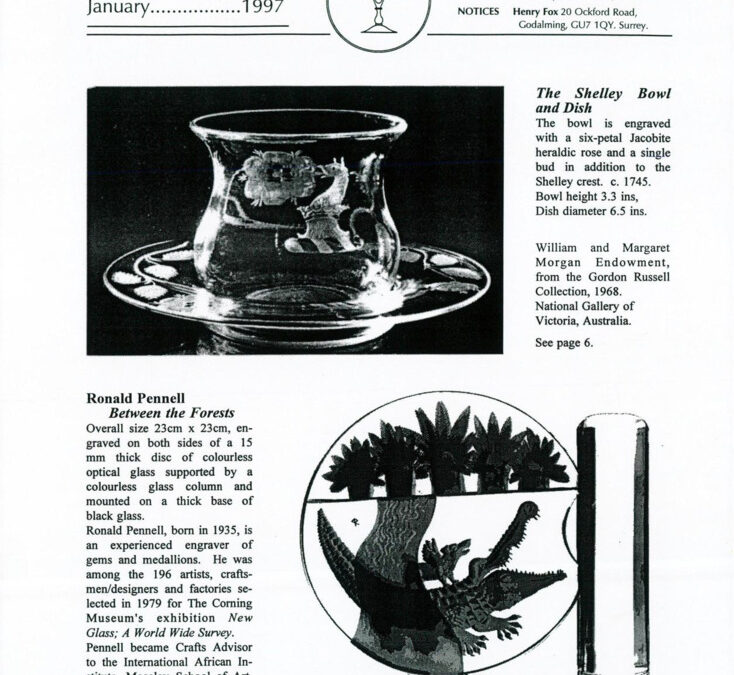
The Shelley Bowl
and Dish
The bowl is engraved
with a six-petal Jacobite
heraldic rose and a single
bud in addition to the
Shelley crest. c. 1745.
Bowl height 3.3 ins,
Dish diameter 6.5 ins.
William and Margaret
Morgan Endowment,
from the Gordon Russell
Collection, 1968.
National Gallery of
Victoria, Australia.
See page 6.
Ronald Pennell
Between the Forests
Overall size 23cm x 23cm, en-
graved on both sides of a 15
mm thick disc of colourless
optical glass supported by a
colourless glass column and
mounted on a thick base of
black glass.
Ronald Pennell, born in 1935, is
an experienced engraver of
gems and medallions. He was
among the 196 artists, crafts-
men/designers and factories se-
lected in 1979 for The Corning
Museum’s exhibition
New
Glass; A World Wide Survey.
Pennell became Crafts Advisor
to the International African In-
stitute, Moseley School of Art,
Birmingham, which may explain
his predilection for engraving
crocodiles and other ‘monsters’.
Also often included, as here, is
his pet Jack Russell terrier, Monty, symbolising the triumph of good over evil among the pitfalls of life.
This work, from the
British Studio Glass
tour of the Czech and Slovak Republics, is currently exhibited at Peter
Layton’s Gallery, The Leathermarket. See pages 2 and 8.
1997
Page 2.
GLASS CIRCLE NEWS No. 70
Craft or Art? Getting to Grips with Contemporary Glass
Britain currently enjoys the status of being one of
the leading centres of contemporary studio art glass
production in Europe. In about two years time a
new National Glass Centre, built with 15 million
pounds of lottery money, will open in Sunderland.
In close association with industry and Sunderland
University, where Dan Klein is now Professor of
Glass (to whom, congratulations), it will provide a
range of fully-equipped studio workshops for all
types of glass creation, as well as display, sales and
conference facilities. The Centre’s objective* is to
attract the best studio glassmakers to come and
work in an artist-interactive environment. Hence, we
may look forward to an upsurge in the output of
quality studio art glass in a few years time.
And yet all is not well at the commercial level;
interest by the British public is minimal. Individual
workshops successfully attract people to enjoy the
spectacle of glass making but sales of anything
other than run-of-the-mill lines, are few. There are
endless complaints about the broad lack of financial
investment in contemporary glass art at home as
compared with abroad. Hard evidence is lacking, but
it does seem that the best works, other than those
that find their way into our museums, and they are
all too few, are destined for export. A series of
contemporary glass galleries, located in prestigious
shopping areas in London, have come and gone.
Some years ago Dan Klein felt he had got the
formula right, and yet his Gallery was said to have
failed. In a lecture to the Glass Circle he bewailed
the need for a glass guru who could excite public
interest and cause it to reach for its chequebook.
It may be partly to do with cash, for glass art is
expensive to make, but it is also to do with
confidence and understanding at a wider level. For
many years Britain was barren in the creative use
of glass in architecture. Then came Prince Charles
trenchant criticism of the new architecture destroying
London and, in spite of the howls of protest, the
scene is slowly changing bringing with it a more
imaginative use of glass into our architecture. Glass
sculpture is also coming into vogue as illustrated by
a work by Danny Lane outside number 1 Burlington
Gardens, near the Museum of Mankind, and another
in Croydon.
Britain now enjoys both established glass artists and
emerging talent able enough to take on the might of
what we used to call Czechoslovakia. That is what
the Exhibition,
British Studio Glass,
returned from a
successful tour of Prague and Bratislava and on
show at the Studio Glass Gallery in Connaught
Street and at Peter Layton’s new Gallery in
Southwark (as outlined in the last GC News) was
all about. This touring showcase was organised by
the Studio Glass Gallery, itself created with support
from The Prince’s Trust.
Prognosis, then, is favourable, but is the Studio
Glass Movement doing enough to promote itself?
Here, it must be said, problems remain. Dan Klein
touched on the matter in his
Glass: A contemporary
Art
(1989) in a section asking whether it is Craft or
Art. In the early days preoccupation with the
material aspects of glass making were dominant.
Indeed, one critic, with some justification, accused
the glass makers of “art envy” over their wild
enthusiasm for their wobbly products. At the time,
Dan Klein felt there was no answer.
But, by now, the distinction should be clear.
Traditionally, artists communicate to their audience
through their work their personal thoughts, emotions
and interpretation of the world around them.
Personal skill is an important but not sufficient
factor. We may ask if, in balancing these two, that
studio glassmakers have lost their way? For some
reason, painters are treated as though their skills are
inborn, but a reading of, for example, Sir Joshua
Reynold’s
Discourses on Art
(1923) or Paul Klee’s
Notebooks
(1992) will quickly put the matter in
perspective. Hardly ever does the painter acompany
his work with a rundown of its inner technology,
while, by contrast, today’s studio glassmaker is
obsessed with emphasizing that his piece is a
combination of slumping, sandblasting, and whatever,
to the detriment of its underlying artistic inspiration.
By contrast, Diana Hobson is pioneering the true
artist’s approach. A booklet accompanying her
exhibition
The Language of Light,
at Kilkenny
Castle, last summer, recorded her thoughts and
emotions as she developed the creations on view.
Diana leans heavily on a deep underlying symbolism
and her work, which is demanding of the viewer
anyway, is, at least for me, uninterpretable without
the explanations she provides**. Her explanations
stimulate the viewer to analyse his/her own thoughts
on the subject. Whether in agreement or not is
immaterial; the artist has achieved her objective of
communication and the work stands as true Art. The
materials and techniques used are still mentioned but
now emerge in perspective.
In the catalogue for the Czech/Slovak touring
exhibition the artists’ inspirational backgrounds are
presented only in general terms rather than being
specific to each piece on show. Several of the
artists teach; is it with them that the responsibility
lies for any negligence over artistic training in the
Art Schools themselves? In their concern to get over
the technology has Art been subsumed to Craft?
Glass art, unlike (other) fine arts, does not have an
historical foundation of readily comprehensible work
upon which to build. However, it does not have to
be obscure in its message; Peter Dreiser’s
The Price
of Oil
is an outstanding example. Gavin Stamp, in
introducing
Visions of Light,
the catalogue to Patrick
Reyntiens glass panels inspired by Ovid, observes
that this artist believes that “great art can only be a
response to the intelligent patron…” yet his work is
“the most communal of them all”. If you are
unfamiliar with Ovid then you will certainly need
guidance to get the most from this stained glass.
How much more is it so for a truly abstract or
symbolic piece as most glass art seems to be.
Where might Art Schools concentrate their efforts?
Language, it has been said, is the ultimate form of
artistic expression. Here would be a good place to
start in expressing the artistic objectives of work
proposed – even for routine exercises -, with great
emphasis on the questions
why?
and
to what
purpose?
This is but a start; there are other
aspects of the problem to consider, such as scale,
familiarity and investment potential, but it should be
remembered that the public is less likely to buy
what it does not understand.
D.C.W.
* Under its Director, Shiona Airlie Tel. (44)191 510 8858.
**Diana Hobson’s
Language of Light
is also reviewed in Neues
Glas (Part 4, 1996).
GLASS CIRCLE NEWS No. 70
Page 3.
1997
The Daily Telegraph Judgement
Breathing life, for the uninitiated, into the dusty
desirables of the past, is an onerous role for a
newspaper reporter. In this respect Godfrey Barker
has performed a notable service, both for the Glass
Circle and the interests of collectable glass in
general. Following his published review (on the 11th
November) of the Symposium, which, incidentally,
he attended all day, cries of “undue bias” and
“misrepresentation” came to my ears. But close
reading of his text revealed little one could directly
contest other than his opening estimate of the
number of participants, which totalled about 130,
roughly half being members of The Glass Circle.
Not surprisingly, the Telegraph pursued the more
newsworthy line that the existence of eighteenth
century Jacobite glasses (in number?) was not
proven and, consequently, today’s market for it
remained paralysed. Indeed, Barker’s article showed
the strength of the prosecution case that could be
made against Jacobite Glass by a skilled counsel.
Barker supported this assessment with his own
outline of the events surrounding “The king over the
water”, concluding that Jacobite glass was too
politically hot to handle before 1822, when King
George IV went to Scotland sporting the tartan, and
certainly not worth the risk for London engravers.
on Jacobite Glass
and it may be a criticism of what has been
generally acknowledged as a very successful, as well
as enjoyable, symposium that this evidence was
made rather less clear in his article than it might
have been. The weight of good circumstantial
evidence reviewed by our speakers was such that,
while caution must prevail, it challenges belief that
the main body of Jacobite glass could be the sole
outpouring of a Victorian neo-Jacobite interest
buoyed up by a few forgers on the make.
One reason behind the symposium was to enable the
Circle to proclaim publicly its concern, for, if
Jacobites are fakes,
it touches all engraving of any
value from the elegant Newcastle glasses onwards.
One positive outcome of the symposium which
should have received prominence was the construct-
ive thought on the way forward for further research
to resolve this problem.
The Symposium proceedings and discussion will be
published as rapidly as possible in 1997. However,
in addition, Glass Circle News is prepared to
consider for publication any further evidence,
pro
or
contra,
that members might care to submit, partic-
ularly in answer to Godfrey Barker’s challenging
question
“did anyone dare to own or make Jacobite
glass in the years after Culloden?”.
There is limited hard evidence against this view,
D.C.W.
Two Books on Czechoslovakian Glass
Bohemian Glass traditional and… present
Published by Crystalex Novy Bor, 1991
Soft covers, 192 pages 23.5 x 32 cm with 301 illustrations,
mostly colour. Price £10 from The Studio Glass Gallery, 63,
Connaught Street. London W2 2EA. Tel. 0171 706 3013.
This volume, completed just before the westernisation
of Czechoslovakia retails the history of glassmaking
there from its earliest beginnings to the present day.
The extra-large format, layout and short chapters are
reminiscent of the Czechoslovakian
Glass Review,
probably using the same press.
The book is divided into two sections. First comes
Historical Glass
outlining the origins of the
glassworks, the glassmakers involved and the types
of glass produced from earliest times to Art
Nouveau and Jugendstil. The second section on
Bohemian glass in the 20th century
covers glass
between the wars and the development of the
glassmaking educational system. The nationalisation
of the glass industry, following the liberation of
Prague, in 1945, consolidated the industry in North
Bohemia. This was followed by the Communist
“victory of the working people”, its outcome
included the formation of Borocrystal in 1948, and
Crystalex in 1988, both at Novy Bor. The book
does not hesitate to mention the initial chaotic effect
on the industry resulting from these and subsequent
changes although it ultimately benefited from
redevelopment and an extensive parallel programme
of teaching and research. The artistic originality and
versatility of Czechoslovakian glass produced is
manifest from the excellent prolific illustrations on
good art paper. Sections on modern reproductions,
techniques and architectural glass are included.
In spite of a somewhat stilted translation, a style
familiar to readers of
Glass Review,
this book, full
of historical extracts and quotations, is a delight to
read as an historical document as much as a
treasury of collectable glass. The text would benefit
from a map of the numerous places mentioned.
Even so, for £10 (excluding p+p), from The Studio
Glass Gallery, it is a bargain not to be overlooked.
Made in Czechoslovakia
by Ruth A. Forsythe
Published by Ruth A. Forsythe, Box 327, Galena, Ohio
43021. 1982.
Size 21.5 x 28 cm, soft covers. 72 pages illustrating 780
glass objects and 91 in pottery, mostly in colour. Sold by
Foyles, price £16.95.
Although now 15 years old this book forms a
useful complement to the previous work. All the
764 pieces of glass illustrated were made between
the wars and imported into America. Importantly, all
carry engraving, stamps or labels indicating that
they were made in Czechoslovakia. Inevitably, many
of the same, or similar, pieces came to Britain.
Ordinary tableware and pressed glass is excluded.
The text is minimal but includes a one-page
Czechoslovakian history and two pages of drawings
of identity marks.
The picture are divided into types of ware
produced. Sections on cased art glass and candy
baskets are followed by an impressive array of 176
perfume bottles, many with extraordinarily elaborate
stoppers several inches tall. Sections on various
other ware for the dressing table, blown decorative
tableware, a little jewellery and lamps are also
included. Although by no means comprehensive in
coverage it gives a good idea of the broad range
of products produced over the period. While perhaps
a little pricy for a paperback, it should delight
those interested in this area of glass collecting.
1997
Page 4.
GLASS CIRCLE NEWS No. 70
Surfing the Net …. the Glass Circle Guide to Computer Communication
Among our recent mail was a press release from Christies
stating that it now had a new and colourful 200-page file
of its activities on the World Wide Web (www). The
resulting baffled frown as to what this was all about
prompted this article. It all begins with a little box, called
a modem, one end of which plugs into your telephone
socket and the other into your desk-top computer. With
this device information can be transferred from your
computer to a similarly set-up receiving computer (and
vice versa) anywhere on the telephone network for the
cost of the call. We here survey the different types of
communication available, for which the computer may
require additional software – bought programs which may
include a purpose-built modem that tucks away inside the
computer.
Telephone Communication
–
billed at the normal
rate
for the call. i.e. Proportional to distance.
Bulletin Board Service (BBS)
A BBS provides information on a specific topic stored on
a computer that is permanently linked to a phone line.
Only subscribing members of the BBS are able to “dial
up”, via their own computer, and access the information
provided there. For example, a Glass Circle BBS might
contain information on it’s lecture programme with any
late alterations, sales, exhibitions etc. – a kind of detailed
readily updateable version of Henry’s Clippings. The caller
may contribute new information to the BBS, and even
talk to the BBS administrator via his computer keyboard.
The caller pays the phone bill_
FAX
For about £60 a computer can be converted into a Fax
machine. Copy, composed on a word processor, may be
sent directly from the computer screen without being
printed first. Both a telephone handset and the computer
can simultaneously be linked to your domestic phone line,
like an answerphone but a computer has a much greater
storage capacity. The received text is stored for inspection
on the monitor and/or print-out as required. However, the
receiving computer must be switched on so a sender may
need to make a warning call.
The Internet –
The “Communication Superhighway”
– billed at the price of a local call.
The Internet consists of a vast number of computers all
over the world that are in permanent communication. How
they are linked – cable, satellite, optical fibre or whatever
– doesn’t matter except the the often used term
“Communication Superhighway” is misleading. The
connections are more like a randomly built, road system
(hence the term
Net)
across which “packets” of
information can be transfered very much faster (and,
therefore, cheaper) than over a telephone line. For
example, a document of, say, 50 pages may be dispatched
from Britain to anywhere in the world, and vice versa,
theoretically in a matter of minutes.
To link your own computer to the Internet would be
prohibitively expensive so access is rented via an Internet
Service Provider (ISP) such as Demon (used by ITV’s
London Tonight
programme) or A.O.L. (America on Line).
The packages offered by different ISPs vary but, typically,
for about £10 per month, a subscriber, through the ISP,
can plug into the Internet at any time and access
terminals anywhere in the world for the additional cost of
no more than a
local phone call.
The services included in
the rental, covering every conceivable topic, are extensive;
the main ones of interest to glass enthusiasts are The
World Wide Web, E-Mail and Usenet.
Continued
on page 13
Glass Finds from
Early 17th Century Newfoundland
Jamestown, Virginia, well known for its glasshouse,
was founded in 1707. It is the earliest permanent
English settlement in North America. Two new sites,
further north, are now yielding fascinating insights
into early settlements there. The earlier, Cupids
Cove, was founded in 1610 by
The London and
Bristol Company,
a group of merchants, one of
which, John Bly, from Bristol, became Governor.
He laid the foundations for a number of enterprises,
including glass manufacture. So far, of glass interest,
archeologist, William Gilbert, has found shards of
case bottles for Aqua Vitae (probably from England)
in a context suggesting they ware bartered with the
local, and now extinct, Beothuk Indians. Bly wrote
a journal of his time there which is now preserved
in the Bishop’s Library at Lambeth Palace.
The second site, Avalon, was the enterprise of Sir
George Calvert, a courtier of King Charles I, who
dispatched his first settlers there, in 1621, Robust
remains of Welsh-style buildings, with solid brick
walls and slate roofs, have been excavated by James
Tuck, a Newfoundland University archaeologist. As
well as shards of early case bottles for Aqua Vitae,
a store house littered with broken crucibles and
other 17th century alchemical equipment has been
discovered. In 1629, Gilbert wrote to the King
abandoning his venture due to the long and harsh
winter conditions there that prevented catching fish.
Source: New Scientist, February 1996. Look out for:
In
Search of
Ancient North America (1996) by
Heather Pringle.
The
Contemporary Glass Society
A New Organisation for Studio Glass Workers
and
their Supporters
Last November some three dozen studio artists met
at Peter Layton’s workshop, in the Leathermarket, to
discuss and form a new professional society for
studio glass workers in all aspects of the subject.
British Artists in Glass,
a society with similar aims
formed back in the ’70s, had collapsed for various
reasons. One problem, familiar to most societies, had
been the time required to run it and the fmding of
suitable volunteers. It was felt that the time was
now ripe for a new organisation to take its place.
How this works out remains to be seen but a new,
enthusiastic and mainly youthful body, appears
prepared to take charge.
The aims of CGS are succinctly described as:
A professional society representing and promoting
glass as a creative medium.
The scale of membership fees and what you get for
your money have yet to be resolved but lay
membership is to be actively encouraged as part of
a drive to educate the public about contemporary
glass and the artists involved. Britain is often
compared unfavourably with the rest of Europe but
in Studio Glass it heads the field and one objective
is that CGS should become an international, rather
than just a national body. Such aspirations require
both stiff resolve and hard work. We wish them
well in their endeavours and look forward to the
fruitful prospect of joint activities in the future.
GLASS CIRCLE NEWS No. 70
Page 5.
1997
The Glass Circle Summer Outing
With the sun just peeping from light cloud the
coach sped our party smoothly east, following the
line of the Docklands Light Railway past the old
Commercial Tobacco Vaults with their fabulous
architecture and attendant three-masted schooners,
now being refurbished as a shopping mall; past the
site where John Bowles produced his world-beating
Crown Glass and now in the hands of W & T Ide,
glaziers there since 1820; past the Isle of Dogs with
its great tower and the slender strip of the London
City Airport, into the undulating green countryside
of Essex. Industry gave way to whitewashed Tudor
cottages with exposed beams and thick thatch as the
clouds rolled back assuring us of a fine day.
Chelmsford Museum is a grand old house standing
in a well-kept park. Here we were welcomed by the
Assistant Curator, Anne Lutyens-Humfrey and two of
The Friends of Chelmsford Museum
(one turning out
to be a Circle member) who refreshed us with
coffee and home-made cakes. The Tunstill collection
we had come to see was first sorted out some years
ago by our members, Tim Udall and the late Fred
Ahn. In 1995 a new display became possible with
financial support from local industry and
The
Friends.
A new case was commissioned from a local
cabinet maker and
The Friends
lent a hand in the
assembly of the exhibition.
The collection consists of 408 English drinking
glasses, together with a further 36 ale glasses, all
dating approximately between 1700 and 1820. They
are arranged by stem-type following Barrington
Haynes’ classification and show up well against a
background of draped purple velvet. The baluster
collection is breathtaking and shows what a collector
could achieve, pre-1958, on a modest income!
Inevitably, there was dissension about the origin of
Newcastle glasses, of which there is a small display,
unusually, it would seem, without Dutch engraving.
The problem here is the lack of documentary
evidence about English style lead crystal manufacture
in Holland. By contrast, the ale glasses were of
superb quality, some of unusual shape but carrying
the authenticity of a Churchill label. One, curiously,
was engraved with a Jacobite (style) rose, but no
buds, in addition to a spray of ‘barley ears’. A fine
representative selection of air and opaque twist
glasses had, perhaps, one or two of questionable
origin. Engraved decoration on a pan top always
seems to attract attention. Among the cut stems
should be mentioned an unusual stem form basically
cut in columns but with two horizontal bands of
diamonds. Among the decorations present were
diamond-inscribed graffiti, a piece, possibly by Jacob
Sang, inscribed
Aurea Libertas,
gilding and a
traditional wheel-engraved design by James Giles
with undulating swags and bucrania, wheel engraved
Jacobites and enamelling (Mary Beilby?). Altogether
this was a collection worthy of detailed study.
Frederick Walter Tunstill was born in 1875. His
connection with glass began at the age of 12 when
he was apprenticed to Cromptons (lamp) engineering
works. Some 30 years later he left to become a
commercial traveller for Electrical Construction Co.,
Wolverhampton, and it was during this period that
he built up his collection. As he also collected
china, bequeathing some three dozen pieces of Castle
Hedingham ware to the museum, he clearly made
full use of his travels. Among his other activities he
lectured on china and glass at the local School of
Art, was a Churchwarden for about 44 fragments of
years, Treasurer of the
Freemasons’ Lodge and gave
help and advice to young
collectors. Indeed, we might
see in him a strong parallel
with our own founder. Finally,
retiring, aged 80, Tunstill died
in 1955, his glass collection
being said to contain about
900 items at that time.
Besides the Tunstill collection
Chelmsford Museum has an
innovative display of local
Roman antiquities, including
fragments of cast glass windows, a small 4th
century glass bowl with blue prunts and, inevitably,
a collection of beads. Fragments of early Wealden
glass include the wrythen necks of small bottles
among many other interesting items.
Finally saying farewell to
The Friends,
but joined
by Anne Lutyens-Humfrey, we headed for a
leisurely and generously-portioned lunch to a fine
old Essex pub,
The Cricketers,
in Danbury, where
we were made most welcome at two long tables.
Our final call before turning back to London was to
see the famous 12th century coloured (pot metal)
glass windows in the church of
St. Mary and All
Saints,
Rivenhall. This small church is deceptively
uninspiring at first sight, with its more recently
plaster-rendered walls and brick tower (c.1710) of
which the turret (see below) blew away in 1837. It
is, however, a little gem dating back at least 1000
years and its rectors traceable to 1185. Externally,
the stucco has been removed in places to reveal the
early bonded-flint structure of enormously thick
walls with their original small, round-topped
windows. The 14th century foundations of the
original tower, which fell down in about 1710, and
early buttresses, later removed, are left exposed for
inspection. Once inside, the simple Anglo-Saxon
structure, with its single aisle, immediately focusses
attention on the 12th century East window. Divided
vertically into three sections, the centre panel glows
at you with four predominantly blue roundels. One
of its figures shows clear artistic affinities with
those in Chartres Cathedral. Of the same date, two
French arch- bishops (see above) guard either side.
These are the only examples in the world to have
survived. Thirteenth century glass is inserted in the
top three lights of the east window and in the
nave.
The windows were bought by Bradford D. Hawkins,
a descendant of Admiral Sir John Hawkins, of
Elizabethan fame. Educated at Tours and Oxford,
Bradford found them, in 1849, in a neglected
church at Chenu, 35 Km from Tours, and bought
them for a princely £69. This bargain may have
shocked the Rivenhall locals but secured a place for
St Mary and All Saints
church in history.
Rivenhall Church, c. 1835
Altogether, it was a most
pleasurable day out in
the Essex countryside
and grateful thanks go to
our Hon. Secretary for
her efficient and
impeccable ‘organisation.
Ceremonial goblet, in slightly
crisseled lead metal, originally
attributed to Ravenscroft’s
workshop but now assessed as
‘mid-channel’ (possibly Dutch?).
It is engraved in diamond point
either by Willem Jacobsz van
Heemskerk (1613-1692) or by
Elizabeth Crama.
Height 12.45 ins.
Felton Bequest, 1968.
1997
Page 6.
GLASS CIRCLE NEWS No. 70
The Glass Collections of the National Gallery of Victoria, Melbourne
By Geoffrey Edwards (National Gallery of Victoria, Melbourne)
A Glass Circle meeting held at the Artworkers Guild on the
12th November, 1996 by the kind invitation of Mr D. Stokoe,
Mr and Mrs J. Newgas, and Mr Brian Watson.
Our speaker, Geoffrey Edwards treated us to a
colourful and well-illustrated history of the origin and
development of the National Gallery of Victoria.
Before Canberra was built, Melbourne served as
the nominal Federal capital of the nation, hence
the “National” prefix for the Melbourne Gallery
which is, in fact, a state institution that draws
operating funds from the Government of
Victoria. Most purchasing funds are raised
independently by the Gallery. Melbourne is
blessed with many fine buildings dating from
the city’s “boom” era (1860-90). The National
Gallery of Victoria (NGV) was founded in
1861, initially as an adjunct to the State
Library. The Library, Gallery and the first
University of Melbourne were initiatives of the
young Irish-born Chief Justice, Redmond (later
Sir R.) Barry. Barry was an enigmatic and
somewhat contradictory character. Aside from
his role as self-styled cultural autocrat, he is
best known (perhaps notoriously) in Australian
history as the judge who sentenced to death the
controversial “bushranger” Edward (Ned) Kelly.
The original neo-classical State Library/National
Gallery building still stands in the centre of the
city although the Gallery collections were
moved in 1968 to new purpose-built premises
(architect Sir Roy Grounds) on the south bank
of the River Yarra. This building houses the
Gallery’s collections of antiquities, Asian Art,
`old master’ paintings and sculpture, prints and
drawings, modern European and American art,
Australian and aboriginal art, and a notable
collection of European decorative arts.
The earliest acquisitions, like those of many
19th century public institutions, were intended
to ‘improve’ public taste and as an educational
resource. In Melbourne’s case, these included
numerous casts after antique sculpture alongside
contemporary paintings purchased from the
annual Royal Academy and French Salon exhibitions. Of
particular note are paintings by Memling, Rembrandt, Van
Dyck, Poussin, Tintoretto, most of the prominent English
painters of the 18th century and Tiepolo’s vast canvas
The
Banquet of Cleopatra
(featuring an intriguingly anachron-
istic Venetian flute glass into which we see the empress
dropping a priceless pearl earring). There are several fine
Dutch still life paintings some of which feature images of
glass drinking vessels, and a series of genre pictures (the
Pamela series) by Joseph Highmore one of which depicts
a splendid glass tazza laden with syllabub glasses.
The colonial Australian collections include delightful
topographical paintings of the gold rushes of the 1840s
and surrounding countryside (wool-clipping etc.) together
with numerous examples of exotic jewellery made from
the mined gold and decorated with curious locally-inspired
flora and fauna. The Gallery also mounts about fifty
special exhibitions a year; one of recent interest was a
retrospective survey of contemporary glass made by the
celebrated German-born artist/craftsman, Klaus Moje.
The Gallery has fine glass collections with some 2500
pieces ranging from ancient Mesopotamian to modern. It is
particularly strong in English late-17th and 18th century
glass, mostly built up by Sydney collector, G. Gordon
Russell. His collection came to the Melbourne Gallery in
a round-about way. It was initially offered to the Art
Gallery of New South Wales, in Russell’s home town of
Sydney; the offer was declined owing to that gallery’s
exclusive focus on painting and sculpture. It was then
generously offered to the NGV ‘at cost’ – the dollar
equivalent of the price paid by Mr Russell some two, or
more, decades earlier. Even so, the MGV
had difficulty raising the necessary figure.
But through the diligence of the Gallery’s
then honorary advisor (glass) – the late Rex
Ebbott (both Rex and Gordon were members
of The Glass Circle) – an endowment for
this purpose was eventually established by
the Melbourne couple, William and Margaret
Morgan. Rather poignantly, Mr Morgan died
soon after signing the papers for the
endowment; his widow, now Mrs Margaret
Stewart, continues to assist the Gallery as a
much-valued patron of the glass collection.
Another important source of funds used for
glass purchases is the Felton bequest which
provides monies accrued as interest on
investments bequeathed to the NGV in 1904
by the prominent Melbourne industrialist,
Alfred Felton. One of Felton’s business
interests was a Melbourne glassworks that
developed, over time, to become one of the
nation’s largest corporate enterprises.
Examples from the glass collections were
illustrated with transparencies of a number of
key items such as the sealed Ravenscroft
dish, the Beilby Royal Armorial Goblet,
several of the Gallery’s large holding of
Jacobite glassware (see cover), and examples
of Dutch diamond-point engraving (including
characteristic work by Mooleyser, Greenwood
and van Heemskerk). The 19th century glass
includes examples from the Biedermeier
period (Lithyalin, Kothgasser and Mohn) and
a small core of French Art Nouveau and
pate-de-verre pieces. A large consignment of
Venetian ‘revival’ glass was acquired from
the
1880 International Exhibition
held in Melbourne.
These flamboyant vessels are quite a feature of the
collection as is the sizeable collection of 20th century
Italian and Scandinavian glass and the more recent
holdings of international ‘studio’ glass.
Rex Ebbott did much to promote the collections and
published (1971) a selection of glass in his booklet
British Glass of the seventeenth and eighteenth centuries
(from the collections of the National Gallery of Victoria).
Decorative Arts from the Collections of the National
Gallery of Victoria
(1980) is a useful handbook that is
still available and this illustrates a number of additional
pieces of glass. A considerably more comprehensive and
extensively-illustrated catalogue of the glass collection at
Melbourne is in preparation. Our two pictures (here and
on the front cover) are taken from Rex Ebbott’s booklet.
John Green Waller (1813-1905)
Can you help our member, Phillip Whittimore, who is
researching John Waller, a glass painter who designed the
Chaucer Window, formerly in Westminster Abbey but which
was destroyed by a bomb in the second World War. Other
examples of his work are sought. Waller also designed
monumental brasses which are often marked *.
GLASS CIRCLE NEWS No. 70
Page 7.
1997
Glass Clippings
by Henry Fox
Chinese Glass commemorates Circle Jubilee
Probably the largest concentration of Chinese glass
tableware outside China, the holding at the Bristol
City Museum & Art Gallery dates largely from the
late Ming and Qing (Manchu. 1644-1911) dynasties,
with few earlier ornaments and beads, and a few
scent bottles. Members will recall the Summer
Outing visit to Bristol in 1995.
Some beautifully carved and unusual pieces have
been selected from those not normally on show to
mark the Diamond Jubilee of the Glass Circle. This
special display may be seen in the Top Front
Balcony at the Museum from 7th February until 8th
August, 1977.
Excavation of Mysterious Glass
A strange glassy substance found at an ancient
Egyptian city is thought to have resulted from
Christian fanatics burning earlier shrines. Animal
bones and teeth encased in the glass seem to have
come from mummified offerings consumed in the
conflagration.” This is the opening eye-catching and
intriguing paragraph from a report by the Archaeol-
ogy Correspondent of ‘The Times’ last year.
(Source; J. of Archaeological Science 23:485-492.)
The site of this discovery is at the ancient city of
Mendes, north of Cairo, which is known to have
been occupied from before 3000 BC until the
Roman period and covered an area in excess of 1.5
square km. The glassy material was found on a
mound called “hill of bones” which lies outside the
city wall, and is thought to have been a cemetery
in the Greco-Roman period. Examined under a
microscope the glassy matrix was a silicate
containing iron, potassium and aluminium, but the
low ratio of iron to silica precluded an origin as
metallurgical slag. The high potassium level relative
to sodium also made an origin in glassmaking
unlikely. Further, there was no human bone present,
so the substance did not come from cremation
rituals, nor were the detected temperatures of
burning high enough. The Canadian team who
investigated this site “believe that the slag is the
result of the fusion of a mud brick structure which
encapsulated animal bones and teeth”. Egyptian
archaeologists believe that at Mendes the silica
would come from the mud brick, the potassium and
sodium from mummification (of animals in this
case). It is considered most likely that “the later
rise of Christianity brought a prohibition of pagan
rituals associated with vandalism of traditional
Egyptian religious centres”. Its enforcement was
responsible for what took place, the result of which
has presented to-day’s investigators with their
“mysterious glass” finds.
Games for the Romans
An exciting recent discovery during an archaeol-
ogical dig of a Roman grave site at Bellhouse
Quarry, near Colchester, was a gaming board with
glass counters. Many Roman gaming boards have
been found in the past but this one was unique in
being the first set out ready for play. Most of the
board had decayed but the copper alloy corners and
hinges remained. The board had been of wood,
22ins x 14 ins, and possibly incorporated bone and
leather, suggesting high quality. It folded longways
down its centre. Two sets of glass counters, like
large chocolate drops, one set blue, the other white,
were arranged opposite each other down each long
side with one counter on each side advanced by
one or two squares, rather in the manner of
draughts. The position of the pieces survived
because the board was set up in a shallow box
before the grave was closed. One wonders if the
owner had been the national champion? (Source:
Essex Countryside, Nov. 96)
Chelsea Glass or Caught in a Triangle!
How many members are aware that Chelsea
“triangle” marked porcelain has been described as
pure glass, possibly related to “Reamur porcelain”
This conclusion is based on analyses of this early
marked English porcelain which show little or no
clay present. To follow this up members should
refer to an article entitled “The Origins of Chelsea
Porcelain” by W.H.T John published in Journal of
the Northern Ceramics Society, Vol 13, 1996.
The Largest Burne Jones Window?
Should you be in the Sloane Square area of London
in January (or for that matter any other time) relax
from the stresses of the Winter Sales scramble and
go and view the magnificent Burne Jones window,
said to be the largest one commissioned from
Morris & Co., which is above the altar in Holy
Trinity Church, Sloane Street. To avoid disappoint-
ment, as the Church could be closed during periods
when services are not in progress, it is advisable to
telephone 0171 730 7270 before the visit.
Glass Studies at Sotheby’s Institute
An evening lecture series on glass is being held at
the Sotheby’s Institute, 30 Oxford Street, London on
Mondays January 13th – March 17th. (0171 462
3232 for further details).
Battles & Beasties
18th January – 16th April 1997.
An exhibition of masterpieces of Victorian engraved
glass at Broadfield House Glass Museum.
New Broadfield House Phone Numbers
As a result of going onto Cable Phone Broadfield
House numbers have been changes as follows:
Museum (General)
01384 812 745
Fax 01384 812 748
Roger Dodsworth (Direct Line) 01384 812 747
Charles Hajdamach (Direct Line) 01384 812 749
Zelda Baveystock (Direct Line) 01384 812 748
A Forthcoming Ceramics and Glass Fair
On March 2nd, at the Commonwealth Institute,
Kensington, from 9.30 am.
maccliwings02Pagc12
Forthcoming Auctions – 1977
*Phillips Bond Street
25th March – Art
Nouveau Sale will offer good Daum, Galle
and Pate-de-Verre
glass.
12th March – Ceramics and Glass Sale will include a small
selection of 18th century English drinking glasses, including
pair of composite stems,
a
rataffia, and an attributed Beilby
enamelled wine glass.
*Christie’s South Kensington – These Rooms are now the
only ones in London having, at the present time, specialist
sales combining only British and Continental glass, including
18th century English drinking glasses etc. Their next sale is
on the 20th February.
•
Christie’s King Street, St. James’s
24th February British & Continental Ceramics & Glass.
•
Sotheby’s Bond Street
27th February Glass included in Colonnade Sales.
26th March An Applied Arts Sale includes 20th c. glass.
14th/15th April Fine European Ceramics & Glass. There will
be about 75 lots of English 18th century glass.
1996
Page 8.
GLASS CIRCLE NEWS No. 70
-1
New Books –
reviewed by D.C.W,
Glass Art
by Peter Layton
Published by A & C Black, 1996. ISBN 0-7136-3866-4.
216 pages, size 282 x 225 mm, many illustrations mostly in
colour. Hard covers. Price £39.99.
Being badly burnt is not the best introduction but it
did not more than momentarily deter Peter Layton
from switching from pottery to working in hot
glass. This book, unlike those of other contemporary
authors, conveys the personal appreciation of a
working glassmaker of the development of Glass Art
over some 25 years from that fateful day.
By Glass Art is meant the more sculptural, graphic,
mixed media and painterly forms through which the
artist explores the medium in relation to the world
about us. This concept is reflected in the rather free
design of the book. It is built around a loose
classification of a series of mini-statements about
glass artists world-wide, many the author has met
and others whose work commands respect.
Biographical details, as such, are few and a new
word, perhaps “artography”, is required to cover
these brief sketches relating artists to their work.
Each is accompanied by at least one illustration and
if, turning the pages, you feel an inward desire to
experience more of that particular artist’s work there
is likely to be an empathy between your own
thinking and that of the artist. Coverage is extensive
but only reflects the best and hence there is no
really adverse comment, perhaps the most critical
being “frivolous”, but even that is a matter of
personal interpretation for it is certain that no reader
will find himself in tune with every artist.
The main text is thought-provoking. A short history
of traditional glassmaking introduces the challenge
taken up at the Toledo workshop, in 1962, to make
and manipulate glass in a small studio. Alongside
this event evolved the enduring dictum of “freedom
from functional necessity”, acceptable providing that
the outcome is what the artist intended and not just
the result of an accident or random 3-D doodle.
Humphrey Littleton controversially wrote “technique
is cheap”; Peter rightly avers that it depends on
what you do with it. Nowadays we talk of learning
curves; for some they are more difficult to surmount
than for others but nevertheless are still barriers to
be overcome by all who would successfully practice.
Would Picasso have become so acclaimed had he
not first been a talented straight painter? Certainly,
in the best glass art depicted here the distinction
between artist and craftsman blurs into oblivion.
Next, the development of the Studio Glass move-
ment world-wide is traced with reference to leading
exponents in each country. Then we move into what
is perhaps the most important section of the book
on materials and techniques – glassblowing, lamp-
work, casting, pate de verre, kiln forming, cutting,
the full range of methods for treating the surface
and, finally fabrication. The use of such specialised
applications by individual artists provides a valuable
insight into their work. What, one wonders, would
Ruskin have made of glass completely obliterated by
such cold treatment? Interestingly, glass is finding
favour as an ideal 2-D and 3-D canvas for painting,
even using an air-brush, in line with the view that
painting “provides the most potent means of
expressing emotions and ideas”. Is this an abdication
of all the wondrous properties of glass? – examples
contradict the immediate gut reaction. Finally, after
a short section on Glass Art in architecture, one of
the author’s specialities, we are told where to view
contemporary glass, given a glossary of terms used,
a bibliography and an index of artists as well as a
general index.
This presentation will appeal both to the student and
to those who like merely to browse. Gombritch
wrote in his
History of Art
“There is no such thing
as Art only artists”. Peter Layton’s book clearly
portrays what he meant.
Yellow-Green Vaseline
A Guide to The Magic Glass
By Jay L. Glickman
1991, Antique Publications, USA. ISBN HB 0-915410-77-X.
111 pages, size 280 x 215 mm. 32 pages of colour
illustrations plus some b/w. Soft covers, Price £18.
The rather gushing, condescending style of this
publication may irritate the cognoscenti but as the
only relatively readily available monograph on this
topic it has much to commend it. The discovery
and chemistry of uranium is outlined without delving
into the complexities of such niceties as its isotope
composition. The need for a long-wave UV. lamp
for the positive detection of uranium glass is
explained and the danger for the unwary collector of
colour look-alikes is emphasised, claiming that not
all glass that flashes yellow-green in sunlight is
genuine ‘Vaseline’ – not this reviewer’s experience
except for some modern Bohemian glass.
The health hazard from ‘Vaseline’ glass is found by
experiment to be negligible although this conclusion
is not extended to all uranium glass in general. The
book considers only clear and shaded uranium glass
at least part of which shows the yellow-green
dichroic effect. This includes partly opaque glass
such as the typical Davidson press-moulded pieces.
Pictures of 457 examples of ‘Vaseline’ glass are
depicted in colour with a predominance of press-
moulded pieces. The history of the American
industry is reviewed in this context. The author
shows only a superficial understanding of the
situation in Britain, unaware that ‘Vaseline’ had
many years of use here before giving way (if it
has) to ‘uranium glass’. Only a tiny proportion of
the objects illustrated are English and the manu-
facturers name of obvious pieces by Davidson and
a John Derbyshire “Britannia” are not given.
Nevertheless, the American coverage could be a
useful aid to help track down intractable specimens.
The European background to Vaseline glass is
given. It is contested whether Lloyd and Summer-
field of Birmingham (England) should be credited
with the first large scale production of uranium
glass, suggesting that the Boston and Sandwich
Glass Co. made such items as early as the 1840s.
Reference for the English attribution is not given
and it would be interesting to check this out.
The book concludes with 30 pages describing the
the objects illustrated, a collection of American
advertisements for uranium glass and a short
bibliography. A loose inclusion gives the 1991
values of the objects illustrated. At the UK price
of £18 the book is only average value for money.
GLASS CIRCLE NEWS No. 70
Page 9.
1997
Henry’s browse around the Sales
Looking Back on 1996
Although a number of substantial prices were
realised for exceptional or very rare specimens
during 1996, for the average collector good
examples in the middle price range seemed harder
to fmd. This was true for practically all areas of
glass collecting. Both Phillips and Christie’s reported
that there did not appear to be much good or
interesting English 18th century glass around at the
present time. Dealers complained that it was quite
difficult to replace stock.
Christies South Kensington – Items of interest sold
on 10th October included three similar graduated
circular tazzas with fluted stem and domed and
folded feet, 19th century (£1600) and two similar
engraved and cut Masonic decanters on turned
wooden stands, mid 19th century (£480 and £400
respectively). An Irish oval turnover rim fruit bowl
with alternate prismatic cut rim and lemon squeezer
foot, circa 1800 made £900, while a French opaque
hinged casket painted with flower sprays, late 19th
century made £1200. A Baccarat close millefiore
paperweight made £1500.
Sotheby’s Bond Street Colonnade At the sale on
the 18th November a pair of early 19th century
mallet shaped decanters doubled estimate at £400.
On the 19th November (Fine Ceramics Glass) the
highlights among early Continental glass were
£19,550 for an exquisite Rubinglas travelling set;
£15,525 for pair of Scandinavian goblets and,
believed to be new world record for a 19th century
drinking glass, £65,300 for a magnificent Bohemian
blue cased goblet and cover circa 1860 attributed to
Franz Zach. In the English section a drop knop
baluster made £2070 (est. £800/£1200) while a
ratafia with an opaque twist stem made £920
against an estimate of £600/800. An unusual
diamond point engraved mirror, dated 1728, made
£2300; but the highlight of this section was a very
rare green tinted opaque twist wine glass sold for
£4830 (est.£2000/3000).
*Sotheby’s Country House Sale, at Hall near
Barnstaple, included a collection of 18th century
drinking glasses and early bottles. Many lots were
damaged but this did not stop bidders taking away
the lots at prices closer to those for complete
examples. The highlight of this section of the sale
was a small group of sealed bottles where several
individual bottles achieved four-figure prices.
(N.B. a small collection of sealed bottles will be
included in a London sale next April.)
Sotheby’s Billingshurst October
Sales
featured attractive glass; in
particular, a Galle two handled
cameo vase featuring clematis
flowers and leaves which made
£1350, and a 1930’s Lalique frosted
green opalescent bowl which made
£2650. Another sale on the theme
“Dining Room” had on offer an
Edwardian table top novelty in the
form of a silver mounted engraved
glass wheelbarrow used for fruit
and the like; it made £5100.
This unusual glass with a double bowl was sold at Sotheby’s on the
6th May, 1960. It is 4.9 ins. tall and dated 1720. A similar one was
exhibited at our Specimens Meeting – but what was it used for? It is
not thought to be a measure but could be an egg cup paralleling
similar but decorated pieces made of china.
. . . and Glass Fairs
The autumn season of fairs kicked off in October
with the 2nd Glass & Ceramics
Fair at the
Commonwealth Institute, Holland Pk, Kensington.
This fair showed a mixture of glass ranging from
Roman period through to traditional 18th century
examples of drinking glasses to general Victorian
pressed glass and then on to some distinctly modern
glass. Judging by the number of dealers queuing for
the doors to open there had to be “fmds”
somewhere, and indeed several members were seen
later leaving happily clutching bags. Shirley Warren
made a rare re-appearance selling glass – she was
offering the collection of tazzas put together by our
late member Dr. Kelsall as well as some fine 18th
century drinking glasses. Frank Dux and Brian
Watson both had 18th and 19th century glass on
offer. Few examples of glass from the art nouveau
or later art deco periods were spotted.
The November Glass Fair at the Motor Cycle
Museum
again stretched itself into three rooms. As
usual the quantity and variety of glass on sale is
almost overwhelming, and a collector would have to
be very exacting not to find something of interest.
This fair has developed its own community atmos-
phere over the years with dealers and visitors
meeting-up like old friends; it is one of those
re-union occasions when you are amazed at the
number of people you know or appear to know
you! This time there seemed to be more 18th
century drinking glasses about but the main
attractions here had to be the stands of William
MacAdam and Jeanette Hayhurst. The former had
an excellent display of covetable specimens, in
particular a small green glass with gadrooned bowl
on shoulder and basal knopped incised twist stem.
Jeanette was also showing a selection of interesting
19th century engraved glass, including Whitefriars
pieces. Nigel Benson presented a good show of
20th century glass including some Stuart 1930’s
enamelled pieces, along with Monart etc. A stand
dealing in small items of the decorative French
makers such as Daum and Galle was constantly
surrounded by eager visitors, as were the book
dealers present. Pressed glass collectors had their
finds but the rarer items of Sowerby were not left
long on the stands and prices for good pieces
seemed to be higher this time round. The regular
appearance now of new specialist books, coupled
with museum initiatives in holding more specialised
exhibitions (with good catalogues), have done much
to educate and encourage existing collectors as well
as attract new enthusiasts.
,4ii_ea-41–eil_< n -ea-ea • ••• The Guild of Glass Engravers - 21st Birthday Spring Lecture Saturday 12th April, 2.30 - 4 pm at the V & A. Dan Klein, Professor of Glass at the School of Arts, Design and Communication, City of Sunderland University, will survey the imaginative and innovative work of glass engravers of the contemporary Czech and Slovak glass industries. Fee £5 (no concessions) to: Box Office, V & A, Cromwell Road, South Kensington, London, SW7 2RL 01 phone (credit card) 0171 938 8047. Book A EHE 696 EGRV. - - - 4) . - ea ea • • • DIM and BM ge97 Aren't you glad you're not engraved on a glass. Somebody might say we were just another example of "pre-invented history". I think you've got the term wrong, and from what I know of your family being descended from gaslights the least said the better. Interesting about the Jacobite cause, though, because to call it "reinvented" must mean it was invented in the first place. I don't think Bonnie Prince Charlie would agree with that - do you? 1997 Page 10. GLASS CIRCLE NEWS No. 70 ANNUAL GENERAL MEETING AND SPECIMENS EVENING On October 16th, 1996, at the Sotheby's Educational Studies Building with permission of Mrs Anne Ceresole and by kind invitation of Mrs Barbara Morris and Mr Ray Notley. With the 18th century glass gavel, presented to the Circle by Dr Harwood Stevenson, on display our Chairman, Mr Simon Cottle, reviewed a busy year which had seen the publication of the Glass Circle Journal, Vol. 8. This included colour for the first time, made possible by the generous support of our advertisers. John Scott and the Editorial Committee were particularly thanked for their hard work. In addition to the full programme of meetings and the Summer Outing we had enjoyed three other events, the Southwark walk, a long weekend in Manchester and an evening reception at Mallett's. Glass Circle News continued to prosper, with more pages, pictures and learned articles that had been abstracted by The Journal of Glass Studies. Thanks were expressed to the Committee and all those involved. Looking to the future, in our Diamond Jubilee Year, a major new venture is the full day Symposium on Judging Jacobite Glass at the Victoria and Albert Museum. In addition, there will be an exhibition of 18th century glass at Christies and the publication of a new edition of John Bacon's rare introductory booklet for glass collectors, as well as the full lecture programme and a commemorative goblet. The Hon. Treasurer reviewed a satisfactory financial year but reflected on increasing costs of the services provided free to members and the fact that as subscriptions had been held constant for seven years a rise in the coming year was inevitable. The Hon. Auditor, Mr R. West was thanked for his services. Mrs Barbara Morris had retired from the Committee after many years of service. Along with Mr Paul Hollister she was unanimously elected an Honorary Member of the Circle. Paul Hollister had also Glass Circle News - Deadlines for 1997 No. 71 Mid-March for publication in April No. 72 Mid-July for publication in August No. 73 Mid-October for publication in November rendered enduring enthusiasm and practical support to the Circle from the distant shores of the USA as well as lecturing to us on two occasions (see GC News Nos. 46 & 55). Miss Martine Newby was elected to the Committee. An archaeologist by training, Martine has worked for the late Dr David Harden, for Dr David Whitehouse, Director of the CMOG, while he was director of The British School in Rome, and as an exhibition assistant for The Glass of the Caesars. Her publications include booklets on Roman and Antique glass for various dealers including Christopher Sheppard. Martine lectured to the Circle on Roman Glass (see GC News No. 69), catalogued the glass collection in the Ashmolean Museum and arranged the visit there for the Circle's Summer Outing, in 1994. She is currently working on a thesis about Medieval Glass in the Papal State. Her wide expertise will bring new vitality to the Committee. Dr J.H. Kersley and Miss K. Crowe also retired by rotation and were unanimously re-elected. With business completed, following thanks to our hosts attention turned to the interesting collection of specimens on display reflecting members' interests from early to modern glass. Our impressive panel of experts was Simon Cottle, John Smith, Martine Newby, Jo Marshall, John Scott and Barbara Morris while members provided additional information on their pieces. First under scrutiny was a tiny glass mug in opal glass with a silver rim hallmarked 1690 London. Probably of English manufacture it was perhaps a souvenir from the big freeze on the River Thames in 1684. Also 17th century was a fine handled jelly glass with folded rim and gadrooned base, and an interesting German scent bottle with a silver stopper. Turning the century we encountered a stemmed cream jug with trailed foot, the design typical in silver of the period. Then came another interloper from overseas, a Lauenstein baluster, with a ring of air beads in the base of the bowl, on a high domed foot. Of bright colour, these glasses are typically of potash crystal and may have a lion or letter C engraved on the pontil. An elaborately designed candlestick on a high domed foot raised eyebrows as to its origin - German or Scandinavian - and date? Three Venetian goblets with elaborately moulded bowls and knopped stems next attracted admiration. Victorian? no! they were made only a few weeks ago at the Dudley Glass Festival and >
Welcome to New Members:
Dr N.D. Brener
Mrs K Coleman
Mrs M.A. Dowding
Mr B.G. Gardner Berkshire
Mr C. Lowry & Mrs S. Evard London
Mr L.A. Meaney South Australia
Mr A.J. Neilson
Dorset
Dr N.H. Tennant
Mr G.S. Veitch
Bath
Mr L.A. Woods Hampshire
Deaths
We are saddened to report the passing of two
members and staunch supporters of The Glass
Circle, Mr John Homer and Mr Michael Poulson.
We extend our deepest sympathies to their
families.
GLASS CIRCLE NEWS No. 70
Page 11.
1997
4MPT
–
0 REWEe7T071.5
4
7
Perm.
This Reflection starts in the unlikely surroundings of
the new Royal Armouries Museum at Leeds. I
found only a single Glass artefact amongst the
myriad of weaponry on chew. It is a small Glass
sphere, with shallow moulded ribbing, of about two
and a half inches diameter and having a short open
neck of about half an inch orifice. The colour is a
pale greenish blue, and at first glance one might
put it down as a miniature fire extinguisher ‘bomb’.
Fortunately, the Master of the Armouries explains its
much more esoteric use: he tells us that it is
English, and called a Bogardus Target Globe of
about 1870. This was the precursor of the more
familiar ‘clay-pigeon’, and the description continues:
“Designed to be flung from the BOGARDUS Trap,
the globe was filled with feathers or red powder
it was unpopular because of the glass shards
which resulted from a hit.”
Clay shooting with a shot gun was only just
beginning at that time, offering an alternative and
more humane target than pigeons released from
under flower pots. Surprising as it may seem, the
Badminton Library volume on “Shooting; field and
covert” published as late as 1887, could still devote
a whole chapter to shooting at live pigeons released
from traps, even though the author starts by saying
that:
“In these days a defence of pigeon-shooting would
be considered by many an ungrateful task”.
Despite his enthusiastic advocacy, it shortly after-
wards became illegal in this country.
But an even less humane practice which Glass
alleviated is described in Ian Hay’s book: “The
Royal Company of Archers” (The Archers still
flourish and are, you may remember, The
Sovereign’s Bodyguard in Scotland, having been so
designated by George IV.) One of The Archers’
competitions is The Goose Prize; Hay’s book tells
us:
“…this dates back to 1703. As its title suggests, a
goose, and a live goose at that, participated in
these proceedings. The unfortunate bird in question
was buried in turf with only its head protruding.
The archer who first succeeded in transfixing the
head from a ‘convenient’ distance was adjudged the
winner, and secured the goose for his dinner. ….
Needless to say, a live goose has long ceased to be
the target: its place has been taken since about
1764 by a small glass ball, some three-quarters of
an inch in diameter, …. a small spike protrudes
from the glass ball which holds it in position.”
[The Glass ball is still known as The Goose.]
Humanity amongst Archers, it would seem, preceded
that amongst shooting folk by more than one
hundred years.
As is so often the case, having found one of these
shooting targets, they then started popping up all
over the place. The Perth museum has a blue one,
moulded twice round its circumference:
N.B.GLAZZWORKZ dERTH
(sic: all three ‘S’ are
inverted, as is the
P
of
PERTH).
Hildegard
Berwick, the Curator of Fine and Applied Arts, >
AGM continued
signed by Andrew Potter. A glass consisting of two
round funnel bowls of similar size joined base to
base also caused problems (see p. 9). Was this a
measure or did it have some other unknown use?
More puzzle pieces; a rent-collectors ink bottle – a
small flattened flask with a shaped lip to fit a lapel
button hole; a flattish c. Sins long oval container in
clear glass with a roughly finished hole in the
centre, looking a little like a feeding bottle, or
perhaps a breast reliever, but clearly not either, they
are known in ruby and may be ornaments, vases or
hand coolers; a flattened bottle with angled, flared
neck was arguably a urinal for female use in spite
of the somewhat constricted neck; a curious small
footed flask with a capillary tube from rim to near
the inside base which was perhaps a water
barometer; a glass slab with round hollow
indentations suggesting it had been stepped on by a
dinosaur was confidently explained by the owner as
a Whitefriars architectural tile about which more
information is sought.
Emerging into the light, next came two fine goblets
– an air-twist wine, of Oxburgh Hall type, engraved
with Jacobite rose, portrait, thistle and Prince of
Wales feathers on a foot which had once been
snapped and riveted together, followed by a drawn
trumpet wine with tear in the stem and engraved
“Davis”, a Jacobite family originating from Denbigh
in Wales. The style of lettering with a bent cross-
stroke to the A raised questions (unsubstantiated) of
a late date? Other goblets followed, one, C19, cut
and engraved with a crested grebe. Also a highly
covetable cut scent bottle with a silver (vinaigrette?)
inserted in its centre, a curious yellow small rummer
(probably modern?), a mini roemer – beautifully
constructed – perhaps a sample , a fine ornamented
bowl with gilded feet, a set of six amusing cocktail
sticks in the form of umbrellas and a heavy mille-
fiori Whitefriars ink bottle stand out in the memory.
Altogether, it was an amusing, challenging and
informative evening. Our thanks to all concerned
and to R.L.W. for taking notes on the objects.
The Glass Circle Committee 1996 – 1997
Simon Cottle (Chairman)
Jo Marshall (Hon. Secretary)
Derek Woolston (Hon. Treasurer)
Janet Benson
Kate Crowe
Wendy Evans
Henry Fox
Dr Jonathan Kersley
Martine Newby
Anne Towse
Dr David Watts
1997
Page 12.
GLASS CIRCLE NEWS No. 70
Glass Clippings – continued
from page 7
aecusz “Quate>s ”
No this is not a Stock Exchange Promotion, but a
couple of quotations to do with glass that may be
new to some members. I recently came across the
first through an interest in Walter Crane, the
illustrator/designer/lecturer, whose nursery rhyme
designs were identified some years ago as being
taken-up by Sowerby to reproduce on their pressed
glass wares in the 1880s (for examples refer
Sowerby catalogue 1882). Crane, in his book
entitled “The Bases of Design”, published in 1898,
which in substance originally formed a series of
lectures addressed to students of the Manchester
Municipal School of Art when Crane was the
Director of Design, has this to say on the subject
of glass making in his chapter on “The Collective
Influence”:-
“Those who have seen glass blowing and the
formation of glass vessels must have been struck by
the skill and celerity displayed by the craftsmen at
the furnace mouth, under very trying conditions,
and also by the necessity of effective help at
certain movements, when the molten glass is made
to revolve upon the bar by one man, while shape
is given to it by another. The master craftsman
generally seems to have two assistants, but the
amount of co-operation necessary in forming the
vessels depends much upon their size, small pieces
being completed by one alone
The circle of the
furnace mouths, ruddy glow falling upon the faces
and figures of the workers, form a striking scene.
By a skill of manipulation that might well appear
magical seen for the first time, the craftsmen
produce vessels of any variety of shape, constantly
returning as it progresses to the fire. Though the
work seems to lend itself to the varying invention of
the designer, they can produce the section sketched
in chalk on a black panel at the side of the
furnace in a completed form to exact measurement.”
The second quotation is from John Cavel’s account
of “The Alloa Glass Work” published in 1953. It
may in part be humorous but this should not
detract from the very real deterrents with which
British glass houses had to confront on a daily
basis between 1745 – 1854, a period when tax on
glass was in force in varying degrees of harshness.
It cannot come as a surprise that once glass began
to become more widely available and to enter into
common domestic use the glass houses should
attract the attention of politicians requiring to raise
additional taxes. Here is an every day story of
Customs and Excise men in Alloa on the north
bank of the River Forth in Scotland! –
“Excise men, generally in pairs, sometimes lived
on the premises, and it was their duty to watch
every” process. Furnaces were under constant
Concluded overpage
1
I ”
tells me that this is one rescued from a group of
half a dozen found in a potting shed in Leicester-
shire, and that they are known in green, blue and
amber coloured Glass. But much more interesting, it
is related that they were still being produced by
Moncrieff s Perth Glassworks after the war; this
seemed strange, for by then the conventional Clay
Pigeon in terracotta or plastic was widespread.
However, further enquiries amongst the older
workers evinced the explanation; they were a special
order for use on board the liner Queen Mary, where
the broken shards would disappear into the sea, and
old fashioned ways would be preserved. Hildegard
also has a photograph of a Bogardus target globe,
with the moulded inscription
Patd. April 10th.
1897,
which seems at odds with the date given by
The Master of the Armouries.
A few weeks later, a visit to Broadfield House
produced yet another Perth variant, in blue, with the
moulded inscription:
N.B. GLASS WORKS PERTH
repeated twice round the circumference. (On this
specimen none of the lettering is reversed.) At the
same time I visited the National Trust house of
Baddesly Clinton, and found there four specimens of
the better known Fire Bomb. Three were of dark
green Glass, and one of emerald green, and all
moulded with three inscriptions,
‘The Imperial
Grenade’, ‘FIRE EXTINGUISHER’,
together with
the Prince of Wales’ feathers and the motto:
Ich
Dien.
With a diameter of some five inches they are
double the size, and thus have eight times the
capacity, of the Target Globes. A visit to the
Pilkington Museum, on the occasion of the
Manchester Glass Exhibition, revealed an American
example, inscribed:
HARDENS HAND GRENADE,
and
STAR.
According to Christina Hardyment’s
book ‘Home Comfort’, published by the National
Trust in 1992, these fire extinguishers were first
produced in the USA in 1871. They are variously
described as having been filled with water, sodium
bicarbonate or carbon tetrachloride.
Finally, at almost our publication deadline, Hildegard
Berwick at Perth put me in touch with Brigitta
Hoffman, of the Manchester University Archaeolog-
ical Unit. She has come across two groups of
shards. The larger one was in what turned out to
be a mid-nineteenth century domestic rubbish dump,
and contained portions of some twenty five target
balls; they appeared to have been accidentally
broken, rather than shot down, for it was possible
to piece together several complete balls. With this
group, whilst the ‘S’s of
GLASSWORKS
were
inverted, the
‘P’
of
PERTH
was correct; so we
have, apparently, three different moulds in use,
implying a very substantial output of Target Balls
over the course of their lifetime. The second fmd
was of a single ball on Roman ramparts at Ardoch
in Perthshire Presumably the Roman banks at both
sites made a convenient arrangement for ‘Clay-
Pigeon’ shooting.
A more bellicose use for Glass globes was for
`Grenado Shells’ and in G.C. News, No. 55, I gave
a reference of 1699, for two hampers containing
493 Glass Grenados being carried by the vessel,
Rising Sun,
from Leith to the Darien settlement on
the Panama isthmus, and also noted an English
patent of 1689 for making both them and bottles:
“of an exact size.” David Watts has, too, referred
me to an entry from John Evelyn’s diary in 1664,
where he recorded:
“…to Court, where I had
discourse with the King about an invention of
Glass-grenades, and several other subjects.”
Harold
Newman, in his “Illustrated Dictionary of Glass”
instances an Islamic Glass grenade in the Arsenal at
Rhodes, whilst Churchill’s Glass Notes, No.6, also
records an early Islamic example. *
GLASS CIRCLE NEWS No. 70.
Page 13.
1997
Surfing the Net – Concluded
E-Mail
The standard method of communication over the Internet,
is by E-Mail. This is a service which parallels the postal
system, with each user possessing a unique E-Mail
Address (similar to a postal address). Text only
documents, which can be quite long, may be sent to
another user (or a set of users) at their E-Mail
address(es). If your computer is “on line” to the ISP it
can receive your E-Mail directly, otherwise it is held by
the ISP for you to “collect” the next time you dial-up,
which can be from
any
computer linked to the Internet.
Each subscriber has a personal
IP number
to provide
confidentiality. BBC chat shows nowadays frequently invite
comments from the Continent by E-Mail during the show.
You can send a message to Broadfield House Glass
Museum by E-Mailing Dudley Council at
postman@dudley.gov.uk
(Roger will be surprised!!!) but
there is no “talk” facility. A user-friendly layout for
sending messages is provided by the ISP software.
Incidentally, the possession of an IP number and an ISP
Account,
is used as financial accreditation for access to
other Internet services.
Usenet
This is essentially a free universal BBS with an
alphabetical subject index. You may post a query on the
board or answer one already there. There was not much
under Glass when I looked, just two replies to an enquiry
about the location of a glassworks in America where
someone’s father had worked years ago. Direct
identification between communicants is not required.
The World Wide Web (www)
This is where we came in; www is the fastest growing
service on the Internet. It operates like a world-wide
Advertiser but with the important addition that it may
include links to other pages of information or services
such as E-Mail. Each ISP package includes the free option
to display text and pictures in b/w or colour (equivalent
to rather less than the size of GC News) which can be
updated at any time. Each presentation has its own
“address” and can be accessed by other ISP subscribers.
There is no index of entries, as such, but the software
provided by the ISP usually includes a number of
so-called
search-engines
where you key in the topic of
interest –
glass –
and it throws up all the items which
include that word in its database of Internet presentations.
Individual search-engine databases are not exhaustive so
you may have to hunt for a particular piece of inform-
ation. Using a www “browser” called
Netscape
I tested
three,
GO.D., Yahoo
and
Infoseek
which yielded 57, 521
and 21,023 hits respectively. The data retrieved may be
sub-categorised or one long list and include unexpected
items such as the
Gay & Lesbian Adult Social Services,
which has the acronym GLASS. If you know the address
you can go directly to the item of interest. For Christies,
the extent of their world-wide activities, beautifully
presented and illustrated, is a revelation and is said to
have been consulted as many as 16,000 times in one day.
Sadly, I found no imminent glass sales to report.
Browsing or
Surfing the Net, as
it is called, brings its
own rewards and can easily lead to sleepless nights and
massive phone bills, even at the local rate. In about four
hours, on October 22nd, 1996, I was able to look up
only a few hundred of the above hits; most were
American. As a few examples: The Corning Museum of
Glass has a fine entry giving its opening times, special
exhibitions, books on sale and special services including a
detailed rundown on the fantastic holdings of the Rakow
Library. The Pilchuck Glass School is celebrating its 25th
Anniversary (1996) with new extensions of its workshops
and a book on its history. The International Paperweight
Society is a fund of information on the subject and
includes a list of makers and pictures of artists involved.
Homing in on Caithness Paperweights I discovered that
they are to make a limited edition of 50 weights called
Dragonfly in Monet’s Garden
for L.H. Selman Ltd.
Caithness also has its own Buy and Sell BBS, (which
operates from www) with a current file of 1200 weights
1969-1994, provided with a ‘finder’ to search the list. The
Fenton Art Glass Co. is run by eleven members of the
Fenton family (pictured!), currently employs 500 personel
and has a magazine called
Glass Messenger.
Redlands CA,
has a Historical Glass Museum and shows amateurish
pictures of some of its glass, while The University of
Florida has an illustrated account of its excavations in
Sepharis, Israel, 1983-1991, a site of early Jewish glass-
making. There is endless information about modern glass
artists, their studios and books on the subject. But draw-
backs remain; the time taken to download files on the
individual topics, particularly pictures, shipped in from
anywhere in the world at the ‘click’ of a mouse, can be
extremely slow in spite of all that has been said, and if
you tried to shop around on Internet shopping you might
well die of starvation before filling your weekly basket!
British Internet addresses, incidentally, include
“.uk”
while
American ones usually have
“.doc”.
Britain is way
behind the USA in exploiting www but this is changing
By chance, while persuing this subject, the government
announced an educational drive on the Internet this winter.
You will have seen an Internet tour of 10 Downing Street
advertised on the telly; it had 30,000 visits in the first 24
hours which indicates the power of the system. I have
also received an ad. from an unknown (to me) antique
shop in Pennsylvania which takes orders over the www.
Also, Croydon Borough Council has experimentally
introduced four Internet terminals in its Public Library for
general use.
There is no doubt that computer communication will
become an ever-increasing part of everyday life. There is
plenty of room for making it more efficient and
user-friendly.
D.C.W.
We are grateful to Benedict Watts for technical advice.
Glass Clippings – concluded from page 12
supervision, and the annealing arches were placed
under seal of the officers who had to be present
when these were opened, and every piece of glass
had to be weighed and accounted for. The cost of
extra handling and the inevitable breakages must
have added considerably to the cost of production,
not to mention the delay in suiting the convenience
of the officers. Besides checking the production of
glass, the Excise men had to keep an eye on the
town’s breweries to make sure they did not evade
their contribution to the revenue. Before 1830 there
were only two classes of beer: “Strong” taxed at
two shillings a barrel, and “Small”, taxed at
sixpence a barrel. The only means of distinguishing
between them was the “gauger’s” palate, supple-
mented at one time by an official test in which the
gauger, who wore leather breeches sat in a pool of
the beer for thirty minutes. If he stuck the beer was
“Strong”. It can easily be appreciated how some-
times an Excise man whose presence was urgently
required at the Glass Works was late in keeping his
appointment.”
The Glass Circle
60th Anniversary Exhibition
This will be held at Christies, King Street, St James,
London, from May 27th to 6th June. Volunteers to help
man the stand part-time would be appreciated – ring
Henry Fox on 01483 861314 for arrangements.