




GLASS CIRCLE NEWS
No. 71
April
1997
EDITORS David C. Watts
27 Raydean Rd,
Barnet, EN5 1AN. Herts.
F. Peter Lole
5 Clayton Ave.
Didsbury, Manchester, M20 6BL.
NOTICES Henry Fox
20 Ockford Road,
Godalming, GU7 1QY. Surrey.
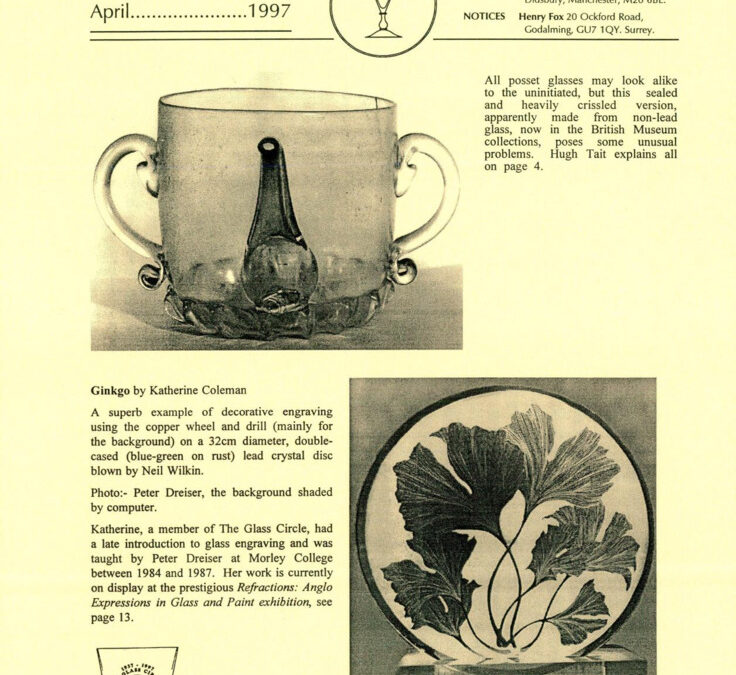
All posset glasses may look alike
to the uninitiated, but this sealed
and heavily crissled version,
apparently made from non-lead
glass, now in the British Museum
collections, poses some unusual
problems. Hugh Tait explains all
on page 4.
Ginkgo
by Katherine Coleman
A superb example of decorative engraving
using the copper wheel and drill (mainly for
the background) on a 32cm diameter, double-
cased (blue-green on rust) lead crystal disc
blown by Neil Wilkin.
Photo:- Peter Dreiser, the background shaded
by computer.
Katherine, a member of The Glass Circle, had
a late introduction to glass engraving and was
taught by Peter Dreiser at Morley College
between 1984 and 1987. Her work is currently
on display at the prestigious
Refractions: Anglo
Expressions in Glass and Paint exhibition,
see
page 13.
Important notices concerning the Glass Circle
Diamond Jubilee Exhibition and reception at
Christie’s, King Street, and a reception and viewing of fine 18th century glass at Phillips, New Bond
Street, are given on pages 2 and 4.
Have you ordered your Diamond Jubilee commemorative goblet yet? If you have lost the order form
simply write to Roma Design Services, 50 Wychbury Road, Pedmore, Stourbridge, West Midlands
DY9
91IR,
UK. or phone 01562 886124.
1997
Page 2.
GLASS CIRCLE NEWS No. 71
The Jacobite Cause and the Judgement of the Daily Telegraph.
A Response from F. Peter Lole
Our last issue carried an encomium from our
Editor-in-Chief for Godfrey Barker’s service to the
cause of Jacobite Glass Studies. I have to admit that
I am one of those unregenerate churls stigmatised
by David, who viewed the Daily Telegraph report of
our symposium with less than enchantment. But it is
not that which prompts this piece; it is the fly
which David so artfully cast as his tailpiece, to
which I rise:
“did anyone dare to own or make Jacobite Glass
in the years after Culloden?”
Those years, it is suggested, stretched out until 1822
when George IV displayed himself in Edinburgh in
tights and tartan. This rather ignores the fact the his
father, George III, had, in 1801, the grace to grant
his Stuart cousin, Cardinal Henry, (King Henry LX
of Great Britain to some) a pension in his adversity.
The bicentenary of Prince Charles Edward Stuart’s
death spawned a plethora of books on Jacobite
history; two of them proved to be seminal classics,
which anyone writing on Jacobitism today ignores at
their peril. The first is Frank McLynn’s biography
of Prince Charles, the second, and in this context
the more important, is Paul Monod’s
Jacobitism and
the English People, 1688-1788
(1989). Monod
devotes much of his book to the question of what,
and when, did people have to say, or possess,
relating to Jacobitism. He considers in some depth
the prosecutions for uttering
“Seditious Jacobite
Words”,
finding evidence for some 2,000 prosecut-
ions between 1689 and 1760. Fewer than 30% of
prosecutions achieved convictions (compared with
about 50% for ‘normal’ prosecutions) and Monod
comments:
“The government was extremely
scrupulous in its handling of seditious word cases”.
There were three major waves of prosecutions; the
early Williamite period, the period following on after
the 1715 Rising, and especially relevant to our
question, the period following the ’45 Rising.
Interestingly, in the case of both Risings, the peak
time for prosecutions was two to three years after
the Rising. When actually considering a quite
different aspect of the ’45 Rising, Monod provides
the explanation:
“The frightened [English] Tories did
nothing to help the Prince, but they redeemed
themselves in the next few years by reviving the
Stuart cause”.
If we turn to prints, and specifically those of Prince
Charles, Richard Sharp’s book,
The engraved record
of the Jacobite movement
(1996) lists impeccable
evidence for prints of Prince Charles being both on
sale, and displayed in homes in England, around
1750; even, indeed, being advertised in Newspapers
under the most flimsy of pseudo-nyms. He cites
some ten cases of Printsellers being arrested, but
none of a conviction; the only arrest he notes after
1745 was in 1749-50, and that for satires on the
Duke of Cumberland; despite a prominent Printseller
being questioned at much the same time about his
display of the well known print of Prince Charles
by Robert Strange, no action followed.
Medals present a similar pattern after the ’45. (See:
Noel Woolf;
The Medallic Record of the Jacobite
Cause,
1988) No Jacobite medals were issued
between 1737 and the landing of Prince Charles in
July 1745; seven were issued to commemorate
various aspects of the campaign, countered by no
less than thirty-nine lauding the Duke of
Cumberland in 1746, but significantly none later,
when his popularity had plummeted. A further eight
Jacobite medals were struck 1748-50, including in
the latter year the REVIRESCIT medal of the Oak
Society, suggested as being inspirational for Glass,
and for which invoices relating to 441 medals are
known. Whilst I know of contemporary references to
Jacobite medals, I know of no instance of a pros-
ecution for either distributing or owning one.
If this were the only evidence of people daring to
own and to own up to, Jacobite ‘Material Culture’
in the decade following Culloden, it would be
impressive enough. But Godfrey Barker ignores the
explicit documentary evidence for two separate
groups of Jacobite Portrait Glasses published by
Eirwen Nicholson, and touched upon by three of the
six speakers at our symposium. EN’s publication
leads on, incidentally, to emphasize that the penalty
for being known to have Jacobite artefacts was
seldom prosecution; it was deprivation of the fruits
of office. Dashwood and Wenman, whose exploits
with Jacobite Glasses were reported in the 1753
Oxford Journal, headed the poll at their election, but
were unseated from Parliament by their defeated
opponents petition to a Parliamentary Committee
“packed with Whigs”.
Thomas Pennant,
“that Whig
dog”
as Dr. Samuel Johnson characterised him,
illustrated the same thing in his very last book
(1796). When describing his home, Downing in
North Wales, he surprisingly tells that a favourite
picture was a portrait of Prince Charles, which had
come to him indirectly from Sir William Meredith,
who:
“suddenly veered from the STUART to the
BRUNSWICK line”
[Which he did in the 1750s, in
order to reap the rewards of office!] and goes on:
“I remember the time when I might have been
struck out of the Commission [as a JP.] for having
in my possession even a shadow of disaffection.”
It seems to me to be almost impossible to argue
convincingly that around 1750, producing or owning
Jacobite artefacts, even Glass, was sufficiently risky
to deter any but the most craven or the most
grasping Tory. I sought fruitlessly through the
transcript of Eirwen Nicholson’s Paper to the
Jacobite Glass Symposium seeking some pithy,
trenchant phrase to encapsulate her theme that a
marriage of Glass and Historical knowledge is
essential. I fear you will have to read the whole
paper in due course.
Evening Reception at Phillips Auctioneers
Thursday May 29th, 5.30pm – 7.30 pm
Glass Circle members are cordially invited to a
reception with refreshments and viewing of fine 18th
century glass, including that from the collection of our
member of long standing, Graeme Cranch and the late
Mrs Molly Cranch, to be sold on June 4th in these
Rooms.
Please note
that the entrance to Phillips is at
7 Blenheim Street, off New Bond Street, London.
RSVP
Combine this with a visit to our exhibition at
Christie’s – a social occasion not to be missed.
GLASS CIRCLE NEWS No. 71
Page 3.
1997
Studio Glass: Craft or Art – Further Thoughts.
by Patricia Baker*
Is interest by the public to contemporary glass minimal,
and if so, why and what can be done about it? Is it the
lack of a guru and high-profile galleries that dissuades
people to reach for their cheque-books? Have glass-makers
lost their way? Has Art been subsumed to Craft? Are
students unaware of the importance of communicating with
the public?
The British fascination in watching people work is well
known whether seen in the public gallery of the stock
exchange or in a glass-making studio. Just as well-known
is the British reticence of parting with money unless for a
recognised icon of success and a healthy bank balance,
such as a Porsche, Armani suit, or conversely for a ticket
to greater wealth, a lottery ticket. Contemporary studio
glass fulfills neither of these roles. A guru is always
suspected for his motives, usually harvesting more critics
than supporters, so would high-profile galleries alter the
buying habits of the public? I doubt it, otherwise why
have so many British galleries failed in the last decade.
Glass-makers, established and up-and-coming, have been
concerned about stimulating British interest in contemporary
glass in the media for the past twenty years and have
tried to redress the situation. But short of orgies in the
hot-shop and sado-masochism in the cutting room, glass is
not headline news. Media coverage rarely gets past
awesome descriptions of the noise and heat of the furnace.
Sending work to Europe and further afield, our
glass-makers always refer to the awareness and interest of
gallery owners and clients abroad:
“They ask such good
questions”, “They take more interest in our glass”.
But
enthusiasm is growing here if the numerous visitors to the
V&A Glass Gallery are anything to go by. Often
confessing complete ignorance, they question avidly and
press for guidance:
“What and whom should we collect?’,
“How do we find out what is ‘good’ glass?”,
and so on.
Displays whet the appetite, so perhaps the real stumbling
block is a lack of customer confidence. The Craft Council
in Islington, London and associated regional organisations
hold details of recognised glass-makers in their
photographic, documentary and computer records, Names
have been vetted by panels, so the listing offers a form
of quality control. The
Crafts
magazine is less useful.
Examine past issues and you will see there is no rhyme
nor reason behind the selection of glass-makers profiled,
and typically the text is just publicity puff; indeed writers
have been cautioned against including criticism of the
work (exhibition/book reviews somewhat exempted) as I
personally know.
The would-be-collector (WBC) is faced with an immense
diversity in work, in terms of concept, form or process.
The V&A contemporary Glass cabinets are bursting with
pieces, expressing their makers’ creative individuality and
demanding (rather than requesting) the observers’ attention.
Instead of being directly related to utilitarian functions as
centuries ago, more glass accords with the notion of
“Art
for Art’s Sake”.
Viewers can feel isolated and ignorant of
the values being explored or challenged. makers in the
past worked to a different set of rules imposed by the
craft-guilds, patrons and customers, and perhaps by
*Dr Patricia Baker was the Historian in Glass at West Surrey College
of Art and Design (now Surrey Institute), 1981-1987. In addition to
being a member of The Glass Circle she is an occasional lecturer for
the V&A Educational Department, the Hon. Editor of the Glass Assoc-
iation’s journal,
Glass Cone
and, until recently, the Hon. Secretary of
the Association for the History of Glass (British Branch of AIRV)
technical constraints. And it was in Renaissance Europe
that our artificial division between Fine, or ‘clean’, Art
and the Decorative, or ‘dirty’, Crafts was created. Since
Harvey Littleton and Sam Herman studio glass-makers
have concentrated on breaking down those conventions;
whether anything is being or should be established in their
place is an interesting question. Increasingly the WBC is
faced with
‘glass sculpture’
and
‘sculptural glass’
(a world
of difference) which presents the WBC with such
problems as “By what aesthetic criteria do I judge this
work — those pertaining to sculpture or to making, or
both?”. Yet few contemporary glass-makers, during their
training and after, have had direct contact with sculptors.
Often work is medium-orientated (What can I make with
glass?) rather than concept-driven (To achieve this idea I
must use glass). It is an important difference.
To me contemporary glass-makers continue to develop
along certain avenues. There are the Craftspersons, totally
at home with technique and the material, who happily
explore new forms, perhaps changing their ‘house-style’
every year. They may feel the need to be recognised as a
Serious Artist but their expertise lies in skill. Then there
are the Technicians, justly recognised for technical
experiment, perhaps rediscovering an historical process or
technique, so their glass celebrates this research. The
Designers enjoy the challenge of working within the
constraints of form and function; whatever the scale the
glass should appeal to the eye and the hand with its line,
balance and
fitness to form’
(the jug will pour, the goblet
feels good in the hand and at the mouth, etc.). Then
there are the Artists, who are primarily concerned with
creating non-utilitarian, non-functional artwork in form and
concept. No pecking order should be inferred from this
categorisation, though debates over just this craft issue
during the last two decades have been both lengthy and
extremely heated. Some of our glass-makers fit neatly into
these classifications; others straddle them, a few transcend
them. Today’s makers can rarely support themselves 100%
financially by sales of their exhibition work so income is
supplemented, perhaps by teaching, designing for
manufacturers, or team-making small-production
‘table-ware’
ranges. Remember that income from the
‘haute couture’
range of fashion houses is minimal; the real money comes
from their
‘ready to wear’
lines and franchising.
The international recognition of some of our Higher
Education glass-making courses is based on the teaching
staff; their concerns with certain standards in the technical
and process fields are well known. In turn, the pieces of
contemporary glass selected for inclusion in certain
specialist international journals are duly noted; no-one
wants to be left behind. What is a real threat to the
technical quality and the ‘hands-on’ approach of our glass
courses are the on-going financial cuts in college budgets.
Glass history programs to complement the practical courses
have already been curtailed, staff reduced . . . furnaces
not cheap to run.
David Watts asks art schools to start questioning their
students. I can assure him this is an established , official
requirement in most if not all courses. During practical
sessions, tutorials and assessments students are pressed to
talk about their work, the inspiration, the development,
decision-making etc.. In degree-shows it is customary for
each graduate to compose a brief statement to accompany
the display, for public distribution. So the glass-maker is
no stranger to writing about the creative experience and
development. But it should be remembered they have
Concluded overpage
1997
Page 4.
GLASS CIRCLE NEWS No. 71
The Albert Hartshorne “Sealed” Posset Glass.
This contribution, triggered by reading David Watts article
on the S-sealed glasses (GC News No. 67, April 1996),
concerns an almost forgotten gift to the British Museum
from the Pioneer Historian of English Glass Studies,
Albert Hartshorne, F.S.A., who died on 8th December,
1910. In his will he bequeathed his entire collection of
glass – about 600 items – to a distant cousin, Mrs Hugh
Wyatt, of Cissbury, and her husband, but by then it no
longer contained his most treasured “sealed” posset glass.
Six months before he died, Albert Hartshorne had read a
paper on glassmaking in England to the Society of
Antiquaries (on 23rd June, 1910), the high point of which
had been not only the evidence afforded by the letters
and drawings sent by John Greene, a London glass-seller,
to Allesio Morelli, a glass-supplier
in Venice, between
1667 and 1672, but how one drawing in particular related
to an exceptional “glass spout pot, c. 1675, which was
exhibited together with a silver example of 1702.”(1) It
was the only piece of glass that Albert Hartshorne had
selected from his vast collection to exhibit that evening –
presumably because he had judged it to be
a
glass of the
greatest rarity and of special significance for his thesis
and interpretation of the Greene drawings but, perhaps,
also because it was a hitherto unpublished and almost
unknown piece. Indeed, its absence from Hartshorne’s
massive work,
Old English Glasses
(published in London
in 1897), which contains a lengthy chapter devoted to
Greene’s drawings and extant examples of Venetian(?) or
English origin including various posset glasses (p. 233 ff),
indicates that it must have been a recent discovery. It was
evidently found without any history because, in his
lecture, Hartshorne took the trouble to record that the
silver version of 1702 had belonged to
“an ancestor,
John Postlethwayt, D.D., chief master of St. Paul’s School
from 1697 to his death in 1713.”
Bringing his paper to an end, Albert Hartshorne
announced to the Society
of Antiquaries that
“he had the
desire, with the concurrence of the President, to add the
glass spout pot to the collections in the British Museum.”
The Society’s President in 1910 was Dr. (later Sir)
Charles Hercules Read, Keeper of Medieval and Later
Antiquities at the British Museum and, by the autumn, the
gift had been gratefully accepted by the Trustees.(2)
Neither in 1910 nor at any subsequent date has the seal
affixed to the base of the spout of the Hartshorne posset
Patricia Baker: Studio Glass concuded
chosen to express their ideas in visual form, not in words;
they are makers, not authors.
It is the gallery or museum which requests specifications
of the making processes and indeed such information is
now increasingly asked of Fine Artists. If we think this
data is irrelevant or insufficient, we should inform the
gallery and the maker and query publicity hype whether
in books, articles or personal statements. If we are unclear
about the
why’s and wherefores of contemporary glass, we
should press for clarification. Lastly, glass, whether old or
new, like Persian carpets should never ever be purchased
for investment purposes. We surely buy such things
because we feel their presence will enhance our life, and
we appreciate the creativity of the maker/designer/artist. If
their commercial value increases over time, if others flatter
us on our taste and selection, so much the better. but it
is living with such things, rather than viewing them in a
museum, that is most important
by Hugh Tait
glass been convincingly deciphered. Another indecipherable
seal (on a stem fragment of a drinking glass) was found
at Jamestown, Virginia.(3) Regrettably, reports in the
most recent publications(4) may have led the reader to
believe that the seal on the Hartshorne posset glass had,
in fact, been successfully identified – apparently by an
unnamed person and at an unspecified time – as “similar
to”, or, as being the same device” as, the seal on the
Northampton Museum’s four-lobed stem fragment (namely,
a female figure shooting with a bow). Unsubstantiated
claims of this kind are less than helpful; indeed, they
positively hinder progress towards an objective assessment
of the evidence.
Finally, in addition to the three S-sealed specimens listed
by David Watts in GC News No 67, there was apparently
a fourth S-sealed piece – a stem fragment
“excavated at
Canterbury
,
‘ –
recorded (without illustration or measure-
ments) in 1968(5), and now presumably preserved among
the local archaeological collections, although whether
publicly or privately owned is far from clear.(6) In view
of the importance and rarity of S-sealed specimens, none
should be lost sight of and all, if possible, should be
re-examined using today’s more reliable scientific methods.
Perhaps such a survey could include related rare
specimens, such as the Hartshorne “sealed” posset glass of
which Hartshorne in 1910 wrote:
“it is at once apparent
that its nature is very different from English glass objects
of the same time.”
Footnotes
1.
Proceedings of the Society of Antiquities of London,
Vol.
XXIII (1910), pp. 267-271; being the earliest known
publication of this sealed posset glass; it is particularly
regrettable that the account was not accompanied by any
illustrations. Albert Hartshorne,
elected a
Fellow in 1882,
was a tireless scholar and, between 1876 and 1894,
devoted 15 years to the editorship of
The Archaeological
Journal.
For
a recent illustration of the John Greene
drawing of a posset glass (sent to Morelli in Venice with a
letter dated 28th August, 1668, see Helen
McKearin,
Possets, Syllabubs and their Vessels,
The Glass Circle
Journal,
Vol 5 (1986), p. 65, Fig.1.
2.
Reg. No. 1910, 10-17,1. Ht. Sin. (7.6 cm). Its cnssled
state and Inherent fragility requires a specially controlled
atmosphere with a constant relative humidity; consequently,
this piece has not been displayed In the public galleries of
the museum in Eying memory. This factor has, undoubtedly,
contributed to Hartshorne’s ‘sealed” posset glass becoming a
forgotten gift.
3.
RJ. Charleston, George Ravenscroft New light on the
development of his ‘Christalline Glasses”,
Journal of Glass
Studies, Vol.
X (1968) p. 162.
4.
Robin Hityard, Glass Collecting in Britain,
The Burlington
magazine, vol. cxxxvi
May, 1994, page 303. footnote 10;
RJ. Charleston,
English Glass.
London, 1984, page 126;
Thorpe’s
History,
(1929, facsimile 1969) Plate XVII, No.2.
5.
R.J. Charleston, 1968, (ref. in footnote 3, above). p. 161,
footnote. 36.
6.
A search last month through the Canterbury Museum’s
collection of glass “small finds”, most helpfully conducted by
Mr S.J. Marshall, drew a blank; therefore, either the
excavator or the landowner (both unrecorded) may have kept
it and, ai a result, this S-sealed stem fragment has not
been seen (or even mentioned in the literature) since 1968.
Two early moulded 6-sided pedestal stem
glasses. Left: with 4-pointed stars on the
corners of the shoulders
and
6-pointed
stars in between. Right: This glass has a
thick deceptive bowl and the stem has
been twisted to create a wrythen effect.
From the Ronald and Mary Thomas trust glass
collection. (photo courtesy Wing Commander R.G.
Thomas M.B.E., RA.F. Retd.).
Two 4-sided pedestal stem glasses, both c. 1715 and of
approx. Ht. 16cm. Left: from the Anthony Waugh collection
embossed round the shoulders with God Save ye King GR
with a crowned bust portrait to dexter between the G and R
(photo courtesy Sotheby’s). Right: a similar glass from the
Ronald and Mary Thomas trust glass collection (photo
courtesy Wing Commander R.G. Thomas M.B.E., R.A.F.
Retd.).
1937
1997
The Glass Circle
Diamond Jubilee Exhibition of
May 27t
At Christie’s, Kin
Open Mon. – F
ADM
une 1997
t. James, London
.m. to 4.30 p.m.
FREE
Glass Circle Diamond Jubilee
Exhibition and Reception.
We hope to see you all at the Glass Circle diamond
Jubilee Exhibition and at the special Birthday
Reception at Christie’s on the evening of May 27th.
Henry Fox still requires stewards for the Exhibition
and to sell Circle publications (a sitting down job!).
Members able to participate, even for a couple of
hours, would be appreciated.
If you can help please contact Henry at his address
on the front cover of GC News.
GLASS CIRCLE NEWS No. 71
Page 5.
1997
Moulded Pedestal Stems –
the origin of the hinged mould?
After the baluster glasses, those with a moulded pedestal stem, dating
traditionally from
1714/15 to
1765, are the earliest 18th century English glasses
with an elaborate stem formation. They were clearly extremely popular both
with the glassmaker and with the public. This is because they were easy to
make, compared with a baluster, while they were both elegant in design and
flexible in expression according to how far the stem was drawn. The basic
method of manufacture employed a shallow, flat-bottomed dip-mould with 4, 6
or 8 sides into which a small thick bubble of glass was inserted. The stem
was extended as the shaped bubble was withdrawn from the mould and, if
necessary, further manipulated at the furnace.
Because they were produced over a long period they are difficult to date with
any accuracy. With early versions, typically, the bowl (a drawn trumpet being
earlier than a thistle) had a thick base joined directly onto the stem which also
joined directly onto a plain folded foot. Two examples, shown below, have
decoration moulded into the sides of the stem commemorating the coronation of
King George I. Such glasses are extremely rare, perhaps no more than half a
dozen being recorded. Because the decoration is on the side wall of the
mould, thereby preventing the hot glass from being easily withdrawn, the
moulds themselves must have been made in two parts hinged together.
Versions with letters (G.S.K.G), crowns or sceptres moulded on the shoulders
(i.e. engraved in the base of the dip mould) have also been recorded. A little
later 4- or 6-sided stars became common. Particularly rare, illustrated above
(left), is the glass with both 4- and 6-sided stars
together. In some instances the moulded corners of
the 6- or 8-sided stem appear as pronounced ribs
suggesting a further elaboration of the mould itself.
The introduction of one or more mereses came later. The
multiple merese between stem and foot (the latter often
enhanced with a dome) is particularly associated with
sweetmeat glasses. These are conventionally dated, mainly
on bowl style, to the middle of the century although firm
evidence for dating can be elusive.
The classification by Barrington Haynes distinguishes eleven
different categories of moulded pedestal stem glasses. There
is much about them still to be resolved.
D.C.W.
1997
Page 6.
GLASS CIRCLE NEWS No. 71
GLASS CLIPPINGS
by Henry Fox
Pressed Glass through Roof at Crystal Palace
Tucked away in Roseberry’s South London Auction
Rooms, next to Crystal Palace Station, there was to be
found in their January sale an exciting private collection
of mixed pressed glass – over 200 pieces including several
covetable Sowerby nursery rhymes. Sadly, the sale was
divided into large lots, basically by colour, and rare items
were catalogued so briefly, or indifferently, that without
viewing it was impossible to identify them with any
certainty. An important exception was a collection of
Sowerby spill vases moulded with swans, which was
composed of a very rare yellow example, an aesthetic
green example, and a pair of opaline (sic) examples (these
two with slight damage). Overall condition was largely
excellent or good, but a rare model of the Albert Hall
(an oval lidded container in opaque white glass) was
chipped and nibbled in various places and also had a hole
on the base line; the lid did not fit very well either.
On the day, collectors and dealers must have been out in
force as the following highlights show. The lot with the
four Sowerby rare swan spill vases (Sowerby 1882 Cat.
No. 1436) made £1100 against estimate £50/£70: another
lot (15 items!) of blue Sowerby (inc. Cats Nos.1234,
1224, and 1191) made £650 against estimate £100/£150;
whilst another lot of Sowerby Queens Ware (9 items!)
including a “Jack and Jill” and a scarce example of
Catalogue item No. 1408 made £460 against estimate
£50/£70. (All prices plus premium). All in all, prices bid
were well in excess of estimates, and even the Albert
Hall, despite its faults, made £70. Possibly with better
cataloguing – smaller lots and references to compare
illustrations in books, and where certain items had been
loan exhibits – bids would have been even higher.
All
this information was eventually made available separately
if interest was expressed in the collection when viewing.
I was surprised to get a copy. It was certainly not being
freely handed out to all.
Bo
–
Peep encased!
A few years ago a Sowerby opalescent glass posy vase
impressed with “Bo-Peep” (a design from the “Baby’s
Opera” by Walter Crane) was found with silver mounts.
A member has recently seen a flint version with silver
mounts. Do any other members know of Victorian
hall-marked silver-mounted Sowerby pieces ?
More “Aspiring” Glass!
Another glass spire has come to light with a photograph
in the Independent newspaper for 30th January 1997.
This example, which has now been moved to the
Avoncroft Museum of Buildings at Bromsgrove, is 55ft
tall and dates from 1961 where it had been installed at
the now demolished St. Paul’s Church in Smethick. This
spire (made of fibre glass) is believed to be the first of
its kind. Its designer, Peter Falconer, an architect from
Painswick in Gloucestershire, designed several such spires.
Clippings now knows of two glass spires (refer GC News
No. 67). If you know of any other examples please let
Henry know. The Avoncroft Museum is normally open
from 10.30 am daily, March to late November; entrance
fee £3.95 with concessions. The museum hopes to have
the upper half of the spire on public view this summer.
Oh, Dram!
A report in the Times newspaper (4th March)
suggests that “In Scotland , the imposition of the
Malt Tax in 1713, led to the first Jacobite rising in
1715, and a nation-wide illegal distilling industry.”
We may not have had the Stuart Succession but
certainly the Scots eventually have won, and one,
over the English with their whisky. Are there any
engraved glasses celebrating either of these events?
EXHIBITIONS
Diamond Jubilee – More to see
Following our announcement in the last GC News we are
pleased to report that the special exhibition of Chinese
Glass to be shown at the Bristol Museum & Art Gallery
this year is now on. News comes of two more events
celebrating the Circle’s Diamond Jubilee. First, a small
special display of fine English glass to be shown on the
landing at the Worthing Museum & Art Gallery, Sussex,
17th May – 21st June. Also, members in reach of Buxton
in Derbyshire are invited to view a small display of 18th
century English drinking glasses which have been loaned
for the duration of the Buxton Antiques Fair to be held
in the Pavilion 10th – 17th May.
“Twenty-One Today” April 16th – May 16th,
1997
This exhibition celebrates 21 years of the London
Glassblowing Workshop and, incidentally, Peter Layton’s
60th birthday. It will display a diversity of work by 21
artists who have worked there over that period and
includes Siddy Langley, Anna Dickinson, Norman Stuart
Clarke and Patrick Stern. There will also be an open
weekend sale and exhibition April 18th, 19th 20th, 11 am
– 5pm. Our member, Peter Layton, looks forward to
welcoming you to this special celebration at 7 The
Leathermarket, Weston St., London SE (a short walk from
London Bridge and Borough Underground Stations).
Tel. Anna on 1071 403 2800 for more information.
Public awareness in the creativity of today’s glass artists
is growing rapidly, and Britain is among the leaders in
the field. The National Glass Centre, in Sunderland will
open in 1998 with an exhibition
A Journey Through
British Contemporary Glass
selected by Dan Klein; the
Glass Circle has preliminary plans for a joint one-day
symposium with the new Contemporary Glass Society on
British Achievements in Contemporary Glass
of which
more later.
A Few of My Favorite Things –
until Autumn 1997
The newly refurbished Nottingham Castle Museum, in
addition to a new display of its glass collection, invited
Bonham’s glass expert and TV personality, Eric Knowles,
to select an exhibition of favorite ceramic and glass pieces
from the Museum’s archives. The result is a sheer delight
and well worth a visit. The Museum, open daily 10am to
5pm, is free Mon-Fri but £1.50 for adults at weekends
and Bank Holidays. Tel. 0115 915 3700.
Welcome to New Members:
Mr & Mrs P.J. Black, Kent
Mr R.M. Bramah, M.A., Worcester
Mr & Mrs A.E. Bright.
Miss J.R. Cameron
Mr B. Clark, West Midlands.
Mrs P.C. Harbottle, London.
Dr M.J.P. Higgins, London.
Mr D. King, Wiltshire.
Dr R.A. Mones, U.S.A.
Mr P. Obrey, London.
Mr C.M. O’Bryen, London.
Mr E.V. Phillips.
Mrs G.L. Taylor, U.S.A.
Mr & Mrs A.C.M. Van der Meulen,
Netherlands.
Glass Circle News –
Publication Deadlines
No.72 Mid-July for publication in August.
No.73 Mid-October for publication in November.
No.74 Mid-December for publication in January.
DIM and BRI
Don’t you get bored spendin
life fixed to
the same old wall?
Well! Its boring but its safe, although I sometimes
wish I had the exciting life of a milk bottle. Do you
know one recently travelled all the way from
Waterford in Ireland and turned up on a North
London doorstep. I wonder how many have travelled
further than that?*
*If you can contribute to the milk bottle travel record please
support your claim with a pencil rubbing of the dairy from
which it came that is embossed on the bottle. It must, of
course, have been delivered to you full of milk.
GLASS CIRCLE NEWS No. 71
Page 7.
1997
Bottles and Wine
by Dominic King (formerly British director of Bouchard Aine)
A meeting of The Glass Circle on Thursday 12th
December at The Artworkers Guild by kind invitation
of Mr and Mrs J. Whittle and Dr and Mrs B. Scheer.
In a wide-ranging lecture our speaker gave an
entertaining insight into the lighter side of the
French wine industry. Round his neck he was
wearing a silver tastevin or wine-tasting cup. Glass
ones were known but silver was more robust for
cellar use and the silver helped in judging the
colour of the wine. The use of wine-tasters goes
back four- or five-hundred years and our speaker
owns a small representative collection of them.
c.1700
41720
So far as choice of wine is concerned the
recommendation was to drink what you liked when
you liked. But compared with the French and Italian
consumption of 160 bottles/head per year, on
average, the British consumption at 15 bottles was
very modest. Wine and viniculture, which originated
in the Middle East, was considered the drink of the
gods and a number of these deities were illustrated.
Wine was brought to this country by the Romans
although the Middle Ages is considered the Golden
Age of the wine trade. For social drinking a
small-bowled glass is used.
Wine was originally stored and transported in oak
casks. The English dark green wine bottle was
probably invented in the second half of the 17th
century and is associated with Sir Kennelm Digby.
The dating of bottles is helped by the form of the
string lip, used to tie down the stopper. Corks,
incidentally, were used much earlier than is
sometimes thought. Glass seals to identify and date
bottles were introduced about the middle of the 17th
century, the earliest complete bottle being in
Northampton museum. Sealed bottles were expensive
to make; many of the metal stamps for pressing the
glass seals were engraved in Newcastle and could
be sent back to the glasshouse to be recut when
worn. The evolution of the wine bottle was traced
through to the invention of the three-part mould by
James Ricketts of Bristol in 1780-1820 and the
emergence of separate bottle shapes for different
types of wine. Wine should be stored at
temperatures between 45 and 50 degrees Fahrenheit.
Daylight can be excluded and, as oxygen is the
enemy of wine, a bottle, once open should be used
as soon as possible.
Wine occasions are a feature of continental life.
Once the grape has been gathered (we were given a
short rundown on the different varieties) the next
step is fermentation of the pressed (using one’s feet)
must. Personal involvement does not end here as
during August, September and October, heat may be
required to initiate the fermentation process. This is
achieved by immersing in the juice a number of
individuals, including on several occasions, our
speaker, until the yeast bursts into life. Half an
hour or more of such treatment is not uncommon.
Nowadays, modern methods of heating are used.
Communal enjoyment is also enhanced by wine
hospices. These operate as charities and, over the
years, have donated both land and vineyards (some
dating back to 1500) for a worthy cause. There are
over sixty operating in Beaune. Auction evenings
are very popular and candles ( in some mysterious
c.1740
1750
1760
1800
1822
way)
are used in the bidding process. Auctioning is
carried out by the “Commander”, usually a person
of local importance or a celebrity, who is in charge
of the evening. Our speaker had enjoyed this privil-
ege. A particularly memorable evening was when
Peter Ustinov, as Commander, auctioned his own
barrel of wine (300 bottles) for UNESCO, raising
the remarkable sum of Fr.500,000 (approx. £50,000).
The highest price for a barrel, raised for charity, is
a record one million francs bid by Patriarch.
In response to questions Dominic King described
how he was introduced to wine in bulk in unusual
circumstances at the end of the last war. Being sent
to collect a consignment of sewing machines in the
Middle East he discovered, on arrival, that these had
been replaced in the warehouse by crates of wine.
Exploiting what must be a natural entrepreneurial
spirit he nevertheless took commercial advantage of
this discovery. This introduced him into the wine
trade from which he has never looked back.
Glass Circle members present, who were further,
rewarded with reprints outlining wine history and a
vintage chart, both provided by the speaker, were
delighted to applaud this unusual and most enjoyable
evening.
Fig. 1. see text
Fig.2 see text.
1997
Page 8.
GLASS CIRCLE NEWS No. 71
Baluster Drinking Glasses
by
Martin Mortimer.
A meeting of The Glass Circle at The Artworkers Guild on March 18th, 1997 by kind
invitation of Mr D. Manning, Mr R. Whatmoor, Mr D. Woolston and Mr T. Udall.
The immediately identifiable baluster series of drinking
glasses is traditionally dated 1685-1725 or a little later.
The glasses are characterised by heavy construction with a
thick base to the bowl and, generally, a folded or domed
and folded foot; a few with plain feet come towards the
end of the period. The most identifiable feature is, of
course, the thick swellings in the stem of which the
common architectural feature, a baluster, gives its name to
the group. A glass with round funnel bowl joined directly
to an inverted baluster stem and conical folded foot was
probably the earliest style of baluster glass. The metal of
the early glasses tends to be white (colourless) or slightly
yellow while, after the turn of the century, when manu-
facture of the new lead crystal became more widespread, a
delightful steely blue-grey colour emerged that is much
admired by collectors, although reflecting impurities in the
batch materials rather than the glass-maker’s desire.
The material for the lecture came from the rare event that
a complete collection of 120 glasses, compiled by Dr
Clarence Lewis of Toronto (many of which had been
supplied by Delomosne), had been returned to the firm in
1985 for resale. Fifty of the best representative glasses
comprise Delomosne’s booklet,
The Baluster Family of
English Drinking Glasses*.
The purpose of the talk was
not just to survey their variety of stem type but, more
important, to compare them with other glasses from the
collection and analyse why the artistic achievement and
aesthetic appearance of some was much more successful
than others. Martin proclaimed that this was a personal
assessment although few, if any, of the large assembly
present would have questioned the surety of his
judgement. The approach was intentionally perfectionist as
a collector would have welcomed any of the examples
illustrated into his collection.
The opening slide (Fig.1) depicted a goblet with round
funnel bowl on a half knop over a wide angular and base
knops (the latter generally round) with tears over a wide
folded foot(7). The proportions of its parts, vigorous and
strong but not overbearing in execution, were ideal, no
one part taking dominance over the rest. An important
feature was the half-knop under the bowl which gives the
bowl elevation and distinction as compared with those
lacking this feature(6b). It also dates the glass to c. I 715.
The stem formation is one of the commonest among
balusters but nevertheless most satisfying. This
Venus de Milo
among vessels indeed humbled
the next group of glasses illustrated (6a,b,c)
with the same stem formation but where a
certain meanness in the use of metal, irregular-
ity of form and lack of proportion among the
parts was apparent. The fourth glass in the
group(6d) illustrated how the introduction of a
bucket bowl, although a collectors rarity, made
a less elegant combination. It was not helped
by giving the bowl a greater flare at the rim.
Another rare glass(8b) had a bowl of incurved
thistle or double ogee form which, largely due
to the weight of metal in the base of the
bowl, gave a top heavy appearance. Likewise,
adding a domed foot could carry the glass too
high with the same unbalanced effect. The
drawn trumpet bowl mounted directly on the
angular knop(e.g. 8a) can have a very pleasing
effect while the bell, which can overwhelm by
having too much glass in the base of the
bowl, is considered a late addition to the series, generally
dating after 1720.
The same principles could be said to
apply to the rarer stem formations
with drop knops, mushrooms and
acorns. The acorn (Lewis had five
such glasses) gave a particularly
satisfying stem formation in a well-
formed glass whether surmounted by
a round funnel(9) or drawn trumpet
bowl(11b). The multiple annular
knop could be pleasing and was balanced well by a bell
bowl(e.g. 19b,c,d). Spindly versions verged on what has
been called “balustroid”, a somewhat derogatory term for a
less heavy but quite satisfying glass.
Deceptives were rare. They typically had a thick conical
bowl mounted directly onto a ball knop with tear, a short
plain stem and folded conical foot(18c). A more elegant
and complex type had a triple graded collar between bowl
and stem and a base knop which improved the height and
balance of this basically utilitarian glass(e.g. 17a).
A remarkable example of the glass-makers skill is a glass
(c. I 720) with bell bowl but the inverted baluster stem
contained a coin within an enlarged tear.
Cylinder knop and egg knop glasses were described as an
“acquired taste”. Only about six baluster glasses with an
egg formation are known to exist. Two superb examples
of cylinder stems were shown, both beneath flared drawn
trumpet bowls. The typical stem sequence was half knop,
collar, cylinder stem with tear, and dumbell leading onto
the foot (Fig.2) which could be plain or folded(13a,b).
Martin Mortimer closed his lecture with a brief review of
the moulded pedestal (Silesian) stems which date from the
same period. Of particular note was an engraved glass
with cover with a finial matching the stem. He concluded
by returning to his opening slide to reinforce the features
that contribute to a well-balanced baluster glass.
A lively debate followed on a range of topics; were
bucket bowls desirable – yes; might they have religious
significance (e.g. as communion cups) – possibly; was
anything known about engraving on these early glasses –
almost nothing; evidence was presented for sets of
balusters glasses from records and paintings; the lack of
examples to match records of purchases due to
natural breakage; was there evidence for lead
crystal being made in Holland or on the cont-
inent at that time – none known; the meaning
of single and double flint glass – nothing to do
with the weight or construction of the glass but
more probably its colour relating to the quality
of ingredients used; was there a slow spread of
fashion in the use of balusters in the provinces
as compared with the taste and style of London
– not known; a suggested use of statistics in
determining glass survival; the functional role of
giant balusters – speculative, no real answer;
classifying glasses from the structure of the foot,
particularly dome-type – the foot (blown) was
made by the foot-maker, the bowl and stem by
the gaffer, did the same pair always work
together in making a glass?
A vote of thanks was given by Miss Wendy
Evans for a thoroughly enjoyable evening.
* Numbers in parentheses here are the Fig. numbers in this
booklet where the glass (or a similar glass) is illustrated.
GLASS CIRCLE NEWS No. 71
Page 9.
1997
Further research reveals that both Percy Bate in his
English
Table Glass
(1913) and J. Sydney Lewis in his
Old Glass
and how to collect it
(1928) had already reached the same
conclusion. Both illustrate suitably engraved glasses but on
facet stems (Figs 1 and 2). Lewis goes so far as to date
his facet as 1801. Thus,
a priori,
we now have a series
which, based on conventional dating of the glasses, might
reflect the commemoration of 25, 50 and perhaps 100 years
of the 1707 event, all with similar engravings, but as close
inspection reveals, differing in detail.
Here the problem starts because it is on the facet stems,
apparently by the same hand, that the engraving appears of
earlier date!
The workmanship is less sure with the bars
of the St Andrews cross of uneven thickness and the blazes
of the star rather coarse.
All this contrasts with the clean,
even outlines on the drawn trumpet and air twist specimens.
The illustration of the air twist glass, from the Queen’s
collection, in Bernard Hughes
English, Scottish and Irish
Table Glass
(Fig. 74) shows the detail superbly. None of
this might be considered of any significance but for the fact
that these two glasses, unlike the facets, have Sans Serif text
(Fig. 3). Unfortunately, Sans Serif is said to have been first
invented as a typeface in 1816 by the Caslon factory!
A trawl though my bookshelf revealed that all the 18th
century engraved glasses I could find with text of which
one had no reason to doubt the validity, have letters with
serifs.
So it would appear that there is at least some
justification for the suspicion that the two “early” glasses
were engraved in the 19th century, perhaps to cash in on
the Jacobite boom you might say? But could Sans Serif
have been used before its invention as a typeface? For
further insight into this problem I sought Hugh Tait’s
advice. He has found that Sans letters occur scratched on
early examples of “humble ware” – simple pottery for
domestic use, but not on anything with any pretensions of
grandeur comparable with an expensively engraved
commemorative goblet. However, similar lettering to that in
Fig. 3, with thick even strokes, does occur on Wedgewood
creamware of the 1770-1800 period, as illustrated in
Geoffrey Godden’s
China and Glass under .£5
(Fig. 23).
Hence, if the use of Sans Serif lettering on these engraved
glasses, albeit unusual, is accepted as being genuine, all
these glasses probably commemorate the same event
irespective of the dates when the glasses themselves were
made.
Taking the
terminus post quem –
the earliest date for the
engraving – as 1770, the following dates are possible
commemorative occasions:
1782 Fox’s Repeal of Ireland Bill granting Ireland legislative
independance from Britain.
1788 The death of Prince Charles Edward, the Young
Pretender.
1790 Death of Flora Macdonald, the Jacobite heroine.
1801 The Act of Union of Gt. Britain with Ireland.
There is nothing in the engraving compatible with the first
three dates and we are left with J. Sydney Lewis’ offering
of 1801 as the most probable. Hence the flag within the
garter must represent the united flags of St. Patrick
(not
St.
Andrew) and St George, while the dimidiated rose and
thistle on the reverse side of the bowl the 1707 Union of
England with Scotland.
John Bailey, in his lecture at the Jacobite Symposium,
illustrated how a study of apparently similar engravings on a
sequence of glasses is much more informative than one
alone, particularly on the question of dating. It was a point
well made as is illustrated here. In the same symposium
Peter Francis drew attention to the dubious nature of a Fiat
glass engraved in Sans (illustrated in Seddon’s The Jacobites
and their Drinking Glasses, Plate 117,e). However, the
engraving is so crude, unlike the rose motif, it is surprising
if that addition to a genuine piece would fool anybody.
Fig. 3.
Detail of the wine glass, illustrated in Glass Circle
News, No. 70, to show the Sans Serif engraving of the motto.
Fig. 2.
Facet stem
wine engraved with
Union sentiments.
Note the serifed text,
uneven thickness of
the two crosses and
the irregular spacing
of the blazes of the
star as compared
with Fig. 3.
Detail from Fig. 21 in
J. Sydney Lewis’
Old
Glass…, .
(see text).
A
Provenance Problem
with Union Glasses
– a tale of the unexpected
by David Watts
In Glass Circle News, No. 69, it was proposed that glasses
engraved with the Union flag within a garter star and bearing the
HSQMP motto should be regarded as reflecting the Union of
Scotland with England rather than as showing Jacobite sympathies.
Fig. 1. A wine glass
with a facetted stem,
with the same decor-
ative form of wheel-
engraving as Fig. 3,
and initially presumed
to commemorate the
Union of England with
Scotland.
Illustrated by Percy
Bate, Plate LVII. (see
text).
1997
Page 10.
GLASS CIRCLE NEWS No. 71
Around the Sales with Henry Fox
Members should not restrict their viewing to solely glass
related sales when viewing at the major auction houses. In
the French 19th century furniture sale at Sotheby’s Bond
St. in February there were items of interest spotted e.g. a
set of four French cut glass wall appliqués, with cut
drops, which had been wired for electricity. These sold
for £3000; whilst a magnificent cut glass and gilt bronze
two handled, lidded, vase made £5800. Both lots plus
buyers premium.
In Christie’s South Kensington March Glass-only sale a
tall Regency style punch urn dated to early 19th century
made £8000; a tall goblet of the heavy baluster period
with large round funnel bowl set on a stem with an
angular knop over a base ball knop on a conical folded
foot made £2800; and two early sealed wine bottles (one
with some reported damage) went to the same continental
buyer for £2200 and £2800 respectively.
(All prices plus premium). This sale contained several
group lots making under £500 per group.
There were only a few glasses of interest in the end
February Sotheby’s Colonnade sale.
A darkish green coloured glass with incurved cup bowl,
plain stem, and conical wide folded foot, estimated at
£300/£500 failed to sell. Perhaps it was considered by
bidders to be 19th century, or even later. Perhaps it was
not the day for green glass! A glass with a stuck-on
bowl, however, sold for £160, but then this opaque twist
stem glass did have white enamel fruiting vine decoration
on its re-stuck on bowl. A plain taper stick c. 1750 sold
for £550. (All prices plus premium).
As stated before it is quality, rarity, good provenance (if
any), and freshness to the market which boosts the
attractiveness of items to would be bidders which in the
end usually means an higher price being obtained..
Whither Goest Thou?
For sometime now, members have been heard at meetings
to lament the passing of the regular glass only sales at
Christie’s and Sotheby’s. This is because many still recall
the days when that was the case and the prizes that could
be found occasionally in some job lots. The major auction
houses did not have then the extensive branch network
that they have today. During the last ten years or so
good interesting examples of English glass have become
increasingly difficult to find by the ordinary private
collector. Rare and exceptional pieces have priced
themselves out of the reach of all but the few. Certainly
the more expensive items now go either to museums or
those wishing to make glass an investment. In the one
case the item(s) purchased leave the pool of available
glass, more or less, for ever. In the other case, the glass
may return at sometime to the market place, but in the
meantime it has remained closely guarded, largely unseen –
whereabouts unknown. Neither of these scenarios is good
news for the private collector wishing to pursue his hobby
and increase his knowledge of the subject.
It is both interesting and appropriate that in the year of
the Circle’s Diamond Jubilee that the following piece by
Anne Crane should appear in the Antiques Gazette (Issue
1279 w/e 15th March 1997. Our thanks to the Editor for
permission to reproduce it in total):-
“Where do antique glass enthusiasts go to hunt their
quarry these days? Equally, where do they choose to
dispose of it?
“They must, it seems, be prepared to range over
increasingly broad territory.
“A prime source/outlet used to be Sotheby’s and Christie’s
specialist glass sales at Bond Street and King Street, but
the norm these days is glass sections within ceramics
sales. Sotheby’s have adopted this approach in their main
and Colonnade sales at Bond Street and also make use of
their Sussex rooms at Billingshurst. Indeed many of the
provincial rooms such as Neales, Woolley and Wallis and
Dreweatt Neate now turn up large glass sections with
some frequency.
“While Christie’s have also adopted the glass section
solution they have made alternative provision. Some of the
material that featured in their specialist King Street sales
now goes to glass sales at their South Kensington rooms.
“One does not have to look far to
see
the reason behind
the shift of goods from SW1 to SW7 or Bond Street to
Billingshurst. Like many English ceramics that have
followed the same route, antique drinking glasses may
have performed reasonably as an investments over the past
20-odd years but they do not make much of a dent in
saleroom turnover figures. The big rooms are choosing
more cost efficient venues for standard fare.
“Since Bonhams and Phillips have always mixed ceramics
and glass, CSK’s three sales a year are currently the only
regular all-glass auctions in the capital, although this looks
to change. Sotheby’s have an all-glass sale at Bond Street
on May 28, another scheduled for Autumn and aim to
make these regular events. Nonetheless, Christie’s second
London saleroom has become a more important place of
pilgrimage for customers.”
Glass Sleeper!
Estimated at £50/£80 lot 107 finally went to a telephone
bidder for £2000 (plus premium). What was this item
which attracted such keen attention in Newbry at Dreweatt
Neate’s sale in January? To quote from the sale
catalogue: “A blue tinted wine glass, with ogee shaped
bowl, on stem with central knop, 14.5 cm high (5 3/4″)
(foot-rim chip)”. No doubt some viewers had identified it
as a rare 18th century example, although no indication of
date was given in the description. Certainly, the chip did
not deter the bidders, although no doubt without it, the
final bid would have been much higher. According to the
auctioneers this lot was left behind by a firm of London
auctioneers on a visit to a local house!! Included in the
same sale were a number of early English drinking
glasses and among these an ale glass with trumpet shaped
bowl, on a plain tear drop stem which made £190; a
wine, with drawn trumpet bowl , on plain stem with
almost central ball knop made £250; a cordial glass, with
basally wrythen bucket bowl etched with a roundel band,
on opaque gauze and spiral twist stem c.1770 made £260;
whilst a wrythen glass bowl, the rim with applied tinted
blue band, on round foot c.1780 made £130. (prices plus
premium).
M.B.E for Allison Kinnaird
Congratulations from The Glass Circle to contemporary glass
artist, Allison Kinnaird. The citation is “Clarsach player and
teacher and glass engraver, services to music and art”.
Women’s International Stained Glass Network
Exhibition and Conference
To take place at the Crawford Municipal Art Gallery,
Cork, Eire. 3rd. Sept, 1997, with a public slide show
and seminar on Sat. 6th Sept. 1997.
Further information from:-
Mary MacKay, Coachman’s House, Laurel Walk, Bandon,
Co. Cork. Tel. 0035 3234 402.
GLASS CIRCLE NEWS No. 71
Page 11.
1997
471/0
)
72, RE945e7T671,S,
by F. Peter Lole
Since the New Year came in, my Glass life has
been redolent of Surtees, – a sort of cross between
`Jorrocks Jaunts and Jollities’ and ‘Mr. Sponge’s
Sporting Tour’.
January brought an opportunity to see and photo-
graph some of The Tarporley Hunt Club Glasses,
and to discuss the Minute Book entries with Gordon
Fergusson, THC Secretary, whose 1993 book, ‘The
Green Collars’ contains many useful snippets for any
student of Eighteenth Century True Blue Hunt
drinking and Club Glass. Unfortunately the earliest
Glass, which the inaugural meeting of 1762
instructed the Secretary to purchase, has not
survived, although the minute book record of how it
should be used has. All this, and much more
besides, may be found in Fergusson’s book.
The beginning of February saw enlightened
co-operation between the membership of the National
Art-Collections Fund and the museum world. The
Northumberland branch of the NACF arranged a
study day at the Laing Gallery, where the two
Keepers of Glass for Tyne and Wear Museums,
Nick Dolan and our member Sue Newell, talked not
just about Glass in general, but particularly about
the Glass of the Beilbys and, two generations later,
The Wear Flint Glass Company and The
Londonderry Service. Thus, interested ‘non-
professionals’ had the opportunity not only to see,
but also to handle, Museum Glass, both
distinguished and less important. Real knowledge and
enjoyment of Glass must be tactile as well as
visual, and that Study Day is an example which
should be more widely developed; some of the
Lottery money sloshing around for Museum develop-
ment will surely provide suitable environments for
such occasions.
In quick succession came two presentations at Tatton
Park for NADFAS, on the Tatton Glass and Tatton
Booze, giving more opportunities to caress those
wonderful Warrington Glass Ice Cream Cellars.
The climax of these Jaunts and Jollities was a six
day trip to Ireland, starting at Cork in the south
west, and travelling northwards in an anticlockwise
sweep through Waterford to Dublin, with a quick
train excursion to Belfast. A trip that was fascinat-
ing, enjoyable and informative. Enhanced, of course,
by the legendary generosity of the Boydells, so
prodigal of both hospitality and knowledge, the
Jaunt culminated in the Jollity of a meeting of The
Glass Society of Ireland at which Dr. Brian Boydell,
whose 80th. birthday is being so signally honoured,
gave us an oration (no lesser word will suffice) on
the engaging eccentricities of Mr. Pockrich, who
claims their invention, and the subsequent maddening
story of Musical Glasses. His talk was graced by
the presence of a local set of such Glasses. The
demonstration of how a semitone may have
simultaneously both a musical and a spirituous
meaning brought the house down.
This Irish Jaunt, as well as yielding all the expected
rewards, illuminated the Eighteenth and Nineteenth
Century drinking Clubs, their Glass and its cost and
source, not only bringing me back full circle to my
starting point, but illustrating just how congenial and
enlivening is our love of Glass.
Broadfield House Glass Museum Summer Events
Compton Drive, Kingswinford, West Midlands, DY6 9NS.
Tel. 01384 812 745. Fax. 01384 812 746.
Open Tue., Fri. and Sun. 2 pm – 5 pm. Sat. 10 am – 1pm and 2 pm – 5 pm. Bank Holiday Mondays 10 am – 5 pm.
Glassmaking Studio, Wed. – Sun. 2 pm – 5 pm.
At Broadfield House
Science Fictions: 12th April – 22 June 1997.
Fact and Fantasy in Laboratory Glass. From Dr Jekyll to
Dr Frankenstein, this exhibition examines the image of the
mad scientist with weird glass contraptions and contrasts it
with some real and vital use of glass in science.
Belle Glass. 28th June
–
12th August, 1997.
A vibrant show of work, combining shapes and colours with
a strong sense of design, made by Belle Walker, this year’s
resident glassmaker in the Broadfield House Scholarship
Studio. The opening times of the Studio are given above.
At Himley Hall, Himley Park, West
Midlands
Open Tue. – Sat. 12 noon – 5 pm.
Sun. 2 pm – 5 pm.
First Gather. 24th May – 22nd June, 1997.
Tenth annual exhibition of work by students specialising in
glassmaking at the highly-acclaimed International Glass
Centre, Brierley Hill.
All exhibits are for sale. A £750 prize is being presented for
the most innovative work.
Glass of ’97 16th August
–
28th September, 1997.
Exhibiting the best glass designed and made by final year
students from over 13 universities and colleges throughout
the country during 1997. Plowden and Thompson will be
presenting the £250 Sam Robinson Award. This year’s
judge is the acclaimed glassmaker, Elizabeth Swinburne.
Ely Stained Glass Museum Appeal
Following early rescue work going back to 1972 the Stained Glass Museum first opened, in 1979, in the North
Triforium Gallery of Ely Cathedral. Now, with some 15,000 visitors each year the Museum is moving to
magnificently situated larger space in the South Triforium. The sum of £350,000 is required to create new
illuminated displays of its unique and impressive collections of our heritage, going back to the Middle Ages, and
for which your support is asked.
The Stained Glass Museum Appeal, 10 Ferry Lane, Chesterton, Cambridge. Tel. and Fax. 01223 327 367.
1997
Page 12.
GLASS CIRCLE NEWS No. 71
A Reappraisal of Stiegel
American glass making has always had links with Europe
and, particularly, England. Arlene Palmer (Schwind),
perhaps better known over here for her research on
Bristol glass-making, has been researching the early
history of Stiegel for some time with results’ that negate
much of the earlier work in what had hitherto been
recognised as the standard work on the subject by Hunter
(1914, reprinted by Dover Books) who discovered Stiegel’s
factory record books. Henry W. Stiegel is important not
just because, in 1764, he was the first successful 18th
century glass maker in America after Caspar Wistar
(1739) but more particularly because he was the first to
rise to the challenge to make a lead glass that competed
with the much-favoured imported English lead crystal. To
quote from Arlene’s chapter “He recruited English artisans
to produce what he called
American Flint Glass”
even
though “it was not for the Honour of England to Suffer
Manufactories in the Colonies”.
In the early years, employing blowers enticed from
Wistar’s works, at first bottles, window glass and a wide
range of table and scientific ware was produced. Most
were made from a green bottle glass; a two handled
sugar bowl on a lobed foot and cover with a swan finial
is particularly attractive. But the future, Stiegel assessed,
lay in the reproduction of lead crystal to compete with
the massive English imports. This was no easy task as
red and white lead were rendered prohibitively expensive
due to swingeing duties imposed by the Townshend Acts
(in England) together with prohibitions that endeavoured to
stop English glass workers taking their expertise abroad
2
.
Stiegel, nevertheless, obtained the services of five English
workers, one of whom (William Rego) made the pots
with detatchable covers, and the first lead glass was made
with remelted cullet in their wood-fired fumace
3
. The
glass produced was in a predominantly English style
reflecting German influence. Few of Hunter’s attributions
of glass to Stiegel are now accepted although the types
of glass made is known. Only the 1773 marriage goblet
previously discussed in these pages is certain and seven
other probables are illustrated. Only the marriage goblet
has an engraved rose.
Turning to the question of engraving, Arlene is convinced
of the English origin of the engraver, Lazarus Isaacs, and
she had already recognised a similarity between the rose
engraved on the Stiegel goblet, discussed previously (G.C.
News Nos. 65 and 66), with that in a picture in Geoffrey
Seddon’s article on Jacobite engraving in Glass Circle 3.
The opportunity had apparently not arisen to carry this
observation further so the independant study reported in
these pages not only confirms her obsevation but has
helped establish a whole group of glasses with this
characteristic “Jacobite” rose, many of them also bearing
the dimidiated thistle. The need now is for a more
detailed comparison of the engraving technique to
determine whether the association can be more precisely
established. High quality mouldings of the engraving,
using the dental plastic for making false teeth, as a basis
for examination without the need for un-necessary
handling of valuable glasses, is still in its infancy but
offers high hope for the future. In the meantime would
members please record the details of any glasses that turn
up with the multipetalled rose and let DCW have them.
The more glasses identified for study the more fruitful
any outcome is likely to be.
1. Arlene Palmer’s re-appraisal is published in
The American
Craftsman and the European Tradition 1620-1820
(1989),
pages 222-239, edited by Francis J. Puig and Michael
Conforti. ISBN 0-912964-37-5 (paperback). The book is
distributed by the University Press of New England. >>>
Forthcoming Auctions and Fairs
*15th April –
Sotheby’s Bond Street – 16th/19th century
Continental glass.
*9th May –
Christie’s South Kensington – Lalique Glass.
*22nd May –
Sotheby’s Bond Street “Irish Sale” – some 50
lots of Irish and related Irish glass.
*22nd May –
Bonhams, Knightsbridge – 19th Century
Ceramics & Works of Art – will include Bohemian glass.
*28th May –
Sotheby’s Bond Street – European Glass and
Paperweights with emphasis on British glass. This sale will
include the Airth Castle “Amen” glass, and a variety of 18th
century English drinking glasses such as 10 to 15 colour
twist stem examples. A collection of sealed wine bottles
dating from 1670 will be on offer, too. A collection of
watercolours by William Beilby from the estate of the
Circle’s late President, Robert Charleston, will
be
included
(See Glass Circle No. 5). A selection of Whitefriars glass
designed by Harry Powell as well as much later examples
from this glasshouse will be on offer, including a cut glass
mosque and a range of paperweights; The visitors book for
the Whitefriars glasshouse from 1887 as well as watercolour
views of the glasshouse will also be in this sale.
*29th May –
Christie’s South Kensington – English &
Continental Glass – a varied selection.
Visit the Glass
Circle Diamond Jubilee Exhibition of Members’ Glass.
*4th June –
Phillips Bond St. – fine 18th c. glass;
see p.2.
*5th June –
Bonhams in Vienna – Continental Glass – good
range of Lalique, blitz, Gate etc.
*13th June –
Phillips Bayswater – Art Nouveau/Decorative
Arts – includes period glass.
*18th June –
Bonhams Chelsea – British & Continental
Glass – general range.
*3rd July –
Bonhams Knightsbridge
Decorative Arts – will
include period glass.
*7th July –
Christie’s King Street – Ceramics & Glass will
include a range of paperweights, good early Venetian glass
and some Facon de Venise drinking glasses, as well as
some 18th century English drinking glasses.
*15th July –
Phillips Bond Street – Art Nouveau/Decorative
Arts – includes period glass.
Forthcoming Fairs
*10th – 17th May
Antiques Fair at the Pavilion Gardens,
Buxton, will feature our dealer member William MacAdam.
*18th May
(Sunday only) Glass Fair at the Birmingham
Motorcycle Museum. A must for all glass enthusiasts.
*24th – 26th May
Antiques Fair at Langley School, Norfolk
where our dealer member Brian Watson will be showing.
*30th May – 1st June
Antiques Fair at Seaford College,
Sussex will also feature Brian Watson.
Antiques Course and Fair
Notice has been received that an Antiques Course is being
organised for the first week in September at Carleon College
near Newport in South Wales. Our member Brian Watson will
be giving several talks on glass. There is a fair associated
with this course but admission is only by invitation.
Members who would like a ticket please Tel. 01263 732519
2. It is for this reason that the first glass makers came to
America from the Continent where there was no such
prohibition.
3. Palmer errs slightly in apparently thinking that the use
of the coal-fired furnace was an essential feature of
Ravenscroft’s invention. Both in the Savoy glasshouse and
probably at Henley as well (Glass Circle News (1996) 67, p.
3) he used a wood-fired furnace. The important ingredient
(other than lead oxide), that Stiegel may or may not have
known about, was saltpetre; this prevents the formation of
reduced metallic lead which attacks the pots, although this
was less important for wood- than for coal-firing. Only the
Master of the glasshouse held the formula of the glass as
indicated by John Hill’s experience in Waterford.
D.C.W.
GLASS CIRCLE NEWS No. 71
Page 13.
1997
Clippings continued.
Around the Fairs
The Commonwealth Institute in Kensington High St,
London,
was again the venue for a Sunday only Ceramics
and Glass Fair. Spread this time over two large display
rooms, this fair offered a wide range of middle-of-the-road
affordable examples of basically late 19th and 20th
century items. The range of earlier glassware was of
minor interest to the dedicated collector, but Brian Watson
was showing an interesting shaped “Lynn” ringed jug of
good size, whilst Dux Antiques and Mary Hopkins of
Bath were showing a number of 18th century wines,
including a couple of good sweetmeats. From this stand a
member of the trade was seen to carry off “a rare
oversewn foot” dram glass. (Why is this foot treatment –
and its brother the overstrung foot – seen only on drams,
and, almost exclusively, on plain stems? Your comments
on this point would be most welcome). A good selection
of books on glass topics was available from Raymond
Slack. Shirley Warren was again making an appearance
selling off the remaining tazzas etc. from the Kelsey
Collection, plus a few other 18th century pieces. Few
items of pressed glass interest were noted, and one dealer
told me that good examples were becoming much harder
to find, particularly nursery rhyme examples and pieces in
Sowerby Ivory Creamware. One stand was devoted entirely
to carnival glass, which was attracting active interest.
Several well known glass dealers were spotted viewing the
stands and acquiring stock, mainly late decorative Victorian
and Edwardian glass. The work of several young contemp-
orary glass artists was on show, including a worker in
stained glass commissions. The opportunity was taken,
with permission, to put up the first posters announcing the
Circle’s forthcoming Diamond Jubilee Exhibition at
Christie’s*. After-date comment by one exhibitor was that
this had been a very successful fair and looked set to
becoming a well established twice-yearly event.
Now on to Olympia for the last day –
here the glass
on view seemed to be largely from the Art Nouveau/Art
Deco periods. Many of the pieces, particularly the range
of Lalique car mascots shown by Gallerie Moderne, were
much admired, as was a fine Sabino part black enamelled
art deco bowl moulded below the rim with Art Deco
style figures, seen on Succession’s of Richmond stand,
and which had just been sold to an overseas buyer. In
contrast Gerald Satin’s stand had a number of fine quality
18th century English glasses, including a good heavy
baluster and an attractive shoulder knopped colour twist.
Andrew Lineham was showing a blaze of colour with his
good range of quality turn-of-the century English and
continental decorative glass. I suspect that I missed several
glass items of note around the fair but time was not on
my side this Sunday, although I did meet up with two
charming ladies from abroad. One was a glass artist
specialising in the difficult “pate de Verre” technique,
whose work I had seen at exhibitions, and the other a
keen student of glass at the Sotheby Institute.
Also in March was the BADA Fair at the Duke of
York’s Barracks, Kings Road, Chelsea.
This year, glass
was more to the fore with the debut of Jeanette Hayhurst
at this prestigious event. Jeanette was showing a good
selection of 18th century English drinking glasses,
including a number of rarities, several of which sold on
the opening day. When I visited her stand she still had a
few “recherché” specimens, such as a pedestal stem wine
glass with moulded trumpet bowl and a moulded domed >
*If you would like a poster (A4 size) to display in a
prominant position please contact D.C. Watts.
and folded foot. I liked, too, an airtwist stem cordial with
its small bucket bowl and domed foot;, an early heavy
baluster deceptive wine glass and a good facet stem
ale/champagne glass with an unusual cut decoration on the
bowl and foot. As members would expect, Jeanette was
showing a selection of James Powell pieces. The fine rock
crystal decanter and stopper, engraved with “Indian Cone”
and floral design by William Fritsche, the noted Bohemian
engraver, and great exponent of rock crystal engraving,
who worked for Thomas Webb & Sons, was illustrated
under Jeanette’s entry in the fair catalogue. This attractive
decanter made in 1897 had sold quickly on the first day.
Also exhibiting glass were Highgate Antiques who were
displaying a more routine selection of drinking glasses
(mainly mid to late 18th century); Gerald Satin was
showing a good range of 18th century English glasses,
including some coloured glass of the 18th and early 19th
centuries; Mark West had some interesting 18th century
English glasses, including an engraved cordial with opaque
twist stem on domed foot, as well as a tazza pyramid.
But pride of place was given to his good range of quality
mid to late 19th century coloured English and Continental
glassware. Decanters and claret jugs, and the occasional
rummer, were spotted on several other stands throughout
the fair, as were examples of glass candelabra. Reverse
paintings on glass, particularly Chinese, were also there to
be admired. When visiting antiques fairs it is well worth
looking closely at the furniture stands for glass items. At
this fair one furniture dealer had a large Italian 19th
century micro-mosaic inlaid table, from which was hanging
an even larger price tag! Also do not miss the picture
dealers, as glasses may be featured. This was certainly the
case on Spink’s stand; here was a delightful 18th century
oil painting by Philip Mercier (c. 1689 – 1760) showing
several drawn plain stem wines with folded feet. Seen on
a bookstand were a set (4) of Walter Smith Collection
(1968) Sale Catalogues complete with price lists. In those
far-off days auctioneers printed the buyers names against
the winning bids. Several familiar names were spotted,
including some present members of the Circle.
Earls Court Antique Fair 14th – 17th August
On the style of the big fairs at the NEC in Birmingham
this will be a new large Fair incorporating the established
Fair at the Kensington Town Hall. It will be of interest
to see how much glass is on show for collectors.
Refractions: Anglo-American
Expressions in Glass and Paint
7th April – 20th June 1997.
Stair & Co. Ltd., 14 Mount Street, London W1Y 5RA.
Tel. 0171 499 1784.
Top drawer selling exhibition of work by 12 international
glass artists with different cultural traditions, including
premier British engravers, David Peace, Peter Dreiser,
Katherine Coleman(see cover picture), Simon Whistler and
Tracey Sheppard, plus multi-media designer Paolo Guidi.
In addition, lithographs by HRH The Prince of Wales will be
on display.
Death of Mrs Parkington
We regret to report the death of Mrs Parkington,
well known for her husbands superb collection of
English glass which has been displayed for some
time at Broadfield House.
We understand that the collection is currently
being returned to the executors although
negotiations for its purchase continues.
See
you at the Glass Circle Commemorative exhibition at Christie’s, May 27th – June 6th