




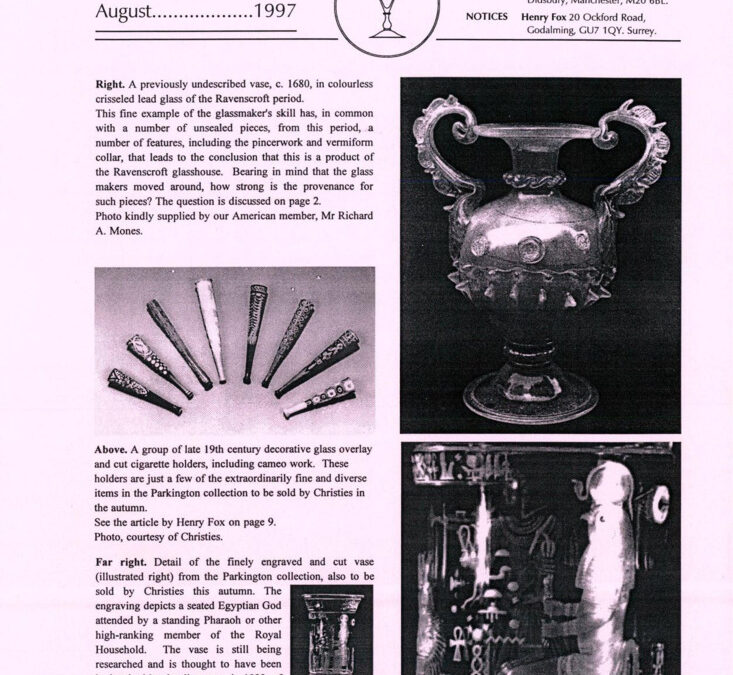
Right. A previously undescribed vase, c. 1680, in colourless
crisseled lead glass of the Ravenscroft period.
This fine example of the glassmaker’s skill has, in common
with a number of unsealed pieces, from this period, a
number of features, including the pincerwork and vermiform
collar, that leads to the conclusion that this is a product of
the Ravenscroft glasshouse. Bearing in mind that the glass
makers moved around, how strong is the provenance for
such pieces? The question is discussed on page 2.
Photo kindly supplied by our American member, Mr Richard
A. Mones.
Above.
A group of late 19th century decorative glass overlay
and cut cigarette holders, including cameo work. These
holders are just a few of the extraordinarily fine and diverse
items in the Parkington collection to be sold by Christies in
the autumn.
See the article by Henry Fox on page 9.
Photo, courtesy of Christies.
Far right.
Detail of the finely engraved and cut vase
(illustrated right) from the Parkington collection, also to be
sold by Christies this autumn. The
engraving depicts a seated Egyptian God
attended by a standing Pharaoh or other
high-ranking member of the Royal
Household.
The vase is still being
researched and is thought to have been
be inspired by the discovery, in 1922, of
the tomb of Tutankhamen.
See the article by Henry Fox on page 9.
Photo, courtesy of Christies.
The Glass Circle Diamond Jubilee Symposium at the
British Museum. For more details see back page.
GLASS CIRCLE NEWS
No. 72
August
1997
EDITORS David C. Watts
27 Raydean Rd,
Barnet, EN5 1AN. Herts.
F. Peter Lole
5 Clayton Ave.
Didsbury, Manchester, M20 6BL.
NOTICES Henry Fox
20 Ockford Road,
Godalming, GU7 1QY. Surrey.
1997
Page 2.
GLASS CIRCLE NEWS No. 72
Editorial
Diamond Jubilee Exhibition a Great Success
Months of preparation finally came to fruition as
members rolled up at Christie’s, their precious bundles
meticulously unwrapped, checked and labelled. Display
cabinets were trundled up from the cellars, cleaned and
polished, the exhibits installed and artistically arranged into
an Aladdin’s cave of sparkling English glass together with
memorabilia of the Circle, books – including an original
Hartshorne in its centenary year, and a display of glass
exhibition posters and pictures on the walls.
Catalogues were heaped up ready for distribution and, as
the final touches were being applied, the caterers appeared
to prepare refreshments for the evening’s reception.
Christie’s were more than generous both in providing the
facilities and in hosting the evening’s hospitality with food
and good wine. Before long the room was buzzing with
visitors casting a critical and approving eye over the
exhibits as personal favourites were selected and compared.
Our Vice-President, Hugh Tait made a graceful speech of
appreciation and thanks to all those involved and pointed
out some of the highlights of the display.
Of the glass itself, it may be said without reserve that
this was the best display of English glass anywhere
currently on show in the country. Goblets and a tazza
dating back to the Duke of Buckingham were followed by
a superb variety of baluster glasses including rare egg and
cylinder knops, and a diversity of bowl forms including
deceptive glasses. Incised, air and opaque twist glasses
depicted both form and decoration and it was possible to
study a range of Jacobites. A David Wolff stipple
engraved “Newcastle” was a particular highlight of the
show, as was the Whittington goblet, engraved by our
member, Peter Dreiser and presented by the Circle to our
late President, Robert Charleston. Cut glass was well
represented with scale-cut stems as well as more
traditional forms plus a breathtaking display of jellies and
those most delicate of all glasses, posset pots.
Ta77as, sweetmeats, bottles, candlesticks and tapersticks
were all on show and a collection of most beautiful scent
bottles with gilding, enamelling and sulphide inclusions as
well as miscellaneous items, such as the glass cannon
(also featured in the Strange and Rare exhibition), and a
huge fish bowl. Not least were the special loan exhibits
of glass from Bacon’s own collection from Bristol
Museum and a sealed Ravenscroft shard and a set of
nesting beakers (they really did nest!) as illustrated in
Greene’s famous drawings of 1668.
The catalogue has a story of its own, being originally
conceived as “simply” a reprint of Bacon’s rare booklet
about how to start collecting old English glass. It soon
became apparent that an update was necessary and we are
grateful to Martin Mortimer for his additional expert
commentary. The inclusion of a catalogue of the exhib-
ition was a last minute decision. Accurate descriptions of
the individual glasses proved elusive and there was neither
time nor space to photograph them for posterity. Insurance
requirements dictated that each item was given its own
number so that it became impossible to rearrange glasses
into a more compatible sequence without upsetting their
numerical order. Detailed proof checking became out of
the question as the deadline loomed and we apologise for
the manifest errors, both factual and typographical, but
thanks to our most co-operative printer the booklet finally
appeared miraculously on time for the opening. We hope
in future issues of Glass Circle News to illustrate some
of the beautiful glasses that were on display.
The week passed all to quickly and we thank Martine
Newby, Jo Marshall, Mrs P. Dickins, Mrs R. Pulver, Dr
and Mrs Schear and Messrs. Bright, Fox, Meyer, Scott,
Watts, Wilson, Whittle and Woolston (not to mention two
of Christies’ “green ladies”) for manning the stand. The
close proximity to Christie’s display of Princess Diana’s
dresses and an exhibition of Chinese porcelain etc. added
to the fun and helped ensure a steady stream of visitors
although some were baffled that this was an exhibition
and not glass for auction!
Christie’s, we are pleased to report were delighted both
with the exhibition and the prestige it added to the firm
as well as to the Circle. We were honoured with a visit
from their newly appointed Vice-Chairman, the Earl of
Halifax, who expressed enthusiasm and approval, as well
as several departmental heads. Dwight Lanmon, Glass
Circle Vice-President from America, also paid a visit.
Particular thanks must go to Rachel Russell and Paul
Tippett of Christie’s whose help made the exhibition
possible, not forgetting an unsung ever-willing helper in
the underground cellars we knew only as Matthew. All
the items were eventually returned safely to their owners
without the need for a single claim on our insurers,
Nordstern, whose generous terms greatly benefited the
Circle. Finally our undying gratitude must go to Henry
Fox who, among the numerous helpers, shouldered the
major burden of this enterprise from its early conception
to a triumphant conclusion.
Attributions to Ravenscroft?
Have you ever wondered what it would be like trying to
attribute glasses to the Ravenscroft factory without the
wonderful sealed pieces that we have to help us? It
would be difficult, to say the least. Even so, this
problem still arises with a group of lead-containing glass-
ware that is stylistically of the Ravenscroft period; the
glass tends to lack the brilliance of the Ravenscroft
pieces, is often blown rather heavily and is extensively
crizzeled. Typical is the decanter jug which passed
through the hands of none other than Howard Phillips and
is illustrated by Bernard Hughes. The presence of nipt
diamond waies conforms with the tariff of Ravenscroft’s
glass’ but, I understand, the only independent support for
this attribution was the finding of such a piece in what
was Flintshire somewhere (unstated) near to the Ravens-
croft family seat at Harwarden. Even if true, as factual
evidence it is a non-starter and the critical gaze of others
has resulted in the floating of views that such items
might be of Continental origin. The problem here is that
hard evidence for lead glass
of this quality
being made on
the Continent at this time is close to zero. Our member,
Colin Brain has researched a glasshouse in Nijmegen
where lead glass was possibly made between 1665 and
1672 and I was able to confirm that a glass fragment of
this period contained lead although not approaching the
Ravenscroft quality. If it were so then the whole story of
the Englishness of baluster and drawn-stem glasses would
fall into confusion. Charleston, with his usual thorough-
ness has examined the problem
2
fmding, along with
Hartshorne, that the Bonhommes of Liege have a claim in
that in 1680 they engaged workmen to produce “verres
l’Angleterre”. But did this refer to style or the glass used?
Charleston thought the latter. However, the Continental
glassmakers are not known to have included the vital
English ingredient of lead glass, saltpetre at this stage in
their glassmaking while Chambon discovered that one of
-continued on page 5.
GLASS CIRCLE NEWS No. 72
Page 3.
1997
Glassmaking after the Romans
by Dr Ian C. Freestone
Summary by the author of a lecture given
to a joint meeting of The Glass Circle with
the Society of Glass Technology held at the
Artworkers Guild on February 11th 1997.
Under the Romans, glass production took place on a massive scale. The role of glass was transformed from a
luxury material to a material for everyday use in the form
of numerous household vessels in transparent glass, lightly
tinted blue or green by the iron oxide from the sand used
to make the glass material.
Roman glass was a remarkably consistent soda-lime-silica
composition, not dissimilar to modern container glasses.
The alkali source was a relatively pure soda, sometimes
termed natron, from the Wadi Natrun, west of the Nile
delta. According to classical authors, the favoured glass-
making sand was from the Syro-Palestinian coast, near
Haifa. Sands from this region are rich in lime, and
analysis has shown that they would produce a good glass
with natron, without the necessity of adding lime and
corresponding precisely to the composition of Roman glass.
Evidence for the mass-production of glass has come from
the Byzantine period in this area. An 8 ton slab of glass
at the necropolis at Beth Shearim, Israel, has been known
for many years; this glass failed because its lime content
was too high. However, recent discoveries near Hadera
have revealed a bank of fourteen furnaces of similar
dimensions to the Beth Shearim slab, which appear to
have been making glass in the sixth to seventh centuries
A.D. These tank furnaces appear to have been of the
reverbatory type; they were fired at one end and the heat
deflected down by a superstructure which is now inferred,
as evidence above ground level has been destroyed.
During the discussion, after the paper, Dr Jan Kock of the
University of Aarhus drew attention to furnaces in India
which were operating on the same principle, and produc-
ing 2 tons of glass in a firing lasting some 10 days.
Current opinion is that glass produced in such furnaces on
a massive scale on the coast of present day Lebanon and
Israel was broken up and distributed as irregular chunks,
to be made into vessels elsewhere. By the Byzantine
period, and probably sometime in the Roman period, there
was a separation of glassmaking and glass working into
different workshops or factories.
Throughout the first millennium B.C., glass from all over
the Mediterranean and Europe had a very similar compo-
sition to the Roman/Byzantine type, and was clearly made
from similar raw materials. It is very likely that much of
this glass material ultimately originated in Syria-Palestine,
but was made into vessels in the regions where it is
found today. Analysis of glass from various sites such as
the abbeys at Jarrow, Northumberland and San Vincenzo
in Italy indicates that many of the rare elements in the
glasses, such as yttrium and zirconium, occur at the same
levels as those produced in the tank furnaces in Israel,
and suggest that the glass was indeed imported from the
Mediterranean. However, other elements, such as cobalt,
antimony, tin and lead, which were often added to colour
and opacify decorative glasses, are also slightly elevated in
the transparent glasses of the period. This suggests that
these glasses were, at least to some extent, recycled from
old glass, and that some old coloured glass was included
in the batch and contaminated the composition. The extent
to which the northern European glasses of the first
millennium AD represent a progressively declining stock of
recycled old Roman glass, as opposed to fresh glass
imported from the South is still an open question. Glass
colours certainly were dependent upon the re-use of old
*Dr Ian C. Freestone is a research officer in the Department of
Scientific Research at The British Museum and has kindly provided
this summary of his talk.
glass, however, and there is considerable evidence for the
addition of old mosaic tesserae to colour ecclesiastical
window glass, for example.
By the ninth century AD, a change in glass composition
began to take place. From glasses based upon natron,
there was a move towards glasses made from plant or
wood ash. In the Islamic world, glasses were still of the
soda-lime-silica type but changes in minor components
indicate that the ash of beach or desert plants began to be
used, materials that were later imported into Venice, stim-
ulating the development of the glass industry there. This
change in composition is well documented by the analysis
of Islamic glass weights. In northern Europe, potash glass
made with wood ash, particularly beechwood, began to be
made, as specified by the Benedictine, Theophilus, who
wrote in the early part of the twelfth century. Interest-
ingly, Theophilus also specifies the use of old Roman
mosaic tesserae for enamel glass on metalwork, and
analysis of enamelwork of the 12th and 13th centuries
confirms that old Roman glass was being used. Potash
glass is widely found in windows and vessels from the
eleventh century, and also in more specialised objects,
such as the 13th century retable of Westminster Abbey.
The Great Pavement at Westminster, made by Italian
specialists in about 1268, contains opaque glass tesserae,
but these are of the soda ash type glass being used in
the Mediterranean at this time, and clearly imported.
Among the enamelled Islamic glasses of the 13th to 14th
centuries are pieces of outstanding quality. The enamels
melted on the surface of the glass vessels were coloured
by a range of materials including tin oxide or bone ash
whites, lead-tin oxide yellows, lapis lazuli or cobalt blues
and hematite reds. The base glass for the enamels may be
a soft, low-melting lead silicate or a soda-lime-silica glass
identical in compostion to that of the vessel glass itself.
This raises the question as to how the enamels were fused
on without deforming the vessel itself Experiments by Bill
Gudenrath of the Corning Museum have shown that this
was achieved by enamelling a partially-made vessel cold
and reheating the vessel on the end of a pontil for a very
brief period, manipulating the pontil so that the vessel
does not collapse. At about the same time as the Islamic
enamelled vessels, the first enamelled glasses were being
produced in Europe, probably Venice, and are known as
the ‘Aldrevandin group’ after the beaker in the British
Museum, enamelled with the same name. The Aldrevandin
vessel glasses are similar to the Islamic vessels as are the
coloured enamels, which differ in rather subtle ways
implying that they were made in Europe, rather than
imported. From the middle of the fourteenth century
through to the middle of the fifteenth century, the
production of enamelled glass in Europe appears to have
ceased, awaiting the rise of Venetian enamelled glass.
A stimulating discussion raised the question of the role of
iron and manganese oxides in determining the colour of
glass, with reference to the observations of Theophilus,
and the extent to which early glassmakers were aware of
the role of lime in glassmaking, or if it was added
accidently in other materials such as calcareous sand and
plant ash.
Glass Circle News – Publication Deadlines
No.73 Mid-October for publication in November.
No.74 Mid-December for publication in January.
No.75 Mid-March for publication in April.
1997
Page 4.
GLASS CIRCLE NEWS No. 72
English Paperweights – 1848 And All That
by Roger Dodsworth
Report of a lecture held at the Artwork-
ers’ Guild on 22nd May 1997, by kind
invitation of Miss J. Toynbee Clark,
Miss F. Haywood, Mr Brian Clarke and
Ms. Katherine Coleman.
The questions addressed in this lecture were whether
certain English paperweights, often containing canes with
the date 1848, were indeed 19th century and correctly
attributed to the Whitefriars factory as commonly stated.
The answers to both were negative. Although it is known
that weights were made in the middle of the 19th century
by the companies of George Bacchus and Rice Harris in
Birmingham, there is no evidence that Whitefriars did so.’
A type with a central portrait cane of Queen Victoria is
attributed to Bacchus by comparison with those of William
T. Gillander who worked for the firm before emigrating
to America where he set up his own company. These
early weights, unlike those under consideration, are
characterised by complex canes with soft colours.
The dated inkwells and weights have concentric canes of
simple rather than compound design
2
. These were
established as being the product of John Walsh Walsh at
the Soho and Vesta Glass Works (1851-1951) in
Birmingham. A letter from an employee, Mr Parkes, dated
20th May 1977, tells how one of his first jobs at the
factory, in 1928, was to set up “mille-fleur” paperweights.
Their manufacture continued until the factory closed.
Quarter inch lengths of cane, made on the premises, were
used. There was a breakage problem due to an incomp-
atability of expansion of the different colours and
annealing in fine ash took a week, even then with losses.
The paperweights were left with a rough pontil and had
their bases scratched in order to make them look old.
These observations were verified in 1990 when a small
case of provenanced Walsh Walsh canes came to light
containing brightly coloured and dated canes with the
numbers 1, 8, and 4 in white embedded in clear glass
and one with the number 4 in blue embedded in white
glass. There were also canes with a rabbit and a horse in
white glass as found in these weights. Two weights
illustrated by Hollister
3
as Whitefriars belong to this group.
A wholesale firm offering Walsh Walsh weights in the
20th century was Hill Ouston of Birmingham. Their 1934
catalogue listed E8175 – Daisy Weight 3 inch, and E8176
– ink bottle 6 inch. The U.S. department store, Marshall
Field, also offered Walsh Walsh “Mille fleur” paperweights
in three sizes with the following heights and diameters
respectively of 1
1
/16, 21/4; 1
3
/8, 3; 1%, 4; inches. In 1992,
Broadfield House Glass Museum acquired from a local
source a case of paperweight moulds and canes many of
which were similar to Walsh Walsh canes, particularly the
rabbit, horse and numbers in blue on white.
A second maker of paperweights in the 20th century,
about which Mr Dodsworth learned by chance in the
course of preparing for the
Between the Wars
exhibition
some years ago, was Alfred Arculus & Co. of Birm-
ingham. A descendant of the firm’s founder recognised a
vase on display as an Arculus product and the firm’s
paperweight interest emerged in casual conversation. They
were probably made from 1918, being eventually taken
over and closed down by Walsh Walsh in 1931. One
example in the family possession (used as a doorstop!) is
a magnificent magnum weight 51/2 ins. in diameter and 3
ins. high with four panels of concentric millefiori around
the sides and one random millefiori panel on top. Again
the canes are of the non-compound type. Weights of this
type were also classified as Whitefriars by Hollister. They
also produced an ink bottle 61/2 ins tall, a dated (1848)
weight with compound canes in the outer and third
concentric ring, low profile weights of 4, 31/4 and 11/2 ins
diameter, the latter with a swirled cane in the centre, and
also a mini tumbler or shot glass 11/2 ins tall with a
millefiori base.
There is no evidence that the third factory, H.G. Richard-
son, produced weights in the 19th century but they occur
in pattern books of 1913, 1914 and 1916. They were
possibly made for the firm by Smart Bros. of Brierley
Hill. An ink bottle is listed in 1913 with a cost price of
12/- and a retail price of 19/- while the weights cost 6/6
and retailed at 16/-. In the catalogue they accompanied
recreations of 18th century styles of tableware and early
19th century cut glass.
Finally, mention was made of Whitefriars who made
paperweights from the 1930s. A 1938 catalogue contains
pictures of an ink bottle and a paperweight. They also
occur in their 1953 and 1957 catalogues. A cut base may
occur but is not characteristic.
Mr Dodsworth concluded that no evidence had emerged to
support the production of paperweights in England in the
19th century other than those mentioned above, and all
those with 1848 dated canes could be assigned to the
1930s. Their attribution to the well-known and respectable
Whitefriars factory was a stroke of brilliance on the part
of unscrupulous traders to underpin their authenticity and
to deceive collectors into thinking they were genuine.
Notes
1.
Hollister P. Jr. in
The Encyclopaedia of Glass Paperweights,
1970 Edn.
records that he was told by the late Geoffrey Baxter,
designer for Whitefriars, that they produced paperweights in the
19th century although “Whitefriars had very few examples of
their work put aside” and, quoting Baxter, “these are nearly all
examples made over the last ten years”. The book includes
useful summaries of the histories of the lesser known English
firms involved in this work.
2.
Simple canes are made in one operation by a series of
gathers at the furnace and then drawn and cooled. Compound
canes are of secondary construction containing simple canes that
have already been drawn out and cooled as part of a new
design.
3.
Hollister P. Jr. loc. cit. This attribution follows the prevailing
view of the time.
D.C.W. (Checked by R.D.)
Stained Glass: light as a building block
Contemporary Stained Glass Exhibition by three
artists at The Cochrane Theatre.
Southampton Row, London WC1B
4AP. Near Holborn U/G Stn.
Mon.-Fri. 10am – 6pm. Closed Sat, Sun, and Bank Holidays.
Sept. 8th – 26th Angela Bruce.
Oct 3rd – 23rd Tim Lewis.
Alison Kinnaird M.B.E. Engraved Glass
4th – 29th October, at 16 Dundas Street, Edinburgh.
Womens’ International Stained Glass Network
Exhibition and Conferenence
The Crawford Municipal Art Gallery, Cork, Eire, 3rd Sept. 1997
with a Public Slide Show and Seminar on Sat. 6th Sept.
Further information from: Mary MacKay, Coachman’s House, Laurel Walk,
Bandon, Co. Cork. Tel. 0035 3234 402.
GLASS CIRCLE NEWS No. 72
Page 5.
1997
English Industrial Espionage Laws ?
GC News, No 68 carried a review of the book which
accompanied and catalogued the Danish Exhibition of
Royal Glass in 1995. I can wholeheartedly endorse what
Ada Polak wrote; it is a marvellous book, with essays
considering the Glass, sources and manufacturers,
economics, iconography and design, and perhaps most
importantly the usage which inspired acquisition of the
Glass.( If ever we get the documentation of Jacobite Glass
to approach this level, even the most fervent sceptic will
shout ‘Hurrah’ )
The essay which considers the Nostetangen Factory raises
an intriguing question. Started in 1741, Nostetangen
languished until the energetic Caspar Herman von Storm
was appointed Director of the Company in 1753. One
of his first acts was to send a trusted employee, Morten
Waern, to study Glassmaking in England, and to poach
experienced Glassmen; it was this which led to the well
known move of James Keith from Newcastle-upon-Tyne to
Nostetangen. However, the essay goes on to aver:
“England had enacted a number of laws to prevent the
spread of expertise to other countries…”, and relates that
after almost two years of Industrial Espionage in England,
Waern was arrested for infringing these laws, and only
after spirited intervention by the Danish Ambassador with
the British Authorities was he released on bail (which he
promptly skipped, and went over to France to continue
his espionage!).
Whilst the Venetian Laws to prevent Industrial Espionage
are often cited, I have never before come across specific
British equivalents. (However, since this was first penned,
a similar assertion is noted in the review of Arlene
Palmer Schwind’s work on Stiegel; GC News No.71).
Can anyone say if there were such laws, and how
frequently they were invoked? Or was it perhaps the
case that Waern was apprehended under the notorious
`General Warrants’, following the well known principle
“E’s a foreigner; `eave `alf a brick at ‘im.”? Any
answers, please?
FPL.
NACF supports Glass Acquisitions.
The Report of the National Art-Collections Fund for 1996,
published in June, lists support for the acquisition of five
very varied pieces of Glass by museums ranging from
Maidstone to Belfast, strung out in a very wriggly line
proceding through Cheltenham, Kingswinford and
Birmingham. In aggregate the total cost was £82,000,
towards which the NACF contributed £17,000.
The most important piece, acquired by Belfast, was the
Bute Bowl, a massive twenty inches high piece of Irish
Cut Glass; the earliest a seventh century Claw Beaker
excavated at Faversham in Kent and originally in the
Pitt-Rivers collection. Broadfield House received a stunning
Claret Jug engraved by Frederick Kny, only recently
discovered; together with the Elgin Vase and several other
pieces by Kny, it formed the star group in their winter
`Battles and Beasties’ exhibition. A Burne-Jones window
went to Birmingham, whilst Cheltenham acquired an
unusual Whitefriars Ceremonial Goblet with gilt decoration,
designed by Heywood Sumner in the 1890s, to
commemorate his parents’ Golden Wedding anniversary.
All the pieces are illustrated and fully described in the
NACF Report, which is received without further charge by
all members of the NACF.
FPL
Identifying Ravenscroft’s Glass –
continued from page 2.
Bonhomme’s Italian workmen contracted to produce “sixty
glasses English fashion” according to the style required.
So what does one make of the interesting but heavily
crizzeled vase illustrated on our cover which has recently
come into the hands of our member, Richard Mones, in >
A Buxton Feast.
In
our last issue, Clippings noted an Exhibition at the
forthcoming Buxton Antiques Fair, held in mid-May. It
proved to be very popular, with a group of some fifty
Classic English Drinking Glasses, drawn from a private
collection and extending from the time of Ravenscroft
down until that period in Nineteenth Century when the
onset of glacial excesses attracted the opprobium of our
first President, W.A.Thorpe.
The nicely set out group had a choice representation of
all the significant forms and types of drinking vessel,
many with the added attraction of interesting engraving.
The Circle, too, was given a considerable amount of
publicity in association with the display.
Installed in a well lit free standing display case, in an
otherwise all black grotto, the Glasses simply demanded
attention from passers by; it was indeed a cross between
a light-house and a honey-pot, attracting many visitors and
much discussion. With a small, unobtrusive number beside
each Glass, visitors could refer to a comprehensive set of
notes for every specimen, and one new classification
which received some comment was the fine specimen of a
“doomed” foot.
FPL.
Identifying Ravenscroft’s Glass – concluded
America? Stylistically, it falls squarely into the group
under consideration with the vermiform collar and the
pincerwork at alternating right angles, plus a broad folded
foot. If the others are Ravenscroft then surely this is too.
One new piece of information emerges. The design,
shape and decoration are characteristic of Venetian vases
of the same period in porcelain from which arises the
germ of a new thought.
Neri
3
explained the beauty and manufacture of lead glass
long before Ravenscroft came onto the scene. The
problems he posed are the time-consuming expense and
technological difficulty of its manufacture. But once
confronted with an English example of superior quality to
their
cristallo
and from the weight (and perhaps ring) of
which a lead glass could be instantly inferred, might not
the workers in Murano respond to this threat to their
livlihood by themselves turning to the manufacture of lead
glass for the English market. Aware of the need to
purify their ingredients but lacking the precise knowledge
about the need for saltpetre to maintain a well-oxidised
melt (additional to Neri’s formulation), the product could
well turn out as a greyish unstable imitation of Ravens-
croft’s invention. One swallow does not make a summer,
but the argument is just as compelling as the Continental
alternative.
The trouble with speculation is that it can be good fun
but unless it leads to a certain outcome it remains no
more than that. One might equally well argue that these
pieces were made at Ravenscroft’s Henley glasshouse
where coal-firing (outside the City of London) was the
law and this could explain the difference from the sealed
pieces. Whatever the truth of the matter it remains one
more unsolved mystery to intrigue and challenge lovers of
old glass and the kindly owner of this particular piece.
Any suggestions would be gratefully appreciated.
1.
R.J. Charleston (1984)
English Glass,
p. 116, lists “Quart
bottles all over nipt diamond waies.” also Plate 23c., the
crizzeled bottle with n.d.w. and raven’s head seal.
2.
R.J. Charleston (1957)
Dutch decoration of English glass.
Trans. Soc. Glass Technol. XLI, 229T.
3.
A. Neri (1612)
L’Arte Vetraria,
Florence.
1997
Page 6.
GLASS CIRCLE NEWS No. 72
BOOKS
The American Cut Glass Industry; T.G. Hawkes and his Competitors
Jane Shadel Spillman
Antique Collectors’ Club in association with The Corning
Museum of Glass
308 pages, size 218 x 280 mm, prolifically illustrated in b/w
and colour. Hard covers. 1996. Price £35.00
ISBN 1 85149 250 X
The more one studies and compares the glass industries of
the U.S., the U.K, and Ireland the more one comes to
appreciate how deeply they contribute to the knot that ties
these countries together. Nowhere is this more apparent
than in the cutting business. Jane Shadel Spillman, our
long-standing member, takes up the story with two natives
of Cork who emigrated to America. The first, John Hoare
trained in Belfast under his father, also a glass cutter, and
then in England. By 1857 he had established his own
factory in Philadelphia, later expanding to Brooklyn and
Corning to facilitate access to a good supply of glass
blanks. He employed many English workers and his work
is characterised by bold distinctive styles often incorpor-
ating technically exacting curved pillar cutting on thick
blanks made possible by the outstanding clarity of the
local glass. Hoare later (1912) diversified into “Rock
Crystal” with highly polished floral patterns cut on a
background of curved pillars, possibly using English
blanks supplied by Stevens and Williams who, around
1879, had marketed the same design. John Ruskin’s
influential remarks about the barbarous nature of cut glass
had helped temporarily put cut glass out of fashion in
England and Rock Crystal had been developed to help
assuage the consequent unemployment in the industry. The
fashion for American “Rich Cut” glass faded around 1910
and Hoare may have been adopting English Rock Crystal
for the same reason.
The second Irishman, Tom G. Hawkes is the main focus
of attention of this book. He was employed by Hoare
before departing to set up his own cutting workshop in
Corning. Hoare initially decorated and then made glass.
Hawkes, on the other hand, concentrated on excellence in
cutting with outstanding success. By 1902, his was the
largest cutting shop in Corning, if not anywhere in the
world, and he supplemented the local supply of blanks
from France, Belgium, Bohemia and England, including
John Walsh Walsh, F. & C. Osier and Boulton & Mills
as well as the Stourbridge factories. The European firms
not only supplied blanks suited to particular cut designs
but also undercut the local factories. There seemed to be
no shape he could not decorate; the most extraordinary
illustrated, to my mind, is a Jack-in-the-Pulpit vase (Fig.
2-41, c.1900-1910) with only the top exposed outer
surface of the mouth left plain. In addition, cased colours
were used to exploit the full spectrum of design.
Next, the author explores trade relationships and links with
other firms. Strikes by the cutters and their movements
between firms, contrary to agreed contracts, were a
universal problem that led the American factory owners to
close ranks against the workers’ Unions (as in England)
and Jane follows the intrigues of particular workers in
some detail. Passing reference is made to a cutter called
Elwell concerning whom a series of correspondence exists.
A little-known luxury glass manufacturing and factoring
business with this somewhat unusual name was begun in
Essex, England, in 1923. It would be interesting to
discover if we have here an early family connections.
There are numerous pages from past pattern books and
other examples of Hawkes cut glass are illustrated in a
chapter on Trademarks, Advertisements and Brochures. A
separate chapter is devoted to the 1889 Universal
Exposition, in Paris, then challenging to become the
largest in the world. Along with Thomas Webb (high-
lighting Cameo glass) Hawkes won a gold medal for the
overall quality of its stand. The exhibition proved a good
investment for the Company which flaunted its gold medal
in advertisements for the next seventy years!
For those familiar with the author’s publication on
White
House Glassware
the special Chapter incorporating this
subject will be of particular interest. Attention here
particularly focuses on the exclusive Russian pattern about
which new information has emerged. The origin of the
name, by the Briggs Company, is now certain and the
invention of the design is attributed to Philip MacDonald,
and patented by Hawkes in 1882. The design itself,
created on a diamond grid, emerges as rows of 12-pointed
stars alternating with rows of 8-sided flat hobnails. This
rang a bell in my memory and I turned up Herbert
Woodward’s monograph on Edinburgh Crystal
2
to find that
its predecessor, the Leith and Edinburgh Flint Glass Co.,
widely acknowledged for the outstanding quality of its cut
glass, produced an oval dish with just this pattern in circa
1886, the precise date being uncertain. Is it coincidence,
one may ask, that the name, MacDonald, has a Scottish
ring about it? We may never know. The Russian pattern
is extraordinarily difficult to cut well due to the need to
achieve exact intersection of the rays at the centre of each
star. The design is rarely executed today, not even for
The White House! Similar patterns in press-moulded glass
were popular at that time on both sides of the Atlantic.
Another profitable area at the top end of the industry was
silver mounted cut glass. In the decade to 1898 Tiffany
placed large orders with Hoare for cut glass to be silver
mounted. Another prolific silversmith, Gorham bought cut
glass from Hoare and Hawkes and some from Stevens and
Williams. Other important creators of “rich cut” glass
linked with Hoare and Hawkes include Oliver Eggington,
an English cutter. This book is full of surprises but I did
not expect to find a 30cm Steuben goblet recording the
continued overpage
Welcome to New Members:
Ms. M. Borgward, Germany.
Mr. G.S. Charles.
Mr. G. deBroekert, USA.
Mrs. D.S. Daugherty, USA.
Ms. S.K. Frantz.
Mr. A.J. Gilbert.
Mrs. A. Ginage.
Mr. and Mrs A. Gower.
Mr. R.H. Hardy.
Miss J. Hay.
Mr. W.A. Hodgson.
Dr. J. Holmes-Milner.
Mr. A.C. Hubbard Jnr. USA.
Miss A. Lutyens-Humphrey.
Mr. and Mrs. K.W. Lyon.
Dr. P.J. Mills.
Mr. M. Rabin.
Miss R. Rendell.
Mr. I.A. Robinson.
Mr. J.A. Stout, USA
Mr. G.A. Vivian.
Mr. P.G. Walker O.B.E.
Mrs. W. Webster Aron.
Dr. and Mrs S.W. Wyse.
GLASS CIRCLE NEWS No. 72
Page 7.
1997
story of The Luck of Eden Hall
3
. It is superbly engraved
by William Morse (c. 1912-1919) for Hawkes with four
scenes surrounded by an elaborate rococo cartouche, one
dramatically entitled “Musgrave snatches Goblet”. I am
sorry we are not shown the rest. Tom Hawkes considered
it to be second in importance only to the Portland Vase
which at least indicates the esteem in which it was held.
The name
Edenhall
was used for cheaper lines of Hawkes
glass, some with silver mounts.
If one has to criticise this book it is that it is sometimes
difficult to see the wood for the trees, so dense is the
undergrowth of information; this review does scant justice
to its full extent. This, in turn, has made indexing a
challenge and not all the important page references are to
be found there, for example the reference to Briggs and
MacDonald on pages 239 and 240 discussed above. The
book is beautifully produced (in England) on a semi-matt
art paper which generally responds well to the prolific
illustrations of cut glass, in both black and white and
colour – itself a challenge in photography. There are a
few illustrations (e.g. Figs. 11-8 and 11-9) requiring the
identification of numbers in minute captions in the
photographs that I found uninterpretable, even with a
magnifying glass.
Bearing in mind the wealth of archival documentation in
the Rakow Library, this book is unlikely to be the last
on the subject but it is assuredly destined to become a
standard work of reference that will enchant glass lovers
everywhere for many years to come.
Notes
1.
Haden
H.J.
1993, Elwell’s Luxury Glass, G.C. News, 55, p.8.
2.
Woodward H.W. 1984, The Story of Edinburgh Crystal, pub.
by Dema Glass. pp. 33-34.
3.
Tait H. 1992, The “Luck of Edenhall” and other glasses
associated with English families of ancient lineage. G.C. News
No. 54,
pp. 9
–
11.
See also G.C. News, 66, 1996, pp. 12-13.
D.C.W.
Conservation of Glass
Roy Newton and Sandra Davison
1996, Butterworth Heinmann, 318 pages, 245 x 188mm.
Soft covers.
Numerous BAN
illustrations, tables and figures,
and 2 pages containing 5 colour plates.
ISBN 0-7506-2448-5. Price £25.
First published in 1989 as an expensive museum manual,
this information-packed volume has now been released as
a paperback. The print is small but comfortably readable
in two columns per page. Its objective is the under-
standing and conservation of old glass, and this may mean
no more than, say, one hundred years old. The diversity
of information this book contains will appeal to all those
with an interest in glass and its technology in particular.
After an introductory chapter on the nature, colour and
physical properties of glass we are given a potted history
of its development from earliest times. We then move into
the technology of glass production from a historical point
of view. This is divided into two parts. The first deals
with glass composition and hot and cold decorative
techniques. Then follows a section on melting and the
history of glass furnaces.
This takes us to page 135 where the serious content of
the work begins with a chapter on the deterioration of
glass and the factors which cause and affect it. Emphasis
is placed here on painted (enamelled) window glass.
Having identified the problem we move into conservation
– cleaning, adhesives, consolidants and lacquers. The next
chapter on the examination of glass using both simple and
sophisticated techniques paves the way for a lengthy
exposition on the conservation, repair and restoration of
glass artifacts and architectural glass. The work concludes
with a glossary, lengthy bibliography and index.
D.C.W.
“Glass in the Rijksmuseum”
by Pieter C. Ritsema van Eck and Henrica
M. Zijlstra-Zweens. Vol. 1.
Hard back, 28cm. by 22cm. 390 pages, 545 black and white
illustrations and 32 colour plates.
ISBN 90-6630-408-1 geb. NUGI 926/911
Published by Waanders Publishers, Zwolle. Price not known
Volume
1 of this 2 volume work** covers the period from
1500-1800 and all the non-engraved glass, the Hedwig beaker
and the “glass with engravings of only secondary importance”
in the Rijksmuseum.
It lists 545 glasses ranging from an early 16th Century
Venetian enamelled Tam, through `facon-de-Venise’ to a
wide selection of Roemers, 18th Century drinking glasses,
bottles and decanters, novelty glass, the Hedwig beaker, Indian
Persian and Chinese glass, enamelled gilt and ruby glass from
late 16th Century to 18th Century. The last chapter is of
`Nineteenth and Twentieth Century Glass’ and includes cut,
enamelled and engraved glasses, Historismus examples from
Europe and Art Nouveau and Art Deco styles from Germany,
Bohemia and France. Every glass has been photographed in
black and white and in addition there are 32 colour plates.
There is also an excellent Bibliography and a Glossary in both
English and Dutch – but the catalogue entries are in English.
There is a short text at the beginning of each of the five
sections which sets the glasses in their historical context. It is
interesting to note that Venetian glasshouses closed down from
**See GC News No. 66 for a review of Volume 2.
mid-August to the end of October, but in spite of this “output
was vast and exports increased correspondingly. Much glass
was exported from Venice to North of the Alps and German
glass dealers in 1282 were exempted from taxes provided that
the load they carried on their backs in baskets did not exceed
10 lire – a sum that according to Zecchin in ‘Veto e vetrai di
Murano, 1987, vol. 1) would buy 1300 plain drinking glasses
In the chapter on European Vessel Glass 1500-1800 (pp.112-
116) it is stated that from the end of the 17th Century to the
beginning of the 18th Century many wine glasses were
imported from England. But in 1680 the glasshouse of the
Bonhommes in Liege engaged an Italian (Massaro) to produce
“60 yams a l’Angleterre daily” and also that “Glaser nach
Englischer Art” were produced in Hesse and Saxony from the
beginning of the 18th Century. But it is also stated that “lead
content does not afford a criterion whether a glass is made in
England or on the Continent” – and a number of the drinking
glasses illustrated are attributed as “England or Southern
Netherlands”. The material of these glasses is listed as “clear
colourless glass” (Nos. 226-276) but no mention is made as to
whether it is potash, soda or lead glass. But it does mention
that Sebasitan Zoude who took over the Namur glassworks,
“managed to secure the jealously guarded formula for lead
glass”. So it leaves us still with the question as to where these
glasses were made !
To sum up, it is a beautifully produced book with excellent
photographs, albeit very heavy! It should make purchasers of
the book feel that a trip to the Rijksmuseum is a “Must”
Jo Marshall
Ivory on yellow, Webb
cameo vase.
Parkington collection.
Photo by Christies.
1997
Page 8.
GLASS CIRCLE NEWS No. 72
It is quite likely that few members of the Glass Circle
will have known Michael Parkington. It is less that he
was secretive in his collecting than that his interest in
glass took every available minute of time and ounce of
energy. He was a man of law with a full life in South
Africa for many years. There he earned a reputation as an
enemy of apartheid and successfully defended many of the
activists of the African National Congress including Nelson
Mandela. During those years he established an atmosphere
of complete trust with the Africans despite apparently
dramatically opposed backgrounds. Michael Parkington was
a serious collector of silver and amassed a considerable
group. This included wine labels. When he found the
subjects of his wine labels appearing on a series of
English glass decanters of the 1760s and 1770s, he began
to include them too. In no time a decanter collection
emerged and he was hooked on glass. The silver was
sold, and, on his return to London in the 1970s, he
concentrated on glass. Although we had previously
corresponded on the subject of labelled decanters, I had
never met Michael. Our first meeting was typical. It was
a quiet Saturday morning at Campden Hill Road and
Christopher Sheppard was pottering about the stock. The
door opened and a large and truculent gentleman with an
orange tie asked if he could look round. I attempted
conversation and received monosyllabic replies, but he
homed in on decanters and after a brief review, asked if
we had nothing better: “colour? gilding?”. I mentally
moved him up into the higher spenders and asked
tentatively whether an example of Giles gilding on glass
might be of interest. “I have Giles on blue, Giles on
green, Giles on Amethyst, Giles on colourless, Giles on
opaque-white. What did you have in mind?”. The sentence
rolled forth, delivered in a tone of withering politeness. I
made some inadequate reply, and Michael left. There was
a chuckle from a dark corner. I had forgotten Christopher.
“You know who that was?”. I confessed ignorance.
“Michael Parkington has the best collection of coloured
glass I’ve seen; he lives somewhere near here”. For nearly
20 years after that, an appallingly large part of my life
was taken up in attending to Michael’s needs. The
collection grew and some was lodged at the V. & A. to
make more room. His rate of acquisition was breathtaking
and I was frequently sent for to inspect something new,
to discuss possible provenance and also minor repair since
everything had to be in pristine state. Chips on cut pieces
were eliminated if possible but a fire surface was never
touched and a chip in such a position ruled the piece out
of court.
Michael had the ability to coax (if coax is the right
word) what he wanted from one. A trenchant question
would initially appear unanswerable but he would get an
answer somehow and discussions tended to add to the
general feeling about a piece for both of us. He would
not take no for an answer, and was extremely suspicious
of “I don’t know”. An impatient man, everything had to
be done at the greatest possible speed.
As his knowledge grew, the collection extended. A group
of Varnish was assembled together with examples of the
coloured pieces of the 1830s and 40s. Next, the finest in
Victorian engravings, followed by Cameo. Soon all the
exotica of the third quarter of the nineteenth century were
explored; Agate, Burmese, pull-up, Silvaria, Satin,
Amberina, Alexandrite. He bought in the Manley sale but
soon left that collection standing. All had to be English.
Everything else was dismissed as “nasty foreign habit.”
At this time began his association
with Broadfield House and soon
his pieces were withdrawn from
the V. & A. and an extensive
and broad spectrum of his glass
was selected for display at Broad-
field House Glass Museum. The
group on show is well-balanced
and shows its early beginnings
and the focus on quality and
brilliant condition as well as the
great range of Victorian glass in
all its exuberance and technique.
Michael might well have stopped there, but he didn’t. It
is not too much to say that the acquisition of glass had
become obsessive. As he moved on into the products of
the 20th Century his pieces became larger and larger.
Now he was assembling examples of the work of known
studio artists and they often appeared to be both big and
ugly. He would become purple with rage if one dared to
dislike a new vase. Ysart paperweights followed and it is
possible he would have continued into contemporary work
had a merciful providence not cried “enough”!
Michael Parkington, despite his ebullient character, was a
discrete collector. He did not suffer fools, and the
uninitiated he considered foolish. Many requests to view
his glass were smoothly side-tracked as “inconvenient on
that (or any) day”. Thus, until the display of his glass at
Broadfield House began, few knew of it. He was a
member of the Glass Circle but only as part of his
intelligence network. He never attended a meeting and
professed never to read about his subject, dismissing
learned articles in the “Horror Comics” as he termed the
art magazines. Nevertheless, the briefest discussion of a
point at issue made plain he had read all and assimilated
every implication. He seldom attended any auction sale.
When he did, it would be with the apparent intention of
ridiculing the efforts of anyone charged with bidding on
his behalf. “Having trouble with your little finger, love”
he would chuckle after the sale; “I saw it waving about
quite dramatically!” This importunate irritating, time-
consuming, but in the end, lovable man has been greatly
missed in many ways.
It is now more than three years since Michael Parkington
died. For the whole of that time, Peggy Parkington,
Michael’s widow, had pursued schemes to secure funding
so that the collection could remain as a unit, perhaps
housed at Broadfield House or, in the longer term, at
Himley Hall. In the event, it was soon conceded that the
collection was too large, and in many of Michael’s recent
interests, too repetitive for it to remain together. In any
case, there seemed little merit in keeping together the
arbitrary acquisitions of a veritable magpie. While
negotiations continued, it seemed right to hold back this
review. Now, however, things have come to a conclusion
with the sudden death of Peggy Parkington. In a recent
will, she bequeathed the entire present loan to Dudley
Metropolitan Borough for continued display at Broadfield
House. This now remains in perpetuity and, at a stroke,
doubles the collections there. It is a fine memorial, not
only for Michael Parkington, but also for Peggy who saw
quite clearly where the glass should go once she had no
need of it.
Martin Mortimer
Delomosne & Son Ltd.
MICHAEL WROUGHTON PARKINGTON
1923 – 1994
An Appreciation by Martin Mortimer
GLASS CIRCLE NEWS No. 72
Page 9.
1997
The Michael Parkington Collection
– A GC NEWS EXCLUSIVE – by Henry Fox
All photos reproduced by courtesy of Christies.
An invitation to exclusively review the Michael Parkington Collection prior to its
eventual auction at Christie’s South Kensington – part in this coming October and
the remainder sometime early next year – was an exciting moment. However,
arriving in heavily driving rain at an outpost of Christie’s in London’s Vauxhall IN
area in no way prepared me for what I was about to see. Once through the tight
security, I was lead into what the poet Coleridge called “caverns measureless to
man”. Suddenly I came upon shelves laden with what seemed a never ending
variety of English glass decked out like Jacob’s coat of many colours – over 1400
pieces, ranging from the 18th century up to around the mid-20th century. I took a
deep breath and marvelled that so much remained to be sold after the substantial
W—0400
bequest by Mrs. Parkington to Broadfield House Glass Museum. With his Richardson’s tall white bottle transfer
particular emphasis on examples from the last two hundred years, her late husband, decorated
with figures
to form the word
Michael Parkington, was without doubt the most avid collector of English’ glass Brandy. c.1840.
this century.
The true diversity of the collection did not sink in until I started to examine
the assortments to be found on the various shelves. Care had been taken when
removing this glass hoard from its home in the Midlands to separate items, as
far as possible, by period and, where identifiable, maker. I had not realised
that Michael Parkington had an interest in 18th century English glass, the
balance here of which consists principally of cordial glasses of various stem
types and a good range of facet stem wines and then onto later cut glass.
From the many illustrations taken from Michael’s collection for inclusion in
Charles Hajdamach’s excellent book
British Glass 1800 – 1914
it is very easy
for me to understand now how this had arisen,
although at the present moment I still find it difficult
to comprehend the breath of his collection. Once one
has passed the 1830’s the variety of Victorian glass
expands as the century develops, and this expansion
continues into the next century up to the 1960’s,
concluding with a large collection of Ysart
paperweights and colourful Vasart pieces.
Lynn decanter; cordial glass with opaque Notwithstanding that the major pieces from his vast
hoard (over 500), hitherto on long term loan to the
twist stem and domed foot; facet stem cyder
glass and an opaque twist wine, the bowl Broadfield House Glass Museum, have now through
engraved
Miss
Percy 1778.
the generous bequest of Mrs Parkington, entered the
public domain to give this museum permanently what
must be the best collection of English 19th century and early 20th century glass to be seen
anywhere, there still remain many fine and rare examples from this period with the Parkington
provenance for today’s collector to seek out and possibly acquire. Equally, it is an educational
experience to see the variety of glass on offer, their design and methods of manufacture and
decoration. Here we see the expertise of handicraft along side the development of the machine
age. These aspects are clearly visible in the pieces now coming shortly to the auction room. I
cannot recall ever finding in an auction – let alone a single owner sale – a series of colourful lots Stuart decanter, colour
which have excited me more. They range, for example, through Apsley Pellatt, Richardson, Webb, enamel decorated with
Varnish, Stevens & Williams, Stuarts, Whitefriars, Sowerby, Greener, John Derbyshire, Kidd, an
encircling fruiting
branch, butterflies etc.
Hurtles Tait, Monart, Vasart and Ysart as well as various plain and coloured decanters and
decanter bottles (including a few miniatures), engraved glasses and jugs, Nailsea type flasks, c.1930s.
various size pipes, rolling pins. fancy scent bottles, stompers and cigarette holders. I must not forget, too, the English 18th
century cordial and facet stem drink-drinking glasses, a good Lynn ring decanter and stopper, several Stourbridge opaque
white decorated pieces (a few dated), and an interesting group of pieces, such as jugs and bowls, with blue rims. In
conclusion, all the pieces I saw and handled demonstrated clearly that they had been unerringly chosen by Michael
Parkington over the years with great care
and an eye for excellent condition. To
whet the appetite further I selected a few
pieces to be photographed for you to see
in GC News. Enjoy and dream on!
Another picture is on page 15.
It is understood that a private view is planned
at Christie’s South Kensington of Part I of the
Parkington Collection sale on Saturday
morning
I Ith October, and that a short
address on the man and his collection may be
given, too. Members will receive further
details and an invitation in due course.
A group of facet stem
glasses with various
bowl and stem formations and decoration.
c. 1775 – 1795.
1997
Page 10.
GLASS CIRCLE NEWS No. 72
471/tP71, RE945e76125.
by F. Peter Lole
A leisurely journey in the early spring, from Perth-
shire to Galloway, allowed time for a comfortable
visit to The Burrell Collection in Glasgow.
One of the pleasures of The Burrell is that many of
the exhibits change around quite frequently. A
newcomer to me was an amazing travelling decanter
set, described as being English of the late eighteenth
century. It comprised seventeen separate case
decanters, of fairly uniform height – some twelve to
thirteen inches, but of considerably differing capacity
and cross section; the largest was a monster of
octagonal section, with a capacity many times that
of the smallest; some were hexagonal, others square,
four were triangular and these alone had spouted
silver mounts at the neck. All had Glass stoppers
with a ball finial cut with printies (not truly
faceted) and all were rather sketchily engraved with
a partially polished meandering sunflower motif.
They fitted neatly into a large, and rather rough
deal travelling case banded with brass and iron. The
case was very workmanlike and well used; no
display item this.
But what could so large a set be for? An Officers’
Mess perhaps, but unlike much regimental Glass
they bore neither badge nor insignia; or, possibly,
some nobleman or nabob, whose anticipation of
thirst probably exceeded his consumption? A
pleasing enigma, whose usage allows one to wander
off into the realms of speculation.
The very distinguished Dutch engraved Glass
acquired from 1990 to 1995 remains on view (See
GC.68) but the large cabinet crammed with
eighteenth century British Glass acquired by Burrell
himself, which first appeared on shew in 1991, has
gone back to store. I missed this, for its crowded
appearance was comfortingly ‘old fashioned’, and
gave one the opportunity for a really intense
nose-pressing gaze at all its treasures. Indeed, it was
reminiscent of that evocative frontispiece photograph
in our Diamond Jubilee Exhibition Catalogue of our
founder, John Maunsell Bacon, gazing pensively at
the massed Glass in one of his cabinets. Glasgow
Museums, who are responsible for The Burrell, as
well as Pollok Hall and Kelvingrove which both
display fine and applied arts, has a truly magnificent
collection of Classical British Glass, which they are
all too coy about displaying.
So often it happens that when one is studying one
aspect of Glass, light is suddenly thrown onto
another, quite different, matter of interest. Recently,
a study of Danish Glass unexpectedly provided a
parallel for an obscure aspect of iconography on
Jacobite Glass, whilst a Jacobite foray to photograph
the Legh family Jacobite Glass at Lyme Park,
illuminated a quite unrelated feature of their Rinsers
and ‘Heel Tap’ Glasses.
The ‘ROYAL GLASS’ catalogue of the Danish
Royal Collections discusses at some length an
elaborately wheel engraved beaker commemorating
King Frederik III at the siege of Copenhagen in
1659, where the Swedish threat to the Danish
Kingdom was decisively rebuffed. The beaker is
thought to date from the 1660s, and certainly
appears in the Royal inventories from 1696 onwards.
On the front is a mounted representation of
Frederik, with an elaborate background of the siege
of Copenhagen; the reverse carries: “… a circular
cutting emitting rays like a sun. The cutting forms a
reducing lens through which we see the King’s face
on the opposite side of the Glass. This surprising
and sophisticated effect is one of the earliest
examples in Denmark of the concept of the King as
the sun of society, as the `Roi-Soleil’.”
A similar device is also catalogued a century later
on two Glasses, for the wedding and the coronation
respectively, of Christian VII in 1766. He wed
Princess Caroline of England, sister of George III.
There is a related Goblet in the Garton Collection
in the Museum of London, engraved with sailing
vessels and inscribed “Prosperity to the Prince and
Princess of Denmark”; this presumably celebrates the
proxy marriage in London, immediately before
Princess Caroline departed for her husband in
Denmark, where they were destined soon to become
King and Queen. The marriage was unfortunately
brief, and ended disastrously.
But, back to the sun-burst lens; surely this is related
to the star with its circular polished centre, so often
found on the reverse of those Portrait Glasses of
Prince Charles Edward Stuart on which he wears the
garter sash on the wrong shoulder and where, as
Geoff Seddon points out in ‘The Jacobites and their
Drinking Glasses’, the `Audentior Ibo’ motto never
appears. Is this star the lens through which he
should be viewed on these Glasses, and which
restores his sash to the correct shoulder? I have to
confess that I have recently only had the
opportunity of handling one such Portrait Glass,
thanks to Bill MacAdam at the Buxton Fair; it was
difficult to get a good image through the star on
that specimen. Perhaps those of you with a shelf
full of such Portrait Glasses can comment.
The Lyme Park rinsers, with their series of cryptic
mottoes and their en suite ‘heel tap’ Glasses,
deserve more space than I can give them in this
issue, so I shall discuss them more fully in due
course.
GLASS WITHOUT FRONTIERS
1st Symposium of The Contemporary Glass Society
September 12th – 14th, 1997
Glass Dept., Wolverhampton University
Programme
Friday,
Informal evening Get-together –
glass videos and
members slides of their work.
Saturday,
a.m.
Speakers include Prof. Mike Press on
Glass Design
–
,
Jane
McDonald on
Architectural Glass;
Prof. Keith Cummings on
Kiln-formed Glass; Diana Hobson on Concepts in Glass
and
Alison Kinnaird O.B.E. on
Recent Engraved Glass.
p.m.
Hot and cold demos., particularly centrifugal casting.
Sunday, a.m.
Peter Wren Howard on
Technical aspects of Glass Working,
Barry Clark on
The new National Glass Centre, Sunderland
Marian Buus on
Danish Glass
and Charles Hajdamach on
The
Future of Studio Glass, Ideas and Possibilities.
Fees:
Conference, coffee, lunch, and tea, £65 (£90)*; ditto plus
one night accomodation (student room) £80 (£105)*, ditto two
nights £100 (£125)*
N.B.
no dinners in these prices.
**Fees in brackets for non-members, includes a 1-year subscription.
Registration deadline, 24th August.
For further information and to book write to:-
Dr D.C. Watts (as on GC News cover) or phone 0181 449 7666.
Stained glass screen on the theme of
weaving in shades of yellow, orange
and brown.
Nicola Coates:- North Wales School of
Art and Design (NEW).
Lost wax vase with
helical interior in green
glass.
Julie Lagan:- Lancaster
College of Art
1997
Page 1
1.
GLASS CIRCLE NEWS No. 72
GLASS CLIPPINGS
by Henry Fox
contemporary
Around the Fairs
THE NEC Fair
The opening day, back in April, was marred by the
“Bomb Alerts” on the M5 and M6. However, it is an ill
wind that blows nobody any good; consequently your
intrepid train traveller was somewhat delighted to find
how easy it was to get around this large diverse antiques/
collectables fair. The usual initial “rush and crush” was
absent, so viewing was easier and dealers had time for
questions. More stands than usual seemed to be showing
good 18th/19th century collectable glass. I counted twelve
in section 1, whilst 19th/20th century glass was widely
scattered in Section 2 (a fun area akin to the Portobello
Road, providing a variety of good collectable items from
Edwardian linens to Art Deco china and glass, including
useful period glass lamps and light fittings). William
MacAdam was showing a number of interesting drinking
glasses, including a large wine (or goblet) with an
unusual cup shaped bowl on an opaque twist stem set on
a terraced foot! An attractively cut sweetmeat was spotted
as well as a very fine and elegant facet cut wine glass.
There was a cider glass on this stand, too. Brian Watson
had several items with Lynn ring decoration. Jeanette
Hayhurst had an acorn knopped heavy baluster wine on
show among her range of 18th century glasses as well as
a number of later pieces. Christine Bridge had several
good examples of 18th century drinking glasses, including
a large engraved facet stem glass; she was also showing a
range of colourful and decorated 19th century glass. Ged
Selby and D & C Hyatt were both showing a mid-range
selection of 18th century glasses. The former had a facet
stem wine with duplex bowl form. Patricia Harbottle was
showing old bottles, some glasses and other wine related
items. Bell Antiques had a number of toddy lifters, 18th
century drinking glasses and pre-Victorian decanters. A
furniture stand had a small collection of late 18th/early
19th century (?) boot glasses which the dealer termed
stirrup glasses; these were for sale either individually or
as a collection. Ondines/circa 1900, specialists in Art
Nouveau glass, were attracting attention with their colouful
display of Galle, Daum and Almeric Walter pieces. Nigel
Benson’s stand had several fine examples of Art Deco
period glass selected from his wide range of stock from
this period. Most of the dealers mentioned usually have
stands at the Birmingham Glass Fair held twice yearly at
the Motor Cycle Museum. This interesting day out to the
NEC was punctuated by meeting up with other members
of the Glass Circle from time to time. This is a large
fair, but I have to report that it did not seem to have
quite the same number of stands as in the past, For some
members I have to report, too, that Sowerby press-
moulded glass seemed to be nowhere to be found, neither
do I recall noticing any carnival glass – perhaps it’s being
saved up for Birmingham.
Continued overpage
David Watts explores . . .
The Fabulous World of
New Designers
It is part of the magic of our great metropolis that events that would receive major
coverage in most places pass almost un-noticed unless you look for them. Such is
New Designers,
an overwhelming show of art and design from nearly all the
Colleges in the UK and Ireland. Held at The Business Design Centre, Islington, it
covers all aspects of design in two back-to-back shows, the second devoted to metal,
wood, jewellery, ceramics and glass – a reclining bicycle, 21st century computer and
furniture design, a theatre interior, a streamline lawnmower and endless inventive
uses of decorative glass may give you the flavour of this extraordinary show. It
represents the final year practical projects of our most talented youth, and some not
so young – and what talent and what skill! Two three-hour visits were barely enough
to cover the glass in reasonable detail. For the first two days, at least, the graduates
are in attendance to explain their exhibits, display their portfolios and detail the work
that has gone into the piece – and they long to tell you about it. All are for sale,
unique objects at realistic but modest prices. If you cannot begin to understand
contemporary art here you never will. The atmosphere is as removed from the sterile
ambience of the average ‘gallery’ as you could wish to find.
The glass exhibits themselves reflect the cutting edge of modern technology. Glass
blowing may not have changed in 2000 years but its exploitation certainly has. Shape
and colour are all-important – fun tall decanters some flame shaped, others with
exotic Ascot-style hat stoppers. Enchanting etched overlay vases with designs in
colours and motifs. If you think `graal’ is clever, consider silk-screen
lettering mysteriously buried in the thick walls of a
multi-coloured glass bowl, or lost wax pieces that Carder would have kept back for experiment in
retirement. Cast and kiln work – forming glass in or on moulds – as it is now called, is a major
area of glass making. I particularly admired a massive font cum bird-bath with a slumped glass
lining to a sculptured hemispherical bowl in black concrete, a product of the Dublin school. The
term “stained glass window” is now too limiting to describe these barriers to the outside world
that may incorporate 3-dimentional slumped, engraved, sand-blasted, etched, multi-component
elements that create wonderful changing imagery with the movement of light. Wrexham’s `NEWF
College displayed extraordinary talent in this field. Sunderland went further with a 3-dimensional
steel and ‘stained glass’, free-standing sculpture.
Of course, not everything pleased. Some were mundane; others perhaps not meeting their
designers expectation. Again, an eleventh-hour triumph of technical achievement in cast glass,
detailed to me by one student, was, I felt, at the expense of an artistic outcome. But this is
today’s real world. I came away thinking that if only the BBC and other media would give this
more attention rather than endless rounds of drugs, assaults and child abuse, horrific as these may
be, our nation would have a more elevating target on which to set its sights and ambitions.
1997
Page 12.
GLASS CIRCLE NEWS No. 72
Around the Fairs – continued
The Birmingham Glass Fair
Once again this Sunday-only fair on the 18th May at the
Motorcycle Museum was packed with enthusiastic collect-
ors, and once again few were likely to be disappointed.
The glass on offer ranged from circa 1700 to the present
day. There seemed to be more 18th century English glass
about but, as usual, the 19th century, particularly the
latter half, was well represented. The rarer pieces of
press-moulded glass from the Northern factories were in
short supply. Stands selling colourful English and French
late 19th century glass were attracting lively attention.
William MacAdam was showing his usual range of quality
18th century drinking glasses, and an interesting airtwist
taper stick. Jeanette Hayhust was displaying a wide range
of glass, including a good selection of Whitefriars pieces.
All in all there were over 80 stands plus several
specialist book dealers. The organisers kindly allowed
posters about the forthcoming Diamond Jubilee Exhibition
to be displayed. Sadly, annoucements about this event
were largely drowned out by the general clamour of the
crowds. Many members were spotted at this fair – it was
rather like an extended family re-union!! Several reported
that they had acquired bargains due to their own specialist
knowledge or n;che expertise. Next dates for your diary –
Sunday 2nd November 1997 and Sunday 17th May 1998.
Ten Stipples at Park Lane!!!
Apart from those collections to be seen in a few of the
great museums of the world, stipple engraved glasses of
the 18th century are rarely encounted, either in private
collections or on dealers’ shelves. To find ten, nine with
one dealer, was really the highlight of my visit to the
International Ceramics Fair this year. I was too taken
aback to inquire if these dealers had any more tucked
away from view! The Press Preview ticket, which the
organisers kindly sent me again, allowed for an unhurried
browse around the glass dealers’ stands, some of which
were still in preparation. Two of the dealers, Aspreys and
Malletts, show glass, too, at Grosvenor House, but without
doubt Park Lane offers to anyone interested in the best of
collectable glass a veritable feast and should be essential
viewing – it is an education in quality and craftsmanship.
Adrian Sassoon was showing a choice selection of modern
glass. I particularly liked Colin Reid’s polished Pyramid
in shades of vibrant pink, wonderfully broken in two
along a most natural looking grey-black seam, rather like
when a stone is split open. Also, David Taylor’s swirling
scent bottles, frosted and delicately outlined in transluscent
colour. Interestingly, one had five stoppers set in the back
of its snake-like form. Again, I admired a large round
wavey-edged “slumped” bowl by Keiko Mukaide, which
looked as if it were made of glassy crumpled tissue
paper. The next stand was a complete contrast, being that
of Christopher Sheppard. Here was to be seen glass
spanning easily two thousand years. There were several
moulded and trail-decorated specimens from the Roman
period; also a good millefiori shallow dish with short
upright sides, and a greenish-coloured two-handled pear-
shaped and lidded vase or pot. Moving on quickly to the
17th century, there was a rare colour beaded drawstring
purse, dated 1637, as well as an unusual small negro
head shaped bottle, set on silver mount and (what I
took to be) a semi-precious stone base c. 1680 – 1700,
attributed as possibly Perrot. Shown, too, was an attractive
selection of 18th century English drinking glasses, along
with some coloured glassware. A fine cut and portrait
engraved scent bottle, profile of Lord Brougham (of the
carriage fame), and signed Pellatt & Co. Patentees,
contrasted with later Bohemian coloured and heavily cut
glassware. Next, on to Delomosne’s stand where a pair of
cut candlesticks with drops and inset sulphides in their
stems (wickered basket with flowers) marked Pellatt &
Green was taking pride of place, along with a decanter
with three cut neck rings and basal fluting, engraved with
Royal Arms for Prince William Henry, 1st Duke of
Gloucester & Edinbrurgh, nephew of George
HI.
A
somewhat fussy but finely engraved important-looking
magnum claret jug dated 1876 with stopper engraved to
match was spotted on a rear shelf. As usual this stand
had an excellent choice of good 18th century drinking
glasses on offer, including a number of heavy balusters.
Now for a compete change – round the corner to Leo
Kaplan of New York where colour abounds. On this stand
was to be seen, yet again, a superb collection of cameo
pieces by the great craftsmen who pioneered the redis-
covery of this technique in England over a hundred years
ago. Here, too, were wonderful examples of French Art
Nouveau glass. Mr Kaplan was most gracious in getting
pieces out for examination, but sadly I have to report that
at sometime during the afternoon of the opening day an
extremely rare and finely-cut blue-ish cameo hollow glass
apple with cut out heart shaped windows and a drooping
stalk handle was stolen from its display case. This
important and unusual item is well known and document-
ed and had been on exhibition for several years at the
Corning Museum.
Across the aisle was Mallett where the emphasis seemed
more on 19th century glass than usual, but with the
reviving interest in glass of this period, including up to
the 1950’s, this cannot be surprising. A large goblet c.
1860, engraved with a prowling lion eyeing, across a
display of heavily cut fruit, a seated stag (as in a crest)
was admired. Good and rare Whitefriars glass of the
Harry Powell period was on display. There were good
18th century English drinking glasses, notably a number of
mixed twists. (This dealer was showing at Grosvenor
House, too, and there could be seen a magnificent
torchere by Baccarat, which had eight branches with lustre
drops and was over two meteres high. Also at GH was a
good Bohemian goblet, engraved with English scenes such
as Tower of London, Osborne House, and York Minster.)
Now we come to the stand which took my breath away!
Frides Lameris of Amsterdam had returned with a
vengence. Here was quality, beauty and colour. There was
a range of early Venetian winglasses with convoluted
stems alongside other good continental glass of the 16th
and 17th centuries; on another shelf there were nine
stipple decorated wine glasses by various Masters as well
as good “Newcastle” Dutch wheel-engraved wine glasses;
nearby were English glasses, mainly airtwist stems. Good
early wine bottles were spotted, too. If I have any
criticism, it is that the prices were all in code, a practice
which went into disuse in this country a long time ago.
The Asprey stand looked almost barren by comparison,
but a nicely gilded decanter was admired, also two Beilby
enamelled wine glasses. The stand seemed to be aimed at
the interior decorator (several pairs of cut glass candle
sticks with cut drops, Victorian cut dishes etc.) more than
the collector. Now on to Jonathan Horne who was show-
ing, as usual, a number of early wine bottles, although
these always take a back seat to his fine collection of
early pottery. Lastly, I went to the stand of Dragesco –
Cramoisan of Paris. On display were two interesting early
candlesticks which appeared to show signs of crizzeling,
and a further fine stipple-decorated glass. However, the
prize piece on this stand was a unique large glass panel
in an attractive period frame, deeply wheel-engraved in the
so-called
Tiefschnitt
technique with the equestrian portrait
oif the Compte D’Artois, the future king Charles X. It
was signed
“FelljJ’
and dated 1817.
This fair is always a joy to visit, particularly on press
preview day, and I .-am indebted to the organisers for their
kind invitation. I left reminding myself that I must buy a
lottery ticket!!
GLASS CIRCLE NEWS No. 72
Page 13.
1997
Around the Sales with Henry Fox
May – July saw a number of good glass sales of
particular interest to collectors:-
*Dreweatt Neate, Newbury (16th May) advertised a range
of pressed glass and 19th century collectables, but scrutiny
of the catologue showed several important pieces of 18th
century glass. Some, which had previously been on loan
(1983 – 1994) to the Laing Art Gallery, Newcastle, were
to be sold. Highlights were a good sweetmeat, the ribbed
bowl with applied arcaded rim with prunt terminals,
pedestal stem, and ribbed domed and folded foot, £2300;
another sweetmeat formerly in Peter Lazarus Collection
and illustrated in Arthur Churchill’s Glass Notes, Dec.
1955, page 6, fig. 4, £800; a rare double “B” handle
Jelly, £750; a baluster-shaped porringer and cover, the
body decorated with trailed bands (chain links?) and set
on petal foot, £1950; a simple, but unusal, plain jelly on
a squat opaque twist knop and domed foot, £280; a good
pair of Waterford slender mallet-shaped decanters (George
and William Penrose), £3200. Of the other glass, which
Forthcoming Sales
*Christie’s South Kensington
–
Parkington Collection – 16th &
17th October, 1997. A general glass sale will also take place
during this period at CSK. Precise timing of the two sales has
not yet been released.
*Christie’s King Street, St. James’s London
–
Ceramics &
Glass
–
3rd November. Last entries for this sale is mid
–
August.
*Sotheby’s Bond St. London
–
Ceramics and Glass
–
25th
November. The sale is expected to include some 18th century
English glassware as well as continental glass.
*Sotheby’s
Bond St. London
–
English Glass and English &
French Paperweights – a major sale is planned, and a highlight
is expected to be the Buckmaster Goblet, decorated with a
polychrome armorial by William Beilby, estimated at
£30/40000. The pair to this important glass is in the Cecil
Higgins Museum, Bedford, and is illustrated by James Rush in
his books on the Beilby family.
accounted for over 300 lots, there was cetainly something
for anyone interested in Sowerby, John Derbyshire, Burtles
Tait, Heppel, Davidson, or bells, crooks/walking sticks,
flasks, pipes and other novelties. Quite a few of the lots
comprised several items, and, on average, most lots went
for less than £100, but a few did make more, and a few
did not sell. Probably in the next century – and that is
now less than three years away – Victorian glass will
come more into its own. (Prices do not include buyers
premium.) The catalogue for this sale is well illustrated
and no doubt this back number could prove a useful
source of reference. Refer Mr Mark Law 01635 312234.
*Sotheby’s, Bond St. London
(22nd May) – Irish Sale –
this went very well, especially marked decanters e.g. a
Cork decanter and stopper made £1300, and another Cork
one with vesica decoration went for same hammer price.
*Sotheby’s, Bond St. London
(28th May) – Fine Glass –
had a large number of coloured twist stem English wine
glasses, among which was a rare canary mixed twist glass.
This went for a premium inclusive price of £14950 – an
auction record for this type. In the same sale was the
Airth Castle Amen glass with piece missing from the
bowl, but this rare glass has an important provenance, and
sold for a premium inclusive price of £21275. Other 18th
century glass sold well.
*Phillips, Bond St. London
(4th-5th June) – Good
European Ceramics, Glass & Enamels – this sale included
198 lots of glass of which 126 were from the collection
of our long standing member, Mr. Graeme Cranch and the
late Mrs Molly Cranch. Members may recall Mr. Cranch’s
informative lecture on early baluster glasses given some
years ago at the Museum of London. Highlights from this
section were £6500 for an early baluster goblet, £500 for
a plain stem wine glass with panel moulded bowl and
similar moulded domed foot, £1100 for a fine toasting
glass with central swelling-knop stem, £800 for a comp-
osite stem glass with wide round funnel bowl and drawn
air twist stem set on beaded knop over domed foot, £850
for another composite stem glass with round funnel bowl
over short dumb-bell section and shoulder and basal
knopped opaque twist section and plain conical foot,
£1400 for a four knopped airtwist stem glass, £1700 for
an opaque twist stem ratafia glass, £2300 for a rare
deceptive or toastmaster’s glass with opaque twist stem
and domed foot, £1600 for a very rare baluster-period ale
glass, £3400 for a Beilby white enamelled (bird and fruit
etc – compare to Bickerton fig. 770 ) glass on opaque
twist stem, £2200 for a colour-twist (dark blue) wine
glass, £950 for a good, typical mead-type glass and £400
for a double “B” handled plain jelly. Highlights from
other lots in this sale were £8200 for a Jacobite portrait
tumbler illustrated in Thorpe’s History (1929 – pl. CIX),
£4200 for an early English bottle decanter with handle,
and £4000 for a fine panel-moulded sweetmeat bowl and
cover, the latter with acorn finial. The buyer’s premium
has to be added to these prices. Generally the bidding
was brisk and many members present went away
astounded at the high prices achieved. As I have ment-
ioned before, provenance, condition and ‘illustrated in…’,
as well as ‘exhibited at…’, all help to make a good sale
even better.
*Sotheby’s, Bond Street London,
Ceramics & Glass –
here a good range of continental glass was on offer.
Ventetian and fawn de Venise pieces sold well, but of
note were a fine Bohemian Zwischengoldglas goblet and
cover c.1730 which fetched £5250 and a Brandenburg
goblet and cover attributed to Elia Rosbach c.1740 which
fetched £4200 despite some crissling. Some top prices
were paid, too, for 19th century glass where pieces from
the Lobmeyr factory were in demand e.g. an Islamic Vase
by Lobmeyr fetched £6000 against an estimate of £4/5000.
Also a 180-piece Spanish Royal Service by the same firm
c.1900 made £14500 against the estimate of £6/8000.
(Prices do not include buyers premium.)
*Christe’s, King St.,
St James’s London – Fine Ceramics
and Glass – here a substanital part service of Bohemian
red glass with overall gilded decoration, reputed to have
once belonged to the King of Naples, made £31000. A
rare and fine stipple engraved glass was sold after sale for
£12000. Two Venetian 16th century tazzas sold for
£10000 each. There was a limited range of English glass,
e.g. a green glass, the bowl with heavy basal gadroonimg,
made £420, and a pair of balustroid glasses with annu-
lated knopped stems made £950, whilst a two colour
colour twist stem made £1600. A good Baccarat panelled
carpet ground paperweight went for £9800. (The buyers
premium has to be added to these prices.)
Clippings goes North
Members who have not done so should make a pilgrimage
to Sheffield. The Turner Museum, part of the University
of Sheffield, houses a most facinating collection of glass
items, including the blue wedding dress and hat, bag and
shoes made of glass fibres in 1943 by Glass Fibres Ltd
of Glasgow for the wedding of Professor W.E.S, Turner
to his second wife. Professor Turner, a distinguished glass
chemist, was responsible for advising the government to
set up a Department of Glass Technology during the first
World War. He subsequently established the Society of
Glass Technology, and travelled widely advising on glass
technology, both collecting and being awarded examples of
contemporary glass, and, later, some examples of ancient
glass. An example is a one-off piece by Fredrick Carder,>
DIM and BRI
You’re looking very seedy today today.
I always
thought soda glass didn’t agree with you!
You’re right. But the real reason is I have just
learned that the ‘Waterford” milk bottle actually came
from a Dairy in Manchester, not from Ireland at all.
No wonder the IRA wanted to blow the place up.
Well! never mind, its still holds the record since its
the only entry we’ve had!
1997
Page 14.
GLASS CIRCLE NEWS No. 72
Clippings continued
whom he visited. He gave his collection to the University.
There have been additions since and the museum curator
is always on the look out – funds permitting – to add
contemporary items which show new skills and techniques.
Professor Turner believed strongly in glass being
accessible to view and to study. There is a cafe in the
museum and the museum area may be found thronging
with students drinking their tea or coffee and possibly
eating a sandwich. Of interest to members may be the
small group of 1930’s, possibly Dutch, glasses presented
by Mr. & Mrs Robert Charleston. The museum also
houses the 18th century drinking glass collection given by
Albert Harland MP. This small interesting collection of
antique English glasses is somewhat swept to one side in
relation to the 20th century glass on display from around
the world, but I did count 11 “Jacobite” glasses and no
less than 14 colour twist stem glasses, including a good
canary twist. Among the latter group are not only bell
bowls, but you should look for a flared bucket bowl and
a faintly wrythen moulded one. I did not see any glasses
of the heavy baluster period but there are quite a few
with plain stems. Also, do not miss the glass designed by
Barnaby Powell, made at Whitefriars, and engraved as a
presentation piece to the Society of Glass Technololgy: it
is in the style of a late 17th century piece with a basal
gadrooned bowl and Venetian style knopped stem. In
your mind’s eye compare this with true 17th century
examples of which you are aware and assess why you, as
a glass collector, would have known without telling that
this glass is of more recent manufacture. On a wall
adjacent to the refreshment area will be found an
interesting glass mosaic map illustrating the history of
glass. Although the Turner Museum of Glass, is open to
the public, Mon. – Fri., 10am – 4 pm, it is best to
avoid
term time and lunch times. The museum is located in the
Hadfield Building, Dept. of Engineering Materials,
University of Sheffield, Portobello Street. There is unlikely
to be any parking. Telephone 0114 266 31688 before you
set out as the Hadfield Building is not that easy to find,
but it is most certainly worth the effort of getting there.
Make Glass A Feature
Members who can recall the Edwardian elegance of the
original Scotts Restaurant, looking down Haymarket from
its corner on Coventry Street near Piccadilly Circus, may
be interested to know that this famous fish restaurant has
recently revamped its present Mount Street, Mayfair
premises (with its eyecatching circular window) to include,
as a feature, a spiral glass column through which water
rushes. Glass is being more and more used by architects
and interior designers to good effect. In March the
London
Evening Standard
had in a property supplement a
most interesting article on the use of glass in the home –
from shower panels to wall room dividers. In the July
issue of
Elle Decoration
one of the magazine’s features
was an attractive glass open-tread staircase. More and
more glass students are exploring the domestic market and
bringing to it fresh ideas. Once people become familiar
with the varied uses for glass and the different techniques
available, their attitude to glass will change. This must be
good for the future of glassmaking.
Worthing Museum
An attractive display of glass from the museum’s reserve
collection supplemented by a few pieces from a local
private collection was to be seen in May/June, covering
examples of glass from the 18th century up to the present
time. This small but interesting exhibition was specially
mounted to celebrate the Glass Circle’s Diamond Jubilee
(see GC News, No. 71). Our thanks to the museum and
to Laura Woolley for organising this event. Worthing
Museum has a good ‘permanent display of 18th century
and later glass, as well as important locally excavated
finds from the Roman period.
Windows reach a high ceiling
The set of stained glass windows by Harry Clark referred
to in the last issue of GC News were finally sold by
Christie’s in May for over £300,000!
Looking Around
Members attention is again drawn to the interesting items
of glass, use of glass, or glass decorating techniques,
which can be found from time to time in non-glass
related sales. This time, for example, buried away in
Sotheby’s Bond St. French & Continental Furniture Sale
Catologue (13th June) was a rare set of four Italian
painted and engraved glass mirrors c.1760. Another lot in
this sale was described as:- “Coco Chanel’s Chinoiserie
Cabinet (Boulle brass inlaid ebony and red tortoischell
cabinet) part c. 1700, the panels remounted in the 19th
century”. What really caught my attention was that a
close examination of the panelS revealed that their design
exactly corresponded to traces of
verre eglomise
decoration
which unfortunately, due to the fragility of this material, it
had been necessary to replace. This was said to have been
done probably by an English dealer and restorer named
Baldock in the first half of the 19th century.
(Eglomise:
briefly, a style of decorating glass by applying
gold and/or silver leaf and engraving it with a fine needle
point, but without firing the piece further. It is usually
applied on the reverse of the surface to be viewed.)
Gothic Stained Glass
Members with an interest in Church stained glass may
like to know that
“The Narravitives of Gothic Stained
Glass”
by Wolfgang Kemp is published by Cambridge
University Press, £45. This book examimes stained glass
painting of Early and High Gothic France and England.
The paintings are placed in their architectural contexts.
Stop Press or Cordially yours!
Delomosne (01225 891505) have just announced that they
will be holding a selling exhibition of the John Towse
collection of Cordial Glasses, 4th-12th October, 1997,
under the title
Strength and Chearfulness.
Some fifty or
so cordials, spanning the styles of the 18th century, will
be displayed. It is understood that a fully-illustrated
booklet has been prepared to accompany this exhibition.
We hope to have more details in the next issue. John
Towse is a well known and long standing member of the
Circle. For several years he assisted David Watts with
editorial matter for GC News. His daughter, Anne, a
lawyer, is a member of our Committee.
GLASS CIRCLE NEWS No. 72
Page 15.
1997
Dudley Glass Festival 1997
(21 – 28 September)
Master Glassmakers 21st – 26 Sept. 10am – 5pm.
One of the following will be making glass each day.
Paul Barcroft (Hot House), Bob Crooks (First Glass), Andy
Potter, Roger Tye (Phoenix Glass), Ed Burke (E & M),
James Watts.
FREE ADMISSION.
The Focus on the Broadfield House Scholarship Studio will
be the weekend of 27/28th Sept. after the master
glassmaker series has ended.
Focus on the Studios. 21st
–
28th September.
The local studios will have an open door policy throughout
the Festival, with special events including:-
Okra
Glass
Visitors on Fri. 26th can make their own
paperweight under expert guidance – £15 per paperweight.
Blow Zone
will concentrate on their opening day on their
particular skills of hot applications, showing how their 3D,
figurative and natural forms are built up.
Hot Marks
(Mark Laycock at Himley Hall) will be offering an
opprtunity to learn how to blow a small vessel on the first
Sunday of the Festival.
Michael Parkington Memorial Lecture
Fri. 26th Sept. 7.30pm. at Himley Hall.
Scratching the Surface – Michael Robinson (Previously Keeper
of Fine Art at the Ulster Museum, Belfast) will talk on cold
working techniques.
How do they do that?
Sat. 27th Sept. Himley Hall 2.30pm. Entrance fee £5.
An introduction to studio glass techniques, set in their
historical context. Session led by Charles Hajdamach and Dil
Hier.
An Evening with David Reekie
Sat. 27th Sept. Himley hall. 7.30pm. Entrance fee £25
including buffet supper.
Learn the idea behind the artist’s work and the techniques
used to turn these into reality.
Glass Antiques Roadshow and Studio Glass Auction.
Sun. 28th Sept. Broadfield House Glass Museum.11am –
5pm. The Roadshow with John Brooks, Dil Hier and Charles
Hajdamach. The Auction of Studio Glass starts at 3pm.
Other Events
Broadfield House Glass Museum
Compton Drive, Kingswinford, West Midlands, DY6 9NS.
Tel. 01384 812 745. Fax. 01384 812 746.
Open Tue., Fri. and Sun. 2 pm – 5 pm. Sat. 10 – 1pm and 2 – 5 pm.
Bank Holiday Mondays 10 am – 5 pm.
Glassmaking Studio, Wed. – Sun. 2 pm – 5 pm.
Studio Glass. from 20th September
A new permanent display of the Museum’s studio glass
collection.
At Himley Hall, Himley Park, West Midlands
Open Tue. – Sat. 12 noon – 5 pm. Sun. 2 pm – 5 pm.
Glass of ’97 16th August
–
28th September, 1997.
Exhibiting the best glass designed and made by final
year students from over 13 universities and colleges
throughout the country during 1997.
The Glass Circle Diamond Jubilee Symposium
Important British Glass (1675-1845)
and its Collectors.
at the British Museum
Saturday 1st November, 1997. 10.10 am – 4.45 pm
The Speakers and the Museums and Art galleries under review
are:-
Aileen Dawson (The British Museum); Amanda Beresford (The
Cecil Higgins Art Gallery); Alyson Pollard (Liverpool); Godfrey
Evans (The Royal Museum of Scotland); Julia Poole (The
Fitzwilliam); Martine Newby (The Ashmolean); Robin Hildyard
(The Victoria & Albert) and Karin Walton, (Bristol).
Glass Circle members: fee, £20 including coffee and tea.
Booking Form and details to follow.
and last but not least . . .
‘There once was a fine Princely Charlie’
Dr. David Stuart draws our attention to a recent note in
The Times diary, concerning the incorporation of Latin
tags into Limerick verses by members of The Classical
Association. An example was given:
There were two young girls in the Scillies
Who cut up The Times for their frillies
To have used The Express
Would show poor sense of dress.
Tempora mutantur nos et mutamur in illis.
David goes on to propose that such treatment incorporating the
Jacobite Latin Mottoes found on Glass might be diverting;
whilst saying that he has himself composed a Limerick
incorporating Audentior Ibo; he regrets that it is not only too
vulgar for publication, but even for the Editors to see!
Your Editor for Jacobite Affairs is offering a Badge of
Prince Charles Edward Stuart struck during the ’45 (in
replica
together with a half bottle of Champagne, for
what the Editors consider to be the best, printable, version
of such a Limerick to be submitted.
F.P.L.
Comment!
A Jacobite zealot, quite vain
Will award a half bot. of champagne
If you’ll a Limerick compose
That includes Latin prose
Which Redeat and later explain.
The Jacobite Latin tags are listed and their meanings
interpreted in Chapter 5 of Geoff. Seddon’s book and by
Professor Lelievre in Vol. 5 of the Glass Circle Journal.
All entries to be sent directly to Peter Lole with whom,
his rebus constituti.
all responsibility lies.
D.C.W.
A group of Victorian glass fancy stompers and scent bottles
in various colours. From the Parkington Collection.
Photo courtesy of Christies. See page 9.
First and Fashionable
– 18th Century English Glass
4th – 25th October, 1997.
at Guildford House, Guildford, Surrey
An exhibition of glass from a private collection to
celebrate the Diamond Jubilee of The Glass Circle.