




GLASS CIRCLE NEWS
No. 73
November
1997
EDITORS David C. Watts
27 Raydean Rd,
Barnet, EN5 IAN. Herts.
F. Peter Lole
5 Clayton Ave.
Didsbury, Manchester, M20 6BL.
NOTICES Henry Fox
20 Ockford Road,
Godalming, GU7 1QY. Surrey.
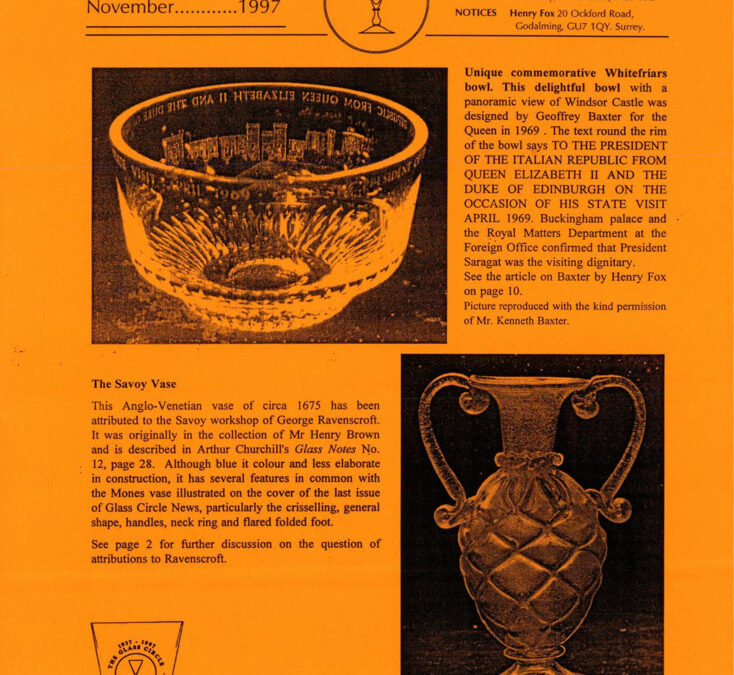
Unique commemorative Whitefriars
bowl. This delightful bowl
with a
panoramic view of Windsor Castle was
designed by Geoffrey Baxter for the
Queen in 1969 . The text round the rim
of the bowl says TO THE PRESIDENT
OF THE ITALIAN REPUBLIC FROM
QUEEN ELIZABETH II AND THE
DUKE OF EDINBURGH ON THE
OCCASION OF HIS STATE VISIT
APRIL 1969. Buckingham palace and
the Royal Matters Department at the
Foreign Office confirmed that President
Saragat was the visiting dignitary.
See the article on Baxter by Henry Fox
on page 10.
Picture reproduced with the kind permission
of Mr. Kenneth Baxter.
The Savoy Vase
This Anglo-Venetian vase of circa 1675 has been
attributed to the Savoy workshop of George Ravenscroft.
It was originally in the collection of Mr Henry Brown
and is described in Arthur Churchill’s
Glass Notes
No.
12, page 28. Although blue it colour and less elaborate
in construction, it has several features in common with
the Mones vase illustrated on the cover of the last issue
of Glass Circle News, particularly the crisselling, general
shape, handles, neck ring and flared folded foot.
See page 2 for further discussion on the question of
attributions to Ravenscroft.
Last chance
to order your Diamond Jubilee commemorative goblet. Remember you can have it
cut or plain or with added lettering to suit your own requirements. If you have lost the order
form simply write to Roma Design Services, 50 Wychbury Road, Pedmore, Stourbridge, West
Midlands DY9 9HR, UK.
or phone
01562 886124.
1997
Page 2.
GLASS CIRCLE NEWS No. 73
Editorial
The opening weeks of our new season have seen some
spectacular incidents in the history of our Society.
Symposium at the British Museum
November 1st saw over 70 members ascend the steps of
The British Museum in bright sunshine to attend our
Diamond Jubilee Symposium –
Important British Glass
(1675 – 1845) and its Collectors.
After a warm welcome
from our Chairman and from Aileen Dawson on behalf of
the BM, the packed programme of lectures, well illustrated
with slides, soon revealed how the glass collections of our
major museums were, in most cases, dependent on the
whims and generosity of a few devoted collectors, both
male and female, concerning whom new and interesting
insights emerged. This was not entirely the case as the
British Museum, for example, had benefited greatly from
the awareness and judgement of its curators. It is not
proposed to attempt to summarise the individual lectures in
GC News as an illustrated symposium volume should be
available towards the end of 1998. Our thanks go to the
speakers for their participation and to the Committee for
its work in making this Symposium a reality.
Visitors from the National American
Glass Club*
The Symposium was graced by the presence of Ellen
Roberts, the President, and Carmen Freeman, the Chair, of
the NAGC. Both told me afterwards that they found it
an exceedingly interesting meeting. Ellen was busily taking
notes throughout for an account in their newsletter,
Glass
Shards,
although she admitted that she found some of the
references to British history engraved on our glasses –
particularly the Jacobites – somewhat difficult to under-
stand. Our guests were able to meet members and discuss
matters of common interest over coffee and, later, during
a relaxing lunch organised for participants at the nearby
Spaghetti House.
On such occasions the best laid plans can go awry. A
choice of three meals had been selected by participants
from the menu, in advance, but, on the day, nearly a
third more turned up than had booked. Lunch times are
crowded anywhere in London, particularly on a Saturday.
However, the chef coped magnificently and everyone was
fed. But the inevitable delay meant that we had to go
without afternoon tea. Perhaps, in future, there should be
a financial incentive to book early (or vice- versa)? Any
suggestions for future symposia would be appreciated by
the Committee.
NAGC presentation.
Ellen and Carmen also joined the the Circle’s regular
November meeting the following Tuesday when Simon
Cottle gave a scintillating update about the Beilby family
and their enamelled glasses. New information is changing
our views on just which members of the family were
involved in particular pieces. A summary of the lecture
will appear in the next issue of GC News and a full,
illustrated account in the next issue of the Journal.
Before the lecture began Ellen was invited to say a few
words on behalf of the NAGC and surprised us by
presenting The Circle with an engraved piece of Studio
Glass to commemorate their visit and our Diamond
Jubilee. It consists of a thickly-blown hollow clear crystal
disc, about the size of a small sports discus; the centre
two thirds are cased bright red. On the clear glass of the
upper surface the names of our two societies are engraved
opposite each other. Our Chairman graciously accepted
the gift on behalf of the Circle and expressed thanks to
the NAGC. It is currently stored in a black velvet bag,
labelled Stuben, within a substantial case. The Committee
is considering its permanent display for all to enjoy.
The NAGC, originally called The National Early American
Glass Club, was founded in 1933 and has about 1700 members.
The Glass Circle Library
Ever since the Reverend Humphreys bequeathed the
nucleus of his personal glass library to The Circle your
Committee has struggled to find a worthy home for it
with easy access for our members. For a number of years
the Museum of London has kindly acted as custodian and
during this time the holding of books has increased
through donations. At our Annual General Meeting the
Chairman was delighted to announce that the Sotheby
Institute had generously agreed to include The Glass Circle
Library in its brand new library, built as a consequence of
its elevation to University status.
The new library has been installed in the capacious old
ballroom and consists of extensive open-shelf storage for
books on all aspects of art with a special space for the
Glass Circle Library which will be kept in the Institute’s
care but as an independent unit. Glass Circle books will
carry their own bookplate, recording, where appropriate, the
name and date of the donor. In addition, reading tables
and chairs have been installed for study in comfort.
Visiting members will have access to
all
the books in the
library, not just those on glass. At the time of the initial
announcement the books had only just been received from
the Museum of London but we are pleased to announce
that all have now been catalogued ready for use.
It should be mentioned that other than registered students,
this privilege is exclusively for Glass Circle members who
should phone the librarian in advance on 0171 462 3247
to book their visit. A list of Glass Circle Library holdings
will be circulated when available. Further donations to the
library of books and documentary material of relevance to
glass will be gratefully appreciated.
Glass at the Chelmsford Museum.
An account of The Glass Circle outing last summer to the
Chelmsford Museum to see the Tunstill Collection of
English 18th century glass (see GC News 70, p.5) was
published in the magazine of the Museum’s Friends with
an unusual outcome. Some disappointment had been
expressed by our members that there were no brochures or
postcards available illustrating some of the fine pieces on
show. This has now been corrected with the public- ation
by the Friends of a delightful 3-fold full-colour brochure
summarising the nature of the collection and illustrating a
number of items from it, together with an account of how
the collection was formed by Frederick Walter Tunstill.
The Committee felt that all Circle members would
appreciate receiving a copy (enclosed with this newsletter)
and a donation was made to the Friends for this purpose.
Picture postcards are on the Friends’ list for production
when funds become available. All this is the outcome of
the devoted care and promotion of the Tunstill collection
by Marie Polley who is to be congratulated for this
successful outcome to all her hard work.
Attributions to Ravenscroft?
The last issue of GC News included a speculative article
on whether all lead glass, particularly heavily crizzled but
otherwise unmarked pieces, could be confidently attributed
to Ravenscroft. It was initiated by a picture, carried on
the front cover, of a previously unrecorded vase sent in
by our American member, Mr. Richard Mones. If the
patent was secure then this should be the case. However,
due to the crisscrossing of glass-makers between England
and the Continent, plus the fact that the difficult process
of making lead glass was available through Neri and that
there is an overspill period of relatively unknown activity
after his retirement, the involvement of other makers can-
-concluded
overpage.
GLASS CIRCLE NEWS No. 73
Page 3.
1997
Attributions to
Ravenscroft?
concluded
not be wholly excluded.
The proposed suggestion
that the vase shape had a
Venetian precedent in
porcelain that might
indicate its place of
origin was shot down
within days by Hugh Tait
who rang to inform me
that no porcelain factory
could be attributed to
Venice for the period or,
indeed, up to the middle
of the 18th century.
However, as shown above, a blue Venetian glass vase, c.
1600, of this general form, including the neck ring but
lacking the elaborate pincered decoration of the Mones
piece, is illustrated by Robert Schmidt in
Das Glas,
page
80. On the Mones vase the pincerwork, mereses on either
side of the moulded hollow knop and the broad fold to
the foot, not found on this early Venetian piece do
appear more characteristic of English work. A well-known
crizzled decanter jug, with replacement foot, decorated
with similar alternating pincer work is currently on show
at Broadfield House, and unequivocally labelled
“Ravenscroft” although there is no provenance for it.
Our member, Colin Brain, advances an entirely different
hypothesis, that it might actually have been made in
America? He observes that shards of lead glass, some of
an apparently unusual lead-soda, rather than lead-potash,
composition have been found at the closely-dated (1692)
Port Royal site in Jamaica. Moreover, he finds that a
glasshouse employing English glass workers was in
operation in Philadelphia from 1683. What it made and
for how long it operated is not known although an initial
aim was to make vessel glass. The problem here is
distinguishing the native products from imports. An
S-sealed fragment, surely English, was among the shards
found at Port Royal, and, while attending the NAGC
Symposium at Norfolk, Virginia, last Spring, I visited the
Jamestown glasshouse site where I learned that two sealed
Ravenscroft shards had been recovered from the old town-
ship. The local glasshouse certainly made no lead glass
and these are unquestionably English imports. In defence
of the “Venetian origin” theory one might further argue
that a lead-soda glass could betoken a Venetian origin,
given the nature of their cristallo. However, this is piling
speculation upon speculation.
Perhaps the last word, at least for the moment, should go
the eminently authoritative
Glass Notes
by Arthur
Churchill Ltd. In issue 6, December 1946, the problem of
distinguishing between true Venetian glass and
facon de
Venise
(fdV) is addressed. After concluding that
“the
majority of so-called Venetian glasses are in fact from the
Low Countries, mainly from Antwerp and Amsterdam
houses we suppose.”
it continues
“that English facon de
Venise exists now goes without saying. We have found a
few items and there are others.”
Then, after adopting as
English-fdV a glass with an emerald green bowl and a
lion mask stem and a soda glass with a round-funnel
bowl with blue rim but no stem on a folded foot, found
in Sussex, the existence of other coloured glass of this
period is examined.
“There are examples of opaque white,
Rhineland green, and the British Museum mug in purple.
Blue is now known from the crizzled Savoy vase in the
collection of Mr Henry Brown.”
This vase, shown on our
front cover, could well have come from the same hand
that made Mr Mones piece. A close comparison of the
two might prove instructive. Where is it now?
J.T. Fereday and Dynasty Crystal
by H. Jack Haden.
The cover illustration in GC News No. 72 of an engraved
and cut decorated vase with the seated figure of one of
the Egyptian deities, the hawk-headed Horns, and hiero-
glyphics, an item in that part of the Parkington collection
to be sold at Christie’s, must surely predate the discovery
of the tomb of Tutankhamun which is given the date, 4th
November 1922, though, of course, excavation and clearing
of the site had been in progress for months. The vase
was part of
a Dynasty Crystal
suite – a bowl and two
vases – designed and decorated (in part) by John Thomas
Fereday, who was employed by Thomas Webb and Sons,
Dennis Glassworks, Amblecote, for over 40 years. Since
1920, the recently registered Thomas Webb and Sons Ltd.
had become part of Webb’s Crystal Glass Co. Ltd. which
issued from its Crystal Showrooms at 26 Hatton Garden,
London, EC1, a 7-page booklet,
Egyptian Mythology
containing a description of Webbs
Dynasty Crystal
and a
picture of one of the vases.
It was not until the 19th century that serious interest,
other than pillage, was taken in the archaeology and art
of ancient Egypt, but as the years passed, artists and
manufacturers searching for new ideas and decorative
themes directed their attention to the bewildering decor-
ations and artifacts that had lain beneath the desert sand.
Obelisks and sphinxes, Cleopatras and asps, sprang up in
parks, cemeteries and drawing rooms, and no museum
worthy of the name was lacking a mummy case, a
mummified cat or a miniature replica. As the archae-
ologists dug, later under licence from the Egyptian
Government Department of Antiquities, tourists flocked to
Egypt for its sun, sights and souvenirs, and the Khedive
commissioned Verdi’s ‘Aida’ which was first performed in
the newly opened Theatre in Cairo on the 24th December,
1871. It is hard to believe that the discovery of
Tutankhamun’s tomb was anticipated, albeit by only a few
months, but a
Dynasty Crystal
suite and the
Egyptian
Mythology
booklet are mentioned in an article in the
Country Express
(Stourbridge) of 1st February 1922, as
the wedding present of the Corporation of Aberdeen to
H.R.H. Princess Mary. It was stated that the gift
comprised two vases and a bowl decorated by Councillor
J.T. Fereday, of Brierley Hill. Princess Victoria Alexandra
Alice Mary, daughter of King George V and Queen Mary,
was married on the 28th February, 1922 to Viscount
Lascelles, eldest son of the fifth Earl of Harewood.
It is not impossible that the
Dynasty Crystal
was designed
and possibly produced before World War I during which
most glassmakers were either called up for service or
engaged in producing domestic glassware. The demand for
expensive ornamental glass would have been small.
Nevertheless, manufacturers might have thought it prudent
to give skilled craftsmen, such as Fereday, an opportunity
to produce prestigious pieces for the wealthy for export.
The
Egyptian Mythology
booklet states “Every piece is
signed by the designer, Mr J.T. Fereday” (as is the piece
offered at Christie’s), but it is not recorded here who
engraved the elaborate decoration or the cutting, the
booklet merely adding “With true artistic sympathy and
consummate skill the designers and craftsmen of Webbs
have used themes of that ancient but magnificent civil-
isation for the decoration of examples of their world-
famous crystal glass.”
From what did Fereday take the motif – probably a book
illustration – and are the details accurate? That is a matter
for an Egyptologist. It would be interesting to know how
many pieces of
Dynasty Crystal
were produced. The
identification of Tutankhamun’s unviolated tomb should
have boosted demand and after the war there was a
spending spree from which the decorated glass industry >
‘ (A1ILDFORD IIOUSE GALLERY
134 WW1 SIRE11, (A 1141.0110 t.t 1 ’10 111 11,00 lt1’M.
ISTII CENTURY GLASS
fAbibitux/
1101110
pri
1’i:11
lU
crklwale
I
)
n
.
n
11>Oati
lt.thrIc;,,ith,,
,
.(;i:1,-,
ii c-
4-2 OCTMEK 1997
SAII.LtmA
;,41,
W.,.
fl
1997
Page 4.
GLASS CIRCLE NEWS No. 73
First and Fashionable . . .
This was the headline given to the very last note in the August issue of Glass Circle
News – and this was followed by a two-line description of an exhibition to be held in
Guildford. Well, did such a soft sell justify the journey from Southampton?
Enquiring of another collector, I was advised that the Exhibition comprised only a
single case, which contained a few glasses, of only general interest. Now, was the
collector down-playing another’s collection or was he being modest concerning a
selection of his own? Suspecting the latter, I ventured to visit. The result proved to be
well worth the journey. True, there were only some 55 glasses on display – but what
glasses!
The exhibition featured the extraordinary range of English glasses produced in the 18th
Century. It did so by featuring, generally, only a single example of each main type.
But what examples! The green glass had an interestingly moulded bowl and a green
double series air twist stem. The Beilby enamelling, on a double series opaque twist
stem, was of a charming pastoral scene, perhaps inspired by the woodcuts of Thomas
Bewick. The Giles gilding, a typical floral subject on a DSOT, appeared as pristine as
when it left the gilders bench. The cylinder knop design, not always the most
successful in the heavy baluster class, was here beautifully
carried out. The “cyder” glass was gorgeously and
intricately engraved. There was a stirrup cup, with an
engraved hunting design, there was a moulded cup and its
saucer – but I could go on, enumerating my favourites until
I had listed all the 55 glasses on show! It is certainly not
my purpose to provide my own catalogue because that of
the exhibitor was concise, very helpful and, in my
judgement, entirely accurate.
The object of the exhibition was to celebrate, locally, the
Glass Circle’s Diamond Jubilee. In this respect it
succeeded brilliantly. (What a pity that there is not an
annual Jubilee that would encourage our members to
show off their glasses locally and publicly. Perhaps, if
this was so arranged, it might be possible that no year
passed without at least one local public exhibition of old
English glasses.)
Tony Pott
Dynasty Crystal concluded.
derived substantial benefit for a few years until the
Depression, which resulted in the closure of several works.
The war had interrupted the flow of skilled craftsmen and
few engravers capable of producing such elaborate work as
that on the
Dynasty Crystal
suite were to be found in the
country. Not only was such work time-consuming and
difficult to sell, but the public’s taste in glass had
changed. Thomas Webb and Sons found George Woodall
cameo plaques left on their hands and it was not until the
late 1950s and 1960s that such amazing achievements in
glass began to be sought by discriminating collectors.
I cannot recall pieces of
Dynasty Crystal
appearing in the
major salerooms. However, a letter, dated 29th January
1985, from George W. Cole, auctioneers and appraisers in
Kingston, New York, was received in Stourbridge, offering
for sale a
Dynasty
suite for the best offer over $5000.
One of the vases had a minor chip “nothing drastic or to
take away their value.” A poor photograph of the bowl
and two vases was enclosed. The letter added that all the
pieces were were signed “W.T.J. Farraday”! The catalogue
(1985) of the Dennis Glassworks museum contains an
illustration (No. 209) of one of the vases (the standing
figure of the hawk-headed god is depicted with arm
outstretched, the hand grasping what might be a sword).
the catalogue states that the 12-inch vase (pattern No.
39422 – 1923) depicts a “victorious royal warrior in the
act of killing a group of barbarian prisoners who are
pleading for mercy.” This is a rewording of the description
given in
“Egyptian Mythology?’.
The catalogue adds that
J.T. Fereday engraved and signed the vase. Was this the
vase bought (with other pieces of Webb glass) when the
works museum was broken up and the outstanding items
acquired by the American collector and dealer, Mr Ray
Grover?
Little is known about John Thomas Fereday. He was one
of a score or so of talented artist-craftsmen employed by
Stourbridge glass firms, especially Thomas Webb and Sons,
and Stevens and Williams. He is to be seen, wearing a
heavy walrus mustache and mutton-chop side-whiskers, with
five other cameo glass carvers in a posed photograph
taken about 1895, seated to the right of the others carving
the border of a large plate (Illustrated in Geoffrey W.
H. Jack Haden’s
Artists in Cameo,
p. 44). A cameo glass
vase with two handles, elaborately decorated with floral
sprays and birds, designed by Thomas Woodall and
decorated by Fereday, is in the V & A collection. It was
illustrated in the
Pottery and Glass Trades Review
January
1957, and a coloured plate is placed opposite page 38 in
Hugh Wakefield’s
Nineteenth century English Glass.*
Fereday (born 18th March, 1854) lived for most of his
working life in Brierley Hill. He was employed by
Thomas Webb and Sons for over 40 years, retiring, in
1922, to Llandudno where he died in February 1942, age
88 years. He was closely associated with the brothers,
Thomas and George Woodall, and carved many of the
elaborate ornamental borders for their cameo plaques. He
became an executor of George Woodall’s will. His
retirement
(County Express,
15th July, 1922) could have
been prompted by the reorganisational measures being
introduced at the Dennis Glassworks at that time by the
new management of Webb’s Crystal Glass Co., mentioned
earlier, which was London based, and part of a larger
group of manufacturers and dealers in glassware. Steps to
mechanise manufacturing processes and to speed up
production were resented by many employees with the
result that several departmental managers and some skilled
craftsmen left and started a new manufacturing company –
the Stourbridge Glass Co., Ltd., at Audnam, Wordsley –
makers of what became known as Tudor Crystal.
Fereday was a cultivated man who married a school-
teacher. He became a member of Brierley Hill Literary
Society and later served on Brierley Hill Public Library
Committee, became chairman of the local Higher Education
Committee and a member of Brierley Hill Urban District
Council. He addressed the Royal Society of Arts on the
10th February, 1921, on the production of
Dynasty
Crystal,
specimens of which were exhibited at the British
Industries Fair that year
(County Express,
5th Mar. 1921).
*Recently, I came across another signed example of Fereday’s
work in the shop of Andrew Lineham in The Mall, Camden
Passage. It is a large, clear crystal vase engraved with a man
fishing beneath a tree with a mayfly passing by. Ed.
Figs. 1 & 2. Two early
yard-of-ale glasses, one
a yard,
the other a
half-yard shown roughly
to scale. The smaller
glass is accompanied
by a jelly glass and a
small funnel to show
their relative size.
Pictures kindly suppled
by Peter Meyer (left)
and Henry Fox.
5
Page 5.
1997
GLASS CIRCLE NEWS No. 73
rigin of the Yard-of-Ale Glasses?
David Watts
The yard-of-ale glass has been described as “a special type of ale glass vary-
ing in length from 75cm to over 1m. and having a capacity of about one pint.”
1
Emphasis in most accounts is placed on the bulbous end with a narrow orifice
to the trumpet which serves to make it a “Trick Glass” suit- able for parties.
This, however, is a later adaptation of unknown origin, probably discovered by
accident. These ‘trick glasses’ are said to date from the 19th century with many
being made from the 1950s.
The earliest mention of long flute glasses recorded to date, cited by Bernard
Hughes
2
, is by the poet Lovelace in about 1650;
“Elles of beare, flutes of canary, they well do wash down pasties Mary.”
The ell was a unit of approximately 45 inches (114 cm) commonly used in the
measurement of cloth. I have been unable to find any record of such glasses
still in existence. More common, but still rare slightly later examples, apparently
date to the second half of the 17th century. They often had a foot and only a
tiny bulb, more like a hollow knop
1
while others had a real knop but no bulb
at all
3
The examples shown here (left) have a double or triple bulb of small
capacity and the glass itself is quite thick so that their volumes are relatively
small. They almost certainly derived from the tall Venetian flute with origins
going back to the 16th century. The illustration (below, right)
of a 17th century Venetian flute shows the early inclusion of
a bulbous swelling at the base•
The earliest know flute with an English attribution is the
Scudamore or Chesterfield flute, 36.8cm tall, in the Garton
collection in the Museum of London. Dated c.1650 by
Mysteries still remain, however. Lewis
7
,
Charlestons its knop, suggested to be an English character-
whose account is more expansive than
istic, is similar to that in Fig. 3. By comparison the
most, refers to a ‘Cambridge yard-of-ale’
Exeter flute, with a portrait of Charles II and dated to
and retails that “At the annual
Vinis
of
1660, and another, dated 1672 and 43cm tall, in the
the Mock Corporation of Hanley, Staffs,
V&A, with a portrait of William III as Prince of Orange,
the initiation of a member included the
have plain inverted pear-shaped knops and suggested
drinking of a yard of port, while the
Netherlandish atributions. Yet another flute in the Toledo
freeman of Stoke-on-Trent had as a
Museum of Art, also about 43cm tall, is engraved prob-
preliminary to admission to dispose of a
yard-of-ale glasses seem to have been intended initially for
achieve.”
Unfortunately, no dates are
ostentatiously to proclaim a loyal toast. In a like manner
accomplishment which many never
ably to commemorate the birth of the Prince of Orange in
yard of ale.” And likewise, “To
Floor the
1650
6
. That all are engraved suggests their intended use –
long glass
at Eton
is also
an
Venetian flute.
see text.
Fig. 3. An early
festive or official occasions where a public toast was
given by Lewis for these events so any information to
made. The significance of such toasts in those days (as
provide enlightenment on these problems would be gratefully
we know with the Jacobites) was of considerable import-
received.
ance and the use of a large glass made it indisputably
clear to those in attendance what was taking place. This
is well illustrated in the public display of loyalty recorded
in the Diary of John Evelyn, 10th Feb. 1684/85 at
Bromley, Kent, where the use of a glass of ordinary size
would have had no impact at all.
“Being sent to by the Sheriff of the County to appear
and assist in proclaiming the King (James II), I went the
next day to Bromley, where I met the Sheriff and the
Commander of the Kentish Troop, with an appearance, I
suppose of above 500 horse, and innumerable people, two
of his Majesty’s trumpets, and a Sergeant with other
officers, who having drawn up the horse in a large field
near the town, marched thence, with swords drawn, to the
market place, where, making a ring, after sound of
trumpets and silence made, the High Sheriff read the
proclaiming titles to his bailiff, who repeated them aloud,
and then, after many shouts of the people, his Majesty’s
health being drunk in a flint glass of a yard long, by the
Sheriff, Commander, Officers, and chief Gentlemen, they
all dispersed and I returned.”
This is the earliest known record of the use of a yard-of-
ale glass in a real life situation and it is interesting that
the glass used was made of the then new lead glass.
Presumably, many more were made in both lead and non-
lead glass for similar proclamations all over the country.
Although all the early glasses are extremely rare this is not
necessarily due to accidental breakage during riotous
festivities as seems generally supposed but more probably
because few were made and only for special occasions.
Notes
1.
H.
Newman (1977)
An Illustrated Dictionary of Glass,
p. 349.
Also illustrated are two yards-of-ale glasses, one footed, of
c.1685 date in The British Museum collections.
2.
G. Bernard Hughs (1967)
English Glass for the Collector,
p. 45.
3.
Bate P. (1913)
English Table Glass,
Plate XXXVIII, Fig. 145.
4.
G. Mariacher (1963)
Vetri del Rinascimento,
p. 75.
5.
Charleston R.J. (1957) Dutch decoration of English glass.
Trans. Soc. Glass Technol. XLI p.229T-243T.
6.
Art in Glass
(1969) The Toledo Museum of Art. p. 55.
7.
J. Sydney Lewis (1928)
Old Glass And How To Collect It,
p. 161.
The Glass Society of Ireland – 1-Day Symposium
IRISH GLASS – PAST GLORY FUTURE PROMISE
Saturday 28th March 1998
at the National Gallery of Ireland, Dublin
Details and Booking:
Bridget Hornby, 4 The Bower, Balbriggen, Co. Dublin, Ireland.
1997
Page 6.
GLASS CIRCLE NEWS No. 73
The Diamond Jubilee AGM and Specimens Meeting
As has now become the tradition over the past few years
our Annual general Meeting was held at the Sotheby
Institute by kind invitation of its Director, Mrs Ceresole.
In her absence Ray Notley made our members welcome
and explained how the changed cicumstances of University
status had resulted in the conversion of the ballroom,
where we used to meet, into the new Library. Groups of
members were taken to view the remarkable transformation
that had taken place and all were impressed by the new
study facilities, the broad range of art books available
and the space given for The Glass Circle Library. The
Circle was most generously invited to hold its AGMs
there for the forseeable future.
In reviewing the past year our Chairman, Simon Cottle,
referred to the series of events to celebrate our Diamond
Jubilee, beginning with the Symposium on
Judging
Jacobite Glass
leading up to that on
Important British
Glass (1675-1845) and its Collectors,
together with the
publication of The Bacon Booklet and the
Exhibition of
Early English Glass
held with the invaluable support and
co-operation of Christie’s and the Nordstone Insurance
Company. In addition there had been a full programme of
lectures, all held at The Artworkers Guild; as for last two
years the Circle had held one meeting jointly with the
London section of The Society of Glass Technology; on
this occasion Ian Freestone had given the lecture. In
addition, there had been a hospitable preview of the
Cranch Collection of English glass at Phillips Auctioneers,
and, jointly with the Glass Association, a preview of The
Parkington Collection at Christies, South Kensington, and,
of course, our Summer Outing.
All the organisation involved had placed a great strain on
the Committee and full appreciation was expressed of all
the hard work that had been put in to make these events
a success. The exhibition, in particular, had been wonder-
fully supported by our members, both in terms of glass
loans and in their participation, and had done much to
cement our relationship with Christies.
The retirement from the Committee of Miss Kate Crowe
was regretfully announced, her stirling work in producing
The Glass Circle Journal being specifically appreciated.
Kate has generously offered to continue to help with its
production in the future. No new Committee members
were elected at this time but the election of Mrs Janet
Benson as an Honorary Member in respect of her past
and continuing work for The Circle, was confirmed. Tim
Udall continues the invaluable job of dispatching
publications to members.
Derek Woolston presented the Hon. Treasurer’s report. In
spite of the heavy financial outlay involved in our
Diamond Jubilee celebrations The Glass Circle accounts
showed a comfortable balance. This was partly due to the
considerable increase in the number of new memberships
as a result of The Circle’s more active profile. However,
the costs of our meeting premises and our publications
were due to rise in the coming year and it had been
prudent to increase the annual subscription after a
considerable period of stability. The new membership
rating of
Institutional Membership
had been introduced to
meet the need for firms or industry to establish a
relationship with The Circle to our mutual benefit. The
auditor, Dennis West, was formally thanked for his
examination of the accounts.
The, reports having been approved, the formal business
meeting concluded and The Sotheby Institute thanked for
its hospitality, the meeting then moved on to examine the
glass specimens brought by members. The experts on this
occasion were Simon Cottle, Jo Marshall and David Watts.
The earliest glass on show was some medieval fragments
of vessels uncovered during an excavation. The moulding
and variable colouration of the pieces were quite
distinctive. Moving into the early 18th century, we were
shown a fine baluster with triple collar knop, c.1720,
newly acquired from the Cranch collection, and two jelly
glasses, one with a double-B handle on a collar and
slightly domed foot, the other of flared ogee shape with
an overlay round the base of the bowl and a high domed
foot. The question was whether this thickening had a
functional role, perhaps to make the glass more resistant
to being broken by an over-enthusiastically wielded spoon?
More difficult to date were two spouted pots of flattened
shape, one with a lid, which, variously, have been
suggested to have been used for filling oil lamps, watering
plants, feeding invalids or even as a pharmaceutical
measure. It was suggested from the audience that such
pots could have been made in America, although no
provenance was forthcoming. This would certainly make
them later, probably 19th century rather than the latter
half of the 18th century as is sometimes thought.
A curious 18th century drinking glass with the drawn
funnel bowl mounted directly on the foot caused disagree-
ment among the experts as to whether this was a repaired
specimen resulting from a broken stem. Three later
coloured drinking glasses had diverse origins; one was in
red Lithyalin from the Egermann workshop, another was
in Burmese glass – perhaps American – and the third, an
Art Deco glass, was cased nickel purple, probably also
Bohemian. Two beakers, elegantly intaglio engraved in
Rock Crystal fashion with large poppies, dated to between
the wars and were probably made by Stuart’s in Stour-
bridge where they were found.
Paperweights were also in evidence, one, of book form
with cut hobnails underneath and a sulphide inclusion
under an applied disc of clear glass, was possibly by John
Ford of Edinburgh; another had a paper picture of the
Statue of Liberty on the back and a Czech weight had
charming feathery green and pink inclusions. Also of
interest were two 19th century Chinese snuff bottles, one
with a blue overlay carved with phoenix and dragon, the
other with a minutely painted interior of a diversity of
different species of insect – a miniature zoological marvel.
Among other items brought along for discussion were a
red over yellow overlay vase etched with fledgling birds
in a nest and signed G. Nicholas who had worked for
Gad, a Whitefriars bowl with a folded rim and cut
decoration, a plate in uranium(?) yellow glass with a blob
foot and an enamel rim, probably modern, a footed
Irish(?) salt and a late 19th century barrel decanter with a
short neck and a nicely cut fluted body, commonly used
for spirits.
Welcome to New Members:
Mr Peter J. Arlidge.
Mr. Joseph C.H. Bibby.
Mr. Anthony M. Dougall.
Mr. Alan Flack.
Mr. Anton Gabszewicz.
Mr. Peter W. Jenkins.
Dr. P.J. Mills.
Mr. Arif Quereshi.
Miss Carolyn F. Satterthwaite.
Mr. and Mrs Geoffrey C. Timberlake.
Mr. P.G. Walker.
Glass Circle News – Publication Deadlines
No.74
January for publication in February.
No.75 Mid-March for publication in April.
DIM and
SRI
ge97
You’re looking gloomy today, Dim.
Yes, its all very well for you to look on the bright side
but my lux have been severely curtailed to comply with
museum regulations. At least I am not stuck all over
with plastic film like a snooty window I know
or.
That
wouldn’t suit me at all.
Quite right, knowing your family background I would
say you are stuck-up enough already!
*Windows in the Burges Room at The Cecil Higgins Art Gallery,
were found to be admitting 400 lumens, five times more UV
light than the permitted maximum. Simple corrective treatment
involved the application of 3M solar film to the existing glass.
Collectors with light sensitive artifacts, take note.
GLASS CIRCLE NEWS No. 73
Page 7.
1997
1
The Glass Circle Summer Outing
Saturday, 20th September 1997.
To recount to our readers the
joys of the Summer Outing is
to recall and recollect the very
best and most jolly episodes of
Dickens’ Pickwick Papers; and
of the anxieties of falling
through the ice, matrimonial
anguish, and derision of the fat
boy. It is ever an occasion of
the utmost conviviality, good
company, excellent food and fun. And this year’s tour
was no exception. An unseasonably bright hot day
additionally smiled on our excursion.
The Northampton Museum provided us, initially, on the
ground floor, with an eyeful of footwear that would have
made Ismelda Marcos blush with envy; the largest shoe
museum in the world; and, the shoes of the largest man –
8’4″ Charles O’Brien: plus an elephant boot. However,
hidden away behind this feast of leather and shoe-making
machinery was a huge glass panel engraved by John
Hutton (of Coventry Cathedral fame) of St Crispin, the
Patron Saint of shoemakers – an unexpected delight.
Alison Cowling, the charming curator, explained the
building originated as a women’s Gaol, became an art
gallery in 1911 and that the glass collection started with
the collection of Thomas George in the 1890s. She
graciously permitted us a view of the basement reserve
collection which had not seen the light of day for some
eleven years – apparently before our present curator’s time
– and was got out and displayed especially for our visit.
Notable were some excellent old bottles; one, a “shaft and
globe” type was impressed “RMP 1657”, another was
labelled “Premier Cru 1898 de Cognac Grande Champagne
de la Perouse”; what stories might they have to tell. As
seems to be the case with all such reserve collections
there were mystery pieces of pressed and continental glass
as well as a number of good but not particularly special
18th century glasses.
In the main glass showcase, upstairs, one was a little
distressed to note the absence of dates on the very best
pieces, including a magnificent baluster, with base knop
and tear, relegated to the bottom shelf (where the writer’s
arthritic hip forbade a proper perusal). Here, too, was
Peter Dreiser’s beautifully engraved goblet, exhibited in
our
Strange and Rare
exhibition. Nearby, was a good
collection of ceramics.
Those who were very quick had a few minutes to marvel
at the nearby E.W. Godwin 1864 Gothic Guildhall,
resplendent with polychrome stone work, the richest of
metal work and excellent internal stencil decoration. The
modern adjacent extension has been executed with rare
sympathy for this Victorian masterpiece.
Thence to Oundle, through lush countryside with not a
russet tinge of autumn in view. The village, of great
charm, constituted almost exclusively of local stone, largely
unsullied by plastic and aluminium, contained the school,
through which we passed to the Chapel. This fine gothic
edifice stood alone in extensive grounds providing, in
bright sunlight, a most picturesque setting outside the
town. An extra and unannounced glass treasure was
concealed within. For many, I suspect, the magnificent
rich hues of the John Piper East Window were eclipsed
by a delightful set of more modern windows behind the
altar set in a charming ambulatory. These chronicled the
life of a recalcitrant schoolboy through to soldier and aged
schoolmaster, executed with exquisite draughtsmanship and
a delicious sense of humour. Each window
included schoolboy-like graffiti as well as, tucked in a
corner, a series depicting the development of a butterfly
paralleling that of man. These windows were designed by
Hugh Easton who was responsible for the
Battle of
Britain
window in Westminster Abbey.
Habitually, we are told, the Glass Circle Secretaries scour
tour areas for hostelries of suitable excellence to satisfy
members’ demanding palates. The Falcon Inn, Fotheringhay,
(Tel. 01832 226 254 – well worth a return) would fulfil
the dreams of the most demanding gourmet . . . and fill
the gourmands! The cold buffet, taken in the conservatory
with views of the garden, contained all you could desire
and the deserts were exclusively home made. A most
delightful choice.
A necessary short country walk took us to The Church of
St. Mary and All Saints where John Hadman, a local
archaeologist, greatly enlivened our visit with the history
of the 12th century church, completed at a cost of £350
in 1475. Some seven years ago a rubbish dump of 1800,
next to the tower, was excavated to reveal Saxon pottery,
Roman and Charles II coins and thousands of pieces of
very early stained glass. The most interesting of these
fragments have been meticulously assembled to create a
window of splendid fascination, installed in a room over
the porch, where they are easily inspected. This wonder
was but part of an ancient mausoleum of Plantagenet
history that had witnessed the passage in life and death of
Mary, Queen of Scots. But there was no time for
Fotheringhay Castle, of which little remains, so it was
back for tea in the pleasant gardens of The Falcon before
heading back to London.
Many thanks, indeed, to Jo
Marshall for all her efforts that
makes these occasions so happy.
As we returned home, like true
Pickwickians, we mused that
though we had not finally
discovered the true source of
the Hampstead Ponds, we had
enjoyed a very jolly day in
Northamptonshire.
John Scott
1997
Page 8.
GLASS CIRCLE NEWS No. 73
47/10
)
?7
,
REpisemoits.
by F. Peter Lole
An extremely enjoyable visit to
the Glass Collection of
my predecessor as deputy editor
of the Glass Circle News
revealed a fine and delightful collection, much enhanced,
in true collector manqué, by the many stories told by my
host of his Glass and his Collecting. Inevitably, after
seeing a collection for the first time, one finds on later
reflection that there are details, nay often fundamentally
important aspects, about which one is uncertain. (For me,
not the least pleasing feature of our Diamond Jubilee
Exhibition at Christies was that I was able to make two
visits and thus resolve some of those queries that had
occurred to me after my first visit.) So, this expedition
produced some later pondering, and two quite separate
aspects of the Collection provoked a single question:
“What’s in a name ?”.
In telling me some of the history of his Collection, John
remarked that he had formerly built up a group of
Lauenstein Glass, but had later disposed of it to allow
acquisitions in other fields. He enquired if I was familiar
with Lauenstein, to which I nodded a sage affirmation.
Indeed, I could have said yes, it is one of the Eighteenth
Century Germanic groups, inspired by that widespread
fashion reaction against the tortuous intricacy of Facon de
Venise Glass, which in England inspired the Baluster
Family of Glasses, with not dissimilar styles evolving
across the whole of Northern Europe. I could have further
added that some authorities now ascribe to Lauenstein the
inspiration for what I still like to call Silesian stems. (For
however inaccurate, it is a long-standing, honourable and
widely understood term; the confusing and tiresome
tergiversations of the taxonomist are as much to be
deplored in the Glass world as in the horticultural sphere.)
One could, too, have recalled the frequency of early
faceted knops, and a propensity to Glass disease; but
much of this is equally valid for other Middle European
Glass. If asked to “compare and contrast” with other
Germanic and Bohemian Glass, I would have been
stumped.
So I set to to repair my uncertainty. Starting, apparently
logically, with Frank Davis’ “Continental Glass”, I found
that he does not even index Lauenstein; he does, however,
tell us that Kunckel, founder of the Potsdam Glass works
in the late seventeenth century, was ennobled in Sweden
with the title: “Kunckel von Lowenstein”. Robert
Charleston had a few pithy comments, whilst Barrington
Haynes had most to say. But the conclusion was rapidly
forced upon me, that for those of us who do not read
German, resolving the specific characteristics of the
Eighteenth Century Glass of Bohemia, Brandenburg,
Lauenstein, Potsdam, Saxony, Silesia and Thuringia, et al.,
is at best an uncertain science. Perhaps, I thought, the
essays in the Danish Royal Glass catalogue, by Olga
Drahotova on Bohemian and Silesian Glass, and Gisela
Haase on that from Saxony, would help? But, whilst they
give invaluable information on the mercantile aspects and
the artistic giants, they seem more to rehearse the
similarities of the wares rather than identify the
differences. Indeed, both of the writers stress how the
mobility of the craftsmen, especially the cutters, engravers
and gilders, was a major factor in achieving a community
of styling throughout Middle Europe. Harold Newman’s
`Illustrated dictionary ….’ does indeed consider all these
Glassworks, but concentrates more on their history than on
the product. There is however mention of one feature
upon which our Editor and my host both commented;
some Lauenstein Glass has engraved underneath the foot,
upon the punty mark, a ‘C’ or a small lion. Nonetheless,
perhaps the last word rests with Barrington Haynes: “they
made …. much the same kind of Glass in their different
styles which are confusing to English Collectors and not
always clear to the German ones.” Here indeed is a case
of “What’s in a name?” Here, also, is a field where a
good English language reference work would be much
appreciated.
Amongst the more imposing pieces in the Collection, and
particularly attractive in their separate ways, are two fine
claret jugs, both having interesting stories as to their
acquisition. One, typically Irish, has that covetable long
beaked spout. The other, superbly cut and with good
ormolu mounts carrying Egyptian motifs, murmurs ‘France’
at first glance and is indeed acknowledged in the Baccarat
archives. But, those of you who enjoyed the Glass
Association expedition to Liege six years ago, will
remember that the seed for the flowering of Baccarat lay
with Aime-Gabriel d’Artigues and his Voneche Glassworks
in Liege. One outcome of The Congress of Vienna, which
redefined European boundaries after the fall of Napoleon,
was the detachment of Liege from France, and its
incorporation into the Belgian-Netherlands federation, with
the consequent imposition of a very high tariff on
Voneche Glass destined for its traditional French market.
However, in 1816, d’Artigues secured for Voneche a
duty-free concession from Louis XVIII, the new French
Monarch, subject to the proviso that he should transfer the
established Voneche technology to his newly acquired and
run-down glassworks at Baccarat, in Lorraine. Reflecting
this dependence on the Liege parent, the title of the
company remained until 1842, “La Compagnie des
Verreries et Cristalleries de Voneche a Baccarat”. Those of
you on the Liege trip will also remember the expositions
of Ann Chevalier and Luc Enghen, who both suggested
that most of the best work during the period 1816-1823
when d’Artigues ran both establishments, came from
Voneche, albeit that the superlative ormolu mounts which
embellished the finest work were applied in the Paris
workshop of “A l’escalier de crystal”.
So, what of the jug in question? The mild Egyptian
influence on the ormolu mounts, together with the
neoclassicism of the swirling diamond cut acanthus leaves
on the body of the jug, suggest a date earlier than 1823,
when d’Artigues relinquished control. Indeed, Ann
Chevalier in her book “Le Verre au quotidien” illustrates
an ormolu mounted vase of c.1815, which she attributes
to Voneche, and whose cut decoration is clearly related to
the jug in question. So could it be that the ‘Baccarat’ jug
is really a Woneche’ jug, or is it merely influenced by
the Voneche craftsmanship? But truly, “What’s in a
name?” For a rose would smell as sweet …. I
By way of dessert, a tale of a collector with no interest
in Glass. After a dinner party recently, my host said:
“come upstairs and see my engravings”; and lo, command-
ing the head of the stairs was a large engraving, entitled:
`The Drunkards Arms’; some twenty inches wide, it was
published in London by Carrington Bowles in 1783. The
central shield was quartered with various attributes of the
drunkard, and was bordered with six lidded tankards.
Surmounting the shield, as a crest, was a barrel, with
astride it a bacchic putto, grasping a wanded flask in one
hand and a stemless wide funnel Glass in the other, –
lifted almost directly from John Greene’s drawings for his
Venetian suppliers, of more than one hundred years earlier.
The two large supporters, both in a state of debauched
inebriety, were a man to the dexter of the shield, holding
a decanter marked ‘Claret’ and a woman to the sinister
with a jug labelled ‘Gin’. Each of the supporting figures
had also a raised plain stemmed Glass; both bowls were
most unusually, but quite clearly, of shaped octagonal
panel form. Whilst this form is not uncommon in jelly
Glasses, it is very rare in drinking Glasses; indeed, it
cannot be very comfortable to drink from. However, those
concluded on page 9.
GLASS CIRCLE NEWS No. 73
Page 9.
1997
GLASS CLIPPINGS
by Henry Fox
Up in Smoke or
Fox Takes Cover
Our long standing member, Dr Edmund Launert points out that
the holders shown on cover page of last GC News are, in fact,
Cheroot holders; they were never intended for cigarettes. He
kindly sent a copy of an article that Audrey Godfrey and he
published on this very subject in the July 1982 issue of
Antiques Collector
under the title
A Glass Puzzle Solved
Certainly there seems to be little information on this area of
collecting, and of all those holders known, it would seem that
some may be similar but none are identical, which gives rise to
the idea that they are perhaps all one-offs. Indeed, these
attractive objects are infrequently found and then only after
serious searching. The questions posed are; who made them and
where; who sold them; who used them; where are they now.
The authors of the article state that many pieces seen are of
quality, and in the case of overlay examples require a team of
two or three workers. It would seem that these holders were
never advertised, and consequently it is assumed that they were
made to order. If any members can add information which will
help answer these questions or, alternatively, shed new light on
what appears to be a “glass mystery”, please let me know for
the benefit of all GC News readers. Watch this space! In the
meantime ponder on the following quote from Charles
Hajdamch’s book
British Glass
(published in 1991):
“One range of novelties which never receives mention in glass
literature is the glass cheroot or cigar holder, produced in every
technique including cased and cut, lamp-work, threaded, acid
etched and cameo.”
Name
Your Poison
For many years now, collecting early wine bottles has had a
strong following, and like any specialised area of collecting the
prices paid can often be well outside the ken of the uninitiated.
However, in more recent years an interest in collecting a variety
of glass bottles made in the 19th century, and later, has grown
rapidly. Here one is not referring to the French scent bottle
creations by Lalique and others, but to the humble bottles,
usually produced in large quantities for everyday use, such as
tonic waters, milk, beers and medicines. The latter have a keen
following, and look attractive in green and blue.
Even so, members may be amazed to learn that a blue glass
poison bottle in the shape of a coffin, for which a provisional
patent was issued in 1871 to a Mr. Langford, appeared at a
specialist provincial auction last July and was finally sold after
brisk bidding to a collector for £6700. Compare that with the
price for a good heavy baluster or rare Jacobite!! Very little is
known about this particular blue glass bottle other than it is
very rare and is in mint condition, and is an example of the
ever-elusive
true English coffin poison bottle.
Apparently two
other such bottles are known, but one is largely re-assembled
and repaired. So search your medicine chest. You never know
what treasures it may hold!
Auctioning With Intent?
This cryptic heading refers to a Country House style sale held
in a large marquee at the rear of Christie’s South Kensington
premises in June. Of interest was a late Victorian cut glass
chandelier by the Birmingham firm of F & C Osler, which sold
for the staggering price of £29 900. Such high prices must
make our own Dim and Bri characters seem even more
deprived; it’s like being poor with lots of uninterested rich
relatives!
Can This Be Right?
“Lead glass, often called flint glass, was invented in England in
1560. By 1676 it was used extensively in France, where it was
called
crystal, just as in America today.” This is a direct quote
from
Old Glass Paperweights – Their Art, Construction and
Distinguishing Features
by Evangeline Bergstrom, published in
New York c.1940, 5th printing May 1968. Can any member
give a hint as to the source of the substance of the quotation?
Ideas please. Am I the only one who is totally bewildered as to
how what I believe is wholly misinformation could go uncorr-
ected after the first printing?
Cornwall Stained Glass
An interesting reference in
Country Life
(4th Sept. ’97) was to
the early stained glass to be found at the Church of St. Neot, St
Neot, Nr. Bodmin, Cornwall. I quote:
“These are glorious
works of art. Although the craftsmen are unknown, they are an
English Brueghel. Here they are lost in time, their mastery
shared with a few passers-by and the winds of the moor.”
Members visiting Cornwall next year may care to make a
detour; certainly from the colour photograph shown of one of
the windows it would be a rewarding experience.
News
From Corning
The Corning Museum of Glass houses the world’s most comp-
rehensive glass collection – more than 28 000 objects, repre-
senting 3500 years of glass craftsmanship and design. Since
1996 it has arranged a variety of classes for individuals of all
ages and levels of glass making experience. The Museum has
just announced that is to receive an annual $50 000 grant from
the Heineman family of Chicago for the acquisition of
continued on page. 11.
100 years of
WEBB CORBETT
until 11th January 1998
Broadfield House Glass Museum. Tue-Fri & Sun 2 – 5. Sat
10 – 5.
Webb Corbett, now called Royal Doulton Crystal, is one of
Stourbridge’s oldest surviving glass factories. Founded in 1897, the
company was originally situated at the White House Glass Works
in Wordsley, but moved to its present site in Amblecote after a
disasterous fire. It has produced some exceptionally fine glass.
100 pieces of glass, from turn-of-the-century rock crystal through to
today and special commissions, such as the European Cup and
glasses for Concord, photos, records and videos, trace the story of
this successful firm which does much international designing today.
Limpid Reflections, concluded from page 8.
of you who visited our Diamond Jubilee Exhibition will
remember that there was just such a Glass, as exhibit No. 76,
with another, as Lot 61, in the Cranch sale held about the same
time; both were attributed to c. 1765. Twenty years later, was
this bowl form considered in some way symbolic of
drunkenness? Every aspect of this satirical print is so redolent
of the symbols of demon drink, that one must assume that the
choice of this unusual Glass was thought appropriate to the
subject; perhaps it was that the Devil could hide in the corners
and murmur insidious encouragement to over-indulgence.
There once was a fine Princely Charlie,
Who waited for rhymes to come, hourly.
The submission of limericks which play upon the Latin
mottoes on Jacobite Glass may continue until Christmas, in
time for our next issue. Thus those of you who tell us that
you have felt the muse stirring in your breast have still time to
capture her and display the offspring(s) of these feelings.
Please send them directly to Peter Lole.
1997
Page 10.
GLASS CIRCLE
NEWS No. 73
Henry Fox
discovers that
Geoffrey Baxter, Whitefriars Designer, is – a Local Lad Made Good
I had the recent pleasure of setting up a display in my local
museum to pay tribute to the talent of Geoffrey Baxter
(1922-1995), who was described in his obituary in The Inde- pendent as “one of the leading British glass designers of the
post war years”. I had not associated him with Godalming, in
Surrey, and probably never would have if I had not accidentally
discovered that he died in Farncombe, a village adjacent to
Godalming, whilst he was visiting his brother, Ken.
Geoffrey’s claim to fame is the distinctive designs which he did
for Whitefriars Glass where he worked (1954 – 1980), initially
as assistant to William Wilson, the then Managing Director and
Chief Designer. At Whitefriars he rose rapidly to assume the
mantle of Chief Designer. Prior to his death Geoffrey was
working with Lesley Jackson of the Manchester City Art
Galleries in the setting-up of the first major Whitefriars Glass
Exhibition. He was scheduled officially to open the Exhibition,
but sadly this was not to be. However, the Manchester Exhib-
ition, part of which subsequently went on show at the Museum
of London, was a great success, and created a renewed interest
in not only the exciting designs of Harry Powell, Barnaby
Powell, and others working at Whitefriars during the period
1890 – 1940, but also in the post war period, which was to be
dominated from the late 1950’s onwards by Geoffrey’s imag-
inative textured designs in either their muted or bright exciting
colours which caught the spirit of the ’60s. Probably his
Banjo,
Drunken Bricklayer,
and
Bark
vases are his best known creat-
ions; certainly he introduced textured novel designs into British
glassmaking, and examples of Whitefriars’
Glacier
tableware
range proved popular. He did, also, traditional design work
incorporating cutting and engraving. In 1969 he designed the
bowl with an engraving of Windsor Castle for the Queen (see
front cover), and went on in due course to design a range of
commemorative glassware to Celebrate the Queen’s 25th Jubilee
in 1977 and, in the 1970’s, he worked on paperweight designs.
Without doubt, the last quarter century of Whitefriars’ exist-
ence can be called the ‘Baxter Period’. In 1980 the Whitefriars
Glassworks in Wealdstone, Middlesex, closed for good and this
brought to an end a business which had flourished since 1834,
starting on a site which had been, since 1720, a glassworks, off
Fleet Street close by the River Thames. For a century and a half
the name Whitefriars had been synonymous with quality and
skilled craftsmanship.
What do we know of the early days of this man who was to be
the first professionally trained and qualified glass designer who
had not come up through the ranks at Whitefriars? Young
Geoffrey’s parents moved from Down Road, Islington, London,
into a council house in Woodside Road, Chiddingfold, in 1923.
His father worked for the London County Council as a leather-
work instructor at the King George V Sanatorium at Hydestile,
near Godalming. Geoffrey, with his parents and two brothers,
spent nine years at this address. He started school days at the
local junior school in Chiddingfold but when the family moved
to Minster Road, Busbridge, Godalming, in 1932 he attended
the Central School in Meaddrow, Godalming. His brother Ken
recalls that Geoffrey did well in art, and that a master at the
school, who thought he showed promise, helped him to get a
place at the Guildford Technical School/Guildford School of
Art when he was fourteen. On leaving school he went to work
for the Guildford Glass & Metal Company, and it may well be
this experience, coupled with his burgeoning artistic bent, that
made him strive to get a scholarship to the Royal College of
Art in London, which he did.
As with so many young people at this time, the War cut short
ambition and education. Initially Geoffrey joined the Home
Guard unit centred on Stovolds Farm, Eashing, Godalming.
Later he was called up, and after serving in the Royal Air Force
as a storeman at Gibraltar and in the Far East (Burma, Minga-
ladon Air Strip), he succeeded, after he was demobbed, in
being admitted to the Royal College of Art, where his work
soon attracted attention. He obtained a first class honours
degree in glass design, and was awarded a travelling > page
11.
GLASS CLIPPINGS concluded
contemporary art. The gift will be used to purchase glass
sculpture created since 1960 by artists world-wide. The new
funds will augment existing museum appropriations for
contemporary glass. The museum has collected, exhibited, and
documented new glass since its opening in 1951. Corning has
also announced a special exhibition of new international
sculpture 16 May – 13 September 1998 under the title
The
Glass Skin.
This exciting exhibition has been organised by the
Hokkaido Museum of Modern Art (Japan), the Kunstmuseum
Dusseldof (Germany), and The Corning Museum, and will
feature the work of 20 artists who use glass as their primary
medium. We are told that these artists draw attention to the
glass surface and exploit it – physically and metaphorically – to
help communicate their ideas. The 80 works to be shown by the
20 artists from around the world are representative of the
maturation of artistic work in glass. Members visiting America
next year should put a visit to the Corning Museum at the top
of their list of places to see. Its glass collections are truly
amazing. Have a fun day!
Glass on the Telly
Seen recently on TV BBC2, a Mayan Period volcanic glass
(obsidian) ceremonial knife; and, on Chanel 4, a selection of
Jacobite glass from the Drambuie Collection in Edinburgh. The
Antiques Road Show recently highlighted the polychrome
enamelled armorial Beilby wine glass with badly damaged foot;
this fault did not deter the “experts” from putting a value of
£6000 on it, stating that, if perfect, it could be worth five times
or more. From the sublime to the ridiculous were the false
descriptions given in the
Channel 2
lunch-time programme
Going, Going Gone
for an English mid-18th century pan-
topped cordial glass from being a candlestick (believed by one
challenger) to a product of Bohemia. The creative insanity
involved in this fun programme is truly brilliant.
Inflated claim for a diet of snail’s!
Heard on 19th July on BBC Southern Counties Radio – ten
facts about snails:
Glass blowers eat snails. They claim this
improves their blowing capacity.
Do any members know if
this claim is true or why this is so? The BBC was unable to
provide an answer as to the source of the facts that were read
out by their morning presenter as it had not been kept.
Collectors BEWARE
With rising prices and an increased awareness of its collect-
ability, glass is now becoming more the object of theft. A
number of wine glasses were recently featured under “Stolen”
in the
Antiques Trade Gazette.
On another occasion a valuable
glass collection was taken from a highly reputable auctioneer’s
van, temporarily left unattended while
en route
to the show-
rooms. Make sure that you either insure the items yourself or
receive a signed receipt accepting
full financial responsibility
before you let a single object of your valuable possesions out
of your control. Do not take anybody’s word for it.
GLASS CIRCLE NEWS No. 73
Page 11.
1997
Geoffrey Baxter – concluded
scholarship to the British School in Rome in 1953, the first
time such an award had been given to an industrial designer.
His brother recalls that he visited Venice at this time, too.
Immediately on completing his diploma, he was head hunted by
William Wilson, Managing Director and Chief Designer at
Whitefriars Glass, to work as his assistant. By the end of the
1950’s, although nominally still Wilson’s assistant, he was
designing the bulk of Whitefriars’ domestic glass. The style he
developed was very much his own. He was creative and
innovative, and certainly his exciting colourful textured ranges
caused a sensation when introduced from the mid-1960’s. His
wife recalls walking with him on various accasions through
woods and his looking for (and finding) inspiration in the barks
of various trees. He also delighted in experimenting with new
colours, some bright and some muted, and these were intro-
duced to ranges of his designs over the years. His designs were
very much a part of the vibrant ’60s, and he introduced further
new designs for the ’70’s such as vases decorated with random
strapping and vases and bowls with applied coloured spots and
ribbon trails. These were designs for the masses, but he created,
also, a number of one-off studio pieces over the years. He was
very much aware of the work being done by the then studio
glass artists, and worked closely with the Whitefriars craftsmen
to achieve his own studio designs. He created commercial
designs for the Queen’s Silver Jubilee and, also, during the
1970’s he worked on a series of paperweight designs, which
proved popular, particularly in America. On a personal level he
retained his interest in engraving, and experimented with
diamond point. (In the Godalming Museum display was a small
clear glass Whitefriars tankard which Geoffrey had designed
and subsequently engraved himself for a neighbour in
Godalming, Frank Needham, who was a former master at the
Godalming Grammar School – now a 6th Form College, and
later a master at Priorsfield, a Girls’ Public School in
Godalming, from where he retired in 1977. Also, on the subject
of engraving, his brother Ken remembers that Geoffrey had told
him that he had designed and worked on panels for the
Dorchester Hotel, Park Lane, London).
Geoffrey Baxter, who eventually took over as Chief Designer at
Whitefriars, said himself in 1974 that he had a completely free
hand to create. It is to this freedom that we owe his many
attractive and radical designs that can be found in homes here
and abroad today, and increasingly in museums such as the V
& A and the Museum of London. Certainly a number of his
design ideas can be traced in work of today’s studio glass
students. Some of his Whitefriars pieces look as fresh and new
today in design terms as they did to those who saw them when
first produced twenty or more years ago.
Whitefriars had always been a quality glass manufacturer, and
it was costs which eventually caused the firm to close in 1980;
backers were no longer prepared at that time to support a
commercial business with its combination of maintained
quality, high skilled labour content, and artistic innovation.
Whitefriars glass was sold in such noted London stores as
Fortnum & Mason and Heal’s, as well as quality retail glass
outlets throughout the country; Whitefriars also exported.
Geoffrey was devastated by the closure of Whitefriars where he
had spent so many happy creative years. He died in September
1995 just a few months before he was due to open the major
exhibition in Manchester on the achievements of Whitefriars,
spanning nearly 150 years. He was cremated at Guildford and
his ashes were scattered at the noted Winkworth Arboretum
near Godalming. He is survived by his wife, two sons and a
daughter, and by his brothers Ken and David, both of whom
visited the museum to see the display.
It is interesting to realise that he was, in a tenuous way, linked
to glass through his childhood days in Chiddingfold, an early
glassmaking area which supplied window glass during the
booming church and cathedral building period of the 13th and
14th centuries. Equally tenuous is the fact that for his diploma
work at the RCA he submitted designs on glass made by
Chance Brothers, a branch of whose family have resided in the
Godalming area for some time. In the final analysis, however,
we owe a debt of gratitude to the unknown school master who
recognised Geoffrey’s talent, and to the fact that Geoffrey
seized his opportunity when it was presented and, further, did
not let active wartime service deter him.
In putting on this display at the Godalming Museum under the
title
Of Its Time, I
must acknowledge the help and assistance
received from Lesley Jackson at the Manchester City Art
Gallery. Lesley very kindly arranged for me to have three
examples of Geoffrey’s early designs from his College days; it
was a great honour for me and the Godalming Museum to have
the privilege of publicly exhibiting these for the first time. I
was both excited and filled with amazement when I saw them.
Here, indeed, was talent. As the highlight of the display, the
two original chalk drawings of a design for a bowl and an
elegant curvaceous decanter done in the early 1950’s whilst at
the RCA, together with the photograph of a sandblasted panel
design from his time at the Guildford School of Art (Oh where
is that panel now?) drew much attention and admiring comment
from visitors to the Museum. I am grateful, too, to Alex Werner
of the Museum of London for sending me numerous photo-
copies of pages from old Whitefriars Catalogues showing
Geoffrey Baxter designs from which I was able to make a
collage. I am, again, grateful to Richard Dennis Publications (as
copyright holders) for permission to prepare enlarged colour
photocopies from the book Whitefriars Glass by Lesley
Jackson, which included the catalogue of the Manchester
Exhibition. I am particularly indebted to the kindness of Mrs
M. Baxter, Mr Ken Baxter, and Mrs Needham for family
information and for the loan of photographs and items of glass
designed by Geoffrey Baxter. Lastly I must thank Jeanette
Hayhurst and Nigel Benson, both noted dealers in Whitefriars
glass in Kensington Church St. London, for sponsoring the
display and loaning a number of important pieces from The
Baxter Period. including a few pieces which were originally
shown at Manchester, The display received a mention on BBC
Southern Counties Radio, as well as in the Surrey Advertiser
under the heading
Museum Honours Local Designer.
Due to
popular demand the display, scheduled for two weeks, was
extended for a further week to finish on 7th November.
Postscript – A number of early Baxter Period pieces were
included in a recent exhibition at the Fine Art Society Gallery
in New Bond Street, London, under the heading
Austerity to
Affluence – British Art and Design 1945 – 1962.
I managed to
view a few days before the exhibition closed; it seemed strange
to see so many items from the days of one’s youth. There were
furniture, ceramics, plastics, glass, textiles, metalwork,
examples of Haute Couture and a few paintings, prints and
sculptures. I had been alerted by a neighbour to the glass as a
result of her seeing the display in the Goldaming Museum.
Certainly, the clean lines and colour of the Baxter glass
(pre-texture ranges) stood out in sharp contrast to the early
post-war cut and polished decoration on clear colourless glass
by other designers from Whitefriars, Webb Corbett, Thomas
Webb & Sons, Stuart & Sons and Chance and Co. A fine large
vase engraved with Angels by John Hutton (1907 – 1978),
which was lent by Broadfield House Glass Museum, is,
incidentally, on a colourless Whitefriars blank.
1997
Page
12.
GLASS CIRCLE NEWS No. 73
Around the Fairs
with Henry Fox
August used to be a holiday month when most families went
off to the seaside, and, indeed, cities like Paris came to more or
less a complete stop. Nowadays all has changed as is evidenced
by the large antiques fairs which take place in August. Record
crowds swarmed around the NEC Birmingham on the first day
despite the hot weather. Fortunately I missed the crush and
turned up on Saturday afternoon. The sweltering heat was still
there but at least there were fewer people, and it was easier to
get around this large busy fair. Again it is divided into two
sections. Firstly good quality antiques, many items pre 1860’s,
giving way as one enters farther into the fair to a wide variety
of late Victorian, Edwardian, and later period collectibles and
decorative items.
As you would expect, the specialist glass dealers were
principally in the first area. Here William MacAdam from
Edinburgh was displaying a good interesting range of desirable
18th century drinking glasses. I noted a cider glass as well as a
small gadrooned hollow knopped mead style glass which once
belonged to our founder John Bacon. This dealer had just sold
a magnificent Sunderland Bridge rummer. Brian Watson from
East Anglia had several Lynn ringed examples and also a good
deceptive baluster period dram glass. Jeanette Hayhurst of
London had a fine rummer engraved Industry and Commerce .
She was also showing (what must be a unique) moulding of a
fruiting vine on the bowl of an opaque twist stem wine. I recall
that a year or so ago she had another very rare moulding on an
opaque wine, featuring what looked like largish vine leaves,
known in the books as meandering vine. Christine Bridge of
London was showing several well engraved glasses of the
Newcastle style and later, but I particularly liked the early
baluster cylinder wine on display. Alan Ball of Bell Antiques in
the Midlands was displaying several toddy lifters beside a range
of air-twist and opaque twist stem wines etc. Carol Ketley, to
my %uprise, still had on offer the three Victorian period
decanters which were featured (full page colour photograph) in
the August issue of The Antique Dealer & Collectors Guide
Magazine. This stand had a good general range of usable
Victorian and Edwardian glassware. I particularly noted her
variety of mirror “mats”, which always enhance items displayed
on them. The techniques and colours employed in making glass
of the Art Nouveau period will always attract attention of the
general visitor, and so it was on the stand of Ondines/Circa
1900, who come from the Oxford area, which seemed to have a
constant throng of people wanting to get a closer look at the
small attractive examples of Galle, Daum, Lalique, and pate de
verre on show. In the second part of the fair Victorian and later
glass is likely to be seen all over the place, but one or two
stands, such as Nigel Benson of London, featured good
examples of glass from the between the Wars period. Very little
pressed glass of any description was spotted; the same can be
said for Varnish glass, “Cranbury”, “Mary Gregory”,
“Carnival” glass, and enamelled glass from between the Wars,
such as Stuart. Except for an imitation jade set of connecting
glass dishes and matching small drinking glasses, no Chinese
glass was noted, including snuff bottles. All the glass dealers
reported good business, but I gained the impression that some
of the “high rollers” among the present collectors had yet to
make an appearance! Certainly this very hot Saturday afternoon
was keeping the crowds to a comfortable level. There were
more and better-sited refreshment
areas,
which greatly assisted
getting round (perhaps I am beginning to feel my age).
Now on to the most hyped Antiques Fair of 1997, newly
come to London’s Earls Court.
This fair incorporates the former August fair held at the
Kensington Town Hall each year, and proposes to demonstrate
that “Bigger is Best”. Like the NEC fair it is divided into two
sections, in this case “Fulham” and “Chelsea”. These titles are
meant to suggest to the visitor the quality and type of
mechandise on display. Anyone who has visited Earls Court
will be fully familiar with the immense size of the exhibition
halls, and consequently I wondered on my way to this fair
whether it would prove to be too big. Sister fairs at Olympia,
particularly the Summer one, are huge, but on the other hand
these ones do not separate by date-line and/or quality, except
that in the Summer when the mezzanine has been called the
Gold Section. Clutching a Press invitation I arrived to have a
sneak preview on behalf of GC News readers about an hour or
so before the opening. The fair was staged in the new hall
known as Earls Court 2, which means that anyone, who travels
by tube and does not want a long walk from Earls Court
Station, should alight at West Brompton, as the No. 2
Exhibition Hall is directly across the road. Having said this, I
was impressed with the venue. It is modern with a high barrel
roof and the fair occupied only part of the ground floor area, so
it was not as large as I had anticipated. It was well laid out with
room to move easily, but it suffered in that visitors were
automatically drawn to march down the wide central isle, which
brought them almost immediately into the Fulham Section. It
was a very hot day, but the cooling system seemed very
inadequate, and had to get more so once the crowds built up. I
began to question in my mind if any general visitor, able to
spend a substantial sum on an antique or work of art, would
find the rising heat conducive to doing business. Collectors, on
the other hand, hoine in on their specialist dealer(s), eagerly
seeking out that special “fmd” to add to their collection.
Although there were several familiar glass dealers showing, I
saw little that excited . (It seems today that rare balusters, fine
engraved “Newcastle” style glasses, pictorial enamelled
Beilby’s, colour twist stem candlesticks, and the like are to be
found only on the shelves of a few exclusive Mayfair estab-
lishments; or possibly they may make an occasional appearance
at one or other of the main London auction rooms.) However, I
must say that a fair to middling range of mid to later 18th
century English drinking glasses etc. was on display. Jeanette
Hayhurst was showing an attractive gadrooned and engraved
straight sided bowl c. 1720-30, a variety of later 18th century
glass, and some well engraved Victorian ewers and goblets, as
well as Whitefriars examples from the Powell era; Christine
Bridge was showing several engraved goblets c. 1760-75 along
with some 19th century coloured glass; Carol Ketley had a large
selection of 19th century glass spirit/drinks measures, also
decanters. By contrast, late 19th century glass, particularly Art
Nouveau, seemed well represented. Attractive vases and bowls
etc. by Daum, Galle, Lalique, Moser, Muller, Loetz and some
lesser known makers were seen on several stands. Ondines/
Circa 1900 had a particularly fine Loetz blue glass vase with
combed wavy line decoration and silver art nouveau motif
inlay. A more general stand had a magnificent pair of very
expensive iridescent bulbous shaped vases extensively decorated
with silver inlay, again in art nouveau style which were by a
noted craftsman who did work for Tiffany. Nigel Benson’s
stand was showing classic Whitefriars along with later fine
examples of English glass. A furniture stand had an attractive
pair of French girondels; whilst a general stand had an
interesting pair of purple glass silver-mounted (ships style)
decanters, which I thought could have been more 19th century
than post 1st World War as labelled. Of good weight and with
two neck rings, the pair had retained their pontil marks. Sadly
the silver neck rim mounts were not hallmarked so these could
give no clue to substantiate my thought. On a country furn-
iture/utensils stand was a large selection of those hanging
inverted glass bowls used in the 19th century (and may be
earlier?) to protect ceilings from the smoke and heat from >
GLASS CIRCLE NEWS No. 73
Page 13.
1997
Books For Christmas
One of the incontrovertible statistics with which we are
bombarded nowadays states that the average sum of money
spent on the family child at Christmas is around £200. That
makes books seem a cheap option and, among the new books,
top favourite and the only general work on glass must be
Glass,
edited by Reino Liefkes, Deputy Curator at the V & A.
On quality paper with large glossy colour photos this is surely
a best buy at £25. However, only a few sample pages have
arrived so far and a detailed review must await our next issue.
Thomas Heneage has just published his
Winter Art Book Survey
with 40 pages listing several thousand books with cover
illustrations of many of them (Tel. 0171 930 9223 for a free
copy). Books on glass are relatively few, however, but include
the long-awaited
Gilded and Enamelled Glass From The
Middle East.
Based on the Symposium held at the B.M. back in
1995, it includes papers by some 30 specialists that update this
whole field. Heneage tells us that the work focuses on “the
materials, techniques, iconography, patronage and trade of
gilded and enamelled glass of 13th-15th century Egypt and
Syria, the Byzantine and Islamic periods and its influence on
production in Europe, 14th-19th centuries”. Large format with
224 pages and copiously illustrations it is averagely priced at
£48.50 but publication, by the B.M., is not until January 1998.
Early glass is, indeed, the focus of attention, with
Ancient
Glass in the Hermitage Collection
covering the museum
collection 6th c. BC to 4th c. AD with 265 coloured and
numerous b/w illustrations; it is reasonably priced at £42. If
your French is up to it, there
is Verreries Antiques du Musee
Picardie
which lists 357 items and provides an analysis of
historical production techniques; 132 pages and 140 illust-
rations for £29. More general is
Guide to the Archaeological
Museum of Thessalonike –
a complete guide to the museum and
its collection, including glass. With 215 pages and 215 colour
illustrations it has to be good value at £20 and might turn your
thoughts to the balmy days of summer holidays. For those with
parallel interests in precious stones and metals
The Snettisham
Roman Jeweller’s Hoard is available at
a pricy £35 for 128
pages and 42, monochrome only, plates.
The Middle Ages is well-served with
Paintings on Glass,
Studies in Romanesque and Gothic Monumental Art ranging
the 12th-15th centuries,
Sugar to Siosson and Hampton Court,
but will set you back £90. For German scholars there is
Die
Glasmalereien von San Francesco in Assisi
analysing its 13th
century glass panels and roundels at £125 or, in the unlikely
event that you can read Czech., there is a book on old
testament arts including architectural fragments, glass and
icons.
European Glass in the J. Paul Getty Museum
covers the
Middle Ages to the late 17th century for £73, while two
volumes in German, at £71 each, cover the entire collection of
over 700 preliminary sketches for 16th and 17th century
cabinet glass paintings by the Swiss artist, Johann Emanuel
Wyss (1782 – 1837).
For glass in the 18th and 19th centuries the only resource this
winter so far is the excellent crop of Auction Room catalogues.
Twentieth century glass is better served with
John Piper and
Stained Glass,
by the eminently readable and authoritative June
concluded on page
15
Around the Fairs, concluded from previous page
lamps. In general, I recall seeing only one small piece of
Sowerby, two Burtles Tait swans, no pate-de-verre, no Stuart’s
art deco enamelled glassware, and certainly no carnival nor
Chinese glass. This enterprise is a larger version of the
Kensington Town Hall fair which it replaces; it offers a good
range of quality items; it is all on the one level; but I was glad
to escape the heat and get out into the August sunshine. (The
Summer Olympia Fair suffered similar heat problems last year –
so perhaps, when it comes to exhibition hall areas for antiques
fairs, P & 0„ owners of Earls Court and Olympia, stands for
“Phew & ‘OW which I suppose is “fair” as the group founder
company was originally called Pacific & Oriental.) Incidentally
in a post Earls Court press release, members may be amazed to
learn of the million to one chance of a Swiss Dealer who pur-
chased a jug from Jeanette Hayhurst only to find the matching
two engraved goblets on Carol Ketley’s stand!
The popular November one
–
day Glass Fair at the National
Motorcycle Museum
was once again thronged with eager
collectors of all periods hunting out that special bargain, or
thrilling to the discovery of that long sought rarity to add to
their collection. The three specialist bookstalls were doing well,
and so too were many of the dealers, some of whom are only
seen at this twice yearly event. It is always best to arrive early,
even if one does have to queue. Whilst waiting one chats, and
this November I met a couple who for the past three years or so
have become keen carnival glass collectors. Now they go to
America each year in search of that special piece. In America,
rare Carnival pieces go for tens of thousands of dollars. Several
fellow GC members were patiently waiting, like myself, for
“the off”. This November, despite the damp and fog, had not
deterred the early birds.
Immediately on entry to this fair, which is spread over three
large rooms, one sees directly in front an impressive display of
paperweights from the Sweetbriar Gallery which invariably
attracts much attention. Beside the traditional French makes of
the 19th century, including several important examples, there
was a good variety of weights from this century, notably from
Scotland and America. Weights by Stankard are exquisite and
here were several by this noted American maker; the skill and
beauty of his workmanship is reflected in the price, but on this
stand I found another group of weights equally appealing, this
time by Salazar, a fellow American. There was a good selection
of attractive Perthshire weights, too. To one side, just inside the
door, is to be found a wide variety of collectable 19th century
glass, notably with an interesting selection of Sowerby pieces.
This time was no exception. Indeed, I have not seen so many
examples of scarce nursery rhyme piecess for sale for a long
time. Quickly moving on, one sees the more traditional coll-
ectables of interest to GC members i.e. 18th century glassware,
particularly drinking glasses. The main dealers familiar to us all
were showing a pleasing variety, ranging broadly in date from
1710 – 1810. I particularly liked a plain drawn stem wine with
folded foot and scarce cup-shaped top to a trumpet bowl
(similar to one in the recent Parkington sale); a late baluster
cordial glass with bucket bowl on knopped stem; and an
unusual very small jug moulded all over. Whitefriars glass
(basically 1880 to 1980) was to be seen on several stands. So,
too, was colourful glass of the Art Nouveau period. Whilst
there was a wide range of 20th century glass available, it
seemed to me to be principally decorative and serviceable. I did
not see this time any Stuart’s enamelled glass of the 1930’s or
Chinese glass (including snuff bottles). Davidson’s cloud glass
was not much in evidence and certainly none in the rare orange
and red colours. Carnival glass, which brings me back to where
I started, was limited, as far as I could see, to one stand. At this
time of year this fair is a must for seeking out seasonal gifts or
that special present, and this visit proved to be no exception.
Prices, however, were well up.
1997
Page 14.
GLASS CIRCLE NEWS No. 73
Glass at the Globe
This was both the title and venue for this year’s Exhibition in
London of engraved glass by the members of the Guild of
Glass Engravers. The display of 125 items was not as large as
on some previous occasions, but the quality and variety of
techniques was to the high standard that one has come to expect
from the Guild members, many of them Fellows. Most items
were for sale, and in quite a number of cases at very reasonable
prices – this is certainly an event to visit for that special present.
As might be expected several exhibits had a Shakespeare
connection but this year I was impressed to see several attract-
ive examples of stipple engraved glass, the work of James
Denison-Pender, Mike Norris, David Scurfield and Simon
Whistler I particularly liked. Calligraphy was much in evidence,
notably a fine piece by our member Peter Dreiser – a disc with
the Globe in the centre from which radiated the titles of his
works with admiring faces outlined on the back. However, the
calligraphy prize went of Charmian Mocatta, who also edits the
Guild newsletter. Another GC member, Katharine Coleman,
whose work, using copper wheel and flexible drive drill, was
featured in GC News 71, was showing contrasting inspiration
when one compared (a) her small green on orange cased lead
crystal bottle entitled
Forest Fire,
with a whole array of fleeing
animals watched by a wise old owl, the excitement and terror
being wonderfully communicated to the viewer, with (b) her
delightfully amusing bowl,
The Owl and the Pussy Cat
which
used similar techniques but on a grey on orange cased glass.
Several pieces had a fishy theme and I was quite taken with an
oval green/red example shaped like a partially closed shell
entitled
Piscatorial Combat,
by Nicholas Rutherford. Here in
the interior of the shell you had a warrior, his entire body made
up of various engraved fish confronting a circling shark. Again,
two truly contrasting pieces by Shirley Palmer absorbed my
attention. First, a kiln formed coloured glass plate, which she
had made herself, and then painted, and also used the flexible ,
drive drill technique, to produce a series of fields with sheep
but the ram was fenced. An amusing piece entitled
Suffolk
Sheep Safely Grazing.
Second, was her piece entitled
The Trap
which was a lead crystal block on a base, again engraved using
the flexible drill, which showed a young man and a young
woman entwined with ribbon, which when viewed from one
side showed the woman to be within the ribbons but as one
walked round to view from the other side she appeared to
escape and now he was entrapped. An attractive conversation
piece. A totally different piece attracting much attention,
Tangle
by Geoff Thwaites was a fenestrated, engraved and carved
recycled bottle! It was a surprise to spot a couple of Whitefriars
crystal bricks being used by one engraver as the basic glass for
two exhibits. By now you can appreciate that this was a
stimulating and intriguing display of the Guild’s engravers’
skills and artistry; there were also two attractive pieces made
using the graal technique. However, I was a little disappointed
to note that several pieces seemed to be very much set in the
commercial cut glass mould which has dominated the High
Street for most of this century. I cannot deny the quality of the
workmanship of these few traditional pieces on show but I feel
that use of a little colour, more imaginative subject matter, and
experimentation with new shapes to engrave would not now be
out of place as we prepare to say good-bye to the 20th century.
I revisited the exhibition two weeks later during the daytime
with the sun shining – making the displays even more magical.
This event should definitely be an annual ‘must’ for all GC
members who can get to it. Next date/venue for your 1998 diary
are 6.9.98 to 26.9.98 at Romsey Abbey, Hants (to be confirm-
ed). The Guild’s next “annual lecture” will be on 4.4.98 at
Winchester Guild Hall (title/speaker to be confirmed). H.F.
Under the Hammer
Glass, glass and yet more glass. Certainly the last few months
have seen quantities of glass coming into the auction rooms.
For the collector there has been a good choice ranging from
18th century drinking glasses etc. to Victorian pressed glass and
on to a variety of 20th century glass.
*Christie’s South Kensington – Parkington Collection, Part I –
members will have received an invite to a view plus talks by
Jeanette Hayhurst and Charles Hajdamach – also see GC News
exclusive preview in last issue. As everyone expected, the sale
was well attended and got off to a fine start with lot
1,
a
diamond point inscribed opaque twist stem cordial glass on
domed foot c. 1765 going for £1800, whilst a tall opaque stem
cordial with central Imp went for £1700 and lot 12, a facet-cut
stem cider glass, fetched £3000. The drinking glasses, mainly
facet stems, sold very well with many going for double plus the
top estimate, one with a rare gilded bowl selling for £800
against estimate £150 – £200. A Lynn decanter lot 66 sold for
£1600. The pressed glass, mainly Sowerby pieces, sold well; an
unusual pair of Queen’s Ivory Ware candlesticks fetched £750
and a white “multiplication” vase after a design by Walter
Crane went for £480. All the Cheroot Holders did well, selling,
so far as I could tell, to the same bidder, lot 242 making the
exceptional sum of £900 against an estimate of £200 – £300;
the cheroot holders were sold in two per lot and there were nine lots. The highlight of the Varnish & Co. glass was lot 275 a
green cased silvered vase with Prince of Wales feathers with
arched panels; this made £3200. The Webb “Alexandrite” glass
lots again appeared to sell to same bidder at up to several times
top estimate! The Webb “Egyptian Dynasty” vase illustrated in
the last GC News and discussed in this issue by Jack Haden,
sold for £2400. (All hammer prices).
The second session of this sale contained a variety of glass of
this century and it too sold well, the Ysart paperweights
particularly. Christie’s report that the total sale realised just
under £250 000. One down one to go – Parkington Collection
Part II is scheduled for next April (date to be confirmed).
*Christie’s South Kensington
traditional glass sale held
immediately before the Parkington sale was overshadowed by
the above, but it too achieved good results, notably the
rummers illustrated on the catalogue cover.
*Phillips Gateshead
sale in October included pressed glass
forming part of the Jenny Thompson Collection. A rare small
Sowerby bowl in Ivory Queen’s Ware sold for £230 and a rare
Greener Marquis of Lorne covered butter dish in marbled green
glass which was exhibited at the GC’s Golden Jubilee Exhib-
ition in 1987 (Strange & Rare) fetched £390. (All hammer
prices).
*Dreweatt Neat,
Newbury, October Sale contained 313 lots of
glass, the bulk coming from one unnamed private collection. A
quantity of early drinking glasses was included but not any
interesting or rare heavy balusters. The highlight of this sale
was a rare epergne c.1760 or sweetmeat tree with hanging
individual baskets. Sadly, the bowl at the top was restuck, two
small baskets were replacements and one basket was lacking.
However these faults did not stop it selling to the trade for
£6500. A rumour reaches me that it may be on its way to an
overseas museum. A single small sweetmeat basket with looped
and prunted rim went for £500. A glass porringer and cover c.
1740 – 1760 sold for £780, whilst a single pedestal stem
candlestick went for £720. £5000 was paid for a tall Dutch
“Newcastle” glass engraved with Cupid and the Grim Reaper
flanking a tree within a cartouche c. 1740. A mid-18th century
short ale glass with flammiform decoration on a folded foot >
GLASS CIRCLE NEWS No. 73
Page 15.
1997
Under the Hammer, concluded
made £800 against estimate £60 – £90; what it would have
made with a pincered propeller knop from fifty/sixty years
previous is hard to imagine. As I did not view this sale and the
glass was not illustrated I am unable to justify this winning bid.
(All hammer prices).
*Sotheby’s Bond Street – 24th November – Important Ancient
Glass from the BR Pension Fund Collection. This single owner
sale had 33 lots of superb early glass ranging from 6th – 5th
century BC to 5th century AD. The top eleven lots went to the
same buyer including, for £2.1 million plus premium, the
Roman Cage Cup sold in London in 1979 for £520 000; a
Roman glass cup signed in Greek in the mould
Aristeas the
Cypriot made me,
for £205 000, both from the Constable-
Maxwell Collection; and, for £185 000 the Anglo-Saxon green
glass bucket which I obtained as a special loan for the GC’s
Golden Jubilee Exhibition
Strange and Rare
in 1987. At that
time no one was supposed to know that this excavated bucket
came from the British Rail Collection – I recall that it was all
rather cloak and dagger! The late Mr Constable-Maxwell and
his wife were members of the Glass Circle for many years, and
were discerning avid collectors of ancient glass.
Forthcoming Sales
*Sotheby’s Bond Street –
18th December – Fine Glass – this is a
glass only sale and will include a good selection of balusters, colour
twists and Beilby enamelled glasses, e.g. a very rare set of six colour
mixed twist stems and the Buckmaster armorial goblet which is one
of a pair (the other in the Cecil Higgins Art Gallery, Bedford).
*Phillips Bond Street –
10th December – Fine Ceramics & Glass
*Christie’s South Kensington – next glass only sale scheduled for
February 1998. Items for this sale, including paperweights, accepted
up to 23rd December 1997.
*Dreweatt Neate Newbury – 28th January 1998 – Ceramics and
glass.
*Sotheby’s Bond Street – 3rd March – about 300 lots of glass from
the Royal Brierley (Stevens and Williams) Honeybourne Museum
including trial and rare items from the factory.
On the Move
Christopher Sheppard Ltd announce that their showroom is now
relocated a few yards from Christie’s South Kensington at 302
Sussex Mansions (1st Floor), Old Brompton Road, London
SW7 3LR. To avoid disappointment Tel: 0171 589 2565 before
a visit.
And a new Dealer
Charles Trueman, ex V & A and Asprey’s Antique Glass dept.,
has joined forces with Lucy Holiday, who trained at Phillips
and is also ex Aspreys, to set up a new, top-of-the-range,
antique venture, which will include glass, at 25 Shepherd
Market, London, WlY 7HR. The firm is called
Namara Fine
Art,
a division of the Namara Group of which Naim Attallah is
Chairman. Tel. 0171 499 2901.
Lateral Sowerby
Whilst this name is nine times out of ten associated with glass,
it may surprise some members to know that John Sowerby was
an artist whose work can be seen occasionally at auction or
Fairs. Also Githa Sowerby wrote a play called Rutherford &
Son, in 1912, and it was seen at the National Theatre on the
South Bank in 1994. It was produced, too, earlier this year at a
theatre in Croydon, Surrey. It has been described as a gritty
North Country family saga with John Rutherford being head of
the family glassmaking firm. One wonders if this could be
veiled autobiography, but in any case the Sowerby connection
would certainly make for authencity whenever there was
reference to glassmaking or the equivalent of “trouble ‘t mill”.
Has any member seen a production of this play and would like
to comment? H.F.
Death of Arthur Graeme Cranch
August 1910 – October 1997
It is with
great sadness that we record the death of our
member, Mr Graeme Cranch on 23rd October, 1997. Both
he and his wife were staunch supporters of The Glass Circle
and were members for many years. Through his Australian
business connections he became a great friend of Rex Ebbott
and was instrumental in helping to form the collection of
English glass in The National Gallery of Victoria, Mel-
bourne (see GC News No.70 page 6). He had a fine personal
collection of early English glass and loaned his unique
assembly of toasting glasses for the
Strange and Rare
exhibition where they are illustrated in the catalogue.
Although of more recent time Mr Cranch had been unable to
attend Circle Meetings in the evenings, nevertheless he
continued to take a lively interest in the Circle’s activities,
often contributing as a co-host. We were delighted to see
him at the Reception at Messrs. Phillips Auctioneers which
was held prior to the sale of part of his collection in June. He
would have been happy to think that some of his favourite
glasses had passed into the hands of other Circle members.
His interest and support will be sorely missed.
J.M.
Books for Christmas, concluded from page 13
Osborne, with 244 pages and numerous b/w and colour plates
for £40 while, in the contemporary field, Peter Layton’s
copiously illustrated
Glass Art
is excellent value at £39.99.
This and three other authoritative glass books published by A
& C Black,
Dictionary of Glass
(£35),
Techniques of
Kiln-Formed Glass
(£28) and
Beauty of Stained Glass
(£25),
are on special offer to members of The Contemporary Glass
Society until the end of the year along with an 8 issues for the
price of six subscription to Crafts Magazine.
The London “Remainder” book shops also have good glass
offerings including, more unusually,
G. Argy-Rousseau –
Glassware as Art
(1991). With hardback covers and 229 high
quality large format pages on everything you are likely to want
to know about this pate-de-verre Artist (1885-1953) and the
technique in general, it costs £14.99 from Henry Pordes Books
Ltd, Tottenham Court Road. Here is one way of cheating the
statistics and ensuring a colourful yet cheap Christmas. D.C.W.
Postscript: Lecture and Book Our member Dr David Stuart,
who, on January 16th 1998, is giving an extra talk in our
regular lecture series, on Glass in Norfolk, has also privately
published a
History of Glass in Norfolk
which includes a
discussion of Lynn glasses and other such important matters.
The price, including P + P, is £8.00 – profits donated to Gt. Yarmouth
Parish Church. Send your cheque directly to Dr. Stuart at 4 Marine
Crescent, Gt. Yarmouth, Norfolk, NR30 4ER.
Exhibition of Slovak Contemporary Glass
by Eva Fiserova
at the Studio Glass Gallery, 63 Connaught St., London, W2.
Tel. 0171 706 3013
Our member, John Scott, has been to the preview and reports
that a visit is highly recommended. The exhibition continues
until 28.2.1998.
Contemporary Stained and Decorated
Panels and Windows
by The Women’s Stained Glass Network
at The London Glassblowing Workshop Gallery, 7 The Leathermarket,
Weston St., London, SE! 3ER. Tel. 0171 403 2800.
Also
new designs and ideas from Peter Layton’s workshop for
unique and unusual presents for Christmas and the New Year.