




GLASS CIRCLE NEWS
EDITORS David C. Watts 27 Raydean Rd,
Barnet, EN5 IAN. Herts.
F.
Peter Lole 5 Clayton Ave.
Didsbury, Manchester, M20 6BL.
NOTICES Henry Fox 20 Ockford Road,
Godalming, GU7 1QY. Surrey.
.
No. 75
June
1998
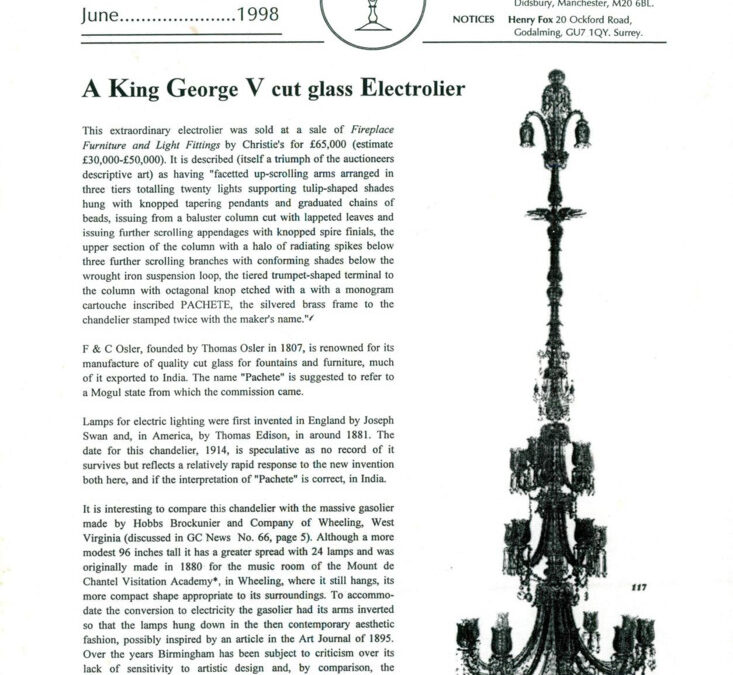
A King George V cut glass Electrolier
This extraordinary electrolier was sold at a sale of
Fireplace
Furniture and Light Fittings
by Christie’s for £65,000 (estimate
£30,000450,000). It is described (itself a triumph of the auctioneers
descriptive art) as having “facetted up-scrolling arms arranged in
three tiers totalling twenty lights supporting tulip-shaped shades
hung with knopped tapering pendants and graduated chains of
beads, issuing from a baluster column cut with lappeted leaves and
issuing further scrolling appendages with knopped spire finials, the
upper section of the column with a halo of radiating spikes below
three further scrolling branches with conforming shades below the
wrought iron suspension loop, the tiered trumpet-shaped terminal to
the column with octagonal knop etched with a with a monogram
cartouche inscribed PACHETE, the silvered brass frame to the
chandelier stamped twice with the maker’s name.”t
F & C Osler, founded by Thomas Osler in 1807, is renowned for its
manufacture of quality cut glass for fountains and furniture, much
of it exported to India. The name “Pachete” is suggested to refer to
a Mogul state from which the commission came.
Lamps for electric lighting were first invented in England by Joseph
Swan and, in America, by Thomas Edison, in around 1881. The
date for this chandelier, 1914, is speculative as no record of it
survives but reflects a relatively rapid response to the new invention
both here, and if the interpretation of “Pachete” is correct, in India.
It is interesting to compare this chandelier with the massive gasolier
made by Hobbs Brockunier and Company of Wheeling, West
Virginia (discussed in GC News No. 66, page 5). Although a more
modest 96 inches tall it has a greater spread with 24 lamps and was
originally made in 1880 for the music room of the Mount de
Chantel Visitation Academy*, in Wheeling, where it still hangs, its
more compact shape appropriate to its surroundings. To accommo-
date the conversion to electricity the gasolier had its arms inverted
so that the lamps hung down in the then contemporary aesthetic
fashion, possibly inspired by an article in the Art Journal of 1895.
Over the years Birmingham has been subject to criticism over its
lack of sensitivity to artistic design and, by comparison, the
adherence of Osler to the traditional chandelier layout with the
lamps upright (the upper ones being hung down of structural
necessity) may be a further reflection of this parochial outlook. The
American gasolier has recently been restored to its original shape
with the replacement globes pointing upwards but with the electric
lighting retained. The destiny of the Osler electrolier is unknown.
* A Catholic order originating in France in 1610.
A Electrolier of unusual size made by F & C Osler,
circa 1914. Ht. 165 ins. (419cm)
Photograph courtesy of Christie’s.
Cammisio
–
Al Fre Bgaiorit
–
Lo Ilentsr
q1,155 /VirtS Ei4411 . #4X 771Ca4e9430
%~
g
7
Ivpiavkaii4
Pti.gvis
–
tins
F14
to 5ca
t
e,
is
I
4.
1.
ke..a.447 iv
041477
nnorr: /400,..1
1344
–
*44,4
atvi ,35 14. 9.4:4
r…44sfed
(.4/
fr./ frop4Mi
rwloce &
orl
e
FAce
;
–
••{1
,
1
sezicv.
*ro
Pq
/
04
,
..-5,4e/7
Smn
fink
fhi$
,
/44
Awe/
adf.)
blow Ishirid .rn
—
.
sir
.
Late News
Himley Hall Summer Attractions
Himley Park, Himley, Nr. Dudley, West Midlands DY3 4DF
Tel. 01902 326 665. Open Tues. – Sun. 2.00pm – 5.00pm. Free
admission to exhibitions. Pay and display parking.
Once home to the Earls of Dudley, Himley Hall with 180 acres
of lake and parkland, now belongs to Dudley Council as part of
the Museums Service. It provides a delightful leisure area
including a 9-hole public golf course and a cafe.
Castmark July 4 to September 13. Intricate and unusual glass
by Birmingham sculptor, Ken Cantillon Howell.
Glass of ’98 August 15 to October 4. The best glass designed
and made by final year students from Universities and Colleges
throughout the country, much of it selected from the New
Designers exhibition in London (see page 4.).
Hot Marks Glass Studio.
Beginners’ guide with Mark Locock
Dudley Glass Festival
September 27 to October 4. A star-
studded programme including the usual wide range of activities
with lectures and glass making demonstrations involving both
Himley Hall and Broadfield House Glass Museum. Barry
Sautner, cameo artist (see Editorial and NAGC Bulletin on page
13), is this year’s star lecturer for the Michael Parkington
lecture on October 2. The International Glass Centre, Brierley
Hill is holding a one-day stained glass workshop. Also four half
days of beadmaking with Diana East at Plowden & Thompson.
Need to book. Tel. Broadfield House on 01384 812 745.
Frans Greenwood booklet offer
Our member, Mr F.G.A.M. Smit is kindly offering to Circle
members,
free of charge,
his recently published booklet
containing additions and corrections to his 1988 monograph on
the renowned stipple-engraver, Frans Greenwood. For your
free copy write to:-
Mr F. Smit, 4 Glamis Gardens,
Longthorpe, Peterborough, PE3 9PQ.
Glass Sculpture Commission for Broad-
field House Glass Museum.
Members familiar with the layout of Broadfield House will
be aware of a small courtyard languishing behind the
temporary exhibition space on the ground floor. It is
languishing no longer, the Friends of Broadfield House have
now raised funds, and with the help of an Arts lottery grant,
have commissioned the recently installed large glass sculp-
ture by versatile London-based glass artist, Max Jacquard.
Approximately 1900mm tall, it is based on the idea of a glass
cone with hand-made glass bricks with opaque sand-blasted
windows onto which shadows of glass tools are projected by
means of interior lighting.
The picture (left) is a preliminary working diagram kindly
loaned to GC News by Max. This presents the basic
2-dimensional outline of his idea which he develops in three
dimensions as construction proceeds.
1998
Page 2.
GLASS CIRCLE NEWS No. 75
Editorial
Book reviews, a regular feature in GC News, are usually
passed by without comment. To receive any comments at
all is unusual. However, my review of Rieno Leiflces’
Glass
has received a mixed reception with two views that
it was ‘fair comment’ and a letter from Susanne Frantz,
until recently Curator of 20th Century Glass at The
Corning Museum of Glass, complaining that I was unduly
harsh on her V&A contemporary, Jennifer Opie. My view
that more contemporary glass should have been illustrated
was not contested but Susanne disagreed that the book
should have given more prominence to British artists.
Further, it is not the role of a museum to promote the
achievements of its nationals but should give a straight
overall world perspective. This is easily said from a
museum with a holding (in 1985) of over 200 American
contemporary pieces compared with 40 Czech and 27 each
of German and English pieces. One does not need to plug
the home product when the sheer number can be left to
speak for itself. Further, CMOG has just received an
annual donation of $50,000 to spend on contemporary
glass. This is quite a different scenario from our British
Craft industry where the emphasis is on survival.
Chris Smith, Government Cultural Secretary, said at the
recent Cannes Film Festival that art is not only socially
important it is big business and it is the government’s job
to help Britain get its share of that business. With reason-
able generosity it funds both our contemporary Arts and
Crafts and our museums. I hold that our museums have a
dual responsibility in presenting a balanced view between
the global and national picture and in the case of
Glass
that balance was not achieved. What do you think?
The Cause of Crisseling
Finally, a word about crisseling. No one contested my
technical criticisms, which I felt was the most lamentable
failing of
Glass,
but
I
had wondered at the repetition of
the unqualified statement about the shortage of calcium in
the batch being the cause of crisseling. This comment was
first made in the joint V&A / CMOG CD-Rom,
The
Story of Glass,
and, having now visited Corning, a
possible explanation emerges, for that Museum has a case
devoted to crisseling in which it does indeed say that this
is due to a lack of calcium in the glass. In support, five
nicely crisseled old glasses are displayed To my eye
these are all Venetian or f-d-V, concerning which the
statement is absolutely correct. It is now believed that
Barovier achieved his
cristallo
by purifying (isolating) the
soda from plant ash. This is done by extracting the ash
with water, filtering off the sediment and evaporating the
filtrate in which the soda is dissolved. The problem with
this treatment is that the calcium salts are almost insoluble
and remain with the sediment. Hence the lack of calcium
in the batch. Probably, Barovier had to add back calcium
in some form since traces left in the soda would not
alone be enough to make even a temporarily stable glass.
This situation has to be distinguished from that for lead
glass where there was no intention to include calcium in
the first place, but to use lead oxide as the stabiliser.
Purified saltpetre had been readily available for many
years for the explosives industry in the 17th century, and
relatively pure potassium tartrate from the residues in wine
casks. Here the need was to achieve the correct balance
in the batch between the lead oxide and the salts. Dr Plot
was on the right track when he suggested that the cure
lie in the “abatement of the salts”. Whether or not
Ravenscroft and his assistants understood about calcium is
irrelevant. Hence, in any account of crisseling it is
essential to explain the nature of the glass to which the
crisseling relates and here both
Glass
and The CMOG are
at fault. The Corning museum caption certainly needs
some qualification if not detailed further explanation.
Glass Circle Web Site
We are delighted to announce that through the assistance
and generosity of our member, John Newgas, the Circle
now has its own Web Site with the address:-
glasscircle@usa.net
On it you will find a short history of the Circle, past
articles from GC News, details of how to join and links
to some other Web Sites of glass interest. I provided the
material and John, a self-taught programmer for the Web
has done the programming and, no less important,
provided the space on which it is displayed at no cost to
the Circle. We are truly grateful for a contribution that
helps propel our flourishing society into the 21st century.
This is more than just a status symbol. Note the above
address which should be typed in exactly as shown.
While in America recently to attend the annual Conference
of The National American Glass Club (NAGC) I
purchased a book (they are cheaper there) entitled
Teach
Yourself HTPL in
7
Days.
(HTPL is the Web Site
programming language). After two weeks solid reading I
am only about half way through it!!! but far enough to
appreciate what a good job John has done for us. Our
site will be updated from time to time and we hope in
the future to include advance information about meeting
topics and dates and other Circle activities. You may
have seen the programme on BBC television
Computers
Don’t Bite.
Before long they will be as common in every
household as television is today. Anyone thinking of a
purchase and wanting advice has only to contact your
ever-helpful editor, if not the nearest 7-year old!
NAGC Conference at Pittsburgh
Pittsburgh is famous for its now defunct steelworks,
Westinghouse, who invented the electric chair, and Heinz
who made his millions not because his products were
better than his competitors but because he put them into
locally-made glass jars and bottles. The Heinz University
building has a tower the top of which disappears on a
cloudy day, and the Heinz University Memorial Chapel,
where we had a session on its stained glass windows,
gives the impression that St Paul’s cathedral could be
comfortably accommodated in one corner. The other
famous eminence in this otherwise quite modest and
delightful city is the Pittsburgh Plate Glass headquarters
building, not just a splendid all-glass skyscraper but
bristling with neo-gothic turrets – the “crystal crown jewel”
of the Pittsburg skyline. The City sits in the “V” caused
by the confluence of two rivers and is surrounded by
high hills on the top of one of which we had the
meeting dinner with splendid surrounding views, including
fireworks. This was followed by an auction of glass and
books contributed by members with all or part of the
proceeds going to swell NAGC funds. There was also a
raffle for a contemporary white-over-blue cameo vase, only
3.5 inches tall, with a rose on trellis design. The cameo
of this delightful piece was sculptured in depth by a new
sand-blasting technique invented by the artist (see p.13).
Appropriately, it was won by the artist who created the
trophy given by the NAGC to the Circle to celebrate our
60th birthday. The free and easy lecture sessions, although
on topics of American interest, inevitably harked back,
from time to time, to their ancestral origins in Europe
and had not my two enterprising co-editors been so
prolific with copy for this issue
I
would probably have
told you more, but that must be saved for another time.
However, a session that did prove popular on one
afternoon was a rotation of simultaneous short seminars,
each of 30 minutes or so duration, on four specific
glasshouses and their glass. One could attend any three. It
is an idea we might consider if we can find members
interested in telling us about their local glass factories –
any offers from all you historians out there?
GLASS CIRCLE NEWS No. 75
Page 3.
1998
ENGLISH PROVINCIAL GLASS CUTTERS & ENGRAVERS c.1795
by Peter Lole
Since 1990 a group of National Trade Directories of the
last decade of the eighteenth century and the first half of
the nineteenth have been republished in facsimile. This has
made much more widely available several scarce
Directories which were hitherto little known; they all
contain information about Glass Manufacturers, Ancillary
Trades, and Distributors. One of my brothers-in-law, an
assiduous family historian, has acquired a number of these
reprints, and browsing through them on a recent visit
suggested that some of the entries, if abstracted and
consolidated would yield information useful, but not
ponderous, of interest to many of you, and even of value
to some. However, work on the earliest, that for
1793-1798, soon demonstrated that it is so time consuming
a job that in the interests of family tolerance it will have
to be done over a series of visits, and presented as
occasional papers. This long winded preface is not to
excuse, but to explain, the partial and intermittent nature
of these offerings.
This essay deals with the earliest of this group of
Directories:
THE UNIVERSAL BRITISH DIRECTORY of
Trade, Commerce and Manufacture 1793-1798
(London, at
the British Directory Office, Ave Maria-lane, and sold by
Chamnate and Whitrus, Jewry-street, Aldgate) The
introduction is signed in 1793, by Peter Barfoot and John
Wilkes. Despite calling itself ‘British’, the directory covers
only England and Wales. [The 1993 facsimile re-print is
by The Book Factory, London N7 7AH, in ten volumes;
ISBN 1 898593 00 0]
When using these directories one has to enter a series of
oft’ rehearsed caveats. The dates sometimes span a period,
and in a national survey some entries will inevitably
predate others. In some instances, as indeed with some
modern Directories, fees were solicited for inclusion. Thus,
no fee, no entry; but if pushed too far, no Directory,
either! But the major problem is what precisely is the
meaning of a description? Does an entry represent a one
man band or a large workshop? What does a particular
descriptive term mean, and is this term used consistently?
Precise consistency seems unlikely, for the format varies
somewhat geographically, suggesting that even in this
respect different contributors were not consistently edited.
In the context of the Directory under review, should we
infer some difference is intended between the following
terms used for the selling side of the Glass Trade:
Glass shop
Glass warehouse
Glass dealer
Glass merchant
Glass seller
Glassman
This last term, ‘Glassman’, is particularly uncertain.
Consider for instance, Jacobs & Co. of Great Gardens,
Bristol, `Glassmen’; Witt, Weedon & Schwind, in their
book
BRISTOL GLASS,
make it clear that the Jacobs were
substantial decorators of Glass, by means of cutting,
engraving and gilding, and may even have had their own
Glasshouse before the end of the period this Directory
spans. Similarly, William Absolon at Yarmouth is listed
as: ‘Glass and China-man’, and as David Stuart has
recently shewn in his
GLASS IN NORFOLK,
Absolon was
both an engraver and a gilder as an adjunct to to his
retail activities. But what of the other four Bristol
`Glassmen’ who are in addition to six entries for Glass or
Bottle makers and manufacturers? Indeed, is there any
difference intended between a Glass-maker and a Glass-
manufacturer?
I
have, quite arbitrarily, listed Absolon and
Jacobs as Cutters, but excluded the other Glassmen for
whom I have no collateral evidence of them working as
cutters.
The two largest volumes of the set cover London, and
I
have yet to abstract them, so this review covers only
provincial entries specifically for Glass-cutters or Glass-
engravers. Entries for ‘Engravers’ or ‘Copper-plate-
engravers’ are deemed not to be Glass workers. I have
covered all the major towns outside London, but ignored
most of the smaller towns (with fewer than about 75
entries) unless they might seem traditionally to have Glass
connections. The search has revealed 19 Cutters and 3
Engravers, as follows:
Town. Name.
Description.
Address (when given)
Birmingham
Isaac Hawker
New St.
Glass-cutter
Glass-cutter
David Hughes
Bull St.
John Moore
Stamper, Glass-cutter
Silversmith,
Edgbaston St.
and plater
Lombard St.
Glass-cutter
Temple St.
Glass-cutter
Great Gardens
Glassmen
11 Somerset Sq.
Glass-engraver
Redcliffe Hill
Glass-cutter
Glass Cutter &c.
Glass Engraver
Glass Cutter
Glass Cutter
Glass-cutter
Glass-cutter
James Orton
Glass-cutter
Manchester
Joseph Ivory
Glass-cutter
Newcastle upon Tyne
Thos. Alexander * Glass-engraver &c.
John Gray
Dealer in China and Staffordshire-
ware, and Cut-glass Manufacturer
Stourbridge
James Dovey
Glass-cutter
Warrington
Jonathon Atherton Glass-cutter
Denis Murfey
Glass-cutter
YarmouthWilliam Absolon * Glass & China-man
There are also two retailers(?) who specifically sell cut-glass, but
who might possibly, like John Gray above, also do their own
cutting:
Manchester
W & K. Freer
Plain, Cut, and Engraved,
Glass-warehouse
8 St. Ann’s Sq.
Sheffield Elizabeth Cross
Cut-glass Dealer
* these men were listed by R.J. Charleston; see below.
In
the eighteenth century the term ‘Cutting’ is often used
in a context which makes it clear that it embraces
Engraving. Thus we may probably assume that where
cutting was available, engraving skill was also there; but
presumably those described as ‘Glass-engraver’ were
principally, or solely, engaged in engraving. All the names
listed would seem to be English, except perhaps for Denis
Murfey who may have come from one of the Irish cutting
houses. (The best Warrington cutting of just after 1800
could easily be confused with Irish Glass.) It was not
until after the political turmoil of 1848 that we get a
significant influx of Bohemian engravers. The concentration
of Cutting and Engraving is, naturally, in the Glass
Continued on Page 4
– Penn
Bristol
William Clark *
Jacobs & Co.
James Padmore *
William Smith
Dudley John Benson
Thomas Dudley *
Daniel Silver
Bejamin Smith
Exeter S.Benedict
Liverpool Benjamin Horton
High St.
50 Green-
land St.
7 Pownall Sq.
Parker St.
1998
Page 4.
GLASS CIRCLE NEWS No. 75
Book Review
by Simon Cottle
Glass, Tools & Tyzacks. 3rd edition, 1997, by Don
Tyzack
247
pages, 35 figs. (1997), ISBN 0 9526390 5 X. Price £9.99 plus £1.50 postage U.K. £4.00 Overseas
Order from D. Tyzack, 14 Meadowcroft, Gerrards Cross, Bucks., SL9 91.1D. Fax/Tel. 01753 887781
Whilst reading Don Tyzack’s privately published book on
the history of his family,
Glass, Tools and Tyzacks,
I
could not help being reminded of Daphne du Maurier’s
classic novel
The Glassblowers
(published in 1963). Both
stories are set in France and both follow the fortunes of a
family of glassmakers. However, that is where the
similarity ends. For whilst the latter is a novel, Don
Tyzack’s book is a readable, scholarly and well-researched
history tracing his family’s early origins in Lorraine, in
1400, to their subsequent arrival in England and settlement
in the Midlands and the North-east of England. He
presents much original and new material.
To take comparison further, as an historian and someone
whose own family has early French origins, together with
a gradual evolution in the spelling and pronunciation of a
surname, I feel well-qualified to review this book from the
genealogist’s viewpoint. Furthermore, I was pleased to be
reminded that I have a close connection with the Tyzacks
through my mother’s steel-making family, the
Wolstenholmes of Sheffield. Thirdly, as former Keeper of
Applied Art at the Laing Art Gallery, Newcastle upon
Tyne, from 1980-1986, I was privileged to look after
several examples of glass which may have been made
under the Tyzack auspices.
Don Tyzack’s research has obviously taken some years to
gather and if the style of presentation may be a bit
daunting – it is packed with statistics, tables and other
useful pieces of information – it is not necessarily a book
to be read at one go. The author’s references to the
historical background in Lorraine and Europe, generally,
are useful but occasionally might have led him to cloud
fact with some imagination. Several of the statements
made by members of the family in the 15th and 16th
centuries are recorded as fact when it is probable that the
author has made more of an assumption. When
interpreting the material evidence it might he easy for the
reader to be drawn into believing that much of the
evidence comes from ‘diaries’ with personal reminiscences
closely recorded. Perhaps publication of elements of the
original French documents in their ‘original’ language
would have been useful even if the number of people
able to read them might be few. Interpretation of the
language of these documents can lead to wildly differing
opinions and in the translation may lose something.
The title of the book is also a little misleading. There is
neither a glass nor a tool in the book. The author
concentrates specifically on the genealogy of the Tyzacks.
Thus, glass collectors might be surprised to learn that
whilst there are several engraved examples in English
museums none appear in this book. The most famous
example, a tankard inscribed TYZACK, in the V&A, is
illustrated by Robert Charleston in
English Glass,
pl. 42c.
There is also a decanter at the Laing Art Gallery similarly
inscribed. The publication of this book offered an
opportunity for the author to bring together those glasses
as a record for both historians and glass connoisseurs. The
absence of any glass objects and the concentration on the
genealogy of the family is perhaps an indication of the
purpose behind this book and in that respect it achieves
its aim admirably. Don Tyzack’s deferring to other glass
scholars – David Guttery, Robert Charleston
et. al. –
citing
passages from each of their well-known books, might
suggest that he was unsure of his ground when writing
more specifically about the history of vessel glass.
Nonetheless, I find that whilst the author gives a good
insight into European history for the background to the
Tyzacks in Lorraine in the 15th and 16th centuries, the
chapter devoted to lead crystal strongly perpetuates the
myth that English glass was supreme in glass-making
terms at the time of Ravenscroft’s
invention
of glass of
lead. It ignores entirely the European perspective. Although
one may generally ignore French glass of the period, if
one considers glass produced in the German states at this
time – particularly that of Nuremberg, Silesia and Bohemia
– English glass looks decidedly provincial.
Finally, for those wanting to use the book for reference,
though the index can be a little inaccurate, it will
undoubtedly prove to be a worthwhile and lasting
contribution to the history of the glassmaker, the ‘unsung
hero’ of glass, who, unlike so many of the decorators,
remains a largely anonymous figure.
New Designers
Part 1: 9th -12th July
The Business Design Centre, 52 Upper St . Islington.
11am – 7 pm Entry £6, Concessions £4
See the very best of this year’s student craft and
art – an experience not to be missed.
Glass, Ceramics, Jewellery, Furniture, Silversmithing,
Metalwork, Industrial, Product and Interior Design.
English Provincial Glass Cutters & Engravers c. 1795 Concluded
producing centres. But Exeter, Sheffield(?), and Yarmouth
each had a single cutting establishment, although manu-
facturing no Glass, whilst Manchester certainly had one,
and may have had two, but had no Glasshouse in the
1790s.
Some of the cutting was undoubtedly specialist, rather
than general tableware. This was especially the situation in
Birmingham, where the Smallwares concentration is
reflected in Glass manufacturing, which comprised 4 Glass-
button or Glass-toy makers, one Glass-necklace maker, and
Two Glass-pinchers, one each Watch Glass-maker and
Spectacle glass-grinder, with two further Glass-manufact-
urers, in addition to the four craftsmen listed here.
Elizabeth Cross, the Cut Glass-dealer in Sheffield, probably
serviced the cutlery and silver plated goods manufacturers
who dominate the directory there, and for whom cruets
were important business.
It is instructive to compare these names with those
considered by R.J. Charleston in his
Some English
Glass-Engravers; late 18C. – early 19C.
in G.C. Journal
No: 4 (1982). One of the sources he cites is
The
Universal Directory – 1790 –
presumably an earlier edition
of this one. Charleston also lists a number of craftsmen
working in the 1793-1798 period who do not appear in
this directory. Those names above which are also given
by Charleston, from other sources for the 1790s, are
marked with an asterisk.
As with so much archival evidence, this picture leaves us
with many questions unanswered. It is but a piece, albeit
an important piece, in the jigsaw that builds up to the
whole story of glyptic decoration at the close of the
eighteenth century.
GLASS CIRCLE NEWS No. 75
Page 5.
1998
Glass Cutters’ Trade Cards – Article by Hilary Young in APOLLO.
Reviewed by Peter Lole
“An eighteenth-century London
glasscutter’s trade card;
Its parallels and derivatives”
On 28th. May last year, Sotheby’s sold for £752, from
the collection of Robert J. Charleston, an impression of
the well known Maydwell & Windle’s trade card.
Fittingly, this has now entered the collection of the V&A.
In the February 1998 issue of APOLLO Magazine*,
Hilary Young, the recently appointed Assistant Curator in
the Department of Ceramics and Glass at the V&A, has
used this acquisition to consider a group of Glass-Sellers
Trade Cards which seemingly portray examples of the
Glasswares being offered for sale.
I
say ‘seemingly’
because the main thrust of the article is to contend that
thanks to plagiarism by the engravers of Trade Cards, it
is questionable how accurately these depictions actually
represent the stock in trade of the Glass-Sellers for whom
the cards were engraved.
Young illustrates six Glass-Cards in his article; the dates
given are those which, after careful analysis, he now
suggests for the cards, but he concedes that in most cases
explicit evidence is wanting:
1.
Maydwell & Windle’s
c.1750-5
2.
Weatherby, Crowther, Quintin & Windle’s
The Green Yard Glasshouse.
c.1755-8
3.
Colebron Hancock
c.1762
4.
William Parker
c.1762-70
5.
Parker’s (same as 4)
c.17654
6.
John Jacob
after 1763
All these cards have been previously reproduced in the literature of English Glass, with the single exception of
that for the Green Yard Glasshouse, which is a valuable
addition to the illustrations available to us. Young also
discusses and compares in some depth the card of c.1759
of Hopton, Hanson and Stafford, of the White Fryers
Glass House (No: 7); he does not illustrate it, which will
infuriate those of his readers who have not spent £50 on
Whitefriars Glass
by Evans, Ross and Werner (1995) and
to which he refers for the illustration.
The author developes with varying degrees of conviction
his thesis that plagiarism of motifs by card engravers
vitiates the the use of trade cards to establish current
Glass-ware styles. His initial observation that the card 1
illustration of a cut, bell shaped ewer standing in a dish
is: “unparalleled in surviving eighteenth century English
Glass…” may well be just. (Although including in the
same category the candelabrum also illustrated in card 1
is more questionable. Two pairs of candelabra illustrated
as figs: 15 & 16 in E.M. Elville’s
English and Irish Cut
Glass
(1953) are similar in most respects other than the
feet.) He points out that this unusual ewer and basin is
represented virtually identically on trade cards: 2,3,4,6 &
7, as well as on No: 1. (No: 4 omits the basin.) But the
dessert pyramid cited as plagiarism of No: 1 by William
Parker’s card, No: 4, is in fact an epergne with baskets
for dessert, and quite different from the earlier card. The
similarity of the Jelly Glasses on the two differing dessert
stands is hardly surprising, given how restricted in form
the large numbers of survivors are. The three ‘Twins’, or
Glass barrels, shewn on cards 3,4 & 7, seem to me to be
quite different representations of the same article, and all
to be different in proportion to the “Shaftsbury” (The
Vintners’ name for a Tonn) of one gallon capacity, with
silver mounts of 1748, seen by those of us who visited
the Vintners Hall recently.
However, the plagiarising of the Glass-house emblems
between the Green Yard Glasshouse (2) and the White
Fryers Glass House (7) cards, together with both their
general layout, and the representation of a covered loving
cup engraved with a ‘Jacobite’ Rose, is real enough. But
as against this, to cite as plagiarism the inverted bell
shape candle holders that were so ubiquitous for some
fifty years for hanging, wall mounting or mounted on
stair rails and newels, is hardly convincing.
Young has adequately demonstrated that the Trade Card
engravers were quite happy to seek ‘inspiration’ in some
cases, and in others to make an outright detailed copy of
groups of motifs, from earlier cards. But this is far from
establishing that engravers were allowed carte-blanch by
their patrons to illustrate cards with wares not stocked by
the Glass Seller concerned. The pirating of appropriate
visual images was common enough throughout the
eighteenth century, – it is not unknown today. In March,
at the Manchester symposium: “The Print in eighteenth
century Britain” the Chairman concluded: “Eighteenth
century prints borrow very much from one another, and
acknowledgements or attributions are minimal or non
existent.” This exactly parallels Young’s conclusion for
these Trade Cards, but surely the corollary agreed for
portrait, political and satyrical prints, that this borrowing
did not detract from topicality, must also apply for Trade
Cards? The variety of wares illustrated on these cards,
over what seems to be a twenty year span, shewing a
progression from the lightly cut and engraved drinking
Glasses and dessert wares of the earlier cards 1,2,3 & 7,
to the heavily faceted styles of William Parker and John
Jacob seems a reliable enough indication of stylistic
progression. Presumably, too, Glass Makers and Decorators
were no less loathe to copy each other’s successful lines,
than are those of today.
There is an unfortunate misprint in the article, where the
proprietors of Whitefriars, (Card 7) are referred to as
Shepton & etc., rather than Hopton & etc.; one expects
proof reading in a magazine of APOLLO’S standing to be
more careful. One interesting point which Young makes
concerns the fact that in the V&A impression of
Maydwell and Windle’s card (No. 1) the representation of
the Glass-ware seems less deeply engraved than that of
the cartouche and lettering and thus probably by a
different hand; his illustration certainly shews them as less
dense. Bernard Hughes, in his
English, Scottish and Irish
Tableglass
(1956) gives a good illustratration of the
impression held by the B.M., and so far as can be
judged from photographs, in this specimen the density of
print is uniform between the Glass-wares and the body of
the card. This would seem to bear out that the engraving
of the wares is shallower, and to suggest that the V&A
impression is from a worn plate, aggravating the initial
engraving depth differences.
Hilary Young was also responsible for that part of
Chapter IV of the V&A book
GLASS
which deals with
Bohemian and Silesian Glass of the Classic period; see
the review in GC 74. How nice it is that this should be
the second successive issue of the G.C. News called upon
to review publications emanating from staff at the V&A.
Let us hope that after all the changes and retrenchments
of the past two decades that this heralds a return to the
situation where the Department which houses the
preeminent collection of Classical British Glass should be
a frequent source of scholarly articles on that Glass and
the context in which it was produced and used. One long
felt want which this article highlights, and which the
V&A itself might remedy, is the reproduction within a
1998
Page 6.
GLASS CIRCLE NEWS No. 75
Glass Clippings
by Henry Fox
Mendip Snails
In response to a question raised in the last issue of GC
News, I am indebted to our member Ron Thomas for the
following information which was published by the Curator
of the Taunton Museum, Mr. H. St. George Gray, in
The
Connoisseur,
in June 1911. I quote directly from his letter
to me : “Referring to French employees as “foreigners”,
St. George Gray had written –
Many of these foreigners
thought that snails were useful in chest diseases to which
glass-workers are liable, and it was a very common sight
to see these workmen searching the old walls for snails.
The Bristol glass-workers still eat them, and they may
have learnt the habit from the Nailsea Frenchmen
”
This series of articles prompted a letter by a Mr. George
Eyre of Exeter to the Curator of the Taunton County
Museum, dated 10 July 1911, confirming that snail eating
took place at Nailsea during the time that he was a young
man employed in the Nailsea office and stores
I give
you a verbatim account of what Eyre wrote.
“I can safely endorse what you say, about snail eating (on
page 93), by English, as well as Frenchmen. As long as
you get the right kind of snails in dry condition, they are
very palatable. I have eaten and enjoyed them myself,
baked upon a shovel held for a few minutes at the mouth
of the furnace; and taken from their shells with a two
inch nail.
If oysters, mussels and winkles, why not
snails?”
Snail eating is also referred to in
Nailsea Glass
by Keith
Vincent, published in 1975:- “Snail eating, apparently not
just a continental custom, was also a local one in
Somerset. The snails were heated at the furnace; it hs
been suggested that the juice from the snails was thought
to prevent silicosis and therefore also indulged in by local
miners.”
Having read this far and hopefully not fallen asleep, I
would just add that some years ago I heard on the radio
that there was a snail farmer in Cornwall exporting British
snails to France:
Vive L ‘Escargot Anglais – Tousj our La
France, Demain Le Monde!
(About this time an enter-
prising farmer was offering a “Breed Snails Yourself’ kit
with one free male snail for every ten female snails
purchased. The joke – snails are hermaphrodite!!!
The correspondence on snails is herewith terminated. Ed.)
Jockey Boots
Our member, John Morris, has kindly informed me that
an illustration of the jockey boot referred to in the last
issue of GC News can be found in Dr. Colin Lattimore’s
book, fig. 92. The pair I have are opaque black(?)
whereas the boot illustrated, otherwise identical to mine, is
in transparent bottle green. Dr. Lattimore makes no factory
attribution, nor comments on the significance of the
inscriptions, but does state that the boot also exits without
the inscriptions. Perhaps the 1894 Derby winner was a
popular one, but then, of course, Lord Rosebery, on the
retirement of Gladstone, had become Prime Minister in
March that year.
Mills & Boon
This well known publisher is now so widely associated
with only popular romantic fiction that it may come as a
surprise to learn that this was not always the case, unless
of course the title
Old Glass Beautiful
has misled me!
Perhaps it is a romantic regency novelette where the
Becky Sharps of this world besport their hour glass
figures! But no, it is in fact a signed limited edition of
this title by Thomas Rohan, published in November 1930
by Mills & Boon, which I came across by chance, and it
is indeed about 18th century English and Irish glass. The
book is well illustrated and in particular has reproductions
of two pictures of which I was totally unaware: Plate No.
I “an enlargement of the engraving of the banquet in
Westminster Hall (about 1688) showing a Banqueting
Glass on the table”, and Plate No. III “how a glass was
held in the 17th and 18th centuries”. In the main text the
author states that from this latter old engraving “you will
see that the glass was held at the base and not the stem,
as at present”. In a chapter headed “Recollections and
Tales” the author records various interesting anecdotes
from his time as a dealer, supplying glass to a number of
notable collectors, including one tale which has the
elements of a classic Mills & Boon story with a dash of
melodrama from Dickens! It is always a pleasure to read
these early glass books, but one does come across – by
today’s appreciation of glassmaking – the occasional
statement that jars e.g. “Again, on the old glass you can
see the rings on the bowl of the glass, these having been
made when the glass was
thrown
by the glass-makers.”
(The italics are mine.) I am given to understand that this
book comes in a general edition, too, and as such is not
too difficult to find, but the edition to which I refer
above is limited to 50 numbered copies.
Trade Cards Concluded
single publication of all the known Glass Trade Cards of
the eighteenth century, – and beyond. (The literature refers
to at least four more eighteenth century cards with illus-
trations of Glass wares, and up to half a dozen further
cards which do not illustrate the wares; there will certain-
ly be more of which I am unaware.) The Decorative Art
department of Leeds Art Galleries produced in 1976 a
copiously illustrated booklet of “Engrav’d Cards of
Trades-Men in the County of York”, which unfortunately
comprehended no Glass. Surely our premier Gallery of
Decorative Arts is the body to do something compre-
hensive and definitive; perhaps a work for both Glass and
Ceramics together would be more viable and valuable than
for Glass alone?
*Back numbers of Apollo may be ordered from: APOLLO
Magazine, 1, Castle Lane, London SW1E 6DR .
Editor’s Comment
The problem with these plagiarization theories emerges
when one asks the question – Who benefits? – not the
printer who has to engrave an entirely new plate for each
card, probably using motifs provided by the customer
anyway. And how does the glass cutter or maker benefit
unless he can deliver the items illustrated? It does not
make sense. In spite of the apparent rarity of the bell-
shaped ewer most of the items shown are of the general
sort that would find use over a long period in most of
the homes targetted by these trade cards. I saw an
English late 18th-century version of the candle lantern
illustrated, only differing in having metal fitments, being
used in the hall of a period town house in America.
Perhaps these cards were aimed at the overseas market?
The use of the same glasshouse emblem on two different
cards poses a related problem. Towards the end of the
17th century glasshouses were being taken over by rich
syndicates as a financial investment. That is why John
Bowles moved away from the Bear Garden to Ratcliff.
We know almost nothing about the financial backing of
most of the glasshouses of this period. Might not the use
of the same glasshouse logo indicate that the same
syndicate had a controlling interest in both factories? Were
cutting shops being taken over in the same way? I like
Hilary Young’s stimulating proposal but more information
is required to justify his plagiarization theory. §
GLASS CIRCLE NEWS No. 75
Page 7.
1998
Venetian Glass –
the Splendours of the
Renaissance
by Martine Newby
A lecture given at a meeting of the Glass Circle at the Artworkers Guild on the 17th March 1998
by kind invitation of Mr B.H. Budd, Mrs Cremieu-Jeval, Mr Peter Dreiser and Mr L. Trickey.
The rise of Venice in the 14th century as the major
trading nation in Europe brought unparalleled wealth to
the city. Luxury goods were imported and the Arts, which
coincided with a resurgence in the art of glassmaking,
flourished. The literature on Venetian glass always
mentions that relatively colourless glass was produced in
Italy from the 13th century, but these early products are
only known from depictions, such as Giotto’s
Death of the
Knight of Celamo in Assisi.
Our speaker had been
fortunate to work on glass finds from an excavation of a
late medieval or early Renaissance palace at Tarquinia,
Pala77o Vitelleschi. Glass was retrieved from rubbish pits
filled between 1370 and 1390 and comprised over 500
individual glass vessels, including fine tablewares, bottles,
urinals and distilling equipment. This attests to a
dramatically higher level of glass usage than previously
recorded from any European archaeological site of this
period. The glass was a light yellow or greenish tinged
soda glass of higher quality than the potash glass made in
northern Europe. Members were then shown slides of
prunted beakers, bottles, jugs and a large bowl with blue
zig-zag trailing from the abbey of Farfa – a forerunner of
later Venetian Renaissance fruit bowls.
In the 14th century the reintroduction of mould-blowing
permitted the simple and fast production of multiple
copies, making glass vessels and especially beakers less
expensive and available to a wider public. This
development is thought to have occurred at Gambassf, in
the Elsa valley in Tuscany. Mould-blown beakers,
decorated with various simple designs (circles, ribs and
Lozenges) in low relief, probably comprised more than
70% of Italian glass production. At the early 15th-century
monastery, Monte Oliveto, near Sienna, these beakers were
ordered frequently in great quantities, almost 3,000
between 1409 and 1429 as well as liturgical cruets and
flasks for the table. Inventories of glassmaker’s stocks also
reveal the huge quantity of glass produced, with one
including 100,000 beakers and 14,000 jugs. Our speaker
illustrated these mould-blown products with examples from
Tarquinia including one slide that showed over one
hundred beaker bases.
In Venice, glassworkers’ guilds had been formed by the
early 13th century with the earliest surviving statute, the
Capitolare de Fiolari,
which sets out the basic rules for
glassmaking, dating to 1271. By the end of the century
the industry had been removed to the island of Murano
where 150 years later Angelo Barovier invented
cristallq
eliminating the impurities found in glass like that from
from Tarquinia.
Cristallo
was soon being imitated by other
Murano factories and, in order to protect and enhance the
value of their best glass, foreign buyers had to buy direct
from the glasshouse which, in consequence, became a
fashionable place for viewing by visitors. For the same
protective reason the well-known bans on glassworkers’
movement were imposed although there were no such
restrictions on artisans from Altare, near Genoa, and
flacon
de Venise
glass gradually spread throughout Europe.
Initially, most later Renaissance Venetian
cristallo,
some in
rich colours – blue, green or purple – was enamelled.
Opaque turquoise and white
(lattimo)
glass was also
produced. These features were illustrated in a series of
slides of more simple forms with bands of gilt and
enamelled decoration as well as a mid-15th century purple
plate enamelled with a girl’s head by Angelo Barovier.
Also illustrated was the ring-handled vase of Henry VII in
the British Museum made in
lattimo
glass and possibly
decorated by Giovanni Obizzo, as well as other vessels
decorated to commemorate marriages, including the Behain
Beaker of 1495 in The Corning Museum of Glass.
As well as single glasses whole services were decorated
with armorials, of which at least three are known. The
first was made to celebrate the marriage of Anne of
Brittany to Louis XII of France in 1499; four pieces
survive from this service, including a plate in the V&A
and a diamond-moulded salver in the Toledo Museum of
Art. An inventory of Queen Anne, famous for her taste
for works of art, mentions an assemblage of glass pieces
that included a “grand tasse” and eight ta77as, three with
covers. They were decorated with “dorees par les bords”
although the presence of armorials on them is not
recorded. Papal services, too, may be inferred from the
numbers of surviving salvers and jugs with arms of a
Medici pope, either Leo X (pope 1513-1521) or Clement
VII (pope 1523-1534). Differences in quality and treatment
of the armorials, especially in the depiction of the crossed
keys, suggest that pieces were made over a number of
years as replacements although for which pope it is not
possible to say.
An inventory compiled on the death of Catherine de
Medici in 1589 mentions “pots” and candlesticks of blue
gilded glass, possibly of Venetian manufacture, and
thirteen pieces of glass made at the royal glasshouse at
St. Germain en Laye, which was founded in 1551 by her
husband Henri II of France. A footed bowl with the arms
of Catherine de Medici as queen of France, now in the
Renaissance museum at the palace of Ecouen on the
outskirts of Paris, must be one of these pieces.
Further illustrations showed the central decoration of
salvers and bowls with medallions containing religious
scenes or single animals, often depicted on a bright grassy
green mound beneath yellow sun rays or “golden rain”.
An example is the ribbed footed salver (1500-1525) in the
Wolf collection which has the Lamb of God on a green
mound with water in the foreground.
As well as
cristallo,
Angelo Barovier is also credited with
the invention of
calcedonio
made in imitation of
semi-precious banded stones, like agate. This is based on
a contract of 1460 that apprenticed Bartolomeo Visentin to
Angelo’s brother, Taddeo. Towards the end of the 15th
century
millefiori
or mosaic glass began to appear and
another of the Barovier family, Maria, was recorded, in
1496, as maker of the coloured glass canes required for
this purpose.
Our speaker then moved on to discuss items with cold
decoration, either with reverse painting or engraving with
the diamond point, particularly grotesques, mermaids, putti,
dragons etc. These included a lobed bowl in the Lehman
Collection, New York, painted with Apollo playing his
lyre on Parnassus, taken from Raimondi’s engraving (c.
1517-20) after Raphael’s fresco,
Parnassus,
in the Stanza
della Segnatura in the Vatican.
This comprehensive review of Italian glassmaking closed
with a survey of glassware using other techniques such as
ice glass and
latticiniq
contrasting with later simple 17th-
century wineglasses.
Summary prepared by M.N./D.C.W.
1998
Page 8.
GLASS CIRCLE NEWS No. 75
Shades of Red: The Problems of Ruby Glass
by David Watts
A lecture given at a joint meeting of the Glass Circle and Society for Glass Technology at the Artworkers Guild on the 10th February, 1998
Dr Watts’ original intention to cover all aspects of ruby
glass had to be modified because of the large amount of
information available. This talk would be limited to copper
ruby glass; gold ruby glass would be addressed on
another occasion.
Copper ruby is one of the most difficult glasses to make
and yet we find that some of the earliest glass known to
us occurs as blobs and stripes of bright or sealing-wax
red glass found in Egyptian charms and amulets dating to
around 1400-1300 BC. Assyrian tablets from the library of
King Assurbanipal, with recipes now dated to 1350 BC,
include complex formulations for making red glass. Three
red glasses are described, originating from different
regions, Elamite Akkadian, Assyrian and a third from a
region known only as +Marhase. The Elamite red glass is
significant in that in addition to copper it contains lead
and possibly antimony which gives us a pointer as to
where and how the complex polychrome vessels of the
18th Dynasty developed.
Carbon-dating and tree-ring dating have revolutionised
archaeological thinking and from Assyria (modern Iran)
and Anatolia (modern Turkey) to as far west as Spain,
copper was being mined that could have found its way
into red glass. Suitable trade routes had long existed.
Eighteenth Dynasty Egypt is in the high bronze age.
Although the so-called “soft” bronzes, made with copper
and lead, could have been used as the source of these
metals in the glass batch, analyses of ancient red glass
indicate that the much higher proportions of lead in the
glass makes this improbable. Further, none of he early
red glass analyses seen by the speaker contained tin, a
significant component of “hard bronze”. The glass makers
clearly took their art beyond the slavish exploitation of
whatever materials happened to be available.
How does copper turn glass red? – a good question, still
not fully resolved. It requires the additional presence of
lead, tin or other oxides such as those of antimony or
arsenic. Their function is mainly to increase the solubility
of copper in the glass and help maintain the copper in a
particular state of oxidation. Metallic copper is oxidised
first to cuprous and then the cupric form. The cupric
form produces blue colours in glass and the cuprous form,
along with finely divided metallic copper itself, the red
colour. The ancients appear to have made red glass by
adding copper powder to a base glass followed by
prolonged heating to convert it to the cuprous form. The
hot, dry atmosphere in the Middle East creates an
oxidising atmosphere in the furnace but if the oxidation
goes too far, the blue cupric form produced turns the
melt “livery”. Lead and other metals present control the
balance between the various forms of copper. The copper
reds discussed so far were all opaque.
Copper ruby seemed to go out of fashion for vessels after
the Roman period although it found use in mosaic inlays
with tesserae made in Byzantium from around the 3rd
century (e.g. in the Ravenna Mosaics), and at Houis, near
Metz, where numerous tesserae have been found. Such
tesserae were also used to colour window glass and the
earliest use in Britain relates to Abbot Benedict Biscop
who, in 675 AD, brought over French glassmakers to
glaze his monastery at Monkswearmouth. The streaky red
glass found is typical of the addition of tesserae to a
batch which fails to form a homogeneous melt. Some 80
years later Abbot Cuthbert repeated the process in Jarrow.
Theophilus mentions this use of coloured tesserae in his
book
On Diverse Arts.
In Islam, copper red enamels and
lustres were used from early medieval times.
An interesting feature of the ruby windows is that the red
is now transparent. How this was achieved is a mystery
as pot-metal copper red is a very dense colour. Professor
Cable suggests that it may relate to the colour forming
thin layers within the glass – a phenomenon that also
seems to be involved in the formation of Lithyalin.
Flashed glass was invented in the 14th century and the
later red windows were mostly made in this way.
Apart from window glass, medieval glassmaking seems to
have kept alive no more than a faint tradition of copper
red glass. Opaque red medallions in the British Museum,
such as the
Seven Sleepers of Ephasus,
were made in
Venice in the 13th century. However, their blown glass
was not coloured (see Martine Newby’s lecture, p. 7) and
the invention of
cristallo
by Barovier effectively polarised
the direction of Italian glassmaking, colours being reserved
more for enamel decoration. Copper resurfaces briefly in a
group of luxury polychrome vessels made around 1500,
including
millefiori
and Chalcedony glass
(calcidonio),
the
latter with swirling colours ranging from deep red,
through brown to blue green. Perhaps it was from a
failed batch of
calcidonio
that Aventurine, with sparkling
crystals of pure copper in the glass, was discovered!
In England, crucibles with remains of red glass were
found at two sites in the Weald from the mid 16th
century; in 1916 the Rev. Cooper incorporated fine quality
ruby fragments from his excavations there into a sample
window in Chiddingfold church.
Gold ruby glass, discovered on the Continent in the
second half of the 17th century is better suited for
colouring lead glass. Hence the secret of copper ruby
was, with exception of a few glassmakers, lost in
England. In Victorian times, flashed red glass was made
by Chance in Nailsea for windows. George Bontemps,
who joined Chance from France, was probably responsible;
he gives a complex procedure, involving several remelts,
for making ruby that has distinct overtones of the ancient
Elamite glassmakers over 2000 years earlier.
By the 1920s the manufacture was virtually lost in Britain
and the discovery by Sir Flinders Petrie of red glass
fragments in Egypt challenged Sir Herbert Jackson, then
Director of the
British Scientific Instrument Research
Association,
to discover how it was made. He suggested a
formulation based solely on its appearance and Richard
Threllfall, managing director of Plowden & Thompson, in
Stourbridge, made two melts of this “Egyptian Scarlet”. A
sample of one of these melts was presented to Stour-
bridge historian, Jack Haden and was generously loaned
for demonstration by the speaker. The exact formula used
is now lost but the balance between oxidation and
reduction was achieved by sprinkling powdered coke over
the melt as shown by the sample. Beneath this can be
seen clear greenish glass containing tiny spangles of pure
copper and then 6- and 8-sided crystals shading from
brown to red as the crystals grow larger towards the
inside of the melt. This opaque red glass resisted
remelting and was offered for sale by the firm for
jewellery use – apparently without much success! A letter
from Mr Haden, giving some account of events at the
time, was read out. An article including this topic, by Sir
Herbert Jackson, was published in
Nature
in 1927.
In 1960, the manufacture of copper ruby glass had to be
rediscovered yet again, this time in the unexpected context
of Indian bangles. At that time, ruby, made with
selenium, accounted for half the profit from the important
Indian bangle industry. However, the cost of selenium
GLASS CIRCLE NEWS No. 75
Page 9.
1998
4MP9
–
0 RE46V71012.5
4 7
Pete4,4,01e
These Reflections are mostly on old damaged relics; no,
not autobiographical, but on archaeological Glass shards
from a single important site, The Palace of Linlithgow,
which Ann and I visited in February on a journey to
Edinburgh. Despite having been roofless for two hundred
and fifty years, Linlithgow Palace remains a most
imposing and romantic pile. Almost all the Scottish Stuart
Kings contributed to its building, so that it displays a
variety of styles, but has nonetheless a remarkable unity.
The last King to use it was Charles I, on his visit to
Scotland in 1633; but his son, James, Duke of Albany
and York, used it extensively during his banishment to
Scotland between 1679 and 1682 following the Exclusion
Crisis, and considerable refurbishment was carried out at
this time. James soon after acceded to the throne as the
ill-fated King James II, whose expulsion by Dutch
William in 1688 led to one hundred years of Jacobitism.
The building then slumbered, until a final flash closed its
useful life. Bonnie Prince Charlie was there for the night
of 15th. September 1745, on his way to capture
Edinburgh; four months later Butcher Cumberland used it
to billet his troops, and when they moved out on the
bitterly cold 1st. February 1746, starting their march
towards Culloden, the fires which they failed to extinguish
on their departure gutted the whole building. The shell
remains today virtually complete, but roofless. Extensive
excavations on the site in 1966-7 revealed interesting
Glass remnants, some of which are now displayed in one
of the covered galleries.
There are two groups; seven virtually intact black bottles,
of various onion forms, and one mallet shaped. None has
a seal, rather surprisingly in view of the importance of
the site. The whole group is described as seventeenth
century, but some are well into the eighteenth century.
There are also the remains of two bottles with
rudimentary necks mounted with pewter screw fittings,
from which the caps are missing; at first glance these
seem the top portions of globular bottles, but a more
careful study of my photographs suggest that some of the
broken corners are from the depressed rounded shoulders
of square sided cases bottles. Volume I of the
Rijksmuseum Catalogue illustrates as Plate 279 (Inv: KOG
1709c) just such a bottle with pewter screw mount, the
type being attributed to Germany during the second half
of the seventeenth century. The other remains are four
stems of broken Wine Glasses; typically broken, with a
fragment of bowl, some of the foot, and in all but one
case, the whole stem intact. Each is different and they are
of beautifully dark, brilliant metal; all have massive stems,
except for one lightly knopped baluster. One has a plain
teared stem and the base of a drawn-trumpet bowl, and
must have been 7″ to 9″ high; the others are balusters.
Perhaps the most interesting is the shattered remains of
the enormous solid base, almost 2 inches in diameter, of
a thistle bowl; from the bottom extends a fragment of
stem, whilst the upper side is shattered just above the
waist of the bowl. These fragments suggest Glasses of
high quality, but they must surely all be later than the
time of residence of James, Duke of Albany and York.
Although again labelled as seventeenth century, they are
more likely of the early eighteenth century. Perhaps it
would infuriate the hard nosed realists too much if I were
to go beyond observing that the mallet bottle and drawn
stem Glass were of the period spanning the time of
Prince Charles’ visit in 1745! But an albeit very remote
possibility of a connection remains.
All praise to ‘Historic Scotland’, the guardians of
Linlithgow Palace, for displaying these Glass shards in a
meaningful way; this is all too infrequently done on
historic sites in this country, although developed to an Art
Form in Colonial Williamsburg, where a booklet on the
Archaelogical Glass finds was published in 1969.
Sharing the site with the Palace is the Parish Kirk of
Saint Michael, a building coeval with the Palace. Sacked
in 1559 by the Protestant mob, following John Knox’s
inflammatory sermons heralding the Reformation, much of
the building remained in secular use for over a century;
Cromwell, who spent the winter of 1650 in the Palace,
stabled his horses in it. But today all is decorous, and it
forms the largest Parish Kirk in Scotland. It has two
Glassy treasures worthy of comment; there are, displayed
in a glazed aumbry at the west end, two large cup
bowled Glass Chalices, about 11″ high and 8″ in
diameter. Each is engraved, in sanserif lettering:
” + LINLITHGOW * ”
One has a broken bowl which has been mended with
rivets. These are the only two Glass Chalices remaining
in-situ known to me, although of course many Church of
Scotland Kirks use nowadays instead of a communal
Chalice small individual Glass Communion cups, dispensed
from carriers for two or three dozen cups. These two
Chalices would seem to date from the second or third
quarter of the nineteenth century, but the verger on duty
could tell me nothing of them. The other treasure is a
delightful, recently installed Stained Glass Window in the
south transept, by Crear McCartney. Not only are the
colours brilliant and effective, but the iconography
representing the Pentecost is, when explained, both clear
and relevant, which is not always the case.
Ruby Glass Concluded
there had risen by 3000% making the trade unprofitable.
The Ceramic Institute of Calcutta sought assistance from
the Department of Glass Technology in Sheffield and, a
cheaper alternative – a copper ruby – was produced.
However, it required strong reducing conditions in the melt
and the founding process had to be stopped at exactly the
right time or the colour was spoiled. A novel procedure
for doing this was developed by looking down the length
of a drawn sample thread. The outcome was a success
and the profitability of the bangle makers happily restored.
Dr. Watts concluded by saying that in this country copper
ruby glass is not highly regarded although it is more
labour-intensive, relatively expensive and difficult to make.
The collector should not allow any piece of ruby glass to
be passed over. The knowledge of an understanding of its
technology greatly enhances the pleasure of possession.
The lecture was followed by detailed discussions of
examples of red glass, including Lithyalin, brought by
members. §
The Guildford, Tunsgate, Finds
Why were 193 pots, 41 glasses and the remains of 81
meals thrown away on one autumn day in the 1700s? That
is one question posed by this remarkable excavation that
yielded the set of Venetian nesting tumblers and a sealed
Ravenscroft shard, shown in our 60th Anniversary
Exhibition, as well as a glass with a previously unknown
seal (see GC News No. 58).
Copies of the report from the
Journal of the Society for
Post
–
Medieval Archaeology
are now available from:-
Guildford Museum Excavation Unit, Guildford Museum,
Castle Arch, Guildford, GUI 3SX. Price £5.00 plus £1.50
P+P. Make out cheques to
Guildford Museum.
DIM and
BRI
Ge98
What have you got there, Dim?
Well! Its called a flytrap but when I hung it up the
flies simply flew straight in at the bottom and straight
out at the top.
I think flies are rather more cute than the
glassmakers like to make out!
1998
Page 10.
GLASS CIRCLE NEWS No. 75
Clubs and their Glasses
by F. Peter Lole
A lecture given at a meeting of the Glass Circle at the Artworkers Guild on the 14th April 1989
by kind invitation of Mrs S. Davies, Mrs Paddy Ross, Dr F. Schweitzer and Mrs J. Marshall
This paper considered Clubs, defined in a very broad
sense, and the Glass used for convivial purposes by such
Clubs, during the ‘Long Eighteenth Century’, – a
convenient concept introduced by historians studying the
eighteenth century, and extending from 1688 to 1837, a
period which broadly coincides with the ‘classic’ period of
British Glass. It looked at a variety of Club types and
took account of both the archival and pictorial records
which shed light on them, as well as the Glass itself and
how it was used.
Mostly the Clubs were fairly loose associations, nearly
always with a predominately sociable purpose which
involved much drinking and toasting, and were largely
confined to men. Whilst the pictorial evidence rarely, or
never, shews decorated Glass, it was the decorated Glass
which may be linked to a specific Club which received
most attention.
Many Clubs have left no tangible remains, merely fleeting
references to their existence; but some had other artefacts
as well as Glass, – silver, china, paintings and furniture,
whilst a very few had their own premises. The author
stressed the need to look at the whole of the ‘Material
Culture’ relating to the Clubs in order to understand both
the Clubs and their Glass. Of the surviving Glass, that of
the Political and Sporting Clubs predominates; but
Corporations, Guilds and Liveries, Regimental Messes,
Masonic organisations and purely social Clubs have all
left a legacy of badged Glass.
As well as minutes, letters, diaries and newspaper reports,
paintings and prints were examined, with some twenty
three slides of these being shewn, drawing especially on
Hogarth, Patch and Troost. These representations suggested
that Clubs preferred a uniform set of Glass, instanced by
the facet stem Glasses shewn in Reynolds’ two large
paintings of 1777-9, portraying the Dilettanti; but
uniformity is far from universal, and even the more
opulent Clubs seem to have accepted replacement(?)
Glasses which were not ‘en suite’. Considerable attention
was given to Initiation and Ceremonial Glasses and
Decanters, for the Initiation Glass gets relatively frequent
mention in contemporary records. Attention was drawn to
Dutch practice, which in several instances seems to
provide information probably, although not certainly,
relevant to what happened in Britain. Such slight evidence
as exists concerning the cost and source of Club Glass
suggested that, taking the normal retail price for a plain
flint drinking Glass throughout most of the eighteenth
century as 6d. each, a decorated Club Glass, whether
engraved or enamelled, was two to three times this sum.
This contrasted with the Dutch situation, where Club Glass
tends to be much more elaborately decorated, and
consequently very much more expensive when compared
to plain Glass. No British evidence has been found as to
how design was established; it would seem to have
evolved jointly between customer and engraver, and not to
have been prescribed by some ruling body, even in the
case of Jacobite, Masonic and Regimental Glass. Basing
his view on the newspaper advertisements published
principally by Francis Buckley and A.J.B. Kiddell, Peter
Lole suggested that until the last third of the eighteenth
century, engraved Club Glass came predominately from the
London Engravers.
Starting with the Kit Kat Club (1689-1721), which has
some claim to have been the first group to use the term
`Toasting’ in a convivial sense and whose diamond
engraved Glasses carrying some of these toasts are
recorded contemporaneously, some three dozen Clubs were
briefly considered, as illustrative of Club practice and
Glassware. The author specifically excluded consideration
of Privateer Glasses, as being commemorative rather than
convivial; for other reasons he did not consider the Glass
of Hanoverian, Williamite and Orange Clubs, nor that of
Masonic societies.
Summary by F.P.L.
Welcome to New Members:
Ms E. Cullen
Miss K. Hasegawa
Mr N.T. Lynn
Mr A.P. Oakley
Mr and Mrs G.F. O’Neil
Mr H.C.S. Self
Mr I. Wilcock
Death of Mrs Maisey
We report with
regret the death of Mrs Nora
Maisey, an expert on Dorset churches and their
windows, and a long time member of the Circle.
A New Specialist Fair:-
DINING ROOM, STUDY AND
DECORATIVE ARTS
Sunday 6th September 1998
This Fair, organised by Pat Hier at the National Motor
Cycle Museum, made famous as the successful venue for
her
Glass Collectors’ Fairs,
breaks new ground, being theme
related. The Dining Room should attract specialist dealers in
quality glass as well as ceramics, porcelain and silverware,
together with wine-related artifacts; the Study provides an
opportunity for writing implements, paperweights and writing
slopes. Decorative Art gives scope for bronzes, Arts and
Crafts, metalware, lighting fitments and Art Glass. The Fair
is aimed at both the committed collector and those simply
looking to enhance their lifestyle.
Entrance
charges:- as for the Glass Collectors’ Fairs; from
9.30am £3.50; from 11.00am £2.50; kids free; closes 4pm.
The next Glass Collector’s Fairs are
Sunday 8th November ’98 and Sunday 16th May ’99.
Glass Circle News – Deadlines for 1998/9
No. 76 August for publication in September
No. 77 November for publication in December
No. 78 January for publication in February
GLASS CIRCLE NEWS No. 75
Page 11.
1998
Under the Hammer
with Henry Fox
A number of important sales have resulted in this section
being considerably longer than usual but we hope it is
justified by the important pieces of glass that have come
to auction and the prices they have realised. All prices
are without the 10% premium
–
*Michael Stainer, Boscombe, Bournmouth –
18th
February. A large and varied single owner collection of
Victorian and later art glass, including two attractive fan
shaped vases of Walsh design, and a number of English
and continental paperweights. Price highlights were a pair
of good opalescent models of elephants by Jobling for
£740 (the auctioneer thought that they were possibly by
Sabino, but I found both were marked with the Jobling
registration number); a Sowerby purple malachite “Old
King Cole” posy holder after the Walter Crane design
made £127 (this again was poorly described and its mark
not identified), and a cranberry colour glass epergne with
incised twist branches which made £960. By contrast, a
Sabino style plate with sea anemones design made £48.
*Davey & Davey, Parkstone, Poole –
17th February. This
sale included an unusual late 19th century mantel clock in
a Baccarat glass case and sold for £600, apparently.
*Dreweatt Neate Newbury —
25th February. A Ceramics
& Glass sale with 126 lots of varied glass including a
Williamite wine glass with engraved bell bowl and drawn
multispiral airtwist stem with vermicular collar, £1400; an
early heavy baluster wine glass with trumpet bowl with
solid base set over large bladed knop (called an acorn
knop in catalogue) with short plain section and basal ball
knop, folded foot, £880; a stirrup glass in the form of a
riding boot c. 1800, £48; a pair of differing monteiths
c. 1750, £55; a drawn trumpet multi-spiral airtwist stem
ale-style glass or flute engraved with Jacobite emblerts
and inscribed “Redeat” £650.
*Bonhams Chelsea (Lots Road) –
25th February. An
interesting mixed sale of glass including a variety of
paperweights. Highlights were a Dutch armorial engraved
English heavy baluster period glass c. 1715, for £550; a
pair of Stueben pouter-pigeon luminors c 1920’s, designed
by Frederick Carder (slight damage), £280; Whitefriars
faceted butterfly paperweight £280; St. Louis Pansy
paperweight, £720; Baccarat bouquet paperweight, £3500
(despite bruising, minor chip and wear).
*Sotheby’s Bond Street –
3rd March. Sale of the Royal
Brierley Collection of English Glass attracted a lot of
attention; both the Stourbridge and Bond Street viewings
were well attended. Rarely do the contents of what was
always thought would remain a museum collection, the
later part of which was representative of a single highly
regarded English factory, covering a century or so, come
onto the market. Consequently this was a very special
occasion which generated excitement among collectors,
curators and dealers. With commission bids, several
telephone bidders, and a forest of paddles in the room –
all seeking to carry off the lots – an exciting atmosphere
was generated. The collection, which had been housed in
the Royal Brierley’s Honeybourne Museum, included a
good selection of rare or unusual 18th century and early
19th century English drinking glasses, and of course later
19th century and 20th century examples of the skills of
craftsmen employed by the famous innovative glassmaking
firm of Stevens & Williams (now called Royal Brierley
Crystal. John Northwood 1 was appointed Artistic Director
in 1881). The sale initially included 120 books, in lots,
relating to glass from earliest times to the present, plus a
single lot quantity of
Transactions of the Society of Glass
Technology.
These book lots, plus an extra five lots made
up of of old glass auction catalogues, added on the day,
were, without warning, subdivided, making it difficult to
know exactly what one was bidding for, a reprehensible
act hopefully not to be repeated, particularly as the prices
fetched were very high (The
Transactions
did not sell).
Among the highlights of the 18th century glass were a
rare baluster wine glass c. 1720 with teared drop knop,
£1900; a rare baluster wine glass c. 1730 with cupped
shape bowl, £1200; a single handled pan topped jelly
glass c. 1750, £380; a double-bowl “bell” wine glass
c. 1730, £1600; a Dutch engraved baluster goblet c.1720,
£2600; a continental-looking, ?Norwegian, c. 1770, knopped
canary colour twist stem, foot chipped, £3200; a fine
colour twist stem firing glass c.1770, £2500; an overall
moulded patch stand or small salver on a high narrow
conical folded foot, £400. A very rare opaque white twist
wine glass with the opaque strands extending to the rim
of the bowl c. 1770 was hotly contested and finally went
for £2700 despite the bowl and the foot being chipped; an
engraved opaque twist stem Ratafia made £1200; an
octagonal bowl opaque twist stem wine with similar
engraving to the one shown in the Circle’s Diamond
Jubilee Exhibition last year, £950; a red, white and blue
twist stem glass with basal honeycomb moulded ogee
bowl, £3200, despite minor foot chip. A typical Beilby
with fruiting vine opaque white enamel decoration on what
was catalogued as a double ogee bowl, set on opaque
twist stem reached £2300; an ale glass with gilded hops
and floral decoration on bowl, in almost “too good to be
true condition” set on facet cut stem and plain foot with
very minor chip, £1600. A very rare set of six facet
stemmed wine glasses, enamelled in pink and white with
the head of Cardinal Henry Steuart, the Jacobite Duke of
York, catalogued as c. 1780 (but more probably late 19th
c.) went for £6000, well above the estimate. Most of the
Stevens & Willaims 19th century and later glassware was
enthusiastically received. (Interestingly, the usual mass
exodus of 18th century glass collectors did not appear to
occur once this interesting section of the auction got under
way.). Here could be seen Museums and the major
decorative art glass specialists vying for the best lots. A
fine rock crystal engraved jar and cover c. 1884 made
£2600; a small rock crystal engraved footed bowl c. 1894,
£3400; another rock crystal lot consisting of an ewer and
single goblet, 1880-85, £4200. A William Northwood blue
cameo vase was contested to £15,500, and another blue
cameo vase, catalogued as probably by Wm. Northwood,
made £10,500 and a red cameo vase c 1885 by Charles
Northwood fetched £4200. A truly enormous cut glass
decanter (H.29ins/73.5cm) c. 1895 finally went for £4000;
a rare “Silveria” bottle c. 1900 made £3400. A series of
cased intaglio-cut hock glasses of various colour/shape
designs sold individually at prices ranging from £720 to
£1200. A gilt-metal mounted opalescent glass epergne
designed by Frederick Carder c. 1900 sold for £2300. As
the auctioneer (Simon Cottle) reminded us, Webb were not
the only makers of Burmese glass! A fine Stevens &
Williams gilt “Burmese” two piece oil lamp and chimney
c. 1886, decorated in the Japanese style with raised gilt
prunus blossom and insects, went over five times the
upper estimate to make £1600. In the later glass a fine
intaglio cut “Cacti” vase c. 1935, designed by Keith
Murray made £2200. (Note: I have been informed that
designs by Murray are to be re-introduced shortly by the
current owners of Royal Brierly Crystal.)
*Christie’s South Kensington –
8th April. Part II of the
Micheal Parkington Collection of British Glass. This sale
was well viewed and on the day the sale well attended.
As with Part I, sold last October, bidding was brisk and
determined, but lacked the initial “buzz” which made Part
I so memorable. Here was variety in quality and quantity
spanning two hundred years of British glass with an
impressive array of 20th century coloured glass from north
of the border by Monad, Vasart, and the Ysarts, but the
prices realised (with a few exceptions) were not
extravagant – a number of bidders found themselves with
bargains on this occasion. Some of the highlights were a
baluster cordial c. 1720, £600; a baluster cordial with
waisted bucket bowl and central swelling knop to stem
circa 1715, £1000; an opaque twist stem cordial with
engraved bucket bowl, £1200; an engraved pan topped >
1998
Page
12.
GLASS CIRCLE NEWS No. 75
Under the Hammer Concluded
jelly glass mid-18th century, £500. Moving on to facets,
an engraved facet stem wine glass with central knopped
stem fetched £300 and an engraved facet stem armorial
wine glass, £720. By contrast, a facet stem wine glass
with ovoid bowl with polished flutes and overall cut
scales on a notched and fluted stem and panel-cut conical
foot c. 1790 fetched only £190; an engraved facet stem
ale flute, £600; a ship’s decanter with bull’s eye stopper,
£800; a facet toddy lifter cut all over, c. 1820, £450; an
engraved tumbler named for “Grog” within a cartouche
c. 1800, £400. A small baluster period wine glass with
funnel bowl and angular knop and basal knop stem made
£800; a pair of later tripod salts with prunted scroll feet,
£950; an early 19th century blue glass globular cream jug
plus a blue baluster shaped jug sold for £400; a pair of
blue honeycombe moulded salts fetched £600; a mid-19th
century opaque white and transparent orange rolling pin
on an attractive bobbin turned wood stand together with
one other wider rolling pin in pink and blue glass fetched
£550; a varied lot containing a yellow glass hammer and
various pipes etc. (6 items) made £650; two large lots (5
and 9 items) of Sowerby pressed glass, the latter also
with some Davidson pieces, fetched £550 and £600
respectively; nursery rhyme pieces – Old King Cole in
Sowerby blue realised £160 whereas a black version went
for £180 as did an example of Elizabeth, Elspeth, Betsy
and Bess; an Oranges and Lemons oblong posy trough in
Queen’s Ivory made £200. Varnish Co. cased glass all
sold well; a pair of ruby cased silvered goblets making
£3000, a pair of green cased silvered vases; £2000, and a
large baluster shaped amethyst cased silvered vase, £3500.
A Stevens & Williams transparent cameo vase, probably
by Joshua Hodgetts, together with a hock glass made
£750. A Stourbridge cameo bottle vase reached £1500; a
pair of Webb’s Alexandrite ware specimen vase, (5 cm
high) went for £1300. A Monart “Paisley Shawl” baluster
vase in deep flecked blue 23cm high made £1000 as did
another similar vase but in flecked green 24cm high; a
Monart “Cloisonne” vase in opaque scarlet 24.5cm high,
£1600; an Ysart paperweight ink bottle and stopper £1100
and an Ysart double snake paperweight £1300.
*Christie’s King Street – April. European Ceramics &
Glass contained largely Continental glass. However, among
the British glass were a four-knopped airtwist stem wine,
£750; a tartan colour twist stem wine, £2200; a tall
(8 ins.) drawn trumpet plain stem glass, £620; a large
baluster goblet, c. 1729, with triple annulated knop over a
true baluster set on domed and folded foot £2200 and an
Anglo-Netherlands quatrefoil knopped stem goblet, £1100.
In contrast, a German green prunted “unbreakable” glass
beaker, dated 1663, fetched £26,000; whilst a good rare
facon-de-venise enamelled armorial goblet c. 1530 achieved
£40,000.
*Christie’s South Kensington – 7th May. A general
British & Continental glass sale – Of interest were an
airtwist double knopped stem wine £380; a baluster wine
with trimmed domed foot c. 1730, £300; a Davenport
Rummer marked underside
Patent
c. 1810, £480; a
mallet-shaped magnum decanter and flattened faceted
stopper late 18th century, £1050. But an amber tinted
Apsley Pellatt sulphide (Princess Charlotte) scent bottle
and silver stopper with some chips and damage to stopper
£130; a pair of French decorative opaque vases, enamel
painted with Iris and other flower sprays c 1870, £3000.
*Sotheby’s Bond Street – 12th May. Important British &
Continental Glass. An attractive and interesting sale which
I took the opportunity to view on a Sunday. There were
several good early wine glasses but the main attraction
has to be a polychrome enamelled Beilby armorial goblet
which (at the time of writing) will no doubt go for a
good price if the Buckmaster goblet sold by Sotheby’s at
the end of last year is anything to go by. Some of the
results of this sale will be presented in the next issue of
GC News.
Around the Fairs
It was busy yet not overcrowded on the opening day at
the
Spring Antiques Fair
at Olympia. As usual, glass
graced a number of stands. Hancocks the Jewellers have
recently moved from their famous corner site in
Burlington Gardens into the rarefied environs of The
Burlington Arcade. This old established firm had on show
a fine cut glass wriggley snake with silver head about 10
inches long. It turned out to be a scent bottle, possibly
Webb. I suggested to the assistant that it probably could
be an object in which Lucretia Borgia would have liked
to keep her poisons! On Gerald Satin’s stand there was a
rare light baluster cylinder knopped glass, a type, I am
told which is generally scarcer than the heavy earlier
versions of this stem type. The colourful stand of Andrew
Lineham, who specialises in quality 19th and early 20th
century British and Continental glass, had a number of
those intriguing cheroot holders, including at least one ex-
Part I of the Parkington Collection„ good glass by
Stevens & Williams and a heavily-carved cylindrical vase
by August Bohm, beautifully executed. Further on, Mark
West had an attractive set of small dishes and saucers,
colour enamel decorated with leaves and spiders web –
1930’s Stuart, of course. There were several pieces of
silver-encased glass, designed for Liberty’s, on another
stand. As I came away I recalled that I had seen on
different stands two engraved 19th century rummers
relating to boxing and a small beaker gilded on one side
with a golfing scene, while another glass had a lamp-
worked fox trapped in the stem beneath an enamel painted
vine trail around the base of the bowl, but this design
had possibly more to do with Aesop than fox hunting.
The London Glass & Ceramics Fair (at the Common-
wealth Institute, Kensington) is a twice yearly one day
event. No less than eight well known glass dealers were
present. Items ranged from 18th century drinking glasses,
Victorian decorative and/or engraved glassware, pressed
glass, turn-of-the-century art glass to 20th century glass. It
was good to see Andrew Burne exhibiting. Older members
will recall fond memories of the family shop in Chelsea
where it was an honour to be invited by Andrew’s father
or uncle to go past the Regency glassware and chandeliers
to view many a rare drinking glass in the rear cabinets
which formed the office wall. Since the shop’s closure a
few years back Andrew has concentrated on repair work,
advising clients and undertaking commissions. On another
stand I not only admired the selection of early French
paperweights, but, in particular, I liked a Perthshire weight
encasing a colourful rattlesnake in raised strike position,
and a Murano weight encasing a black dog.
The next Glass & Ceramics fair is scheduled for Sunday
1 1 th October. A new London Glass Fair, also at the
Commonwealth Institute, to be held in June, will be
reviewed in the next GC News.
The BADA Fair Held in its gigantic marquee off
Chelsea’s Kings Road, this was like entering a dream
world. Here you are presented with a selection of the best
that British dealers can offer. As you would expect, much
of the furniture is wonderful but, sadly, you need a
lottery grant to acquire it, not to mention the right
environment and ambience to house it. Little glass was
seen that attracted my immediate attention. Mark West had
a fruiting vine decorated Beilby on an opaque twist stem,
a colour twist glass and several pleasant glasses from the
second half of the 18th century; also a typical two
spouted open flame oil lamp of medium size. A new-
comer, Narmara Antiques, whose key staff were formerly
with Aspreys, were showing a selection of facet stems,
including a rather nice – and rare – small facet wine with
notched panel-cut stem. I particularly liked a large covered
beaker with simple engraving and named for “Grog”.
Namara was recently responsible for the successful bid on
Concluded overpage
1998
Page 13.
GLASS CIRCLE NEWS No. 75
Around the Fairs Concluded
behalf of a private client for the Buckmaster polychrome
armorial goblet which may go on public display
(accompanied by other fine glass from this private
collection) in the not too distant future.
The Chelsea Town Hall Fair
This small, quality event,
was in its second week. Brian Watson had an attractive
selection of decanters, including a musical one – great
fun. Again there was a good selection of air, opaque and
facet-cut stems, also a fine cordial glass with basal
moulding to bowl on an interesting opaque twist stem,
acquired sometime ago from the collection of our recently
late member Dr. David Stuart. Christine Bridge was also
demonstrating fine glass while ‘The Stone Gallery’ was
displaying a fine collection of varied 19th century French
paperweights. On a furniture stand were a pair of early
19th century horticultural bells for forcing plants and an
unusual glass insect trap!
Its April now and off to the NEC Birmingham for
Antiques for Every One.
I avoided the general crush of
the first day which proved to be a good strategy. On the
Friday the numbers were much less. From quite a number
of the dealers I learnt that business was very slow. This
is a general observation covering both the smart front
section – the majority of the specialist glass dealers – and
what I like to call the “Portobello Road” or “Fun”
section. In general there was a good variety of fine glass
to suit all tastes. William MacAdam had an excellent
display of 18th century drinking glasses including, from
the heavy baluster period, a tall early knopped stem ale
glass with deep waisted bell bowl c. 1710, as well as an
unusual rare small wine glass with double ball knopped
stkn the first ball knop being pincered out into five
.
.
:propellers. Brian Watson had a trumpet drawn airtwist
wine with bowl engraved
Capillaire
within stylised
flower cartouche. (Members who attended Peter Lole’s
lecture the week before would have recognised the dual
significance of this glass. Firstly
Capillaire
is
a drink
made from Maidenhair Fern and orange waters, but
secondly
Capillaire
was the name of a short lived
drinking club in Edinburgh in the second half of the 18th
century, although it must be stated that there is no
evidence that the club used badged glasses.). A fun piece
was a late 19th/early 20th century pen with metal nib but
with a long wavy twisted glass holder containing red and
white opaque twist. Jeanette Hayhurst’s good cross section
of glass, included a variety of examples from Whitefriars’
Powell period. One glass that caught my eye was a blue
opalescent thrown top vase which was marked
Tiffany .
It
was suggested to me that despite the markings this vase
could possibly be by Wash who could have made it for
Tiffany. There seemed to be more lighting fittings and
glass shades this time, too. However I discovered that
some glass shades were modern. I saw American carnival
glass on one stand, but very few pieces of late Victorian
pressed glass and certainly none of the collectable
Sowerby nursery rhyme pieces. A great surprise was
waiting for me in the second section. At the back of one
stand I discovered a rare hollow knopped ribbed stem
sweetmeat glass with similar moulded bowl and foot. The
dealer knew what he had as it was clearly described and
identified as one known example shown in Arthur
Churchill’s
Glass Notes
back
in
the 1950s. But the best
had yet to come. I was idly looking at some silver in a
low glass topped cabinet backed by a rear view of a
moderately tall display cabinet when I saw rising like a
vision above this second cabinet a Beilby white enamelled
wine glass (stricken tree with a gated fence). I was
amazed. I had to pinch myself, before I could go round
to the other side in case it had indeed been a vision.
(Fair Fatigue Syndrome can strike at anytime – especially
as one can easily forget to have refreshments at these
large events). To my joy it was not a vision. Astound-
ingly, the wine glass was one of a pair of hitherto
unknown Beilby designs on opaque twist stems and was
already reserved for some lucky collector; its companion
had already been sold. Handling this one glass made my
visit to Birmingham all the more worthwhile. My “vision”
had been caused by the dealer taking the glass out of the
cabinet and standing it briefly on top of the cabinet; from
where I was standing I could in no way see the dealer
nor he me. This is a large fair and one cannot really do
it justice in a few hours. My journey home seemed to
pass very quickly as I lulled myself to sleep, thinking of
the highly desirable glasses that I had seen. Had I have
gone on the first day, who knows what other delights I
might have been able to tell you about!
For my next fair I cleaned my shoes and straightened my
tie. I am again attending the priviledged preview of
The
Claridges Antiques Fair
deep in the heart of London’s
fashionable Mayfair. Trying not to spill my drink I edged
my way into the milling throng of late night society
shoppers known as the
glitteratti. I
could find only one
stand that specialised in glass – and even that was Art
Nouveau! I saw a nice collection of paperweights on one
mixed stand, but had to search very hard to find a blue
glass facet-cut English scent bottle with some gilding,
possibly by the Giles workshop, which was on an
expensive quality stand dealing in
objet d’Art.
Vainly I
searched for a glimpse of an English 18th century wine
glass. In previous years there had been several good
examples to admire (and even covet.) but not today. Ah!
well! at least the wine was free.
H.F.
Publications Received
The Corning Museum of Glass Annual Report
A lavishly produced account of the CMOG activities and
acquisitions in the past year. We will return to this report
in the summary of David Whitehouse’s Circle lecture in
the next issue of GC News.
The Glass Club Bulletin, Fall/Winter 1987. No 181
A 20-page issue with a letter from their President, Ellen
Roberts, relating her experiences with “an auspicious
organisation in London”, in particular, our symposium at
the British museum. An 8-page account is given of the
history of the Bryce family and the Bryce, McKee and
Co. glass factory in Pittsburgh. Then there is an account
of the cameo vase made by Barry Sautner, mentioned in
our Editorial, a section on bead-making – an area of
growing interest – and a long review of
Higgins:
Adventures in Glass (Schiffer, $29.95)
by the Bulletin
editor, Bonnie Bledsoe Fuchs. The Higgins’ were slumped-
glass artists who demonstrated their skills in Chicago’s
Marshall Field store. Their work, some quite remarkable,
predates the now famous 1962 Toledo conference in
America and the “birth” of studio glass.
The Guild of Glass Engravers Newsletter.
The Glass Society of Ireland Newsletter.
Thomas Heanage latest book list:-
includes
Collections
in Context. The Museum of the Royal Society of
Edinburgh and the Inception of a National Museum for
Scotland
at £25. Don’t forget GC members get 10% off
their listed prices.
CRAFTS, the July/August issue, just published, is devoted
largely to glass, with a 32-page colour supplement of
exhibitors and exhibits for the Jerwood Prize, involving
eight of Britain’s top glass artists. The exhibition will be
at the Crafts Council Gallery, 48a Pentonville Rd.
London. 10th Sept. – 1 1 th Oct. 1998, and at the NGC
Sunderland, 21st Oct. – 22nd Nov. 1998. Entrance is
free – good coffee bar and pictures of top craft
artist’s work available on computer. Go and browse.