




GLASS CIRCLE NEWS
No. 76
October
1998
EDITORS David C. Watts
27 Raydean Rd,
Barnet, Herts. EN5 1AN.
F. Peter Lole
5 Clayton Ave.
Didsbuty, Manchester, M20 OBL.
NOTICES Henry Fox
20 Ockford Road,
Godalming, GU7 1QY, Surrey
‘NEW GLASS
FOIR, IIVHIR,1101R,
DIECORATION.
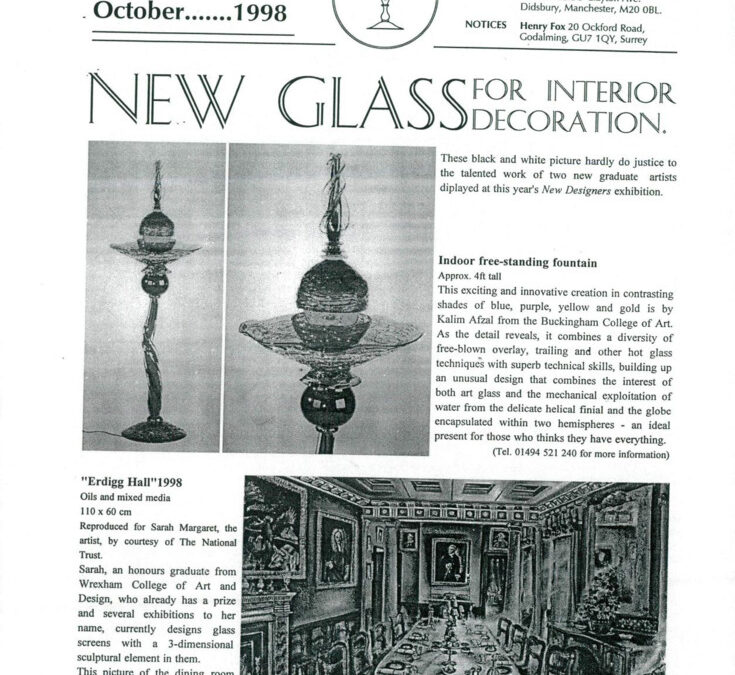
These black and white picture hardly do justice to
the talented work of two new graduate artists
diplayed at this year’s
New Designers
exhibition.
Indoor free
–
standing fountain
Approx. 4ft tall
This
exciting and innovative creation in contrasting
shades of blue, purple, yellow and gold is by
Kalim Afzal from the Buckingham College of Art.
As the detail reveals, it combines a diversity of
free-blown overlay, trailing and other hot glass
techniques with superb technical skills, building up
an unusual design that combines the interest of
both art glass and the mechanical exploitation of
water from the delicate helical finial and the globe
encapsulated within two hemispheres – an ideal
‘ present for those who thinks they have everything.
(Tel. 01494 521 240 for more information)
“Erdigg Hall”1998
Oils and mixed media
110 x 60 cm
Reproduced for Sarah Margaret, the
artist, by courtesy of The National
Trust.
Sarah, an honours graduate from
Wrexham College of Art and
Design, who already has a prize
and several exhibitions to her
name, currently designs glass
screens with a 3-dimensional
sculptural element in them.
This picture of the dining room
from Erddig Hall, commissioned
by the National Trust, shows she
is also a talented painter with a
taste for vibrant and exciting
colour combinations.
(Tel. 01978 313 7490)
GLASS CIRCLE NEWS No. 76
Page 2
1998
Editorial
New Developments at Corning
For some time now the glossy 49-page annual report of
The
Corning Museum of Glass
has been sitting on my desk.
Listing 49 full-time staff and assets of some $14 million,
excluding the collection, it brings home the magnitude of this
enterprise which
I
was able to see for myself earlier this year. It
has forty Fellows, including glass scholars from the world over,
of which Hugh Tait, our new President elect, is one. Currently
the museum is about to renew its show cases and is busily
creating
–
an innovative glass science section to the museum.
These should be complete by the year 2000 but some areas of
the museum may be temporarily closed in the meantime. Keep
an eye on their Web site for ongoing information.
Unfortunately, new showcases does not mean more shelf space
for exhibits; the imposing reference collections are literally
crammed into tall showcases and not easy to study by the
casual visitor, while fine examples of glass from the world over
are being added to the collection all the time. It is a drawback
of having a building that is an architectural showpiece in itself;
although spacious much of it is only perambulatory. A separate
shop would create more much-needed exhibition space.
Pride of place among the items acquired this year goes to a
tabletop in white marble inlaid with Hellenistic and Roman
mosaic glass interspersed with predominantly 19th century
plain yellow Venetian glass, made by Giovanni Rossignant in
Rome about 1866. The design involves a series of concentric
interlocking triangles formed by radii centred around the rim of
the table with an outer border of stars within octagons – a truly
spectacular piece. It was submitted by the papal government to
the Paris Exposition Universelle in 1867.
Of English interest is a claret jug and stopper, signed Pellatt, c.
1862, elaborately wheel engraved with motifs including a table
bearing five Renaissance Venetian drinking glasses. This
superb piece, exhibited in the 1862 London International
Exhibition, is by the same hand as the famous Morrison Tazza,
the remains of which are now in Broadfield House. In Magnif-
icent condition is an opaque white ovoid flask enamelled with a
typical hare coursing scene within a rococo cartouche, the
obverse with MATeW. Stubs Esq./1757, probably by John
Haseltine of Birmingham to whom William Beilby was appren-
ticed on July 3rd 1755. Also a Redgrave designed Water Lilly
jug made by W.H.B. & J. Richardson in 1850. Donated gifts
included two 18th century jelly glasses and a decanter, c. 1820,
given by Mrs Penrose Hawkes in memory of Penrose Hawkes,
and a Waterford 1997 posy vase presented by the Waterford
Society, New Jersey.
Unusual acquisitions include three ‘wedding baskets’ elabor-
ately ornamented with beadwork and shells; about the size of
biscuit tins, they were used to contain presents for a newly
married couple who later returned them to the owners. Another
curio is a 4th century Syro-Palestinian ‘handkerchief vase’
so-called from its method of manufacture. In 1996, Corning
Glass Works celebrated its 50th anniversary for which Milton
W. Bond created a reverse painting behind glass showing the
factory at work with delightful little cameos reflecting the
firm’s history.
The Rakow Library now lists 1054 books, 203 trade catal-
ogues, 550 auction catalogues, 83 films and video tapes and
5940 slides. A landscape, pencil on paper, by William Beilby,
1774, is one of its latest acquisitions. A new computer system
is being installed and this should benefit glass researchers
everywhere. The service is both friendly and extremely helpful;
when I popped in for a look I was immediately helped with
locating a few slides for a future lecture I had in mind.
Jerwood Prize for Applied Arts goes to Tessa Clegg
This prestigious competition for contemporary British artists in
all crafts, with a £15,000 prize at stake, was founded in 1995 in
conjunction with the Crafts Council. It goes to the best
innovative work in the last five years. The topics for 1996 and
1997 were jewellery and textiles. This year was the turn of
glass and the eight finalists, a prestigious achievement in itself,
have their entries on display at the Crafts Council headquarters
in Pentonville Road near Angel Underground station. The
selection panel was chaired by Charles Hajdamach. The eight
finalists were Galia Amsel, Lise Autogena, Tessa Clegg, Keith
Cummings, Anna Dickinson, Diana Hobson, Keiko Mukaide
and David Reekie. Of these I felt that the work of the four
stalwarts, Keith, Anna, Diana and David, all of outstanding
merit, reflected longer term development than the competition
requirement while Keiko, developing the idea of a Japanese
garden in glass, Lise, who was in the earlier
Glass, Light and
Space
exhibition and Galia all produced more sculptural rather
than applied art work. That left Tessa with a series of
technically demanding kiln-cast vases reflecting bead shapes on
a large scale. Thus the competition did not necessarily reflect
the best of British glass but on the competition rules of the
moment.
Congratulations to Tessa for exploiting an unquestionably
novel concept for a vase – “a play on function and contain-
ment”, the epitomy of applied craftsmanship. She was trained
from 1979 at Stourbridge College of Art and has a fine artistic
pedigree with shows in France in 1995 and 1996; also selection
for
Venice Aperto Vetro
in 1996 (as did all the finalists except
Lise and Keiko) which is fast becoming a benchmark for
contemporary glass achievement. Her competition work is a
radical departure from her previous involvement in “the
concept of timeless beauty”. A 30-page coloured catalogue,
costing £4.95, accompanies the exhibition which lasted until
llth October at the Crafts Council before moving to the
National Glass Centre in Sunderland from 21st October – 22nd
November 1998. Other than Keiko’s, this catalogue does
actually illustrate some of the work displayed, unlike that for
Glass, Light and Space,
and includes a challenging essay by
Michael Robinson, provocative ex-curator at The Ulster
Museum.
Charge increase for
guests at Glass Circle meetings
inevitable – but still a bargain.
The cost increases resulting in raised subscriptions have
inevitably impacted on member’s guests as well. The charge for
bringing a guest to a meeting is now £5.00 and, as always, the
Hon. Sec. must be notified in advance together with payment.
By comparison the British Society of Master Glass Painters
recently charged £13 for non-members to attend an evening
meeting with refreshments at The Artworkers’ Guild. The Glass
Circle is still the best value around.
Tunstill Collection Postcards
Marie Polly from The Friends of Chelmsford and Essex
Museum tells me that they now have two coloured postcards of
glasses for sale as well as their leaflet. These are a fine Jacobite
glass and the
“A urea Libertas”
Newcastle, possibly engraved
by Sang. All cost 35p each, plus postage, that is £1.30 for two
cards + one leaflet and £1 for the two cards alone. Extra cards,
35p each up to six for the same postage. Send cheques to
Marie at 25 Tower Avenue, Chelmsford, Essex, CM1 2PW.
Plesch collection of Chinese Glass for auction
We have just learned that the study and reference collection of
Chinese glass belonging to Professor Peter and Mrs. Trudy
Plesch, consisting of 45 pieces (lots 287-331 inclusive), is to be
auctioned at Christie’s, King Street, at 2.00 pm on Nov. 16th
1998 in their sale of
Fine Chinese Ceramics and Works of Art.
Professor Plesch, initially considering later Chinese glass
“rather vulgar” by comparison with the 17th century European
glass with which he was familiar, fell in love with a delicately
wheel-engraved pale blue Chinese bowl (lot 290) which
sparked his collection. The forthcoming sale includes glass
exhibited in the Circle’s
Strange and Rare
exhibition and
another by the Ceramic Society. Two highlights of the
collection are a rare Yongzheng diamond engraved glass panel
of c. 1723-1735 (est. £5000-£8000) and a fine large deep
purple globular bottle of Qianlong with four character marks
of the period, 1736-1795 (est. £8000412000).
1998
Page 3
GLASS CIRCLE NEWS No. 76
GLASS CLIPPINGS
by Henry Fox
“Burne-Jones”
Probably starting with the William Morris Exhibition at the
V&A, and encouraged by the Leighton Exhibition at the Royal
Academy, and the recent Exhibition of Pre-Raphaelite Women
Artists at the Manchester City Art Galleries, interest in all things
relating to the Pre-Raphaelites and the Arts and Crafts Move-
ment of the last century has gathered momentum. Of particular
interest to members will be the forthcoming important exhibition
under the banner “Burne-Jones”. Among the work on display by
this significant British Artist, and close associate of William
Morris ,will be examples of his stained glass. This exhibition,
originally at the Metropolitan Museum of Art, New York, will
be at Birmingham Museum & Art Gallery, 17 October 1998 to
17 January 1999; and Musee D’Orsay, Paris, 1st March to 6th
June 1999.
Fifties Material
Under the title “Today’s Antique is Yesterday’s Reject” the
following is quoted from
Country Landowner Magazine
(March
1998) “Fifties material has become well established over the
past decade and is fetching high prices . . .Professor (Dan) Klein
who was one of the first people to form a major collection of
1950s Italian and Scandinavian glass . . . when the collection
sold in 1983, a vase by Finnish glassmaker Tapio Wirkkala,
bought for £38, sold for £21,000. A piece by the Italian
glassmaker, Vennini which cost £500 made £25,000. The same
piece came up again in 1987 and sold for £52,000.” But, be
warned, what goes up can come down and I have learned that
such sensational prices are not currently being made and the
erstwhile collector needs to be highly selective in choosing what
to buy.
The Dragonfly Cup
One need have no such doubts about the top pieces made by
Emile Galle. This superb yellow and green but not particularly
large ornamental cup, which was formerly owned by his wife,
came up for sale at Christie’s on May 13th with a top estimate of
£150,000. On the day there was brisk bidding and the victor
carried off this prize piece for £190,000 (hammer price).
Chandelier Specialist
Yet again
Country Life
(26.2.98) provides an interesting clip-
ping. In its series “Living Treasures” it features a chandelier
repair specialist, Roland Emery, whose old family firm used to
be in Holborn, London. He now operates from Balcombe, in
Sussex. Apparently, Mr. Emery used to do work for Lord
Snowdon’s famous designer uncle, Oliver Messel. I quote
directly from the article where Mr. Emery says “I can see
something immediately and transform it in my mind. Much of
what I use for chandeliers might once have been a Georgian
scent bottle or decanter.”
Glass Urns
In the same issue of
Country Life
Asprey’s feature an advertise-
ment for an important (aren’t they always!) large glass urn with
silver tap, possibly Irish and circa 1830. Christie’s recent
“Marquess of Bute” sale catalogue contained an essay about the
purchase of such an urn, with decorative cutting and 25 inches
tall, by the Marquess. Its purchase was recommended to him by
M.S. Dudley Westropp who drew a little sketch to show what it
looked like (reproduced in Phelps Warren’s
Irish Glass, 1st
edn.
page 149). This particular urn has since disappeared and was not
in the Christie sale. Kim Mawhinney, curator at the Ulster
Museum, where they have some of the Bute collection, men-
tioned to the recent conference of The Glass Society of Ireland,
that the museum does have a similar urn to that described by
Westropp but it has a brass tap. All urns of this type, although
unquestionably a rather specialist area of interest, are now
considered important collectors’ items but if the Bute one were
ever to be identified it would be a treasure indeed.
The Glass Circle
New Members
The Circle is pleased to welcome:
Mr and Mrs T. Carlitz
Mr L. Megahey
Mrs Christine Niblett
Mrs G. Enid Phillips
Mr R. Phillips
Mr P. Whitehead
Deaths
Mrs Harwood Stephenson
We were sorry to learn from Dr Harwood Stephenson of the
death of his wife. The Stephensons were members and support-
ers of The Glass Circle for many years and collected both
English and contemporary Venetian glass of high quality. In true
Circle fashion they welcomed other members to their home to
discuss and study their collection as well as sample Mrs
Stephenson’s fine cooking. Few members now remember them
personally but are acquainted with the 18th century gavel and
case with which Dr Harwood Stephenson presented to the Circle
upon his retirement through ill health. However, we welcome
the news that he is still with us and extend our great sympathy at
his loss.
J. Anthony (Tony) Stout
Tony Stout was an American member of The Glass Circle and
although little known over here had many friends in his local
glass society in Washington from where another of our mem-
bers, Julius Kaplan has sent us this information. Tony was a
graduate of Harvard University where he received a Master’s
degree in Psychology. He was a Fellow of The Corning Museum
of Glass and had an extensive collection of fine English and
American glass, all the more remarkable because it was
assembled with minimum funds but reflecting a great eye and
depth of knowledgeD Tony was also a keen photographer and
was photographing the Kaplan collection for a catalogue at the
time of his death. He will be sorely missed by his friends in the
local Glass Circle and through Corning. The Glass Circle is
proud to have enjoyed his participation from afar as a member
and sends its condolences.
Glass Circle Web Site
Our Webmaster, Paul Newgas, reports that he has upgraded The
Glass Circle Web site which now contains recent journal
information and details of how to join as well as interesting links
to some other glass sites across the world.
If you have Internet access you can visit our site at
www.tassel.com/glass
The Glass Circle also has an email address for electronic
correspondance. Send your email to: glasscircle®usa.net
which will then be passed on to your committee by Paul.
Some other glass-related Web sites
The Stained Glass Magazine
www.stained glass.org
Art on the Net
htpp://www.art.net
Museums around the World
www.icom.org/vlmp/world-
.html
National Collectors Site
htpp://www.verzamel.net
Tiffany Glas Kunst GmbH
htpp://www.tgk.de
If you find an interesting glass site let us know.
MEETING DATES 1988-89 SEASON
Thursday
12th November
1998
All meetings to
Thursday
10th December
1998
be held at The
Tuesday
9th February
1999
Artworkers
Tuesday
16th March
1999
Guild, 6 Queen’s
Tuesday
13th April
1999
Square, London,
Tuesday
11th May
1999
WC1.
Tuesday
15th June
1999
1998
Page 4
GLASS CIRCLE NEWS No. 76
Limpid Reflections
by F. Peter Lole
Blatobulgium
what a name! I really couldn’t refrain from
starting this piece with such a rollicking tongue twister, even
though it spoils the sequence of my story.
It is a platitude that when one enjoys a pension, increasingly
one’s time becomes devoted to funerals; but just as a good
funeral is as much a celebration as a lamentation, so the travel
involved is as much an opportunity as a chore. In the first half
of this year we have been involved in over two thousand miles
of such unpremeditated travel, and thus it was that we found
ourselves at
Dumfries Museum.
It could hardly be described as
a treasury of Glass, although it is a treasury of silver by local
makers of the second half of the C.18th and the first half of the
C.19th. But some fragments of Roman Glass caught my eye, a
few pieces of
matt-glossy
window Glass, smooth on one side
and matted on the other from the casting process, and a
fragment, roughly three inches square, of a bowl; but what an
attractive bowl, with good regularly cut oval facets surmounted
by an outurned rim with with four superimposed rings of sharp
vee cutting. It was labelled as being part of a cup, but surely
from the curve of its chord it must have been 8-12 inches in
diameter. It came from the 1936 excavations at the Roman Fort
of Birrens, just to the west of the M74 motorway that speeds
you past Ecclefechan on the way to Glasgow, and was one of
the few attractive artefacts that escaped being sent off to the
national museum in Edinburgh, there to languish in the stores.
It was such a pleasing piece that it merited an enquiry at the
desk, to be rewarded with one of the last few copies of the
1975 report of the excavations at Birrens, in hard back at the
price of a double whisky; it even has a sketch of the bowl
fragment, and yes, you’ve guessed it, the Romans knew the
Fort as
Blatobulgium
When we reached our hosts, I mentioned how attractive I had
found the Glass, and what a bargain the excavation report was,
to met by the riposte
“Have you seen the report on the
excavations at Whithorn which has just been published?”.
The
question was rhetorical really, for they knew quite well I
hadn’t, so after supper it duly appeared, and it knocked my find
into a cocked hat.
Whithorn is one of the earliest Christian settlements in Britain,
the
Candida Casa
of Bede’s history, and is remotely situated in
the large peninsular that juts southwards from the Galloway
coast. The report, a very substantial work* was published in
1997, and has been in such demand that it has been reprinted
this year. It truly is a treasury of Glass, with thirty-two A4
pages being devoted to the Glass finds:
“one of the largest
groups of imported early medieval pottery and glass vessels
from any comparable Western site …. several unique vessels
and groups of vessels not found elsewhere in Britain …”.
Parts of at least six late Roman vessels were discovered, and
are discussed by Jenifer Price, but by far the most important
section is that dealing with the early medieval (C.6th – C.9th)
Glass. The vessel Glass was studied and reported on by Ewan
Campbell, whilst the window Glass was dealt with by
Rosemary Cramp. No intact Glass vessels were found; but
careful study of the sherds has led to the conclusion that at least
80 vessels, plus a haul of window Glass comparable in
importance to that at Jarrow, are represented from this early
medieval period. The majority of these vessels are cone
beakers, some 55 of these, together with 11 or 12 bowls; the
remainder are single vessels of varying types. The remains of
ten wine amphorae testify to the sophistication of the settlement
and the utility of the beakers. Many of the cone beakers belong
to recognisable groups which are paralleled in finds from other
sites throughout northern Europe, but there are at least fifteen
beakers, with sherds amongst the largest found on the site,
which have no equivalent from any other finds. Simple,
unusually thick cones, with an unworked but fire-finished rim,
whereas cone beakers normally have a folded rim. It is
suggested that these must have been made at this location.
Unfortunately no traces of any furnace have been found,
although finds of what appears to be heated and folded cullet
from similar cone beakers, together with some of the
metalwork finds, reinforce the view that there must have been
furnaces. The congested site makes it difficult to extend the
excavations to where the furnaces may have been, but it is
fascinating that we now have circumstantial evidence for native
Glass working for a period which has always been portrayed as
barren of Glass. Over the past two decades much new evidence
for Roman Glass-working has come to light, and now
apparently it seems that our glacial era may have continued
well into the dark ages.
“Oh! Let us never, never doubt,
What nobody is sure about”
Hilaire Belloc.
There were some finds of C.18th Glass, fortunately, thus
keeping this column within its remit to treat of C.18th subjects.
These were largely bottle remains and the most evocative is a
fragment of a sealed bottle, whose seal reads:
And
Adair
1777
Andrew Adair, the well to do Whithorn Minister from 1743 to
1794, is buried in Whithorn kirkyard, less than a hundred yards
from where the shard of his bottle was found.
And all this emerged, not from publicising the material in the
`Glass World’, but from a casual encounter with Blatobulgium.
However, the bibliography reveals that Jenifer Price is
preparing for the B.M. Press a work on
“Glass in Britain
AD350-800”.
From what has already been published in
“The
Whithorn Excavation”
it seems that this will be required
reading for anyone pretending an interest in early British Glass
History, although unfortunately all that the B.M. Press can tell
me is that it is not in their :forthcoming’ list up to’the end of
1999.
* “Whithorn and St. Ninian – The excavation of a Monastic
Town”
Ed: Peter Hill (1997) ISBN 0 7509 0912 9
Price £45.
Editorial comment
Excavations at Whithorn Priory have been ongoing for a
number of years and when I was there a few years back the site
was open in the summer to visitors and there was an interesting
museum display of artifacts found, as well as booklets on sale
outlining its early history. There was an unusually extensive
display of early coloured window and vessel glass, particularly
that from finely-made Saxon period cone beakers as mentioned
by Peter. An unexpected sophistication of manufacture was the
use of opaque white trailed decoration on a number of the
beaker shards, common on glass found in the Rhineland,
Belgium and Northern France but only up to the mid-6th
century after which trailing with ordinary vessel glass became
the norm
(5000 Years…
p.103). At that time, although evidence
of other trade workshops had been found at Whithorn, like
Jarrow, there was no indication of a glassmaking furnace.
Whithorn was of potentially considerable importance as a
staging post in travelling from Monkswearmouth or Jarrow to
Stranraer for the short crossing to Lame in Northern Ireland
and it is of interest as to whether early glass making was
brought into Ireland by this route. Chemical analysis of the
shards found may help resolve whether the Whithorn glass was
made by the same process as that at Jarrow involving imported
reworked low-magnesium cullet coloured by tesserae probably
made in Northern France. Rosemary Cramp did the Jarrow
excavation but Jennifer Price, an authority in the field, will be
all too well aware of this implication and her book will be
awaited with considerable interest.
GLASS CIRCLE NEWS No. 76
Page 5
1998
In from the Cold –
discussion point by Henry Fox
Without doubt British glass from the second half of the 19th
century up to the present has finally received general public
recognition with various specialist groups of collectors steadily
growing in numbers as the months go by. No longer is
Victorian glass, whether pressed or blown, disregarded; what
was, up until a few years ago, spurned is now avidly sought out
at fairs of all kinds, and auctioneers, who would have in the
past consigned much of the glass from house clearances and
deceased estates to poorly described multi-lots, now sift
through to separate out any collectable items such as Sowerby,
Whitefriars, Jobling, Webb, Walsh, Davidson, Stuart, Stevens
& Williams, Monart etc, etc.
How has this come about? Without doubt the various excellent
displays put on in recent years by museums, such as the
Broadfield House Glass Museum and the Sunderland Museum ,
both of which have substantial collections of Victorian and
later British glass, have helped to create and sustain interest.
Exhibitions are now accompanied by informative and well
illustrated catalogues, which in turn educate, e.g. the recent
publications on Whitefriars Glass by Manchester City Art
Galleries and the Museum of London . Events like the opening
of the V&A redesigned glass gallery a few years back focused
media attention on glass, especially as the V&A chose to
emphasise its later and modern glass as one enters the gallery
and Danny Lane’s glass mezzanine creation is a focal
architectural feature. Again, the revelation in recent years that
the British Museum was assembling a selection of later glass,
helped to raise public awareness and appreciation in glass of
this period. Leading up-market glass dealers such as Asprey’s
and Mallet’s have, for some time, stocked choice pieces of
Victorian and later British glass, and show their stock at the
Park Lane Hotel and Grosvenor House annual antique fairs.
This, too, has educated and encouraged a wider appreciation of
glass from this period (circa 1840 – 1980). Today there are
several knowledgeable dealers in this period; indeed, a few
specialise only in the period circa 1890 – 1980.
The twice yearly one day glass fairs at the Birmingham Motor
Cycle Museum will
be
celebrating shortly ten years in
supplying the needs of glass collectors. This fair has probably
done more than anything else to reach the public by showing
the diversity of glass, particularly 19th century and later, which
is available to the collector. It has become a Mecca for
collectors and trade alike, irrespective of their particular
preference, and the well-informed collector may even find the
occasional bargain. Its success has encouraged other specialist
one day fair organisers to devote more space to glass and so
attract a number of leading dealers to exhibit, which in turn
brings in the more serious collector and encourages new
collectors, too. Glass also featured widely in Pat Hier’s new
fair, –
Dining Room, Study and Decorative Arts.
There are
now, also, several glass specialist book dealers and these are
often to be found at the large antiques and decorative arts fairs
around the country. In response to the growing awareness of
Victorian and later glass a number of authoritative and well-
illustrated books have been published in the last decade or so
of which
British Glass 1800 – 1914
by Charles Hajdamach, and
English Pressed Glass
by Raymond Slack spring to mind.
These have created a better informed collector, and in a number
of cases probably inspired readers to become new collectors.
Further, in the last year the publicity machines of the two
premier auction houses have maximised the potential of their
respective major sales of single owner collections of later
British glass. In the February issue of the BBC
“Homes &
Antiques”
magazine there was an article with numerous
illustrations (with price guide range) on 19th century British
glass; also the weekly magazine
“Country Life”
(19.2.98)
featured a collection of 19th century glass (from Broadfield
House) on its front cover. For this quality magazine, usually
associated with genteel country and sporting pursuits, and in
particular renowned for its extensive range of estate agents
advertisements for castles, manor houses, and other stately
homes with acreage, to honour Victorian glass on it cover was
an accolade indeed! In three years time all things Victorian will
be a century or more old; they can no longer be referred to as
new antiques. Victorian glass and latter decorative items will
have come in from the cold.
This was recognised this year by the new, widely acclaimed
and successful 19th century and later decorative arts fair held at
the Chelsea Town Hall. News has also just come to hand that
Christies South Kensington and P &
0
Events (organisers of
the Olympia and Earls Court Antiques Fairs) will be
collaborating on a specialist 19th century and later decorative
arts fair to be launched in London this Autumn. Expect the
number of such fairs to grow rapidly in the next few years.
The question we might ask is should The Glass Circle
respond more positively to this trend in its selection of
lectures etc? If you have any ideas in this connection let
me know and I will pass them on to the Committee.
Glass Cutters’ Trade Cards – Further Thoughts
GLASS BUBBLES.
In my GC 75 review of Hilary Young’s article on Glass
Cutters’ Trade Cards, our Editor added a footnote concerning
the financial control of Glass-Houses; a sidelight is cast on this
comment by a mid C.18th work,
“The History of London”
by
William Maitland, published in 1756. In commenting on the
South Sea Bubble scandal of 1720, Maitland wrote: “… a vast
number of other villainous Projects were set on foot, purely to
enrich the roguish Projectors at the Expense of the middling
and poorer Sort of People. … Those vile schemes were justly
denominated Bubbles, as consisting of nothing but Air and
Scraps of Paper. … Several Persons Petitioned for Letters
Patent for carrying on: [18 different projects ].
Besides the above named Bubbles, the undermentioned [138
projects listed] were carried on without ever applying for
Patents or Charters, called ‘Little Bubbles’.”
What is of interest to us in the present context is that two or
three of these schemes involved Glass; these were:
A scheme for making Glass Bottles.
Ditto – for making Looking-glass.
Ditto – for Globe Permits.
whether Globe Permits had any Glass connection is unsure, but
these three projects are all listed together, as shewn above.
If one had come across a contemporary reference to them in
any other context, one would assume that they were indeed
genuine industrial undertakings, but as presented by William
Maitland they do seem to represent shady syndicates seeking
financial backing for questionable ventures. Taken with the
frequency with which Glass Makers’ bankruptcies are reported,
is it perhaps indicative of shadowy backers for some of the
Glass-makers who seem from their Trade Cards and
Advertisements to be independent?
Peter Lole
Editor’s Comment
I think Globe Permits may refer to the introduction of street
lighting in the 1690s as mentioned by Roy Bendrey in his
article on The Falcon Glass House Cone (GC Journal No 9)
The globes, were later called Convex Lights. Production of
these lights, probably invented by Samuel Hutchinson of the St.
Mary Overy bottle house, became a fiercely contested issue
continued on Page 7
Table 1. Mean, Range, Mean Ratio (K
2
0/CaO) and range of Ratios (K
2
0/CaO) for
constituents of Amelung and Lauenstein glasses.
Potassium
Oxide wt.%
Amelung (18 samples) Lauenstein (7 samples)
Mean
15.2
12.4
Range
10.0 – 17.9
6.3 – 15.9
Calcium Oxide wt.%
Mean
Range
Mean Ratio (K
2
0/CaO)
Range of Ratios (K
2
0/CaO)
9.2
7.0
6.4 – 11.4
4.9 – 8.7
1.658
1.776
1.178 – 1.843
1.285 – 1.952
1998
Page 6
GLASS CIRCLE
NEWS No. 76
Amelung, Lowenstein . . . and Statistics!
by David Watts
No!, those first two names in the title are not euphemisms for
the words people usually associate with statistics. They reflect
the unexpected consequence of a telephone conversation earlier
this year with my co-editor, Peter Lole, during which he
happened to remark that the upmarket remaindered book shop
near South Kensington Underground station had on offer a fine
catalogue of Continental glass. Finding myself in the area a
few days later I popped in for a look round. The catalogues had
all gone but prominently positioned was
John Frederick
Amelung, Early American Glassmaker.
Thumbing through it
my eye-fell first upon the well-known 18th century plan of a
Southwark bottle house and then a Table reporting the
chemical composition of a group of Lauenstein glasses. Why
on earth were they there? Peter had been bewailing the lack of
information about Lauenstein in a previous “Limpids” so
perhaps he might be interested. And noting that the authors,
Dwight Lanmon, Arlene Palmer Schwind, Ivor Noel Hume
(Jamestown archaeologist), and two analysts, Robert Brill and
Victor Hanson, numbered among the top American glass
experts I readily parted with £19.99 and happily left to pursue
the problem further.
J.F. Amelung (1741- 1798) came from a German family of
glassmakers, his brother having leased the Duke of
Brunswick’s mirror factory where glass had been made since
the 14th century. The firm’s fortunes declined and J.F. decided
to establish a glassworks in the New World. After various
adventures involving the attempts of scheming British
merchants to thwart the potential competition, he took over, in
1784, a factory in Frederick County, Maryland. His aim was to
make window glass and mirrors but the demand for bottles and
tableware led to their production instead and mirrors are not
known to have been made.
Amelung was rich and he poured his money into his new
enterprise to the extent that by 1790 he was running at least
two furnaces, employed a work force of 400 – 500 people and
had built a village to accommodate them. However, he had
been ill-advised as to the depth of the market and over-
production soon placed him in financial difficulties. The
American glass-import tax was raised from 10% to 12.5% in
1790, justifying British fears over the competition, but in spite
of this attempt at protection the firm collapsed and was offered
for sale in 1795. It was a tragic end to a laudable enterprise,
previously unsurpassed in America for its magnitude.
Unlike Stiegel, another early American glass maker, Amelung
produced and signed a number of presentation pieces which
provides the core of provenance for his work. As well as the
history of the factory the book details the attributed Amelung
glass and then goes on to describe the excavation (1962-1963)
of one of his glasshouses (which burnt down), and it concludes
with analyses of Amelung’s glass. The need for comparisons
with European glass houses to help the interpretation of their
findings explains the presence of the Southwark plan.
Shards from the Amelung site presented no problem for
analysis but the museum artefacts could not, of course, be
damaged. Fortunately, the Energy Dispersive X-Ray
Fluorescent (XRF) Analyser had just become available making
the non-destructive analysis of glasses possible, although with
the disadvantage that the lighter-weight elements – sodium,
magnesium, aluminium and phosphorus – common constituents
of glass made with crude wood-based potash, could not be
measured. This limited the analysis to potassium, calcium and a
string of minor contaminants but nevertheless provided
valuable information for comparison with Brill’s chemical
analyses of the recovered shards. Fortunately, it turned out that
the total sodium, magnesium, aluminium and phosphorus in
Amelung’s glass was no more than around 1% and the silica,
obtained by difference, was in the range 70-75%. Thus the
contribution of the potassium and calcium, as the only
XRF-measurable major constituents, was highly important – a
truly lucky coincidence.
For comparison, a homogeneous group of 18th century
European glasses was required and a collection of seven
fine-quality marked Lauenstein glasses nicely filled the bill. I
was pleased to see that Lauenstein glasses, in spite of their
sparkle, are non-lead as this concurred with my own finding
using the UV lamp and simple density measurements.’ Their
chemical composition is remarkably similar to that of the
Amelung XRF-analyser group and what Brill calls his “low
calcium” group of colourless shards. Differences in the trace
elements might be expected since the batch materials came
from opposite sides of the Atlantic. However, it is clear from
the low levels of sodium, magnesium, aluminium and
phosphorus that the potash used had been highly purified in
both the Amelung and Lowenstein glasses.
This brings us to statistics. The investigation was first
published in 1976 and this book is a 1990 reissue of the data.
At that time statistical analysis was not rated so important and
Brill, probably following current practice of the day,
subjectively compares the average values for the Amelung
museum group and his low calcium shards which he describes
as good for potassium and acceptable for calcium. But no
reference is made to the Lauenstein group which, after all,
might (should?) reflect Amelung’s European experience. So,
borrowing my son’s calculator, I started punching the buttons.
There is a considerable misunderstanding about statistics so it
should first be explained that they do not prove anything. In
this case they tell us, for two groups of similar numbers, as
here, the probability that the calculated average (mean) value
for each group is the same or whether this has occurred by
GLASS CIRCLE NEWS No. 76
Page 7
1998
chance. The accepted probability is that if two such groups
were analysed on 100 separate occasions, then they would be
considered the same if no difference was found 95 times out of
the 100. Put the other way round, the statistical test predicts
that if the measurements of the two groups only differ
significantly on five randomly occurring occasions out of 100
trials, then they are considered identical. The variation is
attributed to experimental error. If only one in 100 such trials
would differ significantly then this 99%
confidence level
is
considered very compelling indeed.
Table 1 suggests by a simple inspection of means that the
Lauenstein glasses contain less potassium and calcium oxides
than the Amelung glasses. By using Student’s “t” test
2
this is
confirmed for potassium at the 95% confidence level and for
calcium at the 99% confidence level. However, the
mean ratio
of potassium to calcium in the two groups of glasses is
identical at the 99% confidence level. Thus statistics is telling
us that in spite of the. differences between the individual means
for potassium and calcium the two batch formulations are
identical in this respect but that Amelung was using rather less
sand, as the only other major constituent, than used in the
Lauenstein glasses.
Brill calculated that for the Amelung glass the batch ratio for
potash to lime is 2:1 by weight with about 5 parts of sand. The
ratio from Table 1 is closer to 3:2, but this is for the oxides in
the glass. For a batch made of potash and lime these would
give a ratio of 22.31 : 9.2 which is roughly 2:1 as stated by
Brill. However, if the batch were formulated from potash and
chalk, as is more probable for a glass based on continental
practice, the ratio would be 22.31: 16.4 which gives a ratio
closer to 3:2. The corresponding potash : chalk ratio for the
Lauenstein batch is 18.2: 12.5, almost exactly 3:2. This is an
interesting illustration of the assumption that the old
glassmakers liked to work in round numbers if they could.
A possible explanation for Amelung’s choice of using rather
less sand is suggested by the bubbly nature of a number of the
glass shards found during the excavation of his glass house. It
would seem that Amelung was having some difficulty in
getting his furnace hot enough fully to refine the glass; 75% of
silicon is a particularly high value. A simple expedient to
overcome this problem when making his best glass would be to
add a little less sand to lower the melting point of the batch.
As with all such analyses there are a number of qualifications.
First, Brill found a distinct group of amber and green Amelung
shards with less potassium and more calcium in them – the
reverse of the above. The colour appears mainly to be due to
the presence of iron. Hence it should not be assumed that only
one formula existed for Amelung’s glass. Second, Brill found
that while he had good agreement with some of Hanson’s XRF
data there were significant discrepancies and, of course,
scientists are not happy to concede inaccuracies in their
methods. (This statistical analysis has used exclusively
Hanson’s XRF data because there was no chemical analysis for
the Lauenstein group.). However, it does highlight the
importance of statistics which function to overcome just this
sort of variation that would otherwise obscure important
aspects of their hard-won results.
Notes
1.
Early on in my collecting days I was fortunate to acquire
two marked Lauenstein glasses (one with an engraved lion and
one engraved with a “C”) on which my measurements were
made. Although it was easy to show the absence of lead it was
assumed that the glass was a potash crystal and it is gratifying
to have this demonstrated here. These glasses are illustrated in
Antiques: Traditional Techniques of the Master Craftsmen
(Ed.
by Elizabeth Drury) for which I wrote the sections on glass and
enamels. It was republished in 1997 for distribution through
remaindered book shops and the two Lauenstein glasses are
illustrated on the dust jacket.
2.
Student (the name of the author) devised the “t” test for
groups of measurements (called parametric) that scatter
normally about the mean value. That is, given enough
measurements, equal numbers occur above and below the mean
such that if plotted on a graph a symmetrical bell-shaped curve,
with the mean value at the apex, is obtained: Scatter due to
experimental variation, both in formulating the batch and in the
scientific analyses of the glasses, are assumed to follow
parametric statistics because there is no reason why any one
measurement should be consistently higher or lower than the
true value. This relationship is crucial for the reliability of the
“t” test.
Trade Cards continued from page 5
(outlined in
Early History of Street Lighting,
1941, Guildhall
Library) involving bribery, corruption, forceful coercion and
considerable sums of money invested by as many as 32
patentees who expected financial reward for the £25,000 to
£32,000 estimated to have been invested in their production.
Hawley Bishopp, who took over Ravenscroft’s glass house was
involved in a similar scheme for the the production of street
lighting globes that involved a large number of shareholders.
The names of the more important ones are listed.
Possibly of more direct importance in relationship to the trade
cards are the activities, in 1691, of Robert Hookes Esq. and
Christopher Dodsworth who set up a glasshouse in Woolwich
by raising capital of £7,300 and appointing a committee of
management from the shareholders (Chalklin C.W.
Seventeenth
Century Kent,
Longmans, 1965 p. 149). “Next year (I quote) in
April 1692 the committee doubled the number of shares to buy
out (partly by grant of shares and partly by cash) the owners,
all Londoners, of a glasshouse in Southwark making plate and
window glass, two others in Southwark making flint glass, and
another manufacturing green glass at the Minories outside
Aldgate.” The Woolwich glasshouse involved the takeover of
that established by Mansell and run by the Hensey family at
least until 1691 and probably until it closed in 1701. The
Southwark glasshouse making windows was, of course, The
Bear Garden, and was the reason Bowles moved his Crown
glass manufactury down river to Ratcliffe. The other two
Southwark glasshouses, probably the Falcon glasshouses, do
not feature in our current considerations but the Minories
glasshouse mentioned could well be the Green Yard Glasshouse
for which the trade card exists.
The objective of Hookes and Dodsworth was completely to
take over the London glass making industry which by now had
become so expensive to fund that it was beyond most rich
individuals and could only be run on a shareholding basis.
Whether or not this particular monopoly attempt, some fifty or
more years before the trade cards under consideration were
produced, was successful and whether or not the Whyte Friars
Glass House (the matching trade card to the Green Yard Glass-
house) featured in the takeover is immaterial. The point is
clearly established that more than one glass working
establishment, run by a syndicate on a shareholding basis, had
become firmly established in London by the beginning of the
18th century. The committee of management might be expected
to be involved in promoting the enterprise, perhaps with a
stylised glasshouse as depicted on the trade cards – an early
example of a logo – to link their glasshouses together. Whether
this extended to regulating the design and scope of the objects
produced is a matter for further research.
1998
Page 8
GLASS CIRCLE NEWS No. 76
A New Gallery for the Pilkington Collection
by Ian Burgoyne
The “Hotties”, the name given to a short strip of water which
was formerly part of the Sankey Canal of 1757 – also known as
the St Helens Canal – was used by Pilkington plc to provide
cooling water for the nearby sheet works. This resulted in water
becoming relatively warm, hence the derivation of the “Hotties”.
Close to this canal stands the Old No. 9 Tank House, a Grade II
listed building of the former Jubilee Sheet Glass Works owned
by Pilkington plc. The Tank House with its impressive truncated
brick-built cone was built by Pilkington in 1887 for manufactur-
ing cylinder glass for use in windows and other flat glass
applications. The building housed the earliest remaining exam-
ple of a tank furnace using the Sieman’s regenerative principle
for melting glass ready for forming.
The Tank House and surrounding land has been extensively
excavated by the Lancaster University Archaeology Unit to
reveal the foundations of the furnace and flue structures clearly
demonstrating the regenerative principle. This work has only
been possible with the aid of generous grants from a variety of
sources including English Heritage, other government funding
and Pilkington plc. The “Hotties” Science and Art Centre Ltd
was created in 1991 to organise the excavation project and
develop the whole site into a new visitor attraction. It planned
that the Tank House will remain as an archaeological site with
appropriate interpretation and displays.
A major development will be a new building to house the
Pilkington Glass Museum Collection and appropriate exhibits
from the St Helens Museum Collection. The name of the new
centre will be “The World of Glass”. Within the new building a
purpose built gallery will be provided to accommodate the
Pilkington Vessel Collection together with appropriate exhibits
from the St Helens Museum Collection. The main themes for the
new gallery will be the historical development of the crafts and
techniques of glass making and the evolution of furnace
technology. The Pilkington Vessel collection was acquired to
illustrate the evolution of glass making crafts and techniques.
Typical subjects to be covered will be core forming, blowing
and moulding, the development of coloured glass, decorating
techniques and the combination of techniques used by artists to
produce contemporary glass.
Within the new gallery it is planned to explore the archaeology
of furnace technology to show the evolution of charcoal
furnaces, wood furnaces, coal furnaces and regenerative fur-
naces. Further research will be required to link in the themes of
social strata, changes in fashion, commemoration and religious
influences etc.
The visitor centre will be a very creative development requiring
a capital funding of approximately £15 million and when
completed will provide a unique experience for visitors to the
North West and St Helens, in particular, where glass making has
been an important industry for more than two centuries.
Editorial Note.
This article first appeared in
Verre
vol. 2,
Nov/Dec, 1996. and is reproduced with the author’s permission.
Since then, further financial support from the Lottery Grant
National Arts Fund has been awarded to the project and
The
World of Glass
is now well under construction and is proposed
to open in the year 2000. Its total cost is similar to that of
The
National Glass Centre
and, if that is anything to go by, this
should become a very major addition to the display and
promotion of glass history in Britain.
Ian Burgoye, Curator of the Pilkington Glass Collection – a
member of The Glass Circle for many years – has now retired
and the mammoth task of transferring and displaying the
Pilkington and St Helens Museum collections in their new home
has fallen on the shoulders of Joanne Howdle from the St Helens
Museum. All glass lovers will be delighted that this fantastic
collection, formed mainly through the skill and knowledge of
Howard Phillips, to whom it also stands as a memorial, and
endless financial support from Pilkington plc, is to be preserved
intact for posterity. Most of the other favourite displays from the
Pilkington Museum, including the submaring periscope and the
lighthouse lantern, will also be incorporated into the the new
centre where it is hoped that more space will be available for
what had already become an overcrowded collection. The
existing Pilkington Museum will close either at the end of this
year or early next year so members with a nostalgic fancy to
take a last look at an important phase of British glass history
please note.
Clippings goes North
by Henry Fox
When I arrived in Sunderland – what a revelation! The old
industries of shipbuilding and glass making may have gone, but
then so had the inevitable sadness and depression which
overtakes areas affected by major change and recession. We all,
at times, hanker for the past, but as a first time visitor to this area
I was struck by the pleasantness of the town centre and the
feeling that there appeared to be more than an inkling of local
well being and hope in the future. The Wear estury for so long
the life blood of the town with its great shipyards and docks has
been transformed. Land has been reclaimed; grass sown and
trees planted; riverside walks set out with what I consider to be
the best modern civic sculpture and metal work I have seen in
this country; a University built on one bank with good
accommodation blocks on the other; an attractive marina for
small craft with basin side flats and houses; but most importantly
– and the reason for my visit – the new National Glass Centre,
had just been opened.
This is a shining modern building, yet blending with its two
slender metal ventilation towers or chimneys into the townscape,
set along side the University and immediately overlooking the
river and adjoining the riverside walk. As one would expect,
glass has been extensively incorporated into its structure, most
notably the roof. The architects have made the roof a special
feature in that it is composed of both large opaque and
transparent areas. It is a strange experience to be in the
somewhat upmarket restaurant area (incidently the only eating
area) and look up to see people casually walking directly above
you, or to be on the flat open roof and look down on various
working areas within the building. You know that the glass has
got to withstand your weight and the weight of others near you,
but it is a little unnerving at first, especially as you are looking
directly down some 50ft or more. Apparently the roof should
easily withstand some 14000 people on it, but already vandals
have tried to smash their way in like Eskimos breaking the ice
except that Eskimos do it to survive (hunting and fishing) whilst
these vandals do it for the “fun of it”. I was told that the roof is
an official open space and consequnetly is never closed. This
means that cyclists, skateboarders, dog walkers etc wander
freely at all hours. The interior of the centre is bright and airy
with four main areas, plus restaurant and a small conference
room called “the Pod”, which is suspended half in and half out
the building above part of the restaurant area. There are two
large exhibition halls; a sales area with an extensive display of
contemporary glass and some glass related books; and a glass
making studio in continuous operation and a decorating work-
shop area providing facilities for visiting glass makers; lamp-
workers; engravers and the like; and stained glass designers. The
whole of this last area provides visitors with visual experience of
the different processes, and for group visits hands-on experience
exercises can be arranged (in advance) under the supervision of
craftsmen. Whilst I was there it was good to see so many visitors
on the premises and to note their keen interest in seeing glass
techniques caried out and objects being made.
>>
GLASS CIRCLE NEWS No. 76
Page 9
1998
The Centre’s opening exhibition (free) covers post war studio
glass development in Britain, including engraving.
I
found this
large display very exciting, showing as it did such a range of
innovative experimental work, using a wide vareity of techniques.
However the permanent exhibition (charged) under the title
“Kalidescope” was a real fun experience – imaginatively pre-
sented to appeal to young and old alike. Firstly you had the
history of glass and how it came to England graphically displayed
with emphasis on the part that the Sunderland area played, but
then you moved on to an exciting range of “find out for yourself”
exhibits. These were concerned with teaching you the properties
of glass and the use of glass in its many forms today. It was both
fun and informative – there were even distorting mirrors! The one
exhibit that really facinated me was sand going into an hour glass
shaped area encased within a large flat circular disc. As the sand
filtered through it was creating desertscapes, firstly sand dunes
and then building up to pyramid effects in the lower bowl, which
when all the grains of sand had been accumulated, the whole disc
slowly and automatically turned upside down so that for one brief
moment the sand became level before the disc came to rest in its
inverted position, and the cycle repeated itself recreating once
again its dunes and pyramids. I found it quite hypnotic.
The Centre makes only a passing nod at glass history ; its aim
appears to be to present the here and now with a glimpse of the
future. Members should certainly put the NGC on their list of
places to visit. It is of course early days, but hopefully, given the
enthusiasm currently being generated for the success of this
project, the NGC will go from strength to strength to become a
major influence on people’s perception of glass in today’s world.
I am looking forward to going back, in say, five years (or sooner)
and being just as thrilled and pleased with my visit. (PS – should
you decide to walk along the riverside path towards the marina to
admire the clever sclupture works and artistic metalwork you
must go into the Maritime Activities Centre and ask at the desk to
view “The Tufa”! This attractive curiosity was uncovered when
construction began on the site; it is one of the larger and finest
examples in England. Admission is free – 24 hours a day. Around
at the side of the centre is a welcome coffee shop. Continue to the
end of the jetty and you will see sculptural plaques and more
exciting metalwork.) Also nearby is St Peter’s church dating back
to Saxon times where Benedict Biscop (now the Patron Saint of
glassmakers) brought over the first glass makers from France and
a small window of these early fragments is on view among other
interesting artifacts.
I
took the opportunity to visit the Sunderland Art Gallery &
Museum, which has an excellent permanent display of local glass
from the Greener and Jobling factories among others. Also on
show was a selection of glass by Hartley Woods, which closed a
short while ago. I very much coveted a small stained glass panel
of a rural scene – the quality was superb. Some members may
recall that a few years ago an important Art Nouveau Glass
exhibition, including royal loans, was held here. Behind the
building is a municipal park where
I
found a fine floral display
trumpeting the opening of the National Glass Centre. I found the
town library which was exhibiting contempary art glass, based
largely on parts of the human form, in the top floor gallery.
Whilst
I
can appreciate the skill and sometimes the significance of
the “art” of this genre produced by today’s studio glassmakers, I
find that it does not fit easily – if at all – into my domestic scene,
but then perhaps the artist envisages the work in a modern public
setting such as a shopping mall or the reception areas of a modern
office building, or in the expanse of a modern apartment in a
warehouse conversion. The library shop had on sale several
one-off pieces of more convential modern glass.
Members thinking of visiting this part of Northern England
should also include the Laing Gallery in Newcastle with its good
collection of 18th century Beilby enamelled glasses, and exam-
ples of later glass from local factories. Also The Shipley Museum
in adjacent Gateshead always has a worthwhile exhibition on
view – a few years ago it staged the very successful major
Davidson exhibition. At the time of my visit this year there was
only a limited glass display. There were interesting examples of
pressed glass plus what was totally new to me: examples of
Sowerby in a pinkish/pale red flint glass.
I
would be interested to
hear if any member has examples of Sowerby in this colour, and
how easy they were to find.
No visitor to North East England should miss the chance of
going to Durham.
I
only had time to see its famous ancient
cathedral with its many important tombs, including that of Bede,
which is to be found in a truly light, bright and cheerful chapel,
its windows containing roundels and squares of ancient stained
glass reset within large areas of leaded clear glass. They were
facinating as well as contrasting the other windows in the
cathedral with their deep and majectic hues. The cathedral also
has a fine modern and contemprary stained glass windows
including one by Mark Angus with a styalised depiction of The
Last Supper (immediately above and slightly to the left of the
entrance as viewed from inside.); Mark recently gave a lecture at
a joint meeting of the Circle and the Contemprary Glass Society.
Around the Fairs
with Henry Fox
Sadly I was unable to make the Motorcycle Museum for the May
glass fair, but another member, Mr. B. Scheer kindly offered his
view of this twice yearly event, and here it is.
“The glass enthusiasts year seems to be divided not by the
seasons but by the two fairs that are held in the late Spring and
Autumn at the
Birmingham Motor Cycle Museum.
To a very
inexperienced visitor the concept of three rooms dedicated to
glass of all ages and a hoard of people whose interest lies
specifically in glass is mind blowing. The diversity of items and
general atmosphere of the fair not only excites but also expands
dramatically the knowledge of the relative beginner.”
“So it was at the fair held on May 17th. The queue of enthusiasts
waiting for the fair to open at 9.30 am, that seems to get longer
each time, was followed by the usual controlled frenzy to get to
the waiting bargain first. This was familiar ‘enough as was the
difficulty of deciding where to look first. There were approxi-
mately 90 dealers, including several booksellers, although one
had the overall impression that there were fewer dealers who
were exhibibiting the more unusual balusters and fine balus-
troids. The fair followed the large, nearly two week long,
Buxton Fair, and many dealers said that they had been “cleaned
out” or were exhausted by Buxton. Even William MacAdam,
who was in his usual spot with a depleted but beautiful
collection of early balusters, complained that he was looking
forward to going home. Jeanette Hayhust showed a wide range
of glass including several attractive balustroids.”
“My wife and I were pleased to see John Stallybrass, a member
of the Circle, exhibiting a varied collection of glass as it seemed
that – in contrast to previous fairs – there were few familiar
faces.”
“Toddy lifters seemed to be in vogue and several dealers had a
number of unsusal specimens. Prices however varied greatly and
it seemed to me that they did not always reflect the quality of the
specimen.”
“I have to admit that although Art Nouveau glass is not my main
interest the crowds surrounding the tables displaying Galle,
Daum and Lalique seemed larger than ever. Although we came
away empty handed it was, as usual, worth the journey.”
However I did attend the London June fairs. First, the new
one-day only glass fair at the
Commonwealth Institute
in
Kensington High Street (next to the entrance to the lovely
Holland Park). A wide variety of glass was on display, but in no
way does this fair compare to the breath and size of that in
Birmingham. Shirley Warren displayed probably the largest
single group of 18th and 19th century lacemakers lamps and
other open flame lamps ever seen for sale (a sight unlikely to be
ever repeated) alongside copies of Prof. Kelsall’s book on this
specialised subject. Several fine examples were quickly snapped
up, including a very rare open lamp on an opaque twist stem on
a wide folded foot. Shirley told me that The Corning Museum
continued overpage
GLASS CIRCLE NEWS No. 76
Page 10
1998
Round the Fairs, continued
had expressed interest in the extremely rare early six spouted
guardroon-moulded lamp from the Kelsall’s collection but it had
already gone into a private collection. It is always good to be
reminded that wine glasses were not the only items being made
in 18th century glasshouses. Indeed, the variety of domestic
glass made in this period often comes as a surprise, as does the
quality and lower price when compared to some quite ordinary
drinking glasses.
Upstairs, were to be found Jeanette Hayhurst, Brian Watson,
Andrew Burne, Nigel Benson and John Stallybrass, offerring
18th and 19th century drinking glasses, although the last two
named dealers had on display only 19th and early 20th century
glass including, in one case, continental pieces. I particularly
admired on John Stallybrass’s stand, a decanter jug and stopper
finely engraved by Joseph Keller at Stevens & Williams; the
design for this piece was illustrated in the Sotheby sale catalogue
of the Royal Brierley Collection/Honeybourne Museum earlier
this year. Nigel Benson’s speciality is mainly glass between the
Wars as well a selection of Whitefriars. He had the only example
of a Stuart enamelled glass as far as I could see. Brian Watson
showed me a complex opaque twist stem which had been
identified as a rare triple series; this was very exciting as it
varied distinctly from the form usually seen (if one’s lucky).
Jeanette Hayhurst had some 18th century glasses and quite a
number of good decanters and late 19th century Whitefriars
pieces, as well as an excellent pair of tall Sowerby Queens Ivory
ware candlesticks made specially for Mortlocks of Oxford
Street, copied after the china creamware candlesticks produced
by by Royal Worcester in 1875-6 (See
English Pressed Glass
by
R. Slack p. 62). Interestingly, a china pair of these turned up at
the International Ceramics Fair a few days later! Andrew Burne,
on the other hand, had a variety of early 18th and 19th century
drinking glasses, some in small sets, as well as several sulphides
by Apsley Pellatt in the form of medallions and scent bottles.
Dux Antiques of Bath, as well as 18th century drinking glasses
and another lacemakers lamp of the traditional early 19th
century tall handled form, had an amusing and unusual item – a
glass axe, probably mid to late 19th century. A North Country
dealer (always on the first stand as you go in at Motorcyle
Musuem) had the best selection of Sowerby’s much sort after
nursey rhymne pieces that I have seen for sometime. Nearby was
an interesting and varied collection of Carnival glass brought up
from the West Country.
Back to the ground floor where our Circle member, from the
Sweetbriar Gallery, who specialises in paperweights„
was
showing her usual high qaulity 19th and 20th century range,
while Raymond Slack was doing brisk business in glass related
books. I was both pleased and surprised when he informed me
that the demand this time was for the older reference books on
18th century glass –
I
saw copies of previous issues of the GC
Journal being avidly browsed and purchased! Ray Slack and
Shirley Warren are the Glass Circle agents for our publications.
I must thank the organisers for once again letting me stick up
notices about the Glass Circle – I hope members who visited this
fair noticed? (Even if only to comment on the
deliberate
spelling mistake – it comes from my typing with crossed
fingers!) To sum up I think this fair could settle down to become
a regular glass-only feature for London; in time it may attract
more dealers as well as possibly a greater variety of contempo-
rary glassmakers and those doing stained glasswork. I found it a
pleasant and rewarding day out offerring something for everyon.
I even saw other well known non-exhibiting glass dealers
scouring the stands for stock – and finding it.
To do justice to the new one-day glass-only fair at the
Commonwealth Institute
I
decided not go to Olympia that
Sunday, but went the following Wednesday and made a whole
day of it. Like the NEC fairs there is much to see, but at
Olympia
the quality is so much better and quite a number of
exhibitors are from overseas. Sadly, the amount of 18th century
glass seen this time was less, and will probably become even
lesser after Gerald Satin retires from 24th June. Mark West was
showing an attractive stand full of 19th and early 20th century
glassware, some in suites and largely engraved, but 1 saw no
18th century glass this time. It is always difficult for a dealer to
balance his stock when he has to be showing at two major fairs
which overlap – in this case with Grosvenor House. Alan
Lineham was displaying in the gallery area a truly magnificent
range of colourful British and Continental glass from the 19th
and early 20th century, including a number of those elusive
cheroot holders. Carol Ketley had her usual stock of mainly clear
glass period decanters, jugs and water sets, etc. Early drinking
glasses were noted only on Gerald Satin’s stand. I particularly
admired an Irish serving bottle with flute moulding around the
base, engraved “Claret”; an attractive engraved ale glass with
fine gauze spiral opaque twist stem; and a pretty centre knopped
facet cut wine glass with waisted, ogee bowl delightfully
engraved with flower baskets on trellis cut bases. This stand also
had a good selection of the “Bristol” glass in green and
aubergine. Coach House Antiques, which comprises four dealers
in the decorative arts, largely of the 19th century, were showing
a sizeable selection of pieces by Varnish & Co. including the
notable example decorated with the Prince of Wales Feathers
sold last October in the Parkington Collection.
A number of furniture stands had 18th and early 19th century
glass on show to complement their displays – mirrors, table
lustres, chandeliers, reverse paintings on glass etc . On one I
spotted an unusual large moulded metal (iron sheeting) oblong
box with sloping sides, brass handles, and on low brass feet,
which had applied narrow plate glass panels with frosted reverse
vine moulded decoration fixed as an almost edging to the lid.
The dealer agreed that if it had a liner then it might well be a late
Victorian wine cooler, but otherwise he was unsure of its exact
use in the past, although he initially thought it could be a coal
scuttle. I still think that the vine motif makes this unlikely and
that the use of glass as a decoration to the lid only confirms this.
Has any member come across similar decorated metal domestic
items with any heavy glass panels attached? One of the joys of
going to fairs is seeing (and discussing with the dealer) curious
items; and the more so if glass is involved. One should never go
with blinkered vision, otherwise one can miss so much of
interest.
As you might expect glass of the art nouveau period was in
evidence. I coveted a beautiful tall vase decorated with large
plums, signed “Galle”. This stand also had a large turn-
of-the-century Continental model of an elephant in a carnival
ware type finish of goldish-reddish brown, which I was told was
designed to be a flower holder (although I thought it could easily
have been better used as a hat pin cushion holder; somehow I
could not envisage flowers of any kind coming directly out of
the back of this elephant. However, this interesting object was by
Loetz and priced accordingly! On another stand I saw an
amusing Victorian biscuit barrel with the silver plated lid
moulded with a pug’s head and the body of the dog made of
thick clear glass. To anyone interested in the Victorian revival
period of stained glass, exemplified by William Morris & Co.,
Whitefriars and others, I recommend they should always make a
bee-line for Rachel Moss. This time she not only had her usual
range of original art work for various church windows etc, but
also an original stained glass panel designed by Burne-Jones and
used as a work sample in the William Morris showrooms. (This
dealer held the special Burne-Jones exhibition in London before
its move to Birmingham – see page 3).
Next day was Press Preview of
The International Ceramics
Fair
at the Park Lane Hotel. As ever this turned out to be a very
pleasant privilged experience, but sadly, the quantity and breath
of glass was not as in the last fair; but this is in no way a
criticism of the exhibitors who, each to their field of specialisa-
tion, had wonderful items on show. Three exhibitors were not
present this time: Christopher Sheppard with his extensive range
of choice items from Roman to mid-20th century, Frides Lameris
of Amsterdam with his superb 18th century and earlier examples
of Continental glass and, more importantly, those magnificent
examples of stiple engraving by the great masters, and Asprey’s
who were at Grosvenor House only. However, Delomosne’s were
displaying a fine very large goblet poplychrome enamelled with
the arms of the House of Orange and a butterfly on the reverse
under which was the all important words
Wm Beilby Fecit.
This
1998
Page 11
GLASS CIRCLE NEWS No. 76
glass had been seen on the market twice before in the last twenty
years or so, but its quality and rarity was destined to make it a
show stopper – which it was. This handsome piece is probably
the largest of the known Beilby enamelled drinking glasses. Also
on this stand, among a good selection of other interesting 18th
century glasses, was a rare engraved glass with royal arms
flanked by trophies such as flags,cannons, swords and drums
and on the reverse with entwined initials
“GR”
under a crown
with
“God Save King George”
around the rim of the bowl above
the arms and
“the 2”
beneath, probably celebrating the cornona-
tion of George II. Several good gilt decorated green glasses were
On show as well as an overall facet cut blue decanter and stopper
and some plain “Bristol” type wines and choice pieces of late
18th century tableware such as dishes and bowls. Next door was
Malletts with more 18th century glasses, including a rare captain
glass, a large lidded tumbler engraved “Grog”, and several
Beilby enamelled monochrome examples. In the past few years
Malletts has expanded its interest into high quality later 19th and
up to mid-20th century glass; a selection of this was on show
too. Malletts also at. this time exhibit at Grosvenor House. A
short distance away was to be found a newcomer – Namara
Antiques whose young management team was formerly with
Asprey’s. Here were to be seen several good mid 18th century
drinking glasses as well as a particularity fine shallow-cut large
tumbler engraved with the royal arms of Prince Frederick
Augustus, Duke of York. A truly sparkling substantial trio of
heavily cut serving dishes and covers of superb quality could not
but catch one’s eye. Again, only a stroll away , but at the back,
was Leo Kaplan of New York showing once again a glorious
display of radiant colour created by the highly important
examples of Webb’s cameo work, including a fine Northwood
vase, as well master works by Galle, Rouseau and Legras. There
was a case of fine French paperweights which also included
wonderful examples in
pate de verre
by Almeric Walter. Mr.
Kaplan was most gracious in getting out some of his treasures
for me to examine. I had no idea how heavy the pieces by
Rouseau were; no wonder Rouseau’s pieces are often found
mounted on ormulu stands. Nor had I appreciated until this visit
the clever overall engraving treatment of the surface to provide
some of the effects. This is not that readily seen unless the item
is in the hand. My thanks once again to Mr Kaplan. Jonathan
Horne, early pottery specialist, was showing fewer early glass
wine bottles this time, but the few rare examples on display were
a pleasure to see. It would seem that mid-17th century to early
18th century bottles – whether sealed or not – are now very
scarce and difficult to find. It is well worth looking at the china
dealers stands as occasionally glass will be spotted. This year
was no exception in that I saw a few English and continental
examples of glass items on one stand, and some very attractive
floral, colour painted opaque Victorian vases on another. A
specialist dealer in Chinese items from New York had several
examples of period glass, including some in the much admired
“Imperial yellow”. Modern glass was represented on the stand of
Adrian Sassoon. The virtuosity and freedom expressed in
today’s studio glass cannot but attract attention as works of art
and technical skill as the display on this stand confirmed. My
thanks once again to the fair organisers for my press invite on
your behalf.
In the afternoon I went to
Grosvenor House.
Here Mark West
was showing a good range of mid to late 18th century drinking
glasses along with some attractive good engraved Victorian and
continental glassware. The highlight on the stand was a tiered
pyramid of 18th century matching ta77as, colourfully arrayed to
make an eyecatching table centrepiece. Malletts were showing
their glass separate from their main furniture stand, again with a
fine selection of 18th century drinking glasses. I particularly
liked a bucket-bowled plain stem goblet or large wine – it was
simple, elegant and dignified. Asprey’s stand had a very limited
show of fine quality glass, mainly cut and engraved tableware. I
was told that glass for collectors may be returning to Asprey’s
shortly, but I suspect that the changes which this group is
currently undergoing have yet to be fully resolved. (I have since
learnt that Aspreys will be concentrating on fine period late 18th
century and 19th century tableglass, and this can be now seen
displayed to advantage in a large any first floor room; drinking
glasses for the collector have been discontinued.) An excellent
selection of antique mirrors, chandeliers etc were to be seen
around the furniture stands, along with some decanters and
rummers. On one such stand
I
coveted a pair of “Sunderland
Bridge” decanters. I noticed a glass table on one stand and was
intrigued to learn that this modern piece was in fact made by the
daughter of the lady assisting on this stand. (In my ignorance I
had enquired if it were by Danny Lane as the table resembled
closely his work and he was the only glass artist that I knew by
name who created glass furniture.)
All in all a very satisfying day – taking in two world class fairs –
viewing and handling a wonderful range of fabulous glass.
These two fairs present annually the finest examples of what’s
available for the most fastidious collector, but do not be put off,
quite a few items are very affordable, also its a pleasure and a
learning experience to see and handle the best in the market
place.
August saw two further major fairs where glass was well
represented.
The Antiques for Everyone Fair
at the NEC
Birmingham was a pleasant surprise this time. First, it seemed to
be better ventillated, and second, the guest stand had been
allocated to Broadfield House Glass Museum. Based on the
maxim “if you’ve got it, flaunt it”, the museum provided a
magnificent show of the best of British glass, covering the 18th.
19th and 20th centuries. I particularly liked the mauvish-
coloured small cruciform decanter bottle (extremely rare, if not
unique) and a good interesting “Cyder” glass, the engraving
similar to that on a glass seen last year at an exhibition in
Guildford. Here, too, were the only Sowerby nursey rhyme
pieces, including an atttractive “multiplication” posy vase. The
display was well sited and visitors could walk all round the area
and look at the glass shown from all angles. By limiting the total
number of items on display, the museum certainly created a
great amount of interest. To me this stand was the highlight of
my visit – other dealers could not compete on the range and
excellence of the glass displayed. This is n’ot to say that good
glass was not at the fair, because it was. William MacAdam had
an extensive collection of all types of 18th century glass,
including a fine knopped baluster ale, a cider glass, and several
interesting hollow stems; in contrast on the adjacent stand of Lin
Holroyd was a selection of 19th century table glass, including
some coloured glass. Jeanette Hayhurst, as well as her usual
selection, was showing an attractive Rousseau piece in clear with
red and black areas, the whole body closely engraved
all
over. It
is not often that Jeanette strays from the British
path but when
she does the quality of the piece is paramount, and so it was
in
this case. Brian Watson, Ged Selby, and Bell Antiques were
showing a variety of 18th century drinking glasses as well as
later glass. Carol Ketley was showing 19th century glassware,
mainly ewers and decanters. Amherst Antiques had a good
showing of Cranberry ware. Glass by Galle, Daum Freres,
Lalique, Moser and LOetz were to be seen on specialist stands
covering largely the Art Nouveau and early Art Deco periods.
The fair seemed more spced out this time, and certainly there
appeared to be fewer exhibitors.
A week has gone by and it is time to visit Earls Court for
The
Great Antiques Fair.
Clutching my press invitation I was able
to get in earlier and avoid the long queues which always seem to
form on opening days. I am able to get round quickly before the
rush of eager bargain hunters, but I know that I shall see several
of the dealers who were at the NEC the previous week.
However, I know too, that dealers like to keep something back
for their next fair. Like the NEC fair, this one is divided into two
sections, which in this case are “Chelsea” and “Fulham”. The
Chelsea stands are at the front, and here I went straight to
Jeanette Hayhurst’s stand. Several fresh items caught my eye,
notably a fine cut glass ewer and two goblets made by Benjamin
Richardson for the 1851 Great Exhibition, a fine clear blue
Whitefriars “Comet” bowl, and a good Stevens & Williams
“Cactus” decanter with slice cut stopper designed by Keith
Murray. There was also a green glass bowl decorated with Koala
GLASS CIRCLE NEWS No. 76
Page 12
1998
Bears by Bagley, a maker who is becoming better known and
now sought after by collectors of later glass. Among the 18th
century drinking glasses on this stand was a good selection of
airtwists, including a number on composit stems as well as a fine
cordial glass with mercurial twist stem and domed foot. Next I
found another of our trade members, Christine Bridge, who had
several good examples of Irish bowls, both turn over rim and
boat shaped, attractively cut. She had a nice colour twist stem
wine with simple single opaque pink strand entwined with
opaque white enamel twist; also a number of other 18th century
drinking glasses, including a wine with opaque twist stem and
gilt decoration on the bowl. There was a tiered set of three
graduated pedestal stem tazzas. In addition she was showing a
range of later decorative glassware, including several coloured
pieces. I liked a gilded and cut decorated small mirror showing
an oriental river scene from a garden bank. It was signed Jean
Hanau. Dbes any member recognise this name? Eureka An-
tiques, probaly better known for their Mauchline ware and items
of furniture, had a colourful range of those narrow Victorian
spire-like decanters, some were attractively engraved. I always
feel that items such as these•are best seen against a window with
the sunlight streaming in. Members will recall that both parts of
the Parkington Collection Sales had an extensive variety of these
decanters.
I wandered into the “Fulham” section, which tends to be very
much 19th and 20th century based. Indeed the best stand – if not
the largest – was a specialist display of Art Deco furniture and
accessories. It is not often that one sees a complete dining room
setting in this style in that lovely mellow golden walnut veneer;
but here were two!!. You either hate it, or love it. So lets get
back to glass. I quickly found the stand of trade member, Nigel
Benson, who was showing a fine colourful display of pre-war
glass such as Monart, Graystan and Whitefriars. I also spotted on
his stand two fine amber coloured vases by Stuart with attractive
floral enamelled decoration. Another of our trade members, Mrs
Metcalfe of Sweetbriar Antiques, was showing paperweights,
ranging from the best early French to Whitefriars. Over recent
years Mrs Metcalfe has carved out a niche reputation in this area
of collecting, but of all the specimens which I have seen over the
last forty years or so, I would choose examples from the current
great American exponents of this art form. Is it, perhaps, new
techniques coupled with a freshness and accuracy of design
which make these particular weights so attractive to me? Among
those on this stand I particularly liked a floral weight by
Rosenfold.
In general, I noticed this time that glass was in evidence on quite
a number of stands, but no interesting examples of pressed glass
or for that matter Davidson’s cloud glass. Several stands had Art
Nouveau, and one a particularly attractive heavily cut Galle-like
cameo vase which upon enquiry turned out to be signed by
Rousseau . (This is the third time this year that glass by
Rousseau has caught my eye!)
Finally, I am particularly pleased that I spotted Linares Decora-
tive Antiques offering a new area for glass collectors. It was my
first experience of seeing a stand given over entirely to the
collection of mainly glass beaded bags and beaded picture
panels. I have seen beaded evening bags ocassionally, and
certainly Continental beaded beakers, but to see such a spendid
array of colourful bags – all in the finest condition – was
startling. The examples on sale, which seemed to date from late
Victorian into Edwardian and possibly up to the last War, came
from this country as well as the Continent, and there were a few
examples of American Indian tribal work, too. A few were
covered in beading of bright cut metal. All in all, this was a good
fair with again something for everybody; it was certainly more
comfortable going round this year, too
Gerald Satin, a Glass Circle trade member, retires.
Gerald Satin, who has been dealing in fine antiques, glass, china
and Objet d’Art for many years, closed his King St., St James
shop in June. However, he will continue to act privately and may
be contacted at PO Box 20627, London, NW6 7GA. and also
on
FAX 0181
451 3295.
Forthcoming Auctions
*Sotheby’s Bond St., 15th December –
An important sale
which will include good English 18th century glass: colour
twists , Beilby enamelled glasses, heavy balusters etc. High-
light to date of this sale will be two previously unrecorded
Venetian 15th century bluish goblets enamelled and gilt (est.
£50/70000) which were found in a house in West Wales! This
sale will also include a large collection of paperweights, Dutch
glass(including glasses formerly known as “Newcastles”), plus
interesting early German glass.
*Christie’s King Street, 2nd November –
Fine Ceramics and
Glass – will include the “Ker” Amen glass (refer p. 223,
The
Jacobites and their Drinking Glasses);
some Perrin & Geddes
glasses from the Liverpool service with Liver Bird crest,
including a green example, and some with the Prince of Wales
Crest (Prince Regent); also a Stourbridge service in rock
crystal style, 16th and 17th century Continental glass; good
examples of Dutch engraved “Newcastle” style drinking
glasses, including rare bobbin knopped stems and some late
heavy cut Georgian glass tableware. The sale will include a
number of paperweights such as a a good Clichy moss ground
weight.
Christie’s South Kensington, 6th November. The Standish
Collection of
glass. This is an unusual collection which
includes over 200 18th century wine glasses and a good
selection of French paperweights. Mr. Standish is reported as
a reclusive elderly gentleman living in a small house in Wigan
where he formed numerous collections which will be coming
up for sale in the future.
*Phillips Bond Street, 16th December –
Good Ceramics and
Glass – entries for this sale will be accepted up to 30th
October.
Forthcoming fairs
*Craft Fair, Chelsea Town Hall, 13th to 25th October.
Organised by The Crafts Council this important fair will
include good contemporary glass.
*The 20th Century at Olympia, 2nd to 14th December
at
Olympia 2 Exhibition Centre with work by 30th century
artists and designers will Be featured, including Tiffany, Galle,
Lalique and later British and Continental glassmakers
Around the Auctions
The Summer months are usually quiet with few, if any. major
glass sales, but I am indebted to our member John Whittle for the
following comments on a Country House Sale at West Wycombe
Park on 22nd June. The contents for the three day Sotheby sale
were drawn from 12 country houses but the glass interest came
from one source – Viscount Rochdale. “The collection of 50 lots
was formed between the Wars by his father and was thus fresh to
the market. In those halcycon days 18th century glasses were
often purchased in sets of half a dozen or more. This was
demonstrated by one lot of 10 glasses described in the catalogue
as “wine glasses with bell bowls set on airtwist stem with an
auricular collar”. There were three chipped bowls but the lot sold
for £1100. The thin attendance in the marquee included one
member of the trade and one glass collector. Prices were perhaps
bizarre – a fine 8 ins Plain Stem Toasting glass made £120, and
four Drawn Trumpet Plain Stem wine glasses with domed feet
(two with chips) £50. A good engraved continental glass made
over £3000. Country House Sales usually bring forth exagger-
ated prices but in the case of West Wycombe Park the
sotto voce
advertising must have contributed to the subdued interest.”
(Sotheby’s have commented that the advertisement for this sale
in the Antiques Trade Gazette did feature glass and that quite a
number of commission bids were received for glass lots,
including bids from several members of the trade. Despite the
good provenance, prices did to some extent reflect the “tired”
condition of several lots.)
Record prices always seem to be recorded for glass lamps, light
fittings and chandeliers. Last April at Christie’s South Kensing-
ton sale of European Works of Art and Furniture (a good
catch-all title) two pairs of very large 20th century hall lanterns
went under the hammer for £17,500 and £9,000 respectively.
PS. Dim and Bri are having a late holiday