




GLASS CIRCLE NEWS
No. 77
December….1998
EDITORS David C. Watts
27 Raydean Rd,
Barnet, Herts. EN5 IAN.
F. Peter Lole
5 Clayton Ave.
Didsbury, Manchester, M20 OBL.
NOTICES Henry Fox
20 Ockford Road,
CodaIming, GU7 1QY, Surrey
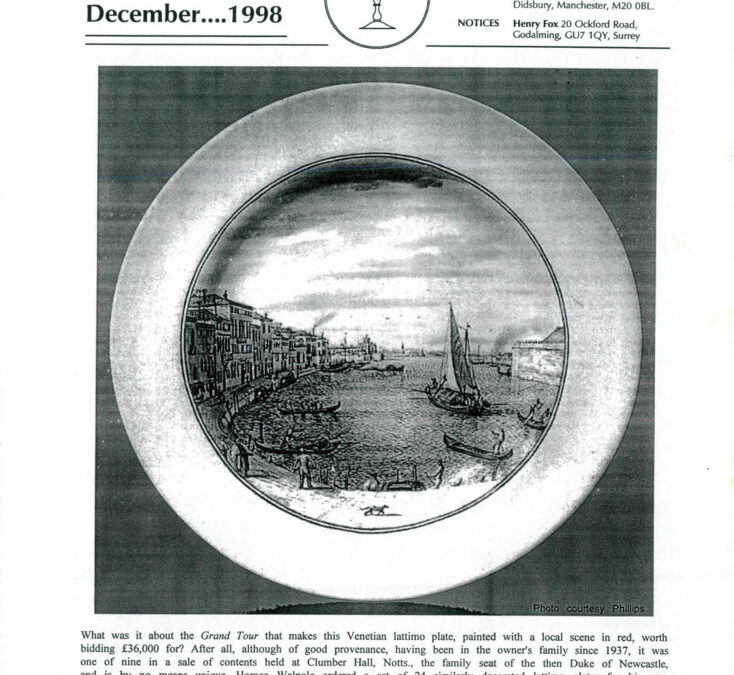
What was it about the
Grand Tour
that makes this Venetian lattimo plate, painted with a local scene in red, worth
bidding £36,000 for? After all, although of good provenance, having been in the owner’s family since 1937, it was
one of nine in a sale of contents held at Clumber Hall, Notts., the family seat of the then Duke of Newcastle,
and is by no means unique. Horace Walpole ordered a set of 24 similarly decorated lattimo plates for his new
house at Strawberry Hill, which were sold in 1842. No! it must be something about the nature of the Grand Tour
itself which, unlike today when holidays abroad fill a fair proportion of our thoughts, was the prerogative of the
very rich and most ordinary people were unlikely to move outside their villages. Certainly, what Italy had to offer
was a revelation to English travellers. It later inspired Ruskin to write
The Stones of Venice
with its controversial
passage about cut glass, and, more recently, the Tate Gallery to mount an outstandingly successful exhibition, as
well as providing valuable documentary information of the time. A new book on the subject is
The Evolution of
the Grand Tour
by Edward Channey (£45 from Heneage, see p. 10) which documents the lives and travels of
the English who made the trip and examines their various reasons for doing so. Now that one plate is either the
property of a new rich owner, or has perhaps gone to a museum where others will be able to
gaze upon it and
dream of times gone by. The Grand Tour wasn’t just an occupation; it spawned a whole new industry.
GLASS CIRCLE NEWS No. 77
Page 2
1998
Editorial
The Special Relationship
The UK and USA, we are frequently told, enjoy a special
relationship. Exactly what this is and the benefits it confers are
not always clear on this side of the Atlantic, and it is doubtful if
those on the other side are even aware it exists. When it comes to
glass, however, there is no question that interaction between
these two countries has had a great impact on the development
and history of glass.
For the beginner, collecting glass is a mysterious and quite
difficult occupation. I still have a clear vision of my first
encounter with an 18th century English opaque-twist cordial, so
enchanting and yet quite unlike anything made today in both
form and proportions. Fortunately, at that time, Elville’s
English
Table Glass
had just appeared in the shops and the discovery of
Barrington Haynes
Glass Through the Ages
provided two clear
texts to guide my first faltering steps as a collector. Even so, it
was several years before I could bring myself to read the early
chapters on Roman, Venetian and other forms of glass, let alone
chandeliers, press-moulded glass and other even more mysteri-
ous areas of the subject. There was simply too much to be
learned first about early English drinking glasses. Looking back,
it is easy to appreciate the problems that faced Bacon and the
other enthusiasts who formed The Circle of Glass Collectors.
One of my early experiences of a Glass Circle lecture was a
whole hour devoted to an analysis of the Parr Pot (in the British
Museum) and I left with my head in a whirl wondering why it
was so important.
Eventually, however, one emerges from such ‘graduate’ studies,
competant in the basic understanding of the nature of British
glass and its history and the realisation that specialisation in at
least one area is the way forward. Alongside, the time comes to
turn to ‘post-graduate’ studies and the opportunity to enjoy the
broader spectrum of glass history that puts the British story into
perspective. Venice and the Continent have obvious connec-
tions, athough great differences as well, and there is no shortage
of books itasthi direction. The link with America, however, is
less clear, and with the exception of a few oft-quoted connec-
tions, such as Frederick Carder, the contentious invention of
press moulding and Queen’s Burmese made by Thomas Webb
under licence from Frederick S. Shirley, its history is more
diverse and less well charted. And yet, starting with the
foundation of Jamestown, in 1607, at a time when Verzelini had
not long retired and the thoughts of Thomas Purcivall were still
turning on how to build a coal-fired glass furnace, American
glass history reveals an intricate tapestry embracing Europe in
general and England in particular. English lead table-ware and
bottles (made mainly in Bristol), exported in vast quantities,
were the yardsticks by which the developing American industry
was judged and in some areas it is now difficult to distinguish
products of the two countries. I recently found a bonnet glass on
a market stall in Bridport, Dorset; its twin is illustrated as a ‘salt’
in Hunter’s
Stiegel Glass.
Indeed, much of the glass once
attributed to this early American master is now considered of
dubious provenance. In the 1920s, with the awakening interest
in old glass and the explosion of reproductions, Mrs Graydon
Stannus, as well as muddying the waters of early Irish glass, as
is generally believed, also enjoyed a thriving trade with
America, the nature and outcome of which is largely, if not
totally, unresolved.
American glass, of course, developed its own styles and
characteristics both in blown and press-moulded glass. Hardly
any of their press-moulded glass, other than depression glass,
found its way over here – such was the home demand, and even
much of the ubiquitous Pyrex is distinct between the two
countries. And yet it is almost impossible to delve into
American glass history without almost immediately encounter-
ing English, Irish or Scottish involvement and ties with Europe.
`New England’ glass is not called that for nothing! A tour of
American museums, glass factories and antique malls is the best
way to start and in this issue of GC News we make a few
suggestions, not forgetting the Internet and The National
American Glass Club with its regular and instructive Bulletin.
GLASS CIRCLE (G)HOST HUNT
Our Hon. Sec. tells us that our famous Glass Circle tradition of
providing light refreshments at our regular meetings is being
endangered by a lack of support from our regular participants to
act as hosts. The cost of meetings comes out of our annual
subscriptions but it has always been felt that so far as
refreshments are concerned members should pay their way by
means of an occasional contribution. The required offering is a
minimum of £10.00 with, usually, four hosts per meeting.
Personal presence to act as host, although not essential, is
appreciated as it also helps break the ice in getting to know one
another. An opportunity to do so more readily will now be
provided on the attendance participation form.
May we also take this opportunity to thank our members in
distant parts who, although only rarely able to be present at our
meetings, nevertheless join us in spirit and so generously
support those they cannot themselves meet.
Prince Charles visits the National Glass Centre.
“Well! let me see you do better” might be a more sympathetc caption than the one actually
used (“He huffs and puffs and produces a pathetic, treacly dribble”) for this picture of
Prince Charles carrying out the obligatory ‘blow’ during his Royal Visit to the National
Glass Centre in Sunderland as part of a day-long, whistle-stop tour of this part of the
North East, charted in some detail in a 3-page ‘special’ on
Charles at 50
by Allison
Pearson* for London’s EVENING STANDARD’, 4th November, 1998. With unruffled
aplomb, Circle member. Barry Clark, the real hero of the incident, keeps the blowing iron
turning and preserves some sense of achievement for the Prince doing his public duty
while providing a bit of free advertisement for the NGC and humerous copy for the media
(a short clip also appeared on S.E. TV News and probably more in the North).
Barry, glass officer at the NGC is responsible for all things practical from checking and
lumping gas cylinders and purchasing equipment to running demonstrations and glass
making lessons for schools in the capacious glass studio there. Also singled out for
mention was ‘Anna’ who had made “heart-breakingly lovely tall vases”. Anna got started
with financial support from The Princes Trust and, no doubt, provided one light of
personal achievement for H.R.H. in an otherwise long and arduous day.
*Described by the Evening Standard as “one of the most outstanding journalists of her generation”.
Photo: London
Evening Standard
If you are thinking of a trip to Sunderland to see the NGC, St. Peter’s Church, the Library and other sights, a comfortable and convenient motel
is the Premier Lodge, Quincey’s, about 2 miles out of town and 8 minutes drive from the NGC, at Timber Beach Rd, off Wessington Way,
Castletown, Sunderland. Central Reservation:- Tel. 0800 118833., booking advisable.
1998
Page 3
GLASS CIRCLE NEWS No. 77
4
7
Pete/ride
Serendipity depends upon receptivity. So often one passes over
a statement because it has no especial relevance to one’s current
attention; but then, out of the blue, suddenly there comes a fact
that one can recognise as crucial, although quite unrelated to
the matter in hand. So it was recently with a substantial
commentary on Thomas Erskine, 6th. Earl of Kellie, given in
Ian Purser’s book on ‘Scottish Music’. Kellie fits well into the
Jacobite pantheon; his father was imprisoned after the ‘Forty-
Five’, although never brought to trial, and he had cousins who
were at the Jacobite Court in Rome. His collateral successor,
the 9th Earl, is credited with having commissioned the set of
six drinking Glasses with polychrome enamel portraits of
Bonnie Prince Charlie, used at the birthday dinners in Edin-
burgh held annually by James Steuart until the death of Charles
in 1789. The 6th. Earl was known as ‘The Musical Earl’, and
despite the rather disparaging description of ‘dilettante
musician’ given in the catalogue entry for his picture in the
`Scottish National Portrait Gallery’, after pursuing his musical
studies in Germany he became quite a force in the musical life
of Edinburgh, from the mid 1750s until his death in 1781.
There are, too, on rather precarious evidence, Jacobite songs
attributed to him and reputedly sung by the Edinburgh Musical
Society. He was also a devotee of Claret (all in all, ‘a good
Glass man’), and sported a visage so rubicund that it was said
of him: “His nose would ripen cucumbers.” But the serendipity
lay in an aside from Purser’s main story:
“We have lost much of Kellie’s music as a result of his
cavalier approach which was part of his whole convivial
life-stye. He is credited with having founded the Capillaire
Club which was ‘composed of all those who were inclined
to be witty or joyous.’ Naturally, he wrote a piece of music
specially for them to dance to – perhaps at their annual
ball, which in 1774, was attended by nearly two hundred
ladies and gentlemen. Capillaire was a kind of eighteenth
century cocktail which members drank exclusively from
small liqueur glasses, engraved with the name.”
In the light of the doubt expressed by Henry Fox when
considering the Capillaire Glass offered at the April NEte-Fair,
as to whether the name related to this Club or not, (GC News
No: 75) it was gratifying to find support for my earlier
contention that the Glasses so engraved did pertain to this Club.
This year has seen me visiting three of the City of London
Corporate establishments; The Vintners’ Hall under the tutelage
of Ken Cannel and M.H.Fairbank, later on The Goldsmiths’
and recently The Mansion House. All three establishments
boast sumptuous Lighting Glass, much of which is not what it
seems, but is well documented. Vintners’ is the oldest of these
three buildings, but the earliest chandeliers which
I
noted were
the group of five made by Osler in 1875, and hung in the Great
Hall. There may well be other earlier but less imposing lights
there, but this Hall unfortunately had no guide book to
supplement one’s memory and notes. The Mansion House is
next in age, being started in 1730; it had a very substantial face
lift and refurbishment in the early 1990s, and it is now both
smart and appropriate as the Lord Mayor’s establishment.
Several convincing groups of lights in the Georgian style were
inserted by Wilkinson Glass in 1993. The State Drawing Room
has two twenty light waterfall style chandeliers of 1828 by
John Blades, whilst the Saloon has a set of four magnificent
thirty-six light chandeliers, eighteenth century in feeling but
installed by Osler in 1875. The private apartments, to which I
was not admitted but which are well illustrated in the guide
book, also have good looking eighteenth century style lights,
but attributable to Osler in 1931 or to Osler and Faraday in
1962.
Goldsmiths’ Hall was totally rebuilt in the early 1830s, and
trouble with a set of four very large forty-eight light cascade
chandeliers by Perry & Co., delayed the opening of the Livery
Hall for some months in 1835. There they still hang, largely
unaltered but now internally lit by electricity and still
supplemented with candles on state occasions; they are
supplemented too by a now electrified, enormous central Glass
gasolier. The Court Room, Drawing Room and Exhibition Hall
share a set of three concentric ring chandeliers, originally from
Perry in 1835, but substantially remodelled in 1871 by by
Leopold Jones of James Green & Sons. These lights fortunately
were in store during the blitz, for the three rooms were gutted
by the bombing. The Entrance Hall of Goldsmiths’ has the
enormous Hudson painting of 1752 depicting Benn’s Club of
Aldermen, each with an airtwist Glass of claret to aid their
pondering on their duty to their exiled Stuart Monarch.
The difficulty which even knowledgeable members of The
Circle have in assessing and dating chandeliers is a reflection
on the frequent repair and remodelling of lights, the
circumstances which often defy close examination and the
rather scanty literature. One hopes that the forthcoming
monograph on “The English Glass Chandelier” by Martin
Mortimer will appear in the not too distant future, allowing
those of us who are but casually interested to make rather more
informed judgements.
News from the Sales
by
Henry Fox
At
Phillips
October London sale the
highlight was the lattimo plate shown
on our cover. Also noteworthy were a
fine stipple engraved facet-stem wine
glass decorated by David Wolff
(right), £7000; a Jacobite airtwist wine
glass, c. 1750, the bowl engraved with
a rose and thistle, dimidiated, beneath
a crown, the reverse with a crowned
lion crest standing on the bonnet of a
cap of maintainance, a heraldic device,
£3600. In contrast, a heavy baluster
period wineglass with thistle bowl and
good drop knop stem failed to reach its
reserve (est. £1200 – £1500) while an
attractive baluster period toasting glass
with deceptive bowl and ball ‘mopped stem made £400.
At
Dreweatt Neate
Newbury sale Ceramic and Glass in October
– a set of five wine glasses with waisted bucket bowls on stems
containing pair of multi-spiral opaque enamel entwined cables
made £650; a drawn trumpet airtwist wine made £160 but a
plain stem drawn trumpet wine went for £260; a Lynn wine on
opaque twist stem and with footrim chips made £290.
Christie’s
had two sales in the first week in November. The
first, in King Street was very much dominated by the ceramic
lots, but the highlight of the glass section has to be the “Ker”
large plain drawn trumpet Amen glass which made £30,000. The
glass was diamond point engraved with only one verse on the
bowl, but was, to my mind, despite its long history and
provenance, a little too well engraved, including the decorative
design around the rim. I wondered if it had been engraved in
quieter times, such as 1770, instead of nearer to 1745. I must
confess that my knowledge of such engraving is very scant.
Comments on this glass would be welcome. There were several
lots of wine glasses from the “Liverpool” suite and the “Prince
of Wales” Suite. These sold well; for example, a single green
“Liverpool” glass went for £1300, whilst a pair of clear “Prince
of Wales” wines fetched £3400. The distinctive style of these
glasses will be well known to most members as is the on-going
debate about when some of them were made. A year or two ago
I saw an unengraved pair of wine glasses of this famous pattern,
but with plain feet, on a well known dealer’s shelf where they
were dated to the end of 19th century, and priced accordingly;
since then I have learnt that Thomas Goode apparently supplied
some glasses of this pattern, but with seemingly the full heavy
cut foot, in the 1920’s. A claret jug cut in the same style but
continued on page 5
GLASS CIRCLE NEWS No. 77
Page 4
1998
The Glass Circle Annual General Meeting and Specimens Evening
The meeting was held at The Sotheby Institute, Oxford Street, .20th
October, 1998, with the permission of Mrs. Ceresole, the Director, and
by kind invitation of Mrs. Barbara Morris and Mr. Ray
Notley.
The AGM was called to order by Chairman, Simon Cottle,
re-elected unanimously by the Committee for another year in
office. Minutes of the last AGM and previous meeting were
read by the Hon. Secretary and approved.
In his report Mr. Cottle said that in addition to another
successful year of meetings there were two special events this
evening. The first was to ratify the Committee proposal that
Hugh Tait should be elected at President of The Glass Circle.
Hugh had a distinguished career (see inset) and is widely
regarded as one of the most authoritative experts on British
glass today. He has been a Vice President of the Circle for
many years, has given several lectures and represented the
Circle at the opening of our recent Diamond Jubilee Exhibition
at Christie’s. In response to the unanimous vote of approval
Hugh thanked the Chairman and Circle for its support in
granting such a great honour. He accepted the responsibility
seriously and promised to do everything in his power to
support and promote the activities of The Glass Circle.
The second event was the award of Life Membership to Tim
Udall, one of our most popular members who has served the
Circle for more years than most can remember. In response,
Tim said that he was overwhelmed with gratitude at the
kindness shown to him by the Circle for doing jobs that had
given him great personal satisfaction over the years.
Changes had occurred in the Committee, Janet Benson and
Wendy Evans, after many years of faithful service, had retired,
being replaced by John Smith, well known glass expert at
Mallets, and Paul Crane, recently of Phillips Auctioneers and
now in the commercial antique business.
The committee for 1998/9 is:
Mr. S. Cottle (Chair),
Mrs. J.M. Marshall (Hog. Sec.)
Mr. D. Woolston (Hon.
Treasurer
and Membership Secretary)
Mr. Paul Crane
Mr. Henry Fox
Dr. Jonathan Kersley
Miss Martine Newby
Mr. John Smith
Miss Anne Towse
Dr. David Watts
Our President, Mr. Hugh Tait, is an
ex officio
member of the
Committee.
For several years now, the Committee has met at the rooms of
Dr. Kersley, in Harley Street and the Circle expressed its
gratitude for his hospitality and also for the services of his
Secretary who helped maintain the membership distribution list.
The Committee was currently meeting at The Sotheby Institute
in Bond Street at no cost to The Circle and thanked Mrs.
Ceresole, the Director, Ms. Sonia Leadlay and Ray Notley for
their kindness in making this possible. Thanks were given To
Dr. Watts, Peter Lole and Henry Fox for their services to Glass
Circle News and to John Newgas for establishing and
maintaining The Glass Circle Web Site.
In giving the Hon. Treasurer’s and Membership Secretary’s
report Derek Woolston outlined the satisfactory nature of the
Circle’s accounts. The subscription increase, in 1997, was
regrettable but inevitable, as is the new but still modest charge
of £5.00 for members’ guests attending meetings. Expenses for
running Circle meetings had inevitably increased as had the
cost of
Glass Circle News;
the publication of the next issue of
the
Journal
and the 1997 Symposium were in train. Auditor of
the Accounts, Mr. West, was thanked for his service.
The membership list is now stored on computer by Mr.
Woolston and all address changes etc. should be addressed to
him. The membership currently stood at 352 plus a further 60,
or so, partners and 19 Honorary and Corresponding members.
The Circle now had an Institutional Membership for businesses
and institutions, information about which could be had upon
application. A new list of members would be circulated shortly.
Thanks were due to Shirley Warren for managing the growing
list of Glass Circle publications which made a steady
contribution to Circle funds. Members were reminded that
copies were available to them at reduced rates A revised price
list is being prepared for the next issue of GC News.
The Glass Circle Library was now stored in a separate cabinet
at the library of the Sotheby Institute, behind
–
the enquiry desk
but available for consultation. Back in 1947 John M. Bacon
had purchased a copy of Hartshorne for The Circle which was
thought to be lost. This has now turned up with his signature
on the flyleaf, but in damaged condition. The Committee has
decided to have it repaired as one of the Circle’s heirlooms.
New books will be bought to enlarge the library, complement
and fill gaps in the Sotheby holding of glass books to make
this a comprehensive research and learning resource. The Circle
expressed its gratitude to the Sotheby’s Institute Librarian for
the care taken on our behalf.
For the Specimens Meeting the panel of experts was Hugh Tait,
Simon Cottle, Jo Marshall and Martine Newby. A number of
interesting specimens had been brought for inspection. First
under review was an unusual heavy (lead) facet cut glass with
thistle bowl above a baluster stem and domed foot, engraved
with a 5-petal rose and single bud. (A similar glass but with
continued on page 5
The Glass Circle President – Hugh Tait
Hugh was educated as a historian at Cambridge, went on to
study the history of art at the Courtauld Institute of Art,
University of London, and “cut his museum teeth” in the
Fitzwilliam Museum, Cambridge, before joining the British
Museum. There, he was Deputy Keeper of the Department of
Medieval and Later Antiquities, where the collections of post-
medieval material were his responsibility.
He is a former President of the International Association for the
History of Glass, an Honorary Fellow of The Corning Museum
of Glass, a Fellow of the Society of Antiquaries and a
Liveryman of the Worshipful Company of Clockmakers; also a
former President of the Society of Jewellery Historians and of
the Society of Post-medieval Archaeology.
His publications reflect his wide professional interests:
Porcelain,
a general book;
Bow Porcelain –
a catalogue for his
international loan exhibition;
The Golden Age of Venetian
Glass (1978,
German edn. in 1982);
Clocks and Watches
(1983, revised edn. 1986);
Catalogue of the Waddesdon
Collection in the British Museum,
a series of five volumes.
Already published are: – I.
The Jewels, II. The Silver Plate,
Ill.
The ‘Curiosities’.
He is author of the post-medieval glass
section in
Masterpieces of Glass at The British Museum
(1968)
and co-author, with P.G. Goole, of
Catalogue of Watches in the
British Museum – I. The Stackfeed.
He is a contributor to and editor of three books;
Five Thousand
Years of Glass (1991,
revised 1995);
Seven Thousand Years
of Jewellery
and
The Art of the Jeweller,
a catalogue of the
Hull Grundy Gift to the British Museum.
As well as contributing to
Glass Circle News
Hugh has
published many articles in
The Antiquaries Journal,
The
Corning
Journal of Glass Studies,
the
Proceedings of the Silver
Society, The Connoisseur
and other specialist journals.
He is currently preparing the sections on Glass and Jewellery
for the forthcoming publication of the
Inventory of Henry VIII.
Dim and Bri
9e9I
You’re looking very dim today, Dim.
Yes, It’s my own fault. I was lit up late trying
to catch Father Christmas coming down the
chimney. Suddenly my shade was covered
in soot and I never saw a thing.
Well, you would have been lucky; they are in
short supply. I hear that the Ministry of Fun is
advertising for no less than 470 suitably
rotund male figures, beards provided!
1998
Page 5
GLASS CIRCLE NEWS No. 77
AGM and Specimens Meeting continued
different engraving was illustrated in
Hartshorne No. 47, page 290, ambigu-
ously characterised as English or Bo-
hemian.) The Jacobite engraving with
single bud was appropriate for an
early English glass, previously dated
by Robert Charleston as c. 1730, but
the very white metal of which the
glass was made cast some doubts on
its authenticity although no conclu-
sion was reached in this respect. Nev-
ertheless it was acknowledged to be a
very fine specimen of its kind reflect-
ing Continental influence.
Another glass (illustrated above,
right), believed to be unique, was a
single flame oil lamp with double ogee bowl above a double
series opaque twist stem . Some discussion took place as to
how the wick was fitted in such lamps, whether floated on the
oil or via a wick suspended from a metal fitting. The use of
metal fittings is described in our late member, Professor Keith
Kelsall’s book, and in five c. 19th century lamps featured in the
Winterthur Catalogue (see review by F.P.L. on page 10).
Three tiny mould-blown jelly or sweetmeat glasses of mid-18th
century date came next. With spreading bowls on compressed
knopped stems, about 6cm tall they were just too large to be
considered as dolls house tableware and were suggest to have
been made for salt or other small items on the table.
A typical small deceptive glass with conical bowl above a large
knop, baluster stem and broad foot came next. These attractive
glasses, not uncommon a few years ago, are typically dated to
the c. 1830 although one member suggested that such glasses
continued to be made up to c. 1890. It was suggested that these
“toasting glasses” reflected the heavy drinking and tradition of
endless toasting characteristic of the time.
Of similar early date (1835) was a massive bowl of steel blue
tint with characteristically Irish fan-cut rim, and circuits of
pointed ovals filled with fine diamonds and the base cut with
strawberry diamonds to accept a stand (missing). The form, of
great rarity, is illustrated in Phelps Warren’s
Irish Glass,
1st
Edn. Fig. 43, which also tells us that such pieces were the
prerogative of the very rich such as the Marquess of Bute and
the Duke of Wellington. This example was, however, found in
an antique mall showing that diligent searching along the lines
directed by John Maunsell Bacon’s letters may still produce
unexpected dividends.
Slightly later in date (1850) but totally different in form was a
Hale and Thompson hollow internally-silvered ring stand,
technique.
to show
the silver beneath – a delightful use of the
overlaid cobalt blue over clear, cut round the rim
Moving into the 20th century brought us to the
next extraordinary glass, a joke piece suggested by
the owner to be the sort of piece that might have
been designed by Salvador Dali, although actually
made by Inglehart. It was of amber glass some 6
or 7 inches tall, the bowl with a dark purple split
rim, the ends trailed up and down – the only way I
can describe it – was supported on a slender spiral
stem and spreading folded conical foot. It was
generally felt to be beyond comment! –
Equally mysterious was a thick c. 15cm diameter
disc of clear glass, with, rising from it, upstanding
thick walls c. 4 cm tall, in the pattern shown and
possibly made by Whitefriars. Suggestion as to its
function ranged from a decorative tile to a teapot
stand but your guess is as good as the experts!
Finally, a heavy turnover bowl, the rim cut with ovals, and two
fine goblets of provenanced Whitefriars origin, c. 1890, one
trailed one pale blue, the other ruby, brought an interesting
evening to a close. Our thanks to our experts and all those
whose glasses made such an enjoyable evening possible.
Sales News, continued from page 3
engraved with the Arms of the Dukes of Bedford, is known, as
well as green and clear examples of wines engraved “J.A.M.”-
there is a green example in the FitzWilliam Museum. From
evidence uncovered in the V&A archives some years ago,
relating to Blade, a glass seller in Ludgate Hill, London, these
“J.A.M.” wine glasses are now considered probably to date from
the 1840’s. Incidently, the V&A has a good pair of decanters in
this pattern engraved with Prince of Wales Feathers; these are
illustrated in Mrs. Jo Marshall’s book,
Glass.
The bulk of the
Prince of Wales suite is in the Royal Collection at Windsor.
The second Christie’s sale belonged to a single owner and was
held appropriately – as it turned out – on 5th November. The
Standish Collection had come to town! Everyone had heard of
Parkington, but who was Standish? I have discovered that he is
very elderly; lived modestly in Wigan; had been an avid
collector of more than several categories of antiques. He was an
“unknown” to present day auctioneers. dealers, and collectors
alike, although he had fairly extensive correspondence etc. in the
immediate post war years with Arthur Churchill. Mr. Standish
apparently ceased collecting his drinking glasses from around
the late 1950’s. Consequently, his collection is very much “new
to the market place”. This always gives a sale a special interest,
particularly as his collection of 18th century drinking glasses –
centred mainly on airtwist and opaque twist stems – was being
sold almost entirely as individual glasses. Many hopefuls must
have thought this was a chance not to be missed, especially as a
large number of the lots mentioned chips to foot or bowl, thus
providing an opportunity to acquire a reasonably priced speci-
men, even if damaged.
On the day, the room at South Kensington was packed. Bids
came thick and fast and the excitement generated could be felt as
prices took off. A catch phrase of collectors is “Condition,
condition, condition.” On this occasion “Condition” in many
cases seemed to be totally ignored as bidders (in the room and
on the several telephones) tried to feast on the lots. The keen
competition meant that there was never a dull moment as the
auction advanced, as it began, briskly with over two hundred
lots devoted to drinking glasses. then on to some continental and
Victorian glass, and then on to its conclusion with a range of
paperweights, principally French. The catalogue of 298 lots
was
a total sell out. Here are some highlights (hammer prices).
A
continued
on page 7
GLASS CIRCLE NEWS No. 77
Page 6
1998
LASS IN THE
_Su
by David Watts
A=
–
13EAL WORLD
Bomber Harris left an unexpected legacy to Germany as a
result of the devastation caused by his massive bomber raids in
World War II. He created a virgin opportunity not only for
their stained glass artists but also their building industry and
glazing in particular. The result is that much, if not most, of the
modern technology available today is either German or
Continental in origin while the UK struggles to keep up. We
only hear of their successes, of course, but these are enviably
numerous. Pride of place for anyone visiting Berlin (and all
those interested in glass should go at least once in a lifetime,
for the museums on both sides of the old border are fantastic)
goes to the reconstructed Reichstag (parliament) building which
now sports a massive all-glass dome in place of the old
traditional one. It was made possible by the development of
laminated glass, similar to that used at Broadfield House, for
safety and also heat and light control, by the incorporation of
chemicals in the plastic films. Separately applied plastic films,
as mentioned in a previous issue of GC News, for increased
security and for UV light control, as well as for privacy and
visual appearance, is becoming a major industry although the
DIY angle is being discouraged. If you are thinking of buying
replacement windows in the near future look out for the new
European standard prEN 12600 which will replace the UK’s
BS 6206 concerning impact performance requirements for both
safety glass and plastics.
On the question of security I am currently experimenting with
optical polycarbonate sheet. At around £28 for a 2ft x 3ft x
4mm thick sheet it is not cheap but it is easy to fashion for
difficult shapes and has 200 times the strength of plate glass. It
is clearer than glass and scratching seems not to be a problem.
Polycarbonate sheet is used for the police shields you see on
TV and, around 6mm thick, they are bullet proof! The latest
exploitation of this unique material is the dance floor for the
show,
Saturday Night Fever
at the London Palladium; 5mm
thick, it is predicted to last 1000 performances over three years.
From my experience of the Whitefriars tesserae laid at Guy’s
Hospital and still looking like new after nearly a century I am
sure glass could easily outdo that, but not for lightness,
flexibility and cost.
The era of white UPVC window frames is drawing to a close
with the development of wood look-alike finishes, a boon to
owners of cottages and scheduled buildings. Germany is doing
its bit here, too, becoming the major provider of glues, for
cementing the bits together, that no longer emit greenhouse
gases – OK, so you never knew they did! – the outcome of
what is known as The Montreal Convention.
Talking of greenhouse gases, the use of glass in new buildings
is set to grow as the government emphasises the creation of
more energy efficient buildings using less fuel (carbon dioxide
is a greenhouse gas so you might concentrate on cutting down
your breathing habits as well!). The professional arena is
currently arguing about the relative merits of the thermal
efficiencies of different glass constructs so gen up on your
knowledge of U-values as well if you are thinking of entering
the window replacement market to avoid being baffled by sales
talk. The government is putting money into this so it must be
serious! The Building Research Establishment in Watford is
currently testing the Wilcon Integer House (as seen on TV and
illustrated above), the objective of which is to cut the
building’s operating energy costs to zero (i.e. no fuel bills).
This is a south-facing building of which glass provides 50% of
the roof and 40% of the building, with an electricity-generating
photo-voltaic section at the roof apex. Construction is not
cheap and that all-important glue features largely in the picture,
but this is a ‘concept’ house, to try out new ideas, not a
commercial prototype, and one “lucky” family is moving in to
Integer
Building
Establishment’s Watfoul site
pointing to the ititUre.
Picture from
Glass and Glazing Products,
October 1998
discover what it is like to live in a nil-energy fish bowl!
When we think of greenhouse gas pollution we generally have
a vision of cars and lorries. It is not realised that, nationally,
the carbon dioxide emissions from our homes is double that of
cars; 50.5% of all energy used in the UK is attributable to
buildings of which two thirds is by housing. Building regulat-
ions in Austria, Denmark, Germany, Norway and Sweden
require low energy (low-E) double glazing to be implemented
in all new buildings. The UK has yet to follow suit. Pilkington
Glass commissioned the Building Research Establishment to
quantify the potential benefit to the UK of low-E glass. The
astounding finding emerged that if all single glazed buildings
were double-glazed with low-E glass a saving of £400,000,000
per year could be made on housing alone and £638 million on
all buildings. This is equal to of 9.07 million tonnes of carbon
dioxide emissions each year and represents enough energy to
heat every house in six cities the size of Birmingham – wow!
For the individual to install low-E glazing represents an
incremental expenditure of £100 – £200 compared with
ordinary glazing, the difference being repaid by fuel savings in
about five years. The Glass and Glazing Federation argues that
the government should spend more on insulating our houses in
this way and be less concerned about reducing VAT on fuel,
which is sending the wrong signal both to householder and
industry. This is particularly so as our European Environmental
Ministers, on the 17th June, this year, legally committing us to
reducing greenhouse gas emission by 14% over the next 10-14
years – a testing challenge when the number of vehicles on our
roads continues to increase.*
Glass bricks, that became popular after the World War II but
were rapidly reduced to the ignominious role of vandal-
resistant illumination for public toilets, are also making a
comeback. The shiny, new West Ham Station at the eastern end
of the Underground Jubilee Line extension – primarily an
interchange – consists of new ticket halls, a bridge link and new
platforms, all clad in glass block panels giving it a smart
contemporary appearance. In London, the B&Q superstores are
selling kits of German-made glass blocks, both plain and
coloured, along with installation instructions for DIY. The
price per sq. metre is not out of line with other high-class
screen treatments. So if you are looking for an unusual
Christmas present, the introduction of colour makes this a
turn-on for artistic self-expression whilst providing a modest
contribution to greenhouse gas control, ignoring, of course, the
energy required to make the glass blocks in the first place!!
*Information from
Glass and Glazing Products,
July/October 1998.
eco Necklaces.
Photo courtesy of
S. Tomalin Beads
,
PortabelARoact.
GLASS CIRCLE NEWS No. 77
1998
Page 7
Beads of the
Woi’It an exhibition
01 OHS
Beads and Bead
Broadfield House Glass Museum. 16 January – 11 April 1999
Broadfield House Glass Mtiseum’s next exhibition is the first
ever in the UK to be devoted to glass beads and beadwork. It
brings together a host of stunning items from private collectors
and museums across the country. Featuring rare and beautiful
examples of fashion, jewellery and accessories from Africa,
Asia, the Americas and Europe, the exhibition shows just how
timeless and universal beads are. From a Zulu girdle to a Plains
Indian tobacco pouch, and from an ancient Roman necklace to a
flapper’s handbag from the 1920s, you can marvel at the
delicacy and intricacy of beadwork the world over.
The exhibition focuses on four main themes: trade & assimil-
ation, body adornment, beads with meaning, and contemporary
British work. Glass beads have been used for their intrinsic
value as well as for their beauty, forming a staple form of
currency in Africa and the Americas for hundreds of years.
Beads made in Venice and Czechoslovakia were exported in
vast quantities to these countries since the earliest days of
European exploration, in exchange for other goods like metals,
ivory and even slaves. The explorer H. M. Stanley estimated he
needed 22 sacks of beads for a 2-year trip to Africa in 1872!
These ‘trade’ beads have had a profound influence on costume
and culture, as the exhibition demonstrates. As beadwork
became a staple craft in many cultures, beaded items soon
started to be sold back to Europe, as typical tourist souvenirs.
The word bead comes from the Anglo-Saxon
bede,
meaning
prayer, and a further sec-
tion of this exhibition ex-
amines the symbolic
meanings of beadwork.
Birth, death, love and
marriage have all been
celebrated through beads
– from a tiny decorated
pouch containing an um-
bilical cord carried to protect a Native American Indian child to
an astoundingly delicate French beaded funeral wreath.
Rosaries, prayer beads and even Turkish evil eye beads are well
known to us all, but less familiar may be the vibrant beadwork
of the Yoruba (S.W Nigeria), which traditionally could only be
worn by priests and kings. Or the Zulu ‘love letter’ – a small
patch of beadwork made by a young woman to give to any
available man that took her fancy – much as we might send a
Valentine’s card or bunch of flowers today!
The exhibition concludes with a look at contemporary British
artists working with beads today, proving the art is still as strong
and popular as ever before.
Z.B.
Broadfield House Glass Museum, Compton Drive. Kingswinford. West
Midlands DYG 9NS Telephone: 01384 812745
Opening hours: Tue-Sun 2-5pm; Easter Bank Hol. (4th & 5th April)
10am-5pm.
Sales News, concluded from page 5
plain drawn stem shape wine, but with deep
honeycomb moulded bowl and foot (right),
finally went for £1800; an incised twist
stem ale glass, the bowl with basal honey-
comb moulded decoration made £700; a
mercurial airtwist stem ratafia style glass,
the bowl with basal moulding,and engraved
below the rim with barley (somewhat odd, I
thought, as ratafia is an almond based
drink!) rocketed to £2000; a typical drawn
mercurial airtwist cordial glass engraved
with a fleeing fox above the motto
TALYHO
(sic)
was snapped up at £1000.
An acorn knopped airtwist stem wine (left) with
engraving beneath the rim made £1700 (a rare
stem formation for an airtwist glass, but in this
case the stem was made in two parts, a fact which
was confirmed for me by a dealer at the viewing
who examined it at my request with his eyeglass –
the difficult problem with complicated knopped
airtwists is not to loose the airtwist spirals as you
draw out and form the stem design – but this
elegant style of glass is exactly what Barrington
Haynes said of it
“A collector’s joy”).
Another rare m.s.a.t airtwist glass (right) with
four knops in an otherwise conventional
shape was bid to £1800.
Jacobites continue in favour with £1500
being bid for a drawn airtwist glass, the bowl
engraved with typical rose, half open bud,
and another bud, with an oak leaf below the
motto “Fiat”, the reverse with a sunburst, but
the foot chipped; a mixed twist wine with
footrim chip made £380; a pan topped
opaque twist stem wine on domed foot with
footrim chips made £400; amazingly an
opaque twist stem glass catalogued as in the
18th century style, the bucket bowl engraved
with LIBERTY & WILKES and with footrim
chips reached £320; a “Sarah Siddons” portrait glass on opaque
twist stem then went on to make £1800; a tartan twist colour
stem wine was finally knocked down at £4200; there were two
octagonal bowl wines on different pattern opaque twist stems
and these fetched £850 and £700 (footrim chip) respectively; a
gilt decorated facet stem goblet with slight wear to gilt rim made
£2000. Among the later lots a Stourbridge ewer and two goblets
engraved with classical maiden holding a lyre went for £700; a
pair of St. Louis faceted knife rests with red colour twist
inclusion (one with small chip) fetched £220. Among the
collection of paperweights a Baccarat flower paperweight made
£1500; a Clichy “Barber Pole” chequer weight, £4200; a St.
Louis encased double overlay upright bouquet, £2000; and a St.
Louis green carpet-ground weight, £3800.
Upon reflection, I wondered if the high number of chipped items
revealed that the owner’s true interest was in stem formations,
whether it was number of knops or the variety and complexity of
the stem interiors. He had few balusters and equally few facet
stems, but his variety of airtwist and opaque twist combinations
was truly representative. Perhaps, when he was collecting, all
those years ago, the price differential between the perfect
specimen and a damaged version was substantial, as it often is
today. Again, to have a damaged example is preferable to many
dedicated collectors of moderate means, particularly when to
them the glass is in the rare or very rare category. But then, glass
was only one of many areas of interest to Mr. Standish.
Many members may have missed it, but in the same week in
Wolverhampton
there was a single owner sale of over 300
hundred lots of Victorian coloured decorative glass. This large
sale consisted of vases and similar type of glassware. Apart from
two lots where the items were described as Sowerby, I could
find no pressed glass, nor any glass of note. Indeed, the
catalogue provided no information as to the manufacturer(s) of
the other lots. Many of the designs appeared to me to be similar
and were grouped in colour bands. The “Jack-in-the-pulpit” style
seemed popular with this collector. A few highlights were an
Okra vase of Tiffany design in dark blue, turn-over rim having
iridescent colourings, £145; pale amethyst
vase
with turn-over
frilled vaseline rim, clear leaf base, £140; a pair of pale
Cranberry opalescent bulbous vases with tall fluted necks, and
turn over serpentine frilled rims £200; Cranberry baluster jug
having opalescent dimpled cagework throughout, and a clear
ribbed handle, £180.
GLASS CIRCLE NEWS No. 77
Page 8
1998
Fly-Drive to Glass
in North lmerica
with David Watts
The centre of the glass world, so far as America is concerned, is,
of course, The Coming Museum of Glass, situated in New York
State about 300 miles N.W. of New York City. This is one
possible route for a visit, one can fly direct or, do as we did, fly
to Boston, Mass., on the coast further N.E., and pick up a hire
car at the airport there for the drive of around 400 miles.
Boston itself is a delightfully compact city with a good U/G train
service and a mixture of New World and modern architecture. A
tourist trail is painted on the pavement, taking you past most of
the important sites and through the old market, with its flower
stalls and craft shops with modern glass, as well as numerous
museums and antique shops. A couple of miles across the river,
in Cambridge, is Harvard University and, exercising a little
patience over parking, we visited the fabulous display of around
2000 glass flowers, plants and insects made for the Botany
Department by the Blashko family in Europe. Its extent,
magnificence, technical excellence and biological accuracy is
stunning. It is supported by a small historical museum with the
bench and burners allegedly used by the Blashko’s in their
manufacture – at least, the smaller pieces.
Heading 50 miles south, we drove along the coast via Plymouth,
(just before Cape Cod) with its Mayflower replica. Passing the
premises of The New England Glass Co., where they hand-press
a huge diversity of modern cup plates and blow a range of
decorative glass, we arrived at the Sandwich Glass Museum with
14 galleries, set in idyllic old-world surroundings. The curator is
Kirk Nelson whose pioneering research increased our knowledge
of the development of glass pressing – Deming Jarves is no
longer considered the inventor. Kirk kindly gave a conducted
tour of the museum which is devoted to New England glass from
the blown glass of the first European immigrants onwards. Some
preliminary reading is a great help to understanding its
chequered history. Highlights include, a rainbow display of early
dolphin candlesticks, 800 cup plates – many extremely rare – and
a cabinet of shards retrieved from nearby factory sites, key
material for identifying a previously undocumented piece.
From here, an easy 75-mile drive, roughly north-west, took us to
our pre-booked overnight motel at Sturbridge. Sturbridge Old
Village is a tourist highlight depicting early migrant American
life with historically dressed artisans demonstrating their skills.
It includes a static concise history of New England glass (set up
by glass guru, Ken Wilson) ranging from blown, in English
styles, to press-moulded including an impressive leaded window
made of cup plates, revealing that they had more innovative uses
that just for receiving a tea cup. This tour took us from breakfast
to mid-afternoon and included the museum shop with its
extensive selection of art glass made by the local (to America)
factories, and one of the several antique centres nearby.
Hitting the State Highway we settled down to some serious
driving, grateful that we had accepted the special offer of a
larger car, with air conditioning and cruise control, than that
originally booked. The cruise control is a particular boon as it
not only enables you to rest your throttle foot but enables you to
drive legally uphill and down, closely adhering to the speed
limits of from 50 to 65 mph which feel very slow by British
standards, although we never saw their traditional motorcycle
speed cop. In spite of its size the car seemed to go for ever on a
gallon of petrol costing around 90 cents. The weather was mixed
but we had no problem in finding a motel in torrential rain as
dusk was setting in. A short drive up the road took us to an
almost empty cafe, nicely appointed, where we were served an
excellent and cheap dinner, including wine. The motel room cost
about the same price as in Britain and included a breakfast cup
of coffee and cookies in the reception area with the chatty
hotelier. The locals seemed very impressed that we were driving
so far from Boston (identified by the car registration plate); most
of them-rarely moved from their
.district.
Just after tea the following day we drew into Corning, a couple
of hours later than intended due to getting lost as the result of
roadworks at an intervening town. It left us time enough to get
acquainted with The C.M.O.G, and receive friendly welcomes
from The Director, David Whitehouse (who came and lectured
to the Circle a week or so later), and Jane Shadel Spillman who
showed us around and, later, entertained us with traditional
burgers at home. The glass is, of course, as good as one can get
and it was a delight to see, at last, some of the many exquisite
pieces for which the museum is renowned. How long you stay
there depends on how much you wish to study in detail. Apart
from the special displays, the reference collections are held in
very tall cabinets with folders alongside documenting details of
each piece, which makes for fairly slow. viewing. Seeing so
many rare objects jostling for space was absolutely breathtaking.
At the Comfort Inn, nearby, which was just that, breakfast was
an all-in do-it-yourself experience in the lounge area with coffee
maker, toaster, microwave and instant porridge in a range of
colours and flavours, which tasted better than it looked, as well
as iced buns and other delicacies. However, it is an excellent
stopover and reasonably priced. Corning, about a mile up the
road is a compact, atmospheric old town with ample eateries, a
few antique shops and The Rockwell Museum. Here are
displayed 2000-plus pieces of early Steuben glass designed by
Frederick Carder – a truly marvellous exploitation of shape and
colour. It also houses another rare treat, a unique collection of
American Western Art with exquisite paintings, sculptures and
artifacts typifying the frontier – indians, bucking bronchos, a
brace of gold-plated colts – fascinating and endlessly evocative.
One of the most important artists to paint the Wild West from
life was Thomas Moran who emigrated from Bolton in 1844.
His painting,
Nearing Camp on the upper Colorado River,
recently saved from export, can be seen in Bolton Museum.
Another long, but easy drive west (350 miles), bringing home
the flavour and spaciousness of the countryside took us to
Butler, north of Pittsburgh, where we…mtexe most hospitably
received by Ellen Roberts, President of The National American
Glass Club, and her husband, Don. With one free day before the
NAGC 4-day Conference, in Pittsburgh, Ellen took us on a
memorable tour of Wheeling, first to see
the period mansion and modern Glass
Museum of The Oglebay Institute situated
in surroundings that outshone a Holly-
wood film set. Holly McCluskey, its
effervescent curator, showed us around
the collections of what she calls “the
peoples’ glass”, nothing special but fully
representitive of the period, again daz-
zling in colour and diversity. Actually,
they have one special item, illustrated
right, the world’s largest punch bowl;
around five feet tall and originally fitted
with drops, it was conceived as a tomb-
stone to Michael Sweeney, founder of the North Wheeling Flint
Glass Works in 1835. A 177-page, lavishly illustrated volume of
the museum glass*, including that by the Harry Northwood
Company (1902-1925), written by Holly and other luminaries is
a treasure-trove of delight and information. A working hot glass
studio and extensively stocked shop complete the display.
Lunch in the golf clubhouse nearby and then on to a rare,
unexpected experience, the long-established mould-making
workshop of the Island Mould and Machine Co. which claims >
*Wheeling Glass 1829-1939. Collection of the Oglebay Institute
Museum.
by Gary E. Baker, G. Eason Eige, Holly H. McCluskey,
James S. Measell, Jane Shadel Spillman and Kenneth M. Wilson. Ed.
by Gerald 1. Reilley. 177 pp. 28 x 21.5 cm, soft covers, with extensive
blocks of col. and b/w ills. between an illustrated text. An excellent general reference guide. Sorry, no price but not expensive. Write to
Oglebay Inst. Glass Museum, Oglebay Park, Wheeling, WV 26003.
omo
?!
77
SOON
Ble nko
a
Pilgrim
CEAF
DO
a
Rainbow
WEST ‘VIRGINIA
‘
ILTON
U
TINGION
Fostoria
MARIE77
—
PENNSYI.VANIA
Seneca
W =at Vir• inia
a
SAND
AND
BOSTO
CAPE
MA
C
OD
Buff
GLASS CIRCLE MEETING DATES
1998-99
Thursday
10th December
1998
All meetings to
Tuesday
9th February
1999
be held at The
Tuesday
16th March
1999
Artworkers
Tuesday
13th April
1999
Guild, 6 Queen’s
Tuesday
11th May
1999
Square, London,
Tuesday
15th June
1999
WC1.
GLASS CIRCLE NEWS No. 77
1998
Page 9
to make 95% of the moulds for the American
glass market. Here, craft is raised to an art
form, albeit computerised nowadays although
the first step is still a wooden pattern; we now
understand why these moulds are so expensive.
Their small museum is crammed with press-
moulded slippers, jugs, candlesticks, and what-
ever, in every conceivable colour that would
both amaze and terrify even an experienced
collector in the field. They also reproduce
suites of Victorian design press-moulded glass-
ware – so watch out!
Our final call was at Mount de Chanel Acad-
emy, an archetype seminary opened in 1848,
based on the French religious Visitation Order
founded in 1610. Our objective was the fa-
mous, recently restored Hobbs and Brockunier
great gasolier, mentioned in GC News 66, and
probably the last piece of glass I had ever
expected to see. Now converted to electricity, it
has a magnificent setting in the Music Room.
The Academy also has a fine Romanesqe
chapel set off by a stained glass dome, made by
Rambusch Inc. of New York, and stained glass
windows with scenes of local historical interest.
Tour West Virginia—
Glass Center of
the (New) World
WH
BUTLER
•
PITTSBURGH
KENTUCKY
Beyond Pit burgh . . .
Map
derived fro
brochure showing so
ft e
important factorie making art glass
a
• o • en for
visitors.
Inset:- major features of the present tour.
OHIO
r—
El
mira
ew York
City
ITTSBURGH
41/3
–
iladelPhia
PA
In Pittsburgh we dispatched our car and took
residence in the Doubletree Hotel, centrally sited with 5-star
facilities but not cheap even at the special rate negotiated by the
NAGC of $123/night, including taxes. A feature of the
air-conditioned room was a coffee maker, provided with sachets
of real ground coffee; with some ingenuity it could also be
coaxed into making an acceptable cup of tea!
The Conference began with an evening reception at the Senator
John Heinz Pittsburgh Regional History Centre where the upper
floor of this romantic old ice-house now accommodates an
ambitious new, 5000sq. ft. permanent exhibition, called
Glass;
Shattering Notions.
Masterminded by curator, Anne Madarasz,
who is plump, jolly and has a mind like a razor, it brilliantly
depicts the nature of glass, its manufacture and the history of the
region from its origins to the present, a model of modern
display techniques. A lavishly produced book, with the same
title**, by Anne, is now available and if you’re looking for an
easy entry into American glass history there is no better place to
start.
Next day, after a morning of lectures, we took lunch at the
Grand Concourse, the old railway station, elaborately decorated
(Empire style?) with exuberant stained glass. The goods line
still runs by with trains of such length that the triply-coupled
engines have disappeared from sight many minutes before the
caboose comes into view. Nearby, in Station Square, an old
coach stuffed with bric-a-brac provided a rewarding experience
for our expert colleagues, several of whom emerged from the
fray triumphantly clutching long sought after trophies. Glass
collecting in America really is different from that in the UK.
After the antique scramble we took a coach to the 1933 Heinz
Memorial Chapel, an overwhelming Neo-gothic edifice with
appalling acoustics, a 4272 pipe organ and 4000 sq. ft of stained
glass illuminating 391 identifiable people, where we received
talks on stained glass, followed by a glass of wine in the
tranquility of the Carnegie Museum across the road. Renowned
for its dinosaur collection, the Carnegie has a modest but
pleasant glass collection, including good contemporary work. It
was surprising to learn that in the land of plenty this noteworthy
museum has struggled for financial survival for the whole of its
life and glass has only recently become of special interest.
Another day of lively lectures, including four, rotating, hands-
on workshops with displays by several members, concluded
with dinner on top of Mount Washington, which rises almost
vertically just south of the city and provides panoramic views of
the river and city including the headquarters of the Pittsburgh
Plate Glass Co., an all-glass skyscraper of ‘Gothic’ design,
associated by Prince Charles with the Houses of Parliament!!
Dinner concluded with the raffle of a modern diatretum, by
Barry Sautner, and auction of members’ glass and glass books,
the proceeds of which were donated or part-donated to NAGC
funds. It was an entertaining conclusion to a rewarding day.
On our last day we took two trips; first, to Old Economy Village,
final home of the Harmony Society founded in 1804. Emigrating
from Germany to seek religious freedom, they became a pious,
industrially prosperous order but, committed to celibacy, not
surprisingly, died out by 1905. The site is now a 6-acre museum.
We took lunch in its fine assembly_ hall, dating to 1826, where a
considerable collection of American glass was set out in
manufacturers groups for comparative study – of great benefit to
the beginner. The museum itself only includes a few normal
domestic items of glass.
Our final visit was to Leonard’s Antiques Mega Mall. About the
size of Alexandra Palace Antiques Fair, only permanent, it was
too large for the time available and most of the glass seen was of
the colourful hand-made variety dating from around the 1970s
and later, together with a little clear cut-glass. Real antiques,
mostly European, were kept in locked cabinets and there were no
bargains to be seen. We were each given a special 10%-off
voucher so there was no problem in finding cheap souvenirs to
round off an exhausting but rewarding Conference. The organi-
sation was exemplorary, the sessions handled with a light touch
and the ever-friendly participants just great. Glass is glass,
wherever you find it, and its fascination and facility for
catalysing new friendships has no end.
** Glass: Shattering Notions
by Anne Madarasz. 163 pp., 28 x 23.4 cm,
soft covers, profusely ill. mostly col., is well documented and includes
profiles and maps of the most important 19th and 20th century
glasshouses in Western Pennsylvania. Price approx. $50.00 inc P+P, to
Historical Society of Western Pennsylvania, 1212 Smallman Street,
Pittsburgh, PA 1522. USA. or phone (412) 454-6405.
REMEMBER –
Let the Hon. Sec. know you are coming.
GLASS CIRCLE NEWS No. 77
Page 10
1998
WINTERTHUR’S GLASS.
One of the goodies listed in the Glass section of John Ives’*
latest catalogue is
“Glass in Early America”
by our member
Arlene Palmer. (ISBN 0-393-03660-X; 1993; 425 pages; £48
plus postage). This is a worthy addition to those English
language Catalogues Raisonee of overseas Glass Collections
which have appeared over recent years. Based wholly on the
Glass Collection of the Henry Francis du Pont Winterthur
Museum, it starts with a series of valuable essays. In the main
catalogue portion, American Glass naturally predominates and
several of the signed AMELUNG Glasses, both in the Winterthur
collection and elsewhere, are illustrated (See David Watts’ article
in G.C. News No: 76). But, of the 422 catalogue entries, all
illustrated, with the majority being actual size, (what a valuable
innovation!) some 99 are given as ‘definitely’, ‘probably’ or
`possibly’ British. In the light of the work’s title, the purist might
cavil that a number of these were purchased by the museum
directly from the London Trade, but all of these are types well
vouched for in American usage. The Winterthur museum is
amongst the world’s premier institutions displaying the applied
arts in a context relating to their contemporary usage; indeed,
those wishing to study British Glass usage during the ‘Classic’
period must inevitably turn to Louise Conway Belden’s
The
Festive Tradition; Table Decoration and Desserts in America
1650-1900
published in association with Winterthur in 1983.
Much of the value of Palmer’s work lies in its consideration of
the Glass in relation to both the supply route and contemporary
usage, quoting many contemporary sources to great effect.
Inevitably, one compares this work with some of the other
English language Catalogues Raisonee of Foreign Collections,
which are nonetheless of considerable value to British Collectors
and Students. Amongst those which spring to mind are the two
volume
Rijksmuseum Catalogue
by Pieter Ritsema van Eck
(Vol. I, 1993 – see G.C.News No: 72; Vol. II, 1995 – see G.C.
News No: 66.);
Danish Royal Glass
Catalogue (Ole Villumsen
Krog 1995 – see G.C. News No: 68.) and the rather earlier
European Glass 1500-1800; the Ernesto Wolf Collection
(Brigitte Klesse & Hans Mayr, 1987), all in the £35-£70 bracket.
Unfortunately, the only British publication.to,approach these is
the long out of print Waddesdon Collection volume,
Glass and
Stained Glass
(Robert Charleston & Michael Archer; 1977),
which hardly touches on British Table Glass. One hopes that
sooner or later British Institutions with important Glass Collec-
tions will produce comparable Catalogues Raisonee and at such
reasonable prices as these foreign ventures.
F.P.L
* John Ives, Bookseller, 5 Norman Hurst Drive, Twickenham,
Midd/x. TW1 1NA. Tel. 0181 892 6265..
Recent Glass Books from the Thomas Heneage Art Book Survey, Winter issue.
Remember to ask for your 10% discount, exclusive to Glass Circle Sottsass. Glass Works ed. by Marino Barovier
members, when you order. Tel. 0171 839 0262.
155
pp. with 133 cot ills. Pictorial account with biographical notes and a list of
glassworks. 1998, £45.00
I Vetri Antichi delle Civiche Raccolte Archoelogiche de Milano
by Elizabetta Roffia
318 pp. with 27 col. and 178
b/w
ills. and 400+ line drawings. Museum
catalogue of 457 pieces of ancient glass including the Trivulzo cage-cup with
provenances etc., 1993. Text Italian, £66.00
The Wonders of Ancient Glass at the Israel Museum, Jerusalem
by Yael Israeli
64 pp. with 55 col. ills. Selection of almost 200 ancient glasses and glass
beads including pieces by Ennion and the famous cut glass dish found in a
cave by the Dead Sea, 1998, £18.00 (Recommended)
Vetri Antichi del Museo
Civico Archeologico di Padova
by Girolamo Zampieri
280 pp. with 59 col. and 345 b/w ills. of the museum’s ancient glass with
provenances etc. 1998, Text Italian, £27.00
Art of Glass. Glass in the Collection of the National Gallery of Victoria
by Geoffrey Edwards (who recently lectured to The Glass Circle)
208 pp. with 150 colour ills. Melbourne has a fine collection of 18th century
English glass. 1998, Price not yet available. (Recommended)
Glas in het Amsterdams Historich Museum en Museum Willet-
Holthuysen
by Hubert Vreeken
400 pp. with 25 col. and 630 b/w ills. of 700 glasses from 16th to 20th
century. Five essays on the production, engravings and the Muller Glass-
house are followed by a scientific catalogue. 1998, Text Dutch with English
summary. £35.00
Schoner als Bergkristall – Ludwig Lobmeyr – Glass Legende
400 pp. with 60 col. and c.350 b/w ills. Ground-breaking study of the Lobmeyr
factory with archival material, designs etc. and early previously unknown
examples by the firm under Josef Lobmeyr Senior (1823-1855). 1998, Text
German. c. £67.00
Lobmeyr. Klares Glas and Helles Licht
208 pp. c.80 col. and c.40 b/w ills. Historical account of the Lobmeyr factory
founded in the 19th century and flourished during the years of the Weiner
Werkstatte. 1998, Text German. £48.00
Glas vom Barock bis zur Gegenwart
by Claudia Horbas and Renate Mailer
162 pp. with 254 col. ills. Illustrated price guide and overview of glass plus
marks and fakes. 1998, Text German, £30.00
The Glass Designs and Prints of Dirk Jacobsz Veiled
by E. Konowitz
250 pp. with ills. The first extensive examination of this Netherlandish artist
who specialised in stained glass design in Antwerp in the early 16th century.
Jan. 1999, £67.00
Orrefors. A Century of Swedish Glassmaking
ed. Kerstin Wickman
256 pp. with 400 ills. all about this factory, designs, techniques, designers
etc. by several authors. Undated, £32.00
Val St. Lambert. Cristallerie Catalogue 1913
267 pp. with 121 pp. of b/w ills. Reprint of the 1913 trade catalogue with list of
contemporary prices. 1998, Text French, £33.00
NOT JUST GLASS
A Swedish Legacy. Decorative Arts 1700-1960. Nationalmuseum Stock-
holm
by Barbro Hovstadius
96 pp. with 120 col. and 6 b/w ills. Chronologically arranged history of the
decorative and applied arts in Sweden, emphasizing Art Nouveau and Art
Deco. Pictures from the museum’s holdings. 1998, £19.95
Kostbare Ostereir aus dem Zarenrich. Aus der Sammlung A.P. Goop
380 pp. and 177 col. ills. representing a collection of 2000 Russian Easter
Eggs in Paper mach& precious metals, porcelain and glass of the 19th and
20th centuries English Edn., 1998, £36.00
Five Centuries of Scent and Elegant Flacons
156
pp. with 318 col. and 12 b/w ills. of gold and silver objects spanning the
late Middle Ages to the present. Eng/Ger text, 1998, £45.00
The Faberge Case from the Private Collection of John Traina.
by John
Traina
192 pp. with 136 col. ills. of a selection of Faberge cases and related
accessories made from precious metals, gemstones enamels, nephrite,
wood, glass, crystal and leather. 1988, £25.00
Venice Art and Architecture. ed. by Giandomenico
Romanelli
920
pp. in 2 vols. in slipcase, lavishly ill. in col. Pictorial survey with sections
devoted to various artistic periods from Byzantine to 20th cent., weaving,
interior decoration and the art of glass. 1997, £40.00
Buying and Selling Art and Antiques. The Law.
by Brian W. Harvey
77 pp. with 3 ills. Essential legal information on buying and selling in the Art
market, 1998, £8.00
Bottles of Delight The Thal Collection of Chinese Snuff Bottles.
by
Jennifer Chan
102 pp. with 85 cal. ills. All sorts of snuff bottles including glass of the late
18th to early 19th century. 1998, £15.00
Islamitische Kunstnijverheid.
by Jef Teske
132 pp. with 90 col. ills. Catalogue of the Hague Gemeentemuseum’s most
important Islamic glass and ceramics plus other artefacts. Text Dutch/
English, 1998, £21.00
FOR THOSE WHO HAVE ALMOST EVERYTHING:-
Museums of the World.
ed by Bettina Bath
637 pp. hard covers. Information on 25,000 museums in 10++ countries
worldwide (where else?) with detailed descriptions of holdings etc. etc. with
names in original language and in English, £225.00
AND FOR THOSE WHO HAVE ABSOLUTELY EVERYTHING:-
The Crown Jewels. The History of the Coronation Regalia in the Jewel
House (or should it be Strass House?) of the Tower of London
by Claude
Blair
et
a/.
Limited edn. of 650 copies, 806 pp. with col. ills., 2 vols. cloth in slipcase,
1998, £1000.00
1998
Page 11
GLASS CIRCLE NEWS No. 77
Whither the Auctioneers?
asks
.
Henry Fox
Certainly the bulk in value and quality on offer passes through
the three major auction houses, but they have to maintain their
magnificent principal rooms sited at premium rental addresses
plus the extensive behind the scenes expert back-up and
administration. The need to get together bigger and better
collections for sale grows annually against keen competition
between themselves as well as the trade with its own private
client connections. However economic conditions also play
their part, and this year failures in the Far East and elsewhere
have had downturn effects on the demand/price in a range of
areas of collecting. The recent gloomy views about imminent
global recession are well known, and now have to be taken into
account when currently preparing plans for the future. (I am
amazed at the number of people who cannot grasp the simple
fact that what can go up can equally come down. See p.12.)
Can the major auction houses continue to maintain their flagship
premises without streamling their operations? Will they survive
without embracing more and more sophisticated technology,
and, most important, being more selective in what they sell at
these locations? The answer must be no. Already one hears of
minimum lot values of around £1000 (and even substantially
more in the case of pictures, jewellery and the like) being
bandied about. There is talk of auctions taking place on the
Internet in the not too distant future. Dealers and private clients
alike no longer have the time to attend sales, but make more and
more use of telephone or commission bidding – time is valuable.
What are these auction houses doing? Well, in recent months it
would appear that staffing levels have been reviewed and “old
stagers” either encouraged to leave or take early retirement;
also natural wastage has played its part in saving staff costs;
recruitment of new staff now has to be justified as cost effective;
all members of staff are encouraged to be “go-getters” in their
particular team – targets and objectives must be realised.
Although academic research would not be discouraged, I get the
impression that the new motto is “Results. Results. Results.” To
some this may sound very much like the “real world”, buta
others like a another “nail in the coffin”. The introduction of
stronger marketing orientated management reminds me some-
what of people and techniques mentioned in Vance Packard’s
book,
Hidden Persuaders,
on this subject, which was required
reading over thirty years ago. When this is coupled with
emphasis on building a fitter and more effective organisation for
the future, it all sounds impressive. New top management/
ownership in two of the auction houses this year has provided
the ideal opportunity for change – but where does all this leave
the small collector? Probably out in the provinces! Phillips has
had numerous provincial auction rooms for many years, and
both Christie’s South Kensington and Sotheby’s Billingshurst
have built up client bases on new areas of collecting and the
more mundane items from the old_ This has been done by
accepting a lower realisable lot value, operating from less
prestigious premises, and having more sales. However, Phillips
are now reviewing the need to have so many scattered auction
rooms. They recently announced that their rooms in Folkestone,
Gateshead, and Sherbome will close on 24th December, but
new
offices to offer a full valuation and probate service will be
opened. Next year may well see further changes. Indeed, I
believe that Christie’s new management may be considering
maximising its famous logo; a reference was seen in the trade
press recently to new quality products. Some members may
recall that “Sotheby’s” once appeared on cigarette packets not so
many years ago. With everything that is going on, one wonders
whether these organisations will soon become like other large
organisations – faceless – and solely money making enterprises
where every action has a hidden agenda. There are , of course,
several hundred smaller firms holding auctions on a regular basis
up and down the country – but for how long? Will the same
expertise and marketing skills, currently provided by the major
houses, filter down to the non-specialist rooms ? Can they find
a niche from crumbs that might fall from the shakeouts at the
bigger firms which will benefit the small collector, either as a
buyer or seller? Perhaps I am too pessimistic – maybe cynical –
please write and cheer me up – even if it only to tell me I could
not be so wrong!
GLASS CIRCLE MATTERS
Have you received your new list of members, if not, call D.W.
New Members
The Circle is pleased to welcome:
Ms. J. Howdle
Mr. D.L. James
Web Site
The counter installed on our Web Site tells us that we are
currently getting, on average, about one visit per day, not quite
in the same league as Buckingham Palace but, nevertheless, an
encouraging start. We have also had a couple of general
enquiries from the USA.
Statisticians tell us that the UK now has more computers per
household than automobiles, but not how many are on the Web.
This is something you might consider this Christmas that is
infinitely more rewarding than pay television.
Glass
Web Sites worth a
visit:
Rockwell Museum NY,
http:/www.stny.lrun.com/RockwellMuseum
NAGC, https://home.attnett–NAGC
Dorflinger Museum PA, www.ibcco.com/dorflinger
Library
The Circle Library, begun with a donation from the late
Reverend Humphreys, is now well installed at the Sotheby
Institute, situated at 30 Oxford Street, about 150 yards from
Tottenham Court Road U/G Station. Give it a visit on your
Christmas shopping trip. We now have a Librarian, Barry
Scheer, who will be preparing a library book list for distribution
to members. We should be pleased to receive any donations of
books and/or archival material related to glass.
Glass Circle Lecture 10th December – Preview
Glass Souvenirs, Great exhibitions and World Fairs, 1850-1940.
by Godfrey Evans
The first part of the lecture will discuss the Bohemian wheel-
engraved and French and British acid-etched glass relating to the
great exhibitions held between 1851 and 1914.
The second half of the lecture will be devoted to the glass made
at, or connected with, the 1876 Philadelphia Centennial Exposi-
tion, the 1873 Columbian Exposition in Chicago, the 1908
Franco-British Exhibition and the 1939-40 New York World’s
Fair. It will concentrate on the activities and work of two
American firms,Gillander & Sons. and The Libby Glass Com-
pany, and also Thomas Webb and Sons.
Godfrey Evans is the Curator of European Art at the National Museums
of Scotland in Edinburgh. He is currently preparing an exhibition and
book on souvenirs from the Early Christian period to the present day.
The exhibition will be mounted at the Royal Museum of Scotland,
Edinburgh, between May and October, 1999.
Christmas Shopping for Glass
Unless you are addicted to Goodes in South Audley St., near
Marble Arch, the shops of the glass manufacturers are still the
best and cheapest places to buy glass as Christmas presents. In
the South The Nazeing Glass Works, Nazeing New Road, near
Broxbourne in Essex, (anyone there will tell you where it is) is
well worth a visit. Then, of course, there are the many
glasshouses in Dudley. But go to Broadfield House Glass
Museum first as their shop is now well stocked with a variety of
modern glass as well as a good collection of both new and
second hand books and a few pieces of glass scoured from the
local bric-a-brac shops. They can make helpful suggestions
where to go and have brochures of places to visit.
The Royal Brierley Winter Sale lasts until 3rd January, has an
engraving service and includes some china.
GLASS CIRCLE NEWS No. 77
Page 12
1998
GIASS
CUPONIS
by
ffkr4ry 69.X
Art Nouveau Glass
but what really pushed up Christie’s and Sotheby’s
unsold rates was the large-scale failure of French art glass, with
the majority of the GalId and Daum entries failing to change
hands.” This is a direct quote from an article under the heading
“Glass needs repricing …” in the
Antiques Trade Gazette
(week
ending 14th November 1998). To continue: “Prices in this field
have already fallen since the late ’80s high when the Japanese
were such a strong force. Now one is likely to find them as
vendors while the French trade who were big takers (often to
supply the Japanese) has a more than plentiful stock.” Sotheby’s
Philippe Garner is stated in this article as “of the opinion that the
whole glass price structure needed to come down still further
when prices are not pegged too high, demand is there.”
However, all is not doom and gloom: “The only sub-section to
escape this thumbs down was the
pate de verre
at Christie’s
which, by contrast, was nearly all snapped up and in some
instances even outstripped expectations.”
Seen in the West End
Recently walking down Bury Street (St. James’s) I came across
the following in three different shops. 1. A noted firm of antique
furniture dealers had a glass wig stand in the window c. 1770. I
thought it a strange object but the assistant was not able to give
me any further information about it. 2. Further down, I came to a
silver specialist who had a magnificent pair of very large dome
shaped glass inkwells with gilt metal tops in the shape of
coronets with balls and strawberry leaves. When opened, these
turned out to have normal size glass wells within. I joked with
the assistant that the substantial cut decorated bases could
possibly be filled with harmless coloured liquid in which
goldfish could then swim. So if you saw these inkwells at the
NEC with fish in, you’ll know who to blame!
Giant inkwell, height 9 inches, max. diameter 10 inches.
Picture courtesy of The Silver Fund Ltd., 40 Bury St, St.
James, London. SW1Y 6AU.
3. Next door was a shop new to the area which specialises in
Edwardian and Art Deco decanters and cocktail shakers. Here I
admired several items but, in particular, an American decanter
c. 1900 in ruby glass with silver mounts which was shaped as a
lady’s leg set in high heeled filigree shoe – naughty but nice. Can
anyone tell us who made it?
Sotheby’s Sale Tues. 15th December 1998
British Continental Glass and Paperweights
Morning session
at 10.30 am: 237 lots of English glass from
late 17th cent. (Duke of Buckingham’s g/hse?) and good 18th
cent. through modern Stourbridge, Whitefriars etc.
Afternoon session
at 2.30 pm: 232 lots of fine Continental glass,
including two 15th cent. Venetian goblets (est £50,000 – 70,000
each) and fine French, Bacchus Ford and Ysart paperweights.
FAIR GAME – Some Diary Dates 1999
23-28 February –
Olympia Spring Antiques Fair
28 February –
Commonwealth Inst. Ceramics and Glass
17 – 23 March – BADA Antiques Fair, Kings Road, Duke of
York’s Barracks
8 -11 April –
NEC Antiques Fair
16 May –
B/ham Natl. Motorcycle Museum Glass Fair
3 – 13 June –
Olympia Summer Antiques Fair
5 – 8 August – NEC Antiques Fair
29 Sep – 3 Oct – Great Antiques Fair Earls Court
2 – 5 December – NEC Antiques Fair
Around the Fairs
with
Henry Fox
The Autumn round of fairs is all too goon upon us. Early
October saw the Sunday Ceramics and Glass Fair at the
Commonwealth Institute by Holland Park. Several glass dealers
were present. Little of great interest to collectors of 18th century
drinking glasses was seen, but there was a great variety of
attractive Victorian and some later glass; several pieces were of
excellent quality. Two stands featured a good range of pressed
glass, one stocking mainly Sowerby, whilst the other specialised
in glass between the wars such as Jobling animals and bowls.
Another had rare and examples of carnival glass, e.g. a hat pin
holder, as well as Victorian pressed glass. A glass fair had been
held the previous Sunday in Woking and possibly this may have
accounted for the slightly thinner turnout than usual (I under-
stand that at least one member was pleased with his finds at
Woking, which included an unusual jelly glass). The fair
organiser commented to me that too many specialist fairs within
a short space of time was not good for trade. For future events
at the Commonwealth Institute this organiser proposes to
arrange lectures on topics of interest to collectors of glass and
ceramics.
Whilst in London I took the opportunity to go an antiques fair in
the City at the Armoury and here I found two member dealers,
one with a good range of early drinking glasses, including quite
a few air twists for which I have always had a soft spot, and the
other with a more limited range of fine quality engraved
specimens, along with good colourful Victorian glassware. The
latter told me that she would be concentrating more on selected
higher value glasses as opposed to stocking a wide range of
examples to suit most pockets, but would continue to stock later
decorative glass. I met several members browsing around this
small intimate quality fair; I very much liked an attractive “fish”
scent bottle on a jewellers stand, but all I could learn about it
was who had made the silver mounts.
Although I was again unable to get to the Birmingham
Motorcycle Museum Glass Fair, I can tell you that it was well
attended as usual with early queues forming. The variety and
quality was as great as ever and everyone seemed intent on
finding that special bargain. However, a member has told me
that he noticed that whilst the few select dealers in 18th century
glass had their keen supporters, the vast majority of visitors
seemed more interested in the colourful Victorian and Edward-
ian glassware, and there was certainly plenty of that on display.
And Finally . . .
Poems & their Parodies
In a book entitled
Unauthorised Versions
published by Faber
and Faber, I recently spotted the following by E. Aitken
that shows that good glass certainly has its uses!
(Or should one say – abuses?)
“Elaine, pretending it was salt,
Mixed powered glass in Grandma’s malt.
Her father cried, ‘0 child abhorred!’ –
She used his cherished Waterford.”
– – – A Merry Christmas and a Happy New Year – – –