




GLASS CIRCLE NEWS
No. 78
March
1999
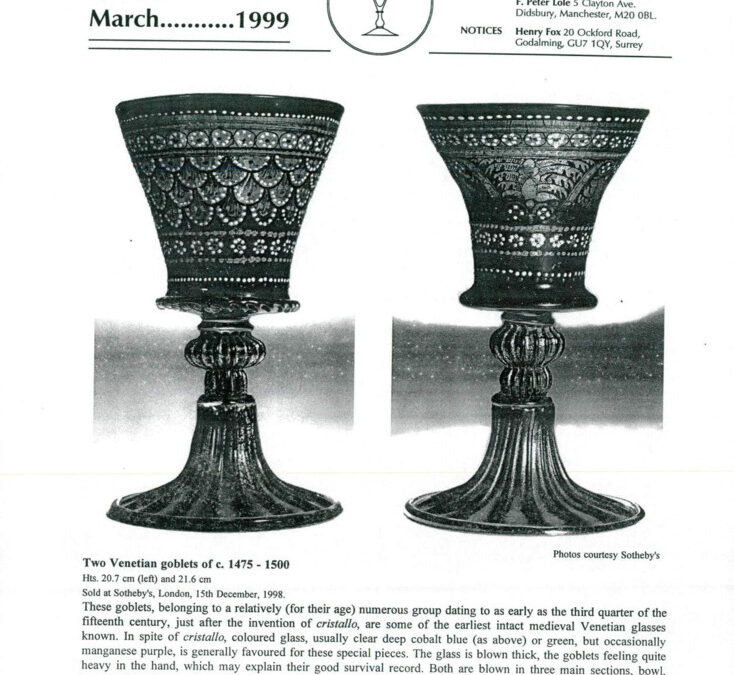
Two Venetian goblets of c. 1475 – 1500
Hts. 20.7 cm (left) and 21.6 cm
Sold at Sotheby’s, London, 15th December, 1998.
EDITORS David C. Watts
27 Raydean Rd,
Barnet, Herts. EN5 IAN.
F. Peter Lole
5 Clayton Ave.
Didsbury, Manchester, M20 OBL.
NOTICES Henry Fox
20 Ockford Road,
Godalming, GU7 1QY, Surrey
Photos courtesy Sotheby’s
These goblets, belonging to a relatively (for their age) numerous group dating to as early as the third quarter of the
fifteenth century, just after the invention of
cristallo,
are some of the earliest intact medieval Venetian glasses
known. In spite of
cristallo,
coloured glass, usually clear deep cobalt blue (as above) or green, but occasionally
manganese purple, is generally favoured for these special pieces. The glass is blown thick, the goblets feeling quite
heavy in the hand, which may explain their good survival record. Both are blown in three main sections, bowl,
stem and foot with upturned rim, and then joined together with wafers of clear glass. Apart from ease of
construction this facilitates decoration, enamelling (blue, green, red and white dots) on an imbricated gold leaf
ground to the bowl, before final assembly. The bowl shape is enhanced by the applied pincered collar shown on
the left hand piece.
These goblets came from the household of Alan Stepney Gulston (1844-1914) of Derwydd Mansion, Llandeilo,
Carmarthenshire, West Wales, and although the provenance is only certain to around the beginning of the 20th
century such pieces would be difficult to fake convincingly (although some experts consider the use of clear glass
wafers suspicious in this context). Further details of the Gulston family history are given in the Sotheby catalogue.
Venetian glass of this age and quality rarely comes up for auction and explains the fierce bidding and high prices
realised of £144,400 and £133,500 for the left and right goblets respectively, around twice the estimates.
A fine example of early wheel engraving on a
German or Dutch roemer, signed and dated WFS
1645, but a subject not at all to Ruskin’s taste.
Illustration of glass No. 163 from
Amsterdam’s
Historich
Museum.
See book review on page 9.
GLASS CIRCLE NEWS No. 78
Page 2
1999
Editorial
THE STONES (AND GLASS) OF VENICE
John Ruskin’s views on cut glass are as well known as the story
of glass making being discovered by the River Belus; but what
was the basis of his remarks and I wonder how many collectors
have read
The Stones . . .
to find out? Until recently, when my
favourite flea market, in Bridport, came up with a three-volume
set, I certainly had no idea. I am now inclined to think that the
widespread dissemination of this particular passage was a ruse
by dealers of the day to deflect interest from the prevailing
enthusiasm for cut glass into the more profitable, for them, areas
of glass collectables. But that is, by no means, all the story.
It has first to be remembered that Ruskin wrote
The Stones . .
published in 1851, at a time when the microscope had come into
its own, natural history was a popular persuit and controversy
over the concept of evolution relative to the
omnipotence of God was rife even before
Darwin’s (1859)
Origin of the Species
brought the problem to the fore. Ruskin’s
outlook is overwhelmingly influenced by
his religion and his writing is an unremit-
ting and logically exacting thesis on the
good of godliness as opposed to “barba-
rous” ungodliness of which Venice is the
the example
par excellence
and cut glass
only an aside. That is not to say that
everything barbarous is bad within its own
context but rather that it is unworthy of a
civilised society.
Ruskin’s view in
The Stones . . .
(Vol. 1) is
that the two conditions pivot around the
date, 1418, after which work, as exempli-
fied by architecture, to the glory of God
declines into the paganism of the Renais-
sance – the self-glorification of man and his
works, excommunication from Rome and
damnation by the Pope. He identifies
Henry VIII’s England as keeping the reli-
gion and discarding the art while Venice
kept the art and threw away the religion. It
follows that for him all Renaissance orna-
ment is to be condemned and within his
analysis of Venetian architecture we find
the basis for his dislike of cut glass.
Roundly speaking, Ruskin’s two ap-
proaches to aesthetic satisfaction are, first,
that all architecture should look as though
it logically and adequately supports itself
and, second, that decoration should be to
the glory of God, appropriate to the form
and not wasteful of effort, both approaches
being guided by pre-1418 Christian princi-
straight lines are ugly things as
lines,
but admirable as limits of
coloured spaces; . .”
The use of chiselled lines in buildings all over London, if not all
England, is a clear indication of how much notice was taken of
that stricture! Following this, in discussing the decoration of a
pillar, he writes:-
“every species of decoration may be wisely lavished, and in
any quantity, so only that the form of the shaft is clearly visible.
This I hold to be the absolute essential, and that barbarism
begins whenever the sculpture is either so bossy, or so deeply
cut, as to break the contour of the shaft, or compromise its
solidity.”
Put these two quotes together in the context of Renaissance
thinking and you have 19th century cut glass – the glorification
of man’s invention of steam cutting – and
hence his description, “barbarous”.
Not just cutting but Renaissance motifs, in
general, are condemned. Barbarous, you
must accept, is the engraved decoration on
any of your glasses identified by the follow-
ing quotation :-
“1. Instruments of art, agriculture, and
war; armour and dress. 2. Drapery. 3. Ship-
ping. 4. Architecture itself.” And, in case
you remain unconvinced:-
“I conclude then, with the reader’s leave,
that all ornament is base which takes for its
subject human work . . .”.
If that doesn’t downgrade the aesthetic status
of some of your highly-prized engraved
goblets I don’t know what will! Ruskin
allows, however, one exception:-
“to represent the human work as an
ornament is conditional on its being neces-
say to the representation of a scene, or
explanation of an action.”
In other words, a man in armour, or holding
a flag on a designated field of battle is
acceptable, but empty armour or a garland of
flags, however worthy (picture top left), is
not. It should be added that this is only a
sample of the derision Ruskin heaps on
Renaissance ornament and its architects.
Not all Ruskin is condemnatory by any
means and we may usefully apply his archi-
tectural thinking to glass. The designs of the
base, shaft and capital, or its related cornice,
of a column have features applicable to a
drinking glass. The base of the English
drinking glass, generally wider than the
bowl, provides favourable stability while
bowl shape may be compared with the
profile of the cornice or capital (picture left).
Ruskin divides cornice shape into two major
groups being either concave (a) or convex (b) relative to the
straight diagonal. Even a slight curve, he claims, is more
interesting than a straight line. Further, he finds the assymetrical
curve, typically based on part of the outline of a salvia leaf,
more interesting than a symmetrical curve. In the figure we may
identify cornice outline (a) with a trumpet bowl and (b) with the
upper part of a bell. The same curve inverted (c) is not a bowl
shape but (d) gives a typical round funnel. Thus (a) and (d), are
not only the typical Corinthian and Doric capital outlines,
respectively, but also those of two of our most common bowl
shapes for 18th century drinking glasses. The series (e) through
(h) combines (a) with (e) and (b) with (d) to give a series of ogee
shapes with (f) and (g) being common among our drinking
pies. Thus, in wall decoration, he contrasts
Some cornice shapes analysed by Ruskin in
The
the dividing lines resulting from the use of
Stones of Venice.
different coloured stone in Romanesque
The diagrams are labelled (left to right):-
buildings with the chiselled lines of Ren
–
top
row a – d, centre row e – h, bottom row k – p.
aissance work as found on the Arthur Club
House (now called White’s Club), St. James St. :-
“But why, it will be asked, should the lines which mark the
division of stones be wrong when they are chiseled, and right
when they are marked by colour? First, because the colour
separation is a natural one. You build with different kinds of
stone, of which, probably, one is more costly than another;
which latter, as you cannot construct your building of it entirely,
you arrange in conspicuous bars. But the chiselling of stone is a
wilful throwing away of time and labour in defacing the
building: it costs much to hew one of those monstrous blocks
into shape; and, when it is done, the building is
weaker
than it
was before, by just as much stone as has been cut away from its
joints. And, secondly, because as 1 have repeatedly urged,
1999
Page 3
GLASS CIRCLE NEWS No. 78
The Mystery of Purple Lalique?
Adherents of the Daily Telegraph cannot have failed to read the
court summary of the extraordinary and extremely rare case of
fraud in which judgement was given in favour of Mansour Ojjeh,
co-owner of the McLaren Formula One motor racing team,
against the London dealer, Mark Waller of Galerie Moderne, in
Belgravia, involving the sale of “faked” purple Lalique car
mascots. Mr Ojjeh had been tempted to part with his collection
of 12 clear Lalique car mascots and £500,000 in exchange for 17
purple mascots. The case for the prosecution took over a year to
prepare by solicitor, Michael Spears who is himself a glass
collector, involved experts in the field and included a trip to
America. Until the dark purple mascots appeared they were
essentially unknown and while Lalique appears to have produced
the occasional piece in black, although not a car mascot, deep
purple was not a Lalique colour.
The question of whether or not the mascots were genuine
products of the Lalique factory, once checked, was not a matter
of contention although at least one was in a fairly tatty condition,
having been well worked over with the wheel. More important
was how the coloration had been achieved. The story here goes
back to a report in 1905 by Sir Wm. Crookes that a piece of
glass containing manganese from South America had become
violet upon exposure to the sun’s rays. The same year Samuel
Avery obtained glass samples from New Mexico which were
intensely coloured including a bottle that had been partly buried
and had changed colour only in the part exposed to the sun. A
flurry of papers followed in which the requirement for manga-
nese in the glass was confirmed and ultraviolet light and
X-irradiation were found to have the same effect as sunlight. The
process, particularly with sunlight, was, however slow, taking
from weeks to several years to bring the colour change about.
Not all types of glass was affected and Fischer found that Jena
combustion glass, Durax glass (Schott), German lead glass and
English lead glass were not affected whereas ordinary Thuring-
ian glass, apparatus glass from various German manufactures
and Schott thermometer glass were coloured strongly by rays
from a quartz-mercury lamp within 12 hours. All the coloured
group contained manganese; Fischer claimed that the glasses not
affected contained no manganese and, so far as the English lead
glass is concerned, this is possibly because nickel and cobalt
were also being used as decolourisers by this time.
Later, in 1920, S.C. Lind confirmed the effect with radium
emanation and reported the important finding that the purple
colour was discharged by heating the glass to softening point,
around 200
0
C or, in certain circumstances, to 500°C. This test
made possible the distinction between purple glass that had been
coloured by irradiation of clear glass containing manganese in an
amount sufficient to cause decolourisation and glass deliberately
coloured purple by the addition of much larger amounts of
manganese. When applied to one of the purple Lalique mascots
its colour was reduced to a pale violet confirming that the cause
of colouring had indeed been irradiation.
Once this was accepted by the defence the legal arguement then
turned on whether or not Lalique would have used irradiation as
part of his factory work. Much of the early radiation chemistry
continued on page 7
THE STONES (AND GLASS) OF VENICE. concluded
glasses. The series (k) through (p) shows the result of adding a
third curve to form the double ogee with, for example, the
shaded areas of (o) and (p) representing the delightful pan top
and saucer top bowls shown upside down. Other bowl shapes
may be analysed in this way and even the bowls of the Sotheby
Venetian goblets (cover pictures) can be fitted to Ruskin’s
cornice profiles. We may study these shapes in relation to our
own collections and consider with Ruskin that:-
“None of these types, however, are found in perfection of
curvature except in the best work”.
While favouring the salvia leaf curve he also points out:-
“that an innumerable variety of curves may be fitted, from every
leaf in the forest, and every shell on the shore . . .”.
Here, he deliberately associates designing with the glorification
of nature and God. It is interesting, too, that in glassmaking
some cornice shapes are never, or rarely, adopted for the bowl,
presumably reflecting current taste. Finally, we may see in these
cornice shapes the curved outlines of the glassware designed for
Whitefriars by Philip Webb and T.G. Jackson in the late 19th
century, and, to a lesser extent, those of Harry Powell himself.
The shaft takes us into a different sphere, and not just because
the transparency of glass allows decoration within its stem. As
quoted above, it should look comfortably strong enough for its
purpose, a situation not always found in baluster and composite
stems. But at this point consideration of the design similarities of
shaft and stem part company. For, while a drinking glass stands
alone a shaft has to be considered relative to the whole building.
Ruskin, for example, finds that Caryatids, much admired today,
should be condemned as “one of the chief errors of the Greek
schools”; by the same reasoning I think he would find difficulty
with the multiple baluster and composite stem, and excessive
and complex knopping. Similarly, superficial additions, such as
a collar, would be treated as Renaissance barbarosities. Indeed,
one might say of our drinking glasses that they are more often
prized for their rarity than purity of line.
It is unfortunate that Ruskin’s pivotal date of 1418 is far too
early for him to have analysed Venetian glass in support of his
thesis. As described by Martine Newby (GC News No.75, p.7)
although Italian glass history goes back to the 13th century,
intact domestic glass is only known from around the mid-15th
century other than from a few paintings. The Sotheby goblets are
among the earliest known and are typical of the period – blue
glass plastered with enamel and gilt decoration. Although
cristallo
was invented by 1450 it was not relieved from enamel
decoration in the better pieces until the end of the century, while
the exquisitely blown clear glass vessels did not become
dominant until the mid-16th century. As described by Trenchard
Cox
(The Renaissance in Europe 1400-1600):-
“Carried away by the caprices of their own imagination the
Venetians blew their glass into a variety of weird forms . . .”.
Clearly, Italian domestic glass followed an independent evolu-
tion – perhaps their glass makers were always godless! Giovanni
Mariacher
(Italian Blown Glass, 1960, p.37.)
meditates “who
would deny in principle that even the greatest names of the
Italian renaissance – from Paolo Veronese to Tintoretto, from
Palma it Giovane to Jacopo da Bassano – might on some
occasions have assisted the glass-maker to evolve new forms, if
only by providing him with sketches and drawings.” Maybe
architects were not without influence on glass design either.
Ruskin’s Victorian style does not make for easy reading but it is
worth the effort, if only to dip into. He will certainly sharpen
your sensitivity to and appreciation of both architecture and
glass, and place his strictures on cut glass in true perspective and
diffract a much more favourable light for the collector.
New Museum of Scotland
Ever since 1952, Scotland has desired a showplace for its
national treasures. Now, next to The Royal Museum in
Chambers Street, Edinburgh, a new “Museum of Scotland”
opened last November. It traces the events of every aspect of
Scotland’s rich history with much new material on display. The
amount of glass has still to be determined but it does include a
double series opaque twist glass polychrome enamelled with a
bust of Bonnie Prince Charlie in tartan regalia.
The adult entry price of £3.00 includes The Royal Museum, next
door, and a single season ticket can be had for £5.00 or a family
season for £9.00; usual concessions and NACF members free.
GLASS CIRCLE NEWS No. 78
Page 4
1999
4:
#4
1-
Reilecti”
4
–
4
Perot Zete
One day in November we set off on a round trip of almost two
hundred and fifty miles, planned as two Glassy venues, with a
Jacobite interlude; but the latter unexpectedly revealed a signifi-
cant Glassy interest, too.
The first stop was Chester, where we had a lunch time talk and
display by a member of Chester Archaelogy, an adjunct of the
Grosvenor Museum, on locally excavated Ceramic and Glass
finds of C.16th. to C.18th. The Ceramics inevitably predomi-
nated, with finds of articles imported from the Rhineland,
Flanders, France, Spain and China, as well as local productions
from Staffordshire and N. Wales.
The Glass finds, paradoxically, produced the only intact item, a
nice late C.17th. onion-shaped Black Bottle, which a workman
had uncovered with his bulldozer. There were beaker bases from
11/2 ins to 3 ins. diameter, a section of a small serpent stem with
blue embellishment and two intact relatively short, lion mask
stems, with bowl bases and fragments of folded feet still
attached. Characterised by Robert Charleston as: “… a cliché, of
fawn de Venise glass”, it is impossible to know whether these
lion knop stems were English or imported. A substantial
fragment of a thin-walled cobalt blue, handled bowl was another
interesting feature of this group, with various other rather
anonymous sherds, mostly from bottles. A surprising feature was
to find only a single example of the cigar shaped stems which
are so ubiquitous and numerous in the London C.16/17th. finds.
The Grosvenor Museum itself
displays only one C.18th.
Glass, a good baluster goblet-
(right), 7 ins. high, with early
wheel engraving of the three
wheatsheaves of the Chester
Arms set into a baroque car-
touche; this was acquired as
lot: 134 from Christie’s sale of
17 Jan. 1978. Another pleasing
late C.18th. drink related arte-
fact is a very large Chinese
Porcelain punchbowl, some 27
ins. diameter, inscribed: “Pros-
perity to the County of Chesh-
ire” “Success to the plough and
sail” and decorated with the
Cholmondeley arms. This cel-
ebrates an election success in
1797 by the Cholmondeleys of
Vale Royal, the Jacobite Tory
branch of the family, in contradistinction to their distant,
Whiggish, cousins, the Earls of Cholmondeley.
Our next port of call was a Jacobite house in the Welsh marches
with the intriguing name of Berse Drelincourt, which had
supported an annexed church orphanage and school for girls.
Some authorities say that it was also used as a safe house and
school for the young offspring of exiled Jacobite nobility;
indeed, one writer asserts that two bastard offspring, followed by
a grandson, of Prince Charles Edward Stuart were accommo-
dated there at different times. We had a most cordial welcome,
and it transpired that the owner had a substantial group of
press-moulded Glass and a wonderfully comprehensive and
extensive group of knife rests, many wholly or mainly of Glass. I
have always expected knife rests to come in pairs, but apparently
the French had sets of 5, 10 or 12, to accommodate their still
continuing use of a single knife throughout the meal.
Finally we moved on to Broadfield House Glass Museum, for a
repeat by Charles Hajdamach of his lecture on “Mrs. Graydon-
Stannus”, which he first gave to the Dublin seminar of The Glass
Society of Ireland in March last year. Charles paid tribute to
Robert J. Charleston’s file, which had yielded much information
and many illustrations. A serendipitous acquisition by Broad-
field House of M.S.Dudley-Westropp’s own copy of one Mrs.
Graydon-Stannus’ booklets was heavily annotated with mar-
ginalia such as ‘rot’, and some of RJC’s cuttings and photo-
graphs were endorsed in similar fashion. Slides of some of Mrs.
G-S’ more outrageous confections kept us amused, but left us all
wondering how many of her less outré, productions still remain
as cherished items in collections. Even her Gray-Stan Art Glass
seems to have followed the inspiration of Monart Glass, rather
than leading the way. On the long drive home I was ruminating
that at least the archaeological finds, of which I seem to have
written so frequently over the past year, are free from the wiles
of the forger; but then a little voice from the back of my mind
whispered “Piltdown Man”.
One of Mrs. G-S’ less contentious commissions was that given
her by Ned Lutyens, for the Glass for Queen Mary’s Dolls
House now at Windsor castle. Charles shewed us four photo-
graphs from RJC’s archive, of items she had made for the house;
one photograph was of four facet cut candlesticks, not much
over 1 ins. high, balanced on the back of Mrs. G-S’ hand. Dolls
House Glass is a rather arcane field, and we have at least one
member with a substantial collection which includes three tiny
opaque twist Glasses. Another member, Philip Jackson, wrote to
me some time ago about the Glass in a Dolls House in
Sherbourne museum, where there is an airtwist drinking Glass
less than 1 inch high. One assumes that usually these tiny
Glasses are lamp-worked, but presumably a twist stem (which I
assume to be of three piece, `stuck-shank’, form) would have to
be made by conventional Glasshouse techniques and pulled out
to a very fine diameter. There are also a number of references to
`Toy Glass’ which seems to be intermediate in size between
Dolls House and normal Glass. The report on the Tunsgate,
Guildford finds (G.C. Nos: 58 & 75) lists a small mould blown
lattimo beaker about 1 1/2 ins. high, c.1700, and quotes Hugh
Tait: “… minute versions of these cups were were made for big
dolls houses, so fashionable at that time in the Low Countries.”
The Winterthur book:
‘Glass in Early America’
(reviewed in
G.C. News No. 77) illustrates two early C.I9th. toy stoppered
decanters 3 – 3
1
/2 ins. in overall height, and also three wine
Glasses of about 2V2 ins. height, quoting a Boston Merchant,
Horace Collamore, requisitioning from his English agent in
1816: “a few dozen Toy Decanters, pitchers, tumblers, Wines
for Children. They must be quite small and come low charged.”
Perhaps a member with real knowledge of this subject may one
day give us a paper on the matter.
Lattimo plates from the Grand Tour
Mention in the last GC News of the number of lattimo plates
produced for Grand Tour visitors prompted Peter Lole to dig in
his archives for a 1997 National Art Collection Fund
Review
which lists the three sets known to have been made for Horace
Walpole, and his friends, John Chute and Henry Fiennes
Clinton, Earl of Lincoln. According to a biography of Walpole
by Timothy Mowl, all three were in Venice in 1741 (at the time
that the White Glasshouse in Southwark was at the peak of its
white glass production). Timothy Wilson writing for the
Review,
tells us that according to circumstantial evidence each commis-
sioned a set of plates, the scenes being from engravings by
Antonio Visentini after paintings by Canaletto. Sixteen of the
Chute plates remain at his house, The Vyne, near Basingstoke
(National Trust). Walpole’s 24 plates were sold in 1842 and are
now widely dispersed, while the Earl of Lincoln became Duke
of Newcastle and his set, apparently nine plates, was kept at the
family seat, Clumber Park, Nottinghamshire, and sold when it
was demolished in 1937. The
Review
relates to one of these
plates, with a view of SS Giovanni E Paolo, Venice, attributed
to the Miotti Glasshouse, acquired for a modest £12,500. It is
now in the Ashmolean Museum and was presented to the
University of Oxford by the NACF in memory of Robert
Charleston (1916-1994) – “one of the great scholars of the
century” – who published the “definitive” study of this group of
glass in
The Journal of Glass Studies,
I (1959) pp. 63-82 as the
result of a “brilliant piece of detective work”.
Dim and Bri
e’99
‘I
say, Bri, can you hear what those two Roman
funerary urns are talking about?
Well! I think they are discussing whose ashes they
would most like to be buried with.
Oh! thats all right, then. I thought for a
moment they
were talking about us!
* Picture derived from
Verreries Antiques du Musee de
Picardie,
see Book Reviews, page 9.
1999
Page 5
GLASS CIRCLE NEWS No. 78
Re:- In from the Cold –
discussion point by Henry Fox
From Mr. Geoff Timberlake,
(Mr Timberlake is also South-East organiser for the Glass Association)
As a relatively new Glass Circle member with a modest
collection spanning the 18th to 20th centuries, I applaud Henry’s
provocative article in GC News No. 76. During my short time
with The Glass Circle I have attended many of the lectures, most
being both informative and entertaining. Some, however have
been either highly technical or academic with, let’s be honest,
limited relevance to the collections and interests of most
members.
Henry has correctly identified the growing trend in glass
collecting, where collectors, due to economic reasons as well as
an enlightened appreciation of the skills, beauty and good design
of the glass produced from the Victorian times to current, are
turning in increasing numbers to examples of those eras. This
was noted at the last Glass Fair organised by Patricia Hier, where
those dealers in pressed or 20th century glass were mobbed by
clients, while the 18th century dealers were having a quiet time,
some to the point of utter boredom!
Although this is the age of communication and many collectors
and academics are busy researching various facets of the glass
industry there is still too little being done about current factories
and studios.
This research is vital – information needs to be gathered and
stored now, while it is still readily available and the personnel
concerned are alive and able to share their knowledge; after all,
in just over one year from now, 20th century glass will be from
the last century and already much information about it has been
lost. To illustrate this point, Nazeing Glass Works, Essex, which
I am currently researching, are still in business, but they do not
have records going back too many years. Trying to find reliable
information about their products made during the 1930s is
difficult, but knowledge of their founder’s activities in South-
wark during the 1920s seems lost for ever. Conversely, however,
there has been much research carried out and information
published about the Vauxhall glass houses of the 17th and 18th
centuries from which Nazeing trace their roots.
So yes, the Glass Circle should be at the front of knowledge of
all aspects of glass and encourage and support lectures that
reflect the change in emphasis of glass collecting. This is really
essential for the Circle, if it is to survive – for I feel that there are
not many new members joining with collections and interests of
16th, 17th or even 18th century glass. If that trend continues,
then in two decades or so from now the Glass Circle will be
another dead and forgotten statistic of the glass world.
Yours sincerely,
or
Insulate Against the Cold Peter Lole• replies
In his obituary of that stalwart of The Glass Circle, Mr. George
Millar, David Watts recalled how Mr. Millar had initially been
rejected by the Circle because his primary interest was Victorian
Pressed Glass; David went on to say: “However, this rule – if
such it was – soon lapsed ….” Two issues later, Henry Fox, in his
article ‘In from the Cold’ (GC News 76), returned to this aspect,
asking: ” … should The Glass Circle respond more positively to
this trend …. ?”.
Indeed there was such a rule; after our first decade Col.
E.E.B.Mackintosh issued, as Paper No: 78 of The Circle of
Glass Collectors, a review of our history to that time. The
concept of The Circle was, he wrote, that: “It should be limited
to old English Glass of the Collectors period 1550-1800.”
Doubtless a thorough perusal of our minute books would reveal
when the relaxation commenced, but even by the time of our
Silver Jubilee, Robert Charleston could write in the introduction
to the Exhibition Catalogue: “…. the focus on the ‘classic’ period
of English Glass has become somewhat less burning, …. foreign
glass (at one time a term of opprobrium), and even the once
despised Victorian glass, have become legitimate fields ….”. The
Exhibition itself included Glass from about 500 BC to the 1960s,
although it included nothing so vulgar (to them) as pressed
Glass, which had to wait until our Golden Jubilee Exhibition for
a token chewing.
But where do we stand today? We have certainly abandoned the
rigid stance of our founders, although the sentiment lingers on.
But in terms of the transactions of The Circle, manifest in our
three forms of expression: The Journal, Papers Read & The
Newsletter, one might question if in our written material we had
not already gone too far from our original brief! Our last two
Journals devoted one third of their space to ‘Classic’ Glass, 43%
to post 1820 Glass and the balance was technical. Also, 60% of
the Papers read at meetings over the past three years were
concerned with ‘Classic’ Glass, with 20% considering post 1820
Glass, whilst with Newsletters of the same period (GC News 66 –
77) just over 40% touched on ‘Classic’ Glass, with almost the
same proportion devoted to post 1820 Glass.
When The Circle was formed, apart from the two Livery
Companies of the City of London, the only other Glass Society
was The Society of Glass Technology; today there are over a
dozen Glass Societies in the U.K. The most important alternative
to The Circle is The Glass Association which “deals primarily
with the history of Glass in the nineteenth and twentieth
centuries”; many of us are members of both Societies, regarding
them as complementary. But when I am at a Circle meeting my
ears prick up with a frisson of interest whenever I hear two
members discussing their latest acquisitions; I confess that when
at an Association meeting, overhearing a conversation along the
lines of “when Bloggit and Pressit’s moulds were acquired by
Skwoshit and Run, did they actually remove the full stop from
the diamond mark?”, I cannot feel the same stimulation. The
Circle cannot be all things to all men, and I believe that we
should continue to regard Classic Glass as our chief interest.
David pulled the ball out of the ruck, and Henry ran with it and
may have scored a try, but I most sincerely hope that we do not
achieve a conversion.
Editorial comment:-
Your
Committee is concious of the need to produce a balanced
programme of lectures but this is not always easy year after year
and you do not have to be a collector of early glass to be
interested in it. My personal view, partly made in my previous
Editorial, is that an understanding of early glass is a prerequesite
to the full appreciation of later glass. The numerous 19th and
20th century historical copies of early glass are now becoming
collectable in their own right thus spanning the two views.
GLASS ENGRAVERS:
George Armstead *
James Byrne *
Thomas Frankland *
New-street-square
(Glass Engraver & Cutter)
79, Little-Britain (Glass Engraver)
59, Redcross-st. Crippleg.
(Glass Cutter & Engraver)
GLASS CUTTERS:
Hancock & Shepherd
Christopher Hannell
John Harris
Harrison and Beardmore
Hodson and Blakeway *
Joseph Hunt
Peter Kolp
Charles Leader
George Lee
George Lovell
Edward Lowe
John Mark
Neale & Bailey
Henry Rider
Henry Ryder
James Simpson
John West
Wilkinson
Young Lake and Son
George Young
Cockspur-street (Cut-glass warehouse)
85, Dorset-str. Salisbury-sq.
Chamber-str. Goodman-str.
125, Houndsditch
71, Strand (Cut-glass manufactory)
34, Noble-street
Yeates-co. Butcher-row
17, Lothbury
48, St. Martin’s-le-grand
53, Red Lime-st. Bloomsbury
15,
Crooked-lane
Finch-lane, Cornhill
8, St. Paul’s-church-yard (Staffordshire
warehousemen & Cut-glass manufacturers.)
231, High Holbom (Cut-glass manufacturer)
23, Holborn (Cut-glass manufactory)
20, Portman-street
40, Old Bond-street
16,
Goldsmiths’ row, Shoe-la.
54, Watling-street
St. Catherines
A trade which was strongly represented in London, but which
was most unusual in the Provinces was that of GLASS
GRINDER. There is only one provincial Grinder recorded:
James Turner, Newcastle-on-Tyne (Glass-grinder and
spectacle-maker)
but there are two other craftsmen whose trade seems to be
related:
John Kendred, Darlington
(Inventor of a machine for grinding optic-lenses which works by water)
Joseph Pearson, Birmingham
(Spectacle-maker, glass-stainer, quicker, gilder and lapidary)
GLASS CIRCLE NEWS No. 78
Page 6
1999
LONDON GLASS CUTTERS & ENGRAVERS c.1793
by Peter Lole
My article in GC. 75 of last June gave an analysis of Provincial
Glass Cutters and Engravers drawn from entries in THE
UNIVERSAL BRITISH DIRECTORY 1793-1795. This note
considers the position in LONDON, covered by Volumes I & II
of the set, the first volumes to be issued. The notes and
explanation about this Directory are given in the earlier article.
The most suprising feature was that clearly London in the early
1790s was still by far the most important domestic Glass centre
in the country. It had more than twice as many cutters as the rest
of England put together, and half the Glass Engravers listed in
the whole of England. It had almost a third (19 out of a total of
66) of the Glasshouses and Glass Manufacturers listed, but forty
years later the proportion of Excise Duty paid in London had
dropped to only 2% of the total English sum of £680,000. (See:
C.R.Hajdamach: British Glass 1800-1914 Pp 413-415) But this
note is really directed to Cutting and Engraving, and I shall
return to Glass Making in a future issue.
As in the first instalment, the correct treatment of those listed as
GLASSMAN, often in association with pottery, is something of
a puzzle. There are twelve of them in London, of whom at least
four are well known names who probably decorated Glass on
their own premises:
William Bacchus
Jonathon Collett
Thomas Johnson
William Kendall
George Yard, Upper Thames-st.
(Glass & China-man)
10, Cockspur-street (Glass-man)
195, Holborn (Potter and glassman)
15, St. James’s-street (Glass-man)
In the following list any already recorded by Robert Charleston
as Engravers (See GC 75 ) are marked * . The designation in the
Directory is exactly as the heading below, except where noted
otherwise.
Whilst one’s initial impression is that a Glass Grinder is
involved in bevelling glass, such as mirror plates, it is clear from
the above listings that it is more probably a lens making activity.
There are a great many Looking Glass Makers in the Directories,
but one takes these to be essentially a branch of Cabinet Making.
London boasts no less than seven Glass Grinders, plus William
Gould given above as a cutter.
Joseph Aldwinkle
Charles Allison
Hector Barnes
Thomas Bennett
Christopher Bird
John Birkley
Samuel Brooks
Edward Brown
William Burgess
Andrew Cobb
Peter Cobb
Samuel Collings *
Jacob Cope
Croucher and Martin
John Davis
Adam Dennis
William Dutton
Thomas Fenton
Anthony Gevener
Henry Goddin
Thomas Goodchild
Joseph Goodchild
William Gould
John Henry Grossman
Haedy & Son
72, Mark-lane
20, Garlick-hill
30, Pudding-lane
48, Gaiter-lane
47, Markwell-st. Wood-st.
17, Ratcliffe Highway
110, Strand
12, Billiter-square
4, Little Friday-street
26, Goswell-street
Angel-st. Martin’s-le-g.
Earl-st. Seven Dials (Lapidary & GI. Cutr.)
111, Upper Thames-st.
23, Queen-street, Cheapsi.
Hart-street, Crutched-friars
Clement’s-Lane, Lombard-st.
Drapers-co. Princes-str.
13, Birchin-lane
340, Oxford-street (Cut-glass manufactory)
9, Sherborne-lane
252, Tooley-street
2, Tooley-street
78, Gracechurch-street
(Glass Cutter & Grinder)
Well-street, Rosemary-la.
287, Strand (Cut-glass manufactory)
GLASS GRINDERS:
Christopher Child
Playhouse-yard, Water-la.
Thomas English
Great Earl-str. Seven dials
John Gray
29, Steward-str. Spitalfields
Nicholas Hancox
Castle-street Long Acre
John Harden
Silver-street, Clerkenwell
Thomas Knight
Old Compton-street, Soho
William Schofield
White-lion-st. Seven Dials (Glass-grinder &c.)
and another specialist not found in the Provinces is:
Thomas Peacock 2, Chatham-pl. Blackfr. (Ground-glass manufactory)
INTEGER IROUSE
The energy-saving Integer House at the Watford Building
Research Station, featured in the last issue of GC News, has
since been chosen for inclusion in the Millennium Dome.
Members may also have seen its construction featured in the
BBC 2 series Dream House. Further information can be obtained
from the BBC by writing to Dream House, PO Box 1001,
Manchester, M60 3JB. or on the Web at www.bbc.co.uk/tw
(note, no final full stop in the Web address). Integer is the name
of the builders, also available on www.integerproject.co.uk
1999
Page 7
GLASS CIRCLE NEWS No. 78
(1lNSS ClippiNfs 69 fiENry 62x
Thirty Years On
I am indebted to a West country member for a cutting from
Independent on Sunday (19.10.98). I had not realised that
Dartington Glass, a project set up in the late 1960s, somewhat in
the manner of the Arts & Crafts movement, in a lovely part of
Devon to help provide work for the local inhabitants, celebrated
its 30th birthday in 1998. Dartington kindly loaned early
experimental pieces to the
“Strange and Rare”
exhibition to
celebrate the Circle’s Golden Jubilee in 1987. Although a craft
industry, Dartington has survived because of its ability to
innovate, use modern technology, and maintain standards of
design in tune with customer demand. From its almost rustic
beginnings it is now a well established name. The Dartington
Trust has ceased to own the business since the 1994 management
buy-out, but the name and ideals established in those early days
continue to be respected today. Personally, I always liked their
heavy and beautifully designed tankards with their applied
moulded topical discs which were brought out in annual
numbered editions. Certainly a collectable for future generations.
As a postcript, Dartington have now opened a new hot glass
studio and shop as a redevelopment of the Fishmarket Quay in
The Barbican, Plymouth old town.
Press
–
moulded Glass on TV
I
found it pleasing that BBC Antiques Road Show (10.1.99)
introduced its visit to Gateshead with a selection of locally made
glass, in particular a number of Sowerby nursery rhyme pieces
which are becoming more sought after by the day but equally
more difficult to find. Just before Christmas a dealer telephoned
to say that they had just acquired from a deceased estate a very
rare and much sort after example, and would be asking £750 for
it!
The disposal of the Cyril Manley and other important
collections over the last decade and a half have each triggered
interest in Victorian pressed glass with the nursery rhyme pieces,
modelled after Walter Crane illustrations, making most of the
running. Viewing the show, I was, however, disappointed not to
see any examples from the 18th century of Beilby workshop
enamelling on drinking glasses, or any examples of the elegant
tall light baluster glasses of the same period which used to be
called “Newcastles” up to some twenty years ago.
Uranium Glass at Sizewell
Guardian readers will have seen the
Space
supplement for Nov.
27 1998, with an article on Uranium glass by independent
correspondent, Sarah Wise and some nice photos by Luke
Kirwan, including some of pieces belonging to uranium glass
collector, Barrie Williams. This relates to the Sizewell Nuclear
Power Visitor Centre (Tel. 01728 642 139) on the Suffolk coast
which is said to contain a display cabinet of post 1830 uranium
containing objects, including glass. If anyone has been there or
is thinking of making a visit a report on the Centre for GC News
would be appreciated.
Flood Disaster for Cambridge, Ohio, Glass Museum
Cambridge Glass produced a wide variety of table and decora-
tive wares in clear, coloured, opaque and shaded glass for 50
years before closing in 1958. Last year was notable for heavy
rains and extensive flooding almost worldwide. Three days of
thunderstorms and hail in late June brought floods to West
Virginia and Ohio in America. On Sunday 28th water invaded
the National Cambridge Collectors Inc. Museum to a depth of
5Y2 feet. As the water rose 25 volunteers worked frantically to
move critical pieces of glassware to higher shelves. As a result
fewer than 100 pieces are thought to have been damaged
although some floated off to various parts of the building! By
Thursday the water had dropped enough for cleaning-up to
begin and valuable specimens, jumbled crazily together on the
shelves, to be rescued. Based on previous flood experience at
Corning, saturated valuable catalogues and other papers have
been stored deep-frozed in plastic bags until they can be treated.
Club members were deeply grateful that, unlike disasters
elsewhere, all their members survived the flooding unharmed.
Needless to say, the Museum is closed for the season and
thoughts are turning to new premises on higher ground.
More details of the disaster are given on https://www.cambridge-
glass.org the Club Website. Financial help can be sent to
Cambridge Collectors Inc. Building Fund, P.O. Box 413,
Cambridge, Ohio 43725, USA. with cheques made payable to
NCC, Inc.
More Clippings on pages 11 and 12.
Purple Lalique, concluded from page 3.
was carried out in France so it might be argued that an awareness
of the effect and its application might be possible there although
not in England. However, the natural tendency of a glassmaker
in colouring glass would be to add the colouring agent to the
batch and this is well known for the use of manganese for
centuries past back to the Romans. It is highly unlikely that a
glassmaker of such repute would depart from such a long-
established practice. The prosecution also came up with the
clinching argument that for a mascot that was to be illuminated
from underneath it was illogical to colour it dark purple as this
would destroy the illuminating effect particularly sought. The
judge also felt that “The dark purple/black colour does indeed
destroy the sense of grace, movement and speed in some of these
pieces.” The report adds “that it was not suggested that Mr.
Waller did not believe the mascots to
be
genuine . . . he had not
been negligent . . . However, by giving his personal assurance to
Mr Ojjeh that the mascots were authentic, Mr Waller had been in
breach of contract.” The Telegraph also reported that Mr Waller,
a Lalique expert, afterwards said that when he first saw “the
stuff” he believed it to be right. He is taking advice on whether
to appeal against the awarded damages of £845,749 and costs of
150,000.
The conclusion in this legal case, then, turns on a matter of logic
and opinion rather than a matter of science. However, there is
another consideration, that of opportunity. Our member, Peter
Dreiser told me that some 30 years ago a colleague treated two
of his glasses in a hospital sterilising machine; one came out lilac
and the
other
a greyish colour. Certainly, there are any number
of old X-ray machines around, world wide, that could be used in
GLASS PURPLING SERVICE ‘•
_
For:
Clear or Light Amethyst Antique Class
&
Bottlei
Must date 1880-1915 8
–
contain “Maganese Oxide”.
Ship or Mail all Boxes & Payments 1i
MJM Pack and Slip
.505B Atlantic Ave.
Interlachen, FL 32148
(904) 684-1248 • Fax. (904) 684-190
All Boxes to be Received hyApril 29, 1991
Approx. return ship date May 6 1996.
Please call for information before,thipmet
this way. Again, a strong rumour has been circulating that the
scam originated with an Australian fruit farmer who discovered
(or re-discovered) the effect by using the radiation equipment for
sterilising his fruit. However, this is not fact and Mr. Spears
successfully tracked down an American advertisement (shown
above) offering to turn your glass purple without even taking it
out of its wrapping.
I am told that the London auction houses, following the lead of
Bonhams, will not now accept purple Lalique for auction. You
might wonder if your own Lalique is at risk in any way? I
certainly would not display it on a sunlit windowsill. I have been
experimenting by standing my most radioactive example of
uranium glass (containing more than 3% Uranium) on a
‘Coquille’ pattern clear glass Lalique plate in the expectation that
it might cause a purple shadow. So far, after more than a year,
there is no discernable effect. Finally, beware of
any
unusual
18th century English glass coloured purple or a manifestly lilac
colour more than the pale tint often seen when decolourising by
manganese has been improperly carried out.
D.C.W.
Skink& Information; $2s, per
Box,
Approx.
size 16 x 13 x 13.
30 lbs:per box max weight. 85:
14
Test box, Max. Weight 2 lbs.
Service does not require boxes to be
opened. Boxes MUST be securely
aped. Shipping-Han dlIng-Irsurance
NOT INCLUDED.
GLASS CIRCLE NEWS No. 78
Page 8
1999
Around the Fairs
with Henry Fox
The Autumn NEC Fair “Antiques for Everyone” was certainly
supported by fewer dealers this time round. I found only three
glass dealers specialising in 18th century drinking glasses,
although there was quite an amount of later glassware to be seen
on a variety of stands. Art Nouveau and Art Deco were well
represented. A well known northern dealer had his usual range
of rare and interesting stock of early glasses, but even his stand
seemed to me to be smaller than before. Another dealer had a
good representative selection of airtwist and opaque twist stems;
whilst the remaining specialist had an example of a glass from
the recently sold
Standish Collection
which had a chipped
folded foot – more of academic interest although a damaged
folded foot is rarely seen, This dealer also had a rummer with
lemon squeezer foot, the bowl engraved with a “Yarmouth style”
coach. On this stand there was also a good pair of cut and
engraved mallet shaped decanters accompanied by II matching
engraved facet stemmed wine glasses; suites or large parts
thereof from the 18th century are not often encountered these
days. Otherwise, there was much to be seen and admired
throughout the fair, including some of those beaded bags that I
saw at Earls Court, but a different dealer this time. (This reminds
me that the Broadfield House Glass Museum exhibition “Beads
of the World” finishes 11 April – see last issue for fuller details.)
This fair was easy to get round and there were numerous seating
areas, sadly filling in for missing stand holders. Are there now
too many fairs, or is this an example of the trade feeling the
pinch in the present economic climate? Or could it even be that
with more and more dealers advertising their stock on the
Internet, more collectors are preferring to surf, view and buy
from the comfort of their own homes? Certainly the Internet
allows immediate world-wide access to what’s on offer, and,
with its rapidly growing usage, it must inevitably take a
significant slice of the collectibles and antiques market,
including glass. In contrast, the organisers boasted that attend-
ance figures had risen by 5000 over the previous similar fair,
and good business was reported by the stand holders. So perhaps
it is true that the British talk themselves into doom and gloom!
The beginning of December saw me visiting the
20th Century
Fair at Olympia.
This small intimate fair specialises largely in
the Art Nouveau and Art Deco products ranging from jewellery
(including the beautiful work of Rend Lalique) to Teddy Bears,
book illustrators (such as originals by Arthur Rackham, whose
brother, Bernard, wrote a book on stained glass during his long
stay at the V & A, and also, I believe, visited John Bacon, in the
1920’s to view his 18th century glass collection) and furniture,
including a fine example of an inlaid table and matching chairs
by Bugatti. As expected, glass was well represented with lamps,
plaques, vases, bowls, wine and spirit glasses, etc., by familiar
names – Lalique, Galle, Daum, Whitefriars, Walsh Walsh,
Stevens & Williams, Monart, Tiffany and Loetz, although not
Jobling or, for that matter, Davidson. Anyone interested in the
variety of glass produced in the first half of this century would
not have been disappointed with that on display. I particularly
admired a huge glinting blue Monart bowl, said to be the largest
piece they produced. Nearby, in contrast, was a small bowl by
Whitefriars cut with Powell’s Roman pattern; on this stand, too,
was a good size Keith Murray design Cactus vase. Also among
the Art Nouveau period glass were some small Tiffany Favrile
spirit tumblers. Another dealer had a pair of attractive German
stained glass window panels, as well a variety of impressive
continental art glass pieces. Not far away I admired several Galle
and Daum vases, including a small Galle one with crocus
design, together with a pair of decorative hanging light bowls by
Verre Francais. I also liked a couple of pieces of
pile de verre
by Argy-Rousseau. Paperweights were represented by one stand,
which showed a good selection of this art form by Whitefriars,
Ysart and Perthshire, but I was taken particularly with the
modern ones currently produced by American craftsmen. Talk-
ing to the dealer I was interested to learn that these were all
made by the individual glassmaker in his own small studio
within the home perimeter. These signed American paper-
weights show great technique and imagination, and can be truly
described as beautiful. I very much coveted an example with a
crane in flight, also another with a bouquet of superb life-like
flowers. I mentioned to several dealers that this new fair
presented a learning curve for both exhibitors and visitors; if
history is anything to go by, then the decorative arts of the 20th
century must be getting nearer to that point when they become
more greatly appreciated by the general public, but I hope this
fair does not get too big or overcrowded in the future. Certainly I
enjoyed my visit – my only disappointment was not being able to
cart off the many things which I liked. I did, however, purchase
a copy of the informative and well illustrated 1985 Corning
exhibition catalogue
Frederick Carder: Portrait of a Glassmaker
for a termer! This certainly made up for the lack of catalogue to
accompany this fair; even a list of exhibitors, I was informed,
had been withdrawn due to errors!
One of the first fairs of 1999 was held at Westpoint
Exhibition
Centre, Exeter.
This is a good-size general fair (claims up to
500 stands) concentrating on wide range of collectibles, largely
late Victorian through to just Post WW2. I found only one stand
with examples of 18th century drinking glasses – all reasonably
priced, but there were certainly no rarities to excite the serious
collector. Among the later glass I saw an attractive complete
glass dressing table set by Stuart, including matching low
candlesticks, overall decorated with blue enamelled butterflies.
This find was eagerly snapped up by a couple whilst I was
viewing it. Other items quickly acquired were a small brown
coloured Whitefriars Baxter-period glass duck; a vase by Walsh
Walsh; an unusual clear greeny-blue pressed glass vase deco-
rated with swans linked with chains. Examples of this last item
are usually seen in opaque glass, often in malachite colourings,
and although unmarked have been attributed by some to
Sowerby. I saw a good Sowerby toast rack in flint, a few pieces
by Davidson, as well as some examples of glass by Lalique. It
pays to get early to this type of fair. This organiser arranges fairs
at Westpoint and the Matford Centre, Marsh Barton, Exeter,
regularly throughout the year. Whilst in Exeter a quick visit to
the two small antique centres on the refurbished quayside should
not be missed. I found a copy of
The Glass Collector – A Guide
to Old Glass
by Maciver Percival. This interesting little book
has thirty pages of illustrations at the back and numerous line
drawings in text, as well as extracts from auctioneers’ catalogues
with realised prices which make fascinating reading e.g. “…wine
glass, engraved with portrait of Charles II and three royal crowns
in the Boscobel Oak Tree, on spiral stem.
Sotheby,
Feb. 8,
1911”, sold for £15 1 Os Od ($75.33). I thought this early book (a
second edition) on drinking glasses etc. well worth £7 – it was
almost out of sight at the back of a locked case.
Millennium Glass Award
Broadfield House Glass Museum has been awarded £24,000 by
the Arts Council Millennium Fund to match a £60,000 commit-
ment by Dudley MBC. This will fund six community Arts
projects collectively entitled
Glass Roots
that will take place
throughout the year 2000. Each glass work will be relate to a
local environment and the area’s glass history. The works will be
unveiled at two monthly intervals throughout 2000, creating
repeated opportunities for the Borough to commit itself to
unremitting celebration. A further six works will be commis-
sioned from top UK glass artists to go on display at Broadfield
House – nails in glass coffins, perhaps!
Engraving Workshop 7 – 9 April 1999
Our member, Katherine Coleman
is running a bargain 3
–
day
beginners engraving workshop at Stoke on Trent Arts College for
the Contemporary Glass Society. The cost, which includes CGS
Associate Membership, is £140 (accomodation extra).
Ring Catherine on 01242 513 019 for further information.
Death of Don Spillman
We have just learned with great sorrow of the sudden death of
Don Spillman, beloved husband of Jane Shadel Spillman who
entertained us only last year at their home in Corning. The
Spillmans have been great supporters of The Circle over many
years and we hope to see Jane in London in November.
D.C. W
1999
Page 9
GLASS CIRCLE NEWS No. 78
New Books
and
Publications Received
Verreries Antiques du Make de Picardie.
This 130-page, soft-back , 22.9 x 30cm, volume, text in French,
is a truly delightful catalogue of the exquisite collection of
Roman glass in the Picardie Museum in Amiens. The earliest
pieces, sand core, date from the 6-5th century B.C. and the series
continues through blown glass to the end of the Roman era. All
the numerous pictures, are full colour, supplemented with b/w
diagrams to illustrate the remarkable diversity of a particular
vessel type. In addition the book contains essays on the use of
the articles produced, their possible centres of production and
mode of manufacture. This last is accompanied by a series of
colour pictures of a French glassmaker illustrating the manufac-
ture of jugs and bottles (c.f.
5000 Years of Glass).
It, perhaps,
should have been explained that the long blowing iron and
glassmaker’s chair were not invented until the 17th century,
making their achievements even more impressive. Nevertheless,
with a good bibliography, this is a delightful contribution to the
subject which all interested in Roman glass will enjoy.
Price FF185 to the Tresor Publique, Musee de Picardie, 48 Rue
de la Republique, 80000 Amiens, France.
Bulletin of the Asociation Francaise pour Archeologie
du Verre.
This occasional 48-page newsletter (the previous issue was in
1996) includes 13 reports of recent archaeological discoveries
presented at their meetings in 1997 and 1998, a bibliography of
related publications (from 1995) and a list of AFAV members,
the Glass Circle being included as a corresponding member in
my name as newsletter editor.
The first two papers present information on the 1st century, late
Roman glasshouse at Avenches where numerous glass fragments
from the blowing iron indicate a diameter of 8 – 12 mm. A
marble hexagonal base of a mould .was also found, the walls
being presumably of wood or clay. Also, fragments of vessels
within which a film of liquid lead (couche de plomb) had been
deposited, perhaps for making small convex mirrors. The third
paper illustrates 3 moulded intaglios (intaille) of female heads of
the 1st or 2nd century AD.
Excavations in Beyrouth, reported by Daniel Foy, revealed many
thousands of glass fragments of drinking glasses, flagons and
lamps, all middle-eastern imports dating from the 6th century to
the 9th-10th cent. or later. Particularly abundant were lamps with
a tubular foot. Another long, illustrated paper (9 pages) by Maria
Teresa Penna analyses the medieval tableware, mainly drinking
glasses, found in north central France. In support of previous
publications, she found homogeneous forms at different sites;
some of which are illustrated Similar papers relate to other areas
and the discovery of an 18th century furnace site are outlined.
An ethnological paper by Noel Barbe provides statistical data,
based on wages records, of the families employed at
La Rochere
glasshouse from the early 20th century; some 31% of patronyms
continue to the present day. About 65% of glass blowers sons
became glass blowers at the factory while wives and daughters
were involved in packing and shop sales (50%), decoration
(16.6% )and in the glass works (33.3%). These trends reflect
both familial associations with the factory and its environmental
location as a major employer.
Guy-Jean Michel traces the restoration of the glass factory of
Le
Morillon
(established in 1523) after the end of the 30-years war,
in 1636, during which the early glass industry of the Vosge area,
in the forests of Darney and Selles, was totally destroyed. This
occurred some 30 years befor the foundation of the, still extant,
factory at La Rochere and involved the families of de-Roux,
Massey and, later, Henzey. A major problem to be overcome
was the reclamation of land abandoned in the war, to make it fit
for farming, the other vital aspect of the verrier’s livelihood.
Some of the old concessions to the gentilshommes verrier were
lost and problems arose over the wood supply. A deposition of
1743 outlines the massive amount of wood (1080 cords = 2952.2
cu. metres) required to run the glasshouse for 6 months in the
year. During the other 6 months the furnace was rebuilt and the
stocks of glass-making materials restored. At first
verre en table
(broad, window glass) was made but this was later abandoned in
favour of bottles. The factory site remains.
The Bulletin concludes with a (too brief) paper on the develop-
ment of the windows in Franche-Comte after 1636 (called here
the 10-years war!) and the emergence of the large (24 pane) sash
window (a la francaise) as illustrated by the Grand Seminaire de
Besancon built around the last years of the 17th century, being
replaced by the casement at the end of the 18th century. Broad
window glass was made in the Black Forest and the Bishopric of
Bale in the north-east of the province, particularly at Bief d’Etoz
and Miellin founded in 1697 and 1730.
Amsterdams Historisch Museum: Museum Willet-
Holthuysen
Listed by Heneage in GC News 77 at £35
This superb hard back volume, pp. 384, 285 x 238 mm with 16
pages colour and endless b/w illustrations, some larger than life,
on quality art paper is truly a treasury of European glass from
the 16th -20th centuries, from Heemskirk to Heineken, Mooley-
ser to Dreiser. Of the 482 objects, or sets, in the collection, some
10% of the later glass might fall withing the range of the
average collector and perhaps resolve some unexplained mys-
tery pieces. Its great strength, however, is the early diamond
point and wheel engraving, much of it on glass described as
English, English or Netherlands or just European. Members who
took advantage of our member, F.G.A.M Smit’s free offers of
his books on Dutch engraved glass will find him usefully
cross-referenced on a number of occasions. The text is in Dutch
and while the basic information is not difficult to understand the
longer expositions frustrate. One feels, while recognising Hol-
land’s National spirit, that the glass world would have been
better served by such a fine work had it been in English.
The book begins with five essays, of which there are shortish
English summaries, on the History of the Museum, Amsterdam
glasshouses, some Occasional Glasses in the Urban Culture,
Jacob Sang, and Amsterdam shops specialising in glass, particu-
larly Glashuis Muller. Because of Amsterdam’s past trade links
with London I had hoped that the account of its glasshouses
would shed some light on the origins of the light balusters
(Newcastles) that form such a prominent part of the collection.
But no such luck as none seems to have made lead glass. In spite
of the claim of ‘Netherlands’ for these distinctive glasses their
origin remains as entrenched in England as it ever has been.
Other than a few in Denmark and, perhaps Val St. Lambert, the
existence of any Continental site that could have made the finer
specimens has yet to be discovered. It should be added here that
one failure of the catalogue is to distinguish between lead and
non-lead glasses (one glass is interestingly described as English
chalk-glass!). However, the pictures are so good that the
difference is usually clear to the tutored eye. I rate this book, at
about one third of the price one would pay for a V&A or BM
equivalent (without the Heneage 10% members’ discount) as
one of the great glass book achievements of the year that will
inform and delight all lovers of old glass.
Remaindered books and cheap reprints
The national chain of County Bookshops is always good for a
browse, occasionally yielding a bargain for glass collectors. Two
recent acquisitions, both with contributions by Circle members,
are here worth reporting. The first,
Understanding Antiques,
in
the Miller’s series, includes a comprehensive review of glass by
specialist dealer, Wing Commander Ron Thomas. As well as
reviewing glass worldwide the section on early English glass is
particularly good for the beginner, packing much well-illustrated
information into a small space, plus useful tips for the collector.
In addition, short sections on Art Nouveau and Art Deco glass
are contributed by Eric Knowles, and post WW II by Alexander
Payne. This 1997, 278 page hardback reprint of the original
1989 edition is offered for a bargain £7.99 against the marked
concluded on page 12
GLASS CIRCLE NEWS No. 78
Page 10
1999
Around the Auctions
(all prices – ex buyers premium. Photos courtesy of the Auctioneers.)
If one were looking for something different in the way of glass
that would be a decorative talking point – if not a show stopper –
then I feel the following two items which turned up in the
Autumn sales of 1998 would meet that criteria. The first item is a
19th century Cranberry glass and gilt metal perpetual table
fountain (right) about 20 inches high, which was sold for £700 at
Wotton Auction Rooms, Wotton-under-Edge, Glos.
The
frame was marked J. Defies & Sons of Houndsditch, London. It
had a clear glass upper bowl. I think the two lower Cranberry
coloured bowls revolve to create fountain and recycle the water.
Does any member have any information to add to, or to correct,
this statement? The second item of interest is a Phonogragh
“Pathe: Le Gaulois” 1900 – 1903 with an extremely rare original
glass horn (far right), which was sold by
Breker-Auction Team
Man, 50971 Köln Germany,
for (premium inc.) DM9013
(=£3168). Despite its age this phonograph plays well, and is in
good unrestored original condition.
November saw the sale at
Christie’s King Street
of the Plesch
Collection of Chinese glass which contained many rare and
academically important pieces. Viewing some of the them I
could readily understand why Prof. and Mrs Plesch were
“hooked” by such fascinating examples of the glassmakers art,
and enticed away from early English glass. Sale highlights were
a rare caramel-brown beaker vase, Gu Yongzheng (1723-35) or
earlier £6000; a fine large deep purple glass globular bottle vase,
Qianlong Four-character mark within a square and of the period
(1736-95) £7000; and a rare cold-painted turquoise glass
rectangular jardiniere, Qianlong as before, £12000.
1998 concluded with a good all-glass one day sale at
Sotheby’s.
Their December sale brought out record prices for heavy
balusters as well as the 15th century Venetian goblets mentioned
on the cover. The room was
packed and there was an im-
pressive bank of telephones
for those anonymous bid-
ders. A small lead crystal
tazza attributed to the Duke
of Buckingham’s Glasshouse
(right), but perhaps Hawley
Bishopp or even much later (like the gadrooned opaque twist, far
right), fetched £1495 while the light weight, exactly right
Anglo-Venetian cristallo speci-
men (left) did not sell! Among
the heavy balusters a mushroom
knop fetched £2600; another,
with wide angular knop, £2800
(right); while a slightly later
goblet of not quite such substan-
tial form with angular knop
fetched £2200.
The wine glass formerly belong-
Asa
ing to John Bacon (left) with the extremely
rare, if not unique combination of double ogee
bowl on cylinder knop over ba-
sal knop, £8000; another cylin-
der knopped glass of more tradi-
tional form with domed and
folded foot, £5500; toastmas-
ter’s glass on inverted baluster
stem £1100; another on short
diamond shouldered octagonal
pedestal stem, £750; a typical
mead glass (right) £1300 (has
any member any evidence that this style of glass was specifically
used for drinking mead, or otherwise shed any light how this
term came into usage for these glasses?); composite wine glass
with stem composed of airtwist ball knop over plain triple
angular knop above an opaque twist section with shoulder knop
and small basal knop, £1500; ratafia with narrow basal fluted
bowl set on opaque twist stem, £1000; airtwist cordial with
conical foot, £850; Jacobite portrait glass, Latin motto
“Auden-
tior Ibo”
(I shall go with greater daring) on a centre knopped air
twist stem, £2800; a rare canary opaque twist stem glass, £8000
(but anyone disappointed in not getting a canary colour twist for
Christmas only had to cross the road to find an example in
Mallett’s window); an ‘unrecorded’ fine rare colour twist, its
stem composed of a central vertical white opaque thread with
translucent emerald green core within a corkscrew spiral of three
opaque white threads enclosing translucent cobalt blue and red
£9000; an opaque white twist stem, the bowl with Beilby white
enamelled decoration of ruined arches and shubbery, £2800;
another rarer white opaque twist Beilby, this time a goblet, the
bowl decorated with florid mirror monogram above leaf sprays,
the reverse with honeysuckle spray and grasses, and the sides
with insects, but with replacement turned wood disc foot, £3200.
In contrast, a Beilby white decorated ale glass with hop and
barley motif but the stem with annealing crack and foot-chip,
and minor chips to enamel decoration, £750; opaque twist stem
wine glass with fruiting vine gilt decoration on bowl and gilt
rim, £1800; a similarly gilt decorated goblet but on different
opaque white twist stem, £1400; another gilt decorated fruiting
vine goblet on a further different opaque twist
twist stem, but with minor foot rim chips,
£1900. Among other early English glass were
a rare and large knopped stem candlestick
(right) on high domed and folded foot c.1730
for £2400 and a small candlestick c. 1750, the
stem composed of collars flanking a cushion
knop over a short waisted section set on wide
conical solid foot, £400. For its simplicity I
particularly liked a shaft and globe decanter
with kick-in base which was diamond point
engraved
Wm Slcelhorn 10th June 1747 ;
it
went for £850. A pleasing rare double “B”
handled jelly (right) on a plain stem fetched
£1000. Highlights of the later English glass
were a pair of c. 1830 engraved coaching
decanters attributed to Thomas Hawkes & Co.,
of Dudley at £3800, while a Stourbridge vase
c. 1890 engraved by Geo. Woodall brought
£1400. Of the selection of good paperweights
the top price was a bid of £17000 for a mid
19th century rare Baccarat white carpet ground
patterned millefiori paperweight. Of the conti-
nental glass I very much admired a pair of tall
Bohemian overlay bottle vases and covers
(right) thought to be possibly by Neuwelt or
Adolfhutte bei Winterberg, c. 1860. The vases
were in two sections which enabled the owner
to change the height and form without detract-
ing from their attractiveness. No doubt the
obvious quality of workmanship plus the
novelty of this design helped the hammer to
fall on these interesting vases for £30,000.
Also in December, among the glass lots at
Woolley & Wallis, Salisbury
was a pair of
heavy late Regency decanters with mushroom
stoppers and step cut octagonal necks and
cylindrical diamond cut bodies which fetched
a final bid of £3000.
Again, in December
Phillips Bond Street
(Works of Art Sale)
had a fine 16th century Flemish stained glass roundel showing >
1999
Page 11
GLASS CIRCLE NEWS No. 78
Around the Auctions
concluded
a humble foodless kitchen scene with wretched looking man
trying to light a small fire (above). This is taken from the
Prodigal Son-type story
The Life of Sorgheloos
and fetched
£16,000.
The new year started well. In January Dreweatt Neatte,
Newbury, Ceramic & Glass Sale had a single owner collection
vose=aissw. of drinking glasses included with other period
glass. There were no heavy balusters or glasses of
exceptional rarity, but the range was T–
interesting and attractive and in-
cluded examples that many a collec-
tor would be pleased to own. Some
highlights were a fine ale, the bowl
gilded with hops and barley on white
opaque twist double series stem (left)
£1950; two cordials with small
bucket bowls, one on a good “mer-
cury” stem (top right) the other on a
plain stem with long tear and domed
foot (right) fetched £680 and £900
respectively; a wine c.1730 with bell
bowl on a plain centre-knopped stem
and domed foot £580, a ratafia, the
tall narrow bowl with basal fluting on
a slender white opaque twist stem
£1100; a red/white/blue colour twist
stem glass with footrim chips £1400.
I particularly liked the gin glass (left),
of c. 1730, with unusual stem forma-
tion £1100 and a two handled jelly
which made £480.
GLASS CIRCLE MATTERS
New Members
The Circle is pleased to welcome:
Ms. Jane Dorner
Mrs. M.F.L. King
Mr. G.E. Taylor
GLASS CIRCLE MEETING DATES, 1999
All meetings to be
Tuesday
16th March
1999
held at the:-
Tuesday
13th April
1999
Artworkers Guild,
Tuesday
11th May
1999
6, Queen’s Square,
Tuesday
15th June
1999
London, WC1.
REMEMBER
–
Let the Hon. Sec. know you are coming,
particularly if you are bringing a guest.
GC News No 79. Deadline Mid-May for publication in June
.
Treatment for Crizzling
Re the crizzling of the V&A glasses discovered recently, our
member from Hampshire, Tom Williams has sent in a clipping
about the progress of the Imperial College London chemists in
treating crizzling. The condition arises because of excess alkali
in the glass which causes the glass to crack up as the ambient
temperature rises and falls (particularly in museum cabinets)
producing cycles of hydration and dehydration. Past museum
efforts have been directed at humidity-controlled cabinets; if the
crizzled glass is totally dried out it also promotes disintegration.
Simon Hogg has experimented with treating the glass surface
with a silane, one of a range of anhydrous silicon-containing
fluids that coat glass about one molecule thick and keeps out the
water. Silane-treated glass, Hogg reports, made glass prone to
crizzling last 10 times longer ( in an unspecified test).
The use of silanes to waterproof glass is fairly well known. I
used it effectively for many years to stop certain biological
fluids sticking to the glass in biochemical manipulations. These
compounds are not expensive and are obtainable from DIY
stores for proofing damp walls etc. Whether these would work
with glass is a matter for experiment. So if any member has a
crizzled piece that they are prepared to test, let us know how you
get on. I suspect that, ideally, the crizzled piece, after being
carefully degreased with, a non-aqueous cleaning fluid should be
pre-humidified to about 60% before silane treatment.
D.C.W.
Mysterious Medical Connections
Tom Williams is an ex-army doctor, one of a number of our
medical members interested in glass. Medical links with glass
are numerous. Two of the collections in the Sotheby’s Dec. ’98
sale were formed by doctors. Our founder, John Mansel Bacon,
is a direct descendent of John Bacon R.A. (1740-1799) who
crafted the memorial to Thomas Guy in Guy’s Hospital Chapel
and statues above the Hospital entrance. A prize-winning
roundel by Bacon, purchased by the architect, Sir William
Chambers (1726-1796), now adorns the walls of the Royal
Society of Medicine in London. Additionally, a replica which
formerly adorned a wall of the original Foundling Hospital, may
now be seen at the Thomas Coram Foundation for Children in
London. Is this just a random series of facts or a mystery worthy
of Mulder and Scully of X-Files? Any comments?
H.F.
Tiffany’s
own Tablelamp
It is only a few years ago that I reported in GC News that Tiffany
Lamps were forecast to one day pass the million dollar mark, but
who would have thought that in such a short time that would
become the million pound mark? Well, last year there were two
examples that did just that. The old year went out all lit up at
Phillips New York when in December the above Tiffany
Peacock centrepiece lamp incorporating six blue Favrile glass
bowls was sold for $1.7m (£1.05m) plus premium. This
interesting piece was once the property of Louis Comfort Tiffany
himself, and is at the moment the second most expensive Tiffany
lamp sold at auction.
H.F.
GLASS CIRCLE NEWS No. 78
Page 12
1999
New Books and Publications received continued
price of £17.99. A revised 1997/98 edition is also available at
full price but I couldn’t find any significant differences in the
glass section. This book does not give prices.
The second volume,
The Antiques Handbook,
Abbeydale
Press, is a compact (16.3 x 21 cm) full colour edition of the
Bookmart Ltd, 1991
Encyclopaedia of Antiques.
Here, Simon
Cottle contributes on glass with 16 pages illustrating types
worldwide. This is ‘general awareness’ reading and, unlike Ron
Thomas, Simon does not delve so far into the more technical
aspects desired by some collectors. However, at £4.99 for 256
pages this has to be a bargain. Incidentally, ask County
Bookshops for a card entitling the holder to a further 10% off
the marked prices during the year or, as I achieved, 20% during
the Christmas period – a very attractive discount.
Collecting the 1950s
by Madeleine Marsh
Millers Antiques Guides £15.99
Just what glass was produced in Britain in the brave post-war
era? The answer, if this guide is to be believed, is not very much
– no wonder people collected milk bottles! Of its 144 pages only
half a dozen are devoted to glass and very little of that – mainly
decorated tumblers – is British. Part of the problem at that time
was, of course, the luxury tax that put the price of quality glass
out of reach of the average household. Manufacturers had to
resort to tricks like labelling vases as for “Celery” to avoid its
punitive influence. Our traditional cut and press-moulded glass
of this period, in spite of its excellence, comes nowhere. In other
aspects this book is a nicely illustrated trip down memory lane.
But if you really want to learn about British glass of this period
the sources to turn to are the Pottery and Glass Trades Gazette
and the related annual Year Books, some of which are held at
Broadfield House.
Design Sourcebook Mosaics by Martin Cheek
New Holland Publishers. £14.99
This is an inspirational volume for the do-it-yourselfer, its 128
full colour pages illustrating a diversity of high class creations
using both glass and ceramic tesserae. Mosaics, like beads, are
the latest craze, in its most refined sense, to sweep the craft
world. Glass, as pre-formed tesserae, as sheets of art glass, beads
and buttons, is now available in a huge range of colours and
shades that makes possible the design of small mosaics with
delicate and subtle shading to be used as wall decoration or
incorporated into tableware and furniture – a sort of create your
own Tiffany! Further, the few tools and materials required are
relatively cheap and the constructional (as opposed to artistic)
skill necessary is minimal. This volume, only one of several
found on the “Craft” shelves at Dillons bookshop, is devoted to
impressing the reader with the range of delightful painterly
effects possible, many being by the author. It does not, however,
list sources of materials or describe how it is done and for this
one of several simpler beginners’ books is necessary, although
once you get the hang of it, anything that can be stuck into tile
cement literally can be pressed into service.
Cristallerie Val St. Lambert Catalogue 1913
V.S.L. press-moulded glass is not uncommon in Britain. This
thick paperback, 208×291 mm, reproduces the 1913 catalogue
with 101 b/w plates of mainly tableware and chandeliers plus a
16 plate 1924 supplement. In addition, a further 146 pages list
the size and price of each object illustrated, in
cristal
or
demicrista4
or occasionally in colour. The paper is rather poor
quality and the price high at £33 (Heneage, see GC News No.77)
but pressed glass buffs may well find this catalogue an essential
addition to their library. Numerous pieces one might arbitrarily
assume to be Victorian are clearly much later. The Belgian
publishers also list a 1904/5 V.S.L. catalogue of 2000 pieces of
glass, but, sorry, no details yet available.
Guild of Glass Engravers Winter 1998/9 Newsletter
Includes accounts of the November ’98 Guild Exhibition, The
Contemporary Glass Society Conference in Sunderland and a
mentally convoluted article on one-sided glass (c.f. one sided
paper rings!) but revealing impeccable laboratory glass blowing.
National American Glass
Club Bulletin
No. 182. Spring/Summer 1998
This issue contains part 1 of a 3-part
major article on
Western Imports and
the Nature of Later Indian Glassware
by Stephen Markel, Curator of South
and Southeast Asian Art in the Los
Angeles County Museum of Art.
Export of European glass to India
dates back to the first decade of the
17th century when an English East
India Company representative recom-
mended sending a large mirror to Mughal emperor, Jahangir
(1605-27). By 1615, so much European glass was being sent to
India that trade factors complained of a glut. Glass was sent by
many European countries and included drinking glasses, wine
and water bottles, spectacles, telescopes, chandeliers and a wide
variety of other items. This led to stylistic cross influences and
glassware expressly designed for this market, of which huqqa
bases and rosewater sprinklers are the most obvious. Subtle
stylistic differences between Indian, Turkish and Iranian taste
were not lost on European craftsmen; Jerome Johnson, the
London cutter, distinguished between Turkish and Indian ewers.
Venetian glass, of course, played an important role in such
exports. One of the earliest Venetians to visit India was Cesare
de Fredrici, c. 1565. He records buying four chests of glasses in
Venice to take as merchandise stock. Much documentary
evidence is presented, including that of an English merchant
William Hawkins who resided at the Mughal court in 1609-11.
European glass in India is represented in numerous paintings,
examples of which are shown in the article. The finest surviving
Venetian glass is an enamel decorated flower vase (above) dated
around 1670-1700. The
date is determined by com-
parison with the invaluable
drawings of similar pieces
ordered by John Greene
from Allesio Morelli.
Fountain from India
Our picture hardly does jus-
tice to this six foot high
glass fountain manufactured
by F & C Osler of Birming-
ham. The main bowl is a
tour de force of the glass-
cutters art requiring great
strength and skill to deco-
rate.
Osler, who made the crystal
fountain for the Great Exhi-
bition of 1851, made a few
of these fountains, mainly
for export to India. This
particular fountain was
made in c. 1880 and imme-
diately installed in the Mit-
ter residence in Calcutta
where it remained until re-
cently.
The fountain, has been care-
fully restored by Mallett
and stands on a modern
marble base.
It is offered for sale at
£75,000, cheap by compari-
son with the Tiffany lamp
on page 11.
and finally .. . Forty
years
on
This year is the 40th birthday of Sir Alistair Pilkington’s
invention of float glass. To celebrate, three new texture patterns
have been created for Pilkington by the current BBC ‘Homefront
Young Designer of theYear’, Oliver 1
–
loath to add to the existing
18 patterns. They are Oak, Charcoal Sticks and Digital.