




GLASS CIRCLE NEWS
No. 80
September
1999
Web site, www.tassel.com/glass
E-mail, glasscircle@tassel.net
EDITORS David C. Watts
27
Raydean Rd,
Barnet, Herts. EN5 IAN.
F. Peter Lole
5 Clayton Ave.
Didsbury, Manchester, M20 6BL.
NOTICES Henry Fox
20 Ockford Road,
Godalming, Surrey, GU7 1QY
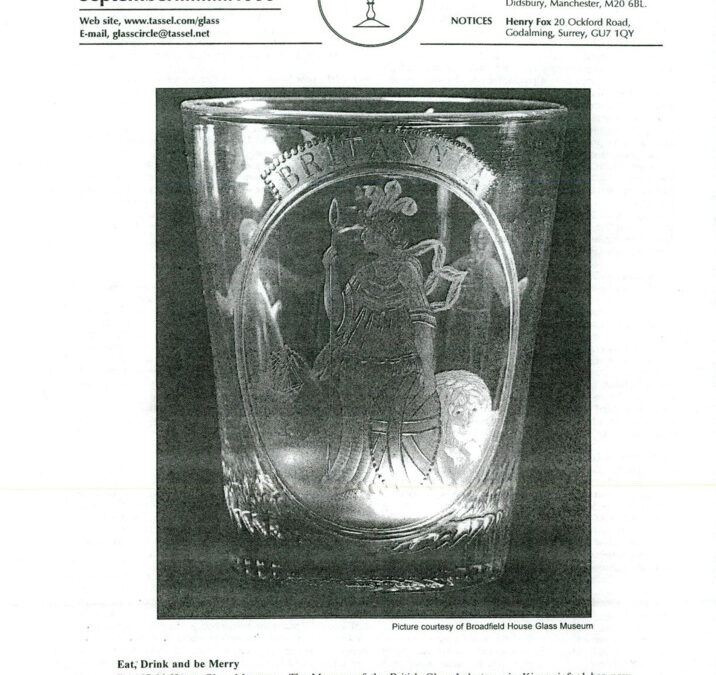
Picture courtesy of Broadfield
House Glass Museum
Eat, Drink and
be Merry
Broadfield Hciuse Glass Museum – The Museum of the British Glass Industry – in Kingswinford has now
reopened its two first floor display galleries after a lengthy period of closure for redisplay. Curator, Roger
Dodsworth describes the new layouts on page 4 and some of the highlights of the display including the above
signed and dated, 1799, rare tumbler (Ht. 11.6 cm) by a Dudley engraver.
GLASS CIRCLE NEWS No. 80
Page 2
1999
Editorial – Anno Domini and Beyond
One Glass Circle season over, another almost upon us, thanks to
the endless peripatetic activities of my two co-editors, Peter and
Henry, we have never, unlike some glass magazines, been short
of interesting material to pack into our pages. However, none of
us are getting any younger and more contributions from all you
glass enthusiasts out there would be greatly appreciated to set
the seal on a successful future. If every member resolved to
contribute just half a page on their most exciting find or a
picture of latest discover just once a year, or even every other
year, it would bring us all so much closer to developing an
interactive society that would benefit us all.
On the same theme
I
hear that our member John Brooks, the
popular dealer who retired a few years back, has now entirely
thrown in the sponge after a productive period revitalising the
Glass Association’s Journal. His broad expertise and friendly
manner will be sorely missed by us all – if he can really manage
to give up glass altogether! However, he is selling his library so
if you have around £3000 to spare give him a ring. Possibly the
most extensive private glass library in Europe, and certainly of
British glass, is owned by our member Ray Slack who, as a
professional book seller, is well known at Fairs. As well as rare
books going back to Neri, he has an extensive collection of
archival material all beautifully catalogued in a 300-plus page
bound volume – an enviable discipline inherited from his
newspaper days. Ray is also feeling the passage of time and, I
think, would like to sell his library as a whole at some time in
the not too distant future. But for that you will need to think in
terms of nearly six figures rather than four.
As members will recall, Tim Udall is no longer able to handle
the Glass Circle mailing of our meeting details and newsletter.
At the moment Jo Marshall is devotedly handling the distribu-
tion of all Glass Circle mailings as well as fulfilling her
Secretarial duties. If anyone in the London area would be
prepared to take on this highly responsible chore the Committee
would be most grateful to hear from them (ring me on 0181 449
7666). Indeed, most members are probably unaware of the
backgrounds of our Committee members, something we might
rectify in future issues of GC News. Incidentally, noting that I
come up for re-election to the Committee this autumn, I
suddenly realised that this year completes 25 years of unbroken
service during which I have been responsible for all but one
issue (when I was ill), as well as founding GC News.
1998
–
9 Season Lectures
Turning to more immediate matters, looking at the issues of GC
News for the last year I find that I have fallen well short of my
promise to record all of the groups of hosts who have so
generously supported our evenings together, in fact, only two
other than the AGM. This has partly been because some of the
talks have been earmarked for articles in our Journal but mainly
that I have been involved elsewhere (excuses, excuses). How-
ever, to put the records straight here are the missing talks, all
given at the Artworkers Guild, with their
hosts:-
November
12th. Hugh Tait
gave the Charleston Memorial
Lecture on
Lattimo glass before and after the Tudors.
with hosts
Martine Newby, Tony Wigg, Mrs. Cremieu-Javal and Mr. and
Mrs. John Scott.
The British Museum has some of the world’s most important
early opaque white glass. The Museum of London also has an
important collection of medieval opaque white shards,with
complex pincer-decorated feet and lids, dug up in London. Hugh
surveyed these collections with their problems and queries. His
lecture will be published in the forthcoming issue of the GC
Journal.
December 10th. Godfrey Evans
talked on
Glass Souvenirs
from the Great Exhibition and World Fairs 1851 – 1940.
The
hosts were Paul Crane, Mr. and Mrs. Barry Scheer and
Delomosnes.
This review of glass from the main World Fair catalogues
including items selected for his exhibition at The Royal Museum
in Edinburgh, relates to his publication called
Souvenirs
(see
review on page 7). We note with gratitude his special postal
offer of this book exclusive to Glass Circle members.
Details of the February and March lectures by
Rachel Tyson
and
Sue Newell,
respectively, and their hosts were given in GC
News 79.
April 13th. David Watts
talked on
Shades of Red:- Gold and
Selenium Glasses.
This joint annual meeting with the Society of
Glass Technology was hosted on behalf of the Circle by Tony
Wigg, Mrs. Ginige and Mr. and Mrs. Whittle. The talk, which
incorporated demonstrations of examples from the speaker’s and
members collections is (hopefully) destined for the GC Journal.
May 1 1 th. Sara Rossi
talked on
Paperweights from the Classic
Period 1842 – 60.
This talk is summarised opposite.
June 15th. Simon Cottle
talked on
Taking the Lead: 18th
Century Drinking Glasses for the Collector.
The hosts were Mr.
and Mrs. Hugh Tait, Tim Udall and Geoffrey Seddon.
Simon’s overview ranged from the Restoration to about 1780
(i.e. excluding cut-stem glasses). He dealt rather less with details
of form than with masterpieces of decoration. Based on
decoration he offered the view that the 17th century flutes, light
balusters (Newcastles) and certain opaque twist goblets were of
continental origin. This presentation, which caused vigorous
discussion about glass origins, is part of a new programme of
introductory lectures for collectors.
Next year’s lecture programme
This is still being finalised but a highlight will undoubtedly be
the visit of the American glass group led by Jane Spillman on
November 3rd. when Ray Notley from Sotheby’s Education
Institute will give the Charleston Memorial Lecture. This is
definitely an occasion not to be missed so make sure you return
your attendance form together with appropriate remittance if you
are bringing a guest. Security measures introduced earlier this
year require the Circle to check-in all participants at meetings. If
you would like to become a host please contact Jo Marshall on
0171 833 0221 for further information.
Members should also note 22nd November when Sotheby’s will
host a reception for the Circle in connection with their glass sale
of Dr. Detmar’s European glass (see page 11) with a talk on the
importance of the collection by Simon Cottle.
Silver Jubilee
– and a Millennium goblet
Following the outstanding success of the Silver Jubilee com-
memorative Goblet your Committee felt that a special issue to
celebrate the new millennium would be in order. The design and
details of the goblet will be ready for the next issue of GC News.
Members might be interested to know that quite a number of the
Silver Jubilee goblets found their way to America.
You may remember, too, that The National American Glass
Club very generously presented the Circle with a commemora-
tive glass plaque of contemporary design to mark our Jubilee on
the occasion of the visit of their President, Ellen Roberts.
Unfortunately, like some human beings, the piece did not travel
well by air and, somewhat embarrassingly, had cracked by the
time it reached us. However, our American friends are not the
sort to let such matters stand in their way and we are delighted to
announce that a replacement has now arrived intact. It will be
photographed for a future issue of GC News and we are hoping
to have it on permanent display, but more of that anon.
Graffiti on glass windows
Our American member, Paul Hollister has written to ask for any
information or examples members may have of graffiti scratched on
windows over the period 1570 to the end of the 18th century, for a
book he is writing on the history of the window. Please reply to
Paul at Firmbank Fell 1008, 80 Lyme Road, Hanover, NH 03755.
U.S.A.
1999
Page 3
GLASS CIRCLE NEWS No. 80
Paperweights originated as an inexpensive table accessory in
bright colours and perhaps began with experiments in coloured
cane at the end of the day. Individual millefiori canes may have a
very complex structure and contain letters, numbers, animal
silhouettes etc. The value of a weight depends on its rarity and
condition. Members should beware of weights where the internal
decoration comes close to the edge indicating cutting-down; also
asymmetry of shape where blemishes or bruises have been
polished out. This talk was mainly concerned with three French
firms, Clichy, Baccarat and St. Louis, whose mastery of lead
crystal, colour and intricacy of design made them pre-eminent in
this field. It is the quality of the lead crystal, not found with soda
or potash glass, that makes the 19th century paperweight
possible. The main features of these three firms were then
considered in turn using prolific illustrations. All three used
surface cutting, commonly five large printies to focus on the
interior, sometimes through an overlay colour.
Clichy used bright but soft colours. A common
feature of the millefiori weights is the cabbage
rose (sketched left), commonly in pink, but
also, more rarely other colours, with the outer
leaflets in green. Canes with aggregates of stars
are also a feature of the firm. The canes may be arranged in
concentric circles with the rose centrally placed or at the
perimeter, also in clusters (small rings of canes round a central
cane) or widely spaced with clear glass between. A mushroom
weight has the canes forming a ‘mushroom’ shape as seen from
the side. Scrambled weights have the canes randomly arranged.
Swirl weights (top picture), made only by Clichy, have the canes
radiating out from a central complex cane giving a Catherine
Wheel effect. Double or triple swirl weights have alternate
coloured canes such as blue and white or blue, white and green.
Canes may include the letters ‘C’ or ‘CLICHY’ (very rare).
Clichy also made weights with lamp-formed inclusions, particu-
larly a flower garland which might include the cabbage rose.
Baccarat
used brighter colours than Clichy and more elaborate
canes with the letter 13′, sometimes accompanied by the date,
usually ‘1847’; also a variety of animal silhouettes – dog, horse,
duck, squirrel, kangaroo, elephant, human forms etc. – usually
black against white. The canes, of characteristic colour and
shape, were often arranged in inventive designs such as
overlapping triangles or a few large widely spaced canes against
a scrambled or tightly organised (no clear glass visible) fine
millefiori ground. Much use was made of skilfully lamp-worked
flowers – pansy, primrose, dahlia etc. – displayed against a tight
millefiori carpet ground or with a millefiori outer ring (or two
rings) with canes radiating from the centre. An extremely rare
(not surprising as it was unattractive to look at!) convulvulus
weight made about £10,000 at auction; the top price paid for a
weight is $248,000. So called ‘butterfly’ weights (the insect
looking more like a bloated moth although with considerable
detail in the wing colour) were also made in several colours.
Baccarat is generally more popular than Clichy with collectors.
Some modern Baccarat weights contain the 1847 date but these
do not confuse knowledgeable collectors.
St. Louis
is one of the most famous French factories. Its ability
to make lead crystal, the equal of English glass, stems from
1782 and they became noted for the use of colour – a simple
red/white or blue/white spiral round the top of a vessel is often
an indicator of the firm. Star canes may differ from Clichy in
having (commonly) a white outline filled with a different
colour. The treatment used for the rim of a vase finds more
complex expression within a paperweight with a flat circular
cane of bright red or blue spiral twists enclosing a central
mushroom. A crown weight has radiating spiral twist canes in
alternate colours – red/white with green, or yellow with blue.
Only one example is known of a multi-coloured crown. A few
weights are dated ‘1884’. As well as canes with `SL’ (black on
white) silhouette canes with black figures of one or two dancers,
devils or animals – dog, horse, bird etc. – were used, often with
one large cane as a central feature of the weight. Realistic fruit –
pears, plums, apples – or vegetables on a white latticinio ground
(called a basket), flowers, some striped on an aventurine ground,
porn-porn dalias, a pansy with a latticinio background and
upright garlands are other attractive Clichy products.
There are no Venetian paperweights of comparable quality to
the French. American weights made by William Gillander, who
emigrated from Gateshead, date from the 1860s while the
British (particularly Scottish) weights of any quality are later
products; Whitefriars made a few concentric weights, repro-
duced in the 1950s.
(Summary by D.C.W.)
Sara Rossi is author of
Letts Guide to Paperweights,
1990, 96 pages with
100 illustrations in colour and b/w. The classic in this field is Paul Hollister’s
(1970)
Encyclopaedia of Paperweights
still available as a paperback. We
hope to review a new book on
Old English Paperweights
by Robert G. Hall,
pub. by Schiffer, 1998, £32, (ISBN 0 7643 0539 5) in the future.
Other GC News articles on paperweights are No 59. 1994, an overview by
Anne Metcalfe; No 64. 1995, Paul Hollister describes Sotheby’s auctioneer,
Tim Clarke faced with cataloguing the first celebrated paperweight sales of
the King Farouk and Mrs. Applewhaite-Abbott collections; No. 72. 1997,
Roger Dodsworth unravels the paperweights of Walsh Walsh.
Glass Circle Lecture
Paperweights from the Classic Period 1842 – 1860
by Sara Rossi
A meeting of The Glass Circle on May I I th at the Artworkers Guild by kind invitation of
Mrs. Marie Polley, Ken Cannell, Brian Watson and Robin Wilson.
Glass Circle matters
Welcome to New Members
Mrs. L.R. Hall
Mrs. Jennifer and Mr. Roger Griffiths
Mr. Robin J.C. Hildyard (V&A)
Mr.Andrew Lineham
Miss K. Mawhinney (Ulster Museum)
Mr. and Mrs. J.E. Shackleton
Mrs. Jill Turnbull
Institutional Members
Victoria & Albert Museum, Ceramics and Glass Department
The Worshipful Company of Glass Sellers of London
Deaths
Mr. H. W. Woodward
We report with sorrow the death of Herbert Woodward on the 11th
August following a stroke and illness. Herbert, author of two books
(on Edinburgh Crystal and Thomas Webb) was a loyal member of the
Circle for 40 years. His interest in glass began when, as Librarian at
Brierley Hill Public Library the local glass collection (now at
Broadfield House) came under his charge. He lectured to the Circle
on two occasions and helped on the Circle stand at the Dudley Glass
Festivals. Our commiserations go to his family and relatives.
Mrs. E.T. Udall
We also report with sorrow the death of Maria Udall in a car
accident and express our great sympathies to Tim in his bereave-
ment. She will be sorely missed by all who knew her.
GLASS CIRCLE NEWS No. 80
Page 4
1999
The two first floor galleries at Broadfield House have recently
been re-opened after a lengthy period of closure for re-display.
The showcase lay-out has been altered to create a circular route
in each gallery around a central “Island” of cases, with other
cases around the walls as before. Pieces of equipment have been
added to the displays, and a video forms a central feature in one
gallery.
Each gallery is devoted to a particular theme. On the right, from
the stairs,
Eat, Drink and Be Merry
looks at the use of glass in
eating and drinking from the 18th century to the present day,
from the rare and expensive to cheap everyday, including
commemoratives and souvenirs. The three central cases take a
snapshot of eating and drinking habits at different points in our
history.
The Georgian Dinner
is dominated by pieces from the
Michael and Peggy Parkington Bequest, which has done so
much to strengthen the Museum’s collection of 18th century
English glass. Highlights include the clear shaft and globe bottle
enamelled with the name Thomas Worrall and the date 1757 (is
this the earliest dated example of English enamelling on clear
glass?) and a splendid green Old Hock decanter with gilt
decoration in the manner of James Giles. The second
case, The
Victorian Wine Service,
is illustrated by a richly cut service from
the Stourbridge firm, Hodgetts, Richardson & Son, comprising
separate glasses for sherry, port, champagne, claret and white
wine besides jugs, decanters, carafes, comports and finger bowls.
The Cocktail Party,
the final case in this group, looks at new
drinking fashions in the 1930s. An early 18th century purple
cruciform decanter is a rarity among the collection of decanters
on display. The Circle’s founder, John Maunsell Bacon was, of
course, the first to collect and date early English decanters.
Another display,
By Royal Appointmen4
gives the Museum a
chance to show off some of its important early 19th century cut
and engraved glass made for the royal household. Again, these
pieces largely come from the Parkington Bequest. They include
a wineglass and rinser from the celebrated service made by
Perrin Geddes and Co. of Warrington for the Prince Regent, and
a uranium yellow finger bowl, Ht. 9.5 cm (illustrated above),
and ice plate, now attributed to Davenport, made for the young
Queen Victoria’s visit to the Guildhall in 1837. Also on display
is a magnificent double-walled footed bowl with enamelled, gilt
and cut decoration by Thomas Hawkes and Co of Dudley,
c.
1835. This was probably also made for Queen Victoria’s visit to
the Guildhall, and has only recently been acquired by the
Museum.
Alongside
By Royal Appointment
is a display of late 18th/early
19th century commemorative rummers and tumblers. One of the
stars of the show here is a Napoleonic Wars tumbler (see front
cover) engraved with a figure of Britannia and a spurious coat of
arms with comical supporters. The base of the glass, 6.5 cm
diameter (shown right), has a most unusual inscription. It reads
“May Britannia Ever Gain the Day. W. Dudley, Dudley,
Worcestershire, Glass Engraver. Finished May 4th 1799”.
by Roger Dodsworth, Curator
The gallery is not just about rare and expensive glass. Mass
production is represented by the sand-blasted pub glasses
(opposite page) and by pieces designed by Alexander Hardie
Williamson for Ravenhead including a complete set of his
famous Paris goblets, designed in 1954 and still in production.
Also showing is a boxed set of Williamson’s Slim Jims tumblers
with their automatically applied screen-printed decoration, as
well as glass by Ravenhead’s main rival, Chance Brothers.
Sometimes the rarities and the cheap glass are combined. A
small display on Tea Drinking shows some of Michael Parking-
ton’s exquisitely cut Regency caddy spoons and a rare mid 18th
century opaque white Bohea tea caddy alongside an American
Depression Glass teacup and saucer and a teapot in Phoenix
heat-resistant glass.
In the other main gallery
Days at the Factories
looks at some of
the processes involved in crystal glass manufacture.
Design
Inspiration
examines the sources of design in Cl9th glass, while
another display looks at the colouring of glass and contains
pieces that span the complete colour spectrum. Glass decorating
techniques are discussed, both hot processes, like threading, and
cold decorating techniques such as cutting and engraving. The
cut glass case contains a splendid array of pieces from facet-cut
decanters of the second half of the 18th century right through to
contemporary-style pieces by designers such as John Luxton and
Irene Stevens from the 1950s. Many of the Museum’s best
CI 9th engraved pieces can be seen in the engraving display,
both traditional matt engraving and rock crystal style work. A
case each is devoted to the three main Stourbridge factories,
Webb, Richardson and Stevens & Williams.
The main focus of the gallery is a glassmaker’s chair with
photographic backdrops, accompanied by a fascinating film
from the early 1950s about Royal Brierley Crystal. This is not
the normal factory promotional film. It concentrates purely on
the lives of the glassmakers; they are given their own voice,
which, if difficult at times to understand, adds a convincing
touch of authenticity to the film. There are evocative shots of the
Black Country, which looks so undeveloped that it could be the
1850s rather than the 1950s! Colonel Williams-Thomas appears,
speaking with great confidence about the future of the Stour-
bridge Crystal industry, a poignant sequence in view of how the
industry has contracted over the last twenty years. §
ew Glass Displays
at
Broadfield ‘louse
Above. Two early 20th century pub glasses with sandblasted inscriptions; left,
Crown
and Anchor Smethwick,
Ht. 12 cm;right,
Falcon Hotel Much Wenlock,
Ht. 11.5 cm. (Eat,
Drink and be Merry)
Right Jug made of glass flat panels coloured red, purple, green, blue, yellow and
brown, fixed with copper came
and
incorporating the date
1808
and the letters W. G.
Ht. 19 cm. Perhaps an advertising piece, e.g. for Chance Bros. in Nailsea, or maybe just
a (rigger. (Eat, Drink and be Merry)
1999
Page 5
GLASS CIRCLE NEWS No. 80
Mare hikhlights from the new Broadlield House glass displays
Three pieces from
Days at the factories
Left,
Decanter, acid etched with figures taken from the Parthenon frieze, Stourbridge, c.1870, Ht. 29.5 cm;
Centre,
Ruby cased and
engraved goblet, Richardson’s c.1844, Ht. 22 cm (a similar goblet featured as the “Special Prize” in a recent edition of the BBC’s
Great Antiques Hunt
and was valued at £1000. Needless to say the two “hapless” competitors passed it over for a piece of non-glass
of very much less value!);
Right,
Claret decanter superbly engraved with a hunting scene, British, late 19th century, Ht. 31.5 cm.
BROADFIELD HOUSE EXHIBITION
Majesty and Rebellion
3rd July – 14th November
The finest private collection of 17th and 18th century English drinking glasses to be formed in recent years.
Includes Ravenscrofts, the Keith Douglas and Perry Amen glasses, Jacobites and anti-Jacobites, enamelled
glasses including the Buckmaster goblet, and a superb polychrome armorial goblet to commemorate the birth of
the Prince of Wales, later George IV, in 1762.
Open Tues.-Sun. 2-5 pm. Admission free
The collection will remain on extended loan to the Museum after the closure of the exhibition
GLASS CIRCLE NEWS No. 80
Page 6
1999
Limpid Reflections
by
F. Peter
The reflections in this issue were both mirrored in two separate
issues of
Country Life.
The first carried a group of articles
celebrating the tercentenary of Castle Howard, and crystallised a
plan I had of returning to look over a house last seen twenty-five
years ago. So on one of the summery days which we enjoyed at
the end of April, off we set over the Pennines to Castle Howard.
There are no great Glass treasures on display; a suite of nice mid
C.19th. Glasses on the dining table, with excellent vine and grape
engraving, and the usual clutch of rather uncertain chandeliers.
But in one of the bedrooms there was a charming group of
zoomorphic spirit flasks, presumably C.18th. Bohemian; the room
steward confirmed them as C.I8th. but knew nothing of their
origins. They comprised a herd of five pigs, together with a dog, –
the swineherd’s hound, perhaps? Two of the pigs had good strong
tails arching over and then joining their backs, to form handles.
The remainder of the herd had the curly-wurly tails which all good
pigs should have. Some of them had, too, the raised, combed ribs
so often found on Continental flasks and decanters. The whole
group were more or less the same size, about 10 to 12 inches long.
The Rijksmuseum has a couple of rather similar dogs in its
collection, although only half the size and less shapely.
(Glass in
the Rijksmuseum;
Vol: 1 [1993] Nos: 345, 346.)
As so often happens, after the first draft of this article was penned,
more porcine spirit flasks came to my notice. At the Cannon Hall
Museum in Barnsley is an apparently exact match to the two pig
flasks with handles at Castle Howard, illustrated above. Thanks to
the kindness of the curator, Dr. Jane Whittaker, I was able to
handle and inspect it closely; It is well made of good metal, but
not of Lead Glass. Finding three apparently identical examples
within forty miles of each other must make one wonder whether
my confident attribution of them to Bohemia is somewhat facile?
One could speculate on whether they might conceivably be
friggers from one of the South Yorkshire glasshouses; it will be
instructive to see whether any further evidence as to their origin
emerges. Then, to make these muddy waters even more murky,
shortly before my deadline I bought from John Ives the bookseller
a copy of the Catalogue of the Danish Glass Exhibition held at the
V&A in 1974. Illustrated, as an undated frigger from the Holme-
gaard Glassworks, was a dog closely related to the animals now
living in Yorkshire, together with a companion pig catalogued but
not illustrated (Exhibits 91 & 92.) Holmegaard started work in
1825, making dark bottles and did not start working colourless
Glass until ten years later, with the initial workforce built round a
core of expatriate German Glassworkers. Although dimensions
were given for all the other 212 exhibits they were unfortunately
omitted for these two items, but the cataloguer, Bent Wolstrup,
emphatically wrote: “… at all factories a large number of fanciful
friggers [were made] … large pigs or dogs which could be used for
Schnapps. As far as Holmegaard is concerned, these animals have
eyes of opaque-white glass with pupils in blue.” These coloured
eyes are very clear in the catalogue illustration and happily
differentiate this particular tribe from their Yorkshire cousins.
Still in the field of zoomorphic decanters, a later edition of
Country
Life
had in its sale room report a nice picture of two silver mounted
Glass claret jugs sold at Sotheby in February; made by Alexander
Crichton during the 1880s, the larger one fashioned as a parakeet
fetched £7,130, whilst the smaller, a walrus, made £5,980. The
National Trust for Scotland has in its care at Brodick Castle on the
Isle of Arran a magnificent group of silver, some of it allied with
Glass, rock crystal or hardstones. Partly this group derives from
William Beckford’s eccentric and luxurious collection, which came
to Brodick when Susan, Beckford’s daughter and heiress, married
the 10th. Duke of Hamilton, and partly from later purchases by the
I I th. and 12th. Dukes. Amongst the latter group are five more of
these zoomorphic claret jugs by Crichton, who apparently worked
in London, Sheffield and Edinburgh before going bankrupt in
1886. The common feature of Crichton’s output is a finely crafted
silver head together with an equally finely crafted Glass body; the
appendages, – handles, legs, tails or wings, are variously of either
silver or Glass. The five jugs at Brodick all have London
Hallmarks for 1881, and the silver mounts have also the
Glass pig spirit flask – see text. Photo from the Castle Howard Collection by
kind permission of the Hon. Simon Howard.
`Registered Design’ lozenge mark, sometimes found on pressed
Glass of this period. The major part of the Brodick silver, some
one hundred and forty nine pieces, was exhibited in Brussels in the
autumn of 1992, in a special exhibition to celebrate Britain’s
Presidency of the Council of Europe, with an accompanying
sumptuous and fully illustrated catalogue. This shews that the
Brodick group of zoomorphic jugs all have silver handles, except
for the Dodo which, being extinct, has no handle; some of the
Glass bodies are plain, but the fish and the Dodo have finely
engraved scales or feathers, and in the case of the Dodo, engraved
rudimentary wings too. By way of contrast, the two jugs sold this
year both have substantial Glass handles, with applied Glass
decoration to represent the wings of the Parakeet, and the feet and
tail of the walrus.
In September 1998 Christies South Kensington sold a pair of owl
decanters, the body of one being green Glass and its companion
ruby; they made an excellent cover illustration for the catalogue.
The cataloguer suggested that these may well have been Ameri-
can, for the silver mounts bore English import hallmarks for
1867. The owls were similar in feeling to Crichton’s work and
although clearly not by him they illustrate the international
popularity of such zoomorphic forms in the last quarter of the
C.19th; in our last issue Henry Fox adduced a blue Glass Orrefors
decanter, formed as either a fish or a seal, of similar date.
Brodick, furthermore, has a group of six owls, with London
hallmarks for 1877 by the maker WFW, but the bodies of these
are formed of horn, rather than Glass. Whilst the pair of owls
offered by Christies were whimsical enough, their uncertain
foreign origin produced a price of only £2,875 for the pair.
Mr. Crichton’s whimsies were always more sophisticated, polished,
– and expensive, than their Bohemian predecessors; 1 had almost
said more witty, too, but the best of the Bohemian productions, as
illustrated above, shew just as much wit. The Dining Room at
Brodick Castle is a delightful room, hung with sporting paintings;
that of the 1844 Derby – “The Dirtiest Derby in history” – is a
pointer to the gambling mania of the Dukes of Hamilton which in
part led to the massive Hamilton Palace sales in the same decade as
Crichton’s confections were acquired. The table is laid with some
very pleasing C.19th Glass, together with splendid silver, and I
would dearly have loved to be of the party when those decanters
were circulating, providing both wine and amusement.
This marriage of Silver and Glass is almost invariably treated both
curatorially and by the Salerooms as Silver; (although the
Christies’ owls were in a Glass sale, presumably the uncertainty
over the silver element contributed to this decision.) In the light of
the workmanship of the Glass element of these hybrids, this
seems rather unfair on the Glass craftsman. Even more is this the
case with some of the fine neoclassical Warwick cruets; with the
best of these the shaping and cutting of the Glass vessels is
superlative, and contributes every bit as much as the Silver to a
fine article. (There were two such sets, both from the 1780s, in
the Brodick Exhibition.) What this does illustrate, of course, is the
interdependence of the Glassmaker, Cutter and Silversmith in
achieving a happy marriage of their skills, with the concomitant
need to have this group of craftsmen in close and frequent
contact. Presumably the peripatetic nature of Crichton’s career
told against this necessarily close relationship, and must have
been a contributing factor to his bankruptcy. §
1999
Page 7
GLASS CIRCLE NEWS No. 80
BOOKS and PUBLICATIONS
Reviewed by David Watts
Souvenirs by Godfrey Evans
NMS Publishing 1999, Soft covers 106 pp 17.2 x 23.1 cm with 80colour
plates, ISBN1 901663 24 8 Price £12.99.
Special
offer
of £9.99, inc P+P to Glass Circle members only – mention
Glass Circle and Godfrey Evans special offer when you write or, for visitors,
directly from the Museum Bookshop, both while the Exhibition lasts’.
Most of us, and particularly collectors, treasure a souvenir or
two – generally commercially made objects relating to an event
or person. The choice is enormous and Godfrey Evans had
reduced his selection problem by excluding commemoratives,
particularly of royalty (except Princess Diana) and battles. Nor is
he concerned with personal mementoes that may have no
general significance. Souvenirs come in all materials among
which glass has its place. All the glass illustrated is included in
the accompanying exhibition which has over 100 glass objects.
Godfrey omits the Romans and starts around the early fourth
century AD with the pilgrims progresses; we are given an
academic history cum travelogue placing the selected objects in
context. Glass does not feature here but it is of no small interest
that plates decorated in enamels with
Our Lady of Kevelaer,
a
popular pilgrimage centre in the Rhineland, were all made in
Leeds, exported plain and decorated in Holland. Some are
impressed for Staffordshire potter, John Turner (1738-86),
others being of characteristic Leeds design. The analogy with the
Dutch-decorated light balusters (Newcastles) of the same period
emphasizes the danger (folly!) of attributing nationality solely
on the basis of applied decoration.
Spa souvenirs come next and, inevitably, a feast of the
Bohemian ruby and yellow ‘overlays’ with fine engraving of the
1840-80 period. Italy and the ‘Grand Tour’ introduce the
exquisite beauty of the pictorial micromosaics dating back to the
fourth century AD. By 1817 there were hundreds of mosaic
artisans around the Piazza di Sagna in Rome and the mosaics
came in all forms from bracelets to tables. Lattimo plates and
Salviati glass receive deserved attention.
From around 1800 the ‘Urban Souvenir’ – buildings, bridges etc.
– came into prominence. These were depicted on china, enamel
snuffboxes and silver among a host of materials with the
Sunderland Bridge featuring on lustre ware and glass rummers.
The emergence of the seaside holiday brought its own souvenir
trade with Goff and endless German china plus engraved,
flashed or stained Bohemian goblets for the superior market.
Incidentally, it is during this late 19th century period that Sans
Serif lettering seems to have come into popular commercial use.
Exhibition souvenirs introduce yet more Bohemian glass pro-
duced for the 1851 Great Exhibition. British glass emerges for
the first time as acid-etched ware by John Ford & Co. of
Edinburgh and John Baird Ltd. of Glasgow, often with the
makers’ marks and sometimes on obviously English (Sowerby)
blanks. Fords demonstrated sandblasting (first demonstrated in
Vienna in 1873) in conjunction with Tilghman’s Patent Sand
Blasting Machine Co. at the 1886 Edinburgh Exhibition.
America comes into prominence with Coney Island and various
Fairs; a fine display from the 1939 New York Fair is used as the
cover picture. Indeed, the only thing that made me cross about
this account was that a survey of the emblems of important Fairs
stopped short of mentioning the Festival of Britain with its
characteristic `Skylon’, Dome of Discovery and fine logo which
is one of the few achievements of this kind on English glass
tankards. Recent souvenirs mentioned include Disneyland, Elvis
Presley and the Navajo Indians!
Generally, English glass makers feature poorly in this review
although Thomas Webb is mentioned for its glass furnace at the
Franco-British Exhibition of 1908 (Gillander and Sons, began
this popular attraction in 1876 in Philadelphia, USA). One might
point to notable omissions – trade souvenirs, for example – and
Circle members might wonder at the lack of reference to any
18/19th century English glass in connection with transport,
hunting, clubs etc. With a good bibliography and handy index,
this is, nevertheless, a useful addition to the subject and
complements Jane Shade! Spillman’s book on World Fairs.
*The ongoing exhibition at The Royal Museum, Chambers
Street, Edinburgh EH1 1JF. closes on January 9th, 2000.
Publications received
The Glass Society of Ireland Newsletter
The Glass Club Bulletin of the National American Glass Club
The Guild of Glass Engravers Newsletter
More books on pages 11 and 12
.
Specialist Glass
Booksellers
We frequently mention
Thomas Heneage
in these columns and he has
produce his latest catalogue of art books. However, members searching for
that special text should also consider:-
Paul
Brown,
68 St. James St., Brighton, East Sussex, BN2 1PJ (Tel. 01273
691 253) new catalogue. No. 57.
John Ives,
5 Norrnanhurst Drive, Twickenham, Middlesex, TW1 1NA
(Tel. 0181 892 6265) new catalogue, No. 47.
Broadfield House
also keeps a good stock with 10% off for
Friends of the
Museum,
as does our member,
Ray Slack
(Tel. 0181 657 1751).
Continued NACF support for Glass.
The importance of the National Art Collections Fund in
supporting Glass acquisitions by our public collections is again
highlighted by their ‘ 1998 Review ‘, issued in June of this year.
In each of the last twenty two years the NACF has supported
acquisitions of Glass; one has to go back to 1976 to find the last
year in which Glass did not feature. It cannot be claimed that
Glass is a major concern of the NACF; in 1998, out of Grants
totalling £2.4m Glass attracted only two grants totalling
£13,700, and the largest single sum ever provided was the
£11,410 contribution in 1983 to Bristol museum’s acquisition of
the core of the Lazarus Collection. But, the consistency of
support for Glass acquisitions is very heartening.
The rage of enthusiasm for modern works is endorsed by the
Chairman, Sir Nicholas Goodison, in the Summer 1999
‘Art
Quarterly’,
the NACF magazine, where whilst recording his
personal pleasure at the upturn in interest by Museums and
Galleries in British ‘modern masters’ he says: “Here at the
Fund we seldom initiate purchases, but rather respond to the
requests of curators … . This puts us in the unique position of
being able to chart the ways in which collecting habits have
changed over the 97 years since we were founded.” This
increased interest in modern works is mirrored for Glass, where
all three items charted in the ‘ 1998 Review ‘ are C.20th. The
Stained Glass Museum at Ely received assistance in acquiring a
Window of 1927 by Harry Clarke; the Ulster Museum acquired
a large cast Glass Sculpture by Ivana Sramkova, whilst the
Chairman himself made concrete his championing of modern
works by gifting to The Fitzwilliam, through the Fund, two
works produced in 1998 by Galia Amsel and Catherine Hough
respectively. This is the first year in which support by the Fund
for Glass has been wholly of C.20th. works.
F.P.L.
Some Forthcoming Fairs
“The Great Antiques Fair – Earls Court London – 29th September/
3rd October.
*Kensington Antiques & Fine Art Fair – 29th/31st October
*Glass Fair B’ham Motorcycle Museum – 7th November
*20th Century Fair -24th/28th November
*NEC Antiques Fair B’ham – 2nd/5th December
GLASS CIRCLE NEWS No. 80
Page 8
1999
Glass Gippings by
1-fenry Fox
Theatrical Glass Curtain
Here is an interesting snippet found in the London
Evening
Standard
(18.6.99). ”
walk into the lobby of the Old Vic …. a
mirror hanging on one wall ….The mirror is etched with a scene
from the 19th century theatre, a picture of an Indian juggler
called Ramo Samee whose act prefaced evenings of melodrama
at the Old Vic. The scene used to decorate a huge curtain,
subsequently broken up
The one remaining shard of glass
curtain hangs in
dressingroom.” (Apparently there are
several old prints of this glass curtain. Has any member seen
one? Better still, does any member know of any other glass
curtain?)
Mirror, Mirror
Fine antique mirrors whether single or in pairs continue to
attract high prices. Earlier this year a neo-Rococo carved
dressing table mirror sold for £34,000 by Christie’s, whilst in
July Sotheby’s sold a pair of giltwood framed mirrors for
£200,000 and Christie’s sold a pair of heavy-looking giltwood
framed pier mirrors made for the 5th Duke of Bolton to designs
by John Vardy for (to me) the incredible sum of £650,000!
Never Two’s
Two issue backs GC News featured on the front page two fine
early Venetian enamel decorated drinking goblets sold by
Sotheby’s. I think that most of us were just recovering from the
excitement which that sale generated when the disposal of
important works of art and antiques belonging to a branch of the
famous Rothchild dynasty hit the headlines. Who would have
thought that in less than a matter of months another example of
this small group of rare early Venetian glasses would come up
for auction? This auction at Christie’s was an exciting and
glittering affair with pictures going for millions of pounds, so I
suppose it was not surprising that “yet just another old Venetian
goblet” (picture above) should go finally for £170,000! This
example has scenes going round it. (Stop Press: another
somewhat similar style glass, but with lid, will be on offer in
Sotheby’s Sale of the Dettmers Collection – see forthcoming
auctions.)
Swallows and Amazons
Probably quite a number of maturer members can recall the
pleasure of reading this book, whilst enjoying the lazy school
holidays of yesteryear, without realising that years into the
future it would be Sotherby’s and Amazons that would be vying
for their attention, but such is the case. Sotheby’s New York has
announced that it has linked up with Amazon.com as part of its
drive on the technological front to give itself wider access to
users of the Internet. It will not be long now before all the major
auctioneers in the world have fully embraced the new future
which the World Wide Web of communication offers to them.
Soon (if not already! See next issue of GC News. ed.) you will
sit at home able to view and bid on items for sale in any part of
the world. You will even be able
to pay electronically. Perhaps at
the end of the day all collections
will be made up of virtual reality
blocks which one can walk
around and admire anywhere one
happens to be without the prob-
lem of cartage, breakage and
theft, let alone insurance. The
trade dealers have had for some-
time established Web sites, and
many claim to have met new
collectors as a result. Today any-
one with access to the Internet _
gets not just descriptions of, say, glasses that are available but
also quite good pictures of them. The dealers’ stock in this
country and abroad is available for you to view at the touch of a
button, or more correctly speaking the click of a mouse. As I see
it, bargains will become rarer, competition keener, and the
excitement of collecting certainly different. As the saying goes:
“There’s a whole new world out there”.
Correction
In the last issue of GC News reference was made to Sotheby’s
Southern as the new name for their Billingshurst Auction Rooms
in Sussex . The new name by which this branch will be known
should have been given as “Sotheby’s South”.
Glass into Flowers – at Godalming
by Peter Myers
Compliments must go to Henry Fox for organising – partly with
his own glasses – a small (because of restricted space) interesting
exhibition in July at the Godalming Museum on the subject of
“Glass in Flowers”
c.
1740-1999 , and which also featured some
colour photographs of the botanically correct glass flowers in the
Botanical Museum of Harvard University. He had also organised
for David Watts to give locally to a larger-than-I-had-expected
audience an informative and entertaining lecture
“Glass into
Flowers – Inspiration and Challenge”
which ranged from
ancient times to the present, with special reference to the glass
flowers at Harvard. Looking at the exhibition, neither my wife
nor I had ever come across those highly colourful enamelled
Stuart glasses of 1930s nor the incredible glass flowers made by
L. and R. Blaschka of Dresden at the turn of this century and on
into the 1930’s exclusively for the Botanical Museum at
Harvard, since, being conservative, we had believed that glass
manufacture stopped after 1835! These remarkable flowers were
displayed by excellent photographs (courtesy of Harvard) in the
exhibition area, and were referred to by David using high quality
slides. Even if there had been no reference to pre-1890 the visit
to this small exhibition would still have been worthwhile.
Henry’s browse around the Fairs
Lrammeu int.o ‘way arm June are me Des’.
major lairs jar glass
of
especial interest to members. Firstly there is the one-day
Glass
Fair at the Birmingham Motorcycle Museum.
Having been
unable to get to either of the fairs at this venue last year, it was a
pleasure to return this year and find so many familiar friendly
faces among both the visitors and the dealers. The usual early
queue was like a school reunion – people greeting each other and
telling tales of their new finds (see leditorial on page 2) and what
they hoped to find this time. This event was the largest ever with
the basement room also being used to accommodate more
dealers. (A book launch was scheduled for later that morning.
Eric Reynolds a noted collector of Walsh Walsh glass would be
signing copies of his book on the history and designs of this
Birmingham glass maker. This is the first book to be devoted to
this firm. (See review on page 11)
Several stands were showing 18th century glass, particularly
from 1740 onwards. Anyone starting up a collection would have
been spoilt for choice, but I did not see any really early heavy
balusters. These stands were surrounded by eager collectors –
admiring, discussing and buying, although other stands selling
Victorian and later glass were very much in the majority as
usual. A dealer in Art Nouveau glass was attracting attention
with a colourful display. I spotted at least four stands showing
paperweights and there were two glass reference book specialists
offering a wide range of books including some of the early
heavyweights on 18th century glass such as Grant Francis and
Francis Buckley – worth buying if only for the classic illustra-
tions. Alas! few private individuals can now equal the quantity
and quality of the collections of 18th century glass put together
during the first half of this century, or, indeed, the fabulous
Corning Museum collection built up in the second half!! This
contined on page 9
1999
Page 9
GLASS CIRCLE NEWS No. 80
Fair was an enjoyable day out feasting on glass of all kinds, and
in particular seeing and examining an extremely rare red silvered
inkwell
c.
1850 marked W
Lund Patent
which the dealer told me
had been unidentified in a house sale. Despite slight damage this
was an exciting discovery as Lund along with Varnish and Hale
Thompson used the same patent to make for such a short period
what we now tend to lump together as “Varnish glass”. I came
away with a pair of decorative Edwardian domestic stained glass
panels and a copy of Eric Reynolds book to read on the train.
The Summer
Olympia Fair
is always large, exhausting, and full
of wonderful surprises. This time round proved to be no
exception. Of particular interest to members has to be the finely
painted – but to my eye slightly contrived – picture by
Charles-Gustave Housez (1822 – 1880) entitled
Interieur d’une
Verrerie.
Here you can trace the various stages in the making of
wine bottles, including the finished product being carried off to
the annealing oven. We hope to illustrate it in the next GC News.
Whilst glass was reasonably in evidence on a variety of stands,
18th century English drinking glasses were not, and those I did
see were largely examples from the second half of the century.
Highgate Antiques
had one shelf of such glasses to compliment
their fine porcelain;
Mark West
(who had no doubt reserved his
best pieces for Grosvenor House, which overlaps with this fair)
was also showing only a small selection alongside an extensive
display of 19th and early 20th century table glass. Here, I was
interested to see a Richardsons
c.
1870 tazza on a six bobbin
knopped airtwist stem on a folded foot. From a brief examina-
tion of this unusual stem formation I concluded that each bobbin
knop might easily be a separate ball containing curved air twists,
certainly in the first knop the airtwist did not continue on down
into to the next one; it was a fine attractive glass demonstrating
great skill in the making.
Christine Bridge
was showing good
examples of 18th century drinking glasses together with her
usual range of fine decorative Victorian glass;
Carol Kerley
had
a wide range of Victorian table glass, and
Barclay Antiques
would have been pleased to show me their pressed glass but it
had all been sold except for four minor pieces. However, no
great treasures had been missed; rare pieces of collectable
Sowerby, Davidson, Greener etc. are increasingly difficult to
find.
Andrew Lineham
had good examples of Webb cameo
glass, including a fine long scent bottle with a Russian gold
enamelled cap.
Rachel Moss
had several domestic stained glass
panels, one of which showed children playing around a well into
which a cat had apparently fallen!
Patricia Harbottle
had early
to mid 19th century drinking glasses plus a few from the
previous century to complement her stock of wine related items,
including a number of early bottles.
Decanters, fish/leech bowls, reverse paintings on glass, and
chandeliers were to be seen on several furniture stands. One
eight-light chandelier about six feet high particularly caught my
attention. It had vivid blue glass hangings within its structure
and matching blue drip trays. I was told that it was probably
Russian mid-19th century. Another item on a furniture stand,
impressively displayed at eye level, was a four panel (out of
originally six) set of stained glass scenes by Clayton & Bell.
These had
been
removed from a house in Wales sometime ago.
There was far less Art Nouveau/Art Deco glass to be found this
time, but I did encounter most attractive examples of pendants in
pate de verre by Almeric Walter and in enamelled glass by
Marcel Goupey, all from the 1920’s.
A few days later saw me viewing two fairs which could not have
presented a greater contrast in diversity on the one hand and
quality on the other. First, the Sunday one-day, glass only, fair at
the
Commonwealth Institute, Kensington.
Here was a wide
range of general glass, largely late 19th century onwards; but
with quite a showing of mid to late 18th century drinking
glasses. This type of focussed fair draws the glass enthusiasts as
well as dealers seeking out new stock and, hopefully, rarities that
the ordinary visitor has not recognised. Collectors of pressed
glass, carnival glass, Art Nouveau glass, Art Deco glass,
paperweights, etc. certainly had much to enjoy. I spent some-
thing like three or more years seeking out a Sowerby “Bo-Beep”
nursery rhyme piece – here I found three, along with other
sought-after examples of designs taken from Walter Crane’s
illustrations in books for young children! (In the mid-1980’s
quite a number of serious collectors here and abroad were on the
look-out for such pieces. The market place had been stimulated
by Ray Slack’s book on pressed glass, and by Simon Cottle’s
book on Sowerby, which incorporated an illustrated trade
catalogue for 1882. Simon’s book highlights the various designs
taken from Walter Crane’s work – the original identification was
by our member, Barbara Morris. This “pirating” by Sowerby, as I
assume it to be, must account for why none of the nursery rhyme
pieces bear a registration lozenge, only the trade mark of a
peacock’s head, and even this is very rarely found on “Little Jack
Horner” bellows, but perhaps a member can correct me on this
last point?) One item of especial interest was a “Bristol” blue
wasp or fly trap of traditional shape on small squat feet
c.
1840 or
perhaps a little earlier.
The second fair of the day was the
International Ceramics &
Glass Fair
at the Park Lane Hotel. This year I was unexpectedly
prevented from attending the Press Preview, which for me has
always been the annual highlight of my reports to members. As I
hurried in, I was worried that many of the wonderful glass
specimens which are normally to be seen at this fair would have
all gone, but my fears were short lived. However, I have to say
that the number of glass dealers exhibiting this year was less than
usual.
Adrian Sassoon
had examples of creative modern studio
work, whilst
Dragesco-Cramoisan
from Paris showed a number
of fine continental pieces of antique glass.
Although the collector of early English glass had only the choice
of two dealers, these provided an excellent array.
Mallett
was
showing the largest group of Beilby enamelled glasses that I have
seen at a fair for some years, including a good ale glass; also
several colour twist stem wines, including a canary twist, as well
as a number of glasses from the heavy baluster period along with
a selection of Dutch armorial engraved light baluster stem
glasses. An unusual item was a Bohemian mid 19th century clear
glass liqueur decanter and stopper divided into eight compart-
ments each with small separate stopper in green glass. I also liked
a very tall pair of facet stemmed candlesticks of fine colour from
the last quarter of the 18th century. Examples of Danny Lane’s
glass structures were also on display.
Next door was
Del omosne ‘s
with a show case full of interesting
examples of fine 18th century drinking glasses, including heavy
baluster period. Also several examples of magnum decanters,
including one with triple neck rings in a pink colour.
Johnathan
Horne
had a number of early sealed wine bottles, but these had
been sold. Lastly, a few feet away was
Leo Kaplan
of New York.
His stand was a blaze of colour created by a display of fine
signed Webb cameo, French period paperweights, Art Nouveau
glass by Galle and Daum among others, and pate de verre by
Almeric Walter and Argy-Rouseau. Here were important one-offs
of museum quality. Mr. Kaplan Jnr. very kindly got out items to
discuss them with me. I had seen so many desirable – I really
mean covetable – things that my mind was in a whirl, but in my
heart of hearts I knew that changing my name to Getty or Bill
Gates or Andrew Lloyd-Webber would not in reality allow me to
have any of them!!! However, I left knowing that without doubt
this specialist fair continues to fulfil its aim for rarity and
excellence, and I would like to thank the organisers for once
again kindly sending me a Press Preview invitation.
I did not make the
Grosvenor House Fair
until the last day so
the atmosphere was fairly relaxed.
Namara Fine Art
was left with
little glass, mainly fine tableware, whilst
Mark West
also had
depleted stocks. This latter stand had a few examples left of 18th
century drinking glasses, including a large wine with ogee –
almost bucket – bowl over drop knop above a ball knop set on
folded foot. An unusual glass was a deceptive rummer engraved
with reference to the Loyal Colchester Volunteers. I also spotted
a purple glass rib-moulded double ogee jelly
c.
1780’s. Among
the good display of later glass was an American acid etched jug
and two glasses signed Lock Art, which I was told referred to
concluded on page 11
Gloss of Ruction
i Henry Fox
GLASS CIRCLE NEWS No. 80
Page 10
1999
*Sotherby’s Bond Street. The May sale had no less than 15
examples from the Beilby workshop, virtually all from the Lymbery
Collection. There was keen bidding for a particularly nice goblet
white-enamelled with typical pyramid and classical ruins (£7000).
Colour twist stem goblets are scarce; here an example of white
enamel opaque gauze corkscrew within a pair of spiralling blue
threads went for £5600. Other glass of interest was a shaft and
globe wine bottle c.1660 with rim chip and weathering (£1200);
Webb cameo swan’s head silver mounted scent bottle (£1000),
Stevens & Williams enamelled “Burmese” vase (£1200), a pair of
black glass John Derbyshire press moulded
models of Greek winged sphinxes (£3500).
*Christie’s King Street.
May saw one of the
best sales of glass of interest to members which
this auction house had held for sometime and
included British and Continental drinking
glasses as well as other early glassware. There
was something for everybody, and the sale was
well attended with a bank of telephones in
competition with the room. An engraved airtwist
pan topped wine with swelling knop (foot rim
chip) £320; three various glasses plus an en-
graved jelly glass £450; an early mead glass
£850; a small bell shaped mug £110; pair of
tripod salts £1900; a baluster candlestick £2200;
and an early punch bowl with “nipt diamond
waies” moulding finally went for £10,500. The
true highlights have to be a Beilby enamelled
“Privateer” colour twist wine with date 1767
(foot rim chip) at £26,000, and the £19,000 bid
for the engraved “Watkin” airtwist stem glass of Jacobite signifi-
cance from Oxburgh Hall (an important collection of drinking
glasses written up and illustrated in
The Connoisseur in May
1908;
Sir Watkin Williams Wynn of Wynnstay, a noted Jacobite sup-
porter, founded the Cycle Club in 1710. Less than half a dozen
“Watkin” glasses – all with airtwist stems – are known ). Not to be
outdone the “Ogilvy of Inshewan”
Amen
glass (foot rim chip) made
£31,000.
*Phillips Bath.
Another May sale with good selection of glass. A
Beilby fruiting vine decorated wine glass on opaque twist
stem made £1750. This glass came with original invoice of
1933 from Arthur Churchill for £6 15s Od. An attractive
heavy baluster period cylinder knop stem wine reached
£2900 despite a tiny chip on bowl rim (shown above, right
of four nice glasses in the sale).
*Phillips Bond Street.
A fawn de Venise diamond point
engraved goblet by Willem Mooleyser, late 17th century,
made £9500 in their May Ceramics & Glass Sale.
*G.A. Key of Aylsham.
In May a pair of 19th century
cranberry glass handled decanters with stoppers made
£360.
*Trembath Welch, Great Dunmow,
Essex. In May a set
of three blue glass “Bristol” club shape decanters and
stoppers decorated in gilt for
Rum, Brandy
and
Hollands,
described as early 19th century went for £160 (against an
estimate of £300 – £500). I have no information as to the
condition of this lot.
*Christie’s Spain.
First sale in Spain for many years was
held in May. The sale included a pair of rosewood and
ebony cabinets with tortoiseshell inlay which were deco-
rated with numerous panels of reverse painted glass
*Hammer prices are given here before the premium is added.
showing mythologi-
cal scenes and char-
acters. These cabi-
nets sold for 26 mil-
lion pesetas (around
a £180,000). See pic-
ture right.
*Bonhams Knights-
bridge London.
May sale of cameo
glass included one of
the best examples
seen at auction for
many years. It was a
plaque engraved in
white glass overlain
on amethyst glass,
dated to
c.
1895, and
signed with T & G
Woodall. In a satin-
wood frame and entitled
Sappho
this beautiful piece of cameo
work is recorded in the Woodall’s price book under the code
W2790 as originally costing £42.10s.0d. It finally sold to a
telephone bidder for £38,000. (See picture). In this sale, too, a tall
three colour cameo vase attributed to the
Woodall workshop which I equally thought was
wonderful with its carved lilies and narcissi in
white and pink on a yellow ground sold to an
American dealer for £18,000.
*Dreweatt Neate, Donnington Priory, New-
bury.
May sale of Ceramics and Glass included
an interesting and varied collection of collect-
able drinking glasses, mainly mid to late 18th
century. A highlight was a Williamite wine
glass which made £1550.
*Sotheby’s Bond Street.
The Irish Sale in May
contained a few items of antique glass such as a
fine large oval mirror bordered with faceted
clear glass studs which made £6000; among
several Irish bowls a typical turnover example,
possibly Cork, went for £1500; whilst an
unusual engraved decanter and two matching
engraved rummers, also possibly Cork, made
the same winning bid – the three pieces in this
lot were each inscribed
The Land We Live In
within a ribbon above
an anchor. In among the pictures was a small stained glass panel of
St. Christopher
by Evie Hone (1895 -1955) which had been set into
a light box; it fetched £13,000 against an estimate of £4/6000.
*Bonhams Chelsea (Lots Rd.) London.
June, glass only sale. A
heavy baluster wine glass with drop knop went for only £950
despite what was described as a flaw to foot in the catalogue, but a
tartan colour twist stem glass with two chips to footrim made
£1400. A Stevens & Williams cameo vase of yellow glass overlaid
with opaque white glass engraved to show white tulips
against a hammered ground and etched J. Millward made
£980.
*Bearne’s, Exeter.
June sale of Ceramics and Glass
included a pair of “Sunderland Bridge” Rummers and
another near matching one as one lot, which finally went
for £1850.
*Christie’s South Kensington.
June Cameo Glass Sale
included a variety of Continental examples such as an
attractive Muller Freres cameo glass vase (illustrated left)
decorated with palm trees, but it remained unsold at £1500
(estimate £2800 – £3200).
*BBR –
This Yorkshire Auctioneer’s July sale was
carefully focused for the annual get-together of the
National Collectors weekend where members are keenly
interested in pot lids and bottles. It will come as no
surprise to members who can recall my reference to poison
bottles some years ago in GC News that a rare late 19th
century blue coffin shaped poison bottle (impressed
Patent
5658 Poison)
should make £3200. A similar bid also
secured a very rare `Nailsea’ bottle (illustrated left) in dark
green and white flecked glass with applied collar to neck
and applied seal
S.
W. 1792 to the swollen body. §
1999
Page 11
GLASS CIRCLE NEWS No. 80
Books and Publications reviewed by David Watts
–
continued
The Glass of John Walsh Walsh
by Eric Reynolds
Pub. Richard Dennis, 1999. 148 pp.,18 x 24.7 cm. 170 b/w figs., 40 colour
plus a further 180 b/w figs of a Walsh Walsh catalogue. ISBN 0 903685 74 4.
Price £25 hard back (limited edn.); £20 soft. (My copy from Paul Brown)
Rarely in recent years has a book engendered such interest and
excitement, and rarely can it have proved such a disappointment
to everyone I spoke to, and also, I am told, the author.
Researching an illustrated history of this sort is a considerable
achievement – the history of the family, the origin of the firm
and why it was called Walsh Walsh, although, sadly, some
material was axed by the publisher. The firm was a great success
and by 1886 was building its second furnace. Under John Lewis
Murray the firm prospered, producing many innovative designs
but with his death in 1912, and the first World War, difficult
years followed. However, from 1930 followed 15 golden years
before the firm finally failed and closed in 1951. These chapters
are extensively illustrated, followed by the colour plates of
Walsh Walsh products and a short chapter illustrating their cut
glass patterns. The remainder of the book, pages 57 to 146, is
devoted to the factory pattern book and it is here that
disappointment sets in as each page of the pattern book measures
only 7.7 x 9.6cm with four to a page of the book. A decanter is
shown less than 20mm tall, a bowl around 6mm and small items
under 3mm. Cut patterns are barely discernable, even with a
magnifying glass and the numerous catalogue entries unread-
able. Tracking down an unknown piece via the pattern book is
barely possible unless you already have a good idea of what you
are looking for. Fortunately, the earlier figures and colour plates
show the more important designs and have already enabled me
to identify pieces that I might otherwise have passed by in
antique and charity shops. So all is not lost and this book will
undoubtedly sell as it is the only real guide to the subject.
However, with a larger format and another ten quid on the price
tag it would have become a classic for the collector’s bookshelf.
The Elegant Epergne: From the Bunny and Charles
Koppelman Collection
Pub. Harry N. Abrams, 1995. hard covers, 32.5 x 27.5 mm, 143 pp. with
innumerable ills. in b/w and mostly colour. ISBN 0 819 3263 6.
Price approx. £35. (my copy from Broadfield House)
If a single glass object epitomises the good life of high Victorian
society it has to be the epergne. Repeal of the duty on glass and
the challenge from Czechoslovakia unshackled the imagination
and ability of English glass houses and later brought similar
reactions in America. Gaffers responded to the new colourful
metal with a joyful freedom of expression as trailed and frilled
trumpets, pincered leaves and dainty baskets coalesced into one
of the most expressive and challenging domestic items ever
made in free-blown glass. Dominating the drawing room it
demanded constant attention as flowers were arranged and
rearranged to impress the visitor and make it look its best
whether for pure decoration or function on the dining table.
This book, although a team effort, is dominated by Bunny who
revels in decorative floral effects and their application to modern
living. A nice touch is showing the same piece as a museum
object and bedecked with flowers in a domestic context. It
captures the spirit of the time and explores the range of design,
both as glass and in a surprising diversity of elegant metal
mounts – the product of twenty years – money no object –
collecting. However, this is not just a gay picture book; Jane
Shadel Spillman and Susan S. Hermanos contribute authoritative
essays on their origin, history and diversity. While this extrava-
gantly illustrated volume could seriously damage the minds of
dedicated 18th century glass collectors (although it does incor-
porate the early history of sweetmeats), without question this
ultra-large format, superbly produced indulgence from the
Abrams stable will inspire, uplift and gladden the spirits of those
with later interests.
More
books reviewed on page 12.
Around the Fairs concluded from
page
9.
Joseph Lock who had left England for America in the late 19th
century. There was also a large attractively engraved Stevens &
Williams vase of baluster form, which I admired. I was told that
Art Deco glass had sold very well. The only other specialist
stand was
Mallett
where I saw a particularly fine tall early lidded
goblet as well as further examples of Danny Lane’s work (see
GC News No. 79, p. 8). Glass was to be found on other stands,
and this year there seemed to be far more reverse paintings on
glass than usual, both Chinese and English examples.
July saw me
in Petersfield
for the Antiques Fair which promised
to have several “good glass dealers”. It was quite a while since I
had been to this fair, and I was in two minds whether to go.
Despite the warm sunshine telling me to do something else I
hastened down on the Sunday afternoon to be pleasantly
surprised. This fair seemed larger than I remembered and the
variety and general quality of antiques displayed was much
better. Glass, mainly Victorian period, was displayed on several
stands, including one which seemed to specialise in clocks!
However, of interest to members would have been the stands of
Brian Watson and Jennie Griffiths. Both these specialist dealers
were showing a variety of mid to late 18th century drinking
glasses as well as 19th and first half 20th century glassware.
Fairs are held several times a year at this venue.
It’s now August and the
Summer NEC Antiques Fair
beckons.
When I arrived I got the feeling that there was more space given
over to wider aisles, general seating areas, coffee bars and
caterers, although I was assured that the number of exhibitors is
being maintained. The entrance section, made up of largely
established quality antique and fine art dealers, is where one
finds most of our friends in the glass trade. The variety and rarity
of drinking glasses on show provided the collector with the
difficult decision of which might be taken home, particularly so
on the stands of William MacAdam and Jeanette Hayhurst. I was
nearly persuaded by Brian Watson that a small tankard engraved
Fox
but with different initial was really meant for me! There
seemed to be more glass dealers present, and certainly a greater
quantity of collectable antique glass on offer, including several
early lamps – one with triple spouts and a gadrooned base. Art
Nouveau and Art Deco period glass was less evident. One Objet
d’Art stand had a good selection of 19th century scent bottles,
including French examples. Nigel Benson, whose stand is to be
found in the second section of the fair, had a good range of ’30’s
glass, and I particularly liked a pair of primrose colour
candlesticks by Walsh Walsh which were under reserve for a
client. As expected, a wide selection of British and Continental
19th and early 20th century glassware was spread over numer-
ous stands in the second section, but pressed glass by Sowerby,
Davidson, Greener, Hepple etc. was notable by its absence.
There was very little carnival glass about, too. On reflection I do
not recall seeing here any paperweights, reverse painting on
glass or examples of stained glass, but with limited time it is
difficult fully to explore these large fairs. I am reminded, too,
that it is now a long time since I have come across at general
fairs any examples of ancient glass, or indeed Chinese glass (not
counting the few snuff bottles around). Perhaps a member would
let me know where I should be looking other than in the
specialist shops in Mayfair or St. James’s!
Forthcoming Auctions
*Dreweatt
Neate Newbury –
3rd November – Ceramics & Glass
will include about a hundred drinking glasses
*Phillips Bond
Street 24th November – Continental Ceramics &
Glass: also 15th December- British Ceramics & Glass – including
some drinking glasses.
*Christie’s King St.
8th November – Ceramics & Glass – some
early drinking glasses and good English and Irish cut glass,
including a rare pair of blue jugs.
*Sotheby’s Bond St.
23rd November – The Dr. Dettmers Collec-
tion of European Glass – this will cover late 15th century to the late
19th century.
*Sotheby’s Bond St.
30th November – Good Glass – a varied and
interesting selection is promised.
GLASS CIRCLE NEWS No. 80
Page 12
1999
Books and Publications
–
concluded
Engraved Glass: International Contemporary Artists
by Tom and Marilyn Goodearl
Pub. Antique Collectors Club 1999. Hard back, Size 279 x 216 mm with 256
pp. and 148 col. and 19 b/w illustrations. ISBN 1 85149 307 7. Price £35.
This book is the size the Walsh Walsh book (see page 11)
should have been, giving the full colour plates ample space to
breathe and tell their story. If in the other book it was desirable,
here it is crucial, devoted to the minutiae of the surface
decoration of glass by abrasive methods; The
Antique Collectors
Club
have duly supplied the high quality for which they are
noted – a superbly designed volume with attractive end papers; it
is a joy to behold.
Of the authors, Marilyn is an established Associate Fellow of
The Guild of Glass Engravers
and Tom a writer and publisher.
The book itself might be described as a supplemented catalogue
of the
International Exhibition of Engraved Glass
held at Peter
Layton’s Gallery where the book was launched. Many, if not
most, of the works exhibited there are illustrated which brings a
feeling of freshness and quality as well as diversity in the work
of nearly 70 top artists. More than half of them are British, a
glowing tribute to the work of the
Guild.
It must be said,
however, that this survey, with its emphasis on pictorial and
abstract subjects, does less than justice to the notable calli-
graphic skills of British engravers.
Two years ago in reviewing the Guild’s own exhibition I
stressed the need to move away from working on commercial
goblets and bowls to glass purpose-designed to integrate with
the engraving. This is reflected in the work of most artists here
from the exemplary – Dreiser, Pennel, Gordon and Sheppard to
the exotic – Leibovitz, Yamano, Borowski and Mannings.
However, details of the works, whose artists were encouraged to
describe their own work, are given
verbatim.
This results in an
uneven treatment, particularly when considering those of, say,
Erwin Eisch – a founder of contemporary glass making, and Jiri
Harcuba – backed by the might of the Czech glass industry.
The authors’ stated main aim, education in response to the public
desire to know more about glass engraving, remains, regrettably,
elusive. A brief survey of glass engraving techniques is more
likely to turn-off the uninitiated and no attempt is made to
explain the skill or training required to perform the different
techniques or how they relate to the final products shown.
Equally brief (and unnecessary) historical notes on glassmaking
contain the ‘detergent-ad.’ howler definition of Venetian
cristallo-
“soda glass with added extra lime . . .” which reveals a
rudimentary grasp of glass making. There is a short glossary and
a list of 15 books for further reading.
D.C.W.
Peter Lole looks
at Introductions to Jacobitism.
Our Editor recently sent to me a little booklet:
“A Wee Guide to
The Jacobites,”
saying that he had found it a helpful summary of
what Jacobitism was about, and suggesting that I might care to
comment on it. It is indeed a useful and very readable little
compendium, perhaps at its best in the brief C.17th history
leading up to the Jacobite period; but it is written very much
from a Scottish viewpoint, as its ‘blurb’ clearly acknowledges,
and is thus much more concerned with the Risings of 1689,
1715, 1719 and 1745, than with either the English or the
political aspects of Jacobitism. To a degree it expresses what
Murray Pittock calls “…
the position taken by the heritage
industry/’
and is aimed at the tourist.
Jacobite Material Culture in general, and Jacobite Glass in
particular, are manifestations of the social and political aspects
of Jacobitism. Before 1760 the market place for these artefacts
was predominately England, as exemplified in
GC News 79
where I quoted evidence for the Duke of Atholl making
successive purchases of engraved Glass in London. A facet of
this, which is of especial significance to Jacobite Glass, is the
recent research for an Edinburgh University Doctoral thesis
entitled:
The Scottish Glass Industry, 1610-1750
by our new
member, Jill Turnbull. Her research seems firmly to establish
that although lead Glass was made earlier, there is no evidence
(from the purchase of batch materials) that Scotland was
producing lead Glass by the middle of the 18th century; the
output of Scottish Glass-houses by this time was wholly
confined to bottles and window-glass. One sincerely hopes that
before long we shall see the whole of this important study
published. Thus, whilst it remains reasonably certain that the
AMEN
Glasses were diamond engraved in Scotland, it is
probable that engravers obtained English Glasses for their work.
It seems to me that Turnbull’s discoveries makes it even more
likely that London was the source of all the ‘mainstream’
Jacobite wheel-engraved Glass produced between 1740 and
1760 by the five major engravers identified by Geoffrey Seddon.
However, for the later Jacobite Glass, produced during the long
reign of George III, the sources are much less clear cut.
A knowledge of the political and social manifestations of
Jacobitism in England is important to understanding this
`mainstream’ Jacobite Glass; here, two other recently published
overviews are of more help than the `
Wee Guide’,
although both
are more than three times the length and double the price. Being
aimed at the undergraduate historian, they are more solid and
require more concentration, but as a recent review in the
Journal
of the Eighteenth-Century Scottish Studies Society
put it:
. .
their shared virtue is not originality but clarity of
presentation. . . . beginners will be grate-
ful for these clearly written vade mecums
to guide them through the tangle of
Jacobite History and Scholarship.”
The work of Daniel Szechi is the more
pan-European of the two, with that of
Murray Pittock being somewhat slanted
towards the Scottish aspect, but much less
exclusively than is the case with the `
Wee
Guide’;
if you want but a single work to
inform you on the modern view of Jaco-
bitism, I would recommend Professor
Pittock.
Charles Sinclair ‘A Wee Guide to The
Jacobites’ (1998)
ISBN 1 899874 14 3 £3.95
Murray Pittock `Jacobitism’
(1998)
ISBN 0 333 69331
Daniel Szechi ‘The Jacobites; Britain &
Europe 1688 – 1788’
(1994) ISBN 0
7190 3774 3
(Neither of the two latter books has a
recommended price, but both are below
£10)
NEW MEMBERSHIP FORMS
We are maintaining our membership total very well
but are always keen to welcome newcomers. Please
do let Derek Woolston (our Membership Secretary/
Honorary Treasurer) know if you have some
possible recruits and he will either send member-
ship application forms for you to forward, or he
will correspond direct with the potential member,
depending on your wishes.
Some members still have supplies of the old
horizontal application forms and these should be
discarded as they no longer quote the correct
subscription rates.
The new vertical forms (shown right) are available
from:-
Derek Woolston, 31, Pitfield Drive, Meopham,
Kent. DA13 OAY. Telephone 01474 813 258.
You can check whether you have the up to date
form by looking at the London single subscription
rate which should read £17.