




GLASS CIRCLE NEWS
No. 83
e) June
0 0 0
EDITORS David C. Watts
27 Raydean Rd,
Barnet, Herts. EN5 IAN.
F. Peter
Lole
5 Clayton Ave.
Didsbury, Manchester, M20 6BL.
NOTICES Henry Fox
20 Ockford Road,
Godalming, Surrey, GU7 1QY
Web site, www.glasscircle.org
E-mail, dcw@glasscircle.org
Picture courtesy
of
Dr. Hugh Willmott
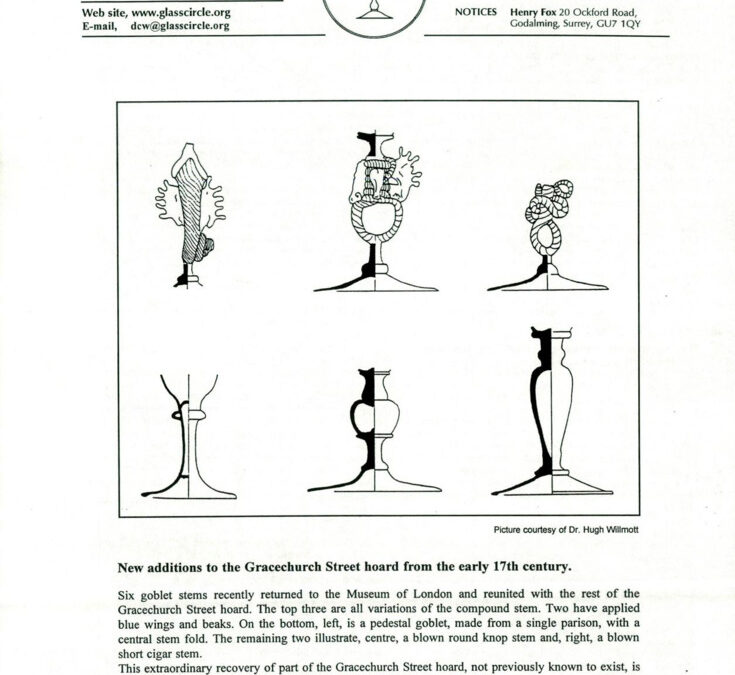
New additions to the Gracechurch Street hoard from the early 17th century.
Six goblet stems recently returned to the Museum of London and reunited with the rest of the
Gracechurch Street hoard. The top three are all variations of the compound stem. Two have applied
blue wings and beaks. On the bottom, left, is a pedestal goblet, made from a single parison, with a
central stem fold. The remaining two illustrate, centre, a blown round knop stem and, right, a blown
short cigar stem.
This extraordinary recovery of part of the Gracechurch Street hoard, not previously known to exist, is
discussed and its implications examined by Dr. Hugh Willmott on page 6.
GLASS CIRCLE NEWS No. 83
Page 2.
2000
Editorial
New Glass Circle Web Site and E-mail
addresses
Since the last issue of GC News the Circle has registered
its web site address as www.glasscircle.org . This is not
only much easier to remember (`org’ stands for organisation)
but puts the Circle in the mainstream for Web search
engines and has already resulted in many more visits to our
site and a greater interest in Circle activities. The address is,
of course, unique to The Glass Circle so that no one else in
the world can take over our name, which was always a
danger before. Both this and our new simplified e-mail
address will be printed on the cover of each issue of GC
News. For the moment all e-mail will come to me
(indicated by the prefix ‘dew’, thus:- dcw@glasscircle.org .
As committee members are upgraded to the Circle e-mail
address we will let you know.
Incidentally, our old web site address will still find our site
if you should happen to use it. Thanks go to our
Webmaster, John Newgas for taking care of these changes.
One objective of our site is to provide links to other sites
of glass interest. This means that instead of having to look
up the address of say, The Corning Museum of Glass, you
can access it directly from our site by a simple click of the
mouse button. Having read your fill you can return to the
Circle site and contact another site to see what is going on
there. For example, we intend to provide links to the
advertisers in our next issue of The Glass Circle Journal if
they so require, so you will be able to browse their sites
and find out what they currently have to offer. You should
also be able to find out about forthcoming glass auctions
and so on. You can see why the web is called Information
Technology; it really does change our appreciation of and
access to the world around us.
Buying a new computer to link to the web
Our last article on computers was back in 1966 (GC News
no. 67) with a survey of what the Net is all about in 1967
(GC News no. 70). Since that time manufacturers have
produced computer systems which come with all the
necessary hardware to access the Web built in. All you have
to do is plug a cable from the computer into your telephone
line and register via it with a network provider. The phone
bill (paid at the local rate even if you are accessing a site
in America, Japan or New Zealand) works out at less than
a cinema ticket for an evening’s entertainment when
advantage is taken of the cheap times. The major problem is
where to buy and how much to spend on a new computer
system.
A computer, like any sophisticated electronic equipment, can
go wrong, so my key advice is: buy local if possible and
from an established computer firm’s outlet.
Tiny,
my
preference, has an excellent reputation (Phone 0800 783
9812 for their nearest shop and special offers) as do
well-established multiples with in-store computer
departments’ such as
Tempo, Comet and Office World.
Computer World
however, can be baffling in its complexity
with many computers being poorly presented and, in my
experience, the staff unhelpful. Particularly avoid cheap
supermarket packages with minimal or no back-up.
The cost of a computer is relative to the
amount
of
information it can store (its memory) and the
speed
with
which it can handle it, plus the size of the monitor on
which its output is displayed.
The top end of the market is for graphics experts and
dedicated games players both of which require large
amounts of memory. If your ambitions, besides using the
Web, are limited to letter writing, lists of addresses and
phone numbers, articles for GC News, tax evasion and
similar straight-forward matters, then the ‘entry’ price end of
the market will suite you fine. You might, however, aspire
to keeping detailed records of your collection including a
picture of each piece, for which the computer is ideally
suited. As pictures are major memory users you should not
think too low although most machines currently available
will easily cope at this level.
You might think that you will not require sound and music
but a CD-Rom, such as
The Story of Glass,
still available
from the V&A and Corning bookshops, will not run without
it. There is also
The Encyclopaedia Brittannica
as well as
other popular CD-Roms on geography (Ordnance Survey
maps etc.), history and Art etc. to tempt you once you have
the means to run them. The world of the computer has
much to offer that you may not yet know about and the
catalogue of
Software Warehouse
(which also sells
computers) is worth a browse to experience the scope
available. It is often included, complete, in computer
magazines such as
Computer World
and
PC Direct.
Further, in spite of the ubiquity of the electronic world, you
will soon find yourself in need of a printer for letter writing
and so on. If you wish to copy pictures or text into your
computer memory you will need a scanner. This may
require additional electronics in the computer’s innards and
so is best purchased with the computer. Yet again, you may
link a small video camera to the computer that gives a real
time display on the screen. Thus you can take even
close-ups of the details of your collection (check when you
buy) to paste into your personal web site, your own
collection catalogue or make into Christmas cards etc.
Fortunately, these add-ons are reasonably cheap. The dearer
cameras can be linked to your television and video recorder
as well as your computer, but for around £30 you can buy
a computer-only USB camera which simply plugs into the
USB port in the back of all modern computers without any
further add-ons. Many firms offer combined packages; in
recent advertisements, Tiny’s
First Family
pack, for
example, comes with colour scanner and colour printer for
£899 including a fistful of software to get you started. For
£1099 you get a bigger hard drive (greater memory) and
monitor (17″) and a nice digital camera that can be used
independently of the computer or linked to it. Both
packages include free unlimited Internet accesss (excluding
phone bills) via Tiny’s own provider, Tiny ONLINE. This is
a very competitive industry and the firms try hard to please
with special offers. Look around before you buy but don’t
forget my key recommendation. Readers of
Which
will find
a salutory story on the back page of the May issue.
Londoners may be interested to know about the Computer
Market held every Saturday (10am – 5pm) at the T.U.C.
Headquarters in Great Russell Street,
a few hundred yards from Tottenham
Court Road UG station and
en-route
for the BM. It deals in second hand
as well as new hardware, often at
bargain prices. It is a Mecca for
those who understand all the bits and
pieces that go to make up a
computer, and a revelation for those
who don’t! A range of software is
always available at below market
prices. Look the organisers up on
www.computer-markets.com
If you have never been in the T.U.C.
building, so often featured in the TV
News, it is worth a visit for that
alone as a fine example of early
post-war II architecture. There are
mosaics everywhere and the basement
conference hall has an unusual glass
roof of interlocking hexagonal flat
(float glass) panels visible from the
ground floor coffee bar.
If you haven’t ordered
your Millennium
glasses yet and have
lost your order form
simply ring Roma
Designs at 01562
886124 with your
requirements.
River
Severn
I s d
Your porsion due
(Ded)uctions
that I payd to mr John Tyrer)
3f 3s 4d yr parte to paye halfe)
for halfe a case of glasse you disposed)
of to Jo Gregory by Jo Toses Acco)
you Reckoned 649 case of glasse
)
17
01
00
11
11
13
09
08
00
John Tosse seyth butt 648
Case soe you to abate for making 1 case)
00
07
06
(hor)se comes to by his note
01
11
04
(Dysacks Horse comes to by his note
00
13
04
Tysacks Horse comes to by his note
00
17
04
Smarte pd for Mr Bigoe per his not
00
08
00
lfor Mr Zach Tyzach per his note
00
02
04
06
04
6
due 11
06
03
(rec)eaved this
ph
of September 1660 of Mr
Robert ffoley of Stourbridge ye some
of eleaven pounds sixe shillings thre pence
being in full for making 648 case
Of glasse at Chelwood in Summersett
Shire according to Articles at 7s 6d per
Case I say pd in full satisfaction to—-
5th day of Sept 11£:6s 3d by us
Wittness
Edward Standish
Abra: Bigo
Zach: Tyzacke
Paul Tyzacke
Nausea
2000
Page 3.
GLASS CIRCLE NEWS No. 83
STANTON WICK GLASSHOUSE:
A.P. Oakley describes over 150 years of glassmaking near Chelwood, Somerset.
The most active
owner/tenant was
Lionel Lyde (who
probably lived in
Chelwood House,
Chelwood) and was
NEWPORT
in partnership with •
Hobhouse and
Challoner* (A house
belonging to Mrs.
Lyde is also shown
on the 1769 map).
The glassworks at Chelwood, some 9 miles from Bristol,
was probably one of the earliest in England to use the new
fuel “Coal” and one of the longest trading, being
established prior to 1658 and closing some time in the
1820s. The glass works predates those in Brisol established
following the Civil War (1642-1660).
Houghton’s Col!ection of Letters 1696, Letter No 198
(British Museum)
For the improvement of Husbandry and
Trade
lists Chelwood glasshouse where bottles were made.
D R Guttery
From Broad Glass to Cut Crystal
(1956)
refers to glass documents in the Palfrey collection which
mention Colemans Glasshouse, The Lye, Stourbridge, being
burnt down in 1658 and the “Chair” being transferred to
Chelwood, Somerset, in 1658. The Colemans glasshouse
was the first glasshouse built in Stourbridge, West
Midlands, by the Lorrainer, Paul Tyzack in 1615. Paul
Tyzack came to England in the mid-16th century and was
granted a patent to make broad glass.
Chelwood in Somerset was at the time in the control of
Robert Foley, son of Richard “fiddler” Foley who
introduced the first slitting mill into the Midlands and
became very wealthy. Richard was a Mayor of Dudley and
was Churchwarden with Jeremiah Bague who built the
second glassworks in Brettell in Stourbridge in the 1640s.
Robert is described as an Ironmaster and Coalmaster and is
referred to in Pepys Diaries date 1660 as Ironmaster to the
Navy Office. There is a receipt signed by the Huguenots,
Paul Tyzack, his nephew Zacharias and Abraham Bigo,
dated 1660, for 648 cases of window glass.
Transcription from the Palfrey Collection:-
It is not clear from the records available whether those who
worked the
glasshouse were owners or tenants as two
Adams appear on the map
12
Miles Around Bristol’
by
Benjamin Donn (dated 1769), one described as Mr Adams.
the other as Adams Esq. The map shows the glasshouse.
I
Lionel Lyde died in
1745 and in 1754 his
M5
1/10th of the glass-
A
house business was sold (F. Buckley,
West County
Glasshouses).
However a member of the Lyde family
(probably Elizabeth Lyde 1700-1768) married John Adams
glassmaker. The Sketchly Bristol directory gives his Bottle
warehouse as 94 on the Quay. The Bristol poll books for
1788 contains the entry John Adams glassmaker Stanton
Drew (Chelwood). In 1786, he also had an interest in The
Limekiln House Bottleworks in Bristol together with J. R.
Lucas.
In 1781 John Robert Lucas, a glass bottle maker of Corn
Street, Bristol, married William Adams’ daughter, Anna
(co-heiress of Chelwood House, Chelwood). In 1787 Lucas
acquired the glassworks at Stanton Wick when John Adams
was declared bankrupt and the works, previously Adams &
Co., were renamed Lucas & Co. There is no evidence to
show that John Adams Glassmaker was related to William
Adams Esq. (Chelwood House) landowner.
It is interesting to note that in the late 17th Century
“Cyder” was fermented in bottles by what we now know as
the “Methode Champagnoise”, this practice has been
suggested to predate the manufacture of Champagne. Lucas,
in addition to being a bottle maker, ran a beer and cider
business and owned the “Coates” apple orchards south of
Bristol; it is not unreasonable to suppose that he acquired
Stanton Wick for the bottle works which was closer to the
orchards and the place of cider making. It is recorded that
the beer and cider business, together with his premises in
Corn Street Bristol, were sold to raise funds for Nailsea. As
a result Stanton Wick was no longer required and the
business run down.
>>
*In
The Virginia letters of Isaac Hobhouse, Merchant of
Bristol,
edited by Walter E Minchinton, (1958) we read:-
“Like many other 18th century concerns, the firm of Isaac
Hobhouse & Co. was a terminable partnership, and the
partners other than Hobhouse changed from time to time.
They included a number of other Bristol merchants. In 1723
his two big associates were William Challoner and Lyonel
Lyde — Neither Hobhouse nor Challoner made the Virginia
trade their main concern, but Lyonel Lyde, an eminent
Virginian merchant and one of the Aldermen of Bristol, had
big connections with Virginia over a long period. These letters
show only his connection with the Virginia slave and tobacco
trades, but he was also one of the Bristol merchants who took
part in the transport of felons to Maryland and Virginia, and
he was a partner in a firm which operated an iron works on
the Rappahanook River. His association with Isaac Hobhouse
seems to have continued for some time for he held shares
with Hobhouse and some others in the voyage of the
“Dispatch” in 1732-33. He too signed the Virginia trade petition
in 1723 and the Africa trade petition in 1739. In addition to
those concerns he had an interest in a glasshouse at Stanton
Drew (Chelwood) and owned land in Berkshire. He served as
Sheriff, Mayor and Alderman of the City of Bristol and also as
Master of The Society of Merchant Venturers”.
M5
M4
RISTOL
BATH
Chelwood
A37
GLASS CIRCLE NEWS No. 83
Page 4.
2000
4
“0
44
Reik e
rid .0
a
4 9-
Perot zeie
“In April when the sweet showers fall,
Then people long to go on pilgrimages,”
Geoffrey Chaucer, The Prologue to the Canterbury Tales
The balminess of April remains today just as potent as it
was in Chaucer’s times. Houses ‘Open to the Public’
complete their spring-clean and put the dust-sheets away;
provincial Exhibitions open their doors and Antique Dealers
give their stock an extra polish. This Reflection concerns a
Pilgrimage, not of Grace, but of Glass, and April in this
millennium year proved to be especially rewarding. I cannot
forbear starting with an Exhibition for whose inclusion one
has to strain at the boundaries of my brief. ‘The Treasures
of the North’ was shewn in Christie’s Great Rooms from
mid January until mid February, then moved northwards to
The Whitworth Gallery in Manchester, where it ran until
9th. April. Composed of Paintings, Furniture, Silver,
Ceramics and Jewellery, it was drawn almost entirely from
Private Collections not normally shewn to the public, and
was staged with enormous flair and panache; truly, a
luscious treat which is unlikely to be upstaged in my
lifetime. The Glass content was minimal; a single rock
crystal Japanese Inro, and a few pictures with Glass as an
incident. Amongst these, however, was one whose existence
was quite unknown to me, but which does, quite
incidentally, have a noteworthy Glass significance; an
irreverent, verging on blasphemous, portrait of Sir Francis
Dashwood at his devotions, by Hogarth. Painted in the
1750s in the format of an adoration portraying Dashwood,
kneeling in a monks habit and gazing, not on religious
icons, but on attributes of the Hell-Fire Club; in the
foreground are two Glass beakers amidst a display of fruit,
which the cataloguer states is “suggestively arranged” (to me
it seemed quite innocuous, but I do not have a trained eye.)
I have discussed elsewhere the justification for suggesting
that Dashwood influenced the production of more C.18th
Club Glass than any person other than Bonnie Prince
Charlie. Those of you who missed the exhibition at both of
its venues could do much worse than seek out its catalogue,
which illustrates all 239 exhibits in colour, and is
remarkable value at £10; as a document of aristocratic taste
in C.18th England it has few equals. Just as ‘The Treasures
of the North’ was finishing, we set off to my sister-in-law
in the Mendips, as a base from which to explore
Delomosne’s little exhibition, ‘Pleasures and Pitfalls’. The
most eye-opening part of this shew was the repaired Glass;
the skill with which broken stems may be rejoined, or the
upper and lower portions of two Glasses united, emphasises
the need for considerable care before paying out large sums
for a Glass. An amusing lesson was the massive and
unusually shaped little bowl, with heavy gadrooned flutes
ending in a scalloped top; it had started life as a decanter.
The Fakes and Forgeries ranged from the obvious to the
“… is it really?”; discussing these with Tim Osborne, the
most useful comment to emerge was the oft repeated: “The
very first impression is the most vital, even though you
cannot put your finger on what troubles you.” Amongst the
Jacobite and Williamite re-inventions was
a
small
improbably waisted Glass on a short, knopped stem and
domed foot, with a ‘full house’ of well engraved Jacobite
symbolism; although smaller at about 5 inches high, one
feels sure that this came from the same stable as a set of
four similarly shaped 7-inch goblets at Traquair (see picture
on Page 5), which are believed to be C.19th.
> >
Stanton Wick Glasshouse,
concluded from page 3.
In 1788, Lucas set up the Nailsea Glassworks in partnership
with Pater and Coathupe following the acquisition of
Stanton Wick in 1787. In 1793, Pater left and William
Chance and Edward Homer (brothers-in-law of Lucas) were
admitted into the Nailsea partnership. As to the glass made,
Stanton Wick produced window glass and bottles and there
are references to two glasshouse cones. Lionel Lyde, being
actively involved in America through both direct trade and
the slave trade, was probably a partner, with other Merchant
Venturers, in the ship “Seahorse” which left Bristol in
January 1722/3 for America; included in its cargo were beer
bottles, one chest of window glass and 3480 bottles which
might well have come from Stanton Wick and could
comprise some of the bottles excavated in Williamsburg,
Virginia, USA.
With the invention of the Ricketts patent in Bristol (1821)
whereby bottles were produced mechanically by using a
three piece mould to a standard size, and Lucas having
transferred the window glass manufacture in 1815 to
Nailsea, Stanton Wick was probably unprofitable and its
closure inevitable. On the 12 August, 1815, details were
listed of the sale of the freehold of Stanton Wick
Glassworks (Chelwood), 13 cottages, 11 acres of land,
subject to the balance of a long lease at £8 per annum to J
R Lucas Esq. the owner of Nailsea Glassworks.
In the will of William Adams of Whitely Stanton Drew,
dated 15th Nov. the same year, 1815, the freehold estate of
Freemans* was bequeathed to farmer Brodribb. This
comprised 230 acres and the glassworks subject to a new 10
* Edward Freeman acquired one quarter of the Manor of Clifton, Bristol
1698. Daughter, Frances, married Shute Adams and inherited two
estates and coal mines.
year lease
at £250 per annum to J R Lucas. The cone and
cottages appear on the Tithe Map 1845.
All that remains of the works today are open fields. There
are still, however, cottages which date from the period and
Glasshouse Farm.
Further research is obviously required both locally and in
America (the Williamsburg excavations) and I am grateful to
Bob Williams of the Bristol & Avon Archaeological Society
who has helped me to identify the site. Local excavations
have been carried out by Bath & NE Somerset County
Authority Archaeologists and there is a report dated August
1993 confirming the recovery of glass from the I8th century
following the building of an extension to a local house.
The writer’s interest began with Denis Ashurst’s
The History
of South Yorkshire Glass
which refers to the Bolstertone
Glasshouse, 1650-1758, that produced articles similar to
those described as “Nailsea” (Black Glass with opaque
decoration), and the Gawber Glassworks 1732/1824 that
produced sealed bottles (examples in the Sheffield Museum).
Quite clearly, with Stanton Wick being active for a similar
period of years those “Nailsea” items found locally by
Bertha Agnes Challicom (H. St. George Gray OBE,
Connoisseur,
June 1911 and March 1923) could have been
made earlier at Stanton Wick, especially the jugs, rolling
pins, inkwells, etc. made of Black Glass with white opaque
decoration.
The majority of the information regarding Stanton Wick
came from an article “Stanton Wick Glasshouse” by B J
Greenhill, which is now in Bristol CC Reference Library
No. B22471.
Norwich until the end of the year; do get to it if you
possibly can, but if you can’t, get hold of the booklet with
the same title, published at £12.95 in paperback (comparing
the colour photographs in this catalogue with those of the
two earlier Exhibitions mentioned, shews how much colour
reproduction has improved in the past ten years.) York too,
boasts in Stonegate,
‘Mulberry Hall’,
a China and Glassware
emporium that always seems to me to outdo in luxurious
modern table settings anything to be seen in London, and
which has recently extended its labyrinthine premises; the
Black & White frontage bears the date 1434, a nice contrast
with its modern contents. With the ‘best’ (the most
expensive, that is) of Glass from England, Scotland and
Ireland; Austria, the Czech Republic, France, Germany and
Italy too, are all represented, with varying degrees of
covetability. I was seduced into buying one Glass from
Austria, despite it outraging a number of my various
prejudices! Finally, we looked again at Treasurer’s House,
that National Trust confection created by Frank Green,
about whom James Lees-Milne writes so amusingly. This
has a group of sixty or more C.18th Drinking Glasses,
some quite distinguished. Although badly lit, once again I
looked on the pair of small firing Glasses with
Audentior
Ibo
Portraits of Prince Charles, noted as being “possibly
Jacobite,” and once again that frisson of the first impression
being questionable crossed my mind. But, what a satisfying
trip with which to conclude our April Glass Jaunts.
Ron Thomas of Somervale Antiques
has kindly
supplied this picture of a truly fine collection of rare
English baluster period drinking glasses, a part of a private
group of such glasses, which he arranged to display at his
shop in Midsomer Norton, near Bath, in May as part of the
BADA members Millennium Celebrations.
2000
Page 5.
GLASS CIRCLE NEWS No. 82
The day after this foray my wife and her
sister, together with our niece, set off on a
shopping expedition, leaving me free to go
House visiting. As so often happens on a
Glass Pilgrimage, one stumbles onto a
quite unanticipated Glass treasury. Going to
Corsham Court, the Wiltshire home of the
Methuen family, which is renowned for its
picture collection, I found two good groups
of Glass. Until 1938 the House was
without electricity, but upon its installation
the 4th Lord Methuen acquired a
substantial group of English and French
Glass candelabra and girandoles,
presumably to soften the abrupt transition
from paraffin to electric lighting; they
illustrate quite a variety of forms, amongst
them being a pair of two light candelabra
supported by matt, pate-de-verre putti,
reeking of ‘between the wars’ and
reminiscent of Lalique; the room steward
told me that they are attributed to
Molineaux Webb of Manchester, who
ceased trading in 1932. Also unheralded is
A 19th century Jacobite revival goblet
House in Hampstead from 27th June to
C.18th Drinking
a cabinet of some twenty
from the set at Traquair House. (see text)
24th September, then moving on to
Glasses; there is nothing of outstanding merit, but they were
a very nice little bonus to discover. On going back for a
second look at the lighting Glass, the steward infuriatingly
remarked, “Ah, but you should see the Glass in the private
quarters; that really is something!” Ten days later we made
a jaunt to York, with the Fairfax House Exhibition
‘Eat,
Drink and be Merry’
as the attraction; this follows the
tradition Fairfax House initiated ten years ago with its
`Pyramids of Pleasure’
Exhibition, where table layouts based
on documented historic feasts are set up with realistically
modelled food displayed on authentic Plate, China and
Glass, in sympathetic surroundings of the right period. The
displays are supplemented by contemporary paintings which
exemplify the gastronomic modes of the day. The present
Exhibition is in some ways the most lavish, with a large
group of loans from Broadfield House, and an enormous
and opulent group of Silver Gilt which has been graciously
lent by her Majesty from the Royal Collection; this is drawn
from the
‘Grand Service’,
commissioned by
`Prinny’
in
1806 from the sonorously named Rundell, Bridge and
Rundell, at an agreed price of £70,000; `Prinny’ did not get
round to paying for the service, to which he kept adding
afterthoughts, until he had acceded to the throne as George
IV, paying in total £111K. The Silver Gilt had last been
publicly displayed at the block-buster Exhibition,
‘Carlton
House’,
in the Queen’s Gallery in 1991. `Prinny’ took
delivery of the first group of his ‘Grand Service’ in 1808,
the same year in which the initial part of the Perrin &
Geddes Glass service, commissioned by Liverpool
Corporation as a douceur to the Prince, was delivered. What
made this Exhibition so special for me was that Broadfield
House have lent a Decanter, a Carafe and a single Glass
from the Perrin & Geddes service badged with the Prince of
Wales feathers, and this Glass is displayed in two of the
massive coasters and one of the oval two lipped `verrieres’
of the Grand Service. Both the Glass and the Silver Gilt by
themselves are impressive enough, but to see the two
married together as Prinny’ intended gives a picture of
luxury difficult to imagine; whatever the Prince Regent’s
manifold defects, his artistic vision is unquestionable.
Appropriately, Broadfield House had also lent from the
Durrington collection the Jacobite Glass on a Newcastle
stem with the Armorial
‘Lion Statant Guardant’
Crest of the
Fairfaxes; at the
‘Pyramids of Pleasure’
Exhibition, ten
years ago, Christchurch College had lent their specimen
from the same set. Possibly at some future Exhibition
Drambuie will be persuaded to lend theirs, the third of the
known remaining Glasses from this set; even better, perhaps
all three will be displayed together, to illustrate the varying
expressions on the faces of the lions. One of the table
settings recreated is a representation of an 1815 Dessert
Course. The table centre carries an
elaborate mirror plateau, bearing three silver
gilt dessert stands on tripod feet; a nice
detail of these is the armorial engraving on
the underside of their bases; the tripod feet
lift this just sufficiently clear of the mirror
plate to allow the seated diners a good
sight of the engraving reflected in the
mirror. Also set out on the plateau,
although rather old-fashioned by 1815, are
an excellent mixed group of eight
`top-Glasses’ for dessert pyramids; there
are, too, double lipped Glass Rinsers, each
carrying an C.18th Glass, set at every
place. One gets a good idea of the
elaborate dessert displays, which required
guests either to vacate the table in the
middle of the feast to allow the setting to
be changed from the main course to
dessert, or alternatively in some grand
establishments to change rooms to where
the dessert had already been laid up. The
Exhibition is peripatetic, and is at Kenwood
GLASS CIRCLE NEWS No. 83
Page 6.
2000
Recent Research on the Gracechurch Street Hoard
Dr. Hugh Willmott
(Department of Archaeology, University of Durham)
Report of a meeting of The Glass Circle held at the Artworkers Guild
on February 8th, 2000. The hosts were Miss J. Darrah, Miss S.
Coppen-Gardner and Dr. and Mrs. R. Emanuel.
During the spring of 1940, workmen demolishing the
remains of All Hallows church broke through the remnant
of a brick and chalk built cellar belonging to a building that
once stood between the church and Gracechurch Street. The
watching brief present observed the presence of large
quantities of glass, clay pipes, Delftware and other pottery,
of which about half was recovered in a brief excavation.
Given the political situation in 1940, only a brief not of the
excavation was made at the time. A summary report
appeared nine years later, giving some examples of the glass
and pottery found]. However, since then there has been no
comprehensive publication of the material, despite the fact it
has become one of the most often quoted deposits of its
period, and still remains the largest assemblage of late
sixteenth and early seventeenth century glass in England.
Recent research into the hoard by Hazel Forsyth, curator of
early modern collections at the Museum of London, and
myself has revealed further complexities. During the nine
years between the discovery and publication of some of the
pieces in
The Connoisseur,
a number of fragments and
vessels excavated from other sites in London were added to
the hoard, including the nearly complete cylindrical beaker
photographed in the 1949 report. It was only with the
careful examination of the original accession numbers
marked on the glass fragments that the intrusive vessels
could be removed. To complicate matters further Barclays
Bank, the owners of the site, recently returned a box of
glass fragments to the Museum of London. This contained a
large number of vessels that paralleled those already known
from the hoard. However, none were marked at all and
there were no accession records for these pieces. The only
explanation was that these had been donated to the bank at
the time of the excavation, or soon afterwards. These have
now been reunited with the rest of the assemblage.
As a consequence of these complications, all previous
estimations as to the size of the hoard, from the original
Connoisseur report to Robert Charleston’s subsequent
re-analysis
2
have been misleading. With the recent new data
and using modern archaeological evaluation techniques
(which cautiously underestimate the totals) a minimum
number of two hundred and forty-one vessels can be
calculated.
Of the vessel types now known, the majority are drinking
vessels, representing most beaker and goblet types from the
first third of the seventeenth century. The most common
beaker forms are cylindrical varieties, the majority being
made from soda or mixed alkali glass. Whilst six are plain
the majority have mould-blown designs, including six with
optic-blown mesh and thirteen with vertical ribbing. There
are also four examples that have optic-blown vertical ribs
and spiral trail laid on top, as well as four thick and three
thin spiral chequered beakers from the Low Countries. At
least two cylindrical beakers are decorated with marvered
opaque white spiral trails. Potash pedestal beaker varieties
are also well represented in the assemblage, the majority of
them being plain, although there are two examples with
optic-blown wrythen, five with optic-blown vertical ribbing
and a single example with a spiral thread trail. There are
two examples of soda pedestal fluted beakers decorated with
thick raised horizontal and vertical opaque white trails. The
final beaker form is a single example of a Netherlandish
potash roemer, with pulled prunts.
A total of one hundred and sixteen goblets were recovered,
over half of them with knopped stems. Ten of these are
inverted baluster stems and a further fifty-five cigar stems.
The assemblage also yielded the largest group of
mould-blown stems thus far found in England. Sixteen
examples of lion-mask and a single ladder stem were
recovered, although none retains any evidence of original
surface gilding. The deposit also contains the largest number
of early C17th compound stems in England, seventeen in
total. Two have loop and scroll designs, four have piled
coils and applied wings, and eleven have a single large loop
and a wavy horizontal cluster above. Ten potash pedestal
goblets were found, of which eight have a folded central
‘knop’ or elaboration. The final goblets are two fragmented
examples of rod-stem goblets with solid stem knops.
A large number of fragmentary flasks were also found. The
largest group consists of twenty-one globular flasks, eight
decorated in optic-blown wrythen, the remainder being plain.
There are nine oval flasks, all decorated in optic-blown
wrythen. The group also includes three plain pedestal flasks
and a single example of a rare conical flask.
The Gracechurch Street deposit contains only three very
fragmentary bowls, all pedestal examples. They are made in
an opaque white metal and probably imported from Holland.
Eight jars were also recovered, six of which are Albarello
shaped. Finally there are fragments from between two and
four alembics, one with an unusually large spout. There was
only one example of a urinal rim.
In the Oswald and Philips report two potentially erroneous
conclusions were drawn. Firstly, that the deposit and the
destruction of the vessels could be dated to the Great Fire
of 1666. This was based upon the large quantity of burnt
material in the cellar. However, this is clearly untrue; of
nearly one thousand fragments of glass recovered, only one
showed any sign of heat distortion. Original excavation
notes, stored in the Museum of London, include a plan and
section drawn at the time of the excavation. This clearly
shows five layers of stratification, one containing the potash
glass and another layer the soda. The typological dating of
both the potash and soda glass provides a date that need be
no later than the first third of the seventeenth century. The
presence of burnt material in with the deposit could
represent a more localised event or merely the dumping of
cinders from a domestic hearth. If the deposit was sealed in
1666 it would seem curious that vessel forms dating to this
period are not present. There are no fragments of wine
bottles or any other later vessels, and if the deposit were
formed in 1666, the glass would already have been of some
antiquity. Finally the presence of distinct stratification within
the deposit would argue against the occurrence of a single
disaster destroying the assemblage.
The second conclusion that can be challenged was that the
deposit was the stock of a glass seller. The possibility that
the assemblage belonged to a wealthy household or an inn
was considered, but ruled out in the original report. The
assumption that the deposit was a glass seller’s stock was
based on the size of the deposit and the multiplicity of
forms present. By 1940, no groups of glass of this size had
been excavated, so the scale of the hoard made this a
reasonable suggestion. However, more recent excavations at
other sites such as Acton Court, Nonsuch Palace and
Eccleshall Castle, suggest that large domestic deposits were
not unusual. A further argument against it being discarded
stock is its very existence at all. Such a large group would
have had significant value as cullet, and whilst a private
concluded on page 7
14
..
N
0
Cb.
‘ct%
PRESIDENT Hugh Tait
Hugh’s background was
detailed in GC News no. 77,
1998, when he was elected
President.
SIMON COTTLE. Chairman of the Committee
Simon is currently a
Director of Sotheby’s and
head of the Department
of European Ceramics
and Glass. An auctioneer
and a specialist
particularly in European
Glass from 1450 to 1900
and a ceramics specialist
of most periods, he has
worked for Sotheby’s
since 1990.
He graduated in History
from the University of
Wales, and then carried
out postgraduate studies
at Washington State
University and at the
University of Manchester where he was awarded a diploma
in Museum and Art Gallery Studies.
From 1979 to 1990 Simon was a member of the museums
profession where he was a curator of ceramics, glass and
silver based successively at public museums in London,
Newcastle-upon-Tyne and Glasgow. Here he organised
several major decorative arts exhibitions and published a
number of books, catalogues and articles. He has made
many television appearances and broadcasts regularly on the
radio. Formerly the Secretary of the Scottish Glass Society
he has been Chairman of the Glass Circle since 1996.
Simon is married and has a young daughter.
Welcome to New Members:
Mr. R.E. Chatfield.
Mr. M. Brian Currie.
Prof. Bruce S. Elliott, Canada.
Mr. Stephen M. Pohlman, Tel Aviv.
Dr. Hugh B. Willmott.
Glass
Circle
Matters
DEREK WOOLSTON. Hon. Treasurer and
Membership Secretary
Derek spent his working life with one of the major clearing
banks, primarily in the City and West End of London. Prior
to assuming control of lending throughout the branch
network at head office, he managed the Bank’s principal
branch for four years which is located opposite the Bank of
England and which holds the accounts of many major
public companies, banks and stockbrokers, as well as those
of well known personalities.
He became interested in glass through one of his colleagues
and a glass dealer customer. He joined the Glass Circle in
1986 and his prime interest is in 18th. century wine glasses.
He became treasurer in 1993 in succession to Tim Udall
and enjoys the duties apart from having to chase members
for payment of their
subscriptions!
His wife, Faith, is also a
member of the Circle but
is not able to attend
many meetings as her
choral activities usually
coincide. They have one
married daughter and two
grandchildren aged five
and eight.
Since retiring from
banking ten years ago he
has spearheaded a
£300,000 fundraising
project to build a church
hall which has been
successfully completed.
He has recently stood down from the management
committee of a local school for autistic children after seven
years, having served as chairman for the last five years. He
is still actively involved at his local church, audits the
accounts of local societies and has various other activities in
the local community. His other interests include photography
and travel.
Page 7.
GLASS CIRCLE NEWS No. 83
Gracechurch Street Hoard. concluded
individual might have discarded it, a glass seller is unlikely
to have done so. A glass seller would have had the means
and the financial will to recycle broken or unfashionable
vessels. The presence of Delftware, and other seventeenth
century pottery dishes and mugs, as well as large quantities
of tobacco pipes (unfortunately all now lost) would also
support the hypothesis that the deposit was a clearance from
an inn or domestic context.
The Gracechurch Street hoard has now been with us for
almost exactly sixty years. Nevertheless it still remains one
of the most important and largest deposits of glass in
England, irrespective of period. Recent research has started
to clarify the nature of the assemblage, giving more accurate
indications of its size and form. Whilst interpretations of the
nature of its original use and subsequent deposition will
always remain contentious, the significance of the hoard can
never be underestimated. Research into the group is still
ongoing, and if suitable funding can be found in the near
future the hoard will be published with the detail and
prominence that it deserves.
Notes
1.
Oswald A. and Philips H. (1949) A Restoration Glass Hoard
from Gracechurch Street, London.
The Connoisseur
September
1949, pp. 30-36.2.
2.
Charleston R.J.
English Glass and the Glass Used in
England,
1984, quotes some figures for the size of the hoard.
Glass Circle News; publication deadlines.
No. 84 Early August for publication in September
No. 85 Early November for publication in December.
No. 86 Mid-February for publication in March.
Thanks to Rosemary Watts for proof-reading.
GLASS CIRCLE NEWS No. 83
Page 8.
2000
New Books
reviewed by David Watts
FIVE THOUSAND YEARS OF GLASS
Revised Edition, 1999, Edited by Hugh Tait.
British Museum Press, Size 276×220 mm, 256 pages,
266 colour ills. plus 214 in b/w on glassmaking techniques.
ISBN 0-7141-1756-0, Paperback, Price £18.99.
Time flies and it comes as no surprise
to
learn that this
popular volume had sold out its 1995 edition and was by
now in need of a make-over. It speaks volumes for the
academic authority of the authors that, although without
close documentation, this book has become an authority in
its own right. The format, layout and pictures remain
unchanged in the revised version and within this constraint
the authors have worked hard to include necessary updated
material. Most affected is the early section where
archaeology has been pouring forth new information
unabated. Indeed, the title itself should more accurately be
“4500 Years . . .” as the origin of glassmaking has homed
in, by general consensus, on
c.
2500 BC as the date for the
earliest known glass.
Veronica Tatton-Brown has introduced a whole raft of small
changes, particularly affecting Chapter 1, pages 21, 29, 40,
41, 43, 44, 49, 51, 53, and 59, to refine dates, usually by
25 to 50 years, to home-in on what were previously more
speculative possibilities and to reorganise the text in a more
logical fashion. This lengthening has inevitably resulted in
some factual deletions. It is a problem for the non-specialist
reader to know whether this is because they are no longer
believed or is simply to comply with the constraints of the
layout. I suspect the explanation is mixed. Moving on to
Chapter 2, also by Veronica, with changes on pages 62, 64,
86 and 87, a major revelation is that the large blue box and
lid (Fig. 70), previously thought to have been cast, is now
accepted as having been blown in a mould. Further, from
more recent excavations, doubt is now cast on the date of
some of the wall paintings in Pompeii depicting transparent
blown glassware. These may be later than first century BC
as originally thought and, further, some may have been
retouched, although whether recently or not we are not told.
Chapter 3, Early Medieval Europe, escapes unscathed, while
in Chapter 4, on Islam and China by Ralph Pinder Wilson,
new information has emerged (pages 122-124) from a study
of rare gilded Islamic fragments recovered from Antioch that
the use of so-called ‘liquid gold’ was a feature of their
decoration, probably in Syria, rather than by the usual
method using gold leaf
With Chapter 5,
Europe from the Middle Ages to the
Industrial Revolution
by Hugh Tait, comes the next major
block of changes, pages 124, 146 , 148,
149, 150, and 152.
On page
148
the use of gold leaf by the Greeks in
Byzantium is contrasted with the Islamic use of liquid gold
described earlier. The text, then goes on to describe how
Venice was the chief beneficiary of the sack of
Constantinople; the previous lengthy section on the use of
`painted gold’ in Islam has been deleted although not, in
itself, I think, incorrect. In posing a new question: “to what
extent did the Venetian glassmakers take over the technical
expertise of the Greeks after 1204 and also of the Islamic
glassmakers before their industries demise in the late
fourteenth century?” – a question to which there is currently
no adequate answer – the author both introduces the
Venetian industry and paves the way for further revisions in
the future. A section on the rules of the Venetian
glassworkers is here replaced by a more technical discussion
of the chemical nature of their glass. Overall, these pages
show a substantial change of emphasis although, again,
much of the data replaced is not necessarily incorrect.
The section on English glass is relatively brief but I was
surprised to find that the legend to Plate 242 persisted in
suggesting that two light balusters illustrated were probably
made in Newcastle, the opportunity to rationalise the knotty
problem of their provenance being overlooked.
I could find only one minor amendment to Paul Hollister’s
contribution, Chapter 6,
Europe and America 1800 – 1940 ,
on page 202, but, regarding factual matters, must return to
page 166 where as an amendment to Plate 212, it is stated
that the Catalogue Colinet (attributed to that important early
European glassmaking family) can no longer be used to
support the picture of a large early C16th Nef (or ship), as
here illustrated, as it can “no longer be regarded as
authentic”. I was surprised to find that this statement was
not new but a repeat of that in the 1995 edition. However,
the editor’s 1994 acknowledgements (repeated in this new
edition) thank David Whitehouse, Director of The Corning
Museum of Glass, for bringing the manuscript (owned by
the Museum) to England for scrutiny by the British
Museum’s manuscript pundits. Detailed studies on both sides
of the Atlantic now jointly conclude that this document is a
forgery, a great information loss to glass history. This
reviewer has not seen the “Catalogue” but perhaps it should
be published so that other authors may be identified who
may have relied on it in good faith and we are not
inadvertently misled in the future.
Nothing has changed in William Goodenrath’s excellent
technical section – still not even a picture of the whole
artist! Finally, it should be mentioned that the reading list
has been updated and
The Glass Circle
gets an oblique
reference in that Hugh Tait is now listed as its President
among his numerous other achievements. In terms of quality
the book is almost indistinguishable from the previous
edition with just a few illustrations being printed on the too
dark side, but, at £18.99*, an increase of £2 since 1995, it
must still represent not just unbeatable value but also one of
the finest, most thorough, reliable and general guides there
is on the topics it covers.
‘There is nothing to tell you on the spine or front cover that this is the
new publication!!! The increased price, on the back cover, and the
words “British Museum Press”, immediately above the ISBN number are
the only outside indications.
MUSEE DU VERRE CHARLEROI
Edited by Christian Renard, Echevin de la
Culture de la Ville de Charleroi. 1999.
Size 205 x 214 mm, paper back, 252 pages,
111 illustrations in b/w and colour.
ISBN 2-9600220-0-9. Price to be advised.
With the Euro 2000 football match
against
Germany imminent (June 17th) Charleroi has
shot into prominence. Since I was there
some years ago the Glass Museum, founded
by the eminent glass historian, Raymond
Chambon (1924-1926), has moved to new
premises and has now, at last, published an
accompanying book – a multi-author work
based on its fine collections, special in that
they encompass both art and technology. ,
Here’s a nice way simultaneously to brush
Charleroi canons
up both your French and your understanding of glass,
particularly if your summer holidays anticipate a visit to the
famous battlefield of Waterloo.
The main body of the text is divided into four sections:-
1.
Conquering the World
–
origins (favouring a route via
pottery), Roman Empire, Middle Ages in Europe, Islam and
China.
2. The Search for Rock Crystal
–
Venice (by Hugh
Tait), Bohemian crystal and glass of the 17th and 18th
century (including British).
3. The Alliance of Art and
Industry
–
which expands on technical developments in
glassmaking such as sulphides in the 19th century, the
reawakening of Art Glass from 1880 to 1914, between the
Wars and, briefly, later and Studio glass.
4. Technical
aspects
–
The materials, furnaces and “from Artisan to
Industry: the story of flat glass made around Charleroi”.
Most of the text is clearly written by the Curator, Isabelle
Concluded on page 14
2000
Page 9.
GLASS CIRCLE NEWS No. 83
Priapic Glasses —
A New Find
Two Wig Club Glasses from
the Collections of St. Andrews
University.
Upper glass: 16.1 and Lower
glass 16.2 as referred to in the
text.
The coin at top is a 20p piece.
Photo:
F.P.
Lole
The Greek Myths
place Pan
into the retinue of Dionysus,
the God of Wine, an appropriate association for Priapic
Glasses. Priapus himself was the Asia Minor incarnation of
Pan, born it is said, with an extraordinary deformity, caused
in consequence of Hera’s jealousy of his mother, Aphrodite;
representations of this Priapic attribute gave protection and
fecundity to both crops and flocks. The Romans took up his
cult with enthusiasm, and many representations both of
Priapus himself with his enormous deformity prominently
displayed, and of straightforward phallic symbols survived to
be rediscovered in the C.18th excavations in Italy. The 1996
British Museum Exhibition on Sir William Hamilton,
Vases
and Volcanoes,
shewed realistic wax models, euphemistically
known as Saint Cosmo’s ‘Big Toe’, which Sir William had
discovered being used as votive offerings in the vicinity of
Naples; the originals in the Museum’s collection had decayed
and fallen apart, but the Museum has carefully recreated
them from the frontispiece illustration of Ralph Payne
Knight’s book,
An account of the remains of the Worship of
Priapus in the Kingdom of Naples
published by the Society
of Dilettanti in 1786. The Romisch Museum in Cologne has
a whole cabinet of Roman lamps with similar
embellishments to them. This rage for the antique
representation of the mildly improper was taken up by at
least three C.18th Clubs and translated into their drinking
vessels. Although references to some of these Glasses were
known at the time of Simon Cottle’s article
“The other
Beilby’s: British enamelled glass of the eighteenth century?’
published in the October 1986 issue of
Apollo,
he was able
to write at that time that the Beggar’s Benison was “… one
of the only pornographic enamelled glasses of British origin
so far known”. Simon illustrated the Glass in his article, and
it is this specimen that is now in the Durrington Collection
at Broadfield House Glass Museum. At the time that he
wrote, it might well have been true to say it was the only
known British C.18th pornographic Glass of any sort.
However, thanks to the work of Professor David Stevenson
on the Collections of St Andrews University, another
specimen of the Beggar’s Benison Glass and two differing
specimens of Wig Club Glasses have been discovered; there
is also now known to be a third Beggar’s Benison Glass in
a private collection in London. Professor Stevenson’s book
Sex Clubs of the eighteenth century enlightenment Scotland
will shortly be published, reviewing the Clubs and their
place in society, together with a full description of their
Glass, Ceramics and other artefacts. I have been rebuked for
referring to these Glasses as pornographic, on the grounds
that whilst good for a giggle they could hardly be regarded
as titillating; however my edition of the OED gives amongst
its definitions of ‘Pornography’: “… the expression or
suggestion of obscene or unchaste subjects in …. art.”
Unchaste they certainly are.
Of the Wig Club, which flourished in Edinburgh from 1775
until about 1830, Harry A. Cockburn in Volume III of
The
by F. Peter Lole
Book of the Old Edinburgh Club
(1910) wrote that: “They
also had a glass of offensive shape from which new
members had to drink a bumper of claret, and the
impression of a well cut seal which could not nowadays be
exhibited in decent society.” It is two Glasses of this Club
in the St Andrews University Collections that Professor
Stevenson has now brought to light. His work has also
established that the minutes of the Club refer to them as
“Prick Glasses”, an entirely appropriate appellation.
Stevenson’s descriptions of these two Glasses in his
inventory of the Club arcana are as follows:
16.1 25
cm long x 12 cm tall. Clear
glass. In the shape of
phallus and scrotum. The mouth, placed over the scrotum, is a
pointed oval, doubtless vulvar in reference. Left testicle broken.
16.2 21 cm long x 12 cm tall. Clear glass. Similar to 16.1;
right testicle broken.
These two are presumably the ‘prick glasses’ mentioned in the
minutes of the Wig Club. The inspiration may have come from
the Roman ‘priapus vitreus’ referred to by Juvenal, but 10.1
above [a tin-ware prototype of the Glasses.] is obviously a
crude attempt at a similar drinking vessel, and may have been
a more immediate inspiration. Kavanagh claimed that the
Beggar’s Benison had had phallic-shaped glasses (said to
have been made in Antwerp) but said that none survived, so
16.1 and 16.2 are here assigned to the Wig Club.
The larger of the two Glasses, (16.1) is of darkish Glass; it
shews no perceptible fluorescence in UV Light, but has a
good ring when struck. The outer end has a pronounced and
sharp flange, and an applied string runs for the full length
of the underside, finishing between the testicles; the mouth
has a considerable amount of finely applied spirally wound
stringing. Since one testicle is broken the precise capacity of
the Glass cannot be measured, but by calculation from its
dimensions it is about 300 ml, some five times that of a
‘standard’ C.18th Wine Glass, and approaching a half bottle.
The smaller Glass (16.2) is of whiter Glass, and the
extremity of the phallus is gently moulded rather than
sharply ridged; it, too, has an applied string for the full
length of the underside, but the stringing round the mouth is
coarser and there is much less than with the larger Glass.
This Glass also shews no fluorescence, but neither has it any
ring to it when struck; I calculate its volume to be about
half that of the larger. It would seem that these two Glasses
came from different Glass-houses; the larger appears to be of
Lead Glass, whilst the smaller is not; although Kavanagh is
not a reliable authority, one wonders whether his reference
to Antwerp as a source might apply to 16.2? Certainly not
works of art, the Glasses might be described as curious, in
every sense of the word.
When wine was drunk in Bumpers, as the commentary
quoted above for inauguration to the Wig Club records, the
Glass had to be emptied in a single swig. The pair of
testicles open into the body of the Glass, effectively making
it into a trick Glass; as the vessel is tipped up, on reaching
a crucial level, air can enter the two globes, allowing the
wine in them to gush out, probably spilling down the shirt
front of the hapless novitiate, to the delight of those
watching with anticipation. Unfortunately, the fact that both
Glasses are partially broken precludes an experiment.
•
Despite being robust and thickly blown vessels, the two Wig
Club Glasses have each had one testicle broken, although
they were reportedly intact in the 1920s. In view of their
chequered history, this damage is not surprising. In 1919 a
colourful gentleman who called himself Col. Canch
Kavanagh acquired the Beggar’s Benison relics, and
subsequently succeeded in obtaining the Wig Club items,
mixing the two sets indiscriminately. He constituted himself
concluded overpage
GLASS CIRCLE NEWS No. 83
Page 10.
2000
DUDLEY:-
FURTHER DEVELOPMENTS
Broadfield House Glass Museum has a new Assistant
Keeper of Glass, replacing Zelda Baveystock. This is Emma
Warren, formerly Keeper of Education at the Lincolnshire
Life Museum in Lincoln. The Glass Museum is not now
destined to move to Himley Hall as previously proposed.
It looks as though Wordsley Art and Technical Institute,
“set up in 1897 by local glass manufacturers to provide
better trained workers and enable it to compete better in the
international market”, will now be demolished after years of
neglect and vandalism. The Institute, with its close
associations with Frederick Carder, was a subject of
discussion in 1977, in the first two issues of Glass Circle
News, when it was threatened by road widening – still much
needed. At that time it was in fairly good condition and
Carder’s elegant terra cotta plaques, now vandalised, still
intact. Several proposals have fallen through, largely due to
the awkward and constrained nature of the site. Now,
declared to be unsafe, this elegant Victorian building will
probably go for good although local conservationists hope to
salvage something from it for posterity. Perhaps they could
sell individual souvenir bricks, or export it to the Rockwell
Museum in Corning where Carder’s glass is displayed.
Following the announcement of a new Glass Centre for
Royal Brierley Crystal in Dudley, (GC News 82) comes the
exciting news that Stuart Crystal’s Red House Cone site is
to be redeveloped with financial support from the European
Regional Development Fund (£570,000) with monitoring by
English Heritage of the site buildings into sixteen craft
studios, to be managed by Dudley Metropolitan Borough.
The glass Cone, it is said, “will be restored to its former
glory”, presumably meaning that the main and subsidiary
furnaces and the leer will be restored. The project manager
is Peter Courtis and the architect is Ian Henderson.
Redevelopment should be finished by Easter 2001.
This year the Dudley Glass Festival will run from Sept.
24th to Oct 1st with the usual wide range of activities.
Of particular note at Broadfield House are:-
Legends
in Glass and Chinoiserie in Cameo
on show until 28th January 2001.
Under these titles Broadfield House Glass Museum will be
showing a distinguished array of cameo glass by George
and Thomas Woodall sourced from public and private
collections together with the newly acquired Sappho plaque,
as well as oriental themed cameo glass by Thomas Webb &
Sons from an important private collection.
The cameo exhibition is supported by an 8-page, A4 full
colour pamphlet
Legends in Glass – Thomas and George
Woodall and the Art of Cameo Glass
by Christopher
Woodall Perry.
For further information ring 01384 812 745.
Main information source:-
Cameo, Newsletter of The Friends of Broadlield House, issue 25.
A RARE
ROEMER
DECORATED BY
H. MOLENYSER
An important Netherlandish
Roemer, signed H.
Molenyser and dated 1651,
the ovoid bowl diamond-
point engraved with the
arms of the 17 provinces of
the Netherlands, flanking
the arms of Prince Willem
HI of Holland (1650-1702),
below a running border of
fruiting vines, the hollow
stem applied with raspberry
prunts beneath an engraved band, the spreading trailed foot
with a deep kick-in base, 28cm. (bowl cracked).
The engraver, H. Molenyser would appear to be distinct
from the better known Moolyser, thought to have been
working during the last three decades of the seventeeth
century. He is not necesssarily linked to the other known
engravers who used the initials M in their signature during
the 1650s. Only one other glass, a berkemeyer, is known
with the signature Molenyser. It is dated 1663 (See Peter C.
Ritsema van Eck,
Glass in the Rijksmuseum,
Vol. II, No.
34). Prince Willem III of Orange, Stadholder of the
Seventeen Provinces and later King William
III
of England,
was born in 1650. The Stadholder office was abolished by
the Dutch States General in 1651. It is likely therefore that
this glass celebrates the Prince’s birth and Stadholdership,
prior to its abolition.
Sold at Phillips, New Bond Street, on May 24, 2000, it
fetched £9000 (Estimate f3000-4000).
Priapic Glasses concluded
`Sovereign Guardian’ of the combined ‘Order’ and tried,
apparently unsuccessfully, to revive membership of the
‘Chivalry’. Ultimately, the trunk full of relics was given to
St Andrews University by the heirs of a later owner; the
University was for some time considerably embarrassed by
such indelicate material, but nowadays it is treated with
great respect and care.
There is a record of what seem to be related Glasses being
used by the Hell Fire Club (1746 — 1770s) of which Sir
Francis Dashwood was president. This met both at
Medmenham Abbey, on the banks of the river Thames and
at Dashwood’s home at High Wycombe. A somewhat
tenuous record relates that Hemming, the silversmith,
supplied both silver drinking vessels in the form of women’s
breasts, and Glass vessels in the form ‘Horns’. Stevenson
mentions an additional reference in the
Public Advertiser
of
29 October 1772, which records “special drinking vessels”.
Dashwood, who had by then succeeded to the title of Lord
Despencer, is recorded in the 1765 Probate list of the
Glass-seller Thomas Betts, as being indebted to Betts for the
quite substantial sum of £9.3.6 (by way of comparison, in
that same year that Lord Fairfax’s housekeeper was paid an
annual wage of £10.) None of the Hell Fire Club Glasses
are known to have survived.
I
am
indebted, both to Professor Stevenson and to the authorities of St.
Andrews University, for their help and for permission to publish these
two Wig Club Glasses.
2000
Page 11.
GLASS CIRCLE NEWS No. 83
GLASS CLIPPINGS 69
fiANry Fob
The World of Glass Museum, St. Henlens
The old familiar Pilkington Glass Museum is no more.
Welcome to the
World of Glass Museum
which replaces it
in its own brand new building. This new museum, with two
studio glass workshops, combines the collections of the
Pilkington Glass Museum and the St. Helens MBC Museum.
The Independent
(14.2.00) architecture feature under the
heading
“Missed opportunity for a real glass act”
is
scathing in its comments about the new museum building. It
complains that the lack of innovative use of latest modern
glass technology within the building remit has meant that
the new museum
“hasn’t even opened but already it is a
dinosaur”.
The future direction of glass is apparently
ignored. The article continues:
“Glass is today so smart that even your rear car window
has thin strips in it to replace radio aerials, and sensors
that automatically turn on the windscreen wipers when rain
trickles down its face. Astronauts wear glass strips woven
into suits, and supersonic pilots at the flick of a eyelid can
use glass visors on their helmets to dive and soar. Glass
today is so tough and safe that nuclear waste is buried
undersea in big glass canisters which won’t leak. It repels
bullets, you can walk on it and cut it into sinuous chairs
strong enough to sit on. But you would never know from
this museum, which is stranded in the past ….a glorious
opportunity to celebrate invention and innovation was
missed…. don’t blame the architects this time. They had the
ideas but not the backing needed to show us a glass act.”
The museum has opened to the public, and I would be
interested to receive comments from any member(s) who
have visited it.
The demand for float glass, undoubtedly one of the great
inventions of the last millennium, continues unabated and
Pilkington’s famous St. Helens factory remains in production
with tours available by appointment. The firm continues to
diversify. Moisture-proof laminated safety glass (used for
swimming pool lighting etc.) is one product of Pilkington
Salford’s merchandising outlet. At Halmstad, in Sweden,
where Pilkington already has a float plant, it has invested
£16 million in a new, upgraded glass coating plant in
response to Nordic government legislation demanding
high specificity low emissivity solar control panels.
No doubt this will come to Britain in a decade or
two. In Spain, in conjunction with another glass
producer, the Glaverbel group, a new float glass plant,
with a sales capacity of approx. 150,000 tonnes per
year, has been installed at Sagunto, near Valencia. In
addition to various tit-for-tat sales arrangements,
Pilkington’s will benefit from easy transport to its
automotive glass fabricating factory alongside.
American Country Home Feature
This year the Daily Mail Ideal Home Show featured the
American country home and one of the participants was
Fenton Art Glass which was founded in 1905 and is the
largest company hand-blown glass in the United States.
Some members will no doubt be familiar with Fenton
Carnival glass which is now widely collected both here and
in the States. Fenton has announced that it hopes over the
coming months to raise further the public awareness in the
UK of its current product range. Check out its Web site.
Honey’s Book
A West Country member kindly showed me recently an
interesting little booklet entitled
Honey’s Book on Victorian
Pressed Glass
by Millicent Honeywood, published privately
in Steying, Sussex, March 1985 (an edition of 1250 copies).
It is printed on card with plastic ring binding, has 16 pages
of text and illustrations (three pages in colour), as well as
cover illustrations front and back. The author gives a short
history of glass by way of introduction before going straight
into the invention of pressed glass “But it was the
Americans at the beginning of the 19th century who
perfected the process based
on the English 18th
century moulds
It was
not until the mid 19th
century that the great mass
of English pressed glass
was produced. It came into
being to provide the less
well-off with inexpensive
copies of what the rich
had ‘for real’.” No preface
is provided as to the
inspiration of this booklet,
nor any information
provided about the author,
nor why is it called
Honey’s Book ?
If any
member can throw any
light on how this book
came about it would be
appreciated if they would’
get in touch with me.
Blowing for Victory
Earlier this year many
members were no doubt
Glassblower (1941), by Mervyn Peake
either
delighted
or (1911-1958)
bemused, if not totally
Picture copyright of Chris Beetles Ltd.,
bored, by the adaptation of
London.
Mervyn Peake’s
Gormenghast ,
heralded as a masterpiece of
English literature, shown on TV as part of the Millennium
celebrations of the BBC. I must confess that, although his
name seemed familiar, I knew nothing of Mervyn Peake’s
work, so you can imagine my surprise to come across an
exhibition in London’s St. James’s entitled:
“The Strange
and Beautiful World of Mervyn Peake”;
but an even greater
surprise was in store for me. When I viewed this varied
exhibition of illustrations, paintings and drawings I was
confronted by a large oil painting of a glassblower, signed
and dated 1941. Apparently Mervyn Peake was asked to do
a number of paintings of this subject, featuring those
engaged in the war effort, (These can be found at the
Imperial War Museum in South London, not far from
Waterloo Station.) I have since discovered that Mervyn
Peake, who was born in 1911 and died in 1968, was
multi-talented in that he wrote poetry, too. Would you
believe that his verse includes
The Glassblowers
published
in 1952!! Does any member have a copy of this poem?
Glass goes Underground
Looking out from a Circle or Metropolitan line tube train at
London’s Gloucester Road Station to view a display of
contemporary glass structures lit up on an unused platform
is almost a surreal experience, not to say baffling, because
it was so unexpected, but there it was is for all to see! Am
I and my fellow travellers that afternoon the only ones to
witness this display, or have some other members seen it?
London Transport was able to confirm this interesting, if
unusual, public display, and indicated that it would be on
show for a further few weeks.
> >
Late News
Auctions
June 14th, Bickerton Collection of Glass
at
Bonhams, Lots Road, Chelsea.
June 13th, Pottery, Ceramics and 150 lots of fine
glass
at Phillips, New Bond Street.
New
Book
Glass of Four Millenia by Martine Newby
An 80-page paperback illustrating in full colour 56 prime
examples of glass, with extended and referenced captions, in
the Ashmolean Museum, Oxford. Price to be advised.
I
say Bri, why are we still upside down? I am getting
quite dizzy. Have we become victims of the Phillipine
“love virus”?
I
don’t think so; the editor says it’s just that he has
unfortunately mislaid the computer program that turns
us back up again, but for the moment we should
consider ourselves as downlighters converted to
uplighters.
Oh! do you think that is what really happened to that
big American Chandelier we heard about?
Well! that was being converted from gas to
electricity. We’re no worse off than it is now it has
been restored. I only hope we don’t go back to gas;
there’s enough hot air in this newsletter as it is!
GLASS CIRCLE NEWS No. 83
Page 12.
2000
CUPP; 1•1/S
i
continued from page 11
Mrs Graydon Stannus
I
have no wish to upset those who believe that this lady is
possibly more sinned against than sinning, but a member
very kindly telephoned me to tell me that her book entitled
Old Irish Glass, published in 1921, had been spotted at a
recent book fair, but more importantly it came with a letter
of complaint written to her 12th March 1923 from Bolton &
Fairhead, Shipping Agents, 9 Percy Street, Tottenham Court
Road, London W 1. I quote:
“Dear Madam, With reference
to the consignment shipped to Mrs Nicholas F Brady. Our
New York Correspondent advises that two of the pieces have
been returned by the Appraiser as being modern and
dutiable, namely a Waterford Bowl , Value £165, and a
pair of decanters , value £14.14.0 , which he claims to be
modern, and value only £5. and fl. respectively .
(New
paragraph)
Customs demand duty on the entered value 490$,
and our New York People are waiting to hear from Mr.
Laidlaw what he intends to do in this matter, but expect
that he will return these two items to you. Yours very truly,
BOLTON & FAIRHEAD”
Sadly we do not have a reply to
this, nor knowledge of the outcome, but it is a very
interesting addition to anyone researching the business affairs
of Mrs. Grayon Stannus. What I find curious is how the
letter addressed to “Mrs E. Graydon Stannus, 23, Earls
Court Square, S.W. ” came to be with a copy of her book.
(Incidentally, I have only recently learnt that her daughter is
none other than the highly regarded and much loved
doyenne of the ballet world, the centenarian, Dame Ninette
de Valois.)
More about Musical Decanters
I
am indebted to two members who have contributed further
to my request for information. Both are the happy owners
of an example. One is described as of Prussian shape made
anytime from 1850 – 1900, and has a Swiss movement. It is
believed to be French as the owner has seen similar shaped
bottles in France. It plays two tunes. The other one is
thought to have been acquired by the owner’s grandfather,
possibly late 19th century. The works are inside a basal
frosted dome, but a red cloth based seal (which carries a
hand-written label listing the “Airs”) prevents one from
seeing the mechanism. It plays three tunes, all presumed
French. In conclusion it would seem that these decanters are
scarce as one of these members writes “Having been in the
Glass trade for many years, I had never seen any at all.
This year including mine, I have now heard of three.”
Henry’s Review
of recent Auctions
(Hammer prices unless otherwise stated)
*Phillips Bond Street –
March 8th – Ceramics & Glass.
Only a small selection of glass was on offer and most of
the lots were early English drinking glasses. A blue and
white colour twist stem wine with round funnel bowl made
£2200.
*Christie’s King Street –
Venetian Glass
Single Owner Collection – such an auction
feast is rare indeed numbering over 300
pieces dating from mainly the 16th century
up into the 18th century. This important
varied private collection, containing many
interesting and fine specimens, was believed
to have been started in the 1970’s.
Venetian glass may not be entirely to the
English taste but the skill in making and in
decorating this early glassware cannot be
denied, nor can the very important
contribution over the centuries that the
Venetian glassmakers have made to the
“:
history of making glass throughout Europe
and beyond. This sale provided a unique
opportunity to all those with an interest in
glass to re-assess and appreciate these
qualities. Among the drinking glasses on offer, a tall 16th
century latticino flute set on moulded knop went for £8,500.
(picture right). Top bid was for a rare gold painted, gilt and
diamond point engraved covered goblet
c.
1570-90. It finally
went for £60,000. Fine pieces of latticino glass were well in
evidence and here the top price of £28,000 was bid for a
lobed ta77a on knopped and cigar shaped stem. A good
enamelled footed bowl made £26,000.
*Bonhams Chelsea –
14th March – Fine Ceramics and
Glass – this sale included a few 18th century English
drinking glasses, notably a triple knopped baluster stem
goblet which fetched £950. There was great interest in a
collection of scent bottles. The 63 lots found an appreciative
audience. There was lively bidding from the trade and
private collectors present or on the telephone. A Webb’s
peachblow bottle made £850; a yellow ground cameo glass
bottle finally went for £1200; the star lot in this collection
was a rare (second half of 18th century) Venetian bottle
from the Brussa workshop, enamelled with a finch and
flowers in colours, which reached £2200.
Sotherby’s Bond Street –
21st March – Ceramics & Glass
–
here there was a 57 lot glass section, but 22 lots were
unsold although several were sold after the sale including a
fine Dutch engraved baluster glass. I heard subsequently
“possibly Sang” being put forward as the engraver for this
unsigned piece. A good stipple engraved glass
c.
1770,
attributed to David Wolff, decorated with putti and inscribed
Indissoluble
went to an American phone bidder for £11,500.
Included in the glass were entries from the estate of our late
member, Dr. Harwood Stevenson. Of special interest to
bidders were a number of important engraved pieces of
English glass
c.
1870-1880. A jug, possibly by Thomas
Webb, engraved with the
Triumph of Amphitrite
made
£9,000. Another jug, also possibly by Thomas Webb,
engraved overall, including handle, (possibly the work of
Frederick Kny) with what has been described as grotesques
and other animals centred on a chimera (a fire breathing
monster with the head of a lion, the middle of goat, and
hinder of a dragon) went for £5,000. (A dated 1876
magnum handled decanter and stopper of typical Webb
pattern and with overall engraving, including the handle and
stopper, featuring a similar engraved chimera and swirling
tendrils and foliage, is known. If a member knows of any
other example of glassware from this period engraved with
the chimera, I would be pleased to hear from them.)
*Hampton’s, Godalming –
Ceramics & Other Items –
Silver mounted Victorian and Edwardian claret jugs have
been firm favourites for some years with collectors so I
suppose one should not marvel that a good size unusual
2000
Page 13.
GLASS CIRCLE NEWS No. 83
Auctions, concluded
claret jug in the realistic shape of a duck, silver neck,
handle and feet with engraved glass body should fetch
£4,600, despite substantial crack in, and piece missing from,
the glass body. Somewhere a restorer is no doubt already
making a replacement engraved body to which can be
affixed the silver mounts, and no one will eventually be any
the wiser! Who will question that the glass is something
like a hundred or so years younger than the date of the
silver hallmarks? In the same sale was a good engraved
Victorian water set, which fetched £1050.
*Dreweatt Neate Donnington Priory, Newbury – 5th April
“The Spring Sale” began with 76 glass lots comprising
almost entirely early English drinking glasses. A damaged
continental
item
prevented
this
section of the sale
being a total sell
out. Highlights
were a late baluster
period style glass
(centre,
right)
£520; a wine flute
of almost toasting
form on opaque ;
white enamel twist
stem £520; an
attractive wine with flared bucket bowl engraved with vine
leaves, set on shoulder knopped multi-spiral airtwist stem,
plain conical foot, £550; described as a cordial glass, a
similar bid secured a glass (Sins/12.8cm high) with pan
topped engraved bucket bowl set on straight multi-spiral
airtwist stem; another lot comprising three glasses with
opaque white enamel twist stems went for £600; a Jacobite
glass, the bowl engraved with rose and two buds set on
opaque white enamel twist stem made £650; an early 19th
century tumbler finely engraved with Masonic emblems, and
in contemporary leather case with hinged lid, finally went
for £850; the last glass lot sold at £1650 and was a pair of
19th century Bohemian amber flashed heavily cut vases and
covers, the vases engraved with a horse in wooded
landscape (one vase with rim chip and one cover with
cracks to finial).
Sotheby’s Country House Sale at Benacre Hall, Suffolk –
9/11th May. The disposal of the contents of a home and
personal effects of a long established titled family in
residence for well over two centuries is bound to attract a
lot of attention. In this case more so as the property had
never been opened to the public, and the late owner, who
was the last of the line, had for many years lived in only
part of it. Here are a few glass highlights. A large Dutch
17th century diamond-point engraved green glass roemer
with hollow prunt decorated stem on low spun domed foot,
the bowl inscribed
Dit Is Stomachael
went for £4000; in
contrast, a large Whitefriars green tinted glass goblet, the
bowl with blue cabling over a quatrefoil knop with
aventurine inclusions and panelled conical foot made £900.
Tucked away in another part of the sale to be sold
separately were two similar rare late 19th century Storer’s
Patent perpetual fountains (unsigned), surmounted by clear
glass bowl with wavy edge, the hour glass style body made
up of two clear glass bulbs, These table fountains which
were bid to £2800 and £3000
respectively. This now brings
to four the number I have
noted in the last two years.
Palais Dorotheum Vienna –
24th May – This sale included
a handled glass jug (right),
designed around 1890 by
Christopher Dresser (1834 –
1904) for the firm of James
Couper & Sons of Glasgow.
This lot fetched Aust. Sch.
12,000 (£5580). In the past
few years wider interest in the designs in metalwear, china,
and glass by Dr. Dresser has been gaining momentum. Last
year some members may have seen the special Dresser
Exhibition at New Century, Kensington Church St., London,
which was accompanied by a well illustrated and informative
catalogue. I saw last year a draft copy of the section on
glass which questioned why did Dresser take so long to turn
his attention to glass – had he carried out designs earlier for
other glass manufacturers? Has any member a view on this?
And Browsing Around the Fairs
The BADA FAIR, under a huge marquee at the top end of
the Kings Road, Chelsea, was showing the best that its
members had to offer. This fair is a must for anyone
seeking fine antique glass – many pieces seen were of
museum quality. Christine Bridge had a display of good
early CI 8th drinking glasses, including an attractive four-
sided pedestal stem specimen on a folded foot; some fine
examples of English cut glass from the early 19th century;
as well as a superb pair of French gilt metal mounted blue
opaline candlesticks. A pair of English baluster period
candlesticks had just been sold prior to my arrival.
A short distance away
Highgate Antiques
had their
traditional shelf of English drinking glasses. These consisted
of choice airtwist and white opaque twist stem examples, the
latter included one with a rare octagonal bowl.
I quickly spotted
Jeanette Hayhurst
whose stand featured a
wide range of glass to whet the appetite. There were a
range of CI 8th drinking glasses, including a few good
continental engraved examples, Cl9th glasses, as well as a
variety of decanters, were on offer including a rare set of
four small blue ones in individual papier mache coasters
affixed to matching serving tray. If my eyes did not deceive
me, there were examples of Roman glass on this stand.
Next I came to
Mark West
who also had a selection of
Cl8th drinking glasses, but is now perhaps better known for
his range of late 19th – early 20th century glass.
Turning a corner I came to
Namara Antiques
who were
showing a variety of finest quality cut glass, including a
rare early “lazy Susan”, the large shallow-cut revolving flat
dish set on a later silver mount. I admired a substantial cut
glass ewer and two matching goblets, which I was told were
by Apsley Pellatt. On some furniture stands other examples
of glass were seen. There were quite a few good mirrors on
show; several attractive English and Chinese 18th century
reverse paintings on glass; some decanters; a large gold fish
bowl; and finally, my favourite, seen along with a group of
early children’s samplers, a framed small piece of 17th
century English coloured bead work depicting a man and a
women facing each other.
A brisk walk down the Kings Road brought me to the
Chelsea Town Hall to see the
Chelsea Spring Antiques
Fair.
Here I found
Brian Watson
showing a selection of
C18th sweetmeat and drinking glasses. Dealers these days
are less inclined to pass them off as champagnes, and
personally I do not recall seeing many remotely designed to
be drunk from comfortably. Between the Wars, the major
collectors of the day often paid substantial sums for
sweetmeats. How fashions change – even in collecting!
I paid my second visit, in late March, to the
Woking Glass
Fair
(Sunday only). Whilst waiting to go in I watched from
a balcony the frantic activity of the dealers getting ready -to
lay out they stock of mainly late Victorian and 20th century
glassware. This time, however, I was surprised to find more
tables with drinking glasses from the latter part of the 18th
century. There were several nice examples from this period
to be had. Collectors of press moulded glass, including later
carnival, were well catered for. I recognised John
Stallebrass who specialises in quality mid-19th to early 20th
century glassware, including specimens by well known
continental glass makers. I admired his two delicate small
handkerchief bowls by Venini, as well as a large jug by
Blow moulded decanter in
clear crystal with drape
decoration.
Cristallerie de Voneche.
GLASS CIRCLE NEWS No. 83
Page 14.
2000
MUSEE DU VERRE
CHARLEROI
review concluded from p. 8
Laurent. The supporting
illustrations, drawn from the
Museum’s collections, bring a fresh
approach to a well-trodden path.
Throughout, there is an emphasis
on the development of technology,
such as, in China, the invention of
a high lead-cum-baryta glass to
simulate jade. Aspects of particular
interest, many concerned with the
local Charleroi area, are set out in
individual greyed boxes.
The Venetian contribution, by Hugh
Tait,
not
only
traces
the
c. 1825
–
30. Ht. 256 mm.
development of the industry and its
wide range of decorative techniques but also looks at the
more recent technical discoveries indicating, for example,
that in the CI3th a refined clear glass, and in the CI4th an
opaque white glass were developed independently of the
Middle East. The expansion of glassmaking from Murano
and Altare is discussed. A grey box is given over to the
spread of Facon de Venise in the Charleroi area from the
end of the C 15th. The contribution of the Colinet family is
mentioned and it is sad that the
Catalogue Colinet
as a
source of early information is now accepted as a forgery
(see
5000 Years…
review).
Bohemian and English glass are, by comparison, given
rather brief treatment. However, the development of lead
crystal by Aline Gabriel d’Artigues (1773-1848) and the rise
and fall of his Voneche glass works is particularly
interesting. If I read this section correctly it would make
some Continental lead glasses attributed to the mid-C18th of
a rather later date. Alongside this comes the until recently
overlooked invention of moulding with compressed air (see
picture left) which made possible the creation of
well-defined patterns in a heavy glass body.
The “Between the Wars” section is much as one would
anticipate and accompanied by nice illustrations, as is that
on modern studio glass with particular reference to Louis
Leloup, Belgium’s premier pioneer in this field.
The last, and in many respects most fascinating, chapter of
this book concerns the modern development of window
glass, with which the Charleroi area is particularly
associated, beginning with the “verre en manchons”
improved broad glass that competed with the English
“Crown” glass. The huge “canons” (picture below), of which
the museum has impressive examples, yielded fine sheet
glass that was exported worldwide (via the Port of London)
and, at one time, exceeded the total production in America.
The USA, in retaliation, put up trade tariffs which led to a
series of inventions and counter inventions as both strived to
gain commercial supremacy. The Belgian “Fourcault process”
finally gained the upper hand (for technical details see R.W.
Douglas and S. Frank’s
A History of Glassmaking,
1972).
Production flourished until the mid-1970s but finally
collapsed when Pilkington’s float glass technology gained
ascendancy. Incidentally, it was Bontemps knowledge of the
“verre en manchon” process that enabled Chance brothers, in
Birmingham, to successfully compete in the production of
glass for Paxton’s 1851 Exhibition building.
Both this book and the Museum in Charleroi are strongly
recommended.
Buxom young
ladies could
each carry two
cannons by
means of straps
attached to their
skirt belts.
All pictures are
taken from the
Charleroi book.
Browsing around the Fairs,
concluded
Stevens & Williams with an enamel painted fox (why do I
like foxes?) hunting scene in full cry curving down and
around from almost the lip to the base.
Its now the end of April and off to the
NEC B’ham.
There
were fewer glass dealers than usual, but there was certainly
variety and quality.
Bell Antiques
had already sold two
colour twists within the first hour – he was packing up an
attractive blue colour twist for a young couple when I
arrived at his stand; I noted an unusual set of three dram
glasses with spiral cable white opaque twist stems, set on
terraced feet.
Wm. MacAdam
had a good facet cut stem wine with
unusual engraved swags and sunbursts on the bowl, so
much more interesting than the common-place ‘egg and
dart’; I also liked a pan topped drawn trumpet plain stem
wine with basal Imp. Also two Absolom decorated glasses,
but sadly one was unsigned and the other, while signed
under foot, was missing virtually all its gilt decoration on
the bowl.
Brian Watson
still seemed to have several sweetmeat
glasses among his more usual range of mid to late CI8th
glasses. There was quite a selection of French glass from
the beginning of the C2Oth, such as Daum and Galle, as
well as later glass by Lalique, including several popular
designs; I was amused by a piece of
pate de verre
by
Argy-Rouseau of a frog clambering onto a rock. I saw
virtually no pressed glass of any kind this time round.
The busiest stand
I
came upon was that of
Nigel Benson,
who specialises in fine glass Between the Wars. Here there
was a queue of at least five people with cheque books at
the ready, clutching items of glass eagerly whisked off the
shelves. Whitefriars; Walsh Walsh; Graystan; Monart; Stuart;
and Nazeing were all popular. On a general stand I came
across a pair of most unusual convex mirrors, said to be
French, late 19th century, which were shaped like curved
arched windows, set in narrow gilt decorated frames.
I have to admit that I left earlier than usual, and may, as a
consequence, have missed something truly wonderful, but
these large fairs are very exhausting despite generous seating
areas! It was disappointing to see that there was no sign of
a piece of Osier glass furniture on the featured Birmingham
City Museum & Art Gallery stand. However at the end of
my visit, this fair had lived up to its claim of “Antiques for
Everybody”.
Forthcoming Fairs
*Sunday 1st October – Antiquities Fair at the Rembrandt
Hotel (opposite V&A Museum)
*Sunday November 12th. – Glass Only Fair at B’ham Motor
Cycle Museum, Nr. NEC.
Puzzle for the Summer Holiday
“It was a funny household. The cottage was hired furnished
and finally, a strange assortment of astonishing pictures
painted on the back of glass, done probably in the early
years of the nineteenth century, or in the late eighteenth.”
There is no prize, but literary members might like to let me know from
whence this extract comes and who was the well known versatile
author, who died comparatively young in the first half of the last century,
and in their lifetime courted controversy in their novels but seemingly not
their poetry. A few further clues available on request, but all will be
revealed in next issue of GC News.
Henry Fox