




7,410.11.11. td
fa.,
No. 1588. ETCHED SERVICE.
PORT.
CUSTARD.
JELLY.
SODA TUMBLER.
LIQUOR.
CHAMPAGNE.
HALF-PINT TUMBLER.
SHERRY.
CHAMPAGNE
TUMSLER.
GLASS CIRCLE XliWS
No. 84
(-) Sept.
.4. 0 0 0
EDITORS
David C. Watts
27 Raydean Rd,
Barnet, Herts. EN5
F. Peter Lole
5 Clayton Ave.
Didsbury, Manchester, M20 6BL.
NOTICES Henry Fox
20 Ockford Road,
Godalming, Surrey, GU7 1QY
Web site, www.glasscircle.org
E-mail, dcw@glasscircle.org
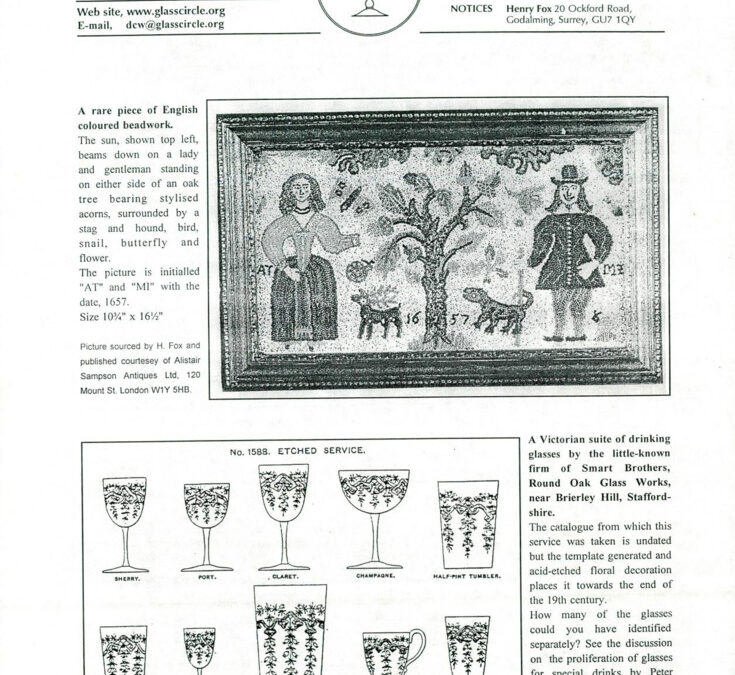
A rare piece of English
coloured beadwork.
The sun, shown top left,
beams down on a lady
and gentleman standing
on either side of an oak
tree bearing stylised
acorns, surrounded by a
stag and hound, bird,
snail, butterfly and
flower.
The picture is initialled
“AT” and “MI” with the
date, 1657.
Size 10%” x 16’/2″
Picture sourced by H. Fox and
published courtesey of Alistair
Sampson Antiques Ltd, 120
Mount St. London W1Y 5HB.
A Victorian suite of drinking
glasses by the little-known
firm of Smart Brothers,
Round Oak Glass Works,
near Brierley Hill, Stafford-
shire.
The
catalogue from which this
service was taken is undated
but the template generated and
acid-etched floral decoration
places it towards the end of
the 19th century.
How many of the glasses
could you have identified
separately? See the discussion
on the proliferation of glasses
for special drinks by Peter
Lole in
his Limpid Reflections
(page 9).
The glasses are said to be to drawn
scale at approx. one third full size.
GLASS CIRCLE NEWS No. 84
Page 2.
2000
Editorial
Fakes, Forgeries and Reproductions
For the new collector, and even for those with some
experience, the danger of parting with one’s hard-earned
cash for a piece that flatters only to deceive, and whose
worth is only a fraction of the asking price (perhaps due to
ignorance on the part of the dealer), is an ongoing matter
for concern. Two questions arise, first whether or not glass
is a particular worry in this respect, and second, the
confusing question of terminology – what do the terms of
my title, often seen as a chapter heading, actually mean?
The matter was brought to a head for me at the Dudley
Glass Festival last year when Jeanette Hayhurst opened an
instructive lecture by saying that there is no such thing as a
glass fake (with one exception!). At this time I was reading
Sandon’s new book,
Antique Glass,
which repeatedly warns
about the danger of fake glass everywhere. All very
confusing; so who is right? The answer, surprisingly, is
both; Jeanette was talking about English glass of the
classical collector’s period, i.e. up to
c.
1830, while Sandon
is surveying the field world-wide. The bottom line for any
collector is that until you understand your chosen field you
are in danger of making mistakes, and even when you do
understand it you will still make mistakes, but not so often.
I recall, many years ago, looking at an enamelled wine just
bought by Peter Lazarus – a noted expert. I expressed some
doubt about the chalky white decoration attributed to Beilby.
“Ah! well” he said cheerfully. “Perhaps it will look better
when I get it home and wash it.” I have often wondered
whether the white colour washed off.
Fake. Of the various terminologies ‘fake’ is the most
difficult. According to the Oxford English Dictionary the
word has an obscure antiquity going back, at least, to 1610
when a ‘finger of loges’ (from the German fegen) is
interpreted as ‘one who begs with false documents’. ‘Fake’
was used in this sense intermittently up to the C.19th during
which it gradually gained usage, coming into prominence
from the mid-1880s, both here and in America, eventually
with the general meaning
‘to tamper with for the purpose of
deception’.
In this context it is connected with ‘faker’, the
person carrying out the deception. The meaning falls short
of being accurate when the purpose behind the creation, as
with some glass, is not known. A British Museum display
uses the word in this context – thus:- “It is difficult to
distinguish between C.19th fakes and early originals…” and
“Certain craftsmen specialised in outright faking…”. The use
of the qualifying word ‘outright’ indicates the limitations of
‘fake’ as a term although several authors use it to mean
deliberate deception. The key question is whether or not the
piece under scrutiny was deliberately made to deceive. To
decide this we have to answer the often unanswerable –
what was the maker’s intent? Were, for example, all late
Williamite engraved glasses intended to deceive rather than
being mementoes of an annually recurrent celebration? If so
there are better terms to use and I prefer to retain ‘fake’ as
often used in the public domain nowadays as
‘something
which is not what is seems at first sight’.
Forgeries. Where deception is intended and unequivocal the
word ‘forgery’ is unambigous. Sotheby’s in their auction
notes telling buyers of circumstances when they may get
their money back use the word ‘counterfeit’. It places the
onus firmly on the buyer to demonstrate that the piece was
made with deceptive intent. Its association with privately
minting bank notes, an illegal practice, takes the word
beyond misunderstanding. For glass, ‘counterfeit’ is hardly
appropriate and ‘forgery’ is preferrable. The fact that forged
decoration may occur on genuine glasses should not confuse.
Although it may seem enough to describe a genuine glass
with a forged engraving as a ‘fake’ it is preferable that the
original and forged parts should be separately identified.
Forging ancient glass is a specialist industry in the Middle
East, but for those of modest means the memory of a
market purchase, such as I once made in Damascus, can be
more important than the piece itself. The deferential
welcoming bow of the shop owner, polite relaxing chat
accompanied by endless glasses of cardamon-flavoured coffee
while time stands still, and eventually a general proffering of
the confusing mixture of battered genuine and more pristine
forged goods available, are all a theatrical prelude to the
final purchase. Passing over a highly distressed but genuine
tooth flask I finally departed happily clutching an impressive
jug, which I dare not wash or its almost certainly numerous
bits glued together with mud would fall apart, and if
genuine would have cost into at least four figures while I
only paid a tenner for the experience (including
refreshments). Similarly, the genial owner of my hotel shop,
where I spent several evenings, asked me why I studied
them so much when the Americans (no disrespect) would
happily buy a handful in a matter of minutes. I told him I
was studying the fakes (I dare not call them forgeries!) but
I could never get him to commit himself one way or the
other. My final selection, bought for peanuts, was greeted
with the same bland smile. At another shop one could buy
Janus flasks of any size or colour or bird flasks
age-simulated with car spray paint. And I learnt the hard
way that in chosing ancient beads one goes for the dirtiest
and grottiest looking specimens in the basket, not the bright
shiny attractive ones.
Some of these contrived pieces might confuse the novice,
but not the expert for a second . . . or so I thought until I
came across
The Journal of Glass Studies (vol.
XIX, 1977)
where I found Sidney Goldstein, as a tribute to the late
Donald Harden, had classified an exquisite collection of
`ancient glass’ fakes accumulated by The Corning Museum
of Glass. His categories are 1. Reproductions; 2.
Historicizing Glass; 3. Conglomererates (like my suspicious
jug); 4. Forgeries; and 5. Miscellaneous Objects. If you are
serious about ancient glass this article is essential reading.
The lengths to which the forger will go to assemble a
convincing conglomerate article is impressive. Some
‘mould-blown’ bottles are not even made of glass but cast
resin.
Reproductions. These are the most troublesome and a sure
indication of the collector’s knowledge. There are numerous
reproductions of C.18th. glasses (and, indeed, of most other
periods) mis-described as fakes. They are only fakes to the
uninitiated and certainly not forgeries. At a recent sale I sat
next to a gentleman who cheerfully bid well over four grand
for a set of enamelled cut wine glasses offered as C.18th.
while I firmly believe them to date around a century later –
cut glass being a speciality of mine. But the fact that there
was no shortage of underbidders shows that, right or wrong,
the set had its own attraction even if the price was
excessive. If wrong, we have no right to call them forgeries
as they may be reproductions, as I suspect, made for a
commemorative purpose now lost.
A sound grasp of how glassmaking processes changed over
the centuries is an insurance against mistakes. However, the
tell-tale characteristics can be masked in heavily cut glass
and, if unsure, it is better to avoid such pieces altogether, as
do some specialist dealers. I have a modest collection of
reproduction cut goblets because one often accompanies a
desirable genuine glass in a lot at auction.
‘Reproductions’ covers a variety of reasons for reissuing
glasses in a particular style. Often they are only loosely
styled on the original. I bought a delightful dolphin
candlestick at the New England Glass Museum in America.
The nozzle is separately applied – a genuine feature – but
the glass is shaded and the base hexagonal, both deviations
from the original. Many modern American reissues of blown
and press-moulded glass and Carnival ware, called by
Sandon ‘fakes’, although close to the originals, generally
have characteristically changed patterns or dimensions;
meticulous documentation will associate them with a
2000
Page 3.
GLASS CIRCLE NEWS No. 84
particular period of manufacture. This is a study in itself
and not an area for the uninitiated to stray into although
temptations are not uncommon in Britain. Cranberry and
Mary Gregory glass, both much beloved across the Atlantic,
have been widely reproduced in response to public appeal.
They, perhaps like some ancient glass, fall into a grey area
between forgeries and reproductions. Careful study may
identify the genuine products but ‘reproductions’, rather than
`fakes’, is the more flattering and probably accurate
attribution.
Possibly the best general article on the subject is by Charles
Hajdamach in John Bly’s
Is it Genuine,
1986 (ISBN 0 5533
612 9). His view that “Knowledge is the key . . .” is sound
advice to which we all aspire. To that should be added
“make sure you use it on every purchase you make, not just
the apparent bargains”.
Faking is by no means exclusive to glass. Currency,
foodstuffs and raw chemicals all have, or had, their
attendant “experts”. Opposition to food tampering led to the
formation of the first Co-op, in 1844, in Toad Lane in
Rochdale (now a museum). In due course the Co-operative
movement contributed significantly to reform at a time when
successive reluctant governments began addressing the worst
of the industrial exploitation of workers brought about by
Laissez-faire.
Following a Paris Convention for the
Protection of Industrial Property, in 1883, the government
enacted The Merchandise Marks Act of 1887. This
land-mark legislation, making faking illegal, covered all
merchandise, incidentally including glass; protection for the
consumer was not its primary intent. With minor additions
in 1957, the Act is still in force today and a convenient
summary of its provisions (Taken from T. W. Eason,
Co-operative Grocery Branch Organisation,
Co-operative
Union Ltd., 2nd Edn. 1956.) is appended for members’
interest. A second Act, in 1926, concering Trade Marks and
place of manufacture, will be covered in the next GC News.
THE MERCHANDISE MARKS ACTS 1887-1953.
The main body of the law relating to the marking of merchandise is
contained in the Act of 1887, which is still fully in force. It has,
however, been amended by the Merchandise Marks Act, 1953, with the
purpose of closing up loopholes in the 1887 Act which allowed
misleading marks to be applied, and the objective of that Act to be
avoided. As a statement of the provisions of the two Acts given
separately would tend to confuse the reader, a statement of the
provisions of the 1887 Act are given, and the amendments made by the
1953 Act, shown in square brackets, thus [ 1, inserted at the points to
which they apply.
The following are the
provisions as they now
apply.
I.
Every person who:
(a)
Forges any trade mark, or
(b)
Falsely applies to goods a trade mark or a mark so nearly
resembling a trade mark as to be calculated to deceive, or
(c)
Makes any block, die, machine, or other instrument for the
purpose of forging, or of being used for forging a trade mark, or
(d)
Applies any false trade description to goods, or
(e)
Disposes of, or has possession of any die, block, machine, or
other instrument for the purpose of forging a trade mark, or
(0 Causes any of the things above to be done,
shall, unless he proves he acted without intent to defraud, be guilty of
an offence against this Act.
[Also any person who sells, exposes for sale, has possession for sale,
trade, or manufacture, anything to which a false trade mark or trade
description is applied, or to which any mark so nearly resembling a
trade mark as to be calculated to deceive is falsely applied shall be
guilty of an offence unless he proves (a) he had taken reasonable
precautions against committing an offence; (b) he had no reason to
suspect the genuineness of the mark; (c) that on demand he gave all
information in his power re the person from whom he received the
goods; (d) that he acted innocently.]
2. A trade mark is a ” trade mark ‘ registered under The Patents,
Designs, and Trade Marks Act, 1883. A trade description means any
description, statement, or other :ndication,
direct or indirect.
The
World
of Glass,
Saint Helens.
In March this new facility opened amidst a fanfare of
trumpets; I call it a facility because it is difficult to know
what it really is. It was originally termed “The Hotties” the
local term for the complex of Glass Workings which had
formerly occupied the site, but consultants advised that it
should have a more trendy title. It is certainly not a true
museum, but is much more than an industrial archaeology
site displaying the remains of an early (1887) Regenerative
Glass Tank Furnace. There is a disproportionately large café
and a large shop selling predominately Studio Glass,
together with a demonstration area with two sets of Glass
Furnaces, Glory Holes and Lehrs which is several times
larger than that at Broadfield House but which appears
much less extensively used. The cost of the purpose-built
main portion was very substantial, but despite having all
this going for it, one fears that this new creation lacks
either a soul or, indeed, a purpose; it is, in fact, a triumph
of presentation over substance. One hopes that it will in
time find a purpose which can turn to full account the
space which has been created, but at present it is one more
example of lottery and EU money establishing a facility
which feels the need to ‘be different’ and then finds trouble
in raising either sufficient money or commitment to sustain
its brave initial promise.
There is, nevertheless, some marvellous Glass on display,
and the small themed groups of Ancient, Roman, and
Islamic Glass are a delightful introduction to the treasures of
the first four millennia of Glass, even though I found the
display technique unattractive. But when one reaches the
C.17th, C.18th & C.19th displays, despite some fine
individual pieces, the story becomes incoherent, and the
displays diffused and confusing, leaving one yearning for
the old Pilkington Museum which it succeeds, and which
one was assured it would surpass. The glossy brochure, on
sale at £2.50, devotes just five of its twenty eight pages to
“real Glass”, epitomising the lack of focus and making one
regret the purchase. Glass enthusiasts cannot ignore it, but it
will attract few back for successive visits.
(a) As to the number, quantity, gauge, or weight, or
[(b)
As to the standard of quality), according to a classification
commonly used or recognised in the trade, or]
[(c)
As to the fitness for purpose, strength, performance, or
behaviour of any goods, or]
(d)
As to the place or country of origin, or
(e)
As to
the
mode of manufacture or production, or
(f)
As to the material of which the goods are composed, or
(g)
As to any goods being subject of an existing patent, privilege, or
copyright.
Any mark, figure, or word which according to the custom of the trade is
commonly taken as an indication of any of the above matters shall be
deemed to be a trade description within the meaning of the Act.
3.
The term ” False Trade Description” means a trade description which
is false [or misleading] in a material respect, and includes every
alteration of a trade description which makes it false [or misleading] in
a material respect.
A trade-mark or trade-description is deemed to be applied if it is applied
to the goods themselves, or to any covering, label, reel, or other thing
in or with which the goods are sold, exposed for sale, or held in
possession for sale, or if such mark or description is used in a manner
calculated to lead to the belief that the goods are designated or
described by that trade mark or trade description [and goods delivered
in response to a request made by reference to a trade mark or trade
description shall, unless they properly comply with such mark or
description, be deemed to be sold in a manner calculated to lead to the
belief that they comply with such mark or description]
4.
It is obvious that goods should not be falsely described and false
claims for goods should not be made or implied in any way. The Act is
directed to making such actions impossible without involving the risk of
prosecution and consequent penalty.
Peter Lole
GLASS CIRCLE NEWS No. 84
Page 4.
2000
The Glass Of John Walsh Walsh
by
Eric
Reynolds
Report of a meeting of The Glass Circle
held at the Artworkers Guild. The hosts
were Mr. and Mrs. E. Reynolds, Mr. R.H.
Claridge, Mr. R. Tailyour and Mr. and Mrs.
B. Symcox.
John Walsh Walsh was already well known as a
businessman in Birmingham, England when, in 1850, he
bought an established glass factory in Lodge Road, Winson
Green, Birmingham! At his death, in 1864, the glass factory
was bought by one of his daughters, Ellen Eliza, and her
husband Thomas Ferdinand Walker, who was himself an
active Birmingham entrepreneur. The company’s future as a
family firm was thus secured. In 1882, Thomas Walker
passed the day to day administration over to a manager,
Lewis John Murray, who for many years had been closely
associated with glass manufacturing in Stourbridge.
From the outset John Walsh Walsh set a very high standard
of quality and design for the products he introduced. One of
the first designs was an inkwell that was mounted on a
mahogany plate and surrounded by an ornate decoration in
brass sheeting. The inkwell was clearly marked on the base
with the lozenge denoting the design registration date of
18th April 1855.
The product ranges throughout the late Victorian period
were vases and flower holders, lampshades, and all types of
dining room table glass. Frequently the design of a flower
holder was based on individual flowers including rose, tulip,
crocus, honeysuckle and water-lily, whilst others took the
form of novelty items such as palm trees, horse shoes and
owls. Lampshades in many different styles and colour were
produced for oil, gas, electricity and candle lighting, with
the use of moulded patterns being employed to great effect.
The cut glass department concentrated on the production of
fine intricate patterns for decanters, wine glasses and fruit
bowls. Many of the designs were so attractive and
decorative that other companies attempted to produce
imitations. John Walsh Walsh counteracted this by filing
Registered Designs at the Public Records Office to legally
protect the business.
Because many of the designs were fragile and delicate, few
have survived to the present day, but those remaining,
reveal the standard and quality prcduced by his highly
trained employees. Some of the clearly identifiable surviving
items include the Crushed Strawberry/Electric Blue range
illustrated in
Pottery Gazette
colour supplement November
1883, and the Queen Anne cut glass pattern (R.D. 1909)
illustrated, on page 213 of
Victorian Table Glass and
Ornaments,
by Barbara Morris. A salt in blue striped satin
form (R.D. 86318) has recently been discovered. This design
was registered by Sheffield electroplater Martin Hall whose
pattern books state at the side of the entry “Blue Sateen
Glass supplied by John Walsh Walsh”. Examples of flower
holder (R.D. 74556) and Palm Tree (R.D. 100004), both
illustrated on page 22 of
The Supplement to The
Identification Of English Pressed Glass
by Jenny Thompson
and both marked with registration numbers, have also
recently been discovered. An extremely ornate crown
(R.D 295654) commemorating Queen Victoria’s Diamond
Jubilee was purchased at the Swinderby Antiques Fair.
Although damaged, it was a worthwhile purchase,
representating the duality of Walsh products in the late
Victorian period. The Opaline Brocade range, using to great
effect the heat sensitive technique, is probably one of
Walsh’s most outstanding ranges and was illustrated in
Pottery Gazette
November 1897. This range was followed
by a series of water-lily flower holders, with known
examples clearly marked (R.D. 409769) on the metal stems.
Illustrations of the water-lily in
Pottery Gazette
August 1903
detail various configurations of one to five holders.
Much of the credit for the early development of the
Midlands glass industry is attributed to the Stourbridge
companies; however, the Walsh factory was particularly
innovative both in the manufacture and decoration of glass.
U.K. patents 5286
2
filed in 1883 and 13592
3
filed in 1885
clearly reveal how basic processes were being challenged.
The early C2Oth was a period of consolidation for Walsh.
The effect of the First World War limited the amount of
development work, but a number of novelty flower holders
in the form of a glass bridge, a hot-air balloon and an
airship were made in limited quantities. A major introduction
in 1912-1915 was a cut glass pattern named Koh-i-noor.
This pattern being deeply cut was so unique that it remained
a flagship of the company for many years, and was still in
production at the time of closure in 1951. Lewis John
Murray died in 1912 and was succeeded as manager by
R.H. Wood of the London Office. Overall control of the
business, however, came under Philip Walker, a grandson of
John Walsh Walsh, but following the death of Philip Walker
in 1923 and R.H. Wood in 1927, William Riley, who had
married Catherine Walker, the great grand-daughter of John
Walsh Walsh, was appointed Managing Director. Riley was
a qualified professional engineer and under his leadership
the company developed into a highly profitable and
progressive unit.
In the 1920’s a range of bowls and vases in many shapes
and sizes was developed around a delicate shade of yellow.
The range was given the name of Primrose with subsequent
additions extending to blue and green but produced in
smaller quantities. A striking feature of the entire range was
the white lining.
The Kenilworth pattern was introduced in 1925 and gained
in popularity as a more reasonably priced and easier-to-cut
pattern than Koh-i-noor. The range was extended to include
a variety of colours applied as casings before the cutting
operation. The most popular colour was a rich blue, sold
under the name Bristol Blue; jade green was produced in
smaller quantities, with ruby as the most limited of the
range.
Koh-i-noor along with several other decorative patterns
required the experience of highly skilled cutters. These
cutting skills established Walsh as one of the leading glass
manufacturers in the U.K. and a front-runner in the art and
craft of fine cut glass. Such were these skills that a major
success was achieved in 1928 when the First Glass
Convention was held in Bournemouth. For this occasion
manufacturers were requested to design and manufacture a
Loving Cup to be presented to the Mayor of the
Corporation. The Royal Society of Arts selected the Walsh
entry.
Walsh registered a number of trademarks, but with the
exception of WALSH registered on 23 June 1926, very few
appear to have been used. WALSH was later modified to
WALSH, ENGLAND and appears on the majority of pieces
produced between 1927 and 1951. A significant development
during this period was the introduction of opalescent glass,
used extensively for screened lighting in public buildings. A
series of panels representing
The Twelve Labours of
Hercules
attracted special attention. The opalescent panels
were very much in the style of Lalique, Sabino and Verlys.
Walsh registered a U.K. trade mark VERLYS in 1934 on
the same date that Holophane withdrew their application to
register a similar mark. This suggests that there may have
been some agreement between Walsh and Holophane.
2000
Page 5.
GLASS CIRCLE NEWS No. 84
by Andy McConnell
In this lecture, Andy McConnell presented a new approach
to the study of glassmaking via the use of moulds to shape
and decorate glassware. Many are surprised to discover what
a high proportion of our glassware was and remains made
in this way. The use of moulds has great antiquity, certainly
going back to Roman times. In England, Verzelini used
two-part contact moulds, made from wood, metal or stone,
to fashion the hollow stems on the glasses associated with
him. A range of similarly formed lion mask and ladder stem
forms have been linked by Dr Willmott [GC News 83],
with Sir Robert Mansell’s Broad Street glasshouse which
opened in 1613.
The advent of Ravenscroft’s lead glass was marked by a
rise in the use of dip-moulds, both for shaping and
decorating table-glass. Dip-moulds were single piece hollows
tapered inwards so that glass blown with them could be
easily withdrawn. The ribbed dip-mould had several uses,
one being the formation of decorative `nipt diamond waies’
by which the moulded ribs were pinched together to form a
trellis pattern, as found on Ravenscroft-era decanters and
smaller vessels into the 18th century. Gadrooning, another
dip-moulded decorative form introduced in the late CI7th,
required a vertically ribbed cup of dip-moulded glass to be
Report of a meeting held at the Artworkers
Guild, 9th May, 2000. The hosts were Mrs.
Ruth Dyson, Mrs. Ann Ginige, Mr. D. Manning
and Mr. Graham Vivian.
applied over the base of the vessel or bowl of a goblet.
These techniques were exploited at intervals throughout the
ensuing centuries and can cause confusion amongst
unsuspecting collectors. An extreme CI9th example in the
Fitzwilliam Museum is a Richardson decanter, copied
directly from a late C17th model, with moulded gadrooning,
arcading and two forms of applied prunt. The prunts
themselves also bear moulded decoration, some of raspberry
form.
The use of prunts as owner-identifying labels became
common with the development of the robust ‘English
bottle’ from the 1660s. Initially prohibited as a container
for the sale and service of wine due to its variable volume,
a purchaser might have his devise or the date moulded in
the form of seal onto his bottles, as in the well-known
account by Pepys.
As the serving bottle developed into the decanter,
dip-moulds became widely used for incorporating decorative
and functional elements. Cruciform decanters, dating from
c.
1725, had dip-moulded X-shaped cross-sections which
accelerated the cooling of their contents. Dating a
continued overpage
Moulded English Glassware
to 1835
Walsh Walsh
Concluded.
Colour became an important feature of Walsh products and
a new range of bubbly glass with the name Pompeian was
produced for the lower-price market. While much of the
output was bowls and vases, a range of novelty items was
also produced. Blue, green and amber were the most popular
colours with a very limited number of items in amethyst
and pink. Distinctive colours were selected for other ranges
of bowls, vases and dishes, some of which were given an
iridescent finish. The popu!.ar colours were amber and blue
but a full range of harlequin colours was chosen for wine
glasses and general tableware. An aggressive marketing
approach was taken in respect of these latest ranges and a
special promotional booklet,
Colour In Glass,
was produced.
William Clyne Farquharson, who had joined the company in
1924, became Chief Designer in the early 1930s and
developed his now highly collectible range of designs,
including named patterns Leaf, Kendal, Barry and Albany.
Walsh glass, including wine suites, was frequently used on
royal occasions inasmuch that one pattern was named after
Marina the Duchess of Kent. A major reconstruction of the
Lodge Road premises
was
carried out in 1934 with new
furnaces added to increase production, and expensive control
equipment added to further improve quality.
The outbreak of the Second World War, and the necessity
for employees to serve with the armed forces, brought to an
end the rising fortunes of the company. As was the case
with many companies, an increasing amount of capacity was
directed towards the wartime effort by transferring resources
to products required in the military, medical and scientific
fields. Such were the skills and engineering knowledge of
the management team at Walsh, that they were selected to
produce runway lighting at military airfields, lighting panels
for aircraft and naval vessels to assist greater accuracy in
navigation, and to manufacture prisms ground to extremely
fine limits for use in episcopes. Following the war an
attempt was made to re-establish the main product lines, but
largely because of Government labour controls skilled
craftsmen were not widely available. Several new ventures
were considered in order to reinstate the company to its
earlier forward-thinking, imaginative and innovative role, but
the inability to restore the former worldwide reputation of
the company gradually had an effect on performance, and a
decision was taken in 1949 to close the cut glass
department followed by another decision in 1951 to close
the entire business. It is ironic that the commitment to a
high quality glass product led to the eventual closure of the
factory.
The history of John Walsh Walsh is an insight into a
company whose products reflected the skills and
personalities of both management and employees. Walsh
decorative glass and tableware developed over many years
from the experience and expertise of previous generations,
with the Walsh legacy being that of an enlightened form
which produced glass of a fine pedigree. Because of the
lack of documentary evidence and records, little had been
known hitherto about this company. However, the Walsh
factory should now enjoy a secure and respected place in
the history of glass manufacture.
Notes
1.
John Walsh Walsh claimed that his strange name came about
because the sponsors at his baptism were rather nervous and instead
of saying just the Christian name John, said John Walsh, which made
him John Walsh Walsh for the rest of his life. However there is no
proof this claim was fact as the entry for his baptism can be found in
the records of St. Mary’s Independent Church, Nottingham, and the
registers for this church for this period suggest the surname was always
used together with the Christian name. He was popular within the local
community and was a member of the Birmingham Town Council for
many years. He devoted a significant amount of time to the planning of
the Aston Fetes in 1856 which raised in excess of £5000, the
equivalent of approximately £250,000 today.
2.
Patent 5286 describes the use of cased glass to produce cameo
effects by cutting, etching, engraving or sandblasting. The article is
decorated and lined prior to being worked into its final shape.
3.
Patent 13592 describes the process by which cased glass is painted
with a design in a protective resist and then the unprotected overlaying
layer is removed by submerging in an acid bath, to expose the lower
layer The resist is then removed and the upper layer is treated with
gold, bronze or other effect before submitting to heat to bum in the
pattern effect.
GLASS CIRCLE NEWS No. 84
Page 6
.
Congratulations
Our member, Jeanette Hayhurst, has been elected “Glass
Dealer of the Year” by the Miller’s Guide sponsored
British
Antiques and Collectables Awards,
a new scheme introduced
this year, in association with
BBC Homes & Antiques
Magazine.
Also, our member, Charles Truman of Namara
Fine Art, has been elected to the Council of the ruling body
of the BADA.
More Honey
Two member have contacted me with further information
about Honey’s Book. (Refer GCN No.83) The author was
recalled as being a part time dealer in the 1960s with an
interest in pressed glass who was known to trade colleagues
and customers as Honey – hence Honey’s Book. The other
member informed that his copy was purchased at the
FitzWilliam Museum shop many years ago.
Mervyn Peake
Again two members have contacted me. Mr. Greville Watts
has kindly supplied me with a copy of an article he wrote
about Mervyn Peake for the Glass Association Cone No.3 in
which the text of Peake’s poem “The Glassblowers” is set
out in full. Reading it reveals how Peake must have been
very strongly influenced by his work on the series of
paintings he did on this subject during the early 1940s. His
poem captures vividly the atmosphere of working at the
furnace culminating with the climax of the finished vessel:-
“And what was moulton, tinkles; what was twisting
in dragon wrath is calm and twists no more.”
Keeping Wasps Out
Two exceptionally rare covered sweetmeats; left, late 17th,
and right, mid-18th centuries, proudly advertised by the
great London firm of Arthur Churchill Ltd. just 50 years
ago. Unfortunately, they were not priced but one wonders
how much they are worth and where they are today?
and . . . Keeping Wasps In – A Timely Revival?
Call them wasp traps, fly traps or what you will, I know at
least one member who includes these generally 19th century
glass domestic artefacts in their range of collectables, but
imagine my surprise to spot modern copies (in two sizes) in
the shop window of a local interior designer, described and
priced accordingly. I wonder how long it will be before
these infiltrate the “antiques” market?
Congratulations too, to Dwight Lanmon
Following his retirement (to Santa Fe, New Mexico) as
Director (1992-1999), the Winterthur Museum has
established, in Dwight’s honour, a new residential research
Glass and Ceramics Fellowship.
Dwight is a Fellow of The
Corning Museum of Glass and a Vice-President of The
Glass Circle, and has numerous publications to his name.
Moulded English
Glassware.
concluded.
half-century later, fine vertical ribbing was dip-moulded
onto a series of vessels, most notably a group of Irish
decanters, some of which also had their maker’s name
`branded’ into the base. Most, if not all, square vessels,
including decanters, scent- and tea-caddy bottles were dip
moulded. A range of square, dip-moulded ‘case bottles’,
often imported from the continent, were fitted into
travelling cases from the last quarter of the 18th century.
Hinged, two-part contact-moulds improved throughout the
18th century. Their use having been apparently abandoned
for several generations, they were reintroduced from
c.
1714 to form the pedestal of Silesian stems, some of which
incorporated slogans or initials celebrating the coronation of
the Hanoverian King George 1st. Silesian stems had a
limited life in drinking vessels [to
c.
1725], but endured
with great popularity for much of the century for
sweetmeats, candle- and taper-sticks, often in conjunction
with rib or trellis moulding to foot or bowl to exploit the
fine refractive properties of lead glass.
Two-part contact moulds in bottle making improved
progressively from the 1720s, facilitating the formation of
cylindrical-bodied bottles of defined volume. Further, they
were used to form and decorate a wide variety of other
bottles, the earliest-known of which bears the moulded
inscription, `Turlington’s Balsam of Life, 1748′.
Pinching, another form of contact-moulding, was recognised
as a separate glass industry trade in 1777. Undertaken in
small workshops, known as ‘cribs’, pinching was used to
make stoppers and chandelier drops using a two part
contact-mould hinged like a waffle iron. The lemon-
squeezer foot, dating from 1790 or earlier, was made by
pouring molten glass into a mould and forming the hollow
underside with a matching hand-held plunger. It is the
mechanisation of this that is associated with the American
invention of press-moulded glass and its development by
figures like Bakewell and Jarves.
In 1802, the Wolverhampton glassmaker, Charles Chubsee
invented the 3-part contact mould, made of iron, bronze or
brass. Such moulds facilitated the creation of elaborate
designs replicating fancy ‘Anglo-Irish’ style cut glass, with
the decoration carried up into the neck of the decanter.
Often overlooked as being of no great importance, early
contact-moulded glassware represent an important part of our
heritage, with later designs departing from the constraints of
hand cutting. Further, the speaker suggested that the
Bristol-trained glassmaker, Thomas Cains probably
introduced three-part contact moulds to the United States
from 1812, where their use soon became widespread, with
`Boston molded’ glassware being advertised in Baltimore by
1820.
In France, mould-blown glass also became a major industry
even at the leading factories. At Baccarat, in
c.
1820, Ismael
Robinet invented mechanical blowing, known as moule en
plien, which not only relieved the strain on the blower’s
lungs, but also enabled deeply profiled moulded patterns
with sharp contours in thick glass. This technique was
exploited by the Baccarat and St. Louis works for a wide
range of glassware, and had arrived in England by 1835, as
demonstated by a green, mechanically-blown decanter shown
to the meeting and illustrated in the Whitefriars pattern
books.
Our speaker concluded an interesting and instructive evening
with several puzzle pieces including a decanter of
indeterminate date but no pontil mark and Lynn glasses
which might have had the characteristic ring depressions
formed by mechanical means. Andy McConnell’s talk will
certainly make those present more conscious of the role of
the mould and its mostly unknown makers in fashioning
glass throughout our history.
New Book – Late Arrival
Paperweights of the 19th & 20th Centuries
by Anne Metcalf in the Miller’s
A Collector’s Guide
series –
several reviewed already. Looks really good at £5.99.
I
say, Bri, do you think chandeliers are funny?
Not as funny as I felt upside down in the
last GC
News. But what makes you ask that?
Well! I hear that one has just been awarded first
place for the funniest sketch on television – in
conjunction with that
Fools and Horses
programme.
I didn’t know horses wore chandeliers but anything
goes these days, Anyway, I expect it will all be in
Martin Mortimer’s new book on the subject. I hope we
get a mention as well.
2000
Page 7.
GLASS CIRCLE NEWS No. 84
Glass Circle Matters
Meet the Committee
Mrs. Jo Marshall
Jo began her career in the
auction business by working
for Mr. A.J.B. Kiddell at
Sotheby’s, their well-known
Specialist on ceramics and
glass at that time who had
close associations with and
lectured to the Circle (see GC
News No. 69, p.2, and Index).
It was Kiddell who imbued
her with a love of glass;
perhaps it was a love lying
dormant as her maternal
grandmother’s family had been glassblowers in Stourbridge.
After marriage and bringing up two daughters Jo returned to
the auction business, joining Phillips Auctioneers as
Specialist in the Glass And Ceramics Department, from
1973 to 1999, apart from a brief spell at Sotheby’s from
1980 to 1982. In 1976 she became the first woman
auctioneer ever in the big three London auction houses. Jo
lectures and writes on glass, including the
Source Book on
Glass.
A long time member of The Glass Circle, she
became Hon. Sec. in 1992.
High Street Londinium
An Exhibition at the Museum of London
until Jan 7th, 2001.
When Samuel Johnson coined his well-known CI8th
aphorism that “When a man is tired of London, he is tired
of life” he did not have its archaeology in mind, but this
exhibition certainly adds new verve to his view. The
controversial replacement of the elegant Victorian building at
No. 1 Poultry (opposite Mansion House) by an incongruous
slab of modernised ‘streaky bacon’ architecture finds
compensation in providing a 4-year dig of some of the
finest Roman remains yet to come out of the capital.
Sponsored by Banca di Roma, the Museum of London has
now translated the finds into a truly impressive exhibition
that takes a detailed look at London life,
circa
AD 100. We
are guided through faithful reconstructions of three of the 74
Roman buildings uncovered on the site – bakery with
adjoining cafe, carpenter’s shop and a merchant of mainly
pottery – all complete with living accommodation and
enlivened by noises and smells. The intention is to allow the
repro glass bowls and bottles, along with pseudo-Samian
ware and other pottery, and numerous other objects, to be
handled by visitors as they integrate themselves into the
atmosphere, described as being similar to our concept of an
American frontier town. One window had glass and I was
surprised to be told it was made by the spun process. If this
is what ‘material culture’ is all about it is very successful.
From the hands-on we go to a hands-off display of a
selection of the 20,000 retrieved objects. Although this
includes only a couple of glass items there is plenty more to
follow as the scope of the exhibition widens to include
many other outstanding finds from the City. A glass-making
workshop displays original maker’s tools, including shears of
identical form to those used today. Poignant items from a
child’s grave include a toy glass bowl and, I am sure, much
cherished fragments of millefiori. The intriguing glass cameo
fragment from Southwark is also on display as is the
massive stone sarcophagus and decorated lead coffin with its
unique glass (?)oil containers that accompanied the last
journey of the elegant lady featured in the BBC
‘Meet the
Ancestors’
series, along with her noble reconstructed head.
Her skeleton, currently on view, goes walk-abouts from
Christmas so prioritise your visit. This exhibition should not
be missed. A 92-page full-colour book,
Heart of the City
by
Peter Rowsome, explains all and, sponsored by English
Heritage, costs only £5.99.
John P. Smith, B.Sc. M.Sc.
John was educated at Repton
School, Bristol University, with
a B.Sc. in chemistry, and then
The London Business School,
with a M.Sc. He first joined
The Glass Circle around 1969
and by 1974 had become a
Committee member but was
obliged to resign from the
Circle when he joined ‘The
Trade’. In 1974 he became the
proprietor of A. Henning
Antiques, of Walton-on-the-
Hill, Surrey. In 1983 he closed this business and joined
Asprey and in 1989 moved to Mallett and Son (Antiques)
Ltd. where he has become an associate director and
manager of the Glass Department. John rejoined The Glass
Circle when ‘The Trade’ were admitted and has been back
on the Committee since 1998. He has numerous
publications to his name and has lectured widely. During
2000 he has been made Vice-president of ‘The European
Society for the History of Chandeliers’, based in the Czech
Republic, and has also been invited to become a Fellow of
the Corning Museum of Glass – a signal honour. John has
two married children and one grandchild; his interests,
besides glass and antiques, are gardening, music and skiing.
Welcome to New Members:
Mr. and Mrs. E Symcox
Mr. R.H. Claridge
Mr. and Mrs. E. Reynolds
Mr. R.S. Tailyour
Glass Circle News; copy deadlines.
No.
85
Mid-November for publication in Dec./Jan.
No.
86
Mid-February for publication in March.
No.
87
Mid-May for publication in June.
No. 88 Mid- August for publication in September.
Thanks to Rosemary Watts for proof-reading this issue.
Something 21Arent… (=Legacy o/ (=eight
An unusual exhibition exploring the relationship between
artists, such as Albrecht Durer and Hans Holbein the
Younger (who painted in the court of Henry VIII), and
stained glass as illustrated by 80 drawings and 60 stained
glass panels with scenes from the Bible and from chivalrous
sports, At the Paul Getty Museum until Sept. 24th, then at
the St. Louis Mo., Art Museum.
GLASS CIRCLE NEWS No. 84
Page 8.
2000
Journey to Altare
by Colin Brain
Altare has been a glass
making centre in Northern
Italy since the middle ages.
Unlike its competitor, Venice,
that has left us with historic
glasses, Altare’s legacy comes
mainly from the craftsmen
who travelled to make glass
throughout Europe, including
England.
We waited for the bus to Altare at Savona station with a
little trepidation. Travelling to Altare in Italy is not in the
same class as visiting the other famous Italian glass-making
centre, Venice. We had made good use of Internet and, so
far, this had stood us in good stead, including the train
travel from the south of France and booking the excellent
Stella Marina Hotel in the seaside town of Alassio.
However, local buses are something else. With a totally
inadequate grasp of Italian, was this a stage too far? Would
we find the glass museum at Altare? Would it really be
open? Would we get back in time to catch the last train
back to Alassio? The arrival of a bus at about the right
time, heading in the correct direction (Cairo Montenotte)
was a great relief, only slightly diminished by the realisation
that we should have bought the bus tickets before we
boarded and did not have the correct change. Still this was
quickly overcome and the bus was on its way. The road
started to climb and hug the hillside on leaving Savona and
this climb continued for most of the 12 km to Altare. As
we climbed the views across the wooded Maritime Alps
widened, and we could see the spectacular engineering of
the Autostrada A6 in the valley below. On the way we
passed the 810 metre high Monte Baraccone, possibly the
origin for the name “Master of Barremont” adopted by the
Altarese glassmaker, John Da Costa, in Holland before he
came to England, in about 1673, to work with George
Ravenscoft on the development of Lead Crystal Glass.
The final approach to Altare is
through a long single-track
tunnel. This has clearly been a
strategic route for a long time,
since the tunnel is incorporated
in a fortification, “Forte
Teggie”. Nearby are the walls
of an ancient castle destroyed
by the Spanish in 1644. Altare
itself is a long village, built
along a valley surrounded by
wooded hills. We knew that
the glass museum closed from
12 till 3 on Saturdays, so we
were prepared for the village being a little quiet when we
arrived about 2 o’clock. Just as well because everywhere
was virtually deserted! We were fortunate in a number of
other respects. The way to the museum was signed and our
route from the bus stop, where we got off, took us past the
`glassmakers’ church of San Rocco and the Villa Rosa.
There are plans that the latter will become the permanent
home of the glass museum and the ISVAV (Istituto per lo
Studio del Vetro e dell’Arte Vetraria). The church (shown
top) appeared to be sadly in need of structural renovation,
but a peep inside the open door showed the inside to be
splendidly decked-out for Easter. On the wall to the right of
the door was the large XVII century portrait of San
Filiberto ‘patrono dell’Arte vitre’ with the caption ‘Atte
Vitrie’ (the name subsequently adopted for the ISVAV’s
magazine). We recognised this from illustrations, but felt
that a detailed examination at this time would be an
unwarranted intrusion on the quiet calm.
The glass museum is currently situated in another church
building, the Oratorio di San Sebastiano; the exquisite statue
of a glass maker in the niche over the door being one of
the few signs of the building’s change of status. The fact
that the sign on the door showed that it was due to reopen
at 3 o’clock seemed very encouraging. As this was still a
little time away, it gave us chance to wander further through
the almost deserted village and search-out where to catch the
bus back. This produced two more discoveries: a studio
producing some superb lamp-worked glass and a poster
advertising the glass museum’s new web site “https://
web.tiscalinet.it/altevitrie”. At first sight the latter seemed
rather incongruous, but on reflection it is perhaps fully in
keeping with the missionary nature of Altarist glass making.
It took a great deal of will power not to purchase a
lamp-worked figure of a glassmaker from the studio. In the
end concerns about breaking it on the journey home were
more persuasive than the matter of cost.
While we sat waiting on a seat in a small green adjacent to
the glass museum, a cheery `Bunn Giorno’ announced the
arrival of the young lady with the keys. The door was left
open for us to follow her in. The museum was started to
house collections from local factories to prevent them being
dispersed when the organisations disbanded. The collections
thus reflect the broad range items being manufactured in the
village, including bottles and specialist chemical vessels as
well as normal tableware. Naturally more recent products
formed the backbone of the collection, but it was nice to see
a glass makers chair and tools taking pride of place. A key
area of interest for us was looking for back numbers of the
magazine
‘Alte Vitrie’
to try to enlarge our set. These are as
delightful for the sheer quality of design and production as
they are for their broadly based content. The fact that the
majority of the text is Italian (there are English summaries)
is only a minor concern.
To me the major impact of the museum is not so much in
the exhibits, but to do with the building’s former use. The
walls still reveal commemorative plaques bearing witness to
earlier glassmakers. One, mentioning
Benedetto Perrotto in 1663, (shown
left*) reminded me of the origins of
the English Perott family of
glassmakers of the 17th and 18th
Centuries. It is becoming common
these days to hear people refer to
‘knowledge-based’ industries; glass
making has always been a
`knowledge-based’ industry. Here
among so many reminders of the
past it is easier to appreciate that
the glasses we treasure are only
material manifestations of the skill
and knowledge of glassmakers, hard
won and carefully safeguarded through the generations.
We left the museum to enter the bustle of the village
coming alive again. The bus journey back to Savona
returned us to the everyday concerns of the 20th century.
With luck this will have been the first of many journeys to
Altare.
*So far,
the inscription,
in ancient
Italian, has defied
translation. We think it relates to a charitable donation rather
than to glass but any help would be appreciated. Ed.
Seminar – Lead Crystal Glass
A one day seminar entitled “Lead Crystal Glass in the 17th
and 18th Centuries” is to be held on 16th November in the
new conference hall at the Wallace Collection, Hertford
House, Manchester Square, London, (off north side of
Oxford Street).
For information write (enclosing sae) to Dr. David Crossley,
University of Sheffield, 196 West St., Sheffield, S1 4ET.
E14L
ecncoN.46,
t”
–
r0r4
,
11 CVEIKS
–
T,
C
ONO N ELI, A C:0 11
.
4.4″rrA
R
–
C.
1
–
i E OOP P,
A”
1.01
,
FA C MO;
AP V /i
GAti4140
rp rvA.
co
—
F
.
1
4
4
,
Aiwa
-ifsar
rNIrot’
F Q4
–
4tvi <>“).
r it A – idecgotcr.30-10ka
w
4
2000
1)’,1e 9.
GLASS CIRCLE, NEWS No. 84
LIMPID REFLECTIONS
by
In February the wine correspondent of one of the Weekend
Magazines devoted his half page to the thesis that “I am
disturbed by the switch from Glass appreciation to Glass
snobbery.” His argument centred on the development by the
Austrian Glassmaker Claus-Joseph Riedel which stipulates
that each minor variety of wine needs a particular and
unique Glass shape before one can fully enjoy the wine.
The Columnist suggested that the situation has got totally
out of hand, so much so that true afficionados have to
spend so much on their Glass needs (at up to £40 each)
that they can afford neither the price of the wine with
which to fill the Glasses, nor the space on the dining table
for the food to accompany the wine. Not moving in such
refined circles, I have to confess that I cannot distinguish a
Rioja Glass from one designed specifically for Hermitage
rather than Burgundy, or indeed that for White Zinfandel.
The writer concluded his piece by reporting that we could
see the full range of Riedel Glasses on a `Website’ address,
which he gave us. A few days later I persuaded one of my
sons to demonstrate the `net’ to me, and we sought out the
`address’ given; needless to say, when we found the site it
said that it was now closed and told us to go somewhere
else. On reaching the new site we learned that the Glasses
were available in various Continental Stores and one in
London, but apart from a puff for the Company that was all
we learned. A study of some sort of index revealed two
other Riedel ‘addresses’, but neither told us anything of
note. A quick look at some other ‘Glass’ sites observed in
the index revealed that most of them related to Glass only
in the most oblique fashion. All this confirmed my
reactionary prejudice that the ‘Web’ is a conspiracy dreamed
up by the Software industry and the Telephone companies
to waste our time and relieve us of our money, and is
promoted by politicians who wish to be thought ‘trendy’.
However, this story of a plethora of en suite Glass shapes,
each particular to just a single wine type, leads me to
reflect upon the situation in earlier times. We all know how
the advent of the C.19th introduced both more elaborate
Glassware and particular shapes destined for specific classes
of wine; the Silber & Flemming Catalogue of 1881
illustrates a great many Glass services, most of which have
between five and eight separate shapes and sizes for
particular wines. After 1945 this insistence on using specific
Glass types lessened, but Riedel would seem to have
restored it, and with a vengeance. But what was the position
in the Eighteenth Century, when many of us believe that
drinking Glassware was at its most elegant? The anecdotal
evidence, from letters, diaries and journals, is meagre and
tends to concentrate on the unusual, such as monster
inaugural Glasses. Prints and Paintings, whilst extensively
illustrating Drinking Glasses, must be treated with
considerable caution; similarly, advertisements in the
Newspapers tend to copy one another and to be very
repetitive. The most useful single archival source is the
invaluable Probate Inventory of 1765 for Thomas Betts’
stock in trade, for whose publication in
The Glass
Association Journal No: I
we must be eternally grateful to
Alex Werner; this may be reinforced by information from
some twenty five Glass-sellers’ Bills, ranging from 1725 to
1799, the great majority of which are from the second half
of the century. The surviving Bills are predominately
addressed to the aristocracy and the more prosperous gentry,
for these are the groups who bought most heavily and then
retained such ephemera as bills in an archive. Betts’
business, too, was very much directed to the top end of the
trade; but it is precisely this market segment which is likely
to select from the widest available range of Glass-wares. My
reflections are on the use to which the drinking vessel was
put, rather than its stem form, bowl or decoration.
The Glasses fall broadly into two groups, those for wine
and those for ‘long’ drinks, beer, ale, cider, lemonade,
F. P eteA Lote,
punch and toddy or the like. The Glass whose position in
this categorization is least clear, is the `Flute’; I have treated
it as being for Wine, for in none of these contemporary
records is it coupled with Ale, but we do meet it referred to
as ‘Spanish Flutes’. In Betts’ inventory ‘Flutes’ are often
associated with ‘Gills’ (with a capacity of about 135 ml,
virtually a modern Wine Glass measure, although double the
`standard’ C.18th Wine Glass capacity.) ‘Gills’, too, I regard
as Wine Glasses; there are 1,400 of these two types of
Glass on the Betts inventory, but only another 25 recorded
in the Glass-sellers’ Bills. The phraseology in one instance
suggests that ‘Flutes’ might be fluted [cut] stems, rather
than the narrow-bowled vessel which the term denotes
today.
The Betts’ inventory covers about 11,000 drinking vessels,
with the Glass-sellers Bills considered comprehending
another 1,300. In both groups, Glasses for Wine accounted
for more than four out of every five Glasses, and the simple
description ‘Wine Glasses’ covers around three-quarters of
these wine vessels. Of the other Glasses used for wine,
`Flutes and Gills’ (because of their high incidence in the
Betts’ inventory) rank highest; ‘Wine & Water Glasses’
come next, although they amount to only 3% of the wine
vessels. `Liquiers’ featured noticeably in the Betts list,
although they are entirely absent from the Bills, whilst
Goblets, and Glasses for Champaign, Clarett, Rhenish, White
Wine & Spanish Wine, all occur in small numbers.
Of just over 2,000 vessels for long drinks, ‘Tumblers’ shew
a slight preponderance over (Lemonade) ‘Cups’ &
all three together accounting for nearly 60%. ‘Beers’
represent another 20%, with ‘Ales’, ‘Beakers’, ‘Large
Glasses’, ‘Mugs’ and ‘Rummers’ making up the balance.
One’s initial impression, that specialist Wine Glasses
counted for little in the C.18th, seems to be borne out by
these documents. The most interesting speciality is probably
the ‘Wine & Water Glass’, whose retail price was 9 – 12d.
each, compared to a remarkably consistent 6d. for plain
`Wine Glasses’, which included both air and opaque twist
stems, although embellishment by Cutting, Engraving,
Gilding or Enamelling could take the price up to as much
as 18d. The higher price for ‘Wine & Water Glasses’
presumably represents a noticeably greater size than for
wines, despite the fact that one Bill specifies both ‘Large
Wines’ (still
@
6d.) and ‘Wine & Water Glasses’ @ 9d.;
this much higher price raises the question of whether the
form of the Glass varies, as well as size? Indeed, is it
possible that the term covers two vessels supplied together,
a Wine Glass together with a Rinser, rather as the term
`Cup and Saucer’ specifies two components which almost
invariably go together? All very intriguing, and I don’t
think that any of the literature really resolves what ‘Wine &
Water Glasses’ comprised. As soon as we move into the
C.19th prices for ‘Best’ Drinking Glasses increase
dramatically as really heavy Glasses with deep Cutting
become fashionable. ‘Marketing’ had suddenly taken off, and
we see the precursor to the Riedel approach which inspired
these Reflections.
Conference on Engraved Glass.
7th October, 10 am –
4
pm,
Guy’s Hospital Tower Conference Suite
The
Guild of Glass
Engravers
cordially invites members of
The Glass Circle to its Annual Conference, which will be on
Engraved Glass and include lectures by John Smith on Dutch
engraved Glass, E. Eliades on The last 25 Years of Glass
Engraving and a slide lecture by Clare Henshaw.
The cost is £15 including tea, coffee etc. or £25 to include lunch
(recommended). Attendance (first come, first served) is limited to 200 by
the lecture theatre For
further info: Tel/Fax: 020 8731 9352
< Guild Jubilee Exhibition - see back page. >
GLASS CIRCLE NEWS No. 84
Page 10.
2000
NEW BOOKS
reviewed by F. Peter Lole
20th Century Factory Glass
by Lesley Jackson
Published by Mitchell Beazley (2000); Size 11.5″x 9.5″;
256 Pages; ISBN 1-85732-267-3; Price: £40.
Lesley Jackson needs but little introduction to Circle
Members. A prime mover in organising the 1996 Whitefriars
Exhibition, which started on her then home territory at
Manchester City Art Gallery and which moved, in a
restricted form, to the Museum of London, she edited and
provided most of the entries for the Catalogue which
accompanied the Exhibition: “Whitefriars Glass; the Art of
James Powell and Sons”. She was also responsible for the
important Exhibition of ‘Finnish post war Glass’ at
Manchester in 1997, together with other displays during the
1990s at Manchester of post war design, in which Glass
was well represented.
The Coffee-Table format of this book belies its importance;
copiously illustrated with good colour plates in the text, it
contains ninety-nine entries, each of from one to six pages
in length; some cover more than one establishment, so that
well over one hundred factories are considered. There is a
useful ten page summary section, giving for all the factories
in the text, factory marks, specific publications, archives and
collections. The prologue limits its scope to Europe and
America, but even so the selection seems somewhat arbitrary
and there are some surprising omissions; there is nothing at
all from Russia, whose output (as the Corning book:
`Russian Glass of the 17th — 20th Centuries’ well
demonstrates) is clearly an interesting part of the European
tradition; recently some intriguing Glass shapes with
three-dimensional internal tear patterns created by laser have
been coming out of Russia. For Britain the omission of
James Couper, Edinburgh Crystal, Osler and those
Manchester factories which survived well into the C.20th,
seems unfortunate, whilst the neglect of important French
factories, including St. Louis, also jars. The similarity of
subject, approach and format between this book and Victor
Arwas’ book of 1987, ‘GLASS; Art Nouveau to Art Deco’
makes comparison inevitable; interestingly, both works were
printed in the Orient. That old examination favourite of my
generation, ‘compare and contrast’, really suggests that
Arwas’ book is both more lucid and, even more importantly,
more cogent; it is also half as long again, and has one
hundred and thirty two entries. The two works do, however,
display a quite different geographical bias, which neither
declares as intentional; Jackson has more entries for Britain,
at 21, than for any other country, whilst Arwas considered
only seven British establishments; similarly Jackson is far
stronger on Scandinavian, German and Bohemian/Czech
concerns (indeed, Jackson’s comprehensive treatment of the
Czech Glass Manufacturers is very valuable in its own right,
and her enthusiasm for Finnish Glass shews through in the
liveliness of the writing when treating of it.) Arwas, on the
other hand, treats France and Belgium much more
extensively than does Jackson. To some small extent the
two works have different intentions, but despite Lesley
Jackson’s title of `…Factory Glass’, more than two thirds of
her almost four hundred illustrations are of vases and
decorative Glass, with much less than half the number of
Tableware illustrations; Lighting Glass fares badly, with only
six pictures, although the discussion of Lighting Glass is
noticeably stronger. Whilst the inclusion of very large
numbers of designer’s names may well be admirable as a
record, giving a string of unfamiliar names as a solid block
in the middle of the text makes for indigestion. A great deal
of the work is devoted to design and designers, but it is not
always clear whether the decorative Glass considered is truly
Factory production in bulk, or essentially Studio Glass
conveniently produced under the aegis of a factory whose
main commercial interest is in mass production of more
mundane Glassware; clearly, many of the illustrations do not
really represent serial production. However, there are some
very useful discussions of mass produced
tablewares, the sections on Dema,
Ravenhead and some of the Bohemian
Factories being of considerable importance. This question of
the relationship between ‘Art Glass’ and ‘Useful Glass’ and
the interaction of design between the two is of much
moment and, although touched on, is insufficiently addressed
in this book, or more generally by other commentators. It is
a subject that can arouse strong feelings; at the 1998 Glass
Society of Ireland seminar: ‘Past Glory — Future Promise’
the subject was raised, but unfortunately the discussion
polarised onto its educational aspects, resulting in
pyrotechnics rather than illumination. It remains, nonetheless,
a question which demands much more attention. When
discussing Borske Sklo, Lesley Jackson reports that it is the
largest producer of household Glass in the Czech Republic,
and that each fully automated production line can produce
3,000 Wine Glasses an hour. This put me in mind of the
contrast posed by the situation in Scotland 350 years ago;
in 1647 Sir James Hope recorded in his diary a detailed
scheme to produce Wine Glasses at Prestonpans, just outside
Edinburgh. The plans and costing required a Gaffer and
seven other workman to produce 1,800 Glasses per week,
but were rejected since it was asserted than this represented
a greater production in one week than could be sold in the
whole of Scotland in one month! (See: The Scottish History
Society ‘Miscellany III’, of 1919, Pp:139-141.) Lesley
Jackson’s valuable compendium complements but hardly
supersedes Arwas’ monumental work. However, what still
remains to be done to fulfil the expectations excited by the
title of the book is to create an encyclopaedic record of all
the C.20th European and American Glass Factories, whilst
knowledge of them remains current, together with, at the
very least, a general review of Glass production in the rest
of the world.
Carnival Glass
by Raymond Notley
Shire Album No: 104 (1995); A5 Format; 32 Pages;
ISBN 0-7478-0098-7; Price £2.25
Whilst reading Lesley Jackson’s book I realised that my
appreciation of Carnival Glass was sketchy in the extreme;
this sent me back to Ray Notley’s little booklet, which I
had purchased recently at Broadfield House but hitherto
only browsed through. What a valuable and succinct work it
is; easy to read, authoritative and comprehensive, and of
exactly the right length to be read whilst leisurely
consuming a Glass of Port. I was so impressed that I went
back to the G.C. News back numbers and index to find a
review for it, to discover that quite amazingly it has never
been noticed by our News. I assume that this is because
when the first version appeared, in 1983, The Circle still
regard the accession of Queen Victoria as the onset of the
Dark Ages in relation to Glass; times have changed, so a
belated notice seems appropriate. I hope that I shall not
cause too much offence by saying that for most of us
whose main Glassy interest lies in earlier Glass, this booklet
contains all that one wants to know on the subject. I know
that I do risk causing offence simply because the literature
on Carnival Glass, especially in America, has become much
fuller, and Ray himself is publishing something more
substantial. However this little work fully lives up to the
high reputation of the Shire books, and if you do not
already have it on your shelves, go out and buy it, pour
yourself a Glass of Port, or whatever else you fancy, and
settle down to read it in one go. It really is a work that
none should be without.
Henry’s Summer Puzzle (GC News No. 83)
The Answer is D.H. Lawrence in his short novel
The
Virgin & the Gypsy,
published after his death.
2000
Pa$4e 11.
GLASS CIRCLE NEWS No. 84
More New Books
reviewed
by David Watts
Chemical Analyses of Early Glasses,
Vol. I, The Catalogue, & Vol. II, The Analyses
by Robert H. Brill
Published by The Corning Museum of Glass, 1999. Size 225
x 287 mm, hard covers. vol. I 335 pages; vol. II, 553 pages,
No illustrations. ISBN 0 87290 142 4 and 142 3, price $116.
Postage USA $6.45, elsewhere $10 surface, $40 airmail.
These bargain-priced volumes, reflecting a substantial
investment in time and money over many years, are to glass
what DNA sequencing is to the Human Genome project.
Like the DNA sequence, they are not intended to be read
verbatim and, indeed, may be largely unintelligible to the
uninitiated. Nevertheless, the 3600, or so, analyses they
record are hugely important for the full understanding of the
developmental history of glass making and a massive credit
to Brill’s industry and diligence. Representing the work of
numerous scientists, most analyses were carried out
in
collaboration with other institutions worldwide. Accurately
describing and classifying so much diverse material, a
problem in itself, has been given particular attention. The
classification is directed first at the source or countries of
the Ancient, Old and New Worlds, and then to the date of
the item. The title word ‘Early’ is curiously misleading as
glass is included up to the C2Oth (e.g. a Salviati & Co.
chandelier, c. 1870 and American press-moulded glass) and
even some made in the 1990s!
Volume I provides many fascinating and informative entries.
For example, how about “Glass from false beard of the gold
mask of Tutankhamun,” or “Contents of a Buddist
Reliquary”, or, from Port Royal, “Wine bottle base,
onion-shaped . . . submerged since 1692” and another
example, the label lost in the 1972 Corning flood. Their
diversity is endlessly evocative and stunning, even “Charred
stems and debris (including relict spikes) of the Salsola kali
plant . . not far from Mount Pellegrino.”, for the analyses
include those of metals and coins, faience and pottery,
vessel contents (e.g. Oily contents “found in a fragment of a
conical lamp at Karanis; C4th or later)”, plant material (of
which your reviewer has practical experience), minerals and
pigments, such as might have been used for eye cosmetics
etc., as well as of man-made and natural glasses. Bearing in
mind the rare and unique nature of the samples these are
triumphs of scientific investigation. Volume I concludes with
extensive lists of references, sample reports and data from
oxygen isotope analyses and experimental melts.
Volume II is mainly devoted to tables of data referenced
from Volume I. However, over the 37 years spanned by
these reports scientific methods have made huge advances
and some account is given of the changes that have taken
place together with appendices describing the physical
procedures used, the Corning glass calibration standards,
reference glasses and examples of the statistical analysis of
selected combined data. The open-ended task of explaining
what it all means (apart from the sample reports given in
Volume I) is reserved for Volume III, hopefully to be
published in three years time. However, chemical historians
will, I am sure, have already got to work, and this
compendium is sure to generate a diversity of interpretive
publications. Inevitably, it cannot be user-friendly to every
interest; investigations of particular types or colours of glass,
for example, require a page by page study of the entries.
This is no criticism as there are bound to be numerous
diverse approaches interpreting the data in combination with
different area of knowledge, the outcomes of which will be
awaited with growing impatience. I envisage it all passing
ultimately into an integrated computer database, perhaps like
that for the Encyclopaedia Brittannica, as thirty-seven years
of hard toil comes into full fruition. My only complaint is
that, for completeness, it is a pity that the earlier
compilation,
Analyses of Ancient Glasses 1790 – 1957
published by Earle R. Caley (CMOG, 1962)
and not now readily available*, was not
included here other than those analyses carried out at
Corning. Nevertheless, both the author and The Corning
Museum of Glass are to be wholeheartedly congratulated on
this signal achievement.
* A
copy is available in the Sotheby Institute library.
Collecting Crackle Glass, with values
by Judy Alford
Schiffer Pub. Co. 1997, Size 280 x 216 mm, paperback,
87 pages of full colour, ISBN 0 7643 0217 5. Price £24.95.
Etched Glass, Techniques and Designs
by Norm and Ruth Dobbins
Hand Books Press, UK 1998, Size 260 x 223 mm,
hardback, 84 pages many ills. mostly colour,
ISBN 0 7090 6347 4, Price £19.99.
Both these books, currently available from Borders Bookshops,
have American authors.
Crackle glass, relatively inexpensive, has
a limited following in this country but
is avidly collected in America. Most
American
crackle
was produced in West
Virginia between 1930 and 1970,
involving as many as thirty firms.
Production continues there today on a
more limited scale as well as in Taiwan,
China and elsewhere. By crackle is
meant the fissured effect produced by
immersing the hot glass in water or wet
sawdust which gived a finer veining. It
does not include
craquelle
made by
rolling the paraison in glass chips, or simulated
mould-blown crackle made by carving a pattern of fissures
in the mould. A short introductory essay by American
historian, Dean Six, attributes the prevalence for its
manufacture in West Virginia to a German, Otto Jaeger who
first trained with the Hobbs Brockunier company, the legacy
of which was carried elsewhere. The meat of the book
illustrates crackle from the major producers, collected mostly
by the author, some pieces being now relatively expensive.
A distinction between early and later crackle is made and
there are illustrations from catalogues.
Crackle is not uncommon in this country and probably
comes mostly from Czechoslovakia and its now republics.
The pieces I have seen are unlike the colourful American
products illustrated, both in shape and colour. Whether any
was/is made in Britain is an interesting question. A limited
number of pieces were made by Apsley Pellatt and by
George Bacchus & Sons in the mid-C19th. Stevens and
Williams pattern number 4784 (c. Feb. 1877), annotated
`Iced by Water’ for a footed bowl, and their Moss Agate,
both mentioned by Hadjamach in his
British Glass
1800-1914,
also fall within her definition. However, neither
Whitefriars, Sowerby nor Walsh Walsh, of the later-working
factories, seem to have made it. Crackle, also called
Craquele, is decribed in Pfaender’s
Schott Guide to Glass,
suggesting it may be a Continental speciality. Frank Davis,
in his
Continental Glass
states that the technique was
invented in Venice and “in due course spread to other
European glass-houses, particularly to those in the
Netherlands” while Mehlman’s
Phaidon Guide to Glass
illustrates just such a Facon de Venise wine glass with a
crackle bowl. These examples provide the background to
crackle but all were made well before it became popular in
the twentieth century. For us, the interest in this first
monograph on crackle glass resides as much in the
questions it poses about our recent glass as in the
information it provides about American glass.
> >
PAPERWEIGHTS
FROM GAUT BRITAlv
1.00) 2,f,1
® AS,mA Pc, fo. C
GLASS CIRCLE NEWS No. 84
Page 12.
2000
Book Reviews concluded
Etched Glass is a lavish DIY book for the aspiring glass
engraver and is mainly devoted to sandblasting techniques
with a little on ‘etching cream’. The authors are highly
experienced teachers and have taught here and worldwide.
Their minutely detailed instructions run from the simplest to
the most complex work and every conceivable aspect is
carefully analysed and presented. The book is supported by
numerous colourful practical diagrams, summarising tables
and carefully chosen illustrative examples, some with
awe-inspiring detail. If you wish to try your hand or simply
to understand how it is done this book will bring both
benefit and pleasure. British and European suppliers of the
necessary materials are listed as well as those in America.
Naissance de la Verrerie Moderne, XIIth –
XVIth Siecles
by Michel Philippe, 1998.
Brepols Publishers, 462 pages 165 x 245 mm, hard covers,
ISBN 2-503-50738-7 , written in French. Price £65 approx.
This volume traces the history of glassmaking in France
from its earliest beginnings through the 16th century. It
covers the time when glassmaking was introduced into
England and is essential reading about the origins of
glassmaking in England. The book is divided into sections
dealing with the geographical breakdown of the glassmaking
regions in France, glassmaking technology, the glassmaking
families and their progressive spread throughout France, and
economic aspects of glass production at the time. There is
an extensive list of glassmakers, including the Hennezels
and Thysacs – the founders of the English industry, and the
Bongards – the scourge of Mansell. It is packed with hard
documentary information backed by numerous tables and
maps in black and white, and an extensive bibliography.
There are also some twenty poor-quality black and white
illustrations. Only cursory treatment is given to the types of
glassware produced.
Overall this book is about history, in the manner of a
University thesis, and, with so few illustrations, seems poor
value for money. The French language, at least for me, is
fairly tough going requiring several dictionary referrals per
page. However, it is worth the effort in gaining a full
picture of the industry from early medieval times and its
link with England.
I ordered the book direct from the Brepols Website
https://www. brepols.com . It took just three days to arrive,
followed by an invoice so no visa details required. For
trouble-free purchasing of books from abroad this is
undoubtedly the preferred way. Their address is Steenweg
op Tielen 68 – B-2300 Turnhout, Belgium.
WHISKY DISPENSERS & MEASURES
By Brian Brooks.
(Reviewed by Henry Fox)
Privately Published. A5 size. 33 pages.
Available from Raymond Slack Books
42 Kingswood Avenue, Sanderstead, Surrey
CR2 9DQ Price £6.50 postage inclusive.
Those who met our member Brian Brooks on
the occasion of the GC weekend visit to
Manchester for the 1996 Whitefriars
Exhibition will no doubt recall his enthusiasm for collecting
whisky measures. He has now put together a well-illustrated
and informative booklet in which he shares his acquird
knowledge and research about this little known area of glass
interest. I learnt that whisky may have been distilled in
Scotland since the 15th century, and be justly recognised
around the world today as one of the great alcoholic drinks,
but as the author explains the commercialisation of the
whisky trade, as it has evolved today, was brought about
quite late. Blending, which made whisky a more palatable
drink, started in 1860, and the export of whisky to England
was given a considerable boost in the 1870s by the
devastation of the French vineyards by disease, which
resulted in Brandy being almost impossible to obtain. These
factors together with rising general prosperity lead to the
acceptance of this “new” spirit drink, as it was then
regarded by the English, rapidly becoming popular far south
of the border and beyond. Glass dispensers and barrels
generally date from 1870 – 1920, but the author has traced
a 1933 advertisement for glass barrels. Spirit measures – in
the form of miniature glass serving bottles – from the same
fifty year period come in various designs. The size of the
measure and its contents marking was officially controlled
to prevent fraud but the introduction of the now familiar
“Optic” in 1911 soon removed the need for these earlier
glass measurers. To add to the interest the official measures
for Scotland and England are
not
identical, eg a Scottish
Gill = 106.5cc whilst an English Gill (Imperial measure) =
142cc. This is a facinating labour of love by a true
collector. Brian would be pleased to hear from fellow
collectors or members who have any further information on
this subject.
(Letters addressed to him care of Henry Fox will be forwarded.)
PAPERWEIGHTS FROM
GREAT BRITAIN (1930-2000)
By John Simmonds
(Reviewed by Anne Metcalfe)
Published by Schiffer,
192
pages,
ISBN 07643 107 4-7, Price £35
When I picked up this book and
flicked through it, as one does, to
get the feel of the book, I could see
that a major effort had been made to
thoroughly cover the work done by
the paperweight-makers of Great Britain.
The book has fine, long, and well-illustrated chapters on all
the main British makers: Whitefriars, Perthshire, Caithness,
Paul Ysart, Strathearn, Selkirk, William Manson, John
Deacons, Wedgwood, Langham, and a final chapter on
lesser-known makers. Finally, there is a very scientific
chapter, which explains the use of UV light, refractive index
and specific gravity testing.
The chapter that particularly impressed me was the one on
Caithness. Perhaps this was because so many writers have
dismissed Caithness, or damned them with faint praise, or in
some cases completely ignored them. If we are in the
paperweight world we should understand why we owe them
a debt of gratitude. It is to Caithness that we owe the
genesis of abstract weights, the popularisation of
paperweight-collecting through the availability of cheap
abstract weights, and the employing of Paul Ysart as
Training Officer early on, to inspire and instruct those
apprentices, some of whom would go on to develop their
own styles of paperweight-making.
Throughout the chapter on Caithness John Simmonds gives
the most fascinating accounts of the making of individual
designs and discusses technical difficulties and their
solutions. It is this aspect which will, I feel, be particularly
interesting to members. I am often asked how abstract
weights are made and apart from a general explanation I
can’t be very enlightening. However, to read about the
interesting problems which were encountered when
attempting to use a lump of charcoal in the design of the
paperweight ‘Intruder’, will cause many people to look
twice at Caithness paperweights in general and individual
Caithness paperweights with a more appreciative—eye.
I have chosen to dwell on this one chapter, but other
chapters too have usefill and interesting information and I
am not surprised that it took John Simmonds fourteen years
of research to complete this book, which will, I am sure,
become a classic.
Thomas Heneage Latest Art Book Review
listing
several new books on glass – Tel. 020 7930 9223
for
a
free copy or more information, quoting
The Glass Circle.
2000
Page 13.
GLASS CIRCLE NEWS No. 84
AROUND
THE
FAIRS
AND
AUCTIONS
by
Henry Fox
Sunday 14th May was one of those gloriously sunny days
made even more glorious by the B’ham Glass Fair which
now extends into three large interconnecting rooms and a
basement area at the Motorcycle Museum. A goodly queue
was eagerly awaiting the “off” when I arrived at about 9am.
I was soon joined by many other glass enthusiasts; time
waiting passed by quickly as one exchanged greetings with
many of the regulars who make this twice yearly event one
of the social high points in the glass collectors’ calendar.
This year my main impression was that there appeared to be
more stands with C.18th glass on offer, although the
majority were a limited range from the second half of the
century. That said, I saw many attractive specimens and
thought how lucky today’s younger collectors are to find
such a good choice of wine glasses within a matter of
yards. One stand displayed a sweetmeat glass with
honeycomb moulded round funnel bowl on pedestal stem
with moulded folded foot; the bowl rim had been decorated
with early cutting, creating an unusual design without which
it would have been called a rare wine glass, and worth
probably three times the asking price!
Elegant tall light baluster glasses (Newcastles) were to be
seen on several stands, so perhaps there is a re-awakening
of interest in these Dutch-engraved glasses.
As usual those interested in the 19th and 20th centuries
were spoilt for choice – from paperweights to carnival glass;
from pressed glass to Galle; from cut glass to enamelled
glass. I saw quite a few examples of
c.
1890’s decorative
glass which has applied fruits and leaf made either by
Stevens & Williams or Mills & Boulter. On one stand I was
shown a pair of small examples by the latter manufacturere
similar to the illustration in Cyril Manley’s book.
This time round I found my favourite pieces in the
basement area. They were a Thomas Webb rock crystal wine
glass signed Fritsche; a heavy footed bowl beautifully
engraved with flowers and cornucopia signed by Joseph
Kellner; and a cockerel car mascot with raised moulded “R.
Lalique” on base – an eariy handsome piece. My fun item
has to be a strange long square shaped narrowish bottle in
clear glass which had a hole in one side near the bottom
whilst inside the bottle was suspended from the mouth a
long gauze-like stocking. I thought it difficult to date but
could be early 20th century, but certainly not earlier than
late 19th. According to the label it had something to do
with “grapes”, which I suppose was appropriate as the
dealer had the only stand showing period wine bottles.
In June the Grosvenor House Antiques Fair and the Park
Lane International Ceramics Fair
between them displayed
the best in glass to be found anywhere in terms of quality
and rarity. Firstly to Park Lane where several of the top
dealers had assembled fine collections of glass to both
delight and tempt private collectors and interest museum
curators. Modern glass was well to the fore on
Adrian
Sassoon’s
stand. I admired a ceramic and glass tall
sculptural form by Felicity Aylief; there was one of Danny
Lane’s substantial “crab” bowls; also some of his interesting
tall wine glasses on loose green looking bases said to be
made of pyrex and float glass respectively. I was attracted
to a typical large green hexagonal wavy bowl by Keiko
Mukaide made in what I can only describe as “shreded
wheat” format! Moving a hundred years back in time we
come to
Leo Kaplan
of New York. As usual, this stand
displayed not only fine English cameo work such as a
signed Woodall small oval plaque of a scantily clad maiden
seated on a rock looking out across the waves playing a
harp like intrument, but also fabulous Art Nouveau examples
by GaIle and Daum and paperweights by great French
makers alongside a few delightful weights by Stankard,
probably America’s greatest living paperweight glass artist,
whose creations feature such beautiful natural detail. An
intersting selection of Russian enamelled boxes as well as
some exceptional Norwegian enamel work, including a
magical wine glass, the bowl
created as delicate vibrant
blue enamel petals, were
much admired on this stand.
Mallett’s
highlighted two
pieces by F. & C. Osier of
Birmingham; one, a working
glass table fountain (picture
right), the other, a glass
corner ‘what not’. A choice
group of C.18th drinking
glasses, some finely engraved,
was to be seen here, too. I
liked very much an eye
catching pyramid of graduated
tazzas decorated with modern
realistically-carved
and
coloured wooden fruits. The
Delomosne
stand showed good
range of early C.19th cut glass and C.18th drinking glasses,
including several with Anglo-Dutch engraving. Of the
English glasses I particularly liked two very rare specimens:
the anti-Jacobite plain stem glass engraved with portrait and
the words “Prosperity to the Duke of Cumberland”, and a
cider glass of ale form, well-engraved with a branch of
apples (but foot slightly trimmed).
Dragesco-Cramoisan
had
several fine early Venetian pieces, including an attractive
clear glass tam with blue chain link decoration. This stand
had several early continental candlesticks, one showing an
overall crizzling. An eye-catching piece was an important
large medallion of King Louis XIV, “the Sun King”. This
slab of glass, cast in a mould and polished on both sides
was produced by the celebrated Bernard Perrot (see page 8)
at his Royal Orleans Glassworks
c.
1670-1680; several
examples are known. A few C.18th English drinking glasses
graced the
Albert Amor
stand, and a pair of ship’s
decanters, said to be early C.19th, that of the china stand of
Earle
D.
Vandekar. A pair of baluster form Chinese
Imperial yellow glass carved vases, 19th century, on the
stand of
Vanderven & Vanderven
also drew my
admiration.
To arrive at the
Grosvenor House Fair
during the height of
the lunch time period seems to me to be a good choice. On
this occasion I found the fair quiet and easy to get around.
As one enters the Great Ballroom immediatly ahead of you
is
Namara Fine Art
with several interesting and rare pieces
of antique glassware. Most exciting, was a Regency period
cut glass vase with a large enamelled panel representing
“The Arts” and inscribed “Patent Enamel”, attributed to
William Collins. This vase comes from an important
garniture enamelled with “The Elements” and “The Arts and
Sciences” from the collection of the Duke of Sussex, a son
of George III. Tucked into a separate area nearby I
discovered
Mark West
showing a fine range of 19th and
early 20th century glassware as well as a cabinet of good
examples of 18th century English drinking glasses. Moving
round the gallery floor I found
Mallett’s
glass only display.
Here were further examples of glass furniture by Osier: a
pair of étagères (Birmingham Museum & Art Gallery has
another example) as well as a substantial wall light. Glass
portraits by Tassie were displayed along side a number of
C.18th century drinking glasses. Moving on, I eventually
came to Mallett’s main stand with its fine furniture,
paintings etc, but guess what? I found a pair of C.19th tall
floor-standing candelabra by Osler. Without doubt, this
dealer must have the largest selection of Osier anywhere in
the world. To see in one day so many extraordinary fine
pieces by this Birmingham firm only confirms the skill of
the Victorian glassmakers and associated craftsmen – the
cutters and polishers – working in England at that time.
I left the gallery area by descending the sweeping staircase
into the main ballroom itself, where a feast of beautiful
2000
Page 14
GLASS CIRCLE NEWS
No. 84
Fairs and Auctions continued.
artefacts delighted the eye. Glass for the collector is not in
evidence here, but several stands have examples of reverse
painting on glass; a good decanter set on an elegant piece
of antique furniture, a fine mirrors and an early light fitting.
However I did admire a large oblong beadwork panel with
overall colourful swirling design, using French bugle beads,
attributed to Tours, 17th century or possibly a little earlier.
Still in June, but a complete contrast in everyway – the
Sunday Glass Fair at Woking
provided a wide range of
collectable 19th and 20th century glassware, including a
variety of good early paperweights on a noted specialist
stand, plus some stalls showing, almost entirely, mid to late
C.18th English drinking glasses. However, highlights for me
were finding a “Jacob’s ladder” frigger, and chatting to the
Mansons, father and son, from Perth in Scotland; who were
displaying their own made paperweights. The quality and
artistry of their weights are impressive. The Manson family
have been making weights for some years, but this was their
first visit to Woking (see, also, the Paperweight book review
on page 12).
It is now August and the
“Antiques for Everyone” Fair at
B’ham NEC
beckoned. I nearly did not arrive on the
opening day, courtesy of the railway operators. Its an
interesting experience being stranded for nearly an hour and
then finding yourself eventually going backwards along the
same track. What had happened to the trains lined up
behind? It’s too late to panic! Suffice it to say that I
eventually arrived, and was able to look on the bright side;
there were no queues to get in; I had not been crushed in
the initial rush of eager visitors. I can report, too, that
CI8th glass was displayed on numerous stands around the
fair. Several of our dealer members, as well as others
specialising in glass, had much to tempt the collector.• For
example, good Anglo-Dutch engraved glasses, along with a
quantity of airtwist and mixed twist glasses were on offer
from
Jeanette Hayhurst;
among the stock of Brian Watson
I liked an engraved drawn trumpet plain stem wine with
wide folded foot as well as an interesting early low
sweetmeat;
Wm. MacAdam
had an unusual four knopped
airtwist glass with flared bucket bowl and domed foot, and,
in contrast, an early small engraved tea bowl and saucer.
This dealer was also showing (but not for sale) an all-blue
centre knopped wine glass, I cannot say for certain, but this
glass reminded me of one at a Provincial auction a few
years ago.
Bonnons
were showing a set of ten masonic
motif engraved dram glasses from the same Scottish Lodge,
as well as a variety of early and later glassware. Jumping
forward more than a hundred years
Nigel Benson
had his
usual selection of British glass from between the Wars;
Anne Metcalt
the paperweight specialist, had a range of
period and later weights, whilst
Lynn Holroyd
spanned the
C.19th with a variety of British and Continental glassware,
including Cranberry. Here I was
very
tempted by an unusal
Bohemian green glass posy holder suspended by a couple of
glass links from an incised flint glass delicate rope-like
mount. The stand of
Favrille,
reflecting its unusual name,
displayed a truly magnificent piece of Tiffany – a glowing
gold and green stemmed and footed vase of flower shape
(about 30cm high), the bowl supported on a slender, slightly
wavy stem. At £18,500 I could only dream – perhaps one
day . . . the lottery
I came back to earth to find more
press-moulded glass than usual – Burtles-Tate (swans),
Davidson (mainly “Pearline”), Heppel (both fish and shell
designs), and Sowerby (various matching sugar bowls and
cream jugs, including pressed decoration highlighted in
coloured enamel), as well as a few pieces of Carnival glass.
I can now recognise Whisky measures on several general
stands dealing in Victoriana (see book review on page 12);
I also noted one example of a large glass dispenser marked
“Port”. Fine Continental glassware of the Art Nouveau
period and later was also to be found on several stands. To
round off, tired but happy, my journey home proved
uneventful. Perhaps there is hope for the railways after all!
Around the Auctions
(Hammer prices unless otherwise stated)
*Durrant’s,
Eccles, Suffolk – 25 February – There was
much excitement at this general antiques sale earlier in the
year when a lot catalogued as
“17th/18th century Continental silver
mounted frosted glass tankard” finally
sold for £26,000 (picture right). Prior
to the sale there had been mounting
interest in this lot: Was it Venetian?
Was it German? Could it be English?
Tension grew. The applied silver
strapping was found to be hallmarked
and this was eventually traced to a
recognised, but unidentified, late
C.17th British maker. One can understand the confusion and
speculation – this item had started out as a vase primitively
etched with Paisley-like squiggles and Tudor roses, but at
some point in the 18th century the vase was converted to a
tankard with the addition of handle, lid and beaded base.
Expert examination showed that the glass body was crizzled
not frosted. Measuring 9ins/23cm high this extraordinary lot
may not be a proven work of Ravenscroft, but the
mounting evidence for its early date as an example of
English lead glass must certainly have convinced the
London trade specialist who won the battle to acquired it.
*Christie’s
King St. – April Islamic
Sale. Here another glass lot created
much excitement. A fine rare Samarra
glass cameo beaker, 41/4 ins high,
(picture right) (9th century AD) made,
despite some restoration, £97,250.
*Sotheby’s New
Bond St.
–
June Glass
Sale. – Fine Continental glass
predominated; the highest bid of the
day at £100,000 captured a substantial
early Saxon goblet made almost
certainly for Augustus the Strong – an impressive piece in
three parts inset with 12 medallions of Roman Emperors’
heads in silver gilt. In the same sale an almost Roman-like
cameo glass small vase, 5V2 ins. high, made by Attlio
Spaccarelli and dated 1891, fetched £14,000.
*Phillips’ New Bond St.
–
June Glass Sale. – a good
general showing of C.18th drinking glasses, including a rare
set of six large bucket bowl colour twist stem wine glasses
(which I’m sure I had seen on a dealer’s shelf awhile back)
bid to £18,000. An early wide angular knopped stem
baluster made £1,600; a drawn bell bowl airtwist stem
composite wine glass reached £600; a two-handled jelly, set
on a flattened beaded knop on domed and folded foot,
made £520.
*Bonhams’ Chelsea
–
June Ceramics & Glass Sale. – this
featured the well-promoted Bickerton collection. Members
will readily recognise this noted author, as I’m sure most of
us have either (if not both) editions of his
18th Century
English Drinking Glasses: an illustrated Guide.
(I have been
told that the reprint of the 2nd Edition should be out this
December; contact publishers, Antique Collectors Club,
Woodbridge, Suffolk.) Provenance and association, I am
sure, played a key role in the keen bidding at this sale,
despite the lack of any truly rare or particularly unusual
glasses to over-excite the collector. My favorite glass was
an early sweetmeat (possibly champagne) on multi-knopped
stem with terraced foot, from the famous Walter Smith
Collection sold in the 1960’s, which made £840. Another
Bickerton glass, a large rummer commemorating the
Yarmouth disaster of 1845, showing people falling off the
broken bridge, was bid to £1900.
*Christie’s South Kensington
–
June Glass Sale.
–
The
highlight was a rare pair of James Giles decorated overall
faceted body and matching spire stoppers, all in a rich
green glass. Even with rubbing to the gilt, especially the
neck, and with one stopper slightly chipped, they sold at
£7,500. These could have been the ones previously sold by
Mr. Christie in 1774, as a similar pair came up in that Sale
•
‘ .:
*
Is
/ , AtIsk
L'”Citrio
–
101
I
li
1
04prifill’Ati
1.: * At
fit TAZ:
E’ “lb.
n
Vc4i
r
ig;
111
-r
la
i
k
.
,,
IVranyk
r
I
•Itgit
fr
0;
”
.
“40
5
::
3
Wr
i
te
‘
4,
“”‘
. r
liN
w
‘
4
7
0.
iA
t
i
…../…… „ _
,
fk
k”,
–
.
4
1
1
V 4 Veit
tarA:
nl.• 4.,
,
VA`
2000
Lost Barnardo’s Window ?
A memorial window (the left panel) once installed in the
Watts naval chapel, is inscribed “to the Glory of God and in
memory of Frederick Humby, a boy hero, who perished on
board the SS Titanic, 15 April, 1912, age 17 years”.
It commemorated Frederick Humby, a Barnardos boy, acting
as a steward on that fatal voyage. The chapel was
demolished in 1953 at which time the window was
transferred to a chapel in Stepney Causeway, the first
Barnardo’s headquarters. In 1968, this chapel was also
demolished and the window put into storage. It was in
Woodford Bridge in 1969 after which it disappeared. If any
Circle member has seen the window since 1968 or knows
where it is please let the Editor know.
This picture (right) is the only known record of the window
and comes from a new catalogue sponsored by Nikon UK
which contains thousands of pictures of Barnardo’s children,
some dating back to 1870, as well as a wide range of
pictures from Barnardo’s homes.
Source Glass and Glazing, March 1999.
Glass sales, concluded
of Giles’s Stock, but if not, this much earlier auction
provided an excellent reference point.
*Special Auctions Services, Reading
June Commemoratives Sale – Tucked away in the catalogue
for this two-day sale, held at an out-of-town hotel, were two
items of glass. Of particular interest to members would have
been the late 1760’s plain stem firing glass of dram
proportions, the basal fluted bowl engraved beneath the rim
Wilkes and Liberty No.48.
It sold for £420. John Wilkes is
regarded by some as the martyr-father of today’s journalistic
freedom, and No. 48 refers to
The North British,
the paper
in which his “offending” articles enhanced his notoriety to
the point that the authorities imprisoned him for libel.
*G.E. Sworder, Stansted Mountfitchet, Essex
June General Sale. – a pair of good size oval hall mirrors of
typical Irish C.18th style
(c.
1780, but actually made
c.
1920’s) was keenly contested by a telephone bidder to
£9,700 on behalf of an Irish client.
*Drewett Neate, Donnington Priory, Newbury
July Pottery and other Ceramics and
Glass Sale – the glass was largely
early C.19th cut and some engraved.
Two C.18th items caught my
attention. (pictures right) A
candlestick with a double series
mercurial stem with moulded foot,
and a separate cut drip pan to fit in
the nozzle, made £650. A small long
necked quatrefoil shaped decanter
went for £240,
*
BBR,
Elsecar, Yorks.
July Collectables Sale – the runaway success at this sale was
the £19,800 (premium inclusive) paid for a sealed shaft and
globe bottle of
c.
mid-1660’s in
exceptional condition for its age.
(picture right) It was discovered a
while back in
a
field near
Shrewsbury by a farm worker; it was
buried among the roots of an oak
tree which had been blown over.
This very fortunate discovery made
me wonder if “finders, keepers” was
a legal right in this case, or did the
land owner have the right to claim
this find. My source is unclear as
into which cagegory the vendor fell, but in any case perhaps
a member with legal expertise could briefly comment on this
situation.
*Christie’s
South Kensington – July Decorative Arts Sale.
Glass highlights were an orange Monart lamp, £1,100 and a
large Whitefriars meadow green Banjo vase, designed by
Geoffrey Baxter, which fetched £800.
Glass at the Tate Modern
Any member visiting this new popular public gallery on
London’s Southbank should seek out the Tony Cragg Room
on the 3rd floor. Here, in a corner, is this artist’s glass
sculpture entitled “Cumulas”, made in 1998. It will give the
viewer an entirely novel way to display (or, more correctly,
stack) their own collection. To me this exhibit is an
interesting conglomaration of glass vessels, which look to
have been sand blasted to give the overall effect of a hazey
white texture, but with cleverly left clear parts to suggest
irregular holes, or give impression of wavey edges, To help
understand this form of modern art, and in this Room there
are
several examples using different materials, I quote the
artist: “objects can reflect and transmit information and
feelings about the world and my own experience”.
Advance Notice
The 15th Congress of the International Association of
History in Glass,
16th – 20th October 2001. It opens in
New York at the Metropolitan Museum and then moves to
the Corning Glass Centre to coincide with a major
exhibition
“Glass of the Sultans”.
Congress tours will take
in East Coast Museums and Collections.
The 16th Congress
is planned for Autumn 2003, in
London. To coincide with this important event your
Committee is examining the possibily of an exhibition of
British Glass 1800 – 1900
at a central London museum.
Members who would be prepared to loan suitable examples
from their collections are invited to contact Henry Fox, in
confidence, to gauge the availability of exhibits representing
a good cross-section of this innovative and exciting period,
reflecting both decorative and functional glass, including
coloured, variously decorated and press-moulded glass.
Forthcoming Auctions featuring glass
*
Sotheby’s New Bond St. –
12th September – Good selection
of early balusters, Beilby and gilded wine glasses, and a rare glass
teapot, plus a range of Continental glassware.
*
Dreweatte Neat, Newbury. – 18th October –
mainly British
anitique and period glass, including drinking glasses.
*
Law Fine Art,
Littlecote House, Nr. Hungerford
–
26th
September
–
Around a hundred lots, including early wine glasses
and selection of early C.19th coloured wines etc.
*
Phillips New Bond Street –
13th September
–
British glass,
including some early drinking glasses; 29th November – Continental
glass.
*
Christie
‘
s South Kensington – 5th October –
good general
selection.
*
Christie
‘
s King St. – 11th December –
fine glass, including
some drinking glasses.
2000
Page 16
GLASS
CIRCLE NEWS No. 84
Sir Jerome’s Glass Prices
by Peter Lole
Between 1854 and 1858 The Chetham Society of
Manchester published four volumes of ‘The Shuttleworth
accounts’, being the Stewards’ House Accounts of the
Shuttleworths of Gawthorpe Hall, at Smithils and Gawthorpe
in the County Palatine of Lancaster. These were drawn from
nine manuscript account books covering, although with some
gaps, the years 1582 — 1621. Not surprisingly, substantial
purchases of wine, principally Claret, White Wine and Sack,
Glasses’ were being made in London. The unit prices for
the English Glasses ranged from 1.5d to 2.6d (disregarding
the ‘cookes glass’) with an average price of 1.9d, whilst at
an average of 7d each, the ‘Venice’ Glasses were almost
four times as costly. Purchases were all of small quantities,
never more than six at a time, and with an average
transaction of only four Glasses. After the Restoration,
surviving London Bills seldom record Wine Glass purchases
1
• X)OCV XL! XLEC1 XLVI; pagination sequential throughout the four volumes)
Page Ref.
Date
Drinking Glasses
Venice Glasses
Quantity
Cost
Unit
Price
d.
Quantity
Cost
Unit
Price
d.
131
1600
sep
6
9 d.
1.5
142
1602
may
4
7 d.
1.75
159
1604
dec
3
6 d
2.0
170
1605
nov
5
9
d
1.8
175
1608 jul
5
13 d.
2.6
179
1608 dec
3
2
s.
8.0
199
1612
1613
apr
aug
5
9
d.
1.8
3
18 d.
6.0
210
TOTAL
28
4 s. 5 d.
1.9
6
3 s. 6 d.
7.0
Other Glass entries:
_Pp 188;
Pp
222;
Pp 239;
Pp 242;
Apr 1610
a glasse for the cookes use Id.
Sep 1617
a looking glasse 7s.
Dec 1619
for a seller of glasses 9s. –
[ What a tantalising entry! ]
1620
two looking glasses 7s.
featured far more widely and expensively than did the
purchase of Wine Glasses. For some unexplained reason,
Wine Glass purchases did not occur throughout the whole
period of the accounts, but were confined to the years 1600
— 1613; that is, the last three years of Elizabeth’s reign, and
the first ten of James 1st. This was precisely the period of
Sir Jerome Bowes’ monopoly, operated by his associates,
Robson and Turner. Verzelini had retired in 1592, and his
two sons had been driven out of the Glass Industry by
1600; although in 1611, towards the end of this record of
purchases, Sir Edward Zouch had obtained his privilege to
confine Glass Making to coal fired furnaces, Robson
continued beyond that date, and there is nothing in the three
later Glass entries in the accounts which is indicative of
change. The full record is tabulated above*:
During these thirteen years the Shuttleworths purchased only
thirty-five Drinking Glasses, of which six were specified as
`Venice’ (or ‘Venis’) Glasses, and one very cheap specimen
was “for the cookes use”. The unspecified Drinking Glasses
were surely of English manufacture. Despite being nearly
four times as expensive as these unspecified Glasses, the
`Venice Glasses’ too, were possibly made in England, for
Robert Charleston records that by 1620, so called ‘Venice
of fewer than one dozen at a time, and often up to three or
four dozen; in Scotland however, the pattern of small scale
purchases continued into the C.18th, with none of the seven
records prior to 1700 which are known to me exceeding six
Glasses at a time. It is instructive to compare the prices
paid by the Shuttleworths in the first decade of the C.17th,
with those recorded in the extensive Woburn Bills, which
run from 1651 to 1691 and are predominately
post-Restoration (copies are preserved in the V. & A. and
W.A.Thorpe discussed them in the ‘Transactions of the
Society of Glass Technologists’ in 1938.) ‘Venice Glasses’,
at 8 — 10d each, had increased in price only by about 30%,
but Thristall’ Wine Glasses at an average price of 7d each
had increased more than threefold, much reducing the
premium commanded by ‘Venice Glasses’ and pointing the
way to the decline of the Venetian industry. The earliest
`New Flintt’ Glasses were purchased in 1675 at 16d each,
but rapidly fell in price, so that by 1690 ‘Double Flint
Glasses’ were themselves only 7d. The whole of the C.18th
proved to be a period of stable prices, with good quality
plain Wine Glasses being a very consistent 6d each,
throughout the century.
*Prices correspond to pre-decimalisation £.s.d.
Clearly inspired – Contemporary Engraved Grass
October 3rd to noon Oct. 14th, 9.30 – 6.30 pm daily, Gallery 27, 27 Cork Street, London WIX 1HB
Free
Do not miss this Exhibition of Art on Glass, by Britain’s
finest engravers to commemorate the 25th anniversary of
the founding of the
Guild of Glass Engravers,
unparalleled
in terms of the outstanding excellence of the displayed
glass, the mastery of the participating artists and the unique
exuberance of such a celebratory occasion.
Founded to promote excellence in design, technique and
display of glass engraving, the Guild’s overriding aim is to
promote glass engraving as one of the most vibrant,
scintillating and dazzling contemporary art forms – Laurence
Entry
Whistler, Peter Dreiser, David Peace and Alison Kinnaird
were among the earliest members of the Guild. This
astonishing Jubilee Exhibition celebrates their work and that
of some 70 artists, including distinguished guest artists Jiri
Harcuba, Ronald Pennell and Clare Henshaw.
Further information: Marilyn Goodearl, Long Wood House,
Kingswear, Dartmouth. Devon TQ6 ODZ. Tel: 01803-752301
Fax: 01803 752732; E-mail bonmarquis@aol.com
Guild Conference on Engraved
Glass.
. see page 9 . . .