




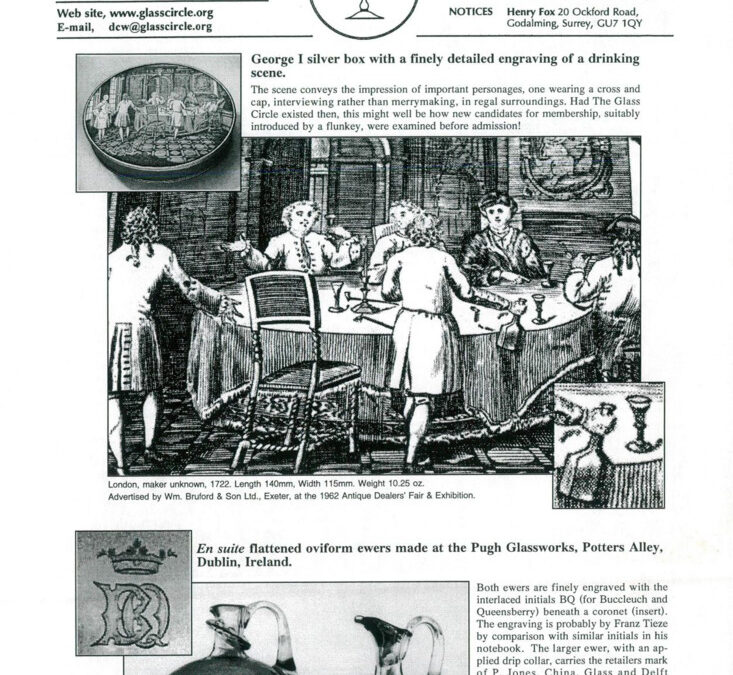
George I silver box with a finely detailed engraving of a drinking
scene.
The scene conveys the impression of important personages, one wearing a cross and
cap, interviewing rather than merrymaking, in regal surroundings. Had The Glass
Circle existed then, this might well be how new candidates for membership, suitably
introduced by a flunkey, were examined before admission!
All’
Aff
r
oo
re
London, maker unknown, 1722. Length 140mm, Width 115mm. Weight 10.25 oz.
Advertised by Wm. Bruford & Son Ltd., Exeter, at the 1962 Antique Dealers’ Fair & Exhibition.
GLASS CIRCLE NEWS
No. 85
(
3 Dec.
Al
000
EDITORS David C. Watts
27 Raydean Rd,
Barnet, Herts. EN5 IAN.
F. Peter Lole
5 Clayton Ave.
Didsbury, Manchester, M20 6BL.
NOTICES Henry Fox
20 Ockford Road,
Godalming, Surrey, GU7 1QY
Web site, www.glasscircle.org
E-mail, dcw@glasscircle.org
En suite
flattened oviform ewers made at the Pugh Glassworks, Potters Alley,
Dublin, Ireland.
Both ewers are finely engraved with the
interlaced initials BQ (for Buccleuch and
Queensberry) beneath a coronet (insert).
The engraving is probably by Franz Tieze
by comparison with similar initials in his
notebook. The larger ewer, with an ap-
plied drip collar, carries the retailers mark
of
P.
Jones, China, Glass and Delft
Warehouse, Westmoreland St., Dublin,
and the registry mark of 1874.
The Pugh Glassworks was the last major
glassworks in Dublin from this period and
closed in 1890.
These fine ewers were exhibited at the 1989
Drinking Treasures Exhibition held
at Drumlanrig
Castle in South West Scotland.
Drumlanrig Castle is the home of the Duke of
Buccleuch and Queensberry K.T., V.R.D., who
mounted the exhibition.
GLASS CIRCLE NEWS No. 85
2000
Editorial
AFTER FROGS — HALF A SQUEEZED DOUGHNUT!
onflict over the French construction company for supplying
‘,…1000 tonnes of cheap stone for the £98 million refurbish-
ment of the British Museum’s historic Great Court having been
resolved by a £250,000 refund, attention has turned to roofing
this 2-acre area. The glass and steel roof was contracted not to
be visible from the surrounding streets. But its raised elevation,
necessitated by a wider than anticipated North Portico, caused
uproar in Camden Council by not only threatening to breech this
regulation but also by being carried out without the Council’s
prior approval. However, this extraordinary construction by
architects,
Foster & Partners
and engineers,
Buro Happold,
is
no bicycle shed. It forms an asymmetrical torus, like half a
squeezed doughnut sliced horizontally, made up of a series of
interconnecting arcs spanning the surrounding facades and the
awkwardly off-centre 1857 Reading Room (picture top). The ten
5 WA 7
4
6
11
r41070
km of sash bars, were computer
AINIP
II*
or II
PifirAlte
n
dt” Ogg
010)0
AWASH WITH “FLOAT”
For a small country Britain is well endowed with large buildings,
some dating back to the tag end of the Industrial Revolution.
One of these, Glasgow Central Station, opened in 1879, has just
undergone a £35 million restoration of its roof (picture right).
At 30,000 sq. metres, and with 50,000 panes of reinforced wired
safety glass, this is still one of the largest glazed roofs in Europe.
Much of the decayed ironwork has been replaced by aluminium
— some 30,000 tons — which includes new walkways to facilitate
maintenance. So pause and cast a glance upwards the next time
you pass through at this remarkable Victorian achievement.
Glass curtain walling, too, is on the increase. Does London need
another Exhibition Centre? Some clearly think so as developers
of London Docklands, will shortly open a new one – EXCEL.
At 90,000 sq. metres, it will be twice the size of Earls Court and
half as large again as the much maligned Dome. The dock-front
façade (picture upper right). is a wall of glass while the main
hall,
alone, is some 87 by 375 metres – the largest single span
roofed structure in the UK. It is already taking over some of the
traditional exhibitions associated with Olympia and Earls Court.
If this includes our classic Antique Fairs our intrepid reporter,
Henry Fox, will need a motorised scooter!
Passing over such new projects as Bluewater Shopping Centre
(the largest in Europe) we may note that the New Tate Gallery
(glazed by Glaverbel) is typical of the ongoing trend to revitalise
old buildings. On a smaller scale it has become apparent that
the facades of many of the buildings – particularly public
buildings – thrown up in the post-war boom of the 1960s and
’70s, are becoming dangerously unsafe. One solution developed
by
Spectus Systems
to solve this problem is to rip out the old
facing and bolt on a new glass curtain wall front. No examples
have been reported so far but keep your eyes open.
With such innovative developments, safety and security become
paramount. Various standard wind, water and other resistance
tests have been introduced for which Britain has its own
Cladding Technology Centre
in West London. It is the largest
in Europe and the only one accredited to undertake all tests to
American and European standards, as well as develop new tests
of its own. So-called “Glass Cancer” is a recently emerging
source of trouble. This is the explosion, without warning, of a
large pane of glass such as happened in a £45 million office
building next to London’s Victoria Railway Terminus. Other
high
profile breakages occurred at the Waterloo Eurostar Termi-
nal and the nearby IMAX cinema. The cause is said to be due
to the (unexplained) inclusion (or formation) of nickel sulphide
in the glass. The best treatment for installed glass appears to be
coating with safety film. For new constructions, one of Scot-
land’s major glass suppliers, A.C. Yule & Sons, is producing a
so-called “heat-soaked” glass that removes the internal stress
caused by the nickel sulphide. Is this re-inventing the lehr?
With such bullish activity around, it is perhaps not surprising
that
Yorkshire Forward,
a government-sponsored regional
development agency, persuaded Saint Gobain to open a new
float plant at Eggborough and now contemplate another there.
Yorkshire Forward
is also chasing America’s Guardian Indus-
tries Corp. who run six float lines in Europe and are thinking of
another. Meanwhile, Pilkington’s profits “soar” (up 36% on the
previous year) as a result of their 3-year reorganisation plan to
concentrate on building and automotive products. As well as a
joint venture with the Glaverbel Group for an automotive glass
plant in Spain, a similar venture with Glaverbel in the Czech
Republic, a combined float glass laminating and coating plant
jointly with Interpane Glas in Northern France, and coating
plants in Sweden and Germany, the company also has invest-
ments in China and
Poland.
A typical float glass
plant produces around
700 tonnes of glass
each
day
and consumes over
1000 tonnes of raw ma-
terials in the process.
There must be fifty or
more (40 in 1973) float
glass plants in operation
around the world, under-
lining the prolific nature
and ready availability of the raw materials. Float glass inventor,
the late Sir Alistair Pilkington, having altered the face of the
earth, is now probably planning glass wings for angels!
Among Pilkington’s latest products are
Saflex Opticolour
col-
oured laminated glass, which can be seen at Peckham (London)
Library and Media Centre, 2000 winner of the Stirling Prize for
architecture; optically clear
Optiglass
for display situations, as
in the Science Museum, and remote-controlled fire-resistant
Venetian blinds sealed within glazing units. The thought of
Venetian blinds that never need cleaning will warm the hearts
of all those who have been confronted with this miserable task.
*Pictures courtesy of
Glass and Glazing
and the British Museum.
•
designed to a remarkable accu-
riffitirir04,1
1
k44..0
4
,11,11,1,VA racy of 6 mm, and then fabri-
v/if
i
r
i
eZottlet-N.TAV cated by robots at the
Waagner
.0470,1X0`.0.
Biro
factory in Vienna. They
were then shipped to
B&K
Fabricators
in Derby for as-
sembly into units before being
sent to the Museum.
Each of the 3,312 panes of
glass (315 tonnes, in all) is a
unique triangle (picture left).
These are screen-printed
(fritted) with small dots over
50% of the surface to filter out
UV rays and reduce solar gain.
The 800 tonnes, total, of roof
41
`
*
encloses an area (including the
Reading Room) roughly the size of Wembly football pitch and
is on sliding bearings to allow for natural movement.
Page 2
2000
GLASS CIRCLE NEWS No. 85
Glass Musical Instruments
by Raymond Chatfield
“I saw there an Instrument…. that 1 never saw of or heard before. It is called Sticcardo
Pastorale. It is very soft Music indeed. It is several long pieces of glass laid in order in a case,
resting on each end of every piece of glass, and is played in the middle parts of the glasses by
two little sticks with Nobbs at the end of them stricking the glass”…
from James Woodforde,
Diary of a Country Parson 1758-1802.
F
or centuries, music made from glasses variously filled had
been practiced by such cultures as the Chinese and Japanese,
Persians and Arabs. In all cases this involved the use of sticks
to strike the vessels.
An English version came about in 1743 when one Richard
Puckeridge (or Pockrich), an Irishman, found that melodious
sounds could also be made by the rubbing of wetted fingers
around the glass rims. This became known as “musical glasses”
or “glassharfe”, later, “angelic organ” and “seraphim”. Gluck,
in 1746, played a concerto on 26 such glasses.
The notes are formed due to the “catch and release” action of
the fingers as they rub around the bowl. This sets up pulses,
which cause the vibration that makes the final note. Tone is
determined by various factors such as quality of metal, shape
and thickness. Several
instruments using glass
were developed during
the course of the eight-
eenth century and col-
lectively they were
known as autophone
rubbed instruments.
Doubtless such concerts in-
spired home music making
and musical glasses found
their way into pieces of inno-
cent furniture like the side-
board pictured here, whose
top, upon opening, reveals
the glasses arrayed in their
octave sets.
The Sticcardo Pastorale of James Woodforde’s diary, also known
as Glass Xylophone or Harmonica Delecta, was made by J.
Platts and, in the 1790’s, Betts manufactured a set in blue glass.
Of two other makers, E. Edgar of Lambs Conduit Street and R.
Hack, the latter described his instrument as the “Improved
Semitonic Folding Harmonicom” (Was that a name with which
to impress the neighbours?). Instead of the former tubular glass
this new version employed flat glass strips suspended on cords.
Although the diarist was sufficiently impressed by at least the
novelty of the instrument, to include its description, the musical
glasses and the glass harmonica seem to have been the more
popular. In 1761, on hearing a concert at the Royal Society on
the musical glasses given by the Englishman Delaval, one
Benjamin Franklin was so impressed by the “soft and pure
sound” that he set about developing further the idea. He came
up with a new form, which he called the Glassharmonica
(illustrated top). Instead of glasses filled with water, or dry tuned
and fitted in a wooden case, bowls of varying diameter were
blown, each representing a different note. For this purpose glass
with a lead content of 40% was used and an emery wheel
employed for grinding and fine-tuning. Gold was sometimes
gilded onto the rim, denoting the black keys. These were then
arranged chromatically, not touching, with a long metal rod
running through them. Imagine now a treadle driven lathe with
the glass-bearing rod as the spindle. With all the glasses rotating
simultaneously the applied fingers are now capable of producing
complex chords as well as individual notes.
Pictures courtesy of
F.
Peter Lole Its
demise, for an in-
strument at once both loved and hated seems to have had two
main contributory factors. In the first place, the move towards
a deeper intensity of sound in orchestral works began to sideline
an instrument, which Paganini described as having “such a
celestial voice”. Indeed, in these words are the clue to another
possible reason for its fall from favour. J.M. Roger, writing his
“Treaty on the Effects of Music on the Human Body”
in 1803
reveals that “its melancholy tone plunges you into dejection to
a point the strongest man could not hear it for an hour without
fainting”. Another, J.C. Millar published in 1788 his book
“Method to teach yourself Armonica”
writes, “It is true that the Armonica has
strange effects on people. If you are
irritated or disturbed by bad news, by
friends, or even by a disappointing
lady, abstain from playing it, it would
only increase your disturbance”.
Indeed, domestic arguments, fatal
disorders, fits in animals and prema-
ture births, all were accusations levelled at the effects of the
glassharmonica. The Viennese doctor Franz Anton Mesmer
(mesmerism), would use the instrument to help bring about the
required hypnotic state in his patients. His expulsion from
Vienna followed his treatment of a blind pianist Marie Paradies
whose sight was apparently restored but at great cost to her
mental health. Rumours spread and slowly the Glassharmonica
slipped from celestial grace.
Since 1982 there has been, in America, a small but dedicated
group that has brought about a revival of this family of glass
instruments. 1 am indebted to their literature as well as archive
material from the Glass Circle, especially the
Christmas Lecture of 1986 given by the late Philip
Whatmoor from whose sources 1 have gathered
this information.
A popular instrument, reckoned as “the fashionable accessory
of parlours and sitting rooms”, it is likely that around 4000 were
produced in a seventy year period and composers, among them
Mozart and Beethoven
composed especially
about 400 works. Two
of the last important
pieces were “Lucia di
Lammermoor” by
Donizetti in 1835.
This was entitled “the
Mad Scene”. Two
Manufacturers are
flutes soon replaced it.
hardly known by name.
Exterior and interior of the
c.
1820 Birkhill Musical Glasses Sideboard which is about 5feet in length.
The second was “Die
One important excep-
The pictures below show the disposition of the glasses and their shape with a short thick stem Frau
ohne Schatten”
tion is James Smith of
which plugs into a wooden socket in the cabinet. The ground region at the bottom of the bowl is
by Richard Strauss.
Edinburgh, in 1829 ad-
probably part of the tuning process. Each glass is engraved with its own note to avoid mis-
vertised as “Glass Cut-
replacement in cleaning etc.
ter and Manufacturer of Musical Glasses”. His advertisement
the “Newly Invented Grand Harmonica” and “a hundred Musical
Glasses, upon a scale never before displayed in this Town”, was
for a concert featuring five persons playing simultaneously.
Three of these were his own daughters. Precocious talent
indeed, with the title “Infantile Musical Phenomenon!” ascribed
to them. For this auspicious performance tickets were priced at
3 shillings and one and sixpence for adults and children
respectively.
Page 3
Sold by Sotheby on
15 Sept. 1992, Lot 43
GLASS CIRCLE NEWS No. 85
2000
LASS CIRCLE 011711
n
1,
161
–
1( SEPTEMBER., 2000
O
n a grey but dry morning only
our Chairman was prevented
from making our London meeting
point in spite of the obstructive petrol
blockade. First destination for our
coach was Kenwood House, delight-
fully set in rolling countryside bely-
ing its close proximity to central
London, and noted for its
architecture, paintings and recently
restored library. Here the
Eat, Drink
and be Merry
exhibition from Fairfax
House (See Limpid Reflections in
GC News 83) was displayed in five
rooms. The main interest was table
settings through the ages and the
early exotic dishes of the well-to-do.
Only one of these had glass – 32 pieces – for an C.18
th
dinner
table setting for eight. With only one glass per place, each
upturned in its finger-bowl, the rest of the setting consisted of
two decanters, six superb examples of cut sweetmeat glasses and
two rows of what are commonly called
`patch stands’ but so laden with ‘delicacies’
that their diversity of form was not easily
appreciated. The centre display was a long
mirror, in eight parts with ormolu mounts,
which supported the cut sweetmeats, and
two silver-gilt food-laden centrepieces. The
remaining early glass consisted of a Geddes
royal armorial decanter and goblet and
seven items loaned by Broadfield House;
these included a fine C.17
th
goblet, a heavy
baluster, a complex stem Jacobite, a Beilby
and two mid C.19
th
Richardson pieces — a
large goblet and decanter with complex
curved cutting.
An excellent lunch, with a choice of courses
and wine, was taken at the San Giorgio,
Pond St., Hampstead Heath, after which our coach carried us to
the Museum of London where Alex Werner and Edwina
Erdman were waiting to show us the Garton Collection and
other glass hidden in the bowels of this superb modern museum.
And what glass there was to see, as the illustrations show! Two
cases contained huge Verres de Parade goblets and covers and
a large punch bowl, all late C.17
th
, as well as other mouth-
watering delights. I was sorry that Peter Lole was not there to
expand on a very tall plain-stem goblet with a cylindrical bowl
inscribed for
‘Lady Wim Wynne Lady Parramount’, with
the
reverse shewing
‘THE CONFEDERATE HUNT’ and
the names
of five Lady Patroness sequentially against the years 1754 –
1758; under the slogan:
Hark Wenman and Dashwood
Watn & the Old Interest for Ever’
However, Peter’s comments are given below.
“Enough”, you may cry as, in addition, we
were taken, in groups, by Alex to sample
the more mundane (I jest) part of the
collection — two Ravenscrofts, balusters
(picture below), opaque and colour-twist
stems and everything else that any glass
collector could ever desire.
To one side were a huge collection of early
bottles – perhaps the largest in Britain – and
a large case of Whitefriars. But no time for
these, as Edwina laid before us three long
trays of archeological artifacts from excavations all over London
for us to inspect and handle. No sooner were these dispatched
than they were replaced by three more and yet more again. Stem
formations from the beginning of time in England could be
studied in detail. Apart from Anglo/Venetian mould-blown
stems, highlights we discussed were two sealed Ravenscrofts,
Silesian stems with star and crown shoulders and one, 4-sided,
heavily embossed with “God Save King George”. Also, the two
Jacobite engraved pieces, one on a colour twist stem, discussed
by Wendy Evans at our Jacobite Symposium.
Looking back, we tended to assume that all
the glass was of European origin but subse-
quent research into early Canadian glass in
response to an email enquiry (see page 5)
has made me wonder whether the base of a
C.19th moulded small oil lamp with a deco-
ration of sunburst and stylised flowers and
an applied handle similar to that shown
above, might have come from across the
Atlantic. Such details as were known of all
these finds could be looked up on their new
computer catalogue close by. Regrettably, I
did not think to look up this one.
Two hours had passed in a flash when we
came to say a grateful farewell, but our
attentive hosts revealed one last surprise
tucked away. This was a 1690 bottle of
fine wine, still in drinkable condition,
excavated from Spitalfield, possibly the
house of a master cutler. A tiny sample
had been extracted by syringe and we
were thereby enabled to carry away with
us not just fond memories and a greater
knowledge of old glass but also the aroma
of a 300-year old Madeira, confirmed by
experts and, prosaically, chemical
analysis.
Postscript: There is no current publication of the
Garton Collection although some members may
have copies of an earlier (1965) booklet by John Hayes from which the
pictures here were taken. Other examples from the collection, including a
fine covered goblet, are scattered throughout the Museum.
DCW
7777777777779E77E73Z 741Z 55777777 VIZIE 7777 ESZ 777 5Z
77 7
The Confederate Hunt Glasses.
This is one of three similar specimens,
which I discussed in 1993 in
GC No:57.
The specimen sold by Sotheby (picture left)
in 1992 is now in the National Museum of
Wales in Cardiff, whilst the location of the
third Glass is presently unknown.
The inscription is fascinating for the number
of different allusions it embraces. It extols
the memory of
‘The Great Sir Watkin’ who
had been killed in a riding accident in 1749
and at the same time glorifies his widow’s
tenacity in sustaining the Jacobite cause and
holding together both The Cycle and The
Wynstay Hounds; it celebrates
“the most corrupt election of the
C. le”,
where the successful Tory
(`Old Interest)
candidates,
Lord Wenman and Sir James Dashwood, were unseated follow-
ing a Whig petition. It records a truly True Blue Hunt whose
success in killing foxes Thomas Pennant records in 1781 as
being much exceeded by the formidable Margaret Uch Evan,
with her bobbity pack of terriers, and it acts as a programme for
the Lady Patroness of the Hunt for the ensuing five years. (From
the election reference the Glass almost certainly dates from 1753
or 1754. By 1758, the last date inscribed for a Lady Patroness,
Lord Wemnan was dead and the 1754 General Election contest
in Oxfordshire was old history. A newspaper report of 1753
records the
Old Interest Society
using Glasses
“cut with the
Figure of the Young Chevalier drest in Plaid”.)
FPL
Page 4
2000
GLASS CIRCLE NEWS No. 85
Glass Circle Matters
Meet the Committee
Martine S. Newby B.A. Hons., M.
Phil.
Martine, a consultant, lecturer
and researcher in ancient and
antique glass, was elected to The
Glass Circle Committee in 1996.
From the early 1980s, as a stu-
dent archaeologist, she spent
several spells excavating in Italy
under Dr. David Whitehouse,
then Director of the British
school at Rome. Immediately af-
ter graduating, in 1984, she
joined the British Museum as
Exhibition Assistant for the
hugely successful
Glass of the
Caesars.
From 1988, Martine worked for the London specialist glass
dealer, Christopher Sheppard, where she developed her interest
in Renaissance and later
glass.
The same year she was awarded
a Rakow Scholarship by The Corning Museum of Glass.
Since becoming freelance in 1993, Martine has worked on a
number of private and public glass collections, including, most
notably, that of the Ashmolean Museum, which culminated
earlier this year in the publication of,
Glass of Four Millennia
(see Book Review, page 6). Her other publications include
Roman Glass
and
Two Centuries of Art and Invention,
edited
with Kenneth Painter, published as a Fetschrift for Donald
Harden. Last year she successfully completed her M. Phil. thesis
on
The Form and Function of Central Italian Medieval Glass.
Martine currently arranges our series of regular lectures – when
not herself attending lectures on Hieroglyphics!
The Glass Circle Web Site
– Glassmaking in Canada
Our new web site address is already attracting more attention
and several queries. Most interesting, is a query from Lynne
Chagnon, historical interpreter at Upper Canada Village, a
government sponsored living history site set in 1866. Lynne
wished to know if the houses of that time would have been
glazed with home-made Canadian glass or whether it would
have been imported? My sole source of information is
Early
Canadian Glass
by Gerald Stevens (1961). He states that the
first glasshouse in Upper Canada was the Mallory Glassworks
but this was short lived and closed
c.
1840. Another, in
Hamilton, was in action by 1865 and had two furnaces. One, a
tank, was used mainly for bottles; the other, a pot was used for
tableware. After this, there were no other glassworks until the
Burlington Glassworks, Hamilton, started up in 1875. Hence it
appears unlikely that locally made window glass was widely
available at that time. On the other hand Pittsburgh, within easy
importing distance, had been producing window
glass
in quan-
tity from the first quarter of the century, so it is much more
likely that American glass would have been used. If any member
has better information on this topic let me know.
D.C.W
Welcome to New Members:
Mr. P. Beebe
Dr. S.J.P. Damment
Mr. J.R. Hall
Mrs. S. Solomons
Deaths
We report with regret the death of our long-standing member,
Professor, Dr. F.A. Dreier.
We were also saddened to hear of the death of Professor Brian
Boydell, husband of Mary Boydell who is the National glass
expert of Ireland and President of The Glass Society of
Ireland. We extend our sympathies to both families.
Anne Towse B.A.
Anne has been surrounded by
glass all her life, as her father,
John, has been collecting since
before she was born. He intro-
duced her to The Glass Circle
and she started coming to meet-
ings in the 1970s, becoming a
member in the early 1980s. In
1988, Anne joined the Commit-
tee but insists that she remains
the least knowledgeable
member, firmly representing the
eager layman.
Professionally, she was origi-
nally a linguist, and retrained as
a solicitor; for many years she
has specialised in commercial property work. As a lawyer, Anne
was, of course, heavily involved in the drafting of our current
Constitution before its presentation to the Circle in 1994, and
has also worked on the various amendments that have had to be
put to the membership from time to time. Anne’s contribution
on Committee is generally on the administrative side.
Anne’s own glass interest was naturally influenced by her
father’s passion for 18
th
century English drinking glasses, but
she also loves certain modern art glass. She tries to attend all
Glass Circle lectures on whatever topic, as she claims, to reduce
her own ignorance! Her other interests are arts-orientated –
literature, theatre, opera — and she also enjoys tapestry-work and
is occasionally delighted by antique needlework of various
kinds.
The Bernedetto Wall Plaque in
Altare
We are grateful to Donald Taylor who has sent us a translation,
given below, of the plaque illustrated in Colin Brain’s article in
the last GC News. It confirms our suspicions that it is not
directly related to glass and, unfortunately, that we cannot even
be sure that it refers to the famous glassmaker. Could the
“religious community of Rocca Vignale” mentioned possibly
refer to a glassmaking community? It seems unlikely.
“The Very Reverend Father Don Bernedetto
Perrotto has given a hundred ducatoons which are
in the (municipality/ religious community) of Rocca
Vignale with the injunction that after his life (i.e.
after his death) we use them to celebrate on 24
th
March/May each year in perpetuity as provided in
the deed drawn up by Giovanni Francesco Mas-
saro in the year 1663 on the 19t
h
November.”
Glass Circle Meeting Hosts – Correction
In GC News 84 we inadvertently listed the new members as
hosts for the talk by Eric Reynolds on the glass of Walsh Walsh.
These should have been:- Mrs M.E. Kilby, Mr. D. Woolston,
Mr. H. Fox and Mrs. M.J. Polley. Our apologies for this mistake.
Diary Dates
Fri. June 22nd, 2001.
Association for the History of Glass. at
the V&A., Provisional title:- Historism on Glass.
14th-16th July, 2001
International Congress of the History of
Glass, in Edinburgh. Info from David@dmatthews.u-net.com
Glass Circle News; copy deadlines.
No. 86 Mid-February for publication in March
No. 87 Mid-May for publication in June
No. 88 Mid-August for publication in September
No. 89 Sept./Nov. for publication in December/January
Thanks to Rosemary Watts for proof-reading this issue.
Page 5
Two English wine bottles.
Left, mid c.17th, right, dated 1715.
GLASS CIRCLE NEWS No. 85
2000
Book Reviews
Roman Glass in Britain
By Denise Allen
Published by Shire Publications Ltd., 1998, Size 150 x 210 mm, soft covers,
64 pages, numerous b/w illustrations. ISBN 0 7478 0373 0. Price £4.99.
Romano-British Glass Vessels: A Handbook
By Jennifer Price and Sally Cottam
Published by the Council for British Archaeology, 1998. Size 149 x 211 mm,
soft covers, 234 pages, 96 b/w and 5 colour illustrations and map.
ISBN 1 872414 966. Price £9.50.
Having just treated myself to a computer mouse mat inscribed “AMO LONDINIUM” (I
love London) and with Roman
archaeology currently prominent in both museums and ‘the
media’, I feel this is an appropriate time to review the above
volumes, although they have been around for a couple of years
now. As no more than an outpost of the Roman Empire, Britain
is particularly rich in glass from the period spanning its
occupation, AD 43 to
c.
AD 450. With superbly displayed
archaeological sites stretching as far north as mid-Perthshire, it
has become an area of growing general interest. Further,
ordinary examples of Roman glass may be acquired for a quite
modest outlay although one must beware of fakes.
As with any artefact, it adds interest to appreciate the detail of
what you are looking at and, at different levels, these volumes
fill the void. The Shire publication, aimed at the general reader,
first traces the history of glass-making from earliest times, its
manufacture and trade. It then surveys, with numerous
illustrations, the types of Roman vessel glass found, classified
by date – the period being divided into four sections. A
concluding couple of pages draw attention to non-vessel glass
of the period, such as jewellery and windows. The usual
glossary, reading list, museums-to-view (but omitting archaeo-
logical sites with museums attached) and index round off an
excellent introduction by Denise Allen, a professionally-trained
archaeologist. Pack this slim volume in your bag for holiday
reading and that weekend away special offer.
This brings us to the ‘hard stuff’. Denise Allen acknowledges
the help of Jennifer Price, a consummate professional who,
along with Sally Cottam, has devised a definitive handbook for
Roman glass finds based on glass found in Britain. Its purpose
is to provide an alternative update to the work of Isings (1957),
generally accepted as the major working classification for
Roman glass, but which includes European types not so far
found in Britain.
Part 1
provides all that general information about Roman glass
you might wish to know but didn’t know where to look – the
archaeological sites explored, meth-
ods of manufacture, characteristics
and decoration of the finds and the
terminology used.
Part 2
classifies the typical or most
common kinds of vessel glass found
according to shape or presumed func-
tion – cups and bowls, jars, jugs,
flasks and bottles. Each class type is
illustrated (as left), described in
detail, and the locations of similar
finds given as well as further reading.
Globular jug with pinched in
The volume concludes with a table of
spout. Date uncertain but
dated forms, a map of the places
pinched in spouts AD
c.1-3.
mentioned in the text, a long bibliog-
raphy and index. It is not intended to
be read in bed with the comfort of a steaming cup of cocoa, but,
mud-stained and dog-eared, to accompany the trowel-scrapers
on their future excavations. Isings, because it is so well known,
will surely continue to be cross-referenced for a time, but this
modern text, perhaps with future updates, will undoubtedly
become a classic on its subject. At under £15 for the two
volumes reviewed we are, indeed, well served in this area of
glass interest. Both are currently on sale at the Museum of
London.
D.C.W
Glass of Four Millennia
by Martine S. Newby
Published by The Ashmolean Museum, Oxford, 2000, A5 format, soft
covers, 80 pages, colour illustrations. ISBN 1 85444 123X. Price: £6.95
This well produced booklet with its excellent photographs,
which are all in colour, supersedes the little picture book
English
Drinking Glasses in the Ashmolean Museum
of 1977. But, as its
title suggests, the work is much more comprehensive, although
again it is entirely drawn from the Ashmolean’s own collections.
Martine gives a brief introduction, which considers the origin of
these collections in a more widely embracing manner than her
article in the Glass Circle’s
Glass Collectors and their Collec-
tions in Museums in Great Britain,
although inevitably the
English Glass origins are
more deeply considered in
the latter work. She then
proceeds to a scholarly but
very readable consideration
of fifty-six Glasses, which
are all illustrated; thirty-
three are Ancient, Roman or
Islamic Glass; thirteen are
classic English Glass
(subject to the quibble ex-
pressed below!) with Orien-
tal
19
th
and 20
11
‘ century
Glass making up the
balance. Of the English
Glass, almost half has al
ready been illustrated in the
1977 booklet.
A couple of entries call for comment. No: 49 considers a pair
of David Wolf stipple engravings, and the unequivocal attribu-
tion of the Glass as English concedes nothing to the uncertainty
expressed in both Pieter Ritsema van Eck’s
Rijksmuseum Cata-
logue
Vol: II and the Klesse:Mayr
Ernesto Wolf Catalogue.
In
these works more than thirty very similar facet-stem ovoid bowl
Glasses with Dutch stipple engraving are all described as
“English or Netherlands.” Next, entry 42/43 considers two
drawn trumpet Glasses, very similar in date and form, but whose
engravings portray opposing propaganda messages: a William
Duke of Cumberland Glass and the Fisher of Ham Common
AMEN
Glass. To describe
“the great Political divide in C.
England”
(which should properly be
“in C.18
th
Britain”)
as
being between the
Williamites
and the Jacobites is unfortunate;
both the conflict itself, and particularly the two Glasses
considered, represent
Hanoverian
versus Jacobite. Neither
`Butcher’ Cumberland nor his contemporaries would have rec-
ognised the term `Williamite.’ Martine cites Peter Francis’
article
The re
–
invention of History on Glass,
but her commentary
does not reflect the fact that the major problem which has
actually been identified (rather than simply speculated about) is
the failure to recognise that a good deal of the `Williamite’ (as
opposed to `Hanoverian’ and ‘Jacobite’) Glass is not C.18
th
, but
is C.19
th
or C.20
th
. Much of this was probably produced quite
innocently for Orange Lodges, but has subsequently been
optimistically, or fraudulently, ascribed to the C.
Fakes there
surely are, but Francis himself recognises only a single instance
of Tieze engraving on old Glass; similar dating confusion,
arising from long continued production, exists with Masonic
Glass. Lastly, there is an unfortunate misprint in entry 52/3,
where the son of Samuel Mohn is called Gottrob, rather than
Gottlob.
This really is a very worthwhile booklet, with much for both the
tyro and the expert; for the early Glass considered, discussion
of production techniques with reference to Bill Gudenrath’s
section of
Hugh
Tait’s
Five Thousand Years of Glass,
is
especially useful. The selection of the entries nicely illustrates
the marvellous breadth and quality of the Ashmolean’s Glass
holdings.
F.P. Lole.
Page 6
2000
GLASS CIRCLE NEWS No. 85
More Book Reviews
by David
Watts
A Closer Look at Antiques
by Judith Miller
Marshall Publishing London, 2000. Size 285 x 217 mm, 224 pages,
hardback, 800+ colour illustrations, ISBN1 84028 320 3. Price £20.
Materials and Techniques in the Decorative Arts
Edited by Lucie Trench
Published by John Murray, 2000. Size 240 x 160 mm, 572 pages, hardback,
numerous b/w ills, and 8 colour plates. ISBN 0-71955722-4.
Price £40 (less 10% for members from Heneage).
Theses two volumes are both general in the sense that glass is
only one of the topics covered; there, however, the similarity
ends. The former is an unashamed coffee-table book that flatters
to deceive — at least so far as glass is concerned. The latter aims,
so far as a dictionary will allow, to fill the gaps in technological
understanding that are all too common in the writings of serious
collectors and Art professionals.
A Closer Look .. , Judith Miller’s book, is not published under
the Miller banner, better known for its antique price guides and,
more recently, the Collector’s Guide series (see below) but is
of similar high quality. Just 32 pages are devoted to glass, the
remainder, apart from an A to Z of people and places, a 20 page
bibliography, glossary and index, is devoted to furniture, ceram-
ics and silver. Judith, one feels, is no glass expert and it is sad
that the initial favourable impression is marred by a number of
misleading statements or factual errors.
We are first told how to look at glass and its history (from Pliny
onwards), followed by a “Closer Look” at wine glasses with fine
illustrations of C.18
th
types. Similar treatments are given, as 2-
page spreads, to pressed, cut, coloured, cased and stained,
enamelled and gilded, engraved and etched, and cameo glass.
The pictures are mostly large and finely detailed.
The “Closer Look” at wine glasses is both instructive and
confusing. A 1930s reproduction illustrated is described as being
made of three separate gathers “unlike earlier glasses, where the
bowl and stem were drawn from a single gather…”. However,
a 1720-1730 wine on the same spread shows just such a 3-piece
glass (both are compared below), as do several of the following
pages.
Two wine glasses discussed
by Miller. Left, 1720-30;
Right, a 1930s reproduction.
Both glasses are made in
three parts. It is not possible
to insert the air tear without
making bowl and stem in
separate parts. The stem is
drawn from a gob attached
to the bowl on the blowing
iron. The foot is attached last
after which the glass is
transferred to a pontil iron
and the bowl finished off.
Cut and pressed glass is nicely handled although the 1745/6 duty
is confused with the 1777 tax on enamel, as a consequence of
which “shapes became lighter and patterns shallower”, in
1745/6, that is! A so called “short list” of “important” British cut
glass manufacturers begins with the Dudley Flint Glassworks
(Est. 1770s) but omits Pellatt and Perrin Geddes and the Scottish
firms. Hence it is too short even to be representative.
Moving to coloured glass, we run into problems with the date
when uranium glass was first made and the slang term “Vase-
line” is used misleadingly to describe a Whitefriars Straw Opal
while a Bohemian Annagelb goblet, illustrated, is described as
Annagrun. However, the picture searcher is to be congratulated
on the diversity and suitability of type illustrations for the
sections on engraved, etched and cameo glass.
In spite of its seductive presentation I feel, with some regret,
unable to recommend this book to the novice glass collector at
whom it is aimed, but if you fancy a copy I suggest you wait
until it appears in the Remainder Bookshops as it surely will.
Materials and Techniques . . is a different kettle of fish
altogether. To write a clear technical text in comprehensible
terms for the uninitiated is a challenging task. Consequently,
many of the articles are of encyclopaedic rather than dictionary
length. Because the book covers metalwork, stone and plaster,
paint, wood, lacquer, ivory and shell, plastics, paper, textiles and
leather, as well as glass and enamels, the entries are not always
orientated in the expected direction. Gilding is a good example;
fire-gilding with mercury/gold amalgam (I hope you know what
an amalgam is because you are not told here!) is described with
reference to metal; water-gilding, most commonly used on flat
glass such as shop fascias, is described with reference to wood
and plaster. Several variants are poorly explained. Acid gilding,
for example, introduced by the Minton factory, does not mention
that the etch is done on an extra heavy glaze so that the applied
gilding looks thick although the gold overlay is of normal
thickness. The use of sand etching on glassware to give
a similar sumptuous effect after gilding is not mentioned.
Nevertheless, the overall amount of information given is
impressive, even if you have to dig around to find it.
The glass entries are attributed to Sandra Davidson and are, for
the most part, basically sound; such criticisms as might be
levelled are those of omission rather than fact. Most of the
subject is lumped together under the general heading of “Glass”
but other aspects merit separate entries. “Flat glass”, for example
outlines its history from muff to float but while mentioning the
American contribution makes no mention of the Belgian indus-
try which provided the bulk of Britain’s window glass in the
later C.19
th
and C.20
th
up to the invention of float. The descrip-
tion of “lead glass” is muddled with no representative formula
being given while a “Lehr” is simply described as being for
annealing glassware without telling you why annealing is
necessary in the first place!
Terms like `oxidation’ and ‘reduction’ are taken for granted so
that while a trained scientist may take these in his or her stride
the artist or historian at whom this text is aimed may end up
feeling little further forward. You presumably know the differ-
ence between a ‘network modifier’ and a ‘network stabiliser’ –
you won’t find out here – but to be told that (non lead) glass
made without including a calcium salt would
“gradually
(my
italics) dissolve in water” is incorrect; instantly soluble water
glass, sodium or potassium silicate, would be formed.
My greatest success was with that mysterious substance,Tripoli
powder, used to polish cut glass before the introduction of acid
(although this is not mentioned). It is defined as “a naturally
occurring silicate abrasive derived from schistose rocks”. Schist
is elsewhere defined as a largely mica-containing mineral.
Hydrofluoric acid, incidentally, is not an entry.
In spite of its limitations this volume is crammed with a wealth
of hard-to-get-at information. Many of the pictures rely on
Diderot and only the colour plates are of above average quality.
At £40 it is rather expensive but nevertheless a great addition
to one’s bookshelf as a source of general information. For glass
alone you might be better off buying the paperback version of
Newton and Davidson’s
Conservation of Glass
which has an
extensive historical and technical section of no greater complex-
ity than given here.
Paperweights of the 19th & 20th Centuries
by Anne Metcalf
Published by Miller’s, 2000. A Collector’s Guide series,
64 pages, size 149×210 mm with numerous full colour illustrations.
ISBN 1 84000 309 X, Price £5.99.
Sheer colourful delight sums up this the latest in the Miller’s
Collector’s Guide series. Anne Metcalfe’s expertise is well
recognised and here she packs a wealth of information into 64
pages with beautifully illustrated examples ranging from cheap
Chinese and Indian to the expensive classical French weights.
Fine modern weights, particularly the underated Venetian and
Murano specimens, can be had for well under £100, a little more
for a William Manson or four figures for a Paul Stankard.
British firms such as Okra, Langham Glass and Peter Layton are
mentioned. How weights are made, cane identification, firm’s
histories and many other hints and tips are packed in along with
the usual glossary, further reading, museums and English spe-
cialist suppliers. In summary – strongly recommended.
Page 7
GLASS CIRCLE NEWS No. 85
2000
47)frePetv REWsemeits
4
7.
Perez
.Lace
T
hese reflections turn again to the Country House tour. This
is hardly surprising, for these are places that were probably
the most important original customers for furnishings, including
Classic Glass. Many of these plenishings remain in their original
home, despite efforts by Collectors, Museum Curators, Dealers,
Auctioneers and covetous Governments to prise them away. One
can still dream plausibly of Glass hoards like that at Oxburgh,
or of
AMEN
glasses at the back of forgotten cupboards; indeed,
some little while ago one of my forays did reveal a Royal
Armorial Beilby Goblet, which remains still unpublished; but,
back to the present.
In October, I visited Harewood, that lavish Yorkshire Palace of
the
Nouveau Riche
Edwin Lascelles, for which Thomas
Chippendale, elder and younger, executed their largest ever
commission, at a cost of £10,000 over a period of thirty years
from 1767 until 1797. This is strictly relevant to my theme, for
the
Harewood House Trust,
which now owns the House and its
Collections, secured from the Heritage Lottery Fund a grant of
well over £100,000 to restore the unique Chippendale state bed,
provided that this was done in time for display in the Millennium
Year. So this year Harewood has staged a magnificent Chippen-
dale Exhibition, borrowing back many pieces that had escaped
over the years, to supplement the large amount of Chippendale
furniture which still remains there. The Exhibition is accompa-
nied by a very well produced colour booklet and catalogue:
The
Art of Thomas Chippendale, Master Furniture Maker;
this
includes an extensive inventory, of February 1795, taken on the
death of Edwin Lascelles, which lists a substantial quantity of
Glass.
It would be nice to be able to say that this totally confirms
my remarks on C.18
th
Wine Glass types made in our last issue,
but in fact it doesn’t. In the Pantry were 48 Decanters, 143
various Wine Glasses, 73 Glasses for long drinks, which taken
with another 30 Lemonade Glasses in the Housekeeper’s room
makes 103, together with 19 Wash hand Glasses. The House-
keeper’s room also had a variety of Dessert Glasses and plates,
twenty in all, 3 Cut Glass Flower urns and 4 Cut Glass Milk
pots. By the time of this inventory Glasses described simply as
`Wine Glasses’ were at 48 only one third of the total Wines;
there were 33 ‘Champagn
(sic)
Glasses’, 28 ‘Sweet Wine
Glasses’ in two sizes, and a dozen ‘Green Hock Glasses’. Some
of the Glass was described as ‘Star Pattern’, whilst ‘Plain
Steward’s Room Glass’ accounted for 46 of the vessels (made
up of 20 Wine Glasses, 13 Ale Glasses and 13 Half pint Mugs.)
However, the record of ‘Wine and Water’ Glasses seems
couched in a way which preclude them representing two separate
components, as I had speculated in our last issue; (the entries
were: 5 Large Glasses for Wine & Water, Star; 16 Lesser sized
ditto; 1 ditto odd pattern.) What I did find surprising was the
small amount of Dessert Glassware, of very mixed types; but
perhaps this just highlights one of the defects of Inventories.
Whilst they are absolutely invaluable as a precise snapshot of
what existed at a certain moment in time, in that they are most
often made as the consequence of the death of a proprietor who
was probably quite elderly, it maybe that they represent a rather
old fashioned picture since the owner may for some time not
have felt a need to keep up with fashion. Thus, the unusually
high proportion of ‘Flutes & Gills’ found in Thomas Betts 1765
Probate Inventory, discussed in our last issue, might well
represent an accumulation of unsold stock for which Betts had
failed to note a waning fashion.
Unfortunately, there was no Table Glassware on display at
Harewood, and whether any survives from the inventory made
more than two hundred years ago, I know not. However, pier
Glasses that were listed in 1795 are still there; despite having
been banished to the stables for over one hundred years, they
were restored and reinstated recently. Three pairs were supplied
in the period 1770 to 1773, but at least five other Glasses were
delivered between 1775 and 1796 and a Chimney Glass in 1780.
It is interesting to speculate whether the original plates for these
later mirrors were obtained from
The British Plate Glass
Manufactory at
St. Helens (founded in 1773) in view of the
continued overpage
NACF again supports Museums acquisitions of Glass
T
he ‘1999 Review of The National Art Collections Fund’
details financial support for four separate pieces of Glass
acquired during 1999. For these the NACF contributed £6,050
towards a total cost of £21,500 and all are illustrated and
discussed by the curator of the museum in question. Only one
of the acquisitions was of Classic Glass, the Falcon Decanter
from the collection of our late member Dr. David Stuart, which
has been bought by Norwich Castle Museum for £6,000. This
magnum shaft and globe decanter is also illustrated and dis-
cussed in David Stuart’s booklet
Glass in Norfolk.
It is engraved
`THE FALCON NORWICH 1759′ on one side, and ‘B. PORT’
on the other; these are linked by a continuous vine meander .
The engraving is similar both to the `GREGORIANS’ decanter
and also a goblet lengthily inscribed to the City and Trade of
Norwich, which were already in the museum’s collection and
are also considered in
Glass in Norfolk
The other three items are all modern; the only purely Glass item,
Keiko Mukaide’s ‘Hexagonal Wavy Bowl; Green No 1’, was
acquired by the Ulster Museum in Belfast. ‘Abbreviated Chair’
and ‘Chain of Glass Tears’, both bought for Aberdeen Art
Gallery, are mixed media pieces with a substantial Glass
element. In addition to these items, two groups of Stained Glass
of c.1500 were supported; one for the Ely Cathedral Museum,
the other, consisting of two figurative panels from the Work-
shop of the Master of Exeter Cathedral, going to the Exeter
Museum.
In GC News, No 80, when discussing NACF support for Glass
in 1998, it was noted that the Chairman, Sir Nicholas Goodison,
had made concrete his support for modern Studio Glass by
presenting two pieces to the Fitzwilliam Museum. In fact, as the
`1999 Review’ records and illustrates, the gift was even more
generous, amounting to five pieces of Studio Glass, which
included another ‘Hexagonal Wavy Bowl’ by Keiko Mukaide.
The NACF provided very much more substantial support, to the
tune of £90,000, for the acquisition by the National Gallery of
Scotland of a group of three ‘Glasgow School’ paintings.
Amongst these, Sir James Guthrie’s 1882 painting of “Miss
Sowerby” has a vicarious Glass connection. Guthrie (1859-1930)
was “The Pivot” of ‘The Glasgow Boys’ and arguably their most
attractive exponent. The painting, strongly influenced by the
prevailing rage for Japonaiserie, is a full length standing portrait
of a girl of about ten years old, the eldest daughter of
J.G.Sowerby of Gateshead. John George Sowerby took charge
of Sowerby’s Ellison Glassworks on the death in 1879 of its
founder, his father George Sowerby.
John George’s tenure of 35 years covered the apogee of the
Sowerby works, and he personally was responsible for many of
their technical achievements. A man of wide interests and
abilities, he was an amateur artist and illustrator of children’s
books, a friend and collaborator of Walter Crane, some of whose
illustrations provided the inspiration for what are now Sowerby’s
most sought after products. Charles Hajdamach, whose
British
Glass
provides an excellent synopsis of both Sowerby’s and of
John George himself, remarks that J.G.’s obituary spent more
space extolling his prowess as an oarsman than on any other
aspect of his full life!
FPL
Page 8
2000
GLASS CIRCLE NEWS No. 85
q/ass COrngs ky Holly fox
Grape Bottles
I am indebted to my colleague, Peter Lole, for supplying me
with the following extract from
The Country House Kitchen
Garden,
Edited by C. Anne Wilson (National Trust Publication
1998). Taken from page 80: “Grapes were stored by sticking
the stems of the bunches into special bottles containing water,
and charcoal to keep the water clean and sweet; kept thus it
was possible to eat grapes harvested in early autumn as late as
the following January and in fact this method of storing
intensified the flavour of the muscat grapes”. (Refer to GC News
No.84, my visit to the Birmingham May Sunday Glass Fair).
Different but related
How many members wish they could reach out for that special
decanter – will it be the one with the pleasing Beilby enamel
decoration or perhaps an Irish one with its moulded base telling
you and the world that it is Penrose Waterford – sitting on an
elegant wine table with appropriate period drinking
glass
close
by? Well, if you have the glassware, you would have been able
to bid last September at Dreweatt Neate, Newbury, for three
matching mahogany wine tables, each with a round 1 lin.
diameter pie-crust bordered top on a turned and vase fluted
column and three splayed legs. The only snag is you might have
had to sell the glassware! After competitive bidding the hammer
finally dropped at £21,000. Small is beautiful ! However if you
are a bottle collector and wine buff, you might have wished,
again in September, to have purchased at Sotheby’s 30th Anni-
versary London Two Day Fine Wine Sale one or more of the
ten bottles of 1748 Rudesheimer which had been discovered in
a remarkably well-preserved condition in the cellars of a
German Schloss. I must say that these slender tapering old
Continental bottles looked a very close cousin of what one sees
on the wine merchants’ shelves today (such as “Blue Nun” for
example). Top hammer price for a bottle of this 252 year old
wine was £1,500. On the same day that I gleaned this
information, I came across an interesting advertisement for a
rare and important oak glass wall cabinet with recessed marque-
try panels above and carved figures between – c.1660. The
dealer (a BADA member) kindly confirmed that it would have
been usual for domestic glassware to have been displayed at
that time in this type of shallow open-front wall cabinet
protected by turned uprights so that the glass could be seen and
the wealth and status of its owner noted.
19th Century Press-Moulded Glass
In an article under the above heading by our member Andy
McConnell, published in the November issue of
Antique
Collecting,
I came across the following interesting sentence in
the last paragraph: “A survey of 150,000 recent visits to
America’s Interenet Antique Shop found that almost half en-
quired about pressed-glass, outnumbering all about furniture,
porcelain, silver, lamps and clocks combined.” The author
comments that “If Europe is to follow suit, collectors could do
worse than board the presssed-glass bandwagon to discover and
enjoy the extraordinary variety available”. However, members
should be warned that collecting American pressed glass can be
a hazardous pursuit for the inexperienced due to the prevalence
of fakes and later reissues.
Limpid Reflections – concluded
Osterley Park inventory which records that a 1770s Chimney
Glass there was inscribed:
“1” Plate made in England”.
It must
be a possibility that this later group used St. Helens plates. (See
GC News, No: 67 for the Osterley details.) Two of the State
Rooms at Harewood have good Chandeliers, but I hesitate to
judge their period.
Just after midsummer’s day we visited Cornwall, calling in at
Antony House, a National Trust property at Tor Point, near
Plymouth, on our way to the west. The dining room there had
some excellent Irish dessert Glass, including a very large centre
bowl some 15ins high, together with Canoe and Kettledrum
bowls and turnover salts. All was ascribed to Waterford, as was
the set of drinking Glass set out upon the dining table; each
setting had three sizes of plain Rummers, approximately 7, 5 &
4ins high respectively. These Rummers were of very bright,
clear and unblemished Glass, and if truly Waterford must date
from the post-war resurrection; but the whole attribution seemed
slightly glib. Anything but glib, however, were two 15ins Candle
Globes mounted on the staircase banisters; these were very
striated and bubbly and extremely satisfying to the eye. There,
too, were Pier Glasses, which the guide-book tells us are:
“Queen Anne, with bevelled Vauxhall plates.”
In contrast to this
older Glass is a modern collection of Dumps, Paperweights and
Door Stops, mostly of Bottle Glass. The Glass interest made a
delightful house even more enjoyable.
The last and oldest house in this trilogy of Glacial delights was
Rockingham Castle, with stupendous views from its position
perched on the edge of the escarpment overlooking the Welland
valley. The Glass I noted here was in my eyes curious rather
than beautiful, although this is not a universally held opinion.
The Castle origins go back to the time of William the Conqueror,
with the long gallery being built in the mid C.16
th
. The gallery
was extensively remodelled in the late 1830s, following a
prolonged Continental honeymoon by Richard Watson and his
bride; whilst in Venice they acquired three, from an original set
of eight, ten-light C.18′ Venetian Chandeliers, and commis-
sioned a Venetian Glassmaker to manufacture ten twin-light
sconces to match. These now all hang in the long gallery, and
although I cannot be enthusiastic about the lacklustre Venetian
lighting fittings with their blue ornaments, this group in fact must
be one of the best in Britain. Not only is the history of the group
impeccably recorded, but also the construction of the fittings
does not give a lot of scope for incorrect assembly and later
intrusions. This is by no means the case with many good looking
English Chandeliers, which so often turn out to be promiscuous
hybrids. One very much looks forward to the delayed issue of
Martin Mortimer’s Chandelier Book, to help one’s understanding
of those imposing confections which grace so many British State
Rooms.
ITITITIrITITITITITITITITITITITI
“Wine and Water Glasses”:
a note from Martin Mortimer
The term has puzzled those who have explored glass manufac-
turers’ accounts of the third quarter of the 18t
h
Century. The
general interpretation has been that they were glasses of large
capacity in which wine could be diluted with water to give a
long drink when desired while delaying inebriation. A less likely
alternative is that the glasses could be used for wine or water.
Now Peter Lole hazards a third suggestion — that each item so
described might have two separate components: a glass of large
capacity accompanied by a rinser.
This ingenious concept set me thinking. Without entering too
deeply into the subject of rinsers, fingerbowls, water glasses and
wineglass coolers which is a labyrinth at present without outlet,
it seems to me the proposition fails for lack of knowledge of
usage of waterbowls at the dessert in the period concerned. Most
held that rinsers/coolers had lips. But do lips appear before
c.1800? I’ve seen none. On another front: the water bowls in
vogue at the time of Thomas Betts’ death in 1765 were give-or-
take, half the capacity of those current at the end of the century.
In addition, it seems clear that they were generally sold with
under-dishes or “plates”, thus comprising already a two-piece
unit without an attendant drinking glass. On the whole I have
doubts about this one, but will file it away under Lole.
The Jacobites and their Drinking Glasses
Copies of this important volume, now out of print, may be
obtained from the author Geoffrey Seddon, for £40 including
Post+ and Packing. Tel. 01451 830 274.
Page 9
GLASS CIRCLE NEWS No. 85
2000
ARoUNID THE FAIRS
WITH
L
T
ast August I made my first ever visit to Ardingly (near
Haywards Heath, South London) where a Sunday only fair
was being held. Members will no doubt be familiar with the
huge 3-day events that take place several times a year on this
site when dealers descend in their thousands from here and
abroad. Along with the large fairs held at Newark, these are a
great clearing house for antiques and collectibles of all kinds.
On this occasion it was a much reduced showing, but still it had
that buzz – dealers and collectors alike intensively searching the
stands with that air of hope and expectancy of finding an
unrecognised rarity. Among the many stalls featuring china,
kitchenalia, and other bygones, I was surprised to find several
with a variety of glassware – one even had drinking glasses
from the second half of the 18th century.
Jumping forward a hundred years, the British glass, included
good examples by the Northern pressed glass factories, notably
Sowerby, Davidson, and Greener. Prices seemed keen, and
business brisk. All in all, a pleasant day out, although it is a bit
like a frantic rummage sale at the local church bazaar. I’m told
that the three-day events covering entire fields are much more
exciting and exhausting, if not intimidating, because of their
very size. I’m told, too, that for those who persevere there are
prizes to be found, and one of these can make up for a long hard
day of what seems to be endless futile searching.
The September Petworth Fair was more sedate with a wide range
of good quality antiques to appreciate. Glass was well repre-
sented by two regular specialist dealers, as well as on more
general stands, one of which had a colourful selection of mid to
late C.19th individual drinking glasses with good cut decoration.
I am sure that these later glasses, along with other
glassware from this period, will form many a
future collection as more people see the quality
and variety still available for less outlay compared
with C.18th specimens. On a country furniture
stand I spotted a table with a large glass bowl with
an outlet in the base inserted (half in, half out)
into the centre of the table together with a long
handled plunger. Underneath the table was a metal
pail. Intrigued, 1 asked the dealer about it. Appar-
ently this period piece was for separating cream,
and had been acquired by another dealer within
ten minutes of the fair opening! I was not
surprised as I could see its decorative potential.
So could the local press; a photograph appeared
in the following week’s
Petersfield Post.
The November Birmingham Sunday Glass Fair at
the National Motorcycle Museum was again a happy hunting
ground and social occasion for many visitors. This fair must by
now have reached optimum size, as it spreads through three
large rooms and a basement area. Well over half the glass to be
seen could rightly be described as modern but, that said, there
appeared to me to be more than usual C.18th glass scattered
around, as well as that on specialist stands of such highly
respected dealers as Jeanette Hayhurst, Wm. Macadam, and
Brian Watson. New and second-hand books relating to glass
1-1EN124-0
FoX
were in the far room on the stands of
Ron Brown and Ray Slack as well as
on the Broadfield House Museum
stand.
Many visitors collect C.19th glass in
one or more of its many guises and
there was certainly a good variety
available. This ranged from British
press-moulded to hand made exam-
ples by quality glass makers such as
Webb, Stevens & Williams, and
Stuart. John Stallebrass had a good
showing of this fine Victorian
glassware. Paperweights were on of-
fer from Anne Metcalf (see the review of her new book on page
7). Attractive pieces of Art Nouveau glass were spotted; also
Carnival glass – which has a big following in America – on the
specialist stand of Alan Sedgewick. Several stands had C.20th
glass by Davidson (including rare colours such as orange and
red). Nigel Benson had a good showing of 1920’s and 1930’s
glass such as Monart and Graystan. Here and on one other stand
I found examples of Stuart’s attractive (to me at any rate, and
now quite expensive) 1930’s enamelled glassware. One group of
stands showed contemporary studio glass, some of which I
found innovative, and attractive; it was interesting to talk to the
artists present.
The snag with this type of all-embracing specialist fair is that if
you only want to focus on one period or type of glass, you have
to scour the whole display area. There is no logic
in the stand allocation sequence. But then, if
there was, half the fun in hunting down that
special find would be missing. Coming away, I
always feel assured that whatever one’s personal
interest, glass as a collectable is very much
“alive and kicking”.
So, too, is the Autumn Olympia Antiques Fair
in London. Once again it proved to be a treasure
house of fine antiques and collectables. Delomo-
sne was showing a good selection of C.18th wine
glasses, and later decanters, including a fine pair
of cut ship decanters. Several Silesian (moulded)
stem glasses were on display and of these I liked
a fine specimen with bowl engraved with arms
of Duke of Marlborough (picture top). Such
glasses are rarely seen with English coats of
arms. A small early C.19th cut glass crown shaped ink well also
caught my eye on this stand (picture left). Namara Antiques, on
the other hand, had probably the finest pair of glass and gilt
metal candelabra, each about a metre tall with five branches plus
centre candle socket, possibly unique, that one will see in a very
long time outside a museum or important historic mansion
collection. They were mounted on blue glass blocks, each side
inset with large shallow facet cut roundels. The stems contained
a large faceted piece of glass glittering like a diamond, (which
44.04-0.X-1
,
48+.0.4
,
•*+004.0.›…$4444-4.40-#.400.04.4.441.44.4.4.4444444-*444-
44$41……4
,
44
,
04
4-140444-i..<>4.4.444-1.0-04.444*(><>04
so wftAr
DO YOU THINK, oF
nas?
Embedded in a block of highly polished flawless
crystal – Rodin’s
Thinker,
the Leaning Tower of
Pisa, your mother-in-law or anything else that
takes your fancy. Apsley Pellatt would be green
with envy for there are no problems with carving
patterns or inserting sulphides as the image is
created from nothing but millions of minute
bubbles. This remarkable achievement is the
latest advance in computer controlled three di-
mensional laser technology. At the present time
only Russia (where the process was invented)
America, Germany, France, and Israel posses the
necessary equipment. The German specimens,
Page 10
like that shown here, are currently deemed tech-
nically superior. A good design is crucial and not
all of those on offer are an unqualified success.
Prices at selected high class outlets range from
around £40 for a 40 mm cube upwards. The
Thinker,
shown here, is 80x50x50 mm. The
Science Museum, London, has a few on display.
A major importer and retailer is Designit (UK)
Ltd. of Glasgow, (Tel. 0141 616 0177). Their
catalogue includes a wide range of animals and
transportation vehicles as well as various monu-
ments etc. Personalised weights can be provided
to customer’s order for runs of 30 or more.
anb
ri
Bri, why do
we have to put up
with prickly holly at Christmas?
Oh! it’s a Pagan act, grafted onto
a Christian holiday.
What is a Pagan
act?
Well! it’s like drinking tomato juice from a baluster.
I see! A strong glass deserves
a strong drink.
What would you drink, Dim?
My favourite is iced pink gin with a dash of
Worcester sauce
and a cherry on a stick.
Ugh! You’re lucky if you only suffer from holly.
2000
GLASS CIRCLE NEWS No. 85
AUCTION ACTION and PRICE-CHECK’ by Henry Fox
*BBR Auctions –
9 July – Bottles & Pot Lids. This sale was
held at the National Collectors weekend in Wath upon Deame,
S. Yorkshire. On this occasion the highlight was a mineral bottle
reported as “the only black glass dumpy Codd bottle known in
the world to be offered at auction”. It was 19 cm high, and was
fiercely contested to £1,720. At the same sale a black glass
eyebath, 8cm high, made £420. (I wonder if these were exam-
ples of recently irradiated glass; see GC News 78, 1999. Ed.)
*Sotheby’s Bond Street
12 and 14 September – European
Ceramics, Glass, Silver, Vertu etc. (All prices premium
inclusive) Attracting brisk bidding among the glass lots was a
rare early wine glass with bowl decorated with moulded
gadroons with pincered flammiform edge, set on a teared
wrythen moulded inverted baluster stem with basal Imp above
a folded foot; it went for £5,760. Another rare early glass,
described as Anglo-Venetian of dwaf ale style, the flared bowl
with spiked gadroons to the lower part, set on collar above a
pincered four bladed propeller knopped stem above a folded
conical foot, made £3,840. A tall fine early heavy baluster goblet
(28.2cm), the stem consisting of inverted baluster with tear over
a folded conical foot, made £3,120, whilst the next lot, a large
plain stem drawn trumpet goblet sold for £1,080. Despite large
chip to rim of lid, a rare bullet shaped glass teapot
c.
1740 made
£1.320, and an early serving bottle of squat onion form with
high kick-in base and applied scroll handle with thumb piece
was sold for £3,120. Candlesticks and tapersticks proved
popular; a single faceted stem candlestick went for £900; a
single knopped airtwist stem taperstick made £3.840; a pair of
tapersticks with wrythen eight sided stems set between beaded
Imps over ribbed moulded feet went for £4,800, and an earlier
tHatnmer Prices unless otherwise stated
Around the Fairs concluded
if it were, I am sure that even De Beers could be forgiven a
tinge of jealousy). There were lesser large “diamonds” hanging
from the branches. It was exciting, too, to learn that the bases
were marked underneath: James Green maker Upper Thames
Street and 62 Cornhill. I was told that this firm exhibited at all
the major fairs in C.19th, including the Great Exhibition of 1851.
Namara also had a fine pair of cut decanters complete with very
rare matching cut glass coasters, whilst tucked away on a bottom
shelf was a good sized light green Varnish patent glass vase
mid-C.19th.
Mark West had an interesting selection of C.18th drinking
glasses, including a good Beilby goblet with white opaque twist
stem, the bowl decorated with a peacock
over a colour sward and a peahen on the
reverse. I found this composition of a
white enamel painted birds and blue/green
colour sward interesting and unusual
(picture left). Has any member come
across this composition before? The glass,
incidentally, was already sold. Mark also
displayed a varied selection of later glass
up to Art Deco.
Christine Bridge had early C.18th drinking
glasses, notably two early four-sided
moulded (Silesian) stems and a colour
twist wine. Among her coloured Victorian
glass were two epergnes. Carol Ketley was
showing C.19th decanters, jugs, rummers and drinking glasses.
But, as usual, by far the most colourful stand was that of Andrew
Lineham. Among his wide variety of glassware there were
several pieces of Webb cameo, plus two long cameo scent
bottles; an unusual cut glass decanter cased in a striking green
colour by Stevens & Williams, the matching stopper designed
as a measure (or perhaps to sample a wee dram); a cut scent
bottle by Stuart with a pink/white decorative cameo floral panel;
and an unusual epergne consisting of a tall gilt metal tree-like
frame with 14 posy or sweetmeat holders in clear glass with
swirling green stripe decoration. Continental glass was well
represented, too; I particularly liked a rare Loetz decanter and
single four sided taperstick made £3,600. An interesting pair of
Irish gilded and crested dishes c.1785 and attributed to John
Grahl of Dublin made £3,840 and £3,360 respectively, despite
some flaking to the gilding, Among the Continental glass a
German Rubinglas beaker c.1700 (13cm) made £6,000. A
Hessen engraved armorial goblet and cover dated 1719 made
£5,400; a later vase enamelled and gilt “Persian Style” by
Lobmeyr
c.
1875 made £3,600; and a Clichy turquoise-blue
ground millefiori paperwight with light repolishing and a minor
bruise made £2,760.
*Law Fine Art, Hungerford, Berks –
26
September – Ceramics & Glass. The first
auction held by this new firm got off to a
good start. Lot 1 was an early deceptive
dram glass, the thick walled trumpet bowl
set on a ball knopped stem over conical
folded foot, which reached £920 before the
hammer finally fell. (picture right). A pair
of interesting small blue honeycomb
moulded salts, said to be c.1800, were bid
to £320. Several lots were of masonic
significance – a small facetted straight-
sided tumbler (7.6cm) engraved with emblems and with the base
containing three dice went for £100, whilst a waisted, almost
deceptive, dram or firing
glass
(9cm) engraved with emblems
climbed to £120. A set of 12 large rummers c.1820, the lower
part of each bucket bowl finely cut with diagonal diamond lines
above band of sliced facets, set on short bladed knopped stem,
and with plain foot, was acquired for £980. (Note: I understand
that this auction house is now conducting its auctions from
premises in Donnington Grove, Newbury, Berks).
continued
glasses, as well as lovingly enamelled small-bowled glasses.
As I have said before, never neglect the more general stands.
One furniture dealer had a good pair of facet-cut candle sticks
c.
1780 with near matching separate glass drip trays. Another
had a large early C.19th fish bowl, (possibly late C.18th), whilst
yet another had, almost buried under a profusion of objects, a
cut glass seal handle together with 13 separate engraved seals,
some in a yellowish-amber coloured glass and others in an
amethyst coloured glass, all in original case. The seals were
metal mounted at the back so that they could be screwed into
the handle when required. On another stand were scent bottles,
some by Apsley Pellatt and others with French sulphides.
Just as I was leaving the fair I spotted two lovely pieces of pate
de verre by Argy-Rousseau. I then realised that I had not seen
any Lalique glassware nor been attracted by any Art Nouveau
glass. Equally, reverse paintings on glass were not noticed on
this visit. However, the case of seals was unquestionably the
most unusual find of the day. Running it a close second, on a
period cushion stand, was a Victorian circular triple seat centre
sofa which had each section (seat and back) covered totally in
sky blue glass bead panels with large central colourful floral
decoration. This is probably one of the earliest examples of a
“wipe down” covering on a piece of upholstered furniture! Has
any member come across anything similar to either of these?
Page 11
GLASS CIRCLE NEWS No. 85
2000
AUCTION ACTION & PRICE-CHECK concluded
*Dreweatt Neate, Newbury –
11 October – Autumn Sale – This
included a private collection of glassware, mainly plain, airtwist
and opaque twist stem drinking glasses. Of interest was a goblet
with basal fluted bucket bowl, set on double series white opaque
twist stem over plain conical foot (minute footrim chip) bid to
£300. A cordial glass, again with double series white opaque
twist stem over a plain conical foot, fetched £650. An unusual
knopped hollow stem wine glass on a folded foot made £190,
which I thought would have made more, but then many collec-
tors tend to ignore or overlook the obscurer drinking glass stem
forms; maybe it had a fault which was only seen when in the
hand. (picture top right, centre glass). A blue bonnet glass with
fluted duplex form ogee bowl set on plain foot (7.5cm) c.1780
made £200. A pedestal stem sweetmeat glass or goblet with
vertically fluted bucket bowl with everted rim made £350. A
typical early C.19th toddy lifter ( minute rim chip) went for £90.
*Dreweat Neate, Newbury
-18
October – Ceramics & Glass – There
were over 100 glass lots in this sale,
some C.18th but largely a variety of
C.19th. Several lots did not sell but
an engraved mercury airtwist cor-
dial glass was bid to £850, whilst
an engraved airtwist shoulder and
centre knopped wine made £420
(picture below). A baluster
stemmed oil lamp (18.5cm) with a
conical reservoir and up-turned
folded foot (to form a drip pan?),
which to my eye was more C.19th
than mid C.18th as catalogued,
went for £300; the glass appeared
quite white, but then I have not
come across that many lamps either
British or Continental. (Any mem-
ber interested in these lamps should
refer to the late Prof. Kelsey’s book
on this subject.) A pair of opaque
twist dram glasses with heavy firing
feet went for £380, whilst a useful
job lot of seven C.19th dwarf ales
made £170. A curiosity was an
unusual flatish green circular flask
said to be c.1800 that was snapped
up at £80. A fine late C.19th Bohe-
mian ruby-flashed and engraved tall
slender flared vase (54cm) on scal-
loped foot made £350 (picture
above). A Clichy close millefiori paperweight with some surface
scratches fetched £1250.
*Phillips, New Bond Street
-14th. November Decorative Arts
– (largely Lalique and bronzes). Here the highlights were a much
sort after scarce Lalique frosted vase entitled
Palestre,
featuring
male athletes, bid to £16,000; and an impressive cire perdue
stained vase of 1921, entitled
Quatre Guirlandes Rose Entrelacs
Quartre Pieds,
which reached £22,000 before the hammer fell.
*Sotheby’s New Bond Street – 21
November – Fine Ceramics
& Glass – Here there was only a very small selection of glass.
Three rare Jacobite lots sold well. They were the “Boswell”
goblet on white opaque twist stem, bowl engraved with crowned
thistle with rose buds on either side, which made £7,500; the
“Hay” goblet, again on white opaque twist stem, the bowl
engraved with crowned thistle and rose and initials for Sir John
Hay, which was bid to £5,500; and a typical period decanter
bottle engraved with a Jacobite rose emblem finally went for
£9,000. Among the other few lots a tall fawn de Venise goblet,
perhaps Hawley Bishopp period, realised £12,000.
ellT=71lrn
mtmo
Reminiscences of a Glass Dealer
1. A NAVAL ENCOUNTER
A
nyone involved with antiques, either as collector or dealer,
must at some time have had an experience which brings
history vividly into the present. One such occasion occurred
some twenty years ago when I was exhibiting at an antiques fair
in Oxford Town Hall.
A lady approached me and enquired whether I knew anything
of William Absolon which struck me as an odd request from a
passing stranger. I replied that I knew something of his life and
that he was known among glass collectors for his engraving and
gilding on drinking glasses. She then explained that her several
times great-grandfather had been a naval officer at the time of
the Napoleonic Wars and, at some point, had commissioned a
group of nine green wine glasses to be gilded; one with his
name and the rest with the names of the eight ships he had
served on – the most important being the Minotaur which he had
commanded at the Battle of Trafalgar. What had prompted her
question, however, was that one of the glasses also had, in gold
lettering under the base, the inscription Absolon Yarm No 25.
The glasses were still in the possession of her family but her
attempt to draw the shape did not match my knowledge of
glasses of the period. However, believing that the connection
with Absolon must be genuine, I suggested that she sent me a
photograph of them. With that she went on her way.
This was fascinating stuff but more was to follow. About an
hour later another exhibitor on the fair, who dealt in pictures and
prints, came to my stand to enquire what I knew of the lady with
the Absolon glasses. It then transpired that in passing his stand
her eye had been caught by a large engraved print, by W.L.
Wyllie I believe, showing the disposition of the British fleet at
Trafalgar. She spoke to the owner, explaining her interest, and
identified the Minotaur on which her ancestor had served. The
exhibitor then told her that his equal times great-grandfather had
also been captain of one of ships in Nelson’s fleet on that
occasion, pointing to another ship shown on the plan.
The odds on descendants of two of the ship’s captains at the
Battle of Trafalgar being in the same place on the same day some
170 years later must be extraordinary.
Page 12
ou
r
ihef copie
d
se
triang
le becau
se
they
beer.
couldn’t
matc
h
u
2000
GLASS CIRCLE NEWS No. 85
Design Registration &
Trade Marks,
Pt. II.
by
David Watts
The personalisation by glassmakers of their products has a long
history. One of the earliest to do so, much before his time, was
the glassmaker, Ennion in the first century. In England, the first
commercial use of a trademark for glass (as opposed to privately
labelled bottles) surely goes to Ravenscroft following his 1676
correction of the crizzeling problem affecting his new lead glass.
This spawned a brief fashion in such applied logos, the origins
of most of them, unfortunately for the historian, now being lost.
None of them provided legal protection and it was not until
1839, after the advent of press moulding and the possibility of
copying on a massive scale, that the Patent Office Design
Registry was introduced with its invaluable diamond registration
mark (lasting through 1883 after which the single numerical
series began). Interestingly, the first glass design registration, by
Rice Harris of Birmingham, was for cut decoration not for the
whole product.’
fit them for the European Market and other
trading changes. Thus shapes (e.g. the Coca
Cola and new Nescafe bottles), slogans,
jingles and even smells can now potentially
be registered as trade marks under a 1994
Ace. Recent court cases indicated that it
is
not enough to register a trademark; to pro-
tect it against the similar mark of a competi-
tor its distinctive character has to be recog-
nised through use by a significant group
of consumers.’
1.
See R. Slack
(1987) English Pressed Glass, for further details.
2.
The Bass Museum, Horninglow St., Burton on Trent, DE14 1YQ.
Tel. 01283 511000, www.bass-museum.com (a very interesting site)
3.
Summarised from T.W. Eason
Co-operative Branch Organisation, 2′
d
edn., Co-operative Union Ltd., 1956.
4.
For more information visit the https://www twobirds.com Web site.
The problem with the design registration mark for the manufac-
5. Premier Luggage and Bags Ltd. V Premier Company (UK) Ltd
and
turer was that it had no significance for the customer and hence
Another.
The Times,
Law Report, Oct.18th, 2000, page 31.
little promotional value. In more recent times, one of the first
to appreciate the value of a distinct logo as a sign of quality and
MERCHANDISE MARKS ACT, 1926.
reliability was William Bass, a native of Hinckley in Leicester-
Section 1 provides that it shall
not be lawful to sell, expose for sale, or,
shire who, in the mid 19
th
century took up brewing at Burton on
by the way of advertising goods of some other kind, distribute, in the United
Trent. The success of his beer was such that the distinctive red
Kingdom any imported goods to which there is applied any name or trade
triangle on his label was soon being widely copied by other
mark
of any manufacturer, dealer, or trader, or the name of any place
or
brewers (top right). The 1842 Designs Act did not protect
district in the United Kingdom, unless the name or trade mark is accompa-
against such plagiarisation. This was first provided by the Trade
nied by an indication of origin.
Marks Registration Act of 1875. It is said that a Bass representa-
Power is given to the Board of Trade by Section 1, Sub-section (3), to
tive sat on the registry doorstep all night; when it opened on
exempt goods from the above provision where it appears necessary.
January 1″ 1876, Bass gained the first registration with its red
The above provision applies only to imported goods, and in every
case
triangle for pale
ale, and the second registration for its red
where these goods are sold with a wrapper bearing the name and address,
diamond strong ale.
A book with all Bass’ registered designs can
or the trade mark of a trader in the United Kingdom, or the name of a place
be seen
at their museum in Burton on Trent.’ The red triangle
or district in the United Kingdom, they must bear a statement of origin.
If
became the first universally recognised
logo and features in
no statement of origin is given the goods are assumed to have been
numerous works of art from Manet to Picasso.
Of the glassmak-
produced in the United Kingdom.
ers only the trademarks of John Sowerby (peacock) and
Henry
Section 10 should be consulted in conjunction with this section, as it
Greener (demi
–
lion facing left
and holding a star) were regis-
outlines the exceptions to the definition of imported goods. (See Section 10
tered in the first year.’ The use of logos without design registra-
for methods of marking.)
tion marks on much press moulded glass, such as by Davidson,
The Board of Trade
has stated that the Act does not apply to articles
generally indicates that it was manufactured after the 1875 Act.
merely wrapped up for delivery in a bag or other wrapper bearing
the name
and address of the seller. Whilst this may represent the original
intention
The 1875 Act was strengthened by the 1887 Act mentioned in
of the promoters of the Act, it is doubtful whether it is wise to rely upon this
Part
I
(GC News 84). Even so, while this Act effectively
statement, for the Act clearly applies to such transactions.
protected against other British manufactories it was less success-
Sections 2, 3, and
4
provide for machinery to decide whether
it is
ful for imported goods, a problem that was eventually addressed
desirable to require the mark of origin to be placed on any class or
by a makeover of the Act in 1926. Details of the Act, so far as
description of imported goods despite the fact that they are sold without
they affect glass, are given below.
3
It is clear that any item,
any of the marks referring to the United Kingdom mentioned in Section 1,
particularly of press moulded glass, that carries the appellation
and empower His Majesty in Council to make Orders requiring such
“Foreign”, “Empire” or “Made in . . .” are post 1926 and not
statement of origin where desirable. These sections define the procedure
19
th
century as some may have believed. Although the Act
for the making of such Orders, and where information on these points is
appears comprehensive there are weak get-out clauses and the
required the Act should be consulted.
penalties for infringement are not prohibitive. Of particular
Penalty.
interest, under ‘Powers of Local Authorities’, are regulations
Section 5
provides that if any person sells, exposes for sale, or distributes
that relate to the marking of objects that were made abroad and
by way of advertisement any goods in contravention of this Act, or acts in
then modified in Britain after importation. Sowerby, in
contravention of, or fails to comply with any Order in Council made under
particular, is said to have imported blanks that were decorated
this Act,
he shall, subject
to
the provisions of this section, be guilty of
an
in Newcastle and then sold as their own product. Collectors
offence; first offence – maximum fine £5, later offences £20.
seem not to be worried by this distinction although it could be
Advertising.
a matter for concern. Certainly, future collectors of later 20
th
Sub-section 2 of this section provides that if any person advertises or offers
century glass will confront problems with the likes of “Webb
for sale as goods of a particular brand or make or otherwise
under a specific
Continental” and with glassware designed in Britain and made
designation, any imported goods of a class or description to which
an Order
abroad; Royal Doulton is a particular example. The amalgama-
in Council under this Act applies, without stating the origin of the goods on
tion of Stuart with Waterford could cause more trouble.
such advertisement or
offer, he shall be guilty of an offence.
Sub
–
section 3 provides that where any person sells or exposes for sale
Does
it matter in a world becoming progressively more
any goods of which any imported goods to which any Order in Council
international? The answer is that it most certainly does if the
applies form a distinguishable part, and that part is reasonably
capable of
history of this increasingly complex industry is to be accurately
being marked with its origin, he shall be deemed to have sold or exposed
recorded and collectors are able to acquire genuine examples of
for sale that part and the provisions of this section shall apply.
particular manufacturer’s products. One way to help is to record
Samples.
for posterity your new purchases accurately, keep any documen-
Sub-section
4
prohibits the sale or the offering for sale by sample of any
tation and under no circumstances remove manufacturer’s labels
goods to which an Order in Council under this Act applies, unless
an
or throw away marked packaging. The clearly defined earlier
indication of origin is given on such samples or is communicated in writing
glass is likely to become even more sought after and valuable.
to the person to whom the samples are submitted.
Since World War II there have been alterations to these Acts to
Sub-section 5 provides that a person shall not be treated as guilty
of >
Page
13
GLASS CIRCLE NEWS No. 85
2000
d
ear/
t
qnspirea
r
The Jubilee Exhibition of the Guild of Glass Engravers
A
better title for the 25th (Jubilee) Exhibition of the Guild of
Glass Engravers could not have been chosen. Immediately
on entering Gallery 27 in Cork Street – the heart of London’s
Contemporary Art World – one became aware of something
exciting taking place. Display cases filled with superlative
examples of engraved glass vied for attention – the almost
overwhelming vibrancy of the different coloured glass used by
some artists to show off their skill and innovation was nicely
balanced with the delicate stipple and fine diamond point work,
as well as some wheel engraving, done on the more traditional
clear glass on show.
To confirm my first impression, I re-visited the exhibition a
week later. I was not disappointed. In fact I had totally
overlooked some exhibits in the melee of the opening evening
event. This time as I wandered at leisure, I found it becoming
more and more difficult to select a few pieces to mention in this
review. I felt that each piece made a claim upon my attention
and justified admiration. There were fine pieces by our members,
Katherine Coleman and Peter Dreiser, but among the fun pieces
which I particularly liked was Tracey Sheppard’s
The Politician,
the title given to a blue cased bowl engraved with grinning
crocodile, its mouth open wide to receive a procession of fish.
Attractively engraved around the rim was “How cheerfully he
grins and welcomes little fishes and neatly spreads his claws
with gently smiling jaws “. I also liked Josephine Harris’s more
traditional, but with a modem twist,
Garden Fantasy –
a three
tiered centre piece in clear glass engraved with people and
garden motifs, whilst a chunky green bowl with sculptural-type
deep interconnecting lettering spelling out its title
Salade
by
Julian Cole was another item that stayed in my memory. Three
further works fall into this category. Tony Gilliam’s
Hampshire
Garland
which was a deep slightly swollen cylindrical eye-
catching yellow on red glass bowl with red calligraphy done
diagonally below the rim. I was sufficiently curious to ask how,
to me, the apparently impossible had been achieved. The illusion
had been cleverly contrived by flexible drive engraving of the
lettering. Carefully colouring of each letter with matching red
paint, and then finally gently polishing to ensure a smooth finish,
conveyed the impression that the lettering was somehow created
by the interior red glass, coming through the exterior yellow
glass. I was not surprised to note that this piece had been
awarded the Guild’s Ronald Pennel
Award for Innovativeness.
The second work was entitled
Breakthrough,
by Shirley Palmer.
It was a clear glass panel with a human head thrusting through
and surrounded by applied splintering fragments. This forceful
piece had both an air of mystery and fear about it. The head had
been well formed by the glass being slumped into a mould and
then finished using engraving techniques for finer facial details,
and to give it a mat textured ghostly overall finish. Again, I felt
that I had to ask about this piece as my first impression was that
the head could be pate de verre. Lastly, whilst I very much
admired the wonderful stipple engraved work by Sir Laurence
Whistler (here examples were on loan from Broadfield House
Glass Museum), and whose magical pieces first entranced me
at his exhibition at Agnew’s Old Bond Street in 1969, it was the
image of Mike Norris’s
Casualties of War,
with its cleverly
presented corner of a chess board with a few pieces still in play
and a few taken pieces lying down on their side, which lingered
on in my mind as I journeyed home. This was a thought-
provoking piece, as well as, to me, a good example of stipple
engraving. All in all, I thoroughly enjoyed this exhibition and
heartily congratulate the Guild members in maintaining such
exceptionally high standards of craftsmanship.
H.F.
Design Registration and Trade Marks – concluded
an offence under this section if he proves that (a) he took reasonable
precaution against committing an offence, that he had no reason to suspect
that the goods were goods to which this Act or an Order in Council made
thereunder applied, and that on the demand of the prosecutor he gave all
the information he could about the persons from whom he obtained the
goods, or (b) that otherwise he acted innocently.
Employer’s Liability.
Section 6 provides that when an employer or principal is charged with an
offence he shall be entitled, on giving not less than three days’ notice to the
prosecution, to have any other person whom he charges as the actual
offender brought before the court, and if such employer or principal proves
that he used due diligence to enforce the provisions of this Act or any Order
made under it, and that the said person had committed the offence without
his consent, connivance, or wilful default, the said other person, subject to
the provisions of Sub-section (5) of Section 5, shall be convicted of the
offence, and the employer or principal shall be free from any penalty.
Interference with Mark.
Section 8 provides that if any person removes, alters, or obliterates an
indication of origin applied to goods in compliance with an Order in Council
under this Act he shall be guilty of an offence unless he proves that such
action was not for the purpose of concealing the origin of the goods at the
time of their sale or exposure for sale.
Powers of Local Authorities.
Section 9 provides for the execution of the Act by local authorities,
empowers an officer of any such local authority to enter any suspect
premises, and provides for the checking, removal and management of
suspect samples to which the Act applies.
Section 10 defines many of the terms used in the Act. The following must
be noted. “Imported goods” do not include:-
(a)
Goods which since the date of their importation have undergone in the
United Kingdom any treatment or process resulting in a
substantial change
in the goods; or
(b)
Goods produced or manufactured in the UK which after exportation are
brought back into the UK including any which have undergone abroad any
treatment or process
not resulting in a substantial change
in the goods.
” Indication of origin ” means at the option of the person applying the
indication, either:-
(a) In the case of goods manufactured or produced in any foreign country,
the word ” Foreign “; or, for goods manufactured or produced in a
part of His Majesty’s Dominions outside the UK the word ” Empire”;
or (b) A definite indication of the country in which the goods were
manufactured or produced, the indication being given in either case
conspicuously.
Sub-section 3 provides that the ” country of origin ” shall be that in which
they last underwent before importation a substantial change by reason of
any treatment or process.
Notes.
1.
The exclusion of goods which have undergone a substantial change
since importation is important in so far as it removes from the operation of
the Act combined and manufactured articles. Thus the Board of Trade states
that to be exempt the blend or mixture must be a blend or mixture of the
same type of article, e.g. an unmounted compound lens, but a mixture of
two different articles, e.g., metal and glass, would not be excluded.
2.
Section 11 deals with the exercise of powers by the Board of Trade.
Section 12 provides that the Act shall apply to Northern Ireland.
Finally:- A Glass Collector’s Puzzle
Are you sitting comfy? Well, once upon a time there was a
somewhat eccentric and untidy glass collector who had been to
a sale and spent £8,000 on four varied drinking glasses. He was
very pleased with himself as he took home a fine engraved
“Cyder” glass, a good early gadrooned mead glass, an interesting
engraved airtwist cordial glass, and a colour twist glass. That
evening he sat down to write up his catalogue, but to his
annoyance he found that he had lost his paperwork. After awhile
he calmed himself and began to reflect on his purchases. He
cogitated, and slowly began to recall that his “Cyder” glass had
cost him the same as the mead glass plus half the cost of the
cordial glass; his mead glass cost the same as his colour twist
glass less the cost of his cordial glass; on the other hand the
cordial had cost him a third of the cost of the “Cyder” glass;
finally, with a satisfied grin, he remembered that the colour twist
cost was equal to the mead and cordial added together. Now for
the headache! How much did he pay for each glass? There is
no prize, except the possibility of dozing off, or alternatively
using the puzzle as an excuse to keep replenishing your glass!
Answers next issue. Happy Christmas and New Year.
H.F.
Page 14